Cryptocurrency Posts
Crypto Briefing
Turkey's move may signal increased geopolitical tension and economic isolation for Iran, potentially affecting regional stability and leadership.
The post Turkey revokes Mellat Bank’s license amid US pressure on Iran appeared first on Crypto Briefing.
The intertwining of AI safety evaluators and companies risks undermining trust, highlighting the need for independent oversight and transparency.
The post AI safety watchdogs face conflict of interest concerns as staff rotate between evaluators and companies appeared first on Crypto Briefing.
Spiko's rapid growth in tokenized assets highlights the increasing institutional trust and adoption of blockchain in traditional finance.
The post Spiko ranks sixth among RWA issuers with $2.5B in tokenized assets appeared first on Crypto Briefing.
Anthropic's IPO reflects growing investor confidence in AI firms, potentially boosting tech sector valuations and influencing future IPO strategies.
The post Anthropic plans November IPO amid tech firm public offering trend: WSJ appeared first on Crypto Briefing.
The integration of tokenized stocks into DeFi could accelerate Base's ecosystem growth and influence future token offerings and market dynamics.
The post Coinbase tokenized stocks make up 7% of Base blockchain DEX activity appeared first on Crypto Briefing.
Bitcoin Magazine
Bitcoin Magazine
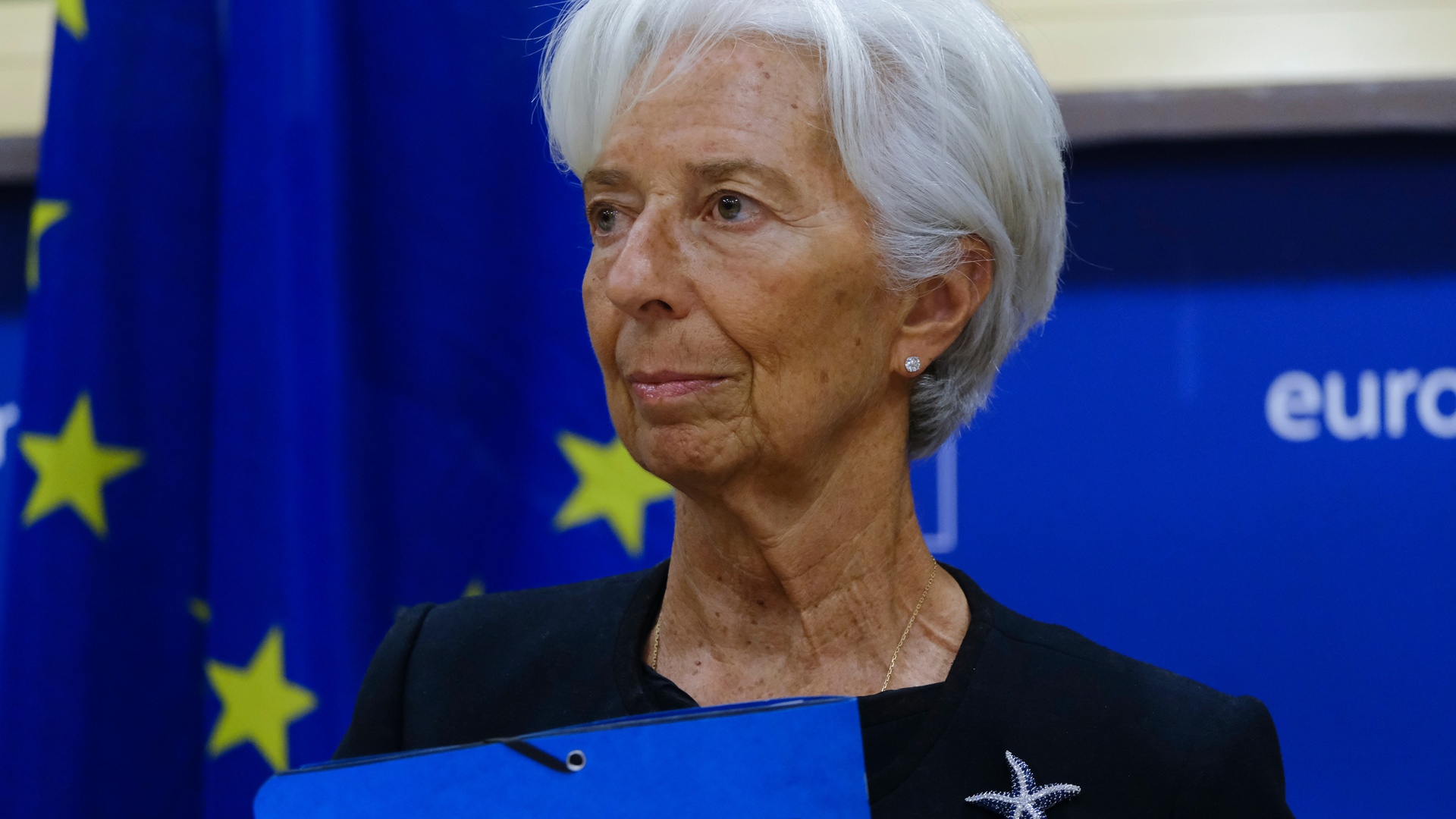
European Central Bank President Blocked Binance’s EU Entry: Report
European Central Bank President Christine Lagarde stopped Binance from operating in the European Union, according to a Wall Street Journal report.
The newspaper on Thursday reported that the top crypto exchange was on the cusp of operating in the trading bloc but then was told it couldn’t after the central bank chief waded in.
EU law requires that local Crypto-Asset Service Providers (CASP) have a MiCA license. Binance does not. Binance in June withdrew its MiCA application in Greece.
“Lagarde wanted to keep the controversial crypto exchange, which pleaded guilty to financial-crime violations in the U.S., out of the European Union,” the newspaper report said, citing interviews with officials.
Lagarde has long been anti-Bitcoin and pro-central bank digital currencies. Back in 2021, Lagarde said that the leading cryptocurrency was “a highly speculative asset” used for money laundering. She also criticized cryptocurrencies as a whole and said central banks would never hold bitcoin.
On CBDCs, though, Lagarde takes a different approach. A CBDC is a digital form of fiat money, like the US dollar or euro; nations around the world are in different stages of researching and releasing them.
The EU under Lagarde is fast moving forward with a digital euro. Lagarde has described the digital euro as key to Europe’s financial autonomy while taking aim at privately issued stablecoins.
CBDCs have been criticized by bitcoiners and others in the crypto industry who think they could be used to surveil citizens. U.S. President Donald Trump signed an executive order banning CBDCs when he took office.
The WSJ report added, citing various interviews, that Lagarde was worried Binance would embed the dominance of dollar-based stablecoins in Europe, instead of encouraging euro counterparts.
Binance is the world’s biggest crypto exchange and billions of dollars in stablecoins are traded on its platform daily.
A controversial company, Binance and its CEO, Chanpeng Zhao, in 2023 pleaded guilty to anti-money-laundering violations and paid a record $4.3 billion fine.
Binance in June said it was still working to pursue MiCA authorization in another EU Member State.
This post European Central Bank President Blocked Binance’s EU Entry: Report first appeared on Bitcoin Magazine and is written by Mathew Di Salvo.
Bitcoin Magazine
CFTC Sends Proposal To Regulate Crypto Transactions Following Clarity Act Fail
The Commodity Futures Trading Commission on Thursday sent a proposal to the White House to regulate crypto transactions and markets.
It isn’t clear what the regulations will look like from the post on the Office of Management and Budget’s website. The proposal is titled “Regulation Crypto Asset Transactions and Regulation Crypto Asset Markets.”
The CFTC’s move comes after lawmakers blocked the long-awaited crypto legislation Clarity Act on Tuesday. Despite the law not advancing, both the CFTC and Securities and Exchange Commission have said they would go ahead with crypto rulemaking anyway.
CFTC Chair Mike Selig said on Wednesday that while the Clarity Act didn’t move forward, the watchdog would still help U.S. President Trump “get the job done” in regulating the crypto space.
“The outcome of yesterday’s Senate vote was unfortunate,” Selig wrote on X, adding that the CFTC was “locked in and ready to ship its rules for the new frontier of finance.”
Before the procedural vote on the legislation this week, Selig had said would proceed with rulemaking whether or not the Clarity Act is enacted — with the aim of finalizing rules before the administration’s term is out.
Senators last year approved Selig as the regulator’s chair. Formerly chief counsel at the SEC’s Crypto Task Force, Selig was described by White House’s Crypto and AI Tsar, David Sacks, as “instrumental in driving forward the President’s crypto agenda”
President Trump campaigned on a ticket to help the crypto space after regulators under the previous administration hit digital asset businesses with lawsuits — mostly for allegedly selling unregistered securities.
Since Trump became president, the SEC and CFTC have taken a much friendlier approach to watchdogging the space.
The CFTC isn’t the only regulator going ahead with rulemaking: the SEC earlier this week approved tokenized stocks trading. In August, it also proposed its own framework for crypto asset offerings, pressing ahead while the landmark legislation stalled.
President Trump last month urged lawmakers to pass the Clarity Act, calling the legislation “very powerful” — but Republicans said that Democrats were deliberately holding it back.
Democrats mainly took issue with the ethics side of the bill. Trump received backing from major industry players while campaigning and since becoming president, his family has made money from digital asset ventures.
Some lawmakers have alleged conflicts of interest. The White House has always denied any wrongdoing.
A new draft of the bill started circulating in July tackling the issue of ethics and banning officials from making money from crypto. But some Democrats said it didn’t go far enough.
The Clarity Act wants to formally divide oversight between regulators, distinguishing which digital assets are securities, commodities or stablecoins.
This post CFTC Sends Proposal To Regulate Crypto Transactions Following Clarity Act Fail first appeared on Bitcoin Magazine and is written by Mathew Di Salvo.
Bitcoin Magazine

Bitcoin Price Surges Over $81,000 Despite Clarity Act Fail and Interest Rate Hike
Bitcoin’s price on Friday shot above $81,000 — despite a week of setbacks for the crypto industry.
The biggest coin was recently trading for $80,982, after jumping as high as $81,055 at one point Friday morning in New York. Over the past 24 hours, it has risen by nearly 6%.
Its surge comes after lawmakers on Tuesday blocked long-awaited crypto legislation, the Clarity Act, and the Federal Reserve on Wednesday hiked interest rates.
JUST IN: Bitcoin surges to $81,000
— Bitcoin Magazine (@BitcoinMagazine) September 18, 2026pic.twitter.com/EQi5apUlxU
Digital asset industry bigwigs had long called for clear rules to regulate the crypto space and the Clarity Act — which wants to divide oversight between regulators — aimed to do that. But lawmakers blocked the landmark digital asset market structure bill in a procedural vote.
And the Federal Reserve increased borrowing costs for the first time due to skyrocketing inflation in the U.S. The central bank’s chair, Kevin Warsh, said that price stability in the U.S. was the Fed’s number one priority.
“The plain fact is that inflation is too high, and has been for too long,” Warsh said. “This summer’s inflation readings do not tell me that underlying trends have meaningfully improved.”
Bitcoin has in the past done well in a low interest rate environment because it means there is more liquidity to trade the asset.
While Bitcoin’s price dipped initially news of the Clarity Act blockage and Fed’s move, it shot up on Friday.
Bitcoin exchange-traded funds in the U.S. have so far this week experienced net negative flows, with investors cashing out nearly $427 million from the vehicles, according to Farside Investors data.
Flows on Thursday turned positive, with investors chucking nearly $160 million at the funds following two days of consecutive outflows.
In a research note Thursday, asset manager Grayscale said that it didn’t expect bitcoin’s price to be hurt by the Fed’s decision because the move reflects a mid-cycle adjustment, not a cyclical change.
And despite lawmakers blocking the Clarity Act, regulators like the SEC are already pushing ahead with pro-crypto regulation.
This post Bitcoin Price Surges Over $81,000 Despite Clarity Act Fail and Interest Rate Hike first appeared on Bitcoin Magazine and is written by Mathew Di Salvo.
Bitcoin Magazine

Bitcoin Community Recognizes Quantum Computing Risk: VanEck
Quantum computing is a risk to Bitcoin but the community recognizes the issue, according to asset manager VanEck’s Head of Digital Assets Research.
Speaking to CNBC on Friday, Matthew Sigel said that while progress on addressing the issue may be slow because of the crypto network’s decentralized nature, the community was working on it.
The crypto community has sounded the alarm about hypothetical advancements in quantum computers that could in the future be able to break Bitcoin’s cryptography.
Some in the space — including Bitcoin developers — have started preparing for a post-quantum future by testing quantum-resistant signatures on live sidechains.
“It’s a risk,” he said. “But the community has recognized the scope of the issue. There’s a lot of talent that’s now come together with a framework of how to upgrade the system.”
He added: “The upgrades don’t happen as fast because there’s no CEO who can tell the devs, ‘hey, do it now.’ There’s a governance process — it takes more time, it’s a little bit messier, but there are technological paths for quantum resistance, and I think you’ll see more of that over the next couple of years.”
Quantum computers do exist but make mistakes and a machine that can break Bitcoin’s cryptography currently does not exist. Bitcoin currently is the biggest computer network in existence.
Major companies in the space — including America’s biggest crypto exchange, Coinbase, and Bitcoin infrastructure firm, Blockstream — are already working on solutions.
Back in July, Coinbase said it plans to deliver a post-quantum signing pipeline using secure enclaves and threshold cryptography.
A Bitcoin Security Consortium — made up of BlackRock, Fidelity Digital Assets, Block, and others — formed in July and donates funds and dedicates engineers to open-source work supporting proposals like BIP-360, which aims to introduce a new transaction output type to reduce long-exposure quantum computing risks.
This post Bitcoin Community Recognizes Quantum Computing Risk: VanEck first appeared on Bitcoin Magazine and is written by Mathew Di Salvo.
Bitcoin Magazine

The Next 3-5 Years of Bitcoin Lending
SALT Lending CRO Hunter Albright says a growing number of Bitcoin holders may eventually borrow against their bitcoin rather than sell it, creating a new relationship between bitcoin, credit and stablecoins.
Bitcoin-backed lending could become an increasingly important part of how holders access the value of their bitcoin without selling it, according to Hunter Albright, Chief Revenue Officer of SALT Lending.
Speaking on BMTV, Albright said he expects borrowing against bitcoin to become more common as the market matures and holders become more comfortable using bitcoin as collateral.
“I’d like to think we will see a growing percentage of the population of bitcoin holders borrow against it,” Albright said.
For Albright, that shift could also change how bitcoin and stablecoins function alongside one another.
“I do believe people borrowing against their bitcoin and leveraging stables is the difference between money in motion and money at rest,” he said. “The speed of conversion really creates a utility and advantage for people willing to operate in that ecosystem.”
In that framework, bitcoin increasingly becomes “money at rest” – an asset held for the long term – while stablecoins serve as “money in motion,” providing liquidity that can be transferred and used more easily without requiring holders to sell their bitcoin.
A Behavioral Shift for Bitcoin Holders
Getting there, however, will require more than simply building lending products.
Albright said greater education around both Bitcoin itself and the mechanics of borrowing against bitcoin will be necessary before the behavior becomes mainstream – something SALT Lending has made part of its own efforts in the market.
It also requires a change in how Bitcoin holders think about the value stored in their assets.
Instead of viewing bitcoin only as something to accumulate and eventually sell, holders can potentially use it as collateral to access liquidity while maintaining their bitcoin exposure.
That model is already common elsewhere in finance, where owners of real estate, equities and other assets regularly borrow against their holdings rather than liquidating them.
For Bitcoin holders, there can also be tax advantages. In the U.S., borrowing against an asset generally does not itself constitute a taxable sale, whereas selling appreciated bitcoin can trigger capital gains taxes. Individual tax consequences depend on the structure of the transaction and the borrower’s circumstances, readers should consult a tax advisor.
Albright sees that combination – long-term bitcoin holdings, growing stablecoin adoption and easier access to credit – as part of a broader shift in how Bitcoin holders may eventually use their wealth.
Rather than bitcoin needing to move every time its value is put to use, bitcoin can remain at rest while liquidity moves around it.
SALT Lending is the Official Liquidity Sponsor of BMTV. Learn more about borrowing against your bitcoin and explore SALT’s BMTV offer at https://saltlending.com/bmtv/?utm_source=bmtv&utm_medium=article&utm_campaign=52783658-BMTV%20article&utm_term=BMTV
Disclaimer: SALT Lending is a paid sponsor of BMTV and serves as BMTV’s Official Liquidity Sponsor. This article is sponsored content and does not necessarily reflect the views or opinions of Bitcoin Magazine. The information provided is for promotional purposes and should not be considered financial advice. Readers are encouraged to conduct their own research before making any investment decisions related to Bitcoin or other financial products mentioned herein.
This post The Next 3-5 Years of Bitcoin Lending first appeared on Bitcoin Magazine and is written by Josh Plischke.
CryptoSlate
The Bank of England has committed to remove £368 billion of gilts held for monetary-policy purposes by September 2034, even as the first market response pointed toward easier conditions in long-dated UK debt.
The figure covers the portfolio left after the Bank separated £120 billion of longer-dated gilts to back banknotes. The Monetary Policy Committee said the remaining stock will fall by an average £46 billion a year through bond maturities and £20 billion of annual active sales.
Quantitative tightening shifts bonds from a central bank's balance sheet toward private investors. That can lift the extra yield investors demand to hold longer-dated debt, tightening financial conditions even when the policy rate stays unchanged.
The rate and balance-sheet decisions were separate votes. Six MPC members kept Bank Rate at 3.75%, while Megan Greene, Catherine Mann and Huw Pill preferred an increase to 4%. All nine members backed the multi-year gilt unwind.
Bitcoin and the slow-burn tightening channel
Implementation begins with fewer active sales to the market. The Bank's market notice said APF auctions will pause while it reviews a possible arrangement involving HM Treasury and the Debt Management Office. Operational details are due by April 2027, and the sales-to-Government model remains subject to a final decision. Gilts will continue to mature.
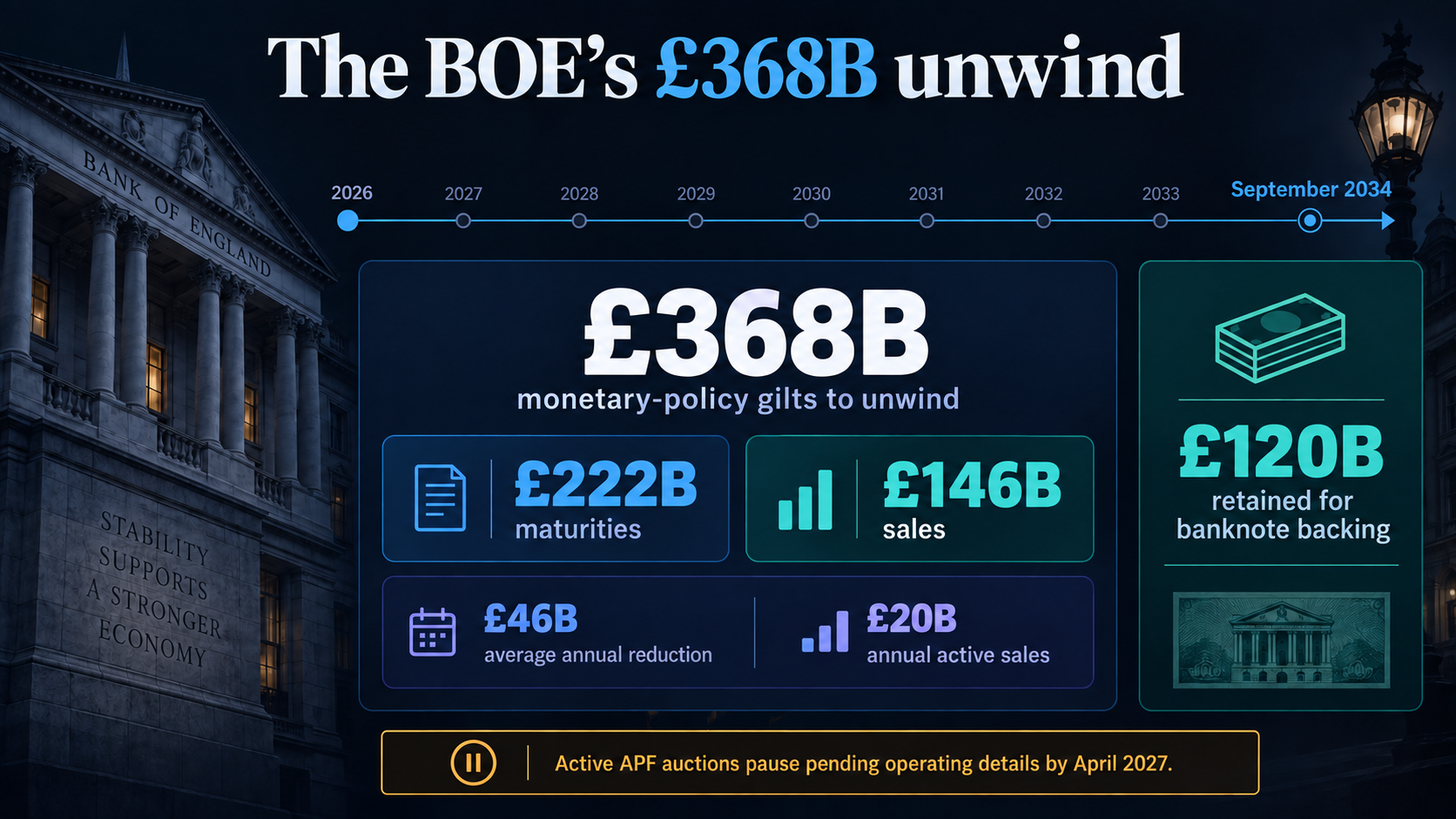
The planned sales pace is close to recent practice. The Bank sold £21 billion over the previous 12 months, compared with £20 billion a year under the new plan. Average total runoff, including maturities, falls to £46 billion from the previous year's £70 billion reduction.
Reuters reported that the 10-year gilt yield fell more than 7 basis points and the 30-year yield nearly 10 basis points by early Thursday afternoon. The Bank's yield-curve data provide the broader rates backdrop, though one trading session cannot identify how much each policy detail contributed.
The BOE also sees the cumulative QT effect as modest. Its July assessment estimated that QT accounted for 20 to 30 basis points of an approximately 200-basis-point rise in long-term gilt term premia since 2022. Global uncertainty, heavy sovereign issuance and structural changes in UK demand explained most of the increase.
Bitcoin's connection runs through the same broad rates and risk-appetite channel. IMF research found that US monetary tightening can depress a common crypto-market factor. The finding concerns US shocks, so it offers a limited analogy for the BOE plan rather than evidence of a UK-driven Bitcoin move. Earlier CryptoSlate analysis similarly described the opposing pressures from tighter liquidity and demand for assets outside sovereign finance.
Bitcoin traded near $78,000 on CryptoSlate on Friday, with Coinbase showing a similar level. Both were rolling snapshots and cannot isolate a reaction to Thursday's announcement.
The BOE's decision therefore creates a long-run test: whether predictable central-bank withdrawal adds enough pressure to global yields and risk appetite to reach Bitcoin, while the auction pause and falling gilt yields make the first response comparatively mild.
The post Bitcoin faces an eight-year rates test as the BOE unwinds £368 billion appeared first on CryptoSlate.
The Bank of Japan announced a policy-rate increase to about 1.25% on Sept. 18, yet the visible Bitcoin and currency response showed limited signs of a disorderly yen-carry unwind.
The BOJ voted 7-2 to lift its target for the uncollateralized overnight call rate by 25 basis points, from about 1% to about 1.25%. The new target and related facility rates take effect Sept. 24, so the decision changed the policy path before it changed the official operating rates.
That separates a scheduled funding-cost change from the market’s reaction to the announcement. Positions can adjust before implementation, and the BOJ’s next signal could matter as much as Sept. 24 because the bank tied further increases to its economic and inflation outlook instead of a fixed timetable.
That distinction matters for yen-funded trades. Investors can borrow yen to buy higher-returning assets elsewhere. A higher Japanese rate reduces the trade’s interest-rate advantage. If the yen appreciates, overseas borrowers must buy a more expensive currency to repay yen-denominated debt, increasing repayment costs in their home currency. Both forces can pressure leveraged risk positions, including crypto exposure.
The available evidence leaves the amount of Bitcoin exposure financed in yen unquantified. Coinbase Institutional’s review of the 2024 carry episode identified several simultaneous catalysts, including weak US economic data and pressure on technology stocks. Yen funding is one transmission channel among several that can shape crypto moves.
Bitcoin’s first response stayed orderly
At the BOJ’s 02:54 UTC release time, Coinbase one-minute data put Bitcoin’s closing price at $76,961. At 03:30 UTC, the one-minute close was $77,383. Bitcoin rose across those 36 minutes and continued throughout the day to reach as high as $81,000 intraday.
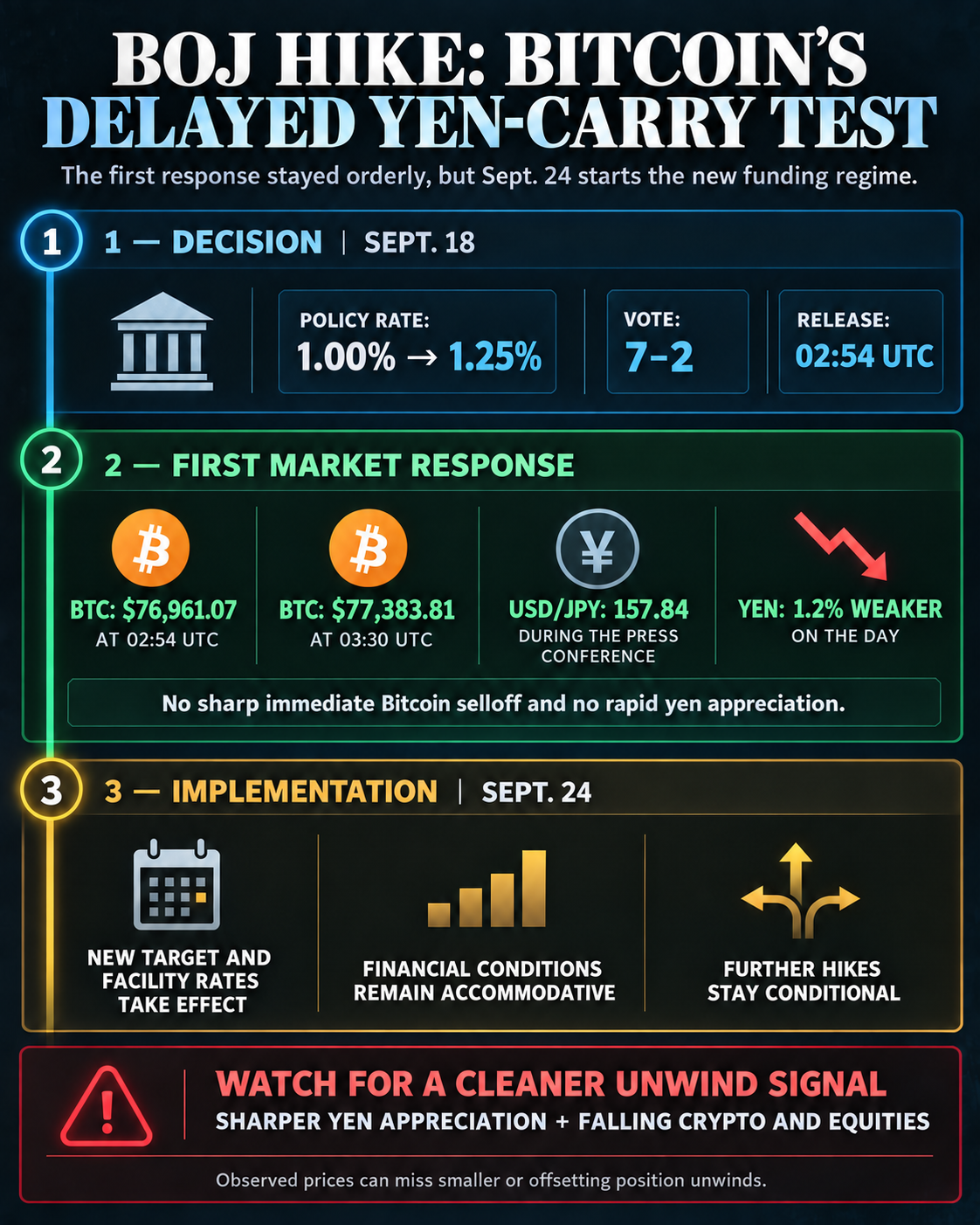
The currency move also ran against the simplest carry-unwind pattern. Reuters reported that the dollar climbed to a two-week high of 157.84 yen during BOJ Gov. Kazuo Ueda’s press conference, leaving the Japanese currency 1.2% weaker on the day. A visible synchronized unwind would more likely pair rapid yen appreciation with falling risk assets.
The initial reaction points to limited immediate unwind pressure in the observed markets. Longer-term risk remains open as the new rate takes effect and the BOJ considers its next steps.
The BOJ said financial conditions would remain accommodative, while retaining a conditional path toward additional rate increases if its economic and inflation outlook is realized. Sept. 24 starts implementation of the new setting. More diagnostic warnings would be sharp yen appreciation alongside falling crypto and equities, or a fresh signal that the BOJ will tighten again sooner than markets expect.
The post Bitcoin rallies after BOJ’s 1.25% hike, but the real yen-carry test starts next week appeared first on CryptoSlate.
Dtcpay, a Singapore payments company, has completed a $25 million Series A with SBI Group joining as a strategic investor, giving its stablecoin payments business fresh backing for product and merchant expansion.
The company announced the close on Sept. 18, naming SBI Ventures Asset Pte Ltd and the SBI-NTU-Kyobo Digital Innovation Fund as the Japanese group's investment vehicles. Genedant Capital and existing investor Kwee Liong Tek also participated. Vertex Ventures Southeast Asia & India led the initial tranche.
The funding will support a revamped business portal for enterprise customers, additional consumer features in the dtcpay app and expansion of its merchant network, the company said. Those priorities put the financing behind the tools businesses and customers use to transact, as dtcpay seeks to widen the use of stablecoins in everyday commerce.
The $25 million figure is the total Series A, rather than the size of SBI's investment alone. Dtcpay did not disclose its valuation or the amounts contributed by individual investors.
In the announcement, SBI Ven Capital CEO Eiichiro So described the investment as the start of a strategic partnership. He linked it to SBI's ambition to expand digital-asset origination between Japan and Southeast Asia through regulated financial infrastructure.
The investment connects SBI's regional ambitions with dtcpay's existing payment business. Dtcpay's stated priorities include deeper financial-institution relationships and further product development, alongside merchant expansion. SBI's participation adds a strategic investor to that effort, although the announcement does not allocate individual funding amounts to those objectives.
The cross-border ambitions remain plans for the partnership; the announcement did not include a date for a dtcpay launch in Japan.
Dtcpay founder and CEO Alice Liu framed the financing around changing how money moves across borders. Co-founder and group chairman Band Zhao identified stronger infrastructure, deeper financial-institution partnerships and entry into additional regulated markets as priorities.
SBI's participation follows the earlier Vertex-led financing. Vertex published an announcement on March 17 describing a $10 million Series A for dtcpay. That release already set out product improvements and European expansion as objectives, putting the latest close within an existing international growth plan.
Funding the products around stablecoin payments
Dtcpay says its infrastructure lets businesses and individuals accept, store and transact in stablecoins, with a swap engine connecting stablecoin and fiat settlement. Its product range includes direct merchant acceptance and card-based spending, giving customers different ways to use digital balances.
The company identifies Singapore department store Metro and hospitality business Capella Singapore among its commerce relationships. It also describes an integration with WalletConnect. These examples show the types of retail and payment connections the company is building on as it expands its merchant network.
Its Visa card offers another route to spending. Dtcpay says the card enables transactions across fiat currencies and stablecoins at more than 150 million merchant locations worldwide. That figure describes card acceptance reach, not the number of merchants directly signed up to accept stablecoins through dtcpay.
Direct merchant acceptance and card spending give dtcpay two channels for reaching customers. The release describes both as part of its business but provides no payment-volume figures, leaving the scale of activity through those channels undisclosed.
Dtcpay describes its regulatory footprint as including a Major Payment Institution license from the Monetary Authority of Singapore and an Electronic Money Institution license in Luxembourg. Both were described in the earlier Vertex announcement, which connected the Luxembourg license to plans for European market entry.
The funding follows that earlier push toward European market entry and adds SBI's stated Japan and Southeast Asia ambitions. Dtcpay's near-term product priorities remain the enterprise portal and consumer app, alongside its merchant network. The announcement ties the financing to those practical improvements without specifying how the capital will be divided between products and markets.
The post Why SBI just put millions behind a Singapore startup’s stablecoin push appeared first on CryptoSlate.
The UK Financial Conduct Authority says overseas crypto providers can fall inside the country's incoming authorization regime when they serve British consumers, even when the business is established abroad.
A “UK consumer” for this purpose means an individual in the UK acting outside a trade, business or profession. The definition is a statutory territorial concept and can differ from client categories elsewhere in the FCA Handbook.
The regulator published its final cryptoasset perimeter guidance on Sept. 16. It explains when firms carrying on the new regulated cryptoasset activities may need FCA authorization from Oct. 25, 2027. The application window opens Sept. 30, giving overseas platforms, custodians and staking providers less than two weeks to map how UK consumers reach their services.
Consumer access sets the boundary
Under the FCA's territorial guidance, a business first applies ordinary territorial principles. Section 418 deeming provisions can then bring certain activities involving a UK consumer within the perimeter when the provider is established overseas.
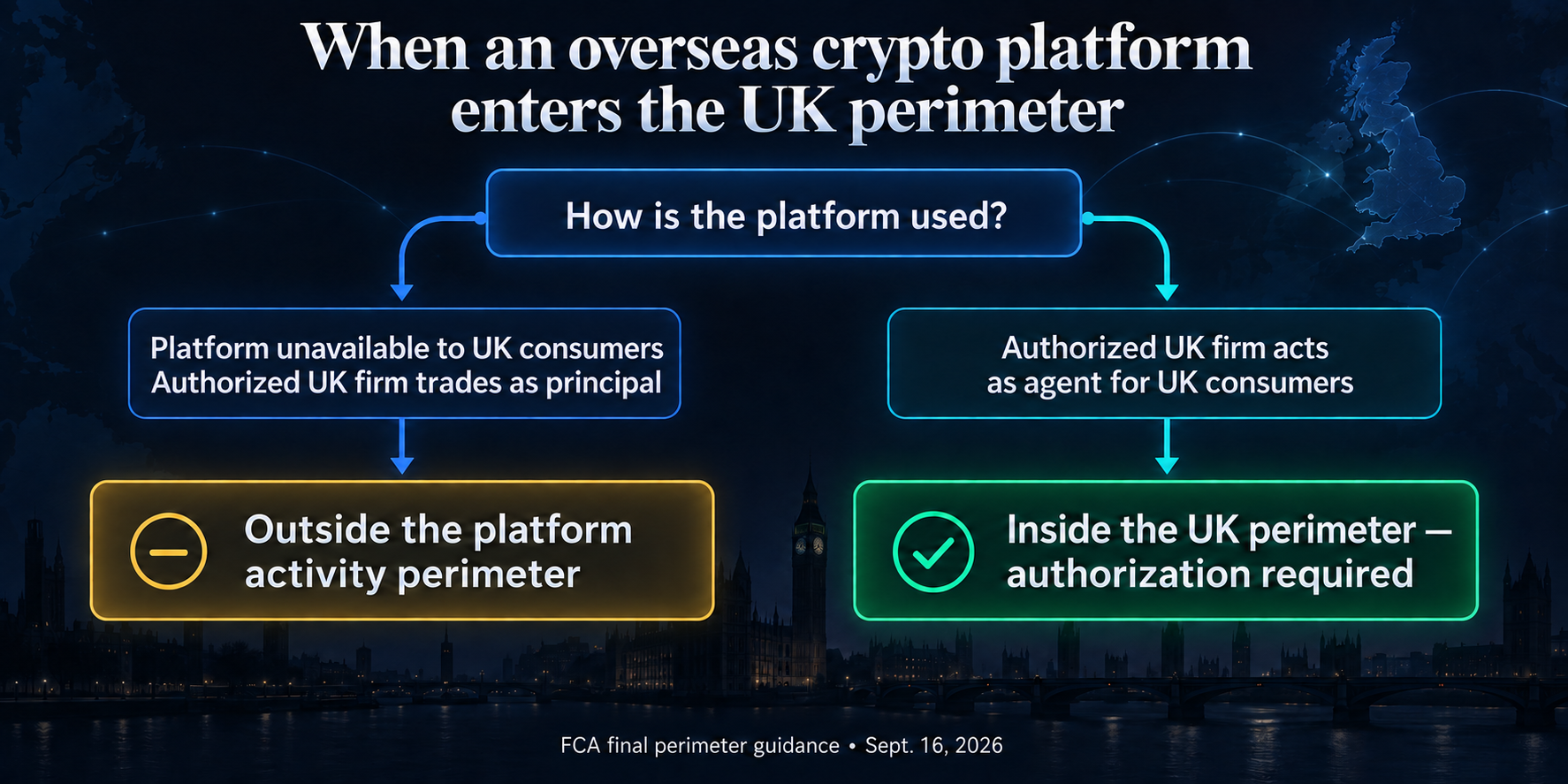
The FCA gives two outcomes for an overseas qualifying cryptoasset trading platform. A platform unavailable to UK consumers remains outside the platform activity perimeter when an authorized UK firm trades on it as principal under the relevant permission.
The overseas operator falls inside the perimeter when that authorized firm instead accesses the platform as agent for UK consumers. The platform guidance says the operator then requires authorization. Consumer access and the UK firm's trading capacity determine the result in this example.
Other services have activity-specific conditions. An overseas provider safeguarding cryptoassets or arranging staking for a UK consumer can be deemed to operate in the UK when it acts independently of a person authorized for that activity. Acting at the authorized person's direction places the arrangement outside that deeming provision.
Automated-protocol interfaces require case-specific assessment. The FCA focuses on whether an identifiable person carries on the elements of a regulated activity by way of business in the UK.
Applications for transitional arrangements run from Sept. 30, 2026 through Feb. 28, 2027. The new activities enter the perimeter on Oct. 25, 2027. Automatic conversion of existing registrations and permissions is unavailable, so an already authorized firm may need to vary its permission when its current scope omits the new activities.
The boundary depends on each service's functions and structure. PERG explains the FCA's interpretation of legislation and lacks binding force in court, leaving exchanges, custodians, staking services and DeFi interfaces to apply the guidance to their particular facts.
The post FCA draws the UK boundary for offshore crypto platforms ahead of 2027 rules appeared first on CryptoSlate.
A routine Radix code refactor created a vault flaw that enabled a roughly $1.3 million theft and later forced validators to halt the blockchain.
The Radix Foundation said Sept. 17 that an RDX Works development team introduced the defect during a June 2023 cleanup of the Radix Engine, the software layer that executes transactions and enforces asset ownership across the network. The vulnerability remained undetected for more than three years before an attacker exploited it on Aug. 31.
A community reconstruction of the ledger shows the attacker withdrew about 458,915 USDC, 72,420 USDT, 61.08 ETH, 6.35 wrapped Bitcoin, 536.16 SOL and 32.91 BNB across 26 transactions. The assets were worth roughly $1.26 million using Aug. 31 market prices, and the attackers took another 13,000 XRD from a vault to pay transaction fees. The two stablecoins alone accounted for about $531,335.
The stolen assets were sent through Hyperlane to Ethereum, BNB Chain, and Solana, then sold for ETH, Radix said. Hyperlane itself operated as designed: the attacker had already obtained the assets through the Radix Engine before using the bridge to move them elsewhere. No private keys were compromised.
However, the immediate loss understated the potential exposure. Radix investigators concluded the flaw could have been used against any vault on the network, putting tokens and other assets beyond the bridged holdings targeted by the attacker at risk.
As a result, network validators deliberately took enough stake offline to prevent it from reaching consensus and stopping additional transactions while developers worked on a fix.
Radix audit miss turns maintenance bug into systemic failure
The vulnerability had already survived an independent security review before the attacker found it.
Zellic audited the Radix protocol in 2024, including the engine kernel containing the defect. The review did not detect the authorization flaw, even though the vulnerable code had been introduced during the previous year's refactor.
The bug changed how the engine handled vault references. A transaction could identify another user's vault by its internal address and pass that reference into purpose-built smart-contract code. The engine then allowed ordinary withdrawal functions to be called without properly enforcing the ownership boundary that should have rejected the request.
That gave the attacker access to assets held by user accounts, applications and liquidity pools without obtaining the owners' signatures.
The Foundation said the attacker completed 26 exploit transactions between 16:02 and 16:57 UTC on Aug. 31. Once investigators determined the vulnerability existed in the execution layer rather than a single application, validators coordinated to stop transaction finalization.
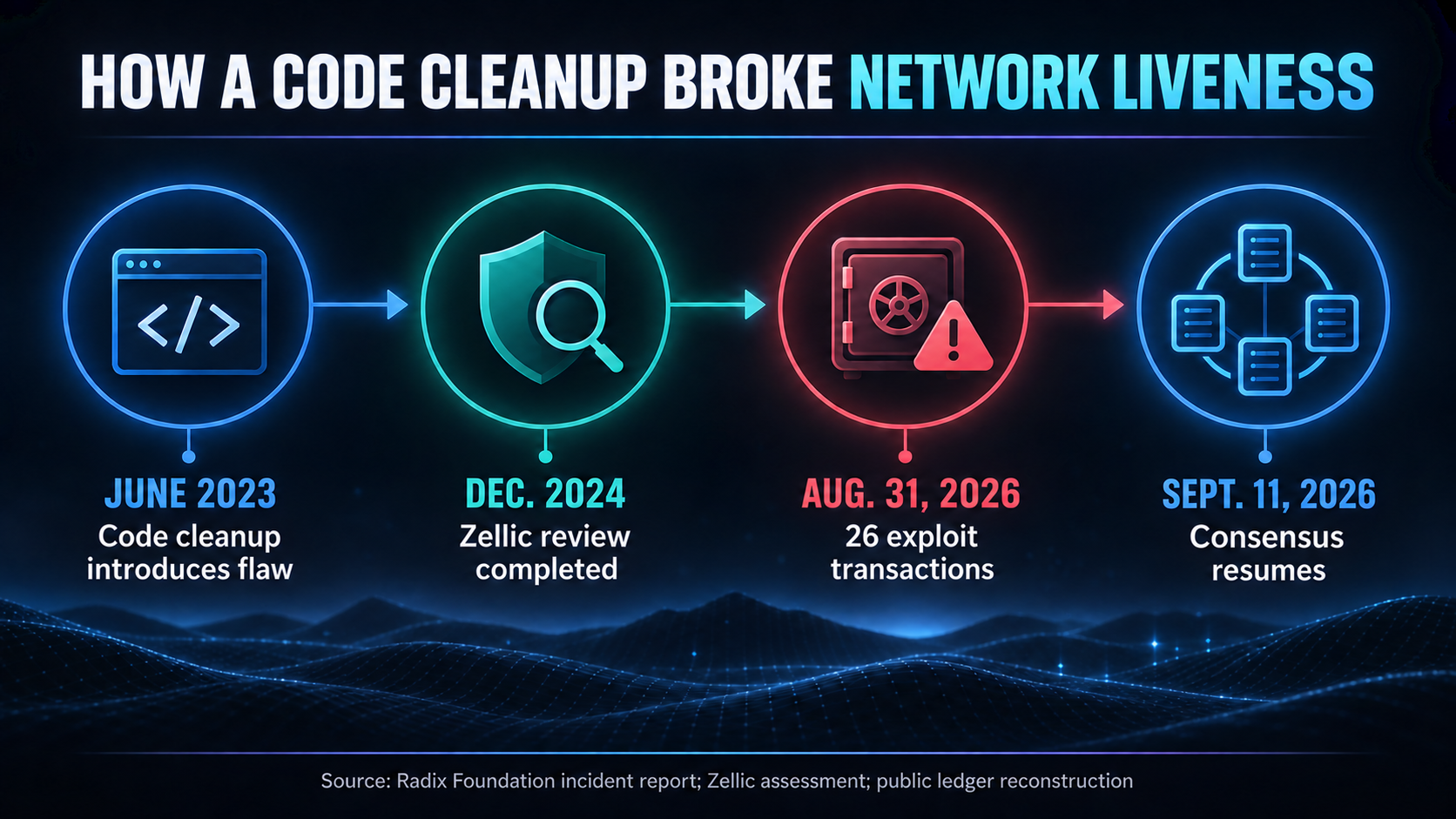
The halt lasted more than 10 days. A protocol fix added checks preventing a restricted vault reference from being used for an ordinary withdrawal, and user transactions resumed Sept. 11, according to the community ledger reconstruction.
The incident also produced secondary losses in liquidity pools after the attacker removed bridged assets from one side of trading pairs. The distorted prices allowed another account to extract millions of XRD from affected pools, showing how an execution-layer failure can keep causing economic damage even after the initial assets have left the network.
Radix said it is adding regression tests, strengthening its security review process, and formalizing the emergency procedure validators used to break network liveness.
The Foundation also said future security work must account for increasingly capable AI-assisted code-analysis tools, which it believes may have helped the attacker identify the years-old defect.
For developers and validators, the next challenge is preventing similarly routine maintenance work from silently altering security assumptions that external audits may miss.
That task extends beyond repairing the exploited code. Radix now has to strengthen the review process around changes to authorization logic while restoring confidence among users and liquidity providers whose assets ultimately depend on the engine enforcing those boundaries correctly.
The post 3-year-old bug triggers $1.3 million drain and forces 10-day blockchain halt appeared first on CryptoSlate.
CryptoTicker.io
NEAR rose to $3.68 on September 18, 2026, around 21 percent higher than 24 hours earlier. The trigger is documented and comes in two parts: near.com has launched confidential perpetual futures that run on Hyperliquid's infrastructure, and alongside it set off an incentive programme that puts 333,333 tokens in prospect. Payout only follows once the three-day average price reaches the $3.33 mark. For you in Germany, three practical questions hang on this: whether you can legally reach the product at all, what 40x leverage does to your position when it goes wrong, and how the tax office sorts incentive tokens and perp gains.
NEAR price on September 18, 2026: these are the documented figures
The data behind this article comes from CoinGecko's public market interface, retrieved on September 18, 2026 at 19:52 UTC. At that moment NEAR was quoted at $3.68. The 24-hour gain stood at 20.8 percent, and the trading range over the same period ran between $2.99 and $3.82. The 24-hour volume was $2.03 billion and market capitalisation $4.81 billion, which placed NEAR 23rd among the largest crypto assets by market value.
Anyone laying several sources side by side today will see different percentage figures, and that is not a contradiction but a feature of rolling time windows. Four minutes before the retrieval named above, the same interface returned $3.72 and a gain of 23.6 percent, because the 24-hour window then began at a different point. The trade publication The Crypto Times reported $3.50 and a daily gain of 30.8 percent on a volume of $1.79 billion on the same day, earlier in the trading session. What holds up is therefore the range: a daily gain somewhere between roughly 21 and 31 percent, depending on when it is measured.
Two figures put the jump in context. Over seven days NEAR is up 45.6 percent, over 30 days 120.3 percent. The rise did not begin today. At the same time the all-time high of $20.44 from January 16, 2022 still sits around 82 percent above the current price, calculated on the same CoinGecko values. Both perspectives belong together if you want to assess a position.
What is behind the NEAR price jump: confidential perps and an incentive programme
On September 17, 2026, near.com enabled trading in confidential perpetual futures. On the product page the provider advertises access to more than 50 markets and leverage of up to 40. The order books and the liquidity do not come from near.com itself, but through a direct connection to Hyperliquid. near.com contributes the confidential settlement of deposits and withdrawals.
Perpetual future: a futures contract without an expiry date
A perpetual future, perp for short, is a futures contract on a price which, unlike a classic future, has no fixed expiry date and can therefore run indefinitely. You deposit collateral, the margin, and trade a multiple of your stake with it. Because there is no expiry, a running settlement payment between the buy and sell sides keeps the contract price close to the spot price. That payment is called the funding rate.
Confidential means a hidden link, not a vanished position
The product page carries the sentence that nobody can trace a position back to you. That is a claim by the provider, and it is worth reading closely. What is hidden is the connection between a deposit address and a specific leveraged bet. The position itself continues to exist in Hyperliquid's trading environment and is liquidated there as well when the collateral no longer suffices. Confidentiality towards blockchain analysis is also something entirely different from confidentiality towards the German tax office, a point the tax section below returns to.
The technical basis for this is a service called NEAR Intents, which according to the provider's announcement now connects more than 30 chains. What is meant is a procedure in which you as the user state only the desired outcome, and so-called solvers handle the execution.

NEAR@3.33: how the incentive programme distributes the 333,333 tokens
The second part of the trigger is a programme the provider calls NEAR@3.33. The key terms are set out in an announcement dated September 17, 2026, 10:00 local time in New York. When the assets tied up in the confidential mode passed the $70 million mark, that set off a snapshot of the balances, the first-stage snapshot. In response, 333,333 so-called milestone tokens are distributed.
Eligible is anyone who held a confidential balance of more than $100 on the cut-off date and had carried out at least one confidential swap. A cap of two percent of the distribution applies per wallet, which is meant to limit concentration on a few large addresses. The tokens are claimed through near.com. The decisive point is the last condition: the milestone tokens remain locked and are only converted into tradable NEAR once the volume-weighted average price over three days reaches or exceeds $3.33.
Alex Shevchenko, general manager of NEAR Intents, is quoted in the announcement saying that confidentiality is rapidly becoming a core requirement of the industry. That is the provider's assessment of its own product, not an independent market observation.
Why the three-day average matters more than the spot price
This is where the programme becomes interesting for price formation. What counts is not the price you see on screen right now, but a volume-weighted average over three days. The VWAP, the volume weighted average price, weights each traded price by the corresponding volume and therefore reacts sluggishly to a single jump.
A look at CoinGecko's daily values shows how wide the gap is. On September 15 NEAR stood at $2.47, on September 16 at $2.34, on September 17 at $2.62, and the daily value of September 18 opened at $3.15. An average across the past three days therefore sits well below the $3.33 trigger, even though the spot price passed it long ago. The exact calculation is carried out by the provider itself, and the volume weighting can shift the result relative to these plain daily levels. The direction of the statement is unaffected by that.
From this follows a quirk you should know before you buy: the programme rewards a price that it helps to create itself. Anyone entitled to the locked tokens has an immediate interest in the average reaching the mark and staying there. Such feedback incentives can extend a move and can end just as abruptly once the distribution has happened and the reason to hold falls away. That is expressly not a forecast, but a description of the mechanism.
MiCA and Hyperliquid: what applies to your money without an EU licence
The near.com product page states that the perps are not available to US persons and in further restricted jurisdictions. As matters stand today, Germany is not among the excluded countries. Accessibility and regulatory protection, however, are two different things.
MiCA in one sentence
The EU Markets in Crypto-Assets Regulation, MiCA for short, requires providers addressing customers in the EU to hold authorisation from a European supervisory authority, and attaches to it obligations on own funds, custody and complaint handling.
Hyperliquid holds no such authorisation. We set this out in detail in our article using Hyperliquid from Germany of September 15, 2026. In practice that means there is no German complaints body, no deposit protection and no supervisor you can turn to if a withdrawal is stuck or a liquidation is disputed. If that framework is too thin for you, our comparison of regulated crypto exchanges lists the providers that can show a European licence. Anyone still looking for leveraged trading should know the cost models we set against each other in our overview of the best perp DEXs.
Leverage and liquidation: what 40x does to your position
Leverage of 40 means that 1,000 euros of collateral carries a position of 40,000 euros. The flip side is arithmetically inevitable: an adverse move of 2.5 percent in the underlying wipes out the entire stake on paper, because 2.5 percent of 40,000 euros is exactly those 1,000 euros. Liquidation, the forced closure by the trading platform, in practice sets in earlier, because a safety buffer is retained.
How little 2.5 percent means on this asset is shown by today's trading session itself. The range between $2.99 and $3.82 amounts to a move of around 28 percent within one day. A position with 40x leverage would have been knocked out several times in that window, in both directions.
Funding rate: the running fee that does not show up on the price chart
The funding rate is a settlement payment that flows between the long and short sides at short intervals and keeps the perp price glued to the spot price. In an overheated upward move the long side usually pays, because that is where the crowd is. These costs run regardless of whether your price moves in the right direction. The near.com product page gives no figures on this, which means you have to look up the actual rates in the application yourself before your first trade.

Buying from Germany: exchange, custody and staking in view
For the simple case in which you want to hold NEAR and use no leverage, today's news changes little about the procedure. You buy through an exchange licensed in the EU and then decide on custody. A balance at the exchange is convenient and remains a claim against a company. Your own wallet shifts the responsibility to you and to how you secure your keys. Which trading venues can show a European licence and at what fees they work is set out in our overview of regulated crypto exchanges.
NEAR runs on a proof-of-stake procedure, so you can delegate tokens and receive ongoing rewards for it. Bear in mind that staked tokens are subject to a notice period depending on the provider and cannot be sold immediately in a fast market. Anyone taking today's jump as an occasion to build a position should first answer the question of whether the coins need to be available within minutes if things turn.
We produced an assessment of the value independent of the day's news in August; the question of whether NEAR is a good buy at the prevailing price is answered there on the data available on August 27, 2026, and therefore before this move.
Tax on NEAR, incentive tokens and perp gains: three separate pots
The three things coming together today are treated differently for tax purposes. Drawing that distinction cleanly saves you work and queries later on.
If you buy and sell NEAR in your own holdings, it is a private disposal transaction under section 23 of the Income Tax Act. After a holding period of one year the gain is tax free; below that your personal tax rate applies. Since 2024 an exemption limit of 1,000 euros per year applies to all private disposal transactions taken together. If it is exceeded by one euro, the entire gain is taxable, because an exemption limit works differently from an allowance. The administrative view on this is set out in the Federal Ministry of Finance circular of May 10, 2022, in the supplemented version of March 6, 2025.
If incentive tokens such as the 333,333 milestone tokens accrue to you, that is not covered by the above. Tokens that accrue to you for an activity or for holding are regularly valued by the tax administration at their market value at the time of accrual, and that value is taxable in the year of accrual. With a programme whose distribution is tied to a price condition, there is the additional question of when accrual takes place at all: at the time of the snapshot, of the claim, or of the actual conversion into tradable tokens. That classification depends on the contractual terms in the individual case and belongs in the hands of a tax adviser. Until then, document the date, quantity and price of every accrual without gaps.
Gains from perpetual futures fall into a third pot. Forward transactions are charged under section 20 of the Income Tax Act with the flat-rate withholding tax of 25 percent plus the solidarity surcharge, and there is no holding period there. Whether a perp traded on a decentralised platform falls under that provision in every case is disputed among specialists. What is certain is the practical side: with a provider that has no German paying agent, nobody withholds tax for you. The declaration runs through the KAP annex, and you have to supply the evidence yourself. This is exactly where the advertising claim of confidentiality becomes a trap if you misunderstand it. A hidden link on the blockchain releases you from not a single tax obligation. Which tools automatically consolidate transactions and keep count of holding periods is shown in our comparison of crypto tax tools.
Levels above and below: what to anchor your next step to
Instead of price targets plucked from the air, it is worth looking at levels that come from documented data. On the upside that is first of all the daily high of $3.82 from September 18, 2026. Above it begins new ground out of this move, and the next reference point lies far away at the all-time high of $20.44 from January 2022.
On the downside three values are within reach. The daily low of $2.99 marks the point at which today's jump began. The daily value of September 17 at $2.62 corresponds to the level before the announcement. And the programme mark of $3.33 is special in that below it the incentive for those entitled persists, while above it selling pressure can arise once conversion has taken place. None of these values is a prediction. As points on which to anchor your own decision, they serve better than waiting for a round number.
If you take a position, set in advance the price at which you will give it up again, and write it down. That sounds banal and, in a move with a daily range of 28 percent, is the difference between a decision and a reaction.
Checking the NEAR price jump: what to take away
- Separate the trigger from the valuation. The jump has a documented cause, a new product and an incentive programme with a price condition. Whether NEAR therefore belongs in your portfolio is a different question. Buy through a trading venue with an EU licence; the providers are listed in our comparison of regulated crypto exchanges.
- Work through the leverage before you use it. At 40x, an adverse move of 2.5 percent consumes the stake on paper, and today's daily range was around 28 percent. Compare fees and funding models beforehand in our overview of the best perp DEXs.
- Set up your bookkeeping before the tokens accrue. Holding period, exemption limit and the KAP annex concern three different matters. Record the date, quantity and price of every accrual; the right tools are listed in our comparison of crypto tax tools.
The primary sources for this article are the product page for near.com's confidential perpetuals and the announcement on reaching the $70 million mark and on the NEAR@3.33 programme of September 17, 2026.
(As of September 18, 2026. This article is not investment advice. Prices and fee structures change; check the terms with the provider before you buy.)
The CLARITY Act has failed in the US Senate, but the regulation of crypto markets in the United States is moving on, only by a different route. Instead of Congress, the supervisory agencies are now writing the rules: the derivatives watchdog CFTC filed two rule proposals of its own on September 17, 2026, and the securities regulator SEC opened trading in tokenised stocks on the same day. For investors in Germany nothing changes legally for now, because the EU regulation MiCA applies here. The prices of Bitcoin, XRP and other coins, however, feel the effect directly, as the past few days have shown.
The vote result, the CFTC and SEC filings and the price data are documented in this article. Where it turns to the consequences, this is a reading by our editorial team, and we mark it as such.
CLARITY Act fails in the Senate: the vote of September 15
On Tuesday, September 15, 2026, the US Senate voted on whether debate on the Digital Asset Market CLARITY Act could begin. According to CNBC, 50 senators voted in favour and 49 against. Sixty votes would have been needed. That hurdle is called cloture: with 60 votes the Senate ends a minority blockade and can negotiate a bill. Without it, a proposal never reaches a vote at all.
According to consistent reports, the bill failed not over the question of which agency supervises which crypto assets, but over a dispute about ethics rules for officeholders' crypto stakes. We summarised the background on the day of the vote in our article on the CLARITY Act vote.
What the CLARITY Act was meant to settle
The bill was meant to settle a question that has paralysed the US crypto market for years: is a token a security falling under the SEC, or a commodity for which the CFTC is responsible? That classification determines the obligations of exchanges, issuers and custodians. For XRP this very distinction was the subject of a legal battle for years, which is why the price reacted so sharply to the failure. We described how sharply in our article on the XRP price slide after the Senate vote.
Why the calendar now argues against a new law
The midterm elections are due in the United States on November 3, 2026. According to CNBC reports, senators leave Washington in early October and do not return until after the election. That leaves barely any time for a second attempt this year. The law firm analysis by the National Law Review reaches the same conclusion: in the short term the bill is effectively off the table, and progress is more likely to come through the agencies.

The CFTC rule filing: what the agency submitted on September 17
Two days after the failure in the Senate, the CFTC responded. It sent two rule proposals titled Regulation Crypto Asset Transactions and Regulation Crypto Asset Markets to the Office of Information and Regulatory Affairs. That White House body reviews new federal rules before they are published. CFTC chair Michael Selig had already instructed his staff earlier to draft a framework for crypto markets that works on the basis of existing powers, should Congress pass no law.
The content of the two filings is not yet public, and the CFTC did not comment on details. Review is followed by publication, comment periods and a further round of review. Industry reports expect months to pass before binding rules arrive, possibly into 2027.
SEC innovation exemption: tokenised stocks get a framework
Also on September 17, the SEC issued a time-limited exemption it calls the innovation exemption. Trading venues for tokenised US stocks, that is shares represented as tokens on a blockchain, may operate under conditions for five years without being licensed as a classic exchange. According to the SEC, volume limits apply, holders of the tokens must have the same rights as shareholders, and companies can object if their shares are traded as tokens without their involvement.
For investors in Germany this is above all a signal. Tokenised stocks are offered here too, though often as certificates or derivatives without genuine shareholder rights. How to tell the difference is set out in our article on how to check the rights attached to stock tokens.
Bitcoin, XRP and Ethereum: how the market responded to the Senate and the CFTC
The response could be read off the prices. On the day of the vote the market slid, and according to CoinDesk Bitcoin fell from close to $80,000. Three days later the picture has turned. According to CoinGecko data, Bitcoin stood at around $81,000 on the evening of Friday, September 18, a good 6 percent above the previous day. Ethereum gained 6.7 percent, XRP 7.2 percent and Solana 11.5 percent.
Our assessment: the market digested the news from the Senate within a few days and read the CFTC filing as a sign that regulation is advancing even without a law. The rise was amplified by the forced closure of bets on falling prices, which reached around $470 million within 24 hours according to CoinDesk. That explains the speed of the move, not its durability.

MiCA instead of CLARITY: what applies to crypto investors in Germany
In the EU, the question the CLARITY Act was meant to settle for the United States has already been answered. The Markets in Crypto-Assets Regulation, MiCA for short, has applied in full since the end of 2024. It governs what obligations providers have, how stablecoins must be backed and how client assets are to be held. Since the German transition period ended at the close of 2025, platforms serving clients in Germany need authorisation as a crypto-asset service provider. Whether a provider holds it is shown in the register of the European securities regulator ESMA.
For you that means: what is decided in Washington moves prices, but not your rights towards your exchange. Those depend on whether it holds a MiCA licence. Our comparison of regulated crypto exchanges gives an overview of licensed providers.
US crypto regulation: which dates count now
Three points matter in the coming weeks. First, publication of the CFTC proposals after the White House review, because only then will it be known which coins the agency intends to treat as commodities. Second, the first trading venues to offer tokenised stocks under the SEC exemption. Third, the midterm elections on November 3, which decide the majorities available for a fresh legislative attempt in 2027.
Our assessment: until then, news from the US agencies is likely to move the prices of XRP and other coins whose classification is contested more than technical developments do. Anyone trading with leverage in such phases risks being pushed out of the market by a single headline.
Tax in Germany: why US rules change nothing about the holding period
The taxation of crypto assets in Germany follows the Income Tax Act, not US law. Gains from a sale within one year are taxable as soon as all private disposal gains for a year exceed the exemption limit of 1,000 euros; after more than one year they are tax free. Neither the failure of the CLARITY Act nor a CFTC rule changes that. Anyone thinking about taking profits after this week's recovery should check the purchase date first, and with several purchases follow the FIFO principle.
CLARITY Act and the CFTC: what to take away
- Separate price moves from your legal position. US decisions move prices; your rights depend on your provider's MiCA licence. Licensed exchanges are listed in our comparison of regulated crypto exchanges.
- Trade regulatory news without leverage. Until the CFTC publishes its proposals, headlines remain the most important driver. If you want to buy, spread your purchases through an exchange from our exchange comparison.
- Check the holding period before selling. The tax position in Germany remains unchanged. A crypto tax tool shows you which coins have already passed the one-year mark.
(As of September 18, 2026. This article is not investment advice. Prices and fee structures change; check the terms with the provider before you buy.)
Hyperliquid is at a record high. HYPE, the token of the trading platform of the same name, reached a new all-time high of $92.56 on Friday, September 18, 2026, according to CoinGecko, and stood at $91.57 in the evening, close to 12 percent above the previous day. The previous record of $89.66 dated from September 6. The trigger is above all a new lending function. For investors in Germany it raises a question that does not arise with other coins: where and how to buy HYPE in a compliant way at all.
The price data and the platform's own statements about its new function are documented in this article. Where it turns to valuation and what comes next, this is an assessment by our editorial team, and we mark it as such.
Hyperliquid price at an all-time high: the numbers at a glance
The daily range ran from $82.80 to $92.56. Over the week HYPE is up close to 12 percent, over 30 days a good 46 percent, and over a year around 56 percent. Market capitalisation stands at around $20.4 billion, which puts Hyperliquid eleventh among the largest cryptocurrencies. According to CoinGecko, around 222 million HYPE are in circulation, with a maximum supply of one billion.
For comparison: Bitcoin gained close to 6 percent on the same day, Solana 11.5 percent. Together with Solana, HYPE is therefore among the strongest large caps in the recovery.
What is Hyperliquid? The platform behind the HYPE token
Hyperliquid is a decentralised exchange for perpetual futures, perps for short. These are futures contracts without an expiry date, which traders use to bet on rising or falling prices with leverage. Unlike most decentralised exchanges, Hyperliquid runs an order book on its own blockchain, which allows fast execution. The HYPE token serves among other things to secure the network, and the platform uses part of its revenue to buy the token back. That is why HYPE reacts strongly to trading activity: more trading means more fees and therefore more buybacks.

Hyperliquid lending: the new function behind the price jump
On September 18, Hyperliquid introduced a lending function on its HyperCore trading layer. Users can deposit HYPE or Bitcoin as collateral and borrow the stablecoins USDC or USDT against it. According to the platform, as reported among others by the industry outlet The Crypto Times, loans worth around $269 million were taken out on the first day.
That matters for the price for two reasons. Anyone who wants to use HYPE as collateral has to hold HYPE, which increases demand. And anyone borrowing against their coins does not have to sell them to obtain liquidity. Both support the price as long as the market is rising.
Borrowing against HYPE: when liquidation threatens
The downside of the new function is the same as with any loan against crypto assets. If the value of the collateral falls below a certain threshold, it is sold automatically to cover the loan. That is called liquidation. With a token that gains 12 percent in a day, declines of the same size are possible at any time. Anyone depositing HYPE as collateral should therefore draw on only part of the available credit line and know the threshold at which the platform sells.
Our assessment: lending functions amplify moves in both directions. As long as HYPE is rising, they create additional demand. If the price turns, liquidations can accelerate the decline, because deposited HYPE reaches the market automatically. That mechanism was at work on the same day among short sellers across the market: according to CoinDesk, short positions worth around $470 million were force-closed.
Hyperliquid without a MiCA licence: what that means for investors in Germany
Hyperliquid is a decentralised platform and holds no authorisation as a crypto-asset service provider under the EU regulation MiCA. We set out the consequences in detail in our article on Hyperliquid without a MiCA licence. In short: there is no provider that is liable to you for custody, no segregation of client assets by a supervised firm, and no office you can turn to if something goes wrong. Your coins sit in your own wallet, and you carry every technical risk yourself.
Anyone who only wants to hold HYPE as an investment rather than trade on the platform can also buy it through centralised exchanges that list the token. You can check whether an exchange holds a MiCA licence in the register of the European securities regulator ESMA. Our comparison of regulated crypto exchanges shows a selection of licensed providers.

HYPE token unlocks: how much new supply is coming to market
A look at supply belongs in every valuation. Of the maximum supply of one billion HYPE, only around 222 million are in circulation according to CoinGecko. Further tokens are released on a fixed schedule, above all to the team and early backers. Every release can create selling pressure if the recipients sell their tokens in the market. Our article on the HYPE unlock and dilution describes what the release schedule looks like and how far it can dilute the price.
Buying HYPE after the record high: what to check first
A new all-time high attracts buyers, and that is exactly when a cool head pays off. Three questions help before a purchase. First: which route are you buying through? Directly on Hyperliquid with your own wallet and without supervision, or through a licensed exchange. Second: how large is the position relative to your total crypto holdings? A token that has risen 46 percent within 30 days can fall just as sharply in the same period. Third: are you buying with or without leverage? On a platform for perps, leverage is only one click away, and this week's liquidations show how quickly it ends positions.
Anyone who wants to trade on Hyperliquid itself should compare the platform with other decentralised derivatives exchanges, on fees, liquidity and safety mechanisms for instance. Our comparison of perp DEXs provides an overview.
Hyperliquid and tax: what applies to gains
For tax purposes the German tax office treats HYPE like other crypto assets. Gains from a sale within one year are taxable under section 23 of the Income Tax Act, provided all private disposal gains for the year together exceed the exemption limit of 1,000 euros. After more than one year the gain is tax free. Trading perps is different: gains from futures contracts do not count as private disposal transactions, and no tax-free holding period applies to them. Anyone trading on a decentralised platform also receives no tax statement and has to document every transaction themselves.
Hyperliquid price: which levels count now
After the record there are no historical resistances left above for sellers to orient themselves by. That makes price targets particularly uncertain. On the downside, the old high at around $89.70 is the first test: if HYPE holds above it, that argues for a genuine breakout. The daily low at $82.80 marks the next zone. Our assessment: the rise has a comprehensible trigger in the lending function, yet a large part of the momentum hangs on trading activity. If the market calms down, HYPE loses one of its most important drivers.
Hyperliquid at a record high: what to take away
- Choose your buying route deliberately. Hyperliquid holds no MiCA licence. If you want supervision and segregated client assets, buy through an exchange from our comparison of regulated crypto exchanges.
- Use credit and leverage only with a buffer. Know the liquidation threshold and do not exhaust the credit line. Our comparison of perp DEXs shows the differences in fees and safety.
- Document every transaction. Decentralised platforms issue no tax statement. A crypto tax tool reads the data from your wallet.
(As of September 18, 2026. This article is not investment advice. Prices and fee structures change; check the terms with the provider before you buy.)
Bitcoin is back above $80,000. According to CoinGecko data, BTC traded at around $81,000 on the evening of Friday, September 18, 2026, up a good 6 percent on the day and at its highest level since September 7. Many investors now face the same question: buy more, hold or take profits? The answer depends less on the daily price than on three points you can check yourself: your holding period, the way you buy, and where your coins are kept.
The price, liquidation and ETF figures in this article are documented. Where it turns to what comes next, this is an assessment by our editorial team, and we mark it as such. We summarised the day's news flow in our article Bitcoin price back above $80,000.
Bitcoin above $80,000: the numbers at a glance
The daily range ran from $76,205 to $81,213. Over the week Bitcoin is up a good 4 percent, over 30 days close to 19 percent. Market capitalisation stands at around $1.63 trillion. The wider picture is more sober: over twelve months BTC is down around 31 percent, and a good third still separates the price from the all-time high of $126,080 set in October 2025.
Why is Bitcoin rising? Three reasons for the recovery
First, regulation. The US derivatives watchdog CFTC sent two rule proposals for crypto markets to the White House for review on September 17, two days after the CLARITY Act failed in the US Senate. The market read that as a sign that regulation in the US is moving ahead even without a new law.
Second, liquidations. According to CoinDesk, short positions on Bitcoin worth around $238 million were force-closed within 24 hours, and around $470 million across the market as a whole. Traders who had bet on falling prices with leverage had to buy back, which accelerated the move.
Third, ETF demand. US spot Bitcoin ETFs recorded net inflows of around $159.5 million again on Thursday, according to financial media. Inflows mean the fund providers have to buy Bitcoin in the market.

What still argues against Bitcoin despite the rise
Interest rates are going up. The US Federal Reserve raised its benchmark rate by 0.25 percentage points this week, and the Bank of Japan followed overnight into Friday. Higher rates make risk assets less attractive, and Bitcoin currently trades closely in step with US technology stocks. Our assessment: as long as central banks are tightening, every recovery stays exposed to setbacks.
Buying more Bitcoin at $80,000: lump sum or savings plan?
Anyone who wants to buy now faces a choice. A lump-sum purchase uses the current price in full, but carries the risk of entering right before a pullback. A savings plan buys a fixed amount at fixed intervals, so less Bitcoin when prices are high and more when they are low. That effect is called dollar cost averaging: the average entry price evens out over time, without you having to pick the right moment.
Our assessment: after a daily gain of 6 percent that rests in good part on liquidations, there is a strong case for spreading a planned larger purchase across several dates. If you want to invest regularly anyway, you can automate it with a Bitcoin savings plan. Providers for one-off purchases are listed in our overview of where to buy Bitcoin.
Limit order instead of market order on volatile days
On days with wide swings, the order type is worth a look. A market order is executed immediately at the best available price, which can differ noticeably from the quoted price in hectic moments. A limit order sets the maximum price you are prepared to pay. It may not be filled straight away, but it protects you from a worse price.
Hold or sell Bitcoin: what the holding period decides
If you are thinking about taking profits, look at your purchase date first. In Germany, Bitcoin counts as a private disposal transaction under section 23 of the Income Tax Act. If you sell at a profit within one year, the gain is taxed at your personal income tax rate, provided all private disposal gains for the year together exceed the exemption limit of 1,000 euros. Above that amount the gain is taxable in full. After a holding period of more than one year, the gain is tax free.
That has a practical consequence: anyone who bought in October 2025 and is close to the end of the one-year period may hand a large share of the gain to the tax office by selling a few weeks too early. Where there have been several purchases, the FIFO principle applies: the coins bought first count as the ones sold first.
Locking in Bitcoin gains: partial sale and stop-loss
There are middle paths between holding and selling. A partial sale secures part of the gain and lets the rest run, which takes the edge off the decision. A stop-loss order sells automatically when the price falls below a set threshold. It limits losses, but with Bitcoin it comes with a catch: in fast downward moves it is executed at the next available price, which can be well below the threshold. If you place such an order, do not set the threshold too tightly, or a normal daily swing will trigger it.
Storing Bitcoin: exchange or your own wallet?
After a purchase the coins sit at the exchange at first. That is convenient, but it means the exchange holds the keys. For small amounts and active trading it is defensible, not least because licensed providers have had to keep client assets separate since MiCA. If you want to hold Bitcoin for years, for instance to reach the tax-free holding period, you are safer with your own hardware wallet. There the private key sits offline on a device you control yourself. The seed phrase, the word list used for recovery, belongs on paper or metal and never in a photo or a cloud. Suitable devices are weighed up in our hardware wallet comparison.
If the coins stay at an exchange, it is worth checking the provider. Since the German transition period ended at the close of 2025, platforms serving clients in Germany need authorisation as a crypto-asset service provider under the EU regulation MiCA. Whether a provider holds one is shown in the public register of the European securities regulator ESMA. Where the entry is missing, so are the protections that come with authorisation.
Bitcoin price: which levels investors are watching now
The $80,000 mark is the first test. It has been resistance several times in recent weeks, a price area where sellers dominated supply. If Bitcoin holds it as support into the weekend, that argues for more than a brief countermove. On the downside, the daily low at around $76,200 marks the next zone; on the upside lies the area around $82,000, where sellers are gathering according to CoinDesk.
Our assessment: weekends in Bitcoin are often marked by thin trading because the US ETFs do not trade then. Larger swings in both directions are therefore more likely until Monday than during the week. That is a further reason not to place larger purchases on a Friday evening of all times.
Bitcoin above $80,000: what to take away
- Spread your purchases instead of betting on the daily price. After a rise that rests in good part on liquidations, a staggered entry through a Bitcoin savings plan is often the calmer choice.
- Check the holding period before every sale. A sale shortly before the one-year period expires can turn out expensive. A crypto tax tool shows you which coins are already tax free.
- Keep long-term holdings yourself. Anyone counting on the tax-free holding period should not leave coins at an exchange for years. Suitable devices are listed in our hardware wallet comparison.
(As of September 18, 2026. This article is not investment advice. Prices and fee structures change; check the terms with the provider before you buy.)
Ethereum has cleared the $2,600 mark. According to CoinGecko data, ETH stood at $2,616 on Friday evening, September 18, 2026, 6.7 percent above the previous day. The daily high was $2,622. This is exactly the area where the price bounced off in mid-September. A substantial part of the rise goes back to what is known as a short squeeze, and that says a good deal about how durable the move is.
What is documented in this article is the price and liquidation data. Where it turns to the further development, that is an assessment by our editorial team, and we label it as such.
Ethereum price above $2,600: the numbers at a glance
The daily range ran from $2,436 to $2,622. Over one week ETH is up only 1.7 percent, over 30 days close to 25 percent. Market capitalization comes to around $319 billion, which keeps Ethereum clearly in second place behind bitcoin. Despite the recovery, around 47 percent still separate the price from its all-time high of $4,946 from August 2025.
Why the $2,600 mark mattered for Ethereum
On September 14 we described how Ethereum failed at the $2,600 mark. A zone like this is called resistance: a price area where many sell orders accumulate, for instance from investors who bought there earlier and now want to exit without a loss. Once a resistance is cleared, it can turn into support, meaning a zone where buyers step in. Whether that works here will only be decided in the coming days.
Ethereum short squeeze: what happened on September 18
According to CoinDesk, short positions on Ethereum worth around $85 million were forcibly closed within 24 hours, and around $470 million across the entire crypto market. A short is a bet on falling prices. Anyone entering one with borrowed money has to post collateral. If the price rises far enough for that collateral to be used up, the exchange closes the position automatically, and to do so it has to buy ETH back on the market.
These forced purchases push the price up further and trigger the next liquidations. That is the squeeze: short sellers are pushed out of the market and, with their forced buying, drive exactly the move they had bet against.

What a short squeeze reveals about the rally
Our assessment: a squeeze explains why the rise came so quickly, though not whether it holds. Once the leveraged shorts are closed out, that buying pressure disappears. The breakout only becomes durable when investors without leverage buy in and the price stays above $2,600, even as the news flow quietens down.
Fed, Bank of Japan and CFTC: what moved the crypto market this week
The week began with bad news. On Tuesday the CLARITY Act, the most important crypto legislative project in the US, failed in the Senate. The US central bank raised its key interest rate by 0.25 percentage points this week, and in the night to Friday the Bank of Japan followed with a step of the same size. Higher interest rates normally make risky assets less attractive.
That the market rose anyway has to do with a counter-movement. On September 17 the US futures regulator CFTC sent two rule proposals for crypto markets to the White House for review. That was read as a signal that regulation is progressing even without a new law. Together with the liquidations, Friday's recovery grew out of it.
Ethereum with leverage: when your position gets liquidated
This week's liquidations hit more than just professionals. Many exchanges offer leverage to retail customers too, and the mechanism is simple. At a leverage of 10, a price move of around 10 percent against you is enough to use up the collateral you posted, and slightly less once fees are deducted. At leverage 5 it is around 20 percent. On this Friday, Ethereum moved by almost 8 percent between its low and its high within a single day.
Anyone holding a leveraged position should therefore know the liquidation price, which every exchange displays in the position overview, and compare it with the daily range of recent weeks. If it sits inside that range, the risk is high that an ordinary swing ends the position. Leveraged products are unsuitable for most retail investors, and this week's numbers show why.
Ethereum against bitcoin: what the ETH/BTC ratio shows
Measured in bitcoin, one ETH costs around 0.0323 BTC according to the CoinGecko data from Friday evening. This ratio shows whether Ethereum is rising under its own steam or merely being carried along in bitcoin's wake. On this Friday ETH gained 6.7 percent, somewhat more than bitcoin at 5.8 percent, but it stayed well behind Solana at 11.5 percent. Ethereum is therefore benefiting from the recovery without leading it.
For investors holding both coins, that is a useful control figure. If the ratio rises over weeks, Ethereum gains weight in the portfolio without you buying anything. Anyone aiming for a fixed allocation should recalculate after a week like this one to see whether the weightings still match their plan.

Ethereum staking: check the yield and the commission after the rise
For long-term holders, staking is the alternative to trading. You deposit ETH to secure the network and receive rewards for it. How much of that reaches you depends heavily on the provider's commission. Depending on the platform it ranges from a few percent to a quarter of the reward. How to recalculate it is set out in our article on the commission in Ethereum staking.
Selling or holding Ethereum: holding period and exemption limit
Anyone who bought in August at prices around $2,100 is now clearly in profit. Whether a sale costs tax is decided in Germany by the holding period. Ethereum counts as a private sale transaction under section 23 of the Income Tax Act. Within one year the gain is taxable as soon as all private sale gains of the year together exceed the exemption limit of 1,000 euros. After more than a year it is tax-free, even if the coins were staked in the meantime. How to determine the deadline for individual purchases is explained in our guide to Ethereum profits and the holding period.
Ethereum wallet: revoke token approvals after active days
On days with strong price moves, activity on decentralized exchanges rises, and with it the number of approvals users grant to smart contracts. A token approval of this kind allows a contract to move tokens out of your wallet, often without an upper limit and without an expiry date. If the contract is later attacked, the approved tokens are at risk. Anyone who traded this week should check their open approvals and revoke the ones no longer needed. How that works is set out in the article on revoking token approvals.
Ethereum price: which levels count now
On the downside, the area around $2,600 is the first test. If it holds, that argues for a genuine breakout. If ETH falls back below it, the move was probably owed above all to the liquidations. The daily low at around $2,436 marks the next zone. On the upside, many analyses name the $3,000 mark as the next larger target; we summarized the scenarios for it in the Ethereum forecast for the $3,000 mark.
Ethereum price and the short squeeze: what you take away
- Buy without leverage and in stages. After a squeeze the price is often overstretched in the short term. Spread the entry across several purchases at an exchange from the exchange comparison.
- Recalculate the commission when staking. The differences between providers are larger than many assume. You can compare terms in the staking comparison.
- Check the holding period before a sale. Anyone who built up ETH through several purchases needs a clean record. A crypto tax tool shows which coins are already tax-free.
(As of September 18, 2026. This article is not investment advice. Prices and fee structures change; check the terms with the provider before you buy.)
Decrypt
The filing seeks CFTC approval for contracts giving US traders 24/5 leveraged exposure to individual stocks without ownership.
A new upgrade would cut Zcash block time from 75 seconds to 25, while quietly rewriting how the network pays for its own security after 2031.
Kevin O'Leary believes Bitcoin could hit $1 million if crypto beats its quantum computing problem, and explained why he's ditching Ethereum.
XRP is roaring back as Bitcoin claws its way above $800,000 again, but the charts continue to give traders mixed signals.
The agency submitted a prerule on crypto asset transactions and markets to the White House for review, signaling it will build a derivatives framework on its own authority after the Clarity Act's collapse.
U.Today - IT, AI and Fintech Daily News for You Today
Solana jumped 11% to $112 on Thursday, hitting its highest level since January as strong ETF activity, a massive short squeeze and growing institutional adoption added fuel to the rally.
Bloomberg senior ETF analyst Eric Balchunas believes Bitcoin ETFs could eventually grow to three times the size of the gold ETF market.
Barry Silbert mirrors his early BTC and Zcash strategies, shifting institutional DCG capital to back Bittensor (TAO) as the next major AI scarcity play.
XRP gains spotlight in South Korea after its largest treasury firm, Evernorth, secured a massive $30 million funding from South Korean investment firm NH Investment & Securities through convertible notes.
XRP whales moving big with Binance inflows reaching 1.6 billion tokens.
Blockonomi
Zoomex, the global cryptocurrency derivatives exchange known for its Easy to Use interface and Transparent by Design fee structure, has relaunched its popular Zero-Fee TradFi campaign, giving traders a fresh opportunity to access global markets at no cost. Running from September 11, 2026, 10:00 AM UTC through October 11, 2026, 10:00 AM UTC, the event rebates 100% of actual trading fees paid on eligible TradFi products, capped at 100 USDT per account, reinforcing Zoomex’s commitment to Fair Access & Rule-Based Execution for every trader on the platform.
The campaign covers three categories of assets available directly on Zoomex: Stock Contracts spanning more than 200 global stocks, indices, and ETFs; Commodity Contracts on gold, silver, crude oil, and other widely traded raw materials; and Stock Tokens offering flexible exposure to popular US equities and ETFs. All three product lines now sit inside the upgraded TradFi Hub, live on the Zoomex app, which brings stocks, indices, ETFs, gold, and crude oil together in a single, streamlined venue built around Zoomex’s Refined Brand & Trading Experience.
How the Zero-Fee TradFi Event Works

Participation follows three simple steps, consistent with the straightforward, no-friction design traders have come to expect from Zoomex:
- Register for the Event. Users complete registration directly on the campaign page during the promotional window to qualify for the 0% fee rebate.
- Trade TradFi. Once registered, traders can open positions across any Stock Contract, Commodity Contract, or Stock Token available on Zoomex, going long or short with leverage, 24/7.
- Collect the 100% Fee Rebate. All eligible trading fees incurred during the campaign period are refunded in full, up to the 100 USDT cap per account.
Rebates are calculated and settled every Sunday, with funds credited back to eligible accounts within three business days of settlement. That weekly cadence keeps the process visible and predictable rather than leaving traders guessing when a rebate will land, reflecting the same rule-based, transparent settlement logic that underpins Zoomex’s broader derivatives offering, where balances, funding, and execution follow clearly published mechanics rather than opaque, discretionary adjustments.
Why It Matters for TradFi Traders on Zoomex
Traditional finance instruments such as stocks, commodities, and ETFs have become one of the fastest growing corners of the crypto native trading world, and Zoomex has positioned its TradFi Hub as a direct bridge between the two. By letting traders go long or short on more than 200 global stocks, indices, and ETFs with leverage, around the clock, Zoomex extends market access well beyond the limited hours of traditional exchanges. Commodities traders get the same continuous flexibility on gold, silver, and crude oil, all from a single account and a single, unified interface, without needing to juggle separate brokerage platforms for equities and raw materials exposure.
The Zero Fee TradFi campaign removes one of the most common frictions in active trading, the cost of simply placing trades, and lets users test Zoomex’s TradFi offering at effectively no cost up to the rebate cap. For a platform built around Fair Access & Rule Based Execution, a rebate that applies uniformly to every eligible, registered participant, rather than being reserved for a select group of high volume accounts, is a natural extension of that philosophy. It also gives newer traders a lower risk way to explore Stock Contracts, Commodity Contracts, and Stock Tokens side by side before committing larger positions.
Key Terms of the Campaign
A few conditions are worth noting for anyone planning to participate:
- Eligibility requires completing registration on the campaign page during the promotional period. Only registered accounts qualify for rebates.
- The 100% rebate applies to actual trading fees paid on Stock Contracts, Commodity Contracts, and Stock Tokens, capped at 100 USDT per user. Fees beyond the cap are not rebated.
- For Stock Token trades, on chain gas fees are excluded from the rebate and remain the trader’s responsibility.
- Fees already waived or offset through bonus vouchers, discount coupons, or other promotions do not qualify for the rebate.
- Zoomex reserves the right to disqualify accounts and forfeit rewards where fraudulent activity is detected, including batch account registration, wash trading, self dealing, or volume manipulation, keeping the event aligned with fair, rule based participation for genuine traders.
- Campaign timing and task schedules may be adjusted based on operational needs, with updates communicated through official Zoomex channels. Zoomex retains final interpretation rights over the event.
About Zoomex
Founded in 2021, Zoomex is a global cryptocurrency trading platform focused on derivatives trading. The platform serves over 3 million users across 35+ countries and regions, offering access to 700+ trading pairs. Built around easy to use, transparency, fairness, and speed, Zoomex provides a clear and efficient trading experience for users worldwide.
Through its high-performance matching engine, clear asset and order displays, and transparent fee and rule mechanisms, Zoomex helps users better understand their account status, order execution, trading costs, and results. Zoomex maintains registrations, licenses, and regulatory statuses across multiple jurisdictions, including the U.S. MSB, Canada MSB, U.S. NFA, and Australia AUSTRAC, and has completed security audits conducted by blockchain security firm Hacken. The platform also continues to strengthen its trust framework through Proof of Reserves, Security & Transparency, Compliance Information, and Fees / Rules Transparency initiatives.
Beyond trading, Zoomex builds a refined brand experience through elite sports partnerships, including the TGR Haas F1 Team, World Cup-winning goalkeeper Emiliano Martínez, and world-class tennis events such as Wimbledon. The values of speed, precision, discipline, fair play, and rule-based execution are closely aligned with Zoomex’s approach to derivatives trading.
At Zoomex: Easy to Use. Transparent balance. Fair access to your earnings.
Frequently Asked Questions
- What is Zoomex?
Zoomex is a global crypto derivatives platform founded in 2021, serving over 3 million users across more than 35 countries and regions with 700+ trading pairs. - How does Zoomex work?
Zoomex operates through a high-performance matching engine with transparent asset and order displays, allowing users to execute trades and track outcomes with full visibility into their balances and results. - What can you trade on Zoomex?
Zoomex offers 700+ trading pairs spanning cryptocurrencies such as BTC, ETH, and SOL, as well as stock-linked contracts like NVDA and AAPL and gold exposure through XAUT. - How does Zoomex compare to other exchanges?
Zoomex differentiates itself by not issuing a platform token, avoiding venture capital or incubation deals, and holding security certifications from Hacken alongside regulatory licenses in multiple jurisdictions, positioning the platform around transparency and fund safety rather than token incentives. - Where is Zoomex headquartered?
Zoomex operates as a global cryptocurrency exchange with regulatory registrations including Canada MSB, U.S. MSB, U.S. NFA, and Australia AUSTRAC, reflecting its multi-jurisdictional compliance approach. - Is Zoomex available in my country?
Zoomex serves users across more than 35 countries and regions. Availability can vary by local regulation, so traders should check the official Zoomex website for country-specific access and requirements.
The Upgraded TradFi Hub
Alongside the fee rebate campaign, Zoomex has rolled out an upgraded TradFi Hub inside the Zoomex app, unifying stocks, indices, ETFs, gold, and crude oil into one dedicated section. The redesign is meant to make moving between crypto derivatives and TradFi assets feel seamless, so traders don’t need to switch platforms or manage separate accounts to diversify across asset classes. It’s a further step in Zoomex’s push to be Focused on Derivatives while still giving users a genuinely broad set of markets to trade from a single login.
Media Contact
Contact: Catherine
Company: Zoomex
Address: 306 Victoria House, Victoria, Mahé, Seychelles
Website: www.zoomex.com
Email: catherine.shi@zoomex.com
Publication Partner: ZM Newswire – Powered By Zeest Media
The post Zoomex Relaunches Zero-Fee TradFi Campaign for Traders appeared first on Blockonomi.
TLDR:
- Bitcoin rebounded above $80K after regulatory, rate, and security fears pressured market sentiment.
- The Fed raised rates 25 bps to 3.75%-4.00%, adding fresh pressure to crypto risk assets.
- BTC faces key resistance at $82K-$84K, while $75K remains a critical support zone.
- A sustained move above $85K-$86K could shift attention toward the $88K-$95K range.
Bitcoin has rebounded above $80,000 after three major fear narratives dominated crypto markets this week.
BTC now trades at $81,137.97, up 6.05% over 24 hours and 4.30% over seven days. Its 24-hour trading volume stands at $42.20 billion, according to the latest CoinGecko data.
The rebound follows heavy market pressure around U.S. crypto legislation, interest rates, and security incidents. Santiment Intelligence said these themes dominated crypto-related social discussions as Bitcoin fell toward the mid-$75,000 region.
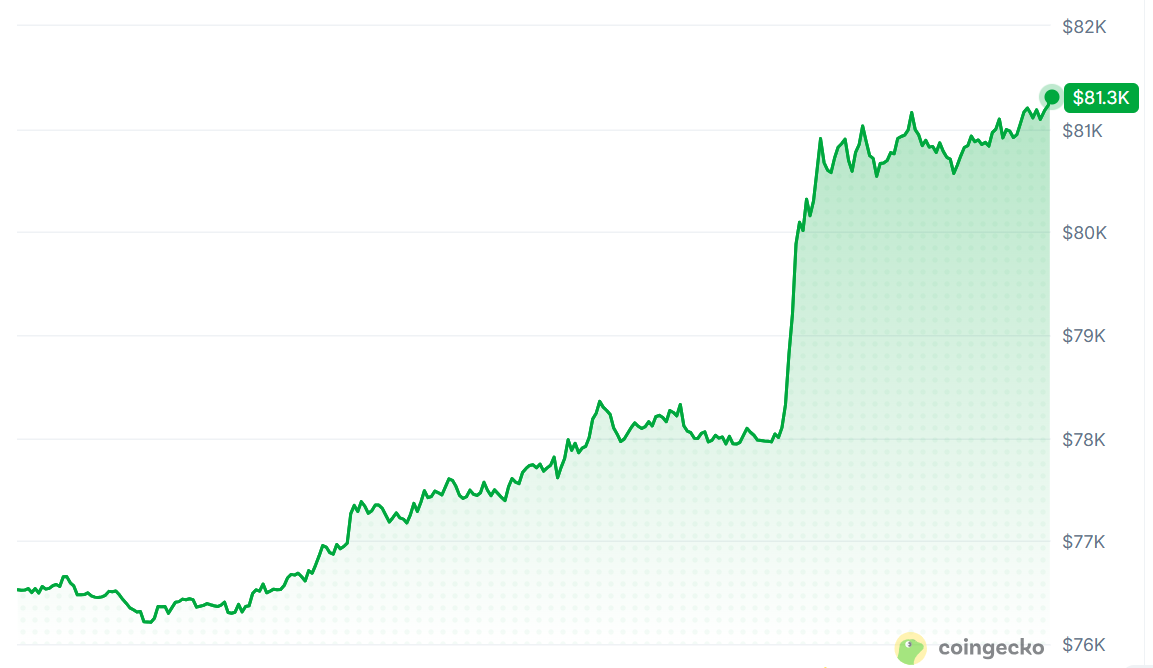
Bitcoin Price Rebound Follows a Wave of Market Fears
The first major catalyst was the Senate’s failure to advance the CLARITY Act on September 15. The procedural vote on H.R. 3633 failed 49-50, leaving the legislation unable to move forward at that stage.
The setback added regulatory uncertainty for the crypto industry. However, Bitcoin’s subsequent recovery suggests traders absorbed the news without extending the sell-off indefinitely.
Crypto spent the week digesting three dominant fear narratives.
CLARITY Act disappointment, higher interest rates, and fresh hack/security concerns all surged across social channels while Bitcoin slid toward the mid-$75K area.
The policy shocks were real. The Senate… pic.twitter.com/5vuy4iFkqq
— Santiment Intelligence (@SantimentData) September 18, 2026
Interest rates added another source of pressure one day later. The Federal Reserve raised its benchmark rate by 25 basis points to 3.75%-4.00% on September 16. The move marked a return to rate hikes after the previous increase in July 2023.
Higher rates can tighten financial conditions by increasing borrowing costs across markets. They can also reduce the appeal of riskier assets when safer yields become more attractive.
Security concerns further weighed on sentiment. Santiment pointed to the Symbiosis Bitcoin Bridge exploit and the Revolut breach involving personal information from crypto customers.
Despite those narratives, Bitcoin moved back above $80,000. Santiment suggested that larger buyers may have entered as fear became widespread.
That interpretation remains market analysis rather than confirmed evidence of specific buying activity.
What Bitcoin Price Action Suggests Around $80K?
Bitcoin’s current structure remains closely tied to several technical levels identified by market analysts.
Crypto Patel described an 8-hour bullish flag, with $80,000 serving as the key breakout trigger. The analyst identified $82,250 and $98,000 as potential upside levels after confirmation.
The bearish setup begins below $75,000, according to Patel. A breakdown could expose Bitcoin to $71,000 and then $68,000.
Bitcoin Bullish Flag Pattern: Could $BTC Rally Toward $98,000 Next?
8H TECHNICAL STRUCTURE: #BTC Is Currently Trading Inside A Bullish Flag, A Classic Continuation Pattern Following The Previous Impulsive Move.
BULLISH SCENARIO: Break + 8H Close + Hold Above $80,000 → Flag… pic.twitter.com/8HVDDAWlLQ
— Crypto Patel (@CryptoPatel) September 18, 2026
KillaXBT presented a different risk-management approach around the same range. The analyst said a move toward $82,000-$84,000 could trigger a 50% hedge against a continuation long.
Killa also identified $85,000-$86,000 as an important area. A sustained reclaim could leave the $88,000-$95,000 region as the next area under consideration.
These levels represent individual trading frameworks rather than established market outcomes. Bitcoin’s next move, therefore, depends on whether price confirms a breakout or returns toward range support.
The broader mechanism is straightforward: negative headlines can accelerate selling, but that pressure can weaken once sellers become exhausted. Bitcoin’s move above $80,000 shows that sentiment can shift quickly when price absorbs adverse news without breaking key support.
The post Bitcoin Price Hits $81K as BTC Shrugs Off Regulatory and Rate Fears appeared first on Blockonomi.
TLDR
- Disney stock drops 2.52% as Karandeep Anand joins as chief technology officer.
- Disney creates a new CTO role to oversee technology, data, product, and engineering.
- Anand joins from Character.AI after senior roles at Brex, Meta, and Microsoft.
- Disney expects Character.AI technical employees to follow Anand into the company.
- The leadership move supports Disney’s broader push to modernize digital operations.
The Walts Disney (DIS) shares fell 2.52% to $102.69 on Friday after a sharp mid-morning decline. The move followed Disney’s appointment of Karandeep Anand as its new chief technology officer. Disney created the role as it expands technology, data, product development, and engineering across the company.
The Walt Disney Company, DIS
Disney Stock Extends Losses After Leadership News
Disney created the chief technology officer position to strengthen company-wide technology leadership. Anand will start on October 2 and report directly to Chief Executive Officer Josh D’Amaro. His role will cover enterprise technology, infrastructure, data platforms, product development, and engineering.
Disney shares remained under pressure after the earlier decline accelerated during mid-morning trading. The stock closed down 2.52%, keeping market attention on Disney’s near-term share performance. Meanwhile, management continued outlining a broader plan to modernize technology across its businesses.
Disney also wants to connect its entertainment businesses through stronger digital systems and shared technology. Disney+ remains central as management builds more direct relationships with audiences worldwide. The company plans greater coordination between technology teams serving streaming, parks, entertainment, and other operations.
Karandeep Anand Takes New Technology Role
Anand joins Disney after serving as chief executive officer of Character.AI. He led the company during a period of strong platform growth and expanding consumer engagement. Before Character.AI, Anand served as president and chief product officer at financial technology company Brex.
Earlier, Anand held several leadership positions at Meta, including roles overseeing advertising and business products. He also spent 15 years at Microsoft in senior product and engineering positions. During that period, Anand worked on teams involved in building the Azure cloud platform.
Disney expects several members of Character.AI’s technical team to join the company with Anand. Their arrival could strengthen Disney’s engineering resources across several business areas. However, Disney has not provided specific roles or responsibilities for those incoming technical employees.
Disney Expands Technology Strategy Under D’Amaro
D’Amaro has placed technology among Disney’s main priorities since becoming chief executive officer. His approach combines storytelling, stronger technology support, and closer coordination across the company. Management also wants technology to create more connected experiences across Disney’s major consumer businesses.
The new structure gives Anand company-wide oversight instead of responsibility for one operating division. That setup could help Disney standardize infrastructure, data systems, engineering practices, and product development. It also places one senior executive in charge of coordinating major technology projects across Disney.
Disney faces strong competition across streaming, entertainment, gaming, and other digital platforms. The company has relied more heavily on digital distribution to support engagement and direct customer relationships. Anand’s appointment adds experienced technology leadership as Disney continues reshaping operations around connected products and services.
The post Disney (DIS) Stock: Plunges as Character.AI CEO Joins as Chief Technology Officer appeared first on Blockonomi.
TLDR
- Amazon’s air cargo network prepares for a major Airbus A330 fleet expansion
- ATSG receives its first Amazon-ready A330 and targets operations in 2027
- ABX Air plans new pilots and maintenance staff for the expanding A330 fleet
- Amazon has committed to multi-year leases covering four Airbus A330 freighters
- ATSG expands beyond Amazon through new Latin American cargo operations
Amazon (AMZN) stock traded at $253.20 as its air cargo network prepared for a wider Airbus A330 rollout. The expansion will gradually reduce reliance on Boeing 767 aircraft across Amazon’s cargo operations. Meanwhile, Air Transport Services Group is preparing its first A330 for Amazon service in 2027.
Amazon.com, Inc., AMZN
Amazon Prepares for A330 Expansion
ATSG received its first A330 freighter modified from a passenger aircraft for Amazon’s cargo network. The company expects ABX Air to begin operating the aircraft during the first quarter of 2027. Meanwhile, Amazon has committed to multi-year operating leases covering four A330 aircraft.
ABX Air must complete Federal Aviation Administration programs before adding the A330 to its operating certificate. These programs cover pilot training, aircraft operations, and maintenance procedures for the new type. Therefore, ATSG plans to hire additional pilots and maintenance workers as A330 capacity increases.
ATSG currently operates 56 aircraft within Amazon’s fleet of more than 100 planes. The company has supported Amazon since 2016 using Boeing 767-200 and 767-300 freighters. Meanwhile, Alaska Airlines operates 11 Airbus A330 freighters for Amazon.
ATSG Builds a New Freighter Fleet
The A330 expansion reflects the declining supply of mid-life Boeing 767 passenger aircraft available for cargo conversions. Boeing no longer produces the 767, while older passenger aircraft continue to leave commercial service. As a result, ATSG has pursued the A330 as its next medium-widebody freighter platform.
ATSG plans to acquire and convert 30 A330 aircraft as part of its broader cargo fleet strategy. Airbus aftermarket affiliate Elbe Flugzeugwerke performs the passenger-to-freighter conversion work. However, supply chain problems have slowed the conversion program and delayed some planned deliveries.
EFW has delivered two converted A330 freighters to Turkey-based ULS Airlines Cargo so far. ATSG also plans to support its new aircraft through maintenance operations in Ohio and Florida. The company is developing an Airbus maintenance program at Wilmington Air Park and in Tampa.
Amazon Cargo Network Expands
ABX Air has also added a new cargo customer as ATSG expands its business beyond Amazon and DHL Express. Miami-based Global Aviation Link hired ABX Air to operate a Boeing 767-300 to Latin America. Under the one-year agreement, ABX Air provides the aircraft and operates the service.
The service began flights between Miami and Quito on September 2 and operates six days each week. Global Aviation Link plans to expand service toward Venezuela and Peru, which export flowers and fruit. The company already provides scheduled cargo service between Miami and Bogota using Boeing 767 aircraft.
ATSG also announced three executive appointments as it continues changes following its 2025 acquisition by Stonepeak. Mike Hough became group president for airlines and services, while Tim Schulze joined as chief risk officer. Doug Belding also joined as vice president for enterprise performance and operating systems.
The post Amazon (AMZN) Stock: Air Cargo Network Prepares for Airbus A330 Expansion appeared first on Blockonomi.
TLDR
- HSBC stock falls 1.56% as the bank expands Premier services across the US market.
- Premier now combines wealth, health, travel and cross-border banking services.
- New mobile tools let customers open brokerage accounts and manage investments.
- HSBC adds telemedicine, wellness benefits and enhanced travel support for clients.
- The bank strengthens its US wealth corridor with 21 Wealth Centers nationwide.
HSBC Holdings (HSBC) shares fell 1.56% to $101.24 as the bank expanded its Premier offering across the United States. The upgrade targets affluent customers seeking wealth, health, travel, and international banking services. The move supports HSBC’s broader plan to deepen its global wealth business.
HSBC Holdings plc, HSBC
HSBC Stock Slides as Premier Upgrade Reaches US Market
HSBC launched the enhanced Premier service as affluent customers increasingly manage money across several markets. The bank said the United States remains a leading destination for international investment. Its 2026 research found many wealthy clients plan to maintain or increase exposure to US assets.
The new service combines banking tools with support for customers who travel, relocate, or invest internationally. HSBC also wants to simplify access to financial services across different countries. The bank is positioning Premier as a wider relationship offering for globally connected customers.
HSBC shares still moved lower during the session despite the service expansion. The stock traded at $101.24 after falling 1.56% during the day. The decline came as HSBC promoted its larger US wealth strategy.
HSBC Expands Wealth Health and Travel Services
HSBC added new investment tools to its US mobile application for eligible Premier customers. Clients can open brokerage accounts, review holdings, and trade mutual funds through the platform. Wealth Relationship Managers will also continue providing financial planning and personalized support.
The health package includes third-party telemedicine services and wellness support for members. Customers can access doctors by phone or video for primary, urgent, and mental healthcare needs. The package also includes selected discounts on fitness, nutrition, massage, acupuncture, and other wellness services.
HSBC expanded travel benefits through global support, merchant partnerships, and credit card rewards. Premier customers can receive selected hotel and dining savings alongside points on qualifying travel purchases. Eligible cards also carry no foreign transaction fees for overseas spending.
US Wealth Strategy Targets Cross-Border Banking Demand
HSBC strengthened international banking features for customers moving money or relocating across borders. The service includes competitive foreign exchange rates and no HSBC fees on international transfers. Customers moving to the United States can also open accounts before arriving.
The Premier expansion forms part of HSBC’s wider strategy for the United States. The bank is combining digital services with physical wealth centers in major financial markets. HSBC currently operates 21 Wealth Centers across the country, including locations in New York and California.
HSBC relaunched its Park Avenue Wealth Center earlier this year and plans another relaunch in Cupertino this month. Its network also covers South Florida, Washington, Los Angeles, San Francisco, and Seattle. HSBC expects these centers to support affluent customers with international banking and wealth needs.
The post HSBC Holdings (HSBC) Stock: Plunge as Global Banking Push Expands With Premier Upgrade appeared first on Blockonomi.
CryptoPotato
Binance users should prepare for a temporary interruption to some main services at the start of next week due to scheduled maintenance.
On the bright side, the disruption is expected to last only about an hour, after which all operations should return to normal.
Cause for Concern?
Binance announced it will perform an infrastructure wallet upgrade on September 22 and, to support the process, will temporarily stop deposits and withdrawals. The company said token trading will not be impacted during the maintenance. It also assured that everything will return to normal once the system is deemed stable.
Such endeavors are quite frequent and shouldn’t trigger panic across the community. Earlier this summer, for example, Binance briefly halted deposits and withdrawals on the Bitcoin (BTC) network to perform wallet maintenance.
Before that, it temporarily paused such operations on the Ethereum blockchain; other ecosystems affected by support for certain improvements include Cardano, BNB Chain, Tron, and others.
The outages have lasted from minutes to a few hours, with no reports of major issues or user complaints.
The Previous Updates
Just a few days ago, Binance disclosed that it will remove the following cross-margin pairs: ENJ/USDC, GENIUS/USDC, CVX/USDC, and VANA/USDC, as well as the isolated-margin pair GENIUS/USDC. It also vowed to terminate access to the BREV/USDC, COOKIE/USDC, LA/USDC, and QNT/USDC spot trading pairs. The delistings are scheduled for today (September 18).
The announcement caused little to no volatility for the involved cryptocurrencies. However, when Binance disallows all trading services for certain tokens, it is usually a completely different story. This August, for instance, Across Protocol (ACX), Hashflow (HFT), PIVX (PIVX), Vulcan Forged PYR (PYR), Vanar (VANRY), and Viction (VIC) collapsed by double digits after the exchange waved them goodbye.
On the other hand, backing has the opposite effect. The latest example is PONS, whose price spiked substantially after the company added it to its Binance Alpha section.
Besides its listings and delistings, the company issued a scam alert about phishing attacks targeting crypto investors. It warned that attackers send fake text messages that seem official, such as “Your account settings were changed:” or “Suspicious login detected,” to trick users into clicking malicious links that could result in painful losses.
“Remember: Binance will never ask you to tap a link in a text message to “verify” or “secure” your account,” the alert reads.
The post Major Binance Warning: The Exchange Will Briefly Suspend Deposits and Withdrawals Next Week appeared first on CryptoPotato.
The failure of the CLARITY Act in the US Senate has been a major setback for the crypto industry. The outcome raised new questions about the future of regulation in the country and whether the setback could hurt Bitcoin and other digital assets.
But Bitwise Chief Investment Officer Matt Hougan believes the vote may not be enough to derail the broader crypto market rally.
Wall Street Isn’t Waiting
Hougan said the CLARITY Act would have been useful for the industry. The legislation was designed to provide a clearer regulatory framework for digital assets. It also aimed to strengthen investor protections and create rules that could remain in place beyond the current administration. Despite this, the exec said Bitcoin’s latest rally did not depend on the bill’s chances of passing.
According to Hougan, Bitcoin bottomed at about $57,950 on July 1. It then climbed above $80,000 by September 4. During the same period, Polymarket odds of the CLARITY Act becoming law this year fell from 39% to 18%. The two trends moved in opposite directions. For Hougan, that suggests crypto investors were not waiting for Congress to provide regulatory clarity.
Wall Street has also continued moving into the sector. For instance, Robinhood has launched its own blockchain. Morgan Stanley has launched a Solana ETF. The Depository Trust & Clearing Corporation, or DTCC, has also completed its first batch of tokenized stock settlements.
At the same time, US regulators have been working on rules outside Congress. In August, the SEC proposed Regulation Crypto Assets. This does not mean the loss of the CLARITY Act is unimportant. Agency rules can be changed by a future administration. Congress is also needed to give the CFTC broader authority over spot crypto markets.
Bitcoin fell after the Senate vote, which added short-term market pressure. But Hougan believes the setback is more of a speed bump than a roadblock.
“Crypto spent its first 17 years without core market legislation. Without Clarity, it has managed to go from a fringe idea to a $2.5 trillion asset class that’s reshaped everything from global payments to capital markets.”
Shift Back to Buying
US-based Bitcoin ETFs returned to net inflows after two days of heavy withdrawals. The funds attracted more than $159 million on Thursday. BlackRock’s IBIT was the only ETF to report a net inflow. Interestingly, HYPE also recorded $4.25 million in inflows.
Ethereum ETFs, on the other hand, moved in the opposite direction after posting $39.2 million in net outflows. These investment vehicles extended their losing streak to three days. Market analyst Darkfost said the end of the week appears “calmer” for the ETF market.
The post Here’s Why Bitwise CIO Believes Crypto Could Keep Rallying Without Congress appeared first on CryptoPotato.
SOL has followed the green wave sweeping through the broader cryptocurrency market, surging 6% in the past 24 hours to $105.
Many analysts believe the asset’s rally might be just starting, with one envisioning a potential explosion to as high as $1,300.
Parabolic Jump on the Way?
Earlier this week, the landmark crypto bill known as the CLARITY Act failed in the US Senate and could not advance to formal discussion. The development caused a brief correction for the crypto sector, with Ali Martinez noting that SOL plunged from $101 to around $95.60.
However, he argued the asset found solid support despite the pullback and outlined several bullish factors. First, he pointed to strong institutional demand, with spot SOL ETFs recording several consecutive green weeks and attracting over $200 million in the past month alone. Martinez also mentioned that 3 million tokens were withdrawn from exchanges in the last 30 days and that network growth remains “elevated.”
Shortly after, the analyst opined that a breakout is near, spotting a potential bull flag forming on SOL’s 4-hour chart. He said the key level to watch is $105 and claimed that a sustained close above could confirm the bullish breakout and open the door to an ascent to $130.
Most recently, Martinez claimed that the asset is “ready to go parabolic.” He opined that SOL has spent the last few years building a massive cup-and-handle pattern, with the neckline sitting near $360.
“A confirmed break above that level could mark the beginning of a much larger expansion toward $1,300,” he maintained.
Additional Forecasts
X user CRYPTOKRALI argued that SOL has started to “look interesting” again. The analyst noted that after weeks of compression, the price has finally broken above the descending resistance that kept rejecting every attempt higher. They said $98 has held repeatedly as support, and the strong daily candle through the trendline provides the necessary confirmation.
“Now the key is whether SOL can hold above the breakout and turn that old resistance into support. If it does, I’d be watching $110 first, with room for a bigger continuation if momentum follows through. The downtrend is breaking. Now we see how far the next leg can run,” the analyst added.
Scient also weighed in. The market observer expects one more leg up to around $130, saying they will then de-risk 50% of their spot bags and look to reload if the price dips to $90.
The post Solana to Go Parabolic? Here’s Why SOL Can Explode by 1,100% appeared first on CryptoPotato.
ETH witnessed a notable recovery after briefly plunging near $2,350 this week. The leading altcoin has since climbed over $2,480. At the same time, its transaction fees have fallen sharply, making the network cheaper to use.
The average cost per ETH transfer has dropped to around $0.095 from this year’s peak of $0.72 on April 21, according to Santiment’s findings.
Ethereum Gets Cheaper
The decline comes as mainnet demand softened during the bearish summer. However, network upgrades have also increased Ethereum’s capacity. Fusaka, higher blob throughput, and a 60 million gas limit have helped the network handle more activity. At the same time, Layer 2 solutions are processing large amounts of transactions that previously competed for Ethereum’s mainnet blockspace.
Lower fees could make Ethereum more accessible for users and developers, according to Santiment. Swaps, transfers, DeFi activity, stablecoin movements, and ERC-20 transactions can now be completed at a lower cost.
The analytics platform said that cheap transactions do not necessarily mean demand is recovering. But it is important to note that lower costs remove one of Ethereum’s long-standing barriers. With ETH prices having recovered, cheaper network activity could provide a more favorable environment for Ethereum-based projects.
Meanwhile, Ali Martinez observed that the asset is trading within a defined 4-hour channel despite recent market volatility. ETH has reached the lower boundary of the range, following which the $2,570 level has come into focus. Martinez expects a potential rebound toward the middle and upper end of the channel. A strong 4-hour close above $2,570, supported by higher trading volume, could signal a breakout. He added that the next stops would be $2,700 and then $3,000.
The Long Investor believes Ethereum remains a buy despite an almost 45% rise over the past three months. The investor said buying before ETH moves above $3,000 may put investors ahead of late buyers. They also pointed to the 200-week moving average as a strong long-term reference.
Supply Drain
Less ETH on exchanges is helping the recovery. Recent estimates revealed that only 6.06 million units now sit on exchanges, down from 22.9 million at the June 2020 peak. That is a 73% decline in readily available supply. The drop reflects more ETH moving into staking, ETFs, treasury holdings, and long-term custody.
Validators are also locking ETH to help secure the network. Lower liquid supply may increase the impact of buying activity. Even without a major rise in demand, smaller waves of buying can have a stronger effect when fewer coins are available on exchanges.
The post Ethereum Gets Cheaper: Network Fees Collapse Over 85% as ETH Price Rebounds appeared first on CryptoPotato.
Ethereum has recovered sharply from its mid-year lows and jumped past the key $2.5K level on Friday. The charts show a constructive improvement in the broader market structure, although ETH remains below several important higher-timeframe resistance levels.
Meanwhile, the Coinbase Premium Index is once again negative, suggesting that the recent recovery has not been accompanied by consistently strong spot demand from U.S. investors.
Ethereum Price Analysis: The Daily Chart
On the daily timeframe, ETH has undergone a significant structural recovery from the $1.5K support area. The rebound has pushed price back above both the 100-day and 200-day major moving averages shown on the chart, with the 100-day yellow average aggressively pushing toward the 200-day one from below, likely to form a bullish crossover around $2K.
ETH is currently trading around $2.5K, directly inside a key resistance zone. This area has repeatedly contained price during the recent consolidation. Yet, a valid daily breakout above it can lead to continuation of the recovery.
A successful move above the $2.5K area could expose the next major resistance around $3.0K. Beyond that, the larger daily resistance zone sits around $3.3K-$3.4K, which coincides with the broader structure established earlier in the year.
On the downside, the first important support is around $2.1K, where the moving averages are also currently clustered. Below this area, the $1.9K zone becomes the next notable support. Still, the daily RSI is around the mid-to-upper 50s, meaning momentum is still bullish but not showing an overbought reading anymore. Therefore, there could still be room to the upside if sufficient demand emerges.
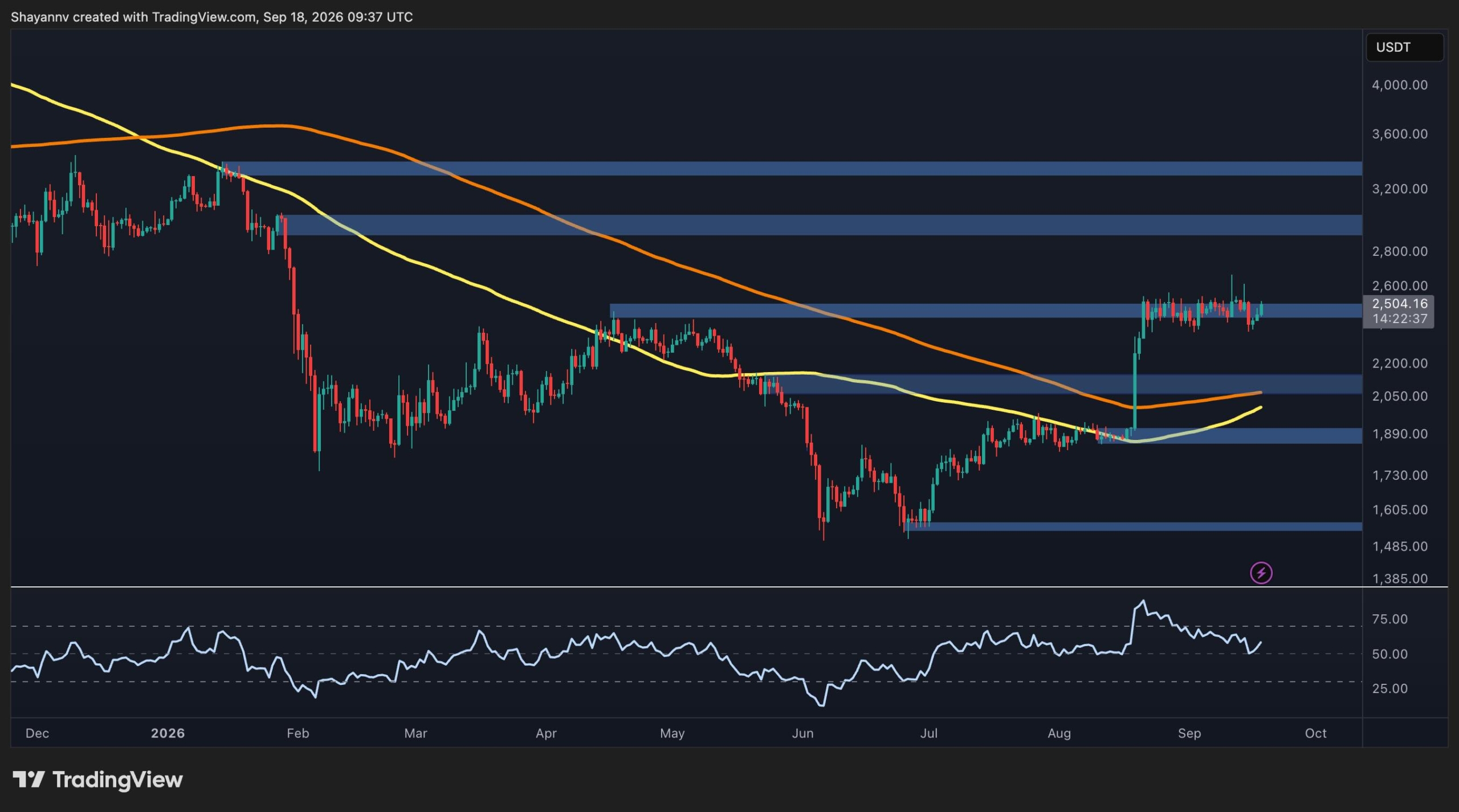
ETH/USDT 4-Hour Chart
The 4-hour chart provides a clearer picture of the current consolidation. ETH has been trading inside a broad range roughly between $2.35K and $2.65K since the sharp late-August advance.
The latest price action shows ETH recovering from the lower portion of the range and returning toward the $2.5K area. The repeated reactions around the range boundaries suggest that the market is still in consolidation rather than an established directional breakout.
The immediate resistance is around $2.5K, followed by the upper range boundary near $2.65K. A decisive 4-hour breakout above the latter would provide a clearer structural shift and could open the way toward the higher daily resistance zones.
Conversely, rejection around the current resistance and a move back below $2.35K would weaken the short-term structure. Losing that zone would invalidate much of the current range-based bullish setup and bring the next major support into consideration, as a deeper retracement would be probable.
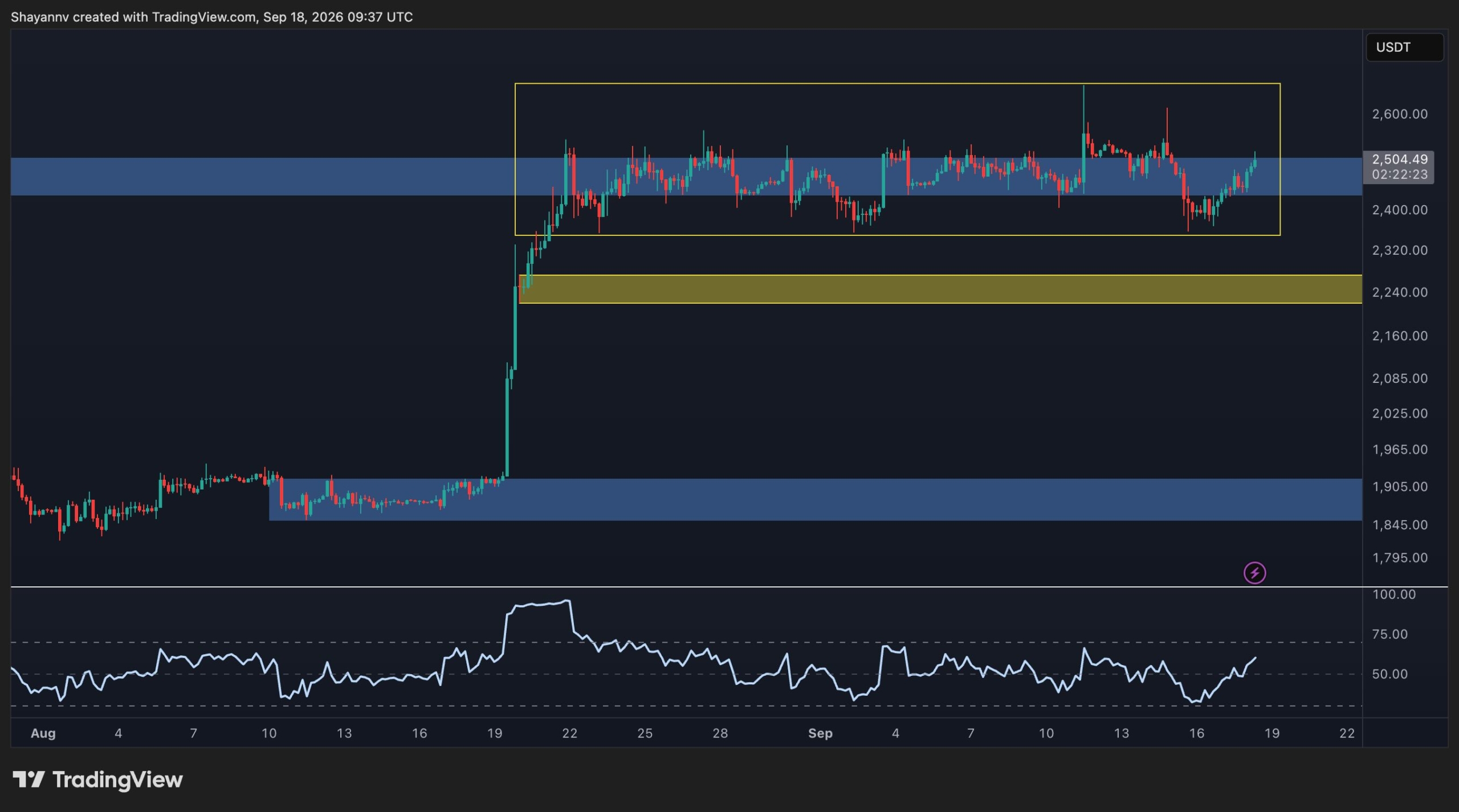
On-Chain Analysis
The Coinbase Premium Index is currently around -0.07, with the indicator spending much of the recent period below the zero line. The metric compares ETH prices on Coinbase with those on other major exchanges and is commonly used as an indication of relative buying or selling pressure from Coinbase’s predominantly U.S.-based market.
The notable point is the divergence between price and the premium index. ETH has recovered from roughly $1.5K to around $2.5K, yet the Coinbase Premium has generally remained negative during much of that advance. This suggests that the recovery visible on the price chart has not been accompanied by consistently strong US-based spot demand.
There have been brief positive spikes, particularly during parts of the summer, but they have not developed into a sustained positive trend. The latest reading has also returned firmly below zero.
This does not necessarily invalidate the broader recovery, since ETH can rise through demand from other venues and derivatives markets. However, a sustained move back above the zero line in the Coinbase Premium Index, particularly alongside a breakout above $2.5K, would provide additional confirmation that spot demand is strengthening, and that the recovery is likely to continue.
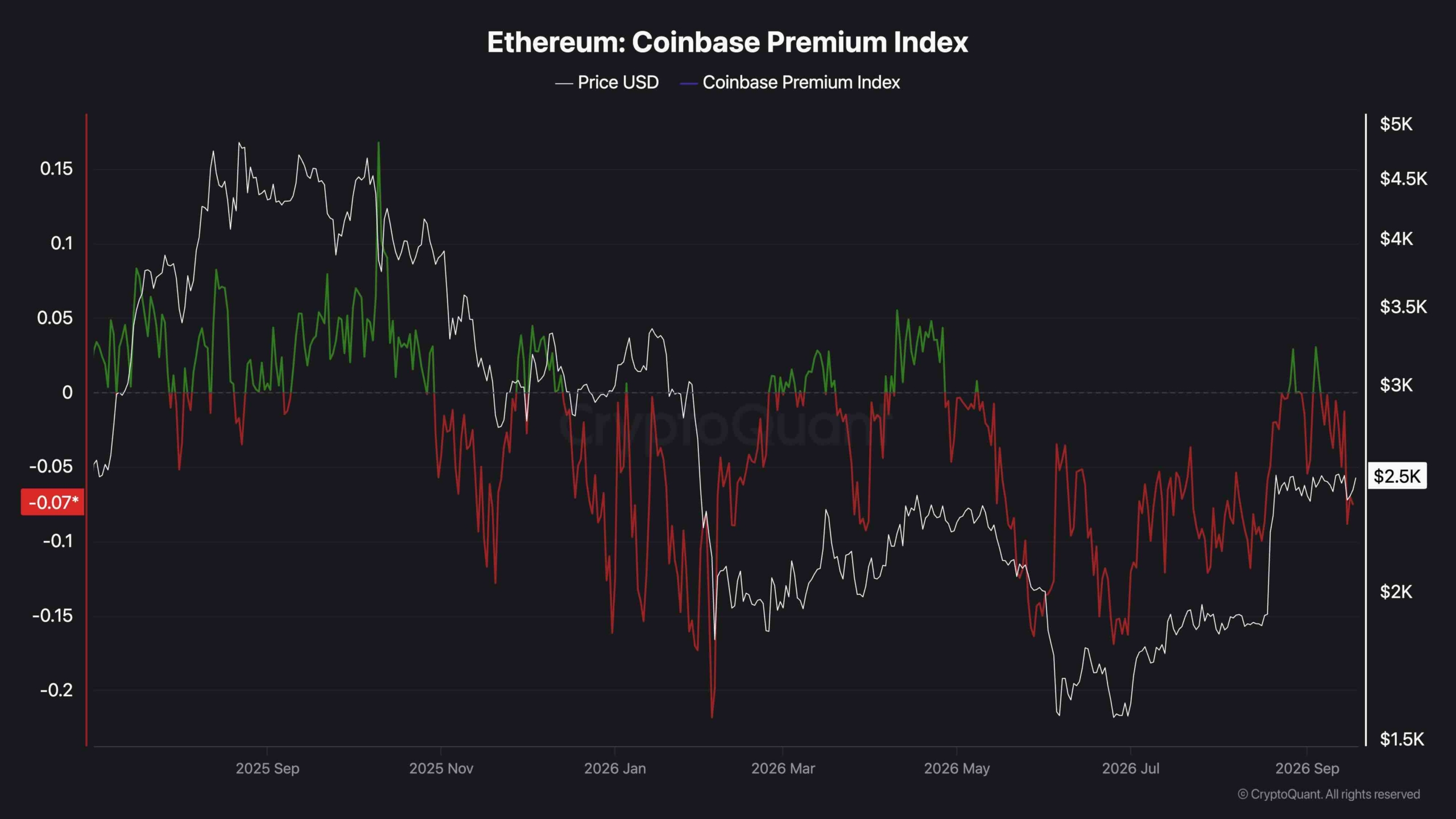
The post Ethereum Price Analysis: ETH Jumps Past $2.5K as Moving Averages Eye Bullish Cross appeared first on CryptoPotato.