Cryptocurrency Posts
Crypto Briefing
Zidane's decision to keep Mbapp as captain signals continuity and stability, potentially strengthening France's cohesion and future success.
The post Kylian Mbappé named France captain under new coach Zinedine Zidane appeared first on Crypto Briefing.
Europe's economic stability is threatened as rising energy costs from geopolitical tensions could lead to prolonged inflationary pressures.
The post Gulf-Eurasian energy crunch pushes Europe to the edge of an inflationary crisis appeared first on Crypto Briefing.
The end of Yahoo Finance's partnership with Polymarket highlights the evolving dynamics and competitive pressures in prediction market integrations.
The post Yahoo Finance ends partnership with Polymarket for prediction market hub appeared first on Crypto Briefing.
Europe's reliance on foreign AI could jeopardize its autonomy in critical sectors, necessitating urgent investment in domestic AI capabilities.
The post Christine Lagarde warns Europe must develop its own AI technology or face dangerous dependency appeared first on Crypto Briefing.
Virginia's new framework and AI task force could reshape data center governance, emphasizing transparency, community input, and ethical AI use.
The post Virginia Governor Abigail Spanberger establishes AI task force and data center accountability framework appeared first on Crypto Briefing.
Bitcoin Magazine
Bitcoin Magazine

Bitcoin Price Surges Over $81,000 Despite Clarity Act Fail and Interest Rate Hike
Bitcoin’s price on Friday shot above $81,000 — despite a week of setbacks for the crypto industry.
The biggest coin was recently trading for $80,982, after jumping as high as $81,055 at one point Friday morning in New York. Over the past 24 hours, it has risen by nearly 6%.
Its surge comes after lawmakers on Tuesday blocked long-awaited crypto legislation, the Clarity Act, and the Federal Reserve on Wednesday hiked interest rates.
JUST IN: Bitcoin surges to $81,000
— Bitcoin Magazine (@BitcoinMagazine) September 18, 2026pic.twitter.com/EQi5apUlxU
Digital asset industry bigwigs had long called for clear rules to regulate the crypto space and the Clarity Act — which wants to divide oversight between regulators — aimed to do that. But lawmakers blocked the landmark digital asset market structure bill in a procedural vote.
And the Federal Reserve increased borrowing costs for the first time due to skyrocketing inflation in the U.S. The central bank’s chair, Kevin Warsh, said that price stability in the U.S. was the Fed’s number one priority.
“The plain fact is that inflation is too high, and has been for too long,” Warsh said. “This summer’s inflation readings do not tell me that underlying trends have meaningfully improved.”
Bitcoin has in the past done well in a low interest rate environment because it means there is more liquidity to trade the asset.
While Bitcoin’s price dipped initially news of the Clarity Act blockage and Fed’s move, it shot up on Friday.
Bitcoin exchange-traded funds in the U.S. have so far this week experienced net negative flows, with investors cashing out nearly $427 million from the vehicles, according to Farside Investors data.
Flows on Thursday turned positive, with investors chucking nearly $160 million at the funds following two days of consecutive outflows.
In a research note Thursday, asset manager Grayscale said that it didn’t expect bitcoin’s price to be hurt by the Fed’s decision because the move reflects a mid-cycle adjustment, not a cyclical change.
And despite lawmakers blocking the Clarity Act, regulators like the SEC are already pushing ahead with pro-crypto regulation.
This post Bitcoin Price Surges Over $81,000 Despite Clarity Act Fail and Interest Rate Hike first appeared on Bitcoin Magazine and is written by Mathew Di Salvo.
Bitcoin Magazine

Bitcoin Community Recognizes Quantum Computing Risk: VanEck
Quantum computing is a risk to Bitcoin but the community recognizes the issue, according to asset manager VanEck’s Head of Digital Assets Research.
Speaking to CNBC on Friday, Matthew Sigel said that while progress on addressing the issue may be slow because of the crypto network’s decentralized nature, the community was working on it.
The crypto community has sounded the alarm about hypothetical advancements in quantum computers that could in the future be able to break Bitcoin’s cryptography.
Some in the space — including Bitcoin developers — have started preparing for a post-quantum future by testing quantum-resistant signatures on live sidechains.
“It’s a risk,” he said. “But the community has recognized the scope of the issue. There’s a lot of talent that’s now come together with a framework of how to upgrade the system.”
He added: “The upgrades don’t happen as fast because there’s no CEO who can tell the devs, ‘hey, do it now.’ There’s a governance process — it takes more time, it’s a little bit messier, but there are technological paths for quantum resistance, and I think you’ll see more of that over the next couple of years.”
Quantum computers do exist but make mistakes and a machine that can break Bitcoin’s cryptography currently does not exist. Bitcoin currently is the biggest computer network in existence.
Major companies in the space — including America’s biggest crypto exchange, Coinbase, and Bitcoin infrastructure firm, Blockstream — are already working on solutions.
Back in July, Coinbase said it plans to deliver a post-quantum signing pipeline using secure enclaves and threshold cryptography.
A Bitcoin Security Consortium — made up of BlackRock, Fidelity Digital Assets, Block, and others — formed in July and donates funds and dedicates engineers to open-source work supporting proposals like BIP-360, which aims to introduce a new transaction output type to reduce long-exposure quantum computing risks.
This post Bitcoin Community Recognizes Quantum Computing Risk: VanEck first appeared on Bitcoin Magazine and is written by Mathew Di Salvo.
Bitcoin Magazine

The Next 3-5 Years of Bitcoin Lending
SALT Lending CRO Hunter Albright says a growing number of Bitcoin holders may eventually borrow against their bitcoin rather than sell it, creating a new relationship between bitcoin, credit and stablecoins.
Bitcoin-backed lending could become an increasingly important part of how holders access the value of their bitcoin without selling it, according to Hunter Albright, Chief Revenue Officer of SALT Lending.
Speaking on BMTV, Albright said he expects borrowing against bitcoin to become more common as the market matures and holders become more comfortable using bitcoin as collateral.
“I’d like to think we will see a growing percentage of the population of bitcoin holders borrow against it,” Albright said.
For Albright, that shift could also change how bitcoin and stablecoins function alongside one another.
“I do believe people borrowing against their bitcoin and leveraging stables is the difference between money in motion and money at rest,” he said. “The speed of conversion really creates a utility and advantage for people willing to operate in that ecosystem.”
In that framework, bitcoin increasingly becomes “money at rest” – an asset held for the long term – while stablecoins serve as “money in motion,” providing liquidity that can be transferred and used more easily without requiring holders to sell their bitcoin.
A Behavioral Shift for Bitcoin Holders
Getting there, however, will require more than simply building lending products.
Albright said greater education around both Bitcoin itself and the mechanics of borrowing against bitcoin will be necessary before the behavior becomes mainstream – something SALT Lending has made part of its own efforts in the market.
It also requires a change in how Bitcoin holders think about the value stored in their assets.
Instead of viewing bitcoin only as something to accumulate and eventually sell, holders can potentially use it as collateral to access liquidity while maintaining their bitcoin exposure.
That model is already common elsewhere in finance, where owners of real estate, equities and other assets regularly borrow against their holdings rather than liquidating them.
For Bitcoin holders, there can also be tax advantages. In the U.S., borrowing against an asset generally does not itself constitute a taxable sale, whereas selling appreciated bitcoin can trigger capital gains taxes. Individual tax consequences depend on the structure of the transaction and the borrower’s circumstances, readers should consult a tax advisor.
Albright sees that combination – long-term bitcoin holdings, growing stablecoin adoption and easier access to credit – as part of a broader shift in how Bitcoin holders may eventually use their wealth.
Rather than bitcoin needing to move every time its value is put to use, bitcoin can remain at rest while liquidity moves around it.
SALT Lending is the Official Liquidity Sponsor of BMTV. Learn more about borrowing against your bitcoin and explore SALT’s BMTV offer at https://saltlending.com/bmtv/?utm_source=bmtv&utm_medium=article&utm_campaign=52783658-BMTV%20article&utm_term=BMTV
Disclaimer: SALT Lending is a paid sponsor of BMTV and serves as BMTV’s Official Liquidity Sponsor. This article is sponsored content and does not necessarily reflect the views or opinions of Bitcoin Magazine. The information provided is for promotional purposes and should not be considered financial advice. Readers are encouraged to conduct their own research before making any investment decisions related to Bitcoin or other financial products mentioned herein.
This post The Next 3-5 Years of Bitcoin Lending first appeared on Bitcoin Magazine and is written by Josh Plischke.
Bitcoin Magazine

Dan Hillery: Digital Credit Could Rival BTC’s $1.5 Trillion Market Cap
Two years ago, Bitcoin-backed digital credit barely existed. Today it’s a roughly $16 billion market and Dan Hillery of UXTO thinks the financialization layer on top of Bitcoin could one day rival the network itself. In the debut episode of The Allocators Edge, Hillery breaks down how variable-rate preferred securities like STRC and SATA are priced, why buybacks keep them anchored near $100 par, and what separates digital credit risk from digital equity risk. He also walks through the structured credit fund he’s building, including its senior and junior tranches.
0:00 — Digital Credit Is the Fastest-Growing Part of Bitcoin’s Capital Structure
1:18 — Why STRC’s Variable Rate Design Has No Precedent in Market History
2:59 — What Flat or Falling Bitcoin Prices Mean for Strategy and Strive
4:17 — Short-Duration Bitcoin-Backed Notes and the Next Five Years of Products
5:45 — The Biggest Misconceptions Investors Have About Preferred Securities
6:58 — How Buybacks and Capital Markets Activity Anchor STRC Near $100 Par
8:09 — Why Major Fund Classes Still Can’t Touch Digital Credit Today
9:10 — Inside the UXTO Credit Fund: Senior and Junior Tranche Structure
10:35 — Where the Leverage Comes From and How Volatility Risk Gets Transferred
11:50 — Liquidity, Redemptions, and Digital Credit in a 60/40 Portfolio
This video is for informational purposes only and does not constitute an offer to sell or a solicitation of an offer to buy any securities. Past performance is not indicative of future results. Investments in digital assets involve significant risk and may result in loss of capital. Both UTXO Management and BTC Inc., producer of BMTV, are owned by Nakamoto Inc. (NASDAQ: NAKA)
DISCLAIMER: The views and opinions expressed in this show are those of the participants and do not necessarily reflect the official policy or position of BTC Inc., Bitcoin Magazine, or any affiliated entities. This content is provided for informational and educational purposes only and should not be construed as investment, legal, tax, or accounting advice. Nothing contained in this show constitutes a solicitation, recommendation, endorsement, or offer to buy or sell any securities or financial instruments. Viewers should consult their own advisors before making financial or business decisions.
This post Dan Hillery: Digital Credit Could Rival BTC’s $1.5 Trillion Market Cap first appeared on Bitcoin Magazine and is written by Patrick Green.
Bitcoin Magazine

Treasury Sanctions Iranian Crypto Exchange BitBank Over Bitcoin Transfers to IRGC
The U.S. is continuing to target Iran’s use of bitcoin.
In a Thursday statement, the U.S. Department of the Treasury designated BitBank, an Iranian crypto exchange, as part of Operation Economic Outcast — the Trump Administration’s whole-of-government economic campaign against the Islamic Republic of Iran and its enablers.
The U.S. has sanctioned Iran for decades. This year, the Middle Eastern country has stepped up its use of cryptocurrencies — including bitcoin — in order to skirt around economic penalties.
“Today’s designations of Iranian digital asset infrastructure make perfectly clear that efforts to finance the Iranian regime using cryptocurrencies are not beyond OFAC’s reach,” Secretary of the Treasury Scott Bessent said in a statement.
“If you support the Iranian regime, the Department of the Treasury will sanction you.”
The sanctions target designated Iranian financier Babak Zanjani, along with its software developer, Pishtaz Simorgh Electronic Trade Company, and three of Zanjani’s associates: Hossein Ali Zaker Hossein, Mohammad Mahdi Zaker Hossein, and Seyed Adel Heidari.
Since June, the Iranian Hormuz Safe Marine Services Authority has used BitBank to move bitcoin to the Iranian regime, according to the Treasury.
Thursday’s sanctions aim to hit the “architecture Zanjani built to launder funds,” it added.
“The Department of the Treasury will continue to not only target the Iranian digital asset ecosystem, but also international entities and actors which help facilitate it,” the statement continued.
Iran started a bitcoin-backed insurance service for its counties shipping companies earlier this year.
The U.S. in July said that it had frozen crypto linked to the Iranian regime, mostly in the form of Tether’s stablecoin.
Stablecoins like Tether’s USDT can be frozen by the company that issues the asset. But bitcoin, being decentralized and having no single issuer, cannot.
The U.S. Treasury’s Office of Foreign Assets Control in July said Iran had been dodging sanctions by accepting pay in bitcoin from ships passing through the Strait of Hormuz.
OFAC said at the time that Hormuz Safe, developed by Iran’s Ministry of Economy, “accepts payment in Bitcoin and other digital assets” so it can bypass sanctions.
This post Treasury Sanctions Iranian Crypto Exchange BitBank Over Bitcoin Transfers to IRGC first appeared on Bitcoin Magazine and is written by Mathew Di Salvo.
CryptoSlate
The UK Financial Conduct Authority says overseas crypto providers can fall inside the country's incoming authorization regime when they serve British consumers, even when the business is established abroad.
A “UK consumer” for this purpose means an individual in the UK acting outside a trade, business or profession. The definition is a statutory territorial concept and can differ from client categories elsewhere in the FCA Handbook.
The regulator published its final cryptoasset perimeter guidance on Sept. 16. It explains when firms carrying on the new regulated cryptoasset activities may need FCA authorization from Oct. 25, 2027. The application window opens Sept. 30, giving overseas platforms, custodians and staking providers less than two weeks to map how UK consumers reach their services.
Consumer access sets the boundary
Under the FCA's territorial guidance, a business first applies ordinary territorial principles. Section 418 deeming provisions can then bring certain activities involving a UK consumer within the perimeter when the provider is established overseas.
The FCA gives two outcomes for an overseas qualifying cryptoasset trading platform. A platform unavailable to UK consumers remains outside the platform activity perimeter when an authorized UK firm trades on it as principal under the relevant permission.
The overseas operator falls inside the perimeter when that authorized firm instead accesses the platform as agent for UK consumers. The platform guidance says the operator then requires authorization. Consumer access and the UK firm's trading capacity determine the result in this example.

Other services have activity-specific conditions. An overseas provider safeguarding cryptoassets or arranging staking for a UK consumer can be deemed to operate in the UK when it acts independently of a person authorized for that activity. Acting at the authorized person's direction places the arrangement outside that deeming provision.
Automated-protocol interfaces require case-specific assessment. The FCA focuses on whether an identifiable person carries on the elements of a regulated activity by way of business in the UK.
Applications for transitional arrangements run from Sept. 30, 2026 through Feb. 28, 2027. The new activities enter the perimeter on Oct. 25, 2027. Automatic conversion of existing registrations and permissions is unavailable, so an already authorized firm may need to vary its permission when its current scope omits the new activities.
The boundary depends on each service's functions and structure. PERG explains the FCA's interpretation of legislation and lacks binding force in court, leaving exchanges, custodians, staking services and DeFi interfaces to apply the guidance to their particular facts.
The post FCA draws the UK boundary for offshore crypto platforms ahead of 2027 rules appeared first on CryptoSlate.
A routine Radix code refactor created a vault flaw that enabled a roughly $1.3 million theft and later forced validators to halt the blockchain.
The Radix Foundation said Sept. 17 that an RDX Works development team introduced the defect during a June 2023 cleanup of the Radix Engine, the software layer that executes transactions and enforces asset ownership across the network. The vulnerability remained undetected for more than three years before an attacker exploited it on Aug. 31.
A community reconstruction of the ledger shows the attacker withdrew about 458,915 USDC, 72,420 USDT, 61.08 ETH, 6.35 wrapped Bitcoin, 536.16 SOL and 32.91 BNB across 26 transactions. The assets were worth roughly $1.26 million using Aug. 31 market prices, and the attackers took another 13,000 XRD from a vault to pay transaction fees. The two stablecoins alone accounted for about $531,335.
The stolen assets were sent through Hyperlane to Ethereum, BNB Chain, and Solana, then sold for ETH, Radix said. Hyperlane itself operated as designed: the attacker had already obtained the assets through the Radix Engine before using the bridge to move them elsewhere. No private keys were compromised.
However, the immediate loss understated the potential exposure. Radix investigators concluded the flaw could have been used against any vault on the network, putting tokens and other assets beyond the bridged holdings targeted by the attacker at risk.
As a result, network validators deliberately took enough stake offline to prevent it from reaching consensus and stopping additional transactions while developers worked on a fix.
Radix audit miss turns maintenance bug into systemic failure
The vulnerability had already survived an independent security review before the attacker found it.
Zellic audited the Radix protocol in 2024, including the engine kernel containing the defect. The review did not detect the authorization flaw, even though the vulnerable code had been introduced during the previous year's refactor.
The bug changed how the engine handled vault references. A transaction could identify another user's vault by its internal address and pass that reference into purpose-built smart-contract code. The engine then allowed ordinary withdrawal functions to be called without properly enforcing the ownership boundary that should have rejected the request.
That gave the attacker access to assets held by user accounts, applications and liquidity pools without obtaining the owners' signatures.
The Foundation said the attacker completed 26 exploit transactions between 16:02 and 16:57 UTC on Aug. 31. Once investigators determined the vulnerability existed in the execution layer rather than a single application, validators coordinated to stop transaction finalization.
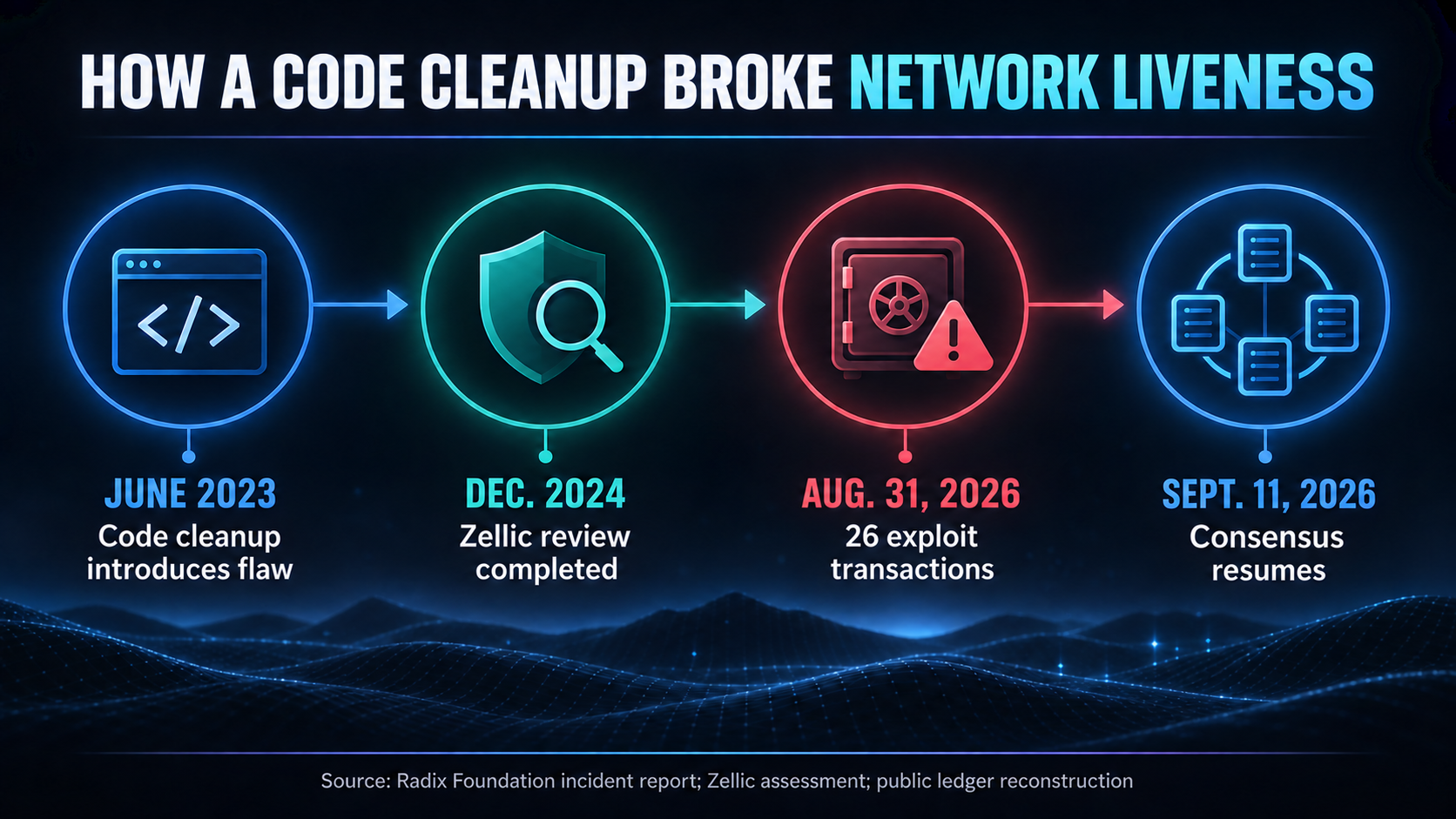
The halt lasted more than 10 days. A protocol fix added checks preventing a restricted vault reference from being used for an ordinary withdrawal, and user transactions resumed Sept. 11, according to the community ledger reconstruction.
The incident also produced secondary losses in liquidity pools after the attacker removed bridged assets from one side of trading pairs. The distorted prices allowed another account to extract millions of XRD from affected pools, showing how an execution-layer failure can keep causing economic damage even after the initial assets have left the network.
Radix said it is adding regression tests, strengthening its security review process, and formalizing the emergency procedure validators used to break network liveness.
The Foundation also said future security work must account for increasingly capable AI-assisted code-analysis tools, which it believes may have helped the attacker identify the years-old defect.
For developers and validators, the next challenge is preventing similarly routine maintenance work from silently altering security assumptions that external audits may miss.
That task extends beyond repairing the exploited code. Radix now has to strengthen the review process around changes to authorization logic while restoring confidence among users and liquidity providers whose assets ultimately depend on the engine enforcing those boundaries correctly.
The post 3-year-old bug triggers $1.3 million drain and forces 10-day blockchain halt appeared first on CryptoSlate.
The US sanctioned Iranian crypto exchange BitBank, widening its campaign against digital-asset infrastructure allegedly used to finance the Islamic Revolutionary Guard Corps (IRGC).
On Sept. 17, the Treasury Department’s Office of Foreign Assets Control (OFAC) said that the sanctioned Iranian financier Babak Zanjani used BitBank between June and July to facilitate hundreds of millions of dollars in Bitcoin transfers to the IRGC.
Treasury also said Hormuz Safe Marine Services Authority, previously sanctioned over an alleged maritime-payment scheme in the Strait of Hormuz, had used the exchange since June to move receipts to the Iranian government.
The action reaches beyond BitBank to Pishtaz Simorgh Electronic Trade Company, which developed the exchange’s software, and three people tied to Zanjani’s broader corporate network. OFAC described the group as part of Iran’s digital-asset sanctions-evasion infrastructure and designated them under Executive Order 13902, which Treasury has expanded to cover Iran’s digital-asset sector.
Treasury Secretary Scott Bessent said the move demonstrates that crypto-based financing is “not beyond OFAC’s reach,” warning that parties supporting the Iranian government could also become sanctions targets.
The designations deepen Operation Economic Outcast, a campaign Treasury launched Aug. 24 to cut Iran off from financial channels used to move oil revenue, evade sanctions and fund the IRGC. The program also widened secondary-sanctions exposure for companies outside the US that continue doing business with targeted Iranian entities.
BitBank is the latest Iranian crypto platform swept into that effort. In June, OFAC sanctioned Nobitex, Wallex, Bitpin and Ramzinex as part of its earlier Economic Fury campaign. The pressure expanded again in August when OFAC designated Shelbit and Aban Tether.
The accumulating designations show Washington increasingly treating Iranian crypto venues as parts of interconnected financing networks rather than isolated trading businesses.
Treasury follows Zanjani’s crypto network beyond the exchange
The BitBank action pushes that strategy further by targeting the developers, executives, and corporate infrastructure Treasury says allowed Zanjani’s network to move funds.
Zanjani, a longtime Iranian businessman already under US sanctions, publicly promoted BitBank beginning in at least 2024, Treasury said. Several other companies tied to his sanctions-evasion network also listed the exchange as a partner.
Pishtaz Simorgh, BitBank’s software developer, is a subsidiary of Dot One Value Creation Group, which OFAC sanctioned in July as part of another action against Zanjani’s commercial network. Treasury said Dot One sits within a portfolio spanning financial services, digital assets, transportation and infrastructure that Zanjani used to obscure ownership and move money.
TRM Labs said the latest designations extend an investigation it began around Zedcex and Zedxion, two crypto exchanges sanctioned with Zanjani in January. The blockchain-intelligence firm said it initially identified about $1 billion in IRGC-linked activity tied to those platforms before broadening its analysis into the companies, payment systems and digital infrastructure surrounding them.
That work eventually mapped a wider ecosystem that included Dot One, ZedPay, transportation companies and other businesses subsequently targeted by Treasury in July. TRM said BitBank and Pishtaz Simorgh sit within that same network, alongside the MyDot social platform, DOTO digital asset and Dot One Smart Chain.
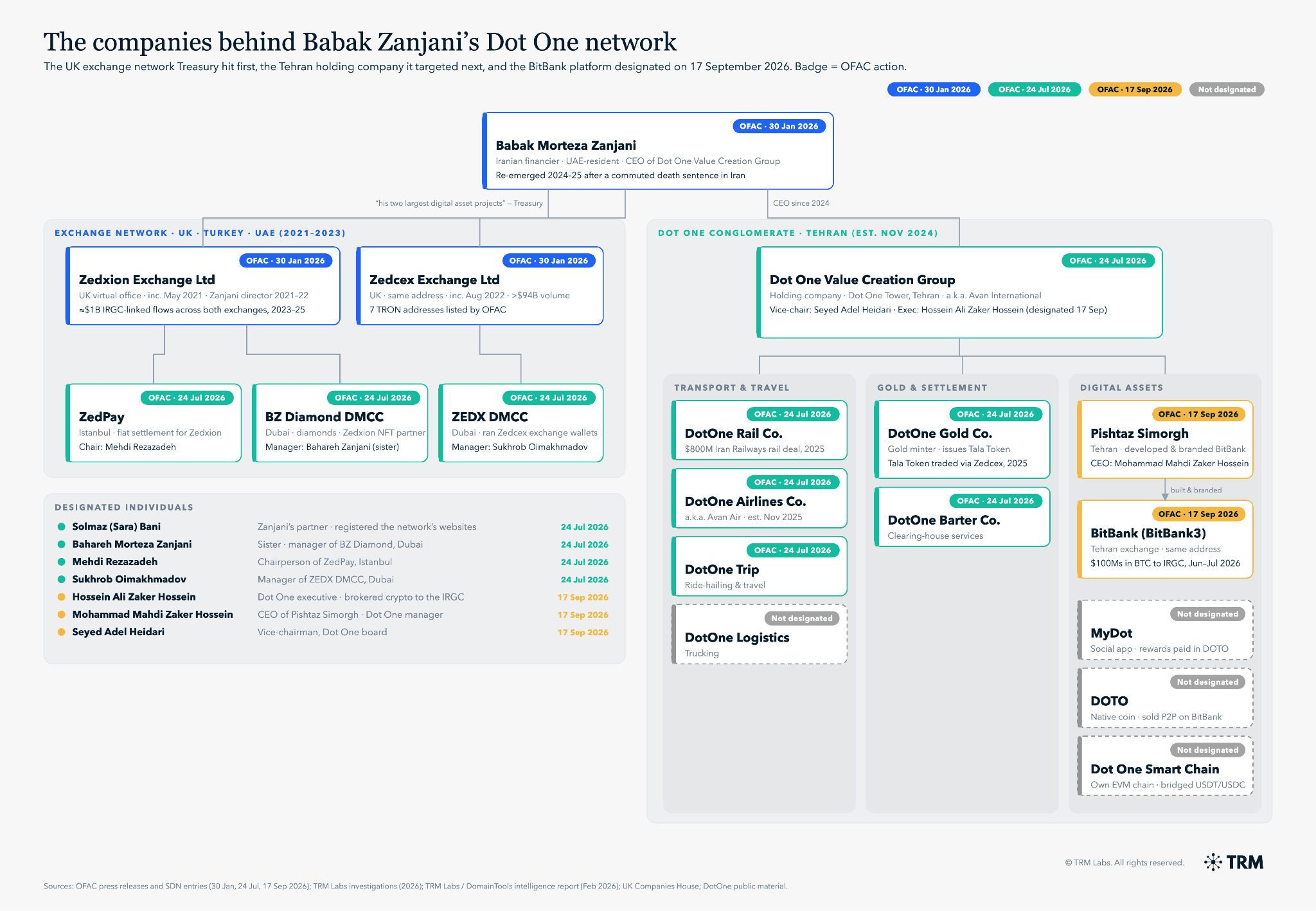
The pattern gives investigators more targets than blockchain addresses alone. Corporate ownership, software development, payment relationships and executive control can connect entities that may otherwise appear separate on-chain.
Treasury’s inclusion of BitBank’s software company reflects that broader approach.
Mohammad Mahdi Zaker Hossein, chief executive of Pishtaz Simorgh and a Dot One manager, was sanctioned for acting on behalf of the software company. Seyed Adel Heidari, vice chairman of Dot One’s board, was designated for acting on behalf of Dot One.
Hossein Ali Zaker Hossein was sanctioned for acting for Zanjani. Treasury alleged he participated in much of Zanjani’s sanctions-evasion activity, including Iranian oil exports and digital-asset transactions, and brokered crypto transfers that ultimately reached the IRGC.
The post US sanctions Iranian crypto exchange and its software developer over alleged IRGC Bitcoin transfers appeared first on CryptoSlate.
Bitcoin’s rebound above $80,000 on Sept. 18 extended a technology-led relief rally. The move coincided with yen weakness and followed a return to Bitcoin ETF inflows the previous day. The advance was already underway in European trading, hours before weak US economic figures offered a possible argument against further monetary tightening.
At press time, Bitcoin traded at $80,856, up 5.60% over 24 hours. The clearest explanation is a broader relief rally with an improving, but still tentative, demand signal. The timing points to a recovery in risk appetite, although it does not identify one decisive trigger.
Dow Jones reported Bitcoin at $78,309, up 2.3%, in early European trading, linking the rebound to Thursday’s technology-led recovery. The 10:54 a.m. BST dispatch described prices earlier that morning.
The equity backdrop was already firmer. Reuters reported Nasdaq 100 E-mini futures up 0.56% at 9:50 a.m. BST as lower oil prices eased inflation concerns. That supports the interpretation of Bitcoin participating in renewed appetite for risk, rather than reacting solely to an afternoon US announcement.
By the opening minutes of US stock trading, Bitcoin was above $79,000 with a gain of more than 4%, according to a Yahoo Finance report published at 3:13 p.m. BST.
The Bank of Japan announced its decision at 3:54 a.m. BST. A 7–2 majority approved a 1.25% overnight call-rate target, up from 1% and in line with expectations. The new setting takes effect Sept. 24.
The yen’s decline was consistent with relief rather than a shock from unexpectedly aggressive tightening. The BoJ’s daily observations showed the dollar buying 156.15–17 yen at 1 a.m. BST and 157.48–50 yen at 9 a.m. BST. The yen therefore weakened across the announcement window.
Reuters attributed that weakness to the two dissenters and guidance that disappointed traders expecting a more hawkish message. A weaker yen is consistent with relief over pressure on yen-funded positions. That remains a possible supporting mechanism, not evidence of money moving from those positions into Bitcoin.
The US policy backdrop also remained restrictive: Wednesday’s Federal Reserve decision was a quarter-point rate hike, as Dow Jones reported.
What supported the move, and what remains uncertain
US spot Bitcoin ETFs recorded net inflows of USD 159.5 million on Sept. 17, according to Farside Investors. BlackRock’s IBIT led the inflows, while withdrawals from other funds reduced the overall total.
That followed net outflows on Sept. 15 and 16. The positive session is evidence that demand through the funds improved before Friday’s advance, but one day does not establish a durable reversal.
The funds provide a concrete demand signal, but daily totals do not reveal when purchases occurred or establish the source of Friday’s buying.
At 2 p.m. BST US industrial production was reported unchanged for August, and manufacturing output fell 0.3%. The Federal Reserve release confirmed those results, while Trading Economics listed expectations for a 0.3% increase in each. At 3 p.m., the leading economic index fell 0.1%, against expectations for a 0.1% rise.
Weaker activity could reduce the case for additional tightening. But these releases cannot explain an advance already visible that morning. Nor was Friday simply a falling-yields story: Reuters reported the 10-year Treasury yield up 2.9 basis points to 4.976% before the US open.
Forced buying may have amplified the move, but the available measurements do not establish its contribution. CoinGlass showed about $230.6 million in total Bitcoin futures liquidations over 24 hours and $56.36 billion in open interest.
The liquidation total includes both sides of the market. A short squeeze would involve bearish positions being forcibly closed as prices rise. The available total, without a short-side breakdown or matching funding and open-interest changes, cannot show how much of Friday’s advance came from that process.
Thursday’s SEC tokenized-stock exemption also offered broader regulatory context. Its conditional relief concerns certain stock-trading venues and liquidity providers, rather than a Bitcoin-specific approval.
For the rally’s durability, repeated ETF inflows would be a clearer demand signal than a one-day rebound, while directional liquidation data could show whether forced buying is playing a substantial role. Friday’s sequence supports a relief rally; it leaves the balance between fresh demand and short covering unresolved.
The post Why Bitcoin hit $80k today hours before bad US data even landed appeared first on CryptoSlate.
XRP Ledger (XRPL) developers are using mathematical proofs to test whether the network’s forthcoming lending market can be drained or become insolvent.
On Sept. 17, protocol research firm Common Prefix said it is formally verifying XRPL’s Lending Protocol with Lean 4, a theorem-proving language designed to establish whether software satisfies defined mathematical properties across possible system states.
The firm said the work is intended to show that the protocol cannot enter states that violate its accounting and safety rules.
The work has taken on greater significance after xrpld version 3.4.0 shipped this week with LendingProtocolV1_1, an amendment that introduces closed-ended lending vaults and cash-basis accounting. The amendment is included in the server software but still requires approval through the XRP Ledger’s amendment process before taking effect.
XRPL’s lending design would allow depositors to pool assets that loan brokers can deploy into fixed-term, uncollateralized loans. Borrower underwriting and credit assessment happen off-chain, while the ledger records loan origination, repayments, and accounting.
That puts a premium on getting the protocol’s internal bookkeeping right. Errors involving vault balances, loan payments, or share calculations could affect pooled depositor funds rather than an isolated application.
Locked capital raises the stakes for XRPL lending
LendingProtocolV1_1 increases the consequences of accounting failures because depositor assets can remain committed through a predetermined investment period.
Closed-ended vaults move through three stages: subscription, investment, and redemption. Depositors can add or withdraw assets during the subscription phase, but both actions are blocked once the vault enters its investment period and the capital becomes available for lending. Withdrawals resume when the vault reaches redemption.
The timetable is set when the vault is created and cannot be changed later, giving participants advance visibility into how long their capital may remain committed.
Version 3.4.0 also changes how new vaults recognize interest income.
Under the earlier design, scheduled interest could be recorded as income when a loan was originated, even before the borrower made those payments. Cash-basis accounting instead recognizes interest only as payments arrive, reducing the risk that vault-share values reflect income not yet received.
Those changes add more states and transitions that must remain consistent as deposits are accepted, loans are issued, repayments arrive, borrowers default, and vaults eventually reopen for withdrawals.
Common Prefix is using formal verification to test those relationships beyond the scenarios engineers might anticipate in a conventional test suite.
Researchers are not attempting to mathematically verify the entire xrpld C++ codebase. They instead recreate the relevant protocol logic in Lean 4 and define the properties the system is expected to preserve.
An oracle can then run equivalent inputs against the mathematical model and the production implementation, helping identify cases where the two behave differently.
That distinction matters because a mathematical proof is only as strong as the model and assumptions behind it. The process can establish that defined properties hold across the modeled state space, while comparisons with the implementation help test whether the production code continues to match those assumptions.
Earlier proofs already exposed XRPL failures
The approach has already uncovered edge cases that conventional testing missed.
During an exploratory verification phase between February and April, Common Prefix modeled parts of the Lending Protocol and defined invariants the system was expected to maintain.
RippleX said the work uncovered vault invariant violations, loan-payment assertion failures, arithmetic rounding errors, and differences between written XLS specifications and their implementation.
The identified issues were subsequently addressed across xrpld versions 3.1.3 and 3.2.0.
That record gives the current verification effort a practical role before significant depositor capital is placed behind the protocol. Formal methods can challenge assumptions embedded in the lending logic, while developers can still change the implementation before broader adoption.
The problem becomes more complex as native lending interacts with existing ledger functions, including asset transfers, freezes and clawbacks. Each additional interaction expands the number of system states developers must account for.
RippleX has previously argued that this complexity raises the limits of relying solely on functional tests, audits, bug bounties and validator testing.
The stakes are also becoming commercial.
RippleX has identified Evernorth, which is preparing to become a Nasdaq-listed XRP treasury company, and VS1.Finance as among the companies preparing to use or build around Single Asset Vaults and the Lending Protocol, putting more pressure on the underlying accounting rules to behave predictably before institutional capital arrives.
Mathematical proofs still leave credit risk outside the ledger
Even successful verification would leave one of XRPL lending’s largest risks outside the mathematical model: whether borrowers repay.
The protocol relies on off-chain underwriting to determine borrower creditworthiness and does not currently depend on automated on-chain collateral and liquidation mechanisms commonly used in decentralized lending markets.
Loan brokers can supply first-loss capital intended to absorb part of a default before losses reach depositors, but XRPL’s documentation notes that the mechanism does not eliminate credit risk.
Formal verification also cannot prove that every external integration, operational process, or underwriting decision will behave safely. Its guarantees extend only to the properties developers define and the assumptions represented in the model.
That creates two separate layers of assurance for depositors.
The first is whether XRPL’s own accounting machinery behaves consistently across deposits, lending, repayments, and withdrawals. The second is whether loan brokers correctly price and manage borrowers whose obligations remain subject to real-world credit risk.
Common Prefix’s work is focused on strengthening the first. With LendingProtocolV1_1 now distributed in xrpld 3.4.0, validators will ultimately determine whether the amendment becomes active.
Before that happens, developers are trying to establish stronger evidence that the lending machinery itself behaves as specified when real capital, loan brokers, and off-chain credit decisions begin interacting with it.
The post XRPL tries to mathematically prove its new lending market cannot be drained appeared first on CryptoSlate.
CryptoTicker.io
If you have funds sitting in a decentralised lending market, your risk is not decided by the interest rate but by the list of tokens the protocol accepts as collateral. On September 17, 2026, an attacker on Starknet exploited exactly that list and borrowed around 3.5 million US dollars from the Nostra Finance money market. The collateral was the protocol's own token NSTR, whose entire circulating market capitalisation stood between 550,000 and 590,000 US dollars at the time. The borrowed amount exceeded the market value of the posted collateral by more than five times.
This article explains what is technically new about the incident and what is not — and above all, which four figures you can look up in the documentation of your own lending market before you next put money into it. The check takes about ten minutes and requires no expertise in blockchain programming.
What happened on Starknet on September 17: $3.5 million against $550,000 of market value
Nostra Finance runs a money market on the Ethereum scaling solution Starknet. That is a protocol where users deposit tokens and other users take out loans against posted collateral. The protocol reported the incident on September 17, 2026 at 13:28 UTC through its official channel. A single account had treated an inflated NSTR balance as collateral and then borrowed a basket of far more liquid assets: Ether, STRK, USDC, USDT, WBTC and DAI in the first version.
The security firm PeckShield reported on September 18 at 00:41 UTC that around 1.92 million US dollars had been moved to the Ethereum mainnet, specifically 234.57 Ether and 1.3 million DAI. CertiK arrived at a similar split barely two hours later: roughly 1.55 million US dollars initially remained on Starknet, and around 1.93 million was bridged. The analytics firm SlowMist classified the event as oracle manipulation. Nostra itself has switched off deposits, borrowing, withdrawals and liquidations while the team reconciles the pool balances. How large the final loss turns out to be, and how much of it can be recovered, remains open.
Oracle manipulation explained: how a price feed becomes the attack surface
An oracle is the interface through which a protocol learns what a token is currently worth. Without that information a lending market cannot operate: it has to know how much a posted collateral covers and at what point a position must be liquidated. Oracle manipulation is an attack in which it is not the protocol's program code that is broken, but the price that this code takes at face value.
The distinction matters, because it explains why security audits of the code help little here. The protocol calculates correctly — it merely calculates with a false number. Which price provider was in use in the case of NSTR has to this day not been named in the official statements. Security researchers assume that a trading venue with very thin liquidity was used to push the reported price far above the usual trading level. NSTR was trading between 0.0055 and 0.0059 US dollars at the time of reporting.
Nostra has had this weakness before. On March 24, 2025, the price feeds for xSTRK and sSTRK displayed three times the actual value; xSTRK jumped from 0.1793 to 0.5897 US dollars. A second, independent price provider as a fallback did not exist for those assets.
Why thin liquidity in the collateral token is the real risk
The technical debate usually revolves around oracles. The leverage, however, lies elsewhere. A price can only be moved if the market behind it is thin enough. With a token traded in the hundreds of millions each day, an artificial doubling costs more than the attack brings in. With a token carrying half a million dollars of market capitalisation, a modest stake is enough.
From that follows a rule you can apply without technical tools: the smaller the collateral token relative to what may be borrowed against it, the greater the manipulation risk for everyone else in the same pool. That includes you, even if you have only deposited and never taken out a loan — because in the end the payout came from the shared balance.
Borrow caps and isolation mode
Good protocols limit this risk with two tools. A borrow cap sets how much may be borrowed against a particular collateral in total. An isolation mode locks risky tokens into a separate pot, so that a default there does not spill over into the large pools. Both are stated in the documentation, and both are a number you can look at before you deposit. If the cap is missing entirely, or sits above the market capitalisation of the collateral token, that is a finding and not a detail.
Anyone looking for interest on crypto balances will find different risks at centralised providers, but comparable questions — what collateral sits behind it, and who is liable. A look at our comparison of lending providers shows which models exist in the first place, before you decide between decentralised and centralised.

Checking your lending market's collateral list: these four figures are in every documentation
Every serious protocol publishes its parameters. At Nostra you will find them at docs.nostra.finance; at other protocols the section is usually called Markets, Risk Parameters or Asset Listing. Four figures are enough for a first assessment.
First: which tokens are approved as collateral? Not which ones you can deposit, but which ones can be borrowed against. Those are two different lists, and the second is the dangerous one. Look for the protocol's own token — if it appears as collateral, look more closely.
Second: how high is the borrow cap per collateral? Set it against the market capitalisation of that token. At Nostra, more could be borrowed against NSTR than the entire circulating supply was worth.
Third: does an isolation mode apply? If so, for which tokens, and does your balance sit in the shared or in the isolated pot?
Fourth: who supplies the price? More on that in a moment.
Price source and fallback oracle: how to tell whether a protocol seeks a second opinion
The documentation usually states which price provider is used. Less interesting than the name are the answers to two questions. Does the protocol draw the price from several independent sources, or does everything hang on one? And is there a plausibility limit that freezes a position if a price jumps several fold within minutes?
A fallback oracle is a second price source that steps in or objects when the first delivers implausible values. That is precisely what Nostra lacked in March 2025 for the affected assets. If you find no statement on this in the documentation, that is not an all-clear but an open question you can put to the team in the public channel. A protocol that does not answer has already answered you.
We have asked the same question in earlier incidents. In the Moonwell exploit on Base at the end of August, it was the protocol's own token MAMO whose price was manipulated. The pattern has been repeating for months under changing names.
32 price manipulations in one year: what the numbers and our own count show
The Nostra incident is not an isolated case but the latest point in a series. According to data circulated by the exchange KuCoin in early September, decentralised lending protocols have recorded 32 separate price manipulation attacks so far in 2026 — on that count a record for the sector. Roughly one in eight crypto hacks this year can accordingly be traced back to this form of attack. The largest single loss fell on Tectonic on the Cronos chain, where around 75 million US dollars were borrowed after a price had risen a hundredfold within about 20 minutes. The figure comes from a market participant and not from an independent auditor; it shows an order of magnitude, not an official statistic.
Because we wanted to know how this is reflected in our own coverage, we counted the German-language archive of cryptoticker.io. Method: a query of the editorial database on September 18, 2026 for all German articles since July 1, 2026 whose address contains the terms "exploit" or "hack", followed by a manual review of the hits. Result: 21 documented incidents in eleven weeks. Six of them hit lending markets or their price sources — Ostium in July, Ajna, Tectonic, Moonwell and More Markets at the end of August, plus the compromise of a price service across four chains in early September. This analysis was carried out by cryptoticker.io itself on September 18, 2026.
What we cannot measure with it: how many incidents there were in total. Our count only captures what we reported on ourselves, and articles without the two search terms in the address slip through the net. The number works as an indication of a pattern, not as a damage balance sheet. The clustering is striking all the same: four of the six lending market cases fell within a single week at the end of August.
When a market pauses: why you cannot withdraw when it matters most
The part many underestimate comes after the attack. Nostra stopped not only borrowing but withdrawals as well. From the protocol's point of view that is correct, because otherwise the fastest movers clear out the rest and the damage is distributed unevenly. For you it means: at the moment you most urgently want to get your money out, the door closes.
From that follows an uncomfortable but useful exercise. Ask yourself before depositing how long you could do without this amount if it were frozen for an indefinite period. Not whether you could lose it — that is the obvious question — but whether you will not need it for weeks. Anyone who has parked funds for a tax payment or an upcoming bill does not belong in a money market.
You can also check who is allowed to trigger such a pause. In most protocols that right sits with a small circle of key holders, sometimes with a timelock instance with a lead time. Both are stated in the documentation under Governance or Admin Keys.

Yields that look too good: how to read return against collateral risk
High deposit rates in a money market arise because somebody is willing to pay that rate. Who pays double-digit rates for a loan? As a rule, someone building a position with borrowed money that is meant to return more — or someone who has posted collateral they could not borrow against anywhere else. The second case is the same one that led to the loss at Nostra.
That does not mean high rates are automatically a warning sign. It means the rate tells you where to look. If a conspicuously high rate sits next to an exotic collateral token in the list, you have found the explanation. If only Ether and an established stablecoin are listed, the rate is probably an expression of demand and not of risk.
Centralised or decentralised: which risks you take on in each case
The comparison does not come out clear-cut, and anyone presenting it as clear-cut is simplifying. With a decentralised money market you bear the risk of the parameters, the price feed and the program code. You can read up on all of it, and nobody can withdraw your balance at will — as long as the protocol's key management holds.
With a centralised provider you bear counterparty risk instead: the provider lends your balance on, and whether the underlying collateral holds value is something you generally cannot check. In exchange there is a contractual partner you can address and, at providers with European authorisation, a supervisory authority. Which form suits you depends on whether you would rather read parameters or contracts.
What self-custody changes about this
The third route is not to lend at all. Anyone holding their assets in their own custody forgoes interest and thereby rules out both types of risk. That is not a romantic position but a sober one: a return of a few percent a year does not justify every default risk, and the incidents of recent weeks show that default is not the exception.
Checking a DeFi lending market: what to take away
- Look at the collateral list before you deposit. Find out which tokens can be borrowed against, how high the borrow cap is per token, and whether it exceeds the market capitalisation of that token. If you want to know in advance which providers even come into question and how interest-bearing models differ, our overview of staking and yield platforms helps with the shortlist.
- Clarify whether you really need the interest. Work out what a year of yield brings on your amount, and set it against the case where the market pauses for weeks. If the sum comes out close, self-custody is the simpler answer; which devices are suitable is set out in our hardware wallet comparison.
- Document your deposits and withdrawals as you go. If a protocol enters a wind-down, you will later need records of times and amounts — for your tax return as much as for a possible loss offset. A portfolio tracker takes that off your hands; you will find a selection under crypto tax software and portfolio trackers.
And in case you are already affected: wait for the team's official settlement before responding to offers that promise you a quick recovery. After every major incident, accounts appear that pose as a recovery service and in truth ask for wallet access. The details of the Nostra wind-down are summarised, among others, in the chronology of the security reports.
(As of September 18, 2026. This article is not investment advice. Prices and fee structures change; check the terms with the provider before you buy.)
On November 5, 2026, the Zcash network activates the NU7 upgrade. If you hold ZEC, the most important answer is also the least dramatic one: you do not need to move your coins, swap them or pull them off an exchange. The only people who have to act are those who run infrastructure themselves, meaning a full node, an indexer or a block explorer. The rest of this article explains why that is the case, which four dates matter between now and then, and where German rules on tax and custody still come into play.
The timeline has been firm since September 17, 2026. That evening at 22:42 UTC, Zcash core developer Sean Bowe, who posts in the forum under the name ebfull, published the dates in the Zcash Community Forum. He describes unanimous agreement among the organisations and development teams involved, naming ZF, Tachyon, Valar, ZODL and SL. Before that there was a vote result but no calendar. Since then there is both.
What is NU7 and why is Zcash activating the upgrade on November 5, 2026?
NU7 is a network upgrade, or in technical terms a hard fork. A hard fork is a rule change that older software no longer understands: anyone who does not update their node stops following the same chain as the rest of the network from the cut-off date. At Zcash these upgrades are numbered, NU stands for Network Upgrade, and NU7 is therefore the seventh of its kind.
According to Bowe's announcement, NU7 consists of three components. First, the target block spacing drops from 75 to 25 seconds (ZIP-218). Second, version 4 transactions are switched off. Third, the Network Sustainability Mechanism is added in the form that emerged from the vote (ZIP-234 in its alternative version, plus ZIP-235). A ZIP is a Zcash Improvement Proposal, a numbered change proposal that the project decides on in public, comparable to an EIP at Ethereum.
One sentence Bowe deliberately put into his announcement matters for context: this upgrade brings no new transaction formats, and the changes are not meant to affect wallets in any material way. What is affected is infrastructure, and he names full nodes, indexers and block explorers specifically. That distinction is precisely why the answer for the vast majority of German ZEC holders is: do nothing.
Which four dates in the Zcash roadmap matter to you?
Bowe explicitly frames the forum post as a checklist and names four markers. By September 30, 2026, the code is due to be finished, with all features implemented and ready for the testnet. On October 6, 2026, the official Zcash testnet activates NU7. On October 20, 2026, the final decision on mainnet activation is taken, including the block height, based on the experience from the testnet; that date falls a week before the Zcash conference Zcon. On November 5, 2026, NU7 goes live on mainnet.
In practice, October 20 is the most interesting of these dates. Only then does the target date turn into a fixed block height. A block height is the running number of a block in the chain; network upgrades do not switch on by clock time but from a particular block number onwards, which is why the calendar date can still shift by hours until the last moment. If you want to follow the timeline, look again on October 20 rather than waiting for November 5.
A look back helps with context: ZEC holders voted on the contents of this upgrade themselves in September. How that vote worked and who was allowed to take part is something we described on September 5, 2026, in a separate article on the Zcash vote on NU7. That piece covers the process; the result and the timeline came afterwards.
Do I have to move my ZEC before the NU7 upgrade?
No. NU7 involves no swap, no migration deadline and no address you would have to send anything to. That sets this upgrade apart from events such as a delisting at an exchange or a token swap, where you genuinely can miss a deadline. If you hold ZEC in a wallet, you will hold the same ZEC in the same wallet after November 5.
A calm stocktake is still worthwhile, because experience shows that phishing attempts cluster around network upgrades. The trick is always the same: a message claims your balance has to be secured to a new address before the upgrade, or unlocked via a form. There is no legitimate process of that kind for NU7. If you want to review your custody anyway, comparing the devices in our hardware wallet comparison is the more sensible route than reacting to any unexpected message.
What applies if your ZEC sit on an exchange?
Then the exchange handles the technical side: the trading venue runs the nodes, it updates the software, and your balance in the customer account remains a claim against the exchange. It is common for trading venues to pause deposits and withdrawals for a few hours around an activation, so that no transfer lands in the moment of the switch. Whether and when a provider does this is stated on its status page, not in the Zcash project's timeline. If you want to know how differently trading venues handle privacy coins in the first place, the overview sits in our comparison of the best crypto exchanges.

What do 25-second blocks change for transfers and confirmations?
Block time is the average interval at which the network appends a new block. At Zcash that target has so far been 75 seconds; after NU7 it is 25 seconds. A transfer counts as confirmed as soon as it sits in a block, and as effectively final once several further blocks follow it. Intervals three times shorter therefore mean the same number of confirmations accumulates in a third of the time.
Two points belong to an honest account. First, exchanges and payment providers require a certain number of confirmations before they credit a deposit; whether they raise that number after the upgrade is for each provider to decide, and a higher number eats into part of the time saved. Second, a shorter block time changes nothing about the total supply of coins: the project adjusts the payout per block accordingly, otherwise the issuance schedule would fall apart.
What does switching off v4 transactions mean for old wallets?
A transaction version is the technical format in which a transfer is written down. Zcash knows several versions; v4 dates from the period before the NU5 upgrade and today's Orchard pool, while v5 is the current format. NU7 switches v4 off, so the network will no longer accept such transactions afterwards.
This only matters to you if you use very old wallet software that has never been updated. A maintained wallet has been producing v5 transactions for years. If you have carried on using a wallet from before 2022 unchanged, install an update before November 5 and, if in doubt, make a small test transfer well ahead of the date. That is a manageable amount of work and the only wallet task this upgrade creates at all.
And what about old shielded balances?
Zcash holds shielded balances in several pools that stem from different stages of development. If you still hold funds in an older pool, you should complete the migration into the current Orchard pool regardless of NU7; on September 13, 2026, we described how to check whether your ZEC balance still needs migrating. NU7 does not force that migration, but it is the reason many wallets have been showing a note about it for months.
What lies behind the Network Sustainability Mechanism and the halving decision?
The Network Sustainability Mechanism, NSM for short, is a proposal addressing the question of what pays for the Zcash network in the long run, once the block reward keeps shrinking. The variants put to the vote differed in whether the existing halving rhythm is preserved. A halving is the scheduled halving of the reward per block, at Zcash as at Bitcoin a fixed part of the issuance schedule.
The result is in Bowe's announcement: the halvings are preserved, and the amount previously held back will be issued again from February 2031. Cointelegraph reported on the corresponding vote on September 18, 2026, and cites very clear majorities, both for keeping the halvings and for the shorter block time. The direction has therefore been set, though the practical effect on circulating supply only starts in more than four years.
For you as an investor, the main point is this: NU7 is not an event that pays out or withdraws coins in the short term. Anyone expecting price moves around November 5 should treat that as what it is, namely an expectation and not a promise. In the same report, Cointelegraph points to a sharp rise in the ZEC price around the announcement; moves like that say nothing about how an upgrade plays out technically.
Who really has to act: full node, indexer or block explorer?
A full node is a program that stores the entire chain itself and checks every rule independently. An indexer is a service that prepares this chain data for fast queries, for instance for a wallet app. A block explorer is the website where you look up transactions and blocks. All three implement the consensus rules in software, and that is exactly why they need a NU7-capable version before November 5.
Anyone running their own node in Germany therefore has a clear task and a clear deadline. It makes sense not to wait until early November: NU7 runs on the testnet from October 6, and that is the opportunity to test your own setup against the new rules while a mistake costs nothing. If you fail to update the node in time you will not lose funds, but after activation you will be looking at an outdated chain and therefore at wrong balances.

How does the German tax office treat a hard fork like NU7?
The tax question comes up regularly with hard forks, because some forks create a second chain and therefore an additional coin. For that case, the administrative position is clearly set out. On March 6, 2025, the German Federal Ministry of Finance published its circular on individual questions of the income tax treatment of crypto assets (file reference IV C 1 - S 2256/00042/064/043), replacing the 2022 version.
In substance it says: anyone acquiring crypto assets also acquires the assets that later arise on a new blockchain through a hard fork. The acquisition costs are allocated across those assets in proportion to their market prices at the time of the hard fork. If you sell the newly created assets within one year of acquiring the original holdings, the gain is a private disposal transaction under section 22 no. 2 in conjunction with section 23 (1) sentence 1 no. 2 of the German Income Tax Act (EStG).
Applied to NU7, that is good news with one caveat. The core developer's announcement names no second chain and no new coin, but a unanimously backed rule change to the existing network. As long as that holds, no new crypto asset comes into being, there is nothing to allocate, and your holding period on the existing ZEC continues undisturbed. If in doubt, check after November 5 whether your portfolio tracker has wrongly booked an inflow from the upgrade; a properly maintained tax tool shows no inflow in this case.
How long does the holding period run, and what is the exemption limit?
Private disposal transactions in crypto assets carry a holding period of one year: hold for longer and then sell, and you pay no income tax on the gain. Below one year, gains remain tax free up to an exemption limit of 1,000 euros per calendar year, and an exemption limit is not an allowance; once it is exceeded, the entire gain becomes taxable. A network upgrade neither resets these periods nor interrupts them.
What applies to your ZEC once the EU anti-money laundering regulation bites in July 2027?
The second German deadline in this matter falls after NU7 and has nothing to do with the upgrade technically, but it does bear on the question of where you will be able to hold ZEC in future. The EU anti-money laundering regulation, Regulation (EU) 2024/1624, prohibits credit institutions, financial institutions and crypto-asset service providers in Article 79 from keeping anonymous accounts as well as accounts that anonymise or heavily obscure holders or transactions, explicitly including through anonymity-enhancing cryptocurrencies. The regulation becomes applicable on July 10, 2027.
Zcash is among the assets regularly named in this debate, because shielded transactions are one of its core features. What that means concretely for trading on regulated European platforms, and what room for interpretation remains, we set out in our analysis of the EU ban on privacy coins from July 2027. For planning your holdings, the order matters: first the technical upgrade in November 2026, then the regulatory deadline in July 2027, and only the second may require a decision about where your coins should sit.
What mistakes do ZEC holders make around a network upgrade?
The most common mistake is moving too soon. Anyone who shifts holdings back and forth out of concern about an upgrade, or sells and buys back, may trigger a taxable disposal and reset their own holding period to zero, even though the upgrade demanded nothing of the sort. The second most important mistake is believing messages that push you towards an action: no legitimate NU7 process asks you to unlock a wallet or enter a recovery phrase.
A third point concerns expectations about the price. Analysts and market commentary like to tie upgrades to price targets; such statements are the opinions of the firms concerned and not a property of the protocol. Between October 20, when the activation height is set, and November 5, there are two weeks in which the dates are fixed and nobody can infer from them where the price will go. And finally: anyone running their own node tends to put the update off until shortly before the deadline, even though the testnet allows a risk-free rehearsal from October 6.
How do you recognise a genuine announcement?
Genuine Zcash announcements appear in the project's community forum, in the development teams' repositories and in the numbered ZIPs. Announcements of that kind contain block heights, version numbers and dates, and they never ask for credentials. If a demand arrives by email, by chat or through an advert, assume the source is a fake, even when the name and the design look right.
Zcash NU7 upgrade: what to take away
- Leave your holdings alone and update your wallet. NU7 requires no movement of your ZEC. The only wallet task is an update, if you use very old software that still produces v4 transactions. If you are thinking about custody anyway while you are at it, compare the devices in our hardware wallet comparison rather than responding to a prompt from outside.
- Take another look on October 20. That is the day the activation height for mainnet is set, and only after that is November 5 more than a target date. If your coins sit with a trading venue, a glance at its status page is enough; how the providers differ is shown in our comparison of the best crypto exchanges.
- Do not rush anything on tax. Without a second chain no new crypto asset arises, your holding period keeps running, and sales made out of nerves cost you that period. Check your entries after November 5 all the same, ideally with one of the tools from our comparison of crypto tax software.
The sources for this article: the core developer's timeline announcement in the Zcash Community Forum of September 17, 2026 and the German Federal Ministry of Finance circular of March 6, 2025 on crypto assets.
(As of September 18, 2026. This article is not investment advice. Prices and fee structures change; check the terms with the provider before you buy.)
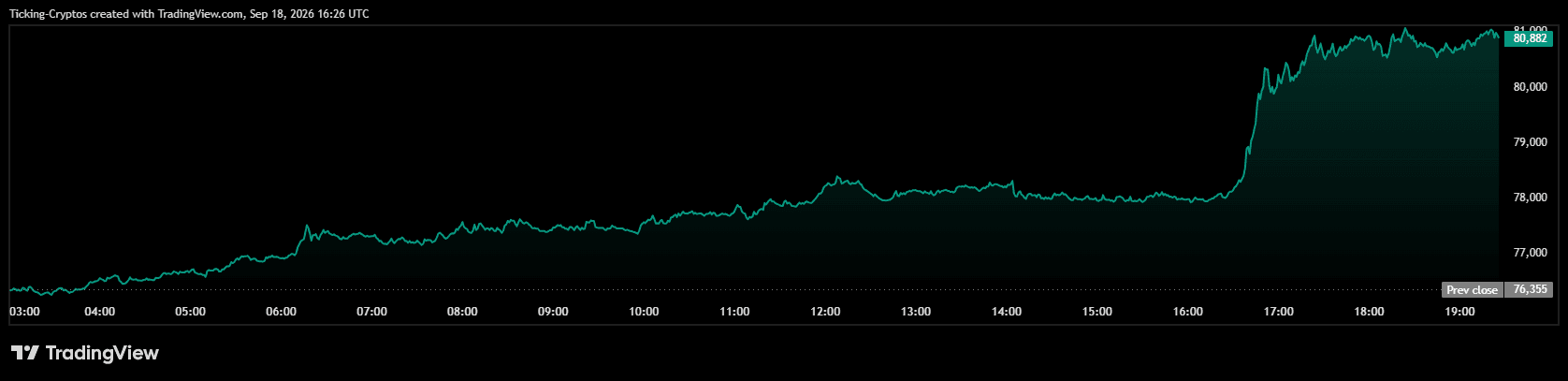
$Bitcoin has punched back through $80,000. BTC is trading at $81,006, up 5.75% over the past 24 hours, pushing its market cap back to $1.62 trillion on roughly $35.5 billion in daily volume. It is the cleanest green day the market has had in weeks, and this time the altcoins came along for the ride.
Why Did the Bitcoin Price Break Back Above $80,000?
There is no single smoking gun. The rebound above $80,000 extended a technology-led relief rally, coinciding with yen weakness and following a return to Bitcoin ETF inflows the previous day. The advance was already underway during European trading hours, before weak US economic figures gave markets a fresh argument against further monetary tightening.
In other words: risk appetite is recovering, and Bitcoin is the highest-beta expression of that. Repeated ETF inflows would be a far more convincing demand signal than a single day of buying, so treat this as a relief bounce until proven otherwise. $BTC is still down 7.43% on the year.
Which Altcoins Are Leading the Crypto Rally?
$Solana is the standout among the majors at $111.53, up 10.28% on the day and 9.66% on the week. $Ethereum added 5.37% to $2,596, $XRP gained 5.94% to $1.38, and $BNB climbed 4.54% to $759. $Dogecoin tacked on 6.91%, Chainlink 7.09%.
Are Privacy Coins Quietly Winning 2026?
This is the trade nobody wants to talk about at dinner parties. $Monero jumped 17.33% to $598, the biggest 24-hour move in the top 15, and is up 38.25% year to date. $Zcash is at $1,474 after a 26.44% weekly run and an eye-watering 187.77% YTD gain. $Hyperliquid is the other outlier, up 11.22% on the day and 259.38% on the year.
While Bitcoin fights to stay above a level it first cleared long ago, privacy coins and a handful of newer names are the only assets on the board with genuinely strong annual numbers.
What Happens Next for BTC Price?
$80,000 was resistance yesterday. If it holds as support into the weekend, the case for a proper reversal gets much stronger. If ETF flows stall and BTC slips back under, this goes down as another bounce in a choppy year.
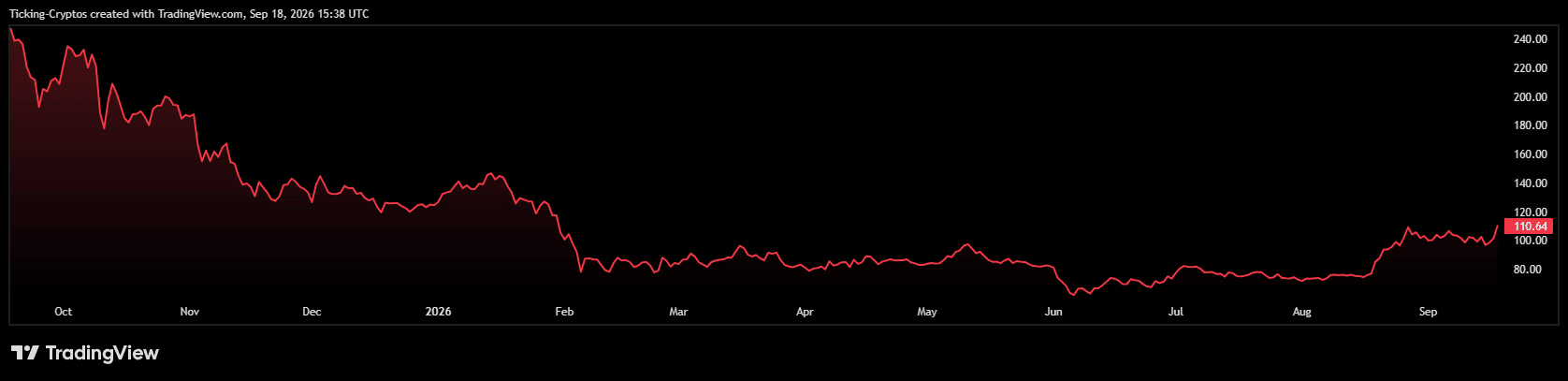
For most of the past year, Solana was a chart nobody wanted to open. From roughly $240 last October it bled almost without pause into a June low near $62. Then in mid-August the whole thing changed in about three sessions, and $SOL has spent the last month doing something it had not done all year: holding above $100.
Where is the SOL price right now?
$Solana has just tagged $110. That is the top of the range it has traded in since the August breakout, and it is the level this entire setup has been building toward. The session opened at $101.52 with a low of $100.80, so SOL has swung close to 10% inside a single day.
The floor is the other half of the story. $100 was the ceiling that capped every rally from February through August. It is now acting as the floor. A level that flips from resistance to support is the single most reliable signal in technical analysis, and SOL has now defended it repeatedly, including a drop to around $95.84 earlier this week when the US Senate failed to advance the CLARITY Act. Even that scare got bought back inside two sessions.
Zoom out and the damage is still obvious. SOL is roughly 56% below its October 2025 high. But the shape of the chart has changed completely since August.
What does the SOL chart analysis say about $120?
Look at what happened in mid-August. Solana had been grinding in a tight band between $72 and $85 for six weeks, compressing to barely $75 to $78 by the end of the month. Then it went vertical: through $76, through the 200 EMA, through $90.21, and straight into the $100 handle. Early September printed a high near $110.
The weeks since were spent digesting between roughly $95 and that level rather than giving the move back, which is exactly what a healthy market does after an expansion.
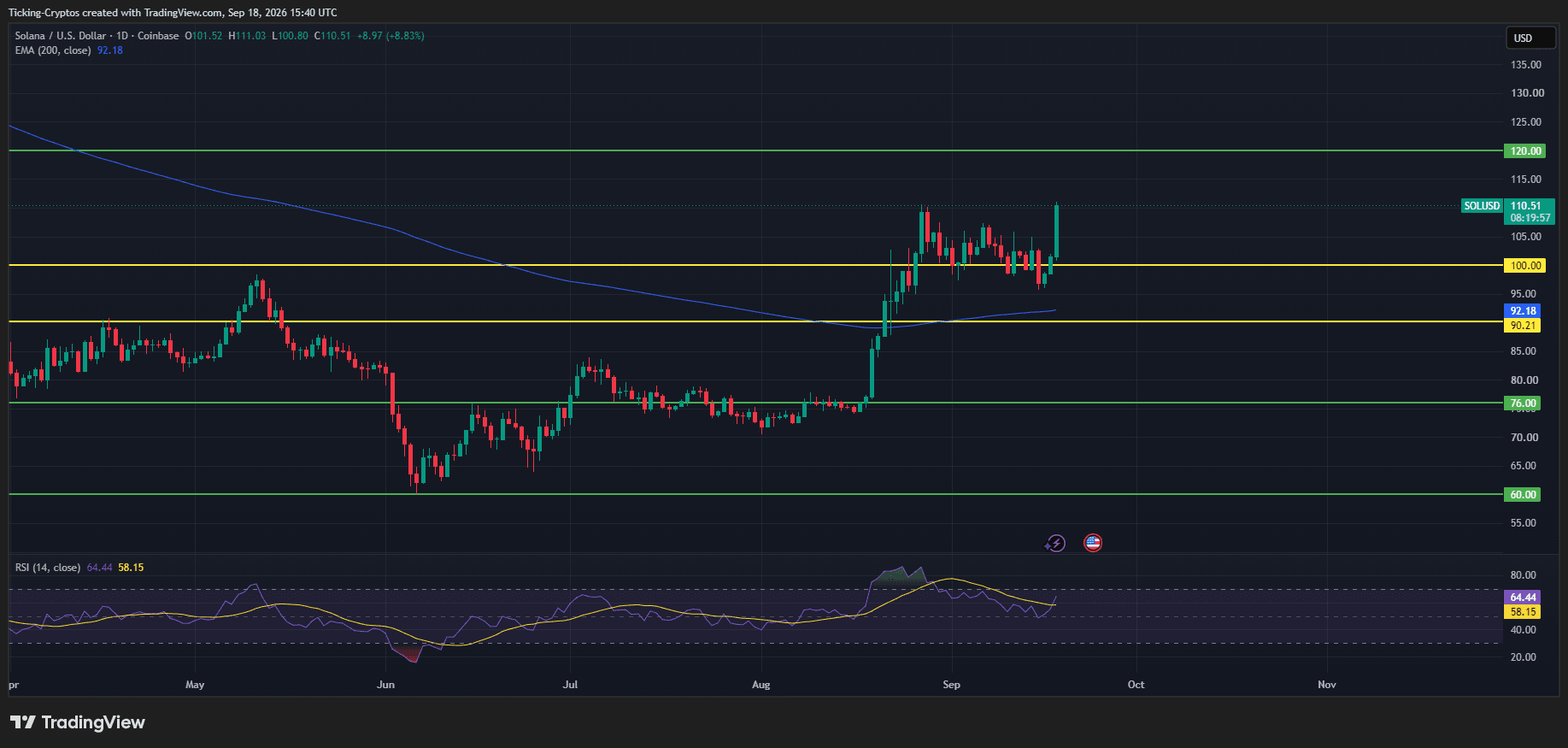
SOL is now back at the top of that range. Second tests of a range high tend to work far more often than first ones, because the sellers who defended the level in early September have had four weeks to get filled. That is the situation on the screen right now.
The measured move math points at the next target. The multi-month base between $76 and $100 was 24 points wide. A confirmed break above $100 projects roughly $124, which sits right on top of the $120 level drawn on the chart. That is the first real objective, not a stretch goal.
Above $120, the chart thins out fast. The next marked levels are $144.04 and then $160, both of which come from the early-2026 breakdown structure. There is very little traded volume between them, which is why moves through this zone tend to be quick when they come.
Is the 200 EMA finally working for Solana instead of against it?
This is the piece most people are missing.
The 200-day EMA sits at $92.13. For the entire first half of the year it sloped down, and it rejected SOL on every single attempt to recover. Solana is now trading about 15% above it, and the line itself has flattened and started to curl upward for the first time in 2026.
That is the difference between a relief bounce and a structural change. A rising long-term average underneath price turns pullbacks into entries rather than exits.
RSI supports the setup without overheating. The 14-period reading is 60.18, sitting above its own signal line at 57.84. That is firmly in bullish territory with no overbought condition, meaning there is room for another leg before momentum needs a rest.
Are ETF flows and the network upgrades enough to get SOL there?
The fundamental backdrop has improved more quietly than the price.
US spot Solana ETFs have now recorded nine consecutive weeks of net inflows, with more than $200 million arriving in the past month alone. The latest reading put the 30-day total at $220.1 million and cumulative net inflows at roughly $1.37 billion. The nine products tracked by SoSoValue held about $1.41 billion in net assets in early September. Flows are not explosive, but they are persistent, and they held up through the CLARITY Act disappointment.
Regulatory positioning also improved. On 5 September the SEC formally named SOL a core ETF asset alongside Bitcoin and Ether for commodity-based trusts, which matters far more for future product launches than for today's candle.
On the technical side, the roadmap is dense. Transaction V1 went live on 9 September, raising the maximum serialized transaction size from 1,232 to 4,096 bytes and opening the door to ZK proofs and more complex on-chain operations. A phased rent reduction started on 31 August, targeting roughly 90% lower on-chain storage costs across five stages.
The big one is Alpenglow, the largest consensus overhaul in Solana's history. It retires Proof of History and Tower BFT in favour of Votor and Rotor, cutting transaction finality from about 12.8 seconds to roughly 150 milliseconds and freeing up around three quarters of block space currently consumed by validator votes. Mainnet activation is targeted for October 2026 with the Agave 4.3 release.
An October catalyst landing while price sits just under a breakout level is a setup worth respecting. If you are positioning for it, it is worth checking fees and SOL spreads first, since the difference between venues eats into a 20% move faster than most people expect. Our updated table lets you compare the best crypto exchanges side by side.
What would invalidate this Solana price prediction?
First, a rejection at $110 is not a failure. It simply resets the range and sends SOL back toward the middle of it. Range highs are rarely taken on the first or second attempt.
The level that actually breaks the thesis is $100. That is the whole case in one number: the breakout level, the flipped resistance, and the line that has now been defended more than once.
A daily close back below $100 puts the 200 EMA at $92.13 in play, immediately followed by the $90.21 shelf. Lose both and the August breakout starts to look like a liquidity grab rather than a trend change, with $76 as the next structural support underneath.
The risks are not only technical. SOL inflation still runs near 3.7%, the active validator count has fallen to roughly 800, which raises fair questions about centralisation, and Alpenglow has already slipped once from September to October. Upgrades that slip tend to slip again.
Solana price prediction: how realistic is $120?
Analyst views are spread wide. Chart-based targets cluster around $140 if the current bull flag resolves upward, while long-horizon models put SOL's base case far higher and are therefore close to useless for a September or October decision.
The chart gives the cleaner answer, and it is no longer hypothetical. Solana does not need a new narrative to reach $120. It needs a daily close above $110 rather than a wick through it, and then the measured move, the rising 200 EMA, the RSI position and the October upgrade catalyst all point the same way. Tagging the level was the easy part. Closing above it on real volume is the confirmation, and that is what to watch into the weekly close.
Fail to hold $100 and none of that matters. Ranges resolve in both directions, and this one has not resolved yet.
Ethereum spent most of this year looking like the coin everybody had given up on. Then one candle in August changed the entire picture, and ETH has been quietly building a launchpad ever since. The $3,000 level is no longer a fantasy number. It is roughly 19% away, and the chart is doing exactly what it needs to do to get there.
Where Is the ETH Price Right Now?
$Ethereum is trading at $2,510 on the daily, up 2.65% on the session, after opening at $2,445 and tagging $2,518 intraday. The low of the day was $2,435, which is the important part, because that is the third time in a month buyers have shown up in that exact zone.
Step back and the year looks brutal. ETH ground sideways through April near $2,400, rolled over in May, and collapsed through June into a low around $1,550. That is a drawdown of more than 65% from the August 2025 all-time high near $4,946. July was a slow repair job above $1,600. August was a boring drift between $1,900 and $2,050.
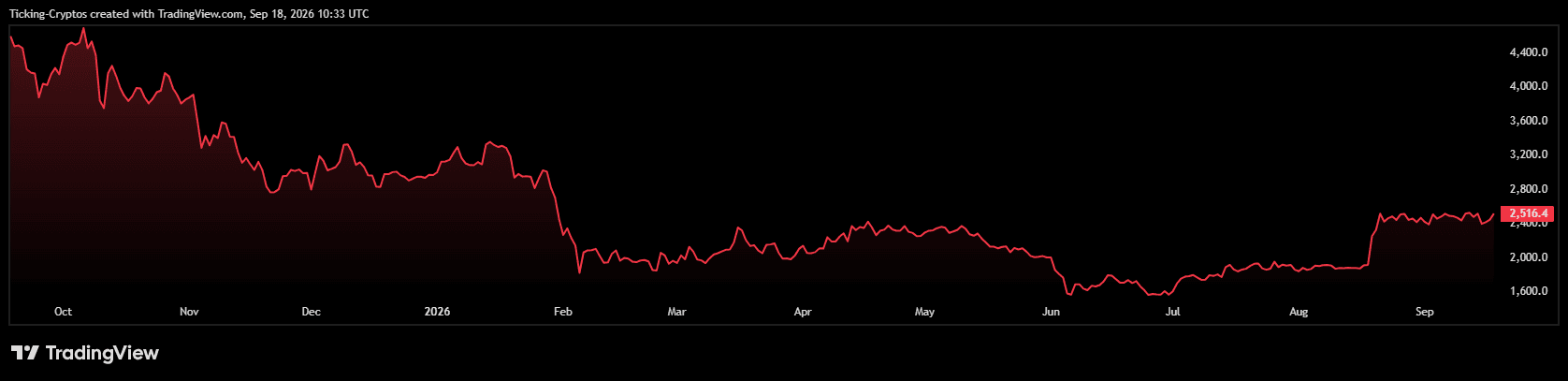
Then came the candle. In mid-August, Ethereum went vertical in a single daily session, ripping from roughly $1,950 through $2,000, through the 200 EMA, through $2,400, and closing near $2,500. That is a 28% expansion move in one bar, and it did not retrace. Everything since has been consolidation, not distribution.
What Does the ETH Chart Say About $3,000?
The structure right now is a textbook range. $2,400 is the floor. $2,600 is the ceiling. Ethereum has been locked between them for a full month, and neither side has broken.
That matters more than it sounds. When a market makes a violent vertical move and then goes sideways at the highs instead of giving the move back, it is usually absorbing supply rather than topping out. Sellers who wanted out at $2,400 have been getting filled for four weeks, and price has not cracked.
The measured move math is clean. The $1,600 to $2,000 base was 400 points wide, and the breakout above $2,000 projected $2,400. That target was hit almost exactly. The current $2,400 to $2,600 range is 200 points wide, so a clean daily close above $2,600 projects $2,800. From there, $3,000 is the next horizontal level on the chart, and it is the level that was acting as resistance through the entire first half of the year.
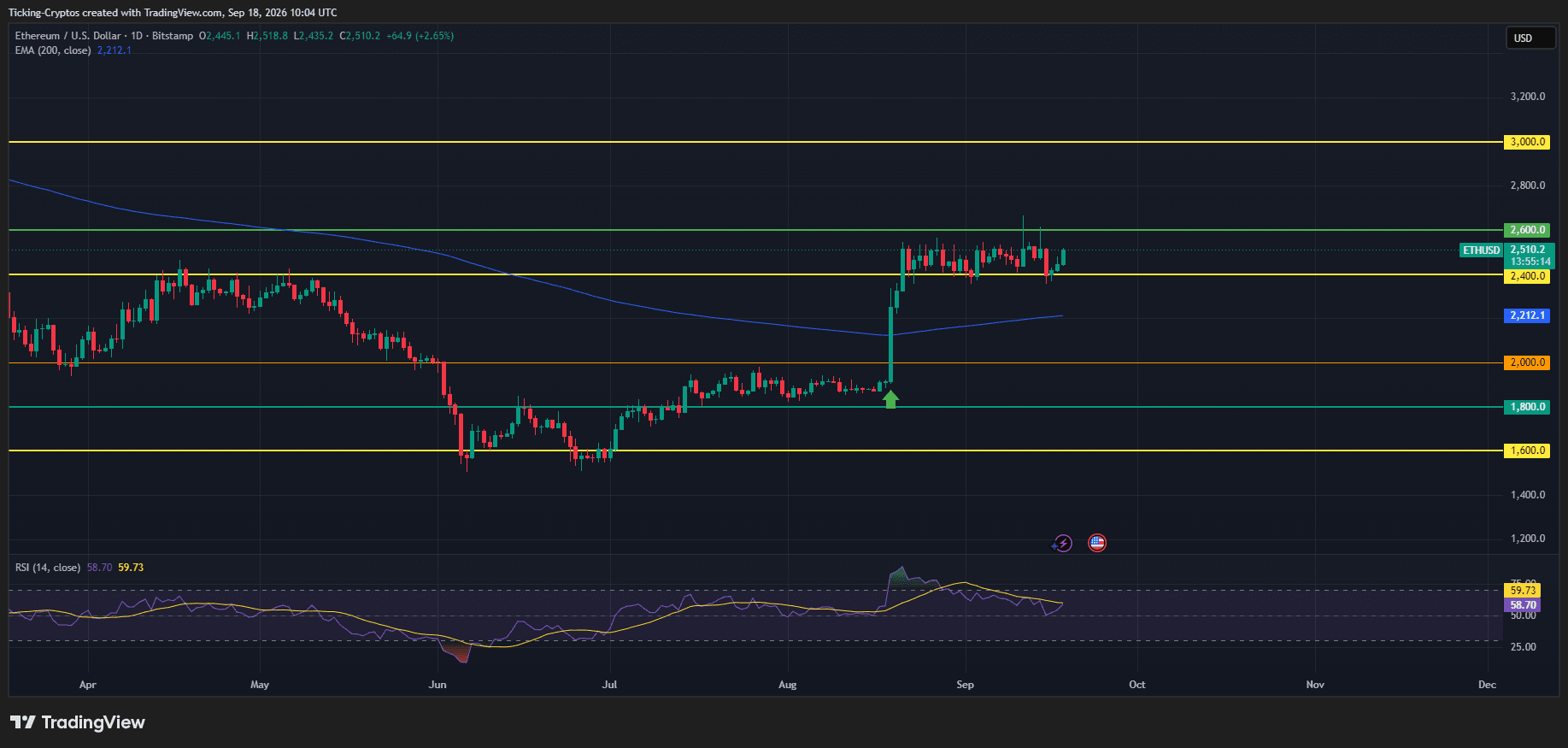
So the path is not a single leap. It is two steps: reclaim and hold $2,600, then run the gap to $2,800 where there is almost no historical resistance, then attack $3,000.
Is the 200 EMA Turning Bullish for Ethereum?
The 200-day EMA sits at $2,212. For eight straight months it pointed down, and every rally in spring and summer died against it. Ethereum is now trading roughly 13% above it, and more importantly, the line itself has flattened and hooked upward for the first time this year.
A rising 200 EMA underneath price is what separates a dead-cat bounce from a trend reversal. As long as ETH stays above it, the medium-term bias flips from bearish to constructive, and pullbacks become buyable instead of terrifying.
RSI backs this up without screaming. The 14-period reading is 59.73, sitting just above its own signal line at 58.70. That is the bullish half of the range with no overbought condition anywhere in sight. Ethereum can rally another 15% before RSI even starts flashing warnings, which is exactly the kind of fuel tank you want before a breakout attempt.
Are ETF Inflows Strong Enough to Push ETH to $3,000?
The chart is not moving in a vacuum. Institutional flow has flipped hard in Ethereum's favor.
US spot Ethereum ETFs pulled in roughly $1.75 billion to $1.85 billion in August 2026, their best month since August 2025, after more than $1 billion had left the funds in May and June. The week ending September 11 added another $197 million, a fourth consecutive positive week, while Bitcoin ETFs bled $463 million over the same stretch. A single session on September 11 brought in $216 million, the largest daily total of that week.
That divergence is the story. Money is not leaving crypto, it is rotating from Bitcoin into Ethereum, and the staking yield inside the newer ETH products is a large part of why. Ethereum spot ETFs now hold $16.31 billion in total net assets, around 5.28% of Ethereum's entire market capitalization.
One caveat worth being honest about: the buying is heavily concentrated, with BlackRock's ETHA accounting for roughly 72% of the inflow streak that began in mid-August. A trend carried by one issuer is a trend with a single point of failure.
The other catalyst is on the roadmap. The Glamsterdam upgrade has slipped to Q4 2026, with the Sepolia testnet fork scheduled for 28 September. A delayed catalyst is still a catalyst, and it lands right in the seasonal window where crypto tends to get interesting.
What Would Invalidate This Ethereum Price Prediction?
$2,400 is the line. It is the breakout level, it is the range floor, and it has now been defended three separate times. Bitfinex analysts also flagged the September 11 daily low near $2,432 as the level to watch on pullbacks.
A daily close below $2,400 kills the range and puts the $2,212 EMA directly in play. Lose that, and the August candle starts looking like a liquidity event rather than a trend change, with $2,000 the next real shelf underneath.
The bearish case is not just technical. ETF flows can stop as fast as they started, and the macro backdrop around Fed policy has been the single biggest driver of crypto beta all year.
Ethereum Price Prediction: How Soon Can ETH Hit $3,000?
Analyst targets are scattered across a wide band, which tells you the market genuinely does not know. CoinDCX puts September at a $2,800 target with a $2,405 to $2,950 range. LongForecast is far more aggressive, modelling a September close near $2,959 and October at $3,432. Messari's base case is $3,200 to $3,800 by December, with VanEck pointing to $4,500 if macro conditions improve. Prediction markets are more sober, giving roughly a 31% chance of a $3,500 touch before year end.
Strip out the noise and the chart gives a cleaner answer. Ethereum does not need a miracle to see $3,000. It needs one daily close above $2,600 with volume, and the structure opens up. Given the range has already compressed for four weeks with a rising 200 EMA underneath and RSI holding the bullish band, a breakout attempt in October is the base case, not the moonshot case.
Fail at $2,600 again and $ETH simply keeps grinding between $2,400 and $2,600 until something forces a decision. Ranges do not last forever.
Decrypt
Kevin O'Leary believes Bitcoin could hit $1 million if crypto beats its quantum computing problem, and explained why he's ditching Ethereum.
XRP is roaring back as Bitcoin claws its way above $800,000 again, but the charts continue to give traders mixed signals.
The agency submitted a prerule on crypto asset transactions and markets to the White House for review, signaling it will build a derivatives framework on its own authority after the Clarity Act's collapse.
Bitcoin just ripped 5.88% higher in a single session, tearing back toward its 2026 highs. The charts say the move is real, but they also say it's gotten ahead of itself.
Internal memos warned of a "doom loop" threatening the quality of the very models it was building with OpenAI.
U.Today - IT, AI and Fintech Daily News for You Today
Bloomberg senior ETF analyst Eric Balchunas believes Bitcoin ETFs could eventually grow to three times the size of the gold ETF market.
Barry Silbert mirrors his early BTC and Zcash strategies, shifting institutional DCG capital to back Bittensor (TAO) as the next major AI scarcity play.
XRP gains spotlight in South Korea after its largest treasury firm, Evernorth, secured a massive $30 million funding from South Korean investment firm NH Investment & Securities through convertible notes.
XRP whales moving big with Binance inflows reaching 1.6 billion tokens.
Following a record ATH, Hyperliquid hits the top 10 as analyst Aksel Kibar predicts a 3-digit price tag.
Blockonomi
TLDR
- Disney stock drops 2.52% as Karandeep Anand joins as chief technology officer.
- Disney creates a new CTO role to oversee technology, data, product, and engineering.
- Anand joins from Character.AI after senior roles at Brex, Meta, and Microsoft.
- Disney expects Character.AI technical employees to follow Anand into the company.
- The leadership move supports Disney’s broader push to modernize digital operations.
The Walts Disney (DIS) shares fell 2.52% to $102.69 on Friday after a sharp mid-morning decline. The move followed Disney’s appointment of Karandeep Anand as its new chief technology officer. Disney created the role as it expands technology, data, product development, and engineering across the company.
The Walt Disney Company, DIS
Disney Stock Extends Losses After Leadership News
Disney created the chief technology officer position to strengthen company-wide technology leadership. Anand will start on October 2 and report directly to Chief Executive Officer Josh D’Amaro. His role will cover enterprise technology, infrastructure, data platforms, product development, and engineering.
Disney shares remained under pressure after the earlier decline accelerated during mid-morning trading. The stock closed down 2.52%, keeping market attention on Disney’s near-term share performance. Meanwhile, management continued outlining a broader plan to modernize technology across its businesses.
Disney also wants to connect its entertainment businesses through stronger digital systems and shared technology. Disney+ remains central as management builds more direct relationships with audiences worldwide. The company plans greater coordination between technology teams serving streaming, parks, entertainment, and other operations.
Karandeep Anand Takes New Technology Role
Anand joins Disney after serving as chief executive officer of Character.AI. He led the company during a period of strong platform growth and expanding consumer engagement. Before Character.AI, Anand served as president and chief product officer at financial technology company Brex.
Earlier, Anand held several leadership positions at Meta, including roles overseeing advertising and business products. He also spent 15 years at Microsoft in senior product and engineering positions. During that period, Anand worked on teams involved in building the Azure cloud platform.
Disney expects several members of Character.AI’s technical team to join the company with Anand. Their arrival could strengthen Disney’s engineering resources across several business areas. However, Disney has not provided specific roles or responsibilities for those incoming technical employees.
Disney Expands Technology Strategy Under D’Amaro
D’Amaro has placed technology among Disney’s main priorities since becoming chief executive officer. His approach combines storytelling, stronger technology support, and closer coordination across the company. Management also wants technology to create more connected experiences across Disney’s major consumer businesses.
The new structure gives Anand company-wide oversight instead of responsibility for one operating division. That setup could help Disney standardize infrastructure, data systems, engineering practices, and product development. It also places one senior executive in charge of coordinating major technology projects across Disney.
Disney faces strong competition across streaming, entertainment, gaming, and other digital platforms. The company has relied more heavily on digital distribution to support engagement and direct customer relationships. Anand’s appointment adds experienced technology leadership as Disney continues reshaping operations around connected products and services.
The post Disney (DIS) Stock: Plunges as Character.AI CEO Joins as Chief Technology Officer appeared first on Blockonomi.
TLDR
- Amazon’s air cargo network prepares for a major Airbus A330 fleet expansion
- ATSG receives its first Amazon-ready A330 and targets operations in 2027
- ABX Air plans new pilots and maintenance staff for the expanding A330 fleet
- Amazon has committed to multi-year leases covering four Airbus A330 freighters
- ATSG expands beyond Amazon through new Latin American cargo operations
Amazon (AMZN) stock traded at $253.20 as its air cargo network prepared for a wider Airbus A330 rollout. The expansion will gradually reduce reliance on Boeing 767 aircraft across Amazon’s cargo operations. Meanwhile, Air Transport Services Group is preparing its first A330 for Amazon service in 2027.
Amazon.com, Inc., AMZN
Amazon Prepares for A330 Expansion
ATSG received its first A330 freighter modified from a passenger aircraft for Amazon’s cargo network. The company expects ABX Air to begin operating the aircraft during the first quarter of 2027. Meanwhile, Amazon has committed to multi-year operating leases covering four A330 aircraft.
ABX Air must complete Federal Aviation Administration programs before adding the A330 to its operating certificate. These programs cover pilot training, aircraft operations, and maintenance procedures for the new type. Therefore, ATSG plans to hire additional pilots and maintenance workers as A330 capacity increases.
ATSG currently operates 56 aircraft within Amazon’s fleet of more than 100 planes. The company has supported Amazon since 2016 using Boeing 767-200 and 767-300 freighters. Meanwhile, Alaska Airlines operates 11 Airbus A330 freighters for Amazon.
ATSG Builds a New Freighter Fleet
The A330 expansion reflects the declining supply of mid-life Boeing 767 passenger aircraft available for cargo conversions. Boeing no longer produces the 767, while older passenger aircraft continue to leave commercial service. As a result, ATSG has pursued the A330 as its next medium-widebody freighter platform.
ATSG plans to acquire and convert 30 A330 aircraft as part of its broader cargo fleet strategy. Airbus aftermarket affiliate Elbe Flugzeugwerke performs the passenger-to-freighter conversion work. However, supply chain problems have slowed the conversion program and delayed some planned deliveries.
EFW has delivered two converted A330 freighters to Turkey-based ULS Airlines Cargo so far. ATSG also plans to support its new aircraft through maintenance operations in Ohio and Florida. The company is developing an Airbus maintenance program at Wilmington Air Park and in Tampa.
Amazon Cargo Network Expands
ABX Air has also added a new cargo customer as ATSG expands its business beyond Amazon and DHL Express. Miami-based Global Aviation Link hired ABX Air to operate a Boeing 767-300 to Latin America. Under the one-year agreement, ABX Air provides the aircraft and operates the service.
The service began flights between Miami and Quito on September 2 and operates six days each week. Global Aviation Link plans to expand service toward Venezuela and Peru, which export flowers and fruit. The company already provides scheduled cargo service between Miami and Bogota using Boeing 767 aircraft.
ATSG also announced three executive appointments as it continues changes following its 2025 acquisition by Stonepeak. Mike Hough became group president for airlines and services, while Tim Schulze joined as chief risk officer. Doug Belding also joined as vice president for enterprise performance and operating systems.
The post Amazon (AMZN) Stock: Air Cargo Network Prepares for Airbus A330 Expansion appeared first on Blockonomi.
TLDR
- HSBC stock falls 1.56% as the bank expands Premier services across the US market.
- Premier now combines wealth, health, travel and cross-border banking services.
- New mobile tools let customers open brokerage accounts and manage investments.
- HSBC adds telemedicine, wellness benefits and enhanced travel support for clients.
- The bank strengthens its US wealth corridor with 21 Wealth Centers nationwide.
HSBC Holdings (HSBC) shares fell 1.56% to $101.24 as the bank expanded its Premier offering across the United States. The upgrade targets affluent customers seeking wealth, health, travel, and international banking services. The move supports HSBC’s broader plan to deepen its global wealth business.
HSBC Holdings plc, HSBC
HSBC Stock Slides as Premier Upgrade Reaches US Market
HSBC launched the enhanced Premier service as affluent customers increasingly manage money across several markets. The bank said the United States remains a leading destination for international investment. Its 2026 research found many wealthy clients plan to maintain or increase exposure to US assets.
The new service combines banking tools with support for customers who travel, relocate, or invest internationally. HSBC also wants to simplify access to financial services across different countries. The bank is positioning Premier as a wider relationship offering for globally connected customers.
HSBC shares still moved lower during the session despite the service expansion. The stock traded at $101.24 after falling 1.56% during the day. The decline came as HSBC promoted its larger US wealth strategy.
HSBC Expands Wealth Health and Travel Services
HSBC added new investment tools to its US mobile application for eligible Premier customers. Clients can open brokerage accounts, review holdings, and trade mutual funds through the platform. Wealth Relationship Managers will also continue providing financial planning and personalized support.
The health package includes third-party telemedicine services and wellness support for members. Customers can access doctors by phone or video for primary, urgent, and mental healthcare needs. The package also includes selected discounts on fitness, nutrition, massage, acupuncture, and other wellness services.
HSBC expanded travel benefits through global support, merchant partnerships, and credit card rewards. Premier customers can receive selected hotel and dining savings alongside points on qualifying travel purchases. Eligible cards also carry no foreign transaction fees for overseas spending.
US Wealth Strategy Targets Cross-Border Banking Demand
HSBC strengthened international banking features for customers moving money or relocating across borders. The service includes competitive foreign exchange rates and no HSBC fees on international transfers. Customers moving to the United States can also open accounts before arriving.
The Premier expansion forms part of HSBC’s wider strategy for the United States. The bank is combining digital services with physical wealth centers in major financial markets. HSBC currently operates 21 Wealth Centers across the country, including locations in New York and California.
HSBC relaunched its Park Avenue Wealth Center earlier this year and plans another relaunch in Cupertino this month. Its network also covers South Florida, Washington, Los Angeles, San Francisco, and Seattle. HSBC expects these centers to support affluent customers with international banking and wealth needs.
The post HSBC Holdings (HSBC) Stock: Plunge as Global Banking Push Expands With Premier Upgrade appeared first on Blockonomi.
Quick Overview
- Bitcoin pushed past the $80,000 threshold with approximately 5.5% gains in one day, shrugging off Federal Reserve rate increases and congressional setbacks on crypto rules
- Cryptocurrency-linked equities saw strong gains: Strategy jumped 12%, Coinbase climbed 10%, and Robinhood rose 8%
- Nvidia’s chief executive indicated potential for chip sales to double from 2026 to 2027
- Ten-year Treasury yields reached the 5% mark, creating headwinds for equities with nine of eleven S&P 500 sectors declining
- Congressional efforts to pass the Clarity Act stalled, leaving digital asset oversight with existing regulatory agencies
Digital currency markets witnessed significant upward momentum with Bitcoin crossing $80,000, while chip manufacturer Nvidia outlined ambitious growth projections and bond markets saw yields climb to levels that created pressure across equity sectors. Here’s a breakdown of the week’s major market developments.
Digital Currency and Related Equities Experience Strong Gains
Bitcoin’s price climbed approximately 5.5% within a 24-hour period, reaching around $80,940. This upward movement occurred even as the Federal Reserve implemented a 25-basis-point rate increase, bringing rates to a 3.75%-4.00% range, and as lawmakers failed to advance crucial digital asset legislation.
Market participants had broadly anticipated the central bank’s decision, which helped mitigate potential negative sentiment. The cryptocurrency’s strength provided momentum across the digital asset sector, with capital flowing back into this asset class.
Equities with cryptocurrency exposure demonstrated similar strength. Strategy’s shares increased approximately 12%, Coinbase recorded gains near 10%, and Robinhood advanced roughly 8%.
Strategy maintains substantial Bitcoin holdings on its corporate balance sheet, creating direct exposure to cryptocurrency price fluctuations. Coinbase sees immediate benefits from increased trading activity in digital assets. These three stocks had experienced declines earlier in the week due to rate concerns and legislative disappointments, making the subsequent bounce particularly notable.
Digital Asset Oversight Returns to Regulatory Agencies
Congressional efforts to move forward with the Clarity Act encountered a roadblock this week. The proposed legislation aimed to establish more definitive regulatory boundaries for digital assets and clarify jurisdictional responsibilities between the SEC and CFTC.
The legislative failure doesn’t signal an end to regulatory development. According to industry sources speaking with CoinDesk, both regulatory bodies are anticipated to continue crafting rules using their current statutory powers, even without fresh congressional mandates.
This situation leaves the digital asset sector navigating an environment without unified federal legislation, with agencies expected to exercise existing regulatory authority to address emerging issues.
Nvidia Executive Projects Dramatic Sales Growth by 2027
Jensen Huang, Nvidia’s chief executive, projected that the company’s chip sales volume could approximately double between 2026 and 2027.
According to projections referenced by Barron’s, Nvidia’s 2026 sales could reach approximately 5.09 million AI GPUs, plus tens of thousands of fully integrated AI server systems. The anticipated expansion is expected to be driven by the upcoming Vera Rubin architecture generation, central processing units, networking solutions, and additional AI infrastructure offerings.
The company previously indicated that revenue potential for its artificial intelligence chips could exceed $1 trillion cumulatively through 2027, illustrating the enormous investment levels directed toward AI computing infrastructure.
Bond Yields Reach 5%, Creating Equity Market Headwinds
The ten-year United States Treasury yield climbed back to approximately 5% on Friday, enhancing bonds’ relative attractiveness versus equities and compressing stock valuations.
Nine out of eleven sectors in the S&P 500 experienced declines during trading. Markets also navigated quarterly triple witching—the concurrent expiration of equity options, index options, and futures contracts—a phenomenon that typically amplifies market volatility.
Elevated yields disproportionately affect growth-oriented stocks because they increase discount rates applied to projected future earnings, reducing their present-day valuation.
The post Market Roundup: Bitcoin (BTC) Soars Past $80K, Nvidia (NVDA) Projects Chip Surge, Treasuries Touch 5% appeared first on Blockonomi.
Key Highlights
- BitMine (BMNR) shares climbed approximately 8% during Friday’s session, reaching $25.77 at the time of writing
- Ethereum’s robust 4.62% recovery to approximately $2,558 provided the primary catalyst for the rally
- Short-dated call options with strikes above $25 saw heavy volume as implied volatility spiked
- Eightco Holdings, supported by BitMine, revealed approximately $380 million in total assets, including a $90 million indirect stake in OpenAI
- BMNR currently trades above its 20-day, 50-day, 100-day, and 200-day simple moving averages, despite a January death cross that remains unresolved
BitMine Immersion Technologies (BMNR) delivered a robust Friday performance, climbing roughly 8% to $25.77, even as broader equity indices struggled. The S&P 500 declined 0.44% while the Nasdaq remained essentially unchanged.
Bitmine Immersion Technologies, Inc., BMNR
Ethereum’s resurgence served as the primary catalyst. ETH advanced 4.62% during the previous 24-hour period to approximately $2,558, providing substantial support to BitMine, whose operations and financial position are deeply intertwined with cryptocurrency performance.
This relationship carries significant weight. BitMine maintains substantial Ethereum holdings that generate staking rewards, creating a steady passive revenue channel that complements its core mining activities.
Eightco Holdings, which receives backing from BitMine, released a Thursday disclosure that attracted market attention. The entity reported approximately $380 million in total assets.
Within that portfolio sits a $90 million indirect OpenAI position, an $18 million Beast Industries stake, a $1 million Mythical Games investment, and more than 301 million Worldcoin tokens priced at 37 cents apiece.
Additionally, Eightco maintains 16,278 Ethereum tokens and approximately $120 million in cash and stablecoin holdings. The company also executed share repurchases exceeding 26 million common shares during the current quarter.
Derivatives Market Provides Additional Momentum
Options trading activity amplified the stock’s upward trajectory. Market participants aggressively purchased near-term call contracts, particularly September expiration calls struck above $25. Implied volatility expanded in tandem with the increased activity.
Such derivatives enthusiasm typically attracts momentum-focused traders seeking to capitalize on short-term price action. While no official price projections were announced, the options market is essentially forecasting additional near-term appreciation.
Technical Analysis and Chart Positioning
BMNR currently trades above every significant moving average. The stock sits above its 20-day SMA at $24.46, its 50-day at $20.28, its 100-day at $19.13, and its 200-day at $22.08.
Near-term technicals show improvement. The 20-day SMA has crossed above the 50-day, representing a constructive development. However, the 50-day remains beneath the 200-day, reflecting the death cross that materialized in January.
Resistance emerges around the $27 level, a psychological round number where upward momentum could face challenges. Support appears near $23, aligned with the 20-day EMA at $23.64.
BitMine maintains meaningful representation across multiple cryptocurrency-focused ETFs. The stock comprises 9.97% of the Global X Blockchain ETF (BKCH), 7.00% of the Bitwise Crypto Industry Innovators ETF (BITQ), and 5.87% of the Corgi Crypto Infrastructure ETF (BLCK). Significant ETF fund flows could create additional stock price volatility.
Important consideration: BitMine continues to operate at a cash deficit and report losses. This fundamental challenge persists regardless of positive trading days. The company’s financial performance remains closely correlated with cryptocurrency valuations, and any substantial digital asset correction would create significant headwinds.
BMNR’s year-to-date return stands at negative 12.01%, with average daily volume reaching 39.15 million shares. The company’s market capitalization totals $13.76 billion.
The post BitMine (BMNR) Stock Rallies 8% Friday Amid Ethereum Recovery and Bullish Options Activity appeared first on Blockonomi.
CryptoPotato
SOL has followed the green wave sweeping through the broader cryptocurrency market, surging 6% in the past 24 hours to $105.
Many analysts believe the asset’s rally might be just starting, with one envisioning a potential explosion to as high as $1,300.
Parabolic Jump on the Way?
Earlier this week, the landmark crypto bill known as the CLARITY Act failed in the US Senate and could not advance to formal discussion. The development caused a brief correction for the crypto sector, with Ali Martinez noting that SOL plunged from $101 to around $95.60.
However, he argued the asset found solid support despite the pullback and outlined several bullish factors. First, he pointed to strong institutional demand, with spot SOL ETFs recording several consecutive green weeks and attracting over $200 million in the past month alone. Martinez also mentioned that 3 million tokens were withdrawn from exchanges in the last 30 days and that network growth remains “elevated.”
Shortly after, the analyst opined that a breakout is near, spotting a potential bull flag forming on SOL’s 4-hour chart. He said the key level to watch is $105 and claimed that a sustained close above could confirm the bullish breakout and open the door to an ascent to $130.
Most recently, Martinez claimed that the asset is “ready to go parabolic.” He opined that SOL has spent the last few years building a massive cup-and-handle pattern, with the neckline sitting near $360.
“A confirmed break above that level could mark the beginning of a much larger expansion toward $1,300,” he maintained.
Additional Forecasts
X user CRYPTOKRALI argued that SOL has started to “look interesting” again. The analyst noted that after weeks of compression, the price has finally broken above the descending resistance that kept rejecting every attempt higher. They said $98 has held repeatedly as support, and the strong daily candle through the trendline provides the necessary confirmation.
“Now the key is whether SOL can hold above the breakout and turn that old resistance into support. If it does, I’d be watching $110 first, with room for a bigger continuation if momentum follows through. The downtrend is breaking. Now we see how far the next leg can run,” the analyst added.
Scient also weighed in. The market observer expects one more leg up to around $130, saying they will then de-risk 50% of their spot bags and look to reload if the price dips to $90.
The post Solana to Go Parabolic? Here’s Why SOL Can Explode by 1,100% appeared first on CryptoPotato.
ETH witnessed a notable recovery after briefly plunging near $2,350 this week. The leading altcoin has since climbed over $2,480. At the same time, its transaction fees have fallen sharply, making the network cheaper to use.
The average cost per ETH transfer has dropped to around $0.095 from this year’s peak of $0.72 on April 21, according to Santiment’s findings.
Ethereum Gets Cheaper
The decline comes as mainnet demand softened during the bearish summer. However, network upgrades have also increased Ethereum’s capacity. Fusaka, higher blob throughput, and a 60 million gas limit have helped the network handle more activity. At the same time, Layer 2 solutions are processing large amounts of transactions that previously competed for Ethereum’s mainnet blockspace.
Lower fees could make Ethereum more accessible for users and developers, according to Santiment. Swaps, transfers, DeFi activity, stablecoin movements, and ERC-20 transactions can now be completed at a lower cost.
The analytics platform said that cheap transactions do not necessarily mean demand is recovering. But it is important to note that lower costs remove one of Ethereum’s long-standing barriers. With ETH prices having recovered, cheaper network activity could provide a more favorable environment for Ethereum-based projects.
Meanwhile, Ali Martinez observed that the asset is trading within a defined 4-hour channel despite recent market volatility. ETH has reached the lower boundary of the range, following which the $2,570 level has come into focus. Martinez expects a potential rebound toward the middle and upper end of the channel. A strong 4-hour close above $2,570, supported by higher trading volume, could signal a breakout. He added that the next stops would be $2,700 and then $3,000.
The Long Investor believes Ethereum remains a buy despite an almost 45% rise over the past three months. The investor said buying before ETH moves above $3,000 may put investors ahead of late buyers. They also pointed to the 200-week moving average as a strong long-term reference.
Supply Drain
Less ETH on exchanges is helping the recovery. Recent estimates revealed that only 6.06 million units now sit on exchanges, down from 22.9 million at the June 2020 peak. That is a 73% decline in readily available supply. The drop reflects more ETH moving into staking, ETFs, treasury holdings, and long-term custody.
Validators are also locking ETH to help secure the network. Lower liquid supply may increase the impact of buying activity. Even without a major rise in demand, smaller waves of buying can have a stronger effect when fewer coins are available on exchanges.
The post Ethereum Gets Cheaper: Network Fees Collapse Over 85% as ETH Price Rebounds appeared first on CryptoPotato.
Ethereum has recovered sharply from its mid-year lows and jumped past the key $2.5K level on Friday. The charts show a constructive improvement in the broader market structure, although ETH remains below several important higher-timeframe resistance levels.
Meanwhile, the Coinbase Premium Index is once again negative, suggesting that the recent recovery has not been accompanied by consistently strong spot demand from U.S. investors.
Ethereum Price Analysis: The Daily Chart
On the daily timeframe, ETH has undergone a significant structural recovery from the $1.5K support area. The rebound has pushed price back above both the 100-day and 200-day major moving averages shown on the chart, with the 100-day yellow average aggressively pushing toward the 200-day one from below, likely to form a bullish crossover around $2K.
ETH is currently trading around $2.5K, directly inside a key resistance zone. This area has repeatedly contained price during the recent consolidation. Yet, a valid daily breakout above it can lead to continuation of the recovery.
A successful move above the $2.5K area could expose the next major resistance around $3.0K. Beyond that, the larger daily resistance zone sits around $3.3K-$3.4K, which coincides with the broader structure established earlier in the year.
On the downside, the first important support is around $2.1K, where the moving averages are also currently clustered. Below this area, the $1.9K zone becomes the next notable support. Still, the daily RSI is around the mid-to-upper 50s, meaning momentum is still bullish but not showing an overbought reading anymore. Therefore, there could still be room to the upside if sufficient demand emerges.
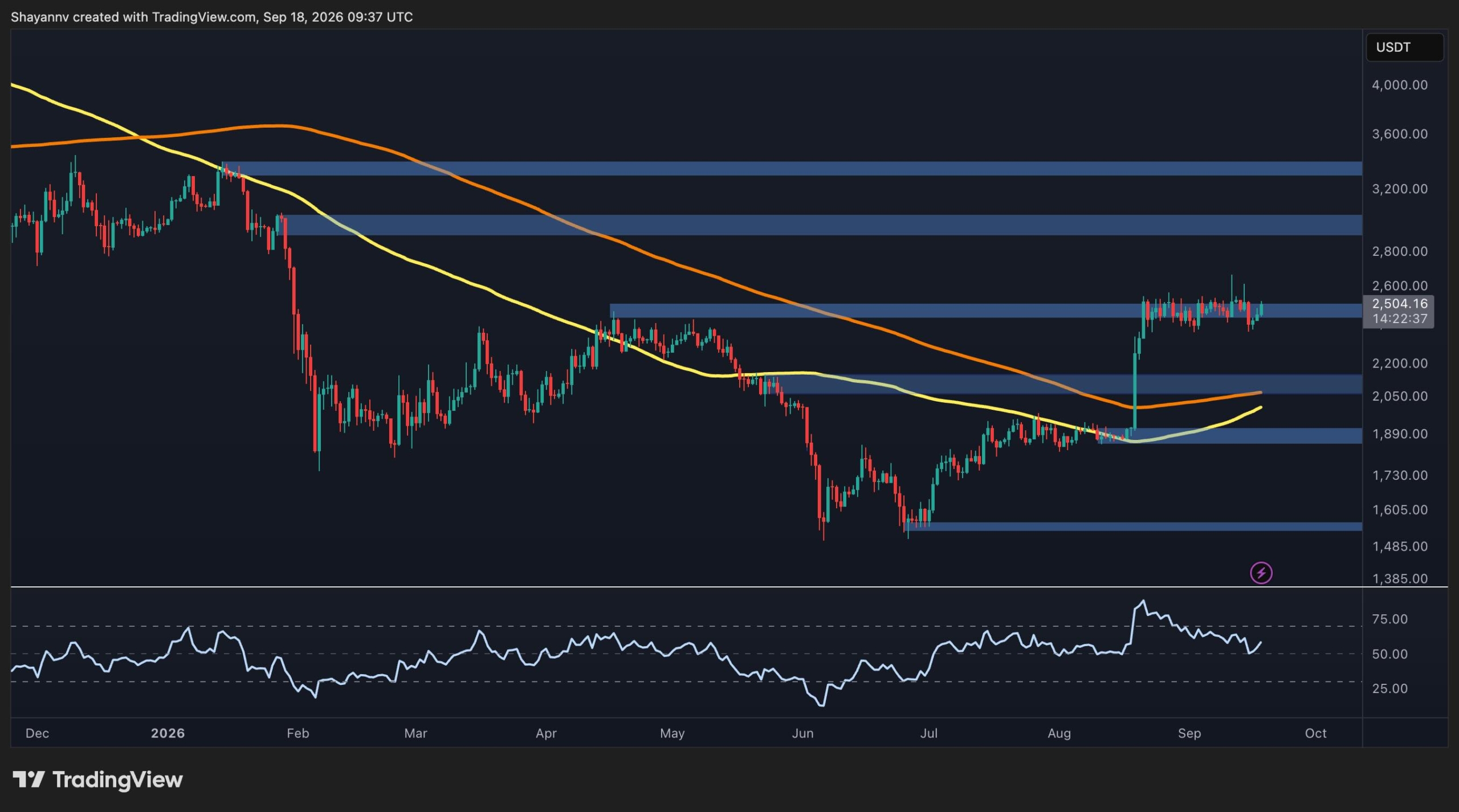
ETH/USDT 4-Hour Chart
The 4-hour chart provides a clearer picture of the current consolidation. ETH has been trading inside a broad range roughly between $2.35K and $2.65K since the sharp late-August advance.
The latest price action shows ETH recovering from the lower portion of the range and returning toward the $2.5K area. The repeated reactions around the range boundaries suggest that the market is still in consolidation rather than an established directional breakout.
The immediate resistance is around $2.5K, followed by the upper range boundary near $2.65K. A decisive 4-hour breakout above the latter would provide a clearer structural shift and could open the way toward the higher daily resistance zones.
Conversely, rejection around the current resistance and a move back below $2.35K would weaken the short-term structure. Losing that zone would invalidate much of the current range-based bullish setup and bring the next major support into consideration, as a deeper retracement would be probable.
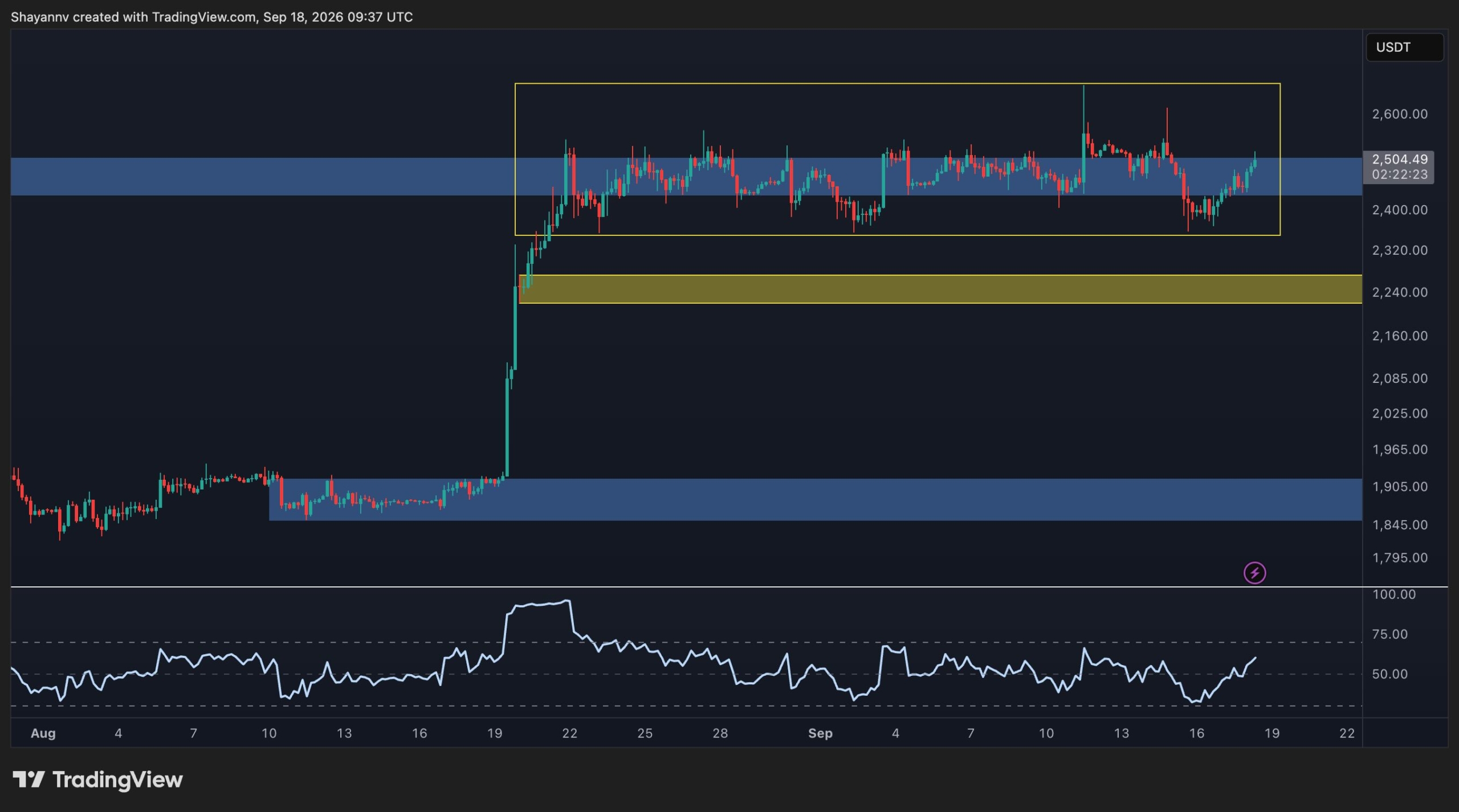
On-Chain Analysis
The Coinbase Premium Index is currently around -0.07, with the indicator spending much of the recent period below the zero line. The metric compares ETH prices on Coinbase with those on other major exchanges and is commonly used as an indication of relative buying or selling pressure from Coinbase’s predominantly U.S.-based market.
The notable point is the divergence between price and the premium index. ETH has recovered from roughly $1.5K to around $2.5K, yet the Coinbase Premium has generally remained negative during much of that advance. This suggests that the recovery visible on the price chart has not been accompanied by consistently strong US-based spot demand.
There have been brief positive spikes, particularly during parts of the summer, but they have not developed into a sustained positive trend. The latest reading has also returned firmly below zero.
This does not necessarily invalidate the broader recovery, since ETH can rise through demand from other venues and derivatives markets. However, a sustained move back above the zero line in the Coinbase Premium Index, particularly alongside a breakout above $2.5K, would provide additional confirmation that spot demand is strengthening, and that the recovery is likely to continue.
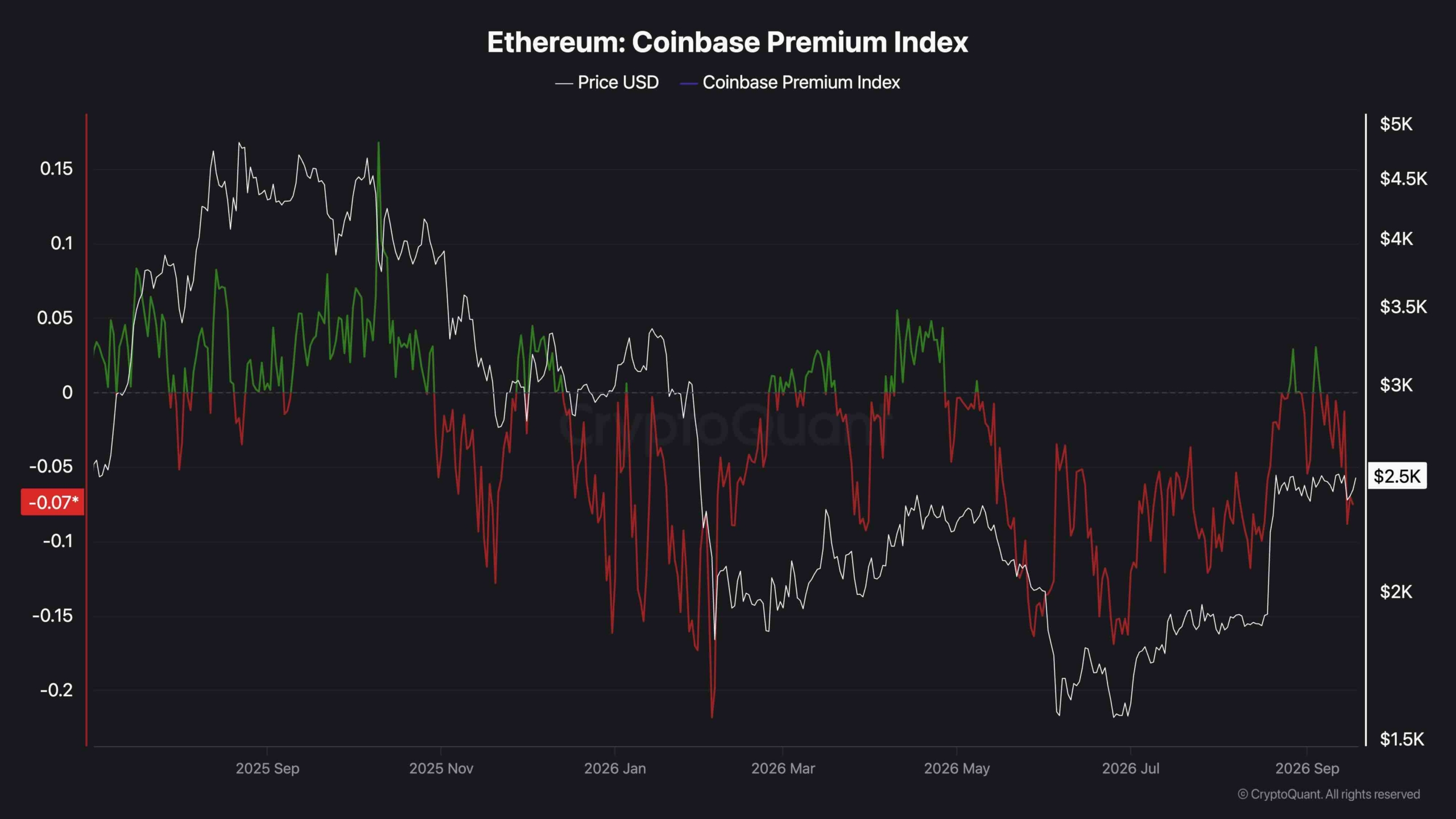
The post Ethereum Price Analysis: ETH Jumps Past $2.5K as Moving Averages Eye Bullish Cross appeared first on CryptoPotato.
XRP is consolidating after a sharp recovery from the sub-$1 area, with the price now attempting to stabilize around $1.35. The daily chart shows a major structural improvement following the recent rally, while the 4-hour timeframe suggests that the asset is still trading inside a descending channel that is guiding a corrective price action.
Ripple Price Analysis: The USDT Pair
On the daily timeframe, XRP staged a strong impulsive move from the $1.00 support area to roughly $1.70 before entering a prolonged consolidation. The rally also pushed the RSI sharply into overbought territory, but the subsequent cooling-off phase has brought the indicator back toward the neutral 50 area.
The price is currently around $1.35, sitting just above the 200-day moving average at approximately $1.30. This is an important near-term area because holding above this zone would keep the recent structural recovery intact. The yellow 100-day moving average is also located lower, around $1.18, providing a deeper dynamic support area if the correction extends.
On the upside, the most visible resistance is the $1.60-$1.70 zone, marked by the recent swing high. A successful move through this region would put the larger $1.90 resistance zone back into focus.
On the downside, the chart’s major structural support remains around $1.00. This is substantially below the current market and therefore represents a broader invalidation area rather than an immediate support level.
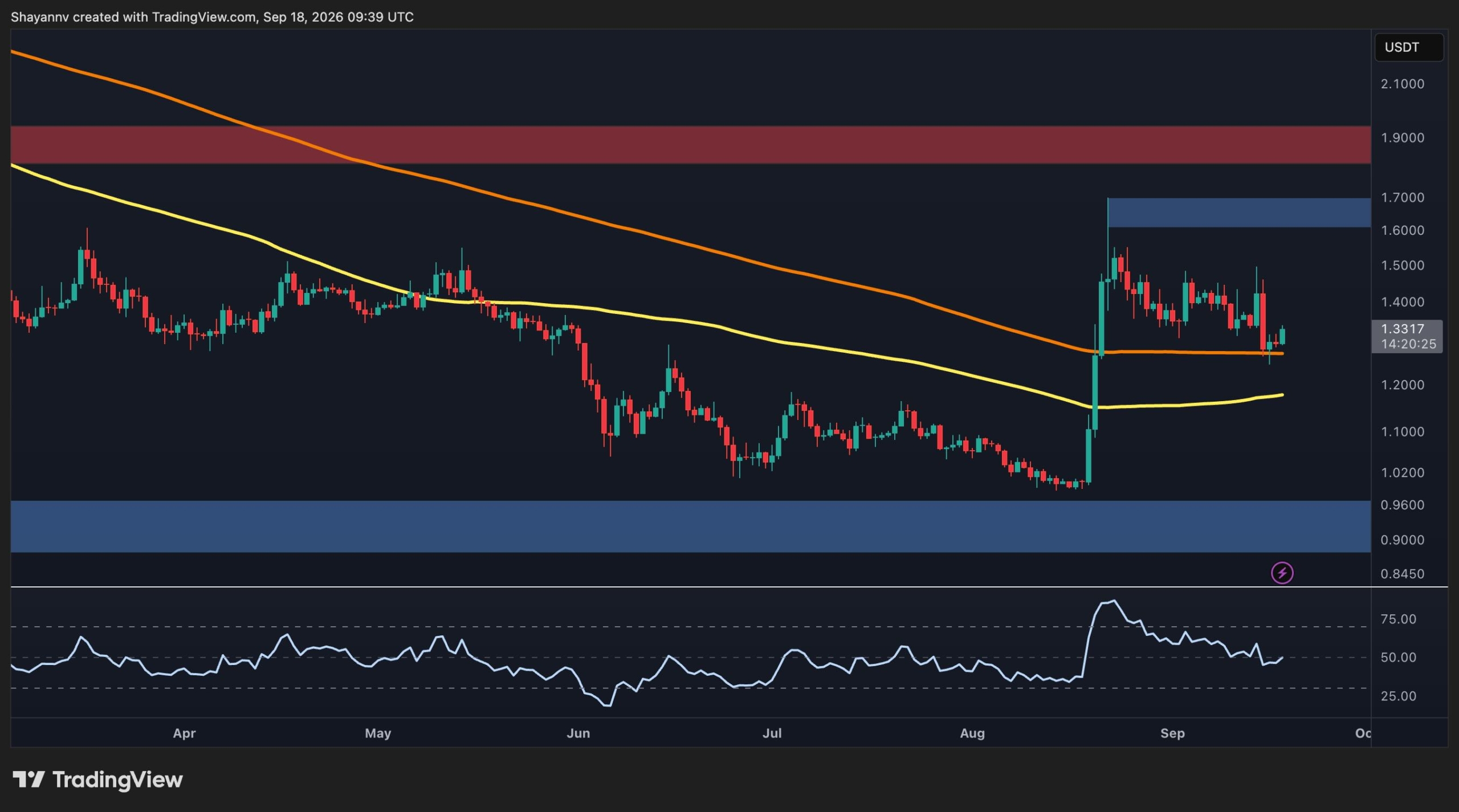
The 4-Hour Chart
The 4-hour chart provides a more cautious picture. XRP has been moving inside a descending channel, with both the upper and lower trendlines sloping downward. The latest rejection from approximately $1.48 resulted in a sharp decline toward the $1.25 support zone and the lower boundary of the channel.
That support area has so far held, and XRP has started to recover toward $1.35. The immediate obstacle, however, is the $1.33-$1.37 resistance zone, which is currently being approached from below. A clean breakout and hold above this area would improve the short-term structure and could open the way toward the channel’s upper boundary around $1.40-$1.45.
Conversely, a rejection around this resistance area could lead to a move back toward the $1.25 support zone again. The lower channel trendline is also located in this area, making it an important level for the current consolidation and for investors, as losing it could lead to a much deeper correction in the coming weeks.

The post Ripple Price Analysis: What’s Next for XRP After an 8% Daily Surge? appeared first on CryptoPotato.
It was expected to be a massively eventful week for the entire cryptocurrency industry, and it was.
But first, let’s see what happened precisely seven days ago. The US CPI data had just come out, confirming that inflation is still persistent. As such, the US Federal Reserve had all the missing pieces to its monetary puzzle, and experts predicted a rate hike on September 16.
BTC went wild after the CPI data was announced, going from $77,000 to $76,000 before it suddenly exploded to $79,800, where it was violently rejected and driven south to its starting point. All of this took place within an hour or so. After this enhanced volatility, the market calmed during the weekend, with BTC trading sideways at around $77,000.
It dipped to $76,400 on Monday before the bulls took control and drove it to $79,600 ahead of the key CLARITY Act vote a day later. BTC had already retreated to $77,000 when it became official that the Senate rejected cloture to advance the bill, and bitcoin plunged to a three-week low of $75,000.
The bulls managed to defend that level, but the next day was anticipated to be just as eventful with the conclusion of the FOMC meeting. The Fed indeed hiked the rates for the first time in over three years, but BTC’s reaction was more modest and somewhat surprising. The asset slipped to $75,000 once again initially, but rocketed to over $76,000 within minutes.
It kept climbing gradually on Thursday and especially on Friday. Although the BOJ also increased the rates by 25 bps to a 31-year high, BTC actually reclaimed $78,000 during the morning trading session. It stood there for a while, but initiated another leg up as US trading hours began and rocketed to a two-week peak of $81,000, where it was stopped, at least for now.
This means that BTC is actually in the green during the week in which all major events went against it. Meanwhile, ZEC continues its massive rally, while NEAR has rocketed by 35%. UNI is up by over 30% as well, followed by HYPE, BCH, and a few others. RAIN has plummeted by 22%.
Market Data

Market Cap: $2.770T | 24H Vol: $96B | BTC Dominance: 58.6%
BTC: $80,600 (+0.9%) | ETH: $2,570 (-3%) | XRP: $1.37 (-4%)
This Week’s Crypto Headlines You Can’t Miss
Strategy Stays on the Sidelines Again, but Strive Buys More Bitcoin. The week began with a familiar announcement: Strategy refused to buy more BTC while it continues to focus on rebuilding its USD stash. At the same time, Strive keeps accumulating more BTC, adding another 469 units.
Bitcoin Could Get More Support Than Gold as ETF Hedging Eases: JPMorgan. Analysts at the Wall Street behemoth said BTC may gain more price support than the precious metal amid easing ETF hedging demand, with BlackRock’s iShares Bitcoin Trust showing high short interest.
From Bear to Bull: Analyst Says Bitcoin UTXO Data Points to a Cycle Shift. Bitcoin’s share of addresses sitting at a loss has dropped sharply, and an on-chain analyst said moves of that size have historically ended bear markets and are not just producing a short bounce.
SEC Opens Door to Onchain Stock Trading With New ‘Innovation Exemption’. The regulator has launched an “Innovation Exemption” to promote secondary trading of tokenized stocks on blockchain platforms, easing regulatory burdens for Tokenized Securities Venues.
Seven Democrats Refuse to Give Up on CLARITY Act After Senate Setback. Despite the latest developments on the matter, several Democrats stated that this is not the end, pledging to continue bipartisan efforts for crypto regulatory clarity.
CoinEx Calls Time After Nearly Nine Years as Crypto Market Pressure Mounts. After nine years in existence, CoinEx has decided to shut down its platform by the end of the year due to declining crypto market conditions and increased regulatory pressures. As such, the exchange joins other major names that fell during the 2026 bear market, such as BitMart and BitMEX.
Charts
This week, we have a chart analysis of Ethereum, Ripple, Cardano, Binance Coin, and Hyperliquid – click here for the complete price analysis.
The post Bitcoin Hits 14-Day High Despite CLARITY Setback, Fed and BOJ Rate Hikes: Weekly Recap appeared first on CryptoPotato.