Cryptocurrency Posts
Crypto Briefing
The disruption in Saudi oil exports exacerbates global economic instability, heightening inflationary pressures and threatening energy security.
The post Saudi Arabia faces oil supply disruptions amid escalating Middle East conflict appeared first on Crypto Briefing.
The EU's potential use of frozen Russian assets for Ukraine's reconstruction signals a deepening economic and geopolitical rift with Russia.
The post EU may use frozen Russian assets for Ukraine reconstruction appeared first on Crypto Briefing.
The divergence in AI risk perception highlights the urgent need for global consensus on regulation to balance innovation with safety.
The post United Nations chief warns of AI risks after Trump downplays them appeared first on Crypto Briefing.
The delisting of Venezuela may shift regional alliances, while Colombia faces pressure to reform its drug policies to maintain US support.
The post Trump removes Venezuela from US narco status list, hints at Colombia next appeared first on Crypto Briefing.
Rising oil prices due to Middle East tensions could slow global economic growth and increase inflationary pressures worldwide.
The post Middle East tensions drive global oil prices higher amid supply concerns appeared first on Crypto Briefing.
Bitcoin Magazine
Bitcoin Magazine

Deutsche Bank To Debut Bitcoin Custody for Institutional Clients
Deutsche Bank said Wednesday that it would debut a bitcoin custody service for European corporate and institutional clients this year.
The German multinational said that the service was subject to the completion of the applicable regulatory timeline.
Deutsche Bank’s announcement comes as top banks worldwide launch crypto custody services. BNY Mellon, State Street, Standard Chartered, U.S. Bank, and Citigroup have all either launched or committed to direct crypto custody over the past 18 months.
“Digital assets are not a replacement for the traditional financial system but an important complement to it,” Gerald Podobnik, Co-Head Corporate Bank, Deutsche Bank, said in a statement.
“We see them as new rails that can coexist with existing market infrastructures while benefiting from the trust, security and safeguards that regulated financial institutions provide. Our aim is to offer clients a secure and regulated gateway to this evolving market. The service will be further developed in line with client demand, regulatory requirements and the bank’s risk appetite.”
Germany’s biggest lender added it would support a “selected range of digital assets,” other than bitcoin — including stablecoins.
“The range of supported assets may be expanded over time, subject to client demand and the bank’s product-approval, risk management and regulatory processes,” a statement added. “Tokenized financial instruments are also included in the roadmap.”
News first dropped of the bank working on debuting bitcoin custody services in 2025. A report said that the German banking giant would integrate Bitpanda’s custody infrastructure while working with Taurus to build the solution for corporate and institutional clients.
Just last month, Citi said it would this year debut a bitcoin custody service, allowing institutional investors to custody both traditional assets and bitcoin within one framework, rather than needing separate systems.
This post Deutsche Bank To Debut Bitcoin Custody for Institutional Clients first appeared on Bitcoin Magazine and is written by Mathew Di Salvo.
Bitcoin Magazine

How MSCI Shifted from Objective Benchmark to Defacto Market Regulator
For decades, the mechanics of global equity indexing were treated as plumbing—hidden, technical, and resolutely administrative. Providers like Morgan Stanley Capital International (MSCI) designed benchmarks to reflect the economic reality of public markets, not to shape it. Their mandate was descriptive, serving as a transparent mirror of global capital flows, sector weightings, and free-float market capitalizations.
That architectural assumption has quietly fractured. Today, the sheer scale of passive index-tracking capital has transformed benchmark administrators from passive cartographers into de facto market regulators. When an index provider determines the eligibility criteria for inclusion in indexes such as the MSCI Global Investable Market Indexes (GIMI), it is no longer merely measuring a company’s market value; it is dictating its access to institutional capital, influencing its cost of borrowing, shaping its shareholder register, and driving its liquidity profile.
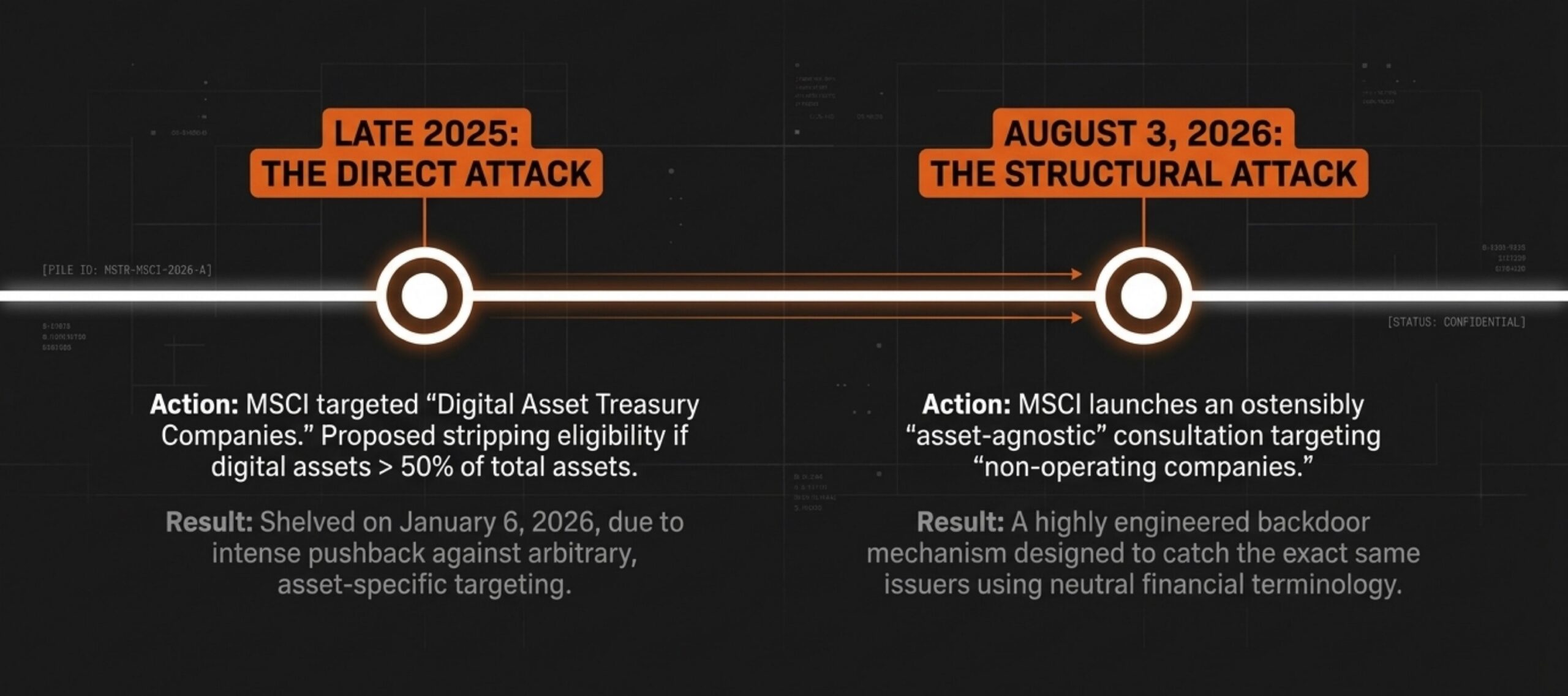
Nowhere is this transformation more evident—or more contentious—than in MSCI’s ongoing confrontation with public Bitcoin treasury companies. Following a failed attempt in late 2025 to explicitly target digital-asset holding vehicles, MSCI launched a sweeping consultation on August 3, 2026, aimed at redefining and restricting the index eligibility of “non-operating companies.” While the proposal is drafted in neutral financial terminology, its practical architecture threatens to eject major corporate Bitcoin adopters, most notably Strategy (formerly MicroStrategy), from global benchmarks.
This clash is much more than a corporate dispute over index weighting. It raises a profound structural question for contemporary capital markets: What happens when a private, for-profit index provider acquires the power to penalize corporate balance-sheet innovation, and by extension, exercise private market governance without regulatory accountability?
From Direct Exclusion to Structural Filters
To understand the current crisis, one must trace MSCI’s regulatory maneuvers over the past twelve months. In late 2025, MSCI opened a consultation specifically addressing “Digital Asset Treasury Companies,” proposing to strip index eligibility from any corporate issuer whose digital asset holdings represented 50 percent or more of its total assets. Market participants quickly recognized the measure as an explicit screen against companies that had pivoted their corporate treasuries into Bitcoin.
Facing intense pushback from issuers and institutional investors who pointed out the arbitrary nature of singling out a specific asset class, MSCI shelved that direct approach on January 6, 2026. Rather than dropping the inquiry, however, the index provider retreated to draft a more sophisticated mechanism.
On August 3, 2026, MSCI announced a broader, ostensibly asset-agnostic consultation regarding the eligibility of “non-operating companies” for the GIMI framework. Rather than naming Bitcoin directly, the new proposal establishes a two-step quantitative sieve designed to catch companies deemed to be operating primarily as holding vehicles or investment funds rather than traditional operating businesses.
The methodology proceeds in two distinct stages:
- The Core Screen: MSCI applies a primary balance-sheet test to determine whether an issuer maintains substantial operating assets. A company clears this initial hurdle if its operating assets exceed 50 percent of its total assets.
- The Exclusion Screen: For any issuer failing the core screen, MSCI applies five non-industry-specific financial ratios: operating asset intensity, expense intensity, operating cash flow, fair value intensity, and capital dependence. If a company triggers failing thresholds on at least four of these five metrics, it is classified as a non-operating company and rendered ineligible for index inclusion.
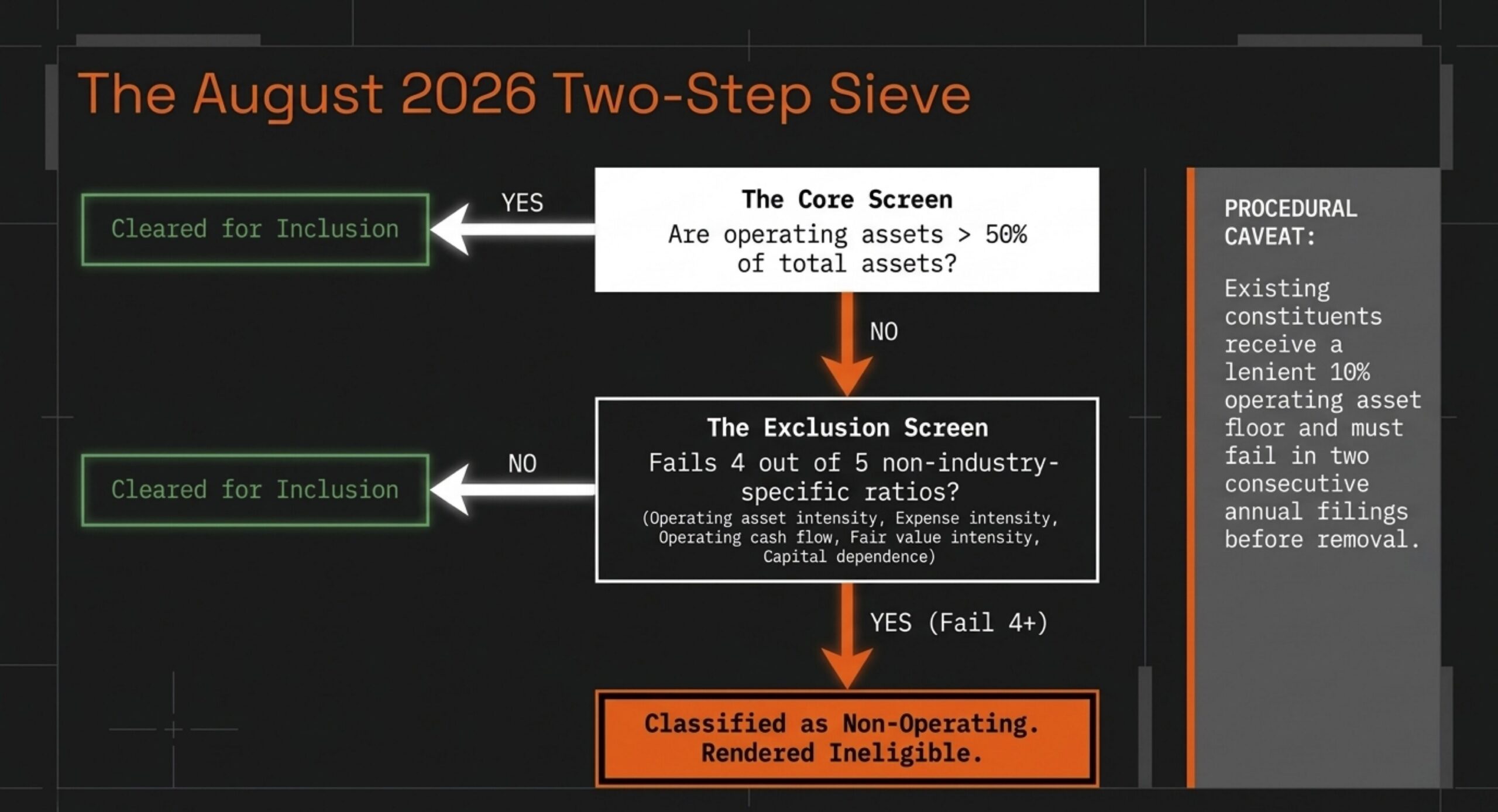
While existing constituents receive modest procedural protections—such as a more lenient 10 percent operating asset floor rather than 20 percent and a requirement to fail the screen in two consecutive annual filings before removal—the structural intent is clear. The simulation accompanying the August 2026 consultation revealed that applying the screen to the MSCI ACWI IMI universe using mid-2026 data would immediately flag and delete major public Bitcoin treasuries, including Strategy and Japan’s Metaplanet, alongside UK-based uranium holding vehicle Yellow Cake plc, while placing firms like SharpLink, Center Laboratories, and Lydia Holding onto a public watchlist.
The Targets and the Quantitative Realities
The primary focal point of this methodology is Strategy. Following its multi-year pivot into accumulating Bitcoin as its primary treasury reserve asset, Strategy has amassed over 845,050 bitcoin, making it the largest corporate holder of the asset globally. In the simulation data released by MSCI, Strategy—boasting a float-adjusted market capitalization exceeding $23.9 billion among the flagged entities—accounts for the vast majority of the affected market value.
The financial stakes of index inclusion for a company of this scale are frequently misunderstood. Critics of corporate Bitcoin strategies often assume that index exclusion triggers a terminal liquidity catastrophe. Yet empirical analysis of trading volumes reveals a more nuanced picture. Industry estimates indicate that passive funds tracking MSCI GIMI indexes hold roughly 3.1 percent of Strategy’s basic shares outstanding, amounting to approximately 13 million shares. When measured against Strategy’s robust trading velocity—where daily volume regularly absorbs hundreds of millions of dollars—that passive exposure represents less than a single average trading day.
Consequently, the true threat of MSCI’s proposal is not a mechanical liquidity shock, but rather a structural and narrative penalty. Index exclusion closes doors to specific institutional mandates, benchmark-restricted pension pools, and broad-market ETFs that are legally or contractually bound to replicate MSCI indexes. It penalizes a company not for operational failure, but for balance-sheet structure.
The Accounting and Legal Clash: GAAP versus Index Discretion
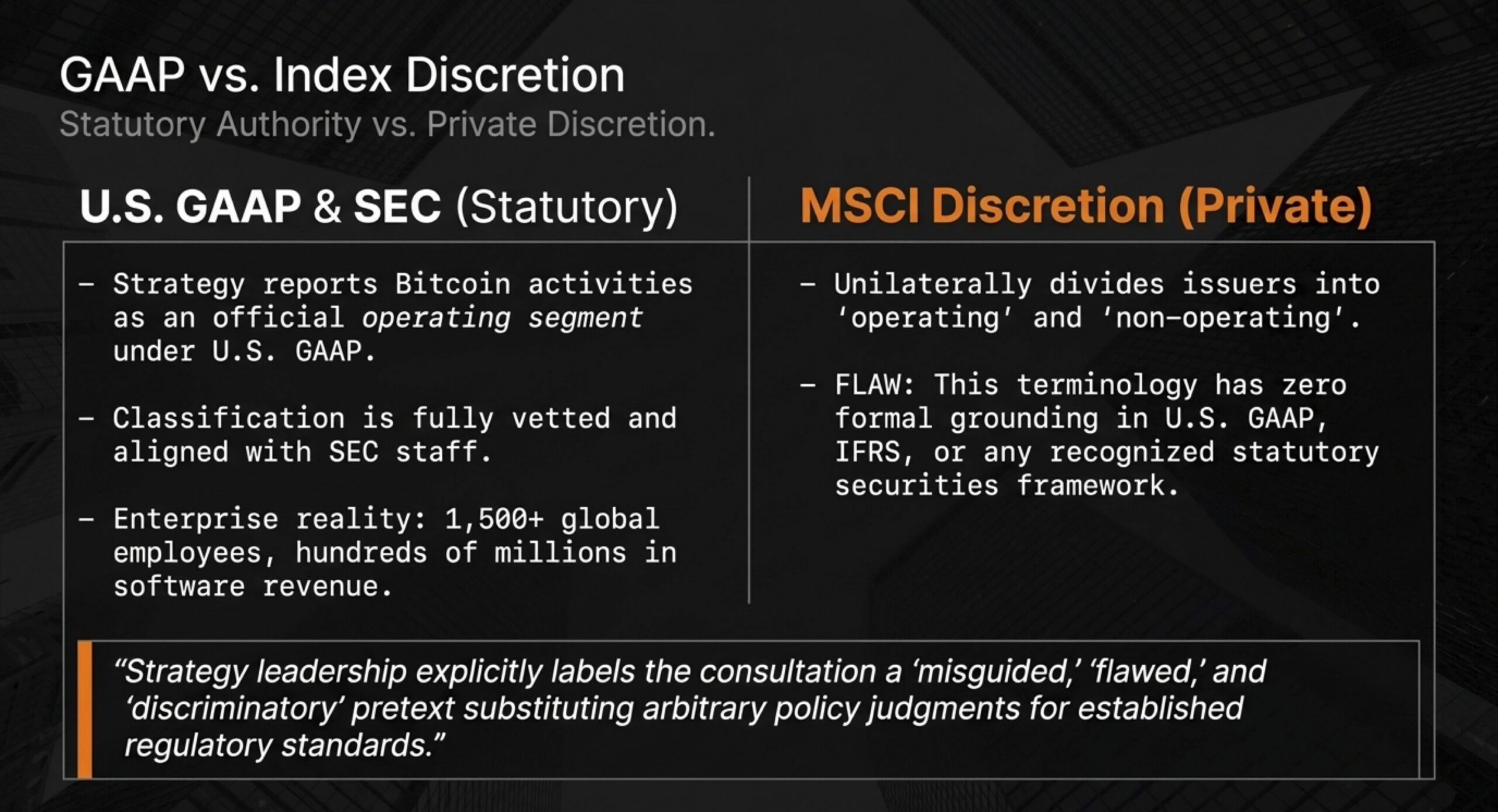
Strategy launched an aggressive counter-offensive in late August 2026, led by founder Michael Saylor and CEO Phong Le. In formal communications to MSCI and public filings, the company blasted the consultation as a “misguided,” “flawed,” and “discriminatory” pretext designed to achieve through backdoor ratio screens what MSCI failed to accomplish with its direct digital asset proposal in 2025.
The core of Strategy’s legal and accounting argument hinges on the definition of an operating business. Strategy noted that its terminology—dividing issuers into “operating” and “non-operating”—has no formal grounding in U.S. Generally Accepted Accounting Principles (GAAP), International Financial Reporting Standards (IFRS), or any recognized statutory securities framework.
Furthermore, Strategy underscored that it reports its Bitcoin activities as an official operating segment under U.S. GAAP, a classification arrived at through extensive engagement and alignment with staff at the U.S. Securities and Exchange Commission (SEC). By treating Bitcoin treasury operations, capital markets issuance, and asset management as core segments of an enterprise that employs over 1,500 people globally and generates hundreds of millions in software revenue, Strategy argues that MSCI is substituting its own arbitrary policy judgments for established regulatory and accounting standards.
In a particularly sharp rhetorical turn, Strategy’s pushback weaponized MSCI’s own historical regulatory positions. The company highlighted a 2022 SEC concept release examining whether information providers and index administrators exercise sufficient market power to bring them within the purview of the Investment Advisers Act. By forcing index providers to judge whether an asset class like Bitcoin belongs inside an operating business, MSCI risks undermining its foundational claim to absolute neutrality—the bedrock principle that index providers merely reflect market reality rather than passing moral or strategic judgment on corporate balance sheets.
The Double Standard of Asset Concentration
Beyond technical accounting definitions, the institutional debate centers on consistency. Critics of MSCI’s methodology argue that the proposed financial ratios are applied unevenly across asset classes.
Consider the treatment of real estate investment trusts (REITs) and mortgage REITs (mREITs). MSCI benchmarks routinely include entities whose balance sheets are overwhelmingly concentrated in a single asset class—commercial real estate, residential mortgages, or physical property portfolios—and whose revenues and valuations are driven entirely by external market cycles, rental yields, and continuous capital raises via debt and equity markets. These entities rely heavily on external capital dependence to scale their portfolios, mirroring the capital-raising mechanics utilized by Bitcoin treasury companies.
Yet under MSCI’s proposed framework, asset concentration and capital dependence in real estate are deemed fully compatible with index inclusion, whereas identical structural strategies executed in digital assets are classified as disqualifying non-operating traits. This disparity exposes the fundamental vulnerability of MSCI’s criteria: they rely on subjective definitions of “operations” that can easily be tailored to exclude disfavored asset classes while sheltering traditional ones.
The Structural Crisis of Private Governance
The confrontation between MSCI and Bitcoin treasury companies transcends the crypto asset ecosystem. It illuminates a broader institutional crisis concerning the unaccountable power of private index providers.
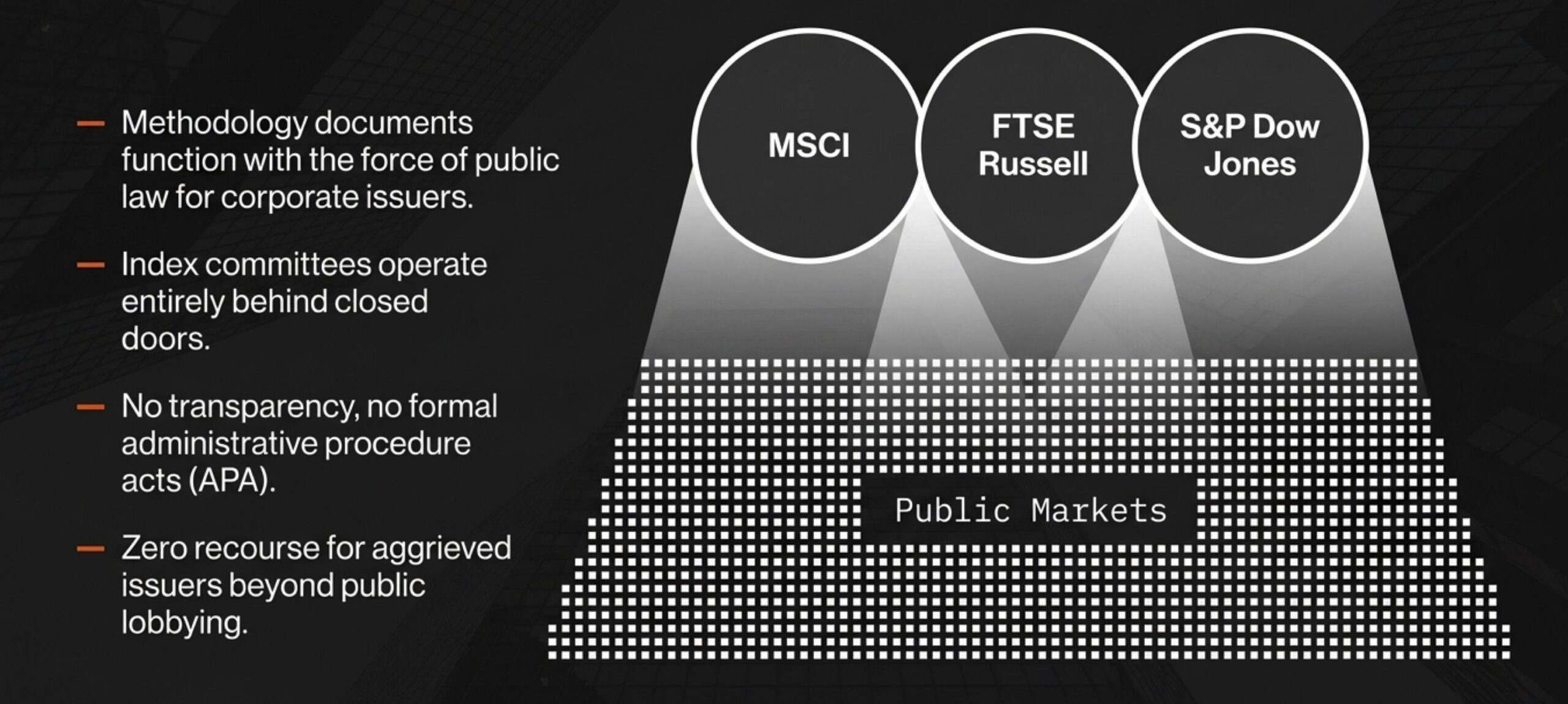
Over the past two decades, the migration of capital from active management to passive index-tracking funds has concentrated immense economic leverage in the hands of a small oligopoly of index administrators, dominated by MSCI, FTSE Russell, and S&P Dow Jones. These firms operate as private, for-profit entities, yet their methodology documents function with the force of public law for corporate issuers.
When an index provider unilaterally alters its inclusion rules to penalize specific corporate treasury models, it engages in private market governance. Unlike regulated public exchanges or statutory securities regulators, index committees operate behind closed doors, subject to limited public transparency, no formal administrative procedure acts, and virtually no recourse for aggrieved issuers other than public lobbying.
If MSCI succeeds in establishing the precedent that holding non-traditional reserve assets on a corporate balance sheet strips a public company of its operating status, it creates a dangerous chilling effect. Today, the target is Bitcoin; tomorrow, it could be corporate holdings of physical commodities, strategic technology stakes, gold, real estate, data centers or alternative monetary reserves that conflict with the prevailing preferences of institutional ESG or benchmark committees. Corporate directors lose the sovereign right to optimize their balance sheets for shareholder value if doing so risks excommunication from the passive capital ecosystem.
The Timeline, the Stakes, and the Regulatory Reckoning
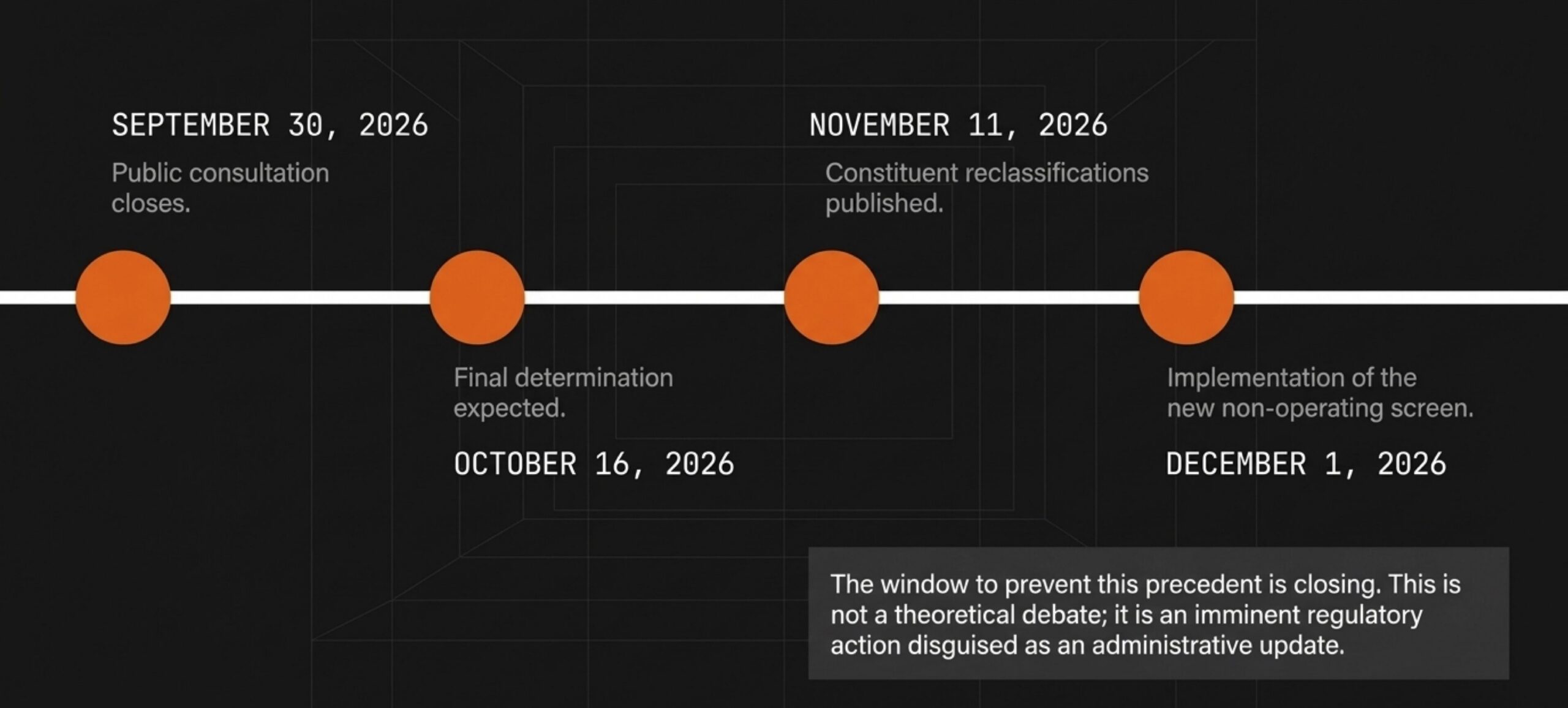
The immediate resolution of this conflict is rapidly approaching. The public consultation period for MSCI’s non-operating company proposal closes on September 30, 2026, with a final determination expected by October 16, 2026. If adopted in its current form, constituent reclassifications will be published on November 11, 2026, and implemented on December 1, 2026.
Yet for institutional investors, asset managers, and corporate executives, the stakes extend far beyond the ticker symbol MSTR. The outcome will test whether public companies retain the autonomy to innovate their balance sheets in an era dominated by passive gatekeepers, or whether benchmark administrators have officially crossed the line from measuring markets to regulating them.
The solution does not lie in government micromanagement of index design, but in statutory accountability. The U.S. Securities and Exchange Commission and global securities regulators must stop treating index providers as invisible software plumbing. When an index committee’s discretionary classifications can dictate corporate access to capital, distort price discovery, and bypass standard administrative notice-and-comment safeguards, that committee is acting as a de facto market regulator.
Regulators must revisit the framework governing dominant index providers under the Investment Advisers Act, demanding transparent due process, strict standards against arbitrary discrimination, and formal accountability for decisions that alter capital formation.
Until market authorities recognize that index providers have become systemic gatekeepers, the free market for corporate control will no longer be governed by shareholders, boards, and public statutes—it will remain at the mercy of unelected private arbiters in New York and London.
Take Action to Protect Index Neutrality
The boundary between measuring market value and regulating corporate behavior is being erased. MSCI’s proposed “non-operating company” screen threatens to penalize balance-sheet innovation, misclassify legitimate operating businesses, and set a dangerous precedent for private governance in capital markets.
Don’t let private index administrators dictate corporate treasury strategy behind closed doors. The public consultation window closes on September 30, 2026.
Join business leaders, institutional investors, and advocates for open capital markets:
- Sign the Open Letter: Add your voice or your organization’s signature to demand that MSCI withdraw the proposed screen and publish all market feedback at msci.bitcoinforcorporations.com.
Disclaimer: This content was prepared on behalf of Bitcoin For Corporations for informational purposes only. It reflects the author’s own analysis and opinion and should not be relied upon as investment advice. Nothing in this article constitutes an offer, invitation, or solicitation to purchase, sell, or subscribe for any security or financial product.
This post How MSCI Shifted from Objective Benchmark to Defacto Market Regulator first appeared on Bitcoin Magazine and is written by Nick Ward.
Bitcoin Magazine

Bitcoin, BTC-Related Stocks Tumble After Senate Blocks Clarity Act
Bitcoin’s price tumbled — along with crypto-related stocks — following the blockage of the long-awaited Clarity Act.
The price of the leading cryptocurrency recently stood at $75,939, down 4% over the past day, after dropping as low as $75,038 at one point on Tuesday.
Lawmakers blocked the landmark digital asset market structure bill in a procedural vote Tuesday. Major companies in the digital asset space have long called for clear rules to be put in place to regulate the industry.
Bitcoin wasn’t the only asset that dropped: BTC-related stocks such as Coinbase (NASDAQ: COIN) and Strategy (MSTR) were also down.
America’s biggest crypto exchange’s stock dropped by more than 10%; Strategy, the largest corporate holder of bitcoin slid by over 5%.
BREAKING:
— Bitcoin Magazine (@BitcoinMagazine) September 15, 2026U.S. Senate DOES NOT PASS the Clarity Act in its procedural cloture vote. pic.twitter.com/1nYTgYZo5P
Major publicly traded bitcoin miners also dropped in price, with MARA, CleanSpark, and Core Scientific all slipping by 5% or more over the past day.
Senators mostly voted against advancing the legislation — 49 for and 50 against — that the digital asset industry has long called for.
The bill aims to formally divide oversight between regulators, distinguishing which digital assets are securities, commodities or stablecoins.
President Donald Trump last month urged lawmakers to pass it, helping spur a bitcoin rally. But Republicans warned for months that Democrats were deliberately holding it back.
And hold it back they did: anti-crypto senator Elizabeth Warren warned congress against voting for the bill on Tuesday, slamming the bill as “a massive risk to families.”
While Senator Bernie Sanders wrote on X that the bill was “corrupt.”
Lawmakers had a problem with the bill because they said it unfairly allowed Trump to make money from the crypto industry. The president’s family has cashed in with numerous crypto ventures since Trump took office but the White House has always denied any wrongdoing.
“Crypto billionaires have spent nearly $300M on the midterm elections,” added Sanders.
“Meanwhile, Trump and his family have pocketed more than $1.4B from crypto deals.”
Pro-crypto senator Cynthia Lummis slammed Democrats for blocking the bill.
Writing on X, the Republican said: “The once-proud Democratic party is anti-consumer and pro-illicit finance, anti-ethics, anti-free enterprise, anti-worker, anti-livable wage jobs, and pro-socialism. The Democrats are now anti-American.”
This post Bitcoin, BTC-Related Stocks Tumble After Senate Blocks Clarity Act first appeared on Bitcoin Magazine and is written by Mathew Di Salvo.
Bitcoin Magazine

Strive’s Matt Cole: Bitcoin is Primed for 30% Growth into 2030
What happens when the Fed and Treasury finally step in to suppress long-end rates? Matt Cole says the dollar becomes the release valve and scarce assets rip. In this interview with Grace Remington and Sean Hagan, the Strive CEO lays out his three-part macro thesis on the dollar, long-end treasury rates, and Bitcoin reclaiming its role as the fastest horse against gold. He also shares his base case of roughly 50% annual Bitcoin returns into 2030.
DISCLAIMER: The views and opinions expressed in this show are those of the participants and do not necessarily reflect the official policy or position of BTC Inc., Bitcoin Magazine, or any affiliated entities. This content is provided for informational and educational purposes only and should not be construed as investment, legal, tax, or accounting advice. Nothing contained in this show constitutes a solicitation, recommendation, endorsement, or offer to buy or sell any securities or financial instruments. Viewers should consult their own advisors before making financial or business decisions.
This post Strive’s Matt Cole: Bitcoin is Primed for 30% Growth into 2030 first appeared on Bitcoin Magazine and is written by Patrick Green.
Bitcoin Magazine
Lightning Lands on BitBox — And It Doesn’t Ask for a New Seed Phrase
Bitcoin wallet manufacturer BitBox is putting Lightning in users’ pockets.
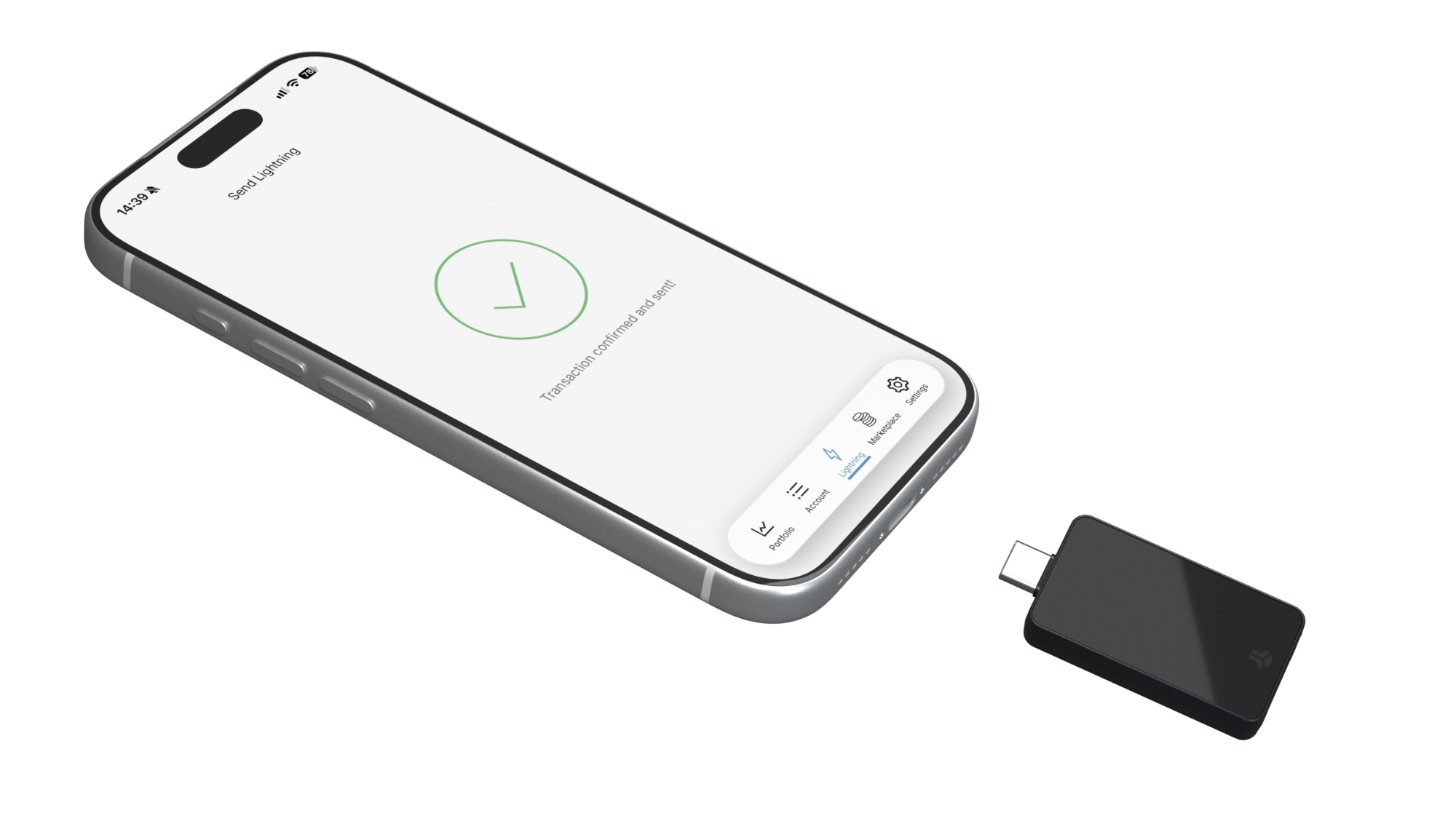
Owners of any BitBox hardware wallet can create a Lightning hot wallet inside the mobile BitBoxApp, fund it directly from their on-chain balance and pay invoices without bouncing between apps, wallets or third-party services, the company announced Tuesday.
And users don’t need a new recovery phrase. The Lightning wallet is derived from the BitBox backup they already have, so there are no extra words to write down — the two wallets stay distinct.
Instant bitcoin on a hardware wallet
— Breez
Savings on the BitBox, spending on your phone, one backup for both wallets. Powered by Breez.
Congrats @BitBoxSwisshttps://t.co/vM3JE0WNEC
(@Breez_Tech) September 15, 2026


The Lightning side runs as a hot wallet built for small amounts and everyday spending — coffee, invoices, a quick transfer — while long-term savings stay locked behind the hardware device.
Inside the BitBoxApp, users can scan and pay Lightning invoices, send and receive bitcoin, claim their own Lightning address, top up from their on-chain wallet, and sweep funds back again.
Under the hood, the feature runs on the Breez SDK, which now counts BitBox among more than 100 integration partners. Spark handles the plumbing that has long kept casual users off Lightning — no node to run, no channels to open, no liquidity to babysit. Custody stays with the user throughout.
Breez in August debuted Glow, an app that allows developers to see what’s working under the hood with the Lightning wallet so they can build their own products.
This post Lightning Lands on BitBox — And It Doesn’t Ask for a New Seed Phrase first appeared on Bitcoin Magazine and is written by Mathew Di Salvo.
CryptoSlate
The XRP Ledger (XRPL) validated 3,254 transactions in ledger 106,965,249 on Sept. 13, giving the network a high-count mainnet result with a highly concentrated workload.
The ledger closed at 20:51:50 UTC, with 20 submitting accounts supplying 2,000 successful one-drop XRP payments, with each account submitting exactly 100 payments. The batch delivered 0.002 XRP.
Vet, an XRPL community figure posting as @Vet_X0, described the ledger as a new record and said the pattern probably reflected throughput testing.
The immediate result is that XRPL reached consensus on an unusually large set of included transactions. The composition of that set limits conclusions about sustained throughput, adoption, and XRP demand.
A closer look at the 3,254 transactions
The ledger recorded 2,295 successful results and 959 unsuccessful results. Its 2,000 one-drop payments made up most of the successful group, while several other transaction types added different forms of activity.
| Ledger measure | Observed result |
|---|---|
| Total included transactions | 3,254 |
| Successful results | 2,295 |
| Non-success results | 959 |
| One-drop payments from 20 accounts | 2,000 |
| OfferCreate transactions with non-success codes | 440 of 458 |
| XRP delivered by successful native-XRP Payments | 323.641509 XRP |
| XRP delivered by three CheckCash transactions | 1,950 XRP |
| Total across native delivered_amount entries | 2,273.641509 XRP |
| Transaction fees destroyed | 0.111136 XRP |
The complete transaction list contains 2,467 Payment transactions, 458 OfferCreate transactions, 229 TicketCreate transactions, 74 CheckCash transactions, 22 TrustSet transactions, three AccountSet transactions, and one NFTokenCancelOffer.
Successful native-XRP Payment transactions delivered 323.641509 XRP, while 3 successful CheckCash transactions delivered another 1,950 XRP, bringing the sum across native delivered_amount entries to 2,273.641509 XRP.
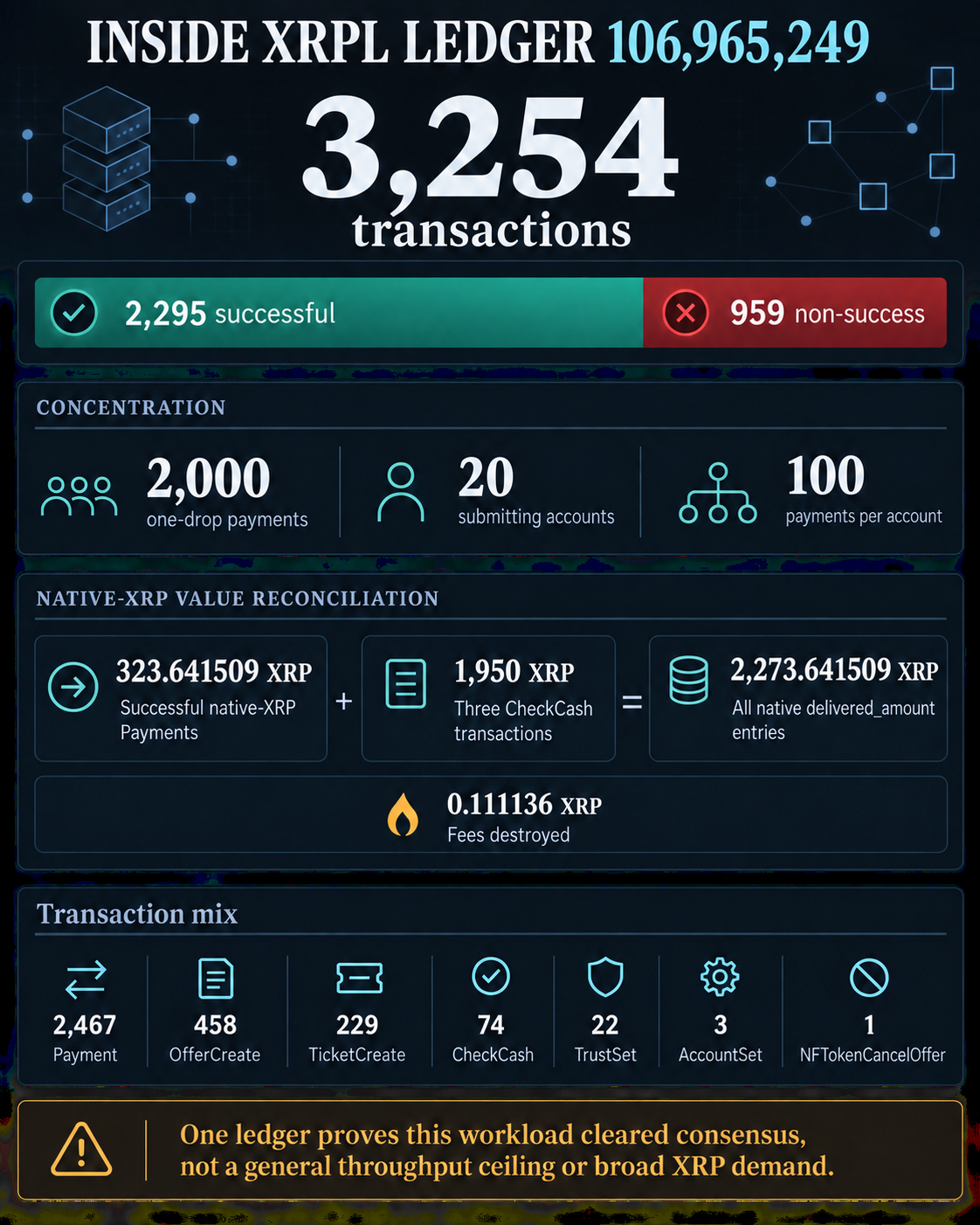
Both figures exclude issued-currency value and fall short of a total economic-volume measure because XRP and issued assets use different units, while order fields describe proposed exchanges rather than a single settled-value total.
Of 458 OfferCreate transactions, 440 returned non-success codes: 379 tecKILLED and 61 tecUNFUNDED_OFFER. Those 440 are a subset of the ledger's 959 non-success results.
The ledger combined a large stream of successful micro-payments with unsuccessful activity and a smaller set of other operations. The 20-account pattern establishes concentration at the submitting-account level.
All Fee fields summed to 111,136 drops, equal to 0.111136 XRP, creating a second measurable connection to XRP. XRPL's transaction-cost documentation explains that included transactions destroy their specified fees, including transactions that finish with certain failure codes.
The XRPL capacity signal and the demand question
The official Payment reference distinguishes direct transfers from cross-currency and path-based payments. Cross-currency transactions can traverse intermediary steps and consume decentralized exchange offers.
These mechanics make raw transaction counts an incomplete basis for comparing workloads.
Official documentation says the soft transaction limit rises when a ledger exceeds it and falls when consensus takes more than five seconds. The open-ledger cost can increase exponentially after that threshold. Ledger 106,965,249 shows that consensus included this particular transaction mix.
As of Sept. 15, XRP price registered an intraday high of $1.50, with $4.5 billion in 24-hour trading volume. Its Trading Activity indicator was 84 out of 100, and its Market Signal was Bullish at 65 out of 100.
For holders, the on-chain evidence supports delivered XRP and destroyed fees as measurable quantities. Durable token demand would require broader evidence, such as users acquiring and retaining XRP or economically significant activity consistently routing through the asset.
Recent reports pointed out to concentrated automated XRPL activity, stablecoin and DEX liquidity, and infrastructure for a future lending protocol.
Comparable scale from path payments, exchange activity, tokens, and future lending, paired with successful settlement and measurable value, would provide a more consequential capacity test.
The post XRPL proved it can handle over 3,000 transactions, but the traffic was entirely synthetic appeared first on CryptoSlate.
Cardano collected 3.3 million ADA in transaction fees while recording 493.7 million ADA in staking rewards across the 73 epochs ending Sept. 1, 2026, according to Bitquery's full-chain count. Fees covered about 0.668% of rewards, leaving the reward total roughly 149.6 times larger than fee revenue.
The figures turn Cardano's fee-replacement question into a measured economic gap. Planned upgrades may give the network enough throughput to process far more activity, while sustainable staking rewards still depend on applications and users generating substantially more fee revenue.
Cardano's fee-reward gap spans two measurement windows
The Bitquery analysis counted Cardano transactions from the network's first block and grouped the latest reward comparison into 73 five-day epochs from Sept. 1, 2025, through Sept. 1, 2026.
Its 3.3 million ADA fee total amounted to about one ADA for every 150 ADA in staking rewards. Reserve emissions supplied the dominant share of the reward economy during the period.
Cardano's epoch 655 supply page offers a shorter official snapshot. It attributed 108,500 transactions and 33,855 ADA in fees to completed epoch 654. Spread across five days, that was about 21,700 transactions per day, or 0.251 transactions per second. Fees equaled about 0.339% of roughly 9.998 million ADA in distributed rewards for the epoch.
The one-epoch snapshot uses a different reward denominator from Bitquery's 12-month staker total, so the percentages are not directly interchangeable. Each window nevertheless places transaction fees at well below 1% of its respective reward measure.
| Measure | Observed value | Economic signal |
|---|---|---|
| Fees, 73 epochs | 3.3 million ADA | Network fee revenue |
| Staking rewards, 73 epochs | 493.7 million ADA | About 149.6 times fees |
| Average daily transactions | 90,294 in 2022; 24,869 in 2026 | A 72.46% decline |
| Bot share of transactions | 11.5% in 2022; 32.8% in 2026 | Automated activity became a larger part of the smaller total |
| Reserve, epoch 655 | 6.127 billion ADA | 13.62% of the 45 billion ADA maximum supply |
| Share of circulating ADA staked | 75.6% at end-2022; 58.3% in 2026 | Participation declined alongside activity |
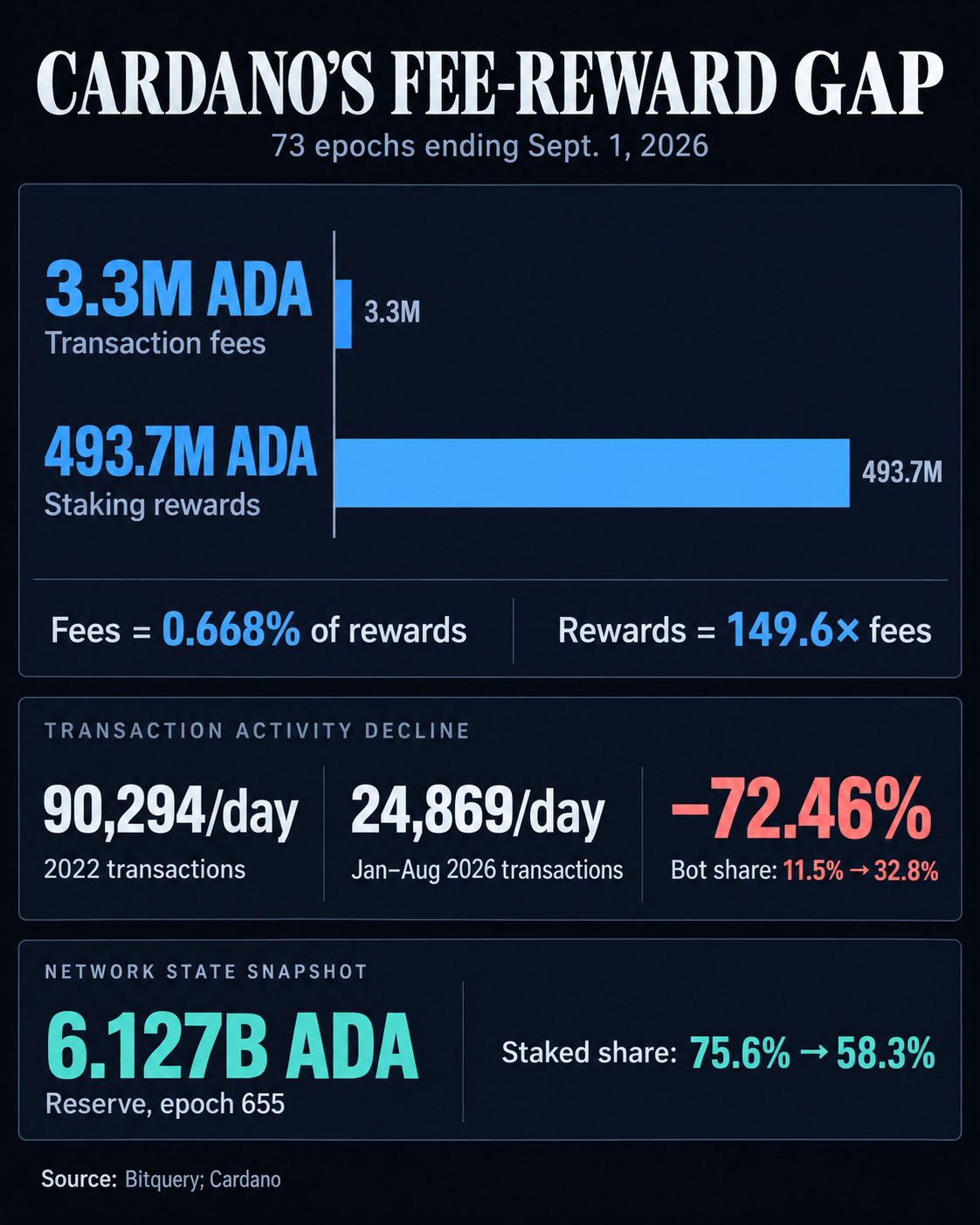
The long-window transaction count also points to weaker demand. Cardano averaged 90,294 transactions per day in 2022. From January through August 2026, the average was 24,869, a decline of 72.46%.
Activity composition changed at the same time. Bitquery classified wallets sending at least 3,000 transactions in a month as bots unless their behavior resembled an exchange. Under that method, bots' share of transactions rose from 11.5% in 2022 to 32.8% in 2026, with batchers forming the largest identified bot subgroup.
Those counts describe on-chain actions rather than unique people. One bot can submit thousands of transactions, while a decentralized exchange batcher can process orders for many customers. A modern Cardano wallet can use multiple addresses tied to one stake key, and a holder who stakes ADA without moving it remains absent from a count of sending wallets.
The transaction decline still matters for fee revenue because every action creates an opportunity to pay a fee. It cannot reveal how many people left, remained active or delegated their coins.
Bitquery also measured a decline in the share of circulating ADA staked, from 75.6% at the end of 2022 to 58.3% in the last epoch of its study period. That is a participation measure. The cited evidence contains no direct security-outcome metric, so it cannot support a claim that network security has already deteriorated.
The reserve creates runway as its contribution declines
Cardano's epoch 655 data showed 6,126,859,027 ADA left in reserves, equal to 13.62% of the network's 45 billion ADA maximum supply.
The reserve is designed to shrink. Under Cardano's monetary policy, transaction fees and 0.3% of the remaining reserve enter a virtual pot each epoch. The treasury receives 20% of that pot, and the balance is available for stake rewards, subject to pool performance. Unclaimed rewards remain in the reserve.
Applying a fixed percentage to the remaining balance produces exponential decay. Cardano's documentation describes a reserve half-life of roughly four to five years, without setting a definitive exhaustion date.
That declining reserve contribution changes the reward side of the equation. Nominal reward outlays can fall as emissions decline, which would reduce the fee revenue needed to match them. A lower target would still leave the network dependent on real economic activity if fees are to replace a larger share of rewards.
Cardano's fee structure provides another variable. Current minimum fees combine a fixed component with a charge based on transaction size, and protocol governance can change those parameters. Higher revenue per transaction would narrow the gap with less traffic, although the price of block space can also influence demand.
Holding average fees constant shifts the calculation toward activity. Scaling the 2026 average of 24,869 daily transactions by the current 149.6 reward-to-fee ratio produces about 3.72 million transactions per day, or roughly 43.1 transactions per second.
That is a simplified gross scenario calculated before the 20% treasury allocation. It is a translation of the measured gap, rather than a forecast or a precise break-even point.
The 43.1 TPS illustration broadly aligns with CryptoSlate's Sept. 8 model, which estimated that replacing reserve-funded rewards could require roughly 36 to 50 sustained transactions per second. That model placed a central estimate near 45 TPS after the treasury cut.
Linear Leios is designed for throughput above that range. The proposed CIP-164 specification models sustained capacity above the simplified 43 TPS scenario, giving Cardano a plausible technical path to process the necessary volume.
Leios test results leave the demand question open
Test results address only the capacity side. Cardano reported roughly sixfold Leios performance in an August public testnet update, using synthetic traffic. The result showed that the design could process more load under test conditions. It supplied no evidence that mainnet users would generate enough activity to multiply fee revenue by roughly 150.
Deployment also remains ahead. Intersect's Dijkstra planning document targets code completion in the fourth quarter of 2026, excluding Preview and pre-production testing and governance time from that schedule. The mainnet hard-fork date remains undetermined.
The economic equation has several moving parts. More transactions and higher average fees increase the revenue side. Declining reserve emissions and lower reward outlays reduce the amount that fees would need to replace. Leios enlarges Cardano's processing capacity, but adoption decides how much of that capacity generates revenue.
For now, the measured distance is stark: 3.3 million ADA in fees against 493.7 million ADA in rewards. Leios may remove a technical ceiling, while Cardano's larger test is attracting enough paid activity to turn capacity into durable network income.
The post Cardano fees covered just 0.7% of staking rewards as transactions fall 72% appeared first on CryptoSlate.
HM Treasury has laid the final draft of the Financial Services and Markets Act 2000 (Cryptoassets) (Miscellaneous Amendments) Regulations 2026, which would narrow parts of the UK’s forthcoming crypto regulatory perimeter for UK qualifying stablecoin payments.
The draft instrument, laid before Parliament on Sept. 15, would remove qualifying transfers from the rules for dealing as principal, dealing as agent and arranging deals. It has not been made and is not in force.
The relief is narrower than a blanket exemption for sterling stablecoins. A UK qualifying stablecoin must be issued through the regulated article 9M activity by a firm holding the relevant permission. An overseas-issued token, or a coin that merely tracks sterling, would not qualify on that basis alone.
Sending a UK qualifying stablecoin to another person could fall outside the dealer perimeter. So could exchanging it for money or another UK qualifying stablecoin.
The boundary changes when the transaction resembles financing or crypto trading. If the recipient has a right or obligation to return the stablecoin later, the transfer does not receive the basic exclusion, leaving ordinary lending or borrowing potentially regulated when the underlying activity tests are met. Swapping the stablecoin for another kind of qualifying cryptoasset, such as Bitcoin, also remains outside the payment carve-out.
The final text adds a separate wholesale-style exception for some title-transfer collateral and repo arrangements involving qualifying stablecoins. It can apply when the original holder is neither a consumer nor a person in a category specified by the Financial Conduct Authority.
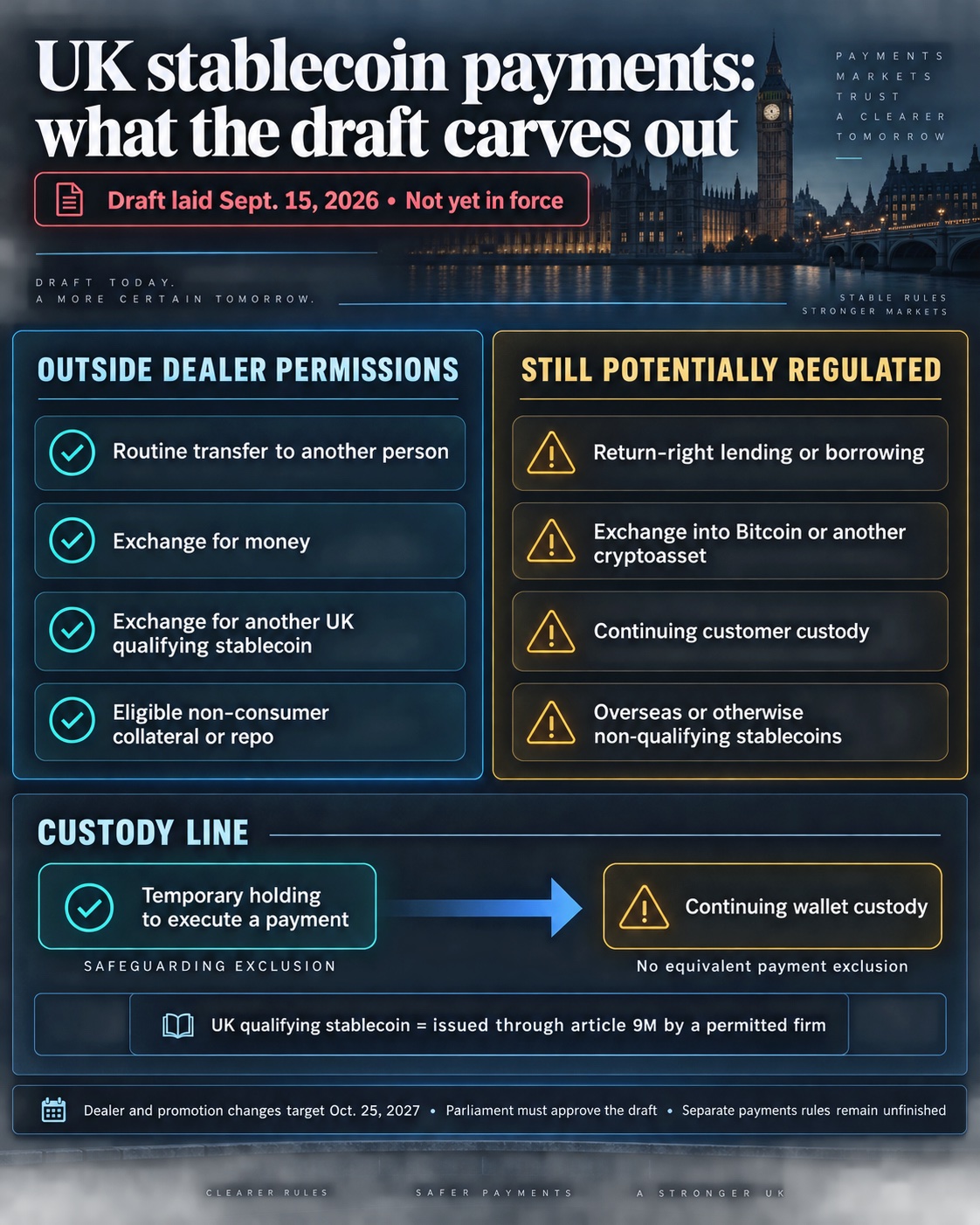
Temporary UK qualifying stablecoin holding gets custody relief
A new safeguarding provision would exclude temporary holding of a UK qualifying stablecoin when that holding is connected with executing a payment. Longer-term custody, such as maintaining a customer wallet, receives no equivalent payment exception and can remain within the safeguarding activity.
That differs from HM Treasury’s April proposal, which said payment firms would still need safeguarding permission and proposed limiting the temporary-settlement exclusion to holding ancillary to other crypto activities. The final draft instead distinguishes brief payment execution from continuing custody.
The financial-promotion rules, which govern marketing, broadly align with the transfer, exchange, collateral and repo exclusions. Their coverage is not identical, and arrangements requiring the stablecoin to be returned do not receive the basic promotion exemption.
The dealing, arranging and financial-promotion amendments are drafted to begin on Oct. 25, 2027, when the FCA says the new regime for crypto firms starts. Amendments made through regulation 4 would begin after the instrument is made. Parliament must approve the draft first, and HM Treasury’s separate payments reform still has to define the longer-term rules for stablecoins used in payments.
The post UK opens a major loophole for stablecoin payments while clamping down on crypto lending appeared first on CryptoSlate.
Summary: Positioned squarely between foundation models and AI agents, B.AI is integrating compute routing, decentralized settlement, and full-stack agent infrastructure to establish itself as an undoubted spearhead in AI infrastructure.
Just five months after its launch, B.AI has already set a new industry record with a daily throughput of over 1.51 trillion tokens—a 71,500x-plus increase since inception.
B.AI achieved in just over 100 days what took OpenRouter, an early aggregation pioneer, roughly two years. Driven by the integration of settlement networks with core infrastructure, the exponential growth pulled off by B.AI highlights the viability of its full-stack commercial strategy while also demonstrating to the global market that the platform has risen to be the absolute leader in the next-generation AI infrastructure stack.
B.AI has secured its leadership thanks largely to its ability to capture and cater to the global demand for cost-effective, high-performance Chinese LLMs. While offering homegrown LLM products a critical gateway for international adoption, the platform has also gained a head start by positioning itself as a global compute distribution hub. B.AI's ability to rise in this tailwind is rooted in its unique ecosystem design.
Co-incubated by TRON and YZi Labs, B.AI disrupts the market via a dual engine of settlement and distribution, plus its complete infrastructure for the emerging agent economy. The platform enables global access to top-tier LLM compute while equipping AI agents with native resource scheduling and execution capabilities—unlocking liquidity and value exchange across the global agent economy.
Unprecedented Infrastructure Growth: B.AI Builds Global Distribution Hub for LLMs
To reach 1.51 trillion tokens in its daily throughput, simply seizing the tailwind is far from enough. B.AI has also responded swiftly to two macro trends in the AI industry: the cost-performance advantage of leading Chinese LLMs and the surging demand for high-throughput, low-cost inference in the agentic era.
Over the past year, Chinese LLM developers like DeepSeek, Kimi, Qwen, and GLM have matched top global benchmarks at a fraction of the API cost. This unbeatable cost efficiency makes adoption virtually inevitable for developers worldwide.
As a global, next-generation infrastructure, B.AI aggregates top international models like GPT and Claude alongside rising Chinese LLMs. The platform has established close partnerships with Tencent, Alibaba, ByteDance, DeepSeek, Zhipu AI, Kimi, and MiniMax—all top LLM players in the Chinese market—to build a comprehensive model portfolio. This all-star model lineup has, in turn, made B.AI the default launchpad for Chinese LLMs seeking global expansion.
Chinese LLMs, including DeepSeek-V4-Flash, Qwen3.8-Flash, and GLM-5.3 Flash, have stood out as top-performing models on B.AI with the highest usage. Building on the momentum, B.AI continues to drive adoption through model discounts, limited-time free access, tiered API pricing (with discounts up to 90%), and developer incentives, aiming to convert model cost efficiencies into usable throughput for developers worldwide. The traction from this strategic positioning is clearly backed by the numbers: B.AI's daily token throughput has breached 1.51 trillion—a massive 71,500x-plus surge since its first day upon launch.
Beyond its organic growth momentum, ecosystem partner YZi Labs serves as B.AI's core distribution engine, continuously onboarding early-stage projects and developer communities. This ecosystem support enables B.AI to penetrate diverse real-world use cases, driving a steady influx of incremental traffic and commercial demand.
For foundation model providers, B.AI's multi-trillion, high-concurrency architecture provides a fast track to high-value global workloads. Within this massive pool of demand, B.AI has evolved from a simple distribution channel into a primary facilitator—scaling the commercial reach of leading LLMs while reshaping the global AI landscape.
Beyond Aggregation and Routing: B.AI Builds Closed-Loop Infrastructure for the Agent Economy
Yet for this super amplifier to truly sustain a trillion-dollar agent economy, front-end compute routing is nowhere near enough. Building on the API aggregation foundation pioneered by early movers like OpenRouter, B.AI recognized a critical insight: fully unlocking massive agent collaboration requires a closed financial loop at the foundational layer.
To achieve this, B.AI bridges models and agents, creating a global settlement layer for intelligence. This core differentiator transforms the platform from a simple traffic conduit into the central master ledger for the entire agent economy, ensuring every cross-region call and task allocation is seamlessly routed, precisely metered, and automatically settled.
To achieve this vision, B.AI embeds settlement directly into the infrastructure layer, creating a dual-track Web2 and Web3 payment network. Built on Web3 principles, the architecture maintains backward compatibility with traditional Web2 payment systems. On the Web3 front, B.AI leverages on-chain settlement channels to provide global developers with decentralized, verifiable, and low-friction options that enable fully automated transactions and micropayments between agents. On the Web2 front, it preserves legacy gateways like WeChat Pay, Alipay, UnionPay, and Visa, ensuring effortless integration into existing enterprise workflows. Together, this dual-track model delivers a single integration point for frictionless global capital flow.
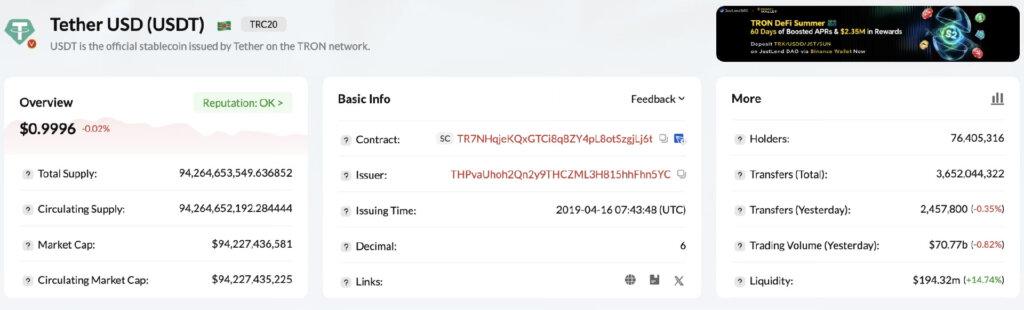
At the heart of this global liquidity is B.AI's deep integration with TRON. As the world's largest stablecoin transfer network, TRON offers B.AI a native payment rail through its massive USDT ecosystem, built for maximum liquidity and minimal friction. As of September 10, total TRC-20 USDT supply surpassed 94.2 billion, continuing to set record highs. Backed by TRON's battle-tested on-chain capacity, B.AI provides the essential infrastructure required to scale cross-border compute scheduling and high-frequency automated agent micro-transactions.
The true ambition of this architecture is to capture the emerging landscape of automated transactions in the agent economy ahead of the pack. The coming explosion in agent adoption will inevitably drive agent-to-agent (A2A) collaboration and autonomous commerce. Yet, fully unlocking this automated A2A synergy requires far more than just a foundational payment rail. B.AI builds beyond its Web3 smart settlement network by deploying a dedicated full-stack runtime environment for agents. This establishes an end-to-end, high-precision technical loop bridging compute scheduling, task execution, and financial settlement.
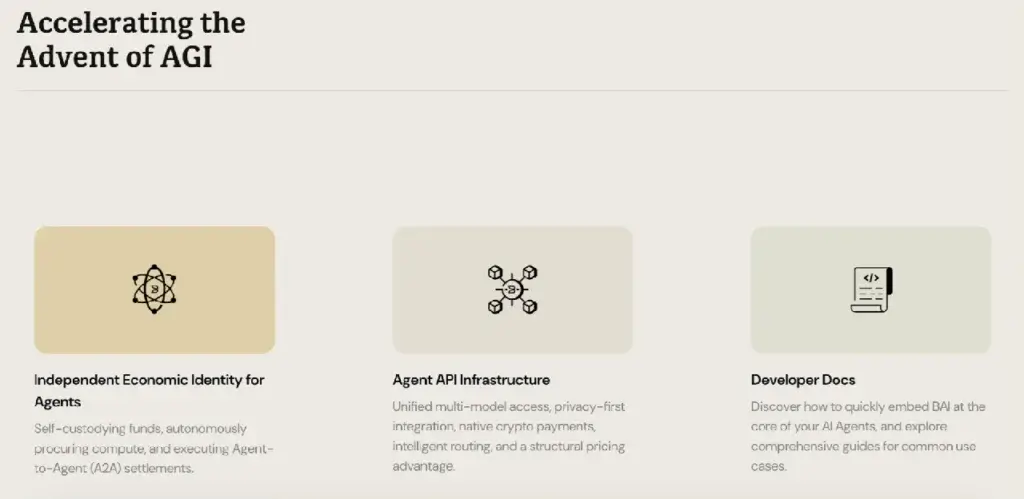
At the scheduling layer, B.AI drives fine-grained compute allocation. Its tiered API system fundamentally reshapes compute procurement logic, offering structured invocation plans that allow developers to match specific business demands with optimal compute resources.
At the execution layer, B.AI constructs a native agent collaboration ecosystem. It endows agents with direct operational capabilities to act across the digital world. Powered by embedded toolchains like Skills and Agent Wallet, alongside natively integrated AI assistants BAIclaw and BAIcode, agents evolve into fully fledged digital workers capable of autonomous data acquisition and execution, laying a solid engineering foundation for multi-agent synergy.
At the protocol layer, B.AI establishes foundational transaction standards for A2A commerce. This marks B.AI's most strategically profound move. By natively integrating the x402 payment protocol and the 8004 identity authentication protocol, the platform paves a standardized path for mutual trust, identity verification, and high-frequency automated settlement between agents.
From fine-grained model scheduling to intelligent collaboration systems and standardized transaction protocols, this architecture seamlessly fuses perception, reasoning, action, and settlement. This holistic infrastructure propels B.AI into a central hub for the agent economy, engineered to handle micro-transactions and compute settlement at scale. Crossing into the trillion-token era is merely a new starting point for B.AI. As next-generation AI infrastructure, its core value extends beyond distributing intelligence to powering transactions. By establishing foundational standards for high-frequency A2A collaboration, B.AI is reshaping the global flow of compute value, driving AI infrastructure into a new era built explicitly for agents and machine intelligence.
B.AI Team
Singapore
support@b.ai
The post Unlocking the Trillion-Token Era: B.AI’s Global Settlement Layer for the Agent Economy appeared first on CryptoSlate.
Celsius Network’s bankruptcy estate has sued BitMEX over a 2020 liquidation cascade it says cost more than 6,360 Bitcoin.
The complaint, filed Sept. 12 in the US Bankruptcy Court for the Southern District of New York, accuses entities behind the crypto derivatives exchange of fraud, market manipulation and wrongful liquidations during Bitcoin’s historic March 2020 selloff.
Celsius is seeking to recover losses tied to 6,360 BTC, worth roughly $495 million around the time of the filing.
Blockchain Recovery Investment Consortium, or BRIC, brought the case on behalf of Celsius entities as the bankrupt lender’s litigation administrator and complex asset recovery manager.
The defendants include Seychelles-based HDR Global Trading Ltd., Hong Kong-based ABS Global Trading Ltd. and Shine Effort Inc. Ltd., along with Bermuda entities 100x Holdings Ltd. and HDR Global Services Ltd. They collectively operated under the BitMEX name.
The filing comes as BitMEX prepares to shut down its exchange on Sept. 23, giving Celsius a new recovery target just days before one of crypto’s longest-running derivatives venues stops trading. BitMEX announced the closure in July after what it described as a strategic review of its business and the broader industry.
Notably, this marks the second major lawsuit against BitMEX since it announced its intention to wind down operations.
Complaint targets BitMEX’s liquidation engine
The case turns on how BitMEX handled leveraged positions as Bitcoin plunged during the March 12, 2020 market panic.
Celsius alleges BitMEX’s conduct during the crash resulted in wrongful liquidations and the seizure of digital assets belonging to Celsius and investment-fund group JST.
The complaint describes the losses as stemming from the exchange's fraudulent misconduct and market manipulation. The filing stated:
“While BitMEX made multiple representations that it would maintain an orderly market for its derivatives contracts, BitMEX knew these representations were false. Instead of maintaining an orderly market, BitMEX intentionally designed its platform and liquidation procedures to cause liquidations of collateral and defraud its own customers.”
Bitcoin fell sharply that day as the emerging coronavirus pandemic triggered a broad rush out of risk assets.
The selloff pushed the cryptocurrency from about $7,200 to a 10-month low near $5,678 within roughly 15 minutes at one stage, while about $702 million of positions were liquidated on BitMEX during the initial crash. Nearly all of those liquidations were long positions.
The episode became one of the defining stress events for crypto derivatives markets. BitMEX was then a dominant venue for highly leveraged Bitcoin trading, meaning falling prices could automatically force the exchange’s liquidation system to close positions that no longer met margin requirements.
Those forced sales could add fresh sell pressure to an already falling market, creating the potential for successive rounds of liquidations as prices declined.
Celsius’ lawsuit seeks to turn that market event into a recoverable bankruptcy claim more than six years later. The estate must show that its losses flowed from actionable misconduct by BitMEX rather than from the extreme volatility and contract mechanics that traders accepted when opening leveraged positions.
That distinction is likely to become central if the defendants challenge the claims. The complaint’s allegations remain unproven, and the court has yet to determine whether BitMEX or its related entities are liable for the Bitcoin Celsius says it lost.
A recovery target Celsius identified years ago is finally in court
The lawsuit turns a potential claim Celsius first identified in 2023 into an active recovery effort at a critical moment for BitMEX.
A September 2023 bankruptcy filing listed HDR Global Trading Ltd., which operates as BitMEX, among possible litigation targets for claims involving negligence, fraud and market manipulation.
Those claims were later transferred into Celsius’ broader post-bankruptcy recovery process after BRIC was appointed in 2024 to pursue litigation and other complex assets on behalf of creditors.
BRIC has already generated proceeds from that mandate. In October 2025, Celsius reached a $299.5 million settlement with Tether following litigation brought by the estate.
The BitMEX complaint adds another potentially large claim to that campaign, but it comes as the exchange winds down operations.
BitMEX stopped accepting new accounts after announcing its closure and began limiting customers' ability to increase positions in late August. It has since been settling and delisting contracts ahead of the Sept. 23 shutdown, including the early settlement of several BTC and ETH perpetual swaps and futures on Sept. 16.
The company has said the closure was not prompted by financial distress, a hack or immediate regulatory pressure. It has also said customer assets exceed liabilities and that users will retain access after trading ends to withdraw remaining balances.
That timetable has shifted attention toward whether Celsius will seek additional measures while the wind-down is still underway.
Simon Dixon, a prominent Celsius creditor and longtime commentator on the bankruptcy, said the timing suggests the litigation administrator may be considering more than a damages award that could take years to obtain.
He said filing before a company completes a wind-down can help preserve claims against assets, entities and counterparties before corporate structures or holdings change. Dixon stressed, however, that there is no evidence Celsius has obtained an injunction blocking the closure or restricting asset transfers.
He said he would now watch for any effort by BRIC to seek an injunction, preserve assets or otherwise limit transfers while the exchange shuts down. Any such move would require separate legal action or court approval.
For now, the complaint leaves BitMEX’s closure schedule intact. The entities named in the lawsuit remain defendants after trading stops, meaning the case can continue even after the exchange ceases operations.
Their response will help determine whether the dispute proceeds to discovery into BitMEX’s 2020 trading and liquidation systems or faces an early challenge on jurisdiction, limitation periods, or the legal sufficiency of Celsius’ claims.
The post Celsius sues BitMEX for $495 million just 11 days before exchange shutdown appeared first on CryptoSlate.
CryptoTicker.io
$XRP is having the kind of day that makes traders close the app and go for a walk. Ripple's token has slid below $1.30 and is down roughly 8% to 9% over 24 hours, the worst performance in the entire top ten. Bitcoin lost about 1.4% in the same window. Ethereum lost around 3%. XRP lost six times what Bitcoin did.
That gap is the whole story. This was not a crypto-wide flush that happened to catch XRP. This was a regulatory event, and XRP was standing closest to the blast radius.
Why Did the XRP Price Crash Today?
Two things hit within 24 hours of each other, and both of them are American.
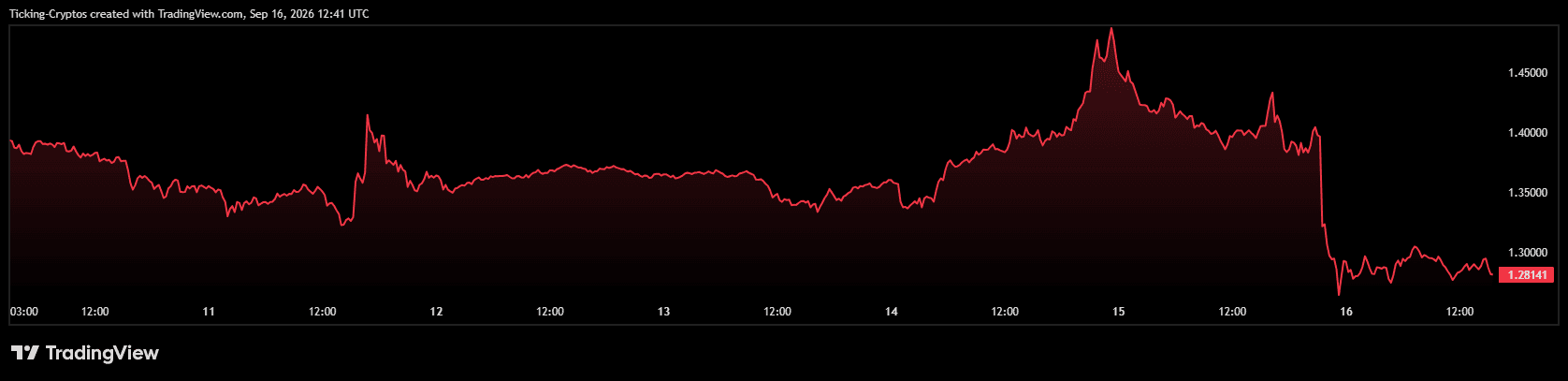
The first was Tuesday's Senate vote on the CLARITY Act. The second is the Federal Reserve, which announces its rate decision this afternoon with a hike widely expected. $XRP is unusually sensitive to both, and it got them back to back.
The mechanical damage came from leverage. Crypto exchanges liquidated roughly $571 million in long positions over the 24 hours following the vote. Bitcoin and Ether longs absorbed around $190 million each, XRP longs around $30 million, and Solana longs roughly $22 million. Traders had been positioned for the bill to pass. Bitcoin had pushed toward $80,000 earlier in the week on exactly that assumption.
When the assumption broke, the positions broke with it.
What Happened With the CLARITY Act Vote?
The Senate failed to invoke cloture on the motion to proceed to H.R. 3633 on Tuesday afternoon. The official floor tally was 49 yeas to 50 nays. That is not just short of the 60 votes needed, it is short of a simple majority.
Worth being precise here, because a lot of coverage will blur it: this was a procedural vote to begin formal debate, not a vote on the bill itself. A win would only have opened the floor to amendments, with a separate passage vote still ahead. Losing it means the chamber never opens that debate at all.
The bill died on the fight that had stalled it for months. Democrats wanted an enforceable ban on the president and senior officials profiting from crypto while writing its rules, a demand that hardened after President Trump disclosed more than $1.4 billion in crypto income for 2025. Republicans released a finalized 630-page text on September 14 containing 126 Democratic-requested changes, including ethics language enforceable by state attorneys general. It was not enough. Senator Elizabeth Warren, ranking Democrat on the Banking Committee, led the opposition and dismissed the revised ethics provision as a weak fig leaf.
Three Republicans crossed the aisle to vote no: Susan Collins of Maine, Josh Hawley of Missouri and Jerry Moran of Kansas. Several Democrats who had spent months at the negotiating table, including Gillibrand, Warner, Booker, Warnock and Gallego, also voted no.
The market repriced instantly. Polymarket odds of the CLARITY Act becoming law in 2026 collapsed to about 7%, down from 82% in February. Ripple CEO Brad Garlinghouse, who had spent the better part of a year publicly handicapping the bill's chances at 80% or better, summed it up in three words: "This one stings."
Given the compressed calendar before the November midterms, this effectively ends US crypto market structure legislation for 2026.
Why Is the Fed Rate Hike Making the XRP Crash Worse?
Bad timing does not begin to cover it.
The Fed announces at 2 p.m. ET today, September 16, and futures traders are pricing roughly a 90% chance of a 25 basis point increase, which would lift the target range to 3.75% to 4.00%. That would be the first Fed hike since 2023, under new Chair Kevin Warsh, who spent his Jackson Hole debut making it very clear that inflation is his predominant focus.
Rate hikes are structurally hostile to crypto. Higher yields mean investors get a guaranteed return from government bonds without absorbing crypto's volatility. Treasury yields and the dollar have both risen as investors brace for tighter policy.
Here is the subtlety that matters for traders: because a hike is so heavily priced in, the decision itself is unlikely to be the story. The vote count, the updated dot plot and Warsh's tone in the press conference thirty minutes later are what actually move the dollar and risk assets. A hawkish dot plot pointing to more hikes in 2027 would be considerably worse for XRP than the hike itself.
Why Did XRP Fall Harder Than Bitcoin, Ethereum and Solana?
Look at the damage across the top of the market:
| Asset | Price | 24h | YTD |
|---|---|---|---|
| Bitcoin ($BTC) | $75,847 | -1.35% | -13.33% |
| Ethereum ($ETH) | $2,404 | -2.97% | -18.98% |
| $BNB | $712.94 | -0.81% | -17.41% |
| $XRP | $1.28 | -8.71% | -30.21% |
| Solana ($SOL) | $97.55 | -3.43% | -21.63% |
XRP is the worst 24-hour performer and the worst year-to-date performer on this list by a wide margin. BNB, notably, barely moved at all, which tells you something: BNB has almost no exposure to US legislative outcomes.
The reason XRP moved the most is that XRP had the most riding on the vote. The CLARITY Act named XRP among 16 tokens that would have been classified as digital commodities, moving them under CFTC spot-market rules rather than the SEC's. For an asset whose entire price history is scarred by a five-year securities fight with the SEC, permanent statutory classification was not a nice-to-have. It was the last box to check.
Bitcoin's regulatory status was never in question. XRP's was, and the bill that would have settled it just died.
Why Is Ripple So Closely Tied to US Macro and Policy News?
Ripple is arguably the most Washington-dependent company in crypto, and XRP trades like it.
Ripple's core business is cross-border payments for regulated financial institutions. Banks do not integrate settlement rails that sit in legal grey zones. Every piece of Ripple's growth story, from institutional adoption of the XRP Ledger to the RLUSD stablecoin to its pursuit of a US banking license, runs through American regulators.
Ripple has also leaned into that dependency. Garlinghouse took a seat on the CFTC's Innovation Advisory Committee, publicly backed Trump's push to get the bill passed, and made the CLARITY Act a recurring theme in nearly every interview he gave this year. When you tie your narrative that tightly to a single piece of legislation, you inherit the downside when it fails.
There is a second channel, too. US spot XRP ETFs now exist, and they transmit American macro sentiment directly into XRP's order book. Those funds recorded $60 million in net inflows in one week earlier this month, their best weekly showing of 2026. That bid can reverse just as fast. Spot Bitcoin ETFs shed $450 million after the Senate vote, the heaviest single-day outflow since June.
Institutional money is not an unconditional buyer. It is a buyer that reads the Federal Register.
XRP Price Prediction: What Are the Downside Targets?
Honest framing first: nobody can separate from a chart how much of this 8% to 9% drop is CLARITY Act, how much is Fed positioning and how much is generic risk-off. All three are live simultaneously. What follows are levels traders are watching, not forecasts.
The $1.26 to $1.28 structural range that held through March and April has already been broken, and XRP is now trading right at it.
- Immediate support: $1.10. This is the level most cited as the next real test. From roughly $1.28, a move there is another 14% down.
- On-chain support: $1.06. Over 830 million tokens changed hands at this level, meaning a large cohort of buyers has cost basis here and tends to defend it.
- Deeper bear case: $0.87 to $0.80. The $0.80 zone saw 923 million tokens transacted. Reaching $0.87 would require a further decline of around 31% from current prices.
- Cycle floor scenario: $0.70 to $0.62. The 2-week Gaussian Channel lower band, which caught the bottom of every XRP bear market since 2017, currently sits between $0.70 and $0.90. The $0.62 level had 1.16 billion tokens transacted.
A weekly close below $1.06 is the line that shifts the conversation from correction to cycle-bottom hunting.
XRP Price Prediction: What Are the Upside Targets?
The recovery path is narrower than the downside path, and it has a ceiling problem.
- First reclaim: $1.38 to $1.45. XRP needs to close back above this zone to stop the bleeding. Until it does, every bounce is a lower high.
- Next resistance: $1.50 to $1.60. This was the pre-vote target if the bill had advanced. It is now overhead supply instead.
- Major resistance: $1.67 to $1.81. The first genuine trend-change confirmation. Reclaiming $1.67 is what would put the bullish 2026 case back on the table.
- The supply wall at $2.00. Roughly 75% of XRP's realized cap sits at a loss near the $2 level. That is an enormous band of underwater holders who become sellers into any rally that reaches them.
For context on scale, base-case models put XRP between $1.36 and $1.93 by the end of 2026, with a midpoint near $1.60. That would be a recovery, not a new cycle.
What Should XRP Holders Watch Next?
Three things, in order of how fast they matter.
- Today at 2 p.m. ET. Not the hike, which is priced. The dot plot and Warsh's press conference. A signal of further tightening into 2027 pressures every risk asset including XRP.
- XRP ETF flow data this week. The institutional bid was the one genuinely constructive thing in XRP's chart. If those flows go negative and stay negative, the $1.10 test comes quickly.
- The regulators, not Congress. With the bill dead, attention shifts to the SEC and CFTC, both of which are already writing crypto rules independently. Grayscale called the vote not the outcome it hoped for while pointing to exactly that ongoing regulatory work. It is slower and less durable than legislation, but it is not nothing. Some Republicans, including Senator Thom Tillis, still think the bill has life in it.
One more note on the calendar. The Senate's state work period begins in October and campaign season follows. With Congress likely under split control next year, the realistic next window for market structure legislation is 2027 at the earliest.
XRP spent 2026 pricing in a law that is not coming. It is now in the process of pricing that out.
Whether you can get your coins out of a provider depends neither on your balance nor on customer support, but on a technical question: does the provider offer a payout to an address you own yourself at all? cryptoticker.io checked this on September 16, 2026, for ten providers available in Germany. Seven of them have that route. Three do not, and by their own public statements this is not a temporary state of affairs.
The occasion is anything but theoretical. Within a few weeks two trading venues are winding down, and in both cases the clock is running for balances still sitting on the platform. Anyone who only realises at such a moment that their provider cannot release coins at all is left with nothing but a sale. For tax purposes that is something entirely different from a transfer, and it happens at whatever price prevails at the time. For Bitcoin that meant a level around 77,000 US dollars this week, well below the highs of the year.
Two exchanges are winding down: why the withdrawal question matters now
On September 15, 2026, the exchange CoinEx announced its own retreat and published a phased plan: no more new registrations, margin, lending, staking and the Earn products disappear from September 22, spot trading ends on September 29, and the withdrawal channel closes on December 22, 2026. Whatever remains after that moves, according to the exchange, into separate custody with a monthly fee. cryptoticker.io recorded the phases and the currencies affected in a measurement of its own on September 15, 2026.
The wind-down of BitMEX is running in parallel. Trading there ends on September 23, 2026; cryptoticker.io documented the deadlines on August 26, 2026. Two wind-downs in a single month are part of the normal picture of a market in which trading volume keeps shifting to fewer large venues. For you as an investor, one very concrete piece of homework follows: you need to know whether your own provider has an exit for coins if it comes to that.
The question is independent of whether your provider is reputable. All three providers that lack the route are regulated in Germany and have been operating for years. These firms have simply built their product so that the coins never leave the house.
Payout to your own wallet: what the term means technically
A crypto payout to your own wallet is an on-chain transaction in which your provider transfers coins out of its custody to a blockchain address whose private key you hold yourself. After that, your balance sits on your address in the network rather than in the provider's database.
Three things have to be distinguished from that, and marketing likes to make them sound similar. A euro payout to your bank account is a sale, not a transfer. An internal transfer between two accounts on the same platform never touches the blockchain. And a crypto security merely tracks the price; there is no coin behind it that you could receive.
Why this matters only ever becomes clear in the exceptional case: in a wind-down, in a frozen withdrawal, in a dispute over identity verification. Anyone holding their coins on an address of their own is unaffected by such events, but carries full responsibility for securing their keys. Which devices are up to the job and what they cost is set out in our hardware wallet comparison. Both routes have their price, and the honest answer is that the choice depends on the amount and on your willingness to keep a recovery phrase safe for years.
Method: how we checked ten providers on September 16, 2026
A single question was examined: does the provider name, on a publicly accessible page, a way to pay out crypto assets to an address you control yourself? For this we retrieved the product, fee and help pages of ten providers aimed at customers in Germany between 09:50 and 10:15 UTC on September 16, 2026, and logged every retrieval with its HTTP status code.
The ten providers: Trade Republic, BISON, Bitpanda, Kraken, Bitvavo, Coinbase, Revolut, Scalable Capital, justTRADE and N26 Krypto. Five of them served a page that answers the question in plain terms (HTTP 200). Four help centres rejected the automated retrieval with HTTP 403, although the pages are perfectly readable in a browser; there we cross-checked the content via search and flagged it in the text. At Trade Republic the product page did respond with HTTP 200, but the content is only loaded in the browser, so there we rely on reporting from several trade publications.
cryptoticker.io compiled this survey itself on September 16, 2026. The survey is a snapshot of public statements, not a test from inside a real account: we triggered no payout, timed no processing, and measured no fee at the checkout.
Three providers with no withdrawal route: Scalable Capital, justTRADE and N26 Krypto
At these three providers, no route leads from the platform to a blockchain address of your own:
- Scalable Capital: the broker's FAQ answers the question with a direct no. The reason lies in the product form, namely exchange-traded crypto securities instead of coins.
- justTRADE: the provider trades genuine crypto assets but explicitly excludes both inbound and outbound delivery.
- N26 Krypto: the product page names buying, selling and swapping more than 300 coins as well as custody by a partner. There is no mention there of a transfer to an external address.
This is no reproach to these firms. Anyone holding crypto purely as an admixture in a portfolio, with no intention of ever transferring, loses nothing through this design and is spared the pitfalls of self-custody. Anyone who assumes they can simply withdraw when it matters, on the other hand, is labouring under a misunderstanding.

Crypto ETP instead of coin: why Scalable Capital provides no wallet address
The broker's help page is unambiguous on this point. It states word for word that a direct payout of cryptocurrencies to a private wallet is technically not possible through the Scalable broker. The page gives the product form as the reason: what is traded are exchange-traded crypto securities, so-called crypto ETPs, and not the coins themselves. A wallet of your own is simply not part of this design.
A crypto ETP is an exchange-traded security that tracks the price of a cryptocurrency and is as a rule physically backed by coins held at the issuer. Some issuers permit a physical delivery of the backing coins in their product terms. That, however, is an application to the issuer with its own documentation, its own fees and extended identity checks, not a button in the broker app.
The product form also has a tax flip side that many overlook: a crypto ETP is a security, and gains on it run through the flat withholding tax, whereas a coin held directly in private assets remains tax-free after a one-year holding period. Anyone mixing the two should keep the portfolios cleanly separated.
Pooled custody at justTRADE: physical coins with no delivery in or out
justTRADE is the more interesting case, because here genuine coins really are bought. According to the provider, 73 physical crypto assets are tradable, custody is handled by Tangany GmbH of Munich in a pooled wallet, and trading runs as a commission business through a partner bank. Even so, the provider's FAQ states that delivery of crypto assets in and out is as a matter of principle not possible, and for the other direction, that transferring crypto assets to justTRADE is not possible.
Pooled custody means the coins of all customers sit bundled on a few addresses belonging to the custodian, while your claim is recorded in its books. Legally that is a claim for delivery against the custodian; technically you are visible in no block of the chain. For everyday purposes that makes no difference. For the exceptional case it does, because your claim is only as solid as the books and the supervision behind them.
The second half of the statement is the remarkable one: inbound delivery is ruled out as well. Anyone wanting to bring coins there from a wallet of their own in order to sell them more cheaply cannot do so. The platform is a closed circuit in which euros flow in and out again, but coins do not.
N26 Krypto: buying and selling in the banking app, keys held by the partner
Crypto trading in the N26 app is provided by Bitpanda Asset Management GmbH, which is licensed for it by BaFin. On the German product page the bank advertises more than 300 coins that can be bought, sold or swapped. On custody, the page states that the partner holds the balances in cold storage and manages the private keys. A function for sending to an external address does not appear on the page.
Caution is called for here, and we say so explicitly: the absence of a mention is not proof of the absence of the function. All that is solid at this point is that the public product page described no payout route to an address of your own on September 16, 2026. Anyone holding balances there and planning a transfer should ask support before the next purchase and get the answer in writing.
The same pattern shows up across bank offerings generally. On September 12, 2026, cryptoticker.io described how the crypto offering of the Sparkassen provides no key of your own; at the Volksbanken the picture looks similar according to our survey of September 13, 2026. The banking model deliberately sells convenience and familiarity, not self-custody.
Seven providers with a withdrawal route: from Trade Republic to Revolut
At the remaining seven providers the exit exists, in varying breadth:
- Trade Republic activated its crypto wallet on November 14, 2025. According to the consistent reporting of several trade publications, more than 50 cryptocurrencies can be sent and received since then with no platform fee of its own; only the network fee of the respective blockchain applies. Custody sits with a regulated custodian.
- BISON describes deposits and withdrawals on its own website and states that they are free of charge. The condition is stated there as well: the destination may only be an address of which you are the beneficial owner.
- Kraken maintains a help page of its own with minimum amounts and withdrawal fees per coin and network. Its note that the final fee is only fixed at confirmation is typical of exchanges with many chains.
- Bitpanda, Bitvavo, Coinbase and Revolut reject automated retrieval of their help centres (HTTP 403). The help articles of these four providers on sending to external addresses exist and are readable in a browser; we cross-checked their content via search. At Revolut the payout is expressly limited to certain coins and networks.
Anyone choosing between these firms should treat the withdrawal function as a criterion in its own right, not as a given that will be written somewhere in the small print. Which venues are available in Germany and how fees, spreads and selection differ is shown in our exchange comparison.
Minimum amount, network and fee: what makes a crypto payout fail in practice
The existence of an exit does not yet mean it fits your holdings. Three hurdles keep cropping up in practice, and all three can be checked beforehand.
The first is the minimum amount. Almost every exchange sets, per coin, the quantity below which it will not pay out at all. If your residual balance falls below it, the balance stays put even when the button is visible. That hits small positions above all, the odds and ends left over after years of a savings plan.
The second is the choice of network. Many tokens run on several chains, and the fee differs considerably between the main network and layer 2. Choose the wrong chain and you either pay unnecessarily much or send your balance to an address that cannot serve the format at all. A small test payout costs a few cents and settles the question for good.
The third is the form of the fee. Some providers pass on only the network fee, others set a fixed amount per coin that looks cheap when the network is busy and expensive when it is quiet. On a residual balance in the double-digit euro range, that difference decides whether the transfer is worth making at all.
Proof of ownership from 1,000 euros: what the Transfer of Funds Regulation requires of you
Since the European Transfer of Funds Regulation took full effect, the checking does not stop at the provider. From a value of 1,000 euros your provider must establish that the destination address genuinely belongs to you before executing a payout to a self-hosted wallet. cryptoticker.io described the permissible methods and the procedure in detail on August 19, 2026.
In practice that means: do not plan your first transfer for the evening the deadline expires. Depending on the provider, the proof runs through a signed message, through a small test transfer, or through a verification in the app. Each of these routes takes time, and each can get stuck on some small thing, such as a wallet that does not offer message signing at all.
The same regulation also explains why providers such as BISON expressly permit payouts only to your own addresses. A transfer to another person's wallet is not a technical problem but a regulatory one.
Is a transfer to your own wallet a taxable sale?
No. When you move coins from your account at a provider to an address whose key you hold yourself, the beneficial owner does not change. There is no disposal transaction, the one-year holding period keeps running, and the acquisition date remains that of the original purchase.
Two points deserve attention nonetheless. First, you need complete documentation: after a transfer, tax software sees two holdings if you do not link the addresses cleanly, and a relocation becomes a purchase without provenance on paper. Second, a forced conversion in a wind-down is a different matter from a voluntary transfer. If an exchange converts your balance into a stablecoin before closing, that is a swap and therefore a transaction with tax consequences, even though you did not trigger it.
That is precisely why it pays to make the transfer voluntarily and early rather than under the pressure of a deadline. Anyone whose holdings are spread across several providers should also keep a tool that holds addresses and accounts together.

Limits of the survey: what this snapshot does not show
Our check answers a binary question and nothing else. The survey does not say how quickly a payout is actually executed, whether a provider holds it up in an individual case pending a review, how high the fee turns out to be in the end, or which coins are excluded from the function. At most providers, those details appear only in the logged-in area or directly in the confirmation dialogue.
It also remains open whether the three providers without an exit will change their design in future. Trade Republic took exactly that step in November 2025, and several firms have retrofitted transfer functions once the regulatory requirements were settled. A no today is therefore no permanent no, and every one of these details can change without notice.
And finally: four of the ten help centres rejected our retrieval. That a page is blocked to automated access says nothing about its accuracy; it merely makes checking more laborious. We flagged those four cases rather than presenting them as verified.
Checking your crypto payout: what to take away
- Ask the question before you buy. Search your provider's help centre for "withdrawal", "send" or "external wallet". If you find no clear answer there, ask support and have the information given to you in writing. Where the option exists at all is shown in our overview of crypto exchanges.
- Make a test payout while there is no pressure. A small amount to an address of your own answers in ten minutes what every FAQ leaves open: minimum amount, choice of network, duration and proof of ownership. Where the transfer should go is settled by our hardware wallet comparison.
- Document every transfer immediately. Address, date, quantity and fee belong in the same record as your purchases, or a tax-free relocation later becomes a gap in the chain of provenance. Suitable tools are listed among the crypto tax tools.
Sources for this survey, each retrieved on September 16, 2026: the Scalable Capital FAQ on payouts to a private wallet and the justTRADE information page on crypto trading.
(As of September 16, 2026. This article is not investment advice. Prices and fee structures change; check the terms with the provider before you buy.)
A crypto loss carryforward is the part of your losses from crypto sales that the tax office has formally assessed at year-end because it could not be offset in the same year. It does not sit in your account or in your app but in a notice of its own, and it can only be set against one very particular kind of gain. If you have realised losses during the current year, you should therefore keep two things apart: how much loss arose, and what that loss may actually be set against later.
The question is gaining weight right now. In September 2026 the Federal Ministry of Finance circulated a draft bill that would assign gains from crypto assets to income from capital assets from 2027 onwards and tax them at a flat 25 percent. Existing holdings are to remain under the current system. It is precisely at that seam that the fate of an assessed loss carryforward is decided: whether it still finds a counterpart. The market provides the occasion: Bitcoin traded at 75,887 US dollars at around 07:00 UTC on September 16, 2026, roughly 1.7 percent below the previous day (source: CoinGecko price query, retrieved by us).
Crypto loss carryforward: what the term in your tax notice means
In Germany, gains and losses from selling crypto assets within a year of purchase fall under private disposal transactions in section 23 of the Income Tax Act. In its judgment of February 14, 2023 (case number IX R 3/22), the Federal Fiscal Court confirmed that Bitcoin, Ether and Monero are other economic assets within the meaning of that provision. The same logic therefore applies to them as to gold, collectibles or foreign currency balances.
A private disposal transaction is a sale in which no more than one year lies between acquisition and disposal. A loss carryforward is the amount of unrelieved negative income that the tax office assesses separately as at December 31 of a year so that it can still be used in later years. Together, the two produce the situation at issue here: you can hold a loss that exists for tax purposes without it doing anything for you the following year.
Why the carryforward does not arise automatically
The assessment does not happen by itself. It requires the losses to have been declared in your tax return, as a rule in Annex SO. Anyone who did not report their sales at all, because the bottom line was negative anyway, frequently has no assessed carryforward either. If you never declared your sales, you can make that good through Annex SO for the year in question, provided the year is still open under procedural rules.
Section 23 ITA: why crypto losses land in a ring-fenced pot
The decisive sentence sits in section 23(3) sentence 7 of the Income Tax Act and is short: losses may only be offset up to the amount of the gain the taxpayer realised in the same calendar year from private disposal transactions. In the same sentence, the statute explicitly rules out the general loss deduction under section 10d. Sentence 8 then opens a narrow door: the losses reduce the income you realise from private disposal transactions in the immediately preceding or in subsequent assessment periods.
In practice that means a crypto loss from 2026 may be carried back against a crypto gain from 2025 or carried forward against gains from 2027 and later, as long as those gains are also private disposal transactions. It does not run against your salary, your rental income or your dividends. This is not an innovation of crypto taxation but the basic mechanics of this category of income, and they have applied unchanged for decades.
The second pot sits in section 20(6) of the Income Tax Act and works as a mirror image. Losses from capital assets may not be offset against income from other categories; they only reduce income you realise from capital assets in subsequent assessment periods. Within that pot there are narrower compartments still, such as the familiar special pot for share disposals. There is no connection between the section 23 pot and the section 20 pot.

Checking your tax notice: where the remaining loss carryforward is shown
The assessment follows section 10d(4) of the Income Tax Act: the loss carryforward remaining at the end of an assessment period is to be assessed separately, by the tax office responsible for the taxation. In practice you receive a notice of its own for this, headed with the separate assessment of the remaining loss carryforward, or a corresponding section in your income tax notice.
What to look for when you check:
- Is an amount shown for losses from private disposal transactions, and does it match your own calculation?
- Is the assessment year the year in which you realised the losses?
- Is there a second assessment alongside it for losses from capital assets, from shares or certificates for instance? These two amounts do not belong together and must not be added up.
- Has the tax office cut amounts or applied different figures? Then the one-month objection period runs from notification.
Anyone who would rather not assemble the figures by hand usually works with a portfolio or tax tool that sorts disposals by holding period and maps the acquisition sequence. Which programs cover the German rules and what they cost is set out in our comparison of crypto tax tools and portfolio trackers. What matters in every case is reconciling with the notice: the tool calculates, the tax office assesses.
The 1,000 euro exemption limit: how it changes loss relief in the current year
Section 23(3) sentence 5 of the Income Tax Act provides that gains remain tax-free if the total gain realised from private disposal transactions in the calendar year came to less than 1,000 euros. The figure used to be 600 euros; the higher threshold has applied since the 2024 assessment period. It is an exemption limit and not an allowance: exceed it and the entire gain is taxable, not merely the excess.
For the loss side, what matters is that the exemption limit applies to the total gain for the year. If you realise gains and losses in the same year, you offset within the year first; only the result is measured against the threshold. A small gain pushed below the threshold by losses therefore stays tax-free, but it consumes the losses used. That is the point at which realising a loss shortly before year-end becomes an arithmetic exercise: the loss is spent and the tax saving is zero, because no tax would have fallen due on the gain in any case.
Flat withholding tax from 2027: what the draft bill proposes for crypto assets
The Federal Ministry of Finance's draft bill from September 2026 proposes to assign gains from crypto assets to income from capital assets irrespective of the holding period and to charge them at the special rate of 25 percent. Together with the solidarity surcharge that works out at 26.375 percent, with church tax on top where applicable. Income from lending and staking would also be treated as investment income under the draft.
A draft bill is a working document of the ministry. It passes through coordination within the federal government, then goes to the Bundesrat as a government bill, and only after that to the Bundestag. At the time of writing, no bill on this question is before the Bundestag. Everything set out here about the period after December 31, 2026, therefore describes a planned position and not the law in force.
What matters in the draft for holders of losses
There are two points. First, the assignment to section 20 ITA moves future gains into the capital assets pot, where an old section 23 carryforward achieves nothing. Second, under the draft the switch would apply only to crypto assets acquired after the cut-off date. Together, those two points determine how large your future counterpart still is.
Grandfathering at December 31, 2026: which coins stay in which system
Under the draft, the new rules would cover only crypto assets acquired after December 31, 2026. Whatever you bought before that would remain in the current system with its one-year holding period, and thus within the scope of section 23 ITA. That produces a situation many investors underestimate: from 2027, two groups of coins could sit side by side in your portfolio, treated under different tax rules, with their gains landing in different offset pots.
For the allocation, what counts is the acquisition date of the individual unit, not the date you opened the account. Anyone buying regularly, through a savings plan for example, accumulates tranches from both worlds across the turn of the year. How the cut-off date affects new purchases is covered in detail in our article on the holding period and grandfathering.

The bottleneck for the carryforward: when the offsetting pool shrinks
Here lies the actual finding, and it is milder than the widespread shorthand suggests. An assessed loss carryforward from private disposal transactions does not expire on a cut-off date. It has no time limit and remains in place until matching gains arise. What would change under the draft is not the shelf life of the carryforward but the pool of gains it can run against.
That pool shrinks more slowly than it first appears. Three sources remain:
- Existing holdings. Coins acquired before the cut-off date would stay in the old system. A sale within the one-year window still produces a gain under section 23 ITA, against which the carryforward runs.
- Other economic assets. Section 23 ITA covers more than crypto assets. Gains from selling physical gold, collectibles or foreign currency balances within the one-year window belong in the same pot.
- Real property. Gains from disposing of real estate within the ten-year window also fall under section 23 ITA.
Anyone who holds crypto assets exclusively, only buys more after the cut-off date and leaves existing holdings untouched beyond the one-year window does genuinely have a problem: hardly any gains then arise that fit the old pot, and the carryforward sits unused. It is not an expiry, it is an idle run.
Why realising gains for their own sake rarely pays
From this situation people readily derive the advice to realise gains in 2026 in order to use up the carryforward. The thought is arithmetically comprehensible and economically risky. A sale made purely for tax reasons changes your position in the market, costs fees and spread, and exposes you to the risk of having to buy back at a higher price. Whether it pays depends on your personal tax rate, the size of the carryforward and your provider's trading costs. The fee side can be checked beforehand, for instance through our comparison of the best crypto exchanges.
Claiming a loss assessment retrospectively: which deadlines apply to past years
Many investors never declared their losses from the years 2022 to 2025, because there was nothing to pay anyway. That carryforward then does not exist for tax purposes. Whether it can be assessed retrospectively depends on whether an assessment is still possible for the year in question. Section 10d(4) sentence 4 ITA ties the assessment to the tax bases of the income tax notice, and whether a notice can still be amended is governed by the Fiscal Code.
Put simply: as long as an income tax return can still be filed for a year, or a notice is still procedurally open, an assessment comes into consideration. Where the notice has become final and can no longer be amended, it is generally ruled out. This classification turns on the individual case, particularly on provisional clauses and on whether there was an obligation to file. It belongs in the hands of a tax adviser, and this article does not replace that.
One point matters on the evidence side: without solid records of the acquisition date, acquisition cost and disposal price, making a loss plausible becomes difficult. With worthless or delisted tokens there is the further problem that, as a rule, no loss arises under section 23 ITA without a disposal event. A token that has merely fallen in value and is still sitting in your wallet produces nothing at all for tax purposes.
Lending and staking: why this income sits in a third pot
Income from lending and staking is not a disposal gain. Under the law in force it is regularly captured as other income under section 22 no. 3 ITA and charged at your personal tax rate. On January 26, 2026, the Cologne Tax Court ruled that income from Bitcoin lending is not subject to the flat withholding tax but to the often higher personal rate; the classification is therefore not conclusively settled, and objections against such notices are a topic we took up in our article on the taxation of lending.
For your loss carryforward the consequence is this: a loss from a crypto sale does not reduce your lending income. That income sits in a different category. Should the draft bill become law in this form, lending and staking would move into investment income in future, leaving them just as far out of reach for the old carryforward as future disposal gains from new purchases.
Three figures you need for your own calculation
Before you decide anything, you need three values, documented rather than estimated:
- The size of your assessed carryforward from the most recent assessment notice, split between private disposal transactions and capital assets.
- The extent of your existing holdings, meaning which units were acquired before December 31, 2026, and how large the unrealised gains on them are.
- The cost of realising at your provider, meaning the trading fee and spread on the amount you would move.
Without these three figures, any statement about whether a sale before the turn of the year is worthwhile is guesswork. With them it becomes a calculation that you or your tax adviser can set out in a few minutes.
Checking your crypto loss carryforward: what to take away
- Dig out the notice and check whether a carryforward has been assessed at all. Make sure that losses from private disposal transactions and losses from capital assets are shown separately. If you lack the basis for the reconciliation, put your records in order first; the programs for that are in our comparison of crypto tax tools and portfolio trackers.
- Sort your holdings by acquisition date. As long as the draft has not been passed, nothing changes; if the decision comes, December 31, 2026, determines which unit sits in which system. Savings plan investors should look especially closely, because there every execution is a tranche of its own with its own acquisition date; which providers document executions cleanly is set out in our comparison of Bitcoin savings plans.
- Weigh the costs before every realisation. Fees and spread can eat up the tax advantage, especially on smaller amounts; you will find providers' terms in our comparison of the best crypto exchanges. A tax-driven transaction that does economic damage is a poor trade.
The sober summary: your loss carryforward does not run out. It only becomes worthless if you never again realise a gain that fits the same drawer. Whether that happens depends less on the legislator than on your own conduct over the coming years.
(As of September 16, 2026. This article is not investment advice. Prices and fee structures change; check the terms with the provider before you buy. It is not tax advice either: legislative proposals change, so have individual tax questions clarified by a tax adviser.)
Sources: section 23 ITA and section 10d ITA as published on gesetze-im-internet.de, retrieved on September 16, 2026.
Bitvavo is removing Kava (KAVA), Nano (XNO) and Ravencoin (RVN) from trading on Friday, September 18, 2026. If you hold any of these three cryptocurrencies on the exchange, you have exactly two options until 2:00 p.m. CEST: sell, or withdraw to an address of your own. Balances left untouched will be converted into euros automatically on Monday, September 28, 2026, or earlier, at a rate the exchange explicitly refuses to guarantee. For Nano, the second option does not exist at all: Bitvavo carries XNO as a pure trading asset with no blockchain withdrawal.
This is not a footnote for collectors of exotic tokens. Bitvavo is one of the most widely used crypto exchanges in the German-speaking market, the announcement is published in German as well as English, and all three assets still sit in plenty of older portfolios from a period when Kava traded as a DeFi hope and Ravencoin as a mining coin. If you are working out where your money belongs after this Friday, it is worth looking at a new venue before trading closes.
What exactly happens at Bitvavo on September 18, 2026?
A delisting is the removal of a cryptocurrency from an exchange's offering. The venue halts the trading pair, closes deposits and withdrawals, and liquidates whatever is left. Your balance does not disappear; it changes form. KAVA, XNO or RVN become a euro amount in the same account. We have set out what happens to your tokens in such a process in our explainer on delisting at a crypto exchange.
Bitvavo announced the move on September 8, 2026, in its own help centre, in English and in a German-language version. The text names four time stamps, three of which fall on a single afternoon. That compression is precisely why delistings go wrong so often: check on Friday evening and you find a closed market.
The delisting timetable: three deadlines in one afternoon
All times are Central European Summer Time (CEST), which is local time in Germany. Coordinated Universal Time (UTC) is given in brackets, because exchange status pages frequently work in UTC.
- Friday, September 18, 1:00 p.m. (11:00 UTC): deposits in KAVA, XNO and RVN close. From that moment you can no longer send any of these cryptocurrencies to Bitvavo.
- Friday, September 18, 2:00 p.m. (12:00 UTC): trading ends. Buying and selling are no longer possible, and the market price on Bitvavo disappears.
- Friday, September 18, 3:00 p.m. (13:00 UTC): withdrawals close, but only for KAVA and RVN. Nano has no such deadline, because it has no withdrawal route.
- Monday, September 28, or earlier: Bitvavo converts all remaining balances into euros automatically and credits the proceeds to the cash balance.
In practice: the last deadline genuinely in your hands is Friday afternoon. The withdrawal windows fall in the middle of the working day, not in the evening. Anyone who sets up two-factor codes, withdrawal addresses or a new wallet at midday on Friday is working against the clock, because at many exchanges every newly registered withdrawal address goes through a security delay.

Why you cannot withdraw Nano (XNO)
A trade-only asset is a cryptocurrency an exchange makes tradable without running a blockchain connection for it. There is no deposit address and no withdrawal route; the value exists only as an entry in the exchange's own system. That is exactly how Bitvavo carries Nano. The announcement puts it as a warning: if you hold XNO, you can sell until 2:00 p.m. on September 18 or wait for the balance to be converted into euros automatically. No third option is offered.
You do not have to take the announcement on trust, because the claim can be checked. Bitvavo's public trading API reports a deposit status and a withdrawal status for every listed asset. At around 06:40 UTC on September 16, 2026, XNO showed both depositStatus and withdrawalStatus as MAINTENANCE, while KAVA, RVN and the Bitcoin control all reported OK. The withdrawal route for Nano is genuinely shut, and was shut before the deadline. All three euro pairs were still marked trading at the same moment.
For you as a holder that is an uncomfortable narrowing. With KAVA and RVN you can decide whether to accept the current price or keep the cryptocurrency and hold it elsewhere. With XNO you decide only when to sell, no longer whether.
Moving Kava and Ravencoin to an external wallet
For KAVA and RVN the withdrawal route stays open until 3:00 p.m. on Friday. Two things are worth settling first. The destination address comes first: KAVA runs on its own Cosmos-based chain, RVN on a separate Bitcoin-style blockchain. An address from a different network means total loss, and nobody can reverse that mistake for you. The network fee comes second: Bitvavo quotes it in the cryptocurrency itself, not in euros.
On September 16, 2026, those fees stood at 5.6 KAVA and 170 RVN, taken from the exchange's public asset endpoint. At the prices of that same moment, that works out at roughly 0.32 euros for Kava and roughly 0.31 euros for Ravencoin. In absolute terms that is very little. Measured against a small residual holding it is a great deal: hold 100 KAVA and you pay 5.6 percent of your position for the transfer alone. Hold 500 RVN and 34 percent goes to the fee, and below 170 RVN you cannot get out at all. For very small balances, selling is therefore often the cleaner solution.
If you want to keep the cryptocurrencies, you need custody you control yourself. Which devices support which networks, and what matters during setup, is covered in our hardware wallet comparison. Check before you withdraw whether your device carries the chain at all; otherwise you will have rescued the tokens but lost access to them.
What is the automatic EUR conversion on September 28?
The automatic euro conversion is the sale of your remaining holdings by the exchange itself once trading has closed. Bitvavo carries it out on Monday, September 28, 2026, or earlier, and credits the proceeds directly to your cash balance. You do not have to click anything, and you cannot opt out.
The decisive sentence of the announcement sits in the section on the conversion: Bitvavo says it will carry out the sale with care, but can guarantee neither a particular exchange rate nor a particular spread. That is not legal boilerplate; it is an honest description of a problem. Once trading stops, there is no running market for these three assets on Bitvavo. The sale has to happen elsewhere, on terms that apply ten days later and that nobody knows today.
Spread and liquidity: why a forced sale can get expensive
The spread is the gap between the highest bid and the lowest offer in the order book. It is the price of being able to trade immediately, and it widens when little is traded. That makes the numbers still measurable today worth a look. At around 06:40 UTC on September 16, 2026, Bitvavo's public 24-hour statistics gave the following picture:
- Nano (XNO): bid 0.23969 euros, offer 0.25208 euros. That is a gap of roughly 5.0 percent. Turnover over 24 hours: about 22,500 euros.
- Kava (KAVA): bid 0.057028 euros, offer 0.057377 euros, so roughly 0.6 percent. Turnover over 24 hours: about 4,400 euros.
- Ravencoin (RVN): bid 0.001806 euros, offer 0.001811 euros, roughly 0.3 percent. Turnover over 24 hours: about 37,200 euros.
Two things stand out. Nano, the asset with no escape route, carries by far the widest spread. A gap of five percent means an immediate market sale costs a noticeable share of the displayed value before anyone has even discussed the price. The Kava market on Bitvavo is also thin, with daily turnover in the low four-figure euro range. In a thin market even a mid-sized sell order moves the price, and on September 28 the exchange sells the holdings of every affected customer at once.
The practical conclusion is plain. If you intend to sell anyway, sell yourself and on your own terms rather than waiting for the exchange to settle it. You see the price, you choose the moment, and you can set a floor with a limit order instead of selling into the next available bid. A limit is no free lunch, mind you: an order that goes unfilled also ends up in the forced conversion. So do not set the threshold too ambitiously, and check it once more on Friday morning.
Why Bitvavo is dropping Kava, Nano and Ravencoin
Bitvavo gives no coin-specific reasons in the announcement, but a general review checklist: trading volume and market liquidity, the security and stability of the network or contract, the activity of the project team, the interest of its own customer base, and any evidence of unethical conduct or negligence. The exchange adds explicitly that a delisting in many cases reflects fading activity or changed market conditions rather than misconduct.
That restraint deserves to be taken seriously, and we adopt it. No verdict on a project can be derived from a delisting, and certainly no accusation against the people involved. What can be said is the turnover data above: a market that moves a little over 4,000 euros in 24 hours eventually stops justifying the operating cost of a regulated exchange.
The context still matters to you, because it answers the question of what comes next. A delisting on one exchange is not the end of a cryptocurrency. KAVA and RVN remain listed on other venues, and their networks keep running regardless. Only your access through this particular provider ends.

The Ravencoin background: consensus flaw and a wave of delistings
With Ravencoin there is a connection you should know about, even though Bitvavo does not draw it itself. A consensus flaw is a software bug that leaves the nodes of a network no longer in agreement about which blocks are valid. That is exactly what hit Ravencoin from August 7, 2026. According to crypto.news, an unvalidated field in the KAWPOW block header was exploited, invalid blocks were accepted from block 4,487,776 onwards, and the network split. Mining pools built a cleaned chain and published an emergency patch with a checkpoint below the affected block.
Several exchanges subsequently suspended deposits and withdrawals for RVN, and the South Korean venues Upbit and Bithumb issued delisting warnings. Bitvavo is thus the first larger European exchange to drop RVN in this environment. Whether the consensus flaw caused the decision, Bitvavo does not say, and we do not claim it. The sequence of events is documented; the reasoning remains open.
This sequence is not an isolated case. We have been tracking it for weeks, most recently at the Bybit delisting of VIC and L3, where two separate deadlines applied to trading and withdrawals as well. The pattern repeats reliably enough to make a quarterly review of your own residual holdings worthwhile.
Tax in Germany: the forced conversion counts as a sale
This point is routinely overlooked at delistings. For the tax office, the automatic euro conversion on September 28 is not a technical process but a disposal. Cryptocurrencies count as other economic assets in Germany, and their sale falls under private disposal transactions under section 23 of the Income Tax Act. Whether you press the sell button yourself or the exchange does it for you makes no difference.
Two questions follow, and both are worth settling before Friday. The first is the holding period: if more than a year lies between acquisition and sale, the gain is tax-free. Below that, it counts towards other income, and an exemption limit of 1,000 euros applies to the sum of all private disposal transactions in a year. An exemption limit is not an allowance: exceed it and the entire amount becomes taxable, not just the excess.
The second is timing. If your holdings have been sitting there for years, the question is settled. If you bought more during the current year, the date of sale determines which tax year the transaction falls into, and in a forced conversion the exchange fixes that date. Trigger the sale yourself and you keep control of it. With losses the opposite applies, and that too is good news: a loss realised within the one-year window can be offset against gains from other private disposal transactions. A token merely sitting worthless in your portfolio does nothing of the sort.
For that calculation to be possible at all, you need a complete record of your acquisition data. Tools that read German exchange exports and assign holding periods automatically take that work off your hands. Export your Bitvavo history before September 18, while the trading pairs are still active: after the delisting your old purchase entries remain in the account statement, but the convenient filters by trading pair will come up empty.
When your portfolio briefly shows 0 euros
Bitvavo itself warns in the announcement about a display effect that looks like a bug if it catches you unprepared. Once trading stops there is no running market price, so the estimated euro value of the affected holdings can temporarily show as 0. The value updates as soon as the automatic sale has settled and the euro amount has been credited.
So if you open the app on Friday evening or over the weekend and see a zero, that is to be expected. Before you contact support, check the transaction overview: as long as no sale entry appears there, the conversion simply has not been executed yet. What you should not do in this phase is panic and unwind further positions.
Delisting checklist for Friday, September 18
Work through this list on Thursday evening rather than at midday on Friday.
- Check your holdings. Look in your Bitvavo portfolio for KAVA, XNO or RVN, including small remnants from old purchases or promotional credits.
- Make the decision. Sell or withdraw? With XNO the decision disappears. With very small KAVA and RVN balances the network fee eats the transfer.
- Prepare the destination address. Set up the wallet, generate the address, double-check the network, and send a small test withdrawal first if the sum justifies it.
- Secure your tax data. Export the transaction history while the pairs are still tradable.
- Set a reminder. An alert for Friday at 12:00 gives you two hours of headroom before trading closes.
Checking the Bitvavo delisting: what to take away
- Act before 2:00 p.m. CEST on Friday. That is the last deadline at which you can still see the price. After that the exchange's settlement decides. If you intend to switch provider anyway, compare the best crypto exchanges at your leisure first and open the new account before trading closes.
- Keep what you want to keep, yourself. KAVA and RVN can be withdrawn until 3:00 p.m. If a hardware device feels like too much trouble, our software wallet comparison lists the applications that carry both chains.
- Settle the tax question before the exchange answers it for you. The forced conversion on September 28 is a disposal. Export your history and check the holding periods with one of the crypto tax tools.
(As of September 16, 2026. This article is not investment advice. Prices and fee structures change; check the terms with the provider before you buy.)
Circle opens the mainnet of its own blockchain, Arc, to the general public on this September 16, 2026. For you as an investor, exactly one thing changes for now: an additional entry will gradually appear in the withdrawal menus of exchanges and in the network lists of wallets, and it lets you send USDC. Before you click that entry for the first time, four points are worth a checking look: the network data, the fee model, the bridge and the address.
Here they are in order, with measured figures instead of announcement prose. We queried the chain ourselves on the morning of the opening rather than retelling press releases.
Arc in one sentence: Circle's own layer 1 with USDC as the gas token
Arc is a standalone blockchain built by Circle, the company that issues the dollar stablecoin USDC. A layer 1 is a blockchain that settles its transactions itself and needs no other chain beneath it. That sets Arc apart from rollups such as Arbitrum or Base, which draw their security from Ethereum and whose price you can follow on our Ethereum price prediction.
The distinctive part sits in the fuel. On almost every other chain you pay the network fee in a fluctuating currency: in ETH on Ethereum, in SOL on Solana, in BNB on BNB Chain. Anyone wanting to move stablecoins there always needs two assets, the stablecoin and the fuel. Arc asks for both in the same unit. The gas token is the asset a chain uses to pay for its computation, and on Arc that asset is USDC.
In practice this means the balance you bring onto the chain is also what pays for forwarding it. The familiar annoyance of holding funds on a chain and being unable to move them for lack of fuel disappears.
Circle is visibly aligning the chain with institutions. The trade outlet crypto.news names eleven founding validators, among them BlackRock, DTCC, Visa, Mastercard, Standard Chartered and SBI Group; the validators are selected by Circle at first, and according to the same report a move from the authority procedure to a stake procedure is still only on the roadmap. If you hope for decentralization in the sense of an open validator set, do not expect it today.
Chain ID 5042 and the RPC endpoint: the network data your wallet needs
If you enter Arc into a wallet by hand, you need four details. Circle lists them in the network overview of the Arc documentation: network name Arc, chain ID 5042, RPC endpoint https://rpc.mainnet.arc.io, currency symbol USDC.
The chain ID is the value that matters here. It is the identification number a wallet uses to identify a chain unambiguously, and it is folded into every signature. A transaction signed for chain ID 5042 is valid on no other chain. That is exactly why a transposed digit at this point is not a cosmetic flaw but the reason a transfer fails without a word.
We did not take the value from the documentation. We asked the chain itself. The mainnet endpoint answered the eth_chainId call with 0x13b2, hexadecimal for 5042. Documentation and running network therefore agree.
One point you should know before relying on the official block explorer: the host explorer.arc.io named in the documentation redirected our request at 03:57 UTC on September 16 to a Cloudflare Access sign-in page. For you that means a transaction cannot readily be looked up in public there at the moment. If you want to prove that a transfer arrived, query the chain directly through the RPC endpoint for now, or wait until a freely accessible explorer is available.
What "currency symbol USDC" means in your wallet
Wallets are designed on the assumption that the fuel of an EVM chain is called ETH. Circle points out explicitly in the documentation that wallets without support for custom gas tokens can still sign and send, but may under certain circumstances label the balance as "ETH" even though USDC sits underneath. So do not be alarmed if your wallet shows an ETH line after you add the network. Check instead whether the symbol can be set to USDC by hand in the network settings.
Measured ourselves: block height, block time and fee on the morning of the opening
This analysis was carried out by cryptoticker.io itself on September 16, 2026. The method in one sentence: we queried the public mainnet endpoint https://rpc.mainnet.arc.io between 03:55 and 03:57 UTC with the standard calls eth_chainId, eth_blockNumber, eth_getBlockByNumber, eth_gasPrice and eth_call, and converted the raw values. One network, two blocks a hundred positions apart and four contracts were examined.
The result is surprising in one respect. The chain stood at block 21,096,586 at the time of measurement, and the genesis block carries the timestamp May 12, 2026, 00:00 UTC. So Arc does not start at zero this Tuesday. It has been running for months and is merely being opened to the general public today. That matches the statement from crypto.news that a private mainnet was already in operation with more than a hundred institutional participants.
Across a hundred consecutive blocks we measured an average spacing of 0.5 seconds. The block we opened in detail carried 23 transactions against a block limit of 30 million gas. The base fee stood at exactly 20.0 Gwei, and the price returned by eth_gasPrice was 20.000000001 Gwei.
What we could not check: the composition of the validator set, the actual distribution of balances across holders, and the question of how the fee behaves under load. The 20 Gwei are the floor named in the documentation, and a network at the bottom of its fee range is a quiet network, not a strained one.

Gas in USDC: why a token transfer on Arc costs 0.0013 USDC
The fee can be calculated directly from the measured values. A simple transfer of the network balance consumes 21,000 gas, which at 20 Gwei works out to roughly 0.00042 USDC. A standard token transfer under the ERC-20 norm sits at around 65,000 gas and therefore at roughly 0.0013 USDC. In its fee documentation Circle names a target value of about 0.001 dollars per ERC-20 transfer under normal conditions. Our calculation lands in the same order of magnitude.
The model behind it is no fixed price. By its own description Arc uses EIP-1559 with an additional smoothing step through a weighted moving average that gives recent blocks more weight than older ones. The base fee moves between a floor of 20 Gwei and a ceiling of 20,000 Gwei. In the theoretical worst case a token transfer would therefore be a thousand times more expensive than today, which still amounts to a good one dollar.
The practical consequence for you is simple: always keep a small USDC remainder on Arc. Anyone who clears the balance down to the last cent can move nothing afterwards, because the next transaction can no longer pay its own fee.
18 or 6 decimal places: the display quirk you have to reckon with
One detail causes confusion on Arc, and it is purely technical. As a token, USDC usually carries six decimal places. As a gas balance, however, Arc calculates with eighteen decimal places, because the entire EVM world is designed for that resolution. According to the documentation both views show the same balance, only at a different resolution.
So if a wallet suddenly shows you a number with twelve additional zeros or states a fee in Gwei, that is no error in your holdings. It is the gas view of the same amount. You can check it yourself: 65,000 gas times 20 Gwei gives 1.3 trillion wei, and that is 0.0013 USDC.
The contract with the ERC-20 interface sits on Arc at the address 0x3600000000000000000000000000000000000000. We queried it: the symbol reads USDC, the number of decimal places is six. At the time of measurement the contract reported a circulating supply of 373,811,829.11 USDC. That is the figure with which the chain enters its public phase.
Withdrawing from an exchange: why Arc is missing from your network menu for now
Here lies the point that affects you first in daily use. A new chain does not appear automatically in your exchange's withdrawal menu. Every provider has to connect, test and enable it independently, and experience shows that takes weeks to months. Until then you simply cannot withdraw USDC to Arc there.
Check this concretely instead of assuming it: open the USDC withdrawal form at your provider and read the network list. If Arc is not in it, the direct route is closed. Anyone who regularly moves between chains should know which networks their provider supports in any case; our crypto exchange comparison lists the providers along with their deposit and withdrawal routes.
A second point concerns the opposite direction. A deposit from Arc to an exchange also works only if the provider knows the chain. If you send USDC over Arc to a deposit address intended for Ethereum, the balance lands at an address your provider does not watch on that chain. The credit never appears, and whether the amount can be retrieved depends solely on whether the provider controls the key to that address on the foreign chain.
CCTP instead of a bridge vault: how USDC reaches Arc by burn and mint
As long as the exchanges are missing, the route runs through Circle's own transfer procedure. CCTP stands for Cross-Chain Transfer Protocol and works on a burn-and-mint basis: your USDC is destroyed on the source chain, and after a confirmation Circle issues the same amount anew on the target chain. That is the decisive difference from classic bridges, where a contract collects the deposits and issues a wrapped representation. If such a pooled vault falls victim to an attack, the representation is worthless. With CCTP there is no pool that could be drained.
What you pay are two network fees, once on the source chain for the burn and once on Arc for the issuance. Anyone coming from Ethereum pays Ethereum prices on the source side. Anyone coming from a cheap rollup chain stays in the cent range. The waiting time depends on the confirmation threshold; Circle's guide for the route from Ethereum to Arc describes the fast mode and the regular route via full confirmation separately from each other.
Domain 26: the identifier the destination hangs on
CCTP numbers chains not with the chain ID but with an identifier of its own, the domain. Arc carries number 26 there. The associated contracts on Arc read 0x28b5a0e9C621a5BadaA536219b3a228C8168cf5d for the TokenMessenger and 0x81D40F21F12A8F0E3252Bccb954D722d4c464B64 for the MessageTransmitter. If an interface shows you a different domain or divergent contracts while bridging, stop and compare with the documentation.
One distinction, so that nothing gets mixed up: the shutdown of the first CCTP version, which we described in our piece on the shutdown of the USDC bridge CCTP V1, concerns older applications on existing chains. Arc has been connected to the second version from the start. These are two separate processes that merely share the same name in the headline.

Same 0x address, different network: the costliest mistake when switching
Arc is EVM compatible. Your receiving address there looks as it does on Ethereum, on Arbitrum and on Polygon: 42 characters beginning with 0x. That sameness is convenient and at the same time the cause of most losses when switching networks, because the address on its own says nothing about which chain you are currently on.
Three checks protect you from that, and together they cost less than a minute. First: compare the chain selected at the top of your wallet with the chain named in the counterparty's withdrawal menu. Second: send a small amount ahead and wait for the credit before the rest follows. Third: with a wallet address, check whether you hold the private key yourself. With an address in your own custody you reach your balance on any EVM chain by adding the network afterwards. With an exchange address that does not apply, because there the provider decides which chains it watches.
This calculation is a good occasion to put your own custody in order. Anyone holding their own keys can add a new chain at any time and loses nothing if a provider never supports it; which devices come into question is set out in our hardware wallet comparison. Also reckon with the fact that a bridge transaction is not credited by the second: the waiting time depends on how many confirmations the source chain demands before release.
EURC on Arc: what the euro stablecoin's MiCA status covers
For investors in Germany a second contract is more interesting than the dollar one. Alongside USDC, Arc also carries EURC, Circle's euro stablecoin, at the address 0xbEf5f6d51CB62b58e6A8f77868681825C6fe21c1. Our query on September 16 returned a circulating supply of 5,555,685.86 EURC. For comparison: the dollar holding on the same chain stood at a good 373 million in the same minute. The euro is therefore still a footnote on Arc.
Legally the same applies to both tokens as everywhere else. Circle issues USDC and EURC in the EU through an e-money institution licensed in France; both are therefore e-money tokens within the meaning of the European crypto regulation MiCA. This status attaches to the issuer and its licence, not to the chain a token currently sits on. The fact that USDC now also exists on Arc changes nothing about your redemption claim against Circle.
What the status explicitly does not cover is the chain itself. MiCA regulates the issuer and the service providers, not the technical infrastructure. If a validator consortium does not include a transaction or the chain comes to a standstill, e-money status will not help you. Which issuers are licensed in the EU at all is set out in the public MiCA register of the European supervisor; Circle appears there with its French licence, while many well-known names do not.
No freely tradable network token: how to spot airdrop traps
A new chain attracts pages promising a free allocation within hours. Stick to what is documented: on the project page and in the documentation Circle names USDC as the network's gas token. Circle does not advertise there an allocation of a network token of its own to retail investors. A possible coordination asset for validators and governance has been reported on since the spring, and Circle itself has so far described its own position as under review.
In practice that means any page holding out to you a claim to an Arc token today and demanding a wallet connection, a signature or an approval for it is unsubstantiated to begin with. The classic sequence consists of obtaining an approval over your holdings by deception. Safe handling: do not connect your main wallet at all, check unknown providers against BaFin's company database, and give announcements weight only once they appear on the issuer's official channels.
Tax and record keeping: how to document a network switch
A switch between two chains is no sale as long as the same asset remains under your own control. You are not swapping USDC for something else, you are moving the same claim to a different place. The case is different if you actually swap while bridging, say a euro stablecoin for a dollar stablecoin. That is a disposal, and we have gathered the details on it in our piece on stablecoins and taxes.
What matters for your records is traceability. With the burn-and-mint procedure the trail ends on the source chain and begins anew on the target chain. Two transactions, two timestamps, no visible connection unless someone documents it. So when bridging, note the transaction identifier on both sides, the date and time, the amount and the interface used. Without that assignment, tax software can later book the process as an inflow out of nowhere and impute to you an acquisition without acquisition costs.
That the acquisition data are preserved lies in your responsibility. Since the start of 2026 providers have reported holdings and transactions automatically to the tax administration, yet a bridge transaction between two self-custodied addresses does not appear in that report.
Checking the Arc network: what you take away from this
For most investors there is no pressure to act today. Anyone holding USDC on an exchange or on Ethereum need do nothing; nothing about your holdings changes because a further chain exists. If you nevertheless want to use the new chain, proceed in this order:
- Check the network list before you send anything. Open the USDC withdrawal form at your provider and look whether Arc is offered at all. If the entry is missing, the direct route is closed. Which providers support which networks can be found in the crypto exchange comparison.
- Match the network data against the source. Chain ID 5042, RPC endpoint
https://rpc.mainnet.arc.io, currency symbol USDC. If you enter that by hand, take the values from the documentation and not from a forum post. For addresses you hold yourself this applies in any case: the key belongs on a device you control, see the hardware wallet comparison. - The test amount first, then the rest. Send a small sum ahead, wait for the credit and note both transaction identifiers for your tax records. Only after that does the actual amount follow. Anyone preferring the euro route should know that EURC on Arc is so far in circulation with a good 5.5 million units. For assigning the transactions in your tax software, the comparison of crypto tax tools helps.
(As of September 16, 2026. This article is not investment advice. Prices and fee structures change; check the terms with the provider before you buy.)
Decrypt
Bitcoin, Ethereum, and XRP ETFs shed roughly $593 million combined Tuesday, their heaviest single-day drawdown since June.
The Layer 1 network’s validator set is permissioned, and Circle has minted 10 billion ARC tokens without committing to publicly launch them.
Cato favors voluntary safeguards, while Block Chairman Jack Dorsey backs independent testing and narrowly justified restrictions.
Overseas firms serving UK retail customers need authorization too, and nobody trades under the new rules before October 2027.
It should not have come as a surprise given the odds, but crypto majors, alts and memes all sold off anyway in the wake.
U.Today - IT, AI and Fintech Daily News for You Today
That relative strength is particularly conspicuous on a day dominated by the fallout from the CLARITY Act vote.
Michael Saylor has reacted to the Senate's failure to pass the long-awaited crypto bill, calling on the SEC and CFTC to take action regardless of the Clarity Act setback.
Fresh XRP fiat corridors and Reddit stock collateral arrive on Binance as Quant exits alongside underperforming USDC pairs.
The upgrade will allow Solana users to have faster confirmation times for their transactions.
Shiba Inu coin trading in South Korea is suddenly so busy that a local exchange just caught up with Binance.
Blockonomi
TLDR
- Intel stock rises as Altera takes another major step toward a proposed IPO
- Altera files an S-1 draft as the chipmaker prepares to return to public markets
- Intel retains a 49% stake after selling control of Altera to Silver Lake last year
- Altera’s IPO plan supports Intel’s broader restructuring and foundry growth strategy
- The proposed listing would strengthen Altera’s position as a major public FPGA company
Intel (INTC) rose 1.38% to $98.54 as Altera advanced its return to public markets through a confidential SEC filing. The programmable chipmaker submitted a draft Form S-1 registration statement for a proposed initial public offering. However, Altera has not set the share count, offering price, or timing for the listing.
Intel Corp., INTC
Altera Moves Toward a Public Listing
Altera’s filing marks a major step toward separating the chip business further from Intel’s corporate structure. The company submitted the registration document confidentially, while key offering details remain undisclosed. Additionally, the listing requires regulatory review before Altera can proceed with an offering.
The listing follows Intel’s decision to carve out Altera and sell a controlling stake to Silver Lake. Intel completed the transaction one year ago, valuing Altera at $8.75 billion and retaining a 49% minority stake. Moreover, Middle Eastern state fund MGX later joined Silver Lake as a co-investor.
Altera develops field-programmable gate arrays, or FPGAs, which users can reprogram after production. These chips support artificial intelligence infrastructure, industrial automation, robotics, and defense systems. Consequently, a public listing would establish Altera as a major standalone FPGA company.
Intel Advances Its Restructuring
The offering would give Altera a separate public market structure after its recent ownership transition. Silver Lake currently holds the controlling position, while Intel retains ownership through its minority stake. Meanwhile, the filing does not disclose how much ownership Altera plans to sell.
Altera’s return to public markets follows years of changing ownership under Intel. Intel acquired the company in 2015 for approximately $16.7 billion, expanding its programmable semiconductor business. However, Intel later separated Altera’s operations as capital demands increased across its main businesses.
The Altera transaction forms part of Intel’s wider restructuring as the company works to strengthen liquidity. Intel has pursued asset sales and operational changes while directing resources toward its foundry business. Hence, the proposed listing gives Intel another way to retain value from its remaining ownership.
Intel’s 49% stake means the company would continue holding an interest in Altera after any public offering. However, the final ownership structure will depend on the shares offered and transaction terms. Additionally, the IPO could provide a public valuation for Altera once its shares begin trading.
For now, Altera has submitted the confidential registration statement but has not announced final offering terms. The company must complete regulatory steps before confirming the IPO structure, timing, and price range. Meanwhile, Intel shares remained above $98, with $100 acting as the next visible resistance during the session.
The post Intel (INTC) Stock: Surge as Advances Altera IPO as Chip Unit Returns to Public Markets appeared first on Blockonomi.
TLDR
- Amazon lifts core operations starting pay to $20 per hour across the United States.
- Average hourly pay nears $24, while total compensation now exceeds $32 per hour.
- Day 1 Financial gives qualified workers and families lifetime banking access.
- Amazon adds 10% online grocery discounts and 20% off at Whole Foods stores.
- Existing benefits include Prime, healthcare, tuition support, leave and a 401(k).
Amazon.com (AMZN) traded at $247.50, down 0.37%, as Amazon expanded compensation and benefits for US operations employees nationwide. The company raised minimum starting pay for full-time core operations roles to $20 per hour across the country. Amazon also introduced banking and grocery benefits while average hourly pay for eligible operations workers reached nearly $24.
Amazon.com, Inc., AMZN
Amazon Raises Pay Across US Core Operations
Amazon increased pay by $1 per hour for eligible employees working across its large core operations network nationwide. The change lifts the minimum starting wage for full-time core operations roles to $20 per hour across all US locations. Amazon said average hourly pay for these employees now approaches $24, reflecting another increase in its operations compensation structure.
The company values average total compensation above $32 per hour when it includes the estimated value of employee benefits. Amazon also uses an annual step plan that increases pay during an employee’s first three years with the company. That structure gives eligible operations workers a defined wage progression while adding predictable increases during their early employment period.
The latest increase continues a broader expansion of hourly pay across Amazon’s US operations workforce during recent years. Amazon said its minimum starting pay has increased more than 17% over the past three years across eligible positions. Many core operations jobs require no previous experience, which keeps entry requirements relatively limited for new warehouse and logistics workers.
Day 1 Financial Expands Employee Banking Access
Amazon will add Day 1 Financial through First Tech Federal Credit Union for qualified employees and their eligible family members. The benefit gives qualified workers access to banking services they can retain for life, including after leaving the company. Eligible spouses and children can also keep membership access, extending the financial service beyond an employee’s period at Amazon.
The banking service removes overdraft fees, monthly maintenance fees, and account minimums from standard checking and savings accounts. It also allows qualified employees to open checking and savings accounts without needing an established credit history. Members can access thousands of surcharge-free ATMs and receive up to $300 yearly for qualifying out-of-network ATM fees.
Amazon will begin rolling out Day 1 Financial in late 2026 and expects broad employee availability during 2027. The program also includes digital banking, direct deposit, credit-building tools, and access to qualifying credit and lending products. Amazon said the service complements Brightside Financial Care, which already provides financial guidance to hourly workers across several money topics.
Grocery Discounts Add to Existing Benefits
Amazon will introduce new grocery and everyday essentials discounts for all US employees starting on October 1, 2026. Employees will receive 10% off eligible groceries and everyday essentials through Amazon.com and Whole Foods Market online. They will also receive 20% off qualifying in-store purchases at Whole Foods Market, including hot bar and salad bar items.
The company said the new grocery discounts have no stated spending cap for eligible employee purchases across qualifying channels. Employees must make purchases through their Amazon accounts, and they can combine the discount with existing Prime member discounts. The program extends Amazon’s compensation package into recurring household spending alongside wages, banking access, healthcare, and education benefits.
Amazon already offers healthcare from day one for regular full-time employees, including an Essential Plan with low weekly costs. Eligible workers also receive free Prime membership, a company-matched 401(k), paid parental leave, and around-the-clock mental health support. Career Choice provides prepaid tuition up to $5,250 yearly through more than 475 education partners for degrees and certificates.
The post Amazon (AMZN) Stock: Employee Compensation Push Expands Across U.S. Operations appeared first on Blockonomi.
Key Takeaways
- Tom Lee of Fundstrat maintains an S&P 500 year-end projection exceeding 8,200, citing artificial intelligence and technology sector momentum
- Yardeni Research lowered its S&P 500 forecast to 7,900 from 8,400 and increased bearish scenario probability to 30%
- The 10-year Treasury yield surpassed 5% this week, prompting Yardeni’s more cautious stance
- Lee argues the Fed’s rate increase will eliminate uncertainty and potentially ignite an equity market surge
- Historical data from Goldman Sachs shows the S&P 500 typically declines 2% within three months following initial Fed rate hikes
Market strategists on Wall Street remain divided over the S&P 500’s trajectory, with a leading optimist maintaining conviction while another major forecaster scales back projections.
In a recent CNBC interview, Tom Lee—chairman of Bitmine Immersion Technologies and Fundstrat’s head of technology research—projected the S&P 500 will “easily be above 8,200 by the end of the year.” His optimism stems from sustained momentum in artificial intelligence and technology equities.
Contrary to conventional wisdom, Lee suggested the Federal Reserve’s anticipated 25 basis point rate increase might benefit equity markets. His reasoning centers on the notion that executing the hike eliminates speculation about future tightening, potentially driving Treasury yields lower and restoring investor confidence to deploy capital into equities.
Lee observed that substantial cash reserves accumulated on the sidelines following recent market volatility. This dry powder stands ready to fuel a market recovery once the Fed’s monetary policy direction becomes clearer.
Regarding inflation, Lee highlighted that August headline CPI remained steady at 3.4% on a year-over-year basis. He referenced Goldman Sachs analysis identifying four transitory inflation contributors: portfolio management fees, flash memory pricing, trade tariff impacts, and energy market fluctuations. These elements collectively add approximately 1.7 percentage points to headline PCE inflation but are expected to dissipate within six months.
Yardeni Adopts More Conservative Outlook
Yardeni Research adopted a markedly different perspective. The research firm slashed its year-end S&P 500 forecast to 7,900 from 8,400, postponing the 8,400 target until mid-2027. Simultaneously, it elevated the probability of a bearish scenario from 20% to 30%.
The firm reduced the likelihood of its optimistic “Roaring 2020s” baseline scenario from 80% to 70%. The revision primarily reflected concerns about escalating Treasury yields. The 10-year U.S. Treasury yield breached 5% this week, trading at 4.988% as of this writing, while the 30-year yield stood at 5.355%.
Yardeni also adjusted its year-end forward price-to-earnings multiple assumption downward to 18.6 from 19.8, though it maintained its 2027 earnings projection for the S&P 500 at $425 per share.
Goldman Sachs Provides Historical Context
Goldman Sachs highlighted that equity markets traditionally face headwinds during the initial phase of Federal Reserve tightening cycles. Historical data shows the S&P 500 has averaged a 2% pullback during the three months following the start of previous hiking campaigns, though it typically rebounds with an average 9% gain over twelve months. The 2022 cycle represented the sole exception to this pattern.
According to Goldman’s chief U.S. equity strategist Ben Snider, the intermediate-term effect on stocks hinges on how monetary tightening influences corporate earnings growth.
Lee countered prevailing market pessimism, asserting that corporate earnings have not reached their zenith and that depressed housing investment creates opportunities for continued economic expansion. He calculates that a housing sector recovery could contribute $30 to $50 in additional S&P 500 earnings.
While Lee acknowledges the possibility of a correction later this year linked to elevated debt levels among AI companies and a crowded IPO pipeline, he contended that pervasive market skepticism itself suggests stocks have additional upside potential.
Yardeni maintained its end-of-decade S&P 500 target at 10,000.
The post Tom Lee Maintains Bullish S&P 500 Forecast Despite Fed Rate Hikes and Rising Yields appeared first on Blockonomi.
Key Highlights
- Circle officially debuts Arc mainnet on Wednesday, establishing a Layer 1 blockchain where USDC functions as the native gas token
- Major institutions including BlackRock, DTCC, Visa, Mastercard, and Standard Chartered serve as inaugural validators
- The network facilitates 20+ fiat-based stablecoins and bridges to 20+ blockchains through Circle’s CCTP infrastructure
- Circle executed a genesis mint of 10 billion ARC tokens while clarifying no guarantee of public token distribution
- Prior funding round secured $222 million through an Arc token presale, establishing a $3 billion network valuation
On Wednesday, Circle’s Arc mainnet officially launched, with CEO Jeremy Allaire describing it as “the single most significant launch in Circle’s history since USDC itself.”
LATEST:
— CoinMarketCap (@CoinMarketCap) September 16, 2026
The Arc platform represents a purpose-built Layer 1 blockchain engineered specifically for stablecoin-centric payments, trading activities, and autonomous agent transactions. With approximately $74 billion currently in circulation, USDC operates as the network’s foundational gas token.
Built with EVM compatibility in mind, the blockchain delivers deterministic finality in under one second. This architectural approach targets both developers and institutional players seeking rapid, stablecoin-first infrastructure solutions.
The network commenced operations with over 100 institutional and ecosystem collaborators from launch day. The founding validator cohort encompasses BlackRock, the Depository Trust & Clearing Corporation (DTCC), ICE, Mastercard, Visa, Standard Chartered, MoneyGram, SBI Group, Sumitomo, Worldpay, and Galaxy.
Circle employs a permissioned validator framework. The company positions this structure as advantageous, providing financial institutions with established governance protocols for deploying public chain infrastructure in treasury management, trading operations, and confidential payment systems.
Network Participants
Major banking institutions with Arc access include BNY, HSBC, Societe Generale, and State Street. Within the decentralized finance ecosystem, Aave and Morpho manage lending protocols, while Uniswap, Aero, and FOMO facilitate trading services.
Leading cryptocurrency exchanges such as Binance, Kraken, Bybit, and OKX provide network onboarding capabilities, with Coinbase integration forthcoming. BlackRock’s BUIDL fund alongside Circle’s USYC token deliver tokenized collateral infrastructure within the ecosystem.
The platform accommodates over 20 fiat-denominated stablecoins, spanning USDC, EURC, JPYC, KRW1, and TRYB. Network interoperability extends across more than 20 additional blockchains via Circle’s Cross-Chain Transfer Protocol (CCTP) and Gateway solutions.
Based on Dune analytics data referenced by Circle, USDC represents 98.8% of agent-initiated transaction volume across the platform.
Token Economics
This week, Circle finalized the genesis creation of 10 billion ARC tokens. The organization highlighted this achievement positions them as the inaugural publicly traded entity to mint a network token for a novel Layer 1 blockchain.
Nevertheless, Circle emphasized the mint “is not a commitment to publicly launch ARC.” The token creation represents a technical milestone supporting a prospective transition from Proof of Authority to Proof of Stake consensus mechanisms scheduled for 2027.
Previously, Circle secured $222 million through an Arc token presale round, valuing the network at $3 billion.
The Arc public testnet debuted in October 2025, featuring BlackRock and Visa among initial contributors. Throughout less than twelve months, the testnet successfully processed over 700 million transactions.
The network arrives with integrated agent wallets, expenditure limitations, and nanopayment capabilities. Arc additionally offers optional post-quantum cryptographic signatures, with comprehensive security enhancements currently under development.
Over 100 organizations engaged with Arc’s private mainnet environment preceding Wednesday’s public deployment.
The post Circle (CRCL) Unveils Arc Blockchain with BlackRock, Visa, and DTCC as Network Validators appeared first on Blockonomi.
Key Highlights
- Kraken’s parent firm Payward has announced intentions to introduce onchain perpetual futures trading on Hyperliquid for American customers
- Trading would be facilitated through CFTC-regulated Bitnomial Exchange, positioning it as Hyperliquid’s inaugural regulated US platform
- American traders will need to maintain futures accounts with both NinjaTrader Clearing and Bitnomial for eligibility
- HYPE token experienced a 4%+ price increase while Binance futures open interest climbed 7% after the announcement
- Implementation depends on obtaining regulatory clearance with no confirmed launch timeline yet established
Payward, which operates as the holding company for Kraken crypto exchange, revealed plans Wednesday to provide American customers with access to onchain perpetual futures trading on the Hyperliquid blockchain. Market response was immediate, with HYPE token valuations climbing over 4% in the hours following the disclosure.
Payward
We're building permissioned Hyperliquid HIP-3* markets for US clients. pic.twitter.com/D9WwRgVaK0
— Payward (@Payward) September 16, 2026
Implementation would commence with Hyperliquid HIP-3 markets, a framework enabling external entities to establish and operate permissioned perpetual futures venues. Bitnomial, operating as Payward’s CFTC-regulated trading platform, would oversee market creation and management duties. Client account administration would fall under NinjaTrader Clearing’s purview.
American participants would be required to establish futures accounts through Payward’s registered brokerage entity and secure authorization from both NinjaTrader Clearing and Bitnomial. Trading access would be restricted exclusively to allowlisted accounts meeting qualification standards.
Perpetual futures contracts represent derivative instruments enabling traders to speculate on digital asset price movements without direct ownership. Unlike traditional futures, these contracts lack expiration dates, with traders paying regular funding rates to maintain their positions.
Bringing Offshore Trading Onshore
Since their introduction in 2016, perpetual futures trading has predominantly occurred outside US regulatory frameworks. Throughout 2025 alone, global perpetual futures trading volume exceeded $85 trillion, based on CoinGecko statistics.
Hyperliquid’s decentralized platform currently accounts for approximately 9% of global perpetual futures open interest. This partnership could provide crucial momentum for Hyperliquid following a revenue decline. Platform revenue dropped 43% during Q3 2025 before rebounding to roughly $202 million in Q2 2026, according to DefiLlama metrics.
Arjun Sethi, Payward’s co-CEO, stated the firm aims to become the inaugural entity fulfilling regulatory responsibilities on Hyperliquid. President Donald Trump previously indicated regulators were pursuing pathways to bring Hyperliquid under US jurisdiction, a statement that propelled HYPE to all-time peaks near $89 during early September.
Trading Activity Surges
HYPE trading volumes increased nearly 30% over 24 hours post-announcement. Aggregate HYPE futures open interest reached $2.92 billion, representing approximately 2.5% growth within four hours.
Binance recorded a 7% surge in open interest, accompanied by modest increases on OKX and Bybit platforms. These metrics suggest strengthening bullish positioning among derivatives market participants. Market observers project HYPE could potentially touch $100 in coming weeks.
Payward completed its Bitnomial acquisition in May for $550 million and secured NinjaTrader Clearing through a $1.5 billion purchase in 2025. This arrangement specifically excludes American access to Hyperliquid’s current perpetual trading markets.
Details regarding fee structures, anticipated trading volumes, or specific launch dates remain undisclosed. The initiative awaits necessary regulatory approvals before operational commencement.
The post Kraken’s Payward to Bring CFTC-Compliant Hyperliquid Perpetuals to US Market appeared first on Blockonomi.
CryptoPotato
Ethereum is still trading around $2.4K after a sharp recovery from the $1.5K area. The latest charts show ETH consolidating beneath the $2.5K resistance region, while supply continues to tighten. The technical structure remains constructive on the higher timeframe, although short-term momentum has weakened.
Ethereum Price Analysis: The Daily Chart
The daily chart shows a significant structural improvement compared with the June lows. ETH formed a base around the $1.5K-$1.6K region before beginning a sustained recovery that eventually pushed the price above the $2K area and into the $2.5K zone.
The most important near-term resistance is the $2.5K zone, where ETH has spent several weeks consolidating. The price has repeatedly struggled to confirm a breakout above this range, and the latest candles show another rejection at this level. A decisive daily close above $2.5K could open the way toward the next major psychological resistance around $3K.
On the downside, the first important support appears around $2.0K-$2.1K. This zone is particularly significant because it also closely overlaps with the 100-day and 200-day moving averages. The 200-day moving average is around $2.05K and is rising, while the 100-day moving average is also turning upward near the $1.95K area. Holding this region would help preserve the improving medium-term structure.
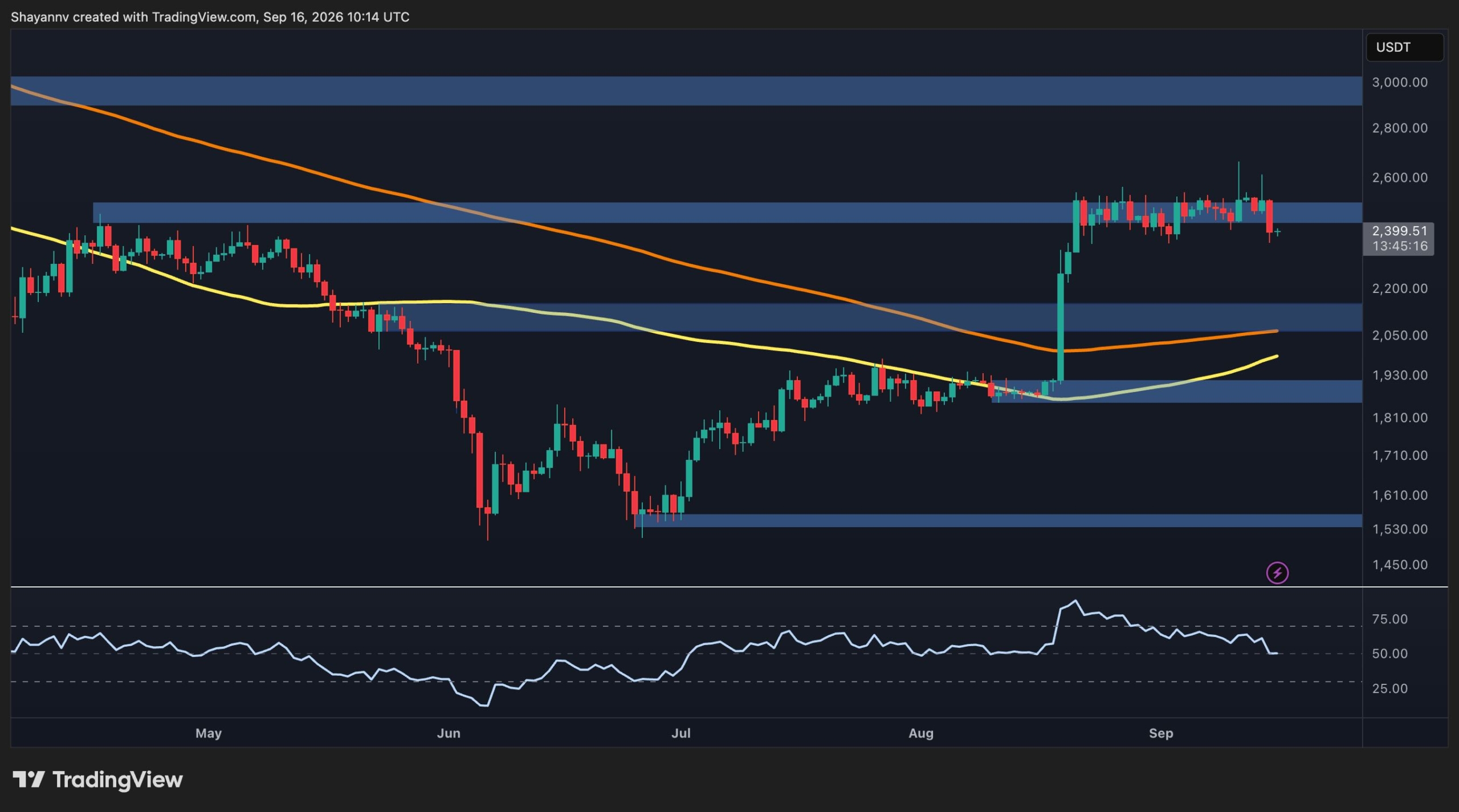
ETH/USDT 4-Hour Chart
The 4-hour chart demonstrates a more granular picture of the current consolidation. ETH experienced a powerful upside move around August 19-22, climbing from roughly $1.9K toward the $2.5K region. Since then, the market has largely remained inside a broad horizontal range.
The range currently appears to extend from approximately $2.35K to $2.6K, with the $2.5K zone acting as the central resistance area. ETH is now trading around $2.4K after recently falling from the upper half of the range.
The immediate technical concern is that the price has moved toward the lower boundary of the range. The $2.35K area is therefore an important short-term support. If buyers defend this region and reclaim $2.5K, the range could remain intact, and the upper boundary near $2.6K could come back into consideration.
Conversely, a breakdown below $2.35K would weaken the range structure. In that scenario, the next visible support is the $2.25K order block. A loss of that region would expose the broader $1.9K support area.
The 4-hour RSI has fallen toward the 30 region, indicating that short-term momentum has become significantly weaker following the rejection from the $2.5K area. This leaves room for a technical rebound, but the RSI alone does not confirm that a durable bottom has formed. Price’s reaction around $2.3K-$2.35K should therefore be important for determining whether this is simply a pullback within the range or the beginning of a deeper correction.

On-Chain Analysis
The exchange-reserve chart shows a clear long-term decline in ETH held on exchanges. The visible reserve level has fallen from above 21M ETH during the first half of 2025 to approximately 14.6M ETH currently.
Notably, the decline in exchange reserves has continued even as ETH recovered toward $2.4K. This indicates that the amount of ETH tracked on exchanges has been trending lower rather than expanding alongside the recent price recovery.
A continued reduction in exchange balances can mean that fewer coins are immediately available on exchanges for potential selling, which can reduce readily available exchange supply. However, the metric by itself does not establish future price direction, since ETH can move between exchanges, wallets, custodians, and other entities for numerous reasons.
From a technical perspective, however, the combination is worth watching. ETH remains below the key $2.5K resistance, while exchange reserves are near their lowest visible level on this chart. If ETH manages to reclaim $2.5K while reserves continue declining, it would provide a supportive backdrop for the breakout. On the other hand, failure to hold the $2.3K-$2.35K 4-hour support would keep the market in a corrective phase despite the longer-term decline in exchange reserves.

The post Ethereum Price Analysis: Is ETH Heading Toward $2K After Another Rejection at $2.5K? appeared first on CryptoPotato.
XRP fell about 8% over the past 24 hours, one of the worst showings among the top cryptocurrencies, after the US Senate failed to advance the Digital Asset Market CLARITY Act on Tuesday.
The drop left XRP down well over 10% for the week, well behind Bitcoin and most other major coins, and it shows how closely tied the token’s price still is to progress on crypto legislation in Washington.
The Selling Was Not Just Profit-Taking
XRP’s price ran from around $1.46 per CoinGecko data to near $1.27, with analyst Xaif Crypto noting that its cumulative volume delta (CVD) cratered to negative 10.5 million as the price dumped.
“Sellers aren’t hiding anymore, this is aggressive dumping not just profit taking,” they wrote on X.
The selloff tracked the Senate vote almost exactly. Cloture on the bill, formally known as H.R. 3633, needed 60 votes and got 49. Every yes vote came from Republicans, and four of their own broke ranks to vote no.
Furthermore, Senators Gillibrand, Warner, Booker, Warnock, Gallego, Alsobrooks, and Cortez Masto all voted no after months of talks, meaning no Democrats crossed over to support it.
The CLARITY Act is meant to divide oversight of digital assets between the SEC and CFTC and bring exchanges, brokers, and dealers under a new federal registration regime, provisions the market had been pricing ahead of the Tuesday vote.
At the time of writing, CoinGecko data put XRP around $1.28, down over 8% in 24 hours and more than 10% in seven days. The picture looks different further out, with the Ripple token still up close to 29% over the past 30 days, even after this week’s drop, although it remains down more than 56% across one year and about 65% below its all-time high of $3.65 from July 2025.
Bitcoin and the Rest of the Market Also Slipped
The broader market was also under pressure, with Bitcoin slipping around 2.0% over the same 24 hours to trade near $75,000, while its share of the total crypto market remained above 56%. On its part, Ethereum dropped close to 4%, which saw it trading a few bucks under $2,400.
Stellar dipped even harder than XRP, shaving nearly 9% from its value, while BNB was only slightly ruffled, with its price dropping less than 1%.
Zcash gained about 3%, and Hyperliquid fell more than 2% over the same period, while Dogecoin slipped 3.7% and Solana lost over 4%, in line with the rest of the market’s retreat.
For XRP, the immediate price damage does not change its legal position, as pointed out by Ripple CEO Brad Garlinghouse, who also stated that his company “has never been stronger” despite the CLARITY setback.
The post Why XRP Was Hit Hardest After the CLARITY Act Senate Failure appeared first on CryptoPotato.
The CLARITY Act did not receive enough support in the US Senate, so it could not move to official discussion. This triggered a correction in the broader cryptocurrency market, while the upcoming FOMC meeting may worsen the sector’s condition.
The prevailing expectation is that interest rates in the USA will rise by 0.25%, yet analyst Ali Martinez assumed the central bank may be forced to keep the benchmark unchanged, which could propel a BTC price rally. Here’s why.
Influence From Trump?
Martinez started his thesis by noting the CLARITY Act failure and describing it as “a major setback for one of Trump’s crypto-policy objectives ahead of the November midterms.”
Then, he revealed that the odds of a 25-basis-point rate hike following the FOMC meeting, scheduled for later today (September 16), are roughly 93%, with only a small minority expecting the figure to stay the same.
According to the analyst, the smaller group may actually get it right this time. He pointed to the approaching midterms in the US, arguing that Trump needs a political win and that another rate increase could create more economic pressure, possibly hurting his chances of success.
“That could weigh on Kevin Warsh and the FOMC’s decision-making,” he said.
Martinez thinks that such a surprise move could trigger a powerful rally across risk assets, with BTC (which has rarely risen after the past 14 FOMC decisions) potentially surpassing $82,000.
“This is my wild prediction. Not the consensus view. Trump needs a win. A no-hike decision could give markets exactly the surprise they need to rally,” he concluded.
However, another angle is worth considering. The widely expected rate hike may already be priced in, making Fed Chair Warsh’s press conference the key event to watch. It will take place immediately after the FOMC meeting, and any signals of further rate increases could negatively impact BTC and altcoins. On the other hand, a softer tone and remarks that the central bank has made progress on inflation could lead to a solid rebound.
Massive Shorts Ahead of the Meeting
X user Max Crypto revealed that a mysterious whale opened a $50 million short position on BTC and a $15.8 million short on ETH ahead of the central bank’s crucial decision.
Usually, such major bets fuel speculation that the trader may have access to inside information. However, the whale’s win rate is around 40.6%, meaning their track record is far from flawless.
Meanwhile, another anonymous trader (with a staggering 100% win rate) recently opened multi-million shorts on BTC, ETH, and ZEC before the CLARITY Act vote. As mentioned above, the bill did not move forward for official discussion, and the crypto market headed south.
The post Wild Bitcoin Prediction Ahead of the FOMC: Here’s What Could Trigger a Pump appeared first on CryptoPotato.
Bitcoin (BTC) is stuck in a narrow price range as investors wait for the U.S. Federal Reserve to announce its interest-rate decision on Wednesday. Selling has slowed, but buying has not been strong enough to push BTC clearly higher.
According to Bitfinex Alpha, Bitcoin has traded within a 5.5% range for more than 24 sessions, keeping the market quiet. The report says the next move could depend on whether new demand returns after the Fed decision, as traders have built positions at both ends.
Selling Eases, but Buyers Remain Cautious
About 840,000 BTC have a cost basis within this narrow range, meaning they were bought at prices inside it. Glassnode’s sell-side risk ratio has fallen to seven basis points, showing that long-term holders are taking fewer profits.
Newer investors now account for most of the remaining supply, but trading activity remains low. In other words, sellers have become less aggressive without a strong wave of new buyers stepping in.
Leverage has also built up around the current price levels, which could make any breakout more volatile. CoinGlass data show about $1.95 billion in possible short liquidations near $82,000, while long positions are concentrated around $75,000 to $76,000.
Institutional demand has also weakened, adding another obstacle to a sustained move higher. U.S. spot Bitcoin ETFs saw over $460 million in outflows last week, selling approximately 5,900 BTC, while Ether ETFs took in $196.9 million. September ETF flows remain positive, but recent outflows show weaker institutional demand could limit Bitcoin’s upside.
Inflation Keeps Pressure on the Fed
Inflation is adding another challenge, with August prices rising 0.4% from the previous month and 3.4% over the year. Core inflation eased to 2.4%, but gasoline prices rose 3.9%, and diesel reached $5.65 per gallon.
Higher energy costs could keep inflation elevated, especially as Brent crude trades above $100 a barrel and U.S. strategic reserves fall to 285.4 million barrels. This could reduce expectations for easier monetary policy and keep pressure on interest rates.
Markets now see an 88.5% chance of a 25-basis-point rate hike on September 16. The U.S. 10-year real Treasury yield has risen to 2.55%, making non-yielding assets such as Bitcoin less attractive to some investors.
The post Bitcoin Stays Stuck as Traders Wait for the Fed’s Next Move appeared first on CryptoPotato.
Circle, the company behind USDC, has officially launched the public mainnet of Arc today. This is a Layer 1 blockchain as infrastructure built specifically for financial markets, payments, and AI-powered economic activity.
According to the firm’s official announcement, the protocol debuts with more than 100 institutional and ecosystem participants.
USDC, the stablecoin with more than $74 billion in circulating supply, is integrated in the network directly as the main gas token, meaning that users will have a degree of predictability that other networks might lack.
USDC Powers Network Fees
Unlike most Layer 1 networks, which have a USD-denominated cryptocurrency as the native token, Arc allows users to pay for transaction fees directly with USDC.
Circle also says that the network provides sub-second finality and supports assets including USDC, EURC, and tokenized real-world assets.
Some of the founding validators include BlackRock, Mastercard, Visa, Standard Chartered, Galaxy, ICE, DTCC, and MoneyGram. Crypto firms, on the other hand, include Binance, Coinbase, Kraken, Bybit, Aave, Morpho, Uniswap, MetaMask, and others.
ARC Token Into Spotlight
Circle also revealed that it has minted the full initial supply of 10 billion ARC tokens earlier this week. The company, however, stressed that this does not confirm a public token launch.
ARC is intended to support network security, utility, and governance eventually. This should come into prominence once Arc starts exploring a transition from Proof of Authority to Proof of Stake in 2027.
The next key thing that many in the industry are currently watching is if Arc’s blockchain will become a playground for traders and on-chain enthusiasts in a similar way Robinhood Chain did.
The post Circle Launches Arc Mainnet With 100+ Institutional and Crypto Partners appeared first on CryptoPotato.


