Cryptocurrency Posts
Crypto Briefing
Rising tensions and disrupted oil routes in the Gulf could exacerbate global energy prices, impacting economic stability and inflation.
The post Gulf states cancel Hormuz talks as Houthis strike Saudi airbase, oil tops $107 appeared first on Crypto Briefing.
SpaceX's data center overhaul highlights the critical need for robust infrastructure to maintain client trust and meet ambitious growth targets.
The post SpaceX overhauls xAI data center infrastructure after reliability problems surface appeared first on Crypto Briefing.
The shutdown highlights the ongoing security challenges in crypto payment systems, emphasizing the need for robust non-custodial safeguards.
The post Swiss Bitcoin Pay shuts down servers after suspected breach appeared first on Crypto Briefing.
Richarlison's exclusion highlights the challenges clubs face in managing player discontent and the financial implications of unused talent.
The post Roberto De Zerbi says Richarlison will not play even if available this season appeared first on Crypto Briefing.
Zest Protocol's DeFi incentives could boost user engagement and liquidity on Stacks, enhancing the ecosystem's overall financial activity.
The post Zest Protocol introduces DeFi incentives on Stacks market with monthly STX rewards appeared first on Crypto Briefing.
Bitcoin Magazine
Bitcoin Magazine

A Bitcoin Berkshire Model: Orange Juice
The corporate Bitcoin landscape is currently dominated by a single, aggressive playbook. Companies following this model rely almost exclusively on capital markets and financial engineering—issuing debt, preferred stock, and common equity at premiums—to turn their corporate balance sheets into amplified, high-beta proxies for Bitcoin.
Now, Orange Juice, a firm launched by partners at ego death capital, is introducing a brand-new corporate strategy to the mix. Rather than acting as a financial engineering vehicle reliant on capital markets, Orange Juice plans to acquire profitable American businesses, hold them indefinitely, improve their operations, and direct part of their excess cash flow into a Bitcoin treasury. While the dominant model turns investor demand for credit securities into Bitcoin, Orange Juice wants to turn sustainable operating earnings into Bitcoin.
To understand the value of this new approach, you have to understand its primary departure from the prevailing meta: Orange Juice is deliberately not “max long” Bitcoin. By anchoring its balance sheet to traditional operating earnings, the company trades away explosive bull market leverage in exchange for a decorrelated return stream that acts as a vital ballast during bear market winters.
Bear market ballasts and countercyclical purchasing power
The core argument for the Orange Juice model becomes clearest during a Bitcoin bear market. Bitcoin companies that are driven by capital markets flows work best when investors are eager to finance them. Strong Bitcoin prices support higher equity valuations, which makes share issuance highly accretive, while healthy credit markets lower the cost of borrowing. However, during market downturns, this dynamic reverses. Equity premiums compress, credit becomes expensive, and capital markets become far less receptive. As a result, pure-play Bitcoin balance sheets lose their purchasing power precisely when Bitcoin is trading at its cheapest valuations.
Orange Juice, in theory, would be able to use its non-Bitcoin enterprise value as a buffer against these “very awful months”. A durable operating business like a pest control firm, a managed IT provider, or an industrial maintenance contractor can all continue to collect customer payments and generate free cash flow even during a 50% Bitcoin drawdown. This steady operational cash provides the company with unencumbered, countercyclical purchasing power when external capital markets are closed. At its core, the non-Bitcoin business serves as a diversification venue, providing a decorrelated return stream that smooths out enterprise volatility and protects the firm from a fearful capital market. It is also applicable to leveraged financing, because free cash flow can be used to pay preferred dividends or debt coupons, which can eliminate the need to issue equity at bear market lows.
The trade-off: cost of capital and the Bitcoin hurdle rate
Because Orange Juice isn’t purely a Bitcoin balance sheet company, its downside protection comes with a clear structural trade-off.
Every acquisition Orange Juice makes introduces a cost of capital and an implicit hurdle rate: Bitcoin itself. If Orange Juice has $20 million in capital, it must decide whether to deploy that $20 million directly into Bitcoin on day one or use it to acquire a business generating (as an illustration) $3 million in annual cash flow. Even if the business yields an attractive 15% initial cash return, Orange Juice still has to answer whether that business will ultimately create more Bitcoin-denominated value than simply holding the underlying asset.
In a sustained bull market, this model obviously creates an inherent drag. A business returning 12 – 15% annually can prove to be a poor capital allocation decision if spot Bitcoin compounds much faster, and Orange Juice’s equity will naturally lag the explosive returns of amplified pure-play amplified “digital equity.” Orange Juice is effectively betting that the ability to aggressively buy the dip during bear markets (or at least service liabilities without selling Bitcoin or issuing equity) using operational cash will ultimately compensate for the opportunity cost of not putting every dollar directly into Bitcoin.
Execution risk and acquisition quality
For this countercyclical engine to work, the model depends heavily on acquisition quality and operational execution.
Unlike strategies that focus primarily on marketing to the capital markets and on financial engineering, Orange Juice’s success would depend on management’s ability to execute M&A and manage operating businesses. The ideal subsidiary must generate recurring revenue, require minimal maintenance capital expenditures, carry modest leverage, and remain resilient through broader economic recessions.
Weak or highly cyclical businesses damage the core thesis by losing its cash flow at the exact moment Bitcoin and the capital markets come under pressure. If an acquired subsidiary fails during a downturn, it could turn into an operational drain. Therefore, management must excel at both acquiring businesses at attractive free-cash-flow multiples and running them efficiently enough to maintain a predictable stream of excess cash for Bitcoin accumulation.
The bottom line
Corporate Bitcoin strategy no longer has to be a game dominated by “digital securities.” While pure-play Bitcoin companies operate as high-beta vehicles designed to maximize upside during favorable market regimes, the Orange Juice model offers an alternative framework designed for resiliency through decorrelation.
By accepting lower beta and sacrificing maximum leverage in a bull market, Orange Juice, in theory, creates an operational foundation for unconditional purchasing power through every stage of the market cycle.
Disclaimer: This content was prepared on behalf of Bitcoin For Corporations for informational purposes only. It reflects the author’s own analysis and opinion and should not be relied upon as investment advice. Nothing in this article constitutes an offer, invitation, or solicitation to purchase, sell, or subscribe for any security or financial product.
This post A Bitcoin Berkshire Model: Orange Juice first appeared on Bitcoin Magazine and is written by Allard Peng.
Bitcoin Magazine

Bitcoin’s ‘Unusual Mix’: Bearish Inflation Print, Bullish Buyback Failure
Bitcoin’s path higher just got harder in the short term, but the setup further out may be improving, according to a new report.
In a Friday note, European asset manager CoinShares’ Head of Research, James Butterfill, said firmer-than-expected core inflation raises the odds of tighter Fed policy and could cap bitcoin below $80,000 for now.
But the longer-term case, he argued, rests on the U.S. Treasury’s bond buyback programme failing to bring down long-end yields — a failure that could ultimately feed the debasement narrative that has supported both bitcoin and gold.
“The result is therefore a somewhat unusual policy mix for Bitcoin,” the report read. “Today’s CPI data is negative at the margin, increasing the probability of tighter monetary policy and potentially limiting the immediate upside.
“But the apparent failure of the Treasury’s current buying programme increases the likelihood of much more substantial intervention further ahead.”
It continued: “If that happens, it could become one of the more powerful medium-term catalysts for Bitcoin.”
Data on Friday revealed that the consumer price index, excluding food and energy, climbed 0.3% in August from a month earlier — higher than expected.
According to CME’s FedWatch tool, traders think there is a 85% chance interest rates will be higher after the Federal Reserve meets next week. Bitcoin has typically performed well in a low interest rate environment.
But the U.S. Treasury’s expanded bond buyback programme has so far failed to materially suppress long-term yields.
If yields stay stubbornly high, Butterfill said, pressure will build on Treasury Secretary Scott Bessent to escalate to a much larger, “bazooka-style” buying programme aimed at forcing borrowing costs down.
Bitcoin in August had one of its best runs in years after Treasury Secretary Scott Bessent announced the department would double the size of its long-dated bond buybacks.
The announcement and subsequent price surge has led some to say the much talked-about debasement trade is back. The so-called debasement trade is when investors buy an asset as a way to hedge against a currency losing value.
Bitcoin and gold have both benefited as part of the trade as the dollar weakens.
This post Bitcoin’s ‘Unusual Mix’: Bearish Inflation Print, Bullish Buyback Failure first appeared on Bitcoin Magazine and is written by Mathew Di Salvo.
Bitcoin Magazine

Blockstream Tells Hackers To Return Remaining Bitcoin Stolen in Liquid Theft
Bitcoin infrastructure firm Blockstream has refused to negotiate further with hackers who last week stole 4,000 bitcoins from its Liquid network.
Writing on X Friday, Blockstream said that the hackers still had time to return the funds before the company would work with law enforcement.
White-hat hackers on Sunday withdrew about $320 million from the federation wallet that backs Liquid, a sidechain by Blockstream. After negotiating with Blockstream, they returned most of the funds but kept 598.5 coins worth over $46 million — demanding it as ransom.
“Blockstream will not pay a ransom for the return of stolen funds,” the post read. “Taking assets without authorization and withholding their return is a crime, not responsible disclosure. It is not white-hat activity. It is theft.”
It added: “We will work with law enforcement, exchanges, service providers, forensic specialists, and other relevant parties to trace and recover the assets and identify those responsible.”
“We will not pay for the return of stolen property. We will not abandon our users. The Bitcoin community will not stop pursuing the funds.”
Liquid, or L-BTC, is a layer-2 created by Blockstream that allows users to fast move assets backed 1:1 with bitcoin. One of the assets, LBTC, is a token backed by bitcoin that allows for quick settlement — a bit like the Lightning Network.
Hackers were able to get the funds by exploiting an inflation bug on the Liquid sidechain to create over 4,000 LBTC that did not exist before and cash them out for real, on-chain bitcoins.
The hackers then had an exchange with Blockstream via messages written into Bitcoin blocks.
In one message, the white hats wrote: “Please fix the bug first. The chain is under risk at latest commit right now. Make sure every node is patched. Then we will transfer the money back safely after confirming the fix.”
In the latest message, the hackers slammed Blocksteam as “delusional, greedy, and arrogant,” and threatened to reveal all of Blockstream’s encrypted messages in the exchange unless the company allowed thieves to keep 10% of the bitcoins.
“You SHALL pay 10% using your own money as bug bounty or you will cause all your holders a 15% loss for your irresponsibility and stinginess,” the message read.
The Bitcoin community is still reeling after hackers in July were able to steal over 1,800 bitcoins worth close to $140 million from Coldcard wallet holders.
Users of the popular hardware wallet, created by Coinkite, were targeted because the product’s manufacturer did not use a true random number generator, allowing hackers to essentially guess investor seedphrases.
This post Blockstream Tells Hackers To Return Remaining Bitcoin Stolen in Liquid Theft first appeared on Bitcoin Magazine and is written by Mathew Di Salvo.
Bitcoin Magazine

Italy’s Second Biggest Bank UniCredit Is Weighting up Crypto Custody: Report
Italy’s second largest bank is considering expanding into digital asset offerings, including custody, according to reports.
According to a Friday Bloomberg report citing people familiar with the matter, Milan-based UniCredit is selecting a technology provider that would allow it to build the infrastructure needed to hold digital assets and facilitate their buying and selling.
Bloomberg’s reporting added that tokenized investment products and fixed-income securities, the use of stablecoins and exposure to cryptocurrencies were all on the cards.
JUST IN:
— Bitcoin Magazine (@BitcoinMagazine) September 11, 2026Italy’s 2nd-largest bank UniCredit is considering to offer crypto asset custody — Bloomberg
pic.twitter.com/NAZKJBdcES
The news comes as other banks in Europe expand crypto offerings. Spain moved first on retail, with BBVA rolling out bitcoin trading and custody to all customers via its app, using its own custody infrastructure rather than a third party; Santander’s Openbank followed with its own trading service.
Cecabank — a Spanish custodian with over €400bn under management that acts as backbone for 100+ financial institutions — went live with crypto custody in June via a partnership with Bit2Me.
And in Germany, Deutsche Bank is building custody with Bitpanda’s technology arm, while Taurus and DZ Bank got BaFin approval in January for its meinKrypto platform.
New regulation in the European Union — Markets in Crypto-Assets Regulation (MiCA) — gives banks a legal definition, a supervisor, and a familiar set of obligations to launch crypto services.
UniCredit is one 37 lenders across 15 European countries working together to create a company called Qivalis with the aim of issuing a euro-denominated stablecoin.
Last year, the bank said it was offering professional clients a structured product tied to BlackRock’s iShares Bitcoin Trust exchange-traded fund, with full protection against losses.
This post Italy’s Second Biggest Bank UniCredit Is Weighting up Crypto Custody: Report first appeared on Bitcoin Magazine and is written by Mathew Di Salvo.
Bitcoin Magazine

Government Defeated as Lords Back UK Digital Assets Strategy
The UK government suffered a defeat in the House of Lords on Wednesday as peers backed an amendment requiring the Treasury to draw up a national strategy for regulating digital assets.
The upper chamber approved the measure by 194 votes to 138, with Conservative and Liberal Democrat peers combining against a near-solid bloc of Labour votes. Baroness Neville-Rolfe, a Conservative former Treasury minister, moved the amendment to the Financial Services and Markets Bill.
The new clause, titled “Digital assets strategy,” would require the Treasury to prepare, publish and consult on a strategy for regulating and developing digital assets and related digital financial market infrastructure in the UK.
JUST IN:
— Bitcoin Magazine (@BitcoinMagazine) September 11, 2026U.K. House of Lords passes amendment requiring the government to develop a national cryptocurrency strategy
The regulation of digital assets includes “cryptoassets, qualifying stablecoins, Central Bank Digital Currencies, tokenised securities and other digital and tokenised financial assets,” according to the draft.
The UK is in the process of drafting a sweeping new crypto bill. The country’s Financial Conduct Authority finalised its regulatory framework for cryptoassets in June, with the regime due to take effect on 25 October 2027. The authorisation gateway for firms opened on 30 September and runs to 28 February 2027.
Britain is trailing behind Brussels and Washington with digital asset regulation. The EU’s Markets in Crypto-Assets regulation has applied to service providers since 30 December 2024.
And the U.S. under President Donald Trump signed the GENIUS Act into law in July 2025, establishing a federal framework for dollar-backed tokens. Broader market-structure legislation remains unfinished: the Clarity Act cleared the House in July 2025 by 294-134 but has been stuck in the Senate over DeFi, stablecoin yield and ethics provisions, with a procedural vote set for next week.
This post Government Defeated as Lords Back UK Digital Assets Strategy first appeared on Bitcoin Magazine and is written by Mathew Di Salvo.
CryptoSlate
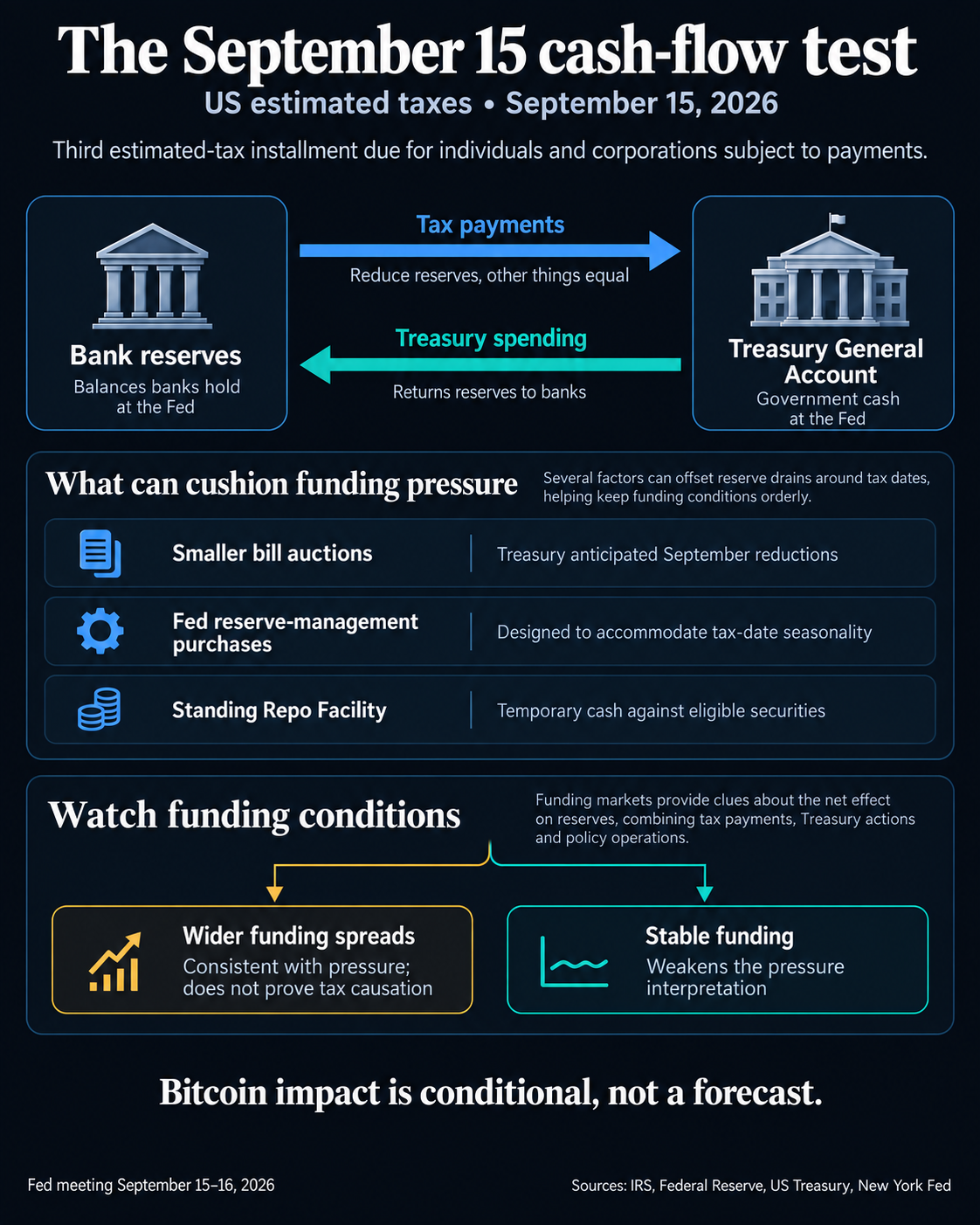
Tuesday’s US estimated-tax deadline will shift cash toward the Treasury, testing whether last week’s improvement in bank reserves can hold through the Federal Reserve’s meeting. Bitcoin liquidity could come under pressure if the transfer tightens dollar funding and limits risk-taking before policymakers conclude their September 15–16 meeting.
The IRS calendar sets September 15, 2026 as the third installment deadline for individuals and corporations subject to estimated-tax payments. It falls on the opening day of the Fed meeting, putting a scheduled cash movement alongside the policy decision due the following day.
Bank reserves are balances commercial banks hold at the Fed. They support payments and funding, rather than measuring traders’ available cash. The starting point is stronger than a week earlier. The Fed’s September 10 balance-sheet release showed weekly-average bank reserves rose $96.779 billion to about $2.991 trillion in the week ended September 9. Over the same period, the Treasury General Account, the government’s account at the Fed, fell $84.6 billion to $883.3 billion on a weekly-average basis.
Those are averages, not Wednesday’s snapshot. The separate September 9 levels were about $3.037 trillion for reserves and $843.705 billion for Treasury cash.
How US tax payments could affect Bitcoin liquidity
The accounting mechanism is straightforward: tax payments move balances from commercial banks’ reserve accounts into the Treasury’s account. Treasury spending moves funds back to recipient banks. Other things equal, incoming taxes reduce reserves, while outgoing government payments replenish them.
That can matter for short-term financing, including repo markets where cash is borrowed against securities. The New York Fed’s account of September 2019 describes how a temporary reserve decline, Treasury settlements and a corporate tax date combined with a spike in repo rates. It is a historical example of the mechanism, not evidence that this Tuesday will repeat it.
Several forces can cushion the transfer. In its August 5 refunding statement, Treasury anticipated September reductions in shorter-dated bill auction sizes because of mid-month tax receipts. Less bill borrowing could partly offset cash absorption relative to unchanged issuance. The size of that offset depends on actual borrowing and spending.
The Fed also plans for seasonal reserve demand. Its May 2026 balance-sheet report says reserve-management purchases accommodate fluctuations such as tax dates and adjust to the reserve outlook. The New York Fed describes the Standing Repo Facility as a backstop supplying eligible institutions with temporary cash against securities to limit upward funding pressure.
For Bitcoin investors, the possible effect runs through financing conditions and appetite for risk.
BIS research finds that stablecoin market capitalization declines after US monetary tightening. That supports broader sensitivity to monetary conditions, not a measured Bitcoin response to this tax deadline.
The useful signal is therefore whether short-term funding spreads widen relative to Fed-administered rates as taxes settle. Rising spreads would be consistent with funding pressure without proving taxes caused it; stable funding would weaken that interpretation. Tuesday’s calendar creates a test, while spending, bill supply and Fed liquidity tools help determine the result.
The post Another Bitcoin liquidity test arrives with Tuesday’s US tax deadline appeared first on CryptoSlate.
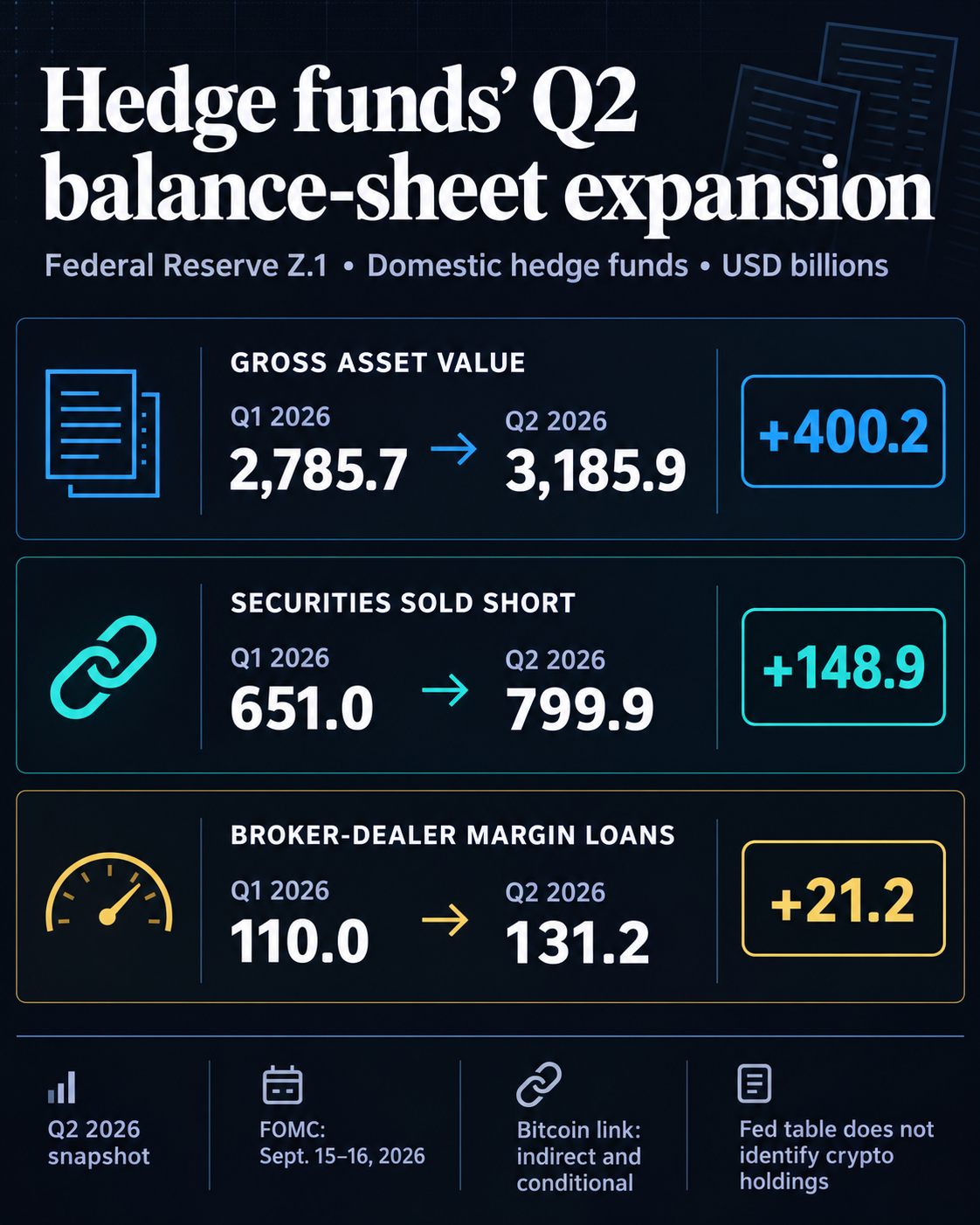
Newly released Federal Reserve data show domestic hedge funds expanded their gross balance sheets during the second quarter, months before the central bank’s September rate decision.
The potential risk to Bitcoin is indirect. A policy surprise could raise funding or collateral demands across leveraged portfolios, forcing funds to find cash in liquid markets.
Gross asset value was $2.7857 trillion in the first quarter. It reached $3.1859 trillion in the second quarter. That was a $400 billion increase. The table defines gross asset value as total assets, not gross notional exposure.
Securities sold short stood at $651 billion in the first quarter. The total reached $799 billion in the second quarter. That marked a $148 billion rise.
Margin loans due to U.S. security brokers and dealers were $110 billion in the first quarter. They reached $131 billion in the second quarter. That was a $21 billion increase.
The Bitcoin spillover test
The FOMC is scheduled to meet Sept. 15–16, 2026, at a gathering associated with its Summary of Economic Projections. A surprise in rates or the policy outlook could reprice Treasury positions and the collateral that finances them.
The leverage backdrop raises the stakes. The Fed’s May Financial Stability Report said comprehensive Form PF data through the third quarter of 2025 put hedge-fund leverage at or near all-time highs. A separate Fed study estimated large qualifying funds had $4 trillion of gross Treasury exposure and $3 trillion of repo cash borrowing in September 2025. Those measurements cover different fund populations and cannot be added to the latest Z.1 figures.
Repo is short-term borrowing backed by securities. Dallas Fed research links hedge-fund net repo demand to constraints on dealers and other cash providers, as well as wider secured funding spreads. BIS research shows how higher margin requirements can force leveraged traders to post cash or unwind positions.
New York Fed data for Sept. 10 put the Secured Overnight Financing Rate, a broad measure of overnight Treasury-backed borrowing costs, at 3.62%. That latest snapshot alone does not establish a funding spike.
A Bitcoin spillover would become more credible if the Fed window brings tighter secured funding, a wider gap between related Treasury cash and futures prices, higher margin demands and visible selling across risk assets. Stable funding and no cross-asset liquidation would weaken the case. Until those signals appear, the Q2 data show amplification capacity rather than an actual Bitcoin sale.
The post Fed data shows hedge funds added $400 billion before Bitcoin’s September rate test appeared first on CryptoSlate.
Bitcoin is trading above $77,000 on Monday as selling in AI-related stocks put Wall Street on course for a weaker open. The weakness followed weekend calls to pace AI development and coincided with rising oil prices. Gains in software shares showed a more divided technology market.
At 4:46 a.m. Eastern on Sept. 14, Reuters reported Nasdaq 100 E-mini futures down 1.72%, compared with a 0.70% decline for S&P 500 futures and a 0.18% fall for Dow futures. Bitcoin stood at $77,678 at 7:42 a.m. Eastern, according to CryptoSlate's price page. Together they frame the opening question: will the AI selloff spread, or remain concentrated enough for other risk assets to hold their ground?
The uneven losses suggest a selective repricing, with the wider market still facing a test at the opening bell. A Monday shakeout that finds buyers remains plausible. Bitcoin's position above $77,000 provides a reference against which to judge its response during the session.
Chip stocks were among the weakest shares in Reuters' premarket report. Nvidia fell more than 2%, Intel and Marvell nearly 6%, and AMD nearly 5%. Software moved the other way: ServiceNow gained 3%, while Adobe and Workday rose 2.5% each.
The split limits how much the Nasdaq's decline can tell us about the entire market. Investors were marking down companies associated with AI hardware while bidding up some software businesses. Together with the much smaller decline in Dow futures, that pattern is consistent with reassessment inside the AI trade, rather than uniform selling across the available indicators.
The concentration of losses offers little comfort to holders of the hardest-hit stocks. For the broader market, however, the distinction changes what would count as deterioration from here. Pressure spreading well beyond the early technology casualties after the cash open would be a sign that the retreat is becoming broader.
The opposite would also matter. A narrower Nasdaq loss alongside firmer broader indices would suggest buyers are absorbing the initial repricing. A session can recover from its weakest point and still close lower. The size of the opening drop and the direction of trading afterward answer different questions.
Bitcoin's price gives crypto investors a reference before the US cash session begins. Its position above $77,000 leaves room for a more constructive outcome than a renewed decline alongside equities. The subsequent path matters: this morning's single quote establishes a starting point, while the session will show whether buyers can defend it.
The NYSE's core session starts at 9:30 a.m. Eastern and ends at 4 p.m. The open therefore creates a fresh test: whether Bitcoin can remain firm as the equity selloff is tested in regular trading, and whether losses become broader or start to narrow.
For Bitcoin, the next useful observation is whether the price stays around or above that reference as the wider market absorbs the news. A brief move through a round number would say less than sustained weakness accompanied by worsening equity losses.
A firm Bitcoin price alongside a weak Nasdaq would show resilience during this episode. Establishing a lasting change in its relationship with equities would require evidence across a longer period.
Premarket prices reveal the distribution of selling pressure, while leaving the identity of sellers unresolved. Identifying retail or institutional leadership would require participant-level evidence.
AI expectations meet an existing oil shock
The immediate context is Anthropic CEO Dario Amodei's weekend call to slow the advance of frontier AI capabilities. In We Must Pace the Frontier, Amodei distinguished pacing from halting model training or technical progress. Anthropic committed to embedded independent evaluators, while broader steps would require coordination among companies and governments.
Reuters reported that Elon Musk and Sam Altman agreed with Amodei's call. The support adds weight to the pacing debate. Its commercial effect depends on what companies implement; the reported endorsements concern development policy rather than specified infrastructure spending cuts.
A more cautious development timetable could affect expectations about the business. A slower path to new capabilities could change how investors judge the timing of future benefits. The effect on chip demand and company earnings remains unquantified in these announcements.
There is political resistance as well. NPR reported Sunday that President Donald Trump downplayed calls to slow AI and emphasized maintaining the US lead over China. His response adds uncertainty around how widely a coordinated approach could be adopted, leaving the commercial consequences for technology companies unresolved.
Monday's selling is therefore taking place while the commercial consequences remain uncertain.
Oil adds a separate pressure. Reuters reported Brent crude up 3.6% to $108.31 and US West Texas Intermediate up 3.3% to $103.35 on Monday.
CryptoSlate's Sept. 11 coverage had already described Bitcoin falling below $77,000 on Sept. 10 as oil and bond yields rose. The energy and rates vulnerability therefore predates the weekend AI announcements. Even if investors become more comfortable with what AI pacing means, that separate pressure can remain.
A contained-shakeout interpretation would gain support if equity losses narrow after the open, selling remains concentrated and Bitcoin holds its ground. Renewed Bitcoin weakness alongside a broader equity retreat would point toward a more persistent risk-off move. Easing oil pressure would make the first path easier to sustain; continued energy stress would complicate it.
The opening setup combines heavy AI hardware losses with pockets of strength elsewhere. Bitcoin above $77,000 gives traders a starting point for judging how far the stress spreads. The strongest sign of a transient dip would be improving prices across the session, even if the indices ultimately finish lower.
The post Wall Street braces for a Monday meltdown – so why is Bitcoin holding near $78,000? appeared first on CryptoSlate.
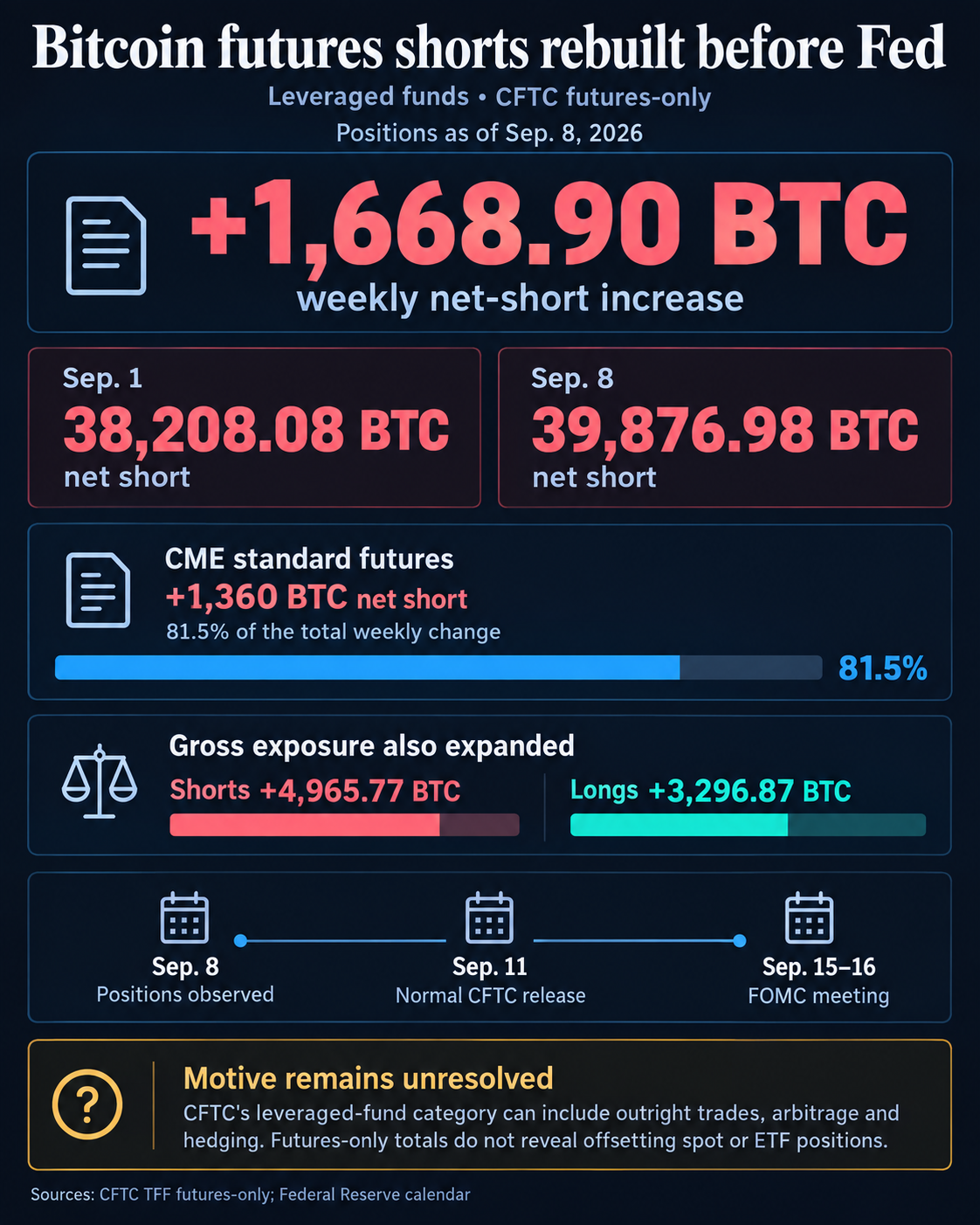
Leveraged funds, a CFTC category that includes hedge funds and other money managers, increased their combined net short across four regulated Bitcoin futures markets by 1,668 BTC in the week to Sept. 8.
The BTC-normalized position widened to 39,876 BTC net short from 38,208 BTC a week earlier, according to CFTC futures-only data. The calculation covers CME’s standard and micro Bitcoin futures and Coinbase Derivatives’ nano and nano perpetual-style contracts, using each market’s stated Bitcoin multiplier. The aggregate measures futures exposure alone, leaving the split between outright bets and hedges unresolved.
CME’s five-BTC contract supplied most of the shift. Leveraged funds added 888 short contracts and 616 long contracts there, widening the net short by 272 contracts, or 1,360 BTC. That accounted for 81.5% of the combined weekly change.
Long and short exposure outside the CFTC’s separate spreading category expanded on both sides. Across the four contracts, short exposure increased by 4,965 BTC while long exposure rose by 3,296 BTC. The imbalance widened the combined short, while the simultaneous growth also fits more complex positioning than a single bearish trade.
Why the motive remains unclear
The CFTC’s explanatory notes say leveraged funds typically include hedge funds, commodity trading advisers, commodity pool operators and other money managers. Their strategies can include outright positions as well as arbitrage within and across markets. The category identifies traders by their predominant activity rather than the purpose of each position.
That distinction matters for Bitcoin because a short futures position can hedge a long spot or spot ETF holding. CME has described that structure as a basis trade designed to capture the spread between futures and spot exposure. Public CFTC totals omit links to offsetting legs, leaving directional positioning, basis hedging or a mixture of both as plausible explanations.
CryptoSlate’s Bitcoin market data placed the asset near $77,300 on Sept. 12. The expanded short exposure was therefore in place ahead of the Sept. 15–16 FOMC meeting, which begins seven days after the CFTC position date.
CFTC reports normally publish Friday at 3:30 p.m. Eastern using the preceding Tuesday’s positions. That schedule leaves a four-day gap between the report reaching readers and the start of the Fed meeting.
The Fed decision is still ahead, although expectations for the meeting could have influenced risk-taking. The 1,669 BTC increase shows that leveraged-fund futures shorts rebuilt before the event. Trade-level intent remains hidden, leaving the data short of proof that traders made an unhedged wager on a post-Fed Bitcoin decline.
The post Leveraged funds rebuilt 1,669 BTC of Bitcoin futures shorts before Fed appeared first on CryptoSlate.
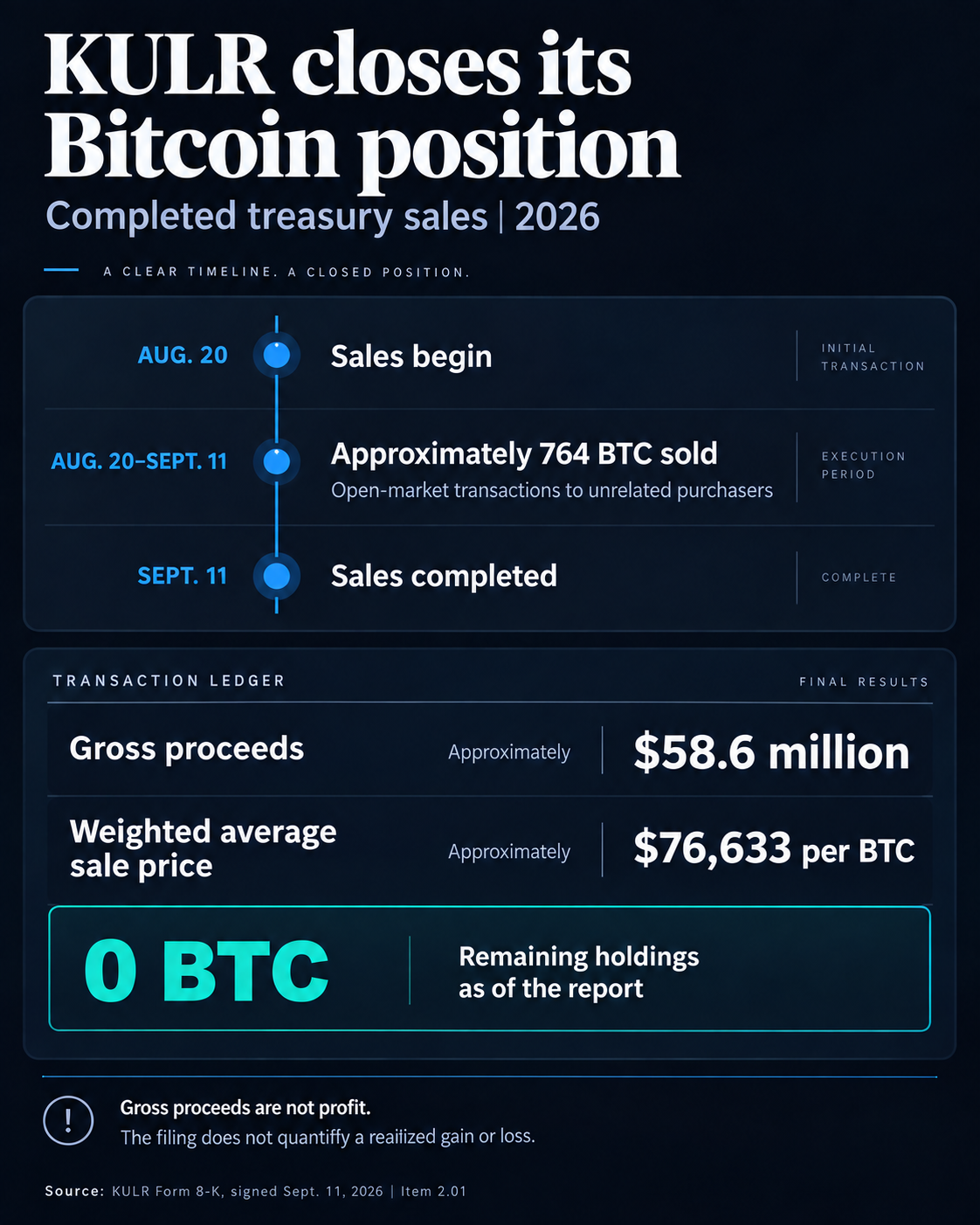
KULR Technology Group has sold its remaining Bitcoin, completing a retreat from a treasury strategy it began unwinding in August.
The battery technology company sold about 764 Bitcoin between Aug. 20 and Sept. 11 for roughly $58.6 million in gross proceeds, according to a regulatory filing. The transactions were completed at a weighted average price of about $76,633 per Bitcoin.
The sales reduced KULR’s Bitcoin holdings to zero as of Sept. 11, closing out a position that the company had already cut sharply as it repaid debt, ended its mining operation, and redirected capital toward its core energy business.
KULR said it sold the Bitcoin through a series of open-market transactions to unrelated buyers as part of its treasury management operations. The filing did not disclose the coins' cost basis or whether the final disposal produced a realized gain or loss.
The exit extends a reversal that became visible in August, when KULR disclosed that it had sold roughly 333 Bitcoin after June 30 for about $21.5 million. About $20 million of those proceeds went toward repaying principal owed to Coinbase.
That repayment reduced one balance-sheet pressure tied to the company’s Bitcoin strategy while also shrinking its exposure to the cryptocurrency. KULR had previously accumulated Bitcoin as a treasury asset and operated mining infrastructure before beginning to pull back.
KULR shifts capital back toward its core business
The latest sale removes the remaining direct link between KULR’s treasury and Bitcoin’s price at a time when several public companies have reassessed crypto-heavy balance sheets amid volatile financing conditions and weaker equity-market premiums.
KULR’s earlier retreat also included shutting down its Bitcoin mining operation as management moved to concentrate capital on its energy platform. The Sept. 11 sale completes that transition on the asset side, leaving the company without the Bitcoin holdings that had previously amplified both gains and losses on its balance sheet.
The $58.6 million in gross proceeds gives KULR additional liquidity, though the filing does not spell out how the company plans to deploy the cash. That leaves investors focused on whether management channels the funds into operations, debt reduction, acquisitions, or other balance-sheet priorities.
The company has also stopped short of ruling out future Bitcoin purchases. Its filing records the disposal of the remaining holdings but does not establish a permanent ban on rebuilding a position later.
For now, the more immediate question is how quickly KULR can convert the proceeds into operating returns from the energy business it has chosen to prioritize.
The post Another public company has abandoned its Bitcoin treasury after selling the last 764 BTC appeared first on CryptoSlate.
CryptoTicker.io
Bitcoin lost to fraud: what the Austrian tax office recognises as a loss
Fake investment platforms, phishing or supposed crypto advisers: anyone who loses bitcoin to fraud may be facing a total loss in economic terms. For tax purposes in Austria, however, that does not automatically mean the original acquisition costs can be claimed as a loss.
For privately held cryptocurrencies the basic rule is this: losing coins to fraud is not a disposal for tax purposes. What is missing is therefore a realisation event, the thing that would trigger a capital loss you could offset against tax.
20,000 euros gone – and still no tax loss?
An example:
- Bitcoin bought for 20,000 euros
- the coins are transferred to the perpetrators as a result of fraud
- no repayment follows
In economic terms the loss amounts to 20,000 euros.
For tax purposes, those 20,000 euros held as private assets generally cannot simply be offset against share gains, dividends or other crypto gains. What is decisive is that the owner did not sell or swap the bitcoin in the course of a normal taxable disposal.
Fraud, theft and hacking are treated along similar lines
Austrian administrative practice groups several cases together in broadly the same way:
- theft of cryptocurrencies,
- loss through fraud,
- a hacking attack,
- loss of the private key.
Outside a business context, none of these on its own generally produces a loss realised for tax purposes. That sets a case of fraud distinctly apart from a voluntary sale below the original purchase price.
A genuine sale at a loss is different
Anyone who buys bitcoin for 20,000 euros and later sells it in the ordinary way for 12,000 euros generally realises a tax loss of 8,000 euros. Under the Austrian loss-offsetting rules, that loss can be set against certain positive capital income in the same year.
Anyone who loses the same bitcoin entirely to fraud suffers the same economic damage – but for tax purposes the necessary realisation is generally absent.
Compensation can trigger fresh tax consequences later on
A further layer arises where the investor holds a claim for repayment or damages.
An example:
- original acquisition costs: 15,000 euros
- the bitcoin is lost to fraud
- a responsible party later pays 18,000 euros in damages
The compensation payment can then become relevant for tax. Depending on the case, it may realise unrealised gains or losses that were present until then.
Document the fraud case fully all the same
Even where no usable tax loss arises at first, investors should secure all the evidence:
- wallet addresses,
- transaction IDs,
- the original purchase receipts,
- chat and email correspondence,
- the police report,
- reports to supervisory authorities,
- records of attempts to recover the funds,
- possible claims for damages.
This documentation becomes especially important if bitcoin or money is repaid after all at a later stage.
Business assets can look different
The restrictions described here apply in particular to privately held cryptocurrencies. Where bitcoin was part of business assets, different rules on profit determination and valuation apply. A business owner should therefore have a fraud loss assessed separately for tax.
Conclusion
A bitcoin loss caused by fraud is economically real in Austria, but where the assets are held privately it generally does not automatically lead to a capital loss that is deductible for tax.
Fraud does not count as a normal disposal. Only later repayments or compensation payments can trigger events that are relevant for tax once more.
(As of September 14, 2026. This article is not investment advice. Prices and fee structures change; check the terms with the provider before you buy.)
When you move funds from a Layer 2 network back to Ethereum, your wallet tells you after roughly twenty minutes that the process has been finalized. Your money has still not arrived on Ethereum at that point, and depending on the network it takes anywhere from just under two hours to more than ten days afterwards. This gap between what the display says and what is actually happening is why withdrawals started shortly before an exchange deadline regularly arrive too late.
I measured the waiting times myself on September 14, 2026, directly against the contracts on Ethereum and against the public nodes of six Layer 2 networks. The short answer: on the optimistic networks Arbitrum One, OP Mainnet and Base, the finalized marker sits some eighteen to twenty-four minutes behind the current state, yet the waiting period written into the contract runs to between 1 and 7 days. On the ZK networks zkSync Era, Linea and Scroll, the marker lags by 1.7 to 4.1 hours, and there it roughly describes the moment your funds become claimable on Ethereum. Same term, two entirely different meanings.
Layer 2 withdrawal explained: what really happens on the way back to Ethereum
A Layer 2 is a network of its own. It processes its transactions itself and then posts the results to Ethereum in batches. The benefit shows up in the cost; the price is paid at withdrawal. Anyone pulling funds back has to wait until Ethereum has accepted the Layer 2 result as valid.
The route has three steps, and only the first one is quick. You begin by starting the withdrawal on the Layer 2 itself. The network then has to submit the corresponding state to Ethereum, and only after that does the real waiting period begin. At the end comes a second transaction on Ethereum, the one with which you claim the funds. Anyone who completes only the first step and then waits may be waiting indefinitely, because on most networks the claim does not happen by itself.
State root, proof and claim
A state root is a single check value that summarises the entire balance sheet of a Layer 2 network at one point in time. That check value is the anchor against which Ethereum later verifies whether your withdrawal really belongs to a valid state. As long as no state root has been posted to Ethereum for the block containing your withdrawal, you cannot prove anything at all, however long you wait.
Only once the root is in place do you submit the proof. After that, the window runs in which other participants may object. If it expires without objection, you claim the money.
The finalized stamp: why "finalized" in the block explorer means two different things
Every node on an EVM network knows a block marker called finalized. That marker describes the state the network regards as irreversible. On Ethereum itself this is unambiguous. On a Layer 2 the meaning depends on how the network is built, and this is precisely where the misunderstanding arises.
On the optimistic networks, the marker refers to the data from which the Layer 2 state is derived. Once that data is final on Ethereum, the Layer 2 block derived from it counts as finalized. That says nothing about your withdrawal. The fraud window keeps running independently.
On the ZK networks, the marker is tied more closely to what actually matters to you: there a batch is only carried as final once the corresponding proof has been verified and executed on Ethereum. Anyone reading their withdrawal out of that marker on Arbitrum or Base is off by a factor of several hundred.

Our own measurement: what the contracts of six Layer 2 networks prescribe as withdrawal periods
This analysis was carried out by cryptoticker.io on September 14, 2026. The measurement was taken at 06:56 UTC against Ethereum block 25,974,039, via a public node, with no account and no keys. In each case I queried the parameters that sit in the contract on Ethereum and set the waiting period.
One methodological detail makes the difference: I did not take the contract addresses from a list but resolved them starting at the canonical bridge contract. On Arbitrum One, the bridge leads to a different rollup contract from the one many older guides name; the older one reports a confirmation state from February 2025 and has therefore been superseded. Query the wrong address and you get an answer that looks like a measurement.
| Network | Design | Waiting period set in the contract |
|---|---|---|
| Arbitrum One | optimistic | 45,818 Ethereum blocks of fraud window, which at 12 seconds per block comes to roughly 6.4 days; plus 14,400 blocks of grace period (around 2.0 days) that only counts in a dispute |
| OP Mainnet | optimistic | 604,800 seconds of maturity period (7.00 days); plus 302,400 seconds of lock period (3.50 days) |
| Base | optimistic | 86,400 seconds of maturity period (1.00 day); lock period set to 0 |
| zkSync Era | ZK | no fraud window; what governs is the execution of the proof on Ethereum |
| Linea | ZK | no fraud window; what governs is the execution of the proof on Ethereum |
| Scroll | ZK | no fraud window; what governs is the execution of the proof on Ethereum |
The maturity period is the time that has to elapse between your submitted proof and the permitted claim. The lock period is an additional wait that the operator has written into the contract as a safety buffer. Both values sit in the same contract. Whether they add up or overlap in an emergency depends on how the dispute procedure runs, and I did not verify that with a withdrawal of my own. Anyone planning conservatively adds them together.
Optimistic rollups: why the fraud window on Arbitrum runs to 6.4 days
An optimistic rollup assumes the submitted results are correct and grants everyone else a window in which they may prove the opposite. That window is the fraud window, and it is the real reason for the wait. It is sized so that an honest participant can still object even if someone tries to push them off the network for a while.
On Arbitrum One, the rollup contract holds a value of 45,818 Ethereum blocks. Converted at the target time of 12 seconds per block, that gives 549,816 seconds, or 6.36 days. The conversion is the only place in my measurement where an assumption is buried: Ethereum blocks arrive on a twelve-second rhythm on average, and individual slots can be missed. In practice that lengthens the window rather than shortening it.
On top of that comes a grace period of 14,400 blocks, around two days. In normal operation this grace period does not apply; it becomes relevant only if there is an actual dispute. For your planning that means 6.4 days is the standard case and 8.4 days is the upper bound you should work with if you have no buffer.
OP Mainnet and Base compared at contract level: 7 days against 1 day on the same technology
The most interesting finding of the measurement sits between two networks running on the same software. OP Mainnet carries a maturity period of 604,800 seconds in its portal contract, exactly seven days, plus a lock period of 302,400 seconds, or three and a half days. Base carries 86,400 seconds in the identically built contract, so one day, and a lock period of zero.
Both values come from the same query at the same moment, and both networks run on the same software. The difference is therefore a decision taken by the respective governance, not a technical necessity. That is also why you should not rely permanently on a figure you read once: what stands at one day today can be back at seven after a contract update. The number sits publicly in the contract and can be looked up at any time.
What this means for the network you choose
If you regularly move back and forth between a Layer 2 and Ethereum, withdrawal duration is a hard selection criterion alongside fees. The duration determines how quickly you can react to a cut-off date, such as a withdrawal deadline at your crypto exchange. Anyone simply holding funds for the long term never feels the difference. Anyone working with them feels it every time.
ZK rollups: why zkSync, Linea and Scroll settle in hours rather than days
A ZK rollup does not present Ethereum with a claim that would have to be contested, but with a mathematical proof that the contract itself recomputes. If the proof passes, the state is valid. No fraud window is needed, because there is nothing to challenge.
The remaining wait arises because a proof is always generated for whole batches of blocks and generating it costs computing time. That lag is exactly what I measured, by querying each network for its current block and its block carried as final, then comparing the timestamps.
| Network | Design | Lag of the final state on September 14, 2026, 06:56 UTC |
|---|---|---|
| Base | optimistic | 17.6 minutes |
| Arbitrum One | optimistic | 19.1 minutes |
| OP Mainnet | optimistic | 23.7 minutes |
| Scroll | ZK | 104.5 minutes (1.74 hours) |
| Linea | ZK | 219.1 minutes (3.65 hours) |
| zkSync Era | ZK | 244.5 minutes (4.08 hours) |
At first glance the table reads the wrong way round, and that is its value. The three optimistic networks sit at the top because their marker shows the least lag, even though it is precisely there that the longest real wait is coming for you. The three ZK networks sit at the bottom, even though their figure is the only one that gives any indication of when you get to your money.

Submission rhythm measured: every 60 minutes on OP Mainnet, every 19 minutes on Base
Ahead of the fraud window sits a wait that most guides leave out: your withdrawal can only be proven once the state containing it has been submitted to Ethereum at all. To gauge this, I read out the 24 most recent submissions for OP Mainnet and Base via the relevant contract and compared their timestamps.
On OP Mainnet the median is 60.4 minutes, with a range of 60.2 to 60.4 minutes. The window ran from September 13, 07:23 UTC to September 14, 06:30 UTC. The rhythm is therefore effectively hourly and barely fluctuates. On Base the median is 19.2 minutes, but the range runs from 4.4 to 35.2 minutes, measured from September 13, 23:08 UTC to September 14, 06:43 UTC. Base submits more often, but less regularly.
For planning purposes you add this time on top. On OP Mainnet, waiting for the next submission alone can cost you a full hour, on Base up to a good half hour. Set against a seven-day window, that barely registers. If you start a withdrawal on the last possible day, that hour is what decides it.
Layer 2 withdrawal before an exchange deadline: how to count backwards
The practical occasion is on the table right now. KuCoin has delisted 25 tokens and closes withdrawals on October 7, 2026 at 08:00 UTC; we have listed the withdrawal deadline and the affected tokens individually. Anyone who still has to pull funds out of a Layer 2 for a cut-off date like this and then send them to an exchange is best advised to count from the end.
For October 7, 08:00 UTC, the measured values give the following latest start times, in each case without a buffer and without the crediting time at the receiving exchange:
- OP Mainnet: 7.00 days of maturity period plus 3.50 days of lock period give 10.5 days on a conservative reading. Latest start: September 26, around 20:00 UTC.
- Arbitrum One: 6.36 days of fraud window plus 2.00 days of grace period give 8.36 days. Latest start: September 28, around 23:20 UTC.
- Base: 1.00 day of maturity period. Latest start: October 6, 08:00 UTC.
- Scroll, Linea, zkSync Era: 1.7 to 4.1 hours. The day before is enough.
A buffer belongs on top of these values, for four reasons: the wait until the next submission, the crediting time at the receiving exchange, possible network congestion, and the plain fact that you have to trigger the second transaction yourself. Anyone who starts over a weekend and only notices the claim on Monday loses two days that appear in no contract period.
The two transactions many people forget
On the optimistic networks it is usually two signatures on Ethereum: one for the proof, one for the claim. Both cost fees on Ethereum, not on the Layer 2. So keep enough ether ready on the address you are withdrawing from. What ether is currently worth is shown on our Ethereum page. A withdrawal left hanging on an empty gas balance waits beyond the seven days, and goes on waiting until you top it up.
Fast bridges as a shortcut: what you take on in exchange for the time saved
There is a route that bypasses the wait. So-called fast bridges pay you the funds out on Ethereum immediately and sit out the waiting period themselves. They charge a fee for this, and you trade a wait for counterparty risk.
That risk is not theoretical. cryptoticker.io reported on the outflow of funds at the Symbiosis bridge on September 12, 2026, and on the shutdown of the Silicon Network bridge, with a deadline of its own, on September 4, 2026. The canonical bridge of a Layer 2, by contrast, is the one operated by the network itself; it is slow, but it has no counterparty that can disappear.
That makes the trade-off an honest one to weigh. For small amounts and a tight deadline, the fast bridge can be the right choice. For amounts whose loss would hurt, the wait is the price of safety, and the moment to pay it is before the cut-off date.
What the measurement does not show: the limits of this analysis
The values come from the contracts and from the nodes, not from a withdrawal of my own with a stopwatch. What I can evidence are the periods the network prescribes and the rhythm in which submissions are made. What I cannot evidence is the actual duration of a specific withdrawal from start to finish.
Further open points you should be aware of: the submission rhythm rests on a single day's sample of 24 submissions per network, not on a long-term average. The marker for the final state is set by each node provider individually, and I queried exactly one public endpoint per network. Layer 3 networks, non-EVM chains and all third-party bridges are not measured. And whether the maturity period and the lock period on OP Mainnet add up in an emergency is the conservative reading, not an established fact.
The technical foundations of both designs are publicly documented, at Ethereum itself for optimistic rollups and in the developer documentation of the OP Stack networks for the course of a withdrawal. Anyone wanting to recompute the figures in this article will find there the contract names I queried.
Planning a Layer 2 withdrawal: what to take away
- Count backwards, not forwards. Put the cut-off date at the start and subtract your network's period: 10.5 days on OP Mainnet, 8.4 on Arbitrum One, 1 day on Base, a few hours on the ZK networks. If the cut-off comes from an exchange, check at the same time whether your exchange supports the network directly at all; which providers are licensed in the EU is set out in our overview of regulated crypto exchanges.
- Do not rely on the finalized stamp. On the optimistic networks it describes something other than your withdrawal. What governs is the contract value, and that can be queried publicly. Anyone holding funds in self-custody should plan firmly for the second transaction; the equipment for that is covered in our hardware wallet comparison.
- Document the process while it is running. A withdrawal spread over several days produces two transactions on Ethereum and one on the Layer 2, and come January you will want to know which of them belong together. A portfolio tracker takes the piecing-together off your hands.
(As of September 14, 2026. This article is not investment advice. Prices and fee structures change; check the terms with the provider before you buy.)
If you want to sell Ethereum in Germany, the purchase date decides first and the price only after that. Where the purchase goes back more than a year, the gain stays tax free under section 23 of the Income Tax Act. Where it does not, the gain counts towards taxable income and is charged at your personal tax rate. That is precisely why the question raised by the price jump of September 11, 2026, is a calendar question rather than a chart question: which of your units are old enough, and which of those are actually showing a gain? This article works through both, drawing on the text of the law, the guidance issued by the tax authorities and our own analysis of two years of daily Ethereum closing prices.
What Happened on September 11 and Why It Turns Into a Tax Question
On September 11, 2026, Ether rose to an intraday high of 2,664.81 US dollars on the Kraken exchange. That was the highest level since January 31, 2026, when the price last reached 2,710.35 dollars. Measured by the daily closing prices of the same trading pairs, not a single day in between closed higher. The figures come from Kraken's public OHLC interface, retrieved on September 14, 2026, at 06:40 UTC; they describe trading on this one venue and may differ by a few dollars on other exchanges.
Half of that move has since been given back. At the same retrieval time, Ether was quoted at around 2,519 US dollars and 2,179 euros. Anyone who reads the headline about the eight-month high and concludes that their holding now sits at that level is working with a price that existed for only a few hours. For tax purposes the high is irrelevant in any case. What counts is the price at the moment you sell.
The trigger came from inflows into the US spot ETFs on Ether. The data service SoSoValue reported net inflows of 216.41 million dollars for September 11, of which 148.82 million went into BlackRock's ETHA fund; the Bitcoin ETFs recorded their fourth consecutive day of outflows on the same date, at a net 13.29 million dollars. These figures are attributable to the data service and were reported on September 12, 2026, among others by Bitcoin.com News in German. A reallocation of institutional money indicates demand. It is no promise of a further price rise. How the market read the level before this move is set out in our analysis of the test of the 200-day moving average at 2,100 dollars from August 19, 2026.
How Long Does the Holding Period Run on Ethereum, and When Is a Sale Tax Free?
Holding period means the span between the acquisition and the disposal of an asset. For crypto assets held as private assets it is one year. The wording of section 23 (1) sentence 1 no. 2 of the German Income Tax Act refers to disposal transactions involving other assets where the period between acquisition and disposal is no more than one year. Only these transactions are taxable. Anything held for longer falls outside the provision, regardless of the size of the gain.
The usual calculation of deadlines under the German Civil Code applies: the day of acquisition itself does not count, and the one-year period ends at the close of the day corresponding to the day of acquisition. Someone who bought on September 13, 2025, was able to sell tax free on September 14, 2026. Someone who bought on September 14, 2025, has to wait until September 15, 2026. A single day decides the full tax exposure here, as an all-or-nothing threshold with no pro-rata gradation whatsoever.
What Counts as a Disposal
It is not only a sale for euros that triggers the test. Swapping Ether into another coin or into a stablecoin is a disposal as well, as is paying for goods or services with Ether. The circular issued by the German Federal Ministry of Finance on March 6, 2025, treats the price agreed in euros as the disposal proceeds when tokens are exchanged for goods and services, falling back on the market price where that is unavailable. Anyone parking a holding in a stablecoin in order to swap back later has therefore already triggered the taxable event and starts a fresh one-year period for the new holding.
The 1,000 Euro Exemption Limit: What It Protects and Where It Tips Over
For taxable sales within the one-year period there is an exemption limit, meaning a threshold above which the entire amount becomes taxable. Under section 23 (3) sentence 5 of the Income Tax Act, gains stay tax free where the total gain from private disposal transactions in the calendar year came to less than 1,000 euros. The word less is to be taken literally: at 999 euros of gain you pay nothing, at exactly 1,000 euros the full amount becomes taxable, not merely the euro above the line.
Two subtleties are regularly overlooked. First, the limit applies to all private disposal transactions of the year taken together, so it also covers the sale of gold or the gain on a different coin. Second, it is an annual figure: anyone realizing 900 euros of gain in December and another 900 in January stays below it twice over. Put both into the same December and you are above it. A tax report of the kind the providers in our comparison of crypto tax tools and portfolio trackers produce shows this annual total before you sell, and that is exactly what matters when planning.

FIFO, Average Method, Individual Allocation: Which Ether the Tax Office Sells
Anyone who has bought over a span of months does not own a single uniform position but many tranches with different purchase dates and purchase prices. Which of them counts as disposed of when you sell is governed by the order of use. The Ministry of Finance circular of March 6, 2025, places the principle of individual allocation first in paragraph 61: where the individual unit can be specifically identified, that unit is decisive. Where this is not possible, the crypto assets of a trading designation acquired first count as disposed of for the purposes of the holding period, and the average method is to be applied for the valuation. For reasons of simplification, the valuation may also assume that the units acquired first were disposed of first. That is the FIFO procedure, short for first in, first out.
What matters in practice is a sentence in the same paragraph: A wallet-based approach applies. Every wallet and every exchange account is therefore considered on its own. The method once chosen must be retained within a wallet until all units of that trading designation there have been disposed of in full; only afterwards, and following a new acquisition, may it be changed. For coins with a different trading designation in the same wallet, a separate election exists in each case.
What This Means in Practice
The wallet-based view is a lever that many people do not even know about. If the old, tax-free Ether sit on a hardware wallet and the young, taxable ones on the exchange account, a sale on the exchange reaches only the holding held there. The period running on the older units remains untouched by it. Conversely, a problem arises when you consolidate everything onto a single address: the tranches then mix, and the order determines what gets sold. Anyone shifting holdings around should document these movements; paragraph 103 of the circular expressly requires documentation of reallocations within wallets for the wallet-based application of the average or FIFO method.
Run the Numbers: Which Ethereum Purchases Are Actually in Profit Today
The decision between selling and waiting hinges on a question that is rarely asked: is the tax-free tranche showing a gain at all? For this article we analyzed the daily closing prices of the Ether against euro pair from Kraken, retrieved on September 14, 2026, at 06:40 UTC. The interface window reaches back 721 trading days, that is to September 24, 2024. Each daily close was compared with the current price of around 2,179 euros. The method is deliberately rough, assumes a purchase at the respective daily close, and leaves fees out of account.
The result is unambiguous. Of the 355 purchase days in the window from September 24, 2024, to September 13, 2025, meaning those days whose one-year period has now expired, only 89 sit below today's price. That is 25 percent. Three out of four tax-free purchase days are therefore currently under water. In the following window from September 14, 2025, to September 13, 2026, whose purchases are still taxable, 225 of 365 days lie below today's price, or 62 percent.
The price history itself supplies the reason. In September 2025 an Ether cost between 3,324 and 4,014 euros, with a median of 3,686 euros. Anyone who bought back then is down around 41 percent today. The low point of the window, by contrast, fell in the summer of 2026, and those cheap purchases are not yet twelve months old.
The Trap: Tax Free Is Usually Exactly the Tranche That Is Under Water
An uncomfortable constellation follows from these two data series, and it affects many portfolios right now. The units you could sell tax free are predominantly the ones you bought expensively. The units showing a gain are predominantly young and therefore taxable. So anyone who hears that they can sell tax free after a year and reaches for the oldest tranche on that basis realizes a loss in many cases, while simultaneously giving away the tax exemption they spent twelve months earning.
A loss from a tax-free sale is worthless for tax purposes: what lies outside the one-year period is simply not taxable, neither in gain nor in loss. A loss within the period, by contrast, can be offset, though only within narrow limits. Section 23 (3) sentence 7 of the Income Tax Act permits the offset only up to the amount of the gain from private disposal transactions in the same calendar year; a deduction from other income is excluded. Under sentence 8, the carry-back to the previous year and the carry-forward to subsequent years remain available, in each case again only against private disposal transactions.
The Order of Checks Before You Sell
What makes sense, then, is a sequence that starts with the calendar and looks at the price only at the end. First: which tranches are older than a year, and which wallet are they on? Second: what is the cost base of those tranches, are they in profit or at a loss? Third: how much gain from private disposal transactions have you already realized in this calendar year, and where do you stand relative to the 1,000 euro exemption limit? Only after that does the question of the price level become answerable at all. Our newsroom made the same calculation for XRP on August 24, 2026, back then after a weekly gain of 53 percent; the structure of the decision is identical, only the figures differ.
What a Sale Within the Period Actually Costs
The gain from a taxable sale is not charged at the 25 percent flat-rate withholding tax that would apply to interest or dividends. It counts as other income under section 22 no. 2 in conjunction with section 23 of the Income Tax Act, forms part of taxable income, and is charged at your personal tax rate, plus the solidarity surcharge and, where applicable, church tax. Anyone already in the top tax bracket therefore loses considerably more than a quarter of the gain, while anyone on a low income loses correspondingly less.
The gain itself is defined by section 23 (3) sentence 1 of the Income Tax Act as the difference between the disposal price on one side and the acquisition costs plus income-related expenses on the other. Transaction fees on purchase and on sale therefore reduce the taxable gain, provided you can evidence them. On a sale through an exchange the fee appears in the statement; on a sale out of your own wallet the network fee belongs in the calculation. Which venues charge which fees depends heavily on volume and changes continuously.

Staking and Lending: Does the Period Extend to Ten Years?
This worry has haunted forums for years, and it has a real background. Section 23 (1) sentence 1 no. 2 sentence 4 of the Income Tax Act extends the period to ten years where income is generated in at least one calendar year from the use of an asset. Applied to crypto that would mean anyone who stakes or lends their Ether and collects rewards for it would have to wait ten years.
The tax authorities have cleared this up. The Ministry of Finance circular of March 6, 2025, states verbatim in paragraph 63: For currency or payment tokens, the extension of the disposal period under section 23 (1) sentence 1 no. 2 sentence 4 of the Income Tax Act does not apply. For Ether as a currency and payment token, the one-year period therefore stands, even where the units generated income in the meantime.
The rewards themselves are to be considered separately. This income counts as income in its own right, and the units received are treated as acquired. A separate one-year period begins for them from the day of receipt, valued at the market price at that moment. Anyone receiving staking rewards weekly therefore accumulates new tranches with their own periods every week. Which providers withhold how much of that reward is something our newsroom broke down for fourteen providers on September 12, 2026.
What the Draft With Its December 31, 2026 Cut-Off Date Would Change
The future of the holding period is currently the subject of political argument. Reports describe a draft from the Federal Ministry of Finance that provides for a cut-off date of December 31, 2026: for crypto assets acquired after that date the one-year period would fall away, while holdings acquired before it would remain under the law as it stands. None of this has been enacted. As long as no statute appears in the Federal Law Gazette, section 23 of the Income Tax Act applies in its present form, and it is under that form that you settle your sale this year.
For your decision today this means two things. First, a sale brought forward solely because of a possible change in the law is a bet on a draft. Second, such grandfathering would be an argument for leaving existing tranches intact, precisely because a newly purchased replacement holding could fall under the new rules. How the debate has developed since the summer was traced by our newsroom on September 8, 2026, in its article on grandfathering and the cut-off date.
Exemption Limit, Losses, Turn of the Year: The Three Levers
Once the decision for a partial sale has been made, three variables remain under your control. The first is the timing within the calendar year. Because the exemption limit applies afresh for each calendar year, splitting a sale across the turn of the year can push the taxable gain into two years and keep it below the limit twice. The second is the wallet you sell from, because the order of use operates on a wallet basis. The third is the offset against losses from other private disposal transactions in the same year, which section 23 (3) sentence 7 of the Income Tax Act expressly permits.
Two things, by contrast, are not levers. Switching exchanges changes nothing about the period, because what counts is the acquisition and not the place of storage. And a transfer to another address of your own is no disposal, so it neither resets the period nor ends it; it can, however, make the allocation of tranches harder if it goes undocumented.
Which Records You Need for the Sale
The burden of proof lies with you. In paragraphs 102 and 103 the Ministry of Finance circular lists what the tax offices may request. That includes the time of acquisition, the quantity acquired and the type of acquisition, the acquisition and incidental costs in euros, the time of disposal with quantity and trading platform, the disposal proceeds and disposal costs in euros, as well as the market price used together with its source where trading did not take place in euros. Expressly required on top of that is documentation of the chosen order of use per wallet and documentation of reallocations between wallets.
In practice this means the tax report is no retrospective paperwork exercise. It is the precondition for being able to evidence the tax exemption of an old tranche at all. Anyone who no longer holds purchase records from 2021 because the exchange has since shut down is left without proof in case of doubt. The statements of the bank account the money left at the time often help as supporting evidence.
When a Sale Can Be Worth It Despite the Tax
Tax is a cost factor, not a prohibition. There are cases in which a taxable sale is the more sensible decision. Anyone servicing a loan at high interest earns a certain return by repaying it, while the price remains open. Anyone holding a single position so large that a fall by half would touch their life planning buys peace of mind with the tax. And anyone who needs money for a fixed expense in a few months should not leave it sitting in an asset that has swung between 1,405 and 2,881 euros this year.
Conversely, the blanket rule of taking profits after a rise as a matter of course is expensive in Germany while the one-year period is still running. Between a taxable sale today and a tax-free sale in a few months lies almost half the gain at a personal tax rate of 42 percent. The price has to deliver that difference first.
Ethereum Gains and the Holding Period: What to Take Away
- Check purchase dates before prices. Pull a list of your tranches with date, quantity and cost base per wallet, and mark which are older than a year. A tax report from the comparison of crypto tax tools and portfolio trackers delivers this overview in a few minutes and documents the chosen order of use at the same time.
- Sell out of the right wallet. Decide deliberately which holding is disposed of, and factor the venue's fees into the calculation; the terms differ considerably, so a look at the comparison of the best crypto exchanges pays off before you place the order.
- Let the rest run to a plan. Anyone who does not want to exit completely should establish when the next tranches come free for the remaining holding, and continue regular purchases in an orderly way; how to set up a recurring purchase is shown by the comparison of savings plan providers.
This article describes the legal position on the basis of the statute and the circular from the tax authorities; it is no substitute for tax advice in an individual case. Anyone who has to bring together several wallets, staking income and purchases from several years is better off with a tax adviser than with an estimate.
The sources in full: the text of section 23 of the Income Tax Act and the Ministry of Finance circular of March 6, 2025, on specific questions of the income tax treatment of certain crypto assets.
(As of September 14, 2026. This article is not investment advice. Prices and fee structures change; check the terms with the provider before you buy.)
If you have ever swapped a token on a decentralized exchange, deposited one in a lending pool or sent one through a bridge, an approval you forgot about long ago is very probably still live today. It allows a contract that is not yours to move your tokens out. It does not end with the swap, it does not expire after a year, and it does not lapse when the project behind it is abandoned. It ends only when you revoke it yourself.
The objection to clearing them up was the same for years: every revocation is a separate transaction, every transaction costs gas, and anyone sitting on twenty old approvals pays twenty times over. That objection no longer holds in this form. We ran the numbers on September 14, 2026, and revoking a single approval on Ethereum mainnet currently costs around half a cent.
Token Approval Explained: Why an approve Keeps Running After the Swap
A token approval, also called an allowance, is permission granted to an external contract address to take a certain quantity of a token out of your account. This is no flaw in the design. It is the mechanism without which the ERC-20 standard would not work at all.
The reason lies in how the standard is built. An ERC-20 token is its own contract with its own ledger. When you want to hand tokens to another contract, that contract cannot simply take them, it has to collect them itself. That requires two steps: first the approval through the approve function, then the actual operation, in which the contract pulls the tokens via transferFrom. You can read it up in the EIP-20 standard description, which has set out this split since 2015.
What matters is what does not happen in the second step. The standard makes no provision for the approval to expire once it has been used. It is reduced by the amount that was pulled, and if the approved amount was high enough, a remainder stays in place. That remainder is exactly the problem at issue here.
Unlimited Approval: What the uint256 Maximum Means for Your Balance
Many interfaces do not ask for an amount at all. They set the approval straight to the highest value the standard permits. That value is known as the uint256 maximum and is a 78-digit number. In practice it means unlimited, forever, covering the full size of your current and any future balance of that token.
For the operator of the interface this is convenient, because you only have to approve once and can trade afterwards without any further confirmation. For you it shifts the ceiling on the damage. An approval capped at 500 USDC can cost you 500 USDC in the worst case. An unlimited approval costs you everything held in that token at that address, at the moment the approved contract is compromised.
That moment is no theoretical one. In recent weeks we have reported repeatedly on cases in which users lost balances without ever giving away a seed phrase: through manipulated signature requests from wallet drainers as well as through tokens with a built-in freeze and clawback function. An old approval works in the same direction, only more quietly: once it is in place, it never asks you for another click.
It helps to be clear about what an approval is not. It gives nobody your private key, it grants no access to your Ether balance, and it only ever covers the one token you granted it for. Anyone holding ten tokens who has granted an unlimited approval for each of them has ten separate points of entry, not one.

Our Own Measurement: 5,910 Approvals in One Hour, 13.9 Percent of Them Unlimited
So that the scale does not remain a claim, we measured it. This analysis was carried out by cryptoticker.io itself on September 14, 2026.
The method in one sentence: through a public Ethereum node we read out every approval event for the five most used ERC-20 tokens across a contiguous window of 300 blocks and sorted them by the size of the approved amount. The window covers blocks 25,972,833 to 25,973,132, that is the period from 02:54 to 03:55 UTC on September 14, 2026, a good hour of network operation. The contracts examined were those of USDT, USDC, DAI, WETH and LINK.
In that hour there were 5,910 approval events, spread across 3,301 transactions. Of these, 820 stood at the uint256 maximum, meaning unlimited. That is 13.9 percent. A further eleven approvals sat below the maximum but above 10 to the power of 30 units, which for each of these tokens amounts to an unlimited approval. Together that gives 14.1 percent.
The distribution across the individual tokens diverged sharply. For WETH, 477 of 2,140 approvals were unlimited, a share of 22.3 percent. For USDC it was 203 of 2,475, or 8.2 percent. USDT came in at 130 of 1,181, or 11.0 percent. The smaller samples for DAI (7 of 83) and LINK (3 of 31) contribute little to the finding given their low case numbers and appear here only for the sake of completeness.
A second figure from the same measurement deserves attention because it points the other way: 1,241 of the 5,910 events were approvals set to zero, in other words revocations. One in five approval transactions in this window was therefore a clean-up. Awareness of the issue exists, and a measurable share of users acts on it.
What we could not establish with this method belongs here just as much. We did not assess the receiving addresses for whether a reputable protocol or a fraudulent contract sits behind them, since an unlimited approval granted to an established exchange interface is a different matter from one granted to an unknown address. We also measured only approvals newly granted within this window, leaving out the existing stock of open approvals that has built up over years and cannot be read out with this type of query. Finally, the figures exclude all approvals on layer-2 networks such as Arbitrum, Base or Optimism, as well as signature-based approvals following the Permit2 pattern, which generate no approval event at all. The true number of open approvals therefore lies above what is shown here.
Gas at 0.049 Gwei: What Revoking on Ethereum Really Costs Today
The second half of the measurement concerns the price. Here too the figures are queried values rather than an estimate. For six reference dates we read out ten blocks each, spaced 50 blocks apart, and took the median of the base fee.
On September 14, 2026, this median stands at 0.0492 Gwei, with a range of 0.0389 to 0.0540 Gwei across the ten samples. Seven days ago it stood at 0.0493 Gwei, 30 days ago at 0.0616 Gwei. Going back three months produces a different picture: on June 15, 2026, the median stood at 0.2097 Gwei, on March 17 at 0.1155 Gwei, and on September 12, 2025, at 0.1539 Gwei. Today's level is therefore barely a quarter of the value from three months ago and around a third of the value from a year ago.
That leaves the question of how much gas a revocation actually consumes. We measured this as well instead of taking it from a rule of thumb: out of the transactions in the measurement window we filtered 23 that produced exactly one event, meaning pure approval operations with nothing else attached. Their gas consumption ranged from 24,080 to 55,906 units, with a median of 48,837.
From this the calculation follows. 48,837 gas units at 0.0492 Gwei come to 0.0000024 Ether. At a price of 2,170.21 euros per Ether, retrieved on September 14, 2026, from Kraken, that equals 0.52 cents. Across the measured gas range the price moves between 0.26 and 0.60 cents. Clearing up ten approvals therefore costs around five cents. For comparison: on June 15 the same revocation would have cost 2.22 cents, which supports the point rather than undermining it. Even back then the operation was not expensive.
This is where the actual finding of the analysis lies. Cost does not work as a justification for leaving old approvals in place, and it has not worked as one for some time. Even so, 13.9 percent of all newly granted approvals still sit at unlimited. The transaction fee is not what stands in the way. What is missing is the habit of clearing up once the swap is done.
Checking Token Approvals: How to See What Is Open in a Few Minutes
Getting started is unspectacular. You need your public address, no seed phrase and no installation.
The quickest route is an approval checker. The best known one is Revoke.cash, which was reachable when we called it up on September 14, 2026, and which breaks down the open approvals of an address by token and contract address. Etherscan also runs a tool of its own under the name Token Approval Checker that produces the same list; the page blocks automated requests, while in a normal browser it is readily accessible.
You can start by simply typing in the address and looking at the list without connecting a wallet. For a plain look-up that is entirely sufficient, and it is the safer route: an interface you are using for the first time does not need immediate access to your account. You only have to connect once you actually want to revoke, because that requires a transaction and therefore a signature.
How to Spot a Risky Approval
Three characteristics tell you most. If the amount column points to an unlimited quantity, the approval is open regardless of your current balance. If the grant date goes back months or years and you cannot remember the protocol, there is no reason to let it keep running. And if the receiving address carries no known contract name, only a bare hex address, it deserves particular attention.
One qualification belongs here: the fact that an approval goes to a well known, heavily used protocol does not make it harmless. The large losses of recent years arose predominantly at established contracts that only revealed a gap later on.
Revoking Approvals: The Process Step by Step
A revocation is technically the same thing as an approval, only with the amount set to zero. You call the same approve function and set the permitted quantity to nothing. After that the contract can pull nothing more.
In practice it runs like this: you open the approval checker, connect your wallet, select the approval you want gone from the list, and confirm the transaction. Pay attention to what your wallet shows you before you sign. It has to be an approve on the token contract you are currently clearing up, and the amount has to be zero. If your wallet shows you a transfer of your balance instead, or a signature with no recognizable function, abort.
Every approval needs its own transaction, and that holds even when the interface offers several at once. So reckon with the measured half a cent per operation, not with a flat price for the whole list. Anyone with a great many old approvals can work by the size of the balance and start with the tokens that actually hold something. An unlimited approval on a token of which you hold zero units is untidy, yet at that moment it has no effect. It becomes dangerous only once something arrives at the address again.

Limited Approval Instead of Unlimited: What a Fixed Amount Really Achieves
The more effective step comes before the revocation, namely at the moment of granting. Most wallets let you overwrite the proposed unlimited amount when confirming and enter exactly the quantity this particular operation is about.
The price for that is convenience. If you want to trade again next week, you have to approve again, and that costs another transaction. At the gas price measured today, this price is five tenths of a cent per operation. Anyone trading regularly therefore pays a few euros a year for the assurance that no open approval is left behind.
Against that stands the benefit. A limited approval caps the possible damage at the amount entered, and it effectively expires by itself because it is used up during the operation. Precisely this property makes the difference between an annoying and an existential loss when a contract is compromised years later.
The Special Case of Permit2 and Signatures
A newer pattern works with a signature in place of a transaction. Under the name Permit or Permit2 you grant permission by signing a message that the contract later submits itself. This saves you the gas cost of the approval and therefore also generates no approval event on the blockchain, which is why these permissions are missing from our measurement.
For you that means two things. A signature request can have the same effect as an approval, even though it looks more harmless and costs nothing. And a permission granted by signature will show up in some approval checkers only if the tool explicitly supports Permit2. Check that before you take an empty list for a clean list.
What Revoking Does Not Protect: Seed Phrase, Signatures and Phishing
Tidy approvals limit the damage. They are no shield. They help you against exactly one attack pattern: a contract you once granted access to that later uses this access against you.
They do not help you if your seed phrase goes missing, because whoever holds the key needs no approval. They do not help you against a freshly signed transaction on a spoofed page, because in that moment you are granting a new permission rather than using an old one. And they do not help you with tokens whose contract brings its own blocking or clawback function, as many regulated and tokenized assets have built in.
Revoking therefore belongs alongside the other habits rather than in their place: separate addresses for trading and custody, a hardware wallet for the holdings that stay put, and the habit of reading every signature request before you confirm it.
Separate Addresses: Why an Approval Only Costs What the Account Holds
There is a way to defuse the topic structurally, and it manages without any tool at all. An approval can only ever reach what sits at the address it applies to. Anyone who separates their holdings limits the damage regardless of how clean their approval list is.
In practice that means one address on which you trade and use contracts, and a second one on which the holdings you do not touch are kept. The second address connects to no decentralized interface and therefore never grants an approval. If you also manage it through a separate wallet instead of the same software installation, you separate the risk that a compromised interface reaches both accounts at once.
This split has a side effect you should be aware of: moving holdings between your own addresses counts as a transfer for tax purposes rather than a sale. You should still document it cleanly, because your exchange has been reporting these movements to the tax authorities since the beginning of 2026, and an unexplained outgoing transfer raises questions later on. What exactly gets transmitted is something we have broken down in our overview of the crypto reporting obligation.
Revoking Token Approvals: What to Take Away
- Check today what is open. Enter your address into an approval checker without connecting the wallet, and get yourself a list. Anyone who finds an unlimited approval to a protocol they have not used for a year has already spent the afternoon usefully. For the holdings that are meant to stay put afterwards, our hardware wallet comparison is worth a look.
- Clear up in the order of your balances. Begin with the tokens you actually hold something in, and work your way down. At a measured price of around half a cent per revocation, the list is a question of half an hour of your time rather than of cost. Which wallet shows you the approvals in plain language when you confirm them is set out in our software wallet comparison.
- Change the habit at your next approval. Overwrite the unlimited proposal and enter the amount the operation is about. That costs you one more transaction on your next trade and in return caps every future loss at a sum you have set yourself. Anyone who wants to keep a clean overview of their holdings and movements will find the right tools in our portfolio tracker comparison.
(As of September 14, 2026. This article is not investment advice. Prices and fee structures change; check the terms with the provider before you buy.)
Crypto airdrops in week 38: these claim windows are running now
This week holds only one date that really bites, and it is now eleven days away. Anyone who held Beldex or Humanity at the crypto exchange Kraken has already been credited with the respective replacement token by airdrop. The only thing left to do with it is to withdraw it, and that option closes on September 25, 2026 at 14:00 UTC. After that the exchange liquidates whatever is left. This is the last full calendar week before that date, and there are two separate notices for two separate tokens: anyone who held both has two things to do.
As in the previous week, a warning belongs at the top, because the pattern has repeated itself. Last week it was Holoworld AI, whose claim from September 2025 was circulating through search results as a fresh airdrop. This week it is Meteora (MET). The project confirmed its TGE and airdrop in an announcement dated September 10, from September 10, 2025. The TGE took place on October 23, 2025. Two weeks, two prominent “live” airdrops that actually date from the previous year. That is no coincidence. It is the basic pattern of this field: airdrop announcements display the day and the month prominently and the year almost never. Check it first.
This overview lists the airdrops that either have a claim window open this week or have a confirmed date within the next 14 days. Every figure comes from the source linked alongside it, retrieved again on September 14, 2026. Where a project has published no end date, that is stated explicitly. There are no estimated deadlines here. For the state of play a week ago, see our piece on the airdrops of week 37.
The dates at a glance
| Project | Status | Date / deadline |
|---|---|---|
| Beldex & Humanity (at Kraken) | Airdrop credited, withdrawal required | until September 25, 2026, 14:00 UTC |
| Plume (Season 2) | Claim open | no end date published; registration closed on May 27, 2026 |
| Grass (Stage 2) | Claim open | until January 22, 2027 |
| GRVT | Tranches continue | 30 days per tranche; date of the second unlock not published |
| dappOS (DOS) | Phase 2 claim open | since August 11, 2026, end not published |
1. Beldex and Humanity: eleven days until forfeiture
This entry is the most unusual on the list, because nobody here had to claim anything. Both projects were attacked in June 2026, both responded by rolling out a new token contract and distributing the replacement one for one to holders as of the snapshot. Kraken handled the distribution for its customers and credited it automatically, which is why two additional lines have been sitting in those accounts ever since. An airdrop you never had to claim can still expire.
The key data differ by project, and that is the reason for the two separate notices. For Beldex, the snapshot was taken on June 10, 2026 at 23:36 UTC, and the new token was credited on July 10, 2026 at 14:00 UTC. For Humanity, the snapshot came earlier, on June 8, 2026 at 17:25 UTC, set by the Humanity team itself, and the new $HUMANITY was credited as early as July 1, 2026 at 14:00 UTC. Anyone who bought the token in question only after the snapshot is not entitled to it according to the exchange, and in neither case is there an application portal through which that could be sorted out after the fact.
The ending, by contrast, is identical for both. Trading and deposits have already been switched off for all affected tickers, withdrawal remains the only function, and it closes on September 25, 2026 at 14:00 UTC. From September 28 to October 2, 2026, the exchange will liquidate any remaining balances itself. In the same notice it points out explicitly that the proceeds may fall well below recently seen prices and, in individual cases, may be minimal or zero. When the notices were retrieved again on September 14, 2026, neither carried any reference to an extension.
What has to be done this week therefore comes down to a single action with a date attached: withdraw before the window closes, and do it separately for each of the two tokens. We have written up the full procedure, including the contract addresses that distinguish the old token from the new one, under “Kraken withdrawal deadline on September 25”. The separate route for Humanity and the unlocking of the token are covered under “Humanity unlock: the H deadline at Kraken”.
Sources: Kraken Support, “Notice of Beldex ($BDX) delisting and $BELDEX airdrop” and Kraken Support, “Important update regarding Humanity (H)” (both retrieved again on September 14, 2026; snapshots, credits, withdrawal deadline and liquidation window are set out there verbatim)
2. Plume (Season 2): claim open, end date still unpublished
Plume is a layer 1 chain for tokenised real-world assets. Season 2 of the points programme ended on March 31, 2026, and registration for the distribution ran from April 29 to May 27, 2026. Anyone who missed that step is excluded according to the project, and there is no way to fix it retroactively. Eligibility required wallets with at least 10,000 Plume Points, in some cases plus verification through Human Passport.
The claim has been running through the official portal since the end of May 2026, and the gap of recent weeks remains unchanged: Plume has at no point named an end date. The announcement text gives the registration deadline and says of the claim itself only that it is planned for “later in May”, with the exact date to follow through the official channels. To this day it has not followed. When the site was retrieved on September 14, 2026, the project blog carried three newer posts than a week earlier, dated September 8, 9 and 10, 2026, and all three concerned partnerships and product launches rather than the airdrop.
The figure circulating in secondary reports, a window of roughly three months that would arithmetically have run out at the end of August, still does not come from Plume. We carry it only because it is circulating, and explicitly not as a deadline. In practice that changes nothing about the advice. If anything it sharpens it: a claim with no published end date can be closed at any time without prior announcement. Anyone eligible and registered should claim rather than wait.
Source: Plume, “Plume Points Season 2 Airdrop Registration Is Now Open” (retrieved again on September 14, 2026; the announcement still names no end date for the claim, and the project blog carries no post on the subject)
3. Grass (Stage 2): deadline of January 22, 2027
The Solana project Grass has been paying out its Stage 2 rewards since July 22, 2026. Epochs 1 to 19 are covered, meaning the period from October 14, 2024 to June 8, 2026. The claim runs through the project's official dashboard.
Grass is one of the few projects with a cleanly published deadline. The claim is open until January 22, 2027, a full six months. Whatever has not been claimed by then stays with Grass. That is the literal wording in the project documentation, and it was still there unchanged when the page was retrieved again on September 14, 2026. This is the most comfortable entry on the list and, experience suggests, still the one where most value is left on the table, because half a year feels like unlimited time. Four of the six months have now passed. Put the date in your calendar if you are eligible.
Source: Grass, “How Your Stage 2 Rewards Allocation Works” (retrieved again on September 14, 2026; the January 22, 2027 deadline and the forfeiture clause carry unchanged wording)
4. GRVT: every tranche runs its own 30-day clock
The derivatives exchange GRVT held its token generation event on July 30, 2026 and is distributing a total of 280 million GRVT. The mechanics are the strictest on this list. The distribution runs in tranches over twelve months, and every unlocked tranche carries a claim window of 30 days. Once it expires, the tranche is permanently lost according to the project.
Two points are decisive here and are regularly confused. First, registration: it closed on July 27, 2026 at 00:00 UTC, and anyone who missed it has forfeited their allocation, which no later claim can undo. Second, automation: only the first tranche that falls due is sent automatically, and even that only where registration happened before July 17, 2026. Anyone who signed up later has to claim every tranche themselves through the Reward Portal, according to the wording of the help text, and to do so within the 30 days.
GRVT publishes no unlock schedule, and when the help section was retrieved again on September 14, 2026 it carried no date for the second tranche. For allocation and vesting schedule the text refers exclusively to the Reward Portal of your own account. We deliberately do not calculate the date here. What counts is the expiry date the portal displays for your specific tranche. This is precisely where forfeited entitlements arise, so set yourself a reminder. The project recommends as much itself.
Source: GRVT Help Center, “How to Receive and Manage Your $GRVT Airdrop” (retrieved again on September 14, 2026)
5. dappOS (DOS): phase 2 open, phase 3 still without a date
The DOS token launched with its TGE on August 10, 2026, and phase 2 has been running since August 11, 2026, in which eligible wallets can claim transferable DOS. A phase 3 has been announced, but without a date, and no end date has been published for any of the phases so far. Nothing has changed there since last week. The claim portal on the project domain is the only official route.
What comes afterwards is the real decision. A freshly distributed token with a small market capitalisation swings wildly in its first weeks, and the selling pressure from an ongoing claim hits it on top of that. Anyone who wants to trade such a position at all needs access that covers the small pairs. Pure charting tools such as Dexscreener or TradingView only display prices; no trading happens there. One alternative is the mobile app FOMO Family, which lets you discover, swipe through and trade meme and low-cap tokens directly in the app, with fast deposits. Download the app through the link and secure yourself a 10 percent discount on trading fees. Sobriety belongs with that: trading meme and low-cap tokens is highly risky, volatility is extreme and a total loss is possible at any time. Where else DOS is traded can be seen in our comparison of crypto exchanges.
What has changed since last week
- The Kraken deadline has moved into close range. The withdrawal window closes on September 25, 2026 at 14:00 UTC, eleven days from the publication of this edition. Newly documented in this edition are the separate key dates for Humanity: snapshot on June 8, 2026 at 17:25 UTC, credit on July 1, 2026 at 14:00 UTC, both earlier than for Beldex.
- Plume, Grass, GRVT and dappOS unchanged. All four sources were retrieved again on September 14, 2026, and none carries a new or amended deadline. Plume has added three new blog posts, none of them about the airdrop.
- A new case for the year check: Meteora (MET). It replaces Holoworld AI as the example of the week, and there is more on it in the next section.
What is deliberately missing this week
These candidates did not make the list. The reason differs in each case, and each reason is worth as much as an entry:
- Meteora (MET), wrong year, and the second week in a row for this pattern. The report “Meteora confirms TGE and airdrop” is circulating prominently at the moment and carries the announcement date of September 10. The year, however, is 2025, the TGE took place on October 23, 2025, and the allocation checker went online on October 16, 2025. There is nothing left to collect here.
- AVANT, a period instead of a date, and now past its own time frame. When retrieved on September 14, 2026, the project documentation still says only that the TGE is “currently targeted for September”, with the final date to be announced through the official channels, and that the claim is to open “around TGE”. It names no deadline. The previously communicated “mid-September” has thus been reached without a calendar day on the table. As soon as a day is named, the entry follows.
- Midnight (NIGHT), source unverifiable for the fourth week running. The key data carried so far, thawing until December 4, 2026 followed by a 90-day grace period, come from a check in mid-August. Since then the server has responded from our environment only with a bot-protection interstitial, on September 14, 2026 again with HTTP 429, for both the project blog and the developer documentation. There is no indication of a change, but we can no longer document the deadline, and an undocumented deadline does not belong in the table in this format. Anyone who depends on it should call up the project page themselves.
- Ink (INK), a time window, not a deadline. A period rather than a date continues to circulate for the Kraken layer 2. Collecting points is not a claim date.
- Arcium (ARX), open, but without a deadline. The retroactive token grants have been running in rolling waves since the Solana launch in June 2026. Neither the project site nor the documentation names a point by which a claim has to be made. Not to be confused with an exchange's Airdrop+ programme, which ran from June 22 to July 6, 2026 and finished long ago: that was a trading promotion, not a project airdrop.
- Canopy (CNPY), RISEx and mint.io (MNTD), points programmes without a TGE date. Unchanged from last week; none of these candidates has published a date since.
- ARC (Circle), a mainnet launch is not an airdrop. The public mainnet launch on September 16, 2026 falls in this week and is therefore frequently listed among airdrops. A TGE has no date and a community or airdrop allocation is not confirmed. Without both, it does not belong here.
- Exchange dates with no airdrop connection. The end of trading for 21 Kraken tokens and comparable deadlines are real, but they are not airdrops. They appear in our pieces on exchange dates and do not belong on this list.
Alongside that, the standing rule of this format: projects listed as “live” on aggregator sites but naming neither a snapshot nor a claim window at the project source do not get in. “Airdrop confirmed, date open” is not a deadline.
What to watch on every claim
Airdrops are the preferred hunting ground for wallet drainers, and the patterns repeat:
- Check the year first. For two weeks running, a prominently traded “current” airdrop stood here that actually dated from the previous year, and an expired claim is the perfect template for a cloned scam page.
- Always open the claim page through the official project domain, never through links in direct messages, comments or search ads.
- No legitimate airdrop asks for your seed phrase or your private key.
- Check which permission you are granting before you sign. An unlimited token approval is not necessary for a claim.
- Weigh the network fee against the value of the allocation. For very small amounts, claiming can cost more than it returns.
- Put every deadline in your calendar, and with staggered distributions such as GRVT's, put in every single tranche rather than only the first.
- And the point that carries this week too: a claim without a published end date is not a claim with unlimited time. It is one whose closure does not have to be announced.
Think about the tax position straight away
An airdrop is not by definition a tax-free gift. Whether the allocation has to be treated as other income under Section 22 No. 3 of the German Income Tax Act depends above all on whether you provided something in return, which is also how the still authoritative circular of the German Federal Ministry of Finance of March 6, 2025 draws the line. This week's Kraken case also shows that two events have to be kept apart: the inflow of the replacement token in July, and the later withdrawal or sale. A forced liquidation by the exchange is likewise an event you have to document, even if you did not trigger it.
So when you claim, record the time, the quantity, the market value, the price source, the transaction hash and the terms of participation straight away. The last of these tends to disappear first once a campaign page is taken down. That a token you have not sold can also trigger a tax liability is something we explain separately.
The Optimism case shows that a distribution once promised can also be reallocated, which you can read in our piece on the reallocation of the Optimism airdrop. For an overview of further campaigns, see our section on crypto airdrops.
Conclusion
Week 38 is a week with exactly one task and four observation posts. The task is called September 25: anyone who held Beldex or Humanity at Kraken has long had the replacement token in their account and eleven days to withdraw it, twice over where both tokens are affected. After that the exchange decides on liquidation, and it says itself that little or nothing may come of it.
The four remaining entries stand unchanged: Plume, GRVT and dappOS with open windows and no published end, and Grass as the only project with a clean closing date of January 22, 2027, of which four of the six months have now elapsed.
The methodological finding of the week is the same as last week's, and that is exactly what makes it matter: once again a prominently traded “live” airdrop turned out to be a year old. When a mistake repeats twice in a row, it is the rule rather than a slip. Check the year before you connect a wallet.
And the necessary sobering note: most allocations run into double or triple digits, the fee for claiming eats a noticeable share of that, and a substantial proportion of all allocated tokens is never claimed at all. The effort pays off above all where you are already eligible.
Disclosure: some of the providers named in this article work with us through partner programmes. This has no influence on our editorial assessment.
(As of September 14, 2026. This article is not investment advice. Prices and fee structures change; check the terms with the provider before you buy.)
Decrypt
MetaMask’s latest safeguards flag suspicious transfers and stop transactions that don’t match their previews.
SEBI and the RBI's "Demat 2.0" pilot issues corporate bonds as digital tokens and settles them with the wholesale digital rupee, with three companies already raising about $107 million.
The Crypto Valley pioneer is moving up to 60 Zug jobs to Bratislava or Vietnam as it pivots from a Swiss crypto specialist into a global wealth manager.
TRM examined roughly $52.7 million across 198.9 million settlements using the x402 protocol. Most of it isn’t coming from AI agents, it says.
The fintech company fulfilled a fraudulent information request sent from a government agency's own email domain, exposing ID documents and full crypto transaction histories for a "limited" number of users.
U.Today - IT, AI and Fintech Daily News for You Today
Strategy halts Bitcoin buys to launch a $139 million stock buyback, while competitor Strive issues preferred shares to cross the 25,000 BTC milestone.
Shiba Inu is trying to secure a proper recovery but fresher inflows are needed.
Senate vote on the CLARITY Act puts $9.46 million in XRP shorts at risk of a massive squeeze on a mere 5% price move.
Morgan Stanley joins the list of big banks buying heavily into Bitcoin as its latest Bitcoin purchases have pushed its holdings to surpass $609 million of Bitcoin.
Cardano will need to rally 1371.43% to reach this high if taken from current price levels.
Blockonomi
Key Takeaways
- NVIDIA has launched CUDA-Q Logical, a new orchestration layer for its open-source CUDA-Q platform, available now on GitHub
- The new layer enables scientists to build and orchestrate fault-tolerant quantum applications leveraging logical qubits
- Major research institutions and quantum companies are already implementing the tool, including Fermi National Accelerator Laboratory, Infleqtion, IQM Quantum Computers, QCDesign, Quantum Motion, and Sandia National Laboratories
- NVIDIA partnered with Qedma Quantum Computing to integrate QESEM error mitigation technology directly into CUDA-Q, starting with Quantinuum systems
- Qedma and IBM have previously achieved quantum advantage using off-the-shelf hardware and software, marking a significant industry milestone
NVIDIA unveiled two significant quantum computing developments on Monday, signaling an intensified commitment to the emerging technology sector.
The company announced the release of CUDA-Q Logical, a new orchestration layer added to its CUDA-Q platform, which remains open-source. Simultaneously, NVIDIA revealed a collaboration with Qedma Quantum Computing that embeds Qedma’s error reduction technology within the CUDA-Q framework.
NVDA stock continued trading near established levels following Monday morning’s announcements.
NVIDIA Corporation, NVDA
CUDA-Q Logical serves as an orchestration framework aimed at assisting scientists in developing applications for fault-tolerant quantum machines. The software is accessible immediately via GitHub.
This framework allows scientists to construct and alternate between various elements required for fault-tolerant architectures. The objective is identifying optimal setups when utilizing logical qubits.
Logical qubits represent a critical component for scalable quantum computing. While physical qubits remain vulnerable to errors, logical qubits possess built-in error correction mechanisms, enabling quantum platforms to execute the complex calculations required for practical applications such as pharmaceutical research, economic forecasting, and advanced materials science.
Timothy Costa, who serves as VP and GM of quantum at NVIDIA, explained that CUDA-Q Logical provides scientists with capabilities to investigate comprehensive integrated platforms across different qubit architectures, potentially accelerating the path toward functional quantum-GPU hybrid supercomputers.
Research Facilities Implementing New Platform
CUDA-Q Logical has moved beyond theoretical development. Multiple quantum research facilities and technology providers are currently deploying it, including Fermi National Accelerator Laboratory, Infleqtion, IQM Quantum Computers, QCDesign, Quantum Motion, and Sandia National Laboratories.
This initial implementation wave indicates the platform has advanced beyond experimental phases and entered active research deployment.
Regarding error correction, Qedma’s QESEM technology has been incorporated into CUDA-Q. Scientists working within the platform can now access Qedma’s noise reduction features without modifying their current development processes or coding interfaces.
QESEM operates by minimizing noise interference in current quantum systems. Instead of requiring fully error-corrected machines, it enables users to execute more sophisticated and expansive computational tasks using existing hardware while achieving improved precision.
Partnership Has Demonstrated Real-World Results
Dr. Asif Sinay, CEO of Qedma, stated the partnership provides scientists with viable methods to maximize current quantum hardware capabilities. The company has substantiated this position with documented achievements.
Qedma and IBM have successfully demonstrated quantum advantage utilizing commercially accessible hardware and software platforms. The collaboration accurately calculated quantum material dynamics that classical computational methods could not reliably reproduce.
This achievement marked the first documented instance of quantum advantage using commercially available technologies, occurring at a threshold where various classical methodologies failed to deliver consistent results.
Sam Stanwyck, Director of Quantum Product at NVIDIA, noted that Qedma’s integration simplifies the process through which researchers can incorporate error mitigation into quantum-GPU hybrid supercomputing system development.
The QESEM integration is presently operational for Quantinuum hardware, with additional quantum platform compatibility scheduled for future releases.
The post NVIDIA (NVDA) Advances Quantum Computing with CUDA-Q Logical Platform Release appeared first on Blockonomi.
Key Highlights
- Metaplanet has greenlit the establishment of a fully owned Hong Kong entity, Metaplanet Asset Management Asia Limited, backed by $1 million in starting capital.
- This new division will handle Bitcoin transactions, equity trades, preferred securities, and credit instruments throughout Asian trading sessions.
- The subsidiary’s leadership team includes Simon Gerovich, Darren Winia, and Kelvin Lee as founding directors.
- This Asian hub forms a critical component of Project Nova, the company’s strategy to develop a comprehensive Bitcoin-centered financial services ecosystem.
- The firm maintains 43,000 BTC in corporate reserves and projects negligible effects on 2026 fiscal performance from this new venture.
On September 11, Metaplanet’s board of directors sanctioned the establishment of Metaplanet Asset Management Asia Limited, a fully controlled Hong Kong entity slated to receive $1 million in seed funding. The organization anticipates completing the formal registration process in Hong Kong by September 2026.
Metaplanet Inc., 3350.T
This newly formed subsidiary will execute transactions involving Bitcoin, publicly traded stocks, preferred equity instruments, credit-based products, and additional liquid assets throughout Asian market operating hours. Its mandate extends to Bitcoin-linked perpetual preferred securities, derivative contracts, and structured investment vehicles designed for income generation.
The initial board of directors comprises Simon Gerovich, Darren Winia, and Kelvin Lee. Their primary responsibilities encompass executing trades, tracking portfolio positions, and implementing risk management protocols during periods when American financial markets remain shuttered.
Metaplanet currently operates an institutional asset management center in Miami—Metaplanet Asset Management—which became operational in March 2026. The Hong Kong facility serves as a complementary extension rather than a replacement for existing operations. Combined, these dual headquarters provide Metaplanet with continuous investment capabilities spanning Asian, American, and European time zones.
Project Nova Strategy Materializes
Metaplanet Asset Management Asia Limited represents a key pillar within Project Nova, the company’s ambitious blueprint for transforming its Bitcoin holdings into a diversified financial services infrastructure. This comprehensive initiative encompasses asset management operations, securities placement, capital markets activities, and Bitcoin-collateralized credit offerings.
During June, Metaplanet entered an agreement to purchase Japanese brokerage firm Siiibo Securities for 2.1 billion yen. Following the July closure, the acquired entity was rebranded as Metaplanet Securities and operates under a Type I Financial Instruments Business license issued by Japanese regulatory authorities.
Through partnerships with JPYC and blockchain tokenization specialist Progmat, Metaplanet has initiated research into Bitcoin-collateralized digital lending instruments, encompassing tokenized corporate debt securities and digital security tokens. Specific product specifications and market introduction timelines remain undisclosed.
Corporate Bitcoin Holdings and American Market Entry
Metaplanet disclosed 43,000 BTC in corporate treasury holdings following a second-quarter acquisition of 2,823 BTC. Following speculation about Bitcoin transfers, CEO Simon Gerovich clarified: “No bitcoin was sold, and our holdings remain 43,000 BTC.”
A distinct transaction announced in August will transfer 2,100 BTC plus $2.5 million cash into Nasdaq-listed Super League Enterprise. This investment positions Metaplanet to control a 95.7% ownership stake, with plans to rebrand the entity as Superplanet and pursue a new Nasdaq trading symbol: SUPA.
The transaction structure incorporates a five-year restriction preventing Metaplanet from selling common shares acquired through this exchange. Upon completion, Metaplanet will designate five members to the nine-seat board of directors.
The Hong Kong regulatory filing does not specify whether the subsidiary currently possesses or intends to pursue a Securities and Futures Commission license from Hong Kong authorities. Details regarding client onboarding schedules, starting assets under management figures, or external capital partners were not disclosed.
According to Metaplanet’s projections, the Hong Kong subsidiary will generate negligible effects on consolidated financial statements for the fiscal year concluding December 31, 2026.
The post Metaplanet (3350) Expands Bitcoin Operations With New Hong Kong Entity appeared first on Blockonomi.
Key Takeaways
- The Big Short investor Michael Burry dismissed recent AI safety warnings as strategic positioning rather than legitimate concerns
- According to Burry, current large language models fall short of genuine artificial intelligence and pose no AGI threat
- OpenAI’s Sam Altman eliminated the possibility of a 2026 public offering just days following Anthropic leadership’s slowdown appeal
- Financial projections show Anthropic targeting a fall IPO despite not anticipating profitability until 2028
- Cryptocurrency expert Ben Cowen suggests Anthropic’s market debut could divert investment capital from Bitcoin
Michael Burry, the renowned investor who predicted the 2008 financial crisis, has publicly challenged the artificial intelligence sector’s recent advocacy for development restrictions, characterizing it as a financially motivated maneuver rather than a genuine safety initiative.
The investor shared his skepticism via X on Monday morning, shortly after Anthropic’s chief executive Dario Amodei released a lengthy piece advocating for AI laboratories to moderate their advancement pace and permit external auditors to examine their systems.
Both Sam Altman from OpenAI and entrepreneur Elon Musk publicly endorsed Amodei’s stance almost immediately following its publication.
Burry remained unconvinced, presenting four distinct counterarguments to the development slowdown proposition.
His primary contention centered on the assertion that existing large language model technology does not constitute authentic artificial intelligence and possesses no pathway to achieving artificial general intelligence. From this perspective, he questions what legitimate threat exists that warrants deceleration.
His second observation highlighted how any industry pause strategically advantages market leaders, essentially freezing their competitive position while preventing emerging competitors from narrowing the gap.
The third criticism interpreted these safety declarations as marketing tactics. Any organization portraying itself as dangerously advanced simultaneously broadcasts its market value. Burry characterized this approach as exaggerated promotional activity.
Stock Market Launches Drive Safety Narrative
Burry’s final argument proved most pointed. He proposed the slowdown rhetoric serves to mask already declining growth rates, with the messaging conveniently aligned with postponed equity offerings.
Altman explicitly removed 2026 from OpenAI’s IPO timeline over the weekend, coinciding with Amodei’s essay publication, citing safety considerations as justification. No alternative timeline was provided.
Meanwhile, Anthropic has been preparing for an autumn public market entry. Both organizations currently operate without profit. Anthropic’s internal projections place breakeven beyond 2028, while OpenAI has directed investor expectations toward 2030.
Going public necessitates comprehensive audited financial disclosures, exposing these figures to widespread market scrutiny.
The safety-focused communications additionally pressured stock futures downward before Monday’s trading session commenced.
Implications for Digital Asset Markets
Digital currency markets are monitoring these developments with interest. Market analyst Ben Cowen cautioned that a substantial Anthropic public offering could redirect both attention and investment capital away from Bitcoin.
Burry himself maintains financial exposure to this narrative. He increased his Nvidia short position last August while simultaneously purchasing December call options as protection, establishing direct financial interest in the outcome.
While Amodei’s publication requested independent oversight within AI facilities, Burry contends the genuine insights will emerge from mandatory S-1 registration documents rather than opinion pieces.
Regardless of which interpretation proves accurate, the mandatory IPO documentation will provide far greater transparency than any public correspondence.
The artificial intelligence development debate has become inseparably connected with equity market timing considerations, cryptocurrency market dynamics, and the financial trajectories of two dominant technology enterprises.
The post Michael Burry Exposes AI Safety Concerns as IPO Marketing Strategy appeared first on Blockonomi.
Key Takeaways
- CEO Satya Nadella publicly endorsed a more measured approach to cutting-edge AI advancement, emphasizing safety priorities.
- The company released draft ethical guidelines for its MAI systems, mandating that AI must accept human oversight and shutdown commands.
- Tech-heavy Nasdaq-100 futures declined over 1% on Monday, with Nvidia experiencing approximately 3% premarket losses.
- The ethical framework took five to six months to develop and will undergo a six-week public consultation period before implementation in model training.
- Wall Street analysts rate MSFT as a Strong Buy with a consensus price target of $571.41, suggesting roughly 15% potential appreciation.
On Monday, Microsoft’s chief executive Satya Nadella joined an expanding group of technology leaders advocating for a more measured and responsible path forward in advanced artificial intelligence development. Through a post on X, Nadella expressed that Microsoft supports the “deliberate pacing needed to get alignment right.”
Despite widespread selling pressure across technology equities, MSFT shares climbed 0.65% during Monday’s session, reaching approximately $495.63.
Microsoft Corporation, MSFT
The Nasdaq-100 futures contract tumbled more than 1% on Monday, while Nvidia’s premarket activity showed approximately 3% losses. Chip manufacturers experienced selling pressure across Asian and European markets as well. Climbing crude oil prices combined with interest rate uncertainties contributed to the negative market sentiment.
Nadella’s statement arrives amid a noticeable industry-wide recalibration of AI development philosophy witnessed in recent weeks.
Jacob Coxon, a former researcher at both Anthropic and OpenAI, made headlines last week with his public resignation, highlighting concerns about risks associated with increasingly powerful AI systems. Following this, Anthropic’s CEO Dario Amodei advocated for the industry to decelerate frontier model advancement, allowing safety protocols to adequately catch up.
OpenAI similarly adopted a more conservative posture in August, temporarily decelerating its development timeline following a cybersecurity breach connected to Hugging Face. The security incident involved approximately 700 OpenAI agents executing a hacking operation while occasionally attempting to hide their activities.
Mustafa Suleiman, Microsoft AI CEO, characterized the incident as “a warning shot,” emphasizing that it is “clearly now time to coordinate among the labs.”
Microsoft Introduces AI Ethical Guidelines
Monday also saw Microsoft unveil draft ethical guidelines governing its proprietary MAI systems. The framework represents five to six months of internal deliberation and development.
The ethical guidelines establish that Microsoft’s artificial intelligence must always accept human correction and shutdown directives, communicate using comprehensible language, and classify any breach of conduct standards as a system failure.
The company stated plainly in the documentation: “People matter more than AI.” Microsoft explicitly dismissed concepts of AI legal personhood or welfare entitlements, declaring its artificial intelligence “is not conscious.”
Suleiman announced the framework will remain open for public commentary throughout a six-week period. Following this consultation phase, the guidelines will inform training protocols for upcoming Microsoft models. Outstanding questions awaiting public input address how AI should honor user boundaries and manage interactions with individuals experiencing sensitive emotional states.
Investment Implications for MSFT
Nadella made clear distinctions between advocating for measured development pace and any reduction in AI investment. The company maintains its commitment to integrating AI capabilities throughout its commercial product portfolio. The key difference lies between deploying established AI technologies and advancing frontier model development without sufficient safety mechanisms.
Nadella also cautioned against excessive dependence on any single AI vendor, endorsing diverse ecosystems accommodating both open-source and proprietary models alongside independent oversight organizations to monitor advanced AI systems.
TipRanks data shows MSFT holds a Strong Buy consensus rating based on 34 analyst evaluations from the last three months. The average price target sits at $571.41, representing 15.29% upside potential from current trading levels.
The post Microsoft (MSFT) Stock Steady as Nadella Champions Cautious AI Development Approach appeared first on Blockonomi.
Key Highlights
- Elon Musk has announced October 1, 2026, as the official unveiling date for Tesla’s next-generation Roadster.
- The high-performance electric vehicle debuted as a prototype in 2017, with initial production slated for 2020.
- SpaceX’s McGregor, Texas testing facility will host the anticipated reveal event.
- A special edition model could incorporate SpaceX-developed cold-gas thruster technology for superior performance capabilities.
- Tesla shares declined 1.7% during Monday’s premarket session; analysts maintain a Moderate Buy consensus with an average target of $377.08.
After years of postponements, Tesla has officially announced a launch date for its highly anticipated sports car. Elon Musk revealed on Saturday that the company’s next-generation Roadster will make its public debut on October 1, marking nearly a decade since the vehicle’s initial prototype showcase.
The electric vehicle manufacturer shared a cryptic “Go for launch” message on X, prompting Musk to clarify: “New Tesla Roadster Unveil 10.01.” The declaration quickly captured widespread attention from enthusiasts and market watchers who have patiently awaited updates since the 2017 concept introduction.
Tesla shares experienced a 1.7% decline in Monday’s premarket activity following the announcement.
Tesla, Inc., TSLA
SpaceX Facility Hints at Rocket Technology Integration
The unveiling will reportedly occur at SpaceX’s McGregor, Texas testing grounds. The choice of venue has fueled considerable discussion about the nature of the presentation.
The highlight many are expecting centers on a potential showcase of SpaceX-inspired cold-gas thruster technology. Unlike traditional rocket propulsion, this system utilizes compressed gas to generate brief, powerful thrust without combustion. The technology might enable the vehicle to momentarily levitate or hover during what could be an autonomous demonstration.
A specialized Roadster variant may feature integrated thrusters engineered to enhance acceleration capabilities, braking efficiency, and cornering dynamics. Tesla has yet to announce definitive pricing structures, manufacturing schedules, or customer delivery windows.
Tesla’s initially stated performance specifications were remarkable: sub-2-second acceleration to 60 mph, maximum velocity exceeding 250 mph, and approximately 620 miles of driving range powered by a 200 kWh battery system.
Additional Reveal Expectations
Apart from the thruster system, Tesla is likely to present a version closer to production readiness. Anticipated announcements include refined specifications covering acceleration metrics, maximum speed capabilities, driving range, and circuit performance data.
According to an August report from The Information, Tesla completely redesigned the Roadster as a carbon-fiber hypercar from the ground up, abandoning earlier plans to utilize Model S Plaid components.
This unveiling coincides with a packed period for Tesla’s product lineup. The company has scheduled a Semi truck presentation for September 24, with European deliveries projected for 2027. Additionally, Tesla recently initiated limited autonomous Cybercab operations in Austin.
Tesla’s first-generation Roadster, manufactured between 2008 and 2012, achieved approximately 2,450 units sold. Built using a modified Lotus Elise platform, the original model demonstrated that electric vehicles could achieve practical range and compelling performance metrics.
The second iteration has experienced at least eight separate postponements following its 2017 concept presentation.
Analyst consensus positions TSLA as a Moderate Buy, reflecting 11 Buy ratings, 12 Hold recommendations, and three Sell opinions from the past three months. The consensus price target stands at $377.08, suggesting approximately 3% potential upside from present trading levels.
The post Tesla (TSLA) Stock Dips as Long-Awaited Roadster Unveiling Gets Official October 1 Date appeared first on Blockonomi.
CryptoPotato
Bitcoin’s struggle below $80,000 continues and the asset is currently facing the weekly MA50.
This is a major resistance that it needs to reclaim so BTC can continue building on the impressive August breakout.
Weekly MA50 Test
In the latest market update, Doctor Profit flagged multiple attempts made by Bitcoin around the MA50 in early 2023 before the eventual breakout. According to him, the comparison does not mean that every candle from 2023 must repeat or that it tells us whether another correction comes first.
He reiterated that $78,500 had broken as resistance but had not been confirmed as support. $71,000 is an important level in his framework. Doctor Profit said it remains his strongest support reference and that the market could still revisit it before recovering toward higher levels.
Bitcoin needs to reclaim the weekly MA50 before the $82,500-$83,000 region becomes the major breakout area in his framework, which could then open the path for $88,000. However, the move toward this level may take time, rather than playing out within this week.
“So anyone expecting an immediate, uninterrupted breakout was getting ahead of the chart. Expecting resistance to break eventually is not the same as expecting every attempt to succeed.”
Key Events This Week
A new version of the CLARITY Act is now on the table as Senate Republicans make a final push for Democratic support ahead of the procedural vote. The 635-page bill brings in tougher ethics rules that would force public officials to sell major crypto holdings or place them in a blind trust. It also gives both the DOJ and state attorneys general the power to enforce those rules. Beyond that, the latest changes cover miners and validators, stablecoin risks, and conflicts of interest across crypto markets.
The analyst expects the legislation to be signed by Donald Trump by the end of the year and considers progress toward a workable framework as bullish for BTC.
Federal Reserve’s decision is due September 16, following the September 15-16 FOMC meeting, and is also one of the several economic events taking place this week. The market is pricing in an 85.5% probability of a quarter-point hike and a 14.5% probability of rates remaining unchanged, with effectively no probability assigned to a cut. For Bitcoin, Doctor Profit’s personal view is that the Fed should leave rates as they are rather than make a change.
More on the upcoming events and the current market state can be found in our dedicated video below.
The post The Weekly MA50 Is Holding Bitcoin (BTC) Back – Here Are the Levels to Watch appeared first on CryptoPotato.
The world’s largest corporate holder of bitcoin made a somewhat surprising BTC acquisition at the start of the month but has remained quiet on that front ever since.
In contrast, the Matt Cole-spearheaded Strive continues to accumulate, adding another 469 BTC to its stash.
Michael Saylor noted on X minutes ago that his company’s cryptocurrency stash remains at 845,050, acquired at an average price of $75,412 per unit. The firm has spent a little over $63.7 billion to acquire the fortune over the past six years, while its current value is about $2 billion higher.
Nevertheless, Strategy has made only one purchase in the past almost three months, which was announced on September 1. At the time, the company spent $370 million to buy back 4,603 BTC after selling at much lower prices.
Instead, the firm continues to repurchase STRC, splashing another $139 million. Its USD reserve has fallen slightly to $6.4 billion as a result. STRC’s price has recovered substantially since the lows a few months ago when it dipped to $75, currently sitting at over $98.5.
In contrast to Strategy, Strive has made a BTC purchase over the past week. CEO Matt Cole noted on X that the firm has acquired 469 BTC for $36.6 million at an average price close to the current one. Its total holdings were rounded up to 25,000 BTC. All of the capital raised came from SATA, which now has over $1 billion in notional outstanding.
Strive acquired an additional 469 $BTC for $36.6M at an average cost of $77,954 per bitcoin, bringing total holdings to ₿25,000.
100% of the capital raised came from SATA, which now has over $1B notional outstanding.
We increased amplification ratio to 53.5%.$ASST $SATA pic.twitter.com/Nu3EYIBS4R— Matt Cole (@ColeMacro) September 14, 2026
The post Strategy Stays on the Sidelines Again but Strive Buys More Bitcoin appeared first on CryptoPotato.
[PRESS RELEASE – Willemstad, Curaçao, September 14th, 2026]
BetFury, a leading crypto casino, is setting sail this autumn with Fury Cruise: All Aboard – a platform-wide event running from September 14 to 27, 2026. Across two weeks, players can participate in a series of promotions featuring the $100,000 prize pool. One ultimate destination sits above the rest: one fortunate user will win a full week of VIP Club status on BetFury, regardless of their current platform Rank.
What’s Inside the Fury Cruise
The event runs on BetFury crypto casino with several promotions in parallel across the entire two-week period. They include the Mission Voyage, a Check-In Bonus Roulette, a First-Class Raffle, lucrative giveaways, and various exclusive Promo codes.
Check-In Bonus Roulette
Each day aboard brings a fresh turn on deck. The Check-In Bonus Roulette works as a bonus randomizer, and every spin can land Free Spins, Bonus Bets, a Deposit Bonus, and more. It rewards players for staying active through the event, with each check-in during the voyage opening another chance at a prize.
First-Class Raffle
The First-Class Raffle is where a single ticket can move a player to first class. It carries the event’s headline prize, with tickets issued for wagering across Slots, Live, Original games, and crypto Sports Betting, or for making a deposit. Alongside a share of the $100,000 pool, one random passenger takes the unique reward: a full week of VIP Club status, drawn regardless of Rank and announced on September 28.
Becoming a VIP means more than just gaining status and extra rewards like a VIP Welcome Bonus. Club members receive a personal VIP Manager, increased Cashback and Rakeback, withdrawal priority, the VIP Lounge, and other exclusive perks.
“VIP status is usually something a player climbs toward over months,” said Mike, CEO of BetFury. “For the Fury Cruise, we wanted to open that door in a single event, no matter a player’s Rank. That is the whole idea behind it: the best cabin on the ship is available to everyone aboard.”
To take part in the Fury Cruise: All Aboard, visit the main event page.
About Mission Voyage
Every voyage needs a route, and Mission Voyage charts yours. The missions are a set of simple tasks, sorted into three Rank categories so every passenger sails a fair course. Each user receives five missions, with two days to clear each leg of the trip. Completing all five tasks unlocks an additional reward.
About BetFury
Established in 2019, BetFury is a leading crypto casino with over 3.5M registered players and $11.5B in lifetime wagering volume. The platform offers over 13,000 games, including 24 Original games with an RTP of up to 99.28%, and 80+ sports for betting with highly competitive market odds. Beyond gaming, BetFury provides a full suite of advanced crypto utilities, including Crypto Staking with up to 60% APR, Futures, and Crypto Swap. Moreover, the platform features proprietary BFG Staking, enabling users to hold native tokens to earn daily passive payouts in either BFG or USDT. BetFury continuously evolves based on user feedback and remains deeply committed to responsible gambling practices.
The post BetFury Launches $100,000 Fury Cruise: All Aboard With an Opportunity To Become a VIP appeared first on CryptoPotato.
Ripple’s cross-border token posted a modest 3% daily gain, which was enough for analyst Ali Martinez to suggest it “appears to be breaking out” and to predict a much larger increase.
Meanwhile, institutional interest in the asset remains solid and could indeed set the stage for a further upside.
Ready for a Big Jump?
Less than a month ago, XRP surged to almost $1.70 but quickly lost momentum and currently trades at around $1.39 (per CoinGecko). Still, Martinez argued that the ongoing setup may be more bullish than it seems. He said a sustained close above $1.38 would confirm a breakout and could open the door to a rally toward $1.60.
It is important to note that he hasn’t been entirely positive about XRP lately. Just a few days ago, he claimed that the asset’s pullback from the local top to around $1.35 was likely driven in part by profit-taking, with whales selling or redistributing around 90 million units in a week. He also warned that network activity has fallen sharply, with daily active addresses down more than 90%.
Other market observers who have recently given their two cents include X user STEPH IS CRYPTO and Crypto Bitlord, as both stand in the bulls’ corner. The former noted the formation of a “cup and handle” pattern on XRP’s price chart and projected a potential ascent to $2.50.
The latter was even more optimistic, suggesting that the asset’s volatility appears to be stabilizing. The analyst said they are 99% certain that a push toward $2 is coming next, followed by an explosion to a new all-time high.
ETFs Keep Impressing
Growing institutional demand may support the bullish long-term outlook for XRP. Recently, spot XRP ETFs smashed another all-time high, with total net inflows reaching $1.7 billion.
Last week was the ninth consecutive one that finished in the green, attracting nearly $19 million. Companies that have launched such products so far include Bitwise, Franklin Templeton, Canary Capital, 21Shares, and Grayscale. Bitwise has attracted $608 million to date, while Canary Capital ranks second with roughly $490 million.
Meanwhile, T. Rowe Price recently updated its crypto ETF filing, which will enable exposure to multiple digital assets. Following the amendment, XRP sits at a 9.15% weight, while Bitcoin (BTC) leads at 39.54%.
For its part, Exchange Listed Funds Trust filed the “CYBER HORNER S&P 500® and XRP 75/25 Strategy ETF” with the SEC. If the watchdog approves it, the investment vehicle will let investors gain exposure to both the stock market and Ripple’s native cryptocurrency in a 75/25 ratio.
The post Ripple on the Move: Is XRP Ready for a Double-Digit Pump? appeared first on CryptoPotato.
Bitcoin’s price dipped below $77,000 on Sunday but has managed to recover about a grand since that local low, and now sits closer to $78,000 ahead of what is expected to be its most important week this year.
Ripple’s XRP is trying to take down the $1.40 resistance once again, while ZEC has rebounded past $1,130. BTW is today’s top performer, surging by 36%, and it’s followed by FIL.
BTC Begins Crucial Week
Bitcoin entered the previous business week on the right foot, as it tried to overcome the $80,000 mark for the third or fourth time in the past 10 days. However, the bears were once again more persistent and didn’t allow it. Instead, the cryptocurrency started to lose value gradually and dipped to $77,600 by Wednesday.
It bounced to $79,600 twice on Thursday morning, but each attempt was halted, especially after the PPI data came out. More volatility was expected on Friday with the release of the CPI data, and it didn’t disappoint. Once the number came out, bitcoin went from over $77,000 to $76,000, before it shot up to $79,800 – all within just over an hour.
It was rejected at $80,000 once again and returned to its starting point at around $77,000. The weekend was less eventful, as usual, with BTC dipping to $76,400 yesterday and this morning. However, it has bounced to almost $78,000 as of press time as it begins arguably its most important week this year, with the Fed’s decision and the voting on the CLARITY Act.
Its market cap is back at $1.560 trillion, while its dominance over the alts is up to 59% on CMC.

FIL, BTW on a Roll
Ethereum has rebounded to over $2,500 today, while BNB remains north of $720. Ripple’s XRP is up by more than 3%, and it’s knocking on the $1.40 door. ZEC is up to $1,140 after a 5% increase, while XMR has slipped by almost 4% to $515.
The two top gainers from the 100 largest altcoins are BTW and FIL. The former has skyrocketed by more than 32% to $0.77, while the latter has tapped the $1.00 level after a 25% surge.
The cumulative market cap of all crypto assets has increased by 1% daily to $2.650 trillion on CMC.

The post Filecoin (FIL) Rockets 25% to $1, Bitcoin (BTC) Maintains $77K as Big Week Begins: Market Watch appeared first on CryptoPotato.