Cryptocurrency Posts
Crypto Briefing
The call to close Bab al-Mandab Strait highlights potential geopolitical risks, affecting global oil trade and escalating US-Iran tensions.
The post Iranian editor calls for Bab al-Mandab Strait closure amid US tensions appeared first on Crypto Briefing.
China's defiance of US sanctions may heighten geopolitical tensions, potentially disrupting global oil supply and impacting market stability.
The post China orders refineries to ignore US sanctions, raising oil supply concerns appeared first on Crypto Briefing.
Central banks' hawkish stance amid rising oil prices may reshape market expectations, impacting economic growth and inflation management strategies.
The post ECB, BOE signal rate hikes amid rising oil prices and inflation concerns appeared first on Crypto Briefing.
Iran's peace proposal could stabilize regional tensions, impacting leadership continuity and reducing the likelihood of regime change.
The post Iran proposes peace plan amid US tensions, seeks security assurances appeared first on Crypto Briefing.
The ongoing conflict in the Sumy region underscores the challenges of achieving a ceasefire, impacting regional stability and market perceptions.
The post Russia, Ukraine dispute Sumy region control amid ongoing conflict appeared first on Crypto Briefing.
Bitcoin Magazine
Bitcoin Magazine

From NYSE Gut Punch to ‘One App for Money’: Exodus Bets Self‑Custody Can Power Everyday Life
On stage, co-founder and CEO JP Richardson opened by talking about the company’s derailment at the New York Stock Exchange in May 2024, when Exodus flew 130 employees, friends, and family to Manhattan only to learn the night before that regulators had pulled its listing.
He described the reversal as a rule change at “the 11th hour” that left a room of supporters stunned and forced the company back into private status despite having, in his telling, followed the playbook.
That episode ended months later after the U.S. election, when Exodus finally listed on NYSE American in January with the same team, ticker, and business, but under a new administration more open to digital asset companies.
Richardson framed that saga as proof that Exodus can absorb political and regulatory shock while holding to a single principle: money belongs under user control.
Exodus, founded in 2015 in Omaha, built a self-custodial wallet that stores keys on user devices and routes swaps across multiple liquidity providers, offering access to Bitcoin and other assets without ever holding customer funds in company accounts.
Fixing the “pub test” and app sprawl
The CEO argued that crypto still fails normal users on basic usability. He recounted an early experience helping a friend download four different wallets and write a 12-word seed phrase on a cocktail napkin, a ritual he said still defines too many products a decade later. Richardson called this the “pub test”: if a friend in a bar cannot safely set up a wallet without resorting to napkins, the industry has missed the mark.
He extended that critique to chain tribalism, insisting that consumers do not care whether payments settle on Solana, Ethereum, Arbitrum, or Base as long as the experience works.
To make the point concrete, he asked the audience to pull out their phones and count how many apps they use for money. The typical screen, he said, shows a bank app, person-to-person payment apps, a brokerage account, and often a separate crypto wallet.
He cast this fragmentation as a structural problem that leaves consumers juggling providers who do not share their interests.
Exodus wants to replace that cluster with “one app” that holds digital assets, connects to card networks, and routes payments while keeping users in self-custody.
Owning the rails: Monavate, Baanx and Exodus Pay
A central reveal at the summit was the closing of the Monavate and Baanx UK acquisitions, a move that shifts Exodus from “renting the rails to owning them,” in Richardson’s phrase.
Monavate and Baanx supply regulated card issuing, acquiring, and processing infrastructure in the UK and EU, including BIN sponsorship, Visa and MasterCard membership, and fraud systems that already support crypto brands such as Ledger and MetaMask.
Exodus previously agreed to acquire their parent, W3C Corp, in a roughly $175 million deal aimed at building an on-chain payments stack; the company later enforced a $70 million secured loan against that group in UK receivership to protect its position.
With those assets, Exodus gains the ability to issue and process cards directly rather than acting as a program that rides on third-party rails.
CFO James Gernetzke said the combined platform now supports six layers of activity, from the core wallet and swap engine to stablecoin issuance, card programs, and banking rails, giving Exodus “owner economics” on each step of a transaction.
On stage, he walked through a £100 purchase example, explaining that where Exodus once retained a fraction of the economics as a client of Monavate and Baanx, it now captures a larger share through interchange, processing fees, and interest on float.
Richardson and Gernetzke both made it clear that Exodus is trying to grow past a trading‑centric model after a peak year in 2025, when it generated $121.6 million in revenue and $11 million in adjusted EBITDA on a base of roughly 1.5 to 1.6 million monthly active users.
In early 2026, the limits of that dependence on crypto cycles came into sharper focus: preliminary first‑quarter results show revenue falling to $22.7 million from $36.0 million a year earlier, a $36.4 million net loss on digital assets, and a 22% quarter‑over‑quarter drop in exchange volume to $1.18 billion, even as monthly active users held at 1.5 million and funded users slipped to 1.4 million.
Gernetzke described the tight correlation between trading revenue and Bitcoin’s price as a ceiling the company needs to break.
Exodus Pay, now live in all 50 states, is the clearest expression of that strategy. Embedded in the core wallet, it lets users spend USD‑backed stablecoins, Bitcoin, and other assets anywhere Visa or Apple Pay works, while keeping keys in self‑custody and turning every checkout into interchange, processing, and float income.
Later in the Summit at a fireside chat, Richardson cast that stack as infrastructure not only for today’s users but for AI agents that will execute autonomous payments across the same rails.
This post From NYSE Gut Punch to ‘One App for Money’: Exodus Bets Self‑Custody Can Power Everyday Life first appeared on Bitcoin Magazine and is written by Micah Zimmerman.
Bitcoin Magazine

Strategy (MSTR) Stock Pops 9% As Bitcoin Price Pumps Back to $78,000
Shares of Strategy (NASDAQ: MSTR) surged roughly 9% on Friday as Bitcoin clawed back to the $78,000 level.
This movement comes just days after Executive Chairman Michael Saylor delivered a headline-grabbing keynote at the Bitcoin 2026 conference in Las Vegas.
MSTR climbed above $180 per share during Friday’s session, building on a prior close near $165. The move tracked Bitcoin’s intraday advance, which pushed BTC to $78,961 as of Friday afternoon, according to Bitcoin Magazine Pro data.
The rally is building up a welcome reprieve for MSTR investors who have endured a brutal stretch — the stock remains down more than 70% from its November 2024 all-time high above $457.
The price action comes amid a broader recovery in Bitcoin that has been grinding higher since a sharp pullback to the mid-$60,000s earlier this year. Bitcoin surged past the $78,000 mark last week as well, propelled by short liquidations and improving macro sentiment following reports of progress in U.S.-Iran diplomatic negotiations.
Polymarket contracts on May 1 BTC pricing showed 100% confidence the asset would finish in the $78,000–$80,000 range.
As a leveraged proxy for Bitcoin, MSTR tends to amplify BTC’s moves in both directions. Strategy currently holds approximately 818,334 Bitcoin on its balance sheet — roughly 3.9% of all Bitcoin that will ever exist — acquired at an average cost of around $66,385 per coin.
Saylor: Strategy’s STRC is booming
The stock pop also comes on the heels of fresh enthusiasm generated by Saylor’s keynote at the Bitcoin 2026 conference in Las Vegas last week.
Rather than focusing on Bitcoin price targets or more Bitcoin purchases, Saylor’s pitch centered on STRC — Strategy’s Bitcoin-backed preferred stock — and a sweeping thesis that digital credit is poised to cannibalize trillions of dollars in the legacy credit market.
“The world’s $300 trillion credit market is a much bigger opportunity than the world’s roughly $2 trillion Bitcoin market, and Strategy has built the first product to bridge the two,” Saylor argued during the keynote.
STRC, which pays an 11.5% monthly variable dividend and trades on Nasdaq, has grown to approximately $8.5 billion in notional value in under nine months — larger, Saylor claimed, than the entire existing universe of monthly-paying preferred securities combined.
“This is going viral,” he told the audience.
BlackRock’s iShares Preferred & Income Securities ETF has already taken a roughly $210 million position in STRC.
Saylor said STRC has financed the acquisition of approximately 77,000 BTC year-to-date in 2026, roughly ten times the net inflow of all U.S. spot Bitcoin ETFs combined over the same period.
This post Strategy (MSTR) Stock Pops 9% As Bitcoin Price Pumps Back to $78,000 first appeared on Bitcoin Magazine and is written by Micah Zimmerman.
Bitcoin Magazine
Exodus (EXOD) Announces Official UFC Deal and Revised, Self-Custody Money App
JP Richardson, co-founder and CEO of Exodus Movement (NYSE American: EXOD), opened part of the Exodus Summit today in Omaha, Nebraska, with an announcement about where he thinks the company’s customers already are.
Exodus is becoming the official payments partner of the UFC, Richardson said, with the partnership going live June 1.
This launch coincides with the UFC staging its “Freedom 250” fight event on the White House lawn to mark the 250th anniversary of the United States, making it the first UFC event held on those grounds. Branding will appear inside the octagon, in broadcast spots, and through activation footprints at the venue itself.
“As the fans walk through the gates, you’re gonna see Exodus activation footprints everywhere at the White House,” Richardson said.
Richardson framed the deal in two dimensions: brand exposure and trust. For a financial application, trust is not a marketing metric but rather a result of a solid product.
Consumers do not experiment with unrecognized brands when their money is involved, and Richardson argued that the UFC’s reach, 700 million fans across 165 countries, provides the kind of repeated, high-stakes visibility that accelerates that trust-building at a scale few media properties can match.
The deal is multi-year. Richardson described the target demographic as crypto-curious, young and digitally native — one that already aligns with what Exodus has spent over a decade building toward.
A deep dive into Exodus Pay
Later in the day, Ain Sonayen, Chief Product Officer, delivered what amounted to a formal retirement notice for the wallet category, at least as Exodus defines it.
Sonayen’s argument was precise: a wallet is a starting point, not a destination. Exodus began as a wallet because that was the primary entry point for people getting into Bitcoin and crypto in 2014. That era, he said plainly, is over.
The company is repositioning as a money platform — what Sonayen called a “money OS,” or operating system for money — built around three core experiences: stablecoin cash for everyday spending, crypto for ownership, and expanded utility for more sophisticated users.
Exodus Pay is the first layer of that platform. It ships now, available across all 50 states, with global expansion planned later in 2026. Users can fund the app via Apple Pay, bank transfer, or existing crypto balances.
Spending works anywhere Visa is accepted. Peer-to-peer sends are free and instant, requiring only a phone number — including to recipients who have not yet installed Exodus, who receive the funds upon signup.
The self-custody distinction matters here more than it might appear. Competing payments products hold user balances on their own balance sheets. If a company freezes an account, the money stops. Exodus Pay keeps private keys on the user’s device; the company never takes custody of the funds.
In a post-GENIUS Act regulatory environment, that architecture carries both compliance and competitive weight. The stablecoin market exceeded $300 billion in circulation earlier this year, and Exodus Pay said it is among the first consumer products to launch within that framework.
Sonayen also outlined the revenue logic. Payments businesses do not win on transaction volume alone; they win on balances.
Exodus Pay is engineered to keep money inside the ecosystem — users add funds, earn rewards in any asset including Bitcoin, spend with their card, and earn again. The revenue stack includes stablecoin balances, card interchange, foreign exchange, on-ramps, and utility expansion over time.
CFO James Gernetzke, quoted in the company’s press release, called Exodus Pay “recurring, scalable, and fully ours” following record Q4 earnings — language that signals the company views this launch as the beginning of a fundamentally different business model, not a feature release.
This post Exodus (EXOD) Announces Official UFC Deal and Revised, Self-Custody Money App first appeared on Bitcoin Magazine and is written by Micah Zimmerman.
Bitcoin Magazine

Galoy Pushes Deeper Into U.S. Banking With All-in-One Bitcoin Platform
Galoy is widening its push into U.S. banking at a moment when many institutions still wrestle with how, or whether, to bring Bitcoin into their product stack.
Ahead of this week’s Bitcoin 2026 conference in Las Vegas, Galoy unveiled an expanded version of its Bitcoin-native core banking platform, aiming to turn a fragmented set of experiments into something closer to a coherent operating model for banks and credit unions.
The update bundles six core use cases into a single system: Bitcoin-backed lending, Lightning payments, stablecoin payments aligned with emerging legislative frameworks, Bitcoin exchange under the OCC’s riskless principal model, custody options, and embedded wallet infrastructure.
Rather than replacing existing core systems, Galoy said the software acts as a “sidecar,” a layer that sits alongside legacy rails. That framing reflects a reality inside most institutions, where replacing core infrastructure remains a multi-year effort few are willing to undertake.
For many banks, the most tangible entry point may be BTC-backed lending. The logic feels familiar. Lenders already understand collateralized loans tied to equities or real estate. Bitcoin introduces volatility, but the structure maps onto existing credit practices.
What has been missing is tooling that can handle real-time collateral monitoring and liquidation triggers without adding operational strain. Galoy’s platform leans into that gap, offering LTV tracking, accounting systems, and approval workflows that resemble traditional credit processes.
Addressing bitcoin uncertainty
The company also introduced three tools meant to address a quieter obstacle: uncertainty.
Regulatory posture in the U.S. has shifted in tone but remains complex. Galoy’s “Regulatory Radar” aggregates guidance from federal and state agencies into plain language summaries, a nod to compliance teams that need interpretation as much as raw information.
Meanwhile, its “Portfolio Analyzer” and “LTV Risk Scenarios” tools speak to a deeper concern inside banks: how BTC exposure behaves under stress. By pre-loading data from thousands of U.S. financial institutions, the analyzer allows executives to see how a Bitcoin lending book might fit within their balance sheet.
The risk scenarios tool pushes further, modeling how sharp price moves could ripple through collateral and capital.
Behind the product expansion sits a broader shift in tone across the industry. A few years ago, Bitcoin in banking often lived in innovation labs or pilot programs. Now, the conversation has moved closer to revenue lines and risk committees. That shift brings a different kind of scrutiny.
Last year, Galoy launched Lana, software that enables smaller banks to offer bitcoin-backed loans, aiming to expand access and drive down high borrowing rates as more institutions enter the market.
This post Galoy Pushes Deeper Into U.S. Banking With All-in-One Bitcoin Platform first appeared on Bitcoin Magazine and is written by Micah Zimmerman.
Bitcoin Magazine

Strike CEO Jack Mallers Announces Lending Proof-of-Reserves, Volatility-Proof Loans, and Backs Tether Merger Plan
Strike CEO Jack Mallers announced a series of product updates and strategic moves Wednesday, including the launch of lending proof-of-reserves, a new “volatility-proof” bitcoin-backed loan structure built with Tether, and a $2.1 billion credit facility.
He also said he supports a proposal by Tether Investments to merge Strike with Twenty-One Capital and bitcoin miner Elektron Energy.
Mallers said Strike’s bitcoin-backed loan and line-of-credit business has grown since launch, with users drawn to the ability to borrow against bitcoin rather than sell it.
He described bitcoin as a savings account for many customers and said Strike cut its rate tiers across the board. Pricing now ranges from approximately 10.5% APR for loans under $250,000 to approximately 7.49% APR for loans above $5 million.
Strike announced the first iteration of its lending proof-of-reserves, which gives borrowers the ability to verify that their collateral is present and segregated in a distinct on-chain address.
“We want you to trust us and know that we are who we say we are,” Mallers said. The disclosure mechanism was developed in partnership with Tether, which Mallers credited with helping Strike build the transparency infrastructure.
The two companies also jointly developed what Mallers called “volatility-proof” bitcoin-backed loans, a structure that removes the risk of forced liquidation when bitcoin prices fall or broader markets drop.
Mallers said the segregated collateral product is available now through Strike’s private client desk, and the volatility-proof loan feature is available to customers as part of the bitcoin-backed lending suite.
Mallers announced that Strike has secured a $2.1 billion credit facility, which he said gives the company capacity to meet demand at any order size within its lending business.
Merger proposal
Earlier Wednesday, Tether Investments published a proposal to merge Twenty-One Capital with Strike and Elektron Energy, a large-scale bitcoin mining operator that manages approximately 50 EH/s, or roughly 5% of the current Bitcoin network hashrate.
Tether said the combined entity would integrate bitcoin treasury holdings, mining, financial services, lending, and capital markets under a single listed platform.
Mallers said he backs the plan. “Simply put, I think it’s a great idea,” he said, adding that building a Bitcoin company — not a narrow payments app — was his founding goal. Elektron founder Raphael Zagury has been proposed as President of the combined entity under the plan.
The bitcoin company quadrant and Maller’s vision
Mallers used a quadrant framework onstage to argue that the Bitcoin industry has a gap at the intersection of high conviction and high operating income.
He placed crypto exchanges in the high-income, low-conviction corner, saying they run profitable businesses but list many coins and build products across asset classes. He placed bitcoin treasury companies in the high-conviction, low-income corner, describing them as deeply committed to bitcoin but limited in operating business scope.
He cited Coinbase as an exchange that could carry more bitcoin on its balance sheet, and praised MicroStrategy executive chairman Michael Saylor while drawing a distinction between a treasury strategy and a product strategy. “I love him and his company,” Mallers said of Saylor, “but I want to build bitcoin products.”
His answer to the gap was a four-pillar model: a financial services arm covering brokerage, custody, lending, payments, treasury, and prime services; bitcoin infrastructure spanning energy, power generation, mining, hardware, and hosting; a capital markets operation built around loan-book securitization, mining revenue securitization, bitcoin-backed debt, and structured products; and a mergers-and-acquisitions function targeting profitable bitcoin businesses across software, custody, payments, energy, and distribution.
The stated goal of the M&A arm, as presented on his slide, is to give “every dollar of operating income one job: buy more Bitcoin.”
Mallers closed by saying a platform of that scope could “change the world with its products” and cited a phrase he has used throughout his career: “Fix the money, fix the world.”
This post Strike CEO Jack Mallers Announces Lending Proof-of-Reserves, Volatility-Proof Loans, and Backs Tether Merger Plan first appeared on Bitcoin Magazine and is written by Micah Zimmerman.
CryptoSlate
The country that gave the world its first crypto ATMs is now preparing to eliminate them entirely. In April 2013, a Vancouver coffee shop installed what would become crypto's most recognizable retail footprint, a machine that let ordinary people convert cash into Bitcoin without a bank account, a broker, or much friction at all.
Thirteen years later, Canada has nearly 4,000 of these machines operating across the country, the highest concentration per capita in the world. And the federal government's Spring Economic Update 2026 has proposed banning them outright.
The proposal didn't come out of the blue. Canadians reported losing more than $704 million to fraud in 2025, bringing total reported losses since 2022 to over $2.4 billion. The government estimates that only 5 to 10 percent of fraud incidents are ever reported, which means the real figures are almost certainly a multiple of what's on paper.
Officials described crypto ATMs in the update as a “primary method for scammers to defraud victims and for criminals to place their cash proceeds of crime.” This kind of language sounds like a public verdict on a product category that's been operating under a compliance framework designed for currency exchange counters and Western Union branches.
Crypto ATMs: Machines that made fraud easy to explain
To understand why Ottawa moved on these machines before any other corner of crypto, we need to think about how regulators communicate risk to the general public, and what makes a target legible enough to act on politically.
Crypto ATMs are physically present. They sit all over the country in convenience stores, gas stations, and shopping malls. They don't require a bank account to use; most transactions under $1,000 only require a phone number, and unlike a bank teller, there's no human interaction capable of recognizing fraud in progress.
That combination of visibility and low verification threshold makes them uniquely exposed to political action. A regulator can point to the machine and explain the problem in a single sentence, which is an advantage that no other corner of the crypto ecosystem currently offers. No one needs to understand DeFi, cross-chain bridges, or stablecoin mechanics to see how they're being scammed out of their money, and that simplicity is now the industry's greatest liability.
A 2023 internal analysis by FINTRAC, Canada's financial intelligence agency, found that bitcoin ATMs are likely to remain “the primary method” fraudsters use to collect and launder funds from victims. That conclusion sat in the background for years while operators continued to expand, and industry-specific regulations never materialized.
When CBC News requested interviews with Finance Minister François-Philippe Champagne and FINTRAC last fall to ask what action they were taking, neither request was granted. The Spring Economic Update was, in effect, the answer that neither institution had been willing to give on record.
The industry's own compliance record complicates its defense. Nearly a dozen former employees of crypto ATM companies operating in Canada told CBC News that fraudsters tricking scam victims into sending money through the machines is a known problem within the companies, with half of them saying they don't believe the operator they worked for would be profitable without transactions tied to fraud.
That allegation, if accurate, reframes the problem with ATMs in a way that compliance measures alone can't easily address. Warnings, cooling-off periods, and identity checks can blunt fraud at the margins, but they don't address a model that may structurally depend on it.
The FBI has been flagging crypto ATM scams as a growing trend for years, and California moved to cap Bitcoin ATM transactions at $1,000 per day in 2023 to create friction before irreversible transfers are completed. Ottawa's approach is more categorical than either of those responses.
Who actually loses when the on-ramp closes
The government's proposal includes a carve-out: Canadians would still be able to purchase digital assets through other regulated channels, including brick-and-mortar money services businesses already subject to existing oversight frameworks.
This essentially makes the ban a restriction on the unattended cash-to-crypto pipeline rather than a prohibition on crypto access itself, which is an important distinction, though one that matters considerably less to users who relied on these machines because the alternatives weren't available to them.
Some Canadians use crypto ATMs because they're underbanked or cash-dependent, because they're making small purchases and don't want to go through identity verification on a regulated exchange, or simply because the machine is in the corner store where they already buy groceries.
A full ban removes a legal access point for that population without creating a meaningfully equivalent replacement. According to the Canadian Anti-Fraud Centre, fraud victims reported theft of $14.2 million in scams through crypto ATMs in 2024, with losses exceeding $4.2 million in the first three months of 2025 alone.
Those figures represent only an estimated 5 to 10 percent of actual incidents, so the harm is real and material. The question is whether its concentration justifies eliminating a channel that also carries legitimate use, and Canada's government has decided it does.
That decision has precedent. Bybit's exit from Canada and the fines levied against Bybit and KuCoin for securities failures show a regulatory environment that's willing to accept access reduction as a byproduct of enforcement. The pattern shows us that when Ottawa decides a compliance problem is serious enough, it prioritizes the problem over the product.
The playbook Canada is writing for everyone else
If enacted, Canada's ban would be among the most comprehensive responses to the crypto ATM fraud problem in any major economy.
The UK effectively restricted crypto ATMs in 2021 by requiring all operators to register with the Financial Conduct Authority (FCA), and as of 2026, no operator has obtained that registration, rendering each machine in practice illegal and subject to enforcement.
Australia took a softer approach, with AUSTRAC imposing per-transaction cash limits in mid-2025 following a joint review focused on fraud and consumer protection. The UK's approach achieved removal through bureaucratic friction rather than legislation, while Australia chose graduated controls.
Canada's route is more direct, and it's emerging from a government that's simultaneously standing up a Financial Crimes Agency with $352.7 million in funding over five years and a mandate to follow illicit money wherever it flows.
The logic and motivation behind this proposal are worth taking seriously beyond their immediate application.
When a retail crypto product becomes associated with fraud in the public mind, particularly fraud targeting vulnerable populations, Canada's current answer is immediate removal.
That's a much different regulatory stance than the industry has historically faced, and it isn't limited to machines in corner stores. Prepaid crypto cards, self-custody apps, stablecoin on-ramps, and any product with a simple retail interface and low verification requirements are all operating inside the same political risk window, even if none of them has reached the ATM's level of public notoriety yet.
Canada's evolving regulatory record suggests that when the fraud association sticks, the product follows.
The country that installed the world's first Bitcoin ATM in a Vancouver coffee shop may be about to become the first major economy to make them entirely illegal. That's a striking inversion, and a signal worth paying attention to well outside Canada's borders.
The post Canada wants to ban crypto ATMs as fraud fears turn Bitcoin access into a political target appeared first on CryptoSlate.
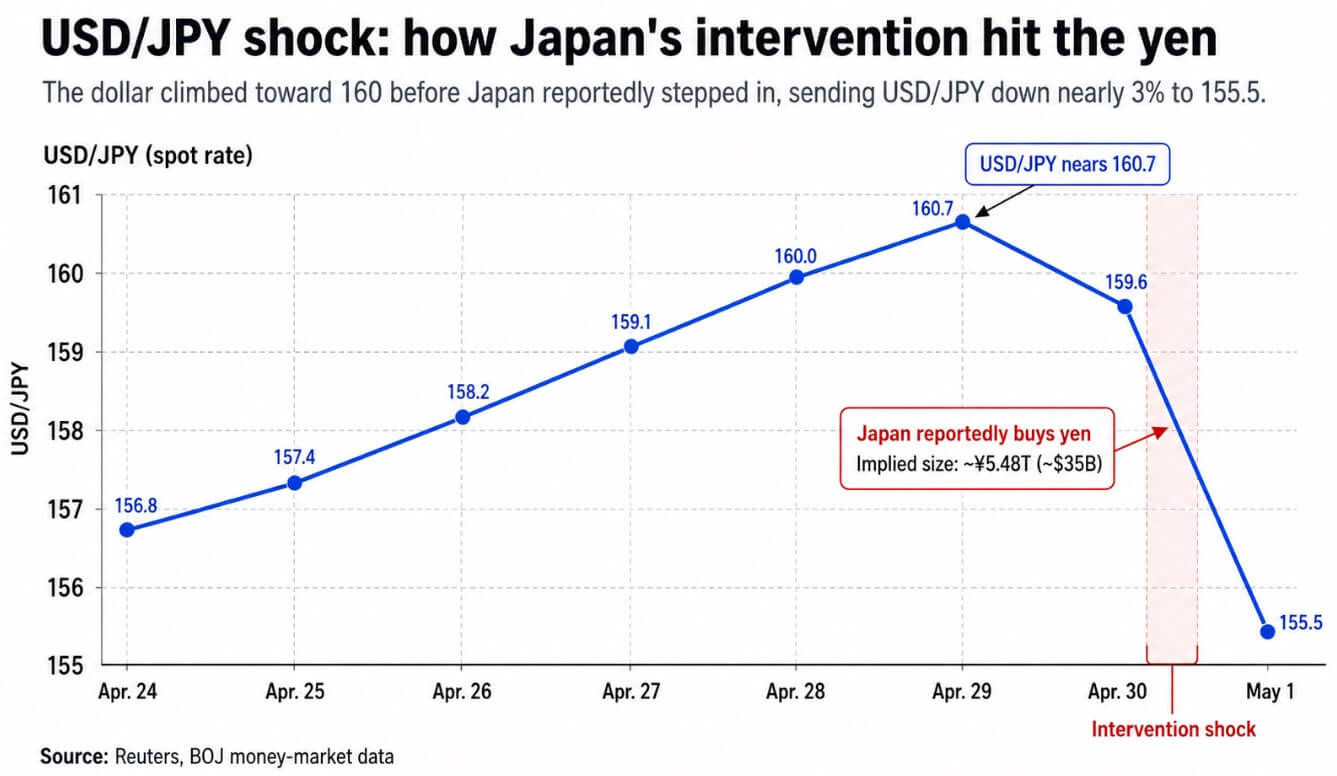
Japan reportedly stepped into the currency market with roughly $35 billion of yen buying, sending the dollar down nearly 3% to 155.5.
Bank of Japan (BOJ) money-market data imply that size is accurate. Once the Ministry of Finance's monthly release confirms it, this would rank as Japan's first official yen-support action in almost two years and the second-largest on record.
The BOJ's own April outlook projects CPI excluding fresh food at 2.5% to 3.0% in fiscal 2026, and economists expect inflation to re-accelerate as oil and yen weakness amplify import costs.
The numbers show that 95% of Japan's crude oil flows through the Strait of Hormuz, and the BOJ's baseline scenario assumes Dubai crude will trend toward $70-$80, with no major supply disruption.
Tokyo's political tolerance for importing inflation while the yen slides has limits, and those limits were broken this week.
The BOJ held its policy rate at 0.75% on Apr. 28, with three board members dissenting and arguing for a 1% rate. The Fed also held its policy rate at 3.50%-3.75% on Apr. 29.
That short-rate reality of roughly 275 to 300 basis points is the mechanical reason the carry trade keeps rebuilding. Yen borrowing costs stay low by almost any global comparison, and the spread to US yields makes it attractive to put that capital to work in higher-returning assets.
Intervention without rate convergence only buys time. Reuters reported that 65% of economists in an Apr. 16 poll expect the BOJ to reach 1.0% by the end of June 2026, with further hikes penciled in through 2027.
Why the yen is everyone's problem
BIS data from its 2025 triennial survey shows the yen accounted for 16.8% of all foreign exchange trades worldwide.
Another BIS study on the August 2024 episode estimated yen-funded carry trades at roughly $250 billion, before that unwind, while UBS estimated the total near $500 billion, with only about halfway done at the time.
A separate BOJ paper noted that yen liabilities fund balance sheet expansion is driven by hedge funds and financial intermediaries that are long assets far removed from Japanese currency markets.
CFTC positioning data from Apr. 21 shows leveraged funds in CME yen futures held 80,220 long contracts against 148,717 short contracts, with gross shorts up over 16,000 week over week.
When the yen suddenly strengthens, those shorts need coverage, and the assets those trades were funding need to be trimmed.
| Metric | Bank of Japan | Federal Reserve | Why it matters for the carry trade |
|---|---|---|---|
| Policy rate | 0.75% | 3.50%–3.75% | The wide gap keeps yen funding cheap and U.S. assets relatively attractive |
| Latest policy decision date | Apr. 28, 2026 | Apr. 29, 2026 | Shows the rate divergence is current, not historical |
| Current short-rate gap | Roughly 275–300 bps | This spread is the core mechanical driver of yen-funded carry trades | |
| Policy bias | Three BOJ board members dissented in favor of a 1.0% rate | Fed held steady | Suggests Japan may be moving slowly toward tighter policy, but not fast enough yet to erase the spread |
| Market expectation | Reuters poll: 65% of economists see BOJ at 1.0% by end-June 2026 | No comparable immediate shift in the draft | A BOJ hike could compress the carry spread and make short-yen positions less attractive |
| Carry-trade implication | Low-cost funding currency | Higher-yield destination market | Investors can borrow cheaply in yen and seek better returns elsewhere |
| Article takeaway | Intervention can jolt FX markets, but without rate convergence it only buys time | Higher U.S. yields keep the carry incentive alive | Explains why yen weakness keeps rebuilding and why a sudden yen rebound can squeeze risk assets, including Bitcoin |
BIS data also show that foreign-currency credit denominated in yen contracted by 4.9% during 2025, so the carry complex may already be somewhat smaller, which means the mechanical force of any unwind is lower.
Bitcoin's sensitivity runs through global leverage, as the balance sheets, margin calls, and risk appetites of the same macro funds simultaneously short yen and long higher-yielding assets.
BIS's August 2024 review found that procyclical deleveraging and margin increases amplified the shock across risk assets, and Bitcoin tanked 13% during the washout.
Bitcoin traded in the $78,000 zone on May 1, reaching an intraday high near $79,000. A sudden yen squeeze forces leveraged macro books to cut gross exposure, and traders can sell Bitcoin because it is liquid and held by leveraged books that need to raise cash fast.
The bull case
If the BOJ's three dissenters are right and a June rate hike lands, it will come with a credible tightening cycle that compresses the carry spread, makes a fresh buildup of short-yen positions less attractive, and the dollar softens with it.
The intervention already pushed the dollar index down 0.8%, with the euro, pound, and Swiss franc all gaining. That broad dollar softening is historically a constructive backdrop for Bitcoin, which tends to track global dollar liquidity.
In an orderly adjustment where the BOJ's June hike lands without triggering a disorderly unwind, USD/JPY settles into a tighter range, and global risk markets absorb the repricing without cascading margin calls.
Bitcoin can work through its initial volatility and return to the weaker-dollar, easier-liquidity regime that drove its rally through early 2024.
Coinbase Research's outlook for the second quarter noted that 75% of institutional respondents view BTC as undervalued at current levels, which argues that buying interest waits on the other side of any short-term dislocation.
An 8% to 15% recovery from current levels over a two-to-six-week window is a plausible outcome in this scenario.
The bear case
Repeated interventions, or a sharper repricing of BOJ policy expectations, could squeeze the short-yen trade with enough velocity to force VAR and margin cuts across macro portfolios simultaneously.
In that setup, traders sell Bitcoin because it is liquid and held by leveraged books under pressure.
The August 2024 analog serves as the reference frame, with roughly a 15% drawdown over a matter of days, driven by the same carry mechanics and amplified by forced selling.
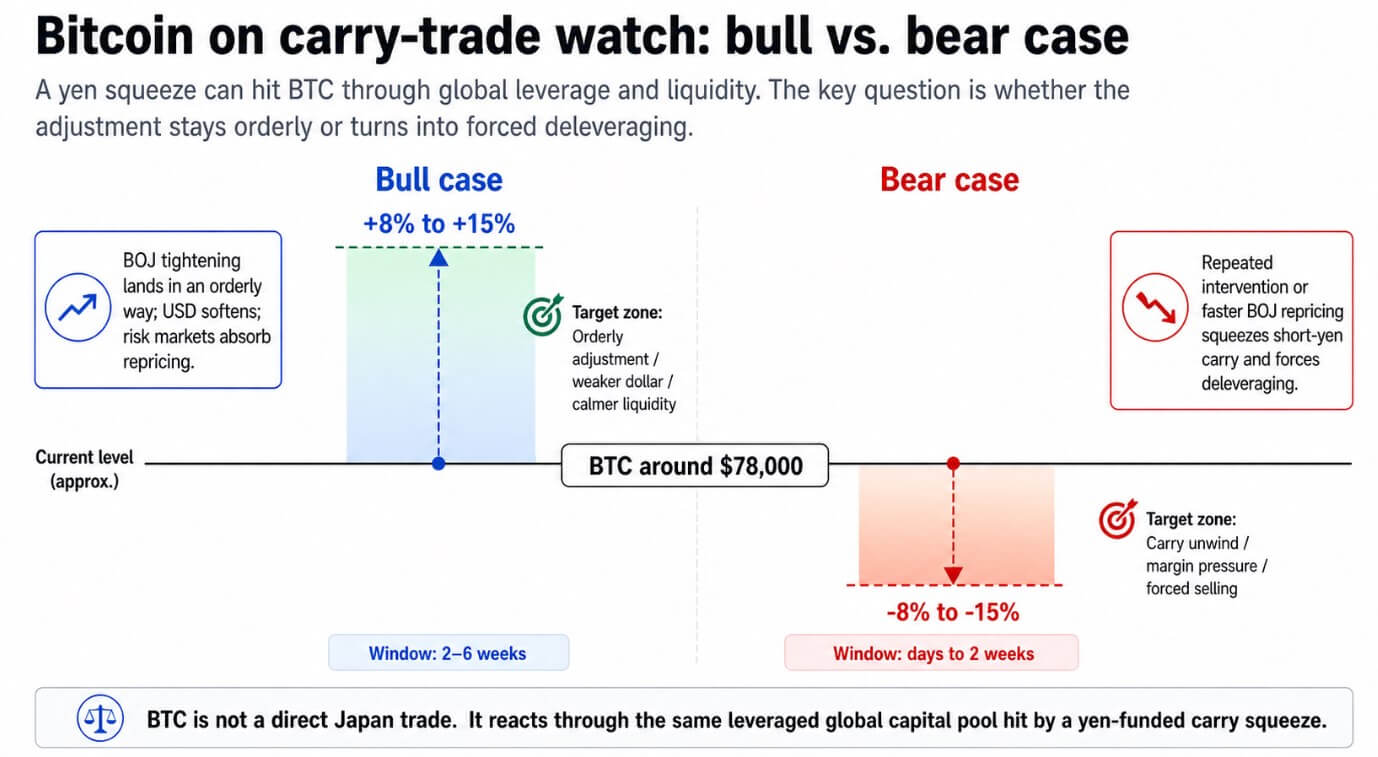
Bitcoin sitting at the $78,000 zone presents less cushion for holders with large embedded gains who might sit through a dip.
A drawdown of 8% to 15% is consistent with historical patterns when interventions recur without policy backing.
The post Japan has moved to save the yen again, and Bitcoin traders may pay the price appeared first on CryptoSlate.
After Circle and Bullish delivered blockbuster listings in 2025, crypto exchanges rushed toward public markets with a familiar promise: the industry is finally mature enough for Wall Street. However, the latest research from Kaiko shows that it's not as simple as that.
The crypto exchange IPO wave was supposed to prove that the crypto industry had graduated from speculative boomtown to legitimate financial infrastructure. These companies hired Wall Street bankers, appointed compliance chiefs, and refined their pitch decks to emphasize regulated platforms, recurring institutional flows, and revenue streams diversified enough to survive a bear market.
But Kaiko's analysis found that exchange trading activity, investor appetite, and public-market valuations all remain tethered to Bitcoin price in ways most of these exchanges try to obscure.
When Bitcoin rallies, trading volume surges, we see an increase in listings, and Wall Street rewards the sector generously. When Bitcoin stalls or reverses, however, exchange revenue expectations compress fast, and the infrastructure narrative loses its audience.
The central question for anyone buying into crypto IPOs in 2026 is whether they can generate durable earnings when Bitcoin isn't cooperating.
The year the IPO window reopened
To understand why exchanges are scrambling to go public now, it helps to understand how good 2025 looked from a distance.
Circle priced an upsized IPO at $31 per share in June 2025, raising $1.05 billion and valuing the stablecoin issuer at roughly $8 billion on a fully diluted basis. Its shares surged on their NYSE debut, and the reception sent an unambiguous signal: institutional investors had an appetite for regulated crypto exposure and weren't particularly sensitive to valuation.
Bullish followed in August, pricing above range at $37 per share, raising more than $1.1 billion, and debuting at a total valuation of nearly $13.2 billion. Bankers had a genuine pitch to deliver: regulation was improving, institutional participation was deepening, and crypto companies were no longer the fringe startups that had defined the previous cycle.
The enthusiasm was real, and so were the numbers behind it. What the boom obscured, though, was a structural question that IPO markets tend to defer until earnings season makes it unavoidable: can an exchange sustain its revenue when the underlying asset that drives all of its trading activity decides to go quiet?
Gemini gave us an answer to that question, and it proved to be quite an uncomfortable one.
In September 2025, Tyler and Cameron Winklevoss lifted Gemini's IPO price range and targeted a valuation of up to $3.08 billion, reflecting genuine investor demand during the crypto rally. By early 2026, a shareholder lawsuit emerged alleging investors were misled around the IPO period: the company had announced a 25% workforce reduction, market exits, and a projected significant annual loss, with the stock down more than 75% from its $28 IPO price.
As CryptoSlate reported at the time of filing, Gemini had already disclosed a $282.5 million net loss in the first half of 2025 alone. It showed how quickly a company can go from an oversubscribed listing to a Bitcoin-cycle casualty when sentiment reverses.
The mechanism behind that reversal is worth understanding, because it applies to every exchange in the current queue. Crypto exchanges make the overwhelming majority of their revenue when people trade, and Bitcoin still drives the conditions that make people want to trade at all. A Bitcoin rally generates retail excitement, institutional repositioning, altcoin speculation, and elevated volatility across the entire asset class, all of which translate directly into exchange fee income.
When Bitcoin stalls, volumes compress across the industry, and the fee income that justified premium valuations starts looking considerably thinner. The public-market pitch frames exchanges as neutral infrastructure collecting fees regardless of market direction, but the operational reality is that many of them still depend on the most emotionally driven asset in finance to make users show up.
Bitcoin as the underwriter
Kraken's own IPO timeline is also a good example of this.
In November 2025, the exchange had confidentially filed for a US listing and was targeting Q1 2026, having recently been valued at $20 billion after a capital raise involving Jane Street and Citadel Securities. CryptoSlate's own report framed the company as having matured into a disciplined financial institution, and the Q3 2025 numbers backed that framing: $648 million in revenue, $178.6 million in adjusted EBITDA, and platform transaction volume of $576.8 billion. All of these were record figures, achieved during a period of elevated Bitcoin activity and favorable crypto sentiment.
But by March 2026, Reuters reported that Kraken had frozen its IPO plans, with sources indicating the company may revisit a listing when market conditions improve. Kraken's delay turns the whole IPO wave into a referendum on whether the window stays open on its own terms, or whether Bitcoin's direction remains the deciding factor.
The most important analytical distinction the 2025 wave introduced is the one between Circle and a crypto exchange, because Wall Street may eventually price them very differently.
Circle's business is tied to stablecoin circulation, interest income from the reserves backing USDC, and payment infrastructure, all revenue streams that are largely uncoupled from elevated trading volumes or Bitcoin-driven volatility.
Exchanges are structurally different, with earnings that move with crypto market activity rather than against a fixed yield. Infrastructure companies like CME Group and Intercontinental Exchange command premium multiples precisely because their earnings hold up across market cycles.
Crypto exchanges are currently asking for comparable treatment while running businesses that collapse when Bitcoin loses momentum. The next phase of public-market crypto listings may end up separating stablecoin infrastructure companies, which can plausibly claim CME-like earnings characteristics, from exchange operators whose revenue profile looks considerably more cyclical when conditions deteriorate.
Public investors reprice stocks every trading day, and that's the particular difficulty exchanges face upon listing. Private capital can afford to wait through a winter; public shareholders tend not to. The exchanges that survive quarterly earnings scrutiny will be those that can demonstrate revenue genuinely diversified across derivatives, custody, institutional services, and staking rather than leaning on spot trading volumes to carry the business.
The crypto exchange IPO wave retains momentum, but it's no longer sufficient for exchanges to argue they survived the last bear market. Public investors want evidence they can earn through the next one. Until that evidence exists in audited quarterly reports, Bitcoin remains the sector's underwriter, market maker, and ultimate judge, whether Wall Street likes it or not.
The post The crypto IPO wave has one big problem: Bitcoin is still in charge appeared first on CryptoSlate.
Stablecoin issuers spent years asking Washington for clear rules, and now those rules are becoming the industry’s biggest barrier to entry.
The GENIUS Act gave dollar-backed tokens something crypto had wanted since stablecoins became a serious part of the market: a legal home in the US. It defined payment stablecoins, set reserve expectations, created a federal framework for issuers, and moved the sector out of the gray zone that shaped much of its early growth.
That was an undisputed victory for an industry used to enforcement risk, state-by-state licensing, offshore structures, and years of policy drift. But once the law moved from Congress to the agencies, the hard part began.
Treasury, the Office of the Comptroller of the Currency (OCC), and the Federal Deposit Insurance Corporation (FDIC) are now turning GENIUS into an operating manual. That manual will decide whether stablecoin issuance stays close to its crypto roots or becomes a financial-infrastructure business run by firms with the compliance staff, legal budget, banking relationships, and supervisory experience to survive inside a federal rulebook.
CryptoSlate has already covered the bank-lobby push for a 60-day pause, the fight over stablecoin rewards, and the broader consequences of Congress making digital dollars easier to use. The latest GENIUS scoop now is how its implementation could make bank-grade infrastructure the price of admission.
Washington will turn digital dollars into a supervised business
Treasury’s role sits closest to the part of crypto Washington worries about most: illicit finance. Its proposed rule focuses on anti-money laundering programs, sanctions compliance, counter-terror financing, and Bank Secrecy Act obligations. Treasury said its April proposal is designed to implement the GENIUS Act’s AML and sanctions program requirements while creating a tailored regime for payment stablecoins.
A serious issuer will need customer-risk systems, sanctions screening, suspicious activity monitoring, reporting procedures, trained staff, vendor controls, audit trails, and board-level accountability. The token may still move on a blockchain, but the company behind it will look like a regulated financial institution.
The OCC is building the federal lane for issuers under its jurisdiction. Its proposal covers permitted payment stablecoin issuers, foreign payment stablecoin issuers, and certain custody activities at OCC-supervised entities. That makes the OCC central for crypto firms thinking about national trust charters, custody authority, and the status that comes with federal supervision.
The FDIC is working on the bank side of the map. Its April proposal covers FDIC-supervised permitted payment stablecoin issuers and insured depository institutions, including reserves, redemption, capital, liquidity, custody, and risk management. The FDIC also said the GENIUS Act will take effect on Jan. 18, 2027, or 120 days after final implementing rules are issued, if that date comes earlier.
Together, the proposals move stablecoin issuance away from a token launch model and toward a supervised payments business. The biggest question becomes whether an issuer can manage reserves, redemptions, custody, reporting, compliance, governance, vendor risk, and regulator relations at scale.
That’s where the advantage starts to narrow.
Large banks already have examination histories, treasury operations, risk committees, custody teams, compliance departments, and direct regulatory channels. Large fintech companies have spent years building systems around payments, onboarding, fraud controls, consumer accounts, and money movement. Regulated crypto giants such as Coinbase, Circle, and Paxos operate closer to that world than most token issuers because they already deal with institutional customers, custody expectations, and financial-market oversight.
Smaller issuers face a harsher equation because compliance doesn’t scale down neatly.
A sanctions-screening system costs money whether an issuer has $200 million or $20 billion outstanding. So do legal review, audit support, reporting infrastructure, reserve administration, redemption operations, cyber controls, and executive accountability.
Once those costs become baseline requirements, the advantage moves away from teams that can launch quickly and toward firms that can absorb a fixed-cost regulatory burden.
Compliance is the stablecoin moat
The GENIUS Act may give stablecoins a federal framework, but it's the implementation rules that decide what kind of issuer can operate inside it. That distinction is where the market could bend toward banks, large fintechs, trust companies, and crypto firms with bank-grade systems already in place.
The new stablecoin moat may be compliance capacity.
That moat doesn’t look like the old crypto version of defensibility, like better smart contracts, faster settlements, deeper liquidity pools, or a more aggressive exchange listing strategy. It’s now a reserve committee, redemption processes that work under stress, compliance teams, and a board that signs off on risk policies.
It's also why the implementation phase could reshape the business more than the statute itself. A company issuing a regulated dollar token will need to prove that it can manage cash-equivalent reserves, process redemptions, screen activity, report suspicious behavior, document controls, and protect customer assets. Those are ordinary expectations in supervised finance, but they’re very expensive and hard to implement when applied to a crypto product built for instant, global circulation.
The contradiction is that stricter rules can make stablecoins more useful while making the issuer base smaller.
Clear federal standards could make digital dollars easier to trust. A retailer accepting stablecoins for settlement doesn’t want to study an issuer’s reserve quality every morning. A corporate treasurer doesn’t want to explain to a board why operating cash sits in a token with unclear redemption rights. A payment company needs to know that the asset moving across its rails can survive more than a bull-market week.
Clear reserve, redemption, custody, and reporting standards solve part of that problem. They turn stablecoins into instruments that essentially look and act like bank deposits, money-market funds, card networks, and treasury operations.
That same process will bring stablecoins closer to banks. The issuer that wins under this model will have conservative reserves, formal redemption rights, audited processes, regulator-facing staff, custody arrangements, and distribution through trusted financial channels. The stablecoin will still settle across digital rails in seconds, but the issuer will behave like a supervised financial company.
So GENIUS may make stablecoins safer by effectively making them less crypto-native.
But banks are still fighting the market they help build. Their push against reward structures and their campaign around implementation show that they still see stablecoins as a threat to deposits, especially if tokens or third-party platforms give users a more visible share of Treasury-bill income. The stablecoin rewards fight could push banks toward their own branded digital dollars if crypto platforms retain a rewards lane.
The fight also shows how far stablecoins have entered into banking territory. If digital dollars stay inside offshore exchanges, banks can treat them as a crypto product. But if they become payment instruments used by merchants, fintech apps, corporate treasury desks, and settlement networks, banks have every reason to shape the rules, custody the assets, partner with issuers, or launch products of their own.
The market splits into crypto stablecoins and bank-grade stablecoins
The end result may be a split market.
Some stablecoins will continue to dominate crypto trading, offshore liquidity, decentralized finance, and venues where users care most about depth, speed, availability, and exchange access. Tether and USDT have long held that role across global crypto markets, while Circle and USDC have leaned harder into regulated distribution, institutional use, and US market access. USDC has been gaining in transfer activity even as Tether holds the larger supply base.
Another group of stablecoins may become the regulated dollars used by banks, merchants, payment companies, and corporate treasurers. This category is about institutional trust, legal certainty, and operational comfort. It’s the version of the market that Visa, Stripe, Mastercard, Bridge, and other payments firms are circling as stablecoins move from crypto trading collateral into settlement infrastructure.
Major payments companies have already begun rebuilding around stablecoin rails as regulatory clarity improves, with enterprise adoption tied closely to compliance, custody, and reserve management. That’s the same direction GENIUS implementation points toward: stablecoins as regulated money movement, rather than crypto’s internal dollar substitute.
The FDIC’s proposal also sharpens the line between stablecoins and bank deposits. The agency said deposits held as stablecoin reserves would lack pass-through deposit insurance for stablecoin holders, while tokenized deposits can remain within the existing legal treatment for deposits when structured that way. That distinction gives banks a reason to promote tokenized deposits inside their own systems, while nonbank stablecoin issuers compete on openness, distribution, and settlement reach.
This is an important difference for users. The stablecoin used to trade on an offshore venue may differ from the stablecoin a merchant accepts, a payroll provider settles with, or a corporate treasury team approves. While one market values liquidity and reach, the other values redemption certainty, reserve discipline, and supervisory comfort.
That’s the real implementation fight we're about to witness. The GENIUS Act gave stablecoins a legal home in the US, and the agencies are now deciding what kind of residents can afford the rent.
The next signals will come from the final rules. Watch whether agencies soften or harden compliance timelines, whether banks launch stablecoin products or expand custody partnerships, whether crypto issuers seek trust charters or bank charters, and whether reserve and redemption rules become the main trust signal for corporate users. The most telling detail may be whether smaller issuers can absorb the fixed costs without selling, partnering, or retreating into narrower markets.
The GENIUS Act opened the door for stablecoins. The rulebook will decide whether the market behind that door becomes crypto’s next open frontier or a regulated payments layer built around firms that already know how banks are supervised.
The post The GENIUS Act opened the door for stablecoins, but regulators want to narrow it appeared first on CryptoSlate.
Bitcoin headed into the Federal Reserve's rate decision this week after failing to cleanly reclaim $80,000, with the institutional bid that fueled its April recovery now visibly softening.
Spot ETF flows have been volatile, the price is sitting below the on-chain levels that define whether recent buyers are profitable, and Jerome Powell's press conference was most likely his final one as Fed chair.
Taken together, those variables make the current zone considerably more consequential than ordinary pre- and post-FOMC consolidation.
The April recovery was well-supported for most of the month. Spot Bitcoin ETF total inflows reached $2.43 billion, supporting a 14.46% price gain to around $78,000 and establishing what looked like a credible approach toward the $80,000 breakout.
On April 27, though, Bitcoin ETF net outflows surpassed $263 million, breaking an inflow streak that had attracted more than $1.2 billion the week prior, and April 28 followed with another $89.7 million in net redemptions.
Bitcoin's institutional cushion is softening at the wrong moment
The composition of those April 28 outflows is where the picture gets more interesting than the headline numbers suggest. BlackRock's IBIT, which has functioned as the primary institutional Bitcoin allocation vehicle throughout 2026, posted $112.2 million in outflows, with ARK Invest's ARKB providing only a partial offset at $41.2 million.
Fidelity's FBTC led the larger April 27 reversal at $150.4 million, followed by Grayscale's GBTC at $46.6 million.
Earlier in the cycle, it was reasonable to explain ETF-level softness as a Grayscale-specific drag from legacy holders still rotating out of the converted trust. What the last two sessions have shown is that the weakness is now more broadly distributed, with IBIT pulling back at a critical point in the price structure alongside the others.
The institutional cushion that supported BTC's move toward $80,000 has thinned, and it continued to do so as the Fed's largest macro event of the week approached.
As CryptoSlate has documented throughout 2026, ETF flows function as a primary transmission channel between macro sentiment and spot Bitcoin demand, and when that channel softens ahead of a policy-setting event, it removes one of the market's key structural shock absorbers.
The cost-basis zone is the first hurdle, not $80,000
The most analytically useful part of the current setup isn't the proximity to $80,000 as a round number, but where Bitcoin is trading relative to the two on-chain thresholds that define the profitability landscape for recent buyers.
BTC is currently around $78,400, placing it just above the True Market Mean of approximately $77,990 but below the Short-Term Holder (STH) cost basis near $78,770.
The True Market Mean represents the average acquisition price of actively circulating coins, excluding lost or dormant supply, so it captures the aggregate cost basis of engaged market participants rather than the whole coin supply.
The STH cost basis reflects the average price at which coins held for under 155 days last changed hands on-chain, making it the clearest proxy for where recent buyers came in. CryptoSlate reports showed that this level has consistently served as Bitcoin's most reliable support during bull phases, and that price breaking below it tends to heighten selling pressure as holders treat any rally as a chance to exit near break-even.
Trading below both levels simultaneously means the average recent participant in the market is sitting on an unrealized loss. That's the psychological environment in which “strong hands” have to prove themselves: absorbing supply from short-term holders who are underwater, maintaining price above the STH bull-capitulation threshold at approximately $77,310, and eventually securing the $77,990 to $78,770 band before $80,000 becomes a realistic target again.
There's a compressed layer of overhead resistance in that band, and any move through it requires buyers to be more aggressive than the ETF data currently suggests they're willing to be.
What Powell's tone changes from here
Wednesday's rate decision has been priced in for weeks, with the CME FedWatch tool showing 100% probability of a hold at the current 3.5% to 3.75% target range, marking a third consecutive pause as the Fed assesses the economic impact of tariffs and elevated energy prices from the Iran conflict.
The decision itself didn't surprise anyone. What was less settled beforehand was what Powell would signal about the path forward, so this meeting carried an extra layer of interpretive complexity, given that it's widely expected to be his last press conference before his chairmanship expires in May.
Kevin Warsh, Trump's nominee, is expected to be confirmed in time to chair the June meeting.
For Bitcoin, the real question was whether Powell's tone on inflation, liquidity, and the timing of future cuts gives risk assets room to recover, or whether he reinforces conditions tight enough to keep sellers anchored around the cost-basis zone.
The more cautious inflation reading, particularly with energy prices elevated by geopolitical risk, validated the current softness and turned the $77,990 to $78,770 band into a ceiling rather than a launchpad.
Bitcoin has already demonstrated it can recover toward $80,000 when conditions cooperate. The harder test now is whether the buyers willing to hold through a volatile macro event can keep the rebound credible when ETF flows are moving against them, and recent holders haven't yet reclaimed break-even.
A hold near $77,300 keeps the thesis alive. Reclaiming the $78,000 to $78,770 zone soon after FOMC would signal that buyers are regaining control. A clean break above $80,000 would confirm that the April recovery was a foundation. Anything less, and Wednesday's session still risks turning what looked like a successful rebound into a distribution zone that sellers were happy to use.
The post Bitcoin’s next breakout will depend on whether investors treat $80K as relief, resistance, or the start of a new recovery appeared first on CryptoSlate.
Cryptoticker
Crypto Regulation News: Why Stablecoin Yield Is Back in Focus
Crypto regulation news is becoming one of the most important market drivers again, especially as Bitcoin continues to hold near the $78,000 level while traders wait for the next major catalyst. The latest focus is the CLARITY Act, a US crypto market structure bill that could reshape how stablecoins, exchanges, and crypto platforms operate.
The main issue is stablecoin yield. According to recent reports, Senators Thom Tillis and Angela Alsobrooks reached a compromise on language that would restrict crypto companies from offering bank-like interest or yield simply for holding stablecoins. However, the text reportedly still allows rewards connected to real platform activity, such as payments, transfers, or usage-based incentives.
This distinction matters because it could decide how stablecoins compete with traditional banks. If crypto platforms can reward users for active usage but not passive holding, the industry may still keep an important growth tool while avoiding the direct comparison with bank deposits.
What the CLARITY Act Could Change for Stablecoins
The latest draft reportedly includes a section focused on prohibiting interest and yield on payment stablecoins. The goal is to stop stablecoins from acting like interest-bearing bank accounts, especially when users are simply holding tokens without any real transaction activity.
At the same time, the compromise appears to leave room for activity-based rewards. This means crypto companies may still be able to offer incentives linked to platform usage, payments, transfers, or other “bona fide activities.”
For the crypto market, this is not a small detail. Stablecoins are one of the biggest bridges between traditional finance and digital assets. They are used for trading, payments, liquidity management, DeFi, and exchange settlement. Any rule that changes how stablecoin rewards work could directly affect user behaviour, exchange revenue, and capital flows across the market.
Why Banks Are Watching Stablecoin Yield Closely
Banks have pushed back against stablecoin yield because they see it as a potential threat to deposits. If users can hold dollar-backed stablecoins and earn attractive rewards, some money could move away from traditional bank accounts and into crypto platforms.
That is why the new compromise tries to draw a line between passive yield and activity-based incentives. Passive yield looks more like bank interest. Usage-based rewards look more like loyalty points, payment incentives, or platform benefits.
This is where the crypto industry may have gained some ground. A full ban on all stablecoin rewards would have been much more restrictive. But a framework that allows rewards tied to actual usage could help exchanges, payment companies, and stablecoin platforms continue building products under clearer rules.
Why This Matters for Bitcoin
At first glance, stablecoin regulation may not look directly connected to Bitcoin. But it is.
Bitcoin rallies often need liquidity, confidence, and clear market structure. Stablecoins are a major source of liquidity across crypto exchanges. If the US moves closer to a clearer regulatory framework, it could improve institutional confidence and reduce uncertainty around crypto platforms.
Bitcoin is currently trading around $78,000, with a market cap near $1.57 trillion, according to the latest market data shown on TradingView. The asset has remained relatively stable, but the broader market is still waiting for a reason to break higher. A regulatory breakthrough could become that reason if traders believe it will support long-term crypto adoption.
The key question is whether this bill becomes a positive catalyst or another source of uncertainty. If the market sees the CLARITY Act as a balanced framework, Bitcoin could benefit from renewed confidence. If traders believe the rules are too restrictive, especially for stablecoin businesses and exchanges, the reaction could be more cautious.
Could Stablecoin Rules Trigger the Next Bitcoin Move?
The stablecoin yield compromise could trigger the next Bitcoin move because it touches three major market themes: regulation, liquidity, and institutional adoption.
First, clearer rules could reduce the fear that US regulators will continue handling crypto through enforcement instead of legislation. Second, stablecoin clarity could support deeper liquidity across exchanges and payment platforms. Third, institutional investors may be more comfortable entering the market when the rules around stablecoins, exchanges, and token classification become easier to understand.
This does not guarantee an immediate Bitcoin breakout. However, it gives traders a new catalyst to monitor while BTC consolidates near key levels.
If the Senate Banking Committee moves forward with the markup and the bill gains stronger political support, crypto regulation news could quickly become one of the biggest drivers of the market in May.
What Crypto Traders Should Watch Next
The first thing to watch is whether the CLARITY Act moves forward smoothly in the Senate. Any delay, political conflict, or change in the stablecoin language could affect market sentiment.
The second thing to watch is how major crypto companies respond. Coinbase and other platforms have a direct interest in how stablecoin rewards are defined, especially if rewards linked to usage remain allowed.
The third thing to watch is Bitcoin’s reaction. If BTC holds above the $78,000 area while regulatory clarity improves, the market could start pricing in a stronger move toward higher resistance levels. But if Bitcoin fails to react positively, it may suggest that traders are still more focused on macro risks, liquidity conditions, and broader risk appetite.
Conclusion: Stablecoin Regulation Could Be Bitcoin’s Next Catalyst
Crypto regulation news is no longer just a background story. The latest stablecoin yield compromise in the CLARITY Act could become a major turning point for the market.
By blocking bank-like passive yield while allowing activity-based rewards, US lawmakers may be trying to create a middle ground between protecting banks and allowing crypto innovation to continue. For Bitcoin, the impact depends on whether traders see this as a step toward real regulatory clarity.
With BTC still holding near $78,000, the next major move may not come from charts alone. It could come from Washington.
$BTC, $ETH, $USDT, $USDC
As we enter May 2026, the cryptocurrency market stands at a critical technical junction. After a period of consolidation, the "Big Four"—Bitcoin, Ethereum, XRP, and Cardano—are displaying setups that suggest a massive volatility expansion is imminent. While individual narratives like ETF inflows and network upgrades provide local support, the overarching theme remains Bitcoin’s dominance and its role as the market's primary liquid engine.
Is the Bull Run Resuming?
Traders are currently asking if the recent sideways price action is a distribution phase or a re-accumulation for the next leg up. Technical indicators suggest the latter. If Bitcoin successfully clears the psychological hurdle of $80,000, it will likely trigger a waterfall effect across the altcoin sector, starting with Ethereum and eventually trickling down to high-cap assets like XRP and Cardano.
Bitcoin (BTC) Prediction: The Road to $90,000
Bitcoin is currently the linchpin of the entire crypto ecosystem. As of early May 2026, the BTC price has shown remarkable resilience, holding support above the $75,000 mark.
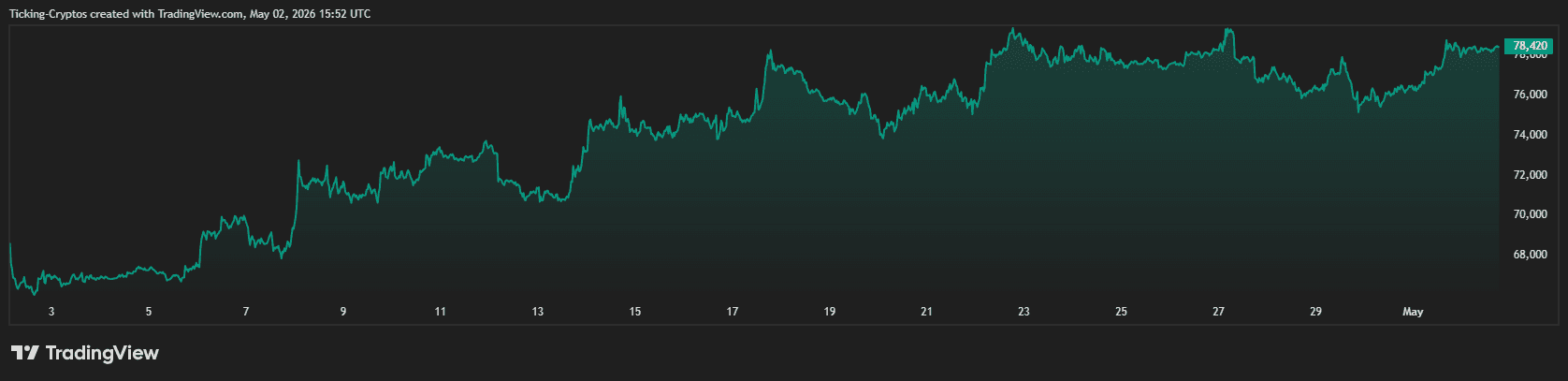
- The Catalyst: Renewed institutional demand and easing selling pressure from spot ETFs.
- The Target: Once BTC breaks the $80,000 resistance, the lack of historical overhead supply suggests a swift move toward $90,000.
- The Risk: A failure to maintain the $75,000 floor could delay this rally, as the altcoin market is not yet ready to decouple from Bitcoin's price action.
Ethereum (ETH) Forecast: Breaking the $2,400 Barrier
Ethereum has been trailing Bitcoin in terms of percentage gains, but the technical structure of ETH is tightening.
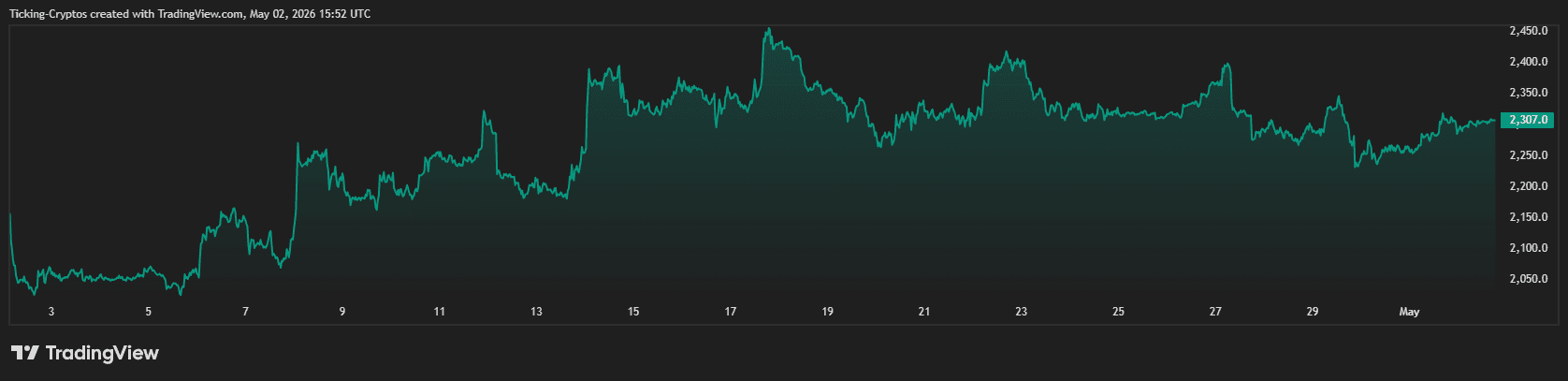
- Immediate Resistance: The $2,400 level has acted as a multi-month ceiling.
- Breakout Potential: A clean daily close above $2,400 shifts the focus toward $2,800.
- Network Utility: Increased activity on Layer 2 solutions continues to burn ETH supply, providing a deflationary tailwind that supports a higher price floor.
XRP and Cardano (ADA): The Lagging Giants
While BTC and ETH lead the charge, XRP and Cardano (ADA) are currently in a "lagging" phase, characterized by horizontal accumulation.
XRP: The $1.50 Springboard
XRP is currently consolidating within a rising channel. Analysts expect XRP to continue lagging until it breaks the $1.50 resistance. Once this level is cleared, historical price action suggests a "short squeeze" or "fomo" effect that could catapult the price to $2.00 very quickly.
Cardano (ADA): Waiting for $0.28
Cardano remains in a tight range. The key level to watch is $0.28. If ADA can flip this resistance into support, the path to $0.40 becomes clear. However, like XRP, ADA requires a stable or bullish Bitcoin environment to find the necessary volume for such a move.
The "Bitcoin Contingency" Rule
It is vital to understand that these predictions are not independent events. The cryptocurrency market in 2026 remains highly correlated.
| Asset | Current Resistance | Target Price |
|---|---|---|
| Bitcoin ($BTC) | $80,000 | $90,000 |
| Ethereum ($ETH) | $2,400 | $2,800 |
| $XRP | $1.50 | $2.00 |
| Cardano ($ADA) | $0.28 | $0.40 |
Important Note: The targets for ETH, XRP, and ADA are strictly contingent on Bitcoin maintaining its bullish momentum. If Bitcoin faces a significant correction, the "lagging" altcoins are likely to see deeper retracements before any breakout occurs.
As decentralized compute and machine learning models become integrated into financial and creative workflows, certain projects have emerged as clear leaders.
Investors are increasingly looking beyond simple "AI hype" toward protocols that provide tangible infrastructure for the future. In this article, we analyze three AI tokens that demonstrate high utility and strong market positioning.
Why AI and Blockchain are the Future of Investment
In 2026, the synergy between AI and blockchain is no longer theoretical; it is a "multiplicative" force for global efficiency. Blockchain provides the transparent, decentralized layer needed to verify AI data and secure compute resources, while AI offers the "intelligence" to optimize on-chain processes.
- Decentralized Intelligence: Reducing reliance on "Big Tech" silos for model training.
- Resource Efficiency: Tokenizing GPU power allows for a global, borderless marketplace for compute.
- Trustless Governance: AI can manage complex DAO structures with high-speed data analysis.
Top 3 AI Coins to Consider in 2026
1. Bittensor (TAO): The Decentralized Brain
Bittensor remains the premier protocol for decentralized machine learning. By creating a marketplace for intelligence, Bittensor allows different subnets to specialize in various AI tasks—from image generation to complex data analysis—rewarding participants in TAO.
Why TAO is a Strong Contender
As of May 2026, Bittensor has gained massive institutional validation. With recent reports of major tech entities exploring TAO's subnet architecture, the token has shown strong "alpha" performance. The Bittensor price (often compared to the blue chips of the sector) remains a favorite for those betting on a "World Computer" of intelligence.
- Subnet Scalability: Each subnet acts as its own specialized economy.
- Institutional Interest: Rumors of AI-specific ETFs have kept liquidity high.
- Deflationary Incentives: The halving mechanics and staking requirements create a supply crunch as demand for decentralized inference grows.
2. Render (RENDER): Powering the Visual AI Revolution
As AI-generated video and spatial computing become mainstream, the demand for GPU (Graphics Processing Unit) power has hit record highs. Render Network bridges the gap by connecting users who need compute power with those who have idle GPUs.
The Investment Thesis for RENDER
Render transitioned successfully to the Solana blockchain, which significantly lowered transaction costs and improved scalability. This move allowed it to integrate more deeply with AI training and inference workloads, moving beyond its original scope of 3D rendering.
- Burn-and-Mint Equilibrium: This economic model ensures that as network usage grows, the supply of RENDER is managed efficiently.
- Strategic Partnerships: Render's involvement in spatial computing projects with companies like Apple and Meta makes it a critical infrastructure play.
- GPU Shortage Hedge: As centralized cloud providers (AWS, Google) face capacity limits, Render provides a decentralized alternative.
3. DeXe (DEXE): AI-Driven Social Trading and DAOs
While Bittensor and Render focus on infrastructure, DeXe Protocol is revolutionizing how we interact with decentralized finance (DeFi) and governance through AI-enhanced tools. DeXe provides the framework for DAOs (Decentralized Autonomous Organizations) and social trading platforms.
The Role of AI in DeXe
In 2026, DeXe has integrated advanced automated tools that allow for "meritocratic" governance. AI agents within the DeXe ecosystem help analyze trader performance and manage treasury allocations based on real-time data, reducing human error and bias.
- Social Trading Evolution: Users can replicate the strategies of top traders (Executives) with AI-powered risk management.
- Incentive Alignment: The DEXE token is used for governance, ensuring that those with the most "expertise" have a proportional say in the protocol's future.
- Multi-chain Utility: DEXE's presence across multiple chains ensures high liquidity and accessibility.
3 AI Coins to Consider in 2026
| Project | Primary Sector | Key Catalyst for 2026 |
|---|---|---|
| Bittensor ($TAO) | Decentralized AI Models | Subnet expansion and ETF speculation |
| Render ($RENDER) | Decentralized GPU Compute | Spatial computing and AI video demand |
| DeXe ($DEXE) | DAO & Social Trading | AI-governed treasuries and copy-trading |
Bitcoin Price Breaks 78K
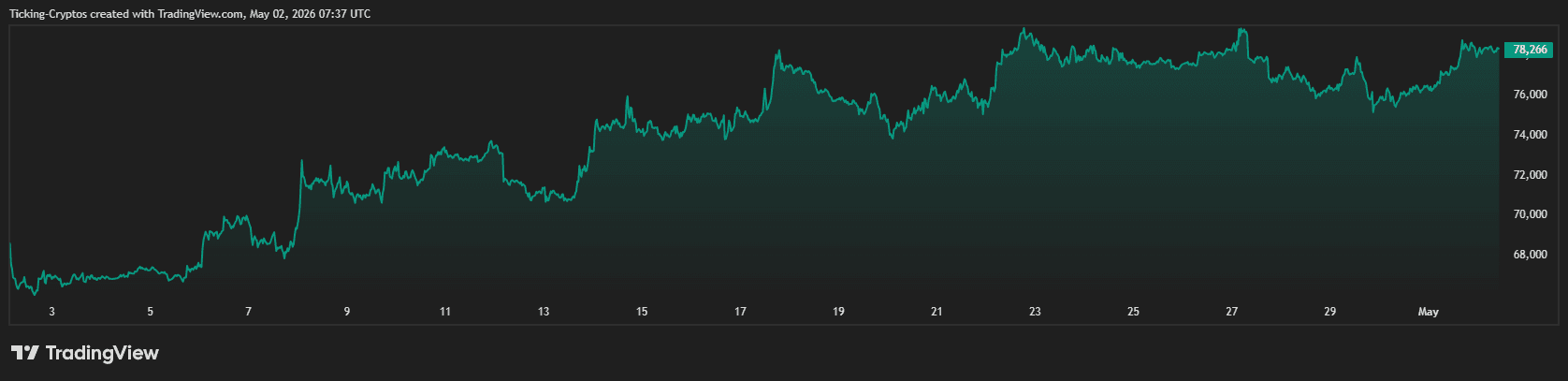
The digital asset market has entered May 2026 with a distinct "multi-speed" dynamic. While Bitcoin has successfully breached the psychological resistance of $78,000, the broader altcoin market remains in a state of watchful consolidation. This divergence has historically preceded periods of significant "catch-up" growth, making the current window a potential strategic entry point for diversified portfolios.
Why are Crypto UP?
If you are looking for the best cryptocurrencies to buy in May 2026, the focus should shift toward established projects currently showing technical resilience. While BTC steals the spotlight, major assets like Ethereum, XRP, and Cardano are building foundations that suggest a breakout is imminent.
In crypto trading, "accumulation" refers to a phase where an asset trades within a tight range after a move, allowing larger investors to build positions without significantly moving the price. Currently, the "Altcoin Dominance" index suggests that capital is still heavily concentrated in Bitcoin, leaving the rest of the market undervalued relative to the market leader.
Top 5 Cryptocurrencies to Buy in May 2026
The following five cryptocurrencies have been selected based on their recent consolidation patterns, upcoming network milestones, and technical support levels.
1. XRP: The $1.40 Consolidation Floor
XRP has spent the better part of the last quarter consolidating around the $1.40 mark. Despite a surge in social sentiment following the integration with major payment providers like Rakuten Pay, the price has remained remarkably stable.
Why Buy: The lack of immediate "news-driven" volatility suggests that the weak hands have been shaken out. Holding the $1.40 support level is crucial; a successful flip of this resistance into support could clear the path toward $1.85.
2. Cardano (ADA): The Known Lagger
Cardano often earns the reputation of being a "lagger" in bull cycles. Currently, ADA is consolidating around the $0.24 - $0.26 range. While it hasn't mirrored Bitcoin’s double-digit gains this month, its historical 2026 forecast suggests May could be its most bullish month yet.
Why Buy: ADA is currently trading at a significant discount relative to its ecosystem growth. For patient investors, this "boring" price action often precedes an explosive "impulse wave."
3. Ethereum (ETH): Targeting the $3,000 Milestone
Ethereum has faced recent headwinds, briefly dipping below $2,300 due to minor security concerns and wallet movements. However, the network remains the undisputed king of DeFi and Layer 2 scaling.
Why Buy: ETH is currently undervalued below $2,500. Technical analysts point to a target range of $2,800 to $3,000 by the end of May, provided it holds the $2,300 support zone. Track real-time on-chain metrics via Etherscan to monitor institutional accumulation.
4. Solana (SOL): The High-Performance Contender
Solana continues to prove its resilience as the fastest smart-contract blockchain. While Bitcoin nears $80k, SOL has maintained a steady upward trajectory without the "blow-off top" behavior seen in previous cycles.
Why Buy: As the go-to platform for retail users and meme-coin launches, Solana’s utility remains at an all-time high. A move back toward its yearly highs is expected as capital rotates out of BTC.
5. Polkadot (DOT): The Interoperability Play
Polkadot remains a staple for those betting on a multi-chain future. With staking rewards still hovering around 11%, it offers a dual benefit of capital appreciation and passive income.
Why Buy: DOT is currently testing critical resistance. If the "Interoperability" narrative gains traction this month, DOT is positioned to lead the Web3 sector.
Crypto Predictions and Targets for May 2026
| Asset | Current Status | May Target | Risk Level |
|---|---|---|---|
| $XRP | Consolidation | $1.85 | Moderate |
| $ADA | Lagging | $0.45 | High |
| $ETH | Undervalued | $3,000 | Low |
| $SOL | Bullish | $180+ | Moderate |
| $DOT | Support Testing | $12.50 | Moderate |
The "Bitcoin Season" we are currently witnessing is a classic precursor to a potential shift in liquidity. Investors should keep a close eye on the Bitcoin Dominance Chart on TradingView. When this percentage begins to drop while Bitcoin stays flat or climbs slowly, it typically signals that capital is flowing into the altcoin market.
Bitcoin is once again trading in bullish territory, with the crypto market following the broader risk-on mood across global assets. Bitcoin climbed above $78,000, Ethereum moved near $2,300, and several major altcoins turned green as stocks continued to show strength. The rally came alongside strong performance in the S&P 500 and Nasdaq, both of which recently pushed into record-high territory as markets reacted positively to easing geopolitical concerns and renewed risk appetite.
But the next test for crypto may not come from the chart. It may come from Washington.
President Donald Trump announced that tariffs on European Union cars and trucks entering the United States will rise to 25% next week, arguing that the EU is not complying with a previous trade agreement. Vehicles produced by European automakers inside the United States would reportedly avoid the tariff.
For crypto traders, this matters because tariffs can quickly bring inflation fears back into the market. Bitcoin may be rallying now, but if investors start pricing in higher import costs, renewed trade tensions, and delayed Fed rate cuts, the current crypto market rally could face a serious macro test.
Why is the crypto market rallying today?
The crypto market is benefiting from a stronger risk-on environment. Bitcoin is holding above $78,000, Ethereum is trading near $2,300, and several large-cap tokens such as Dogecoin, Hyperliquid, and Bitcoin Cash are showing solid gains.
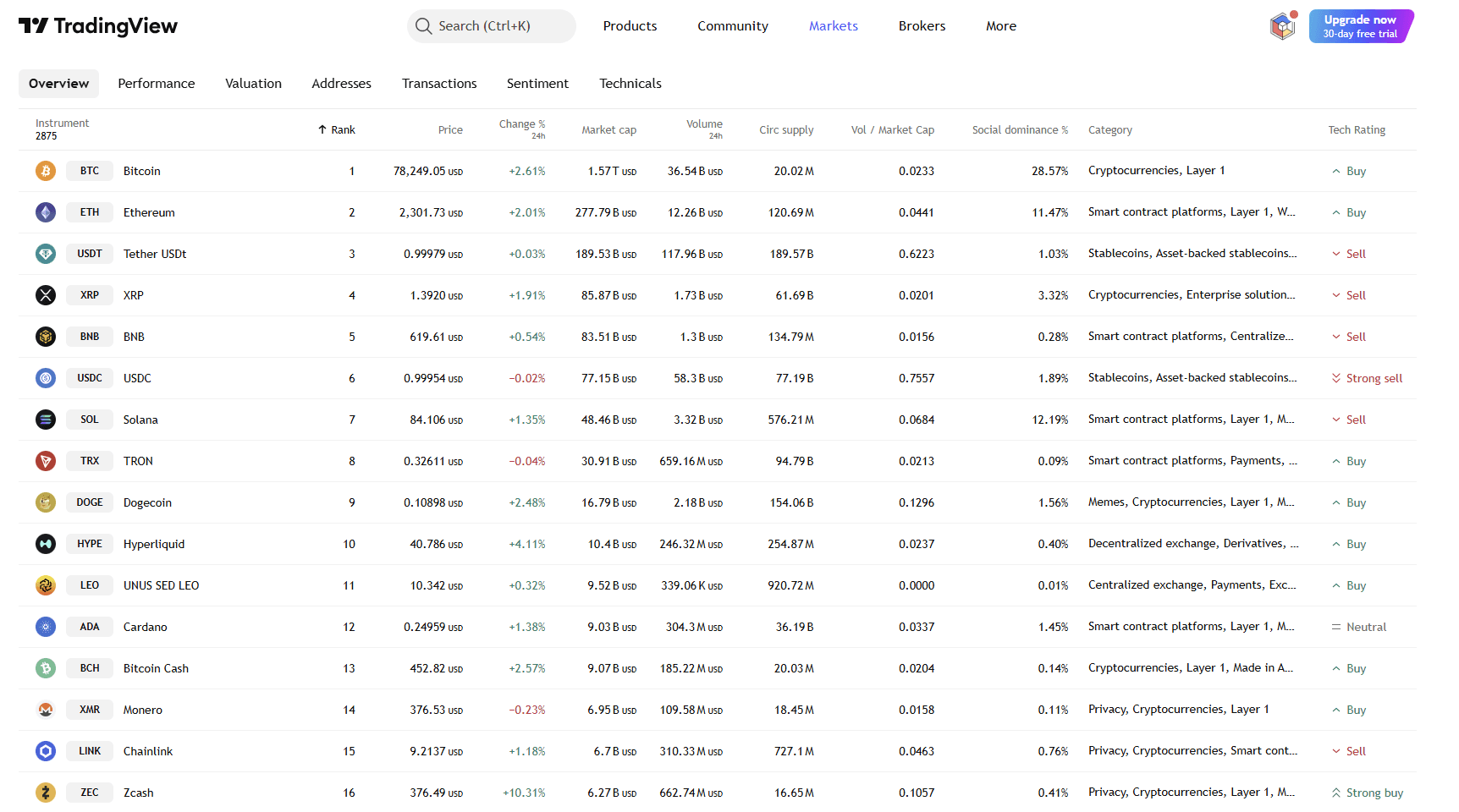
Part of this move is linked to stronger stock market momentum. When the S&P 500 and Nasdaq push higher, crypto often benefits because traders become more willing to take risk. In this environment, Bitcoin is being treated less like a defensive asset and more like a high-liquidity risk asset.
The latest U.S. manufacturing data also added to the picture. The ISM Manufacturing PMI stayed at 52.7 in April, above the 50 level that signals expansion, although it came in slightly below expectations. New orders improved, while employment weakened and prices continued rising.
That creates a mixed signal for crypto. Growth remains strong enough to support risk assets, but inflation pressure is still present. This is exactly why Trump’s tariff announcement matters.
Trump’s EU tariff threat brings inflation back into focus
The proposed 25% tariff on EU cars and trucks could become a new inflation trigger for markets. Tariffs usually increase the cost of imported goods, and if those costs are passed to consumers, inflation can become harder to control.
This is especially important now because markets have been trying to price in a more supportive macro environment. Traders want lower inflation, easier Fed policy, and stronger liquidity. But if trade tensions return, the market may start questioning whether rate cuts can arrive as quickly as expected.
For Bitcoin, this is a key point. The current rally is not happening in isolation. It is connected to liquidity expectations, stock market strength, geopolitical de-escalation, and the belief that inflation will not force the Fed to stay restrictive for longer.
If tariffs push inflation expectations higher again, crypto may lose part of that support.
Why tariffs matter for Bitcoin and crypto prices
Crypto prices are highly sensitive to liquidity. When traders believe interest rates could fall, capital usually moves faster into risk assets such as Bitcoin, Ethereum, and altcoins. When inflation rises or rate cuts look less likely, liquidity expectations weaken.
That is why tariffs can affect Bitcoin even if they are not directly related to blockchain or crypto regulation.
The link is simple:
Higher tariffs can raise import costs. Higher import costs can increase inflation pressure. Higher inflation can reduce the chance of near-term rate cuts. Fewer rate cuts can slow liquidity growth. And weaker liquidity can pressure Bitcoin and altcoins.
This does not mean the crypto rally has to stop immediately. But it does mean traders should watch whether Bitcoin can keep holding strength if the macro narrative shifts from “growth and liquidity” back to “inflation and trade war.”
Stocks are at all-time highs, but crypto faces a different test
The strong performance in U.S. stocks is currently helping Bitcoin. When equities rise, especially tech-heavy indexes like the Nasdaq, crypto often follows because both markets attract similar risk-seeking capital.
However, Bitcoin now needs to prove that it can hold above key levels even if macro uncertainty increases.
The $78,000 area is important because it now acts as a short-term confidence zone. If Bitcoin holds this level while tariff headlines grow, it would show that buyers are still in control. But if BTC loses momentum and falls back below this range, the rally could quickly turn into another failed breakout attempt.
Ethereum is also important to watch. ETH is trading near $2,300 but still looks weaker than Bitcoin. If Bitcoin dominance keeps rising while Ethereum underperforms, the market may remain concentrated in BTC rather than expanding into a broader altcoin rally.
What crypto traders should watch now
There are four key signals to monitor.
First, watch Bitcoin around the $78,000 level. A strong hold above this zone would support the bullish case, while a drop below it could signal fading momentum.
Second, watch Ethereum near $2,300. ETH needs to show strength if the market wants a broader crypto rally instead of a Bitcoin-led move only.
Third, watch tariff headlines. If the EU responds strongly or markets begin pricing in a renewed trade war, inflation fears could return quickly.
Fourth, watch Fed expectations. The most important question is whether traders still believe rate cuts are coming soon. If tariff risks delay those expectations, crypto may face pressure even while stocks remain strong.
Can the crypto market rally survive this macro test?
The crypto market still looks strong, but the rally is becoming more dependent on macro stability. Bitcoin above $78,000 is a bullish signal, especially with stocks at record highs and risk appetite improving. But Trump’s EU tariff threat adds a new layer of uncertainty at the worst possible time.
If tariffs revive inflation concerns, the market may start to question the liquidity story that helped support the latest Bitcoin move. That does not cancel the bullish setup, but it makes the next few days important.
For now, Bitcoin is still holding the line. But the real test is whether the crypto market can stay strong if inflation fears return.
$BTC, $ETH, $DOGE, $HYPE, $BCH
Decrypt
No items found in feed after parsing.
U.Today - IT, AI and Fintech Daily News for You Today
Shiba Inu has regained strength in its network activity after multiple days of staying flat, showing a notable 812% increase in its burn activity.
Dogecoin notes major recovery in its monthly price performances, achieving the highest monthly gain in about 8 months.
Shiba Inu (SHIB) under pressure as market shakeout forces position exit.
A decisive breakout from a triangle pattern could result in a 26% price move for XRP.
Shiba Inu lead ambassador Shytoshi Kusama teases what comes next in new X update.
Blockonomi
TLDR:
- Ethereum’s gas limit will increase from 60 million to 200 million following the Glamsterdam upgrade.
- L1 execution capacity will grow by more than 3x, with a further doubling expected shortly after.
- ETH mainnet gas fees could remain near zero for years if network demand does not rise equally.
- ePBS, BALs, and gas repricings work together to make the higher gas limit both safe and efficient.
Ethereum’s gas limit is heading for a dramatic increase following the upcoming Glamsterdam upgrade. The current limit of 60 million will rise to approximately 200 million, marking a major shift in the network’s execution capacity.
This change is expected to ease pressure on Ethereum’s mainnet significantly. As a result, gas fees could remain near zero for the foreseeable future, according to crypto researcher Hasu.
Glamsterdam Upgrade to Triple Ethereum’s Execution Capacity
The Glamsterdam upgrade will push Ethereum’s gas limit from 60 million to around 200 million. That represents a more than threefold increase in L1 execution capacity on the network. Beyond that, a further doubling is already being anticipated shortly after the initial raise.
Crypto researcher Hasu shared this development on X, noting it remains widely unknown. In his post, @hasufl wrote that “Ethereum’s gas limit will be increased to ~200M after Glamsterdam, a huge increase from the 60M we have today.” He further noted the expectation of a further doubling soon after that.
A fact I feel like almost nobody knows: Ethereum's gas limit will be increased to ~200M after Glamsterdam, a huge increase from the 60M we have today.
That’s a 3x+ of L1 execution capacity, with expectation of further doubling soons after that. Assuming no similar increase in…
— Hasu
(@hasufl) May 2, 2026

The upgrade brings together several technical innovations working in combination. Enhanced Proposer-Builder Separation (ePBS) gives payload processing more time during block production.
Meanwhile, Block-level Access Lists (BALs) allow clients to prefetch and parallelize execution work more efficiently.
Gas Fee Relief Expected as Network Supply Outpaces Demand
With execution capacity expanding this sharply, the supply side of Ethereum’s blockspace is set to grow considerably.
Assuming network demand does not rise at a similar pace, fees on Ethereum mainnet could stay near zero for years ahead.
Hasu pointed out that gas repricings also play a role in making higher limits technically safe. These repricings adjust the cost of certain operations, reducing the risk that a larger gas limit could be exploited or cause instability. Together, these changes form a coordinated technical foundation for scaling.
This combination of ePBS, BALs, and gas repricings arriving simultaneously is what makes the Glamsterdam upgrade particularly notable.
Each piece supports the others, allowing the gas limit increase to proceed without compromising network security.
The timing of these innovations coming together appears deliberate and well-coordinated within Ethereum’s development roadmap.
The post Ethereum Gas Limit to Triple After Glamsterdam Upgrade, Fees Could Stay Near Zero for Years appeared first on Blockonomi.
TLDR:
- Yakovenko warns that AI could crack post-quantum cryptography schemes securing blockchain networks today.
- Hidden mathematical and deployment vulnerabilities in PQC schemes remain poorly understood across the industry.
- Solana’s Anza team has published quantum readiness research exploring migration to quantum-resistant cryptography.
- Ethereum and Bitcoin face the same long-term cryptographic exposure, making this a cross-chain security concern.
Post-quantum cryptography risk has emerged as a pressing concern for blockchain networks, with Solana co-founder Anatoly Yakovenko raising alarms about the long-term security of cryptographic systems.
His warning covers wallets, transactions, and network integrity across the broader crypto industry. The concern is forward-looking but gaining urgency as quantum computing research advances steadily.
Yakovenko Warns of AI Breaking Quantum-Resistant Schemes
Yakovenko took to X to share his concerns about post-quantum cryptographic systems. He argued that the biggest risk is that AI could break post-quantum cryptography (PQC) signature schemes. His position as Solana’s co-founder gives his warning considerable weight among developers and researchers.
I think the biggest risk is that pqc signature schemes will get broken by ai, we don’t know all the implementation footguns even, let alone the math footguns. So we need to support 2/3 wallets for them. @fusewallet or ideally natively with PDAs in the tx processor.
— toly
(@toly) May 2, 2026
He pointed out that the industry lacks full understanding of the mathematical vulnerabilities in these schemes. Beyond that, hidden dangers in practical deployment remain unclear, adding another layer of concern.
These gaps make it harder for blockchain networks to confidently transition to quantum-resistant cryptography.
To address this, Yakovenko proposed practical solutions for securing networks during any transition period. He suggested providing 2/3 multi-signature wallet support for post-quantum schemes.
He also recommended native support through Program Derived Addresses (PDAs) within transaction processors as a stronger alternative.
In his post, Yakovenko tagged @fusewallet, indicating interest in collaboration on this issue. His comments reflect a broader push within the Solana ecosystem to treat quantum readiness as a technical priority. The call to action is aimed at developers building wallet infrastructure today.
Blockchain Networks Face a Shared Cryptographic Challenge
Solana’s engineering arm, Anza, has already published research on securing the network against powerful quantum adversaries.
The research explores how Solana could transition to quantum-resistant schemes while maintaining its performance standards. This groundwork shows that the concern is moving from theory into active planning.
The challenge extends well beyond Solana. Every blockchain relying on ECDSA or EdDSA signatures faces the same long-term exposure.
Bitcoin, Ethereum, and other major networks all use public-key cryptography that a sufficiently capable quantum computer could theoretically compromise.
Ethereum has also outlined a quantum resistance roadmap as part of its long-term strategy. The parallel efforts across major protocols suggest post-quantum preparedness is becoming a standard expectation. Projects that demonstrate a clear migration path may hold a credibility advantage with institutional investors.
The core difficulty lies in coordinating a cryptographic migration across millions of wallets and smart contracts. This must happen without disrupting active network operations, which makes the process technically complex.
Networks that begin preparing earliest will be in the strongest position when quantum computing capabilities mature further.
The post Solana Co-Founder Anatoly Yakovenko Warns AI Could Break Post-Quantum Cryptography Securing Blockchain Networks appeared first on Blockonomi.
TLDR:
- Galaxy Digital Alex Thorn says Bitcoin holders broadly agree Satoshi’s coins should remain untouched.
- Satoshi’s BTC spans roughly 22,000 addresses, making a full quantum attack far harder than many assume.
- Exchanges and active entities can upgrade to post-quantum addresses, reducing their realistic vulnerability.
- Developers broadly support building post-quantum cryptographic tools now and storing them for future use.
The Bitcoin community is gradually forming a shared view on the risks posed by quantum computing. Alex Thorn, Research Director at Galaxy Digital, shared observations from recent discussions held in Las Vegas.
He noted that both skeptics and advocates are beginning to align on key positions. The emerging agreement covers Satoshi Nakamoto’s holdings, post-quantum cryptography development, and how the broader ecosystem should respond.
Satoshi’s Coins and the Case for Non-Interference
A central point of agreement is that Satoshi Nakamoto’s Bitcoin should remain untouched. Thorn noted that interfering with those holdings could seriously damage Bitcoin’s core value proposition around property rights. This position appears to be widely shared across different camps within the community.
Thorn also pointed out that the actual risk may be lower than commonly believed. Nakamoto’s coins are spread across roughly 22,000 addresses, each holding 50 BTC.
As he noted in a post on X, “a long range attack would have to crack them all,” meaning it is not a single concentrated target.
The larger risks, Thorn explained, sit with exchanges and active entities holding large amounts of Bitcoin. However, those parties can upgrade to post-quantum addresses when needed, reducing their vulnerability. This makes them less of a realistic target compared to concerns raised in earlier discussions.
Additionally, Thorn referenced the “hourglass proposal” as a potential measure if a long-range quantum attack ever appeared imminent.
He also cited data showing that Bitcoin markets have routinely absorbed over one million BTC in sell pressure. Even a sharp drawdown from Satoshi’s coins being cracked would likely be manageable, and most Bitcoin holders would accept that trade-off to preserve property rights.
Developing Post-Quantum Cryptography as a Precaution
The second area of emerging agreement involves post-quantum cryptographic research. Most people Thorn spoke with agree that developing new cryptographic tools for Bitcoin is a worthwhile effort. The work includes testing, signature compression, and debating how it could eventually be implemented.
There are, however, recognized risks with moving too fast. Thorn outlined concerns such as diverting developer resources, introducing untested technology into the protocol, and creating consensus gridlock that could stall other upgrades. These risks make the timeline and approach important factors.
A broadly accepted middle ground appears to be developing a post-quantum solution and placing it “on the shelf” for when or if it becomes necessary.
This approach allows preparation without forcing premature changes to the protocol. Thorn described this as “unequivocally a good thing” based on his conversations.
Thorn closed by noting that even a one percent chance of quantum computing affecting Bitcoin justifies continued work on the issue.
He also acknowledged that urgent warnings about the threat have helped push these critical discussions forward within the developer community.
The post Bitcoin Community Reaches Early Consensus on Quantum Computing Threat, Says Galaxy Digital appeared first on Blockonomi.
TLDR:
- Bitcoin has tested the $78,657 daily resistance seven consecutive times since April 22 without a confirmed breakout.
- Open Interest fell just 0.69% while price advanced, pointing to spot demand rather than leveraged futures driving the move.
- Funding Rates briefly hit -2.24% on May 1, reflecting extreme short pressure and a potential setup for a rapid squeeze.
- A dense liquidity zone from $79.5K to $81K on the heatmap makes $82K the next natural target if $78.6K breaks cleanly.
Bitcoin is testing a key daily resistance at $78,657 on May 2. Since April 22, the price has challenged this zone seven times without a confirmed breakout.
The Spot Taker CVD shows active buy-side demand, yet resistance keeps absorbing it. Derivative data adds tension to the picture.
A dense liquidity zone between $79.5K and $81K sits just above. This makes the current level critical for Bitcoin’s next major directional move.
Spot Demand Drives Price but Falls Short of a Breakout
The Spot Taker CVD is currently green, confirming buy-side dominance in spot markets. Even so, Bitcoin has not broken above $78,657 with clear conviction.
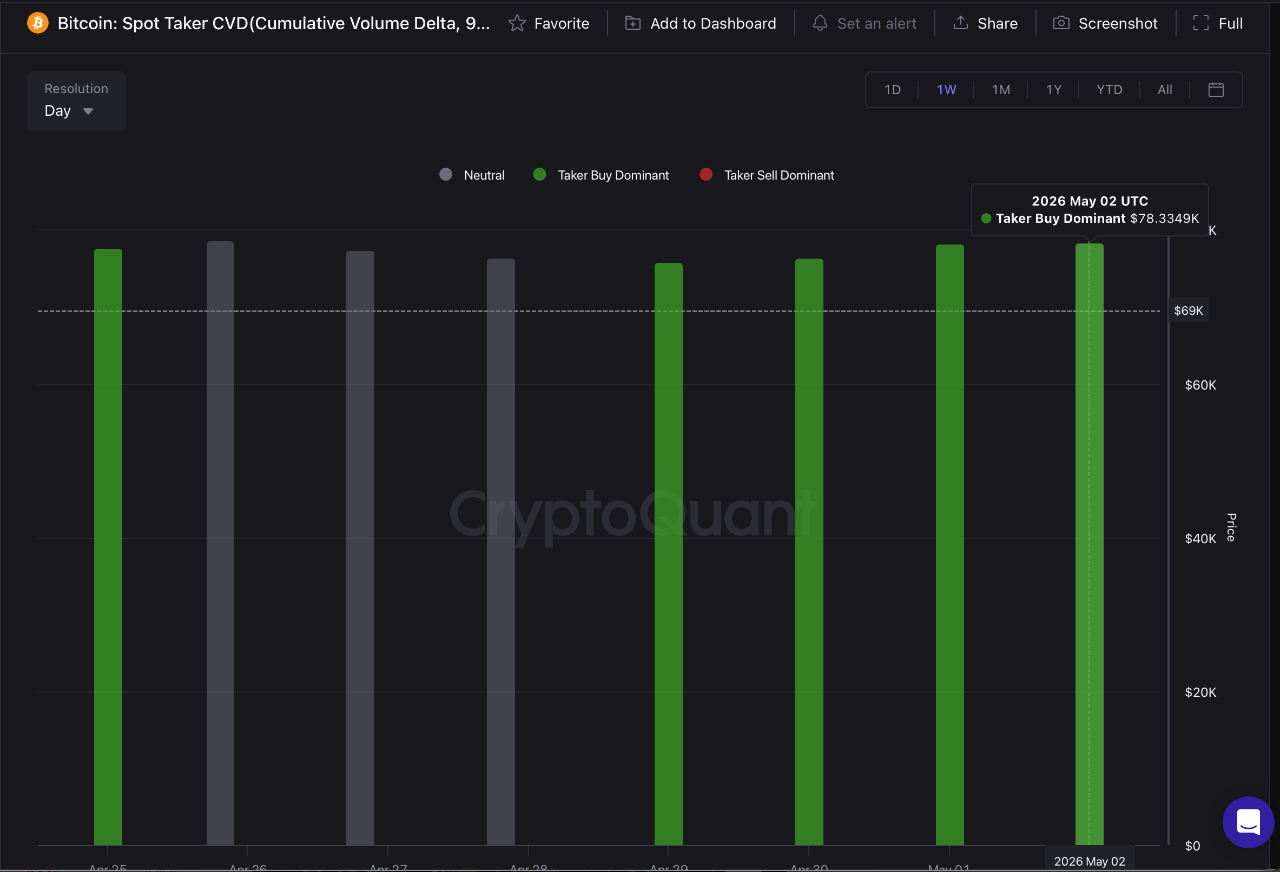
Source: Cryptoquant
The resistance zone continues absorbing incoming demand at a steady pace. Spot buyers remain active but not yet strong enough to force a clean breakout.
Meanwhile, Open Interest recorded only a minor decline during this period. It dropped from 26.737M to 26.552M, a fall of roughly 185M, or just 0.69%.
During that same window, the price moved from $78,480 up to $78,585. The recent advance was not driven by a fresh expansion in leveraged futures positions.
The pattern of rising prices alongside declining open interest points to spot-led action. When spot demand drives a move rather than futures, the resulting structure tends to be more stable.
A breakout could also occur through aggressive futures inflows. However, spot support would give any breakout a higher structural quality.
Crypto analyst Carmelo Alemán observed that buy-dominant spot activity aligned with minimal open interest change. This setup separates the current attempt from previous failed bids at $78,657.
It points to organic demand rather than speculative positioning. Buyers appear to be gradually building pressure at a firm resistance level.
Funding Rate Extremes and Liquidity Zones Define the Upside Risk
The 1-minute Funding Rates showed extreme negative readings on May 1, briefly touching near -2.24%. This means short traders were paying long traders at a highly unusual rate.
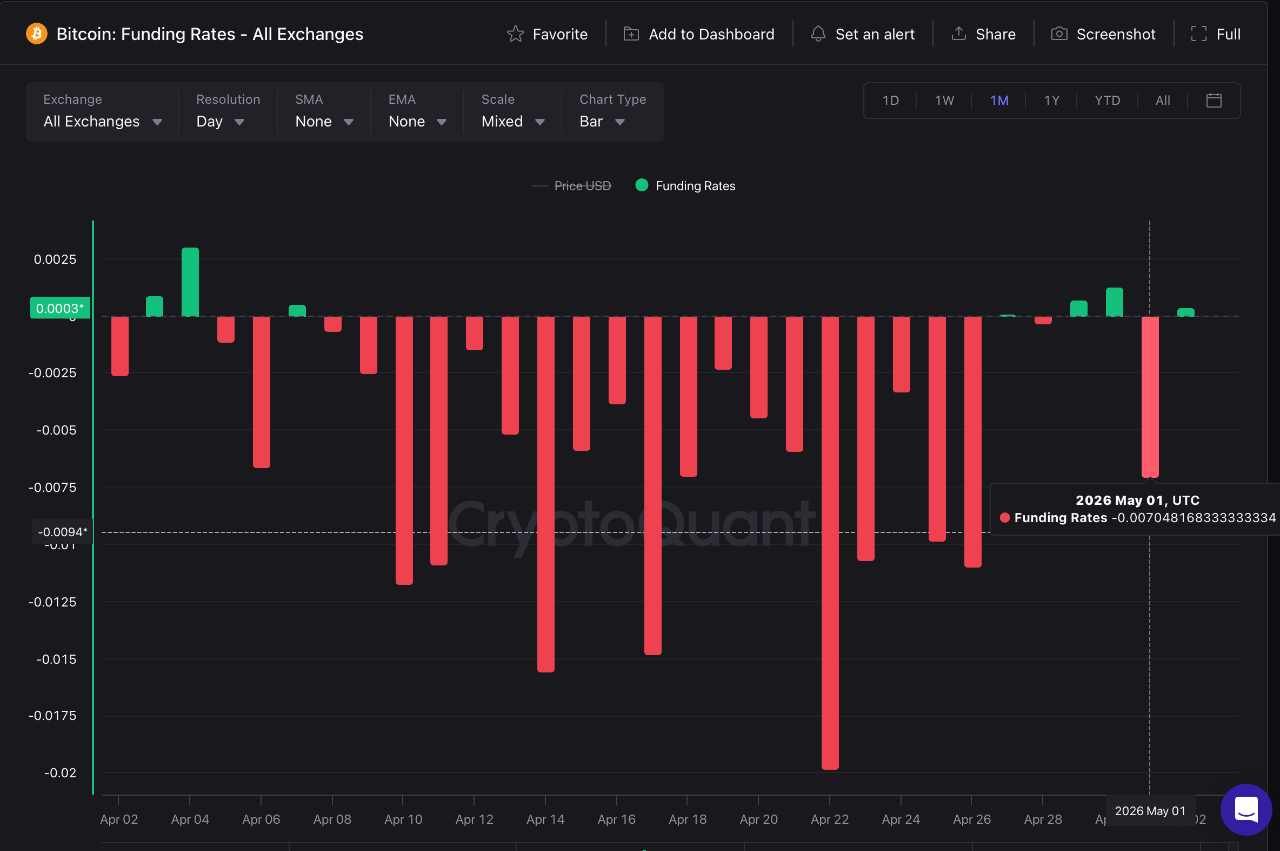
Source: Cryptoquant
Such sharp funding episodes often reflect short-term market stress. They can also set up rapid price moves when short positions get squeezed.
The Estimated Leverage Ratio currently sits near 0.245, moderate but elevated versus earlier weekly lows. The market is not overly stretched at this reading. That said, any sharp directional move could still trigger meaningful liquidations on either side of the market.
On the liquidity heatmap, the zone from $79.5K to $81K appears clearly loaded. Leveraged positions at 5x and 10x are concentrated throughout this range.
If Bitcoin breaks above $78.6K, this liquidity cluster becomes the immediate upside target. Price momentum could accelerate sharply once the breakout pulls in those positions.
Beyond the $79.5K–$81K zone, $82K emerges as the next natural target for Bitcoin. Yet a clear risk follows any sweep of that liquidity cluster.
As leveraged positions close within that range, upside momentum may begin to fade. A price correction remains possible once the market digests the liquidity sweep above $78.6K.
The post Bitcoin Tests $78.6K Resistance for the Seventh Time as Liquidity Builds Above appeared first on Blockonomi.
TLDR:
- Patoshi Pattern: Researcher Sergio Lerner mapped ExtraNonce values across 50,000 blocks, revealing one dominant mining slope.
- The Patoshi miner accumulated 1.1 million BTC in 2009, worth over $115 billion and untouched for 16 years.
- Patoshi deliberately capped his hash rate at 50%, allowing other early miners to win blocks consistently.
- If the dormant stash ever moves, it would trigger the largest single asset liquidation in crypto market history.
The Patoshi pattern, identified over a decade ago, remains one of the most debated findings in Bitcoin’s history. In 2013, researcher Sergio Demian Lerner analyzed the earliest Bitcoin blocks and uncovered a unique mining fingerprint.
His findings pointed to a single miner controlling a massive early stash. That miner, later named “Patoshi,” accumulated approximately 1.1 million BTC. The coins remain untouched to this day, worth over $115 billion.
How the ExtraNonce Field Exposed a Single Dominant Miner
Every Bitcoin block contains a small data field called the ExtraNonce. Miners increment this value each time they attempt to generate a block. Different miners produce different ExtraNonce sequences based on their software behavior.
Lerner mapped ExtraNonce values across the first 50,000 Bitcoin blocks. When plotted on a graph, the values formed distinct slopes. Each slope represented a separate miner’s activity.
One slope stood out clearly from the rest. It appeared across roughly 22,000 of the first 36,000 blocks ever mined. The pattern showed consistent timing and identical software behavior throughout.
As @0xSweep noted on X: “Satoshi’s mining code incremented the ExtraNonce field differently than any other miner’s — an unintentional fingerprint built into the original Bitcoin client itself.” Cross-referencing with known transactions involving early developers like Hal Finney led the cryptography community to link Patoshi to Satoshi Nakamoto.
What the Patoshi Pattern Reveals About Satoshi’s Behavior
The Patoshi miner did not attempt to dominate the network completely. In 2009, the Bitcoin network had very few participants. Satoshi’s hardware was effectively the entire network at that time.
However, the data shows Patoshi deliberately limited his hash rate to around 50% of his actual capability. This allowed other miners to win blocks consistently. That behavior points to an intentional decision to support network participation.
The on/off mining pattern also followed a human daily rhythm. Patoshi stopped mining at similar times each day, resembling someone running a computer from a personal workspace rather than an industrial setup.
Around April 2010, the Patoshi pattern disappeared entirely from the blockchain. Satoshi sent his last public message in April 2011 and has not been heard from since. The 1.1 million BTC now sits across approximately 20,000 separate addresses, untouched for 16 years.
The dormant stash carries two possible outcomes for the market. If the coins move, the crypto market would face the largest single liquidation in its history. If they never move, Bitcoin’s true circulating supply is effectively smaller than current figures suggest.
The post Patoshi Pattern: The Cryptographic Fingerprint Linking Satoshi Nakamoto to 1.1 Million Bitcoin appeared first on Blockonomi.
CryptoPotato
April 2026 turned out to be an unusual month for the crypto market. While overall activity remained steady on the surface against significant geopolitical turmoil, the space saw a series of exploits that shook investor confidence.
The leading blockchain security firm, CertiK, reported that crypto-related exploits and incidents in April 2026 resulted in total losses of over $650 million.
April Hacks
The largest incidents were led by KelpDAO, which lost $292 million, followed by Drift Protocol at $285.2 million. The Drift Protocol exploit followed weeks of setup and months of social engineering to gain access to protocol signers. The funds were drained in about 12 minutes. In comparison, the KelpDAO hack stemmed from a single-verifier flaw in a LayerZero bridge, as attackers later moved funds through THORChain after over $70 million was frozen on Arbitrum
Other exploits include Rhea Finance at $18.4 million, Grinex at $16.2 million, among others. By sector, DeFi projects saw the highest losses at $609.3 million, while unverified contracts lost $8.5 million, GameFi $3.4 million, bridge-related incidents $2.8 million, and meme-related projects $1.9 million.
In terms of categories, wallet compromises accounted for the majority of losses at $611 million, followed by price manipulation at $18.8 million, code vulnerabilities at $16.9 million, phishing at $3.5 million, and front-end attacks at $544.7k.
Fewer Attacks, Higher Financial Impact
North Korean hacking groups made up 76% of all crypto hack losses in 2026 through April, according to TRM Labs. This was not because they carried out more attacks, but because two major incidents alone caused $577 million in losses, which ended up outweighing all other activity. This pattern of fewer but higher-impact attacks has been typical of North Korea’s strategy since 2017.
TRM found that their share of total crypto theft has steadily increased over the years, rising from under 10% in 2020 and 2021 to 22% in 2022, 37% in 2023, 39% in 2024, and 64% in 2025. That jump in 2025 was largely driven by the Bybit breach, where $1.46 billion was taken through a compromised Safe{Wallet} signing interface, which made it the largest crypto hack recorded so far.
In 2026, the combined losses from KelpDAO and Drift stand out in a similar way. What remains consistent is the pace of activity, with only a small number of carefully planned operations each year. What is changing, however, is how these attacks are carried out.
North Korea’s total crypto theft has now crossed $6 billion since 2017, as per TRM’s findings. Experts believe that these groups may be using AI tools to improve reconnaissance and social engineering for more precise and targeted exploits.
The post KelpDAO and Drift Lead Devastating $650M Crypto Hack Wave of April appeared first on CryptoPotato.
Bitcoin is trading at $78.3k as the first weekend of May opens. It has done something it has not managed since the cycle peak, which is closing above the 100-day MA and breaking out of a long-term descending channel that contained the entire bearish trend.
The move comes alongside strong daily RSI readings, a successful retest of the breakout level on the 4-hour chart, and an on-chain supply picture that explains precisely why the road ahead gets harder from here, and why it may be worth it anyway.
Bitcoin Price Analysis: The Daily Chart
On the daily chart, BTC has been pushing toward the higher boundary of the mid-term ascending channel after reclaiming the 100-day moving average, which has descended to the $72k zone. The RSI is climbing toward 70, showing consistent bullish readings while still leaving room for follow-through, as an overbought state has not been reached yet.
The immediate test remains the $80k supply zone, which has capped the price on every approach since February. A clean daily close above this area would open the path toward the $90k level, with the 200-day moving average also in the way near the $85k mark. On the downside, the lower boundary of the current zone at $75k is now the first line of support to defend, followed by the 100-day moving average located just below this level.
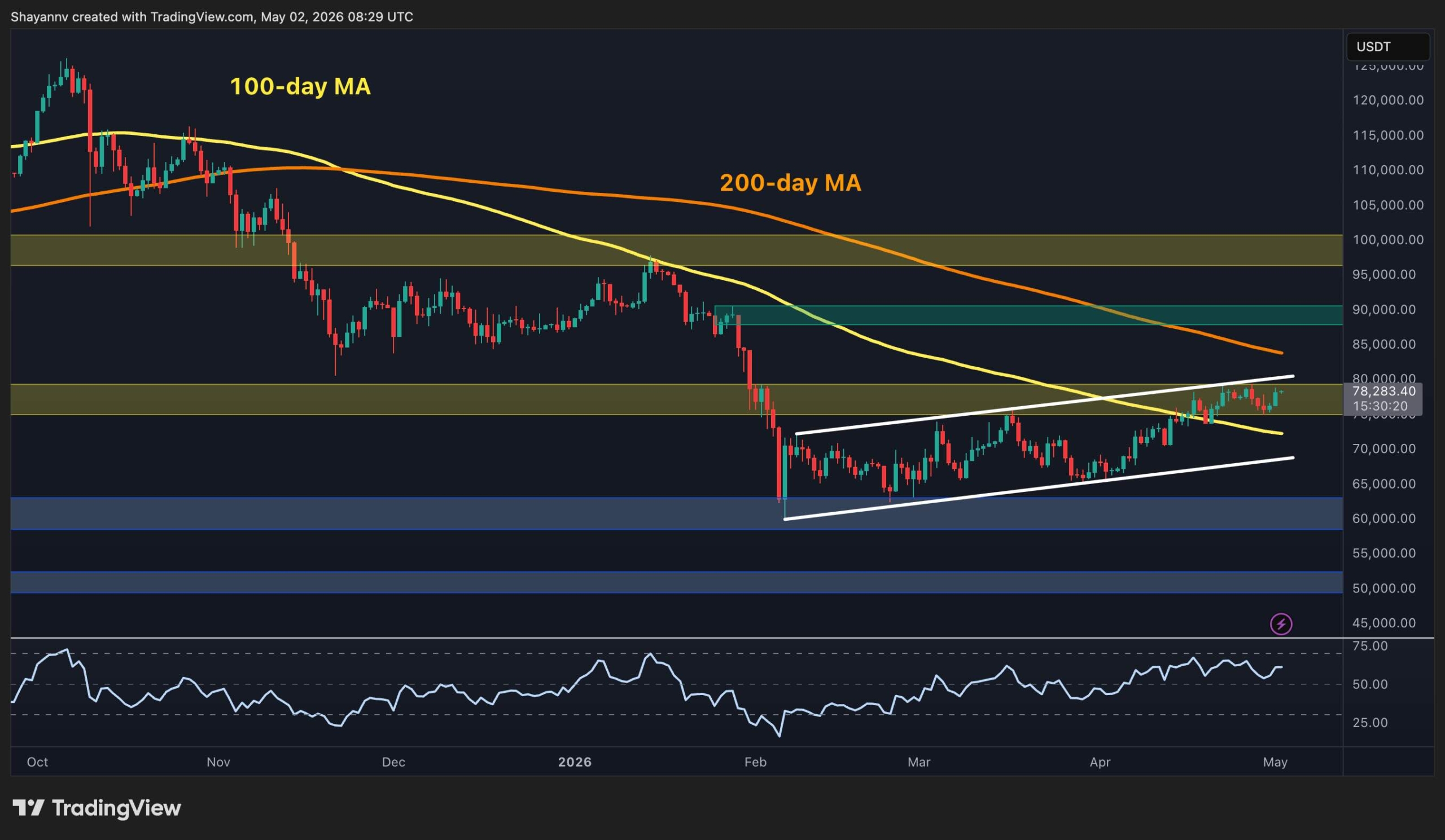
BTC/USDT 4-Hour Chart
The 4-hour chart shows a textbook post-breakout structure. The asset broke above the $75k level, pulled back to retest it, which is labeled explicitly on the chart, and has since pushed back toward the $79k region with the RSI also climbing above 60, showing a clear bullish shift in momentum. The structure is clean, and the retest adds conviction to the move.
The upper channel boundary and the $80k psychological level are converging as the immediate ceiling. A 4-hour close above the recent highs near $79.5k, with the RSI also holding below the overbought region, keeps the bullish structure intact and targets the $82k-$84k supply zone above. In case of any pullback, the $75k area can prove critical again, as it’s the major nearby support level on this timeframe.

On-Chain Analysis
With 64.2% of Bitcoin’s circulating supply currently in profit, the recovery from the February low has made meaningful progress, but the remaining 35.8% underwater tells the more important story. The bulk of that loss-making supply was acquired between $80k and $125k during the late 2025 distribution phase, meaning BTC is now entering the price range where a large cohort of holders approaches breakeven, and the incentive to sell intensifies.
Historically, crossing the 75–80% supply-in-profit threshold has marked the point where correction-driven overhead pressure meaningfully subsides, and momentum can sustain. The current reading of 64.2% confirms that the threshold has not yet been reached, which explains why the $80k–$90k zone has acted as such a stubborn ceiling.
Each push higher converts more underwater holders into profit-takers, but it also reduces the pool of forced sellers, and if the price can clear $80k, the supply-in-profit curve could accelerate rapidly toward levels that have historically preceded the next significant leg higher.

The post Bitcoin Price Analysis: BTC Closes Above 100-Day MA as Bulls Eye Breakout appeared first on CryptoPotato.
Last year was a significant one for real-world assets (RWAs), as the sector saw intensified competition, regulatory progress, and an influx of traditional institutional players. In fact, the RWAs sector performed so well that it outpaced stablecoins in growth.
According to CoinGecko’s RWA Report 2026, RWAs grew from 2.7% the size of stablecoins to 6.4% as the pace of tokenization accelerated in 2025. The report examines the sector’s growth from January 2025 through the end of Q1 2026.
RWAs Outpace Stablecoins in Yearly Growth
Within the last 15 months ending March 2026, the market cap of tokenized RWAs more than tripled from $5.42 billion to $19.32 billion. This represented a 256.7% growth from January 2025.
The RWAs sector comprises four asset classes: treasuries, commodities, stocks, and exchange-traded funds (ETFs). Tokenized treasuries have remained the largest asset class, adding $9 billion in market cap from January 2025. This accounted for a 225.5% increase during the reporting period. CoinGecko noted that momentum for this asset class surged after its market cap exceeded the $10 billion mark for the first time on February 11, 2026.
Despite the growth, the market share of tokenized treasuries fell slightly from 73.7% to 67.2% because other asset classes recorded notable growth. Commodities accounted for 28.7%, while stocks and ETFs captured 2.5% and 1.5%, respectively, by the end of Q1 2026.
The growth in tokenized commodity market share was driven by gold-backed tokens — Tether Gold (XAUT) and PAX Gold (PAXG). The market cap grew 289% from $1.43 billion to $5.55 billion within the report period. XAUT and PAXG accounted for 89% of the market cap growth. Notably, spot trading for tokenized gold surpassed the $84.6 billion traded in 2025 to reach $90.7 billion in Q1 2026.
RWAs Perpetuals Gain Traction
Furthermore, the market cap of tokenized stocks grew from $2.09 million in June 2025 to $486.69 million in March 2026. Tech companies like Circle, Tesla, Nvidia, and Alphabet led the charge. Spot trading volumes for this asset class totaled $15.1 billion by the end of last quarter, surpassing the $14.8 billion traded in the second half of 2025.
As for tokenized ETFs, this asset class recorded broad-based growth, with a market cap that rose from $0.62 million in July 2025 to $297.5 million by March 2026. It currently accounts for half the size of tokenized stocks.
Interestingly, the RWAs perpetuals volume grew from $313 billion for the whole of 2025 to $524.8 billion by Q1 2026. With this level of growth, 2026 is likely to see double the volume recorded for 2025.
The post Tokenized RWAs See Strong Growth in 2025, Outpacing Stablecoins: Report appeared first on CryptoPotato.
2026 has been quite eventful for the cryptocurrency industry, mostly driven by the developments in the war between the US/Israel and Iran. It began with a massive nosedive to $60,000 and was followed by an impressive 30%+ recovery by early May.
Now, though, this rather notable rally has reached a major resistance and Ali Martinez warned that a technical indicator has flashed a major sell signal.
Indeed Sell in May and Go Away?
The analyst told his over 165,000 followers on X that the Tom DeMark (TD) Sequential indicator has flashed red for bitcoin on the 3-day chart, marking the “first major bearish pivot of the year.” He added that the same tool timed perfectly the aforementioned rebound from the early February lows of $60,000 to almost $80,000, which was neared twice in the past 10 days or so.
Martinez warned that if bitcoin fails to stabilize and dips decisively below $67,500, which has emerged as the most crucial level now, it could “trigger a new bearish countdown, potentially extending the correction.”
Previously, the same analyst suggested that bitcoin could find a new bottom beneath $55,000 if the current structure breaks down.
“While the macro trend remains constructive, the TD Sequential is a high-authority timing tool. For those looking to manage risk, the $67,500 level is the primary floor to watch for trend validation,” he concluded.
It’s worth noting that BTC ended April on a high note, posting a near 12% increase. It became the best-performing month since the previous April.
Strong Resistance
Fellow analyst Ted Pillows also weighed in on the cryptocurrency’s latest price performance, especially the Friday increase to over $78,000, which came after reports that Iran had sent another peace proposal to the US. Although it was rejected by Trump hours later, BTC maintained the $78,000 level and has remained there for about 24 hours.
Pillows noted bitcoin has tested a “strong resistance zone” at around $80,000 lately, which has rejected both attempts in the past few weeks. May has been historically a positive month for BTC, but more adverse developments on the war front could quickly turn the tables once again.
$BTC is back above the $78,000 level.
Now, Bitcoin has entered a strong resistance zone.
Do you think BTC will break above $80,000 this month? pic.twitter.com/gDOWAEhfJl
— Ted (@TedPillows) May 2, 2026
The post Bitcoin Price Faces Risk as Proven Indicator Signals Major Sell-Off appeared first on CryptoPotato.
April turned out to be the best month for the cryptocurrency markets on different fronts since late last year, with BTC posting a double-digit surge and the spot Bitcoin ETFs attracting almost $2 billion.
At the same time, the exchange-traded funds tracking the world’s largest altcoin stopped a five-month painful streak, in which they bled well over $2.5 billion.
Spot Bitcoin ETFs Turn Green YTD
After a record-setting July 2025 in which the funds tracking bitcoin gained over $6 billion, investors continued to pour money into the financial vehicles in September and October, as roughly $3.5 billion flowed into each month. However, the tides turned in November when the same amount was withdrawn as the entire crypto market bled out. Over $1 billion was pulled out in December and another $1.6 billion in January.
February saw a substantial reduction in investor exodus, but it was still in the red, with net outflows of $206 million. March finally snapped this four-month streak, with net inflows of $1.32 billion. April was even better. Aside from the nearly 12% monthly surge in the underlying asset, the ETFs attracted just shy of $2 billion, according to data from SoSoValue, marking the best monthly performance since October last year.
Moreover, the positive flows for March and April have managed to reverse the year-to-date numbers as the cumulative flows for 2026 now stand at almost $1.5 billion.
BlackRock’s IBIT remains the undisputed leader in terms of overall flows, followed by Fidelity’s FBTC.
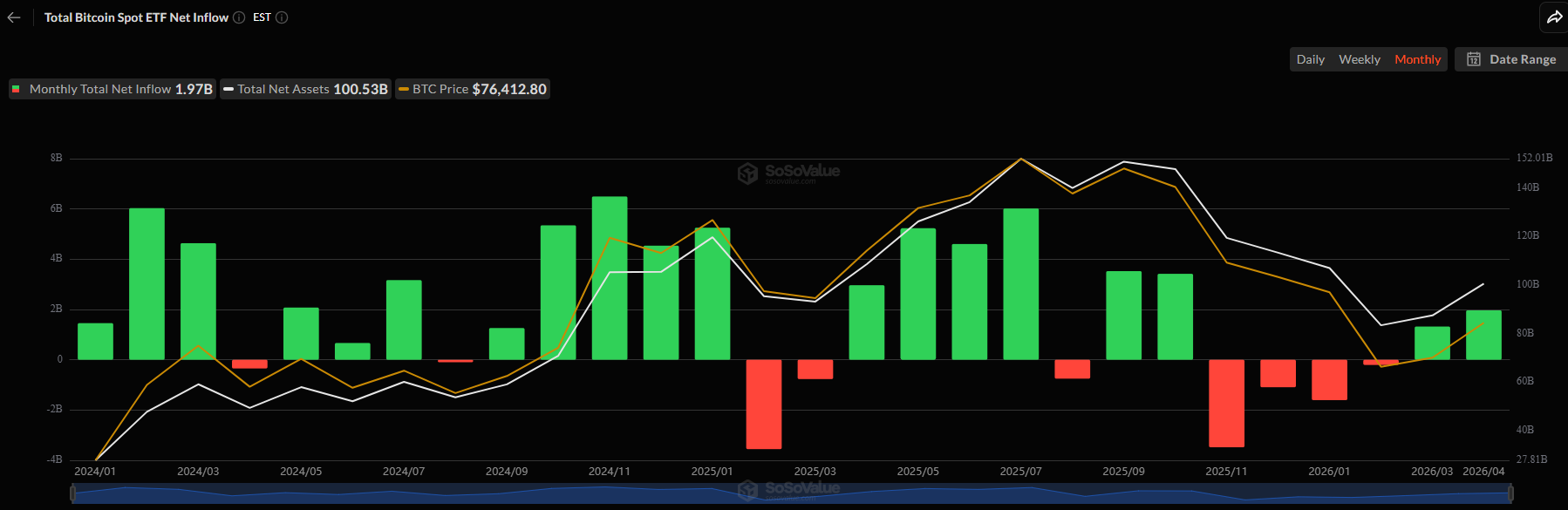
ETH ETFs Break Streak
While the BTC ETFs managed to break their negative streak in March, the Ethereum counterparts couldn’t. The funds tracking ETH bled out heavily in November (-$1.42 billion), followed by another $616 million in December, $353 million in January, $370 million in February, and a more modest $46 million in March.
This five-month negative streak, which became the worst in the spot Ethereum ETFs‘ history, finally ended in April. Investors poured $356 million last month, but the YTD performance remains negative, with over $410 million leaving the funds in just four months.
Once again, the (first) product launched by BlackRock (ETHA) is the undeniable market leader, followed by Fidelity’s FETH.

The post Bitcoin ETFs Attract Almost $2B in April as 2026 Turns Green appeared first on CryptoPotato.