Cryptocurrency Posts
Crypto Briefing
Institutional traders' increased activity amid market volatility suggests a shift towards risk-taking, potentially boosting financial market dynamics.
The post JPMorgan’s prime-brokerage balances hit record high amid market volatility appeared first on Crypto Briefing.
Heightened regional instability may disrupt air travel, impacting economies and increasing geopolitical tensions in the Middle East.
The post Iran conflict raises airspace closure concerns in Middle East appeared first on Crypto Briefing.
Persistent inflation and geopolitical tensions may lead to prolonged high interest rates, impacting economic growth and financial market stability.
The post Fed’s Collins warns inflation to persist, no rate cuts expected through 2026 appeared first on Crypto Briefing.
Ledger's IPO delay highlights the challenges crypto firms face in volatile markets, potentially shifting focus to private funding strategies.
The post Ledger shelves US IPO plans, weighs private fundraising: Report appeared first on Crypto Briefing.
AI's integration into money laundering operations significantly amplifies the scale and complexity of financial crimes, challenging regulatory frameworks.
The post Australia’s watchdog warns money launderers are increasingly using AI to scale scams appeared first on Crypto Briefing.
Bitcoin Magazine
Bitcoin Magazine

Bitcoin Suisse Secures Bermuda Regulatory Approvals for International Digital Asset Expansion
Bitcoin Suisse (International) Ltd., an affiliate of the Switzerland-based Bitcoin Suisse Group, has obtained dual regulatory approvals from the Bermuda Monetary Authority, according to a note shared with Bitcoin Magazine.
The Bermuda Monetary Authority (BMA) granted the entity a Class F license under Bermuda’s Digital Asset Business Act (DABA) and a Class B registration under the Investment Business Act 2003.
The approvals, granted on a pre-operational basis, authorize Bitcoin Suisse to provide regulated digital asset management and investment advisory services to professional and institutional clients. The entity is domiciled in Hamilton, Bermuda, and is a subsidiary of BTCS Holding Ltd., the group’s parent holding company.
The DABA license covers the provision of regulated digital asset business services, while the IBA registration permits investment advisory and discretionary portfolio management.
Clients may fund mandates in Bitcoin, stablecoins, or fiat currency, the company said. The entity operates on a non-custodial basis, relying on regulated custodial providers and partner banks for institutional-grade security.
Andrej Majcen, Co-Founder and Group CEO of Bitcoin Suisse, framed the approvals as a turning point for the firm’s global ambitions.
“Institutional investors recognize digital assets as a permanent part of their portfolios. What they need is a partner who combines deep crypto-native expertise with the governance and regulatory standards they expect from traditional financial services,” Majcen said. “The BMA approvals mark an important step in Bitcoin Suisse’s transition towards a global wealth management platform.”
Multi-region bitcoin expansion strategy
Investment decisions will draw on Bitcoin Suisse’s proprietary Crypto Analysis Framework and its Global Crypto Taxonomy — a classification system covering approximately 600 digital assets across six sectors, developed over more than a decade of research. An experienced CIO Office and dedicated research function will underpin all client mandates.
Bermuda has positioned itself as a global hub for digital asset regulation since introducing the Digital Asset Business Act in 2018, one of the first comprehensive frameworks of its kind in the world. The jurisdiction’s regulatory architecture has attracted crypto-native firms seeking institutional credibility and offshore reach.
The Bermuda approvals build on Bitcoin Suisse’s existing international presence. The group holds an In-Principle Approval from the Financial Services Regulatory Authority of the Abu Dhabi Global Market, establishing a regulated footprint in the Middle East. Together, the two jurisdictions form the foundation of a multi-region expansion strategy targeting ultra-high-net-worth individuals, family offices, external asset managers, and corporate counterparties.
This post Bitcoin Suisse Secures Bermuda Regulatory Approvals for International Digital Asset Expansion first appeared on Bitcoin Magazine and is written by Micah Zimmerman.
Bitcoin Magazine

The 2036 Issue: Letter From The Editor
None of us can see the future. We don’t know what 2036 will bring.
We all like to tell ourselves that we can, or do, and maybe we do actually see small pieces of it coming before we catch up to them, but none of us see the whole picture. That’s, at the end of the day, part of what it is to be human.
Nevertheless we can’t seem to help ourselves from at least trying.
Going into the second half of the 2020s we are coming out of a time period that marked wild and tumultuous disruption, with the world changing in both big and small ways that none of us could have imagined in our wildest dreams at the start of 2020. As we enter the second half of the decade, events around the world are starting to push us in a direction that seems like it will be even more disruptive and unpredictable than the first half of the decade.

In this issue, we are going to do what we can’t help ourselves doing, we’re going to try to predict the shape of the next decade. I say shape, and not just the future itself, because that is the best that human beings can actually do.
These pages are filled with pieces written by some of the most influential and intelligent people that engage in this space trying to look ahead and provide something of value to you, the reader. Some have given deep analysis of how larger geopolitical trends will unfold, others have written more lighthearted musings on what different aspects of our lives will be like day-to-day, and some have written what I can only call warnings or reminders of what to keep in mind while navigating the coming ten years.
Every few generations, the world seems to go through some tumultuous upheaval. A radical shift that upends the order and institutions that maintained the previous shape of the world. I think we are entering that next period now, and we’ve probably been standing in its doorway since 2020.
Chaos and change are not solely reasons to give in to fear, or anxiety, they are also reasons to have hope and optimism. When things fall apart, it doesn’t just mean the end of what was there before, it means there is space to build something new. It signals the beginning of something new in the exact same moment that it signals the end of something old.
The next ten years are going to be the biggest opportunity yet for Bitcoin. We can either spend them optimistically building, putting our energy into bringing into reality the positive impact we see that Bitcoin can have on the world, or we can squander them doing the opposite.
Ultimately, the shape the future has when it finally arrives at our doorstep will be the shape that all of our individual actions and choices mold it into.
Make them count.

Don’t miss your chance to own The 2036 Issue — featuring articles written by many influential figures in the space pondering the challenges of the next decade!
This piece is the Letter from the Editor featured in the latest Print edition of Bitcoin Magazine, The 2036 Issue. We’re sharing it here as an early look at the ideas explored throughout the full issue.
This post The 2036 Issue: Letter From The Editor first appeared on Bitcoin Magazine and is written by Shinobi.
Bitcoin Magazine
Senate Crypto Bill Faces Over 100 Amendments Ahead of Thursday Markup
Senate Banking Committee members have filed more than 100 proposed amendments to the Digital Asset Market Clarity Act, according to Politico reporting. The panel is set to convene on Thursday for a long-awaited markup vote that crypto and industry leaders say could reshape digital asset regulation in the United States.
The committee scheduled its executive session for 10:30 a.m. on May 14 at Room 538 of the Dirksen Senate Office Building in Washington, D.C., where lawmakers will debate the amendments and vote on whether to send the bill to the full Senate floor.
The flood of filings follows the release of an updated 309-page draft of the bill earlier this week, expanded from the 278-page version proposed in January.
Senator Elizabeth Warren leads the opposition push, submitting more than 40 amendments alone, with the bulk of proposed changes coming from Democratic members of the Banking Committee.
The wave of filings mirrors the January markup session, which drew 137 amendments before that session was cancelled, signaling that resistance to the bill remains strong even as its supporters push for a final vote.
At the center of the dispute is how the bill handles stablecoin yield products — crypto that offer returns to holders. Banking groups argue such crypto products threaten traditional deposit bases; crypto firms counter that reward programs support liquidity and customer activity without functioning as bank deposits.
The American Bankers Association has sent more than 8,000 letters to Senate offices since last Friday, targeting the stablecoin yield compromise brokered by Senators Thom Tillis and Angela Alsobrooks. That compromise, reached after months of negotiations, prohibits stablecoin issuers from paying interest or yield to users who hold tokens passively, while preserving exceptions for rewards tied to genuine platform transactions and payment activity.
Senators Jack Reed and Tina Smith filed amendments to tighten those standards further, targeting products that deliver returns in ways that resemble traditional interest-bearing deposit accounts.
The banking lobby maintains the existing compromise language still leaves room for stablecoin platforms to replicate high-yield savings products without meeting bank-level regulatory requirements.
Senate ethics provisions and developer protections
Senator Chris Van Hollen introduced a proposal that would prohibit senior government officials and their families from owning or promoting crypto-related businesses — a demand Democrats say is non-negotiable given President Trump’s close ties to the crypto industry.
Republican sponsors have resisted the provision, with some warning that ethics riders could fracture the coalition needed for the bill to advance.
A recent draft of the bill already included language shielding noncustodial developers from being classified as money transmitting businesses, with that protection extended retroactively to cover past conduct.
The broader stakes for the crypto industry
The CLARITY Act, formally H.R. 3633, passed the House on July 17, 2025, by a 294–134 bipartisan vote before stalling in the Senate through two cancelled markup sessions and protracted stablecoin negotiations.
At its core, the bill would draw a clear jurisdictional line between the Securities and Exchange Commission and the Commodity Futures Trading Commission, ending years of enforcement-based policymaking that left crypto firms operating under legal ambiguity.
Prediction markets have priced the odds of the bill becoming law in 2026 roughly at 60%, the highest level in months, with the White House setting a July 4 target for a presidential signature.
Committee Chairman Tim Scott had originally targeted a Senate floor vote for September 2025, then pushed that deadline to end-of-year, and most recently said he hoped to reach a full Senate vote by June or July 2026.
Thursday’s markup is the first formal committee vote on the bill in the Senate, and its outcome will determine whether that timeline is still within reach.
This post Senate Crypto Bill Faces Over 100 Amendments Ahead of Thursday Markup first appeared on Bitcoin Magazine and is written by Micah Zimmerman.
Bitcoin Magazine

Blockaid Launches Real-Time Compliance Suite as Institutions Deepen Crypto Exposure
Blockchain security firm Blockaid has introduced Risk Exposure, a real-time compliance infrastructure suite built for institutions that now operate inside crypto and decentralized finance but still answer to regulators.
The launch extends Blockaid’s platform beyond scam and exploit prevention into what the company calls programmable, real-time compliance for institutional onchain finance, a category it argues has no adequate solution today.
The need is real. Banks, asset managers, custodians, and payment processors have moved from occasional crypto experimentation into continuous onchain operations. They hold positions in liquidity pools, run stablecoin settlement across multiple chains, and manage treasury exposure through DeFi protocols around the clock.
A wallet or pool that screens clean at 9 a.m. can carry tainted exposure by noon — without the institution touching a single transaction — as stolen funds move through bridges, mixers, and smart contracts faster than any compliance team can track.
The numbers behind that risk are substantial. Over the past 18 months, North Korean-linked actors moved more than $1.5 billion through the Bybit hack. Exploits at Cetus, Balancer, and KelpDAO pushed combined losses past $600 million. In most cases, tainted funds spread across wallets, liquidity pools, and counterparties before legacy compliance systems flagged anything. The forensic model — tag addresses after the fact, file a report — was not designed for this environment.
Real-time crypto compliance
Risk Exposure is built around three functions. A Risk Screening API evaluates inflows before funds are accepted, returning structured verdicts with exposure categories, dollar amounts, and severity scores formatted for audits and SAR filings. A Cosigner Policy Engine embeds AML thresholds into multisig workflows, rejecting transactions that breach preset limits even after internal approvals have cleared. DeFi Toxicity Monitors track protocols, liquidity pools, and counterparty positions throughout the day, sending alerts when exposure to sanctioned entities, stolen crypto funds, scam infrastructure, or mixers crosses defined thresholds.
Blockaid also points to a parallel threat: AI-driven “pig butchering” fraud has pushed crypto investment scams into the tens of billions of dollars each year. The FBI’s Operation Level Up found that roughly 8 in 10 victims never file a report, which means compliance tools that rely on law enforcement records to tag addresses miss the bulk of that activity.
Blockaid’s system uses transaction simulation, behavioral analysis, and AI-driven threat identification to surface exposure earlier — before scam proceeds enter institutional systems undetected.
The firm screens more than 500 million transactions each month for clients including Coinbase, MetaMask, Uniswap, Fireblocks, Polymarket, and OKX, processing hundreds of transactions per second with verdicts returned in under 300 milliseconds at 99.99% accuracy. Founded in 2022, the company has raised $83 million from Ribbit Capital, Sequoia, Greylock, and others.
For Bitcoin specifically, the implications are pointed. As BTC custody, BTC-backed lending, and Bitcoin treasury strategies move deeper into institutional balance sheets, the compliance infrastructure those institutions carry will determine how far that integration can go.
Risk Exposure is the kind of tooling that lets a regulated bank or asset manager maintain onchain exposure without asking a regulator to accept ambiguity in return.
This post Blockaid Launches Real-Time Compliance Suite as Institutions Deepen Crypto Exposure first appeared on Bitcoin Magazine and is written by Micah Zimmerman.
Bitcoin Magazine

$11.77 Trillion Brokerage Giant Charles Schwab Launches Spot Bitcoin Trading Platform
Charles Schwab has begun rolling out spot bitcoin trading to retail clients in the United States, marking a major expansion of crypto access through one of the country’s largest brokerage firms.
The company announced Tuesday that an initial group of eligible customers can now trade bitcoin through its new platform, Schwab Crypto. The launch gives retail investors direct access to digital assets inside Schwab’s existing brokerage ecosystem, rather than through third-party exchanges or exchange-traded funds.
Charles Schwab said the rollout follows plans first outlined last year and confirmed in April. The firm previously limited crypto exposure to ETFs, futures, and other indirect investment products.
The new platform allows customers to buy and sell spot bitcoin while maintaining a separate crypto account connected to their Schwab brokerage profile. Charles Schwab Premier Bank will act as custodian, while Paxos will handle trade execution and sub-custody services.
According to Schwab’s FAQ materials, the service carries a 75-basis-point trading fee and is available in every U.S. state except New York and Louisiana. The company said some clients may not qualify for access during the first phase of the rollout.
TradFi’s bitcoin bandwagon
The move places Schwab among a growing list of traditional financial firms expanding into digital assets after years of cautious engagement with the sector. The company reported $11.77 trillion in client assets and 39.1 million active brokerage accounts at the end of March, giving the launch potential reach across a large base of retail investors.
The launch arrives as major financial institutions compete to integrate digital assets into mainstream investment products and services. Firms across banking and brokerage sectors have increased crypto offerings following the approval of spot bitcoin ETFs and rising demand from retail and institutional clients.
BlackRock’s IBIT alone held roughly $54 billion in assets under management by early 2026, with institutions disclosing holdings of more than 513,000 BTC through exchange-traded funds — a figure that grew as professional ETF ownership surged 32% across 2025.
U.S. spot Bitcoin ETF products pulled in approximately $2.44 billion in net inflows during April 2026 alone, the strongest monthly total of the year, with nine consecutive trading days of net positive flows extending into May. Each net inflow translates into Bitcoin removed from the open market and delivered to custodians, a dynamic analysts say is creating structural price support independent of speculative trading activity.
The banking sector’s posture toward Bitcoin has shifted in parallel. Nearly 60% of the largest U.S. banks either offer Bitcoin-related services or plan to, according to research from River, with JPMorgan, Goldman Sachs, Morgan Stanley, and Citi all expanding custody, trading, or ETF product lines in recent months.
Morgan Stanley has signaled ambitions to operate as a full crypto bank, while Goldman Sachs filed an application for a Bitcoin Premium Income ETF and Citi launched an institutional custody initiative — moves that Wall Street analysts say reflect a structural, compliance-driven integration rather than a tactical hedge.
Franklin Templeton’s director of digital asset research said in late April that institutional demand, underpinned by clearer regulation, was the primary reason the firm expects Bitcoin to reclaim the $100,000 level before the end of 2026.
Bitcoin traded near $80,000 during Tuesday trading.
This post $11.77 Trillion Brokerage Giant Charles Schwab Launches Spot Bitcoin Trading Platform first appeared on Bitcoin Magazine and is written by Micah Zimmerman.
CryptoSlate
Prediction markets have been growing fast, from crypto price bets to election forecasting and sports outcomes. But there's a persistent problem most platforms don't address: users are essentially guessing.
They pick a side based on gut feeling, social media noise, or whatever narrative feels convincing in the moment. Poly Truth is attempting to solve that. Rather than just giving people a place to bet on outcomes, it positions itself as an intelligence layer sitting on top of prediction markets, one that tells you which side the data actually supports. You can explore the project directly on the $PTRUE Coin official website.
The project is currently in presale with its native $PTRUE token, and it's worth understanding what the system actually does before looking at the token economics.
What Is Poly Truth?
Poly Truth is a prediction market intelligence tool. That distinction matters: it's not a trading bot, not a prediction platform itself, and not an automated system that places positions on your behalf. The core idea is to give users data-backed probability analysis on active prediction events, whether those events involve sports results, political races, crypto price movements, or any other outcome-based market.
Think of it like having a research analyst who, instead of giving you a tip, walks you through the reasoning: here's what the data shows, here's the probability each outcome occurs, and here's why. Users still make their own decisions; Poly Truth just gives them more to work with.
How the Poly Truth System Works
The project explains its process through a three-part framework it calls its “characters.” It's a useful framing for understanding how data moves through the system.
The Runners are automated bots that continuously scrape data across the internet (news, odds movements, historical patterns, social sentiment), focused on whatever prediction events are currently active. They're the data collection layer, running in the background without user involvement.
The Starlet is the AI analyst component. Once the Runners pull in raw data, The Starlet cross-references sources, identifies patterns, and produces probability scores. This is where the intelligence layer actually sits: it's not simply aggregating data but interpreting it to determine which outcome has stronger statistical backing.
The Presenter is what users see. It delivers the final output: which events have meaningful data behind them, what the probability breakdown looks like, and the reasoning that led to those numbers.
The flow is clean: collect → analyze → present. Whether the AI analysis proves consistently accurate in live conditions is something that will only be tested over time, but the architecture is logically sound for what it's trying to do.
What Markets Does Poly Truth Cover?
The system is designed to work across several categories of prediction events:
- Sports: match outcomes, player performance, tournament results
- Politics: elections, policy decisions, geopolitical events
- Crypto: price movement predictions, project milestone outcomes
- General events: any outcome-based market with sufficient data to analyze
The breadth of coverage is worth noting. Most prediction market tools that incorporate AI tend to focus narrowly on one vertical. Poly Truth's multi-market approach means The Runners need to scrape and contextualize very different data types depending on the event category, which is a more complex engineering challenge but also a wider potential use case if executed well.
The $PTRUE Token: Key Details
PTRUE is the native token of the Poly Truth ecosystem, currently available in presale. Here's a breakdown of the core numbers:
| Detail | Figures |
|---|---|
| Total Supply | 11.5 billion tokens |
| Presale Price | $0.001190 |
| Blockchain | Ethereum |
| Staking APY | 4,452% |
| Payment Options | ETH, BNB, SOL, USDT, USDC, Card, SEPA |
Token Distribution:
- Presale: 40%
- Liquidity: 17%
- Development: 13%
- Team: 10%
- Staking: 10%
- Marketing: 8%
- Community/Airdrops: 2%
The 40% presale allocation is substantial, which means a significant portion of the total supply is being distributed early. The staking APY of 1,346% is an eye-catching figure — high staking yields are common in early-stage crypto projects as a mechanism to reduce circulating supply and reward early participants, but they are also inherently unsustainable at that rate long-term. Anyone considering staking should factor in how yield rates typically compress as a project matures and token supply dynamics shift.
The payment flexibility is genuinely broad for a presale; accepting ETH, BNB, SOL, stablecoins, card, and SEPA means the project is trying to reduce friction for buyers coming from different ecosystems. Full presale details are available on the PolyTruth platform.
How to Buy $PTRUE in the Presale
The process is straightforward:
- Visit the official Poly Truth website and connect a compatible wallet (MetaMask or similar)
- Select your preferred payment method — ETH, BNB, SOL, USDT, USDC, card, or SEPA
- Enter the amount you want to purchase
- Confirm the transaction
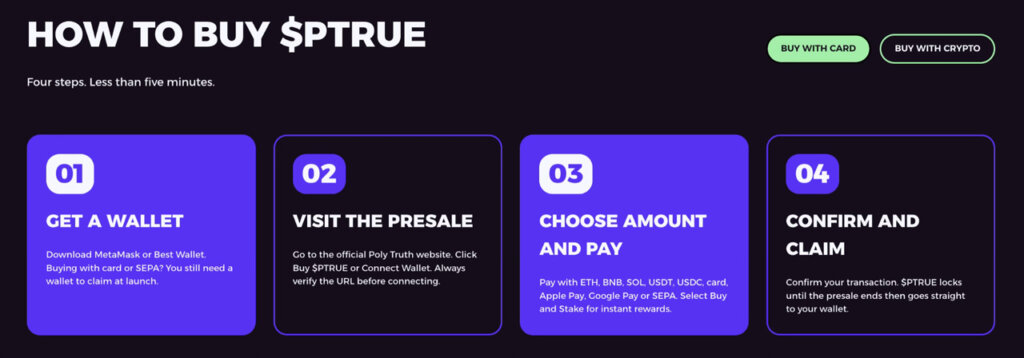
Since the contract is deployed on Ethereum, buyers using ETH will want to account for gas fees. Those paying with BNB or SOL will likely have lower transaction costs, though the mechanics of cross-chain purchases should be reviewed on the site before committing.
Who Is Poly Truth Actually For?
The most natural audience is people already active in prediction markets who want a research edge. If you're regularly using platforms like Polymarket or similar and making judgment calls based on partial information, a tool that systematically aggregates and scores probability data could be genuinely useful.
It's less directly relevant to passive crypto investors who aren't engaging with prediction markets at all. The token itself offers staking, but the utility case is tied to using the intelligence tool rather than simply holding.
The project sits in an interesting space; prediction markets have seen real growth in visibility and volume over the past few years, and AI-powered analysis layered on top of that trend is a logical product direction. Whether Poly Truth's implementation delivers on that concept is the question any prospective user or token buyer should be asking.
Final Thoughts
Poly Truth is a focused concept, not one trying to be everything, but one specifically targeting the information gap in prediction market participation. The three-part system (Runners, Starlet, Presenter) gives it a clear product identity, and the multi-market coverage broadens its potential reach beyond any single niche.
As with any presale-stage project, the gap between concept and working product is where real evaluation happens. The architecture makes sense on paper; live performance across diverse event categories will be the real test. Anyone wanting to dig into the details, review the smart contract, or participate in the presale can learn more on the Poly Truth coin website.
Disclaimer: This is a sponsored post. CryptoSlate does not endorse any of the projects mentioned in this article. Investors are encouraged to perform necessary due diligence.
The post How to Buy Poly Truth ($PTRUE): The AI Prediction Market Tool Explained appeared first on CryptoSlate.
The Senate Banking Committee’s crypto market structure bill is heading into CLARITY Act markup with more than 100 proposed amendments.
This is turning a long-delayed vote on the CLARITY Act into a test of whether a fragile stablecoin compromise can survive pressure from banks, Democrats, and crypto industry groups.
The final number of amendments has not been formally confirmed. However, the current markup amendment proposal puts it in the same range as the January effort, when 137 amendments were submitted before a planned committee vote was scrapped.
The size of the amendment pile underscores how unsettled the bill remains even after months of negotiations.
Banks force stablecoin rewards vote
The most consequential fight is over stablecoin rewards, the issue that helped stall earlier negotiations and now threatens to reopen the divide between crypto companies and the banking industry.
The Senate compromise would prohibit rewards on idle stablecoin holdings when those rewards resemble interest on bank deposits. It would still allow incentives tied to other stablecoin activity, such as payments or transactions.
That distinction was designed to keep stablecoins from becoming deposit substitutes while allowing firms to reward usage rather than passive balances.
Banks say the language does not go far enough. Their concern is that crypto exchanges and other intermediaries could structure rewards around stablecoin activity in ways that still pull deposits away from insured banks.
Banking groups have pushed senators to close what they view as a loophole and to prevent stablecoin issuers or affiliates from offering yield-like incentives that compete with bank accounts.
Sens. Jack Reed and Tina Smith reportedly filed an amendment to tighten that standard.
Their proposal would target rewards that are “substantially similar” to deposit interest, a formulation that could give regulators more room to block incentive programs that banks see as functionally equivalent to yield.
That amendment could become one of the clearest votes of the markup. Supporting it would move the bill closer to the banking industry’s position. Opposing it would preserve the Tillis-led compromise and signal that committee members are unwilling to use the market structure bill to further restrict stablecoin incentives.
The lobbying campaign around the provision has already intensified. Stand With Crypto, the Coinbase-backed advocacy group, said banking lobbyists sent 8,000 letters seeking to stop stablecoin rewards.
The group said its own advocates made 8,000 calls and sent 300,000 emails in recent months, and that supporters have contacted lawmakers almost 1.5 million times in favor of CLARITY.
On the other hand, traditional finance leaders are actively maintaining the pressure to ensure the amendment's success.
Lorrie Trogden, president and CEO of the Arkansas Bankers Association, recently issued a public call to action. On X, she urged banking industry members to make their voices heard ahead of the Thursday markup.
These efforts reflect an unusually visible outside campaign for a committee markup. They also show how a technical debate over reward language has become a proxy fight over whether banks or crypto platforms will control the next layer of dollar-based payments.
Warren pushes ethics and Fed access limits
Meanwhile, the stablecoin fight is not the only pressure point Democrats are bringing into the markup.
Crypto skeptic Sen. Elizabeth Warren has reportedly filed more than 40 amendments, the largest individual batch among committee members.
Her proposals target several parts of the bill, but one of the most significant would prevent the Federal Reserve from granting master accounts to crypto companies.
A Fed master account gives an eligible institution direct access to the central bank’s payment rails.
Crypto firms have long sought clearer paths into the banking system, while regulators and banks have warned that granting direct access to novel financial firms could create new supervisory and stability risks.
Warren’s amendment would put that fight directly into the CLARITY Act debate. If adopted, it would limit crypto companies' ability to use the market structure bill as a path to deeper integration with the Fed’s core payment infrastructure.
Notably, banking associations such as the Independent Community Bankers of America (ICBA) previously criticized the Federal Reserve Bank of Kansas City’s approval of a master account for the crypto exchange Kraken.
According to the group:
“Granting nonbank entities and crypto institutions access to the master accounts poses risks to the banking system.”
Meanwhile, Warren is also pressing the ethics argument that has become central to Democratic resistance.
The lawmaker has said that new crypto legislation should not move through the Banking Committee without stronger guardrails to address conflicts of interest involving President Donald Trump and his family’s crypto ventures.
That line of attack gives Democrats a broader political frame than just investor protection. It links the bill to concerns that public officials could benefit from policies that expand the digital asset market, especially if the legislation leaves gaps around affiliated projects, stablecoin activity or token holdings connected to political figures.
The ethics push complicates the Republican case for speed. Supporters argue the bill is needed to end regulatory uncertainty.
Warren and other skeptics argue that speed without additional safeguards could entrench conflicts before Congress has built a durable oversight framework.
DeFi and legal tender amendments widen the fight
Other Democratic amendments would expand the debate beyond stablecoins and ethics into the structure of decentralized finance and the legal status of crypto assets.
Sen. Mark Warner filed an amendment that would overhaul the bill’s decentralized finance provisions.
The latest CLARITY Act text attempts to define when a protocol is sufficiently decentralized and when an operator, platform, or intermediary should face bank-like compliance obligations.
That section is among the most technically sensitive parts of the bill because it determines whether some DeFi systems can operate outside traditional intermediary rules or must comply with reporting, monitoring, and anti-money laundering requirements.
Warner’s amendment signals that some Democrats remain uncomfortable with the bill’s treatment of DeFi.
Their concern is that broad exemptions for decentralized protocols could allow firms to avoid oversight by claiming that no central entity controls the system.
Crypto developers counter that rules built for custodial intermediaries cannot be applied cleanly to open-source protocols without forcing some projects offshore or shutting them down.
Reed also filed a separate amendment that would prohibit cryptocurrencies from being used as legal tender, including for tax payments.
That proposal would push against efforts by some crypto-friendly lawmakers to give Bitcoin or other digital assets a more formal role in public payments.
Together, the DeFi and legal tender amendments show that the impending markup will not be limited to one banking dispute.
Senators will also be asked to decide how much autonomy decentralized systems should have, how far crypto assets should be allowed to enter public finance, and whether the bill gives regulators sufficient authority to police risks across the market.
Crypto industry urges senators to hold the line
Despite all of these pressures, crypto industry groups are urging the committee to move the CLARITY Act forward without amendments that would weaken the compromise.
On X, the Blockchain Association and Crypto Council for Innovation have called the markup a defining moment for US leadership in financial technology.
Their argument is that the bill would replace fragmented enforcement-driven oversight with a statutory framework that lets companies build in the US under clearer rules.
Stand With Crypto has taken a more direct political approach, framing the bank-backed push against stablecoin rewards as an attempt to protect incumbents from competition.
The group’s campaign is aimed at showing senators that crypto supporters are organized enough to match the pressure coming from banks and trade associations.
For pro-crypto lawmakers, the challenge is holding together a coalition broad enough to get the bill out of committee while preserving language that can survive the Senate floor.
Republicans control the committee, but the broader bill will still need Democratic support to clear the broader Senate floor. That makes the markup both a policy negotiation and an early vote-counting exercise.
The post CLARITY Act faces 100+ amendments as bankers send 8,000 demand letters against stablecoin rewards appeared first on CryptoSlate.
Bitcoin just fell below $80,000 as a hotter-than-expected US inflation print pushed crypto and equities lower.

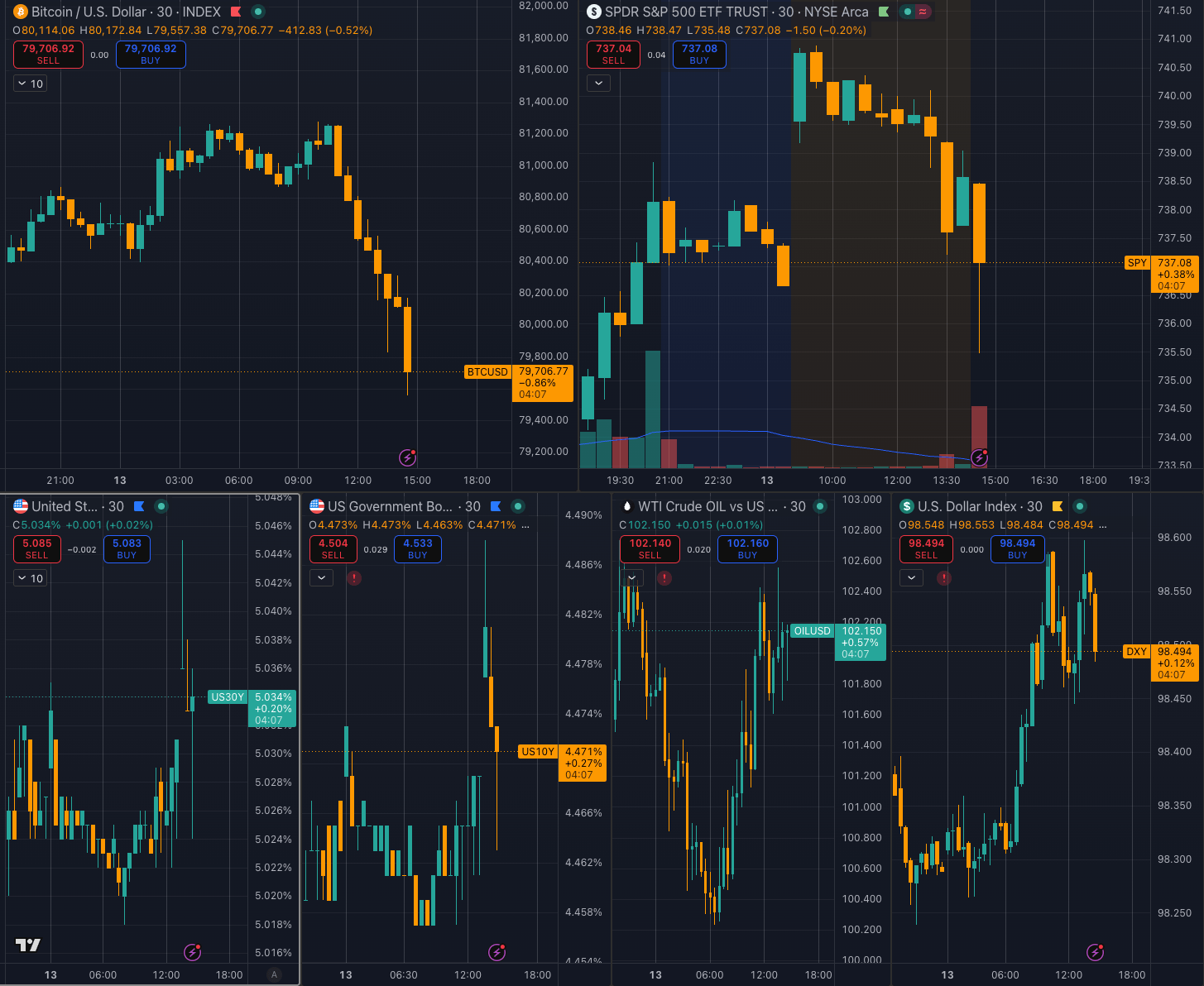
BTC price slipped from the low $81,000 area into $79,706, with the session low marked near $79,557. The break turned $80,000 from a round-number reference into the first tactical line for intraday structure.
The move followed the April US Producer Price Index. Final demand PPI rose 1.4% month over month, far above the 0.5% consensus and the prior 0.7% reading.
The annual rate accelerated to 6.0% from 4.3%, above the 4.9% consensus. Core PPI rose 1.0% month over month against expectations for 0.3%, while core PPI year over year moved to 5.2% from 4.0%.
Trading Economics data also shows the narrower measure excluding food, energy, and trade services also firmed, rising 0.6% month over month and 4.4% year over year.

The PPI surprise followed yesterday’s CPI report, in which headline consumer inflation accelerated to 4.8% year over year from the prior 3.3% reading, above expectations of 4.5%.

That mix changes the market’s inflation map. A broad upside miss in producer prices pressures the Fed's path because it feeds directly into the cost pipeline and parts of the PCE calculation. It also reduces room for a benign rate reaction when energy is rising at the same time.
The cross-asset response clearly showed the repricing. SPY sold off from above $740 to $737, with a lower wick extending toward $735.48. Long-end rates moved higher, with the 30-year Treasury yield around 5.034% and the 10-year yield around 4.471%. The US Dollar Index held near 98.49, while WTI crude traded around $102.15.
Bitcoin’s immediate price issue is acceptance below $80,000. A quick reclaim would narrow the damage to an event-driven flush. Continued trade below that level leaves the $79,557 low exposed and makes every failed bounce into the prior support zone a test of seller control.
Markets attempted a modest stabilization after the initial post-PPI selloff, but the rebound remained fragile. Bitcoin briefly recovered from the $79,557 low, rising toward $79,700, while SPY bounced off the $735 area and Treasury yields pulled back slightly from session highs.
However, renewed buying in crude and a firm US dollar are still keeping broader macro pressure elevated, leaving cross-asset price action reactive rather than decisively recovered.
The next signal is simple: BTC needs to recover $80,000 while SPY stabilizes and yields stop rising. Until that sequence appears, the PPI shock remains the active driver, and Bitcoin’s intraday structure stays broken.
The post Bitcoin price just lost $80k because US PPI hit 6% matching 2022 levels, stoking inflation fears appeared first on CryptoSlate.
Starknet launched strkBTC on May 12, locking BTC on Bitcoin's base layer to back an ERC-20 token that brings shielded balances into a smart contract environment at scale.
The token runs in the public mode, where it behaves like any other wrapped Bitcoin asset, and shielded mode, where users can hide selected balances and transfers from outside observers.
Starknet routes viewing keys to an independent third-party auditor, preserving selective disclosure when regulators or counterparties require it.
A five-member federation handles BTC movement between Bitcoin and Starknet, with its roadmap pointing to greater trust minimization. Atomiq and Garden provide bridge routes from BTC and WBTC into the new token.
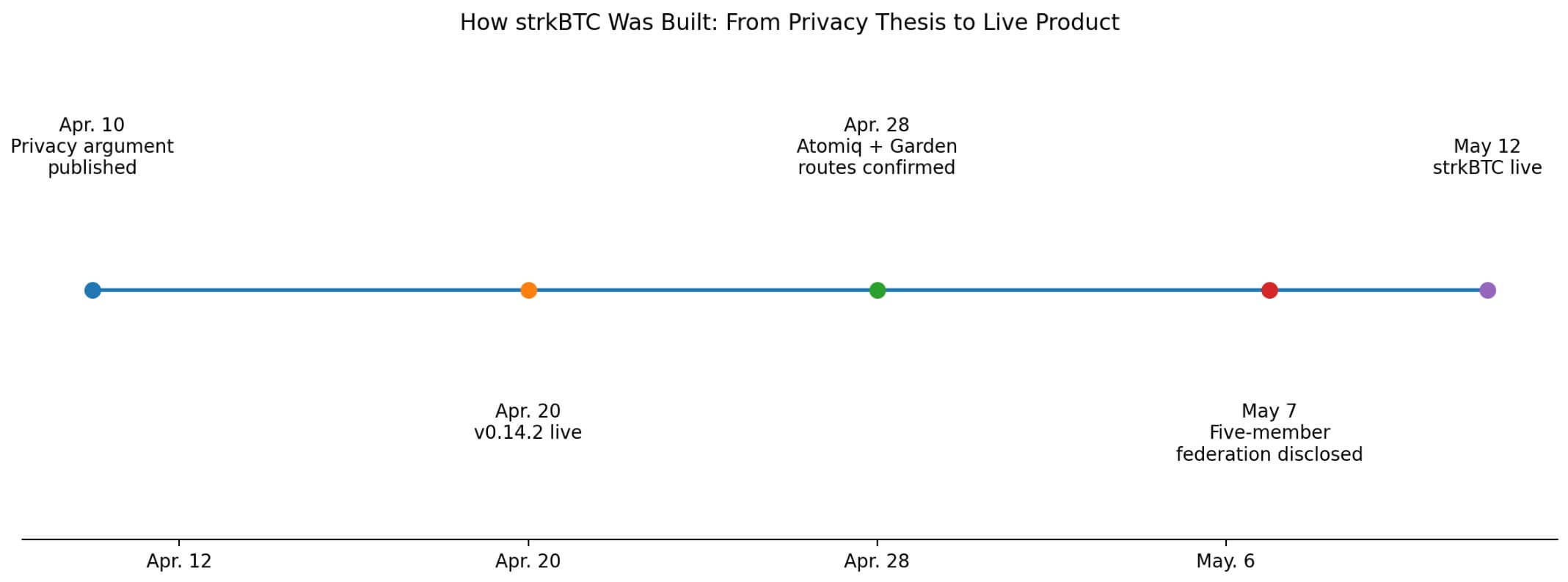
Starknet published its privacy argument on Apr. 10, framing on-chain visibility as incompatible with real financial use.
By Apr. 20, v0.14.2 was live, with native in-protocol proof verification and the infrastructure layer for encrypted balances. On Apr. 28, Starknet confirmed that Atomiq and Garden would wire BTC and WBTC liquidity directly into strkBTC.
On May 7, it disclosed the five-member federation, and seven days later, the product went live.
That build sequence reflects that the most active Bitcoin privacy development is happening outside the Bitcoin protocol, in environments designed for rapid iteration.
Bitcoin built transparency into its ledger by design. Every transaction is verifiable, every address is traceable, and the complete payment history of any wallet is visible to anyone with a block explorer.
For corporate treasury managers, large-value OTC desks, or any entity that prefers not to broadcast its full wallet balance to the market on every outbound payment, it creates a real operational problem.
The market response has been to build privacy into adjacent systems that can move faster than Bitcoin's base layer.
Private Bitcoin built elsewhere
Liquid, Blockstream's Bitcoin sidechain, has operated on this principle for years.
Users lock BTC into the peg and receive L-BTC on a network where Confidential Transactions hide both the asset type and amount from outside observers, making third-party inspection of amounts impossible.
Liquid's functionaries sign the blocks, federation infrastructure handles peg-outs, and users trade Bitcoin's security model for Liquid's in the process. Real privacy, available inside Liquid's federated architecture, with its own trust assumptions baked into every peg transaction.
WBTC paired with RAILGUN shows the same pattern in EVM territory. WBTC brings Bitcoin exposure to Ethereum, and RAILGUN shields ERC-20 assets in private 0zk balances, where users can send, swap, and interact with DeFi without those actions appearing on a public ledger.
RAILGUN requires assets to be in ERC-20 form before it can shield them. The privacy covers a Bitcoin-derived instrument that has already crossed into Ethereum, with WBTC's issuer and bridge touching the Bitcoin before RAILGUN can shield it.
Fedimint and Cashu build privacy through custody, as users deposit Bitcoin into a federated system and receive private payment claims in return.
Fedimint's federation guardians cannot trace individual members' balances or transaction histories, and Cashu uses Chaumian blind signatures, allowing users to spend privately against a mint without the mint seeing who holds what.
Both deliver genuine payment privacy, and both carry the same cost of making trust a third-party responsibility.
0xbow's Privacy Pools add a compliance layer to that same pattern, vetting deposits and providing users with zero-knowledge proofs that their funds are not connected to flagged addresses before admitting them into an association set.
That parallels Starknet's viewing-key architecture closely enough to show that selective disclosure is becoming a design standard across the sector.
What each model trades for privacy
Every solution solves a distinct problem and adds a distinct assumption.
Liquid hides amounts and asset types through Confidential Transactions, but users have accepted federation governance and peg mechanics to access that privacy. strkBTC layers a five-member federation, a bridge, smart contracts, and a third-party auditor underneath its shielded mode.
RAILGUN's DeFi privacy reaches users only once WBTC's issuer and bridge have already touched the Bitcoin, and Fedimint's strong transactional privacy inside a community mint vanishes if the federation does.
Cashu is the most transparent about its terms, offering fast private payments at the explicit cost of mint custody. Across all of them, the privacy improvement is real and attached to bridge, federation, or mint assumptions.
| Model | Privacy gain | Main trust/risk layer | Best fit |
|---|---|---|---|
| Liquid / L-BTC | Hides asset type and amount through Confidential Transactions | Federation governance and peg mechanics | Users who want Bitcoin privacy inside a sidechain environment |
| strkBTC | Shielded balances and transfers in a smart-contract environment | Five-member federation, bridge, smart contracts, third-party auditor | BTCFi users and institutions seeking auditable privacy |
| WBTC + RAILGUN | Private balances, transfers, and DeFi interactions for Bitcoin-derived assets | WBTC issuer risk, bridge risk, smart-contract/privacy-layer risk | EVM DeFi users who want privacy after wrapping BTC |
| Fedimint | Strong transactional privacy inside a federated system | Federation/community custody risk | Community or local payment networks |
| Cashu | Fast, private Bitcoin-backed payments using blind signatures | Mint custody and redemption risk | Users prioritizing lightweight private payments |
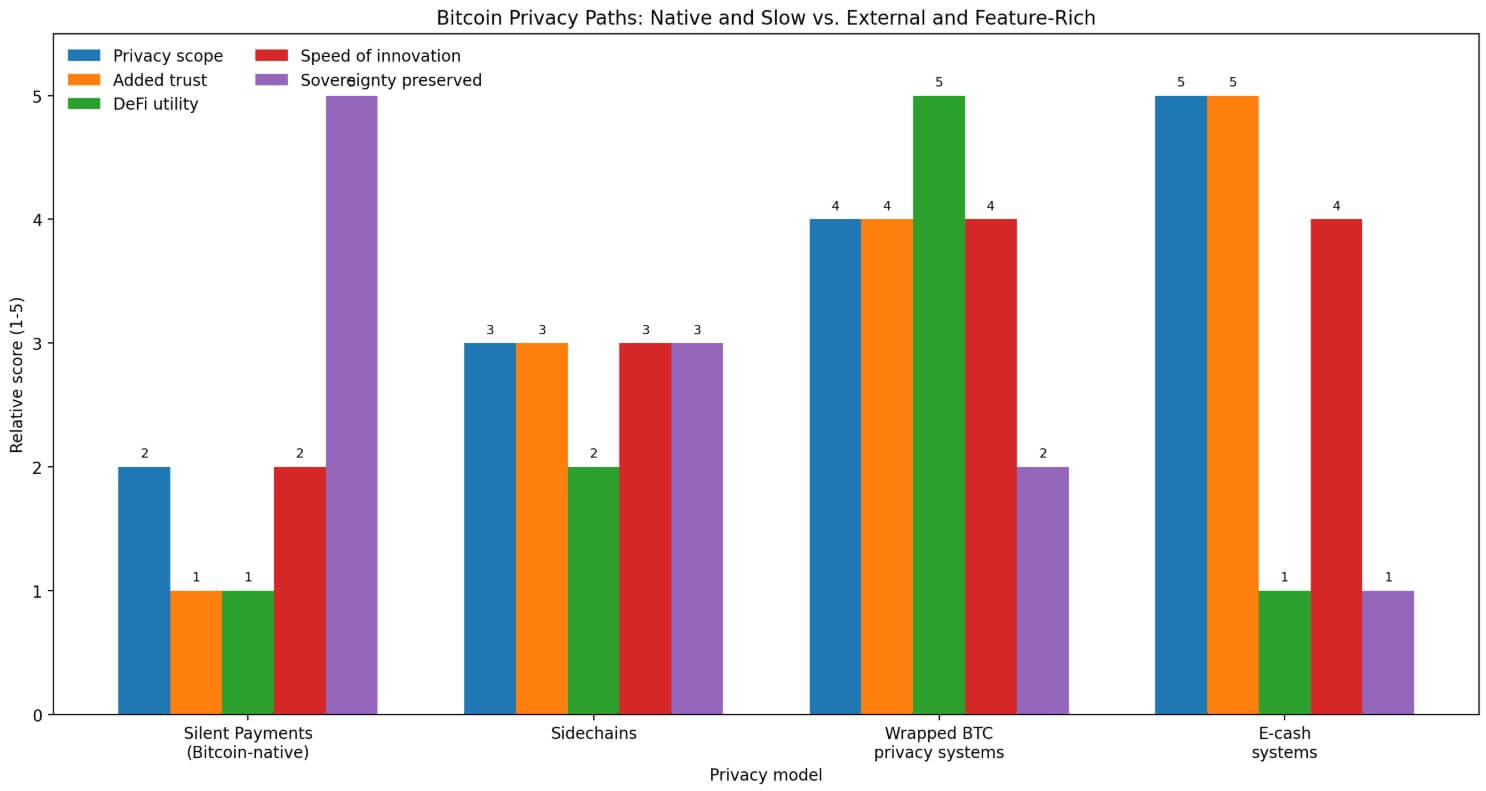
| Silent Payments | Reusable payment address without onchain linkability | Minimal added trust, but narrower privacy scope | Native BTC holders who want receiver privacy without leaving Bitcoin |
Bitcoin-native privacy is advancing toward narrower goals on a longer timeline.
BIP 352, which addresses Silent Payments, lets receivers publish a single reusable off-chain address while each incoming payment lands at a unique on-chain address, removing the address-reuse linkability that makes wallet tracking straightforward.
Bitcoin Optech has documented steady progress in scanning performance and wallet integration, and the privacy gain adds almost no new trust. Users keep their BTC on the Bitcoin network, use no bridges or federations, and maintain Bitcoin's full base-layer security.
Silent Payments deliver receiver-level privacy, with each incoming payment reaching a unique on-chain address, making wallet clustering difficult and requiring no BTC movement.
The scope stops at the payment layer. Shielded portfolio balances, private DeFi execution, and concealed smart-contract interactions belong to wrapped and sidechain systems that are outpacing Bitcoin's own development.
That difference between Bitcoin-native privacy primitives and the shielded environments that wrapped and sidechain systems can build is where the market is currently filling in with external solutions.
The bull case for strkBTC-style architectures is that auditable privacy is exactly what institutions need.
Selective disclosure through viewing keys, association sets, and view-only wallets provides compliance officers with a workable audit trail without publicly exposing every transaction.
In this scenario, wallets make shielding a one-tap option, federations mature toward trust minimization as Starknet's roadmap describes, and Bitcoin privacy becomes a competitive feature in BTCFi.
That would attract treasury managers and market makers who need transaction privacy for counterparty reasons but cannot accept opacity for regulatory ones.
The bear case is that the trust stack proves too thick. A five-member federation, a bridge, a smart contract environment, and a viewing-key auditor each introduce trust layers absent from Bitcoin's base chain.
Users who understand those layers, or who watch one of them fail, may decide the sovereignty cost exceeds the privacy gain.
In that world, demand for private Bitcoin transactions splinters. Cashu and Fedimint serve communities comfortable with mint or federation custody, while wrapped asset DeFi privacy stalls short of institutional scale.
Bitcoin's base-layer privacy work continues in either scenario. Whether users wait for it or adopt a new trust layer to get something functional today is the decision now facing every BTC holder who needs financial privacy.
The post Bitcoin holders can now hide more of their activity, but only by trusting new middlemen appeared first on CryptoSlate.
A hotter-than-expected April inflation report has put Bitcoin back at the center of the Federal Reserve trade, reviving the higher-for-longer rates problem that has capped crypto markets for much of the year.
The Bureau of Labor Statistics (BLS) reported on May 12 that headline CPI rose 3.8% year over year in April, above the 3.7% consensus estimate and the highest annual reading since January 2024.
Core CPI, which strips out food and energy, rose 2.8% year over year and 0.4% month over month. Bond markets moved on the news, with the 2-year Treasury yield climbing 3 basis points to 3.98%, the 10-year increasing 4 basis points to 4.45%, the dollar index gaining 0.3% to 98.29, and major US equity indexes fell at the open.
These reactions are a common near-term bearish setup for Bitcoin, as higher yields make Treasuries more competitive and compress tolerance for risk assets. A firmer dollar also tightens dollar-denominated liquidity globally, and a delayed rate-cut calendar removes one of the clearest catalysts for crypto outperformance.
The Federal Reserve left rates at 3.50%-3.75% on Apr. 29. Bank of America and Goldman Sachs each pushed their first-cut forecasts further out this week, with traders now pricing the current rate range through year-end.
April's CPI confirmed a trajectory markets had already started pricing in.
| Metric | April reading / move | Why it matters for Bitcoin |
|---|---|---|
| Headline CPI (y/y) | 3.8% | Hotter inflation raises the odds of higher-for-longer rates |
| Headline CPI vs. estimate | 3.8% vs. 3.7% est. | The upside surprise is what tightened the macro backdrop |
| Core CPI (y/y) | 2.8% | Sticky core inflation is harder for markets to dismiss |
| Core CPI (m/m) | 0.4% | Reinforces concern that underlying price pressure remains firm |
| 2-year Treasury yield | +3 bps to 3.98% | Higher short-end yields reduce odds of near-term Fed easing |
| 10-year Treasury yield | +4 bps to 4.45% | Higher long-end yields tighten financial conditions |
| Dollar index (DXY) | +0.3% to 98.29 | A firmer dollar tightens global dollar liquidity |
| Fed rate range | 3.50%–3.75% | No cut relief yet for liquidity-sensitive assets |
| Immediate market read-through | Fewer cuts, higher yields, stronger dollar | Near-term bearish setup for Bitcoin and other risk assets |
Energy led the headline
Energy rose 3.8% in April and accounted for more than 40% of the monthly all-items increase, with gasoline up 28.4% year over year. Shelter rose 0.6% for the month, rent and owners' equivalent rent each gained 0.5%, and airline fares jumped 2.8%.
The BLS also flagged a one-time rent adjustment tied to the government shutdown, which temporarily inflated core inflation.
Taken together, the report carried enough breadth in shelter, rent, and airfares to deny markets a clean “transitory” read, which is why bond traders pushed yields higher.
If markets treat April as a temporary fuel pass-through, crypto-specific demand and policy catalysts have room to reassert themselves. If the stickiness in shelter, rent, and airfares reads as core reacceleration, the higher-for-longer trade gets another leg, and Bitcoin's near-term liquidity setup tightens before it eases.
Fidelity has documented a strong historical relationship between Bitcoin and global M2 growth, and the asset has served as a hedge against monetary debasement over multi-year horizons.
BlackRock frames Bitcoin's real-rate sensitivity similarly to gold, since when real yields are falling and dollar purchasing power eroding, the case for scarce, non-sovereign money attracts structural inflows.
Over a multi-year horizon, sticky inflation can build Bitcoin's monetary narrative and support long-term accumulation. Over the next three sessions, Fed reaction, Treasury yields, and dollar strength tend to dominate.
Both arguments operate on different clocks, and traders betting on the inflation-hedge thesis today still have to survive the macro repricing that comes first.
What Bitcoin's reaction to the print actually said
Bitcoin declined on May 12, briefly losing $80,000, but recovered and traded between $81,000 and $80,000.
Matt Mena, senior crypto research strategist at 21Shares, said that the market had positioned for a hot print, absorbed the data, and held above $80,000, the level that had served as support through April's macro volatility.
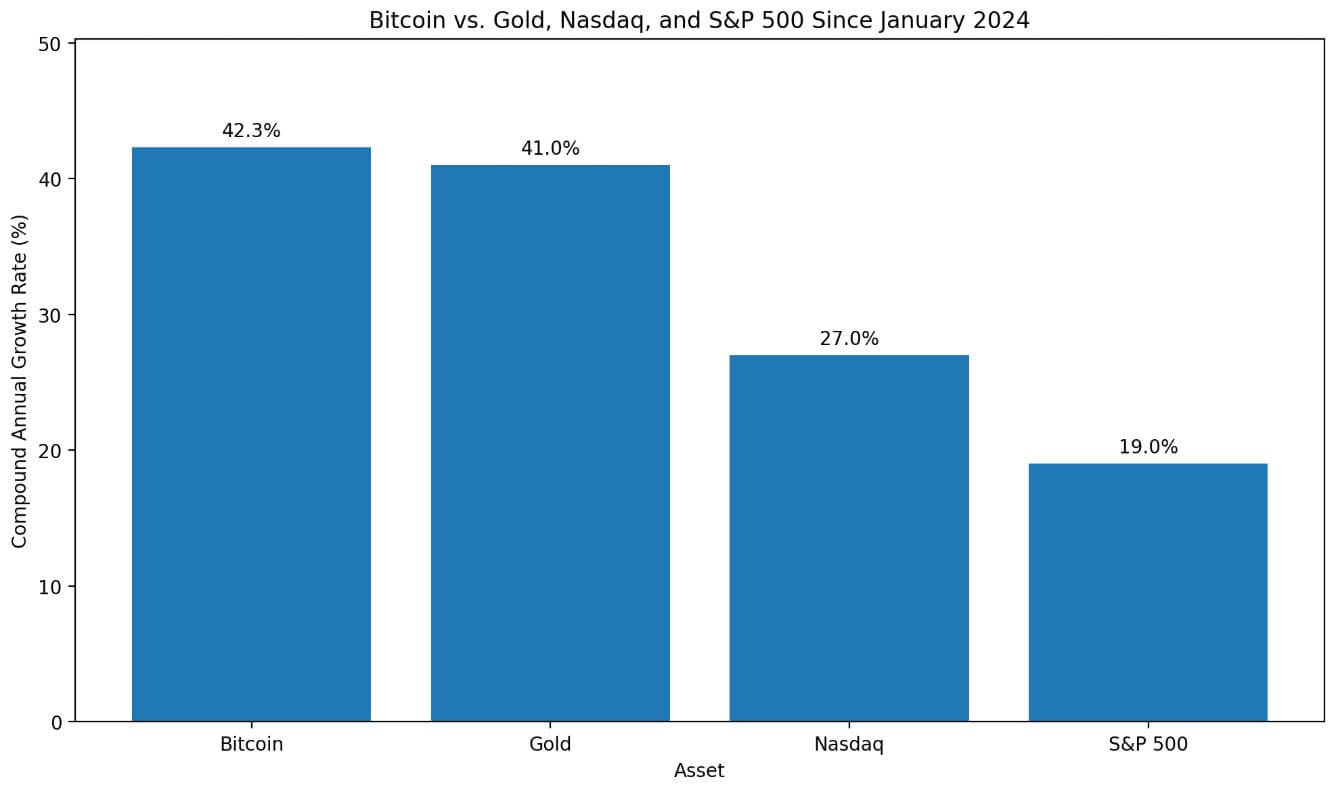
Mena also placed the print inside a longer-run performance frame, as 3.8% annual CPI is the highest reading since January 2024. Since then, Bitcoin's compound annual growth rate has reached 42.3%, outpacing gold's 41%, the Nasdaq's 27%, and the S&P 500's 19%.
That track record documents an asset that has compounded through periods of comparably adverse macro conditions and continued to appreciate, even as the near-term liquidity setup tightens.
Three concrete near-term catalysts could provide Bitcoin with a potential offset to macro drag.
The Senate Banking Committee has confirmed a markup hearing for the CLARITY Act on May 14 at 10:30 a.m. ET. Traders on Polymarket now price in roughly a 70% probability of approval, up from approximately 50% at the start of May.
A clean markup vote would represent the clearest legislative catalyst for the broader market in months.
White House crypto adviser Patrick Witt told attendees at Consensus Miami last week that a “big announcement” on the Strategic Bitcoin Reserve was coming “in the next few weeks,” citing a breakthrough in the legal framework that would allow the executive branch to act before Congress codifies new acquisition authority.
The US already holds an estimated 328,372 BTC from prior seizures, and any announcement involving new buying, or one that only reaffirms the existing reserve structure, will determine how much of a catalyst it proves to be.
Spot Bitcoin ETF inflows have run as a separate structural floor for six consecutive weeks, absorbing more than $3.5 billion in that stretch. Daily inflows peaked at $629.8 million on May 1 and $532.3 million on May 4, then turned negative on May 7 and May 8.
Net flows through May 11 stayed positive at approximately $1.29 billion, creating demand that compressed the downside even as prices stalled near resistance.
| Driver | Current status | Bullish implication for Bitcoin | Bearish risk | Timing |
|---|---|---|---|---|
| CLARITY Act markup | Senate Banking Committee markup scheduled | Legislative progress could improve market structure outlook and sentiment | Delay, weak vote, or messy process reduces policy tailwind | May 14, 10:30 a.m. ET |
| Strategic Bitcoin Reserve | White House adviser signaled a “big announcement”; U.S. holds 328,372 BTC | Any credible path to additional buying or stronger reserve framework could support BTC | A symbolic update with no new buying may disappoint | “Next few weeks” |
| Spot Bitcoin ETF flows | Six straight weeks of inflows; more than $3.5B absorbed | Structural demand can cushion downside even under macro pressure | More negative daily flows would weaken the support bid | Ongoing / daily |
| Peak recent ETF inflows | $629.8M on May 1; $532.3M on May 4 | Shows strong demand can still appear quickly | Peak days may prove temporary if momentum fades | Early May |
| Net ETF flows through May 11 | Approx. +$1.29B | Confirms net demand remained positive despite stalled price action | A reversal would strengthen the macro-bearish case | Through May 11 |
| Next macro test: PPI | April PPI ahead of catalyst window | In-line or cooler PPI could stabilize yields and help BTC hold support | Hot PPI could extend higher-for-longer and pressure BTC below support | May 13 |
The two-sided technical setup
Mena stated that a clean daily close above $82,000 opens the path to $85,000 and a retest of the $88,000-$90,000 zone, particularly if the CLARITY Act markup clears without a major setback and a Strategic Bitcoin Reserve announcement introduces credible acquisition optionality.
That bull case requires the macro data to stop deteriorating, so the PPI needs to come in at or below expectations on May 13, Treasury yields need to stabilize, and the dollar needs to stop firming.
If those conditions hold, the three crypto-specific catalysts could push Bitcoin past the resistance that has capped it since early April.
For the bear case, a hot April PPI print on May 13 is sufficient to extend the higher-for-longer trade, push yields higher, and test whether $80,000 support can hold against renewed macro selling. Below that, $75,000 comes back into play.
Bitcoin absorbing the CPI print without a breakdown gives the bull case its footing, with PPI arriving as the next test before any of the crypto-specific catalysts resolve.
The post Bitcoin was waiting for cuts. Hot CPI inflation data just put hikes back on the table appeared first on CryptoSlate.
Cryptoticker
As of May 13, 2026, PEPE remains a central figure in the meme coin landscape. While many expected the "frog" to fade into obscurity, it has maintained a significant market presence. However, the 2026 market is vastly different from the speculative frenzy of years past. With $Bitcoin dominance rising to over 58.5%, the question for retail investors is simple: Is PEPE a hidden gem or a falling knife?
Is PEPE Worth Buying?
Currently trading at $0.00000418, PEPE is in a "make or break" consolidation phase.
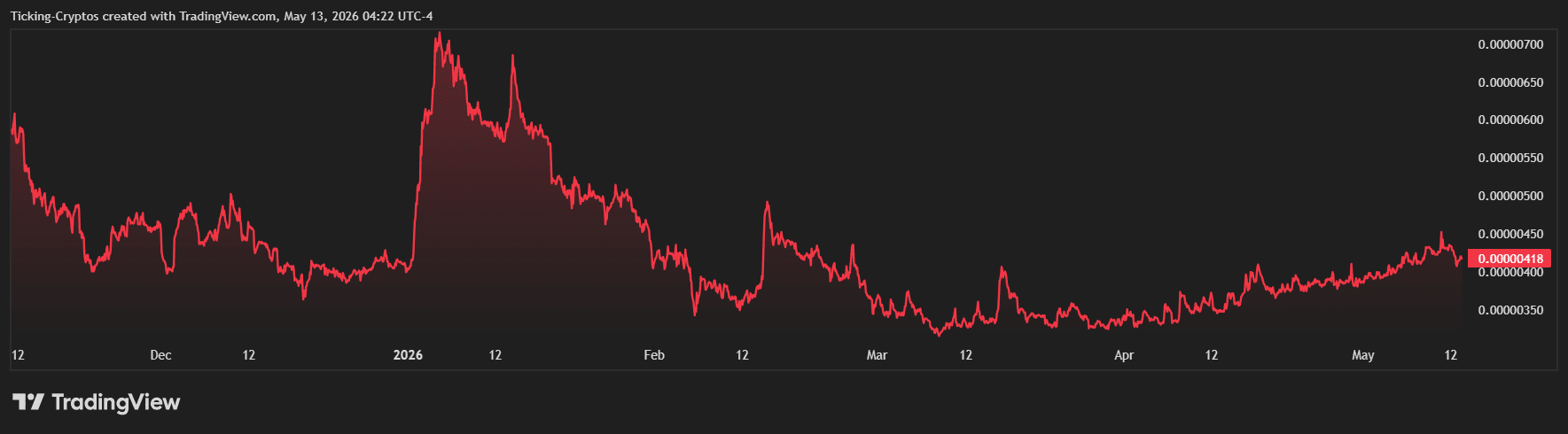
- The Bull Case: If PEPE breaks the current descending resistance, it could target $0.00000580 in the short term.
- The Bear Case: Analysts warn that if support at $0.00000304 fails, PEPE could see a further 23% drop by mid-May.
For those seeking high-risk, high-reward plays, PEPE is still "worth it" as a speculative tool, but it is no longer the "easy money" it was during its inception.
PEPE as a High-Beta Asset
In 2026, professional traders treat PEPE as a High-Beta asset. This means PEPE tends to move in the same direction as Bitcoin but with much greater intensity. When the market is "Risk-On," PEPE outperforms; when the market consolidates—as it is doing now in May 2026—PEPE often bleeds value faster than major coins.
Performance Comparison: PEPE vs. The Giants
To determine if PEPE is worth buying, we must look at how it stacks up against the "Serious" assets in May 2026.
| Asset | Price (May 13, 2026) | Market Outlook | Risk Level |
|---|---|---|---|
| Bitcoin (BTC) | $81,016 | Consolidating (Dominance up) | Low |
| Ethereum (ETH) | $2,301 | Bearish Momentum | Medium |
| XRP | $1.46 | Neutral / Regulatory Stability | Medium |
| PEPE | $0.00000418 | Neutral / Speculative | High |
PEPE vs. Bitcoin (BTC)
Bitcoin is currently the preferred choice for institutional capital, with funds flowing back into BTC as altcoins struggle. PEPE is only a superior buy if you anticipate a massive retail surge that lowers Bitcoin's dominance.
PEPE vs. XRP
XRP has found a floor at $1.40, backed by its utility in cross-border payments. PEPE lacks this fundamental "floor," making it more susceptible to total retracements if community interest dips.
PEPE Price Analysis: Key Levels for PEPE Coin
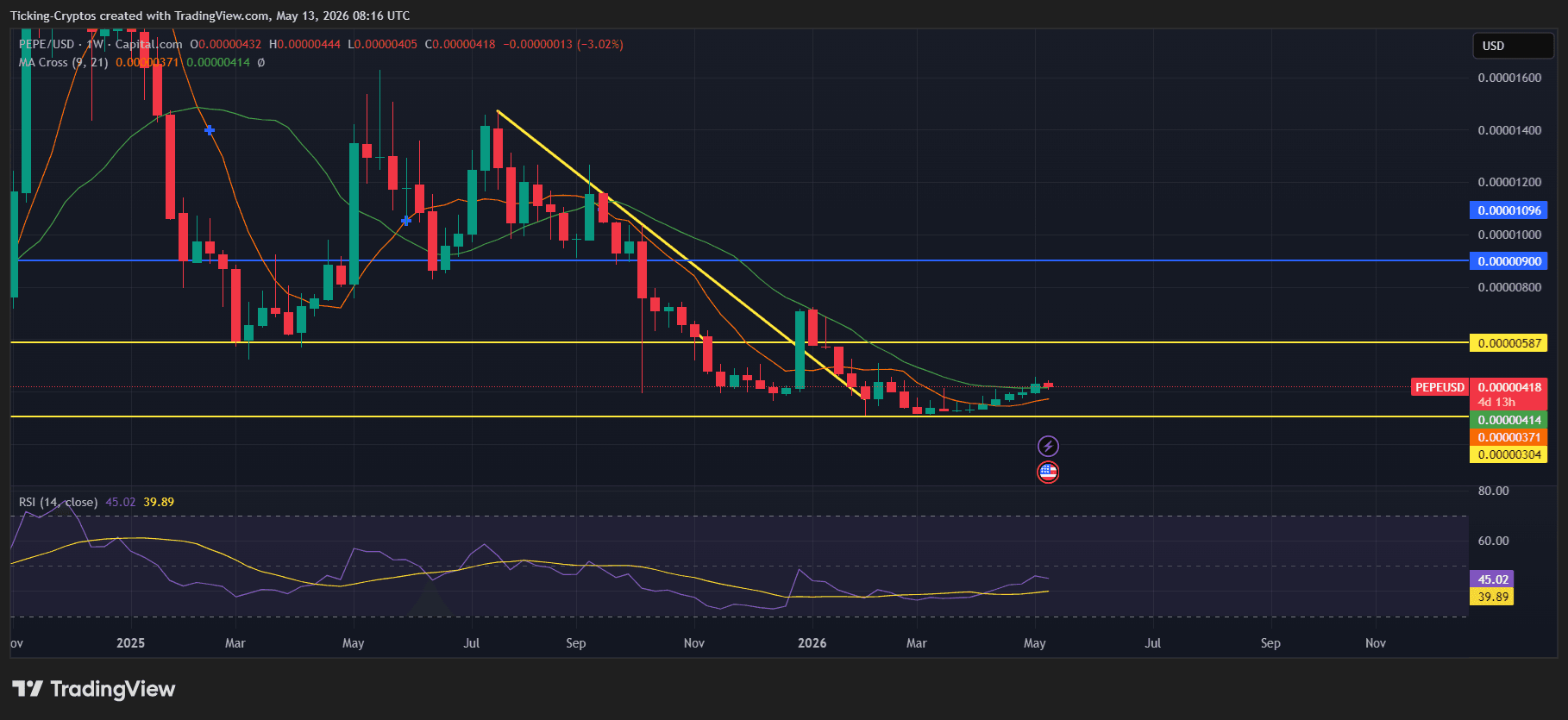
The weekly chart shows a tightening wedge. The RSI is at 45.02, which is firmly in "no man's land."
Key Support and Resistance
- Resistance ($0.00000479 - $0.00000592): PEPE has failed to break this level four times in 2026. A daily close above this is the primary "Buy" signal for trend followers.
- Support ($0.00000304): This is the ultimate "safety net." According to recent crypto news, a breach here would likely invalidate the 2026 bull thesis.
2026 Market Catalysts
- Other Frogs Threat: New competitors are siphoning liquidity from the original PEPE community, posing a significant threat to PEPE's "meme-king" status.
- Institutional Moves: While JPMorgan is launching tokenized funds on Ethereum, meme coins like PEPE rely entirely on social media virality and potential "Spot Meme ETF" rumors.
IS PEPE Coin Worth Buying in 2026?
PEPE is worth buying in 2026 only if you are using "play money." It remains a powerful tool for catching volatility, but it is underperforming compared to the stability of Bitcoin.
JPMorgan Chase intensified its foray into the decentralized finance (DeFi) ecosystem by filing for a new tokenized money-market fund on the Ethereum blockchain. This move, identified through recent SEC filings, underscores a major shift in how "Global Systemically Important Banks" (GSIBs) view public blockchain infrastructure not just as an experiment, but as a primary settlement layer for institutional liquidity.
JPMorgan’s Ethereum Strategy
The bank’s latest vehicle, the JPMorgan OnChain Liquidity-Token Money Market Fund (JLTXX), follows the successful late-2025 launch of its first public-chain fund, MONY (My OnChain Net Yield Fund). Unlike early permissioned experiments, these funds leverage the public Ethereum network, allowing for greater interoperability with the broader digital asset ecosystem.
Tokenized Money Market Funds
A tokenized money-market fund is a traditional financial product—typically investing in short-term U.S. Treasury bills and repurchase agreements—where ownership is represented by digital tokens (often ERC-20 on Ethereum).
- Yield on-chain: Investors earn dividends that accrue daily and are distributed as additional tokens.
- 24/7 Liquidity: Unlike traditional banking hours, these tokens can be transferred or redeemed near-instantaneously.
- Programmability: The fund’s "shares" can be integrated into smart contracts to serve as collateral.
Bridging Traditional Finance and Stablecoins
The timing of this launch is strategic. With the implementation of the GENIUS Act (the 2025 U.S. stablecoin legislation), stablecoin issuers are now required to hold high-quality liquid assets as reserves. JPMorgan is positioning JLTXX specifically to satisfy these legal requirements, effectively turning Ethereum into a bridge between the $240 billion stablecoin market and U.S. Treasury yields.
Institutional Competition: JPMorgan vs. BlackRock
JPMorgan is moving into a space currently dominated by BlackRock’s BUIDL fund, which recently surpassed $2.5 billion in Assets Under Management (AUM). While BlackRock has a head start, JPMorgan’s deep integration with corporate treasury desks through its Morgan Money platform gives it a unique distribution advantage.
| Feature | JPMorgan JLTXX | BlackRock BUIDL |
|---|---|---|
| Blockchain | Ethereum | Multi-chain (ETH, Arbitrum, etc.) |
| Platform | Kinexys Digital Assets | Securitize |
| Target Audience | Institutions / Stablecoin Issuers | Accredited Institutional Investors |
| Primary Assets | U.S. Treasuries / Repo | U.S. Treasuries / Cash |
Services and Utility on Ethereum
The launch of JLTXX on Ethereum entails several key services that were previously manual or siloed within internal bank ledgers:
- Atomic Settlement: Subscriptions and redemptions can happen in real-time using stablecoins or tokenized deposits, eliminating the T+1 or T+2 settlement lag.
- Collateral Mobility: Through JPMorgan’s Tokenized Collateral Network (TCN), these fund tokens can be used as collateral for derivatives or repo trades without moving the underlying assets.
- Transparent Registry: While identity is verified off-chain to meet KYC/AML standards, the record of ownership exists on a transparent, immutable ledger, reducing audit friction.
Bitcoin (BTC) continues to oscillate above the critical $80,000 psychological barrier, supported by a historic six-week streak of ETF inflows. Meanwhile, XRP has emerged as a top performer, outshining both Bitcoin and Ethereum (ETH) in recent trading sessions.
Market Snapshot: Bitcoin and XRP Performance
Investors are currently witnessing a Divergence in momentum across the board. While Bitcoin faces slight selling pressure near its local highs, Ripple's XRP has captured the market's attention with a significant breakout.
1. Bitcoin (BTC) Price Stability
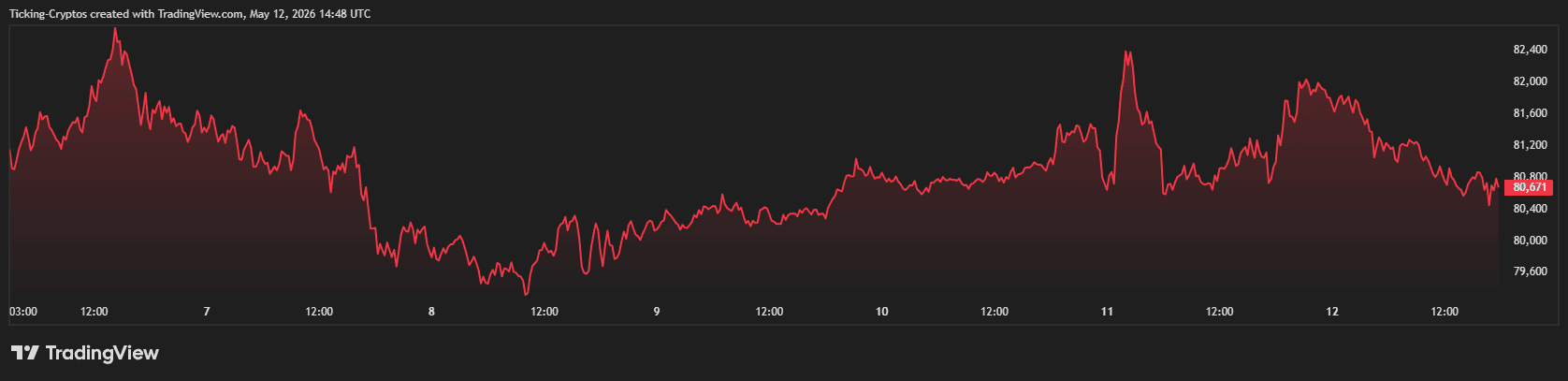
As of May 12, 2026, Bitcoin is trading at approximately $80,750, down slightly by 0.20% over the last 24 hours. The asset has established a firm trading range between $80,400 and $82,100. This consolidation is widely viewed as healthy by analysts, especially following the massive surge in late April.
2. XRP Leads the Altcoin Charge
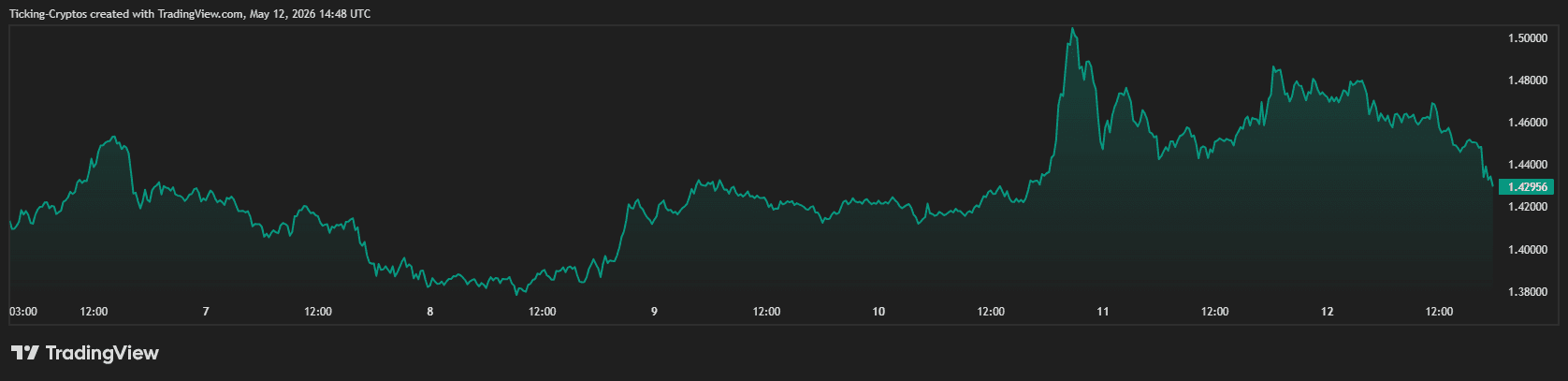
The most notable move comes from XRP, which successfully breached the $1.45 resistance level on high trading volume. Although sellers stepped in near the $1.50 mark, XRP's ability to outpace Ethereum and Bitcoin suggests a shifting appetite toward high-utility altcoins.
Institutional Era: The ETF Inflow Phenomenon
A major catalyst for the current price floor is the relentless demand from U.S. spot Bitcoin ETFs. According to recent, these funds have recorded their longest inflow streak since 2025.
- Six-Week Inflow Streak: ETFs have attracted over $3.4 billion since early April.
- AUM Records: Total Assets Under Management (AUM) for Bitcoin ETFs reached $109 billion this week, the highest level recorded in 2026.
- Supply Shock: ETFs are currently absorbing between 4,500 and 5,000 BTC daily, while only 450 BTC are mined per day—a 10:1 demand-to-supply ratio.
This "institutional era" of crypto investing is fundamentally different from previous retail-driven cycles. Wall Street wholesalers are now acting as a stabilizing force, preventing deep drawdowns even when market sentiment wavers.
What’s Next for Crypto in May 2026?
The current market structure suggests that while Bitcoin provides the foundation, the real "alpha" is currently found in selective altcoins like $XRP and $Solana. Investors are no longer buying the entire market; instead, they are rewarding projects with clear regulatory standing and technical strength. As we look toward the second half of May, the sustainability of the $80,000 level for Bitcoin will be the ultimate litmus test for the next leg toward $100,000.
The US Senate Banking Committee has officially released an expanded 309-page draft of the Digital Asset Market Clarity Act, commonly referred to as the Clarity Act. This updated version, which grew from a 278-page draft seen in January, marks a significant step forward in establishing a federal regulatory framework for digital assets. The bill arrives at a critical juncture as the industry seeks to move beyond "regulation by enforcement" and toward statutory certainty.
Jurisdictional Split: SEC vs. CFTC Authority
Investors and industry participants asking whether the new draft changes the core jurisdictional split can rest assured: the fundamental division of labor remains. The Securities and Exchange Commission (SEC) is slated to oversee most initial token sales, while the Commodity Futures Trading Commission (CFTC) will govern the spot markets and trading of tokens once they are deemed sufficiently decentralized or "mature."
What is the "Clarity" in the Act
The Clarity Act is designed to be the "ultimate rulebook" for the US digital asset market. It seeks to define three main categories:
- Digital Commodities: Under CFTC jurisdiction.
- Digital Asset Securities: Under SEC jurisdiction.
- Payment Stablecoins: Governed by a combination of the Federal Reserve and state regulators.
By creating these legal buckets, the bill aims to eliminate the gray areas that have led to years of litigation between the SEC and major exchanges.
Expanded Investor Protections and Antifraud Measures
A major addition to the 309-page text is the strengthening of investor-protection language. The draft explicitly grants the SEC enhanced authority to pursue insider trading and antifraud cases involving specific crypto offerings. This move is seen as a compromise to win over skeptical lawmakers who argue that the crypto market remains a "Wild West" for retail investors.
The Stablecoin Yield Crackdown: No More "Bank-Style" Interest
One of the most contentious sections of the bill focuses on stablecoins. The draft aims to prevent crypto platforms from operating like unregulated banks. Under the new rules:
- Passive Yield Prohibited: Platforms are barred from offering "bank-style" interest just for holding payment stablecoins (like USDC or USDT) in an account.
- Activity-Based Rewards Allowed: The bill leaves the door open for rewards tied to staking, liquidity provision, governance, or loyalty programs.
This distinction ensures that while simple "interest-bearing" accounts are restricted to licensed banks, the functional utility of DeFi and blockchain ecosystems remains intact.
Refined Focus on Tokenization and the "Build Now" Surprise
The section regarding tokenization has been narrowed. While earlier versions used broad "real-world assets" (RWA) terminology, the current draft focuses more precisely on tokenized securities. This adjustment provides clearer pathways for traditional financial institutions to bring equities and bonds on-chain.
In a move clearly designed to garner broader political support, the draft now incorporates the "Build Now Act." This housing-related legislation has no direct connection to cryptocurrency but is a strategic "rider" intended to attract votes from senators focused on urban development and affordable housing.
What’s Next for the Clarity Act?
The Senate Banking Committee is expected to move toward a formal markup session soon. For the latest updates on how these regulations might affect specific assets, you can monitor the $Bitcoin price and other major tokens on our live tickers.
The United Arab Emirates has officially authorized residents to pay government fees using cryptocurrency. This development comes through a strategic partnership between the Dubai Department of Finance (DOF) and Crypto.com, following the exchange's successful acquisition of a Stored Value Facilities (SVF) license from the Central Bank of the UAE.
Crypto for Public Services: How It Works
The new integration allows Dubai residents to settle various government-related charges—ranging from utility bills to permit fees—directly using their digital assets. While users pay in cryptocurrency, the backend system ensures that all settlements are received by the government in UAE Dirhams (AED) or Central Bank-approved, dirham-backed stablecoins.
"This initiative supports the Dubai Cashless Strategy, which aims to reach 90% cashless transactions across the public and private sectors by 2026." — Dubai Department of Finance Statement
Regulatory Framework and Access
To access this service, residents must be onboarded through the VARA-licensed (Virtual Assets Regulatory Authority) platform of Crypto.com. The SVF license issued to Foris DAX Middle East FZE (Crypto.com's local entity) is a critical component, as it bridges the gap between virtual asset wallets and traditional financial settlements under the Central Bank's framework.
Key Technical Details:
- Settlement Currency: UAE Dirham (AED).
- Approved Assets: Large-cap cryptocurrencies and approved dirham-backed stablecoins.
- Compliance: Users must undergo full KYC on the Crypto.com platform.
- Infrastructure: Integration with the Dubai Department of Finance's existing payment gateways.
What’s Next: Emirates Airline and Beyond
The scope of crypto payments in the UAE is expected to expand rapidly. Sources indicate that once further approvals from the Central Bank of the UAE are secured, the payment model could be integrated into Emirates Airline and Dubai Duty Free. This would effectively allow travelers to fund their journeys and retail purchases using their crypto portfolios.
This move reinforces Dubai's position as a premier global hub for the digital economy, providing a seamless bridge between the Bitcoin ecosystem and daily administrative life.
Decrypt
Charles Schwab started allowing select users to trade Bitcoin and Ethereum directly alongside their other investments.
The U.K.’s central bank is “not picking winners” in the debate over tokenized deposits and stablecoins, Sasha Mills said Wednesday.
A peer-reviewed audit in BMJ Open found that nearly 50% of health responses from five major AI chatbots were problematic, with fabricated sources and confident delivery.
Michael Shaulov argued that changing to a post-quantum cryptographic signature scheme is “not a technical challenge” for Bitcoin.
Hot CPI didn't stall markets for long, while the Clarity Act has already received 100 amendments ahead of tomorrow's markup.
U.Today - IT, AI and Fintech Daily News for You Today
Dogecoin maintains positive futures activity while other top cryptocurrencies flips negative in their open interest, suggesting that futures traders are taking caution on the tokens.
Legendary trader warns Bitcoin hasn't bottomed, predicting a bear channel drop as surging 6% US PPI inflation shatters market optimism.
On-chain data from CryptoQuant reveals the largest corporate XRP treasury is facing a $389 million unrealized loss after buying near the market top.
Metaplanet CEO reveals company’s plans to expand its Bitcoin treasury by introducing a Bitcoin-backed product that could become Japan’s first-ever perpetual preferred shares.
Shiba Inu is finally net negative in exchange netflows that brings the realistic possibility of a market recovery.
Blockonomi
The solana price prediction turned bullish after SOL broke above $94 and reclaimed its 100 day moving average for the first time in over 200 days. Western Union launched a dollar backed stablecoin on Solana earlier this month, and whale wallets loaded millions in SOL while retail waited on the sidelines.
But while SOL aims for $100, Pepeto has secured $10 million with a working trading hub before the expected Binance listing, and the solana price prediction cycle shows why early entries deliver the biggest returns.
Western Union Launched Stablecoin on Solana as SOL Reclaimed Key Levels
The solana price prediction gained fresh fuel after Western Union launched its USDPT stablecoin on Solana on May 4 for 24/7 settlement according to CoinDesk, the first time a 175 year old payments company chose Solana as a settlement layer.
Cofounder Yakovenko confirmed the Alpenglow upgrade could arrive next quarter. SOL ETF products pulled in $33 million in weekly inflows.
Altcoin Rally and Early Stage Tokens Compete for Capital
Pepeto: A Working Trading Hub With $10 million Raised Before Listing
Pepeto is among the most talked about presale tokens in the market, and the $10 million raised at just $0.0000001868 per token explains why. The expected Binance listing draws closer with every batch that sells out faster than the last, and a former Binance expert on the team brings the kind of operational knowledge that turns presale hype into real exchange positioning.
That combination of speed, team, and capital means wallets entering now hold the widest distance between their cost and the opening exchange price.
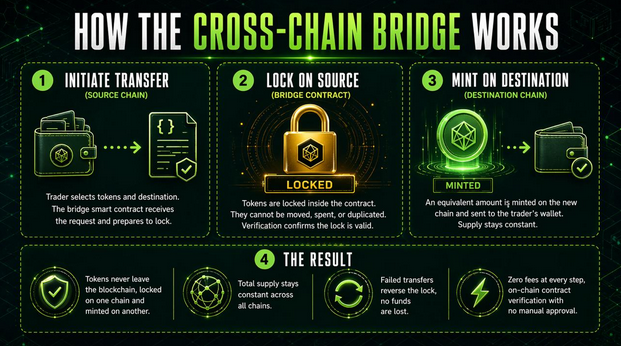
The trading hub behind that number is already live, not planned for later. PepetoSwap runs zero fee token swaps, a cross chain bridge connects multiple networks at no cost, and 173% staking APY is paying holders right now while the listing approaches. SolidProof completed the full contract audit, which means the infrastructure is verified and the product is working today, and that changes the risk profile entirely because holders are not betting on a future delivery date. They are betting on a listing event for tools that already exist.
The energy behind $10 million flowing into this presale while the market was still cautious is the kind of signal that precedes every major run. The expected Binance listing turns presale tokens into live exchange positions, and that floor holds only until the listing removes it.
Solana Price Prediction: Analysts Eye $100 After 100 Day Moving Average Reclaim
SOL gained strength through mid May after breaking above the 100 day moving average for the first time in 205 days. The token holds near $94.67 according to CoinMarketCap with analysts targeting $96 to $100 next if buyers defend the breakout.
The solana price prediction for the rest of 2026 ranges from $120 to $200 if the recovery continues and Alpenglow reaches mainnet.

Conclusion
The solana price prediction today shows capital flowing back into SOL at the same time institutions chose Solana for real payments, and that alignment has not happened since the early days when SOL traded below $1. But the market always pays the most to the earliest believers, and Pepeto is where that early window sits right now. SOL was below $1 in 2020, and the people who entered when nobody believed turned small positions into life changing wealth that later buyers spent years trying to match.
The same pattern is playing out with Pepeto, where $10 million flowed into a presale backed by working tools, a former Binance expert, and a listing that could arrive any day. The difference between entering at presale pricing and waiting for the listing is the same gap that separated people who bought SOL at $0.50 from those who bought at $50, and that gap never closes once the exchange goes live.
The presale is in its final stage, the listing window shrinks with every token sold, and the wallets that moved first will collect returns while everyone else pays the price early holders already locked in.
Click To Visit Pepeto Website To Enter The Presale
FAQs:
What is the solana price prediction for 2026?
SOL trades near $94 after reclaiming the 100 day moving average. Analysts target $120 to $200 if Alpenglow and ETF inflows continue.
Which presale competes with SOL for the biggest returns this cycle?
Pepeto secured $10 million with a live trading hub, 173% staking, and an expected Binance listing creating the widest presale to exchange gap.
The post Solana Price Prediction: SOL Holds Above $94 as Pepeto Presale Crosses $10 million and Listing Window Closes Fast appeared first on Blockonomi.
TLDR:
- Strategy’s STRC ex-dividend date on the 15th triggers monthly bitcoin buying, creating a recurring mid-month price pattern.
- STRC-driven bitcoin purchases surged from 4,467 BTC in January to nearly 46,872 BTC in April, per K33 data.
- Bitcoin’s 30-day funding rate is nearing a record 74 consecutive negative days, signaling defensive market positioning.
- Strategy proposes twice-monthly STRC dividends, a move that could tighten and amplify its bitcoin accumulation cycle.
Strategy’s perpetual preferred stock, STRC, may be quietly driving a repeating bitcoin price pattern each month. Research firm K33 has flagged a consistent mid-month surge in bitcoin during both March and April.
The firm’s Head of Research, Vetle Lunde, attributes the trend to STRC’s dividend structure, which sets share ownership eligibility on the 15th of each month.
As that date approaches, investor demand for STRC rises, and Strategy channels the fresh capital directly into bitcoin.
STRC’s Dividend Cycle Creates a Predictable Bitcoin Buying Window
The mechanics behind the pattern are straightforward. Strategy issues new STRC shares through an at-the-market program whenever the stock trades at or near its $100 par value.
Those proceeds go directly toward bitcoin purchases. Lunde explained that “the instrument pays dividends on the last day of each month, while share ownership is determined by the ex-dividend date on the 15th.”
That deadline pushes investors to position early, drives STRC back toward par, and gives Strategy the capital to keep accumulating bitcoin.
K33’s data shows May is already tracking the same setup. On Monday, May 11, STRC volumes climbed to their highest level since April 15, and the stock recovered back to $100.
Lunde pointed directly to the timing, saying, “this Friday marks another STRC ex-dividend date, and on Monday, May 11, we already saw early signs of the pattern repeating.”
With the ex-dividend date approaching, the firm expects another major bitcoin purchase announcement from Strategy by next Monday.
The scale of STRC-driven acquisitions has grown sharply this year. Strategy purchased 4,467 BTC via STRC in January, then 22,131 BTC in March, and nearly 46,872 BTC in April.
The company’s total bitcoin holdings now stand at 818,869 BTC, worth approximately $65.7 billion. STRC’s annualized yield of 11.5% continues to attract steady investor interest, sustaining the cycle each month.
Strategy has also proposed moving STRC dividend payments to twice per month. The company stated the change could “lead to reduced reinvestment lag, enhanced liquidity, market efficiency, and increased price stability.”
If adopted, the adjustment could tighten and potentially amplify the mid-month bitcoin demand window that K33 is already monitoring.
Broader Bitcoin Market Stays Cautious Even as STRC Fuels Supply Absorption
Despite the structural support STRC provides, the wider bitcoin market remains defensively positioned. Both the seven-day and 30-day average funding rates for bitcoin perpetual futures are still negative. The 30-day rate is now approaching a record-long consecutive negative streak of 74 days, according to K33.
Lunde noted that a brief uptick in funding rates earlier this week lacked genuine bullish backing. “While funding rates briefly normalized higher in recent days, the move appears largely driven by low trading activity rather than renewed bullish positioning,” he wrote, adding that open interest held flat and volumes stayed subdued throughout the period.
Bitcoin’s 30-day correlation with the Nasdaq currently sits near record highs. Yet bitcoin has slightly underperformed against the latest equity rally, complicating the view that it simply behaves as a high-beta version of tech stocks.
K33 maintains that crypto fundamentals remain solid, though near-term price action continues to closely follow equities.
On the STRC front, May has moved slower than prior months. Strategy added only 1 BTC through the instrument so far, and the stock took longer to recover to par.
Lunde acknowledged the slowdown but remained measured, saying “the week is still young” and that the firm is “prepared for yet another massive BTC purchase announcement from Strategy” by next Monday.
The post Strategy’s STRC Is Quietly Driving a Monthly Bitcoin Buying Surge, K33 Research Reveals appeared first on Blockonomi.
Key Highlights
-
Shares of EOSE surge 9% following Cerberus-backed storage venture announcement
-
Cerberus Capital commits $100M to new energy storage platform with Eos
-
EOSE stock climbs on Frontier Power USA partnership focusing on long-duration storage
-
Company locks in 2 GWh capacity agreement through Cerberus-supported deal
-
Innovative insured storage approach aims to accelerate deployment timelines
Shares of Eos Energy Enterprises (EOSE) experienced significant upward momentum following the company’s revelation of a new storage platform receiving financial backing from Cerberus Capital Management. The stock climbed to $8.86, representing a $0.76 increase or 9.44% gain, after briefly reaching prices close to $12 during trading. This rally demonstrated heightened investor enthusiasm for long-duration energy storage solutions and innovative financing structures.
Eos Energy Enterprises, Inc., EOSE
Frontier Power USA Partnership Drives EOSE Stock Higher
Eos joined forces with Cerberus to establish Frontier Power USA, an independent energy storage development entity receiving substantial capitalization. This new platform will be responsible for constructing, owning, and managing long-duration battery energy storage installations throughout the nation. Furthermore, the venture will deploy Eos’ proprietary zinc-based Z3 technology across commercial, industrial, data center, and utility-scale applications.
The Frontier Power USA initiative integrates Eos’ cutting-edge technology with Cerberus’ financial resources and Ariel Green’s performance insurance solutions. This comprehensive framework is designed to enhance project creditworthiness and accelerate the timeline from initial commitment to operational deployment. Consequently, Eos stands positioned to advance numerous projects from planning phases into active construction stages.
The partnership encompasses a committed 2 GWh capacity reservation agreement with Eos. This reservation augments the company’s existing backlog documented as of March 31, 2026. Additionally, it provides Frontier Power USA with a predetermined capacity foundation to support initial storage project rollouts.
$100M Cerberus Investment as Eos Pursues Additional Capital
Cerberus will serve as the anchor investor for Frontier Power USA with a $100 million equity investment. The investment firm simultaneously extended its current Eos lock-up agreement through December 2026. As compensation, Cerberus will receive Eos warrants alongside controlling ownership stakes in Frontier Power USA.
Eos simultaneously plans to initiate a rights offering seeking approximately $150 million in capital. The company intends to allocate these funds toward its equity stake in Frontier Power USA. Moreover, current Eos stockholders may obtain subscription rights and anticipated warrants through the proposed financing structure.
The rights offering remains contingent upon multiple requirements. These prerequisites include board authorization, shareholder consent, and specific approvals under current debt covenants. Nevertheless, the framework is structured to provide existing shareholders participation opportunities while minimizing dilution for those who choose to participate.
Insurance Framework Enhances Storage Project Bankability
Frontier Power USA established a Technology Performance Insurance agreement with Ariel Green. The framework provides coverage for anticipated long-duration storage installations utilizing Eos’ Z3 battery systems. It envisions 15-year non-cancellable insurance policies with total capacity reaching approximately $1.5 billion.
The insurance structure is intended to facilitate financing through top-rated insurance markets, including Lloyd’s of London syndicate participants. As a result, projects may secure extended debt maturities and reduced cost of capital. This arrangement could enable Frontier Power USA to finance storage infrastructure on investment-grade equivalent terms.
Eos anticipates that Frontier Power USA will isolate project financing from its consolidated balance sheet. This configuration enables Eos to concentrate on manufacturing capabilities, technology advancement, and project execution. Simultaneously, Frontier Power USA can pursue asset ownership and generate long-term storage revenues.
Context: Growing Appetite for Long-Duration Storage Solutions
Long-duration energy storage has emerged as increasingly critical as electricity consumption accelerates nationwide. AI-powered data centers, transportation electrification, and grid stability requirements continue driving storage demand upward. As a result, companies offering scalable domestic storage technologies now enjoy enhanced competitive positioning.
Eos specializes in zinc-based battery technology engineered for long-duration energy storage applications. The company maintains sourcing and production operations within the United States. This domestic manufacturing emphasis reinforces its contribution to energy independence and supply chain stability.
Frontier Power USA provides Eos with a potential pathway to expedited commercial rollout. The platform unifies technology, financing, insurance, and development capabilities within a single organizational structure. Therefore, the transaction bolstered market sentiment surrounding EOSE stock and reinforced investor confidence in its storage expansion strategy.
The post Eos Energy Enterprises (EOSE) Stock Surges on Cerberus-Backed Storage Partnership appeared first on Blockonomi.
Key Highlights
- TSLA shares have jumped approximately 30% in the last month, despite a 4% decline year-to-date
- Elon Musk is currently in China seeking regulatory approval for Full Self-Driving technology in the region
- The company disclosed 1.3 million FSD subscribers in Q1 2026, representing growth from 850,000 subscribers in the prior year
- Model S and X assembly lines have been shut down to facilitate Optimus humanoid robot production
- Industry analysts at McKinsey anticipate widespread robotaxi deployment across global markets by 2030
Shares of Tesla ($TSLA) are currently hovering near $448, reflecting an approximate 30% gain over the last month, although the stock continues to post a 4% decline year-to-date.
Tesla, Inc., TSLA
The equity experienced an early Wednesday uptick before retreating, settling at $432.08—a 0.3% decline—as CEO Elon Musk departed aboard Air Force One for China, accompanied by prominent American executives including Nvidia’s Jensen Huang, Apple’s Tim Cook, and Boeing’s Kelly Ortberg.
This diplomatic visit carries significant implications. Tesla is pursuing authorization to commercialize its Full Self-Driving (FSD) advanced driver assistance system in China, a development that could substantially broaden its revenue from subscriptions.
Within the United States, FSD is priced at $99 monthly. The electric vehicle manufacturer concluded Q1 2026 with 1.3 million FSD subscribers, climbing from approximately 850,000 subscribers twelve months earlier.
Securing Chinese market access would provide substantial momentum for an enterprise that has positioned its trajectory around artificial intelligence innovations—including FSD capabilities, autonomous taxi services, and humanoid robotics.
During Tuesday’s trading, the stock declined 2.6%, ending a four-session rally that had delivered gains exceeding 14%. That upward momentum was partially attributed to anticipation surrounding potential FSD authorization in China.
Tesla’s core automotive operations are confronting headwinds. The manufacturer is grappling with softening vehicle demand, a relatively stagnant product portfolio, and intensifying international competition.
Instead of aggressively updating its vehicle offerings, Musk has been reallocating capital toward strategic long-term initiatives.
Optimus Robot Production Accelerates
Earlier this month, Tesla discontinued manufacturing of its Model S and Model X vehicles. The freed-up production capacity is being repurposed to establish assembly operations for the company’s Optimus humanoid robot platform.
Market participants are anticipating information regarding Optimus version three, which may be showcased during the summer months.
Tesla has maintained operational security around its developments. During the Q1 earnings discussion, Musk explained that rival companies conduct “frame-by-frame analysis” of Tesla’s public demonstrations and replicate innovations rapidly.
Autonomous Taxi Market Potential
Beyond robotics, the autonomous taxi sector represents a cornerstone of the investment thesis for Tesla bulls.
Consulting firm McKinsey & Co. forecasts that robotaxi services will achieve large-scale commercial deployment internationally around 2030. Ark Invest’s Cathie Wood estimates the total addressable market opportunity between $5 trillion and $10 trillion.
Tesla has already commenced manufacturing its Cybercab vehicle, a purpose-built platform designed exclusively for autonomous taxi operations. Test programs are currently operational across multiple metropolitan regions.
Tesla’s established production infrastructure, which appears disadvantageous given current automotive sales weakness, may prove strategically valuable as robotaxi market demand accelerates.
The company reported 1.3 million FSD subscriptions at Q1 2026’s conclusion, with substantial growth potential contingent upon Chinese regulatory approval.
The post Tesla (TSLA) Stock Surges on China FSD Prospects and Optimus Robot Expansion appeared first on Blockonomi.
Key Takeaways
- Ondas releases Q1 2025 results Thursday morning, with Wall Street forecasting approximately $38–39M in revenue and an EPS loss of $0.05
- The defense-focused company’s pro forma backlog reached $457M, significantly enhanced by the Mistral acquisition which contributed roughly $264M of the $175M merger value
- The entire analyst community covering ONDS—7 to 8 firms—maintains Strong Buy ratings, with average price targets near $20.13–$20.14, suggesting potential gains of 118–124% from the current $9.04 level
- The options market anticipates a 15.25% price swing following the earnings announcement, signaling considerable investor uncertainty
- The company projects 2026 revenue reaching minimum $375M, though full profitability across operations isn’t anticipated before Q1 2028
Ondas Holdings faces a pivotal moment Thursday as it prepares to unveil its quarterly financial performance. Currently trading near $9.04 with a six-month gain exceeding 56%, the company’s trajectory has captured significant market attention.
Ondas Holdings Inc., ONDS
Wall Street’s consensus points to Q1 revenue in the $38–39 million range alongside a per-share deficit of $0.05—representing substantial progress compared to last year’s comparable quarter, which delivered only $4.2 million in sales with a $0.15 per-share shortfall.
This dramatic year-over-year transformation demands attention. The growth story centers largely on strategic acquisitions and an aggressively expanding defense contract portfolio.
The headline figure for this period is the order book. Ondas‘ combined backlog—incorporating the recently integrated Mistral and World View operations—reached approximately $457 million at quarter-end March 31. The Mistral transaction, valued at $175 million, contributed roughly $264 million to the cumulative backlog.
Leadership has established a 2026 revenue floor of $375 million. Needham’s Austin Bohlig believes the company might approach $500 million with solid operational performance.
Contracted Work Provides Revenue Visibility
The company’s contract pipeline contains tangible commitments. Ondas maintains involvement in approximately $80 million worth of active demining initiatives related to Israel’s Eastern Border Security Barrier project.
Additionally, its INDO Earth Moving division secured an initial contract worth roughly $68 million as part of a broader $140 million multi-year military engineering program. These extended-duration agreements provide meaningful forward revenue transparency.
The organization also established the ONBERG Autonomous Systems partnership in Germany, positioning for expansion into European defense drone markets.
Last quarter delivered record Q4 revenue of $30.1 million, substantially exceeding the $15.9 million analyst consensus. However, the bottom line disappointed significantly with a $0.34 per-share loss.
Wall Street Forecasts and Derivatives Positioning
Every analyst following Ondas maintains a Strong Buy stance. Price objectives span from $20 to $25, clustering around $20.14—more than doubling the present share price.
Maxim’s Matthew Galinko elevated his target to $22 from $16, highlighting that Ondas possesses sufficient capital to sustain operations until reaching breakeven, which leadership anticipates in 2028.
The derivatives market tells a more cautious story. Option pricing implies a 15.25% move in either direction following the earnings release—an unusually wide expected range reflecting genuine uncertainty about revenue trajectory sustainability.
Profitability remains a multi-year objective. Management anticipates product-level profitability by Q3 2026, but organization-wide positive earnings won’t arrive until Q1 2028.
Thursday’s financial disclosure represents the initial meaningful examination of whether the substantial backlog translates into recognized revenue at projected rates.
Ondas releases results before Thursday’s market opening on May 14, 2026.
The post Ondas (ONDS) Stock: Q1 Earnings Preview Shows $457M Defense Backlog in Focus appeared first on Blockonomi.
CryptoPotato
Many leading cryptocurrencies have seen some volatility over the past 24 hours, yet their price swings don’t compare to the devastating crash that five lesser-known altcoins experienced.
The culprit behind that meltdown was Binance, which recently announced its latest delisting effort.
The Heavy Bleeding
The world’s largest crypto exchange revealed that it has conducted another review to ensure that all coins listed on the platform meet high standards and industry requirements. Based on its analysis, it decided to terminate all services involving Automata (ATA), Harvest Finance (FARM), Enzyme (MLN), Phoenix (PHB), and Syscoin (SYS).
The delisting will take place on May 27, with Binance explaining that deposits of these tokens will not be credited to users’ accounts after May 28. Moreover, withdrawals will remain available until July 27.
The news has caused a major decline for the involved coins. All of them have plunged by double digits immediately after the disclosure, with SYS taking the biggest blow as its valuation has tumbled by 34%.
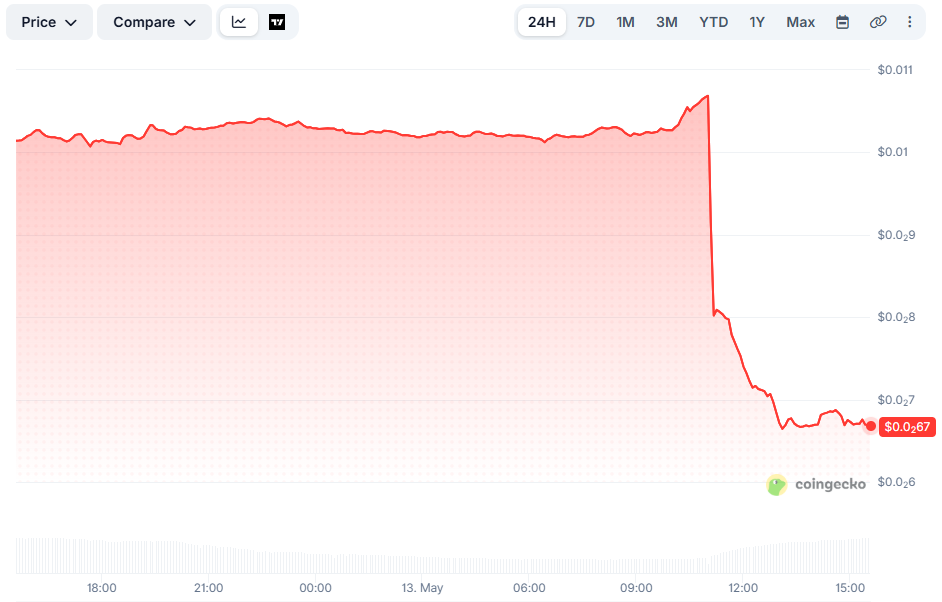
Such price reactions are hardly surprising, since losing backing from a crypto behemoth like Binance typically leads to reduced liquidity, lower market visibility, and reputational damage.
In April, Beefy.Finance (BIFI), FunToken (FUN), FIO Protocol (FIO), Orchid (OXT), Measurable Data Token (MDT), and Wanchain (WAN) posted similar losses after the exchange removed them from its platform. Shortly after, Dego Finance (DEGO), DENT (DENT), and TrueFi (TRU) met the same fate.
Other Recent Updates
Earlier this week, Binance listed the trading pairs MEGA/U, TON/U, and TON/USD1 to its margin program. The initiative was once again primarily centered on United Stables (U) – a stablecoin launched in late 2025 and pegged to the American dollar.
Over the past months, the exchange expanded the list of trading pairs on Binance Spot by adding XRP/U, SUI/U, ASTER/U, and PAXG/U. It also included AVNT/U, BIO/U, CHIP/U, KAT/U, CHIP/USD1, and XAUT/USD1 on Cross Margin.
Just recently, it announced that users can spend U tokens with their Binance Cards and earn 15% cashback. The offering comes with 0 conversion fees and 0 Foreign Exchange (FX) charges.
The company explained that the reward will be distributed in tokens designated by the company, at its sole discretion, before June 30. The cashback is non-transferable, non-exchangeable, and cannot be redeemed for cash or any other benefit, it added.
The post Brutal Price Collapse for 5 Altcoins After Binance Says Goodbye: Details appeared first on CryptoPotato.
Prediction market platforms such as Polymarket regularly observe millions in volume on most of their events, ranging from election outcomes to crypto price targets. That said, one persistent problem remains: most participants are essentially just guessing. They pick a side based on brief research, gut instinct, social media noise, or whatever narrative may feel more convincing that specific week.
Poly Truth is positioning itself as a platform that wants to fix that. Rather than being just another prediction platform, it’s an intelligence layer, which is built on top of prediction markets. Think of it as an AI-powered tool designed to analyze active events, score outcomes by probability, and explain the reasoning behind each call. The project’s website lays out the pitch in full, along with details of its live presale for the native token PTRUE.
The project has raised $170,000 in the first 24 hours of the presale, suggesting a real audience for this kind of tool and an understanding of what it helps with and why.
How Poly Truth Works: The Three-Character System
Poly Truth frames its architecture around three main functions, each one of which is represented by a character. This can serve more like a useful mental model, so let’s walk through each one of them.
The Runners are automated bots that are designed to continuously scrape information from across the internet. Whenever there is an active prediction event (an election, a crypto market call, a sports match, etc.), the Runners are pulling relevant information from multiple different sources in real time.
The Starlet, on the other hand, is the AI analyst at the heart of the system. It’s designed to take the raw data from the Runners, cross-reference sources, identify patterns, and generate a probability score for each possible outcome. This is where the actual intelligence is nested.
The Presenter is how the users interact with the results. It surfaces the findings in plain language – which events have strong data-based support, and what the probability breakdown looks like, as well as why the model made the decisions it did.
When these are put together, the system is designed in a way that turns noisy and scattered information into a structured view of a prediction event, giving the user more context on whether to take a position or not.
What Poly Truth Isn’t
It’s important to note that this is not a trading bot, and it’s not a financial advisor. The platform doesn’t manage funds, guarantee outcomes, or execute trades. The value proposition here is strictly informational. It’s designed to give users a more grounded basis for their own decisions when it comes to prediction markets.
This is a critical distinction. Many projects in this space are blurring the lines between an automated trading system and a signal tool. Poly Truth’s framing is analytical, and that’s explicit. Whether that’s how it ultimately gets used in practice is a question that’s completely separate. However, the design intent is not automation – it’s education and data.
The PTRUE Token
The native token of the platform carries the ticker PTRUE. It’s live in presale with a current price of $0.001190. Here is the supply breakdown:
- Total supply: 11.5 billion tokens
- Presale allocation: 40%
- Liquidity: 17%
- Development: 13%
- Team: 10%
- Staking: 10%
- Marketing: 8%
- Community/Airdrops: 2%
At the time of this writing, there is a listed staking APY of 4,452%, which is definitely an impressive number. However, keep in mind that these yields are fairly common in early-stage presale projects and tend to compress significantly as more tokens enter circulation. This is a mechanism that is designed to incentivize early holders to lock their tokens rather than sell them right off the bat – it’s not a figure that reflects long-term sustainable yield.
The token is built on Ethereum, with the contract address listed on the site. Payment options are flexible: ETH, BNB, SOL, USDT, USDC, card, and SEPA – all of these are accepted. This should remove most of the friction for buyers who come from different chains or even traditional finance.
Who is This For?
The primary audience for the project is undoubtedly active participants in prediction markets – people who are interested and are already using platforms like Polymarket or similar services and are looking for a smarter and more data-informed approach to the way they evaluate probabilities.
However, it could also appeal to:
- Crypto-native users
- Researchers and analysts
- Casual participants
The interface is designed to be beginner-friendly, at least that’s how it’s described, and it matters. Prediction markets do have a reputation for being a bit overwhelming. If Poly Truth can make probability reasoning a bit more accessible to a broader audience, then the product might become really interesting.

Early Traction and What to Watch
Raising $170,000 in the first 24 hours of the presale doesn’t validate the project on its own. However, it’s an indication that there is genuine early demand. The more meaningful metrics will, of course, come after launch: how accurate the AI’s probability scores are over time, whether the platform will be able to sustain a user base that’s engaged beyond the initial presale excitement, and so forth.
The prediction market space is undoubtedly becoming much more competitive. Tools that add analytical value rather than just another token tend to have more staying power.
For anyone researching the project in detail, the full tokenomics, contract address, and presale mechanics are available on the Poly Truth website.
The post Poly Truth Hit $170K in 24 Hours: Here’s What This AI Prediction Tool Actually Does appeared first on CryptoPotato.
Sports and fans have always had a dialectical relationship. In some cultures and organisations, the club or sport calls all the shots and the fans adapt. In others, there is fan ownership of the team and shared governance.
Sports web3 has made it easier for this tense relationship to be more of a two-way street. Fans are more engaged than before, and the newfound digital fan experience all comes down to technology. It started off as Twitter and YouTube, but not blockchain is truly offering infrastructural opportunities, like fan tokens.
For clubs, the fan data captured on the blockchain is a useful marker of sentiment, predictive behaviour, and a way to more accurately reward loyalty. For fans, it’s about having evidence of their support – a new currency.

The information gap
The use of fan tokens in major sports leagues has created a need for dedicated educational resources. Platforms like Socios have helped explain token-based fan participation models to global audiences, because it is extremely novel and strange at first, and it’s helping supporters to engage with their favorite teams in new ways.
For this ecosystem to mature though, users really do need convincing. They need context and to trust the motivations, and this is where information hubs come in. For example, FanTokens provides help to people track market movements, understand concepts, and look at governance utility so they can understand what’s going on behind these digital assets.
By offering fan tokens data insights, these platforms put minds at rest over market volatility. They’re analytical reference points for those getting to grips with web3 sports platforms, and even stabilize the market so that it’s grounded in fan token data rather than just speculation. It’s the difference between just guessing a player’s popularity given its actual jersey sales and knowing how many fans across three continents voted on a specific kit design.
Transparency and ownership
At the heart of this infrastructure is digital ownership. Traditional engagement metrics have never been transparent like the public blockchain ledgers, nor immutable, regarding fan participation. Things like on-chain voting or performance-related token burns – it’s helping build trust because of the transparency.
Tokenized sports ecosystems encourage better support for their club because it reflects how their involvement impacts the broader network too. Sports blockchain adoption is still in its infancy despite being taken on by major soccer clubs. Both fans and stakeholders alike are enjoying the visibility of metrics and reward distributions – it’s not just about pushing a like button anymore, but actual stake-weighted governance. We aren’t too far away from a fan-managed team with on-field tactical inputs or player selection, at least as an experiment.
Such decentralized sports communities can’t use complex technology without everyday usability and understanding. It’s still maturing, and while it continues to do so, the demand for structured education and analytics will only mount up. Prioritizing transparent information is a must for all parties so that data-driven fandom can continue to reflect and reward the masses. There simply are no sports without fans.
Disclaimer: The above article is sponsored content; it’s written by a third party. CryptoPotato doesn’t endorse or assume responsibility for the content, advertising, products, quality, accuracy, or other materials on this page. Nothing in it should be construed as financial advice. Readers are strongly advised to verify the information independently and carefully before engaging with any company or project mentioned and to do their own research. Investing in cryptocurrencies carries a risk of capital loss, and readers are also advised to consult a professional before making any decisions that may or may not be based on the above-sponsored content.
Readers are also advised to read CryptoPotato’s full disclaimer.
The post How Fan Tokens are Becoming Trusted Data Sources in the Sports Web3 Ecosystem appeared first on CryptoPotato.
The company behind the popular cryptocurrency XRP made headlines again by collaborating with some well-known names.
The price of its native token has risen by 9% over the past month, while the sustained institutional interest suggests a further ascent could be on the way.
Partnerships and More
Earlier this week, Ripple announced the successful closing of a $200 million debt facility from funds managed by Neuberger Specialty Finance, the dedicated asset-based division within the global investment management firm Neuberger.
The new capital will help Ripple Prime (formerly known as Hidden Road) to expand its services and support more institutional clients. Ripple also noted that demand for reliable, large-scale financing solutions continues to grow across both traditional and digital markets. Speaking on the matter was Noel Kimmel, President of Ripple Prime:
“This facility enables us to grow alongside our clients by delivering increased margin capacity, greater responsiveness, and improved capital efficiency. Neuberger Specialty Finance has deep expertise in asset-based finance and a strong understanding of our business model, and its support reflects the differentiated prime services platform we have built and the many growth opportunities available to us.”
For his part, Peter Sterling (Head of Neuberger Specialty Finance) applauded Ripple Prime for building an innovative brokerage platform that combines “fintech-grade technology and agility with bank-level compliance and operational rigor.”
The initiative caught the eye of numerous crypto commentators. The popular X user Vincent Van Code claimed this has marked Ripple’s jump into “financial liquidity.”
“Land wait til this $200m number becomes $20BN on chain. And then wait for XRP to become not only the bridge but a margin facility,” they added.
In the meantime, the Brazilian fintech and blockchain infrastructure company Levery joined Ripple UDAX and the local research and educational foundation FGV “to bring institutional on-chain liquidity” to LatAm banks. UDAX stands for the University Digital Asset Xcelerator – a mutual initiative between Ripple’s University Blockchain Research and UC Berkeley.
The ETF Front
Institutional interest in spot XRP ETFs has strengthened lately, with millions of dollars flowing into these products daily. On May 11 alone, inflows topped $25 million, marking the best day since the beginning of January. In fact, the last time outflows surpassed inflows was on April 30.
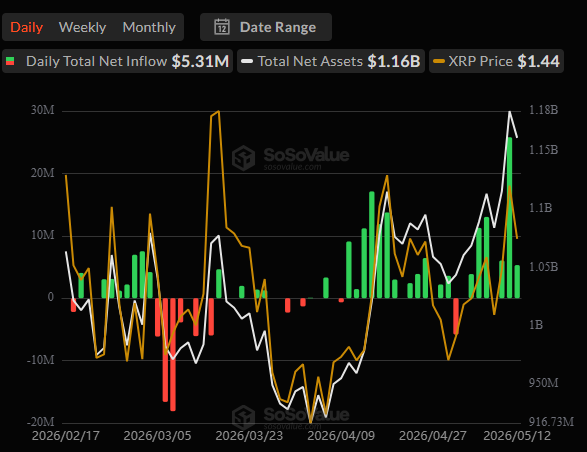
When new capital enters these products, issuers must buy actual XRP to back the sold shares. This steady demand can lift the asset’s price, especially when it outpaces available supply.
The companies that offer such ETFs in the USA include Canary Capital, Bitwise, Franklin Templeton, Grayscale, and 21Shares. The cumulative total net inflow generated by these financial vehicles since their launch is over $1.36 billion.
RLUSD’s Progress
Ripple is best known for its native token XRP, but its ecosystem also includes the stablecoin RLUSD, which is pegged 1:1 to the American dollar.
It officially saw the light of day towards the end of 2024, and since then, numerous financial giants and exchanges have embraced it. Some examples include the oldest bank in the US, BNY Mellon, as well as the popular trading venues Binance and OKX. Recently, Quick AI revealed that RLUSD is available on its payment protocol Q402.
“Users can pay in RLUSD without holding gas. Q402 covers execution. Every payment also gets a Trust Receipt: signed, shareable, and verifiable in the browser,” the announcement reads.
As of press time, the stablecoin’s market capitalization stands at almost $1.6 billion, making it the 56th-biggest cryptocurrency.
XRP Price Outlook
The asset trades at roughly $1.42 after posting a solid 9% increase over the past month. Moreover, several factors suggest that a more substantial pump could be on the horizon. A few days ago, the renowned analyst Ali Martinez disclosed that the TD Sequential indicator had flashed a buy signal on XRP’s price chart, expecting an ascent to $1.82 if the valuation decisively breaks through the $1.45 resistance.
Moreover, the analytics platform Santiment revealed that the number of wallets holding at least 10,000 tokens has reached a new all-time high of 332,230.
“Historically, rising numbers of mid-to-large wallets suggest increasing conviction from investors who are less focused on short-term price swings and more interested in long-term positioning. This is especially notable because XRP has spent much of 2026 trading below previous highs, meaning many holders appear willing to accumulate during fear rather than chase momentum,” the team added.
The post Ripple (XRP) News Today: May 13 appeared first on CryptoPotato.
Metaplanet reported a ¥114.5 billion (around $725.6 million) net loss in the first quarter of fiscal year 2026, as declining Bitcoin prices led to massive accounting valuation losses on its holdings.
The company reported an ordinary loss of ¥114.9 billion ($728 million), largely driven by ¥116.3 billion ($736 million) in Bitcoin valuation losses recorded during the quarter.
Metaplanet Quarterly Loss
Despite the losses, Metaplanet posted strong operating growth. Its net sales rose 251.1% year-over-year to ¥3.08 billion ($19 million), and its operating profit increased 282.5% to ¥2.27 billion ($14.3 million). Revenue from its Bitcoin Income Generation business, which includes option premium strategies tied to BTC derivatives, rose sharply to ¥2.54 billion.
Metaplanet’s Bitcoin holdings increased to 40,177 BTC by the end of March 2026, up from 35,102 BTC at the end of December 2025. It has managed to retain its position as the largest Bitcoin-holding listed company outside the United States, according to the filing.
During the quarter, the company continued raising capital through common share issuances, preferred shares, stock acquisition rights, and Bitcoin-backed credit facilities to support additional BTC purchases.
Metaplanet also disclosed that it secured a $500 million Bitcoin-collateralized credit facility and had drawn $302 million under the arrangement as of May 13, 2026. Total assets fell to ¥466.7 billion at the end of March from ¥505.3 billion at the end of 2025, mainly due to lower Bitcoin valuations.
“The Company will continue to accumulate Bitcoin, grow Bitcoin per share, and allocate capital with discipline. Over time, it intends to develop financing capabilities, operating businesses, and institutional relationships that make its Bitcoin position more productive and durable. This work sits inside a larger shift in how money and capital markets are organized. The Company intends to contribute to the development of Japan’s digital capital markets.”
Metaplanet’s Disclosure Practices Controversy
The results come as the company faces criticism online over its Bitcoin acquisition strategy and disclosure practices. Earlier this year, CEO Simon Gerovich defended the company’s strategy while explaining that all Bitcoin purchases, wallet addresses, and borrowing arrangements had been disclosed in real time.
Gerovich also said the company’s options strategy was aimed at acquiring BTC below spot prices through premium income rather than speculating on short-term price movements.
The post Japan’s Biggest Corporate Bitcoin Holder Reports $736 Million Valuation Loss appeared first on CryptoPotato.