Cryptocurrency Posts
Crypto Briefing
AEVS enhances trust and transparency in AI agent operations, crucial for scaling autonomous systems and ensuring accountability in complex networks.
The post Fetch.AI launches AEVS for verifiable AI agent executions appeared first on Crypto Briefing.
Hayes' bullish Bitcoin forecast suggests potential economic shifts, highlighting the impact of monetary policy and tech investment on asset markets.
The post Arthur Hayes predicts Bitcoin will surge past $90,000 amid bull market appeared first on Crypto Briefing.
strkBTC's launch on Starknet could revolutionize Bitcoin transactions by enhancing privacy, potentially reshaping DeFi and compliance landscapes.
The post Starknet launches strkBTC for ZK-powered shielded Bitcoin on Layer 2 appeared first on Crypto Briefing.
The ruling curtails executive power, emphasizing Congress's role in trade policy, potentially reshaping future U.S. economic strategies.
The post Trump loses trade superpower after Supreme Court ruling strikes down IEEPA tariffs appeared first on Crypto Briefing.
Labour's internal strife may weaken its electoral prospects, potentially altering UK political dynamics and impacting future policy directions.
The post Wes Streeting prepares to challenge Keir Starmer amid Labour Party turmoil appeared first on Crypto Briefing.
Bitcoin Magazine
Bitcoin Magazine
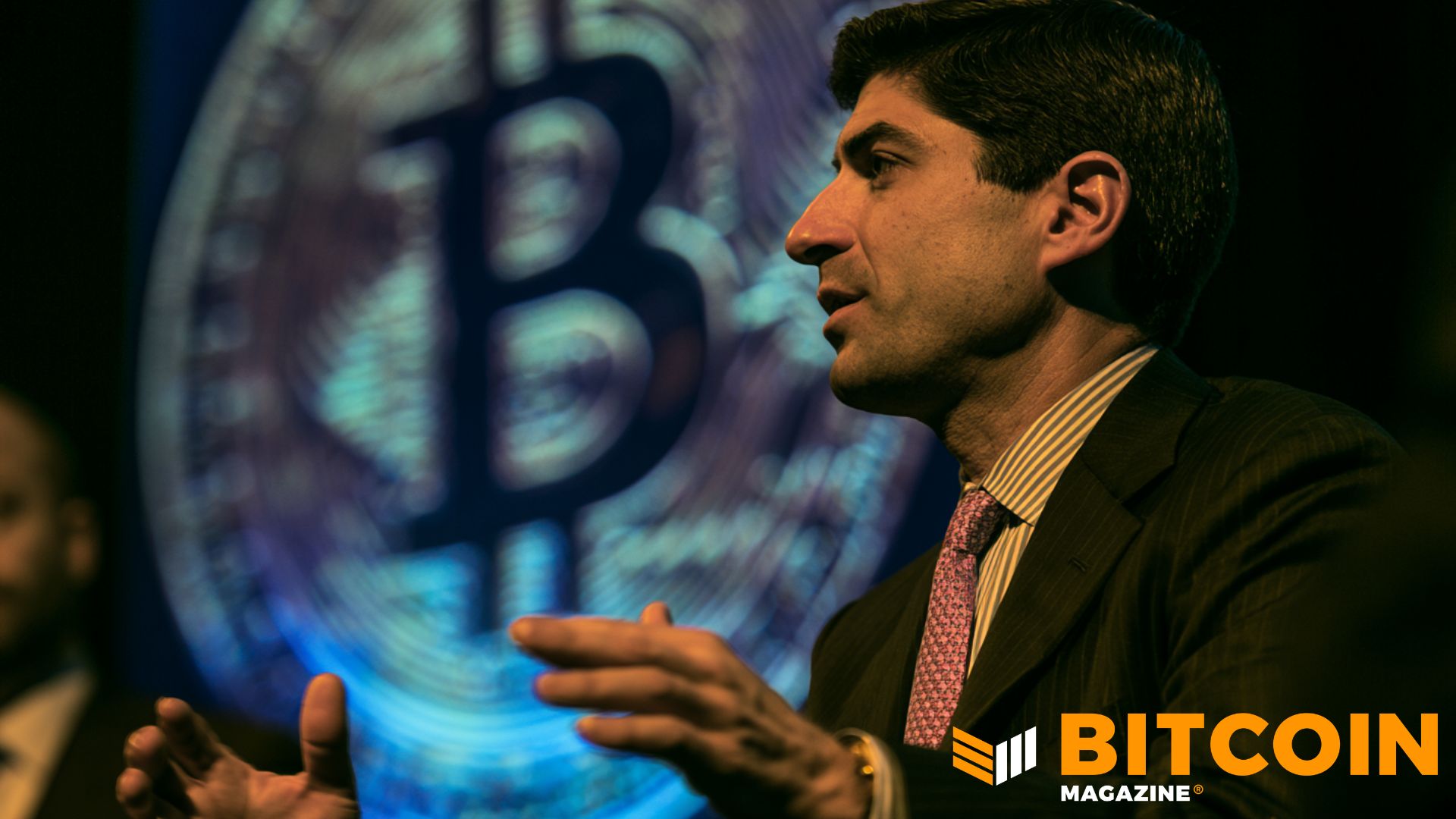
Senate Confirms Bitcoin Friendly Kevin Warsh As Fed Chair Ahead of Clarity Act Vote
The Senate on Wednesday confirmed Kevin Warsh as the next chair of the Federal Reserve in the most divisive confirmation vote in the central bank’s modern history, handing President Donald Trump a landmark win just as fresh inflation data clouds the path to the interest rate cuts he has loudly demanded.
The chamber voted 54–45 to confirm Warsh, 56, making him the 11th Fed chair of the modern banking era and the wealthiest person ever to hold the position. The vote was nearly entirely along party lines, with only Pennsylvania Democratic Senator John Fetterman crossing over in support.
BREAKING:
— Bitcoin Magazine (@BitcoinMagazine) May 13, 2026Pro-Bitcoin Kevin Warsh officially confirmed as Federal Reserve Chair in Senate vote. pic.twitter.com/LfVVSbAsGA
Warsh takes over from Jerome Powell, whose four-year term as chair expires Friday — though Powell is not departing the Fed entirely, as he retains his seat as a board governor through 2028.
Warsh is no stranger to the Fed’s marble corridors. He previously served on the Board of Governors from 2006 to 2011, becoming the youngest member in the institution’s history at age 35.
His return comes at a far more turbulent moment: the Fed is grappling with persistent inflation above its 2% target, economic fallout from the war in Iran, and a looming Supreme Court fight over the fate of Governor Lisa Cook.
Trump has made no secret of his expectations. The president repeatedly clashed with Powell over what he viewed as overly restrictive monetary policy, and Warsh was selected from a field of nearly a dozen candidates — including current governors Christopher Waller and Michelle Bowman — with rate relief firmly in mind.
Yet this week’s data has complicated the picture, with pipeline price pressures accelerating at their highest pace in more than three years, causing markets to scale back rate-cut bets and even price in a chance of an increase later this year. Warsh’s first FOMC meeting as chair is scheduled for June 16–17.
Warsh: Bitcoin doesn’t trouble me
For the Bitcoin community, Warsh’s confirmation carries singular weight. He is the first incoming Fed chair to have held direct exposure to digital assets, including an equity stake in Flashnet, a Bitcoin payments startup, as well as ties to crypto index manager Bitwise and stablecoin project Basis.
He has publicly described Bitcoin as “an important asset” and “a very good policeman for policy,” arguing its price reflects real-world confidence in the Fed’s inflation management. “Bitcoin doesn’t trouble me,” Warsh said at a Hoover Institution event last year, framing it as a signal of monetary credibility rather than a threat to the dollar.
Lawmakers are set to vote tomorrow on the Clarity Act, a closely watched piece of legislation that could reshape regulatory oversight for bitcoin and digital assets in the United States.
Rep. French Hill (R-AR) praised the confirmation, saying Warsh’s “commitment to disciplined monetary policy will help restore confidence in our economy”.
Critics, including Sen. Elizabeth Warren, spent his April 21 confirmation hearing warning that political pressure from the White House could compromise the Fed’s independence — a concern Warsh flatly rejected, vowing to keep monetary policy “strictly independent”.
Powell, for his part, said he plans to “keep a low profile as a governor.”
This post Senate Confirms Bitcoin Friendly Kevin Warsh As Fed Chair Ahead of Clarity Act Vote first appeared on Bitcoin Magazine and is written by Micah Zimmerman.
Bitcoin Magazine
Coinbase CEO Says Crypto Bill Could Rewire American Finance — Senate Votes Thursday
A long-stalled crypto market structure bill is moving through Congress with new momentum — and Coinbase’s top executive says it could reshape the American financial system.
Coinbase CEO Brian Armstrong declared his company’s support for the Digital Asset Market Clarity Act on Wednesday, calling the legislation a “true compromise” that balances the demands of the crypto industry against the interests of the traditional banking sector and signaling the bill is in the best shape he has seen since negotiations began.
The statements, via Fox News, came as the Senate Banking Committee prepared to hold its markup of the CLARITY Act on May 14, the first formal committee vote on the legislation in the Senate after months of procedural delays and two cancelled markups.
Committee Chairman Tim Scott has set a target of June or July 2026 for a full Senate floor vote, while the White House has marked July 4 as its goal for a presidential signature.
JUST IN: Coinbase CEO Brian Armstrong tells Fox Business there was a compromise on the Bitcoin & crypto market structure bill, clearing the way for it to pass the Senate
— Bitcoin Magazine (@BitcoinMagazine) May 13, 2026
"It's in the best place we've seen so far…We're ready to support a markup later this week."pic.twitter.com/U88UfywifU

A legislative marathon is taking place
The CLARITY Act — formally H.R. 3633, the Digital Asset Market Clarity Act of 2025 — cleared the House of Representatives on July 17, 2025, in a 294–134 bipartisan vote, with all 216 House Republicans in support and 78 Democrats crossing the aisle.
Since then, the bill sat in the Senate Banking Committee through two cancelled markups, extended stablecoin negotiations, and an intensifying lobbying war between crypto firms and Wall Street banks.
At its core, the legislation draws a regulatory line between the Securities and Exchange Commission and the Commodity Futures Trading Commission.
Under the bill, the CFTC would hold exclusive jurisdiction over spot and cash markets for digital commodities while the SEC retains authority over investment contract assets and primary market fundraising. Stablecoins are carved out as a separate category under shared oversight.
The Senate version of the bill expanded beyond the House text, growing to nine titles that cover decentralized finance protections, illicit finance provisions, bankruptcy safeguards for crypto customers, and the Blockchain Regulatory Certainty Act, which creates safe harbors for software developers who publish code without controlling customer funds.
The stablecoin standoff
The bill’s most contested provision centered on stablecoin yield. Banks warned that permitting crypto platforms to pay rewards on stablecoin balances would trigger deposit flight from traditional bank accounts and threaten lending operations. Crypto firms, led by Coinbase, argued that restrictions would hand banks a competitive advantage and strip Americans of new financial tools.
The standoff produced a compromise brokered by Senators Thom Tillis (R-NC) and Angela Alsobrooks (D-MD). Under the final language in Section 404 of the bill, stablecoin issuers and affiliated digital asset service providers cannot pay yield on balances if that yield is the functional or economic equivalent of bank interest.
Activity-based rewards — cashback on payments, transaction-based incentives, and rewards tied to commerce — remain permitted. A stablecoin holder who takes no action generates no return.
Armstrong confirmed his support after the compromise text became public, with Coinbase’s Chief Policy Officer Faryar Shirzad declaring the industry “secured what is important.”
Speaking on Fox, Armstrong credited Senators Tillis, Alsobrooks, and their staffs for bringing both sides to the table. “I’ve got to give a lot of credit to Senators Brooks and Tillis and their staff who worked tirelessly on this,” he said.
Armstrong described a financial sector moving fast toward digital asset integration.
“I go around and I speak with lots of different bank CEOs, and many of them are just leaning into this as an opportunity to grow their business,” he said. “They’re integrating stablecoins as fast as they can.”
More than 100 crypto firms and industry groups, including the Crypto Council for Innovation and the Blockchain Association, wrote to the Senate Banking Committee in April urging the panel to advance the bill, warning that continued delays risk pushing innovation and capital outside the United States.
Treasury Secretary Scott Bessent reinforced that call, telling a Senate panel the legislation is essential to protecting the dollar’s status as the world’s reserve currency.
The Thursday markup is not the finish line. If the Banking Committee approves the bill, it must merge with a version passed by the Senate Agriculture Committee in a party-line 12–11 vote in January 2026.
A full Senate floor vote requires 60 votes, making Democratic support a practical requirement and leaving an ongoing fight over ethics provisions — specifically language addressing President Trump and his family’s crypto holdings — as the bill’s biggest remaining fault line.
This post Coinbase CEO Says Crypto Bill Could Rewire American Finance — Senate Votes Thursday first appeared on Bitcoin Magazine and is written by Micah Zimmerman.
Bitcoin Magazine
Bitcoin Suisse Secures Bermuda Regulatory Approvals for International Digital Asset Expansion
Bitcoin Suisse (International) Ltd., an affiliate of the Switzerland-based Bitcoin Suisse Group, has obtained dual regulatory approvals from the Bermuda Monetary Authority, according to a note shared with Bitcoin Magazine.
The Bermuda Monetary Authority (BMA) granted the entity a Class F license under Bermuda’s Digital Asset Business Act (DABA) and a Class B registration under the Investment Business Act 2003.
The approvals, granted on a pre-operational basis, authorize Bitcoin Suisse to provide regulated digital asset management and investment advisory services to professional and institutional clients. The entity is domiciled in Hamilton, Bermuda, and is a subsidiary of BTCS Holding Ltd., the group’s parent holding company.
The DABA license covers the provision of regulated digital asset business services, while the IBA registration permits investment advisory and discretionary portfolio management.
Clients may fund mandates in Bitcoin, stablecoins, or fiat currency, the company said. The entity operates on a non-custodial basis, relying on regulated custodial providers and partner banks for institutional-grade security.
Andrej Majcen, Co-Founder and Group CEO of Bitcoin Suisse, framed the approvals as a turning point for the firm’s global ambitions.
“Institutional investors recognize digital assets as a permanent part of their portfolios. What they need is a partner who combines deep crypto-native expertise with the governance and regulatory standards they expect from traditional financial services,” Majcen said. “The BMA approvals mark an important step in Bitcoin Suisse’s transition towards a global wealth management platform.”
Multi-region bitcoin expansion strategy
Investment decisions will draw on Bitcoin Suisse’s proprietary Crypto Analysis Framework and its Global Crypto Taxonomy — a classification system covering approximately 600 digital assets across six sectors, developed over more than a decade of research. An experienced CIO Office and dedicated research function will underpin all client mandates.
Bermuda has positioned itself as a global hub for digital asset regulation since introducing the Digital Asset Business Act in 2018, one of the first comprehensive frameworks of its kind in the world. The jurisdiction’s regulatory architecture has attracted crypto-native firms seeking institutional credibility and offshore reach.
The Bermuda approvals build on Bitcoin Suisse’s existing international presence. The group holds an In-Principle Approval from the Financial Services Regulatory Authority of the Abu Dhabi Global Market, establishing a regulated footprint in the Middle East. Together, the two jurisdictions form the foundation of a multi-region expansion strategy targeting ultra-high-net-worth individuals, family offices, external asset managers, and corporate counterparties.
This post Bitcoin Suisse Secures Bermuda Regulatory Approvals for International Digital Asset Expansion first appeared on Bitcoin Magazine and is written by Micah Zimmerman.
Bitcoin Magazine
The 2036 Issue: Letter From The Editor
None of us can see the future. We don’t know what 2036 will bring.
We all like to tell ourselves that we can, or do, and maybe we do actually see small pieces of it coming before we catch up to them, but none of us see the whole picture. That’s, at the end of the day, part of what it is to be human.
Nevertheless we can’t seem to help ourselves from at least trying.
Going into the second half of the 2020s we are coming out of a time period that marked wild and tumultuous disruption, with the world changing in both big and small ways that none of us could have imagined in our wildest dreams at the start of 2020. As we enter the second half of the decade, events around the world are starting to push us in a direction that seems like it will be even more disruptive and unpredictable than the first half of the decade.

In this issue, we are going to do what we can’t help ourselves doing, we’re going to try to predict the shape of the next decade. I say shape, and not just the future itself, because that is the best that human beings can actually do.
These pages are filled with pieces written by some of the most influential and intelligent people that engage in this space trying to look ahead and provide something of value to you, the reader. Some have given deep analysis of how larger geopolitical trends will unfold, others have written more lighthearted musings on what different aspects of our lives will be like day-to-day, and some have written what I can only call warnings or reminders of what to keep in mind while navigating the coming ten years.
Every few generations, the world seems to go through some tumultuous upheaval. A radical shift that upends the order and institutions that maintained the previous shape of the world. I think we are entering that next period now, and we’ve probably been standing in its doorway since 2020.
Chaos and change are not solely reasons to give in to fear, or anxiety, they are also reasons to have hope and optimism. When things fall apart, it doesn’t just mean the end of what was there before, it means there is space to build something new. It signals the beginning of something new in the exact same moment that it signals the end of something old.
The next ten years are going to be the biggest opportunity yet for Bitcoin. We can either spend them optimistically building, putting our energy into bringing into reality the positive impact we see that Bitcoin can have on the world, or we can squander them doing the opposite.
Ultimately, the shape the future has when it finally arrives at our doorstep will be the shape that all of our individual actions and choices mold it into.
Make them count.

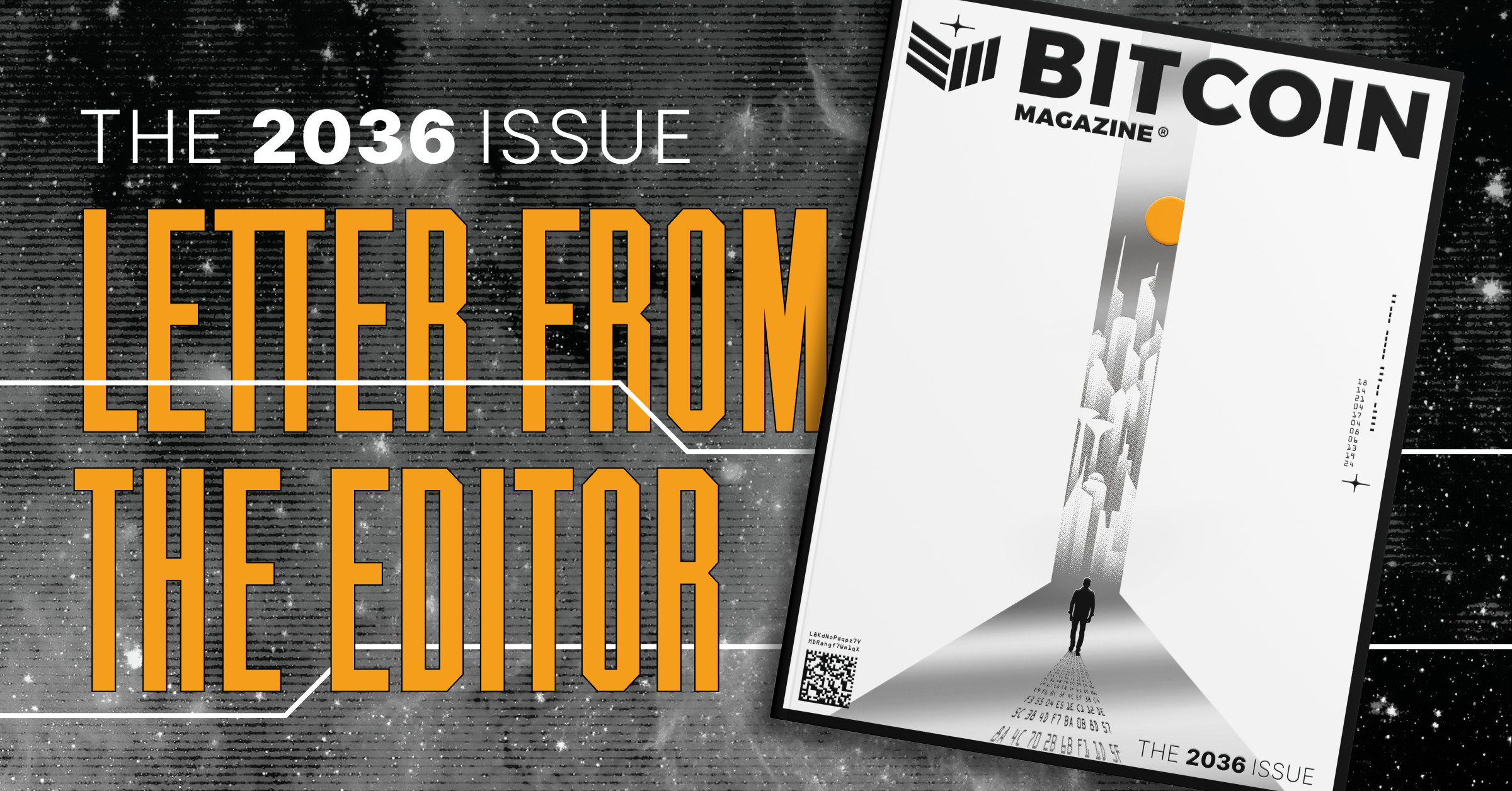
Don’t miss your chance to own The 2036 Issue — featuring articles written by many influential figures in the space pondering the challenges of the next decade!
This piece is the Letter from the Editor featured in the latest Print edition of Bitcoin Magazine, The 2036 Issue. We’re sharing it here as an early look at the ideas explored throughout the full issue.
This post The 2036 Issue: Letter From The Editor first appeared on Bitcoin Magazine and is written by Shinobi.
Bitcoin Magazine
Senate Crypto Bill Faces Over 100 Amendments Ahead of Thursday Markup
Senate Banking Committee members have filed more than 100 proposed amendments to the Digital Asset Market Clarity Act, according to Politico reporting. The panel is set to convene on Thursday for a long-awaited markup vote that crypto and industry leaders say could reshape digital asset regulation in the United States.
The committee scheduled its executive session for 10:30 a.m. on May 14 at Room 538 of the Dirksen Senate Office Building in Washington, D.C., where lawmakers will debate the amendments and vote on whether to send the bill to the full Senate floor.
The flood of filings follows the release of an updated 309-page draft of the bill earlier this week, expanded from the 278-page version proposed in January.
Senator Elizabeth Warren leads the opposition push, submitting more than 40 amendments alone, with the bulk of proposed changes coming from Democratic members of the Banking Committee.
The wave of filings mirrors the January markup session, which drew 137 amendments before that session was cancelled, signaling that resistance to the bill remains strong even as its supporters push for a final vote.
At the center of the dispute is how the bill handles stablecoin yield products — crypto that offer returns to holders. Banking groups argue such crypto products threaten traditional deposit bases; crypto firms counter that reward programs support liquidity and customer activity without functioning as bank deposits.
The American Bankers Association has sent more than 8,000 letters to Senate offices since last Friday, targeting the stablecoin yield compromise brokered by Senators Thom Tillis and Angela Alsobrooks. That compromise, reached after months of negotiations, prohibits stablecoin issuers from paying interest or yield to users who hold tokens passively, while preserving exceptions for rewards tied to genuine platform transactions and payment activity.
Senators Jack Reed and Tina Smith filed amendments to tighten those standards further, targeting products that deliver returns in ways that resemble traditional interest-bearing deposit accounts.
The banking lobby maintains the existing compromise language still leaves room for stablecoin platforms to replicate high-yield savings products without meeting bank-level regulatory requirements.
Senate ethics provisions and developer protections
Senator Chris Van Hollen introduced a proposal that would prohibit senior government officials and their families from owning or promoting crypto-related businesses — a demand Democrats say is non-negotiable given President Trump’s close ties to the crypto industry.
Republican sponsors have resisted the provision, with some warning that ethics riders could fracture the coalition needed for the bill to advance.
A recent draft of the bill already included language shielding noncustodial developers from being classified as money transmitting businesses, with that protection extended retroactively to cover past conduct.
The broader stakes for the crypto industry
The CLARITY Act, formally H.R. 3633, passed the House on July 17, 2025, by a 294–134 bipartisan vote before stalling in the Senate through two cancelled markup sessions and protracted stablecoin negotiations.
At its core, the bill would draw a clear jurisdictional line between the Securities and Exchange Commission and the Commodity Futures Trading Commission, ending years of enforcement-based policymaking that left crypto firms operating under legal ambiguity.
Prediction markets have priced the odds of the bill becoming law in 2026 roughly at 60%, the highest level in months, with the White House setting a July 4 target for a presidential signature.
Committee Chairman Tim Scott had originally targeted a Senate floor vote for September 2025, then pushed that deadline to end-of-year, and most recently said he hoped to reach a full Senate vote by June or July 2026.
Thursday’s markup is the first formal committee vote on the bill in the Senate, and its outcome will determine whether that timeline is still within reach.
This post Senate Crypto Bill Faces Over 100 Amendments Ahead of Thursday Markup first appeared on Bitcoin Magazine and is written by Micah Zimmerman.
CryptoSlate
Bitcoin is hovering just below $80,000 as President Donald Trump arrives in Beijing for a high-stakes meeting with Chinese leader Xi Jinping, turning the visit into a live test of whether the crypto market’s latest risk rally has enough support to survive a difficult macro week.
The trip comes as traders are already contending with hotter inflation data, rising Treasury yields, and a Bitcoin rally that has leaned heavily on derivatives positioning rather than deep spot demand.
That combination has left the market unusually sensitive to headlines from Beijing, where any shift in trade, technology, or supply-chain policy could quickly feed through global risk assets.
For Bitcoin, the China visit is less about direct digital-asset policy than the broader market signal it sends.
A constructive meeting could ease fears of another round of escalation between the world’s two largest economies and help extend the risk-on bid that pushed BTC back toward $80,000.
Conversely, a breakdown could have the opposite effect, forcing traders to reassess a rally already showing signs of strain.
China visit becomes Bitcoin’s risk-sentiment test
Trump’s arrival in Beijing marks the first visit by a US president to China since 2017 and places trade, technology, and strategic competition at the center of global markets for the week.
The US president's delegation reflects the economic stakes. Trump is joined by senior officials, including Secretary of State Marco Rubio and Treasury Secretary Scott Bessent, as well as business leaders from technology and finance.
NVIDIA CEO Jensen Huang, Tesla CEO Elon Musk, and Apple CEO Tim Cook are among the executives whose presence reflects how deeply US-China relations now run through chips, artificial intelligence, electric vehicles, and global manufacturing.
Those issues matter directly for equity markets and indirectly for crypto. Bitcoin has traded less like an isolated monetary hedge during recent macro shocks and more like a high-beta expression of global liquidity, risk appetite, and investor confidence.
When traders expect looser financial conditions or reduced geopolitical pressure, Bitcoin tends to benefit. When trade tensions rise and yields climb, crypto often loses its speculative cushion.
That makes the tone of the Trump-Xi meeting crucial. Any signal that Washington and Beijing are willing to soften trade barriers, reopen channels on technology restrictions, or negotiate around rare-earth exports could support a broader risk rally.
At the same time, commitments tied to agricultural purchases, energy flows, or aircraft orders would also give markets a reason to price in reduced trade friction.
However, the reverse would be more difficult for Bitcoin. A dispute over Taiwan, export controls, rare-earth minerals, or military positioning could push investors back toward cash, Treasuries, and the dollar.
In that scenario, Bitcoin’s claim as digital gold would again be tested against its recent behavior as a leveraged risk asset.
Inflation leaves little room for disappointment
The Beijing summit is carrying more weight because the US macro backdrop has already narrowed Bitcoin’s margin for error.
This is because the April inflation data showed that price pressures remain too firm for markets to price in a more accommodative Federal Reserve path with confidence.
The Consumer Price Index rose 3.8% from a year earlier, while core inflation, which strips out food and energy, stood at 2.8%. Energy prices rose 17.9% annually, keeping headline inflation well above the Fed’s 2% target.
Producer prices added to the pressure. The Producer Price Index rose 6% from a year earlier in April, while the 1.4% monthly increase marked the largest gain since March 2022.
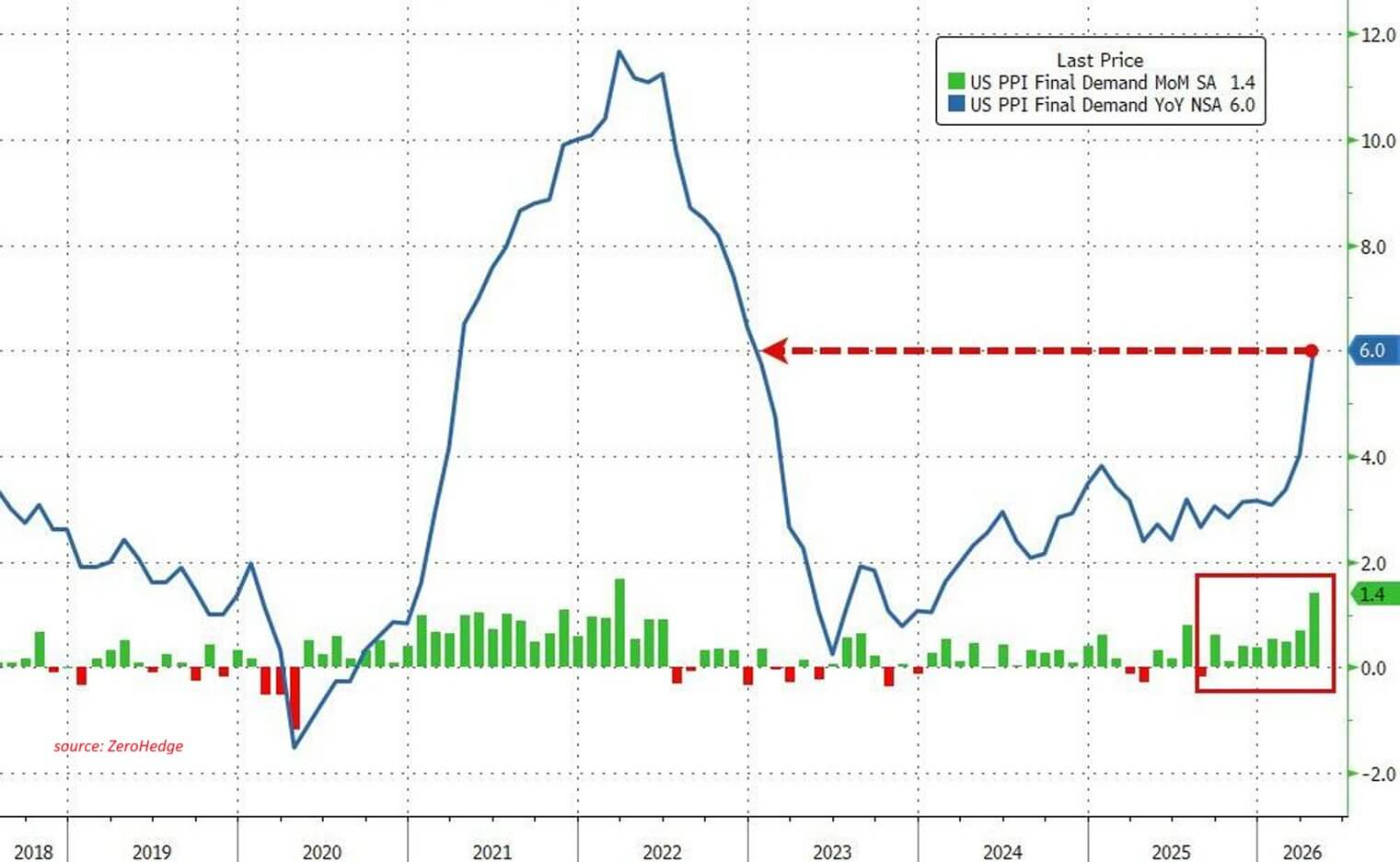
The data reinforced concerns that companies are still facing cost pressures that could eventually be passed on to consumers.
The market response was immediate. US Treasury yields pushed higher, with the 10-year yield moving back toward 4.4%, while traders scaled back expectations for near-term Fed relief.
That repricing creates a more restrictive environment for speculative assets because higher yields increase the appeal of safer income-producing instruments.
Bitcoin has historically struggled when real yields rise. Unlike Treasuries, it does not offer a coupon.
Due to this, its appeal depends on expectations for price appreciation, monetary debasement hedges, and liquidity expansion.
So, when yields rise and inflation remains sticky, investors become less willing to pay for risk without stronger evidence of sustained demand.
That is why the China summit now sits at the center of the week’s Bitcoin setup. The market is not entering the meeting with inflation pressure elevated, yields rising, and traders already cutting exposure after the CPI print.
Leverage makes the $80,000 rally easier to break
Meanwhile, Bitcoin’s current market positioning around $80,000 also has the potential to amplify both gains and losses.
Analysts at Wintermute noted that BTC’s recent push above $80,000 was driven heavily by derivatives activity. Open interest climbed from $48 billion to $58 billion in a month, suggesting that perpetual futures played a major role in the advance.
That does not mean the rally is artificial, but it does make it more fragile. When open interest rises quickly, price gains can reflect traders adding leverage rather than long-term investors accumulating spot Bitcoin.
In that environment, a positive headline can accelerate upside as shorts are forced to cover. A negative headline can trigger the opposite reaction, with leveraged longs rushing to exit.
Wintermute’s warning that “covering isn’t conviction” captures the central weakness in the current move. Short covering can push prices higher, but durable bull markets usually require sustained spot buying.
So far, spot volumes have not kept pace with the surge in leverage, leaving the market exposed if the squeeze loses momentum.
Technical signals point to a similar risk. Bitcoin’s Relative Strength Index has moved toward overbought territory, suggesting that the rally may be stretched in the short term.
Low exchange reserves add another layer of complexity. Constrained supply can help prices rise when demand is steady, but it can also worsen slippage when traders rush to reduce exposure.
In a thin market, a sharp shift in sentiment can produce larger price swings than fundamentals alone would suggest.
That leaves Bitcoin highly exposed to the tone of the Trump-Xi meeting. A constructive outcome could keep leverage working in the bulls’ favor. However, a diplomatic stalemate or escalation could turn the same leverage into the mechanism for a rapid pullback.
The post Trump’s CEO-filled China visit can decide whether Bitcoin’s $80,000 risk rally survives this week appeared first on CryptoSlate.
Is a global 2008-style economic crash nigh? And do current conditions resemble the early stages of a broader global financial crisis driven by debt costs, inflation pressure, and constrained policy responses?
Those questions have become harder to dismiss because the pressure points are stacking in the wrong order: high sovereign yields, high public debt, an energy shock, sticky inflation, and stretched asset valuations.
The world has echoes of 2008, but the policy setting is different. Banks are better capitalized than they were before the global financial crisis, and the Federal Reserve's latest financial-stability work still points to areas of resilience in household and bank balance sheets.
Any 2020 analogy also breaks down: governments and central banks could then flood the system with support while inflation was muted.
The setup is different because the rescue tradeoff is more expensive. Global public debt stood at just under 94% of GDP in 2025 and is projected to reach 100% by 2029 in the IMF's April Fiscal Monitor.
The World Bank is warning that the Middle East war can push energy, food, fertilizer, and inflation higher. The Financial Stability Board has flagged sovereign bond markets, asset valuations, and private credit as areas that need close monitoring.
The result is a credible, reasonable worst case, with inevitability still outside the evidence.

Sovereign yields return to global financial crisis warning levels
[Editor's Note: Intraday volatility was extremely high today, May 13. Snapshot used for this article was taken around 14.00 UTC]
The bond market is where the question starts. Intraday government-bond data today, May 13, showed U.S. Treasurys at roughly 3.99%, 4.46%, and 5.03% across the 2-year, 10-year, and 30-year tenors.
U.K. gilts were around 4.53%, 5.10%, and 5.78%. German Bunds were near 2.71%, 3.11%, and 3.63%. Japanese government bonds sat at around 1.40%, 2.59%, and 3.82%.
The historical comparison is critical here. Nasdaq previously marked U.S. 2-year yields at the highest since 2007, when they reached 4%.
U.K. 2-year gilts are at the highest levels since June 2008, while U.K. 10-year yields are near 18-year highs, and 30-year gilts are near levels associated with 1998.
Germany's 10-year Bund is close to its highest level since May 2011, during the eurozone debt crisis. Japan's 10-year yield has reached levels last seen in 1997, with the 2-year yield at levels last seen in 1995.
China is the exception. Its 10-year government bond yield was around 1.74% on May 13, with the 2-year near 1.27% and the 30-year near 2.24%, according to Trading Economics.
That curve points to a different growth and price backdrop, splitting the story into high-yield stress in developed markets and low-yield growth pressure in China.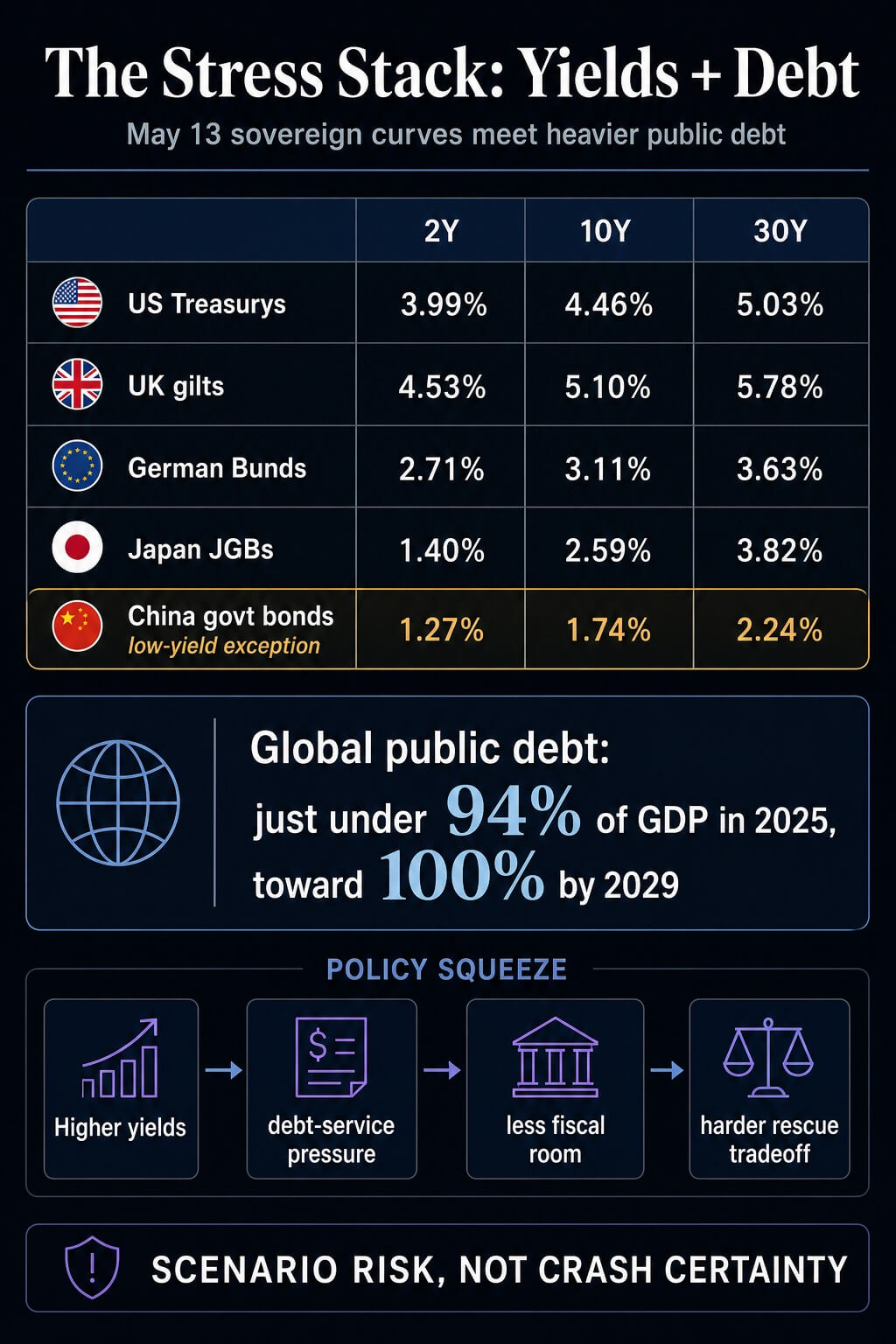
The developed-market side still carries the bigger fiscal problem. The OECD's 2026 debt work shows heavy sovereign borrowing and refinancing needs across its member economies.
Higher yields roll into auctions, coupon costs, and political choices over time. The longer the long end stays elevated, the more the market forces governments to choose between higher interest bills, reduced spending flexibility, and larger deficits.
In 2008, aggressive monetary rescue and balance-sheet support helped stabilize the financial system. In 2020, fiscal and monetary expansion bridged a sudden collapse in activity.
In 2026, the debt stock is bigger, long-end yields are higher, inflation risk is visible, and an energy shock is already inside the data.
Hormuz turns oil risk into policy risk
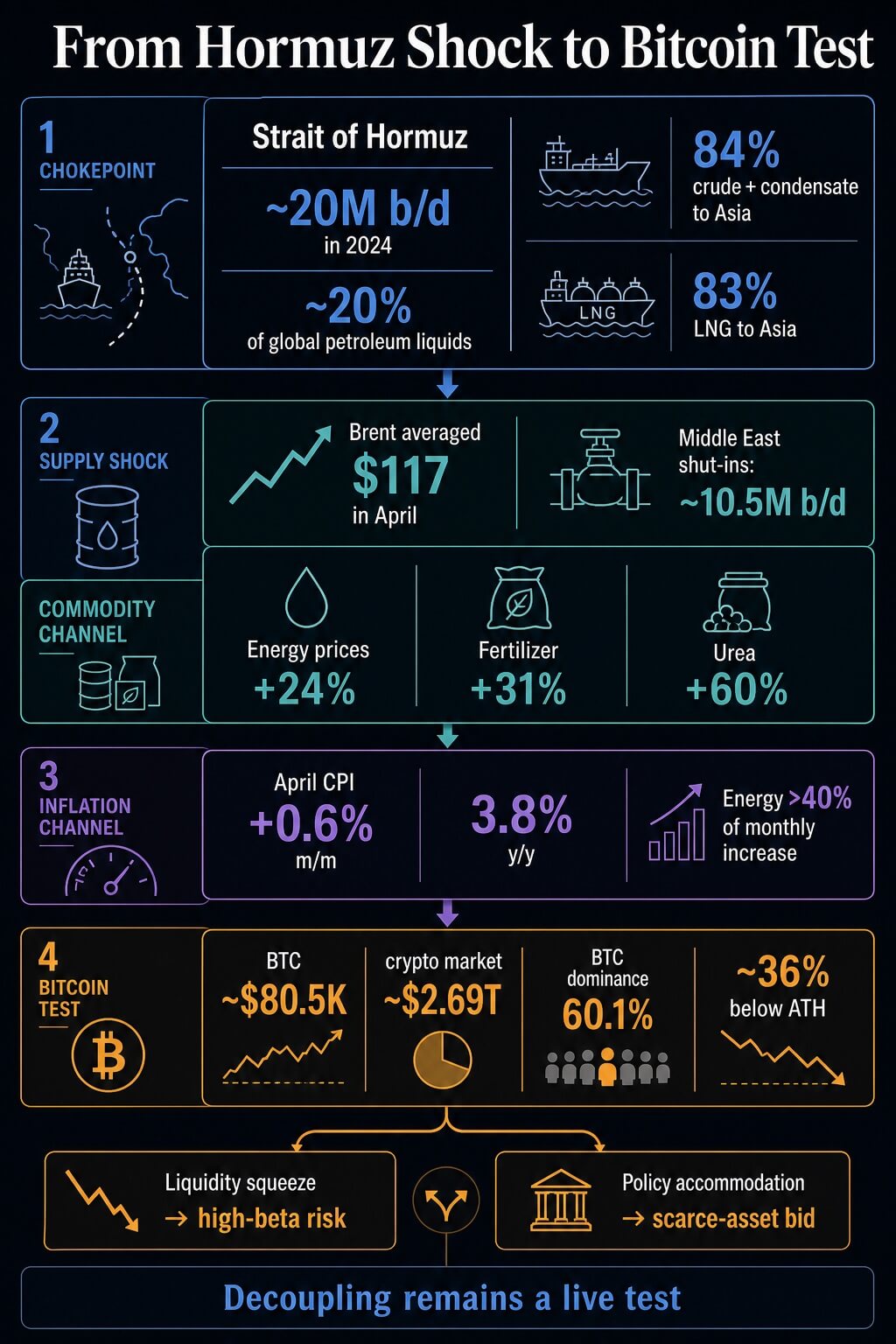
The Strait of Hormuz is the main pressure point because it turns a regional conflict into a global cost shock. The U.S. Energy Information Administration estimates that roughly 20 million barrels per day moved through the strait in 2024, equal to about 20% of global petroleum liquids consumption.
The agency also estimated that 84% of crude oil and condensate and 83% of LNG moving through Hormuz went to Asian markets that year.
The current shock has moved into official price and supply forecasts. In its May 2026 Short-Term Energy Outlook, the EIA described Hormuz as effectively closed to shipping traffic, said Brent averaged $117 per barrel in April, and assessed Middle East production shut-ins around 10.5 million barrels per day that month.
The agency assumes flows begin to resume from late May or early June, but that assumption is itself one of the live risk variables.
The World Bank's April Commodity Markets Outlook puts the macro channel in plain terms. Energy prices are projected to surge 24% this year, Brent is forecast at $86 per barrel in the baseline, and a severe-disruption scenario could push Brent as high as $115.
Fertilizer prices are projected to rise 31%, driven by a 60% jump in urea. The same report warns that higher commodity prices will lift inflation and weaken growth, especially in developing economies that already have limited fiscal buffers.
The U.S. data already show part of that pass-through. The Bureau of Labor Statistics said April CPI rose 0.6% on a seasonally adjusted monthly basis and 3.8% over the year before seasonal adjustment.
Energy accounted for more than 40% of the monthly increase.
That is the mechanism that makes the crash question credible. A shorter shock can still keep inflation expectations firm enough to slow rate cuts while debt-service costs continue to climb.
If growth weakens at the same time, the policy choice becomes ugly: defend inflation credibility or defend financial stability.

| Trigger | Transmission path | Release valve |
|---|---|---|
| Higher sovereign yields | Debt-service costs rise as governments refinance | Debt maturities stagger the impact over time |
| Hormuz disruption | Oil, LNG, fertilizer and shipping costs feed inflation | Rerouting, demand adjustment and resumed flows can soften the first shock |
| Sticky inflation | Central banks have less room to cut into market stress | Weak growth can still force accommodation later |
| High valuations and leverage | Risk assets have less margin for bad news | Bank and household balance sheets still show resilience |
| Bitcoin decoupling test | BTC either trades as scarce collateral or high-beta risk | Recent divergence is early and still needs confirmation |
Why markets have less policy support than before the global financial crisis
The equity-market tension is that risk assets can look calm even while the bond market is repricing the policy backdrop. The Fed's May Financial Stability Report said forward equity price-to-earnings ratios remained in the upper range of their historical distribution.
Corporate bond spreads were still low by longer-run standards. Hedge fund leverage remained near all-time highs and was concentrated among the largest funds.
That mix is a cushion problem. The same Fed report said market contacts most frequently cited geopolitical risks, an oil shock, private credit, and persistent inflation as salient risks to financial stability.
The FSB made a similar point in April, saying the Middle East conflict had already created a substantial global economic shock, with market reactions visible in energy prices and government bond yields.
That is the collision investors have to watch across policy meetings, auctions, and liquidity conditions. Markets can absorb high rates when growth is strong, inflation is falling, and fiscal financing looks manageable.
They can absorb oil shocks when central banks can look through the price spike. They can absorb high public debt when borrowing costs are pinned down. The current setup weakens each cushion at once.
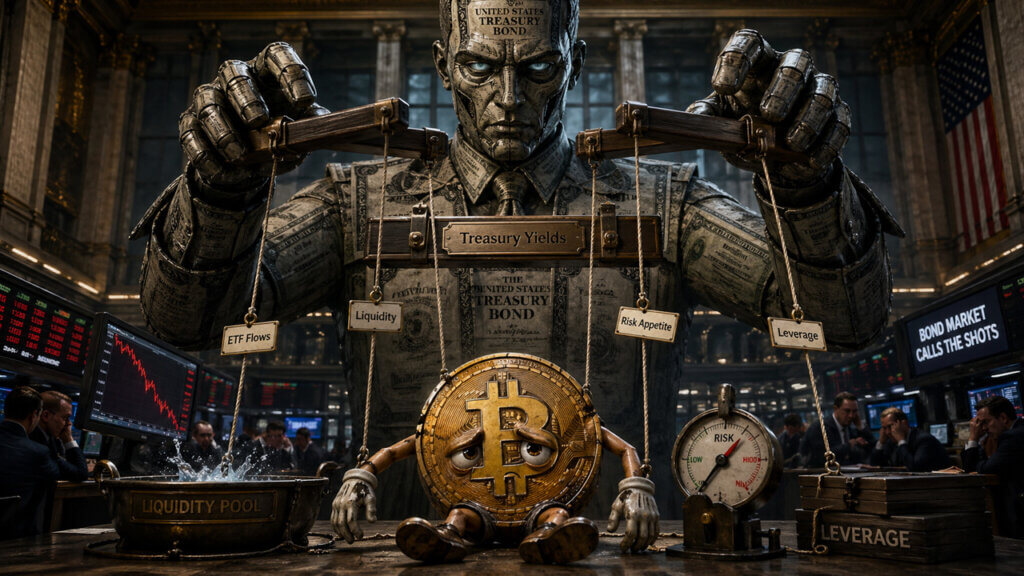
A crash becomes a reasonable worst case if the sequence tightens: Hormuz keeps energy and fertilizer prices high; inflation remains sticky; central banks delay support; long-end yields stay elevated; debt-service pressure grows; risk assets that had priced a soft landing reprice toward weaker growth and tighter liquidity.
A calmer path is also possible. If oil flows normalize, inflation eases, real yields soften, and central banks can pivot toward growth support, the stress stack breaks before it becomes systemic. That framing is conditional fragility.
That distinction is critical for market timing. Sovereign stress tends to build through auctions, refinancing calendars, credit spreads, equity multiples, and central-bank decisions. It rarely announces itself through one clean trigger.
That gives markets time to adapt, but it also means pressure can keep accumulating after the first oil-price spike fades. A soft-landing trade can survive one shock; the harder test is whether it survives several at once, with each channel limiting the policy answer to the next.
Bitcoin becomes the macro test during global financial crisis fears
Bitcoin sits at the end of this chain because it is now part of the macro read.
Bitcoin traded around $80,500 on May 13, before hot PPI pushed it below $80,000, while the broader crypto market stood at around $2.69 trillion, and BTC dominance held at around 60.1%.
That leaves it still large enough to be a macro asset, while its volatility keeps it outside clean-shelter status.
Recent CryptoSlate coverage has noted windows when Bitcoin moved differently from U.S. equities amid oil, yield, and dollar pressure on stocks. Another CryptoSlate analysis framed the Hormuz shock as a fork for Bitcoin: either a liquidity squeeze that drags BTC back into high-beta collateral behavior, or a policy-accommodation path that revives the scarce-asset trade.
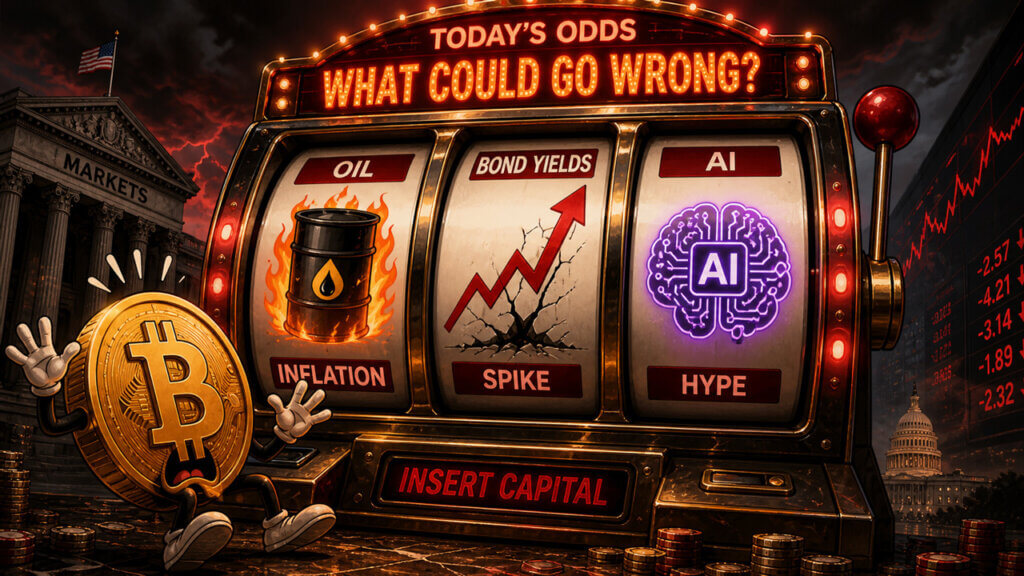
That is the sober way to treat Bitcoin here. Bitcoin's record as a stable inflation hedge remains unproven. Its separation from risk appetite remains incomplete.
Glassnode's latest market pulse supports caution: improving structure still needs confirmation amid macro pressure from rates, oil, and liquidity.
A single bad equity session tells little. The test is whether Bitcoin can hold up if stocks sell off, yields stay high, the dollar firms, and central banks hesitate to ease because inflation is still being fed by energy and food costs.
If BTC holds that environment, the monetary-disorder narrative gets stronger. If it fails, the market will have treated it as another risk asset with better branding.
That leaves the crash question with a practical answer. A 2008 replay remains an outside possibility, and the claim of inevitability is too strong.
However, the current setup is more fragile because the public debt load is heavier, the inflation shock is real, and the policy response is more constrained.
One price chart will tell only part of the story; the policy choice will carry the bigger signal. If central banks prioritize inflation control while oil and debt-service costs keep rising, financial markets will face greater stress without a rescue.
If they shift toward financial stability, Bitcoin faces its clearest test as a hedge against policy accommodation and currency-credibility risk.
Either way, the question has moved from alarmism to risk management. What pulls it back from the brink is that several release valves still exist:
- The shock is conditional. If Hormuz flows resume and oil normalizes, the inflation impulse weakens.
- Debt stress rolls through time. Refinancing calendars stagger the hit rather than forcing one immediate rupture.
- Balance sheets are stronger than 2008. The piece cites resilience in banks and households, which limits direct GFC-style contagion.
- Central banks still have optionality. They are constrained by inflation, but weak growth or market stress can still force accommodation later.
- Markets have warning indicators. Auctions, long-end yields, credit spreads, liquidity, equity multiples, and BTC’s behavior give a sequence to monitor.
The post Global financial crisis fears grow as bond yields hit 1998 levels and Bitcoin drops below $80,000 appeared first on CryptoSlate.
XRP is rising into a market split between traditional finance infrastructure and crypto-native skepticism.
According to CryptoSlate's data, the token recently traded above $1.46 as spot-market indicators improved, exchange-traded funds drew their strongest daily inflows in more than four months, and Ripple expanded the credit capacity behind its institutional prime brokerage business.
However, this came at a time when derivatives traders continue to lean against the move, with Binance futures data showing persistent selling pressure even as leverage rebuilds across major exchanges.
That tension has turned XRP into a test case for whether institutional access, ledger utility, and market infrastructure can overpower a futures market still positioned for weakness.
Spot demand meets futures resistance
The divide between spot demand and derivatives positioning has become the clearest feature of XRP’s market structure.
US spot XRP ETFs recorded $25.8 million in net inflows on May 11, their largest daily intake since early January, SoSoValue data show.
This extends the four funds' positive performance this month, attracting more than $60 million in inflows. XRP-focused funds have registered total inflows of over $1.35 billion since their launch last year.
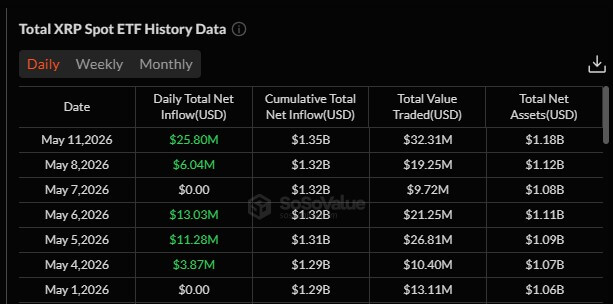
Those inflows give XRP a regulated channel at a time when exchange-based positioning remains conflicted. ETFs allow investors to gain exposure through brokerage accounts and adviser platforms without managing direct custody or trading on crypto exchanges.
That opens the asset to a wider pool of allocators than the offshore derivatives venues that have historically shaped much of XRP’s short-term price action.
However, the mood in the derivatives market is different.
CryptoQuant data show that the Binance perpetual cumulative volume delta has fallen to about -$434 million, even as XRP has pushed higher. Open interest on Binance has climbed from about 207 million XRP on April 30 to nearly 232 million, showing leverage is returning after the latest reset.
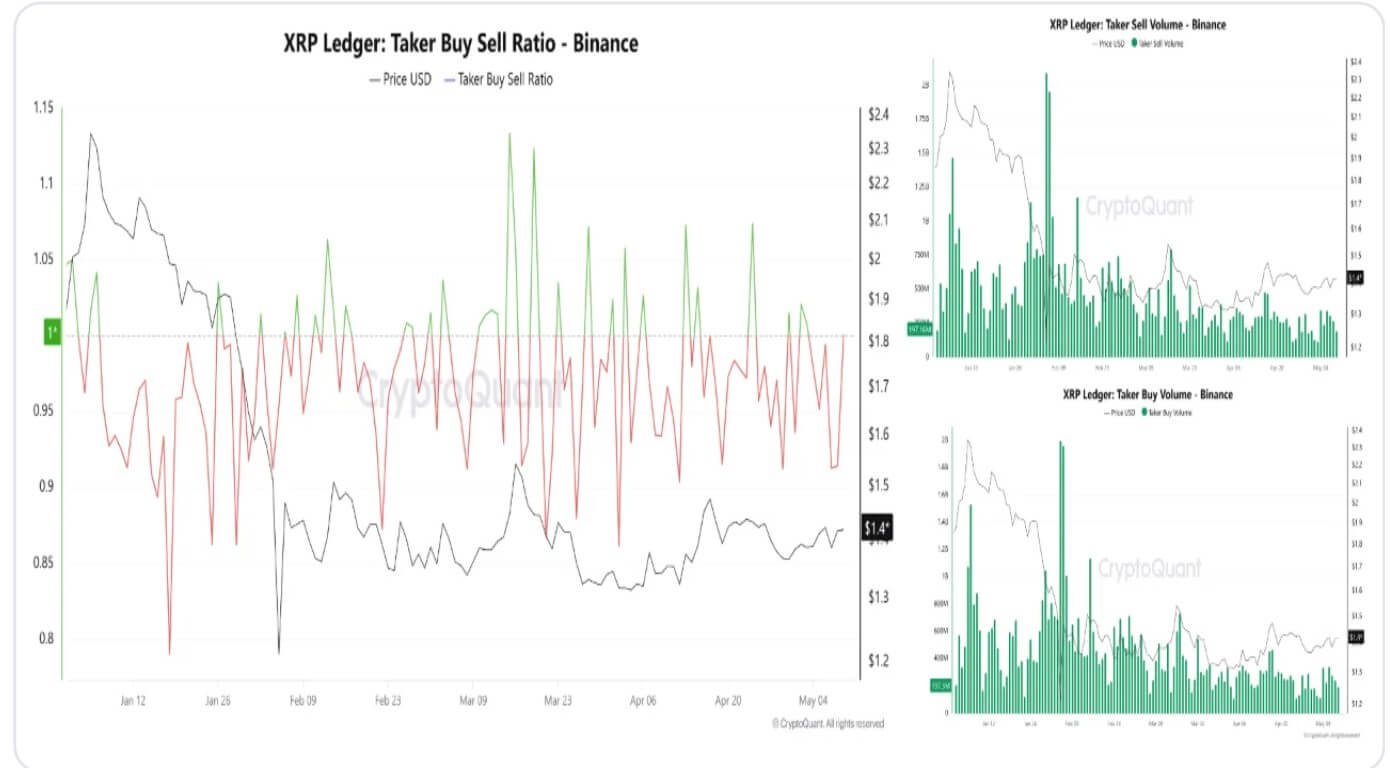
The increase is not limited to Binance. On May 11, open interest rose by about $18 million on Binance, $10.4 million on OKX, and $8.5 million on Bybit, adding almost $36.9 million across the three exchanges.
Ordinarily, rising open interest can confirm a stronger trend when spot demand is also expanding.
However, XRP’s setup is more complicated. Spot estimated cumulative volume delta across centralized exchanges has slipped to about $575 million, even as the token trades higher.
That suggests the rally is not yet being driven by broad, clean spot accumulation.
Notably, XRP funding rates point to the same tension. XRP funding on Binance has carried a bearish bias for nearly three months, CryptoQuant data show, even as the token has gained roughly 27% over the same period.
This negative funding means shorts are paying longs to keep bearish exposure open.
Ripple adds Wall Street credit to the ecosystem
This bearish futures positioning is running headlong into a massive institutional buildout around Ripple.
On May 11, Ripple announced that it had secured a $200 million asset-backed debt facility from funds managed by Neuberger Specialty Finance, the dedicated asset-based investment team within Neuberger.
The firm said the facility would support Ripple Prime's continued growth amid increasing demand for “institutional-grade prime services and margin financing solutions.” The facility is backed by Ripple Prime’s institutional loan portfolio and structured for flexible drawdowns.
Noel Kimmel, president of Ripple Prime, said:
“Dependable access to financing and balance sheet strength are critical to institutional participants in today’s dynamic markets. This facility enables us to grow alongside our clients by delivering increased margin capacity, greater responsiveness, and improved capital efficiency.”
Ripple acquired Hidden Road last year and later rebranded it as Ripple Prime. The Brad Garlinghouse-led company revealed that the brokerage platform's revenue has tripled, driven by “sustained growth in client activity and demand for its prime services.”
Against this backdrop, this new credit facility fundamentally strengthens the market structure surrounding the Ripple ecosystem. Institutions require robust financing, custody, settlement certainty, and reliable counterparties before deploying capital at scale.
By embedding XRP and RLUSD within this broader institutional stack, Ripple is positioning itself directly against heavyweight service providers.
XRPL upgrades lead to increased activity on the ledger
Ripple’s corporate expansion is unfolding alongside a technical buildout of the XRP Ledger (XRPL) that is beginning to show up in network activity.
Over the past several months, the blockchain network developers have added features to meet the needs of regulated financial institutions.
The upgrades are designed to give banks, asset managers, and payment firms the controls they need to use public blockchain infrastructure without sacrificing compliance, privacy, settlement certainty, or auditability.
The new tools include Multi-Purpose Tokens (MPT), which allow issuers to embed compliance features into tokenized assets. Other upgrades, including Permissioned Domains and Permissioned DEX, are designed to create more controlled trading environments.
Additionally, the network recently implemented the Token Escrow feature, which extends escrow functionality beyond XRP to issued currencies, laying the foundation for on-chain delivery-versus-payment settlement.
Meanwhile, the ledger’s development roadmap also includes native lending markets and privacy-focused Smart Escrows.
Together, those changes point to a network being adapted for institutions that want the speed and transparency of shared blockchain rails, but still require permissioning, risk controls, and confidentiality.
Unsurprisingly, that institutional thesis is beginning to find support in ledger activity and institutional adoption.
Last week, Ripple piloted the cross-border redemption of a tokenized US Treasury fund alongside JPMorgan, Mastercard, and Ondo Finance on the XRPL.
Evernorth, an XRP-focused treasury firm, argued that these institutional activities, alongside rising retail adoption, contributed to XRP transaction activity increasing 65% over the past 12 months to 71 million.
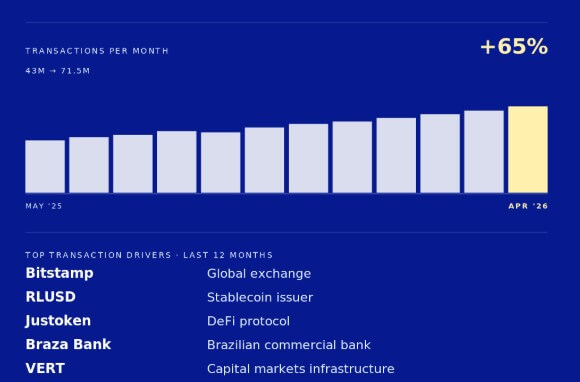
According to the firm, these activities were driven by Bitstamp, Ripple’s RLUSD stablecoin, Justoken, Braza Bank, and VERT.
It stated:
“Speculative volume on a blockchain comes in bursts. Real utility looks different. Steady. Programmatic. Tied to real businesses moving real money.”
What's next for the XRP price?
Considering the above, XRP’s near-term trajectory ultimately hinges on whether spot demand can translate this institutional progress into sustained buying pressure.
If ETF inflows persist, the spot cumulative volume delta improves, and the taker buy-sell ratio remains above parity, the heavily bearish derivatives positioning could backfire, triggering a wave of forced buying.
In that scenario, negative funding and climbing open interest would act as rocket fuel for an XRP rally toward the $1.50 to $1.60 range.
Conversely, if spot demand falters, that same leverage leaves XRP highly vulnerable to a sharp reversal.
A market propped up by rising open interest without underlying spot support can unwind violently, particularly when traders are deeply divided near a contested price range.
This dynamic makes the current market setup less about a single upcoming catalyst and more about a fundamental regime change.
Ultimately, XRP is transitioning from an asset dominated by offshore exchange speculation to one defined by ETFs, institutional credit, ledger utility, and tokenized-asset infrastructure.
The post Wall Street is buying XRP while Binance traders keep betting against it appeared first on CryptoSlate.
Prediction markets have been growing fast, from crypto price bets to election forecasting and sports outcomes. But there's a persistent problem most platforms don't address: users are essentially guessing.
They pick a side based on gut feeling, social media noise, or whatever narrative feels convincing in the moment. Poly Truth is attempting to solve that. Rather than just giving people a place to bet on outcomes, it positions itself as an intelligence layer sitting on top of prediction markets, one that tells you which side the data actually supports. You can explore the project directly on the $PTRUE Coin official website.
The project is currently in presale with its native $PTRUE token, and it's worth understanding what the system actually does before looking at the token economics.
What Is Poly Truth?
Poly Truth is a prediction market intelligence tool. That distinction matters: it's not a trading bot, not a prediction platform itself, and not an automated system that places positions on your behalf. The core idea is to give users data-backed probability analysis on active prediction events, whether those events involve sports results, political races, crypto price movements, or any other outcome-based market.
Think of it like having a research analyst who, instead of giving you a tip, walks you through the reasoning: here's what the data shows, here's the probability each outcome occurs, and here's why. Users still make their own decisions; Poly Truth just gives them more to work with.
How the Poly Truth System Works
The project explains its process through a three-part framework it calls its “characters.” It's a useful framing for understanding how data moves through the system.
The Runners are automated bots that continuously scrape data across the internet (news, odds movements, historical patterns, social sentiment), focused on whatever prediction events are currently active. They're the data collection layer, running in the background without user involvement.
The Starlet is the AI analyst component. Once the Runners pull in raw data, The Starlet cross-references sources, identifies patterns, and produces probability scores. This is where the intelligence layer actually sits: it's not simply aggregating data but interpreting it to determine which outcome has stronger statistical backing.
The Presenter is what users see. It delivers the final output: which events have meaningful data behind them, what the probability breakdown looks like, and the reasoning that led to those numbers.
The flow is clean: collect → analyze → present. Whether the AI analysis proves consistently accurate in live conditions is something that will only be tested over time, but the architecture is logically sound for what it's trying to do.
What Markets Does Poly Truth Cover?
The system is designed to work across several categories of prediction events:
- Sports: match outcomes, player performance, tournament results
- Politics: elections, policy decisions, geopolitical events
- Crypto: price movement predictions, project milestone outcomes
- General events: any outcome-based market with sufficient data to analyze
The breadth of coverage is worth noting. Most prediction market tools that incorporate AI tend to focus narrowly on one vertical. Poly Truth's multi-market approach means The Runners need to scrape and contextualize very different data types depending on the event category, which is a more complex engineering challenge but also a wider potential use case if executed well.
The $PTRUE Token: Key Details
PTRUE is the native token of the Poly Truth ecosystem, currently available in presale. Here's a breakdown of the core numbers:
| Detail | Figures |
|---|---|
| Total Supply | 11.5 billion tokens |
| Presale Price | $0.001190 |
| Blockchain | Ethereum |
| Staking APY | 4,452% |
| Payment Options | ETH, BNB, SOL, USDT, USDC, Card, SEPA |
Token Distribution:
- Presale: 40%
- Liquidity: 17%
- Development: 13%
- Team: 10%
- Staking: 10%
- Marketing: 8%
- Community/Airdrops: 2%
The 40% presale allocation is substantial, which means a significant portion of the total supply is being distributed early. The staking APY of 1,346% is an eye-catching figure — high staking yields are common in early-stage crypto projects as a mechanism to reduce circulating supply and reward early participants, but they are also inherently unsustainable at that rate long-term. Anyone considering staking should factor in how yield rates typically compress as a project matures and token supply dynamics shift.
The payment flexibility is genuinely broad for a presale; accepting ETH, BNB, SOL, stablecoins, card, and SEPA means the project is trying to reduce friction for buyers coming from different ecosystems. Full presale details are available on the PolyTruth platform.
How to Buy $PTRUE in the Presale
The process is straightforward:
- Visit the official Poly Truth website and connect a compatible wallet (MetaMask or similar)
- Select your preferred payment method — ETH, BNB, SOL, USDT, USDC, card, or SEPA
- Enter the amount you want to purchase
- Confirm the transaction

Since the contract is deployed on Ethereum, buyers using ETH will want to account for gas fees. Those paying with BNB or SOL will likely have lower transaction costs, though the mechanics of cross-chain purchases should be reviewed on the site before committing.
Who Is Poly Truth Actually For?
The most natural audience is people already active in prediction markets who want a research edge. If you're regularly using platforms like Polymarket or similar and making judgment calls based on partial information, a tool that systematically aggregates and scores probability data could be genuinely useful.
It's less directly relevant to passive crypto investors who aren't engaging with prediction markets at all. The token itself offers staking, but the utility case is tied to using the intelligence tool rather than simply holding.
The project sits in an interesting space; prediction markets have seen real growth in visibility and volume over the past few years, and AI-powered analysis layered on top of that trend is a logical product direction. Whether Poly Truth's implementation delivers on that concept is the question any prospective user or token buyer should be asking.
Final Thoughts
Poly Truth is a focused concept, not one trying to be everything, but one specifically targeting the information gap in prediction market participation. The three-part system (Runners, Starlet, Presenter) gives it a clear product identity, and the multi-market coverage broadens its potential reach beyond any single niche.
As with any presale-stage project, the gap between concept and working product is where real evaluation happens. The architecture makes sense on paper; live performance across diverse event categories will be the real test. Anyone wanting to dig into the details, review the smart contract, or participate in the presale can learn more on the Poly Truth coin website.
Disclaimer: This is a sponsored post. CryptoSlate does not endorse any of the projects mentioned in this article. Investors are encouraged to perform necessary due diligence.
The post How to Buy Poly Truth ($PTRUE): The AI Prediction Market Tool Explained appeared first on CryptoSlate.
The Senate Banking Committee’s crypto market structure bill is heading into CLARITY Act markup with more than 100 proposed amendments.
This is turning a long-delayed vote on the CLARITY Act into a test of whether a fragile stablecoin compromise can survive pressure from banks, Democrats, and crypto industry groups.
The final number of amendments has not been formally confirmed. However, the current markup amendment proposal puts it in the same range as the January effort, when 137 amendments were submitted before a planned committee vote was scrapped.
The size of the amendment pile underscores how unsettled the bill remains even after months of negotiations.
Banks force stablecoin rewards vote
The most consequential fight is over stablecoin rewards, the issue that helped stall earlier negotiations and now threatens to reopen the divide between crypto companies and the banking industry.
The Senate compromise would prohibit rewards on idle stablecoin holdings when those rewards resemble interest on bank deposits. It would still allow incentives tied to other stablecoin activity, such as payments or transactions.
That distinction was designed to keep stablecoins from becoming deposit substitutes while allowing firms to reward usage rather than passive balances.
Banks say the language does not go far enough. Their concern is that crypto exchanges and other intermediaries could structure rewards around stablecoin activity in ways that still pull deposits away from insured banks.
Banking groups have pushed senators to close what they view as a loophole and to prevent stablecoin issuers or affiliates from offering yield-like incentives that compete with bank accounts.
Sens. Jack Reed and Tina Smith reportedly filed an amendment to tighten that standard.
Their proposal would target rewards that are “substantially similar” to deposit interest, a formulation that could give regulators more room to block incentive programs that banks see as functionally equivalent to yield.
That amendment could become one of the clearest votes of the markup. Supporting it would move the bill closer to the banking industry’s position. Opposing it would preserve the Tillis-led compromise and signal that committee members are unwilling to use the market structure bill to further restrict stablecoin incentives.
The lobbying campaign around the provision has already intensified. Stand With Crypto, the Coinbase-backed advocacy group, said banking lobbyists sent 8,000 letters seeking to stop stablecoin rewards.
The group said its own advocates made 8,000 calls and sent 300,000 emails in recent months, and that supporters have contacted lawmakers almost 1.5 million times in favor of CLARITY.
On the other hand, traditional finance leaders are actively maintaining the pressure to ensure the amendment's success.
Lorrie Trogden, president and CEO of the Arkansas Bankers Association, recently issued a public call to action. On X, she urged banking industry members to make their voices heard ahead of the Thursday markup.
These efforts reflect an unusually visible outside campaign for a committee markup. They also show how a technical debate over reward language has become a proxy fight over whether banks or crypto platforms will control the next layer of dollar-based payments.
Warren pushes ethics and Fed access limits
Meanwhile, the stablecoin fight is not the only pressure point Democrats are bringing into the markup.
Crypto skeptic Sen. Elizabeth Warren has reportedly filed more than 40 amendments, the largest individual batch among committee members.
Her proposals target several parts of the bill, but one of the most significant would prevent the Federal Reserve from granting master accounts to crypto companies.
A Fed master account gives an eligible institution direct access to the central bank’s payment rails.
Crypto firms have long sought clearer paths into the banking system, while regulators and banks have warned that granting direct access to novel financial firms could create new supervisory and stability risks.
Warren’s amendment would put that fight directly into the CLARITY Act debate. If adopted, it would limit crypto companies' ability to use the market structure bill as a path to deeper integration with the Fed’s core payment infrastructure.
Notably, banking associations such as the Independent Community Bankers of America (ICBA) previously criticized the Federal Reserve Bank of Kansas City’s approval of a master account for the crypto exchange Kraken.
According to the group:
“Granting nonbank entities and crypto institutions access to the master accounts poses risks to the banking system.”
Meanwhile, Warren is also pressing the ethics argument that has become central to Democratic resistance.
The lawmaker has said that new crypto legislation should not move through the Banking Committee without stronger guardrails to address conflicts of interest involving President Donald Trump and his family’s crypto ventures.
That line of attack gives Democrats a broader political frame than just investor protection. It links the bill to concerns that public officials could benefit from policies that expand the digital asset market, especially if the legislation leaves gaps around affiliated projects, stablecoin activity or token holdings connected to political figures.
The ethics push complicates the Republican case for speed. Supporters argue the bill is needed to end regulatory uncertainty.
Warren and other skeptics argue that speed without additional safeguards could entrench conflicts before Congress has built a durable oversight framework.
DeFi and legal tender amendments widen the fight
Other Democratic amendments would expand the debate beyond stablecoins and ethics into the structure of decentralized finance and the legal status of crypto assets.
Sen. Mark Warner filed an amendment that would overhaul the bill’s decentralized finance provisions.
The latest CLARITY Act text attempts to define when a protocol is sufficiently decentralized and when an operator, platform, or intermediary should face bank-like compliance obligations.
That section is among the most technically sensitive parts of the bill because it determines whether some DeFi systems can operate outside traditional intermediary rules or must comply with reporting, monitoring, and anti-money laundering requirements.
Warner’s amendment signals that some Democrats remain uncomfortable with the bill’s treatment of DeFi.
Their concern is that broad exemptions for decentralized protocols could allow firms to avoid oversight by claiming that no central entity controls the system.
Crypto developers counter that rules built for custodial intermediaries cannot be applied cleanly to open-source protocols without forcing some projects offshore or shutting them down.
Reed also filed a separate amendment that would prohibit cryptocurrencies from being used as legal tender, including for tax payments.
That proposal would push against efforts by some crypto-friendly lawmakers to give Bitcoin or other digital assets a more formal role in public payments.
Together, the DeFi and legal tender amendments show that the impending markup will not be limited to one banking dispute.
Senators will also be asked to decide how much autonomy decentralized systems should have, how far crypto assets should be allowed to enter public finance, and whether the bill gives regulators sufficient authority to police risks across the market.
Crypto industry urges senators to hold the line
Despite all of these pressures, crypto industry groups are urging the committee to move the CLARITY Act forward without amendments that would weaken the compromise.
On X, the Blockchain Association and Crypto Council for Innovation have called the markup a defining moment for US leadership in financial technology.
Their argument is that the bill would replace fragmented enforcement-driven oversight with a statutory framework that lets companies build in the US under clearer rules.
Stand With Crypto has taken a more direct political approach, framing the bank-backed push against stablecoin rewards as an attempt to protect incumbents from competition.
The group’s campaign is aimed at showing senators that crypto supporters are organized enough to match the pressure coming from banks and trade associations.
For pro-crypto lawmakers, the challenge is holding together a coalition broad enough to get the bill out of committee while preserving language that can survive the Senate floor.
Republicans control the committee, but the broader bill will still need Democratic support to clear the broader Senate floor. That makes the markup both a policy negotiation and an early vote-counting exercise.
The post CLARITY Act faces 100+ amendments as bankers send 8,000 demand letters against stablecoin rewards appeared first on CryptoSlate.
Cryptoticker
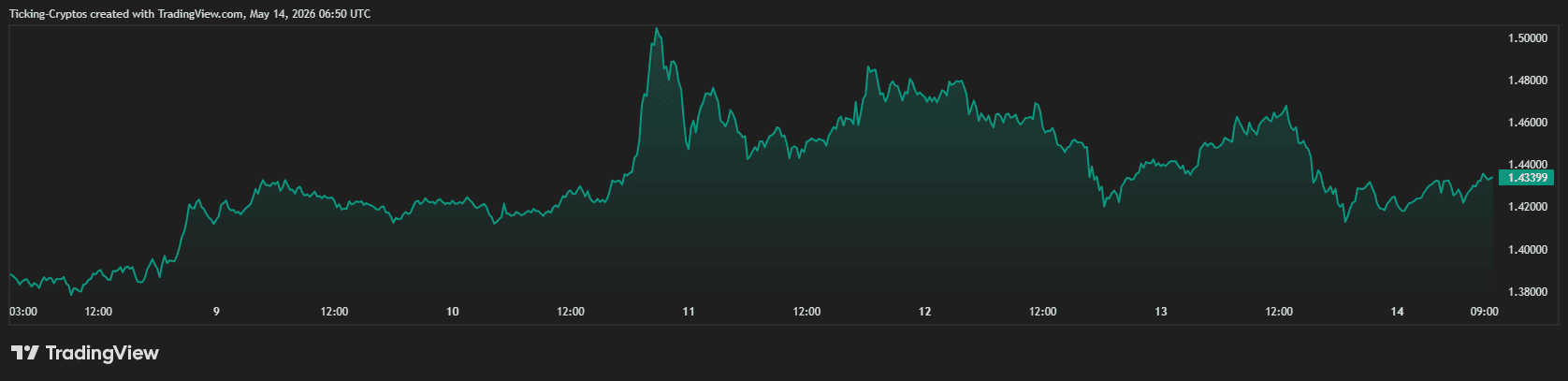
While the broader crypto market sentiment has turned cautious, XRP price is holding strong support around the $1.40 level. This comes at a time when Bitcoin and Ethereum have breached critical psychological and technical floors.
What's Happening to Crypto?
Current market data confirms a significant shift in momentum:
- XRP: Maintaining stability above $1.43, successfully testing the $1.40 support zone.
- Bitcoin (BTC): Has officially dropped below the $80,000 mark, trading near $79,200.
- Ethereum (ETH): Is struggling to find footing after slipping below $2,400.
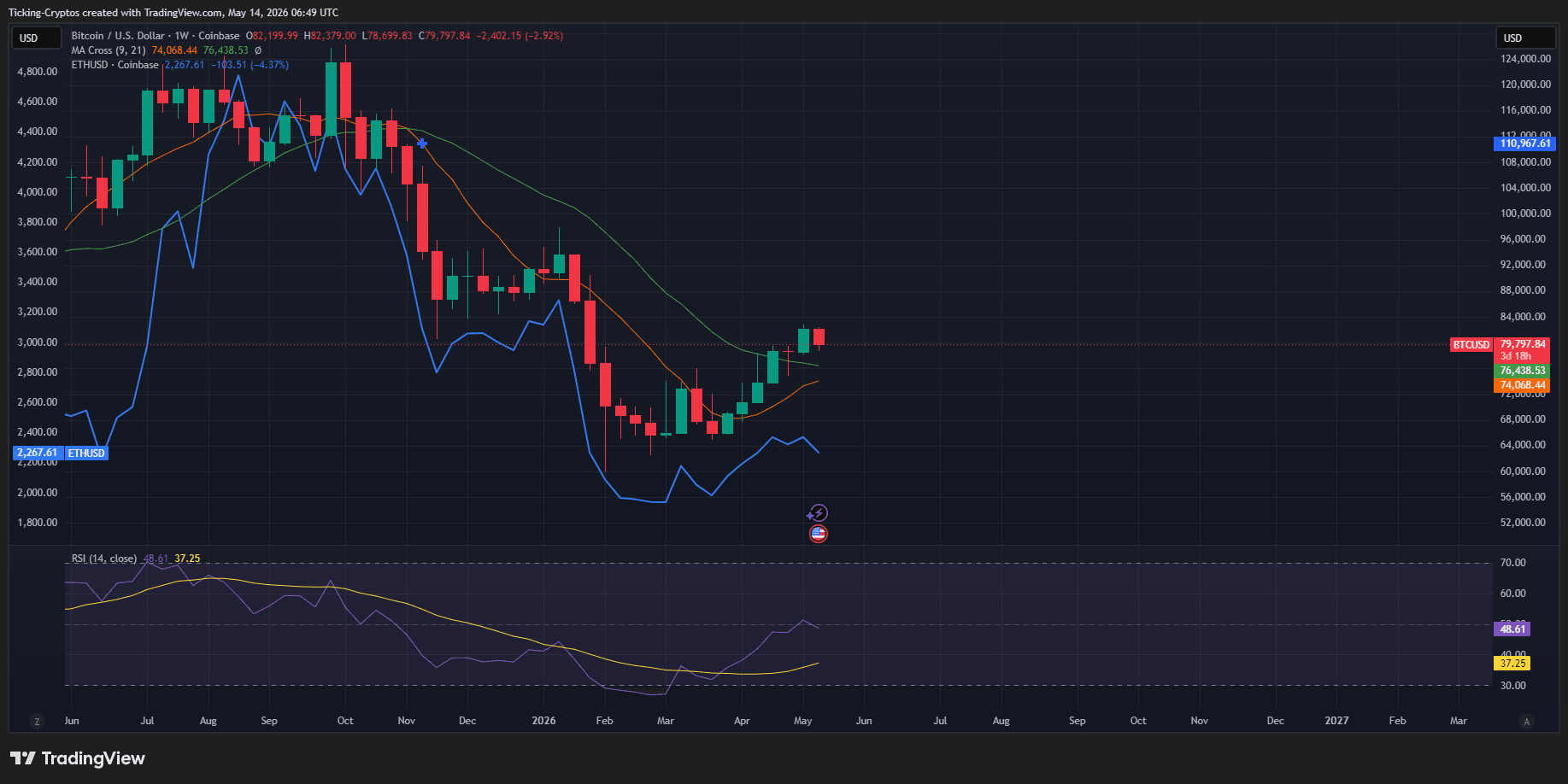
For the current bullish structure to remain intact, XRP must defend its current base, while BTC and ETH need a swift recovery to prevent a localized "liquidity drain" from altcoins.
Why $1.40 Matters for XRP
In technical analysis, a "strong support" level is an area where buying interest consistently outweighs selling pressure. For $XRP, the $1.40 zone represents a pivot point that has transitioned from resistance to support over the last several months. Holding this level during a Bitcoin price drop suggests that XRP investors are currently less reactive to BTC’s volatility, potentially due to ecosystem-specific developments or institutional accumulation.
The Ripple Effect: Can XRP Decouple from BTC and ETH?
While XRP is showing strength, the broader market health heavily depends on the recovery of the leaders.
The Dependency on Bitcoin and Ethereum
If $Bitcoin fails to reclaim $80,000 and $Ethereum stays below $2,400, the market may enter a "distribution phase." In this scenario, even strong performers like XRP eventually see a breakdown as traders move capital into stables or hardware wallets to preserve gains.
- Recovery Target: BTC needs a daily close above $81,500 to signal a "fakeout."
- Downside Risk: Failure to recover could lead the market toward lower liquidity zones not seen since early Q1.
XRP Price Prediction: Support and Resistance Targets
Analyzing the current 1W XRP/USDT chart provides two primary paths for the coming weeks.
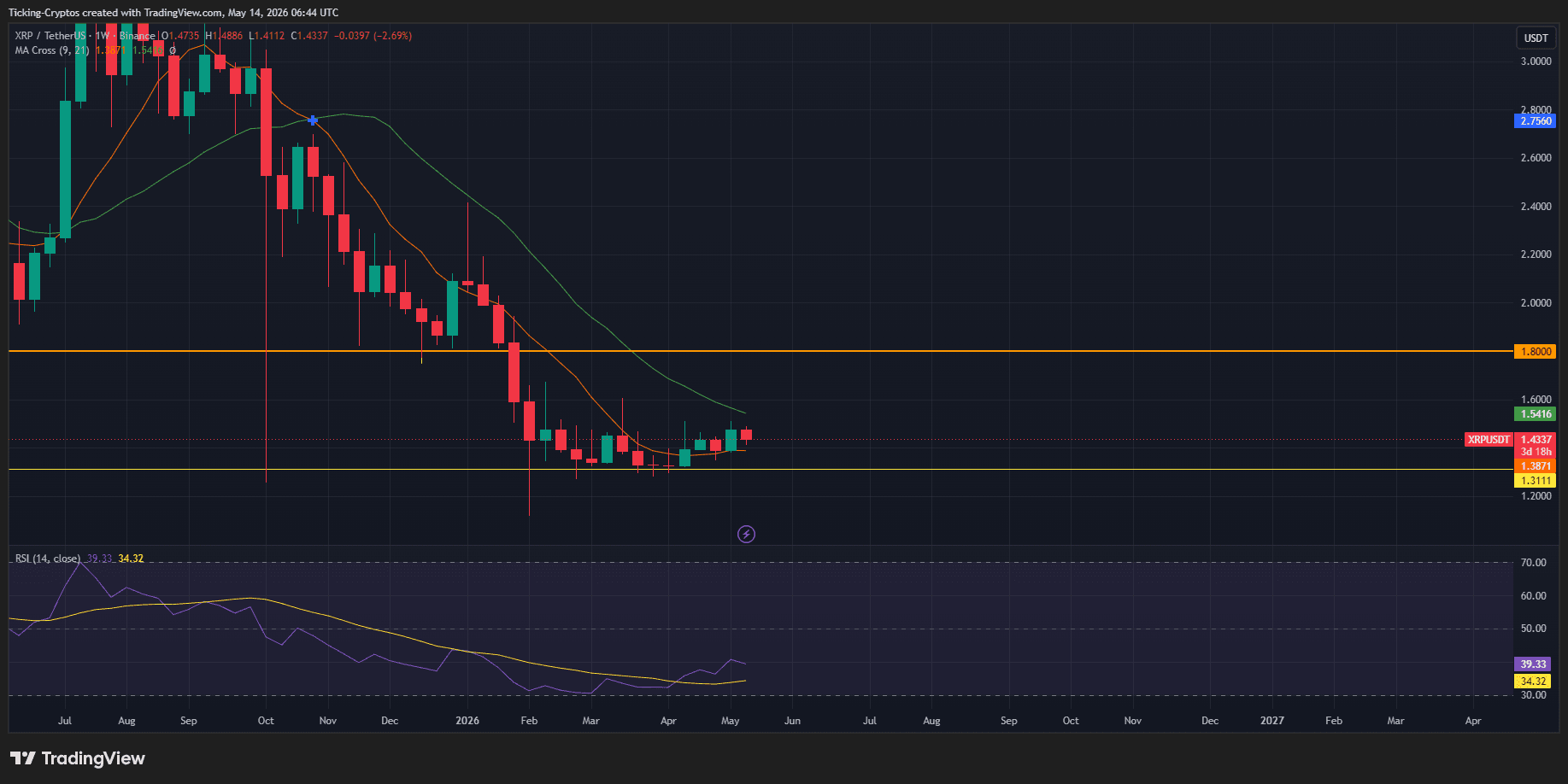
1. The Bearish Scenario: A Retest of $1.20 - $1.30
Should the $1.40 support fail due to continued pressure from the crypto market, XRP will likely gravitate toward its secondary support zone. This area, located between $1.20 and $1.30, is a high-volume node where the price found significant stability during previous corrections.
2. The Bullish Scenario: Eyes on $1.80 and $2.00
If XRP maintains its "holding strong" status, the path of least resistance remains upward. The immediate overhead resistance sits at $1.80. A successful breach of this level would clear the way for a run toward the psychological $2.00 milestone, a target that has remained a primary focus for long-term Ripple holders.
The digital asset market has been hit by a wave of intense volatility, leaving traders and long-term holders in a state of shock. After a period of bullish consolidation where Bitcoin ($BTC) appeared to be building a base for a six-figure run, the tide has turned. Today, the leading cryptocurrency plummeted below the psychological $80,000 mark, dragging the rest of the market, including Ethereum ($ETH), down with it.
Bitcoin Price Crash Today
Bitcoin is currently trading at approximately $79,100, having officially lost the $80,000 support level that bulls defended for weeks. This 5% intraday drop has triggered over $300 million in liquidations, primarily affecting over-leveraged long positions. The sudden move has shifted market sentiment from "Greed" to "Fear" almost instantly.
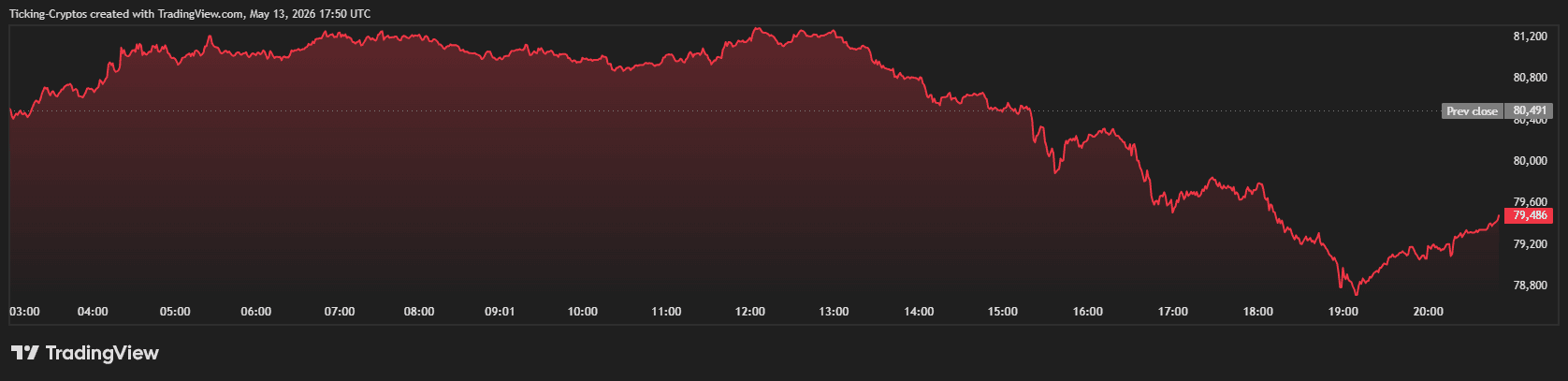
Why did Bitcoin Price Crash?
The primary catalyst for today's market crash is the release of the U.S. Producer Price Index (PPI) for April 2026. The data, published this morning by the Bureau of Labor Statistics, revealed that wholesale inflation is surging at its fastest pace in years.
The PPI Shock by the Numbers
- Headline PPI: Increased by 1.4% month-over-month, vastly exceeding the 0.5% forecast.
- Year-over-Year PPI: Hit 6.0%, the highest level in 3.5 years (since late 2022).
- Core PPI (ex-food & energy): Jumped 1.0% MoM, signaling that inflation is broad-based and not just tied to volatile sectors.
A significant driver of this spike was a 15.6% surge in gasoline prices and a 7.8% rise in energy goods, largely due to the escalating geopolitical tensions in the Middle East affecting global supply chains.
Why High PPI Destroys the Crypto Narrative
Bitcoin is often touted as an "inflation hedge," but in practice, it behaves as a high-beta liquidity asset. When the US PPI comes in this high, it forces the Federal Reserve to maintain a hawkish stance.
The market is now pricing in a "higher-for-longer" interest rate environment. Higher rates make the US Dollar stronger and Treasury yields more attractive, which naturally sucks liquidity out of risk assets like Bitcoin and Ethereum.
Technical Analysis: Is $75k the Next Stop?
From a technical perspective, the Bitcoin kurs has broken below its 50-day Exponential Moving Average (EMA). This is a major bearish signal for swing traders.
- Crucial Resistance: For any hope of a recovery, BTC must reclaim $80,500 on the daily candle.
- Support Levels: The next major "liquidity pocket" is located at $75,000. If the selling pressure continues, analysts expect a rapid descent to this level as stop-losses are triggered.
- Ethereum Impact: ETH cours has also broken its support at $2,275, currently eyeing the $2,100 zone.
To manage the current volatility, many investors are moving their funds to safety. You can compare the most secure storage options in our hardware wallets comparison or look for exchanges with higher liquidity on our exchange comparison page.
As of May 13, 2026, PEPE remains a central figure in the meme coin landscape. While many expected the "frog" to fade into obscurity, it has maintained a significant market presence. However, the 2026 market is vastly different from the speculative frenzy of years past. With $Bitcoin dominance rising to over 58.5%, the question for retail investors is simple: Is PEPE a hidden gem or a falling knife?
Is PEPE Worth Buying?
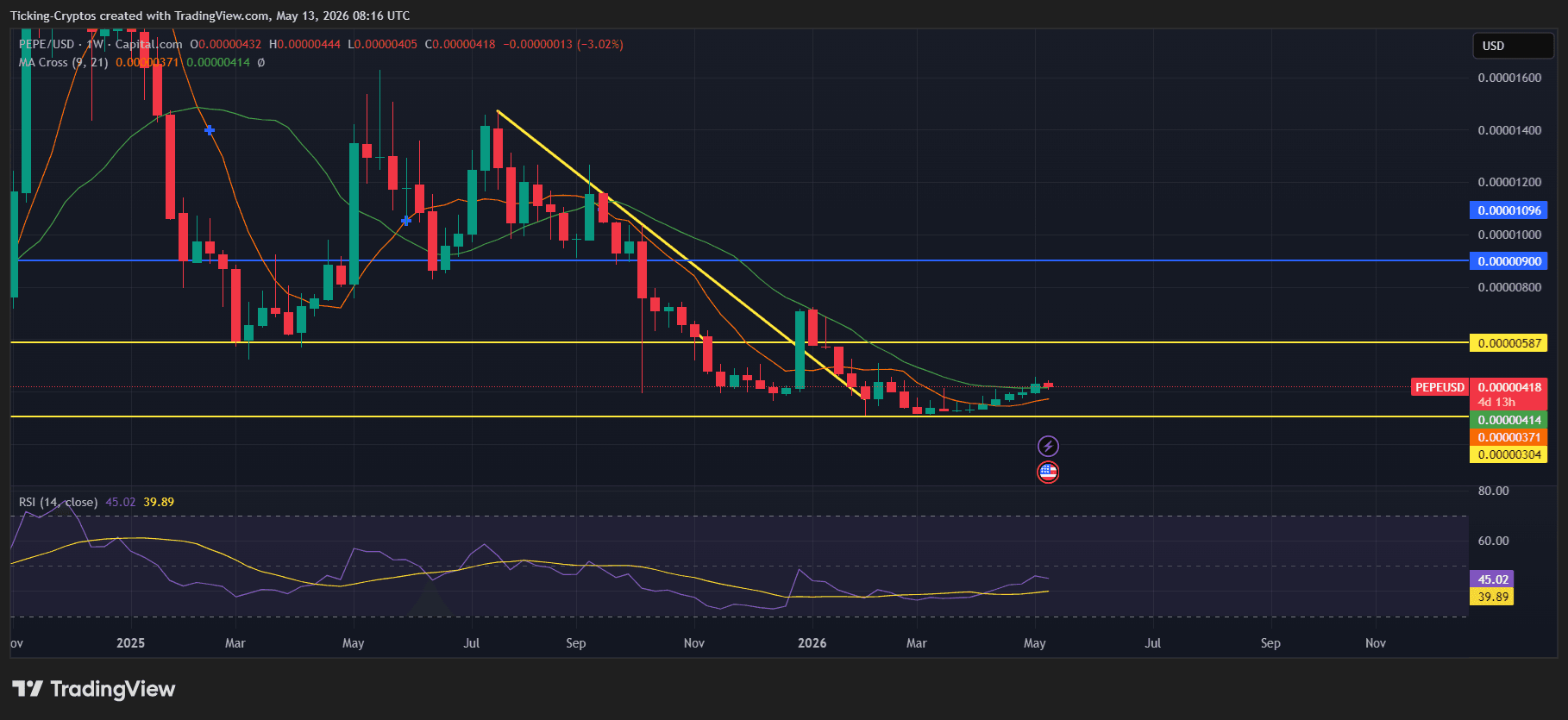
Currently trading at $0.00000418, PEPE is in a "make or break" consolidation phase.
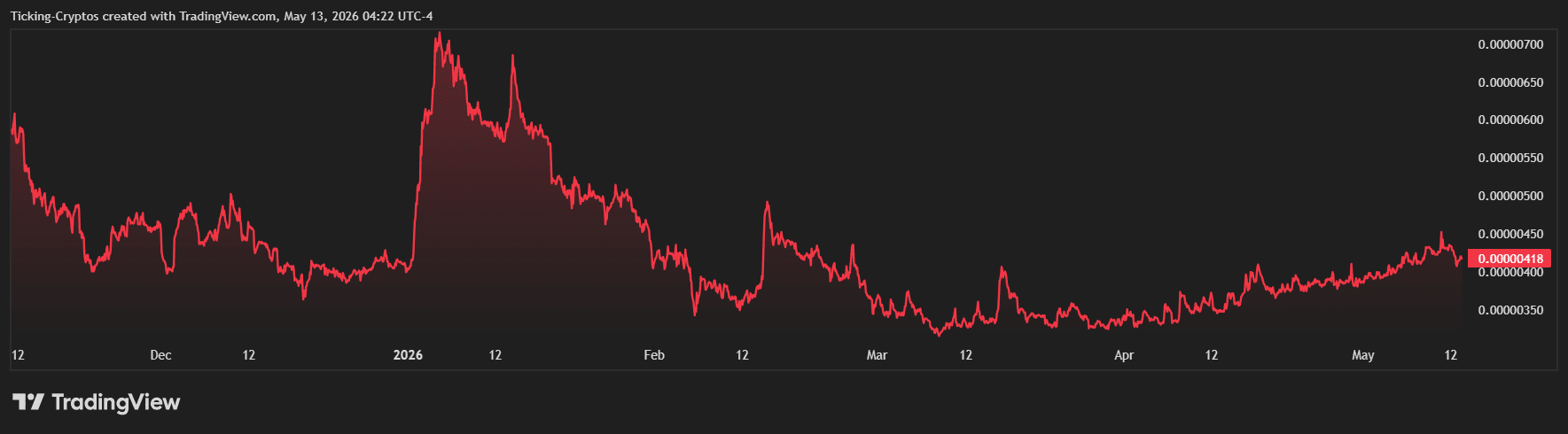
- The Bull Case: If PEPE breaks the current descending resistance, it could target $0.00000580 in the short term.
- The Bear Case: Analysts warn that if support at $0.00000304 fails, PEPE could see a further 23% drop by mid-May.
For those seeking high-risk, high-reward plays, PEPE is still "worth it" as a speculative tool, but it is no longer the "easy money" it was during its inception.
PEPE as a High-Beta Asset
In 2026, professional traders treat PEPE as a High-Beta asset. This means PEPE tends to move in the same direction as Bitcoin but with much greater intensity. When the market is "Risk-On," PEPE outperforms; when the market consolidates—as it is doing now in May 2026—PEPE often bleeds value faster than major coins.
Performance Comparison: PEPE vs. The Giants
To determine if PEPE is worth buying, we must look at how it stacks up against the "Serious" assets in May 2026.
| Asset | Price (May 13, 2026) | Market Outlook | Risk Level |
|---|---|---|---|
| Bitcoin (BTC) | $81,016 | Consolidating (Dominance up) | Low |
| Ethereum (ETH) | $2,301 | Bearish Momentum | Medium |
| XRP | $1.46 | Neutral / Regulatory Stability | Medium |
| PEPE | $0.00000418 | Neutral / Speculative | High |
PEPE vs. Bitcoin (BTC)
Bitcoin is currently the preferred choice for institutional capital, with funds flowing back into BTC as altcoins struggle. PEPE is only a superior buy if you anticipate a massive retail surge that lowers Bitcoin's dominance.
PEPE vs. XRP
XRP has found a floor at $1.40, backed by its utility in cross-border payments. PEPE lacks this fundamental "floor," making it more susceptible to total retracements if community interest dips.
PEPE Price Analysis: Key Levels for PEPE Coin
The weekly chart shows a tightening wedge. The RSI is at 45.02, which is firmly in "no man's land."
Key Support and Resistance
- Resistance ($0.00000479 - $0.00000592): PEPE has failed to break this level four times in 2026. A daily close above this is the primary "Buy" signal for trend followers.
- Support ($0.00000304): This is the ultimate "safety net." According to recent crypto news, a breach here would likely invalidate the 2026 bull thesis.
2026 Market Catalysts
- Other Frogs Threat: New competitors are siphoning liquidity from the original PEPE community, posing a significant threat to PEPE's "meme-king" status.
- Institutional Moves: While JPMorgan is launching tokenized funds on Ethereum, meme coins like PEPE rely entirely on social media virality and potential "Spot Meme ETF" rumors.
IS PEPE Coin Worth Buying in 2026?
PEPE is worth buying in 2026 only if you are using "play money." It remains a powerful tool for catching volatility, but it is underperforming compared to the stability of Bitcoin.
JPMorgan Chase intensified its foray into the decentralized finance (DeFi) ecosystem by filing for a new tokenized money-market fund on the Ethereum blockchain. This move, identified through recent SEC filings, underscores a major shift in how "Global Systemically Important Banks" (GSIBs) view public blockchain infrastructure not just as an experiment, but as a primary settlement layer for institutional liquidity.
JPMorgan’s Ethereum Strategy
The bank’s latest vehicle, the JPMorgan OnChain Liquidity-Token Money Market Fund (JLTXX), follows the successful late-2025 launch of its first public-chain fund, MONY (My OnChain Net Yield Fund). Unlike early permissioned experiments, these funds leverage the public Ethereum network, allowing for greater interoperability with the broader digital asset ecosystem.
Tokenized Money Market Funds
A tokenized money-market fund is a traditional financial product—typically investing in short-term U.S. Treasury bills and repurchase agreements—where ownership is represented by digital tokens (often ERC-20 on Ethereum).
- Yield on-chain: Investors earn dividends that accrue daily and are distributed as additional tokens.
- 24/7 Liquidity: Unlike traditional banking hours, these tokens can be transferred or redeemed near-instantaneously.
- Programmability: The fund’s "shares" can be integrated into smart contracts to serve as collateral.
Bridging Traditional Finance and Stablecoins
The timing of this launch is strategic. With the implementation of the GENIUS Act (the 2025 U.S. stablecoin legislation), stablecoin issuers are now required to hold high-quality liquid assets as reserves. JPMorgan is positioning JLTXX specifically to satisfy these legal requirements, effectively turning Ethereum into a bridge between the $240 billion stablecoin market and U.S. Treasury yields.
Institutional Competition: JPMorgan vs. BlackRock
JPMorgan is moving into a space currently dominated by BlackRock’s BUIDL fund, which recently surpassed $2.5 billion in Assets Under Management (AUM). While BlackRock has a head start, JPMorgan’s deep integration with corporate treasury desks through its Morgan Money platform gives it a unique distribution advantage.
| Feature | JPMorgan JLTXX | BlackRock BUIDL |
|---|---|---|
| Blockchain | Ethereum | Multi-chain (ETH, Arbitrum, etc.) |
| Platform | Kinexys Digital Assets | Securitize |
| Target Audience | Institutions / Stablecoin Issuers | Accredited Institutional Investors |
| Primary Assets | U.S. Treasuries / Repo | U.S. Treasuries / Cash |
Services and Utility on Ethereum
The launch of JLTXX on Ethereum entails several key services that were previously manual or siloed within internal bank ledgers:
- Atomic Settlement: Subscriptions and redemptions can happen in real-time using stablecoins or tokenized deposits, eliminating the T+1 or T+2 settlement lag.
- Collateral Mobility: Through JPMorgan’s Tokenized Collateral Network (TCN), these fund tokens can be used as collateral for derivatives or repo trades without moving the underlying assets.
- Transparent Registry: While identity is verified off-chain to meet KYC/AML standards, the record of ownership exists on a transparent, immutable ledger, reducing audit friction.
Bitcoin (BTC) continues to oscillate above the critical $80,000 psychological barrier, supported by a historic six-week streak of ETF inflows. Meanwhile, XRP has emerged as a top performer, outshining both Bitcoin and Ethereum (ETH) in recent trading sessions.
Market Snapshot: Bitcoin and XRP Performance
Investors are currently witnessing a Divergence in momentum across the board. While Bitcoin faces slight selling pressure near its local highs, Ripple's XRP has captured the market's attention with a significant breakout.
1. Bitcoin (BTC) Price Stability
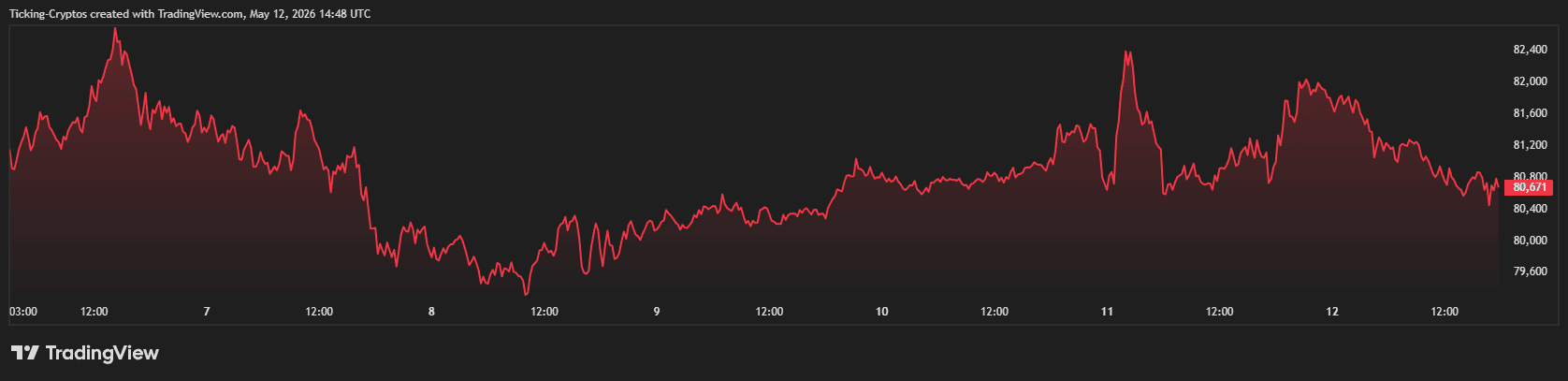
As of May 12, 2026, Bitcoin is trading at approximately $80,750, down slightly by 0.20% over the last 24 hours. The asset has established a firm trading range between $80,400 and $82,100. This consolidation is widely viewed as healthy by analysts, especially following the massive surge in late April.
2. XRP Leads the Altcoin Charge
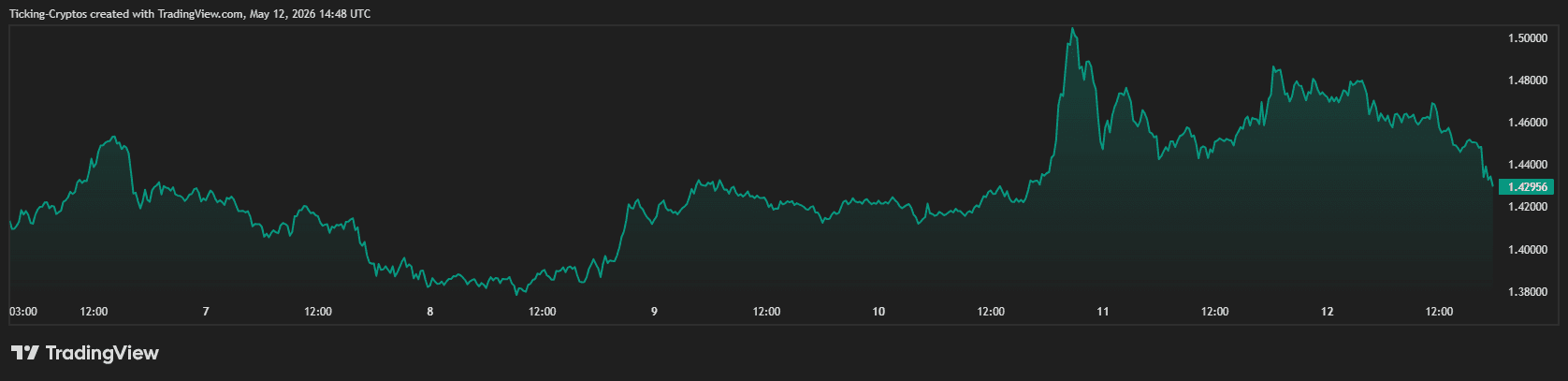
The most notable move comes from XRP, which successfully breached the $1.45 resistance level on high trading volume. Although sellers stepped in near the $1.50 mark, XRP's ability to outpace Ethereum and Bitcoin suggests a shifting appetite toward high-utility altcoins.
Institutional Era: The ETF Inflow Phenomenon
A major catalyst for the current price floor is the relentless demand from U.S. spot Bitcoin ETFs. According to recent, these funds have recorded their longest inflow streak since 2025.
- Six-Week Inflow Streak: ETFs have attracted over $3.4 billion since early April.
- AUM Records: Total Assets Under Management (AUM) for Bitcoin ETFs reached $109 billion this week, the highest level recorded in 2026.
- Supply Shock: ETFs are currently absorbing between 4,500 and 5,000 BTC daily, while only 450 BTC are mined per day—a 10:1 demand-to-supply ratio.
This "institutional era" of crypto investing is fundamentally different from previous retail-driven cycles. Wall Street wholesalers are now acting as a stabilizing force, preventing deep drawdowns even when market sentiment wavers.
What’s Next for Crypto in May 2026?
The current market structure suggests that while Bitcoin provides the foundation, the real "alpha" is currently found in selective altcoins like $XRP and $Solana. Investors are no longer buying the entire market; instead, they are rewarding projects with clear regulatory standing and technical strength. As we look toward the second half of May, the sustainability of the $80,000 level for Bitcoin will be the ultimate litmus test for the next leg toward $100,000.
Decrypt
A viral thread on X drew millions of views as a user claimed Claude AI helped recover a lost Bitcoin wallet.
Bitcoin's recent rally stalled at a critical level, putting the top crypto asset in a position that has previously led to major downturns.
Chainlink Runtime Environment enables Myriad to deploy a new range of prediction markets with immediate settlement.
Kevin Warsh, President Donald Trump's pick to lead the Federal Reserve, was confirmed as its new chair Wednesday to replace Jerome Powell.
The Senate Banking Committee will vote tomorrow on the new additions to the crypto bill, before deciding whether to refer it to the Senate floor.
U.Today - IT, AI and Fintech Daily News for You Today
Ripple's Brad Garlinghouse has outlined the key advantages of the XRP token.
Despite the existing risk demand, market saw a substantial drop in activity of traders and investors that triggered a substantial sell-off.
Ripple Chief Legal Officer Stuart Alderoty is sending a clear message to Washington ahead of the high-stakes CLARITY Act markup: cryptocurrency investors are "everyday Americans" who hold significant political power.
Kevin Warsh has been confirmed as the next Chair of the Federal Reserve in a 54–45 vote.
Galaxy Digital founder Mike Novogratz is sounding the alarm for his own party, urging Democrats to "seize the center of the ring" by immediately passing the CLARITY Act.
Blockonomi
TLDR:
- BitGo’s total Q1 2026 revenue reached $3.8B, rising 112.6% year-over-year driven by digital asset sales activity.
- Net loss widened to $60.7M in Q1 2026, largely due to non-cash Bitcoin treasury adjustments and IPO-related stock compensation.
- Client count grew 42% year-over-year to 5,569, reflecting continued institutional demand across BitGo’s platform.
- Stablecoin-as-a-Service revenue jumped 43.6% sequentially to $38.2M, supported by new partnerships and improved take rates.
BitGo Holdings reported $3.8 billion in total revenue for Q1 2026, marking a 112.6% year-over-year rise. The crypto infrastructure firm, now publicly traded on the NYSE under ticker BTGO, saw strong top-line growth fueled by digital asset sales and stablecoin services.
However, its net loss widened to $60.7 million, compared to $25.7 million in Q1 2025. The results mark BitGo’s first quarterly earnings release since its January IPO.
Revenue Growth Driven by Digital Assets and Stablecoins
Digital Asset Sales generated approximately $3.7 billion in revenue during Q1 2026. That figure represents a 127.9% year-over-year increase but a 39.3% sequential decline.
The drop came after BitGo launched its derivatives offering at the start of the quarter, shifting client activity away from spot trading.
Since derivatives revenue is recognized on a net basis, while spot revenue is gross, the comparison with prior periods is not directly comparable.
Despite that shift, margins within the digital assets segment improved to 32 basis points from 20 basis points a year ago.
CFO Ed Reginelli addressed the revenue optics directly, stating that “underlying platform economics remained significantly more resilient than reported revenue trends would otherwise suggest.”
The derivatives product generated roughly $3 billion in notional trading volume during its first quarter of operation.
Stablecoin-as-a-Service revenue reached $38.2 million, rising 43.6% sequentially. That growth was supported by new partnerships, including BitGo Mint and related stablecoin workflows.
The take rate in this segment improved to 7.4% from 5.5% in Q4 2025, reflecting stronger client adoption and product development.
Subscriptions and Services revenue came in at $25.6 million, up 11.3% year-over-year but down 34.8% sequentially.
BitGo attributed the sequential decline to fewer one-time ecosystem projects completed during the quarter. These projects, while non-recurring, continue to generate downstream opportunities across the platform.
Client Growth and Platform Metrics Show Underlying Strength
BitGo’s client count reached 5,569 in Q1 2026, up 42% year-over-year and 4.6% sequentially. User numbers rose to 1.2 million, up 7.3% from a year earlier.
CEO Mike Belshe spoke to the broader institutional momentum, saying, “This underlying momentum is a testament to the strength of our platform and the trust of our institutional clients in BitGo.”
Belshe also outlined the company’s strategic direction going forward. “As institutional adoption of digital assets continues to accelerate, we are investing to ensure BitGo not only scales its core infrastructure, but also remains positioned to lead in emerging areas such as stablecoins and tokenized assets,” he said.
Normalized Assets on Platform grew 29.4% year-over-year to $63.0 billion, stripping out the effect of price movements across digital assets.
Staking revenue totaled $49.4 million, declining 66.2% year-over-year due to lower token prices. Still, normalized staked assets grew 20.8% year-over-year and 27.2% sequentially.
The staking take rate also improved sharply to 16.1% from 12.5% a year ago, driven by new token onboarding and a more favorable validator mix.
The widened net loss was primarily driven by non-cash mark-to-market adjustments on BitGo’s Bitcoin treasury and elevated stock-based compensation tied to its IPO.
BitGo held 2,449 Bitcoin on its balance sheet as of March 31, 2026, with a fair value of approximately $167.1 million. The company expects stock compensation expense to normalize in subsequent quarters.
The post BitGo Revenue Hits $3.8 Billion in Q1 2026 Despite Widening Net Loss After NYSE Debut appeared first on Blockonomi.
Key Highlights
- Bitcoin dropped to $79,200, breaching the critical $80,000 support that had been maintained throughout much of the previous week
- Solana experienced the steepest decline among major cryptocurrencies, falling 5.6% to reach $90, with Dogecoin standing alone as the only gainer
- President Xi delivered a stern warning to Trump regarding Taiwan during their high-profile Beijing meeting
- Consecutive inflation shocks — CPI reaching 3.8% and PPI climbing 1.4% month-over-month — cast doubt on the Federal Reserve’s interest rate trajectory
- American equity futures showed resilience with modest gains, while Cisco shares rocketed 20% following impressive quarterly results
Digital asset markets faced downward pressure on Thursday as Bitcoin tumbled below the psychologically important $80,000 mark, squeezed by a dual threat of escalating geopolitical friction and persistent inflationary concerns.
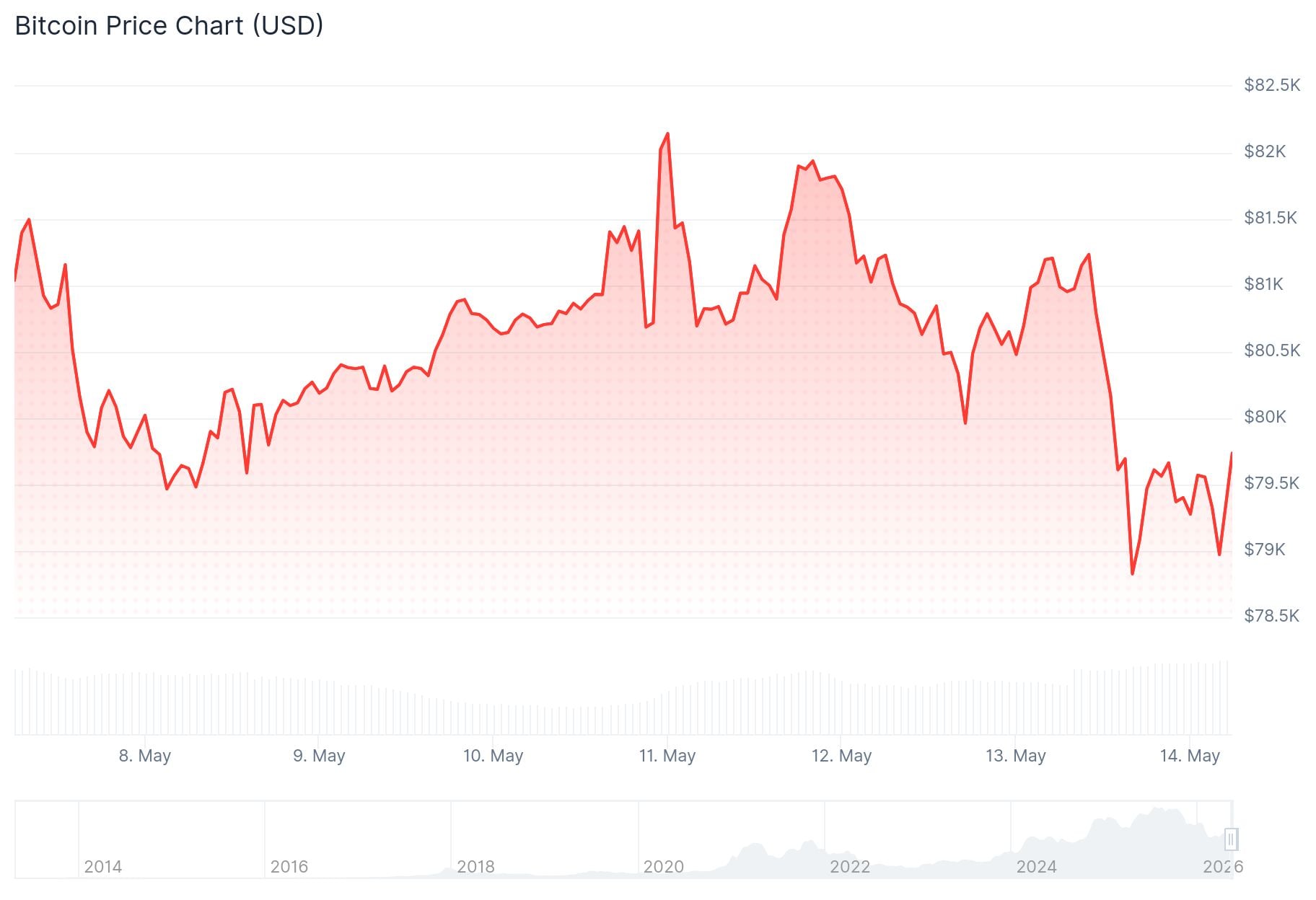
Bitcoin changed hands at $79,200 during the Asian trading session, representing a 2.3% decline over the preceding 24-hour period. The breach of $80,000 marked a significant technical failure after this threshold had provided reliable support throughout the week.
Solana experienced the most severe losses, plummeting 5.6% to $90 and erasing the majority of its two-week rally. The token had previously distinguished itself as the top-performing major altcoin during that period.
Ether declined 2.1% to settle at $2,250, extending its seven-day losses to 3%. This performance positioned it as the second-weakest major cryptocurrency behind Bitcoin.
BNB retreated 1.6% to $660 while maintaining a 3.9% advance for the week. XRP declined 1.7% to $1.43. Dogecoin stood out as the sole major cryptocurrency posting gains, advancing 0.9% to $0.1126.
Elevated Inflation Readings Weigh on Market Confidence
Tuesday’s Consumer Price Index registered 3.8%, marking the highest reading in nearly three years. Wednesday delivered another blow as the Producer Price Index surged 1.4% month-over-month, dramatically exceeding the 0.5% consensus estimate, with the annual rate hitting 6%.
These consecutive inflation surprises undermined expectations for Federal Reserve rate reductions later this year. Anticipated rate cuts had been a crucial catalyst that cryptocurrency markets had been factoring into valuations.
The cryptocurrency downturn coincided with President Trump’s arrival in Beijing for the first presidential visit to China in nearly a decade. A delegation of prominent CEOs accompanied him, including Nvidia’s Jensen Huang, Tesla’s Elon Musk, and Apple’s Tim Cook.
Beijing’s Taiwan Statement Increases Market Volatility
China’s President Xi Jinping issued a pointed warning to Trump that mismanagement of Taiwan relations could trigger “collision or even clashes.” Beijing released its official summary of Xi’s comments before the bilateral meeting had finished, amplifying market jitters.
Asian stock markets exhibited volatility throughout the session. The MSCI Asia Pacific benchmark declined 0.1% after climbing as high as 0.8% earlier in the day. Mainland Chinese equities retreated 1.3%.
The offshore yuan extended its winning streak to 11 consecutive sessions, the longest rally since September 2017, indicating some market participants are adjusting positions in anticipation of summit developments.
American equity futures demonstrated greater stability. Dow futures advanced 0.2%, S&P 500 futures edged up 0.1%, and Nasdaq 100 futures gained approximately 0.5%.
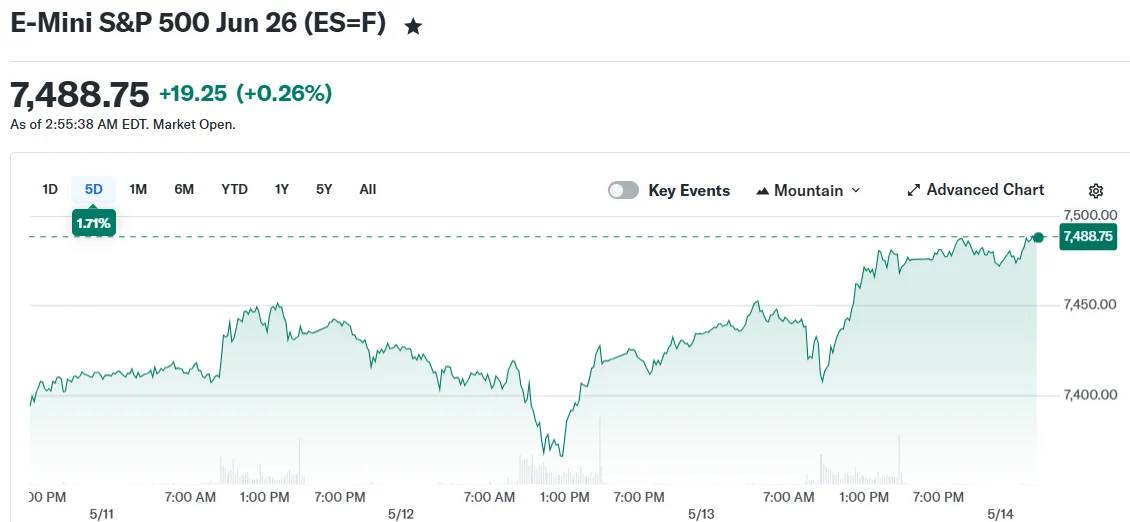
Cisco stock exploded 20% in extended trading following quarterly revenue that exceeded analyst projections. The networking giant simultaneously unveiled an artificial intelligence restructuring initiative that will eliminate approximately 4,000 positions.
An Asian technology stock indicator reached an all-time high, climbing 2.3%. The AI-driven momentum persisted despite broader market caution.
For Bitcoin traders, the critical downside level to monitor is $78,000, which represented the early-May trough before the surge to $82,000. A violation of that support would bring late-April lows back into consideration.
The United States Senate confirmed Kevin Warsh as the incoming Federal Reserve chair. Applied Materials and Klarna are scheduled to release quarterly earnings on Thursday.
The post Bitcoin (BTC) Dips Below $80K Amid Taiwan Tensions and Surging Inflation Data appeared first on Blockonomi.
Key Highlights
- Metaplanet reported a ¥114.5 billion (~$725M) quarterly net loss for Q1 FY2026, primarily from Bitcoin valuation writedowns
- Bitcoin declined approximately 22–24% in Q1, marking its weakest first quarter performance since 2018
- Operating income surged 282% year-over-year to ¥2.27B (~$14.4M), fueled by Bitcoin derivatives and options trading
- The company’s Bitcoin treasury expanded to 40,177 BTC, ranking it third globally among publicly traded companies
- CEO Simon Gerovich announced delays in the preferred share listing timeline; shares declined ~3.82% in Tokyo trading Wednesday
Metaplanet‘s first quarter fiscal 2026 earnings revealed a stark contrast between operational performance and bottom-line results.
Metaplanet Q1 FY2026 Results
Revenue: ¥3.08b (+251% YoY)
FY2026 Guidance (unchanged):
— Simon Gerovich (@gerovich) May 13, 2026
From an operational standpoint, performance was impressive. The company reported net sales growth of 251% compared to the prior year, reaching approximately $19.5 million. Operating profit experienced even more dramatic expansion, rising 282% to ¥2.27 billion ($14.4 million). This growth was predominantly driven by revenue from Bitcoin derivatives and options trading, which generated a robust 73.6% operating margin.
However, the financial narrative shifted dramatically when examining net results.
Bitcoin experienced a severe downturn during the first quarter of 2026, declining approximately 22–24% from roughly $87,000 in early January to about $66,000 by March 31. This represented Bitcoin’s poorest first-quarter performance in eight years, and [[LINK_START_3]]Metaplanet[[LINK_END_3]]’s growing cryptocurrency treasury bore the brunt of this decline.
The firm posted a ¥114.5 billion ($725 million) net loss for the three-month period. The majority of this loss was non-cash in nature — representing accounting-based valuation adjustments to its Bitcoin holdings as cryptocurrency prices fell. The basic loss per share reached approximately $0.63, a significant increase from the $0.078 loss recorded in the comparable period one year earlier.
Metaplanet Inc., 3350.T
Shares of [[LINK_START_3]]Metaplanet[[LINK_END_3]] closed at approximately 327 yen ($2.07) during Wednesday’s Tokyo trading session, representing a 3.82% decline from the previous day’s closing price.
Bitcoin Accumulation Continues Unabated
Despite recording a substantial quarterly loss, [[LINK_START_3]]Metaplanet[[LINK_END_3]] maintained its aggressive Bitcoin accumulation strategy.
The company’s Bitcoin holdings reached 40,177 BTC at the conclusion of Q1, up from 35,102 BTC at the end of December 2025 — representing an increase of roughly 5,075 BTC during the quarter. This positions the firm as the third-largest publicly traded holder of Bitcoin worldwide.
As of May 2026, [[LINK_START_3]]Metaplanet[[LINK_END_3]] controls approximately 87% of all [[LINK_START_2]]Bitcoin[[LINK_END_2]] held by Japanese publicly listed corporations.
On a fully diluted per-share basis, the company’s Bitcoin holdings increased from 0.0240486 to 0.0247319 BTC per share — representing a 2.8% quarter-over-quarter increase. The company refers to this metric as “BTC yield” and considers it a primary measure of value creation for shareholders.
To finance these continued acquisitions, [[LINK_START_3]]Metaplanet[[LINK_END_3]] increasingly utilized its $500 million Bitcoin-collateralized credit facility. As of May 13, 2026, the company had drawn $302 million against this facility.
Balance Sheet Under Pressure
Total net assets contracted from $2.96 billion on December 31 to approximately $2.60 billion by the end of the quarter, as Bitcoin-related valuation losses exceeded equity capital raised during the period.
Short-term debt increased as the company relied more substantially on its credit facility to continue accumulating [[LINK_START_2]]Bitcoin[[LINK_END_2]].
The company maintained its full-year fiscal 2026 guidance unchanged — projecting net sales of approximately $101 million and operating profit of roughly $72 million. Management did not provide guidance for ordinary income or net income, citing the significant sensitivity to Bitcoin price fluctuations.
CEO Simon Gerovich acknowledged postponements to the company’s anticipated preferred share listing, introducing an additional consideration for investors monitoring the equity.
The company’s hotel operations segment continued to generate a modest but consistent revenue stream alongside its Bitcoin-focused business activities.
The post Metaplanet Stock Slides as $725M Bitcoin Valuation Loss Overshadows Strong Operations appeared first on Blockonomi.
TLDR:
- Forward Industries holds 6.96M SOL purchased at $232.08, putting its unrealized loss close to $1 billion.
- The company posted a $585.65M net loss in Q1 fiscal 2026, largely from a $560M digital asset loss.
- Staking rewards topped 112,171 SOL since inception, with gross APY ranging between 6.5% and 7.2%.
- Forward reported $21.4M in revenue, a 4x year-over-year jump driven almost entirely by staking income.
Forward Industries (NASDAQ: FWDI), the world’s largest listed Solana treasury firm, is sitting on a near $1 billion unrealized loss.
The company holds close to 7 million SOL, purchased at an average net cost of $232.08 per SOL. With Solana trading well below that price, the mark-to-market loss is substantial.
Despite the drawdown, the firm continues staking operations and reports strong yield performance across its validator infrastructure.
Treasury Performance Amid a Challenging Market
Forward Industries disclosed holdings of 6,962,501 SOL as of December 31, 2025. The bulk of these tokens were acquired in September 2025 at a total cost of approximately $1.59 billion.
The purchase was funded through a $1.65 billion PIPE backed by Galaxy Digital, Jump Crypto, and Multicoin Capital.
The company’s staking operations have remained active despite the price decline. Forward’s validator infrastructure generated between 6.5% and 7.2% gross APY since inception. That performance exceeds most peer validators operating on the Solana network today.
As of the quarter’s end, Forward had accumulated over 112,171 SOL in staking rewards. Nearly all of its SOL holdings remained staked throughout the reporting period. Staking revenue for Q1 fiscal 2026 totaled $17.38 million.
The firm also launched fwdSOL, its proprietary liquid staking token, during the quarter. This product allows Forward to earn native staking yield while keeping capital available for on-chain deployment.
Financial Results Reflect Deep Digital Asset Losses
Forward reported a net loss of $585.65 million for the quarter ended December 31, 2025. That compares to a net loss of just $0.7 million in the same quarter the prior year. The sharp increase was driven by digital asset fair value changes.
The company recorded a $560.21 million loss on digital assets under U.S. GAAP accounting rules. An additional $33 million impairment charge was also included in the quarter’s results. These figures reflect mandatory mark-to-market treatment, not realized losses from selling SOL.
Revenue, however, told a different story. Total revenue rose more than four times year-over-year, reaching $21.4 million versus $4.6 million previously. The increase was tied almost entirely to staking income generated through the treasury strategy.
SG&A expenses rose to $7.2 million from $2.0 million in the prior-year quarter. That increase reflected higher operational costs tied to Forward’s transition into a Solana-focused treasury company.
The firm held approximately $25.4 million in cash and carried no institutional debt as of December 31, 2025.
The post Forward Industries Nears $1B Unrealized Loss as Solana Price Falls Below Its $232 Buy-In appeared first on Blockonomi.
Key Highlights
- Cardano has posted an 11% gain throughout May 2026, hovering near $0.27–$0.28 with key resistance at $0.30–$0.32
- Founder Charles Hoskinson confirmed the updated CLARITY Act no longer treats ADA as a security
- Major holders controlling 1M+ ADA tokens now possess 67.47% of total circulating supply
- Derivative open interest climbed from $69M in February to $122M currently
- Technical analysts suggest a sustained move past $0.28 could target $0.34
Cardano has delivered an 11% rally since May 2026 began, propelled by two critical catalysts: favorable developments surrounding the U.S. CLARITY Act and sustained buying from institutional-sized wallets. While the upward momentum is notable, ADA continues trading within a defined range on shorter timeframes without a decisive breakout confirmation.
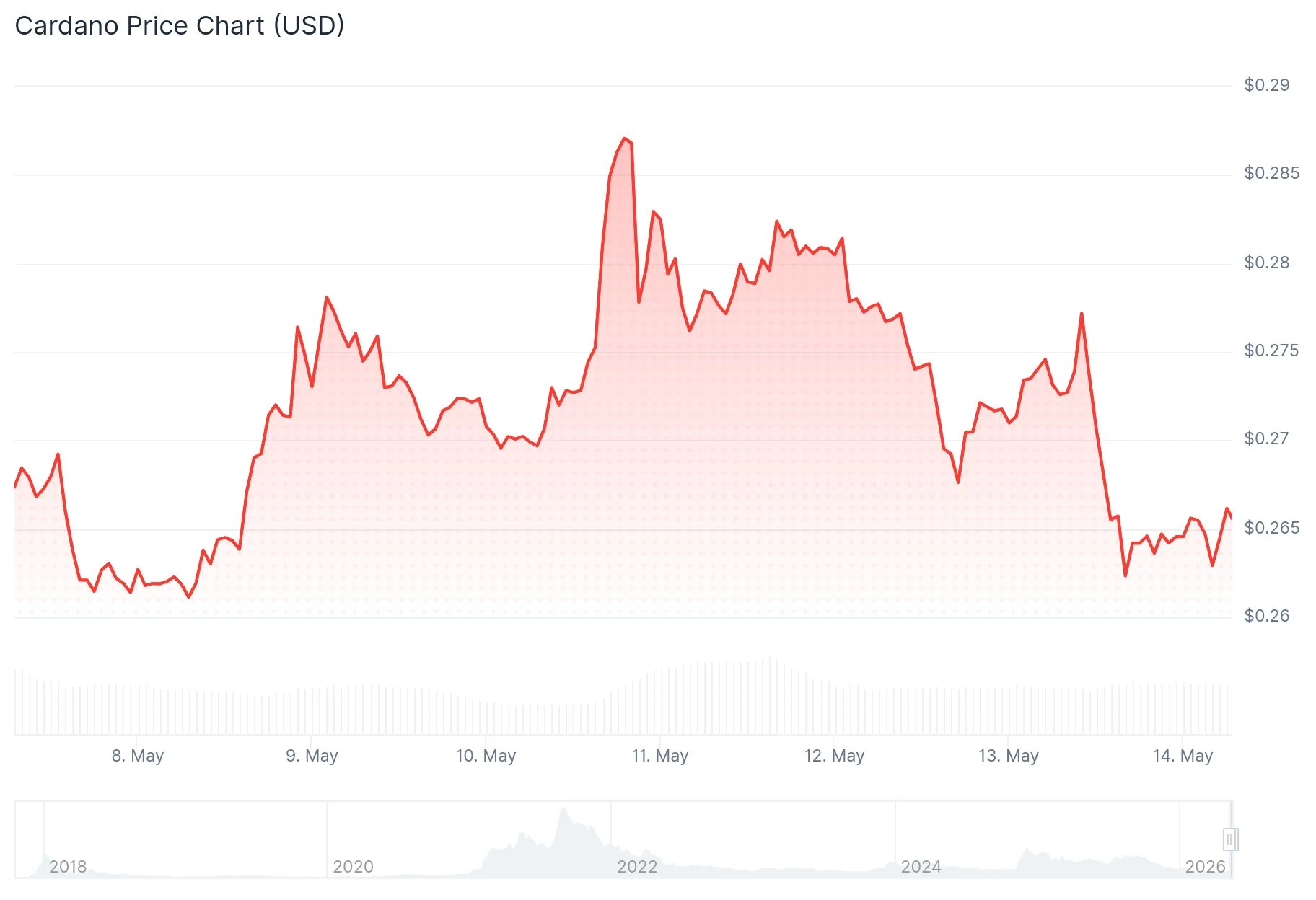
The digital asset currently trades between $0.27 and $0.28. Last week saw price rebound sharply from a demand area spanning $0.24 to $0.25, creating the most substantial weekly candle observed since mid-March. Immediate resistance appears at $0.28, while more formidable supply clusters exist between $0.317 and $0.329.
Downside protection remains intact within the $0.254–$0.266 band, which corresponds with the 50%–61.8% Fibonacci retracement levels. Should this critical zone fail, the next major support structure lies near $0.227–$0.233.
Cardano’s creator Charles Hoskinson recently voiced approval for the revised CLARITY Act via social media platform X, praising Senator Tim Scott for demonstrating “strong leadership” in refining the legislation. Hoskinson clarified that the updated draft explicitly recognizes ADA as a non-security, crediting Cardano’s decentralized governance framework.
Hoskinson had earlier expressed concern about the CLARITY Act’s initial language, cautioning it might categorize certain digital assets as securities. The revised legislation now accommodates decentralized networks more favorably, which directly benefits Cardano’s operational model.
Large Holders Continue Expanding Positions
Data from Santiment reveals that major ADA holders have maintained consistent accumulation patterns since December 2023. Addresses containing a minimum of 1 million ADA tokens collectively hold 25.09 billion units — representing 67.47% of available supply. This buying trend has persisted despite ADA experiencing a 71% market capitalization decline over the preceding nine months.
Cardano’s key stakeholders have slowly but surely accumulated, consistently adding more and more of the existing supply to their bags, dating back to December, 2023.
Wallets with at least 1M tokens now hold 25.09B $ADA, which translates to 67.47% of the current existing… pic.twitter.com/knuSbfYtaE
— Santiment Intelligence (@SantimentData) May 13, 2026
Technical momentum metrics suggest cautious optimism. The Relative Strength Index registers 60.28, positioned above the neutral midpoint of 50. The MACD indicator shows 0.00673 versus a signal line at 0.00444, producing a positive histogram value of 0.00229, which indicates strengthening buyer momentum.
Futures Market Shows Growing Interest
Open interest across ADA derivative contracts has expanded from $69 million in February to $122 million presently, based on Coinglass metrics. Binance exchange data reveals a long/short ratio of 2.30, indicating bullish positions outnumber bearish ones by more than two-to-one.
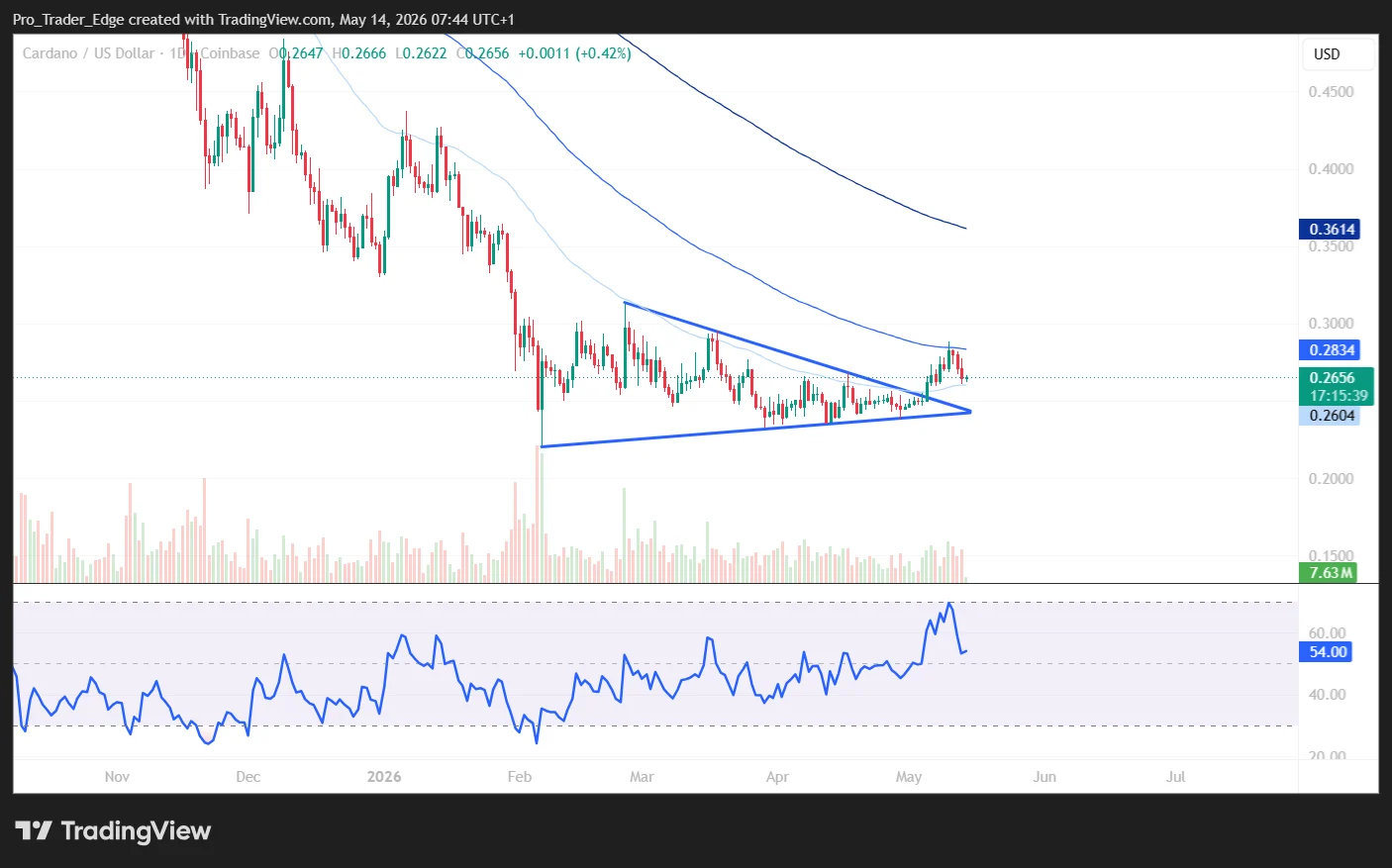
Nevertheless, the CLARITY Act continues facing headwinds. Banking institutions have submitted 8,000 written objections to the Senate regarding stablecoin yield components. Polymarket prediction markets currently assess the bill’s passage likelihood at 60%, representing a decline from the previous 74% probability.
Technical analyst More Crypto Online identifies near-term resistance at $0.299, with a significant extension target at $0.349. A confirmed breakout requires ADA to decisively reclaim the $0.30–$0.32 zone supported by substantial trading volume.
The elevated long/short ratio of 2.30 on Binance introduces potential downside risk — any price stagnation could trigger rapid liquidations among overleveraged long positions, potentially sparking a sharp correction.
The post Cardano (ADA) Surges 11% in May as Whale Activity and Regulatory Win Spark Rally appeared first on Blockonomi.
CryptoPotato
The undeniable growth of the overall cryptocurrency industry over the past decade has, unfortunately and expectedly, led to an increasing number of scammers trying to exploit unsuspecting victims in various ways.
Ripple and its broader ecosystem are no exception, as they have often been targeted by such fraudsters. The latest warning came from the company’s CTO Emeritus.
Stay Safe, XRP Family
David ‘JoelKatz’ Schwartz issued the warning to his over 700,000 followers on X, indicating that there has been a “huge escalation lately in airdrop and giveaway scams targeting XRPL users.” Airdrop scams typically mean that victims are prompted to enter their blockchain wallets with the promise of receiving new (and free) tokens.
Although there are numerous legit airdrops in crypto, they go through the official channels. Ripple has never actually completed such initiatives, so Schwartz warned that “any such posts you see are likely scams.”
Giveaway scams work similarly. The bad actors urge users to send a certain amount of tokens to an address operated by them, promising to return twice the amount. In general, they promote the alleged giveaways with some promotion or celebration. It does sound lucrative and promising, perhaps that’s why a lot of users have fallen victim, but there’s no free lunch, and people who have sent tokens do not get anything in return.
Schwartz emphasized that if someone is pretending to be him on social media, they are “likely a scammer.”
SCAM ALERT: There has been a huge escalation lately in airdrop and giveaway scams targetting XRPL users lately. Any such posts you see are likely scams.
Anyone claiming to be me on Instagram, Telegram, or almost anywhere else is likely a scammer.
Stay safe XRP fam.
— David ‘JoelKatz’ Schwartz (@JoelKatz) May 14, 2026
Not the First
As mentioned above, this is not the first time the XRP community has been targeted by bad actors. CryptoPotato reported in July last year that scammers used YouTube as their main platform to impersonate Ripple’s official account and execs to promote various frauds, including giveaways and airdrops.
Months later, the company’s official X account alerted that such fraudsters had started fake Ripple or XRP livestreams and even deepfake videos, trying to scam viewers out of their tokens.
The firm’s CEO, Brad Garlinghouse, warned before the 2025 holiday season that bad actors are likely to intensify their efforts, and praised a website that provides more information on how users can protect themselves.
The post Ripple CTO Emeritus Issues Urgent Warning About XRP Scams appeared first on CryptoPotato.
Ripple’s native cross-border token is among the most popular assets within the cryptocurrency community, and the CEO of the company behind it recently published a video explaining what makes it unique.
Some of those features include rapid transaction speeds and low costs.
Why Is XRP Unique?
Garlinghouse’s video began with a short history lesson going back to the early XRP Ledger days from a decade ago. Contributors at the time included key developers who worked on the core of Bitcoin, where they saw an opportunity to “build something specialized and specific and unique to really solve a payments problem.”
This is where the cross-border token shines, according to Garlinghouse. At first, he began by outlining the settling speeds where transactions are completed in 3 to 5 seconds. Second: “it’s cost. Extremely low costs, fractions of a penny per transaction.” Third: XRP’s scalability, with over 4 billion transactions completed since its inception. Last but not least, the CEO highlighted the “incredible community” around the token, which the company calls “the XRP family.”
“But you put those things together, and you can include the longevity of this blockchain, you have something special and unique that is poised for great success in the years ahead.”
XRP Price Update
While on the topic of XRP, let’s quickly explore its most recent price moves. The token tried to break out on Sunday when it outperformed the rest of the larger-cap alts, but it was almost instantly halted at $1.52 and driven back down toward $1.45. It has since slipped below that level as most of the crypto market has retreated.
What’s particularly worrying is that it lost the fourth spot in terms of market cap to BNB, and the gap between the two stands at $1.5 billion as of press time.
Popular analyst MikybullCrypto noted that XRP has been forming a “possible breakout of the 9-month trendline resistance,” which could be supported by an ongoing significant accumulation at this triangle formation. CRYPTOWZRD said XRP had closed indecisively once again as it needs to hold above the $1.445 resistance to initiate a more profound run. As of now, though, the asset remains below that important level.
The post Why Is XRP Special and Unique? Garlinghouse Reveals Ripple’s Biggest Advantages appeared first on CryptoPotato.
Blockchain investigator ZachXBT has linked US-based alleged threat actor Dritan Kapllani Jr. to more than $19 million in crypto thefts carried out through social engineering attacks targeting cryptocurrency holders.
In a series of posts on X, ZachXBT alleged that Dritan frequently showcased luxury cars, designer watches, private jets, and nightlife activities across social media while interacting with other threat actors online.
Crypto Laundering Network Exposed
According to the investigator, Dritan was recently recorded during a Discord “band 4 band” (B4B) call on April 23, 2026, wherein he displayed an Exodus wallet allegedly holding $3.68 million in cryptocurrency in an attempt to prove he possessed more funds than another individual on the call.
ZachXBT identified the Ethereum wallet address shown during the exchange and connected it to a major Bitcoin theft that took place on March 14, 2026. The investigator claimed the address traced back to the theft of 185 BTC, worth around $13 million at the time, from a victim targeted through social engineering tactics.
According to the findings, Dritan’s wallet allegedly received approximately $5.3 million from the theft on March 15. ZachXBT stated that by the time the Discord call took place, six weeks later, nearly $1.6 million had already been spent or laundered. The allegations surfaced one day after US authorities unsealed a criminal complaint against Trenton Johnson for his alleged role in the 185 BTC theft.
ZachXBT claimed Dritan was identified in the complaint as “Co-Conspirator 1,” although he has not been formally charged. The investigator also noted that meme coin influencer “yelotree” was charged for allegedly helping launder stolen funds through a Miami-based rental car business and could face up to 30 years in prison if convicted.
Link to “Lick” Investigation
ZachXBT further connected Dritan to an earlier January 2026 investigation involving John Daghita, also known as “Lick,” who was accused of stealing $46 million from the US government. According to the prominent on-chain sleuth, one of Dritan’s previously used wallet addresses was exposed in a deleted Telegram post shared by Daghita. ZachXBT claimed the wallet was tied to at least five additional social engineering thefts in 2025 that stole more than $5.85 million.
The investigator said he delayed publicly sharing his findings until charges connected to the 185 BTC theft became public and added that Dritan had avoided prosecution partly because he was a minor until recently turning 18.
The post ZachXBT Links Teen Crypto Flaunter to $19M Theft Network appeared first on CryptoPotato.
The Senate Banking Committee’s CLARITY Act is heading into Thursday’s markup, buried under opposition.
According to reports, Senator Elizabeth Warren alone filed more than 40 amendments before Tuesday’s 5 p.m. ET deadline, and American Bankers Association members sent over 8,000 letters to Senate offices in less than a week demanding changes to the bill’s stablecoin yield rules.
Over 100 Amendments Filed
The total number of proposed amendments going into Thursday is still being confirmed, but according to a list obtained by Politico, there have been more than 100 proposed. To put things in perspective, a total of 137 revisions were proposed before the markup scheduled for January, which was canceled.
Warren’s batch alone covers a wide range of restrictions. One amendment that stood out would bar the Federal Reserve from issuing master accounts to crypto companies, which would effectively cut such firms off from the core infrastructure of the US banking system.
The lawmaker also attacked the updated bill on X, arguing that it lacked ethics provisions tied to President Donald Trump’s crypto businesses.
“No bill should move through the Banking Committee without real ethics guardrails,” she wrote.
That dispute has become harder for negotiators to avoid. Late last month, analyst Simon Dedic claimed that Trump’s meme coin and his crypto-related dinners were part of the reason the CLARITY Act was going nowhere, with Democrats demanding conflict-of-interest language before backing the legislation.
Another revision, filed by Senator Jack Reed of Rhode Island, would prohibit crypto from being used as legal tender, including for paying taxes. That proposal runs directly counter to a bill Representative Warren Davidson introduced last year that would have allowed Bitcoin to be used for precisely that purpose.
Senators Reed and Tina Smith of Minnesota also filed a joint amendment that would incorporate bank-requested changes to the stablecoin yield language.
According to journalist Brendan Pedersen, the proposal will force senators to choose between crypto and the banks on a single vote, making it an uncomfortable moment for Republicans who tend to side with both.
Bankers Blitz Senators With 8,000 Letters
Elsewhere, members of the American Bankers Association have reportedly sent more than 8,000 letters to Senate offices since last Friday, pushing lawmakers to change the bill’s stablecoin yield compromise.
However, Stand With Crypto, the crypto advocacy group, responded with its own numbers on Tuesday, saying its advocates had called Congress 8,000 times and sent 300,000 emails over recent months to protect stablecoin rewards, and have contacted lawmakers nearly 1.5 million times in support of the CLARITY Act overall.
Those on the side of digital assets are framing the banking industry’s lobbying campaign as an attempt to block competition from yield-bearing stablecoins.
Senator Bernie Moreno accused banks of trying to “kill stablecoins that would let everyday Americans earn real yields on their own money.” He also described the banking industry as a “cartel” protecting low-interest deposit models.
But not everyone inside Washington thinks this fight ends at Thursday’s committee vote. According to reporter Sander Lutz, banking policy leaders are already preparing for another push on the Senate floor if they lose the markup battle over yield restrictions.
Meanwhile, crypto journalist Eleanor Terrett reported that Senate Minority Leader Chuck Schumer privately encouraged Democrats to work toward supporting the bill.
The post CLARITY Act Faces Wave of Amendments Ahead of Markup appeared first on CryptoPotato.
The biggest meme coin by market capitalization has jumped by double digits over the past 30 days, increasing its dominance in its niche.
However, certain technical indicators suggest the bears may soon regain control.
The Incoming Correction?
As of press time, DOGE trades at around $0.114 (according to CoinGecko), representing an impressive 8% increase on a two-week basis and a 25% surge for the month. In fact, it has outperformed many leading cryptocurrencies, including Bitcoin (BTC) and Ethereum (ETH), over these time frames.
Nonetheless, the renowned analyst Ali Martinez tempered the excitement in the Dogecoin community after noting that the TD Sequential indicator had flashed a sell signal on the meme coin.
Another short-term warning sign is DOGE’s Relative Strength Index (RSI). The technical analysis tool is often used by traders to spot potential price reversal points and ranges from 0 to 100.
Readings above 70 indicate that the meme coin’s valuation has risen too much, too quickly, and could be due for correction. On the contrary, anything below 30 suggests that the token is oversold and on the verge of a resurgence. As of this writing, DOGE’s RSI stands at roughly 88.
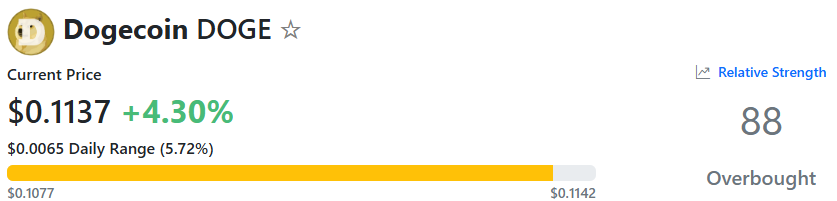
The Bullish Scenario
Despite the aforementioned indicators hinting at a price decline in the near future, multiple market observers remain optimistic that the meme coin has plenty of fuel left to post further gains.
X user Ryker claimed that DOGE’s chart “looks great,” predicting that it “will lead meme trend back together.” For their part, JAVON MARKS argued that the asset has started responding even more positively to a major bullish divergence that has been holding with the MACD.
They envisioned a whopping 500% breakout to the $0.6533 target, which could then open the door to an ascent to a new all-time high of approximately $1.25.
MikybullCrypto followed up with an even more optimistic outlook. They suggested the current levels are “the best area” to hop on the bandwagon before “the massive bullish tide,” forecasting an astronomical explosion to $12.
It is important to note that such a pump seems quite improbable (at least for now), as it would require DOGE’s market cap to exceed $1.8 trillion. In comparison, the current capitalization of BTC stands at around $1.61 trillion, while the total value of the entire crypto sector is less than $2.8 trillion.
The post Dogecoin (DOGE) Soars 25% in a Month, But Key Indicator Flashes a Sell Signal appeared first on CryptoPotato.