Cryptocurrency Posts
Crypto Briefing
Tottenham's poor start raises concerns about managerial effectiveness and squad cohesion, potentially impacting their long-term ambitions.
The post Tottenham Hotspur remains winless and goalless after draw with Everton appeared first on Crypto Briefing.
The Houthi control of a key maritime chokepoint could destabilize global trade and energy markets, prompting international military and diplomatic actions.
The post Houthis seize Perim Island, control Bab el-Mandeb Strait after 18-hour assault appeared first on Crypto Briefing.
Athletic's missed opportunity to capitalize on a numerical advantage highlights potential struggles in converting dominance into victories.
The post Athletic Bilbao draws 1-1 with Elche in La Liga match appeared first on Crypto Briefing.
SpaceX's increased Nasdaq 100 weighting may drive significant market activity, impacting passive funds and investor strategies.
The post SpaceX set for larger weighting in Nasdaq 100 this month as lockup expirations expand float appeared first on Crypto Briefing.
The potential pause in Fed rate hikes could ease financial strain but may raise concerns about political influence over monetary policy.
The post Fed rate hikes unlikely due to rising interest payments, political factors: analyst appeared first on Crypto Briefing.
Bitcoin Magazine
Bitcoin Magazine

Bitcoin’s ‘Unusual Mix’: Bearish Inflation Print, Bullish Buyback Failure
Bitcoin’s path higher just got harder in the short term, but the setup further out may be improving, according to a new report.
In a Friday note, European asset manager CoinShares’ Head of Research, James Butterfill, said firmer-than-expected core inflation raises the odds of tighter Fed policy and could cap bitcoin below $80,000 for now.
But the longer-term case, he argued, rests on the U.S. Treasury’s bond buyback programme failing to bring down long-end yields — a failure that could ultimately feed the debasement narrative that has supported both bitcoin and gold.
“The result is therefore a somewhat unusual policy mix for Bitcoin,” the report read. “Today’s CPI data is negative at the margin, increasing the probability of tighter monetary policy and potentially limiting the immediate upside.
“But the apparent failure of the Treasury’s current buying programme increases the likelihood of much more substantial intervention further ahead.”
It continued: “If that happens, it could become one of the more powerful medium-term catalysts for Bitcoin.”
Data on Friday revealed that the consumer price index, excluding food and energy, climbed 0.3% in August from a month earlier — higher than expected.
According to CME’s FedWatch tool, traders think there is a 85% chance interest rates will be higher after the Federal Reserve meets next week. Bitcoin has typically performed well in a low interest rate environment.
But the U.S. Treasury’s expanded bond buyback programme has so far failed to materially suppress long-term yields.
If yields stay stubbornly high, Butterfill said, pressure will build on Treasury Secretary Scott Bessent to escalate to a much larger, “bazooka-style” buying programme aimed at forcing borrowing costs down.
Bitcoin in August had one of its best runs in years after Treasury Secretary Scott Bessent announced the department would double the size of its long-dated bond buybacks.
The announcement and subsequent price surge has led some to say the much talked-about debasement trade is back. The so-called debasement trade is when investors buy an asset as a way to hedge against a currency losing value.
Bitcoin and gold have both benefited as part of the trade as the dollar weakens.
This post Bitcoin’s ‘Unusual Mix’: Bearish Inflation Print, Bullish Buyback Failure first appeared on Bitcoin Magazine and is written by Mathew Di Salvo.
Bitcoin Magazine

Blockstream Tells Hackers To Return Remaining Bitcoin Stolen in Liquid Theft
Bitcoin infrastructure firm Blockstream has refused to negotiate further with hackers who last week stole 4,000 bitcoins from its Liquid network.
Writing on X Friday, Blockstream said that the hackers still had time to return the funds before the company would work with law enforcement.
White-hat hackers on Sunday withdrew about $320 million from the federation wallet that backs Liquid, a sidechain by Blockstream. After negotiating with Blockstream, they returned most of the funds but kept 598.5 coins worth over $46 million — demanding it as ransom.
“Blockstream will not pay a ransom for the return of stolen funds,” the post read. “Taking assets without authorization and withholding their return is a crime, not responsible disclosure. It is not white-hat activity. It is theft.”
It added: “We will work with law enforcement, exchanges, service providers, forensic specialists, and other relevant parties to trace and recover the assets and identify those responsible.”
“We will not pay for the return of stolen property. We will not abandon our users. The Bitcoin community will not stop pursuing the funds.”
Liquid, or L-BTC, is a layer-2 created by Blockstream that allows users to fast move assets backed 1:1 with bitcoin. One of the assets, LBTC, is a token backed by bitcoin that allows for quick settlement — a bit like the Lightning Network.
Hackers were able to get the funds by exploiting an inflation bug on the Liquid sidechain to create over 4,000 LBTC that did not exist before and cash them out for real, on-chain bitcoins.
The hackers then had an exchange with Blockstream via messages written into Bitcoin blocks.
In one message, the white hats wrote: “Please fix the bug first. The chain is under risk at latest commit right now. Make sure every node is patched. Then we will transfer the money back safely after confirming the fix.”
In the latest message, the hackers slammed Blocksteam as “delusional, greedy, and arrogant,” and threatened to reveal all of Blockstream’s encrypted messages in the exchange unless the company allowed thieves to keep 10% of the bitcoins.
“You SHALL pay 10% using your own money as bug bounty or you will cause all your holders a 15% loss for your irresponsibility and stinginess,” the message read.
The Bitcoin community is still reeling after hackers in July were able to steal over 1,800 bitcoins worth close to $140 million from Coldcard wallet holders.
Users of the popular hardware wallet, created by Coinkite, were targeted because the product’s manufacturer did not use a true random number generator, allowing hackers to essentially guess investor seedphrases.
This post Blockstream Tells Hackers To Return Remaining Bitcoin Stolen in Liquid Theft first appeared on Bitcoin Magazine and is written by Mathew Di Salvo.
Bitcoin Magazine

Italy’s Second Biggest Bank UniCredit Is Weighting up Crypto Custody: Report
Italy’s second largest bank is considering expanding into digital asset offerings, including custody, according to reports.
According to a Friday Bloomberg report citing people familiar with the matter, Milan-based UniCredit is selecting a technology provider that would allow it to build the infrastructure needed to hold digital assets and facilitate their buying and selling.
Bloomberg’s reporting added that tokenized investment products and fixed-income securities, the use of stablecoins and exposure to cryptocurrencies were all on the cards.
JUST IN:
— Bitcoin Magazine (@BitcoinMagazine) September 11, 2026Italy’s 2nd-largest bank UniCredit is considering to offer crypto asset custody — Bloomberg
pic.twitter.com/NAZKJBdcES
The news comes as other banks in Europe expand crypto offerings. Spain moved first on retail, with BBVA rolling out bitcoin trading and custody to all customers via its app, using its own custody infrastructure rather than a third party; Santander’s Openbank followed with its own trading service.
Cecabank — a Spanish custodian with over €400bn under management that acts as backbone for 100+ financial institutions — went live with crypto custody in June via a partnership with Bit2Me.
And in Germany, Deutsche Bank is building custody with Bitpanda’s technology arm, while Taurus and DZ Bank got BaFin approval in January for its meinKrypto platform.
New regulation in the European Union — Markets in Crypto-Assets Regulation (MiCA) — gives banks a legal definition, a supervisor, and a familiar set of obligations to launch crypto services.
UniCredit is one 37 lenders across 15 European countries working together to create a company called Qivalis with the aim of issuing a euro-denominated stablecoin.
Last year, the bank said it was offering professional clients a structured product tied to BlackRock’s iShares Bitcoin Trust exchange-traded fund, with full protection against losses.
This post Italy’s Second Biggest Bank UniCredit Is Weighting up Crypto Custody: Report first appeared on Bitcoin Magazine and is written by Mathew Di Salvo.
Bitcoin Magazine

Government Defeated as Lords Back UK Digital Assets Strategy
The UK government suffered a defeat in the House of Lords on Wednesday as peers backed an amendment requiring the Treasury to draw up a national strategy for regulating digital assets.
The upper chamber approved the measure by 194 votes to 138, with Conservative and Liberal Democrat peers combining against a near-solid bloc of Labour votes. Baroness Neville-Rolfe, a Conservative former Treasury minister, moved the amendment to the Financial Services and Markets Bill.
The new clause, titled “Digital assets strategy,” would require the Treasury to prepare, publish and consult on a strategy for regulating and developing digital assets and related digital financial market infrastructure in the UK.
JUST IN:
— Bitcoin Magazine (@BitcoinMagazine) September 11, 2026U.K. House of Lords passes amendment requiring the government to develop a national cryptocurrency strategy
The regulation of digital assets includes “cryptoassets, qualifying stablecoins, Central Bank Digital Currencies, tokenised securities and other digital and tokenised financial assets,” according to the draft.
The UK is in the process of drafting a sweeping new crypto bill. The country’s Financial Conduct Authority finalised its regulatory framework for cryptoassets in June, with the regime due to take effect on 25 October 2027. The authorisation gateway for firms opened on 30 September and runs to 28 February 2027.
Britain is trailing behind Brussels and Washington with digital asset regulation. The EU’s Markets in Crypto-Assets regulation has applied to service providers since 30 December 2024.
And the U.S. under President Donald Trump signed the GENIUS Act into law in July 2025, establishing a federal framework for dollar-backed tokens. Broader market-structure legislation remains unfinished: the Clarity Act cleared the House in July 2025 by 294-134 but has been stuck in the Senate over DeFi, stablecoin yield and ethics provisions, with a procedural vote set for next week.
This post Government Defeated as Lords Back UK Digital Assets Strategy first appeared on Bitcoin Magazine and is written by Mathew Di Salvo.
Bitcoin Magazine

Bitcoin Price Spikes, Shrugs off Hot US Inflation Data
Bitcoin’s price rose on Friday — despite data revealing that U.S. inflation had risen.
The biggest cryptocurrency by market cap was recently trading for close to $78,749 after jumping 2% over a 24-hour period. At one point on Friday morning in New York, bitcoin rose as high as $79,607.
Bitcoin’s price spike came after news dropped that U.S. consumer prices accelerated in August, reinforcing expectations that the Federal Reserve will raise interest rates next week.
The consumer price index, excluding food and energy, climbed 0.3% in August from a month earlier, which was higher than expected.
Inflation in the U.S. has been difficult to tame due to the war with Iran, which has lifted oil prices, in turn raising the costs of food, gasoline and other goods.
Higher inflation typically means the Federal Reserve will raise interest rates, which in turn could stop bitcoin’s price climbing higher.
According to CME’s FedWatch tool, traders think there is a 85% chance interest rates will be higher by next week. The Federal Reserve will meet next week and reveal what it will do with borrowing costs.
Bitcoin has typically performed well in a low interest rate environment because it means people can buy more of the cryptocurrency with increased liquidity.
Federal Reserve Chairman Kevin Warsh, who took the helm in January, last month gave his first speech as head of the U.S. central bank and said he had “more work to do” to fight inflation.
The U.S. is currently in the grips of an affordability crisis and rising oil prices are a hot topic ahead of the midterm elections.
U.S. President Donald Trump has reassured voters that prices will get under control and repeatedly put pressure on the central bank to lower interest rates.
Bitcoin in August had its biggest run in years following positive regulatory news and an announcement from the U.S. Treasury.
Treasury Secretary Scott Bessent announced the department would double the size of its long-dated bond buybacks, helping non-yielding assets like bitcoin and gold. The cryptocurrency then benefited from President Trump urging lawmakers to get key crypto legislation, the Clarity Act, over the line.
This post Bitcoin Price Spikes, Shrugs off Hot US Inflation Data first appeared on Bitcoin Magazine and is written by Mathew Di Salvo.
CryptoSlate
August’s inflation report left the Federal Reserve with a mixed signal: gasoline drove much of the headline increase, but monthly core inflation accelerated. That combination kept Governor Christopher Waller’s conditional case for a rate hike in play even as Bitcoin held its daily gain.
CryptoSlate's live Bitcoin market data had BTC at $78,683, up 2.08% over 24 hours, when trading closed in the US for the week. In contrast, Reuters reported that futures had moved to about an 85% probability of a quarter-point increase at the Fed's September 15-16 meeting, from about 70% before the inflation report. CME says its FedWatch probabilities are derived from 30-Day Fed Funds futures.
The policy tension lay inside the inflation report: annual core inflation eased, while its latest monthly pace picked up.
CPI composition cut both ways
The Bureau of Labor Statistics said the consumer price index increased 0.4% in August on a seasonally adjusted basis after a 0.1% rise in July. The unadjusted 12-month rate stayed at 3.4%.
Gasoline supplied the clearest reason to look beneath the headline. Its index rose 3.9% and accounted for more than one-third of the monthly all-items increase, while the broader energy index gained 2.1%.
That composition could support a limited relief case for Bitcoin. An outsized contribution from a volatile component does not carry the same policy signal as a similarly broad increase across the basket.
The report did not, however, deliver an energy-only inflation story. Core CPI, which excludes food and energy, rose 0.3% in August after a 0.2% increase in July. Its annual rate eased to 2.4% from 2.5%, creating the central split: the longer-run measure improved while the latest monthly pace accelerated.
Other parts of the basket showed pressure too. Shelter rose 0.3% in August, and services excluding energy services were up 3.0% over 12 months. Gasoline explained a large share of the headline move, but not the entire report.
Federal Reserve Governor Christopher Waller had made August inflation central to his next decision. In a September 3 speech, Waller said continued progress toward the Fed's 2% goal would incline him to support holding the policy rate steady. He also said a hot report, or evidence that progress had reversed, could lead him to consider a hike at the September 15-16 meeting.
Waller described that view as a reaction function, not a commitment. His comments do not determine how he or the committee will vote. They do show why the monthly core acceleration cannot be dismissed simply because annual core inflation edged lower.
Waller also said core inflation was useful for seeing through energy volatility and that broader spillovers from earlier energy increases had not appeared so far. At the same time, he identified renewed energy pressure and a possible rise in longer-term inflation expectations as risks the Fed should watch.
The August report therefore landed between the two sides of his test. Annual core inflation moved closer to target, but the latest monthly core reading moved away from the pace seen in July. The futures response showed that traders gave substantial weight to the latter risk.
September’s energy risk lies beyond August CPI
Bitcoin's 24-hour move still needs careful handling. During Saturday trading, Bitcoin has fallen to around $77,500 into thin weekend liquidity.
Also, Friday's release describes August, so it cannot include the sharper oil-price move that developed in September.
CryptoSlate's pre-CPI analysis highlighted that timing gap. The new energy shock is not evidence inside August CPI, and it would be premature to say it has already spread into broader prices. It can still matter through future inflation data and expectations, the channels Waller identified as policy risks.
August CPI gave policymakers a reason to look through part of the gasoline-led jump, but faster monthly core inflation complicated the case for a hold. Whether September’s energy pressure persists or spreads remains a separate risk for subsequent data and inflation expectations.
The post Why Bitcoin initially held its gain as rate traders put September hike odds at 85% appeared first on CryptoSlate.
When you send money to someone abroad, the confirmation on your phone is only your half of the transaction: the other half belongs to the person who has to use it. Their rent may be due in local currency. Their nearest cash collection point may be across town. They may want to spend some of the money immediately and keep the rest in dollars.
Transfers can take seconds and leave recipients with an afternoon's work. Stablecoin payments compete in that everyday setting. These privately issued digital tokens are designed to track a currency, usually the dollar, and move across blockchain networks. Recipients can also keep them, retaining dollar exposure until they want to convert the money into the currency used at home.
But receiving a dollar token isn't the same as receiving money in a local bank account. Whether it's better depends partly on what the recipient intends to do next. The same transfer can be convenient for someone already using a crypto app and very difficult for their parent who wants cash for the week.
Where stablecoins stop being cheap
Consider a transfer that begins with euros in a bank account and ends with reais available to spend in Brazil. Senders using stablecoins might first fund an exchange account and buy tokens, then transfer them to the recipient. At the other end, the recipient sells those tokens and withdraws the proceeds into a local account.
The blockchain handles the movement of the token, but it doesn't set every exchange rate or control the price of every service around that movement. An inexpensive transfer between digital addresses can therefore be surrounded by more expensive transactions.
Some costs are explicit fees, while others are built into the exchange rate. Services can advertise low transfer fees while supplying fewer reais for each euro than a competitor. Households experience both as less money received, regardless of where the charge appears on the receipt.
Bank of Italy researchers examined $200 USDC transfers across routes connecting Italy with five countries in a paper published in July. Its Brazil results show how the same pair of countries can produce very different comparisons depending on which way the money travels.
| Direction | USDC route cost | Cost on $200 | Wise quote used in the paper | Cost on $200 |
|---|---|---|---|---|
| Italy to Brazil | 2.70% | $5.40 | 2.20% | $4.40 |
| Brazil to Italy | 2.21% | $4.42 | 4.68%–4.89% | $9.36–$9.78 |
USDC transactions were conducted in March 2026; Wise simulations were conducted on April 14. These are a small set of dated observations, not current quotes or market-wide averages. Dollar amounts are calculations from the paper's percentages.
The cheaper route switched with the direction of the payment. That makes sense once the transfer is understood as a sequence of purchases and withdrawals in different markets. Someone selling tokens in one country faces a different set of prices and services from someone buying them there.
The World Bank's remittance-price work also includes exchange-rate margins in the cost of sending money. Comparing the sender's total spending with the recipient's payout captures costs that an advertised fee can leave out. Country averages provide context, while individual households need quotes for the route and payout method they will actually use.
Speed depends on those surrounding services too. Tokens may appear in a wallet within seconds, while conversion or withdrawal requires a banking step that takes a day. Recipients who need the local payout have to wait for that step before they can spend.
Well-connected exchanges and fast domestic payment systems can make the last step painless. Recipients in Brazil may have little reason to care which network carried the token if the proceeds become spendable in the app they already use.
That's a much more demanding standard than counting how quickly a blockchain confirms a transfer, but it's also the standard payment services are supposed to meet.
Stablecoins give the recipient another choice
There's also another reason a simple cheapest-route comparison can miss the appeal of digital dollars: it often assumes the recipient wants to convert everything immediately.
Imagine, instead, someone receiving $200 who wants the local-currency equivalent of $120 for expenses and wants to retain the rest in dollar form. It's a hypothetical household, but it exposes two separate decisions: how to move the money and what to hold once they receive it.
Stablecoins can combine those decisions. Recipients can convert part of the balance and retain the rest, provided the available services and local rules permit it. Alongside any savings on the transfer, they gain control over how much to convert.
Keeping dollars brings exchange-rate risk for people whose expenses are in local currency. Dollars can also lose purchasing power, and holding them as tokens adds dependence on the issuer's reserves and redemption arrangements. Stablecoin balances generally lack the deposit insurance that eligible bank accounts provide.
Still, the ability to choose when and how much to convert can have genuine household value. It's different from a provider deciding that a transfer must be paid out entirely in local currency, and different again from a sender insisting the recipient learn a new financial system simply because the sender prefers it.
Access to the issuer follows its own rules. Circle Mint serves institutions obtaining and redeeming USDC, while retail users often buy and sell through exchanges or payment providers. Circle's EEA redemption policy provides a separate route for eligible holders under European rules. Households may therefore have redemption rights even when they can't open institutional accounts.
For someone sending money home, those rights work with the services they can actually reach. Redemption with an issuer still leaves the recipient needing local conversion or cash access, with support they can understand if something goes wrong.
Familiarity has an economic value here. Recipients who know the person behind the counter can ask for help; relatives using the same app can explain an unfamiliar step. Those relationships save time and reduce mistakes. They also spare the sender from becoming unpaid technical support for the whole family, a cost absent from blockchain fee estimates.
Recipients deserve a say in how they get their money. The sender's preferred app becomes a poor choice if using it means giving someone else a task they didn't ask for.
The best payment is the one you can actually use
Much of the appeal of remittance technology comes from making small payments less expensive. Fees that look modest in a comparison table add up when the same family pays them every month.
In a purely illustrative example, reducing the all-in cost of a $200 monthly transfer from 5% to 2% saves $6 each time, or $72 across twelve transfers. That's the relevant financial gain; whether it comes from a stablecoin, a bank, or a specialist payment company is secondary to whether the household can actually receive it.
The comparison also needs a fixed starting point. If the sender has $200 in total, adding a fee on top produces a different result from deducting that fee from the amount sent. Comparing only the advertised transfer amounts can accidentally compare different budgets.
Getting started takes work too. New customers may need to verify their identity and fund another account before learning which network their recipient supports. Sending to the wrong address or an unsupported network can make recovery difficult or impossible, depending on who controls the receiving account. Experienced crypto users may navigate those steps easily, while first-time customers need help that the quoted transfer price may exclude.
Conventional services impose their own work. Cash collection can require travel and waiting, while account access may depend on documents the recipient lacks. Providers with excellent apps in the sending country can offer poor service at the destination. The comparison has to include the effort each route demands from both people.
Payment companies can take on much of that work themselves. They might move stablecoins between their own accounts and pay out ordinary money through a familiar local system, handling the conversion and network choices for the household.
For someone paying for food, a familiar local balance may be the whole point. The company can choose its settlement method while the customer chooses where to spend.
Other recipients will prefer the wallet because retaining the token is the point. Services that offer both choices let households decide how much of the balance to convert, with the costs explained before they commit.
Sending money home is a personal financial transaction. The sender has often already decided who needs the money and what they want it to accomplish. The payment service earns its fee by carrying that intention through to the recipient.
For one family, that may mean more local currency for the week's expenses; for another, it may mean keeping part of the payment in dollars. Both depend on what the person receiving the money can do with it.
The post Stablecoins make sending money easy until someone needs to spend it appeared first on CryptoSlate.
Imagine asking an AI assistant to book a decent hotel for a weekend away. You give it a budget and say you’d like somewhere near the center, then it finds a room, pays, and sends you the confirmation.
The hotel is within budget and in a solid location, but the room has no window, breakfast costs extra, and cancellation is impossible.
The software may have followed its instructions closely enough to leave you arguing about a purchase you would never have made yourself. As payment companies build services for AI agents, that gap between permission and satisfaction becomes part of the product they have to sell.
In a report released Sept. 8, Mastercard forecasts that one in ten people will routinely use AI agents to shop and pay by 2030.
Shopping online can mean comparing a dozen tabs, decoding fees, and wondering whether the product description has omitted something essential. Software that does the tiresome part deserves a chance, but once it can spend money, its mistakes become purchases someone has to undo.
Crypto is one way to give that software a payment method. The hard work is deciding how much authority it has and who is responsible when a completed transaction becomes the start of the problem.
Teaching a wallet what you meant
AI agents are software allowed to take actions toward a goal. Travel assistants cross an important boundary when they go from recommending rooms to reserving and paying for them on your behalf.
Payment permission needs to describe the purchase you authorized. Spending ceilings of $200 can prevent $500 bookings, while leaving room for disagreement over cancellation terms and checkout fees. Software also needs to know which room features it can compromise on.
People routinely leave details unstated because another person would infer them or ask before committing. Payment systems need instructions they can verify, which means translating an ordinary request into limits without making the user write a contract before every purchase.
Google’s Agent Payments Protocol addresses part of that work through digitally signed records called mandates. These connect users’ instructions with proposed purchases and payments. Users can approve specific carts or authorize purchases under conditions set in advance.
For the hotel example, that could mean a record of the maximum total price and the exact room approved. If the AI agent books something else, the signed record gives the participants evidence beyond their competing recollections of what happened in a chat.
Card networks are also working on their own agent arrangements. Mastercard describes authorization and authentication as part of Agent Pay, alongside controls over what an assistant is allowed to do.
The word “token” appears here too. Card tokens replace sensitive card credentials with identifiers used to process payments, and dollar stablecoins are transferable assets designed to track the dollar.
The limits built around either method determine how much freedom an agent gets. Carefully configured crypto wallets can restrict spending more tightly than poorly configured card services.
Card-based products can provide their own controls alongside established dispute processes, and users delegate authority across that arrangement, including the settings that govern individual purchases.
The payment can succeed while the purchase fails
Some things agents buy may be too small or too dull for people to approve individually. Travel assistants might pay other software services for current room availability as part of finding the right booking.
The x402 payment standard enables this through standard web requests. Services reply that payment is required and supply the terms. The requesting software can then submit payment for verification and receive the information it wanted.
The user doesn’t have to open a subscription with every small service involved. That can be an appealing alternative to maintaining accounts for one-off use, especially when each request costs only a few cents.
Small purchases still need a budget. In this hypothetical example, an AI assistant pays two cents each time it checks a data service:
| AI agent behavior | Price per lookup | Total spent |
|---|---|---|
| Checks five times and finishes | $0.02 | $0.10 |
| Repeats the task 500 times | $0.02 | $10.00 |
Illustrative prices and usage, not a quote from an actual provider.
Per-payment limits would permit both outcomes. Total budgets and attempt limits can stop the second, provided the software tracks spending across the task, which is important when services return errors and the assistant keeps trying.
Repeated attempts need to be distinguished from completed purchases, with controls against duplicate charges. Receipts must also connect spending to the task so users can see whether the money bought information or funded a loop.
Under x402’s exact-payment scheme, executed transfers are irreversible, though sellers can refund buyers by sending money back in new transfers. Its batch-settlement scheme has separate provisions for refunds and withdrawals from escrow, where funds are held under specified release conditions.
Getting money back depends on the seller’s policy and any contractual or escrow arrangements governing the funds. Basic token transfers have no card-style dispute process of their own, so the surrounding service must provide a route for complaints and repayment.
The Consumer Financial Protection Bureau describes circumstances in which a credit-card purchase can be disputed, and the issuer may reverse a charge. Those processes aren’t a universal promise that every disappointing purchase, including one delegated to software, will be refunded.
An agent booking a hotel needs more than a successful payment receipt. The customer needs proof of the advertised room, the cancellation terms, and the instruction that authorized the booking. The payment network can establish that money moved, but resolving the purchase can require evidence from several other participants.
Nobody wants to manage the AI agent shopping assistant
The hotel example starts as an attempt to save time. It fails if the traveler has to spend hours reading logs to establish why the assistant chose a windowless room.
People buy this kind of convenience to spend less time on a task. Supervising a junior purchasing department would be an expensive substitute, especially if every mistake requires reconstructing a chain of software decisions.
People want to approve expensive purchases and let small, repetitive ones proceed within a budget. Refundable reservations could go through automatically, while nonrefundable bookings require confirmation.
Those controls track how expensive a mistake would be and how easily it could be undone.
The interface has to preserve those distinctions through checkout. Spending ceilings should include fees, and permissions need to expire when the job ends. Receipts should identify the merchant and explain the purchase in terms the customer recognizes, so resolving a dispute starts with what was bought rather than a search through payment addresses.
An AI assistant recommending a hotel can rank options by the user’s preferences, by payments from sellers, or by some combination disclosed in its business model. Automating the purchase just makes the incentives less visible if the customer never sees the alternatives.
The commercial model belongs alongside the spending permissions. Before letting an agent choose and pay, buyers need to understand whether sellers can pay for placement and how those payments affect the options presented.
The same applies to the software services an agent buys along the way. The user may be happy to pay a few cents for better information, but it may be less happy if the assistant repeatedly purchases data that doesn’t improve the booking.
A system that handles these details well can support both card networks and stablecoins. Cards connect to established merchant and dispute arrangements, and crypto payment standards can make small, programmatic purchases easier to arrange across services.
Neither payment method can substitute for understanding the task.
For travelers, successful assistants would remember the room requirements, explain the total commitment, and resolve a booking that went wrong. The payment would be one step in a job completed on their behalf.
That's the convenience worth paying for: closing the app and getting on with the weekend.
The post The challenge for AI agents is deciding who pays for automated errors appeared first on CryptoSlate.
Stablecoins on the XRP Ledger swelled to $1.126 billion as XRP logged a 29.7% monthly rebound, putting the network's value-capture case under a sharper test.
At a Sept. 11 snapshot, XRP traded near $1.32 after losing about 8.7% over seven days. Meanwhile, XRPL decentralized-exchange volume reached $253.1 million across the latest complete 30-day window, more than double the preceding period.
The figures enlarge the market in which XRP could serve as bridge inventory. Whether that opportunity becomes lasting token demand depends on routing behavior and holding time. XRPL can send issued-token trades through XRP when the bridge offers better pricing, while direct routes can bypass it. The available datasets report supply, turnover and pool reserves, but not the share of flow that actually uses XRP or how long liquidity providers retain the asset.
A larger dollar market meets modest visible XRP depth
DefiLlama's XRPL stablecoin series rose from $921.9 million on Aug. 12 to $1.126 billion on Sept. 11, a 22.2% increase. That measurement covers the dollar value of tracked pegged assets on the ledger.
Exchange activity grew faster over the monthly window. DefiLlama recorded $253.1 million of XRPL DEX volume for the latest complete 30 days, compared with $100.4 million in the preceding 30 days, a 152.1% increase.
The shorter window cooled. Seven-day volume fell to $30.6 million from $41.1 million in the prior seven days, a 25.4% decline. A strong rolling month and a weaker latest week can coexist when earlier activity remains inside the longer window.
| Signal | Latest reading | Comparison | What it shows |
|---|---|---|---|
| XRPL stablecoin value | $1.126 billion | Up 22.2% from Aug. 12 | A larger base of issued dollars |
| XRPL DEX volume, 30 days | $253.1 million | Up 152.1% from the prior window | More monthly exchange activity |
| XRPL DEX volume, seven days | $30.6 million | Down 25.4% from the prior window | Recent turnover cooled |
| Observed XRP/RLUSD AMM | About $4.6 million | About 0.41% of XRPL stablecoin value | One visible XRP-linked pool remains modest in scale |
| XRP market price | About $1.32 | Up 29.7% in 30 days, down 8.7% in seven days | Market context without a causal link |
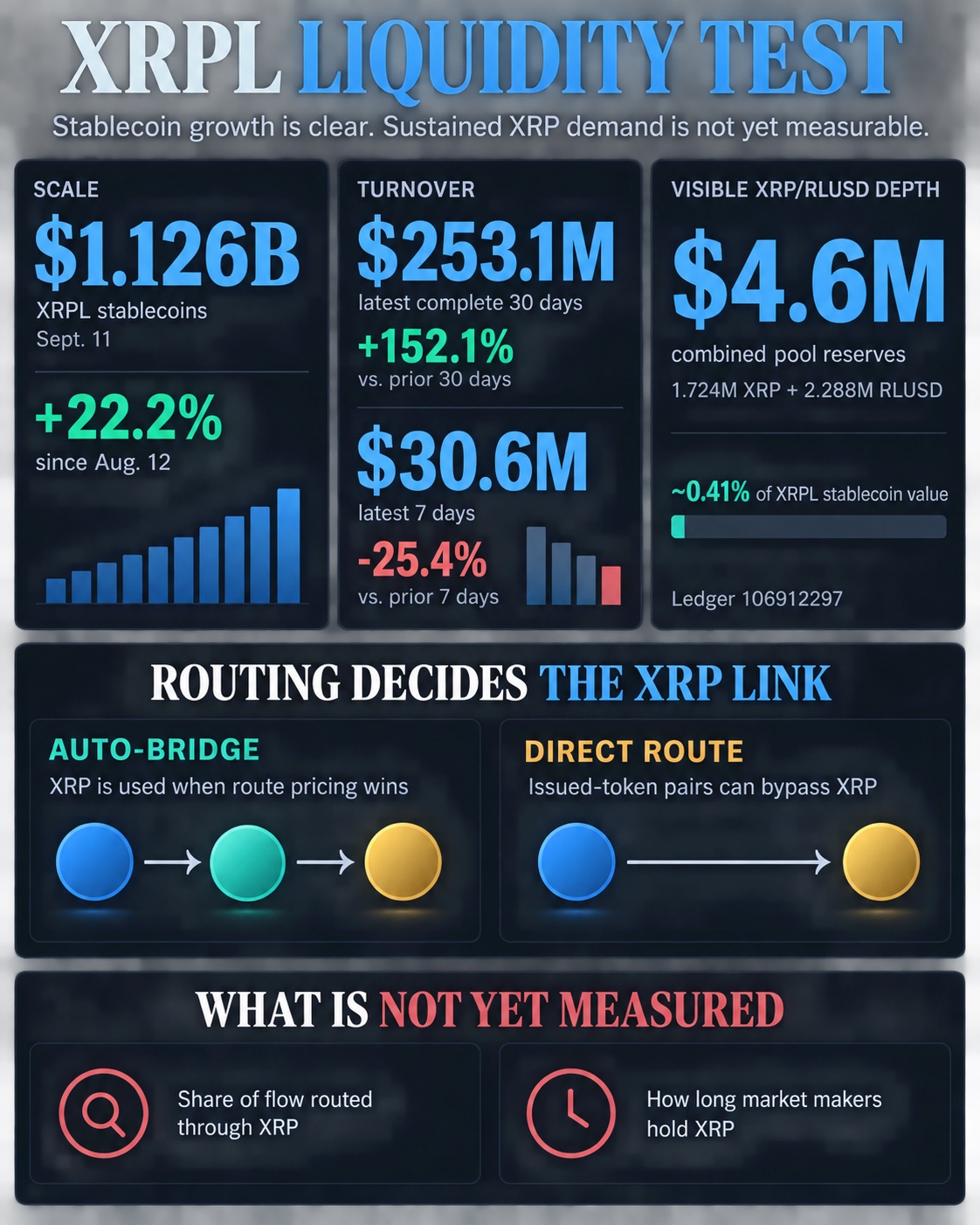
The visible bridge inventory is far smaller than the stablecoin base. At validated ledger 106912297, an XRP/RLUSD automated market maker tracked by XRPL.to held about 1.724 million XRP and 2.288 million RLUSD.
Valuing the XRP side at the nearby $1.32 market snapshot and RLUSD at its $1 target puts both reserve sides at about $4.56 million, or $4.6 million when rounded. That is roughly 0.41% of DefiLlama's daily XRPL stablecoin total.
The ratio is a scale comparison between one observed pool and the network's tracked stablecoins. It does not establish that this is the largest XRP/RLUSD venue, nor does it show how often payments, order books or other pools use XRP. It does show that a multimillion-dollar pool sits inside a billion-dollar stablecoin base, leaving a wide gap between dollars issued and XRP visibly committed to this venue.
RLUSD's headline circulation number needs the same boundary. Ripple reported about 2.3956 billion RLUSD in total circulation as of Sept. 3, while an XRPL ledger query on Sept. 11 showed about 1.0315 billion RLUSD of issuer obligations on XRPL.
The ledger figure equals roughly 43% of Ripple's eight-day-earlier total. Because the observations are not simultaneous, that percentage is a scale marker rather than a precise chain allocation. The residual cannot be assigned to Ethereum from these two snapshots alone.
Routing economics decide how much XRP matters
XRPL's auto-bridging system can connect two issued-token markets through XRP when the combined route offers a better exchange rate than the direct pair. An order can also combine direct and auto-bridged liquidity.
That mechanism gives XRP a chance to intermediate stablecoin activity, but no exclusive claim on it. A direct issued-token pair can offer the better price. Ordinary Payment transactions do not auto-bridge by default, although pathfinding can discover routes with a similar effect.
Transaction fees create a separate form of native-asset use. The standard minimum cost is 10 drops before load scaling, equal to 0.00001 XRP, and the fee is destroyed. Special transactions can cost more and congestion can raise the effective fee, but the reference minimum was worth only a tiny fraction of a cent at the observed XRP price.
The larger demand question therefore rests on liquidity rather than fee burn. A bridge asset can support substantial gross turnover while being bought and sold quickly. Persistent demand becomes more plausible if market makers need to hold larger XRP balances for longer periods or if XRP-linked routes consistently capture a growing share of activity.
Neither condition is visible in the current aggregate datasets. Stablecoin supply shows how many dollar-linked assets are present. DEX volume shows how much exchange activity occurred. Pool reserves show inventory at one venue and one moment. None of those figures reveals the path taken by each trade or the duration of the XRP position behind it.
That leaves XRP holders with a clear set of observable signals. XRP-linked pools and order books would need to deepen alongside stablecoin turnover. Path-level reporting would need to show XRP winning routes rather than merely being available. Inventory data would need to show that intermediaries retain meaningful XRP exposure instead of recycling it almost immediately.
XRPL has moved beyond the argument that it lacks dollar liquidity. Its stablecoin base is larger, its monthly DEX turnover has surged and XRP itself remains sharply higher over 30 days despite the latest weekly pullback. The next step is value capture: translating those dollars into measurable XRP-routed flow and durable inventory. Until those measures appear, the evidence supports a bigger opportunity for XRP liquidity, not a confirmed source of sustained token demand.
The post XRP’s 30% monthly rebound meets a $4.6 million liquidity trial inside XRPL’s $1.1 billion stablecoin boom appeared first on CryptoSlate.
Revolut disclosed customers’ passports, verification selfies and Bitcoin transaction histories after treating a fraudulent government request as legitimate.
Affected customers were told Friday that the disclosed information could include passport or driver’s license copies, verification selfies, names, dates of birth, occupations, home addresses, phone numbers, IBANs, and account statements. Withdrawal records and complete transaction histories, including Bitcoin activity, may also have been released.
The request came from an unauthorized mailbox operating inside the domain infrastructure of a genuine government agency and carried valid authentication credentials.
Revolut subsequently contacted the agency, concluded the request was fraudulent, blocked the address and began notifying customers and regulators. The company has not identified the agency or disclosed how many customers were affected.
Compliance demands sharpen customer backlash
The incident has drawn scrutiny over how much information financial institutions collect from customers and the controls used when governments later seek access to those records.
Marc Zeller, founder of the Aave Chan Initiative, said the disclosure came shortly after Revolut demanded additional information from him, threatening to close his account.
“The infuriating part is that it happens right after Revolut sent me a notification to provide a LOT of data or ‘we will close your account in 20 days,’” Zeller said. He accused the company of doing the attackers’ work for them after the request fooled him.
The criticism cuts into a tension created by modern financial compliance. Banks and fintech firms collect extensive identity and transaction records to satisfy know-your-customer and anti-money laundering requirements. Those databases become especially sensitive when they link verified identities and residential information to cryptocurrency activity.
For Bitcoin holders, the exposed records could give an attacker far more than a financial statement. Bitcoin transactions are recorded on a public blockchain, meaning information tying a known person to specific activity can potentially help map that individual’s wider onchain footprint.
Onchain investigator ZachXBT, who publicized the incident, said the disclosure appeared limited in scale and may have targeted high-net-worth customers. Revolut has not provided a figure that would establish the scope of the incident.
No customer funds have been reported stolen, and the information described in Revolut’s notices did not include passwords, card PINs or cryptocurrency private keys.
The immediate risk instead stems from the combination of identity documents, contact information, residential addresses and financial histories now potentially available to the attacker.
A genuine government domain defeated Revolut’s checks
The method used to obtain the information leaves a separate problem for Revolut and potentially other financial institutions that received requests from the same source.
The fraudulent email passed SPF, DKIM and DMARC authentication, mechanisms designed to help verify that messages are authorized by the domain they claim to represent.
That suggests the attacker had access to an unauthorized mailbox within the government agency’s actual email infrastructure rather than simply changing the sender information on a conventional spoofed email.
Revolut said that combination led it to fulfill the request, believing it came from an authentic government authority. The firm discovered the problem after contacting the agency separately, then alerted officials to the unauthorized mailbox and blocked the sender internally.
Former Mt. Gox CEO Mark Karpelès, who circulated a copy of the notification Saturday, argued that identifying the compromised government agency could allow other banks and exchanges to determine whether they also received information demands from the same mailbox. Revolut has so far withheld the agency’s identity while it investigates.
That leaves the verification sequence as the key unresolved issue. Revolut has explained why the email looked authentic, but has yet to say whether government information requests require confirmation outside email, why it contacted the agency only after releasing customer records, or whether it has changed that process since discovering the fraud.
The post Revolut tricked into handing hackers the passports and Bitcoin histories of wealthy customers appeared first on CryptoSlate.
CryptoTicker.io
When you stake ether, you never receive the reward the network pays out. You receive what is left once your provider has taken its cut. How large that cut is appears on the page where you decide to stake at only a handful of providers. On September 12, 2026 we pulled the public staking and fee pages of 14 routes through which you can stake Ethereum from Germany. Five of them name a specific commission figure. The range runs from zero to fifty percent, depending on which part of the reward the provider touches.
cryptoticker.io compiled this survey itself on September 12, 2026.
Ethereum staking fees: what your provider keeps from your reward
The staking commission is the share of the rewards that the operator of your validator keeps for its work before the rest reaches you. It is not a fee you transfer, and it appears on no invoice. It is simply deducted from the yield, and that is exactly why it is easy to overlook.
That makes it the most important number in the whole offer. The yield itself is beyond your influence: it follows from the protocol and is identical for everyone. According to the reading from validatorqueue.com that we took on September 12, 2026, the network APR stood at 2.46 percent. At that level, the commission decides the difference between a usable offer and a pointless one. A ten percent commission costs you roughly 0.25 percentage points a year, which is one tenth of your entire yield.
The APR, meaning the reward rate annualised without compounding, is the number every provider puts in the shop window. Whether it is stated before or after the provider's own commission is rarely spelled out alongside it.
Consensus layer and execution layer: why the staking commission consists of two numbers
A validator earns in two separate places. The consensus layer is the layer of Ethereum on which validators are rewarded for proposing and attesting blocks; the protocol itself pays out this reward and it accounts for by far the larger part of the yield. The execution layer is the layer on which transactions are processed; that is where user tips and proceeds from block building accrue, known in the trade as MEV.
Some providers distinguish between the two pots, and that can distort a comparison entirely. The operator stakefish shows a commission of zero percent on the consensus reward on its Ethereum page and, at the same time, fifty percent on the pot of tips and MEV. Anyone who looks only at the first number takes this for a free offer. The calculator on the same page shows a combined APR of 2.61 percent, made up of 2.51 percent protocol reward and 0.09 percent from tips and MEV. The fifty percent therefore reaches into the smaller of the two parts, which is why this model works out cheaper in practice than the bare number suggests.
Keep the question in mind for your own offer: which of the two pots does the stated percentage refer to? A provider that names a single commission and means both layers is more expensive than one that charges fifty percent and means the tips alone.

How we checked: 14 Ethereum staking routes on September 12, 2026
The method in one sentence: on September 12, 2026 we pulled the publicly reachable staking, fee and documentation pages of 14 providers and protocols through which investors in Germany can stake ether, and noted which commission figure appears in the text there.
We checked Lido, Rocket Pool, StakeWise, stakefish, Everstake, Allnodes, P2P.org, Kiln, Figment, Ledger Live, Kraken, Bitpanda, Coinbase and Bitvavo. Twelve of these fourteen pages answered with HTTP 200 and were readable. Coinbase and Bitvavo refused our requests with status 403, so their terms are missing from this survey. As a reference for the network data we additionally pulled ethereum.org and validatorqueue.com, both with HTTP 200.
The result in one sentence: of fourteen routes checked, five name a specific commission figure on their own page. A sixth names the figure of a partner. For the remainder, the page either says nothing at all about the commission or merely notes that one is charged.
Five providers name a number: Lido, Everstake, Allnodes, P2P.org and stakefish
The picture is clearest at the protocols that have to document their rules publicly in any case. The documentation of Lido states that the protocol keeps ten percent of the staking rewards, one half of which goes to the node operators and the other into the protocol treasury. Lido is a liquid staking protocol, meaning a service that swaps your staked ETH for a tradable share token, in this case stETH.
Everstake likewise names ten percent commission on its Ethereum page, with entry from 0.01 ETH and a stated yield range of 3.4 to 10 percent that varies by tier. For institutional amounts from $500,000 and for stakes from 320 ETH, the provider points to separate, negotiable terms.
Allnodes shows ten percent commission on its Ethereum staking page, entry from 0.01 ETH and a current yield of 2.9 percent plus 0.1 percent. The page also records that the service runs technically through StakeWise.
P2P.org is the cheapest provider with a stated figure in our survey: five percent validator fee on native Ethereum staking, at a stated net reward rate of 2.9 percent and a minimum stake of 32 ETH. For the variant with distributed validator technology the page names a fee of seven percent at up to 3.05 percent, and in combination with EigenLayer seven percent at up to 3.25 percent.
stakefish, finally, separates the two layers as described above, with zero percent on the consensus reward and fifty percent on tips and MEV, at a minimum stake of 32 ETH.
Ledger Live names the figure of a partner
Ledger Live occupies a middle position in this list. The page explains that staking in the wallet runs through Kiln for native staking and through Lido for liquid staking, and in doing so names Lido's ten percent explicitly, split between node operators, the DAO and an insurance fund. For Kiln itself no commission figure appears there, although an average yield of about 3.5 percent against about 3 percent at Lido does. For stakes from 32 ETH, Ledger points to Figment and a validator of its own.
Kraken, Bitpanda, Kiln and StakeWise: when the staking fee is missing from the page
At the custodians through which most investors in Germany actually stake, matters look different. Kraken's German-language staking page lists Ethereum at 2.44 percent in the bonded variant and writes alongside it that the rates shown are estimates and stand before its own commission. How high that commission is does not appear on the page.
Bitpanda lists Ethereum in its staking overview at 2 to 4 percent and states explicitly that a commission is charged for providing the staking services and deducted automatically before the rewards are paid out. Here, too, the percentage is missing. The page additionally points out that with Ethereum, unlike other assets, an unbonding period follows from the protocol itself, so you cannot get back out again immediately at any time.
Kiln's home page carries yield figures, among them 2.6 percent for Ethereum, but no commission. At StakeWise we found no commission figure on the home page either. At Rocket Pool, home page and documentation answered with HTTP 200, yet no commission figure appeared in the extracted page text, which is why we list the provider as not checked and not as a provider without a figure. At Figment the home page was reachable; the Ethereum subpage answered with HTTP 404.
That a figure is missing from a marketing page does not mean it cannot be found anywhere. It often sits in the terms of use, in a help article or in the statement. The point is a different one: at the place where you make the decision, it is missing. How far that can go is shown by our own survey of the Bison app from September 6, 2026, which produced a retained share of 27 percent of the staking rewards for that provider. That is our own reading and not an outside confirmation, but it shows the order of magnitude at stake here. Anyone who wants to compare will find the offers bundled in our comparison of staking platforms.
Gross APR and net APR: how to work out your Ethereum yield yourself
The calculation is straightforward once you have both numbers. Take the network APR, subtract the commission from it, and you have your net yield before tax.
With the network APR of 2.46 percent measured on September 12, 2026, it looks like this: at five percent commission you keep roughly 2.34 percent. At ten percent you keep roughly 2.21 percent. At 27 percent you keep roughly 1.80 percent. On ten staked ETH, calculated over a year, that comes to roughly 0.234, 0.221 and 0.180 ETH respectively. The gap between the cheapest and the most expensive model thus amounts to a good fifth of your yield.
A second checkpoint is the reference figure. If a provider advertises a rate that already applies after its commission has been deducted, as P2P.org does with its net reward rate of 2.9 percent, you must not subtract the commission a second time. When in doubt, ask in writing whether the advertised number is meant gross or net. An answer by email also serves as evidence later on.

Entry queue: why your ETH currently earns nothing for about 32 days
The commission is only one half of the calculation. The other is the time your stake is tied up without earning anything. Ethereum admits new validators to the active set only at a limited speed, and anyone who wants to join joins a queue.
On September 12, 2026 we measured 1,857,828 ETH in the entry queue at validatorqueue.com, with an estimated waiting time of roughly 32 days and 6 hours. The exit queue stood at zero, and the delay until actual payout after an exit at 7.9 days. 910,898 validators were active, and in total 43.1 million ETH sat in staking, which is 35.29 percent of the supply.
For comparison: in our own reading from August 17, 2026, 2,229,411 ETH stood in the entry queue, at roughly 39 days of waiting time. The queue has therefore grown shorter since then, yet it remains long enough to change your calculation. Anyone depositing today effectively earns in only about eleven of twelve months in the first year, and that depresses the actual yield more than the difference between five and ten percent commission does.
At liquid staking protocols and at custodians you often notice nothing of this queue, because they balance it out in the background against an existing stock. It has not disappeared for that reason. It then surfaces elsewhere, for instance in a discount when the share token is swapped back into ETH.
Liquid staking, pool or your own validator: where which commission applies
The three routes into Ethereum staking differ not only in price, but also in who carries the liability when things go wrong.
Your own validator
You need 32 ETH and run the software yourself or have it run for you. You then pay the commission to the technical service provider, in our survey five percent at P2P.org or the tiered model at stakefish. The keys and the risk of a penalty for validator misbehaviour, known in the trade as slashing, stay with you.
Liquid staking
You hand over any amount you like and receive a share token that remains tradable. The commission is transparent, in our survey ten percent at Lido. In return you additionally carry the risk that the share token trades below the value of the deposited ETH for a time.
Staking through a custodian
The most convenient route, and in our survey the least transparent one. At Kraken and Bitpanda no commission figure appears on the staking page. In return you need no technology of your own. The provider takes over custody, and with that you carry the risk that it fails.
Staking tax: why the commission does not automatically lower your tax-free allowance
In Germany, staking rewards have to be recorded for tax purposes at the moment they accrue. In practice that means what matters is the amount actually credited to you. If the provider deducts its commission before crediting you anything, only the smaller amount accrues to you from the outset. If instead it credits you the full amount and bills the commission separately, the starting position is a different one.
So establish which of the two cases applies at your provider, and do it before you carry the earnings over into your tax return. The statements are the right evidence for this, not the display in the app. How to record and document the earnings cleanly is a topic in its own right; you will find the tools that suit it in our comparison of crypto tax tools. This article does not replace tax advice, and with larger holdings professional support is worth the money.
What this survey does not show: Coinbase, Bitvavo and the open points
Part of the honesty of a survey of one's own is what it fails to cover. Coinbase and Bitvavo refused our requests on September 12, 2026 with status 403, so their terms are missing here entirely. At Rocket Pool and Figment the page was reachable, but we were unable to find the commission figure in the extracted text; we list both as not checked and not as providers without a figure.
This survey is also a snapshot of public pages and not an audit of statements. We hold no accounts with these providers and have therefore not recalculated whether the commissions named are actually billed that way. What a page says today may read differently tomorrow. And yield figures fluctuate with network utilisation in any case.
What the survey does show is more modest for that reason and useful all the same: at the place where you make your decision, a majority of the routes checked give you no commission figure. Those that do name one sit between five and ten percent on the consensus reward.
Checking the Ethereum staking fee: what to take away
- Get the commission figure in writing. Open your provider's staking page and look for a percentage. If you find none, check the terms of use or ask support in writing, separately for the consensus reward and for the tips. Which providers come into question at all you can see in the comparison of staking platforms.
- Work out the net yield before you deposit. Take the current network APR, subtract the commission and factor in the waiting time in the first year. Only that number is comparable with another offer, and only afterwards is it worth looking at trading venues in the exchange comparison.
- Settle the tax side straight away. Note down whether your provider credits gross or net, and secure the statements from day one. A tool from the comparison of crypto tax tools takes the collecting off your hands.
(As of September 12, 2026. This article is not investment advice. Prices and fee structures change; check the terms with the provider before you buy.)
If you hold an account with Revolut and want to know whether the data incident of 11 and 12 September 2026 affects you, there are exactly two reliable routes: the notification the company sent to affected customers, and a subject access request of your own under Article 15 of the General Data Protection Regulation. Everything else is guesswork. Having received no message is not an all-clear; all it establishes is that no notification arrived.
This case differs from the breaches that usually occupy the industry. No server was broken into, no malware was planted and no password was cracked. An unauthorised party asked Revolut for customer data, and the request came in over the genuine, correctly authenticated email domain of a government agency. Revolut treated it as lawful and handed the documents over. For holders of Bitcoin that is particularly awkward, because the material released includes the complete transaction history.
What Revolut handed over, and what the company says remained untouched
The data categories come from CoinDesk's reporting of 12 September 2026, which draws on the notifications sent to those affected. They name passports and driving licences, the selfies from identity verification, names, dates of birth, occupations, home addresses, email addresses, phone numbers, IBANs, account statements, withdrawal logs and the entire transaction history including all Bitcoin activity.
Revolut told BeInCrypto that it had identified a sophisticated external identity attack in which an unauthorised third party submitted fraudulent information requests via the email domain of a legitimate government agency; systems and customer funds were unaffected. According to the company, police, data protection and financial supervisors were brought in, and the agency concerned was informed that an unauthorised account is operating inside its domain. Revolut does not say which agency, citing the ongoing investigation. The number of people affected also remains open; the company speaks of a limited number, and the investigator zachXBT, whose tip made the case public, described the target as a small circle of wealthy users.
What the notifications state explicitly did not leave: credentials, passcodes and the biometric templates behind facial recognition. That distinction matters, because it determines which protective measure achieves anything at all. An attacker who never had your password is not locked out by a new one.
How to tell whether you are one of the notified Revolut customers
Revolut says it wrote to affected customers individually; customer reports date those messages to 11 September 2026. There is no public list, and for good reasons there will not be one. The check is therefore yours to make.
The notification from Revolut and how it differs from a phishing email
A notification under Article 34 GDPR is a company's communication to affected individuals telling them that their data was exposed in a personal data breach carrying a high risk. It sets out the incident, the categories of data involved and the recommended measures. How you recognise one: a message of this kind does not ask you to enter credentials through a link, approve a payment or connect a wallet using a recovery phrase.
This is where the second wave begins. A breach of this kind produces forged messages within days that pose as the company's response, and this time the attackers hold names, home addresses, IBANs and account movements. That makes the fakes unusually credible. Check every incoming message inside the Revolut app itself rather than through a link in an email, and stick to the rules we set out in our guide to checking the genuine sender domain.
An Article 15 subject access request as documented proof
Article 15 GDPR gives you the right to ask a company what personal data it processes about you and to which recipients it has disclosed that data. It is the second part that matters here: the request forces a statement on whether your documents were part of the disclosure. The deadline is one month, extendable by a further two months in complex cases, and the company has to tell you if it extends.
Put the request in writing, name the incident with its date, ask explicitly about the recipients of your data, and request a copy of the notification if one was sent to you. Keep the reply. Anyone who later wants to bring a claim or lodge a complaint needs that correspondence as the foundation.
Why the Bitcoin transaction history is the most dangerous part of the package
An ID document can be replaced, an IBAN changed, a home address moved if it comes to that. The Bitcoin history, by contrast, points at a public database that nobody can take back. Whoever knows your deposits and withdrawals at a provider knows amounts, timestamps and, in many cases, the counterparties on the chain.
From the account statement to cluster analysis of your Bitcoin addresses
Cluster analysis is the technique of assigning several Bitcoin addresses to a single economic entity on the basis of shared characteristics, for instance because they appear together as inputs in one transaction. As long as nobody knows who a cluster belongs to, it stays an anonymous set of addresses. A withdrawal log with an amount and a timestamp supplies the missing anchor point, and from that moment the cluster carries a name and a home address.
An uncomfortable calculation follows. The attacker sees not only that you own Bitcoin, but can estimate through the linked addresses how much of it is still there and whether it is moving. We described what such a package of identity, home address and traceable wealth can lead to when we covered events in France: kidnappings and extortion with a crypto connection regularly started there with lists of exactly this kind.

Emergency data request: the mechanism behind the fake government enquiry
An emergency data request is a law enforcement request for information that a company answers on grounds of imminent danger, without a court order and without the scrutiny it would otherwise apply. The procedure exists because there are cases in which hours count. It has also been a known point of entry for years, because the only check is the judgement of an employee faced with an urgent enquiry that looks official.
The sequence is well documented in the specialist literature: someone gains access to an official mailbox or creates an account inside an agency domain, writes an urgent request for information from there, and receives the data because the recipient is trained to serve public authorities promptly. This is precisely the pattern Revolut describes in its statement when it speaks of an unauthorised account inside an agency's domain.
Why checking the sender domain, SPF and DMARC did not hold here
SPF, DKIM and DMARC are technical procedures that let the recipient of an email establish that it really was sent from the stated domain and was not altered in transit. These procedures answer a single question: does the message genuinely come from this domain? On whether the person behind the mailbox is authorised, they say nothing.
That is the counter-test to a recommendation we have issued ourselves. Checking the sender domain remains correct and catches the overwhelming majority of attacks. It only stops working at the moment an attacker controls an account inside the genuine domain, because then every technical check passes and nothing is right all the same. Anyone relying on that signal alone is mistaking a passed authentication for a passed authorisation check.
What changing your password after this data breach does, and what it does not
The usual advice after a breach runs: change your password, switch on two-factor authentication, check your devices. Here that is only half right, and the half that does not hold is the more important one. What left the company, according to the notifications, was not credentials but identity documents and account history. A new password takes nothing away from the attacker, because he never had the old one.
What genuinely helps is aimed at the follow-up attacks. That includes requiring a hard confirmation for withdrawals in the app, refusing phone enquiries from supposed staff on principle and hanging up, and assuming with every call that cites your real account details that those details may come from this incident. The caller who knows your last transfer is no longer proof that the call is genuine.
Immediate measures: identity misuse, account security, crypto holdings
The measures fall into two groups. One concerns your identity and makes sense regardless of whether crypto is involved. The other concerns your holdings and the question of where they should sit in future.
ID data cannot be recalled
A leaked scan of an ID document stays out there. What remains is observation: check your credit file regularly for enquiries and contracts you do not recognise, and have your bank explain its rules for opening accounts and changing addresses. Where a suspicion of identity misuse arises, it belongs in a police report, because establishing when the misuse happened later decides questions of liability. Germany's financial supervisor has already warned about this pattern; we have worked through the BaFin warning on identity misuse in the crypto sector in detail.
Home address plus Bitcoin holdings: take the physical risk seriously
The most unpleasant part of this package lies outside the digital world. Whoever holds a home address, a photo from an ID document and proof of wealth has everything needed for an attack at the front door. In practice that means: no public references to crypto holdings on social networks, no deliveries of hardware accessories to your home address, and no amounts named in conversation with acquaintances. Anyone self-custodying larger sums will find the devices that allow an access lock via an additional passphrase in our hardware wallet comparison, so that a coerced access does not release the entire balance.
This caution is not a panic reaction. It matches what those affected by earlier leaks in this industry have described in hindsight, and it costs nothing but habit.

Where German Revolut customers can complain
German customers are as a rule in a contractual relationship with Revolut Bank UAB, based in Lithuania and licensed as a credit institution by the Lithuanian central bank and the European Central Bank; alongside that, the company runs a German branch. For data protection, the provider's own privacy notice names the Lithuanian data protection authority as the lead supervisory authority. Check the details in your own contract documents, because the responsible entity can differ depending on the product and the date you signed up.
This order makes sense: first the Article 15 request to the company, then the complaint to a data protection authority once the reply has arrived or the deadline has passed. A complaint to the data protection authority responsible for where you live remains open to you under the General Data Protection Regulation; in cross-border cases it passes the matter to the lead authority. Without the prior correspondence, the complaint lacks its foundation.
How to reorganise your crypto holdings after a data breach
A data incident at a provider is a good occasion to review how your holdings are split, and to do it without haste. The decisive question is less which provider counts as the safest. The more useful thought is how much wealth needs to sit with any single provider at all. A trading account needs the amount that is actually being traded. Everything beyond that is a decision that could equally go the other way.
Self-custody means holding the private keys to your own coins yourself instead of entrusting them to a provider. That shifts the risk, it does not remove it: anyone self-custodying carries the risk of loss alone and needs a backup plan for the recovery phrase that survives a house fire and a house move. For many investors a split is the sensible middle path, with a small part kept ready to trade at the provider and the rest moving into self-custody.
The order matters here: the backup plan first, then the move. Anyone shifting balances in the agitation after bad news makes the most expensive mistakes of the year in that particular week.
What this case shows about KYC data at crypto providers and neobanks
KYC stands for "know your customer" and denotes the legally mandated identity check that banks and crypto service providers have to carry out before opening an account. That check is not negotiable, and at every regulated provider it creates a record made up of an ID photo, a selfie, an address and account movements. The Revolut case shows that the attack surface of this record is not made only of servers, but also of the procedures a company uses to answer requests for information.
A practical question for choosing a provider follows from that: how does the house handle official requests for information, does it publish figures on them, and how quickly does it inform those affected? Anyone looking for a new trading venue will find the providers licensed under the European supervisory framework in our overview of regulated crypto exchanges. A licence is not a promise of protection against this line of attack, but the assurance that a supervisor is responsible and reporting duties apply.
The incident joins a chain that has hit European crypto investors several times this year. The type of article is always the same because the questions are the same; our write-up on the Trezor data breach and how to check whether you were affected transfers step by step to this case.
Frequently asked questions about the Revolut data breach
Is my money at Revolut now at risk?
According to the company, systems and customer funds are unaffected by the incident, and none of the available sources contradicts that. The event is a release of documents to an unauthorised party, not access to accounts. The risk lies in what is attempted with those documents afterwards.
Do I have to change my Bitcoin addresses?
For the history already disclosed, changing addresses achieves nothing, because the past sits immutably in the chain. For future incoming payments it is still sensible to use new addresses and not to hold balances permanently on addresses that can be tied directly to a withdrawal from a provider account.
What about the claim of millions of Revolut records from the summer?
That is a different matter. The claim about a large-scale data set that surfaced on the darknet in July 2026 has no documented connection to the September request for information. Mixing the two is misleading, because the categories of data involved and the route of attack differ.
How do I know an email really comes from Revolut?
Reliably, not from the email alone. Open the app and check whether the same message is sitting in your inbox there. That rule carries more weight after this case than it did before, because a passed domain authentication simply does not prove authorisation.
Revolut data breach: what to take away
- Establish whether you are affected, do not estimate. Check in the Revolut app whether a notification is waiting, and independently of that file a subject access request under Article 15 GDPR with an explicit question about the recipients of your data. Anyone who wants to switch provider afterwards can shortlist candidates through the overview of regulated crypto exchanges.
- Decouple your holdings from your identity record. Decide what amount has to stay ready to trade at the provider, and move the rest into self-custody, with the backup plan in place before the move. The device selection including the passphrase function is in the hardware wallet comparison.
- Plan for the second wave. Expect calls and messages in the coming weeks that know your real account details, and treat every approach as unconfirmed until you have seen it in the app yourself. If you need a software solution for the part kept ready to trade, the software wallet comparison helps with the choice.
(As of September 12, 2026. This article is not investment advice. Prices and fee structures change; check the terms with the provider before you buy.)
Sources: CoinDesk on the data categories involved and Revolut's statement to BeInCrypto.
If you failed to declare gains from Bitcoin or other crypto assets in earlier German tax returns, you face a question with a clear answer: a voluntary disclosure that exempts you from prosecution under section 371 of the German Fiscal Code only works for as long as the offence has not been discovered and none of the statutory blocking grounds applies. That window is currently getting shorter. The German Crypto Asset Tax Transparency Act has applied since January 1, 2026, and in the 2027 calendar year crypto service providers will transmit data for the 2026 reporting period to the Federal Central Tax Office for the first time.
This article explains how a subsequent declaration works in practice, which years are still open at all, what causes a voluntary disclosure to fail and what it costs. It does not replace advice: a voluntary disclosure is a document with criminal law consequences and belongs in the hands of a tax adviser or a lawyer specialising in tax law. Draft it yourself and forget a single year or a single exchange, and you lose the exemption from prosecution for everything.
Why Your Crypto Data Will Sit With the Federal Central Tax Office From 2027
The Crypto Asset Tax Transparency Act, KStTG for short, was adopted on December 22, 2025 and transposes the EU directive DAC 8 into German law. DAC 8 is the eighth version of the EU administrative cooperation directive; it extends the automatic exchange of information between tax authorities to crypto assets. The reporting obligation falls on the service providers themselves: exchanges, brokers, custodians and intermediaries that exchange or transfer crypto assets for customers. Investors themselves report nothing to the authorities.
According to the Federal Central Tax Office, what gets reported is the aggregated transaction data of the wallets, together with name, address, tax residence, tax identification number, date of birth and transaction volumes. Providers deliver to the Federal Central Tax Office by July 31 of the following calendar year in each case, and the office passes the data on to the EU central register and to the partner states of the international framework by September 30. The first of these transmissions covers the year 2026 and takes place in 2027.
For everyday purposes that means two things. First, providers are already asking for tax residence and tax identification numbers; anyone who does not respond must expect restrictions on their account. Second, from 2027 the tax office will hold a body of data that can be matched against the return you filed. A data match is not criminal proceedings, but it is the route by which discrepancies come to light.
What the 2026 Reporting Year Does Not Do
The report covers the period from 2026 onwards. It brings no retroactive analysis of the years 2017 to 2025. That is the most common misconception in this field, and it leads to wrong conclusions in both directions. Anyone who believes old years are thereby automatically exposed panics needlessly. Anyone who believes old years are therefore safe underestimates the collective information requests with which tax authorities have already demanded user lists from individual trading venues in the past.
Section 153 Correction or Section 371 Voluntary Disclosure: What the Difference Is
Both routes correct an incomplete tax return, but they start from different points and carry different consequences.
The duty to notify and correct under section 153 of the Fiscal Code applies where someone subsequently realises, before the assessment period expires, that a return they filed is incorrect or incomplete and that tax may be understated as a result. The wording of the statute requires this to be notified without delay, meaning without culpable hesitation. What is meant is the case without intent: an item was overlooked, an exchange was forgotten, a swap was mistakenly treated as tax free.
The voluntary disclosure under section 371 of the Fiscal Code, by contrast, is the route for cases where tax evasion is in play, meaning deliberate conduct. It leads to exemption from prosecution where three conditions come together: full correction for all unbarred tax offences of one type of tax over the last ten calendar years, no blocking ground, and timely payment of the evaded tax plus interest.
In practice the line between the two cases often cannot be drawn cleanly, because intent is an internal fact. Advisers therefore frequently frame a correction so that it simultaneously meets the requirements of an effective voluntary disclosure. That is the real reason a self-drafted letter to the tax office can be dangerous: it may satisfy section 153 while falling short of the completeness that section 371 demands.

Which Years You Have to Declare: Assessment Period and Limitation on Crypto Gains
Two periods run alongside each other, and they are regularly confused. One decides whether the tax office may still assess the tax. The other decides whether the offence can still be prosecuted.
The assessment period is set out in section 169 of the Fiscal Code. For income tax it is normally four years. In cases of reckless understatement it extends to five years, and in cases of tax evasion to ten years. On top of that comes the suspension of commencement: the period only begins at the end of the year in which the return was filed, and at the latest three years after the tax year. So if you never filed for 2018, you must expect the assessment for that year to still be open.
Limitation under criminal law follows its own rules and is irrelevant to the question of whether back tax has to be paid. What matters is the practical consequence: a year can still be open for tax purposes even though nothing threatens under criminal law. It still has to be paid, plus interest.
How to Work Out Which Years Are Open in Your Case
The starting point is unspectacular: dig out your own tax assessments from the last ten years and lay your trading history alongside them. What counts is the timing of every sale and every swap; the account balance at year end is irrelevant to this. Swapping one coin for another counts as a disposal of the first coin for tax purposes, even though no euro changed hands. It is precisely these swaps that are missing most often from old returns, because they do not feel like a sale.
The Blocking Grounds of Section 371(2): When a Voluntary Disclosure Comes Too Late
Exemption from prosecution does not arise where one of the blocking grounds named in the statute has already occurred. Among others, the law names notification of an audit order under section 196 of the Fiscal Code, notification that criminal or administrative fine proceedings have been opened, the appearance of an official for a tax audit, and discovery of the offence where the offender knew of it or had to reckon with it. A separate blocking ground applies as soon as the understated tax exceeds 25,000 euros per offence.
The blocking ground of discovery is the reason the reporting procedure from 2027 matters for this subject at all. An offence is discovered where the authority holds a suspicion concrete enough to make a conviction appear likely. A blanket data match is therefore not automatically a discovery. But anyone who has already received post from the tax office about specific crypto transactions should assume the clock has run out and take advice before sending any further letter.
The blocking ground of the audit order is equally underestimated. It bites for the audit period, and it does so from notification onwards, not only from the start of the audit. Anyone with an announcement of a field audit in their letterbox who then writes a voluntary disclosure will no longer achieve exemption from prosecution for the audited years.
Completeness Instead of a Partial Disclosure: Why Half a Correction Fails
Since 2011 there has been no such thing as an effective partial voluntary disclosure. The law requires correction in full, for all tax offences of one type of tax over the last ten calendar years. Translated, that means: anyone who reports only the gains from a single exchange and leaves out an account with a second provider has not made an effective voluntary disclosure but has handed the authority part of the evidence.
For crypto holdings this is the hardest requirement of all, because the traces lie scattered. The typical picture is one large exchange, a small secondary account from the early days, a decentralised application, a staking service and a hardware wallet whose transactions appear in no report anywhere. If one of these sources is missing, it is missing from the declaration.
If you first have to establish an overview, the sensible route is a portfolio and tax tool that merges transactions from several sources and produces a report for each year. Which providers can import which exchanges, wallets and protocols is shown in our comparison of crypto tax software and portfolio trackers. The tool does not replace advice, but it supplies the numerical basis without which no adviser can work.
The Most Common Mistake: The Forgotten First Exchange
Many holdings begin with a small account from the years 2017 to 2021, often at a provider that has since left the market or been taken over by another. That is exactly where the purchases sit that determine the acquisition cost of later sales. Without that data the gain cannot be evidenced, and without an evidenced gain the tax office estimates.
From 25,000 Euros of Evaded Tax: The Surcharge Under Section 398a
Where the understated tax exceeds 25,000 euros per offence, the exemption from prosecution falls away. The case is not lost as a result: section 398a of the Fiscal Code provides that prosecution is waived where the evaded tax plus interest is paid and an additional sum is settled on top. Under the wording of the statute this surcharge amounts to 10 percent of the evaded tax up to an evaded amount of 100,000 euros, 15 percent between 100,000 and 1,000,000 euros and 20 percent above 1,000,000 euros.
The surcharge is not refunded if the proceedings are later reopened after all; it can, however, be credited against a fine. What is decisive is the evaded tax, not the gain and certainly not the portfolio value. If you failed to declare 40,000 euros of gains, the tax on that will often fall below the threshold depending on your tax rate.
Which Records You Need From Exchange, Wallet and Tax Tool
A subsequent declaration is, in the end, an arithmetic exercise with supporting evidence. What is needed for each year is a complete transaction list with timestamps, the matching of acquisitions and disposals in order of acquisition, the prices at the relevant time and the fees. Added to that are the records for transactions that are not sales and still count for tax: staking income, lending interest, airdrops and mining rewards.
You obtain the transaction history from the trading venues themselves, usually as a file in the account area. Anyone whose account was with a provider that has since closed needs the support route and should start early. An overview of the regulated trading venues, including the question of who issues usable annual statements, is in our comparison of crypto exchanges. For wallets with no provider behind them, only the blockchain itself helps: collect addresses, export transactions, explain inflows.
A practical note on sequence: first establish the data basis, then calculate, then draft. Work the other way round and set up the letter to the tax office before the analysis, and you risk exactly the incompleteness on which the exemption from prosecution founders. Incidentally, the data basis also determines whether your holdings can evidence the conditions for a tax-free sale after the one-year holding period has elapsed at all.
What the Draft Bill of September 8, 2026 Changes About the Situation
On September 8, 2026 a draft bill from the German Federal Ministry of Finance became known which would in future treat crypto assets as investment income and subject them to the flat-rate withholding tax of 25 percent plus the solidarity surcharge, regardless of the holding period. Under the draft, the new rules would apply only to holdings acquired after December 31, 2026; for holdings acquired before that date the one-year holding period would remain in place. Automatic tax deduction by the service providers is not envisaged until 2028.
None of this has been enacted. A draft bill is a working document from the ministry, not a law; coordination within the federal government is under way, and no bill is before the Bundestag. For the current year 2026 the rule in section 23 of the Income Tax Act with its one-year holding period applies unchanged.
For the question of a subsequent declaration the draft changes nothing about the legal position of the past. It does change the urgency, because it directs the attention of the tax administration to a field that is becoming transparent anyway. Anyone with open years is therefore not choosing between two tax regimes, but between a correction on their own initiative and a correction after being asked.

Evasion Interest and Costs: What a Subsequent Declaration Really Costs
The back payment itself is only the first item. Interest comes on top, and here a close look at the statute pays off. Interest on additional tax claims under section 233a of the Fiscal Code has stood at 0.15 percent for each month since 2019, so 1.8 percent a year. For the remaining interest under the Fiscal Code, which includes evasion interest under section 235, half a percent for each month continues to apply, so 6 percent a year. Over eight or ten years that adds up considerably, and payment of the interest is a condition of the exemption from prosecution, not a later side effect.
Then there are the costs of advice. They depend on the effort of reconstruction and not on the portfolio value; a holding with twenty transactions is worked through in a few hours, a holding with several thousand transactions across five platforms is not. Prepare the data basis cleanly yourself and you will noticeably reduce this item.
What Happens If You Do Nothing
For the time being the assessment stays as it is. If an audit follows later, the blocking grounds have taken effect, the exemption from prosecution is lost, and on top of the tax and the interest criminal proceedings loom. For amounts below the de minimis thresholds such proceedings often end with a monetary condition; above them they do not. The tax itself falls away in none of these cases for as long as the assessment period is running.
Crypto Subsequent Declaration: What to Take Away
The legal position is confusing; the next steps are not.
- Get your data basis together before you write anything to the tax office. Collect the trading history of all accounts and wallets from the last ten years and merge it. Which tools import several sources and issue annual reports is shown in our comparison of crypto tax software and portfolio trackers.
- Request missing records now, not later. Exports from closed or acquired trading venues take weeks. Which providers supply usable annual statements is set out in our comparison of crypto exchanges.
- Have the declaration drafted professionally once the figures are in place. Completeness across all years and all sources decides the exemption from prosecution, and it cannot be repaired afterwards. Calculate the expected tax burden in advance, for instance with the tools from our comparison of crypto tax software, so that the back payment plus interest does not become the second surprise.
The legal bases can be read in the original wording: voluntary disclosure in section 371 of the Fiscal Code and the reporting procedure at the Federal Central Tax Office.
(As of September 12, 2026. This article is not investment advice and not tax or legal advice. Prices and fee structures change; check the terms with the provider before you buy.)
If you buy Bitcoin through your ordinary securities account, you are as a rule not buying Bitcoin. You are buying a note that certifies a claim against a company. That note is called a crypto ETN, usually marketed as an ETP, and in legal terms it is a debt security. If the firm behind it collapses, the price of the coin will do little for you. That is exactly why the products actually tradable in Germany deserve a closer look.
On September 12, 2026 we downloaded the official Deutsche Boerse product list for crypto ETNs on Xetra and counted it line by line. The result: 146 trading lines, behind them 122 distinct products from 16 issuer families, whose securities identification numbers originate in six different countries. cryptoticker.io compiled this analysis itself on September 12, 2026.
The trigger is recent. The European Securities and Markets Authority, ESMA, published its second risk report of the year on September 10, 2026 and left market risk, contagion risk and operational risk at the highest level. Its argument: the links between crypto markets and the traditional financial system keep growing. The exchange-traded crypto ETN is precisely that link, and it is the one sitting in German securities accounts.
Crypto ETN Explained: Why a Bitcoin ETN Is Not a Fund Unit
An exchange traded note, or ETN, is a bearer debt security that tracks the price of an underlying asset and whose repayment depends on the issuer. That is the definition that matters, and it separates the product fundamentally from an ETF.
An ETF is legally a segregated fund. Investors' money is held separately from the assets of the fund company and does not fall into the estate if that company becomes insolvent. An ETN has no such construction. It is a receivable, which makes you a creditor. If the debtor defaults, your claim joins the queue with every other claim.
Issuers address this with collateral: they deposit the coins with a custodian and pledge them in favour of investors, often through a trustee. That is a genuine and effective improvement on an unsecured note. It does not replace a segregated fund, however, and it only works as well as the custody chain behind it. Anyone who wants to grasp the difference between a securitised claim and genuine ownership will find the same mechanism at work in tokenised equities.
The practical advantage remains, and it explains why these products have been so successful: you need no wallet, no private key and no account at a crypto exchange. The purchase runs through your brokerage account and settles along the usual securities paths. How the underlying asset itself develops is an entirely separate question; our running assessment sits in the Bitcoin price prediction.
Our Own Count: How We Tallied 122 Crypto ETNs on Xetra
The method in one sentence: we downloaded the table of crypto ETNs tradable on Xetra published by Deutsche Boerse, together with the accompanying list of admitted underlyings, in their original form, evaluated both files programmatically and then checked every single securities identification number against the product pages of Boerse Frankfurt.
What we examined: 146 table rows, 122 unique securities identification numbers, 27 entries on the admission list and 122 individual product page requests. Every request returned status code 200, so each of the 122 identification numbers led to an existing product page on the day of the survey. The survey date is September 12, 2026. The source material is available on the Deutsche Boerse overview page for crypto ETNs.
What we did not survey has a section of its own further down. The most important point up front: the product list carries a cut-off date of March 31, 2026. It therefore states what was admitted to trading on that date, and our cross-check only shows that a page still exists today for each of those identification numbers. Whether every product is still continuously traded today is not established by this.

146 Trading Lines, 122 Products: Why the Same Note Shows Up Twice
The gap between 146 and 122 has a simple explanation. 24 products are listed twice: once in euros and once in US dollars, each with its own ticker but under the same securities identification number. It is the same note, the same issuer and the same risk, only a different trading currency.
That has two consequences for you. First, buying via the dollar line incurs a currency conversion whose cost your broker sets and which appears nowhere in the product itself. Second, the same title can show up twice in a search mask and display two different bid-ask spreads. Pick the worse line and you pay more for nothing in return. So check the identification number and the trading currency, not just the product name.
How to Work Out Which Line You Are Actually Trading
Open the order mask in your brokerage account and look at which trading venue and which currency are preset. Many brokers automatically select the venue with the best margin for themselves rather than the tightest spread. If a foreign currency is set there while your settlement account is held in euros, every purchase and every sale triggers a conversion.
16 Issuer Families and Six Countries of Origin: Which Law Applies
The 122 products are spread across 16 issuer families. By number of distinct products, 21Shares leads with 26, followed by CoinShares with 19, Bitwise with 15, VanEck with 14 and WisdomTree with 12. Then come Virtune with 11, Valour and Global X with five each, Deutsche Digital Assets with four, nxtAssets with three, and Hashdex and Xtrackers with two each. Fidelity, Invesco, iShares and Issuance Swiss each account for one product.
More interesting than the ranking is where the securities identification numbers come from, because that reveals the legal jurisdiction in which the note was issued. Our count gives the following picture: 39 identification numbers begin with GB, 36 with DE, 31 with CH, eleven with SE, three with XS and two with JE. Behind those codes stand the United Kingdom, Germany, Switzerland, Sweden, an international identifier and Jersey.
This is no formality. Which insolvency law applies in an emergency, which court has jurisdiction and how quickly collateral can be realised all depend on the registered seat of the issuing entity. A German special purpose vehicle and a Jersey company mean two different procedures with different deadlines. In our count each issuer family uses exactly one country of origin, with one exception: CoinShares issues under both GB and JE.
Brand Name and Legal Entity: Who Your Debtor Really Is
A well-known brand appears on the product. Your debtor is as a rule a purpose-built special vehicle that does nothing except issue these notes and hold the collateral. That is not a flaw but standard practice in the securities business, because it shields the product from the issuer's remaining business risk. You simply need to know that the company on the marketing material and the company on your settlement statement need not be the same.
A verifiable example from our survey: for the Bitwise Physical Bitcoin ETP with identification number DE000A27Z304, the Deutsche Boerse product page names ETC Issuance GmbH as the legal entity. The brand name is Bitwise, the debtor a German limited liability company. Both are true at the same time, and only the second name determines whom your claim is directed against.
The check takes less than a minute. Call up the product page at Boerse Frankfurt, enter the identification number and look at the issuer field. If a name other than the one on the factsheet appears there, that is the legal entity worth remembering.
Collateral According to Issuer Information: What the Exchange Checks and What It Does Not
On the Boerse Frankfurt product pages, the section on deposited assets carries a remarkable heading. It reads "Collateralisation (according to issuer information)" and asks below whether the note is collateralised and what type of collateral is involved. The parenthesis is the real information: the exchange reproduces what the issuer has declared. It does not confirm that the coins exist.
That is factually correct and legally clean, because an exchange is not an auditor of custody balances. For you it still means that the chain of issuer, custodian and trustee is the load-bearing construction, not the tick mark on the product page. Anyone who wants to follow the collateral seriously has to read the securities prospectus and the custodian's reports.
Three questions will take you furthest here. Who holds the coins in custody, and does that custodian sit in the same jurisdiction as the issuer? Is there a trustee holding the collateral for investors, and is that trustee independent of the issuer? And does the provider publish addresses or proof of holdings that you can check yourself?

31 Staking ETNs on Offer: Why the Yield Is a Separate Question
31 of the 122 products carry staking in their name. They additionally deploy the deposited coins in the relevant network and pass the proceeds on to the note in whole or in part. By provider the split is as follows: CoinShares supplies eleven of these products, 21Shares seven, Bitwise six, Valour three, Virtune two, and WisdomTree and Issuance Swiss one each. Among the underlyings, Ethereum dominates with five products and Solana with four.
Staking means locking coins in a proof-of-stake network, which pays out new coins as compensation on an ongoing basis. Inside an ETN wrapper this becomes a yield component that is either distributed or accumulated in the price. Tax treatment is a separate matter entirely, because income earned inside a security is handled differently from staking income you receive directly in your wallet. If you run a securities position and a wallet balance side by side, you should document both types of income separately.
The additional risk is equally real. Staked coins are not freely available for the duration of the lock-up period, and in some networks faulty validator behaviour can lead to deductions. Whether and how the issuer bears that risk is set out in the prospectus, not in the product name.
38 Products Track an Index Instead of the Coin: The Difference in the Small Print
Our count of the underlyings reveals a split. 84 of the 122 products track a coin directly. For the remaining 38, the underlying is an index, a reference rate or a basket. In total we arrive at 69 different underlyings, because many providers apply their own calculation method.
Sorted by coin, Bitcoin leads: 21 products carry Bitcoin as their underlying, 13 Ethereum. Solana, Chainlink, Cardano and Polkadot follow with single-digit product counts each.
The distinction between a coin and a reference rate looks technical, but it determines the price you end up with. A reference rate is calculated at a fixed point in time from several trading venues. That smooths outliers and makes the price traceable. It also means that in a hectic moment your note will not track exactly the price you can see on an exchange. Anyone trading solely through a broker should know this before mistaking the gap for an error. Which providers grant access to these notes in the first place is shown in our comparison of the best crypto brokers.
The Admission List of Underlyings Still Dates From November 2024
Alongside the product list, Deutsche Boerse publishes a second file containing the crypto assets admitted as underlyings for ETNs on Xetra. That list comprises 27 entries, from Aave through Bitcoin and Ethereum to TRON, Uniswap and USD Coin. Its stated cut-off date is November 22, 2024.
Cross-checking it against the product list is revealing: four products track underlyings that do not appear on this admission list, namely Celestia, Pyth and SUI, the last of these in two products. We expressly do not claim that any of these notes is inadmissible. The obvious explanation is that the admission list has not been updated for almost two years while trading carried on. We were unable to clarify the point, and the practical lesson for you is a different one: a file that looks official is only as current as its cut-off date.
Compulsory Redemption: What an ETN Issuer Can Decide Unilaterally
The idea that an issuer can terminate a note is no grey theory. The same product list contains the 1Valour STOXX Bitcoin Suisse Digital Asset Blue Chip ETP with identification number GB00BPDX1969 and ticker BCIX. Valour declared a compulsory redemption for this note under condition 10.1. According to the issuer's notice of August 12, 2026, investors had until September 1 to deliver a valid redemption notice if they wanted the coins rather than cash. The last trading day fell on September 11, 2026, the redemption date on September 15, with settlement on September 16.
Anyone who missed this receives cash in their settlement account and is left with a taxable sale in their portfolio that they did not initiate. We described the process in detail when the compulsory redemption with its September 1 deadline became known. The point for this article is a different one: the option to do so is written into the terms of practically every ETN. It is part of the product category and not an isolated case.
One concrete habit follows from this. Record the identification numbers of your crypto ETNs in your files so that you can find them again, and read the investor notices from your broker instead of archiving them unopened. Those notices are the only channel through which such a deadline will reliably reach you.
ESMA Risk Report of September 10: Why Interconnectedness Is Now the Issue
The European Securities and Markets Authority published its second risk report of the year on September 10, 2026. It kept market risk, contagion risk and operational risk at the highest level and named tokenised equities, incidents in decentralised finance and prediction markets among the areas it is watching. According to the authority, the value of tokenised equities grew from 0.3 to 1.9 billion euros within eighteen months, while the crypto market as a whole lost considerable value from the end of October onwards.
ESMA expressly does not find in the report that crypto currently poses a threat to the stability of the EU financial system. Its concern is the growing connection: the more closely crypto products dock onto banks, funds and exchanges, the more easily disruptions can jump from one side to the other. The report and the accompanying statement are available from ESMA.
For retail investors this is no cause for alarm, though it is a reason to put things in perspective. 122 exchange-traded notes with a coin reference inside a single trading system are exactly the bridge the supervisor has in mind. And anyone investing across that bridge carries a second risk on top of the coin's price risk, one that has nothing to do with the coin.
Limits of This Survey: What We Could Not Verify
Our count rests on two files published by Deutsche Boerse and on 122 product page requests. It says nothing about whether a particular note is good or bad, and it is not a recommendation for or against any provider.
First, we could not verify whether the product list has been extended with new notes or cleaned of terminated ones since its cut-off date of March 31, 2026. Second, we did not independently verify the collateral of a single product, because that requires access to custody accounts which we do not have. Third, we could not read out the issuers for all 122 identification numbers by machine, because the exchange pages load that detail dynamically; the ETC Issuance GmbH case cited above we checked individually. Fourth, it remains open why three underlyings do not appear on the admission list. And fifth, our figures say nothing about trading volumes, spreads or the running costs of the individual notes.
Checking a Crypto ETN: What to Take Away
- Find out who your debtor is. Take the identification number from your portfolio overview, use it to call up the product page at Boerse Frankfurt, and note the issuer and its country of origin. If a name other than the one on the factsheet appears there, the legal entity is the name that counts. If that prompts you to hold the coins yourself instead, the devices for doing so are in our hardware wallet comparison.
- Check the trading currency and the venue before every order. 24 of the 122 products are listed twice, in euros and in dollars. Make a deliberate choice in the order mask instead of accepting your broker's default, and compare the gap between the bid and the ask. If you are considering a direct purchase anyway, it is worth looking at our overview of the best crypto exchanges, because different costs and different risks apply there.
- File your records so that a deadline actually reaches you. The Valour case shows that a compulsory redemption can produce a sale you never wanted within weeks. Keep a list of your identification numbers, read investor notices and hold on to the settlement statements. On the tax side, a tool from our comparison of crypto tax software helps by bringing securities and wallet positions together.
(As of September 12, 2026. This article is not investment advice. Prices and fee structures change; check the terms with the provider before you buy.)
BaFin published twelve consumer notices on unauthorised business between September 2 and September 11, 2026. Five of them explicitly name crypto-asset services, and five of the twelve appeared on a single day, September 11. If a trading platform reached you through an advertisement, a chat group or a direct message, you can check for yourself in about three minutes whether that provider is allowed to operate in Germany at all. This article shows how, and sets out what the twelve notices actually say.
A BaFin warning is an official notice issued under the German Banking Act and the Crypto Markets Supervision Act. Its core message is almost always the same: the regulator has findings, or a suspicion, that a provider is conducting business requiring authorisation without holding that authorisation. No court ruling is attached to it.
BaFin warnings in September 2026: twelve notices in ten days
For this article we retrieved BaFin's "News & Warnungen" overview page, loaded every 2026 consumer notice linked there individually, and evaluated the opening paragraph of each one. Twelve notices were listed at the time of retrieval, and all twelve responded with HTTP status 200. cryptoticker.io compiled this evaluation itself on September 12, 2026.
The distribution by publication date: one notice on September 2, one on September 3, two on September 4, one on September 7, two on September 9 and five on September 11. September 11 is by far the densest day in the window. The notices give no reason for that, and we do not attribute one either: publication backlogs and the processing rhythms of a regulator are not visible from the outside.
The composition matters more than the timing. Seven of the twelve notices concern classic financial and securities services, fixed-term deposit offers or credit agreements. Five concern crypto-asset services, which is exactly the area this page deals with.
Crypto-asset services: five of twelve warnings concern your subject
Crypto-asset service is a legal term taken from the EU's MiCAR regulation and the German Crypto Markets Supervision Act. It covers, among other things, trading in crypto-assets on behalf of others, exchanging them for euros, holding crypto-assets belonging to others in custody, and operating a trading platform. Anyone offering one of these services commercially in Germany needs authorisation.
These five notices in the window name crypto-asset services explicitly in their first paragraph:
- 37mh(.)com, September 2. According to BaFin's findings, the operators there offer crypto-asset services without authorisation. The regulator also notes that the website carries no valid imprint and that the supervision by BaFin claimed there does not exist.
- rheinbridge(.)capital, September 4. There is a suspicion that unknown operators are offering financial services and crypto-asset services without the required authorisation.
- Telegram channel "Sophia Hoffmann" and sophiahoffmann(.)icu, September 9. Here BaFin warns explicitly about a messenger channel and the bot run inside it, not only about a website.
- schelhammer-systems(.)com, September 11. Same wording as rheinbridge: suspected financial services and crypto-asset services without authorisation.
- sogmbh(.)com, September 11. Suspected financial and securities services as well as crypto-asset services, combined with alleged identity misuse.
Five out of twelve sounds like a minority. Measured against the fact that crypto is only one slice of the entire financial market BaFin supervises, the share is remarkably high. Anyone active in this market should treat a look at the register as routine rather than as an exception reserved for suspicious cases. If you are weighing up where to buy anyway, it helps to look at regulated crypto exchanges authorised for the European market before you open an account anywhere.

BaFin company database: how to check an authorisation in three minutes
BaFin points to the same place in every one of its notices: the company database. It records which companies hold authorisation in Germany and for exactly what. Access is free and requires no account.
Step one: take the exact company name from the imprint
Search for the legal entity named in the imprint, not for the brand name shown on the home page. This is exactly where many checks fail, because brand and legal entity do not match. If an imprint is missing altogether, as BaFin notes for 37mh(.)com, the check ends there: a provider without a traceable legal entity cannot be verified by you.
Step two: check the authorisation against the right service
A hit in the database is not enough on its own. What counts is which authorisation is recorded there. An authorisation for investment broking does not cover crypto trading, and registration as a financial investment broker under the German Trade Regulation Act is no BaFin authorisation at all. So read the scope of the entry and do not settle for its mere existence.
Step three: cross-check the warning list
Finally, look at the section holding consumer notices on unauthorised business. If the name or the domain appears there, the matter is settled. If it does not appear, that means little: BaFin issues a warning only once a specific case has come to its attention. A missing warning is no seal of approval.
Identity misuse: when a real company serves as camouflage
Three of the twelve notices cite alleged identity misuse. By this BaFin means that a website uses the details of a genuinely existing, often reputable company without having any connection to it.
In the case of cptvertex(.)com, BaFin says the imprint lists a company called Vertex AG, and the register number given there belongs to Vertex Treuhand AG in the Swiss commercial register. By its own account, the regulator has no information whatsoever that this company actually has anything to do with the website. For capitalparadigm(.)com, BaFin states explicitly that there is no connection with Paradigm Capital AG, based in Grünwald. For sogmbh(.)com the same applies to Strategic Opportunities GmbH, based in Offenburg.
This finding has a practical consequence for you. The reasoning "the company is in the commercial register, so everything is in order" no longer holds. The register number can be genuine and still belong to someone who knows nothing about the website. The check only becomes reliable once you reverse the contact and call the supposed parent company on the number from its own, independently found web presence.
WhatsApp group and Telegram bot: the entry point moves into the messenger
In two of the twelve notices the starting point lies in a messenger rather than on a website. On September 9, BaFin warned about a Telegram channel and the bot "Sophia Hoffmann" run inside it, together with the associated website. A second notice on offers made in WhatsApp groups appeared the same day.
That second notice is the most detailed in the entire window, and it describes a sequence. According to BaFin, the initiators of such groups present themselves as a US company called "Pinney Investment Lab" or as the "PISI Investment Forum" and promote a supposed AI project under the name "Dual-Track Transformation Plan". The associated website claims that an application for authorisation has already been filed with BaFin and that the operation complies with German and European supervisory law. The regulator addresses this in one sentence: that does not correspond to the facts. After recruitment, those interested are asked to fill in a registration form to gain access to an external trading platform under further domains.
Two details here are useful for your own assessment. First, the claimed legitimacy rests on an invented pending application instead of an invented authorisation. An application cannot be looked up in any public register, and that is precisely what makes it so convenient as a claim. Second, the recruitment takes place in a space with no reviews, no search engine and no history. A supervisory authority never approaches investors of its own accord in a chat group.
If you want to understand the mechanics behind such approaches in more detail, our analysis of fake AML checks for crypto wallets covers a related scheme that ends with the release of a wallet instead of a bank transfer.
Crypto Markets Supervision Act and Banking Act: what BaFin bases its warnings on
The legal basis appears in the footer of each notice, and it is a useful indication of what the individual case is about. Notices on financial and securities services invoke section 37(4) of the German Banking Act. Notices on crypto-assets cite section 10(7) of the Crypto Markets Supervision Act. For sogmbh(.)com and for the Telegram channel, both provisions stand side by side, because both areas are affected.
The Crypto Markets Supervision Act is the German legislation accompanying the European MiCAR regulation. Among other things, it governs who may act as a provider of crypto-asset services in Germany and what powers the supervisor holds in doing so. The warning power in section 10(7) is interesting because it allows the regulator to inform the public on the basis of suspicion alone, that is, before proceedings have concluded. That explains the cautious language in the texts. Where BaFin has established findings, it writes "according to BaFin's findings". Where it does not, it writes "there is a suspicion".
Four of the five crypto notices in the window are phrased as suspicion, one as a finding. This gradation is more than a formality: it shows how far supervision has already progressed in each case.

What a BaFin warning does not achieve: the limits of the list
The warning list is a rear-view mirror. It records cases that have been reported to the regulator or have come to its attention, and it does so with a delay. Between the launch of a website and a notice there are usually weeks or months in which money has already changed hands.
There is also a limit of jurisdiction. BaFin supervises the German market. For providers authorised in another EU state, the European securities regulator ESMA maintains its own register, and for crypto-asset service providers under MiCAR the European passport applies. A provider can therefore operate legally in Germany without being listed in the BaFin database as a German institution. In that case it appears in the register of its home state. Anyone who searches in only one place and finds nothing easily draws the wrong conclusion.
And finally, an authorisation says nothing about prices, service quality or creditworthiness. All it proves is that a supervisor is responsible and that rules for complaints exist. How to file such a complaint and which deadlines apply is something we described in our article on complaining about a crypto exchange under Article 71 MiCAR.
Money already transferred: which steps still help
When the check comes too late, speed counts. For a classic transfer to an account in the SEPA area, it is worth calling your own bank immediately and asking for a recall of the payment. This rarely succeeds, but it costs nothing and has a chance only in the first few hours. For a card payment, the route runs through the card issuer's chargeback procedure.
For a transfer in Bitcoin or a stablecoin there is no recall. What remains is documentation: transaction hashes, recipient addresses, chat histories, screenshots of the platform and of every payment request. These records are the basis for a report to the police and for a notification to BaFin through its consumer service. The notification will not bring your money back, but it is how a case makes it onto the warning list that others read later.
One point is easily overlooked. After such an incident, a second approach often follows, offering help in recovering the money and demanding an advance payment for it. BaFin, the Federal Criminal Police Office and the state criminal police offices point to exactly this pattern in their joint guidance on financial fraud on the internet.
Self-custody as a consequence: what should change after an incident
A more general lesson can be drawn from the twelve notices. Every one of the cases described requires money or crypto-assets to pass into the control of a third party. That is where the damage occurs, regardless of how convincing the interface looked.
Anyone holding larger amounts reduces this attack surface through self-custody. Trading then still takes place with an authorised provider, but the holdings afterwards sit on a device nobody else can access. Which devices are suitable for this and how they differ is shown in our comparison of hardware wallets. For day-to-day use, the remainder stays with an exchange whose authorisation you have checked.
Limits of this BaFin survey: what we could not check
Three things were beyond our reach. First, BaFin's overview page lists only the most recent notices; older 2026 notices sit in the archive, so the twelve notices represent a time window and no annual total. Second, we deliberately did not open the websites named, which is why we cannot say whether they were still reachable at the time of the survey. Third, we did not verify ourselves whether the operators are in fact acting without authorisation; BaFin explicitly labels this as suspicion in ten of the twelve notices.
Checking a crypto provider: what you take away
- Check before your first deposit, not after your first withdrawal delay. Take the legal entity from the imprint, look it up in BaFin's company database and see which service the authorisation covers. If you are still looking anyway, start with regulated crypto exchanges.
- Treat every approach in a messenger as a warning sign in its own right. Two of the twelve September notices began in a WhatsApp group or a Telegram channel. A claimed application for authorisation cannot be looked up anywhere and is therefore worthless as evidence. Where you can buy instead is set out in our overview of regulated trading venues.
- Shrink the attack surface for the next case. Keep on the exchange only what you need for trading, and move the remainder into self-custody. Our hardware wallet comparison provides the starting point.
The two original notices on the messenger cases are available from BaFin itself: the warning about the Telegram channel of September 9, 2026 and the more detailed warning about offers made in WhatsApp groups.
(As of September 12, 2026. This article is not investment advice. Prices and fee structures change; check the terms with the provider before you buy.)
Decrypt
The fintech company fulfilled a fraudulent information request sent from a government agency's own email domain, exposing ID documents and full crypto transaction histories for a "limited" number of users.
A week after launch, complaints are rolling in from users that GPT-6 Astra has been nerfed. OpenAI's last model went through the same cycle in July.
Ben Delo and Christopher Harborne each gave £36 million, and between them beat what every UK party raised last year.
The surveillance mod on GTA V brings the privacy fight to Los Santos, where players can demolish the cameras tracking them.
OpenAI's new image model promises sharper detail and more precise editing. We ran it against Google's Nano Banana 2 across six categories to see how it compares.
U.Today - IT, AI and Fintech Daily News for You Today
A sharp price rebound took bears who had expected a further drop by surprise, with Solana returning above $100.
The circulating supply of RLUSD stays above $1 billion in the XRP Ledger, currently at $1,053,014,745.
BNB Chain emerges as the largest blockchain by real world asset growth, accounting for a massive $3.6 billion in the metric amid growing adoption.
SHIB holder count could be understated with 1.8 million addresses highlighted.
Ripple Prime has turned Ripple into a broader institutional financial-services provider, but its expansion beyond XRP does not mean the company has abandoned the token.
Blockonomi
TLDR:
- Bitcoin price faces a dense $77,100 to $80,200 supply area after long-term holders released up to 539,000 BTC during a 30-day period.
- A close above the 365-day moving average at $81,700 would test the $83,600 Metcalfe band before the $88,700 trader band becomes relevant.
- U.S. spot Bitcoin ETFs posted a fourth straight daily outflow, losing $13.29 million Friday and $462.73 million for the week despite $2.60 billion in trading.
- Ether ETFs collected $216.41 million Friday, but the differing flows do not prove money moved directly out of Bitcoin products.
Bitcoin price stalled after a rapid advance from beneath $65,000 in mid-August to above $82,000 within several weeks. BTC traded near $77,100 on Friday, beneath a dense collection of technical and on-chain barriers. CryptoQuant’s assessment says the trend looks constructive, yet it identifies several levels buyers must clear.
Bitcoin price needs a close above the 365-day moving average at $81,700. That threshold rejected the early-September advance and has historical weight in CryptoQuant’s framework. The firm views a close above it as bull-phase confirmation, not a brief resistance breach.
Bitcoin Price Faces a Dense $77,100 to $81,700 Barrier
Long-term holders form the nearest obstacle. CryptoQuant estimates that this cohort sold as many as 539,000 BTC during one 30-day window in 2026. The sales occurred between $77,100 and $80,200, creating an area where former holders may sell into rebounds. Bitcoin price trades at the lower end, so demand must absorb supply before higher resistance matters.
Read the full report
https://t.co/Nrp27VZ4Ap
— CryptoQuant.com (@cryptoquant_com) September 11, 2026
That supply zone sits below the 365-day average, turning the route higher into a sequence rather than one breakout. Bitcoin price has already failed there once, after the move above $82,000 lost traction. CryptoQuant also tracks a 200-day moving average near $70,000. It identifies that area as the first technical support if selling pressure increases.
The $77,100 to $80,200 band represents more than a chart line. It groups coins released by investors who held them through earlier market phases. Repeated tests can clear such supply if buyers take the offered coins. Failed rebounds leave the same holders with another opportunity to reduce exposure.
Buyers still face two further levels if the $81,700 average gives way. The three-times Metcalfe valuation band stands at $83,600. It derives network-value estimates from active addresses. CryptoQuant calls it a valuation ceiling buyers must clear near the present range. The trader realized price upper band, at $88,700, forms another resistance point.
That final band tracks the cost basis of active traders. Profit margins usually widen as spot prices approach it. CryptoQuant says earlier approaches have coincided with increased selling pressure. Therefore, a move through $81,700 would not settle the Bitcoin price breakout question by itself.
Bitcoin ETF Flows Turn Focus Toward $83,600 Ceiling
ETF flows add a separate near-term signal. U.S. Bitcoin ETFs posted $13.29 million in net withdrawals on Friday, extending a four-session outflow streak. The group lost $462.73 million during the week, with $2.60 billion traded. Its net assets closed at $97.58 billion.
The Bitcoin price stayed near $77,000 during the withdrawal run. That information does not prove that fund redemptions caused the price retreat. It does show that recent institutional transactions did not provide consistent demand during the test of overhead supply. The contrast with ether funds stood out.
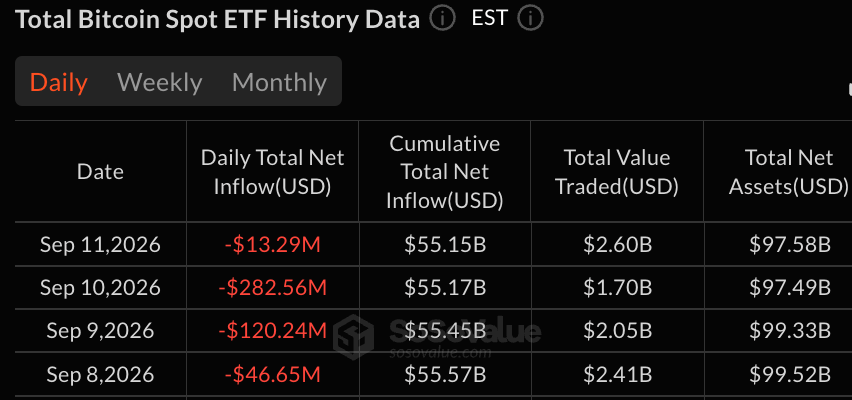
Ether ETFs took in $216.41 million on Friday and finished a fourth consecutive week of net inflows. The split does not prove a direct rotation into ether products. Still, the different flows show that ETF demand has become selective. It coincides with overhead supply and the failed $81,700 test.
The moving average offers a clear reference point for the next move. A strong close above $81,700 would put $83,600 firmly in focus. A rejection keeps the $77,100 to $80,200 supply zone active. Bitcoin’s price would then face the same seller concentration that capped its latest rally.
Downside levels also carry weight. CryptoQuant places the next visible support at the 200-day moving average near $70,000. A second on-chain accumulation cluster lies between $62,000 and $65,000, where roughly 476,000 BTC accumulated this year. The $77,100 to $80,200 area, $81,700, and $83,600 now map the levels buyers need to reclaim before $88,700 enters focus.
The post Bitcoin Price Tests $81,700 as Long-Term Supply Caps the Rally appeared first on Blockonomi.
TLDR:
- Sen. Lummis says the revised CLARITY Act includes 114+ Democratic changes before the September 15 vote.
- The House passed the bill 294-134 in July 2025, including support from 78 Democrats across party lines.
- The Senate Banking Committee advanced its version 15-9 in May 2026, while Senate passage still needs 60 votes.
- The bill would split SEC-CFTC oversight and add registration, disclosure and customer asset safeguards.
Sen. Lummis escalated pressure on Senate Democrats Saturday, arguing they should support the CLARITY Act after securing more than 100 requested changes. In a September 12 post on X, the Wyoming Republican said Democrats would bear responsibility if the legislation fails.
Her argument centers on negotiations completed before a crucial September 15 procedural vote. The vote could determine whether Congress advances comprehensive cryptocurrency market structure legislation before the November midterm elections. Supporters still need bipartisan backing as Senate advancement requires 60 votes.
Lummis Presses Democrats After 114+ CLARITY Act Changes
Sen. Lummis released revised legislative text on September 10 after lawmakers negotiated during the August recess. She said the approximately 630-page draft incorporated more than 114 Democratic provisions.
That record now forms the core of her political argument. Democrats helped rewrite substantial parts of the proposal, while unresolved disagreements continue over consumer safeguards, ethics and financial regulation.
The revised CLARITY Act includes provisions addressing protocols claiming decentralization while retaining centralized control. Regulators would determine when those businesses fall under specific federal compliance requirements.
Those requirements could include Commodity Futures Trading Commission obligations and Bank Secrecy Act rules. The revision also narrows certain decentralized-finance provisions to spot and cash digital commodity transactions.
Additionally, the legislation clarifies digital asset powers for credit unions. More broadly, the proposal would divide cryptocurrency oversight more clearly between the Securities and Exchange Commission and the CFTC.
It would also establish registration systems for digital asset intermediaries. Those entities would face disclosure requirements, customer asset segregation standards and protections addressing conflicts of interest.
The legislation already demonstrated bipartisan support in the House. At the time, representatives passed it 294-134 in July 2025, with 78 Democrats supporting the measure. The Senate Banking Committee later advanced its version 15-9 in May 2026. However, those earlier votes have not produced a publicly confirmed 60-vote Senate coalition.
September 15 Vote Tests Whether Senate Has 60 Votes
Democratic lawmakers continue seeking stronger protections despite the revisions. Their concerns include illicit finance, consumer protection, securities law loopholes, financial stability and presidential cryptocurrency conflicts.
Banking groups have also raised concerns about stablecoin rewards and possible deposit outflows. Consequently, the September 15 procedural vote remains dependent on bipartisan support.
Sen. Lummis has argued that congressional legislation would provide more durable market rules than regulation through federal agencies alone. However, her warning that consumers would have “zero federal protection” if the CLARITY Act fails goes beyond the current regulatory landscape.
The CFTC already has authority to pursue fraud and manipulation involving spot digital commodity markets. Nonetheless, it lacks comprehensive oversight authority covering those markets.
The SEC has also issued a 2026 interpretation covering crypto assets and proposed disclosure requirements for some crypto-related investment contracts. Those measures provide limited federal oversight, but they do not establish the comprehensive statutory spot-market structure envisioned by the legislation.
That distinction explains the importance of Tuesday’s vote. Failure to secure 60 votes would stall the current effort as the congressional calendar tightens. Nevertheless, success would not immediately make the legislation law.
Instead, it would allow the measure to proceed toward further Senate debate and amendments. For Sen. Lummis, that procedural hurdle now supports a simple political case: Democrats helped write the revisions, and the next vote tests whether they support them.
The post Democrats ‘Wrote the Fix’ and ‘Must Pass It,’ Lummis Says Ahead of CLARITY Act Vote appeared first on Blockonomi.
TLDR:
- XRP ETF developments include a Cryptex S-1/A that lists XRP as an eligible 4.36% index component, with a 4.41% indicated fund weight.
- The Cryptex Digital Market Cap ETF table puts XRP above Chainlink, Solana, and Avalanche, yet the proposed multi-asset product is still pre-effective.
- Listed Funds Trust moved the Teucrium 2x Short Daily XRP ETF effectiveness date to Oct. 11, though the filing does not set a debut date.
- The amendment gives no stated reason for the timing change and does not cite the CLARITY Act, Senate negotiations, or a regulatory decision.
XRP has appeared in two U.S. fund-registration updates that describe separate products and stages. A Sept. 11 pre-effective amendment for the Cryptex Digital Market Cap ETF lists XRP as an Eligible Component. This XRP ETF update gives XRP a 4.36% weight in the underlying Cryptex Digital Market Cap Index. The document does not signal that any shares have begun trading.
The same table places XRP above Chainlink, Solana, and Avalanche by index weight. It also shows a 4.41% prospective fund allocation after Cryptex applies its additional eligibility screens. Separately, Listed Funds Trust changed the effectiveness date for its Teucrium 2x Short Daily XRP ETF to Oct. 11. That amendment does not announce a trading date.
XRP ETF Update Gives XRP a 4.36% Cryptex Index Weight
The Cryptex Digital Market Cap ETF is designed to follow the components and weightings of its digital-asset index. It is a proposed multi-asset crypto product, rather than a single-asset XRP fund. The preliminary prospectus says the shares are intended for Nasdaq under the ticker BAGZ. It has not become effective.
XRP just landed in a new SEC ETF filing
Cryptex Digital Market Cap ETF (S-1/A, filed Sept 11) lists XRP as an Eligible Component 4.36% index weight, ahead of SOL, LINK & AVAX in the basket. https://t.co/GBwLhCulLZ pic.twitter.com/9J1ARAA8kP
— Xaif Crypto (@Xaif_Crypto) September 12, 2026
The Sept. 11 filing presents the index composition as of Sept. 8. XRP carries a 4.36% index weight and a 4.41% indicated fund weight. Chainlink stands at 3.15%, Solana at 2.80%, and Avalanche at 2.13% within the index. Each appears as an eligible component in the table.
Bitcoin and Ethereum hold the largest index allocations, at 25.83% and 13.55%, respectively. The index contains 36 assets, while the proposed fund screen leaves 19 constituents. Those screens address the proposed product’s own listing and operational requirements. They can alter a constituent’s final fund allocation.
The XRP ETF filing does not mean the Commission has approved the Cryptex product. A pre-effective S-1/A is a registration and disclosure step before sales may begin. The proposed product must become effective and complete its exchange-listing process. It also must satisfy the terms set by its sponsor and service providers.
XRP ETF Short Fund Filing Moves Effectiveness to October 11
A separate Sept. 11 filing came from Listed Funds Trust, not from Cryptex. Post-Effective Amendment No. 606 covers the Teucrium 2x Short Daily XRP ETF. It designates Oct. 11, 2026, as the new effective date for a previously filed amendment. It also identifies the form as Amendment No. 608 under the Investment Company Act.
The XRP ETF document says its sole purpose is to delay the fund’s effectiveness. It gives no explanation for the change and names no scheduled first trading day. For that reason, the record does not support describing the action ads an SEC decision to delay a launch. The trust submitted an amendment that sets a later effective date under Rule 485(b).
The Teucrium fund seeks negative twice XRP’s daily return before fees and expenses. It uses financial instruments, including swaps, instead of directly shorting XRP. If XRP falls 3% in one trading day, the stated objective would target roughly a 6% gain before costs. Actual returns can differ from that target after expenses and compounding.
The XRP ETF product resets its exposure each day. Compounding and volatility can cause returns over longer periods to differ from negative twice XRP’s cumulative move. The prospectus warns that investors can lose money even when XRP declines over a longer period as daily results compound. It describes the fund as a short-term trading vehicle requiring active monitoring.
The September amendment does not cite the CLARITY Act, Senate negotiations, or political opposition. It incorporates earlier registration materials by reference and changes only the effective date. The filing provides no trading date, exchange symbol, or new investment strategy for the Teucrium fund.
The post XRP ETF Filing Puts XRP Above SOL, LINK, AVAX as Short Fund Moves appeared first on Blockonomi.
TLDR:
- Ben Delo’s £36M Reform UK donation sets a British political record, surpassing the previous £10M high.
- Delo’s reported 2026 support for Reform UK now totals about £44M after £8M in earlier contributions.
- The £36M payment nearly matches the roughly £38M Reform UK had raised since its 2021 launch, before the gift.
- Current UK rules impose no general cap on permissible domestic donations, though reporting rules still apply.
BitMEX co-founder Ben Delo has donated £36 million to Reform UK, setting a record for the largest single contribution to a British political party. The payment gives Nigel Farage’s party substantially more funding as it prepares for the next general election.
Delo originally intended to contribute £1 million monthly until the election, which must take place by mid-2029. Instead, he transferred the planned support through one payment. He said the approach would give Reform a “level playing field” while reducing the party’s need for continuous fundraising.
The £36 million contribution exceeds Britain’s previous single-donation record of £10 million. That amount came through businessman John Sainsbury’s bequest to the Conservative Party. Delo’s payment also surpasses crypto investor Christopher Harborne’s previous £9 million contribution to Reform.
Delo Front-Loads £36M as Political Funding Rules Face Review
The timing reflects concerns about possible changes to political-finance rules before the election. Delo said providing the money immediately would protect his planned support from future legislative restrictions.
However, existing UK rules place no general ceiling on donations from permissible domestic donors. According to the Electoral Commission, eligible individuals and organizations can contribute unlimited amounts.
Political parties must still verify donors and meet reporting requirements. Therefore, Delo’s contribution falls under established rules governing permissible domestic political funding.
Meanwhile, the government has proposed separate restrictions targeting overseas electors and cryptocurrency payments. One proposal would impose a £100,000 annual donation limit on overseas electors.
The government also plans a moratorium on political contributions made directly with crypto assets. Those measures target foreign financial influence rather than imposing a general £100,000 cap on domestic donors.
Importantly, the record payment was made as a conventional political donation. It was not transferred through Bitcoin or another cryptocurrency despite Delo’s BitMEX background.
Reform’s Funding Base Expands After Delo’s Latest Contribution
Delo had already provided Reform with £8 million during 2026 before making the latest payment. His reported support for the year now totals about £44 million.
Electoral Commission figures showed he contributed £4 million during the second quarter alone. That represented roughly 75% of the £5.3 million Reform raised during that period.
The scale becomes clearer when compared with the party’s previous fundraising. The Independent reported Reform had received roughly £38 million since its 2021 launch before this payment.
Consequently, the latest contribution alone is almost equal to the amount Reform collected during that earlier period. It significantly expands the party’s available financial resources before 2029.
Delo’s connection to the cryptocurrency industry also brings attention to his past at BitMEX. He co-founded the cryptocurrency derivatives exchange alongside Arthur Hayes and Samuel Reed.
In 2022, he pleaded guilty in the United States to failing to establish a Bank Secrecy Act-compliant anti-money-laundering program. President Donald Trump granted Delo and other former BitMEX executives full pardons in March 2025.
Separately, Metropolitan Police recently expanded an investigation into allegations involving possible foreign political donations following an undercover investigation. Reform denies wrongdoing and says it will cooperate.
There is no indication that the investigation concerns Delo’s £36 million payment. The donation nevertheless gives Reform an unprecedented funding boost ahead of the next UK election.
The post BitMEX Co-Founder Ben Delo Gives Reform UK Record £36M Donation appeared first on Blockonomi.
Key Highlights
- Shares of DELL climbed 11.8% on Friday, reaching a record peak of $567.75
- RBC Capital Markets launched coverage with Outperform rating and $640 target price
- The company’s AI server order book reached $60.9 billion with a massive $95 billion backlog
- CEO Michael Dell’s wealth surged to $274 billion, securing the No. 3 position on Forbes’ billionaire rankings
- Potential headwinds include significant insider transactions, hardware supply constraints, and a forthcoming $4 billion debt issuance
Dell Technologies (DELL) reached an unprecedented milestone on Friday, touching a record high of $567.75 before settling near $566.62—an impressive 11.8% gain. This represents a substantial jump from Thursday’s closing price of $506.62, with trading activity surging 71% beyond typical daily volumes.
Dell Technologies Inc., DELL
The stock’s explosive movement followed RBC Capital Markets’ decision to launch coverage with an Outperform designation and a $640 price objective. RBC analysts highlighted the company’s strategic positioning in enterprise artificial intelligence spending, infrastructure modernization, storage solutions growth, and personal computer replacement cycles as primary catalysts.
Goldman Sachs joined the bullish chorus by increasing its price forecast from $510 to $570 while maintaining its Buy recommendation. Meanwhile, Barclays elevated its target from $550 to $603 with an Overweight stance. Fox Advisors took things further, upgrading from Equal Weight to Overweight with a $625 price objective.
The company’s most recent quarterly results, unveiled September 1st, significantly exceeded Wall Street’s projections. Dell delivered earnings per share of $7.04 compared to the $4.91 analyst consensus, while revenue hit $46.97 billion—representing a remarkable 57.7% increase from the prior year.
Artificial Intelligence Infrastructure Fuels Growth
The technology giant’s AI server order book swelled to $60.9 billion, contributing to an overall backlog approaching $95 billion. Revenue from AI-optimized servers doubled sequentially to $16.4 billion in the latest quarter. Dell has established fiscal year 2027 earnings guidance at $25.50 per share with Q3 projections of $6.50.
Oracle’s recently announced $95 billion infrastructure investment initiative further energized investor enthusiasm for AI hardware providers. As a primary supplier of Nvidia-powered servers, Dell stands to capture substantial demand from both cloud hyperscalers and enterprise clients.
The company currently commands a market capitalization of $367.23 billion, trades at a price-to-earnings multiple of 32.89, and has a beta coefficient of 1.34. Its 50-day moving average rests at $447.99.
Wealth Rankings Reshuffled
Friday’s stock surge elevated founder and CEO Michael Dell’s estimated wealth by more than 6% to $274 billion, edging him slightly ahead of Amazon’s Jeff Bezos at $273 billion for third place on Forbes’ live billionaire tracker.
Dell and Bezos have exchanged the third position multiple times this week. Dell momentarily surpassed Larry Page on Wednesday before relinquishing the spot. Page’s fortune registered at $279 billion as of Friday. Tesla CEO Elon Musk maintains his top ranking with an estimated $916 billion net worth.
However, not all indicators point upward. Multiple company insiders have recently liquidated shares, including Silver Lake-connected entities that reduced their stakes by more than 53% and 58% respectively. Combined insider sales totaled 1.3 million shares valued at over $624 million during the past three months.
Additionally, Dell is preparing a $4 billion bond issuance intended for debt refinancing, which market participants will scrutinize for potential effects on financial leverage and liquidity. Supply chain bottlenecks for AI components present ongoing challenges, as does the stock’s premium valuation following its dramatic appreciation.
Wall Street’s collective assessment currently registers as Moderate Buy, with a mean price target of $560.24 across 36 covering analysts. The company distributes a quarterly dividend of $0.63 per share, translating to an annualized payout of $2.52 and yielding 0.4%.
The post Dell Technologies (DELL) Stock Soars to Record High as CEO Climbs Wealth Rankings appeared first on Blockonomi.
CryptoPotato
Swiss-based asset manager 21Shares has outlined its investment case for XRP, citing regulatory clarity, institutional access, growing XRPL utility, and a predictable supply.
Nevertheless, it outlined one major risk, which continues to haunt the underlying asset.
Why Bullish on XRP?
Given Ripple’s years-long battle with the US Securities and Exchange Commission and the favorable outcome in the past year or so, 21Shares’ report identified regulatory clarity as the first pillar. The conclusion in August 2025 removed what the asset manager described as a major compliance obstacle for institutions, and the regulatory environment for the asset improved further in 2026, giving it considerably clearer treatment than it had under the previous SEC tenure.
Perhaps related to regulatory clarity is the second pillar: expanding institutional access. Recall that several spot XRP ETFs hit Wall Street last November and attracted over $1 billion in a month and a half. As recently reported, the cumulative inflows reached a new all-time high above $1.7 billion, even during this difficult year for the asset.
Next, 21Shares outlined the actual network usage, as the report noted that XRP Ledger has processed close to $500 billion in on-chain value during the past 12 months. At the same time, Ripple’s RLUSD stablecoin expanded from a market cap of $72 million to $1.6 billion in less than two years.
Tokenized assets on XRPL have also grown substantially, recently hitting $4 billion. The network continues to target payments, stablecoins, and real-world assets.
Crypto commentator Vincent Van Code also weighed in on 21Shares’ report, arguing that Ripple’s broader infrastructure strengthens that proposition. They described it as an “out-of-the-box, turnkey end-to-end solution” for institutions looking to adopt digital assets.
Lastly, the report mentioned XRP’s fixed maximum supply of 100 billion tokens, with no ongoing inflation schedule and a small amount permanently burned through transaction fees.
Major Uncertainty
Despite all the bullish comments explained above, 21Shares highlighted an important weakness in that thesis, as more XRPL usage does not automatically mean more XRP demand. Institutions can use the network while holding XRP only temporarily. In some cases, they might only barely use the token.
The crucial question here is whether expanding payments, stablecoins, and tokenized assets will ultimately translate into sustainable value accrual for XRP.
For investors convinced that global finance will increasingly move on-chain, 21Shares argued that XRP provides one of the more regulated and institutionally connected ways to gain exposure to that trend. However, the investment case still depends on adoption eventually translating into actual demand for the underlying asset, which continues to struggle against the $1.40 resistance as of press time.
The post Why Ripple (XRP)? 21Shares Highlights 4 Reasons Investors Should Take Notice appeared first on CryptoPotato.
The analyst at CryptoQuant weighed in on BTC’s notable price resurgence, which drove the asset from under $65,000 to over $82,000 within a few weeks, and, more specifically, on the subsequent rejection and what could follow around the corner.
They believe the overall setup remains constructive, but the cryptocurrency has to overcome a stack of technical and on-chain resistance levels, which are right in front of it.
Which Level Decides BTC’s Fate?
The weekly report by CryptoQuant identified Bitcoin’s 365-day moving average, currently located at $81,700, as the asset’s most important level. Recall that BTC briefly exceeded that level at the start of September, but the bears stepped up and quickly rejected the move.
Historically, bull markets have “officially” begun once the cryptocurrency closes above this moving average. A successful close above $81,700 could confirm a new bullish phase and open the door for another major leg up. However, its continuous inability to break through could lead to a longer consolidation phase or even to a more profound decline.
On the downside, bitcoin’s rally won’t be confirmed by simply moving past the $81,700 obstacle, as there are a few others on the way up. At first, CryptoQuant found the 3x Metcalfe valuation band, which sits at $83,600 and stands as the next big resistance. This level halted BTC in May and has previously coincided with important cycle turning points.
If taken down, there’s one more at $88,700, which is the trader realized-price upper band. History shows that selling has intensified once the cryptocurrency approaches this line because active traders begin sitting on increasingly large unrealized profits.
539K BTC
CryptoQuant noted that the most immediate problem is considerably closer as long-term holders sold as much as 539,000 units between $77,100 and $80,200 throughout the year, creating what the analysts described as the heaviest nearby on-chain supply wall.
Bitcoin would need to absorb this supply before making another convincing attempt north, while the downside is better defined. The 200-day MA around $70,000 represents the first major technical support, followed by another substantial on-chain cluster between $62,000 and $65,000, where approximately 476,000 BTC were accumulated this year.
Overall, CQ’s analysts are still bullish on BTC, but under one critical condition: the asset must clear $81,700 soon, then $83,600, and eventually $88,700 before the recovery can develop into a more profound rally.
The post Bitcoin’s 24% Rally Hit a Wall: CryptoQuant Reveals What Comes Next appeared first on CryptoPotato.
Popular analyst CryptoGoos outlined a remarkably simple BTC trading strategy that has successfully tracked and identified the asset’s most important cycle bottoms and tops.
If it plays out again, the next major buy signal could be happening as we speak (or as you read). The idea is quite interesting – instead of relying on complicated indicators, moving averages, and on-chain metrics, investors should look into the US midterm elections.
This striking historical pattern shows that Bitcoin has struggled during every previous midterm election year before recovering strongly once the vote was out of the way. That makes this year and the following several months highly interesting.
No Good Midterm Year
Given the fact that BTC was essentially an unknown internet magic money in 2010, we won’t count that midterm election year. Instead, we will focus on 2014, 2018, and 2022. A quick look into that shows that all three were ugly. 12 years ago, BTC had already collapsed following the extraordinary 2013 bull market and the failure of Mt. Gox.
Fast forward to the 2018 bear market, the cryptocurrency plunged from almost $20,000 to under $3,500. The 2022 example was no better, as the asset entered another brutal downturn amid aggressive Fed rate hikes, the deterioration of Terra/LUNA, and a broader crypto credit crisis. Days after the November 8 midterm election, FTX imploded, which resulted in the last leg down of that cycle with BTC slumping toward $16,000.
Research from CryptoQuant found that BTC declined by more than 60% during each of those three midterm election years. As such, the similarities with 2026 are hard to ignore. The cryptocurrency remains far below its October 2025 all-time high despite its most recent recovery.
Signal to Buy?
The more interesting part of CryptoGoos’ conclusion is what comes after the vote, as BTC has historically rebounded strongly in the 12 months following the US midterm elections. Data tracking the previous three cycles puts the average subsequent gain at over 50%.
Obviously, this doesn’t guarantee that the election itself mechanically leads to a sharp bitcoin price uptick. A more reasonable explanation is that midterm years tend to coincide with several conditions that can pressure risk assets, such as political uncertainty, reduced investor appetite, changing fiscal expectations, and, in BTC’s particular case, the historically weak part of its four-year cycle.
Once the election passes, one major source of uncertainty goes away, and markets can start pricing the next two years of fiscal, regulatory, and monetary policy with considerably more confidence.
If investors choose to follow CryptoGoos’ strategy and accumulate BTC now ahead of the midterms, the first sales should begin with a 25% offload next year, followed by a more significant 50% dump in 2028 and another 25% in the post-election 2029.
The post This Bitcoin Election Strategy Has Worked 3 Times: Here’s When It Says to Buy BTC appeared first on CryptoPotato.
On-chain investigator ZachXBT revealed earlier today that Revolut had disclosed highly sensitive personal and financial information belonging to certain customers after receiving what appeared to be an authentic government request.
The company sent emails to the affected users, admitting that the exposed records included passports, verification selfies, addresses, and complete Bitcoin transaction history.
What Was Exposed
In the email sent to customers and revealed by ZachXBT on his Telegram page, Revolut explained that it received a request for information that appeared to originate from a legitimate government agency. The sender was not merely spoofing an address that looked official. The request came from an unauthorized email account using the government agency’s actual email domain and carried valid domain authentication credentials, the company added.
Revolut fulfilled the request under the belief that it was legit. The disclosed information potentially included certain customers’ full names, dates of birth, occupations, home addresses, email addresses, and phone numbers. More sensitive material included copies of passports and/or driver’s licenses and the selfie images clients had supplied during the verification process. The good news, according to the company, is that biometric facial telemetry itself was not compromised.
However, the firm said it has provided financial information, including account statements containing IBANs, account-opening dates and wallet reference numbers, as well as withdrawal records and full transaction history, including BTC transactions.
So far, Revolut has not publicly named the government agency involved, and the notice sent to customers does not indicate whether passwords, private keys, or their funds were accessed.
Going Against the Rich?
The on-chain sleuth described the incident as “likely limited in size,” as it seemed that the perpetrators focused only on high-net-worth users. However, this hasn’t been confirmed either independently or by Revolut itself. In addition, the company hasn’t disclosed the actual number of affected clients.
Given the available information as of press time, the incident appears to be an unauthorized disclosure rather than a direct compromise of Revolut’s infrastructure. The company itself instructs government and law-enforcement bodies to submit official information requests through a dedicated channel.
The post Revolut Exposed Passports and Bitcoin Records After Fake Government Request: Report appeared first on CryptoPotato.
XRP went on a massive run after the August 19 breakout, surging from the key psychological support at $1.00 to a multi-month peak at $1.70, all within the span of just 72 hours.
However, the subsequent rejection was quite violent, and the token lost a few crucial support levels on the way down, including $1.60, $1.50, and, most recently, $1.40. It now sits below the last one, and some on-chain data suggests more pain is ahead.
Activity Slumps
Perhaps the most evident reason behind XRP’s major breakout several weeks ago came from whales. These large market participants ‘went crazy’ in their accumulation efforts, scooping roughly 400 million tokens within a week or so. In addition, network activity spiked, showing increased interest in the token and the blockchain behind it.
The same investors have turned on the cross-border token, according to more recent data shared by Ali Martinez. Citing Santiment Intelligence, he noted that the “pullback appears to be driven in part by profit-taking, with whales selling or redistributing roughly 90 million XRP over the past week.”
Naturally, such moves from the largest ecosystem participants have a two-fold effect. First, they increase the immediate selling pressure. Second, their example can be followed by retail investors who tend to copy whales.
The second major warning comes from the network activity. Daily active addresses have plunged by over 90% from the peak during the rally of 388,492 to 38,163. According to Martinez, this signals a “significant drop in participation during the correction.”
The analyst added that XRP has found “critical support” near $1.35, where 2.29 billion tokens were previously traded. If the asset maintains that level, it could rebound toward $1.60 or even $1.68 next.
600% Rally in the Making?
Another popular analyst, Celal Kucuker, was even more optimistic about XRP’s future. They added that the token’s rally to its previous all-time high began when it stood 12% below its 50-day moving average. Current data shows that it trades at the same point now.
As such, the cross-border token could reignite another major run if it manages to reclaim the 50-day MA soon. The analyst predicted a massive 600% move based on historical performance and the Fibonacci equality. If Kucuker’s prediction comes to fruition, it could push XRP to over $9, more than double its current all-time high.
The previous ATH rally started when XRP was 12% below the 50-day moving average.
We are at the same point now: 12%
Above the 50-day MA = The bull run begins for XRP
If the 13.55% descending channel breaks to the upside, a 600% move could begin based on Fibonacci equality! pic.twitter.com/Pw6Cwhk6iJ
— Celal Kucuker (@CelalKucuker) September 11, 2026
The post Ripple (XRP) Price Outlook: Two Key Metrics Are Flashing Warning Signs appeared first on CryptoPotato.


