Cryptocurrency Posts
Crypto Briefing
SEC says most crypto assets fall outside securities laws and clarifies rules for staking, airdrops, and Bitcoin mining.
The post SEC says most crypto assets fall outside securities laws, including staking, airdrops, and mining appeared first on Crypto Briefing.
The incident underscores the urgent need for enhanced cybersecurity measures in crypto platforms to protect user data and financial assets.
The post Bitrefill reports Lazarus-style exploit drained funds and exposed some user data appeared first on Crypto Briefing.
Aster launches a privacy focused Layer 1 for perpetual trading as ASTER rises 8% and DeFi derivatives volume hits $14T.
The post Aster launches privacy-focused Layer 1 for perpetual trading as ASTER token jumps 8% appeared first on Crypto Briefing.
Tally shuts down after six years as demand for DAO governance tools declines following regulatory changes and market consolidation.
The post Tally shuts down operations amid reduced demand for DAO tools appeared first on Crypto Briefing.
World launches AgentKit beta, linking World ID with x402 to help AI agents prove a real human stands behind them while preserving privacy.
The post Sam Altman’s World and Coinbase roll out toolkit to distinguish human-backed AI agents from bots appeared first on Crypto Briefing.
Bitcoin Magazine
Bitcoin Magazine

From $5 to $75,000: Bitcoin’s Saint Patrick’s Day Prices Shows You the Wild Ride of Bitcoin
Bitcoin’s rise from an obscure digital asset to a global financial instrument is again in focus this St. Patrick’s Day. On March 17, 2012, Bitcoin traded near $5. Thirteen years later, it has reached roughly $75,000.
This is a massive expansion driven by increasing demand and a fixed supply model.
Bitcoin’s early years were defined by sharp price swings and thin liquidity. In 2013, the asset surged from under $50 to more than $600 before retracing below $300 by 2015.
These cycles repeated over time, with each rally followed by a correction.
In 2017, Bitcoin crossed $1,000 and later accelerated higher before entering another downturn. By 2021, it had climbed past $50,000 as institutional participation began to take shape. Pullbacks in 2022 and 2023 tested conviction, but the broader trend remained intact.
In late 2025, BTC surged above $125,000 before pulling back to $60,000 earlier this year.
Each cycle introduced new participants and strengthened market infrastructure, contributing to a more resilient asset over time.
Historical Bitcoin prices on Saint Patrick's Day
— Bitcoin Magazine (@BitcoinMagazine) March 17, 2026
2012 $5.34
2013: $47
2014: $630
2015: $290
2016: $417
2017: $1,180
2018: $8,321
2019: $4,047
2020: $5,002
2021: $56,825
2022: $41,140
2023: $26,876
2024: $68,845
2025: $83,223
2026: $74,590
HODLpic.twitter.com/8LMFUGZkpX

Institutional access is growing despite Bitcoin’s fixed supply
One of the most significant developments in the current cycle is the expansion of institutional access. Spot Bitcoin exchange-traded funds in the United States have created a direct pathway for large pools of capital to enter the market.
These products have recorded sustained inflows, including single-day totals exceeding $500 million, reflecting strong demand from asset managers, pension funds and retail brokerage accounts. The result is a steady accumulation of BTC within regulated investment vehicles.
As more capital flows through these channels, available supply on exchanges has tightened, reinforcing upward pressure on price.
Bitcoin’s monetary policy continues to differentiate it from traditional assets. The protocol enforces a hard cap of 21 million coins, limiting total supply regardless of demand conditions.
This scarcity is reinforced through halving events, which reduce the rate of new issuance. The most recent halving in April 2024 cut block rewards from 6.25 BTC to 3.125 BTC, lowering the number of new coins entering circulation each day.
Historically, these supply shocks have preceded major upward moves, as reduced issuance meets sustained or increasing demand.
Corporate and traditional finance interest
Beyond financial markets, Bitcoin has gained traction among corporations and policymakers. Public companies have continued adding Bitcoin to their balance sheets, treating it as a reserve asset rather than a speculative position.
Most popular of all these is Strategy, the bitcoin treasury company led by executive chairman Michael Saylor. The company purchased another 22,337 bitcoin for about $1.57 billion last week, continuing one of the largest corporate accumulation strategies in the crypto market.
The acquisition brings the firm’s total holdings to 761,068 bitcoin. Strategy said its cumulative BTC holdings were acquired for roughly $57.61 billion at an average price of about $75,696 per coin.
The stash represents more than 3.4% of the fixed 21 million supply of BTC, reinforcing MSTR’s status as the largest corporate holder of the asset.
Bitcoin’s changing market structure
Bitcoin’s market structure is shifting as ownership consolidates among long-term holders, institutions and corporate buyers. This has reduced the influence of short-term speculation and improved overall stability, even as volatility persists.
Bitcoin has remained resilient through recent turbulence, supported by steady institutional demand and continued accumulation. Analysts point to a clear return of large buyers, with ETF inflows and spot demand helping push prices back above $70,000 after weeks of range-bound trading.
Data shows institutional conviction holding firm. Despite a sharp drawdown since late 2025, ETF outflows have remained limited compared to earlier inflows, signaling that investors are maintaining positions rather than exiting.
This growing base of committed capital reflects a broader shift. Institutional investors entering the market today tend to have high conviction, often allocating with a long-term view rather than reacting to short-term price moves.
Research also highlights the expanding role of ETFs and corporate treasury strategies in reshaping BTC ownership. Institutional vehicles now account for a meaningful share of supply, while a large portion of coins remains inactive, reinforcing the dominance of long-term holders.
At the same time, on-chain data suggests the market may be in a late-stage bear phase, historically tied to accumulation. Analysts say current conditions point to continued consolidation, with long-term investors positioning for the next cycle.
This post From $5 to $75,000: Bitcoin’s Saint Patrick’s Day Prices Shows You the Wild Ride of Bitcoin first appeared on Bitcoin Magazine and is written by Micah Zimmerman.
Bitcoin Magazine

Jack Mallers Confirmed As A Bitcoin 2026 Speaker
Jack Mallers has been officially confirmed as a speaker at Bitcoin 2026, returning to the stage where he made Bitcoin history to share his perspective on Bitcoin’s expanding role in payments, capital markets, and global finance. As Co-Founder and CEO of Twenty One Capital (NYSE: XXI) and Founder and CEO of Strike, Mallers now sits at the intersection of two consequential Bitcoin companies operating today, one reshaping how people spend and save Bitcoin, the other redefining what a publicly traded Bitcoin company can be.
Twenty One Capital launched on the New York Stock Exchange in December 2025, debuting with a treasury of 43,514 Bitcoin — the third-largest public corporate Bitcoin holding in the world, behind only Strategy and MARA Holdings. The company is majority-owned by Tether, the world’s largest stablecoin issuer, and Bitfinex, with significant minority ownership from SoftBank Group, and has committed to operating with public-market transparency, including publishing on-chain proof of holdings for real-time shareholder verification. Speaking on CNBC at launch, Mallers made the mission clear: the company plans to “buy as much Bitcoin as we possibly can” not as a passive treasury vehicle, but as a full Bitcoin-native operating business building capital markets advisory, lending models, and educational media on top of its BTC holdings.
Strike, the company Mallers founded in 2020, has become one of the most widely used Bitcoin financial platforms in the world. Built on Bitcoin’s Lightning Network, Strike allows users to make and receive payments, buy and sell bitcoin with no added fees, and convert their paychecks directly into Bitcoin all without requiring prior crypto experience. In March 2026, Strike received both a BitLicense and a money transmitter license from the New York State Department of Financial Services, allowing the company to operate in one of the most tightly regulated digital asset markets in the United States. “Strike is building the leading Bitcoin financial institution,” Mallers said in a statement. “With our BitLicense, we can now bring that mission to New York, the global center of finance.”
With Twenty One Capital now live on the NYSE and Strike completing its all-50-states U.S. expansion, Mallers arrives at Bitcoin 2026 carrying more institutional weight than ever, and the same conviction he’s held since day one: that Bitcoin is honest money, and that the infrastructure being built around it will determine what the next chapter of global finance looks like.
JACK MALLERS, FOUNDER & CEO OF STRIKE AND TWENTY ONE, TO SPEAK AT BITCOIN 2026
— The Bitcoin Conference (@TheBitcoinConf) March 3, 2026
"It's over man, Bitcoin is going to the moon."pic.twitter.com/wHorQFmcYa

Bitcoin 2026 Returns to Las Vegas Bigger Than Ever
Bitcoin 2026 will take place April 27–29 at The Venetian, Las Vegas, and is expected to be the biggest Bitcoin event of the year.
Focused on the future of money, Bitcoin 2026 will bring together Bitcoin builders, investors, miners, policymakers, technologists, and newcomers from around the world. The event will feature a wide range of pass types, including general admission passes designed specifically for those new to Bitcoin, alongside premium passes for professionals, enterprises, and institutions.
With multiple stages, immersive experiences, technical workshops, and headline keynotes, Bitcoin 2026 is designed to serve both first-time attendees and long-time Bitcoiners shaping the next era of global adoption.
Past Bitcoin Conferences in the U.S.
Bitcoin’s flagship conference has scaled dramatically over the past five years:
- 2021 – Miami: 11,000 attendees
- 2022 – Miami: 26,000 attendees
- 2023 – Miami: 15,000 attendees
- 2024 – Nashville: 22,000 attendees
- 2025 – Las Vegas: 35,000 attendees
 Get Your Bitcoin 2026 Pass
Bitcoin Magazine readers can save 10% on Bitcoin 2026 tickets using code ‘ARTICLE10‘ at checkout.
Stay at The official hotel of Bitcoin 2026, The Venetian, and get a guaranteed low rate plus 15% off your pass. Hotel Prices increase soon, be in the middle of where the fun is all happening, and where the networking never ends.
And don’t forget:
Volunteer at Bitcoin 2026 and get Pro Pass access plus exclusive perks.
All students ages 13+ can apply for a Student Pass and get free general admission access to Bitcoin 2026.
 Location: The Venetian, Las Vegas
 Dates: April 27–29, 2026
With tens of thousands of attendees expected and hundreds of major speakers like Jack Mallers already confirmed, now is the time to lock in your ticket.
Buy Bitcoin 2026 Tickets — Save 10%
Why Attend Bitcoin 2026?
Bitcoin 2026 is the definitive gathering for anyone serious about the future of money. With 500+ speakers, multiple world-class stages, and programming spanning Bitcoin fundamentals, open-source development, enterprise adoption, mining, energy, AI, policy, and culture, the conference brings every corner of the Bitcoin ecosystem together under one roof.
From headline keynotes on the Nakamoto Stage to deep technical sessions for builders, institutional strategy discussions for enterprises, and beginner-friendly Bitcoin 101 education, Bitcoin 2026 is designed for everyone—from first-time attendees to the leaders shaping Bitcoin’s global adoption.
Whether you’re looking to learn, build, invest, network, or influence, Bitcoin 2026 is where Bitcoin’s next chapter is written.
Bitcoin 2026 Pass Types: Something for Everyone
Bitcoin 2026 offers a range of pass options designed to meet the needs of newcomers, professionals, enterprises, and high-net-worth Bitcoiners alike.
Bitcoin 2026 General Admission Pass
Ideal for newcomers and those looking to experience the heart of the conference.
- Limited access on Days 2 & 3
- Entry to Main Stage
- Access to Genesis Stage
- Full access to the Expo Hall

Bitcoin 2026 Pro Pass
Designed for professionals, operators, and serious Bitcoin participants.
Includes all General Admission features, plus:
- Full 3-day access, including Pro Day
- Entry to the Pro Pass Reception
- Access to Enterprise Hall, Enterprise Stage, and Networking Lounge
- Conference App networking features
- Access to the Bitcoin For Corporations Symposium
- Entry to Compute Village and Energy Stage
- Complimentary lunch, coffee, tea, and snacks
- Dedicated registration and check-in
- Reserved seating at Main Stage
- Huge savings when you bundle your hotel and Pro Pass

 Bitcoin 2026 Whale Pass
The all-inclusive, premium Bitcoin 2026 experience.
Includes all Pro Pass features, plus:
- Reserved seating at Main Stage
- All-inclusive gourmet food and beverages
- Entry to Whale Night and Whale Reception
- Access to all official after-parties
- Networking app access to connect with other Whales
- Premium access to The Deep — an exclusive networking lounge with intimate speaker sessions
- Complimentary stay at The Venetian when you bundle your whale pass and hotel (use promo code ‘WHALEHOTEL’ here)
This is the most immersive way to experience Bitcoin 2026.

 Bitcoin 2026 After Hours Pass
Your ticket to the night.
Most deals are done with a drink in your hand. Get exclusive access to 3 official Bitcoin 2026 after-parties across Las Vegas — each with a 2-hour open bar — where the real conversations happen and the best connections are made.
- Access to 3 official Bitcoin 2026 after-parties
- 2-hour open bar at each event
- Evening events across Las Vegas, April 27–29
- Network with Bitcoiners, builders, and industry leaders after hours
More headline speaker announcements are coming soon.
Don’t miss Bitcoin 2026.
This post Jack Mallers Confirmed As A Bitcoin 2026 Speaker first appeared on Bitcoin Magazine and is written by Jenna Montgomery.
Bitcoin Magazine

Bitcoin Price Dances Near $75,000 as Market Questions ‘Decoupling’ Narrative
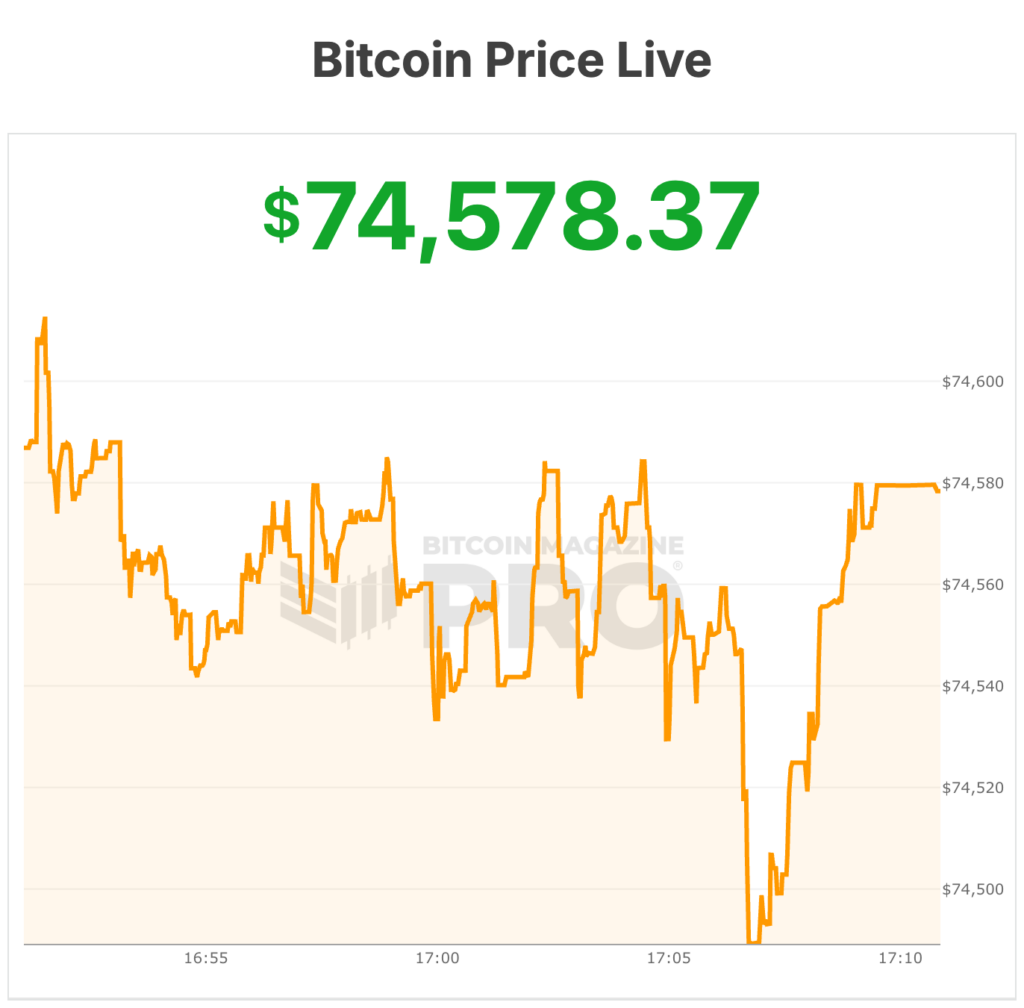
Bitcoin price traded near $75,000 on Tuesday, after extending an eight-day streak that has pushed the asset close to a key psychological level.
The move marks a sharp recovery from February lows near $60,000 and has renewed debate over whether the market has found a bottom.
The world’s largest cryptocurrency broke above $75,000 yesterday during U.S. trading hours after weeks of tight consolidation. The rebound has lifted prices close to early February levels and placed focus on whether bitcoin price can hold its ground.
Analysts at Bitfinex said the recent strength reflects relative outperformance but warned against calling it a structural shift.
“The recent strength above $75,000 does show relative outperformance, but calling it a true ‘decoupling’ is premature,” analysts wrote to Bitcoin Magazine. They pointed to stabilizing ETF flows, fresh demand from new structured products, reduced leverage, and tighter on-chain supply as key drivers.
Bitcoin has outperformed traditional risk assets in recent sessions. Still, analysts noted that it remains tied to broader liquidity conditions. A sustained break from macro correlation would require bitcoin price to continue rising despite tighter financial conditions such as higher yields and a stronger dollar.
For now, the $75,000 to $78,000 range is seen as a critical test. Holding that zone could signal strong spot demand and supply absorption. Failure to do so may suggest the rally is part of a broader positioning reset.
Bitcoin price speculation
Data from Nansen supports the view that the current move is driven by more than speculation. Exchange outflows have remained steady in recent weeks, indicating that investors are moving bitcoin into long-term storage rather than selling into strength.
ETF inflows have also stayed consistent, with roughly $763 million in weekly demand. Corporate buying has added to the trend. Strategy disclosed a $1.57 billion bitcoin purchase, one of the largest this year.
Nansen analyst Nicolai Søndergaard wrote to Bitcoin Magazine that this reflects balance sheet accumulation rather than short-term trading.
“These are balance sheet decisions rather than speculative buys,” he said, adding that derivatives activity has amplified the move. Rising futures open interest and short liquidations contributed to the break above $75,000.
Macro conditions remain a key variable. Geopolitical tensions tied to the Iran–Israel War and shifting expectations around interest rates continue to shape sentiment. Easing concerns around the Strait of Hormuz helped support risk appetite over the weekend.
Markets are now focused on the Federal Reserve’s March 18 decision. A neutral stance could support further upside, while a hawkish signal may trigger profit-taking.
Bitcoin price has staged similar recoveries in past cycles without confirming a lasting bottom. Traders are watching whether the asset can maintain support above $75,000. A sustained hold could open a path toward $80,000.
This post Bitcoin Price Dances Near $75,000 as Market Questions ‘Decoupling’ Narrative first appeared on Bitcoin Magazine and is written by Micah Zimmerman.
Bitcoin Magazine

Bitrefill Discloses Cyberattack, Points to North Korea’s Lazarus Group
Crypto e-commerce platform Bitrefill said it was the target of a cyberattack earlier this month that resulted in stolen funds and limited exposure of customer data, with indicators pointing to the North Korean-linked Lazarus Group as a likely perpetrator.
The breach, which began on March 1, originated from a compromised employee laptop, according to the company’s incident report.
Attackers were able to extract legacy credentials tied to production systems, allowing them to escalate access across Bitrefill’s infrastructure, including segments of its internal database and certain cryptocurrency hot wallets.
Bitrefill said the attackers drained an undisclosed amount of funds from its hot wallets while also exploiting its gift card inventory systems to place suspicious purchases with vendors. The company did not specify the total financial impact but stated it will absorb the losses using operational capital.
The intrusion was first detected through irregular purchasing patterns and anomalies in supplier activity.
In response, Bitrefill temporarily took its systems offline to contain the breach across its global operations. The company said services, including payments and account access, have since returned to normal levels.
As part of the attack, approximately 18,500 purchase records were accessed. The exposed data includes email addresses, cryptocurrency payment addresses and metadata such as IP addresses.
Around 1,000 of those records involved encrypted customer names, which are being treated as potentially exposed due to the possibility that attackers accessed encryption keys. Bitrefill said it has notified affected users directly.
Despite the breach, the company emphasized that it stores minimal personal data and does not require mandatory know-your-customer verification for most transactions. Any KYC-related information is handled by external providers and is not stored within Bitrefill’s systems. The firm added there is no evidence that its full database was exfiltrated or that customer data was the primary target.
“Based on our investigation and logs, we don’t have reason to think that customer data was the objective,” the company said, noting that the attackers appeared to conduct limited queries consistent with probing for valuable assets such as cryptocurrency holdings and gift card inventory.
North Korea’s Lazarus Group was involved
Bitrefill cited several indicators linking the attack to the Lazarus Group, including similarities in malware, reused infrastructure such as IP addresses and email accounts, and on-chain transaction patterns.
The group, often associated with North Korea, has been tied to some of the largest crypto thefts in recent years through its specialized subgroup, Bluenoroff.
Cybersecurity firms including zeroShadow, SEAL911 and RecoverisTeam assisted in the response and investigation, alongside on-chain analysts and law enforcement. The company said it is implementing additional security measures, including expanded monitoring systems and internal controls, to prevent similar incidents.
The attack highlights ongoing concerns around state-sponsored cyber threats in the digital asset sector.
According to blockchain analytics firm Chainalysis, groups linked to North Korea were responsible for more than $2 billion in crypto thefts in 2025, accounting for a significant share of total illicit activity in the space.
Bitrefill said operations have stabilized following the incident and expressed confidence in its recovery, noting that customer activity and sales volumes have returned to typical levels.
This post Bitrefill Discloses Cyberattack, Points to North Korea’s Lazarus Group first appeared on Bitcoin Magazine and is written by Micah Zimmerman.
Bitcoin Magazine

Strategy (MSTR) is About to Have More Bitcoin Than BlackRock’s IBIT
Strategy (MSTR) is closing in on BlackRock’s iShares Bitcoin Trust (IBIT), with the gap in Bitcoin holdings shrinking to a level that could be erased within the next couple of weeks.
Recent data shows IBIT holding roughly 781,000 BTC, while Strategy holds about 761,000 BTC. The difference, now around 40,000 BTC, has tightened as Strategy accelerates its accumulation pace, according to investor Mark Harvey.
The shift reflects diverging models. IBIT holdings rise and fall based on investor inflows and outflows into its spot ETF, while Strategy raises capital through equity and preferred share issuance to fund direct Bitcoin purchases.
This allows Strategy to acquire Bitcoin independent of ETF demand cycles.
Strategy has added significant volume in recent weeks, including two multibillion-dollar purchases in March that pushed its total higher. Last week, the company bought 2,337 bitcoin for about $1.57 billion.
The company continues to frame its performance around Bitcoin accumulation and “BTC Gain” as a proxy for net income under its Bitcoin-centric strategy.
Over the first two weeks of March 2026, Strategy acquired 40,332 BTC and posted a 3.0% yield, reinforcing its aggressive treasury approach, according to Michael Saylor.
Year to date, the firm has accumulated 88,568 BTC with a 3.4% yield, signaling sustained momentum behind its balance sheet transformation.
NEW: Michael Saylor's Strategy could surpass BlackRock's BTC holdings in the next couple weeks
— Bitcoin Magazine (@BitcoinMagazine) March 17, 2026pic.twitter.com/7i70XB0pBN
Bitcoin and Strategy’s strong March
Bitcoin has posted eight consecutive days of gains, a rare streak seen only 15 times since its creation, with past instances delivering a median 30-day return of about 19%, according to Bitcoin Magazine Pro data.
Bitcoin recently climbed from below $66,000 to $76,000 before easing back near $73,800, even as historical patterns show such rallies can precede sharp pullbacks like the 30% drop four years ago.
Bitcoin’s latest surge comes after the asset bottomed near $63,000 in February during heightened geopolitical tensions linked to the Iran–Israel War.
Since then, prices have staged a steady recovery as macroeconomic conditions stabilized and investor confidence returned.
Bitcoin has outperformed other assets like gold and the S&P 500.
Markets received a boost over the weekend after signs of easing tensions around the Strait of Hormuz, one of the world’s most important oil shipping routes.
For now, traders are watching whether bitcoin price can maintain support above the $72,000 region.
A sustained hold above that level could open the door to a push toward $80,000, which previously acted as a key support zone before the early-2026 correction.
Shares of MSTR are pushing $150 a share today.
This post Strategy (MSTR) is About to Have More Bitcoin Than BlackRock’s IBIT first appeared on Bitcoin Magazine and is written by Micah Zimmerman.
CryptoSlate
Citigroup cuts Bitcoin and Ethereum targets as slower US policy timeline trims the upside case
Citigroup has cut its 12-month targets for Bitcoin and Ethereum, lowering its Bitcoin forecast to $112,000 from $143,000 and its Ethereum forecast to $3,175 from $4,304.
The March 17 revision marks a sharp step down from the bank’s December view and ties that reset to slower US legislative progress, a delay that Citi said is weighing on the policy support it had expected to help drive ETF demand and wider adoption.
The cuts are large enough to change the shape of the one-year crypto outlook without turning Citi bearish on the two assets.
Bitcoin’s new target is about 21.7% below Citi’s prior forecast, while Ethereum’s new target is about 26.2% below the earlier call. Both new targets still sit above current market prices.
Based on the latest CryptoSlate figures, Citi’s revised Bitcoin target still implies roughly 51.8% upside from spot, while its revised ether target implies about 36.8% upside.
Citi still expects Bitcoin and Ethereum to rise over the next year. But it has sharply lowered the ceiling it sees for both assets because the bank no longer expects the same pace of regulatory progress, institutional demand, and network follow-through that shaped its December forecasts.
For a market that has already bounced in recent weeks, the downgrade reads less like a call for immediate downside and more like a warning that the path higher may be slower and narrower than the earlier bull case assumed.
That warning lands as both assets have posted recent gains. Bitcoin trades around $74,000, up 4.5% over seven days, and 7.5% over 30 days. Ethereum sits near $2,300, up 12% over seven days, and 15% over 30 days.
The downgrade arrives as the market has recovered tactically, even as one of Wall Street’s largest banks has lowered its one-year expectations.

Citi’s new targets still point higher, but the one-year range has narrowed
Citi’s revision follows a much more upbeat set of targets published in December. At that point, the bank set a 12-month Bitcoin target of $143,000 and a 12-month ether target of $4,304, while also outlining a Bitcoin bull case of $189,000 and an Ethereum bull case of $5,132 in a December report.
The earlier view leaned on regulatory easing and increased adoption. The new view keeps the basic upside case alive, but resets it lower because that policy timeline has not moved as fast as Citi expected.
In practical terms, the bank is saying the market may still move up over the next year, but the fuel it expected to push prices much higher has not arrived on schedule. That is a narrower and more cautious claim than the one Citi made at the end of last year. It also shifts the focus away from pure price prediction and toward the mechanism behind the forecast.
Citi’s December case depended on regulation, ETF demand, and adoption, reinforcing one another. Its March revision suggests that the sequence now looks less certain and less immediate.
The numbers show that clearly.
| Asset | Prior 12-month target | New 12-month target | Target cut | Current price | Implied upside to new target | 7-day move | 30-day move |
|---|---|---|---|---|---|---|---|
| Bitcoin | $143,000 | $112,000 | 21.7% | $73,777.10 | 51.8% | 4.55% | 7.51% |
| Ethereum | $4,304 | $3,175 | 26.2% | $2,320.12 | 36.8% | 12.7% | 15.38% |
The table captures the contradiction at the center of Citi’s revision. Prices have improved over the last week and month, especially for Ethereum, but Citi has still lowered its one-year targets. That suggests the bank is questioning whether the forces needed to sustain a larger move are strong enough to restore the December outlook.
That is especially relevant for Ethereum. Ethereum has outperformed Bitcoin over both the seven-day and 30-day windows in the latest market snapshot. Even so, Citi cut Ethereum's target by a larger percentage than Bitcoin’s, pointing to a more cautious view of the medium-term case for ETH than short-term price action alone would suggest. In other words, recent strength has not been enough to offset Citi’s concerns around adoption, policy timing, and the broader demand backdrop.
For Bitcoin, the change is slightly different. Citi still sees more than 50% upside from current levels, which means the bank has not rejected the broader institutional case for BTC. But by cutting the target from $143,000 to $112,000, it has marked down how far that case can travel in the next year under current conditions.

That leaves Bitcoin with a still-positive but less expansive upside profile, one that depends more heavily on steady inflows and less on a rapid policy tailwind.

ETF flows and market performance show support is still there, but Citi is looking past the rebound
According to Farside, spot Bitcoin ETFs recorded $199 million in net inflows on March 16, bringing cumulative net inflows to $56.3 billion. Spot Ethereum ETFs posted $36 million in net inflows, with cumulative net inflows of $11.8 billion.
Those numbers show real demand is still present. But they also help explain why Citi’s revision is more nuanced than a simple bearish call. The issue is whether the current pace of flows, combined with a slower policy timeline, is strong enough to support the much higher targets Citi set in December. On that question, the bank’s answer now appears to be no.
That shift is easier to see when the December and March narratives are placed side by side. In December, Citi tied its targets to regulatory easing and wider adoption.
In March, it cut those same targets because US legislative progress had been slower than expected, according to the March 17 report. The underlying change is not that crypto prices have stopped moving. Citi is saying the policy and demand sequence it expected to amplify those moves has not come together fast enough.
That leaves markets in an unusual position. Bitcoin and Ethereum have both recovered in recent weeks. ETF money is still coming in. Yet a major bank has decided that the one-year payoff should be reduced anyway.
That gap between price performance and target revisions is the more useful signal. It says the market can rally in the short run without persuading every large forecaster that the longer-term setup has improved by the same degree.
It also explains why Citi’s downgrade does not read like a call on day-to-day trading. The bank is cutting a 12-month target, not predicting a near-term crash. That distinction matters. Targets are about the scale of the move over time, not whether prices can keep rising over the next few sessions or even the next few weeks.
By that standard, Citi’s message is straightforward: the market can still go up, but the room above spot is smaller than the bank thought a few months ago.

The next test is whether policy and flows can rebuild the case Citi cut back
The main variable behind Citi’s reset is Washington. In January, Senate Banking Committee Chair Tim Scott announced a digital-asset market structure markup for Jan. 15, then postponed it on Jan. 14 as negotiations continued, according to the committee’s statement and follow-up update. Senators are still working to unlock the stalled CLARITY Act through a compromise tied to stablecoin yield.
That timeline shapes Citi’s reset because it is the clearest reason the bank has given for lowering its targets. A slower policy track delays legislation and weakens confidence that a friendlier rule set will arrive soon enough to accelerate ETF demand, corporate participation, and other forms of institutional adoption within the next year.
The mechanism is concrete: if the policy step slips, the adoption step can slip with it, making price targets tied to that adoption harder to defend.
For Bitcoin, the next question is whether spot ETF inflows can keep building even without a cleaner legislative backdrop. If they can, Citi’s new target could still prove conservative. If inflows flatten or lose momentum, the bank’s cut may look early rather than late.
The same structure applies to Ethereum, but with a tighter margin for error. Ethereum's recent gains have been stronger, yet Citi’s target cut was deeper. That means ETH needs not only continued price support, but stronger evidence that usage and institutional demand can justify a higher one-year ceiling.
None of that requires a dramatic break in either direction. The data already in hand points to a narrower, more conditional setup. Citi still sees upside from current prices. ETF flows remain positive. Both Bitcoin and Ethereum have risen over the last month. But the one-year case now depends more heavily on whether policy negotiations start producing results and whether flows remain strong enough to replace the optimism Citi stripped from its December forecasts.
The next few months should show whether that caution was warranted. A legislative breakthrough, stronger ETF inflow streaks, or firmer adoption data could rebuild the case for higher targets.
More delays in Washington, softer flows, or weaker follow-through from recent market gains would support Citi’s decision to lower the bar.
For now, Citi’s revision leaves crypto with a live but reduced upside case, and with a clear test ahead, whether policy and demand can catch up to the prices that have already moved.
The post Citi slashes Bitcoin target by $31,000 despite rising prices as Washington delays stall crypto breakout appeared first on CryptoSlate.
Bitcoin is heading toward its first real recession-era test as a mature institutional asset after Moody’s recession model rose to 48.6%, a level that, in that historical series, has not previously been reached without a recession following within 12 months.
The historical ‘point of no return' signal arrives as US growth slows, the labor market weakens, oil trades above $100, and Bitcoin has started to post gains over the past week and month.
That combination sets up a clearer test than the brief COVID downturn: whether Bitcoin trades like a risk asset when the economy softens the slow way, or holds up as an alternative asset when confidence in traditional markets starts to fray.
The macro case behind that framing is no longer thin. US real GDP growth slowed to 0.7% annualized in the fourth quarter of 2025 after 4.4% in the third quarter, based on revised figures.

February payrolls fell by 92,000, and unemployment held at 4.4%, according to Labor Department data. Initial jobless claims stood at 213,000 for the week ending March 7, and weekly claims data fit a softer labor backdrop in a slowing economy.
At the same time, the current Sahm Rule reading sits at 0.27, still below the 0.50 recession trigger.
The New York Fed’s yield-curve model is also less alarmed, with a 12-month recession probability of 18.8%.
That split leaves a clear tension in the data. Moody’s does not capture the whole macro picture, yet the signal is strong enough to drive Bitcoin analysis. It now points to a recession risk zone that collides with a market Bitcoin has never seen before, deep ETF ownership, large fund flows, and the highest ever level of institutional participation.
CryptoSlate data currently shows Bitcoin at $73,777, up 0.05% over 24 hours, 4.55% over seven days, and 7.51% over 30 days, with a $1.48 trillion market cap, $55.59 billion in daily volume, and 58.5% market dominance.
| Indicator | Latest reading | What it shows |
|---|---|---|
| Moody’s recession probability | 48.6% | Recession risk has moved close to the model’s historical danger zone |
| Q4 2025 real GDP growth | 0.7% | Growth slowed sharply from Q3’s 4.4% |
| February payrolls | -92,000 | Hiring weakened instead of expanding |
| Unemployment rate | 4.4% | Labor conditions remain softer than late-2025 levels |
| Initial jobless claims | 213,000 | Layoffs are not yet flashing a full recession signal |
| Sahm Rule | 0.27 | Below the 0.50 threshold that has historically marked recession starts |
| NY Fed recession probability | 18.8% | Other major models remain less alarmed than Moody’s |
| Brent crude | $103.43 | Oil is adding inflation pressure to an already weaker economy |
Why this setup looks different from COVID
The easiest comparison for crypto markets is March 2020. It is also the least useful one for this analysis. The National Bureau of Economic Research dated the COVID recession from March 2020 to April 2020, making it the shortest US recession on record.
Markets moved through a shutdown shock, then through an unusually fast policy response, and then into a sharp rebound. Bitcoin crashed with everything else in the first leg, while the episode left open the larger question of how it behaves in a slower recession with weaker growth, weaker hiring, and a longer stretch of pressure on risk appetite.
The current setup is broader and less concentrated in a single event. Growth had already slowed before the latest Middle East shock. Payrolls had already turned down.
The outside-world pressure point is oil. Brent crude recently traded at $103.43, while a separate energy analysis shows the Strait of Hormuz handled 20.9 million barrels per day in the first half of 2025, around 20% of global petroleum liquids consumption. The chokepoint feeds directly into fuel, shipping, and consumer prices at a moment when the growth backdrop is already weaker.
The historical comparison that fits better is the Great Recession, with one obvious limitation: Bitcoin did not exist then.
The Great Recession ran from December 2007 to June 2009, with a 4.3% peak-to-trough GDP decline and unemployment rising from 5% to 9.5% by June 2009, according to Federal Reserve history.
There is no direct market record for how Bitcoin would trade from the start of a long, broad recession. It launched in 2009, after the downturn had already taken hold.
The next 12 months could therefore produce the first clean read on whether Bitcoin still trades mainly as a liquidity-sensitive asset or can keep attracting capital during a drawn-out slowdown.
That distinction carries more weight now because the ownership structure has changed. Bitcoin is no longer a niche retail market reacting only to internal crypto events. It now sits inside portfolios that also hold equities, bonds, commodities, and cash.
Fund flow data show the tension clearly. CoinShares reported $619 million of inflows in the week of March 9 and about $1.4 billion of inflows over three weeks since the Iran crisis began. Those figures point to institutional demand after months of outflows, even as recession risk and geopolitical stress rise.


What the next 12 months could do to Bitcoin
The next question is straightforward. If the economy slips into recession without a quick reset, Bitcoin has to show whether it behaves like a high-beta trade that gets sold when liquidity tightens, or a harder asset that can absorb flows when confidence in traditional markets weakens. Both outcomes still fit the available data.
The case for resilience starts with relative behavior. Bitcoin is up over the last seven and 30 days even as recession odds rise and oil markets stay tense. Weekly fund flow data have also turned positive again.
If that pattern holds while labor and growth data worsen, the market will have stronger grounds to argue that Bitcoin is reacting differently from earlier risk-off periods. That would be the strongest evidence yet that part of the market sees Bitcoin as a policy hedge, an inflation hedge, or simply an asset outside the banking and sovereign debt system.
The bear case is just as clear. A normal recession often becomes a liquidity story before it becomes an inflation or monetary story. If payroll weakness deepens, claims rise, and investors cut risk across portfolios, Bitcoin could still trade like a risk asset first. Any identity shift would then have to wait.
The oil shock sits at the center of that risk. Higher oil prices can delay easier policy by lifting inflation pressure even as growth fades. That combination is rough for speculative assets because it removes the clean “bad growth equals lower rates” path that can support markets in a plain slowdown.
| Bitcoin metric | Latest reading | Why it matters |
|---|---|---|
| Spot price | $73,777.10 | Bitcoin is holding well above prior cycle levels despite recession fears |
| 24-hour change | 0.05% | Short-term price action is flat rather than disorderly |
| 7-day change | 4.55% | Bitcoin has gained during a period of rising macro stress |
| 30-day change | 7.51% | Momentum has remained constructive over the last month |
| Market cap | $1.48 trillion | The asset is large enough to influence broader portfolio allocation |
| 24-hour volume | $55.59 billion | Liquidity remains deep enough for institutional trading |
| BTC dominance | 58.5% | Bitcoin continues to take a larger share of crypto market value |
| Distance from all-time high | 41.55% below | Bitcoin is recovering and still trading below full price-discovery territory |
Staying on the current trajectory would keep recession fears elevated without full confirmation from layoffs or claims. In that setup, Bitcoin could stay volatile while outperforming equities on a relative basis if fund flows remain positive.
A bull case would require that pattern to strengthen, weaker macro data, continued inflows, and rising Bitcoin dominance. A bear case would show up in broad de-risking, negative flow reversals, and Bitcoin selling off alongside equities.
However, a black swan event would pair a deeper oil shock with worsening growth, creating a stagflation-style squeeze that could hit Bitcoin first and then support an “outside money” allocation if markets lose confidence in a quick policy response.

What to watch next
The next checkpoints are clear.
- The labor market comes first. Another weak payroll report, a rise in unemployment, or a move higher in jobless claims would make the Moody’s signal harder to dismiss. The Sahm Rule is also worth watching because it is still below the line that has historically marked the start of recession. If it moves toward 0.50, the argument shifts from elevated odds to firmer confirmation.
- Oil is the second checkpoint. If Brent stays above $100 or moves higher, markets will have to deal with rising inflation pressure and weaker growth at the same time. That would likely tighten the test for Bitcoin.
- The third checkpoint is flows. If Bitcoin investment products continue to attract money while recession odds rise, the case for relative resilience strengthens. If those flows reverse quickly, markets are still treating Bitcoin as a liquidity trade rather than a macro shelter.
For now, the data support a stronger line than generic macro uncertainty and a narrower line than a full recession call. Moody’s says the odds are high enough to take seriously. GDP and payroll data support the slowdown narrative.
Other gauges still show less urgency. Bitcoin now sits at the center of a test it has never fully taken before, not whether it can survive a sharp shock, but whether it can trade through a slower recession as a mature, institutionally owned asset.
The next payroll print, the next claims update, the next oil move, and the next round of crypto fund flows should decide whether that test is beginning in earnest.
The post Moody’s recession odds hit ‘point of no return’ preparing Bitcoin to show its true market value in 2026 appeared first on CryptoSlate.
Bitcoin is back in focus after another sharp turn higher, with the asset trading at $73,772 on March 17 after hitting an intraday high of $75,937, according to market data. The move matters less as proof of a clean breakout than as evidence that buyers have rebuilt momentum after a punishing February washout.
On Feb. 6, Bitcoin rebounded from a 16-month low of about $60,018 after a broad selloff across risk assets, posting its biggest one-day gain since March 2023. That rebound did not end volatility, but it did mark the point where panic selling started to give way to a more selective bid.
Still below the highs
Even with that recovery, the market is still climbing out of a deep hole. Bitcoin hit a record high above $125,245 in October 2025, and today’s mid-$70,000 range still leaves it far below that peak. Recent trading underscores how quickly sentiment has shifted.
Reuters reported Bitcoin was near $71,021 on March 13 and around $74,298 early on March 17, while the current tape shows the market briefly probing nearly $76,000 before pulling back. That is a meaningful rebound, but not yet a full technical or psychological reset, especially for traders still anchored to last year’s highs.
Macro still controls the tone
Macro remains the dominant backdrop. Global stocks rallied on March 16 as oil prices eased, but Brent still settled above $100 a barrel and traders pushed expectations for a U.S. rate cut further out as they waited for this week’s Federal Reserve decision. Those conditions help explain why Bitcoin’s move higher has looked opportunistic rather than fully risk-on.
Citigroup captured that tension on March 17 when it cut its 12-month Bitcoin target to $112,000 from $143,000, arguing that stalled U.S. crypto market-structure legislation narrows the window for the regulatory catalysts that many expected to support ETF-driven demand and broader institutional adoption.
Citi also said Bitcoin is likely to range-trade around $70,000 as legislative headlines evolve, a reminder that the latest rally still sits on top of unresolved policy risk.
Where G Coin by Playnance fits in
That backdrop also matters for smaller token stories trying to break through Bitcoin’s gravitational pull. Playnance’s G Coin is being positioned as a utility-driven project rather than a simple trading chip. Playnance says G Coin powers its ecosystem and serves as the unified economic layer across products built on PlayBlock.
In its January 2026 white paper, Playnance OÜ describes G Coin as an ERC-20 compatible utility token on Ethereum and its EVM-compatible Playblock Layer 3, with a fixed maximum supply of 77 billion tokens.
The company says the token is designed for digital access, gameplay, reward unlocking, missions, and promotional participation across the Playnance ecosystem.
Utility narrative, speculative market
The same white paper makes clear that G Coin does not confer ownership, governance, dividend, or profit-sharing rights, which is an important distinction in a market that still blurs the line between utility and speculation.
For now, the setup remains simple: Bitcoin is trading well above its February low but still far below its October record, while utility-token stories such as G Coin are trying to gain traction in a macro-sensitive tape.
If BTC can keep holding the low-to-mid $70,000 area, those narratives may get more room to breathe. If the macro picture darkens again, attention is likely to snap back to Bitcoin first.
Disclaimer: This was a sponsored post brought to you by Playnance.
The post Bitcoin price action retests $75k as G Coin by Playnance enters the utility-token conversation appeared first on CryptoSlate.
XRP gained nearly 10% over the past week, presenting a sharp divergence from the institutional sector as investment products tied to the token posted their steepest monthly outflows of the year.
Data from CryptoSlate showed the digital asset reaching a monthly high of $1.60 over the last 24 hours before pulling back to stabilize at around $1.51 at press time.
This notable market rally coincided perfectly with a massive surge in new wallet creation, an increase in daily active addresses, and a higher volume of completed payments executed directly on the XRP Ledger.
Blockchain analytics provider Santiment reported that the underlying network recently surpassed 7.7 million non-empty wallets. Additionally, active addresses on the network rose to 46,767, marking a definitive five-week high in network participation and user engagement.

Evernorth, the largest XRP treasury company, highlighted the aggressive growth trajectory of these network metrics in a recent market update.
It stated:
“XRP transactions are nearing 3M per day as of this week, up from ~1M per day in mid 2025. Nearly triple! Price moves attract attention. Activity shows where adoption is growing as more financial assets move on-chain.”

As a result, the current market environment provides traders with two completely separate signals to evaluate. The blockchain network's usage and raw transactional utility are accelerating rapidly across the digital ecosystem, while the investments through regulated financial fund vehicles continue to contract.

Institutional investors reduce XRP portfolio exposure
Institutional interest in the digital asset has followed a completely separate trajectory from the retail spot market, with professional investors rapidly cutting their direct exposure to the Ripple-linked token.
On March 16, asset management firm CoinShares reported that XRP investment products registered $133 million in formal outflows throughout the current month. That specific volume of capital flight firmly places the token as the worst-performing digital asset within professionally managed investment portfolios during the reporting period.
SoSo Value data shows that the four United States spot XRP exchange-traded funds (ETFs) actively corroborate this broader institutional retreat. These funds have experienced a continuous outflow streak since March 5, resulting in a total capital outflow of approximately $58 million.

Notably, the current trend marks the longest continuous outflow streak since these exchange-traded products launched last November. At the present pace, XRP funds are on course to record their first negative monthly flows since their launch year.
This sharp contraction immediately follows four consecutive months of positive capital injections totaling approximately $1.26 billion.
The decline in XRP funds can be attributed to shifting macroeconomic and geopolitical factors. CryptoSlate previously reported a 93% decline in flows directed into XRP funds amid rising geopolitical tensions in the Middle East.
During this period, investors have directed consistent, substantial capital inflows into Bitcoin-related financial products. Current CoinShares data shows Bitcoin funds have attracted approximately $1.3 billion in positive inflows since the beginning of the current month.
Despite the shifting institutional landscape, Ripple continues advancing its corporate strategy across global payments, institutional custody, liquidity provision, and corporate treasury management.
The technology company recently executed a series of significant strategic acquisitions involving financial firms Hidden Road, GTreasury, and Palisade. The firm also continues to aggressively pursue regulatory operating licenses across various global jurisdictions to support its expanding XRP infrastructure.

Spot market buyers absorb institutional selling
Meanwhile, the rapid decline of institutional capital has left retail spot market investors as the primary drivers of current XRP price action.
A research note from CryptoQuant showed that XRP's open interest is demonstrating early signs of a broader structural recovery following a period of sustained downward pressure.
Open interest across major cryptocurrency derivatives exchanges, including industry leader Binance, has trended consistently downward since the beginning of the year, sitting near its lower historical range.

A decline in open interest alongside falling or stabilizing prices typically signals a thorough unwinding of excess leverage across the broader financial market. This indicates a significant portion of highly speculative leveraged positions has successfully cleared the trading system, paving the way for more organic price discovery.
However, CoinGlass data showed a slight upward movement in the open interest during the past day to $2.84 billion.
At the same time, daily derivatives volume rose by 71% to $7.37 billion, marking the highest daily trading volume since mid-February.

What next for XRP?
Considering the above and recent price trajectory, crypto analyst Dom pointed out that XRP's market structure on Coinbase, the largest US-based exchange, is showing the “largest bid skew within 50% seen in nearly a year.”
This means there is minimal concentration of sell orders in the $1.50 to $2.00 price range. The distinct lack of heavy overhead resistance suggests the asset price can move upward with significantly reduced friction, as fewer structural barriers exist in the order book to slow potential forward momentum.
However, for the token to achieve such upside, outflows from its four funds would need to significantly reduce from current levels.
This means the XRP ETFs must successfully recoup the approximately $58 million lost since early March to provide the necessary institutional support.
At the same time, the token would require a broader shift in macro market momentum to revive interest in alternative crypto assets. This could help revive the speculative market attention in XRP toward long-term sustainability.
The post XRP rallies as ledger activity surges — even as ETFs suffer over $50 million in outflows appeared first on CryptoSlate.
For weeks, Bitcoin (BTC) couldn't convincingly break out of the $70,000 zone, which it kept circling as a real problem area.
BTC repeatedly failed to close above that level from early February through early March, making the zone a meaningful area of resistance in a market shedding confidence.
Glassnode's Mar. 11 report described those failures as a sign of weak buy-side demand and overhead supply. However, the ceiling broke, and Bitcoin managed a weekly close above $70,000 on Mar. 14.

As of press time, Bitcoin has settled to approximately $74,000, with an intraday high near $75,900.
With the weekly close pillar fulfilled, other key metrics drew attention, such as ETF flows and spot demand.
US spot Bitcoin ETFs absorbed around $763 million from Mar. 9 to 13, according to Farside Investors data, and Glassnode reported that buy-side activity was close to offsetting selling pressure.
These metrics show that Bitcoin has moved from “fragile bounce” territory into “possible stabilization” territory. Yet, the next major options cluster sits almost directly overhead at $75,000.

The gamma magnet above
Glassnode's Mar. 4 report identified the $75,000 strike as the key gamma magnet, hosting about $2.3 billion of negative gamma across expiries, with roughly $1.8 billion tied to the Mar. 27 expiry.
The Mar. 11 update kept $75,000 as the key upside magnet, this time putting the pocket at roughly $2 billion, and said that if price pushes into that region, dealer hedging could accelerate the move toward $80,000.
Amberdata's Mar. 8 derivatives note described $60,000 and $75,000 as the floor and ceiling of the current gamma box, with dealers holding large short gamma positions at both edges.
The note said that if markets trade beyond that box, negative gamma can make things worse from a dealer rebalancing perspective.
Deribit data recently showed that the BTC-27MAR26-75K-C strike holds roughly 8,000 contracts of open interest, making the zone one of the largest clusters into month-end.
The structure creates a two-way volatility trap.
Negative gamma amplifies moves in both directions. Glassnode explicitly states that a push into $75,000 can accelerate upward toward $80,000, while Amberdata frames moves beyond the $60,000/$75,000 box as amplified in whichever direction the break occurs.
The truth is that $75,000 is where the next move can stop being smooth.
If Bitcoin forces a convincing break above the strike and holds there, short-gamma hedging could help drag the price higher. If it gets rejected and loses momentum at the cluster, the same structure can make the pullback nastier than a normal fade.
| Source | Date | Key level | What it said | Why it matters |
|---|---|---|---|---|
| Glassnode | Mar. 4 | $75K | ~$2.3B of negative gamma across expiries; ~$1.8B tied to Mar. 27 | Shows the size of the overhead options cluster |
| Glassnode | Mar. 11 | $75K | Still the key upside magnet; push into the zone could accelerate toward $80K | Confirms the level remained important one week later |
| Amberdata | Mar. 8 | $60K / $75K | Dealers short gamma at both edges; “floor and ceiling of the box” | Frames the current range as mechanically unstable at the boundaries |
| Deribit / market data | Recent | $75K strike | ~8,000 contracts of open interest at BTC-27MAR26-75K-C | Shows the crowding into month-end |
Why this setup exists
The negative gamma concentration at $75,000 reflects a market that has been range-bound for months.
Dealers sold options to collect premium while Bitcoin chopped between $60,000 and $75,000, and those positions have accumulated at the boundaries.
The Mar. 27 expiry deadline sharpens the setup because about $1.8 billion of the $75,000 negative gamma pocket expires then, potentially leaving the current gamma map to persist into April. That gives the current threshold real urgency.
The backdrop also makes a crowded strike more dangerous. Last week, global equity funds saw $7 billion of outflows, while Brent traded above $100 and the VIX hit 28.15, its highest since November.
Barclays joined Goldman Sachs in pushing back its expected first Fed cut to September, with only one 25-basis-point cut now expected this year amid elevated Middle East-driven inflation risks.
In that environment, a crowded Bitcoin strike can become a volatility transmission point for macro headlines, turning a crypto-native level into a regime-break indicator.
The stabilization versus stress debate
Bitcoin's move back above $70,000 makes the case that it's strong enough to force dealers to chase price through the biggest overhead options cluster on the board.
Glassnode's Mar. 11 note described near-term dealer gamma as neutral, which sounds calming. Neutral dealer gamma still allows violent price action when the asset is sitting just under a $2 billion negative gamma pocket.
Amberdata's base case assumes consolidation, with the market needing to trade “within the box” as realized volatility runs at 77% on a 30-day daily candle basis versus 58% on a monthly candle basis.
That implies a calmer regime, but one with explosive edges.
The Mar. 27 expiry becomes a deadline for the current range to either break or persist. If Bitcoin holds above $75,000 before then, the hedging flows could help accelerate the move. If it stalls and pulls back, the same structure can amplify the rejection.

What decides the outcome
The cleanest bull case assumes a convincing move through $75,000, with Bitcoin holding above the strike long enough to force dealer rehedging.
Glassnode's setup implies that hedging could accelerate the price toward roughly $80,000 in that scenario.
The bear case assumes a hard rejection at $75,000, with Bitcoin slipping back through the low-$70,000s.
In that case, the same short-gamma structure can make the pullback uglier, potentially reopening a move toward the mid-$60,000s and the $60,000 edge of Amberdata's box.
The macro wildcard sits above the chart. A fresh escalation in the Middle East or a hawkish Fed surprise could shove Bitcoin violently through one side of the box.
In that scenario, the options structure amplifies the move, but macro supplies the spark.
The negative gamma test is close enough to feel urgent, and the structure is sharp enough to make the next move violent.
Currently, Bitcoin is consolidating around a resistance-turned-support at $73,750-$74250 after being rejected at $76,000, so neither bull, bear, nor the wildcard scenario has yet been confirmed.
The post Bitcoin breaks into a $2B options trap that can turn this rally violent around $75,000 appeared first on CryptoSlate.
Cryptoticker
Vietnam is shifting from one of the world's most active unregulated crypto markets to a strictly controlled domestic ecosystem. According to reports from Reuters, the government in Hanoi is preparing to launch a pilot scheme for locally licensed digital asset exchanges while simultaneously drafting rules to ban citizens from using overseas platforms.
The Race for the First Vietnam Crypto License
Five major domestic entities have passed an initial qualification round to operate the country’s first legal exchanges. This move marks a significant transition for a nation that ranked fourth globally on the Chainalysis Global Crypto Adoption Index.
The qualified applicants include:
- Techcombank (TCB)
- VPBank (VPB)
- LPBank (LPB)
- VIX Securities
- Sun Group
Why Hanoi is Curbing Foreign Trading
The Vietnamese government’s primary concern is uncontrolled capital outflows. While the country has high crypto interest, most transactions currently occur on offshore servers, making it difficult for authorities to monitor wealth movement or collect taxes.
By forcing users onto local platforms, Hanoi aims to:
- Regulate Capital: Ensure trades are settled via local banking rails.
- Tax Revenue: Implement a structured tax framework for digital assets.
- Consumer Protection: Bring high-risk trading under the oversight of the Ministry of Finance.
Market Impact and Local Adoption
Currently, Vietnamese traders move over $200 billion annually in crypto. The new regulations will likely push this liquidity into the hands of major local financial institutions. However, digital assets are still not recognized as legal tender or a formal means of payment in the country.
Summary of New Vietnam Crypto Regulations
| Feature | New Policy |
|---|---|
| Foreign Exchanges | Planned ban for Vietnamese nationals |
| Local Exchanges | Pilot program for licensed domestic firms |
| Key Players | Major private banks (VPBank, Techcombank) |
| Objective | Combat capital flight and increase oversight |
Ripple’s native token, $XRP, reclaimed the $1.50 price level. This move comes after weeks of tightening volatility, where the asset was compressed within a massive technical structure. As the broader crypto market shows signs of a renewed bullish cycle, XRP's recent price action suggests that the long-awaited move toward psychological resistance levels may be underway.
XRP Price Prediction: The Road to $2.00
The current technical setup confirms that XRP is targeting the $2.00 milestone. This projection is based on a "measured move" following the breach of a multi-week consolidation pattern. If XRP-USD can maintain its position above the $1.45 support zone, the next liquidity pocket sits between $1.85 and $2.10.
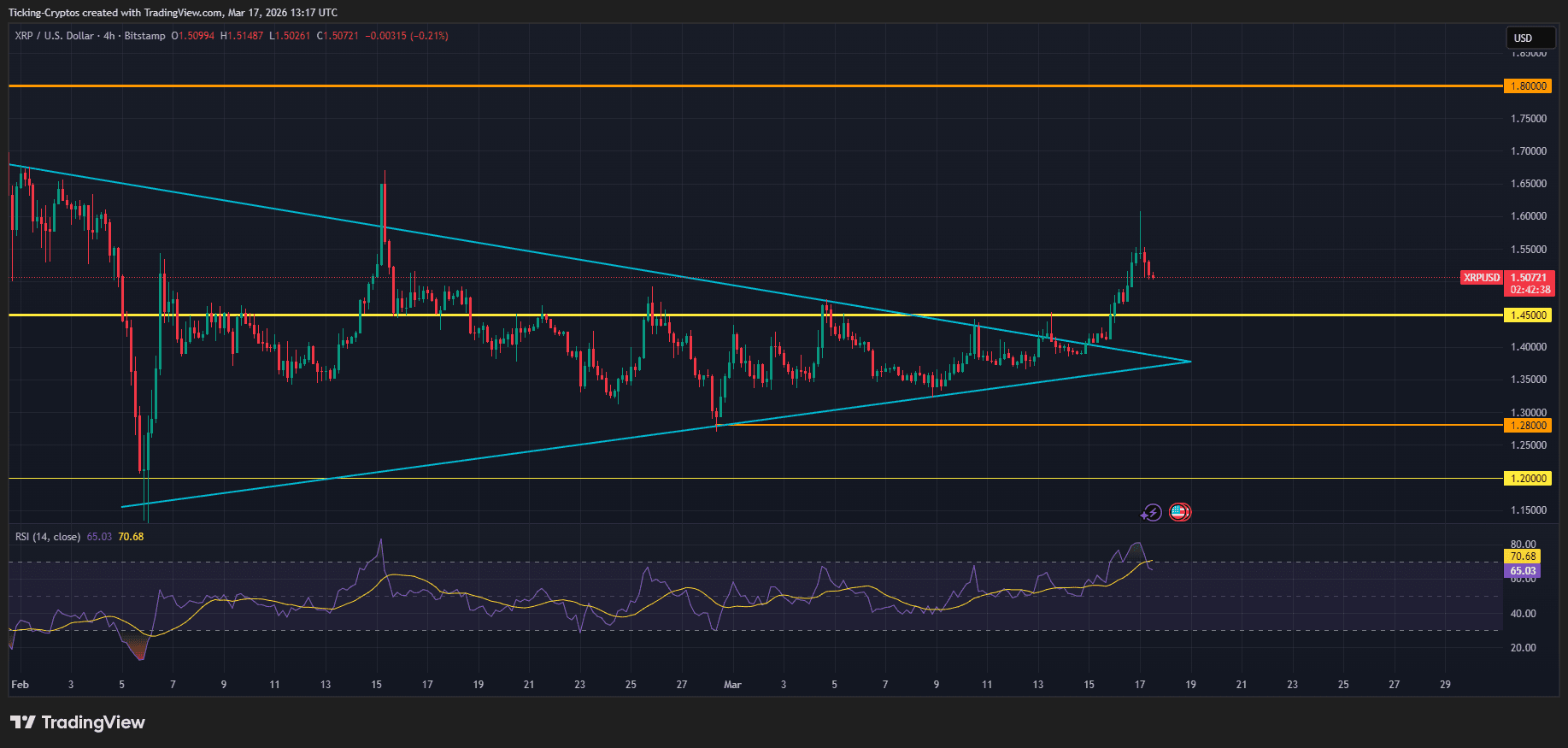
The Symmetrical Triangle
A symmetrical triangle is a chart pattern characterized by two converging trendlines connecting a series of sequential peaks and troughs. In XRP’s case, this pattern represented a period of "equilibrium" where buyers and sellers were in a deadlock. Typically, a breakout from this formation indicates that the prevailing trend—in this case, the bullish momentum from late 2025—is ready to resume with high volume.
The Breakout: How XRP Breached the Triangle
The most critical development in the recent XRP-USD price action is the upward breach from the triangle formation. Since February 2026, XRP has been making lower highs and higher lows, narrowing into an apex near the $1.38 mark.
On March 14, trading volume surged by over 300%, providing the necessary fuel for XRP to pierce the upper descending trendline. This "breach" was not merely a wick but was followed by a daily candle close above the resistance, effectively flipping it into a support floor. Technical analysts often view this specific type of exit from a triangle as a signal that the "accumulation phase" is over and the "markup phase" has begun.
Technical Indicators Supporting the $2 Target
Beyond the triangle breakout, several other indicators point toward a continued rally:
- Moving Averages: XRP is now trading comfortably above its 50-day and 200-day Exponential Moving Averages (EMAs).
- Relative Strength Index (RSI): The RSI is currently at 64, suggesting that while the asset is gaining strength, it is not yet "overbought" (which typically occurs above 70).
- Institutional Inflows: According to data from CoinShares, XRP-specific investment products have seen over $1.3 billion in cumulative inflows this year, providing the structural liquidity needed to sustain a move to $2.00.
Key Support and Resistance
| Level | Type | Significance |
|---|---|---|
| $1.38 - $1.42 | New Support | The previous triangle resistance now acts as a floor. |
| $1.56 | Current Pivot | XRP is consolidating here to build momentum for the next leg. |
| $1.80 | Minor Resistance | A historical supply zone from early 2026. |
| $2.00 | Major Target | The primary psychological and technical goal for the current rally. |
Ethereum (ETH) has bounced back strongly, rising more than 20% over the past eight days. While much of the market focused on Bitcoin’s volatility, Ethereum moved higher in the background. The rally is being driven by growing institutional interest and clearer regulatory support, two factors that are starting to change how major financial players approach the Ethereum network.
Why is Ethereum Price UP?
The recent Ethereum price pump is driven by a convergence of institutional liquidity and regulatory clarity. Specifically, the Federal Reserve's decision to allow tokenized securities as bank collateral and BlackRock’s launch of its iShares Staked Ethereum Trust (ETHB) have provided the necessary fundamental support for ETH to decouple from minor market corrections.
Tokenization and Staked ETFs
To understand why these developments are "game-changers," we must define the two pillars supporting this rally:
- Tokenized Securities: These are traditional assets (like stocks or bonds) represented as digital tokens on a blockchain.
- Staked ETFs: Unlike a standard spot ETF, a staked ETF (like ETHB) actually participates in the network's consensus, earning a "yield" or dividend for its shareholders by securing the network.
1. The Fed’s Green Light: Tokenized Assets as Collateral
On March 6, 2026, the Federal Reserve, alongside the OCC and FDIC, issued a landmark clarification. U.S. banks are now officially permitted to use tokenized securities as collateral for loans.
Why This Matters for Ethereum
Regulators confirmed that as long as the tokenized version confers the same legal rights as the traditional asset, it will receive the same capital treatment. Crucially, the Fed stated this applies regardless of whether the blockchain is permissioned or permissionless (public).
- Liquidity Influx: Trillions of dollars in "off-chain" value (Treasuries, equities) can now migrate to Ethereum.
- Ethereum as the "Settlement Layer": Since Ethereum remains the dominant hub for Real-World Assets (RWAs), this ruling cements $ETH role as the global plumbing for modern finance.
2. BlackRock’s ETHB: The First Dividend-Paying Crypto ETF
On March 12, 2026, BlackRock launched the iShares Staked Ethereum Trust (ticker: ETHB). While the market already had spot ETH ETFs, ETHB is the first from a major issuer to offer staking rewards directly to shareholders.
Key Features of ETHB:
- Yield Generation: The fund stakes between 70% and 95% of its holdings.
- Monthly Distributions: Investors receive monthly cash payouts, similar to a high-yield dividend stock.
- Institutional Infrastructure: BlackRock partnered with Figment and Coinbase Prime to manage the validator sets, bringing "Enterprise-Grade" security to the staking process.
"The ETHB launch transforms Ethereum from a speculative commodity into a productive, yield-bearing asset for the average 401k investor." — Market Insight
Comparison: Spot ETH vs. Staked ETH ETFs
| Feature | Spot ETH ETF (e.g., ETHA) | Staked ETH ETF (ETHB) |
|---|---|---|
| Primary Goal | Price Tracking | Price + Yield |
| Income Source | None | Staking Rewards (~2-3% Net) |
| Risk Profile | Market Volatility | Volatility + Slashing Risk |
| Target Audience | Traders | Long-term Income Seekers |
Fundamental Divergence
For months, analysts have noted a divergence: Ethereum's network fundamentals (Total Value Locked, Active Addresses, and Layer 2 scaling) were hitting record highs while the Ethereum price lagged. This 20% pump suggests the "valuation gap" is finally closing.
Markets Rally Ahead of President Trump’s Speech
Global markets are reacting strongly ahead of President Donald Trump’s expected White House speech today, with equities surging and oil prices falling after reports that the United States is allowing some oil tankers to pass through the Strait of Hormuz to stabilize global supply.
The development comes after days of heightened geopolitical tensions involving Iran and the United States. The Strait of Hormuz is one of the world’s most critical energy chokepoints, responsible for transporting roughly 20% of global oil supply.
Reports that tankers are now being allowed to pass through the strait have eased fears of a major disruption to global energy markets. As a result, oil prices dropped sharply, triggering a powerful rally across U.S. stock markets.
$1 Trillion Added to U.S. Stocks
The market reaction has been immediate. U.S. equities surged at the open, with major indexes posting strong gains.
The S&P 500, Nasdaq, Dow Jones, and Russell 2000 all climbed significantly as investors interpreted the tanker news as a signal of possible de-escalation in the Middle East conflict.
Tech stocks led the rally, with major companies such as Nvidia, Meta, Tesla, Apple, and Google all trading higher. In total, the U.S. stock market added hundreds of billions of dollars in market value, approaching the $1 trillion mark during the early session.
The logic behind the rally is straightforward: if oil supply remains stable, inflation pressure may ease, which could reduce economic uncertainty and support risk assets.
Oil Prices Drop After Hormuz News
Energy markets were extremely sensitive to the situation in the Strait of Hormuz over the past week. Any threat to the route can send oil prices soaring due to fears of supply disruptions.
However, the latest reports suggesting the United States is allowing some tankers to pass through the strait have helped calm markets.
Oil prices dropped sharply after the announcement, reinforcing the perception that global supply chains may remain intact despite ongoing geopolitical tensions.
For financial markets, lower oil prices often translate into lower inflation expectations, which tends to support stocks and other risk assets.
All Eyes on President Trump’s Announcement
President Trump is expected to address the situation during a White House press conference later today. Investors are closely watching the speech for signals about the next steps in U.S. policy.
Key questions markets are asking include:
- Will the U.S. officially confirm that tanker traffic through Hormuz is being stabilized?
- Will there be a broader international coalition protecting the shipping route?
- Could the speech signal de-escalation or further military action?
Markets have already partially priced in a positive outcome, meaning the tone of the speech could play a decisive role in determining the next move across global assets.
Could Bitcoin Be the Next Market Mover?
While traditional markets have already reacted, the cryptocurrency market is watching closely.
Bitcoin has recently shown surprising resilience during geopolitical instability. In many cases, major macro developments initially move traditional markets such as oil and equities before spilling over into crypto.
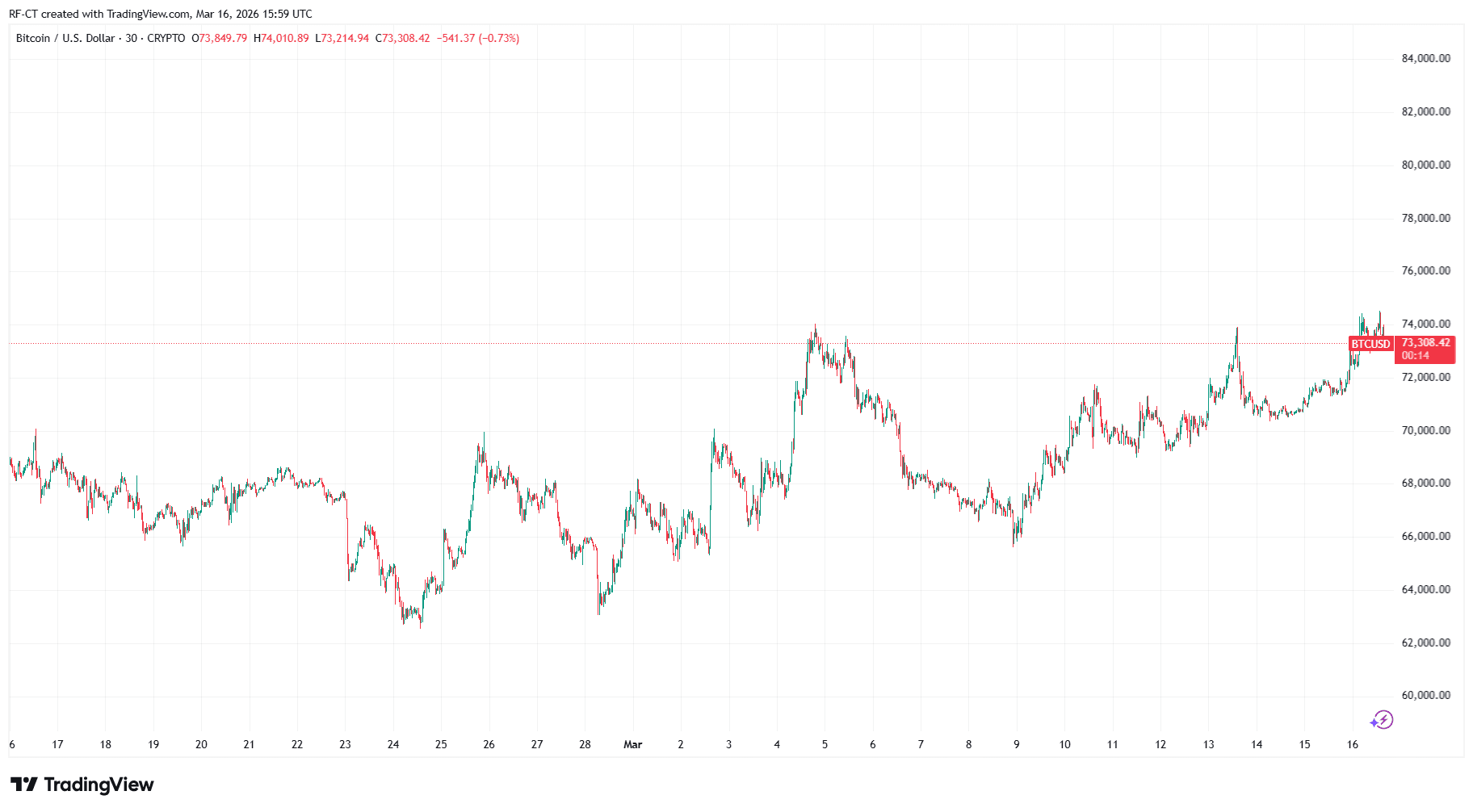
If global risk sentiment continues improving, capital could rotate back into digital assets, potentially supporting Bitcoin and the broader crypto market.
On the other hand, if the speech signals escalation or renewed uncertainty, volatility could return across both traditional and crypto markets.
For now, Bitcoin traders are waiting to see whether the macro rally in equities will translate into momentum for the crypto market as well.
Conclusion
With oil prices dropping and U.S. stocks surging ahead of President Trump’s speech, global markets are positioning for potential stabilization in the Strait of Hormuz situation.
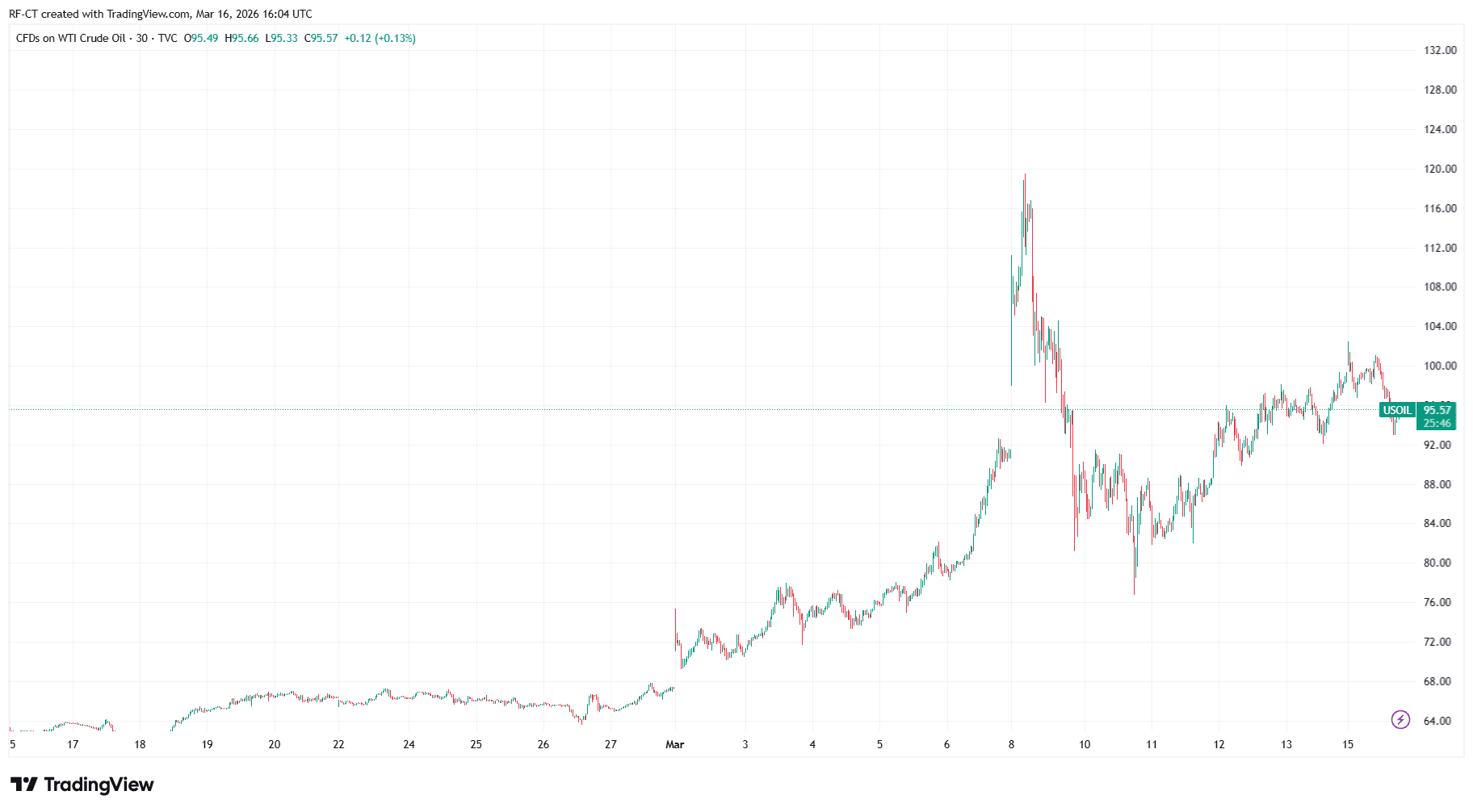
However, the final market reaction will likely depend on the tone and details of the announcement. Investors across equities, commodities, and cryptocurrencies are now waiting to see whether the speech confirms de-escalation — or introduces a new wave of uncertainty.
If risk appetite continues improving, Bitcoin could become the next asset to react.
While U.S. President Donald Trump has actively lobbied for a multinational military coalition to reopen the strategic waterway, Beijing has formally responded with a message of de-escalation. The friction between the world's two largest economies, coupled with a tightening energy supply, has positioned Bitcoin as a focal point for investors seeking a hedge against systemic risk.
China Sidesteps Military Engagement in the Strait
In a direct response to President Trump’s call for China to deploy warships to the Strait of Hormuz, the Chinese Foreign Ministry has signaled a firm preference for diplomacy over military intervention. Foreign Ministry spokesperson Lin Jian stated on Monday that "all parties should immediately cease military operations" to prevent a regional catastrophe that could further cripple global economic growth.
The Strait of Hormuz is a critical chokepoint through which approximately 20% of the world’s oil flows. Trump’s administration argued that since China is a major beneficiary of Middle Eastern oil, it should share the burden of securing the passage. Instead of joining the U.S.-led coalition, China is prioritizing "head-of-state diplomacy," though Trump has threatened to delay his upcoming summit with Xi Jinping if cooperation is not met.
Bitcoin Price Analysis: BTC Price Breaches $73K
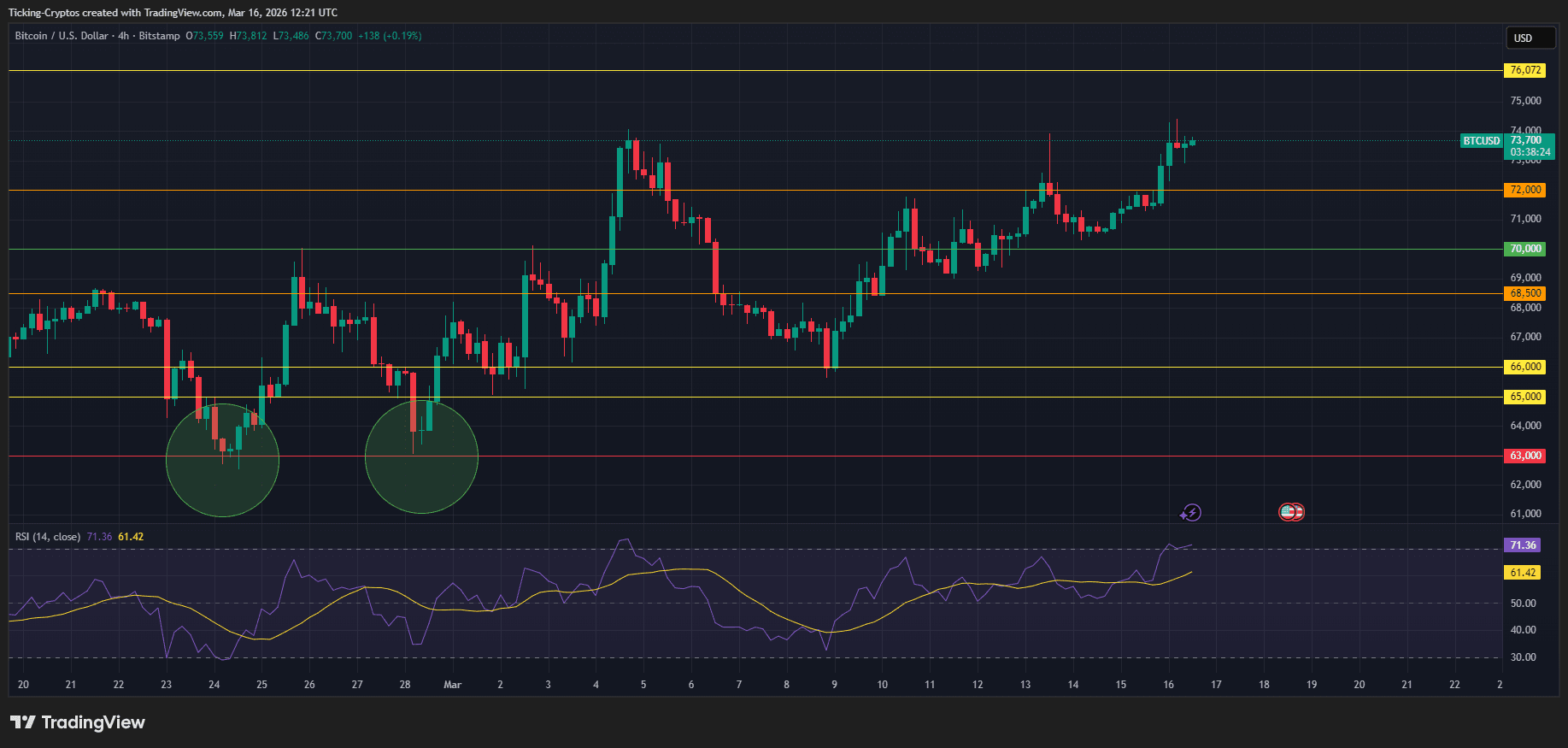
Amidst this geopolitical standoff, the Bitcoin price has shown remarkable resilience. After consolidating near $70,000 for much of early March, the premier cryptocurrency surged past $73,000 today, marking an 8% increase over the past week.
Technical Targets and Resistance
Market analysts are now eyeing the $75,000 level as the next immediate target. The breakout above $73,400—a level aligned with the 50-period moving average—suggests that the "Expertise" of the bulls is currently dominating the narrative.
- Immediate Support: $70,000 (Psychological barrier)
- Resistance Zone: $74,500 – $75,200
- Weekly Gain: +8.3%
The rising appetite for $Bitcoin reflects a shift in market sentiment. While the S&P 500 has faced pressure due to soaring oil prices (now exceeding $100 per barrel), BTC is increasingly being viewed as a "digital gold" alternative.
Why China's Stance Matters for Markets
China's refusal to join the military coalition adds a layer of uncertainty to global trade. If the Strait remains blocked and the U.S. continues its unilateral military pressure, energy prices are expected to stay elevated. For the crypto market, this often translates to two scenarios:
- Inflationary Hedge: Persistent high energy costs drive inflation, traditionally a bullish catalyst for BTC.
- Safe Haven Shift: As traditional exchange platforms see increased volatility in equities, capital flows toward decentralized assets.
Bitcoin Prediction: The Road to $75,000
As the "Who, What, and Why" of this crisis unfold, the path to $75,000 for Bitcoin seems clear, provided it can maintain its support above $72,000. Investors are closely watching the upcoming diplomatic meetings, as any further escalation in the Middle East or a breakdown in U.S.-China trade talks could provide the final push needed for BTC to hit new all-time highs.
Decrypt
NVIDIA pitched DLSS 5 as a breakthrough in real-time rendering. Players saw something closer to AI overreach.
Bitrefill, which lets users swap Bitcoin, Dogecoin and other crypto assets for gift cards, disclosed a breach that took place on March 1.
The White House is prepared to announce progress as soon as tomorrow on the issue plaguing crypto's market structure bill.
Prediction market platform Kalshi was hit with 20 criminal charges in Arizona, which alleged that it's an "illegal gambling operation."
Under the ruling, the developer of the Phantom self-custody crypto wallet avoids having to register as a broker.
U.Today - IT, AI and Fintech Daily News for You Today
The agencies noted that this guidance serves as a critical bridge for the market while Congress continues working to advance comprehensive, bipartisan market structure legislation.
The top-tier cryptocurrency exchanges are rapidly outpacing the broader market in trust and compliance, creating a massive 20-point "governance gap" between the industry elite and lower-ranked platforms.
Ripple has announced a massive expansion in Brazil, rolling out a unified financial architecture that integrates custody, prime brokerage, and stablecoin settlements for the nation’s regulated institutions.
Shiba Inu (SHIB) faces a 6% correction after its recent surge. We analyze key support levels and market sentiment to determine if the 43% upside potential remains "on the menu" still.
Binance metric suggests Ethereum liquidity shift might be underway.
Blockonomi
TLDR:
- Ethereum’s derivatives market saw Bybit record a rise of around 2.51 million ETH, pointing to active liquidity redistribution across platforms.
- Ethereum’s SuperTrend indicator flipped from Sell to Buy for the first time since September, previously triggering gains of 52% and 174%.
- ETFs accumulated roughly 83,000 ETH worth approximately $193 million over three weeks, adding real institutional demand pressure.
- Ethereum reclaimed $2,200 as support after 39 days below it, with traders now watching $2,400 and $2,600 as the next key levels.
Ethereum is drawing renewed attention as derivatives market data points to a structural shift in trader behavior. Open interest figures across major exchanges show clear signs of liquidity redistribution rather than outright capital outflows.
Technical indicators are flipping bullish for the first time in months. ETF demand over recent weeks adds another layer of confidence to the trend currently taking shape.
Open Interest Data Points to Liquidity Redistribution
Ethereum’s derivatives market is showing a notable divergence across trading platforms. The ETH Open Interest 30D Change indicator reveals clear shifts in the structure of open positions.
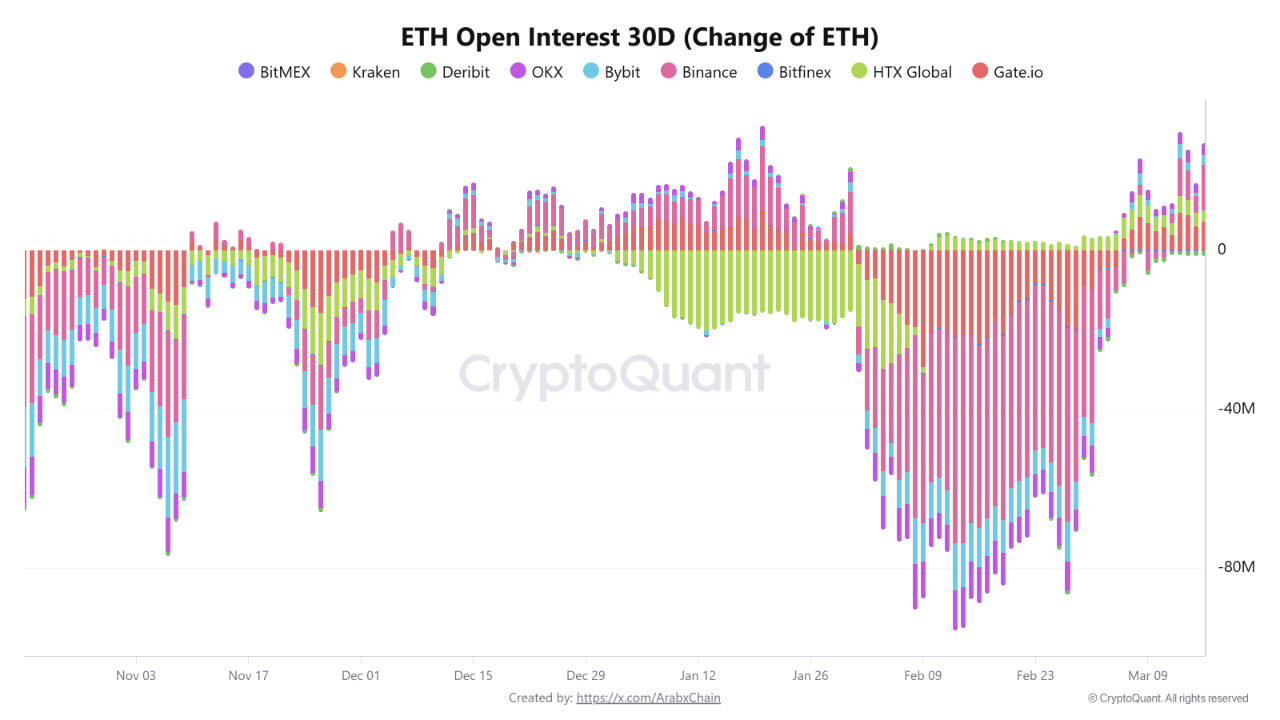
Source: Cryptoquant
Binance recorded an increase of approximately 11,400 ETH, indicating continued liquidity inflows. This points to ongoing activity despite recent market fluctuations.
Bybit also posted a notable rise of around 2.51 million ETH. This further supports the idea of redistribution rather than a wholesale exit from positions.
Bitfinex, however, saw a decrease of roughly 35,700 ETH, while Kraken dropped by around 4,300 ETH. Gate.io also recorded limited movement compared to other major platforms.
These figures reflect weaker activity or reduced risk appetite on certain exchanges. Still, the contrast between platforms does not point to a market breakdown.
Rather, it suggests a state of caution and repositioning ahead of stronger moves. Traders closing positions on some platforms are opening new ones elsewhere.
Sustained liquidity inflows into the derivatives market support the stability of Ethereum’s uptrend. Elevated or rising open interest signals trader confidence and a willingness to hold positions.
This pattern reinforces the persistence of bullish momentum rather than pointing to a temporary move. The data overall leans toward continued upward pressure on price.
Technical Indicators and ETF Demand Reinforce the Uptrend
Ethereum recently triggered a key technical signal that traders have been watching closely. Analyst Ali Charts noted that the SuperTrend indicator flipped from Sell to Buy for the first time since September.
In the previous two instances, price surged by 52% and 174% respectively. This kind of reversal signal tends to attract both technical and momentum-driven traders.
A critical part of the breakout involves reclaiming a key price level. Ethereum managed to hold above $2,200 after spending 39 days trading below it. This reclaim marks a clear structural shift in price action. The next levels to watch are $2,400 and $2,600.
ETF demand has also played a measurable role in reinforcing the current move. Over the past three weeks, ETFs accumulated approximately 83,000 ETH, worth around $193 million.
This level of institutional buying adds real demand pressure to the market. It also reduces the likelihood of a sharp reversal in the near term.
As Ethereum continues building on these technical and structural developments, traders are watching for follow-through.
The combination of rising open interest, a trend reversal signal, and ETF-driven demand creates a layered bullish case.
Whether price can sustain gains above current levels will be key. The coming weeks will test the strength of this recovery.
The post Ethereum Derivatives and Technicals Align as Bullish Signals Stack Up Across the Market appeared first on Blockonomi.
TLDR:
- TRON Network is now supported on Reown SDK, removing the need for custom wallet adapters in dApps.
- Developers can access TRX transfers, fiat on-ramps, and analytics tools through one SDK configuration.
- TRON supports over 369 million accounts, giving Reown SDK builders access to a massive user base.
- Reown SDK supports TRON testnets Shasta and Nile, plus Travel Rule tools for financial applications.
TRON Network support is now officially live on the Reown SDK, an open-source toolkit for building onchain apps. TRON DAO made the announcement on March 17, 2026, from Geneva, Switzerland.
The integration gives developers a unified solution for incorporating both TRON and EVM networks into their dApps.
Builders no longer need custom wallet adapters or separate chain-specific infrastructure. This launch opens a more direct path for multichain development.
What the Integration Offers Developers
Through the Reown SDK, developers can now connect wallets to TRON and authenticate users. They can also send transactions and enable payments across networks within a single session.
This removes a common barrier in building for multiple blockchain ecosystems simultaneously. Builders gain a consistent user experience across both EVM and TRON networks from day one.
The SDK includes wallet authentication on TRON alongside social and email login options. Developers can also enable TRX and TRC-20 token transfers within their applications.
On-platform swaps, fiat on/off-ramps, and built-in analytics dashboards are part of the toolkit as well. These tools give development teams a more complete platform for building TRON-based dApps.
Justin Sun, Founder of TRON, commented on the launch. “TRON was built to give developers the performance and scale needed to power the next generation of onchain applications,” Sun said. He noted that lower friction for builders leads directly to faster innovation.
The SDK also supports both modern and legacy TRON transaction formats for full wallet interoperability. Developers can test on TRON testnets, including Shasta and Nile. Travel Rule compliance tools are available for teams building financial applications on the platform.
TRON’s Growing Role in Global Blockchain Infrastructure
TRON Network currently supports more than 369 million accounts across the globe. The ecosystem has strong adoption in stablecoin transfers, payments, and decentralized finance.
This large user base makes TRON an attractive network for developers building multichain applications. The Reown SDK integration now gives builders direct access to this audience through a simple configuration.
Jess Houlgrave, CEO of WalletConnect, spoke to the reasoning behind the partnership. “Developers shouldn’t have to choose between ecosystems or build bespoke infrastructure for every chain they want to support,” she said. She added that teams can reach TRON’s users through the same workflow already used for EVM chains.
Since its 2022 launch, the Reown SDK has been adopted by platforms such as Morpho, Ethena, Marinade Finance, and Coinbase.
Adding TRON further broadens its network coverage and developer reach. Teams can now manage EVM and TRON support without separate technical setups, saving time and resources.
Through this integration, TRON continues to strengthen its position in global blockchain infrastructure. Developers can now build multichain applications with fewer technical barriers.
The combination of TRON’s user base and Reown SDK’s capabilities provides a strong foundation. Both ecosystems stand to benefit as more builders adopt this unified multichain approach.
The post TRON Network Support Goes Live on Reown SDK for Multichain dApp Development appeared first on Blockonomi.
TLDR:
- Phantom wallet received formal CFTC no-action relief, becoming the first crypto wallet to secure this status.
- Users can now access regulated derivatives and event contracts directly from Phantom without a separate brokerage account.
- The CFTC issued written formal relief, giving Phantom a clear legal foundation to operate as a market connection point.
- Other crypto wallets are already preparing similar CFTC applications, using Phantom’s approval as a regulatory blueprint.
Phantom, the widely used crypto wallet, has received formal no-action relief from the Commodity Futures Trading Commission (CFTC).
The relief allows Phantom to connect users to regulated derivatives markets and event contracts. Most notably, it removes the requirement to register as an introducing broker.
This marks a first for any crypto wallet in the United States. The decision is drawing attention from wallet providers and legal teams across the industry.
What the CFTC Relief Means for Phantom Users
Normally, any platform routing users into futures, options, or prediction markets must hold a broker license. That process involves compliance costs, regular audits, and ongoing regulatory obligations.
Phantom is now exempt from those requirements under the CFTC’s formal relief. This positions the wallet uniquely among its peers in the crypto space.
As a result, users can access regulated derivatives and event contracts directly from their wallet. No separate brokerage account or intermediary platform is required for this access.
The CFTC’s relief allows the wallet to act as the connection point without the full regulatory weight of a licensed broker.
The commission issued this as a written, formal ruling rather than informal guidance. Crypto publication Milk Road noted on X that this was not a gray area or verbal nod, but formal, documented relief.
That distinction gives the platform a clear legal foundation to operate on. Other platforms can now reference this document when pursuing similar arrangements.
The CFTC has long been regarded as Washington’s more crypto-friendly regulator. This relief further supports that position by enabling innovation without heavy broker compliance requirements. The commission’s approach shows a willingness to extend regulatory clarity to crypto-native platforms. It also lowers the barrier for wallets seeking to integrate regulated financial products.
How This Sets a Blueprint for the Broader Wallet Industry
The crypto wallet sector is already responding to this regulatory win. Legal teams at competing platforms are reportedly preparing similar CFTC applications.
Milk Road stated on X, “If Phantom got it, their lawyers are already drafting applications.” That response signals a broader shift may be forming across the industry.
This relief creates a replicable model for other wallet providers to follow. Any platform demonstrating a comparable operational structure may qualify for similar treatment.
The CFTC’s decision lowers the entry barrier for wallets seeking to offer regulated derivatives products. Moreover, this could reshape how such products reach retail users.
For everyday users, this development means broader market access through familiar tools. Rather than navigating a separate brokerage platform, users can stay within their existing wallet.
That reduction in friction may draw in a wider range of retail participants. It also positions crypto wallets as more complete financial platforms going forward.
The CFTC’s relief does not rewrite existing regulations but opens a new compliance pathway. Wallets pursuing this route must still satisfy conditions outlined in the formal document.
However, the written standard gives other platforms a clear framework to replicate. Industry observers will watch closely as similar applications begin to emerge.
The post Phantom Wallet Becomes First Crypto Wallet to Receive Formal CFTC No-Action Relief appeared first on Blockonomi.
Messari just replaced its CEO and laid off staff to become an AI company. The crypto data firm that built its reputation on human-driven research is now opening its data layer to autonomous AI agents and repositioning entirely around artificial intelligence.
Messari spent years building the human research model before concluding AI had to replace it. DeepSnitch AI started there. Five live AI agents running today, and a TGE confirmed for March 31st on Uniswap.
While Messari restructures its entire company to catch up to where AI-native crypto intelligence is heading, DSNT is already operating inside that future, and the best crypto presale opportunity closes in weeks.

Messari pivots to an AI-first strategy
Messari has announced layoffs alongside a leadership transition, with founder-era CEO Eric Turner stepping down in favor of longtime CTO Diran Li, who is repositioning the crypto data firm as an “AI-first company serving institutions through research and AI products.”
The restructuring follows previous workforce reductions in 2023 and 2025, suggesting ongoing pressure on crypto-native data businesses to find sustainable revenue models.
Messari’s transformation reflects a broader industry pattern: crypto-native companies are increasingly reorienting around AI as the primary growth vector. As institutional demand shifts toward AI-powered research and autonomous agent infrastructure, the line between crypto data providers and AI companies is rapidly dissolving.
Top 3 best crypto presales to buy in 2026
DeepSnitch AI
Messari just concluded that human-driven crypto research can’t compete with AI-native intelligence, and restructured its entire company around that conclusion. DeepSnitch AI reached the same conclusion before writing a single line of fundraising copy and built the product first.
That sequencing matters. Messari is now racing to open its data layer to autonomous agents. DeepSnitch AI’s five AI agents have been running continuously since before this presale launched.
The same institutional demand that forced Messari’s restructuring is the demand DeepSnitch AI was designed to serve at the retail level: real-time, AI-driven market intelligence that doesn’t require a research team or a Bloomberg terminal to access.
The market has already started pricing that in, naming DeepSnitch AI the best crypto presale of 2026.
$2.2M raised during a bear market, the same conditions Messari called difficult enough to justify layoffs. That capital arrived because investors looked at a working platform and made a deliberate call about where AI-native crypto intelligence is heading.
The March 31st TGE is the fixed point that everything converges on. After the presale closes, a 7-day claim period opens for tokens, presale bonuses, and staking rewards.
Messari took years to conclude that AI had to replace its old model. The market won’t wait that long to reprice a live AI-native trading platform hitting public markets for the first time. At $0.04487, that repricing hasn’t happened yet for DeepSnitch AI.
Based Eggman
Based Eggman (GGs) sold out two presale stages and raised over $311,000. Built on Base, the project accesses low fees and institutional ecosystem credibility that meme coins on congested networks can’t match.
The token combines play-to-earn gaming and community events in one ecosystem. Multiple demand drivers give holders real reasons to hold beyond listing day. That’s more ambitious than the single-feature offerings crowding this space.
The ambition is also the risk. Building gaming, streaming, and social infrastructure simultaneously at the presale stage is complex. Projects that spread across too many verticals early tend to underdeliver across all of them.
Pepeto
Pepeto raised over $8M, building dedicated infrastructure for the meme coin ecosystem. Dual audits from SolidProof and Coinsult add security credibility that most projects at this stage skip.
The differentiation challenge is real. DEX functionality, bridging, and staking have become baseline expectations, not advantages. The crowded field moved while Pepeto was building.
The broader headwind compounds it. Investors rotate toward utility-focused and TradFi-adjacent projects. Building infrastructure for a contracting market segment creates structural demand risk that community enthusiasm alone doesn’t solve.
Closing thoughts
Messari fired staff to become an AI company. The writing is on the wall: manual crypto research is ending, and AI-native intelligence is taking over. DeepSnitch AI was already there, which is why it is considered the best crypto presale of this year. Live tools, $2.2M raised, 200% presale gains, and a March 31st Uniswap launch confirmed.
DSNT delivers a working AI intelligence layer at the exact moment Messari’s restructuring confirms that’s where the industry is heading. A $10,000 position with the DSNTVIP150 code adds a 150% token bonus before the first listing candle prints.
Visit the official website for more information, and join X and Telegram for community updates.
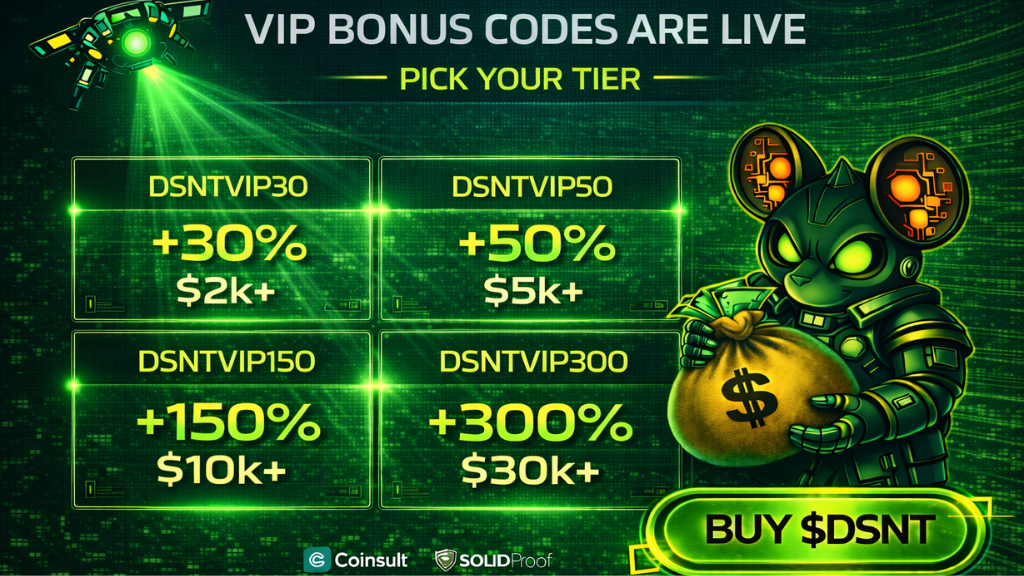
FAQs
Which crypto presale coins offer the strongest early investor opportunities as AI reshapes the market?
The best crypto presales right now are DeepSnitch AI, Ozak AI, and Pepeto. DSNT leads with $2.2M raised, five live AI agents, and a confirmed March 31st Uniswap launch with 1,000x return potential backed by a working product.
What makes DeepSnitch AI one of the best early investor crypto deals heading into Q2 2026?
DeepSnitch AI stands out among early investor crypto deals because the product is already live. The protocol has five AI agents running daily, 200% presale gains, and a hard March 31st deadline before Uniswap listing and major CEX additions could follow shortly after.
How do token presale opportunities like Ozak AI and Pepeto compare to DeepSnitch AI right now?
Among current token presale opportunities, Ozak AI raised $6.4M with promising analytics tools, and Pepeto raised $7.8M with meme infrastructure, but DeepSnitch AI’s confirmed launch date and AI-first positioning make it the strongest complete opportunity available before Q2.
The post Best Crypto Presale: DeepSnitch AI Surges 200% as Web3 Companies Go All-In on AI Technology appeared first on Blockonomi.
Every token on your watchlist is green today. XRP jumped 9%. Bitcoin broke $75,000. But the biggest returns this cycle will not come from the coins that already moved overnight. They will come from the presale that reprices when the Binance listing opens.
While traders chase momentum in large caps that already moved, the sharpest money in the market is positioning in the projects that capture long term volume, not just today’s recovery bounce.
That is where Pepeto enters the conversation. The project built zero fee exchange infrastructure for the meme coin economy with cross chain bridging and AI token screening that verifies every listed token. The presale crossed $8 million according to CoinDesk, and the Binance listing is locked in. That early infrastructure is one reason Pepeto trends alongside popular topics like the XRP price prediction according to Bloomberg.
The market turns green as Bitcoin breaks $75,000 and altcoins surge
Bitcoin surged above $75,000 on March 17, breaking a six week range as spot ETFs recorded $1.3 billion in March inflows. XRP jumped 9% to $1.57. Ethereum surged 8.5% past $2,360. The Fear and Greed Index improved from extreme fear at 15 to 28. Capital is rushing back into every corner of the market.
Three tokens leading the conversation in this recovery
Pepeto
Most presale launches follow the same tired script. Investors fund a roadmap and hope the product eventually shows up months later. Pepeto flipped that entirely. The team built the exchange infrastructure first and then opened the presale, which is exactly why capital kept flowing in even when the market was at its lowest.
PepetoSwap handles zero fee trades across Ethereum, BNB Chain, and Solana. The cross chain bridge transfers assets at zero cost with AI contract verification scanning every transfer. The full exchange screens every listed token for contract risks, holder concentration, and liquidity depth. All three products route through the $PEPETO token at the protocol level, creating demand from real trading volume.

Exchange infrastructure like this is becoming more relevant by the day as the meme coin economy grows more complex and more fragmented. The need for a single zero fee exchange layer that verifies everything before it reaches traders has never been greater.
SolidProof and Coinsult completed independent audits with zero critical findings. The cofounder built Pepe to $11 billion. A former Binance executive advises the listing. At $0.000000186, a $10,000 entry becomes $1,000,000 if Pepeto reaches just 1% of what Pepe achieved with nothing. Staking at196% APY compounds daily while the listing approaches.
XRP price prediction: Can Ripple push past $1.67 as momentum builds?
XRP surged to $1.57, up nearly 9% in 24 hours as institutional access expands through regulated platforms like Coinbase Derivatives, which now offers futures for Bitcoin, Ethereum, Solana, and XRP. Retail activity has cooled however, with futures open interest falling to $2.33 billion, down sharply from the $10.94 billion peak in July.
The token faces resistance near $1.67. According to current XRP price predictions, a break above opens the path toward $2.00, but even that best case is roughly 27% from here. Not the 100x sitting at six zeros.
Hyperliquid rides the recovery as derivatives volume surges
HYPE trades near $40,47 according to CoinMarketCap as the broader market recovery lifts sentiment across the derivatives sector. Perpetual volume surged past $11 billion. Resistance at $39, with $43 and $50 as targets if it breaks.
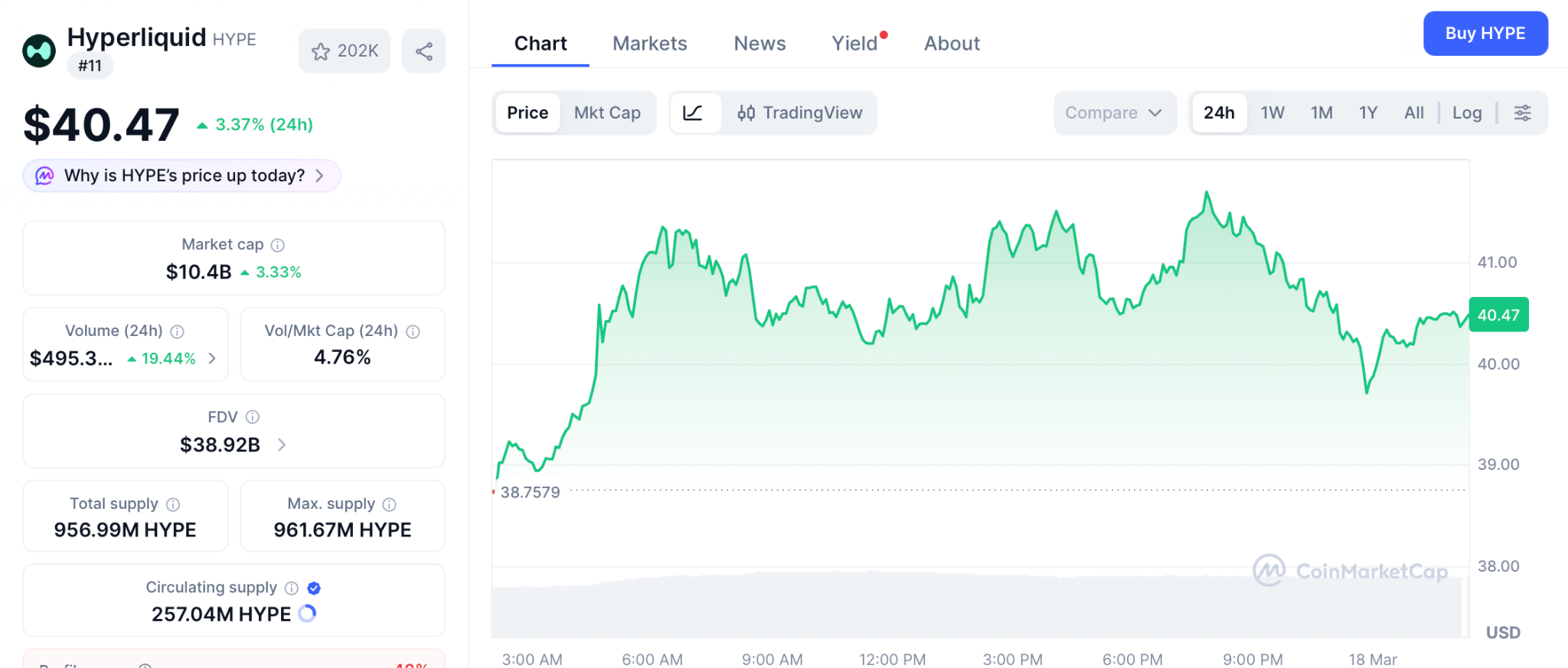
A solid position, but the upside is measured in percentage points, not the 100x that sits at six zeros with three exchange products and a Binance listing.
The recovery is here and the listing window is closing
You can chase the XRP price prediction and hope for 27% if everything breaks right. Or you can position at $0.000000186 in an exchange ecosystem built by the team that created an $11 billion token and backed by dual audits from SolidProof and Coinsult. Over $8 million in presale conviction says the smart money already made its choice.
The Binance listing will close this entry permanently. Staking at 196% APY compounds daily. People are already in. This is the kind of entry that changes everything, but only for those who actually take it.
Click To Visit Pepeto Website To Enter The Presale

FAQs
What factors could influence XRP’s price movement in the near term?
XRP price predictions depend on holding $1.40 support and breaking $1.67 resistance to confirm stronger upward momentum on charts.
How does institutional activity impact XRP’s long term outlook for 2026?
Growing access through regulated platforms may support the XRP forecast as institutional participation increases liquidity and long term confidence.
What signals do analysts watch when estimating XRP’s next big move?
Sentiment, futures open interest, and resistance zones shape XRP price targets, especially combined with broader crypto and macro trends.
The post XRP Price Prediction: Pepeto Surges Past $8 Million While Ripple and Hyperliquid Ride the Market Recovery Higher appeared first on Blockonomi.
CryptoPotato
Bitcoin (BTC) touched $76,000 on March 17 to register its highest price level since early February, as institutional investors continued to put money into U.S. spot ETFs, extending a multi-day recovery streak coming after heavy outflows in February.
However, the rebound in demand is running into a key constraint, according to analyst Axel Adler Jr., with ETF investors still sitting on an average unrealized loss of $5,174, which he says could affect price action around the $80,000 mark.
ETF Flows Recover, But the $79,962 Realized Price Looms
In his latest market update, Adler said that spot Bitcoin ETF flows have gone through what he called a “full cycle” over the past month, going from capitulation in mid-February to a steady recovery in the last few weeks. According to him, from February 15 to 24, the seven-day average of ETF net flows stayed negative, hitting a low of about -1,883 BTC per day on February 18.
However, around February 25, the trend changed, with flows turning positive and peaking at about +3,387 BTC per day on March 2. Adler currently puts the seven-day average at around +1,472 BTC per day, with liquidity conditions also getting better. During the same period, the total number of ETF holdings rose by about 26,600 BTC, which is a little over 2%.
The analyst sees this change as a return of institutional demand after the earlier outflows. He does, however, point out that this demand is below a clearly defined level of resistance.
That level is the realized price for the ETF cohort, which Adler mapped at $79,962, an amount showing the average cost of buying an ETF for all investors. And with BTC trading just above $74,000 after earlier hitting a six-week high, it means the group still has an overall paper loss of over $5,000.
Adler described the gap as one of the most important structural features of the current market. This is because, as Bitcoin gets closer to the realized price, more investors will get closer to breaking even, which can make it more likely for them to sell. For that reason, the market technician says that the $80,000 region is a place where upward movement may slow down unless demand is strong enough to take in the potential extra supply.
Market to Test Resistance Condition
At the time of writing, data from CoinGecko showed BTC up over 5% in the last 7 days and the same across 30 days. However, the uptick was almost 9% over two weeks, although performance still lagged year-on-year, with the asset shedding nearly 11% from its value in that time, keeping it over 41% below its all-time high.
For now, Adler is watching the $80,000 level as the key battleground.
“A spot close above $79,962 combined with sustained ETF net inflow above +2,000 BTC per day would signal a regime change,” he wrote in his analysis.
The post Analyst: Bitcoin ETF Holders Are $5K Underwater Even as Institutional Demand Returns appeared first on CryptoPotato.
Argentina has moved to restrict access to the prediction market platform Polymarket after a Buenos Aires court determined it was operating as an unauthorized betting service.
In a ruling issued by Judge Susana Parada, authorities ordered a country-wide block on the website and instructed Google and Apple to remove or limit access to its application on mobile devices.
No License, No Limits
The measure comes after an investigation by Prosecutor Juan Rozas, who oversees gambling-related cases in the city. As part of the enforcement, the telecom regulator Ente Nacional de Comunicaciones (ENACOM) has been directed to ensure internet service providers prevent access to the platform within the country.
The probe concluded that Polymarket allowed users to trade on the outcomes of real-world events without complying with gambling regulations. Prosecutors said accounts could be created rapidly without identity or age checks, which ended up enabling unrestricted participation, including by minors.
They further stated that the platform facilitated payments via cryptocurrencies and credit cards without applying the controls required for regulated betting operations. The case was triggered by a complaint from the Lotería de la Ciudad de Buenos Aires, which alleged that the platform was offering services locally without authorization. Additional verification conducted with the Asociación de Loterías Estatales de Argentina found no record of Polymarket holding a licence in any jurisdiction.
The court’s decision surfaced publicly during a broader controversy linked to Argentina’s inflation data. Shortly before the release of February figures by the national statistics agency INDEC, market probabilities on international prediction platforms moved toward a higher reading.
While analysts had largely estimated inflation between 2.6% and 2.8%, the official figure came in at 2.9%. Activity on Polymarket tied to that data point saw trading volumes rise to roughly $91,000 in the minutes preceding publication, which led some observers to question whether the data had circulated in advance.
The development adds to a growing trend of regulatory crackdowns on prediction market services, with companies like Polymarket and Kalshi increasingly coming under legal or supervisory pressure in a range of jurisdictions, among them France, Germany, Italy, Australia, Singapore, Portugal, Hungary, Thailand, and the Netherlands.
Polymarket Intelligence Misuse
Earlier this year, Israeli authorities formally charged an IDF reservist and a civilian over alleged misuse of classified military intelligence to gain an advantage on the prediction platform. A joint probe by the Defense Ministry, Shin Bet, and national police found that sensitive operational knowledge may have been leveraged to place high-confidence bets on future military developments.
Prosecutors filed serious charges, including security violations, bribery, and obstruction of justice, while a court-imposed gag order limits further disclosures.
The post Argentina Orders Nationwide Block on Polymarket Over Unlicensed Gambling appeared first on CryptoPotato.
The meme coin PIPPIN, which was among crypto’s rock stars not long ago due to its staggering price increase, has crashed by approximately 50% over the past day alone.
The big question now is whether a rebound is on the horizon or if this was a textbook rug pull, signaling that things may only get worse from here.
The Scam Revealed Its Real Face?
While the broader crypto market struggled throughout February, the lesser-known meme coin PIPPIN defied the negative conditions, registering a triple-digit price explosion. At one point, the valuation surged to $0.76, whereas towards the end of last month it climbed to an all-time high of almost $0.90.
PIPPIN’s market capitalization briefly reached nearly $900 million, thus entering the elite club of the 100 biggest cryptocurrencies, but that success was short-lived. The beginning of March saw a substantial correction, which intensified after a 52% decline over the last 24 hours. In a matter of a single day, nearly $200 million of the asset’s market cap was vaporized, and it now ranks as the 188th-largest digital asset.

The most evident reason for the crash appears to be the selling spree initiated by certain investors. Some X users reported that the same wallets that accumulated PIPPIN last week recently dumped their holdings en masse.
The meme coin has been the subject of criticism from many market observers, even during its bull run. Last month, X user Dippy.eth described it as “the largest scam of the past year,” while others think the whole project is “a cabal play,” in which a coordinated group of insiders is believed to manipulate the price through their actions. Most recently, Crypto Analyst joined the club of critics, classifying PIPPIN as a “scam coin” that “rugged people.”
How About a Revival?
Despite the overwhelming opinion among industry participants that PIPPIN is a red flag for traders and investors, some remain bullish on the asset. X user Nehal, for instance, envisioned heightened volatility ahead and eventual price increase to a new ATH of $1.
The asset’s Relative Strength Index (RSI) supports the rebound theory. The indicator measures the speed and magnitude of recent price movements, helping traders identify potential reversal points. It runs from 0 to 100, and ratios below 30 are considered bullish territory that could precede a resurgence. On the contrary, readings beyond 70 signal that a pullback might be on the way. Currently, PIPPIN’s RSI stands at around 24.
The post Trending Meme Coin PIPPIN Collapses by 50%: Classic Rug Pull or Buying Opportunity? appeared first on CryptoPotato.
Bitcoin briefly neared $76,000 on Tuesday, a level seen for the first time in six weeks, in spite of the global uncertainty as the conflict in the Middle East entered its third week.
Data from Alphractal shows that Bitcoin’s Coin Days Destroyed (CDD) Multiple has fallen to its lowest level since 2022. This indicates minimal movement of older units.
Veteran Holders Stay Put
Alphractal explained that the metric, which measures the intensity of Coin Days Destroyed relative to its historical average, normalizes current activity against a long-term baseline to assess whether long-term holders are spending at elevated or reduced rates.
Current readings suggest that older BTC remains largely dormant, which points to steady holding behavior among long-term investors.
According to the analysis, many of these holders previously distributed coins at higher price levels, leaving the present market dominated by relatively younger supply in circulation. The low CDD Multiple also implies limited selling pressure from mature holdings.
In previous cases, similar low levels in the metric have coincided with consolidation phases, where reduced activity from long-term holders precedes significant directional moves in the market.
Meanwhile, data from Santiment shows that Bitcoin’s recent move has been accompanied by a sharp rise in market optimism. The uptick has pushed FOMO to its highest level since January 2, as social media data from this week indicates a bullish-to-bearish comment ratio of 1.67 across platforms such as X, Reddit, and Telegram. The positive sentiment has outweighed the negative views.
Further data reveal Bitcoin is showing early signs of recovery in buyer activity after heavy selling in February. Despite rising geopolitical tensions and expectations that the Federal Reserve will not cut interest rates at the upcoming FOMC meeting, CryptoQuant found that BTC has remained relatively “resilient” compared to traditional assets like equities and commodities.
Buyer Dominance
Data from Binance and Coinbase indicate that trading volumes are gradually changing in favor of buyers. On February 16, the 30-day average volume delta was strongly negative, at -$145 million on Binance and -$88 million on Coinbase, reflecting broad selling by both retail and institutional investors. This has now turned positive, and reached about +$21 million and +$14 million, respectively.
While this is a clear improvement, analysts say that liquidity remains low, and the trend will need further confirmation to support upward price movement.
The post The Old Whales Aren’t Selling: What Bitcoin’s Plunging CDD Multiple Means for the Rally appeared first on CryptoPotato.
[PRESS RELEASE – Kingstown, St. Vincent & the Grenadines, March 17th, 2026]
Non-custodial exchange platform ChangeNOW has announced the rollout of Private Send, a feature designed to prevent direct links between sender and recipient addresses on public blockchains.
Integrated into NOW Wallet, Private Send introduces a toggle within the transaction flow. Instead of a direct wallet-to-wallet transfer, funds are routed through ChangeNOW infrastructure before reaching the final address. To the recipient, the transaction appears standard, while the sender’s address does not appear in the recipient’s transaction history.
Pauline Shangett, CSO at ChangeNOW, says, “Public blockchains were supposed to be about financial freedom, not financial surveillance. Yet today, analytics firms map billions of addresses into clusters, building profiles on ordinary users. Private Send isn’t about hiding from regulators, it’s about stopping the default exposure of every move you make. One click, and the direct link between you and the recipient disappears. That’s it.”
Role of Blockchain Analytics
Blockchain analytics has become standard infrastructure across the industry. A common misconception is that holding crypto in self-custodied wallets ensures anonymity. Analytics firms map billions of addresses into identifiable clusters, linking wallet activity to individuals or entities. Private Send was developed in response to this environment by introducing an intermediary into the transaction flow. The blockchain records the transaction without establishing a direct connection between the sender and the recipient.
Transaction Flow Structure
- Users toggle “Private Send” in NOW Wallet’s standard send flow
- Transaction routes: sender → ChangeNOW → recipient
- Recipient sees funds arriving from a ChangeNOW address
- No additional apps, registrations, or technical knowledge required
Key details
- Most assets available in NOW Wallet
- All transactions undergo standard AML screening
- Geographic availability matches ChangeNOW’s existing restrictions
- Requirement: latest version of NOW Wallet
Typical use cases
- Moving funds between personal wallets without consolidating on-chain history
- Paying vendors or contractors without exposing full portfolio activity
- General privacy-conscious transfers where direct address links are undesirable
Private Send is not a mixing service or an anonymization tool. It operates entirely within ChangeNOW’s compliance framework and does not alter the final transaction record; it only changes the path to the destination.
About ChangeNOW
ChangeNOW is a non-custodial cryptocurrency exchange platform that values speed, security, and user liberty. Since its launch, it has served over 8 million customers worldwide, offering access to over 110 blockchains and 70+ fiat currencies. By combining the best rates from top centralized and decentralized platforms, ChangeNOW offers a seamless experience with simplified onboarding where users have full control over their assets.
The post ChangeNOW Launches Private Send to Break Blockchain Address Tracking appeared first on CryptoPotato.