Cryptocurrency Posts
Crypto Briefing
The WGC's digital platform could revolutionize gold's role in finance, enhancing accessibility, liquidity, and integration into modern systems.
The post World Gold Council plans to build shared infrastructure platform for digital gold appeared first on Crypto Briefing.
Kalshi has raised more than $1 billion at a $22 billion valuation, roughly double the $11 billion valuation from its December round.
The post Kalshi doubles valuation to $22 billion with new $1 billion raise appeared first on Crypto Briefing.
Anchorage Digital expanded Atlas with collateral management, aiming to bring regulated risk controls to institutional crypto lending.
The post Anchorage Digital expands Atlas network with collateral management for institutional crypto lending appeared first on Crypto Briefing.
NASA may shift Artemis missions to SpaceX Starship, reducing Boeings role as delays and costs push changes to the moon program.
The post NASA weighs shifting Artemis mission to SpaceX Starship, reducing Boeing’s role appeared first on Crypto Briefing.
Datavault AI signed a deal to acquire NYIAX, expanding tokenized markets for data, ads, commodities, politics, and NIL rights.
The post Datavault AI signs agreement to acquire NYIAX for blockchain trading appeared first on Crypto Briefing.
Bitcoin Magazine
Bitcoin Magazine

North Carolina Lawmakers Propose State Bitcoin Reserve
North Carolina lawmakers introduced legislation on Wednesday to create a state-controlled Bitcoin reserve.
Senate Bill 327, titled the North Carolina Bitcoin Reserve and Investment Act, would allow the Office of the State Treasurer to allocate up to 10% of public funds into BTC as part of the state’s long-term financial strategy.
The bill, sponsored by Senators Johnson and Overcash, passed its first Senate reading and was referred to the Rules and Operations Committee. Its stated goals include establishing a Strategic Bitcoin Reserve, promoting BTC as a financial innovation, and positioning North Carolina as a leader in state-level crypto adoption.
Under the proposal, the Treasurer would manage the reserve using cold storage wallets with multi-signature authentication.
A new department within the Treasurer’s office would take custody of the assets, ensuring state control. The bill also calls for a Bitcoin Economic Advisory Board composed of industry experts to provide guidance and monthly audits to verify reserve balances, security, and performance.
Bitcoin acquisitions would be conducted through regulated U.S.-based exchanges, with bulk purchases timed to take advantage of market conditions. The bill also directs the Treasurer to explore BTC mining operations as a potential method to increase state holdings.
Use of the reserve would be restricted to severe financial crises, approved investment strategies, funding for critical infrastructure and economic development projects, and support for Bitcoin-related research, education, and business incentives.
Any liquidation of BTC would require approval from at least two-thirds of both chambers of the General Assembly. The bill allows the reserve to back bonds as an alternative financing tool for public projects.
The Treasurer would submit quarterly reports to the General Assembly detailing the reserve’s status, value, and performance.
Reports would also be publicly available on the Treasurer’s website, according to the bill’s text. The bill includes provisions to comply with federal and state laws regarding cryptocurrency holdings and taxation and encourages advocacy for federal regulations favorable to Bitcoin.
JUST IN: North Carolina introduces bill for a Strategic Bitcoin Reserve
— Bitcoin Magazine (@BitcoinMagazine) March 19, 2026
Today, it already passed the first readingpic.twitter.com/gaVfzoObD4

U.S. states want Bitcoin
Several U.S. states are exploring or have implemented BTC reserves as part of state treasury strategies.
Texas, New Hampshire, and Arizona have enacted laws allowing portions of state funds to be allocated to Bitcoin, while Maryland, Iowa, Kentucky, North Carolina, Michigan, South Dakota, Illinois, Tennessee and Missouri have introduced legislation proposing similar reserves.
Other states, including Oklahoma, Utah, and Pennsylvania, have considered bills that remain in committee, while proposals in Wyoming, Montana, and Florida have stalled or been rejected. These efforts reflect a growing trend to use BTC as a potential store-of-value hedge and diversify state financial assets.
This post North Carolina Lawmakers Propose State Bitcoin Reserve first appeared on Bitcoin Magazine and is written by Micah Zimmerman.
Bitcoin Magazine
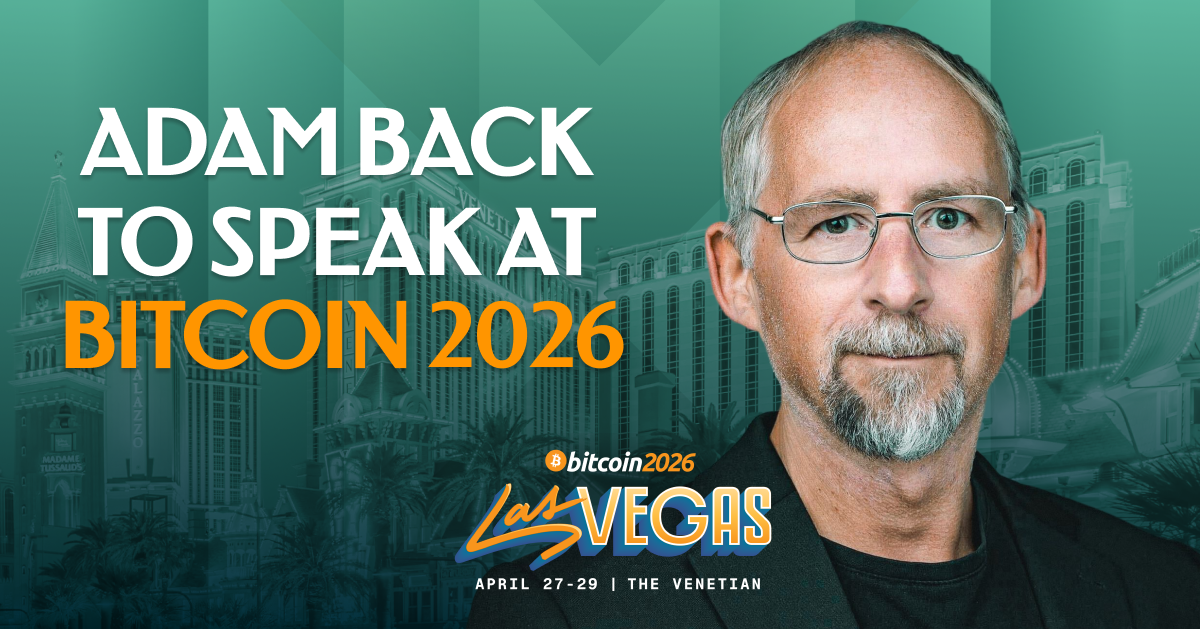
Adam Back Confirmed As A Bitcoin 2026 Speaker
Adam Back has been officially confirmed as a speaker at Bitcoin 2026, returning to the conference as one of the few people in the world whose contributions to Bitcoin predate Bitcoin itself. As Co-Founder and CEO of Blockstream and CEO of Bitcoin Standard Treasury Company (BSTR), Back comes to Las Vegas operating at the intersection of Bitcoin infrastructure and capital markets like never before.
In 1997, Back invented Hashcash — a proof-of-work system originally built to combat email spam that became the direct technical foundation for Bitcoin’s mining process. Satoshi Nakamoto cited Back by name in the Bitcoin white paper, writing that the network would need “a proof-of-work system similar to Adam Back’s Hashcash.” Before the genesis block was ever mined, Satoshi emailed Back directly.
Blockstream, which Back co-founded in 2014, develops Bitcoin infrastructure across three areas: consumer self-custody tools including the open-source Jade hardware wallet, enterprise settlement and asset issuance on the Liquid Network, and institutional products through Blockstream Asset Management — with with Liquid Network closing 2025 with close to $5 billion in TVL. At Bitcoin 2025, Back framed the company’s direction: “We’re laser-focused on Bitcoin. At Blockstream, we are here to provide the infrastructure to enable that.”
On the capital markets side, Bitcoin Standard Treasury Company has entered into a definitive agreement to go public through a merger with Cantor Equity Partners I (CEPO), structured with 30,021 BTC on its balance sheet and up to $1.5 billion in PIPE financing — the largest ever announced alongside a Bitcoin treasury SPAC merger. As of March 2026, BSTR is awaiting completion of the de-SPAC process, with shareholder approval targeted as early as April, after which the combined company is expected to trade on Nasdaq under the ticker “BSTR.”
From inventing the proof-of-work system that makes Bitcoin possible, to building the infrastructure layer on top of it, to now bringing over 30,000 BTC to public markets — Back’s is unlike anyone else on the Bitcoin 2026 stage. His appearance at The Venetian this April will be one of the most technically credible perspectives at the conference on where Bitcoin’s protocol, infrastructure, and capital markets are all heading at once.
LEGENDARY ADAM BACK TO SPEAK AT BITCOIN 2026
— The Bitcoin Conference (@TheBitcoinConf) March 9, 2026
"Dips exist to transfer bitcoin from weak hands to strong hands." – @adam3uspic.twitter.com/dZwfxRKtWq

Bitcoin 2026 Returns to Las Vegas Bigger Than Ever
Bitcoin 2026 will take place April 27–29 at The Venetian, Las Vegas, and is expected to be the biggest Bitcoin event of the year.
Focused on the future of money, Bitcoin 2026 will bring together Bitcoin builders, investors, miners, policymakers, technologists, and newcomers from around the world. The event will feature a wide range of pass types, including general admission passes designed specifically for those new to Bitcoin, alongside premium passes for professionals, enterprises, and institutions.
With multiple stages, immersive experiences, technical workshops, and headline keynotes, Bitcoin 2026 is designed to serve both first-time attendees and long-time Bitcoiners shaping the next era of global adoption.
Past Bitcoin Conferences in the U.S.
Bitcoin’s flagship conference has scaled dramatically over the past five years:
- 2021 – Miami: 11,000 attendees
- 2022 – Miami: 26,000 attendees
- 2023 – Miami: 15,000 attendees
- 2024 – Nashville: 22,000 attendees
- 2025 – Las Vegas: 35,000 attendees
 Get Your Bitcoin 2026 Pass
Bitcoin Magazine readers can save 10% on Bitcoin 2026 tickets using code ‘ARTICLE10‘ at checkout.
Stay at The official hotel of Bitcoin 2026, The Venetian, and get a guaranteed low rate plus 15% off your pass. Hotel Prices increase soon, be in the middle of where the fun is all happening, and where the networking never ends.
And don’t forget:
Volunteer at Bitcoin 2026 and get Pro Pass access plus exclusive perks.
All students ages 13+ can apply for a Student Pass and get free general admission access to Bitcoin 2026.
 Location: The Venetian, Las Vegas
 Dates: April 27–29, 2026
For more information and exclusive offers, visit the Bitcoin Conference on X here.
Why Attend Bitcoin 2026?
Bitcoin 2026 is the definitive gathering for anyone serious about the future of money. With 500+ speakers, multiple world-class stages, and programming spanning Bitcoin fundamentals, open-source development, enterprise adoption, mining, energy, AI, policy, and culture, the conference brings every corner of the Bitcoin ecosystem together under one roof.
From headline keynotes on the Nakamoto Stage to deep technical sessions for builders, institutional strategy discussions for enterprises, and beginner-friendly Bitcoin 101 education, Bitcoin 2026 is designed for everyone—from first-time attendees to the leaders shaping Bitcoin’s global adoption.
Whether you’re looking to learn, build, invest, network, or influence, Bitcoin 2026 is where Bitcoin’s next chapter is written.
Bitcoin 2026 Pass Types: Something for Everyone
Bitcoin 2026 offers a range of pass options designed to meet the needs of newcomers, professionals, enterprises, and high-net-worth Bitcoiners alike.
Bitcoin 2026 General Admission Pass
Ideal for newcomers and those looking to experience the heart of the conference.
- Limited access on Days 2 & 3
- Entry to Main Stage
- Access to Genesis Stage
- Full access to the Expo Hall

Bitcoin 2026 Pro Pass
Designed for professionals, operators, and serious Bitcoin participants.
Includes all General Admission features, plus:
- Full 3-day access, including Pro Day
- Entry to the Pro Pass Reception
- Access to Enterprise Hall, Enterprise Stage, and Networking Lounge
- Conference App networking features
- Access to the Bitcoin For Corporations Symposium
- Entry to Compute Village and Energy Stage
- Complimentary lunch, coffee, tea, and snacks
- Dedicated registration and check-in
- Reserved seating at Main Stage
- Huge savings when you bundle your hotel and Pro Pass
 Bitcoin 2026 Whale Pass
The all-inclusive, premium Bitcoin 2026 experience.
Includes all Pro Pass features, plus:
- Reserved seating at Main Stage
- All-inclusive gourmet food and beverages
- Entry to Whale Night and Whale Reception
- Access to all official after-parties
- Networking app access to connect with other Whales
- Premium access to The Deep — an exclusive networking lounge with intimate speaker sessions
- Complimentary stay at The Venetian when you bundle your whale pass and hotel (use promo code ‘WHALEHOTEL’ here)
This is the most immersive way to experience Bitcoin 2026.
 Bitcoin 2026 After Hours Pass
Your ticket to the night.
Most deals are done with a drink in your hand. Get exclusive access to 3 official Bitcoin 2026 after-parties across Las Vegas — each with a 2-hour open bar — where the real conversations happen and the best connections are made.
- Access to 3 official Bitcoin 2026 after-parties
- 2-hour open bar at each event
- Evening events across Las Vegas, April 27–29
- Network with Bitcoiners, builders, and industry leaders after hours
More headline speaker announcements are coming soon.
Don’t miss Bitcoin 2026.
This post Adam Back Confirmed As A Bitcoin 2026 Speaker first appeared on Bitcoin Magazine and is written by Jenna Montgomery.
Bitcoin Magazine
Despite a 47% Price Drop, Bitcoin Traders Aren’t Selling
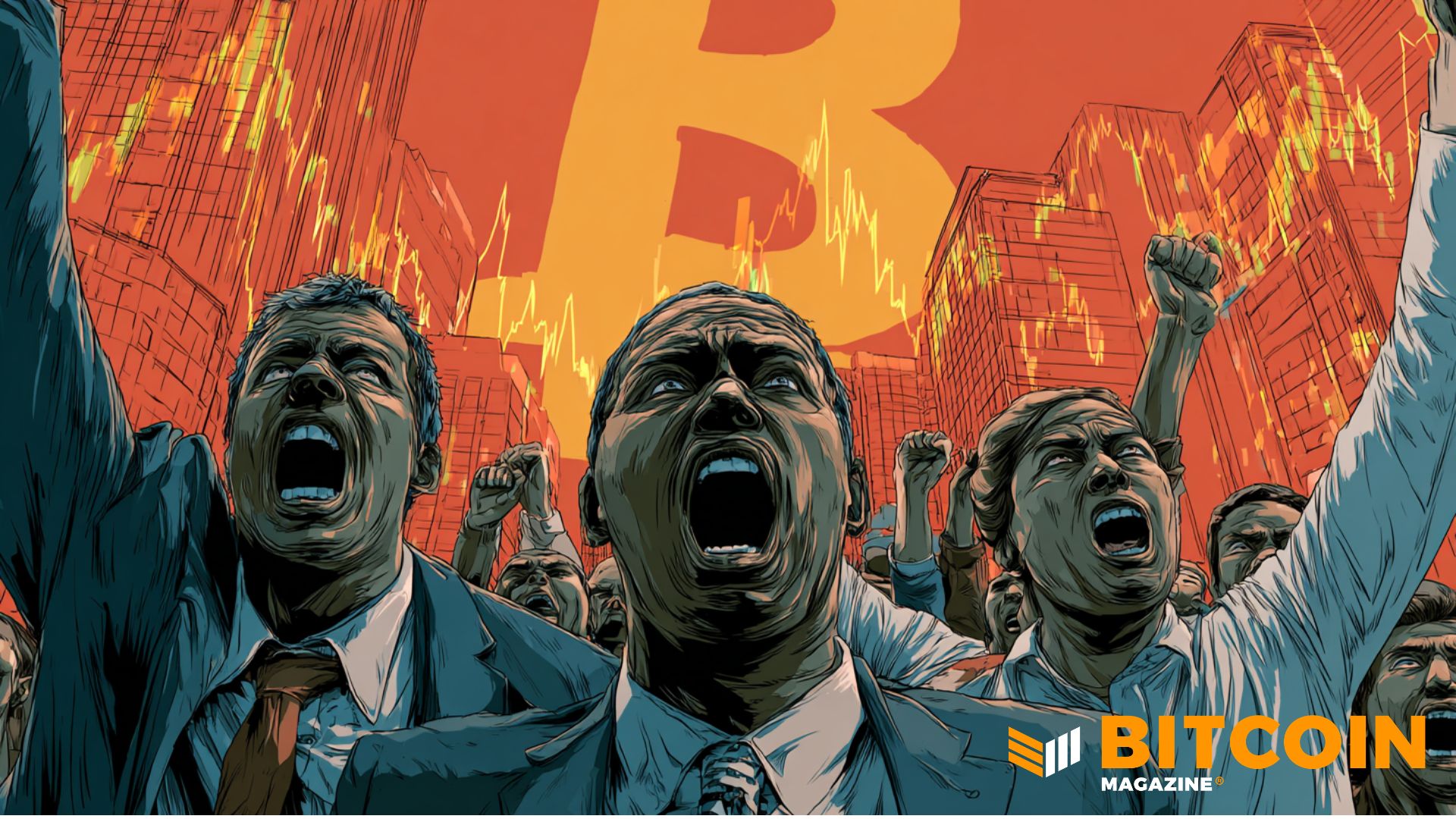
Bitcoin faced a dramatic market correction in early 2026, plunging 46% from its $126,000 all-time high and briefly dipping below $61,000 on February 6.
The drop erased over $1 trillion in market value and prompted headlines warning of a defining crypto moment. Social media feeds filled with reactions, yet most holders remained on the sidelines.
A survey by Oobit of 1,006 American Bitcoin holders and sentiment analysis of 117,630 posts across 10 major crypto subreddits reveals that fear did not translate into widespread selling.
Anxiety and hope dominated emotional responses, with 39% of holders reporting anxiety and 38% hope.
Despite the turbulence, 69% of respondents had neither sold their holdings nor planned to, demonstrating what the community often calls “diamond hands.” Only 8% were classified as true panic sellers.
Among anxious holders, 72% still intended to hold, and 64% of fearful holders expressed the same.
Overall, 75% would maintain their positions even if prices continued to fall. The survey indicates that fear and hope often coexist: 86% of respondents reported experiencing both emotions while holding their Bitcoin, according to the survey.
A Bitcoin recovering is coming
Investors are also anticipating a recovery. Two-thirds of holders (66%) expect Bitcoin to reach a new all-time high, with the median 12-month price forecast at $75,000.
Expectations varied across demographics: Gen Z participants were most bullish at 70%, compared with 60% of baby boomers. High-income holders ($100,000+) predicted a median price of $80,000, while those earning less than $100,000 forecasted $72,000.
Market behavior during the downturn also included opportunistic buying. Roughly 25% of holders purchased Bitcoin during the dip, with younger and higher-income investors more active in buying.
Reddit sentiment mirrored the survey’s findings. Across 117,630 posts, positive sentiment outweighed negative nearly 2-to-1.
Bitcoin prices recovered faster than sentiment. By February 12, the market had rebounded to $66,221, though online sentiment trailed, reflecting ongoing emotional processing among holders.
The data suggests that investors react on conviction as much as price, with sentiment volatility roughly one-third that of price volatility during the downturn.
At the time of writing, Bitcoin is trading at $70,400 after briefly trading above $75,000 this week.
Yesterday, Bitcoin fell below $70,000, trading near $69,500, as rising energy prices and a firm Federal Reserve stance strengthened the dollar and weighed on risk assets.
The drop coincided with Brent crude surpassing $114 per barrel amid Middle East tensions, driving broader market weakness and a roughly 4% decline in Bitcoin over 24 hours.
This post Despite a 47% Price Drop, Bitcoin Traders Aren’t Selling first appeared on Bitcoin Magazine and is written by Micah Zimmerman.
Bitcoin Magazine

Morgan Stanley Bitcoin Trust to Trade as MSBT on NYSE Arca
Morgan Stanley has confirmed that its proposed spot bitcoin exchange-traded fund will trade under the ticker MSBT on NYSE Arca, according to an updated filing with the U.S. Securities and Exchange Commission.
The filing outlines the structure of the Morgan Stanley Bitcoin Trust, a passive investment vehicle designed to track the spot price of bitcoin through direct holdings.
Shares of the trust will reflect the value of bitcoin held in custody, offering exposure through brokerage accounts without requiring direct ownership of the asset.
The trust plans to seed the fund by issuing 50,000 shares, expected to raise about $1 million in initial proceeds.
The ticker MSBT places the product alongside other spot bitcoin ETFs that launched following regulatory approvals in 2024, a shift that opened the market to traditional financial institutions.
NEW: Morgan Stanley files new form with the SEC for its spot Bitcoin ETF, revealing the ticker will be MSBT
— Bitcoin Magazine (@BitcoinMagazine) March 19, 2026pic.twitter.com/U70OkVnd1F
Morgan Stanley has also appointed Coinbase Custody Trust Company as the primary bitcoin custodian. The firm will safeguard the digital assets and facilitate transfers tied to share creation and redemption. Most of the bitcoin will be held in cold storage, where private keys remain offline.
BNY Mellon will serve multiple roles, including administrator, transfer agent, and cash custodian. The bank will handle accounting, shareholder records, and cash management for the trust.
The structure follows a model used across the spot bitcoin ETF market. A portion of the fund’s holdings may move into trading wallets during periods of share creation or redemption, when authorized participants exchange cash for bitcoin or redeem shares for the underlying asset.
The filing states that custody insurance is in place but shared across multiple clients and may not cover all losses. Similar disclosures appear in other ETF filings, reflecting standard industry practice as asset managers expand into direct bitcoin exposure.
Key details remain undisclosed, including the management fee and expense ratio. These figures often play a role in investor demand, particularly in a market where fee competition among issuers has intensified.
Morgan Stanley is embracing bitcoin
Morgan Stanley first filed for the bitcoin trust in January. The latest update confirms operational details and brings the product closer to launch, pending effectiveness of the registration statement and final regulatory approval.
The move marks a deeper push by the bank into digital assets. Morgan Stanley has signaled plans to expand beyond ETFs, with efforts underway to integrate crypto trading into its E*Trade platform. The firm has also explored custody, lending, and yield-related services tied to digital assets.
At Strategy World, digital asset strategy head Amy Oldenburg described further expansion as part of the firm’s roadmap, pointing to client demand for integrated crypto services.
She said the bank intends to develop a fully integrated custody and exchange platform.
“This is a natural progression,” the executive said. “We can’t just primarily rent the technology to do this. People expect Morgan Stanley – they trust our brand – to be no fail.
This post Morgan Stanley Bitcoin Trust to Trade as MSBT on NYSE Arca first appeared on Bitcoin Magazine and is written by Micah Zimmerman.
Bitcoin Magazine

Bitcoin’s Quantum Risk May Be Real, But the Network Is Preparing: Report
Galaxy Digital’s latest report says the risk that quantum computing could compromise Bitcoin is real, but so is the work underway to protect the network.
The firm’s research frames the issue as a long-term engineering and governance challenge rather than an imminent crisis, with developers already building tools that could reshape how the network secures trillions in value.
At the center of the concern is a simple premise. Bitcoin relies on cryptographic signatures to prove ownership of coins. Those signatures, based on elliptic curve cryptography, are considered secure against classical computers.
How Quantum Computing could break Bitcoin
A sufficiently advanced quantum machine could break that assumption, allowing an attacker to derive a private key from a public one and spend funds without authorization.
The scenario has a name within the industry: “Q-day,” the moment a cryptographically relevant quantum computer becomes viable. The timeline remains uncertain. Estimates range from years to decades, and no consensus exists among experts. The report stresses that uncertainty itself is the problem. Bitcoin’s decentralized structure means upgrades take time, often measured in years, not months.
Still, the risk is uneven. Most Bitcoin is not exposed today.
Wallets only reveal their public keys when funds are spent, meaning coins sitting untouched behind hashed addresses remain shielded.
Vulnerability emerges in two main cases: coins whose public keys are already visible onchain, and coins in transit during a transaction.
Which Bitcoin is actually at risk
Galaxy cites estimates suggesting that millions of bitcoin could fall into the first category, including funds tied to early network activity and long-dormant wallets.
These coins, often associated with early adopters and even the pseudonymous creator Satoshi Nakamoto, present a unique challenge. If quantum capabilities arrive before protective measures are deployed, such holdings could become prime targets.
The implications extend beyond individual losses. A sudden unlocking of dormant supply could ripple through markets, placing pressure on price and, by extension, on mining incentives that underpin Bitcoin’s security. The report frames this as a systemic risk, not just a technical flaw.
Yet the tone of the research is measured. Rather than signaling alarm, it points to a growing body of work aimed at preparing the network. Among the most prominent proposals is a new transaction structure known as Pay-to-Merkle-Root, outlined in Bitcoin Improvement Proposal 360.
The design removes a key exposure point by eliminating always-visible public keys, reducing the attack surface for long-term threats.
Other ideas take a broader approach. One proposal, known as “Hourglass,” attempts to manage the fallout from vulnerable coins by limiting how quickly they can be spent in a worst-case scenario. The goal is not to prevent access, but to slow it, giving markets time to absorb potential shocks.
There is also movement toward new forms of cryptography. Hash-based signature schemes, such as SPHINCS+, have emerged as candidates for a post-quantum future. These systems rely on mathematical assumptions different from those used today and are viewed by some researchers as a more conservative foundation.
Post-Quantum cryptography brings tradeoffs
The tradeoff is efficiency. Larger signatures could increase transaction sizes and strain network resources.
In parallel, developers are exploring contingency plans. One proposal introduces a commit-and-reveal process that could protect transactions even if a quantum breakthrough occurs before new cryptography is deployed. Another line of research looks at zero-knowledge proofs to allow users to verify ownership of funds without exposing sensitive data.
Taken together, these efforts suggest a layered defense. No single fix solves the problem. Instead, the strategy resembles a toolkit, with protections aimed at different stages of exposure and different levels of urgency.
The harder question may not be technical. Bitcoin has no central authority to mandate changes. Every upgrade requires coordination among developers, miners, exchanges, and users. Past changes, including major upgrades like SegWit and Taproot, took years to activate and often sparked intense debate.
Quantum preparedness could prove even more complex. Some proposals touch on sensitive issues, including whether coins that fail to migrate to safer formats should lose spendability. Such ideas raise philosophical questions about property rights and the social contract embedded in the network.
Even so, the report points to a key difference from past conflicts. Quantum risk is external. It does not divide the community along economic lines or competing visions for Bitcoin’s future. Instead, it presents a shared threat.
Every participant, from long-term holders to infrastructure providers, has an incentive to maintain the network’s security.
In the end, the report suggests that the outcome will hinge less on whether quantum computers arrive and more on whether a decentralized network can coordinate in time.
The answer, as with much of Bitcoin’s history, will emerge through slow consensus rather than sudden change.
This post Bitcoin’s Quantum Risk May Be Real, But the Network Is Preparing: Report first appeared on Bitcoin Magazine and is written by Micah Zimmerman.
CryptoSlate
Retail investors became the main force behind gold-fund buying over the past six months, helping extend bullion’s rise even as some institutional money started to step back.
At the same time, fresh inflows into US spot Bitcoin exchange-traded funds (ETFs) show part of Wall Street rebuilding crypto exposure through the regulated ETF channel, setting up a split in how investors are responding to the same backdrop of war, inflation pressure, and shifting rate expectations.
The divergence offers a clearer view of investor behavior than either market does alone. Essentially, households have leaned on gold as the traditional store of value, while professional capital has shown renewed willingness to buy Bitcoin after a weak start to the year.
The result is a market in which gold and Bitcoin are no longer moving as simple rivals for the same defensive trade, but as separate expressions of different risk appetites.
Retail takes the wheel in gold accumulation
The Bank for International Settlements laid out the shift in unusually direct terms in its March quarterly review.
In a section on the late-January and February break in precious metals, the BIS said fund-flow data showed retail investors were the main source of inflows into gold and silver funds, while institutional investors “maintained stable positions or even trimmed exposure.”
The chart accompanying the analysis showed cumulative retail inflows into gold funds climbing to roughly $60 billion by the first quarter of 2026, up from about $20 billion in late 2025, while institutional flows stayed near flat and then turned negative.

The BIS tied the move to a broader run-up that stretched through 2025 and into early 2026. Gold and silver rose sharply before reversing in late January and February, a swing the BIS said was amplified by retail participation through ETFs, daily rebalancing by leveraged products, and margin-driven selling.

Silver, which had doubled in 2025 and then risen more than 50% in January alone, fell about 30% in a single day in late January. Gold followed the same pattern with smaller moves.
The fund-flow picture helps explain how gold continued to attract money even as prices became harder to chase.
World Gold Council data show that physically backed gold ETFs pulled in $19 billion in January, the strongest month on record, then added another $5.3 billion in February, marking a ninth straight month of inflows.
Total holdings rose to 4,171 metric tons in February, while assets under management reached a record $701 billion.
Those totals show demand remained broad, but the BIS breakdown suggests retail investors were doing more of the incremental buying.
The institutional bid starts to soften
What changed in March was not the long-run case for gold, but the willingness of some larger investors to keep adding at the same pace.
Earlier this month, investors pulled more than $4 billion from GLD, the largest gold-backed ETF. Notably, this was the largest weekly outflow in its 20 years of existence.

By a week later, spot gold had fallen rapidly to around $4,611 an ounce, its lowest level since early February.
According to goldprice.org data, this extends a seven-session losing streak as higher oil prices and inflation fears pushed expectations toward tighter monetary policy.
Higher-for-longer rates have always been a problem for bullion because gold yields nothing, and the recent slide turned that old relationship back into the main driver.

Reuters reported that analysts at Commerzbank pointed to more restrictive policy expectations as the key reason gold had come under pressure, while TD Securities said institutional positioning had grown large during the past year’s “debasement trade” and that the foundations of that trade were weakening.
In other words, gold’s buyers changed just as the macro case became harder to hold in a straight line.
Still, the institutional retreat should not be overstated.
The World Gold Council said North America added $7 billion to gold ETFs in January and another $4.7 billion in February, both part of a sustained run of inflows tied to geopolitical risk and demand for defensive assets. Europe was the weak point in February, with $1.8 billion of outflows, much of it tied to redemptions after the late-January sell-off.
This means that institutions were trimming their exposure at the margin and not abandoning the precious metal outright.
Bitcoin draws fresh money
While gold’s institutional bid began to look less certain, Bitcoin started attracting money again through the market’s main institutional access point.
Data compiled by Farside Investors show US spot Bitcoin ETFs absorbed about $1.16 billion in net inflows from March 9 through March 17. Notably, this was the strongest inflow streak since last October.
The streak included daily net additions of $246.9 million on March 10, $180.4 million on March 13, and $199.4 million on both March 16 and March 17.
However, that run paused on March 18 with a $163.5 million outflow, but the direction of travel had already been established, with BTC price reaching as high as above $75,000 during the streak.
While those ETF flows do not prove a wholesale institutional embrace of crypto, they are the clearest evidence that professional money has started moving back toward Bitcoin after months of caution.
This is further corroborated by Bitwise data, which shows that Bitcoin’s latest institutional demand extends beyond ETF inflows.

André Dragosch, Bitwise Europe’s head of research, said in a post on X that institutional demand had accelerated to its highest level since October 2025.

His one-month tally showed that Bitcoin ETPs added 34,400 BTC and treasury companies added 46,800 BTC, including 46,400 BTC from Strategy alone, for a combined 81,200 BTC.
Against a new monthly supply of about 13,300 BTC, that meant institutions bought about six times as much Bitcoin as miners produced over the same period.
Meanwhile, Coinbase’s latest institutional survey points out the institution's strong conviction in the top crypto.
In a January survey of 351 institutional decision-makers conducted with EY-Parthenon, 74% of the respondents said they expect crypto prices to rise over the next 12 months, and 73% said they plan to increase digital-asset allocations in 2026.

The same report said the share of firms allocating more than 5% of assets under management to digital assets is expected to rise from 18% to 29% by the end of 2026.
Those figures suggest Wall Street’s return to Bitcoin is no longer visible only through the ETF wrapper. It is also showing up in corporate treasury accumulation and in survey data pointing to larger planned allocations.
What does this shift mean for gold and BTC?
The flow split suggests that gold and Bitcoin are attracting different types of buyers across different parts of the same macro trade.
Gold remains the first choice for retail investors seeking a store of value during periods of war, inflation, and interest-rate uncertainty. Its long history, deep liquidity, and lower day-to-day volatility keep it attractive to households and fund buyers seeking protection without taking on the price swings common in crypto markets.
Bitcoin, by contrast, is regaining ground with institutions willing to treat it as a scarce, liquid asset with higher upside and higher risk.
The recent pickup in ETP demand, treasury-company accumulation, and survey data pointing to larger planned allocations suggest that professional investors are becoming more comfortable adding exposure as supply conditions tighten and access improves through regulated products.
For markets, the implication is that gold and Bitcoin are no longer competing in a simple zero-sum way.
Gold can continue to attract defensive retail flows even if institutional money slows, while Bitcoin can benefit from corporate buying and portfolio reallocation even if it remains more sensitive to policy signals and liquidity conditions.
In the near term, gold looks positioned to hold its role as a hedge, while Bitcoin is increasingly trading as an institutional scarcity asset.
The post Retail is rushing into gold, but institutions are buying Bitcoin again – so why the split? appeared first on CryptoSlate.
Coinbase is directing some Commerce users to a seed-phrase recovery flow ahead of a March 31 migration deadline.
The issue sits inside Coinbase’s shutdown plan for legacy Commerce wallets. In its transition guide, Coinbase says users with funds in a Commerce wallet must withdraw them before March 31, 2026, when the Commerce portal and withdrawal tool will become inaccessible.
For users who backed up their wallet to Google Drive, Coinbase says they should go to the Commerce dashboard, open Settings and Security, reveal the 12-word seed phrase, and use the withdrawal tool at withdraw.commerce.coinbase.com.
Coinbase says the process is especially important for merchants that received Bitcoin or other UTXO-based assets because balances may otherwise be hard to surface in standard wallets.
A seed phrase is the master recovery key for a self-custody wallet. Coinbase’s own wallet documentation describes it as a 12-word recovery phrase that only the user has access to.
Whoever controls that phrase controls access to the wallet and its funds. Lose it, and access to funds can be lost. Expose it, and funds in the wallet can be drained.
That is where the contradiction becomes hard to miss. Coinbase’s wallet guidance tells users never to share a recovery phrase, says the firm will never ask for it, and adds a separate warning: “Never paste it into any website.”
Yet the Commerce transition guide tells some users to reveal the same phrase as part of an official Coinbase-hosted recovery path.
The company’s explanation is that Commerce wallets are self-custodial, and Coinbase does not have access to the phrase or the funds, which leaves users responsible for recovery before the shutdown.
Security researchers see a phishing template
Nonetheless, this Coinbase demand has rung the alarm bells for many security experts, who are criticizing the platform for the behavior its page teaches users to accept.
Blockchain security firm SlowMist founder Yu Xian said he was puzzled that Coinbase would host a page asking users to enter a mnemonic phrase in plain text for asset recovery and said the practice was so insecure that he first wondered whether the subdomain had been hacked.
The warning sharpened the core criticism around the page: an official brand, an urgent deadline, and a seed-phrase workflow combine into a format attackers regularly mimic.
Meanwhile, SlowMist chief information security officer 23pds wrote on X that there were “two issues” with the flow. First, he said:
“While the link is from the official Coinbase website, directly asking users to transmit their mnemonic phrase to verify assets is extremely foolish.”
Secondly, he noted that the site had a flawed sitemap that could let attackers copy the front end and deploy a near-clone on a lookalike domain, creating a strong phishing lure for users already primed to trust the Coinbase version.
Additionally, blockchain investigator ZachXBT further pressed on that point even more directly. In a post on X, he wrote:
“So basically Coinbase has an official page live threat actors can use to target Coinbase users via seed phrase social engineering if they wanted?”
Their concerns are unsurprising, considering phishing and social engineering scams remain one of the most potent attack vectors against the crypto industry.
Last year, ZachXBT revealed that Coinbase users lose more than $300 million annually due to social engineering scams.
This captures why the Commerce flow has triggered such a strong reaction. Security teams have spent years teaching users that any request involving a seed phrase is the start of a scam.
However, a Coinbase-owned page handling the same phrase could change the visual and behavioral cues users have been taught to rely on.
Coinbase’s breach history hangs over the debate
Meanwhile, the security debate lands harder because Coinbase is already dealing with the aftereffects of past social-engineering incidents.
In May 2025, Coinbase reported that cybercriminals bribed a group of overseas support agents to steal customer data for social-engineering attacks.
The Brian Armstrong-led exchange said the attackers obtained account data for fewer than 1% of monthly transacting users and used it to compile lists of customers they could contact, pretending to be from the platform.
The company said no private keys were exposed and pledged to reimburse customers who were tricked into sending funds to attackers.
Apart from that, the company also has an earlier breach record.
Coinbase said in its 2024 annual report that in 2021, third parties obtained login credentials and personal information for at least 6,000 customers and used those details to exploit a vulnerability in the account recovery process. The firm said it reimbursed impacted customers about $25.1 million.
That history raises the stakes around any official workflow that asks users to handle a seed phrase on a live web page.
Security researchers warn that such a branded interface that normalizes seed-phrase entry will further boost phishing and impersonation attacks, which remain among the industry’s most effective attack methods.
The post Coinbase tells users to follow ‘foolish’ steps scammers use to withdraw funds from wallets appeared first on CryptoSlate.
Metaverse land never recovered. The numbers now show how far it fell
The biggest metaverse land deals of the 2021 and 2022 boom now map to four- and five-digit values when priced against current collection floors, rather than the six- and seven-figure valuations buyers once paid.
The decline runs through the entire metaverse land trade. A CoinGecko study found that average metaverse land prices were already down 72% from their highs by June 2024, with Sandbox off 95%, Decentraland off 89%, and Otherdeed for Otherside off 85% from peak-cycle average floor levels.
The famous parcels that once stood in for scarcity and status now read like artifacts from a pricing regime that assumed virtual neighborhoods would become high-traffic digital cities.
The broader NFT market also failed to recover its old price structure. DappRadar said NFT trading reached $25.8 billion in 2021, and its January 2022 report said that month alone hit a record $16 billion in sales before wash-trading distortions were stripped out. Later data shows a market that kept moving while getting cheaper.
DappRadar’s Q2 2025 report said NFT trading volume fell 45% quarter over quarter to $867 million even as sales rose 78% to 14.9 million.
In Q3 2025, the same tracker said the market logged $1.6 billion in trading volume across 18.1 million sales. Trading activity persisted, while the premium attached to many collections collapsed.
The metaverse land unwind is best understood as a repricing because buyers treated digital land as if it would become a durable asset, with brands, traffic, and resale scarcity. The market now prices much of it as illiquid optionality.
The splashy land deals now look like relics
The clearest case studies are the deals that once stood in for the entire boom. In December 2021, a 3×3 Snoopverse estate next to Snoop Dogg’s property in The Sandbox sold for about $450,000, or about 71,000 SAND. That nine-parcel estate now screens at about $1,025 on a floor-equivalent basis. That is a drawdown of about 99.8% from the reported sale price.
The Decentraland Fashion District deal points the same way. Metaverse Group bought a 116-parcel estate in November 2021 for about $2.4 million. That estate is now not worth materially more than $8,929 on a floor-equivalent basis, down about 99.6% from the original purchase price.
In June 2021, Republic Realm bought 259 parcels for about $913,228. At the same current floor-equivalent value, that estate screens at about $19,935, down about 97.8%.
The Sandbox “city” deal is another clean marker because of its scale. Republic Realm’s 24×24 Sandbox estate, or 576 parcels, was purchased for $4.3 million in late 2021. Marked to the current floor-equivalent price, that estate screens at about $65,583, down about 98.5%.
Otherside’s trophy sales show the same baseline collapse. A May 2022 DappRadar report said Otherdeed #24 sold for 333 ETH, or close to $1 million, while the floor now sits around $167.
Even so, against the current Otherdeed floor, the category baseline has fallen so far that these headline purchases now imply floor-equivalent markdowns approaching 100%.
| Deal | Original sale price | Parcels | Current floor-equivalent value | Implied decline |
|---|---|---|---|---|
| Snoopverse estate in The Sandbox | $450,000 | 9 | $1,025 | 99.8% |
| Decentraland Fashion District estate | $2.4 million | 116 | $8,929 | 99.6% |
| Republic Realm Decentraland purchase | $913,228 | 259 | $19,935 | 97.8% |
| Republic Realm Sandbox estate | $4.3 million | 576 | $65,583 | 98.5% |
| Otherdeed #24 | About $1 million | 1 | About $167 | About 100% |
Floor-equivalent pricing is the fairest way to present these comparisons. It shows what happened to the market’s baseline. The market that once paid a premium for celebrity adjacency, branded districts, and virtual location now assigns only a thin residual value to the category as a whole.
NFTs kept trading, but the pricing model broke
The land collapse sits inside a broader NFT reset. The first quarter of 2022 was the strongest in NFT history at $12.46 billion in trading volume. By June 2022, monthly trading had fallen below $1 billion for the first time in a year. However, the bust did not totally erase the market.
DappRadar’s 2024 overview report said NFT trading volume fell 19% year over year in 2024 and sales fell 18%, making 2024 one of the weakest years since 2020. Then 2025 showed a split market, lower dollar volume, higher unit activity, and more trading in cheaper assets.
That split is visible in the quarterly numbers. In Q2 2025, DappRadar said volume fell to $867 million while sales rose to 14.9 million. In Q3 2025, DappRadar’s tracker said the market posted $1.6 billion in volume and 18.1 million sales.
October 2025 added another signal. DappRadar said the market reached $546 million in monthly volume and 10.1 million sales, the highest monthly sales count of the year. Traders were still buying NFTs. They were spending far less per item.
A blue-chip proxy shows how severe the repricing was outside land. CoinGecko’s BAYC page shows Bored Ape Yacht Club at about 5.22 ETH, or about $11,410, versus an all-time high floor of 153.7 ETH, or about $420,430. That leaves BAYC down about 96.6% in ETH terms and 97.3% in dollar terms. Even one of the category’s most recognizable collections never came close to reclaiming its old clearing level.
The financing layer also broke. DappRadar’s NFT lending data said lending volume fell 97% from its January 2024 peak of nearly $1 billion to just over $50 million in May 2025. Borrowers were down 90%, lenders were down 78%, and average loan sizes shrank from $22,000 at the 2022 peak to about $4,000.
NFT lending helped support high-end prices during the boom. Once traders could no longer borrow against expensive JPEGs and land deeds at scale, premium valuations lost another key support.
| Market marker | Peak or prior reading | Later reading | What changed |
|---|---|---|---|
| Total NFT trading in 2021 | $25.8 billion | N/A | Boom-year baseline |
| Q1 2022 NFT volume | $12.46 billion | June 2022 below $1 billion monthly | Sharp post-peak fall |
| Q2 2025 NFT volume | – | $867 million | Volume down, sales up |
| Q2 2025 NFT sales | – | 14.9 million | Cheap assets drove activity |
| Q3 2025 NFT volume | – | $1.6 billion | Activity persisted at lower price points |
| Q3 2025 NFT sales | – | 18.1 million | Higher unit turnover |
| NFT lending volume | Nearly $1 billion in January 2024 | Just over $50 million in May 2025 | Credit support faded |
The broad NFT market kept operating, though its price ladder dropped sharply. Land was one of the boom’s purest narrative trades. It depended on the belief that digital location itself would become a durable asset class.
Other parts of the NFT market found cheaper pockets of demand. Land rarely did.
The market outlook is narrower, cheaper, and less forgiving
The current market does show signs of life. CoinGecko collection pages for Sandbox, Decentraland, Otherside, and Voxels show 60-day gains of 153.9%, 95.5%, 12.8%, and 41.8%, respectively.
Yet, those rebounds start from deeply depressed levels and leave the larger picture unchanged. The case studies still sit 98% to nearly 100% below their boom-era valuations on a floor-equivalent basis. That is what happens when a market loses both leverage and belief.
The category is also competing in a different NFT market than the one that existed in late 2021. In 2025, RWA NFTs grew 29% in volume and became the second-largest NFT category by volume during the quarter. Gaming-linked assets also gained ground.
Still, that shift does not prove metaverse land can recover soon. Traders moved on to RWAs when the old premise stopped working. They moved toward categories that looked more transactional, more utility-linked, or simply cheaper to own.
Corporate signals moved in the same direction. Meta changed its name in 2021 to emphasize the metaverse, and the company’s announcement now reads like a document from another market cycle.
Meta’s 2025 earnings filing said Reality Labs lost $19.2 billion in 2025 after years of multibillion-dollar losses. Virtual worlds remain active, though under a very different cost and growth calculus than the one that drove the land boom.
The market now trades digital assets with much lower ticket sizes, weaker financing, and a preference for narrower use cases. Metaverse land can still rally in short bursts, especially when crypto sentiment turns risk-on.
The last 60 days show that. The market still sits far below the assumptions embedded in the 2021 and 2022 trophy sales.
For land values to behave like property again, platforms would need more than token rebounds. Users who show up regularly, brands that stay, and a reason for virtual location to generate durable economic value instead of narrative premium are the only avenues to recovery.
The post RIP metaverse: Land values capitulate as $24M metaverse plot collapses to just $9,000 appeared first on CryptoSlate.
Trading begins on MEXC
Playnance’s G Coin has entered open-market trading, with the G Coin/USDT pair going live on MEXC after the project’s Token Generation Event on March 18.
MEXC’s official announcement said deposits were open and withdrawals would begin on March 19, while the exchange’s live G Coin page shows the pair as active. For Playnance, that shifts G Coin from an ecosystem-native utility token into a publicly traded asset with continuous price discovery.
The listing matters because Playnance is not presenting G Coin as a blank-slate token. In its white paper and product documentation, the company describes G Coin as a utility asset tied to gameplay, missions, rewards, loyalty features, and broader participation across its platforms, not as a governance or profit-sharing token.
That gives the MEXC debut more substance than a typical launch, because market access is arriving after utility has already been built into the ecosystem.
Staking becomes the first post-listing signal
The clearest early signal is staking participation. Playnance’s site highlighted a launch phase in which more than 250 million G Coin were locked within hours, and later launch coverage tied to the MEXC debut said staking had already moved above 1 billion G Coin shortly after going live. Playnance’s staking page shows four lockup periods, 6, 9, 12, and 18 months, with reward allocations weighted toward longer commitments.
That matters because lockups can do more than generate a headline number. They can reduce immediately available supply, encourage longer-term alignment, and give the market a measurable signal of confidence just as trading opens.
Playnance’s public G Coin Tracker adds another reference point. Indexed snippets from the tracker show a fixed 77 billion token supply and more than 3.15 billion G Coin in locked supply or treasury categories, alongside live fields for price and holder data.
Utility and token design now face the market
Playnance says its broader ecosystem runs on PlayBlock, a Layer-3 infrastructure built for gaming, trading, betting, and prediction markets, with gasless execution and sub-second finality. Within that framework, G Coin is meant to power gameplay interactions and fees, rewards and incentives, partner revenue distribution, and treasury flows.
That gives the token a clearer operational role than many newly listed assets that reach exchanges before their use cases are live.
Supply design is also central to the pitch. Playnance’s docs and white paper say G Coin has a fixed maximum supply of 77 billion tokens. Tokens lost through gameplay are locked for 12 months before returning to circulation, while unsold tokens at TGE are subject to a 12-month cliff followed by 24-month linear vesting. The white paper also says the token already provided access to an operational ecosystem before admission to trading.
The next test is simple, whether the exchange listing, staking participation, and underlying product activity reinforce each other over time. MEXC gives G Coin liquidity and visibility. Staking gives the market an early demand signal. The tracker gives users a public dashboard. What matters now is whether volume, user growth, and on-chain usage keep moving in the same direction after launch-day attention fades.
The post Playnance’s G Coin goes live on MEXC as staking momentum builds appeared first on CryptoSlate.
For decades, the benchmark for US risk lived on US time. S&P 500 opened at 9:30 a.m. Eastern and closed at 4:00 p.m., with premarket whispers and after-hours fragments filling the gaps.
On Mar. 18, that constraint began to crack. S&P Dow Jones Indices licensed the S&P 500 to Trade[XYZ] to launch the first officially sanctioned perpetual derivative based on the benchmark on Hyperliquid, available to eligible non-US investors using institutional-grade index data.
The ecosystem surrounding the S&P 500 already processes more than $1 trillion in daily trading volume across linked exposures. Now, a piece of that exposure can trade 24/7/365, including the 49-hour window from Friday's 5:00 p.m. close to Sunday's 6:00 p.m. CME futures reopening when traditional US infrastructure goes dark.
The move represents a structural bet that the first tradable reaction to global events may emerge on always-open rails before traditional venues fully reopen.

Trade[XYZ] created a perpetual derivative tied to licensed S&P benchmark data, not direct ownership of the underlying 500 stocks. By midday, the contract held approximately $3.4 million in open positions, a negligible figure relative to the trillions the benchmark represents.
Trade[XYZ] says its markets have processed more than $100 billion in volume since October 2025 and currently run at an annualized pace above $600 billion.
Hyperliquid's broader HIP-3 macro markets grew from roughly $260 million in open interest a month before Jan. 27 to approximately $1.43 billion recently.
The S&P contract enters a venue where non-crypto macro instruments have already gained traction.

The weekend gap and who fills it
CME already offers near-24-hour weekday access to S&P exposure through E-mini S&P 500 futures, which trade from Sunday 6:00 p.m. Eastern to Friday 5:00 p.m. Eastern with a daily one-hour maintenance break.
NYSE Arca and brokers provide premarket and after-hours equity trading windows.
Traditional infrastructure shuts down from Friday evening to Sunday evening, leaving a two-day gap during which a tariff announcement, military escalation, or a central bank leak can land without an official market response.
Kaiko documented this dynamic during the Feb. 27-28 US-Iran escalation. Weekend Bitcoin spot volume surged from a typical $1.5 billion per day to $2 billion, then to $8 billion, while traditional markets remained closed.
Kaiko noted that crypto printed the first move, but deeper institutional liquidity often arrived later when London and US hours resumed.
The pattern suggests crypto can capture initial reactions without yet commanding final pricing authority.
The S&P perpetual on Hyperliquid positions itself to serve that first-draft function with a more precise instrument than Bitcoin, which has historically absorbed weekend macro flow as a blunt proxy for global risk.
The infrastructure supporting this shift is evolving rapidly. Nasdaq is working toward 24/5 trading and has filed to extend equities hours to 23 hours a day, five days a week.
DTCC's NSCC targets 24×5 trade processing from Sunday 8:00 p.m. Eastern to Friday 8:00 p.m. Eastern, with implementation slated for June 28, 2026, subject to regulatory approval.

Incumbents are moving toward continuous availability, but they have not arrived yet. Crypto arrived first.
| Venue | Typical trading window | Weekend access | Public price visibility | Depth today | Main limitation |
|---|---|---|---|---|---|
| U.S. cash equities | Regular session: 9:30 a.m.–4:00 p.m. ET | No | High during regular session | Deepest | Closed outside the official session |
| Premarket / after-hours equities | Typically around 4:00–9:30 a.m. ET and 4:00–8:00 p.m. ET, depending on venue | No | Fragmented across venues; not a single clean tape | Moderate, often thinner than cash hours | Thin liquidity and fragmented price discovery |
| CME E-mini S&P futures | Sunday 6:00 p.m. ET to Friday 5:00 p.m. ET, with a 1-hour daily break | Not through the full weekend gap | High | Deep on weekdays | Closed from Friday 5:00 p.m. ET to Sunday 6:00 p.m. ET |
| Hyperliquid S&P perpetual | 24/7/365 | Yes | Public onchain tape | Early but growing | New market; depth still building; trust depends on stress performance |
Transparency as a competitive advantage
NYSE research shows that overnight US equity trading remains small, accounting for approximately 0.11% of total volume and 0.15% of year-to-date notional in 2025.
More telling, that activity is fragmented. NYSE notes that some prior-day trading does not appear in most public feeds, and Sunday evening matches are not publicly available through the Securities Information Processors.
Hyperliquid's HIP-3 system operates on-chain, enabling deployer actions to be independently analyzed. The emerging contest is over who produces the most legible first print when official infrastructure is offline or opaque.
New York Fed research found that US equity returns are meaningfully positive during the opening hours of European markets, suggesting that price discovery continues even when US venues are closed.
If a licensed S&P perpetual on public crypto rails consistently reflects weekend macro shocks before CME futures reopen, it becomes a signal market.
The bull case assumes the S&P perpetual grows from its current single-digit-million-dollar scale to a tens-of-millions- or hundreds-of-millions-dollar product.
Weekend liquidity deepens. Repeated on-chain moves closely align with Sunday CME reopening levels, leading macro desks to treat the on-chain read as the first serious price reference, and crypto precedes traditional venues in the price discovery sequence.
The bear case treats this as a high-leverage narrative product. Depth stays shallow, funding rates turn noisy, and serious size stays at CME, broker overnight books, or alternative trading systems.
In this scenario, Hyperliquid fails to provide durable price discovery, and the S&P contract becomes a sentiment telemetry tool.
A threshold model helps frame credibility. With under $25 million in S&P-specific open positions, the market remains symbolic. Between $25 million and $100 million, it becomes a credible weekend signal worth charting against Sunday CME reopening.
Above $100 million, it could serve as a reference-grade first-move indicator for macro narratives. Above $250 million, with tight spreads through weekend shocks, it enters a real fight over who prints the first trusted price for US risk.
| S&P perpetual OI | Interpretation | What it means for price discovery |
|---|---|---|
| Under $25M | Symbolic | Useful as sentiment, not trusted first print |
| $25M–$100M | Credible signal | Worth comparing against Sunday CME reopen |
| $100M–$250M | Reference-grade | Serious first-move market |
| Above $250M | Competitive with incumbents | Real contest over first trusted price |
The most serious risk is trust under stress. A geopolitical or policy shock during the weekend could expose thin liquidity or trigger oracle disputes.
HIP-3 assigns operational responsibility to the deployer, who defines the market and the oracle. Traditional US market guardrails are built around regular hours frameworks with circuit breakers, coordinated halts, and regulatory oversight calibrated to established venues.
A weekend gap or liquidation cascade on the S&P perpetual could damage credibility faster than consistent weekend prints could build it.
What the market is pricing in
The official opening and closing still belong to traditional markets.
However, with a US risk proxy trading 24/7, it remains to be seen if the first meaningful reaction to a Friday-night strike, a Saturday tariff leak, or a Sunday central bank surprise starts showing up on-chain before US futures reopen.
The advantage lies in time-plus-tape visibility, as crypto can trade the S&P on weekends with a public record before the US market infrastructure is fully operational.
The outcome depends on the S&P perpetual on Hyperliquid sustaining depth, maintaining tight spreads, and surviving its first weekend stress test without a credibility crisis.
The post Crypto just opened S&P 500 trading for the weekend while Wall Street shuts down appeared first on CryptoSlate.
Cryptoticker
XRP Price Today: Stuck Below Key Resistance
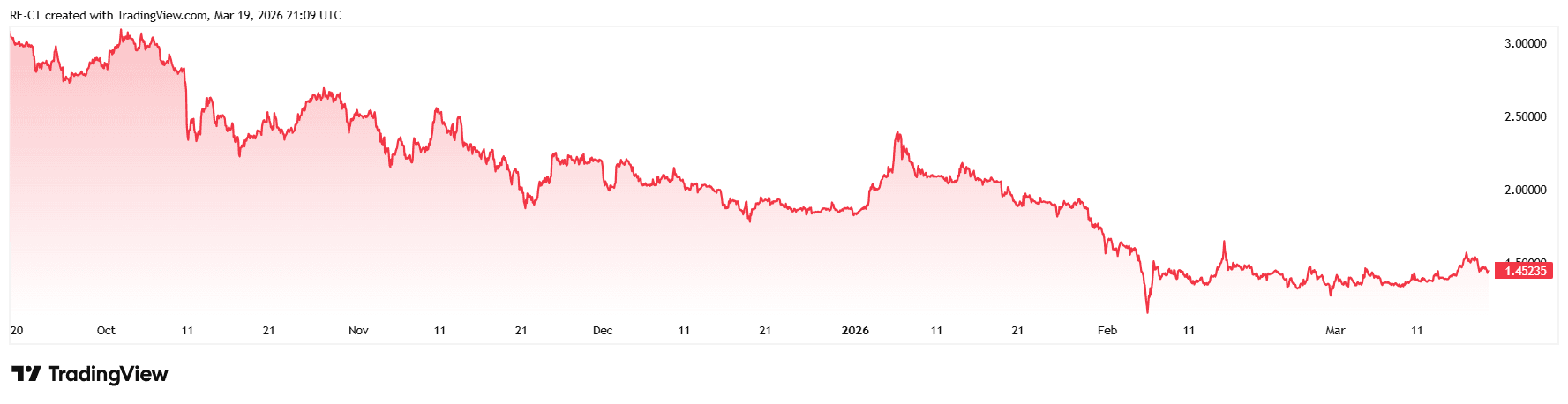
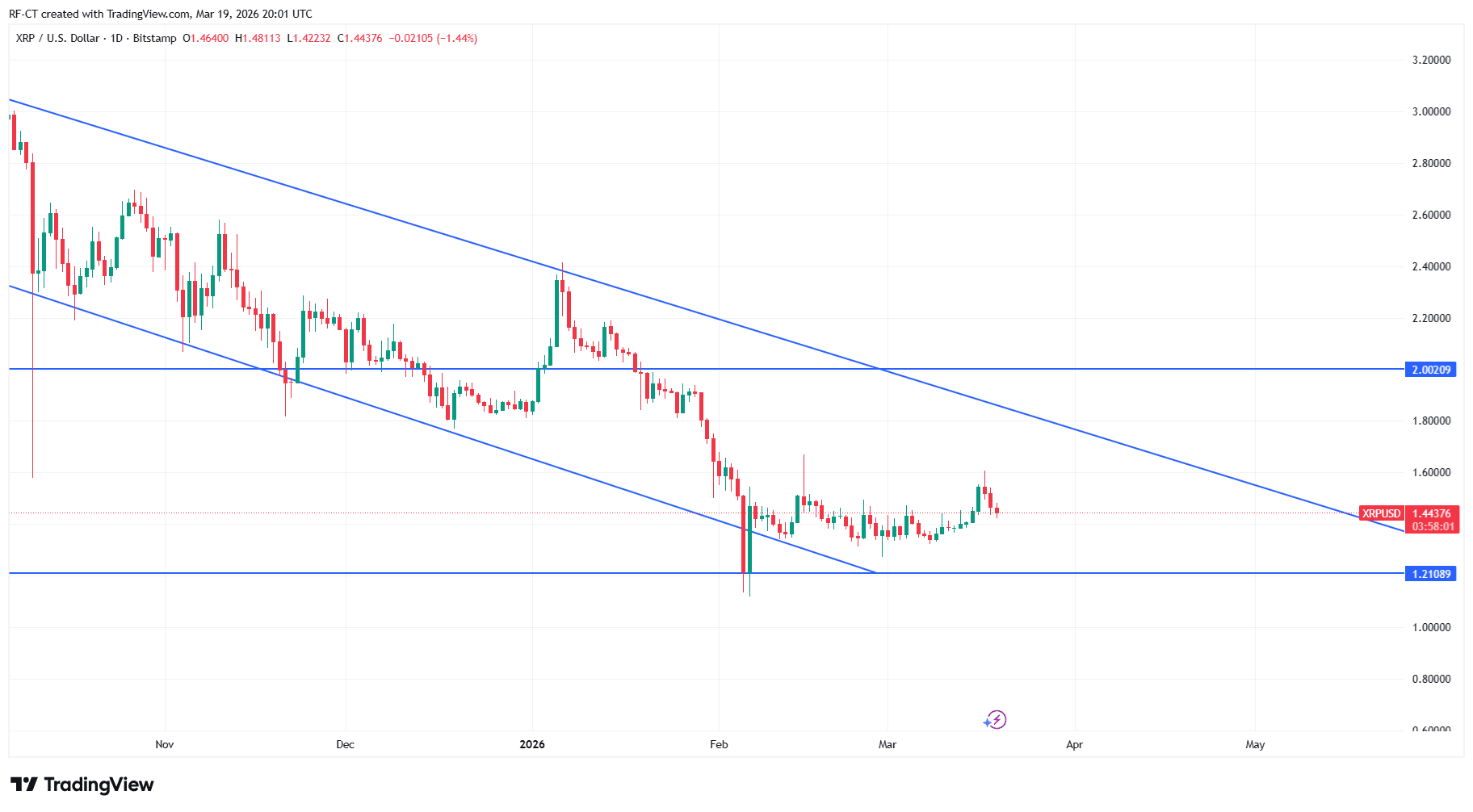
XRP is currently trading around $1.40–$1.44, struggling to gain momentum after weeks of consolidation. Despite a few short-term rebounds, the price remains under pressure and continues to follow a broader downtrend.
XRP has failed to reclaim higher levels and is now hovering below key resistance zones, with buyers showing limited strength.
XRP Price Analysis: Bearish Channel Still Dominates
The below chart clearly shows $XRP trading inside a descending channel, which is a classic bearish pattern.
Key observations:
- Lower highs confirm ongoing selling pressure
- Price remains below the mid-channel resistance
- Strong resistance sits around $1.60, then $2.00
- Support is holding near $1.20
Even recent upward moves have been weak and quickly rejected, suggesting that the market lacks strong bullish conviction.
👉 As long as XRP remains inside this channel, the trend is still bearish to neutral.
How Much Does XRP Need to Reach $2?
Let’s break it down:
- Current price ≈ $1.44
- Target price = $2.00
👉 Required move: +38.9% increase
This is a significant move — especially within a very short timeframe.
Can XRP Realistically Move +40% in 12 Days?
While crypto can be volatile, a move of nearly 40% in 12 days is unlikely under current conditions.
Here’s why:
1. Momentum Is Weak
XRP has been ranging between $1.35 and $1.50 with no strong breakout continuation.
2. No Strong Catalyst
Large moves typically require:
- Major legal developments
- Institutional adoption news
- Market-wide bullish momentum
None of these are currently driving XRP.
3. Market Structure Is Bearish
The descending channel suggests sellers still control the market.
Without a breakout, upside remains limited.
Historical Comparison: Has XRP Done This Before?
Yes — but under very different conditions.
XRP has previously delivered large double-digit gains in short periods, but these happened:
- During strong bull markets
- After major announcements (e.g., Ripple-related news)
- With significant volume spikes
👉 Current market conditions do not reflect that environment.
Most Likely Scenario for March 2026
Based on the chart:
- XRP is likely to remain within $1.20 – $1.60 range
- A break above $1.60 could signal early recovery
- A move to $2 would require a full trend reversal
That kind of shift typically takes more time than a few days.
Final Verdict: Can XRP Reach $2 This Month?
👉 Mostly unlikely
To reach $2 before the end of March 2026, XRP would need:
- Nearly 40% upside in days
- Strong breakout above resistance
- A sudden surge in market momentum
None of these signals are currently present.
Bitcoin news today is dominated by a sudden reversal in market sentiment. After a spectacular rally that saw the $Bitcoin price push toward the $76,000 resistance level earlier this week, the primary cryptocurrency has experienced a sharp correction. On Thursday, March 19, 2026, Bitcoin slipped below the psychologically significant $70,000 mark, trading as low as $69,400 during the European session.
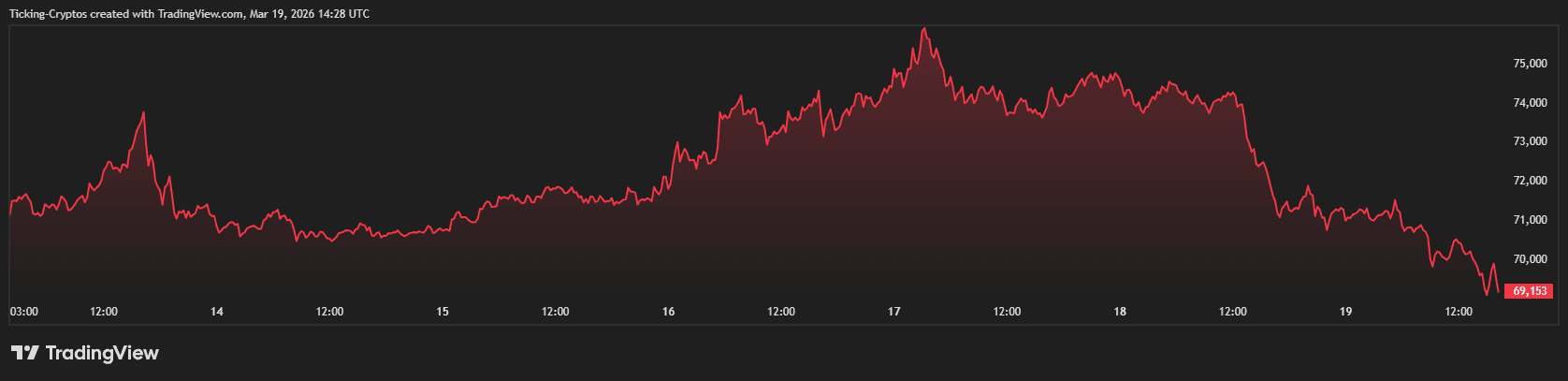
This downward move follows a period of intense optimism fueled by institutional ETF inflows and the SEC’s recent classification of 16 digital assets as commodities. However, the combination of a "hawkish hold" by the Federal Reserve and escalating geopolitical tensions in the Middle East has forced investors back into a defensive posture.
Why is Bitcoin Crashing?
The core reason for the Bitcoin price drop today is a "perfect storm" of macroeconomic factors. Specifically, the Federal Reserve’s decision to keep interest rates in the 3.50%–3.75% range, paired with a surge in global oil prices (Brent crude exceeding $114), has strengthened the US Dollar and dampened the appetite for "risk-on" assets like cryptocurrencies.
The "Hawkish Hold" and Risk Appetite
In financial terms, a "Hawkish Hold" occurs when a central bank keeps interest rates unchanged but uses rhetoric that suggests rates will stay higher for longer or could even rise.
For Bitcoin, this is a significant headwind. Because BTC is often viewed as a high-growth, speculative asset, its valuation is highly sensitive to liquidity. When the Fed signals that it is not ready to pivot to rate cuts, the "cost of carry" for holding Bitcoin remains high compared to "safe" yields like US Treasuries.
The Fed Effect: High Rates and Inflation Fears
The Federal Reserve's March meeting was the primary catalyst for the volatility seen in today's bitcoin news. While the market expected rates to remain steady, the updated "dot plot" and comments from Chair Paul Atkins (who took over the SEC and influenced broader policy) suggested that inflation remains a stubborn foe.
- Inflation Forecast: The Fed raised its 2026 PCE inflation outlook to 2.7%.
- Growth Outlook: Projected growth for 2026 was upgraded to 2.4%, giving the Fed more room to keep rates high without immediate fear of a recession.
- Market Reaction: The probability of an April rate cut has plummeted to near zero, with some traders now pricing in a 4% chance of a rate hike if energy costs continue to spiral.
Geopolitical Tensions: The Oil Factor
Beyond the Fed, the escalating conflict in the Middle East has sent shockwaves through the energy markets. Attacks on energy infrastructure have caused oil prices to spike, which historically leads to higher transport and production costs, further fueling inflation.
In previous cycles, Bitcoin was occasionally touted as "digital gold" or a safe haven. However, recent crypto news shows that in times of acute geopolitical stress, BTC often moves in lockstep with the Nasdaq-100, which also saw significant losses today. Investors are currently seeking the safety of the US Dollar and actual physical gold over digital assets.
Institutional Sentiment: ETF Inflows Turn to Outflows
A key pillar of the recent rally was the consistent demand from US-listed spot Bitcoin ETFs. According to data from CoinGlass, a seven-day streak of inflows—totaling over $1.1 billion—was snapped on Wednesday.
| Metric | Detail |
|---|---|
| Trend Change | 7-day inflow streak broken |
| Wednesday Outflow | ~$129 million |
| Key Support Level | $69,000 - $70,000 |
| Next Resistance | $74,500 |
From a technical perspective, Bitcoin's failure to reclaim the $76,000 level is a bearish signal in the short term. The price is currently testing the 100-hourly simple moving average. If the $69,000 support level fails to hold, analysts warn of a potential slide toward the $66,500 zone, which acted as a floor earlier in March.
As of March 19, 2026, the global financial markets are witnessing a rare and counter-intuitive phenomenon. Despite an escalation in the Middle East conflict—including strikes on critical energy infrastructure—both Gold (XAU/USD) and Bitcoin (BTC/USD) are trading in the red. Traditionally, these assets serve as the world’s primary "disaster hedges," yet they have both succumbed to a broader market sell-off following the Federal Reserve’s hawkish stance on Wednesday.
This "double drop" is not a sign that the safe-haven narrative is dead. Instead, it is a textbook example of a liquidity squeeze driven by a resurgent US Dollar and rising bond yields. As oil prices surge above $110 per barrel, the market is pricing in "sticky" inflation, forcing the Fed to keep interest rates high, which historically creates a temporary headwind for non-yielding assets like Gold and high-beta assets like Bitcoin.
Why are Gold and Bitcoin Falling Today?
The primary reason Gold and Bitcoin are dropping today is the Federal Reserve’s decision to hold interest rates at 3.5%–3.75% while signaling fewer rate cuts for the remainder of 2026. This move strengthened the US Dollar Index (DXY), making dollar-denominated assets more expensive. Furthermore, investors are selling "winning" positions in Gold and Bitcoin to cover margin calls in the plummeting equity and energy markets.
Gold Price Analysis: XAU/USD Rejects the $5,000 Milestone
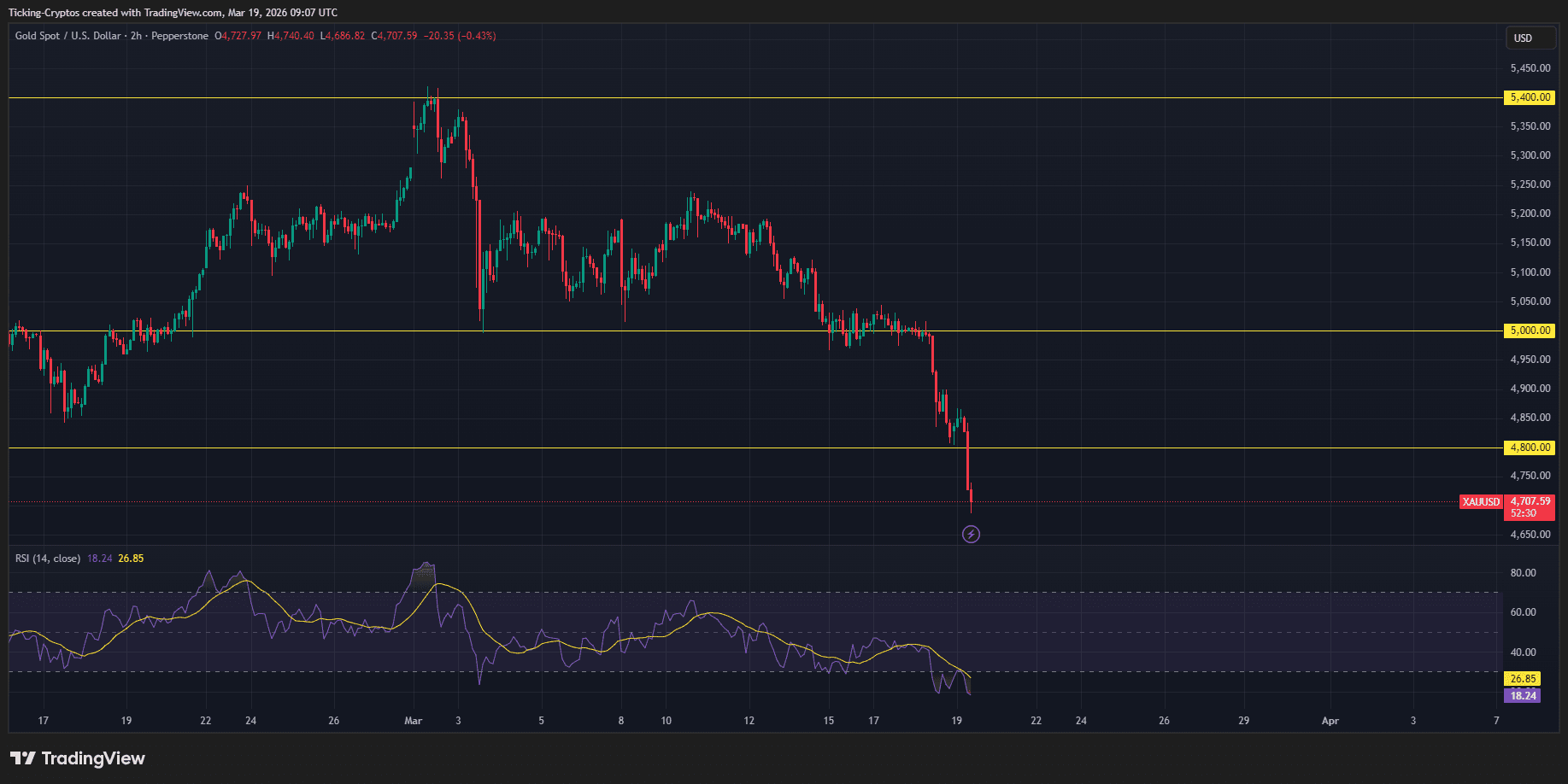
After flirting with the psychological resistance of $5,000 earlier this week, Gold has entered a sharp corrective phase. On the morning of March 19, spot gold slipped toward the $4,800 region, marking its most significant losing streak in over a year.
Critical Support and Resistance Levels
- Major Support: $4,840 – $4,750. This zone represents a historical "buy-the-dip" area for central banks.
- Major Resistance: $5,000. Reclaiming this level is essential for the bullish trend to resume.
The "Oil Shock" of 2026 has been a double-edged sword for Gold. While it fuels long-term inflation (bullish for Gold), it also increases the likelihood of a "higher-for-longer" interest rate environment (bearish for Gold). Currently, the market is prioritizing the interest rate risk over the inflation hedge.
Bitcoin Technical Analysis: Is $70,000 the New Floor?
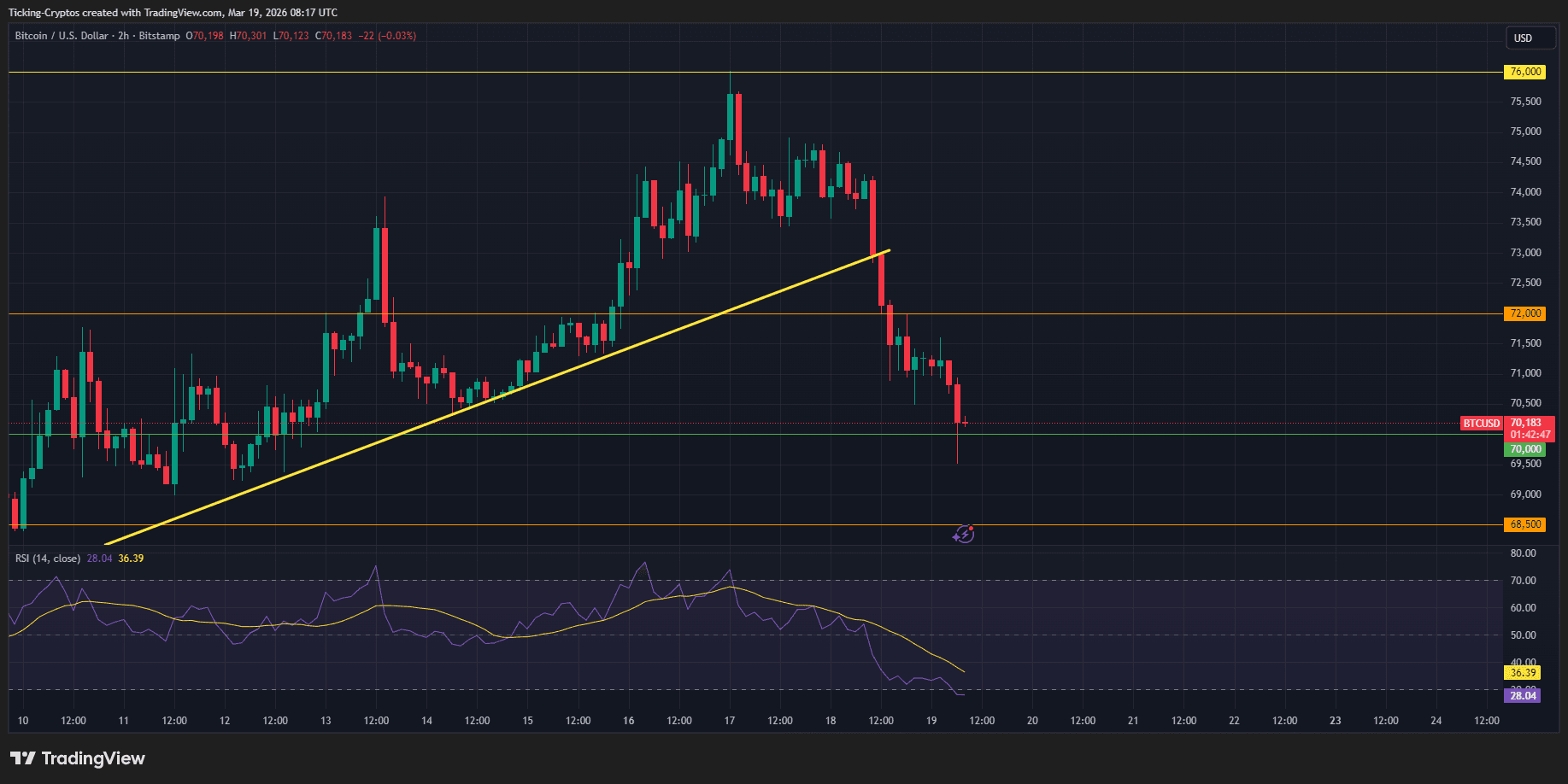
Bitcoin has shown relative resilience compared to the broader "Risk-On" sector, yet it was unable to sustain its push toward $76,000. On Thursday, $BTC dropped below $71,000, tracking the general weakness in global liquidity.
The "Digital Gold" Decoupling
Interestingly, the 2026 correlation between Gold and Bitcoin has shifted. According to recent data from Investing.com, Bitcoin is increasingly behaving as a "Global Liquidity Sponge." It thrives when money is cheap. With the Fed’s hawkish tone, Bitcoin is facing a temporary outflow. However, institutional demand via Bitcoin ETFs remains a structural floor that prevented a crash below $66,000.
- BTC Immediate Support: $70,200.
- BTC Resistance: $74,500.
The 2026 Correlation: Safe Havens vs. Liquidity Hedges
Traders often mistake Bitcoin and Gold for the same type of asset. In 2026, the distinction has become clear:
- Gold: A geopolitical "bunker" asset. It drops when the Dollar is strong but rises when sovereign trust fails.
- Bitcoin: A "technological" hedge. It performs best when the financial system seeks an alternative rail for 24/7 global liquidity.
| Asset | 24h Trend | Key Driver | Long-term Outlook |
|---|---|---|---|
| Gold (XAU) | Bearish | Fed Hawkishness / DXY Strength | Bullish (Target $5,500) |
| Bitcoin (BTC) | Neutral-Bearish | Liquidity Withdrawal / ETF Flows | Highly Bullish (Target $100k+) |
How to Navigate the Bitcoin and Gold Crash
For investors looking to capitalize on this volatility, diversification remains the key. While the short-term trend is downward, the macro fundamentals—high debt, war, and energy shortages—historically favor both assets.
- For Gold: Look for stability around the $4,800 mark.
- For Bitcoin: Utilize the best crypto exchanges to set limit orders near $68,500, which has acted as a strong institutional accumulation zone.
- Security: Ensure your assets are safe by using a hardware wallet during these high-volatility periods.
Bitcoin Future: The Path Ahead for March 2026
The "Great Decoupling" of 2026 is in full swing. Gold is fighting the weight of a high-interest-rate environment, while Bitcoin is consolidating its gains after a massive Q1 rally. Despite the current price drops, the geopolitical unrest in the Middle East suggests that the "safe haven" trade is merely resting, not retreating. Traders should keep a close eye on the US Dollar Index (DXY); a reversal there will likely trigger a massive "relief rally" for both XAU and BTC.
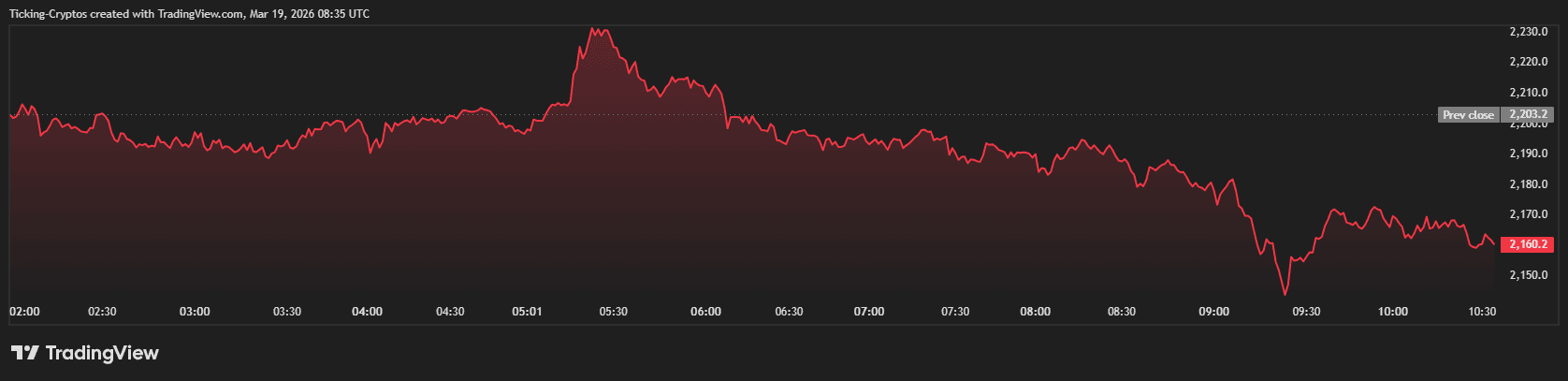
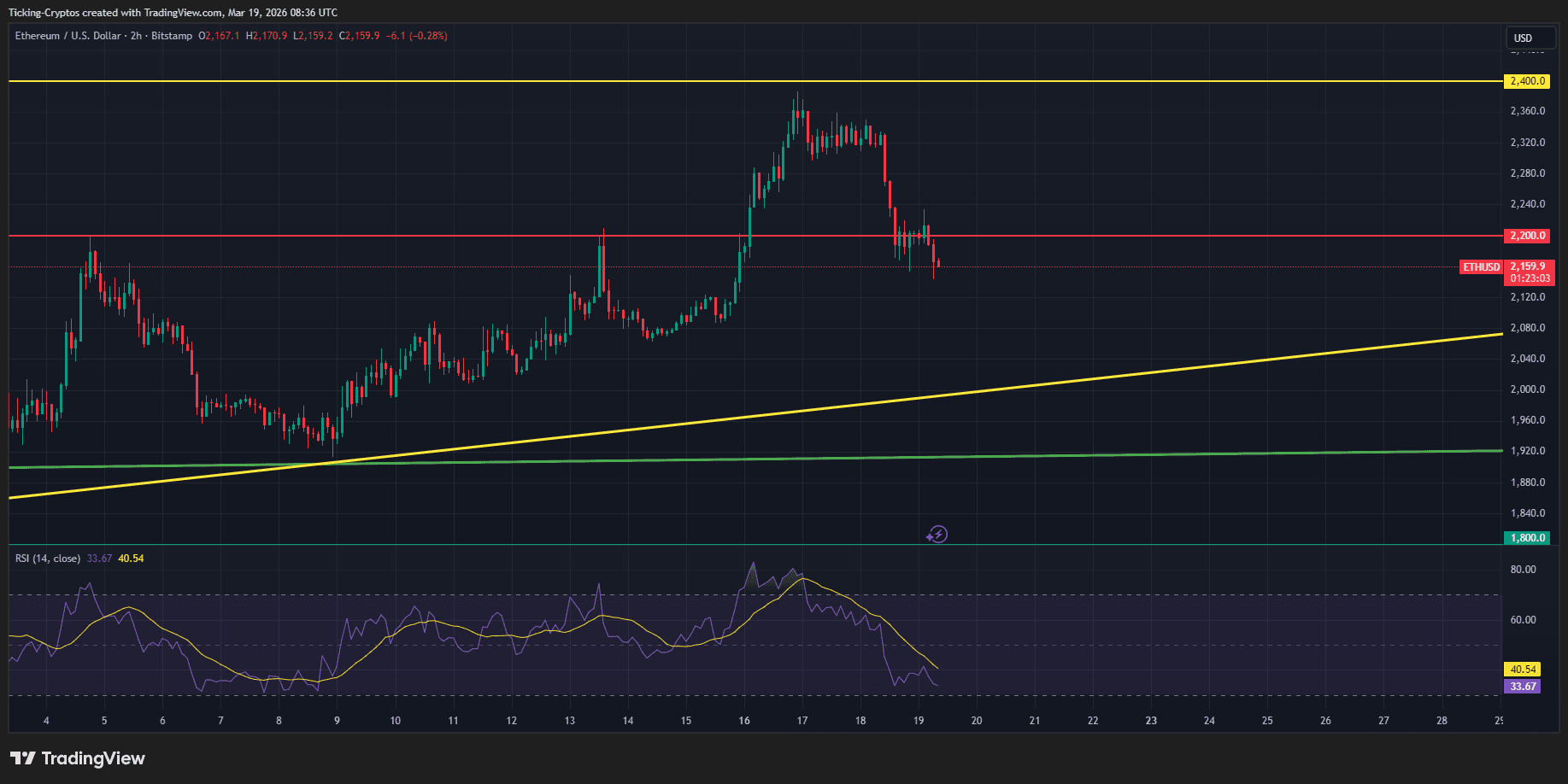
After a brief rally earlier this week, Ethereum ($ETH) is now testing the critical breakout-turned-support zone between $2,180 and $2,200.
This price action comes as a direct response to three simultaneous global shocks: a major military escalation in the Middle East, a hotter-than-expected US inflation report, and a stern warning from Federal Reserve Chair Jerome Powell. For ETH bulls, the mandate is clear: hold the $2,200 line or risk a deep correction toward the psychological support of $1,900.
Ethereum Analysis: Why Are Cryptos Crashing
The sudden reversal in risk appetite isn't just a technical correction; it is a fundamental shift driven by three massive catalysts.
1. Middle East Conflict Hits Global Energy
Geopolitical tensions reached a breaking point today following reports that Israel targeted Iran’s South Pars gas facility, the world’s largest gas field. In immediate retaliation, Iranian strikes reportedly caused extensive damage to Qatari LNG infrastructure at Ras Laffan.
This "energy war" sent crude oil prices soaring toward $99 per barrel almost instantly. For Ethereum and the broader crypto market, rising energy costs act as a double-edged sword: they increase the cost of living (reducing retail liquidity) and fuel long-term inflation fears.
2. PPI Data: The Inflation Pipeline is Refilling
Adding fuel to the fire, the Producer Price Index (PPI) for February 2026 came in significantly hotter than anticipated at 3.4% year-on-year. This suggests that wholesale inflation is accelerating even before the full impact of the recent oil price surge hits the data.
When "factory gate" prices rise, they inevitably trickle down to consumers, making the path to the Fed’s 2% target look increasingly impossible.
3. Powell’s Hawkish Pivot
Federal Reserve Chair Jerome Powell held interest rates steady at 3.5%–3.75% today, but it was his tone that rattled the cages. For the first time in the Fed's history, the committee explicitly acknowledged the Middle East situation as a primary economic risk.
Powell’s refusal to commit to a timeline for rate cuts, combined with the acknowledgment of "uncertain" implications for the US economy, led markets to price out a summer pivot.
Ethereum Price Analysis: Will Ethereum Price Recover?
Despite the macro negativity, Ethereum's chart shows a technical battle that is currently being fought at the "Line in the Sand."
Critical Support at $2,180–$2,200
As seen in recent trading data, Ethereum has retraced to its previous breakout zone. This area was formerly a heavy resistance level throughout early 2026. In technical analysis, a successful "retest" of this zone as support would be a massive bullish signal.
- The Bull Case: If ETH closes the daily candle above $2,200, it confirms that buyers are still defending the trend despite the macro noise. This could lead to a relief rally back toward $2,320.
- The Bear Case: A breakdown below $2,180 would invalidate the recent recovery. Given the lack of intermediate liquidity, the next major "safety net" sits at $1,900.
Market Sentiment and Correlation
Ethereum’s correlation with the S&P 500 and Bitcoin remains high. With the US dollar index (DXY) strengthening on the back of safe-haven flows, ETH faces significant selling pressure. Investors looking to hedge against this volatility often turn to hardware wallets to secure their assets during periods of extreme exchange uncertainty.
Ethereum Prediction: What to Watch Next
The next 48 hours are crucial for the ETH/USD pair. Investors should monitor:
- Oil Price Stability: If oil breaks $105, expect further downside in equities and crypto.
- The $2,180 Closing Price: A daily close below this level often triggers stop-loss cascades.
- Strait of Hormuz Developments: Any further disruption to global trade will likely keep the crypto market in a defensive crouch.
Bitcoin Price Crash: Crypto Market Faces a Sudden Reversal
The cryptocurrency market has entered a period of intense volatility today, March 18, 2026, with Bitcoin ($BTC) tumbling from its recent highs near $76,000 to the $72,000 range. This sudden "sea of red" has caught many retail traders off guard, especially following the bullish momentum seen earlier this week.
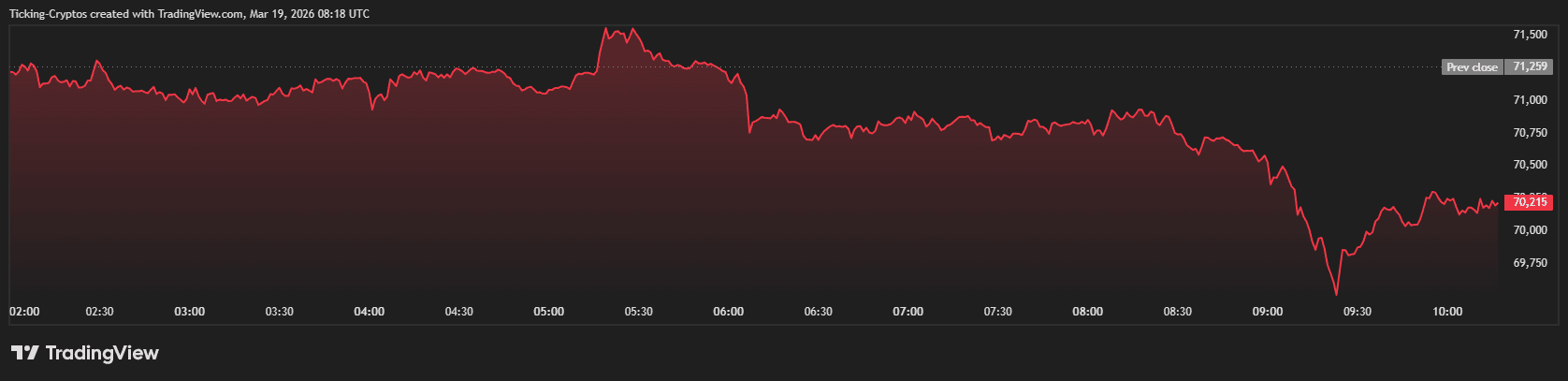
While the digital asset space often moves independently, today’s crash is a direct result of a "perfect storm" involving geopolitical escalations, disappointing US inflation data, and a necessary technical cooling period.
1. Middle East Escalation: Energy Infrastructure Under Attack
The primary driver of the "risk-off" sentiment across global markets is the dramatic escalation in the Middle East. Following Israeli strikes on Iran’s South Pars gas field—the world’s largest natural gas reserve—Tehran has officially declared its intent to retaliate against Gulf energy sites.
Key Geopolitical Developments:
- Target List: Iran’s Revolutionary Guards have identified key infrastructure in Saudi Arabia, the UAE, and Qatar as potential targets.
- Energy Disruption: Iraq has already reported a total halt of gas supplies from Iran, leading to a loss of approximately 3,100 megawatts of power.
- Oil Prices Surge: Brent crude has spiked toward $110 a barrel, fueling fears of global stagflation.
In times of war and energy insecurity, investors typically flee "risk assets" like cryptocurrencies in favor of "safe havens" like gold or the US Dollar. This flight to safety is putting massive downward pressure on the $Bitcoin price.
2. US Core PPI Hits 3.9%: Inflation Remains "Sticky"
Macroeconomic data released today has further dampened hopes for a dovish pivot from the Federal Reserve. The US Core Producer Price Index (PPI), which excludes volatile food and energy costs, came in at 3.9% year-over-year.
This figure significantly overshot market expectations of 3.7%. For crypto investors, this is a bearish signal because:
- Higher for Longer: Hotter-than-expected wholesale inflation suggests the Fed will keep interest rates elevated to cool the economy.
- Yield Pressure: Treasury yields have climbed following the report, making non-yielding assets like Bitcoin less attractive to institutional players.
- Liquidity Crunch: High interest rates reduce the "cheap money" that typically flows into speculative markets.
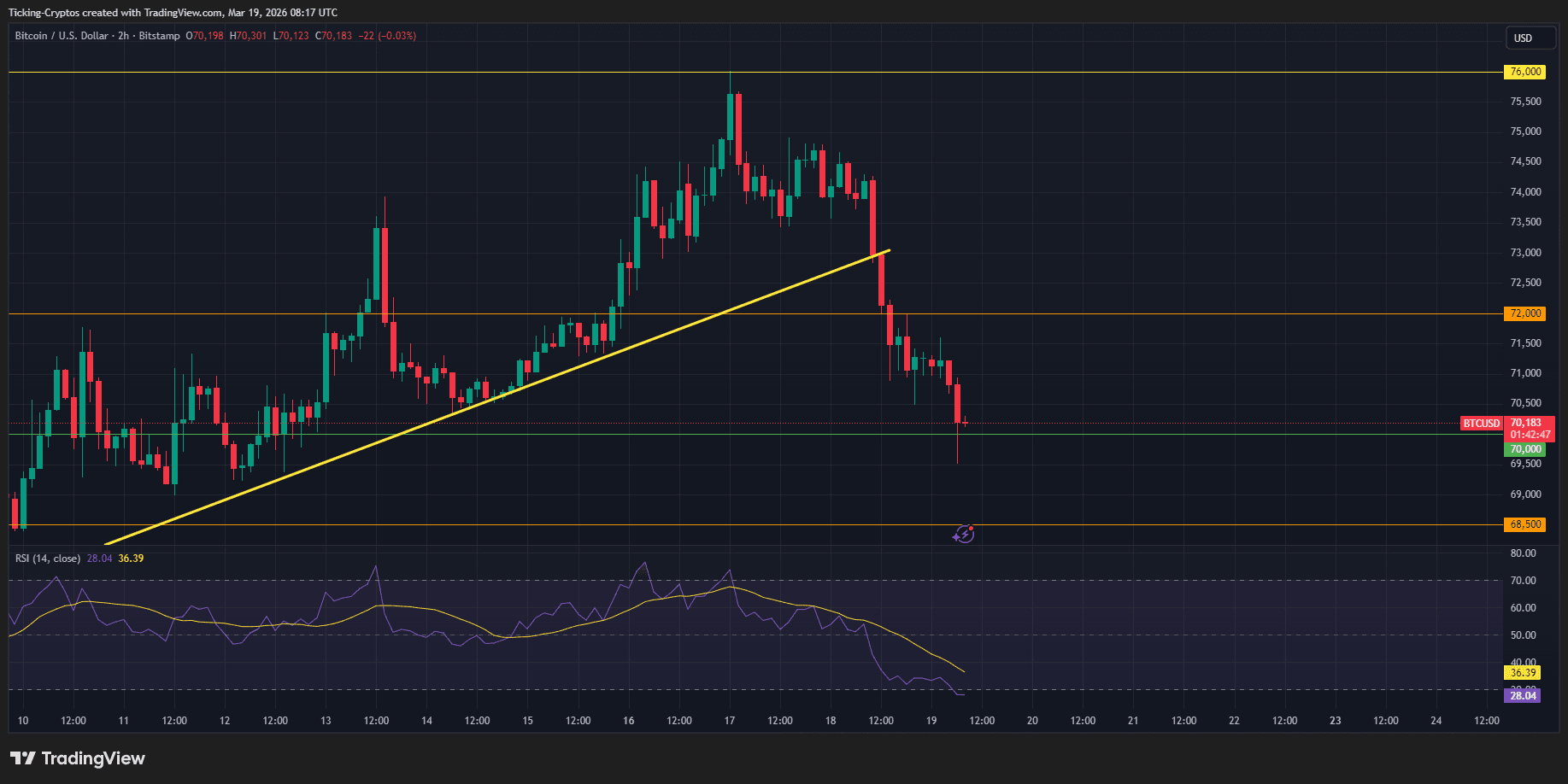
3. Technical Adjustment: The $76,000 Rejection
From a purely technical perspective, many analysts argue that a correction was overdue. Bitcoin recently hit a peak of $76,000, a level that acted as a psychological and technical glass ceiling.
The "Overheated" Market
Leading up to today’s drop, several on-chain indicators suggested the market was "overextended." Funding rates in the derivatives market had reached unsustainable levels, meaning long-positioned traders were paying high premiums to keep their bets open.
When the news of the Iranian retaliation broke, it triggered a "long squeeze," forcing leveraged traders to liquidate their positions. This mechanical selling accelerated the drop, pushing BTC toward its immediate support levels.
What’s Next for Bitcoin and Altcoins?
The market is currently looking for a floor. While the $72,000 level is providing some initial support, the upcoming Federal Reserve meeting will be the next major catalyst. If the Fed adopts a hawkish tone due to the PPI data and rising energy costs, we could see further testing of the $68,000–$70,000 zone.
Decrypt
A crypto kiosk bill in Kentucky includes language that could effectively outlaw self-custody, drawing industry backlash.
The deal would help scale capacity as AWS builds its own chips, revealing deeper reliance on Nvidia’s stack as usage keeps growing.
Higher fuel costs and restrictive financial conditions are absorbing consumer liquidity, helping explain why expanding global money supply has yet to translate into gains for Bitcoin.
Investors focused on a shift toward steadier revenue streams and a push into prediction markets, even as trading volumes declined.
Microsoft's AI image generator offers impressive realism and text rendering, but strict content limits and 1:1-only output hold it back.
U.Today - IT, AI and Fintech Daily News for You Today
Gemini Space Station, the cryptocurrency exchange founded by Tyler and Cameron Winklevoss, has slashed its headcount by 30% following a disastrous $585 million annual net loss.
Market is certainly backpedaling right now as multiple key resistances turned out to be tougher to break than initially expected.
A controversial, last-minute amendment to a Kentucky regulatory bill could effectively ban self-custodial cryptocurrency wallets in the state by mandating a technological impossibility: seed phrase recovery backdoors for hardware wallets.
The Federal Reserve has officially opened the door to a landmark revision of the Basel III capital rules, potentially stripping Bitcoin of its "toxic asset" status and enabling traditional banks to hold the digital asset on their balance sheets.
Cardano intra-era hard fork to protocol 11 version, van Rossem, is now approaching, with a key node release expected in a matter of days.
Blockonomi
Key Takeaways
- Cardano’s price declined 1.86% over 24 hours, currently trading around $0.267 within the $0.26–$0.27 support zone
- Joint regulatory guidance from the SEC and CFTC provides clarity on crypto asset classification, including commodities and securities
- The Protocol 11 (van Rossem) hard fork approaches as Node 10.7.0 prerelease readies for deployment
- Bearish momentum persists; bulls must break above $0.28 resistance to challenge $0.29–$0.30 levels
- Technical analyst @alicharts identified a TD Sequential buy signal on weekly timeframes, projecting potential moves to $0.32 and $0.37
Cardano (ADA) currently hovers around $0.267, reflecting a 1.86% decline in the last 24-hour period. The digital asset maintains position within a consolidation range spanning $0.26 to $0.27.
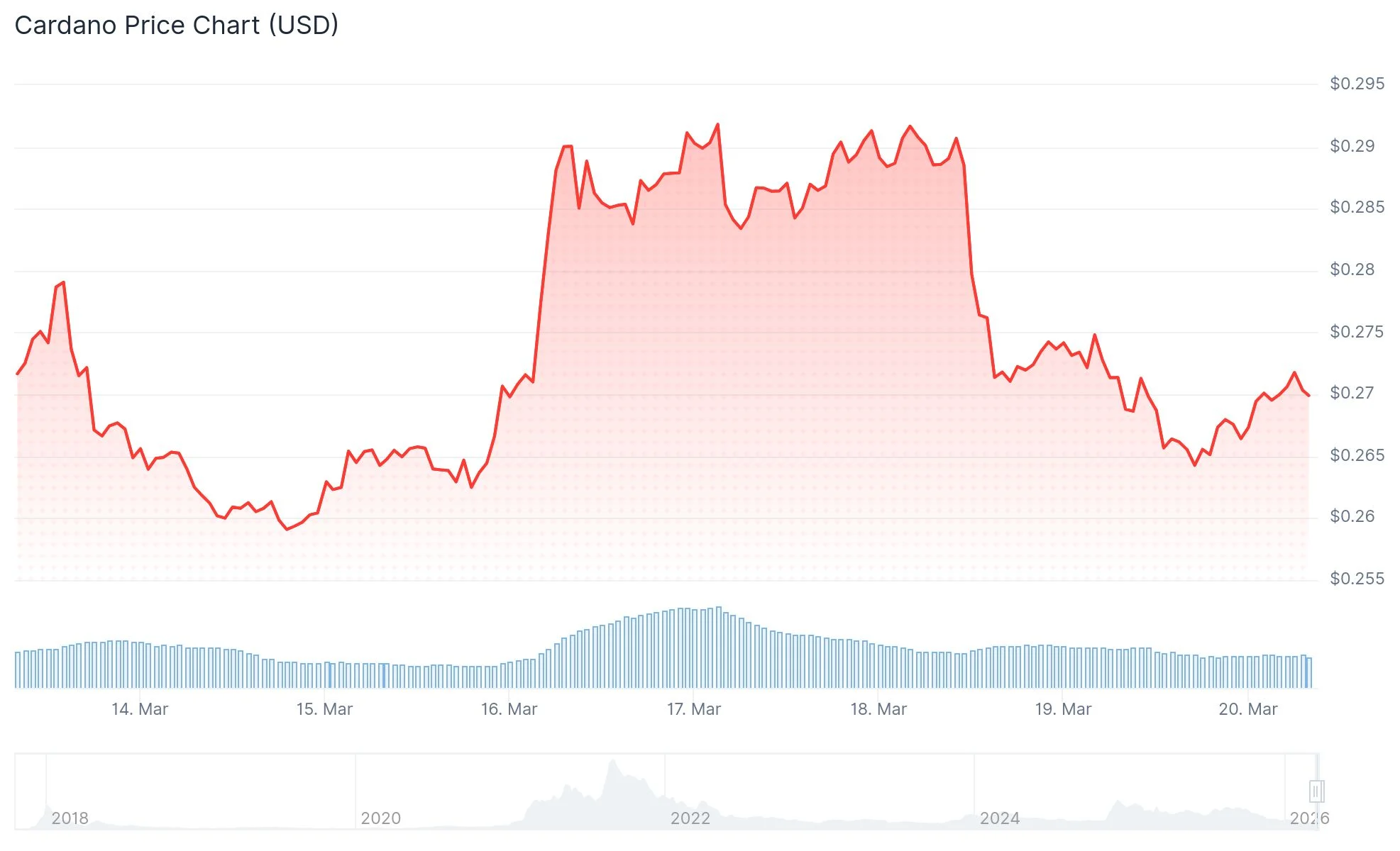
The wider cryptocurrency landscape experienced similar downward pressure throughout this timeframe. The aggregate global crypto market capitalization decreased 1.26%, settling at $2.41 trillion.
Escalating geopolitical tensions across Middle Eastern regions contributed to surging crude oil valuations. These developments reignited inflationary fears and prompted widespread selling across risk-oriented assets, including digital currencies.
Bitcoin maintained its position above the $70,000 threshold despite modest daily losses. Ethereum preserved support above $2,100 while XRP remained anchored above $1.40.
Examining the four-hour timeframe reveals that ADA bears reasserted dominance following an unsuccessful attempt to breach recent peak levels. The MACD histogram displays red bars positioned beneath the signal line, while the RSI indicator rests below the 50 midpoint, suggesting near-term bearish pressure.
For bullish traders to regain momentum, ADA must successfully recapture the $0.28 resistance level. A decisive move beyond this threshold could unlock pathways toward $0.29, followed by $0.30.
Market analyst Ali Charts shared observations on X, highlighting that Cardano has formed a TD Sequential “black 9” buy signal across weekly charts. The analyst indicated this technical pattern “typically anticipates 1–4 weeks of upward expansion,” establishing price objectives at $0.32 and $0.37, contingent upon ADA maintaining $0.23 support on weekly closing prices.
https://twitter.com/alicharts/status/2034859227110351302?s=20
Regulatory Agencies Issue Unified Crypto Framework
The United States Securities and Exchange Commission, alongside the Commodity Futures Trading Commission, published collaborative guidance addressing crypto asset categorization. The regulatory bodies delineated distinct classifications encompassing digital commodities, collectibles, stablecoins, and digital securities.
The framework further clarifies circumstances under which tokens qualify as investment contracts and conditions enabling that designation to expire. The CFTC acknowledged that certain non-security tokens may meet commodity classification criteria. Market observers suggest enhanced regulatory transparency could influence ADA’s investor sentiment and future exchange-traded fund conversations.
Network Upgrade Advances Toward Mainnet Deployment
Cardano progresses toward its subsequent network enhancement. The intra-era hard fork implementing Protocol 11, designated as van Rossem, anticipates activation within the forthcoming days.
https://twitter.com/IntersectMBO/status/2034598520892571701?s=20
The upgrade necessitates two sequential node releases. Node 10.6.2 deployed in February. Node 10.7.0 represents the concluding requirement before the hard fork can execute.
Intersect, a membership-driven organization within the Cardano ecosystem, verified that the Node 10.7.0 prerelease is anticipated imminently.
Protocol 11 introduces additional Plutus built-in functions through multiple Cardano Improvement Proposals. These enhancements incorporate an array type (CIP-138), refined MaryEraValue processing (CIP-153), modular exponentiation capabilities (CIP-109), and multi-scalar multiplication supporting advanced cryptographic operations (CIP-133).
The upgrade preserves existing transaction architecture without disrupting deployed smart contracts. Hardware wallet functionality remains unaffected. SanchoNet currently operates these capabilities in testing environments.
Mainnet activation will proceed following successful testnet fork completion.
The post Cardano (ADA) Price Eyes Breakout After Weekly Buy Signal Emerges appeared first on Blockonomi.
TLDR:
- Iran’s IRGC charges up to $2M per tanker transit, accepting cash, crypto, or barter as payment.
- Between March 1–15, roughly 89–90 vessels cleared the strait under some form of IRGC approval.
- Total transit costs now exceed what moving an entire fleet through Hormuz cost six months ago.
- Sanctioning paying operators risks halting the only active oil supply channel through the strait.
The Strait of Hormuz has become a commercial toll point following reports of Iran’s IRGC charging tanker operators up to $2 million per passage.
The Financial Times confirmed the arrangement, with the IRGC verifying clearances over VHF radio. Between March 1 and March 15, roughly 89 to 90 vessels transited under some form of IRGC clearance, according to Lloyd’s List Intelligence.
Payments are made in cash, cryptocurrency, or through barter, and the commercial precedent is now firmly established.
How the IRGC Toll Mechanism Operates at the Strait of Hormuz
The process begins when a tanker operator contacts intermediaries linked to the IRGC. Negotiations follow, and a fee of up to $2 million per voyage is agreed. Payment is accepted in cash, cryptocurrency, or through barter. The vessel then receives clearance to proceed.
The IRGC hails the tanker on VHF radio to verify its AIS transponder data. After confirmation, the ship is granted passage through the strait.
Not all 89 to 90 vessels paid the toll between March 1 and March 15. Iranian and allied ships, along with some Indian tankers, received passage through separate government-to-government arrangements.
Analyst Shanaka Anslem Perera shared key details on X about the toll arrangement. He described how intermediaries negotiate with the IRGC and confirmed that payments are made in cash or crypto.
At least one operator paid the toll explicitly, his post confirmed. That single transaction set a benchmark the broader market now faces.
The $2 million toll adds to soaring war-risk insurance costs. A VLCC worth $120 million pays between $3.6 million and $6 million in war-risk premiums per voyage.
Charter rates have also quadrupled, reaching up to $800,000 per day. Moving one crude cargo now costs more than an entire fleet transit did six months ago.
Cost Flows to Consumers as the Strait of Hormuz Becomes Self-Financing
Every dollar added at the strait eventually reaches end consumers. The toll raises prices for crude, LNG, urea, and pharmaceuticals.
The $2 million is not a cost confined to the shipping industry. Billions of people downstream absorb it through higher commodity prices.
The IRGC appears to have created a self-sustaining revenue loop through the closure. The blockade generated scarcity, and that scarcity pushed operators to pay for passage.
Those payments reportedly fund the same provincial commands that enforced the initial closure. The mechanism sustains itself without any external financing.
The United States is likely to frame these toll payments as state-sponsored terrorism financing. Expected responses include sanctions on paying operators and expanded designations on intermediaries.
A naval escort pledge involving six allied nations is also set to accelerate. However, enforcement carries a direct contradiction in practice.
Sanctioning every paying operator removes the only vessels currently moving oil through the strait. The toll, though extortion, remains the only active supply channel in the region.
Iran has reopened the Strait of Hormuz selectively, on its own terms and at its own price. The boundary between a military operation and a protection racket has effectively collapsed.
The post Iran’s IRGC Turns Strait of Hormuz Into a $2 Million Toll Road for Global Tanker Traffic appeared first on Blockonomi.
Quick Overview
- A tokenized version of the Coinbase Bitcoin Yield Fund has been introduced on the Base blockchain through a collaboration between Coinbase Asset Management and Apex Group.
- The investment vehicle aims to deliver 4% to 8% yearly returns denominated in Bitcoin through options strategies and lending activities.
- Apex Group functions as the blockchain-based transfer agent, managing compliance protocols and ownership documentation.
- The fund utilizes the ERC-3643 token framework, which integrates investor verification requirements directly within each digital token.
- Access is presently limited to institutional and accredited investors outside the United States, with domestic availability expected in the future.
Coinbase Asset Management (CBAM) has partnered with financial services provider Apex Group to introduce a tokenized share class of its Bitcoin Yield Fund, deploying it on Base, the Ethereum Layer-2 network developed by Coinbase.
https://twitter.com/BSCNews/status/2034729035117600807?s=20
Apex Group, which manages approximately $3.5 trillion in assets under administration, takes on the role of on-chain transfer agent. This responsibility includes maintaining digital ownership records, implementing regulatory compliance protocols, and recording all transactions natively on the Base blockchain infrastructure.
The investment strategy seeks to generate between 4% and 8% in annual Bitcoin-denominated returns. The fund achieves this through various mechanisms, including the sale of covered call options on Bitcoin holdings and engagement in strategic lending programs.
Coinbase initially introduced the international version of this yield fund in April 2025, followed by a domestic offering in October 2025. The blockchain-native tokenized share class has now been activated exclusively for investors based outside the United States.
Brett Tejpaul, who leads Coinbase Institutional, noted that numerous institutional market participants maintain significant Bitcoin and Ether allocations as foundational portfolio holdings. This yield-generating product provides these investors with an opportunity to earn incremental returns during periods when they’re holding assets for price appreciation.
Understanding the Compliance Framework
The tokenized offering leverages the ERC-3643 permissioned token protocol. This technical standard incorporates investor verification and eligibility validation mechanisms directly within the token’s code structure.
Wallets that haven’t completed the required onboarding and verification procedures will find transfer transactions automatically rejected by the smart contract. This approach eliminates the need for manual compliance oversight by encoding regulatory requirements into the token architecture itself.
Anthony Bassili, president of Coinbase Asset Management, explained that the infrastructure validates “identity and eligibility at the token level.” Currently, only qualified institutional and accredited investors located outside U.S. jurisdiction can participate in the offering.
Coinbase has indicated intentions to release a tokenized iteration of its domestic fund, though no timeline has been publicly disclosed.
Apex’s Broader Blockchain Strategy
Apex completed its acquisition of Tokeny in the previous year. Prior to the transaction, Tokeny had enabled the tokenization of assets exceeding $32 billion in total value.
The company has publicly committed to tokenizing $100 billion worth of investment funds through its T-REX Ledger platform by June 2027. This infrastructure is engineered to facilitate ownership management and regulatory compliance across multiple blockchain networks.
This product launch positions Coinbase among an expanding group of prominent asset management firms deploying tokenized investment vehicles. Industry leaders including BlackRock, Fidelity, and Franklin Templeton have all rolled out comparable blockchain-based offerings in recent years.
Projections for the tokenized asset sector show considerable variation. McKinsey’s analysis forecasts the market reaching $2 trillion by 2030, while collaborative research from BCG and Ripple suggests the industry could grow to $18.9 trillion by 2033.
According to Apex, the tokenized share class is “set up to interact with compatible platforms, wallets, and infrastructure without compromising compliance.”
The blockchain-based share class of the fund became operational on Base as of March 19, 2025.
The post Coinbase Partners with Apex to Bring Bitcoin Yield On-Chain via Base Blockchain appeared first on Blockonomi.
Key Highlights
- Solana’s SOL token plummeted 11% over a three-day period, declining from $97.70 to $87 and triggering $25 million in liquidations.
- Perpetual futures funding rates for SOL have reached 0%, indicating minimal bullish interest in leveraged trading.
- DApp revenue on the Solana network plunged to $22 million, marking an 18-month low from $36 million recorded eight weeks earlier.
- Specialized derivative platforms like Hyperliquid now dominate with over 80% of perpetual futures trading volume.
- Corporate SOL holders including Forward Industries and DeFi Development Corp. are experiencing losses on their treasury positions.
The Solana ecosystem has encountered significant headwinds this week. Following a peak of $97.70 earlier this week, the SOL token experienced an 11% correction over 72 hours, bottoming out at $87. This sharp decline resulted in $25 million worth of long position liquidations, dampening market sentiment among traders.
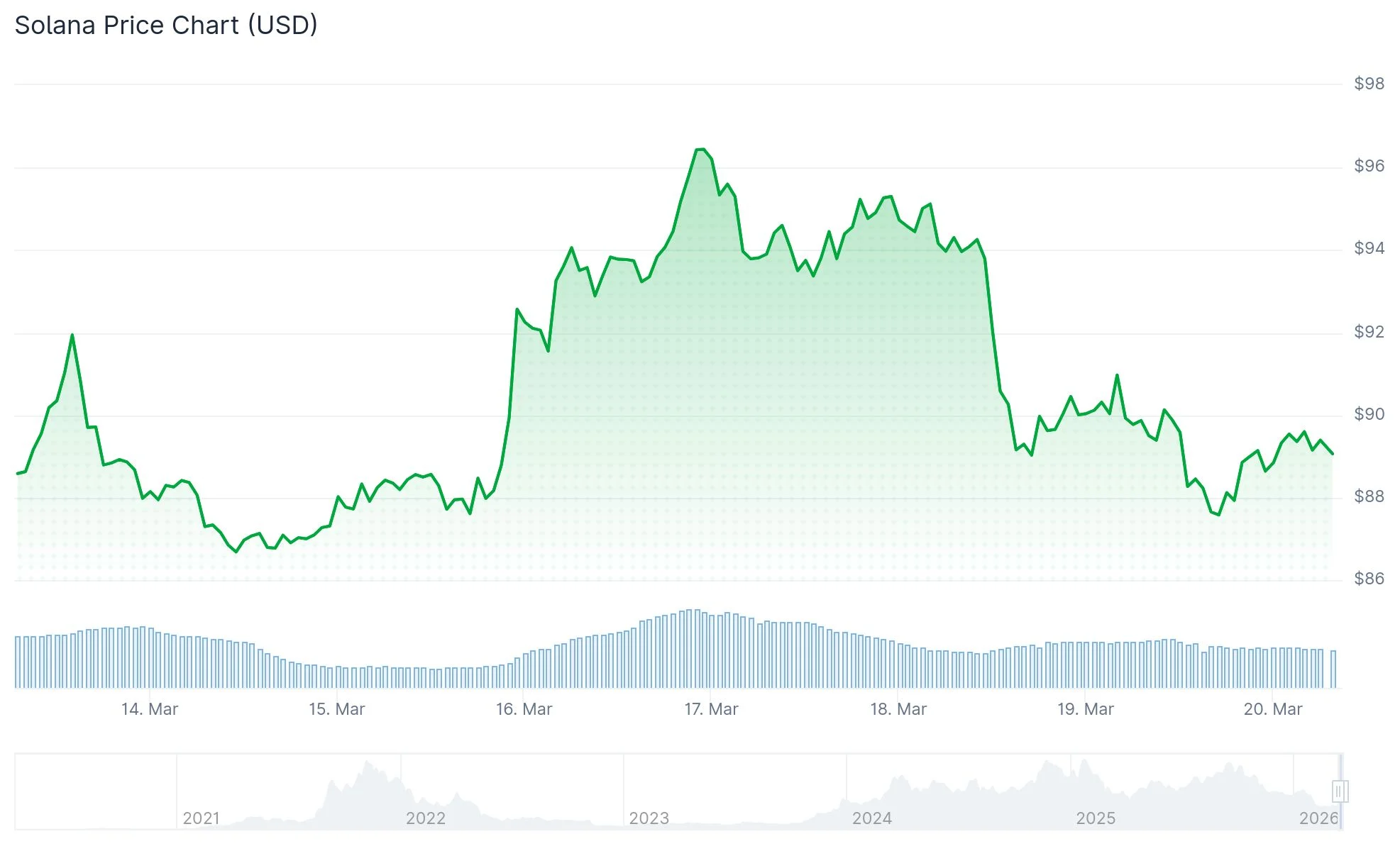
The futures market signals are equally concerning. Funding rates for SOL perpetual futures contracts have collapsed to approximately 0%, indicating a complete absence of bullish appetite for leveraged long positions. Typically, these rates maintain levels around 9% when market participants exhibit optimistic positioning. For the past 30 days, bearish traders have dominated the derivatives landscape.
The options market reflects similar pessimism. Deribit’s 30-day delta skew metric surged to 12% this Thursday, suggesting that put options—which generate profits from declining prices—command higher premiums than call options. This premium structure reveals that sophisticated market participants and institutional traders are positioning defensively against additional downside, despite SOL already trading 70% beneath its record high.
Network Revenue Decline Compounds Market Weakness
The revenue generated by Solana’s decentralized applications has contracted to an 18-month nadir of $22 million. This represents a significant decline from the $36 million recorded merely two months prior. While this deterioration isn’t exclusive to Solana—BNB Chain witnessed a 52% revenue contraction during the same timeframe—it underscores widespread weakness in blockchain network activity.
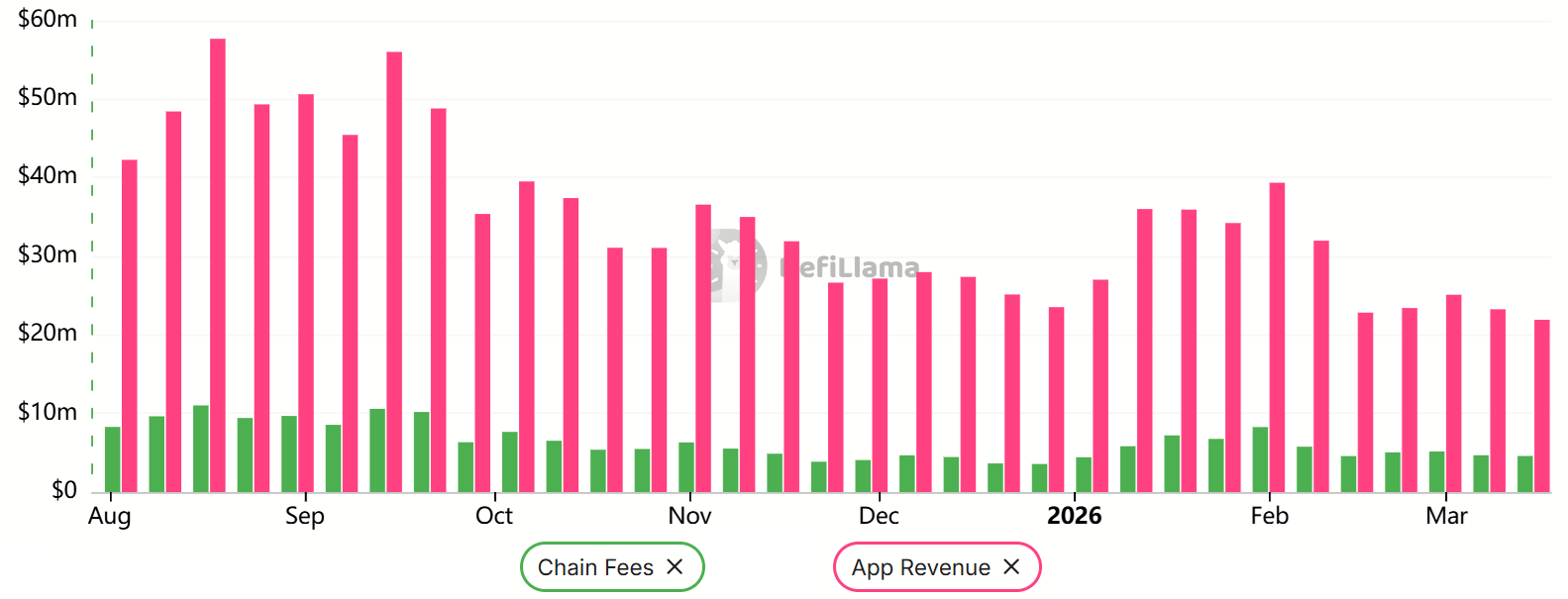
Solana maintains its position as the leading blockchain for decentralized exchange activity, powered by platforms such as Pump, Raydium, and Orca. However, the derivatives trading landscape tells a different narrative. Purpose-built derivative chains—including Hyperliquid, Edgex, Zklighter, and Aster—have captured more than 80% of the perpetual contract trading market.
The introduction of an officially sanctioned S&P 500 Index perpetual futures product on Hyperliquid, created by Trade[XYZ], has further diverted liquidity and trader attention from Solana-based protocols. The tokenized equities sector is now approaching $1.1 billion in aggregate assets.
Technical Analysis Shows Bearish Pattern Formation
From a technical perspective, market analysts have identified a bearish fractal developing on Solana’s price chart. Analyst Elja highlighted that the current price action bears striking resemblance to a January 2026 pattern where SOL rallied into resistance zones before experiencing a sharp reversal. Both instances feature similar characteristics: upward movement into resistance following a decline, followed by rapid momentum loss.
https://twitter.com/Eljaboom/status/2034310769488416909?s=20
With a market capitalization of $51 billion, SOL trades at a 42% discount relative to BNB’s $88 billion valuation. Nevertheless, Solana demonstrates superior fundamentals in certain metrics—generating $20.8 million in 30-day network fees compared to BNB Chain’s $9.1 million, while maintaining a total value locked (TVL) of $6.9 billion versus BNB Chain’s $5.7 billion.
Corporate entities such as Forward Industries and DeFi Development Corp., which incorporated SOL into their balance sheet strategies, are presently facing unrealized losses on these holdings.
The post Solana (SOL) Tumbles 11% Amid Plunging DApp Revenue and Zero Funding Rates appeared first on Blockonomi.
Key Takeaways
- Kalshi’s emergency motion to halt Nevada enforcement action was rejected by the Ninth Circuit Appeals Court
- The platform faces a likely temporary restraining order that would suspend Nevada operations for a minimum of 14 days
- Nevada regulators issued a cease-and-desist order in March, claiming Kalshi operates unlicensed sports wagering
- The platform maintains its products are federally regulated by the CFTC, not subject to state gambling laws
- Multiple states including Connecticut, New York, and New Jersey are pursuing parallel enforcement actions against Kalshi and competing platforms
The Ninth Circuit Appeals Court has rejected Kalshi’s urgent petition to prevent Nevada from pursuing enforcement action against the platform’s sports-event trading products. This decision opens the door for state authorities to move forward with regulatory measures.
https://twitter.com/coinbureau/status/2024026094609768527?s=20
Back in March, Nevada’s Gaming Control Board delivered a cease-and-desist notice to Kalshi. State regulators contend that the platform’s sports-event trading products constitute illegal sports wagering operations without proper licensing.
According to gaming attorney Daniel Wallach, a temporary restraining order appears virtually certain at this point. Because Nevada statute prohibits appealing a TRO, Kalshi would be forced to suspend state operations for no less than 14 days.
https://twitter.com/WALLACHLEGAL/status/2034674972522680587?s=20
“Since a TRO is not appealable under Nevada law, Kalshi would be required to exit the state in the interim,” Wallach explained.
In its court filings, Kalshi has contended that the Commodity Futures Trading Commission holds exclusive regulatory authority over its products. The company asserted that preventing these contracts from operating would inflict “imminent harm” on its business operations.
With the emergency appeal denied, the matter heads back to federal district court as Nevada prepares its enforcement measures.
Platform Highlights Risk of Contradictory Judicial Decisions
Through a March 13 legal filing, Kalshi emphasized that permitting Nevada’s action to proceed alongside ongoing federal proceedings could result in conflicting judicial outcomes.
The company warned that both forums might arrive at “exactly the opposite conclusion” regarding whether federal commodities regulations preempt state gaming statutes. Kalshi characterized this scenario as potentially generating “jurisdictional chaos.”
At the heart of the dispute lies a fundamental question: whether federal authorities or state gaming regulators hold ultimate jurisdiction.
Multi-State Campaign Targets Prediction Trading Platforms
Nevada’s regulatory offensive is part of a broader pattern. Connecticut, New York, New Jersey, and additional jurisdictions have launched similar challenges against sports-event trading contracts on prediction market platforms.
Kalshi isn’t the sole platform under scrutiny. Crypto.com, Polymarket, and Coinbase are similarly entangled in legal confrontations with various state authorities over comparable offerings.
The prediction markets sector has experienced explosive expansion. Weekly transaction volumes across platforms such as Kalshi and Polymarket routinely exceed $2 billion, per Dune Analytics data.
This rapid growth has attracted regulatory attention from officials concerned about potential insider trading violations and market manipulation schemes.
Throughout these legal confrontations, Kalshi has consistently argued that state regulators lack jurisdiction to restrict event contracts already supervised by federal authorities.
The critical next phase involves a preliminary injunction hearing, which will decide whether Kalshi can maintain Nevada operations during the extended litigation process.
The post Nevada Takes Aim at Kalshi: What This Means for Crypto Prediction Platform Legal Battles appeared first on Blockonomi.
CryptoPotato
Gemini has reduced its workforce by roughly 30% since the start of 2026, extending earlier layoffs as the crypto exchange pivots toward greater use of artificial intelligence to improve efficiency, according to a shareholder letter cited by Bloomberg.
Founded by Tyler Winklevoss and Cameron Winklevoss, Gemini reported that it employed about 445 people as of March 1 and did not provide an operating outlook for 2026 alongside its fourth-quarter results.
Aggressive Layoffs
The latest cuts come after an earlier announcement that the firm would eliminate up to a quarter of its staff, withdraw from the UK, European Union, and Australia, and part ways with several top executives, including its chief operating, financial, and legal officers. Additional US layoffs occurred beyond the initial reduction.
The downsizing also comes as Gemini, which went public on Nasdaq’s Global Select Market last September, is facing financial strain after posting a full-year loss of $585 million. The figure includes unrealized crypto asset losses after losing more than $500 million in the prior year. Fourth-quarter revenue rose nearly 40% year-over-year to about $60 million, but losses widened significantly to $140.8 million from $27 million.
Data from Kaiko revealed that the company operates with less than 1% of global market share, which is relatively small in scale in an industry where larger platforms dominate. By comparison, Coinbase Global Inc. employs approximately 4,951 staff, which is around 11 times more than Gemini, and recorded daily trading volumes nearly 42 times higher in the past 24 hours, based on CoinGecko data.
The broader crypto market downturn has added pressure, as Bitcoin remained down about 44% from its October peak and trading activity was low amid volatility and macroeconomic uncertainty.
Industry-Wide Restructuring
Alongside Gemini, several industry players have downsized their workforce as market conditions remain challenging. For instance, Crypto.com recently slashed 12% of its workforce while citing the need to adapt to AI-driven changes. Algorand reduced its staff by approximately 25%. Meanwhile, OP Labs, a major contributor to the Optimism ecosystem, eliminated around 20 roles. At the same time, Messari is undergoing a leadership shakeup alongside staff cuts.
Jack Dorsey’s Block Inc. also cut over 4,000 jobs, reducing staff to under 6,000 from 10,000. The company, however, later rehired a small number of employees.
The post Another Exchange Slashes 30% Workforce as AI Pivot Deepens Amid Mounting Losses appeared first on CryptoPotato.
Around 24,600 Bitcoin options contracts will expire on Friday, Mar. 20, with a notional value of roughly $1.7 billion. This event is smaller than last week’s, which was also quite negligible, so it is unlikely to affect spot markets.
Crypto prices have been in decline over the past few days following the Federal Reserve’s hawkish outlook for the rest of the year. Total capitalization has declined by $75 billion since Monday, and volatility and volumes have dwindled.
Bitcoin Options Expiry
This week’s batch of Bitcoin options contracts has a put/call ratio of 0.96, meaning that the longs and the shorts are relatively evenly matched. Max pain is around $70,000, according to Coinglass, which is pretty close to current spot prices, so many could be in the money on expiry.
Open interest (OI), or the value or number of Bitcoin options contracts yet to expire, remains highest at the $60,000 strike price on Deribit, with $1.5 billion in bearish bets. Total BTC options OI across all exchanges has been climbing this month, reaching $44 billion.
“With the quarterly settlement week approaching, Bitcoin may enter a period of relatively low volatility unless major events occur,” noted crypto derivatives provider Greeks Live on Thursday.
In addition to today’s batch of Bitcoin options, around 176,500 Ethereum contracts are also expiring, with a notional value of $377 million, max pain at $2,150, and a put/call ratio of 1.0. Total ETH options OI across all exchanges is around $9 billion.
This brings the total notional value of crypto options expiries to around $2.1 billion.
Spot Market Outlook
Spot markets have ended the week in the red, declining a further 1.3% on the day, dropping total capitalization to $2.48 trillion.
Bitcoin has moved back to the middle of its sideways channel, dipping below $69,000 briefly on Thursday before recovering to trade at just over $70,000 during the Friday morning Asian session.
Ether prices have lost another 3% on the day, falling back to the $2,100 level, and are in danger of losing the psychological $2,000 zone again as momentum from this week’s rally dissipates.
Altcoins are mostly in the red again with larger losses for Hyperliquid, Zcash, and Toncoin.
If these Bitcoin range breakouts keep failing, “then it will be hard for a prolonged relief bounce to happen,” said analyst ‘Daan Crypto Trades.’
“All we’re seeing now is a sweep of shorts into further downside since this downtrend began.”
The post How Will Markets React to $2.1B Crypto Options Expiring? appeared first on CryptoPotato.
[PRESS RELEASE – Zug, Switzerland, March 19th, 2026]
Following six months of testing with zero state divergence, Igra Network opens public access to a 3,000+ TPS smart contract environment secured by proof-of-work consensus. Fifteen protocols are deploying at launch alongside cross-chain connectivity through Hyperlane. A security audit by Sigma Prime completed with no unresolved issues.
Igra Labs has opened public access to Igra Network, a decentralized EVM-compatible execution layer built on Kaspa’s proof-of-work BlockDAG. The mainnet launch follows a testnet that processed over 730,000 transactions across 21 million blocks with zero state divergence.
Kaspa is a proof-of-work blockchain with a market capitalization nearing $1 billion and more than 500,000 active addresses. The ecosystem generated $486 million in trading volume on the day KRC-20 token protocol functionality launched, demonstrating significant latent demand for on-chain activity. Despite that demand, the ecosystem has operated with less than $1 million in DeFi total value locked due to the absence of a decentralized and programmable smart contract layer. Igra Network is built to close that gap. By inheriting Kaspa’s proof-of-work security while delivering full Ethereum Virtual Machine compatibility, the network gives the ecosystem’s existing user base and a global developer community of over 100,000 Solidity engineers a shared execution environment for the first time.
Igra operates as a based rollup, a design in which transaction ordering is delegated entirely to the base layer rather than handled by a centralized sequencer. Kaspa miners sequence Igra transactions without the ability to read their contents, a structural property that provides resistance to MEV extraction, front-running, and transaction censorship at the protocol level rather than as an application-layer patch.
The network delivers over 3,000 transactions per second with sub-second inclusion latency, powered by Kaspa’s 10-block-per-second BlockDAG architecture and parallel transaction sequencing. Unlike linear blockchains where transactions queue in a single ordering chain, the BlockDAG processes multiple blocks simultaneously, providing the throughput required for DeFi workloads at scale. A security audit by Sigma Prime, the firm behind Ethereum’s Lighthouse consensus client, completed clean with no unresolved issues.
Fifteen protocols have committed to deploy at launch spanning DeFi, infrastructure, wallets, and stablecoins. Launch partners include Kaskad (Aave V3-style lending and borrowing), ZealousSwap (Uniswap v2 decentralized exchange), Zealous Auctions Protocol (Continuous Clearing Auctions token launch), Hyperlane (cross-chain messaging and USDC.e bridging), Kasperia and Kasware (wallets), KAT Bridge (KRC-20 Token and KRC-721 NFT bridging), Dagscan (block explorer), and Kaspa.com (DEX and launchpad). Ecosystem partners collectively manage over $5 million in total value locked across the Kaspa ecosystem. Kaspa’s native token wraps 1:1 to iKAS on Igra through a trust-minimized bridge backed by locked KAS on L1, serving as the network’s gas token.
Igra Labs plans to introduce a second-generation execution engine incorporating Block-STM parallel processing in the second half of 2026, alongside agent-native infrastructure for machine-to-machine payment, identity, and orchestration, positioning the network for the emerging autonomous agent economy.
“There is over a billion dollars in ecosystem value on Kaspa and $486 million in volume on a single day when KRC-20 launched, yet almost no sufficiently decentralized programmable infrastructure exists to capture it,” said Pavel Emdin, CEO of Igra Labs. “That gap is now closed. Igra delivers full EVM programmability without compromising on the security properties that brought people to proof-of-work.”
“Fifteen teams committed before mainnet went live. Hyperlane gives us cross-chain connectivity and stablecoin access from day one, and Kaskad brings institutional-grade lending to proof-of-work for the first time,” said Ashton Wood, Head of Ecosystem and Business Development at Igra Labs. “The infrastructure is live and the ecosystem is ready.”
The Igra Labs core team includes former DAGLabs engineers who contributed to shipping Kaspa’s original mainnet, alongside Panther Protocol alumni and EVM client contributors. The project is governed by a Swiss association, with a functioning DAO governance structure following a successful token generation event.
A public token auction for the IGRA governance and security token is scheduled for late March 2026 through ZAP (Zealous Auctions Protocol), an on-chain continuous clearing auction on Igra Network (https://igralabs.com/public-auction/overview). The same mechanism powered Aztec’s $59 million sale—on-chain price discovery, no lockup or vesting, tokens fully liquid on claim. Participation is open to anyone with iKAS on the network ($0.006 floor; three-point-five percent of supply). Details at igralabs.com. Secondary on-chain trading through ZealousSwap DEX.
About Igra Network
Igra Network is a rollup based on Kaspa’s proof-of-work BlockDAG delivering full EVM compatibility, 3,000+ TPS, sub-second finality, and architectural MEV resistance without a centralized sequencer. Learn more at igralabs.com (https://igralabs.com).
The post Igra Network Launches Public Mainnet as Decentralized EVM Layer on Kaspa’s Proof-of-Work BlockDAG appeared first on CryptoPotato.
[PRESS RELEASE – Panama City, Panama, March 19th, 2026]
The $METAWINNERS token presale is now live at mw.xyz.
$METAWIN is the community token of the MetaWinners – a collective of crypto natives that has grown into one of the most active and recognisable communities in Web3.
With 440,000 connected wallets, 300,000 social community members, a fully sold-out NFT collection, and over $6.5 million distributed in prizes to NFT holders alone, the MetaWinners community arrived at this launch with a solid, proven track record of delivering for holders and members.
The presale is open to the public right now. 200,000,000 tokens — 20% of the fixed one-billion total supply — are available across a schedule of rising tranches. There are no private rounds, no venture capital allocations, and no preferential pricing.
Why $METAWIN Token
Most token launches ask participants to bet on a roadmap. $METAWIN allows participants to join a community that has already delivered.
01 / Access to Millions in Rewards via MetaWin.com
$METAWIN is the key to some of the largest prize competitions in crypto. MetaWin.com is an independent ecosystem partner expected to open exclusive prize draws to $METAWIN holders.
02 / A Fair Presale — No VCs, No Insiders, One Price Per Tranche
There are no private rounds behind this presale. No venture capital. No institutional allocation. 200,000,000 tokens are available to the public across rising tranches — one fixed price per tranche, the same for every participant. Earlier tranches are priced lower than later ones; once a tranche closes, it doesn’t reopen.
03 / A Live Ecosystem, Not a Promise
The MetaWinners community has been active since 2022. The rewards have been paid. The NFTs sold out. Participants joining the presale are not funding something to be built — they are joining a community with a four-year track record, and an ecosystem partner in MetaWin.com, already one of the most recognised names in crypto gaming.
Disclaimer: $METAWIN carries no direct on-chain utility, governance rights, or entitlement to revenues. All ecosystem benefits are offered voluntarily by MetaWin.com as an independent partner and are not contractually guaranteed.
How to Participate
The presale is structured in rising tranches. Each tranche carries a fixed per-token price. Once a tranche closes, the next opens at a higher price! Earlier tranches carry a lower per-token price than later ones. The presale may close before all tranches are filled at the issuer’s discretion.
Participation Process
- Connection — Access is available via mw.xyz using an EVM-compatible wallet (MetaMask or similar).
- Funding — Supported assets include ETH, USDT, USDC, BNB, and SOL. Card payments are also available.
- Participation — Contributions are made by selecting an amount, with tokens registered at the current tranche price.
- Distribution at TGE — Tokens are held in the audited presale contract until the Token Generation Event. 25% is claimable on day one; the remaining 75% vests over 12 months.
Participation is available at mw.xyz
@Meta_Winners on X provides live presale updates.
About the MetaWinners Community
The MetaWinners are a community of crypto-native participants united by on-chain competition and prize culture. The ecosystem spans 440,000 connected wallets, 300,000+ social community members, a sold-out 10,000-piece NFT collection, and over $6.5 million distributed to community members in prizes. $METAWIN is issued by TropiChain Inc., Republic of Panama. For more information, users can visit mw.xyz or follow @Meta_Winners on X.
About MetaWin.com
MetaWin.com is a leading crypto casino and prize platform, named Best Crypto Casino of 2025 by Casinos.org. The platform offers a broad range of innovative games and is recognised across the industry for instant withdrawals and a maximum RTP guarantee. MetaWin.com operates independently from TropiChain Inc. and is not the issuer, sponsor, or organiser of the $METAWIN token or presale. Any benefits extended to $METAWIN holders by MetaWin.com are entirely voluntary and discretionary.
IMPORTANT NOTICE: $METAWIN tokens are community tokens and do not represent equity, governance rights, or entitlement to revenues. Participation involves significant risk, including total loss of capital. Not available to persons in Europe, the United Kingdom, or other restricted jurisdictions. This announcement does not constitute financial or investment advice. Read the full Litepaper at mw.xyz before participating.
The post Now Live: MetaWinners Community Launches $METAWIN Token Presale appeared first on CryptoPotato.
Bitcoin has broken above the upper boundary of its February-March trading range after climbing past $70,000 to touch $74,000 briefly.
On-chain data indicates that the asset has moved beyond a dense accumulation cluster formed between $59,000 and $72,000. However, it has recently returned below the upper boundary, even though the daily closure is not here yet.
Is $82K Next?
According to the latest findings by Glassnode, the UTXO Realized Price Distribution shows that this zone contained a significant share of recently acquired supply, and its clearance has pushed Bitcoin into a relatively thin liquidity region between $72,000 and $82,000, where limited prior accumulation suggests reduced resistance in the near term. While the recent breakout defines the most probable short-term range, broader market indicators reveal that the move has yet to confirm a structural shift.
The Percent of Supply in Profit metric has risen to roughly 60%, which is consistent with early recovery phases seen in prior cycles but is still below the long-term average near 75% that typically points to stronger bull market conditions. At the same time, high short-term holders realized profits, which recently reached $18.4 million per hour, indicating ongoing sell-side pressure that the market must absorb to sustain higher levels.
Glassnode explained that maintaining a price above $70,000 while digesting this profit-taking would strengthen the likelihood of further gains toward levels such as the True Market Mean near $78,000 and the upper end of the current range around $82,000.
Additionally, off-chain data reflects improving demand conditions. For instance, US spot Bitcoin ETF allocations rebounded after a period of outflows amid renewed institutional participation. However, CME futures open interest remains low, which means that the current price advance is driven more by spot demand than leveraged positioning. This trend has historically been associated with more stable market conditions, though a steady uptrend typically requires expansion in both capital inflows and derivatives exposure.
Strengthening buyer activity was evidenced by spot market indicators, as cumulative volume delta across major exchanges has flipped from persistent sell-side pressure to net buying, with Coinbase flows stabilizing and trending higher.
Persistent Bearish Bets
In derivatives markets, negative perpetual funding rates point to a concentration of short positions, which has contributed to the recent rally through short covering. Options data further indicates a transition toward a more balanced structure, as implied volatility declined, which ended up easing demand for downside protection and a gradual increase in call buying.
Meanwhile, concentrated negative gamma exposure around the $75,000 level may continue to influence price action in the near term and potentially amplify upward moves through dealer hedging flows. Glassnode added,
“This positioning backdrop suggests further upside may be supported in the near term, though a sustained trend will likely require continued capital inflows and a broader expansion in leverage and conviction.”
The post Bitcoin Clears Key Supply Wall, But Weak Conviction Clouds Bull Market Outlook appeared first on CryptoPotato.