Cryptocurrency Posts
Crypto Briefing
A stablecoin yield compromise could reshape financial competition, impacting banks and boosting digital asset adoption if regulatory clarity is achieved.
The post Tim Scott expects stablecoin yield compromise proposal by week’s end appeared first on Crypto Briefing.
The rise of agentic commerce could redefine payment systems, challenging traditional networks and reshaping consumer-merchant dynamics.
The post Visa’s Jack Forestell calls the agentic web the biggest payments opportunity in two decades appeared first on Crypto Briefing.
SEC says most crypto assets fall outside securities laws and clarifies rules for staking, airdrops, and Bitcoin mining.
The post SEC says most crypto assets fall outside securities laws, including staking, airdrops, and mining appeared first on Crypto Briefing.
The incident underscores the urgent need for enhanced cybersecurity measures in crypto platforms to protect user data and financial assets.
The post Bitrefill reports Lazarus-style exploit drained funds and exposed some user data appeared first on Crypto Briefing.
Aster launches a privacy focused Layer 1 for perpetual trading as ASTER rises 8% and DeFi derivatives volume hits $14T.
The post Aster launches privacy-focused Layer 1 for perpetual trading as ASTER token jumps 8% appeared first on Crypto Briefing.
Bitcoin Magazine
Bitcoin Magazine

From $5 to $75,000: Bitcoin’s Saint Patrick’s Day Prices Shows You the Wild Ride of Bitcoin
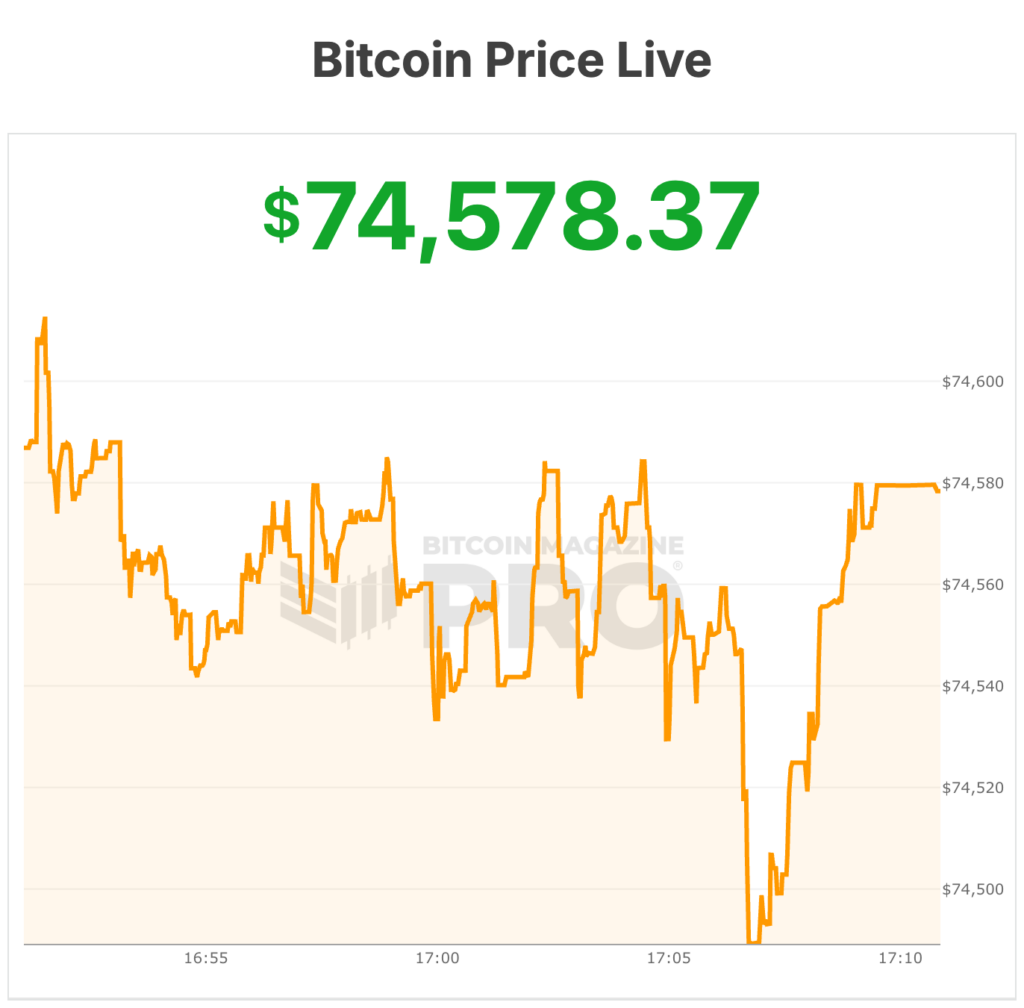
Bitcoin’s rise from an obscure digital asset to a global financial instrument is again in focus this St. Patrick’s Day. On March 17, 2012, Bitcoin traded near $5. Thirteen years later, it has reached roughly $75,000.
This is a massive expansion driven by increasing demand and a fixed supply model.
Bitcoin’s early years were defined by sharp price swings and thin liquidity. In 2013, the asset surged from under $50 to more than $600 before retracing below $300 by 2015.
These cycles repeated over time, with each rally followed by a correction.
In 2017, Bitcoin crossed $1,000 and later accelerated higher before entering another downturn. By 2021, it had climbed past $50,000 as institutional participation began to take shape. Pullbacks in 2022 and 2023 tested conviction, but the broader trend remained intact.
In late 2025, BTC surged above $125,000 before pulling back to $60,000 earlier this year.
Each cycle introduced new participants and strengthened market infrastructure, contributing to a more resilient asset over time.
Historical Bitcoin prices on Saint Patrick's Day
— Bitcoin Magazine (@BitcoinMagazine) March 17, 2026
2012 $5.34
2013: $47
2014: $630
2015: $290
2016: $417
2017: $1,180
2018: $8,321
2019: $4,047
2020: $5,002
2021: $56,825
2022: $41,140
2023: $26,876
2024: $68,845
2025: $83,223
2026: $74,590
HODLpic.twitter.com/8LMFUGZkpX

Institutional access is growing despite Bitcoin’s fixed supply
One of the most significant developments in the current cycle is the expansion of institutional access. Spot Bitcoin exchange-traded funds in the United States have created a direct pathway for large pools of capital to enter the market.
These products have recorded sustained inflows, including single-day totals exceeding $500 million, reflecting strong demand from asset managers, pension funds and retail brokerage accounts. The result is a steady accumulation of BTC within regulated investment vehicles.
As more capital flows through these channels, available supply on exchanges has tightened, reinforcing upward pressure on price.
Bitcoin’s monetary policy continues to differentiate it from traditional assets. The protocol enforces a hard cap of 21 million coins, limiting total supply regardless of demand conditions.
This scarcity is reinforced through halving events, which reduce the rate of new issuance. The most recent halving in April 2024 cut block rewards from 6.25 BTC to 3.125 BTC, lowering the number of new coins entering circulation each day.
Historically, these supply shocks have preceded major upward moves, as reduced issuance meets sustained or increasing demand.
Corporate and traditional finance interest
Beyond financial markets, Bitcoin has gained traction among corporations and policymakers. Public companies have continued adding Bitcoin to their balance sheets, treating it as a reserve asset rather than a speculative position.
Most popular of all these is Strategy, the bitcoin treasury company led by executive chairman Michael Saylor. The company purchased another 22,337 bitcoin for about $1.57 billion last week, continuing one of the largest corporate accumulation strategies in the crypto market.
The acquisition brings the firm’s total holdings to 761,068 bitcoin. Strategy said its cumulative BTC holdings were acquired for roughly $57.61 billion at an average price of about $75,696 per coin.
The stash represents more than 3.4% of the fixed 21 million supply of BTC, reinforcing MSTR’s status as the largest corporate holder of the asset.
Bitcoin’s changing market structure
Bitcoin’s market structure is shifting as ownership consolidates among long-term holders, institutions and corporate buyers. This has reduced the influence of short-term speculation and improved overall stability, even as volatility persists.
Bitcoin has remained resilient through recent turbulence, supported by steady institutional demand and continued accumulation. Analysts point to a clear return of large buyers, with ETF inflows and spot demand helping push prices back above $70,000 after weeks of range-bound trading.
Data shows institutional conviction holding firm. Despite a sharp drawdown since late 2025, ETF outflows have remained limited compared to earlier inflows, signaling that investors are maintaining positions rather than exiting.
This growing base of committed capital reflects a broader shift. Institutional investors entering the market today tend to have high conviction, often allocating with a long-term view rather than reacting to short-term price moves.
Research also highlights the expanding role of ETFs and corporate treasury strategies in reshaping BTC ownership. Institutional vehicles now account for a meaningful share of supply, while a large portion of coins remains inactive, reinforcing the dominance of long-term holders.
At the same time, on-chain data suggests the market may be in a late-stage bear phase, historically tied to accumulation. Analysts say current conditions point to continued consolidation, with long-term investors positioning for the next cycle.
This post From $5 to $75,000: Bitcoin’s Saint Patrick’s Day Prices Shows You the Wild Ride of Bitcoin first appeared on Bitcoin Magazine and is written by Micah Zimmerman.
Bitcoin Magazine

Jack Mallers Confirmed As A Bitcoin 2026 Speaker
Jack Mallers has been officially confirmed as a speaker at Bitcoin 2026, returning to the stage where he made Bitcoin history to share his perspective on Bitcoin’s expanding role in payments, capital markets, and global finance. As Co-Founder and CEO of Twenty One Capital (NYSE: XXI) and Founder and CEO of Strike, Mallers now sits at the intersection of two consequential Bitcoin companies operating today, one reshaping how people spend and save Bitcoin, the other redefining what a publicly traded Bitcoin company can be.
Twenty One Capital launched on the New York Stock Exchange in December 2025, debuting with a treasury of 43,514 Bitcoin — the third-largest public corporate Bitcoin holding in the world, behind only Strategy and MARA Holdings. The company is majority-owned by Tether, the world’s largest stablecoin issuer, and Bitfinex, with significant minority ownership from SoftBank Group, and has committed to operating with public-market transparency, including publishing on-chain proof of holdings for real-time shareholder verification. Speaking on CNBC at launch, Mallers made the mission clear: the company plans to “buy as much Bitcoin as we possibly can” not as a passive treasury vehicle, but as a full Bitcoin-native operating business building capital markets advisory, lending models, and educational media on top of its BTC holdings.
Strike, the company Mallers founded in 2020, has become one of the most widely used Bitcoin financial platforms in the world. Built on Bitcoin’s Lightning Network, Strike allows users to make and receive payments, buy and sell bitcoin with no added fees, and convert their paychecks directly into Bitcoin all without requiring prior crypto experience. In March 2026, Strike received both a BitLicense and a money transmitter license from the New York State Department of Financial Services, allowing the company to operate in one of the most tightly regulated digital asset markets in the United States. “Strike is building the leading Bitcoin financial institution,” Mallers said in a statement. “With our BitLicense, we can now bring that mission to New York, the global center of finance.”
With Twenty One Capital now live on the NYSE and Strike completing its all-50-states U.S. expansion, Mallers arrives at Bitcoin 2026 carrying more institutional weight than ever, and the same conviction he’s held since day one: that Bitcoin is honest money, and that the infrastructure being built around it will determine what the next chapter of global finance looks like.
JACK MALLERS, FOUNDER & CEO OF STRIKE AND TWENTY ONE, TO SPEAK AT BITCOIN 2026
— The Bitcoin Conference (@TheBitcoinConf) March 3, 2026
"It's over man, Bitcoin is going to the moon."pic.twitter.com/wHorQFmcYa

Bitcoin 2026 Returns to Las Vegas Bigger Than Ever
Bitcoin 2026 will take place April 27–29 at The Venetian, Las Vegas, and is expected to be the biggest Bitcoin event of the year.
Focused on the future of money, Bitcoin 2026 will bring together Bitcoin builders, investors, miners, policymakers, technologists, and newcomers from around the world. The event will feature a wide range of pass types, including general admission passes designed specifically for those new to Bitcoin, alongside premium passes for professionals, enterprises, and institutions.
With multiple stages, immersive experiences, technical workshops, and headline keynotes, Bitcoin 2026 is designed to serve both first-time attendees and long-time Bitcoiners shaping the next era of global adoption.
Past Bitcoin Conferences in the U.S.
Bitcoin’s flagship conference has scaled dramatically over the past five years:
- 2021 – Miami: 11,000 attendees
- 2022 – Miami: 26,000 attendees
- 2023 – Miami: 15,000 attendees
- 2024 – Nashville: 22,000 attendees
- 2025 – Las Vegas: 35,000 attendees
 Get Your Bitcoin 2026 Pass
Bitcoin Magazine readers can save 10% on Bitcoin 2026 tickets using code ‘ARTICLE10‘ at checkout.
Stay at The official hotel of Bitcoin 2026, The Venetian, and get a guaranteed low rate plus 15% off your pass. Hotel Prices increase soon, be in the middle of where the fun is all happening, and where the networking never ends.
And don’t forget:
Volunteer at Bitcoin 2026 and get Pro Pass access plus exclusive perks.
All students ages 13+ can apply for a Student Pass and get free general admission access to Bitcoin 2026.
 Location: The Venetian, Las Vegas
 Dates: April 27–29, 2026
With tens of thousands of attendees expected and hundreds of major speakers like Jack Mallers already confirmed, now is the time to lock in your ticket.
Buy Bitcoin 2026 Tickets — Save 10%
Why Attend Bitcoin 2026?
Bitcoin 2026 is the definitive gathering for anyone serious about the future of money. With 500+ speakers, multiple world-class stages, and programming spanning Bitcoin fundamentals, open-source development, enterprise adoption, mining, energy, AI, policy, and culture, the conference brings every corner of the Bitcoin ecosystem together under one roof.
From headline keynotes on the Nakamoto Stage to deep technical sessions for builders, institutional strategy discussions for enterprises, and beginner-friendly Bitcoin 101 education, Bitcoin 2026 is designed for everyone—from first-time attendees to the leaders shaping Bitcoin’s global adoption.
Whether you’re looking to learn, build, invest, network, or influence, Bitcoin 2026 is where Bitcoin’s next chapter is written.
Bitcoin 2026 Pass Types: Something for Everyone
Bitcoin 2026 offers a range of pass options designed to meet the needs of newcomers, professionals, enterprises, and high-net-worth Bitcoiners alike.
Bitcoin 2026 General Admission Pass
Ideal for newcomers and those looking to experience the heart of the conference.
- Limited access on Days 2 & 3
- Entry to Main Stage
- Access to Genesis Stage
- Full access to the Expo Hall

Bitcoin 2026 Pro Pass
Designed for professionals, operators, and serious Bitcoin participants.
Includes all General Admission features, plus:
- Full 3-day access, including Pro Day
- Entry to the Pro Pass Reception
- Access to Enterprise Hall, Enterprise Stage, and Networking Lounge
- Conference App networking features
- Access to the Bitcoin For Corporations Symposium
- Entry to Compute Village and Energy Stage
- Complimentary lunch, coffee, tea, and snacks
- Dedicated registration and check-in
- Reserved seating at Main Stage
- Huge savings when you bundle your hotel and Pro Pass

 Bitcoin 2026 Whale Pass
The all-inclusive, premium Bitcoin 2026 experience.
Includes all Pro Pass features, plus:
- Reserved seating at Main Stage
- All-inclusive gourmet food and beverages
- Entry to Whale Night and Whale Reception
- Access to all official after-parties
- Networking app access to connect with other Whales
- Premium access to The Deep — an exclusive networking lounge with intimate speaker sessions
- Complimentary stay at The Venetian when you bundle your whale pass and hotel (use promo code ‘WHALEHOTEL’ here)
This is the most immersive way to experience Bitcoin 2026.

 Bitcoin 2026 After Hours Pass
Your ticket to the night.
Most deals are done with a drink in your hand. Get exclusive access to 3 official Bitcoin 2026 after-parties across Las Vegas — each with a 2-hour open bar — where the real conversations happen and the best connections are made.
- Access to 3 official Bitcoin 2026 after-parties
- 2-hour open bar at each event
- Evening events across Las Vegas, April 27–29
- Network with Bitcoiners, builders, and industry leaders after hours
More headline speaker announcements are coming soon.
Don’t miss Bitcoin 2026.
This post Jack Mallers Confirmed As A Bitcoin 2026 Speaker first appeared on Bitcoin Magazine and is written by Jenna Montgomery.
Bitcoin Magazine

Bitcoin Price Dances Near $75,000 as Market Questions ‘Decoupling’ Narrative
Bitcoin price traded near $75,000 on Tuesday, after extending an eight-day streak that has pushed the asset close to a key psychological level.
The move marks a sharp recovery from February lows near $60,000 and has renewed debate over whether the market has found a bottom.
The world’s largest cryptocurrency broke above $75,000 yesterday during U.S. trading hours after weeks of tight consolidation. The rebound has lifted prices close to early February levels and placed focus on whether bitcoin price can hold its ground.
Analysts at Bitfinex said the recent strength reflects relative outperformance but warned against calling it a structural shift.
“The recent strength above $75,000 does show relative outperformance, but calling it a true ‘decoupling’ is premature,” analysts wrote to Bitcoin Magazine. They pointed to stabilizing ETF flows, fresh demand from new structured products, reduced leverage, and tighter on-chain supply as key drivers.
Bitcoin has outperformed traditional risk assets in recent sessions. Still, analysts noted that it remains tied to broader liquidity conditions. A sustained break from macro correlation would require bitcoin price to continue rising despite tighter financial conditions such as higher yields and a stronger dollar.
For now, the $75,000 to $78,000 range is seen as a critical test. Holding that zone could signal strong spot demand and supply absorption. Failure to do so may suggest the rally is part of a broader positioning reset.
Bitcoin price speculation
Data from Nansen supports the view that the current move is driven by more than speculation. Exchange outflows have remained steady in recent weeks, indicating that investors are moving bitcoin into long-term storage rather than selling into strength.
ETF inflows have also stayed consistent, with roughly $763 million in weekly demand. Corporate buying has added to the trend. Strategy disclosed a $1.57 billion bitcoin purchase, one of the largest this year.
Nansen analyst Nicolai Søndergaard wrote to Bitcoin Magazine that this reflects balance sheet accumulation rather than short-term trading.
“These are balance sheet decisions rather than speculative buys,” he said, adding that derivatives activity has amplified the move. Rising futures open interest and short liquidations contributed to the break above $75,000.
Macro conditions remain a key variable. Geopolitical tensions tied to the Iran–Israel War and shifting expectations around interest rates continue to shape sentiment. Easing concerns around the Strait of Hormuz helped support risk appetite over the weekend.
Markets are now focused on the Federal Reserve’s March 18 decision. A neutral stance could support further upside, while a hawkish signal may trigger profit-taking.
Bitcoin price has staged similar recoveries in past cycles without confirming a lasting bottom. Traders are watching whether the asset can maintain support above $75,000. A sustained hold could open a path toward $80,000.
This post Bitcoin Price Dances Near $75,000 as Market Questions ‘Decoupling’ Narrative first appeared on Bitcoin Magazine and is written by Micah Zimmerman.
Bitcoin Magazine

Bitrefill Discloses Cyberattack, Points to North Korea’s Lazarus Group
Crypto e-commerce platform Bitrefill said it was the target of a cyberattack earlier this month that resulted in stolen funds and limited exposure of customer data, with indicators pointing to the North Korean-linked Lazarus Group as a likely perpetrator.
The breach, which began on March 1, originated from a compromised employee laptop, according to the company’s incident report.
Attackers were able to extract legacy credentials tied to production systems, allowing them to escalate access across Bitrefill’s infrastructure, including segments of its internal database and certain cryptocurrency hot wallets.
Bitrefill said the attackers drained an undisclosed amount of funds from its hot wallets while also exploiting its gift card inventory systems to place suspicious purchases with vendors. The company did not specify the total financial impact but stated it will absorb the losses using operational capital.
The intrusion was first detected through irregular purchasing patterns and anomalies in supplier activity.
In response, Bitrefill temporarily took its systems offline to contain the breach across its global operations. The company said services, including payments and account access, have since returned to normal levels.
As part of the attack, approximately 18,500 purchase records were accessed. The exposed data includes email addresses, cryptocurrency payment addresses and metadata such as IP addresses.
Around 1,000 of those records involved encrypted customer names, which are being treated as potentially exposed due to the possibility that attackers accessed encryption keys. Bitrefill said it has notified affected users directly.
Despite the breach, the company emphasized that it stores minimal personal data and does not require mandatory know-your-customer verification for most transactions. Any KYC-related information is handled by external providers and is not stored within Bitrefill’s systems. The firm added there is no evidence that its full database was exfiltrated or that customer data was the primary target.
“Based on our investigation and logs, we don’t have reason to think that customer data was the objective,” the company said, noting that the attackers appeared to conduct limited queries consistent with probing for valuable assets such as cryptocurrency holdings and gift card inventory.
North Korea’s Lazarus Group was involved
Bitrefill cited several indicators linking the attack to the Lazarus Group, including similarities in malware, reused infrastructure such as IP addresses and email accounts, and on-chain transaction patterns.
The group, often associated with North Korea, has been tied to some of the largest crypto thefts in recent years through its specialized subgroup, Bluenoroff.
Cybersecurity firms including zeroShadow, SEAL911 and RecoverisTeam assisted in the response and investigation, alongside on-chain analysts and law enforcement. The company said it is implementing additional security measures, including expanded monitoring systems and internal controls, to prevent similar incidents.
The attack highlights ongoing concerns around state-sponsored cyber threats in the digital asset sector.
According to blockchain analytics firm Chainalysis, groups linked to North Korea were responsible for more than $2 billion in crypto thefts in 2025, accounting for a significant share of total illicit activity in the space.
Bitrefill said operations have stabilized following the incident and expressed confidence in its recovery, noting that customer activity and sales volumes have returned to typical levels.
This post Bitrefill Discloses Cyberattack, Points to North Korea’s Lazarus Group first appeared on Bitcoin Magazine and is written by Micah Zimmerman.
Bitcoin Magazine

Strategy (MSTR) is About to Have More Bitcoin Than BlackRock’s IBIT
Strategy (MSTR) is closing in on BlackRock’s iShares Bitcoin Trust (IBIT), with the gap in Bitcoin holdings shrinking to a level that could be erased within the next couple of weeks.
Recent data shows IBIT holding roughly 781,000 BTC, while Strategy holds about 761,000 BTC. The difference, now around 40,000 BTC, has tightened as Strategy accelerates its accumulation pace, according to investor Mark Harvey.
The shift reflects diverging models. IBIT holdings rise and fall based on investor inflows and outflows into its spot ETF, while Strategy raises capital through equity and preferred share issuance to fund direct Bitcoin purchases.
This allows Strategy to acquire Bitcoin independent of ETF demand cycles.
Strategy has added significant volume in recent weeks, including two multibillion-dollar purchases in March that pushed its total higher. Last week, the company bought 2,337 bitcoin for about $1.57 billion.
The company continues to frame its performance around Bitcoin accumulation and “BTC Gain” as a proxy for net income under its Bitcoin-centric strategy.
Over the first two weeks of March 2026, Strategy acquired 40,332 BTC and posted a 3.0% yield, reinforcing its aggressive treasury approach, according to Michael Saylor.
Year to date, the firm has accumulated 88,568 BTC with a 3.4% yield, signaling sustained momentum behind its balance sheet transformation.
NEW: Michael Saylor's Strategy could surpass BlackRock's BTC holdings in the next couple weeks
— Bitcoin Magazine (@BitcoinMagazine) March 17, 2026pic.twitter.com/7i70XB0pBN
Bitcoin and Strategy’s strong March
Bitcoin has posted eight consecutive days of gains, a rare streak seen only 15 times since its creation, with past instances delivering a median 30-day return of about 19%, according to Bitcoin Magazine Pro data.
Bitcoin recently climbed from below $66,000 to $76,000 before easing back near $73,800, even as historical patterns show such rallies can precede sharp pullbacks like the 30% drop four years ago.
Bitcoin’s latest surge comes after the asset bottomed near $63,000 in February during heightened geopolitical tensions linked to the Iran–Israel War.
Since then, prices have staged a steady recovery as macroeconomic conditions stabilized and investor confidence returned.
Bitcoin has outperformed other assets like gold and the S&P 500.
Markets received a boost over the weekend after signs of easing tensions around the Strait of Hormuz, one of the world’s most important oil shipping routes.
For now, traders are watching whether bitcoin price can maintain support above the $72,000 region.
A sustained hold above that level could open the door to a push toward $80,000, which previously acted as a key support zone before the early-2026 correction.
Shares of MSTR are pushing $150 a share today.
This post Strategy (MSTR) is About to Have More Bitcoin Than BlackRock’s IBIT first appeared on Bitcoin Magazine and is written by Micah Zimmerman.
CryptoSlate
Citigroup cuts Bitcoin and Ethereum targets as slower US policy timeline trims the upside case
Citigroup has cut its 12-month targets for Bitcoin and Ethereum, lowering its Bitcoin forecast to $112,000 from $143,000 and its Ethereum forecast to $3,175 from $4,304.
The March 17 revision marks a sharp step down from the bank’s December view and ties that reset to slower US legislative progress, a delay that Citi said is weighing on the policy support it had expected to help drive ETF demand and wider adoption.
The cuts are large enough to change the shape of the one-year crypto outlook without turning Citi bearish on the two assets.
Bitcoin’s new target is about 21.7% below Citi’s prior forecast, while Ethereum’s new target is about 26.2% below the earlier call. Both new targets still sit above current market prices.
Based on the latest CryptoSlate figures, Citi’s revised Bitcoin target still implies roughly 51.8% upside from spot, while its revised ether target implies about 36.8% upside.
Citi still expects Bitcoin and Ethereum to rise over the next year. But it has sharply lowered the ceiling it sees for both assets because the bank no longer expects the same pace of regulatory progress, institutional demand, and network follow-through that shaped its December forecasts.
For a market that has already bounced in recent weeks, the downgrade reads less like a call for immediate downside and more like a warning that the path higher may be slower and narrower than the earlier bull case assumed.
That warning lands as both assets have posted recent gains. Bitcoin trades around $74,000, up 4.5% over seven days, and 7.5% over 30 days. Ethereum sits near $2,300, up 12% over seven days, and 15% over 30 days.
The downgrade arrives as the market has recovered tactically, even as one of Wall Street’s largest banks has lowered its one-year expectations.

Citi’s new targets still point higher, but the one-year range has narrowed
Citi’s revision follows a much more upbeat set of targets published in December. At that point, the bank set a 12-month Bitcoin target of $143,000 and a 12-month ether target of $4,304, while also outlining a Bitcoin bull case of $189,000 and an Ethereum bull case of $5,132 in a December report.
The earlier view leaned on regulatory easing and increased adoption. The new view keeps the basic upside case alive, but resets it lower because that policy timeline has not moved as fast as Citi expected.
In practical terms, the bank is saying the market may still move up over the next year, but the fuel it expected to push prices much higher has not arrived on schedule. That is a narrower and more cautious claim than the one Citi made at the end of last year. It also shifts the focus away from pure price prediction and toward the mechanism behind the forecast.
Citi’s December case depended on regulation, ETF demand, and adoption, reinforcing one another. Its March revision suggests that the sequence now looks less certain and less immediate.
The numbers show that clearly.
| Asset | Prior 12-month target | New 12-month target | Target cut | Current price | Implied upside to new target | 7-day move | 30-day move |
|---|---|---|---|---|---|---|---|
| Bitcoin | $143,000 | $112,000 | 21.7% | $73,777.10 | 51.8% | 4.55% | 7.51% |
| Ethereum | $4,304 | $3,175 | 26.2% | $2,320.12 | 36.8% | 12.7% | 15.38% |
The table captures the contradiction at the center of Citi’s revision. Prices have improved over the last week and month, especially for Ethereum, but Citi has still lowered its one-year targets. That suggests the bank is questioning whether the forces needed to sustain a larger move are strong enough to restore the December outlook.
That is especially relevant for Ethereum. Ethereum has outperformed Bitcoin over both the seven-day and 30-day windows in the latest market snapshot. Even so, Citi cut Ethereum's target by a larger percentage than Bitcoin’s, pointing to a more cautious view of the medium-term case for ETH than short-term price action alone would suggest. In other words, recent strength has not been enough to offset Citi’s concerns around adoption, policy timing, and the broader demand backdrop.
For Bitcoin, the change is slightly different. Citi still sees more than 50% upside from current levels, which means the bank has not rejected the broader institutional case for BTC. But by cutting the target from $143,000 to $112,000, it has marked down how far that case can travel in the next year under current conditions.

That leaves Bitcoin with a still-positive but less expansive upside profile, one that depends more heavily on steady inflows and less on a rapid policy tailwind.

ETF flows and market performance show support is still there, but Citi is looking past the rebound
According to Farside, spot Bitcoin ETFs recorded $199 million in net inflows on March 16, bringing cumulative net inflows to $56.3 billion. Spot Ethereum ETFs posted $36 million in net inflows, with cumulative net inflows of $11.8 billion.
Those numbers show real demand is still present. But they also help explain why Citi’s revision is more nuanced than a simple bearish call. The issue is whether the current pace of flows, combined with a slower policy timeline, is strong enough to support the much higher targets Citi set in December. On that question, the bank’s answer now appears to be no.
That shift is easier to see when the December and March narratives are placed side by side. In December, Citi tied its targets to regulatory easing and wider adoption.
In March, it cut those same targets because US legislative progress had been slower than expected, according to the March 17 report. The underlying change is not that crypto prices have stopped moving. Citi is saying the policy and demand sequence it expected to amplify those moves has not come together fast enough.
That leaves markets in an unusual position. Bitcoin and Ethereum have both recovered in recent weeks. ETF money is still coming in. Yet a major bank has decided that the one-year payoff should be reduced anyway.
That gap between price performance and target revisions is the more useful signal. It says the market can rally in the short run without persuading every large forecaster that the longer-term setup has improved by the same degree.
It also explains why Citi’s downgrade does not read like a call on day-to-day trading. The bank is cutting a 12-month target, not predicting a near-term crash. That distinction matters. Targets are about the scale of the move over time, not whether prices can keep rising over the next few sessions or even the next few weeks.
By that standard, Citi’s message is straightforward: the market can still go up, but the room above spot is smaller than the bank thought a few months ago.

The next test is whether policy and flows can rebuild the case Citi cut back
The main variable behind Citi’s reset is Washington. In January, Senate Banking Committee Chair Tim Scott announced a digital-asset market structure markup for Jan. 15, then postponed it on Jan. 14 as negotiations continued, according to the committee’s statement and follow-up update. Senators are still working to unlock the stalled CLARITY Act through a compromise tied to stablecoin yield.
That timeline shapes Citi’s reset because it is the clearest reason the bank has given for lowering its targets. A slower policy track delays legislation and weakens confidence that a friendlier rule set will arrive soon enough to accelerate ETF demand, corporate participation, and other forms of institutional adoption within the next year.
The mechanism is concrete: if the policy step slips, the adoption step can slip with it, making price targets tied to that adoption harder to defend.
For Bitcoin, the next question is whether spot ETF inflows can keep building even without a cleaner legislative backdrop. If they can, Citi’s new target could still prove conservative. If inflows flatten or lose momentum, the bank’s cut may look early rather than late.
The same structure applies to Ethereum, but with a tighter margin for error. Ethereum's recent gains have been stronger, yet Citi’s target cut was deeper. That means ETH needs not only continued price support, but stronger evidence that usage and institutional demand can justify a higher one-year ceiling.
None of that requires a dramatic break in either direction. The data already in hand points to a narrower, more conditional setup. Citi still sees upside from current prices. ETF flows remain positive. Both Bitcoin and Ethereum have risen over the last month. But the one-year case now depends more heavily on whether policy negotiations start producing results and whether flows remain strong enough to replace the optimism Citi stripped from its December forecasts.
The next few months should show whether that caution was warranted. A legislative breakthrough, stronger ETF inflow streaks, or firmer adoption data could rebuild the case for higher targets.
More delays in Washington, softer flows, or weaker follow-through from recent market gains would support Citi’s decision to lower the bar.
For now, Citi’s revision leaves crypto with a live but reduced upside case, and with a clear test ahead, whether policy and demand can catch up to the prices that have already moved.
The post Citi slashes Bitcoin target by $31,000 despite rising prices as Washington delays stall crypto breakout appeared first on CryptoSlate.
Bitcoin is heading toward its first real recession-era test as a mature institutional asset after Moody’s recession model rose to 48.6%, a level that, in that historical series, has not previously been reached without a recession following within 12 months.
The historical ‘point of no return' signal arrives as US growth slows, the labor market weakens, oil trades above $100, and Bitcoin has started to post gains over the past week and month.
That combination sets up a clearer test than the brief COVID downturn: whether Bitcoin trades like a risk asset when the economy softens the slow way, or holds up as an alternative asset when confidence in traditional markets starts to fray.
The macro case behind that framing is no longer thin. US real GDP growth slowed to 0.7% annualized in the fourth quarter of 2025 after 4.4% in the third quarter, based on revised figures.

February payrolls fell by 92,000, and unemployment held at 4.4%, according to Labor Department data. Initial jobless claims stood at 213,000 for the week ending March 7, and weekly claims data fit a softer labor backdrop in a slowing economy.
At the same time, the current Sahm Rule reading sits at 0.27, still below the 0.50 recession trigger.
The New York Fed’s yield-curve model is also less alarmed, with a 12-month recession probability of 18.8%.
That split leaves a clear tension in the data. Moody’s does not capture the whole macro picture, yet the signal is strong enough to drive Bitcoin analysis. It now points to a recession risk zone that collides with a market Bitcoin has never seen before, deep ETF ownership, large fund flows, and the highest ever level of institutional participation.
CryptoSlate data currently shows Bitcoin at $73,777, up 0.05% over 24 hours, 4.55% over seven days, and 7.51% over 30 days, with a $1.48 trillion market cap, $55.59 billion in daily volume, and 58.5% market dominance.
| Indicator | Latest reading | What it shows |
|---|---|---|
| Moody’s recession probability | 48.6% | Recession risk has moved close to the model’s historical danger zone |
| Q4 2025 real GDP growth | 0.7% | Growth slowed sharply from Q3’s 4.4% |
| February payrolls | -92,000 | Hiring weakened instead of expanding |
| Unemployment rate | 4.4% | Labor conditions remain softer than late-2025 levels |
| Initial jobless claims | 213,000 | Layoffs are not yet flashing a full recession signal |
| Sahm Rule | 0.27 | Below the 0.50 threshold that has historically marked recession starts |
| NY Fed recession probability | 18.8% | Other major models remain less alarmed than Moody’s |
| Brent crude | $103.43 | Oil is adding inflation pressure to an already weaker economy |
Why this setup looks different from COVID
The easiest comparison for crypto markets is March 2020. It is also the least useful one for this analysis. The National Bureau of Economic Research dated the COVID recession from March 2020 to April 2020, making it the shortest US recession on record.
Markets moved through a shutdown shock, then through an unusually fast policy response, and then into a sharp rebound. Bitcoin crashed with everything else in the first leg, while the episode left open the larger question of how it behaves in a slower recession with weaker growth, weaker hiring, and a longer stretch of pressure on risk appetite.
The current setup is broader and less concentrated in a single event. Growth had already slowed before the latest Middle East shock. Payrolls had already turned down.
The outside-world pressure point is oil. Brent crude recently traded at $103.43, while a separate energy analysis shows the Strait of Hormuz handled 20.9 million barrels per day in the first half of 2025, around 20% of global petroleum liquids consumption. The chokepoint feeds directly into fuel, shipping, and consumer prices at a moment when the growth backdrop is already weaker.
The historical comparison that fits better is the Great Recession, with one obvious limitation: Bitcoin did not exist then.
The Great Recession ran from December 2007 to June 2009, with a 4.3% peak-to-trough GDP decline and unemployment rising from 5% to 9.5% by June 2009, according to Federal Reserve history.
There is no direct market record for how Bitcoin would trade from the start of a long, broad recession. It launched in 2009, after the downturn had already taken hold.
The next 12 months could therefore produce the first clean read on whether Bitcoin still trades mainly as a liquidity-sensitive asset or can keep attracting capital during a drawn-out slowdown.
That distinction carries more weight now because the ownership structure has changed. Bitcoin is no longer a niche retail market reacting only to internal crypto events. It now sits inside portfolios that also hold equities, bonds, commodities, and cash.
Fund flow data show the tension clearly. CoinShares reported $619 million of inflows in the week of March 9 and about $1.4 billion of inflows over three weeks since the Iran crisis began. Those figures point to institutional demand after months of outflows, even as recession risk and geopolitical stress rise.


What the next 12 months could do to Bitcoin
The next question is straightforward. If the economy slips into recession without a quick reset, Bitcoin has to show whether it behaves like a high-beta trade that gets sold when liquidity tightens, or a harder asset that can absorb flows when confidence in traditional markets weakens. Both outcomes still fit the available data.
The case for resilience starts with relative behavior. Bitcoin is up over the last seven and 30 days even as recession odds rise and oil markets stay tense. Weekly fund flow data have also turned positive again.
If that pattern holds while labor and growth data worsen, the market will have stronger grounds to argue that Bitcoin is reacting differently from earlier risk-off periods. That would be the strongest evidence yet that part of the market sees Bitcoin as a policy hedge, an inflation hedge, or simply an asset outside the banking and sovereign debt system.
The bear case is just as clear. A normal recession often becomes a liquidity story before it becomes an inflation or monetary story. If payroll weakness deepens, claims rise, and investors cut risk across portfolios, Bitcoin could still trade like a risk asset first. Any identity shift would then have to wait.
The oil shock sits at the center of that risk. Higher oil prices can delay easier policy by lifting inflation pressure even as growth fades. That combination is rough for speculative assets because it removes the clean “bad growth equals lower rates” path that can support markets in a plain slowdown.
| Bitcoin metric | Latest reading | Why it matters |
|---|---|---|
| Spot price | $73,777.10 | Bitcoin is holding well above prior cycle levels despite recession fears |
| 24-hour change | 0.05% | Short-term price action is flat rather than disorderly |
| 7-day change | 4.55% | Bitcoin has gained during a period of rising macro stress |
| 30-day change | 7.51% | Momentum has remained constructive over the last month |
| Market cap | $1.48 trillion | The asset is large enough to influence broader portfolio allocation |
| 24-hour volume | $55.59 billion | Liquidity remains deep enough for institutional trading |
| BTC dominance | 58.5% | Bitcoin continues to take a larger share of crypto market value |
| Distance from all-time high | 41.55% below | Bitcoin is recovering and still trading below full price-discovery territory |
Staying on the current trajectory would keep recession fears elevated without full confirmation from layoffs or claims. In that setup, Bitcoin could stay volatile while outperforming equities on a relative basis if fund flows remain positive.
A bull case would require that pattern to strengthen, weaker macro data, continued inflows, and rising Bitcoin dominance. A bear case would show up in broad de-risking, negative flow reversals, and Bitcoin selling off alongside equities.
However, a black swan event would pair a deeper oil shock with worsening growth, creating a stagflation-style squeeze that could hit Bitcoin first and then support an “outside money” allocation if markets lose confidence in a quick policy response.

What to watch next
The next checkpoints are clear.
- The labor market comes first. Another weak payroll report, a rise in unemployment, or a move higher in jobless claims would make the Moody’s signal harder to dismiss. The Sahm Rule is also worth watching because it is still below the line that has historically marked the start of recession. If it moves toward 0.50, the argument shifts from elevated odds to firmer confirmation.
- Oil is the second checkpoint. If Brent stays above $100 or moves higher, markets will have to deal with rising inflation pressure and weaker growth at the same time. That would likely tighten the test for Bitcoin.
- The third checkpoint is flows. If Bitcoin investment products continue to attract money while recession odds rise, the case for relative resilience strengthens. If those flows reverse quickly, markets are still treating Bitcoin as a liquidity trade rather than a macro shelter.
For now, the data support a stronger line than generic macro uncertainty and a narrower line than a full recession call. Moody’s says the odds are high enough to take seriously. GDP and payroll data support the slowdown narrative.
Other gauges still show less urgency. Bitcoin now sits at the center of a test it has never fully taken before, not whether it can survive a sharp shock, but whether it can trade through a slower recession as a mature, institutionally owned asset.
The next payroll print, the next claims update, the next oil move, and the next round of crypto fund flows should decide whether that test is beginning in earnest.
The post Moody’s recession odds hit ‘point of no return’ preparing Bitcoin to show its true market value in 2026 appeared first on CryptoSlate.
Bitcoin is back in focus after another sharp turn higher, with the asset trading at $73,772 on March 17 after hitting an intraday high of $75,937, according to market data. The move matters less as proof of a clean breakout than as evidence that buyers have rebuilt momentum after a punishing February washout.
On Feb. 6, Bitcoin rebounded from a 16-month low of about $60,018 after a broad selloff across risk assets, posting its biggest one-day gain since March 2023. That rebound did not end volatility, but it did mark the point where panic selling started to give way to a more selective bid.
Still below the highs
Even with that recovery, the market is still climbing out of a deep hole. Bitcoin hit a record high above $125,245 in October 2025, and today’s mid-$70,000 range still leaves it far below that peak. Recent trading underscores how quickly sentiment has shifted.
Reuters reported Bitcoin was near $71,021 on March 13 and around $74,298 early on March 17, while the current tape shows the market briefly probing nearly $76,000 before pulling back. That is a meaningful rebound, but not yet a full technical or psychological reset, especially for traders still anchored to last year’s highs.
Macro still controls the tone
Macro remains the dominant backdrop. Global stocks rallied on March 16 as oil prices eased, but Brent still settled above $100 a barrel and traders pushed expectations for a U.S. rate cut further out as they waited for this week’s Federal Reserve decision. Those conditions help explain why Bitcoin’s move higher has looked opportunistic rather than fully risk-on.
Citigroup captured that tension on March 17 when it cut its 12-month Bitcoin target to $112,000 from $143,000, arguing that stalled U.S. crypto market-structure legislation narrows the window for the regulatory catalysts that many expected to support ETF-driven demand and broader institutional adoption.
Citi also said Bitcoin is likely to range-trade around $70,000 as legislative headlines evolve, a reminder that the latest rally still sits on top of unresolved policy risk.
Where G Coin by Playnance fits in
That backdrop also matters for smaller token stories trying to break through Bitcoin’s gravitational pull. Playnance’s G Coin is being positioned as a utility-driven project rather than a simple trading chip. Playnance says G Coin powers its ecosystem and serves as the unified economic layer across products built on PlayBlock.
In its January 2026 white paper, Playnance OÜ describes G Coin as an ERC-20 compatible utility token on Ethereum and its EVM-compatible Playblock Layer 3, with a fixed maximum supply of 77 billion tokens.
The company says the token is designed for digital access, gameplay, reward unlocking, missions, and promotional participation across the Playnance ecosystem.
Utility narrative, speculative market
The same white paper makes clear that G Coin does not confer ownership, governance, dividend, or profit-sharing rights, which is an important distinction in a market that still blurs the line between utility and speculation.
For now, the setup remains simple: Bitcoin is trading well above its February low but still far below its October record, while utility-token stories such as G Coin are trying to gain traction in a macro-sensitive tape.
If BTC can keep holding the low-to-mid $70,000 area, those narratives may get more room to breathe. If the macro picture darkens again, attention is likely to snap back to Bitcoin first.
Disclaimer: This was a sponsored post brought to you by Playnance.
The post Bitcoin price action retests $75k as G Coin by Playnance enters the utility-token conversation appeared first on CryptoSlate.
XRP gained nearly 10% over the past week, presenting a sharp divergence from the institutional sector as investment products tied to the token posted their steepest monthly outflows of the year.
Data from CryptoSlate showed the digital asset reaching a monthly high of $1.60 over the last 24 hours before pulling back to stabilize at around $1.51 at press time.
This notable market rally coincided perfectly with a massive surge in new wallet creation, an increase in daily active addresses, and a higher volume of completed payments executed directly on the XRP Ledger.
Blockchain analytics provider Santiment reported that the underlying network recently surpassed 7.7 million non-empty wallets. Additionally, active addresses on the network rose to 46,767, marking a definitive five-week high in network participation and user engagement.

Evernorth, the largest XRP treasury company, highlighted the aggressive growth trajectory of these network metrics in a recent market update.
It stated:
“XRP transactions are nearing 3M per day as of this week, up from ~1M per day in mid 2025. Nearly triple! Price moves attract attention. Activity shows where adoption is growing as more financial assets move on-chain.”

As a result, the current market environment provides traders with two completely separate signals to evaluate. The blockchain network's usage and raw transactional utility are accelerating rapidly across the digital ecosystem, while the investments through regulated financial fund vehicles continue to contract.

Institutional investors reduce XRP portfolio exposure
Institutional interest in the digital asset has followed a completely separate trajectory from the retail spot market, with professional investors rapidly cutting their direct exposure to the Ripple-linked token.
On March 16, asset management firm CoinShares reported that XRP investment products registered $133 million in formal outflows throughout the current month. That specific volume of capital flight firmly places the token as the worst-performing digital asset within professionally managed investment portfolios during the reporting period.
SoSo Value data shows that the four United States spot XRP exchange-traded funds (ETFs) actively corroborate this broader institutional retreat. These funds have experienced a continuous outflow streak since March 5, resulting in a total capital outflow of approximately $58 million.

Notably, the current trend marks the longest continuous outflow streak since these exchange-traded products launched last November. At the present pace, XRP funds are on course to record their first negative monthly flows since their launch year.
This sharp contraction immediately follows four consecutive months of positive capital injections totaling approximately $1.26 billion.
The decline in XRP funds can be attributed to shifting macroeconomic and geopolitical factors. CryptoSlate previously reported a 93% decline in flows directed into XRP funds amid rising geopolitical tensions in the Middle East.
During this period, investors have directed consistent, substantial capital inflows into Bitcoin-related financial products. Current CoinShares data shows Bitcoin funds have attracted approximately $1.3 billion in positive inflows since the beginning of the current month.
Despite the shifting institutional landscape, Ripple continues advancing its corporate strategy across global payments, institutional custody, liquidity provision, and corporate treasury management.
The technology company recently executed a series of significant strategic acquisitions involving financial firms Hidden Road, GTreasury, and Palisade. The firm also continues to aggressively pursue regulatory operating licenses across various global jurisdictions to support its expanding XRP infrastructure.

Spot market buyers absorb institutional selling
Meanwhile, the rapid decline of institutional capital has left retail spot market investors as the primary drivers of current XRP price action.
A research note from CryptoQuant showed that XRP's open interest is demonstrating early signs of a broader structural recovery following a period of sustained downward pressure.
Open interest across major cryptocurrency derivatives exchanges, including industry leader Binance, has trended consistently downward since the beginning of the year, sitting near its lower historical range.

A decline in open interest alongside falling or stabilizing prices typically signals a thorough unwinding of excess leverage across the broader financial market. This indicates a significant portion of highly speculative leveraged positions has successfully cleared the trading system, paving the way for more organic price discovery.
However, CoinGlass data showed a slight upward movement in the open interest during the past day to $2.84 billion.
At the same time, daily derivatives volume rose by 71% to $7.37 billion, marking the highest daily trading volume since mid-February.

What next for XRP?
Considering the above and recent price trajectory, crypto analyst Dom pointed out that XRP's market structure on Coinbase, the largest US-based exchange, is showing the “largest bid skew within 50% seen in nearly a year.”
This means there is minimal concentration of sell orders in the $1.50 to $2.00 price range. The distinct lack of heavy overhead resistance suggests the asset price can move upward with significantly reduced friction, as fewer structural barriers exist in the order book to slow potential forward momentum.
However, for the token to achieve such upside, outflows from its four funds would need to significantly reduce from current levels.
This means the XRP ETFs must successfully recoup the approximately $58 million lost since early March to provide the necessary institutional support.
At the same time, the token would require a broader shift in macro market momentum to revive interest in alternative crypto assets. This could help revive the speculative market attention in XRP toward long-term sustainability.
The post XRP rallies as ledger activity surges — even as ETFs suffer over $50 million in outflows appeared first on CryptoSlate.
For weeks, Bitcoin (BTC) couldn't convincingly break out of the $70,000 zone, which it kept circling as a real problem area.
BTC repeatedly failed to close above that level from early February through early March, making the zone a meaningful area of resistance in a market shedding confidence.
Glassnode's Mar. 11 report described those failures as a sign of weak buy-side demand and overhead supply. However, the ceiling broke, and Bitcoin managed a weekly close above $70,000 on Mar. 14.

As of press time, Bitcoin has settled to approximately $74,000, with an intraday high near $75,900.
With the weekly close pillar fulfilled, other key metrics drew attention, such as ETF flows and spot demand.
US spot Bitcoin ETFs absorbed around $763 million from Mar. 9 to 13, according to Farside Investors data, and Glassnode reported that buy-side activity was close to offsetting selling pressure.
These metrics show that Bitcoin has moved from “fragile bounce” territory into “possible stabilization” territory. Yet, the next major options cluster sits almost directly overhead at $75,000.

The gamma magnet above
Glassnode's Mar. 4 report identified the $75,000 strike as the key gamma magnet, hosting about $2.3 billion of negative gamma across expiries, with roughly $1.8 billion tied to the Mar. 27 expiry.
The Mar. 11 update kept $75,000 as the key upside magnet, this time putting the pocket at roughly $2 billion, and said that if price pushes into that region, dealer hedging could accelerate the move toward $80,000.
Amberdata's Mar. 8 derivatives note described $60,000 and $75,000 as the floor and ceiling of the current gamma box, with dealers holding large short gamma positions at both edges.
The note said that if markets trade beyond that box, negative gamma can make things worse from a dealer rebalancing perspective.
Deribit data recently showed that the BTC-27MAR26-75K-C strike holds roughly 8,000 contracts of open interest, making the zone one of the largest clusters into month-end.
The structure creates a two-way volatility trap.
Negative gamma amplifies moves in both directions. Glassnode explicitly states that a push into $75,000 can accelerate upward toward $80,000, while Amberdata frames moves beyond the $60,000/$75,000 box as amplified in whichever direction the break occurs.
The truth is that $75,000 is where the next move can stop being smooth.
If Bitcoin forces a convincing break above the strike and holds there, short-gamma hedging could help drag the price higher. If it gets rejected and loses momentum at the cluster, the same structure can make the pullback nastier than a normal fade.
| Source | Date | Key level | What it said | Why it matters |
|---|---|---|---|---|
| Glassnode | Mar. 4 | $75K | ~$2.3B of negative gamma across expiries; ~$1.8B tied to Mar. 27 | Shows the size of the overhead options cluster |
| Glassnode | Mar. 11 | $75K | Still the key upside magnet; push into the zone could accelerate toward $80K | Confirms the level remained important one week later |
| Amberdata | Mar. 8 | $60K / $75K | Dealers short gamma at both edges; “floor and ceiling of the box” | Frames the current range as mechanically unstable at the boundaries |
| Deribit / market data | Recent | $75K strike | ~8,000 contracts of open interest at BTC-27MAR26-75K-C | Shows the crowding into month-end |
Why this setup exists
The negative gamma concentration at $75,000 reflects a market that has been range-bound for months.
Dealers sold options to collect premium while Bitcoin chopped between $60,000 and $75,000, and those positions have accumulated at the boundaries.
The Mar. 27 expiry deadline sharpens the setup because about $1.8 billion of the $75,000 negative gamma pocket expires then, potentially leaving the current gamma map to persist into April. That gives the current threshold real urgency.
The backdrop also makes a crowded strike more dangerous. Last week, global equity funds saw $7 billion of outflows, while Brent traded above $100 and the VIX hit 28.15, its highest since November.
Barclays joined Goldman Sachs in pushing back its expected first Fed cut to September, with only one 25-basis-point cut now expected this year amid elevated Middle East-driven inflation risks.
In that environment, a crowded Bitcoin strike can become a volatility transmission point for macro headlines, turning a crypto-native level into a regime-break indicator.
The stabilization versus stress debate
Bitcoin's move back above $70,000 makes the case that it's strong enough to force dealers to chase price through the biggest overhead options cluster on the board.
Glassnode's Mar. 11 note described near-term dealer gamma as neutral, which sounds calming. Neutral dealer gamma still allows violent price action when the asset is sitting just under a $2 billion negative gamma pocket.
Amberdata's base case assumes consolidation, with the market needing to trade “within the box” as realized volatility runs at 77% on a 30-day daily candle basis versus 58% on a monthly candle basis.
That implies a calmer regime, but one with explosive edges.
The Mar. 27 expiry becomes a deadline for the current range to either break or persist. If Bitcoin holds above $75,000 before then, the hedging flows could help accelerate the move. If it stalls and pulls back, the same structure can amplify the rejection.

What decides the outcome
The cleanest bull case assumes a convincing move through $75,000, with Bitcoin holding above the strike long enough to force dealer rehedging.
Glassnode's setup implies that hedging could accelerate the price toward roughly $80,000 in that scenario.
The bear case assumes a hard rejection at $75,000, with Bitcoin slipping back through the low-$70,000s.
In that case, the same short-gamma structure can make the pullback uglier, potentially reopening a move toward the mid-$60,000s and the $60,000 edge of Amberdata's box.
The macro wildcard sits above the chart. A fresh escalation in the Middle East or a hawkish Fed surprise could shove Bitcoin violently through one side of the box.
In that scenario, the options structure amplifies the move, but macro supplies the spark.
The negative gamma test is close enough to feel urgent, and the structure is sharp enough to make the next move violent.
Currently, Bitcoin is consolidating around a resistance-turned-support at $73,750-$74250 after being rejected at $76,000, so neither bull, bear, nor the wildcard scenario has yet been confirmed.
The post Bitcoin breaks into a $2B options trap that can turn this rally violent around $75,000 appeared first on CryptoSlate.
Cryptoticker
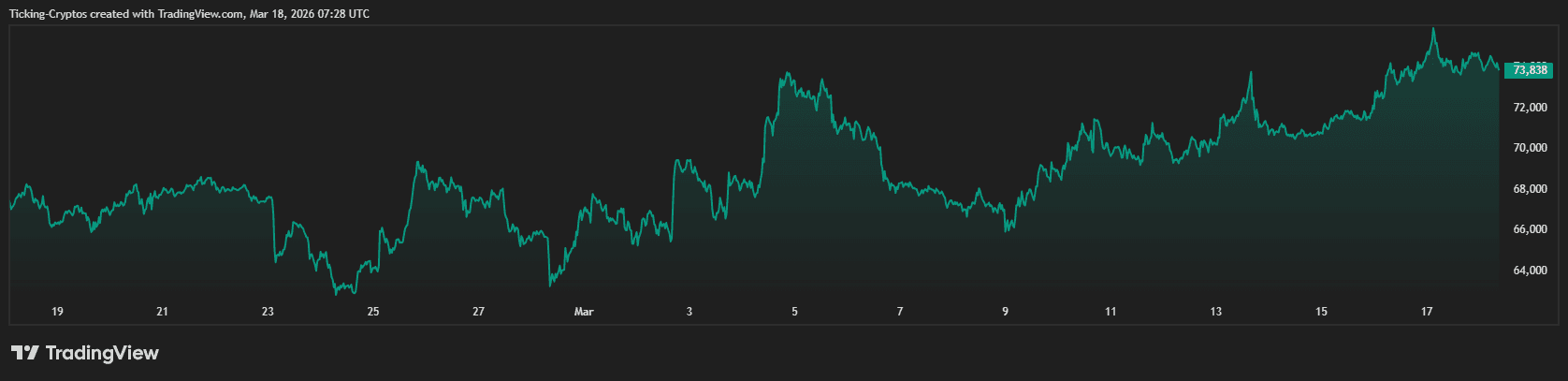
The crypto market in early 2026 has been nothing short of a rollercoaster. After the euphoric highs of late 2025, where Bitcoin flirted with the $130,000 mark, a "diffuse cocktail of macro anxieties" has sent prices into a steep correction. As of late mid-March 2026, $Bitcoin has retraced nearly 50% from its All-Time High (ATH), trading in above $73,000.
Is it a Good Time to Buy Crypto?
Historical cycles suggest that corrections of 50% to 70% are healthy "purges" that wipe out over-leveraged traders. With Bitcoin currently sitting at a 50% discount, the risk-to-reward ratio for March 2026 has shifted heavily in favor of the bulls.
As geopolitical tensions and tariff uncertainties stabilize, capital is expected to rotate back into "risk-on" assets. Investors who missed the 2025 rally now have a second chance to enter the market. If you are looking to build a portfolio, diversifying across these five projects offers a balance of stability, utility, and explosive recovery potential.
1. Ethereum (ETH) – The Infrastructure King
Despite the rise of "Ethereum killers," Ethereum remains the undisputed home of Decentralized Finance (DeFi) and Real-World Asset (RWA) tokenization. In 2026, the successful rollout of the "Prague" upgrade has further slashed Layer-2 costs, making the network more scalable than ever.
- Why Buy Now? ETH has followed Bitcoin’s slide, dropping from its 2025 high of $4,950 to under $2,000.
- The Catalyst: Major financial institutions like BlackRock and JPMorgan are increasingly using Ethereum for tokenized deposit pilots. At current prices, you are buying the "settlement layer of the internet" at a 60% discount.
2. Solana (SOL) – The Speed Demon
Solana has proven its resilience after the network reliability concerns of previous years. With the Firedancer upgrade now fully integrated in 2026, Solana can process over 1 million transactions per second.
- Status: While it reached $260 in the last bull run, SOL is currently trading significantly lower, creating a "gap" that savvy traders are eager to fill.
- Use Case: It has become the primary chain for consumer AI-crypto applications and high-frequency trading.
3. Chainlink (LINK) – The Oracle Essential
You cannot have a functional DeFi ecosystem without accurate data, and Chainlink owns 90% of that market. In 2026, its Cross-Chain Interoperability Protocol (CCIP) has become the standard for banks moving data between private and public blockchains.
- The Play: LINK often lags behind the initial BTC pump but rallies hard once the ecosystem matures. It is one of the most undervalued "blue-chip" utility tokens heading into March.
4. Sui (SUI) – The Emerging Contender
Sui has emerged as the breakout Layer-1 of the 2025-2026 cycle. Utilizing the Move programming language, it offers a level of security and parallel processing that older chains struggle to match.
- Growth Potential: Sui's Total Value Locked (TVL) has remained stable even during the February crash, suggesting a loyal and committed developer base. As the market recovers, SUI is positioned to be a top performer.
5. Fetch.ai (FET/ASI) – The AI Narrative
2026 is the year of "AI Agents." Fetch.ai, as part of the Artificial Superintelligence Alliance, is at the forefront of this movement. Their autonomous agents are now being used in logistics and decentralized energy grids.
- Why March 2026? The "AI plus Crypto" narrative is the strongest secular trend in the market. With FET down along with the broader market, it offers a high-beta play for those betting on the continued AI revolution.
Conclusion: Strategy for March 2026
Investing during a 50% Bitcoin drawdown requires a long-term mindset. While volatility may persist in the short term, the fundamental value of these projects remains unchanged. Consider using a regulated exchange to dollar-cost average into these positions throughout the month.
Vietnam is shifting from one of the world's most active unregulated crypto markets to a strictly controlled domestic ecosystem. According to reports from Reuters, the government in Hanoi is preparing to launch a pilot scheme for locally licensed digital asset exchanges while simultaneously drafting rules to ban citizens from using overseas platforms.
The Race for the First Vietnam Crypto License
Five major domestic entities have passed an initial qualification round to operate the country’s first legal exchanges. This move marks a significant transition for a nation that ranked fourth globally on the Chainalysis Global Crypto Adoption Index.
The qualified applicants include:
- Techcombank (TCB)
- VPBank (VPB)
- LPBank (LPB)
- VIX Securities
- Sun Group
Why Hanoi is Curbing Foreign Trading
The Vietnamese government’s primary concern is uncontrolled capital outflows. While the country has high crypto interest, most transactions currently occur on offshore servers, making it difficult for authorities to monitor wealth movement or collect taxes.
By forcing users onto local platforms, Hanoi aims to:
- Regulate Capital: Ensure trades are settled via local banking rails.
- Tax Revenue: Implement a structured tax framework for digital assets.
- Consumer Protection: Bring high-risk trading under the oversight of the Ministry of Finance.
Market Impact and Local Adoption
Currently, Vietnamese traders move over $200 billion annually in crypto. The new regulations will likely push this liquidity into the hands of major local financial institutions. However, digital assets are still not recognized as legal tender or a formal means of payment in the country.
Summary of New Vietnam Crypto Regulations
| Feature | New Policy |
|---|---|
| Foreign Exchanges | Planned ban for Vietnamese nationals |
| Local Exchanges | Pilot program for licensed domestic firms |
| Key Players | Major private banks (VPBank, Techcombank) |
| Objective | Combat capital flight and increase oversight |
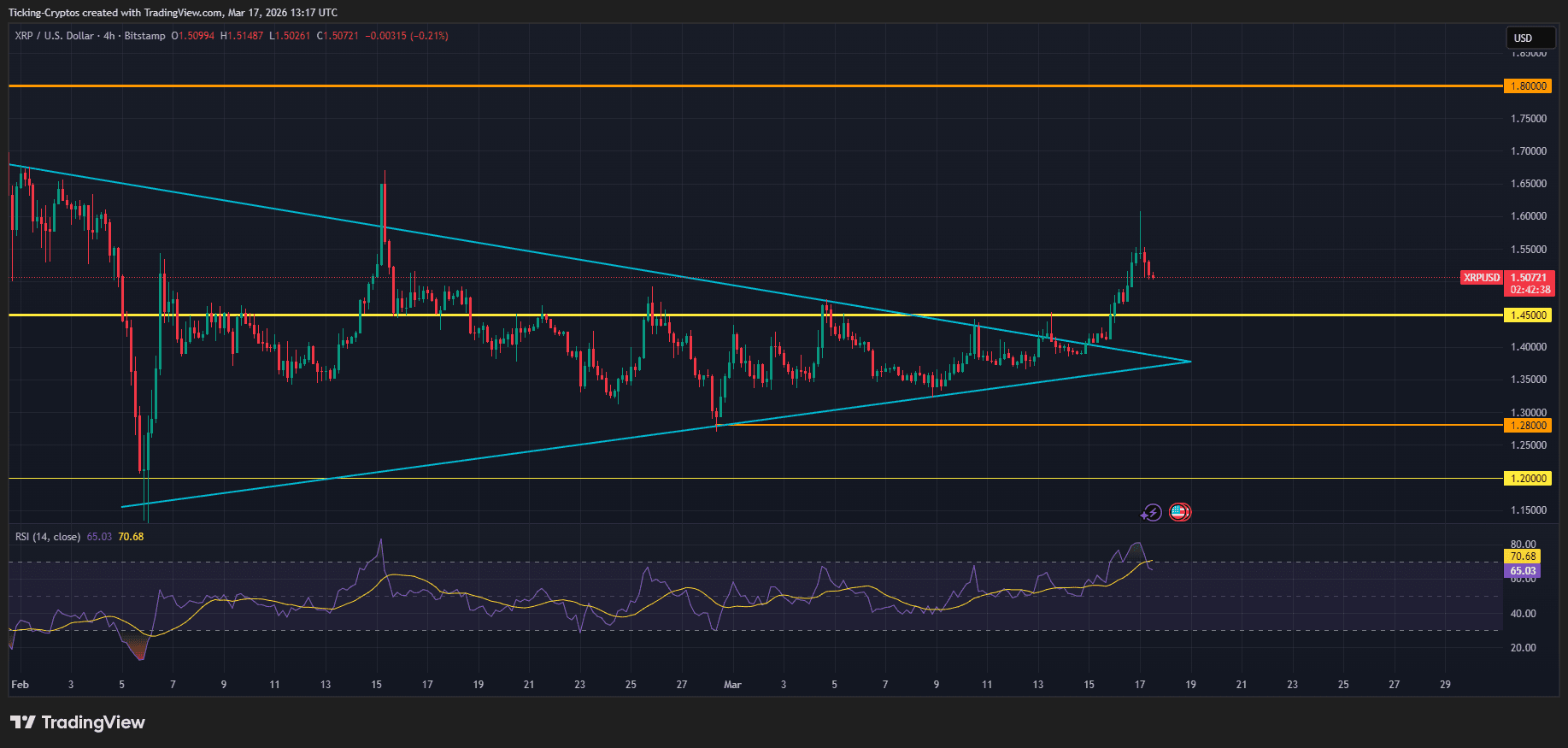
Ripple’s native token, $XRP, reclaimed the $1.50 price level. This move comes after weeks of tightening volatility, where the asset was compressed within a massive technical structure. As the broader crypto market shows signs of a renewed bullish cycle, XRP's recent price action suggests that the long-awaited move toward psychological resistance levels may be underway.
XRP Price Prediction: The Road to $2.00
The current technical setup confirms that XRP is targeting the $2.00 milestone. This projection is based on a "measured move" following the breach of a multi-week consolidation pattern. If XRP-USD can maintain its position above the $1.45 support zone, the next liquidity pocket sits between $1.85 and $2.10.
The Symmetrical Triangle
A symmetrical triangle is a chart pattern characterized by two converging trendlines connecting a series of sequential peaks and troughs. In XRP’s case, this pattern represented a period of "equilibrium" where buyers and sellers were in a deadlock. Typically, a breakout from this formation indicates that the prevailing trend—in this case, the bullish momentum from late 2025—is ready to resume with high volume.
The Breakout: How XRP Breached the Triangle
The most critical development in the recent XRP-USD price action is the upward breach from the triangle formation. Since February 2026, XRP has been making lower highs and higher lows, narrowing into an apex near the $1.38 mark.
On March 14, trading volume surged by over 300%, providing the necessary fuel for XRP to pierce the upper descending trendline. This "breach" was not merely a wick but was followed by a daily candle close above the resistance, effectively flipping it into a support floor. Technical analysts often view this specific type of exit from a triangle as a signal that the "accumulation phase" is over and the "markup phase" has begun.
Technical Indicators Supporting the $2 Target
Beyond the triangle breakout, several other indicators point toward a continued rally:
- Moving Averages: XRP is now trading comfortably above its 50-day and 200-day Exponential Moving Averages (EMAs).
- Relative Strength Index (RSI): The RSI is currently at 64, suggesting that while the asset is gaining strength, it is not yet "overbought" (which typically occurs above 70).
- Institutional Inflows: According to data from CoinShares, XRP-specific investment products have seen over $1.3 billion in cumulative inflows this year, providing the structural liquidity needed to sustain a move to $2.00.
Key Support and Resistance
| Level | Type | Significance |
|---|---|---|
| $1.38 - $1.42 | New Support | The previous triangle resistance now acts as a floor. |
| $1.56 | Current Pivot | XRP is consolidating here to build momentum for the next leg. |
| $1.80 | Minor Resistance | A historical supply zone from early 2026. |
| $2.00 | Major Target | The primary psychological and technical goal for the current rally. |
Ethereum (ETH) has bounced back strongly, rising more than 20% over the past eight days. While much of the market focused on Bitcoin’s volatility, Ethereum moved higher in the background. The rally is being driven by growing institutional interest and clearer regulatory support, two factors that are starting to change how major financial players approach the Ethereum network.
Why is Ethereum Price UP?
The recent Ethereum price pump is driven by a convergence of institutional liquidity and regulatory clarity. Specifically, the Federal Reserve's decision to allow tokenized securities as bank collateral and BlackRock’s launch of its iShares Staked Ethereum Trust (ETHB) have provided the necessary fundamental support for ETH to decouple from minor market corrections.
Tokenization and Staked ETFs
To understand why these developments are "game-changers," we must define the two pillars supporting this rally:
- Tokenized Securities: These are traditional assets (like stocks or bonds) represented as digital tokens on a blockchain.
- Staked ETFs: Unlike a standard spot ETF, a staked ETF (like ETHB) actually participates in the network's consensus, earning a "yield" or dividend for its shareholders by securing the network.
1. The Fed’s Green Light: Tokenized Assets as Collateral
On March 6, 2026, the Federal Reserve, alongside the OCC and FDIC, issued a landmark clarification. U.S. banks are now officially permitted to use tokenized securities as collateral for loans.
Why This Matters for Ethereum
Regulators confirmed that as long as the tokenized version confers the same legal rights as the traditional asset, it will receive the same capital treatment. Crucially, the Fed stated this applies regardless of whether the blockchain is permissioned or permissionless (public).
- Liquidity Influx: Trillions of dollars in "off-chain" value (Treasuries, equities) can now migrate to Ethereum.
- Ethereum as the "Settlement Layer": Since Ethereum remains the dominant hub for Real-World Assets (RWAs), this ruling cements $ETH role as the global plumbing for modern finance.
2. BlackRock’s ETHB: The First Dividend-Paying Crypto ETF
On March 12, 2026, BlackRock launched the iShares Staked Ethereum Trust (ticker: ETHB). While the market already had spot ETH ETFs, ETHB is the first from a major issuer to offer staking rewards directly to shareholders.
Key Features of ETHB:
- Yield Generation: The fund stakes between 70% and 95% of its holdings.
- Monthly Distributions: Investors receive monthly cash payouts, similar to a high-yield dividend stock.
- Institutional Infrastructure: BlackRock partnered with Figment and Coinbase Prime to manage the validator sets, bringing "Enterprise-Grade" security to the staking process.
"The ETHB launch transforms Ethereum from a speculative commodity into a productive, yield-bearing asset for the average 401k investor." — Market Insight
Comparison: Spot ETH vs. Staked ETH ETFs
| Feature | Spot ETH ETF (e.g., ETHA) | Staked ETH ETF (ETHB) |
|---|---|---|
| Primary Goal | Price Tracking | Price + Yield |
| Income Source | None | Staking Rewards (~2-3% Net) |
| Risk Profile | Market Volatility | Volatility + Slashing Risk |
| Target Audience | Traders | Long-term Income Seekers |
Fundamental Divergence
For months, analysts have noted a divergence: Ethereum's network fundamentals (Total Value Locked, Active Addresses, and Layer 2 scaling) were hitting record highs while the Ethereum price lagged. This 20% pump suggests the "valuation gap" is finally closing.
Markets Rally Ahead of President Trump’s Speech
Global markets are reacting strongly ahead of President Donald Trump’s expected White House speech today, with equities surging and oil prices falling after reports that the United States is allowing some oil tankers to pass through the Strait of Hormuz to stabilize global supply.
The development comes after days of heightened geopolitical tensions involving Iran and the United States. The Strait of Hormuz is one of the world’s most critical energy chokepoints, responsible for transporting roughly 20% of global oil supply.
Reports that tankers are now being allowed to pass through the strait have eased fears of a major disruption to global energy markets. As a result, oil prices dropped sharply, triggering a powerful rally across U.S. stock markets.
$1 Trillion Added to U.S. Stocks
The market reaction has been immediate. U.S. equities surged at the open, with major indexes posting strong gains.
The S&P 500, Nasdaq, Dow Jones, and Russell 2000 all climbed significantly as investors interpreted the tanker news as a signal of possible de-escalation in the Middle East conflict.
Tech stocks led the rally, with major companies such as Nvidia, Meta, Tesla, Apple, and Google all trading higher. In total, the U.S. stock market added hundreds of billions of dollars in market value, approaching the $1 trillion mark during the early session.
The logic behind the rally is straightforward: if oil supply remains stable, inflation pressure may ease, which could reduce economic uncertainty and support risk assets.
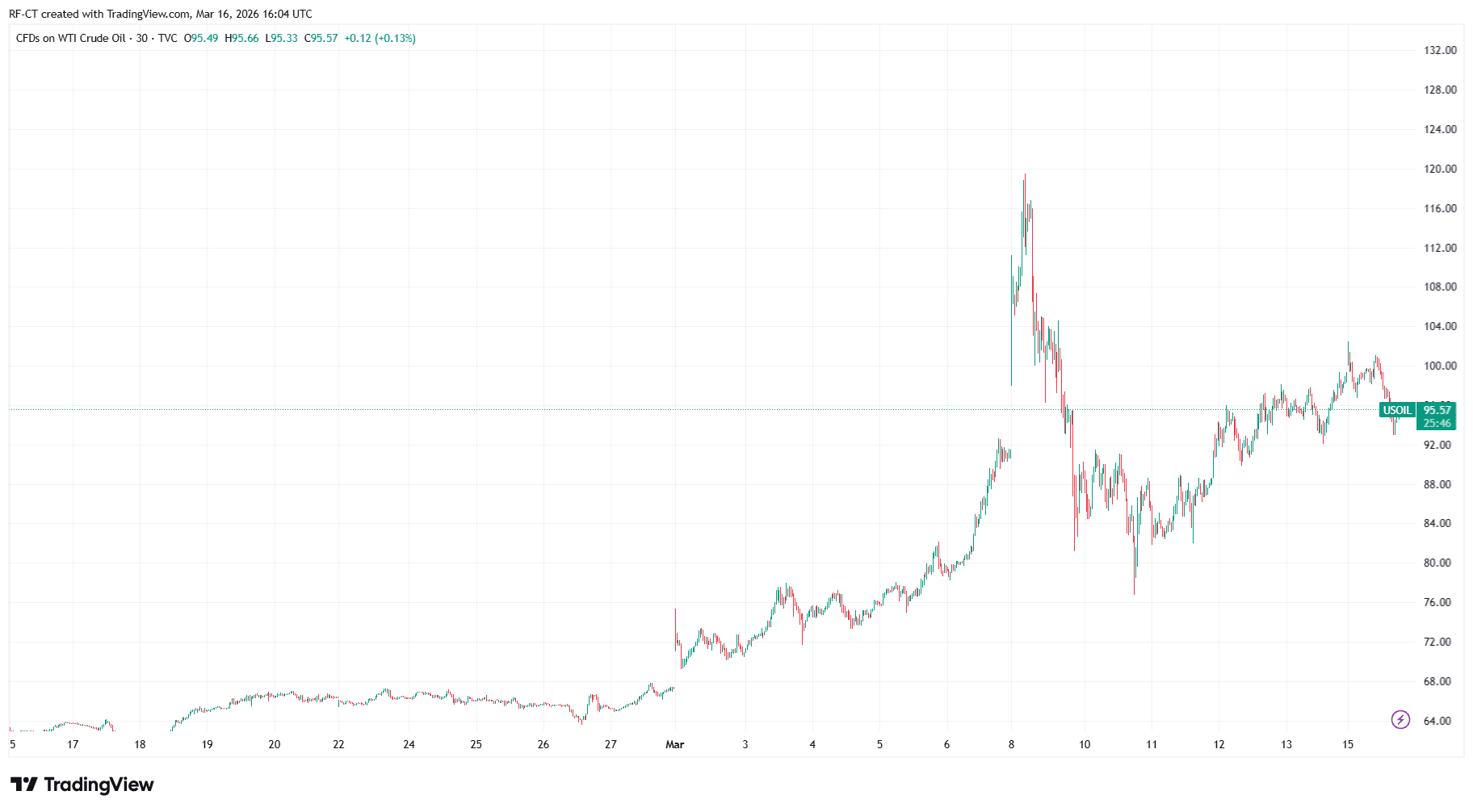
Oil Prices Drop After Hormuz News
Energy markets were extremely sensitive to the situation in the Strait of Hormuz over the past week. Any threat to the route can send oil prices soaring due to fears of supply disruptions.
However, the latest reports suggesting the United States is allowing some tankers to pass through the strait have helped calm markets.
Oil prices dropped sharply after the announcement, reinforcing the perception that global supply chains may remain intact despite ongoing geopolitical tensions.
For financial markets, lower oil prices often translate into lower inflation expectations, which tends to support stocks and other risk assets.
All Eyes on President Trump’s Announcement
President Trump is expected to address the situation during a White House press conference later today. Investors are closely watching the speech for signals about the next steps in U.S. policy.
Key questions markets are asking include:
- Will the U.S. officially confirm that tanker traffic through Hormuz is being stabilized?
- Will there be a broader international coalition protecting the shipping route?
- Could the speech signal de-escalation or further military action?
Markets have already partially priced in a positive outcome, meaning the tone of the speech could play a decisive role in determining the next move across global assets.
Could Bitcoin Be the Next Market Mover?
While traditional markets have already reacted, the cryptocurrency market is watching closely.
Bitcoin has recently shown surprising resilience during geopolitical instability. In many cases, major macro developments initially move traditional markets such as oil and equities before spilling over into crypto.
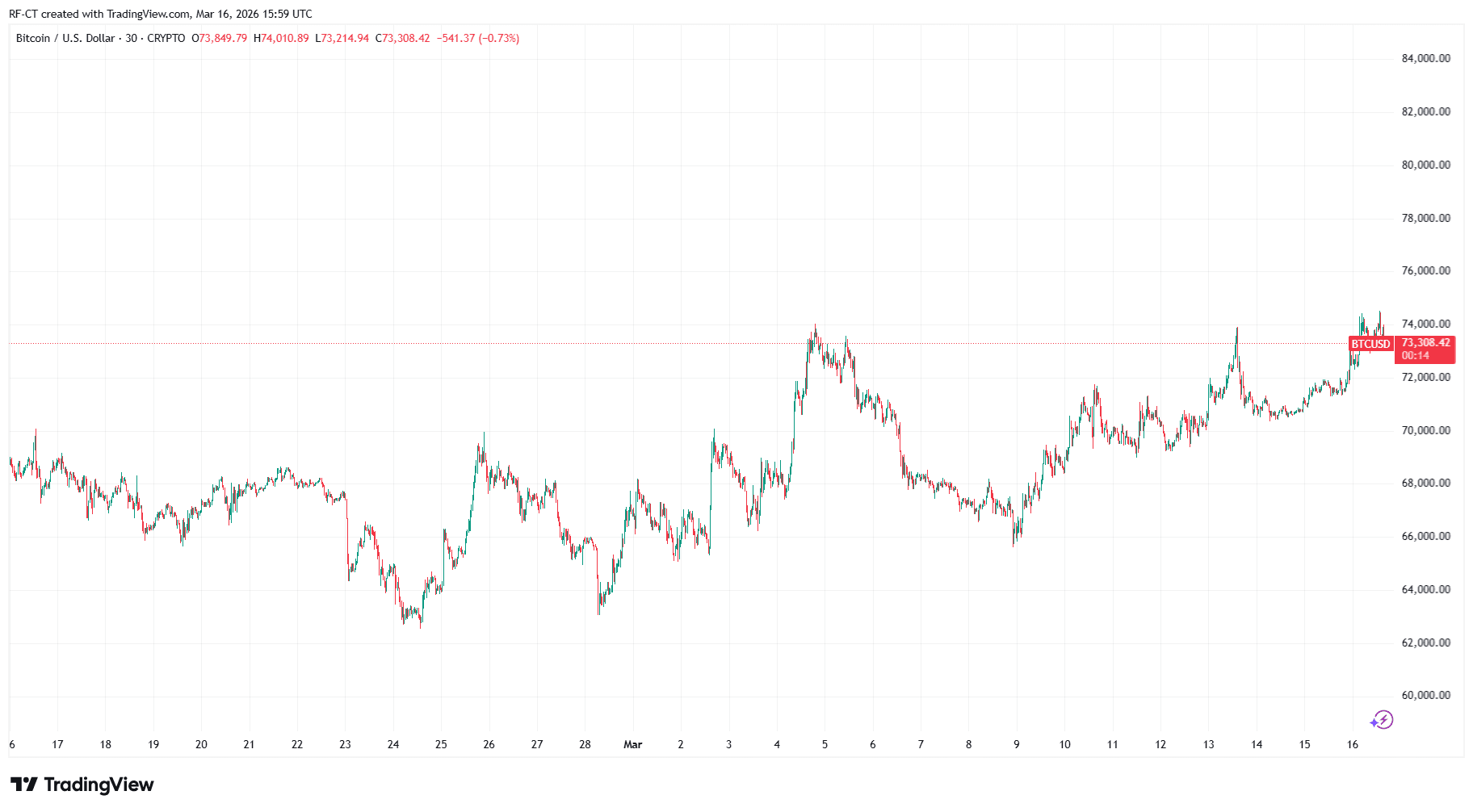
If global risk sentiment continues improving, capital could rotate back into digital assets, potentially supporting Bitcoin and the broader crypto market.
On the other hand, if the speech signals escalation or renewed uncertainty, volatility could return across both traditional and crypto markets.
For now, Bitcoin traders are waiting to see whether the macro rally in equities will translate into momentum for the crypto market as well.
Conclusion
With oil prices dropping and U.S. stocks surging ahead of President Trump’s speech, global markets are positioning for potential stabilization in the Strait of Hormuz situation.
However, the final market reaction will likely depend on the tone and details of the announcement. Investors across equities, commodities, and cryptocurrencies are now waiting to see whether the speech confirms de-escalation — or introduces a new wave of uncertainty.
If risk appetite continues improving, Bitcoin could become the next asset to react.
Decrypt
A cross-party committee has warned that cryptocurrency donations leave UK politics open to foreign interference.
Its license was suspended after regulators accused the Bitcoin ATM operator of overcharging kiosk users and failing to provide some refunds.
Lawmakers are citing privacy risks tied to wearable AI and are asking how Meta intends to secure consent from both users and bystanders.
NVIDIA pitched DLSS 5 as a breakthrough in real-time rendering. Players saw something closer to AI overreach.
Bitrefill, which lets users swap Bitcoin, Dogecoin and other crypto assets for gift cards, disclosed a breach that took place on March 1.
U.Today - IT, AI and Fintech Daily News for You Today
Dogecoin's zero removal attempt is no longer relevant in terms of longer-term price performance.
Bestselling Rich Dad Poor Dad author Robert Kiyosaki has issued a stark warning to his millions of followers.
The SEC and CFTC have issued a historic joint interpretation officially recognizing XRP as a digital commodity.
Market could be on its way to a recovery, but it is too early to tell if investors will have enough conviction for a recovery.
The agencies noted that this guidance serves as a critical bridge for the market while Congress continues working to advance comprehensive, bipartisan market structure legislation.
Blockonomi
TLDR:
- Binance confirms Fabric Protocol (ROBO) as its 62nd HODLer Airdrops project, listed on March 18, 2026.
- A total of 100M ROBO tokens are reserved for airdrop rewards, with 200M set aside for marketing campaigns.
- Eligible users subscribed BNB to Simple Earn or On-Chain Yields between March 4 and March 6, 2026 UTC.
- ROBO launches with 2.23B circulating tokens, available on both BNB Smart Chain and the Ethereum network.
Binance has officially announced Fabric Protocol (ROBO) as the 62nd project on its HODLer Airdrops page. The exchange confirmed the listing on March 18, 2026.
Fabric Protocol is a decentralized infrastructure built for coordinating robots and AI workloads. It connects devices, services, and humans within a unified network.
Users who held BNB in Simple Earn products during a set window are eligible for the airdrop. Distribution is expected within five hours of the announcement.
ROBO Airdrop Details and Token Distribution
The total genesis token supply for Fabric Protocol (ROBO) stands at 10 billion tokens. Of this, 100 million ROBO tokens have been reserved for HODLer Airdrops rewards.
An additional 200 million ROBO will support future marketing campaigns. Binance will share details on those campaigns through separate announcements.
The circulating supply upon listing on Binance will reach 2,231,000,000 ROBO. This figure represents 22.31% of the total token supply.
ROBO is available on both BNB Smart Chain and Ethereum networks. The BNB Smart Chain contract is 0x475cbf5919608e0c6Af00e7bf87FaB83bF3Ef6e2. The Ethereum contract address is 0x32b4d049fe4c888d2b92eecaf729f44df6b1f36e.
To qualify for this airdrop, users must have subscribed BNB to Simple Earn products. The eligible window ran from March 4 to March 6, 2026, in UTC time.
Both Flexible and Locked Simple Earn products counted toward eligibility. On-Chain Yields subscriptions were also included in the criteria.
A hard cap applies to BNB holdings throughout the calculation period. Any user’s average BNB holding ratio must not exceed 4% of the total pool.
If a ratio surpasses 4%, Binance will cap it at exactly 4%. This measure supports fair distribution across a broader group of participants. The listing fee for ROBO on Binance is zero.
Binance noted that a research report on Fabric Protocol (ROBO) will be available within 48 hours. Users are advised to conduct their own research before trading ROBO outside Binance.
The exchange warned about potential scams on external platforms. Safety of funds remains a top priority for all participants.
How the Binance HODLer Airdrops Program Works
The Binance HODLer Airdrops program rewards BNB holders based on historical balance snapshots. Unlike other programs, users do not need to take ongoing actions to qualify.
Instead, rewards are distributed retroactively to eligible holders. This makes the process straightforward for regular BNB subscribers.
Binance takes multiple snapshots of user balances at random intervals each hour. These snapshots capture the average balance held in Simple Earn or On-Chain Yields products.
The platform then uses a historical reference period to calculate final rewards. Snapshots may cover a window of several days prior to the announcement date.
Once calculations are complete, Binance distributes the airdrop tokens directly to users’ Spot Accounts. The distribution typically occurs within five hours of the official announcement. This timeline gives users quick access to their earned tokens. There is no separate claim process required.
By subscribing BNB to Simple Earn, users also become eligible for Launchpool and Megadrop rewards. On-Chain Yields subscriptions additionally qualify users for Launchpool rewards. This stacking of benefits makes BNB subscription one of the more efficient options on the platform.
To get started, users can navigate to the Earn section on Binance and search for BNB. From there, they can subscribe to available Simple Earn or On-Chain Yields products.
Once subscribed, eligibility for future HODLer Airdrops becomes automatic. With Fabric Protocol (ROBO), Binance continues expanding the program to its 62nd project.
The post Binance Adds Fabric Protocol (ROBO) as 62nd HODLer Airdrops Project With 100M Token Rewards appeared first on Blockonomi.
TLDR:
- Citi lowered its Bitcoin 12-month base case to $112,000, a $31,000 cut from its prior $143,000 forecast.
- Ethereum’s revised base case now stands at $3,175, reflecting a $1,129 drop from Citi’s earlier projection.
- Stalled U.S. crypto legislation and softening ETF inflows are the two key reasons behind the target revision.
- Citi’s Bitcoin bear case sits at $58,000, tied to a recessionary scenario the bank does not currently expect.
Bitcoin price target revisions from major financial institutions carry real weight across crypto markets. Citigroup, the world’s third-largest bank, has officially lowered its 12-month forecasts for Bitcoin and Ethereum.
The bank cut Bitcoin’s base case to $112,000 from $143,000 and Ethereum’s to $3,175 from $4,304. Two primary factors drove the change: stalled U.S. crypto legislation and a noticeable softening in ETF inflows.
Citi Revises Bitcoin and Ethereum Forecasts Amid Regulatory Uncertainty
The revision marks a $31,000 reduction in Citi’s Bitcoin outlook within a single update. For Ethereum, the cut amounts to $1,129 off the previous 12-month base case estimate.
Both reductions came simultaneously, pointing to a broader reassessment of the crypto market. Citi cited U.S. legislative delays and weaker ETF demand as the main drivers.
Markets had widely priced in a pro-crypto regulatory wave from the United States. That wave has not arrived, and institutional forecasters are now adjusting their positions.
As Milk Road noted, “when a bank of Citi’s size moves its targets, it’s usually because the macro story changed.” This suggests the revision goes beyond surface-level price action.
Softening ETF inflows added another layer of pressure to Citi’s forward-looking model. Institutional demand through ETF channels had previously been a key pillar of bullish forecasts.
With that momentum easing, the bank’s analysts found less justification for the higher targets. The revision reflects a more cautious, data-driven stance from the institution.
Both Bitcoin and Ethereum still trade well below their revised base case targets. Bitcoin is currently priced near $74,089, while Ethereum sits around $2,325.
This means the revised base cases still project considerable upside from current levels. However, reaching those levels will depend heavily on regulatory progress.
Bull and Bear Cases Reveal the Range of Possible Outcomes
Citi’s bull case for Bitcoin holds steady at $165,000 for the 12-month period ahead. That figure sits roughly 47% above the revised base case of $112,000.
For Ethereum, the bull scenario projects a price of $4,488 over the same period. These numbers show the bank has not turned broadly bearish on digital assets.
On the opposite end, the bear case projects Bitcoin falling to $58,000. Ethereum’s downside scenario drops further, landing at $1,198.
Both bearish outcomes are tied to a recessionary environment taking hold. Citi does not view this as the most likely scenario, but it remains within range.
The wide spread between bull and bear cases reflects the ongoing uncertainty in crypto markets. Regulatory outcomes, macroeconomic shifts, and ETF demand trends all remain unpredictable.
Any movement on U.S. crypto legislation could quickly shift the probability toward the higher end. Conversely, prolonged policy stagnation could push outcomes closer to the bearish range.
The base case revision carries the most weight for institutional market participants. It represents Citi’s central expectation given current available data.
Further revisions remain possible as the regulatory and macroeconomic landscape develops. For now, the market must recalibrate around a more measured institutional outlook on Bitcoin and Ethereum.
The post Citi Slashes Bitcoin and Ethereum Price Targets as U.S. Crypto Legislation Stalls appeared first on Blockonomi.
TLDR:
- Hyperliquid HIP-3 aggregated open interest surged to a record $1.43 billion, a 100x rise in six months.
- WTI crude oil’s 24-hour volume hit $1.39B on Hyperliquid, ranking second behind Bitcoin and above Ethereum.
- Only 7 of the top 30 trade.xyz markets are crypto pairs, while 23 are tokenized traditional assets.
- HYPE token is up over 50% year to date in 2026, outperforming Bitcoin which is down roughly 15%.
Hyperliquid HIP-3 markets have hit a record $1.43 billion in aggregated open interest as of Saturday. This marks a 100x increase since the first HIP-3 markets launched six months ago.
Trade.xyz, built by Hyperunit — Hyperliquid’s tokenization arm — controls nearly 90% of all open interest. Daily trading volumes on the platform now reach $22 billion.
Of the top 30 active markets, only seven are crypto pairs, with the rest being tokenized traditional assets.
24/7 Trading Fuels Demand for Tokenized Assets
The ability for Hyperliquid HIP-3 markets to operate 24/7 is the key driver of this growth. Traditional exchanges shut down on weekends and during off-hours.
This leaves traders without access to real-time price discovery for equities and commodities. HIP-3 markets fill that gap, offering continuous trading across the week.
Trade.xyz’s top 30 markets include contracts for the S&P 500, NASDAQ, and individual stocks. Commodity contracts for gold, silver, and crude oil are also among the most active.
The WTI crude oil perpetual contract alone recorded $1.39 billion in 24-hour trading volume. That placed it second across the platform, behind Bitcoin and ahead of Ethereum.
Among the top 30 markets, 23 are tokenized traditional assets rather than crypto pairs. This distribution reflects a clear expansion beyond the crypto-native user base.
Traders who had no weekend venue for equities and commodities are now active on Hyperliquid. The platform has broadened its reach into a new segment of the market.
Trade.xyz captures roughly 90% of total HIP-3 trading activity. Its growth curve has been nearly vertical since launch six months ago. The platform’s daily volume now stands at $22 billion.
These numbers confirm that tokenized real-world assets are gaining ground on decentralized exchanges.
HYPE Token Outperforms as HIP-4 Announcement Draws Attention
The HYPE token has been one of the strongest-performing crypto assets in 2026. It is up over 50% year to date, while Bitcoin has fallen by approximately 15% in the same period.
This performance sets HYPE apart from the broader market trend. The divergence has drawn attention from traders and market participants.
Hyperliquid has also recently announced HIP-4. This upgrade will enable permissionless listings of prediction markets on the platform.
Prediction markets represent a largely untapped area within decentralized finance. The announcement adds a potential new growth vector for the ecosystem.
Combined with HIP-3’s record open interest, the HIP-4 announcement reinforces Hyperliquid’s ongoing momentum. The platform is expanding beyond crypto trading into new asset classes and market structures.
Tokenized equities and commodities now dominate the top 30 markets on trade.xyz. This shift shows how on-chain finance is evolving to serve a wider audience.
The WTI crude oil contract’s strong performance offers a clear example of this trend. It surpassed Ethereum in 24-hour trading volume, a notable market development.
As traditional markets remain closed on weekends, Hyperliquid HIP-3 continues to offer a viable alternative. The platform’s structural advantage in 24/7 trading may continue driving open interest higher.
The post Hyperliquid HIP-3 Surpasses $1.43B Open Interest as 24/7 Tokenized Asset Trading Expands appeared first on Blockonomi.
TLDR:
- BNB Chain has extended its 0 Fee Carnival through March 31, 2026, covering USDC, USD1, and U gas fees.
- Over $4.5 million in stablecoin gas fees have been covered since the program launched on BNB Chain.
- Thirteen wallets sponsor free BSC transfers, with USD1 and U unlimited and USDC capped at two per day.
- Celer cBridge and Meson.fi offer zero-cost bridging into BNB Chain from Ethereum, Arbitrum, and more.
BNB Chain’s 0 Fee Carnival has been extended through March 31, 2026, at 23:59 UTC. The program now covers gas fees for three stablecoins: USDC, USD1, and U.
This applies across CEX withdrawals, wallet transfers, and cross-chain bridging on BSC and opBNB. Since launch, BNB Chain has covered more than $4.5 million in user gas fees.
The network also handles approximately 40% of all global stablecoin transactions to date.
Zero-Fee Withdrawals and Wallet Transfers Now Available Across Platforms
Multiple major centralized exchanges are part of the zero-fee withdrawal program. Binance, Bitget, MEXC, Bitmart, Ourbit, BingX, LBank, and HTX are all enrolled.
Each exchange sets its own minimum withdrawal threshold for the supported assets. For example, Binance covers USD1 withdrawals on BSC with a minimum of $10.
BNB Chain confirmed the extension through an official post on X. The network stated it had already covered $4.5 million in gas fees across the program. The post also pointed to its 40% share of global stablecoin activity. Zero fees continue to apply to all three supported stablecoin assets.
The 0 Fee Carnival continues.
We’ve already covered $4.5M+ in stablecoin gas fees and power ~40% of all stablecoin transactions.
Now zero-fee transfers for USDC, USD1 & U are extended to March 31, 2026.
Read more
https://t.co/gNxRWzN4zS pic.twitter.com/fTYMkDxyr6
— BNB Chain (@BNBCHAIN) March 17, 2026
Wallet-to-wallet transfers on BSC also remain gas-free under the extension. Thirteen wallets sponsor these transfers, including Trust Wallet, Bitget Wallet, SafePal, and TokenPocket.
USD1 and U have unlimited daily transfers, while USDC is capped at two per day. The minimum eligible transfer amount is $0.10.
Only direct wallet-to-wallet transfers on BSC qualify for the gas sponsorship. Transactions routed through DApps or swap protocols are not covered.
This keeps the program focused on standard peer-to-peer stablecoin movement. Users sending directly between wallets stand to benefit the most.
Cross-Chain Bridging Into BNB Chain Now Comes at Zero Cost
Celer cBridge and Meson.fi both support gas-free stablecoin bridging into BNB Chain. Eligible source chains include Ethereum, Arbitrum, Polygon, Avalanche, and Optimism.
Meson.fi also includes Tron as a supported source network. Together, these two bridges cover the most widely used cross-chain routes.
Celer cBridge charges no bridge fee for USDC transfers onto BNB Chain. Meson.fi takes a different approach, offering users a full 100% rebate on completed transfers.
In both cases, users pay nothing to complete a cross-chain move. This removes a common barrier for users active across multiple blockchain ecosystems.
Before this program, moving stablecoins across chains involved gas fees on both ends. The zero-fee setup now eliminates that cost for users bridging into BNB Chain.
This makes it easier for users coming from Ethereum, Arbitrum, or Optimism to join. Those users can now explore DeFi on BNB Chain without paying to get started.
HTX has gone further by committing to zero-fee USD1 support on a permanent basis. Other wallets, exchanges, and bridges are invited to participate as the program grows.
BNB Chain positions this as a long-term effort to reduce friction in stablecoin movement. The current extension gives all users until March 31, 2026, at 23:59 UTC.
The post BNB Chain Extends Zero-Fee Stablecoin Transfers for USDC, USD1, and U Until March 31, 2026 appeared first on Blockonomi.
TLDR:
- Bitrefill’s March 2026 breach was linked to North Korea’s Lazarus Group based on malware and IP patterns.
- Attackers used a stolen legacy credential from an employee laptop to access production infrastructure.
- Around 18,500 purchase records were accessed, exposing emails, crypto addresses, and IP metadata.
- Bitrefill confirmed it remains financially stable, absorbing all losses through its operational capital.
Bitrefill, a global crypto payments platform, disclosed a cyberattack that took place on March 1, 2026. The attack is suspected to involve North Korea’s Lazarus Group, also known as Bluenoroff.
Approximately 18,500 purchase records were accessed, containing email addresses, crypto payment addresses, and IP metadata.
The company went public with the incident after a detailed investigation involving external security experts and law enforcement agencies.
How the Bitrefill Attack Was Carried Out
The breach started on a compromised employee laptop within the company’s network. Attackers extracted a legacy credential from that device without triggering immediate alerts. That credential gave them access to a snapshot holding production secrets.
Using those secrets, the attackers escalated access into Bitrefill’s broader infrastructure. They reached parts of the company’s database and specific cryptocurrency hot wallets. Funds were then moved to attacker-controlled wallets.
The platform detected the breach after noticing suspicious purchasing patterns with certain suppliers. The team found that gift card stock and supply lines were being exploited simultaneously. Several hot wallets were also being drained in real time.
On March 1, Bitrefill’s official account posted a full incident report on social media. The company confirmed taking all systems offline as soon as the breach was detected. Restoring services across dozens of suppliers and payment methods required careful coordination.
Security investigators found strong similarities between this attack and prior DPRK Lazarus Group operations. The malware deployed, on-chain tracing, and reused IP addresses all matched known patterns. The team collaborated with ZeroShadow, SEAL_Org, Recoveris, and other incident response specialists throughout the process.
What Happened to Customer Data and What Bitrefill Is Doing
Customer data was not the primary target in the Bitrefill breach. Logs showed the attackers ran only a limited number of queries during the intrusion. Those queries were focused on probing cryptocurrency and gift card inventory, not personal records.
Around 18,500 purchase records were accessed during the attack. Those records included email addresses, crypto payment addresses, and IP metadata. For roughly 1,000 purchases, names stored in encrypted form may also have been accessed.
Since the attackers potentially obtained the encryption keys, the company treated that name data as compromised. Bitrefill directly notified all affected customers by email. No specific action is currently required from the broader customer base.
As a precaution, Bitrefill advised customers to stay alert to unexpected communications related to the platform. The company stated it will notify affected users if the risk assessment changes. Transparency remained a central part of its public response throughout the ordeal.
The company confirmed it remains financially stable and has been profitable for several years. All losses were covered using operational capital, with no disruption to ongoing services. Sales volumes and payment processing have since returned to normal.
The post Bitrefill Cyberattack Linked to North Korea’s Lazarus Group, Exposes 18,500 Customer Records appeared first on Blockonomi.
CryptoPotato
After the recent volatility that drove bitcoin to a six-week peak at $76,000 and the subsequent retracement, the asset has calmed at around $74,000.
Most larger-cap alts are also quite sluggish on a daily scale, but ETH has managed to defend the $2,300 level, while XRP is above $1.50.
BTC Stands Still at $74K
The primary cryptocurrency initiated an impressive leg up last week that culminated on Friday when it touched $74,000 for the second time in the past 10 days. However, the bears were quick to intercept the move and pushed the asset south by almost four grand toward $70,000, especially on Saturday when the US launched another major attack against Iran.
The asset remained above $70,000 during the weekend, and the bulls returned as the new business week began. They helped bitcoin climb toward $74,000 again, where it faced more resistance but ultimately managed to break through on Tuesday morning.
The leg up drove BTC to its highest price level since early February at $76,000. Nevertheless, bitcoin couldn’t keep rising and dipped to $73,500 later that day. The past 18 hours or so have been less eventful, as BTC has remained sideways at around $74,000, where it currently trades as well.
Its market cap stands at $1.480 trillion, while its dominance over the alts on CG is flat at 56.7%.
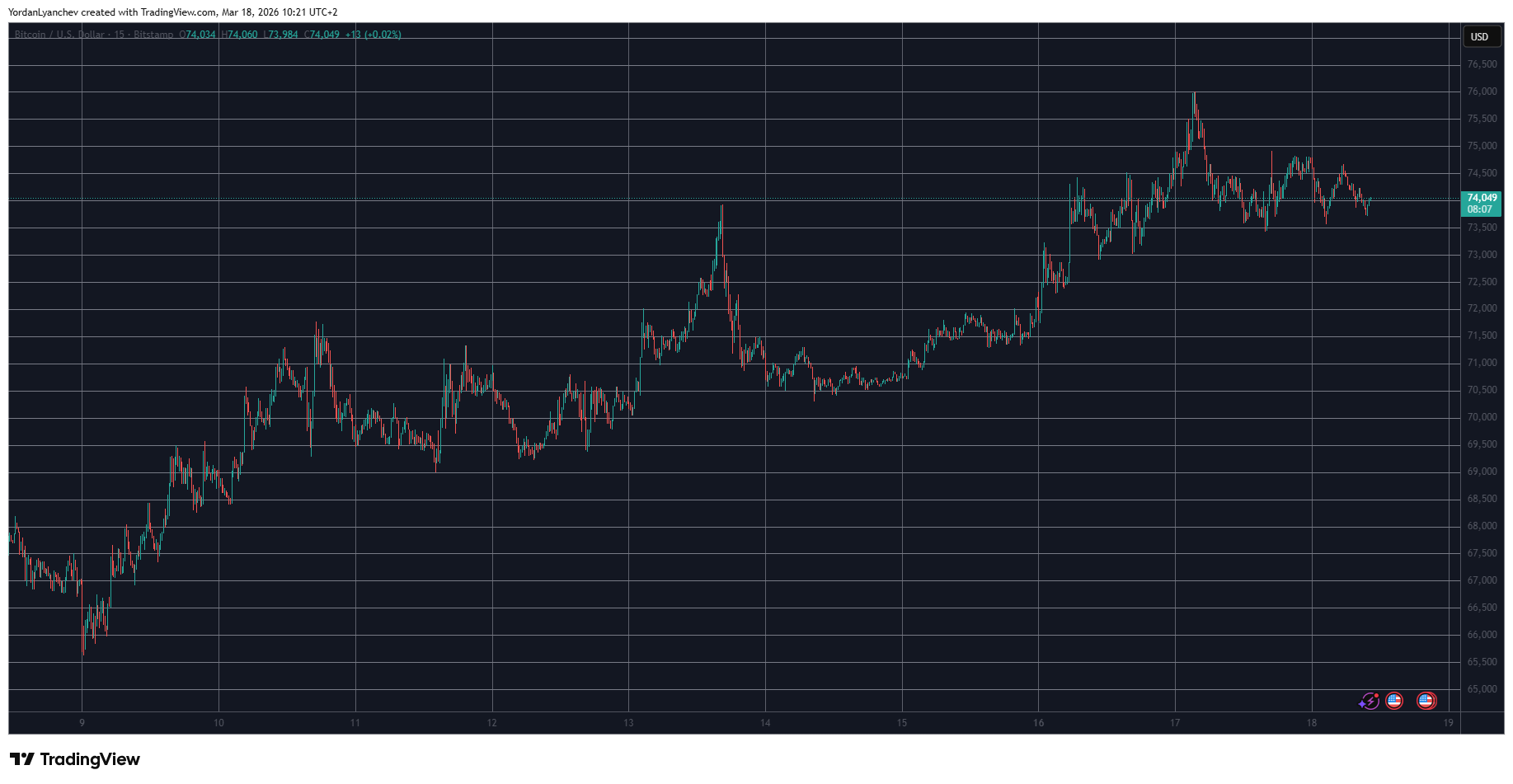
SIREN Enters Top 100
Ethereum continues to trade above $2,300 despite a minor slip in the past day. XRP is also slightly in the red, but remains north of $1.50. BNB, TRX, ADA, HYPE, and LINK are with minor gains, while SOL, DOGE, and BCH have posted insignificant losses.
XMR, CC, and SKY have dropped the most from the larger-cap alts, while ZEC is up by 3% to $276. SIREN has entered the top 90 alts by market after another double-digit daily surge. The asset has soared by 300% in the past month. M and KAS follow suit with 10% gains.
The total crypto market cap continues to sit above $2.6 trillion on CG.

The post SIREN Solidifies Top 100 Spot With 300% Monthly Surge, BTC Stalls at $74K: Market Watch appeared first on CryptoPotato.
Although it was completed several days ago, the Core Team behind the controversial project announced the migration earlier today, solidifying the successful upgrade to version 20.2.
They reasserted that the new protocol version should be groundbreaking for the project as it provides the foundations to eventually enable smart contract capabilities. However, even this big news couldn’t halt PI’s free-fall.
V20.2 Arrived
The past month has been quite eventful for Pioneers as the Core Team made several key protocol upgrades even before the aforementioned one. At first, they announced the successful migration to v19.6 on February 20, followed by v19.9 on March 4.
All eyes turned to March 12, which was the new deadline for the implementation of v20.2. It was the most important one from this year. In a post on X from hours ago, the team said: “All major Pi nodes have now been upgraded to version 20.2 and are supporting protocol 20.”
It’s worth noting that the team actually completed the migration within the original timeframe, as hinted in their Pi Day celebratory post from the weekend. However, the post now provides more information on what Pioneers can expect, especially since Pi Network has upgraded its Mainnet blockchain to protocol 20. The latest version is a major step toward the network’s goal to have smart contract capabilities, as explained in the post:
“Protocol 20 provides the foundation to enable smart contract capabilities, and the rollout of smart contracts will occur gradually, prioritizing categories that align with utility-based product innovation and operations. The specific types of smart contracts featured will depend heavily on the needs arising from the utility creation process.”
PI Drops Yet Again
Perhaps driven by the initial updates, PI’s price went on a roll in late February/early March. This rally received a major boost when the major US crypto exchange Kraken announced that it would list it for trading on March 13. The effects were immediate as PI skyrocketed by double digits from around $0.20 to almost $0.30.
After hitting a five-month peak, though, the reality set in as it turned out to be another classic sell-the-news event. PI nosedived on the next day toward the $0.20 support, which gave in yesterday. The situation has only worsened in the past 12 hours, as the token has dumped to under $0.175, thus dropping by almost 50% in just a few days.
PiScan data shows that the number of tokens to be released in the next month would be rather negligible compared to what it was in February and early March. Aside from March 20, when almost 16 million coins will be unlocked, the rest of the month will see numbers below 4 million.
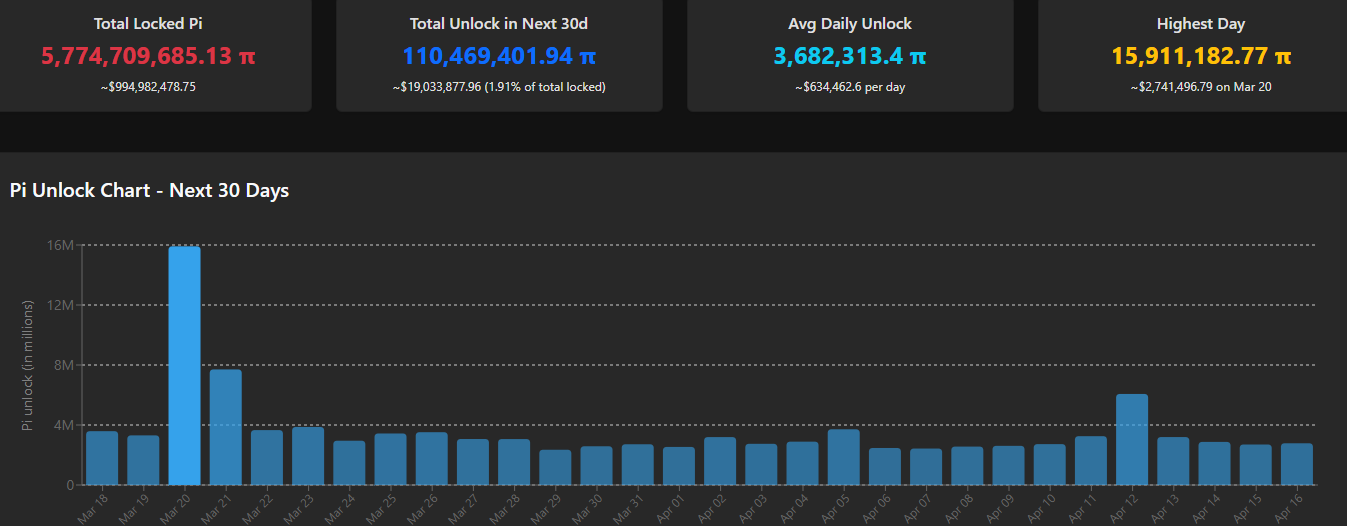
The post Pi Network Completes Groundbreaking Upgrade but PI Price Plunges Again appeared first on CryptoPotato.
The regulatory climate in the US is shifting, and although many consider it for the better, the changes are already taking effect.
Tally, a governance tooling platform that’s used by more than 500 decentralized autonomous organizations (DAOs), including Uniswap, Ethereum Name Service (ENS), and Arbitrum, announced that it will be shutting down after more than five years of operations.
In a video posted on X, the CEO of Tally, Dennison Bertram, outlined some reasons for the decision to wind down operations.
https://t.co/WD6Z4uVTeR pic.twitter.com/JJt3XIIJbl
— Tally (@tallyxyz) March 17, 2026
The move comes just as the SEC and the CFTC issued joint guidance clarifying that most cryptocurrencies are not securities, a major de-risking event for the entire industry.
While the previous administration pushed many projects toward a decentralized structure in the form of a DAO to reduce legal risk, the current, more relaxed environment has reduced demand for DAO governance, as Wu Blockchain noted in its commentary on the news.
Tally will not be conducting an ICO. Bertram said that continuation plans are already in the works with all of the firm’s enterprise clients, while the interface will remain operational for them as needed.
The post Major Governance Platform Tally Announces Shutdown Amid Regulatory Shifts appeared first on CryptoPotato.
For years now, the entire cryptocurrency industry has operated under a fog of regulatory uncertainty. Investors and developers alike were wondering which crypto asset the U.S. government might suddenly decide to classify as an unregistered security. Take Ripple’s XRP, for instance – one of the most obvious examples. The company was tangled in a prolonged lawsuit with the Securities and Exchange Commission, which lasted roughly half a decade, casting the shadow of ambiguity over an entire cohort of investors.
That era, however, effectively ended on March 17th, when the SEC, together with the Commodity Futures Trading Commission (CFTC), issued a landmark joint interpretive guidance.
The core takeaway, stated by the Chairman of the SEC, Paul Atkins, represents a true paradigm shift:
Most crypto assets are not themselves securities. – He said.
But while significant and historic, what does it all mean for the regular Joe? Here is a breakdown of what this decision means for your crypto portfolio, your staking yields, and your airdrops.
Staking and Airdrops: The Rules of Engagement
Staking and airdrops are perhaps two of the more common ways many retail crypto investors participate in decentralized networks. They have also historically been some of the biggest legal gray areas. The new joint guidance draws some clear and actionable lines for both of these.
First things first, for staking, the regulatory status would now depend on the structure of operation. If you are participating in protocol-level staking (read: locking up your tokens in order to secure a blockchain network like Ethereum, for example, and earning automated and pre-determined protocol rewards), this particular activity would generally fall outside of the scope of securities laws.
However, if you use a centralized, third-party service that pools investor funds and then promises a return based on its own managerial efforts, chances are regulators will still classify that yield product as a security (an investment contract).
Moving on to airdrops. These face a relatively similar test depending on context. Tokens that are distributed freely to a community, without requiring a financial investment or promising future profits based on the centralized team’s efforts, are currently a lot less likely to be classified as securities. On the other hand, if the airdrop is advertised and used explicitly to promote an investment opportunity, promising future returns based on the team’s efforts, it may still draw the scrutiny of the SEC.
A New Taxonomy for Digital Assets
If you’ve been around in crypto for a while, you know that there’s been an overlapping jurisdictional battle that has simply plagued the industry for years. The new joint guidance establishes a formal token classification framework. This taxonomy categorizes digital assets into distinct groups.
- Digital Commodities: These fall primarily under CFTC jurisdiction and concern assets that function primarily as a decentralized medium of exchange or store of value.
- Digital Collectibles: These are unique digital items and non-fungible tokens (NFTs).
- Digital Tools: These are utility tokens used to access or operate software applications or networks.
- Stablecoins: Digital assets pegged to fiat currencies.
- Digital Securities: Tokens that represent traditional investment contracts, equity, or profit-sharing agreements.
Essentially, by effectively separating the underying digital asset from the transaction itself, both regulators have provided a rather coherent roadmap for developers to build networks that are compliant without the constant fear of arbitrary enforcement.
Conclusion: What the SEC/CFTC’s New Guidance Means for Your Crypto
For everyday crypto investors, this guidance is a massive de-risking event. The Chairman of the CFTC said that the goal is to further foster an environment where the entire industry can flourish with “clear and rational rules of the road.”
Speaking practically, this means that major altcoins are much less likely to face sudden delistings from U.S. exchanges due to unexpected regulatory lawsuits or even the fear of them.
Moreover, it paves the way for a robust integration of digital assets into traditional finance – something that we have already seen starting to take shape. Recall that Mastercard enlisted Ripple, Binance, and other firms in a new crypto partnership, seeking to further integrate crypto into mainstream commerce.
Of course, the decision doesn’t necessarily guarantee the market success of any individual token, but at the very least it removes the heavy regulatory overhang that has suppressed US-based crypto markets (and arguably globally) for years.
The post What the SEC and CFTC’s New Guidance Actually Means for Your Crypto appeared first on CryptoPotato.
The SEC issued an interpretation on Tuesday clarifying how federal securities laws apply to certain crypto assets and transactions involving cryptocurrencies.
This is a “major step in the Commission’s efforts to provide greater clarity regarding the treatment of crypto assets,” it stated. The guidance also “complements Congressional endeavors to codify a comprehensive market structure framework into statute.”
The Commodity Futures Trading Commission (CFTC) also joined the interpretation, confirming that it will apply the Commodity Exchange Act to crypto assets.
SEC: Cryptos Are Not Securities
The interpretation establishes a token taxonomy covering five categories: digital commodities, digital collectibles, digital tools, stablecoins, and digital securities.
The key takeaway is that most crypto assets are not classified as securities, which is the opposite of the previous Administration’s stance on them. SEC Chairman Paul Atkins stated:
“It also acknowledges what the former administration refused to recognize – that most crypto assets are not themselves securities.”
“After more than a decade of uncertainty, this interpretation will provide market participants with a clear understanding of how the Commission treats crypto assets under federal securities laws,” he added.
After more than a decade of uncertainty, this interpretation will provide market participants with a clear understanding of how the SEC treats crypto assets under federal securities laws.
This is what regulatory agencies are supposed to do: draw clear lines in clear terms. https://t.co/wij5cA7N2i
— Paul Atkins (@SECPaulSAtkins) March 17, 2026
“For far too long, American builders, innovators, and entrepreneurs have awaited clear guidance on the status of crypto assets under the federal securities and commodity laws,” said CFTC Chairman Michael Selig.
“With today’s interpretation, the wait is over. Chairman Atkins and I are committed to fostering a regulatory environment that allows the crypto industry to flourish in the United States with clear and rational rules of the road.”
It also provides guidance on common crypto activities that have long existed in a legal gray zone, including airdrops, mining, staking, and asset wrapping.
Both Atkins and Selig framed this as a “bridge for entrepreneurs and investors” while Congress works on broader bipartisan market structure legislation.
“This is the biggest move toward legitimacy I’ve seen in all my time in crypto. Maybe bigger than the genius act since it covers all crypto assets,” commented crypto investor Ryan Sean Adams.
No Crypto Market Reaction
It seems that positive regulatory developments fail to move markets these days, as spot markets actually retreated by 1% over the past 24 hours.
Bitcoin tapped $74,800 three times over the past 12 hours or so but failed to break through, falling back to $74,350 at the time of writing.
Ether prices were tightly rangebound over the past 24 hours, trading at $2,333 on Wednesday morning in Asia.
The altcoins were a mixed bag, with gains for Tron and Hyperliquid, and losses for XRP, Stellar, and Canton.
The post SEC Finally Clarifies That Most Crypto Assets Are Not Securities appeared first on CryptoPotato.