Cryptocurrency Posts
Crypto Briefing
FTX's creditor repayments highlight the importance of structured recovery plans in restoring stakeholder trust and financial stability post-crisis.
The post FTX to distribute $2.2 billion to creditors starting March 31 appeared first on Crypto Briefing.
Kraken delays IPO plans as crypto markets decline, with Bitcoin down sharply and investor demand for crypto stocks weakening.
The post Kraken pauses IPO plans amid tough market conditions appeared first on Crypto Briefing.
Polymarket's acquisition of Brahma could significantly enhance DeFi scalability and user experience, potentially reshaping the prediction market landscape.
The post Polymarket buys DeFi startup Brahma to advance smart finance at scale appeared first on Crypto Briefing.
Polymarket's DC bar could redefine prediction markets, boosting institutional adoption and regulatory visibility, while normalizing the concept.
The post Polymarket is opening a news-watching bar in DC called The Situation Room appeared first on Crypto Briefing.
The evacuation underscores the fragility of global energy security, potentially triggering market volatility and geopolitical tensions.
The post Qatar evacuates Ras Laffan energy hub after Iran threatens Gulf facilities appeared first on Crypto Briefing.
Bitcoin Magazine
Bitcoin Magazine

Zip Ties, Sleeping Pills and Pepper Spray: Canadian Crypto Millionaire Targeted in Foiled Madrid Kidnapping
A Canadian crypto entrepreneur survived a kidnapping attempt Monday night on one of Madrid’s busiest nightlife streets, after witnesses alerted police and helped foil the attack.
The incident occurred at approximately 11 p.m. near the intersection of Calle Claudio Coello and Calle Jorge Juan in the Salamanca district, a hub of high-end restaurants and bars.
The victim had just left Lobito de Mar, the restaurant owned by chef Dani García, when three men forcibly removed him from the street, pepper-sprayed him, and threw him into a Ford Transit van.
Several pedestrians and residents on nearby balconies immediately called authorities. Spanish National Police tracked the vehicle to Ronda de Toledo, about 15 minutes from the scene, and arrested two of the attackers. One suspect escaped and remains at large, according to reports.
Police identified the arrested suspects as Serbian men, ages 33 and 45, both with no prior criminal record.
Investigators say the attackers had planned the abduction to extract the victim’s cryptocurrency passwords and gain access to his digital assets. The suspects also attempted to steal the Canadian’s €100,000 luxury watch.
Authorities determined the kidnappers had followed the businessman from Barcelona to Madrid, where he had traveled to finalize a cryptocurrency deal.
The van used in the crime had an altered license plate, rented specifically for the abduction, and contained plastic zip ties and sedative pills, suggesting a premeditated scheme. GPS data recovered from the vehicle indicated the suspects intended to transport the victim to Petrer, a town in Alicante.
Inside the van, the victim was left alone while police focused on detaining the suspects. He freed himself from the zip ties and flagged down a taxi, which took him to La Princesa Hospital for treatment of injuries sustained during the initial assault. Police recovered firearms from the van during their investigation.
Be careful with your crypto
The kidnapping aligns with a recent rise in physical attacks targeting cryptocurrency holders across Europe. France, for example, has recorded 11 similar incidents so far in 2026, reflecting a trend of criminals seeking direct access to digital assets rather than traditional bank accounts.
Security experts refer to such attacks as “wrench attacks,” in which criminals attempt to obtain wallet seed phrases or private keys through coercion or violence.
Authorities warn that cryptocurrency entrepreneurs are increasingly at risk due to the digital and highly liquid nature of their assets.
Police continue to search for the third suspect and have appealed to the public for information.
The investigation remains open, with officers examining surveillance footage and digital evidence to determine whether the plot involved additional collaborators or extended surveillance beyond the two confirmed attackers.
This post Zip Ties, Sleeping Pills and Pepper Spray: Canadian Crypto Millionaire Targeted in Foiled Madrid Kidnapping first appeared on Bitcoin Magazine and is written by Micah Zimmerman.
Bitcoin Magazine

Kraken Pauses IPO Due to Market Uncertainty: Report
Crypto exchange Kraken has suspended its plans for an initial public offering, sources familiar with the matter told CoinDesk.
The company’s parent, Payward, had filed a confidential draft S-1 registration statement with the U.S. Securities and Exchange Commission in November 2025. The filing valued Kraken at $20 billion, following an $800 million funding round that included a $200 million investment from Citadel Securities.
Kraken had planned to go public this year but now faces a market environment marked by falling crypto prices and weaker trading volumes. The downturn has prompted many digital asset companies to reconsider timing and structure for public listings.
Last year saw a surge in crypto IPOs, with at least 11 companies, including Circle, Bullish, and Gemini, raising a combined $14.6 billion.
So far in 2026, only crypto custodian BitGo has listed publicly, and its shares have declined 45%, highlighting the risks for new entrants.
Kraken has not ruled out a future IPO but appears unlikely to pursue one until market conditions stabilize.
A company spokesperson reiterated the November announcement and declined further comment.
Kraken’s master account
Earlier this month, Kraken secured a master account with the Federal Reserve Bank of Kansas City, making it the first crypto-native firm to access the Fed’s core payment infrastructure.
The approval gives Kraken Financial direct entry into Fed payment systems, including Fedwire, a real-time network that handles trillions of dollars in daily transfers.
This allows the firm to settle dollar transactions without relying on intermediary banks, streamlining operations for large customers.
Kraken’s master account does not provide all traditional banking privileges: it will not earn interest on reserves or access the Fed’s lending facilities. Nonetheless, the move represents a breakthrough for crypto firms, which have historically faced repeated rejections in efforts to connect to the central bank’s payment rails.
Sen. Cynthia Lummis of Wyoming called the approval a “watershed milestone” for digital assets.
Other firms, including Ripple and Custodia Bank, have applied for master accounts, though approval has been uneven.
Kraken’s success is a sign the Fed may explore “skinny” master accounts, granting crypto institutions limited access to payment rails without full bank benefits, signaling cautious but growing acceptance of crypto in mainstream finance
Under such a framework, crypto firms could connect to settlement systems while remaining outside certain capital and reserve regimes applied to depository institutions.
.
This post Kraken Pauses IPO Due to Market Uncertainty: Report first appeared on Bitcoin Magazine and is written by Micah Zimmerman.
Bitcoin Magazine

Boltz Exchange Launches Atomic USDT Swaps for Lightning Network Users
Boltz Exchange launched USDT Swaps on March 18, 2026, introducing atomic, non-custodial swaps between sats on the Lightning Network and USDT on Arbitrum-based networks via USDT0.
The integration relies on USDT0, an omnichain version of Tether built on LayerZero’s Omnichain Fungible Token (OFT) standard. USDT0 concentrates liquidity into a single token primarily on Arbitrum, eliminating the need for Boltz to build separate liquidity pools and integrations across dozens of USDT chains like Ethereum, Polygon, Optimism, Rootstock, and others. This approach delivers seamless swaps to and from USDT to Bitcoiners that do not care to understand the complexities of blockchain bridge networks. While giving DEFI a direct path to lightning payments, without counterparty risk.
Users also gain practical access to the world’s leading stablecoin, while sidestepping custody risks from centralized exchanges or anonymous “trust me bro” swap services, as well as the privacy trade-offs of KYC-heavy platforms. Business applications include topping up crypto debit cards that natively support USDT by converting Lightning sats in seconds, receiving Lightning payments when clients or counterparties send USDT, or merchants accepting USDT inflows but settling revenue in Lightning sats on their preferred terms—all without relinquishing control of funds or trusting third parties at any point. Its all open source.
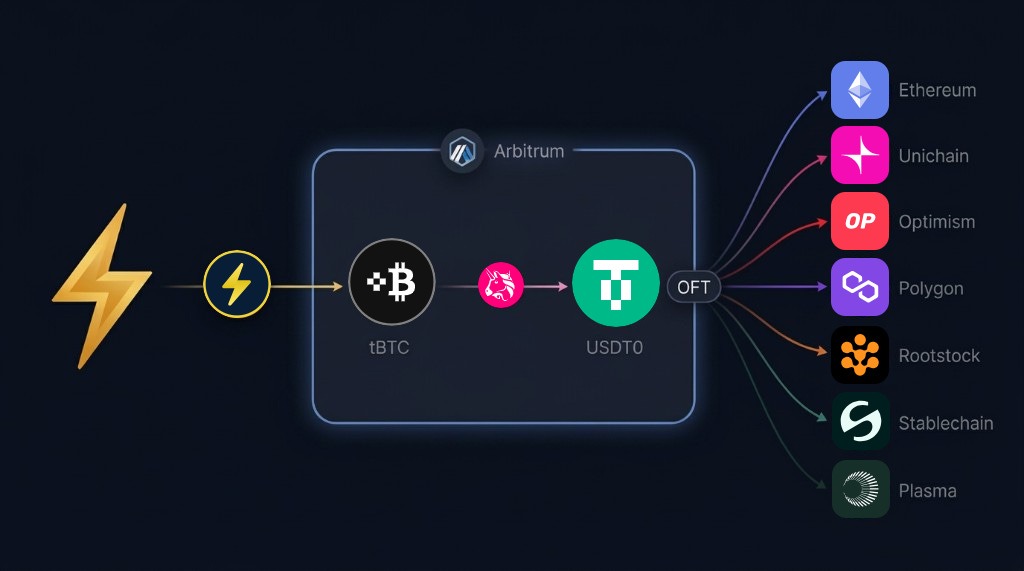
Atomic swaps ensure trustless, simultaneous execution of trades across different blockchains or layers, preventing one party from defaulting after receiving assets. In traditional swaps, especially cross-chain, users face timing risks where one side could claim funds without delivering the other. Atomic swaps resolve this through cryptographic commitments (like hash preimages) and conditional claims: both legs of the trade either complete together or fail entirely, reverting funds to their original owners. Boltz achieves this for Lightning and USDT by routing through tBTC, Threshold’s permissionless ERC20 Bitcoin wrapper on Arbitrum. The flow is Lightning to tBTC via an atomic Boltz swap, then to USDT0 via a DEX swap akin to those on Uniswap, stitched into one irreversible transaction by the Router contract on Arbitrum. Gas abstraction removes the need for ETH on Arbitrum, making the process seamless for Bitcoin-native users.
Boltz plans to expand USDT Swaps across all currently supported Bitcoin layers, including on-chain BTC, Liquid, Rootstock, and Arkade, broadening the utility for businesses and individuals holding Bitcoin in various forms. Future updates will also incorporate USDT0’s Legacy Mesh, which is expected to enable direct support for additional chains such as Tron and Solana. Tron currently holds the largest USDT supply at approximately $83.9 billion according to Tether’s March 17, 2026 transparency report, underscoring the demand for eventual integration on high-volume networks beyond the initial OFT-focused deployment.
This post Boltz Exchange Launches Atomic USDT Swaps for Lightning Network Users first appeared on Bitcoin Magazine and is written by Juan Galt.
Bitcoin Magazine

US Senators Urge Swift Action on Bitcoin, Crypto Market Structure Bill
U.S. Senators are pressing lawmakers to advance legislation aimed at clarifying Bitcoin and broader crypto market structure.
Sen. Cynthia Lummis emphasized urgency in remarks today at the D.C. Blockchain Summit today, saying, “This may be our only chance to get market structure done. I can’t be any clearer: The time for clarity is now.”
She confirmed that the Banking Committee plans to mark up the bill in April, after the Easter recess.
“We really are going to get it out of the Banking Committee in April,” she added.
JUST IN:
— Bitcoin Magazine (@BitcoinMagazine) March 18, 2026US Senator Cynthia Lummis urges lawmakers to pass Bitcoin and crypto market structure legislation ASAP:
"This may be our only chance to get market structure done. I can't be any clearer: The time for Clarity is now."pic.twitter.com/3puu5RMmMB
Lummis also addressed a potential compromise on stablecoin yield, hinted at by Sen. Tim Scott yesterday. “We think we’ve got it,” she said, though she acknowledged she has not seen the negotiated language herself.
She noted banks remain cautious: “We’ve got to get the banks to swallow hard…. Gosh the banks got really dug in on this. But they’re gonna get there.”
Sen. Kevin Cramer echoed the call for speed yesterday, warning that “time is not our friend” and urging passage of market structure legislation before Easter.
The White House’s Patrick Witt is expected to provide further updates on the bill’s progress later today.
The bill is gaining momentum
Efforts to establish the regulatory framework for the U.S. cryptocurrency market are gaining momentum. Senate Banking Committee Chairman Tim Scott said a revised draft, focused on stablecoins, could be introduced this week.
The bill aims to balance innovation with financial stability, particularly regarding yield-bearing stablecoins, which have become a central discussion point.
Key lawmakers, including Angela Alsobrooks, Thom Tillis, and White House official Patrick Witt, have contributed to refining provisions on digital assets. Broader negotiations address political oversight, compliance standards, and balanced representation within regulatory bodies.
DeFi and anti-money laundering (AML) regulations are also under review. Mark Warner is advocating for stronger AML safeguards, with proposals for enhanced know-your-customer (KYC) requirements to improve transparency and prevent illicit activity.
If finalized, the bill could create a comprehensive regulatory structure for the crypto market. Observers see the stablecoin-focused draft as a major step forward, providing clarity for digital assets while maintaining bipartisan support
In the past, Treasury Secretary Scott Bessent has pressed lawmakers to act on the legislation, saying the United States must secure clear market structure rules before the end of the spring legislative window.
This post US Senators Urge Swift Action on Bitcoin, Crypto Market Structure Bill first appeared on Bitcoin Magazine and is written by Micah Zimmerman.
Bitcoin Magazine
Breez SDK Launches Passkey Login for Seedless Bitcoin Wallets
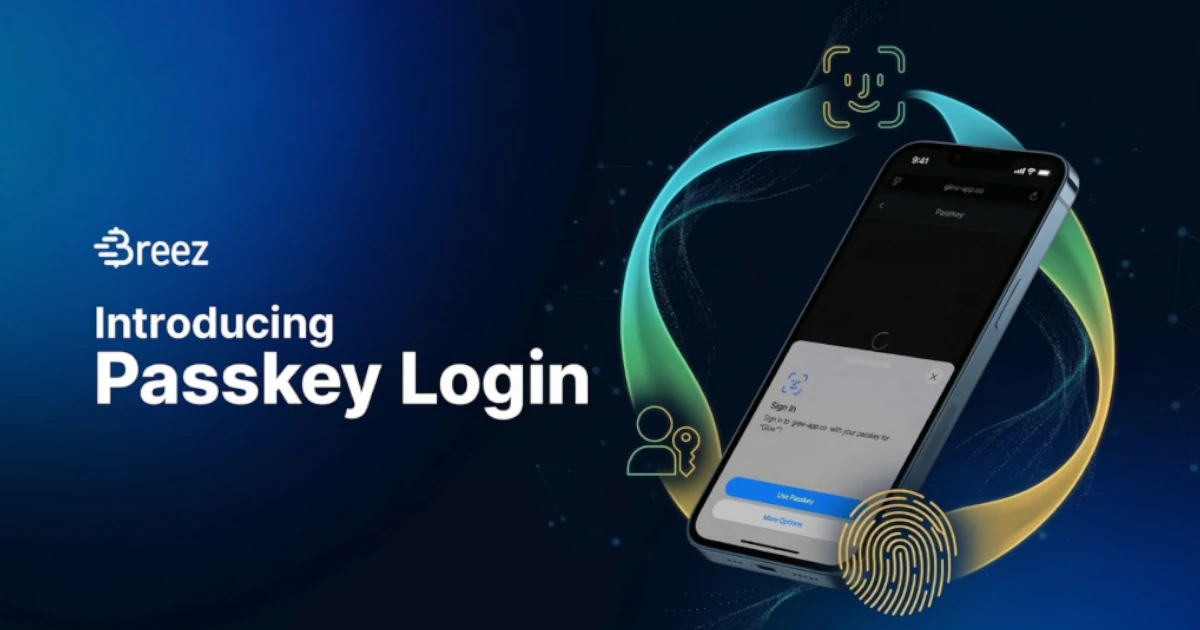
Breez, a lightning service provider and Bitcoin software lab, has introduced Passkey Login into its Breez SDK. The feature allows developers to build self-custodial wallets that use passkeys for authentication and key derivation, eliminating the traditional seed phrase requirement during normal use.
Seed phrase support remains available for users who prefer it, keeping backwards compatibility with industry standards, but removing the “speed bump” in Bitcoin wallets, which prompts users to back up their 12 words.
Breez explained the rationale behind this new feature in a press release shared with Bitcoin Magazine: “The seed phrase has been a barrier to self-custody since day one. It’s what scares normies away from keeping their own bitcoin, and it’s a legitimate reason why people accept the counterparty risk of exchanges and custodial apps.” Adding that “Passkey Login doesn’t eliminate the tradeoffs of self-custody, but it reframes them around something people already understand and use, namely the same biometric authentication that protects their banking app and their password manager. For most users, that’s a much more intuitive security model than a piece of paper in a drawer.”
Passkeys: Per-Site Key Pairs in Modern Hardware
Passkeys — a fairly new security standard that is gaining broad adoption online — are cryptographic credentials based on the FIDO2 WebAuthn standard, jointly promoted by Apple, Google, Microsoft, and the FIDO Alliance since 2022. Each passkey consists of a unique public-private key pair generated for a specific website or application.
The private key remains stored in the secure element or similar hardware on the user’s device, such as Apple’s Secure Enclave, Android’s Titan chip, Windows TPM, external security keys like YubiKey or the user’s password manager.
Normal online Passkeys resemble the original Bitcoin wallet.dat file introduced by Satoshi Nakamoto in his early releases of the Bitcoin client, where private keys are stored locally to the user’s device, while public keys are shared with third parties.
However, the FIDO2 standard implements this private-public key idea in a more standardised and modern way. Websites send a challenge to the user, referencing the user’s known public key for that account. The challenge message is signed by the user’s private key, authenticating their identity in a privacy-preserving way. Each service gets a different public key for the same user, so data compromised on one website does not leak data that can be used to access other websites, nor does it contain any user-identifying data.
FIDO2 is now widely adopted, it leverages device secure elements, integrates with password managers (e.g., iCloud Keychain, Google Password Manager), browsers, and the World Wide Web Consortium (W3C) WebAuthn API. Authentication occurs via challenge-response signing, with the private key bound to the domain to resist phishing.
Passkeys support biometric unlock (Face ID, fingerprint, PIN) and sync across devices within an ecosystem (e.g., via iCloud or Google)—over a billion activations reported by the FIDO Alliance as of mid-2025, with support on major platforms and many top websites.
FIDO2 was not Good Enough for Bitcoin Wallets
Standard passkeys excel at authentication (proving identity to a service) but were missing key functionality needed by the modern Bitcoin industry.
Bitcoin self-custody typically relies on a single source of entropy (seed phrase) to generate all addresses and keys in a deterministic way, via standards like BIP-39. Users expect those 12 words alone to be enough to recover all balances and accounts on a Bitcoin wallet. The Passkey standard needed to be extended to support this use case.
Breez’s Solution: Leveraging the PRF Extension
Breez addresses this by using the Pseudo-Random Function (PRF) extension in WebAuthn Level 3. PRF enables a passkey to produce a deterministic cryptographic output for any given input during authentication.
As described in Breez’s announcement materials, “That’s what the PRF extension of WebAuthn solves, and it’s the key ingredient in Passkey Login. PRF is a newer capability, part of the WebAuthn Level 3 spec, that lets your passkey produce a deterministic cryptographic output for any given input. Same passkey, same input, same output. Always. The passkey never leaves your device’s secure enclave.”
Device Loss and Recovery
If a device is lost, recovery depends on the platform used to store the passkey. Synced passkeys — via iCloud Keychain, Google Password Manager, etc — restore on a new device after regaining access to the associated account.
Breez provides an optional backwards-compatible path: users can export a normal 12-word, BIP-39 mnemonic for their wallet, so they can recover their account in other Bitcoin wallets, following industry standards. The press release adds that “Passkeys also aren’t fully interoperable across platforms yet. If you ever need to move to a platform or wallet that doesn’t support passkeys, you have a standard seed phrase to fall back on.”
The full technical specification for Passkey Login is public, and a reference app called Glow demonstrates the feature. Breez positions this as a step toward making Bitcoin self-custody more accessible by aligning with familiar biometric authentication used in banking and password managers, while preserving non-custodial control. Developers integrating the Breez SDK can now offer onboarding without the traditional “write down these words” step for supported environments.
The full technical specification for Passkey Login is public, and our reference app Glow is already running it, and it’s now available for all the Breez SDK devs to use.
This post Breez SDK Launches Passkey Login for Seedless Bitcoin Wallets first appeared on Bitcoin Magazine and is written by Juan Galt.
CryptoSlate
The SEC just made its biggest crypto classification move in years, placing major tokens such as Ethereum, Solana, Cardano, Dogecoin, Avalanche, XRP, and Chainlink into a “digital commodities” bucket while saying some token sales can stop being treated as securities-law cases once the issuer’s core promises are fulfilled.
Paired with a new SEC-CFTC coordination framework, the March 17 interpretation is less a narrow staking memo than a broad attempt to replace years of crypto-by-enforcement with a clearer split between assets, contracts, and regulator turf.
Until Gary Gensler left the SEC, crypto in the US has lived under a legal cloud. Tokens were launched, traded, staked, wrapped, and airdropped while builders and users were left guessing about the boundary between securities law and commodity law.
The long-awaited interpretation explaining how federal securities laws apply to certain crypto assets and common crypto transactions, and the CFTC joined it, saying it will administer the Commodity Exchange Act consistently with that view.

The Mar. 17 release provides interpretive guidance while preserving existing fraud liability and registration requirements. Additionally, it draws clearer lines.
The SEC's fact sheet says the agency had spent more than a decade engaging with crypto, mostly through Howey-based analysis, and, before 2025, failed to build a tailored framework, instead “regulating by enforcement.”
The Mar. 11 SEC-CFTC memorandum of understanding then established a Joint Harmonization Initiative to clarify product definitions, reduce friction for dually registered venues and intermediaries, and coordinate policymaking, exams, and enforcement.
In the MOU itself, the agencies also commit to consult on overlapping enforcement matters, including, where appropriate, before a Wells notice or similar step.
That makes this week's interpretation bigger than staking or airdrops.
In plain English, the SEC is now saying that many major crypto tokens are not themselves securities.
It then goes further to confirm that some ordinary crypto activities, such as covered staking, mining, wrapping, and certain airdrops, can fall outside securities-sale treatment in some circumstances, and that a token sale does not necessarily remain a live securities-law relationship forever if the issuer’s essential promises have been fulfilled.
That does not erase fraud liability, excuse unlawful original sales, or settle every edge case, but it does give exchanges, issuers, builders, and users a much clearer answer to the question that has hung over the market for years: what is the asset, what is the contract around it, and when does that contract end?

A federal labeling system
The government is finally saying, in plainer terms, what people are buying: a commodity-like token, a collectible, a practical tool, a payment stablecoin, or a tokenized security.
The SEC fact sheet states that digital commodities, digital collectibles, digital tools, and GENIUS Act payment stablecoins fall outside securities classification, whereas tokenized securities remain securities.
That means that a stablecoin such as USDC falls outside the securities classification, while the tokenized stocks xStocks issued by Kraken and Backed Finance would be classified as securities.
It also says covered protocol mining, covered protocol staking, and wrapping of a non-security crypto asset fall outside the offer-and-sale requirement, and that certain airdrops fail Howey's investment-of-money prong.
It also reduces one of crypto's biggest structural drags in the US: uncertainty over ordinary token activity being considered an illegal securities transaction after its conclusion.
The interpretation says that added clarity could reduce legal costs, increase competition, and encourage more activity to remain in the US.
| Category | SEC/CFTC treatment in the release | What it means in plain English |
|---|---|---|
| Digital commodities | Not themselves securities | Commodity-like tokens do not start inside securities law |
| Digital collectibles | Not themselves securities | Collectible-style assets are outside the securities bucket |
| Digital tools | Not themselves securities | Utility-like tokens are not automatically securities |
| GENIUS Act payment stablecoins | Not themselves securities | Some payment stablecoins begin outside securities status |
| Tokenized securities | Remain securities | Tokenized stocks, bonds, and similar assets stay inside securities law |
| Covered mining | Not an offer/sale of securities in described cases | Core protocol participation may sit outside securities treatment |
| Covered staking | Not an offer/sale of securities in described cases | Some staking activity is clearer for users |
| Wrapping non-security assets | Not an offer/sale of securities in described cases | Technical asset transformations are not automatically securities transactions |
| Certain airdrops | Fail Howey’s investment-of-money prong | Some free token distributions may fall outside securities law |
The separation concept
The most important shift may be conceptual. The SEC says a non-security crypto asset can be sold subject to an investment contract and later, separate from that contract, once the issuer's essential promises are fulfilled, or, in some cases, if those promises clearly fail.
In plain English: a token can exit securities status when the underlying investment contract ends.
That directly addresses the long-running fear that tokens are permanently stained by the way they were first sold. The release explains that when buyers cease to reasonably expect the issuer's essential managerial efforts to remain connected to the asset, the token can separate and exit that contractual relationship.
Separation still requires that the original token sale was registered or exempt when the investment contract was created, and fraud liability can survive even after the token later separates.
The release also says the common-enterprise element of Howey must be satisfied, and it explains that if the issuer's promises remain connected to a token, secondary market trades in that token can still be securities transactions until separation occurs.
The agencies are saying the answer depends on whether the underlying issuer-driven investment contract is still alive.
That is a much more structured framework than the old blanket fog.
| Question | If yes | If no |
|---|---|---|
| Is the asset itself a tokenized security? | Securities law applies | Go to next question |
| Was it sold with an investment contract? | Go to next question | Asset begins outside securities status |
| Are issuer promises still central? | Securities obligations may continue | Separation becomes possible |
| Was the original sale registered or exempt? | Separation may occur if contract ends | Liability can survive |
What changed for ordinary users
For users, the practical shift is that the SEC has defined core behaviors more precisely.
Covered protocol mining, protocol staking, and wrapping are outside securities-sale treatment in the circumstances described, and certain no-consideration airdrops fail Howey's investment-of-money prong.
The government has said that some ordinary crypto activities may fall outside the securities bucket in the described circumstances, while other configurations may still trigger securities obligations.
For platforms, the new rulebook reduces the category problem.
Digital commodities, collectibles, tools, and permitted payment stablecoins begin with the assumption that securities laws apply to the contractual relationships surrounding them, if any, rather than to the assets themselves. Tokenized stocks, bonds, and similar instruments remain subject to securities law.
Non-security tokens still tied to issuer promises carry securities obligations until separation.
The release provides exchanges and wallet providers with clearer listing and feature logic while Congress continues work on the permanent statute.
The bull case holds that this will serve as the interim US operating manual. Exchanges, wallets, and issuers use the taxonomy and separation framework to lower legal friction, while the SEC and CFTC use the MOU to reduce overlap in exams and enforcement.
Congress codifies most of the framework, the agencies jointly formalize more definitions, and onshore token issuance, staking, and secondary trading expand because firms can finally structure products around clearer lines.
The SEC's own economic section points to better pricing efficiency, more capital formation, and more competition if clarity holds.
The bear case holds that the interpretation proves helpful within a narrower scope. Litigation tests the boundaries of “separation,” later commissions revisit parts of the framework, and firms still avoid aggressive launches because past failures to register and anti-fraud exposure remain enforceable.
In this scenario, legal uncertainty diminishes but persists in edge cases.
The next phase
The SEC says the Crypto Task Force has already received more than 300 written submissions and held multiple roundtables, including a Mar. 21, 2025, session specifically on security status.
On Jan. 29, CFTC Chairman Michael Selig publicly called for clear, unambiguous safe harbors for software developers, onshoring of perpetuals, and a harmonized crypto taxonomy with the SEC.
Taken together with the Mar. 11 MOU and the Mar. 17 interpretation, the move appears to be a sequenced regulatory project.
This also puts the US closer to other major jurisdictions. The EU says MiCA is a comprehensive legislative framework covering crypto-assets and related services. The UK FCA is rolling out a staged crypto regime, with its roadmap pointing to final rules in 2026 and the new regime expected to come into force in October 2027.
The US is taking an interpretation-heavy approach, grounded in existing securities and commodity statutes. At the same time, this release moves it closer to the category-based regulatory style that other major jurisdictions are already adopting.
The real significance of this release is that the two main US market regulators are trying to move crypto from a regime of case-by-case enforcement toward a more coherent market structure.
The interpretation is paired with the Mar. 11 SEC-CFTC memorandum of understanding aimed at harmonizing oversight, and both agencies framed this week's action as a bridge to broader market structure legislation in Congress.
Once assets are sorted into buckets and the agencies coordinate on overlaps, the next big battles shift to exchange registration, custody, tokenized securities plumbing, stablecoin competition, and the extent to which Congress codifies this framework.
The press release itself says the interpretation complements congressional efforts.
The agencies published a category-based taxonomy, explicitly addressed when non-security tokens become subject to an investment contract and when they stop being subject to one, and clarified several common crypto activities that had lived in gray areas.
That represents a materially more structured approach to enforcement.
If market participants can better predict which rules apply to which assets and activities, compliance costs should fall, pricing distortions from uncertainty should ease, and more activity can plausibly stay onshore.
Whether this becomes a true turning point, however, will depend on whether courts accept the framework, future SEC leaders keep it in place, and Congress locks it into statute.
The post SEC makes huge U-turn, declares crypto tokens are ‘digital commodities’ after years of legal battles appeared first on CryptoSlate.
A token sale tied to a live ecosystem
Playnance is bringing G Coin to a major public milestone today, after saying March 18 would mark the token’s generation event and broader market debut. Unlike projects that arrive before product adoption, Playnance is pitching G Coin as the utility layer for an ecosystem that already has more than 200,000 holders; its official tracker recently showed 203,732 holders.
Launch materials distributed through Chainwire also said roughly 13 billion G Coin had already been distributed during the presale phase ahead of today’s event.
G Coin is positioned as the settlement and utility token across the Playnance stack, which includes on-chain gaming, prediction products, and loyalty mechanics. On its official site, Playnance says the token already powers 10,000-plus on-chain games and 2.5 million live sports events annually, while the G Coin page says the broader ecosystem averages 1.5 million on-chain transactions per day.
What buyers are actually getting
The most important point for buyers is that Playnance describes G Coin as a utility token, not a security, payment token, or claim on company profits.
The whitepaper says the token is meant to unlock gameplay, rewards, loyalty programs, missions, premium features, and promotional access across the ecosystem, and explicitly states that holders do not receive equity, dividends, governance rights, or redemption rights against the issuer.
The whitepaper also adds an important nuance to today’s launch framing. It says G Coin had already been available through authorized sales interfaces inside the Playnance ecosystem before publication, and that the current public offer is structured as an ongoing offer rather than one with a predefined end date.
For direct purchases, Playnance says accepted payment methods include EUR and USD through on-ramp providers such as Wert.io and Onramper, plus a range of crypto assets including BTC, ETH, POL, USDT, USDC, SOL, ADA, DOGE, SHIB, TON and others.
Supply, vesting and distribution
Playnance says tokens sold during the presale are delivered immediately and are not subject to vesting. Non-professional buyers who purchase directly from the issuer are entitled to a 14-day withdrawal period, provided the tokens have not already been used inside the ecosystem.
The same whitepaper says that right does not apply to third-party exchange purchases or to tokens already spent in gameplay or missions.
On tokenomics, the project says total supply is fixed at 77 billion G Coin, with 54 billion allocated to token sale minting. The company also says unsold tokens at the token generation event will face a 12-month cliff followed by 24-month linear vesting, while tokens lost through gameplay are locked for 12 months before re-entering circulation.
That lock-based model sits at the center of Playnance’s supply pitch, which argues for time-based release schedules instead of permanent burns or open-ended issuance.
The bigger bet
The real question is whether utility can translate into durable demand once broader market trading begins. Playnance is clearly betting that a token tied to active gameplay, sports interaction, and on-chain settlement has a stronger story than another speculative launch with no product behind it.
If the company can turn its existing user activity into sustained token usage, G Coin may enter the market with more traction than the average presale. But the whitepaper is also explicit on the limits: this is a utility token with no ownership rights, no guaranteed value, and no promise of financial return.
The post Playnance Puts G Coin Presale in Focus as March 18 Launch Day Arrives appeared first on CryptoSlate.
The company stated that the market for venture-backed governance tooling does not exist at the scale needed to support the business, even after five years of operation and apparent traction.
The closure arrives the same week Mastercard agreed to acquire stablecoin infrastructure firm BVNK for up to $1.8 billion to expand cross-border remittances and business payment rails.
BVNK built a business that solved the problem of moving money across borders faster and cheaper than traditional rails, attracting a Fortune 100 acquirer willing to pay a strategic premium for that capability.
Tally built a product that processed over $1 billion, served over a million users, and still concluded the underlying market was too thin to support a venture-backed business.
The “infinite garden” vision of Ethereum, a diverse ecosystem of protocols and communities that needed sophisticated coordination and governance infrastructure[…] hasn’t materialized.
The divergence reveals where crypto demand concentrates: products that solve direct monetary problems attract capital and exits, while coordination software struggles to prove sustainable unit economics.
| Company | Core product | Problem it solves | Proof points | Capital event | Outcome | What the market is rewarding |
|---|---|---|---|---|---|---|
| Tally | Governance tooling for decentralized protocols | Coordination, voting, and DAO operations | >$1B in payments processed; >1M users; >$80B in protocol assets helped secure; completed a 60-day U.S. ICO registration process | Planned ICO was canceled before launch | Shut down | Activity and scale signals were not enough to prove venture-scale product-market fit or durable monetization |
| BVNK | Stablecoin payment infrastructure | Faster, cheaper cross-border payments, remittances, and business payouts | Built payment rails for enterprise money movement; positioned as infrastructure for real-world payment flows | Mastercard agreed to acquire BVNK for up to $1.8B | Strategic exit / acquisition | Products that solve direct monetary problems attract buyers, capital, and clearer commercial demand |
Besides, Tally's explanation centers on product-market fit. The company was built for a world with thousands of decentralized protocols and millions of active governance participants.
That world, it now says, never reached venture-scale. The decision to cancel the ICO rather than launch it makes the failure more revealing.
Tally could have issued tokens, raised capital, and extended its runway. It chose otherwise because the team concluded it could not honestly deliver value to token holders without a stronger underlying business.
That converts a standard startup shutdown into a statement about what token issuance can and cannot accomplish.
The governance market shows activity but weak monetization.
Research from Harvard Business School cited more than 10,000 active DAOs, 3.3 million voters, and roughly $22.5 billion in DAO treasuries as of early 2025.
However, a January 2026 study covering 50 active DAOs, 6,930 proposals, and 317,317 unique voting addresses found persistently low participation and concentration of proposal activity among small groups.
Although governance exists, engagement patterns appear brittle, and willingness to pay for standalone tooling remains thin.
Where crypto demand actually lives
The categories attracting capital and institutional participation cluster around money.
Stablecoins now total over $316 billion in market capitalization, with Ethereum hosting about $163 billion of that supply. Tokenized US Treasuries have grown to $11.4 billion with 55,143 holders.
The three largest issuers are Circle at $2.3 billion, Securitize at $2.1 billion, and Ondo at $1.9 billion. Tokenized real-world assets have, more broadly, surpassed $27 billion in distributed on-chain value.
Galaxy's 2025 venture capital report showed $20 billion deployed across 1,660 deals, with the largest allocation going to Trading/Exchange/Investing/Lending at more than $5 billion.

The Web3/NFT/DAO/Metaverse/Gaming bucket declined while payments and banking categories grew.
The funding allocation reflects where repeat-user behavior is concentrated: exchanging assets, posting collateral, settling trades, and moving dollars across borders.
McKinsey and Artemis estimate actual stablecoin payments at roughly $390 billion annualized, which represents only 0.02% of global payment volume. Most large on-chain stablecoin transfers still reflect trading and internal movements rather than end-user commerce.
Even the strongest real-world use case remains early-stage by traditional finance standards.
However, that narrow penetration still exceeds what governance tooling has achieved in institutional adoption and measurable economic activity.
In the previous SEC administration, decentralization was part of a legal strategy, with teams decentralizing to manage regulatory exposure.
If regulatory pressure no longer forces decentralization, then governance becomes optional. That removes one of the external supports that had propped up demand for coordination software.
The token issuance paradox
Tally's near-launch of an ICO makes the failure more instructive than a quiet wind-down.
The company completed US registration, presumably cleared legal and compliance hurdles, and had the option to raise capital by selling tokens into a market that still shows appetite for new launches.
It declined because the team concluded that capital alone would not solve the underlying problem.
The tokens would have created obligations to deliver value that the business model could not reliably meet.
That decision separates token financing from product validation.
A token sale can fund development, attract attention, and extend the runway. However, it cannot manufacture repeat usage or prove that customers will pay for the service at sustainable margins.
Tally had operational data showing that its user base, while large in absolute terms, was not generating the depth of engagement or willingness to pay that a venture-backed company needs.
The contrast with payment infrastructure is stark. Mastercard's acquisition of BVNK for up to $1.8 billion reflects confidence that stablecoin rails can plug into existing card-network distribution, compliance systems, and enterprise customer relationships.
The buyer bets on technology that moves money faster and more cheaply across borders, solving a measurable problem for businesses that already pay for similar services through traditional banking channels.
Citi's current scenarios for the stablecoins project a 2030 base case of $1.9 trillion in market size and a bull case of $4 trillion if regulatory clarity improves and distribution through card networks scales.
Those forecasts assume that stablecoins become embedded in the infrastructure for cross-border payments, remittances, and business payouts.
The growth model depends on users wanting cheaper, faster access to dollars in jurisdictions where banking is expensive or unavailable.
What survives the shakeout
The market concentrates demand in products that solve direct monetary problems without requiring ideological participation.
Wallets, exchanges, custody services, settlement layers, and stablecoin issuers all provide utility that users consume without needing to vote, govern, or coordinate with others.

Those businesses can charge fees, measure retention, and demonstrate revenue growth in ways that governance platforms struggle to replicate.
Ethereum remains central to this evolution. The chain hosts the majority of stablecoin supply and dominates tokenized treasury issuance.
Citi notes that ETH remains sensitive to user activity metrics, meaning price performance now depends on growth in settlement volume, stablecoin transfers, and tokenized asset activity.
Bitcoin does not depend on users wanting to govern applications or coordinate through tokens.
Citi's updated 12-month scenarios put BTC at $112,000 in the base case, $165,000 in a bull case, and $58,000 in a recession scenario, with the main swing factors being regulation, macroeconomic conditions, and institutional demand.
The cleanest bull case for crypto now centers on boring utility: stablecoins that settle faster than wire transfers, tokenized securities that trade 24/7 with programmable compliance, and payment rails that bypass correspondent banking.
Those products require users to find them cheaper, faster, or more accessible than alternatives.
The bear case shows that token financing creates an illusion of validation that collapses when actual revenue models are tested.
If regulation stalls and macro conditions worsen, more startups may discover that large on-chain transaction volumes and token optionality cannot substitute for customers who pay recurring fees because the product solves a problem they cannot easily solve elsewhere.
Tally's collapse marks crypto reaching a stage where token launches no longer validate categories.
The market now separates projects that can demonstrate repeatable utility from projects that can demonstrate large numbers. The companies that survive will be the ones users interact with because their products solve a direct problem.
The post The DAO dream is over? Billion dollar crypto company shuts down, kills token launch citing ‘no users’ appeared first on CryptoSlate.
Bitcoin has mostly traded around $74,000 on Wednesday as investors waited for the Federal Reserve's policy decision. However, as of press time, Bitcoin has just lost the $73,500 support, with a route to $72,000 now in sight.
The meeting is expected to leave the federal funds target range at 3.50% to 3.75% while updating projections for inflation, growth, and unemployment after the Middle East conflict pushed energy prices higher.
The policy rate itself has drawn less attention than the Fed's quarterly projections and Chair Jerome Powell's press conference. Andre Dragosch, Bitwise Europe's head of research, said:
“Markets price in no change by the Fed today. Focus will most likely be on forward guidance / SEP = `dot plot' and comments about geopolitical risks & energy today.”
Notably, President Donald Trump has pressed Powell to cut borrowing costs immediately, yet investors have moved in the other direction as oil surged and the inflation outlook worsened.
According to Reuters, futures markets now imply one quarter-point rate cut this year, in September, and another in late 2027, a path that is far tighter than the White House has advocated.
For crypto traders, that has turned Wednesday's meeting into a test of whether Bitcoin can extend a recovery that has carried it back into the mid-$70,000s, or whether a firmer Fed message will keep the market pinned below the next major options and psychological threshold near $80,000.
The setup has become more sensitive because the central bank is dealing with a fresh energy shock at the same time that labor indicators have weakened and a leadership transition is approaching in Washington.

Oil shock reshapes the rate outlook
The Fed entered this meeting with the economy already losing momentum before the conflict added another inflation channel.
US gasoline prices averaged $3.79 a gallon as of Tuesday, more than 25% above where they stood before the war began.
Due to this, economists such as KPMG's Diane Swonk expect policymakers to mark up their inflation and unemployment forecasts and reduce their growth outlook, reflecting a policy backdrop that has shifted from a relatively orderly easing debate to a broader dispute over how much inflation risk the Fed can absorb.
Recent US data support that tension. The Commerce Department reported core PCE inflation at 3.1% year over year in January, the highest reading since March 2024, while fourth-quarter GDP growth was revised down to 0.7%.
The labor picture also softened, with the nonfarm payrolls falling by 92,000 in February and the unemployment rate rising to 4.4%.
Those figures leave the Fed balancing a jobs market that has lost momentum against an inflation trend that remains above target before any full pass-through from higher energy costs.
That mix is central to Bitcoin's current macro narrative. Through much of the past two years, the flagship digital asset has often traded as a proxy for easier financial conditions, lower real yields, and expanding liquidity.
Wednesday's meeting carries a different set of inputs. A Fed that raises inflation forecasts, keeps the median path restrictive, and signals caution on cuts would reduce the case for a rapid expansion in risk appetite, even if digital assets have held firmer than some equity benchmarks during the latest geopolitical shock.

Powell's term adds a second clock for markets
A second timeline is also in play. Powell's current term as chair ends on May 15, 2026, though his term as a member of the Board of Governors runs until Jan. 31, 2028, according to the Federal Reserve.
That distinction has become important for investors trying to map policy beyond Wednesday's decision. A chair transition that once looked straightforward has become less certain as Trump's nominee, former Fed Governor Kevin Warsh, remains stuck in the Senate.
Warsh's nomination remains on hold while the legal fight around the Justice Department's investigation of Powell continues. So, if Warsh is not confirmed by the June 16-17 FOMC meeting, Powell would continue leading rate-setting meetings even after his chair term ends.
That possibility extends the window during which markets may still be trading Powell's policy framework, even as Trump continues to signal his preference for lower rates and a different leadership style at the Fed.
For Bitcoin, this adds a second layer of interpretation to the Fed meeting. Investors would be reading Wednesday's projections for clues about 2026, and they would also be weighing how much of the medium-term path could change once the leadership question is settled.
That does not guarantee a cleaner policy path for crypto or broader risk assets. A delayed transition, Senate friction, and continuing legal disputes around Powell all add uncertainty to the schedule that investors had expected to guide the second half of the year.
Bitcoin's rebound meets a policy test
Bitcoin has recovered from the sharp slide that took it under $60,000 earlier this quarter, yet the market is still trading far below the record levels seen late last year.
Citigroup cut its 12-month Bitcoin target to $112,000 from $143,000, citing stalled progress on US crypto legislation and a narrower window for regulatory catalysts that could support ETF demand and broader institutional adoption.
In the same note, Citi described $70,000 as an important level for BTC as the market awaits policy and legislative direction.
However, industry experts believe BTC could aim higher given the current corporate accumulation, which remains part of the support structure. Crypto market maker Wintermute said:
“The setup is more constructive than it has been in months. The Coinbase premium reset, ETF inflows, and institutional desk flows all point in the same direction. The mid-$60s appears to have attracted a real floor of institutional bids.”
For context, Bitcoin ETFs are currently on their strongest inflow streak since last October, with seven days of consecutive positive cash additions totaling $1.1 billion.
At the same time, Strategy (formerly MicroStrategy) continues to add to its BTC holdings aggressively. The firm has acquired more than 40,000 BTC this month, lifting its holdings to 761,068 Bitcoin.
These purchases show that the market's largest corporate buyers are still adding exposure at prices close to where Bitcoin trades now, even with rate uncertainty unresolved.
That steady demand has helped build a base of buyers beyond short-term macro traders and exchange-driven momentum accounts.

Considering this, the next technical and derivatives reference point sits near $80,000. CME Group said in a March 6 market note that the $80,000 call strike carried high open interest, making it a focal level for market participants.
That shows where traders have concentrated exposure as Bitcoin attempts to stabilize after a deep first-quarter drawdown. A move toward that level after the Fed decision would likely pull more attention from options desks and short-term hedgers, especially if Powell leaves the door open for easing later this year.
The post Fed decision tonight will likely decide whether Bitcoin gets past $80k or fall further appeared first on CryptoSlate.
Mastercard agreed to pay up to $1.8 billion for BVNK, a stablecoin infrastructure firm that connects blockchain payments with traditional banking rails.
The deal includes $300 million in contingent payments and closes what Mastercard told investors would have taken too long to build internally: the ability to move money seamlessly across fiat and on-chain systems for remittances, payouts, P2P transfers, and B2B payments.
The acquisition is part of a broader race with Visa to establish an early lead in stablecoin-based payment systems.
The card networks are absorbing the best parts of blockchain technology before it gets big enough to threaten them.
BVNK had held takeover talks with both Mastercard and Coinbase, with the process appearing further along with Coinbase before the exchange walked away.

That dual interest from a crypto-native giant and a legacy payments giant signals something broader than a single company's acquisition strategy.

Both sides now agree about the stack's importance
Coinbase wanted BVNK because stablecoin infrastructure is strategically valuable to crypto-native firms. Mastercard wanted BVNK because that same infrastructure is now strategically valuable to traditional payment giants.
The real signal is that both camps agree that the stablecoin middleware layer, such as orchestration, licensing, compliance, conversion, and payout rails, has become too important to leave in other hands.
That middleware includes the technical and regulatory scaffolding needed to connect stablecoins with existing financial systems.
BVNK holds licenses across multiple geographies, has recently highlighted MiCA licensing and stablecoin partnerships with Visa Direct, and has built the infrastructure to handle treasury flows, cross-border settlement, and enterprise payouts.
Mastercard's press release says digital currency payment volume reached at least $350 billion in 2025, while McKinsey, working with Artemis, estimates actual stablecoin payments at about $390 billion annualized.
Despite those numbers still being small relative to global payments volume, as McKinsey puts stablecoins at roughly 0.02% of total flows, they are large enough that payment firms now treat the category as strategic rather than experimental.
| Company | What it wanted | Why BVNK matters | Strategic implication |
|---|---|---|---|
| Mastercard | Faster entry into stablecoin payments | BVNK connects blockchain payments to fiat rails for remittances, payouts, P2P, and B2B flows | Incumbents are buying the rails instead of waiting to build them |
| Coinbase | Stablecoin infrastructure scale | BVNK’s middleware stack covers orchestration, licensing, compliance, conversion, and payouts | Crypto-native firms also view the stack as strategically essential |
| BVNK | Middleware layer | Licenses across jurisdictions, Visa Direct pilot tie-in, enterprise payouts and settlement infrastructure | The highest-value layer may be the connective tissue, not the token itself |
The bull case holds that stablecoins become a serious competitive payments and deposit product faster than expected.
Regulatory clarity broadens, enterprise issuance and settlement scale up, and Standard Chartered's January estimate of $500 billion in bank-deposit migration to stablecoins by 2028 becomes more plausible.
Mastercard's acquisition of BVNK fits that timeline: the company is paying for infrastructure that accelerates its entry into lower-cost, faster digital payment systems.
The bear case holds that the infrastructure land grab outpaces actual commerce.
Visa's crypto chief told Reuters that stablecoins still lack widespread merchant acceptance. Under this scenario, deals like BVNK look more defensive, and the main near-term revenue comes from enterprise settlement and back-end money movement.
Why Visa's moves reinforce the thesis
Visa is making similar moves. In January, Visa's stablecoin settlement volumes had reached an annualized run rate of $4.5 billion.

Visa and Stripe-owned Bridge then said in March that their stablecoin-linked cards were already live in 18 countries and planned to be in more than 100 by year-end.
Besides, Visa's settlement pilot allows some issuers and acquirers to settle with Visa using stablecoins. At the same time, BVNK separately said in January that it would power stablecoin payments for Visa Direct pilot programs.
That combination of Mastercard-BVNK, Visa's settlement expansion, and Bridge's card rollout paints a consistent picture: the card networks are building stablecoin capability as a complement to their existing rails.
Stripe's February conditional OCC approval to establish a national trust bank through Bridge adds another layer.
If the regulator grants a final approval, Bridge could offer digital asset custody, stablecoin issuance, and reserve management services under federal banking supervision.
Mastercard also launched a Crypto Partner Program last week with more than 85 crypto-native firms, payment providers, and financial institutions, framing the next phase of on-chain payments as collaboration with established rails.


The regulatory backdrop that made this possible
The timing reflects a mix of regulation, competitive urgency, and early commercial proof.
Mastercard cited increased regulatory clarity in multiple geographies. In the US, President Donald Trump signed the GENIUS Act in July 2025, creating a federal framework for stablecoins.
The argument has since shifted to how much stablecoins can compete with banks and card networks for deposits and payment flows.
Banks are fighting over how far stablecoins can compete for customer balances, with Standard Chartered estimating stablecoins could pull $500 billion in deposits from US banks by 2028.
With a federal framework in place and multiple jurisdictions developing stablecoin rules, the window of opportunity narrows.
Payment giants that move early can shape how stablecoins integrate with existing systems, influence compliance standards, and lock in partnerships with the best infrastructure providers.
For crypto investors, the takeaway is that stablecoins are increasingly where real commercial adoption is happening: remittances, payouts, treasury flows, card-linked spending, business payments, and cross-border settlement.
The pattern also suggests that the next winners in crypto may be less-visible infrastructure companies.
Stripe bought Bridge in 2024, Bridge won preliminary OCC approval for a national trust bank in February 2026, Visa partnered with Bridge on stablecoin-linked cards, and now Mastercard is buying BVNK.
The risk for crypto-native companies is that value accrues to the orchestration and distribution layers rather than to the token or protocol layer.
If Visa and Mastercard control merchant acceptance, enterprise treasury integration, and global payout networks, then stablecoins become a rail that runs through legacy systems.
That outcome favors stablecoin issuers and the broader payment layer, while challenging the theory that crypto would entirely disintermediate traditional finance.
The contest for control
The current disruption thesis holds that card networks are absorbing the most valuable parts of stablecoin infrastructure while the traffic is still building.
Visa is expanding its stablecoin cards and settlement services. Stripe owns Bridge and now has a conditional OCC path into the trust bank infrastructure. Mastercard just bought BVNK.
Stablecoins are becoming a new layer of money movement, and the battle for value capture is shifting toward who controls acceptance, compliance, treasury orchestration, and enterprise distribution.
| Layer | Example players | What they control | Why it matters |
|---|---|---|---|
| Merchant / enterprise distribution | Visa, Mastercard | Acceptance, relationships, payouts, settlement access | Controls scale and monetization |
| Middleware / orchestration | BVNK, Bridge | Compliance, conversion, treasury routing, cross-border rails | Connects stablecoins to real finance |
| Issuance layer | Stablecoin issuers | Token supply and reserves | Essential, but may capture less downstream value |
| Protocol / token layer | Public blockchain ecosystems | Base settlement rails | May provide utility without owning customer relationships |
The incumbents are adapting quickly by acquiring infrastructure, launching pilots, signing partnerships, and shaping regulatory frameworks, while stablecoin payment volume remains small enough to absorb.
That gives them a positional advantage: by the time stablecoins reach meaningful scale in real-world commerce, the card networks will already own the best middleware, have established the compliance standards, and control the merchant relationships that determine if stablecoins become a viable alternative to traditional payments or another input into existing systems.
Mastercard's acquisition of BVNK is a sign that stablecoins are graduating from crypto-market utility to mainstream payments infrastructure.
The post Crypto tried to cut out Visa and Mastercard — now they’re buying up blockchain companies appeared first on CryptoSlate.
Cryptoticker
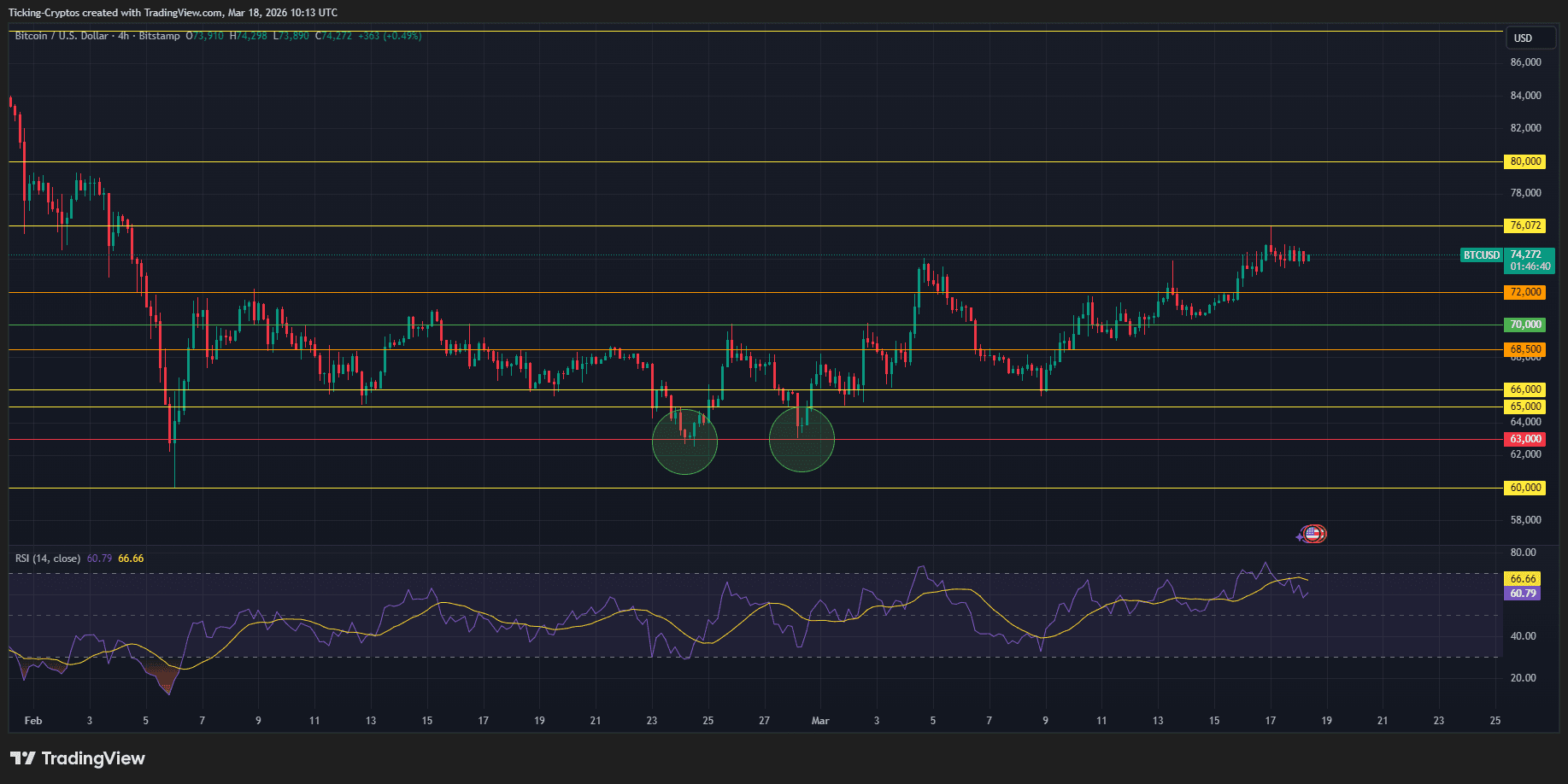
The Bitcoin price is currently navigating a high-stakes consolidation phase, trading at approximately $74,272 during the March 18, 2026, session. After a period of bearish dominance that saw the asset retreat from its 2025 record highs, the market is now testing the resilience of the $74,000 resistance zone.
Bitcoin Price Analysis: Why is BTC Price UP?
Analyzing the BTC/USD 4-hour chart, we observe several key technical patterns that define the current trend.
Double Bottom Recovery
The chart highlights two significant "troughs" (marked with green circles) near the $63,000 level. This Double Bottom formation served as a powerful reversal signal in late February and early March, allowing Bitcoin to climb back above the psychological $70,000 mark.
Key Resistance and Support Levels
The price action is currently sandwiched between tightly defined horizontal levels:
- Immediate Resistance: $74,500 – $76,000. A decisive break above this yellow-lined zone is required to target the next major hurdle at $80,000.
- Critical Support: $72,000. If the price fails to hold the $74,000 level, the green support line at $72,000 will be the first line of defense.
- Deep Support: $68,500 and $65,000. These remain the "must-hold" zones to prevent a return to the bear market lows seen earlier this year.
RSI and Momentum
The Relative Strength Index (RSI) is currently hovering around 60.79. While this indicates bullish momentum, the RSI has flattened significantly as the price approaches resistance. This suggests a "cooling off" period or a potential bearish divergence if the price makes a higher high while the RSI fails to follow suit.
Bitcoin News and Macro Catalysts
The broader crypto market is currently characterized by a "Fear" rating on the Sentiment Index (sitting at 26), despite Bitcoin's recent price recovery.
- The FOMC Factor: Traders are bracing for Federal Reserve Chair Jerome Powell’s comments. While interest rates are expected to remain steady, any hawkish rhetoric regarding inflation—driven by $100+ oil prices—could trigger a "sell the news" event for $BTC.
- Institutional Inflows: According to data from Bloomberg, spot Bitcoin ETFs saw a resurgence in March, with nearly $2.8 billion in net inflows, providing a structural floor for the recent rally.
- The Gold vs. Bitcoin Debate: As gold continues to trade near record levels above $5,000, Bitcoin's role as "Digital Gold" is being tested. Many analysts, including those at Fidelity Digital Assets, suggest that capital may rotate back into BTC if gold's parabolic move stalls.
Conclusion: What to Expect Next?
Bitcoin is showing "Experience" and "Expertise" in its ability to hold the $74,000 handle despite a heavy macro environment. However, the information density on the 4-hour chart suggests that the current range is exhausting.
If Bitcoin can flip $76,000 into support, a run toward $80,000 is the most likely scenario. Conversely, a rejection here, coupled with a hawkish Fed, could see a swift retest of the $68,500 support.
- Technical Note: Watch the 4-hour candle close. A close below $73,800 would signal a short-term breakdown, while a close above $75,100 validates the bullish breakout attempt.
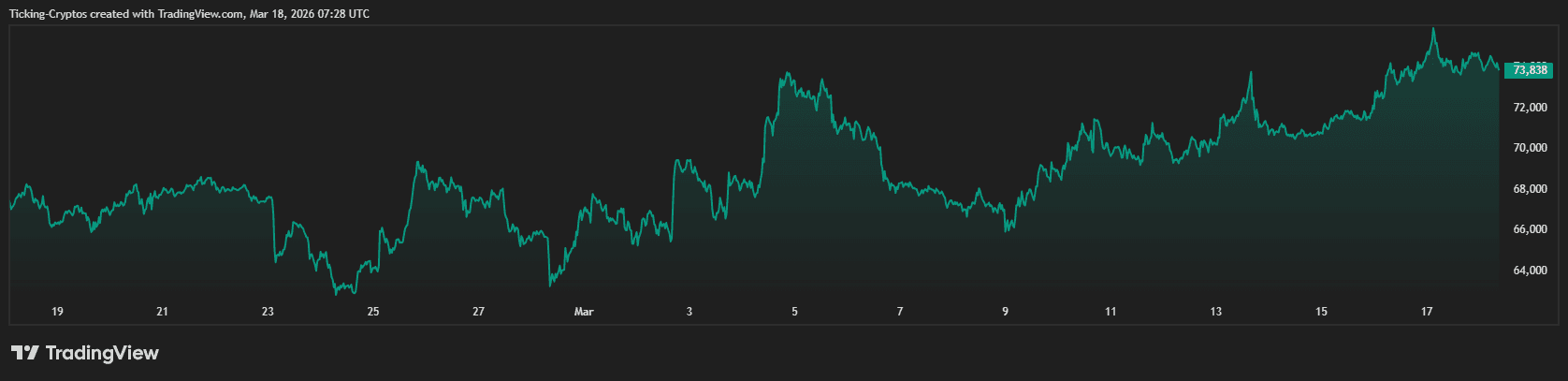
The crypto market in early 2026 has been nothing short of a rollercoaster. After the euphoric highs of late 2025, where Bitcoin flirted with the $130,000 mark, a "diffuse cocktail of macro anxieties" has sent prices into a steep correction. As of late mid-March 2026, $Bitcoin has retraced nearly 50% from its All-Time High (ATH), trading in above $73,000.
Is it a Good Time to Buy Crypto?
Historical cycles suggest that corrections of 50% to 70% are healthy "purges" that wipe out over-leveraged traders. With Bitcoin currently sitting at a 50% discount, the risk-to-reward ratio for March 2026 has shifted heavily in favor of the bulls.
As geopolitical tensions and tariff uncertainties stabilize, capital is expected to rotate back into "risk-on" assets. Investors who missed the 2025 rally now have a second chance to enter the market. If you are looking to build a portfolio, diversifying across these five projects offers a balance of stability, utility, and explosive recovery potential.
1. Ethereum (ETH) – The Infrastructure King
Despite the rise of "Ethereum killers," Ethereum remains the undisputed home of Decentralized Finance (DeFi) and Real-World Asset (RWA) tokenization. In 2026, the successful rollout of the "Prague" upgrade has further slashed Layer-2 costs, making the network more scalable than ever.
- Why Buy Now? ETH has followed Bitcoin’s slide, dropping from its 2025 high of $4,950 to under $2,000.
- The Catalyst: Major financial institutions like BlackRock and JPMorgan are increasingly using Ethereum for tokenized deposit pilots. At current prices, you are buying the "settlement layer of the internet" at a 60% discount.
2. Solana (SOL) – The Speed Demon
Solana has proven its resilience after the network reliability concerns of previous years. With the Firedancer upgrade now fully integrated in 2026, Solana can process over 1 million transactions per second.
- Status: While it reached $260 in the last bull run, SOL is currently trading significantly lower, creating a "gap" that savvy traders are eager to fill.
- Use Case: It has become the primary chain for consumer AI-crypto applications and high-frequency trading.
3. Chainlink (LINK) – The Oracle Essential
You cannot have a functional DeFi ecosystem without accurate data, and Chainlink owns 90% of that market. In 2026, its Cross-Chain Interoperability Protocol (CCIP) has become the standard for banks moving data between private and public blockchains.
- The Play: LINK often lags behind the initial BTC pump but rallies hard once the ecosystem matures. It is one of the most undervalued "blue-chip" utility tokens heading into March.
4. Sui (SUI) – The Emerging Contender
Sui has emerged as the breakout Layer-1 of the 2025-2026 cycle. Utilizing the Move programming language, it offers a level of security and parallel processing that older chains struggle to match.
- Growth Potential: Sui's Total Value Locked (TVL) has remained stable even during the February crash, suggesting a loyal and committed developer base. As the market recovers, SUI is positioned to be a top performer.
5. Fetch.ai (FET/ASI) – The AI Narrative
2026 is the year of "AI Agents." Fetch.ai, as part of the Artificial Superintelligence Alliance, is at the forefront of this movement. Their autonomous agents are now being used in logistics and decentralized energy grids.
- Why March 2026? The "AI plus Crypto" narrative is the strongest secular trend in the market. With FET down along with the broader market, it offers a high-beta play for those betting on the continued AI revolution.
Conclusion: Strategy for March 2026
Investing during a 50% Bitcoin drawdown requires a long-term mindset. While volatility may persist in the short term, the fundamental value of these projects remains unchanged. Consider using a regulated exchange to dollar-cost average into these positions throughout the month.
Vietnam is shifting from one of the world's most active unregulated crypto markets to a strictly controlled domestic ecosystem. According to reports from Reuters, the government in Hanoi is preparing to launch a pilot scheme for locally licensed digital asset exchanges while simultaneously drafting rules to ban citizens from using overseas platforms.
The Race for the First Vietnam Crypto License
Five major domestic entities have passed an initial qualification round to operate the country’s first legal exchanges. This move marks a significant transition for a nation that ranked fourth globally on the Chainalysis Global Crypto Adoption Index.
The qualified applicants include:
- Techcombank (TCB)
- VPBank (VPB)
- LPBank (LPB)
- VIX Securities
- Sun Group
Why Hanoi is Curbing Foreign Trading
The Vietnamese government’s primary concern is uncontrolled capital outflows. While the country has high crypto interest, most transactions currently occur on offshore servers, making it difficult for authorities to monitor wealth movement or collect taxes.
By forcing users onto local platforms, Hanoi aims to:
- Regulate Capital: Ensure trades are settled via local banking rails.
- Tax Revenue: Implement a structured tax framework for digital assets.
- Consumer Protection: Bring high-risk trading under the oversight of the Ministry of Finance.
Market Impact and Local Adoption
Currently, Vietnamese traders move over $200 billion annually in crypto. The new regulations will likely push this liquidity into the hands of major local financial institutions. However, digital assets are still not recognized as legal tender or a formal means of payment in the country.
Summary of New Vietnam Crypto Regulations
| Feature | New Policy |
|---|---|
| Foreign Exchanges | Planned ban for Vietnamese nationals |
| Local Exchanges | Pilot program for licensed domestic firms |
| Key Players | Major private banks (VPBank, Techcombank) |
| Objective | Combat capital flight and increase oversight |
Ripple’s native token, $XRP, reclaimed the $1.50 price level. This move comes after weeks of tightening volatility, where the asset was compressed within a massive technical structure. As the broader crypto market shows signs of a renewed bullish cycle, XRP's recent price action suggests that the long-awaited move toward psychological resistance levels may be underway.
XRP Price Prediction: The Road to $2.00
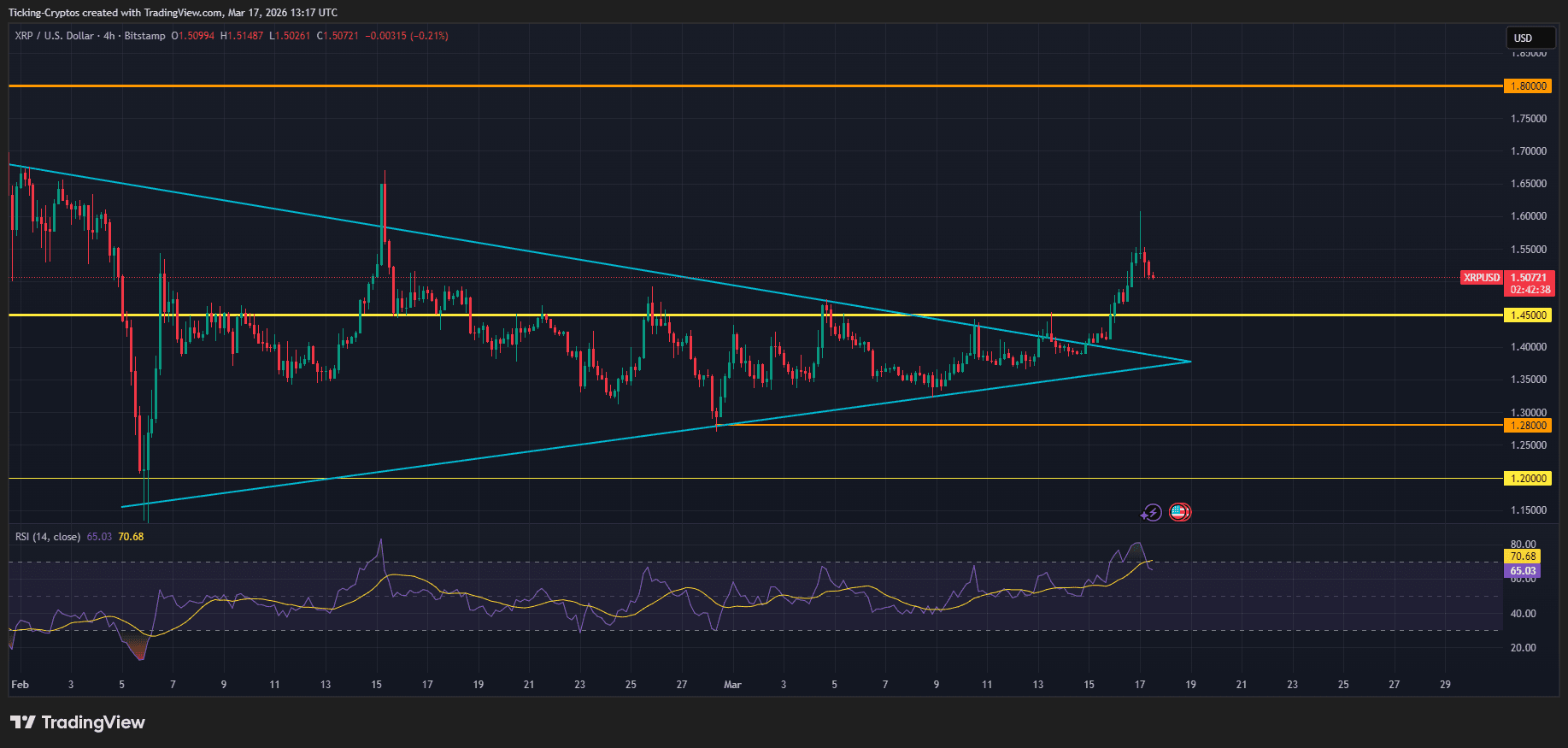
The current technical setup confirms that XRP is targeting the $2.00 milestone. This projection is based on a "measured move" following the breach of a multi-week consolidation pattern. If XRP-USD can maintain its position above the $1.45 support zone, the next liquidity pocket sits between $1.85 and $2.10.
The Symmetrical Triangle
A symmetrical triangle is a chart pattern characterized by two converging trendlines connecting a series of sequential peaks and troughs. In XRP’s case, this pattern represented a period of "equilibrium" where buyers and sellers were in a deadlock. Typically, a breakout from this formation indicates that the prevailing trend—in this case, the bullish momentum from late 2025—is ready to resume with high volume.
The Breakout: How XRP Breached the Triangle
The most critical development in the recent XRP-USD price action is the upward breach from the triangle formation. Since February 2026, XRP has been making lower highs and higher lows, narrowing into an apex near the $1.38 mark.
On March 14, trading volume surged by over 300%, providing the necessary fuel for XRP to pierce the upper descending trendline. This "breach" was not merely a wick but was followed by a daily candle close above the resistance, effectively flipping it into a support floor. Technical analysts often view this specific type of exit from a triangle as a signal that the "accumulation phase" is over and the "markup phase" has begun.
Technical Indicators Supporting the $2 Target
Beyond the triangle breakout, several other indicators point toward a continued rally:
- Moving Averages: XRP is now trading comfortably above its 50-day and 200-day Exponential Moving Averages (EMAs).
- Relative Strength Index (RSI): The RSI is currently at 64, suggesting that while the asset is gaining strength, it is not yet "overbought" (which typically occurs above 70).
- Institutional Inflows: According to data from CoinShares, XRP-specific investment products have seen over $1.3 billion in cumulative inflows this year, providing the structural liquidity needed to sustain a move to $2.00.
Key Support and Resistance
| Level | Type | Significance |
|---|---|---|
| $1.38 - $1.42 | New Support | The previous triangle resistance now acts as a floor. |
| $1.56 | Current Pivot | XRP is consolidating here to build momentum for the next leg. |
| $1.80 | Minor Resistance | A historical supply zone from early 2026. |
| $2.00 | Major Target | The primary psychological and technical goal for the current rally. |
Ethereum (ETH) has bounced back strongly, rising more than 20% over the past eight days. While much of the market focused on Bitcoin’s volatility, Ethereum moved higher in the background. The rally is being driven by growing institutional interest and clearer regulatory support, two factors that are starting to change how major financial players approach the Ethereum network.
Why is Ethereum Price UP?
The recent Ethereum price pump is driven by a convergence of institutional liquidity and regulatory clarity. Specifically, the Federal Reserve's decision to allow tokenized securities as bank collateral and BlackRock’s launch of its iShares Staked Ethereum Trust (ETHB) have provided the necessary fundamental support for ETH to decouple from minor market corrections.
Tokenization and Staked ETFs
To understand why these developments are "game-changers," we must define the two pillars supporting this rally:
- Tokenized Securities: These are traditional assets (like stocks or bonds) represented as digital tokens on a blockchain.
- Staked ETFs: Unlike a standard spot ETF, a staked ETF (like ETHB) actually participates in the network's consensus, earning a "yield" or dividend for its shareholders by securing the network.
1. The Fed’s Green Light: Tokenized Assets as Collateral
On March 6, 2026, the Federal Reserve, alongside the OCC and FDIC, issued a landmark clarification. U.S. banks are now officially permitted to use tokenized securities as collateral for loans.
Why This Matters for Ethereum
Regulators confirmed that as long as the tokenized version confers the same legal rights as the traditional asset, it will receive the same capital treatment. Crucially, the Fed stated this applies regardless of whether the blockchain is permissioned or permissionless (public).
- Liquidity Influx: Trillions of dollars in "off-chain" value (Treasuries, equities) can now migrate to Ethereum.
- Ethereum as the "Settlement Layer": Since Ethereum remains the dominant hub for Real-World Assets (RWAs), this ruling cements $ETH role as the global plumbing for modern finance.
2. BlackRock’s ETHB: The First Dividend-Paying Crypto ETF
On March 12, 2026, BlackRock launched the iShares Staked Ethereum Trust (ticker: ETHB). While the market already had spot ETH ETFs, ETHB is the first from a major issuer to offer staking rewards directly to shareholders.
Key Features of ETHB:
- Yield Generation: The fund stakes between 70% and 95% of its holdings.
- Monthly Distributions: Investors receive monthly cash payouts, similar to a high-yield dividend stock.
- Institutional Infrastructure: BlackRock partnered with Figment and Coinbase Prime to manage the validator sets, bringing "Enterprise-Grade" security to the staking process.
"The ETHB launch transforms Ethereum from a speculative commodity into a productive, yield-bearing asset for the average 401k investor." — Market Insight
Comparison: Spot ETH vs. Staked ETH ETFs
| Feature | Spot ETH ETF (e.g., ETHA) | Staked ETH ETF (ETHB) |
|---|---|---|
| Primary Goal | Price Tracking | Price + Yield |
| Income Source | None | Staking Rewards (~2-3% Net) |
| Risk Profile | Market Volatility | Volatility + Slashing Risk |
| Target Audience | Traders | Long-term Income Seekers |
Fundamental Divergence
For months, analysts have noted a divergence: Ethereum's network fundamentals (Total Value Locked, Active Addresses, and Layer 2 scaling) were hitting record highs while the Ethereum price lagged. This 20% pump suggests the "valuation gap" is finally closing.
Decrypt
Malwarebytes has warned that a phishing campaign is mimicking the Pudgy World game to steal user credentials
Tempo, the layer-1 blockchain backed by payments giant Stripe, launched its mainnet with a clear focus on AI agent payments.
Gemini stock (GEMI) fell 16% on Wednesday following the downgrade and a broader market dip, after Citi cut its Bitcoin and Ethereum targets.
“The Crypto Castle” takes a look at the early days of Bitcoin—and the "sad evolution" it's undergone since then.
Bitcoin fell alongside U.S. stocks after the world's largest gas field came under attack amid hotter-than-expected inflation data.
U.Today - IT, AI and Fintech Daily News for You Today
XRP whale wallets increase holdings by 200 million coins while the market watches $1.50 price level.
The EF just deployed another 3,400 ETH directly into Morpho Vaults.
SEC flags new caution for investors as crypto enthusiasm soars.
US PPI inflation just surged 0.7%, shattering expectations and sending Bitcoin below the $74,000 support as Fed rate hike fears return to the menu.
Cardano is now displaced from Top 10 crypto list as liquidation imbalance rockets above 6,100%.
Blockonomi
TLDR
- Strategy funded most of its recent bitcoin purchases through STRC perpetual preferred share sales.
- K33 said the STRC structure depends on stable pricing and sustained market confidence.
- STRC offers a variable monthly dividend of about 11.5% annualized and trades near $100.
- K33 reported that STRC has recorded price declines of 5% to 10% during market pullbacks.
- Strategy holds about $2.25 billion in cash, which covers roughly 25 months of dividend payments.
Strategy accelerated its bitcoin purchases through heavy use of STRC perpetual preferred shares, K33 reported. The brokerage said the structure creates risks tied to market sentiment and pricing behavior. However, K33 stated that Strategy’s $2.25 billion cash reserve supports near-term dividend coverage.
STRC Structure Drives Bitcoin Accumulation
Strategy funded $1.18 billion of last week’s $1.57 billion bitcoin purchase through STRC sales. It raised the remaining $396 million from Class A common stock. The company disclosed these figures in its latest acquisition update.
STRC trades near $100 and offers a variable monthly dividend near 11.5% annualized. The instrument channels investor demand for yield into bitcoin purchases. However, K33 Head of Research Vetle Lunde said stability depends on price support and continued confidence.
Lunde wrote, “If STRC trades below its target level for a prolonged period, confidence could weaken.” He added that the product could shift toward a credit-like risk profile. STRC recorded several price drops between 5% and 10% during market pullbacks.
Sentiment Dependencies and Market Dynamics
K33 said the model relies on STRC holding near its $100 target price. It also depends on the strategy equity trading at a premium to net asset value. Both conditions reflect market sentiment and can change together.
Lunde stated that STRC holders receive capped upside through dividends. However, they face downside during broader market declines. He said the instrument introduces added complexity compared with direct spot bitcoin exposure.
Strategy holds roughly $2.25 billion in cash to cover dividend obligations. Lunde said this reserve covers about 25 months of payments. He added, “We do not view it as an immediate systemic risk to BTC due to MSTR’s strong cash cushion.”
Strategy added 40,331 BTC over two weeks, marking its fourth-largest such purchase period. It raised $2.85 billion during that span, with 55% sourced from STRC. Last week alone, the company bought 22,337 BTC.
Lunde said the mechanism can create a feedback loop in stronger markets. When STRC trades near its target, Strategy issues shares and buys bitcoin. The firm may also issue common equity to manage leverage and balance sheet optics.
Bitcoin rose about 13% since Feb. 27, according to K33 data. During the same period, the Nasdaq and S&P 500 declined, while gold recorded deeper losses. Lunde wrote that bitcoin had been “underowned, overshorted, and oversold” before the rebound.
K33 attributed the asset’s recent strength to prior positioning conditions. The report noted bitcoin had experienced a roughly 50% drawdown before recovering. The firm published these findings in its latest research update.
The post Strategy’s STRC-Fueled Bitcoin Buying Raises Risk Flags appeared first on Blockonomi.
TLDR
- Kenya’s National Treasury released draft VASP rules and opened them for public comment until April 10.
- The 2026 Regulations operate under the Virtual Asset Service Providers Act that took effect on Nov. 4, 2025.
- The draft requires stablecoin issuers to hold at least 30% of funds in segregated Kenyan bank accounts.
- Issuers must invest remaining reserves in cash, central bank deposits, or short-term government securities.
- Token issuance platforms will charge a 0.05% transaction fee payable by each counterparty.
Kenya’s National Treasury has issued draft operational rules for virtual asset firms and opened them for public comment. The proposal sets licensing, reserve, disclosure, and audit standards under the Virtual Asset Service Providers Act. Authorities will accept submissions until April 10, according to a government notice.
The 2026 Regulations take effect under the law that commenced on Nov. 4, 2025. The Treasury released a regulatory impact statement alongside the draft text. Officials said they developed the rules through a multi-agency task force.
The task force consulted the Central Bank of Kenya and the Capital Markets Authority. The process followed Kenya’s February 2024 grey listing by the Financial Action Task Force. The FATF cited gaps in anti-money laundering and counter-terrorism financing controls.
Kenya VASP Rules Outline Licensing and Oversight Framework
The draft expands eligibility for licenses to include limited liability partnerships. Earlier versions limited applications to companies. The regulator will have 90 days to respond to applicants.
License validity will run for 12 months from the date of issuance. The prior framework tied validity to a Dec. 31 expiration. The draft also requires every provider to open and operate a bank account in Kenya.
The proposal broadens the definition of a virtual asset. It includes a “digital representation of value” that represents real-world assets on blockchain or other technology. The text covers assets “whether cryptographically-secured or otherwise.”
The draft expands the definition of an issuer. It covers any natural or legal person who creates or makes crypto-assets available to the public. This scope applies to initial offerings and later issuance mechanisms.
The regulations require system audits every two years. Certified IT auditors must assess infrastructure, data security, and transaction integrity. Auditors will also review cybersecurity preparedness and operational resilience.
Stablecoin Backing and Fees Under Kenya VASP Rules
The draft sets reserve requirements for stablecoin issuers. Issuers must hold at least 30% of received funds in segregated accounts at Kenyan commercial banks. They must invest remaining reserves in secure, low-risk domestic assets.
Eligible reserve assets include cash and central bank reserve deposits. The list also covers bank deposits and government securities with a residual maturity of 90 days or less. Repurchase agreements must mature within seven days and use cash or central bank deposits as backing.
Local journalist Julians Amboko reported the reserve details. He cited provisions that restrict backing assets to high-quality liquid assets. The draft links compliance to domestic custody and liquidity standards.
The proposal introduces transaction-based fees for digital asset platforms. Token issuance platforms will charge a 0.05% fee payable by each counterparty. Initial virtual asset offerings will incur a 0.5% levy on the value of a successful offer.
The post Kenya Sets Out Draft VASP Rules on Licensing, Reserves appeared first on Blockonomi.
Veteran trader Peter Brandt believes the Ethereum coin might have bottomed out. He expects the altcoin price to rally to $4,000 after it soared above $2,300. The rally was due to easing geopolitical tensions in the Middle East.
Meanwhile, the Dogecoin price prediction for 2026 has turned bullish. On the other side, DeepSnitch AI (DSNT) continues to steal the spotlight. Having crossed the $2M funding milestone, this high-utility AI powerhouse is outperforming traditional assets.
Its price has increased by over 197% and could soar by 100X following its launch on DEX and CEX after its presale ends on March 31. Those who want to get access to its suite of live AI agents and grow their portfolio could get in now before the price skyrockets.

Ethereum could rally to $4k as Peter Brandt flags possible market bottom
Ethereum could be approaching a market bottom, and long-time trader Peter Brandt is indicating a possible rise to $4,000. In a recent analysis, Brandt indicated that ETH is developing a bottom at a major historical support level, which is an indication of a potential bullish reversal.
The cryptocurrency has recently reached a one-month high of around $2,300 as geopolitical tensions between the United States and Iran calmed down. Market sentiment had improved following prospects of stability in the Strait of Hormuz, increasing confidence in the crypto markets, and restoring investor confidence in the future of Ethereum.
Dogecoin price prediction 2026 and two low-priced coins with high potential
1. DeepSnitch AI (DSNT): Is this smart money’s top investment choice for a 100X potential return?
While some investors are still carried away with the market volatility, smart money is tapping into new projects’ potential for exponential growth. One such project is DeepSnitch AI. It has attracted a large number of investors with its AI tools and raised over $2.21M in funding.
Also, the price of its native token, DSNT, has increased by over 197% to $0.04487. The native token is a big part of the ecosystem and is used for staking and also gives holders governance rights. With high adoption and usage, this token could see over 100X growth soon, giving holders massive returns.
Additionally, those who join the DeepSnitch AI ecosystem have access to the platform’s AI-based agents. The five specialized agents are SnitchScan, SnitchFeed, AuditSnitch, SnitchCast, SnitchGPT, and a token explorer.
Together, they form a unified intelligence layer. It does not just present information; it connects dots, identifies patterns, and surfaces opportunities before they become obvious to the broader market. If you take a look at the DeepSnitch AI platform, you will see it has an intuitive interface.
All tools are arranged in an orderly fashion with little description of what they do. Interestingly, the DeepSnitch AI launch date is out. The project is closing its presale on March 31, and the team has confirmed that it will be launching on Uniswap.
Other CEXs and DEXs are still in the works, but rumours are spreading that DeepSnitch AI could be listed on Binance very soon. Given these market updates and the AI tools that could see huge adoption in the long run, DeepSnitch AI might be the best crypto to buy for over 100X returns in 2026.
2. Dogecoin price prediction 2026
Dogecoin, the largest memecoin by market cap, is regaining momentum after a period of correction. According to ARI ZAIM, the Dogecoin price has been trading inside a descending channel since September.
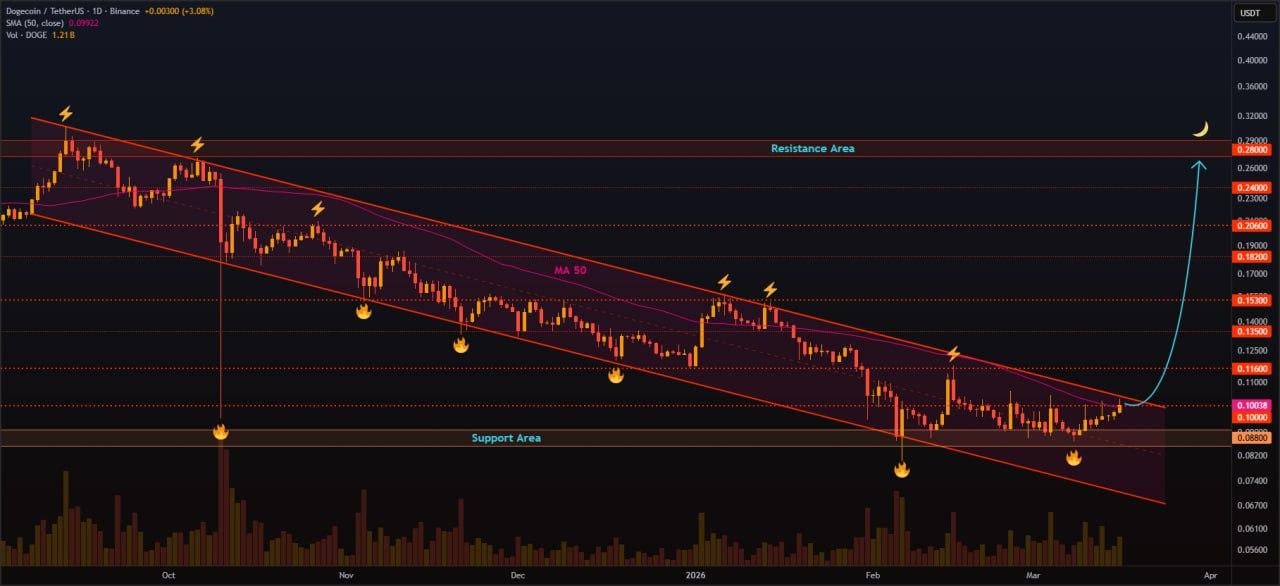
They forecast that a breakout could push the Dogecoin future price to $0.116. In the long run, ARI ZAIM expects the Dogecoin piece to rally to $0.280. Despite the bullish Dogecoin price prediction, more buying pressure is needed to sustain the current rally.
In the meantime, Dogecoin technical analysis shows that bulls are gaining momentum. The Dogecoin price has increased by 5.9% on the weekly timeframe. DOGE was priced at $0.100 on March 17 and could rally to the 200-SMA ($0.152).
3. Monad about to break two-month barrier
The Monad crypto has been on an uptrend in the last week, rising by 10.2%. According to CoinGecko, the Monad coin is trading close to a two-month resistance that has been in place since January 14. If bulls could surpass the resistance around this $0.025 region, the Monad price might soar to the $0.030 level.
As of March 17, the Monad price was priced at $0.024. Looking ahead, technical analysis indicates that buying pressure has increased. The RSI has climbed above the midline to 68. The Monad coin price is forecasted to rise to $0.064 in the coming months.
Final verdict
While a bullish Dogecoin price prediction might offer comfort following the recent market rebound, the real “moonshot” energy has shifted toward projects like DeepSnitch AI that offer massive value. It has already raised over $2.21M in funding while giving investors over 197% returns in the presale stage.
Imagine how far it could go after launch and listing on exchanges. If you want to join the next band of millionaires, this might be the best time to get the DSNT coin at $0.04487, use the 30%-300% bonuses to get more coins, and then stake for passive income. You will get both the bonuses and rewards seven days after the March 31 launch.
Visit the official website for more information, and join X and Telegram for community updates.
FAQs
1. Will Dogecoin reach $1?
Although the current Dogecoin price prediction shows some price growth, reaching $1 is very unlikely due to its high market cap. On the other hand, DeepSnitch AI is a low-cap gem that taps into a billion-dollar market with tools that could see huge adoption and fuel massive growth. So, DeepSnitch AI reaching $1 is likely more feasible.
2. Is DOGE crypto a good investment?
While the Doge price forecast shows short-term gains, the memecoin does not have a utility that can sustain long-term growth. It often depends on hype. On the flipside, DeepSnitch AI has clear AI tools and a structured roadmap for long-term sustainability. Also, DeepSnitch AI offers an early-stage advantage and is currently closing in on the end of its presale on March 31. Investors who join now could gain 100X returns after it launches, making it a good investment opportunity.
3. How high will Dogecoin go in 2030?
The Dogecoin future price could reach $1.50 by 2030. Meanwhile, the DeepSnitch AI price could soar to $5 by 2030. For a higher ROI, DeepSnitch AI could be the best crypto to buy due to its low market cap, price, and early-stage advantage.
The post Dogecoin Price Prediction Flips Bullish, but 100X Narrative and March 31 Deadline Pulls Investors Towards DeepSnitch AI, Peter Brandt Points to Ethereum Bottom appeared first on Blockonomi.
TLDR
- The Ethereum Foundation deployed 3,400 ETH into Morpho Vaults to expand its on-chain treasury strategy.
- The allocation includes 1,000 ETH directed into Morpho Vaults V2.
- The deployment is valued at approximately $7.6 million at current market prices.
- The foundation previously deployed 2,400 ETH and $6 million in stablecoins into Morpho in October 2025.
- The Ethereum Foundation committed up to 50,000 ETH to DeFi platforms earlier in 2025.
The Ethereum Foundation deployed 3,400 ETH into Morpho Vaults on Wednesday, expanding its on-chain treasury strategy. The allocation includes 1,000 ETH into Morpho Vaults V2, according to its official X account. The move reinforces its shift from selling ETH toward generating yield through decentralized finance tools.
Ethereum Foundation allocates 3,400 ETH to Morpho Vaults
The Ethereum Foundation confirmed the transfer through its verified X account. It directed 1,000 ETH into Morpho Vaults V2 as part of the total 3,400 ETH deployment. At current prices, the allocation equals about $7.6 million.
Earlier in October 2025, the Ethereum Foundation deployed 2,400 ETH and about $6 million in stablecoins into Morpho yield vaults. It cited Morpho’s “commitment to Free/Libre Open Source Software principles” at that time. The foundation also referenced Morpho Vault V2 and Morpho Blue V1 releases under GPL 2.0 licenses.
The October deployment followed a broader treasury overhaul announced in early 2025. The foundation committed up to 50,000 ETH to DeFi platforms, including Compound and Spark. It shifted from periodically selling ETH to funding operations through on-chain yield strategies.
Arkham Intelligence data shows the Ethereum Foundation holds over $820 million in total assets. About $735 million of that amount remains denominated in ETH. The foundation now uses DeFi protocols to manage liquidity rather than convert large holdings into fiat.
Ethereum expands on-chain treasury management strategy
Morpho expanded its user base from 67,000 to over 1.4 million during 2025. Deposits rose from $5 billion to $13 billion over the same period. Active loans reached $4.5 billion by the end of the year.
Real-world asset deposits on Morpho increased from near zero to $400 million by the end of Q3 2025. Morpho launched Vaults V2 in November 2025 with an expanded curator model. The new structure allows asset managers to design customized on-chain lending strategies.
The Ethereum Foundation allocated 1,000 ETH specifically to Vaults V2 under this structure. The architecture supports curated vaults with programmable liquidity conditions. It also enables compliance integrations for institutional treasury management.
As of early March 2026, Morpho reported about $5.8 billion in total value locked. ETH traded near $2,239 on Wednesday, reflecting a 3.49% daily decline. The Ethereum Foundation confirmed the latest deployment through its official communication channels.
The post Ethereum Foundation Deploys 3,400 ETH to Morpho Vaults appeared first on Blockonomi.
TLDR
- S&P Dow Jones Indices licensed the S&P 500 to Trade[XYZ] for perpetual trading.
- Hyperliquid launched the first perpetual contract based on the S&P 500 benchmark.
- The product allows 24 7 trading without a fixed expiry date.
- Traders can take leveraged long or short positions at any time.
- The contract uses institutional quality data sourced directly from S&P DJI.
- Trade[XYZ] has processed over $100 billion in trading volume since October 2025.
S&P Dow Jones Indices has licensed the S&P 500 to Trade[XYZ] for perpetual contracts. As a result, Hyperliquid now lists the first perpetual product based on the benchmark. The launch enables 24/7 trading using official S&P DJI data within a digital market structure.
Hyperliquid Lists Licensed S&P 500 Perpetual Contract
S&P Dow Jones Indices granted Trade[XYZ] a license to use the S&P 500 for perpetual trading. Consequently, Hyperliquid introduced the first perpetual contract tied to the benchmark. The product allows continuous trading without a fixed expiry date.
Traders can take leveraged long or short positions at any time. Unlike traditional futures, the contract does not require rollover before expiration. The platform sources institutional-quality index data directly from S&P DJI.
The S&P 500 tracks 500 leading United States companies across sectors. The index serves as the primary equity benchmark for global markets. It underpins futures, options, exchange-traded funds, and structured products.
These linked products generate more than $1 trillion in daily volume. Therefore, the perpetual contract connects digital traders to a widely used benchmark. Hyperliquid provides access through its native interface and partner platforms.
The XYZ protocol governs leverage limits and oracle integrations. It also manages market listings and operational parameters. As a result, the system maintains structured oversight of on-chain perpetual markets.
Trade[XYZ] Expands On-Chain Access to Benchmark Markets
Trade[XYZ] operates as an on-chain protocol for perpetual markets linked to real-world assets. Since October 2025, the platform has processed over $100 billion in trading volume. It reports a projected annualized run rate above $600 billion.
Collins Belton, Chief Operating Officer and General Counsel of Trade[XYZ]’s parent company, addressed the launch. He stated, “We developed XYZ with a vision of bringing the world’s most important markets on-chain.” He added that the S&P 500 represents the most widely tracked equity index globally.
Belton said the benchmark has defined global equities for decades. He explained that the partnership makes the S&P 500 fully accessible on Hyperliquid. He linked the launch to the protocol’s mission to digitize core financial markets.
Cameron Drinkwater, Chief Product and Operations Officer at S&P Dow Jones Indices, also commented. He said the collaboration broadens access to S&P DJI benchmarks in digital markets. He emphasized expectations for institutional-grade standards in digital trading.
Drinkwater stated, “This collaboration expands access and utility of our flagship benchmarks within digital trading environments.” He added that digitally native investors should demand institutional-quality standards. He confirmed that S&P DJI supports the integration with Trade[XYZ].
The S&P 500 anchors a global ecosystem of linked exposures. Those markets span futures, options, ETFs, and structured products. The perpetual contract now extends that benchmark access to 24/7 on-chain trading on Hyperliquid.
The post Hyperliquid Debuts Licensed S&P 500 Perpetual Market appeared first on Blockonomi.
CryptoPotato
Bitcoin was trading below $72,000 on Wednesday after failing to hold within its post-shock range but showing limited ability to build momentum beyond its recent high.
According to a market update by QCP Capital, the cryptocurrency is no longer trading like a pure high-beta risk asset, but it is not yet attracting consistent safe-haven flows either.
Macro Dominance Grows
The broader market remains under pressure, although declines have been relatively contained compared to other macro-sensitive risk assets. The dip-buying activity at the lower end of the range has continued, while spot market volumes remain low. Such a trend indicates that near-term price direction is being driven primarily by macroeconomic factors rather than crypto-specific developments, QCP Capital explained.
In derivatives markets, the options backdrop remains firm but defensive, as 30-day implied volatility hovered around the 50 level. Still above both 10-day and 30-day realised volatility, maintained positive carry, and supported premium-selling strategies. The term structure is mildly in “contango,” though slightly softer on the day, while 30-day risk reversals continue to show higher demand for downside protection, as puts are priced richer than calls.
Skew levels are not at extremes, but implied volatility remains high relative to recent history. This means that volatility conditions are not significantly dislocated. The overall options surface points to a defensive positioning, as negative front-end skew and a residual geopolitical premium are embedded further along the curve.
Macro conditions remain the dominant influence, and the market is focused on a week for central bank decisions. The US Federal Reserve is set to conclude its March policy meeting on Wednesday, followed by the European Central Bank, Bank of Japan, and Bank of England on Thursday.
Expectations for monetary easing have been reduced as rising oil prices complicate the outlook for rate cuts, despite softer growth and labor market data. Oil prices are holding near the $100 level, and ongoing tensions in the Gulf are contributing to a stagflationary backdrop across global markets.
In this environment, QCP said that while Bitcoin is no longer trading purely as a high-beta risk asset, it has also not established itself as a consistent safe-haven, and its range-bound behavior is likely to persist until greater clarity emerges on monetary policy or geopolitical developments.
Downside Liquidity Expansion Risks
According to a Bitunix analyst, Bitcoin has entered a high-level consolidation phase after sweeping overhead liquidity. In a statement to CryptoPotato, they explained that the 75,000-76,000 zone represents a clear concentration of short-side liquidity, acting as a near-term resistance band subject to repeated testing.
“On the downside, the 72,800 level serves as a critical demand cluster, where long positioning overlaps with structural support. A breakdown below this region would likely trigger liquidity expansion toward 71,500-72,000, increasing the probability of cascading liquidations.”
The post Bitcoin No Longer a High-Beta Play – But Still Not a Safe Haven, QCP Warns appeared first on CryptoPotato.
Bitcoin is the most famous digital asset in the world. Most people think the only way to own it is by buying it or mining it with loud machines. A new platform called Bitcoin Everlight is changing that. It has built a simple way for anyone to help the Bitcoin network and earn real BTC rewards. This new system is called Everlight Shards.
Instead of needing a lot of technical skill, users can now support Bitcoin infrastructure through a very easy process. This is why many people are starting to look at Bitcoin Everlight as a better way to grow their Bitcoin balance.

What is a Bitcoin Everlight Shard?
An Everlight Shard is like a digital ticket that lets you join the network. In the past, if you wanted to help verify Bitcoin payments, you had to run a server or have a lot of computer knowledge. Shards take away all that hard work.
When you activate a Shard, you are helping Bitcoin process payments faster and cheaper. The network does the technical part, and you get rewarded for providing the support it needs. It is a simple way to “stack sats.” This means slowly building up your Bitcoin holdings over time.

Bank-Grade Security and Audits
Bitcoin Everlight is built with a Bank-Grade security plan. This means they use the same high standards that big financial companies use to keep money safe. To ensure total trust, the project has completed several major safety checks.
- ISO/IEC 27001 Certification: The platform reached this gold standard for keeping information safe.
- Smart Contract Audits: The code was 100% audited by Solidproof and Spywolf to prove it is secure.
- Team Verification: The team passed KYC checks with Vital Block and Spywolf.
- Data Privacy: The network follows strict GDPR rules and has 24/7 monitoring to protect users.

4 Easy Steps to Start Earning
The team at Bitcoin Everlight wanted to make sure anyone could use this system. They have created a simple path that only takes four steps to complete.
- Get BTCL Tokens: First, you acquire the BTCL utility tokens during the current presale phase.
- Activate a Shard: Your Shard will turn on automatically once you have enough tokens in your balance to meet a tier.
- Validate Transactions: Once your Shard is active, it starts helping the network route and verify Bitcoin payments.
- Earn Real Bitcoin: As the network handles real transactions, you receive a share of the fees in native Bitcoin.
Understanding the Shard Tiers
The system uses different levels, or tiers, to help the network grow. The level you reach depends on how much you put into the project during the presale.
- Azure Shard ($500): This is the entry level and gives you up to 12% rewards during the presale phase.
- Violet Shard ($1,500): This is the middle level and increases your presale rewards to 18%.
- Radiant Shard ($3,000): This is the top level for the biggest supporters and offers 28% or more in rewards.
If you have less than $500, your Shard is Dormant. This means it is waiting in line. Once you add more to reach the $500 mark, it turns on and starts earning for you.

Why Native Bitcoin Rewards Matter
Most crypto projects pay you in their own new tokens. If that new token drops in price, your rewards lose value quickly. Bitcoin Everlight is different because it pays you in Native BTC. This is the real Bitcoin that everyone knows.
After the network launches, you earn a share of the fees from people using the network. This means that as more people use Bitcoin for fast payments, your rewards can grow naturally. You are earning the strongest digital asset in the world just by helping the network run smoothly.
Phase 1 Presale: 6 Days Remaining
The project is currently in the very first stage of its launch. It is the best time to get involved because the price is at its lowest.
- Current Stage: Phase 1
- Token Price: $0.0008
- Total Time: Six Days
- Next Price Jump: $0.0010
There are only six days left in this phase. Once the six days are over, the price will automatically jump to $0.0010. Getting in now during Phase 1 means you can activate a higher Shard tier for a much lower cost.
Conclusion: A Simple Path to Bitcoin
Bitcoin Everlight has removed the hard parts of earning Bitcoin. You do not need to be a computer expert or buy expensive mining rigs. By using the Shard system, you can support the network and earn real rewards from your home. With strong security and a simple process, it is a great way for anyone to start stacking sats today.
Join Phase 1 and activate your Everlight Shard here.
Disclaimer: The above article is sponsored content; it’s written by a third party. CryptoPotato doesn’t endorse or assume responsibility for the content, advertising, products, quality, accuracy, or other materials on this page. Nothing in it should be construed as financial advice. Readers are strongly advised to verify the information independently and carefully before engaging with any company or project mentioned and to do their own research. Investing in cryptocurrencies carries a risk of capital loss, and readers are also advised to consult a professional before making any decisions that may or may not be based on the above-sponsored content.
Readers are also advised to read CryptoPotato’s full disclaimer.
The post Bitcoin Everlight: 4 Steps to Activate Shards and Stack Sats appeared first on CryptoPotato.
Ripple’s native cross-border token was rejected at over $1.60 yesterday and has dropped by over 10% since that local peak to $1.45 as of press time.
Nevertheless, there are a couple of positive signs for its short-term price movements, including the reactivation of whale wallets.
2 Bullish Signs
The spot XRP ETFs in the United States had entered their worst streak in terms of consecutive daily net outflows (or lack of any flows) that lasted nearly two straight weeks – from March 5, when investors pulled out just over $6 million, to March 16, when the withdrawals were just shy of that number. In the meantime, there were two days with zero reportable activity.
However, that negative trend was finally broken yesterday as the funds attracted $4.64 million – the highest single-day figure since March 3. As such, the total net inflows have remained above $1.2 billion.
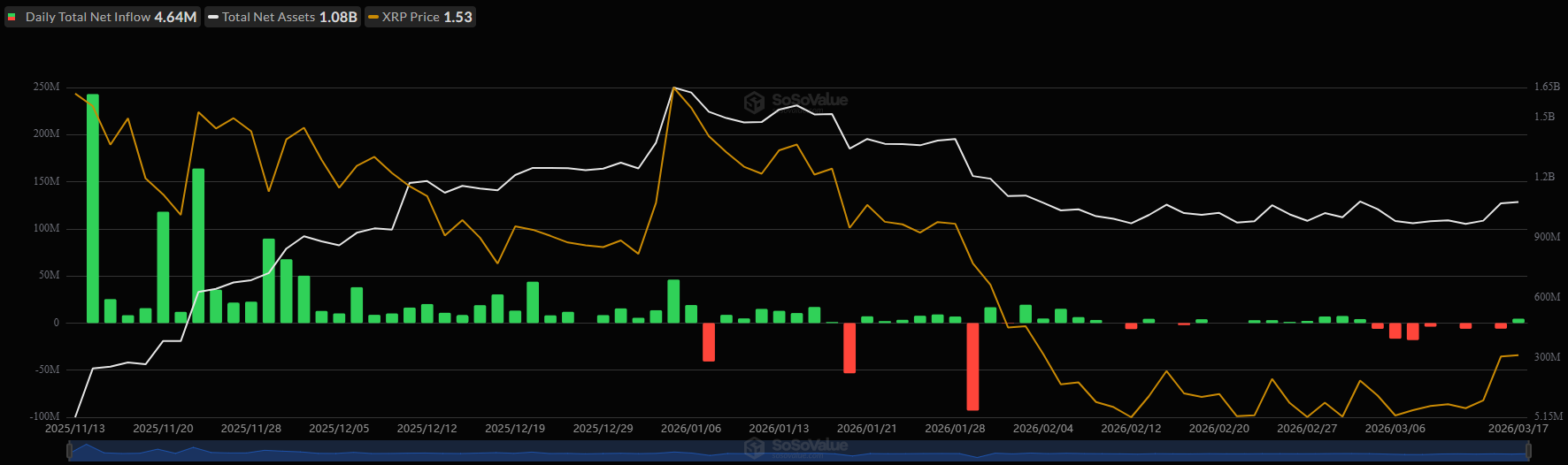
The second positive news for the XRP Army comes from whales. After a prolonged period of lack of any substantial activity, these large market participants have resumed their accumulation spree. Citing data from Santiment, Ali Martinez asserted that they have bought 200 million tokens in the past two weeks. In terms of USD, this stash is worth roughly $300 million at current prices.
200 million $XRP have been bought by whales in the last two weeks! pic.twitter.com/sMQNef3VZN
— Ali Charts (@alicharts) March 18, 2026
XRP Price Rejected
Yesterday’s positive net inflow day for the ETFs, aligned with the accumulation from whales and the overall market-wide resurgence, led to an impressive rally for XRP. The token surpassed BNB in terms of market cap after it jumped to a monthly high of around $1.63.
Although analysts began praising the move and setting new big targets ahead, XRP was rejected at that point and driven south by over 10%. It currently struggles to remain above $1.45. This correction comes despite the recent expansion news from the company behind the asset, as well as the fact that the top traders on Binance have been “quietly buying XRP long positions,” according to data from popular analyst CW.
Binance top traders are quietly buying $XRP long positions. pic.twitter.com/01QV7hj7AC
— CW (@CW8900) March 18, 2026
The post 2 Bullish Signals for Ripple’s XRP Despite Ongoing Correction appeared first on CryptoPotato.
PlayNance, a unified on-chain infrastructure specifically engineered to power the entire world of gaming, betting, and prediction, has launched its highly anticipated native cryptocurrency, GCOIN.
This represents a massive milestone when it comes to the expansion of its Web3 entertainment ecosystem.
GCOIN Deposits at MEXC Now Live, 200K Holders Already
GCOIN will start trading on one of the most popular altcoin-oriented exchanges in the industry – MEXC, and deposits are already open. Speaking on the matter was the CEO of PlayNance, Pini Peter, who said:
“Today marks a defining moment for Playnance. […] We identified early the opportunity to bring real scale into Web3 entertainment, and we’re building one of the leading ecosystems to support it. With GCOIN now live, we’re opening the door to what comes next – a new wave of users, new models, and a much larger shift in how entertainment moves on-chain. This is just the beginning.”
The coin has already attracted over 200,000 holders, with the presale selling over 14 billion tokens.
It’s worth noting that the project’s entire ecosystem has built its token model around rewards, linking the value distribution directly to platform activity rather than relying on fixed emissions.
Playnance already hosts more than 10,000 on-chain games and processes more than 2 million on-chain transactions per day, which reflects a strong user engagement, as well as growing adoption across the entire network.
GCOIN: Powering an Impressive Ecosystem
GCOIN represents the utility token that powers the economic execution across the protocol’s ecosystem. It’s used as a unit for value movement and settlement, and it incentivizes distribution across the PlayBlock layer-3 solution and applications powered by Playnance.
By design, it is intended for high-frequency and real-time use.
That said, the team has also highlighted principles of wallet-based ownership and execution. This means that users hold the cryptocurrency directly in their wallets. Balances and state changes are written on-chain for complete transparency, while users can also verify all network activity through the explorer.
In terms of functionality, GCOIN is designed as a shared utility layer across all applications on Playnance.
This means:
- One wallet balance per user
- One token standard across the ecosystem
- No user-side bridging to move value between supported applications
- Gasless user experience
It’s also worth noting that the team recently launched GCOIN staking, providing yet another mechanism for users to earn rewards simply by staking their tokens. Naturally, the longer the staking period, the larger the reward. This model has proven to attract considerable interest, with more than 250 million tokens staked within hours.
Disclaimer: The above article is sponsored content. CryptoPotato doesn’t endorse or assume responsibility for the content, advertising, products, quality, accuracy, or other materials on this page. Nothing in it should be construed as financial advice. Readers are strongly advised to verify the information independently and carefully before engaging with any company or project mentioned and to do their own research. Investing in cryptocurrencies carries a risk of capital loss, and readers are also advised to consult a professional before making any decisions that may or may not be based on the above-sponsored content.
Readers are also advised to read CryptoPotato’s full disclaimer.
The post Trending New Crypto GCOIN by PlayNance Debuts With 14 Billion Tokens Sold Already appeared first on CryptoPotato.
Bitcoin was mostly stable on Wednesday at $74,000 before it started to lose value gradually, dipping below $72,000 minutes ago.
And while supply pressure has eased significantly, demand remains muted as data revealed that “the rules of the game have quietly changed.”
Direction Still Unclear
In its latest report, CryptoQuant stated that Bitcoin’s supply-side activity has entered a subdued phase, while demand has yet to respond similarly. The MVRV Ratio, which compares market value to realized value, currently stands at 1.3, placing it just above the accumulation zone and indicating a minimal speculative premium.
This level means that Bitcoin is trading close to its aggregate cost basis, and reflects a reset phase rather than confirming either a market bottom or a recovery trend. On the supply side, miner behavior provides additional context. During the sharp price decline in early February, miner outflows climbed to almost 28,000 BTC, as selling pressure rose.
However, as prices stabilized and began to recover, outflows declined significantly, reaching almost 6,800 BTC by mid-March. Interestingly, this was the lowest level observed in the measured period.
Additionally, the Puell Multiple, currently around 0.69, further aligned with this trend, demonstrating that miners are operating within a post-halving normalization range without signs of financial stress or excessive profit-taking, and without urgency to increase supply in the market.
Beyond Old Patterns
Despite this muted supply activity, other structural factors remain relevant. For instance, SoSoValue recorded a steady 7-day non-stop inflow from spot Bitcoin exchange-traded funds. CryptoQuant also pointed to increasing adoption of Bitcoin as a reserve asset by institutional treasuries, and its gradual acceptance at the nation-state level, which may have contributed to elevating the cycle’s price floor compared to previous market cycles.
It is also important to note that the MVRV Ratio has not fallen below 1.0, a level which is historically associated with deeper corrections. This deviation implies that traditional cycle patterns, including revisits to lower valuation zones, may not occur in the same manner.
“For that reason, on-chain accumulation patterns, institutional flows, and miner behavior all warrant closer attention than usual, because the signals may look familiar while the rules of the game have quietly changed.”
The post Bitcoin Dips Below $72K as Data Warns ‘Rules Have Quietly Changed’ appeared first on CryptoPotato.