Cryptocurrency Posts
Crypto Briefing
Roche's massive AI investment could redefine drug discovery timelines, challenging industry norms and intensifying competition with Eli Lilly.
The post Roche deploys 3,500 Nvidia Blackwell GPUs to supercharge drug discovery appeared first on Crypto Briefing.
Fold's ambitious Bitcoin credit card expansion could redefine its market position, but sustaining financial losses poses significant risks.
The post Fold posts $69.6M net loss but doubles down on bitcoin credit card expansion appeared first on Crypto Briefing.
Fed holds rates steady as PPI inflation beats forecasts and crypto markets decline amid rising geopolitical tensions.
The post Fed holds rates steady as sticky inflation and geopolitics pressure markets appeared first on Crypto Briefing.
Coinbase's pursuit of AI stablecoin infrastructure with Cloudflare could redefine digital payments, emphasizing machine-to-machine transactions.
The post Coinbase competes for Cloudflare deal to build an AI stablecoin appeared first on Crypto Briefing.
The market shift towards valuing revenue and usage over narratives signals a new era in crypto asset valuation, challenging established projects.
The post Hyperliquid’s HYPE token flips Cardano’s ADA in market cap appeared first on Crypto Briefing.
Bitcoin Magazine
Bitcoin Magazine

Till Death or Seed Phrase: Woman Accused of Spying on Husband, Stealing $172 Million in Bitcoin
A dispute over more than $172 million in Bitcoin has moved forward in the UK’s High Court of Justice, where a man alleges his estranged wife stole thousands of coins from his hardware wallet using covert surveillance inside their home.
Court filings show that Ping Fai Yuen, a UK resident, held 2,323 Bitcoin in a Trezor hardware wallet in 2023.
On Aug. 2 of that year, the full balance was transferred without his knowledge. The funds were later split across 71 separate addresses through a series of transactions. No movement has been recorded since Dec. 21, 2023.
Yuen claims his wife, Fun Yung Li, obtained access to the wallet’s recovery phrase, which can be used to recreate the wallet and move funds.
The filings allege she recorded him inside their home to capture the phrase, possibly with help from her sister, Lai Yung Li, who is also named as a defendant.
According to the claim, Yuen had been warned by his daughter in July 2023 that Li was attempting to access his Bitcoin.
He then installed audio recording equipment in the residence. The recordings are cited as key evidence. In one excerpt referenced in court, Li is alleged to have said, “The Bitcoin has transferred to me” and “take all of it.”
The filings also describe a recording from July 29, 2023 in which Li allegedly discussed camera placement and the location where Yuen stored his wallet credentials. The claim states she was “covertly recording” him in an effort to obtain access.
After discovering the transfer, Yuen confronted Li and assaulted her. He was arrested and later pleaded guilty to assault occasioning actual bodily harm and two counts of common assault.
Police opened an investigation into the alleged theft and arrested Li in 2023. Officers seized 10 crypto cold wallets during a search, including several linked to Yuen. Authorities later released Li after a no comment interview. The police have since stated they will take no further action without new evidence.
In November 2025, Yuen sought a proprietary asset preservation injunction. He asked the court to confirm his ownership of the Bitcoin, freeze Li’s crypto holdings, and order the return of the assets or an equivalent sum in British pounds.
‘Damning’ evidence of bitcoin theft
In a judgment following a March 2 hearing, Justice Cotter said Yuen’s case shows a strong likelihood of success. He pointed to the warning from Yuen’s daughter, the audio transcripts, and the discovery of equipment capable of accessing the wallet.
“The evidence is that he was warned of what the First Defendant was seeking to do, the transcripts are damning,” Cotter wrote.
The judge also cited Occam’s razor, the principle that the simplest explanation with the fewest assumptions is often the most likely. He said that this straightforward account aligns with the available evidence, and noted that Li has had the opportunity to present her version of events but has not done so in the proceedings.
Cotter added that the volatility of Bitcoin supports the need for a swift trial, as the value of the disputed assets may shift during the course of litigation.
The case is expected to test how English courts handle ownership and recovery claims tied to digital assets.
This post Till Death or Seed Phrase: Woman Accused of Spying on Husband, Stealing $172 Million in Bitcoin first appeared on Bitcoin Magazine and is written by Micah Zimmerman.
Bitcoin Magazine

Zip Ties, Sleeping Pills and Pepper Spray: Canadian Crypto Millionaire Targeted in Foiled Madrid Kidnapping
A Canadian crypto entrepreneur survived a kidnapping attempt Monday night on one of Madrid’s busiest nightlife streets, after witnesses alerted police and helped foil the attack.
The incident occurred at approximately 11 p.m. near the intersection of Calle Claudio Coello and Calle Jorge Juan in the Salamanca district, a hub of high-end restaurants and bars.
The victim had just left Lobito de Mar, the restaurant owned by chef Dani García, when three men forcibly removed him from the street, pepper-sprayed him, and threw him into a Ford Transit van.
Several pedestrians and residents on nearby balconies immediately called authorities. Spanish National Police tracked the vehicle to Ronda de Toledo, about 15 minutes from the scene, and arrested two of the attackers. One suspect escaped and remains at large, according to reports.
Police identified the arrested suspects as Serbian men, ages 33 and 45, both with no prior criminal record.
Investigators say the attackers had planned the abduction to extract the victim’s cryptocurrency passwords and gain access to his digital assets. The suspects also attempted to steal the Canadian’s €100,000 luxury watch.
Authorities determined the kidnappers had followed the businessman from Barcelona to Madrid, where he had traveled to finalize a cryptocurrency deal.
The van used in the crime had an altered license plate, rented specifically for the abduction, and contained plastic zip ties and sedative pills, suggesting a premeditated scheme. GPS data recovered from the vehicle indicated the suspects intended to transport the victim to Petrer, a town in Alicante.
Inside the van, the victim was left alone while police focused on detaining the suspects. He freed himself from the zip ties and flagged down a taxi, which took him to La Princesa Hospital for treatment of injuries sustained during the initial assault. Police recovered firearms from the van during their investigation.
Be careful with your crypto
The kidnapping aligns with a recent rise in physical attacks targeting cryptocurrency holders across Europe. France, for example, has recorded 11 similar incidents so far in 2026, reflecting a trend of criminals seeking direct access to digital assets rather than traditional bank accounts.
Security experts refer to such attacks as “wrench attacks,” in which criminals attempt to obtain wallet seed phrases or private keys through coercion or violence.
Authorities warn that cryptocurrency entrepreneurs are increasingly at risk due to the digital and highly liquid nature of their assets.
Police continue to search for the third suspect and have appealed to the public for information.
The investigation remains open, with officers examining surveillance footage and digital evidence to determine whether the plot involved additional collaborators or extended surveillance beyond the two confirmed attackers.
This post Zip Ties, Sleeping Pills and Pepper Spray: Canadian Crypto Millionaire Targeted in Foiled Madrid Kidnapping first appeared on Bitcoin Magazine and is written by Micah Zimmerman.
Bitcoin Magazine

Kraken Pauses IPO Due to Market Uncertainty: Report
Crypto exchange Kraken has suspended its plans for an initial public offering, sources familiar with the matter told CoinDesk.
The company’s parent, Payward, had filed a confidential draft S-1 registration statement with the U.S. Securities and Exchange Commission in November 2025. The filing valued Kraken at $20 billion, following an $800 million funding round that included a $200 million investment from Citadel Securities.
Kraken had planned to go public this year but now faces a market environment marked by falling crypto prices and weaker trading volumes. The downturn has prompted many digital asset companies to reconsider timing and structure for public listings.
Last year saw a surge in crypto IPOs, with at least 11 companies, including Circle, Bullish, and Gemini, raising a combined $14.6 billion.
So far in 2026, only crypto custodian BitGo has listed publicly, and its shares have declined 45%, highlighting the risks for new entrants.
Kraken has not ruled out a future IPO but appears unlikely to pursue one until market conditions stabilize.
A company spokesperson reiterated the November announcement and declined further comment.
Kraken’s master account
Earlier this month, Kraken secured a master account with the Federal Reserve Bank of Kansas City, making it the first crypto-native firm to access the Fed’s core payment infrastructure.
The approval gives Kraken Financial direct entry into Fed payment systems, including Fedwire, a real-time network that handles trillions of dollars in daily transfers.
This allows the firm to settle dollar transactions without relying on intermediary banks, streamlining operations for large customers.
Kraken’s master account does not provide all traditional banking privileges: it will not earn interest on reserves or access the Fed’s lending facilities. Nonetheless, the move represents a breakthrough for crypto firms, which have historically faced repeated rejections in efforts to connect to the central bank’s payment rails.
Sen. Cynthia Lummis of Wyoming called the approval a “watershed milestone” for digital assets.
Other firms, including Ripple and Custodia Bank, have applied for master accounts, though approval has been uneven.
Kraken’s success is a sign the Fed may explore “skinny” master accounts, granting crypto institutions limited access to payment rails without full bank benefits, signaling cautious but growing acceptance of crypto in mainstream finance
Under such a framework, crypto firms could connect to settlement systems while remaining outside certain capital and reserve regimes applied to depository institutions.
.
This post Kraken Pauses IPO Due to Market Uncertainty: Report first appeared on Bitcoin Magazine and is written by Micah Zimmerman.
Bitcoin Magazine

Boltz Exchange Launches Atomic USDT Swaps for Lightning Network Users
Boltz Exchange launched USDT Swaps on March 18, 2026, introducing atomic, non-custodial swaps between sats on the Lightning Network and USDT on Arbitrum-based networks via USDT0.
The integration relies on USDT0, an omnichain version of Tether built on LayerZero’s Omnichain Fungible Token (OFT) standard. USDT0 concentrates liquidity into a single token primarily on Arbitrum, eliminating the need for Boltz to build separate liquidity pools and integrations across dozens of USDT chains like Ethereum, Polygon, Optimism, Rootstock, and others. This approach delivers seamless swaps to and from USDT to Bitcoiners that do not care to understand the complexities of blockchain bridge networks. While giving DEFI a direct path to lightning payments, without counterparty risk.
Users also gain practical access to the world’s leading stablecoin, while sidestepping custody risks from centralized exchanges or anonymous “trust me bro” swap services, as well as the privacy trade-offs of KYC-heavy platforms. Business applications include topping up crypto debit cards that natively support USDT by converting Lightning sats in seconds, receiving Lightning payments when clients or counterparties send USDT, or merchants accepting USDT inflows but settling revenue in Lightning sats on their preferred terms—all without relinquishing control of funds or trusting third parties at any point. Its all open source.
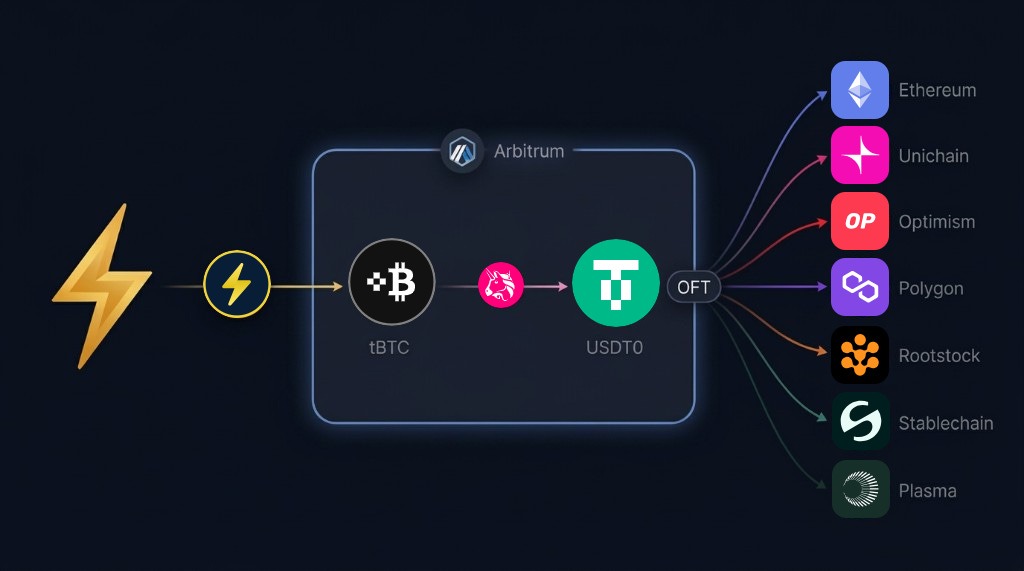
Atomic swaps ensure trustless, simultaneous execution of trades across different blockchains or layers, preventing one party from defaulting after receiving assets. In traditional swaps, especially cross-chain, users face timing risks where one side could claim funds without delivering the other. Atomic swaps resolve this through cryptographic commitments (like hash preimages) and conditional claims: both legs of the trade either complete together or fail entirely, reverting funds to their original owners. Boltz achieves this for Lightning and USDT by routing through tBTC, Threshold’s permissionless ERC20 Bitcoin wrapper on Arbitrum. The flow is Lightning to tBTC via an atomic Boltz swap, then to USDT0 via a DEX swap akin to those on Uniswap, stitched into one irreversible transaction by the Router contract on Arbitrum. Gas abstraction removes the need for ETH on Arbitrum, making the process seamless for Bitcoin-native users.
Boltz plans to expand USDT Swaps across all currently supported Bitcoin layers, including on-chain BTC, Liquid, Rootstock, and Arkade, broadening the utility for businesses and individuals holding Bitcoin in various forms. Future updates will also incorporate USDT0’s Legacy Mesh, which is expected to enable direct support for additional chains such as Tron and Solana. Tron currently holds the largest USDT supply at approximately $83.9 billion according to Tether’s March 17, 2026 transparency report, underscoring the demand for eventual integration on high-volume networks beyond the initial OFT-focused deployment.
This post Boltz Exchange Launches Atomic USDT Swaps for Lightning Network Users first appeared on Bitcoin Magazine and is written by Juan Galt.
Bitcoin Magazine

US Senators Urge Swift Action on Bitcoin, Crypto Market Structure Bill
U.S. Senators are pressing lawmakers to advance legislation aimed at clarifying Bitcoin and broader crypto market structure.
Sen. Cynthia Lummis emphasized urgency in remarks today at the D.C. Blockchain Summit today, saying, “This may be our only chance to get market structure done. I can’t be any clearer: The time for clarity is now.”
She confirmed that the Banking Committee plans to mark up the bill in April, after the Easter recess.
“We really are going to get it out of the Banking Committee in April,” she added.
JUST IN:
— Bitcoin Magazine (@BitcoinMagazine) March 18, 2026US Senator Cynthia Lummis urges lawmakers to pass Bitcoin and crypto market structure legislation ASAP:
"This may be our only chance to get market structure done. I can't be any clearer: The time for Clarity is now."pic.twitter.com/3puu5RMmMB
Lummis also addressed a potential compromise on stablecoin yield, hinted at by Sen. Tim Scott yesterday. “We think we’ve got it,” she said, though she acknowledged she has not seen the negotiated language herself.
She noted banks remain cautious: “We’ve got to get the banks to swallow hard…. Gosh the banks got really dug in on this. But they’re gonna get there.”
Sen. Kevin Cramer echoed the call for speed yesterday, warning that “time is not our friend” and urging passage of market structure legislation before Easter.
The White House’s Patrick Witt is expected to provide further updates on the bill’s progress later today.
The bill is gaining momentum
Efforts to establish the regulatory framework for the U.S. cryptocurrency market are gaining momentum. Senate Banking Committee Chairman Tim Scott said a revised draft, focused on stablecoins, could be introduced this week.
The bill aims to balance innovation with financial stability, particularly regarding yield-bearing stablecoins, which have become a central discussion point.
Key lawmakers, including Angela Alsobrooks, Thom Tillis, and White House official Patrick Witt, have contributed to refining provisions on digital assets. Broader negotiations address political oversight, compliance standards, and balanced representation within regulatory bodies.
DeFi and anti-money laundering (AML) regulations are also under review. Mark Warner is advocating for stronger AML safeguards, with proposals for enhanced know-your-customer (KYC) requirements to improve transparency and prevent illicit activity.
If finalized, the bill could create a comprehensive regulatory structure for the crypto market. Observers see the stablecoin-focused draft as a major step forward, providing clarity for digital assets while maintaining bipartisan support
In the past, Treasury Secretary Scott Bessent has pressed lawmakers to act on the legislation, saying the United States must secure clear market structure rules before the end of the spring legislative window.
This post US Senators Urge Swift Action on Bitcoin, Crypto Market Structure Bill first appeared on Bitcoin Magazine and is written by Micah Zimmerman.
CryptoSlate
Hyperliquid’s HYPE token moved into the top 10 crypto assets by market capitalization, beating Cardano's ADA amid a 1,700-fold rise in trading volume tied to oil volatility during the US-Iran conflict.
Notably, Bitcoin benefited significantly from the broader bid for crypto during the conflict, but HYPE gained a second channel as traders used Hyperliquid's platform to express views on oil around the clock, including on weekends when conventional futures venues were closed.
From March 1 to March 18, HYPE’s market value rose from about $8.16 billion to $10.66 billion, a gain of about 30.7%, according to CryptoSlate's data. Over the same stretch, the token climbed from No. 13 to No. 10 in the site’s rankings.
The move built on momentum already forming across decentralized perpetual futures markets. Hyperliquid had been gaining significant market share as traders shifted more derivatives activity on-chain and as the venue expanded its reach beyond crypto-native speculation.
The US-Iran conflict accelerated that trend by giving traders a reason to use crypto rails for real-time exposure to oil-linked volatility.
That gave HYPE a different profile from many large-cap tokens, as traders no longer priced the token solely as exposure to a fast-growing crypto venue. Instead, they were also pricing in a platform that became a live venue for macro hedging while legacy markets were offline.
Oil volatility pushes flow on-chain
The latest conflict began after US-Israeli strikes on Iran on Feb. 28, setting off a rise in oil prices and a scramble across markets to reprice supply risk.
Since then, Brent crude has settled above $100 a barrel, while analysts have tracked the possibility of further gains if shipping routes or regional energy infrastructure are disrupted.
Hyperliquid became one of the places where that view showed up in volume, as trading in oil-linked perpetual contracts on the platform expanded quickly as the war developed.
Data from Flowscan showed that cumulative oil-futures volume on Hyperliquid rose from about $339 million on Feb. 28 to more than $10 billion as of press time.
Bitwise research analyst Danny Nelson explained that the high Hyperliquid volume was a sign that traders were using the on-chain venue to hedge a commodity that still sits at the center of the global economy.
According to him, oil had been about 2.5 times more volatile during the war than in the two weeks before the conflict and pointed to the gap that forms when traditional futures venues close for the weekend while headlines continue to move.

He added:
“Wartime forces markets to adapt. Sometimes you don’t realize you need a solution until it stares you in the face. I think that’s what’s happening here with weekend hedging. Hyperliquid’s weekend oil sessions have grown 1,700x in just a month.”
Notably, Hyperliquid had confirmed the trend, saying that real-world asset trading on the venue repeatedly set records, surpassing $1.3 billion in open interest and $1.4 billion in weekend volume.
The company said the platform had become a venue for 24/7 price discovery in oil, metals, and equity indexes when standard markets were shut.
Despite this, the scale still remained small compared with legacy energy markets. Nelson noted that traditional futures venues handle about $18.5 billion in WTI contracts on an average trading day, or roughly 35 times Hyperliquid’s best weekend oil session.
Even so, the pace of Hyperliquid's growth drew attention because it suggested a market segment was being built during live geopolitical stress rather than through a slower cycle of product launches and user incentives.
Revenue structure helps explain HYPE’s rally
HYPE rose alongside that activity because Hyperliquid’s structure links platform revenue more directly to token demand than many crypto networks do.
According to Hyperliquid’s documentation, trading fees are directed to an Assistance Fund, which uses them to buy HYPE on the open market.
Tokens held in the fund are burned, reducing supply over time. Users who stake HYPE also receive fee discounts on the platform. The result is a model that allows traders to view the token more like an exchange-linked asset whose value can rise with trading volume.
That framework became more relevant as war-driven oil trading pushed volume higher. In simple terms, more trading produced more fees, and more fees increased the amount of HYPE bought back and removed from circulation. The market had a revenue-based reason to reprice the token.
DefiLlama data showed Hyperliquid generated about $182.5 billion in perpetual futures volume over 30 days, $42.69 billion over seven days, and $6.76 billion over 24 hours.

The platform also posted about $45.4 million in 30-day earnings, which implied roughly $554 million on an annualized basis if activity held near that level.
Considering this, Arthur Hayes, founder of BitMEX, described Hyperliquid as the largest revenue-generating crypto project outside stablecoins.
He said 97% of that revenue was being used to buy back HYPE from the market, a design he argued gave the token a stronger link to platform cash flow than many other crypto assets. According to him, Hyperliquid could continue to take derivative volume from centralized exchanges while adding new products to expand revenue.
Some of that product expansion is already underway through HIP-3, Hyperliquid’s framework for permissionless perpetual listings, which has allowed the trading of real-world assets. The trading platform is also looking to enable prediction markets and options-style derivatives as part of its array of features.
The combination of these developments, he argued, would bolster HYPE's potential to reach $150 by August next year.
A war trade becomes a market-structure test
Meanwhile, the next question is whether that wartime flow turns into a standing category of demand.
The continued use of Hyperliquid for oil-linked and metals-related contracts after tensions cool would support the case that 24/7 macro trading on crypto rails can hold a larger share of activity.
However, a retreat in those volumes, once energy prices settle, would weaken the revenue assumptions that helped drive HYPE higher this month.
Meanwhile, there are also near-term risks. Token unlocks remain on the calendar, including an April 6 unlock that traders will monitor for supply pressure. At the same time, questions remain after research into Hyperliquid’s October 2025 stress event raised concerns about how the platform managed a large liquidation and the use of auto-deleveraging.
Even with those issues, the move into the top tier of crypto assets reflected a clear sequence. The US-Iran war lifted oil volatility. Oil volatility drove demand for markets that stayed open around the clock.
Hyperliquid captured part of that demand through on-chain perpetuals, and HYPE benefited because the platform’s fee structure feeds directly into token buybacks and burns.
The post Why the US-Iran conflict sent traders to Hyperliquid — and pushed HYPE into crypto’s top 10 appeared first on CryptoSlate.
Ethereum is outpacing Bitcoin as tensions involving the United States, Israel, and Iran continue to shape global markets.
Data from CryptoSlate shows ETH has risen 18% against the dollar since the start of March, compared with a 13% gain for Bitcoin over the same period.
The ETH/BTC ratio has also moved higher, rising 7.6% to 0.0315 from 0.0293 in less than three weeks, a sign that Ethereum is gaining ground relative to Bitcoin rather than simply rising alongside it.
That shift has pushed ETH above $2,300 and left it on track for its first positive monthly close since August 2025. The move stands out because it is unfolding amid pressure across global macro markets, where conflict risk and higher energy prices have begun to reshape expectations for inflation and monetary policy.
The military conflict involving the United States, Israel, and Iran has driven Brent crude above $102 a barrel, while West Texas Intermediate has moved past $95. Energy markets are increasingly pricing in the risk of disruption in the Strait of Hormuz, a shipping route that carries about one-fifth of global oil and liquefied natural gas flows.
Higher oil prices have often fed into inflation expectations, raising the prospect that central banks will keep policy tight for longer. In past episodes, that backdrop has tended to support Bitcoin’s role as a defensive crypto trade, with investors treating it as the asset closest to a macro hedge inside the sector.
This time, Ethereum is delivering a stronger performance. The divergence points to capital flowing into blockchain-specific themes tied to Ethereum’s market structure, network activity, and positioning among institutional investors, rather than a broad move into crypto as a shelter from geopolitical stress.
Asset management firm Matrxiport said:
“Ethereum is increasingly behaving like a financial asset…This dynamic may also help explain why crypto has recently shown relative strength versus other asset classes and does not neatly fit into the traditional risk-on/risk-off framework.”
Wall Street money returns to Ethereum
Wall Street is sending fresh capital into Ethereum at a pace that is helping drive the token’s recent outperformance.
Data from SoSoValue shows the nine spot ETH exchange-traded funds (ETFs) took in more than $160 million of net inflows last week, their strongest weekly intake since mid-January. The trend extended into the new week, with the funds drawing another $35.9 million on March 16.
That flow pattern has added to the case that institutional demand is returning to ETH after a period of weaker sentiment.
Typically, sustained inflows of that scale have previously preceded some of the asset’s sharper price moves, including rallies that carried ETH above $4,000.
So, the latest allocations suggest portfolio managers are again increasing exposure as the market broadens beyond Bitcoin.
Meanwhile, a second shift is also shaping the investment case. Regulated products that offer exposure to Ethereum’s network yield are opening a new route for traditional finance investors.
BlackRock recently launched an Ethereum staking ETF under the ticker ETHB, giving investors access to both price exposure and validator rewards. The fund raised $104.7 million in seed capital and attracted more than $45.7 million of additional inflows in its first two trading days.
That structure gives portfolio managers a way to evaluate ETH through cash flow potential and network-based yield, a framework that can carry more weight with allocators who need income generation as part of the case for holding alternative assets.
At the same time, corporate buyers are building Ethereum positions on their balance sheets.
Since last year, BitMine has aggressively expanded its ETH treasury and said it plans to acquire up to 5% of the token’s supply.
The pace of those purchases has increased this month, with the company buying more than 100,000 ETH in the first two weeks, bringing total corporate holdings to nearly 4.6 million Ether as of mid-March.
That buying is creating a steady layer of demand that echoes the treasury strategy several public companies used to accumulate Bitcoin earlier in the cycle.

Speculative interest gradually returns to ETH
Speculative demand is showing signs of returning to ETH as institutional buying strengthens.
CryptoQuant data showed that derivatives positioning across the digital-asset market was reset after the Oct. 10 flash crash, when about $19 billion in leveraged positions were liquidated over 24 hours.
On Binance, Ethereum’s estimated leverage ratio fell 27% in the aftermath of that move, pointing to a broad reduction in speculative exposure.

Since then, leverage has been rebuilding gradually. By mid-March, positioning had risen alongside an improvement in trader sentiment, indicating that speculative participation was returning in a more measured way than during earlier phases of the cycle.
Data from BlockScholes adds to that picture. The firm’s ETH Risk-Appetite Index has climbed from earlier lows, signaling a pickup in investors’ willingness to take exposure to the token as conditions across the crypto market stabilize.

Meanwhile, market structure data also points to lower immediate selling pressure on the digital asset.

CryptoQuant data shows that 30-day Ethereum inflows to Binance fell to about $20.2 billion, the lowest level since May 2025. The drop in exchange deposits suggests fewer tokens are being positioned for sale on major centralized venues, thereby tightening liquidity as prices recover.

At the same time, more investors appear to be moving ETH into private wallets and staking contracts. That shift reduces the volume of tokens readily available for spot trading and leaves the market more responsive to fresh buying activity.
Ethereum's blockchain fundamentals also support a rally
Ethereum’s recent gains against Bitcoin are tracking a pickup in network activity, according to data from staking provider Everstake and other industry sources.
In a recent report, Everstake said Ethereum is on pace to post its strongest quarter of network usage in more than a year, even before the first quarter is complete.
The network has processed more than 150 million transactions so far in the period and recorded 27.7 million active addresses, the report said. Both figures are above comparable quarterly readings seen across 2025.

The increase in activity is also showing up in Ethereum’s base-layer throughput. Everstake said the network reached a record 2.52 million gas per second, a metric indicating higher usage across decentralized applications and other on-chain activity.
Part of that demand is tied to Ethereum’s position in tokenized real-world assets, a segment that has drawn more attention from financial firms.
Data from Token Terminal shows Ethereum currently settles about $200 billion in tokenized financial instruments, giving it a 61% share of the market. That scale has helped keep Ethereum at the center of issuance and settlement activity as institutions move traditional assets onto blockchain-based rails.

The network’s supply profile is also part of the investment case. Since Ethereum moved to a proof-of-stake system, the pace of new ether issuance has remained below that of Bitcoin, according to Leon Waidmann, head of research at Lisk.
Waidmann said Ethereum’s annualized supply growth is about 0.24%, compared with about 1.28% for Bitcoin after its latest halving.
Considering this, he said:
“Everyone calls Bitcoin ‘sound money.' But by the numbers, ETH has the tighter monetary policy!”
Taken together, the data points to a market where Ethereum’s price strength is being matched by higher usage, broader participation, and a slower rate of supply growth. For investors weighing relative value across major digital assets, that combination is helping support ETH's recent outperformance.
The post Ethereum is outperforming Bitcoin when it shouldn’t be — what’s driving it? appeared first on CryptoSlate.
The SEC just made its biggest crypto classification move in years, placing major tokens such as Ethereum, Solana, Cardano, Dogecoin, Avalanche, XRP, and Chainlink into a “digital commodities” bucket while saying some token sales can stop being treated as securities-law cases once the issuer’s core promises are fulfilled.
Paired with a new SEC-CFTC coordination framework, the March 17 interpretation is less a narrow staking memo than a broad attempt to replace years of crypto-by-enforcement with a clearer split between assets, contracts, and regulator turf.
Until Gary Gensler left the SEC, crypto in the US has lived under a legal cloud. Tokens were launched, traded, staked, wrapped, and airdropped while builders and users were left guessing about the boundary between securities law and commodity law.
The long-awaited interpretation explaining how federal securities laws apply to certain crypto assets and common crypto transactions, and the CFTC joined it, saying it will administer the Commodity Exchange Act consistently with that view.

The Mar. 17 release provides interpretive guidance while preserving existing fraud liability and registration requirements. Additionally, it draws clearer lines.
The SEC's fact sheet says the agency had spent more than a decade engaging with crypto, mostly through Howey-based analysis, and, before 2025, failed to build a tailored framework, instead “regulating by enforcement.”
The Mar. 11 SEC-CFTC memorandum of understanding then established a Joint Harmonization Initiative to clarify product definitions, reduce friction for dually registered venues and intermediaries, and coordinate policymaking, exams, and enforcement.
In the MOU itself, the agencies also commit to consult on overlapping enforcement matters, including, where appropriate, before a Wells notice or similar step.
That makes this week's interpretation bigger than staking or airdrops.
In plain English, the SEC is now saying that many major crypto tokens are not themselves securities.
It then goes further to confirm that some ordinary crypto activities, such as covered staking, mining, wrapping, and certain airdrops, can fall outside securities-sale treatment in some circumstances, and that a token sale does not necessarily remain a live securities-law relationship forever if the issuer’s essential promises have been fulfilled.
That does not erase fraud liability, excuse unlawful original sales, or settle every edge case, but it does give exchanges, issuers, builders, and users a much clearer answer to the question that has hung over the market for years: what is the asset, what is the contract around it, and when does that contract end?

A federal labeling system
The government is finally saying, in plainer terms, what people are buying: a commodity-like token, a collectible, a practical tool, a payment stablecoin, or a tokenized security.
The SEC fact sheet states that digital commodities, digital collectibles, digital tools, and GENIUS Act payment stablecoins fall outside securities classification, whereas tokenized securities remain securities.
That means that a stablecoin such as USDC falls outside the securities classification, while the tokenized stocks xStocks issued by Kraken and Backed Finance would be classified as securities.
It also says covered protocol mining, covered protocol staking, and wrapping of a non-security crypto asset fall outside the offer-and-sale requirement, and that certain airdrops fail Howey's investment-of-money prong.
It also reduces one of crypto's biggest structural drags in the US: uncertainty over ordinary token activity being considered an illegal securities transaction after its conclusion.
The interpretation says that added clarity could reduce legal costs, increase competition, and encourage more activity to remain in the US.
| Category | SEC/CFTC treatment in the release | What it means in plain English |
|---|---|---|
| Digital commodities | Not themselves securities | Commodity-like tokens do not start inside securities law |
| Digital collectibles | Not themselves securities | Collectible-style assets are outside the securities bucket |
| Digital tools | Not themselves securities | Utility-like tokens are not automatically securities |
| GENIUS Act payment stablecoins | Not themselves securities | Some payment stablecoins begin outside securities status |
| Tokenized securities | Remain securities | Tokenized stocks, bonds, and similar assets stay inside securities law |
| Covered mining | Not an offer/sale of securities in described cases | Core protocol participation may sit outside securities treatment |
| Covered staking | Not an offer/sale of securities in described cases | Some staking activity is clearer for users |
| Wrapping non-security assets | Not an offer/sale of securities in described cases | Technical asset transformations are not automatically securities transactions |
| Certain airdrops | Fail Howey’s investment-of-money prong | Some free token distributions may fall outside securities law |
The separation concept
The most important shift may be conceptual. The SEC says a non-security crypto asset can be sold subject to an investment contract and later, separate from that contract, once the issuer's essential promises are fulfilled, or, in some cases, if those promises clearly fail.
In plain English: a token can exit securities status when the underlying investment contract ends.
That directly addresses the long-running fear that tokens are permanently stained by the way they were first sold. The release explains that when buyers cease to reasonably expect the issuer's essential managerial efforts to remain connected to the asset, the token can separate and exit that contractual relationship.
Separation still requires that the original token sale was registered or exempt when the investment contract was created, and fraud liability can survive even after the token later separates.
The release also says the common-enterprise element of Howey must be satisfied, and it explains that if the issuer's promises remain connected to a token, secondary market trades in that token can still be securities transactions until separation occurs.
The agencies are saying the answer depends on whether the underlying issuer-driven investment contract is still alive.
That is a much more structured framework than the old blanket fog.
| Question | If yes | If no |
|---|---|---|
| Is the asset itself a tokenized security? | Securities law applies | Go to next question |
| Was it sold with an investment contract? | Go to next question | Asset begins outside securities status |
| Are issuer promises still central? | Securities obligations may continue | Separation becomes possible |
| Was the original sale registered or exempt? | Separation may occur if contract ends | Liability can survive |
What changed for ordinary users
For users, the practical shift is that the SEC has defined core behaviors more precisely.
Covered protocol mining, protocol staking, and wrapping are outside securities-sale treatment in the circumstances described, and certain no-consideration airdrops fail Howey's investment-of-money prong.
The government has said that some ordinary crypto activities may fall outside the securities bucket in the described circumstances, while other configurations may still trigger securities obligations.
For platforms, the new rulebook reduces the category problem.
Digital commodities, collectibles, tools, and permitted payment stablecoins begin with the assumption that securities laws apply to the contractual relationships surrounding them, if any, rather than to the assets themselves. Tokenized stocks, bonds, and similar instruments remain subject to securities law.
Non-security tokens still tied to issuer promises carry securities obligations until separation.
The release provides exchanges and wallet providers with clearer listing and feature logic while Congress continues work on the permanent statute.
The bull case holds that this will serve as the interim US operating manual. Exchanges, wallets, and issuers use the taxonomy and separation framework to lower legal friction, while the SEC and CFTC use the MOU to reduce overlap in exams and enforcement.
Congress codifies most of the framework, the agencies jointly formalize more definitions, and onshore token issuance, staking, and secondary trading expand because firms can finally structure products around clearer lines.
The SEC's own economic section points to better pricing efficiency, more capital formation, and more competition if clarity holds.
The bear case holds that the interpretation proves helpful within a narrower scope. Litigation tests the boundaries of “separation,” later commissions revisit parts of the framework, and firms still avoid aggressive launches because past failures to register and anti-fraud exposure remain enforceable.
In this scenario, legal uncertainty diminishes but persists in edge cases.
The next phase
The SEC says the Crypto Task Force has already received more than 300 written submissions and held multiple roundtables, including a Mar. 21, 2025, session specifically on security status.
On Jan. 29, CFTC Chairman Michael Selig publicly called for clear, unambiguous safe harbors for software developers, onshoring of perpetuals, and a harmonized crypto taxonomy with the SEC.
Taken together with the Mar. 11 MOU and the Mar. 17 interpretation, the move appears to be a sequenced regulatory project.
This also puts the US closer to other major jurisdictions. The EU says MiCA is a comprehensive legislative framework covering crypto-assets and related services. The UK FCA is rolling out a staged crypto regime, with its roadmap pointing to final rules in 2026 and the new regime expected to come into force in October 2027.
The US is taking an interpretation-heavy approach, grounded in existing securities and commodity statutes. At the same time, this release moves it closer to the category-based regulatory style that other major jurisdictions are already adopting.
The real significance of this release is that the two main US market regulators are trying to move crypto from a regime of case-by-case enforcement toward a more coherent market structure.
The interpretation is paired with the Mar. 11 SEC-CFTC memorandum of understanding aimed at harmonizing oversight, and both agencies framed this week's action as a bridge to broader market structure legislation in Congress.
Once assets are sorted into buckets and the agencies coordinate on overlaps, the next big battles shift to exchange registration, custody, tokenized securities plumbing, stablecoin competition, and the extent to which Congress codifies this framework.
The press release itself says the interpretation complements congressional efforts.
The agencies published a category-based taxonomy, explicitly addressed when non-security tokens become subject to an investment contract and when they stop being subject to one, and clarified several common crypto activities that had lived in gray areas.
That represents a materially more structured approach to enforcement.
If market participants can better predict which rules apply to which assets and activities, compliance costs should fall, pricing distortions from uncertainty should ease, and more activity can plausibly stay onshore.
Whether this becomes a true turning point, however, will depend on whether courts accept the framework, future SEC leaders keep it in place, and Congress locks it into statute.
The post SEC makes huge U-turn, declares crypto tokens are ‘digital commodities’ after years of legal battles appeared first on CryptoSlate.
A token sale tied to a live ecosystem
Playnance is bringing G Coin to a major public milestone today, after saying March 18 would mark the token’s generation event and broader market debut. Unlike projects that arrive before product adoption, Playnance is pitching G Coin as the utility layer for an ecosystem that already has more than 200,000 holders; its official tracker recently showed 203,732 holders.
Launch materials distributed through Chainwire also said roughly 13 billion G Coin had already been distributed during the presale phase ahead of today’s event.
G Coin is positioned as the settlement and utility token across the Playnance stack, which includes on-chain gaming, prediction products, and loyalty mechanics. On its official site, Playnance says the token already powers 10,000-plus on-chain games and 2.5 million live sports events annually, while the G Coin page says the broader ecosystem averages 1.5 million on-chain transactions per day.
What buyers are actually getting
The most important point for buyers is that Playnance describes G Coin as a utility token, not a security, payment token, or claim on company profits.
The whitepaper says the token is meant to unlock gameplay, rewards, loyalty programs, missions, premium features, and promotional access across the ecosystem, and explicitly states that holders do not receive equity, dividends, governance rights, or redemption rights against the issuer.
The whitepaper also adds an important nuance to today’s launch framing. It says G Coin had already been available through authorized sales interfaces inside the Playnance ecosystem before publication, and that the current public offer is structured as an ongoing offer rather than one with a predefined end date.
For direct purchases, Playnance says accepted payment methods include EUR and USD through on-ramp providers such as Wert.io and Onramper, plus a range of crypto assets including BTC, ETH, POL, USDT, USDC, SOL, ADA, DOGE, SHIB, TON and others.
Supply, vesting and distribution
Playnance says tokens sold during the presale are delivered immediately and are not subject to vesting. Non-professional buyers who purchase directly from the issuer are entitled to a 14-day withdrawal period, provided the tokens have not already been used inside the ecosystem.
The same whitepaper says that right does not apply to third-party exchange purchases or to tokens already spent in gameplay or missions.
On tokenomics, the project says total supply is fixed at 77 billion G Coin, with 54 billion allocated to token sale minting. The company also says unsold tokens at the token generation event will face a 12-month cliff followed by 24-month linear vesting, while tokens lost through gameplay are locked for 12 months before re-entering circulation.
That lock-based model sits at the center of Playnance’s supply pitch, which argues for time-based release schedules instead of permanent burns or open-ended issuance.
The bigger bet
The real question is whether utility can translate into durable demand once broader market trading begins. Playnance is clearly betting that a token tied to active gameplay, sports interaction, and on-chain settlement has a stronger story than another speculative launch with no product behind it.
If the company can turn its existing user activity into sustained token usage, G Coin may enter the market with more traction than the average presale. But the whitepaper is also explicit on the limits: this is a utility token with no ownership rights, no guaranteed value, and no promise of financial return.
The post Playnance Puts G Coin Presale in Focus as March 18 Launch Day Arrives appeared first on CryptoSlate.
The company stated that the market for venture-backed governance tooling does not exist at the scale needed to support the business, even after five years of operation and apparent traction.
The closure arrives the same week Mastercard agreed to acquire stablecoin infrastructure firm BVNK for up to $1.8 billion to expand cross-border remittances and business payment rails.
BVNK built a business that solved the problem of moving money across borders faster and cheaper than traditional rails, attracting a Fortune 100 acquirer willing to pay a strategic premium for that capability.
Tally built a product that processed over $1 billion, served over a million users, and still concluded the underlying market was too thin to support a venture-backed business.
The “infinite garden” vision of Ethereum, a diverse ecosystem of protocols and communities that needed sophisticated coordination and governance infrastructure[…] hasn’t materialized.
The divergence reveals where crypto demand concentrates: products that solve direct monetary problems attract capital and exits, while coordination software struggles to prove sustainable unit economics.
| Company | Core product | Problem it solves | Proof points | Capital event | Outcome | What the market is rewarding |
|---|---|---|---|---|---|---|
| Tally | Governance tooling for decentralized protocols | Coordination, voting, and DAO operations | >$1B in payments processed; >1M users; >$80B in protocol assets helped secure; completed a 60-day U.S. ICO registration process | Planned ICO was canceled before launch | Shut down | Activity and scale signals were not enough to prove venture-scale product-market fit or durable monetization |
| BVNK | Stablecoin payment infrastructure | Faster, cheaper cross-border payments, remittances, and business payouts | Built payment rails for enterprise money movement; positioned as infrastructure for real-world payment flows | Mastercard agreed to acquire BVNK for up to $1.8B | Strategic exit / acquisition | Products that solve direct monetary problems attract buyers, capital, and clearer commercial demand |
Besides, Tally's explanation centers on product-market fit. The company was built for a world with thousands of decentralized protocols and millions of active governance participants.
That world, it now says, never reached venture-scale. The decision to cancel the ICO rather than launch it makes the failure more revealing.
Tally could have issued tokens, raised capital, and extended its runway. It chose otherwise because the team concluded it could not honestly deliver value to token holders without a stronger underlying business.
That converts a standard startup shutdown into a statement about what token issuance can and cannot accomplish.
The governance market shows activity but weak monetization.
Research from Harvard Business School cited more than 10,000 active DAOs, 3.3 million voters, and roughly $22.5 billion in DAO treasuries as of early 2025.
However, a January 2026 study covering 50 active DAOs, 6,930 proposals, and 317,317 unique voting addresses found persistently low participation and concentration of proposal activity among small groups.
Although governance exists, engagement patterns appear brittle, and willingness to pay for standalone tooling remains thin.
Where crypto demand actually lives
The categories attracting capital and institutional participation cluster around money.
Stablecoins now total over $316 billion in market capitalization, with Ethereum hosting about $163 billion of that supply. Tokenized US Treasuries have grown to $11.4 billion with 55,143 holders.
The three largest issuers are Circle at $2.3 billion, Securitize at $2.1 billion, and Ondo at $1.9 billion. Tokenized real-world assets have, more broadly, surpassed $27 billion in distributed on-chain value.
Galaxy's 2025 venture capital report showed $20 billion deployed across 1,660 deals, with the largest allocation going to Trading/Exchange/Investing/Lending at more than $5 billion.

The Web3/NFT/DAO/Metaverse/Gaming bucket declined while payments and banking categories grew.
The funding allocation reflects where repeat-user behavior is concentrated: exchanging assets, posting collateral, settling trades, and moving dollars across borders.
McKinsey and Artemis estimate actual stablecoin payments at roughly $390 billion annualized, which represents only 0.02% of global payment volume. Most large on-chain stablecoin transfers still reflect trading and internal movements rather than end-user commerce.
Even the strongest real-world use case remains early-stage by traditional finance standards.
However, that narrow penetration still exceeds what governance tooling has achieved in institutional adoption and measurable economic activity.
In the previous SEC administration, decentralization was part of a legal strategy, with teams decentralizing to manage regulatory exposure.
If regulatory pressure no longer forces decentralization, then governance becomes optional. That removes one of the external supports that had propped up demand for coordination software.
The token issuance paradox
Tally's near-launch of an ICO makes the failure more instructive than a quiet wind-down.
The company completed US registration, presumably cleared legal and compliance hurdles, and had the option to raise capital by selling tokens into a market that still shows appetite for new launches.
It declined because the team concluded that capital alone would not solve the underlying problem.
The tokens would have created obligations to deliver value that the business model could not reliably meet.
That decision separates token financing from product validation.
A token sale can fund development, attract attention, and extend the runway. However, it cannot manufacture repeat usage or prove that customers will pay for the service at sustainable margins.
Tally had operational data showing that its user base, while large in absolute terms, was not generating the depth of engagement or willingness to pay that a venture-backed company needs.
The contrast with payment infrastructure is stark. Mastercard's acquisition of BVNK for up to $1.8 billion reflects confidence that stablecoin rails can plug into existing card-network distribution, compliance systems, and enterprise customer relationships.
The buyer bets on technology that moves money faster and more cheaply across borders, solving a measurable problem for businesses that already pay for similar services through traditional banking channels.
Citi's current scenarios for the stablecoins project a 2030 base case of $1.9 trillion in market size and a bull case of $4 trillion if regulatory clarity improves and distribution through card networks scales.
Those forecasts assume that stablecoins become embedded in the infrastructure for cross-border payments, remittances, and business payouts.
The growth model depends on users wanting cheaper, faster access to dollars in jurisdictions where banking is expensive or unavailable.
What survives the shakeout
The market concentrates demand in products that solve direct monetary problems without requiring ideological participation.
Wallets, exchanges, custody services, settlement layers, and stablecoin issuers all provide utility that users consume without needing to vote, govern, or coordinate with others.

Those businesses can charge fees, measure retention, and demonstrate revenue growth in ways that governance platforms struggle to replicate.
Ethereum remains central to this evolution. The chain hosts the majority of stablecoin supply and dominates tokenized treasury issuance.
Citi notes that ETH remains sensitive to user activity metrics, meaning price performance now depends on growth in settlement volume, stablecoin transfers, and tokenized asset activity.
Bitcoin does not depend on users wanting to govern applications or coordinate through tokens.
Citi's updated 12-month scenarios put BTC at $112,000 in the base case, $165,000 in a bull case, and $58,000 in a recession scenario, with the main swing factors being regulation, macroeconomic conditions, and institutional demand.
The cleanest bull case for crypto now centers on boring utility: stablecoins that settle faster than wire transfers, tokenized securities that trade 24/7 with programmable compliance, and payment rails that bypass correspondent banking.
Those products require users to find them cheaper, faster, or more accessible than alternatives.
The bear case shows that token financing creates an illusion of validation that collapses when actual revenue models are tested.
If regulation stalls and macro conditions worsen, more startups may discover that large on-chain transaction volumes and token optionality cannot substitute for customers who pay recurring fees because the product solves a problem they cannot easily solve elsewhere.
Tally's collapse marks crypto reaching a stage where token launches no longer validate categories.
The market now separates projects that can demonstrate repeatable utility from projects that can demonstrate large numbers. The companies that survive will be the ones users interact with because their products solve a direct problem.
The post The DAO dream is over? Billion dollar crypto company shuts down, kills token launch citing ‘no users’ appeared first on CryptoSlate.
Cryptoticker
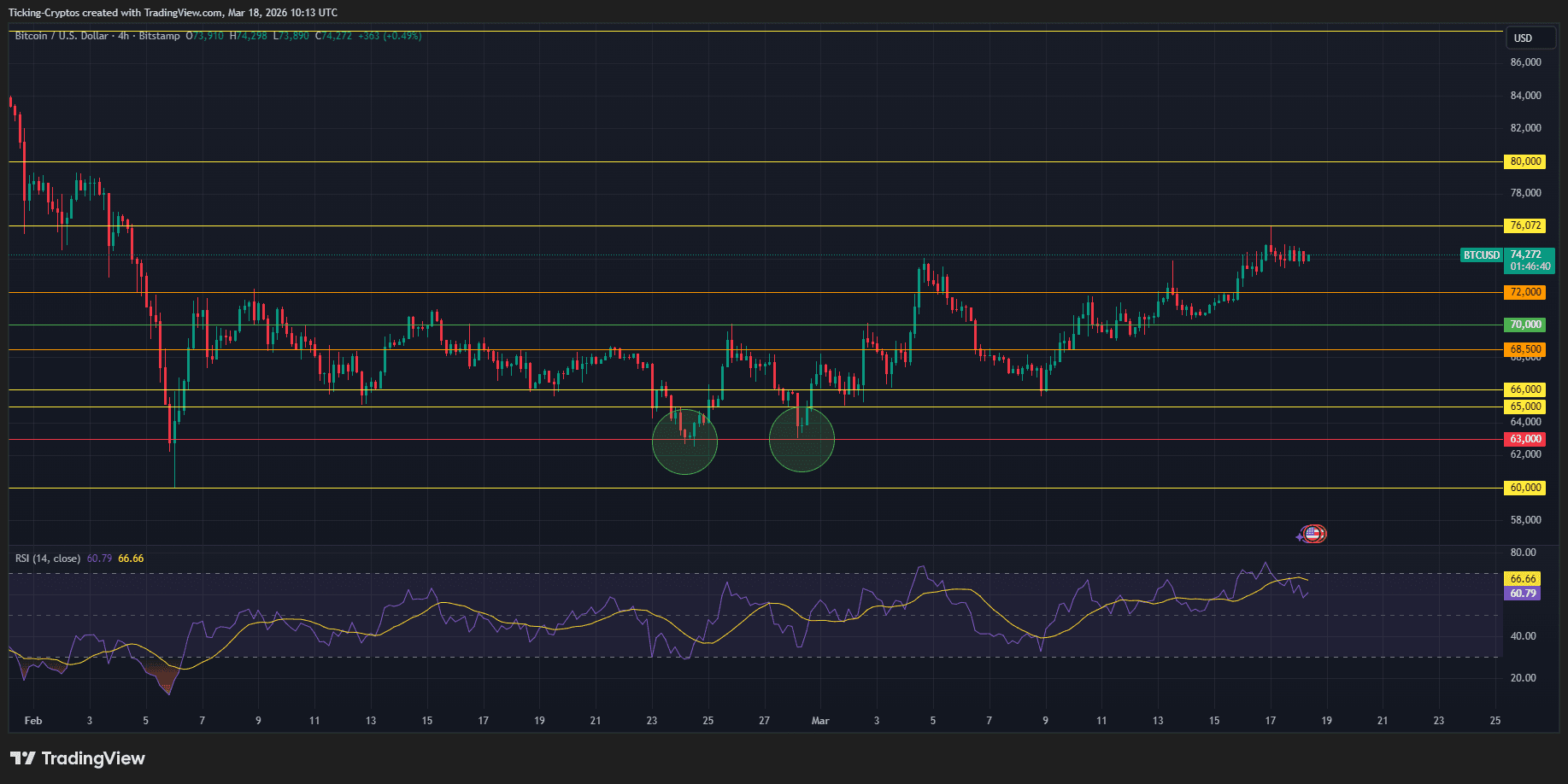
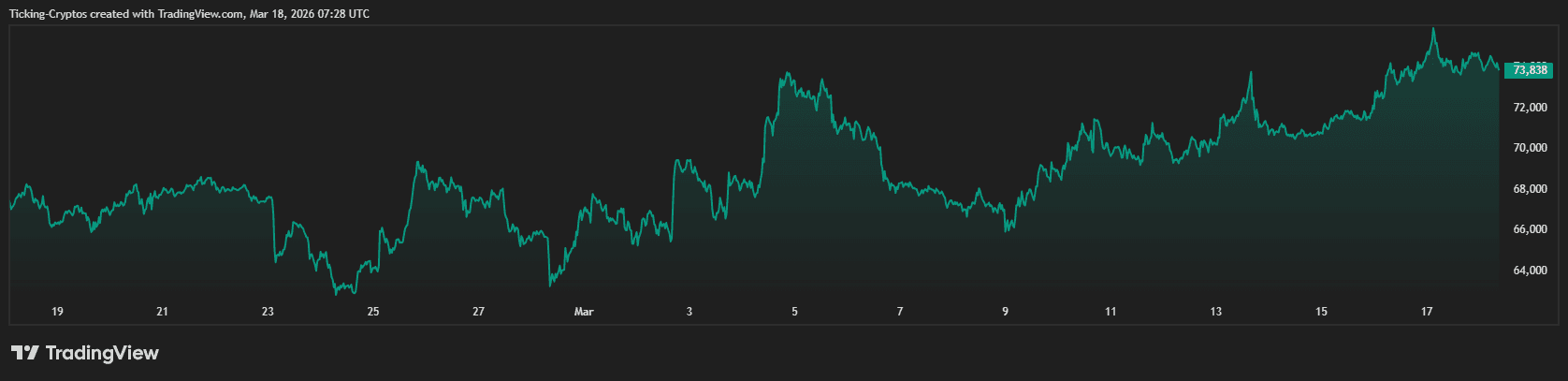
The Bitcoin price is currently navigating a high-stakes consolidation phase, trading at approximately $74,272 during the March 18, 2026, session. After a period of bearish dominance that saw the asset retreat from its 2025 record highs, the market is now testing the resilience of the $74,000 resistance zone.
Bitcoin Price Analysis: Why is BTC Price UP?
Analyzing the BTC/USD 4-hour chart, we observe several key technical patterns that define the current trend.
Double Bottom Recovery
The chart highlights two significant "troughs" (marked with green circles) near the $63,000 level. This Double Bottom formation served as a powerful reversal signal in late February and early March, allowing Bitcoin to climb back above the psychological $70,000 mark.
Key Resistance and Support Levels
The price action is currently sandwiched between tightly defined horizontal levels:
- Immediate Resistance: $74,500 – $76,000. A decisive break above this yellow-lined zone is required to target the next major hurdle at $80,000.
- Critical Support: $72,000. If the price fails to hold the $74,000 level, the green support line at $72,000 will be the first line of defense.
- Deep Support: $68,500 and $65,000. These remain the "must-hold" zones to prevent a return to the bear market lows seen earlier this year.
RSI and Momentum
The Relative Strength Index (RSI) is currently hovering around 60.79. While this indicates bullish momentum, the RSI has flattened significantly as the price approaches resistance. This suggests a "cooling off" period or a potential bearish divergence if the price makes a higher high while the RSI fails to follow suit.
Bitcoin News and Macro Catalysts
The broader crypto market is currently characterized by a "Fear" rating on the Sentiment Index (sitting at 26), despite Bitcoin's recent price recovery.
- The FOMC Factor: Traders are bracing for Federal Reserve Chair Jerome Powell’s comments. While interest rates are expected to remain steady, any hawkish rhetoric regarding inflation—driven by $100+ oil prices—could trigger a "sell the news" event for $BTC.
- Institutional Inflows: According to data from Bloomberg, spot Bitcoin ETFs saw a resurgence in March, with nearly $2.8 billion in net inflows, providing a structural floor for the recent rally.
- The Gold vs. Bitcoin Debate: As gold continues to trade near record levels above $5,000, Bitcoin's role as "Digital Gold" is being tested. Many analysts, including those at Fidelity Digital Assets, suggest that capital may rotate back into BTC if gold's parabolic move stalls.
Conclusion: What to Expect Next?
Bitcoin is showing "Experience" and "Expertise" in its ability to hold the $74,000 handle despite a heavy macro environment. However, the information density on the 4-hour chart suggests that the current range is exhausting.
If Bitcoin can flip $76,000 into support, a run toward $80,000 is the most likely scenario. Conversely, a rejection here, coupled with a hawkish Fed, could see a swift retest of the $68,500 support.
- Technical Note: Watch the 4-hour candle close. A close below $73,800 would signal a short-term breakdown, while a close above $75,100 validates the bullish breakout attempt.
The crypto market in early 2026 has been nothing short of a rollercoaster. After the euphoric highs of late 2025, where Bitcoin flirted with the $130,000 mark, a "diffuse cocktail of macro anxieties" has sent prices into a steep correction. As of late mid-March 2026, $Bitcoin has retraced nearly 50% from its All-Time High (ATH), trading in above $73,000.
Is it a Good Time to Buy Crypto?
Historical cycles suggest that corrections of 50% to 70% are healthy "purges" that wipe out over-leveraged traders. With Bitcoin currently sitting at a 50% discount, the risk-to-reward ratio for March 2026 has shifted heavily in favor of the bulls.
As geopolitical tensions and tariff uncertainties stabilize, capital is expected to rotate back into "risk-on" assets. Investors who missed the 2025 rally now have a second chance to enter the market. If you are looking to build a portfolio, diversifying across these five projects offers a balance of stability, utility, and explosive recovery potential.
1. Ethereum (ETH) – The Infrastructure King
Despite the rise of "Ethereum killers," Ethereum remains the undisputed home of Decentralized Finance (DeFi) and Real-World Asset (RWA) tokenization. In 2026, the successful rollout of the "Prague" upgrade has further slashed Layer-2 costs, making the network more scalable than ever.
- Why Buy Now? ETH has followed Bitcoin’s slide, dropping from its 2025 high of $4,950 to under $2,000.
- The Catalyst: Major financial institutions like BlackRock and JPMorgan are increasingly using Ethereum for tokenized deposit pilots. At current prices, you are buying the "settlement layer of the internet" at a 60% discount.
2. Solana (SOL) – The Speed Demon
Solana has proven its resilience after the network reliability concerns of previous years. With the Firedancer upgrade now fully integrated in 2026, Solana can process over 1 million transactions per second.
- Status: While it reached $260 in the last bull run, SOL is currently trading significantly lower, creating a "gap" that savvy traders are eager to fill.
- Use Case: It has become the primary chain for consumer AI-crypto applications and high-frequency trading.
3. Chainlink (LINK) – The Oracle Essential
You cannot have a functional DeFi ecosystem without accurate data, and Chainlink owns 90% of that market. In 2026, its Cross-Chain Interoperability Protocol (CCIP) has become the standard for banks moving data between private and public blockchains.
- The Play: LINK often lags behind the initial BTC pump but rallies hard once the ecosystem matures. It is one of the most undervalued "blue-chip" utility tokens heading into March.
4. Sui (SUI) – The Emerging Contender
Sui has emerged as the breakout Layer-1 of the 2025-2026 cycle. Utilizing the Move programming language, it offers a level of security and parallel processing that older chains struggle to match.
- Growth Potential: Sui's Total Value Locked (TVL) has remained stable even during the February crash, suggesting a loyal and committed developer base. As the market recovers, SUI is positioned to be a top performer.
5. Fetch.ai (FET/ASI) – The AI Narrative
2026 is the year of "AI Agents." Fetch.ai, as part of the Artificial Superintelligence Alliance, is at the forefront of this movement. Their autonomous agents are now being used in logistics and decentralized energy grids.
- Why March 2026? The "AI plus Crypto" narrative is the strongest secular trend in the market. With FET down along with the broader market, it offers a high-beta play for those betting on the continued AI revolution.
Conclusion: Strategy for March 2026
Investing during a 50% Bitcoin drawdown requires a long-term mindset. While volatility may persist in the short term, the fundamental value of these projects remains unchanged. Consider using a regulated exchange to dollar-cost average into these positions throughout the month.
Vietnam is shifting from one of the world's most active unregulated crypto markets to a strictly controlled domestic ecosystem. According to reports from Reuters, the government in Hanoi is preparing to launch a pilot scheme for locally licensed digital asset exchanges while simultaneously drafting rules to ban citizens from using overseas platforms.
The Race for the First Vietnam Crypto License
Five major domestic entities have passed an initial qualification round to operate the country’s first legal exchanges. This move marks a significant transition for a nation that ranked fourth globally on the Chainalysis Global Crypto Adoption Index.
The qualified applicants include:
- Techcombank (TCB)
- VPBank (VPB)
- LPBank (LPB)
- VIX Securities
- Sun Group
Why Hanoi is Curbing Foreign Trading
The Vietnamese government’s primary concern is uncontrolled capital outflows. While the country has high crypto interest, most transactions currently occur on offshore servers, making it difficult for authorities to monitor wealth movement or collect taxes.
By forcing users onto local platforms, Hanoi aims to:
- Regulate Capital: Ensure trades are settled via local banking rails.
- Tax Revenue: Implement a structured tax framework for digital assets.
- Consumer Protection: Bring high-risk trading under the oversight of the Ministry of Finance.
Market Impact and Local Adoption
Currently, Vietnamese traders move over $200 billion annually in crypto. The new regulations will likely push this liquidity into the hands of major local financial institutions. However, digital assets are still not recognized as legal tender or a formal means of payment in the country.
Summary of New Vietnam Crypto Regulations
| Feature | New Policy |
|---|---|
| Foreign Exchanges | Planned ban for Vietnamese nationals |
| Local Exchanges | Pilot program for licensed domestic firms |
| Key Players | Major private banks (VPBank, Techcombank) |
| Objective | Combat capital flight and increase oversight |
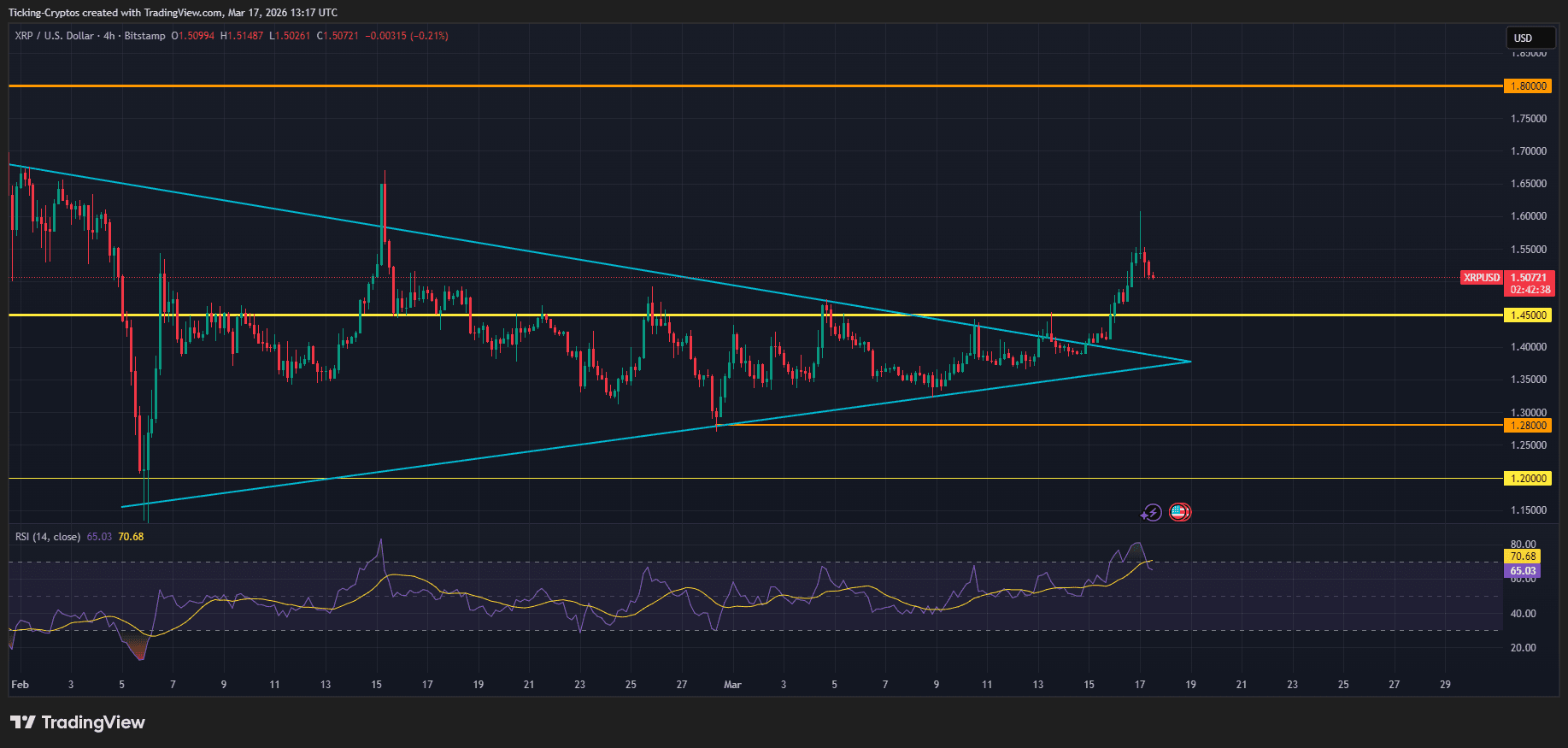
Ripple’s native token, $XRP, reclaimed the $1.50 price level. This move comes after weeks of tightening volatility, where the asset was compressed within a massive technical structure. As the broader crypto market shows signs of a renewed bullish cycle, XRP's recent price action suggests that the long-awaited move toward psychological resistance levels may be underway.
XRP Price Prediction: The Road to $2.00
The current technical setup confirms that XRP is targeting the $2.00 milestone. This projection is based on a "measured move" following the breach of a multi-week consolidation pattern. If XRP-USD can maintain its position above the $1.45 support zone, the next liquidity pocket sits between $1.85 and $2.10.
The Symmetrical Triangle
A symmetrical triangle is a chart pattern characterized by two converging trendlines connecting a series of sequential peaks and troughs. In XRP’s case, this pattern represented a period of "equilibrium" where buyers and sellers were in a deadlock. Typically, a breakout from this formation indicates that the prevailing trend—in this case, the bullish momentum from late 2025—is ready to resume with high volume.
The Breakout: How XRP Breached the Triangle
The most critical development in the recent XRP-USD price action is the upward breach from the triangle formation. Since February 2026, XRP has been making lower highs and higher lows, narrowing into an apex near the $1.38 mark.
On March 14, trading volume surged by over 300%, providing the necessary fuel for XRP to pierce the upper descending trendline. This "breach" was not merely a wick but was followed by a daily candle close above the resistance, effectively flipping it into a support floor. Technical analysts often view this specific type of exit from a triangle as a signal that the "accumulation phase" is over and the "markup phase" has begun.
Technical Indicators Supporting the $2 Target
Beyond the triangle breakout, several other indicators point toward a continued rally:
- Moving Averages: XRP is now trading comfortably above its 50-day and 200-day Exponential Moving Averages (EMAs).
- Relative Strength Index (RSI): The RSI is currently at 64, suggesting that while the asset is gaining strength, it is not yet "overbought" (which typically occurs above 70).
- Institutional Inflows: According to data from CoinShares, XRP-specific investment products have seen over $1.3 billion in cumulative inflows this year, providing the structural liquidity needed to sustain a move to $2.00.
Key Support and Resistance
| Level | Type | Significance |
|---|---|---|
| $1.38 - $1.42 | New Support | The previous triangle resistance now acts as a floor. |
| $1.56 | Current Pivot | XRP is consolidating here to build momentum for the next leg. |
| $1.80 | Minor Resistance | A historical supply zone from early 2026. |
| $2.00 | Major Target | The primary psychological and technical goal for the current rally. |
Ethereum (ETH) has bounced back strongly, rising more than 20% over the past eight days. While much of the market focused on Bitcoin’s volatility, Ethereum moved higher in the background. The rally is being driven by growing institutional interest and clearer regulatory support, two factors that are starting to change how major financial players approach the Ethereum network.
Why is Ethereum Price UP?
The recent Ethereum price pump is driven by a convergence of institutional liquidity and regulatory clarity. Specifically, the Federal Reserve's decision to allow tokenized securities as bank collateral and BlackRock’s launch of its iShares Staked Ethereum Trust (ETHB) have provided the necessary fundamental support for ETH to decouple from minor market corrections.
Tokenization and Staked ETFs
To understand why these developments are "game-changers," we must define the two pillars supporting this rally:
- Tokenized Securities: These are traditional assets (like stocks or bonds) represented as digital tokens on a blockchain.
- Staked ETFs: Unlike a standard spot ETF, a staked ETF (like ETHB) actually participates in the network's consensus, earning a "yield" or dividend for its shareholders by securing the network.
1. The Fed’s Green Light: Tokenized Assets as Collateral
On March 6, 2026, the Federal Reserve, alongside the OCC and FDIC, issued a landmark clarification. U.S. banks are now officially permitted to use tokenized securities as collateral for loans.
Why This Matters for Ethereum
Regulators confirmed that as long as the tokenized version confers the same legal rights as the traditional asset, it will receive the same capital treatment. Crucially, the Fed stated this applies regardless of whether the blockchain is permissioned or permissionless (public).
- Liquidity Influx: Trillions of dollars in "off-chain" value (Treasuries, equities) can now migrate to Ethereum.
- Ethereum as the "Settlement Layer": Since Ethereum remains the dominant hub for Real-World Assets (RWAs), this ruling cements $ETH role as the global plumbing for modern finance.
2. BlackRock’s ETHB: The First Dividend-Paying Crypto ETF
On March 12, 2026, BlackRock launched the iShares Staked Ethereum Trust (ticker: ETHB). While the market already had spot ETH ETFs, ETHB is the first from a major issuer to offer staking rewards directly to shareholders.
Key Features of ETHB:
- Yield Generation: The fund stakes between 70% and 95% of its holdings.
- Monthly Distributions: Investors receive monthly cash payouts, similar to a high-yield dividend stock.
- Institutional Infrastructure: BlackRock partnered with Figment and Coinbase Prime to manage the validator sets, bringing "Enterprise-Grade" security to the staking process.
"The ETHB launch transforms Ethereum from a speculative commodity into a productive, yield-bearing asset for the average 401k investor." — Market Insight
Comparison: Spot ETH vs. Staked ETH ETFs
| Feature | Spot ETH ETF (e.g., ETHA) | Staked ETH ETF (ETHB) |
|---|---|---|
| Primary Goal | Price Tracking | Price + Yield |
| Income Source | None | Staking Rewards (~2-3% Net) |
| Risk Profile | Market Volatility | Volatility + Slashing Risk |
| Target Audience | Traders | Long-term Income Seekers |
Fundamental Divergence
For months, analysts have noted a divergence: Ethereum's network fundamentals (Total Value Locked, Active Addresses, and Layer 2 scaling) were hitting record highs while the Ethereum price lagged. This 20% pump suggests the "valuation gap" is finally closing.
Decrypt
Inflation has exceeded the central bank’s 2% target for nearly five years, but the Fed held rates firm again as Bitcoin and Ethereum wobbled.
A hotter-than-expected inflation reading pushed crypto prices lower Wednesday—slashing the chances of a broad spring breakout.
The S&P 500 index was licensed to Trade[XYZ], a provider of markets for real-world assets on Hyperliquid for perpetual futures.
Sen. Bernie Moreno said if the Clarity Act isn’t passed by May, “digital asset legislation will not pass for the foreseeable future.”
Malwarebytes has warned that a phishing campaign is mimicking the Pudgy World game to steal user credentials
U.Today - IT, AI and Fintech Daily News for You Today
The Fed just held rates steady at 3.5%-3.75% in an 11-1 vote.
BNB Chain's RWA sector surges 33% in 30 days, hitting a massive $3.15 billion milestone. Discover how BlackRock's BUIDL and Circle's USYC are driving this record growth.
XRP whale wallets increase holdings by 200 million coins while the market watches $1.50 price level.
The EF just deployed another 3,400 ETH directly into Morpho Vaults.
SEC flags new caution for investors as crypto enthusiasm soars.
Blockonomi
Solana Price Today
Solana (SOL) is currently trading around the $90 level, holding steady despite short-term volatility across the broader crypto market.
Recent price action shows:
- Minor short-term pullback
- Strong weekly recovery
- Continued market interest
This consolidation phase comes at a critical moment following a major regulatory development.
SEC Classifies Solana as a Commodity
In a significant shift, the SEC has formally classified Solana (SOL) as a digital commodity, confirming that it is not a security.
This places SOL alongside assets like Bitcoin and Ethereum in terms of regulatory positioning.
Why this matters:
- Removes a major layer of uncertainty
- Strengthens investor confidence
- Opens the door for broader institutional exposure
This type of clarity is often a long-term bullish signal.

Solana Price Prediction: Key Levels to Watch
With SOL trading around $90, the next move will depend on how price reacts at key levels.
Bullish Scenario
If momentum builds, SOL could:
- Break above the $95–$100 resistance zone
- Target higher levels in the short to mid-term
- Benefit from increased inflows after regulatory clarity
Bearish Scenario
If market pressure continues:
- SOL may retest lower support levels around $80–$85
- Short-term consolidation could continue
- Broader market sentiment will play a key role
What’s Driving Solana Right Now
Several factors are influencing Solana’s current positioning:
- Regulatory clarity from the SEC decision
- Strong ecosystem activity and developer growth
- Continued relevance in DeFi and on-chain usage
These fundamentals support the case for continued interest in SOL moving forward.

Where Attention Is Moving Next
As major assets like Solana gain clarity, market attention often expands beyond large-cap coins.
Projects that begin attracting early momentum and visible demand tend to benefit the most when sentiment improves.
One example is APEPEPE, which has started gaining traction with early activity and growing visibility as investors look for new opportunities alongside established assets.
Conclusion: What’s Next for Solana?
Solana’s classification as a digital commodity is a meaningful development that reduces uncertainty and strengthens its long-term outlook.
With SOL holding around $90, the market is now watching for either a breakout above resistance or continued consolidation before the next move.
As sentiment shifts, both established assets like Solana and emerging projects gaining early traction are likely to remain in focus.
Website: https://apepepe.com
Twitter (X): https://x.com/realAPEPEPE
FAQ: Solana Price Prediction
What is the Solana price today?
Solana is currently trading around the $90 level, based on recent market data.
Is Solana a security?
No, the SEC has classified Solana as a digital commodity, not a security.
What is the Solana price prediction?
SOL could move toward the $95–$100 range if bullish momentum builds, while support remains around $80–$85.
Is Solana a good investment right now?
Solana’s regulatory clarity and ecosystem growth continue to support long-term interest, though price movements depend on overall market conditions.
The post Solana Price Prediction: SOL at $90 After SEC Decision — What’s Next? appeared first on Blockonomi.
Sixty percent of XRP’s circulating supply is currently held at a cost basis above market price. That is 36.8 billion tokens sitting on a combined $50.8 billion in unrealized losses.
XRP trades at $1.51, down from its $3.65 all-time high reached in July 2025. Whales are buying into the pain: large wallets added 1.3 billion XRP in just 48 hours this month, and $738 million worth of tokens moved to cold storage in a single day. The smart money is accumulating while 60% of holders bleed. That dynamic tells you who controls the next move and who is along for the ride.
Passive holders hoping the whales will push the price past their cost basis are dependent on a group whose interests may not align with theirs. Taurox (TAUX) is a decentralized hedge fund where AI agents will trade pooled capital across DEXs and CEXs once the presale ends. Stakers keep 80% of net profits from strategies that generate returns regardless of any single token’s cost basis distribution.

What the High-Water Mark Means for Protecting Staker Gains
The high-water mark prevents agents from earning fees on recovery. If an agent generates $10,000 in profit, then loses $3,000, the creator earns nothing on the next $3,000 of gains. Performance fees only apply to net new highs above the previous peak. Recovery is free for stakers. This eliminates the classic fund problem where managers collect fresh fees while clawing back to breakeven.
Agents that consistently fail to reach new highs lose capital allocation through Sharpe-weighted rebalancing. Capital flows away gradually as performance declines. No forced liquidation. Stakers keep 80% of net gains at the standard tier. The protocol takes 5% on profits only, with 30% burned permanently and 70% flowing to the DAO treasury. Sixty percent of XRP holders are underwater with no mechanism preventing further decline.
Taurox stakers benefit from a high-water mark that ensures they never pay for an agent’s mistakes twice. One position has a $50.8 billion loss overhang with no structural protection against further decline. The other has protocol-level safeguards that ensure stakers never subsidize an agent’s recovery from losses. That difference is architectural, not speculative.
Phase 2 Fills While 60% of XRP Holders Wait to Break Even
Phase 1 of the TAUX presale sold out in under 24 hours at $0.01. Phase 1 buyers are already up 20% at Phase 2’s price of $0.012, without staking or seeing an agent trade pool capital. The presale has raised $314.7K, and Phase 2 is 23.9% filled. Nineteen phases run from $0.01 to $0.07, each closing permanently once its allocation sells out. The price steps up and the previous entry vanishes forever. Staking activates at the end of the presale, and agents begin trading once the pool goes live.
XRP holders sitting on $50.8 billion in unrealized losses need the price to more than double just to break even. The TAUX presale is pricing in forward value before the pool even activates. The buyers entering Phase 2 right now are not waiting to recover from losses.
They are positioning before agents begin trading. Every token sold at $0.012 brings Phase 2 closer to closing permanently. The window is narrowing in real time, and the cost of hesitation is a permanently higher price tier. Waiting costs real money when phases close and the entry steps up with no exceptions.

Phase 2 Entry and Upside Math
Phase 2 is live at $0.012. Listing at $0.08 is a 6.67x return before the pool produces any profit. A $1 post-listing target is x83 from the current price. At a $1 billion pool with 30% gross returns, implied price reaches $1.85, or x154 from today’s entry. The protocol charges 5% on gross profits only. No management fees at any tier. Thirty percent of collected fees are burned permanently. Supply is locked at 2 billion tokens, non-mintable.
XRP has $50.8 billion in underwater positions. The TAUX presale has $314.7K from buyers who entered at the ground floor. Every profitable trade by agents will compress supply further through the burn mechanism. Phase 2 will not survive the same demand that emptied Phase 1 in a single day.
Learn More
Buy TAUX: https://taurox.io/
Whitepaper: https://docs.taurox.io/
Official Telegram: https://t.me/tauroxlabs
The post Smartest Ripple (XRP) Alternative? Smart Money Move To Taurux (TAUX) as Presale Surpasses $300K Raised appeared first on Blockonomi.
Two Democratic lawmakers introduced the BETS OFF Act this week, aiming to put an end to insider government information being used in prediction markets related to the US-Iran conflict.
With government officials once again pushing back against prediction markets, the retail sector is primarily focused on the market-wide recovery. The Solana price prediction is gaining a lot of attention as SOL prepares to challenge the $95 resistance, but those looking to achieve higher returns are already rotating into the DeepSnitch AI presale.
Securing $2.2M ahead of its March 31 launch, the DeepSnitch AI community is confident in the project’s 100x-300x potential.

BETS OFF Act to crack down on insider trading
On March 17, Greg Casar and Connecticut Senator Chris Murphy introduced the Banning Event Trading on Sensitive Operations and Federal Functions Act that targets prediction market accounts that place bets that could indicate insider information.
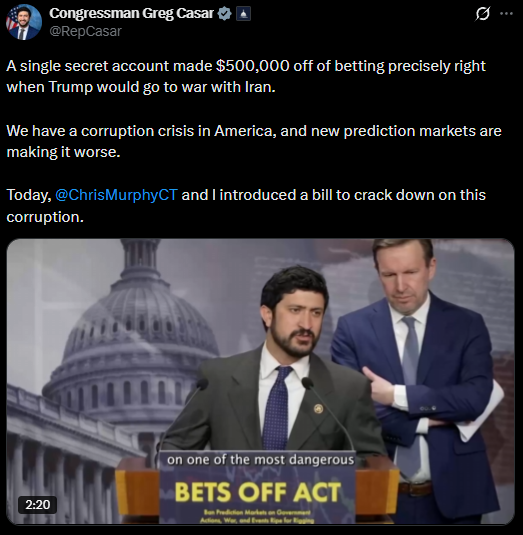
Casar was blunt, saying that decisions about war and peace, life and death, should not be driven by financial positions riding on the outcome.
California Senator Adam Schiff’s DEATH BETS Act, introduced last week (targets event contracts related to war, terrorism, assassination, and individual deaths), which deepened the controversy after a military correspondent received death threats tied to resolving a Polymarket prediction.
Both Polymarket and Kalshi are logging high volumes as they navigate growing regulatory pressure.
Many traders are steering clear of prediction markets, though, and still prefer tracking the Solana price prediction and exploring presale projects like DeepSnitch AI.
Coins you should keep an eye on in March
1. DeepSnitch AI: The highest upside opportunity in 2026?
Although the Solana price prediction is finally showing signs of life, DeepSnitch AI is making rounds due to its unique offering that brings potential gains and solves existing problems for traders.
For starters, the project raised $2.2M at $0.04487, and the trending launch is confirmed for March 31. However, utility is still the star of the show.
Powered by five AI agents, the analytics platform includes multiple life-saving and advantage-centric features, such as a risk scanner and a real-time sentiment and FUD tracker.
These two alone are worth your time as the risk scanner will help you avoid rug pulls and honeypots, while tracking sentiment assists you in finding the perfect time to exit a position.
Two weeks away from launch, and 41.7 million DSNT tokens have been staked, and with the conviction reaching its pinnacle, traders are convinced the toolset behind the project will lead to mass adoption and ensure the project’s long-term growth.
FOMO for DeepSnitch AI is quickly building as the entry room shrinks and traders continue throwing out 100x-300x predictions, much more than any realistic short-term SOL price target can get you.
2. Solana price prediction: Will SOL close above $95?
According to CoinMarketCap, SOL hovered right below the $95 breakdown level on March 18.
This line will determine the short-term Solana market outlook. Closing above will allow recovery to $117.
Yet, since the bear market has deepened, the Solana forecast 2026 is unlikely to be clear-cut, and SOL will pull back from the test of $117.
If it holds $95 after the breakdown, the bullish case will remain in play, putting the SOL price target at $147.
Those watching the Solana price prediction are also fearing an extended correction, which could happen if SOL plummets below $87.
3. Ethereum price prediction: ETH at $2.4K next?
Ethereum started climbing up from $2.3K on March 18, according to CoinMarketCap.
Similar to the Solana price prediction, ETH is quite close to breaking out, and the consolidation is slowly turning into a bullish crossover.
The path to $2.6K is open, and on the technical level, the $3.45K as the extended target.
Bears could still muck up the chart if the price closes below the 20-day EMA around $2K, as it will likely lead to a decline to $1.9K.
Final words: Maintain the momentum
Despite prediction market warfare deepening on a regulatory level, the last few days were surprisingly bullish for traders. The Solana price showing potential is one of the clearest signs, for instance.
However, volatility could still come back to erase the gains, which is why the best way to maintain the bullish momentum is to capitalize on DeepSnitch AI’s March 31 launch.
You can even take it a step beyond and go for bullish wins by participating in the exclusive bonus program (applicable until TGE) and apply DSNTVIP300 at your $30K+ allocations to unlock 300% extra tokens.
Make this count – join the DeepSnitch AI presale and become a part of the community discourse on X or Telegram.
FAQs
1. What is the Solana price prediction, and what levels matter most right now?
SOL is pressing the critical $95 resistance level. A clean break above it targets $117 first, then $147 if $95 holds on any pullback.
2. What is the BETS OFF Act, and what does it mean for prediction markets?
The BETS OFF Act is legislation introduced by Representative Greg Casar and Senator Chris Murphy targeting prediction market accounts that allegedly used insider government information to bet on the US-Iran conflict.
3. Why is DeepSnitch AI grabbing attention right now?
DeepSnitch AI has announced a March 31 launch, and since the project offers a unique approach to AI-sourced trading analytics and provides daily usability, traders are anticipating the project to pump by 100x-300x.
The post Solana Price Prediction: DeepSnitch AI Frenzy Takes Over Traders As March 31 Launch Approaches, SOL Challenges $95 and ETH Bulls Eye $2.6K appeared first on Blockonomi.
Key Highlights
- SBI VC Trade provides 10% annual yield on USDC lending over 12-week periods for everyday investors.
- Lending stablecoins delivers superior returns compared to conventional USD savings accounts in Japan.
- Modest USDC investments could qualify for tax exemptions on earnings below ¥200,000.
- Locked lending periods guarantee attractive yields while restricting withdrawal flexibility.
- SBI broadens Japan’s USDC infrastructure through compliant blockchain financial products.
An SBI Holdings subsidiary is set to introduce a USDC lending platform in Japan starting March 19, 2026. This service enables participants to lend their USDC holdings to the platform in exchange for predetermined returns. The introductory campaign features a 12-week duration with an attractive 10% yearly interest rate, substantially exceeding standard US dollar savings rates.
Following the initial promotion, the platform plans to maintain USDC lending opportunities at approximately 5% annually during standard market periods. Retail participants can access the service and lend up to 5,000 USDC per offering cycle. This initiative marks Japan’s inaugural licensed stablecoin lending platform accessible to everyday consumers.
This development establishes SBI VC Trade as a frontrunner in compliant stablecoin financial services. The firm has already facilitated USDC transactions since March 2025, establishing both market presence and technical proficiency. This USDC lending offering combines distributed ledger technology with SBI Group’s established financial knowledge.
Competitive Yields and Favorable Tax Treatment
USDC lending delivers substantially higher annual yields when compared with conventional US dollar term deposits. Standard three-month foreign currency accounts typically provide 0.01% to 4% annually, with occasional promotional rates reaching 5%. In comparison, USDC lending delivers more reliable and attractive returns for Japanese participants.
The lending program presents advantageous tax treatment for smaller investment amounts. USDC earnings qualify as miscellaneous income according to Japanese taxation regulations and may remain exempt from taxation below 200,000 yen. Participants can begin with modest investments while avoiding the standard 20.315% withholding tax imposed on foreign currency deposits.
SBI highlights user-friendliness and straightforward operations. Participants accumulate usage fees automatically throughout the lending duration without requiring additional actions. The platform enables newcomers to US dollar investing to engage conveniently and effectively.
Program Specifications and Framework
The USDC lending program operates on a 12-week fixed term for individual offerings. Participants receive rental compensation determined by the annual percentage multiplied by the actual loan duration in days. Submissions receive sequential approval, with individual accounts restricted to one active offering.
USDC obtained via the program may be re-lent by SBI VC Trade, creating counterparty exposure for participants. Assets remain unsegregated, meaning the company’s financial health directly impacts repayment capability. Participants cannot exit agreements prematurely, which restricts access to funds but guarantees fixed-term yields.
The service will not provide compensation for new tokens generated from blockchain hard forks occurring during the loan duration. Participants receive identical quantities and types of USDC upon term completion. This framework differs from conventional banking deposits, prioritizing lender stability over market protections.
SBI Strengthens USDC Infrastructure
SBI actively develops its USDC initiatives through strategic alliances and regulatory clearances. The organization has partnered with Circle Internet Financial and Startale to accelerate stablecoin acceptance. SBI’s programs seek to deliver alternative US dollar-based investment vehicles throughout Japan.
The USDC lending offering enhances SBI’s current digital asset portfolio. It delivers a regulated, high-return avenue for stablecoin market participation. The introduction bolsters Japan’s digital asset infrastructure and encourages broader USDC utilization.
This innovative offering sets a benchmark for authorized stablecoin lending services. It merges blockchain innovation with conventional financial competence to deliver secure, high-performance opportunities. Participants can lend USDC with confidence while securing competitive returns through a well-defined structure.
The post SBI VC Trade Introduces Japan’s First Regulated USDC Lending Platform with 10% Annual Yield appeared first on Blockonomi.
TLDR
- Hyperliquid debuts the first officially licensed S&P 500 perpetual derivative product.
- International traders receive continuous, round-the-clock S&P 500 market exposure.
- Decentralized platform enables leveraged, high-frequency trading with low latency.
- Traditional equity benchmark now accessible through blockchain-based derivative.
- On-chain integration expands S&P 500 liquidity and worldwide market participation.
Trade[XYZ] has secured licensing from S&P Dow Jones Indices to launch a perpetual derivative based on the S&P 500 on Hyperliquid. This represents the inaugural officially licensed perpetual contract tied to the S&P 500 index. Qualified international participants outside the United States can now access continuous trading beyond conventional market hours.
This perpetual contract enables market participants to establish leveraged positions—both long and short—without expiration dates. Trading continues non-stop using institutional-grade index information, delivering dependable market exposure through a decentralized infrastructure. Hyperliquid’s high-performance architecture supports rapid execution and around-the-clock availability.
The introduction expands the S&P 500’s presence within on-chain liquidity networks, connecting it to digital asset markets. This perpetual product integrates a world-renowned financial benchmark into the decentralized finance landscape. Traditional S&P 500-linked instruments generate over $1 trillion in daily trading activity globally.
Expanded Access for Non-US Participants
International traders gain unrestricted S&P 500 exposure through this perpetual derivative, free from conventional exchange hour limitations. Users can execute transactions at any time using verified index information. This structure broadens market participation and extends the index’s international footprint.
XYZ trading venues have facilitated more than $100 billion in transaction volume since October 2025, tracking toward an annual pace surpassing $600 billion. The infrastructure proves capable of handling substantial volume and rapid trading activity. The perpetual derivative fits naturally within Hyperliquid’s real-world asset framework.
Qualified users can efficiently leverage their market positions while tracking price action in real time. The decentralized structure ensures transparent order matching and rapid trade execution. This development reinforces the integration of prominent equity indices within blockchain-based markets.
Integration of Traditional Benchmarks into Decentralized Trading
Perpetual contracts create a bridge between established financial indices and blockchain trading infrastructure. They deliver ongoing market exposure comparable to tokenized stocks but supported by official benchmark data. This framework enhances participant confidence and strengthens digital finance capabilities.
The S&P 500 perpetual offering builds upon earlier programs like the S&P Digital Markets 50 initiative. It marks a progression from tokenized assets toward fully licensed, institutional-quality on-chain derivatives. Hyperliquid’s native blockchain layer enables secure, dependable operations operating continuously.
Crypto exchanges and traditional platforms worldwide are increasingly launching perpetual derivatives covering commodities, stocks, and indices. Major platforms including Binance, Kraken, and Coinbase have recently broadened perpetual offerings beyond digital currencies. These trends highlight rising appetite for continuous, leveraged exposure to established financial benchmarks.
This perpetual contract provides international participants with uninterrupted S&P 500 market access. It advances S&P DJI’s blockchain integration efforts while creating fresh trading possibilities. This launch positions the S&P 500 among an expanding collection of traditional assets operating within decentralized market frameworks.
The post S&P 500 Launches First Licensed Perpetual on Hyperliquid Blockchain appeared first on Blockonomi.
CryptoPotato
The leading cryptocurrency experienced a significant upswing over the past several days, with its price briefly rising to as high as $76,000.
Although it was stopped there and pushed south by $5,000, some key factors, including recent whale activity, suggest it may post further gains in the near future.
BTC Isn’t Done Yet?
Despite losing some steam in the past hours, Bitcoin remains well in the green on a weekly scale and currently trades at around $71,400 (per CoinGecko’s data). As a result, many analysts have flipped toward the optimists’ corner and expect an additional price increase.
The renowned market observer Ali Martinez, for instance, claimed that a daily close above the $73,344 resistance and later turning that level into a structural floor could open the door to a pump to $79,234 and $85,555.
In a subsequent post on X, the same analyst revealed that whales have acquired 40,000 BTC over the past seven days. The USD equivalent of the stash is almost $2.9 billion (at current rates), and now this cohort of investors controls roughly 5.17 million units, or roughly 25% of the asset’s circulating supply.
Such accumulations are generally viewed as bullish because they reduce the amount of BTC available on the open market, which, combined with non-declining demand, should lead to a price surge. They may also energize smaller players to step in and further support the upward momentum.
Next on the list is the solid interest in spot BTC ETFs lately. Over the past seven days, inflows into such investment vehicles have surpassed outflows, which is the longest such streak since October last year. When institutional investors such as pension and hedge funds increase their exposure to the asset through regulated financial vehicles, they require the issuers to purchase BTC to back their shares. Put simply, consistent ETF demand makes the remaining supply scarcer, which tends to push the price north.
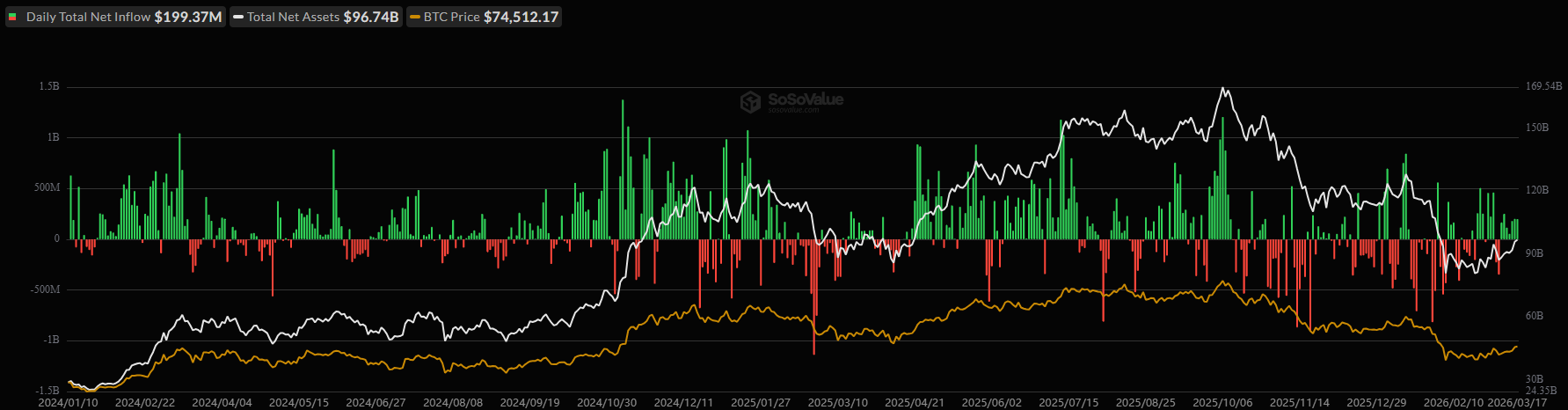
Despite the renewed appetite for such financial vehicles, many ETF investors remain underwater. Earlier this week, Axel Adler Jr. estimated that the $79,962 level represents the average cost basis of every BTC currently held inside these exchange-traded funds. If the asset trades below this mark, the cohort is sitting at unrealized losses, while breaking above would lead to paper profits.
Last but not least, we will touch upon the shrinking supply of BTC held on crypto exchanges. Today (March 18), the figure dropped to a new six-year low of approximately 2.72 million units. This suggests that investors continue to abandon centralized platforms in favor of self-custody methods, thereby reducing the immediate selling pressure.

Major Volatility Ahead?
Another industry participant who analyzed BTC’s recent performance is the X user Cantonese Cat. They claimed that the Bollinger Bands on a monthly scale have squeezed to levels never seen before.
The technical indicator shows how far the price deviates from its average, helping traders gauge volatility. When the bands tighten, it reflects a prolonged period with little turbulence: a setup that often precedes a large breakout. It is important to note that the huge move could be in any direction, or, as Cantonese Cat said:
“This will lead to a very powerful move when it expands. All that volatility that you saw over the last few months is nothing compared to what will come.”
The post 3 Reasons Why Bitcoin (BTC) Could Climb Higher in the Short Term appeared first on CryptoPotato.
In alignment with most experts’ beliefs, the United States Federal Reserve kept the key interest rates unchanged for the second consecutive time in 2026.
BTC already experienced some volatility in the hours leading up to the second FOMC meeting of the year, dropping by $5,000 at one point. However, it has bounced toward $72,000 since the news went out.
America’s central bank maintained the federal funding rate, meaning what banks are charging each other for short-term loans, in the current range between 3.50% and 3.75%.
Experts noted before today’s announcement that the likely justification for this is the war that began in the Middle East, which has immediately impacted oil prices.
“The conflict with Iran has dramatically altered the backdrop to the March Federal Open Market Committee (FOMC) meeting and significantly increases the risks to inflation and the economy,” commented Oxford Economics’ chief US economist, Michael Pearce.
Bitcoin’s price reacted immediately to the news, even though it was expected. The asset had lost $5,000 earlier today in the hours leading up to the second FOMC meeting of the year, but bounced to $72,000 after the Fed’s decision went live.
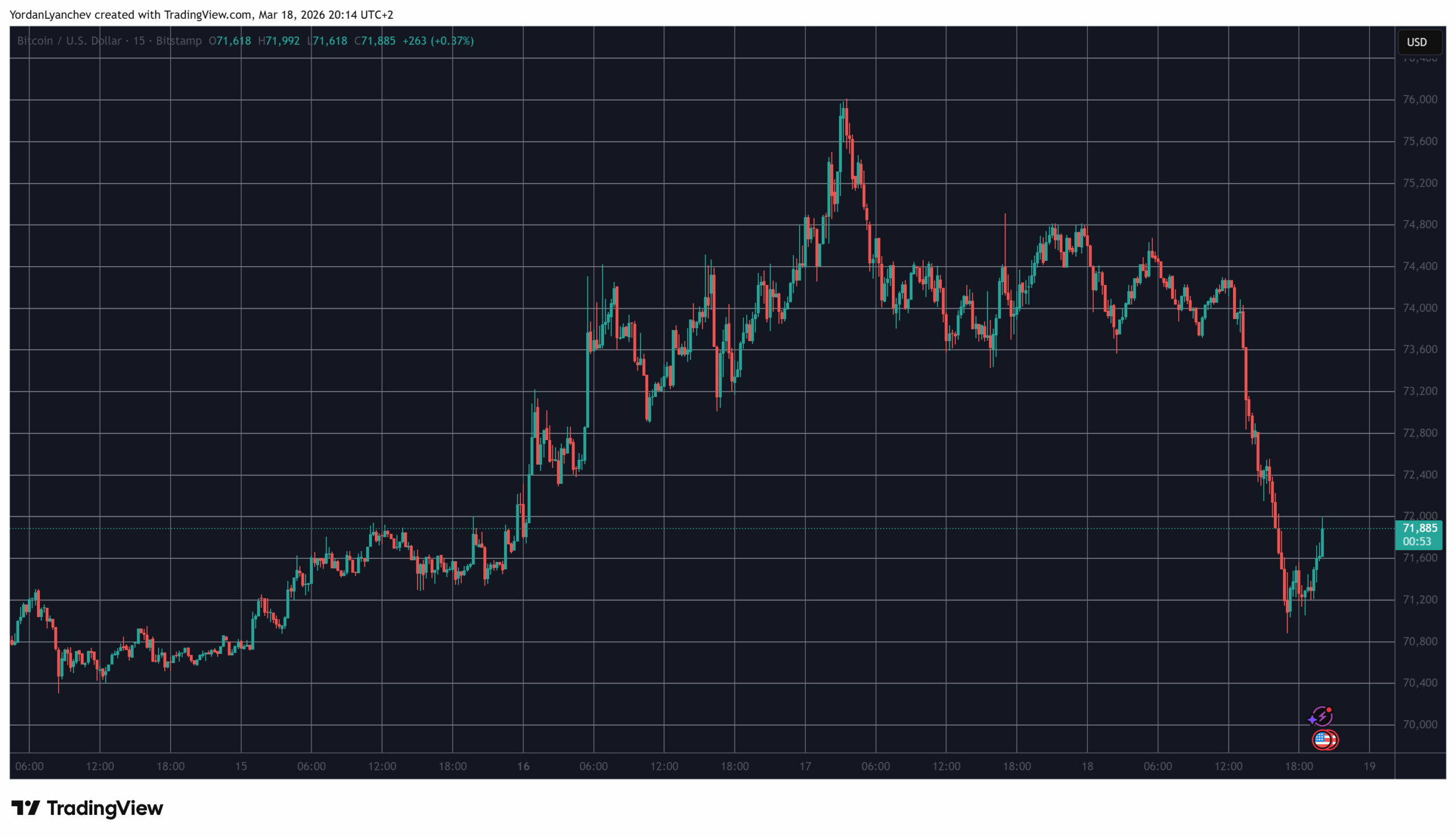
The post Bitcoin Regains Momentum as US Fed Leaves Rates Unchanged appeared first on CryptoPotato.
XRP has pulled back under $1.50 after briefly surpassing $1.60 yesterday, with a popular analyst saying the token now sits at a critical decision point and that a single piece of legislation could determine whether it breaks higher.
According to EGRAG CRYPTO, the CLARITY Act is the primary catalyst standing between XRP’s current price and a potential run past the $1.65 to $1.70 resistance band they dubbed “Zone 1.”
An Ascending Triangle With One Condition Attached
In their analysis, posted on X on March 18, EGRAG pointed out that XRP was forming an ascending triangle just below the $1.65-$1.70 range.
This is a pattern that usually leads to upward breakouts, and, according to the analyst, it shows rising lows, which would suggest that buyers were stepping in. The chart also showed that resistance has so far been flat, meaning that liquidity is concentrated above the current level.
EGRAG estimated that there is a 65% chance the XRP price will break above Zone 1, mainly due to structure and building compressions. However, the other 35% points to a rejection or fakeout, which they believe could happen if the CLARITY Act is postponed.
The Ripple token has gone up about 6.5% in the last seven days, with a range stretching from $1.37 to $1.60. That breakout happened around the same time as a buildup in derivatives positioning, as revealed by CryptoQuant contributor Amr Taha. According to him, XRP’s open interest delta rose by $16 million on March 13 and another $18 million on March 16, with the second wave coming just before the cryptocurrency’s jump above $1.50.
Whale activity followed suit, with chartist Ali Martinez reporting that large addresses had added 200 million XRP in the last two weeks, bringing their total from 10.88 billion to 11.08 billion.
But despite all this, XRP was rejected at $1.60, and was trading near $1.45 at the time of writing, a price that another market watcher, Tara, stated they were closely monitoring, referring to it as the macro 0.618 Fibonacci support level.
What Zone 1 Doesn’t Unlock
EGRAG’s analysis made it clear what the $1.65 to $1.70 zone can trigger, as well as what it cannot deliver on its own. According to them, while breaking above that range would be a meaningful technical event, getting to the next level at $2.60 and beyond requires additional conditions.
These include institutional flows or ETF-style exposures, stable BTC prices, or a drop in the number one cryptocurrency’s dominance, as well as weekly XRP closes above the $1.85-$2.00 band.
The CLARITY Act itself is moving, with negotiations possibly concluding as early as next week, according to investor Paul Barron. U.S. President Donald Trump had publicly blamed banks for holding the bill back in order to protect their deposit base.
The post XRP Needs CLARITY Act Momentum to Unlock the Next Critical Price Zone appeared first on CryptoPotato.
The second-largest cryptocurrency has performed quite well over the past seven days, increasing its valuation by double digits despite its Wednesday correction.
According to numerous analysts, the uptrend could continue in the short term, with some envisioning an astonishing increase toward a new all-time high.
The Rally Goes on?
Earlier this week, ETH soared to almost $2,400, or its highest point since the start of February. Currently, it trades at around $2,200, up 8% on a weekly basis.
The renewed upswing caught the eye of many industry participants who believe the valuation has yet to reach fresh local tops. X user Galaxy set $2,400 and $2,600 as the next potential targets, while Trader Tardigrade envisioned a pump to as high as $2,670.
Ted, who often discusses ETH’s performance, chipped in as well. He thinks the price could hit the $2,400 resistance zone, but that might be a “fakeout” and be followed by a substantial decline.
Meanwhile, several on-chain factors support the bullish scenario. The US spot ETH ETFs have been flashing green over the past six days, meaning inflows have dominated outflows. This reflects rising interest among institutional investors in gaining exposure to the asset and could positively impact future price performance.

Next on the list is the amount of ETH sitting on crypto exchanges. Earlier this week, the figure fell to a nearly 10-year low of around 15.85 million coins. This trend signals that investors continue to shift their holdings toward self-custody methods, thus lowering the immediate selling pressure.

Ethereum’s Relative Strength Index (RSI) should also be mentioned. The technical analysis tool, which measures the speed and magnitude of recent price changes, tumbled to 22. This means the asset has entered oversold territory and could be gearing up for a rally.

The Moon Scenarios
According to other analysts, ETH might be on the verge of a much more substantial increase that can take it to uncharted territory. X user ray claimed that $10,000 is “not a dream, just a milestone.”
A few days ago, the renowned investor and one who successfully predicted the 2008 financial collapse, Robert Kiyosaki, sounded the alarm that major banks and institutions are in trouble, hinting that another crash could be on the way.
Later on, he forecasted that “the biggest bubble” is about to burst, foreseeing that once the meltdown is over, BTC, ETH, gold, and silver will emerge as the major winners. As for the second-largest cryptocurrency, he envisioned its price skyrocketing to a (for now) almost unbelievable $95,000 within a year after the catastrophe.
The post Top Ethereum Price Predictions as ETH’s Price Soars 8% Weekly appeared first on CryptoPotato.
Bitcoin was trading below $72,000 on Wednesday after failing to hold within its post-shock range but showing limited ability to build momentum beyond its recent high.
According to a market update by QCP Capital, the cryptocurrency is no longer trading like a pure high-beta risk asset, but it is not yet attracting consistent safe-haven flows either.
Macro Dominance Grows
The broader market remains under pressure, although declines have been relatively contained compared to other macro-sensitive risk assets. The dip-buying activity at the lower end of the range has continued, while spot market volumes remain low. Such a trend indicates that near-term price direction is being driven primarily by macroeconomic factors rather than crypto-specific developments, QCP Capital explained.
In derivatives markets, the options backdrop remains firm but defensive, as 30-day implied volatility hovered around the 50 level. Still above both 10-day and 30-day realised volatility, maintained positive carry, and supported premium-selling strategies. The term structure is mildly in “contango,” though slightly softer on the day, while 30-day risk reversals continue to show higher demand for downside protection, as puts are priced richer than calls.
Skew levels are not at extremes, but implied volatility remains high relative to recent history. This means that volatility conditions are not significantly dislocated. The overall options surface points to a defensive positioning, as negative front-end skew and a residual geopolitical premium are embedded further along the curve.
Macro conditions remain the dominant influence, and the market is focused on a week for central bank decisions. The US Federal Reserve is set to conclude its March policy meeting on Wednesday, followed by the European Central Bank, Bank of Japan, and Bank of England on Thursday.
Expectations for monetary easing have been reduced as rising oil prices complicate the outlook for rate cuts, despite softer growth and labor market data. Oil prices are holding near the $100 level, and ongoing tensions in the Gulf are contributing to a stagflationary backdrop across global markets.
In this environment, QCP said that while Bitcoin is no longer trading purely as a high-beta risk asset, it has also not established itself as a consistent safe-haven, and its range-bound behavior is likely to persist until greater clarity emerges on monetary policy or geopolitical developments.
Downside Liquidity Expansion Risks
According to a Bitunix analyst, Bitcoin has entered a high-level consolidation phase after sweeping overhead liquidity. In a statement to CryptoPotato, they explained that the 75,000-76,000 zone represents a clear concentration of short-side liquidity, acting as a near-term resistance band subject to repeated testing.
“On the downside, the 72,800 level serves as a critical demand cluster, where long positioning overlaps with structural support. A breakdown below this region would likely trigger liquidity expansion toward 71,500-72,000, increasing the probability of cascading liquidations.”
The post Bitcoin No Longer a High-Beta Play – But Still Not a Safe Haven, QCP Warns appeared first on CryptoPotato.