Cryptocurrency Posts
Crypto Briefing
The rehiring at Block highlights the growing impact of AI and automation on workforce dynamics, prompting industry-wide strategic shifts.
The post Jack Dorsey’s Block brings back a few workers after mass layoffs appeared first on Crypto Briefing.
The rollout of encrypted AI models by Venice could set a new standard for privacy in AI, potentially influencing industry-wide practices.
The post Erik Voorhees’ Venice rolls out end-to-end encrypted AI modes, VVV token surges 10% appeared first on Crypto Briefing.
Algorand Foundation cuts 25% of staff as macro pressure weighs on operations, with ALGO down 19% year to date near $0.09.
The post Algorand Foundation cuts 25% of staff as macro pressure and crypto slump weigh on operations appeared first on Crypto Briefing.
In-depth comparison of Ledger, Trezor, SafePal & NGRAVE hardware wallets. Security chips, open-source status & community trust.
The post Best hardware wallets 2026: Ledger vs Trezor vs SafePal vs NGRAVE appeared first on Crypto Briefing.
SEC approves Nasdaq rule enabling tokenized securities trading alongside traditional shares within existing market structure.
The post SEC approves tokenized securities to trade alongside traditional stocks appeared first on Crypto Briefing.
Bitcoin Magazine
Bitcoin Magazine

SEC Approves Nasdaq Rule to Trade Tokenized Securities, Paving Way for Blockchain Integration
The U.S. Securities and Exchange Commission (SEC) has approved a Nasdaq rule change that allows certain securities to be traded in tokenized form, a move that integrates blockchain technology into traditional stock market infrastructure.
The approval, issued Wednesday, is part of a broader effort to explore digital representations of regulated assets while maintaining investor protections and market stability.
Under the new framework, eligible securities — including stocks in the Russell 1000 Index and exchange-traded funds (ETFs) tracking major benchmarks such as the S&P 500 — can be represented and traded as tokenized assets on Nasdaq.
These tokenized versions are fully interchangeable with traditional shares, sharing the same ticker symbols, CUSIP numbers, and shareholder rights.
Investors holding tokenized securities retain standard protections, including voting rights, dividend access, and claims on residual assets, ensuring consistency with existing securities laws.
The system operates as a pilot program through the Depository Trust Company (DTC), which handles post-trade settlement and tokenization. Market participants can choose to settle trades in tokenized form via a designated instruction at order entry.
Earlier this month, Nasdaq partnered with Payward, Kraken’s parent company, to enable the trading of tokenized stocks between traditional markets and blockchain networks using Payward’s xStocks platform.
A nod to Bitcoin
This move won’t directly affect Bitcoin’s price or network, but it’s a nod to a growing regulatory comfort with blockchain-based assets, which could indirectly boost institutional interest in digital currencies.
By integrating tokenized securities into mainstream markets, it may pave the way for broader adoption of crypto infrastructure and financial products that interact with Bitcoin.
If tokenization requirements are not met, trades default to traditional settlement. Nasdaq confirmed that its core trading infrastructure — including order types, routing strategies, trading sessions, and market data feeds — remains unchanged, ensuring tokenized securities are fully integrated into existing systems.
JUST IN:
— Bitcoin Magazine (@BitcoinMagazine) March 18, 2026SEC approves Nasdaq rule change to enable tokenized securities trading
pic.twitter.com/FUxP1LKhUU
Settlement continues on a T+1 basis, aligning tokenized trading with current standards.
Nasdaq emphasized that a tokenized share and its traditional counterpart will trade on the same order book, with identical execution priority and market data treatment. Surveillance systems will monitor both forms of the security using the same underlying data, accessible to both Nasdaq and FINRA.
The exchange will issue alerts identifying which securities are eligible for tokenized trading and will notify members at least 30 days before launching any tokenized instruments.
The SEC, in its approval, said the proposal meets regulatory requirements designed to protect investors and maintain fair and orderly markets.
The Commission specifically cited Section 6(b)(5) of the Securities Exchange Act, which requires exchange rules to prevent fraud, promote equitable trading principles, and remove impediments to a free and open market.
According to the document, tokenized securities must mirror traditional shares in rights and privileges, limiting the risk of divergence in value or investor protections.
The DTC pilot provides a controlled framework for blockchain-based trading without introducing new market risks.
The approval reflects growing momentum toward tokenization in regulated markets. Exchanges and infrastructure providers are increasingly exploring blockchain representations of conventional assets while remaining within the bounds of existing law.
Nasdaq has indicated that alternative tokenization methods are under discussion and would require separate filings with the SEC.
This post SEC Approves Nasdaq Rule to Trade Tokenized Securities, Paving Way for Blockchain Integration first appeared on Bitcoin Magazine and is written by Micah Zimmerman.
Bitcoin Magazine

The Core Issue: Your Node Vs. The Digital Wilderness
Over 50 years after the first inter-networked message, peer-to-peer networks remain rare beasts in the jungle of the Internet. Bitcoin’s ability to provide an open monetary system depends on its peer-to-peer architecture, and across its attack surface it is the networking layer–how peers discover and connect to each other–that is the most vulnerable. There are two main places problems can occur: Bitcoin’s own peering protocol, and the Internet protocols that Bitcoin’s protocol depends on. In this light Core has a dual mandate to prevent Denial of Service (DOS) vectors that can be abused between nodes, and enable nodes to communicate safely in the wider adversarial environment that is the Internet.
P2P
“Governments are good at cutting off the heads of a centrally controlled networks like Napster, but pure P2P networks like Gnutella and Tor seem to be holding their own.”
– Satoshi, Nov 7, 2008 [1]
The P2P protocol encompasses how nodes exchange messages about transactions, blocks, and other peers. This exchange of information is required before any transaction or consensus validation can occur, and is therefore a primary concern.
There have been several bugs in this area over the years. In 2017, for example, a malicious SOCKS server vulnerability was patched and disclosed [2]. This “buffer overflow” vulnerability could theoretically lead to many different attacks: crash the node, inject malicious payloads, or modify data on the node. In 2020, a high severity vulnerability was reported and patched where a remote peer could get addresses banned, growing the banlist quadratically, and is therefore a DOS on the node [3]. The vulnerability was not disclosed until 2024. This bug is correctly marked as “high severity” since the attack is simple to execute, its effect results in a loss of function for the node, and it has few preconditions required to make it work. These are the kind of bugs that keep Core developers up at night, and why it is highly encouraged to update your node to a still maintained version (older versions of Core are not actively maintained/updated).
This distributed network we call Bitcoin remains relatively small: the clearnet node count hovers around 20k nodes, and even assuming a generous 100k TOR nodes, we still have a small, easily surveillable network. Recently, Daniela Brozzoni and naiyoma showed [4] that if a node runs with both clearnet and Tor, it is trivial to map a node’s IPv4 and Tor addresses. It is very likely that this is already done by intelligence agencies and chainalysis companies. It then becomes easy to notice which nodes publish which transactions first, deducing the transaction’s original IP, and therefore location. While this is not a bug per se, since the node does not crash or misbehave, it can be considered a vulnerability, since it presents a method for tying a given IP address to a transaction.
How to prevent this effectively is currently an open question.
The Badlands of the Web
“We build our computers like we build our cities. Over time, without a plan, on top of ruins.” – Ellen Ullman [5]
Bitcoin runs on the Internet, and its ability to remain a distributed and decentralized system depends on the properties of the Internet itself. Unfortunately, the Internet’s architecture as we know it today remains woefully insecure, with known attacks employed routinely. Most of these attacks are conducted undetected until damage has been done, and this is not to mention the surveillance regimes that permeate the Internet today.
The most well known and practical vector of attack to be concerned with is called an eclipse attack, where a victim node’s peers are all malicious, and feed a specific view of the chain or network to the victim node. This class of attack is fundamental in distributed systems, if you control a node’s peers, you control its awareness of the network. Ethan Heilman and collaborators presented one of the first practical eclipse attacks on Bitcoin at USENIX 2015 [6], and in 2018, the Erebus attack paper described a “stealthy” eclipse attack via a malicious Autonomous System (AS) [7].
These attacks largely leverage weaknesses in the way the Internet’s networks communicate amongst themselves, such as ASs routing topology or via a protocol called the Border Gateway Protocol (BGP). While there are ongoing initiatives to secure the BGP protocol–BGPsec, RPKI–they both have limitations that are well understood, and leave the Internet’s stewards pining for stronger solutions. Until then, the Internet will remain the wild west.
A recent analysis by cedarctic at Chaincode Labs found that Bitcoin nodes are homed within just 4551 ASs, a fairly small subsection of the constituent networks that make up the Internet. They describe a set of attacks that can lead to eclipse attacks by compromising the upstream AS that nodes operate in [8]. The small distribution of nodes amongst ASs and the specific relationships among these ASs creates a unique attack vector. While there are remediations, it is unclear whether this attack vector was well understood beforehand by bitcoiners or their adversaries.
Any attack that relies on compromising one or several ASs requires resources, coordination, and skills to achieve. Although no successful attack of this type has been reported on a Bitcoin node, such attacks have been successfully mounted against miners [9], wallets [10], swap platforms [11], and bridges [12]. While we’re not going to fix the Internet, we can arm nodes with the tools to operate in this adversarial environment.
Network Armory
Below are some features and functionalities that Bitcoin Core has developed or integrated support for in order to arm users against network level attacks:
TOR (the Onion Router) is the oldest privacy-focused overlay network incorporated in Bitcoin Core. It creates hops between a random network of peers to obfuscate traffic.
v2transport [13] encrypts connections between peers, hiding the traffic from snoops and censors. The aim is to thwart passive network observers from snooping on the contents of your communications with other nodes.
I2P (the Invisible Internet Project [14]) is an optional feature of Core which enables an additional, private, encrypted layer to one’s connections. It is a Tor-like anonymity network which relies on peers to obfuscate traffic between clients and servers.
ASmap [15] is another optional feature of Core which implements a mitigation for the Erebus attack that the authors already outlined in the paper, and applies to all AS-based attacks. By making Bitcoin’s peering mechanism aware of the AS that peers are coming from to ensure diversity amongst peers, an eclipse becomes exponentially more difficult, as an attacker would have to compromise many ASs, which is highly unlikely and almost impossible without being detected. Bitcoin Core supports taking a map of IP networks to their AS (an AS-map) since Core 20.0, and the Kartograf project enables any user to generate such an ASmap easily.
Given that the Internet is likely to continue being vulnerable to many attacks, one of the things we can do is observe our peers’ behavior to attempt to detect malicious behavior. This is the impetus behind the peer-observer project by 0xb10c [16]. It provides a full eBPF tracepoint-based logging system (a way to observe the tiniest actions in a program running on an operating system) to observe a node’s activity, including peer behavior. It also gives you everything you need to build your own logging systems.
Bitcoin Must Be Robust
Securing the ability to connect to peers and exchange messages is a keystone component of what makes Bitcoin tick.
Bitcoin operates in a multi-dimensional adversarial environment, in which many of the threats are created by limitations of the internet’s architecture itself. If Bitcoin is to survive and thrive, its developers and users must learn to navigate these strange waters.
The price of open networks is eternal vigilance.

Don’t miss your chance to own The Core Issue — featuring articles written by many Core Developers explaining the projects they work on themselves!
This piece is the Letter from the Editor featured in the latest Print edition of Bitcoin Magazine, The Core Issue. We’re sharing it here as an early look at the ideas explored throughout the full issue.
[0] https://web.mit.edu/gtmarx/www/connect.html
[1] https://satoshi.nakamotoinstitute.org/emails/cryptography/4/
[2] https://bitcoincore.org/en/2019/11/08/CVE-2017-18350/
[3] https://bitcoincore.org/en/2024/07/03/disclose-unbounded-banlist/
[4] https://delvingbitcoin.org/t/fingerprinting-nodes-via-addr-requests/1786/
[5] https://en.wikiquote.org/wiki/Ellen_Ullman
[6] https://www.usenix.org/system/files/conference/usenixsecurity15/sec15-paper-heilman.pdf
[7] https://ihchoi12.github.io/assets/tran2020stealthier.pdf
[8] https://delvingbitcoin.org/t/eclipsing-bitcoin-nodes-with-bgp-interception-attacks/1965
[9] https://www.theregister.com/2014/08/07/bgp_bitcoin_mining_heist/
[10] https://www.theverge.com/2018/4/24/17275982/myetherwallet-hack-bgp-dns-hijacking-stolen-ethereum
[11] https://medium.com/s2wblog/post-mortem-of-klayswap-incident-through-bgp-hijacking-en-3ed7e33de600
[12] www.coinbase.com/blog/celer-bridge-incident-analysis
[13] https://bitcoinops.org/en/topics/v2-p2p-transport/
[14] https://geti2p.net/en/
[15] https://asmap.org
[16] https://peer.observer
[13] https://github.com/asmap/kartograf
This post The Core Issue: Your Node Vs. The Digital Wilderness first appeared on Bitcoin Magazine and is written by Julien Urraca, Fabian Jahr, 0xb10c and CedArctic.
Bitcoin Magazine
Bitcoin Price Fights For $70,000 As Federal Reserve Holds Rates
The Federal Reserve on Wednesday kept its benchmark interest rate steady, maintaining the federal funds target range at 3.50% to 3.75%. Bitcoin price is fighting to hold $70,000 amid a complex backdrop of elevated inflation, slowing job growth, and war in the Middle East.
The decision marked the second consecutive FOMC meeting with no change in borrowing costs and followed a pause that began after three rate cuts last year.
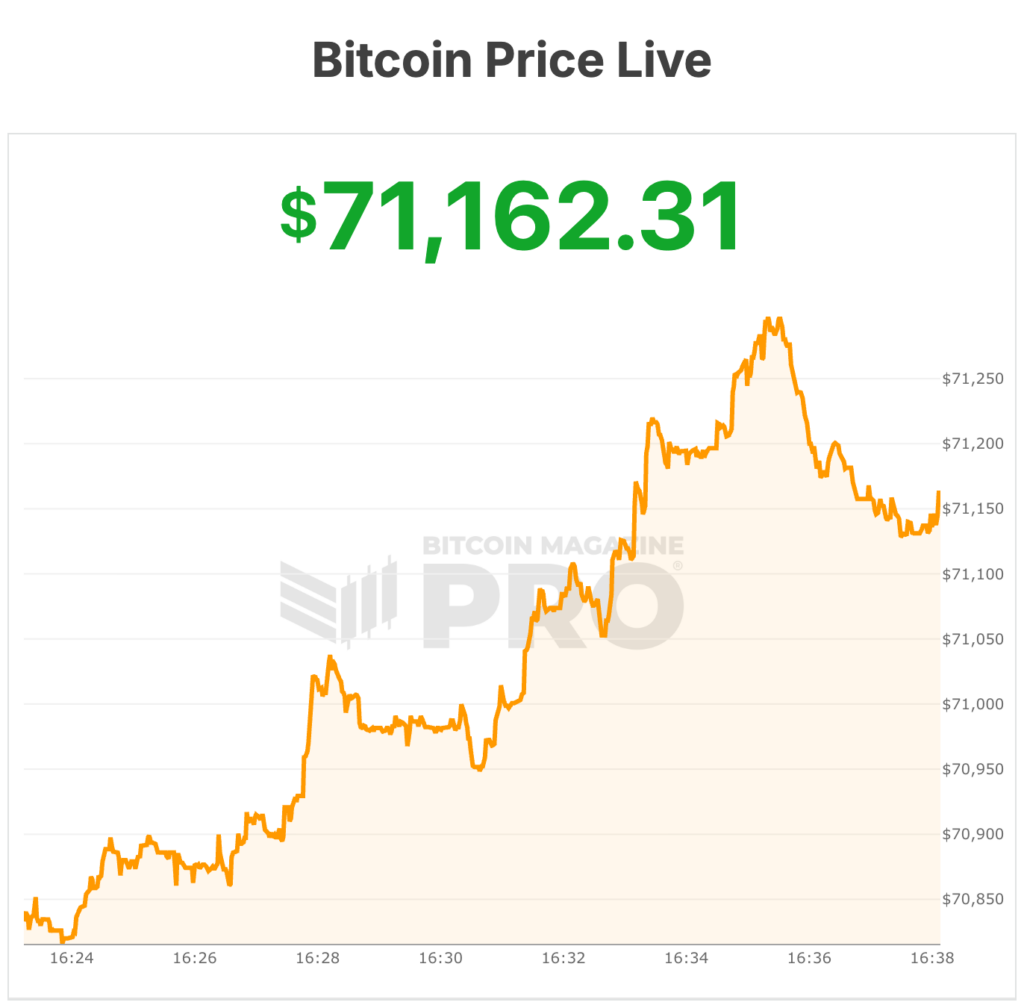
Bitcoin price responded to the announcement with a drop in trading, changing hands around $70,500, down 3.6% over the previous 24 hours, according to Bitcoin Magazine Pro. The cryptocurrency had flirted with $76,000 last week, reaching its highest level in over a month, but has since retraced as investors weighed inflation data and global uncertainties.
Voting members of the Federal Open Market Committee were split for a sixth consecutive policy meeting. Eleven supported holding rates steady, while Fed Governor Stephen Miran dissented, advocating a 25-basis-point cut.
BREAKING:
— Bitcoin Magazine (@BitcoinMagazine) March 18, 2026
In its statement, the FOMC noted that “inflation remains somewhat elevated” and that job gains have remained low, even as the unemployment rate ticked up to 4.4% in February. The Fed emphasized a data-dependent approach to future adjustments, signaling that any decision will rely on incoming economic information.
The backdrop for the Fed’s policy deliberations included the ongoing war involving the U.S., Israel, and Iran, which has pushed energy prices higher. On Wednesday, Bitcoin price fell in tandem with U.S. stocks following reports that Israel struck the South Pars gas field in Iran.
“Uncertainty about the economic outlook remains elevated,” the FOMC said. “The implications of developments in the Middle East for the U.S. economy are uncertain.”
Federal Reserve Chair Jerome Powell discussed the implications of rising energy prices at a press conference.
He said, “Near term measures of inflation expectations have risen in recent weeks, likely reflecting the substantial rise in oil prices caused by the supply disruptions in the Middle East.”
He added that it is “too soon to know” the full economic impact of the conflict and that policymakers would continue to monitor data closely.
Bitcoin price reacts to tariffs, rate expectations
Powell also highlighted the influence of tariffs on consumer prices, noting that “some big chunk of that, between a half and three-quarters, is actually tariffs.”
He described the current federal funds rate range as within neutral territory and emphasized the importance of central bank independence.
“Independence is what allows us to do our jobs, and stable prices is half of our mandate, it’s one of our two mandates – maximum employment being the other,” he said.
Bitcoin price markets have historically been sensitive to interest rate expectations, as lower rates tend to make cryptocurrencies more attractive relative to traditional assets.
Analysts suggest that the combination of higher energy costs, persistent inflation, and geopolitical uncertainty has prompted investors to reduce exposure to riskier assets, including Bitcoin.
Oil prices continued to climb Wednesday, with Brent crude rising 3.8% to $107.38 per barrel following the attack on the South Pars field.
Despite the recent pullback, Bitcoin price remains above $70,000 for now and has recorded gains of 1.6% over the past week. Traders are watching closely for any signs from Powell or the Fed that could influence future monetary policy.
Powell’s term as Fed Chair will conclude in May, with former Fed Governor Kevin Warsh expected to succeed him if confirmed. Powell’s future on the Board of Governors remains undecided.
He said, “I have no intention of leaving the board until the investigation is well and truly over, with transparency and finality.”
At the time of writing, the bitcoin price is slightly above $71,000.
This post Bitcoin Price Fights For $70,000 As Federal Reserve Holds Rates first appeared on Bitcoin Magazine and is written by Micah Zimmerman.
Bitcoin Magazine

Till Death or Seed Phrase: Woman Accused of Spying on Husband, Stealing $172 Million in Bitcoin
A dispute over more than $172 million in Bitcoin has moved forward in the UK’s High Court of Justice, where a man alleges his estranged wife stole thousands of coins from his hardware wallet using covert surveillance inside their home.
Court filings show that Ping Fai Yuen, a UK resident, held 2,323 Bitcoin in a Trezor hardware wallet in 2023.
On Aug. 2 of that year, the full balance was transferred without his knowledge. The funds were later split across 71 separate addresses through a series of transactions. No movement has been recorded since Dec. 21, 2023.
Yuen claims his wife, Fun Yung Li, obtained access to the wallet’s recovery phrase, which can be used to recreate the wallet and move funds.
The filings allege she recorded him inside their home to capture the phrase, possibly with help from her sister, Lai Yung Li, who is also named as a defendant.
According to the claim, Yuen had been warned by his daughter in July 2023 that Li was attempting to access his Bitcoin.
He then installed audio recording equipment in the residence. The recordings are cited as key evidence. In one excerpt referenced in court, Li is alleged to have said, “The Bitcoin has transferred to me” and “take all of it.”
The filings also describe a recording from July 29, 2023 in which Li allegedly discussed camera placement and the location where Yuen stored his wallet credentials. The claim states she was “covertly recording” him in an effort to obtain access.
After discovering the transfer, Yuen confronted Li and assaulted her. He was arrested and later pleaded guilty to assault occasioning actual bodily harm and two counts of common assault.
Police opened an investigation into the alleged theft and arrested Li in 2023. Officers seized 10 crypto cold wallets during a search, including several linked to Yuen. Authorities later released Li after a no comment interview. The police have since stated they will take no further action without new evidence.
In November 2025, Yuen sought a proprietary asset preservation injunction. He asked the court to confirm his ownership of the Bitcoin, freeze Li’s crypto holdings, and order the return of the assets or an equivalent sum in British pounds.
‘Damning’ evidence of bitcoin theft
In a judgment following a March 2 hearing, Justice Cotter said Yuen’s case shows a strong likelihood of success. He pointed to the warning from Yuen’s daughter, the audio transcripts, and the discovery of equipment capable of accessing the wallet.
“The evidence is that he was warned of what the First Defendant was seeking to do, the transcripts are damning,” Cotter wrote.
The judge also cited Occam’s razor, the principle that the simplest explanation with the fewest assumptions is often the most likely. He said that this straightforward account aligns with the available evidence, and noted that Li has had the opportunity to present her version of events but has not done so in the proceedings.
Cotter added that the volatility of Bitcoin supports the need for a swift trial, as the value of the disputed assets may shift during the course of litigation.
The case is expected to test how English courts handle ownership and recovery claims tied to digital assets.
This post Till Death or Seed Phrase: Woman Accused of Spying on Husband, Stealing $172 Million in Bitcoin first appeared on Bitcoin Magazine and is written by Micah Zimmerman.
Bitcoin Magazine

Zip Ties, Sleeping Pills and Pepper Spray: Canadian Crypto Millionaire Targeted in Foiled Madrid Kidnapping
A Canadian crypto entrepreneur survived a kidnapping attempt Monday night on one of Madrid’s busiest nightlife streets, after witnesses alerted police and helped foil the attack.
The incident occurred at approximately 11 p.m. near the intersection of Calle Claudio Coello and Calle Jorge Juan in the Salamanca district, a hub of high-end restaurants and bars.
The victim had just left Lobito de Mar, the restaurant owned by chef Dani García, when three men forcibly removed him from the street, pepper-sprayed him, and threw him into a Ford Transit van.
Several pedestrians and residents on nearby balconies immediately called authorities. Spanish National Police tracked the vehicle to Ronda de Toledo, about 15 minutes from the scene, and arrested two of the attackers. One suspect escaped and remains at large, according to reports.
Police identified the arrested suspects as Serbian men, ages 33 and 45, both with no prior criminal record.
Investigators say the attackers had planned the abduction to extract the victim’s cryptocurrency passwords and gain access to his digital assets. The suspects also attempted to steal the Canadian’s €100,000 luxury watch.
Authorities determined the kidnappers had followed the businessman from Barcelona to Madrid, where he had traveled to finalize a cryptocurrency deal.
The van used in the crime had an altered license plate, rented specifically for the abduction, and contained plastic zip ties and sedative pills, suggesting a premeditated scheme. GPS data recovered from the vehicle indicated the suspects intended to transport the victim to Petrer, a town in Alicante.
Inside the van, the victim was left alone while police focused on detaining the suspects. He freed himself from the zip ties and flagged down a taxi, which took him to La Princesa Hospital for treatment of injuries sustained during the initial assault. Police recovered firearms from the van during their investigation.
Be careful with your crypto
The kidnapping aligns with a recent rise in physical attacks targeting cryptocurrency holders across Europe. France, for example, has recorded 11 similar incidents so far in 2026, reflecting a trend of criminals seeking direct access to digital assets rather than traditional bank accounts.
Security experts refer to such attacks as “wrench attacks,” in which criminals attempt to obtain wallet seed phrases or private keys through coercion or violence.
Authorities warn that cryptocurrency entrepreneurs are increasingly at risk due to the digital and highly liquid nature of their assets.
Police continue to search for the third suspect and have appealed to the public for information.
The investigation remains open, with officers examining surveillance footage and digital evidence to determine whether the plot involved additional collaborators or extended surveillance beyond the two confirmed attackers.
This post Zip Ties, Sleeping Pills and Pepper Spray: Canadian Crypto Millionaire Targeted in Foiled Madrid Kidnapping first appeared on Bitcoin Magazine and is written by Micah Zimmerman.
CryptoSlate
US banks “reduced” their credit risk after 2008 by shifting more of it to nonbank lenders.
Since 2008, banks have shifted a growing share of their lending to nonbanks like private credit funds, making it their fastest-growing loan category.
That shift doesn’t signal another 2008-style crisis today, but it does show where trouble could surface first if private credit starts to crack.
This week, traders, analysts, and Investment firms are reviving a familiar question: are US banks setting up a repeat of 2008?
The clean answer is no, based on the publicly available numbers. The same debate also points to a real shift in bank balance sheets that deserves a harder look.
The chart below, which is circulating on X, shows that bank lending to nondepository financial institutions, or NDFIs, rose 2,320% over 15 years.
An FDIC note documented $1.32 trillion of those loans by the third quarter of 2025, up from $56 billion in the first quarter of 2010, and called the category the fastest-growing loan segment since the 2008-09 crisis.

After 2008, large banks pulled back from riskier direct lending, but they also funded the nonbank lenders that stepped in. That group includes private credit vehicles, mortgage finance firms, securitization structures, and other parts of the shadow banking system. The risk moved elsewhere rather than disappearing.
However, that does not mean banks are already in trouble. The FDIC’s latest industry profile showed the banking sector earned $295 billion in 2025, posted a fourth-quarter return on assets of 1.24%, reduced unrealized securities losses to $306 billion, and counted 60 problem banks, still within the agency’s normal non-crisis range. Those are not the numbers of a system already in a panic.
The issue is where losses, redemptions, and liquidity pressure land when the lending chain has more links.

For crypto, that changes the timing of any stress. A classic bank panic starts at the bank. In the current structure, stress can begin in a fund, a warehouse line, or a financing vehicle, then work backward into banks if marks fall, borrowers miss payments, or investors ask for cash faster than the assets can be sold.
| Indicator | Latest reading in the source set | What it shows |
|---|---|---|
| Bank loans to NDFIs (data) | $56 billion in Q1 2010; $1.32 trillion in Q3 2025 | The exposure became one of the largest post-crisis shifts on bank balance sheets. |
| Growth rate of NDFI lending (study) | 21.9% annual compound growth from 2010 to 2024 | The category expanded much faster than most traditional loan books. |
| Committed bank lines to private-credit vehicles (note) | $8 billion in Q1 2013; $95 billion in Q4 2024; about $56 billion utilized | Large banks are tied to the private-credit system through direct financing lines. |
| Total committed bank lines to private credit and private equity (research) | About $322 billion in Q4 2024 | The funding links extend beyond one niche product. |
| US bank earnings and health check (report) | $295.6 billion net income; 1.24% ROA; $306.1 billion unrealized losses; 60 problem banks | Banks are not yet showing a broad 2008-style breakdown. |
| Global nonbank share of finance (report) | About 51% of global financial assets in 2024 | The migration of credit away from banks is global, not a US outlier. |
| Bitcoin snapshot (market) | $73,777; +0.05% in 24 hours; +4.55% in 7 days; +7.51% in 30 days; 58.5% dominance | BTC was firm while the banking and private-credit debate spread. |
The post-crisis shift is now visible in the numbers
The official numbers make the structural change hard to dismiss. The FDIC said bank lending to NDFIs compounded at 21.9% a year from 2010 to 2024.
By the third quarter of 2025, the total had reached $1.32 trillion, or roughly 10% of bank lending in the agency’s analysis.
Not every dollar in that bucket is private credit, and exposures in the category carry different levels of risk. Even so, the scale shows that a large share of credit intermediation now sits in institutions that do not take deposits and often disclose less than banks do.
That nuance is important. NDFI is a broad label. It can include mortgage intermediaries, consumer finance firms, securitization vehicles, private equity funds, and other nonbank lenders, alongside private-credit funds.
A sloppy reading turns the whole bucket into one bet on private credit. A more accurate reading is that banks built a large, fast-growing set of links to the broader nonbank system.
Private credit is one visible part of that system, and one of the most closely watched because it grew during a long period of higher rates, tighter bank regulation, and steady investor demand for yield.
A Federal Reserve staff note sharpens this point. It is estimated that committed credit lines from the largest US banks to private-credit vehicles rose from about $8 billion in the first quarter of 2013 to about $95 billion by the fourth quarter of 2024, with roughly $56 billion already drawn.
The same work put total committed bank lines to private credit and private equity at about $322 billion.
That does not prove systemic failure is close. The Fed’s own conclusion was more restrained: direct financial-stability risk from this channel looked limited so far because the largest banks appeared able to absorb major drawdowns.
Even so, growing links between banks and private-credit vehicles warrant close attention.
The risk is best framed as continued bank funding for parts of the lending chain, which changes where stress appears first.

In the public market, losses print quickly. In private markets, they can move more slowly because marks update less often, assets are less liquid, and investor withdrawals are managed through product rules.
That delay can make the system look calm until cash needs force a sharper repricing.
Global context points in the same direction. The Financial Stability Board said the nonbank financial intermediation sector accounted for about 51% of total global financial assets in 2024 and continued to grow at roughly twice the pace of banking, according to its latest report.
This is no longer a US edge case. Credit has been moving into institutions outside the classic banking model for years, and the US private-credit boom is part of that wider pattern.

Why the trade is getting tested now
The issue became more urgent as structural data arrived while private credit began to show public strain. Some private-credit vehicles have limited or managed withdrawals, while JPMorgan tightened some lending against private-credit portfolios after markdowns.
Those events stop short of establishing a full-market break and instead show where pressure is likely to emerge first: fund liquidity, financing terms, and collateral values.
That is also why any comparison to 2008 needs restraint.
The same FDIC report that drove renewed attention also showed banks entering this phase from a stronger income position than during past crises. The public banking system is not in free fall.
The greater concern is a funding architecture that could transmit stress from nonbank lenders back into banks if private assets keep repricing lower or if investors want cash before loans can be sold or refinanced.
Borrower quality and refinancing deserve more attention than broad slogans. In a recent Financial Times interview, Partners Group’s chair said that private-credit default rates could double from their roughly 2.6% historical average over the coming years. That is not an official baseline, and it should not be treated as one.
It does, however, capture the key pressure point. A system built on long-duration private loans, slower marks, and regular financing lines can look stable until defaults rise and refinancing windows narrow at the same time.
For Bitcoin, the setup is awkward in the short run and cleaner in the medium run. At the time of writing, BTC traded near $73,777 and held 58.5% market dominance, with gains of 0.05% over 24 hours, 4.55% over seven days, and 7.51% over 30 days, according to CryptoSlate data.
That price action suggests crypto is not trading as if a banking event is already underway. If a broader credit squeeze did hit, the first move would likely be a selloff in liquid assets, and Bitcoin is still one of the most liquid assets in global markets.
Over a longer horizon, if the debate broadens into a deeper loss of trust in how the financial system carries leverage and values private assets, Bitcoin’s appeal as an asset outside the banking stack becomes easier to articulate.
That second-order effect is the real contagion risk for crypto.
A private-credit strain does not automatically send capital into Bitcoin on day one. It can easily produce the opposite move.
Over time, though, if banks have to pull back, if fund financing gets harder, and if more investors start asking who really owns the credit risk, the case for holding some assets outside that system becomes easier to make. We know that trade. The banking data now place it in a new macro setting.

What to watch in the next round of data
The next phase of this story will likely emerge through three checks: whether more private-credit vehicles limit withdrawals or take larger marks, whether banks keep financing those funds on the same terms, and whether the NDFI loan book continues to expand at anything close to the pace the FDIC documented over the prior decade.
That is where the current debate becomes more concrete than the usual “shadow banking” label. If banks tighten financing to nonbank lenders, middle-market borrowers can feel it quickly through cost and access, even if no household hears the acronym NDFI.
If the funds meet redemptions by selling what they can, public credit can take some of the price discovery that private books avoided. If the funds do not sell and banks keep financing them, the exposure stays in the system longer.
None of those paths requires a repeat of 2008. All of them can still change how credit flows.
Pressure is already showing in all three areas
The direction of travel so far looks like tightening, not collapse.
On withdrawals and marks, semi-liquid private-credit vehicles are restricting cash more aggressively while investors push for fresher valuations.
A recent report said Cliffwater’s flagship corporate lending fund received redemption requests equal to about 14% of shares and met only 7%, while Morgan Stanley’s North Haven fund received requests equal to 10.9% and honored only its 5% cap.
The same report said BlackRock and other vehicles also hit standard quarterly limits, while Apollo moved toward monthly and then daily NAV reporting to answer criticism of stale pricing.
That points to weaker liquidity conditions and stronger investor demand for faster price discovery and greater cash access at the same time.
On bank financing, lenders are getting more selective rather than shutting the door outright.
A separate report said JPMorgan marked down some software-backed private-credit collateral and restricted lending to affected funds, which reduced borrowing capacity and pointed to tougher collateral treatment in weaker pockets of the market.
That stance is not universal. Other coverage said banks were still willing to finance some withdrawal needs. The signal is narrower and more useful: lenders are still in the market, but they are showing less tolerance for weak collateral and more willingness to tighten terms fund by fund.
On balance-sheet growth, the NDFI loan book has already changed behavior without needing to contract outright.
The FDIC’s February 2026 study said bank loans to NDFIs compounded at 21.9% annually from 2010 to 2024 and reached $1.32 trillion by the third quarter of 2025. A category that grew at that pace does not need an outright contraction to reset underwriting.
Slower growth, more frequent markdowns, and tougher financing terms are enough to change redemption behavior, reduce leverage, and make investors less willing to assume that rapid balance-sheet growth can continue alongside benign losses.
The official numbers argue against panic today, but they do not support complacency.
The FDIC’s balance-sheet data show a large post-crisis migration in bank exposures. The Fed’s research shows large banks remain connected to the private-credit complex through financing lines. Global data show nonbank finance has become too large to treat as a side story, and the first public tests of private-credit liquidity are already showing up in the market.
The next stress point may arrive through a route that looks safer in good times because it sits one step away from the bank.
The next useful check is whether fund withdrawals stay contained, whether bank financing stays open, and whether the $1.32 trillion exposure that the FDIC documented keeps rising as private credit faces a harder year.
The post Banks risk another 2008 crisis after moving the equivalent of 18 million BTC into shadow lenders appeared first on CryptoSlate.
Hyperliquid’s HYPE token moved into the top 10 crypto assets by market capitalization, beating Cardano's ADA amid a 1,700-fold rise in trading volume tied to oil volatility during the US-Iran conflict.
Notably, Bitcoin benefited significantly from the broader bid for crypto during the conflict, but HYPE gained a second channel as traders used Hyperliquid's platform to express views on oil around the clock, including on weekends when conventional futures venues were closed.
From March 1 to March 18, HYPE’s market value rose from about $8.16 billion to $10.66 billion, a gain of about 30.7%, according to CryptoSlate's data. Over the same stretch, the token climbed from No. 13 to No. 10 in the site’s rankings.
The move built on momentum already forming across decentralized perpetual futures markets. Hyperliquid had been gaining significant market share as traders shifted more derivatives activity on-chain and as the venue expanded its reach beyond crypto-native speculation.
The US-Iran conflict accelerated that trend by giving traders a reason to use crypto rails for real-time exposure to oil-linked volatility.
That gave HYPE a different profile from many large-cap tokens, as traders no longer priced the token solely as exposure to a fast-growing crypto venue. Instead, they were also pricing in a platform that became a live venue for macro hedging while legacy markets were offline.
Oil volatility pushes flow on-chain
The latest conflict began after US-Israeli strikes on Iran on Feb. 28, setting off a rise in oil prices and a scramble across markets to reprice supply risk.
Since then, Brent crude has settled above $100 a barrel, while analysts have tracked the possibility of further gains if shipping routes or regional energy infrastructure are disrupted.
Hyperliquid became one of the places where that view showed up in volume, as trading in oil-linked perpetual contracts on the platform expanded quickly as the war developed.
Data from Flowscan showed that cumulative oil-futures volume on Hyperliquid rose from about $339 million on Feb. 28 to more than $10 billion as of press time.
Bitwise research analyst Danny Nelson explained that the high Hyperliquid volume was a sign that traders were using the on-chain venue to hedge a commodity that still sits at the center of the global economy.
According to him, oil had been about 2.5 times more volatile during the war than in the two weeks before the conflict and pointed to the gap that forms when traditional futures venues close for the weekend while headlines continue to move.

He added:
“Wartime forces markets to adapt. Sometimes you don’t realize you need a solution until it stares you in the face. I think that’s what’s happening here with weekend hedging. Hyperliquid’s weekend oil sessions have grown 1,700x in just a month.”
Notably, Hyperliquid had confirmed the trend, saying that real-world asset trading on the venue repeatedly set records, surpassing $1.3 billion in open interest and $1.4 billion in weekend volume.
The company said the platform had become a venue for 24/7 price discovery in oil, metals, and equity indexes when standard markets were shut.
Despite this, the scale still remained small compared with legacy energy markets. Nelson noted that traditional futures venues handle about $18.5 billion in WTI contracts on an average trading day, or roughly 35 times Hyperliquid’s best weekend oil session.
Even so, the pace of Hyperliquid's growth drew attention because it suggested a market segment was being built during live geopolitical stress rather than through a slower cycle of product launches and user incentives.
Revenue structure helps explain HYPE’s rally
HYPE rose alongside that activity because Hyperliquid’s structure links platform revenue more directly to token demand than many crypto networks do.
According to Hyperliquid’s documentation, trading fees are directed to an Assistance Fund, which uses them to buy HYPE on the open market.
Tokens held in the fund are burned, reducing supply over time. Users who stake HYPE also receive fee discounts on the platform. The result is a model that allows traders to view the token more like an exchange-linked asset whose value can rise with trading volume.
That framework became more relevant as war-driven oil trading pushed volume higher. In simple terms, more trading produced more fees, and more fees increased the amount of HYPE bought back and removed from circulation. The market had a revenue-based reason to reprice the token.
DefiLlama data showed Hyperliquid generated about $182.5 billion in perpetual futures volume over 30 days, $42.69 billion over seven days, and $6.76 billion over 24 hours.

The platform also posted about $45.4 million in 30-day earnings, which implied roughly $554 million on an annualized basis if activity held near that level.
Considering this, Arthur Hayes, founder of BitMEX, described Hyperliquid as the largest revenue-generating crypto project outside stablecoins.
He said 97% of that revenue was being used to buy back HYPE from the market, a design he argued gave the token a stronger link to platform cash flow than many other crypto assets. According to him, Hyperliquid could continue to take derivative volume from centralized exchanges while adding new products to expand revenue.
Some of that product expansion is already underway through HIP-3, Hyperliquid’s framework for permissionless perpetual listings, which has allowed the trading of real-world assets. The trading platform is also looking to enable prediction markets and options-style derivatives as part of its array of features.
The combination of these developments, he argued, would bolster HYPE's potential to reach $150 by August next year.
A war trade becomes a market-structure test
Meanwhile, the next question is whether that wartime flow turns into a standing category of demand.
The continued use of Hyperliquid for oil-linked and metals-related contracts after tensions cool would support the case that 24/7 macro trading on crypto rails can hold a larger share of activity.
However, a retreat in those volumes, once energy prices settle, would weaken the revenue assumptions that helped drive HYPE higher this month.
Meanwhile, there are also near-term risks. Token unlocks remain on the calendar, including an April 6 unlock that traders will monitor for supply pressure. At the same time, questions remain after research into Hyperliquid’s October 2025 stress event raised concerns about how the platform managed a large liquidation and the use of auto-deleveraging.
Even with those issues, the move into the top tier of crypto assets reflected a clear sequence. The US-Iran war lifted oil volatility. Oil volatility drove demand for markets that stayed open around the clock.
Hyperliquid captured part of that demand through on-chain perpetuals, and HYPE benefited because the platform’s fee structure feeds directly into token buybacks and burns.
The post Why the US-Iran conflict sent traders to Hyperliquid — and pushed HYPE into crypto’s top 10 appeared first on CryptoSlate.
Ethereum is outpacing Bitcoin as tensions involving the United States, Israel, and Iran continue to shape global markets.
Data from CryptoSlate shows ETH has risen 18% against the dollar since the start of March, compared with a 13% gain for Bitcoin over the same period.
The ETH/BTC ratio has also moved higher, rising 7.6% to 0.0315 from 0.0293 in less than three weeks, a sign that Ethereum is gaining ground relative to Bitcoin rather than simply rising alongside it.
That shift has pushed ETH above $2,300 and left it on track for its first positive monthly close since August 2025. The move stands out because it is unfolding amid pressure across global macro markets, where conflict risk and higher energy prices have begun to reshape expectations for inflation and monetary policy.
The military conflict involving the United States, Israel, and Iran has driven Brent crude above $102 a barrel, while West Texas Intermediate has moved past $95. Energy markets are increasingly pricing in the risk of disruption in the Strait of Hormuz, a shipping route that carries about one-fifth of global oil and liquefied natural gas flows.
Higher oil prices have often fed into inflation expectations, raising the prospect that central banks will keep policy tight for longer. In past episodes, that backdrop has tended to support Bitcoin’s role as a defensive crypto trade, with investors treating it as the asset closest to a macro hedge inside the sector.
This time, Ethereum is delivering a stronger performance. The divergence points to capital flowing into blockchain-specific themes tied to Ethereum’s market structure, network activity, and positioning among institutional investors, rather than a broad move into crypto as a shelter from geopolitical stress.
Asset management firm Matrxiport said:
“Ethereum is increasingly behaving like a financial asset…This dynamic may also help explain why crypto has recently shown relative strength versus other asset classes and does not neatly fit into the traditional risk-on/risk-off framework.”
Wall Street money returns to Ethereum
Wall Street is sending fresh capital into Ethereum at a pace that is helping drive the token’s recent outperformance.
Data from SoSoValue shows the nine spot ETH exchange-traded funds (ETFs) took in more than $160 million of net inflows last week, their strongest weekly intake since mid-January. The trend extended into the new week, with the funds drawing another $35.9 million on March 16.
That flow pattern has added to the case that institutional demand is returning to ETH after a period of weaker sentiment.
Typically, sustained inflows of that scale have previously preceded some of the asset’s sharper price moves, including rallies that carried ETH above $4,000.
So, the latest allocations suggest portfolio managers are again increasing exposure as the market broadens beyond Bitcoin.
Meanwhile, a second shift is also shaping the investment case. Regulated products that offer exposure to Ethereum’s network yield are opening a new route for traditional finance investors.
BlackRock recently launched an Ethereum staking ETF under the ticker ETHB, giving investors access to both price exposure and validator rewards. The fund raised $104.7 million in seed capital and attracted more than $45.7 million of additional inflows in its first two trading days.
That structure gives portfolio managers a way to evaluate ETH through cash flow potential and network-based yield, a framework that can carry more weight with allocators who need income generation as part of the case for holding alternative assets.
At the same time, corporate buyers are building Ethereum positions on their balance sheets.
Since last year, BitMine has aggressively expanded its ETH treasury and said it plans to acquire up to 5% of the token’s supply.
The pace of those purchases has increased this month, with the company buying more than 100,000 ETH in the first two weeks, bringing total corporate holdings to nearly 4.6 million Ether as of mid-March.
That buying is creating a steady layer of demand that echoes the treasury strategy several public companies used to accumulate Bitcoin earlier in the cycle.

Speculative interest gradually returns to ETH
Speculative demand is showing signs of returning to ETH as institutional buying strengthens.
CryptoQuant data showed that derivatives positioning across the digital-asset market was reset after the Oct. 10 flash crash, when about $19 billion in leveraged positions were liquidated over 24 hours.
On Binance, Ethereum’s estimated leverage ratio fell 27% in the aftermath of that move, pointing to a broad reduction in speculative exposure.

Since then, leverage has been rebuilding gradually. By mid-March, positioning had risen alongside an improvement in trader sentiment, indicating that speculative participation was returning in a more measured way than during earlier phases of the cycle.
Data from BlockScholes adds to that picture. The firm’s ETH Risk-Appetite Index has climbed from earlier lows, signaling a pickup in investors’ willingness to take exposure to the token as conditions across the crypto market stabilize.

Meanwhile, market structure data also points to lower immediate selling pressure on the digital asset.

CryptoQuant data shows that 30-day Ethereum inflows to Binance fell to about $20.2 billion, the lowest level since May 2025. The drop in exchange deposits suggests fewer tokens are being positioned for sale on major centralized venues, thereby tightening liquidity as prices recover.

At the same time, more investors appear to be moving ETH into private wallets and staking contracts. That shift reduces the volume of tokens readily available for spot trading and leaves the market more responsive to fresh buying activity.
Ethereum's blockchain fundamentals also support a rally
Ethereum’s recent gains against Bitcoin are tracking a pickup in network activity, according to data from staking provider Everstake and other industry sources.
In a recent report, Everstake said Ethereum is on pace to post its strongest quarter of network usage in more than a year, even before the first quarter is complete.
The network has processed more than 150 million transactions so far in the period and recorded 27.7 million active addresses, the report said. Both figures are above comparable quarterly readings seen across 2025.

The increase in activity is also showing up in Ethereum’s base-layer throughput. Everstake said the network reached a record 2.52 million gas per second, a metric indicating higher usage across decentralized applications and other on-chain activity.
Part of that demand is tied to Ethereum’s position in tokenized real-world assets, a segment that has drawn more attention from financial firms.
Data from Token Terminal shows Ethereum currently settles about $200 billion in tokenized financial instruments, giving it a 61% share of the market. That scale has helped keep Ethereum at the center of issuance and settlement activity as institutions move traditional assets onto blockchain-based rails.

The network’s supply profile is also part of the investment case. Since Ethereum moved to a proof-of-stake system, the pace of new ether issuance has remained below that of Bitcoin, according to Leon Waidmann, head of research at Lisk.
Waidmann said Ethereum’s annualized supply growth is about 0.24%, compared with about 1.28% for Bitcoin after its latest halving.
Considering this, he said:
“Everyone calls Bitcoin ‘sound money.' But by the numbers, ETH has the tighter monetary policy!”
Taken together, the data points to a market where Ethereum’s price strength is being matched by higher usage, broader participation, and a slower rate of supply growth. For investors weighing relative value across major digital assets, that combination is helping support ETH's recent outperformance.
The post Ethereum is outperforming Bitcoin when it shouldn’t be — what’s driving it? appeared first on CryptoSlate.
The SEC just made its biggest crypto classification move in years, placing major tokens such as Ethereum, Solana, Cardano, Dogecoin, Avalanche, XRP, and Chainlink into a “digital commodities” bucket while saying some token sales can stop being treated as securities-law cases once the issuer’s core promises are fulfilled.
Paired with a new SEC-CFTC coordination framework, the March 17 interpretation is less a narrow staking memo than a broad attempt to replace years of crypto-by-enforcement with a clearer split between assets, contracts, and regulator turf.
Until Gary Gensler left the SEC, crypto in the US has lived under a legal cloud. Tokens were launched, traded, staked, wrapped, and airdropped while builders and users were left guessing about the boundary between securities law and commodity law.
The long-awaited interpretation explaining how federal securities laws apply to certain crypto assets and common crypto transactions, and the CFTC joined it, saying it will administer the Commodity Exchange Act consistently with that view.

The Mar. 17 release provides interpretive guidance while preserving existing fraud liability and registration requirements. Additionally, it draws clearer lines.
The SEC's fact sheet says the agency had spent more than a decade engaging with crypto, mostly through Howey-based analysis, and, before 2025, failed to build a tailored framework, instead “regulating by enforcement.”
The Mar. 11 SEC-CFTC memorandum of understanding then established a Joint Harmonization Initiative to clarify product definitions, reduce friction for dually registered venues and intermediaries, and coordinate policymaking, exams, and enforcement.
In the MOU itself, the agencies also commit to consult on overlapping enforcement matters, including, where appropriate, before a Wells notice or similar step.
That makes this week's interpretation bigger than staking or airdrops.
In plain English, the SEC is now saying that many major crypto tokens are not themselves securities.
It then goes further to confirm that some ordinary crypto activities, such as covered staking, mining, wrapping, and certain airdrops, can fall outside securities-sale treatment in some circumstances, and that a token sale does not necessarily remain a live securities-law relationship forever if the issuer’s essential promises have been fulfilled.
That does not erase fraud liability, excuse unlawful original sales, or settle every edge case, but it does give exchanges, issuers, builders, and users a much clearer answer to the question that has hung over the market for years: what is the asset, what is the contract around it, and when does that contract end?

A federal labeling system
The government is finally saying, in plainer terms, what people are buying: a commodity-like token, a collectible, a practical tool, a payment stablecoin, or a tokenized security.
The SEC fact sheet states that digital commodities, digital collectibles, digital tools, and GENIUS Act payment stablecoins fall outside securities classification, whereas tokenized securities remain securities.
That means that a stablecoin such as USDC falls outside the securities classification, while the tokenized stocks xStocks issued by Kraken and Backed Finance would be classified as securities.
It also says covered protocol mining, covered protocol staking, and wrapping of a non-security crypto asset fall outside the offer-and-sale requirement, and that certain airdrops fail Howey's investment-of-money prong.
It also reduces one of crypto's biggest structural drags in the US: uncertainty over ordinary token activity being considered an illegal securities transaction after its conclusion.
The interpretation says that added clarity could reduce legal costs, increase competition, and encourage more activity to remain in the US.
| Category | SEC/CFTC treatment in the release | What it means in plain English |
|---|---|---|
| Digital commodities | Not themselves securities | Commodity-like tokens do not start inside securities law |
| Digital collectibles | Not themselves securities | Collectible-style assets are outside the securities bucket |
| Digital tools | Not themselves securities | Utility-like tokens are not automatically securities |
| GENIUS Act payment stablecoins | Not themselves securities | Some payment stablecoins begin outside securities status |
| Tokenized securities | Remain securities | Tokenized stocks, bonds, and similar assets stay inside securities law |
| Covered mining | Not an offer/sale of securities in described cases | Core protocol participation may sit outside securities treatment |
| Covered staking | Not an offer/sale of securities in described cases | Some staking activity is clearer for users |
| Wrapping non-security assets | Not an offer/sale of securities in described cases | Technical asset transformations are not automatically securities transactions |
| Certain airdrops | Fail Howey’s investment-of-money prong | Some free token distributions may fall outside securities law |
The separation concept
The most important shift may be conceptual. The SEC says a non-security crypto asset can be sold subject to an investment contract and later, separate from that contract, once the issuer's essential promises are fulfilled, or, in some cases, if those promises clearly fail.
In plain English: a token can exit securities status when the underlying investment contract ends.
That directly addresses the long-running fear that tokens are permanently stained by the way they were first sold. The release explains that when buyers cease to reasonably expect the issuer's essential managerial efforts to remain connected to the asset, the token can separate and exit that contractual relationship.
Separation still requires that the original token sale was registered or exempt when the investment contract was created, and fraud liability can survive even after the token later separates.
The release also says the common-enterprise element of Howey must be satisfied, and it explains that if the issuer's promises remain connected to a token, secondary market trades in that token can still be securities transactions until separation occurs.
The agencies are saying the answer depends on whether the underlying issuer-driven investment contract is still alive.
That is a much more structured framework than the old blanket fog.
| Question | If yes | If no |
|---|---|---|
| Is the asset itself a tokenized security? | Securities law applies | Go to next question |
| Was it sold with an investment contract? | Go to next question | Asset begins outside securities status |
| Are issuer promises still central? | Securities obligations may continue | Separation becomes possible |
| Was the original sale registered or exempt? | Separation may occur if contract ends | Liability can survive |
What changed for ordinary users
For users, the practical shift is that the SEC has defined core behaviors more precisely.
Covered protocol mining, protocol staking, and wrapping are outside securities-sale treatment in the circumstances described, and certain no-consideration airdrops fail Howey's investment-of-money prong.
The government has said that some ordinary crypto activities may fall outside the securities bucket in the described circumstances, while other configurations may still trigger securities obligations.
For platforms, the new rulebook reduces the category problem.
Digital commodities, collectibles, tools, and permitted payment stablecoins begin with the assumption that securities laws apply to the contractual relationships surrounding them, if any, rather than to the assets themselves. Tokenized stocks, bonds, and similar instruments remain subject to securities law.
Non-security tokens still tied to issuer promises carry securities obligations until separation.
The release provides exchanges and wallet providers with clearer listing and feature logic while Congress continues work on the permanent statute.
The bull case holds that this will serve as the interim US operating manual. Exchanges, wallets, and issuers use the taxonomy and separation framework to lower legal friction, while the SEC and CFTC use the MOU to reduce overlap in exams and enforcement.
Congress codifies most of the framework, the agencies jointly formalize more definitions, and onshore token issuance, staking, and secondary trading expand because firms can finally structure products around clearer lines.
The SEC's own economic section points to better pricing efficiency, more capital formation, and more competition if clarity holds.
The bear case holds that the interpretation proves helpful within a narrower scope. Litigation tests the boundaries of “separation,” later commissions revisit parts of the framework, and firms still avoid aggressive launches because past failures to register and anti-fraud exposure remain enforceable.
In this scenario, legal uncertainty diminishes but persists in edge cases.
The next phase
The SEC says the Crypto Task Force has already received more than 300 written submissions and held multiple roundtables, including a Mar. 21, 2025, session specifically on security status.
On Jan. 29, CFTC Chairman Michael Selig publicly called for clear, unambiguous safe harbors for software developers, onshoring of perpetuals, and a harmonized crypto taxonomy with the SEC.
Taken together with the Mar. 11 MOU and the Mar. 17 interpretation, the move appears to be a sequenced regulatory project.
This also puts the US closer to other major jurisdictions. The EU says MiCA is a comprehensive legislative framework covering crypto-assets and related services. The UK FCA is rolling out a staged crypto regime, with its roadmap pointing to final rules in 2026 and the new regime expected to come into force in October 2027.
The US is taking an interpretation-heavy approach, grounded in existing securities and commodity statutes. At the same time, this release moves it closer to the category-based regulatory style that other major jurisdictions are already adopting.
The real significance of this release is that the two main US market regulators are trying to move crypto from a regime of case-by-case enforcement toward a more coherent market structure.
The interpretation is paired with the Mar. 11 SEC-CFTC memorandum of understanding aimed at harmonizing oversight, and both agencies framed this week's action as a bridge to broader market structure legislation in Congress.
Once assets are sorted into buckets and the agencies coordinate on overlaps, the next big battles shift to exchange registration, custody, tokenized securities plumbing, stablecoin competition, and the extent to which Congress codifies this framework.
The press release itself says the interpretation complements congressional efforts.
The agencies published a category-based taxonomy, explicitly addressed when non-security tokens become subject to an investment contract and when they stop being subject to one, and clarified several common crypto activities that had lived in gray areas.
That represents a materially more structured approach to enforcement.
If market participants can better predict which rules apply to which assets and activities, compliance costs should fall, pricing distortions from uncertainty should ease, and more activity can plausibly stay onshore.
Whether this becomes a true turning point, however, will depend on whether courts accept the framework, future SEC leaders keep it in place, and Congress locks it into statute.
The post SEC makes huge U-turn, declares crypto tokens are ‘digital commodities’ after years of legal battles appeared first on CryptoSlate.
A token sale tied to a live ecosystem
Playnance is bringing G Coin to a major public milestone today, after saying March 18 would mark the token’s generation event and broader market debut. Unlike projects that arrive before product adoption, Playnance is pitching G Coin as the utility layer for an ecosystem that already has more than 200,000 holders; its official tracker recently showed 203,732 holders.
Launch materials distributed through Chainwire also said roughly 13 billion G Coin had already been distributed during the presale phase ahead of today’s event.
G Coin is positioned as the settlement and utility token across the Playnance stack, which includes on-chain gaming, prediction products, and loyalty mechanics. On its official site, Playnance says the token already powers 10,000-plus on-chain games and 2.5 million live sports events annually, while the G Coin page says the broader ecosystem averages 1.5 million on-chain transactions per day.
What buyers are actually getting
The most important point for buyers is that Playnance describes G Coin as a utility token, not a security, payment token, or claim on company profits.
The whitepaper says the token is meant to unlock gameplay, rewards, loyalty programs, missions, premium features, and promotional access across the ecosystem, and explicitly states that holders do not receive equity, dividends, governance rights, or redemption rights against the issuer.
The whitepaper also adds an important nuance to today’s launch framing. It says G Coin had already been available through authorized sales interfaces inside the Playnance ecosystem before publication, and that the current public offer is structured as an ongoing offer rather than one with a predefined end date.
For direct purchases, Playnance says accepted payment methods include EUR and USD through on-ramp providers such as Wert.io and Onramper, plus a range of crypto assets including BTC, ETH, POL, USDT, USDC, SOL, ADA, DOGE, SHIB, TON and others.
Supply, vesting and distribution
Playnance says tokens sold during the presale are delivered immediately and are not subject to vesting. Non-professional buyers who purchase directly from the issuer are entitled to a 14-day withdrawal period, provided the tokens have not already been used inside the ecosystem.
The same whitepaper says that right does not apply to third-party exchange purchases or to tokens already spent in gameplay or missions.
On tokenomics, the project says total supply is fixed at 77 billion G Coin, with 54 billion allocated to token sale minting. The company also says unsold tokens at the token generation event will face a 12-month cliff followed by 24-month linear vesting, while tokens lost through gameplay are locked for 12 months before re-entering circulation.
That lock-based model sits at the center of Playnance’s supply pitch, which argues for time-based release schedules instead of permanent burns or open-ended issuance.
The bigger bet
The real question is whether utility can translate into durable demand once broader market trading begins. Playnance is clearly betting that a token tied to active gameplay, sports interaction, and on-chain settlement has a stronger story than another speculative launch with no product behind it.
If the company can turn its existing user activity into sustained token usage, G Coin may enter the market with more traction than the average presale. But the whitepaper is also explicit on the limits: this is a utility token with no ownership rights, no guaranteed value, and no promise of financial return.
The post Playnance Puts G Coin Presale in Focus as March 18 Launch Day Arrives appeared first on CryptoSlate.
Cryptoticker
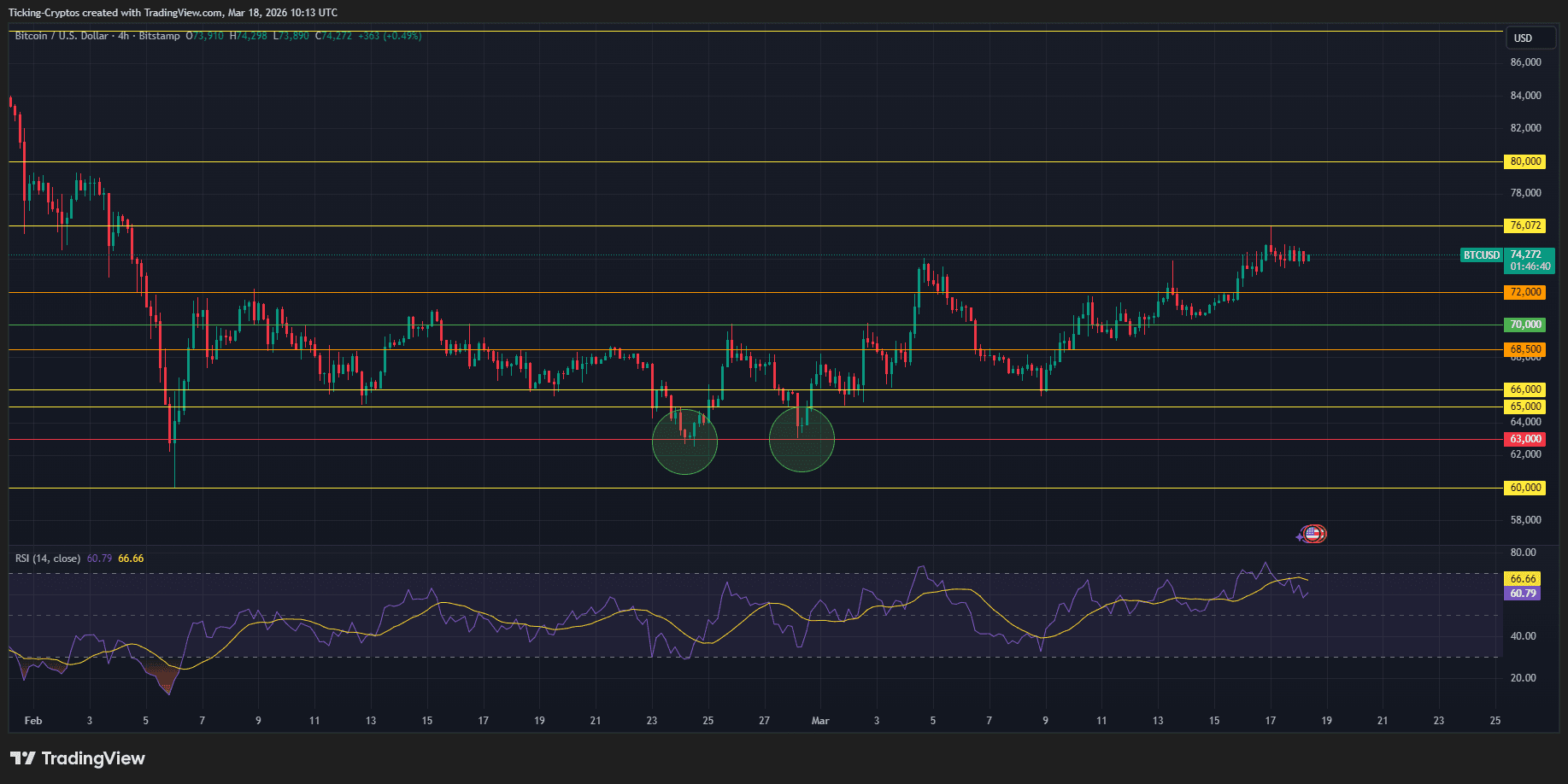
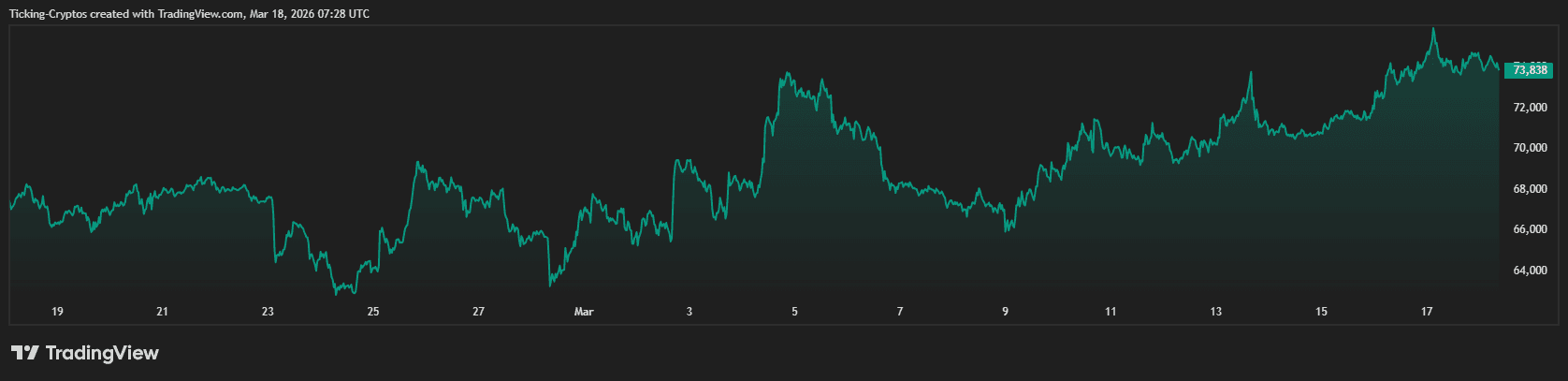
The Bitcoin price is currently navigating a high-stakes consolidation phase, trading at approximately $74,272 during the March 18, 2026, session. After a period of bearish dominance that saw the asset retreat from its 2025 record highs, the market is now testing the resilience of the $74,000 resistance zone.
Bitcoin Price Analysis: Why is BTC Price UP?
Analyzing the BTC/USD 4-hour chart, we observe several key technical patterns that define the current trend.
Double Bottom Recovery
The chart highlights two significant "troughs" (marked with green circles) near the $63,000 level. This Double Bottom formation served as a powerful reversal signal in late February and early March, allowing Bitcoin to climb back above the psychological $70,000 mark.
Key Resistance and Support Levels
The price action is currently sandwiched between tightly defined horizontal levels:
- Immediate Resistance: $74,500 – $76,000. A decisive break above this yellow-lined zone is required to target the next major hurdle at $80,000.
- Critical Support: $72,000. If the price fails to hold the $74,000 level, the green support line at $72,000 will be the first line of defense.
- Deep Support: $68,500 and $65,000. These remain the "must-hold" zones to prevent a return to the bear market lows seen earlier this year.
RSI and Momentum
The Relative Strength Index (RSI) is currently hovering around 60.79. While this indicates bullish momentum, the RSI has flattened significantly as the price approaches resistance. This suggests a "cooling off" period or a potential bearish divergence if the price makes a higher high while the RSI fails to follow suit.
Bitcoin News and Macro Catalysts
The broader crypto market is currently characterized by a "Fear" rating on the Sentiment Index (sitting at 26), despite Bitcoin's recent price recovery.
- The FOMC Factor: Traders are bracing for Federal Reserve Chair Jerome Powell’s comments. While interest rates are expected to remain steady, any hawkish rhetoric regarding inflation—driven by $100+ oil prices—could trigger a "sell the news" event for $BTC.
- Institutional Inflows: According to data from Bloomberg, spot Bitcoin ETFs saw a resurgence in March, with nearly $2.8 billion in net inflows, providing a structural floor for the recent rally.
- The Gold vs. Bitcoin Debate: As gold continues to trade near record levels above $5,000, Bitcoin's role as "Digital Gold" is being tested. Many analysts, including those at Fidelity Digital Assets, suggest that capital may rotate back into BTC if gold's parabolic move stalls.
Conclusion: What to Expect Next?
Bitcoin is showing "Experience" and "Expertise" in its ability to hold the $74,000 handle despite a heavy macro environment. However, the information density on the 4-hour chart suggests that the current range is exhausting.
If Bitcoin can flip $76,000 into support, a run toward $80,000 is the most likely scenario. Conversely, a rejection here, coupled with a hawkish Fed, could see a swift retest of the $68,500 support.
- Technical Note: Watch the 4-hour candle close. A close below $73,800 would signal a short-term breakdown, while a close above $75,100 validates the bullish breakout attempt.
The crypto market in early 2026 has been nothing short of a rollercoaster. After the euphoric highs of late 2025, where Bitcoin flirted with the $130,000 mark, a "diffuse cocktail of macro anxieties" has sent prices into a steep correction. As of late mid-March 2026, $Bitcoin has retraced nearly 50% from its All-Time High (ATH), trading in above $73,000.
Is it a Good Time to Buy Crypto?
Historical cycles suggest that corrections of 50% to 70% are healthy "purges" that wipe out over-leveraged traders. With Bitcoin currently sitting at a 50% discount, the risk-to-reward ratio for March 2026 has shifted heavily in favor of the bulls.
As geopolitical tensions and tariff uncertainties stabilize, capital is expected to rotate back into "risk-on" assets. Investors who missed the 2025 rally now have a second chance to enter the market. If you are looking to build a portfolio, diversifying across these five projects offers a balance of stability, utility, and explosive recovery potential.
1. Ethereum (ETH) – The Infrastructure King
Despite the rise of "Ethereum killers," Ethereum remains the undisputed home of Decentralized Finance (DeFi) and Real-World Asset (RWA) tokenization. In 2026, the successful rollout of the "Prague" upgrade has further slashed Layer-2 costs, making the network more scalable than ever.
- Why Buy Now? ETH has followed Bitcoin’s slide, dropping from its 2025 high of $4,950 to under $2,000.
- The Catalyst: Major financial institutions like BlackRock and JPMorgan are increasingly using Ethereum for tokenized deposit pilots. At current prices, you are buying the "settlement layer of the internet" at a 60% discount.
2. Solana (SOL) – The Speed Demon
Solana has proven its resilience after the network reliability concerns of previous years. With the Firedancer upgrade now fully integrated in 2026, Solana can process over 1 million transactions per second.
- Status: While it reached $260 in the last bull run, SOL is currently trading significantly lower, creating a "gap" that savvy traders are eager to fill.
- Use Case: It has become the primary chain for consumer AI-crypto applications and high-frequency trading.
3. Chainlink (LINK) – The Oracle Essential
You cannot have a functional DeFi ecosystem without accurate data, and Chainlink owns 90% of that market. In 2026, its Cross-Chain Interoperability Protocol (CCIP) has become the standard for banks moving data between private and public blockchains.
- The Play: LINK often lags behind the initial BTC pump but rallies hard once the ecosystem matures. It is one of the most undervalued "blue-chip" utility tokens heading into March.
4. Sui (SUI) – The Emerging Contender
Sui has emerged as the breakout Layer-1 of the 2025-2026 cycle. Utilizing the Move programming language, it offers a level of security and parallel processing that older chains struggle to match.
- Growth Potential: Sui's Total Value Locked (TVL) has remained stable even during the February crash, suggesting a loyal and committed developer base. As the market recovers, SUI is positioned to be a top performer.
5. Fetch.ai (FET/ASI) – The AI Narrative
2026 is the year of "AI Agents." Fetch.ai, as part of the Artificial Superintelligence Alliance, is at the forefront of this movement. Their autonomous agents are now being used in logistics and decentralized energy grids.
- Why March 2026? The "AI plus Crypto" narrative is the strongest secular trend in the market. With FET down along with the broader market, it offers a high-beta play for those betting on the continued AI revolution.
Conclusion: Strategy for March 2026
Investing during a 50% Bitcoin drawdown requires a long-term mindset. While volatility may persist in the short term, the fundamental value of these projects remains unchanged. Consider using a regulated exchange to dollar-cost average into these positions throughout the month.
Vietnam is shifting from one of the world's most active unregulated crypto markets to a strictly controlled domestic ecosystem. According to reports from Reuters, the government in Hanoi is preparing to launch a pilot scheme for locally licensed digital asset exchanges while simultaneously drafting rules to ban citizens from using overseas platforms.
The Race for the First Vietnam Crypto License
Five major domestic entities have passed an initial qualification round to operate the country’s first legal exchanges. This move marks a significant transition for a nation that ranked fourth globally on the Chainalysis Global Crypto Adoption Index.
The qualified applicants include:
- Techcombank (TCB)
- VPBank (VPB)
- LPBank (LPB)
- VIX Securities
- Sun Group
Why Hanoi is Curbing Foreign Trading
The Vietnamese government’s primary concern is uncontrolled capital outflows. While the country has high crypto interest, most transactions currently occur on offshore servers, making it difficult for authorities to monitor wealth movement or collect taxes.
By forcing users onto local platforms, Hanoi aims to:
- Regulate Capital: Ensure trades are settled via local banking rails.
- Tax Revenue: Implement a structured tax framework for digital assets.
- Consumer Protection: Bring high-risk trading under the oversight of the Ministry of Finance.
Market Impact and Local Adoption
Currently, Vietnamese traders move over $200 billion annually in crypto. The new regulations will likely push this liquidity into the hands of major local financial institutions. However, digital assets are still not recognized as legal tender or a formal means of payment in the country.
Summary of New Vietnam Crypto Regulations
| Feature | New Policy |
|---|---|
| Foreign Exchanges | Planned ban for Vietnamese nationals |
| Local Exchanges | Pilot program for licensed domestic firms |
| Key Players | Major private banks (VPBank, Techcombank) |
| Objective | Combat capital flight and increase oversight |
Ripple’s native token, $XRP, reclaimed the $1.50 price level. This move comes after weeks of tightening volatility, where the asset was compressed within a massive technical structure. As the broader crypto market shows signs of a renewed bullish cycle, XRP's recent price action suggests that the long-awaited move toward psychological resistance levels may be underway.
XRP Price Prediction: The Road to $2.00
The current technical setup confirms that XRP is targeting the $2.00 milestone. This projection is based on a "measured move" following the breach of a multi-week consolidation pattern. If XRP-USD can maintain its position above the $1.45 support zone, the next liquidity pocket sits between $1.85 and $2.10.
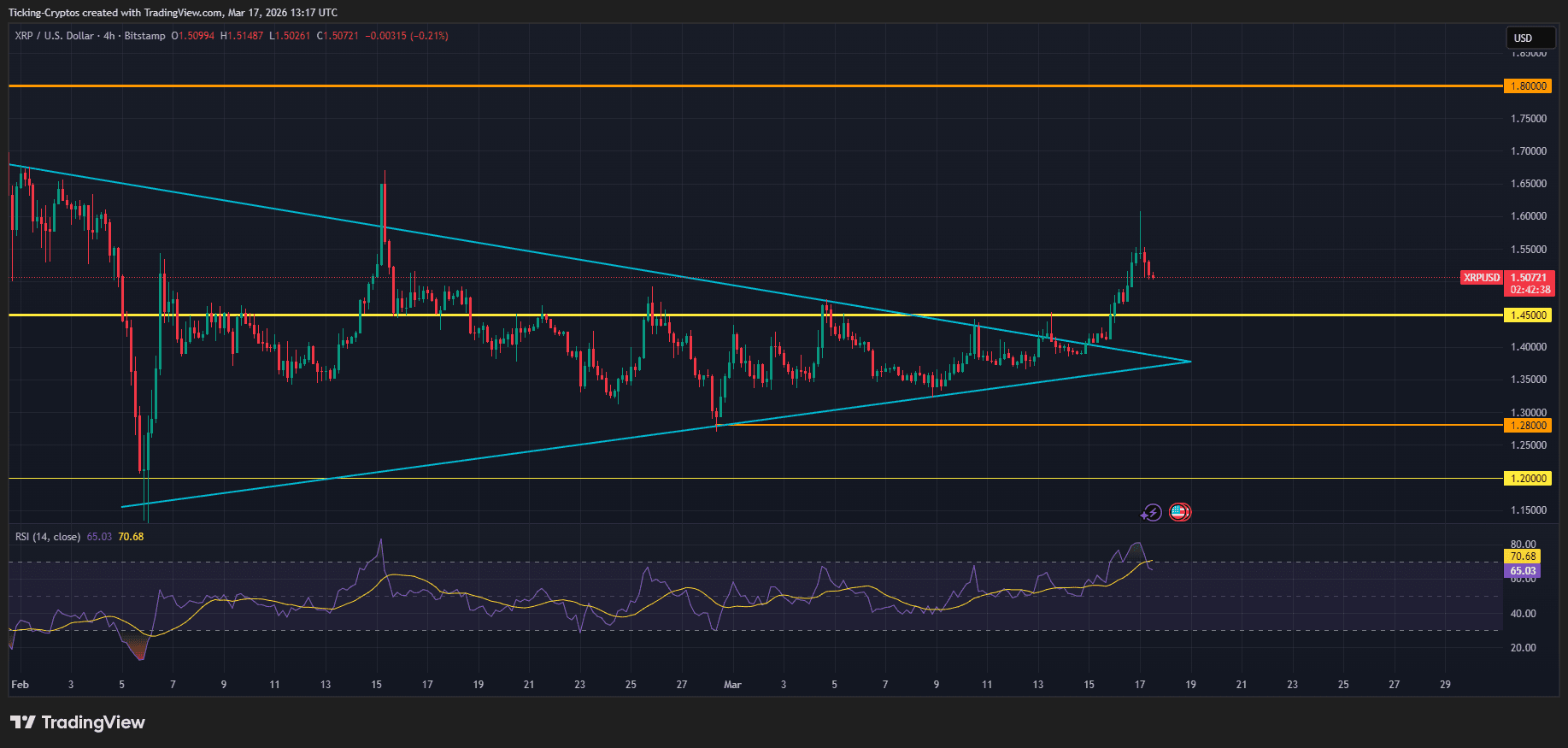
The Symmetrical Triangle
A symmetrical triangle is a chart pattern characterized by two converging trendlines connecting a series of sequential peaks and troughs. In XRP’s case, this pattern represented a period of "equilibrium" where buyers and sellers were in a deadlock. Typically, a breakout from this formation indicates that the prevailing trend—in this case, the bullish momentum from late 2025—is ready to resume with high volume.
The Breakout: How XRP Breached the Triangle
The most critical development in the recent XRP-USD price action is the upward breach from the triangle formation. Since February 2026, XRP has been making lower highs and higher lows, narrowing into an apex near the $1.38 mark.
On March 14, trading volume surged by over 300%, providing the necessary fuel for XRP to pierce the upper descending trendline. This "breach" was not merely a wick but was followed by a daily candle close above the resistance, effectively flipping it into a support floor. Technical analysts often view this specific type of exit from a triangle as a signal that the "accumulation phase" is over and the "markup phase" has begun.
Technical Indicators Supporting the $2 Target
Beyond the triangle breakout, several other indicators point toward a continued rally:
- Moving Averages: XRP is now trading comfortably above its 50-day and 200-day Exponential Moving Averages (EMAs).
- Relative Strength Index (RSI): The RSI is currently at 64, suggesting that while the asset is gaining strength, it is not yet "overbought" (which typically occurs above 70).
- Institutional Inflows: According to data from CoinShares, XRP-specific investment products have seen over $1.3 billion in cumulative inflows this year, providing the structural liquidity needed to sustain a move to $2.00.
Key Support and Resistance
| Level | Type | Significance |
|---|---|---|
| $1.38 - $1.42 | New Support | The previous triangle resistance now acts as a floor. |
| $1.56 | Current Pivot | XRP is consolidating here to build momentum for the next leg. |
| $1.80 | Minor Resistance | A historical supply zone from early 2026. |
| $2.00 | Major Target | The primary psychological and technical goal for the current rally. |
Ethereum (ETH) has bounced back strongly, rising more than 20% over the past eight days. While much of the market focused on Bitcoin’s volatility, Ethereum moved higher in the background. The rally is being driven by growing institutional interest and clearer regulatory support, two factors that are starting to change how major financial players approach the Ethereum network.
Why is Ethereum Price UP?
The recent Ethereum price pump is driven by a convergence of institutional liquidity and regulatory clarity. Specifically, the Federal Reserve's decision to allow tokenized securities as bank collateral and BlackRock’s launch of its iShares Staked Ethereum Trust (ETHB) have provided the necessary fundamental support for ETH to decouple from minor market corrections.
Tokenization and Staked ETFs
To understand why these developments are "game-changers," we must define the two pillars supporting this rally:
- Tokenized Securities: These are traditional assets (like stocks or bonds) represented as digital tokens on a blockchain.
- Staked ETFs: Unlike a standard spot ETF, a staked ETF (like ETHB) actually participates in the network's consensus, earning a "yield" or dividend for its shareholders by securing the network.
1. The Fed’s Green Light: Tokenized Assets as Collateral
On March 6, 2026, the Federal Reserve, alongside the OCC and FDIC, issued a landmark clarification. U.S. banks are now officially permitted to use tokenized securities as collateral for loans.
Why This Matters for Ethereum
Regulators confirmed that as long as the tokenized version confers the same legal rights as the traditional asset, it will receive the same capital treatment. Crucially, the Fed stated this applies regardless of whether the blockchain is permissioned or permissionless (public).
- Liquidity Influx: Trillions of dollars in "off-chain" value (Treasuries, equities) can now migrate to Ethereum.
- Ethereum as the "Settlement Layer": Since Ethereum remains the dominant hub for Real-World Assets (RWAs), this ruling cements $ETH role as the global plumbing for modern finance.
2. BlackRock’s ETHB: The First Dividend-Paying Crypto ETF
On March 12, 2026, BlackRock launched the iShares Staked Ethereum Trust (ticker: ETHB). While the market already had spot ETH ETFs, ETHB is the first from a major issuer to offer staking rewards directly to shareholders.
Key Features of ETHB:
- Yield Generation: The fund stakes between 70% and 95% of its holdings.
- Monthly Distributions: Investors receive monthly cash payouts, similar to a high-yield dividend stock.
- Institutional Infrastructure: BlackRock partnered with Figment and Coinbase Prime to manage the validator sets, bringing "Enterprise-Grade" security to the staking process.
"The ETHB launch transforms Ethereum from a speculative commodity into a productive, yield-bearing asset for the average 401k investor." — Market Insight
Comparison: Spot ETH vs. Staked ETH ETFs
| Feature | Spot ETH ETF (e.g., ETHA) | Staked ETH ETF (ETHB) |
|---|---|---|
| Primary Goal | Price Tracking | Price + Yield |
| Income Source | None | Staking Rewards (~2-3% Net) |
| Risk Profile | Market Volatility | Volatility + Slashing Risk |
| Target Audience | Traders | Long-term Income Seekers |
Fundamental Divergence
For months, analysts have noted a divergence: Ethereum's network fundamentals (Total Value Locked, Active Addresses, and Layer 2 scaling) were hitting record highs while the Ethereum price lagged. This 20% pump suggests the "valuation gap" is finally closing.
Decrypt
The approval lets Nasdaq test tokenized versions of some stocks and ETFs without moving beyond existing market rails.
The phishing campaign lures OpenClaw developers with fake $5,000 token airdrops, then drains wallets through a cloned site with a hidden connection prompt.
Persistent inflation signals and surging oil prices are weighing on risk appetite, even as institutional money has continued to flow.
Advocacy groups say the OpenAI-backed measure would limit legal accountability and lock in narrow protections for children.
The organization behind layer-1 blockchain Algorand laid off 25% of its staff due to macroeconomic uncertainty and lower crypto prices.
U.Today - IT, AI and Fintech Daily News for You Today
Evernorth Holdings has officially filed its Form S-4 with the SEC, a major step toward listing the first-of-its-kind, billion-dollar XRP treasury vehicle on the Nasdaq.
Market is witnessing a serious turnaround that might suggest the existing source of momentum is disappearing.
Crypto news digest: Ripple scores more institutional adoption; SHIB sees spike in futures activity; XRP forms rising support near $1.53.
Legendary trader Peter Brandt has issued a blunt wake-up call to "cryptocultists," describing two starkly conflicting technical patterns.
The Fed just held rates steady at 3.5%-3.75% in an 11-1 vote.
Blockonomi
Peter Brandt believes Ethereum might have bottomed out at $2,300, targeting $4,000. The dogecoin price prediction for 2026 has turned bullish as DOGE reclaims its footing after months of correction.
But while the dogecoin price prediction plays out from a $15 billion cap, the wallets building real wealth have moved to early projects with room for exponential growth.
According to analyst ARI ZAIM, the Dogecoin price has been trading inside a descending channel since September, and a breakout could push the price to $0.116 according to CoinGecko.
In the long run, ARI ZAIM expects the Dogecoin price to rally to $0.280. DOGE climbed 5.9% on the weekly timeframe to $0.100, and the 200 SMA at $0.152 is the next major target according to CoinGecko. The dogecoin price prediction is building on real signals, but even the bullish case delivers growth measured in percentages from $15 billion.
Dogecoin Price Prediction and the Early Projects With 100X Potential Before Their Listings Arrive
Smart Money Is Tapping Into Pepeto While the Dogecoin Price Prediction Plays Out Slowly at $15 Billion
While some investors are still watching the dogecoin price prediction move candle by candle, the wallets building real wealth have moved into early projects with room for exponential growth. One project pulling that capital is Pepeto. It has attracted a growing community of holders with its zero fee exchange and cross chain tools, raising more than $8.1 million in presale funding.
The token is priced at $0.000000186, giving every new holder an entry that large cap meme coins stopped offering years ago. The Pepeto token is central to the entire ecosystem. Holders earn 196% APY staking rewards that compound daily, and the token powers every transaction across PepetoSwap. With a 420 trillion supply matching Pepe and three working products built, this token could deliver the kind of returns the dogecoin price prediction simply cannot promise from $15 billion.
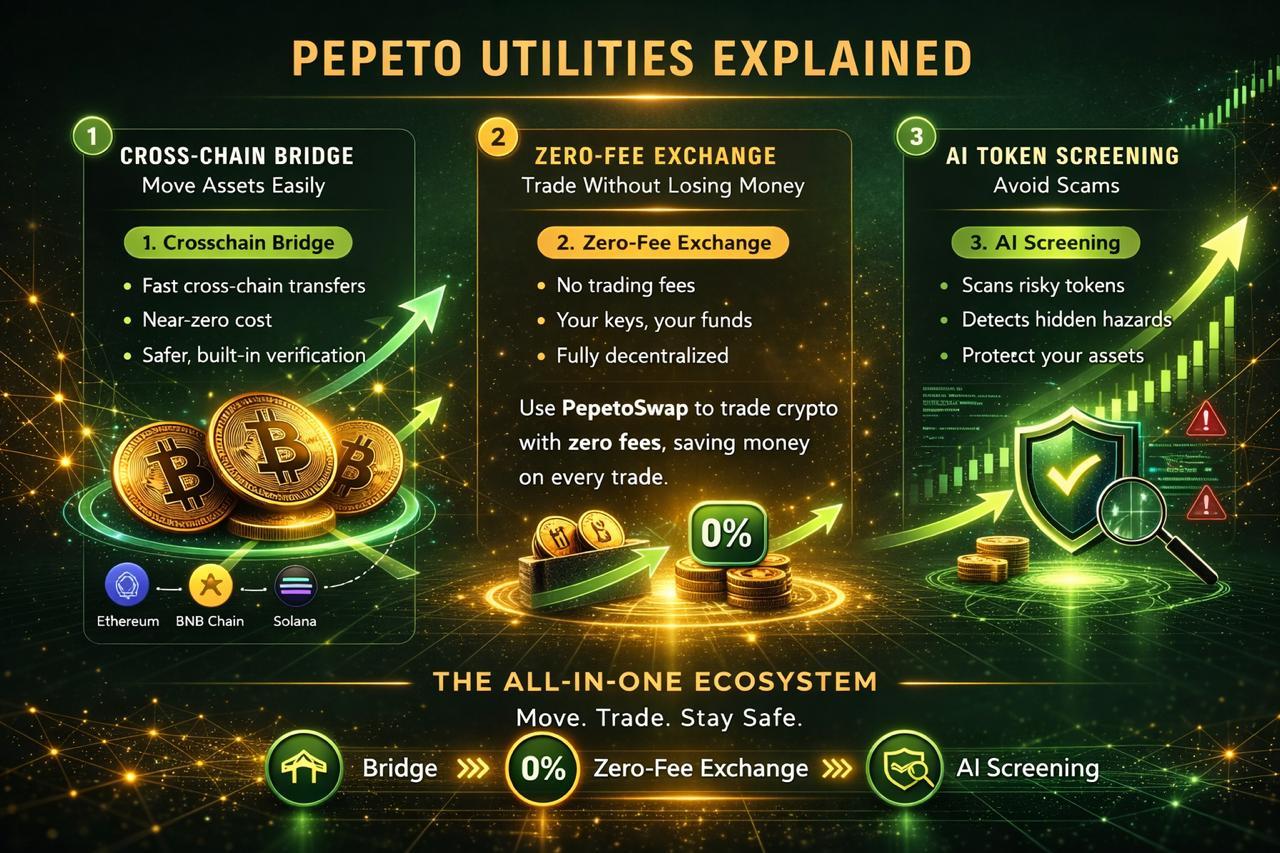
Holders who enter the Pepeto ecosystem get access to three tools that work together. PepetoSwap handles every trade at zero cost, the bridge moves tokens across Ethereum, BNB Chain, and Solana for nothing, and the risk scorer flags dangerous contracts before your capital goes near them. Together, they form a complete trading layer that protects your money, moves it across chains, and scores every new token before you decide to enter.
The SolidProof audit was completed before the presale opened, the cofounder of the original Pepe coin leads the project, and the Binance listing is approaching. Given the working tools, the original team, and an entry that disappears at listing, Pepeto might be the early project that delivers returns Pepeto offers far more than the dogecoin price prediction delivers in 2026.
Dogecoin Price Prediction: DOGE Targets $0.116 Breakout With $0.280 as the Long Term Goal
DOGE trades at $0.094 with a $15.96 billion market cap according to CoinMarketCap. The descending channel breakout targets $0.110, and if buying pressure holds, the long term target sits at $0.280.
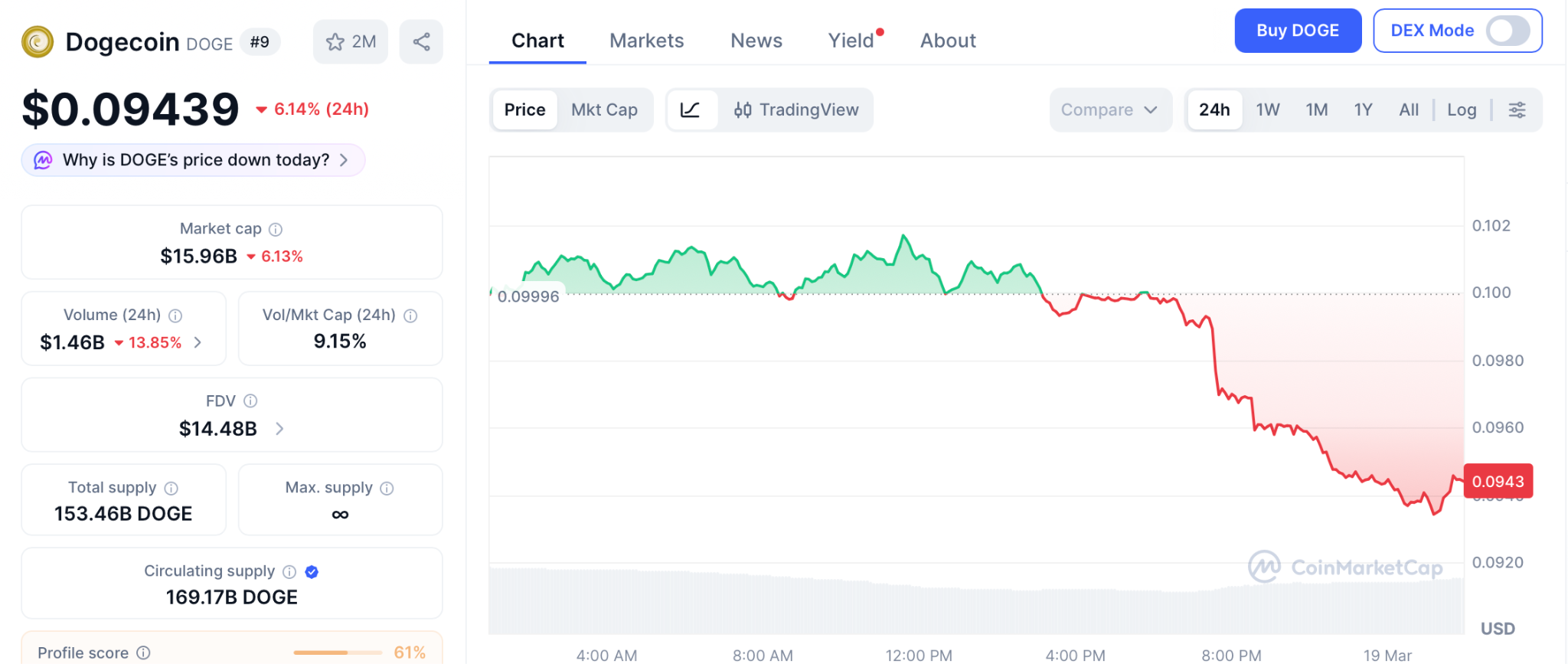
Technical analysis shows bulls gaining control with the RSI climbing.
Monad Approaches Two Month Resistance but Needs a Clear Breakout Above $0.025
Monad climbed 10.2% on the weekly chart to $0.024 and now it’s trading around $0.023, approaching a two month resistance at $0.025 according to CoinGecko.
The RSI at 68 shows buying pressure building. A break above could open a path to $0.030, but unproven fundamentals and low liquidity make it speculative.
A Bullish Dogecoin Price Prediction Offers Comfort but Imagine What Pepeto Does After It Actually Lists on Binance
A bullish dogecoin price prediction is comforting after a correction, but the real energy has shifted toward early projects like Pepeto that offer tools DOGE never built and an entry price DOGE can never offer again. Pepeto has raised over $8.1 million while the market corrected, proving that capital flows into real products even when the Fear Index sits at 37.
Imagine how far it goes after the Binance listing puts it in front of millions of traders who have never seen it.
Click To Visit Pepeto Website To Enter The Presale

FAQs
What is the dogecoin price prediction for 2026?
The dogecoin price prediction shows a breakout to $0.110 with a long term target of $0.280 based on the descending channel pattern.
Why are dogecoin price prediction followers looking at Pepeto?
DOGE at $15 billion delivers percentages. Pepeto is still in presale with a Binance listing approaching and 196% APY staking live.
Is Pepeto a good early project to buy before the listing?
More than $8.1 million raised, SolidProof audit, original Pepe coin team, and working tools built. Visit the Pepeto official website.
The post Dogecoin Price Prediction Turns Bullish, but Smart Money Is Moving to Pepeto for the Returns That DOGE Cannot Deliver, Here is Why appeared first on Blockonomi.
Messari just cut its staff to become an AI first company, handing leadership to former CTO Diran Li. When a major data provider goes all in on machine learning, that tells every investor where the future is heading.
The best crypto portfolio for 2026 needs large caps for the base and an early project for the returns that BTC at $71,614 and ETH at $2,203 can no longer deliver. And the early project absorbing the most capital right now is Pepeto.
Messari confirmed the company is doubling down as an AI first organization, restructuring its entire data layer around machine learning according to CoinDesk.
Strategy purchased $1.57 billion worth of Bitcoin, the largest single buy of 2026, pushing BTC briefly above $75,000 according to CoinDesk. Peter Brandt flagged an Ethereum bottom at $2,300 with a $4,000 target.
Best Crypto Portfolio Allocations and the Projects That Deserve Capital in March 2026
Pepeto Is the Early Entry That Belongs in Every Serious Crypto Portfolio Before the Listing Changes the Price
Picture this: the market just corrected after FOMC, your portfolio is red, and most investors are either panic selling or frozen, staring at charts they cannot read. The ones who already had Pepeto in their portfolio are not worried. Not because they predicted the dip, but because they got in at a price that makes the dip irrelevant. That is the real edge an early project offers for any crypto portfolio in 2026.
Instead of paying fees on every swap and watching your capital shrink trade by trade, PepetoSwap charges zero on every transaction and the bridge moves tokens across Ethereum, BNB Chain, and Solana for nothing. The risk scorer also scans every token in real time, catching honeypots and exploit code before your money ever touches the contract.
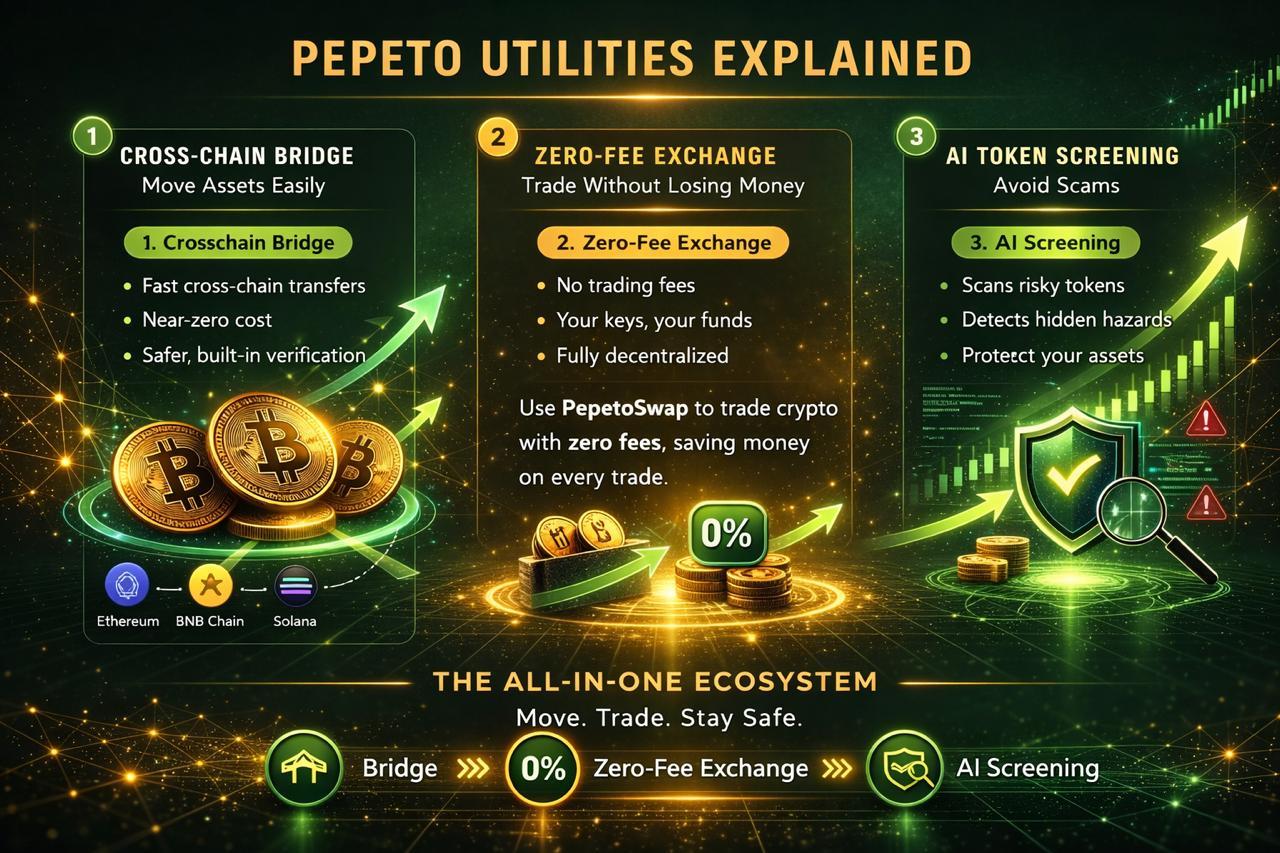
That kind of protection could have saved a lot of portfolios from the rug pulls that wiped out billions last cycle. A working exchange, bridge, and risk scorer all audited by SolidProof before the presale opened is something the presale market almost never delivers.
With the Binance listing approaching and more than $8.1 million already raised, adding Pepeto to a portfolio before it lists could be the single best allocation of 2026. And a $3,000 position at $0.000000186 buys over 16 billion tokens. If Pepeto only reaches the $11 billion cap that Pepe hit with the same 420 trillion supply and zero products, that $3,000 becomes more than $450,000, and that is the base case scenario as Pepeto offers far more utility and potential.
Bitcoin at $71,614 Anchors Every Crypto Portfolio With Institutional Backing
BTC trades at $71,614 according to CoinMarketCap, after the FOMC pullback from $76,000. Strategy’s $1.57 billion purchase and the longest ETF inflow streak in five months confirm institutional conviction.
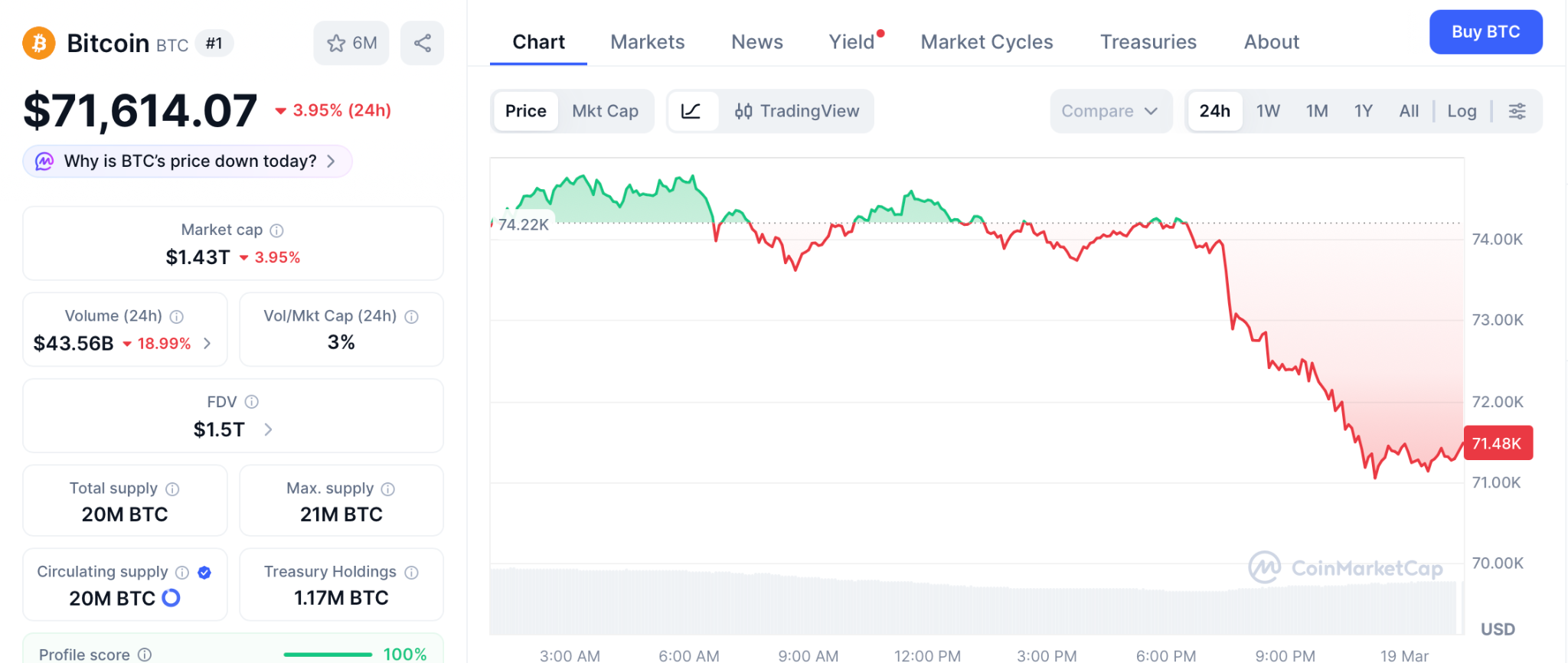
Kiyosaki targets $750,000 long term. Bitcoin is the anchor, but from $74,000 the returns that change a life come from the early entries.
Ethereum at $2,203 With Peter Brandt Flagging a Possible Bottom and a $4,000 Target
Peter Brandt indicated ETH is forming a bottom at a major historical support level, targeting $4,000 according to CoinGecko.
From $2,203 to $4,000 is roughly 75%. Strong for a portfolio allocation, but the biggest returns still come from getting into early projects before the listing.
Digitap Targets the Creator Economy but Lacks a Working Product and Community Traction
Digitap targets the $85 billion creator economy with AI subscription tools. The concept is interesting, but it has raised $1.5 million without a working product or community comparable to projects already generating real demand. The timeline to results is measured in years.
The Best Crypto Portfolio Does Not Wait for the Market to Recover Before the Early Entry Disappears
The best crypto portfolio does not wait for the market to feel safe again before the entry disappears. Pepeto is the early project that belongs in every serious portfolio for 2026, and the Binance listing means the presale at this price has a deadline the market will not extend.
A $3,000 position buys over 16 billion tokens, and 196% APY staking compounds that position daily while the listing advances. Visit the Pepeto official website and add the early entry before the listing, because every cycle proved that the best portfolios were built before the listing, not after.
Click To Visit Pepeto Website To Enter The Presale

FAQs
What is the best crypto portfolio for 2026?
BTC for stability, ETH for the recovery play, and Pepeto as the early project with the biggest potential before the Binance listing.
Why does Messari pivoting to AI matter for building a crypto portfolio?
When institutional data providers restructure around AI, it confirms the direction of the cycle. The best crypto portfolio positions early in that direction.
Is Pepeto a good early project to add to a portfolio?
More than $8.1 million raised, SolidProof audit, original Pepe coin team, and a Binance listing approaching. Visit the Pepeto official website.
The post Best Crypto Portfolio for 2026: Messari Pivots to AI and Pepeto Gives Early Investors the Entry That Large Caps Cannot Offer appeared first on Blockonomi.
Solana’s network revenue has plunged 93% from its January peak. Daily DEX volume cratered from $35.9 billion on January 21 to $979.5 million by mid-March. Transaction fees dropped 83% in a single month. Active daily addresses fell from 6.4 million to 2.8 million, more than halving since November. The memecoin engine that powered Solana’s fee revenue through Pump.fun and Meteora has stalled after a string of celebrity rug pulls and scam launches that drained user trust. SOL trades at $94, and the on-chain activity that justified higher prices has evaporated.
A 93% revenue collapse is not a correction. It is a structural repricing of what the network actually earns when the hype cycle ends. Taurox (TAUX) is a decentralized hedge fund where AI agents will trade pooled capital across DEXs and CEXs once the presale ends. Stakers keep 80% of net profits from diversified strategies that do not depend on a single network’s fee revenue staying elevated through speculative memecoin launches.

How Triple-Layer Oracle Protection Guards Every Trade
Accurate pricing data is the foundation of every trade an agent will execute. Taurox uses Chainlink as its primary oracle, providing multi-provider aggregated USD pricing across all supported assets. If Chainlink data goes stale or becomes unavailable, Pyth Network steps in as a fallback with high-frequency institutional-grade pricing. Every price feed carries asset-specific staleness thresholds.
If data exceeds the allowed age, the system pauses execution until fresh pricing arrives. On top of both oracle layers, Taurox validates pricing through time-weighted average price calculations using on-chain liquidity pools. This three-layer architecture prevents agents from executing trades on manipulated or outdated data, a risk that grows as more venues and liquidity sources come online.
Stakers keep 80% of net profits at the standard tier. The protocol takes 5% on gains only, with 30% burned permanently and 70% flowing to the DAO treasury. Solana’s revenue depended on memecoin volume that vanished when users lost trust. Taurox protects trade execution at the oracle level so pricing integrity never depends on hype cycle volume.
Why $314.7K in Capital Keeps Flowing While SOL Revenue Falls
Phase 1 of the TAUX presale sold out in under 24 hours at $0.01 per token. Phase 1 buyers are sitting on a 20% gain with Phase 2 priced at $0.012, and they have not staked or seen an agent trade. The presale has raised $314.7K so far, and Phase 2 is already 23.9% filled. Nineteen phases run from $0.01 to $0.07, each closing permanently when its allocation is gone. The price steps up with no extensions.
Waiting costs real money when each closed phase eliminates the cheapest entry forever. Staking activates at the end of the presale, and agents will begin trading real capital once the pool goes live. SOL’s revenue dropped 93% because the activity that generated it was speculative and temporary. The TAUX presale raises capital that positions buyers ahead of a protocol designed to produce returns through managed execution, not through fee spikes from unsustainable memecoin volume.
Every token sold at $0.012 brings Phase 2 closer to closing permanently. The demand that cleared Phase 1 in a single day has carried directly into Phase 2. The buyers entering now are positioning before agents begin trading real capital. Phase 2 is filling, and the entry at $0.012 will not exist once this allocation runs out.

Phase 2 Numbers
Phase 2 is live at $0.012 per TAUX. Listing at $0.08 gives buyers 6.67x before the pool generates profit. A $1 target means x83 from today. At a $1 billion pool with 30% gross returns, implied price reaches $1.85, or x154 from $0.012. The protocol charges 5% on gross profits only. Zero management fees. Thirty percent of that fee is burned permanently against a fixed supply of 2 billion tokens.
The remaining 70% funds the DAO treasury. Every profitable trading period compresses circulating supply against a cap that never increases. The remaining 70% of fees funds the DAO treasury for ecosystem growth. Total raised: $314.7K and climbing. SOL’s revenue cratered 93% because the volume that generated it was temporary. The TAUX presale raises capital backed by a protocol designed to produce returns through managed execution. Phase 2 will not survive the demand pattern that emptied Phase 1 in under a day.
Learn More
Buy TAUX: https://taurox.io/
Whitepaper: https://docs.taurox.io/
Official Telegram: https://t.me/tauroxlabs
The post Solana (SOL) Network Revenue Plunges 93% From Peak, Why Taurox (TAUX) Is One Of the Best Alternatives appeared first on Blockonomi.
Robert Kiyosaki just predicted Bitcoin at $750,000 in his latest post on X. The crypto news today is moving fast after the FOMC held rates at 3.50% to 3.75% and BTC pulled back from $76,000. But the real crypto news is in the presale market, where one early project keeps raising while another launched and crashed.
The Federal Reserve held rates unchanged on March 18, and the dot plot signaled limited cuts for 2026 according to CoinDesk.
BTC touched $76,000 before pulling back to $71,000 in the typical sell the news pattern that followed seven of eight FOMC meetings in 2025 according to CoinGecko. Strategy bought $1.57 billion worth of Bitcoin, its largest purchase of 2026. The crypto news today tells the same story it always tells after FOMC: retail panics, institutions load, and the recovery follows within weeks.
Crypto News Today and the Presale Projects That the Correction Is Separating From the Noise
Pepeto Is an Early Project Built for Trading, Risk Scoring, and Cross Chain Movement That Has Raised Over $8 Million
Pepeto is an early meme coin project that combines zero fee trading, cross chain transfers, and a risk scorer that flags dangerous tokens before your capital touches them. The project gives holders tools that remove friction from every trade and protect every transaction from the start. That matters during a correction like this one, when new investors panic and experienced wallets quietly load the projects that will define the next leg up.
PepetoSwap, the bridge, and the risk scorer are all built and audited by SolidProof. This is not a roadmap promise. This is working infrastructure, and that separates Pepeto from projects still selling ideas. BlockDAG raised $452 million and launched on March 5, but crashed 68% from its $0.17 ATH to $0.054 within ten days, proving that money without trust leads to exit selling.
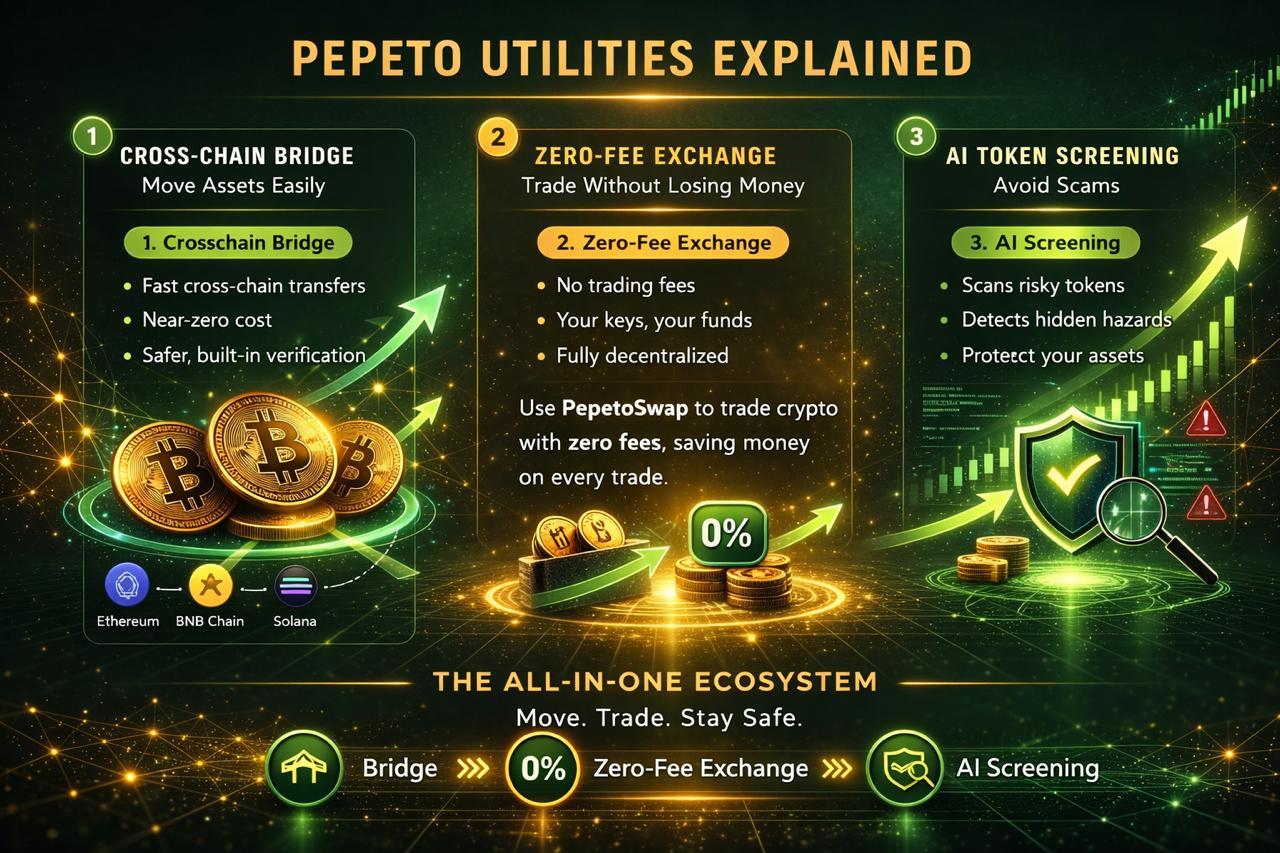
Pepeto on the other hand has PepetoSwap charging zero on every trade, a bridge moving tokens across Ethereum, BNB Chain, and Solana for nothing, and the risk scorer running before a single listing has happened.
Priced at $0.000000186 and still in presale, Pepeto offers early holders access to the full ecosystem before the Binance listing arrives. The project has raised more than $8.1 million, built by the cofounder of the original Pepe coin with a former Binance expert on the dev team. A $2,000 position today buys over 10 billion tokens, and if Pepeto matches the $11 billion cap that Pepe reached with the same 420 trillion supply and zero products, that position becomes more than $300,000. That requires roughly 150x, a target Pepe surpassed within months. And Pepeto has three working products that Pepe never had, so the path to that target has a foundation underneath it.
IPO Genie Targets Private Markets at $0.0001310 With a Structured Listing Return
IPO Genie sits at $0.0001310 with a confirmed listing price of $0.0016, implying a structured 1,127% return from entry to listing.
The project targets the $3 trillion gap between institutional deal flow and retail access. But bridging private markets to blockchain requires regulatory approvals that take years.
Mutuum Finance Offers DeFi Lending but Enters a Crowded Field Without Clear Differentiation
Mutuum Finance targets decentralized lending with variable rate pools and collateral management. The concept has merit, but the DeFi lending space already has Aave and Compound dominating TVL.
Without a technical edge or strong community, Mutuum faces the adoption wall that stalled dozens of lending protocols before it.
The Crypto News Today Will Fade but the Presale Entry You Take During the Correction Will Not
The crypto news today shows Pepeto quietly outpacing every other presale while the market watches the FOMC dip play out. The working exchange, the cross chain bridge, and the approaching Binance listing are pulling capital into Pepeto while other presales stall or crash.
With the products built and the presale still open at $0.000000186, Pepeto is the early entry most likely to turn a small position into the kind of return that corrections are remembered for. Visit the Pepeto official website now, because six months from now the investors who acted during a Fear Index of 37 will be the ones the rest of the market wishes they had followed.
Click To Visit Pepeto Website To Enter The Presale

FAQs
What is the biggest crypto news today?
The Fed held rates at 3.50% to 3.75%, Kiyosaki predicted $750K Bitcoin, and BTC ETFs posted their longest inflow streak in five months.
Is the crypto correction a good time to buy early projects?
FOMC corrections have recovered within weeks historically. Pepeto is still in presale with a Binance listing approaching.
What is Pepeto and why is it in the crypto news?
Pepeto has a zero fee exchange, cross chain bridge, and risk scorer, all audited by SolidProof with $8.1 million raised. Visit the Pepeto official website.
The post Crypto News Today: Kiyosaki Predicts $750K Bitcoin and Pepeto Keeps Raising While BlockDAG Crashes After Launch appeared first on Blockonomi.
Bitcoin just hit a six-week high, which somewhat restored the sentiment in the market. Yet, exchange inflows spiked to 6.1K BTC in a single hour. This could indicate that the rally is real, but selling pressure may be reaching a boiling point.
As fears of an extra wave of volatility become real, the special DeepSnitch AI bonus code presents the easiest way for traders to boost their chances of massive returns.
With launch slated for March 31, DeepSnitch AI’s crypto presale bonus offer provides as many as 300% extra tokens for large allocations. Since these codes expire at launch, the level of FOMO in the community is getting borderline ridiculous as traders keep adding to their allocations.

Is BTC selling pressure building?
According to Julio Moreno of CryptoQuant, hourly Bitcoin inflows into centralized exchanges exploded to 6.1K BTC on March 16. This is the highest reading since February 20, with large inflows accounting to 63% of the total figure.
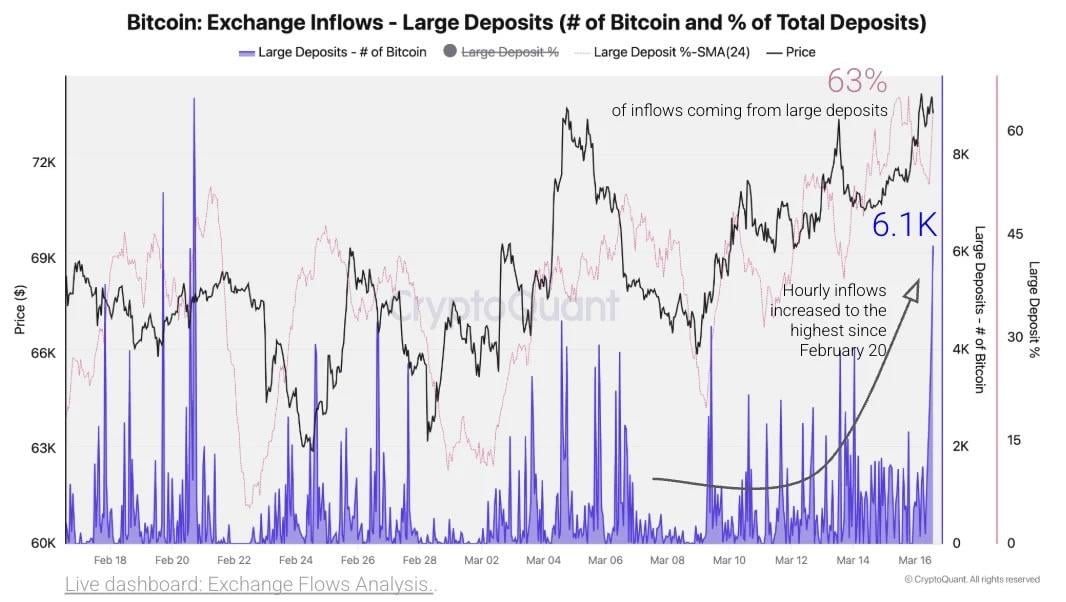
The driving force behind the inflows was Bitcoin’s 12% gradual rally in March.
Traders generally send BTC to exchanges before they sell or convert it into stablecoins, with Moreno noting that such spikes often preceded an uptick in selling pressure.
Thus, traders fear that smart money may be using the rally as an opportunity to profit. This uncertainty only contributed to traders doubling down on the special DeepSnitch AI bonus code, intending to scoop up extra tokens ahead of the March 31 launch.
Best March opportunities in crypto
1. DeepSnitch AI: How much are early investor bonus tokens worth?
Blink, and you’ll miss it. DeepSnitch AI is a project rapidly closing in on its March 31 launch. While this is enough to push FOMO to the max, the special DeepSnitch AI bonus code basically led to the project getting in on many trending lists.
So far, DeepSnitch AI has raised $2.2M at $0.04487. The main offering is an analytics platform consisting of five autonomous AI agents that can do everything from discovering rugs and honeypots, DYOR, token analysis, to real-time sentiment and FUD tracking.
The latest bonuses only enhanced these fundamentals. You can apply any presale discount code at checkout if you meet the right allocation amount. Fortunately, there are multiple tiers, meaning that there’s a special DeepSnitch AI bonus code for everyone.
The lowest one, DSNTVIP30, gets you 30% extra tokens on $2K and above. DSNTVIP50 bumps that to 50% on $5K or more, and DSNTVIP150 adds 150% to your bag for $10K and up. And the biggest presale discount code, DSNTVIP300, unlocks 300% extra on allocations of $30K and above, which works out to roughly $90K.
DeepSnitch AI is running hot. With 41.7 million DSNT already staked, community projections of 100x to 300x make it one of the largest opportunities in recent times.
All codes expire on March 31.
2. Dogecoin: DOGE breaking out?
According to CoinMarketCap, DOGE traded at $0.099 on March 18.
As the community went crazy over the special DeepSnitch AI bonus code, bears surrendered control over DOGE’s price action.
In the short-term, Dogecoin must close above $0.10 (50-day SMA) to open the test of the $0.12 breakdown level, where sellers are expected to start dumping.
A sharp rejection here sets up a range between $0.09 and $0.12 for the near term. While the chances of DOGE hovering in this range are likely, if the OG meme coin closes above $0.12, the entire script will flip, and Dogecoin could end up surging to $0.16.
3. Zcash: Will the ZEC rally continue?
ZEC pushed to $276 on March 18, sparking hopes of the privacy coin’s grand re-entry, according to CoinMarketCap.
In the short term, the $278 level is the key battleground. Holding above it keeps the short-term structure intact, allowing buyers to kickstart another attempt at $286, but a clean break below $278 shifts the advantage back to sellers and opens the path to $272 first.
If ZEC continues sliding down, it could go as low as $265 or $258.
Final words: Boost your bags
Selling pressure could return in an instant, and that’s exactly why DeepSnitch AI has been making rounds lately.
With a launch set at exactly the right time, affordable pricing, powerful utility, and the special DeepSnitch AI bonus adding as much as 300% extra DSNT to your bag, the rewards could be massive if you lock in at exactly the right time.
Don’t let the market erase your gain. Reserve your tokens in the DeepSnitch AI presale now and join X or Telegram for the latest project updates.
FAQs
1. What is the DeepSnitch AI bonus code, and how does it work?
DeepSnitch AI offers four bonus codes tiered by allocation size. DSNTVIP30 gives 30% extra tokens, DSNTVIP50 gives 50% on $5K or more, DSNTVIP150 unlocks 150% for larger positions, and DSNTVIP300 gives 300% extra on allocations of $30K and above. All codes expire at the March 31 launch.
2. Why did Bitcoin exchange inflows spike, and what does it mean for the market?
Hourly Bitcoin inflows hit 6.1K BTC on March 16, the highest since February 20, with large deposits accounting for 63% of total inflows. CryptoQuant’s head of research flagged that historically, these spikes precede increased selling pressure.
3. When is the DeepSnitch AI TGE, and what happens after?
DeepSnitch AI lists on Uniswap on March 31. The seven-day claim window opens at TGE, with DEX and CEX listings expected to follow.
The post Special DeepSnitch AI Bonus Code: Limited Time Left To Reserve 300% Extra Tokens Ahead of Launch, Bears Lose Grip On ZEC and DOGE appeared first on Blockonomi.
CryptoPotato
Total market capitalization has declined by almost $100 billion in less than 24 hours before and after the Federal Reserve’s meeting on Wednesday. The metric is now at around $2.52 trillion after falling from just below a six-week high of $2.61 trillion on Wednesday.
Over the past 24 hours, around 136,000 traders were wrecked, with total liquidations coming in at $452 million. The majority, or around 85% of them, were leveraged long positions in Bitcoin.
The big slump has sent markets back towards the middle of their six-week range-bound channel, wiping out most of the gains from the recent rally.
Hawkish Fed Rattles Traders
The dump began before the meeting but continued after Fed chair Jerome Powell’s comments that there may only be one rate cut this year. The US central bank kept rates the same at 3.5% to 3.75% in a widely expected move yesterday.
Fed policymakers maintained their forecast for an additional rate cut this year, but Powell suggested that the central bank remains concerned about stubbornly elevated inflation even before the conflict’s impact on fuel prices, reported the Associated Press.
“The rate forecast is conditional on the performance of the economy, so if we don’t see that progress, then you won’t see the rate cut,” Powell said.
“FOMC events act as volatility catalysts, but their impact depends on the underlying risk regime,” stated Swissblock on Thursday, adding, “In high-risk environments, FOMC days tend to trigger rejection or accelerate downside.”
Rate decisions tend to “amplify the existing regime,” they added, explaining that the current regime is “transitioning toward low risk, but it is not fully confirmed yet.”
“That means FOMC can still trigger volatility, but in the end, Bitcoin depends more on its own internal strength, flow, and momentum than on macro events alone.”
FOMC events act as volatility catalysts, but their impact depends on the underlying risk regime.
In high-risk environments, FOMC days tend to trigger rejection or accelerate downside.
In stabilizing regimes, they often mark local bottoms or continuation points.
The last three… pic.twitter.com/uWnVkjpHm4
— Swissblock (@swissblock__) March 18, 2026
President Donald Trump has repeatedly called for “too slow” Powell to reduce rates, but his own actions have had the opposite effect. Trump’s tariffs and now the war in Iran have caused prices to increase, which is likely to result in inflation figures going back up.
Inflation is one of the two Fed mandates for policy decisions on rates; the other is the labor market.
Crypto Market Outlook
Bitcoin is down 4.3% on the day, dropping below $71,000 on Wednesday, where it currently struggles.
Ether prices dumped 5.6% and fell below $2,200 while struggling to reclaim that level. Meanwhile, the altcoins were bleeding heavily with larger losses for Dogecoin, Cardano, Chainlink, and Zcash.
“For now, traders are expecting a bullish relief rally in spite of no changes being made,” reported Santiment. “This is likely due to the fact that the bearish price action related to the lack of cuts already occurred yesterday.”
The post Crypto Markets Tank $100B Amid Hawkish Fed Projections appeared first on CryptoPotato.
Bitrefill disclosed that it was targeted in a cyberattack on March 1, which resulted in the theft of cryptocurrency funds, and said its investigation found multiple indicators linking the incident to tactics used by the DPRK-associated Lazarus/Bluenoroff group.
The company stated that similarities in the attackers’ methods, malware, on-chain tracing patterns, and the reuse of IP and email addresses are consistent with previous operations attributed to the group.
Bitrefill Cyberattack
According to the company, the breach originated from a compromised employee’s laptop, where a legacy credential was extracted. That credential allowed access to a snapshot containing production secrets, which the attackers then used to expand their access across Bitrefill’s systems. This enabled them to reach parts of the database and certain cryptocurrency wallets.
In its latest tweet, Bitrefill said it first identified the incident after detecting unusual purchasing patterns involving some suppliers, which indicated that its gift card inventory and supply flows were being misused. At the same time, it observed that some hot wallets were being drained, and funds were sent to addresses controlled by the attackers. Once the breach was confirmed, the company shut down all systems to contain the situation.
Following the incident, Bitrefill confirmed that it has been working with external cybersecurity experts, incident response teams, blockchain analysts, and law enforcement.
The company said there is no indication that customer data was the main focus of the attack. According to its logs, the attackers ran a limited number of database queries consistent with probing activity to identify what could be extracted. This included cryptocurrency and gift card inventory. Bitrefill added that it stores minimal personal data and does not require mandatory KYC, with any verification information held by an external provider.
However, it confirmed that about 18,500 purchase records were accessed, including email addresses, cryptocurrency payment addresses, and metadata such as IP addresses. In roughly 1,000 cases where customers had provided names for specific products, the information was encrypted, but the company is treating it as potentially accessed due to possible exposure of encryption keys. Those users have been notified.
Bitrefill said it does not currently believe customers need to take specific action, but advised vigilance regarding any unexpected communications related to Bitrefill or cryptocurrency.
The company added that it has strengthened its security measures, including conducting further external cybersecurity reviews and penetration testing, tightening internal access controls, improving monitoring and logging systems, and refining incident response procedures. It said the financial losses will be covered from its operational capital, and that most services, including payments and inventory, have been restored.
Lazarus Havoc
Even as many crypto platforms have ramped up their security frameworks in recent years, threat actors continue to bypass protections. The Lazarus Group remains the sector’s most persistent and dangerous adversary, responsible for the largest crypto hack on record after stealing $1.4 billion from Bybit in February 2025.
Blockchain investigator ZachXBT previously said that breaches involving platforms such as Bybit, DMM Bitcoin, and WazirX saw stolen funds laundered with ease. The on-chain investigator had added that the laundering groups have “seemingly won the battle” over enforcement.
The post North Korea-Linked Hackers Suspected in Bitrefill Breach That Drained Wallets appeared first on CryptoPotato.
Solana’s SOL token jumped past a key technical resistance level at about $93, turning what analysts called a “39-day distribution zone” into a structural floor.
The move has brought two price targets into focus, one being an initial level near $103 and a secondary one near $113.
Breakout Above $93 Shifts Sentiment
In a March 18 post on X, chartist Ali Martinez wrote that SOL’s return above the $93 level had turned a zone previously dominated by sellers into a potential base for further gains.
According to him, the setup has put a short squeeze in motion, meaning those who had bet on lower prices could be forced to buy back their positions, with the price moving against them, which could potentially speed up the rally.
“Solana just reclaimed $93.14, flipping a 39-day distribution zone into a structural floor,” Martinez explained. “If this level holds, a bull rally could happen much faster than people think.”
The breakout fits with other technical signals on longer timeframes, including a recurring pattern on Solana’s weekly chart of back-to-back candles with long lower wicks highlighted by analyst WebTrend.
According to them, the pattern has previously come before major rallies, with the first being in 2023, where it led to a 1,604% gain, and the second occurrence happening in 2025, leading to a 142% move upwards.
Fellow market watcher Bluntz also pointed to a completed accumulation phase following the daily breakout, suggesting that if the prices stay above the mid-$90 range, it could confirm a broader trend reversal.
Although SOL indeed broke through $93 earlier today to tap $95, it has lost some traction since then and now sits below $90. It has jumped by 7% monthly, but it was still down nearly 25% over the last year. It remains more than 67% below its all-time high of nearly $293, reached about a year ago.
Improving Market Structure, But Confirmation Still in Progress
The current setup is coming off the back of a period of compressed volatility, with Solana previously trading between $80 and $87 as tightening Bollinger Bands pointed to an imminent breakout. At the time, analysts couldn’t decide on the asset’s next direction, with some predicting a move higher and others, like DrBullZeus, claiming SOL could even drop to the $50 level.
Traders could look at ETF data for further context, with figures from SoSoValue showing that as of March 17, there had been almost $1 billion in net inflows into Solana-linked spot products. Furthermore, daily inflows have turned positive again after a brief period of negative movement earlier in the month.
The post The $93 Floor: Why SOL’s Latest Breakout Could Trigger a Massive Short Squeeze appeared first on CryptoPotato.
The leading cryptocurrency experienced a significant upswing over the past several days, with its price briefly rising to as high as $76,000.
Although it was stopped there and pushed south by $5,000, some key factors, including recent whale activity, suggest it may post further gains in the near future.
BTC Isn’t Done Yet?
Despite losing some steam in the past hours, Bitcoin remains well in the green on a weekly scale and currently trades at around $71,400 (per CoinGecko’s data). As a result, many analysts have flipped toward the optimists’ corner and expect an additional price increase.
The renowned market observer Ali Martinez, for instance, claimed that a daily close above the $73,344 resistance and later turning that level into a structural floor could open the door to a pump to $79,234 and $85,555.
In a subsequent post on X, the same analyst revealed that whales have acquired 40,000 BTC over the past seven days. The USD equivalent of the stash is almost $2.9 billion (at current rates), and now this cohort of investors controls roughly 5.17 million units, or roughly 25% of the asset’s circulating supply.
Such accumulations are generally viewed as bullish because they reduce the amount of BTC available on the open market, which, combined with non-declining demand, should lead to a price surge. They may also energize smaller players to step in and further support the upward momentum.
Next on the list is the solid interest in spot BTC ETFs lately. Over the past seven days, inflows into such investment vehicles have surpassed outflows, which is the longest such streak since October last year. When institutional investors such as pension and hedge funds increase their exposure to the asset through regulated financial vehicles, they require the issuers to purchase BTC to back their shares. Put simply, consistent ETF demand makes the remaining supply scarcer, which tends to push the price north.
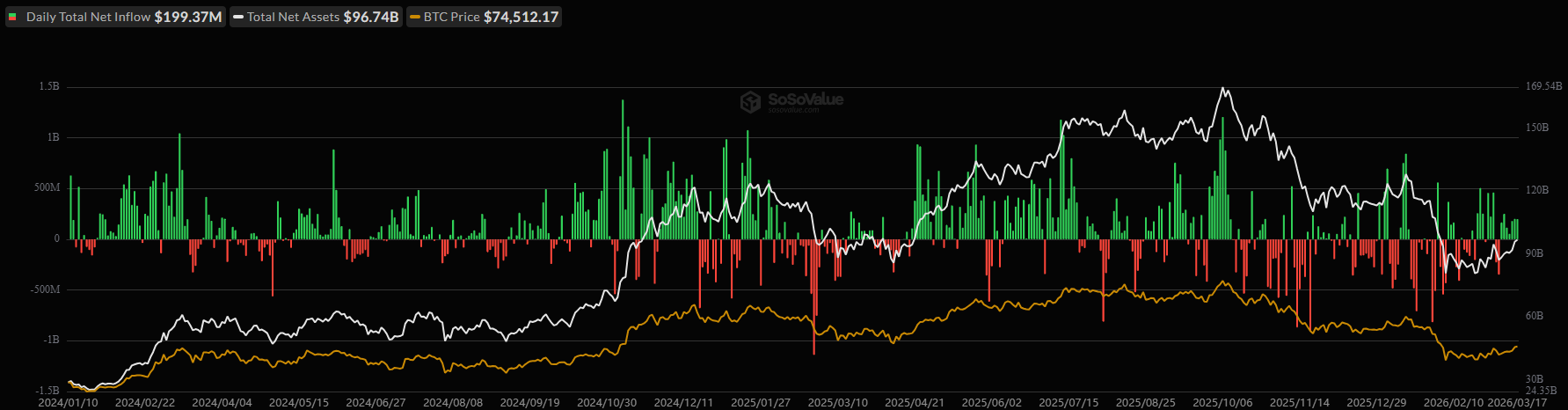
Despite the renewed appetite for such financial vehicles, many ETF investors remain underwater. Earlier this week, Axel Adler Jr. estimated that the $79,962 level represents the average cost basis of every BTC currently held inside these exchange-traded funds. If the asset trades below this mark, the cohort is sitting at unrealized losses, while breaking above would lead to paper profits.
Last but not least, we will touch upon the shrinking supply of BTC held on crypto exchanges. Today (March 18), the figure dropped to a new six-year low of approximately 2.72 million units. This suggests that investors continue to abandon centralized platforms in favor of self-custody methods, thereby reducing the immediate selling pressure.

Major Volatility Ahead?
Another industry participant who analyzed BTC’s recent performance is the X user Cantonese Cat. They claimed that the Bollinger Bands on a monthly scale have squeezed to levels never seen before.
The technical indicator shows how far the price deviates from its average, helping traders gauge volatility. When the bands tighten, it reflects a prolonged period with little turbulence: a setup that often precedes a large breakout. It is important to note that the huge move could be in any direction, or, as Cantonese Cat said:
“This will lead to a very powerful move when it expands. All that volatility that you saw over the last few months is nothing compared to what will come.”
The post 3 Reasons Why Bitcoin (BTC) Could Climb Higher in the Short Term appeared first on CryptoPotato.
In alignment with most experts’ beliefs, the United States Federal Reserve kept the key interest rates unchanged for the second consecutive time in 2026.
BTC already experienced some volatility in the hours leading up to the second FOMC meeting of the year, dropping by $5,000 at one point. However, it has bounced toward $72,000 since the news went out.
America’s central bank maintained the federal funding rate, meaning what banks are charging each other for short-term loans, in the current range between 3.50% and 3.75%.
Experts noted before today’s announcement that the likely justification for this is the war that began in the Middle East, which has immediately impacted oil prices.
“The conflict with Iran has dramatically altered the backdrop to the March Federal Open Market Committee (FOMC) meeting and significantly increases the risks to inflation and the economy,” commented Oxford Economics’ chief US economist, Michael Pearce.
Bitcoin’s price reacted immediately to the news, even though it was expected. The asset had lost $3,000 earlier today in the hours leading up to the second FOMC meeting of the year, but bounced to $72,000 after the Fed’s decision went live.
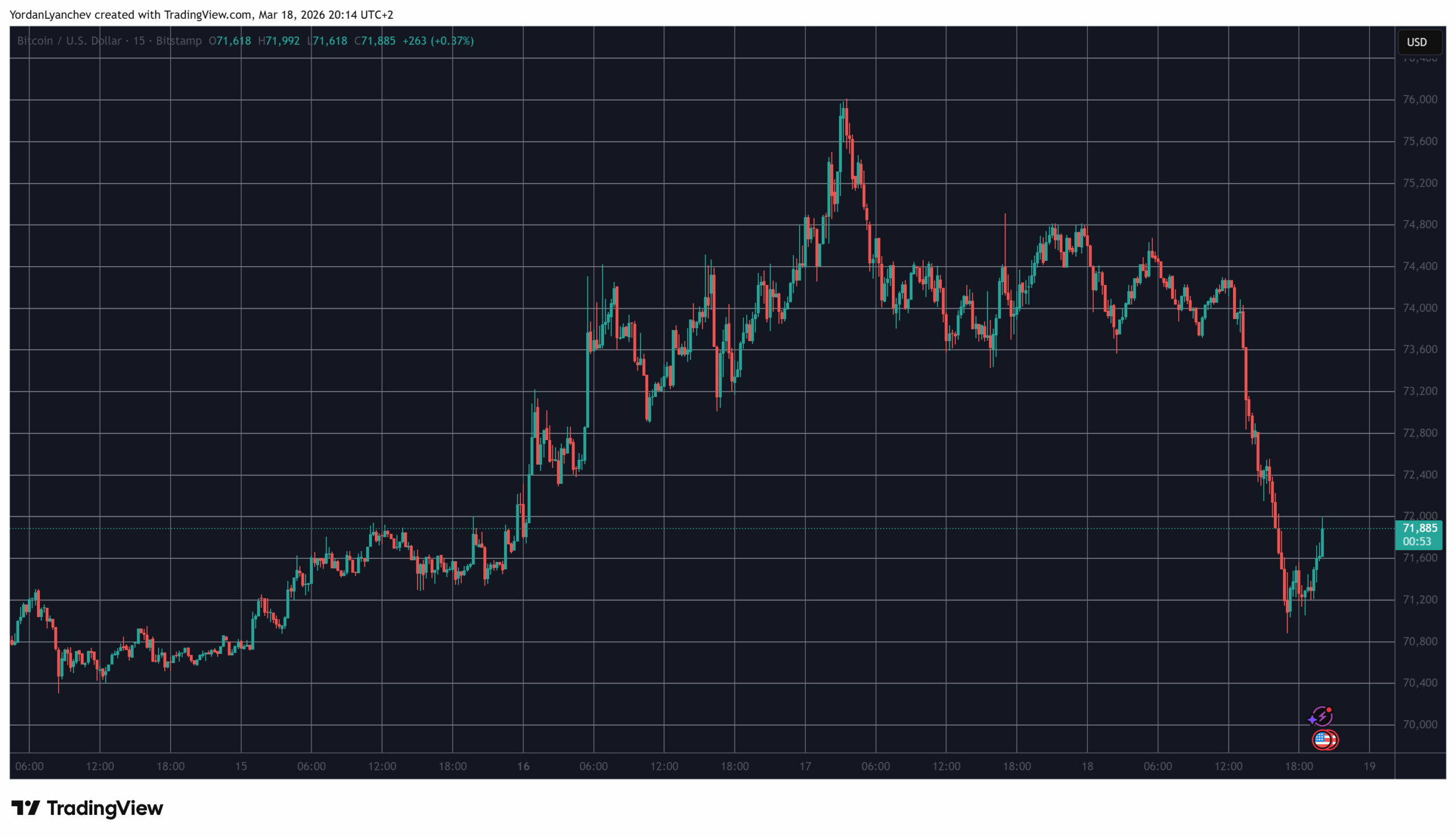
The post Bitcoin Regains Momentum as US Fed Leaves Rates Unchanged appeared first on CryptoPotato.