Cryptocurrency Posts
Crypto Briefing
Amundi's tokenized fund launch signifies a shift towards integrating blockchain in institutional finance, enhancing liquidity and operational efficiency.
The post €2.3 trillion asset manager Amundi launches tokenized fund on Ethereum and Stellar appeared first on Crypto Briefing.
The trader's actions highlight the volatile intersection of politics and crypto, raising ethical concerns and potential market manipulation risks.
The post Crypto trader goes long on 33 tokens then beefs with $TRUMP appeared first on Crypto Briefing.
Strive's Bitcoin accumulation strategy highlights a shift towards digital assets in corporate finance, potentially influencing institutional investment trends.
The post Vivek Ramaswamy’s Strive acquires 317 Bitcoin, moving into top 10 BTC holders appeared first on Crypto Briefing.
Evernorth's Nasdaq listing could enhance institutional confidence in XRP, potentially boosting its adoption and integration in financial systems.
The post XRP treasury Evernorth files with SEC to advance Nasdaq listing plan appeared first on Crypto Briefing.
Crypto.com's pivot to AI highlights the growing trend of automation reshaping industries, potentially widening the gap between tech adopters and laggards.
The post Crypto.com slashes 12% of workforce as it pivots to enterprise AI appeared first on Crypto Briefing.
Bitcoin Magazine
Bitcoin Magazine

5 Ways the Fed’s Basel III Pivot Unlocks Institutional Bitcoin Custody
Today, the Federal Reserve Board released a trio of proposals to modernize the U.S. capital framework which, if adopted, could fundamentally alter the cost and accessibility of institutional Bitcoin services. While the 14-page Board memorandum focuses on the technicalities of the “Basel III Endgame” and “GSIB surcharges,” our analysis suggests the most significant development for corporate treasuries is hidden in the proposed recalibration of operational risk.
1. Shattering the “Toxic Asset” Capital Barrier
For years, the primary hurdle for corporations looking to hold Bitcoin through traditional banks has been the “advanced approaches” to capital requirements. These internal, model-based assessments often resulted in punitive capital hits for digital asset activities, effectively labeling them “toxic” on a bank’s balance sheet. Under previous interpretations of the Basel SCO60 standard, certain digital assets were hit with a 1,250% risk weight… This proposal seeks to move beyond those models by recommending the elimination of the advanced approaches entirely for Category I and II firms. In their place, the Fed proposes a single, “expanded risk-based approach” designed to be more consistent and risk-sensitive across all asset classes.
In practice, a 1,250% risk weight combined with an 8% minimum capital ratio creates a 100% capital requirement. This “dollar-for-dollar” mandate made bank intermediation uneconomic, functioning as a de facto prohibition rather than objective risk management. Today’s proposal recommends eliminating the advanced approaches entirely for Category I and II firms. In their place, the Fed is introducing a single, “expanded risk-based approach” designed to be more consistent and risk-sensitive.
2. The Massive “Custody Service” Win
Critically, the proposed framework for operational risk is designed to “appropriately reflect business activities,” specifically naming custody services as a key area for this recalibration. The Fed staff noted that certain elements of the previous framework resulted in “excessive requirements for traditional banking activities.”
If Bitcoin custody is treated under this broader service definition, it would allow Tier 1 banks to offer these services without the prohibitive capital overhead that has previously driven up fees for corporate clients. By ensuring that operational risk requirements for custody are better aligned with actual historical risk, the Fed is signaling a move away from using punitive weights as a normative judgment.
3. A 4.8% Liquidity Injection and G-SIB Indexing
Got it. Keeping your structure intact, here is the updated Section 3 with the technical refinements (G-SIB indexing and capital relief) and the original bullet formatting you preferred.
3. A 4.8% Liquidity Injection and G-SIB Indexing
Perhaps the most notable projection for institutional adoption is the estimated impact on bank balance sheets. According to the Board memo, the cumulative impact of these proposals—including revisions to stress testing—is projected by staff to decrease the aggregate common equity tier 1 (CET1) capital requirements for Category I and II firms by 4.8 percent.
This reduction provides the nation’s largest banks with the capital “breathing room” necessary to expand into new service lines. For a corporate treasurer, this means:
- Increased Competition: More Tier 1 banks will have the capacity to offer digital asset services without hitting capital ceilings.
- Lower Fees: Reduced capital burdens on banks typically translate to more competitive pricing for fee-based services like custody.
- G-SIB Indexing: By indexing surcharges to economic growth, the Fed prevents “bracket creep,” ensuring banks aren’t penalized simply because the market value of the Bitcoin they hold grows over time.
- Regulatory Predictability: Moving to a “single set of risk-based capital calculations” provides the standardized environment corporate boards require for long-term strategic allocations.
4. Streamlining Through a Single Standard
The proposal aims to “substantially simplify the framework” by subjecting firms to a single set of risk-based capital calculations. This is intended to reduce the “regulatory lottery” where different banks faced vastly different costs for the same custody service due to overlapping or conflicting rules. For a corporation, this could ensure that Bitcoin custody becomes a more transparent, standardized banking product that fits within existing Basel market-risk and operational-risk frameworks.
5. Reversing the “Non-Bank” Migration
The Fed staff explicitly noted that excessive capital requirements in previous years may have accelerated the migration of certain banking activities to unregulated “non-banks.” According to the memo, these proposed revisions are intended to “support on-balance sheet lending and services” by regulated banks, potentially reversing some of that migration.
By bringing activities like high-scale custody back into the regulated banking fold, the Fed appears to be providing the “safe and sound” institutional infrastructure that many corporations have sought. This shift suggests an acknowledgement that transparent and liquid assets—including Bitcoin—benefit from being housed within the oversight of the federal banking system.
Conclusion
The Fed’s proposal represents a significant step toward “increasing the efficiency of capital allocation” and “reducing burden” across the U.S. banking system. By modernizing the risk weights for custody and streamlining the overall capital framework, the Federal Reserve is proposing the removal of several structural barriers that have long separated Wall Street from the digital asset ecosystem. While the final impact will depend on the results of the 90-day public comment period, the path to institutional-grade, bank-provided Bitcoin services appears significantly clearer than it did yesterday.
Disclaimer: This content was prepared on behalf of Bitcoin For Corporations for informational purposes only. It reflects the author’s own analysis and opinion and should not be relied upon as investment advice. Nothing in this article constitutes an offer, invitation, or solicitation to purchase, sell, or subscribe for any security or financial product.
This post 5 Ways the Fed’s Basel III Pivot Unlocks Institutional Bitcoin Custody first appeared on Bitcoin Magazine and is written by Nick Ward.
Bitcoin Magazine

Strive (ASST) Accumulates 13,600 Bitcoin Despite $393 Million Loss in First Six Months as Public Company
Strive, Inc., the corporate treasury firm founded by Vivek Ramaswamy, reported that it amassed 13,628 bitcoin as of March 17, 2026, placing the company among the top 10 corporate holders globally.
The accumulation came in the roughly six months following Strive’s September 2025 public listing, even as the company posted a GAAP net loss of $393.6 million for the period ending December 31, 2025.
The bulk of Strive’s bitcoin holdings came from multiple sources. Initial private investment proceeds and stock exchange activity contributed 5,886 bitcoin, while the acquisition of Semler Scientific, Inc. added approximately 5,048 bitcoin, the company said.
Semler Scientific had built its own digital asset reserve prior to the acquisition. An additional 2,694 bitcoin came from capital markets activity, including public offerings of Strive’s Variable Rate Series A Perpetual Preferred Stock (“SATA”), follow-on offerings, and at-the-market issuances.
Strive’s losses
Strive’s financial statements highlighted the tension between aggressive asset accumulation and market volatility. The firm’s GAAP net loss largely stemmed from non-cash items. Unrealized losses on bitcoin holdings accounted for $194.5 million, or nearly 50 percent of the total GAAP deficit.
Impairment of goodwill and intangible assets tied to the Semler acquisition added $140.8 million, and transaction-related expenses contributed $12.4 million. Adjusted for these items, the company’s non-GAAP loss attributable to common shareholders narrowed to $208.2 million, or $4.73 per diluted share.
Management introduced a proprietary metric, “Bitcoin Yield,” to measure the performance of its digital asset portfolio. By that measure, Strive reported a 22.2 percent yield in Q4 2025 and 13.8 percent quarter-to-date through mid-March 2026, equating to bitcoin gains of 1,305 and 1,050 coins, respectively. In dollar terms, these gains translated to $114.3 million and $78.2 million over the same periods.
The company financed its bitcoin strategy largely through structured finance products. Strive raised $148.4 million in net proceeds from its initial SATA preferred stock offering in November 2025, priced at $80 per share.
A follow-on offering in January 2026 generated $109.2 million at $90 per share. Proceeds were used to retire a $20 million loan from Coinbase Credit Inc., assumed as part of the Semler acquisition, and to exchange preferred shares for $90 million of Semler’s convertible debt.
Strive’s acquisition of Semler Scientific also included an operating business now held under a wholly-owned subsidiary, Clinivanta, focused on preventative healthcare.
The company appointed Michelle Fox, formerly Chief Medical Officer of Teleflex, as CEO of Clinivanta in February 2026, signaling an intent to develop the business alongside its primary focus on bitcoin accumulation.
Chairman and CEO Matthew Cole framed the results as a validation of Strive’s structured finance approach. “The most important success in our first six months as a public company was cementing our foundation as a structured finance company laser-focused on digital credit,”
Cole said. He emphasized that the SATA instrument provides a liquid, scalable solution for investors seeking double-digit yield with minimal volatility, aligning with Strive’s strategy of balancing bitcoin accumulation with broader financial operations.
As of March 17, 2026, Strive held $83.7 million in cash and $50.4 million in fair value of STRC preferred stock.
This post Strive (ASST) Accumulates 13,600 Bitcoin Despite $393 Million Loss in First Six Months as Public Company first appeared on Bitcoin Magazine and is written by Micah Zimmerman.
Bitcoin Magazine

BTQ Deploys First Working BIP 360 Implementation on Bitcoin Quantum Testnet
BTQ Technologies has released the first working implementation of Bitcoin Improvement Proposal 360 (BIP 360), marking an early attempt to bring quantum-resistant transaction infrastructure into a live testing environment.
Announced Thursday, the upgrade is now running on the Bitcoin Quantum testnet v0.3.0, a separate blockchain designed to simulate how Bitcoin could function in a post-quantum world. The release moves BIP 360 beyond theory, offering developers, miners, and researchers a place to test quantum-resistant transactions in practice.
BIP 360 introduces a new transaction format known as Pay-to-Merkle-Root (P2MR), which restructures how transaction data is committed on-chain.
The design removes the need to expose public keys during certain transaction paths, a feature that could become critical if quantum computers advance enough to break current cryptographic protections.
“BIP 360 represents the Bitcoin community’s most significant step toward quantum resistance and we’ve turned it from a proposal into running code,” said Olivier Roussy Newton, CEO of BTQ Technologies, in the company’s press release.
The implementation also preserves key functionality tied to Bitcoin’s scaling roadmap. According to BTQ, P2MR maintains compatibility with scripting features that underpin systems like Lightning and emerging frameworks such as BitVM and Ark, while eliminating the key-path spend mechanism introduced with Taproot that could expose public keys to quantum attacks.
Beyond the core transaction structure, the testnet includes full wallet tooling, allowing users to create, fund, sign, and broadcast P2MR transactions.
BTQ said this end-to-end functionality makes the upgrade immediately testable, rather than remaining a purely academic proposal.
Bitcoin experimentation and quantum-resistance
The company’s broader goal is to accelerate experimentation around quantum-resistant infrastructure at a time when concern over future cryptographic risks is growing. The Bitcoin Quantum testnet currently includes more than 50 miners and has processed over 100,000 blocks, according to the release.
Still, the technical progress highlights a deeper challenge: adoption.
BTQ has effectively bypassed Bitcoin’s traditional governance process by launching its own testing network rather than waiting for consensus within the main ecosystem. That decision reflects longstanding friction around major protocol changes, which historically require broad agreement among developers, miners, and users.
Christopher Tam, BTQ’s head of innovation, framed the issue in human terms. “It’s a social problem,” he told Decrypt, pointing to the difficulty of coordinating change across a decentralized network with entrenched stakeholders.
The approach also raises questions about whether a parallel chain can meaningfully influence Bitcoin’s future.
Bitcoin Quantum does not share Bitcoin’s ledger or balances, instead launching from a new genesis block with its own asset and ruleset. Users would need to opt in rather than automatically inherit the upgrade.
Even with a working implementation, BIP 360 addresses only part of the quantum threat. Tam noted that while the proposal can help secure future transactions, it does not retroactively protect older addresses that may already have exposed public keys.
The urgency, however, remains. Researchers widely expect that sufficiently advanced quantum computers could eventually break the elliptic-curve cryptography that secures Bitcoin, though the timeline is uncertain.
For now, BTQ’s testnet serves as an early proving ground. Whether its work translates into changes on Bitcoin itself may depend less on code—and more on consensus.
This post BTQ Deploys First Working BIP 360 Implementation on Bitcoin Quantum Testnet first appeared on Bitcoin Magazine and is written by Micah Zimmerman.
Bitcoin Magazine

Bitcoin Price Slides Below $70,000 as Oil Spikes, Fed Hold Tightens Financial Conditions
Bitcoin price fell below the $70,000 level on Thursday, pressured by a surge in energy prices and a steady stance from the Federal Reserve that reinforced a stronger dollar and dampened appetite for risk assets.
The largest cryptocurrency traded near $69,500, extending losses from the prior session as crude oil markets spiked amid escalating conflict in the Middle East. Brent crude climbed above $114 per barrel, while Oman crude surged as high as $150, reflecting fears of supply disruptions after attacks on key energy infrastructure tied to tensions between Iran and Israel.
The macro shock rippled across markets. European natural gas futures jumped sharply, while Nasdaq-100 equity futures slipped, signaling broader weakness in risk assets. Bitcoin price declined roughly 4% in the 24-hour period, according to Bitcoin Magazine Pro data.
Pressure on crypto intensified after the Federal Reserve held its benchmark interest rate steady at 3.50%–3.75% following its March meeting.
While the decision was widely expected, policymakers struck a cautious tone as geopolitical risks and rising energy costs threaten to keep inflation elevated.
That shift has altered expectations for monetary policy. Market pricing now reflects limited chances of rate cuts in 2026, with some traders even assigning a small probability to further tightening. Higher-for-longer rates tend to weigh on assets like Bitcoin by increasing the appeal of yield-bearing instruments and strengthening the dollar.
Bitcoin price sell off
Bitcoin price price briefly climbed above $75,000 earlier this week before sliding sharply over the past few days to fall back below $70,000.
The sell-off extended beyond crypto. The S&P 500 and global equities declined, while gold also pulled back from recent highs despite ongoing conflict, suggesting investors are reducing exposure across multiple asset classes.
Geopolitical tensions remain the key driver. Iran’s reported attacks on regional energy infrastructure, including assets linked to Qatar’s liquefied natural gas exports, have raised concerns about supply disruptions.
At the same time, U.S. officials are weighing further military involvement to secure shipping routes through the Strait of Hormuz, a critical artery for global oil flows.
As long as energy prices remain elevated and central banks maintain a restrictive stance, Bitcoin price is likely to trade in line with broader macro conditions rather than idiosyncratic crypto catalysts.
The $70,000 level now stands as a key psychological threshold, with further downside risk if volatility in commodities and geopolitics persists.
This post Bitcoin Price Slides Below $70,000 as Oil Spikes, Fed Hold Tightens Financial Conditions first appeared on Bitcoin Magazine and is written by Micah Zimmerman.
Bitcoin Magazine

SEC Approves Nasdaq Rule to Trade Tokenized Securities, Paving Way for Blockchain Integration
The U.S. Securities and Exchange Commission (SEC) has approved a Nasdaq rule change that allows certain securities to be traded in tokenized form, a move that integrates blockchain technology into traditional stock market infrastructure.
The approval, issued Wednesday, is part of a broader effort to explore digital representations of regulated assets while maintaining investor protections and market stability.
Under the new framework, eligible securities — including stocks in the Russell 1000 Index and exchange-traded funds (ETFs) tracking major benchmarks such as the S&P 500 — can be represented and traded as tokenized assets on Nasdaq.
These tokenized versions are fully interchangeable with traditional shares, sharing the same ticker symbols, CUSIP numbers, and shareholder rights.
Investors holding tokenized securities retain standard protections, including voting rights, dividend access, and claims on residual assets, ensuring consistency with existing securities laws.
The system operates as a pilot program through the Depository Trust Company (DTC), which handles post-trade settlement and tokenization. Market participants can choose to settle trades in tokenized form via a designated instruction at order entry.
Earlier this month, Nasdaq partnered with Payward, Kraken’s parent company, to enable the trading of tokenized stocks between traditional markets and blockchain networks using Payward’s xStocks platform.
A nod to Bitcoin
This move won’t directly affect Bitcoin’s price or network, but it’s a nod to a growing regulatory comfort with blockchain-based assets, which could indirectly boost institutional interest in digital currencies.
By integrating tokenized securities into mainstream markets, it may pave the way for broader adoption of crypto infrastructure and financial products that interact with Bitcoin.
If tokenization requirements are not met, trades default to traditional settlement. Nasdaq confirmed that its core trading infrastructure — including order types, routing strategies, trading sessions, and market data feeds — remains unchanged, ensuring tokenized securities are fully integrated into existing systems.
JUST IN:
— Bitcoin Magazine (@BitcoinMagazine) March 18, 2026SEC approves Nasdaq rule change to enable tokenized securities trading
pic.twitter.com/FUxP1LKhUU
Settlement continues on a T+1 basis, aligning tokenized trading with current standards.
Nasdaq emphasized that a tokenized share and its traditional counterpart will trade on the same order book, with identical execution priority and market data treatment. Surveillance systems will monitor both forms of the security using the same underlying data, accessible to both Nasdaq and FINRA.
The exchange will issue alerts identifying which securities are eligible for tokenized trading and will notify members at least 30 days before launching any tokenized instruments.
The SEC, in its approval, said the proposal meets regulatory requirements designed to protect investors and maintain fair and orderly markets.
The Commission specifically cited Section 6(b)(5) of the Securities Exchange Act, which requires exchange rules to prevent fraud, promote equitable trading principles, and remove impediments to a free and open market.
According to the document, tokenized securities must mirror traditional shares in rights and privileges, limiting the risk of divergence in value or investor protections.
The DTC pilot provides a controlled framework for blockchain-based trading without introducing new market risks.
The approval reflects growing momentum toward tokenization in regulated markets. Exchanges and infrastructure providers are increasingly exploring blockchain representations of conventional assets while remaining within the bounds of existing law.
Nasdaq has indicated that alternative tokenization methods are under discussion and would require separate filings with the SEC.
This post SEC Approves Nasdaq Rule to Trade Tokenized Securities, Paving Way for Blockchain Integration first appeared on Bitcoin Magazine and is written by Micah Zimmerman.
CryptoSlate
The stablecoin debate in Washington is increasingly becoming a fight over a single question: who gets to keep deposit insurance on-chain?
FDIC Chair Travis Hill signaled that payment stablecoins under the GENIUS Act should not qualify for pass-through insurance, while tokenized deposits that meet the legal definition of a deposit would retain the same insurance treatment as traditional bank accounts.
That distinction may prove decisive.
If banks can offer on-chain dollars that preserve deposit insurance while stablecoins cannot, the competitive balance shifts. Stablecoins may still dominate open networks, but banks would retain the core advantage that has always anchored the financial system: insured money.
In that scenario, the stablecoin battle is no longer just about technology or distribution. Whether users prefer open, programmable dollars without insurance or bank-issued tokens that carry the full weight of the existing safety net will be the deciding factor.
In a Mar. 11 speech at the ABA Washington Summit, Hill said the agency plans to propose that payment stablecoins subject to the GENIUS Act are not eligible for pass-through insurance.
In the same section of the speech, he said the FDIC also plans to clarify that tokenized deposits that satisfy the statutory definition of a deposit should receive the same regulatory and deposit insurance treatment as non-tokenized deposits.
Hill also said the agency wants to comment on how existing pass-through rules should apply to tokenized deposit arrangements involving third parties.
The FDIC Chair's speech effectively sketches a two-tier map of on-chain dollars.
Under that map, payment stablecoins can be regulated and widely used, yet would lack federal insurance marketing rights and, if Hill's proposal sticks, would not get pass-through insurance.
On the other hand, tokenized deposits remain within the legal category of bank deposits when they qualify, which means they can retain the core advantage of bank money: access to the existing deposit-insurance regime.
| Feature | Payment stablecoins | Tokenized deposits |
|---|---|---|
| Legal category | Payment token under GENIUS framework | Bank deposit, if it meets deposit definition |
| Insurance treatment | No FDIC pass-through insurance under Hill’s proposal | Same treatment as ordinary deposits, if structured as deposits |
| Who can issue | Banks or nonbanks | Banks |
| Core advantage | Open-network usability | Deposit status and insurance framework |
| Core weakness | No deposit-insurance wrapper | May stay permissioned / bank-controlled |
This divide feeds into the broader legislative fight over the Clarity Act in Washington, where banks and crypto firms are clashing over whether stablecoins should be allowed to offer yield.

Same blockchain rails, different legal reality
This is part of a broader regulatory thaw. In March 2025, the FDIC said FDIC-supervised institutions may engage in permissible crypto and digital asset activities without prior approval, provided the risks are appropriately managed.
In 2025, the FDIC also withdrew from several interagency crypto statements, including one that had suggested public distributed-ledger activity was likely inconsistent with safe and sound banking.
Then, in December 2025, the FDIC proposed an application framework for FDIC-supervised banks that want to issue payment stablecoins through subsidiaries under GENIUS.
In March 2026, the FDIC, the Fed, and the OCC also clarified that tokenized securities generally receive the same capital treatment as their non-tokenized counterparts.
Put together, those moves amount to a much clearer path back into blockchain-based finance for banks.

The US is now separating on-chain dollars into at least two buckets.
Payment stablecoins are designed for payment and settlement, can be issued by banks or nonbanks under GENIUS, and are attractive because they can run on open blockchain networks.
Hill is drawing a bright line around insurance.
Tokenized deposits fall under traditional deposit regulation when they meet the deposit definition, which gives them a different legal footing. The competition becomes stablecoins versus bank money made portable on-chain.
The banking industry's concern is concrete. A February 2026 New York Fed staff report argued that stablecoins can erode banks' deposit franchises and also transmit liquidity stress into the banking system, forcing partner banks to hold more reserves and potentially reducing lending.
Standard Chartered estimates said US banks could lose about $500 billion in deposits by the end of 2028 if stablecoin adoption accelerates.
Hill's distinction offers banks a way to answer stablecoins with a form of on-chain money that still counts as bank funding.

What tokenized deposits look like today
On Jan. 9, BNY said it had taken the first step in a strategy to tokenize deposits by enabling an on-chain, mirror representation of client deposit balances on its Digital Assets platform.
BNY also made clear what kind of product this is: it runs on a private, permissioned blockchain, begins with collateral and margin-workflow use cases, and represents participating clients' existing demand-deposit claims against the bank.
The likely near-term winner for tokenized deposits is institutional settlement.
This development sits within a growing market for tokenized finance. McKinsey estimates tokenized market capitalization could reach around $2 trillion by 2030 in its base case, with a range of $1 trillion to $4 trillion, excluding stablecoins to avoid double-counting.
McKinsey also identifies cash and deposits among the likely front-runners.
At the same time, an IMF paper from March 2026 found that shocks to stablecoin demand can push down short-term Treasury yields, weaken the US dollar, and spill over into crypto and equity markets.
The form of digital dollars is becoming a macro-relevant market infrastructure.

What stablecoins still have
New York Fed research argues that the real edge of stablecoins lies in their use on global, open-access, permissionless systems.
The same research says the stablecoin market capitalization recently exceeded $260 billion and that annual organic stablecoin transaction volume rose from $3.29 trillion in 2021 to $5.68 trillion in 2024.
Stablecoins still have distribution, reach, and composability advantages that bank tokens may struggle to match, especially if bank products launch first in private or permissioned environments.
A second New York Fed staff report, published in February 2026, provides a framework for understanding the endgame. It found that the optimal outcome depends on regulatory costs and bank incentives.
The bull case for banks and tokenized deposits assumes that Hill's proposal becomes final substantially as described.
More banks would launch tokenized-deposit products, and these tokenized deposits would become the preferred on-chain cash leg for regulated tokenized securities and funds by combining programmability with deposit status and existing compliance infrastructure.
That outcome is strengthened by the Mar. 5 capital-neutral treatment for tokenized securities and by recent bank product launches, such as BNY's.
The bull case for stablecoins assumes the insurance distinction weighs less than network effects.
| Market function | Likely winner | Why |
|---|---|---|
| Open, borderless payments | Stablecoins | Wallet access, composability, global reach |
| Cross-border internet-native transfers | Stablecoins | 24/7 transferability and open-network distribution |
| Institutional settlement | Tokenized deposits | Deposit status, compliance, bank integration |
| Collateral and margin workflows | Tokenized deposits | Fits permissioned institutional systems |
| Regulated tokenized-asset markets | Tokenized deposits | Better fit with bank/legal infrastructure |
Stablecoins keep winning where universal wallet access, composability, 24/7 transferability, and cross-border use dominate.
Banks still participate, but through stablecoin subsidiaries under GENIUS rather than through deposit-token products, especially if tokenized deposits stay mostly permissioned and institution-only.

The market segmentation ahead
If both stablecoins and tokenized deposits can move on-chain, with only one category keeping ordinary deposit treatment, the market may start segmenting by function.
Open, borderless, internet-native payments may lean toward stablecoin-heavy solutions. Institutional settlement, collateral movement, and regulated tokenized-asset markets may tilt toward tokenized deposits.
Hill described a forthcoming proposal and said the FDIC is interested in comments, especially on the stablecoin pass-through issue and on tokenized-deposit arrangements involving third parties.
Hill tied deposit treatment to whether the product actually satisfies the statutory definition of a deposit, and the FDIC still wants comment on third-party structures. The design risk is real.
Banks can compete by keeping deposit status on-chain. Stablecoins may dominate open networks, and tokenized deposits may dominate regulated settlement.
The outcome depends on whether the insurance advantage outweighs the network advantage, and whether banks can build deposit products that work across the same open systems that stablecoins already operate in.
The post Stablecoins just lost key battle as insurance protection to be reserved only for bank-issued tokens appeared first on CryptoSlate.
FTX's fourth round of distributing bankruptcy recoveries arrives at a different moment. The estate will begin sending roughly $2.2 billion to eligible creditors on Mar. 31, just as Bitcoin (BTC) pushed back above $70,000 into what Glassnode called a thin $72,000-$82,000 on-chain zone.
FTX announced on Mar. 18 that its fourth distribution will begin Mar. 31 and end Apr. 3, with eligible creditors expected to receive funds via BitGo, Kraken, or Payoneer within 1 to 3 business days.
Dotcom customer claims receive an incremental 18% to reach 96% cumulative recovery, US customer claims receive 5% to reach 100%, and general unsecured and digital asset loan claims each receive 15% to reach 100%. Convenience claims stay at 120% cumulative.
This is the largest FTX distribution since the more than $5 billion second round in May 2025 and is 37.5% larger than the $1.6 billion third distribution in September 2025.
The nominal size alone makes it a real liquidity event, even though it falls short of half the scale of the May round.


Bitcoin's current structure
Bitcoin currently trades around $70,000 with an intraday low of $69,500, after yesterday's high of $74,603
Glassnode's Mar. 18 report said BTC had broken above $70,000 and entered a thinly accumulated $72,000 to $82,000 zone with limited on-chain resistance.
The market has probed into that zone but sits right on or just below the lower boundary, still working to hold the breakout cleanly.
Only about 60% of the supply is back in profit. Glassnode says a sustained move above 75% would be needed to confirm a genuine early bull transition.
The report still treated this as an early conviction rather than a fully validated bull regime.
As a result, the current setup is defined by absorption. Short-term holders realized profit spiked to $18.4 million per hour as BTC approached $74,000, echoing the same sell-into-strength behavior seen in February.
If the market can digest that selling and stay above $70,000, higher levels like the True Market Mean near $78,000 and the upper air-gap band near $82,000 become more plausible.
However, if absorption fails, the move still looks like a fragile bear market recovery rather than a durable trend change.
The current recovery looks more spot-led than leverage-led.
Glassnode says ETF allocations have rebounded, spot cumulative volume delta has turned higher, Coinbase spot activity has stabilized and turned positive, and CME futures positioning stays subdued.
CoinShares adds that digital asset investment products took in $1.06 billion last week, with Bitcoin accounting for $793 million, extending the three-week Bitcoin inflow run to $2.2 billion.
Derivatives present a constructive but restrained picture, as Glassnode sees the market emerging from negative funding and defensive hedging.
Deribit says BTC funding has moved back to roughly neutral, BTC futures-implied yields are flat at around 2% to 3% across tenors, and seven-day BTC implied volatility sits near 52%.
That profile fits a recovering market lacking aggressive speculative conviction.

Why FTX cash can have an impact now
CoinShares says Bitcoin investment products absorbed $2.2 billion over the last three weeks.
FTX is distributing $2.2 billion in cash. The two flows differ in nature: one represents direct Bitcoin fund inflows, while the other represents bankruptcy cash distributed to many creditors. Yet, their nominal size is identical.
The payout tests recycled liquidity, but it is unclear if even a small recycling ratio is enough to matter in a market trying to hold above $70,000 while absorbing $18.4 million per hour in short-term holder profit-taking.
Besides, Glassnode flagged that the FTX cash lands after the March options expiry tailwind. About $4.5 billion of negative dealer gamma sits around $75,000, with $3.9 billion expiring this month.
The report warns that once quarter-end expiry passes, the unwinding of dealer hedges could create headwinds or consolidation. FTX cash may hit just as a key supportive market mechanism fades.

A recycling model
At a 5% recycle rate, $110 million represents about 13.9% of last week's Bitcoin fund inflows and roughly 6 hours at the current $18.4 million-per-hour short-term holder realized profit pace.
Important, though likely insufficient to drive direction alone.
At a 10% recycle rate, $220 million equals about 27.7% of last week's Bitcoin fund inflows and about 12 hours of current short-term holder profit realization. Large enough to affect the price action over a short window, especially if ETF flows stay positive.
At a 20% recycle rate, $440 million represents about 55.5% of last week's Bitcoin fund inflows and nearly 24 hours of current short-term holder profit realization. At that point, the payout becomes a meaningful marginal bid.
At a 30% recycle rate, $660 million equals about 83.2% of last week's Bitcoin fund inflows. This is the level at which an FTX-driven re-risking wave would become visible relative to recent institutional spot demand.
If the full $2.2 billion were spread evenly over three days, that would be $733 million per business day.

Spread mechanically over 72 hours, it amounts to about $30.6 million per hour, versus the current $18.4 million per hour short-term holder realized profit rate. Even modest recycling rates become worth watching amid thin liquidity, where absorption capacity determines direction.
| Recycle rate | Cash potentially rotating back | Share of last week’s BTC fund inflows | Equivalent at $18.4M/hour STH profit-taking | Takeaway |
|---|---|---|---|---|
| 5% | $110M | 13.9% | ~6 hours | Noticeable, but likely not enough alone |
| 10% | $220M | 27.7% | ~12 hours | Can affect short-term price action |
| 20% | $440M | 55.5% | ~24 hours | Becomes a meaningful marginal bid |
| 30% | $660M | 83.2% | ~36 hours | Large enough to show up clearly in the tape |
The bull case assumes a 10% to 20% recycling rate, combined with positive ETF demand and a continued spot-led bid. BTC reclaims and holds the lower air-gap boundary, digests short-term holder selling, and starts trading toward the $78,000 True Market Mean, then $82,000.
The key tell would be price strength without a big re-leveraging in futures, validating the healthier spot-led recovery narrative.
The bear case assumes most recipients de-risk, hold cash, or redeploy elsewhere. BTC loses the lower air-gap boundary and drifts back toward the prior $64,000-$72,000 accumulation cluster.
The market effectively votes that returned FTX cash cannot overpower existing profit-taking and post-expiry headwinds.
The late-March window becomes a test of recycled liquidity landing in a spot-led market before leverage has fully returned.
What dictates the outcome is how much of the returned FTX money becomes fresh crypto demand.
The post Over $2B in “lost” Bitcoin to hit markets this month creating sell pressure within fragile $67k–$74k range appeared first on CryptoSlate.
The US Securities and Exchange Commission (SEC) has drawn its clearest line yet around which parts of crypto it views as outside securities law, a move that hands the industry a new map of regulatory winners while opening a narrower lane for privacy-focused technology.
However, the SEC’s new crypto taxonomy does more than just redraw markets. Quietly, the new approach blocks a regulatory path that could have forced developers and software providers into KYC-heavy broker-dealer regimes.
By classifying much of crypto activity as securities brokerage, the SEC’s earlier approach could have forced developers and software companies to register as broker-dealers, thereby requiring them to comply with strict identity checks (KYC) and anti-money-laundering (AML) rules.
In an interpretive release issued on March 17, alongside the Commodity Futures Trading Commission, the SEC categorized crypto assets into five categories: digital commodities, digital collectibles, digital tools, stablecoins, and digital securities.
The agency said digital commodities, digital collectibles, and digital tools are not themselves securities, while stablecoins may or may not be securities depending on their structure, and digital securities remain inside the SEC’s core jurisdiction.
Chair Paul Atkins framed the shift in broad terms. In remarks announcing the policy, he said the commission was implementing a token taxonomy under which digital commodities, digital collectibles, digital tools, and payment stablecoins under the GENIUS Act are not deemed securities, while digital securities, meaning tokenized traditional securities, remain subject to federal securities law.
The CFTC said it would administer the Commodity Exchange Act in a manner consistent with the SEC’s interpretation, giving the guidance immediate weight beyond a single-agency speech.
Named commodities move to the front
The digital commodity bucket is the most important part of the release because it reaches the largest pool of liquid crypto assets and provides a clearer path away from the securities hostilities overhang that defined the Gary Gensler era.
The SEC describes a digital commodity as a fungible crypto asset linked to the programmatic operation of a functional crypto system, with value tied to utility and supply and demand rather than the essential managerial efforts of others.
That definition strengthens the policy position around Bitcoin and Ethereum, but it also extends formal comfort to networks that have sat in a more contested middle ground, including Solana, Cardano, XRP, and Avalanche. XRP stands out because it spent years at the center of one of the industry’s highest-profile securities fights.
Stuart Alderoty, Ripple's chief legal officer, noted:
“We always knew XRP wasn't a security – and now the SEC has made clear what it is: a digital commodity.”
Solana, Cardano, and Avalanche also gain because the SEC release does more than classify tokens. It also addresses the network activities that help secure them.
For proof-of-work networks, the SEC said covered protocol mining activities do not involve the offer and sale of a security, which supports Bitcoin, Litecoin, Dogecoin, and Bitcoin Cash. For proof-of-stake networks, the commission said covered protocol staking activities do not involve the offer and sale of a security either.
Meanwhile, that interpretation extends to staking by token holders, the roles of third-party validators and custodians, and the issuance and redemption of staking receipt tokens, which serve as one-for-one receipts for deposited non-security crypto assets.
That gives another layer of support to ETH, Solana, Cardano, Avalanche, Polkadot, Tezos, and Aptos.
The release also says redeemable wrapped tokens backed one-for-one by deposited non-security crypto assets and redeemable on a fixed one-for-one basis do not involve the offer and sale of a security in the circumstances described by the SEC.
Collectibles, memes, and utility tokens gain a lane
The second group of winners is smaller in market value but more surprising in political and cultural terms.
The SEC’s digital collectible category includes assets designed to be collected or used and lacking rights to income, profits, or assets of a business enterprise. Its examples include CryptoPunks, Chromie Squiggles, Fan Tokens, WIF, and VCOIN.
The inclusion of WIF, a meme coin, signals to markets that some community-driven tokens can be analyzed less as capital-raising instruments and more as cultural or collectible assets, though the SEC notes that hybrid structures can still raise securities questions.
The digital tools category is another beneficiary. The SEC defines digital tools as crypto assets that perform practical functions such as memberships, tickets, credentials, title instruments, or identity badges. Its examples include Ethereum Name Service (ENS) domain names and CoinDesk’s Microcosms NFT Consensus Ticket.
The commission says digital tools are on-chain analogues to physical utilities and that people acquire them for functional use rather than a claim on a business enterprise.
This is significant beyond the listed examples because it gives a clearer route for builders working on identity, access, naming, and credential systems. For a sector that has often had to explain why a token is a tool rather than an investment product, the SEC has now supplied its own framework.
Stablecoins also move into a stronger position, though with more conditions than the commodity bucket.
The release states that, once the GENIUS Act becomes effective, payment stablecoins issued by permitted payment stablecoin issuers under the GENIUS Act are excluded from securities status by statute. It also says other stablecoins may or may not be securities depending on the facts and circumstances.
That gives regulated dollar-linked issuers a clearer federal lane while keeping yield-bearing and more structured designs under closer scrutiny.
Privacy gets a quiet opening
While the SEC’s taxonomy creates no standalone privacy bucket, it narrows the range of crypto assets and crypto activity that sit inside securities treatment.
In the release, the agency says digital commodities, digital collectibles, and digital tools are not themselves securities, while also stating that the interpretation does not itself create new legal obligations. The commission separately says the Bank Secrecy Act and the Anti-Money Laundering Act are outside the scope of the action.
That language is why privacy advocates are treating the move as an opening for the sector, which had come under increased scrutiny over the past few years.
Independent journalist L0la L33tz argued in a post on X that the interpretation is a major privacy win because a broader broker-dealer framing for digital-asset developers and software-linked services could have pushed more of the sector toward KYC and AML obligations under securities law.
Her reading captures the shift in jurisdictional terms: a narrower SEC perimeter leaves more room for crypto software and non-security asset activity to exist outside the commission’s core registration regime.
The practical benefit of this is strongest around self-custody, open-source development, and non-custodial tools. The SEC’s digital tools category supports that view because it treats functional on-chain assets as utilities acquired for use rather than as claims on a business enterprise.
For privacy-focused builders, wallet software, credential layers, and related infrastructure, the release offers a clearer argument that software-linked crypto activity should be analyzed in terms of function and control rather than automatically through an investment-product lens.
Meanwhile, the remaining compliance boundary sits with Treasury and FinCEN. FinCEN’s 2019 guidance says an anonymizing software provider is not a money transmitter because supplying software differs from accepting and transmitting value.
In the same guidance, FinCEN says an anonymizing services provider that accepts and retransmits value is a money transmitter under its rules.
That leaves privacy advocates with a meaningful policy gain inside securities law while AML and money-transmission obligations continue to be handled through a separate federal framework.
The deeper market message
The broader significance of the SEC release is that it offers a sorting mechanism the industry has wanted for years without dissolving every legal question around token issuance and distribution.
The commission says a non-security crypto asset can still be offered and sold, subject to an investment contract that remains a security.
In practice, that means classification helps most when a token is closely tied to a functioning network, a practical use case, or a decentralized system rather than to a promoter’s ongoing promises about enterprise value.
That leaves the winners from this framework easier to identify. Bitcoin, ETH, Solana, XRP, and other named digital commodities gain the clearest immediate boost. Staking networks, wrapped non-security assets, digital tools, and payment stablecoins receive stronger legal framing.
Meanwhile, privacy-focused crypto projects gain a narrower but still important opening because the SEC has drawn a firmer boundary around its own authority.
So, the next chapter for the market will turn on how exchanges, issuers, developers, and Treasury-led compliance agencies respond to that new map.
The post SEC drastically reduces KYC pressure on Bitcoin, XRP, and Solana with revamped crypto rules appeared first on CryptoSlate.
US banks “reduced” their credit risk after 2008 by shifting more of it to nonbank lenders.
Since 2008, banks have shifted a growing share of their lending to nonbanks like private credit funds, making it their fastest-growing loan category.
That shift doesn’t signal another 2008-style crisis today, but it does show where trouble could surface first if private credit starts to crack.
This week, traders, analysts, and Investment firms are reviving a familiar question: are US banks setting up a repeat of 2008?
The clean answer is no, based on the publicly available numbers. The same debate also points to a real shift in bank balance sheets that deserves a harder look.
The chart below, which is circulating on X, shows that bank lending to nondepository financial institutions, or NDFIs, rose 2,320% over 15 years.
An FDIC note documented $1.32 trillion of those loans by the third quarter of 2025, up from $56 billion in the first quarter of 2010, and called the category the fastest-growing loan segment since the 2008-09 crisis.

After 2008, large banks pulled back from riskier direct lending, but they also funded the nonbank lenders that stepped in. That group includes private credit vehicles, mortgage finance firms, securitization structures, and other parts of the shadow banking system. The risk moved elsewhere rather than disappearing.
However, that does not mean banks are already in trouble. The FDIC’s latest industry profile showed the banking sector earned $295 billion in 2025, posted a fourth-quarter return on assets of 1.24%, reduced unrealized securities losses to $306 billion, and counted 60 problem banks, still within the agency’s normal non-crisis range. Those are not the numbers of a system already in a panic.
The issue is where losses, redemptions, and liquidity pressure land when the lending chain has more links.

For crypto, that changes the timing of any stress. A classic bank panic starts at the bank. In the current structure, stress can begin in a fund, a warehouse line, or a financing vehicle, then work backward into banks if marks fall, borrowers miss payments, or investors ask for cash faster than the assets can be sold.
| Indicator | Latest reading in the source set | What it shows |
|---|---|---|
| Bank loans to NDFIs (data) | $56 billion in Q1 2010; $1.32 trillion in Q3 2025 | The exposure became one of the largest post-crisis shifts on bank balance sheets. |
| Growth rate of NDFI lending (study) | 21.9% annual compound growth from 2010 to 2024 | The category expanded much faster than most traditional loan books. |
| Committed bank lines to private-credit vehicles (note) | $8 billion in Q1 2013; $95 billion in Q4 2024; about $56 billion utilized | Large banks are tied to the private-credit system through direct financing lines. |
| Total committed bank lines to private credit and private equity (research) | About $322 billion in Q4 2024 | The funding links extend beyond one niche product. |
| US bank earnings and health check (report) | $295.6 billion net income; 1.24% ROA; $306.1 billion unrealized losses; 60 problem banks | Banks are not yet showing a broad 2008-style breakdown. |
| Global nonbank share of finance (report) | About 51% of global financial assets in 2024 | The migration of credit away from banks is global, not a US outlier. |
| Bitcoin snapshot (market) | $73,777; +0.05% in 24 hours; +4.55% in 7 days; +7.51% in 30 days; 58.5% dominance | BTC was firm while the banking and private-credit debate spread. |
The post-crisis shift is now visible in the numbers
The official numbers make the structural change hard to dismiss. The FDIC said bank lending to NDFIs compounded at 21.9% a year from 2010 to 2024.
By the third quarter of 2025, the total had reached $1.32 trillion, or roughly 10% of bank lending in the agency’s analysis.
Not every dollar in that bucket is private credit, and exposures in the category carry different levels of risk. Even so, the scale shows that a large share of credit intermediation now sits in institutions that do not take deposits and often disclose less than banks do.
That nuance is important. NDFI is a broad label. It can include mortgage intermediaries, consumer finance firms, securitization vehicles, private equity funds, and other nonbank lenders, alongside private-credit funds.
A sloppy reading turns the whole bucket into one bet on private credit. A more accurate reading is that banks built a large, fast-growing set of links to the broader nonbank system.
Private credit is one visible part of that system, and one of the most closely watched because it grew during a long period of higher rates, tighter bank regulation, and steady investor demand for yield.
A Federal Reserve staff note sharpens this point. It is estimated that committed credit lines from the largest US banks to private-credit vehicles rose from about $8 billion in the first quarter of 2013 to about $95 billion by the fourth quarter of 2024, with roughly $56 billion already drawn.
The same work put total committed bank lines to private credit and private equity at about $322 billion.
That does not prove systemic failure is close. The Fed’s own conclusion was more restrained: direct financial-stability risk from this channel looked limited so far because the largest banks appeared able to absorb major drawdowns.
Even so, growing links between banks and private-credit vehicles warrant close attention.
The risk is best framed as continued bank funding for parts of the lending chain, which changes where stress appears first.

In the public market, losses print quickly. In private markets, they can move more slowly because marks update less often, assets are less liquid, and investor withdrawals are managed through product rules.
That delay can make the system look calm until cash needs force a sharper repricing.
Global context points in the same direction. The Financial Stability Board said the nonbank financial intermediation sector accounted for about 51% of total global financial assets in 2024 and continued to grow at roughly twice the pace of banking, according to its latest report.
This is no longer a US edge case. Credit has been moving into institutions outside the classic banking model for years, and the US private-credit boom is part of that wider pattern.

Why the trade is getting tested now
The issue became more urgent as structural data arrived while private credit began to show public strain. Some private-credit vehicles have limited or managed withdrawals, while JPMorgan tightened some lending against private-credit portfolios after markdowns.
Those events stop short of establishing a full-market break and instead show where pressure is likely to emerge first: fund liquidity, financing terms, and collateral values.
That is also why any comparison to 2008 needs restraint.
The same FDIC report that drove renewed attention also showed banks entering this phase from a stronger income position than during past crises. The public banking system is not in free fall.
The greater concern is a funding architecture that could transmit stress from nonbank lenders back into banks if private assets keep repricing lower or if investors want cash before loans can be sold or refinanced.
Borrower quality and refinancing deserve more attention than broad slogans. In a recent Financial Times interview, Partners Group’s chair said that private-credit default rates could double from their roughly 2.6% historical average over the coming years. That is not an official baseline, and it should not be treated as one.
It does, however, capture the key pressure point. A system built on long-duration private loans, slower marks, and regular financing lines can look stable until defaults rise and refinancing windows narrow at the same time.
For Bitcoin, the setup is awkward in the short run and cleaner in the medium run. At the time of writing, BTC traded near $73,777 and held 58.5% market dominance, with gains of 0.05% over 24 hours, 4.55% over seven days, and 7.51% over 30 days, according to CryptoSlate data.
That price action suggests crypto is not trading as if a banking event is already underway. If a broader credit squeeze did hit, the first move would likely be a selloff in liquid assets, and Bitcoin is still one of the most liquid assets in global markets.
Over a longer horizon, if the debate broadens into a deeper loss of trust in how the financial system carries leverage and values private assets, Bitcoin’s appeal as an asset outside the banking stack becomes easier to articulate.
That second-order effect is the real contagion risk for crypto.
A private-credit strain does not automatically send capital into Bitcoin on day one. It can easily produce the opposite move.
Over time, though, if banks have to pull back, if fund financing gets harder, and if more investors start asking who really owns the credit risk, the case for holding some assets outside that system becomes easier to make. We know that trade. The banking data now place it in a new macro setting.

What to watch in the next round of data
The next phase of this story will likely emerge through three checks: whether more private-credit vehicles limit withdrawals or take larger marks, whether banks keep financing those funds on the same terms, and whether the NDFI loan book continues to expand at anything close to the pace the FDIC documented over the prior decade.
That is where the current debate becomes more concrete than the usual “shadow banking” label. If banks tighten financing to nonbank lenders, middle-market borrowers can feel it quickly through cost and access, even if no household hears the acronym NDFI.
If the funds meet redemptions by selling what they can, public credit can take some of the price discovery that private books avoided. If the funds do not sell and banks keep financing them, the exposure stays in the system longer.
None of those paths requires a repeat of 2008. All of them can still change how credit flows.
Pressure is already showing in all three areas
The direction of travel so far looks like tightening, not collapse.
On withdrawals and marks, semi-liquid private-credit vehicles are restricting cash more aggressively while investors push for fresher valuations.
A recent report said Cliffwater’s flagship corporate lending fund received redemption requests equal to about 14% of shares and met only 7%, while Morgan Stanley’s North Haven fund received requests equal to 10.9% and honored only its 5% cap.
The same report said BlackRock and other vehicles also hit standard quarterly limits, while Apollo moved toward monthly and then daily NAV reporting to answer criticism of stale pricing.
That points to weaker liquidity conditions and stronger investor demand for faster price discovery and greater cash access at the same time.
On bank financing, lenders are getting more selective rather than shutting the door outright.
A separate report said JPMorgan marked down some software-backed private-credit collateral and restricted lending to affected funds, which reduced borrowing capacity and pointed to tougher collateral treatment in weaker pockets of the market.
That stance is not universal. Other coverage said banks were still willing to finance some withdrawal needs. The signal is narrower and more useful: lenders are still in the market, but they are showing less tolerance for weak collateral and more willingness to tighten terms fund by fund.
On balance-sheet growth, the NDFI loan book has already changed behavior without needing to contract outright.
The FDIC’s February 2026 study said bank loans to NDFIs compounded at 21.9% annually from 2010 to 2024 and reached $1.32 trillion by the third quarter of 2025. A category that grew at that pace does not need an outright contraction to reset underwriting.
Slower growth, more frequent markdowns, and tougher financing terms are enough to change redemption behavior, reduce leverage, and make investors less willing to assume that rapid balance-sheet growth can continue alongside benign losses.
The official numbers argue against panic today, but they do not support complacency.
The FDIC’s balance-sheet data show a large post-crisis migration in bank exposures. The Fed’s research shows large banks remain connected to the private-credit complex through financing lines. Global data show nonbank finance has become too large to treat as a side story, and the first public tests of private-credit liquidity are already showing up in the market.
The next stress point may arrive through a route that looks safer in good times because it sits one step away from the bank.
The next useful check is whether fund withdrawals stay contained, whether bank financing stays open, and whether the $1.32 trillion exposure that the FDIC documented keeps rising as private credit faces a harder year.
The post Banks risk another 2008 crisis after moving the equivalent of 18 million BTC into shadow lenders appeared first on CryptoSlate.
Hyperliquid’s HYPE token moved into the top 10 crypto assets by market capitalization, beating Cardano's ADA amid a 1,700-fold rise in trading volume tied to oil volatility during the US-Iran conflict.
Notably, Bitcoin benefited significantly from the broader bid for crypto during the conflict, but HYPE gained a second channel as traders used Hyperliquid's platform to express views on oil around the clock, including on weekends when conventional futures venues were closed.
From March 1 to March 18, HYPE’s market value rose from about $8.16 billion to $10.66 billion, a gain of about 30.7%, according to CryptoSlate's data. Over the same stretch, the token climbed from No. 13 to No. 10 in the site’s rankings.
The move built on momentum already forming across decentralized perpetual futures markets. Hyperliquid had been gaining significant market share as traders shifted more derivatives activity on-chain and as the venue expanded its reach beyond crypto-native speculation.
The US-Iran conflict accelerated that trend by giving traders a reason to use crypto rails for real-time exposure to oil-linked volatility.
That gave HYPE a different profile from many large-cap tokens, as traders no longer priced the token solely as exposure to a fast-growing crypto venue. Instead, they were also pricing in a platform that became a live venue for macro hedging while legacy markets were offline.
Oil volatility pushes flow on-chain
The latest conflict began after US-Israeli strikes on Iran on Feb. 28, setting off a rise in oil prices and a scramble across markets to reprice supply risk.
Since then, Brent crude has settled above $100 a barrel, while analysts have tracked the possibility of further gains if shipping routes or regional energy infrastructure are disrupted.
Hyperliquid became one of the places where that view showed up in volume, as trading in oil-linked perpetual contracts on the platform expanded quickly as the war developed.
Data from Flowscan showed that cumulative oil-futures volume on Hyperliquid rose from about $339 million on Feb. 28 to more than $10 billion as of press time.
Bitwise research analyst Danny Nelson explained that the high Hyperliquid volume was a sign that traders were using the on-chain venue to hedge a commodity that still sits at the center of the global economy.
According to him, oil had been about 2.5 times more volatile during the war than in the two weeks before the conflict and pointed to the gap that forms when traditional futures venues close for the weekend while headlines continue to move.

He added:
“Wartime forces markets to adapt. Sometimes you don’t realize you need a solution until it stares you in the face. I think that’s what’s happening here with weekend hedging. Hyperliquid’s weekend oil sessions have grown 1,700x in just a month.”
Notably, Hyperliquid had confirmed the trend, saying that real-world asset trading on the venue repeatedly set records, surpassing $1.3 billion in open interest and $1.4 billion in weekend volume.
The company said the platform had become a venue for 24/7 price discovery in oil, metals, and equity indexes when standard markets were shut.
Despite this, the scale still remained small compared with legacy energy markets. Nelson noted that traditional futures venues handle about $18.5 billion in WTI contracts on an average trading day, or roughly 35 times Hyperliquid’s best weekend oil session.
Even so, the pace of Hyperliquid's growth drew attention because it suggested a market segment was being built during live geopolitical stress rather than through a slower cycle of product launches and user incentives.
Revenue structure helps explain HYPE’s rally
HYPE rose alongside that activity because Hyperliquid’s structure links platform revenue more directly to token demand than many crypto networks do.
According to Hyperliquid’s documentation, trading fees are directed to an Assistance Fund, which uses them to buy HYPE on the open market.
Tokens held in the fund are burned, reducing supply over time. Users who stake HYPE also receive fee discounts on the platform. The result is a model that allows traders to view the token more like an exchange-linked asset whose value can rise with trading volume.
That framework became more relevant as war-driven oil trading pushed volume higher. In simple terms, more trading produced more fees, and more fees increased the amount of HYPE bought back and removed from circulation. The market had a revenue-based reason to reprice the token.
DefiLlama data showed Hyperliquid generated about $182.5 billion in perpetual futures volume over 30 days, $42.69 billion over seven days, and $6.76 billion over 24 hours.

The platform also posted about $45.4 million in 30-day earnings, which implied roughly $554 million on an annualized basis if activity held near that level.
Considering this, Arthur Hayes, founder of BitMEX, described Hyperliquid as the largest revenue-generating crypto project outside stablecoins.
He said 97% of that revenue was being used to buy back HYPE from the market, a design he argued gave the token a stronger link to platform cash flow than many other crypto assets. According to him, Hyperliquid could continue to take derivative volume from centralized exchanges while adding new products to expand revenue.
Some of that product expansion is already underway through HIP-3, Hyperliquid’s framework for permissionless perpetual listings, which has allowed the trading of real-world assets. The trading platform is also looking to enable prediction markets and options-style derivatives as part of its array of features.
The combination of these developments, he argued, would bolster HYPE's potential to reach $150 by August next year.
A war trade becomes a market-structure test
Meanwhile, the next question is whether that wartime flow turns into a standing category of demand.
The continued use of Hyperliquid for oil-linked and metals-related contracts after tensions cool would support the case that 24/7 macro trading on crypto rails can hold a larger share of activity.
However, a retreat in those volumes, once energy prices settle, would weaken the revenue assumptions that helped drive HYPE higher this month.
Meanwhile, there are also near-term risks. Token unlocks remain on the calendar, including an April 6 unlock that traders will monitor for supply pressure. At the same time, questions remain after research into Hyperliquid’s October 2025 stress event raised concerns about how the platform managed a large liquidation and the use of auto-deleveraging.
Even with those issues, the move into the top tier of crypto assets reflected a clear sequence. The US-Iran war lifted oil volatility. Oil volatility drove demand for markets that stayed open around the clock.
Hyperliquid captured part of that demand through on-chain perpetuals, and HYPE benefited because the platform’s fee structure feeds directly into token buybacks and burns.
The post Why the US-Iran conflict sent traders to Hyperliquid — and pushed HYPE into crypto’s top 10 appeared first on CryptoSlate.
Cryptoticker
Bitcoin news today is dominated by a sudden reversal in market sentiment. After a spectacular rally that saw the $Bitcoin price push toward the $76,000 resistance level earlier this week, the primary cryptocurrency has experienced a sharp correction. On Thursday, March 19, 2026, Bitcoin slipped below the psychologically significant $70,000 mark, trading as low as $69,400 during the European session.
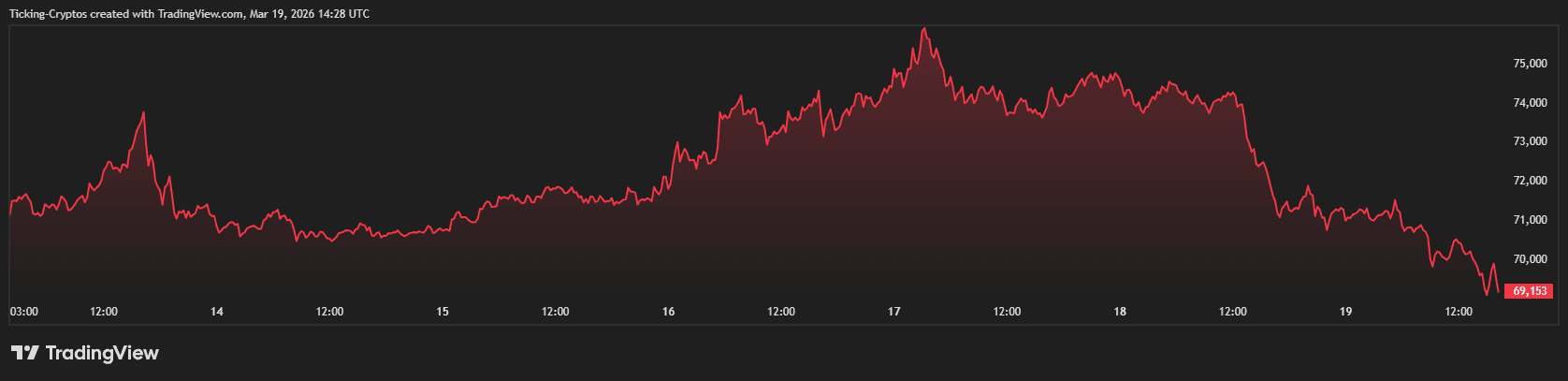
This downward move follows a period of intense optimism fueled by institutional ETF inflows and the SEC’s recent classification of 16 digital assets as commodities. However, the combination of a "hawkish hold" by the Federal Reserve and escalating geopolitical tensions in the Middle East has forced investors back into a defensive posture.
Why is Bitcoin Crashing?
The core reason for the Bitcoin price drop today is a "perfect storm" of macroeconomic factors. Specifically, the Federal Reserve’s decision to keep interest rates in the 3.50%–3.75% range, paired with a surge in global oil prices (Brent crude exceeding $114), has strengthened the US Dollar and dampened the appetite for "risk-on" assets like cryptocurrencies.
The "Hawkish Hold" and Risk Appetite
In financial terms, a "Hawkish Hold" occurs when a central bank keeps interest rates unchanged but uses rhetoric that suggests rates will stay higher for longer or could even rise.
For Bitcoin, this is a significant headwind. Because BTC is often viewed as a high-growth, speculative asset, its valuation is highly sensitive to liquidity. When the Fed signals that it is not ready to pivot to rate cuts, the "cost of carry" for holding Bitcoin remains high compared to "safe" yields like US Treasuries.
The Fed Effect: High Rates and Inflation Fears
The Federal Reserve's March meeting was the primary catalyst for the volatility seen in today's bitcoin news. While the market expected rates to remain steady, the updated "dot plot" and comments from Chair Paul Atkins (who took over the SEC and influenced broader policy) suggested that inflation remains a stubborn foe.
- Inflation Forecast: The Fed raised its 2026 PCE inflation outlook to 2.7%.
- Growth Outlook: Projected growth for 2026 was upgraded to 2.4%, giving the Fed more room to keep rates high without immediate fear of a recession.
- Market Reaction: The probability of an April rate cut has plummeted to near zero, with some traders now pricing in a 4% chance of a rate hike if energy costs continue to spiral.
Geopolitical Tensions: The Oil Factor
Beyond the Fed, the escalating conflict in the Middle East has sent shockwaves through the energy markets. Attacks on energy infrastructure have caused oil prices to spike, which historically leads to higher transport and production costs, further fueling inflation.
In previous cycles, Bitcoin was occasionally touted as "digital gold" or a safe haven. However, recent crypto news shows that in times of acute geopolitical stress, BTC often moves in lockstep with the Nasdaq-100, which also saw significant losses today. Investors are currently seeking the safety of the US Dollar and actual physical gold over digital assets.
Institutional Sentiment: ETF Inflows Turn to Outflows
A key pillar of the recent rally was the consistent demand from US-listed spot Bitcoin ETFs. According to data from CoinGlass, a seven-day streak of inflows—totaling over $1.1 billion—was snapped on Wednesday.
| Metric | Detail |
|---|---|
| Trend Change | 7-day inflow streak broken |
| Wednesday Outflow | ~$129 million |
| Key Support Level | $69,000 - $70,000 |
| Next Resistance | $74,500 |
From a technical perspective, Bitcoin's failure to reclaim the $76,000 level is a bearish signal in the short term. The price is currently testing the 100-hourly simple moving average. If the $69,000 support level fails to hold, analysts warn of a potential slide toward the $66,500 zone, which acted as a floor earlier in March.
As of March 19, 2026, the global financial markets are witnessing a rare and counter-intuitive phenomenon. Despite an escalation in the Middle East conflict—including strikes on critical energy infrastructure—both Gold (XAU/USD) and Bitcoin (BTC/USD) are trading in the red. Traditionally, these assets serve as the world’s primary "disaster hedges," yet they have both succumbed to a broader market sell-off following the Federal Reserve’s hawkish stance on Wednesday.
This "double drop" is not a sign that the safe-haven narrative is dead. Instead, it is a textbook example of a liquidity squeeze driven by a resurgent US Dollar and rising bond yields. As oil prices surge above $110 per barrel, the market is pricing in "sticky" inflation, forcing the Fed to keep interest rates high, which historically creates a temporary headwind for non-yielding assets like Gold and high-beta assets like Bitcoin.
Why are Gold and Bitcoin Falling Today?
The primary reason Gold and Bitcoin are dropping today is the Federal Reserve’s decision to hold interest rates at 3.5%–3.75% while signaling fewer rate cuts for the remainder of 2026. This move strengthened the US Dollar Index (DXY), making dollar-denominated assets more expensive. Furthermore, investors are selling "winning" positions in Gold and Bitcoin to cover margin calls in the plummeting equity and energy markets.
Gold Price Analysis: XAU/USD Rejects the $5,000 Milestone
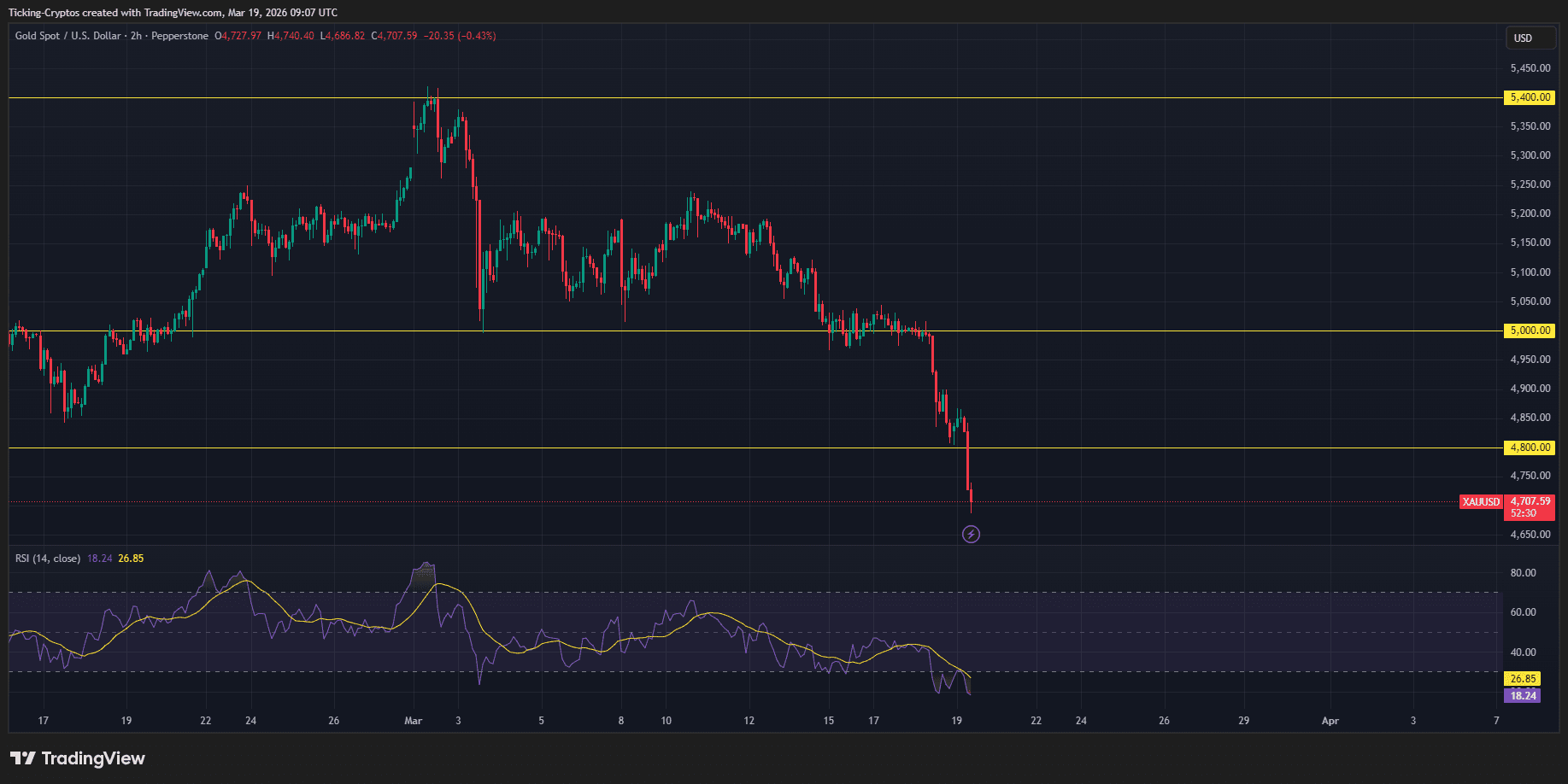
After flirting with the psychological resistance of $5,000 earlier this week, Gold has entered a sharp corrective phase. On the morning of March 19, spot gold slipped toward the $4,800 region, marking its most significant losing streak in over a year.
Critical Support and Resistance Levels
- Major Support: $4,840 – $4,750. This zone represents a historical "buy-the-dip" area for central banks.
- Major Resistance: $5,000. Reclaiming this level is essential for the bullish trend to resume.
The "Oil Shock" of 2026 has been a double-edged sword for Gold. While it fuels long-term inflation (bullish for Gold), it also increases the likelihood of a "higher-for-longer" interest rate environment (bearish for Gold). Currently, the market is prioritizing the interest rate risk over the inflation hedge.
Bitcoin Technical Analysis: Is $70,000 the New Floor?
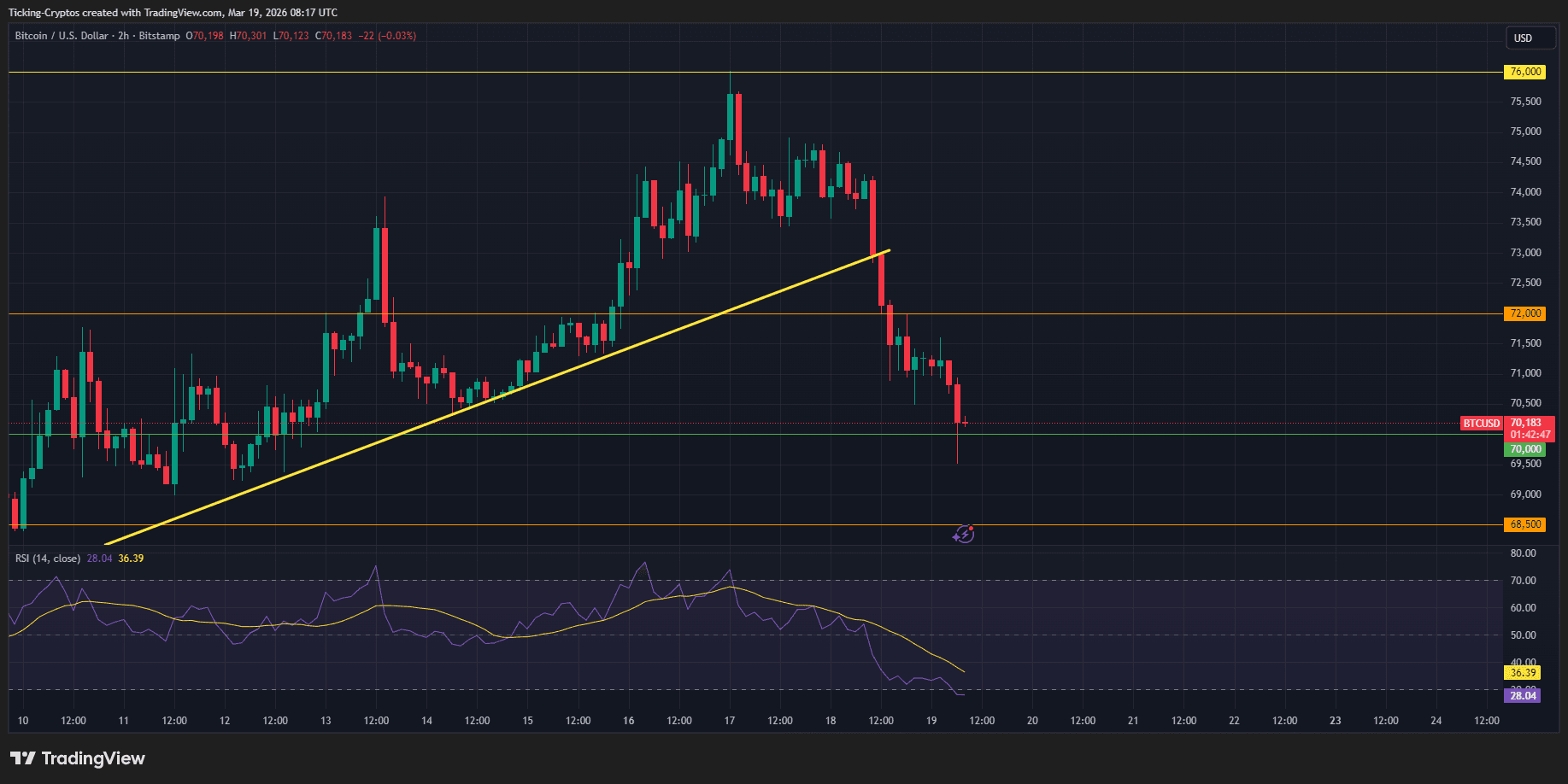
Bitcoin has shown relative resilience compared to the broader "Risk-On" sector, yet it was unable to sustain its push toward $76,000. On Thursday, $BTC dropped below $71,000, tracking the general weakness in global liquidity.
The "Digital Gold" Decoupling
Interestingly, the 2026 correlation between Gold and Bitcoin has shifted. According to recent data from Investing.com, Bitcoin is increasingly behaving as a "Global Liquidity Sponge." It thrives when money is cheap. With the Fed’s hawkish tone, Bitcoin is facing a temporary outflow. However, institutional demand via Bitcoin ETFs remains a structural floor that prevented a crash below $66,000.
- BTC Immediate Support: $70,200.
- BTC Resistance: $74,500.
The 2026 Correlation: Safe Havens vs. Liquidity Hedges
Traders often mistake Bitcoin and Gold for the same type of asset. In 2026, the distinction has become clear:
- Gold: A geopolitical "bunker" asset. It drops when the Dollar is strong but rises when sovereign trust fails.
- Bitcoin: A "technological" hedge. It performs best when the financial system seeks an alternative rail for 24/7 global liquidity.
| Asset | 24h Trend | Key Driver | Long-term Outlook |
|---|---|---|---|
| Gold (XAU) | Bearish | Fed Hawkishness / DXY Strength | Bullish (Target $5,500) |
| Bitcoin (BTC) | Neutral-Bearish | Liquidity Withdrawal / ETF Flows | Highly Bullish (Target $100k+) |
How to Navigate the Bitcoin and Gold Crash
For investors looking to capitalize on this volatility, diversification remains the key. While the short-term trend is downward, the macro fundamentals—high debt, war, and energy shortages—historically favor both assets.
- For Gold: Look for stability around the $4,800 mark.
- For Bitcoin: Utilize the best crypto exchanges to set limit orders near $68,500, which has acted as a strong institutional accumulation zone.
- Security: Ensure your assets are safe by using a hardware wallet during these high-volatility periods.
Bitcoin Future: The Path Ahead for March 2026
The "Great Decoupling" of 2026 is in full swing. Gold is fighting the weight of a high-interest-rate environment, while Bitcoin is consolidating its gains after a massive Q1 rally. Despite the current price drops, the geopolitical unrest in the Middle East suggests that the "safe haven" trade is merely resting, not retreating. Traders should keep a close eye on the US Dollar Index (DXY); a reversal there will likely trigger a massive "relief rally" for both XAU and BTC.
After a brief rally earlier this week, Ethereum ($ETH) is now testing the critical breakout-turned-support zone between $2,180 and $2,200.
This price action comes as a direct response to three simultaneous global shocks: a major military escalation in the Middle East, a hotter-than-expected US inflation report, and a stern warning from Federal Reserve Chair Jerome Powell. For ETH bulls, the mandate is clear: hold the $2,200 line or risk a deep correction toward the psychological support of $1,900.
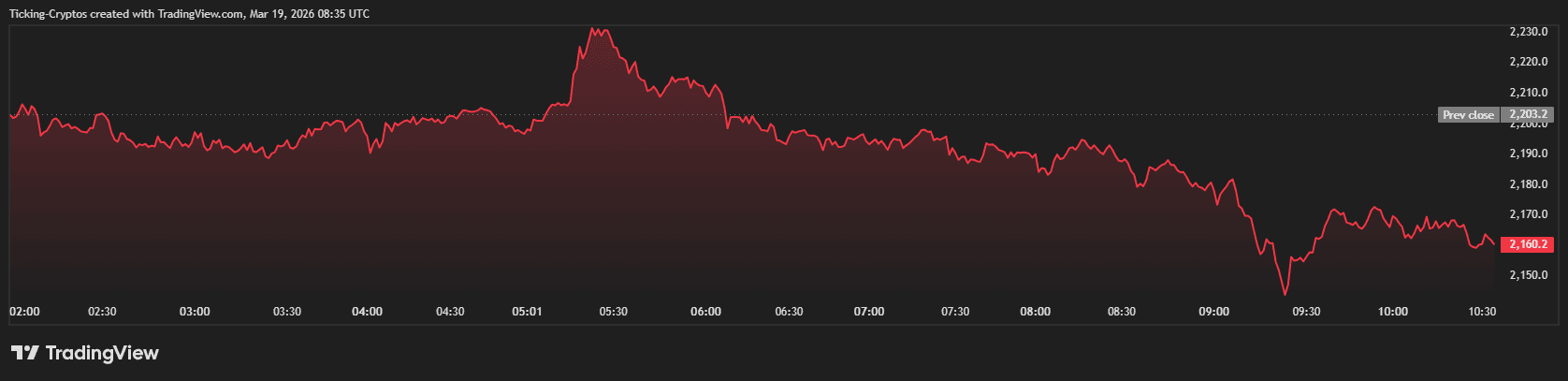
Ethereum Analysis: Why Are Cryptos Crashing
The sudden reversal in risk appetite isn't just a technical correction; it is a fundamental shift driven by three massive catalysts.
1. Middle East Conflict Hits Global Energy
Geopolitical tensions reached a breaking point today following reports that Israel targeted Iran’s South Pars gas facility, the world’s largest gas field. In immediate retaliation, Iranian strikes reportedly caused extensive damage to Qatari LNG infrastructure at Ras Laffan.
This "energy war" sent crude oil prices soaring toward $99 per barrel almost instantly. For Ethereum and the broader crypto market, rising energy costs act as a double-edged sword: they increase the cost of living (reducing retail liquidity) and fuel long-term inflation fears.
2. PPI Data: The Inflation Pipeline is Refilling
Adding fuel to the fire, the Producer Price Index (PPI) for February 2026 came in significantly hotter than anticipated at 3.4% year-on-year. This suggests that wholesale inflation is accelerating even before the full impact of the recent oil price surge hits the data.
When "factory gate" prices rise, they inevitably trickle down to consumers, making the path to the Fed’s 2% target look increasingly impossible.
3. Powell’s Hawkish Pivot
Federal Reserve Chair Jerome Powell held interest rates steady at 3.5%–3.75% today, but it was his tone that rattled the cages. For the first time in the Fed's history, the committee explicitly acknowledged the Middle East situation as a primary economic risk.
Powell’s refusal to commit to a timeline for rate cuts, combined with the acknowledgment of "uncertain" implications for the US economy, led markets to price out a summer pivot.
Ethereum Price Analysis: Will Ethereum Price Recover?
Despite the macro negativity, Ethereum's chart shows a technical battle that is currently being fought at the "Line in the Sand."
Critical Support at $2,180–$2,200
As seen in recent trading data, Ethereum has retraced to its previous breakout zone. This area was formerly a heavy resistance level throughout early 2026. In technical analysis, a successful "retest" of this zone as support would be a massive bullish signal.
- The Bull Case: If ETH closes the daily candle above $2,200, it confirms that buyers are still defending the trend despite the macro noise. This could lead to a relief rally back toward $2,320.
- The Bear Case: A breakdown below $2,180 would invalidate the recent recovery. Given the lack of intermediate liquidity, the next major "safety net" sits at $1,900.
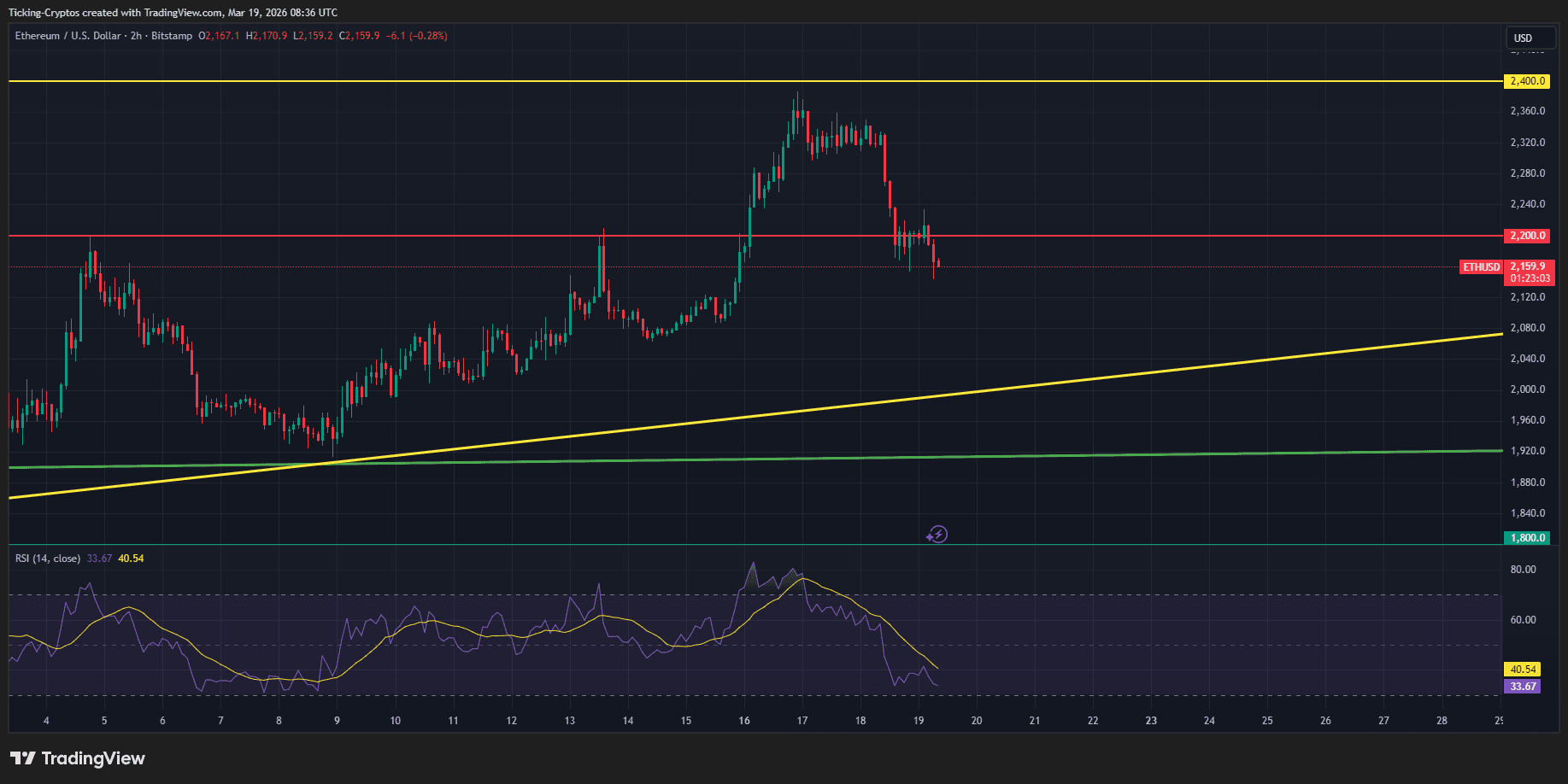
Market Sentiment and Correlation
Ethereum’s correlation with the S&P 500 and Bitcoin remains high. With the US dollar index (DXY) strengthening on the back of safe-haven flows, ETH faces significant selling pressure. Investors looking to hedge against this volatility often turn to hardware wallets to secure their assets during periods of extreme exchange uncertainty.
Ethereum Prediction: What to Watch Next
The next 48 hours are crucial for the ETH/USD pair. Investors should monitor:
- Oil Price Stability: If oil breaks $105, expect further downside in equities and crypto.
- The $2,180 Closing Price: A daily close below this level often triggers stop-loss cascades.
- Strait of Hormuz Developments: Any further disruption to global trade will likely keep the crypto market in a defensive crouch.
Bitcoin Price Crash: Crypto Market Faces a Sudden Reversal
The cryptocurrency market has entered a period of intense volatility today, March 18, 2026, with Bitcoin ($BTC) tumbling from its recent highs near $76,000 to the $72,000 range. This sudden "sea of red" has caught many retail traders off guard, especially following the bullish momentum seen earlier this week.
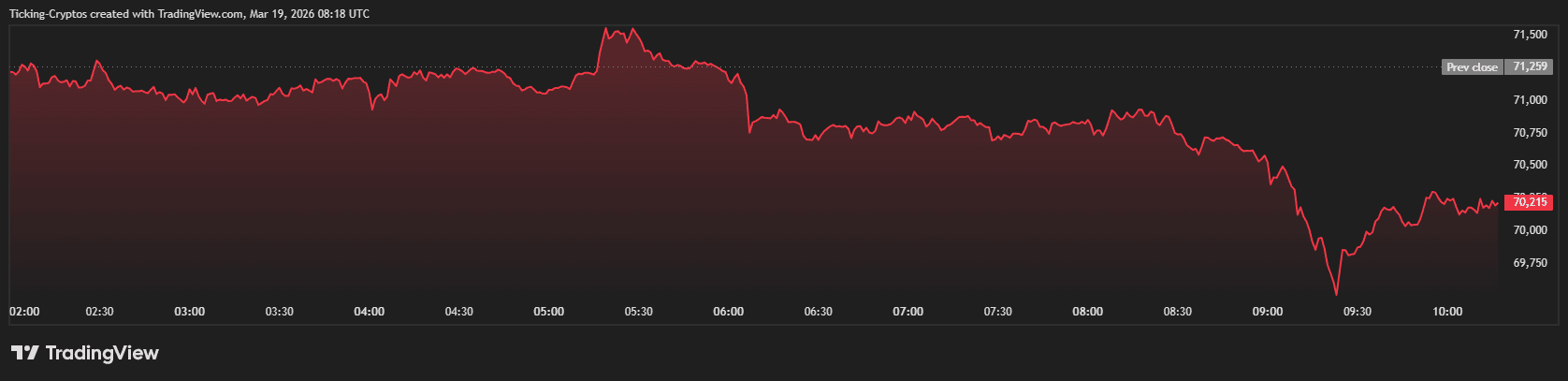
While the digital asset space often moves independently, today’s crash is a direct result of a "perfect storm" involving geopolitical escalations, disappointing US inflation data, and a necessary technical cooling period.
1. Middle East Escalation: Energy Infrastructure Under Attack
The primary driver of the "risk-off" sentiment across global markets is the dramatic escalation in the Middle East. Following Israeli strikes on Iran’s South Pars gas field—the world’s largest natural gas reserve—Tehran has officially declared its intent to retaliate against Gulf energy sites.
Key Geopolitical Developments:
- Target List: Iran’s Revolutionary Guards have identified key infrastructure in Saudi Arabia, the UAE, and Qatar as potential targets.
- Energy Disruption: Iraq has already reported a total halt of gas supplies from Iran, leading to a loss of approximately 3,100 megawatts of power.
- Oil Prices Surge: Brent crude has spiked toward $110 a barrel, fueling fears of global stagflation.
In times of war and energy insecurity, investors typically flee "risk assets" like cryptocurrencies in favor of "safe havens" like gold or the US Dollar. This flight to safety is putting massive downward pressure on the $Bitcoin price.
2. US Core PPI Hits 3.9%: Inflation Remains "Sticky"
Macroeconomic data released today has further dampened hopes for a dovish pivot from the Federal Reserve. The US Core Producer Price Index (PPI), which excludes volatile food and energy costs, came in at 3.9% year-over-year.
This figure significantly overshot market expectations of 3.7%. For crypto investors, this is a bearish signal because:
- Higher for Longer: Hotter-than-expected wholesale inflation suggests the Fed will keep interest rates elevated to cool the economy.
- Yield Pressure: Treasury yields have climbed following the report, making non-yielding assets like Bitcoin less attractive to institutional players.
- Liquidity Crunch: High interest rates reduce the "cheap money" that typically flows into speculative markets.
3. Technical Adjustment: The $76,000 Rejection
From a purely technical perspective, many analysts argue that a correction was overdue. Bitcoin recently hit a peak of $76,000, a level that acted as a psychological and technical glass ceiling.
The "Overheated" Market
Leading up to today’s drop, several on-chain indicators suggested the market was "overextended." Funding rates in the derivatives market had reached unsustainable levels, meaning long-positioned traders were paying high premiums to keep their bets open.
When the news of the Iranian retaliation broke, it triggered a "long squeeze," forcing leveraged traders to liquidate their positions. This mechanical selling accelerated the drop, pushing BTC toward its immediate support levels.
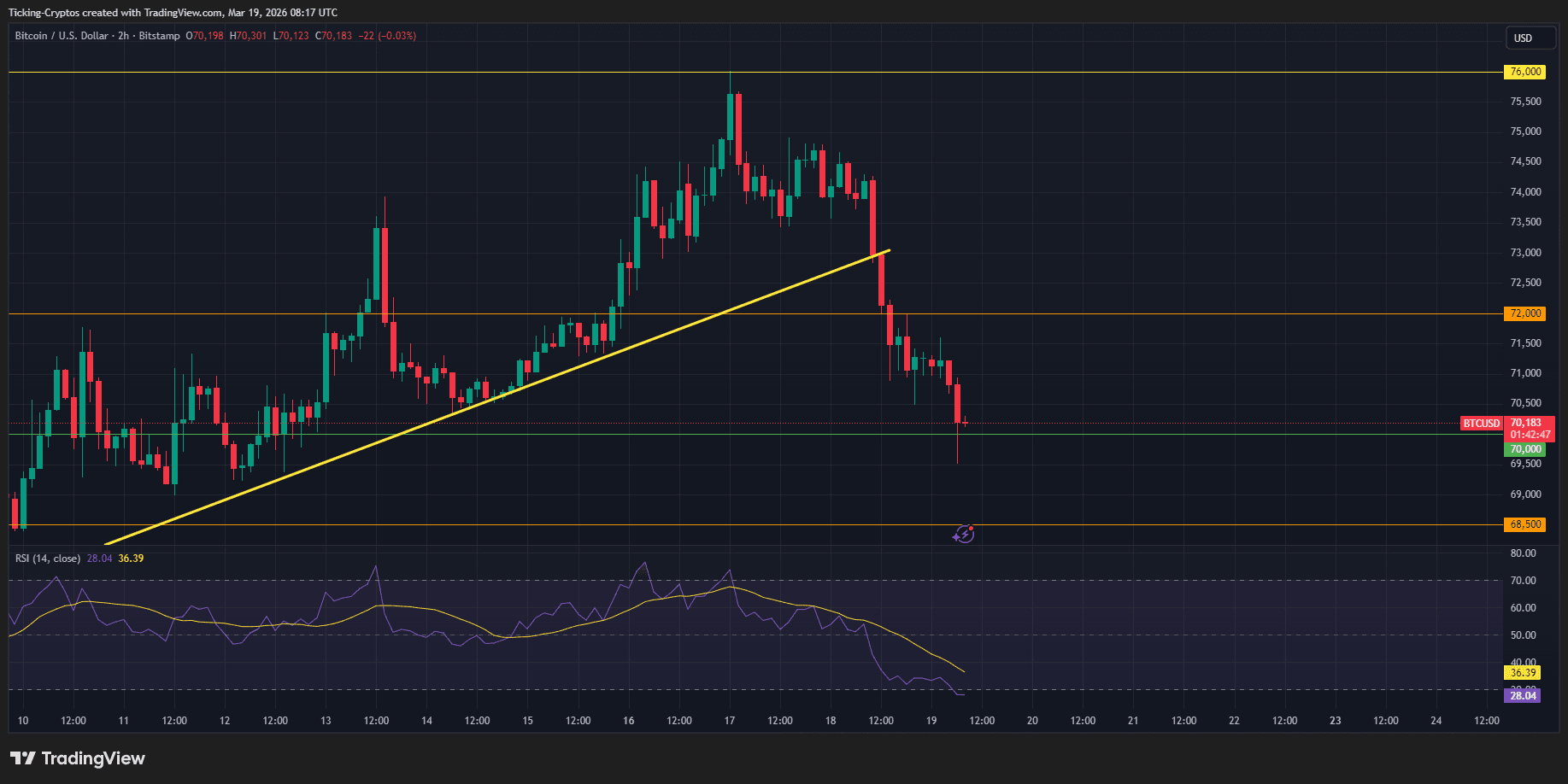
What’s Next for Bitcoin and Altcoins?
The market is currently looking for a floor. While the $72,000 level is providing some initial support, the upcoming Federal Reserve meeting will be the next major catalyst. If the Fed adopts a hawkish tone due to the PPI data and rising energy costs, we could see further testing of the $68,000–$70,000 zone.
The Bitcoin price is currently navigating a high-stakes consolidation phase, trading at approximately $74,272 during the March 18, 2026, session. After a period of bearish dominance that saw the asset retreat from its 2025 record highs, the market is now testing the resilience of the $74,000 resistance zone.
Bitcoin Price Analysis: Why is BTC Price UP?
Analyzing the BTC/USD 4-hour chart, we observe several key technical patterns that define the current trend.
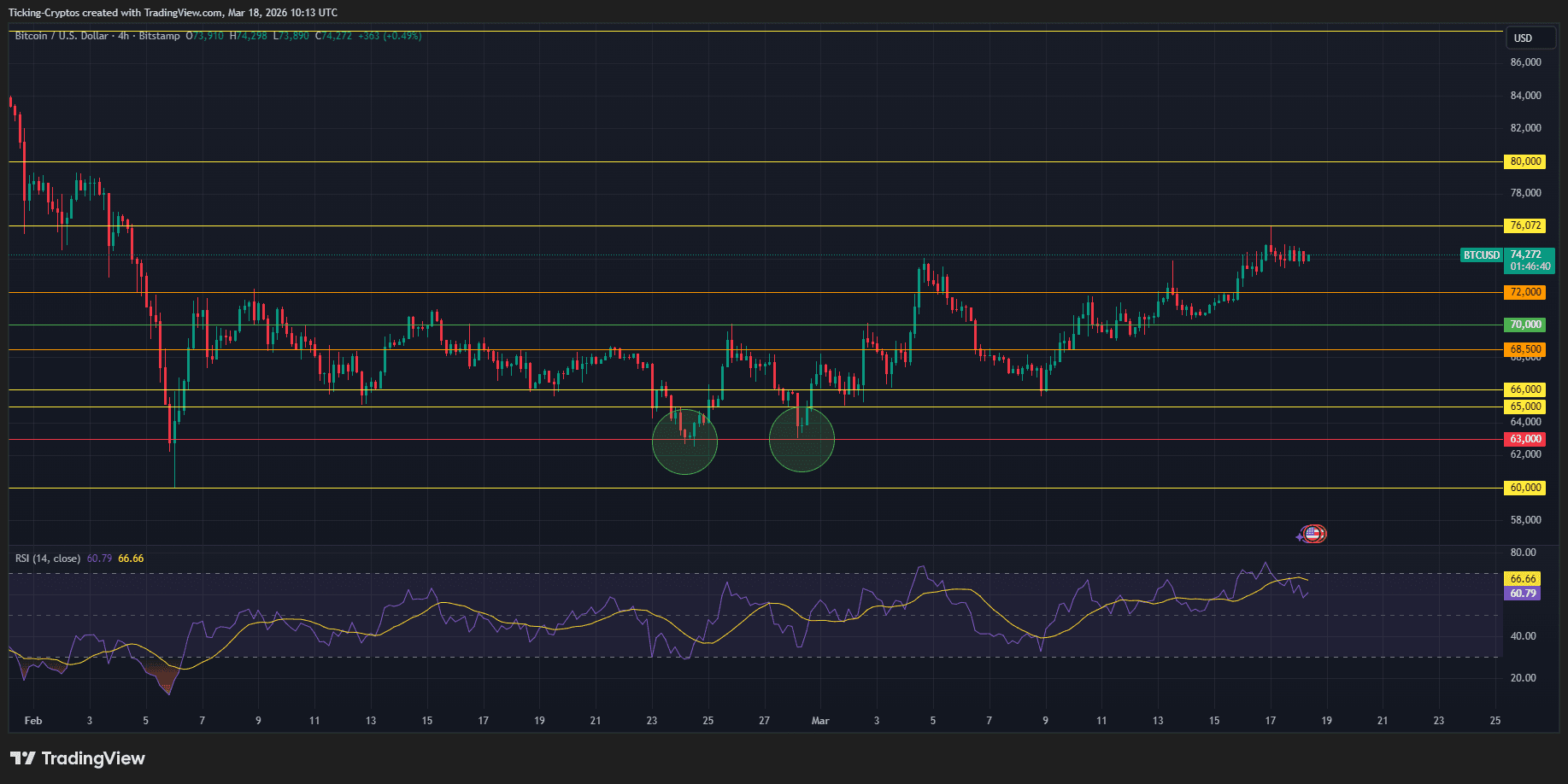
Double Bottom Recovery
The chart highlights two significant "troughs" (marked with green circles) near the $63,000 level. This Double Bottom formation served as a powerful reversal signal in late February and early March, allowing Bitcoin to climb back above the psychological $70,000 mark.
Key Resistance and Support Levels
The price action is currently sandwiched between tightly defined horizontal levels:
- Immediate Resistance: $74,500 – $76,000. A decisive break above this yellow-lined zone is required to target the next major hurdle at $80,000.
- Critical Support: $72,000. If the price fails to hold the $74,000 level, the green support line at $72,000 will be the first line of defense.
- Deep Support: $68,500 and $65,000. These remain the "must-hold" zones to prevent a return to the bear market lows seen earlier this year.
RSI and Momentum
The Relative Strength Index (RSI) is currently hovering around 60.79. While this indicates bullish momentum, the RSI has flattened significantly as the price approaches resistance. This suggests a "cooling off" period or a potential bearish divergence if the price makes a higher high while the RSI fails to follow suit.
Bitcoin News and Macro Catalysts
The broader crypto market is currently characterized by a "Fear" rating on the Sentiment Index (sitting at 26), despite Bitcoin's recent price recovery.
- The FOMC Factor: Traders are bracing for Federal Reserve Chair Jerome Powell’s comments. While interest rates are expected to remain steady, any hawkish rhetoric regarding inflation—driven by $100+ oil prices—could trigger a "sell the news" event for $BTC.
- Institutional Inflows: According to data from Bloomberg, spot Bitcoin ETFs saw a resurgence in March, with nearly $2.8 billion in net inflows, providing a structural floor for the recent rally.
- The Gold vs. Bitcoin Debate: As gold continues to trade near record levels above $5,000, Bitcoin's role as "Digital Gold" is being tested. Many analysts, including those at Fidelity Digital Assets, suggest that capital may rotate back into BTC if gold's parabolic move stalls.
Conclusion: What to Expect Next?
Bitcoin is showing "Experience" and "Expertise" in its ability to hold the $74,000 handle despite a heavy macro environment. However, the information density on the 4-hour chart suggests that the current range is exhausting.
If Bitcoin can flip $76,000 into support, a run toward $80,000 is the most likely scenario. Conversely, a rejection here, coupled with a hawkish Fed, could see a swift retest of the $68,500 support.
- Technical Note: Watch the 4-hour candle close. A close below $73,800 would signal a short-term breakdown, while a close above $75,100 validates the bullish breakout attempt.
Decrypt
Cryptocurrency exchange Crypto.com is laying off around 180 employees as it shifts focus to AI-driven operations.
Bitcoin, gold and stocks all tumbled after several strikes on energy infrastructure. Hyperliquid just brought the S&P 500 onchain. And Kraken has put its IPO on ice.
Analysts remain cautiously optimistic after the Fed’s hawkish stance, expecting a low volatility regime ahead of the quarterly options expiry.
OP_NET is a new protocol that aims to bring smart contracts and decentralized finance directly to Bitcoin transactions.
Authorities seized almost 40 BTC as part of the investigation, in which a rideshare driver is accused of wire fraud and money laundering.
U.Today - IT, AI and Fintech Daily News for You Today
Jim Cramer labels the market "very oversold" as Bitcoin (BTC) trades near $69,400 on March 19, 2026. But is the Mad Money host talking about cryptocurrency?
Crypto analyst links Binance's unusual $2.2 billion USDT inflow to reserve rebalancing.
New SEC S-4 filing reveals SBI Holdings paid $10/share as Ripple's Chris Larsen injects 261 million XRP into the $1 billion Evernorth (XRPN) Nasdaq treasury.
Shiba Inu price drop caught bulls unawares, with 15.99 billion SHIB long positions liquidated.
Bitcoin developers are accelerating work on a suite of "quantum-proof" upgrades as new data from Galaxy reveals that approximately 7 million BTC remains vulnerable to future high-powered computing attacks.
Blockonomi
TLDR
- OpenAI plans to acquire Astral, a company specializing in open source Python development tools
- The Astral team will integrate into OpenAI’s Codex AI-powered coding platform operations
- Codex has experienced remarkable growth, reaching more than 2 million weekly active users—triple its January numbers
- This strategic move positions OpenAI against competitors like Anthropic and Cursor in the AI development tools sector
- Deal specifics remain undisclosed; regulatory clearance is still required
OpenAI revealed on Thursday its intention to acquire Astral, a company that has made its mark creating open source development tools tailored for Python programmers.
The Astral team will become part of OpenAI’s workforce and contribute to Codex, the company’s artificial intelligence-powered coding platform. The acquisition’s financial details have not been made public.
Astral has earned significant respect within the Python development ecosystem. The company’s products are designed to enhance both efficiency and dependability for developers working with Python code.
In a blog post, Charlie Marsh, who founded and leads Astral as CEO, emphasized that the company’s mission remains unchanged following the acquisition. “To make programming more productive. To build tools that radically change what it feels like to build software,” Marsh explained.
Marsh provided assurance that Astral’s open source products will remain maintained and supported once the acquisition becomes final.
OpenAI introduced its Codex offering last year and unveiled a dedicated desktop application for the platform in early 2026. According to the company, Codex has surpassed 2 million weekly active users.
This user count reflects a tripling since January began. Meanwhile, overall usage metrics have jumped fivefold during the same timeframe.
Battle for AI Coding Supremacy Intensifies
The market for AI-enhanced coding tools has experienced explosive expansion throughout the past year. OpenAI finds itself in direct competition with Anthropic, whose Claude Code platform has attracted considerable attention from the developer community.
Cursor represents another significant competitor that has cultivated a loyal user base among software engineers. OpenAI aims to expand Codex’s market share and narrow the competitive distance.
The Astral transaction remains contingent upon standard closing requirements, which include obtaining regulatory clearance.
This purchase represents one element of OpenAI’s broader acquisition strategy. The organization brought on Albert Lee from Google last December to oversee corporate development initiatives.
Expanding Through Strategic Acquisitions
OpenAI finalized a substantial $6.4 billion purchase of io, Jony Ive’s AI hardware venture, in May 2025. More recently this month, the company announced plans to acquire Promptfoo, a cybersecurity-focused startup.
In January, OpenAI purchased Torch, a company operating in health-care technology. The Astral transaction extends this acquisition pattern.
OpenAI operates with backing from Microsoft. The organization has been diversifying its offerings across numerous product categories while navigating intensifying competition throughout the AI sector.
The purchase of Astral represents OpenAI’s latest strategic maneuver to solidify its standing in AI-enhanced developer tools particularly.
The fivefold increase in Codex usage since the beginning of the year stands as the most current performance data OpenAI has released regarding the product’s trajectory.
The post OpenAI Acquires Python Toolmaker Astral to Bolster Codex Against Claude Code appeared first on Blockonomi.
TLDR:
- 72% of finance leaders say offering digital asset solutions is now essential to stay competitive.
- 74% of respondents believe stablecoins can improve cash-flow efficiency and free trapped working capital.
- 89% of tokenization evaluators rank digital asset custody as their single most important partner factor.
- 97% of finance leaders across all segments say ISO and SOC II security certifications are critically important.
Digital assets are reshaping financial services faster than many anticipated. Ripple surveyed over 1,000 finance leaders early in 2026.
The study included banks, asset managers, fintechs, and corporates worldwide. Findings show strong consensus around stablecoins, tokenization, and infrastructure choices.
Around 72% of respondents believe finance leaders must offer digital asset solutions to stay competitive. The survey reveals a market advancing with greater clarity and intent than previous years.
Stablecoins Gain Ground as Treasury Tools While Fintechs Lead Adoption
Among all digital asset use cases, stablecoins have earned the most confidence. As many as 74% of respondents say stablecoins can boost cash-flow efficiency.
They also help unlock trapped working capital for businesses. This points to stablecoins entering the treasury management space, not just payments.
Fintechs continue to lead in real-world digital asset adoption across industries. More fintechs report using digital assets in treasury or payment operations than other sectors.
About 31% use stablecoins to collect payments on behalf of customers. Another 29% accept stablecoins directly, showing growing operational integration.
Building versus partnering also reflects a clear divide between fintechs and corporates. Some 47% of fintechs prefer developing their own digital asset infrastructure.
In contrast, only 14% of corporates lean toward an in-house approach. A strong 74% of corporates plan to work with partners offering ready-made solutions.
Interest in tokenizing financial assets also continues to grow across banks and asset managers. Most institutions are actively seeking experienced partners to execute tokenization strategies.
The results suggest the market is shifting from experimentation toward structured deployment.
Custody and Partner Priorities Shape Infrastructure Decisions
Security and custody have become top priorities as finance leaders evaluate digital asset partners. Among those assessing tokenization partners, 89% say digital asset storage and custody is a top priority.
Token servicing and lifecycle management also rank highly, particularly for banks at 82%. Asset managers, however, place greater weight on primary distribution capabilities at 80%.
Banks also show strong demand for advisory support during the implementation phase. About 85% of banks say pre-issuance structuring consultancy is important.
That compares to 76% among asset managers. This gap points to banks wanting experienced guidance beyond technology deployment alone.
Among respondents exploring stablecoin payments, 57% want integrated custody, orchestration, and compliance services.
This preference helps institutions avoid holding stablecoin balances directly. As governance standards tighten, cohesive partner support has become a critical selection factor.
Partner preferences also reflect broader concerns across the digital asset space. Regulatory clarity tops the list at 40%, followed by security at 37%.
Compliance requirements rank third at 30%, with price volatility cited by 29%. Security certifications such as ISO and SOC II matter to 97% of all respondents surveyed.
The post Ripple’s 2026 Survey: 72% of Finance Leaders Say Digital Assets Are Now a Competitive Necessity appeared first on Blockonomi.
Key Highlights
- Fourth quarter revenue reached $44.8 million, falling short of the $53.7 million Wall Street consensus
- Operational losses totaled $33.1 million, significantly exceeding the projected $12 million deficit
- Shares declined by as much as 8.3% during Thursday’s morning session
- Company projects 2026 revenue between $900 million and $1 billion, surpassing analyst forecasts of $880 million
- Contract backlog exceeded $943 million as of February’s close
The space exploration firm had been riding a wave of momentum heading into this week’s earnings announcement. Shares had climbed 12% since January and surged an impressive 149% over the trailing year. However, Thursday’s financial disclosure changed that trajectory.
Intuitive Machines, Inc., LUNR
The Texas-headquartered aerospace enterprise revealed fourth quarter sales of $44.8 million alongside operational deficits totaling $33.1 million. Analysts had anticipated $53.7 million in quarterly sales with losses limited to $12 million. This substantial variance triggered a sharp selloff, sending LUNR shares down 8.3% during morning trading hours.
$LUNR (Intuitive Machines) Q4’25 & FY25 EARNINGS HIGHLIGHTS
Q4 2025
Revenue: $44.8M
Free Cash Flow: -$56M (cash burn)
STRATEGIC MOVES
— Emmanuel – Big Tech & AI Investor (@EmmanuelInvest) March 19, 2026
The revenue shortfall stemmed primarily from underperformance across core business segments including Commercial Lunar Payload Services, Omnibus Multidiscipline Engineering Services III, and Near Space Network Services. Top-line figures also contracted compared to the equivalent period in the prior year.
Despite these challenges, Intuitive Machines achieved a 19% gross profit margin during the quarter, demonstrating ongoing operational refinement throughout 2025. The company reduced its free cash flow burn by $11.7 million year-over-year, although full-year cash consumption still totaled $56 million.
Forward Outlook Exceeds Market Expectations
Notwithstanding the quarterly miss, company leadership provided 2026 projections that exceeded Street estimates. Management anticipates annual revenue spanning $900 million to $1 billion, with a midpoint of $950 million—comfortably above the $880 million consensus figure. Additionally, adjusted EBITDA is forecast to turn positive for the full fiscal year.
Chief Executive Steve Altemus characterized 2025 as “a transformational year,” highlighting the successful completion of the company’s second lunar expedition, expansion into defense-focused space initiatives, and the integration of two significant acquisitions: KinetX Aerospace and Lanteris Space Systems.
The Lanteris acquisition, carrying an $800 million valuation, finalized during the first quarter of 2026. This strategic move establishes Intuitive Machines as a comprehensive space solutions provider spanning commercial, civilian, and defense markets.
The organization also finalized a $175 million strategic capital infusion in Q1 2026 to advance satellite communication capabilities and orbital data processing technologies.
By February’s conclusion, the aggregate contract pipeline reached approximately $943 million. Notable contract awards encompass participation in the Space Development Agency’s Proliferated Warfighter Space Architecture program and a Missile Defense Agency agreement with a maximum value of $151 billion.
Lunar Mission Track Record and Future Plans
Intuitive Machines achieved a historic milestone in February 2024 when its Odysseus spacecraft became the inaugural privately financed vehicle to execute a controlled lunar touchdown. The company’s second lander, Athena, successfully completed its mission in early 2025.
A third lunar expedition is scheduled for 2026, with funding provided predominantly by NASA.
The firm maintains ongoing partnerships with NASA and the Department of Defense focused on space-based communications infrastructure. Current Wall Street consensus projects 2026 EBITDA of approximately $39 million.
The post Intuitive Machines (LUNR) Stock Tumbles 8% Following Weaker-Than-Expected Q4 Results appeared first on Blockonomi.
Key Takeaways
- Polymarket has been designated as Major League Baseball’s exclusive prediction market partner in a landmark agreement
- The platform gains exclusive rights to utilize MLB branding, official statistics, and promotional opportunities across league functions
- A historic memorandum of understanding between MLB and the CFTC establishes information-sharing protocols for market integrity
- This partnership emerges in the wake of criminal indictments against Cleveland Guardians pitchers involved in pitch-fixing schemes
- Baseball becomes the latest major sports organization to embrace prediction market partnerships, joining soccer, hockey, and mixed martial arts leagues
Major League Baseball revealed on Thursday that Polymarket has secured the position of official prediction market partner, granting the platform exclusive authorization to use MLB intellectual property, official league data, and visibility at baseball events.
According to initial reporting by Front Office Sports, this multi-season arrangement represents the newest chapter in an expanding trend of collaborations between prominent sports organizations and prediction market operators.
In conjunction with the Polymarket announcement, baseball’s governing body also formalized a memorandum of understanding with Commodity Futures Trading Commission Chair Michael Selig. This MOU creates a framework for mutual information exchange regarding prediction market safeguards and professional baseball operations.
While the agreement carries no legal enforcement mechanisms, it marks an unprecedented collaboration between a federal regulatory body and a major professional sports league.
CFTC Chair Selig shared on X: “We’ve committed to work together to protect the integrity and resilience of prediction markets relating to professional baseball.”
The Integrity Component Behind the Partnership
This announcement’s timing connects directly to incidents from the previous season. Last November, criminal indictments were filed against two pitchers from the Cleveland Guardians, alleging they accepted payments from gamblers to manipulate specific pitches during official games.
These allegations thrust baseball’s gambling connections into the public discourse. Commissioner Robert Manfred confronted the issue head-on in his official statement.
“Protecting the integrity of the game on the field is our top priority,” Manfred stated. “By engaging in this community, we are able to work together to create clear boundaries with the goal of mitigating risk while providing fan engagement opportunities.”
Under the terms of this arrangement, Polymarket and MLB have committed to prohibiting markets that present integrity concerns. Excluded categories include predictions on specific pitch outcomes, managerial choices, and umpire actions.
Despite granting Polymarket exclusive status, MLB confirmed it will maintain existing relationships with alternative prediction market platforms offering baseball-related contracts.
Regulatory Challenges Facing Prediction Markets
Polymarket CEO Shayne Coplan characterized the partnership as an opportunity to enhance fan engagement while collaborating with regulatory authorities to maintain competitive integrity.
This development arrives as prediction market platforms navigate intensifying scrutiny from state-level regulators. Earlier this week, Arizona’s attorney general brought criminal charges against Kalshi, a competing prediction market service, claiming the platform operated an unlicensed gambling enterprise within state boundaries.
Kalshi disputed the allegations, describing them as “meritless.” CFTC Chair Selig criticized Arizona’s charges as “entirely inappropriate.”
The CFTC’s collaborative approach with MLB signals federal regulatory endorsement of sports-related prediction markets, contrasting with state gambling regulators who maintain these platforms should fall under sports betting jurisdiction.
MLB’s arrangement with Polymarket mirrors comparable agreements established by the National Hockey League, Major League Soccer, and the Ultimate Fighting Championship.
Polymarket has also established a data collaboration agreement with Dow Jones, which publishes Barron’s.
The post MLB Partners With Polymarket in Historic Prediction Market Agreement appeared first on Blockonomi.
Key Highlights
- BTQ deploys BIP 360 on dedicated testnet for quantum-resistant Bitcoin experimentation.
- P2MR technology conceals public keys to mitigate quantum computing threats.
- Complete wallet infrastructure supports P2MR transaction creation and broadcasting.
- Technical readiness exists, but widespread implementation confronts governance challenges.
- Bitcoin Quantum operates independently; legacy addresses still vulnerable to quantum risks.
Shares of BTQ Technologies Corp. (BTQ) experienced a significant downturn, dropping 7.12% to $2.5450 during late morning sessions. The stock movement occurred alongside the firm’s disclosure of a substantial enhancement to its Bitcoin Quantum testing environment. This development brings forth an operational quantum-resistant transaction framework linked to Bitcoin’s architecture.
BTQ Technologies Corp. Common Stock, BTQ
BIP 360 goes live on Bitcoin Quantum testing platform
BTQ announced that its Bitcoin Quantum testnet version 0.3.0 now features the inaugural operational deployment of Bitcoin Improvement Proposal 360. This enhancement incorporates Pay-to-Merkle-Root transaction outputs engineered to strengthen defenses against emerging quantum computing challenges. The organization has successfully transitioned the proposal from theoretical framework to active testing infrastructure.
The deployment facilitates comprehensive transaction handling through quantum-hardened architectural components within the experimental network. It enables wallet generation, transaction validation, and execution leveraging advanced cryptographic protocols. This allows software engineers to evaluate these capabilities within an operational blockchain environment.
The update additionally incorporates post-quantum digital signature authentication utilizing Dilithium-powered processes. These elements function within the tapscript architecture and enable protected transaction confirmation. The platform thereby showcases a viable route toward quantum-secure distributed ledger systems.
Development responds to emerging cryptographic vulnerabilities
BIP 360 confronts potential weaknesses associated with public key revelation in conventional Bitcoin frameworks. Existing protocols could become compromised if quantum computing capabilities evolve to undermine current cryptographic safeguards. The proposal eliminates key-path transaction methods to minimize this vulnerability.
The redesigned output architecture commits exclusively to a Merkle root rather than depending on conventional key-based mechanisms. This framework retains scripting capabilities while eliminating susceptible elements. It thereby upholds operational requirements without expanding future security exposure.
Bitcoin’s modification procedures typically progress gradually due to its cautious decision-making structure. Historical protocol enhancements demanded multiple years before achieving network-wide implementation. BTQ’s testing platform seeks to facilitate faster innovation without requiring immediate community-wide agreement.
Network expansion and regulatory dynamics influence deployment
Bitcoin Quantum testnet v0.3.0 additionally implements accelerated block generation intervals and revised token distribution settings. The system currently operates with one-minute block targets to enable swift development iterations. It preserves Bitcoin-compatible monetary policy through programmed reduction cycles.
The infrastructure has documented upward of 100,000 generated blocks with engagement from over 50 network validators. It further accommodates an expanding developer community concentrated on post-quantum innovations. These figures reflect consistent advancement throughout successive testnet versions.
Regulatory frameworks continue driving adoption timelines for quantum-resistant cryptographic systems. Government authorities across the United States, European Union, and Canada have established transition implementation deadlines. BTQ structures its technology stack to correspond with forthcoming regulatory and security mandates.
The post BTQ Technologies (BTQ) Stock Drops 7% Following Bitcoin Quantum Testnet BIP 360 Launch appeared first on Blockonomi.
CryptoPotato
Ripple remains one of the most talked-about projects in the crypto space, driven by constant developments across its ecosystem.
Despite the ongoing market correction, XRP (the company’s native token) has posted weekly gains, whereas some key indicators suggest a more substantial rally could be on the horizon.
The Global Expansion and More
In the last several months, the American-based entity expanded its footprint in the Middle East, while earlier in March, it announced plans to secure an Australian Financial Services License. Such a permit would allow the firm to operate a fully licensed payments platform in Australia and offer services under a recognized regulatory framework.
Just a few days ago, Ripple widened its reach across Brazil by becoming “the only solution in the region capable of serving institutions across the full spectrum of financial needs – from cross-border payments and digital asset custody to prime brokerage and treasury management.” Additionally, the company applied for a Virtual Asset Service Provider (VASP) license with the nation’s central bank.
It also made strides in the North American market by teaming up with i-payout to help the latter enable fast, transparent cross-border payments.
Another major news related to Ripple is Evernorth’s step forward to listing on the Nasdaq. The venture that focuses on accumulating, managing, and providing institutional exposure to XRP filed a Form S-4 registration statement with the US SEC in connection with its planned merger with Armada Acquisition Corp. II. Last year, the entity revealed that it had raised over $1 billion in gross proceeds from major institutions such as Ripple Labs, Pantera Capital, Kraken, SBI Holdings, and others.
The ETF Front
2025 was pivotal for Ripple, not only because its long-running legal battle with the SEC finally ended, but also due to the launch of the first spot XRP ETF, which offered full exposure to the asset. This happened in November, and the company behind the product was Canary Capital.
Some renowned firms, including Bitwise, Franklin Templeton, 21Shares, and Grayscale, followed suit, and the investment vehicles have so far generated a cumulative total net inflow of more than $1.2 billion.
However, over the past week, outflows have dominated inflows, indicating that institutional appetite for Ripple’s native token has been declining. After several consecutive red days, the netflow finally flashed green on March 17, and we have yet to see whether the interest will pick up in the short term.

XRP Outlook
As of this writing, Ripple’s cross-border token trades at around $1.44 (per CoinGecko), representing a 4% weekly increase. This contrasts with the losses that many other altcoins have posted during that timeframe.
The broken negative streak on the ETF front, as well as the recent whale accumulation, suggest XRP may record additional gains in the near future. As CryptoPotato reported, large investors purchased 200 million coins in the past two weeks, showing strong confidence in the asset and setting the stage for a possible move north.
The USD equivalent of the stash is roughly $290 million, and this group of market participants now controls 11.1 billion tokens, or 19% of XRP’s circulating supply.
The post Ripple (XRP) News Today: March 19 appeared first on CryptoPotato.
Bitcoin’s price was heavily rejected at $76,000 a couple of days ago, and the correction accelerated today. The cryptocurrency is now trading below $70,000, sending the entire market sentiment to extreme fear.
Major altcoins like Ethereum and Ripple’s XRP are also on the downside, both losing important support levels.
Amid these dwindling market conditions, Playnance’s newly launched native token, GCOIN, is eyeing an impressive milestone.
Bitcoin’s Price Corrects Heavily
The leading cryptocurrency was trading at around $74,00 last Friday when the bears were able to intercept the movement and pushed it south toward $70,000 during the weekend. This happened after the most recent bombings that took place in the Middle East. The good news was that it was able to maintain this level, allowing for the buyers to return in force.
The retaliation took place on Tuesday morning, when the BTC price exploded to a price that we hadn’t seen in around six weeks at $76,000.

As you can see on the chart, though, the momentum was anything but sustained. Although the price remained near the local highs on Wednesday, more volatility occurred in the hours leading up to the highly anticipated FOMC meeting. The US Federal Reserve announced that it wouldn’t change the interest rates – an entirely expected outcome.
Unfortunately, the markets responded negatively, perhaps driven by rising geopolitical uncertainty, and BTC plunged to $71,000 almost immediately upon the announcement’s public release.
Today, the price fell further, and it’s currently trading in the mid $69,000s. Most altcoins also suffered, as it can be seen in the heatmap below.

The entire thing resulted in more than $500 million in liquidated positions, as well as the broader market returning to a state of extreme fear. But it’s these conditions that can also serve well for projects with solid foundations.
PlayNance’s GCOIN Eyes $100M FDV
Launched yesterday, GCOIN, the native cryptocurrency of the PlayNance ecosystem, is already turning heads. At the time of this writing, GCOIN boasts $80 million in fully diluted valuation, less than 24 hours since its token generation event.
Moreover, the locked supply currently stands at more than 3.2 billion tokens, while another 1.3 billion are staked, effectively removing more than 10% of the circulating supply from the market. This reduces selling pressure while also showing conviction in the project’s fundamentals.
The cryptocurrency boasts an impressive user base of more than 200,000 holders, trading on the popular MEXC exchange.
GCOIN is the native utility token that powers the entire PlayNance ecosystem. It’s designed for the Web3 gaming and entertainment infrastructure of the protocol, enabling real-time on-chain interactions through many platforms and digital experiences.
Already, the PlayNance ecosystem powers an average of 1.5 million on-chain transactions every single day, all executed using GCOIN as the settlement and utlity layer. The token might be trading for a day, but its ecosystem has been shaped and honed for the past five years, already catering to a plethora of users and developers.
Those who want to get in on the action early can find more information about GCOIN here.
The post Bitcoin’s Price Slips Below $70K, but GCOIN by Playnance Eyes $100M Milestone appeared first on CryptoPotato.
Bitcoin has continued to trade in a precarious zone after months of relentless selling pressure from the October 2025 highs above $125K. The asset is currently hovering below $70,000, attempting to stabilize after a dramatic downtrend, but several technical and on-chain signals suggest the battle between buyers and sellers is far from over.
Bitcoin Price Analysis: The Daily Chart
Looking at the daily timeframe, the broader picture remains firmly bearish. BTC has been trapped inside a descending channel since its peak above $125K, printing a consistent series of lower highs and lower lows. The asset is now trading well below both the 100-day and 200-day moving averages, which are acting as dynamic resistance overhead. The 200-day MA sits around $92K, and the 100-day near $80K, both far above the current price.
The daily RSI has recovered from deeply oversold territory, currently oscillating around the midline. A key horizontal support zone between $58K and $62K (highlighted in blue) held during the February capitulation wick, and that area remains the most critical floor to watch. For any meaningful reversal, however, the market would need to reclaim the $75K–$80K zone, which also aligns with the descending channel’s upper boundary.
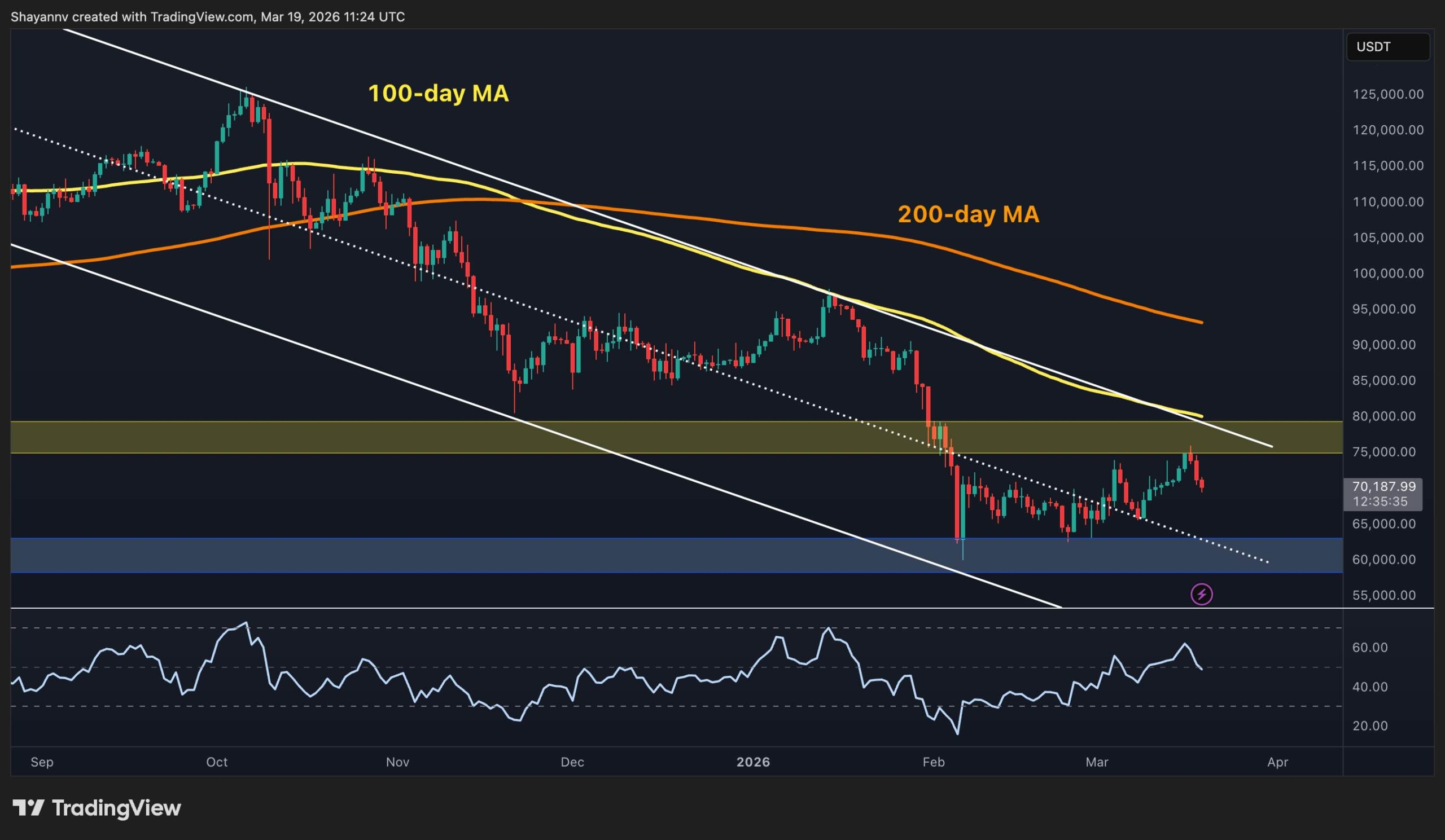
BTC/USDT 4-Hour Chart
Zooming into the 4-hour chart, a more constructive short-term structure emerges. Since the early February lows near $60K, BTC has been forming an ascending channel pattern with higher lows, supported by a rising trendline. Yet, the price recently tagged the upper resistance near $75K before facing a decisive rejection and pulling back sharply toward $70k.
The area between $74K and $76K has acted as a stubborn supply zone, rejecting multiple attempts to break higher. The 4-hour RSI has also cooled off from overbought conditions and now sits below the 40 level, indicating a change in momentum to relatively bearish. A confirmed break below the rising trendline (~$66K) would likely accelerate selling toward $60K, while a push above $75K could trigger a squeeze toward $80K, and change the market outlook to bullish in the short-term.

On-Chain Analysis
The Exchange Whale Ratio, measuring the proportion of large transactions relative to total exchange inflows, has shown a notable spike in recent weeks. After months of relatively subdued whale activity during the prolonged downtrend, the ratio has jumped sharply from around 0.45 to above 0.6, signaling that large holders are becoming more active on exchanges.
Historically, sharp increases in this metric have coincided with periods of heightened volatility, as whales tend to move coins to exchanges either to sell or to reposition. The current uptick, combined with the price hovering near a technically sensitive zone, suggests that big players are preparing for a decisive move. Whether this translates into distribution (selling) or accumulation at these levels will likely determine BTC’s direction in the coming weeks.

The post Bitcoin Price Prediction: How Low Can BTC Fall If $70K Level Is Lost Decisively? appeared first on CryptoPotato.
XRP is trying to build a short-term recovery, but the broader trend still leans cautious. The recent bounce has improved momentum on both pairs, yet the price is still trading beneath major trend-defining resistance levels. In other words, sellers are no longer fully in control of the very short term, but buyers have not done enough to claim a real trend reversal either.
XRP/USDT Analysis: The Daily Chart
On the XRP/USDT chart, the asset has pushed back toward the mid-$1.40s after defending the $1.10 to $1.20 demand zone earlier this month. That rebound matters because it keeps XRP off the lows and lifts RSI back into a healthier range, but the price is still stuck inside the descending structure and below the first major supply band around $1.75 to $1.80.
That leaves XRP in a tricky spot. The current move looks constructive, but it still resembles a relief rally inside a larger downtrend rather than a clean breakout. If buyers can force a reclaim of the $1.75 to $1.80 region, the door opens toward the much heavier $2.40 to $2.50 resistance area. But the price would also need to climb above both the 100-day and 200-day moving averages to reach this area. Until then, the bounce is not decisive.
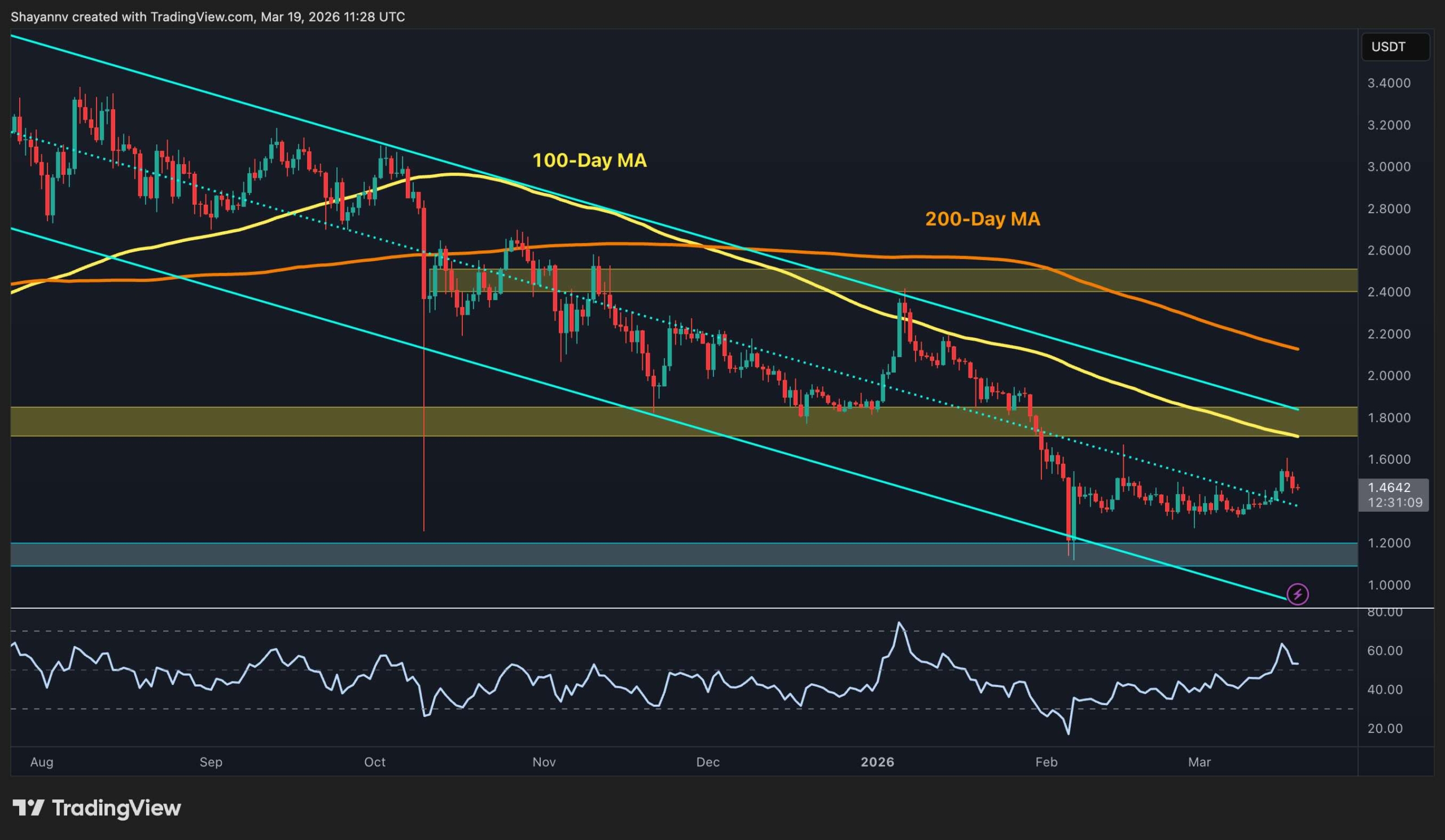
XRP/BTC 4-Hour Chart
The XRP/BTC pair is telling a similar story. After repeatedly holding the 2,000 sats area, XRP has started to recover a bit and is now pressing back above that support zone. Momentum has improved, and the pair no longer looks as weak as it did during the recent dip, though it is still trading under both the 100-day and 200-day moving averages.
For the BTC pair, the first task is to turn this rebound into follow-through. A push through the 2,100 to 2,200 sats area would be a good start, and lead to a breakout above both key moving averages. But the real test remains higher at 2,400 to 2,500 sats, where layered resistance and the broader downtrend line converge. If XRP gets rejected before that, the market likely falls back into the same sideways-to-bearish range. However, if it breaks through, the tone shifts from simple stabilization to genuine recovery.

The post Ripple Price Prediction: The Good and The Bad for XRP After Failed Rebound appeared first on CryptoPotato.
After a solid multi-day run, the primary cryptocurrency lost momentum again, dipping below $70,000.
Numerous analysts caution that the bears still control the market, expecting much more substantial price declines in the near future.
Where’s the Bottom?
The recent FOMC meeting, and especially Chairman Jerome Powell’s subsequent speech, poured cold water on BTC, which earlier this week touched $76,000 for the first time since the beginning of February.
Recall that America’s central bank kept interest rates unchanged for the second consecutive time this year, whereas Powell said the stubborn inflation remains an issue for the local economy. He also outlined the military conflict in Iran, describing the rising price of petrol as another hurdle.
His comments were unfavorable to the cryptocurrency market, whose total capitalization once again slipped below $2.5 trillion. As for Bitcoin, its valuation temporarily fell to as low as $69,500 and currently struggles to remain above that line.
Several analysts have weighed in on BTC’s performance, noting similarities between its recent price action and past cycles. X user Ted pointed out that the current structure closely mirrors the pattern seen in 2022, which ultimately led to a drop to around $16,000. If that historical parallel plays out again, he warned that the price could slip under $50K in the near term.
The analyst who goes by as bee on the social media platform outlined an analogous thesis. They suggested that BTC’s resurgence to nearly $76,000 has been a “fakeout” and bull trap, claiming that “we are still in a bear market” and the valuation could plummet to as low as $46,760 in the coming months. Leshka.eth joined the pessimists’ club, predicting a pullback to almost $53,000 sometime this summer.
The Bullish Case
However, it’s not all doom and gloom, as some key indicators signal BTC may experience another significant revival soon. For instance, whales snapped up 40,000 units in a matter of a single week, potentially positioning themselves for the next leg up. At the same time, spot Bitcoin ETFs have seen strong inflows, suggesting growing institutional demand.
The amount of coins sitting on crypto exchanges should also be mentioned. The figure has been gradually decreasing lately, and earlier today (March 19) dropped to a new six-year low of approximately 2.723 million. This means that many investors continue to abandon centralized platforms and move their holdings to self-custody, thereby reducing immediate selling pressure.
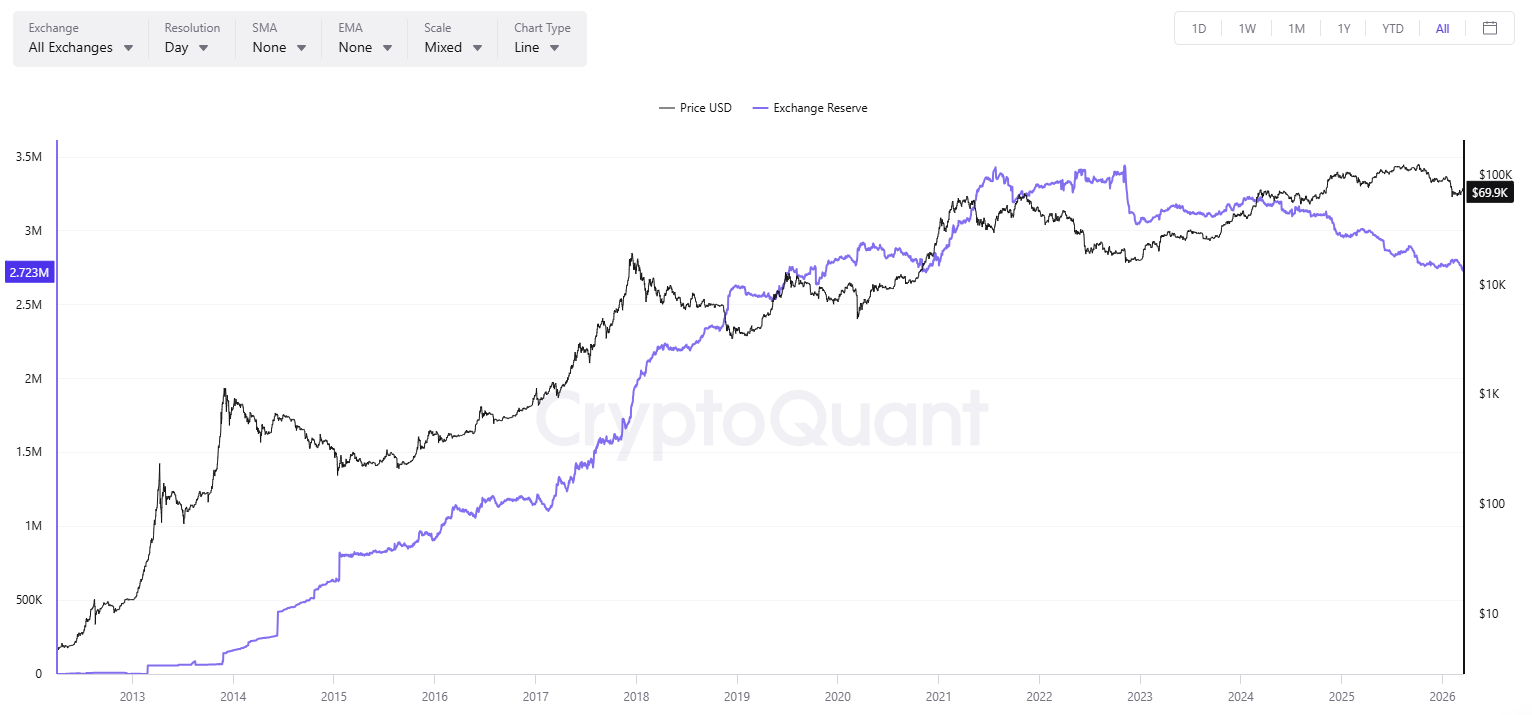
Meanwhile, some analysts, such as Ali Martinez, expect a significant price boom based on the formation of certain setups. Just a few days ago, he noted that BTC’s funding rates have turned negative, and in the past, that has always been a precursor of a “major relief rally.” Martinez reminded that in August 2023, such a development was followed by a whopping 176% price increase for BTC.
The post Bitcoin Bear Market Is Still Here, and BTC Could Plunge Under $50K: Analysts Warn appeared first on CryptoPotato.