Cryptocurrency Posts
Crypto Briefing
Crypto.com's pivot to AI highlights the growing trend of automation reshaping industries, potentially widening the gap between tech adopters and laggards.
The post Crypto.com slashes 12% of workforce as it pivots to enterprise AI appeared first on Crypto Briefing.
The rehiring at Block highlights the growing impact of AI and automation on workforce dynamics, prompting industry-wide strategic shifts.
The post Jack Dorsey’s Block brings back a few workers after mass layoffs appeared first on Crypto Briefing.
The rollout of encrypted AI models by Venice could set a new standard for privacy in AI, potentially influencing industry-wide practices.
The post Erik Voorhees’ Venice rolls out end-to-end encrypted AI modes, VVV token surges 10% appeared first on Crypto Briefing.
Algorand Foundation cuts 25% of staff as macro pressure weighs on operations, with ALGO down 19% year to date near $0.09.
The post Algorand Foundation cuts 25% of staff as macro pressure and crypto slump weigh on operations appeared first on Crypto Briefing.
In-depth comparison of Ledger, Trezor, SafePal & NGRAVE hardware wallets. Security chips, open-source status & community trust.
The post Best hardware wallets 2026: Ledger vs Trezor vs SafePal vs NGRAVE appeared first on Crypto Briefing.
Bitcoin Magazine
Bitcoin Magazine

SEC Approves Nasdaq Rule to Trade Tokenized Securities, Paving Way for Blockchain Integration
The U.S. Securities and Exchange Commission (SEC) has approved a Nasdaq rule change that allows certain securities to be traded in tokenized form, a move that integrates blockchain technology into traditional stock market infrastructure.
The approval, issued Wednesday, is part of a broader effort to explore digital representations of regulated assets while maintaining investor protections and market stability.
Under the new framework, eligible securities — including stocks in the Russell 1000 Index and exchange-traded funds (ETFs) tracking major benchmarks such as the S&P 500 — can be represented and traded as tokenized assets on Nasdaq.
These tokenized versions are fully interchangeable with traditional shares, sharing the same ticker symbols, CUSIP numbers, and shareholder rights.
Investors holding tokenized securities retain standard protections, including voting rights, dividend access, and claims on residual assets, ensuring consistency with existing securities laws.
The system operates as a pilot program through the Depository Trust Company (DTC), which handles post-trade settlement and tokenization. Market participants can choose to settle trades in tokenized form via a designated instruction at order entry.
Earlier this month, Nasdaq partnered with Payward, Kraken’s parent company, to enable the trading of tokenized stocks between traditional markets and blockchain networks using Payward’s xStocks platform.
A nod to Bitcoin
This move won’t directly affect Bitcoin’s price or network, but it’s a nod to a growing regulatory comfort with blockchain-based assets, which could indirectly boost institutional interest in digital currencies.
By integrating tokenized securities into mainstream markets, it may pave the way for broader adoption of crypto infrastructure and financial products that interact with Bitcoin.
If tokenization requirements are not met, trades default to traditional settlement. Nasdaq confirmed that its core trading infrastructure — including order types, routing strategies, trading sessions, and market data feeds — remains unchanged, ensuring tokenized securities are fully integrated into existing systems.
JUST IN:
— Bitcoin Magazine (@BitcoinMagazine) March 18, 2026SEC approves Nasdaq rule change to enable tokenized securities trading
pic.twitter.com/FUxP1LKhUU
Settlement continues on a T+1 basis, aligning tokenized trading with current standards.
Nasdaq emphasized that a tokenized share and its traditional counterpart will trade on the same order book, with identical execution priority and market data treatment. Surveillance systems will monitor both forms of the security using the same underlying data, accessible to both Nasdaq and FINRA.
The exchange will issue alerts identifying which securities are eligible for tokenized trading and will notify members at least 30 days before launching any tokenized instruments.
The SEC, in its approval, said the proposal meets regulatory requirements designed to protect investors and maintain fair and orderly markets.
The Commission specifically cited Section 6(b)(5) of the Securities Exchange Act, which requires exchange rules to prevent fraud, promote equitable trading principles, and remove impediments to a free and open market.
According to the document, tokenized securities must mirror traditional shares in rights and privileges, limiting the risk of divergence in value or investor protections.
The DTC pilot provides a controlled framework for blockchain-based trading without introducing new market risks.
The approval reflects growing momentum toward tokenization in regulated markets. Exchanges and infrastructure providers are increasingly exploring blockchain representations of conventional assets while remaining within the bounds of existing law.
Nasdaq has indicated that alternative tokenization methods are under discussion and would require separate filings with the SEC.
This post SEC Approves Nasdaq Rule to Trade Tokenized Securities, Paving Way for Blockchain Integration first appeared on Bitcoin Magazine and is written by Micah Zimmerman.
Bitcoin Magazine

The Core Issue: Your Node Vs. The Digital Wilderness
Over 50 years after the first inter-networked message, peer-to-peer networks remain rare beasts in the jungle of the Internet. Bitcoin’s ability to provide an open monetary system depends on its peer-to-peer architecture, and across its attack surface it is the networking layer–how peers discover and connect to each other–that is the most vulnerable. There are two main places problems can occur: Bitcoin’s own peering protocol, and the Internet protocols that Bitcoin’s protocol depends on. In this light Core has a dual mandate to prevent Denial of Service (DOS) vectors that can be abused between nodes, and enable nodes to communicate safely in the wider adversarial environment that is the Internet.
P2P
“Governments are good at cutting off the heads of a centrally controlled networks like Napster, but pure P2P networks like Gnutella and Tor seem to be holding their own.”
– Satoshi, Nov 7, 2008 [1]
The P2P protocol encompasses how nodes exchange messages about transactions, blocks, and other peers. This exchange of information is required before any transaction or consensus validation can occur, and is therefore a primary concern.
There have been several bugs in this area over the years. In 2017, for example, a malicious SOCKS server vulnerability was patched and disclosed [2]. This “buffer overflow” vulnerability could theoretically lead to many different attacks: crash the node, inject malicious payloads, or modify data on the node. In 2020, a high severity vulnerability was reported and patched where a remote peer could get addresses banned, growing the banlist quadratically, and is therefore a DOS on the node [3]. The vulnerability was not disclosed until 2024. This bug is correctly marked as “high severity” since the attack is simple to execute, its effect results in a loss of function for the node, and it has few preconditions required to make it work. These are the kind of bugs that keep Core developers up at night, and why it is highly encouraged to update your node to a still maintained version (older versions of Core are not actively maintained/updated).
This distributed network we call Bitcoin remains relatively small: the clearnet node count hovers around 20k nodes, and even assuming a generous 100k TOR nodes, we still have a small, easily surveillable network. Recently, Daniela Brozzoni and naiyoma showed [4] that if a node runs with both clearnet and Tor, it is trivial to map a node’s IPv4 and Tor addresses. It is very likely that this is already done by intelligence agencies and chainalysis companies. It then becomes easy to notice which nodes publish which transactions first, deducing the transaction’s original IP, and therefore location. While this is not a bug per se, since the node does not crash or misbehave, it can be considered a vulnerability, since it presents a method for tying a given IP address to a transaction.
How to prevent this effectively is currently an open question.
The Badlands of the Web
“We build our computers like we build our cities. Over time, without a plan, on top of ruins.” – Ellen Ullman [5]
Bitcoin runs on the Internet, and its ability to remain a distributed and decentralized system depends on the properties of the Internet itself. Unfortunately, the Internet’s architecture as we know it today remains woefully insecure, with known attacks employed routinely. Most of these attacks are conducted undetected until damage has been done, and this is not to mention the surveillance regimes that permeate the Internet today.
The most well known and practical vector of attack to be concerned with is called an eclipse attack, where a victim node’s peers are all malicious, and feed a specific view of the chain or network to the victim node. This class of attack is fundamental in distributed systems, if you control a node’s peers, you control its awareness of the network. Ethan Heilman and collaborators presented one of the first practical eclipse attacks on Bitcoin at USENIX 2015 [6], and in 2018, the Erebus attack paper described a “stealthy” eclipse attack via a malicious Autonomous System (AS) [7].
These attacks largely leverage weaknesses in the way the Internet’s networks communicate amongst themselves, such as ASs routing topology or via a protocol called the Border Gateway Protocol (BGP). While there are ongoing initiatives to secure the BGP protocol–BGPsec, RPKI–they both have limitations that are well understood, and leave the Internet’s stewards pining for stronger solutions. Until then, the Internet will remain the wild west.
A recent analysis by cedarctic at Chaincode Labs found that Bitcoin nodes are homed within just 4551 ASs, a fairly small subsection of the constituent networks that make up the Internet. They describe a set of attacks that can lead to eclipse attacks by compromising the upstream AS that nodes operate in [8]. The small distribution of nodes amongst ASs and the specific relationships among these ASs creates a unique attack vector. While there are remediations, it is unclear whether this attack vector was well understood beforehand by bitcoiners or their adversaries.
Any attack that relies on compromising one or several ASs requires resources, coordination, and skills to achieve. Although no successful attack of this type has been reported on a Bitcoin node, such attacks have been successfully mounted against miners [9], wallets [10], swap platforms [11], and bridges [12]. While we’re not going to fix the Internet, we can arm nodes with the tools to operate in this adversarial environment.
Network Armory
Below are some features and functionalities that Bitcoin Core has developed or integrated support for in order to arm users against network level attacks:
TOR (the Onion Router) is the oldest privacy-focused overlay network incorporated in Bitcoin Core. It creates hops between a random network of peers to obfuscate traffic.
v2transport [13] encrypts connections between peers, hiding the traffic from snoops and censors. The aim is to thwart passive network observers from snooping on the contents of your communications with other nodes.
I2P (the Invisible Internet Project [14]) is an optional feature of Core which enables an additional, private, encrypted layer to one’s connections. It is a Tor-like anonymity network which relies on peers to obfuscate traffic between clients and servers.
ASmap [15] is another optional feature of Core which implements a mitigation for the Erebus attack that the authors already outlined in the paper, and applies to all AS-based attacks. By making Bitcoin’s peering mechanism aware of the AS that peers are coming from to ensure diversity amongst peers, an eclipse becomes exponentially more difficult, as an attacker would have to compromise many ASs, which is highly unlikely and almost impossible without being detected. Bitcoin Core supports taking a map of IP networks to their AS (an AS-map) since Core 20.0, and the Kartograf project enables any user to generate such an ASmap easily.
Given that the Internet is likely to continue being vulnerable to many attacks, one of the things we can do is observe our peers’ behavior to attempt to detect malicious behavior. This is the impetus behind the peer-observer project by 0xb10c [16]. It provides a full eBPF tracepoint-based logging system (a way to observe the tiniest actions in a program running on an operating system) to observe a node’s activity, including peer behavior. It also gives you everything you need to build your own logging systems.
Bitcoin Must Be Robust
Securing the ability to connect to peers and exchange messages is a keystone component of what makes Bitcoin tick.
Bitcoin operates in a multi-dimensional adversarial environment, in which many of the threats are created by limitations of the internet’s architecture itself. If Bitcoin is to survive and thrive, its developers and users must learn to navigate these strange waters.
The price of open networks is eternal vigilance.

Don’t miss your chance to own The Core Issue — featuring articles written by many Core Developers explaining the projects they work on themselves!
This piece is the Letter from the Editor featured in the latest Print edition of Bitcoin Magazine, The Core Issue. We’re sharing it here as an early look at the ideas explored throughout the full issue.
[0] https://web.mit.edu/gtmarx/www/connect.html
[1] https://satoshi.nakamotoinstitute.org/emails/cryptography/4/
[2] https://bitcoincore.org/en/2019/11/08/CVE-2017-18350/
[3] https://bitcoincore.org/en/2024/07/03/disclose-unbounded-banlist/
[4] https://delvingbitcoin.org/t/fingerprinting-nodes-via-addr-requests/1786/
[5] https://en.wikiquote.org/wiki/Ellen_Ullman
[6] https://www.usenix.org/system/files/conference/usenixsecurity15/sec15-paper-heilman.pdf
[7] https://ihchoi12.github.io/assets/tran2020stealthier.pdf
[8] https://delvingbitcoin.org/t/eclipsing-bitcoin-nodes-with-bgp-interception-attacks/1965
[9] https://www.theregister.com/2014/08/07/bgp_bitcoin_mining_heist/
[10] https://www.theverge.com/2018/4/24/17275982/myetherwallet-hack-bgp-dns-hijacking-stolen-ethereum
[11] https://medium.com/s2wblog/post-mortem-of-klayswap-incident-through-bgp-hijacking-en-3ed7e33de600
[12] www.coinbase.com/blog/celer-bridge-incident-analysis
[13] https://bitcoinops.org/en/topics/v2-p2p-transport/
[14] https://geti2p.net/en/
[15] https://asmap.org
[16] https://peer.observer
[13] https://github.com/asmap/kartograf
This post The Core Issue: Your Node Vs. The Digital Wilderness first appeared on Bitcoin Magazine and is written by Julien Urraca, Fabian Jahr, 0xb10c and CedArctic.
Bitcoin Magazine
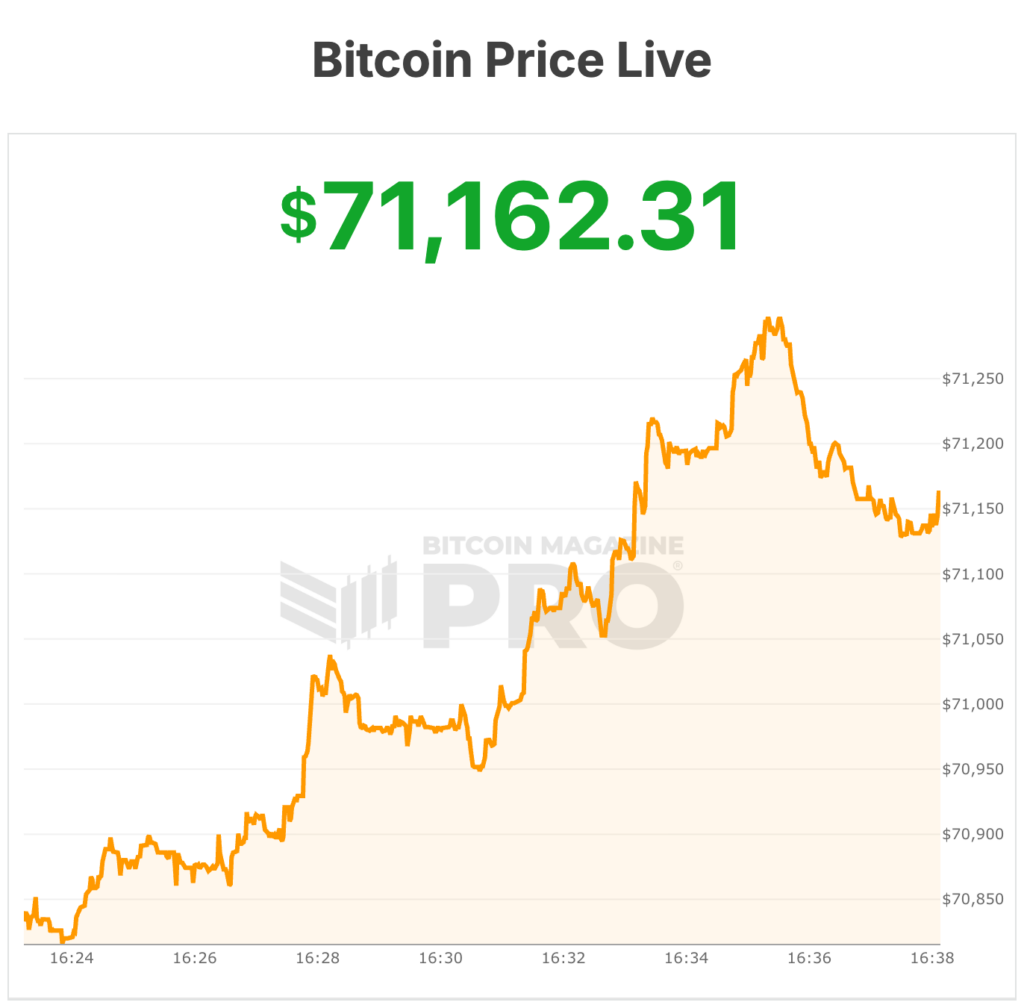
Bitcoin Price Fights For $70,000 As Federal Reserve Holds Rates
The Federal Reserve on Wednesday kept its benchmark interest rate steady, maintaining the federal funds target range at 3.50% to 3.75%. Bitcoin price is fighting to hold $70,000 amid a complex backdrop of elevated inflation, slowing job growth, and war in the Middle East.
The decision marked the second consecutive FOMC meeting with no change in borrowing costs and followed a pause that began after three rate cuts last year.
Bitcoin price responded to the announcement with a drop in trading, changing hands around $70,500, down 3.6% over the previous 24 hours, according to Bitcoin Magazine Pro. The cryptocurrency had flirted with $76,000 last week, reaching its highest level in over a month, but has since retraced as investors weighed inflation data and global uncertainties.
Voting members of the Federal Open Market Committee were split for a sixth consecutive policy meeting. Eleven supported holding rates steady, while Fed Governor Stephen Miran dissented, advocating a 25-basis-point cut.
BREAKING:
— Bitcoin Magazine (@BitcoinMagazine) March 18, 2026
In its statement, the FOMC noted that “inflation remains somewhat elevated” and that job gains have remained low, even as the unemployment rate ticked up to 4.4% in February. The Fed emphasized a data-dependent approach to future adjustments, signaling that any decision will rely on incoming economic information.
The backdrop for the Fed’s policy deliberations included the ongoing war involving the U.S., Israel, and Iran, which has pushed energy prices higher. On Wednesday, Bitcoin price fell in tandem with U.S. stocks following reports that Israel struck the South Pars gas field in Iran.
“Uncertainty about the economic outlook remains elevated,” the FOMC said. “The implications of developments in the Middle East for the U.S. economy are uncertain.”
Federal Reserve Chair Jerome Powell discussed the implications of rising energy prices at a press conference.
He said, “Near term measures of inflation expectations have risen in recent weeks, likely reflecting the substantial rise in oil prices caused by the supply disruptions in the Middle East.”
He added that it is “too soon to know” the full economic impact of the conflict and that policymakers would continue to monitor data closely.
Bitcoin price reacts to tariffs, rate expectations
Powell also highlighted the influence of tariffs on consumer prices, noting that “some big chunk of that, between a half and three-quarters, is actually tariffs.”
He described the current federal funds rate range as within neutral territory and emphasized the importance of central bank independence.
“Independence is what allows us to do our jobs, and stable prices is half of our mandate, it’s one of our two mandates – maximum employment being the other,” he said.
Bitcoin price markets have historically been sensitive to interest rate expectations, as lower rates tend to make cryptocurrencies more attractive relative to traditional assets.
Analysts suggest that the combination of higher energy costs, persistent inflation, and geopolitical uncertainty has prompted investors to reduce exposure to riskier assets, including Bitcoin.
Oil prices continued to climb Wednesday, with Brent crude rising 3.8% to $107.38 per barrel following the attack on the South Pars field.
Despite the recent pullback, Bitcoin price remains above $70,000 for now and has recorded gains of 1.6% over the past week. Traders are watching closely for any signs from Powell or the Fed that could influence future monetary policy.
Powell’s term as Fed Chair will conclude in May, with former Fed Governor Kevin Warsh expected to succeed him if confirmed. Powell’s future on the Board of Governors remains undecided.
He said, “I have no intention of leaving the board until the investigation is well and truly over, with transparency and finality.”
At the time of writing, the bitcoin price is slightly above $71,000.
This post Bitcoin Price Fights For $70,000 As Federal Reserve Holds Rates first appeared on Bitcoin Magazine and is written by Micah Zimmerman.
Bitcoin Magazine

Till Death or Seed Phrase: Woman Accused of Spying on Husband, Stealing $172 Million in Bitcoin
A dispute over more than $172 million in Bitcoin has moved forward in the UK’s High Court of Justice, where a man alleges his estranged wife stole thousands of coins from his hardware wallet using covert surveillance inside their home.
Court filings show that Ping Fai Yuen, a UK resident, held 2,323 Bitcoin in a Trezor hardware wallet in 2023.
On Aug. 2 of that year, the full balance was transferred without his knowledge. The funds were later split across 71 separate addresses through a series of transactions. No movement has been recorded since Dec. 21, 2023.
Yuen claims his wife, Fun Yung Li, obtained access to the wallet’s recovery phrase, which can be used to recreate the wallet and move funds.
The filings allege she recorded him inside their home to capture the phrase, possibly with help from her sister, Lai Yung Li, who is also named as a defendant.
According to the claim, Yuen had been warned by his daughter in July 2023 that Li was attempting to access his Bitcoin.
He then installed audio recording equipment in the residence. The recordings are cited as key evidence. In one excerpt referenced in court, Li is alleged to have said, “The Bitcoin has transferred to me” and “take all of it.”
The filings also describe a recording from July 29, 2023 in which Li allegedly discussed camera placement and the location where Yuen stored his wallet credentials. The claim states she was “covertly recording” him in an effort to obtain access.
After discovering the transfer, Yuen confronted Li and assaulted her. He was arrested and later pleaded guilty to assault occasioning actual bodily harm and two counts of common assault.
Police opened an investigation into the alleged theft and arrested Li in 2023. Officers seized 10 crypto cold wallets during a search, including several linked to Yuen. Authorities later released Li after a no comment interview. The police have since stated they will take no further action without new evidence.
In November 2025, Yuen sought a proprietary asset preservation injunction. He asked the court to confirm his ownership of the Bitcoin, freeze Li’s crypto holdings, and order the return of the assets or an equivalent sum in British pounds.
‘Damning’ evidence of bitcoin theft
In a judgment following a March 2 hearing, Justice Cotter said Yuen’s case shows a strong likelihood of success. He pointed to the warning from Yuen’s daughter, the audio transcripts, and the discovery of equipment capable of accessing the wallet.
“The evidence is that he was warned of what the First Defendant was seeking to do, the transcripts are damning,” Cotter wrote.
The judge also cited Occam’s razor, the principle that the simplest explanation with the fewest assumptions is often the most likely. He said that this straightforward account aligns with the available evidence, and noted that Li has had the opportunity to present her version of events but has not done so in the proceedings.
Cotter added that the volatility of Bitcoin supports the need for a swift trial, as the value of the disputed assets may shift during the course of litigation.
The case is expected to test how English courts handle ownership and recovery claims tied to digital assets.
This post Till Death or Seed Phrase: Woman Accused of Spying on Husband, Stealing $172 Million in Bitcoin first appeared on Bitcoin Magazine and is written by Micah Zimmerman.
Bitcoin Magazine

Zip Ties, Sleeping Pills and Pepper Spray: Canadian Crypto Millionaire Targeted in Foiled Madrid Kidnapping
A Canadian crypto entrepreneur survived a kidnapping attempt Monday night on one of Madrid’s busiest nightlife streets, after witnesses alerted police and helped foil the attack.
The incident occurred at approximately 11 p.m. near the intersection of Calle Claudio Coello and Calle Jorge Juan in the Salamanca district, a hub of high-end restaurants and bars.
The victim had just left Lobito de Mar, the restaurant owned by chef Dani García, when three men forcibly removed him from the street, pepper-sprayed him, and threw him into a Ford Transit van.
Several pedestrians and residents on nearby balconies immediately called authorities. Spanish National Police tracked the vehicle to Ronda de Toledo, about 15 minutes from the scene, and arrested two of the attackers. One suspect escaped and remains at large, according to reports.
Police identified the arrested suspects as Serbian men, ages 33 and 45, both with no prior criminal record.
Investigators say the attackers had planned the abduction to extract the victim’s cryptocurrency passwords and gain access to his digital assets. The suspects also attempted to steal the Canadian’s €100,000 luxury watch.
Authorities determined the kidnappers had followed the businessman from Barcelona to Madrid, where he had traveled to finalize a cryptocurrency deal.
The van used in the crime had an altered license plate, rented specifically for the abduction, and contained plastic zip ties and sedative pills, suggesting a premeditated scheme. GPS data recovered from the vehicle indicated the suspects intended to transport the victim to Petrer, a town in Alicante.
Inside the van, the victim was left alone while police focused on detaining the suspects. He freed himself from the zip ties and flagged down a taxi, which took him to La Princesa Hospital for treatment of injuries sustained during the initial assault. Police recovered firearms from the van during their investigation.
Be careful with your crypto
The kidnapping aligns with a recent rise in physical attacks targeting cryptocurrency holders across Europe. France, for example, has recorded 11 similar incidents so far in 2026, reflecting a trend of criminals seeking direct access to digital assets rather than traditional bank accounts.
Security experts refer to such attacks as “wrench attacks,” in which criminals attempt to obtain wallet seed phrases or private keys through coercion or violence.
Authorities warn that cryptocurrency entrepreneurs are increasingly at risk due to the digital and highly liquid nature of their assets.
Police continue to search for the third suspect and have appealed to the public for information.
The investigation remains open, with officers examining surveillance footage and digital evidence to determine whether the plot involved additional collaborators or extended surveillance beyond the two confirmed attackers.
This post Zip Ties, Sleeping Pills and Pepper Spray: Canadian Crypto Millionaire Targeted in Foiled Madrid Kidnapping first appeared on Bitcoin Magazine and is written by Micah Zimmerman.
CryptoSlate
FTX's fourth round of distributing bankruptcy recoveries arrives at a different moment. The estate will begin sending roughly $2.2 billion to eligible creditors on Mar. 31, just as Bitcoin (BTC) pushed back above $70,000 into what Glassnode called a thin $72,000-$82,000 on-chain zone.
FTX announced on Mar. 18 that its fourth distribution will begin Mar. 31 and end Apr. 3, with eligible creditors expected to receive funds via BitGo, Kraken, or Payoneer within 1 to 3 business days.
Dotcom customer claims receive an incremental 18% to reach 96% cumulative recovery, US customer claims receive 5% to reach 100%, and general unsecured and digital asset loan claims each receive 15% to reach 100%. Convenience claims stay at 120% cumulative.
This is the largest FTX distribution since the more than $5 billion second round in May 2025 and is 37.5% larger than the $1.6 billion third distribution in September 2025.
The nominal size alone makes it a real liquidity event, even though it falls short of half the scale of the May round.


Bitcoin's current structure
Bitcoin currently trades around $70,000 with an intraday low of $69,500, after yesterday's high of $74,603
Glassnode's Mar. 18 report said BTC had broken above $70,000 and entered a thinly accumulated $72,000 to $82,000 zone with limited on-chain resistance.
The market has probed into that zone but sits right on or just below the lower boundary, still working to hold the breakout cleanly.
Only about 60% of the supply is back in profit. Glassnode says a sustained move above 75% would be needed to confirm a genuine early bull transition.
The report still treated this as an early conviction rather than a fully validated bull regime.
As a result, the current setup is defined by absorption. Short-term holders realized profit spiked to $18.4 million per hour as BTC approached $74,000, echoing the same sell-into-strength behavior seen in February.
If the market can digest that selling and stay above $70,000, higher levels like the True Market Mean near $78,000 and the upper air-gap band near $82,000 become more plausible.
However, if absorption fails, the move still looks like a fragile bear market recovery rather than a durable trend change.
The current recovery looks more spot-led than leverage-led.
Glassnode says ETF allocations have rebounded, spot cumulative volume delta has turned higher, Coinbase spot activity has stabilized and turned positive, and CME futures positioning stays subdued.
CoinShares adds that digital asset investment products took in $1.06 billion last week, with Bitcoin accounting for $793 million, extending the three-week Bitcoin inflow run to $2.2 billion.
Derivatives present a constructive but restrained picture, as Glassnode sees the market emerging from negative funding and defensive hedging.
Deribit says BTC funding has moved back to roughly neutral, BTC futures-implied yields are flat at around 2% to 3% across tenors, and seven-day BTC implied volatility sits near 52%.
That profile fits a recovering market lacking aggressive speculative conviction.

Why FTX cash can have an impact now
CoinShares says Bitcoin investment products absorbed $2.2 billion over the last three weeks.
FTX is distributing $2.2 billion in cash. The two flows differ in nature: one represents direct Bitcoin fund inflows, while the other represents bankruptcy cash distributed to many creditors. Yet, their nominal size is identical.
The payout tests recycled liquidity, but it is unclear if even a small recycling ratio is enough to matter in a market trying to hold above $70,000 while absorbing $18.4 million per hour in short-term holder profit-taking.
Besides, Glassnode flagged that the FTX cash lands after the March options expiry tailwind. About $4.5 billion of negative dealer gamma sits around $75,000, with $3.9 billion expiring this month.
The report warns that once quarter-end expiry passes, the unwinding of dealer hedges could create headwinds or consolidation. FTX cash may hit just as a key supportive market mechanism fades.

A recycling model
At a 5% recycle rate, $110 million represents about 13.9% of last week's Bitcoin fund inflows and roughly 6 hours at the current $18.4 million-per-hour short-term holder realized profit pace.
Important, though likely insufficient to drive direction alone.
At a 10% recycle rate, $220 million equals about 27.7% of last week's Bitcoin fund inflows and about 12 hours of current short-term holder profit realization. Large enough to affect the price action over a short window, especially if ETF flows stay positive.
At a 20% recycle rate, $440 million represents about 55.5% of last week's Bitcoin fund inflows and nearly 24 hours of current short-term holder profit realization. At that point, the payout becomes a meaningful marginal bid.
At a 30% recycle rate, $660 million equals about 83.2% of last week's Bitcoin fund inflows. This is the level at which an FTX-driven re-risking wave would become visible relative to recent institutional spot demand.
If the full $2.2 billion were spread evenly over three days, that would be $733 million per business day.

Spread mechanically over 72 hours, it amounts to about $30.6 million per hour, versus the current $18.4 million per hour short-term holder realized profit rate. Even modest recycling rates become worth watching amid thin liquidity, where absorption capacity determines direction.
| Recycle rate | Cash potentially rotating back | Share of last week’s BTC fund inflows | Equivalent at $18.4M/hour STH profit-taking | Takeaway |
|---|---|---|---|---|
| 5% | $110M | 13.9% | ~6 hours | Noticeable, but likely not enough alone |
| 10% | $220M | 27.7% | ~12 hours | Can affect short-term price action |
| 20% | $440M | 55.5% | ~24 hours | Becomes a meaningful marginal bid |
| 30% | $660M | 83.2% | ~36 hours | Large enough to show up clearly in the tape |
The bull case assumes a 10% to 20% recycling rate, combined with positive ETF demand and a continued spot-led bid. BTC reclaims and holds the lower air-gap boundary, digests short-term holder selling, and starts trading toward the $78,000 True Market Mean, then $82,000.
The key tell would be price strength without a big re-leveraging in futures, validating the healthier spot-led recovery narrative.
The bear case assumes most recipients de-risk, hold cash, or redeploy elsewhere. BTC loses the lower air-gap boundary and drifts back toward the prior $64,000-$72,000 accumulation cluster.
The market effectively votes that returned FTX cash cannot overpower existing profit-taking and post-expiry headwinds.
The late-March window becomes a test of recycled liquidity landing in a spot-led market before leverage has fully returned.
What dictates the outcome is how much of the returned FTX money becomes fresh crypto demand.
The post Over $2B in “lost” Bitcoin to hit markets this month creating sell pressure within fragile $67k–$74k range appeared first on CryptoSlate.
The US Securities and Exchange Commission (SEC) has drawn its clearest line yet around which parts of crypto it views as outside securities law, a move that hands the industry a new map of regulatory winners while opening a narrower lane for privacy-focused technology.
However, the SEC’s new crypto taxonomy does more than just redraw markets. Quietly, the new approach blocks a regulatory path that could have forced developers and software providers into KYC-heavy broker-dealer regimes.
By classifying much of crypto activity as securities brokerage, the SEC’s earlier approach could have forced developers and software companies to register as broker-dealers, thereby requiring them to comply with strict identity checks (KYC) and anti-money-laundering (AML) rules.
In an interpretive release issued on March 17, alongside the Commodity Futures Trading Commission, the SEC categorized crypto assets into five categories: digital commodities, digital collectibles, digital tools, stablecoins, and digital securities.
The agency said digital commodities, digital collectibles, and digital tools are not themselves securities, while stablecoins may or may not be securities depending on their structure, and digital securities remain inside the SEC’s core jurisdiction.
Chair Paul Atkins framed the shift in broad terms. In remarks announcing the policy, he said the commission was implementing a token taxonomy under which digital commodities, digital collectibles, digital tools, and payment stablecoins under the GENIUS Act are not deemed securities, while digital securities, meaning tokenized traditional securities, remain subject to federal securities law.
The CFTC said it would administer the Commodity Exchange Act in a manner consistent with the SEC’s interpretation, giving the guidance immediate weight beyond a single-agency speech.
Named commodities move to the front
The digital commodity bucket is the most important part of the release because it reaches the largest pool of liquid crypto assets and provides a clearer path away from the securities hostilities overhang that defined the Gary Gensler era.
The SEC describes a digital commodity as a fungible crypto asset linked to the programmatic operation of a functional crypto system, with value tied to utility and supply and demand rather than the essential managerial efforts of others.
That definition strengthens the policy position around Bitcoin and Ethereum, but it also extends formal comfort to networks that have sat in a more contested middle ground, including Solana, Cardano, XRP, and Avalanche. XRP stands out because it spent years at the center of one of the industry’s highest-profile securities fights.
Stuart Alderoty, Ripple's chief legal officer, noted:
“We always knew XRP wasn't a security – and now the SEC has made clear what it is: a digital commodity.”
Solana, Cardano, and Avalanche also gain because the SEC release does more than classify tokens. It also addresses the network activities that help secure them.
For proof-of-work networks, the SEC said covered protocol mining activities do not involve the offer and sale of a security, which supports Bitcoin, Litecoin, Dogecoin, and Bitcoin Cash. For proof-of-stake networks, the commission said covered protocol staking activities do not involve the offer and sale of a security either.
Meanwhile, that interpretation extends to staking by token holders, the roles of third-party validators and custodians, and the issuance and redemption of staking receipt tokens, which serve as one-for-one receipts for deposited non-security crypto assets.
That gives another layer of support to ETH, Solana, Cardano, Avalanche, Polkadot, Tezos, and Aptos.
The release also says redeemable wrapped tokens backed one-for-one by deposited non-security crypto assets and redeemable on a fixed one-for-one basis do not involve the offer and sale of a security in the circumstances described by the SEC.
Collectibles, memes, and utility tokens gain a lane
The second group of winners is smaller in market value but more surprising in political and cultural terms.
The SEC’s digital collectible category includes assets designed to be collected or used and lacking rights to income, profits, or assets of a business enterprise. Its examples include CryptoPunks, Chromie Squiggles, Fan Tokens, WIF, and VCOIN.
The inclusion of WIF, a meme coin, signals to markets that some community-driven tokens can be analyzed less as capital-raising instruments and more as cultural or collectible assets, though the SEC notes that hybrid structures can still raise securities questions.
The digital tools category is another beneficiary. The SEC defines digital tools as crypto assets that perform practical functions such as memberships, tickets, credentials, title instruments, or identity badges. Its examples include Ethereum Name Service (ENS) domain names and CoinDesk’s Microcosms NFT Consensus Ticket.
The commission says digital tools are on-chain analogues to physical utilities and that people acquire them for functional use rather than a claim on a business enterprise.
This is significant beyond the listed examples because it gives a clearer route for builders working on identity, access, naming, and credential systems. For a sector that has often had to explain why a token is a tool rather than an investment product, the SEC has now supplied its own framework.
Stablecoins also move into a stronger position, though with more conditions than the commodity bucket.
The release states that, once the GENIUS Act becomes effective, payment stablecoins issued by permitted payment stablecoin issuers under the GENIUS Act are excluded from securities status by statute. It also says other stablecoins may or may not be securities depending on the facts and circumstances.
That gives regulated dollar-linked issuers a clearer federal lane while keeping yield-bearing and more structured designs under closer scrutiny.
Privacy gets a quiet opening
While the SEC’s taxonomy creates no standalone privacy bucket, it narrows the range of crypto assets and crypto activity that sit inside securities treatment.
In the release, the agency says digital commodities, digital collectibles, and digital tools are not themselves securities, while also stating that the interpretation does not itself create new legal obligations. The commission separately says the Bank Secrecy Act and the Anti-Money Laundering Act are outside the scope of the action.
That language is why privacy advocates are treating the move as an opening for the sector, which had come under increased scrutiny over the past few years.
Independent journalist L0la L33tz argued in a post on X that the interpretation is a major privacy win because a broader broker-dealer framing for digital-asset developers and software-linked services could have pushed more of the sector toward KYC and AML obligations under securities law.
Her reading captures the shift in jurisdictional terms: a narrower SEC perimeter leaves more room for crypto software and non-security asset activity to exist outside the commission’s core registration regime.
The practical benefit of this is strongest around self-custody, open-source development, and non-custodial tools. The SEC’s digital tools category supports that view because it treats functional on-chain assets as utilities acquired for use rather than as claims on a business enterprise.
For privacy-focused builders, wallet software, credential layers, and related infrastructure, the release offers a clearer argument that software-linked crypto activity should be analyzed in terms of function and control rather than automatically through an investment-product lens.
Meanwhile, the remaining compliance boundary sits with Treasury and FinCEN. FinCEN’s 2019 guidance says an anonymizing software provider is not a money transmitter because supplying software differs from accepting and transmitting value.
In the same guidance, FinCEN says an anonymizing services provider that accepts and retransmits value is a money transmitter under its rules.
That leaves privacy advocates with a meaningful policy gain inside securities law while AML and money-transmission obligations continue to be handled through a separate federal framework.
The deeper market message
The broader significance of the SEC release is that it offers a sorting mechanism the industry has wanted for years without dissolving every legal question around token issuance and distribution.
The commission says a non-security crypto asset can still be offered and sold, subject to an investment contract that remains a security.
In practice, that means classification helps most when a token is closely tied to a functioning network, a practical use case, or a decentralized system rather than to a promoter’s ongoing promises about enterprise value.
That leaves the winners from this framework easier to identify. Bitcoin, ETH, Solana, XRP, and other named digital commodities gain the clearest immediate boost. Staking networks, wrapped non-security assets, digital tools, and payment stablecoins receive stronger legal framing.
Meanwhile, privacy-focused crypto projects gain a narrower but still important opening because the SEC has drawn a firmer boundary around its own authority.
So, the next chapter for the market will turn on how exchanges, issuers, developers, and Treasury-led compliance agencies respond to that new map.
The post SEC drastically reduces KYC pressure on Bitcoin, XRP, and Solana with revamped crypto rules appeared first on CryptoSlate.
US banks “reduced” their credit risk after 2008 by shifting more of it to nonbank lenders.
Since 2008, banks have shifted a growing share of their lending to nonbanks like private credit funds, making it their fastest-growing loan category.
That shift doesn’t signal another 2008-style crisis today, but it does show where trouble could surface first if private credit starts to crack.
This week, traders, analysts, and Investment firms are reviving a familiar question: are US banks setting up a repeat of 2008?
The clean answer is no, based on the publicly available numbers. The same debate also points to a real shift in bank balance sheets that deserves a harder look.
The chart below, which is circulating on X, shows that bank lending to nondepository financial institutions, or NDFIs, rose 2,320% over 15 years.
An FDIC note documented $1.32 trillion of those loans by the third quarter of 2025, up from $56 billion in the first quarter of 2010, and called the category the fastest-growing loan segment since the 2008-09 crisis.

After 2008, large banks pulled back from riskier direct lending, but they also funded the nonbank lenders that stepped in. That group includes private credit vehicles, mortgage finance firms, securitization structures, and other parts of the shadow banking system. The risk moved elsewhere rather than disappearing.
However, that does not mean banks are already in trouble. The FDIC’s latest industry profile showed the banking sector earned $295 billion in 2025, posted a fourth-quarter return on assets of 1.24%, reduced unrealized securities losses to $306 billion, and counted 60 problem banks, still within the agency’s normal non-crisis range. Those are not the numbers of a system already in a panic.
The issue is where losses, redemptions, and liquidity pressure land when the lending chain has more links.

For crypto, that changes the timing of any stress. A classic bank panic starts at the bank. In the current structure, stress can begin in a fund, a warehouse line, or a financing vehicle, then work backward into banks if marks fall, borrowers miss payments, or investors ask for cash faster than the assets can be sold.
| Indicator | Latest reading in the source set | What it shows |
|---|---|---|
| Bank loans to NDFIs (data) | $56 billion in Q1 2010; $1.32 trillion in Q3 2025 | The exposure became one of the largest post-crisis shifts on bank balance sheets. |
| Growth rate of NDFI lending (study) | 21.9% annual compound growth from 2010 to 2024 | The category expanded much faster than most traditional loan books. |
| Committed bank lines to private-credit vehicles (note) | $8 billion in Q1 2013; $95 billion in Q4 2024; about $56 billion utilized | Large banks are tied to the private-credit system through direct financing lines. |
| Total committed bank lines to private credit and private equity (research) | About $322 billion in Q4 2024 | The funding links extend beyond one niche product. |
| US bank earnings and health check (report) | $295.6 billion net income; 1.24% ROA; $306.1 billion unrealized losses; 60 problem banks | Banks are not yet showing a broad 2008-style breakdown. |
| Global nonbank share of finance (report) | About 51% of global financial assets in 2024 | The migration of credit away from banks is global, not a US outlier. |
| Bitcoin snapshot (market) | $73,777; +0.05% in 24 hours; +4.55% in 7 days; +7.51% in 30 days; 58.5% dominance | BTC was firm while the banking and private-credit debate spread. |
The post-crisis shift is now visible in the numbers
The official numbers make the structural change hard to dismiss. The FDIC said bank lending to NDFIs compounded at 21.9% a year from 2010 to 2024.
By the third quarter of 2025, the total had reached $1.32 trillion, or roughly 10% of bank lending in the agency’s analysis.
Not every dollar in that bucket is private credit, and exposures in the category carry different levels of risk. Even so, the scale shows that a large share of credit intermediation now sits in institutions that do not take deposits and often disclose less than banks do.
That nuance is important. NDFI is a broad label. It can include mortgage intermediaries, consumer finance firms, securitization vehicles, private equity funds, and other nonbank lenders, alongside private-credit funds.
A sloppy reading turns the whole bucket into one bet on private credit. A more accurate reading is that banks built a large, fast-growing set of links to the broader nonbank system.
Private credit is one visible part of that system, and one of the most closely watched because it grew during a long period of higher rates, tighter bank regulation, and steady investor demand for yield.
A Federal Reserve staff note sharpens this point. It is estimated that committed credit lines from the largest US banks to private-credit vehicles rose from about $8 billion in the first quarter of 2013 to about $95 billion by the fourth quarter of 2024, with roughly $56 billion already drawn.
The same work put total committed bank lines to private credit and private equity at about $322 billion.
That does not prove systemic failure is close. The Fed’s own conclusion was more restrained: direct financial-stability risk from this channel looked limited so far because the largest banks appeared able to absorb major drawdowns.
Even so, growing links between banks and private-credit vehicles warrant close attention.
The risk is best framed as continued bank funding for parts of the lending chain, which changes where stress appears first.

In the public market, losses print quickly. In private markets, they can move more slowly because marks update less often, assets are less liquid, and investor withdrawals are managed through product rules.
That delay can make the system look calm until cash needs force a sharper repricing.
Global context points in the same direction. The Financial Stability Board said the nonbank financial intermediation sector accounted for about 51% of total global financial assets in 2024 and continued to grow at roughly twice the pace of banking, according to its latest report.
This is no longer a US edge case. Credit has been moving into institutions outside the classic banking model for years, and the US private-credit boom is part of that wider pattern.

Why the trade is getting tested now
The issue became more urgent as structural data arrived while private credit began to show public strain. Some private-credit vehicles have limited or managed withdrawals, while JPMorgan tightened some lending against private-credit portfolios after markdowns.
Those events stop short of establishing a full-market break and instead show where pressure is likely to emerge first: fund liquidity, financing terms, and collateral values.
That is also why any comparison to 2008 needs restraint.
The same FDIC report that drove renewed attention also showed banks entering this phase from a stronger income position than during past crises. The public banking system is not in free fall.
The greater concern is a funding architecture that could transmit stress from nonbank lenders back into banks if private assets keep repricing lower or if investors want cash before loans can be sold or refinanced.
Borrower quality and refinancing deserve more attention than broad slogans. In a recent Financial Times interview, Partners Group’s chair said that private-credit default rates could double from their roughly 2.6% historical average over the coming years. That is not an official baseline, and it should not be treated as one.
It does, however, capture the key pressure point. A system built on long-duration private loans, slower marks, and regular financing lines can look stable until defaults rise and refinancing windows narrow at the same time.
For Bitcoin, the setup is awkward in the short run and cleaner in the medium run. At the time of writing, BTC traded near $73,777 and held 58.5% market dominance, with gains of 0.05% over 24 hours, 4.55% over seven days, and 7.51% over 30 days, according to CryptoSlate data.
That price action suggests crypto is not trading as if a banking event is already underway. If a broader credit squeeze did hit, the first move would likely be a selloff in liquid assets, and Bitcoin is still one of the most liquid assets in global markets.
Over a longer horizon, if the debate broadens into a deeper loss of trust in how the financial system carries leverage and values private assets, Bitcoin’s appeal as an asset outside the banking stack becomes easier to articulate.
That second-order effect is the real contagion risk for crypto.
A private-credit strain does not automatically send capital into Bitcoin on day one. It can easily produce the opposite move.
Over time, though, if banks have to pull back, if fund financing gets harder, and if more investors start asking who really owns the credit risk, the case for holding some assets outside that system becomes easier to make. We know that trade. The banking data now place it in a new macro setting.

What to watch in the next round of data
The next phase of this story will likely emerge through three checks: whether more private-credit vehicles limit withdrawals or take larger marks, whether banks keep financing those funds on the same terms, and whether the NDFI loan book continues to expand at anything close to the pace the FDIC documented over the prior decade.
That is where the current debate becomes more concrete than the usual “shadow banking” label. If banks tighten financing to nonbank lenders, middle-market borrowers can feel it quickly through cost and access, even if no household hears the acronym NDFI.
If the funds meet redemptions by selling what they can, public credit can take some of the price discovery that private books avoided. If the funds do not sell and banks keep financing them, the exposure stays in the system longer.
None of those paths requires a repeat of 2008. All of them can still change how credit flows.
Pressure is already showing in all three areas
The direction of travel so far looks like tightening, not collapse.
On withdrawals and marks, semi-liquid private-credit vehicles are restricting cash more aggressively while investors push for fresher valuations.
A recent report said Cliffwater’s flagship corporate lending fund received redemption requests equal to about 14% of shares and met only 7%, while Morgan Stanley’s North Haven fund received requests equal to 10.9% and honored only its 5% cap.
The same report said BlackRock and other vehicles also hit standard quarterly limits, while Apollo moved toward monthly and then daily NAV reporting to answer criticism of stale pricing.
That points to weaker liquidity conditions and stronger investor demand for faster price discovery and greater cash access at the same time.
On bank financing, lenders are getting more selective rather than shutting the door outright.
A separate report said JPMorgan marked down some software-backed private-credit collateral and restricted lending to affected funds, which reduced borrowing capacity and pointed to tougher collateral treatment in weaker pockets of the market.
That stance is not universal. Other coverage said banks were still willing to finance some withdrawal needs. The signal is narrower and more useful: lenders are still in the market, but they are showing less tolerance for weak collateral and more willingness to tighten terms fund by fund.
On balance-sheet growth, the NDFI loan book has already changed behavior without needing to contract outright.
The FDIC’s February 2026 study said bank loans to NDFIs compounded at 21.9% annually from 2010 to 2024 and reached $1.32 trillion by the third quarter of 2025. A category that grew at that pace does not need an outright contraction to reset underwriting.
Slower growth, more frequent markdowns, and tougher financing terms are enough to change redemption behavior, reduce leverage, and make investors less willing to assume that rapid balance-sheet growth can continue alongside benign losses.
The official numbers argue against panic today, but they do not support complacency.
The FDIC’s balance-sheet data show a large post-crisis migration in bank exposures. The Fed’s research shows large banks remain connected to the private-credit complex through financing lines. Global data show nonbank finance has become too large to treat as a side story, and the first public tests of private-credit liquidity are already showing up in the market.
The next stress point may arrive through a route that looks safer in good times because it sits one step away from the bank.
The next useful check is whether fund withdrawals stay contained, whether bank financing stays open, and whether the $1.32 trillion exposure that the FDIC documented keeps rising as private credit faces a harder year.
The post Banks risk another 2008 crisis after moving the equivalent of 18 million BTC into shadow lenders appeared first on CryptoSlate.
Hyperliquid’s HYPE token moved into the top 10 crypto assets by market capitalization, beating Cardano's ADA amid a 1,700-fold rise in trading volume tied to oil volatility during the US-Iran conflict.
Notably, Bitcoin benefited significantly from the broader bid for crypto during the conflict, but HYPE gained a second channel as traders used Hyperliquid's platform to express views on oil around the clock, including on weekends when conventional futures venues were closed.
From March 1 to March 18, HYPE’s market value rose from about $8.16 billion to $10.66 billion, a gain of about 30.7%, according to CryptoSlate's data. Over the same stretch, the token climbed from No. 13 to No. 10 in the site’s rankings.
The move built on momentum already forming across decentralized perpetual futures markets. Hyperliquid had been gaining significant market share as traders shifted more derivatives activity on-chain and as the venue expanded its reach beyond crypto-native speculation.
The US-Iran conflict accelerated that trend by giving traders a reason to use crypto rails for real-time exposure to oil-linked volatility.
That gave HYPE a different profile from many large-cap tokens, as traders no longer priced the token solely as exposure to a fast-growing crypto venue. Instead, they were also pricing in a platform that became a live venue for macro hedging while legacy markets were offline.
Oil volatility pushes flow on-chain
The latest conflict began after US-Israeli strikes on Iran on Feb. 28, setting off a rise in oil prices and a scramble across markets to reprice supply risk.
Since then, Brent crude has settled above $100 a barrel, while analysts have tracked the possibility of further gains if shipping routes or regional energy infrastructure are disrupted.
Hyperliquid became one of the places where that view showed up in volume, as trading in oil-linked perpetual contracts on the platform expanded quickly as the war developed.
Data from Flowscan showed that cumulative oil-futures volume on Hyperliquid rose from about $339 million on Feb. 28 to more than $10 billion as of press time.
Bitwise research analyst Danny Nelson explained that the high Hyperliquid volume was a sign that traders were using the on-chain venue to hedge a commodity that still sits at the center of the global economy.
According to him, oil had been about 2.5 times more volatile during the war than in the two weeks before the conflict and pointed to the gap that forms when traditional futures venues close for the weekend while headlines continue to move.

He added:
“Wartime forces markets to adapt. Sometimes you don’t realize you need a solution until it stares you in the face. I think that’s what’s happening here with weekend hedging. Hyperliquid’s weekend oil sessions have grown 1,700x in just a month.”
Notably, Hyperliquid had confirmed the trend, saying that real-world asset trading on the venue repeatedly set records, surpassing $1.3 billion in open interest and $1.4 billion in weekend volume.
The company said the platform had become a venue for 24/7 price discovery in oil, metals, and equity indexes when standard markets were shut.
Despite this, the scale still remained small compared with legacy energy markets. Nelson noted that traditional futures venues handle about $18.5 billion in WTI contracts on an average trading day, or roughly 35 times Hyperliquid’s best weekend oil session.
Even so, the pace of Hyperliquid's growth drew attention because it suggested a market segment was being built during live geopolitical stress rather than through a slower cycle of product launches and user incentives.
Revenue structure helps explain HYPE’s rally
HYPE rose alongside that activity because Hyperliquid’s structure links platform revenue more directly to token demand than many crypto networks do.
According to Hyperliquid’s documentation, trading fees are directed to an Assistance Fund, which uses them to buy HYPE on the open market.
Tokens held in the fund are burned, reducing supply over time. Users who stake HYPE also receive fee discounts on the platform. The result is a model that allows traders to view the token more like an exchange-linked asset whose value can rise with trading volume.
That framework became more relevant as war-driven oil trading pushed volume higher. In simple terms, more trading produced more fees, and more fees increased the amount of HYPE bought back and removed from circulation. The market had a revenue-based reason to reprice the token.
DefiLlama data showed Hyperliquid generated about $182.5 billion in perpetual futures volume over 30 days, $42.69 billion over seven days, and $6.76 billion over 24 hours.

The platform also posted about $45.4 million in 30-day earnings, which implied roughly $554 million on an annualized basis if activity held near that level.
Considering this, Arthur Hayes, founder of BitMEX, described Hyperliquid as the largest revenue-generating crypto project outside stablecoins.
He said 97% of that revenue was being used to buy back HYPE from the market, a design he argued gave the token a stronger link to platform cash flow than many other crypto assets. According to him, Hyperliquid could continue to take derivative volume from centralized exchanges while adding new products to expand revenue.
Some of that product expansion is already underway through HIP-3, Hyperliquid’s framework for permissionless perpetual listings, which has allowed the trading of real-world assets. The trading platform is also looking to enable prediction markets and options-style derivatives as part of its array of features.
The combination of these developments, he argued, would bolster HYPE's potential to reach $150 by August next year.
A war trade becomes a market-structure test
Meanwhile, the next question is whether that wartime flow turns into a standing category of demand.
The continued use of Hyperliquid for oil-linked and metals-related contracts after tensions cool would support the case that 24/7 macro trading on crypto rails can hold a larger share of activity.
However, a retreat in those volumes, once energy prices settle, would weaken the revenue assumptions that helped drive HYPE higher this month.
Meanwhile, there are also near-term risks. Token unlocks remain on the calendar, including an April 6 unlock that traders will monitor for supply pressure. At the same time, questions remain after research into Hyperliquid’s October 2025 stress event raised concerns about how the platform managed a large liquidation and the use of auto-deleveraging.
Even with those issues, the move into the top tier of crypto assets reflected a clear sequence. The US-Iran war lifted oil volatility. Oil volatility drove demand for markets that stayed open around the clock.
Hyperliquid captured part of that demand through on-chain perpetuals, and HYPE benefited because the platform’s fee structure feeds directly into token buybacks and burns.
The post Why the US-Iran conflict sent traders to Hyperliquid — and pushed HYPE into crypto’s top 10 appeared first on CryptoSlate.
Ethereum is outpacing Bitcoin as tensions involving the United States, Israel, and Iran continue to shape global markets.
Data from CryptoSlate shows ETH has risen 18% against the dollar since the start of March, compared with a 13% gain for Bitcoin over the same period.
The ETH/BTC ratio has also moved higher, rising 7.6% to 0.0315 from 0.0293 in less than three weeks, a sign that Ethereum is gaining ground relative to Bitcoin rather than simply rising alongside it.
That shift has pushed ETH above $2,300 and left it on track for its first positive monthly close since August 2025. The move stands out because it is unfolding amid pressure across global macro markets, where conflict risk and higher energy prices have begun to reshape expectations for inflation and monetary policy.
The military conflict involving the United States, Israel, and Iran has driven Brent crude above $102 a barrel, while West Texas Intermediate has moved past $95. Energy markets are increasingly pricing in the risk of disruption in the Strait of Hormuz, a shipping route that carries about one-fifth of global oil and liquefied natural gas flows.
Higher oil prices have often fed into inflation expectations, raising the prospect that central banks will keep policy tight for longer. In past episodes, that backdrop has tended to support Bitcoin’s role as a defensive crypto trade, with investors treating it as the asset closest to a macro hedge inside the sector.
This time, Ethereum is delivering a stronger performance. The divergence points to capital flowing into blockchain-specific themes tied to Ethereum’s market structure, network activity, and positioning among institutional investors, rather than a broad move into crypto as a shelter from geopolitical stress.
Asset management firm Matrxiport said:
“Ethereum is increasingly behaving like a financial asset…This dynamic may also help explain why crypto has recently shown relative strength versus other asset classes and does not neatly fit into the traditional risk-on/risk-off framework.”
Wall Street money returns to Ethereum
Wall Street is sending fresh capital into Ethereum at a pace that is helping drive the token’s recent outperformance.
Data from SoSoValue shows the nine spot ETH exchange-traded funds (ETFs) took in more than $160 million of net inflows last week, their strongest weekly intake since mid-January. The trend extended into the new week, with the funds drawing another $35.9 million on March 16.
That flow pattern has added to the case that institutional demand is returning to ETH after a period of weaker sentiment.
Typically, sustained inflows of that scale have previously preceded some of the asset’s sharper price moves, including rallies that carried ETH above $4,000.
So, the latest allocations suggest portfolio managers are again increasing exposure as the market broadens beyond Bitcoin.
Meanwhile, a second shift is also shaping the investment case. Regulated products that offer exposure to Ethereum’s network yield are opening a new route for traditional finance investors.
BlackRock recently launched an Ethereum staking ETF under the ticker ETHB, giving investors access to both price exposure and validator rewards. The fund raised $104.7 million in seed capital and attracted more than $45.7 million of additional inflows in its first two trading days.
That structure gives portfolio managers a way to evaluate ETH through cash flow potential and network-based yield, a framework that can carry more weight with allocators who need income generation as part of the case for holding alternative assets.
At the same time, corporate buyers are building Ethereum positions on their balance sheets.
Since last year, BitMine has aggressively expanded its ETH treasury and said it plans to acquire up to 5% of the token’s supply.
The pace of those purchases has increased this month, with the company buying more than 100,000 ETH in the first two weeks, bringing total corporate holdings to nearly 4.6 million Ether as of mid-March.
That buying is creating a steady layer of demand that echoes the treasury strategy several public companies used to accumulate Bitcoin earlier in the cycle.

Speculative interest gradually returns to ETH
Speculative demand is showing signs of returning to ETH as institutional buying strengthens.
CryptoQuant data showed that derivatives positioning across the digital-asset market was reset after the Oct. 10 flash crash, when about $19 billion in leveraged positions were liquidated over 24 hours.
On Binance, Ethereum’s estimated leverage ratio fell 27% in the aftermath of that move, pointing to a broad reduction in speculative exposure.

Since then, leverage has been rebuilding gradually. By mid-March, positioning had risen alongside an improvement in trader sentiment, indicating that speculative participation was returning in a more measured way than during earlier phases of the cycle.
Data from BlockScholes adds to that picture. The firm’s ETH Risk-Appetite Index has climbed from earlier lows, signaling a pickup in investors’ willingness to take exposure to the token as conditions across the crypto market stabilize.

Meanwhile, market structure data also points to lower immediate selling pressure on the digital asset.

CryptoQuant data shows that 30-day Ethereum inflows to Binance fell to about $20.2 billion, the lowest level since May 2025. The drop in exchange deposits suggests fewer tokens are being positioned for sale on major centralized venues, thereby tightening liquidity as prices recover.

At the same time, more investors appear to be moving ETH into private wallets and staking contracts. That shift reduces the volume of tokens readily available for spot trading and leaves the market more responsive to fresh buying activity.
Ethereum's blockchain fundamentals also support a rally
Ethereum’s recent gains against Bitcoin are tracking a pickup in network activity, according to data from staking provider Everstake and other industry sources.
In a recent report, Everstake said Ethereum is on pace to post its strongest quarter of network usage in more than a year, even before the first quarter is complete.
The network has processed more than 150 million transactions so far in the period and recorded 27.7 million active addresses, the report said. Both figures are above comparable quarterly readings seen across 2025.

The increase in activity is also showing up in Ethereum’s base-layer throughput. Everstake said the network reached a record 2.52 million gas per second, a metric indicating higher usage across decentralized applications and other on-chain activity.
Part of that demand is tied to Ethereum’s position in tokenized real-world assets, a segment that has drawn more attention from financial firms.
Data from Token Terminal shows Ethereum currently settles about $200 billion in tokenized financial instruments, giving it a 61% share of the market. That scale has helped keep Ethereum at the center of issuance and settlement activity as institutions move traditional assets onto blockchain-based rails.

The network’s supply profile is also part of the investment case. Since Ethereum moved to a proof-of-stake system, the pace of new ether issuance has remained below that of Bitcoin, according to Leon Waidmann, head of research at Lisk.
Waidmann said Ethereum’s annualized supply growth is about 0.24%, compared with about 1.28% for Bitcoin after its latest halving.
Considering this, he said:
“Everyone calls Bitcoin ‘sound money.' But by the numbers, ETH has the tighter monetary policy!”
Taken together, the data points to a market where Ethereum’s price strength is being matched by higher usage, broader participation, and a slower rate of supply growth. For investors weighing relative value across major digital assets, that combination is helping support ETH's recent outperformance.
The post Ethereum is outperforming Bitcoin when it shouldn’t be — what’s driving it? appeared first on CryptoSlate.
Cryptoticker
As of March 19, 2026, the global financial markets are witnessing a rare and counter-intuitive phenomenon. Despite an escalation in the Middle East conflict—including strikes on critical energy infrastructure—both Gold (XAU/USD) and Bitcoin (BTC/USD) are trading in the red. Traditionally, these assets serve as the world’s primary "disaster hedges," yet they have both succumbed to a broader market sell-off following the Federal Reserve’s hawkish stance on Wednesday.
This "double drop" is not a sign that the safe-haven narrative is dead. Instead, it is a textbook example of a liquidity squeeze driven by a resurgent US Dollar and rising bond yields. As oil prices surge above $110 per barrel, the market is pricing in "sticky" inflation, forcing the Fed to keep interest rates high, which historically creates a temporary headwind for non-yielding assets like Gold and high-beta assets like Bitcoin.
Why are Gold and Bitcoin Falling Today?
The primary reason Gold and Bitcoin are dropping today is the Federal Reserve’s decision to hold interest rates at 3.5%–3.75% while signaling fewer rate cuts for the remainder of 2026. This move strengthened the US Dollar Index (DXY), making dollar-denominated assets more expensive. Furthermore, investors are selling "winning" positions in Gold and Bitcoin to cover margin calls in the plummeting equity and energy markets.
Gold Price Analysis: XAU/USD Rejects the $5,000 Milestone
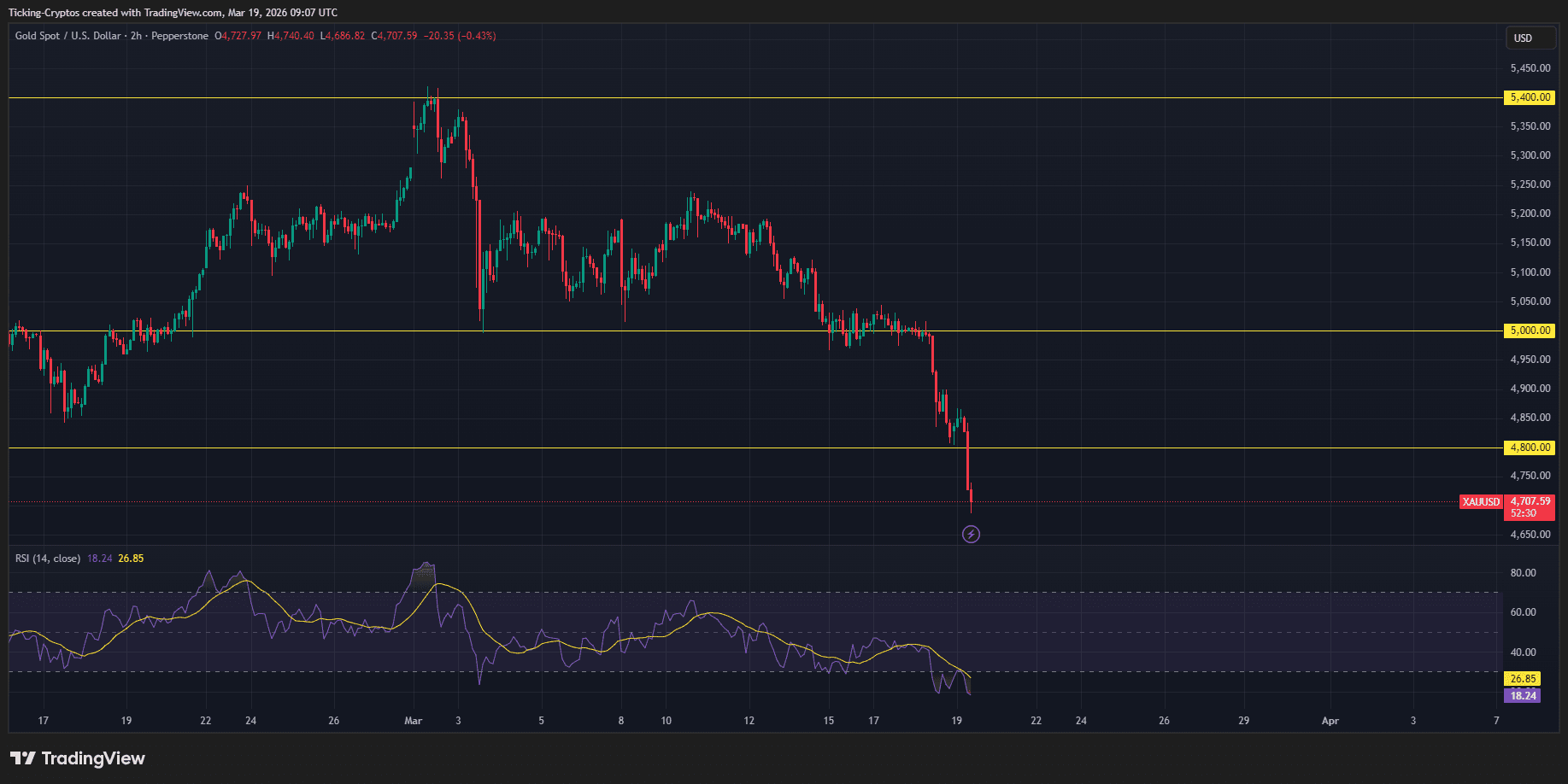
After flirting with the psychological resistance of $5,000 earlier this week, Gold has entered a sharp corrective phase. On the morning of March 19, spot gold slipped toward the $4,800 region, marking its most significant losing streak in over a year.
Critical Support and Resistance Levels
- Major Support: $4,840 – $4,750. This zone represents a historical "buy-the-dip" area for central banks.
- Major Resistance: $5,000. Reclaiming this level is essential for the bullish trend to resume.
The "Oil Shock" of 2026 has been a double-edged sword for Gold. While it fuels long-term inflation (bullish for Gold), it also increases the likelihood of a "higher-for-longer" interest rate environment (bearish for Gold). Currently, the market is prioritizing the interest rate risk over the inflation hedge.
Bitcoin Technical Analysis: Is $70,000 the New Floor?
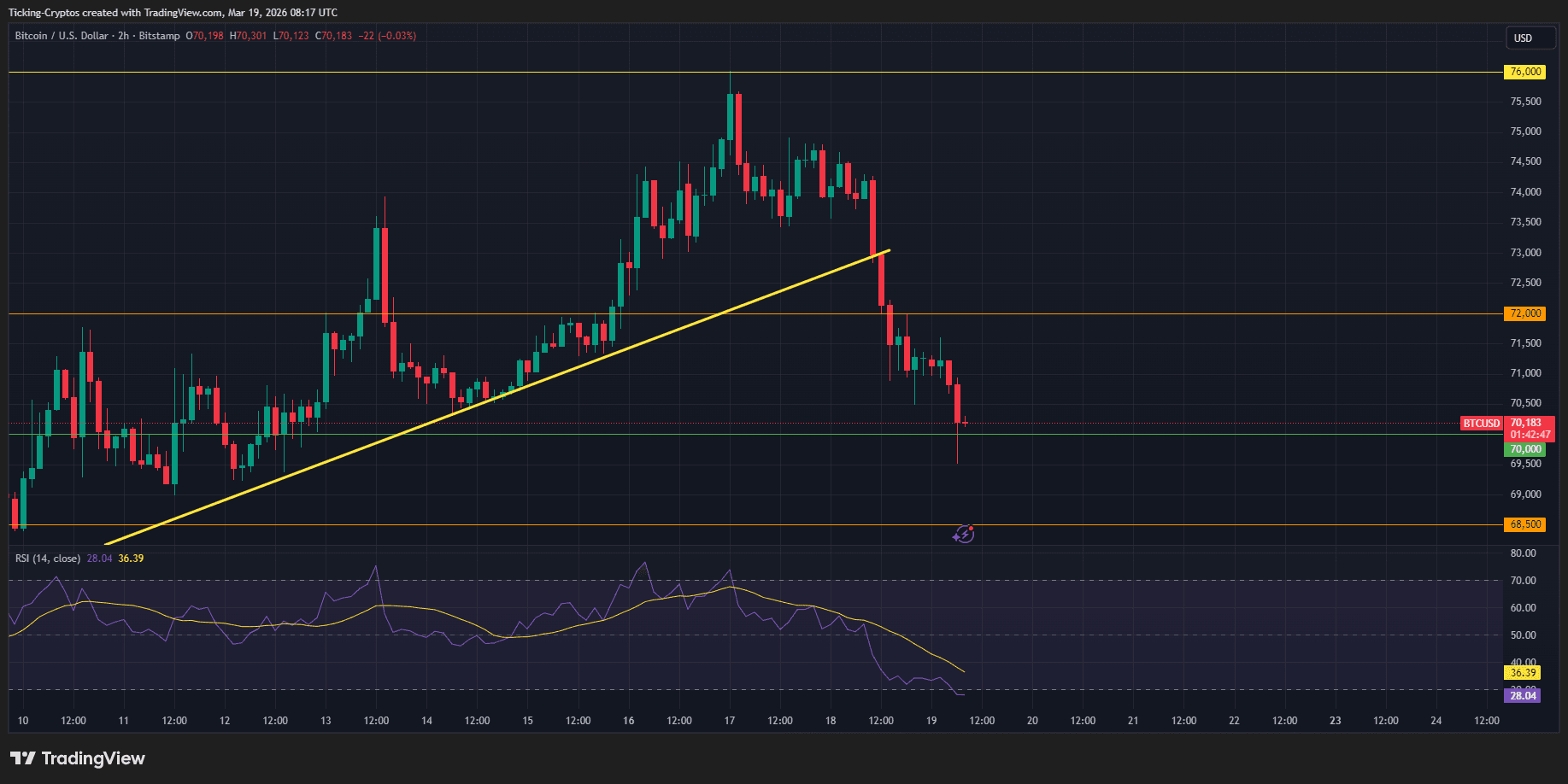
Bitcoin has shown relative resilience compared to the broader "Risk-On" sector, yet it was unable to sustain its push toward $76,000. On Thursday, $BTC dropped below $71,000, tracking the general weakness in global liquidity.
The "Digital Gold" Decoupling
Interestingly, the 2026 correlation between Gold and Bitcoin has shifted. According to recent data from Investing.com, Bitcoin is increasingly behaving as a "Global Liquidity Sponge." It thrives when money is cheap. With the Fed’s hawkish tone, Bitcoin is facing a temporary outflow. However, institutional demand via Bitcoin ETFs remains a structural floor that prevented a crash below $66,000.
- BTC Immediate Support: $70,200.
- BTC Resistance: $74,500.
The 2026 Correlation: Safe Havens vs. Liquidity Hedges
Traders often mistake Bitcoin and Gold for the same type of asset. In 2026, the distinction has become clear:
- Gold: A geopolitical "bunker" asset. It drops when the Dollar is strong but rises when sovereign trust fails.
- Bitcoin: A "technological" hedge. It performs best when the financial system seeks an alternative rail for 24/7 global liquidity.
| Asset | 24h Trend | Key Driver | Long-term Outlook |
|---|---|---|---|
| Gold (XAU) | Bearish | Fed Hawkishness / DXY Strength | Bullish (Target $5,500) |
| Bitcoin (BTC) | Neutral-Bearish | Liquidity Withdrawal / ETF Flows | Highly Bullish (Target $100k+) |
How to Navigate the Bitcoin and Gold Crash
For investors looking to capitalize on this volatility, diversification remains the key. While the short-term trend is downward, the macro fundamentals—high debt, war, and energy shortages—historically favor both assets.
- For Gold: Look for stability around the $4,800 mark.
- For Bitcoin: Utilize the best crypto exchanges to set limit orders near $68,500, which has acted as a strong institutional accumulation zone.
- Security: Ensure your assets are safe by using a hardware wallet during these high-volatility periods.
Bitcoin Future: The Path Ahead for March 2026
The "Great Decoupling" of 2026 is in full swing. Gold is fighting the weight of a high-interest-rate environment, while Bitcoin is consolidating its gains after a massive Q1 rally. Despite the current price drops, the geopolitical unrest in the Middle East suggests that the "safe haven" trade is merely resting, not retreating. Traders should keep a close eye on the US Dollar Index (DXY); a reversal there will likely trigger a massive "relief rally" for both XAU and BTC.
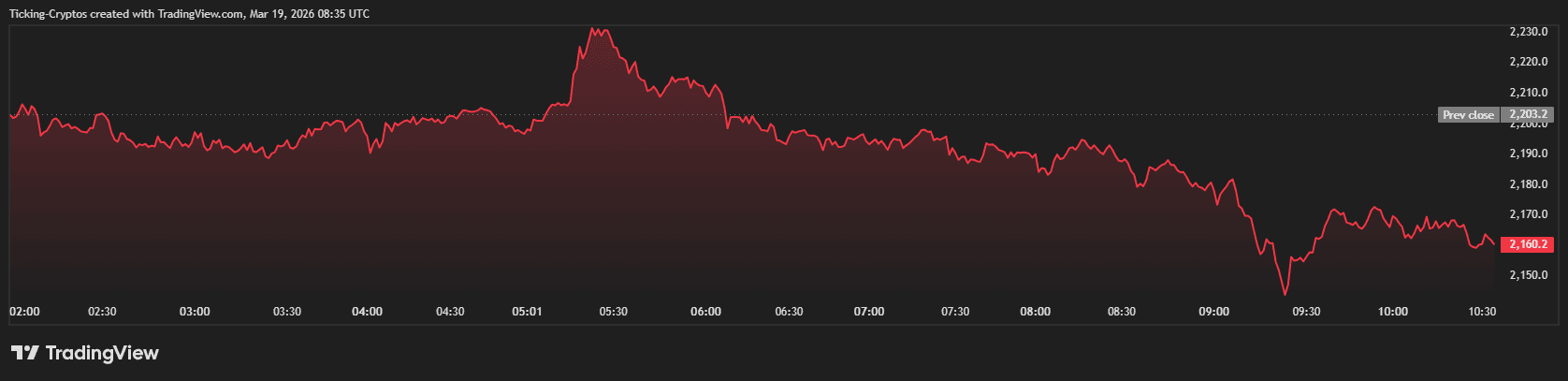
After a brief rally earlier this week, Ethereum ($ETH) is now testing the critical breakout-turned-support zone between $2,180 and $2,200.
This price action comes as a direct response to three simultaneous global shocks: a major military escalation in the Middle East, a hotter-than-expected US inflation report, and a stern warning from Federal Reserve Chair Jerome Powell. For ETH bulls, the mandate is clear: hold the $2,200 line or risk a deep correction toward the psychological support of $1,900.
Ethereum Analysis: Why Are Cryptos Crashing
The sudden reversal in risk appetite isn't just a technical correction; it is a fundamental shift driven by three massive catalysts.
1. Middle East Conflict Hits Global Energy
Geopolitical tensions reached a breaking point today following reports that Israel targeted Iran’s South Pars gas facility, the world’s largest gas field. In immediate retaliation, Iranian strikes reportedly caused extensive damage to Qatari LNG infrastructure at Ras Laffan.
This "energy war" sent crude oil prices soaring toward $99 per barrel almost instantly. For Ethereum and the broader crypto market, rising energy costs act as a double-edged sword: they increase the cost of living (reducing retail liquidity) and fuel long-term inflation fears.
2. PPI Data: The Inflation Pipeline is Refilling
Adding fuel to the fire, the Producer Price Index (PPI) for February 2026 came in significantly hotter than anticipated at 3.4% year-on-year. This suggests that wholesale inflation is accelerating even before the full impact of the recent oil price surge hits the data.
When "factory gate" prices rise, they inevitably trickle down to consumers, making the path to the Fed’s 2% target look increasingly impossible.
3. Powell’s Hawkish Pivot
Federal Reserve Chair Jerome Powell held interest rates steady at 3.5%–3.75% today, but it was his tone that rattled the cages. For the first time in the Fed's history, the committee explicitly acknowledged the Middle East situation as a primary economic risk.
Powell’s refusal to commit to a timeline for rate cuts, combined with the acknowledgment of "uncertain" implications for the US economy, led markets to price out a summer pivot.
Ethereum Price Analysis: Will Ethereum Price Recover?
Despite the macro negativity, Ethereum's chart shows a technical battle that is currently being fought at the "Line in the Sand."
Critical Support at $2,180–$2,200
As seen in recent trading data, Ethereum has retraced to its previous breakout zone. This area was formerly a heavy resistance level throughout early 2026. In technical analysis, a successful "retest" of this zone as support would be a massive bullish signal.
- The Bull Case: If ETH closes the daily candle above $2,200, it confirms that buyers are still defending the trend despite the macro noise. This could lead to a relief rally back toward $2,320.
- The Bear Case: A breakdown below $2,180 would invalidate the recent recovery. Given the lack of intermediate liquidity, the next major "safety net" sits at $1,900.
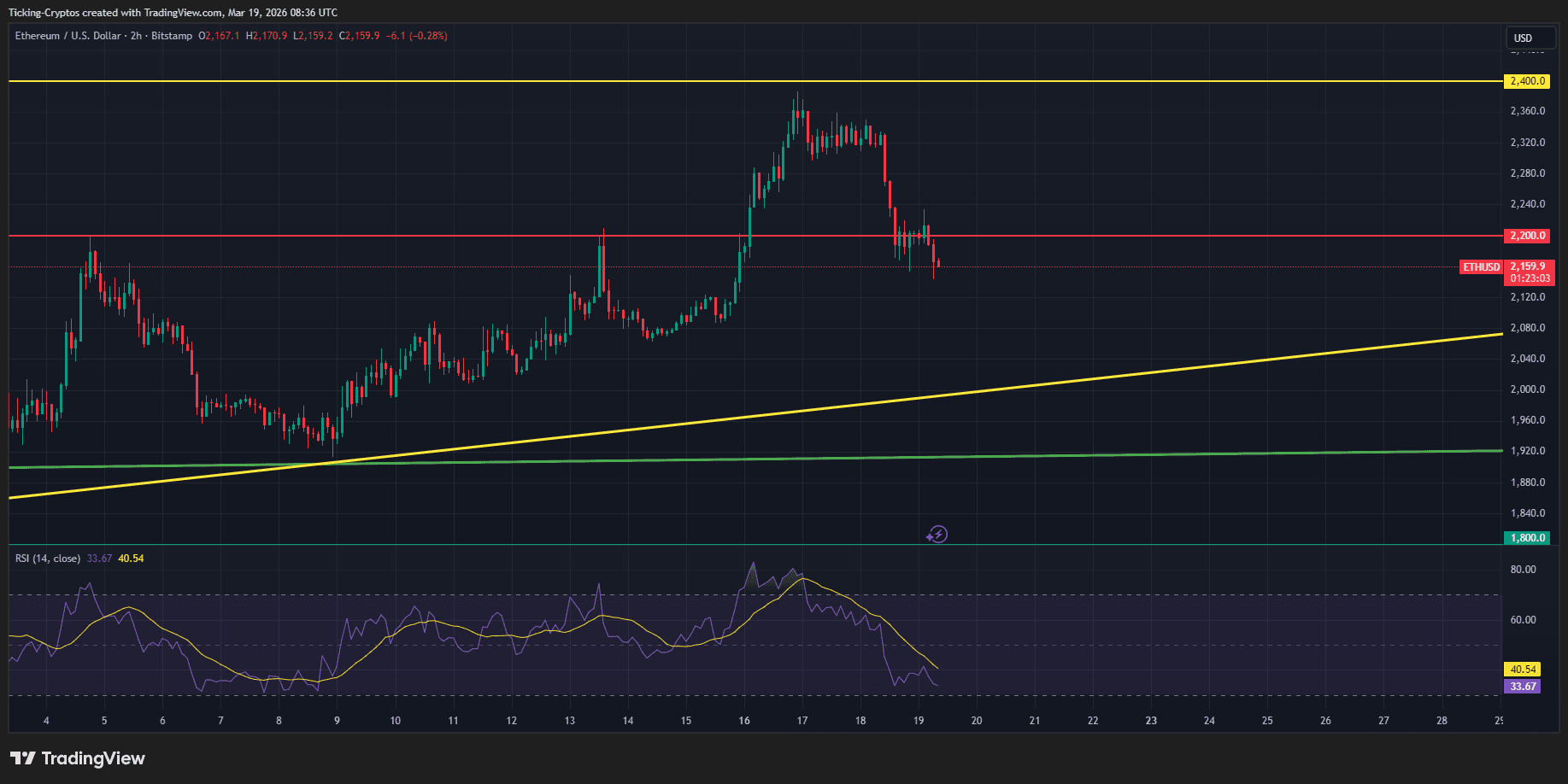
Market Sentiment and Correlation
Ethereum’s correlation with the S&P 500 and Bitcoin remains high. With the US dollar index (DXY) strengthening on the back of safe-haven flows, ETH faces significant selling pressure. Investors looking to hedge against this volatility often turn to hardware wallets to secure their assets during periods of extreme exchange uncertainty.
Ethereum Prediction: What to Watch Next
The next 48 hours are crucial for the ETH/USD pair. Investors should monitor:
- Oil Price Stability: If oil breaks $105, expect further downside in equities and crypto.
- The $2,180 Closing Price: A daily close below this level often triggers stop-loss cascades.
- Strait of Hormuz Developments: Any further disruption to global trade will likely keep the crypto market in a defensive crouch.
Bitcoin Price Crash: Crypto Market Faces a Sudden Reversal
The cryptocurrency market has entered a period of intense volatility today, March 18, 2026, with Bitcoin ($BTC) tumbling from its recent highs near $76,000 to the $72,000 range. This sudden "sea of red" has caught many retail traders off guard, especially following the bullish momentum seen earlier this week.
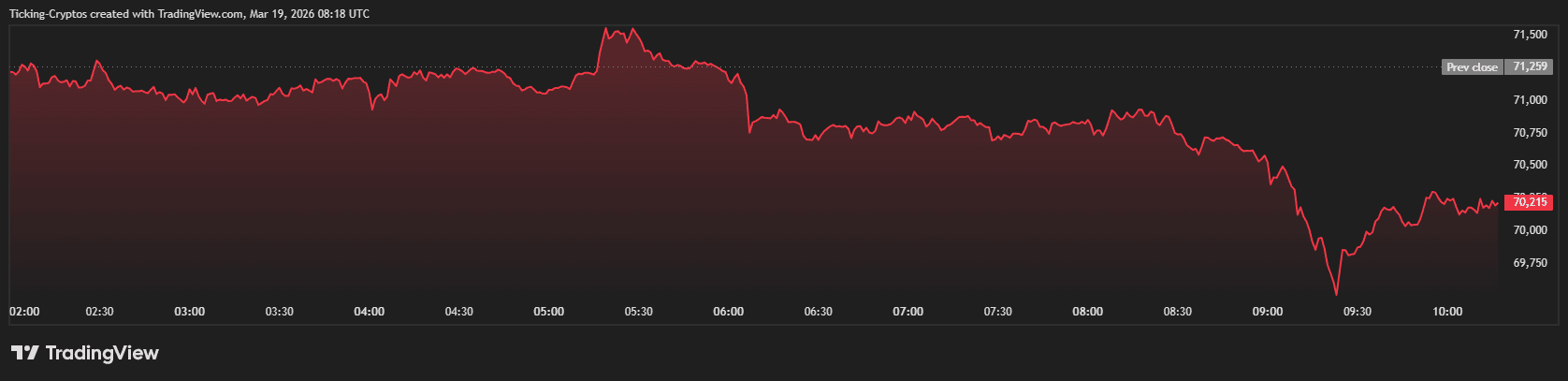
While the digital asset space often moves independently, today’s crash is a direct result of a "perfect storm" involving geopolitical escalations, disappointing US inflation data, and a necessary technical cooling period.
1. Middle East Escalation: Energy Infrastructure Under Attack
The primary driver of the "risk-off" sentiment across global markets is the dramatic escalation in the Middle East. Following Israeli strikes on Iran’s South Pars gas field—the world’s largest natural gas reserve—Tehran has officially declared its intent to retaliate against Gulf energy sites.
Key Geopolitical Developments:
- Target List: Iran’s Revolutionary Guards have identified key infrastructure in Saudi Arabia, the UAE, and Qatar as potential targets.
- Energy Disruption: Iraq has already reported a total halt of gas supplies from Iran, leading to a loss of approximately 3,100 megawatts of power.
- Oil Prices Surge: Brent crude has spiked toward $110 a barrel, fueling fears of global stagflation.
In times of war and energy insecurity, investors typically flee "risk assets" like cryptocurrencies in favor of "safe havens" like gold or the US Dollar. This flight to safety is putting massive downward pressure on the $Bitcoin price.
2. US Core PPI Hits 3.9%: Inflation Remains "Sticky"
Macroeconomic data released today has further dampened hopes for a dovish pivot from the Federal Reserve. The US Core Producer Price Index (PPI), which excludes volatile food and energy costs, came in at 3.9% year-over-year.
This figure significantly overshot market expectations of 3.7%. For crypto investors, this is a bearish signal because:
- Higher for Longer: Hotter-than-expected wholesale inflation suggests the Fed will keep interest rates elevated to cool the economy.
- Yield Pressure: Treasury yields have climbed following the report, making non-yielding assets like Bitcoin less attractive to institutional players.
- Liquidity Crunch: High interest rates reduce the "cheap money" that typically flows into speculative markets.
3. Technical Adjustment: The $76,000 Rejection
From a purely technical perspective, many analysts argue that a correction was overdue. Bitcoin recently hit a peak of $76,000, a level that acted as a psychological and technical glass ceiling.
The "Overheated" Market
Leading up to today’s drop, several on-chain indicators suggested the market was "overextended." Funding rates in the derivatives market had reached unsustainable levels, meaning long-positioned traders were paying high premiums to keep their bets open.
When the news of the Iranian retaliation broke, it triggered a "long squeeze," forcing leveraged traders to liquidate their positions. This mechanical selling accelerated the drop, pushing BTC toward its immediate support levels.
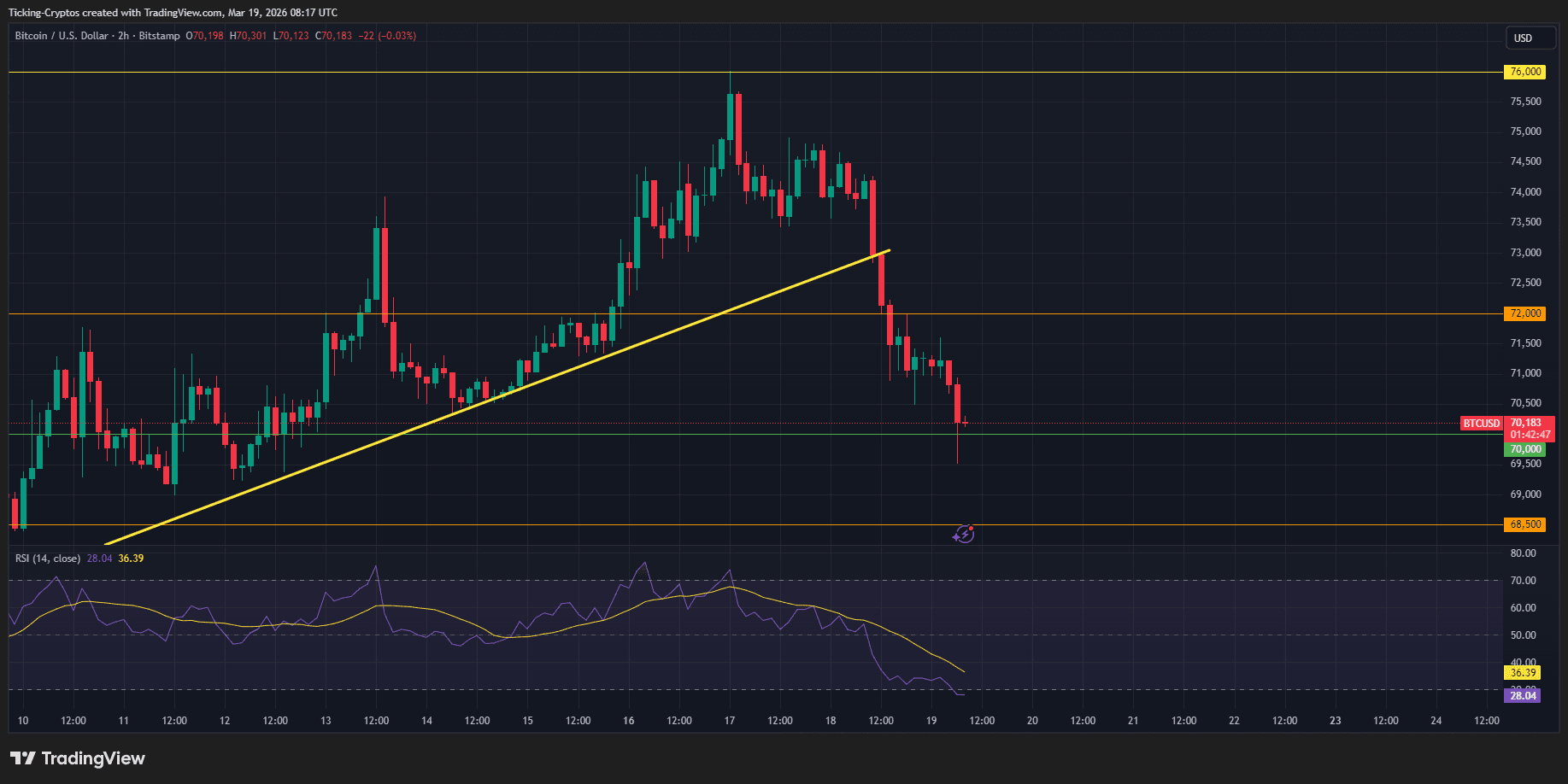
What’s Next for Bitcoin and Altcoins?
The market is currently looking for a floor. While the $72,000 level is providing some initial support, the upcoming Federal Reserve meeting will be the next major catalyst. If the Fed adopts a hawkish tone due to the PPI data and rising energy costs, we could see further testing of the $68,000–$70,000 zone.
The Bitcoin price is currently navigating a high-stakes consolidation phase, trading at approximately $74,272 during the March 18, 2026, session. After a period of bearish dominance that saw the asset retreat from its 2025 record highs, the market is now testing the resilience of the $74,000 resistance zone.
Bitcoin Price Analysis: Why is BTC Price UP?
Analyzing the BTC/USD 4-hour chart, we observe several key technical patterns that define the current trend.
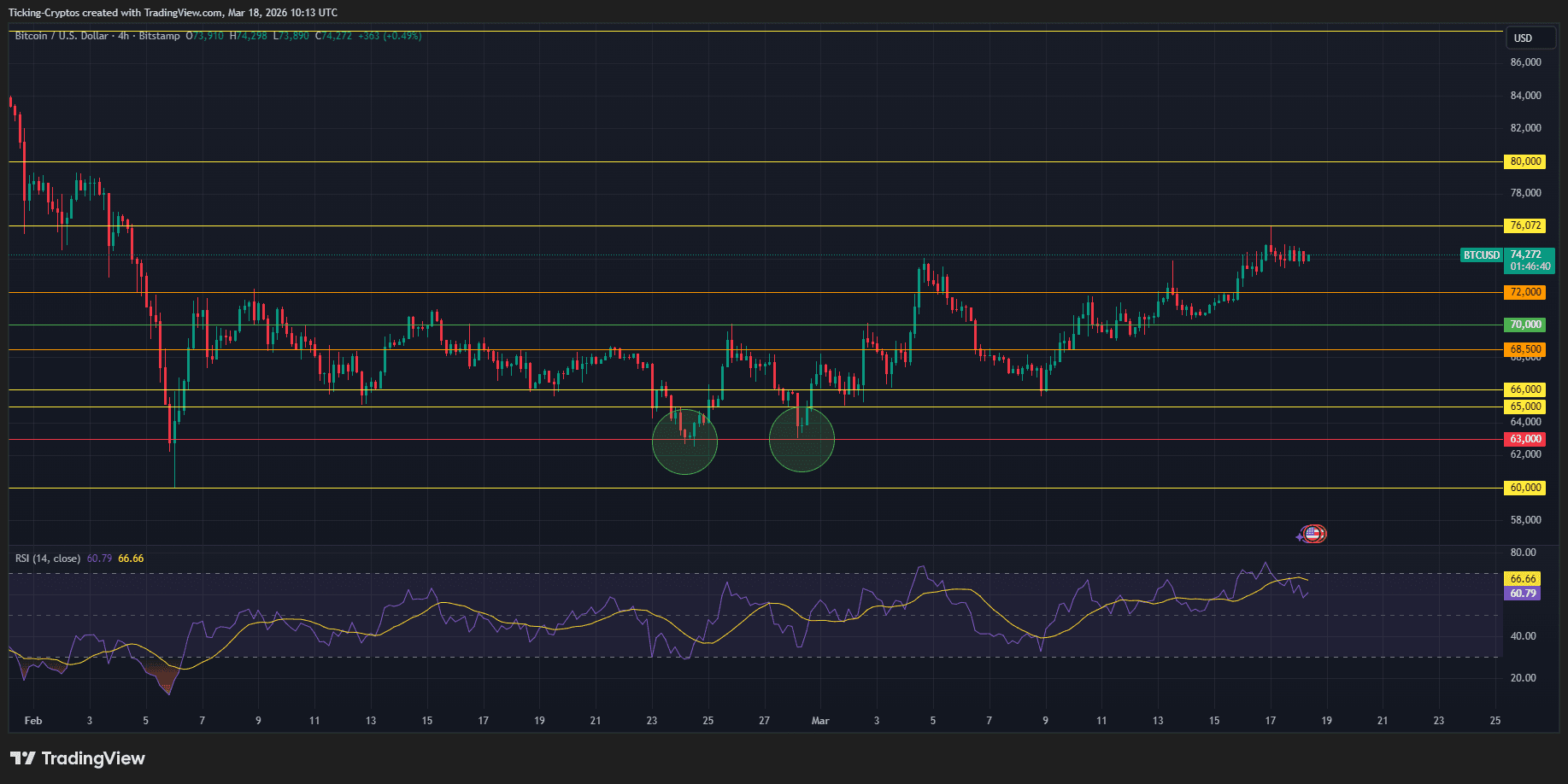
Double Bottom Recovery
The chart highlights two significant "troughs" (marked with green circles) near the $63,000 level. This Double Bottom formation served as a powerful reversal signal in late February and early March, allowing Bitcoin to climb back above the psychological $70,000 mark.
Key Resistance and Support Levels
The price action is currently sandwiched between tightly defined horizontal levels:
- Immediate Resistance: $74,500 – $76,000. A decisive break above this yellow-lined zone is required to target the next major hurdle at $80,000.
- Critical Support: $72,000. If the price fails to hold the $74,000 level, the green support line at $72,000 will be the first line of defense.
- Deep Support: $68,500 and $65,000. These remain the "must-hold" zones to prevent a return to the bear market lows seen earlier this year.
RSI and Momentum
The Relative Strength Index (RSI) is currently hovering around 60.79. While this indicates bullish momentum, the RSI has flattened significantly as the price approaches resistance. This suggests a "cooling off" period or a potential bearish divergence if the price makes a higher high while the RSI fails to follow suit.
Bitcoin News and Macro Catalysts
The broader crypto market is currently characterized by a "Fear" rating on the Sentiment Index (sitting at 26), despite Bitcoin's recent price recovery.
- The FOMC Factor: Traders are bracing for Federal Reserve Chair Jerome Powell’s comments. While interest rates are expected to remain steady, any hawkish rhetoric regarding inflation—driven by $100+ oil prices—could trigger a "sell the news" event for $BTC.
- Institutional Inflows: According to data from Bloomberg, spot Bitcoin ETFs saw a resurgence in March, with nearly $2.8 billion in net inflows, providing a structural floor for the recent rally.
- The Gold vs. Bitcoin Debate: As gold continues to trade near record levels above $5,000, Bitcoin's role as "Digital Gold" is being tested. Many analysts, including those at Fidelity Digital Assets, suggest that capital may rotate back into BTC if gold's parabolic move stalls.
Conclusion: What to Expect Next?
Bitcoin is showing "Experience" and "Expertise" in its ability to hold the $74,000 handle despite a heavy macro environment. However, the information density on the 4-hour chart suggests that the current range is exhausting.
If Bitcoin can flip $76,000 into support, a run toward $80,000 is the most likely scenario. Conversely, a rejection here, coupled with a hawkish Fed, could see a swift retest of the $68,500 support.
- Technical Note: Watch the 4-hour candle close. A close below $73,800 would signal a short-term breakdown, while a close above $75,100 validates the bullish breakout attempt.
The crypto market in early 2026 has been nothing short of a rollercoaster. After the euphoric highs of late 2025, where Bitcoin flirted with the $130,000 mark, a "diffuse cocktail of macro anxieties" has sent prices into a steep correction. As of late mid-March 2026, $Bitcoin has retraced nearly 50% from its All-Time High (ATH), trading in above $73,000.
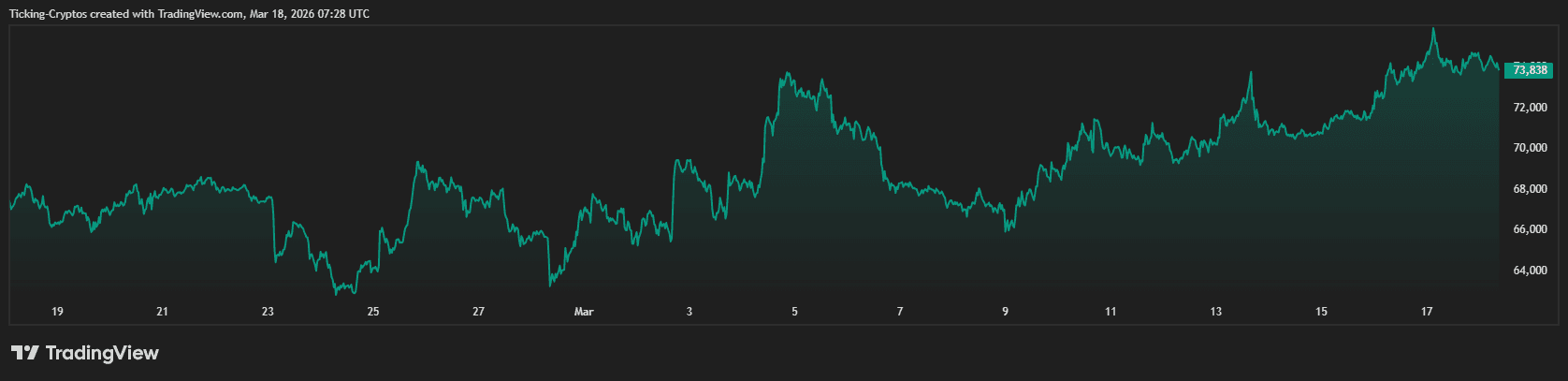
Is it a Good Time to Buy Crypto?
Historical cycles suggest that corrections of 50% to 70% are healthy "purges" that wipe out over-leveraged traders. With Bitcoin currently sitting at a 50% discount, the risk-to-reward ratio for March 2026 has shifted heavily in favor of the bulls.
As geopolitical tensions and tariff uncertainties stabilize, capital is expected to rotate back into "risk-on" assets. Investors who missed the 2025 rally now have a second chance to enter the market. If you are looking to build a portfolio, diversifying across these five projects offers a balance of stability, utility, and explosive recovery potential.
1. Ethereum (ETH) – The Infrastructure King
Despite the rise of "Ethereum killers," Ethereum remains the undisputed home of Decentralized Finance (DeFi) and Real-World Asset (RWA) tokenization. In 2026, the successful rollout of the "Prague" upgrade has further slashed Layer-2 costs, making the network more scalable than ever.
- Why Buy Now? ETH has followed Bitcoin’s slide, dropping from its 2025 high of $4,950 to under $2,000.
- The Catalyst: Major financial institutions like BlackRock and JPMorgan are increasingly using Ethereum for tokenized deposit pilots. At current prices, you are buying the "settlement layer of the internet" at a 60% discount.
2. Solana (SOL) – The Speed Demon
Solana has proven its resilience after the network reliability concerns of previous years. With the Firedancer upgrade now fully integrated in 2026, Solana can process over 1 million transactions per second.
- Status: While it reached $260 in the last bull run, SOL is currently trading significantly lower, creating a "gap" that savvy traders are eager to fill.
- Use Case: It has become the primary chain for consumer AI-crypto applications and high-frequency trading.
3. Chainlink (LINK) – The Oracle Essential
You cannot have a functional DeFi ecosystem without accurate data, and Chainlink owns 90% of that market. In 2026, its Cross-Chain Interoperability Protocol (CCIP) has become the standard for banks moving data between private and public blockchains.
- The Play: LINK often lags behind the initial BTC pump but rallies hard once the ecosystem matures. It is one of the most undervalued "blue-chip" utility tokens heading into March.
4. Sui (SUI) – The Emerging Contender
Sui has emerged as the breakout Layer-1 of the 2025-2026 cycle. Utilizing the Move programming language, it offers a level of security and parallel processing that older chains struggle to match.
- Growth Potential: Sui's Total Value Locked (TVL) has remained stable even during the February crash, suggesting a loyal and committed developer base. As the market recovers, SUI is positioned to be a top performer.
5. Fetch.ai (FET/ASI) – The AI Narrative
2026 is the year of "AI Agents." Fetch.ai, as part of the Artificial Superintelligence Alliance, is at the forefront of this movement. Their autonomous agents are now being used in logistics and decentralized energy grids.
- Why March 2026? The "AI plus Crypto" narrative is the strongest secular trend in the market. With FET down along with the broader market, it offers a high-beta play for those betting on the continued AI revolution.
Conclusion: Strategy for March 2026
Investing during a 50% Bitcoin drawdown requires a long-term mindset. While volatility may persist in the short term, the fundamental value of these projects remains unchanged. Consider using a regulated exchange to dollar-cost average into these positions throughout the month.
Decrypt
Analysts remain cautiously optimistic after the Fed’s hawkish stance, expecting a low volatility regime ahead of the quarterly options expiry.
OP_NET is a new protocol that aims to bring smart contracts and decentralized finance directly to Bitcoin transactions.
Authorities seized almost 40 BTC as part of the investigation, in which a rideshare driver is accused of wire fraud and money laundering.
Adopting the model would require miners and users to migrate to a separate “Bitcoin Quantum” blockchain rather than upgrade the existing network.
The approval lets Nasdaq test tokenized versions of some stocks and ETFs without moving beyond existing market rails.
U.Today - IT, AI and Fintech Daily News for You Today
XRP Ledger shows a substantial drop in the number of transactions, which is the first sign of an upcoming market reversal.
Stellar Foundation CEO Denelle Dixon reacts to the historic 2026 verdict as XLM joins Bitcoin and XRP on the official digital commodities list.
Elon Musk has returned to memes about Dogecoin, making the community buzz with excitement.
As the crypto market reverses its gains, Hyperliquid is now outperforming the Top 10 assets, including XRP.
Bitcoin maximalist Samson Mow again slams Ethereum, this time backing his statement that ETH is not money.
Blockonomi
Key Highlights
- Austrian developer Peter Steinberger’s OpenClaw AI agent has become a viral sensation across China, with adoption rates exceeding those in the United States.
- Major technology companies Baidu and Tencent are organizing large-scale public demonstrations to assist citizens in deploying the software.
- Chinese users have dubbed the technology “raising a lobster” and are leveraging it for entrepreneurial ventures, investment decisions, and workflow automation.
- Regional authorities are providing financial incentives reaching 20 million yuan ($2.8 million) annually for eligible solo entrepreneurship initiatives.
- Security concerns have prompted warnings from Chinese regulatory bodies, with financial institutions, educational organizations, and government offices restricting its deployment.
The autonomous AI agent OpenClaw, developed by Austrian programmer Peter Steinberger, has triggered unprecedented enthusiasm across China this year. This open-source technology possesses capabilities including computer operation, web navigation, airline reservation booking, and coordinating additional automated systems — all functioning independently.
Nvidia CEO Jensen Huang described it as “the next ChatGPT.” Throughout China, it has evolved into a significant cultural phenomenon.
Chinese users have affectionately labeled the technology “lobster,” transforming its installation process into a communal experience. Technology corporations such as Baidu and Tencent have organized mass gatherings where participants queue extensively to receive installation assistance for their computing devices and mobile phones.
“Everyone in my circle — coworkers and acquaintances — appears to have adopted it,” explained Gong Sheng, a recent adopter who participated in a Baidu demonstration in Beijing. “I’m concerned about falling behind.”
Since its initial release in November 2025, OpenClaw has achieved remarkable velocity as among the most rapidly expanding initiatives throughout GitHub’s history, the predominant platform for software development globally.
Cybersecurity organization SecurityScorecard, based in the United States, has documented that Chinese adoption of OpenClaw has already exceeded American usage rates.
Practical Applications Across China
Across China, users have discovered diverse applications for this technological tool. Numerous individuals are establishing “one-person companies” — compact commercial operations managed almost exclusively through artificial intelligence.
“Traditional employees require休息periods, whereas OpenClaw operates continuously around the clock,” noted Wang Xiaoyan, who is deploying the agent for her independent venture.
Additional users are employing it for equity selection, lottery ticket purchases, online retail store creation, and revenue-generating application development.
Municipal governments are actively promoting these activities. Several jurisdictions are distributing subsidies approaching 20 million yuan annually for qualifying solo business operations utilizing AI technologies.
Senior citizens and university students have participated in configuration sessions, seeking supplementary income opportunities. During a workshop conducted by AI company Zhipu in Beijing, 60-year-old Fan Xinquan indicated he was developing an agent to systematize his professional expertise more effectively than conversational AI platforms like DeepSeek.
This momentum corresponds with China’s comprehensive AI Plus initiative, designed to integrate artificial intelligence throughout the national economy.
Regulatory Concerns and Escalating Expenses
Enthusiasm is not universal. Chinese regulatory authorities have intensified advisories regarding data privacy and security vulnerabilities associated with OpenClaw.
Government departments, banking institutions, securities firms, and academic establishments have prohibited staff members from installing the software. China’s state-controlled People’s Daily released editorial commentary urging authorities to “resolutely uphold the security baseline.”
Users themselves have expressed reservations as well. “It’s challenging for average individuals to comprehend what permissions we’ve granted and what information it has collected,” stated user Gong Zheng.
Operational challenges have also emerged. AI startup Zhipu implemented a 20% price increase on tokens for its OpenClaw-compatible model this week.
A message on Chinese social platform Rednote, headlined “Goodbye OpenClaw,” detailed how typical users invested substantial funds in tokens only to accumulate “worthless information.”
At a recent Baidu demonstration, an OpenClaw agent received a voice instruction to purchase coffee through a McDonald’s application via a connected device. The transaction required nearly two minutes to complete — illustrating the disparity between the technology’s theoretical potential and its present practical capabilities.
The post OpenClaw AI Agent Takes China by Storm: Understanding the Viral Phenomenon appeared first on Blockonomi.
TLDR
- On March 3, Defense Secretary Pete Hegseth labeled Anthropic a “supply chain risk,” mandating a six-month removal of Claude from all Pentagon operations
- Defense personnel and contractors argue Claude outperforms competing systems like xAI’s Grok and are opposing the transition
- The transition away from Claude may require 12–18 months and result in significant productivity losses and recertification expenses
- Tech giants including OpenAI, Amazon, Microsoft, and Google are pressuring the Department of Defense to overturn the classification
- Certain government departments are intentionally delaying the transition, anticipating a negotiated resolution before the cutoff date
In March 2026, Defense Secretary Pete Hegseth issued a directive halting the Pentagon’s use of Anthropic’s Claude AI, triggering significant resistance from military personnel and defense contractors.
Following a disagreement about restrictions on military applications of the company’s AI systems, Hegseth classified Anthropic as a “supply chain risk” on March 3. This classification prohibits the Pentagon and its contractors from utilizing Anthropic’s products, allowing six months for complete discontinuation.
However, the transition is encountering substantial obstacles. Defense IT personnel, former government officials, and contractors express strong opposition to abandoning Claude, citing its superiority over competing options.
“Career IT people at DoD hate this move because they had finally gotten operators comfortable using AI,” said one IT contractor. “They think it’s stupid.”
The same contractor said Claude “is the best,” while xAI’s Grok often gave inconsistent answers to the same question.
Anthropic secured a $200 million defense agreement in July 2025. Claude achieved a milestone as the initial AI system authorized for deployment on classified military infrastructure, experiencing widespread adoption throughout federal agencies.
Reuters has documented that the Pentagon deployed Claude in support of U.S. military activities during confrontations with Iran. According to informed sources, the technology remains operational despite the official prohibition.
The Cost of Switching
Transitioning away from Claude involves far more complexity than a straightforward replacement. According to Joe Saunders, CEO of government contractor RunSafe Security, obtaining recertification for alternative systems on classified networks could require 12 to 18 months.
“It’s not just costly, it’s a loss of productivity,” Saunders said.
Operations previously performed by Claude, such as analyzing extensive datasets, are now being conducted manually through applications like Microsoft Excel in numerous instances. Claude Code, extensively utilized throughout the Pentagon for software development, has left programmers disappointed following its discontinuation.
Palantir’s Maven Smart Systems, a platform deployed for military intelligence evaluation and weapons coordination, was constructed utilizing Anthropic’s Claude Code. Palantir maintains Maven-associated contracts exceeding $1 billion and must reconstruct portions of its infrastructure using an alternative AI framework.
Several contractors are deliberately “slow-rolling” the substitution process, leveraging Claude to develop operational workflows before the final deadline arrives.
Industry Pushback Grows
Multiple technology corporations, including OpenAI, are discreetly encouraging the DOD to rescind the supply chain risk classification, as reported by the New York Times.
Key Anthropic investors and collaborators — including Amazon, Microsoft, and Google — maintain substantial financial interests in the company and are actively challenging the designation.
Industry leaders worry the Pentagon’s decision could establish a far-reaching precedent influencing how government contractors engage with AI enterprises.
A chief information officer at one federal agency revealed plans to intentionally delay the phase-out process, wagering that the government and Anthropic will negotiate an agreement before the six-month window closes.
The post Pentagon Faces Backlash Over Anthropic Claude AI Ban as Replacement Proves Difficult appeared first on Blockonomi.
Key Highlights
- Sub-second transaction finality makes Tempo ideal for real-time enterprise stablecoin payments.
- AI agents gain autonomous transaction capabilities through Machine Payment Protocol.
- Stripe collaboration accelerates blockchain integration into mainstream payment systems.
- Platform features ISO 20022 compliance and EVM compatibility for seamless enterprise adoption.
- Infrastructure designed to capture share of $190 trillion annual cross-border payment volume.
The collaboration between Stripe and Tempo has resulted in the official deployment of Tempo’s mainnet alongside the Machine Payment Protocol, creating a next-generation infrastructure for AI-powered financial transactions. This blockchain network facilitates stablecoin-based payments for businesses and autonomous systems, delivering transaction speeds that surpass conventional banking infrastructure through near-instantaneous settlement.
Through the Machine Payment Protocol (MPP), artificial intelligence systems can independently execute financial transactions without human oversight. The protocol accommodates both traditional fiat currencies and digital assets while eliminating dependency on proprietary tokens. Tempo embeds stablecoin settlement mechanisms directly within its blockchain architecture, streamlining implementation for global enterprises.
This strategic deployment establishes Stripe as a dominant force in decentralized payment technology. Tempo specifically addresses high-transaction markets such as international business-to-business transfers and automated commerce networks. The network’s foundation prioritizes transaction velocity, regulatory adherence, and infrastructure expansion for AI-enabled payment scenarios.
Purpose-Built Payment Blockchain
Unlike multipurpose blockchain platforms, Tempo delivers specialized infrastructure optimized exclusively for payment processing at scale. The architecture sustains tens of thousands of simultaneous transactions while guaranteeing predictable settlement times. Utilizing the TIP-20 technical standard, the system processes payments in established stablecoins without introducing additional token requirements.
Businesses can implement Tempo’s technology with minimal disruption thanks to built-in ISO 20022 standard compatibility. The blockchain maintains full EVM compatibility, enabling straightforward integration for development teams experienced with Ethereum-based tooling. During testnet phases, major corporations including Klarna, Visa, Nubank, and Shopify participated in validation testing.
Rather than emphasizing speculative token trading, the mainnet prioritizes practical payment execution efficiency. Tempo’s technical infrastructure targets the enormous $190 trillion yearly cross-border transaction ecosystem. The platform eliminates variable settlement timeframes and unpredictable transaction costs, establishing a frictionless AI-driven payment environment.
Autonomous Transaction Protocol for AI Systems
The Machine Payment Protocol creates standardized frameworks for machine-to-machine financial interactions and AI agent commerce. This enables artificial intelligence platforms to conduct business transactions independently without requiring human authorization. Stripe and Tempo developed MPP as an open-source, modular solution with cross-blockchain compatibility.
MPP accommodates credit-based, debit-based, and cryptocurrency transactions while interfacing with traditional payment infrastructure. Visa provided technical specifications ensuring AI agents maintain clear communication protocols with merchant systems. The protocol architecture emphasizes streamlined design and operational efficiency specifically for AI-driven commerce.
Tempo’s expanding ecosystem seeks to scale AI payment functionality worldwide, serving automated software agents and autonomous transaction processes. The infrastructure supports varied sectors including online retail, data marketplace services, and international payment routing. Together, Tempo and MPP establish a comprehensive foundation for next-generation AI payment innovation.
Tempo secured $500 million in funding during 2025 at a $5 billion company valuation from prominent Silicon Valley investors. Stripe’s strategic participation enhances both the blockchain’s market legitimacy and operational capabilities. The mainnet activation represents a pivotal milestone for enterprise-scale AI payment system deployment across commercial and digital service platforms.
The post Tempo Mainnet Launch: Stripe Powers Lightning-Fast Blockchain Payments for AI appeared first on Blockonomi.
Quick Summary
- Fourth quarter adjusted earnings per share reached $6.25, surpassing analyst projections of $5.93–$6.11 by $0.32
- Quarterly revenue totaled $2.35B, aligned with Wall Street’s $2.34B forecast
- Comparable store sales dropped 0.7% compared to the prior year period
- Fiscal 2027 EPS outlook of $8.80–$10.74 trails analyst expectations of $10.59
- Full-year revenue projection of $6.60B–$6.90B underwhelms against the $6.90B consensus estimate
Signet Jewelers reported better-than-expected quarterly profits on Thursday, yet forward-looking projections for fiscal 2027 dampened investor enthusiasm. Shares initially climbed 0.3% in pre-market activity before reversing course.
$SIG (Signet Jewelers) Q4’26 & FY26 EARNINGS HIGHLIGHTS
Q4 FY2026
Revenue: $2.35B (~flat YoY)
Same-Store Sales: -0.7%
Revenue: $6.81B… pic.twitter.com/1GVAZu5tE7
— Emmanuel – Big Tech & AI Investor (@EmmanuelInvest) March 19, 2026
The company specializing in jewelry retail announced adjusted earnings of $6.25 per share for its fourth fiscal quarter that concluded on January 31, exceeding analyst estimates ranging from $5.93 to $6.11. Top-line results registered $2.35B, essentially matching Wall Street’s $2.34B projection.
While the earnings surprise appeared positive initially, comparable store sales decreased 0.7% year-over-year — a metric unlikely to inspire investor confidence.
Signet Jewelers Limited, SIG
Shares had experienced downward momentum even before the earnings announcement. SIG has declined approximately 17% since December 2, following the company’s lackluster holiday season projection. Prior to that announcement, the stock had appreciated roughly 40% during the preceding twelve-month period.
Prior to Thursday’s disclosure, shares settled at $78.77, representing a 5.47% decline across the previous three-month span.
Future Outlook Falls Short on Multiple Metrics
The company’s forward-looking statements reveal the core challenge. Signet projected fiscal 2027 adjusted EPS within a $8.80 to $10.74 band. The analyst community had forecast $10.59.
Even the upper boundary of the guidance range barely reaches consensus expectations. The substantial spread between low and high estimates reflects ambiguity surrounding the business trajectory.
Regarding top-line performance, Signet forecasts fiscal 2027 revenue between $6.60B and $6.90B. Analyst estimates stood at $6.90B — positioning the company’s own projection at or below Street expectations.
Analyzing the Financial Picture
Signet’s InvestingPro Financial Health rating indicates “good performance,” with five upward EPS revisions during the past 90 days versus a single downward revision. This backdrop provides important perspective when evaluating market response.
However, forward guidance drives trading activity, and both metrics disappointed.
The fourth-quarter performance was genuinely positive. Earnings of $6.25 exceeded forecasts by $0.32, while revenue met expectations. This represents a solid quarterly outcome.
The 0.7% decline in comparable store sales reflects continued weakness in the jewelry retail environment. While not catastrophic, it certainly doesn’t indicate expansion.
The differential between the guidance midpoint ($9.77) and analyst consensus ($10.59) carries significant weight. At the midpoint, Signet is projecting approximately 8% below Wall Street’s fiscal year model.
This magnitude of guidance shortfall typically triggers stock movements, irrespective of recent quarterly performance.
SIG advanced 0.3% during Thursday’s pre-market session. The stock finished the regular trading day down 7.29%.
The post Signet Jewelers (SIG) Stock Plunges 7% on Disappointing Fiscal 2027 Outlook appeared first on Blockonomi.
TLDR:
- Crypto.com has cut roughly 12% of its global workforce as part of a full-scale AI integration move.
- CEO Kris Marszalek warned that companies not adopting AI immediately will fail or be left far behind.
- Only roles unable to adapt to the new AI-driven operational model were targeted in the reduction.
- All affected employees were notified in advance and are receiving transition support from the company.
Crypto.com has announced a targeted reduction of approximately 12% of its global workforce. The decision follows the company’s full-scale integration of artificial intelligence into its operations.
CEO Kris Marszalek confirmed the move, citing the removal of roles unable to adapt to the AI-driven era. All affected employees have already been notified and are receiving resources to support their transition.
The company has described the restructuring as a new foundation for its continued success.
AI Integration Drives Strategic Workforce Realignment at Crypto.com
Crypto.com has made artificial intelligence the central pillar of its revised long-term business strategy. The exchange is moving away from roles that do not align with its new AI-first operational framework.
Leadership views this pivot as a critical requirement for maintaining competitive relevance in the industry. The company has made clear that every part of its business must now operate under this AI-driven structure.
This move reflects the company’s view that AI is not a support function but the core of all operations.
CEO Kris Marszalek outlined the company’s stance in a public post that drew immediate industry attention. He stated directly: “Companies that do not make this pivot immediately will fail. Companies that move slowly will be left behind.”
His remarks set a firm and unambiguous tone for the exchange’s strategic direction going forward. The post confirmed that affected team members had already been notified before the public announcement was made.
Marszalek further argued that firms acting decisively would gain a clear competitive advantage over slower-moving rivals.
He wrote: “Companies that move immediately and pair the best AI tools with top-performers will achieve a level of scale and precision that was previously impossible.”
Crypto.com has positioned this restructuring as the foundation for what the company describes as continued success.
The exchange appears committed to ensuring this AI investment translates into measurable operational improvements.
Impacted Employees Recognized as Crypto.com Charts a New Course
Crypto.com confirmed that the reduction was targeted and did not represent a sweeping, company-wide layoff. The company stated the affected roles were those specifically unable to adapt to AI-driven operations.
All impacted team members were notified ahead of any external public communication by the company. Resources to support departing employees through their professional transition are being actively provided.
The exchange was deliberate in framing the decision as structural and forward-looking rather than financially motivated.
This separates the move from typical cost-cutting measures seen during broader market downturns. Marszalek led the announcement personally, adding: “We are deeply grateful for the contributions our departing colleagues have made.”
He chose a transparent and direct communication approach, addressing the public before speculation could spread.
Crypto.com now joins a growing list of companies implementing enterprise-wide AI-driven workforce changes. Marszalek acknowledged this openly, writing: “We are joining the list of companies integrating enterprise-wide AI.”
Many firms across technology and financial services are actively reshaping staffing around AI capabilities. For the exchange, this moment marks a clear public commitment to what Marszalek calls the new world. The restructuring is both a workforce decision and a firm strategic declaration.
The post Crypto.com Cuts 12% of Its Workforce as CEO Declares AI the New Standard for All Operations appeared first on Blockonomi.
CryptoPotato
Crypto.com founder Kris Marszalek has said the exchange will cut around 12% of its workforce. The move is part of a strategic pivot by the company toward the enterprise-wide integration of AI.
The AI Efficiency Argument
Marszalek made the announcement in a post on his official X account on March 19, stating that Crypto.com would be integrating AI into its business and that firms that fail to do so are setting themselves up for failure.
“Companies that move slowly will be left behind,” warned the CEO. “Companies that move immediately and pair the best AI tools with top-performers will achieve a level of scale and precision that was previously impossible.”
As part of the step, Marszalek confirmed that they will be letting go of at least 12% of the Crypto.com staff, particularly those in what he described as “roles that do not adapt in our new world.”
The announcement follows the company’s acquisition of the AI.com domain for a reported $70 million in February, which it positioned as a launchpad for autonomous AI agents.
Marszalek did not share specific figures on the firm’s total headcount, the exact number of employees being let go, or the financial impact of the restructuring. He did confirm that those affected had been notified and were “receiving resources to support their transition.”
Block Rehires Staff
In February, Block, the company behind payments platforms like Cash App, Afterpay, and Square, reduced its workforce by more than 4,000 employees, with CEO Jack Dorsey justifying the move using the same rationale Marszalek is employing now.
At the time, Dorsey pointed out that the way forward for running companies would be to pair small teams with AI tools, which would improve efficiency.
“We’re already seeing that the intelligence tools we’re creating and using, paired with smaller and flatter teams, are enabling a new way of working which fundamentally changes what it means to build and run a company,” he posted on X.
However, it appears that Block has since rehired a few of the people it had laid off. According to reports, several Block employees posted on their social media that they had received offers to return to work, with one, Andrew Harvard, claiming he was told his layoff was the result of a clerical error.
The post This Crypto Firm Cuts 12% of Its Workforce to Accelerate AI Integration appeared first on CryptoPotato.
The award-winning international cryptocurrency exchange, Toobit, today announces the release of its brand-new feature set, the AI Agent Trade Kit. This is an open-source framework that allows traders to link large language models (LLMs) directly to the exchange. The goal is to turn simple conversations into real-time market actions.
The >AI Agent Trade Kit eliminates the need for manual dashboard navigation by using the Model Context Protocol (MCP).
Understanding the AI Agent Trade Kit
The entire thing is designed as a series of modular files. It teaches AI agents how to handle specific tasks without having to complete additional programming. This framework allows models like Claude and ChatGPT to use specific agent skills necessary to observe price trends, to manage spot and futures orders, as well as to track portfolio balances.
Speaking on the matter was Mike Williams, the Chief Communication Officer at Toobit, who said:
“AI has become a standard part of how we manage our digital lives. […] The AI Agent Trade Kit brings that experience to crypto by automating the manual parts of using an exchange. By letting an agent handle the constant stream of account updates and order placement, our traders can reclaim their time and put their energy into decision making.”
That said, the agent kit contains more than 66 specialized tools, which offer full coverage across the entire exchange ecosystem.
- Market data: Access to real-time depth, price history, and exchange info without requiring a sign-in.
- Trading operations: Direct order placement for spot and futures positions.
- Asset portfolio: Real-time tracking of balances, P&L, and transaction history.
Run it Locally, Preserve Privacy
The team designed the AI Agent Trade Kit to run locally. This means that traders’ privacy remains at the forefront of the architecture. By storing credentials in a local configuration file, the system guarantees that sensitive data never leaves your device. This local-first approach also extends to signing transactions. The latter occurs entirely on the trader’s machine to protect private keys.
In other words, traders maintain final authority over these interactions through customizable access levels. The kit itself allows for complete control over the scope of an agent, including the ability to toggle specific modules or to restrict the agent to a read-only mode.
The kit is distrubited under the MIT License and is available on GitHub. It supports multiple interfaces, which include an MCP server for your chat-based models, as well as a Command Line Interface (CLI) for automated scripts and terminal management. Users can visit the Toobit AI Agent Trade Kit page for instructions and integration details.
It’s beyond question that AI agents have already evolved from simple tools into active participants within the digital asset ecosystem. Over 42% of professionals in the financial sector already use agentic AI to manage complex workflows and to navigate volatile markets.
This transition is fueled by the move toward automation, with 84% of the industry identifying open-source models as a critical part of their long-term strategy.
For more information about Toobit, visit: Website | X | Telegram | LinkedIn | Discord | Instagram
The post Toobit Rolls Out AI Agent Trade Kit, Bridging AI Conversations with Market Actions appeared first on CryptoPotato.
Bitcoin’s price rejection at $76,000 a couple of days ago only accelerated yesterday and earlier today, with the asset dipping below $70,000 for the first time since last Thursday.
The altcoins have faced enhanced volatility as well, with ETH dropping below $2,200 and XRP slipping beneath $1.50. ZEC, WLD, and MNT have plummeted by double digits.
BTC Price Dips Below $70K
The primary cryptocurrency touched $74,000 last Friday when it was stopped and pushed south toward $70,000 during the weekend after the latest bombings in the Middle East. However, it maintained that level, and the bulls stepped up as the new business week began.
The culmination took place on Tuesday morning when bitcoin shot up to its highest price level in roughly six weeks at $76,000. Nevertheless, its progress was quickly halted, and the asset retraced to $74,000.
Although it remained there at first on Wednesday, more volatility ensued in the hours leading up to the highly anticipated second FOMC meeting of the year. BTC dropped by several grand to just under $71,000 when the Fed announced what many expected that it wouldn’t change the interest rates.
Bitcoin bounced to $72,000 at first, but nosedived once again on Thursday morning, dropping below $70,000 for the first time in a week. Despite rebounding to just over that level now, it’s still 5% down on the day. Its market cap has dropped to $1.410 trillion, and its dominance over the alts is down to 56.3% on CG.
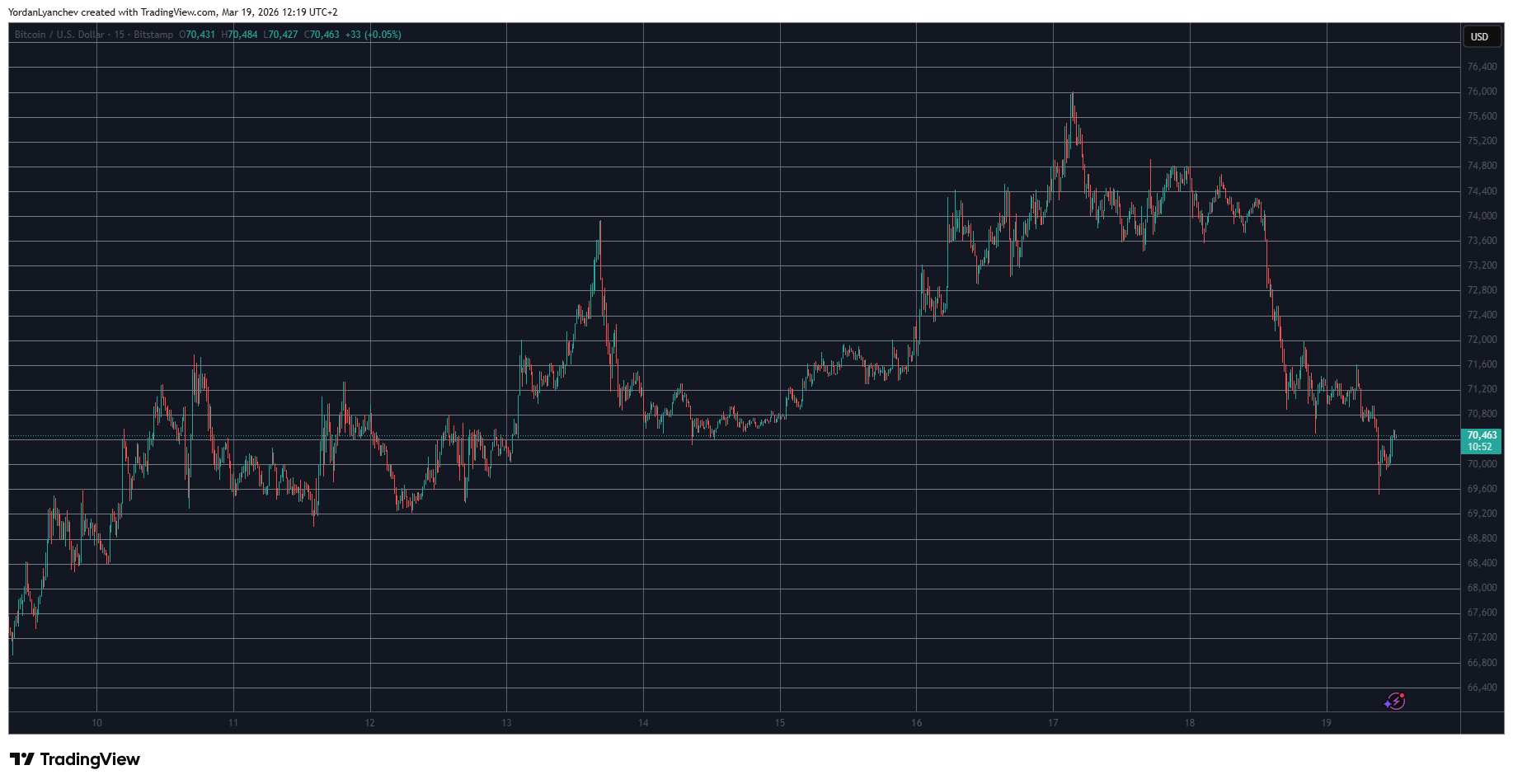
Altcoins Bleed
Most larger-cap alts have followed BTC on the way south. Ethereum is down by over 6% daily and sits well below $2,200. XRP lost the $1.50 support after a 3.5% decline. BNB has dipped beneath $650, SOL is down to $90, while ADA, LINK, and XMR have posted even more significant losses.
The biggest daily declines are evident from ZEC (-14%), WLD (-13%), MNT (-11%), and TAO (-10%). In contrast, HASH and RIVER have surged by double digits to $0.144 and $26.6, respectively.
The total crypto market cap, though, has erased $100 billion since yesterday’s peak and is down to $2.5 trillion on CG.

The post Bitcoin Dips Below $70K After FOMC Meeting, Ethereum Loses $2.2K Support: Market Watch appeared first on CryptoPotato.
Nevada-based Evernorth has formally submitted a Form S-4 registration statement to the US Securities and Exchange Commission tied to its planned merger with Armada Acquisition Corp. II.
The latest move advances a deal that would take the XRP-focused treasury firm public on Nasdaq.
Evernorth’s SPAC Deal
The filing introduces Evernorth as a regulated corporate vehicle structured to give public market investors exposure to XRP through an actively managed treasury strategy. The disclosure provides the first look at the firm’s operational blueprint, including how it intends to allocate, manage, and report its XRP holdings within a public company framework.
The company said it has secured more than $1 billion in gross proceeds from a group of institutional backers, among them Ripple Labs, SBI Holdings, Pantera Capital, Kraken, and Arrington Capital, the sponsor behind Armada II. The proceeds will be used to support the creation of what it expects to be the largest public XRP treasury company on Nasdaq. The registration statement, which includes a preliminary proxy statement and prospectus, remains under SEC review and has not yet been declared effective.
Completion of the transaction is subject to approval by Armada II shareholders and other standard closing requirements. Upon closing, the combined entity is expected to trade on the Nasdaq Stock Market under the ticker “XPRN,” pending exchange approval.
Commenting on the development, Michael Arrington, founder of Arrington Capital, said,
“Evernorth continues to emerge as a key gateway for capital markets, underscoring XRP’s rising influence in bridging traditional finance and real-time innovation. This continued progress by Evernorth reflects a wider wave of achievement and momentum of the XRP ecosystem as it expands utility across global finance.”
Evernorth’s announcement comes just days after the SEC issued new guidance, where XRP was included in a group of assets treated as digital commodities. According to the agency, securities regulations typically extend only to tokenized securities, excluding most other digital assets from such legal classification and regulatory scope.
Price Struggle
On the price side of things, $1.50 remains a major hurdle for XRP. The crypto asset surged past this level at the beginning of the week but failed to sustain the momentum. After shedding almost 4% over the past 24 hours, it was trading near $1.46.
Experts say the CLARITY Act could be a major catalyst for XRP. According to EGRAG CRYPTO, the bill may determine whether the token breaks above the $1.65-$1.70 resistance range. The analyst found that the token is forming an ascending triangle, a pattern which is often linked to breakouts, and sees a 65% chance of an upward move. However, a delay in the legislation could lead to a rejection or false breakout.
The post XRP Treasury Evernorth Submits SEC Filing for Planned Nasdaq Listing appeared first on CryptoPotato.
After successfully implementing several consecutive protocol updates, the Core Team behind the controversial project noted earlier today that the next one is already in the works.
At the same time, the underlying token has posted a minor gain since yesterday. However, its broader performance continues to be quite underwhelming.
Next Update Coming Soon
The team announced the first protocol update of the year on February 20, which brought it to version 19.6. The next one, v19.9, followed suit on March 4, and the highly anticipated v20.2 was successfully migrated before the community’s Pi Day (March 14). This one was particularly important as it laid out the fundamentals for enabling smart contract capabilities.
This rollout will occur gradually, the team said, as they aim to prioritize categories that align with utility-based product innovation and operations. The specifics will depend on the needs arising from the utility creation process, they added.
Without providing a clear deadline this time, Pi Network’s official X channel indicated that the v21 upgrade is coming, and node operators must ensure their systems are “up to date.” They added that more instructions will be coming shortly.
The Pi Mainnet has successfully upgraded to Protocol 20, laying the foundation for supporting smart contracts. Node operators, please ensure your systems are up to date and stay tuned for instructions regarding the upcoming v21 upgrade.
— Pi Network (@PiCoreTeam) March 19, 2026
PI Resists Dropping Further
Aside from the aforementioned updates, all announced in the past month, the other big news in the Pi Network community came last week from Kraken. The veteran US exchange said it would list the underlying token for trading starting March 13.
The combined effects for PI were instant and rather mind-blowing. The token exploded by almost 100% in the span of just days, and tapped a five-month peak of around $0.30. However, once it indeed began trading on Kraken, it suffered the consequences of another classic buy-the-rumor, sell-the-news event.
It plummeted by over 30% at one point, and kept losing value to under $0.17 marked yesterday. Interestingly, it has rebounded slightly in the past day (3%), while most other altcoins have suffered 3-5% losses.
The post Pi Network Gears Up for Another Major Upgrade as PI Resists Market Drop appeared first on CryptoPotato.