Cryptocurrency Posts
Crypto Briefing
Rodri's move to Barcelona could elevate La Liga's global appeal and competitive stature, enhancing Spain's domestic football landscape.
The post Luis de la Fuente calls Rodri ‘the Messi of Spanish football’ after Barcelona transfer appeared first on Crypto Briefing.
The strong AI-driven earnings highlight the growing investor focus on clear profitability from AI investments, impacting market dynamics.
The post Dell, Palo Alto Networks beat forecasts, signaling AI boom strength appeared first on Crypto Briefing.
Uber is eliminating 3,300 jobs, 10% of its workforce, to fund a $10B robotaxi strategy including equity stakes in Lucid and Rivian.
The post Uber cuts 3,300 jobs and bets $10B on a driverless future appeared first on Crypto Briefing.
ECB economists find a 1% rise in synthetic securitisation issuance boosts bank dividends three times more than corporate lending, raising
The post European Central Bank study finds synthetic risk transfers boost bank dividends far more than corporate loans appeared first on Crypto Briefing.
China opposes G20 statement on the Strait of Hormuz. U.S.-Iran agreement by September 15 at 2.7% YES.
The post China opposes G20 statement on Strait of Hormuz amid US-Iran tensions appeared first on Crypto Briefing.
Bitcoin Magazine
Bitcoin Magazine
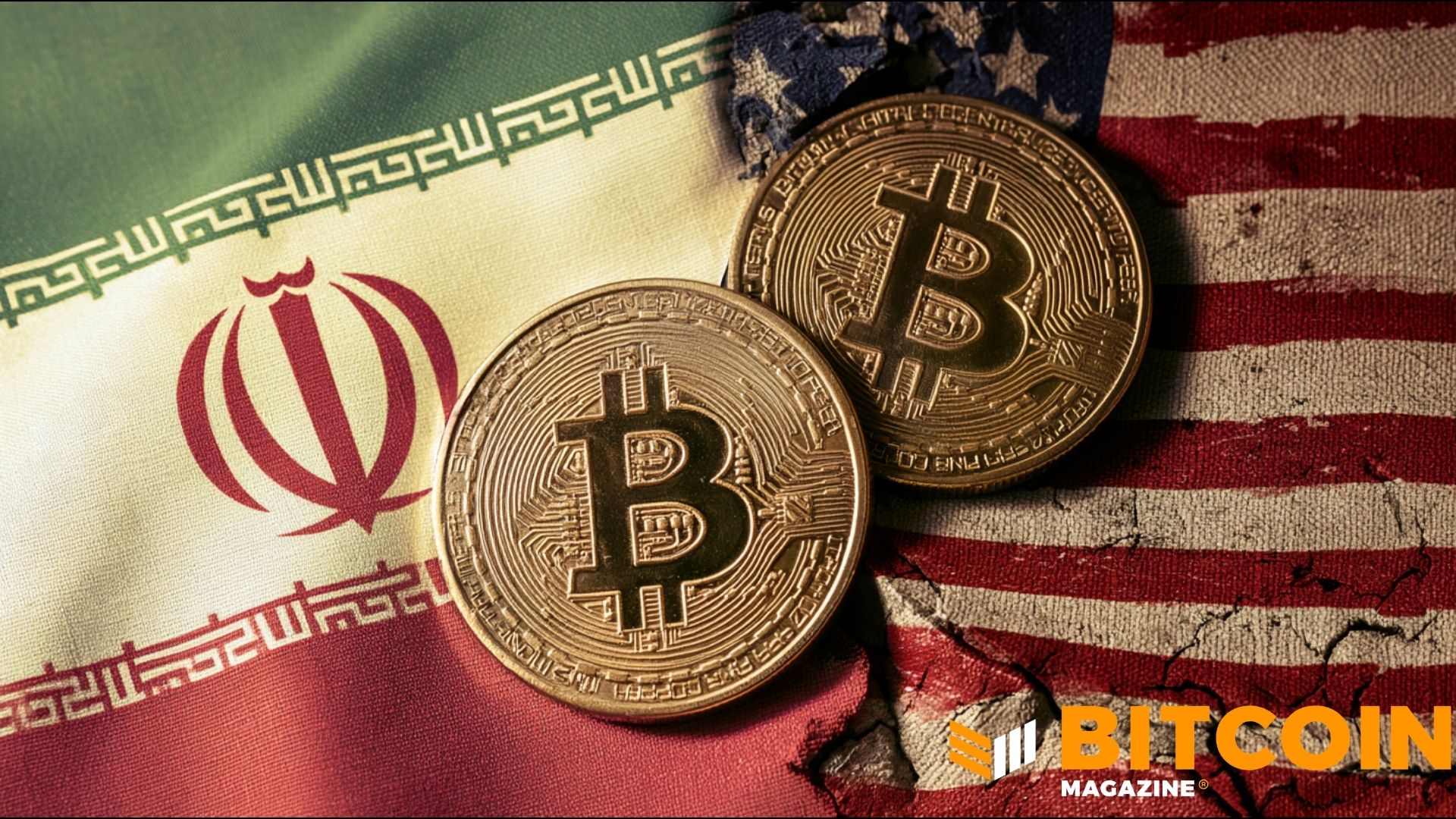
Bitcoin Slides as US-Iran Tensions Escalate
Bitcoin slid on Tuesday after investors went into “risk-off” mode following escalating attacks between the U.S. and Iran.
The largest cryptocurrency had initially shrugged off President Donald Trump’s threats to the Middle Eastern nation, as well as the first strikes.
But things heated up on Tuesday, and bitcoin’s price slid. It was recently down more than 2% on the day, trading for $77,363. The coin had pushed past as high as nearly $81,282 on Friday.
The Tuesday attacks from the U.S. were because Iran tried to put mines in the Strait of Hormuz, and also because of an attack on an American military base in Jordan, according to President Trump.
U.S. Central Command said on X that Iran had also attacked commercial ships.
“The strikes follow recent attempted attacks by the Islamic Revolutionary Guard Corps against commercial shipping in the Strait of Hormuz and against American service members deployed to the region,” the post read.
Iran responded with a “decisive operation” against U.S. military bases, according to Iranian media. Oil surged on the news.
Bitcoin’s price has been sensitive to geopolitical tensions this year — especially after Iran and Israel attacked Iran. The cryptocurrency has typically faced downward pressure on news of war, only to then rally when Trump raised hopes of a ceasefire.
Despite Bitcoin’s price being relatively muted, in recent months, it has made more wild swings since mid-August.
Bitcoin’s immediate reaction to rising oil prices is to drop: more expensive energy means higher inflation, and higher inflation typically means the U.S. central bank will postpone rate cuts, which can restrict the liquidity that bitcoin needs to gain momentum.
The Federal Reserve’s chair, Kevin Warsh, last week gave his first major speech as leader of the central bank and said that inflation in the world’s largest economy had not come down enough.
Traders are now no longer pricing in an interest rate cut this year, instead expecting a hike. Bitcoin has typically performed well in the past in low interest rate environments.
Still, the coin had one of its best runs in August after the U.S. Treasury said it would at least double the size of its liquidity-support buyback operations, in response to surging borrowing costs.
The announcement hurt the dollar but non-yielding assets like bitcoin and gold have benefited.
This post Bitcoin Slides as US-Iran Tensions Escalate first appeared on Bitcoin Magazine and is written by Mathew Di Salvo.
Bitcoin Magazine
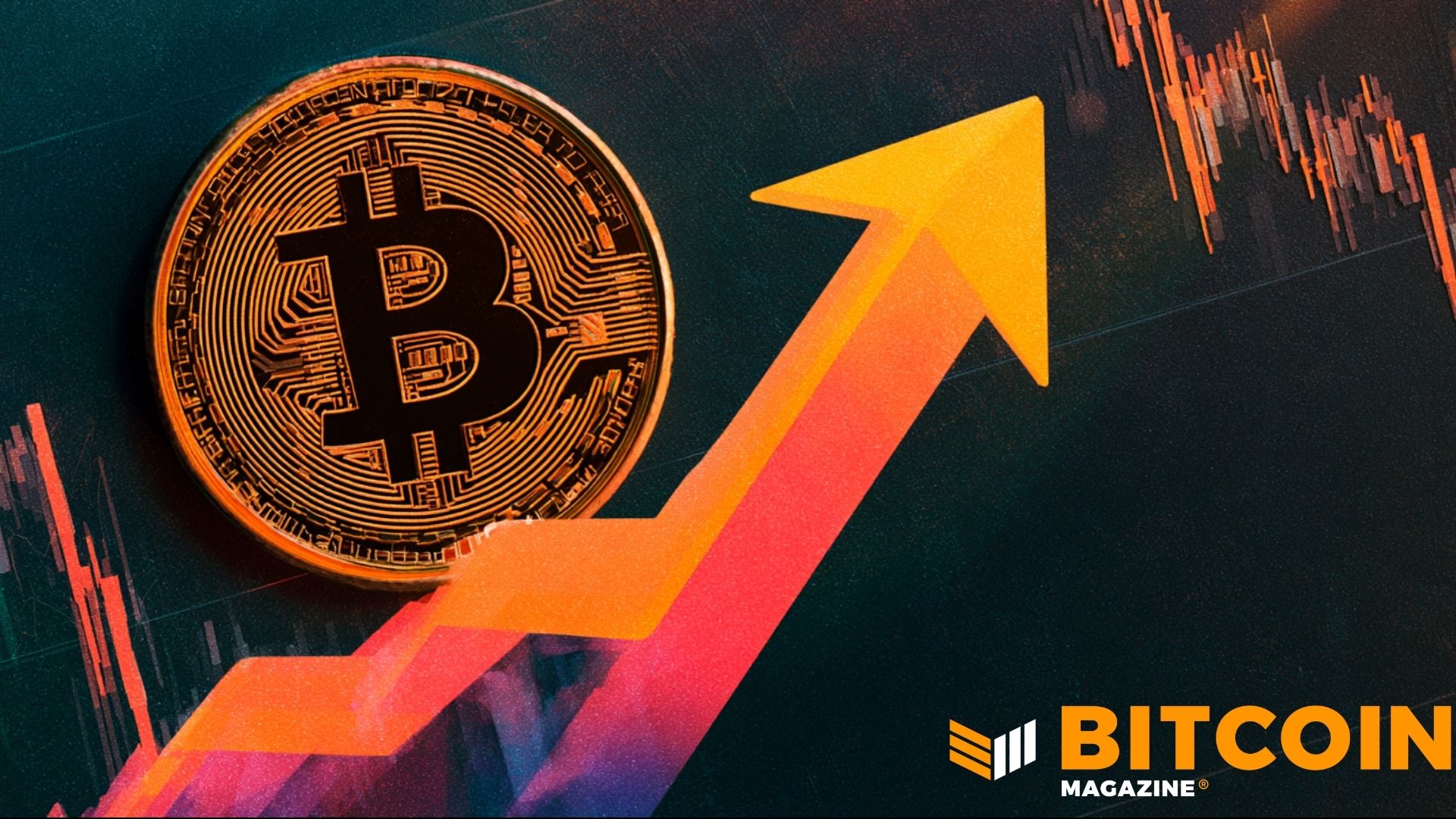
Bitcoin Defies Seasonal Slump With Third-Best August Ever
Bitcoin is known for its summer slumps. But August was different.
In fact, the leading cryptocurrency had its third best August ever.
As highlighted on Tuesday by Bitwise’s European Head of Research, André Dragosch, bitcoin delivered returns of 25% last month.
“No ‘summer lull’ so far,” Dragosch wrote on X, highlighting that the only better Augusts the coin has had were in 2017 when it gave investors returns of nearly 66%, and 2013, with close to 31%.
OFFICIAL: August 2026 is in the books and it's been the 3rd best August in bitcoin's history.
— André Dragosch, PhD
August 2017: +65.6%
August 2013: +30.7%
August 2026: +25.0%
No "summer lull" so far. pic.twitter.com/jwHt2VP5Sk(@Andre_Dragosch) September 1, 2026

Multiple analyses point to the months of June-September showing weaker average returns than the rest of the year.
Throughout most of June and July, bitcoin’s volatility was particularly muted, and the coin traded below $65,000.
But that changed in mid-August after the U.S. Treasury Department said it would more than double the size of its government debt repurchases due to fixed income markets under pressure and yields surging to levels not seen in nearly 20 years.
Lower long-term yields reduce the opportunity cost of holding non-yielding assets like bitcoin and gold, and generally support risk-on sentiment.
Investors flooded into bitcoin as a result.
Positive news soon followed, with President Donald Trump urging lawmakers to get the long-awaited crypto Clarity Act over the line. The digital asset industry has long called for clear rules on how regulators should treat bitcoin, stablecoins and other cryptocurrencies.
Despite a delay in a vote on the legislation, Trump called the draft “very powerful.” The president made the comments after having met with crypto industry bigwigs and CEOs.
Investors also rushed back into ETFs in August, throwing over $2.8 billion at the vehicles — the most since October, when the coin hit a new all-time high.
Bitcoin in August had its best run in three years — and is up nearly over 20% over the past month.
The asset reached as high as $81,281 last week before sliding again on Friday.
Bitcoin’s price recently stood at $76,883, nearly down 3% over a 24-hour period.
This post Bitcoin Defies Seasonal Slump With Third-Best August Ever first appeared on Bitcoin Magazine and is written by Mathew Di Salvo.
Bitcoin Magazine
BlackRock’s iShares Bitcoin Trust Is Beating Top S&P 500 ETF
BlackRock’s iShares Bitcoin Trust exchange-traded fund has delivered better returns since its 2024 launch than Vanguard’s popular S&P 500 fund.
That’s according to Bloomberg data highlighted by the firm’s senior ETF analyst, Eric Balchunas, who said that the BlackRock product’s cumulative percentage return was only slightly ahead of Vanguard’s in the time period.
BlackRock’s bitcoin ETF is up 71% since its January 2024 debut, while Vanguard’s S&P 500 ETF up 66% on a total-return basis.
The iShares Bitcoin Trust — IBIT — started trading in 2024 after the Securities and Exchange Commission gave the green light to 11 spot bitcoin ETFs following a decade of denials.
“IBIT’s path to 70% looks like the El Toro roller coaster at Great Adventure (I needed two Advil last time I rode that thing) while $VOO was a walk in the park in comparison,” wrote Balchunas on Tuesday.
U.S. investors now have several funds to choose from to buy shares that track the price of bitcoin managed by the likes of Fidelity, Grayscale and Morgan Stanley. But BlackRock’s product is the most successful: It currently manages $61.4 billion in assets, according to its website.
By comparison, the second biggest bitcoin ETF, the Fidelity Wise Origin Bitcoin Fund, manages nearly $11 billion.
BlackRock, which manages over $15 trillion in assets, sent shockwaves through the crypto space after it applied for a spot bitcoin ETF in 2023. Its fund now allows more traditional investors to get exposure to bitcoin; its product also experiences more day-to-day trading action than the other ETFs.
Investors piled back into ETFs in August, which has also helped bitcoin’s price. From August 17 to 27, investors threw over $2.8 billion at the vehicles — the most since October, when the coin hit a new all-time high.
Bitcoin reached as high as $81,281 last week before sliding again on Friday.
The price of the biggest cryptocurrency recently stood at $77,539, nearly down 1% over a 24-hour period.
Bitcoin started a phenomenal run two weeks ago — its best in three years — and is up nearly 30% over the past month.
This post BlackRock’s iShares Bitcoin Trust Is Beating Top S&P 500 ETF first appeared on Bitcoin Magazine and is written by Mathew Di Salvo.
Bitcoin Magazine
South Korea’s Bitcoin ‘Kimchi Premium’ Returns
Bitcoin is up this month but there’s one place where it’s more significantly more expensive: South Korea.
The so-called Kimchi Premium — when bitcoin costs more on Korean exchanges — is back as retail investors pile back into the coin. Bloomberg first reported the news and CoinGecko data shows that bitcoin’s price is nearly 1% higher on Upbit, Korea’s biggest exchange, than Binance.
Named after a popular dish in the Asian nation, the phenomenon comes down to Korea’s market being partly walled off. Prices have historically run higher there because of strong local retail demand combined with strict capital controls and trading regulations.
As a result, the Bitcoin/won trading pair is more common in South Korea compared to the Bitcoin/U.S. dollar pair in other places. When there is demand for the asset, it will naturally be higher in the country as compared to other places.
The phenomenon has been described as a retail FOMO indicator, since Korea has few notable crypto funds and tight capital controls. The premium has reached as high as 21.5% in 2022.
Bitcoin was recently trading for $78,287, unmoved over the past 24 hours. It’s also at the same price it was seven days ago, but over the past month, the coin has rallied by 24%.
The price of the biggest digital asset started surging after the U.S. Treasury in August said it would at least double the size of its liquidity-support buyback operations. The announcement hurt the dollar but non-yielding assets like bitcoin and gold have benefited.
President Donald Trump also said the same week that the long-awaited crypto Clarity Act was an important piece of legislation, and urged lawmakers to get it over the line.
JUST IN: There's now a 59% chance Bitcoin will be above $82,500 this month, according to Polymarket.com
— Bitcoin Magazine (@BitcoinMagazine) September 1, 2026pic.twitter.com/kTYEZsxQvk
Crypto industry bigwigs have been calling for clear rules for distinguishing between digital assets that are securities, commodities or payment stablecoins, and news that regulators will soon have such a framework has typically benefited crypto markets.
Speculators are now betting on Polymarket that there’s a 59% chance bitcoin will be above $82,500 this month, leading some to call an end to the bear market.
This post South Korea’s Bitcoin ‘Kimchi Premium’ Returns first appeared on Bitcoin Magazine and is written by Mathew Di Salvo.
Bitcoin Magazine
BlackRock Re-Underwrites Bitcoin, and the Portfolio Math Still Holds
Bitcoin’s roughly 50% decline from its October 2025 high has created a useful test for the institutional investment thesis. It is relatively easy to make the case for a new asset while prices are rising, correlations are favorable and capital is flowing into the market. The more revealing exercise comes after a major drawdown, when investors can revisit the original assumptions and determine which were structural and which were simply products of the preceding cycle.
That is effectively what BlackRock has done in its latest research, Re-Underwriting Bitcoin: Still a Portfolio Diversifier. Rather than treating the recent drawdown as evidence for or against Bitcoin in isolation, the firm returns to the question most relevant to an allocator: how has Bitcoin actually affected the risk and return characteristics of a diversified portfolio?
The results are more consequential than the headline return figures suggest. In BlackRock’s rolling 10-year analysis through May 29, 2026, a traditional 60/40 equity and fixed-income portfolio generated an annualized return of approximately 9.9% with annualized standard deviation of roughly 10.1%. Introducing a 1% Bitcoin allocation increased annualized return to approximately 10.9%, while volatility moved only modestly higher to roughly 10.3%. At a 2% allocation, annualized return reached approximately 11.8%, with standard deviation of about 10.6%.
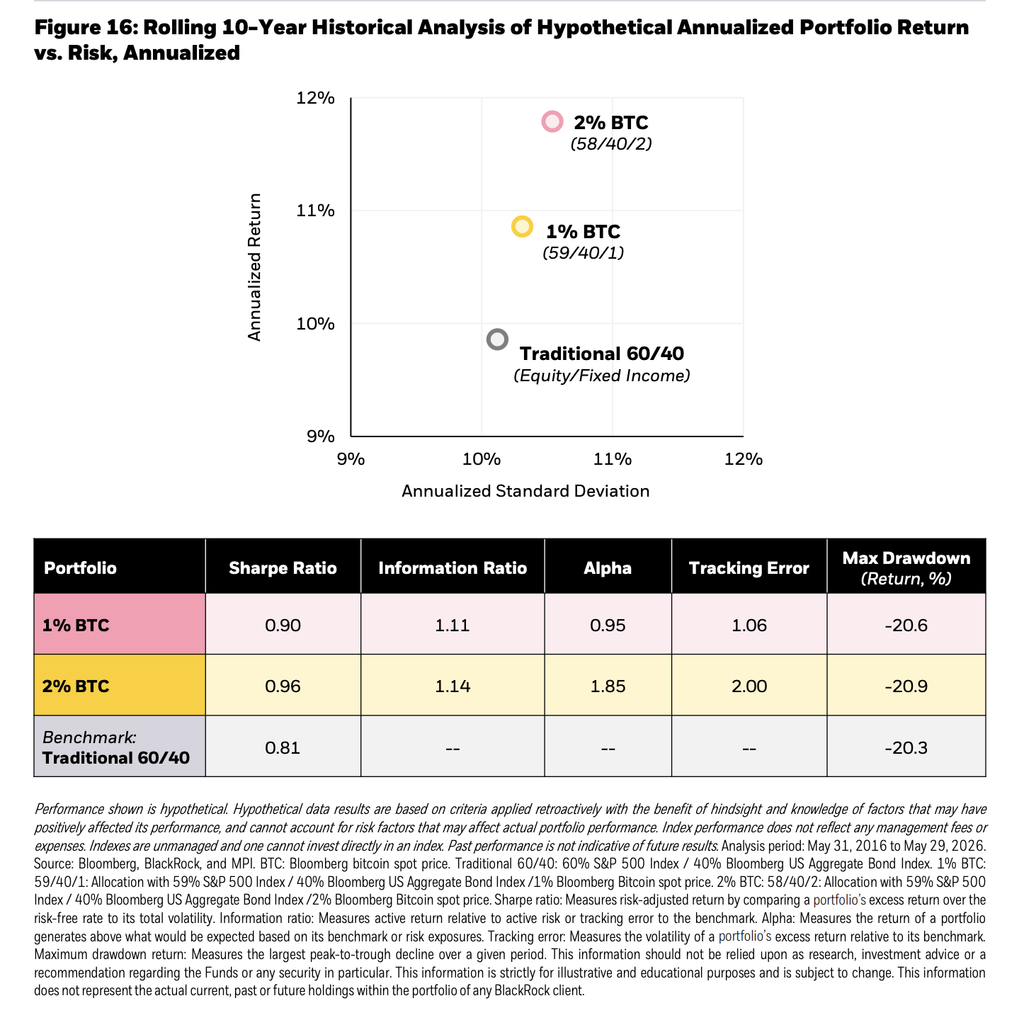
Put differently, the 2% allocation added roughly 190 basis points of annualized return relative to the traditional portfolio while increasing annualized volatility by approximately 50 basis points. The portfolio’s Sharpe ratio improved from 0.81 to 0.96, while maximum drawdown changed from -20.3% to -20.9%. Those figures are hypothetical and backward-looking, but they illustrate why judging Bitcoin primarily by its standalone volatility can produce an incomplete assessment of its portfolio impact.
The more relevant question is how that volatility interacts with everything else an investor already owns. BlackRock continues to characterize Bitcoin as having risk and return drivers that are fundamentally different from traditional assets, rooted in its fixed supply, decentralized structure and independence from any sovereign issuer. Those characteristics do not prevent Bitcoin from trading alongside risk assets during periods of deleveraging, but BlackRock’s research suggests those correlations have historically been episodic rather than permanent.
That distinction helps explain the portfolio results. A modest allocation does not import Bitcoin’s standalone volatility into a portfolio on a one-for-one basis. What matters is the marginal contribution of that allocation to total portfolio risk relative to the return it has historically generated. In BlackRock’s analysis, that trade-off remained favorable at 1% and 2%, even after incorporating one of Bitcoin’s most significant recent drawdowns.
Why 1–2% keeps appearing in BlackRock’s work
This is not the first time BlackRock has arrived at this range. Its earlier portfolio research approached Bitcoin sizing through risk contribution, concluding that a 1–2% allocation could represent a reasonable range for investors willing and able to accept Bitcoin’s risk. At those weights, BlackRock found that Bitcoin could contribute a similar share of overall portfolio risk as an individual mega-cap technology holding in a conventional 60/40 portfolio. Beyond 2%, however, Bitcoin’s contribution to total portfolio risk begins to increase disproportionately.
The new analysis approaches the same question from the opposite direction. Rather than asking how much risk Bitcoin contributes, it examines what investors historically received for assuming that additional risk. The improvement in Sharpe ratio from 0.81 for the traditional portfolio to 0.90 with 1% Bitcoin and 0.96 with 2% Bitcoin suggests that the incremental return historically more than compensated for the additional portfolio-level volatility.
This does not establish 1% or 2% as an optimal allocation, and BlackRock does not present it that way. The appropriate exposure will depend on liquidity requirements, investment horizon, governance constraints and risk tolerance. What the analysis does provide is a more rigorous framework for the discussion. The allocation question can increasingly be evaluated in terms of marginal risk, correlation, drawdown and portfolio efficiency rather than through a binary debate over whether Bitcoin itself is too volatile to own.
BlackRock has also seen the demand firsthand
There is another dimension to BlackRock’s latest analysis that is difficult to separate from the firm’s experience in the market.
BlackRock launched the iShares Bitcoin Trust, IBIT, in January 2024. Less than a year later, it had accumulated more than $50 billion in assets, making it what BlackRock itself has described as the largest exchange-traded product launch in history. It reached that milestone roughly five times faster than the previous record holder.
Its significance has only grown since then. BlackRock now describes IBIT as the world’s largest and most traded Bitcoin ETP, and the fund became the firm’s highest-revenue ETF in 2025 despite competing within a global BlackRock lineup of more than 1,000 products.
The concentration within the U.S. spot Bitcoin ETF market is equally notable. According to current ETF holdings data tracked by Bitcoin For Corporations, U.S. spot Bitcoin ETFs collectively hold approximately 1.25 million BTC, representing nearly 6% of Bitcoin’s fixed 21 million supply. IBIT alone accounts for roughly 775,000 BTC, or more than 60% of the Bitcoin held across the U.S. spot ETF complex.
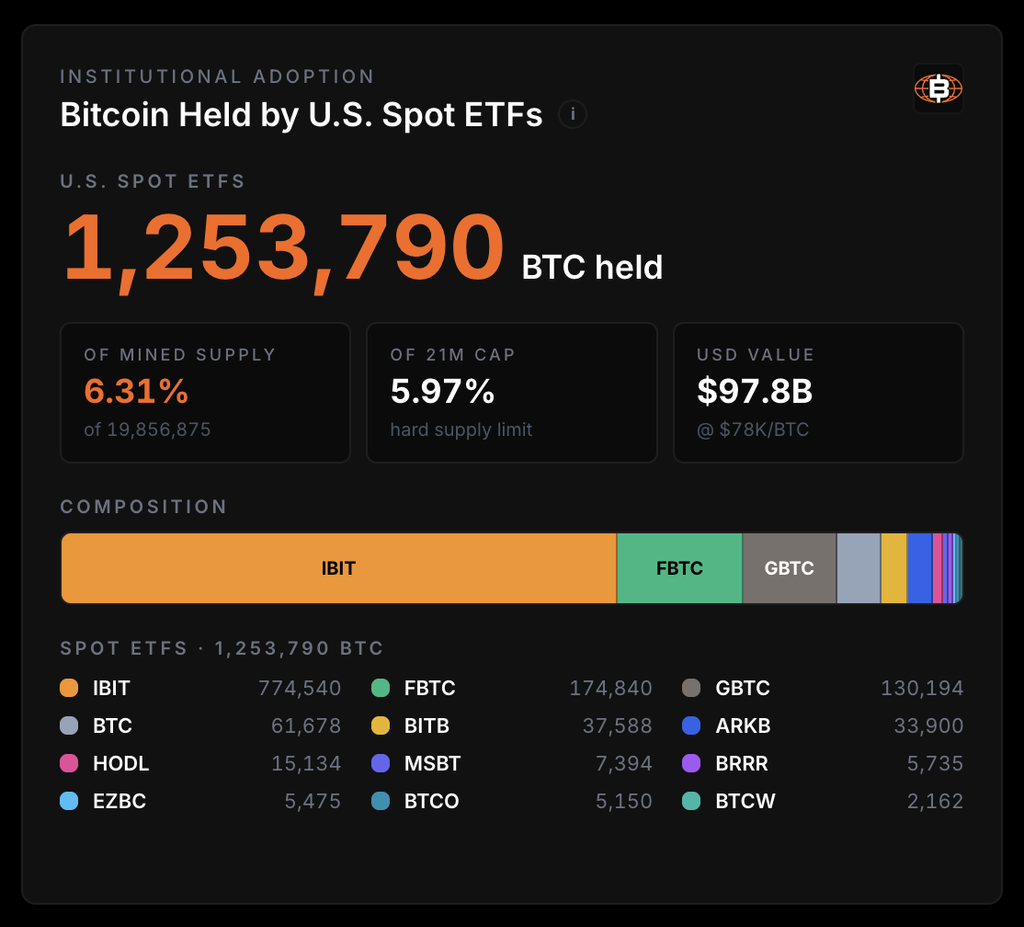
View the full Bitcoin ETF Dashboard.
That does not make BlackRock’s research independent of commercial context; IBIT is an important and increasingly valuable BlackRock product. That context should be understood rather than ignored. But it also means the firm’s reassessment is occurring alongside more than two years of observing how investors actually use Bitcoin exposure at scale.
The distinction is useful. The theoretical case for Bitcoin as a portfolio asset is increasingly being accompanied by observable allocation behavior. Investors have now had access to Bitcoin through familiar brokerage, advisory and institutional infrastructure across multiple market regimes, including periods of rapid appreciation and severe drawdowns. IBIT’s growth suggests that demand has persisted well beyond its initial launch window.
A drawdown is precisely when a thesis should be re-underwritten
The timing of BlackRock’s report may ultimately be more informative than the portfolio simulation itself.
Bitcoin is not being reassessed at an all-time high. BlackRock published the analysis after an approximately 50% drawdown from Bitcoin’s October 2025 peak, a period the firm associates with leveraged positioning being unwound, slowing ETP flows and weaker demand from companies accumulating Bitcoin. Its conclusion is that these forces represented a positioning correction rather than a fundamental change in Bitcoin’s investment case.
That is what re-underwriting is supposed to accomplish. An investment thesis should not survive because investors are attached to it; it should survive because its underlying assumptions continue to hold when conditions change.
For Bitcoin, those assumptions extend beyond historical returns. The asset remains scarce by design, globally liquid, independent of a sovereign issuer and structurally different from the liabilities that dominate traditional portfolios. BlackRock argues that concerns around fiscal sustainability, monetary stability and geopolitical risk may therefore become increasingly relevant to Bitcoin’s long-term adoption.
The portfolio evidence does not prove what Bitcoin will return over the next decade, nor does IBIT’s success establish what an appropriate allocation should be. What the two developments show together is that the institutional conversation has advanced considerably. Bitcoin is no longer being evaluated solely as an unconventional asset that institutions may or may not choose to own. It is increasingly being evaluated through the same disciplines applied elsewhere in capital allocation: sizing, risk contribution, correlation, liquidity, drawdown and expected return.
What this means for corporate leaders
For CFOs, boards and corporate operators, that evolution may be the most important takeaway from BlackRock’s work.
The relevant decision is not whether Bitcoin is volatile; that is already known. Nor does a corporate allocation need to resemble the concentrated Bitcoin strategies pursued by companies that have explicitly built their capital structures around the asset. Between zero exposure and a Bitcoin-centric balance sheet sits a much broader spectrum of possible allocations.
BlackRock’s research provides a useful framework for thinking about that spectrum. A relatively small allocation was sufficient to materially alter the historical return characteristics of a conventional portfolio without producing a comparable increase in portfolio-level risk. At 2%, approximately 190 basis points of additional annualized return came with roughly 50 basis points of additional annualized volatility in the period studied. The allocation was small; its effect was not.
For corporate leaders, the implication is less about adopting BlackRock’s specific allocation range than adopting the discipline behind the analysis. Bitcoin can be underwritten like any other strategic allocation: define its purpose, determine an acceptable risk contribution, establish liquidity and governance requirements, size the position accordingly and periodically revisit the assumptions.
That is a considerably more mature question than whether a company should simply “buy Bitcoin.”
As Bitcoin becomes more deeply integrated into institutional portfolios and financial infrastructure, the burden of analysis is shifting. The question facing the C-suite is increasingly not whether Bitcoin belongs in the conversation, but what allocation, if any, can be justified by the company’s objectives, constraints and cost of capital.
BlackRock has now re-underwritten that question after another full market cycle and a roughly 50% drawdown. Its historical portfolio math still makes the case that, in measured amounts, Bitcoin can improve the equation. For corporate decision-makers, that is the takeaway worth bringing into the boardroom.
Disclaimer: This content was prepared on behalf of Bitcoin For Corporations for informational purposes only. It reflects the author’s own analysis and opinion and should not be relied upon as investment advice. Nothing in this article constitutes an offer, invitation, or solicitation to purchase, sell, or subscribe for any security or financial product.
This post BlackRock Re-Underwrites Bitcoin, and the Portfolio Math Still Holds first appeared on Bitcoin Magazine and is written by Nick Ward.
CryptoSlate
Injective, a layer-1 blockchain network, produced no new block for nearly four hours during an emergency response to an exploit that researchers traced into core modules.
On Sept.1, the foundation said the blockchain was “upgraded, not halted” and that its consensus, native INJ, and staked assets were never compromised. It described the attack as affecting a small number of ecosystem applications using binary-options markets.
On-chain researcher Earthling Paddy challenged both characterizations, while crediting Injective for containing the exploit and keeping staked funds safe.
The ledger shows block 181027005 at 16:09:59 UTC on Aug. 31 before block production stopped for roughly four hours. Paddy said one earlier block alone took about 37 minutes, while infrastructure provider QuickNode also reported a stalled block height during the incident.
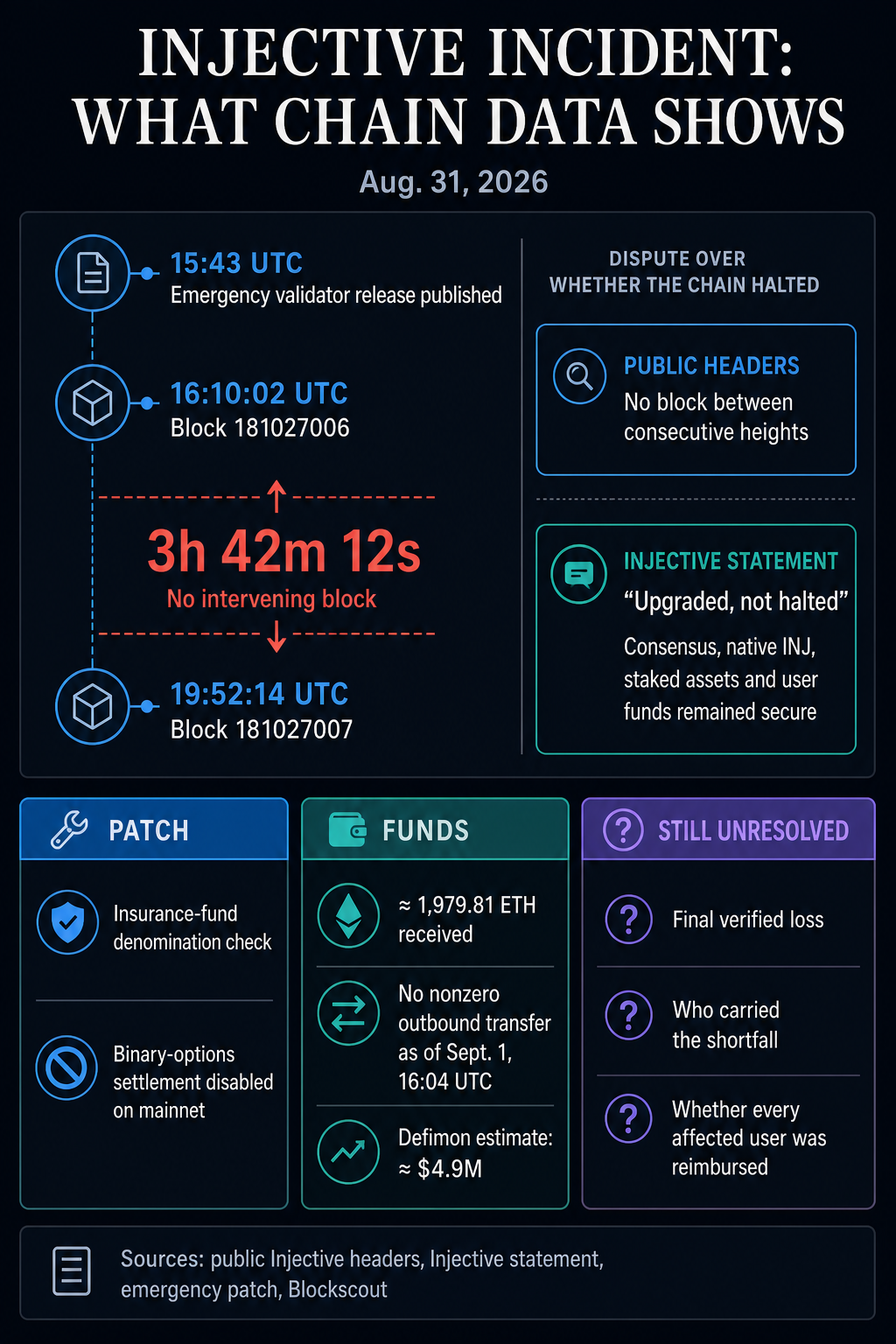
Injective said the accelerated upgrade took longer than expected as validators and ecosystem infrastructure moved to the emergency release. Some validators were temporarily jailed after missing the required upgrade window, while exchanges including Coinbase and Coins.ph temporarily restricted transfers.
Data from CryptoSlate shows INJ trading around $4.80 as of press time, down roughly 3% over the previous 24 hours.
Researcher disputes where the vulnerability sat
Paddy also questioned Injective’s description of the exploit as isolated to ecosystem applications.
He said the attack used messages from Injective’s native exchange and insurance modules, while the emergency v1.20.3-safeharbor.1 release patched the chain’s core code by adding an insurance-fund denomination check and disabling binary-options settlement on mainnet.
That would place the vulnerable logic inside a protocol module used by applications rather than solely within application code.
Injective has not yet published a full technical postmortem. Its statement said the relevant attack vector had been contained and patched and that the foundation was adding stronger invariants, real-time monitoring, and other safeguards.
Researchers estimate about $4.9 million was bridged to Ethereum during the exploit. Paddy said roughly that amount remained in the attacker-linked wallet and had not moved.
The final loss allocation remains unclear. Injective has not disclosed how much was ultimately drained, which party absorbed any shortfall, or whether an ecosystem pool that now appears replenished was restored by the foundation, developers, or another participant.
Instead, the blockchain has maintained that its users weren't affected. In an X post, Injective CEO Eric Chen said:
“Injective users aren’t affected and we’ve been helping the team on recovery. Always sad to see exploits happening in the ecosystem but we’re glad that the incident was contained before further harm was done.”
Nonetheless, the incident therefore leaves two separate findings intact. Injective’s consensus and staked INJ were not compromised, while its emergency response still coincided with a multi-hour interruption in block production and required a core-code patch.
The post A layer-1 blockchain froze for 4 hours to stop a $4.9 million hack, then claimed it was just an upgrade appeared first on CryptoSlate.
Standard Chartered estimated in January that stablecoins could pull about $500 billion from US bank deposits by the end of 2028.
Regional banks looked especially exposed given how much they depend on the spread between what they pay depositors and what they earn on loans.
Now, 21 major financial institutions, including Bank of America, Citi, Goldman Sachs and Wells Fargo, committed Sept. 1 to build one.
The group announced plans to establish a company in the second half of 2026, launch a US dollar-denominated stablecoin in the first half of 2027, and comply with both the GENIUS Act and MiCA.
The venture started as a 10-bank exploration into reserve-backed digital money in October 2025 and has since grown to 21 institutions spanning North America, Europe, Asia, Africa, and the Middle East.
Its stated use cases include wholesale and institutional activity, cross-border payments, digital-asset settlement, and retail markets where client benefits can be achieved.
| Earlier bank concern | Sept. 1 bank response |
|---|---|
| Stablecoins could pull deposits out of banks | 21 institutions committed to launch a bank-backed stablecoin |
| Regional banks could be exposed to funding pressure | Large banks are positioning to capture stablecoin flows |
| Crypto platforms could compete for customer cash | Banks are creating their own digital-dollar product |
| Stablecoins could redirect reserves into Treasuries | Banks may seek a role in reserve management and distribution |
| Payments could move outside bank rails | Banks want stablecoins for cross-border payments, settlement and institutional activity |
Why deposits and stablecoins compete for the same dollar
Bank deposits fund lending and balance-sheet activity, with banks earning income on the spread between what they pay depositors and what they collect on loans.
Stablecoins work as fully backed tokens that hold their reserves in cash, bank balances, and short-dated government securities, with Treasuries making up most of Tether and Circle's reserve holdings.
A dollar moving from a bank account into a stablecoin can remain a dollar in every practical sense while changing who controls the customer relationship, the reserve economics and the payment rail underneath it.
That move in control is what Standard Chartered's warning was about.
Owning the stablecoin migration beats losing the relationship
A bank-backed stablecoin customer moving money from a conventional deposit into a fully reserved token still reduces the bank's traditional funding base.
What a bank-issued stablecoin can preserve is everything built around that deposit: the distribution relationship, the compliance layer, the settlement business and a share of the reserve economics.
Banks appear to be accepting cannibalization of one part of their existing model to avoid surrendering the entire customer relationship to a crypto-native competitor.
Total stablecoin market capitalization stands near $303.7 billion, according to DefiLlama, with Tether's USDT alone accounting for more than 60%.
Citi's 2030 research projects a base case of $1.9 trillion in stablecoin issuance and a bull case of $4 trillion, implying roughly $1.6 trillion to $3.7 trillion of additional issuance from today's level.
Citi's base case also puts annual stablecoin transaction activity near $100 trillion at 50 times velocity, climbing toward $200 trillion under its bull scenario.
The consortium is positioning for a share of that future issuance and transaction flow, a much larger prize than any slice of Tether and Circle's existing balances.
The bank that produced one of the industry's most aggressive stablecoin growth forecasts is simultaneously helping build a company designed to compete inside that forecast. It treats its own projection as a live market opportunity worth entering.
| Metric | Estimate | What it means |
|---|---|---|
| Potential US bank deposit outflow | $500B by end-2028 | Stablecoins could pressure traditional bank funding |
| Current stablecoin market cap | ~$303.7B | The market banks are entering today |
| Citi 2030 base case | $1.9T | Roughly $1.6T of additional issuance from today |
| Citi 2030 bull case | $4T | Roughly $3.7T of additional issuance from today |
| Citi base-case transaction activity | ~$100T/year | Stablecoins become payment and settlement infrastructure |
| Citi bull-case transaction activity | ~$200T/year | The market becomes too large for banks to ignore |
Multiple forms of digital money can coexist
None of this means banks are abandoning tokenized deposits for public-chain stablecoins. Citi's research explicitly expects stablecoins, tokenized deposits, deposit tokens and central bank digital currencies to coexist, and projects that bank-token transaction volume could exceed stablecoin turnover by 2030 even as stablecoin issuance itself keeps expanding.
The more accurate read is that banks want exposure across every plausible form of digital dollar at once. Qivalis, a separate 37-institution consortium building a euro-pegged stablecoin, shows the competitive landscape is already splitting by currency and structure as well as by issuer.
The GENIUS Act takes effect on the earlier of 18 months after its July 2025 enactment, which lands on Jan. 18, 2027, or 120 days after federal regulators finalize implementing rules.
The consortium's first-half 2027 target overlaps that threshold. The same law that gave existing stablecoin issuers regulatory certainty also opened a clear, compliant path for heavily regulated banks to enter the category directly.
That turns a compliance milestone for incumbents into a competitive entry point for their newest rivals.
One warning sign for bank-issued stablecoins is Societe Generale's dollar-backed token, which had just $12.5 million in circulation.
Distribution remains the harder test
Institutional trust and compliance infrastructure do not, by themselves, produce the minting volume, secondary-market liquidity, exchange listings, wallet support, and merchant demand that make a stablecoin useful.
Tether and Circle built years of that kind of distribution, and a consortium of banks cannot replicate it by announcement alone.
Whether the bet pays off or produces a compliant token nobody needs
The bull case has stablecoins approaching Citi's $4 trillion scenario, with bank-backed tokens becoming one of several dominant digital-money formats used across payments, treasury and settlement.
Under that path, deposit substitution turns into a genuine structural funding issue for banks that stayed on the sidelines. Institutions in the consortium capture settlement fees, custody relationships, and reserve income in a market many times larger than today's.
| Scenario | What happens | Who wins | What it means for banks |
|---|---|---|---|
| Bull case: bank stablecoins scale | Stablecoins approach Citi’s $4T scenario and bank-backed tokens gain institutional usage | Consortium banks, regulated issuers, institutional clients | Banks cannibalize some deposits but retain settlement, custody and customer relationships |
| Base case: partial adoption | Bank tokens find use in wholesale, cross-border and institutional settlement but do not displace USDT/USDC broadly | Banks in specific niches; crypto-native issuers in public markets | Banks capture some future flows without fully reshaping deposit funding |
| Bear case: compliant but unused | The consortium launches a well-regulated token that fails to build liquidity or integrations | Existing stablecoins and tokenized-deposit systems | Banks spend years building infrastructure customers do not need |
| Regulatory shock case | Stablecoin rules tighten after a failure, run or liquidity event | Tokenized deposits and bank-controlled rails | Stablecoins lose momentum, and banks pivot harder toward deposit tokens |
The bear case has the consortium building a fully compliant, well-capitalized stablecoin that fails to attract liquidity, matching the same pattern Societe Generale's token already shows.
In that scenario, deposit strain stays limited because stablecoins never scale far past their current niche. The 21 institutions end up having spent years and real capital building infrastructure that crypto-native issuers and tokenized-deposit systems continue to outcompete on usage.
Banks spent months warning that stablecoins could hollow out part of their business. Their answer was to make sure that if the dollar keeps moving onto programmable rails, some of the largest banking names control the rails it moves on.
The post Wall Street is now racing to control the $1.9T stablecoin shift to avoid losing its customer base appeared first on CryptoSlate.
Binance is putting options on more than 1,000 selected US stocks and exchange-traded funds inside the same account that already offers crypto and several forms of equity exposure.
The product is limited to eligible users outside the US, and the securities machinery behind the offer does not belong to Binance.
The company said on Sept. 1 that Nest Trading Limited will introduce the orders and route them to Alpaca Securities LLC. Alpaca will execute, clear, and settle the trades, then custody any shares delivered when an option is exercised.
Eligible customers can move among more products without leaving Binance, while Nest and Alpaca carry distinct responsibilities behind the scenes.
Who does what behind Binance
Binance is the customer-facing access point, Nest Trading is the introducing broker, and Alpaca provides execution and post-trade infrastructure.
An options customer places an order through Binance, but Nest introduces it to Alpaca. If physical settlement produces shares, Binance says Alpaca holds them on the user's behalf.
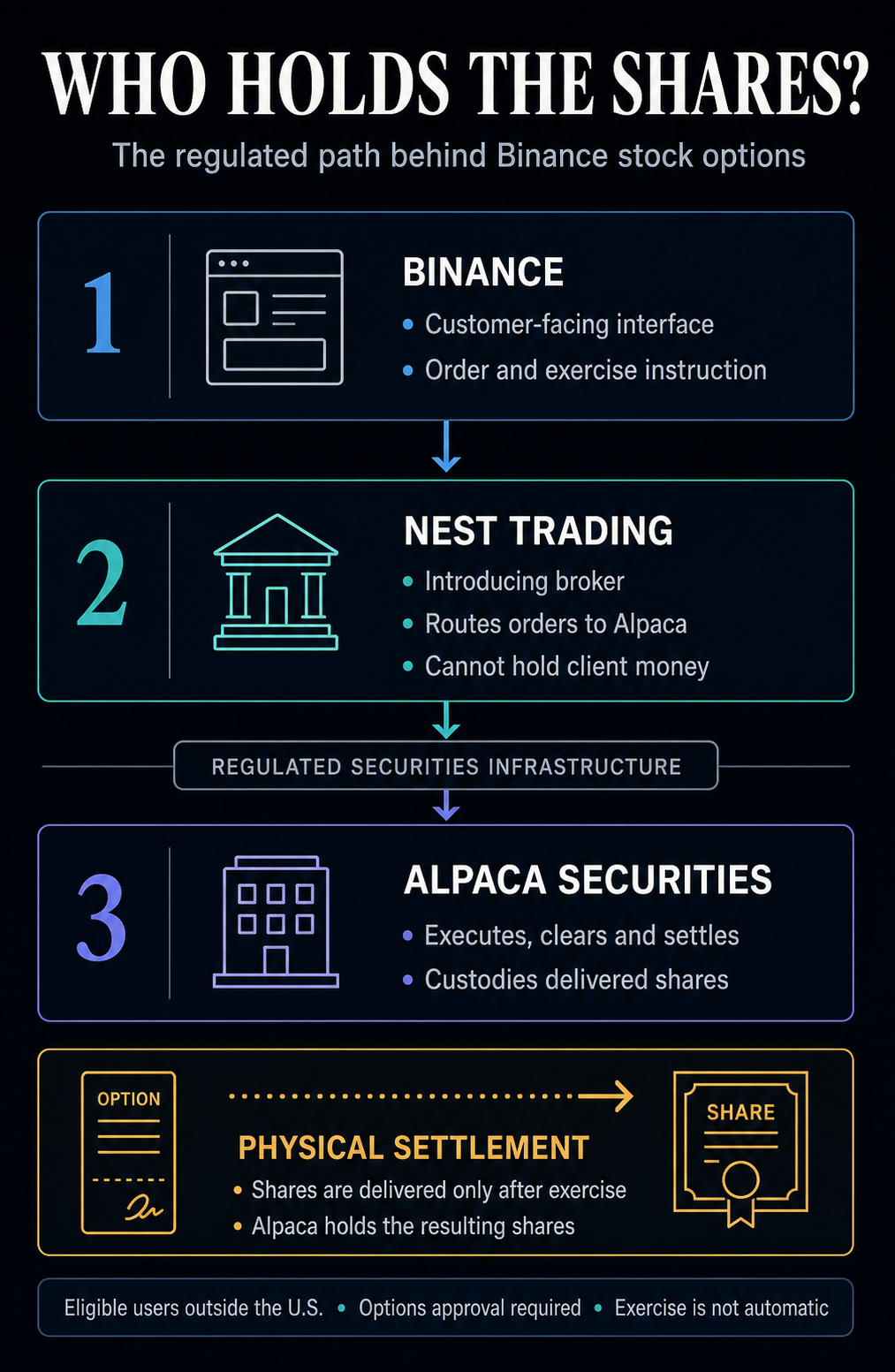
Nest's Abu Dhabi Global Market register lists the firm as active under financial services permission 260000. Its permitted activities include arranging deals, dealing as an agent, and arranging custody, but the register says Nest cannot hold or control client money.
Alpaca's FINRA BrokerCheck profile identifies the firm as SEC- and FINRA-approved and lists options activity, securities clearing and settlement, and electronic trading among businesses it conducts or expects to conduct.
The profile also says Alpaca can hold or maintain funds or securities and provide clearing services for other broker-dealers.
The contracts are physically settled. Exercising a call can produce the underlying shares, while exercising a put can require delivery of them. Until exercise and settlement, the option is a contractual right.
Binance says an exercise instruction must be submitted through its platform by the relevant cutoff, as late as 30 minutes before expiry. Even an in-the-money contract will not exercise automatically without that instruction.
A position without an instruction becomes subject to best-efforts auto-liquidation before trading closes. If it cannot be sold, it may expire worthless, leaving the holder with a loss of the premium.
Binance said eligible retail users may buy calls and puts, with maximum potential loss limited to the premium. The statement does not extend that defined-loss description to option-writing strategies.
The exchange also says that the options remain subject to jurisdictional and user restrictions. Alpaca's options documentation says every customer account must be approved before its first options trade, with financial circumstances, experience, risk tolerance and investment objectives supplied alongside a signed options agreement.
Four products behind one account
The options join three existing routes to equity exposure inside Binance. A single account can make them look adjacent, but their ownership and settlement mechanics differ.
| Product | What the user holds | Ownership or settlement |
|---|---|---|
| Direct U.S. stocks | Shares | Direct equity ownership held through a U.S.-regulated clearing broker |
| bStocks | Tokenized securities | No direct ownership of the underlying company share |
| Equity-linked perpetuals | Derivative exposure | No delivery of the underlying share described |
| Stock options | A right to buy or sell | Underlying shares are delivered or received after exercise and held by Alpaca |
Binance made the ownership distinction explicit when it introduced direct stock trading and previewed bStocks in June. It said direct-stock users would own equities held by a US-regulated clearing broker, while bStocks would not give holders direct ownership of the underlying company shares.
The options add another regulated route, consolidating convenience for users.
Shunyet Jan, Binance's head of exchange and trading, called stock options an “important next step” toward a “fuller multi-asset platform.” Binance said equity-linked perpetuals generated about $342.9 billion in volume during August, represented about 79% of its TradFi perpetual activity and grew more than 800-fold from January.
The launch release shows how Binance is presenting demand within its own ecosystem, but it does not establish how much demand the new physically settled contracts will attract.
The options announcement expands what a crypto account can distribute. Binance controls product discovery and the customer experience, while Nest and Alpaca define the operational route into regulated securities markets.
That structure gives Binance much of the strategic benefit of a securities super-app without making it the entity that executes, clears, or custodies every product on screen.
For users, the practical test is whether they understand which firm holds the asset, which rules govern the account, and which action they must take before an option expires.
The post Binance deepens TradFi push with physically settled options on over 1,000 US equities appeared first on CryptoSlate.
Cardano’s 2026 Constitutional Committee renewal had crossed both voting thresholds in a pre-boundary snapshot on Sept. 1, but formal ratification still waited for the epoch change. The narrow margin on the stake pool side exposed how non-participation can become an effective veto in the network’s on-chain governance.
Cardano divides governance authority among delegated representatives, stake pool operators, and the Constitutional Committee.
DReps vote with ADA delegated to them, SPOs represent block-producing stake pools, and the committee reviews the constitutionality of actions that require its approval. For an update to the committee’s own membership, DReps and SPOs vote while the committee does not.
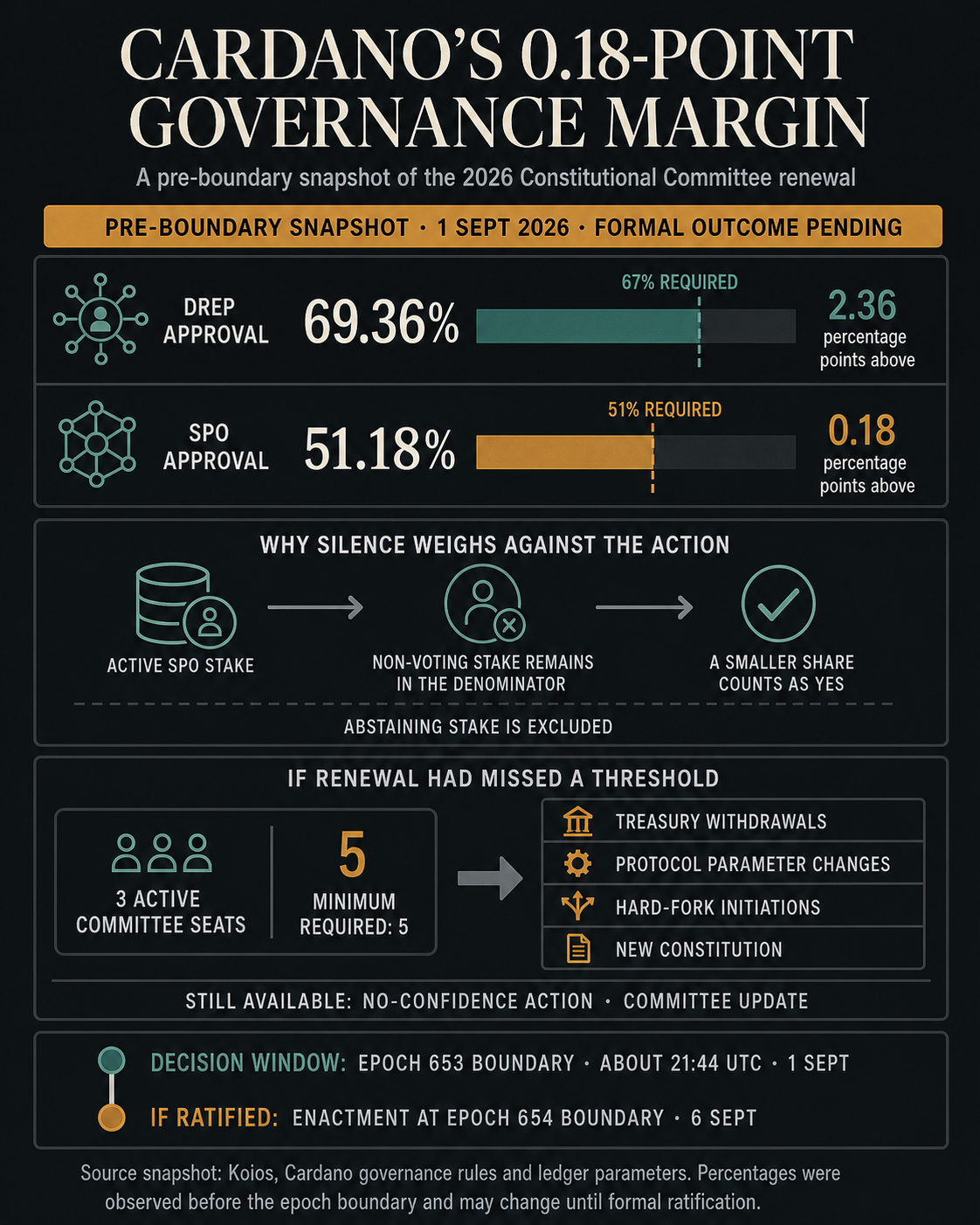
A synchronized Koios voting snapshot retrieved at about 09:59 UTC showed DRep support at 69.36% against a 67% threshold. SPO support stood at 51.18% against a 51% requirement, leaving a margin of 0.18 percentage points at that observed moment.
The proposal’s on-chain record still showed no ratification, enactment, or expiration, and the Koios chain tip remained in epoch 652. The decision was due at the boundary into epoch 653 at about 21:44 UTC on Sept. 1.
| Measure | Pre-boundary snapshot | Requirement or timing |
|---|---|---|
| DRep approval | 69.36% | 67% threshold met |
| SPO approval | 51.18% | 51% threshold met |
| Formal outcome | Pending in epoch 652 | Decision at epoch 653 boundary |
| Enactment if ratified | Pending | Epoch 654 boundary on Sept. 6 |
The thresholds come from Cardano’s epoch-652 protocol parameters, while Cardano's governance overview and CIP-1694 set out the division of voting authority.
The key mechanism sits inside the SPO denominator. The Cardano Developer Portal’s governance rules say stake behind a pool that does not cast a ballot remains against ratification in the effective calculation. The pool has not submitted an explicit No, but its uncast stake still makes the Yes threshold harder to reach.
Abstention follows a different path. Explicit abstentions and stake assigned to alwaysAbstain are removed from the effective calculation.
The Koios breakdown separated roughly 2.008 million ADA of explicit SPO No votes from about 5.316 billion ADA in the total No or default-No side of the calculation. The gap indicates that non-participating stake created most of the drag on approval.
The four committee seats due to lapse raise the stakes of that denominator rule. Those seats remain valid through epoch 653 and expire as epoch 654 begins on Sept. 6. Without an enacted renewal, the committee would fall to three active members, below the minimum of five.
The five-seat line
Voting closes as epoch 652 ends, and ratification is assessed at the boundary into epoch 653. If the update is ratified there, it is scheduled to enact one epoch later at the start of epoch 654, the same boundary at which the four current seats lapse. The action page and a ledger-focused chronology align those two events.
A committee below its five-member minimum could not supply the approval required for new treasury withdrawals, protocol parameter changes, hard fork initiations, or a new constitution. The Cardano ledger implementation treats an undersized committee as lacking the voting threshold needed for actions that require committee approval.
No-confidence and update-committee actions would remain available because the committee does not vote on them. The cited protocol rules describe a ratification bottleneck affecting specified governance actions.
If the threshold-crossing snapshot held through the epoch boundary and the ledger ratified the action, the immediate three-seat bottleneck would be avoided. The vote would still leave a governance lesson: SPO approval rested just 0.18 percentage points above the line after billions of ADA in non-voting stake weighed against passage.
Intersect had warned that failed renewal could interrupt governance continuity and may affect progress toward Dijkstra, Cardano’s next hard-fork program. Cardano has separately described the constitutional preparation required for Dijkstra.
Those sources frame a timeline impact as a risk rather than a confirmed delay.
At the latest synchronized pre-boundary snapshot, late voting had moved the renewal above both thresholds. Its razor-thin SPO margin still demonstrated the force of Cardano’s participation rule: when uncast stake remains in the denominator, governance silence can decide whether the network’s decision-making machinery keeps moving.
The post Cardano clears key voting thresholds for constitutional committee renewal by 0.18% margin appeared first on CryptoSlate.
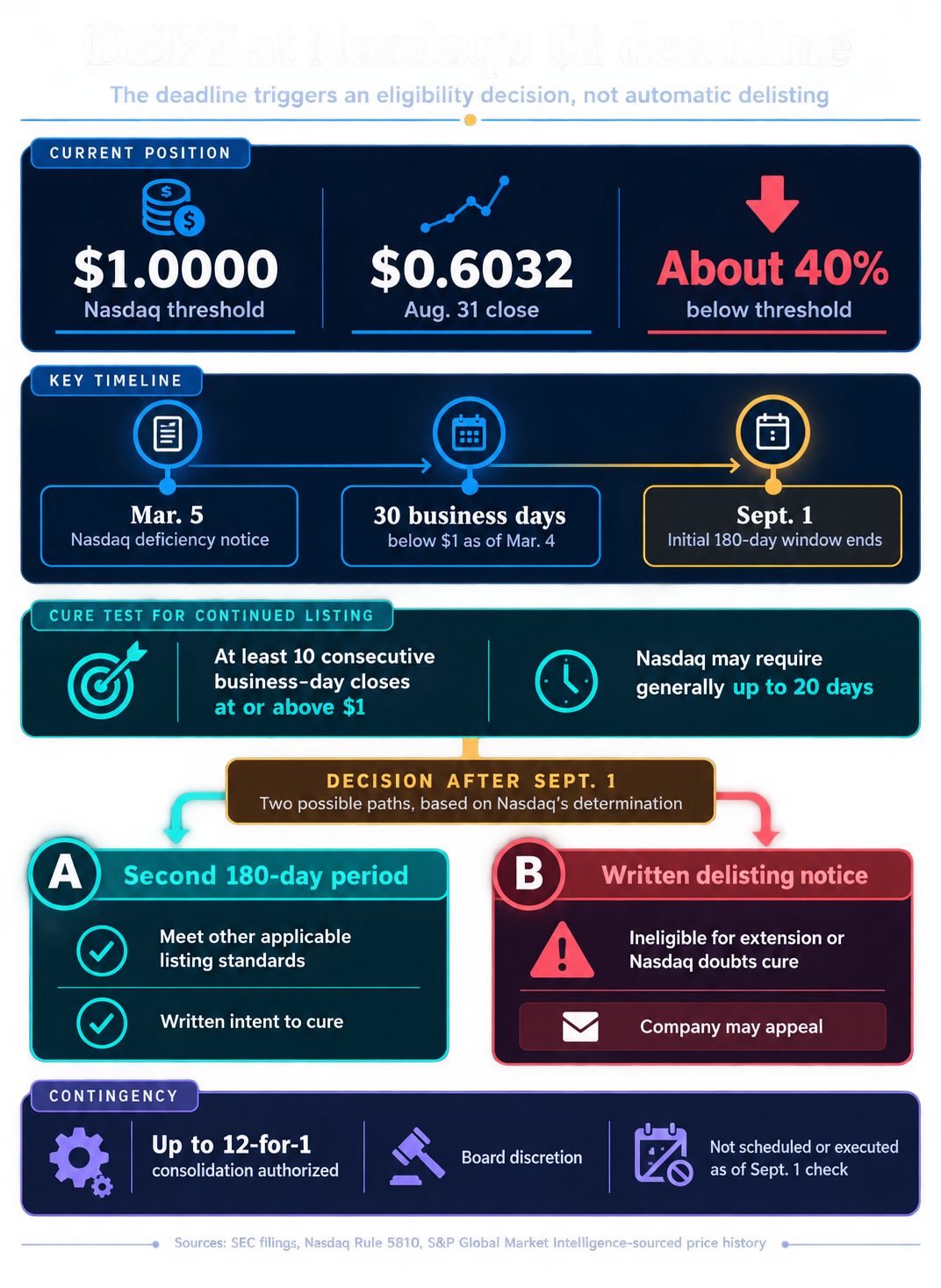
DeFi Technologies reached its Sept. 1 Nasdaq minimum-bid deadline after its US-listed DEFT shares closed Aug. 31 at $0.6032, making it impossible to complete the required 10-business-day streak at or above $1.
The threshold miss moves the company into an eligibility review, with either a second compliance window or a written delisting determination as the next formal outcome.
Nasdaq notified DeFi Technologies on March 5 that DEFT had closed below $1 for 30 consecutive business days as of March 4, and gave DeFi Technologies an initial 180-calendar-day period ending Sept. 1.
The stock's daily history through Aug. 31 showed every August close below $1, so a move above the threshold during the Sept. 1 session could not produce the required consecutive closing-price streak in time.
Nasdaq's test uses consecutive closing prices. DEFT entered the final day without an active qualifying streak, and the Aug. 31 close was about 40% below the $1 threshold. The company's March filing also said Nasdaq staff can require generally up to 20 consecutive business days before confirming compliance.
Extension or delisting notice
Nasdaq can grant a second 180-calendar-day period if DeFi Technologies satisfies the continued-listing requirement for the market value of publicly held shares and all other applicable initial standards for the Nasdaq Capital Market, apart from the bid-price rule.
The company must also notify Nasdaq in writing that it intends to cure the deficiency during the additional period.
If DeFi Technologies does not qualify, or Nasdaq staff concludes it cannot cure the deficiency during a second window, Nasdaq would issue written notice that the shares are subject to delisting. The company could appeal that determination to a Nasdaq hearings panel.
Shareholders have already authorized the board to conduct a share consolidation of up to 12-for-1. The annual meeting circular left the board to decide whether and when to use that authority, making the consolidation a contingency rather than a committed corporate action.
The authorization allows the board to choose a consolidation ratio up to the approved limit before the next annual meeting, or to take no action. That flexibility gives DeFi Technologies a mechanism for addressing the per-share requirement while leaving the decision dependent on its Nasdaq compliance path.
DeFi Technologies' Aug. 13 management filing still described the company as noncompliant and identified the authorized consolidation as a mechanism available to address the bid-price requirement. Company materials through Sept. 1 showed no scheduled or executed consolidation.
At 11:19 UTC on Sept. 1, the company's public newsroom and SEC submissions contained no announcement of a second compliance period, a delisting determination, regained compliance, or an executed consolidation.
The post DeFi Technologies misses Nasdaq $1 deadline as DEFT faces delisting review appeared first on CryptoSlate.
HTTP error 429 on https://cryptoticker.io/en/feed/
Failed to fetch feed: https://cryptoticker.io/en/feed/
Failed to fetch feed.
Decrypt
So far, Rektember is living up to its name as Bitcoin slips. Will this September follow the historical averages, or break the trend?
CrowdStrike and the DOJ isolated more than 15,000 infected machines in a malware takedown spanning four countries.
New Form TA-2 questions would make agents report how many share registers they keep on distributed ledgers.
The North Carolina Republican bought less than $1,000 of contracts on her own race and drew a three-year ban.
The open-source agent framework that started the "autonomous AI" hype cycle just shipped its biggest update ever, almost by accident, and it's coming for the enterprise now.
U.Today - IT, AI and Fintech Daily News for You Today
Crypto community gets safety warning as Coinbase adds support for wrapped Zcash and HYPE assets.
XRP reserve on Binance falls to its lowest monthly average since February 2024 as over 500 million XRP find their way out of the exchange.
XRP Ledger is closer to the long-awaited million threshold.
Remixpoint liquidates all XRP, ETH, and Solana to pocket a ¥117 million profit and pivot entirely into Bitcoin.
Hyperliquid is being pressured by institutional investors who add more to the sell-side liquidity.
Blockonomi
TLDR
- UBS stock drops as $6 billion tender offer targets legacy Credit Suisse notes
- UBS launches nine debt tenders as shares extend losses in pre-market trading
- UBS seeks to retire Credit Suisse notes through a tender plan worth $6 billion
- UBS sets September 10 deadline for nine tender offers on Credit Suisse notes
- UBS targets lower funding costs with a broad Credit Suisse debt tender program
UBS Group (UBS) shares fell 2.84% to $54.14 after the bank launched nine separate tender offers on legacy Credit Suisse notes. The stock then slipped another 0.15% to $54.07 in pre-market trading on September 2. The offers could total about $6 billion if holders tender all eligible notes and UBS accepts them.
UBS Group AG, UBS
UBS structured three offers on an any-and-all basis, covering sterling and dollar securities maturing between 2028 and 2033. The bank also opened six maximum-purchase offers covering additional dollar, euro, and sterling debt. A combined $2 billion purchase cap limits those six maximum-purchase offers.
UBS set September 10 as the expiration date, with tenders and withdrawals due by 5:00 p.m. Eastern time. The bank expects settlement on September 14, two business days after the scheduled expiration. Holders whose notes UBS accepts will also receive accrued and unpaid interest through the settlement date.
UBS Targets Legacy Credit Suisse Funding
Credit Suisse originally issued the notes before its 2023 merger with UBS Group. When the merger closed on June 12, 2023, UBS assumed Credit Suisse’s obligations under each affected note series. The current offers therefore address inherited liabilities within UBS’s broader funding structure.
UBS said the program supports proactive funding management and helps optimize interest expense across its capital structure. The bank also uses the process to manage total loss-absorbing capacity after absorbing Credit Suisse. UBS still plans to issue senior unsecured debt across major currency markets despite the tender program.
The any-and-all group includes a £750 million note, a $697.1 million note, and a $2.25 billion note. These securities carry maturities in 2033, 2028, and 2028, respectively, with separate reference benchmarks and fixed spreads. UBS will calculate each purchase price using the benchmark yield plus the applicable fixed spread.
Maximum Purchase Offers Cap Spending at $2 Billion
The six maximum-purchase offers cover outstanding principal amounts ranging from £450 million to $3 billion. UBS assigned acceptance priorities from one through six, which determine the order for purchasing tendered notes. The highest priority applies to 9.016% callable notes due 2033, while lower priorities cover other inherited debt.
UBS will not exceed $2 billion in total consideration for the maximum-purchase group, excluding accrued coupon payments. The bank may reject lower-priority series if earlier acceptances consume the available purchase capacity. However, UBS may accept higher or lower priority series depending on valid tenders and remaining capacity.
The tender offers carry no minimum principal requirement and do not depend on new financing. UBS may also modify, extend, or terminate individual offers without changing the others. The transaction gives UBS another tool to reduce funding costs while streamlining debt inherited from Credit Suisse.
The post UBS Group (UBS) Stock: Drops as $6 Billion Tender Offer Targets Credit Suisse Notes appeared first on Blockonomi.
Cryptorino is a crypto-focused online casino that launched in 2024 and has grown quickly since then. It offers thousands of games, a full sportsbook, and a welcome bonus built for players who like to use digital currency.
The casino is run by Star Bright Media S.R.L., the same company behind the well-known Betpanda.io platform. That background gives Cryptorino a head start, since the team already has experience running a crypto casino at scale. Below, we break down the games, bonuses, payment options, and overall experience in detail.
This review looks at every part of the site, from sign-up to cash-out, so you know what to expect before you play.
Quick Verdict: Cryptorino is a fast, privacy-friendly crypto casino with a large game library, quick payouts, and a fair welcome bonus that suits both casual and regular players.
Visit Cryptorino
Quick Facts
| Category | Information |
|---|---|
| Website | cryptorino.io |
| Launched | 2024 |
| License | Costa Rica (License #3-102-880000) |
| Owner | Star Bright Media S.R.L. |
| Total Games | 6,300+ |
| Game Providers | 89, including Evolution, NetEnt, and Pragmatic Play |
| Welcome Bonus | 100% up to 1 BTC + 50 Free Spins |
| Weekly Cashback | 10%, wager-free |
| Cryptocurrencies | 11, including BTC, ETH, USDT, XRP, DOGE, LTC |
| Minimum Withdrawal | 20 USDT equivalent |
| Withdrawal Speed | Instant |
| Customer Support | 24/7 live chat |
| Languages | 11, including English, German, Spanish, and French |
| Mobile Compatible | Yes, browser-based |
| Average RTP | 96.99% |
Casino Games
Cryptorino has over 6,300 games from 89 software studios, which puts it near the top of the crypto casino market for sheer choice. The library covers slots, table games, jackpots, and several game styles built around fast, modern mechanics. Every title loads directly in the browser, so there’s nothing to download.
Hold & Win slots are a large part of the collection. In these games, certain symbols lock in place on the reels and trigger extra spins, letting players collect coins or bonus symbols for a shot at multiple prizes in one round. The format is simple to follow but still gives players a real sense of building toward a bigger win.
Table game fans have plenty to choose from too. Cryptorino carries several versions of Blackjack, including Single Deck, Multi-hand, and Perfect Strategy variants, along with American, European, and French Roulette. Baccarat is also available in multiple formats, with clean graphics and betting limits that work for both smaller bets and bigger ones.
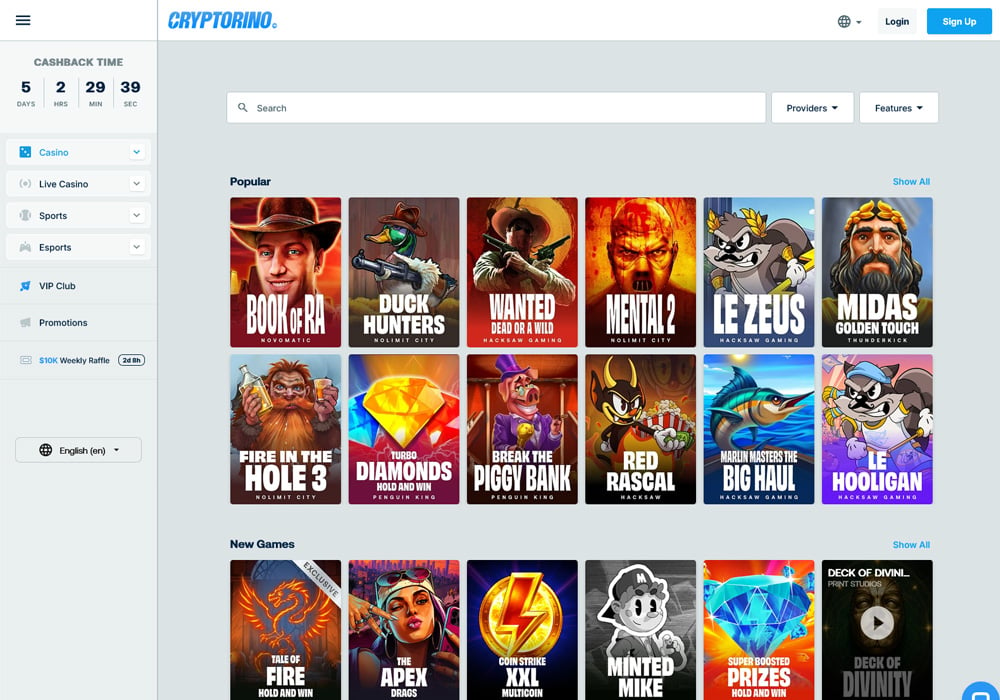
Bonus Buy titles are another strong point. Games like Sweet Bonanza and Gates of Olympus let players pay a set amount, usually between 50x and 200x the base bet, to jump straight into the bonus round instead of spinning to trigger it. This appeals to players who want faster access to a game’s biggest win potential.
Megaways slots round out the collection, using Big Time Gaming’s engine to create as many as 117,649 ways to win on a single spin. Titles like Big Bass Bonanza Megaways and Gonzo’s Quest Megaways combine cascading wins with rising multipliers, which keeps the gameplay fast-paced.
Jackpot games are also part of the mix, with both standalone jackpots and larger progressive prizes. Mega Moolah variations are included, known for jackpots that can reach into the millions. Some jackpot slots offer multiple prize tiers, giving players more than one shot at a payout during a single session.
Sports Betting
Cryptorino runs a full sportsbook alongside its casino games, and the two sections share the same crypto payment system. This means players can move funds between sports betting and casino play without any extra steps.
The sportsbook covers the major sports you’d expect, including football, basketball, tennis, ice hockey, and more. Both pre-match and live betting are available, with odds updating in real time once an event starts.
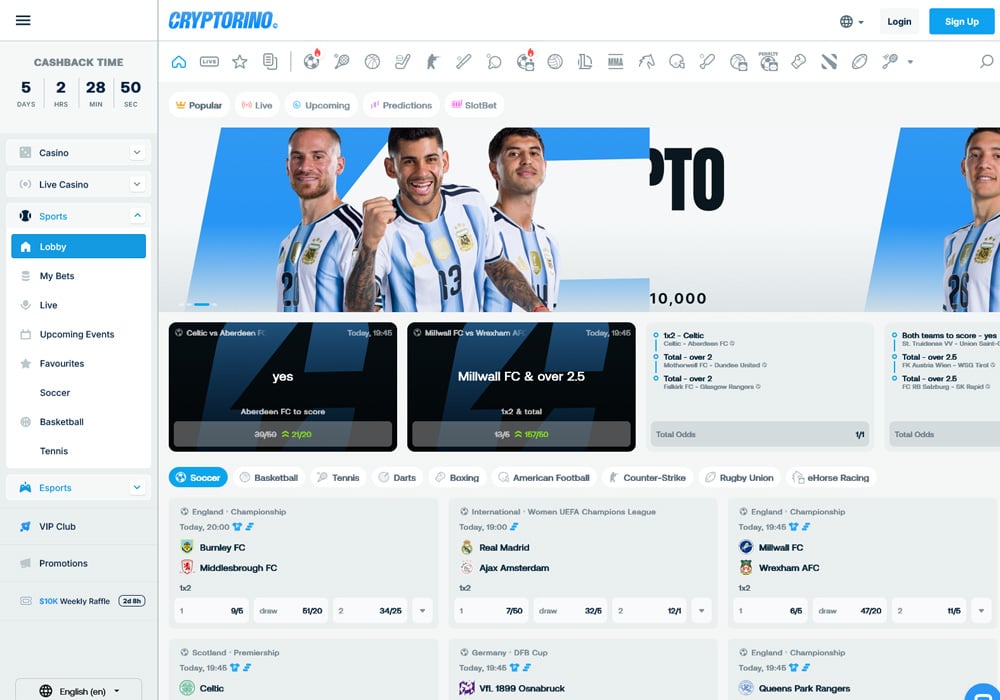
Esports betting is also part of the offering, covering major tournaments and leagues across popular titles. This is a useful addition for players who follow competitive gaming as closely as traditional sports.
For players who want action outside of scheduled matches, Cryptorino also has virtual sports betting. These are computer-generated events that resolve quickly, giving players something to bet on around the clock.
Other Products
The standout addition outside of slots and sports is the live casino section, which pulls in five different studios: Evolution Gaming, Asia Gaming, Pragmatic Play Live, Bombay Live, and SA Gaming. Having five providers in one place is more than most crypto casinos offer, and it means a wider spread of tables, dealing styles, and betting limits.
Evolution Gaming forms the core of the live offering, bringing well-known game shows like Crazy Time and Monopoly Live, along with Sweet Bonanza Live. These games mix traditional casino rules with extra features like multipliers and bonus wheels, which adds variety beyond standard table play.
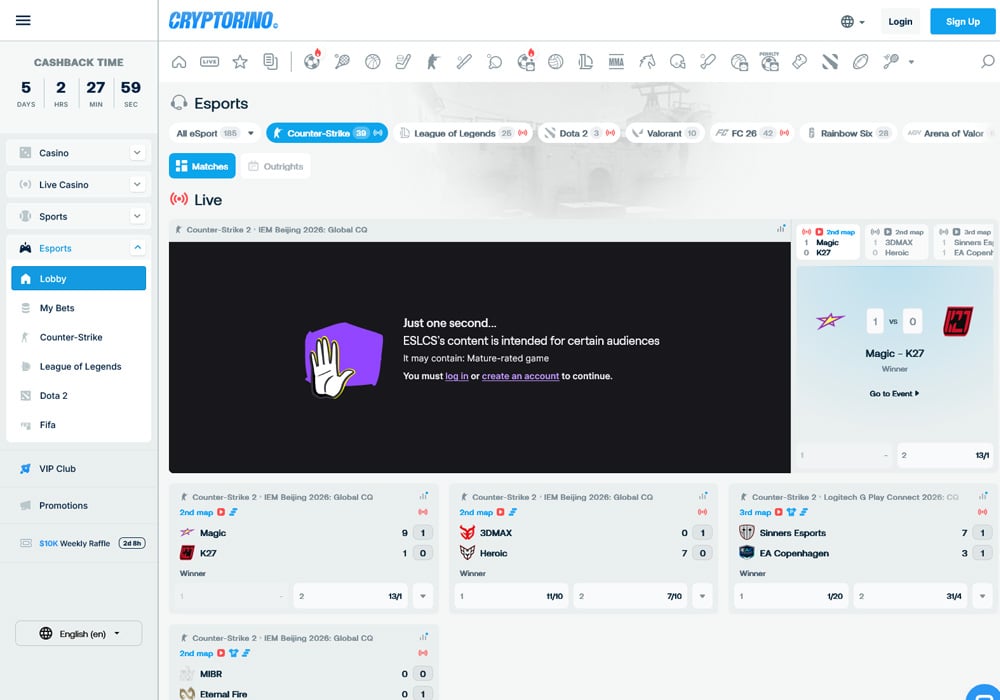
For players who prefer classic formats, the live dealer section carries several versions of Blackjack, Roulette, and Baccarat. Blackjack options range from standard seven-seat tables to games like Power Blackjack, which let any number of players join a single round. Roulette players can pick between European, American, and French rules, plus Lightning Roulette, which adds random multipliers up to 500x on certain numbers.
All live games stream in HD with multiple camera angles, giving the experience a polished, professional feel. Loading times are quick, and switching between tables is smooth on both desktop and mobile.
Welcome Bonuses
New players at Cryptorino get a 100% match bonus up to 1 BTC on their first deposit, plus 50 free spins on selected slots. This combination of a deposit match and free spins gives new players two separate ways to build up their balance before wagering real money.
The wagering requirement is 40x on both the deposit and the bonus amount, and players have 7 days to clear it. That timeframe is in line with typical industry standards for a bonus of this size.
One detail worth pointing out is the maximum bet limit during wagering, set at €10. That’s higher than the €5 cap many other casinos use, which gives players more room to place normal-sized bets while working through the requirement instead of being forced into small, cautious wagers.
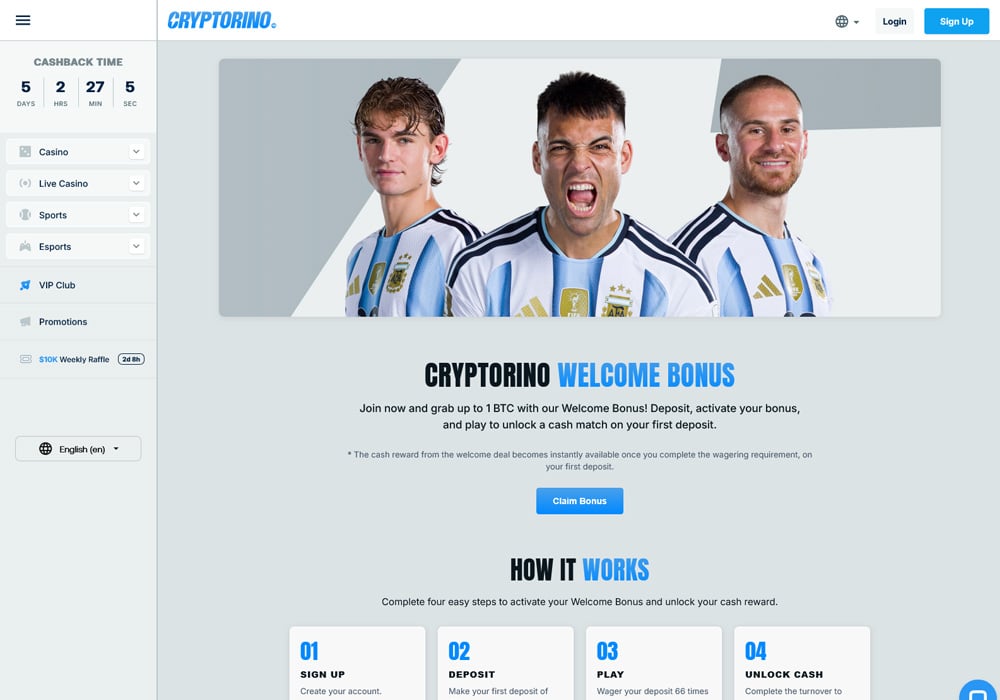
Bonus funds contribute differently depending on the game type. Slots count at 100% toward the wagering requirement, while table games and live casino titles contribute at a reduced rate. This is a standard setup across the industry and simply reflects the lower house edge on table and live games.
The welcome package is rounded out by the weekly cashback program, which gives new and existing players an extra layer of value beyond the first deposit. We cover that in detail in the next section.
How to Signup
Getting started at Cryptorino takes only a few minutes and does not require identity documents for a standard account. Here’s how to do it:
- Go to cryptorino.io and click the green “Register” button in the top right corner.
- Enter your email address. This is the only personal detail needed to open an account.
- Create a password that meets the site’s minimum security requirements.
- Choose a cryptocurrency from the 11 available options, including Bitcoin and Ethereum.
- Confirm your email address using the link sent to your inbox.
- Make your first deposit by copying the wallet address or scanning the QR code with your crypto wallet.
- Select “Claim Bonus” during your first deposit if you want the 100% match plus 50 free spins.
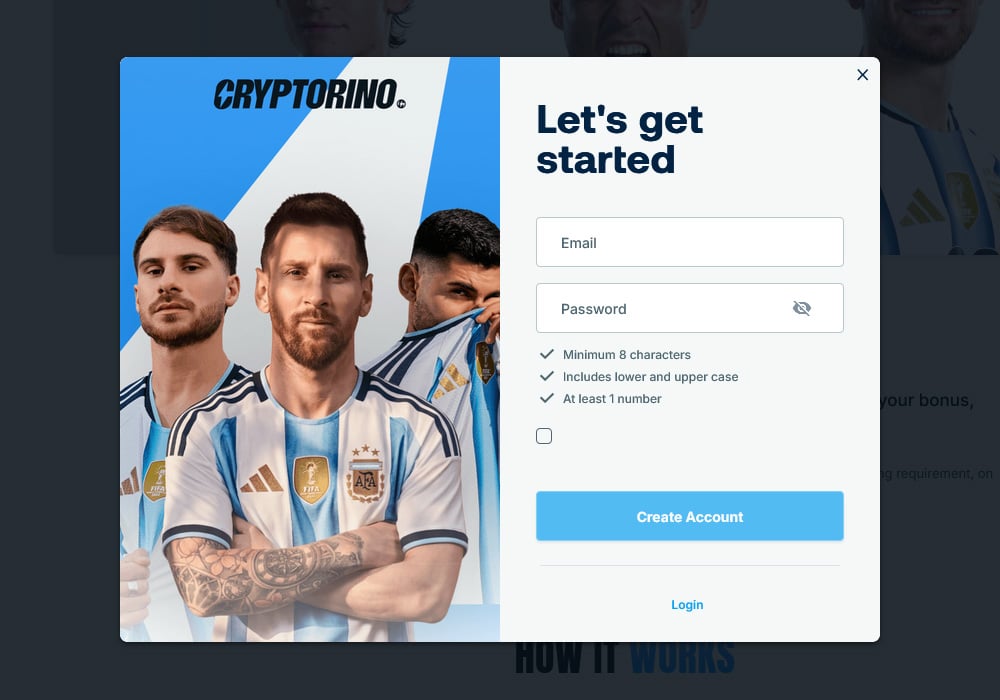
Once these steps are done, the account is active and ready to use. There is no waiting period before you can start playing any of the 6,300+ games on the site.
Regular Promotions and Loyalty Program
Cryptorino’s main ongoing promotion is its weekly cashback, which returns 10% of net losses to players every Monday at 13:00 UTC. This cashback is wager-free, meaning players can withdraw it right away or use it to keep playing, with no cap on how much can be earned back.
Beyond cashback, the casino runs daily slot races and weekly leaderboard competitions. These are paid out in cryptocurrency, and there’s no entry fee required to take part, so any active player can join in.
Seasonal promotions appear through the year, often tied to holidays or major sports events. Weekend reload bonuses show up regularly too, giving players extra funds to work with on top of their normal deposits.

The loyalty program is built around an Experience Points, or XP, system split into four tiers: Bronze, Silver, Gold, and Diamond. Players earn XP from every real-money wager, and moving up through the tiers unlocks better cashback rates, quicker withdrawals, and access to exclusive tournaments.
The top tier, Diamond, comes with the best cashback rates, instant withdrawals, and a dedicated VIP host. High-volume players also get personalized bonus offers and higher betting limits, along with a personal account manager who handles their support requests directly.
Payment Methods
Cryptorino runs entirely on cryptocurrency, and every transaction processes with no fees charged by the casino itself. Players who don’t already hold crypto can buy it directly through the platform using a debit or credit card via a built-in third-party processor.
The full list of supported cryptocurrencies includes:
- Bitcoin (BTC)
- Ethereum (ETH)
- Tether (USDT)
- Ripple (XRP)
- Binance Coin (BNB)
- Dogecoin (DOGE)
- Litecoin (LTC)
- Shiba Inu (SHIB)
- TONCoin (TON)
- TRON (TRX)
- The Sandbox (SAND)
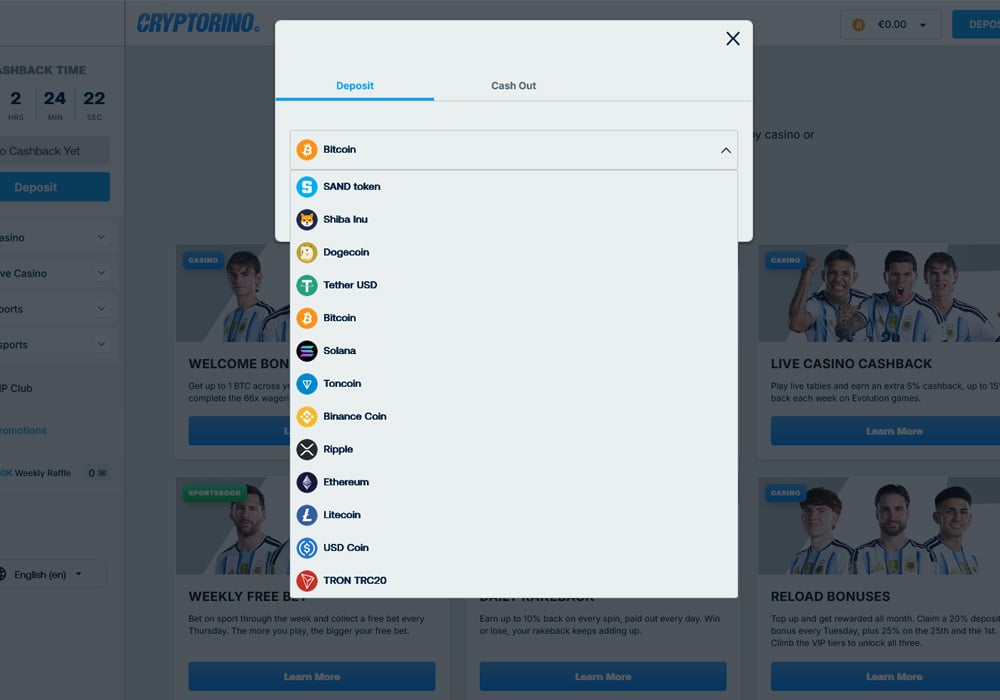
Deposits arrive after standard blockchain confirmation times, and withdrawals process instantly once requested. The minimum withdrawal is the equivalent of 20 USDT, and there is no maximum limit, which is useful for players who wager larger amounts.
Is it Legit?
Cryptorino operates under a license issued in Costa Rica, numbered 3-102-880000. It is owned and run by Star Bright Media S.R.L., the same operator behind Betpanda.io, an established name in the crypto gambling space.
Game fairness is backed by partnerships with 89 licensed and regulated providers, including major names like Evolution, NetEnt, and Pragmatic Play. The casino publishes an overall average RTP of 96.99%, and many of its titles include provably fair systems that let players verify results independently.
The site is transparent about its bonus terms, RTP rates, and withdrawal details, all of which are laid out clearly rather than buried in fine print. Support channels are easy to find and responsive, which adds to the overall sense that this is a well-run operation rather than a fly-by-night site.
Being tied to Betpanda’s track record works in Cryptorino’s favor, since the parent company already has a history of processing payments and handling player accounts at scale. That experience carries over into how Cryptorino is built and run.
Is it Safe to Use?
On the technical side, Cryptorino uses standard SSL encryption for data transfers and offers optional two-factor authentication for extra account protection. The platform undergoes regular security checks and is set up to guard against common cyber threats like DDoS attacks.
Payment security is handled through blockchain technology, with a unique wallet address generated for each transaction. This setup means sensitive financial details are not stored on the casino’s servers, which lowers the risk tied to any single transaction.
Account protection includes email verification for every new sign-up, strong password rules, and monitoring for unusual login activity. Players who want extra peace of mind can turn on two-factor authentication from their account settings at any time.
On the privacy side, Cryptorino does not require KYC documents for standard accounts, and it collects only minimal personal information to begin with. Data that is collected gets encrypted, and the casino states it does not share user information with third parties.
Game fairness rounds out the picture. All games run on verified random number generators, come from licensed providers, and carry published RTP rates. Several titles also use provably fair technology, giving players a way to check that results are not manipulated.
Design & Usability
Cryptorino uses a dark-themed layout with bright accents, which gives the site a modern look while staying easy on the eyes during longer sessions. The main lobby is organized clearly, with categories and filters that make it simple to browse through thousands of games.
Search and filter tools let players narrow results by provider, game type, or specific features, so finding a favorite title doesn’t take long. Important details like RTP, betting limits, and bonus terms are placed where players can see them without digging through menus.
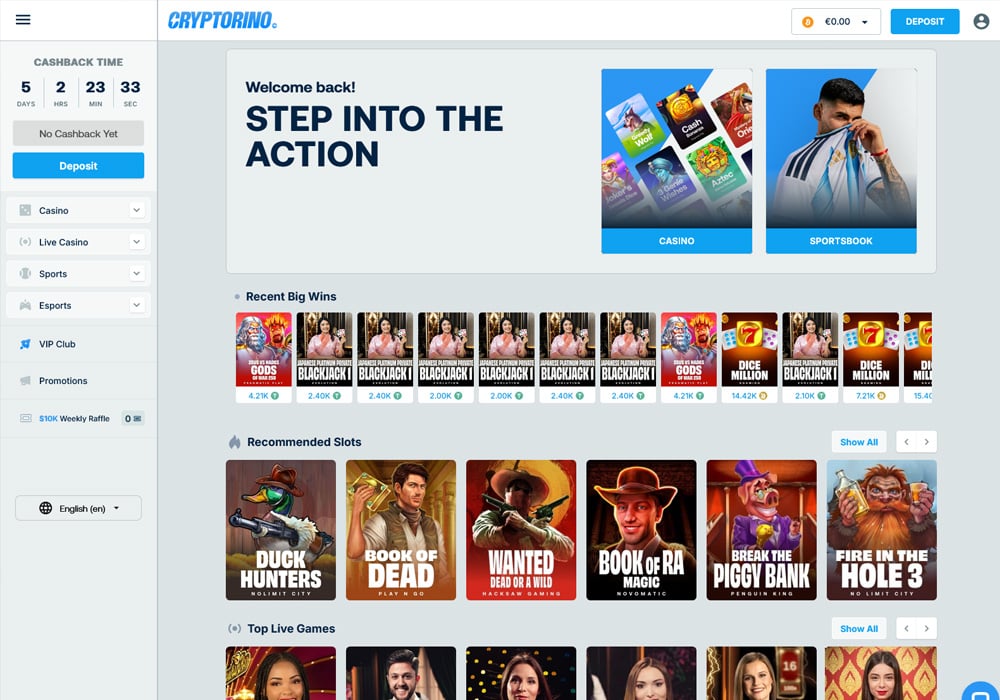
The site performs well on mobile browsers too, adjusting automatically to different screen sizes. Banking, support, and the game lobby all remain fully functional on a phone or tablet, with no separate app required.
This consistency carries into the live casino section as well, where multiple camera angles and betting options are displayed without cluttering the screen. Whether on desktop or mobile, the interface stays clean and easy to read.
Members Area
Once logged in, players land on a dashboard that shows their account balance, active bonuses, and recent activity at a glance. A top navigation bar gives quick access to the cashier, game library, bonuses, and account settings, so nothing important is more than a click away.
The cashier section stands out for its clarity, showing current cryptocurrency balances alongside real-time exchange rates. Generating a new deposit address or starting a withdrawal takes just a few clicks, and the transaction history logs every deposit, withdrawal, and bonus with its current status.
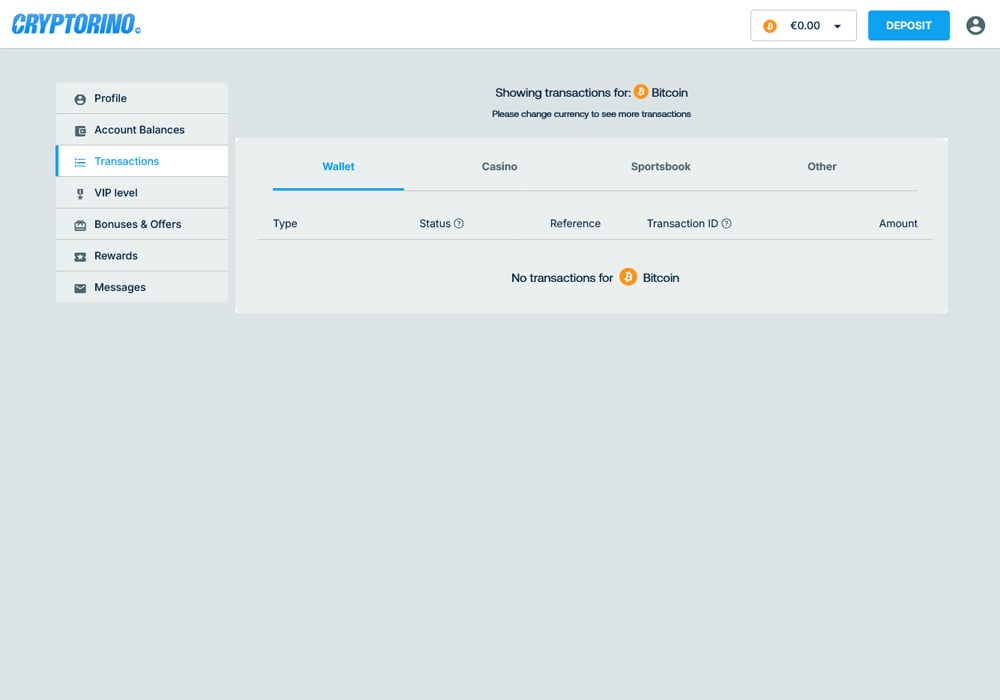
Account settings are just as straightforward. Players can update email preferences, turn on two-factor authentication, set responsible gaming limits, and adjust notifications, all from one simple menu.
Mobile Offering
Cryptorino skips native apps in favor of a responsive website that works across phones, tablets, and desktops. This instant-play approach means players can jump into any of the 6,300+ games directly from a mobile browser without downloading anything.
The mobile layout keeps all the functionality of the desktop site while adjusting for touch use. Game tiles are sized for easy tapping, menus collapse to save space, and betting controls are built for finger input rather than a mouse.

Live casino games run smoothly on mobile as well, streaming without noticeable lag and keeping betting options accessible without crowding the screen. This matters for players who want the live dealer experience without needing to be at a desktop.
Banking works the same way on mobile as it does on desktop, with QR codes making deposits quick and a simple form handling withdrawals. Responsible gaming tools and bonus activation are also available from a phone, so mobile players aren’t missing any features.
Ease of Use
Cryptorino is built to get players from sign-up to gameplay as quickly as possible. Registration only asks for an email address, with no lengthy verification steps, so the whole process takes well under a minute for most players.
Navigation follows a logical structure, with every major section labeled clearly and reachable from the main menu. Game categories are organized in a way that makes sense, and the search function helps narrow down thousands of titles quickly.
Banking is just as simple. Deposits generate a wallet address or QR code automatically, and withdrawals only require an amount and a destination address. Standard withdrawals process without manual approval, so players aren’t left waiting on staff to review a request.
Balance updates and transaction tracking happen in real time, which keeps players informed about where their funds stand at any given moment. This level of automation is one of the more convenient parts of using a crypto-first casino like this one.
Customer Support
Live chat is the main support channel at Cryptorino, and it runs 24/7 in eleven languages, including English, German, Spanish, and French. Response times are typically under a minute, and the team handles everything from simple account questions to more technical issues.
The live chat button stays visible on every page, so help is never more than a click away. This kind of constant availability is useful for a crypto casino, where players may have questions at any hour depending on their time zone.
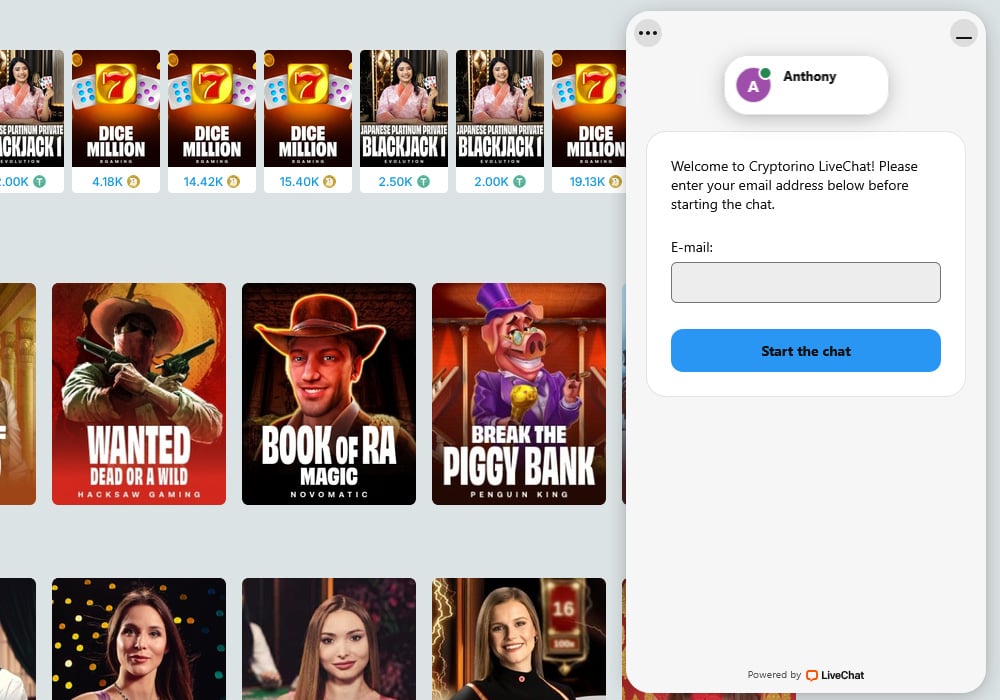
Email support is available for more detailed questions, reachable at support@cryptorino.io. This channel works well for situations that need documentation or a longer explanation, with responses typically arriving within 24 hours.
VIP players get an extra layer of support through a dedicated email and priority handling on all inquiries. A personal account manager is assigned to top-tier players, giving them a direct line for questions or requests rather than going through general support.
Conclusion
Cryptorino has built a solid reputation in the crypto casino space by pairing a large game library with fast, simple cryptocurrency transactions. With over 6,300 games from 89 providers, there’s enough variety here for slot fans, table game players, and live casino regulars alike.
The casino’s strongest points are its instant transactions, broad game selection, and focus on player privacy. Skipping KYC requirements for standard accounts, combined with support for 11 different cryptocurrencies, makes it a good fit for players who value speed and discretion in how they manage their funds.
The welcome bonus of 100% up to 1 BTC plus 50 free spins gives new players real value from the start, and the 10% weekly cashback keeps rewarding players well after their first deposit. Add in a responsive 24/7 support team and a mobile experience that works without an app, and Cryptorino comes across as a well-rounded option for players looking to try a crypto-first casino.
Visit Cryptorino
FAQs
Is Cryptorino Casino legal and licensed?
Yes. Cryptorino operates under a Costa Rica license, numbered 3-102-880000, and is owned by Star Bright Media S.R.L., the same company behind Betpanda.io.
What cryptocurrencies does Cryptorino accept?
Cryptorino accepts 11 cryptocurrencies, including Bitcoin, Ethereum, Tether, Ripple, Binance Coin, Dogecoin, Litecoin, Shiba Inu, TONCoin, TRON, and The Sandbox.
Do I need to complete KYC to play at Cryptorino?
No. Standard accounts do not require identity verification documents, and registration only asks for an email address.
How long do withdrawals take at Cryptorino?
Withdrawals process instantly once requested, with a minimum withdrawal of 20 USDT and no maximum limit.
Does Cryptorino have a mobile app?
There is no downloadable app, but the website is fully responsive and works on any modern mobile browser without loss of features.
What is the welcome bonus at Cryptorino?
New players get a 100% match bonus up to 1 BTC plus 50 free spins, with a 40x wagering requirement to clear over 7 days.
How does the weekly cashback work?
Players get 10% of their net losses back every Monday at 13:00 UTC, and the cashback is wager-free once it’s credited.
The post Cryptorino Review: Crypto Casino With Big Welcome Bonus & Free Spins! appeared first on Blockonomi.
TLDR:
- Tether froze $42.4M in USDT after an informal HSI request, with no warrant issued at the time.
- A seizure warrant arrived in February 2026, months after Tether had already blacklisted the wallets.
- Plaintiffs argue Tether kept earning Treasury yield on reserves while their tokens stayed frozen.
- The lawsuit questions whether the warrant authorized Tether to burn and reissue the seized USDT.
Two Thai businessmen have sued Tether over a Tether USDT freeze involving $42.4 million in stablecoin holdings. The case was filed in the US District Court for the Southern District of New York.
According to attorney Ariel Givner, the plaintiffs say Tether froze their wallets without a warrant. The lawsuit centers on an informal request from Homeland Security Investigations made in October 2025.
A court-issued seizure warrant only arrived months afterward, raising questions the complaint seeks answered.
Freeze Preceded Court Order, Lawsuit Claims
Plaintiffs Nutthawat Rukthammachalern and Natthawat Kasamvilas allege Tether blacklisted their Ethereum addresses on October 30, 2025.
Givner wrote that the businessmen say Tether froze their assets “after an informal request from an HSI agent.” The frozen amount totaled 42,417,785.62 USDT, according to the filing. No warrant, court order, or advance notice accompanied the freeze, the lawsuit states.
Givner explained that HSI’s Raleigh office “opened it from a victim tip.” The tip described romance and investment fraud run through a fake trading platform.
Funds were allegedly layered through multiple wallets to obscure their origin, she wrote, describing the flow as “accumulate, layer, integrate.”
One wallet named in the case, address 0xf3bF…A3eB, held roughly $26.1 million in USDT. Givner noted the wallet had already been mapped as a consolidation point before the government paperwork existed. She wrote that “the court paper arrived later,” well after Tether’s blacklisting action.
A seizure warrant eventually followed on February 19, 2026, issued by the Eastern District of North Carolina. Warrant 5:26-MJ-1267-JG directed Tether to burn the frozen USDT. The order also called for reissuing equivalent tokens to a government-controlled wallet.
Plaintiffs Challenge Tether’s Authority Over Frozen Tokens
The complaint does not dispute the underlying criminal allegations tied to the case. Five days after the warrant, EDNC and HSI announced a $61 million USDT seizure. Officials described the funds as “traced to addresses allegedly associated with laundering proceeds,” per Givner’s account.
Instead, the lawsuit argues Tether froze secondary-market holders before receiving any court authorization. Givner summarized the dispute plainly, writing that Tether “locked secondary-market holders first” and “kept earning Treasury yield” throughout the freeze. The plaintiffs say they could not touch their funds during that stretch.
According to the filing, the main claims include a declaratory judgment against the freeze and burn. Additional counts cover conversion, trespass to chattels, and unjust enrichment tied to reserve yield. The plaintiffs also seek an injunction to remove the wallets from Tether’s blacklist.
Givner framed the core dispute as whether “a stablecoin issuer can lock $42 million on an informal government ask” while continuing to collect interest.
Requested relief includes lifting the freeze and damages if the tokens are destroyed. Punitive damages are also sought, though the case remains a complaint rather than a ruling.
The post Tether Sued for $42.4M USDT Freeze Tied to Alleged Pig-Butchering Case appeared first on Blockonomi.
TLDR
- Bitcoin gained 7.36% in July and 24.95% in August 2026, according to CoinGlass.
- September has not always been a down month for Bitcoin — it rose in 2015, 2016, 2023, 2024, and 2025.
- The U.S. Senate has scheduled a cloture vote on the CLARITY Act for September 15.
- The vote is procedural, not a final decision on the bill itself.
- Reuters reports lawmakers disagree over ethics rules and anti-money-laundering provisions in the legislation.
Bitcoin closed July and August 2026 with strong gains. The cryptocurrency now moves into September under a lot of attention.
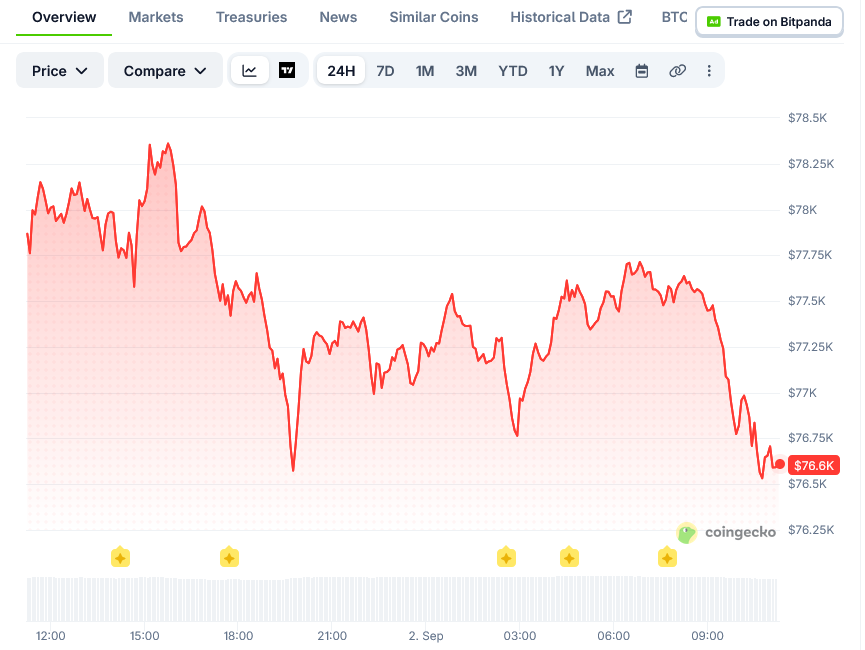
Data from CoinGlass shows Bitcoin rose 7.36% in July. It followed that with a 24.95% gain in August.
Those two months came after a rougher start to the year. Bitcoin lost value in January, February, May, and June.
Traders often talk about September as a weak month for Bitcoin. The idea is based on past patterns, not fixed rules.
Bitcoin’s September Track Record Is Mixed
CoinGlass records show September has not always been a losing month. Bitcoin gained 2.35% in September 2015.
The pattern repeated in later years too. Bitcoin rose 6.04% in September 2016.
More recent years tell a similar story. Bitcoin gained 3.91% in September 2023, 7.29% in September 2024, and 5.16% in September 2025.
This means a claim that September always ends lower after two green months does not hold up against the data.
Seasonal trends are one factor traders watch. Liquidity, institutional demand, and macroeconomic conditions also shape price moves.
A Senate Vote On Crypto Rules Is Coming
Away from price charts, U.S. lawmakers are working on crypto regulation. The Senate has scheduled a vote for September 15.
The vote is a cloture vote on the motion to proceed to H.R. 3633. That is a procedural step, not a final vote on the bill.
The legislation in question is the Digital Asset Market Clarity Act, known as the CLARITY Act. It aims to give clearer federal rules for digital asset markets.
Reuters reported disagreements among lawmakers. The disputes cover ethics rules, anti-money-laundering safeguards, and other provisions in the bill.
A successful procedural vote could keep the legislative process moving forward. A failed vote could slow expectations for a law passing this year.
Bitcoin’s direction in September will likely depend on both market data and this legislative process. The next update on the bill’s progress is expected around the September 15 vote.
The post Bitcoin (BTC) Price: Rises 24.95% in August Ahead of September Senate Vote appeared first on Blockonomi.
Key Takeaways
- Take-Two shares declined 6.7% to $219.70, ranking as the S&P 500’s fifth-worst performer Monday
- Market analysts attribute the decline to delay speculation rather than leaked GTA VI footage
- Netflix’s exclusive GTA VI gameplay premiere attracted 31.1 million viewers, topping charts in 87 out of 93 countries
- Bank of America believes additional delays are improbable now that complete gameplay footage has been released
- Consensus rating on TTWO remains Strong Buy with analysts projecting an average target of $297.29
Take-Two shares experienced significant downward pressure Monday, declining 6.7% to $219.70 amid growing speculation that Grand Theft Auto VI might encounter another postponement.
Take-Two Interactive Software, Inc., TTWO
Social media chatter initially attributed the selloff to unauthorized GTA VI gameplay footage circulating online. However, market analysts dispute this interpretation.
Freedom Capital Markets senior research analyst Nick McKay indicated the decline stemmed from delay speculation rather than leaked content. In his Monday research note, he characterized these postponement rumors as “low-quality.”
McKay referenced a recent statement from Rockstar Games executive Rob Nelson, who reaffirmed the development timeline remains unchanged during an Aug. 28 interview with Famitsu.
Jefferies analysts supported this assessment, noting the leaked footage had negligible influence on share performance.
Bank of America’s Omar Dessouky suggested further delays appear improbable. “The release of comprehensive gameplay footage indicates extremely low probability of additional postponement, as this disclosure demonstrates the game has reached a playable state,” his analysis stated.
Prior to Monday’s downturn, TTWO closed at $235.39 Friday following the gameplay trailer’s Netflix and YouTube debut on Aug. 27. This represented a 1% gain from Thursday’s closing price.
Netflix Premiere Breaks Viewership Records
The exclusive premiere generated extraordinary engagement on Netflix. The approximately 27-minute gameplay showcase accumulated 31.1 million views, establishing itself as the streaming platform’s top-performing content for the week.
The video claimed the No. 1 position across 87 of Netflix’s 93 monitored markets. The platform maintained exclusivity for six hours before the content became available on YouTube and competing services.
The gameplay trailer even surpassed viewership for Netflix’s new Robert De Niro feature film, The Whisper Man, along with Outer Banks’ fifth season premiere. This marked Netflix’s inaugural promotional partnership for an unreleased video game title.
This enthusiasm builds on existing momentum. The initial GTA VI announcement trailer from 2023 has accumulated approximately 293 million YouTube views to date.
Unauthorized Content Fails to Diminish Enthusiasm
Take-Two has confronted ongoing challenges with unauthorized content distribution. Over a dozen GTA VI gameplay clips surfaced online ahead of the authorized premiere. The publisher subsequently issued subpoenas to messaging platform Discord seeking to identify the source.
In an Aug. 26 statement posted on X, Rockstar Games described the unauthorized leaks as “heartbreaking,” while simultaneously apologizing for the game’s previous delay. The title was initially targeted for fall release, subsequently moved to May 2026, and currently carries a November 19 launch date.
The leaked content ultimately failed to diminish consumer interest, with the Netflix premiere numbers providing compelling evidence of sustained demand.
Analyst consensus currently assigns TTWO a Strong Buy rating, supported by 18 Buy recommendations issued over the past three months. The average price objective sits at $297.29, suggesting approximately 37% upside potential from present trading levels.
The post Take-Two (TTWO) Stock Drops 7%: Smart Entry Point Ahead of GTA VI Release? appeared first on Blockonomi.
CryptoPotato
Financial markets experienced enhanced turbulence in the middle of August after the US Treasury Department’s Scott Bessent announced a major monetary pivot.
Bitcoin and gold were among the most significant beneficiaries, posting substantial gains in the first few days. However, the landscape has since changed, especially for the precious metal.
What Happened?
On August 19, the US Treasury Department said it will at least be doubling the maximum size of liquidity-support buybacks for longer-dated government debt, raising them from $2 billion to $4 billion per operation. This came after the bond market’s notable rise to a 19-year high, as the 30-year Treasury yield touched 5.34% the day before.
The impact on financial markets was immediate. The same 30-year Treasury yield corrected to 5.2%, while gold, stocks, and crypto rocketed. The precious metal went from $4,360/oz to $4,530/oz in hours. It kept surging in the following days and skyrocketed to $4,700 per ounce on August 25, which became its highest price tag in over three months.
Bitcoin also reached a similar local peak, but its rally was even more impressive. The cryptocurrency struggled below $65,000 for weeks before it exploded to $81,500 last week.
The two assets, considered safe havens by many investors, were at the forefront of financial gains. Moreover, analysts began commenting that their spectacular rise was due to the ‘debasement trade’ narrative as the greenback weakened while the US debt kept growing.
Gold Down, BTC Stable
The macro situation has since changed, and most of the aforementioned price movements have returned to their starting point. Perhaps the most significant change came last Friday, when the new Federal Reserve Chairman, Kevin Warsh, spoke at Jackson Hole. Although he didn’t say it directly, his speech was quite hawkish, and markets interpreted it as a sign of upcoming rate hikes.
BTC slipped by a few grand to $77,000, while the US bond market reclaimed almost all of its lost value. Gold, on the other hand, was rejected at $4,700 and plunged to $4,300 earlier today. This meant that it not only gave up all its gains but also dropped below its starting level, as it is down by over 8.5% from the local peak.

Although bitcoin has fallen from $81,000, it remains 20% higher than $64,000, where its run began. However, there are a few cracks now, which could suggest that its price might follow the bullion. Aside from the macro perspective returning to unfavorable for risk-on assets, the spot BTC ETFs have experienced more withdrawals than inflows in the past couple of business days as the initial rush is over.
The post Gold Just Erased All Its August Gains – Bitcoin Is Holding Up Better at $77K appeared first on CryptoPotato.
OpenPayd has announced expanded its regulatory presence in the United States after completing the integration of MSB USA Inc. into its group.
The latest move brings 43 state money transmitter licences (MTLs) under its umbrella.
US Expansion
In an official press release shared by CryptoPotato, the London-based financial infrastructure provider said the move strengthens its position in the US market and creates a broader regulatory base for its operations across North America. MSB is a US-based, state-licensed money services business, and the integration was finalised after receiving the required regulatory approvals.
In a statement, OpenPayd Founder, Dr. Ozan Ozerk, said,
“Every era of finance has been defined by its infrastructure: correspondent banking wired together the twentieth-century economy; programmable money will power the twenty-first. The U.S. is at the forefront of this evolution, and with regulated foundations now spanning the U.S., U.K. and Europe – across both fiat and digital assets – OpenPayd has something few providers can claim: regulated infrastructure spanning both fiat and digital assets, on both sides of the Atlantic.”
The network of 43 state licences will increase its geographic reach for global clients that already operate in the US or are planning to enter the market, OpenPayd added. The expansion comes after the platform’s recent authorisation under the European Union’s Markets in Crypto-Assets (MiCA) framework by the Malta Financial Services Authority.
Stats disclosed by OpenPayd continued to show organic growth across its business. As of July 31, 2026, its annual recurring revenue (ARR) climbed above $96 million, while annualised transaction volume surpassed $300 billion. The company said it remains profitable and has not taken external capital. It currently serves more than 1,200 clients globally, including crypto and financial companies such as Kraken, eToro, OKX and B2C2.
Nasdaq Plans
OpenPayd is also preparing to enter the US public markets through a previously announced business combination with Titan Acquisition Corp. In June 2026, the two companies announced a definitive agreement under which the company is expected to become a publicly listed company on Nasdaq under the ticker “OP.”
The transaction values OpenPayd at an equity value of up to $1.145 billion on a pro forma basis. The combination is expected to close in the fourth quarter of this year, subject to customary closing conditions, including approval from Titan’s shareholders.
The post OpenPayd Makes Major US Push After Securing 43 State Money Transmitter Licences appeared first on CryptoPotato.
The cryptocurrency market is a weird one and frequently offers investors the opportunity to make enormous gains in just days, sometimes even hours. Of course, securing such profits requires more than skill; one also needs a bit of luck, perfect timing, and the courage to sell when the moment is right.
Here’s the story of a certain trader who missed their chance to become a millionaire.
Selling Too Early
The analytics platform Lookonchain revealed the case of a crypto trader who bought 7.99 million PONS tokens a month ago for roughly $443,000. Shortly after, the price of the coin headed south, and the investor cashed out their entire position, taking a $308,000 loss.
What happened next must have been hard for the mysterious trader to watch. PONS experienced a major pump, with its price skyrocketing by approximately 1,100% over a two-week period. Lookonchain estimated that those 7.99 million coins would now be worth nearly $3.46 million, meaning the investor would have made a $3 million profit (at least on paper).
PONS is a relatively new token that currently boasts a market capitalization of around $275 million. It is closely connected to Robinhood Chain; if you are interested in learning more, take a look at our detailed article here.
Previous Unlucky Traders
Selling too early can be just as painful as buying at the top, only to watch a major price decline drag your portfolio down with it.
This is what happened to one unlucky trader in the summer of 2024. Back then, they spent more than $900,000 to buy 7.2 million Restore the Republic (RTR) tokens. The anonymous person hopped on the bandwagon when the valuation of the Trump-related meme coin exploded upon launch.
Instead of a further rally, the token’s price crashed hard, and the trader eventually sold the stash for only $18,000.
The post Selling at the Wrong Time: Here’s How an Unlucky Crypto Trader Missed a $3 Million Profit appeared first on CryptoPotato.
Bitcoin was rejected on a few occasions at $79,000 in the past several days, and the latest leg down pushed it to under $76,500 for the first time since August 23.
The most evident reason behind this correction, which has impacted numerous altcoins as well, comes from the Middle East, where the US and Iran initiated new violent strikes against each other.
BTC Slips
The primary cryptocurrency’s major breakout that began on August 19 led to a massive surge of over $16,000, driving it to over $81,000 on a couple of occasions last week before the bears stepped up and halted the move. The subsequent retracements were quite modest aside from the Friday drop to $77,000 after the hawkish speech from Jackson Hole by the new Fed Chair, Kevin Warsh.
Nevertheless, BTC’s more positive sentiment prevailed in the following days, and the asset managed to recover some ground during the weekend. It even tapped $79,000 on Sunday evening before the US and Iran resumed the strikes against each other, and bitcoin dipped by two grand.
The bulls intervened once again on Tuesday, pushing the cryptocurrency to $79,000 once again. However, another leg down followed that drove BTC to $76,500 for the first time in ten days. This came after reports that the US and Iran had carried out more violent strikes.
BTC remains at $77,000 as of now, with its market cap of under $1.550 trillion. Its dominance over the alts has also declined slightly to 59.6% on CoinMarketCap.

FIL, UNI, BTW Defy the Trend
The larger-cap alts are almost all in the red. Ethereum is down below $2,400 after a 2% daily decline; XRP has slipped further away from $1.35; SOL is slightly below $100. TRX, HYPE, ZEC, DOGE, XMR, and LINK are also in the red. Uniswap is the only notable exception, surging by almost 10% to over $6.2.
There are also other gainers from the mid- and lower-cap alts, such as FIL (14%), BTW (13%), and SKY (6%). Most other alts have retreated over the past day.
The total crypto market cap is down by almost 1% daily to $2.6 trillion on CMC.

The post Bitcoin Drops to 10-Day Low, Altcoins Retrace Following New US-Iran Attacks: Market Watch appeared first on CryptoPotato.
Robinhood Chain has been booming in popularity throughout the past month, becoming the talk of town in crypto Twitter, or more like crypto X.
The network saw its total value locked expand by a whopping 93% in the past 30 days, according to data from DeFiLlama, surpassing the likes of Plasma, Avalanche, Sui, and others.

The popular platform, which allows users to scan newly released cryptocurrencies by chain and monitor the performance of different tokens, DexScreener, is flooded with coins on Robinhood Chain, which is indicative of the level of interest the network is attracting. Platforms like FOMO are seeing a surge in interest as the concept of social trading gains traction.
As CryptoPotato reported, the volume aggregated through the network’s automated market makers hit $1.3 billion.
But what are some of the more interesting projects that are attracting investors? Let’s find out.
PONS: Pons Family, Robinhood’s Pump.fun?
Starting off, we have PONS, the native cryptocurrency of the Pons (dot) family platform. As described in their own documents:
“pons is a place to launch and trade tokens on Robinhood Chain. You can browse launches, open any token to see its details, and trade straight from your wallet. Pons never holds your funds. Every launch and trade is a transaction your wallet asks you to approve.”
Undoubtedly the main large actor on Robinhood Chain, PONS boasts a market capitalization of around $285 million at the time of this writing – impressive for a coin launched less than two months ago.

Its price action has been all over the place over the past few days, especially after Hyperliquid announced it would support perps for PONS. The token skyrocketed to a high of slightly below $0.5, only to plummet to about $0.36 and then recover to $0.4, where it’s currently trading at the time of this writing.
PONS is seen as the main “infrastructure play” on Robinhood Chain, and many associate it with Pump.fun – an alternative token launchpad that was largely behind the “meme coin season” that took place on Solana in 2024. However, some market observers have expressed caution, pointing out that expansion of existing solutions (much like Pump.fun itself) to Robinhood Chain could cause serious pressure on PONS.
Cash Cat (CASHCAT)
If you’ve been on crypto X in the past couple of months, you’ve undoubtedly heard stories of people becoming millionaires in a few days after buying and holding Robinhood Chain’s premier meme coin – CASHCAT.
There’s really no way to explain what the token is about other than just reading its name – it’s just that: a cat-themed meme coin, currently sitting at a market capitalization of $280 million, up 40% in the past week. It’s pretty much impossible to break down its gains for a longer period of time because the zeros become far too much, but that’s also a tale as old as crypto meme coin cycles now. Recall DOGE, SHIB, WIF, FARTCOIN, and whatnot.
Holders argue that it’s the network’s largest and most promising meme coin, while countless others are trying to replicate its success by minting alternative meme coins on Pons.

Artificial Inu (AI)
Things change fast in this space and AI is perhaps the main example. The token is actually paired against tokenized Nvidia stock – it’s not paired against the USD, which is one of the more interesting concepts of Robinhood Chain. In other words, the “dog” trades directly against NVDA, which is largely described as the most important stock in the AI space.
Trading activity is also growing the token’s vault, while the generated fees are either burned or locked.
Combined with the virality of a dog-themed meme coin, this has allowed it to explode in both interest and value throughout the past few days, and achieve a market cap similar to that of Cash Cat.

The above are three of the largest coins on the Robinhood Chain by market cap. None of it should be taken as financial advice or recommendation. The article is strictly for informational purposes.
The post Watch These 3 Coins on Robinhood Chain This Week appeared first on CryptoPotato.