Cryptocurrency Posts
Crypto Briefing
The incident exacerbates regional instability, complicates US-Gulf state relations, and heightens risks in global oil markets.
The post US airstrikes in southern Iran kill five at wedding, injure dozens as regional tensions escalate appeared first on Crypto Briefing.
HiddenLayer's funding boost highlights the growing importance of AI security, potentially setting new standards for protecting sensitive AI models.
The post HiddenLayer raises $100M in Series B funding to enhance AI security appeared first on Crypto Briefing.
The Bank of Canada's focus on risk repricing highlights the need for vigilance in financial stability, emphasizing resilience over crisis intervention.
The post Bank of Canada says markets are repricing risk, not running out of liquidity appeared first on Crypto Briefing.
The Vibe Index enhances decision-making in the Stacks ecosystem by integrating community sentiment into investment and development strategies.
The post Stacks launches Vibe Index for real-time community sentiment tracking appeared first on Crypto Briefing.
Universal deposit addresses simplify crypto transactions, potentially boosting user adoption but raising concerns about transparency and trust.
The post Universal deposit addresses are quietly fixing crypto’s most annoying problem appeared first on Crypto Briefing.
Bitcoin Magazine
Bitcoin Magazine
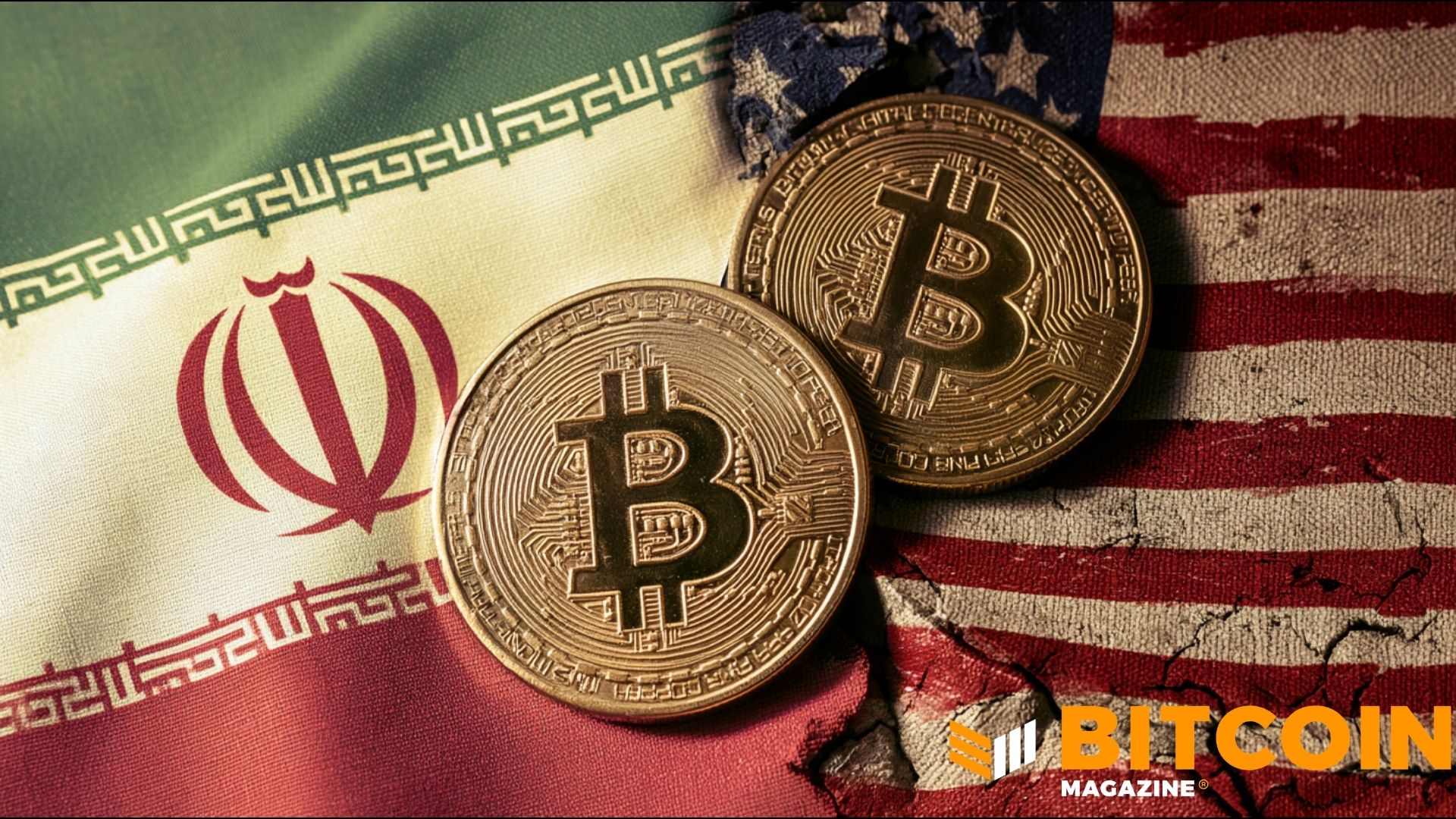
Bitcoin Slides as US-Iran Tensions Escalate
Bitcoin slid on Tuesday after investors went into “risk-off” mode following escalating attacks between the U.S. and Iran.
The largest cryptocurrency had initially shrugged off President Donald Trump’s threats to the Middle Eastern nation, as well as the first strikes.
But things heated up on Tuesday, and bitcoin’s price slid. It was recently down more than 2% on the day, trading for $77,363. The coin had pushed past as high as nearly $81,282 on Friday.
The Tuesday attacks from the U.S. were because Iran tried to put mines in the Strait of Hormuz, and also because of an attack on an American military base in Jordan, according to President Trump.
U.S. Central Command said on X that Iran had also attacked commercial ships.
“The strikes follow recent attempted attacks by the Islamic Revolutionary Guard Corps against commercial shipping in the Strait of Hormuz and against American service members deployed to the region,” the post read.
Iran responded with a “decisive operation” against U.S. military bases, according to Iranian media. Oil surged on the news.
Bitcoin’s price has been sensitive to geopolitical tensions this year — especially after Iran and Israel attacked Iran. The cryptocurrency has typically faced downward pressure on news of war, only to then rally when Trump raised hopes of a ceasefire.
Despite Bitcoin’s price being relatively muted, in recent months, it has made more wild swings since mid-August.
Bitcoin’s immediate reaction to rising oil prices is to drop: more expensive energy means higher inflation, and higher inflation typically means the U.S. central bank will postpone rate cuts, which can restrict the liquidity that bitcoin needs to gain momentum.
The Federal Reserve’s chair, Kevin Warsh, last week gave his first major speech as leader of the central bank and said that inflation in the world’s largest economy had not come down enough.
Traders are now no longer pricing in an interest rate cut this year, instead expecting a hike. Bitcoin has typically performed well in the past in low interest rate environments.
Still, the coin had one of its best runs in August after the U.S. Treasury said it would at least double the size of its liquidity-support buyback operations, in response to surging borrowing costs.
The announcement hurt the dollar but non-yielding assets like bitcoin and gold have benefited.
This post Bitcoin Slides as US-Iran Tensions Escalate first appeared on Bitcoin Magazine and is written by Mathew Di Salvo.
Bitcoin Magazine
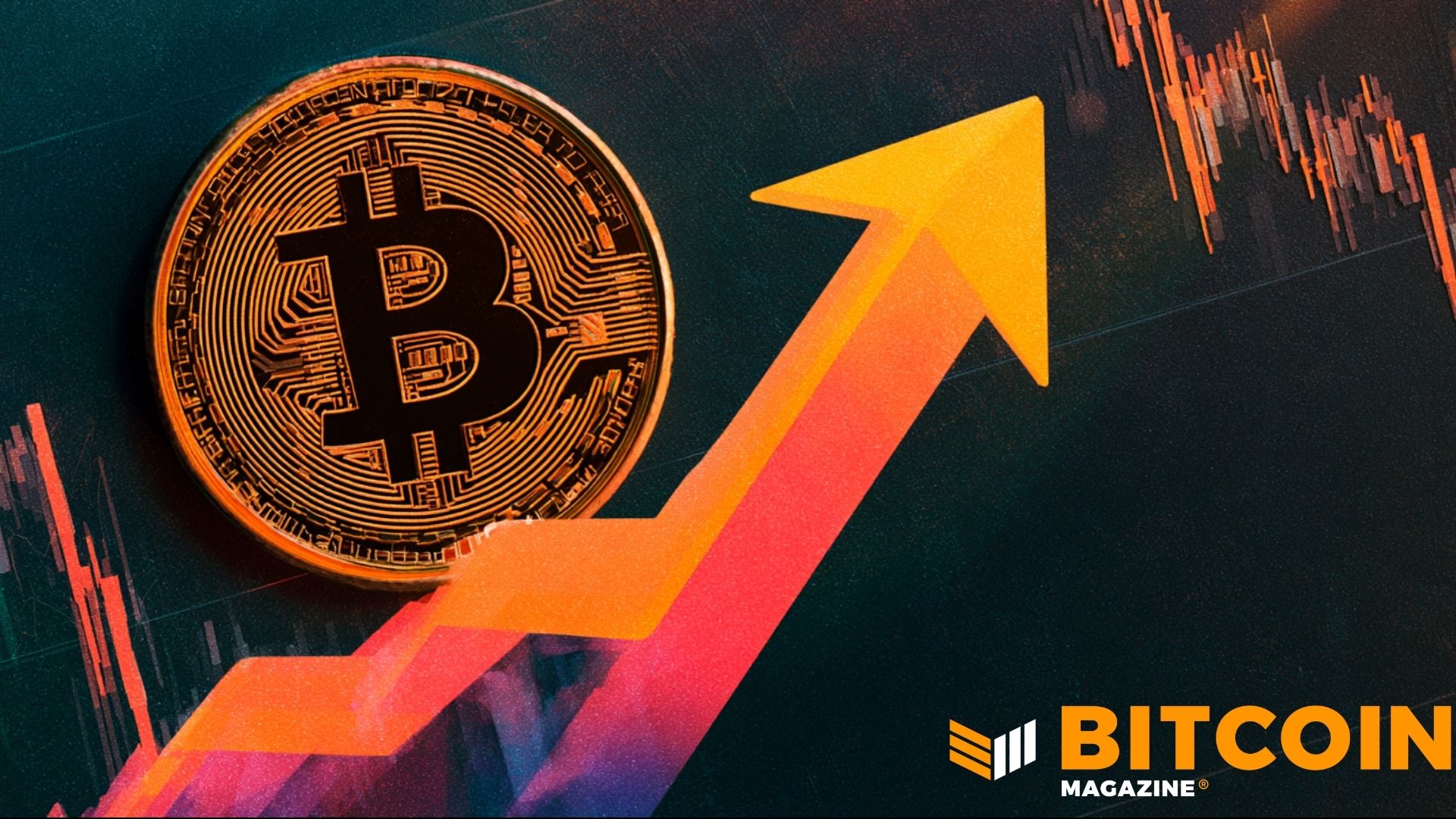
Bitcoin Defies Seasonal Slump With Third-Best August Ever
Bitcoin is known for its summer slumps. But August was different.
In fact, the leading cryptocurrency had its third best August ever.
As highlighted on Tuesday by Bitwise’s European Head of Research, André Dragosch, bitcoin delivered returns of 25% last month.
“No ‘summer lull’ so far,” Dragosch wrote on X, highlighting that the only better Augusts the coin has had were in 2017 when it gave investors returns of nearly 66%, and 2013, with close to 31%.
OFFICIAL: August 2026 is in the books and it's been the 3rd best August in bitcoin's history.
— André Dragosch, PhD
August 2017: +65.6%
August 2013: +30.7%
August 2026: +25.0%
No "summer lull" so far. pic.twitter.com/jwHt2VP5Sk(@Andre_Dragosch) September 1, 2026

Multiple analyses point to the months of June-September showing weaker average returns than the rest of the year.
Throughout most of June and July, bitcoin’s volatility was particularly muted, and the coin traded below $65,000.
But that changed in mid-August after the U.S. Treasury Department said it would more than double the size of its government debt repurchases due to fixed income markets under pressure and yields surging to levels not seen in nearly 20 years.
Lower long-term yields reduce the opportunity cost of holding non-yielding assets like bitcoin and gold, and generally support risk-on sentiment.
Investors flooded into bitcoin as a result.
Positive news soon followed, with President Donald Trump urging lawmakers to get the long-awaited crypto Clarity Act over the line. The digital asset industry has long called for clear rules on how regulators should treat bitcoin, stablecoins and other cryptocurrencies.
Despite a delay in a vote on the legislation, Trump called the draft “very powerful.” The president made the comments after having met with crypto industry bigwigs and CEOs.
Investors also rushed back into ETFs in August, throwing over $2.8 billion at the vehicles — the most since October, when the coin hit a new all-time high.
Bitcoin in August had its best run in three years — and is up nearly over 20% over the past month.
The asset reached as high as $81,281 last week before sliding again on Friday.
Bitcoin’s price recently stood at $76,883, nearly down 3% over a 24-hour period.
This post Bitcoin Defies Seasonal Slump With Third-Best August Ever first appeared on Bitcoin Magazine and is written by Mathew Di Salvo.
Bitcoin Magazine
BlackRock’s iShares Bitcoin Trust Is Beating Top S&P 500 ETF
BlackRock’s iShares Bitcoin Trust exchange-traded fund has delivered better returns since its 2024 launch than Vanguard’s popular S&P 500 fund.
That’s according to Bloomberg data highlighted by the firm’s senior ETF analyst, Eric Balchunas, who said that the BlackRock product’s cumulative percentage return was only slightly ahead of Vanguard’s in the time period.
BlackRock’s bitcoin ETF is up 71% since its January 2024 debut, while Vanguard’s S&P 500 ETF up 66% on a total-return basis.
The iShares Bitcoin Trust — IBIT — started trading in 2024 after the Securities and Exchange Commission gave the green light to 11 spot bitcoin ETFs following a decade of denials.
“IBIT’s path to 70% looks like the El Toro roller coaster at Great Adventure (I needed two Advil last time I rode that thing) while $VOO was a walk in the park in comparison,” wrote Balchunas on Tuesday.
U.S. investors now have several funds to choose from to buy shares that track the price of bitcoin managed by the likes of Fidelity, Grayscale and Morgan Stanley. But BlackRock’s product is the most successful: It currently manages $61.4 billion in assets, according to its website.
By comparison, the second biggest bitcoin ETF, the Fidelity Wise Origin Bitcoin Fund, manages nearly $11 billion.
BlackRock, which manages over $15 trillion in assets, sent shockwaves through the crypto space after it applied for a spot bitcoin ETF in 2023. Its fund now allows more traditional investors to get exposure to bitcoin; its product also experiences more day-to-day trading action than the other ETFs.
Investors piled back into ETFs in August, which has also helped bitcoin’s price. From August 17 to 27, investors threw over $2.8 billion at the vehicles — the most since October, when the coin hit a new all-time high.
Bitcoin reached as high as $81,281 last week before sliding again on Friday.
The price of the biggest cryptocurrency recently stood at $77,539, nearly down 1% over a 24-hour period.
Bitcoin started a phenomenal run two weeks ago — its best in three years — and is up nearly 30% over the past month.
This post BlackRock’s iShares Bitcoin Trust Is Beating Top S&P 500 ETF first appeared on Bitcoin Magazine and is written by Mathew Di Salvo.
Bitcoin Magazine

South Korea’s Bitcoin ‘Kimchi Premium’ Returns
Bitcoin is up this month but there’s one place where it’s more significantly more expensive: South Korea.
The so-called Kimchi Premium — when bitcoin costs more on Korean exchanges — is back as retail investors pile back into the coin. Bloomberg first reported the news and CoinGecko data shows that bitcoin’s price is nearly 1% higher on Upbit, Korea’s biggest exchange, than Binance.
Named after a popular dish in the Asian nation, the phenomenon comes down to Korea’s market being partly walled off. Prices have historically run higher there because of strong local retail demand combined with strict capital controls and trading regulations.
As a result, the Bitcoin/won trading pair is more common in South Korea compared to the Bitcoin/U.S. dollar pair in other places. When there is demand for the asset, it will naturally be higher in the country as compared to other places.
The phenomenon has been described as a retail FOMO indicator, since Korea has few notable crypto funds and tight capital controls. The premium has reached as high as 21.5% in 2022.
Bitcoin was recently trading for $78,287, unmoved over the past 24 hours. It’s also at the same price it was seven days ago, but over the past month, the coin has rallied by 24%.
The price of the biggest digital asset started surging after the U.S. Treasury in August said it would at least double the size of its liquidity-support buyback operations. The announcement hurt the dollar but non-yielding assets like bitcoin and gold have benefited.
President Donald Trump also said the same week that the long-awaited crypto Clarity Act was an important piece of legislation, and urged lawmakers to get it over the line.
JUST IN: There's now a 59% chance Bitcoin will be above $82,500 this month, according to Polymarket.com
— Bitcoin Magazine (@BitcoinMagazine) September 1, 2026pic.twitter.com/kTYEZsxQvk
Crypto industry bigwigs have been calling for clear rules for distinguishing between digital assets that are securities, commodities or payment stablecoins, and news that regulators will soon have such a framework has typically benefited crypto markets.
Speculators are now betting on Polymarket that there’s a 59% chance bitcoin will be above $82,500 this month, leading some to call an end to the bear market.
This post South Korea’s Bitcoin ‘Kimchi Premium’ Returns first appeared on Bitcoin Magazine and is written by Mathew Di Salvo.
Bitcoin Magazine

BlackRock Re-Underwrites Bitcoin, and the Portfolio Math Still Holds
Bitcoin’s roughly 50% decline from its October 2025 high has created a useful test for the institutional investment thesis. It is relatively easy to make the case for a new asset while prices are rising, correlations are favorable and capital is flowing into the market. The more revealing exercise comes after a major drawdown, when investors can revisit the original assumptions and determine which were structural and which were simply products of the preceding cycle.
That is effectively what BlackRock has done in its latest research, Re-Underwriting Bitcoin: Still a Portfolio Diversifier. Rather than treating the recent drawdown as evidence for or against Bitcoin in isolation, the firm returns to the question most relevant to an allocator: how has Bitcoin actually affected the risk and return characteristics of a diversified portfolio?
The results are more consequential than the headline return figures suggest. In BlackRock’s rolling 10-year analysis through May 29, 2026, a traditional 60/40 equity and fixed-income portfolio generated an annualized return of approximately 9.9% with annualized standard deviation of roughly 10.1%. Introducing a 1% Bitcoin allocation increased annualized return to approximately 10.9%, while volatility moved only modestly higher to roughly 10.3%. At a 2% allocation, annualized return reached approximately 11.8%, with standard deviation of about 10.6%.
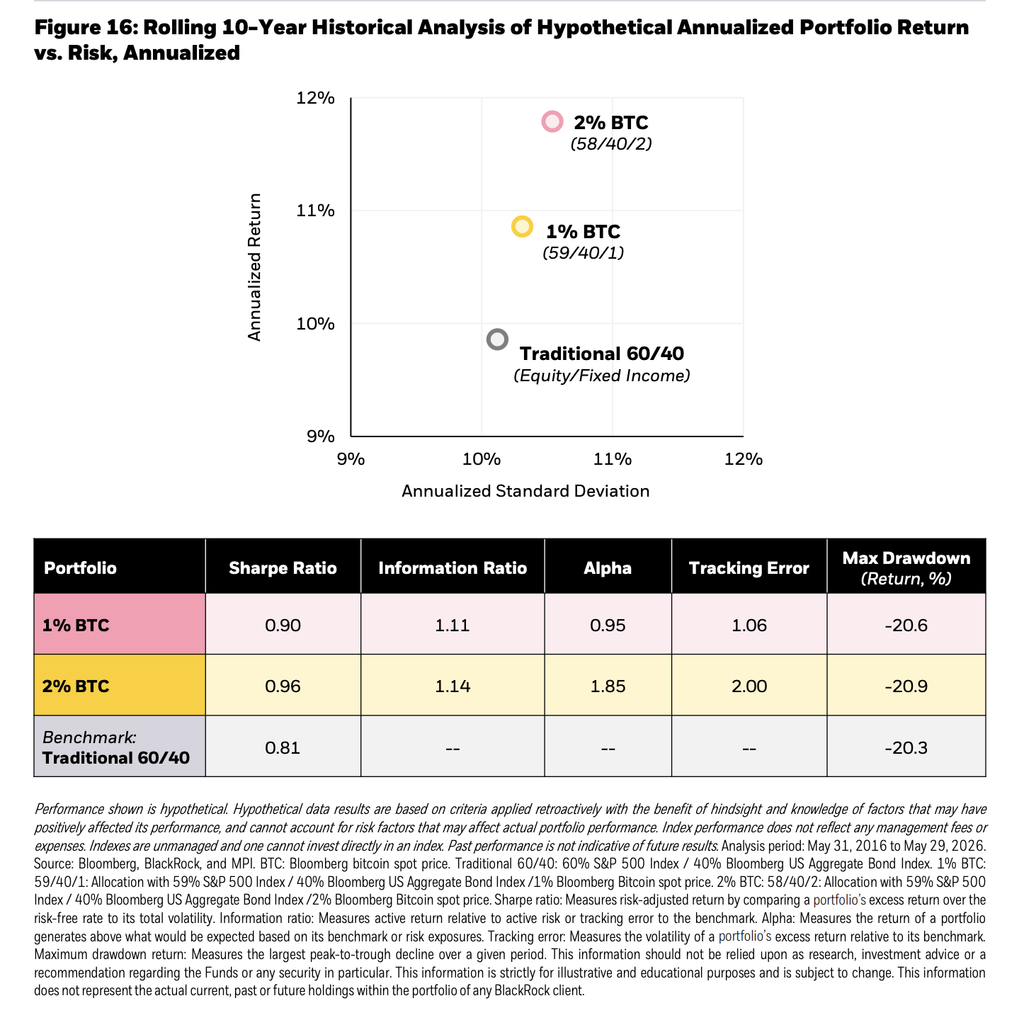
Put differently, the 2% allocation added roughly 190 basis points of annualized return relative to the traditional portfolio while increasing annualized volatility by approximately 50 basis points. The portfolio’s Sharpe ratio improved from 0.81 to 0.96, while maximum drawdown changed from -20.3% to -20.9%. Those figures are hypothetical and backward-looking, but they illustrate why judging Bitcoin primarily by its standalone volatility can produce an incomplete assessment of its portfolio impact.
The more relevant question is how that volatility interacts with everything else an investor already owns. BlackRock continues to characterize Bitcoin as having risk and return drivers that are fundamentally different from traditional assets, rooted in its fixed supply, decentralized structure and independence from any sovereign issuer. Those characteristics do not prevent Bitcoin from trading alongside risk assets during periods of deleveraging, but BlackRock’s research suggests those correlations have historically been episodic rather than permanent.
That distinction helps explain the portfolio results. A modest allocation does not import Bitcoin’s standalone volatility into a portfolio on a one-for-one basis. What matters is the marginal contribution of that allocation to total portfolio risk relative to the return it has historically generated. In BlackRock’s analysis, that trade-off remained favorable at 1% and 2%, even after incorporating one of Bitcoin’s most significant recent drawdowns.
Why 1–2% keeps appearing in BlackRock’s work
This is not the first time BlackRock has arrived at this range. Its earlier portfolio research approached Bitcoin sizing through risk contribution, concluding that a 1–2% allocation could represent a reasonable range for investors willing and able to accept Bitcoin’s risk. At those weights, BlackRock found that Bitcoin could contribute a similar share of overall portfolio risk as an individual mega-cap technology holding in a conventional 60/40 portfolio. Beyond 2%, however, Bitcoin’s contribution to total portfolio risk begins to increase disproportionately.
The new analysis approaches the same question from the opposite direction. Rather than asking how much risk Bitcoin contributes, it examines what investors historically received for assuming that additional risk. The improvement in Sharpe ratio from 0.81 for the traditional portfolio to 0.90 with 1% Bitcoin and 0.96 with 2% Bitcoin suggests that the incremental return historically more than compensated for the additional portfolio-level volatility.
This does not establish 1% or 2% as an optimal allocation, and BlackRock does not present it that way. The appropriate exposure will depend on liquidity requirements, investment horizon, governance constraints and risk tolerance. What the analysis does provide is a more rigorous framework for the discussion. The allocation question can increasingly be evaluated in terms of marginal risk, correlation, drawdown and portfolio efficiency rather than through a binary debate over whether Bitcoin itself is too volatile to own.
BlackRock has also seen the demand firsthand
There is another dimension to BlackRock’s latest analysis that is difficult to separate from the firm’s experience in the market.
BlackRock launched the iShares Bitcoin Trust, IBIT, in January 2024. Less than a year later, it had accumulated more than $50 billion in assets, making it what BlackRock itself has described as the largest exchange-traded product launch in history. It reached that milestone roughly five times faster than the previous record holder.
Its significance has only grown since then. BlackRock now describes IBIT as the world’s largest and most traded Bitcoin ETP, and the fund became the firm’s highest-revenue ETF in 2025 despite competing within a global BlackRock lineup of more than 1,000 products.
The concentration within the U.S. spot Bitcoin ETF market is equally notable. According to current ETF holdings data tracked by Bitcoin For Corporations, U.S. spot Bitcoin ETFs collectively hold approximately 1.25 million BTC, representing nearly 6% of Bitcoin’s fixed 21 million supply. IBIT alone accounts for roughly 775,000 BTC, or more than 60% of the Bitcoin held across the U.S. spot ETF complex.
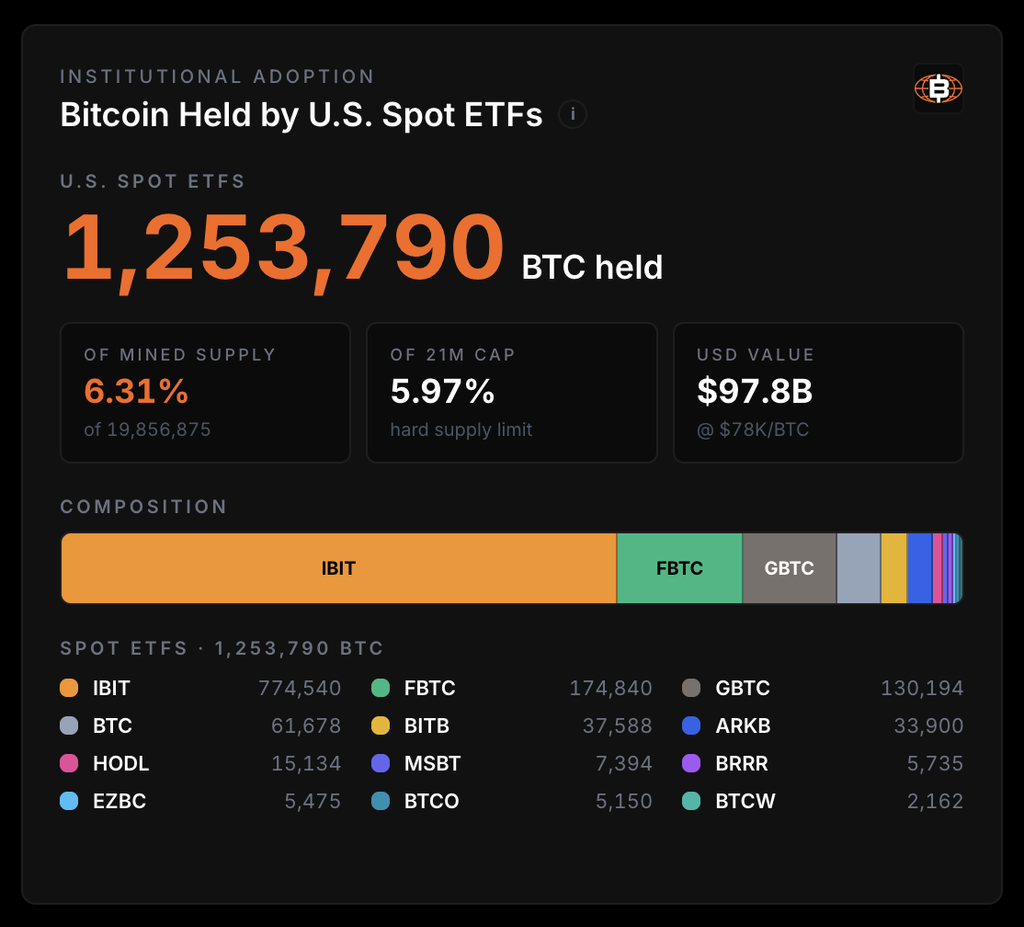
View the full Bitcoin ETF Dashboard.
That does not make BlackRock’s research independent of commercial context; IBIT is an important and increasingly valuable BlackRock product. That context should be understood rather than ignored. But it also means the firm’s reassessment is occurring alongside more than two years of observing how investors actually use Bitcoin exposure at scale.
The distinction is useful. The theoretical case for Bitcoin as a portfolio asset is increasingly being accompanied by observable allocation behavior. Investors have now had access to Bitcoin through familiar brokerage, advisory and institutional infrastructure across multiple market regimes, including periods of rapid appreciation and severe drawdowns. IBIT’s growth suggests that demand has persisted well beyond its initial launch window.
A drawdown is precisely when a thesis should be re-underwritten
The timing of BlackRock’s report may ultimately be more informative than the portfolio simulation itself.
Bitcoin is not being reassessed at an all-time high. BlackRock published the analysis after an approximately 50% drawdown from Bitcoin’s October 2025 peak, a period the firm associates with leveraged positioning being unwound, slowing ETP flows and weaker demand from companies accumulating Bitcoin. Its conclusion is that these forces represented a positioning correction rather than a fundamental change in Bitcoin’s investment case.
That is what re-underwriting is supposed to accomplish. An investment thesis should not survive because investors are attached to it; it should survive because its underlying assumptions continue to hold when conditions change.
For Bitcoin, those assumptions extend beyond historical returns. The asset remains scarce by design, globally liquid, independent of a sovereign issuer and structurally different from the liabilities that dominate traditional portfolios. BlackRock argues that concerns around fiscal sustainability, monetary stability and geopolitical risk may therefore become increasingly relevant to Bitcoin’s long-term adoption.
The portfolio evidence does not prove what Bitcoin will return over the next decade, nor does IBIT’s success establish what an appropriate allocation should be. What the two developments show together is that the institutional conversation has advanced considerably. Bitcoin is no longer being evaluated solely as an unconventional asset that institutions may or may not choose to own. It is increasingly being evaluated through the same disciplines applied elsewhere in capital allocation: sizing, risk contribution, correlation, liquidity, drawdown and expected return.
What this means for corporate leaders
For CFOs, boards and corporate operators, that evolution may be the most important takeaway from BlackRock’s work.
The relevant decision is not whether Bitcoin is volatile; that is already known. Nor does a corporate allocation need to resemble the concentrated Bitcoin strategies pursued by companies that have explicitly built their capital structures around the asset. Between zero exposure and a Bitcoin-centric balance sheet sits a much broader spectrum of possible allocations.
BlackRock’s research provides a useful framework for thinking about that spectrum. A relatively small allocation was sufficient to materially alter the historical return characteristics of a conventional portfolio without producing a comparable increase in portfolio-level risk. At 2%, approximately 190 basis points of additional annualized return came with roughly 50 basis points of additional annualized volatility in the period studied. The allocation was small; its effect was not.
For corporate leaders, the implication is less about adopting BlackRock’s specific allocation range than adopting the discipline behind the analysis. Bitcoin can be underwritten like any other strategic allocation: define its purpose, determine an acceptable risk contribution, establish liquidity and governance requirements, size the position accordingly and periodically revisit the assumptions.
That is a considerably more mature question than whether a company should simply “buy Bitcoin.”
As Bitcoin becomes more deeply integrated into institutional portfolios and financial infrastructure, the burden of analysis is shifting. The question facing the C-suite is increasingly not whether Bitcoin belongs in the conversation, but what allocation, if any, can be justified by the company’s objectives, constraints and cost of capital.
BlackRock has now re-underwritten that question after another full market cycle and a roughly 50% drawdown. Its historical portfolio math still makes the case that, in measured amounts, Bitcoin can improve the equation. For corporate decision-makers, that is the takeaway worth bringing into the boardroom.
Disclaimer: This content was prepared on behalf of Bitcoin For Corporations for informational purposes only. It reflects the author’s own analysis and opinion and should not be relied upon as investment advice. Nothing in this article constitutes an offer, invitation, or solicitation to purchase, sell, or subscribe for any security or financial product.
This post BlackRock Re-Underwrites Bitcoin, and the Portfolio Math Still Holds first appeared on Bitcoin Magazine and is written by Nick Ward.
CryptoSlate
CME and ICE told Washington in May that Hyperliquid's pseudonymous, always-on markets could let sanctioned state actors circumvent enforcement.
On Aug. 31, an Arkham analysis reviewed by CoinDesk found that wallets linked to North Korea's Lazarus Group had sold more than $30 million of Bitcoin through Hyperliquid over the prior three weeks.
The proceeds were converted into ETH and SOL before funds moved to Kraken, LBank, and KuCoin. The same day, Bloomberg reported that Hyperliquid Labs was in advanced talks with Kraken parent Payward over a regulated US entry point.
On paper, the timing could hardly be worse for Hyperliquid. Whether it threatens the push to bring the exchange onshore depends on a detail neither Bloomberg's report nor the Lazarus findings answer: how the proposed US structure would connect to Hyperliquid's market.
| Date | Event | Why it matters |
|---|---|---|
| May | CME and ICE warn Washington about Hyperliquid’s pseudonymous, always-on markets | Establishes that sanctions and market-integrity concerns predated the Lazarus finding |
| June 18 | CME files Chicago Mercantile Exchange Inc. v. Selig | Shows CME was already fighting the regulatory pathway for US crypto perpetuals |
| Aug. 19 | Trump says Selig is working to bring Hyperliquid into the US legally | Turns Hyperliquid’s US entry into a public political priority |
| Aug. 31 | Bloomberg reports Hyperliquid-Payward talks involving Bitnomial | Reveals the likely US-facing regulated venue |
| Aug. 31 | CoinDesk/Arkham identify $30M+ in Lazarus-linked BTC sales via Hyperliquid | Gives CME’s earlier warning a concrete, timely example |
| Sept. 2 / Oct. 2 | CFTC/Selig response deadline, then CME opposition deadline | Keeps the legal fight immediate rather than historical |
The plumbing for the Hyperliquid deal remains a mystery
Bloomberg reported that US customers would use Payward's Bitnomial exchange to trade perpetual futures tied to the price of crypto tokens built on Hyperliquid's blockchain technology, subject to regulatory approval.
Bitnomial would be the US-facing venue, the products would be perpetual futures, and Hyperliquid-related tokens would sit underneath them economically.
The report does not establish whether Bitnomial orders would ever touch Hyperliquid's existing order book, or whether the two venues would share liquidity. It also leaves open whether positions would settle on Hyperliquid's chain, or whether Payward and its market makers would hedge Bitnomial exposure by trading directly on Hyperliquid.
That gap determines whether Lazarus becomes a distant offshore data point or a direct question about who US-regulated customers could end up transacting against.
CME is already fighting the framework in court
CME filed Chicago Mercantile Exchange Inc. v. Selig on June 18 in the US District Court for the District of Columbia. The suit challenges the CFTC's decision to let Kalshi and other designated contract markets list crypto perpetual contracts as futures, a classification CME argues should have been swaps under a separate regulatory structure.
CME's complaint points to differences in swap-dealer registration, margin treatment, transaction reporting, collateral rules, and tax treatment. It alleges competitive injury from a regime that lets newer products compete directly with CME for retail derivatives customers.
The court ordered the CFTC and Selig to respond by Sept. 2, with CME's opposition to an expected motion to dismiss due Oct. 2.
CME's case turns on a narrow statutory question: whether perpetual contracts meet the legal definition of futures under the Commodity Exchange Act, or whether they function as swaps subject to a different regulatory structure entirely.
Whether North Korean wallets moved $30 million through an offshore venue has no direct bearing on that classification question. Lazarus gives CME a far more intuitive story to tell outside the courtroom, in front of the CFTC's product-review process, in congressional hearings, and in public advocacy.
A concrete sanctions-evasion example lands harder there than a technical swaps argument ever could.
ICE has drifted away from CME's position
The original May warning grouped CME and ICE. ICE CEO Jeffrey Sprecher has since struck a far more conciliatory tone, saying ICE was “not freaked out about Hyperliquid” and describing the two companies as helping each other understand their respective worlds.
Those comments followed a round of meetings between the two sides. He called Hyperliquid a wake-up call, a framing well short of a threat to reject outright. That breaks the tidy version of this story where legacy exchanges unite against a common DeFi rival.
CME is actively litigating the CFTC's framework, while ICE looks more interested in understanding the model while still pushing for a level regulatory playing field.
Payward agreed to acquire Bitnomial for up to $550 million in April and completed the deal May 1. The purchase gave it a full CFTC-regulated derivatives stack: a designated contract market, a derivatives clearing organization, and a futures commission merchant.
Kraken has already listed CFTC-regulated crypto perpetuals through that infrastructure for US users. Bitnomial functions as regulated market infrastructure that Payward acquired specifically for this kind of product, carrying its own designated contract market, clearing organization, and futures commission merchant licenses.
Two opposite conclusions for Hyperliquid
CME's version treats Lazarus as proof of concept. A sanctioned North Korean hacking group apparently moved tens of millions of dollars through the kind of pseudonymous, permissionless market CME warned regulators about months earlier.
That market lacks the identity and surveillance architecture required of conventional US intermediaries.
Keeping Hyperliquid offshore leaves the protocol running as it does now, available to the same global actors, with US regulators holding no more control over it than they already do.
A customer entering through a registered FCM, DCM, and DCO structure instead faces onboarding, compliance, and surveillance requirements that offshore access never required in the first place.
| Question | CME’s argument strengthened? | Why |
|---|---|---|
| Did Lazarus validate the category of risk CME and ICE warned about? | Yes | It gives a concrete example of a sanctioned state-linked actor using Hyperliquid’s pseudonymous market. |
| Does it prove crypto perpetuals are legally swaps, not futures? | No | CME’s lawsuit turns on statutory classification, not who used Hyperliquid offshore. |
| Does it raise the political cost of approving a Hyperliquid-linked US product? | Yes | It gives Congress, the CFTC, and legacy exchanges a national-security example. |
| Does it automatically block Hyperliquid’s US entry? | No | The effect depends on whether Bitnomial is segregated from or connected to Hyperliquid liquidity. |
| Could it support the onshoring argument? | Yes | Selig/Payward can argue offshore access is the problem, while US access would impose onboarding, surveillance, and compliance controls. |
CME can litigate the CFTC's classification decisions, lobby Congress, press for stricter surveillance and sanctions-screening requirements, and contest future agency actions if it has standing. Its current complaint already leans on a competitive-injury theory to establish that standing.
CME cannot veto the Payward-Hyperliquid agreement directly, order the CFTC to reject a product, or stop Congress and the CFTC from building a different lawful pathway if this one gets blocked.
Even a full win in its current lawsuit would mean Hyperliquid-linked products cannot use this specific futures framework, a narrower outcome than closing off every compliant path Hyperliquid could take into the US.
Whether the plumbing vindicates the warning or the onshoring push
The bull case for the CFTC's approach has Bitnomial running as a genuinely segregated market, handling its own onboarding, clearing, and participant controls, while Hyperliquid supplies only technology, token exposure, and reference pricing underneath.
Under that path, Lazarus becomes mostly a benchmark and surveillance question, well short of evidence that sanctioned wallets could ever transact against US customers. The episode ends up strengthening the case that bringing this activity onshore beats leaving it purely offshore and unsupervised.
| Scenario | How the structure works | Who benefits rhetorically? | Main regulatory issue |
|---|---|---|---|
| Segregated Bitnomial market | US users trade on Bitnomial; onboarding, clearing, and controls stay inside regulated US infrastructure | Selig / Payward | Lazarus becomes mostly an offshore optics, benchmark, and surveillance issue |
| Shared Hyperliquid liquidity | Bitnomial trades execute against or settle through Hyperliquid’s permissionless market | CME | Sanctioned wallets could be closer to US-regulated exposure |
| Separated US market, offshore hedging | US users stay on Bitnomial, but Payward or market makers hedge exposure on Hyperliquid | Mixed / contested | Regulated US risk may indirectly depend on pseudonymous offshore liquidity |
The bear case has Bitnomial activity executing against, settling through, or getting hedged on Hyperliquid's own permissionless liquidity in some meaningful way.
In that scenario, the compliance picture gets much harder fast: wallet sanctions screening, counterparty exposure, settlement finality, and whether regulated US positions can end up economically dependent on the same liquidity environment Lazarus just used.
That is the scenario where CME's May warning reads as an accurate prediction of what happened.
Lazarus may end up as evidence for two opposite visions of American market regulation at once. One holds that pseudonymous derivatives markets are inherently too dangerous to connect to US finance, while the other holds that leaving them offshore was the danger all along.
Which argument wins probably depends on a technical detail nobody involved has explained publicly yet.
The post North Korea’s $30M crypto cashout just handed legacy finance its best weapon to kill DeFi’s US debut appeared first on CryptoSlate.
Abstract: In H1 2026, TRON bucked broader market headwinds through a twin-track strategy: solidifying its core DeFi engine while aggressively expanding into AI. As recurring deflationary mechanics anchored value across DeFi protocols, a rapid wave of AI product launches unlocked new vectors for ecosystem growth.
Throughout the first half of 2026, global crypto markets faced a macro-driven cooldown. Tightening market liquidity and capital rotations into traditional AI tech pushed many crypto sectors into stagnation. TRON, however, carved out a distinct counter-cyclical rally. From expanding its stablecoin settlement layer and upgrading core DeFi asset value to strategically positioning itself across the Web3 AI stack, TRON delivered ecosystem-wide growth that significantly outperformed industry benchmarks.
At the heart of this performance is TRON's stablecoin infrastructure, which serves as the primary liquidity engine for the entire network. During H1 2026—even as global USDT market cap held relatively flat—circulating USDT on TRON expanded rapidly, breaking through $90 billion and setting consecutive all-time highs as it approaches the $100 billion milestone. This sustained liquidity depth cements TRON's role as the leading settlement network for digital dollars, providing low-cost, capital-efficient liquidity for applications building on top of the layer.
Building on its stablecoin dominance, TRON pursued a cohesive strategy throughout H1 2026: fortify the DeFi foundation and expand the AI front. In DeFi, key protocols introduced recurring buyback-and-burn mechanics alongside steady feature upgrades, sharpening the network's overall value-capture capability. Simultaneously, TRON executed a rapid rollout of foundational AI products—building a full-stack Web3 AI ecosystem that spans unified multi-model access layers, AI agent infrastructure, and distributed compute networks.
DeFi Ecosystem: Synergizing Token Deflation with Protocol Innovation
Against industry headwinds in H1 2026, TRON's DeFi sector advanced a dual-track strategy: value empowerment via buybacks and burns, and continuous product iteration. On the one hand, the ongoing execution of buyback-and-burn mechanisms by core projects across multiple tracks established a normalized, ecosystem-wide deflationary system. On the other, the relentless refinements to the functionality and user experience of core protocols enhanced both token value and protocol fundamentals.
To drive sustainable tokenomics, core ecosystem projects established programmatic buyback-and-burn mechanisms, forming a network-wide deflationary matrix across liquidity infrastructure, lending, oracles, and decentralized storage:
- SUN.io (Liquidity): Expanded its SUN buyback revenue streams. Starting with its 50th buyback-and-burn round in April, revenue from SUNX derivatives was permanently added to the burn pool alongside existing fees from SunSwap V2 and SunPump. The protocol completed its 50th and 51st token burn rounds in April and July, respectively.
- JUST (DeFi): Executed scheduled, multi-round JST token burns. The protocol completed its 2nd and 3rd large-scale buyback-and-burn rounds in January and April, followed by a record-setting 4th round in July that marked the largest capital allocation to date.
- WINkLink (Oracles): Launched a dedicated WIN buyback-and-burn program in July, allocating 100% of oracle service revenue toward repurchasing and burning WIN tokens.
- BitTorrent (Storage & Compute): Initiated a BTT buyback-and-burn program in July, funneling all revenue from decentralized services directly into token burns.
Parallel to these value-accrual mechanics, TRON protocols pushed aggressive feature upgrades across trading, lending, data feeds, and decentralized compute:
- SUN.io completed a strategic rebranding in January by introducing a dedicated Chinese brand to accelerate global adoption, followed by the launch of SunSwap V4 in March to deepen liquidity and enhance user experience.
- JustLend DAO deployed SBM V2 in June, introducing isolated collateral pools to support long-tail assets while enhancing risk management. Concurrently, the network's gasless transaction solution, GasFree, saw exponential adoption across stablecoin transfers.
- WINkLink upgraded its price feed portal in March, adding an integrated “Market Statistics” dashboard to enhance on-chain analytics.
- BitTorrent formally entered the AI space in June with BTTInferGrid, a decentralized AI compute marketplace that unlocks long-term demand for the network.
This dual engine of consistent token deflation and protocol innovation not only drove a steady surge in on-chain DeFi activity but also established a robust bedrock for long-term token value.
According to DeFiLlama, TRON's DeFi TVL climbed past $5.18 billion by September 1, placing it firmly in the top five public chains globally—narrowing the gap with Solana and BSC, and even overtaking them during peak trading periods. TRON's lead is even more pronounced in user engagement: the network logged over 3.88 million 24-hour active addresses, nearly double that of second-place BSC, underscoring its unmatched real-user adoption.

SUN.io: Enhancing DEX Efficiency via SunSwap V4 and Expanding Burn Pools
In H1 2026, SUN.io rolled out major updates across its branding, product suite, and tokenomics. By expanding brand awareness, upgrading protocol capabilities, and strengthening its value-accrual mechanics, the platform significantly sharpened its competitive edge.
To support global adoption, SUN.io launched a dual-brand strategy in January. This included introducing a dedicated Chinese brand identity, “Sun Wukong” (孙悟空), alongside a localized official website. The core product suite was seamlessly unified under this new framework: the DEX platform SunSwap became “Wukong Swap”, the memecoin launchpad SunPump became “Wukong Launch”, and the derivatives platform SunX became “Sun Wukong”. This approach allows SUN.io‘s comprehensive DeFi matrix—covering spot DEX trading, meme issuance, and perpetuals—to effectively engage both Western and Asian user bases.

On the product side, SUN.io continued to iterate on its core protocols, leveraging technical upgrades to lower trading barriers and reduce costs for users. On March 2, SunSwap V4 went live with six core architectural innovations:
- Singleton Design: Unified pool management for maximum capital efficiency.
- Native TRX Swaps: Direct trading pairs without the need to wrap TRX.
- Flash Accounting: Net balance settlements that dramatically cut transaction costs.
- Hooks: Customizable smart contract plugins for novel trading strategies.
- Custom Accounting: Tailored settlement logic for specialized pools.
- Subscribers: Real-time event notifications for active position monitoring.
These features pushed the protocol's customizability to new heights, unlocking possibilities for innovative DeFi scenarios. Within five months of launch, SunSwap V4 saw rapid adoption: peak liquidity stabilized at $108 million, and 24-hour trading volumes frequently surpassed $70 million during peak periods.
Capital efficiency was further improved in May with an upgraded Universal Router contract, which automatically executes trades across the optimal multi-pool paths.
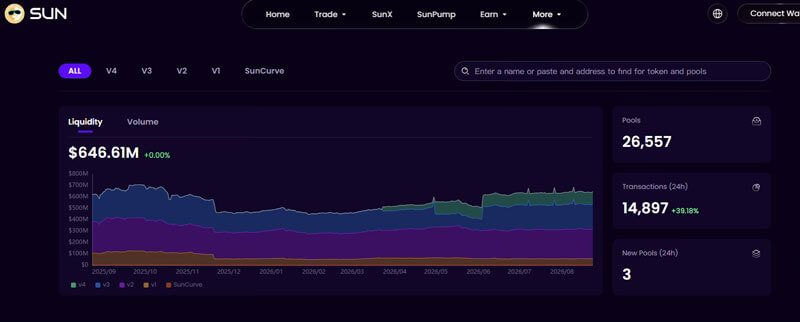
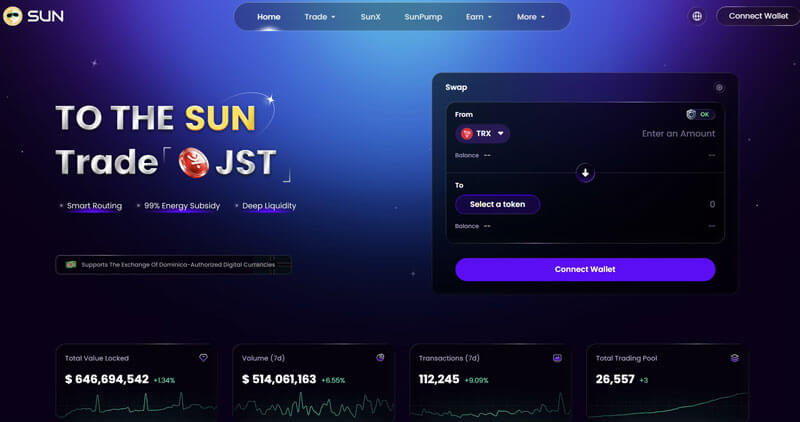
As of September 1, SUN.io reports a total TVL of ~$650 million across more than 26,500 active liquidity pools. Over the past seven days, total platform trading volume exceeded $514 million across 112,000+ individual transactions, maintaining a steady upward trajectory across all metrics.
Finally, SUN.io accelerated the deflation of the SUN token by expanding its buyback revenue streams. Starting with its 50th buyback-and-burn round on April 25, revenue from the SunX derivatives platform was permanently added to the burn pool, complementing existing fees from SunSwap V2 and SunPump. To make this deflationary process more transparent and predictable, the platform also standardized its execution schedule, shifting to a unified announcement in the middle of the first month of each quarter.
Since launching its buyback-and-burn model in December 2021, SUN.io has executed 51 consecutive burn rounds without interruption, permanently removing 678,547,188.32 SUN from circulation—bringing the token rapidly toward the 700 million deflation milestone.
JustLend DAO: Real Yield Fuels JST Deflation as Product Matrix Expands
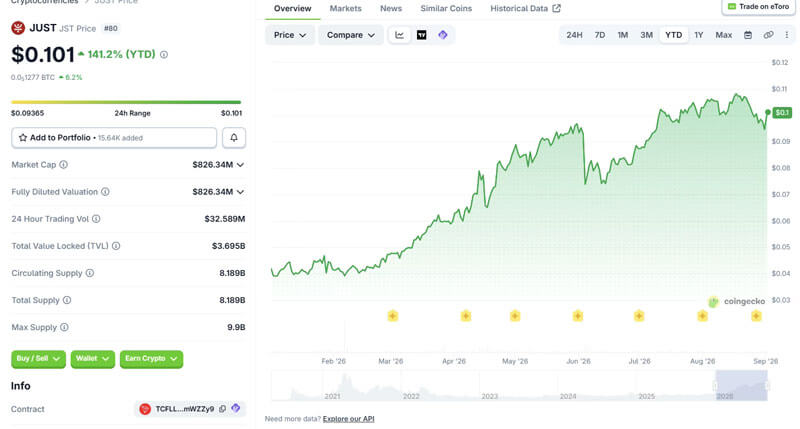
Powered by the protocol's sustained revenue growth in H1, JustLend DAO has executed multiple rounds of JST buybacks and burns. This established a complete closed-loop value model: real business revenue drives programmatic deflation, which fundamentally reinforces JST's value proposition. Driven by this deflationary flywheel, JST's price charted strong growth, surging from $0.04 at the start of 2026 to a peak of $0.11—a 275% cumulative gain. This rally catapulted its market cap from $400 million to over $868 million, marking its highest valuation since 2022. As of September 1, JST remains strong, trading at $0.101.
Concurrently, JustLend DAO‘s diversified product suite—spanning lending, liquid staking, Energy Rental, and smart wallets—unlocked new vectors for long-term ecosystem growth.
Since the start of 2026, JST has completed three large-scale scheduled burn rounds, each deploying over $20 million. In H1 alone, more than $70 million was allocated to buybacks, with nearly 90% derived from JustLend DAO‘s real operating net revenue:
- Round 2 (January 14): 525 million JST burned (equivalent to $21 million), accounting for 5.3% of the total JST supply.
- Round 3 (April 15): 271 million JST burned (equivalent to $21.3 million), accounting for 2.74% of the total JST supply.
- Round 4 (July 17): A record-breaking 355 million JST burned (equivalent to $34.59 million).
Funded by robust protocol revenue alongside accrued USDJ stability fees, this milestone burn accounted for 3.59% of the total JST supply.
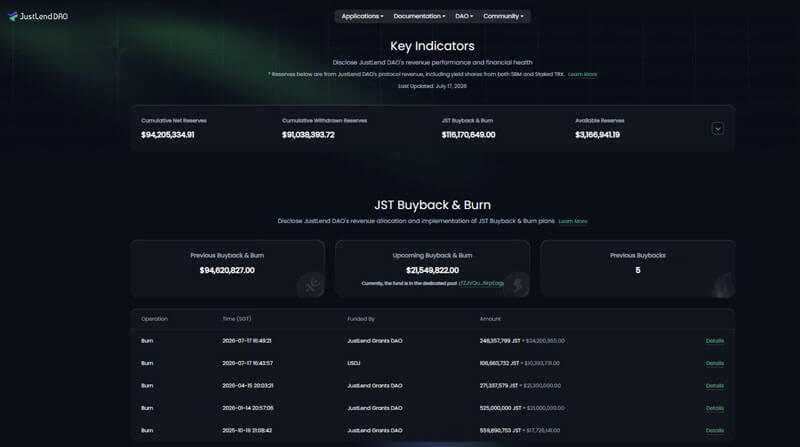
To date, the protocol has completed four major buyback-and-burn rounds, permanently removing 1.711 billion JST from circulation. This accounts for 17.29% of the total token supply and represents over $94.62 million in cumulative capital deployed. Excluding the $10.39 million special burn from accrued USDJ stability fees in Round 4, 100% of routine buyback funds are sourced directly from JustLend DAO‘s real business revenue.
According to official data, JustLend DAO has generated over $94.2 million in cumulative net revenue to date. When combined with stability fees, the total capital generated for repurchases approaches $105 million. This deflationary engine is primed to continue: the protocol has already reserved an additional $10.34 million in accrued revenue to fund the next scheduled buyback-and-burn event.
As the core protocol of the JUST ecosystem, JustLend DAO has built a robust, diversified product suite covering Supply & Borrow Markets (SBM), Liquid Staking (sTRX), Energy Rental, Gas-Free Transfers (GasFree), and Energy Purchasing (Buy Energy)—maintaining a top-tier industry position across all respective verticals.
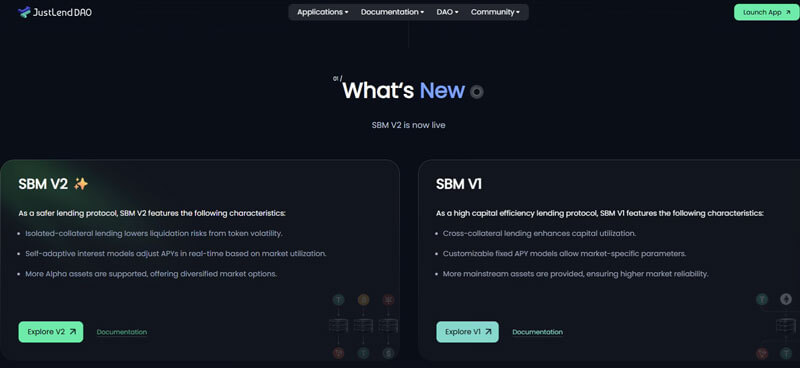
In the decentralized lending sector, JustLend DAO remains a dominant global force. According to DeFiLlama data as of September 1, the SBM platform boasts a Total Value Locked (TVL) of $3.38 billion, firmly securing its rank as the #4 decentralized lending protocol worldwide. Innovation continues to drive this growth: the launch of SBM V2 in June introduced isolated vaults, a critical architectural upgrade that expanded asset coverage while substantially reinforcing platform security. To further enhance capital efficiency during H1, the protocol also rolled out a dedicated $U lending market, continuously broadening its asset support to meet growing user demand.
In the liquid staking track, the sTRX product has accumulated over 9.73 billion staked TRX across more than 17,000 unique addresses, maintaining a steady upward trajectory in both TVL and user adoption. Building on this liquid staking foundation, the Energy Rental market introduces a highly flexible, pay-as-you-go model. This solves the pain point of requiring users to lock up large amounts of TRX long-term to lower on-chain gas costs, attracting a cumulative user base of over 80,000 participants.
Further expanding this utility ecosystem, JustLend DAO launched the Buy Energy feature in August. This pay-as-you-go service allows users to purchase TRON Energy on demand, saving users up to 64% in transaction fees compared to the traditional method of burning TRX for on-chain resources.
Driven by a core mission to eliminate friction and democratize on-chain access, JustLend DAO has engineered a comprehensive utility suite comprising Energy Rental, Buy Energy, and GasFree Transfers.
GasFree Transfers, in particular, has emerged as a primary growth catalyst for the platform. By allowing users to pay gas fees directly in their target token—bypassing the necessity of holding native TRX—it drastically lowers the barrier to entry for decentralized transactions. Currently supporting fee deductions in USDT and USDD (following its strategic integration in August), the feature is experiencing accelerating user adoption and transaction velocity.
Recent data underscores this robust traction. According to CryptoQuant's TRON Q2 report, GasFree transfer volume in the final week of June reached $2.9 billion, closely approaching the $3 billion all-time high established in early May. As of September 1, cumulative GasFree stablecoin transfers have surpassed 7.7 million transactions, representing $132.6 billion in total transfer volume. By saving users over $8.48 million in cumulative transaction fees, GasFree Transfers has rapidly solidified its position as an indispensable utility and a significant new growth vector for JustLend DAO.
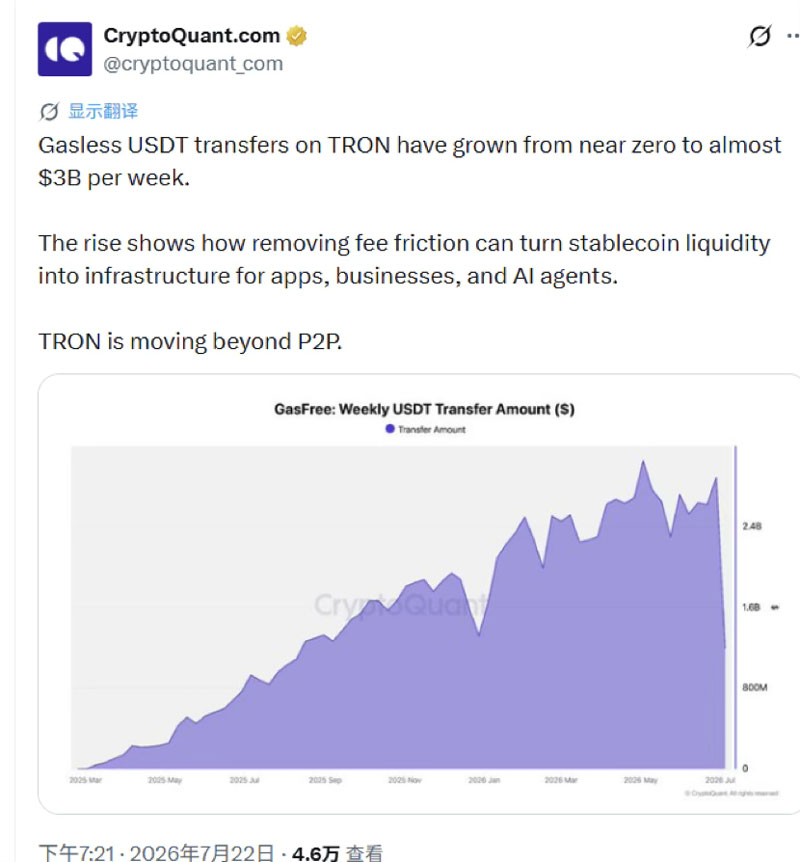
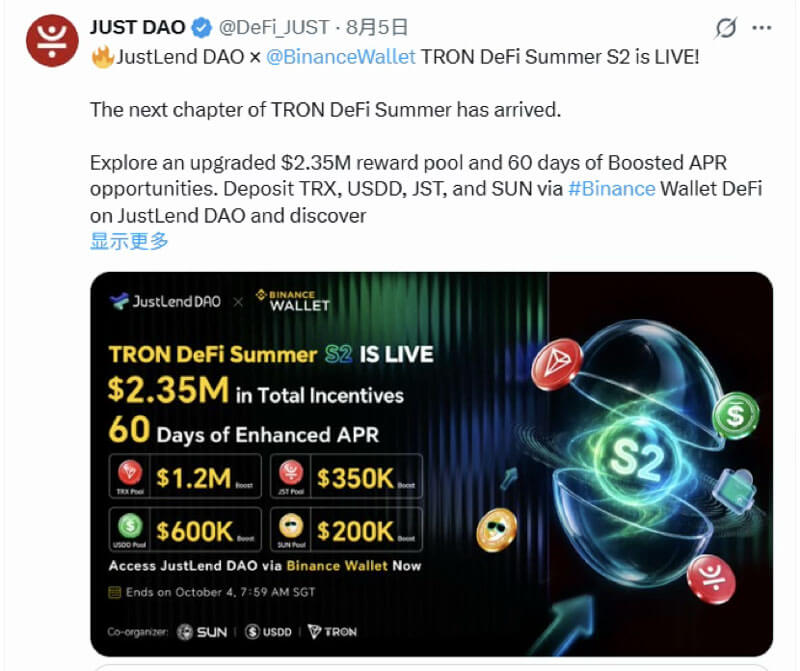
Beyond rapid product iteration and steady growth in core business metrics, JustLend DAO is actively expanding its strategic partnerships to bridge external ecosystems and onboard new users. On July 6, JustLend DAO was officially integrated into the Binance Web3 Wallet DeFi hub, launching dedicated liquidity pools to tap into the leading CEX's massive global user base. Hot on the heels of this integration, JustLend DAO teamed up with USDD and SUN.io to co-host the “TRON DeFi Summer” campaign alongside Binance Wallet, backed by a $4.5 million prize pool. This cross-ecosystem alliance is highly strategic: it not only injects substantial fresh capital and new user cohorts, but it also establishes a seamless conversion pipeline moving users from a top-tier CEX directly into TRON ecosystem DeFi. Ultimately, this frictionless acquisition funnel broadens the protocol's foundation for sustainable revenue generation.
BitTorrent: Expanding into Decentralized AI via BTTInferGrid and Launching Long-Term BTT Buybacks
BitTorrent advanced its core value proposition in H1 2026, achieving landmark breakthroughs across compliance, product development, and tokenomics. By resolving long-standing regulatory headwinds, accelerating core product iteration, expanding into artificial intelligence, and instituting a multi-phase BTT buyback-and-burn initiative, BitTorrent has executed a comprehensive strategic transformation from the ground up.
This shift began with the total clearance of a multi-year regulatory overhang. On March 6, the U.S. SEC officially dropped all charges against Justin Sun, the TRON Foundation, and the BitTorrent Foundation. This resolution brought a definitive end to a three-year dispute, eliminating the policy uncertainty that had previously constrained the ecosystem's growth and strategic roadmap. Capitalizing on this regulatory clarity, BTT secured a fiat listing on Bitkub, a leading Thai cryptocurrency exchange, with the launch of the BTT/THB trading pair. By enabling local users to trade BTT directly with Thai Baht, the listing significantly bolsters BTT's regional market liquidity and deepens its strategic footprint in Southeast Asia.
Simultaneously, BitTorrent continues to iterate on its core infrastructure. On June 5, the team rolled out BitTorrent Neo, a specialized client designed natively for macOS. Delivering a lightweight, intuitive user interface without compromising performance, BitTorrent Neo modernizes the peer-to-peer (P2P) file-sharing experience and reinforces the protocol's position in decentralized distribution.
Expanding into high-growth verticals, BitTorrent officially entered the decentralized AI compute sector with the June 17 launch of BTTInferGrid. Built as a DePIN (Decentralized Physical Infrastructure Network) tailored specifically for AI inference workloads, BTTInferGrid aims to optimize traditional compute supply. This launch signals BitTorrent's strategic expansion into the Web3 AI landscape, unlocking a new growth vector for the entire ecosystem.
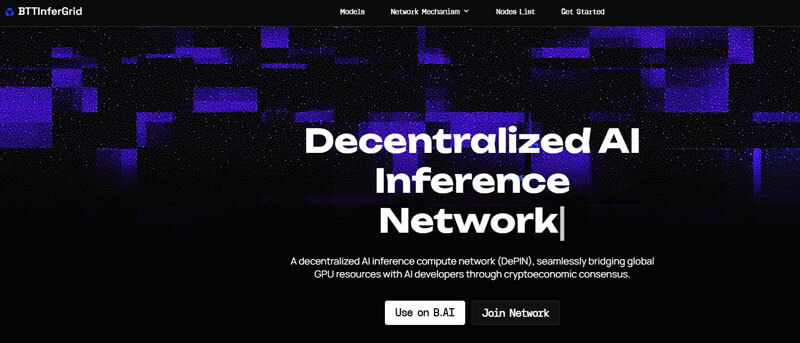
To complement this expansion, BitTorrent has activated a comprehensive BTT buyback-and-burn mechanism designed to drive long-term value. In a strategic update announced July 6, 100% of the revenue generated from its decentralized businesses is now routed into a dedicated pool for routine quarterly burns. This enhances BTT's value capture logic—upgrading it from a standard utility and governance token into a deflationary asset anchored by real protocol yield. Ultimately, this ensures the community shares directly in the growth of BitTorrent's expanding network.
WINkLink: Core Oracle Services Upgrade as New Buyback Program Bolsters Token Value
As the premier oracle infrastructure powering the TRON ecosystem, WINkLink executed comprehensive upgrades throughout H1. These enhancements touched every layer of the protocol, spanning core product functionalities, broader asset coverage, and updated tokenomics. By fortifying its on-chain data services and deploying a dedicated token buyback-and-burn mechanism, WINkLink is actively translating its operational success into sustainable, long-term value for token holders.
On the product front, WINkLink upgraded its Price Service page on March 27, introducing a new Market Statistics module. This feature visualizes key metrics—such as market cap ranking, circulating and total supply, and 24-hour and 7-day price ranges—substantially improving data completeness and readability to better support the diverse needs of developers and financial protocols.
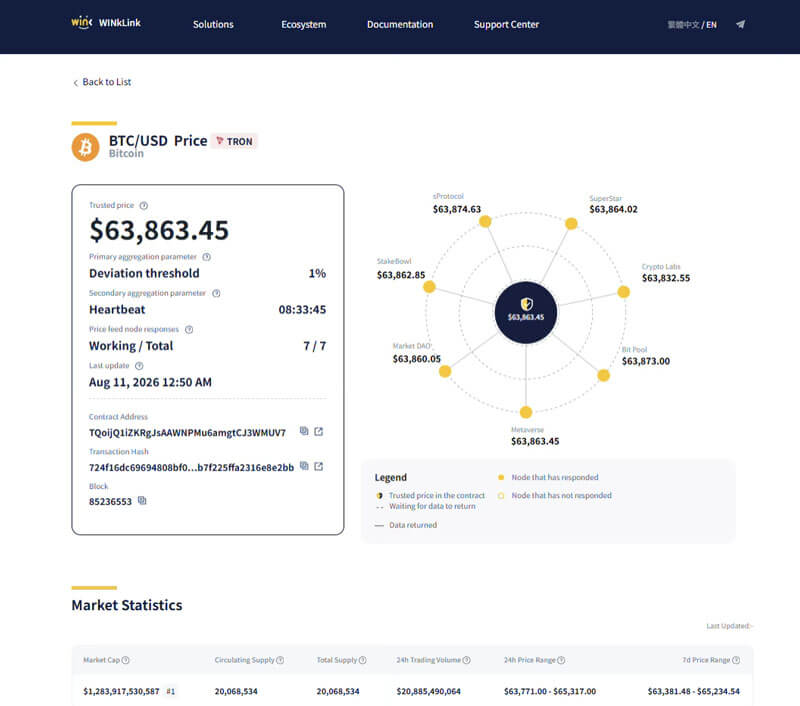
In terms of asset coverage, WINkLink steadily expanded its oracle price feeds. It integrated $U price feeds alongside U/TRX and U/USD trading pairs on April 13, followed by KGST price feeds and the KGST/TRX pair on June 9, continuously enriching on-chain price data across a broader range of asset classes.
To empower token value, WINkLink launched a long-term WIN buyback-and-burn initiative on July 6. Under this program, 100% of the revenue generated from providing oracle services to the TRON ecosystem is allocated to buying back and burning WIN tokens, with burn data publicly disclosed around the middle of the following quarter. By directly linking ecosystem revenue to token value, this mechanism continuously optimizes token supply dynamics, fostering a positive feedback loop between protocol utility and token value. Following the announcement, WIN surged from ~$0.00002055 to $0.00002514 on July 29, marking a 22.5% gain that clearly demonstrates the value appreciation driven by deflationary mechanics.
Additionally, WINkLink secured exchange recognition early in the year. WIN was officially listed on Thailand's leading crypto exchange, Bitkub, on January 30, followed by Baltex on February 28, expanding its global market footprint ahead of schedule.
TRON's AI Matrix: Rapid Product Rollouts Drive Expansion
While a mature DeFi ecosystem serves as TRON's financial anchor through market cycles, its strategic expansion into Web3 AI forms the core pivot for capturing the dividends of the next technological revolution. In H1 2026, TRON entered a major growth phase for its AI ecosystem: Bank of AI, a dedicated financial infrastructure for AI Agents, launched in February; B.AI, a unified multi-model service gateway, debuted in April; and BTTInferGrid, a decentralized AI computing network, went live in June—marking a rapid succession of milestone product rollouts.
Today, TRON's AI ecosystem features a robust product matrix anchored by B.AI, Bank of AI, AINFT, and BTTInferGrid. Spanning large language model (LLM) service gateways, AI Agent infrastructure, AI Agent financial trading, and distributed compute supply, each layer boasts distinct positioning, complementary capabilities, and functional synergies. Together, they form a complete multi-tier architecture connecting top-layer service gateways, middle-layer core infrastructure, and bottom-layer computing power, creating a highly efficient and well-structured decentralized AI ecosystem.
At the top layer, B.AI serves as a unified multi-model gateway bridging Web2 and Web3. Positioned as premier AI infrastructure, B.AI functions as a global settlement layer for intelligence, operating above all models and below all agents to route, compute, and settle every call. Its LLM offering integrates conversational capabilities and standardized API services from multiple mainstream models, supporting one-click model switching and rapid integration through a single API. The platform has also introduced essential ecosystem tools, including the desktop AI agent BAIclaw, the coding assistant BAIcode, and foundational protocols like the x402 payment standard and 8004 identity protocol. Together, these solutions deliver a frictionless user experience while drastically lowering technical barriers for developers, providing a unified LLM foundation for all applications across the ecosystem.
At the middle infrastructure layer, Bank of AI and AINFT power two central pillars for AI agents: financial service onboarding and trading strategy validation. Bank of AI provides dedicated financial infrastructure, leveraging native components such as the x402 payment standard, 8004 identity protocol, MCP Server, and Skills to deliver one-stop Web3 integration. This allows AI agents to seamlessly access mature DeFi functions like trading and lending out of the box, positioning Bank of AI as the primary bridge between AI agents and TRON's DeFi ecosystem. Meanwhile, AINFT plans to build an AI trading hub by introducing standardized evaluation infrastructure, providing strategy verification and benchmarking to foster trust and value flow across the AI trading landscape.
At the foundational layer, BitTorrent's BTTInferGrid decentralized AI inference network powers the entire ecosystem. Drawing on BitTorrent's 20-plus years of global distributed node infrastructure, the platform uses crypto-economic incentives to aggregate idle GPU compute and bandwidth resources. By transforming fragmented hardware into a standardized, unified compute pool, BTTInferGrid delivers low-cost, high-availability, and on-chain-verifiable AI inference services for all upper-layer applications. This directly challenges the monopoly of centralized providers while significantly reducing compute costs for Web3 AI projects.
Beyond product rollouts, TRON has also secured a forward-looking position in industry standards. In March, TRON joined the Agentic AI Foundation hosted by the Linux Foundation as a Gold Member, taking a seat alongside global tech and finance leaders, including OpenAI, Anthropic, Circle, and JPMorgan Chase, to shape industry governance. This strategic move further reinforces TRON's influence and competitive edge in decentralized AI, bolstering its position to lead the next technological revolution.
B.AI: Full-Stack AI Infrastructure and the Go-To Gateway for Global Users
Officially launched in April, the platform has rapidly evolved into a breakout Web2 and Web3 AI product through high-frequency iterations and constant feature rollouts. Serving as TRON's core unified gateway for both everyday users and developers, B.AI surpassed 2.2 million registered users by September 1, reaching a multi-million scale in just four months. Momentum reached a new high on August 31, when daily token throughput crossed 1.1 trillion, ushering the platform into the era of 1T+ compute orchestration and solidifying its position among the industry's fastest-growing AI platforms.
In just four months, B.AI has built a full-stack infrastructure spanning consumer interactions and developer tools. Its multi-tiered architecture features a unified LLM platform at its core, practical applications like the desktop AI agent BAIclaw and coding assistant BAIcode, and foundational components such as the x402 payment standard, 8004 identity protocol, and Skill modules. Together, these layers form an end-to-end framework connecting unified access, real-world applications, and underlying capabilities.

At the core service layer, B.AI aggregates dozens of leading global AI models, pairing premier international flagships with highly cost-effective options. The catalog includes global benchmarks including ChatGPT (GPT-5.4/5.5/5.6 series), Claude (Opus/Sonnet/Haiku series), Gemini (Flash/Pro series), and Grok (4.5 series), alongside competitive Chinese models like MiniMax (M2.7/M3), DeepSeek (V4 series), Kimi (K2.5/K2.6/K3), Zhipu GLM (5.1/5.2/5.3), Qwen (3.6/3.8 series), Tencent Hy3, and MiMo (V2.5/V2.5 Pro). With new models continuously integrated, users can freely toggle across options within a single interface, eliminating the hassle of switching platforms.
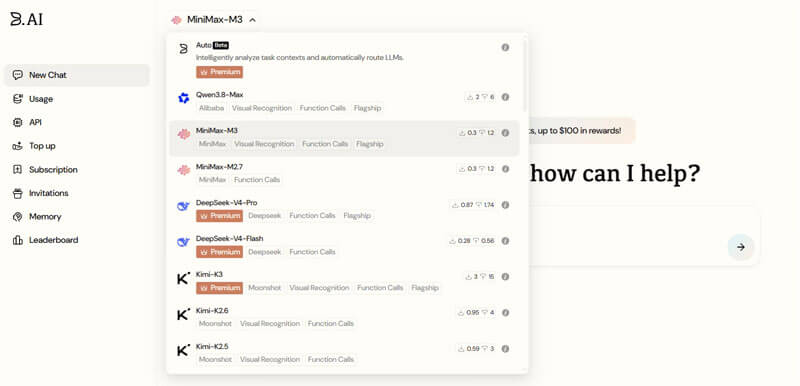
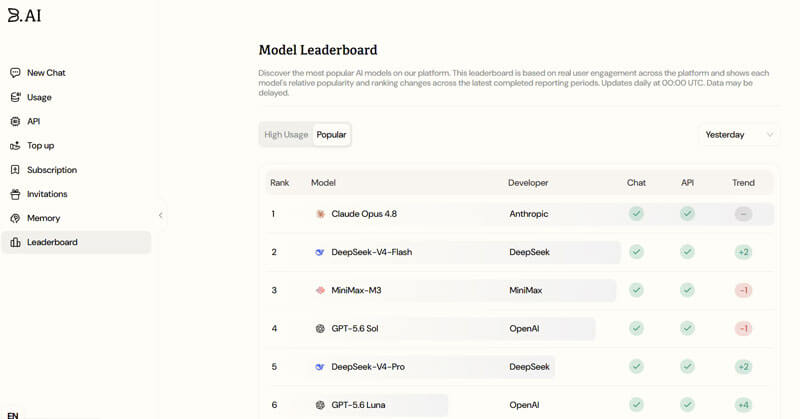
To solve the complexity of model selection, B.AI introduced Auto Smart Routing, which automatically pairs user tasks with the optimal model based on task type, complexity, and cost. This drastically lowers the barrier to leveraging multi-model AI. Additionally, a dedicated Leaderboard tracks real-time usage volume and user ratings, enabling new users to quickly identify top-performing models tailored to their needs.
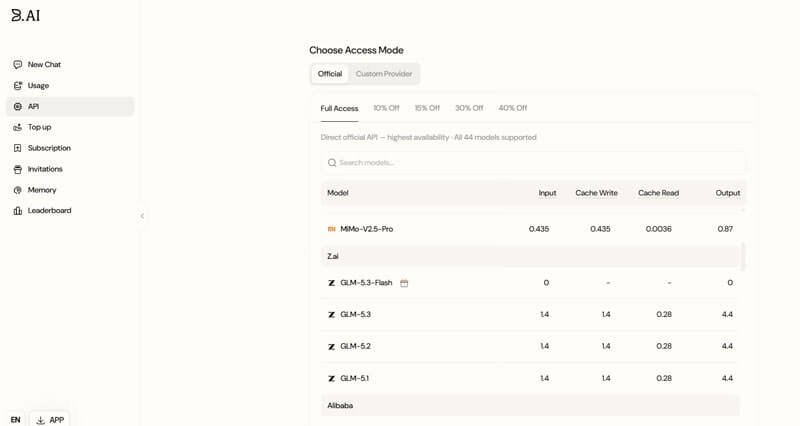
For API integrations, B.AI launched a unified API key interface that enables developers to access every model on the platform with a single key. To accommodate varying user scales, budgets, and operational needs, B.AI API offers dual operating modes:
- Official Mode: Connects directly to native provider APIs and offers discounted resource pools with 10% to 40% off across models like GLM-5.2, Grok, Gemini, and GPT, with model coverage expanding continuously.
- Custom Provider Mode: Allows users to select model providers based on specific business needs and unlock flexible tiered pricing. Featuring discounts up to 90% off across mainstream models like Claude, GPT, Gemini, Kimi, and GLM, this mode regularly adds new providers and pricing tiers to offer developers even more diverse choices for API integration.
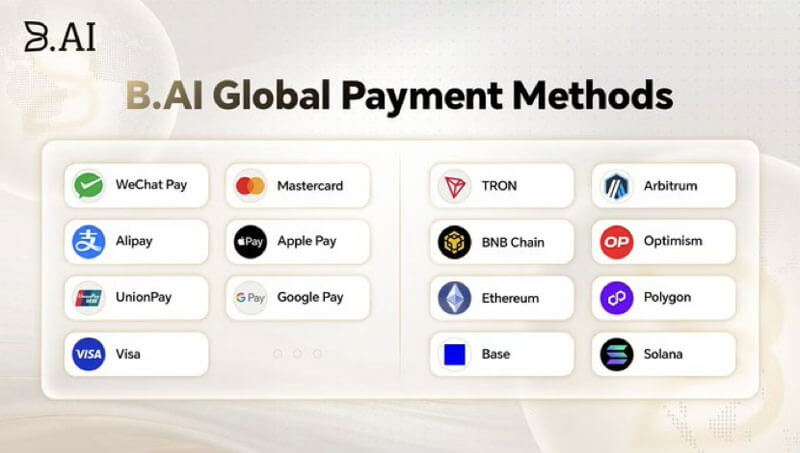
For authentication and payments, B.AI supports dual Web2 and Web3 rails, ensuring frictionless onboarding for users across all ecosystems. On the login side, the platform supports one-click Web2 sign-in via Google accounts alongside multi-chain Web3 wallet access across TRON, Ethereum, BNB Chain, Optimism, Arbitrum, and non-EVM networks like Solana. On the payment side, B.AI bridges traditional fiat and crypto ecosystems: Web2 users can pay via Visa, WeChat Pay, Alipay, and UnionPay, while Web3 users can connect through dozens of major global wallets including TronLink, Binance Wallet, OKX Wallet, MetaMask, and Trust Wallet. By pairing full wallet compatibility with unified fiat-crypto payments, this hybrid approach delivers a smooth interaction and payment experience worldwide.
 To expand its ecosystem, B.AI has partnered with dozens of tech and Web3 leaders, including cloud giants Alibaba Cloud and Tencent Cloud, AI unicorn MiniMax, and Web3 innovators like Biconomy, MoonPay, Pundi X Labs, KuCoin Web3 Wallet, Symbiosis, CROSS, and deBridge.
To boost adoption, B.AI launched a limited-time free-access campaign on August 17, offering zero-threshold, unlimited access to six top LLMs: GLM-5.3-Flash (Ox Alpha), Qwen3.8-Flash, DeepSeek-V4-Flash, DeepSeek-V4-Flash-Vision-Exp, Tencent Hy3, and Xiaomi MiMo-V2.5.
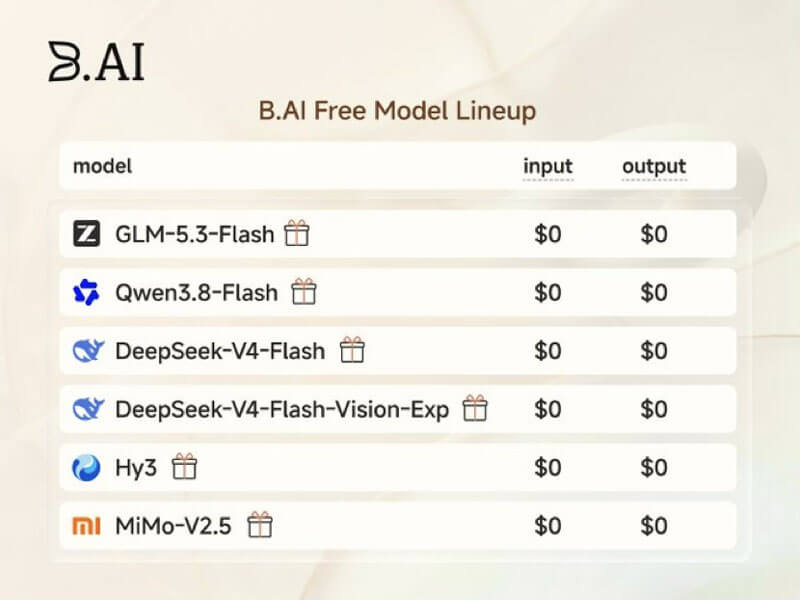
Official data shows this promotion drove explosive usage growth. On August 31, B.AI‘s daily token throughput topped 1.1 trillion, marking a new milestone in 1T+ compute scale. In the campaign's first 14 days, cumulative throughput reached 6.86 trillion, bringing in over 196,000 new API users.
Bank of AI: One-Click On-Chain Financial Infrastructure for AI Agents
Unveiled in February, Bank of AI serves as a financial protocol hub connecting AI and Web3. By equipping AI agents with autonomous execution capabilities, it transforms them from passive chatbots into active, decision-making economic actors.
Designed as an all-in-one toolkit, Bank of AI provides standardized, out-of-the-box financial modules. It integrates foundational standards like the x402 payment protocol and 8004 identity protocol, alongside developer tools such as the MCP Server, Skills plugin framework, and OpenClaw Extension. With simple code snippets or plain natural language prompts, developers and no-code users can equip any AI agent with automated payments, identity verification, and DeFi operations—no smart contract expertise required.
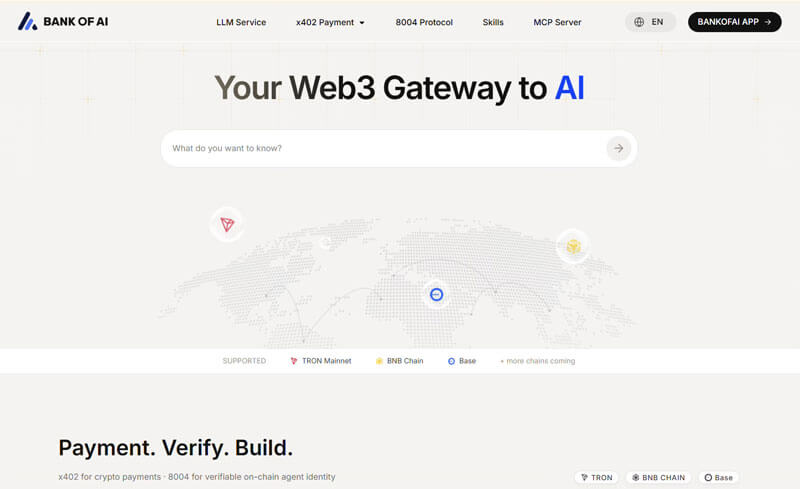
Currently, Bank of AI‘s MCP Server and Skills framework support TRON, Ethereum, and BNB Chain. Connected agents can fetch real-time data and interface seamlessly with top DeFi protocols—including SUN.io, JustLend DAO, Uniswap, and PancakeSwap—to autonomously handle swaps, lending, yield farming, and cross-chain arbitrage. This grants AI agents true asset management autonomy, laying an extensible financial execution layer for the Web3 AI economy.
AINFT: Trading Hub & Standardized Trust Layer for AI Agents
AINFT plans to provide standardized infrastructure and serve as a financial trading hub for AI agents. For developers, AINFT will launch a dedicated trading benchmark platform to turn investment concepts into audited, quantitative backtesting results, establishing clear performance standards and validation frameworks for AI agent trading strategies.
Specifically, developers can evaluate strategies with zero financial risk using simulated real-market data for core assets like BTC and ETH. The platform provides objective quantitative assessments across key metrics—including returns, risk control (loss limits and maximum drawdown), operational stability, alpha generation, and end-to-end decision logic. This allows top-tier strategies to stand out through market competition, building an industry-recognized capability rating and trust credential system for AI agents.
While AINFT has not officially launched, a preview version is currently live on its website. For further product updates, please follow @AINFT on X.
BTTInferGrid: Decentralized AI Compute Network Reshaping the Economy
Launched by BitTorrent in June, BTTInferGrid is a flagship DePIN decentralized compute network designed for AI inference. Serving as the compute foundation for TRON's AI ecosystem, it connects global idle GPU resources with AI developers to build an open, accessible next-generation compute infrastructure.
Powered by cryptoeconomic incentives and distributed consensus, BTTInferGrid aggregates fragmented, underutilized GPU capacity into a standardized, schedulable resource pool that precisely matches developer inference demands. This approach reshapes the production, distribution, and value flow of compute power, dismantling traditional centralized monopolies.
Currently, BTTInferGrid supports key open-source models—including Qwen3.6 27B, Qwen2.5 7B Instruct, and Meta Llama 3.1 8B Instruct—which developers can access with one click via B.AI. The platform will soon release standardized APIs for flexible, on-demand compute scheduling, further shortening AI application development cycles.
Longer term, BTTInferGrid aims to become a fully AI-native infrastructure. By 2028 and beyond, it plans to deliver an integrated network combining compute, storage, and smart contracts to power AI agents and automated applications, establishing itself as the go-to decentralized compute network for global open-source AI.
TRON's DeFi + AI Engine: Building Resilience Across Market Cycles
Amid an industry-wide downturn, TRON achieved counter-cyclical growth by solidifying its DeFi foundation while expanding into AI. Its DeFi sector maintains market leadership, while a rapidly maturing AI ecosystem unlocks new growth vectors. Together, these complementary drivers power TRON's long-term competitiveness, setting a proven blueprint for Web3 growth.
TRON has established a mature DeFi ecosystem spanning trading, asset management, and infrastructure. SUN.io provides a full suite of trading services, including SunSwap (DEX), SunPump (meme launchpad), and SUNX (perpetuals). The JUST ecosystem delivers integrated asset solutions via JustLend DAO—covering SBM lending, sTRX liquid staking, and energy rental—alongside the GasFree smart wallet and USDD stablecoin. Supporting the entire network, WINkLink oracle and BitTorrent offer essential data and file transfer capabilities.
Backed by real protocol revenue, ongoing product iteration, and token deflation, this robust DeFi base provides both the revenue and user foundation needed to power TRON's expansion into AI.
In AI, TRON has secured a strong first-mover advantage through rapid product rollouts and practical execution, establishing a full-stack, closed-loop ecosystem. Built around four core products—B.AI, Bank of AI, AINFT, and BTTInferGrid—TRON has structured a three-tiered architecture spanning top-layer model entry, middle-layer agent infrastructure, and bottom-layer compute. Rather than standalone tools, these components operate as a cohesive system: B.AI serves as the portal for user traffic and model services; Bank of AI and AINFT empower AI agents with financial capabilities; and BTTInferGrid provides distributed compute. Working in synergy, these products drive TRON's competitiveness in Web3 AI and lay the groundwork for deep AI-blockchain integration.
At Malaysia Blockchain Week 2026, TRON Founder Justin Sun highlighted TRON as a cornerstone for converging AI and finance. He noted that DeFi, TradFi, and AI are accelerating convergence across shared assets, payment rails, and user bases. In a future financial landscape shaped by institutions, open blockchains, and AI, TRON's infrastructure will play a central role.
Just as TRON's 2019 vision established its global stablecoin leadership and its 2020 push built its DeFi foundation, its systematic deployment of AI now serves as the growth engine for its next era, driving the ecosystem into new technological frontiers.
TRON Eco Team
Singapore
media@just.network
Disclaimer: This was a sponsored post brought to you by TRON.
The post TRON H1 2026 Strategy Report: Dual-Engine Growth via DeFi and AI Delivers Record Traction appeared first on CryptoSlate.
Michael Saylor has roughly one week to orchestrate STRC’s return to its $100 par value by his informal Sept. 8 target, but the financial machinery required to close the final gap is running hot.
Despite deploying $635.2 million on aggressive buybacks, Strategy’s preferred security continues to hover around $97. The company has simultaneously restarted its Bitcoin accumulation after a two-month freeze, signaling confidence that its balance sheet can absorb both demands.
Yet, the path to par has morphed into a highly capital-intensive grind just as a wave of competing Bitcoin-linked yield products hits the market.
The coming days will test more than Saylor’s 70-trading-day timeline, a target calculated from STRC's latest recovery starting May 28. It will reveal how much more capital the firm is willing to deploy before relying on organic institutional demand to anchor the security.
The final $3 is costing Strategy more
The economics of the buyback campaign have deteriorated steadily as STRC climbs toward par, upending the company's initial strategy.
When Strategy began repurchasing STRC in July, management outlined a clear tapering framework: deploy more capital at deeper discounts to capture attractive economics, then scale back as the security approached $100, where independent investor demand would theoretically take the reins.
Instead, weekly spending has accelerated as the discount narrowed.
| Repurchase Period | Capital Deployed | Average Price | Discount to $100 Par |
|---|---|---|---|
| July 20–26 | $25.0 million | $86.52 | 13.48% |
| July 27–Aug. 2 | $81.2 million | $89.02 | 10.98% |
| Aug. 3–9 | $108.6 million | $94.27 | 5.73% |
| Aug. 10–16 | $132.2 million | $95.20 | 4.80% |
| Aug. 17–23 | $136.4 million | $95.30 | 4.70% |
| Aug. 24–30 | $151.8 million | $97.48 | 2.52% |
| Total | $635.2 million | — | — |
Buying below par still carries a basic economic rationale. Every share retired for less than $100 eliminates $100 of stated value, along with its annualized 12% dividend obligation. However, the rapidly shrinking spread alters the campaign's trade-off.
The firm now has just $364.8 million remaining under its $1 billion authorization. At the recent pace of spending, that runway could narrow quickly, leaving Strategy to decide how much more capital it is prepared to commit to support the final move to par.
MSTR and Bitcoin are carrying the STRC repair
Strategy has leaned heavily on its two largest sources of financial firepower, MSTR common stock and its Bitcoin holdings, to finance the STRC repair effort.
Between late June and early August, the firm sold a net 6,916 Bitcoin across four disclosed transactions to fund preferred-stock obligations and, in later transactions, STRC repurchases.
Last week, Strategy pivoted back toward common-equity issuance, selling 4.53 million MSTR shares for $602.8 million in net proceeds. Of that amount, $151.8 million funded the latest STRC repurchase while another $50.7 million covered STRC dividends.
The company also deployed $369.7 million to acquire 4,603 Bitcoin, its first purchase in roughly two months, pushing its total stockpile to 845,050 BTC. Another $30 million went into its flexible cash pool.
To fortify the structure surrounding its preferred securities, Strategy has ring-fenced a $5.1 billion USD Reserve earmarked for preferred dividends and debt interest, backed by a separate roughly $1.6 billion pool of flexible USD Cash.
It has also maintained STRC's annualized dividend at 12% and instituted a policy barring new STRC issuance below $100.
Those moves temporarily invert the security's intended design.
STRC was engineered to raise capital from investors that Strategy could deploy across its balance sheet, including toward Bitcoin purchases. Instead, the company spent much of the summer using proceeds from MSTR issuance and, at times, Bitcoin sales to service and repurchase STRC.
The return to Bitcoin buying suggests Strategy believes the rebuilt mechanics around the preferred are now strong enough to support both sides of the strategy simultaneously.
STRC’s real test begins at $100
The ultimate gauge of success arrives when Strategy reduces its own purchases and asks outside investors to carry STRC around $100.
Traditional finance has already demonstrated substantial appetite for the security. The initial July 2025 offering was originally slated for 5 million shares, or $500 million at stated value. Strong demand allowed the firm to increase the deal to more than 28 million shares and raise $2.52 billion.
By July 2026, Saylor said Digital Credit was entering the institutional mainstream, pointing to $756 million of STRC held across three major US preferred-stock ETFs: BlackRock’s PFF, Virtus InfraCap’s PFFA and VanEck’s PFXF. STRC was the largest individual holding in all three at the time.
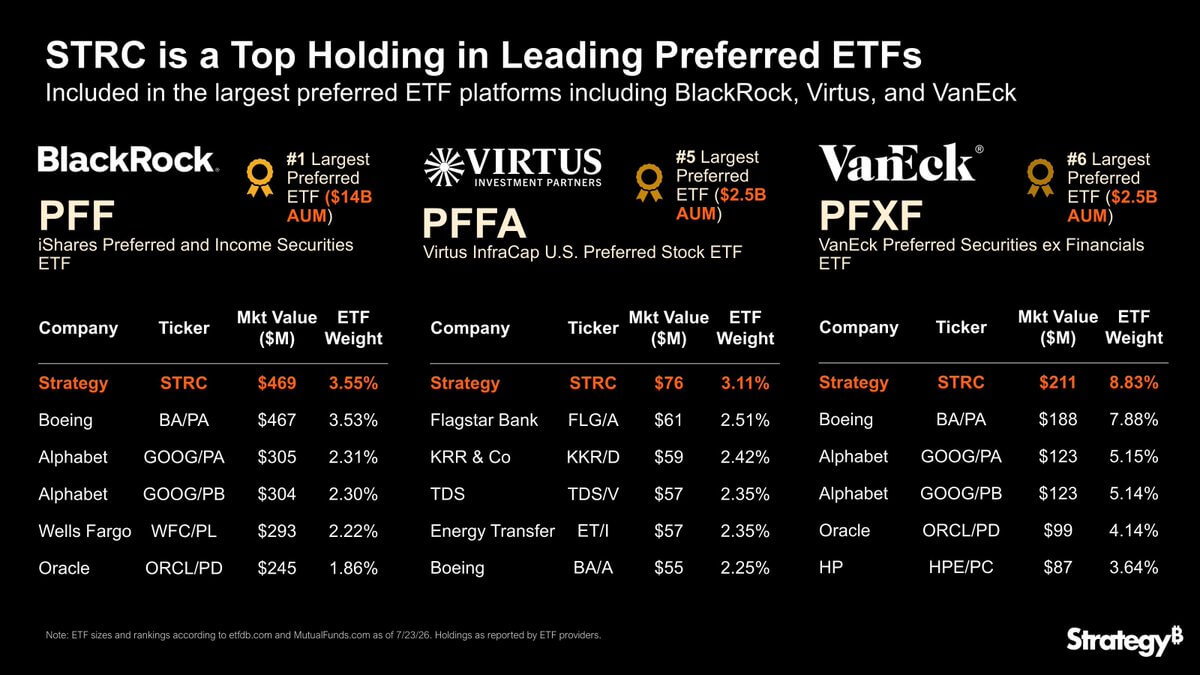
However, as STRC approaches $100, the market it is returning to is becoming more crowded.
Strive has expanded its SATA preferred stock, which carries a 13% annual dividend rate, pays distributions every business day, and follows a similar policy against issuing below $100.
Metaplanet is also building a broader Bitcoin-credit distribution platform. The Japanese Bitcoin treasury company acquired licensed securities platform Siiibo Securities to develop and distribute Bitcoin-linked yield products, while separately expanding its US presence through Super League Enterprise.
Those developments give investors seeking Bitcoin-linked income a growing menu of securities with different yields, payment schedules, and capital structures.
STRC enters that competition with an important advantage: scale and demonstrated institutional adoption. But reaching $100 will test whether that established investor base remains strong enough to replace Strategy's own purchases and eventually absorb fresh issuance at par.
If outside demand does so as Strategy reduces buybacks, STRC can return to its intended role as a funding source for Bitcoin purchases.
However, if demand weakens as issuer support fades and competing products attract capital, reaching $100 may prove easier than sustaining it.
The post Strategy keeps STRC at 12% as Saylor has seven days to salvage the $10 billion Bitcoin yield product as costs spiral appeared first on CryptoSlate.
Bitcoin fell below $77,000 as softer US labor data failed to dislodge expectations for another Federal Reserve rate increase.
Data from CryptoSlate shows the largest cryptocurrency traded around $76,985 as of press time after July job openings held at 7.3 million and hiring remained subdued.
The release landed into a market already confronting $90 oil, rising Treasury yields and a Fed that has shifted sharply from discussing rate cuts to considering another hike.
Data from CME FedWatch showed the probability of a September rate increase at 66%, up from about 60% following Fed Chair Kevin Warsh’s Aug. 28 Jackson Hole speech.
JOLTS did not make markets more hawkish. Instead, the report failed to overturn an inflation-driven repricing already reinforced by higher energy prices and Treasury yields.
The Bureau of Labor Statistics reported 5.1 million hires and 3.1 million quits in July, with both measures little changed from the previous month. June openings were revised down by 177,000 to 7.2 million, while earlier estimates for hires and quits were also lowered.
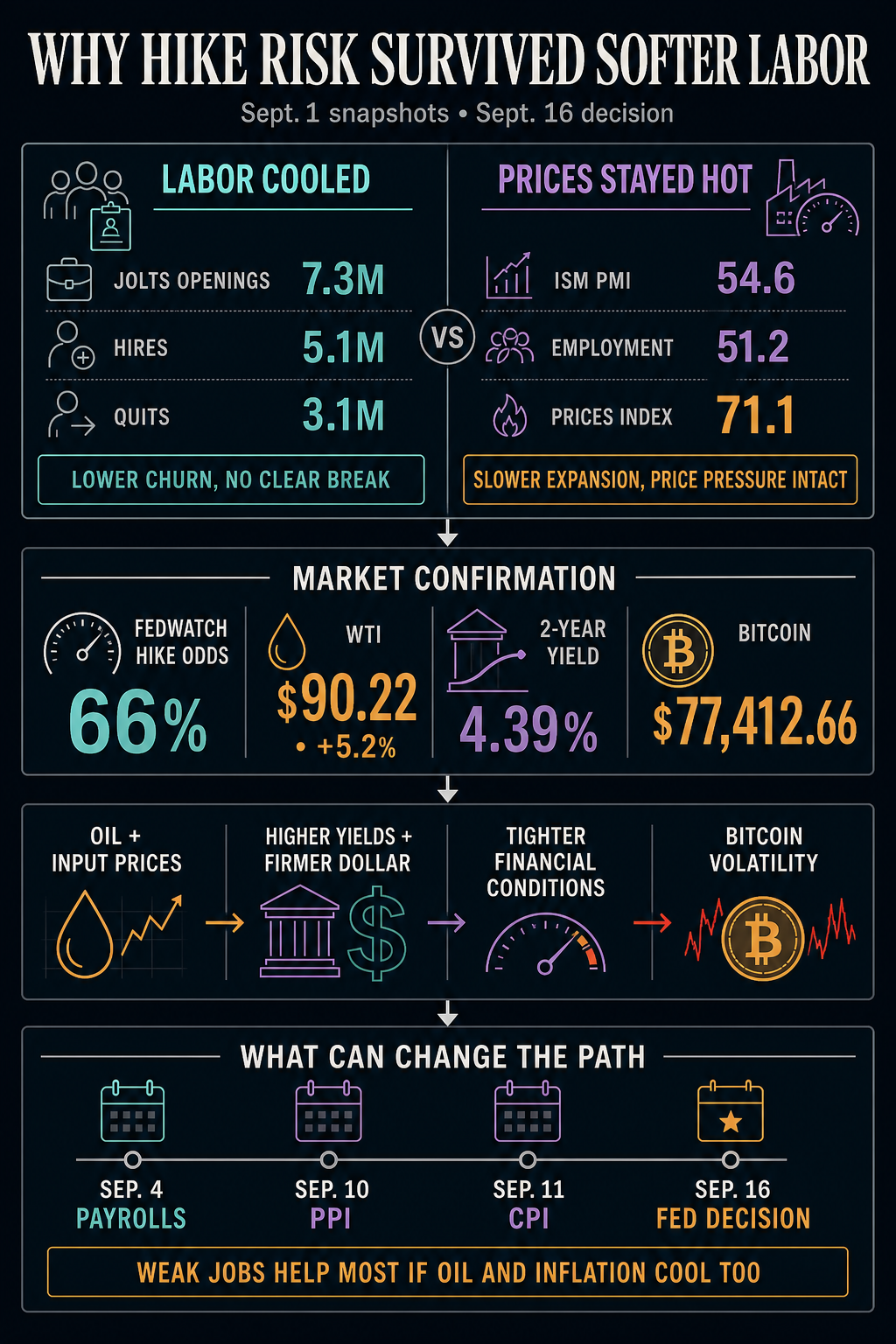
The softer turnover arrived less than three weeks before the Fed’s Sept. 15-16 meeting, giving policymakers further evidence that the labor market is cooling without showing the type of contraction that would settle the policy debate.
Warsh had already drawn that distinction at Jackson Hole. He said employment remained consistent with full employment and argued that unusually low turnover partly reflected the wave of worker and employer rematching that followed the pandemic.
His concern instead remained inflation.
$90 oil keeps the hike trade alive
The inflation side of the debate strengthened elsewhere in Tuesday’s data.
The ISM manufacturing index eased to 54.6 in August from 55.6, while new orders fell to 53.7 from 56.7 and employment declined to 51.2 from 52.8.
But prices barely moved.
ISM’s Prices Index held at 71.1 for a second month, while respondents cited fuel and oil-based products among commodities becoming more expensive.
Crude then amplified the pressure. West Texas Intermediate surged 5.2% to settle at $90.22, while Brent gained 4.6% to $94.65 as the Iran crisis continued to unsettle energy markets.
Treasury yields moved higher alongside oil. The two-year yield rose to 4.39% from 4.34%, while the benchmark 10-year climbed to 4.79% from 4.75%.
The combination helps explain why weaker labor turnover failed to knock down September hike expectations. The Fed entered 2026 expecting several rate cuts, but markets are now assigning a better-than-even probability to another increase.
That reversal leaves Bitcoin facing a considerably less forgiving backdrop than investors anticipated earlier in the year.
Higher Treasury yields increase the return available on dollar assets and raise the hurdle for holding assets without contractual yield. A stronger dollar can also tighten financial conditions across speculative markets.
The latest ETF flows suggest some of that pressure is reaching crypto portfolios.
US spot Bitcoin ETFs recorded $236.46 million of net outflows on Sept. 1, reversing $216.7 million of inflows on Aug. 31. The one-day swing removed a source of institutional support just as Bitcoin slipped back below $77,000.
The reversal followed a volatile stretch for the asset. Bitcoin traded above $81,000 before Warsh’s Jackson Hole remarks pushed rate expectations higher and sent the cryptocurrency below $77,000. Its subsequent rebound has struggled to regain momentum as the September policy outlook hardened.
The Fed’s oil problem cuts both ways
The crude rally complicates the outlook because the same shock strengthening the inflation case can also weaken the economy.
James E. Thorne, chief market strategist at Wellington Altus, argued that raising rates in response to an externally driven energy shock could compound the economic damage.
Higher crude prices raise transport and production costs, reduce household purchasing power, and squeeze corporate margins. Consumers spending more on fuel have less available for other purchases, while companies facing higher input costs can respond by cutting investment or hiring.
The Fed can weaken domestic demand through higher borrowing costs, Thorne said, but it cannot increase oil supply or resolve the geopolitical conditions pushing crude higher.
That distinction becomes more important if the labor market deteriorates further.
July JOLTS has already shown weaker turnover, while the latest ISM employment reading cooled. Neither has yet produced the kind of break that would clearly override Warsh’s inflation concerns.
The next employment report could change that balance.
August payroll data arrives Sept. 4, followed by producer prices on Sept. 10 and consumer prices on Sept. 11. The Fed announces its decision Sept. 16.
A materially weak payroll report would challenge the view that employment remains consistent with full employment. If oil also retreats and subsequent inflation data soften, markets would have a clearer reason to unwind September hike expectations and push yields lower.
Weak employment alongside crude near current levels would create a harder problem. Labor conditions would be deteriorating while an external supply shock kept inflation pressure elevated.
Firm hiring alongside persistent price pressure would reinforce the current setup and could push short-term yields higher again.
Bitcoin enters that sequence back near the level reached during the initial post-Jackson Hole selloff, and without the ETF support it carried into the week.
The post Bitcoin hits $77,000 wall as the Fed gets trapped between weak jobs and $90 oil appeared first on CryptoSlate.
Injective, a layer-1 blockchain network, produced no new block for nearly four hours during an emergency response to an exploit that researchers traced into core modules.
On Sept.1, the foundation said the blockchain was “upgraded, not halted” and that its consensus, native INJ, and staked assets were never compromised. It described the attack as affecting a small number of ecosystem applications using binary-options markets.
On-chain researcher Earthling Paddy challenged both characterizations, while crediting Injective for containing the exploit and keeping staked funds safe.
The ledger shows block 181027005 at 16:09:59 UTC on Aug. 31 before block production stopped for roughly four hours. Paddy said one earlier block alone took about 37 minutes, while infrastructure provider QuickNode also reported a stalled block height during the incident.
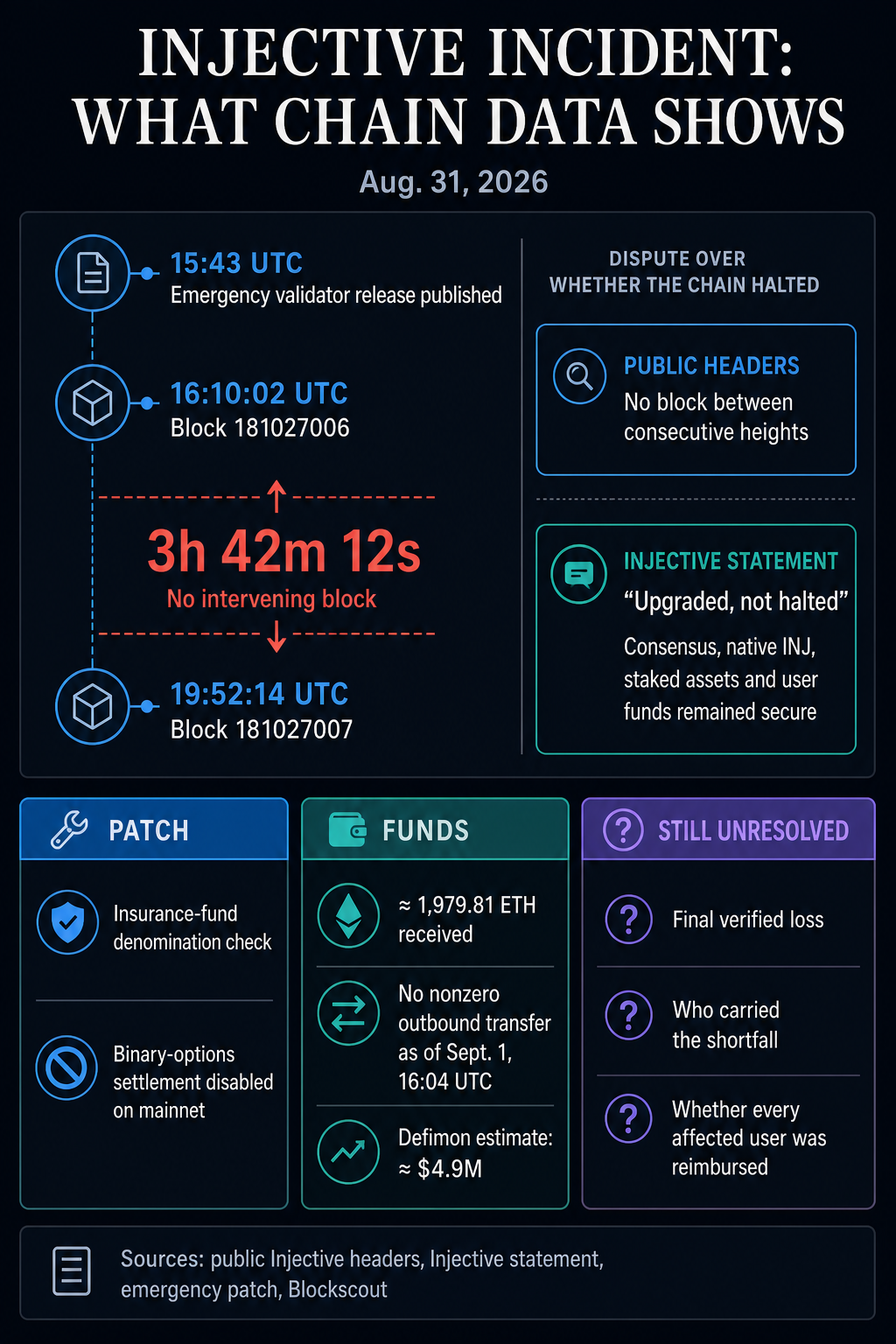
Injective said the accelerated upgrade took longer than expected as validators and ecosystem infrastructure moved to the emergency release. Some validators were temporarily jailed after missing the required upgrade window, while exchanges including Coinbase and Coins.ph temporarily restricted transfers.
Data from CryptoSlate shows INJ trading around $4.80 as of press time, down roughly 3% over the previous 24 hours.
Researcher disputes where the vulnerability sat
Paddy also questioned Injective’s description of the exploit as isolated to ecosystem applications.
He said the attack used messages from Injective’s native exchange and insurance modules, while the emergency v1.20.3-safeharbor.1 release patched the chain’s core code by adding an insurance-fund denomination check and disabling binary-options settlement on mainnet.
That would place the vulnerable logic inside a protocol module used by applications rather than solely within application code.
Injective has not yet published a full technical postmortem. Its statement said the relevant attack vector had been contained and patched and that the foundation was adding stronger invariants, real-time monitoring, and other safeguards.
Researchers estimate about $4.9 million was bridged to Ethereum during the exploit. Paddy said roughly that amount remained in the attacker-linked wallet and had not moved.
The final loss allocation remains unclear. Injective has not disclosed how much was ultimately drained, which party absorbed any shortfall, or whether an ecosystem pool that now appears replenished was restored by the foundation, developers, or another participant.
Instead, the blockchain has maintained that its users weren't affected. In an X post, Injective CEO Eric Chen said:
“Injective users aren’t affected and we’ve been helping the team on recovery. Always sad to see exploits happening in the ecosystem but we’re glad that the incident was contained before further harm was done.”
Nonetheless, the incident therefore leaves two separate findings intact. Injective’s consensus and staked INJ were not compromised, while its emergency response still coincided with a multi-hour interruption in block production and required a core-code patch.
The post A layer-1 blockchain froze for 4 hours to stop a $4.9 million hack, then claimed it was just an upgrade appeared first on CryptoSlate.
HTTP error 429 on https://cryptoticker.io/en/feed/
Failed to fetch feed: https://cryptoticker.io/en/feed/
Failed to fetch feed.
Decrypt
Marc Andreessen, Ben Horowitz and OpenAI's Greg Brockman have backed the super PAC behind the campaign, which faces surging opposition.
So far, Rektember is living up to its name as Bitcoin slips. Will this September follow the historical averages, or break the trend?
CrowdStrike and the DOJ isolated more than 15,000 infected machines in a malware takedown spanning four countries.
New Form TA-2 questions would make agents report how many share registers they keep on distributed ledgers.
The North Carolina Republican bought less than $1,000 of contracts on her own race and drew a three-year ban.
U.Today - IT, AI and Fintech Daily News for You Today
Here are the top stories on U.Today that defined crypto markets.
Key crypto updates for Sep. 2: a $369 million long squeeze hits 90,000 XRP, ETH, and SOL traders while the SEC bypasses Congress to integrate blockchain into TradFi.
3.59 million SHIB burned at the start of September, a month deemed historically poor for risk assets.
Dogecoin is certainly not finding a recovery ground as quickly as we anticipated.
A Shiba Inu mega whale has moved another 600 billion SHIB worth roughly $3.09 million.
Blockonomi
Key Highlights
- Dell Technologies (DELL) shares surged 10% following adjusted earnings per share of $7.04, significantly exceeding the $4.91 consensus forecast
- Total revenue reached $46.97 billion, surpassing Wall Street’s $44.92 billion projection with year-over-year growth approaching 60%
- Forward guidance for Q3 projects $49 billion in revenue and $6.50 earnings per share, substantially above analyst expectations
- The company secured $60.9 billion in new AI server contracts during the quarter, bringing cumulative backlog to $95 billion
- Analyst firms including JPMorgan and Citi elevated price targets to $635 and $600 respectively, maintaining positive ratings
Shares of Dell Technologies (DELL) experienced a dramatic 10% surge during Wednesday’s opening bell following the company’s exceptional quarterly performance powered by explosive artificial intelligence server demand.
Dell Technologies Inc., DELL
The technology giant reported adjusted earnings of $7.04 per share, representing more than a threefold increase compared to the same period last year and comfortably beating the analyst consensus of $4.91. Total quarterly revenue climbed to $46.97 billion, marking a nearly 60% year-over-year expansion and topping the Street’s $44.92 billion forecast.
The company’s stock performance has been remarkable throughout the year, more than tripling in value since January and posting gains of nearly 240% year-to-date prior to Wednesday’s trading session.
Artificial Intelligence Infrastructure Fuels Exceptional Results
The primary catalyst behind Dell’s outstanding performance was its AI server division. During the quarter, the company secured an impressive $60.9 billion in new AI server commitments, elevating its overall order backlog to an unprecedented $95 billion. Such figures effectively silence skeptics questioning the sustainability of AI infrastructure investment.
JPMorgan’s Joseph Cardoso upgraded his price objective on DELL shares from $565 to $635 while maintaining his Buy recommendation. He characterized the results as “another robust quarter” and noted that “the AI momentum spoke for itself.” Cardoso additionally highlighted a sustainable IT infrastructure modernization cycle coupled with surprisingly resilient PC market demand.
Management’s third-quarter outlook projects revenue of $49 billion alongside adjusted earnings of $6.50 per share. This guidance significantly exceeded Wall Street’s estimates of $41.42 billion in sales and $4.49 in earnings. The company also raised its full-year revenue forecast to $192 billion from a previous $167 billion, while boosting adjusted EPS guidance to $25.50 from $17.90.
Wall Street Firms Elevate Price Objectives Following Strong Performance
Citi analyst Asiya Merchant increased her price target to $600 from $515 while reaffirming a Buy rating. She described the quarterly results as a “clear beat” and expressed confidence that accelerating enterprise artificial intelligence deployment will support Dell’s continued strong performance.
TD Cowen’s Krish Sankar boosted his target to $500 from $450 while maintaining a Hold rating. He labeled the performance another “stunning beat and raise” and projected AI server revenue could reach $74 billion in fiscal year 2027. Sankar also observed strengthening demand for conventional server upgrades and emerging interest in agentic AI processors.
Morgan Stanley raised its price objective to $499 from $434 but expressed some caution regarding demand sustainability given Dell’s recent pricing adjustments.
Currently, Dell maintains a Moderate Buy rating from Wall Street’s analyst community, with 20 professionals issuing 13 Buy recommendations and seven Hold ratings over the past three months. The consensus 12-month price target stands at $581.78, suggesting approximately 28% appreciation potential from present trading levels.
The company’s cumulative order backlog now totals $95 billion, with the most recent quarter alone contributing $60.9 billion in AI server bookings.
The post Dell Technologies (DELL) Stock Soars 10% on Record AI Server Demand and Earnings Beat appeared first on Blockonomi.
Quick Summary
- Bernstein assigns SpaceX an Outperform rating with a $248 target, representing a potential 74% gain from present trading levels.
- Analysts project SpaceX’s AI-related revenues will explode from $24.6 billion in 2026 to $115.1 billion by 2027.
- The company’s entry into power turbine blade production triggered notable declines across energy equipment manufacturers this week.
- Industry analysts downplayed competitive concerns, noting it would take more than four years for new competitors to scale operations.
- Howmet Aerospace received positive attention from Citi’s catalyst watch and Deutsche Bank’s top supplier designation.
Shares of SpaceX closed at $141.04 on Wednesday, slipping 0.8% despite positive momentum across broader indices. The S&P 500 gained 0.55% while the Dow advanced 0.77% during the same session.
Space Exploration Technologies Corp., SPCX
The week has been eventful for Elon Musk’s space venture. SpaceX shares have climbed approximately 25% during the past month, with continuous catalysts emerging across multiple business segments.
Douglas Harned, an analyst at Bernstein, maintains an Outperform stance on SpaceX shares with a $248 valuation target. This projection suggests approximately 74% appreciation potential from today’s price levels. Harned anticipates SpaceX’s artificial intelligence segment will expand dramatically from $24.6 billion in 2026 to $115.1 billion the following year, positioning AI as the dominant revenue contributor.
According to Bernstein’s projections, overall company revenue should reach $46.4 billion in 2026, then surge to $150.4 billion in 2027. Artificial intelligence initiatives account for the bulk of this anticipated expansion.
The investment thesis extends well beyond launch services. Bernstein highlights space-based data centers as a significant long-term opportunity. SpaceX is developing Starbase Louisiana across 125,000 acres, with groundbreaking scheduled for 2027 and initial Starship operations from the location planned for 2029. The complex is designed to accommodate at least 10 launch platforms and ultimately support over 30 Starship missions daily.
The company also recently finalized its Cursor acquisition, integrating advanced coding capabilities into the Grok AI ecosystem. Bernstein believes this positions SpaceX to monetize AI software services beyond raw computational infrastructure.
Starlink and Terafab Fuel Expansion Plans
Bernstein projects Starlink connectivity revenues of $17.0 billion in 2026, climbing to $27.7 billion in 2027, and ultimately reaching $205.9 billion by 2031. The aviation sector continues expanding, with 46 carriers now participating. Qatar Airways broadened its implementation in August, while Royal Air Maroc recently became the latest airline partner.
SpaceX’s forthcoming Terafab semiconductor manufacturing facility in Texas represents another strategic initiative. The project’s initial construction phase alone demands approximately $16.8 billion in capital investment.
The Street’s average price objective for SpaceX stands at $231.63, suggesting 64% upside potential. Consensus sentiment leans Moderate Buy, derived from 25 Buy recommendations, five Hold ratings, and three Sell opinions since the company went public.
Energy Equipment Stocks React to SpaceX News
SpaceX’s announcement regarding turbine blade production capabilities created turbulence throughout the power generation equipment industry. Howmet Aerospace declined roughly 4% through Wednesday’s trading week. GE Vernova and Siemens Energy fell approximately 3% and 6%, respectively. Caterpillar and Cummins also experienced downward pressure.
Analysts countered the market’s negative reaction. Citi designated Howmet for upside catalyst monitoring, characterizing the decline as excessive. Deutsche Bank elevated Howmet to its premier aerospace supplier selection with 35% appreciation potential. Jefferies emphasized that any new competitor would require four years minimum to establish meaningful single-crystal casting production capacity.
22V Research suggested SpaceX’s probable near-term strategy involves manufacturing replacement components for its proprietary power generation fleet rather than directly challenging established foundries. SpaceX acquired APR Energy earlier this year, a company that operates mobile power equipment utilizing turbines from manufacturers including GE Vernova.
Howmet shares remained under pressure on Wednesday, declining 1.2% despite supportive analyst commentary.
The post SpaceX (SPCX) Stock: Bernstein Sets $248 Target Amid Explosive AI Growth Projections appeared first on Blockonomi.
Key Takeaways
- Tesla shares declined 1.5% during early Wednesday trading, reaching $350.80 before Thursday’s highly anticipated Cybercab unveiling in Austin, Texas
- The upcoming event will showcase Tesla’s steering wheel-free Cybercab, designed specifically for autonomous taxi operations
- Since launching its robotaxi program with Model Y vehicles in Austin during June 2025, Tesla’s expansion has progressed slowly
- Morgan Stanley analysts kept their “Equal Weight” stance with a $400 price projection, cautioning that a basic product reveal may not drive significant stock momentum
- Year-to-date, TSLA has fallen approximately 20%, trading roughly 30% beneath its peak levels from late 2025
Shares of Tesla (TSLA) retreated 1.5% during Wednesday’s pre-market session, settling at $350.80 as market participants prepared for the automaker’s Cybercab event set to take place Thursday in Austin, Texas.
Tesla, Inc., TSLA
The broader market painted a different picture during this timeframe, with the S&P 500 and Dow Jones advancing 0.2% and 0.4% respectively, highlighting Tesla’s underperformance.
Recent trading sessions have shown considerable volatility for the electric vehicle manufacturer. Following Monday’s impressive 5.5% surge, shares reversed course Tuesday with a 3.2% decline. These price movements appear closely connected to robotaxi developments and mounting speculation surrounding Thursday’s presentation.
The Cybercab represents Tesla’s dedicated autonomous taxi platform. Distinguished by its absence of traditional steering controls and reliance solely on camera-based sensing technology, production of the vehicle commenced earlier this year.
Golden Fleet Alert
Golden Tesla Cybercabs have taken over the city and are flooding Austin
They are constantly validating pick-ups and drop offs ahead of the Cybercab launch event on 09/03
Can’t wait for the most futuristic Robotaxis ever@robotaxi @Tesla… https://t.co/0yy7Whn9uq pic.twitter.com/5bWnPLGVme
—
_Cyber_Owl_
(@RimaSukhadia) September 1, 2026


Thursday’s presentation is anticipated to officially integrate the Cybercab into Tesla’s operational robotaxi network, which presently deploys Model Y vehicles throughout metropolitan areas including Austin, Miami, and Dallas.
The company initiated its robotaxi operations in Austin during June 2025. Following that debut, shares settled near $349. Expansion has proceeded gradually since launch, with the fleet estimated to comprise several hundred vehicles operating across a limited number of markets.
Tesla’s Position Versus Waymo
In contrast, Alphabet’s Waymo division currently maintains thousands of autonomous vehicles operating throughout more than a dozen American cities, employing comprehensive sensor arrays that incorporate lidar systems.
Tesla’s vision-only strategy aims to minimize production expenses. The underlying thesis suggests that economically efficient vehicles will gain competitive advantage once robotaxis primarily compete on fare pricing rather than against traditional human-operated rideshare platforms like Uber.
American motorists collectively travel more than three trillion miles annually. Should robotaxi pricing decrease to approximately 50 cents per mile, industry experts believe a trillion-dollar market opportunity could emerge.
Tesla’s present market capitalization incorporates investor confidence that the company will secure a substantial share of this prospective market.
Analyst Community Maintains Reserved Outlook
Morgan Stanley’s Andrew Percoco observed prior to the event that Tesla’s historical product demonstrations have generated varying investor responses. He indicated that a conventional Cybercab presentation alone would probably not catalyze substantial stock appreciation.
Percoco sustained his “Equal Weight” assessment on TSLA while reaffirming a $400 price objective over the coming twelve months.
Tesla’s promotional campaign for the event has intensified since late August, emphasizing safety protocols and autonomous driving capabilities. However, concrete information regarding Thursday’s agenda has remained scarce.
TSLA shares have depreciated approximately 20% from the beginning of 2026 and currently trade about 30% below the highs achieved in late 2025. The stock experienced a roughly 9% increase throughout August, though market observers largely credited post-earnings momentum rather than Cybercab enthusiasm.
As of Wednesday morning, TSLA was changing hands at $350.80.
The post Tesla (TSLA) Stock Dips Ahead of High-Stakes Cybercab Reveal appeared first on Blockonomi.
Key Takeaways
- Over the past year, RKLB stock has surged 43.7%, significantly outperforming competitors in the aerospace sector.
- ARK Investment Management, led by Cathie Wood, accumulated more than 705,000 shares of RKLB valued at approximately $44 million during two recent trading sessions.
- CEO Peter Beck acknowledges the year-end launch window for Neutron is “narrowing,” positioning it as both a critical opportunity and substantial risk factor.
- Blue Origin secured a $700 million contract from NASA for Mars communications infrastructure, representing a setback for Rocket Lab’s competitive positioning.
- The company’s contract backlog reached an all-time high of $2.36 billion, representing 137% growth year-over-year and ensuring solid revenue visibility.
Shares of Rocket Lab (RKLB) are currently hovering around $62.54, experiencing a 2.2% decline on Tuesday and representing more than a 50% retreat from the peak achieved in May. Nevertheless, ARK Investment Management has maintained an aggressive accumulation strategy, acquiring 705,102 shares during two recent trading sessions totaling approximately $44 million in value.
Rocket Lab USA, Inc., RKLB
The Tuesday session alone saw ARK purchase 504,799 shares distributed across three separate ETFs, representing roughly $31.6 million based on Tuesday’s closing prices.
This accumulation activity occurs against a backdrop of significant selling pressure, with RKLB declining in nine out of the last ten trading sessions, followed by additional weakness in after-hours trading.
Analyst sentiment remains constructive despite recent price target adjustments. Bank of America analyst Ronald Epstein reduced his price target from $115 to $110 on August 31, primarily accounting for anticipated share dilution, while maintaining his Buy recommendation. Even with this adjustment, Tuesday’s closing price suggests potential upside of approximately 76%.
Following the company’s second-quarter earnings release, Cantor Fitzgerald analyst Andres Sheppard raised his price target from $96 to $122, emphasizing Neutron as “the most material catalyst.” Meanwhile, Roth Capital’s Suji Desilva lowered his target from $130 to $110 while preserving his Buy rating, highlighting that the substantial backlog provides “meaningful near-term revenue coverage.”
The Neutron Factor
Rocket Lab’s Neutron launch vehicle represents the focal point of investor debate. The platform is designed to penetrate the medium-lift launch segment, substantially expanding the company’s addressable market beyond Electron’s small-satellite niche.
However, CEO Peter Beck cautioned during the Q2 earnings call that the timeframe for achieving an inaugural launch before year-end is “narrowing.” Critical testing phases must still be completed successfully before flight operations commence. Any additional delays to Neutron’s deployment would postpone the growth trajectory that forms the foundation of bullish analyst price targets.
The orbital launch industry continues facing supply constraints, positioning Rocket Lab favorably if operational execution remains on track. Electron has successfully completed 87 missions to date, while HASTE provides critical support for government programs. The company currently has commitments for over 90 launches spanning Electron, HASTE, and Neutron platforms.
NASA Contract Loss and Backlog Strength
Market sentiment experienced another setback in after-hours trading Tuesday when NASA announced Blue Origin as the recipient of its Mars Telecommunications Network contract. This firm-fixed-price agreement carries a potential value of $700 million, with Blue Origin responsible for deploying a Mars orbiter by late 2028. Rocket Lab had been among the eligible bidders for this opportunity.
Despite this disappointment, the company’s Q2 2026 backlog achieved a record $2.36 billion, representing 137% growth compared to the prior year. Approximately 45.5% of this contracted work is scheduled for revenue recognition within the next twelve months.
Recent strategic acquisitions of Mynaric and Motiv have enhanced Rocket Lab’s capabilities in optical communications and robotics technologies. In August 2026, the company secured a position on the U.S. Space Force’s NITE-STAR IDIQ program, a contracting vehicle with a $981 million ceiling encompassing both space-based and ground systems.
Wall Street’s consensus earnings per share estimate for RKLB in 2026 has increased 44.44% during the past 60 days. The company maintains a total debt to capital ratio of just 0.83%, significantly below the industry benchmark of 61.47%. Its current ratio stands at 5.48, compared to the industry average of 2.06.
RKLB currently commands a valuation of 31.3X forward Price/Sales, representing a substantial premium compared to the industry average of 7.64X.
The post Rocket Lab (RKLB) Stock: Should You Follow Cathie Wood’s $44M Buying Spree? appeared first on Blockonomi.
TLDR:
- Thailand’s SEC will require digital asset firms to verify ownership of self-custodial wallets.
- Operators must transmit sender and beneficiary details with digital asset transfer orders.
- The new Crypto Travel Rule sets a February 27, 2027, compliance deadline for covered firms.
- Thailand’s SEC developed the framework with AMLO to strengthen AML and international regulatory alignment.
Thailand’s Securities and Exchange Commission has issued a new Crypto Travel Rule for digital asset operators nationwide.
The regulation requires firms to verify ownership of self-custodial wallets during transfers. Announced in Bangkok, the rule targets money laundering and technology-related crimes across the digital asset sector. Operators now face stricter due diligence duties before the rule takes full effect in 2027.
New Compliance Duties Under the Crypto Travel Rule
The SEC’s Crypto Travel Rule sets out clear duties for digital asset business operators across Thailand. Operators must first establish internal policies and procedures for managing transfer-related risks.
These systems need to track both the sender and receiver of every transaction. This step forms the foundation for broader monitoring under the new framework.
Beyond internal policy, operators must collect detailed information on customers and their counterparties. This includes conducting due diligence checks before any transfer takes place.
Firms must also verify the standing of counterparty digital asset service providers involved in each transaction. Where an intermediary operator handles part of the transfer route, its qualifications require verification too.
A central feature of the Crypto Travel Rule involves self-hosted wallets. Operators must confirm ownership or control of these wallets before sending or accepting funds.
This applies whenever digital assets move to or from a wallet outside a regulated platform. The requirement closes a gap that previously allowed limited oversight of peer-to-peer transfers.
Ordering operators also carry a transmission duty under the new rule. They must send originator and beneficiary details alongside every transfer order.
This information must reach the counterparty operator receiving the transaction. Operators must retain all transaction records for a minimum of five years for regulatory review.
Timeline and Coordination Behind the Digital Asset Rule
The Crypto Travel Rule will not take effect immediately, giving operators time to adjust. The SEC set February 27, 2027, as the compliance deadline for all covered firms.
This gap allows operators to build systems for information transmission and transaction monitoring. Public hearings on the proposal ran from March through July 2026 before finalization.
The SEC developed the rule alongside the Anti-Money Laundering Office as an interim measure. AMLO is separately preparing its own regulations under the Anti-Money Laundering Act.
A subcommittee on financial data connectivity recommended this coordinated approach between agencies. Most stakeholders who took part in the hearings supported the proposed principles.
SEC Secretary-General Pornanong Budsaratragoon explained the reasoning behind the new framework directly. “The SEC has placed importance on ensuring that digital asset business operators are not misused,” she said.
Budsaratragoon added that the rule strengthens oversight of money laundering and terrorist financing risks. She said the framework reinforces operators’ responsibility for overseeing customer transactions properly.
Budsaratragoon also linked the rule to international standards set by the Financial Action Task Force. She said the measures would enhance “confidence in Thailand’s digital asset ecosystem” over time.
The SEC expects the framework to support stronger connectivity with international digital asset markets. Officials view the rule as a step toward long-term regulatory alignment abroad.
The post Thailand SEC Issues Crypto Travel Rule for Digital Asset Transfers appeared first on Blockonomi.
CryptoPotato
[PRESS RELEASE – HONG KONG, HONG KONG, September 2nd, 2026]
New suite of standalone products gives institutions principal OTC dealing and LP connectivity alongside Liminal’s existing wallet and key-management infrastructure
Today, Liminal, a provider of institutional digital asset wallet and key-management infrastructure, announced the launch of Liminal Prime, an enterprise software suite designed to provide stablecoin liquidity connectivity. It is built exclusively to enable locally licensed exchanges, financial institutions, payment providers, fintechs, market makers, corporate treasuries and OTC trading desks to access principal-to-principal OTC dealing and LP connectivity alongside Liminal’s existing wallet and key-management infrastructure. Liminal’s technology is delivered strictly as a tech infrastructure solution to authorised entities responsible for their own local regulatory compliance.
As cross-border payments, tokenized assets and enterprise blockchain applications move from pilot projects into production deployments, financial institutions increasingly need trading and liquidity infrastructure designed to integrate with the governance and compliance controls institutions have already established. Liminal Prime has been built to address that gap precisely.
For many institutions, secure wallet infrastructure is no longer the primary challenge. As digital asset operations mature, attention is shifting toward trading, liquidity access, and operational efficiency. Liminal Prime has been developed to address this next phase of institutional adoption.
This launch marks the next phase of Liminal’s evolution as an institutional partner, expanding its core wallet and key-management offering with OTC and liquidity connectivity. Each product operates as an independent module, licensed and deployed separately, giving institutions the flexibility to adopt what fits their operational and regulatory requirements, without displacing existing infrastructure
Liminal Prime is built by the team behind Liminal’s institutional wallet infrastructure and key-management infrastructure, which has processed more than US$100 billion in on-chain transactions across more than 20 blockchain networks for institutions in over 12 countries.
The products have been shaped by direct engagement with the licensed exchanges, payment companies, financial institutions and digital asset businesses that form Liminal’s client base. What those clients identified consistently was a common operational gap: institutional-grade trading and liquidity access that works within, not alongside, their existing governance and compliance frameworks.
“What we keep hearing from institutions, across markets, is that the wallet question is largely settled. The conversation has moved on. They are now asking how they actually operationalise digital assets at scale — how they trade, how they manage liquidity, and how they do all of that without introducing new counterparty risk or compliance gaps. Liminal Prime is built to close that gap. We have the relationships and the trust already in place. This is a natural next step.” Rajesh Sabari, Chief Commercial Officer, Liminal
Liminal Prime comprises three products, each addressing a distinct institutional operating requirement:
White-Glove OTC supports high-value, complex, and time-sensitive block trades through a dedicated dealing desk. A desk reaches Liminal directly, gets a price, and confirms the trade; no automated flow, a human on the other end for every transaction. Where regulatory frameworks permit, Liminal acts as principal counterparty for its own account on every trade, buying and selling digital assets. Designed for licensed institutions where transaction size, confidentiality and tailored workflow requirements are paramount.
Electronic OTC (eOTC) provides GUI and API-driven access to streaming and firm quotes for organisations managing recurring, high- frequency digital asset transaction flows at scale. A GUI and API connection enables automated, always-on pricing; a web platform provides a self-serve, screen-based experience for systematic dealing without a manual conversation for every trade. Subject to applicable local licensing, Liminal acts as principal counterparty for its own account.
Bridge is a technology platform that gives institutions a single screen or API to request quotes from, and trade directly with, liquidity providers they have separately onboarded with and been approved by. Liminal is not the counterparty to the trade, does not operate an exchange, brokerage or trading venue, and takes no custody of assets. Liminal’s role is limited to routing quote requests, displaying prices and supporting communication between the two parties; the trade and its settlement happen directly between the institution and its chosen liquidity provider, off-platform, under their own bilateral agreement.
Across all three products, Liminal Prime delivers configurable reporting, audit-ready workflows and integration with Liminal’s wallet and key-management infrastructure. The products support multiple blockchain networks and major digital asset pairs, providing the transparency, governance and operational controls that institutions require.
“The time for discussing institutional digital assets in theory is over. Institutions now need practical solutions that can be deployed against real treasury, payment and liquidity requirements. Whether you are managing stablecoin flows, entering a new market or looking for more efficient execution, bring us the challenge. Liminal Prime is ready to help you put into action.” Clarence Leong, Senior Manager – Institutional Markets, Liminal
Liminal Prime is the first step in a broader infrastructure strategy. As institutional participation in digital asset markets deepens across tokenization, cross-border payment infrastructure and enterprise treasury management, Liminal will continue building out its product offering. The company’s objective is to serve as a trusted infrastructure partner for licensed institutions at every stage of their digital asset operations, from wallet and key-management infrastructure to OTC and liquidity connectivity solutions.
Important Notice
White-Glove OTC and Electronic OTC (eOTC) are restricted and unavailable to entities operating or residing in the UAE, India, Singapore and Taiwan, as well as any jurisdiction where local laws prohibit their use. Bridge is available subject to local regulatory requirements. Note: Users are solely responsible for ensuring compliance with all local regulations before attempting to access any of our services.
Communication Notice: The following Important Notice is an integral part of this release and must be reproduced in full wherever this release, or any substantial portion of it, is published or reproduced.
About Liminal Prime
Liminal Prime is a suite of institutional OTC and liquidity connectivity products comprising three distinct offerings: White-Glove OTC, Electronic OTC and Bridge. Where regulatory frameworks permit, White-Glove OTC and eOTC are principal-to-principal dealing products in which Liminal acts as counterparty for its own account. Bridge is a technology platform through which institutions can request quotes from, and trade directly with, approved and licensed liquidity providers of their choosing; the legal trade is formed and settled bilaterally between the institution and its chosen LP under their own agreements. Each product is operated and assessed independently and is designed to complement existing institutional infrastructure. Institutions may adopt individual products independently, based on their operational and regulatory requirements.
About Liminal
Liminal is an institutional digital asset infrastructure provider offering enterprise-grade wallet infrastructure, key management and governance solutions for exchanges, financial institutions, fintech companies, digital asset businesses and enterprises. Liminal has processed over US$100 billion in on-chain transaction volume across more than 20 blockchain networks for institutions in over 12 countries.
The post Liminal Launches Liminal Prime for Institutional OTC and Stablecoin Liquidity appeared first on CryptoPotato.
The August 19 monetary pivot from the US Treasury Department led to some major changes in the cryptocurrency markets, including how investors view and operate with the spot ETFs tracking BTC and the largest altcoins.
However, another investor shift came on Friday after the hawkish speech by Fed Chair Kevin Warsh. Some crypto ETFs have fallen out of grace, but others remain strong. Interestingly, the winner on Tuesday was neither of the two largest cryptocurrencies.
Who Won The Monday Battle?
Before we get to who stood out as the clear victor in terms of net inflows, let’s ensure that we know who didn’t. The first funds to go live on Wall Street, those tracking the performance of the market leader, were the only ones in the red on Monday. Investors pulled out $236.46 million, according to data from SoSoValue. As such, the Monday inflows of $216.70 million were dwarfed, and the week has turned red, even though there are three more business days left.
The ETFs tracking SOL, ETH, and XRP were all in the green. The Solana ETFs attracted $10.19 million, which was significantly higher than the Monday inflows of just $925,000.
The spot Ethereum funds fared slightly better, gaining $10.95 million on Tuesday. However, their Monday numbers were a lot more impressive, standing at $87.68 million. The ETH-tracking financial vehicles have been on a green-only streak for weeks, with no red days since August 11.
As the title of this article suggests, the winner on Tuesday was XRP. The exchange-traded funds tracking the cross-border token gained $14.38 million, which was nearly 3x higher than Monday’s $5.64 million. The funds have been on an even more impressive streak, as their last red day was August 5. Moreover, they have seen just two days with more outflows than inflows since July 2.
Naturally, the vast XRP Army was quick to celebrate the September 1 win.
US Spot ETF Flows Sep 1
XRP: +$14.38M
BTC funds saw net outflows while XRP, ETH and SOL ETFs all posted inflows a clear rotation signal despite the broader market being down 4% today. https://t.co/uK0Bs00Of0 pic.twitter.com/lUV9v4LHma
— 𝗕𝗮𝗻𝗸XRP (@BankXRP) September 2, 2026

XRP Fails to Capitalize
Although the spot XRP ETFs have become a fan favorite once again in recent weeks, the underlying asset has failed to continue its run. The token exploded in mid-August from $1.00 to $1.70 within 72 hours, but was rejected there and pushed south hard.
It lost a few key support levels, including $1.40 earlier this week. It now struggles below $1.35 after a 6% weekly decline. Nevertheless, analysts remain confident that its actual bull phase is around the corner, outlining some major targets of $7 and beyond.
The post The Crypto ETF Battle: How Ripple (XRP) Won September’s First Fight appeared first on CryptoPotato.
Ethereum’s post-breakout consolidation is beginning to tilt toward a corrective phase, with the price slipping below the lower end of its recent range. While the broader recovery remains intact, weakening short-term structure suggests ETH could seek liquidity at lower levels before buyers attempt another sustained advance.
Ethereum Price Analysis: The Daily Chart
Ethereum’s daily chart shows the market cooling considerably after the explosive rally from the $1.85K-$1.92K base. The move carried ETH directly into the major $2.44K-$2.51K resistance zone, but buyers have repeatedly failed to establish acceptance above this area.
The latest candles are now showing a gradual shift in favor of sellers. ETH has fallen below the lower boundary of the $2.44K-$2.51K resistance zone and is trading near $2.37K. This follows several unsuccessful attempts to continue toward the $2.57K local high, suggesting that the initial bullish momentum has been exhausted for the time being.
If the correction develops further, the Fibonacci retracement levels provide a useful roadmap. The 0.5 level sits around $2.21K, while the 0.618 retracement near $2.13K overlaps closely with the broader $2.07K-$2.16K support zone. This confluence makes the $2.07K-$2.21K region an important potential demand area during a deeper pullback.
Nevertheless, the broader bullish structure would not necessarily be invalidated by such a correction. A recovery back above the $2.44K-$2.51K resistance zone would instead reduce the immediate bearish pressure and put the $2.57K high back in focus.
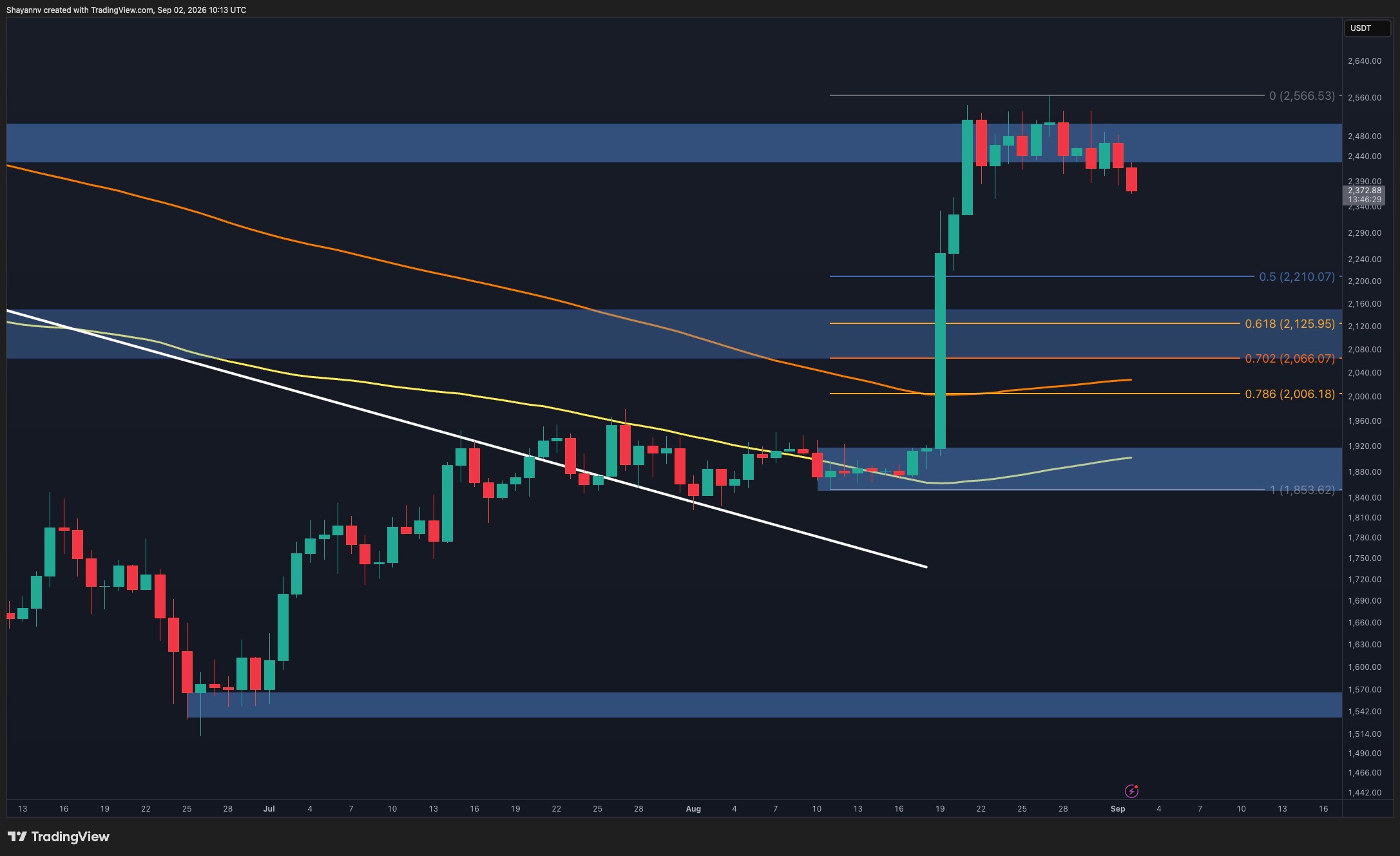
ETH/USDT 4-Hour Chart
The 4-hour timeframe presents a clearer deterioration in short-term market structure. After spending several sessions oscillating inside the $2.43K-$2.51K range, ETH has broken beneath its lower boundary and is now approaching $2.37K.
More importantly, recent rebounds have become progressively less effective at sustaining upside momentum. The latest rejection from the $2.48K-$2.50K area was followed by another sharp move lower, indicating that sellers are gaining control as the previous consolidation resolves to the downside.
The first major technical pullback zone is located around $2.21K-$2.31K. Considering the vertical nature of the original rally, relatively little price structure was established between the current market and this area, making a deeper retracement toward it increasingly plausible if selling pressure continues.
The next significant support sits around $2.07K-$2.12K. However, a recovery above the $2.43K-$2.51K zone would weaken the corrective scenario and indicate that the latest breakdown lacked sufficient follow-through.

Sentiment Analysis
The two-week ETH liquidation heatmap reinforces the possibility of a near-term move lower. With ETH trading around the upper-$2.3K region, a substantial concentration of liquidation liquidity is visible immediately beneath the market, roughly around $2.32K-$2.36K.
This downside liquidity represents the most relevant near-term target on the heatmap. If the current decline continues, the market could be drawn toward this cluster as leveraged positions are cleared and liquidity is collected.
Therefore, the liquidation data aligns with the weakening technical structure. A sweep of the liquidity below the current price could serve as the first objective of the developing pullback before the market determines whether a larger correction toward the major technical support zones is necessary.

The post Ethereum Price Prediction: Will ETH Drop to $2K Next if Buyers Fail to Regain Control Soon? appeared first on CryptoPotato.
You have all probably heard the speech that Ursula von der Leyen, the European Commission President, gave at the annual conference “La Rencontre des Entrepreneurs de France 2026,” held on August 26th. It’s been circulating on crypto Twitter like wildfire throughout the past few days.
To those of you who might have missed it, her message was rather clear: the world has already changed, and Europe must respond by becoming more independent, more industrially capable, and more willing to direct capital toward strategic priorities.
Von der Leyen argued that many of the assumptions that once underpinned the Union’s economic model have disappeared. Part of her point was that Europe must become a continent that “produces, invests and protects.” She said that the expanding access to China, open global trade, strategic American protection, cheap imported energy, as well as the West’s technological dominance can no longer be taken for granted.
And as a European, I can get behind some of the things she’s saying. European companies are facing increasingly high energy costs, regulatory complexity, and growing competition from China. However, I can’t help but consider one particular point she’s making to be rather alarming.
Today, 10 trillion EUR in household savings are kept in bank accounts. And a large share of Europe’s savings is invested outside our continent. Europe now needs to put these savings to work for its companies.
The intention behind this may be to boost growth, but the language, to me, reveals something important about the relationship between private wealth and governments.
E.U. Commission President said households have €10T sitting “idle” that can be “put to work” to boost the economy.
Yes, Ursula von der Leyen really said that.
Buy Bitcoin while you can! pic.twitter.com/hguuQjzk3r
— Bitcoin Archive (@BitcoinArchive) September 2, 2026

Who Should Control Your Savings?
From her speech, I see one thing: to policymakers, our household savings are increasingly viewed not just as our property, but as a resource – an economic catalyst that could be encouraged, incentivized, or regulated toward potential objectives.
And, mind you, consider this statement in light of how heavily Europe has traditionally been taxed. A very brief Google search shows that 4 of the top 5 countries in the world with the highest income tax rates are in the European Union.
We already surrender a massive share of our economic output to the state. That, apparently, isn’t sufficient to accomplish the Union’s political and industrial objectives.
So here’s my question: who should decide what my savings are for?
I’ve worked for my money; I’ve paid my taxes when I earned it; I’m also paying consumption taxes when I spend it in the form of VAT. Oh, by the way, guess where the top six countries with the highest VATs are located. So, having this in mind, should my savings be regarded as capital waiting to be deployed toward certain priorities, which may or may not align with my own?
Something’s Becoming Interesting
This is exactly where Bitcoin becomes interesting. With all of its flaws, Bitcoin represents the absolute opposite philosophy.
It’s an asset without a central issuer. The European Central Bank, or any other bank for that matter, cannot increase its total supply. The EC cannot decide to mint more BTC to finance industrial expansion. There is no government that can determine its issuance schedule.
There will never be more than 21 million bitcoin in existence. I can hold it without an intermediary (I know, lately this has become a touchy subject, but still). If I hold it on my own and keep my private keys private, theoretically, nobody can confiscate it. Nobody can tell me what to do with it.
This is an important distinction – one that carries increasing significance in the times that we appear to be headed toward.
Now, don’t get me wrong, I’m not trying to call out European politicians for doing something they haven’t yet done. Most headlines on this topic scream “the EU wants to steal your savings,” while I’m taking a more moderate approach. As an EU citizen, however, as someone who has spent my entire life here, I cannot rule that possibility out, especially not in the face of modern politics.
A few years ago, we were in Amsterdam at a Bitcoin conference, and we asked a bunch of people: “Why do you Bitcoin?”
I guess this is my answer: this is why I Bitcoin.
The post When Governments Want to Direct Your Wealth, Bitcoin Offers an Exit appeared first on CryptoPotato.
Financial markets experienced enhanced turbulence in the middle of August after the US Treasury Department’s Scott Bessent announced a major monetary pivot.
Bitcoin and gold were among the most significant beneficiaries, posting substantial gains in the first few days. However, the landscape has since changed, especially for the precious metal.
What Happened?
On August 19, the US Treasury Department said it will at least be doubling the maximum size of liquidity-support buybacks for longer-dated government debt, raising them from $2 billion to $4 billion per operation. This came after the bond market’s notable rise to a 19-year high, as the 30-year Treasury yield touched 5.34% the day before.
The impact on financial markets was immediate. The same 30-year Treasury yield corrected to 5.2%, while gold, stocks, and crypto rocketed. The precious metal went from $4,360/oz to $4,530/oz in hours. It kept surging in the following days and skyrocketed to $4,700 per ounce on August 25, which became its highest price tag in over three months.
Bitcoin also reached a similar local peak, but its rally was even more impressive. The cryptocurrency struggled below $65,000 for weeks before it exploded to $81,500 last week.
The two assets, considered safe havens by many investors, were at the forefront of financial gains. Moreover, analysts began commenting that their spectacular rise was due to the ‘debasement trade’ narrative as the greenback weakened while the US debt kept growing.
Gold Down, BTC Stable
The macro situation has since changed, and most of the aforementioned price movements have returned to their starting point. Perhaps the most significant change came last Friday, when the new Federal Reserve Chairman, Kevin Warsh, spoke at Jackson Hole. Although he didn’t say it directly, his speech was quite hawkish, and markets interpreted it as a sign of upcoming rate hikes.
BTC slipped by a few grand to $77,000, while the US bond market reclaimed almost all of its lost value. Gold, on the other hand, was rejected at $4,700 and plunged to $4,300 earlier today. This meant that it not only gave up all its gains but also dropped below its starting level, as it is down by over 8.5% from the local peak.

Although bitcoin has fallen from $81,000, it remains 20% higher than $64,000, where its run began. However, there are a few cracks now, which could suggest that its price might follow the bullion. Aside from the macro perspective returning to unfavorable for risk-on assets, the spot BTC ETFs have experienced more withdrawals than inflows in the past couple of business days as the initial rush is over.
Separately, if you want to know about the market state, the recent Iran-US tension, and other hot crypto news, please check our video below.
The post Gold Just Erased All Its August Gains – Bitcoin Is Holding Up Better at $77K appeared first on CryptoPotato.