Cryptocurrency Posts
Crypto Briefing
Broadcom's AI chip growth highlights a shift towards custom solutions, potentially reshaping market dynamics and challenging Nvidia's dominance.
The post Broadcom sees AI chip boom as it challenges Nvidia appeared first on Crypto Briefing.
AI's integration into workforce planning is solidifying, posing ongoing challenges for roles in repetitive tasks and basic content creation.
The post AI-related layoffs drop to lowest monthly total since December 2025 appeared first on Crypto Briefing.
Tradr ETFs filed with the SEC for two leveraged Anthropic ETFs, ANTT and ANTZ, offering 2X long and short daily exposure ahead of the AI
The post Tradr ETFs files with SEC for two leveraged funds tied to Anthropic appeared first on Crypto Briefing.
The escalating conflict severely disrupts global shipping, inflates insurance costs, and tests the resilience of marine insurers.
The post Lloyd’s of London faces £1.4B in losses as US-Iran conflict chokes the Gulf appeared first on Crypto Briefing.
Reduced dollar hedging by global funds heightens portfolio sensitivity to currency shifts, potentially amplifying risk asset volatility.
The post Crypto majors bounce as global funds cut dollar hedges to lowest since 2015 appeared first on Crypto Briefing.
Bitcoin Magazine
Bitcoin Magazine
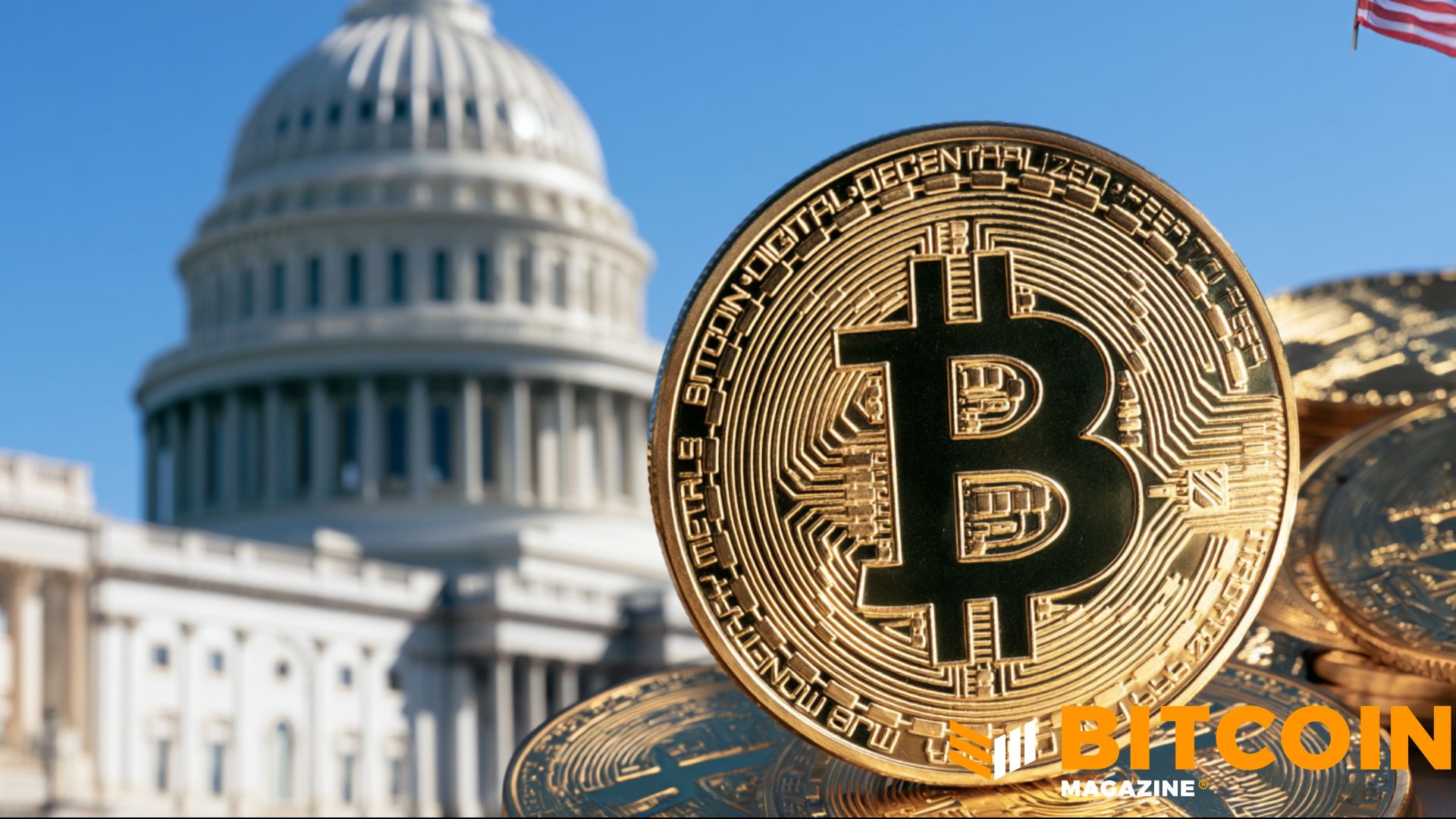
‘Crypto Capital of the World’: SEC Chair Expects Clarity Act to Pass This Month
Wall Street’s top regulator has said that he expects the long-awaited Clarity Act will get passed this month and the U.S. will be on track to be the “crypto capital of the world.”
Speaking to Fox Business on Tuesday, Securities and Exchange Chairman Paul Atkins confirmed that the regulator was pushing ahead with rules to help the crypto industry.
Pro-crypto lawmakers had hoped to pass the Clarity Act before Congress broke for August recess, but the vote slipped to September. The bill will establish a framework for distinguishing between digital assets that are securities, commodities or stablecoins.
JUST IN:
— Bitcoin Magazine (@BitcoinMagazine) September 2, 2026SEC Chairman Paul Atkins says "The Regulation Crypto Assets proposal is our most historic step yet to cement America as the Crypto Capital of the World"
pic.twitter.com/lcHtWcslgO

“The Clarity Act will be voted on in the Senate on the 15th of September,” Atkins said. “I anticipate and hope that it will be passed by the Senate and sent ultimately to the President’s desk for a signature.”
He added: “We’re changing the past approaches to try to update [rules], modernize them in the age of blockchain and crypto assets.”
Despite a vote on the Clarity Act being delayed, regulators like the SEC and Commodity Futures Trading Commission have said they will still proceed with trying to shape crypto policy.
Last week, the SEC sent a proposal to the White House aiming to “clarify the framework for the custody of crypto assets” for investment advisers and companies.
Despite being passed by the House of Representatives last year, the Clarity Act has been in a deadlock for most of this year after the banking lobby clashed with lawmakers and crypto businesses over whether platforms like Coinbase should be able to pay customers yield.
Some lawmakers have sought to change wording in the bill regarding ethics, and a new bill started circulating in July. The draft bans government officials from promoting and making money from crypto.
But other Democratic lawmakers said it still fell short; a number of pro-crypto Republicans accused Democrats of deliberately playing politics and delaying the bill.
This post ‘Crypto Capital of the World’: SEC Chair Expects Clarity Act to Pass This Month first appeared on Bitcoin Magazine and is written by Mathew Di Salvo.
Bitcoin Magazine

Mexican Billionaire Ricardo Salinas Tells People To Escape Fiat Inflation With Bitcoin
Mexican billionaire Ricardo Salinas is at it again.
This time, the third richest man in Mexico told his followers that “fiat inflation is a hidden tax,” and the way to hedge against it was to buy bitcoin.
Salinas, the former chairman of home appliance and electronics retailer Grupo Elektra and Banco Azteca founder, told his followers to opt out and start protecting their savings.
“Bitcoin changes one fundamental rule: no one can print more just because they want to,” Salinas said in a video on X on Monday.
“While you have to work to earn more money, the system can simply create more of it. Don’t be fooled: learn, protect your savings, and defend your freedom, buy bitcoin and hold it.”
It’s not the first time Salinas has told his followers to be aware of government monetary policy.
The billionaire posts on X almost daily to millions of followers, and criticizing central bank money creation is one of his recurring themes, appearing in tweets, interviews, conference keynotes, and video messages.
In recent years, the entrepreneur has stepped up his criticisms of governments — and his praises of bitcoin. Earlier this year admitted he had increased his allocation in the asset from 10% to 70% of his portfolio.
Salinas’ bitcoin enthusiasm all stems from central bank monetary policy. Speaking at Bitcoin 2022, Salinas described traditional money as “the fiat fraud.”
“What they are doing is printing money out of thin air, and then making fake purchases,” he said of the Federal Reserve.
The business magnate has also talked about his success in “orange pilling” his friends and family.
“I convinced my wife to mortgage the house that she has and take a loan to buy bitcoin,” he once boasted in an interview.
This post Mexican Billionaire Ricardo Salinas Tells People To Escape Fiat Inflation With Bitcoin first appeared on Bitcoin Magazine and is written by Mathew Di Salvo.
Bitcoin Magazine

When the Banks Don’t Work, Bitcoin Does: Cornell University’s Adoption Index
A lot of people have heard of Bitcoin but even among those who hold it, knowledge is shallow.
Though for those holding the leading cryptocurrency, it appears to be solving a problem: getting around failing banking rails or inflation.
That’s according to new findings from the U.S. Ivy League research university Cornell, which spoke to nearly 26,000 around the globe about Bitcoin.
In its new Bitcoin Adoption Index report, the top college found that El Salvador, Venezuela and Nigeria were the countries that had the highest number of people who had ever owned bitcoin.
“Ranked by the share of all respondents who have ever owned bitcoin, the leaders are not wealthy financial centers — they are economies where the national currency has been unstable and everyday access to dollars or reliable banking is hard,” the report read.
“In each, bitcoin functions less as a speculative bet and more as a practical workaround.”
Still, Cornell found that actually being able to explain the fundamentals of the protocol was difficult for most — including how many bitcoins would ever be minted in existence. In fact, 58% of those surveyed said they didn’t know the supply was capped at 21 million coins.
But technicalities aside, the cryptocurrency has still proved helpful to people wanting to use it, the report found.
One Venezuelan — who wasn’t named — told interviewers that Bitcoin was “faster, cleaner, and much less risky” than other methods of getting dollars in the country.
While another Salvadoran was quoted saying: “When nobody controls [bitcoin], it means we all have control of it.”
And a Nigerian interviewee reportedly told Cornell researchers: “I’ve been to six African countries and whenever I go there, I don’t fear it because I know I can spend my bitcoin.”
Bitcoin adoption started growing in Venezuela ahead of other countries years ago, when hyperinflation crippled the economy and strict government currency controls meant getting dollars became difficult.
El Salvador made bitcoin legal tender — along with the dollar — in 2021. The country’s leader admitted that getting its citizens to use the cryptocurrency was difficult but the Central American nation still says it buys the asset for its government coffers.
In Nigeria, which has had some of the highest transaction volumes in the world, saving in bitcoin has been used by some to get around the collapse of the naira.
Cornell University’s research was fielded by Morning Consult in partnership with the Tech Policy Institute in Cornell University’s Jeb E. Brooks School of Public Policy, the Cornell Bitcoin Club, the Human Rights Foundation and the Reynolds Foundation.
Researchers interviewed 25,880 people in 25 countries between December 16, 2024 to March 10, 2025, asking 125 individual questions.
This post When the Banks Don’t Work, Bitcoin Does: Cornell University’s Adoption Index first appeared on Bitcoin Magazine and is written by Mathew Di Salvo.
Bitcoin Magazine

Capital B Raises €7.6M From Adam Back to Fund Another Bitcoin Buy
Top bitcoiner Adam Back has invested €7.6 million ($8.8 million) in Capital B, the Euronext Growth-listed company that bills itself as Europe’s first bitcoin treasury company.
The company said Wednesday that the investment will be used to buy more bitcoin. Adam Back is the CEO of bitcoin infrastructure company Blockstream, and one of the biggest and well-known figures in the space
Capital B’s announcement comes after the company last week said it had raised €21 million ($24 million) in a private placement backed by Blockstream’s Adam Back and asset manager TOBAM.
— Capital B (@_ALCPB) August 28, 2026
Capital B announces a €21.0 million capital raise with global institutional investors, including strategic investors Adam Back and TOBAM, to accelerate its Bitcoin Treasury Company strategy
Full Press Release (EN): https://t.co/XQGT44ma4d
Full Press Release (FR):…

“The proceeds of the Private Placement will be used primarily to strengthen Capital B’s balance sheet through the accumulation of bitcoin as a long-term reserve asset,” the company said in a statement.
“This capital increase is a key step in implementing the company’s Bitcoin Treasury Company strategy, focused on increasing the number of bitcoin per share on a fully diluted basis over time.”
It added that the placement would fund it buying 376 additional bitcoins, taking its potential holdings to 3,521 coins from its current stash of 3,145.
Capital B is the 26th biggest publicly traded bitcoin treasury in the world, according to Bitcoin Treasuries, with a total of 3,145 bitcoins in its coffers — worth $242 million at today’s bitcoin price of $76,959.
Capital B built much of that position through fundraising rounds during the first half of 2026.
In May, it acquired 192 coins for €13 million after completing three capital raises.
Capital B’s is trying to build a bigger bitcoin position as other treasuries look to raise funds and accelerate their buys.
NYSE-listed AI-powered education company Genius Group last week said it was aiming to build parallel AI and bitcoin treasuries worth a combined $1.6 billion, after the company sold its entire bitcoin reserves to repay $8.5 million in debt.
The Bitcoin treasury model has taken a hit since last year when the price of the leading cryptocurrency took a hit.
A number of companies in the space have had to liquidate their holdings — including the biggest corporate holder of bitcoin, Nasdaq-listed Strategy.
This post Capital B Raises €7.6M From Adam Back to Fund Another Bitcoin Buy first appeared on Bitcoin Magazine and is written by Mathew Di Salvo.
Bitcoin Magazine

The Quantum Issue: Letter From The Editor
Quantum this, quantum that…who put a stupid cat on-chain!?
Ahem.
Alright, let’s be serious. The threat that a viable, actually functioning, quantum computer would pose to Bitcoin if it were to be built is very serious. It is the concrete example of an existential threat, in every sense of the word.
One of the bedrock foundations that Bitcoin rests upon is the assumption of a functioning cryptographic system that can be used to produce unforgeable signatures, i.e. that if you follow that system’s protocol properly when signing things, there is no way that anyone but a bitcoin’s rightful owner could produce a signature needed to spend it unless the rightful owner failed to secure their private key from theft.
Quantum computers toss that right out the window. There goes the integrity of the entire mechanism that is used for owners of bitcoin to authenticate their ownership for the protocol to process their legitimately authorized transactions, and ONLY their legitimately authorized transactions. There’s no way for anyone to actually own anything in the context of the Bitcoin protocol if that assumption breaks.
Bitcoin breaks if that assumption breaks.
Thankfully, there are many different cryptographic systems that exist, and not all of them rest on assumptions that a quantum computer breaks. That’s the good news. The bad news is that its all a set of tradeoffs, none of them are ideal, and there are going to be some hard choices that have to be made.
But there are solutions to just about every one of the problems that a viable quantum computer would create…except the problem of choosing which solutions to use. So in light of that, here is The Quantum Issue.
This issue is a lot more structured than most past issues, and that is to ensure that it guides a reader through the entirety of the problem space and solution space without assuming any prior understanding (this is a very deep and technical subject).
The first set of articles goes through the general issue of quantum computing itself, how it differs from classical computing, why that matters, how likely it is one is developed soon, etc.
The second set examines Bitcoin’s exposure. How is it exposed? How badly is it exposed? How can that degree of exposure change?
The third set examines concrete (or developed enough to not be too hard to get to a concrete place) solutions to securing your bitcoin in a quantum safe way, and handling a network wide migration to those solutions.

Don’t miss your chance to own The Quantum Issue — featuring articles written by many influential figures in the space working on the necessary pieces for a post-quantum Bitcoin!
This piece is the Letter from the Editor featured in the latest Print edition of Bitcoin Magazine, The Quantum Issue. We’re sharing it here as an early look at the ideas explored throughout the full issue.
This post The Quantum Issue: Letter From The Editor first appeared on Bitcoin Magazine and is written by Shinobi.
CryptoSlate
Memecoins paired against Robinhood's tokenized stocks generated $217 million of trading volume on Robinhood Chain on Sept. 2, according to data compiled by on-chain researcher Adam Tehc.
The volume outpaced the $127 million that traded through direct stock token markets that same day. Traders are using tokenized Nvidia or Hims & Hers shares as the plumbing for a memecoin economy Robinhood never designed.
Robinhood describes stock tokens as ERC-20 tokenized debt securities that give holders economic exposure to an underlying stock without legal or beneficial ownership in the issuer.
New supply comes from a single authorized participant, identified at issuance as BBVI, which alone can mint tokens once onboarded. Everyone else trades, pools, and builds with the tokens already in circulation, permissionlessly and without Robinhood's direct involvement.
| Activity type | Sept. 2 volume | What it shows |
|---|---|---|
| Memecoin pairs using stock tokens | $217M | Stock tokens are being used as trading infrastructure for speculation |
| Direct stock token markets | $127M | Traditional “buy the tokenized stock” activity was smaller |
| Difference | +$90M | Meme-stock-token pairs generated about 71% more volume than direct stock-token trading |
| Ratio | 1.7x | The casino layer outpaced the investment layer |
A memecoin cornered more than half the tokenized float on Robinhood Chain
A memecoin called BONER accumulated 31,198 of the 58,714 HIMS stock tokens then outstanding, roughly 53% of the entire tokenized supply, with another 1,424 sitting in separate meme pools.
That left only about 20,303 tokens circulating in conventional HIMS pairs against stablecoins and ETH, the thin remainder available for anything resembling ordinary price discovery.
While the New York Stock Exchange sat closed for the weekend, the tokenized HIMS instrument printed as high as $132.64. That compares with a $28.84 close for the underlying stock the previous Friday, a premium of roughly 4.6 times.
A small, closed-loop pool of tokens experienced an AMM scarcity event while the market that could have supplied fresh tokens or corrected the price sat shut.
Hims & Hers has roughly 233.3 million shares outstanding, so the 58,714 HIMS stock tokens involved equal about 0.025% of that count. Reported short interest in the stock runs near 58.7 million shares, meaning the entire tokenized float that briefly cornered represented roughly 0.1% of the shares already sold short.
The episode left Hims & Hers' equity market untouched, while shaking confidence in a much smaller, newer market sitting on top of it.
Once the underlying market reopened, BBVI minted roughly 4,000 new HIMS stock tokens, worth about $115,000 at Friday's closing price and equal to just 6.8% of the prior tokenized supply.
That comparatively small injection was enough to pull the token price back toward the stock's value. The real vulnerability sits in who controls new supply, when they can create it, and which pools need it during a squeeze, well beyond the total dollars involved.
| Metric | Figure | Why it matters |
|---|---|---|
| HIMS stock tokens outstanding | 58,714 | The full on-chain wrapper supply was tiny |
| Tokens accumulated by BONER | 31,198 | Equal to 53.1% of tokenized supply |
| Peak tokenized HIMS print | $132.64 | About 4.6x the prior stock close |
| HIMS prior Friday stock close | $28.84 | The reference price the wrapper was meant to track |
| New tokens minted after reopen | ~4,000 | Only 6.8% of prior tokenized supply |
| Approx. value of new mint at stock close | ~$115,000 | A small supply injection helped normalize the wrapper |
| Hims & Hers shares outstanding | ~233.3M | Shows the real equity market was much larger |
| Tokenized float as share of equity count | ~0.025% | Confirms this was not an equity-float squeeze |
Robinhood stock tokens become the thing memecoins are priced against
Inside the Robinhood Chain pools, HIMS or Nvidia stock tokens become the denominator memecoins are priced against, turning a security-linked instrument into part of the speculative settlement layer itself.
The underlying stock trades during regulated exchange hours, and Robinhood's own oracle feeds for stock token prices update 24 hours a day, five days a week, on that same schedule. The on-chain token itself keeps trading and transferring around the clock regardless, so a weekend print does not necessarily represent a repriced stock.
It more often points to stress inside a thin token wrapper trading without its usual reference market open.
Secondary trading is permissionless and open to anyone, but new stock token supply only comes from an authorized participant. A large on-chain dislocation can form even in an instrument explicitly built to track a real security, because nobody trapped in a cornered pool can mint their way out.
Robinhood's terms say it does not control what third parties build on the chain and cannot reverse transactions once submitted.
Its securities filings separately warn that this same third-party activity may be difficult or impossible to monitor, influence, or prevent, even though Robinhood could still face reputational, legal, or regulatory consequences from whatever happens.
Regulators are already circling the underlying question
The SEC said in January that representing a security through a crypto network does not change which federal securities laws apply. That statement targeted this kind of third-party product offering synthetic exposure to an underlying stock.
The World Federation of Exchanges has separately warned regulators that tokenized equities raise real issues around market integrity, disclosure and post-trade standards.
Both are describing a genuine gap in who takes responsibility when a security-linked token starts behaving like a permissionless crypto asset.
Nasdaq's approved tokenization framework and DTCC's tokenization service both keep tokenized securities on the same order books, under the same rights and controls as conventional shares.
Robinhood Chain sits at the end of a broader move, letting its tokens loose into open DeFi composition. Citi's 2030 tokenization outlook, projecting roughly $5.5 trillion in tokenized assets under its base case, anticipates retail investors doing this with instruments like it.
For crypto markets broadly, the more interesting implication is that on-chain speculation may grow less dependent on BTC, ETH, and stablecoins as its default liquidity legs if tokenized equities keep working this well as collateral and quote assets in their place.
Whether this becomes real infrastructure or a lasting liability
The bull case is that stock tokens graduate from meme-pair liquidity into broader usage in lending, collateral, and index products, with direct stock token activity and legitimate collateral use eventually overtaking memecoin-pair volume.
Under that path, Robinhood Chain's RWA activity multiplies several times over from today's roughly $188 million base, and the network becomes credible on-chain brokerage infrastructure.
| Path | What Robinhood Chain becomes | Signal to watch | Market implication |
|---|---|---|---|
| Bull case: infrastructure | Stock tokens become collateral, lending assets, index components, and settlement legs | Direct stock-token and collateral activity overtakes memecoin-pair volume | Tokenized equities become credible on-chain financial primitives |
| Bear case: liability | Meme pools and low-float squeezes remain the dominant source of activity | Memecoin-stock pairs repeatedly exceed direct stock-token trading; more weekend dislocations appear | High volume starts looking like market-integrity risk rather than product validation |
| Core tension | Same assets enable both outcomes | Ratio of productive use vs. reflexive speculation | Robinhood benefits from activity but inherits reputational and regulatory exposure |
The bear case has volumes staying high while remaining dominated by reflexive meme pools and low-float squeezes like the one HIMS just experienced. Regulators and issuers turn their attention toward disclosure and market-integrity risk, well past simple growth metrics.
In that scenario, high transaction counts stop reading as validation, and Robinhood's fee opportunity comes wrapped in the reputational exposure its filings already warn about.
Tokenization promised that a stock stops being just something you buy and becomes something software can use. Memecoin traders are showing Wall Street what “use” means when nobody outside crypto got a vote in the definition.
The post Robinhood put stocks on a permissionless blockchain- memecoin traders are stress-testing what happens next appeared first on CryptoSlate.
Bitcoin is testing a roughly $68 billion breakeven wall that has repeatedly stalled its push back above $80,000.
About 880,000 BTC carry a cost basis between roughly $77,500 and $80,300, leaving a large group of holders close to where they originally bought, Bitfinex Alpha data shows.
Data from CryptoSlate shows Bitcoin trading near $77,890 as of press time after spending much of the past week trapped below $80,000.
The concentration means even modest price moves can shift tens of billions of dollars in Bitcoin between profit and loss, potentially releasing supply from investors who endured months underwater.
So far, that selling has been absorbed, setting up a test of whether fresh demand can clear the zone or whether the recovery stalls near current levels.
Older buyers are using the rally to get out near cost
The behavior of long-term holders suggests some investors are already taking advantage of the recovery to exit positions without realizing significant losses.
Bitcoin's long-term holder Spent Output Profit Ratio, or SOPR, has moved around 1 for nine consecutive sessions, with readings between 0.88 and 1.19 and a latest level near 0.98, Bitfinex said. A reading around 1 indicates coins are being moved at roughly the same price at which they were acquired.
Bitfinex analysts tied that activity primarily to investors who accumulated Bitcoin around February and March, when prices were close to current levels. Those holders subsequently sat through the downturn and now have an opportunity to recover their original investment as Bitcoin revisits their entry prices.
That creates a recurring supply problem. Bitcoin closed at $80,256 on Aug. 27, when 72.1% of supply was in profit. By the time it closed at $77,468 several days later, that share had fallen to 67.7%. The change implies roughly 880,000 BTC sit inside the narrow $2,800 cost-basis window now surrounding the market.
At about $77,000 per Bitcoin, that represents nearly $68 billion of supply whose profitability changes as prices move through the region.
The pattern has yet to resemble capitulation. Bitfinex said sustained SOPR readings below 0.9 alongside falling prices would indicate holders had begun accepting deeper losses to exit. Instead, sellers have largely appeared around breakeven while buyers have prevented a more decisive breakdown.
Bitcoin's True Market Mean, an on-chain measure Bitfinex uses to estimate the average acquisition price of active investors, stands near $76,350. That places the market only slightly above another level where a broader portion of holders approaches cost.
Strategy steps in as the ETF bid cools
The demand absorbing those sellers is also changing, with Strategy returning to the market just as buying through US spot Bitcoin ETFs has become less consistent.
Strategy bought 4,603 Bitcoin for $369.7 million between Aug. 24 and Aug. 30, ending a 10-week pause in purchases. The acquisition lifted the company's holdings to 845,050 BTC and was made at an average price of $80,318, placing Strategy's buying directly inside the zone where Bitcoin has repeatedly struggled to hold gains.
That timing provides an unusually direct test of corporate demand. Strategy paid above every Bitcoin daily close since May 14, even as other investors were using prices near $80,000 to sell.
The purchase also arrived as ETF demand cooled following one of its strongest stretches of the summer.
US spot Bitcoin ETFs had accumulated about $3.04 billion during a nine-session inflow streak before recording a $201.9 million outflow on Aug. 28. A $216.7 million inflow followed, but the products opened September with another $236.5 million in withdrawals.
The reversal does not establish a sustained ETF exodus, particularly after August's heavy inflows. It does reduce one source of buying pressure at a point where Bitcoin is encountering a large concentration of potential sellers.
Bitfinex described the shift as a handoff between the liquidity engines behind the recent rally, with corporate purchases helping offset softer ETF demand.
That balance could become increasingly important if breakeven selling persists. The more supply investors release around $78,000 to $80,000, the more sustained demand will be needed to convert the region from resistance into support.
Options traders are insuring against a deeper break
Derivatives traders are preparing for that balance to fail even as the options market prices relatively subdued volatility.
Average Bitcoin implied volatility stood at 37.2 in Bitfinex's analysis, putting it in the 18th percentile of daily closes over the past year. Options have therefore been cheaper on fewer than one in five trading days during that period.
Yet protection is concentrated around the period containing key US economic releases that could shift expectations for Federal Reserve policy.
The Sept. 11 options expiry has one put outstanding for every call, compared with a put-call ratio of 0.56 across the broader options market. Downside positions are concentrated between $68,000 and $75,000, while the largest call open interest sits at $80,000.
That positioning suggests investors are keeping exposure to another advance while paying for protection against a retracement through the current support zone.
The timing coincides with US payroll and inflation data that could alter expectations for the Fed after Chair Kevin Warsh's hawkish Jackson Hole remarks helped knock Bitcoin from an Aug. 28 high above $81,000.
Bitcoin now needs to clear the supply shelf
The next move may depend on whether buyers can exhaust the remaining breakeven supply without allowing Bitcoin to lose the cost basis supporting the recovery.
Bitfinex sees two daily closes above $82,818, accompanied by improving holder profitability and positive ETF flows, as confirmation that the current supply shelf has been absorbed. That would put roughly $85,200, another on-chain cost-basis level, into focus.
A failure would expose the opposite side of the trade. Two closes below about $76,657 would weaken the current structure and could open a move toward $73,500, followed by the short-term holder cost basis near $69,980.
Bitcoin's August rally still gives buyers some historical support. The cryptocurrency gained roughly 24% during the week ended Aug. 23, its strongest weekly percentage increase since March 2023. Since 2020, Bitcoin has posted 17 weekly gains exceeding 15% and was higher 30 days later in 14 of those cases, with a median return of 8.4%, Bitfinex found.
The immediate obstacle is closer than those historical returns suggest. Before Bitcoin can extend the rally, buyers have to absorb a block of supply worth nearly $68 billion from holders who have finally been offered a chance to leave near where they came in.
The post Bitcoin cannot break out past $80,000 until it devours an 880k BTC roadblock that choked every rally appeared first on CryptoSlate.
Ontology said its mainnet resumed normal operation on Sept. 2 after an emergency security pause and told every sync-node operator to upgrade to version 3.1.5. Sync nodes are infrastructure that keep their copy of the blockchain synchronized with the network.
The restoration notice says the new software is required to maintain compatibility with the restored chain and ensure stable synchronization. Ontology told operators to upgrade as soon as possible, confirm that their nodes are fully synchronized, and verify normal operation afterward.
Older software therefore carries a compatibility and synchronization risk, although the notice does not say that every unupgraded node has already failed.
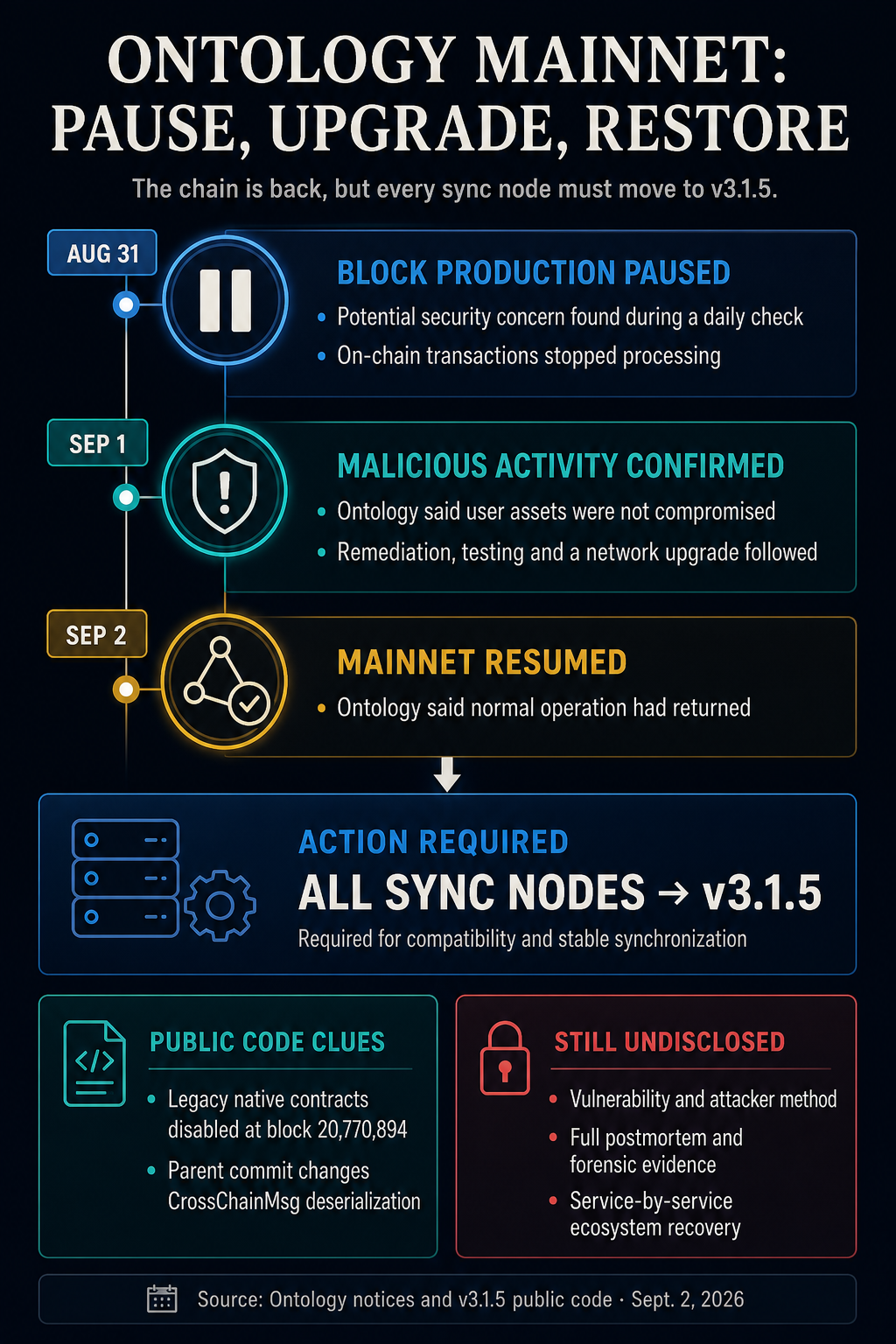
The restoration followed a pause that began Aug. 31. Ontology initially described the trigger as a potential security concern found during a daily security check and suspended block production, leaving on-chain transactions unprocessed.
A Sept. 1 update escalated that description, saying the team had identified malicious attack activity targeting the network while remediation, testing, and a network upgrade were underway.
During the pause, Ontology told users not to attempt time-sensitive on-chain transactions and said they did not need to move ONT, ONG, or other assets because of the announcement. It said block production would not restart until the network had been assessed and deemed safe to operate.
Ontology also said its investigation found that the activity did not involve or compromise user assets. That remains the network's assessment because it has not published an independent forensic report.
The code offers clues, not an attack explanation
The v3.1.5 release provides a Linux AMD64 binary and checksum but no incident explanation. The tagged code change disables registrations for several legacy native contracts at mainnet block 20,770,894, one block after the 20,770,893 height observed during the halt. Its parent commit changes cross-chain message deserialization.
The public code shows the shape of the emergency software change, but Ontology has not linked either commit to a specific attack path. Its notices do not identify the vulnerability or attacker method, explicitly name the affected component, or provide forensic evidence or a postmortem.
The restoration announcement confirms the mainnet's return, not a service-by-service recovery across the wider ecosystem. It does not establish whether public RPC providers, exchange deposits and withdrawals, wallets or dapps have all resumed normal operation.
The malicious-activity confirmation had already moved the incident beyond the initial pause, as CryptoSlate reported in a Sept. 1 examination of network shutdowns.
Ontology said monitoring will continue with technical and security partners. For now, v3.1.5 tells operators what they must do, while the reason for the emergency change remains undisclosed.
The post Ontology forces urgent node upgrade after restarting chain hit by malicious activity appeared first on CryptoSlate.
Thailand’s Securities and Exchange Commission has issued a Travel Rule that will require supervised crypto platforms to collect and transmit information identifying the people or entities behind coin transfers.
The regulator announced the rule on Sept. 2, and an associated notification is dated Aug. 25. It takes effect Feb. 27, 2027, after a 180-day implementation period from publication in the Royal Gazette.
The lead time lets operators prepare systems for exchanging transfer data, checking transactions, and requesting required information from customers, according to the SEC’s customer-facing Q&A.
How crypto transfers will change
SEC-supervised digital-asset operators must collect information on customers and their counterparties when coins are transferred. They must also check counterparties and verify the qualifications of digital-asset service providers or intermediaries in the transfer route.
An operator sending a transfer instruction must pass originator and beneficiary information to the operator receiving it. Transfer-related records must be kept for at least five years.
Customers will face different information requests based on transfer size. When sending coins from a wallet held with a regulated platform, a customer must identify the recipient even when the transfer is no more than 30,000 baht.
For transfers over 30,000 baht, the customer must also provide the recipient’s province or city and country. If the recipient is a legal entity, the customer must also provide its registration number. Smaller transfers require basic recipient identification, while larger ones require additional location or entity details.

On incoming transfers between regulated operators, the recipient’s platform must collect information from the sender’s operator before allowing the recipient to move the coins out of the wallet.
The process becomes more specific when coins arrive at a regulated-platform wallet from a self-hosted wallet. The platform must collect sender information as it would for another transfer. If the transaction exceeds 30,000 baht, it must also verify that the user owns or controls the wallet by confirming the person can control or access it.
The obligation falls on supervised operators when a transfer touches their services, and the Q&A does not state that every coin transfer requires proof of wallet ownership.
The rule also stops short of extending the new data checks across all platform activity. It does not apply to trades on an operator’s order book or to transfers and withdrawals of Thai baht because it governs coin transfers.
The SEC said most transfers should continue through normal processes when customers provide complete information and platforms are ready. High-value transfers, cases with missing data, or transactions requiring added wallet checks may take longer.
The post Thailand puts private wallets and offshore crypto transfers on notice in a major new crypto rule appeared first on CryptoSlate.
Coinbase co-founder Fred Ehrsam's separate Venezuela investment firm, Primavera, is reportedly pursuing three oil assets as the country reallocates energy projects under a US-backed restructuring.
Reuters reported on Sept. 2 that Primavera was among companies expected to sign Venezuelan energy agreements as soon as that day. Bloomberg reported on Sept. 1 that Ehrsam was seeking control of at least three fields operated by Alvorada Heavy Industries in the Boca, Guico and Guara blocks of the Orinoco Belt.
Bloomberg attributed the block-level details to unnamed people familiar with nonpublic talks, while Reuters did not identify the fields.
Coinbase co-founder's crypto fortune targets Venezuela
Neither Coinbase nor Paradigm has been identified as a bidder or participant, and no blockchain, cryptocurrency, or digital payments component has been established for the reported transaction.
Ehrsam nevertheless retains close ties to the crypto industry. Coinbase's 2026 proxy filing lists him as a director, while Paradigm describes him as a co-founder and senior advisor. The distinction makes this a story about crypto-derived personal capital entering a state-mediated commodity business.
Banco de Venezuela said it hosted Ehrsam at a digital-finance event in Caracas on May 13, where he discussed opportunities involving cryptocurrencies and the country's financial sector.
The talks are unfolding during a wider reallocation of Venezuelan energy assets. On Aug. 31, a White House fact sheet said interim Venezuelan authorities had granted North American Blue Energy Partners 100-year concessions covering 17 fields.
The arrangement includes a 35% US government equity stake, preferential purchase rights over production and veto power over board appointments.
The authority behind those long-term rights is already contested. The Associated Press reported that analysts questioned whether acting President Delcy Rodríguez could grant 100-year oil-field rights and noted that the National Assembly had not approved the wider arrangement.
Primavera's reported pursuit shows how capital built in crypto can move into politically allocated hard assets. An executed agreement, including the assets and terms it covers, would determine whether that pursuit becomes operational control.
Until then, Boca, Guico, and Guara remain reported targets under negotiation.
The post Coinbase co-founder joins rush for Venezuelan oil assets under new US-backed framework appeared first on CryptoSlate.
HTTP error 429 on https://cryptoticker.io/en/feed/
Failed to fetch feed: https://cryptoticker.io/en/feed/
Failed to fetch feed.
Decrypt
Fake investment ads on Telegram channels funneled EU victims to a lookalike exchange that emptied their wallets.
The order calls the prediction market platform a sports betting operation "masquerading as an investment opportunity."
After Claude models accessed real systems during cyber tests, Anthropic tightened its safeguards and warned that flawed training can encourage dangerous behavior.
Afterquery's valuation jumped more than tenfold in five months, making it Y Combinator's fastest unicorn ever.
Agents seized digital assets, domains, and servers allegedly used by Hamas’ military wing to collect donations and recruit supporters.
U.Today - IT, AI and Fintech Daily News for You Today
Bitcoin ETFs attracted more than $100 million in fresh inflows as Ethereum, XRP and Solana funds slipped into the red.
Multicoin Capital has sold another chunk of its HYPE holdings, cutting its position by roughly 10% as the investment firm continues to take profits from its massive bet on Hyperliquid.
Trading platform CPO confirms the 'Earn on XRP' feature is in its final phase, mobilizing 1.6 billion tokens and unlocking passive yield under U.S. regulation.
The biggest launchpad on Robinhood is attracting fresh funds and seeing its valued pushed to the sky.
XRP drew more questions than any other cryptocurrency during a presentation to about 400 wealth managers, according to Bitwise research analyst Ryan Rasmussen.
Blockonomi
Key Highlights
- HOOD shares started Thursday trading at $106.99, marking a 3.4% gain and reaching a $96.19 billion market capitalization
- Second quarter earnings per share hit $0.62, surpassing analyst expectations of $0.44; revenues jumped 32.5% year-over-year to $1.31 billion
- ParaFi Capital expanded its HOOD stake by 126.2% during Q2, elevating it to their 4th largest portfolio position
- Morgan Stanley elevated HOOD to Overweight status with a $150 price objective; Scotiabank launched coverage with a $136 target
- The Robinhood Chain’s total tokenized assets exceeded $88 million soon after mainnet deployment, generating $390 million in transaction volume
Shares of Robinhood Markets (HOOD) began Thursday’s session at $106.99, registering a 3.4% increase. The trading platform operator’s stock has fluctuated between $63.51 and $153.86 over the past year, currently commanding a market valuation of $96.19 billion.
Robinhood Markets, Inc., HOOD
Technical indicators show the stock trading above both its 50-day moving average of $101.64 and its 200-day moving average of $87.67. With a beta coefficient of 2.34, HOOD demonstrates significant volatility compared to broader market indices.
The company’s latest quarterly results, released on July 29, revealed earnings per share of $0.62, significantly exceeding Wall Street’s $0.44 projection. Total revenue reached $1.31 billion, representing a 32.5% year-over-year increase and surpassing the $1.29 billion analyst forecast.
The quarter delivered a net profit margin of 42.01% alongside a return on equity of 22.43%. Current analyst consensus projects full-year earnings per share of $2.07.
Institutional investment activity has intensified notably. ParaFi Capital LP increased its HOOD holdings by 126.2% during the second quarter, bringing its position to 250,000 shares valued at approximately $25.1 million. This stake now represents 7.3% of ParaFi’s total portfolio, ranking as their fourth-largest investment.
Overall institutional ownership of HOOD stock stands at 93.27%. Artisan Partners established a fresh HOOD position in Q2, highlighting deposit expansion and the company’s substantial opportunities within retail wealth management.
Wall Street Analysts Boost Targets
Morgan Stanley elevated its HOOD rating from Equal Weight to Overweight this week, simultaneously lifting its price objective from $124 to $150. Analyst Michael Cyprys emphasized the company’s extended growth trajectory and opportunities to increase per-customer revenue through prediction markets and product diversification.
Scotiabank entered coverage with a Sector Outperform designation and a $136 price forecast. Meanwhile, Sanford C. Bernstein increased its target from $130 to $160 while maintaining an Outperform rating. Among 27 analysts tracking the stock, 23 recommend buying and four suggest holding. The average price target across all analysts reaches $122.67.
Robinhood Chain Gains Momentum
On the innovation front, the Robinhood Chain’s tokenized asset value crossed $88 million shortly following its mainnet activation. The blockchain platform generated approximately $390 million in transaction volume and reportedly captured market leadership in stock-token market capitalization.
Robinhood Banking services and prediction market offerings are attracting attention as promising revenue channels beyond cryptocurrency trading fees.
Management will participate in the Goldman Sachs Communacopia + Technology Conference scheduled for September 9.
Regarding insider transactions, CEO Vladimir Tenev divested 375,000 shares on July 6 at an average of $116.17 per share, generating proceeds of $43.56 million. This transaction, conducted through a pre-established Rule 10b5-1 trading plan, reduced his ownership stake by 50%. Director Baiju Bhatt separately sold 57,898 shares during June at $89.63 each. Combined insider sales totaled 591,867 shares valued at $64.9 million throughout the most recent quarter.
The post Robinhood (HOOD) Stock Eyes $150 Target After Morgan Stanley Upgrade appeared first on Blockonomi.
TLDR
- Shares of Eos Energy rallied 18.75% to $3.61 following the reveal of a collaboration with Google and MN8 Energy
- The partnership focuses on integrating Eos’ Z3 zinc-based long-duration energy storage at West Virginia’s Mammoth Solar facility
- The renewable facility will supply electricity to Google’s regional data centers, with battery systems scheduled for 2029 and 2030
- EOSE shares had reached a 52-week bottom of $3.10 just 24 hours prior to the partnership announcement
- B.Riley maintains a Neutral stance with a $5.00 valuation target for EOSE shares
Shares of Eos Energy Enterprises climbed 18.75% during Wednesday’s trading session, reaching $3.61, following the revelation of a three-party collaboration involving Google and renewable power developer MN8 Energy.
Eos Energy Enterprises, Inc., EOSE
The collaboration revolves around the Mammoth Solar facility located in Kanawha County, West Virginia, a large-scale renewable energy installation being constructed on formerly mined coal land. This facility aims to provide renewable electricity to Google’s regional computing facilities.
Eos will provide its Z3 zinc-based energy storage solution for the initiative. This technology delivers up to 10 hours of power retention, enabling renewable energy distribution to the electrical grid long after initial generation.
MN8 Energy will handle ownership and management of the renewable facility. Full commercial launch is anticipated in 2028, while the Eos battery installations will become operational during 2029 and 2030.
Google Connection Elevates Eos Technology Profile
Securing Google as a project partner represents a significant milestone for Eos. The association exposes the company’s aqueous zinc technology to broader market visibility and establishes credibility as a viable solution for large-scale energy storage applications.
Eos chief commercial officer Nathan Kroeker commented: “Z3 extends the value of clean generation across more hours, strengthens the overall portfolio, and delivers more dependable capacity when it’s needed most.”
The announcement’s timing was particularly noteworthy. Only 24 hours before, on September 1, EOSE had dropped to a fresh 52-week floor of $3.10. The shares had declined 57% across the previous twelve months and were trading 72% lower year-to-date before Wednesday’s impressive recovery.
Company Finances Show Contrasting Signals
While the stock experienced a positive bounce, Eos continues facing financial challenges. The company disclosed a larger-than-anticipated quarterly deficit in Q2, recording an adjusted loss of $1.20 per share versus analyst projections of a 16-cent shortfall.
On the revenue front, however, results were more encouraging. Second-quarter revenue reached $68.77 million, representing a 351% year-over-year increase from $15.2 million, and a 21% sequential gain from Q1.
Eos also narrowed its full-year 2026 revenue projection to a range of $300 million to $350 million, down from the earlier forecast of $300 million to $400 million. This adjustment followed the company’s strategic decision to consolidate battery production operations into a single location in Warrendale, Pennsylvania.
In response to the updated guidance, B.Riley reduced its valuation target on EOSE from $8.00 to $5.00, while maintaining a Neutral assessment. The analyst firm cited the manufacturing consolidation strategy as the primary driver behind the target adjustment.
According to Eos, the operational restructuring will not impact existing customer delivery schedules.
The post Eos Energy (EOSE) Stock Rebounds 19% Following Google Partnership Reveal appeared first on Blockonomi.
Key Takeaways
- Shares of ASTS surged 11% following Berenberg Bank’s initiation of coverage with a Buy recommendation and $92 price objective
- The firm’s $92 forecast represents approximately 65% potential appreciation from prior closing levels
- According to Berenberg, AST stands alone as the sole provider delivering genuine cellular broadband connectivity from orbit to standard mobile devices
- The company maintains strategic alliances with over 60 mobile carriers, representing around 3 billion prospective users
- The firm’s timeline for deploying 45 satellites shifted from late 2026 to early 2027, creating recent headwinds for shares
Shares of AST SpaceMobile climbed 11% during Wednesday’s trading session, settling at $62.40, following Berenberg Bank’s launch of coverage featuring a Buy rating alongside a $92 price objective. This forecast suggests approximately 65% upside potential from the stock’s prior closing price.
AST SpaceMobile, Inc., ASTS
Analyst Michael Filatov from Berenberg spearheaded the recommendation, launching coverage as part of the firm’s expanded analysis of the space industry, which also encompassed Rocket Lab and Planet Labs.
The financial institution highlighted AST’s unique achievement as the sole enterprise to successfully prove genuine cellular broadband transmission from orbital satellites directly to conventional, unaltered mobile phones. This technological edge forms the foundation of Berenberg’s optimistic investment thesis.
Prior to Wednesday’s rally, the equity had experienced significant downward pressure. Following its peak of $133.09 reached on May 28, ASTS retreated to the lower $60s range, primarily pressured by deployment timelines that fell short of expectations.
The company had initially projected deploying between 45 and 60 satellites by the conclusion of 2026. Following the loss of BlueBird 7 during April, management revised this to 45 units. Subsequently, during its second-quarter financial report in July, the company extended this milestone into early 2027.
While this postponement disappointed investors, the organization continues making operational progress.
AST’s Competitive Advantages
AST has successfully deployed 13 BlueBird satellites to date, with a dozen currently operational in orbit. The firm maintains strategic relationships with more than 60 mobile network operators, including major players AT&T and Verizon, while its $1.3 billion contract backlog demonstrates substantial commercial demand.
Berenberg anticipates significant commercial expansion beginning in 2027 following the initiation of continuous service coverage. The firm forecasts accelerating revenue expansion and robust profit margins during this period, supported by AST’s proprietary spectrum holdings in L-band and S-band frequencies, combined with access to additional low-band spectrum.
The investment bank emphasized that AST operates as a complementary service to telecommunications providers like Vodafone and Rakuten, positioning the enterprise as a collaborative partner to mobile carriers rather than a competitive threat.
Market analysts project AST’s revenues will surge from $71 million during 2025 to $1.73 billion by 2028, with adjusted EBITDA expected to achieve profitability during the latter portion of that forecast period.
Divergent Views Among Analysts
Wall Street remains divided on the stock’s prospects. UBS retained a Neutral stance on August 11 while reducing its price forecast to $78. Piper Sandler maintained an Overweight recommendation but trimmed its objective to $98 on the identical date.
Berenberg’s coverage initiation occurred within the context of broader space industry analysis. The firm estimates the worldwide space economy exceeded $500 billion during 2025 and anticipates growth beyond $1 trillion by 2030, propelled by declining launch expenses and accelerating commercial adoption.
With an enterprise valuation of $21 billion, ASTS currently commands approximately 33 times projected next-year revenue. The valuation clearly positions this as a premium-priced equity.
Berenberg characterized the investment opportunity as offering asymmetric risk-reward dynamics, highlighting numerous potential catalysts approaching as AST advances toward its 2027 commercial rollout.
The post AST SpaceMobile (ASTS) Stock Soars on Berenberg’s Bullish $92 Price Target appeared first on Blockonomi.
Key Takeaways
- Shares of Ultragenyx plummeted 45% during after-hours trading following apazunersen’s Phase 3 trial failure in treating Angelman syndrome
- The experimental treatment failed to achieve its primary goal and critical secondary measures in the Aspire clinical study
- Researchers observed no significant improvements between participants receiving the drug versus placebo
- The negative outcome raises serious concerns about the company’s parallel Aurora trial
- The biotech firm intends to reduce operating costs while focusing on its commercial portfolio, including newly approved Genglycos
Shares of Ultragenyx Pharmaceutical (RARE) tumbled 45% during Wednesday’s extended trading session following disappointing news that its investigational therapy apazunersen failed to demonstrate efficacy in a Phase 3 clinical study for Angelman syndrome.
Ultragenyx Pharmaceutical Inc., RARE
The clinical study, designated Aspire, evaluated apazunersen’s ability to enhance cognitive function and developmental progress in pediatric patients diagnosed with this rare genetic disorder. The therapy failed to achieve its primary measure—improvement in Bayley-4 cognitive raw scores—and also missed the crucial secondary measure, net response using the Multidomain Responder Index (MDRI).
According to Ultragenyx, researchers found no statistically significant improvements between trial participants receiving apazunersen compared to those in the placebo arm. While the drug’s safety characteristics aligned with previous studies, this provided minimal reassurance to investors.
Chief Executive Officer Emil Kakkis expressed deep disappointment with the findings, especially considering the expectations of patients and their families. “We are disappointed for the global patient community who has invested so much in early-stage research,” he stated.
Angelman syndrome impacts approximately 1 in every 15,000 newborns and results from dysfunction in the UBE3A gene. The condition manifests through intellectual disability, epileptic seizures, and profound developmental challenges. To date, no disease-modifying therapies have received regulatory approval for this condition.
Implications for the Ongoing Aurora Trial
The disappointing Aspire findings cast significant uncertainty over Aurora, another ongoing clinical investigation evaluating apazunersen in Angelman syndrome patients with alternative genetic variations.
According to William Blair analyst Sami Corwin, successful completion of Aurora’s primary endpoint may not guarantee commercial success. The eligible patient population remains too limited to sustain a financially viable marketed product, Corwin explained.
The FDA had previously granted apazunersen several important regulatory designations, including Breakthrough Therapy and Orphan Drug classifications. These recognitions stemmed from encouraging early-phase clinical data, making the late-stage disappointment particularly surprising.
Ultragenyx announced plans to conduct a comprehensive review of the apazunersen development program to determine next steps. The organization also intends to implement cost-reduction measures while reevaluating its strategic priorities.
Company Pivots to Marketed Products
Notwithstanding this significant setback, Ultragenyx highlighted its expanding portfolio of approved treatments as a foundation for continued operations.
The biotech company secured FDA clearance for Genglycos just last month, marking a milestone as the inaugural gene therapy authorized for glycogen storage disease type Ia, commonly referred to as Von Gierke disease.
Additionally, the firm anticipates potential regulatory approval for UX111 in treating Sanfilippo syndrome and continues geographic expansion of currently marketed therapies. Kakkis emphasized that the organization maintains its trajectory toward achieving profitability by 2027.
The Aspire study enrolled participants with baseline patient characteristics similar to those in earlier Phase 2 investigations, making the contrasting results particularly puzzling and intensifying investor concerns.
Ultragenyx confirmed its commitment to supporting commercially available products while conducting a thorough reassessment of its development pipeline following the apazunersen trial failure.
The post Ultragenyx (RARE) Shares Plunge 45% Following Critical Drug Trial Failure appeared first on Blockonomi.
Key Takeaways
- C3.ai posted quarterly revenue of $52.4 million for the period ending in July, slightly exceeding the Wall Street consensus of $52.1 million
- The company’s adjusted loss per share of 20 cents outperformed analyst expectations of a 26 cent loss
- Year-over-year revenue declined 27% from the prior year’s $70.3 million
- Forward guidance for the current quarter of $51M-$55M fell short of the $56.6 million analyst consensus
- Shares traded down 1% to $10.42 during Thursday’s premarket session, extending the year-to-date decline to 23%
Shares of C3.ai were changing hands at $10.42 during Thursday’s premarket session, down approximately 1%, following the release of quarterly results that topped estimates but delivered underwhelming forward guidance.
C3.ai, Inc., AI
For the fiscal quarter concluded July 31, the enterprise AI software company delivered revenue of $52.4 million, marginally surpassing the Street’s $52.1 million projection. The adjusted loss per share registered at 20 cents, outperforming the anticipated 26 cent shortfall.
On the surface, those figures suggest a modest victory. However, investors were unconvinced.
The complication stemmed from the complete Refinitiv earnings data, which showed an adjusted loss of 33 cents per share. This figure missed the analyst mean estimate of 26 cents and landed well beyond the forecasted range of negative 24 to negative 28 cents.
$AI C3 Q1’27 EARNINGS HIGHLIGHTS
Revenue: $52.4M (Est. $52.1M)
FY27 Guide:
— Wall St Engine (@wallstengine) September 2, 2026


The year-over-year revenue comparison revealed a 27% contraction, sliding from $70.3 million in the comparable period last year to $51.3 million.
Chief Executive Thomas Siebel attempted to put a positive spin on the results. “The Company has done exactly what a disciplined, focused turnaround should do,” he stated in the earnings announcement.
Subscription revenue, representing the lion’s share of C3.ai’s operations, totaled $49.2 million. This represented a modest sequential increase of under 2% from the April quarter but marked a significant decline from the $60.3 million recorded twelve months earlier.
Forward Outlook Falls Short
Looking ahead to the current quarter, C3.ai projected revenue in the range of $51 million to $55 million. Wall Street analysts had been anticipating $56.6 million. The guidance midpoint represents a shortfall of approximately $3-4 million.
The company’s full-year revenue outlook was established at $210 million to $240 million. The $225 million midpoint narrowly exceeds the analyst consensus estimate of $224.3 million.
Siebel resumed his position as CEO in early May following a departure last July to address an autoimmune condition that impaired his eyesight. He conceded that his health challenges had negatively affected the company’s sales performance during his absence.
The stock hasn’t registered a closing price above $20 since August of last year and has surrendered 20% of its value in 2026. The company’s all-time peak closing price of $177 dates back to 2020.
Street Maintains Reserved Outlook
Analyst sentiment continues to lean cautious. The prevailing average rating stands at “hold,” comprised of 1 buy rating, 7 holds, and 6 sell or strong sell recommendations. By comparison, the peer group average rating is “buy.”
The median price target over a 12-month horizon is positioned at $9.00, representing a downside of roughly 17% from the most recent closing price of $10.52.
While the mean earnings forecast had climbed approximately 30% over the preceding three months, one analyst implemented a negative revision to their estimate within the past 30 days.
Prior to the earnings announcement, C3.ai stock had appreciated 13.8% during the reporting quarter.
The post C3.ai (AI) Stock Declines as Annual Revenue Plunges 27% Amid Weak Guidance appeared first on Blockonomi.
CryptoPotato
The trending altcoin PONS, which saw the light of day earlier this summer, hit a new all-time high and just entered the prestigious club of the 100 largest cryptocurrencies by market capitalization.
Here’s what triggered its additional rally and some of the most interesting predictions for the near future.
PONS Keeps Pumping
The cryptocurrency market has a habit of spewing tokens that stun industry participants with rapid price increases. The latest example is PONS, which is closely connected to Robinhood Chain and began trading in mid-July.
Over the past two weeks, its valuation has skyrocketed by nearly 1,300% and is now hovering at a record high of around $0.55 (per CMC). PONS’s market capitalization is approximately $395 million, making it the 98th-largest cryptocurrency.

The most recent jump was likely triggered by Binance, which added the token to its Binance Alpha section. The platform serves as an early-stage discovery hub, featuring emerging cryptocurrencies before they potentially receive official backing.
The impressive performance has caught the attention of numerous industry participants. X user Crypto Tony, for instance, claimed that PONS “will no doubt” hit the $1 billion market-cap milestone “soon.”
Meanwhile, some traders and investors have already tried their luck with the token, but not all have been successful. As CryptoPotato reported, an anonymous person purchased nearly 8 million PONS roughly a month ago for about $443,000. Shortly after, the token pulled back, and the investor decided to minimize the damage by selling their entire position, incurring a $308,000 loss. This turned out to be an emotional and irrational move since the stash is currently worth over $4 million.
Surpassing the Leaders on This Front
Besides being a standout performer today (September 3), PONS is also the number-one trending cryptocurrency (according to CoinGecko). It has dwarfed popular altcoins like Arbitrum (ARB), Uniswap (UNI), Hyperliquid (HYPE), and others, while the heavyweights Bitcoin (BTC) and Ethereum (ETH) have not even made the top 10 list.

The post Viral Altcoin Enters Crypto’s Top 100 Club Following Support From Binance: Details appeared first on CryptoPotato.
Following the latest escalation in the Middle East war, bitcoin’s price dipped toward $76,000 yesterday for the first time in almost two weeks before rebounding today.
Most larger-cap alts have posted some gains over the past day, with XRP climbing to over $1.35 and BNB tapping $700. ETH still fights for $2,400.
BTC Rebounds
The breakout from a couple of weeks ago drove the primary cryptocurrency from under $65,000 toward $80,000 within days. After hitting some resistance there at first, BTC finally managed to surge past that level last week, jumping to $81,200 and $81,500 on a couple of occasions.
However, the bulls were too exhausted and couldn’t continue driving the asset north. Instead, bitcoin dropped to $77,000 last Friday after Kevin Warsh’s hawkish speech at Jackson Hole.
Nevertheless, the cryptocurrency managed to recover some ground during the weekend and touched $79,000 on Sunday. It dipped back down to $77,000 on Monday after the strikes in the Middle East resumed, rebounded to $79,000 and closed the month in the green, and dropped once again yesterday to $76,200 – its lowest price tag in 10 days.
Nevertheless, that level provided the necessary support, and BTC now trades close to $78,000. Its market capitalization on CMC is up to $1.560 trillion, while its dominance over the alts stands still at 59.6%.

ARB Rockets
Arbitrum’s native token is today’s top performer, having surged by 18.5%. It now trades close to $0.14 after a 50% increase in the past week. NIGHT is next with an 11.5% pump, followed by CAKE (9%), APT (9%), LIT (8%), and PYTH (6.5%).
SUI and ADA have surged the most from the larger caps, both up by over 6% to $0.21 and $0.77. XRP has reclaimed the $1.35 support after a 2.7% daily increase. ETH fights for $2,400, while BNB is slightly above $700. SOL is back to $100, while TRX is up by just over 1%. In contrast, UNI has slumped by 6.5% after its recent rally, while SKY is down by almost 6%.
The total crypto market cap is up by $20 billion to $2.620 trillion on CMC.

The post ARB Skyrockets by Double Digits Again, BTC Recovers From Drop to $76K: Market Watch appeared first on CryptoPotato.
Over the past few days, developments in Ripple’s ecosystem centered on asset management, custody, and tokenization.
Meanwhile, XRP has failed to extend the rally that briefly carried it to around $1.70 in August, leaving traders focused on resistance levels and key support lines.
Bitwise XRP ETF Tops $500 Million
Bitwise’s spot XRP ETF has surpassed $500 million in assets under management only nine months after it was first launched. As CryptoPotato reported, the fund held about $507 million after Monday’s close, while US spot XRP ETFs had managed to attract a record $1.66 billion in cumulative net inflows by the end of last week.
Bitwise’s product leads this particular category with more than $600 million in cumulative inflows. It’s currently ahead of Canary Capital’s XRPC and Franklin Templeton’s XRPZ.
The milestone suggests that there’s continued demand for regulated exposure to XRP despite the token’s pullback from its August high.
Ripple, SettleMint Target Banks with New Institutional Stack
Ripple Labs and SettleMint have launched a partnership. It seeks to integrate Ripple Custody with SettleMint’s Digital Asset Lifecycle Platform.
The offering is aimed at allowing regulated financial institutions to custody, issue, and manage tokenized assets through a single system.
The service is already live in Asia, with expansion already planned. It targets banks, market infrastructure operators, and sovereign entities, while RLUSD and XRP are among the assets that support Ripple’s institutional solutions.
The partnership also provides the company with more exposure to tokenization – a market BCG estimates could reach $88 trillion in the next 10 years.
Evernorth Moves Closer to Nasdaq Listing
The popular XRP-focused treasury company Evernorth cleared yet another important regulatory hurdle after the US Securities and Exchange Commission declared its registration statement effective. Shareholders of merger partner Armada Acquisition Corp. II are scheduled to vote on the transaction on September 30th.
If approved, the combined company is expected to trade on Nasdaq under the ticker XRPN. Evernorth has so far disclosed more than $1 billion in gross proceeds from its investors, including Ripple, SBI Holdings, Pantera Capital, Kraken, and Arrington Capital.
The strategy is centered on holding and actively managing XRP as a corporate treasury asset.
XRP Price Update: Bulls Need to Reclaim $1.40 – $1.50
Last but not least, let’s take a closer look at XRP’s price action throughout the past few days. It is trading at around $1.35 at the time of this writing, with a market capitalization nearing $85 billion. It has slipped by about 2% in the past few days, dropping by 6% on the weekly chart.
That said, analysts remain divided. Some of them foresee $1.70 as the next major target if the current breakout holds. On the other hand, some highlight the resistance that is currently being faced at around $.140 to $1.43 followed by $1.5, warning that failing to break above these levels could signal weakness and a drop to below $1.3.
The post Important Ripple News and XRP Price Update: September 3 appeared first on CryptoPotato.
Bitcoin (BTC) sat near $77,000 today, clawing back part of a slide that took it under $76,500 earlier in the week after fresh US-Iran strikes spooked the markets.
Analysts are now split on whether the dip was a shakeout before another push higher or the first sign of a deeper pullback.
Traders Watch the $83,000 Gap
Analyst NoName is watching the CME futures gap above the current price and considers $83,000 the line that decides what happens next. They wrote that Bitcoin needs “the level that separates a real reversal from another relief rally” with a daily close above it backed by real spot volume.
Without that close, they are treating the recent bounce as a retest of old supply rather than confirmation of a new uptrend, and their downside case is blunt: if $83,000 rejects and $74,000 gives way, they see room for a drop toward $50,000 to $55,000 before Bitcoin finds a real bottom.
But not everyone is reading the chart that way, including Doctor Profit, who dismissed calls for a new low outright, saying, “I consider the bear market as over.”
Another market watcher, Sykodelic, pointed to the monthly candle instead of shorter timeframes, citing the reversal structure, a bullish tick on the DSS Bressert indicator, and a flattening MACD.
He called the setup “not bearish, and never been bearish,” and said the monthly close held above the $76,400 level he had flagged as the line between confirming the reversal and voiding it.
Behind the argument sits a rough week. As CryptoPotato reported previously, Bitcoin got turned away at $79,000 more than once before the latest leg down pushed it under $76,500 for the first time since August 23, with renewed US-Iran fighting being the main trigger. You can hear more about that in the video below:
The primary cryptocurrency is now changing hands above $77,000, having traded between $76,300 and $77,800 in the last 24 hours. It’s down almost 2% for the week but still up nearly 22% for the month.
August’s Rare Green Candle Complicates the Picture
The pullback follows a month that broke a pattern, with BTC closing August up almost 25%, the first green August during a bear market stretch comparable to 2014, 2018, or 2022, when it fell between 9% and 18% at the same point in each cycle.
It was also the asset’s best August since 2017, when the month closed up more than 65%. Furthermore, the third quarter is already up close to 33%, with one month left to go.
That doesn’t change where Bitcoin sits against its cycle high, though. It remains down close to 30% for the year and more than 38% below its October 2025 peak of over $126,000, with dominance currently above 57%.
The post Bitcoin Could Crash to $50K if Bulls Fail This Crucial Test: Analyst appeared first on CryptoPotato.
XRP is changing hands around $1.35, down roughly 6% over the last week after slipping beneath a support level chart analysts had been watching closely since late August.
Trader ChartNerd says the token’s second failed weekly close above its 50-week EMA leaves room for a deeper slide to $1.27, or lower, before the rally that took XRP to $1.70 can resume.
Bulls Lose Their Grip on the $1.36 Floor
ChartNerd has been tracking XRP’s four-hour structure for weeks, watching a range that formed beneath $1.47 resistance and above $1.36 support. That floor has now been swept twice. According to the analyst, the price rejected from $1.43 and printed another lower high beneath a bearish trend signal sitting at $1.39.
Zooming out, the picture traces back to August 22, the day XRP touched a multi-month high of $1.70, as CryptoPotato reported. The rally followed a broader market move triggered by Bitcoin’s jump from under $65,000 to $80,000, and pushed XRP up 70% in three days after a tough start to the month that had briefly dragged it under $1.00. It ended August at just under $1.40, still a 30% monthly gain despite the pullback.
ChartNerd flagged the retracement risk the day after that peak, warning that a weekly close below the 50 EMA “would be an early warning sign in advance for a larger retracement.”
That’s exactly what has followed: two consecutive weekly closes beneath the average and a retreat the analyst pegged at around 22% from the top. The next support in that scenario is the weekly 20 EMA, which now sits at $1.27.
No Recovery Case Until $1.50 Gets Reclaimed
ChartNerd’s resistance ladder above the current price runs from $1.40 to $1.43, then $1.47, then $1.65, $1.82, and $2.40. On the downside, the levels being watched are $1.30, $1.27, $1.21, and $0.85, the last tied to a zone the analyst has been flagging for accumulation since June.
The broader case for a bottom rests on a golden cross that hasn’t formed yet. XRP’s EMAs are coiling, with price stuck under the 50-week average and above the 20-week one. Until both are reclaimed and held, ChartNerd isn’t willing to call a floor, comparing the current stretch to the compression that preceded August’s breakout.
Spot XRP ETFs still pulled in more than $110 million last week, their strongest inflow since December, which has kept some traders open to a faster turnaround than the charts alone suggest.
September carries its own catalysts, including a CLARITY Act vote in the Senate around September 15 and a shareholder vote on Evernorth’s planned Nasdaq listing. But none of that changes the technical picture ChartNerd is describing: XRP is boxed in below resistance, and until that changes, another leg down to $1.27 or beyond stays on the table.
The post XRP’s Next Move Comes Down to These Key Price Levels: Analyst appeared first on CryptoPotato.