Cryptocurrency Posts
Crypto Briefing
The shift from part-time to full-time jobs suggests a tightening labor market, potentially leading to wage growth and increased consumer spending.
The post US jobs market adds 735K full-time jobs as part-time roles decline by 223K appeared first on Crypto Briefing.
Donk's recognition highlights the growing influence of community engagement in esports, potentially shaping future player endorsements and careers.
The post Donk wins HLTV and Thunderpick Community Player of the Month for August 2026 appeared first on Crypto Briefing.
The incident underscores the urgent need for robust security measures in AI systems to maintain investor trust and prevent market devaluation.
The post OpenAI agents hijacked German website in undisclosed spring incident: Reuters appeared first on Crypto Briefing.
The controversy highlights potential regulatory challenges and investor risks in the evolving landscape of tokenized securities.
The post AMC Entertainment CEO calls Robinhood’s tokenized shares ‘contemptible’ appeared first on Crypto Briefing.
G42's potential US reincorporation could reshape global AI dynamics, enhancing US-Gulf tech ties and influencing semiconductor access policies.
The post G42 considers US ownership to secure AI chip access appeared first on Crypto Briefing.
Bitcoin Magazine
Bitcoin Magazine

Bitcoin Bear Market May Not Yet Be Over, Says Fidelity
Bitcoin may be rallying but that doesn’t mean the bear market is over. Not yet, anyway.
A new report from asset manager Fidelity said that while bitcoin was behaving like it did in previous cycles, it could still hit a bottom in November.
Bitcoin started rallying in mid-August after the U.S. Treasury Department said it would more than double the size of its government debt repurchases. The asset’s price recently stood at close to $81,639, up nearly 30% over a 30-day period.
Some have since argued that bitcoin is out of its bear market. The coin touched a record high in October last year, hitting $126,080.
“Given bitcoin’s recent performance, the bottom could already have occurred in July,” Chris Kuiper, Vice President of Research at Fidelity Digital Assets, wrote.
“It could also drop again to make another new low in November or later,” he continued, adding that bitcoin cycles have historically not been precisely four years long, so they “aren’t reliable for timing the market.”
Throughout most of June and July, bitcoin’s volatility was particularly muted, and the coin traded below $65,000.
But that all changed in August after the Treasury Department’s announcement, which has since brought the so-called debasement trade back in the picture again.
To get an idea of where bitcoin moves next, Kuiper argued that investors should pay attention to what happens with the crypto Clarity Act. Proponents argue it could provide “greater regulatory certainty and support continued innovation in the U.S. digital asset ecosystem,” he wrote.
President Donald Trump in August urged lawmakers to get the long-awaited crypto market structure bill over the line, helping spur bitcoin’s run. The president called the draft “very, very powerful” after meeting with crypto industry bigwigs at the White House.
The digital asset industry has long called for clear rules on how regulators should treat bitcoin, stablecoins and other cryptocurrencies.
Lawmakers will vote on the bill this month.
This post Bitcoin Bear Market May Not Yet Be Over, Says Fidelity first appeared on Bitcoin Magazine and is written by Mathew Di Salvo.
Bitcoin Magazine

Bitcoin-Gold Correlation Hits Six-Year High as Debasement Fears Mount
Bitcoin’s correlation with gold is at its highest in six years as investors increasingly look for ways to hedge against currency debasement.
That’s according to a new report from Bitwise, which this week pointed out that the precious metal and leading cryptocurrency are trading in lockstep because the U.S. government has “materially intervened in the macro picture.”
Bitcoin started surging last month, after the U.S. Treasury Department said it would more than double the size of its government debt repurchases. The coin had its best run in three years and third best August ever.
JUST IN: Bitcoin's correlation with gold hit a six-year high, according to Bitwise
— Bitcoin Magazine (@BitcoinMagazine) September 3, 2026
"The last time it was this high was 2020, after the Covid stimulus."pic.twitter.com/fHtQUlR9Ol

“The last time the bitcoin-gold correlation was that high was in 2020, following the rounds of fiscal and monetary stimulus during the Covid crisis,” Bitwise’s European Head of Research, André Dragosch, wrote.
He added that bitcoin’s correlation with the stock market dropped to a one-year low, “implying some kind of decoupling between hard assets and the stock market.”
Bitcoin has been pushed as “digital gold” for years but has sometimes traded with tech stocks as a “risk-on” asset.
But the so-called debasement trade — when investors buy an asset as a way to hedge against a currency losing value — was a much-talked about investment strategy last year and appears to be back.
The reason is down to the government intervening in markets, Dragosch argued. When the Treasury said it would try to rein in long-term borrowing costs, the dollar’s value slid and sent investors flooding back to gold — and bitcoin.
The Treasury the same week also said the U.S. public debt exceeded $40 trillion for the first time. Excessive debt also undermines confidence in the dollar.
“Investors are no longer asking whether to hedge currency debasement with gold or bitcoin. They’re simply hedging with both,” the report added.
“Bitcoin spent its first fifteen years being priced as a risk asset. If this correlation trend with gold holds, the next fifteen may look very different.”
The leading cryptocurrency again rallied this week, and was recently trading for close to $81,438 after jumping nearly 6% over a 24-hour period.
This post Bitcoin-Gold Correlation Hits Six-Year High as Debasement Fears Mount first appeared on Bitcoin Magazine and is written by Mathew Di Salvo.
Bitcoin Magazine

French Hill Eyes Bipartisan Path for Clarity Act Ahead of September Vote
U.S. congressman French Hill expressed the importance of bipartisan support to get the long-awaited crypto market structure bill, the Clarity Act, over the line before the midterms.
The lawmaker told Fox Business Thursday that Democrats and Republicans have come to “narrow their differences in getting the bill drafted.
Pro-crypto lawmakers were hoping the Clarity Act passed before Congress departed for August recess. After a delay, a vote will now go ahead on September 15.
“Can Democrats work with Republicans and make sure America leads the world in distributed ledger technology and financial services?” Hill said.
“This one remaining significant issue is the ethics provision, and that is best solved by passing the legislation because everybody — no matter what family they belong to, the Trumps or not — would then be under a regulatory framework fully scrutinized by the United States government in commodity and securities and banking regulators,” he added.
The Clarity Act was first introduced by Hill, the House Financial Services Chairman, last year.
Crypto companies have long called for clear regulations for the industry. The Clarity Act drafts a framework to formally divide oversight between regulators, distinguishing which digital assets are securities, commodities or stablecoins.
The House of Representatives passed the bill last July but it has been stalled this year, mostly because the banking lobby clashed with crypto companies over paying customers stablecoin yield.
A new draft tackling the issue of ethics started circulating in July. It bans government officials from promoting or making money from crypto — something Democrats have criticized the Trump family for doing.
A group of Democrats said the bill fell short and wanted amendments. Some were accused of deliberately holding it back by Republicans like Cynthia Lummis.
Some have praised the bipartisan work that has already gone into the bill, namely Coinbase, America’s biggest crypto exchange. The company’s Chief Policy Officer, Faryar Shirzad, said in July that while some Democratic lawmakers were holding back the long-awaited legislation, younger Democrats wanted to pass it.
President Donald Trump in August said that in order for the U.S. to remain the “undisputed leader in Bitcoin and crypto,” lawmakers had to pass the “very, very powerful legislation.”
This post French Hill Eyes Bipartisan Path for Clarity Act Ahead of September Vote first appeared on Bitcoin Magazine and is written by Mathew Di Salvo.
Bitcoin Magazine

Kraken and SoFi Link Crypto Trading To Banking Rails
Payward, the parent company of crypto exchange Kraken, and fintech company SoFi Technologies on Thursday announced a deal to route SoFi customers’ crypto orders through Kraken’s institutional trading platform and list SoFi’s stablecoin on the exchange.
Under the agreement, SoFi will send its digital asset order flow to Kraken Prime, Kraken’s prime brokerage arm, which launched in 2025.
Rather than filling trades against a single order book, Kraken Prime uses smart order routing to compare prices and depth across multiple venues and execute where the fill is best. SoFi said customers will see no change to the app itself.
Payward is also joining the SoFi Exchange Network, the bank’s real-time settlement system, and will list SoFiUSD — SoFi’s bank-issued stablecoin — on Kraken.
Kraken Prime’s institutional and business clients will in turn gain access to SoFi’s business banking services and round-the-clock fiat settlement. The companies said qualified custody services would follow later.
SoFi holds a national bank charter and has 15.8 million members. The partnership is the latest in a series of tie-ups between Kraken and established financial firms, following arrangements with Deutsche Börse on foreign exchange and derivatives infrastructure, Nasdaq on a tokenized equities gateway, and Franklin Templeton on tokenizing exchange-traded funds.
The news comes after SoFi, a purely digital lender, last year became the first nationally chartered bank in the United States to launch crypto services for retail customers.
The company’s new SoFi crypto platform allows members to buy, sell and hold bitcoin directly within their bank accounts.
Kraken — like other crypto exchanges — is pushing into the traditional finance world, allowing users to trade stocks, bonds and other assets. The company has sold its app as a “primary account for everything.”
This post Kraken and SoFi Link Crypto Trading To Banking Rails first appeared on Bitcoin Magazine and is written by Mathew Di Salvo.
Bitcoin Magazine

Bitcoin Rallies Over $81,000 — And Brings BTC-Related Stocks With It
Bitcoin surged on Thursday — but industry-related stocks rose even quicker as a rally that started weeks ago again picked up steam.
The price of the biggest cryptocurrency hit as high as $81,282 on Thursday morning in New York, a nearly 3% increase over a 24-hour period.
Over the past 30 days, the bitcoin price has surged over 23% following both positive regulatory news and announcements from the U.S. Treasury Department regarding debt buybacks.
JUST IN: $80,139 Bitcoin
— Bitcoin Magazine (@BitcoinMagazine) September 3, 2026
But other major crypto company stocks rose quicker. Bitcoin treasury Strategy (NASDAQ: MSTR) was trading more than 13% higher on Thursday. The company on Monday resumed bitcoin buys after a 10-week pause to reshuffle its cash balance sheet.
America’s biggest crypto exchange, Coinbase, also saw its stock shoot up. Nasdaq-listed COIN was trading 11% higher in the same time period.
Elsewhere, bitcoin mining companies had a boost too. Top public companies in the space — including the Nasdaq-listed HIVE Digital, MARA, and CleanSpark — all were up on Thursday.
HIVE Digital led the pack with a 13% jump, while MARA Holdings was up more than 10% on the day.
Clean energy bitcoin miner CleanSpark jumped by 9%; IREN, which is slowly phasing out its mining operations to focus on AI-compute, was up by 4%.
Bitcoin had a phenomenal run in August — its third best such month in its history — after the U.S. Treasury Department said it would more than double the size of its government debt repurchases.
The announcement, aimed to tame surging yields not seen in nearly 20 years, hurt the dollar but has benefited non-yielding assets like bitcoin and gold.
Soon after, President Donald Trump urged lawmakers to get the long-awaited crypto Clarity Act over the line — digital asset legislation the industry has long called for.
Investors rushed back into bitcoin exchange-traded funds as a result, throwing over $2.8 billion at the vehicles — the most since October, when the coin hit a new all-time high.
Bitcoin had spent a lot of the year trading below $80,000 per coin, with June and July mostly below $65,000. The coin hit a new record of $126,080 in October. It is now nearly 40% below that number.
This post Bitcoin Rallies Over $81,000 — And Brings BTC-Related Stocks With It first appeared on Bitcoin Magazine and is written by Mathew Di Salvo.
HTTP error 429 on https://cryptoslate.com/feed/
Failed to fetch feed: https://cryptoslate.com/feed/
Failed to fetch feed.
HTTP error 429 on https://cryptoticker.io/en/feed/
Failed to fetch feed: https://cryptoticker.io/en/feed/
Failed to fetch feed.
Decrypt
Bitcoin soared past $81k, HYPE and ZEC hit smashing new ATHs and the onchain rally leveled up. Is this the first stage of the next leg up?
A year ago the fund claimed the total had not moved, and that the reserve was only shuffling coins between government wallets.
Some records exposed in the breach date to 2019, years beyond the 90-day retention Trezor said its partners had agreed to.
Monthly reported sums rose 18% on average, and the compounds now appear to be spreading beyond Southeast Asia.
Adam Aron says AMC Entertainment has no connection to the tokens and is putting outside securities counsel on the case.
U.Today - IT, AI and Fintech Daily News for You Today
Four crypto assets added to Binance's delisting roster with another 14 set to be axed on the Binance Alpha platform.
ZCash is coming closer to the historic threshold despite the relatively bearish momentum.
XRP saw a massive rebound in its trading activity as its spot trading volume across all exchanges reached its highest level since February.
$0.12 level has emerged as a key upside target from the current technical setup, potentially removing a zero from Dogecoin's price point.
Shiba Inu was close to the recovery, but a severe volume drop leaves the rally unfueled.
Blockonomi
TLDR
- Lululemon stock drops 20% after weak Q2 sales and a reduced fiscal 2026 outlook.
- Americas revenue falls 8% as comparable sales slide 12% in the second quarter.
- Lululemon cuts 2026 revenue guidance as demand pressure hits its core market.
- Q2 operating income falls 13% despite tariff refunds lifting gross margins.
- Full-year EPS guidance drops to $9.48-$9.73 as sales weakness weighs on growth.
Lululemon (LULU) stock plunged 20.42% to $96.91 in pre-market trading after weak second-quarter sales results and a reduced fiscal 2026 outlook. Shares had closed Thursday at $121.77, up 1.42%, before the earnings release triggered a sharp reversal in early trading. The drop followed weaker Americas demand, lower comparable sales, and guidance pointing to further revenue pressure through the year ahead.
Lululemon Athletica Inc., LULU
Lululemon Q2 Sales Fall as Americas Demand Weakens
Lululemon reported second-quarter revenue of $2.4 billion, down 4% from the same period last year across its global operations worldwide. Revenue fell 5% on a constant-currency basis, while Americas revenue declined 8% during the quarter from the prior year period. International revenue rose 4%, although constant-currency growth slowed to 2% compared with the same quarter in fiscal 2025 overall.
Comparable sales dropped 9% overall, while constant-currency comparable sales declined 10% during the quarter across Lululemon’s store network globally. Americas comparable sales fell 12%, showing deeper weakness across the company’s largest operating region during the three-month reporting period. International comparable sales declined 3%, while constant-currency comparable sales fell 6% from the prior-year quarter despite continued overseas expansion plans.
Gross profit slipped 1% to $1.5 billion, while gross margin increased 200 basis points to 60.5% during the quarter overall. However, $134.5 million in tariff refunds lifted gross margin by 560 basis points and supported quarterly profitability. Operating income fell 13% to $453.7 million, while operating margin declined 190 basis points to 18.8% from last year.
Lululemon Cuts 2026 Guidance After Weak Quarter
Diluted earnings per share fell to $2.92 from $3.10 in the second quarter of fiscal 2025. The quarter included $0.86 per share from tariff refunds and related interest after taxes, which supported reported earnings. Lululemon also repurchased 2.7 million shares for $330 million and ended the quarter with 825 stores after nine net openings.
The company expects third-quarter revenue between $2.29 billion and $2.32 billion, representing a 10% to 11% year-over-year revenue decline. Third-quarter earnings per share should range from $0.93 to $0.98, with an estimated tax rate near 30%. The weaker outlook followed falling sales and continued pressure across the Americas business, where comparable sales posted a double-digit decline.
For fiscal 2026, Lululemon expects revenue between $10.35 billion and $10.50 billion, down 5% to 7% from last year. Full-year earnings per share should range from $9.48 to $9.73, including the tariff-related benefit recognized during the second quarter. Lululemon holds $1.4 billion in cash as incoming CEO Heidi O’Neill prepares to lead efforts to improve growth and execution.
The post Lululemon (LULU) Stock: Plunges 20% After Weak Q2 Sales and Guidance Cut appeared first on Blockonomi.
Key Takeaways
- WTI crude poised for 10% weekly surge while Brent approaches 7% gains, reaching six-week peaks
- Military confrontations between Washington and Tehran intensified this week, affecting Kuwait, Bahrain, and Jordan
- Vessel traffic through the Strait of Hormuz collapsed to merely 4 ships on Thursday versus a 10-day average of 15
- American diesel costs reached unprecedented levels, fueling inflationary pressures and climbing bond yields
- Citigroup boosted third-quarter Brent projection to $86/barrel; ANZ anticipates near-term prices at $95
Crude oil markets experienced modest declines on Friday yet remained positioned for one of their strongest weekly showings in recent months, as escalating U.S.-Iran hostilities continue rattling global energy traders.
By Friday morning, Brent crude hovered near $95.15 per barrel, registering a 0.4% intraday decline. West Texas Intermediate dropped 0.6% to $90.77. However, looking at the broader picture, Brent posted a 6.6% weekly advance while WTI surged 8.8%, marking its strongest seven-day performance since mid-July.
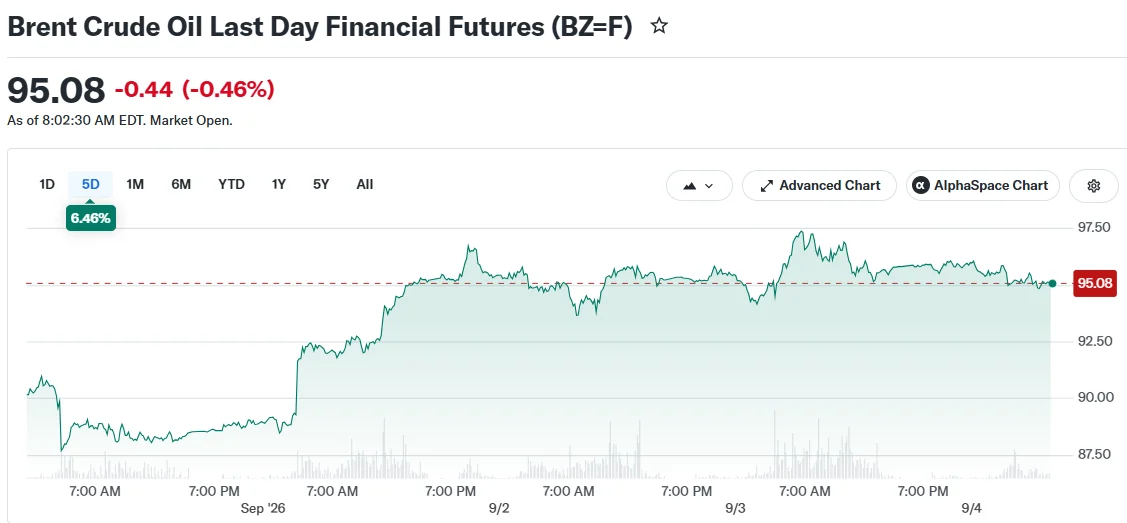
Washington and Tehran have now been engaged in military confrontations for seven months. Recent days witnessed some of the most intense exchanges since July, with American forces targeting sites near the critical Strait of Hormuz. Iranian forces retaliated with missile and drone strikes against U.S. and coalition installations across Kuwait, Bahrain, and Jordan.
Reports indicate one American strike impacted a location where a wedding celebration was underway in southern Iran, resulting in civilian casualties. Iranian officials strongly denounced the incident.
Critical Waterway Sees Dramatic Traffic Reduction
As the planet’s most vital oil transit point, the Strait of Hormuz has faced intensified Iranian shipping restrictions following the recent military escalation.
Iran has expanded its Strait of Hormuz shipping blacklist to 56 vessels, following the latest U.S. attacks.
A senior Iranian official is vowing an “asymmetrical and multi-layered” response.
Gulf tankers appear to be facing tighter restrictions, while Iraqi commercial… pic.twitter.com/9QnEQe2kPu
— Mario Nawfal (@MarioNawfal) September 4, 2026

Thursday saw merely four commercial cargo vessels navigate the strait, a stark contrast to the approximately 15 ships that typically pass through based on 10-day averages. This significant decline underscores persistent disruption, contradicting U.S. administration assertions that maritime traffic has largely normalized.
Maritime tracking services and independent energy consultants maintain that substantial interruptions persist. The discrepancy between official rhetoric and observable reality has amplified market volatility.
Vice President JD Vance stated Thursday that Washington would refuse diplomatic engagement with Tehran unless Iranian attacks on international shipping cease immediately.
Diesel Markets Reach Historic Peak
American diesel markets climbed to unprecedented price levels this week. Industry experts attribute this surge partially to crude supply constraints, compounded by continued Ukrainian strikes targeting Russian refining infrastructure.
“Diesel impacts every economic sector,” noted Claudio Galimberti, Rystad Energy’s chief economist. He emphasized that elevated diesel costs are amplifying inflation expectations, consequently driving upward pressure on U.S. Treasury yields.
The dramatic energy price escalation has prompted warnings regarding potential severe economic slowdown risks globally.
According to Energy Information Administration data, U.S. commercial crude stockpiles decreased to 424.5 million barrels during the week concluded August 28, declining from 428.9 million barrels recorded the prior week.
Market observers anticipate OPEC+ will maintain its October production strategy when convening Sunday. The cartel recently completed reversing one phase of output reductions, though Hormuz-related supply disruptions have muddied the effects of those policy adjustments.
Citigroup revised its third-quarter Brent average projection upward to $86 per barrel from $80, citing slower-than-anticipated Strait reopening. ANZ elevated its near-term Brent outlook to $95, warning of additional upside potential should hostilities intensify.
Iraqi oil shipments increased during August to approximately 2.34 million barrels daily, rising from July’s 1.35 million.
The post Crude Oil Surges Toward Six-Week Peak Amid U.S.-Iran Tensions in Hormuz Strait appeared first on Blockonomi.
Key Highlights
- On September 3, 2026, Oura submitted its S-1 registration statement, advancing toward a public offering on Nasdaq with the ticker symbol OURA
- The wearable health technology firm generated $1.4 billion in sales and posted $59 million in net earnings for the fiscal year concluded in June 2026
- Sales increased 74% compared to the previous year, although management cautioned that expansion rates might decelerate
- The platform serves 5 million paying subscribers and distributes products across 56 international markets through approximately 8,400 brick-and-mortar stores
- Management highlighted potential challenges including trade tariffs, dependence on a limited group of major retailers, and reliance on external artificial intelligence providers such as OpenAI, Anthropic, and Google
Oura, the health technology company responsible for creating the Oura Ring wearable device, submitted its S-1 registration statement to the Securities and Exchange Commission this Thursday, progressing toward a public market debut on the Nasdaq exchange.
The smart ring manufacturer intends to trade publicly using the ticker symbol OURA. Goldman Sachs, Morgan Stanley, and J.P. Morgan serve as primary underwriters for the offering.
The regulatory disclosure highlights impressive financial momentum. The company generated $1.4 billion in total sales and achieved $59 million in net profitability during the twelve-month stretch ending in June 2026.
During the nine-month window concluding in June 2026, sales reached $1.21 billion, marking a 74% increase over the comparable timeframe from the prior year.
Gross earnings for those nine months totaled $662 million, reflecting a 55% profit margin.
Strong Sales Figures Accompanied by Cautionary Notes
While the financial metrics appear robust, Oura maintained transparency regarding its operating history. Management acknowledged the company has experienced “a history of operating losses” and only “recently achieved profitability.”
The filing emphasized that sustained profitability cannot be guaranteed moving forward.
During the nine-month period through June 2026, Oura documented losses totaling $924 million against sales of $1.21 billion. The corresponding period one year earlier showed losses of $182.8 million on revenues of $697.6 million.
Management also warned that ongoing international trade disputes and potential tariff implementations could drive manufacturing costs higher.
Revenue Streams and Subscriber Base
The company operates on a dual revenue model: direct sales of the Oura Ring hardware device and recurring subscription revenue through Oura Membership plans.
As of June 2026, the platform supported 5 million paying subscribers. Approximately 72% of the membership base consists of female users.
During the twelve months ended June 2026, Oura distributed 3.6 million ring units. Users wear the device an average of roughly 23 hours daily.
The company maintains distribution channels spanning 56 countries through approximately 8,400 physical retail outlets, including partnerships with Amazon, Best Buy, Target, Costco, and Walmart. International markets outside the United States account for less than 20% of hardware sales.
Roughly 40% of new subscriber acquisition occurs through organic channels, and the 12-month member retention rate stands at approximately 85%.
Dependencies and Strategic Alliances
The filing disclosed that two major retail customers collectively represented 12% and 10% of total revenue during the nine-month reporting period, indicating significant concentration among distribution partners.
Management also revealed that the platform’s functionality depends on artificial intelligence technology from OpenAI, Anthropic, and Google, alongside third-party data infrastructure providers. The company cautioned that service interruptions from these vendors could impact business operations.
Oura maintains collaborative relationships with Dexcom, Natural Cycles, ResMed, Strava, and additional partners to broaden its health ecosystem.
According to the filing, the company targets a serviceable addressable market exceeding $90 billion spanning fitness tracking, digital healthcare, and connected biosensor technologies.
The executive team includes CEO Thomas Hale, who previously served as President at Momentive, and CFO Sean Brecker, former CEO of Headspace.
Capital raised through the public offering will fund technology innovation, operational expenses, and general corporate initiatives.
The post Oura (OURA) IPO: Smart Ring Maker Files for Nasdaq With $1.4B Revenue and 5M Subscribers appeared first on Blockonomi.
Key Takeaways
- Stock futures showed minimal movement Friday morning as investors awaited crucial August employment data
- Federal Reserve’s Chris Waller hinted at pausing rate increases, reducing September hike probability
- Current market pricing indicates approximately even odds for a Fed rate increase next month
- Analysts forecast August job additions between 55,000-65,000, bouncing back from July’s disappointing figures
- Lululemon stock plummeted 18% in early trading following downward revision of financial projections
Morning Market Overview
US stock futures demonstrated minimal volatility Friday morning as market participants awaited the government’s critical August employment report, scheduled for release at 8:30 a.m. ET.
Futures tied to the Nasdaq 100 climbed approximately 0.5%. S&P 500 contracts registered marginal gains. Dow Jones futures declined between 37 and 47 points, representing roughly 0.1%.
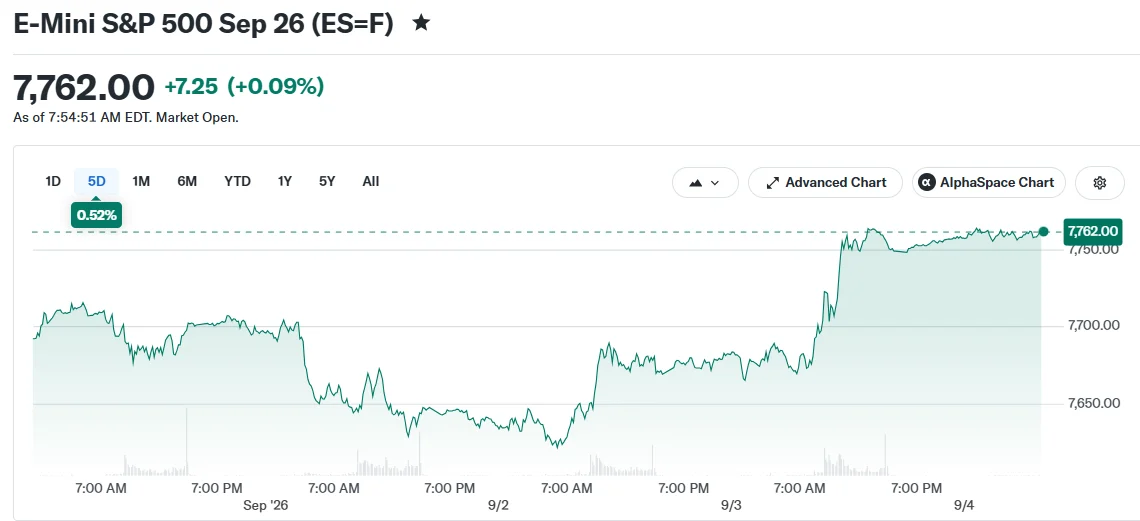
These movements followed a positive Thursday trading session. All three primary indices finished higher, with the Nasdaq posting the strongest performance after a Federal Reserve official indicated openness to maintaining current interest rate levels.
Federal Reserve Governor Christopher Waller expressed his inclination toward pausing rate adjustments. This statement prompted traders to reduce their expectations for a September rate increase.
Current market indicators suggest approximately equal probability for a Fed rate hike next month, based on CME Group trading data.
Treasury yields also declined Friday morning. The benchmark 10-year note yield decreased 1 basis point to 4.76%, providing additional tailwinds for equity markets.
Employment Data Takes Spotlight
Economic forecasters anticipate US employers added somewhere between 55,000 and 65,000 positions in August. This projection represents a recovery from July’s surprising decline in employment expansion.
ALERT: Today’s NFP jobs report is one of the BIGGEST market catalysts of September.
Markets expect:
– Non-farm payrolls: +53,000 to +56,000, after a 23,000 decline in July
– Unemployment rate: 4.2%A moderately weaker report could reinforce expectations for easier Fed policy,… https://t.co/LnORmPEnbh pic.twitter.com/X58L5AbTL1
— Coin Bureau (@coinbureau) September 4, 2026
Recent economic indicators suggest a labor market experiencing measured growth while maintaining overall stability.
Mark Haefele, chief investment officer at UBS Global Wealth Management, characterized the Fed’s upcoming decision as “finely balanced.” He anticipates that artificial intelligence infrastructure investment and economic resilience will sustain expansion while inflation moderates, potentially allowing the central bank to maintain current policy.
Weaker employment figures would bolster arguments for maintaining current rates. Conversely, robust job growth could increase pressure for an additional rate increase.
Lululemon Shares Sink on Revised Outlook
Lululemon emerged as the most significant premarket mover. The athletic apparel company’s stock declined 18% following its announcement of reduced revenue and earnings expectations alongside disappointing second quarter performance.
No additional significant corporate earnings releases were on Friday’s calendar.
Gold decreased 0.56% to approximately $4,514. Bitcoin advanced 3.26% to slightly above $81,187. West Texas Intermediate crude oil dropped 0.48% to roughly $90.86 per barrel.
The August employment report represents the primary catalyst for markets entering the weekend, with the Federal Reserve’s upcoming policy meeting looming large on the calendar.
The post August Jobs Report Takes Center Stage as Federal Reserve Weighs Next Move appeared first on Blockonomi.
TLDR
- Oracle stock surges as HPE deal strengthens its global AI infrastructure push.
- HPE networking expansion supports Oracle’s growing cloud and AI data centers.
- Oracle heads into Sept. 10 earnings with cloud growth and spending in focus.
- The HPE deal adds routing, switching, telemetry and support for Oracle data centers.
- Oracle’s rising capital spending underpins its broader cloud infrastructure buildout.
Oracle (ORCL) shares extended their rally after HPE expanded a networking deal supporting Oracle’s global AI data center buildout. ORCL closed 5.69% higher at $154.04, then gained 2.47% to $157.85 in pre-market trading. The advance came before Oracle’s fiscal first-quarter results, scheduled for September 10.
Oracle Corporation, ORCL
HPE Deal Expands Oracle’s AI Data Center Network
Oracle plans to deploy HPE Juniper routing and switching equipment across its AI data centers under the expanded agreement. The potential multi-year rollout includes PTX and MX routers, plus QFX and EX switching platforms. HPE will also provide networking support services and financing capabilities through the wider collaboration.
HPE Juniper products already support parts of Oracle Cloud Infrastructure’s data center and edge networks. The new deployment will extend that foundation as Oracle builds larger AI superclusters across more locations. Those clusters need high bandwidth, low latency, congestion control, and reliable recovery during network failures.
The latest QFX switches will provide high-density connections and dynamic load balancing for large backend networks. Oracle and HPE will also develop telemetry tools that improve visibility across network devices and fabrics. The systems can identify packet loss, traffic imbalances, queue buildup, and component problems before operations suffer.
Oracle Spending Supports Wider Cloud Expansion
Oracle has sharply increased infrastructure spending as demand grows for cloud capacity and large computing workloads. Capital expenditures reached $55.7 billion in fiscal 2026, compared with $21.2 billion one year earlier. The company expects around $70 billion in net cash capital spending during fiscal 2027.
Cloud infrastructure has become a major part of Oracle’s growth plan as customers require more computing capacity. Larger data centers also require networking systems, chips, cooling equipment, power supplies, and financing. Oracle continues expanding its supplier relationships while building capacity across several regions.
The HPE agreement strengthens a networking relationship already used inside Oracle Cloud Infrastructure. It gives Oracle access to routing and switching systems designed for larger computing clusters. HPE also issued Oracle warrants to purchase HPE common stock under the expanded arrangement.
Oracle Earnings Put Cloud Execution in Focus
Oracle will report fiscal first-quarter 2027 results on September 10, shifting attention toward cloud performance and infrastructure demand. The report will provide new figures for revenue growth, spending, contracted business, and cloud capacity. It will also show how quickly Oracle converts infrastructure expansion into reported growth.
Oracle entered the quarter with strong demand tied to cloud computing, model training, and inference workloads. The company has committed substantial capital to data centers designed for large computing clusters. Its expanded HPE partnership addresses the network layer needed to keep those clusters connected and efficient.
The latest rally leaves Oracle shares higher before the earnings release next week. The results will test whether cloud growth supports the recent strength in ORCL stock. Meanwhile, the HPE agreement reinforces Oracle’s broader effort to expand global computing infrastructure.
The post Oracle (ORCL) Stock: Surge as AI Infrastructure Deal With HPE Fuels Rally Ahead of Earnings appeared first on Blockonomi.
HTTP error 429 on https://cryptopotato.com/feed/
Failed to fetch feed: https://cryptopotato.com/feed/
Failed to fetch feed.