Cryptocurrency Posts
Crypto Briefing
Jain Global's experience highlights the challenges new hedge funds face in balancing impressive gross profits with investor net returns.
The post Jain Global posts $1.8B in gross trading profits over two years, but net returns tell a different story appeared first on Crypto Briefing.
Saudi Arabia's increased borrowing highlights the fiscal strain of geopolitical tensions, challenging its economic diversification goals.
The post Saudi Arabia launches dollar bond sale as Iran war squeezes oil revenues appeared first on Crypto Briefing.
The diplomatic stalemate heightens the risk of regional escalation, impacting global oil markets and reducing prospects for U.S.-Iran dialogue.
The post Hormuz diplomacy yields no results amid US-Iran tensions: Kallas appeared first on Crypto Briefing.
Felix Pago's funding boost could accelerate stablecoin adoption, enhancing financial inclusion and innovation in cross-border transactions.
The post Felix Pago raises $200M in Series B funding led by a16z to scale stablecoin remittances appeared first on Crypto Briefing.
Investor caution in September could lead to increased market volatility, impacting short-term strategies and highlighting the need for hedging.
The post Citadel Securities chief strategist warns of tactical downside in September appeared first on Crypto Briefing.
Bitcoin Magazine
Bitcoin Magazine

Strategy Opposes MSCI Proposal, Says Bitcoin Treasury Firms Are Being Targeted a Second Time
Bitcoin treasury Strategy has blasted Morgan Stanley Capital International’s proposal to exclude it from its Global Investable Market Indexes, calling it “misguided” and “flawed.”
Writing in a letter to MSCI Monday, the Nasdaq-listed Bitcoin behemoth’s founder, Michael Saylor, and CEO, Phong Le, said that the company was discriminating against digital asset businesses.
MSCI said earlier this month that it was consulting on a plan to define “non-operating companies” and make them ineligible for its Global Investable Market Indexes. The removal of such companies would exclude firms like Strategy from indexes visible to a large pool of institutional investors.
MSCI’s latest proposal comes after the company in 2025 proposed excluding from its indices all companies whose digital-asset holdings represent 50% or more of total assets.
“MSCI’s continued effort to discriminate against digital assets is misguided and calls into question MSCI’s neutrality and reliability,” Strategy’s letter read.
It added: “The proposal, like the 2025 proposal that MSCI withdrew, is discriminatory, arbitrary, and misguided. If adopted, the proposal would have no meaningful impact on Strategy’s business, but it would profoundly harm MSCI’s reputation as a reliable and neutral index provider. Like the 2025 proposal, the current proposal should be withdrawn.”
Strategy argued that MSCI was relying on unprecedented classifications to define Bitcoin as a “non-operating” asset. Strategy said it reports its Bitcoin business as an operating segment and its Bitcoin gains and losses as operating expenses.
The company said that MSCI’s methodology for targeting “non-operating companies” was “arbitrary and unexplained,” and was just a way of unfairly targeting digital asset treasuries.
Strategy further argued that the company is an operating one, employing 1,500 people across the globe and actively using its Bitcoin to “create shareholder value.”
Strategy — formerly MicroStrategy — is an enterprise software company that pivoted to buying and holding bitcoin in 2020. It first bought the cryptocurrency to protect shareholders but has since aggressively bought the asset and is now the largest corporate holder of the cryptocurrency, with 845,050 bitcoins worth $65.8 billion at today’s prices.
Investors can buy Strategy’s Nasdaq-listed stock (MSTR) to get heightened exposure to bitcoin’s performance.
MSTR closed Monday trading 4% higher. Year-to-date, the stock is down 15%.
This post Strategy Opposes MSCI Proposal, Says Bitcoin Treasury Firms Are Being Targeted a Second Time first appeared on Bitcoin Magazine and is written by Mathew Di Salvo.
Bitcoin Magazine
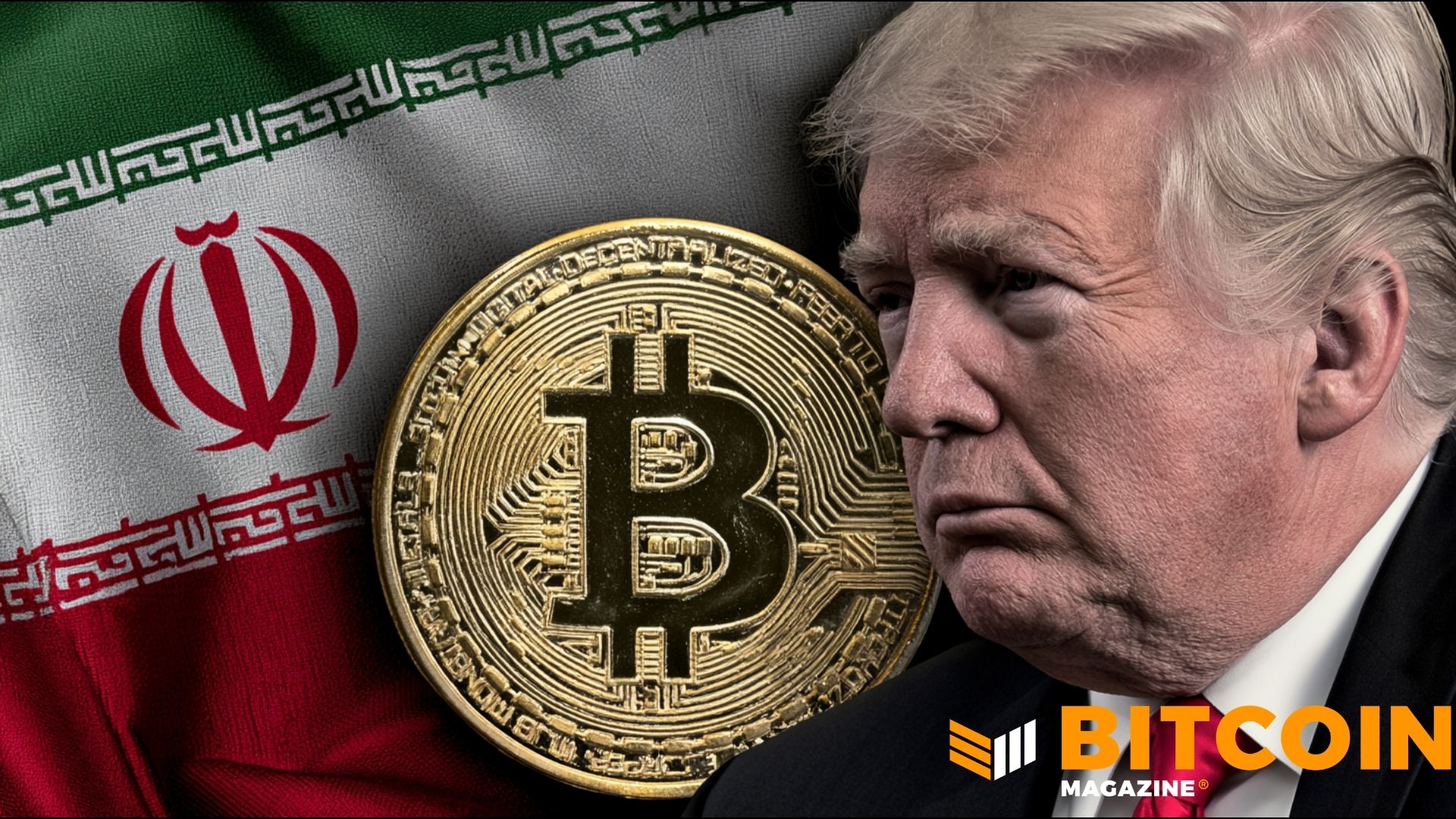
Bitcoin Unfazed by Trump’s Iran Threats
Bitcoin on Monday shrugged off tensions in the Middle East, barely moving despite U.S. President Donald Trump vowing to hit Iran hard.
The price of the biggest cryptocurrency recently stood at $79,076, unmoved over a 24-hour period. The coin also hasn’t budged from where it stood seven days ago.
Geopolitical strife has this year hurt Bitcoin’s price, with the cryptocurrency typically facing downward pressure on news of war and rallied in hopes of a ceasefire.
When the U.S. and Israel first attacked Iran in February, the coin nosedived, and had been shaky on news of war in March and April.
But in recent months, Bitcoin’s volatility has been muted, according to analysts, and Monday was no different: President Trump promised to hit Iran again but the asset didn’t flinch.
“We’re going to hit them hard,” President Trump was quoted telling a Fox News reporter on Monday. The U.S. and Iran started strikes again on Sunday — the first in over one month.
Bitcoin started a phenomenal run two weeks ago — its best in three years — and is up nearly 30% over the past month.
Its price started surging after the U.S. Treasury would at least double the size of its liquidity-support buyback operations. The announcement hurt the dollar but non-yielding assets like bitcoin and gold have benefited.
Positive regulatory news has also helped bitcoin this month: President Donald Trump last week said that the long-awaited crypto Clarity Act was a “very, very powerful” piece of legislation, and urged lawmakers to get it over the line.
The Clarity Act aims to establish a framework for distinguishing between digital assets that are securities, commodities or payment stablecoins — legislation that the crypto industry has long called for.
JUST IN: Crypto ETFs attracted $3.2 billion in inflows last week, "their largest weekly intake since October 2025", The Kobeissi Letter reports.
— Bitcoin Magazine (@BitcoinMagazine) August 31, 2026
BlackRock's IBIT led with $928 million last week, adding to their $1.3 billion from the prior week, and marking the biggest 2-week… pic.twitter.com/ROC9tYPMGN

Investors have piled back into exchange-traded funds this month, too, which has also helped bitcoin’s price. From August 17 to 27, investors threw over $2.8 billion at the vehicles — the most since October.
Bitcoin reached as high as $81,281 last week before sliding again on Friday.
This post Bitcoin Unfazed by Trump’s Iran Threats first appeared on Bitcoin Magazine and is written by Mathew Di Salvo.
Bitcoin Magazine

Strive Becomes Fifth-Largest Bitcoin Treasury, Stock Jumps on Latest Buy
Strive’s stock soared on Monday after the company announced a $143 million bitcoin buy, making it the fifth biggest publicly traded crypto treasury.
The Nasdaq-listed company announced its latest buy of 1,800 bitcoins between August 24 and August 28. It snapped up the coins for an average price of $79,431, according to a filing with the Securities and Exchange Commission.
The Dallas, Texas-based company now holds 23,156 coins worth $1.8 billion at today’s prices. Its stock (NASDAQ: ASST) was trading 9% higher at about 12.30pm in New York. Year-to-date, Strive’s stock has risen by nearly 40%.
JUST IN:
— Bitcoin Magazine (@BitcoinMagazine) August 31, 2026Public company Strive bought 1,800 BTC for $143 million
pic.twitter.com/xEkWx3ZNZp
Strive’s year-to-date Bitcoin yield, a metric that compares growth in bitcoin holdings relative to share count, reached 40.8% as of its Aug. 28 filing, up from less than 37% in early June.
Strive now is the fifth biggest bitcoin treasury, behind only Strategy, Twenty One, Metaplanet, and MARA.
Founded by former Ohio gubernatorial candidate Vivek Ramaswamy in 2025, after raising $750 million to buy Bitcoin, Strive debuted as an official bitcoin treasury.
In January 2026, it completed the acquisition of Semler Scientific in an all-stock deal — the first instance of a publicly traded Bitcoin treasury company acquiring another such company.
The idea is that investors can get amplified returns from Strive’s stock. The company buys bitcoin with equity, and maintains a debt-free balance sheet: no bonds, no credit lines, and no leveraged positions that could trigger forced liquidation in a downturn.
Strive CEO Matt Cole has described the company as debt-free with zero margin requirements and zero encumbered bitcoin.
Strive’s latest purchase comes as Strategy, the biggest corporate holder of bitcoin, restarted its buying last week.
The software company had paused buying bitcoin for 10 weeks but announced it had bought 4,603 bitcoins for $369.7 million between August 24 to August 30.
This post Strive Becomes Fifth-Largest Bitcoin Treasury, Stock Jumps on Latest Buy first appeared on Bitcoin Magazine and is written by Mathew Di Salvo.
Bitcoin Magazine
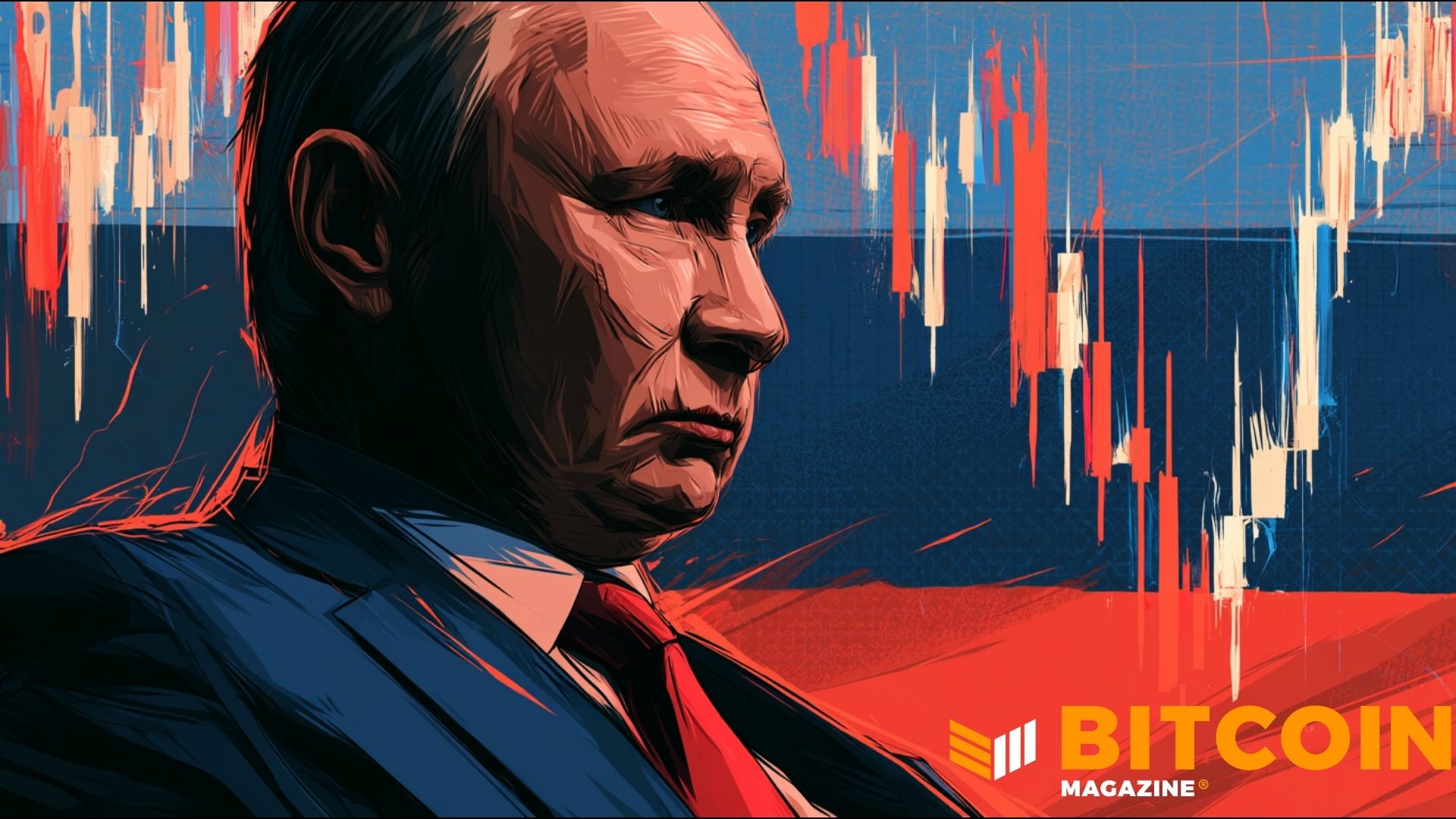
Russia’s Sberbank Estimates $46.4B Trading Volume in First Year of Crypto Buildout
Russia’s largest bank, Sberbank, has said it expects trading volume with its new crypto rollout to hit 4 trillion rubles ($46.43 bln) in the first year, according to reports.
Volumes are also expected to hit 7.5 trillion rubles ($87.06 bln) by 2029, Sberbank Deputy Chairman of the Executive Board Anatoly Popov was quoted saying, as reported by Tass on Saturday.
The forecast was deemed “conservative” according to the news report. Sberbank in July revealed plans to debut a Bitcoin and crypto wallet as well as digital asset custody by December. The Bank of Russia in July published draft regulations for crypto trading, and the State Duma is preparing the comprehensive regulation of digital assets.
And in a Friday report, Tass quoted Sberbank Deputy Chairman Anatoly Popov saying that the bank was planning to accept Bitcoin — and other cryptocurrencies — as collateral for loans.
Russia is fast moving ahead with regulating digital assets in the country. Russian President Vladimir Putin this month signed a law to set in stone the regulation of digital currencies and digital rights in the country.
The new law reportedly allows only registered entities to operate as exchanges, and puts limits on the amount of crypto retail investors can use.
Still, despite the rollout, using digital assets as a means of payment or legal tender within Russia is still banned. Using crypto as a form of payment has been prohibited in Russia since 2022.
President Putin has appeared to praise Bitcoin in the past, once saying that the leading cryptocurrency can’t be stopped.
Since the U.S. and European governments cut Russia off from the SWIFT payments system after it invaded Ukraine in 2022, Russian companies have been using Bitcoin to skirt around the penalties.
But the Russian state keeps a tight grip on what its citizens can do with crypto: authorities have been cracking down and arresting people operating unregistered crypto exchanges.
And the amounts involved barely matter — a nuclear engineer in Sarov was sentenced to 18 years for sending about $13 from his crypto wallet to groups the state designates as terrorist organizations.
This post Russia’s Sberbank Estimates $46.4B Trading Volume in First Year of Crypto Buildout first appeared on Bitcoin Magazine and is written by Mathew Di Salvo.
Bitcoin Magazine

Strategy Resumes Bitcoin Buying After 10-Week Hiatus
Bitcoin treasury Strategy resumed its bitcoin buys last week, snapping up nearly $370 million in the leading cryptocurrency, according to a Monday announcement from the company.
A filing with the Securities and Exchange Commission shows that Strategy bought 4,603 bitcoins for $369.7 million between August 24 to August 30. Each coin was bought at an average price of $80,318, according to the filing.
The buy comes after Strategy paused its bitcoin buys in June, instead focusing on building a cash buffer, buying back its stock and even sometimes selling some of its holdings.
JUST IN: Strategy buys 4,603 BTC for $370 million!
— Bitcoin Magazine (@BitcoinMagazine) August 31, 2026
“Strategy is evolving from one-way capital issuance to active capital management,” Strategy CEO Phong Le said in June.
“We intend to move between issuing securities when capital is attractive and repurchasing securities when our instruments trade at levels that make buybacks accretive. This flexibility is designed to create shareholder value, improve corporate performance, and strengthen the quality and market standing of Strategy’s securities in the eyes of investors.”
Strategy now has $5.1 billion in its USD Reserve and $1.61 billion its new USD Cash reserve — which was announced last week.
The company holds 845,050 bitcoins worth $65.8 billion at today’s prices.
Software company Strategy — formerly MicroStrategy — began buying bitcoin in August 2020 as a treasury strategy to boost shareholder returns during the pandemic.
It has since spent more than $63.7 billion on buying bitcoin and remains by far the largest corporate holder of Bitcoin in the world. Its approach spawned a wave of copycat companies that have since adopted similar crypto-treasury strategies of their own.
Chairman and Strategy founder Michael Saylor has said that the company is now focusing on creating digital credit: high-yield products, such as its preferred equity, STRC, which are backed by its bitcoin holdings.
Strategy’s stock (NASDAQ: MSTR) was trading slightly higher on Monday morning in New York. Year-to-date, its price has dipped nearly 20%.
Bitcoin was trading for $77,821 on Monday morning in New York after hitting a high last week of $81,281. Over a 24-hour period, the coin now sits unmoved, but over a 30-day period, it has jumped by more than 24%.
This post Strategy Resumes Bitcoin Buying After 10-Week Hiatus first appeared on Bitcoin Magazine and is written by Mathew Di Salvo.
CryptoSlate
Crypto added roughly $500 billion in market value in a matter of days as Bitcoin ran from about $63,500 toward $80,000 last week.
A liquidation squeeze powered much of the first phase, and regulated investment products then supplied fresh capital once forced buying began to fade.
Tom Lee told Milk Road that the crypto liquidation event showed how far “offsides” traders had become. He called the move a “course correction” that could open a much larger advance.
Glassnode said Aug. 19 produced the largest short-liquidation day in its feed since 2019, and exchanges automatically closed short positions as prices moved against traders, turning bearish bets into mandatory buying during an already violent rally.
CoinShares recorded over $2.9 billion of global crypto investment-product inflows in the week to Aug. 20, the largest weekly total of 2026. The first three trading days of the next week added another $1.65 billion.
| Rally phase | Main participant | What happened | Why it matters |
|---|---|---|---|
| Stage 1 | Macro buyers | Treasury buybacks, a weaker dollar, and liquidity support helped trigger the breakout | Created the initial conditions for risk assets to rally |
| Stage 2 | Short sellers | Shorts were liquidated as BTC moved from ~$63.5K toward ~$80K | Forced buying accelerated the move |
| Stage 3 | Regulated funds | Global crypto products took in $2.94B, then another $1.65B | Follow-through continued after the squeeze |
| Stage 4 | Institutional allocators | CoinShares survey showed allocations rising to 1.2% | Suggests some reallocation began before the rally |
The crypto rally passed from shorts to funds
CoinShares recorded $976 million of Bitcoin inflows on Aug. 27. Ethereum took in $478 million, XRP added $80.5 million, Solana drew $62.9 million, and Hyperliquid products added $39 million.
Capital entered regulated ETFs across several crypto assets even once the liquidation cascade had already done its work.
QCP’s derivatives data shows Bitcoin climbed from roughly $63,500 to around $80,000 as BTC-denominated futures open interest fell from about 646,000 BTC to 588,000 BTC. That equals a decline of roughly 58,000 BTC, or about 9%.
Funding stayed contained through the move, and a classic leveraged-long chase usually sends price, open interest, and funding higher together.
Falling open interest only establishes what happened to aggregate futures positioning. The data still shows that traders did not immediately rebuild leverage on the long side at the same pace that prices rose.
CoinShares’ August fund-manager survey found that crypto allocations among respondents rose to 1.2% of portfolios, the first increase since the October 2025 selloff. The firm said institutions drove the entire increase.
The survey covered investors overseeing about $1.16 trillion, and more respondents also cited “good value” as a reason for owning crypto during the preceding decline.
Institutions had started adding exposure before Bitcoin printed its biggest green candles, and the breakout then coincided with a much larger wave of product inflows. The short squeeze accelerated a reallocation in crypto that had already begun.
| Asset | Three-session inflow | Share of listed inflows |
|---|---|---|
| Bitcoin | $976M | ~60% |
| Ethereum | $478M | ~29% |
| XRP | $80.5M | ~5% |
| Solana | $62.9M | ~4% |
| Hyperliquid | $39M | ~2% |
| Total shown | $1.636B | ~100% |
The bull case needs the handoff to hold
The bull case rests on the idea that the crypto liquidation event cleared bearish leverage without replacing it with an equally unstable long-side position.
Glassnode places Bitcoin’s first major overhead zone around $83,000 to $86,000. A move through that area would show fresh demand absorbing supply from holders using the rally to exit. Continued weekly crypto product inflows near or above $1 billion would add another layer of support.
A gradual recovery in open interest would give the market more room, and contained funding would keep borrowing costs from showing the kind of speculative excess that often precedes another liquidation cascade.
Under that path, Lee’s “course correction” framing gains support: short sellers supplied the ignition, and institutional capital supplied the persistence.
The macro environment has already made that thesis harder to prove.
QCP linked part of the original breakout to Treasury’s decision to expand long-end liquidity-support buybacks.
Fed Chair Kevin Warsh’s Jackson Hole remarks then pushed Fed-funds futures toward a much more hawkish September outcome. Reports noted that markets lifted the implied probability of a September rate hike from roughly 35% to 64%.
Renewed US-Iran fighting added another source of stress on Aug. 31. Brent crude moved above $90, Treasury yields climbed, and US equities fell.
The buyers who inherited the rally now face a macro setup far less friendly than the one that helped Bitcoin break out.
The bear case begins below $70,000
Glassnode called the market in its Aug. 31 Market Pulse “in transition,” pairing strong institutional allocation with rebuilding leverage. The report also found softer crypto retail participation and early short-term distribution.
Bitcoin’s short-term-holder cost basis sits near $70,000. A break below that level would put recent buyers underwater and test whether regulated fund demand can continue absorbing supply during a broader risk-off move.
The outlook deteriorates further if futures leverage rebuilds as prices fall. Higher open interest and firmer funding during a decline would leave more long-side exposure vulnerable to liquidation just as macro conditions tighten.
Crypto fund flows would then provide the clearest measure of how durable the handoff became. A sharp slowdown would signal weaker institutional appetite, while broad redemptions would show that regulated-product buyers could no longer absorb selling driven by higher yields, hawkish Fed expectations, and geopolitical risk.
The next test arrives with the US jobs report on Sept. 4, with expectations around 55,000 to 58,000 new jobs, depending on the survey referenced.
Another weak employment print could make a September hike harder to justify, and a stronger number could reinforce the hawkish repricing that followed Warsh’s speech, affecting risk assets like crypto.
| Scenario | BTC / macro trigger | What to watch | Meaning for the rally |
|---|---|---|---|
| Bull case | BTC clears $83K–$86K | Product inflows remain near or above $1B weekly; funding stays contained | The handoff from shorts to institutions holds |
| Base case | BTC holds above ~$70K | OI rebuilds slowly; inflows cool but remain positive | Rally digests without confirming a full breakout |
| Bear case | BTC loses ~$70K | Recent buyers go underwater; fund inflows stall | Institutional demand faces its first real stress test |
| Breakdown case | Higher yields, $90 oil, hawkish Fed pressure | OI rises into weakness; redemptions broaden | The move looks more like a liquidation rally with a long tail |
Short sellers explain why crypto moved so quickly from the mid-$60,000s toward $80,000, and regulated fund capital explains more of what came next.
Those buyers now carry the rally into its harder phase. Their ability to keep absorbing supply through $90 oil, higher yields, and a more hawkish Fed will decide whether the $500 billion surge becomes a genuine market reset or a liquidation rally with a longer tail.
The post How short liquidations cleared $500B in crypto positions before institutional buyers took over appeared first on CryptoSlate.
Five major US spot XRP products held XRP with a combined fair value $746.1 million below accounting cost at the end of June, but investors kept buying anyway.
According to SEC filings, Bitwise, Canary Capital, Franklin Templeton, 21Shares, and Grayscale recorded roughly $629.9 million in primary-market share creations against $309.1 million in redemptions during the first half of the year.
That left capital activity positive by about $320.8 million even as the funds' combined XRP holdings sat 44.1% below their $1.7 billion accounting cost.
The gap quantifies what Bloomberg ETF analyst James Seyffart called “surprisingly resilient” XRP ETF demand in an Aug. 31 post, where he put cumulative net inflows across the asset class at $1.8 billion.
| Five-fund XRP ETF snapshot | Amount |
|---|---|
| XRP accounting cost at June 30 | $1.693B |
| XRP fair value at June 30 | $947.3M |
| Gap vs accounting cost | -$746.1M |
| Percent below cost | -44.1% |
| H1 share creations | $629.9M |
| H1 redemptions | $309.1M |
| Net capital activity | +$320.8M |
Why anyone would buy into a position already underwater
Fair value across the sample of five funds totaled $947.3 million as of June 30, versus the nearly $1.7 billion those funds had originally paid.
That decline alone would normally signal selling, since a fund holding an asset at less than half its recorded value gives shareholders every incentive to redeem and reallocate elsewhere.
New creations kept arriving faster than shares left, pushing the aggregate net figure positive despite the size of the paper decline sitting inside the funds themselves.
Bitwise, Canary and Franklin recorded $537.9 million in first-half creations against just $53.3 million in redemptions, a net inflow of roughly $484.5 million. Only about $9.90 left those three funds for every $100 that came in, and it happened while their combined XRP holdings traded 42.9% below accounting cost.
Grayscale and 21Shares recorded $92.1 million in creations against $255.8 million in redemptions, a net outflow of $163.7 million that accounted for roughly 83% of all redemptions across the five-fund sample.
Grayscale alone saw $180.8 million redeemed against just $66.6 million created, while 21Shares recorded $75 million of redemptions against $25.5 million of creations.
The aggregate $320.8 million figure reads as resilient because inflows at three funds overwhelmed outflows at the other two. Even large redemptions at Grayscale and 21Shares were offset by unusually sticky creation activity at Bitwise, Canary and Franklin.
| Fund | XRP below cost | H1 creations | H1 redemptions | H1 net activity |
|---|---|---|---|---|
| Bitwise | -$180.8M | $268.2M | $33.8M | +$234.4M |
| Canary | -$229.2M | $88.3M | $5.9M | +$82.4M |
| Franklin | -$174.5M | $181.4M | $13.6M | +$167.8M |
| 21Shares | -$113.5M | $25.5M | $75.0M | -$49.5M |
| Grayscale | -$48.0M | $66.6M | $180.8M | -$114.2M |
What the numbers establish
Enough fresh capital arrived at a handful of funds to absorb real selling elsewhere in the same product category. Some of that apparent resilience may also reflect rotation, with investors exiting higher-fee or legacy products while entering funds they consider better structured.
That is a different pattern than every cohort of XRP ETF shareholders independently believing in the trade.
The $746.1 million figure measures the gap between the funds' recorded XRP cost and its June 30 fair value, a fund-level accounting figure. That sits apart from the personal cost basis of individual shareholders, who bought and sold at many different prices across the period.
Creations and redemptions likewise happen between the funds and authorized participants in the primary market, a mechanism distinct from retail investors directly depositing or withdrawing cash.
REX-Osprey's XRPR sits outside this analysis entirely, since its 1940 Act structure and ability to gain XRP exposure through other funds make its balance sheet a poor match for the five grantor-trust products compared here.
Cumulative XRP ETF inflows reached nearly $1.6 billion by Aug. 24 and $1.64 billion by Aug. 29, before Seyffart's $1.8 billion figure at month's end. That trajectory shows June 30 captured a moment in a longer pattern, well short of its end.
BTC trades near $78,000, and spot Bitcoin ETFs pulled in roughly $2.5 billion over seven trading days in late August before a rare single-day outflow. Bitcoin's inflows are returning as price sits near a level investors already recognize.
XRP's flows kept building through a far deeper drawdown, with the funds' own holdings still trading well below what they paid.
How far XRP has to recover before the accounting pain disappears
The five funds held roughly 906.8 million XRP at June 30, implying a rough cost-basis breakeven near $1.87 per token. XRP currently trades around $1.38, meaning the sample would remain underwater if marked at today's price.
| XRP price scenario | Implied value of 906.8M XRP | Gap vs $1.693B cost | What it means |
|---|---|---|---|
| $0.75 bear case | ~$680M | ~60% below cost | Redemptions may spread beyond Grayscale and 21Shares |
| $0.90 bear case | ~$816M | ~52% below cost | ETF resilience faces a deeper stress test |
| $1.38 current price | ~$1.25B | ~26% below cost | Funds remain underwater, but less severely than June 30 |
| $1.50 recovery case | ~$1.36B | ~20% below cost | Accounting pain narrows but does not disappear |
| $1.87 breakeven | ~$1.70B | Roughly flat | Five-fund cost basis is largely recovered |
| $1.90 bull case | ~$1.72B | Slightly above cost | Resilience narrative turns into vindication |
The bull case has XRP climbing back toward the $1.50 to $1.90 range, which would erase most of the accounting gap without requiring a fresh cycle high.
Under that path, the funds currently sitting deepest underwater see their fair value close in on cost. The resilience story shifts from a stress test into simple vindication for the investors who kept buying through the drawdown.
The bear case has XRP sliding toward $0.75 to $0.90, pushing the five-fund sample 52% to 60% below cost. In that scenario, the real test shifts to whether the redemption pattern already visible at Grayscale and 21Shares starts showing up across the rest of the complex.
Regulated XRP demand behaved this year like conviction buying into a known loss. Whether that conviction was broadly shared or concentrated in a few funds now depends on where XRP trades next.
The post XRP investors poured $320M into ETFs while the funds sat on a $746M paper loss appeared first on CryptoSlate.
Cronos has restarted and restored block production after validators restored the chain to its state before the Tectonic exploit, replacing an open-ended network halt with a monitored restart. In an Aug. 31 update, Cronos said the restarted chain was producing blocks from block 90,896,189, with a timestamp of 23:49:01 UTC on Aug. 30.
The network said it was fully back online, but added that some protocols, RPC providers, explorers and bridges could take longer to recover. Cronos also said it was monitoring the chain for stability and would publish a full postmortem. Those details superseded a 05:24 UTC update on Aug. 31 that said the network remained halted while the investigation continued.
Cronos had announced the halt on Aug. 30 after identifying an exploit at Tectonic, a decentralized lending protocol on the chain. The response made the wider blockchain, rather than only Tectonic, unavailable while validators and security teams assessed the incident.
Tectonic separately acknowledged an incident and told users not to interact with the protocol until it confirmed that doing so was safe.
How the Tectonic exploit unfolded
Onchain researcher Weilin Li attributed the exploit to manipulation of TONIC, Tectonic's thinly traded governance token. According to Li's analysis, the attacker inflated TONIC's price and used the token as collateral to borrow other assets from Tectonic.
The protocol's documentation lists a 20% collateral factor for TONIC in a parameter table dated May 2025. However, that historical table does not establish the configuration at the time of the incident.
Li initially estimated that about $66 million was affected, then raised the figure to roughly $75 million after identifying another attacker-controlled address. He estimated that only about $6 million was bridged to Ethereum before Cronos halted, leaving most of the affected assets on the network. The figures and attack mechanism remain Li's assessment rather than an official accounting.
What the Cronos restart changes
The restart relied on restoring the chain state to before the Tectonic exploit. Cronos said node operators could restart on version 1.7.8 using updated mainnet snapshots. The network did not say in the cited update how the rollback would affect all transactions submitted during the discarded period.
The difference between Li's total estimate and the reported bridge flow helps explain why the validator halt may have limited onward movement. However, Cronos and Tectonic have not published a confirmed loss, an official root-cause analysis or a complete account of how attacker-controlled assets will be handled.
Crypto.com CEO Kris Marszalek said the company's app and exchange were unaffected, were operating normally and had sent security staff to assist Cronos. That assurance applies to Crypto.com's services, not to Tectonic depositors.
The immediate uncertainty has shifted from when Cronos will restart to how quickly connected services recover and what the promised postmortem establishes. Those details will determine the final accounting and whether Tectonic users can resume normal activity.
The post Cronos validators erase transaction history to contain massive $75 million lending protocol exploit appeared first on CryptoSlate.
Michael Saylor recently published an essay arguing that institutional custody and securities can expand Bitcoin without eliminating self-custody. On the same day, Strategy reported $2.0065 billion of net MSTR share-sale proceeds, $5.10 billion in its USD Reserve, $1.59 billion in a new USD Cash pool and a $136.4 million repurchase of STRC preferred stock.
Saylor's “The Bitcoin Reformation” defines sovereignty as the ability to choose among direct ownership and transparent institutional claims. Strategy's Aug. 24 Form 8-K shows the company raising, protecting and reallocating capital through exactly those layers while holding 840,447 BTC.
The essay remains attributed directly to Saylor; Strategy's formal policies appear separately in its filings. Shared timing doesn't establish a motive; it does place a broad adoption doctrine beside the capital system that benefits most directly from investors accepting Bitcoin-linked equity, preferred stock, debt, and custodial products as legitimate but distinct claims.
Saylor describes self-custody as a vital exit right and a check on intermediaries. He rejects turning that right into an obligation for every person and institution.
The distinction rests on risk allocation. Direct control removes a custodian while making the owner responsible for keys, backups, inheritance planning and protection from digital or physical threats. Institutional custody adds legal, counterparty and concentration risks while potentially providing segregation of duties, multiple approvals, audits, insurance and continuity.
The same logic shapes the essay's treatment of “paper Bitcoin.” Saylor says the phrase accurately captures an unbacked promise falsely presented as Bitcoin. He argues that it obscures more than it explains when applied equally to exchange-traded products, company shares, preferred stock, bonds and derivatives.
Those instruments remain different from Bitcoin and from one another. Their usefulness depends on the holder's needs for custody, income, liquidity, priority or risk transfer. A pension fund, bank, insurer, corporation and individual may all seek Bitcoin exposure through different legal forms.
The capital machine beside the manifesto
Strategy's disclosures show why those distinctions matter to the company.
The Aug. 24 filing said Strategy sold 18,261,118 MSTR shares during Aug. 17-23 for $2.0065 billion in net proceeds. The share count included sales that had yet to settle as of Aug. 21, and the disclosed cash balances included expected proceeds that had yet to settle as of Aug. 23.
Strategy allocated $300 million to its USD Reserve and $136.4 million to repurchase 1,431,212 STRC shares. The remaining proceeds increased the separately designated USD Cash pool. Strategy reported no Bitcoin purchases or sales during the week.
The cash categories carry different constraints. Strategy's USD Reserve remains governed by the policy disclosed in its June 29 Form 8-K. The board-approved policy restricts that reserve to preferred dividends and debt interest and requires management to maintain at least 12 months of expected obligations unless the board authorizes a reduction.
The June filing also records a separate board-authorized BTC Monetization Program. It permits specified Bitcoin sales to add as much as $1.25 billion to the reserve, cover or replenish dividend and interest payments, or fund authorized securities repurchases. The program remains discretionary and may be modified, suspended or terminated.
This week's activity ran in several directions at once: Strategy issued common stock, kept its Bitcoin balance unchanged, expanded dollar liquidity and bought back preferred stock. After the STRC purchase, $516.6 million remained under the broader Digital Credit Securities repurchase program.
Saylor's doctrine can accommodate that mix. Once transparent equity, preferred, debt and derivative claims are treated as components of a Bitcoin capital market, issuance, cash retention, repurchases and potential BTC monetization can function as parts of one capital-management system.
That is an analytical alignment between the essay and the disclosures. Saylor's reason for publishing remains unknown, and his essay creates no promise about Strategy's future capital allocation.
Bitcoin exposure comes in different legal claims
For holders, the practical issue is what they own, who controls the asset and which claims rank ahead of theirs.
| Instrument | Holder's claim | Custody or control | Main structural risks |
|---|---|---|---|
| Direct BTC | Bitcoin controlled through private keys | The holder authorizes transfers and manages the keys | Key loss, theft, operational error, physical security and market volatility |
| Custodial BTC | An account-based or contractual claim whose legal form depends on the provider | The custodian controls keys and processes withdrawals | Counterparty failure, withdrawal limits, legal title, concentration and custody terms |
| Spot Bitcoin ETP share | A security issued under a fund or trust structure | A specialist custodian holds the underlying Bitcoin while investors trade shares | Fees, tracking and market structure, custody concentration and governing documents |
| MSTR common stock | Residual equity in Strategy's operating and financing enterprise | Strategy controls its Bitcoin and capital allocation | Dilution, management decisions, liabilities, tax, financing risk, valuation and Bitcoin volatility |
| Strategy preferred stock | An issuer equity claim with series-specific dividend, conversion, priority or call terms | Strategy controls the assets; preferred claims rank ahead of common equity under their terms | Dividend policy, issuer credit, liquidity, interest-rate sensitivity and subordination |
| Strategy debt | A contractual issuer claim with interest, maturity and seniority terms | Strategy controls the assets and manages repayment or refinancing | Issuer credit, refinancing, maturity, subordination and recovery |
| Derivative | A contract whose value depends on an underlying price or risk factor | Control follows the venue, collateral and contract | Leverage, liquidation, basis, collateral, liquidity and counterparty exposure |
Strategy makes the common-stock distinction explicit. Its published metric definitions say the company is neither an ETF nor an exchange-traded product, does not seek to make MSTR track its underlying Bitcoin and gives security holders no ownership interest or redemption right in that Bitcoin. An issuer-filed MSTR investor briefing describes common stock as the residual claim below debt and preferred stock.
Gross Bitcoin holdings therefore cannot describe every holder's economics. Common shareholders participate after senior claims and face new issuance, repurchases, cash allocation, corporate liabilities and the market's valuation of Strategy's financing operation. Preferred holders and creditors have different priority and payment terms, yet neither group owns a segregated portion of Strategy's Bitcoin.
The sovereignty question shifts based on the instrument. Direct holders focus on private-key control. Investors using custodians, funds or corporate securities also need to examine legal title, withdrawal rights, fees, dilution, seniority, liquidity, collateral, governance and counterparty exposure. The framing follows from the distinctions Saylor and Strategy disclose and does not imply that mediated exposure is inherently safer.
BIP-110 shows the other side of exit
Saylor extends his exit-based logic to Bitcoin governance. He presents BIP-110 as a test of whether one faction could impose a contested view of legitimate Bitcoin use through consensus rules. The BIP repository records the proposal as closed after a chain split and stalled mining in August.
In the essay's account, developers, miners, node operators, companies, exchanges and users can choose their participation, while broader adoption determines which network the economy follows. The episode supplies governance context for Saylor's thesis; it did not drive Strategy's disclosed capital actions.
The doctrine and the capital machine are internally consistent on one point: direct Bitcoin ownership remains the fallback, while a larger economy develops through mediated claims. Wider access expands the range of people and institutions that can hold Bitcoin-linked exposure. It also makes sovereignty depend increasingly on the terms of the claim.
The post How Saylor’s $2 billion capital loop is quietly rewriting the rules of Bitcoin ownership appeared first on CryptoSlate.
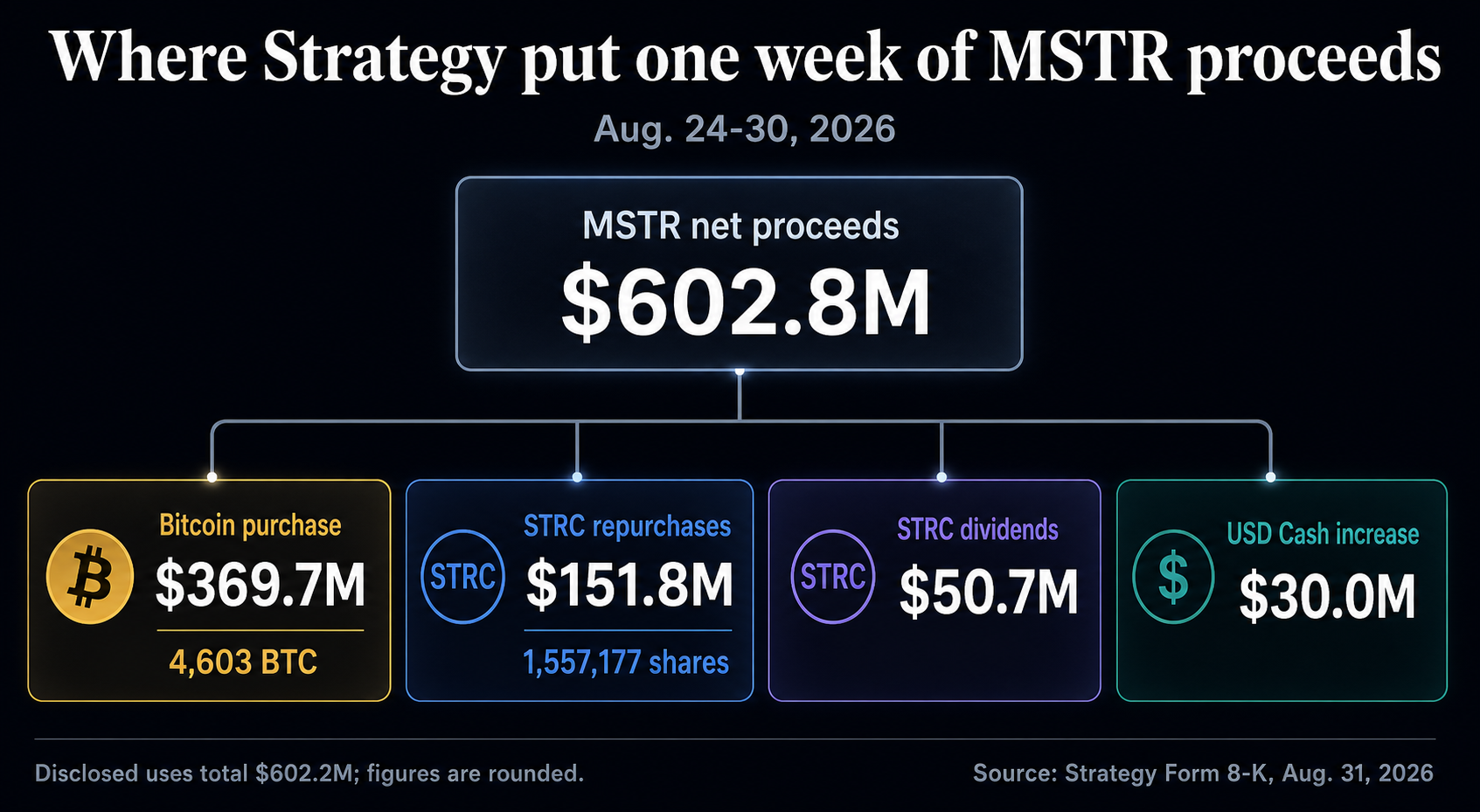
Strategy raised $602.8 million by selling 4,531,421 MSTR common shares in one week, then split the proceeds among a renewed Bitcoin purchase, support for its STRC preferred stock, and additional cash.
The company's Aug. 31 filing attributed $369.7 million to buying Bitcoin, $151.8 million to repurchasing 1,557,177 STRC shares, $50.7 million to STRC dividends, and $30 million to its USD Cash account.
STRC is variable-rate cumulative perpetual preferred stock. The transaction shows Strategy using new common-stock proceeds for both Bitcoin accumulation and preferred-stock support.
The four disclosed uses total $602.2 million, $0.6 million below the filing's rounded $602.8 million net-proceeds figure. The filing reports each amount to one decimal place but does not separately reconcile the difference.
Bitcoin remained the largest destination
Strategy bought 4,603 BTC from Aug. 24 through Aug. 30 at an average price of $80,318, inclusive of fees and expenses. The purchase lifted its holdings from 840,447 BTC to 845,050 BTC, according to the filing and its official Bitcoin ledger.
The company reported an aggregate purchase cost of $63.73 billion and an average cost of $75,412 per BTC for the full position.
In its Aug. 24 filing, Strategy reported no Bitcoin purchases or sales during the prior weekly period. The Aug. 31 filing then reported the 4,603 BTC purchase, while the remaining proceeds funded other parts of the balance sheet.
Strategy sold no preferred shares through its at-the-market programs during the latest period. It instead used $202.5 million of the MSTR proceeds for STRC repurchases and dividends. After the buyback, the company said $364.8 million remained available under its wider preferred-stock repurchase program.
The final $30 million went to USD Cash, a flexible account that Strategy says may be used for Bitcoin purchases, expanding its reserve, capital management, and similar corporate purposes.
USD Cash is separate from the USD Reserve, which is intended to support preferred dividends and interest on outstanding debt. As of Aug. 30, Strategy reported $1.61 billion of USD Cash and a $5.1 billion USD Reserve.
Both balances included expected proceeds from at-the-market shares sold but not yet settled.
Bitcoin was still the largest disclosed destination for the week's MSTR proceeds. But the filing also shows how Strategy's common-stock issuance now feeds three distinct needs at once: Bitcoin holdings, preferred-stock obligations and buybacks, and flexible cash.
The post Strategy splits $603 million share sale between Bitcoin purchases and STRC support appeared first on CryptoSlate.
CryptoTicker.io
The President of the European Commission stood in front of a room full of French business leaders last week and said the quiet part out loud. Europeans have roughly 10 trillion euros parked in bank accounts, that money is "sitting idle", and Europe now needs to put it to work for European companies.
She was not proposing to raid anyone's account. But the language matters, because it tells you exactly how your savings are viewed from Brussels: not as your money, but as a national resource that is currently being wasted. Here is what is actually happening, and what you can do about it that does not involve waiting for a policy to be designed for you.
What Did Von der Leyen Actually Say About Europe's Savings?
Speaking at the La REF business conference in Paris on 27 August, Ursula von der Leyen argued that Europe's old economic model is finished. Cheap imported energy is gone, easy access to global trade is gone, and the assumption that someone else would handle Europe's security is gone.
Her answer is money. Specifically, your money. Around 10 trillion euros in household savings sit in European bank deposits, and a large share of Europe's savings ends up invested outside the continent, mostly in the United States. Meanwhile European companies stall out, get bought, or move abroad for funding.
The President of the European Commission stood in front of a room full of French business leaders last week and said the quiet part out loud. Europeans have roughly 10 trillion euros parked in bank accounts, that money is "sitting idle", and Europe now needs to put it to work for European companies.
She was not proposing to raid anyone's account. But the language matters, because it tells you exactly how your savings are viewed from Brussels: not as your money, but as a national resource that is currently being wasted. Here is what is actually happening, and what you can do about it that does not involve waiting for a policy to be designed for you.
What Did Von der Leyen Actually Say About Europe's Savings?
Speaking at the La REF business conference in Paris on 27 August, Ursula von der Leyen argued that Europe's old economic model is finished. Cheap imported energy is gone, easy access to global trade is gone, and the assumption that someone else would handle Europe's security is gone.
Her answer is money. Specifically, your money. Around 10 trillion euros in household savings sit in European bank deposits, and a large share of Europe's savings ends up invested outside the continent, mostly in the United States. Meanwhile European companies stall out, get bought, or move abroad for funding.
The vehicle for fixing this is the Savings and Investments Union, or SIU. The Commission says the package of measures on securitisation, bank and insurance investment rules, market integration and supervision could unlock up to 470 billion euros in additional investment.
Is the EU Really Taking Money From Your Savings Account?
No, and anyone telling you otherwise is selling something. There is no confiscation, no forced conversion, no deposit levy in the SIU.
What the SIU does is change the plumbing. It makes it easier and cheaper for banks, insurers and asset managers to move retail money into capital markets, it pushes simplified investment products and pension wrappers, and it leans hard on financial literacy campaigns to convince you that your deposit account is underperforming.
On the last point, they are not wrong. The Commission's own framing is that bank deposits are safe and easy to access but usually earn less than capital market investments. That is true. The awkward part is the second half of the pitch: the goal is not only better returns for you, it is cheaper capital for European companies. You are being asked to become the funding source for an industrial policy.
There is also a detail that rarely gets mentioned. Your savings were never idle. Banks lend deposits out. They always have. What Brussels means by "idle" is that the money is not flowing into the specific channels the EU wants it to flow into.
Why Are Bank Deposits Losing You Money Anyway?
Forget the politics for a second. The case against leaving everything in a savings account is much older than the SIU.
A euro sitting in a deposit account earns a nominal rate. Inflation eats the real value. Across most of the last decade, the combination has meant a slow, quiet loss of purchasing power for European savers, even during periods when headline rates looked respectable. You do not see it, because the number on your statement never goes down. Only what it buys does.
That is the actual problem. Von der Leyen is right that 10 trillion euros of deposits is a bad outcome for savers. Where reasonable people disagree is on the solution.
What Does It Actually Mean to Control Your Own Money?
Here is the test. If someone else can change the rules, freeze the account, redirect the flow, or inflate away the value while you sleep, you do not fully control that money. You have a claim on it.
That applies to a bank deposit, and it applies just as much to whichever tidy EU investment wrapper gets rolled out in 2027 with a nice acronym and a tax incentive attached.
Bitcoin is the opposite design. Fixed supply of 21 million, no issuer, no board meeting that can change the schedule, and if you hold your own keys, no intermediary that can freeze it. That is the entire point of the asset. Whether you like the volatility or not, nobody in Brussels, Frankfurt or Washington can decide that your bitcoin is sitting idle and needs to be redirected.
How Does a Bitcoin Savings Plan Work?
A Bitcoin savings plan is the least dramatic way to own bitcoin. You set a fixed amount, weekly or monthly, and it buys automatically. That is it.
The mechanism is dollar cost averaging. When the price drops you buy more sats for the same money, when it rises you buy fewer. Over a full cycle your average entry smooths out, and more importantly, you stop trying to time a market that has humiliated far better traders than you.
It also fixes the behavioural problem. Most people who say they want to buy bitcoin never do, because there is never a comfortable moment. An automated plan removes the decision entirely. At the time of writing bitcoin trades around 78,000 dollars, roughly 37 percent below its all time high near 126,000 dollars. Uncomfortable for lump sum buyers. Exactly the environment a savings plan is built for.
We compared the main providers offering Bitcoin savings plans in Europe, including minimum amounts, fees and whether you can actually withdraw to your own wallet: Bitcoin savings plan comparison
Where Can You Build the Rest of the Portfolio?
$Bitcoin should not be the whole plan. The boring part of a portfolio still matters, and the same automated logic works for stocks and ETFs.
If you want the equity side handled in one place, XTB offers commission free investing in real shares and ETFs up to a monthly turnover threshold, with fractional shares and recurring investment plans, so you can run an ETF savings plan next to your Bitcoin savings plan.
👉 Open an XTB account here

What Are the Risks of a Bitcoin Savings Plan?
This is the part most articles skip, so here it is plainly.
- Bitcoin is volatile. Drawdowns of 50 percent or more have happened repeatedly and will happen again. A savings plan reduces timing risk, it does not remove market risk, and it does not guarantee a profit.
- Never automate money you need soon. Emergency fund first, in cash, in a bank account, boring and accessible. Savings plans are for capital you can leave alone through a full cycle.
- Custody is a real decision. If your provider holds the coins, you are trusting that provider. Check before you sign up whether you can withdraw to your own wallet, because a plan you cannot withdraw from is an IOU, not bitcoin.
- Tax rules differ by country. Holding periods, exemptions and reporting obligations vary across the EU, so check your local rules or ask an advisor.
XRP is down 8.48 percent over the past seven days, trading around $1.3672 after a daily candle that opened at $1.3793, tapped $1.3963 and closed 0.91 percent lower. On a screener full of red numbers that looks like just another altcoin bleeding out.
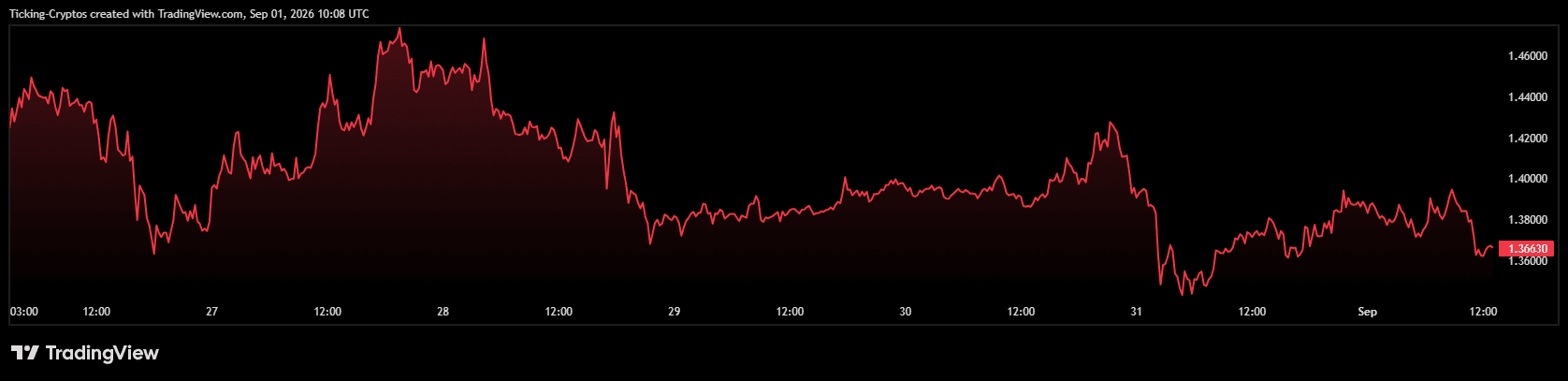
It is not. $XRP was the single best performing large cap in crypto ten days ago. It went from roughly $1.00 to an intraday high of $1.6963 in five sessions, its strongest week in 21 months, and finished August up around 28.5 percent, its best August since 2021.
So the honest framing of this week is not "XRP crashed". It is "XRP gave back part of a violent, leveraged, macro-driven spike". Those are very different setups for anyone thinking about buying, and the difference is the whole article.
Why Did XRP Fall 8% This Week?
Because the thing that pushed it up was never really about XRP.
On August 19 the US Treasury announced it would expand its buybacks of long-dated government debt, raising the cap on individual operations from $2 billion to at least $4 billion for 10 to 30 year maturities, running from September 9 through November 4. Long-term yields fell hard. The 30-year had been sitting at a 19-year high above 5.33 percent and dropped toward 5.19 percent.
Traders immediately relabelled this as "QE Lite" or curve control, and risk assets ripped. XRP ripped hardest, up around 51 percent while Bitcoin managed 22 percent, Ethereum 30 percent and Solana 28 percent over the same stretch.
Two things are worth being precise about here, because a lot of coverage was not.
First, this was not yield curve control. The Treasury described the operations as liquidity support for parts of the bond market receiving heavy volumes of eligible offers. Actual curve control means a central bank setting a yield ceiling and buying unlimited quantities to defend it. Scheduled, capped operations by the Treasury are not that. The YCC read was a market interpretation, not announced policy.
Second, a large chunk of the move was shorts getting run over. CoinGlass data circulated showing roughly $2 billion in shorts liquidated during the week, but that figure covered the entire crypto market rather than XRP alone, and about $1.2 billion of it came in a single 24 hour window. The available data does not support the claim of nearly $2 billion in XRP-specific short liquidations that got repeated widely.
Strip it down and the August spike was a macro liquidity headline, amplified by a short squeeze, on an asset that had underperformed so badly it was crowded with bearish positioning. Whale accumulation of around 380 million tokens in one week and a White House crypto summit added fuel. None of that is nothing. But none of it is a durable, XRP-specific demand story either.
When the squeeze fuel ran out, the price came back down. That is this week.
Are XRP ETF Inflows Strong Enough to Hold the Line?
This is the strongest part of the bull case, and it is genuinely strong.
US spot XRP ETFs pulled in $110.49 million in the week ending August 28, their best weekly haul of 2026 by a wide margin. Cumulative net inflows across the products have reached $1.66 billion, with total net assets around $1.44 billion.
The timing detail matters more than the headline. Of the roughly $153.55 million that flowed in during all of August, only about $3.27 million arrived between August 3 and 14. The remaining $150 million or so landed in the final two weeks, and the buying has continued through nine consecutive positive sessions.
So ETF demand did not lead this rally. It chased it. That is a meaningful distinction: chasing flows tend to be more sensitive to price than anticipatory ones, and they can reverse quickly if the tape turns. The seven US spot XRP funds together hold around 977.92 million XRP, which is real structural demand, but it is a fraction of what circulates.
What Does the XRP Chart Actually Say?
The daily chart is unusually informative right now, because the spike left a very specific footprint.
XRP is sitting at $1.3672, directly on top of the 200-day EMA at $1.3508. That moving average had been falling all year and capped every rally attempt since spring. The August surge blew straight through it, and the current pullback is the retest. That is the single most important thing on this chart.
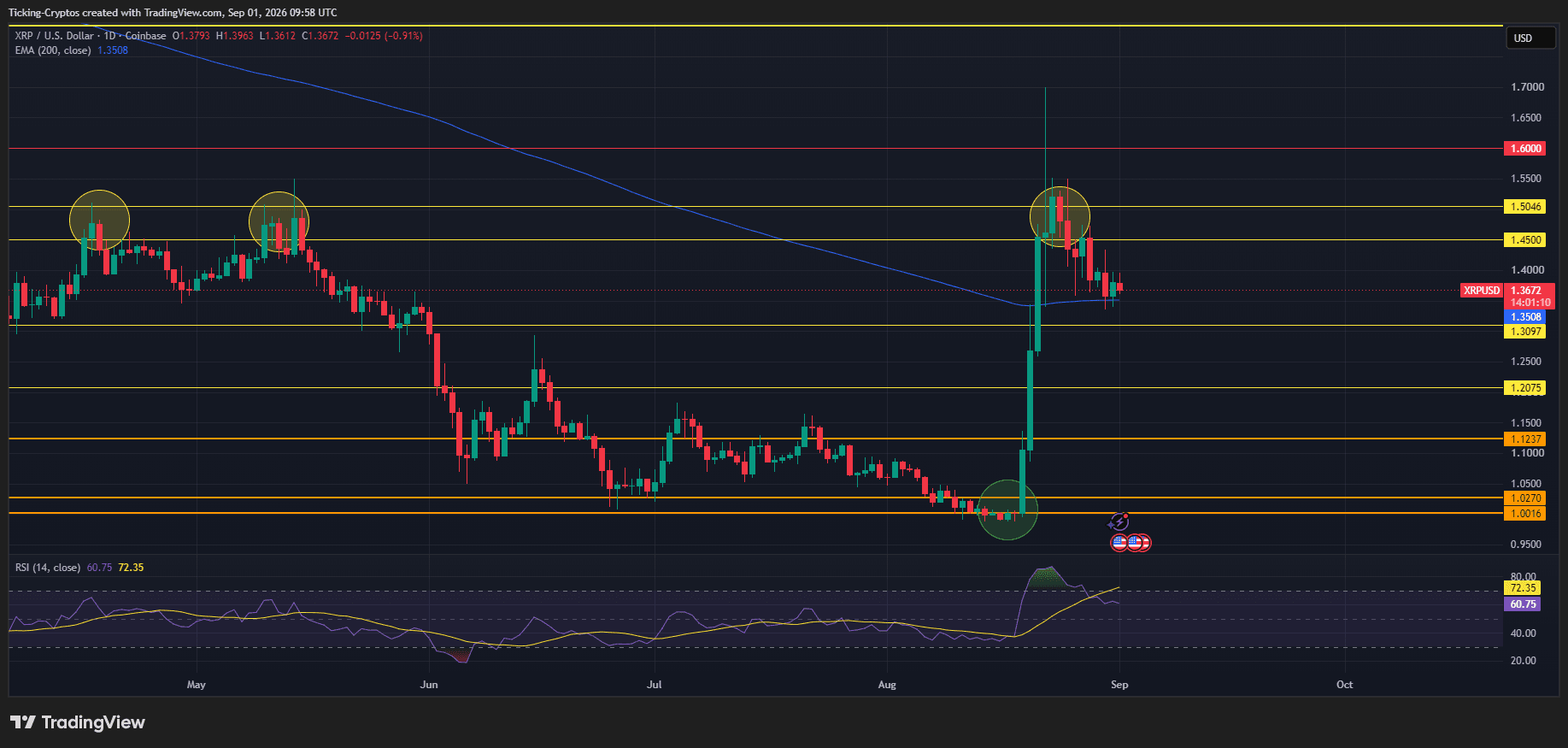
- Resistance overhead: $1.4500 is the first real barrier, and it is where sellers already stepped in on the way down. Above that sits $1.5046, the zone where the late-August candle got rejected, which also lines up with the highs from early May. The wick to $1.6963 above it is exactly that, a wick, with almost no time spent up there. $1.6000 is the next marked level.
- Support below: the 200-day EMA at $1.3508 first, then $1.3097. Below that the chart thins out badly toward $1.2075, then $1.1237, and finally the base of the whole move at $1.0270 and $1.0016, which is where the August low was set.
- Momentum: the daily RSI reads 60.75 and has already rolled over from a reading near 80, with the signal line at 72.35 above it. Momentum is cooling from an overbought extreme rather than breaking down. That is normal after a parabolic leg, but the cross below the signal is a warning that the impulse phase is over.
One structural point that traders keep missing: the move from $1.00 to $1.70 happened in days. There is almost no traded volume in the entire $1.05 to $1.35 zone. If $1.3508 fails and $1.3097 goes with it, there is very little underneath to slow price down. That cuts both ways, but it is why the risk here is not symmetrical with the reward.
What About the 1 Billion XRP That Unlocks Every Month?
Worth knowing, especially since today is the first of the month.
Ripple holds most non-circulating XRP in escrow contracts, and 1 billion tokens unlock on the first of every month. Historically Ripple re-escrows the bulk of it, typically 600 to 800 million, which leaves roughly 200 to 400 million actually entering circulation. Around 37.5 billion XRP remains locked, against circulating supply of about 62.53 billion out of a 99.99 billion total.
At today's price of roughly $1.37, that net monthly release is worth somewhere between $270 million and $550 million of new supply arriving whether the market wants it or not.
Put that next to the ETF numbers and the picture sharpens. The best ETF week of 2026 was $110 million. The monthly structural release is several times that. ETF demand is real, but it is currently not large enough to absorb the supply schedule on its own. That is not a scandal, it is arithmetic, and it is a headwind that Bitcoin simply does not have.
Is Buying XRP at Current Prices a Good Strategy?
Nobody can answer that for you, and anyone who says otherwise is selling something. What can be done is to lay out what the position actually is, because most people buying XRP here do not realise what they are betting on.
- Buying XRP at $1.37 is primarily a macro liquidity bet, not a Ripple bet. The rally was triggered by Treasury buyback expansion and lower long-end yields. If yields keep falling and the liquidity story holds, XRP has already shown it responds harder than Bitcoin or Ethereum. If the 30-year yield climbs back above 5.50 percent, the exact tailwind that created this move disappears. Analysts have flagged that level explicitly as the invalidation point for the macro thesis.
- The bull case: XRP reclaimed a 200-day EMA it had not touched since spring and is holding above it. ETF inflows just hit a 2026 record and are running nine sessions positive. Ripple is building a real business around the token's ecosystem, including a $1.25 billion Hidden Road acquisition, a $1 billion GTreasury deal and a new desk brokering equities exposure for institutions. The actual Treasury buybacks start on September 9, which is a scheduled catalyst rather than a hope. And the token is still only about 20 percent recovered from the slide that took it from $3.65 in July 2025 to below $1.
- The bear case: the move was leveraged and squeeze-driven, and Binance's estimated leverage ratio for XRP derivatives hit its highest level since early 2026, meaning more of the exposure is borrowed. Some analysts note XRP has now failed to reclaim its 50-week EMA for two consecutive weeks after a 22 percent retracement. Monthly escrow supply outweighs current ETF demand. XRP is still down about 26 percent year to date despite the best August in five years, which tells you how much damage there is to repair. And September historically has not been kind to this asset.
- The uncomfortable middle: both cases are credible, which is precisely why position sizing matters more than direction here. An asset that moves 56 percent in five days can move 30 percent against you just as fast.
If you are weighing this, the questions worth answering first are: are you actually taking a view on long-end Treasury yields, do you have a level at which you accept you were wrong, and would you be comfortable holding through a retest of the $1.20 area, because the chart structure makes that entirely possible without the bull case being dead.
What to Watch in September
Three dated events will settle most of this.
- September 9: the expanded Treasury buybacks actually begin. The announcement moved the market. The execution is when we find out whether the effect was priced or persistent.
- September 15: the Senate's procedural vote on the CLARITY Act. Sixty votes are needed to clear the filibuster. Market structure legislation is the regulatory catalyst XRP holders have been waiting on longest.
- September 16 and 17: the Fed decision. With Kevin Warsh sounding hawkish at Jackson Hole and rate hike odds back on the table, this is the one that can override everything else.
Add the ongoing ETF flow prints and the 30-year yield, and you have a fairly complete dashboard. Watch those rather than the price alone.
August was the month crypto remembered how to rally. $Bitcoin closed it up roughly 26 percent, briefly punched through $81,000, and printed its strongest weekly candle in more than three years. Then it stopped.
September opened with a shrug. Bitcoin is changing hands around $77,951 after a daily candle that opened at $78,571, tapped $79,184, and closed the session down 0.91 percent. Nothing dramatic. But after a vertical move like August, "nothing dramatic" is exactly what bulls did not want to see.
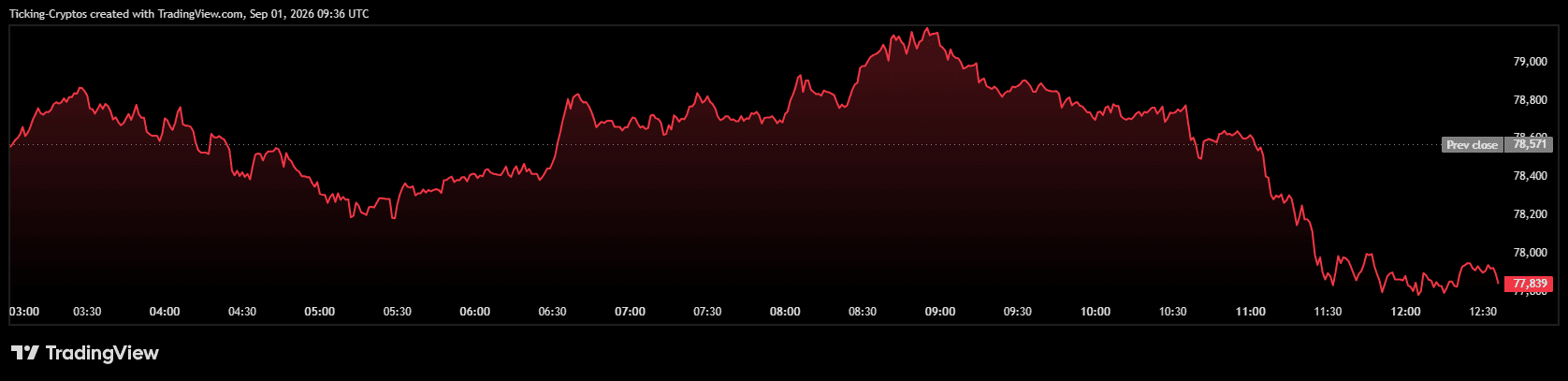
Underneath the surface, though, this market is anything but boring. Michael Saylor is buying again, privacy coins are printing eight-year highs, and September is stacked with catalysts that could decide whether the rally has legs or whether traders spend the autumn explaining what went wrong.
Why Did Bitcoin Stall Right Below $80,000?
The short answer is Kevin Warsh.
The Fed Chair used his first Jackson Hole appearance in late August to make clear that inflation is not beaten, and markets promptly repriced the odds of a September rate hike rather than a cut. Bitcoin dropped roughly 3.3 percent to $77,678 on August 29 after Warsh's speech pushed rate hike expectations higher, cutting short a strong rally.
That is the awkward part of the 2026 setup. Bitcoin spent August climbing on institutional demand and a stabilising ETF bid, and then ran straight into a central bank that is still talking about tightening. Bitcoin had gained roughly 26 percent in August before the pullback, giving traders every reason to lock in profits when yields moved higher, and the failure to hold $80,000 reflected macro conditions overriding otherwise supportive spot demand.
The flow picture improved sharply, which is what makes the stall interesting rather than alarming. US spot Bitcoin and Ether ETFs pulled in a combined $2.6 billion in a single week, their best result since October 2025, trimming the products' 2026 deficit from $5.7 billion to $3.1 billion while BTC consolidated near $77,000. Demand is back. The macro permission slip is not.
What Does Strategy's $370 Million Bitcoin Purchase Actually Signal?
Michael Saylor went quiet for two months. On August 30 he posted two words on X, "We're ₿ack", and the market did the rest.
The filing landed Monday. Strategy acquired 4,603 BTC for $369.7 million at an average price of $80,318 per coin, lifting total holdings to 845,050 BTC, more than 4 percent of Bitcoin's maximum supply. The company also added $29 million to its USD cash position and repurchased $152 million of STRC preferred stock while keeping net leverage at 0.0 percent.
The number matters less than the context. Between June 29 and August 23, Strategy paused Bitcoin buying entirely to clean up its balance sheet, selling 6,916 BTC for around $429 million, raising $4.56 billion through MSTR share issuance, and repurchasing over $500 million of STRC preferred shares. In other words, the largest corporate holder in the market spent the summer de-risking, not accumulating. With net leverage now at zero and dollar assets fully covering outstanding debt, Monday's purchase signals that Strategy considers the balance sheet strong enough to go back on offense.
For a market that spent June and July watching its loudest buyer sell, that is a meaningful psychological reset. Whether it converts into a breakout is another question. Analysts note Bitcoin could retest $80,000 if it holds above $77,000, but favourable Federal Reserve signals are still needed to confirm a breakout.
Why Are Privacy Coins Like Zcash and Monero Outperforming Everything?
Look at the year-to-date column in any market screener right now and one sector jumps out. Zcash is up more than 65 percent this year. Monero is up 21 percent. Almost every other large cap is deep in the red for 2026.
Zcash has been the trade of the year for anyone who caught it. ZEC hit an eight-year high of $888 on August 25 and gained over 60 percent in seven days against Bitcoin's 20 percent, a "de-Bitcoinization" move that reflected capital rotating into privacy assets and dragged Dash, Tezos and Monero higher with it.
The catalysts are real rather than purely narrative. The bullish case has been reinforced by ZEC crossing $800 in August, Grayscale's ZCSH ETF listing on NYSE Arca, and 4.81 million ZEC, roughly 28.4 percent of supply, sitting in shielded pools as of August 27. A new commercial entity, Zcash Labs, launched in August 2026 to fund and drive business and institutional adoption, and an SEC probe into Zcash was dropped in January 2026 with no enforcement action.
Now the honest part. This rally has been leveraged and violent in both directions. Zcash dropped as much as 50 percent within 24 hours in June following disclosure of a severe Orchard vulnerability, and CoinDesk reported billions in futures volume against far lower spot volume as ZEC broke $800, with prices reversing quickly. Monero, meanwhile, is quietly doing its own thing, up 17 percent over the past week while most of the top 15 bled.
Privacy is the strongest sector narrative of 2026. It is also the one most likely to hand out 40 percent drawdowns without warning.
What Are the Latest Crypto Prices Today?
Here is the top of the market as of this morning's snapshot, with 24 hour, 7 day and year-to-date moves side by side. The YTD column is the one worth studying, because it tells you where capital actually went in 2026.
| # | Asset | Price | 24h | 7d | YTD | Market cap |
|---|---|---|---|---|---|---|
| 1 | Bitcoin ($BTC) | $77,951 | 🔴 -0.49% | 🔴 -2.52% | 🔴 -10.93% | $1.56T |
| 2 | Ethereum ($ETH) | $2,451.14 | 🟢 +0.33% | 🔴 -1.37% | 🔴 -17.39% | $295.8B |
| 3 | Tether ($USDT) | $0.9997 | 🔴 -0.01% | 🟢 +0.01% | 🟢 +0.13% | $183.33B |
| 4 | $BNB | $686.38 | 🟢 +0.08% | 🔴 -2.99% | 🔴 -20.47% | $91.4B |
| 5 | $XRP | $1.36 | 🔴 -0.50% | 🔴 -8.48% | 🔴 -25.73% | $85.73B |
| 6 | $USDC | $0.9999 | 🔴 -0.00% | 🔴 -0.00% | 🟢 +0.03% | $73.4B |
| 7 | Solana ($SOL) | $102.22 | 🔴 -0.93% | 🟢 +1.56% | 🔴 -17.88% | $59.82B |
| 8 | TRON ($TRX) | $0.3304 | 🔴 -1.82% | 🔴 -3.76% | 🟢 +16.24% | $31.36B |
| 9 | Hyperliquid ($HYPE) | $83.14 | 🟢 +2.23% | 🟢 +1.91% | 🟢 +226.95% | $20.92B |
| 10 | Zcash ($ZEC) | $845.82 | 🟢 +1.73% | 🔴 -0.07% | 🟢 +65.04% | $14.25B |
| 11 | Dogecoin ($DOGE) | $0.08264 | 🔴 -0.10% | 🔴 -9.40% | 🔴 -29.54% | $12.87B |
| 12 | Monero ($XMR) | $524.44 | 🟢 +1.23% | 🟢 +17.07% | 🟢 +21.06% | $9.85B |
| 13 | UNUS SED $LEO | $9.29 | 🔴 -3.54% | 🔴 -0.90% | 🔴 -3.29% | $8.54B |
| 14 | Chainlink ($LINK) | $11.34 | 🟢 +0.69% | 🔴 -2.43% | 🔴 -10.11% | $8.48B |
| 15 | Cardano ($ADA) | $0.1975 | 🟢 +0.64% | 🔴 -10.93% | 🔴 -40.65% | $7.25B |
Three things stand out.
- The August rally did not repair 2026. Bitcoin is still down almost 11 percent on the year and Ethereum is down over 17 percent, even after a 26 percent and 30 percent August respectively. That tells you how deep the June and July damage was.
- The majors are giving back last week's gains. XRP is down 8.5 percent over seven days and Cardano down nearly 11 percent, despite XRP gaining roughly 31 percent during August with US spot XRP ETFs recording around $153.54 million in monthly inflows. Fast money is rotating out of last month's winners.
- Only four names in the top 15 are green year to date. Hyperliquid, Zcash, TRON and Monero. Three of those four are either privacy plays or revenue-generating infrastructure. Narrative, not beta, has been the winning trade in 2026.
Ethereum sits in its own awkward spot. ETH is trading near $2,455 with repeated rejections around $2,545, and despite record 2026 weekly inflows of $824.42 million into US spot Ethereum funds, it has struggled to hold above $2,500 after gaining more than 30 percent in August. Wallets holding 100 to 1,000 ETH sold 207,000 coins over the past week while larger holders accumulated 182,000. Retail is distributing into whale bids.
Which Bitcoin Chart Levels Matter This Week?
The daily chart makes the situation unusually legible.
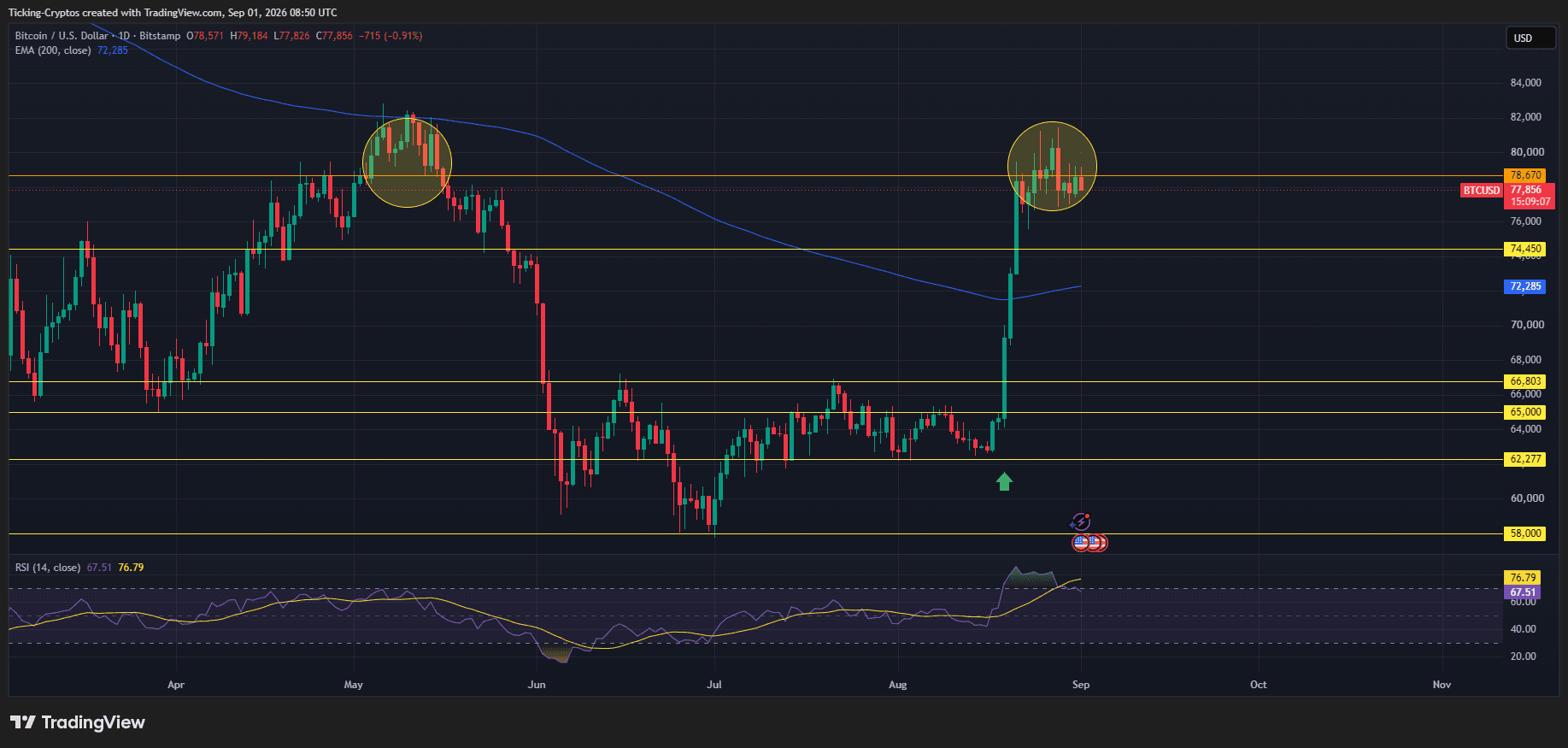
Bitcoin is pressing against the same horizontal band near $78,670 that capped price back in May, marked on the chart by the highlighted zone where the previous rally rolled over. The move that got us here was near vertical, a gap-like surge from the mid $60,000s to $79,000 in a matter of days, which means there is very little traded volume beneath the current price to catch a fall.
- Resistance to clear: $78,670 is the immediate ceiling, with the $79,700 to $80,300 area above it as the real decision zone. Acceptance above roughly $78,340, followed by a higher pullback low that holds, is the condition bulls need, with $78,800 to $79,000 the first reaction area and $79,730 to $79,920 the decisive test before $80,280 and $81,000 come into view.
- Support to defend: A sustained break below roughly $77,165 invalidates the reversal thesis and hands control back to sellers. Below that, the chart is thin down to $74,450, then the 200-day EMA at $72,285, which has just turned upward for the first time since spring.
- Momentum: The daily RSI is at 67.51 and has already rolled over from a reading near 77. That is a cooling overbought condition, not a broken one, but the bearish divergence risk is live if price makes a new high while RSI does not follow. Bitcoin's RSI rose above 80 during the surge, a level commonly associated with overbought markets.
Deeper down the chart, $66,803, $65,000, $62,277 and $58,000 remain the structural levels from the summer range. Nobody wants to revisit them. They are worth knowing anyway.
What Could Move Crypto in September 2026?
September is not a quiet month this year. Three separate catalysts land inside the same window.
- Regulation, September 15. Senate Majority Leader John Thune filed cloture on the motion to proceed to H.R. 3633, with the next procedural vote on the CLARITY Act scheduled for September 15, 2026. The cloture vote requires 60 votes to overcome a filibuster, and the delay came from partisan disagreements over ethics rules and banking sector opposition. The bill cleared the Senate Banking Committee in May on a 15-9 vote after the House passed it 294-134 in July 2025, and any Senate-passed version would need to return to the House. This is the industry's top legislative priority of the year, and its odds are genuinely uncertain.
- The Fed, September 16 to 17. Warsh has spent his tenure stripping back forward guidance, and the market is no longer confident about the direction of the next move, let alone the timing. This is the single biggest variable for Bitcoin's ability to reclaim $80,000.
- Token unlocks, all month. Around $1.5 billion in tokens unlock in the first week of September alone, including 13.53 million SUI worth $9.73 million on September 1 and a potential 9.92 million HYPE worth roughly $797 million on September 6, representing 2.37 percent of Hyperliquid's released supply allocated to core contributors. Given HYPE is the best performing large cap of 2026 at plus 227 percent year to date, that supply event deserves attention.
One analyst has flagged that mid September is the key risk window precisely because a Senate vote, a Fed decision and quadruple witching converge within days, and while spot Bitcoin ETFs took in nearly $2 billion in a single week, their best of the year, the funds remain more than $2.5 billion down for 2026. A strong week is not yet a trend.
Germany's financial regulator BaFin published a survey on financial knowledge of crypto-assets on August 25, 2026, and the result is uncomfortable: anyone who owns Bitcoin or Ether knows more about these products on average than the rest of the population, yet still gets almost every third knowledge question wrong. Four assumptions come up especially often, and all four have consequences for how much money you put into which product.
The paper is titled "Knowledge gaps among crypto investors" and draws on a representative survey conducted in April 2026. It is no new rule and no warning about a single provider. It is a measurement, which is why you can read it as a checklist against your own assumptions. That is exactly how this article is built.
BaFin Survey on Crypto Knowledge: What the Regulator Measured
In April 2026 BaFin surveyed a thousand people and put sixteen knowledge questions on crypto-assets to them. Respondents could explicitly tick "don't know" on every question instead of having to guess. That matters methodologically: a survey that fails to record admitted ignorance separately confuses uncertainty with error.
Across all respondents, 36 percent of the answers were correct and 19 percent were wrong, while in 45 percent of cases participants said they did not know. Almost half the population, then, simply does not trust itself to judge crypto-assets. In itself that is no problem, as long as no purchase decision follows from it.
How Large the Group Concerned Is
According to the survey, around 13 percent of adults in Germany own crypto-assets, which is more than nine million people. A further 34 percent held shares, bonds or funds but no crypto-assets, and 53 percent owned none of these products. Anyone holding Bitcoin therefore belongs to a minority that stopped being a fringe in numerical terms long ago.
57 Percent Right, 31 Percent Wrong: How Crypto Owners Scored
Among owners themselves the picture looks different from the population as a whole. They answered 57 percent of the questions correctly and got 31 percent wrong. The share of openly admitted ignorance shrinks sharply, while the share of wrong answers rises markedly. Someone who has invested has engaged with the subject and trusts their own judgement; they simply get that judgement wrong in almost a third of cases.
This shift is the real finding of the survey. An investor who honestly says they do not know something seeks advice or leaves it alone. An investor who mistakes a false assumption for established knowledge does neither.
Inflation Protection: Why the Supply Cap Says Nothing About the Price
The most common false assumption in the survey: 54 percent of crypto-asset owners took Bitcoin to protect against inflation. The regulator classes that as an error.
The reasoning behind it is understandable. The number of Bitcoin is capped in the protocol at 21 million units, while a central bank can expand the money supply in circulation. A fixed number of units, however, does not produce a fixed value. The price in euros arises on trading venues out of supply and demand and can fall by a double-digit percentage within a few weeks. An asset meant to preserve purchasing power over a given period has to remain reliable across that period. Scarcity alone does not deliver that.
What Follows From This in Practice
If you hold crypto-assets as a hedge against the loss of monetary value, the best check is over what period that hedge is supposed to work and whether you could withstand a price drop of thirty or forty percent within it. For money needed in the foreseeable future the answer is as a rule no. This says nothing about the long-term development of the price. It says something about the function you assign to your holding.

Price Stability: Many Crypto Owners See Bitcoin as the Calmer Asset
More than a third of the crypto owners surveyed assumed the Bitcoin price to be more stable than that of newer coins. Stated in that generality, it is wrong. Bitcoin trades on a great many venues at the same time and reacts immediately to news and market sentiment.
There is something correct in the assumption that the survey does not measure: a very small, thinly traded token can swing more sharply on a single day than Bitcoin, because there a mid-sized order already moves the price. But "swings less than a micro-cap" quickly turns into "swings little", and that leap is the mistake. Anyone who knows the difference between the two statements plans their entries differently.
Stablecoin as a Savings Product: Value-Stable Does Not Mean Value-Growing
A stablecoin is a crypto-asset whose price is tied to a reference, usually the US dollar or the euro. The peg is the entire product promise: a euro stablecoin is supposed to be worth one euro, today and in a year's time.
Around half the owners surveyed considered stablecoins suitable for building wealth. That misreads the construction. A token that by design stays at its reference value throws off no return of its own. Anyone who wants a yield from it regardless has to lend the token out, put it into a protocol or accept an offered rate of interest, and then carries a credit or contractual risk on top. How to tell whether a stablecoin is fit to serve as a cash-like holding at all is set out in our checklist on the criteria for cash equivalence; this article deliberately does not repeat it.
Stablecoin as a Derivative: A Peg Is No Hedge
Just under half of respondents took stablecoins to be derivatives, that is, instruments with which sharp price swings in other crypto-assets can be hedged. That confuses two entirely different things.
A derivative takes its value from an underlying and moves inversely or with leverage to it. A stablecoin refers to a currency rather than to any underlying in the portfolio. It does not fall when Bitcoin rises, and it does not rise when Bitcoin falls. Anyone swapping a position in Ether into a stablecoin has sold that position and afterwards holds something dollar-like. That is a temporary exit and no hedging transaction. For tax purposes in Germany the swap counts as a disposal, which is easily lost if you picture it as mere protection.
Why the Classification Counts at All
42 percent of respondents knew that stablecoins are themselves crypto-assets, and 45 percent did not. The classification is no quibble over terms: under the European MiCA regulation, asset-referenced tokens and e-money tokens carry their own obligations for the issuer, from backing through to the right of redemption. Anyone who does not know which category their token falls into also does not know what rights they hold against whom. Which issuers are registered for this is listed by the regulator in public registers.
Wallet, Data Record, Price Formation: Where Respondents' Knowledge Held Up
The survey shows more than gaps. About half of respondents knew that the Bitcoin price arises out of supply and demand and is not set by any single body, and that crypto-assets sit in digital wallets. 35 percent were able to place Bitcoin, in simplified terms, as electronic data records.
The wallet point is the most practically important of this group, and it is often ticked off too early. Knowing that a wallet exists is one thing; knowing who holds the private key is another. If the holding sits with a provider, the provider holds the key, and you have a claim against a company. If it sits on a device of your own, you hold the key yourself and bear sole responsibility for securing it. Anyone who knows this difference makes a deliberate choice between a trading venue and their own hardware wallet instead of an incidental one.
MiCAR Authorisation: What BaFin Actually Examines for a Licence
A day after the survey, on August 26, 2026, BaFin published an interview with its expert Ruth Burkert that supplies the other half of the picture. Its key sentence: "A BaFin licence is seen in the market as a seal of quality."
The authorisation procedure examines, among other things, the IT systems of crypto-asset service providers. Added to that are requirements for the professional suitability and reliability of the managing directors, a check on the owners and a look at company processes, in particular at the precautions against money laundering. Supervision does not end with the permission, it begins there: the authority keeps watching authorised houses for breaches of the regulation. By its own account, BaFin has also authorised the first DLT trading and settlement system in the EU.

A Seal of Quality With Limits: What a Permission Does Not Vouch For
A permission says something about the company that holds your money and your crypto-assets in custody and executes your orders. It says nothing about the price of the product you buy there. An authorised provider may sell you a token that goes on to lose half its value; that is the market risk you have taken on, and no case for the supervisor.
Second, there is no deposit guarantee for crypto-assets along the lines of the current account. The statutory guarantee covers bank deposits up to 100,000 euros per customer and institution. Crypto-assets fall outside it. What happens in an insolvency depends on how the holding was kept in custody and whether it is held separately from the provider's own assets.
The two points together explain why the survey and the interview sit well side by side. The regulator can set the framework within which a provider works. Whether the product fits your plan remains your decision. An overview of trading venues with a European permission can be found in our comparison of regulated crypto exchanges.
Search Engine Ranking Instead of Authorisation: How Many People Pick Their Provider
One observation from the interview translates directly into an action. According to BaFin, many German consumers still use the companies that appear particularly high up in search engines. A position in a results list, however, is no proof of a permission. It can be bought, and it is in any case independent of whether a European authority has ever examined the house.
For precisely this purpose BaFin keeps public registers: a company database with the supervised institutions and a continuously updated list of warnings about providers operating without permission. How fast that list grows is clear from a look at the past few weeks; on August 25 alone a warning about identity misuse in the crypto sector was added.
Three Checks That Take a Few Minutes
First: enter the full company name from the legal notice into BaFin's company database, not the brand name from the app. Second: check which authority in which member state granted the permission, because under MiCA it applies across Europe and the competent supervisor is often not based in Germany. Third: hold the name against the regulator's warning notices before any money moves. If a dispute with a supervised provider arises later, the route runs via a complaint to BaFin.
What Is Established and What Remains Interpretation
Established and backed by a date are the figures of the survey, its design with a thousand respondents and sixteen questions from April 2026, the publication date of August 25, 2026 as well as the statements from the interview of August 26, 2026. All information in this text comes from these two publications by the regulator.
Interpretation, and expressly no measurement, is the connection this article draws between the two texts: that a market in which half the owners misjudge a basic property of their product needs the provider framework more than a market with an experienced public. BaFin does not put it that way. It describes its role more cautiously and stresses that consumers for whom a purchase may be an option should inform themselves better about opportunities and risks, and that the authority supports them in doing so through various channels. This text makes no statement about the causes of the measured gaps; the survey supplies nothing on that.
Checking Your Crypto Knowledge: What to Take Away
- Take the four false assumptions one at a time. Inflation protection, price stability, stablecoin as savings, stablecoin as protection: ask of each whether it sits inside your own reasoning for an existing holding. If a reason falls away, the position does not yet fall with it, but you decide afresh and no longer on the old assumption. Where you buy belongs to the same decision: the overview of crypto exchanges shows the trading venues along with their fee models.
- Check your provider's permission before you add to a position. Company name from the legal notice, comparison against the regulator's company database, a look at the competent member state. Which trading venues can show a European permission is set out in the comparison of regulated crypto exchanges.
- Establish for your largest holding who holds the key. If it sits with the provider, it hangs on that provider's holdings and solvency; if it sits with you, it hangs on your own safeguards. Both are defensible, but only when chosen deliberately. The devices for this and the differences between them are set out in the hardware wallet comparison.
(As of September 1, 2026. This article is not investment advice. Prices and fee structures change; check the terms with the provider before you buy.)
You copy the receiving address from your wallet, switch to your exchange window, paste it and confirm the withdrawal. If what is known as a clipper is running on your computer, the address you pasted is no longer the one you copied. It belongs to the attacker, it is technically entirely valid, and your wallet has no reason to reject it. The money is gone as soon as the transaction is confirmed.
This type of attack is old, but over the summer of 2026 it changed in three ways that concern you directly as a holder: the route onto the machine, the operating system, and the question of how much is taken from you at all. This piece explains each of the three using the publications in which they were described, and ends by saying which check actually works.
Clipboard attacks explained: how malware swaps the wallet address you copied
A clipper is a malicious program that monitors the contents of the clipboard and replaces any crypto address it recognises with an address controlled by the attacker. That is the whole idea. Nothing is decrypted, no wallet file is opened, no password is guessed. The attack exploits the one moment in which an address leaves the secure area of your wallet and travels through the operating system as plain text.
What sets it apart from almost every other attack on crypto assets is that you do everything right and still lose. You copied the address correctly. Your wallet is not compromised. Your seed phrase sits untouched in the safe. The transaction you sign is exactly the transaction you see, only to a different recipient. That is why none of the precautions that protect against forged approvals or against key theft apply here.
Bitcoin is only one of the targets. If you are interested in the price of the largest crypto asset, you will find our current assessment in our bitcoin price prediction. For this piece, only one thing about Bitcoin matters: the address formats are publicly documented and easy to detect by machine, and that is precisely what makes them convenient for a clipper.
ClickFix: why you paste and run the malicious code yourself
ClickFix describes a deception in which a website places a command in your clipboard and then gets you to paste and run it yourself in your computer's command line. The name comes from the fact that the page acts out a problem for you and immediately offers the matching repair.
That is why this type of attack works so well. There is no email attachment for a virus scanner to check, and no download for your browser to flag as suspicious. The malicious code arrives as text in the clipboard, and the user carries out the execution with their own hand. From the operating system's point of view, the logged-in user entered a command. Which is exactly what they did.
The sequence in detail: what the Federal Office for Cybersecurity described
The Swiss Federal Office for Cybersecurity broke the sequence down into six steps in its weekly review of February 24, 2026. First the attackers manipulate a website or place an advertisement with a convincingly realistic window. Merely opening the page already copies the malicious code into the clipboard automatically, without anything having to be clicked. The window then claims a technical problem, usually a failed browser update or a CAPTCHA still to be solved.
The user is then instructed to enter innocuous-looking key combinations. These open the console, paste the prepared code and run it. At the end comes the download of a program that harvests login credentials and wallet data. The agency puts its most important recommendation unambiguously: be suspicious as soon as a website claims the browser needs updating, and never copy code from an unknown source directly into the command line. The notice deliberately names no specific command lines, because the attackers keep swapping them out anyway.
For you, that yields a rule of thumb that requires no technical knowledge. No reputable software anywhere has you paste a command from the clipboard into a black window in order to fix a browser problem or to prove that you are human. Anyone who asks you to do that is attacking you.
Every 500 milliseconds: how often a clipper reads the clipboard
On June 17, 2026, Microsoft described a Windows campaign that, by its own account, has been running since February 2026. The malware polls its command server and reads the clipboard roughly every 500 milliseconds. In doing so it looks not only for addresses but also harvests seed phrases and private keys as soon as they appear there.
Twice a second means, in practice: there is no window of time short enough. Between copying and pasting, a withdrawal rarely involves more than a few seconds, and that is orders of magnitude more than enough. The second part of the finding is at least as unpleasant. Anyone who ever copies their recovery words to the clipboard, for instance when moving to different wallet software, exposes them on an infected machine.
Bitcoin, Tron and Monero: which address formats the malware recognises
The variant documented by Microsoft recognises six address formats by their beginning and their length. For Bitcoin these are the legacy addresses beginning with a one and 32 to 36 characters long, the P2SH addresses starting with a three and of the same length, the Taproot addresses beginning bc1p with 40 to 64 characters, and the Bech32 addresses beginning bc1q in the same range. Added to these are Tron addresses, which begin with a capital T and count exactly 34 characters, and Monero addresses with a four or an eight at the start and exactly 95 characters.
This list is no secret knowledge, and it shows how mechanically the attack works. A pattern matches or it does not. Once it matches, the swap happens. Anyone who moves value between networks more often should keep in mind that detection can be extended to further formats with a few lines of code; the six above are the state of a single documented campaign, not an exhaustive list of what is possible.

Why the checksum of your bitcoin address is no help here
This is where the most dangerous misunderstanding lies. Crypto addresses carry a checksum, a few additional characters from which it can be computed whether the rest is unaltered. Many holders conclude from this that their wallet would inevitably reject a manipulated address.
That is a fallacy, and the reason is simple. The checksum detects a corrupted address. But the clipper does not deliver a corrupted address; it delivers the perfectly sound address of a different recipient. It is correctly constructed, its checksum is right, its network is right, and the wallet therefore confirms it without objection. A checksum protects against typing errors and transmission errors. Against a swap it does not, because from the point of view of the mathematics a swap is not an error at all.
USB sticks and scheduled tasks: how the clipper digs in and spreads
The Windows variant described by Microsoft arrives via prepared shortcut files on USB storage. After execution it searches the drive for ordinary documents, hides the originals and puts shortcuts with the same file names in their place. Anyone who opens the stick afterwards appears to see their files and in truth starts the malware.
To nest permanently, the software sets up two scheduled tasks with no end date. One ensures that every freshly inserted, still clean USB device is prepared as well, the other runs the actual harvesting. That explains why such infections return in households and small offices after they seemed already cleared: the next stick brings them back.
Tor and a local proxy: why the traffic stays inconspicuous
The campaign brings along a portable Tor client and routes its traffic through a local SOCKS5 proxy on port 9050. In practice that means there is no conspicuous connection to a suspicious server visible on the network for a firewall or a router to act against. Anyone relying on their home network to block malicious destinations has nothing to work with here.
A contract on BNB Smart Chain: why blocklists achieve little against ClickFix
On August 6, 2026, Microsoft Threat Intelligence described a group of compromised websites that serve ClickFix lures. The injected, Base64-encoded JavaScript code connects to an access node of BNB Smart Chain and queries a smart contract there for its instructions. What gets delivered includes Lumma Stealer, the remote control tools Xworm and AsyncRAT, and a downloader called MintsLoader. Microsoft speaks of campaigns that target thousands of devices daily in businesses and households worldwide.
The trick lies in where the instructions are stored. A domain can be taken down, a server seized. An entry in a public contract on a blockchain cannot be removed from outside, and it can only be changed by whoever holds the corresponding key. Defence thereby loses its most effective lever, and protection shifts from the network to the device and to the habits of its user. That a public blockchain of all things takes on this role is the uncomfortable punchline: the very property that makes it valuable as a ledger turns it here into an unreachable letterbox.
macOS is no safe harbour any more: the finding from early August
On August 7, 2026, The Hacker News reported on macOS malware written in Go and distributed via ClickFix lures. The analysis comes from the security researchers at the vendor Huntress. Affected, in their account, are Bitcoin, Litecoin, Dogecoin, Monero, Ethereum and XRP.
With that, an assumption falls that persists stubbornly among holders. The claim that a Mac is the safer choice for crypto custody was already more habit than finding, and the attack route via a pasted terminal command works under macOS for the same reason as under Windows: it rests on the user executing it themselves. The agency notice from February, too, names Windows and macOS explicitly side by side.

Partial draining instead of total loss: why a small shortfall can be more dangerous
One detail of the August 7 finding deserves particular attention. The malware contains a routine that first queries a wallet's balance and can then also withdraw a partial amount instead of the entire holding. The researcher quoted describes this as the first malware known to him with that capability.
Why that is worse than it sounds: an emptied wallet is noticed immediately. A shortfall that stays small enough may go unnoticed by anyone for months, and during that time the infection persists, keeps collecting credentials and travels onward via the next USB device. Anyone who only knows their holdings roughly will not notice such an outflow. A properly kept record of holdings is therefore also a security measure and not merely an obligation towards the tax office.
Address poisoning and clippers: two routes to the wrong address
On August 22, 2026, we described in detail a case of address poisoning in which around $2 million went to a lookalike address. The difference from today's subject matters, because it determines the right defence.
With address poisoning there is no malware on your computer. The attacker places a deceptively similar address in your transaction history, and later you reach for the wrong line yourself. What helps against that is an address book, a whitelist and a deliberate refusal to copy from the history. You will find exactly those steps in our guide to checking a receiving address, and we deliberately do not repeat them here.
With a clipper the malware sits on the device. It intervenes between copying and pasting, which is to say after every choice you make. An address book in wallet software helps only as far as the address does not travel via the clipboard. That is the core of the difference, and it explains why a holder should know both attacks even though the outcome looks the same in either case. Related, but again differently arranged, are forged approvals, which we covered under wallet drainers and signature approvals, as well as malicious browser extensions.
The hardware wallet display: the screen the clipper cannot reach
Against an address swap on the computer there is a defence that works regardless of how good the malware is. A hardware wallet shows the receiving address of an outgoing transaction on its own small screen before you confirm it. That device has no operating system for a clipper to nest in, and it shows what is actually being signed.
The benefit only materialises through reading it, however. Anyone who merely presses the confirm button on the device without comparing the characters against the intended destination has given the advantage away. It makes sense to compare the first five and the last five characters plus a group from the middle, because attackers deliberately generate their addresses so that the beginning and the end look similar. Which devices display the address in full and at a sufficient size differs noticeably; a look at our overview of hardware wallets is worth it before buying for precisely that reason.
Withdrawal whitelists at exchanges: what they achieve and what they do not
Most larger trading venues allow you to register withdrawal addresses once and to block withdrawals to all other addresses. The protection here is greater than it first appears: even if a clipper inserts a foreign address at the moment of withdrawal, the payment goes nowhere, because the destination is not approved.
The limit of this protection lies in creating the entry itself. If the address is pasted from the clipboard when it is first registered, it may have been swapped at exactly that moment, and from then on the wrong address is the approved one. That is why the comparison on the wallet display belongs at this point, not at the later withdrawal. It also makes sense to use the change period that many providers impose after a new address is added.
What is established and what remains assessment
Established are the technical details, because they come from the publications named and are dated there: the sequence of the ClickFix deception per the agency notice of February 24, 2026, the polling interval of around 500 milliseconds, the six address formats, the spread via USB storage, the two scheduled tasks and the Tor route per the Microsoft analysis of June 17, 2026, the querying of a contract on BNB Smart Chain per the Microsoft observation of August 6, 2026, and the macOS variant including partial withdrawal per the report of August 7, 2026.
Assessment, and labelled as such, is the reading of these points as one connected development. That an attack route spreads to a second operating system within a few weeks and moves its command channel onto a blockchain points to growing effort. How many devices are actually affected and how high the damage in Germany turns out to be is not known, and we deliberately give no figure for it. Nor does this text make any statement about who is behind the campaigns.
An assessment of how to handle the residual risk belongs here too. No procedure makes an infected computer trustworthy again. Anyone with well-founded suspicion that a clipper is running on their device should enter no further address from that device and type no further recovery words on it, but move their holdings from another, clean machine.
Defending against clipboard attacks: what to take away
- Never paste a command into a command line or terminal that a website has placed in your clipboard. That is the only step that prevents the infection at all; everything else merely limits the damage. No browser update and no human verification asks for anything of the sort. If you keep assets on a device that is also used for browsing, move custody to a device with its own screen; the differences are shown in our overview of hardware wallets.
- Read the receiving address on the display of the signing device, not on the computer screen. Compare the first five characters, the last five and a group from the middle. If you use a pure software solution, the limits of this approach are greater, because display and clipboard sit on the same system; how much the individual programs catch is set out in our overview of software wallets.
- Register a withdrawal whitelist at your trading venue and check the address especially carefully when creating it. After that, a later address swap goes nowhere. Which providers offer this lock and how long their change periods run is in our rundown of crypto exchanges.
- Keep a traceable record of your holdings. A partial withdrawal is only noticed if you know what should be there. That holds regardless of whether a tax return is due at the end of the year.
The two publications on which this text principally rests are ones you can read yourself: the technical analysis of the Windows campaign at Microsoft Security and the German-language description of the ClickFix sequence at the Federal Office for Cybersecurity.
(As of September 1, 2026. This article is not investment advice. Prices and fee structures change; check the terms with the provider before you buy.)
Decrypt
The proposed screen would cut three companies from MSCI's global indexes in November, with Strategy the largest by some distance.
The sum was the first payment under a $163 million deal with the Messi-backed fantasy card game, now facing a gambling prosecution.
Gov. Greg Abbott ordered state agencies to stop paying for the AI-powered license-plate readers as privacy concerns and officer-misuse scandals mount across Texas.
The Nasdaq-listed asset manager paid an average of $79,431 per coin, lifting its total stash to 23,156 BTC amid a wave of renewed treasury buying.
The exchange found the former congressman placed large trades on his own State of the Union attendance, then made false statements to move prices, profiting nearly $18,000.
U.Today - IT, AI and Fintech Daily News for You Today
Ripple executive teases major RLUSD spotlight at Brooklyn event.
Evernorth reports a 100% surge in XRP weekday trading share as on-chain activity aligns with London and New York banking hours.
Cryptocurrency market before LLMs was much safer and PeckShield's report certainly proves it.
Ripple has unlocked 1 billion XRP from its escrow wallets as part of the company’s regular monthly release, according to blockchain transaction tracker Whale Alert.
The market is on its next stage post-recovery as the majority of investors are witnessing a mini-correction before continuation.
Blockonomi
Key Highlights
- Precious metal prices declined 1.6% to approximately $4,377 amid rising oil prices and climbing bond yields
- Federal Reserve Chair Kevin Warsh’s aggressive stance at Jackson Hole elevated September rate hike probability to 66%
- Brent crude oil surpassed $91 per barrel following escalating U.S.-Iran geopolitical tensions
- 10-year Treasury yield reached 4.78%, marking the highest level recorded since early 2025
- Despite recent declines, gold maintains approximately 10% gains for August, bolstered by Treasury purchasing activity and central bank demand
Precious metal markets experienced significant downward pressure on Tuesday, with gold declining 1.6% to approximately $4,377 per ounce. The selloff occurred as crude oil prices rallied and a widespread bond market rout drove yields upward, intensifying speculation around additional Federal Reserve monetary tightening.
Gold futures contracts similarly retreated 1.2% to $4,426. Silver experienced steeper losses, falling 2.4% to $64.98 per ounce, while platinum decreased 1.2%.
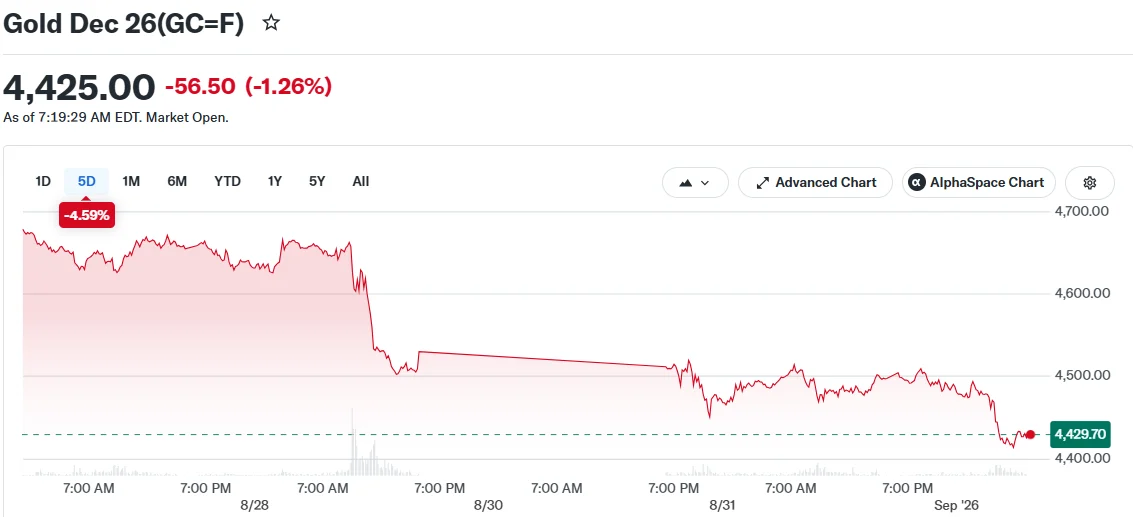
This recent downturn positions gold approximately $320 beneath the previous week’s peak near $4,697.
Monetary Policy Expectations Fuel Decline
Federal Reserve Chair Kevin Warsh delivered remarks at the Jackson Hole symposium last Friday, emphasizing an unwavering dedication to achieving the central bank’s 2% inflation objective.
Financial markets reacted swiftly to the hawkish messaging. The CME FedWatch tool currently indicates approximately 66% probability for a 25 basis point interest rate increase at the upcoming September policy meeting, climbing from roughly 40% prior to Warsh’s address.
JUST IN:
— Whale Insider (@WhaleInsider) September 1, 2026
Rising interest rates typically create headwinds for gold prices. Since the precious metal generates no income or dividends, its appeal diminishes when yields on alternative investments increase.
Analysts at ANZ noted that gold appears exposed to additional downside risk as market participants recalibrate expectations around monetary policy direction.
Energy Markets and Fixed Income Yields Intensify Headwinds
Escalating military confrontations between the United States and Iran have propelled oil prices substantially higher. Brent crude oil advanced beyond $91 per barrel while U.S. crude oil exceeded $86.
This development heightened anxieties regarding potential energy supply chain disruptions and compounded inflation concerns.
The 10-year U.S. Treasury yield advanced to approximately 4.78%, representing its most elevated level since the beginning of 2025. The global uptick in government bond yields has created additional headwinds for precious metals.
Tony Sycamore, a senior market analyst at IG, attributed the approximately $300 decline from the prior week’s zenith to the convergence of Warsh’s hawkish commentary and intensifying tensions surrounding the Strait of Hormuz.
Fundamental Support Factors Remain Intact
Notwithstanding the current pullback, gold accumulated nearly 10% in gains throughout August. This rally stemmed from an unanticipated Treasury Department strategy shift toward purchasing longer-duration government securities.
This policy adjustment compressed borrowing costs and pressured the dollar lower. It simultaneously reignited concerns regarding escalating U.S. sovereign debt obligations and potential currency depreciation.
These underlying dynamics propelled gold approximately 65% higher during 2025. Exchange-traded funds backed by physical gold experienced substantial capital inflows, while persistent central bank accumulation provided additional price support.
Sycamore indicated his intermediate-term outlook remains unchanged, identifying the late June trough near $3,942 as a foundational support level while maintaining a $5,000 upside objective.
Gold continues trading beneath its 200-day moving average, currently positioned near $4,526.
Market participants are closely monitoring upcoming employment statistics, particularly Friday’s nonfarm payrolls report, for additional insight into the likelihood of September monetary tightening.
The post Gold Prices Plunge Below $4,500 Amid Surging Oil and Rising Fed Rate Expectations appeared first on Blockonomi.
Key Takeaways
- The Dutch TTF gas benchmark jumped above €70/MWh, marking the highest level since March 2026
- Military confrontation between US and Iran near the Strait of Hormuz has escalated, with US strikes on Iranian positions prompting missile attacks on American bases in Jordan
- Approximately 20% of worldwide LNG shipments transit through the Strait of Hormuz, which remains largely inaccessible
- Gas inventories across Europe stand at merely 62-64% of capacity, significantly trailing the five-year average for this season
- Analysts at Goldman Sachs project potential prices reaching €100/MWh should Middle Eastern supply disruptions continue through 2027
Natural gas markets in Europe surged to their loftiest levels in half a year this week following renewed military action between Washington and Tehran, sparking concerns over liquefied natural gas availability through critical Persian Gulf shipping lanes.
The front-month Dutch TTF benchmark contract touched €70.85 per megawatt-hour during Monday’s trading session, followed by an additional 1.3% gain on Tuesday to settle at €71.30. Meanwhile, Britain’s NBP wholesale gas benchmark leaped 6.4% to 175.40 pence per therm as market participants returned following a bank holiday.
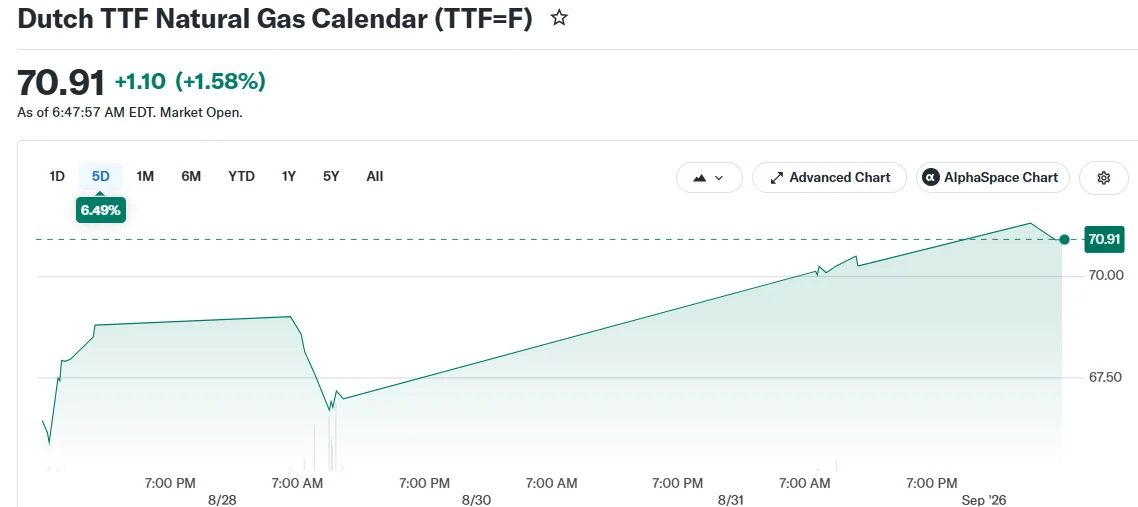
The price acceleration followed weekend operations by American military forces targeting Iranian missile installations on Larak Island positioned near the Strait of Hormuz. Tehran’s response included launching ballistic missiles toward US military installations in Jordan.
US President Donald Trump has issued warnings of additional military action targeting Iranian critical infrastructure, while diplomatic initiatives aimed at reopening commercial navigation through the strategic waterway have achieved minimal progress.
The Strategic Importance of the Strait of Hormuz
The Strait of Hormuz represents one of the planet’s most vital energy transit points. Approximately 20% of global liquefied natural gas commerce flows through this narrow passage, with substantial volumes originating from Qatari export facilities.
The channel remains virtually impassable to commercial traffic, severing a vital supply line for LNG carriers bound for European and Asian markets. QatarEnergy has notified Italian utility Edison that force majeure provisions suspending LNG shipments will remain in effect until early November due to ongoing hostilities.
The contract between Edison and Qatar typically accounts for roughly 10% of Italy’s yearly gas requirements. Edison has confirmed it is securing alternative supply sources.
Inadequate Storage Compounds the Crisis
Europe was confronting supply challenges even before the current military escalation. Continental gas storage infrastructure held just 62-64% of total capacity, based on figures from Gas Infrastructure Europe. This represents approximately 17 percentage points beneath the five-year seasonal norm for this period.
Germany and the Netherlands face potential shortfalls in meeting their respective storage objectives of 70% and 80% ahead of the November 1 deadline. Elevated prices have hampered injection activities because the spread between summer and winter valuations has frequently proven insufficient to justify storage economics.
Sebastian Heinermann, who serves as managing director for German gas storage trade group INES, cautioned that inadequate storage combined with severe winter conditions could leave Germany unable to satisfy typical consumption requirements.
European energy companies now find themselves in fierce competition with Asian purchasers for available spot LNG shipments, driving up both shipping costs and cargo valuations.
Analysts from Goldman Sachs cautioned in recent commentary that should Middle Eastern energy shipments normalize only incrementally throughout 2027, December 2026 TTF valuations would probably need to exceed €100/MWh.
Escalating gas valuations are simultaneously contributing to wider inflationary pressures. Eurozone headline consumer price inflation climbed to 3.3% on an annualized basis in August, propelled predominantly by energy expenses. The European Central Bank convenes on September 10, with market participants anticipating another 25-basis-point rate hike.
The post European Gas Prices Soar to Six-Month Peak Amid Middle East Tensions appeared first on Blockonomi.
Key Takeaways
- August saw euro zone inflation accelerate to 3.3%, climbing from July’s 2.9% reading, propelled by energy sector pressures
- Energy price inflation surged to 14.3%, connected to Iranian conflict and Strait of Hormuz shipping disruptions
- Core inflation metrics declined to 2.4%, while services sector inflation moderated to 3.0%
- Financial markets assign 98.9% probability to a 0.25% ECB interest rate increase scheduled for September 10
- Small and medium-sized enterprises encounter dual challenges from elevated energy expenses and increasing credit costs
The euro zone recorded its steepest inflation reading since September 2024, with consumer prices rising 3.3% in August. Eurostat’s Tuesday data release attributed the acceleration primarily to escalating energy expenses.
LATEST: Eurozone inflation just surged to its highest level in nearly THREE YEARS.
Inflation jumped from 2.9% to 3.3% in August, marking the sixth straight month above the ECB’s 2% target as the Iran war keeps energy prices elevated.
Core inflation FELL to 2.4%, while… pic.twitter.com/DMaTxXwNh2
— Coin Bureau (@coinbureau) September 1, 2026
August witnessed energy inflation reaching 14.3%, representing a significant increase from July’s 10.3% figure. This acceleration stems from oil and gas market turbulence triggered by Iranian military engagement and the strategic Strait of Hormuz waterway obstruction.
European nations rely heavily on imported energy resources, creating substantial vulnerability to international supply disruptions. Market prices for both crude oil and natural gas have experienced sharp increases throughout this period.
While headline inflation figures drew attention, deeper analysis reveals a more subdued underlying trend. Core inflation—excluding volatile energy, food, alcohol and tobacco categories—actually declined to 2.4% from the previous month’s 2.5%.
Services sector inflation, closely monitored by European Central Bank officials, similarly decreased to 3.0% from 3.3%. This data indicates that energy price volatility hasn’t yet transmitted into broader economic price pressures.
Market Consensus Points to Imminent ECB Policy Tightening
Financial markets have effectively locked in expectations for monetary tightening at the ECB’s upcoming September 10 policy session. LSEG market data indicates a 98.9% implied probability for a quarter-point rate adjustment, elevating the deposit facility rate to 2.5%.
The central bank previously implemented a rate increase to 2.25% during its June meeting, marking its initial tightening action since 2023. That decision responded to inflationary momentum stemming from the Iranian crisis.
ECB Executive Board member Isabel Schnabel indicated in recent statements that additional monetary tightening may prove necessary given persistent inflation risks. Central bank officials continue monitoring whether energy cost pressures eventually translate into wage growth and service sector price increases.
Economic Strain Intensifies Across Business Sector
Economic analysts caution that further monetary tightening will compound existing financial pressures throughout euro zone economies. Households carrying substantial debt loads confront rising mortgage obligations, while corporate entities face steeper borrowing expenses.
Smaller businesses and medium-scale enterprises appear particularly vulnerable to current conditions. Many such organizations may postpone or abandon planned capital investments due to elevated financing costs.
MHA’s chief economic researcher Joe Nellis noted the ECB confronts a difficult balancing act between controlling price pressures and sustaining economic expansion.
Euro zone economic performance has demonstrated notable stability thus far, though the dual pressure from elevated energy expenditures and restricted credit availability is projected to challenge this resilience throughout coming months.
The European Central Bank’s September 10 policy meeting will deliver the anticipated interest rate determination.
The post ECB Rate Hike Looms as Euro Zone Inflation Surges to 3.3% on Energy Shock appeared first on Blockonomi.
Key Highlights
-
CBRS stock rises 2.88% following announcement of 165 MW AI data center in Finland.
-
Initial 50 MW phase in Mikkeli will gradually expand to full 165 MW AI computing capacity.
-
Economic impact study by Ramboll projects potential investment reaching €1.7 billion.
-
Compute Nordic selected to oversee facility operations and campus development.
-
Expansion promises substantial job creation, regional tax revenue, and enhanced computing infrastructure.
Cerebras Systems Inc. has announced a significant expansion into Nordic territory with a major AI data center development in Mikkeli, Finland. The ambitious facility will ultimately deliver 165 megawatts of computing power through a phased approach beginning with 50 megawatts. Shares of CBRS finished regular trading at $184.24, reflecting a 2.88% gain, before declining 1.91% to $180.73 during pre-market hours.
Cerebras Systems Inc., CBRS
Major 165 MW AI Computing Campus Takes Shape in Finland
Cerebras has formed a strategic partnership with Compute Nordic Finland to establish the high-capacity computing facility in South Savo. The collaboration includes multiple service agreements spanning seven years for each development phase. This framework provides Cerebras with guaranteed capacity while enabling incremental infrastructure deployment across Finland.
Initial construction delivers 50 megawatts of capacity, followed by intermediate expansion to 80 megawatts. Final buildout targets 165 megawatts of dedicated IT infrastructure at the Mikkeli location. The phased deployment strategy aligns construction timelines with confirmed computing commitments and customer delivery requirements.
Compute Nordic assumes responsibility for facility development, operational management, client engagement, and program oversight. Cerebras gains expanded deployment capacity for its wafer-scale computing technology across global markets. The initiative strengthens European AI infrastructure as worldwide demand for large-scale computational resources accelerates.
Advanced Cooling and Power Systems Drive Mikkeli Design
The facility incorporates innovative approaches to minimize water usage and maximize energy efficiency. Closed-loop cooling technology recirculates water internally rather than continuously sourcing municipal water supplies. Campus infrastructure also enables waste-heat capture for potential integration with local district heating networks.
Cerebras emphasizes that its computing architecture maximizes computational throughput per megawatt deployed. The Mikkeli facility merges this efficiency with advanced cooling, thermal recovery, and specialized infrastructure. These design elements enable high-density operations while reducing dependence on continuous local water resources.
The City of Mikkeli endorses the initiative alongside numerous Finnish regional and national entities. Local construction firms, engineering consultants, energy providers, recruitment agencies, and professional service companies will contribute. This collaborative ecosystem may enhance regional supply chains and advance technical skills development throughout South Savo.
Substantial Regional Economic Benefits Projected
Economic analysis conducted by Ramboll forecasts between €1.0 billion and €1.7 billion in regional capital investment upon full deployment. The assessment anticipates 80 to 250 permanent positions when maximum capacity becomes operational. Projected annual property tax contributions range from €0.8 million to €2.5 million for the municipality.
Cerebras and Compute Nordic anticipate creating permanent positions spanning operations, engineering, network administration, security, and facility oversight. Power management and cooling systems will generate additional long-term technical roles throughout the facility’s operational lifespan. Construction phases will provide temporary employment while sustained operations support ongoing jobs and community services.
This development represents an extension of Cerebras’ broader infrastructure roadmap beyond immediate data center growth in established computing hubs. Cerebras currently supports enterprise, academic, and governmental clients through cloud-based and on-site computing solutions. The Finnish installation provides dedicated infrastructure as global requirements for advanced AI computing continue their upward trajectory.
The post Cerebras Systems (CBRS) Stock Rises as Finland AI Facility Reaches 165 MW Milestone appeared first on Blockonomi.
TLDR
- Nuburu stock gains 2.56% as a 1-for-40 reverse split moves toward effect soon.
- BURU targets NYSE American price rules with a 1-for-40 reverse stock split.
- Nuburu expects BURUD trading to begin on September 2 after the reverse split.
- The reverse split could cut Nuburu’s outstanding shares to about 9.26 million.
- Nuburu’s NYSE American appeal remains pending despite the reverse stock split.
Nuburu Inc. (BURU) stock gained 2.56% to $0.0400 as the company moved forward with a major capital restructuring. The company approved a 1-for-40 reverse stock split to address NYSE American’s minimum price requirements. BURU briefly traded above $0.0430 before giving back part of its intraday advance.
Nuburu, Inc., BURU
Nuburu Approves 1-for-40 Reverse Stock Split
Nuburu’s board approved the reverse split under authority previously granted by company stockholders. The transaction becomes effective at 4:30 p.m. Eastern Time on September 1, 2026. Meanwhile, September 1 will also serve as the official record date for the corporate action.
Nuburu expects split-adjusted trading to begin on the OTC Pink Market on September 2. FINRA will temporarily change the company’s ticker from BURU to BURUD after the split. However, the temporary symbol should remain in use for only 20 business days.
After that period, the stock will return to its existing BURU trading symbol. The company will also assign its common stock the new CUSIP number 67201W509. Consequently, brokers and market systems will process the shares under the revised capital structure.
Reverse Split Reduces Nuburu Share Count
Every 40 outstanding Nuburu shares will automatically convert into one common share when the split takes effect. The action should reduce outstanding shares from approximately 370.49 million to about 9.26 million. However, issuances and conversions before implementation could slightly change the final share count.
Nuburu will not issue fractional shares through the reverse split process. The company expects ownership percentages and voting power to remain broadly unchanged after the adjustment. Still, the treatment of fractional holdings could create minor differences among individual positions.
The reverse split will not change Nuburu’s common or preferred stock par value. Nuburu will retain authorization for 900 million common shares and 50 million preferred shares. The company will also adjust outstanding equity awards and convertible securities according to their existing terms.
NYSE American Appeal Drives Listing Strategy
NYSE American suspended Nuburu shares on July 17 after citing the stock’s low selling price. The exchange also started delisting proceedings under Section 1003(f)(v) of its company rules. Nuburu then appealed the decision and requested a review before the Listings Qualifications Panel.
The company expects the panel hearing to take place during September 2026. Meanwhile, BURU began trading on the OTC Pink Market on July 20 following the suspension. The company now wants the reverse split to raise its per-share price above problematic listing levels.
NYSE American rules address securities trading below $0.10 per share under certain listing circumstances. Nuburu views the reverse split as part of its effort to resolve the pricing issue. Any return to NYSE American trading will still require approval from the exchange.
Nuburu has also focused on strengthening its broader financial and operating position during recent months. The company reported positive stockholders’ equity for two consecutive quarters and repaid several material obligations. It also received Italian government authorization to continue its planned acquisition of Tekne.
The proposed Tekne transaction forms part of Nuburu’s wider defense and security expansion strategy. Management plans to integrate those operations while seeking stronger revenue and cash generation. However, the immediate market focus remains the reverse split and the pending NYSE American listing appeal.
The post Nuburu, Inc. (BURU) Stock: Surges as Reverse Split Targets NYSE American Listing Rules appeared first on Blockonomi.
CryptoPotato
Bitcoin closed August 2026 up nearly 25%, giving the month a result that has not appeared in comparable post-peak years of 2014, 2018, and 2022.
Ash Crypto pointed to the unusual monthly candle on September 1, noting that the latest close breaks a pattern that has accompanied Bitcoin’s previous bear-market phases.
Bitcoin Breaks an August Pattern
Ash Crypto’s chart, based on Bitstamp data and using a logarithmic scale, compares August performances after Bitcoin’s major cycle highs. August 2014 fell about 18% after the 2013 peak, August 2018 lost roughly 9% after the 2017 peak, and August 2022 dropped some 14% following the 2021 high. However, this year, things went the other way.
Bitcoin started the month in the low $60,000s and climbed above $81,000 before finishing at about $78,600, producing a monthly gain of 24.95%, according to CoinGlass data. Ash Crypto described it as “BITCOIN JUST CLOSED AUGUST GREEN FOR THE FIRST TIME EVER IN A BEAR MARKET.”
The distinction is important, since the chart does not establish that BTC has entered a new bull market. Instead, it shows that August behaved differently from the same point in the previous three post-peak cycles. Bitcoin’s last all-time high was just past $126,000 in October 2025, leaving the asset well below that level despite the August recovery.
Furthermore, the flagship cryptocurrency also had its best August since 2017, when the month closed up more than 65%.
CoinGlass data back to 2017 shows how unusual that stretch has been. Outside of the aforementioned 65% gain in 2017 and 2021’s 13.8% jump, every August in between finished red, including two straight double-digit losses in 2022 and 2023, with this year snapping that run.
Besides August ending up positively, the third quarter is also shaping up nicely, with the same CoinGlass data showing it’s in the green by nearly 33%, although there’s still one month to go.
That uptick is only bettered by the same period in 2017 that saw BTC’s value go up more than 80%, and it would take an incredible run in September to bring Q3 2026 anywhere near that.
Price Action as September Starts
Bitcoin dipped below $77,000 as fresh attacks in the Middle East revived geopolitical tension, then clawed back most of that loss soon after.
That follows a productive patch last week, when the OG cryptocurrency pushed past $81,000 to hit its highest level in over three months, only to get rejected after Fed Chair Kevin Warsh’s hawkish remarks at Jackson Hole.
At the time of writing, it was trading near $78,000, after barely moving either way in 24 hours. Although that price reflected a loss of about 2.5% for the week, it was still up more than 23% over the past month.
Dominance over the rest of the crypto market has climbed above 58%, with a market cap near $1.57 trillion. Zoomed out further, BTC remains down close to 29% for the year and more than 38% below its October 2025 ATH.
The post Bitcoin Makes History With First-Ever Green August During a Bear Market appeared first on CryptoPotato.
Perhaps the most notable piece of news within the crypto industry on Monday came from Strategy, as the company started buying more BTC again after completing a few sales and rebuilding its USD reserve to over $6.7 billion.
Although that might sound celebratory at first, it’s worth taking a closer look at when the firm sold and when it bought more bitcoin, as it turns out it realized substantial losses amid the asset’s price recovery.
Back to Buying
As reported yesterday, the largest corporate holder of the leading cryptocurrency spent $370 million to acquire 4,603 BTC at an average price of $80,310 per unit. This means that the acquisition took place during the previous week when bitcoin jumped past $80,000 for the first time since last May. However, its actual time spent above that coveted level was quite brief.
Nevertheless, this purchase came after four consecutive sales completed between June 30 and August 10, as Santiment explained. Within this timeframe, the company offloaded 6,916 BTC, worth roughly $430 million at the time, at an average price of approximately $62,100.
Consequently, the reacquired 4,603 BTC managed to offset approximately two-thirds of everything the firm sold during the summer. What’s quite intriguing is that Strategy’s purchase came at a price almost $18,000 per BTC higher than the average during the sales.
Analysts such as Michaël van de Poppe brought up the timing, saying that they are “genuinely impressed” by the fact that the purchasing power has returned around BTC’s recent peak.
On the plus side, bitcoin’s spectacular resurgence from the recent low-$60,000s to almost $80,000 as of press time means that Strategy’s massive position has turned green again. The firm, which stood at an unrealized loss of well over $10 billion until a few weeks ago, is now above water by around $2.3 billion.
STRC Recovers
Strategy used the past couple of months, in which it sold some BTC and didn’t buy any to raise additional funds by selling MSTR to increase its USD reserve. The total is now over $6.7 billion.
In addition, it repurchased a significant portion of its STRC shares, whose price had tumbled far below the par level of $100 to as low as $75. However, rebuilding the USD reserve and buying back shares helped STRC recover to just over $97 as of Monday’s closing price.
The post Saylor’s Bitcoin U-Turn: Strategy Sells at $62K, Buys Back at $80K appeared first on CryptoPotato.
Ripple’s native token turned the tables in August, although the month saw a few dips to a multi-year low of just under $1.00.
Now, though, the XRP Army has refocused on September, which is expected to be highly volatile. Some even called it XRP’s “most loaded month” in history.
The August Gains
Following a very modest gain of 2.11% in July, XRP went into August with little hope for a turnaround. After all, all four previous editions were in the red, with the asset dumping by as much as 26.6% in August 2023.
The month indeed began on the wrong foot, as by the middle of it, XRP had slipped below the key psychological support of $1.00 on a few occasions. While some bears speculated about another potential leg down toward $0.80 or even lower, the trend changed in an instant.
On August 19, the entire crypto market came to life, led by bitcoin’s massive surge from under $65,000 to $80,000 within less than 48 hours. XRP was a little late to the party, but once it joined, it couldn’t be contained. For 72 hours, that is. Perhaps due to returning ETF inflows or whales going on a big accumulation spree, XRP skyrocketed by 70% from Wednesday to Saturday and touched a multi-month high of $1.70.
However, it was quickly halted there and retraced in the following weeks. Ultimately, it ended the month at just under $1.40, which is still a 30% surge in its worst-performing month in history.
What’s Next, September?
Unlike all August editions between 2022 and 2025, all Septembers within the same period were in the green, some in a modest manner (0.42% increase in 2023), and some in a highly impressive fashion (46.2% in 2022).
This one is expected to be volatile, to say the least. RippleXity called it “the most loaded month in XRP’s history.” Aside from the highly anticipated FOMC meeting scheduled in two weeks, which is likely to impact all financial markets, the US Senate will return on September 14 and vote on the CLARITY Act the following day.
The legislation is expected to influence most altcoins, and the voting in two weeks is likely to set the course for what might occur by the end of the year.
The month will also end with another major XRP-related event. Evernorth’s shareholders will vote on whether the XRP treasury company will become public on Nasdaq as XRPN. It currently holds nearly 475 million tokens.
In terms of price action, many analysts are convinced that the cross-border token has exited its bear phase and is now well-positioned for major gains.
The post XRP Enters Its ‘Most Loaded Month’ in History After 30% August Surge appeared first on CryptoPotato.
After dipping below $77,000 on Monday morning following the new strikes in the Middle East, BTC jumped by two grand, but it was stopped again and now sits in the middle of this range.
Most larger-cap alts have failed to recover the recent losses, with ETH still struggling at $2,450, XRP well below $1.40, and BNB beneath $690.
BTC Settles at $78K
After its best week of the year marked in the middle of August, bitcoin tried to take full advantage of this resurgence at the end of the month, surging past $81,000 on a couple of occasions. However, the bears stepped up and didn’t allow another leg up.
Just the opposite; BTC started to lose value rapidly on Friday after the hawkish speech by new Fed Chair Kevin Warsh at Jackson Hole, and dipped below $77,000. It managed to quickly erase some of the losses and spent Saturday trading above that level.
The bulls returned on Sunday with a minor increase to $79,000. However, the resumed strikes between the US and Iran resulted in another nosedive. Bitcoin slipped to $77,000 once again on Monday before it rebounded to $79,000 and now sits between the two boundaries.
Its market capitalization remains stagnant at $1.560 trillion on CG, while its dominance over the alts is at just under 58%.

UNI Keeps Pumping
Uniswap’s native token is the top performer today once again, surging by another 10% daily (over 32% weekly) to a multi-month peak of almost $6.00 earlier today before it retraced to the current $5.65. RAIN and NEAR have posted gains of around 4%, while HYPE is up by over 2%.
In contrast, TRX is down by nearly 2% to $0.33, SOL has slipped toward $100 after another 1% dip, and ETH remains below $2,450. BNB can’t get past $690, while XRP struggles below $1.40. Even more painful declines come from MNT and SKY.
On the other hand, CRV and ARB have returned to the top 100 alts by market cap. The former has rocketed by 15%, while the latter is up by 24% daily.
The total crypto market cap remains just over $2.7 trillion on CG.

The post Uniswap (UNI) Skyrockets 32% Weekly, Bitcoin (BTC) Calms at $78K: Market Watch appeared first on CryptoPotato.
Donald Trump Jr.’s venture capital firm, 1789 Capital, is leading a $1 billion funding round that values Polymarket at $21 billion, contributing roughly $300 million in fresh capital on top of the $200 million it had already put into the prediction market platform.
The new round lifts Polymarket’s valuation 40% above the roughly $15 billion mark it carried earlier this year, and it comes as the Trump family’s footprint in prediction markets keeps growing even as regulators in multiple countries and at least one US city move to shut the platforms out.
1789 Capital’s Stake Keeps Growing
1789 Capital spokesperson Alexa Henning said the firm’s total investment in Polymarket now sits at around $500 million combined between the new money and what it put in previously. The $21 billion figure is a jump from the roughly $15 billion valuation Polymarket was working with back in April, when the platform first opened talks on a new funding round.
Polymarket, alongside similar platforms like Kalshi, lets users bet on outcomes ranging from what a president says in a speech to who gets married on a reality show, and both have grown quickly over the past year.
Trump Jr.’s ties to the prediction market industry go beyond Polymarket. He became an adviser to Kalshi in 2025 and received shares in the company worth more than $300,000, and he separately advises Polymarket too.
His father’s administration has also moved in the industry’s favor, with Michael Selig, who heads the Commodity Futures Trading Commission (CFTC), responsible for regulating prediction markets, speaking favorably of both companies.
However, Polymarket has run into trouble, with Baltimore Mayor Brandon M. Scott and the City Council suing both it and Kalshi last month, accusing them of offering unlicensed sports betting dressed up as event contracts and marketing their products in ways that could make people think they’re legal, regulated sportsbooks.
The city is seeking penalties and restitution for residents it says were exposed to unregulated gambling.
Trouble Overseas Too
Things are also heating up abroad. As CryptoPotato reported, South Korea ordered domestic access to Polymarket blocked, with regulators there saying the platform’s structure “encourages gambling behavior.”
France, Germany, and Australia have also imposed similar restrictions, and more than 30 countries in total have blocked or limited the platform.
Despite the legal troubles, money has kept flowing into Polymarket, as months before Trump Jr. upped his stake, the firm took on a $600 million investment from Intercontinental Exchange, the parent company of the New York Exchange, as part of a plan to put up to $2 billion toward expanding into event-based trading.
The post Donald Trump Jr.’s 1789 Capital to Put $300M Into Polymarket appeared first on CryptoPotato.