Cryptocurrency Posts
Crypto Briefing
The liquidation event underscores crypto market volatility, potentially impacting investor confidence and regulatory developments' influence.
The post 130,286 crypto positions liquidated as Bitcoin falls below $76K appeared first on Crypto Briefing.
Lower oil prices may ease inflation pressures, potentially reducing the urgency for central banks to implement aggressive rate hikes.
The post US crude oil futures settle 4.5% lower at $95.78 per barrel as Middle East tensions ease appeared first on Crypto Briefing.
Meta's near $2T valuation highlights its strategic AI advancements, potentially reshaping tech industry dynamics and investor expectations.
The post Meta Platforms approaches $2T market cap, less than $100B away appeared first on Crypto Briefing.
Investor skepticism and operational uncertainties could hinder SB Energy's growth, impacting its role in AI infrastructure development.
The post SB Energy delays IPO amid investor skepticism over valuation appeared first on Crypto Briefing.
The VVV token's surge highlights the growing investor confidence in privacy-focused AI platforms, potentially reshaping data privacy norms.
The post Venice AI token VVV surges 3,000% to record $34.51 as privacy-focused platform crosses $100M revenue pace appeared first on Crypto Briefing.
Bitcoin Magazine
Bitcoin Magazine
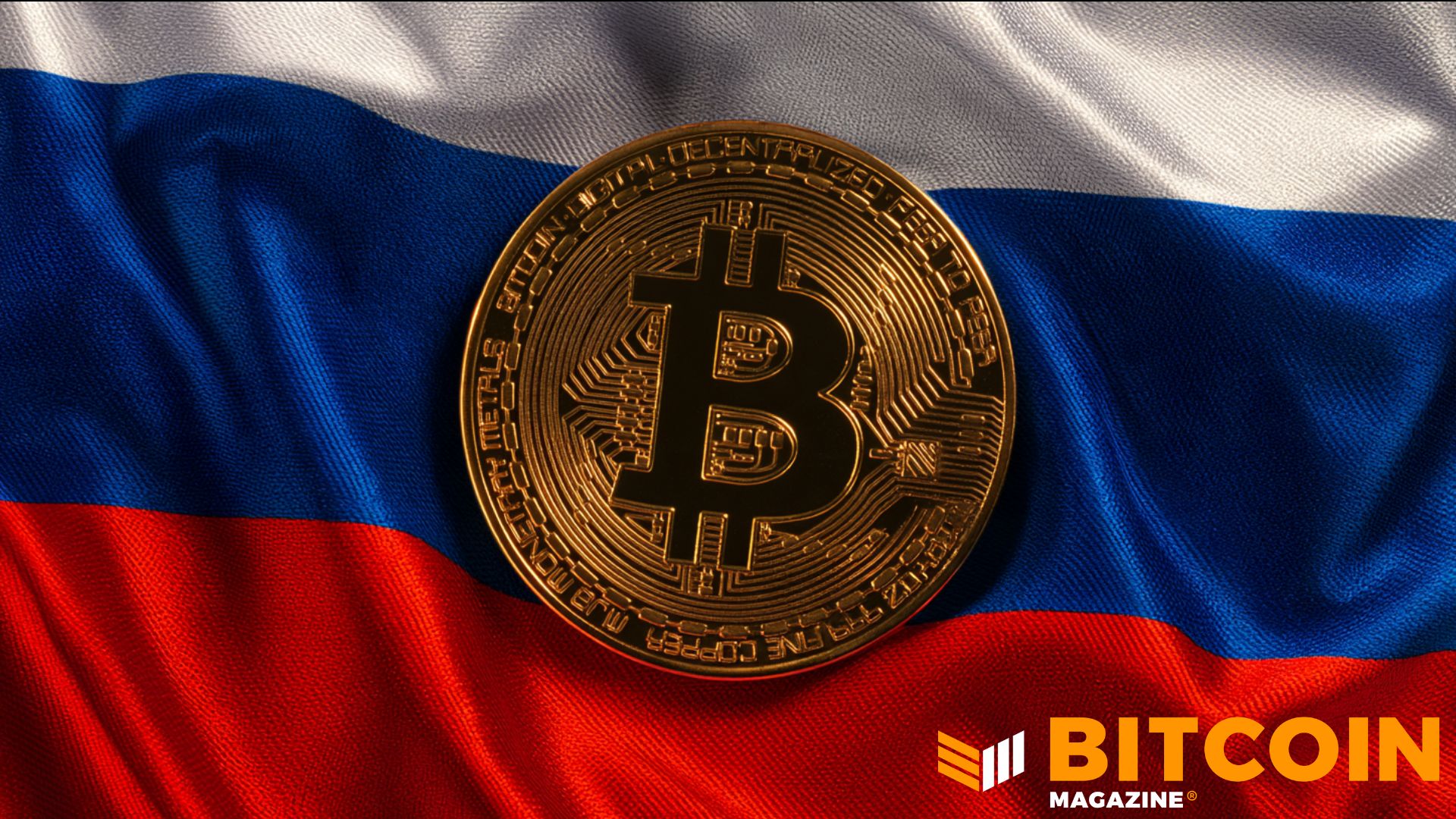
Russian Crypto Industry Could Be Operating Legally by Year-End: Central Bank
Russia’s crypto industry may have all it needs to start legally functioning by year-end, according to reports.
The deputy governor of the country’s central bank, Vladimir Chistyukhin, said that regulations were moving ahead as scheduled, Interfax reported on Monday.
Russia this year has pressed ahead with crypto legislation. President Vladimir Putin in August signed a law to set in stone the regulation of digital currencies and digital rights in the country — although using bitcoin for payments is still banned.
JUST IN:
— Bitcoin Magazine (@BitcoinMagazine) September 21, 2026The Russian Bitcoin and crypto industry may begin functioning within a legal framework before the end of this year, Central Bank Deputy Governor says. pic.twitter.com/Kp1ICUgDrg
“Right now we are talking about creating subordinate regulation; it is very large and significant,” Chistyukhin was quoted saying, adding that the “fine-tuning” of internal rules could be carried out before the end of 2026.
Russia’s central bank has approved Bitcoin trading for the public on the country’s crypto exchanges. Law currency states that unqualified investors can buy 300,000 rubles ($3,582) worth of bitcoin and other assets through one intermediary; qualified investors have no limits.
Sberbank, the biggest bank in Russia, plans to debut a Bitcoin and crypto wallet as well as digital asset custody by December. The bank in August said it expected trading volume with its new crypto rollout to hit 4 trillion rubles ($47 bln) in the first year.
Using digital assets as a means of payment or legal tender within Russia has been prohibited in Russia since 2022.
Despite Putin appearing to praise Bitcoin in the past, its use as a medium of exchange and currency has been banned for years.
Russian lawmakers have made an exception for international payments — but most likely as a way to dodge Western sanctions.
The U.S. and European governments cut Russia off from the SWIFT payments system after it invaded Ukraine in 2022 and Russian companies have been using Bitcoin to skirt around the penalties, according to the country’s finance minister.
This post Russian Crypto Industry Could Be Operating Legally by Year-End: Central Bank first appeared on Bitcoin Magazine and is written by Mathew Di Salvo.
Bitcoin Magazine

Bitcoin Price Shrugs Off Clarity Act Fail, Blasts Past $86,000
Long-awaited crypto legislation failed last week — but Bitcoin buyers don’t seem to care.
The price of the leading cryptocurrency shot up Monday by nearly 7% over a 24-hour period, six days after lawmakers blocked the Clarity Act.
Digital asset industry bigwigs have been calling for clear rules to be put in place to regulate the fast-moving space. But the key legislation aiming to do so in the form of the crypto market structure bill didn’t progress last week after Democrats mostly disagreed with the ethics side of the bill.
JUST IN: Bitcoin surges to $86,030
— Bitcoin Magazine (@BitcoinMagazine) September 21, 2026pic.twitter.com/3Z0RvIVvJ3
Bitcoin’s price has shrugged off the bill’s collapse, and recently stood at $86,225 after touching as high as $86,247 Monday morning in New York.
Over a 30-day period, the coin is up 10%. Bitcoin started a phenomenal run in August — its best in years — after the U.S. Treasury announced it would at least double the size of its liquidity-support buyback operations.
The asset’s price further benefited after U.S. President Donald Trump the same week hosted a meeting at the White House with crypto industry leaders and urged lawmakers to get what he called the “powerful” Clarity Act over the line.
Both Republicans and Democrats blocked the bill but Democrats had mostly been accused of trying to deliberately stall it by pro-crypto lawmakers for months.
The central sticking point for Democratic lawmakers was the conflict of interest posed by the Trump family’s crypto holdings. Beginning in the run-up to his return to office, the president and his sons launched a series of digital asset ventures, and Trump’s own financial disclosure reported roughly $1.4 billion in crypto-related income.
The White House says his assets sit in a trust managed by his children and that no conflict exists.
Democratic Senator Elizabeth Warren, of the crypto industry’s loudest critics, told congress ahead of the vote that the bill “posed a massive risk to families.”
Though despite the bill not advancing, the Securities and Exchange Commission and Commodity Futures Trading Commission are pushing ahead with rulemaking.
Bitcoin exchange-traded funds in the U.S. experienced positive net flows last week after having started the week with investors cashing out.
On Thursday and Friday, investors bought nearly $593 million in shares in the products managed by BlackRock, Fidelity, and Grayscale, according to Farside Investors data.
The Federal Reserve also last week raised interest rates — as expected — but the price of bitcoin hasn’t been affected by the central bank’s decision. Bitcoin has performed well in the past in a low interest rate environment.
This post Bitcoin Price Shrugs Off Clarity Act Fail, Blasts Past $86,000 first appeared on Bitcoin Magazine and is written by Mathew Di Salvo.
Bitcoin Magazine
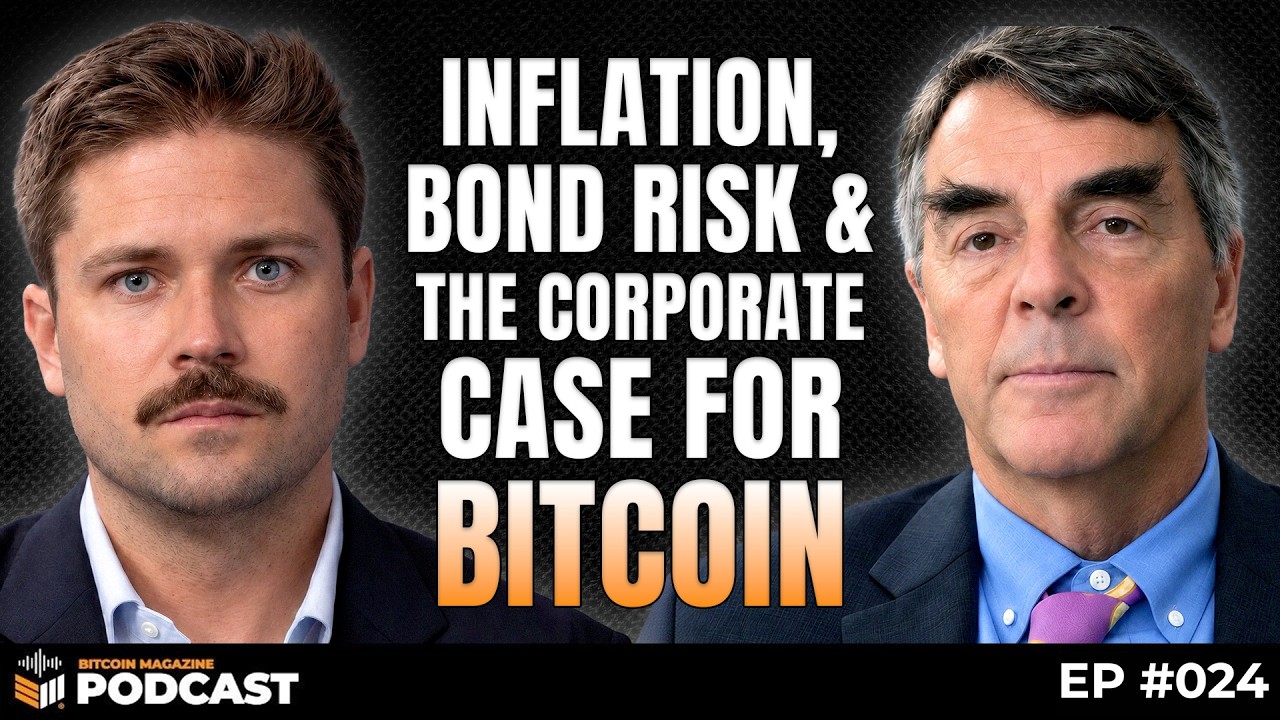
Billionaire Investor Tim Draper: “Irresponsible” for Apple & Meta NOT to Hold BTC
Government spending hasn’t slowed, and Tim Draper says that leaves only two real outcomes: hyperinflation or interest rates high enough to break banks. In this Bitcoin Magazine Podcast conversation with host Spencer Nichols, the Draper Associates founder makes the case that every business should hold at least four weeks of operating expenses in Bitcoin, every individual about six months, and every government a Bitcoin hedge. He explains why he considers boards that hold zero Bitcoin to be exposed — legally and financially — when a bank holding their cash goes under. Draper also maps his $250,000 Bitcoin price target to the next halving and the supply shock that follows.
 Host: Spencer Nichols — Bitcoin Magazine Tim Draper — Draper Associates
Chapters:
00:00 — Why Apple and Facebook Should Hold Bitcoin on the Balance Sheet
01:56 — Decentralization and the Speed of Innovation
04:06 — Is AI a Centralizing or Decentralizing Force?
06:31 — AI Versus Big Law, Big Banks, and the Bureaucracy
09:05 — Government Spending, Hyperinflation, and Bitcoin as a Safe Harbor
11:21 — The Confederate Million Dollar Bill and Three Paths for the Dollar
13:58 — Open Borders, Pandemic Fear, and the Marketplace of Governments
16:56 — Governance as a Service and Governments That Compete for You
20:00 — Voting on Phones, Estonia, and Bitcoin’s Road to Retail
23:28 — The $250K Target, Two More Halvings, and an All-Bitcoin Fund
DISCLAIMER: The views and opinions expressed in this show are those of the participants and do not necessarily reflect the official policy or position of BTC Inc., Bitcoin Magazine, or any affiliated entities. This content is provided for informational and educational purposes only and should not be construed as investment, legal, tax, or accounting advice. Nothing contained in this show constitutes a solicitation, recommendation, endorsement, or offer to buy or sell any securities or financial instruments. Viewers should consult their own advisors before making financial or business decisions.
This post Billionaire Investor Tim Draper: “Irresponsible” for Apple & Meta NOT to Hold BTC first appeared on Bitcoin Magazine and is written by Patrick Green.
Bitcoin Magazine
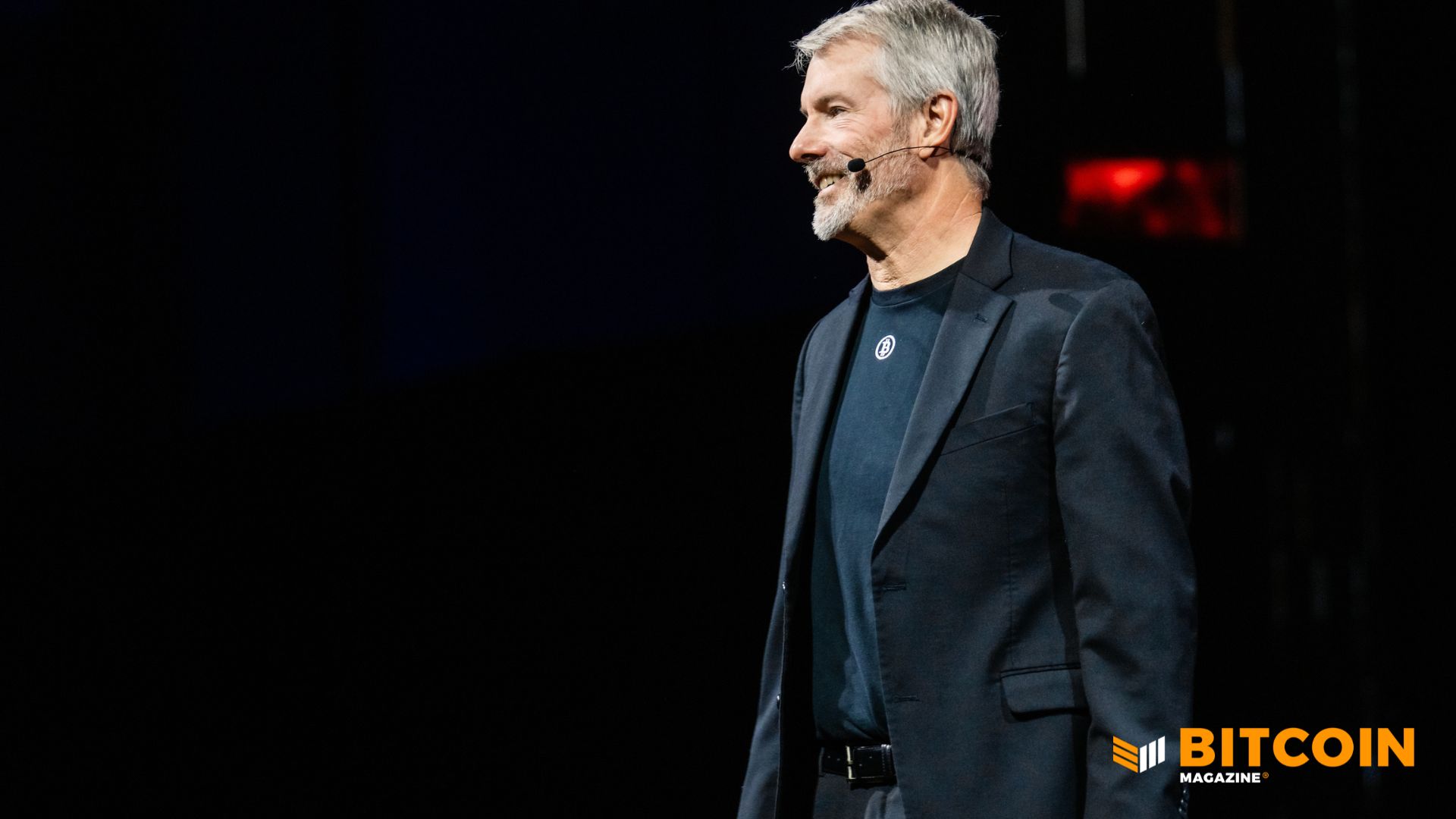
Strategy Founder Michael Saylor Argues Clarity Act Collapse Is a Win
Bitcoin treasury founder and pioneer Michael Saylor has said that the blockage of the Clarity Act is actually good for the digital asset space.
Writing on X on Saturday, the Strategy founder and chair said that legislation can make restrictions permanent just as easily as rights.
Lawmakers this week blocked long-awaited crypto legislation, the Clarity Act, which aims to formally divide oversight between regulators. The digital asset industry had long called for such rules to be in place.
Despite the hurdle, regulators like the Securities and Exchange Commission and the Commodity Futures Trading Commission are pushing ahead with rulemaking.
“We have an administration willing to modernize financial markets. We should use the next two years to put better financial products into people’s hands,” Saylor wrote.
He continued: “Let the Digital Assets industry innovate rapidly in a free market and create the greatest possible value for the U.S. and global economy.”
Saylor, whose company Strategy started buying bitcoin in 2020, argued that watchdogs going ahead to make rules anyway — like the SEC’s conditional relief for onchain trading of certain tokenized stocks and the CFTC Chairman stated willingness to act without the bill — would give crypto companies the regulation they need.
Saylor went on to argue that proposals in the act — such as limits on paying customers for holding payment stablecoins — wouldn’t benefit the crypto space anyway.
Senators on Tuesday mostly voted against advancing the legislation — 49 for and 50 against — that the digital asset industry has long called for.
The bill aims to formally divide oversight between regulators, distinguishing which digital assets are securities, commodities or stablecoins.
President Donald Trump last month urged lawmakers to pass it, helping spur a bitcoin rally. But Republicans warned for months that Democrats were deliberately holding it back.
Crypto industry bigwigs had long called for rules to be in place after regulators during the Biden Administration penalized companies in the digital asset space with fines for allegedly selling unregistered securities.
This post Strategy Founder Michael Saylor Argues Clarity Act Collapse Is a Win first appeared on Bitcoin Magazine and is written by Mathew Di Salvo.
Bitcoin Magazine
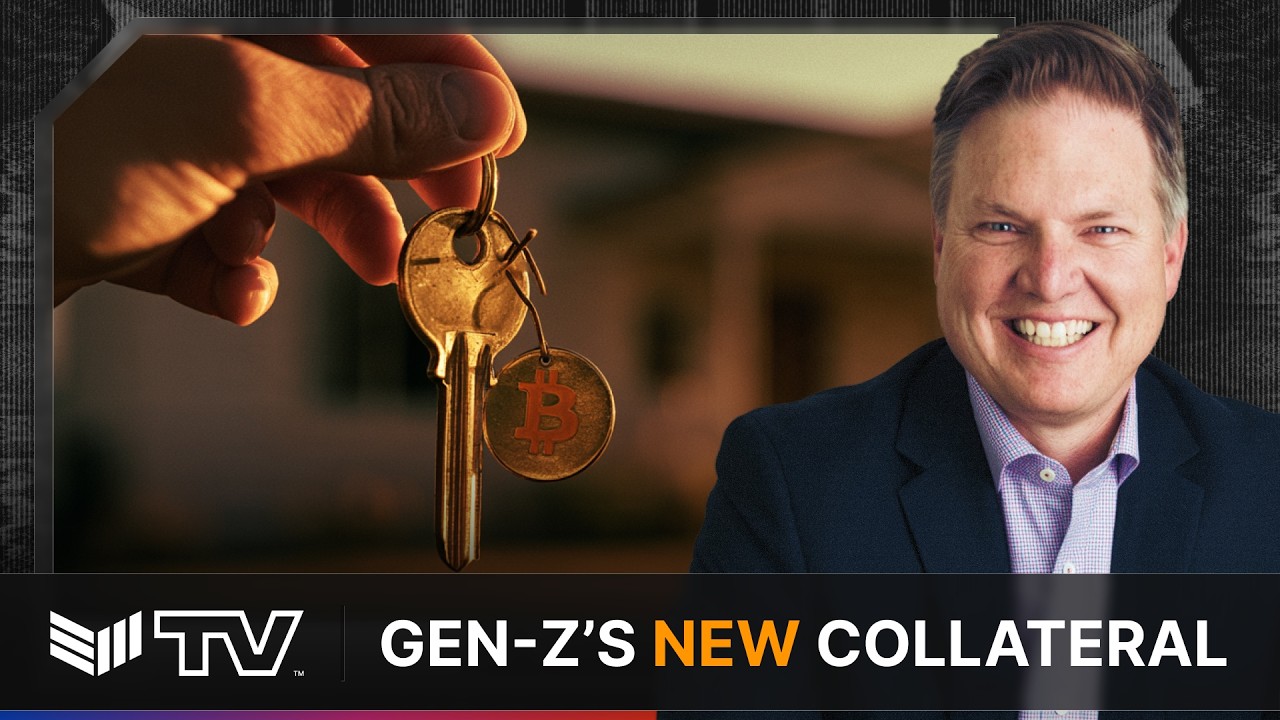
Move Over Housing – Bitcoin is Gen Z’s New Wealth Building Asset
Gen Z now makes up less than 5% of the new home market and Hunter Albright of SALT Lending thinks that changes what assets an entire generation chooses to build wealth with. In this conversation he connects housing affordability, Bitcoin as collateral, and the rise of borrowing against Bitcoin for down payments without locking your coins up for 30 years. Albright also covers Fannie Mae and Freddie Mac recognizing Bitcoin, SALT’s five-year loan terms, and what a Bitcoin-powered life actually looks like in practice.
DISCLAIMER: The views and opinions expressed in this show are those of the participants and do not necessarily reflect the official policy or position of BTC Inc., Bitcoin Magazine, or any affiliated entities. This content is provided for informational and educational purposes only and should not be construed as investment, legal, tax, or accounting advice. Nothing contained in this show constitutes a solicitation, recommendation, endorsement, or offer to buy or sell any securities or financial instruments. Viewers should consult their own advisors before making financial or business decisions.
This post Move Over Housing – Bitcoin is Gen Z’s New Wealth Building Asset first appeared on Bitcoin Magazine and is written by Patrick Green.
CryptoSlate
A coordinated attack drained 8.7 million FET and used a compromised NuNet minter key to create 408.5 million NTX.
The Sept. 19 attack emptied the Ethereum-side conversion contract used by SingularityNET’s bridge, removing 8,721,530 FET worth about $1.55 million at the time. Twenty-nine minutes later, a stolen NuNet minter created 408.5 million NTX and sent the tokens to the same receiving wallet, according to an on-chain forensic report prepared by Athena.
Fetch.ai subsequently paused AGIX-to-FET conversions and its Ethereum-side bridge contract as a precaution. The company said the affected infrastructure belonged to SingularityNET, primarily its Ethereum-Cardano bridge, while Fetch.ai’s own contracts and normal FET transfers remained operational.
The forensic report identified the affected contract as TokenConversionManagerV3, the legitimate Ethereum-side lock-and-release component of SingularityNET’s bridge. Its verified source matches SingularityNET’s public repository, and the contract is tied to the current Artificial Superintelligence Alliance FET token.
Investigators traced the loss to a compromised backend authorization key, not a flaw that let an attacker bypass the bridge contract. The transaction carried a valid signature from the address the contract was configured to trust, allowing its conversionIn function to release the entire FET balance to an attacker-controlled wallet.
The contract’s design magnified the damage. Its 1 million FET transaction cap applied to tokens moving out of Ethereum but was not enforced onconversionIn, allowing the attacker to withdraw 8.72 million FET in one transaction. The signed message also failed to bind the eventual recipient, meaning a valid authorization could direct the tokens to an address selected by the caller.
Same wallet connects separate compromised keys
The NuNet activity provides the strongest evidence that the FET drain formed part of a broader coordinated operation.
At 20:50 UTC, 29 minutes after the FET withdrawal, a NuNet minter key dormant since March 2023 created 408,532,878 NTX and sent the entire amount to the same wallet that received the stolen FET. The mint was equivalent to roughly 42% of NuNet’s documented token supply, according to the report.
A later forensic pass tightened that connection. At 19:36 UTC, 45 minutes before the FET drain, the NuNet minter sent 0.3667 ETH directly to the eventual receiving wallet, while another attacker-linked account moved 24.3 million NTX into it.
NTX sales through MetaMask’s swap infrastructure had also begun before the FET bridge was emptied, indicating that the operation involving the two compromised credentials was already underway ahead of the main withdrawal.
The attacker then began converting the assets. The stolen FET was routed through MetaMask’s swap infrastructure and exchanged largely for Ethereum, while more than 217 million of the newly minted NTX was sold through decentralized liquidity venues.
By about 1:10 UTC on Sept. 20, the central wallet held 547.89 ETH worth roughly $1.44 million and another 230 million NTX, according to the report.
Liquidity quickly became a constraint on the NTX side. Four later sales involving 38.55 million NTX increased the attacker’s ETH balance by only about 0.30 ETH as available pools were depleted. A separate 10 million NTX transaction routed through Mayan Protocol ultimately produced about 940 USDT for cross-chain dispatch.
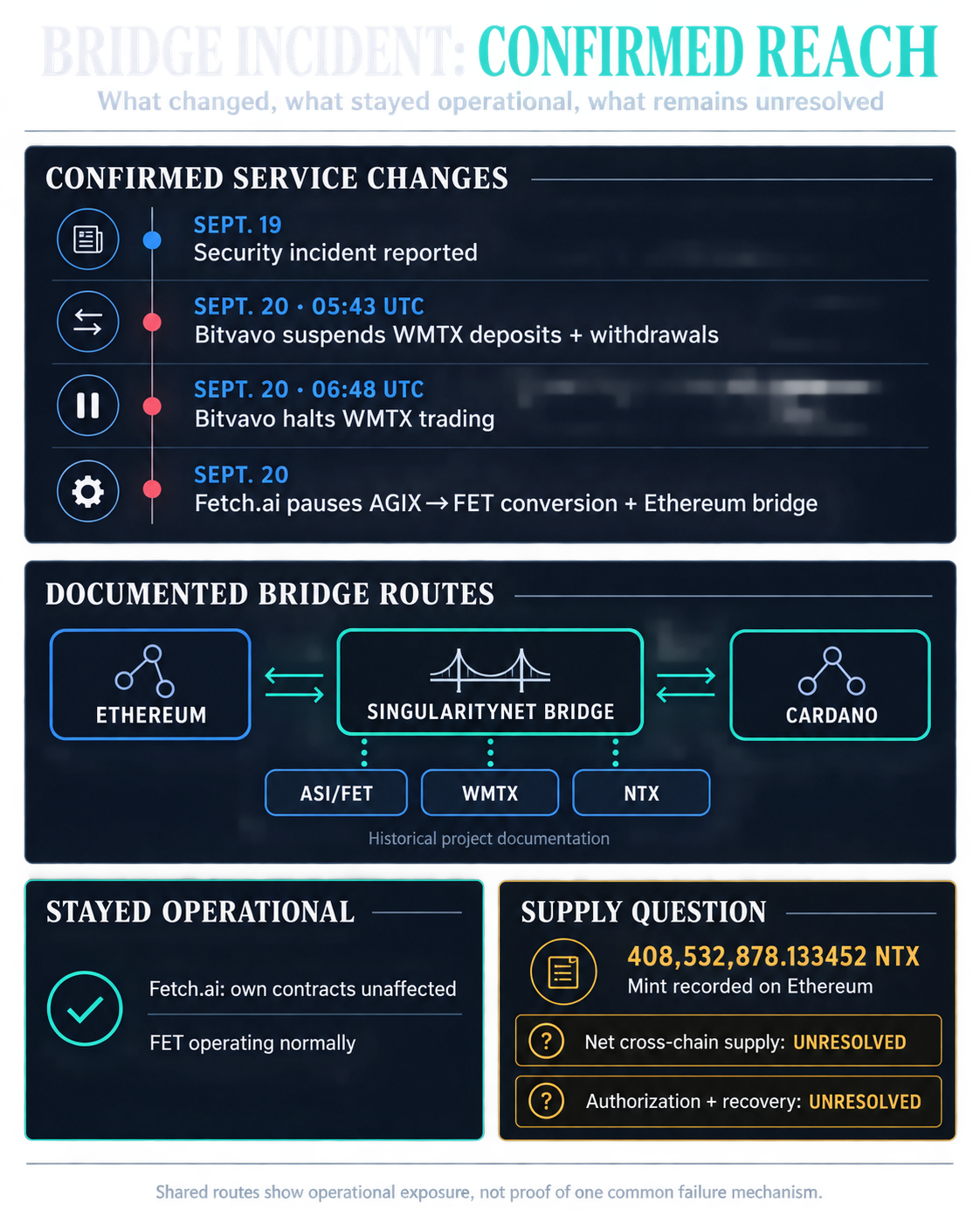
The disruption later widened beyond the two assets examined in the forensic report. Bitvavo suspended WMTX deposits and withdrawals on Sept. 20 after citing an active security incident affecting the token, then temporarily halted trading. The exchange said customer balances remained safe.
Historical SingularityNET material shows WMTX, FET and NTX all used infrastructure connected to its Ethereum-Cardano bridge ecosystem. The available forensic evidence, however, examined the FET and NTX activity in detail and does not establish that WMTX was compromised through the same mechanism.
Fetch.ai said it was working with SingularityNET and paused conversions while it investigated the incident.
The report’s first tracking window found that the compromised FET bridge authorizer and NuNet minter credentials had not yet been rotated or revoked roughly five hours after the attack. By then, the FET bridge was empty and inactive.
That makes credential remediation central to restoring the affected services. Refilling the FET conversion contract while the same authorizer remains trusted could expose fresh liquidity to another signed withdrawal, while NuNet faces a separate risk as long as the affected wallet retains authority to create additional NTX.
Fetch.ai’s AGIX-to-FET conversion service and Ethereum-side bridge are therefore among the clearest operational markers to watch.
For WMTX, Bitvavo has said trading and transfers will remain restricted while it assesses the incident, leaving exchange reopenings and credential rotations as the next visible tests of whether the affected infrastructure is secure.
The post One wallet links $1.55 million FetchAI theft to massive 408.5 million NTX mint appeared first on CryptoSlate.
Bitcoin’s rally toward $86,000 has pushed US spot exchange-traded fund (ETF) investors back into profit after months underwater.
Data from CryptoSlate showed Bitcoin gained about 6% over the past 24 hours, extending its September rebound and briefly trading near $86,000.
Bloomberg Intelligence ETF analyst James Seyffart said the move put the average US Bitcoin ETF holder above water for the first time since January. The funds’ estimated buys-only cost basis stands at about $81,722 per Bitcoin, while their net cost basis sits closer to current prices.
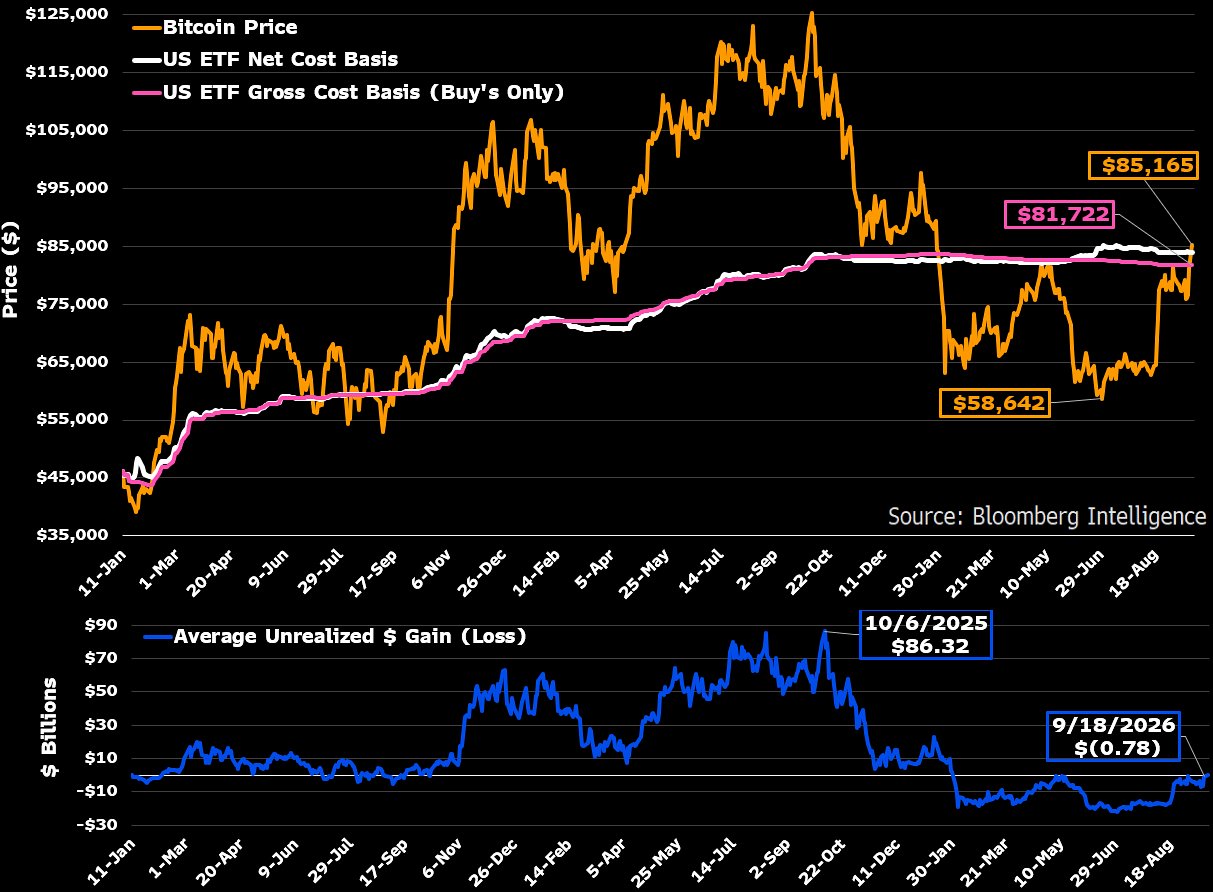
Bitcoin traded around $85,165 in Bloomberg Intelligence’s latest reading, clearing both levels and reversing much of the damage inflicted on ETF investors during this year’s downturn.
The turnaround has been dramatic. US Bitcoin ETF investors held about $86.32 billion in unrealized gains on Oct. 6, 2025, before the subsequent selloff erased that entire cushion. By Sept. 18, the cohort was sitting on an estimated $780 million unrealized loss.
Bitcoin’s latest advance has effectively repaired that drawdown. Capital flows have recovered more slowly, leaving ETF investors profitable again even as cumulative inflows remain well below their 2025 peak.
BTC's price recovery outruns ETF demand
The return to profitability has come well before a full recovery in ETF demand.
SoSoValue data show cumulative net inflows into US spot Bitcoin ETFs peaked at about $61.19 billion in October 2025 before falling to roughly $55.16 billion, leaving the products about $6.03 billion below their high-water mark.
The fund has recorded about $1.46 billion in net outflows so far in 2026. January accounted for roughly $1.61 billion of withdrawals and February another $206.5 million. March and April then brought a combined $3.29 billion of inflows before May and June reversed the improvement with about $6.94 billion of net withdrawals.
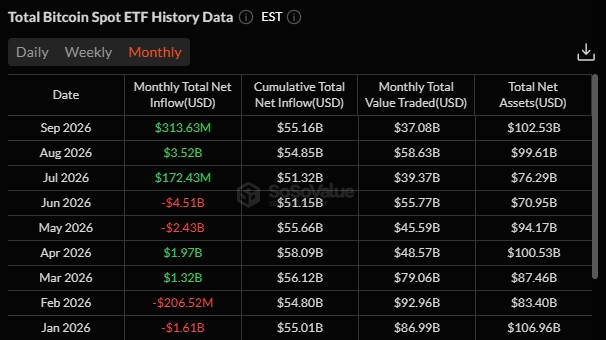
Demand strengthened again in the third quarter. July attracted about $172 million, followed by roughly $3.52 billion in August and another $314 million so far in September. Those inflows have steadied the cumulative total but have yet to replace the capital that left after last October’s peak.
Meanwhile, Bitcoin's price has recovered much faster.
Bloomberg Intelligence’s data show the cryptocurrency fell as low as about $58,642 during the downturn, leaving ETF investors well below both estimated cost-basis measures. Its subsequent rebound of more than $26,000 has carried the market back through the roughly $81,722 buys-only cost basis and toward the higher net measure.
That price appreciation has restored the value of Bitcoin already held inside the funds even as cumulative net inflows remain almost 10% below their October 2025 peak.
The setup differs from last year, when rising Bitcoin prices were accompanied by expanding ETF inflows and a growing pool of unrealized profits. This time, existing holders have moved back into profit while the cumulative capital committed to the products remains smaller.
The recovery is also uneven across the investor base. Bloomberg Intelligence’s buys-only cost basis sits near $81,722, giving those holders a wider cushion at current prices, while the net cost basis remains closer to Bitcoin’s market price and leaves that group nearer breakeven.
ETF breakeven will test investor conviction
That narrow cushion above breakeven is already being tested by volatile ETF flows, even though last week’s headline total looked almost unchanged.
US spot Bitcoin ETFs ended the week with just $6.21 million of net inflows, SoSoValue data show. Beneath that figure, however, investors moved sharply in and out of the products across individual sessions.
About $160 million entered the funds last Monday before roughly $450 million was withdrawn Tuesday and another $296 million Wednesday. The selling then reversed, with about $160 million returning Thursday and $433 million flowing in Friday, the strongest daily inflow since Sept. 3. Fidelity’s FBTC accounted for roughly $311 million of Friday’s total.
That left the funds almost flat for the week despite nearly $1.5 billion of gross daily inflows and outflows. Bitcoin ETF trading volume totaled about $16.17 billion, making the $6.21 million net subscription equivalent to roughly 0.04% of turnover.
The weekly result nevertheless marked an improvement from the previous period, when the funds recorded about $463 million of net outflows. More importantly, the sequence showed that heavy midweek selling did not develop into a sustained exit, with buyers rebuilding exposure rapidly over the final two sessions.
Moving ETF investors back into profit could now determine whether that re-risking continues. Holders who stayed through Bitcoin’s downturn can reduce exposure near or above their average entry levels without realizing the losses they faced earlier this year, creating the possibility of renewed selling as more positions move back into the black.
The next test is whether crossing above the ETF cost basis draws sustained new money into the products or gives investors who endured the downturn an opportunity to leave. Continued inflows would put fresh capital behind Bitcoin’s recovery, while another round of redemptions would show that the return to breakeven has released holders who were waiting for prices to recover
The post Bitcoin hits $86,000 putting ETF investors back in profit after $86 billion wipeout appeared first on CryptoSlate.
Ethereum developers are weighing Ethereum Quick Slots for Hegotá, a proposed faster block rhythm that would reduce waiting without expanding the network's per-second capacity. EIP-8198, or Quick Slots, remains Proposed for Inclusion rather than scheduled, and neither its eight-second draft parameter nor the 10-second alternative has been adopted.
That makes validator performance the deciding issue. Shorter slots could refresh onchain prices sooner and accelerate confirmations and finality, but validators would have less time to receive, check and attest to each block. The proposal's market benefits are modeled; its effect on the slowest operators remains the evidence Ethereum still needs.
The Hegotá meta-EIP lists Quick Slots as Proposed for Inclusion, while Ethereum's official roadmap says most of the upgrade's scope remains undecided. Developers are choosing whether to spend performance headroom on lower latency while preserving the broad participation that gives Ethereum its decentralization.
Ethereum Quick Slots: a faster clock with the same per-second capacity
The canonical EIP-8198 draft uses eight seconds as a placeholder, down from Ethereum's current 12-second slot. It also says the exact target should follow performance characterization and may change before deployment.
Ethlabs favors a more conservative first move. Its updated Hegotá position advocates 10-second slots first, with later cuts only as evidence of safety accumulates. An open sponsor rewrite likewise proposes 10 seconds, but it has not been merged into the canonical EIP.
The possible outcomes therefore extend beyond an eight- versus 10-second choice. Hegotá could start at 10 seconds, retain the draft's eight-second parameter, or leave the 12-second schedule unchanged if testing shows that a cut would be unsafe.
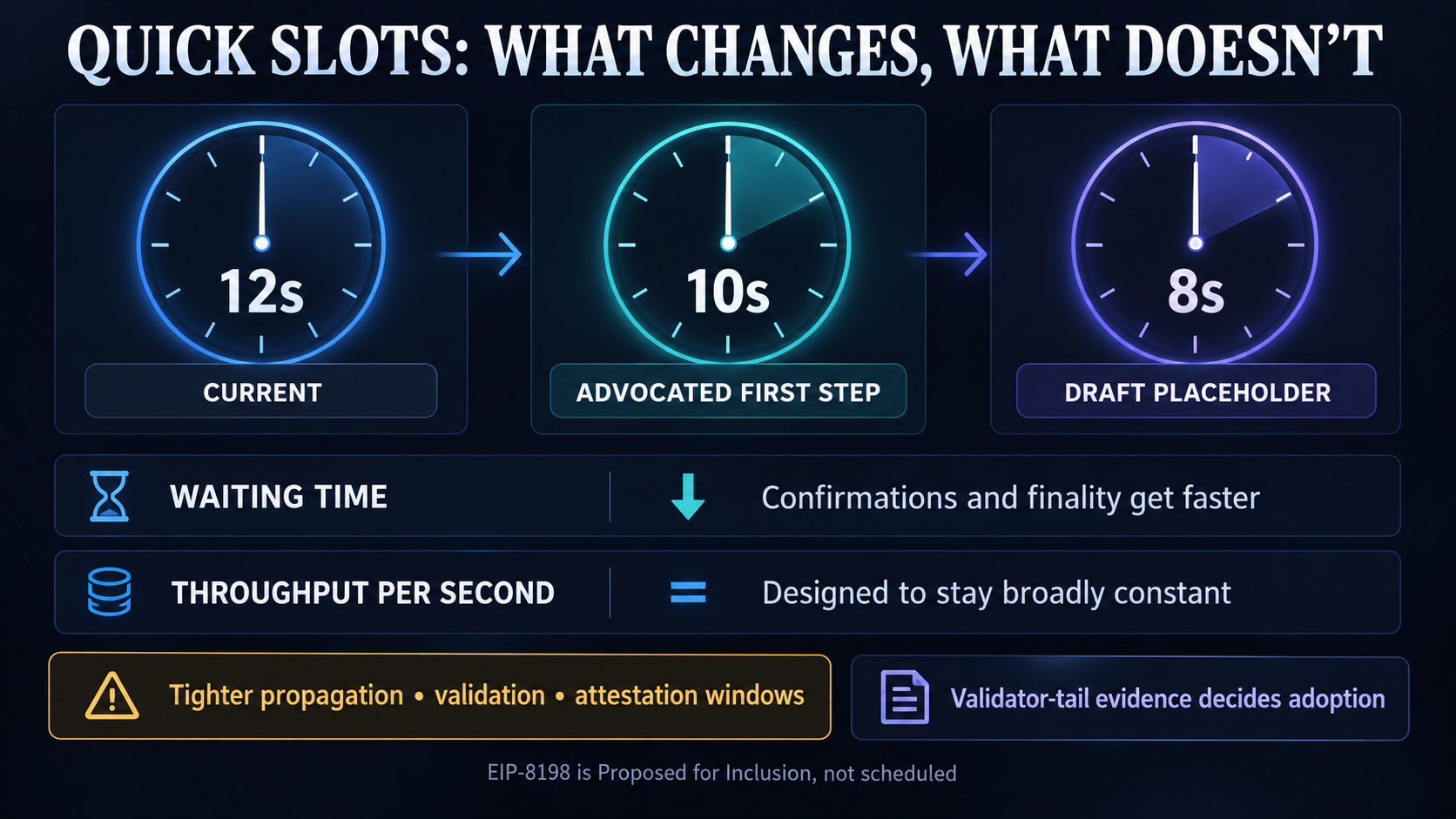
Under either shorter target, capacity per second stays broadly level only if the gas limit and maximum blob count per block fall in proportion to slot duration. Smaller blocks would arrive more frequently. Users could receive a first confirmation sooner, onchain markets could update more often, and systems that inherit Ethereum's cadence could react faster. Normal validator gas-limit voting would resume after the transition, and integer rounding could make blob capacity slightly lower rather than perfectly constant.
Keeping 32 slots in an epoch would also shorten epoch-based finality in wall-clock time. Under the draft's eight-second assumptions, EIP-8198 estimates finality falling from about 13 minutes to about 8.5 minutes. That is a proposal estimate, not an observed result from production Ethereum.
The same distinction applies to the draft's claim that a 12-to-eight-second change would reduce arbitrage losses by roughly 18%. The figure comes from a model in which those losses scale with the square root of the time between blocks. Ethereum has not operated an eight-second production regime that could demonstrate the result.
Independent work supports the direction more strongly than the exact magnitude. An empirical study of automated market maker losses found that faster blocks reduce losses to arbitrageurs, but the effect varied materially by trading pair. A newer jump-diffusion model found that sudden price jumps create a floor that shorter intervals do not eliminate.
Fresher prices could improve spreads and liquidity-provider economics while compressing some surplus available to searchers, builders and proposers. Yet fees, liquidity, volatility, jumps and burned base fees affect who captures the change. A separate Ethereum Research analysis shows why lower nominal arbitrage does not translate mechanically into a uniform 18% gain for users or liquidity providers.
Validator tails decide whether the trade works
Smaller blocks reduce peak payload size, but a faster cadence raises computational and bandwidth demands per second. Validators also face tighter absolute windows for propagation, validation and attestation aggregation. Average performance cannot settle the decentralization question because the network must remain usable for operators in slower regions, on weaker hardware and with varied client configurations.
An analysis of mainnet attestation timing found potential headroom for a shorter schedule alongside a meaningful tail. Some attestations in its sample arrived after the aggregation deadline contemplated for a six-second design, and timings differed across clients, operators and configurations. The study was exploratory and does not establish the safety of six, eight or 10 seconds.
Separate post-Pectra research found propagation delay strongly associated with reorg risk near the attestation boundary. Those observations support a distributional risk: reducing the timing margin could burden slower or poorly configured validators more than well-provisioned peers. They do not quantify validator reward losses under EIP-8198 or prove that either proposed target would centralize the network.
The proposal itself acknowledges incomplete knowledge about blob propagation, attestation aggregation, local block building and validator hardware. Developers have also linked Quick Slots to work on faster execution-payload broadcast, treating propagation improvements as part of the safety case rather than a later optimization.
The Ethereum Foundation Protocol cluster's Hegotá assessment placed Quick Slots in B tier after research teams offered stronger support than delivery-focused engineering teams. The practical requirements behind that split are clear: a complete specification, a full-spec prototype, a downstream-effects assessment and confirmation that Quick Slots will not complicate Ethereum's planned decoupled-consensus architecture.
Those requirements turn Hegotá's decision into an empirical test. A 10-second first step could deliver a measurable latency gain and defer a harder cut if client simulations and devnets show broad validator resilience. Eight seconds could remain the draft's ambition rather than the first deployment. If timing tails or reorg behavior worsen enough to favor larger operators, the market-quality benefit would carry a decentralization cost.
Ethereum Quick Slots could offer fresher markets, shorter transaction-inclusion waits and faster finality without increasing throughput. Broad validator resilience remains the condition that must be demonstrated before the faster clock is worth adopting.
The post Will proposed faster block times really fix Ethereum’s biggest market losses? appeared first on CryptoSlate.
Bitcoin treasury companies Strategy and Strive bought about $183 million of BTC last week as the cryptocurrency’s rebound helped corporate balance sheets recover losses.
Strategy Inc., the largest corporate holder of Bitcoin, acquired 950 BTC for $75.7 million between Sept. 14 and Sept. 20 at an average price of $79,670, according to a regulatory filing Monday. The purchase returned its holdings to 846,000 BTC, acquired for a total of $63.8 billion at an average cost of $75,416.
Strive Inc. separately bought 1,355 BTC for $107.7 million at an average price of $79,475 between Sept. 14 and Sept. 18, taking its treasury to 26,355 BTC. Cash and equivalents rose to $229.6 million over the same period.
Both purchases were made below Bitcoin’s latest market price. The token surged above $85,000 Monday, its highest level since January, extending a recovery of almost 30% from its August lows.
The buying stands out because the broader corporate treasury trade has slowed sharply. Listed companies added about 5,900 BTC over the past three months, Glassnode said in a report last week. That compares with roughly 89,000 BTC accumulated in July 2025 alone.
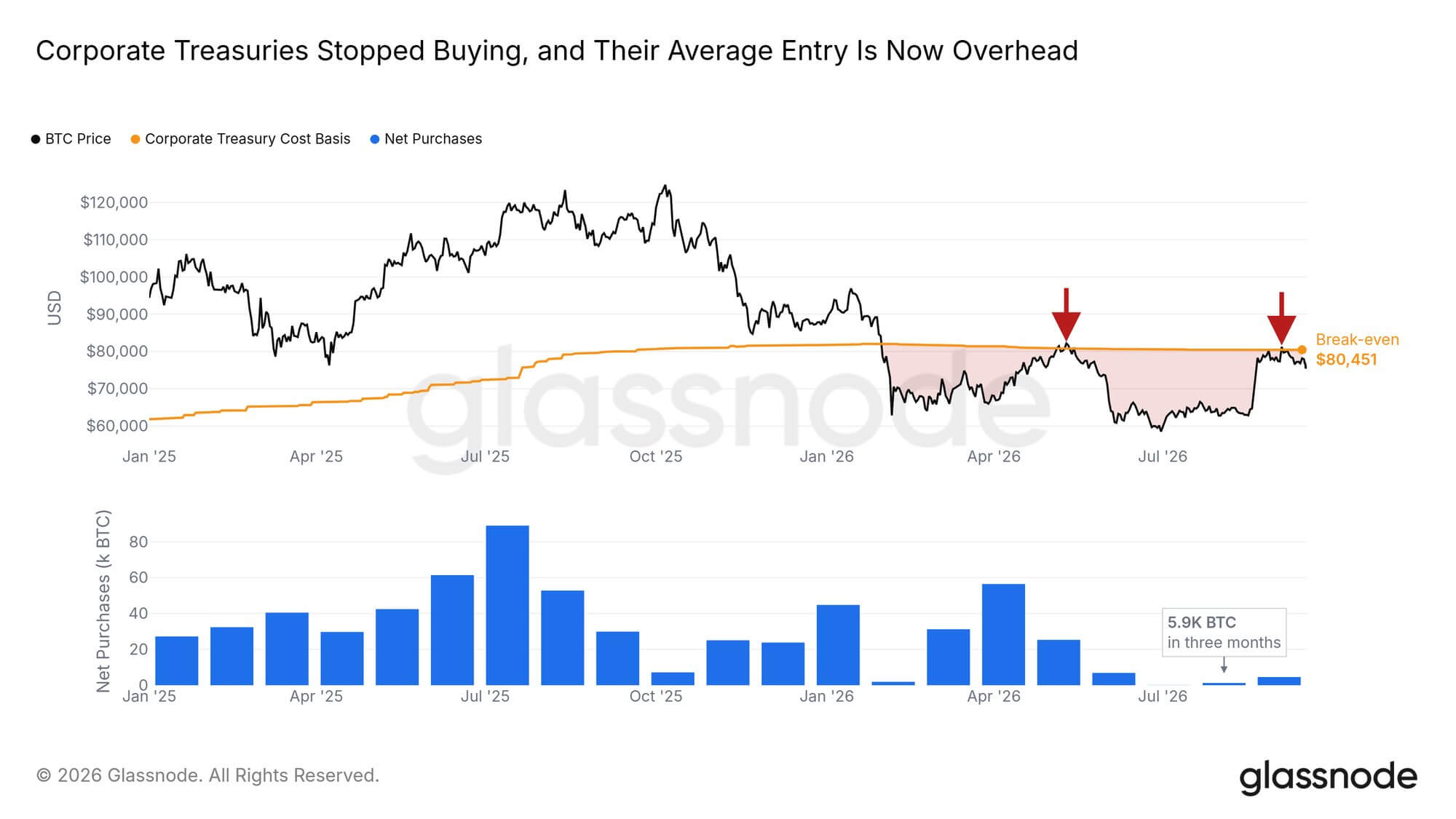
Glassnode estimated the sector’s average acquisition price at roughly $80,500. Bitcoin was still below that threshold when the firm published its report, leaving the aggregate corporate treasury cohort underwater. Monday’s move through $85,000 has reversed that position and pushed the group back above its estimated cost basis.
Strategy’s Bitcoin rebound collides with a capital-management pivot
For Strategy, the rally has particularly large accounting consequences.
Bitcoin ended the second quarter at $58,714, when Strategy held the same 846,000 BTC it does today. The decline contributed to an $8.32 billion loss on digital assets during the three months through June, including $8.31 billion of unrealized losses.
At $85,000, Strategy’s current Bitcoin holdings would be worth about $71.9 billion, roughly $8.1 billion above their aggregate acquisition cost. Their gross market value would also stand more than $22 billion above the value of 846,000 BTC at the June 30 closing price.
That comparison does not translate directly into Strategy’s eventual third-quarter accounting gain because the company bought and sold Bitcoin during the quarter and fair-value changes are recognized as they occur. Still, it illustrates the scale of the balance-sheet swing created by Bitcoin’s rebound.
Strategy has also been directing capital away from Bitcoin at times to manage the securities used to finance its treasury.
The company repurchased 1.77 million shares of its variable-rate STRC preferred stock for $174 million last week. It used another $57.4 million from its dollar reserve for preferred dividends and debt interest, leaving $5.04 billion in its reserve and $1.05 billion of separately designated cash as of Sept. 20.
Strategy has spent months trying to keep STRC near its $100 par value through buybacks and changes to its capital framework. Chief Executive Phong Le said in July that repurchasing the security below par can reduce future dividend obligations while supporting what the company considers a sustainable market for the preferred shares.
Since then, the firm has now spent roughly $1.1 billion on STRC buybacks.
The latest Bitcoin purchase therefore marks a return to accumulation alongside, rather than instead of, that balance-sheet management. Strategy had reported no Bitcoin purchases in the previous two weekly updates and held 845,050 BTC as recently as Sept. 13.
Strive leans on preferred stock to keep accumulating
Meanwhile, Strive has continued buying BTC more consistently while relying on its preferred stock.
Its latest purchase followed a 469-BTC acquisition the previous week and a 1,375-BTC purchase earlier in September, extending a strategy that has increasingly relied on its SATA preferred stock to raise capital.
Strive said warrant exercises also began generating fresh capital last week, producing about $21.2 million in gross proceeds. Including those funds, the company said SATA has accounted for about 57.7% of the total capital it has raised, reflecting how preferred equity has become central to financing its Bitcoin accumulation.
The latest filing showed SATA shares outstanding rose by 786,194 during the week to 11.18 million, while Strive’s Class A share count increased by about 2.07 million.
That financing model becomes easier to sustain when Bitcoin rises faster than the cost of the securities used to acquire it. Strive’s latest BTC was purchased almost $5,500 below Monday’s roughly $85,000 price, though its overall treasury remains closer to its historical acquisition cost than Strategy’s.
The broader question is whether other corporate buyers return now that Bitcoin has cleared the $80,500 sector cost basis.
Glassnode’s data suggest the treasury trade that absorbed tens of thousands of Bitcoin each month during 2025 has become increasingly concentrated among a smaller group of aggressive buyers. Strategy and Strive are adding again as prices recover, but matching last year’s corporate demand would require companies currently sitting on the sidelines to follow them.
The post Strategy and Strive buy $183 million in Bitcoin as $85,000 rally revives treasury trade appeared first on CryptoSlate.
The Balancer V1 recovery proposal would divide 296.401711 ETH returned after an Aug. 31 exploit among liquidity providers in 120 legacy pools, but it does not yet show what any address could claim.
The proposal says tokens worth about $1.39 million at attack-time prices were drained from the pools. It lists five ETH returns to the Balancer DAO Multisig between Sept. 8 and Sept. 16 from the main greyhat, three anonymous whitehats and block builder Ultrasound.money.
The 296.401711 ETH is the amount the proposal records as returned, not a promise of full reimbursement. The attack loss is expressed in dollars at historical prices while the recovery pool is denominated in ETH, and the proposal does not state a recovery percentage.
How Balancer would allocate the recovered ETH
Under the plan, Balancer would first allocate recovered ETH to each pool according to that pool’s share of the total dollar loss at the time of the attack. It would then divide each pool’s allocation among liquidity providers based on their pool-token holdings at Ethereum block 25,872,248.
That block immediately preceded the first exploit transaction at block 25,872,249. Using one pre-attack snapshot would cover all 120 pools, including those later targeted by copycat activity.
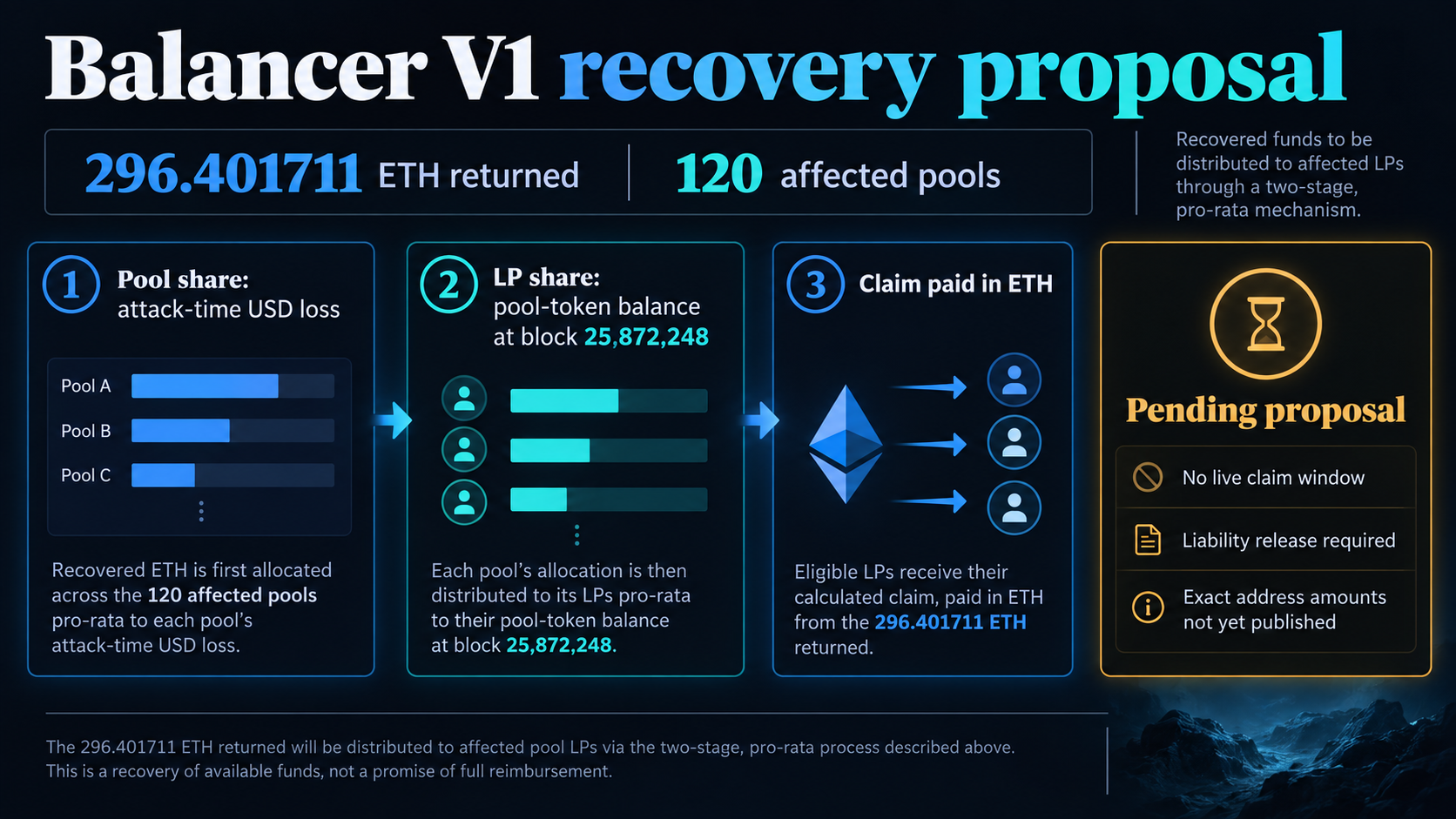
The formula determines the relative weighting of claims, but the Sept. 18 post does not include the per-pool allocation table, holder lists or per-address amounts. Until those files are published, an individual LP cannot calculate an exact ETH payout.
Claims await a vote and address-level data
Receiving the proposed payment would also carry a legal condition. Claimants would have to provide digital consent releasing Balancer Labs, Balancer DAO, Balancer Foundation, affiliated parties and service providers from liabilities related to the incident. Payments would be made in ETH, while contract and multisig claims would be handled case by case.
As of Sept. 20, the Sept. 18 forum post remained labeled BIP-XXX and contained no Snapshot vote link. It says claim data would be published and a claim mechanism deployed only if the proposal passes, leaving the V1 claim window unopened and without announced start or end dates.
The recovery pool is separate from the assets covered by Balancer’s proposed shutdown. Its wind-down proposal says funds recovered from protocol attacks belong to affected LPs and sit outside the treasury distribution intended for BAL holders, a distinction also noted in CryptoSlate’s earlier coverage.
That separation preserves recovered exploit funds for LPs, but the pending vote and unpublished allocation data mean the Balancer V1 recovery proposal defines a recovery route, not a confirmed payout.
The post Why Balancer’s $1.4M hack recovery won’t pay LPs anytime soon appeared first on CryptoSlate.
CryptoTicker.io
Litecoin rose about 11.5 percent on Sunday to $63.57 (CoinGecko, September 21, 2026, 13:12 UTC), placing it 25th among the largest cryptocurrencies. Over the week it is up a good 17 percent, over 30 days by around 22 percent.
Litecoin has something many larger projects are still waiting for: its own exchange-traded fund on a US exchange. And that is exactly where something uncomfortable can be read off on this day.

The ETF is here, the capital is not
A spot ETF on Litecoin has traded on the Nasdaq since October 27, 2025, launched by Canary Capital. The product holds Litecoin directly and charges an annual fee of 0.95 percent.
Assets under management stood at around $5.49 million at the end of June 2026. For comparison: Litecoin's daily turnover on trading venues moves in an entirely different order of magnitude. A fund of that size does not move the price.
This gap is the real story. Approval of an ETF is generally regarded as an opening for institutional capital. In Litecoin's case the door has stood open for almost a year, and hardly anyone has walked through it.
What this says about ETF expectations
The same narrative forms around every ETF approval: access creates demand. With bitcoin that proved true, and billions flowed in. Litecoin shows the other possibility.
An ETF creates access. It does not create interest. Anyone with no reason to hold an asset will not buy it just because doing so becomes more convenient. For the ongoing debate about funds on further cryptocurrencies, that is the soberer benchmark than the bitcoin case.

Where the Litecoin price gain comes from
The day's gain of 11.5 percent comes from the broader market. Bitcoin reached its highest level since January at more than $85,000, triggered by the liquidation of short positions running into the hundreds of millions. In phases like this, the large, long-established assets rise along with it without needing news of their own.
Litecoin benefits from its standing: the coin has existed since 2011, is available on practically every trading venue and is seen by many investors as the more conservative choice within the crypto market. That brings inflows in upward phases without anything changing at the project itself.
The number that sets the frame
Litecoin trades about 85 percent below its all-time high. A gain of 22 percent in a month changes little about that. Anyone comparing today's level with the peaks of earlier cycles sees an asset that has lagged far behind its own records for years, while at the same time staying steadily among the 25 largest cryptocurrencies.
Together the two make up the profile: no growth story, but no project that disappears either.
What to watch
Two points can be checked and carry more weight than any forecast. First, whether the money in the Litecoin ETF rises in the coming months. If the product continues to attract barely any capital in a friendly market, the question is answered. Second, its behavior in the next downward phase: if Litecoin falls less sharply than this week's trending coins, its reputation as the more conservative choice is confirmed. If it falls just as hard, it was only another coin in a rally.
The current crypto prices give an overview of the wider market. The comparison of the best crypto exchanges shows which venues list Litecoin and at what fees.
Morpho rose about 12 percent on Sunday to $2.78 (CoinGecko, September 21, 2026, 13:12 UTC). On its own that would not be worth reporting on a day when almost everything is up. A different number is the notable one.
Morpho trades about 33 percent below its all-time high. Among the other big winners of the day the figure is 81 percent for Sui, 87 for Render and 90 for Arbitrum. Morpho is therefore the only name in the leading group anywhere within reach of its own record.

Why this number counts
The gap to the all-time high separates two kinds of price rise. An asset 90 percent below its high is recovering from a slump. An asset 33 percent below it has largely put the slump behind it and is trading near what the market credited it with in good times.
That is no buy recommendation and no seal of quality. It does shift the question, though: away from whether the price comes back, and towards why it held up so well in the first place.
What Morpho actually earns
Morpho is a lending protocol. Users deposit collateral and borrow other assets against it; the protocol mediates between the two sides and keeps part of the interest. What sets it apart from many projects with a similar description are the figures behind it.
The capital deposited in the protocol passed $10.7 billion in September. That puts Morpho second in lending behind Aave. The amount actively borrowed reached $5 billion for the first time at the start of September, around 95 percent of it in dollar-pegged stablecoins. The protocol runs on 45 chains and, annualized, generates more than $200 million in fees.
Whether that justifies the current price is a valuation question open to argument. That this is revenue and not an announcement is not.

Ten days, five integrations
Between September 9 and September 18, five institutional integrations went live or were announced. They include a lending infrastructure on Circle's Arc chain, which gathered around $220 million in deposits on its first day, lending markets against tokenized equities from Coinbase, and integration into a payments app available in more than 150 countries.
That density explains the price trend of recent weeks better than today's market push. Institutional integrations bring capital that arrives more slowly and leaves more slowly than that of speculators.
Where the risks lie
Lending protocols carry a risk that trading venues do not: when deposited collateral falls faster than positions can be unwound, bad debt arises. With $5 billion of capital lent out, that is not a theoretical point.
The fact that 95 percent of loans run in stablecoins dampens this risk on the lending side and shifts it onto the collateral. On top of that comes the spread across 45 chains: every additional chain brings usage and, at the same time, one more place where something can go wrong.
What to watch in the Morpho protocol
Three measures can be checked without forecasting. First, whether the amount actively borrowed stays above $5 billion, because it generates the fees. Second, whether the new institutional integrations bring volume or remain announcements. Third, the gap to the all-time high: if it keeps narrowing while the rest of the market falls back, the picture of an asset valued differently from its peers is confirmed.
The current crypto prices give an overview of how the wider market is moving. The comparison of the best crypto exchanges shows which venues list MORPHO.
Hedera rose about 12 percent on Sunday to $0.0921 (CoinGecko, September 21, 2026, 12:50 UTC). Trading volume climbed far more sharply than the price and came in at around $283 million. Over the week the token is up almost 18 percent.
Hedera stands out in this market. While the day's winners come mostly from the AI field or from large application chains, this network has been aimed at corporate users for years. The news flow fits that.

Ten million accounts on the Hedera mainnet
The Hedera mainnet has passed the mark of ten million accounts. A number like that should be read with care, because accounts are not users: a single application can create thousands of them. As an order of magnitude for activity on the chain it still serves.
Alongside that came connections to companies building identity and securities infrastructure. This is the clientele Hedera has targeted from the start, and it differs from the typical DeFi user base: decisions take longer, but they also last longer.
Why the volume matters more than the HBAR price
The most striking figure of the day is the jump in trading volume rather than the price gain. Volume rose about 81 percent against the previous day. With a price rise of 12 percent, that means considerably more market participants traded, and not just a few with large amounts.
This combination is regarded as more durable than a price jump on thin volume. It is no proof of continuation, but it rules out one of the most common explanations: a move that arises only from the absence of sellers.

The number that limits the cheering
HBAR trades about 84 percent below its all-time high. A gain of 12 percent changes little about that. Anyone comparing the current level with the peaks of previous years sees a network that is growing operationally while the token has not recovered a large part of its former value.
This gap between network metrics and price is no contradiction. It shows that the market values corporate connections differently from speculative narratives, at least in the short term.
The broader market as the real driver
September 21 was a strong day for the entire crypto market. Bitcoin reached its highest level since January at more than $85,000, triggered by the liquidation of short positions running into the hundreds of millions. In phases like this, assets that usually move little rise as well.
Part of the advance in HBAR therefore belongs to the market as a whole. The network figures explain why capital is landing here; they do not explain why it is flowing at all.
What to watch now at Hedera
Two things can be checked. First, whether the elevated trading volume holds for several days or disappears with the day's event. Second, whether the corporate connections turn into measurable activity on the chain, meaning transactions instead of announcements. Both can be tracked without forecasting.
The current crypto prices give an overview of the remaining assets. The comparison of the best crypto exchanges shows which venues list HBAR and at what fees.
Bitcoin Price Broke Through $84,000
$Bitcoin is trading at $84,374 after a near vertical move that started around 11:30 UTC, up roughly 4% from a previous close of $81,152. The level matters because $82,000 to $83,000 had rejected buyers repeatedly since spring. Once that shelf gave way there was very little supply above it, and the move accelerated into thin air.
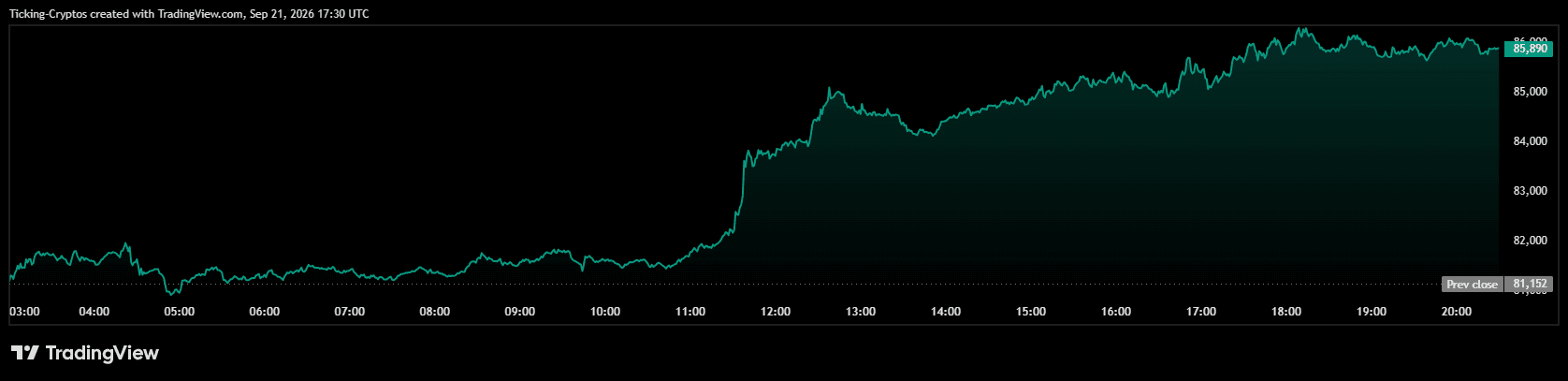
The setup was built on Friday. The Fed raised rates by 25 basis points but signalled a less restrictive path than markets feared, risk assets caught a bid, and more than $445 million in crypto shorts were liquidated. The bears sitting under the range were already cleared out before today's candle even started.
XRP Price Reclaimed $1.50
$XRP moved in the same minute, jumping 5.62% to $1.4895 from a close of $1.4103, and it outpaced Bitcoin doing it. More importantly, it broke the descending trendline that had capped every rally since the late-August spike to $1.70. Underneath that break, the structure had been repairing quietly for weeks: the $1.00 floor from mid-August held, $1.30 held on the September dip, and price reclaimed the 200-day EMA at $1.3563 and stayed above it.
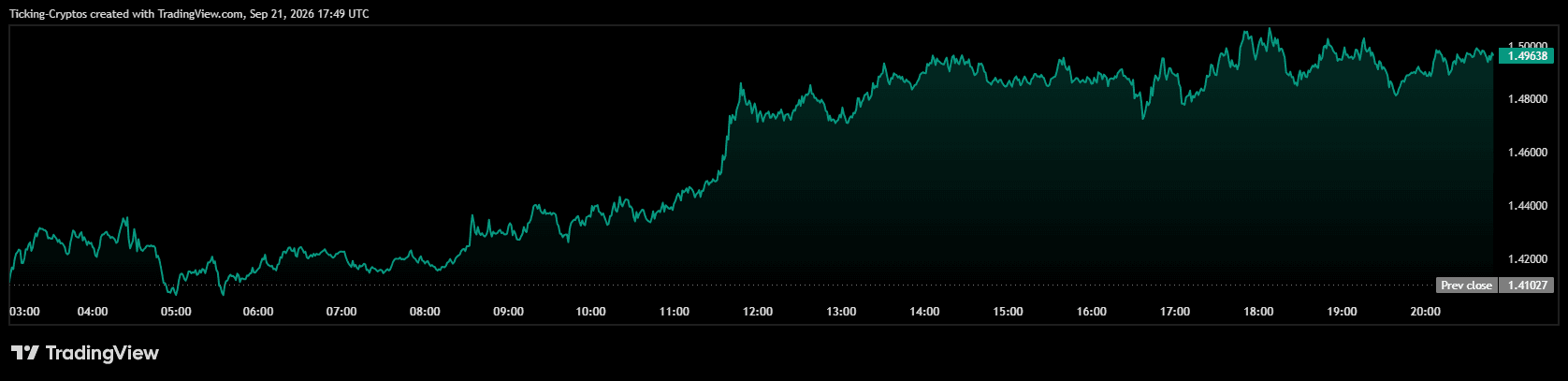
Why Altcoins Move Harder Than The Majors
Here is the part that matters for what comes next. When Bitcoin and XRP break out together, it tells you risk appetite has returned across the board rather than in one coin. Capital then rotates down the market cap table, and it hits smaller books.
That is where the amplification comes from, and it is arithmetic rather than magic. The same dollar of buying that nudges a $1.6 trillion asset moves a $4 billion one visibly. A coin with a $4 billion market cap and a thin order book will print a 25% day on flow that barely registers on the Bitcoin chart. This cuts both ways, and it is exactly why these moves unwind faster than they build.
The timing question is whether this holds. Rotations like this one typically play out over one to three weeks rather than a single session, because capital moves down the market cap table in stages rather than all at once. That is the window these three are positioned for.
1. SUI Has The Strongest Flow Behind It
$SUI trades at $1.03, up 25.23% on the day and 43.52% on the week, and the volume is what separates it from everything else on the board: $2.12 billion against a $4.23 billion market cap. That is a turnover ratio near 50%, meaning half the token's entire market value changed hands in a single day. This is not a thin-book drift being mistaken for demand, it is real participation. SUI remains down 26.34% year to date, so there is recovery room above, but a move with this much volume behind it can retrace just as violently.
2. Cardano Is The Large-Cap Laggard
$ADA sits at $0.2421, up 9.25% on the day and 16.10% on the week, with an $8.9 billion market cap and $865.57 million in daily volume. That is a turnover near 10%, which is healthy participation for a coin this size. It is still down 27.24% year to date, and that is the case for it: ADA has the furthest to travel just to get back to flat. It historically moves late and steadily in rotations, so it behaves as a trend follower rather than a leader.
3. Stellar Is The Defensive Pick
$XLM trades at $0.2083, up 8.87% on the day and 9.58% on the week. It has the softest momentum of the three, but it also has by far the best year: essentially flat at +0.05% year to date while SUI and ADA are both down more than 25%. XLM held its value through a brutal twelve months, and its payments and tokenization positioning overlaps directly with XRP, which is why an XRP breakout tends to drag it along. Volume is lighter at $380.23 million on a $7.26 billion cap, roughly 5%, so expect it to follow the move rather than lead it.
What Has To Hold Next Week
The whole rotation rests on two levels. XRP needs to hold $1.50, and Bitcoin needs to stay above the ceiling it just broke. If XRP fails there and slips back under its trendline, that is the textbook false breakout, and these three give back their gains in the same order they earned them with the thinnest order book falling hardest. For Bitcoin, losing $77,500 would undo the setup entirely.
Watch turnover rather than percentage gains as the week opens. Sustained volume on SUI would confirm the flow is real rather than a single-day squeeze, while ADA and XLM catching up on volume would signal the rotation is broadening rather than fading.
Bittensor rose about 14 percent on Sunday to $287 (CoinGecko, September 21, 2026, 12:50 UTC). Over the week the token is up a good 20 percent, and over 30 days by almost 27 percent. Trading volume stood at around $431 million.
No single piece of news explains the jump on the day. That is worth noting, because in situations like this one tends to get invented. TAO is in fact moving with its sector: AI-linked cryptocurrencies rose as a block, with Render gaining about 19 percent.

What sets Bittensor apart from other AI tokens
Bittensor organizes competition between AI models. The network is divided into subnets in which model providers compete against each other. Whoever delivers better results receives a larger share of the TAO that is paid out. The scoring is done by the other participants in the subnet concerned.
The approach is unusual and hard to verify. Unlike a network that brokers computing power, there is no simple metric such as images rendered or hours sold. The system assesses the quality of the results itself, and whether that assessment is robust against manipulation is the open question of the entire design.
What has changed at Bittensor in recent weeks
Two steps have widened the network's reach. In August, TAO was made available on Base, Coinbase's layer-two network, including transfers between chains. That gives the token access to DeFi applications previously closed to it.
Over the summer came a link to a payment provider through which TAO can be bought directly with conventional money. Both are improvements in access. Neither is a source of revenue. They explain no single day's gain, but they lower the barrier for new buyers.

The Bittensor price in numbers rather than narrative
TAO trades about 62 percent below its all-time high. That is remarkably little compared with other names in this rally: Render is 87 percent below, Sui 81 percent, Arbitrum as much as 90 percent. Bittensor has weathered the slump of recent months considerably better than the rest of the field.
That is the most solid statement the available data supports. It says nothing about the future, but it shows that the token has so far been steadier in down phases than comparable projects.
Why a missing trigger is itself information
When an asset rises by double digits with no news behind it, the move carries market mechanics rather than substance. On September 21 the broader market supplied the explanation: bitcoin reached its highest level since January at more than $85,000, driven by the liquidation of short positions running into the hundreds of millions. Capital that is freed up then looks for themes, and AI is currently the strongest.
Moves of this kind reverse faster than those with a concrete cause. Anyone buying at the peak of a sector rotation takes on the risk of the whole sector alongside that of the individual project.
What to watch in the Bittensor network
Two things will be telling over the coming weeks. First, the number of active subnets and the emissions paid out within them: is actual usage growing, or only the price? Second, how TAO behaves when the sector turns. If it then holds up better than Render and the other AI tokens, the picture of recent months is confirmed.
The current crypto prices show how the wider market is moving. The comparison of the best crypto exchanges shows which venues list TAO.
Decrypt
Venice (VVV) has clawed back from under a dollar to a record $34, and the pitch behind it is simple: an AI chatbot that promises to forget you the moment you close the tab.
The HashFly browser experiment uses a digital neural model for Bitcoin hashing and projects greater efficiency from a hypothetical biological version.
xAI says the new model is a "notable improvement" over Grok 4.6 at the same price. The benchmarks say it's still in second place.
Crypto advocates argue that NFTs can deliver real digital ownership, but privacy gaps and integration hurdles have held the tech back.
The senior roles cover Apple’s consumer payment products and Google Cloud’s institutional blockchain business in Asia.
U.Today - IT, AI and Fintech Daily News for You Today
Billionaire venture capitalist Tim Draper has taken aim at Apple, Meta and other tech giants for keeping Bitcoin off their balance sheets.
Solana’s 5-year chart pattern approaches resolution as the asset coils for a 106% run to the rim, according to veteran Peter Brandt.
Ethereum's open interest on Binance surges to its highest level on Binance in over nine months following a major breakout in its trading price.
An altcoin breakout led by XRP and NEAR triggered $666 million in crypto short position liquidations over the last 24 hours.
Dogecoin gathers momentum toward $0.10 as OI surges.
Blockonomi
TLDR
- T-Mobile and Jio complete the world’s first 5G Standalone roaming connection.
- TMUS stock trades at $167.04, down 0.68%, after recovering from early losses.
- Syniverse provides secure interoperability linking T-Mobile and Jio networks.
- 5G SA roaming brings lower latency and stronger international connectivity.
- The partnership expands T-Mobile’s push toward advanced global 5G services.
T-Mobile US expanded its international network reach after completing the world’s first 5G Standalone roaming connection with Jio. The milestone gives T-Mobile customers access to 5G SA capabilities while traveling between supported networks. Meanwhile, TMUS traded at $167.04, down 0.68%, after recovering from an early drop below $162.50.
T-Mobile US, Inc., TMUS
T-Mobile and Jio Complete 5G SA Roaming Milestone
T-Mobile and Jio connected their 5G Standalone networks through interoperability technology provided by Syniverse. The deployment creates a direct framework for customers to maintain advanced 5G services during international travel. As a result, the companies established a new technical benchmark for cross-border mobile connectivity.
5G Standalone uses a dedicated 5G core network rather than relying on older 4G infrastructure. Therefore, the architecture can provide lower latency, improved reliability, and stronger support for advanced network services. These capabilities can support real-time communications, connected devices, enterprise applications, and other data-intensive services.
The new roaming arrangement extends those network features beyond each operator’s domestic coverage. T-Mobile customers can now retain compatible 5G SA connectivity when roaming on Jio’s network in India. Likewise, the technical framework creates a foundation for broader 5G SA roaming as more operators adopt compatible systems.
Syniverse Technology Supports Cross-Border Connection
Syniverse provided the connectivity platform supporting interoperability between the two mobile networks. Its technology manages secure communication between operators and helps networks exchange information across international boundaries. Consequently, the platform helps operators deploy advanced roaming services without rebuilding their existing network environments.
The system also uses Security Edge Protection Proxy capabilities to secure communication between separate 5G networks. This technology protects signaling traffic when operators exchange information through their 5G core systems. Therefore, the infrastructure addresses an important security requirement for international 5G Standalone roaming.
Syniverse also supports testing and network validation before operators move new roaming services into commercial production. That process can help carriers identify interoperability problems before customers access the service. Moreover, broader testing could support future 5G SA roaming agreements between additional global telecommunications companies.
T-Mobile Builds on Its 5G Standalone Expansion
T-Mobile began deploying its nationwide 5G Standalone network in 2020 as part of its broader network strategy. The company separated 5G services from older network architecture to unlock more capabilities from its wireless infrastructure. Since then, T-Mobile has continued expanding technologies that depend on a dedicated 5G core.
The Jio partnership now extends that strategy into international roaming and cross-network services. Both operators expect standalone architecture to support consumer, enterprise, and AI-enabled applications across connected networks. Furthermore, interoperability could support new services that require consistent performance across different countries and mobile operators.
The development comes as telecommunications companies expand 5G Standalone coverage and prepare more advanced network services. However, widespread international roaming requires cooperation between operators, infrastructure providers, and network technology companies. T-Mobile’s latest deployment demonstrates how those systems can connect while maintaining 5G Standalone capabilities across borders.
The post T-Mobile US (TMUS) Stock: New Jio Partnership Advances Global 5G Roaming appeared first on Blockonomi.
TLDR:
- Bitcoin price recovered above $85K after 62,335 wallets holding 0.1 to 1 BTC disappeared during July-August market weakness.
- A further 7,159 wallets holding 1 to 10 BTC disappeared before Bitcoin reclaimed $80K, pointing to reduced smaller-holder exposure.
- Glassnode said options open interest put-call ratios increased as Bitcoin touched $86K, while perpetual funding stayed below neutral.
- About $648M in bearish crypto positions were liquidated as Bitcoin broke above $85K, with $88K to $92K becoming the next hurdle.
Bitcoin price climbed above $85,000 after smaller Bitcoin holders reduced exposure during the July-August shakeout. Santiment data showed 62,335 wallets holding between 0.1 and 1 BTC disappeared during the decline. Another 7,159 wallets holding 1 to 10 BTC also disappeared before Bitcoin reclaimed $80,000. The wallet changes occurred before the latest recovery and preceded a large short squeeze in global crypto markets.
Traders closed roughly $648 million in bearish crypto positions as Bitcoin crossed $85,000. Glassnode said options leverage was rebuilding near $86,000, although funding stayed below neutral. Open interest put-call ratios also increased as traders positioned around the move.
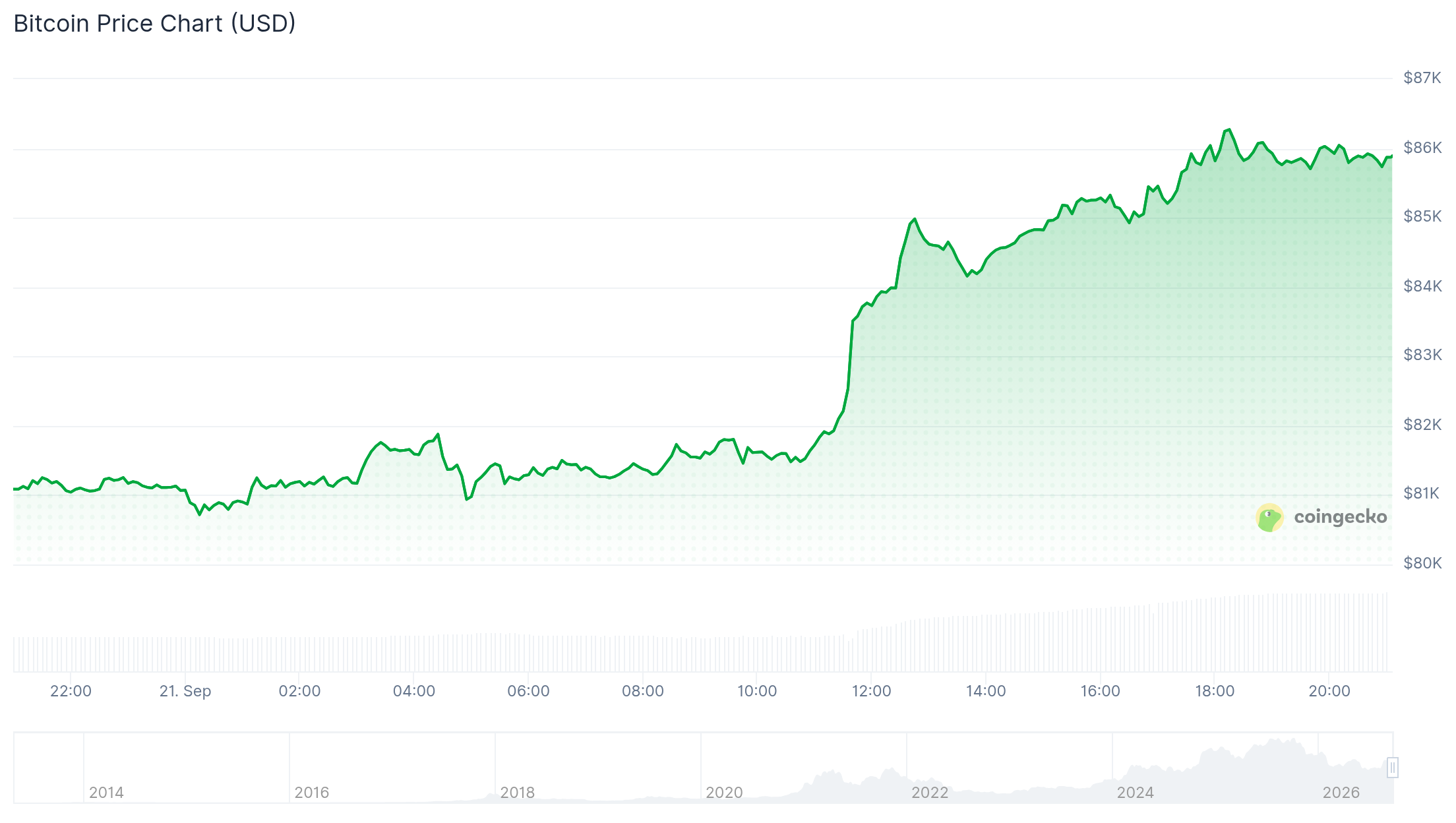
Bitcoin Price Shows Smaller Holders Sold Before the Recovery
The wallet decline points to capitulation among smaller holders, not fresh retail accumulation. Wallet counts do not prove that every address sold its coins. Some holders may have consolidated balances, transferred funds, or closed inactive addresses. Still, the timing gives the data a clear market signal.
Santiment linked the wallet changes to the July-August shakeout. The 0.1 to 1 BTC group lost 62,335 wallets. The 1 to 10 BTC group lost another 7,159 wallets. Together, the changes show that smaller retail holders and individual holders reduced their on-chain presence before Bitcoin moved higher.
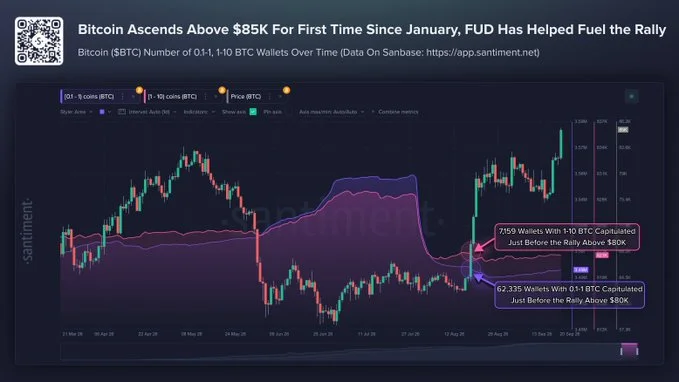
That sequence can affect supply during a rebound. Fearful holders who sell into weakness no longer control those coins. Buyers, custodians, exchanges, or larger wallets may hold the transferred supply. The shift does not guarantee a sustained rally, but it can reduce selling from those groups.
Bitcoin price then reclaimed $80,000 before breaking above $85,000 for the first time since January. The recovery followed reduced exposure among smaller holders. That timing separated wallet capitulation from later momentum, rather than showing that retail buying caused the breakout.
Bitcoin Price Faces $88K-$92K Test as Leverage Rebuilds
The Bitcoin price move above $85,000 forced bearish traders to close positions. Exchanges then recorded roughly $648 million in bearish crypto liquidations during the breakout. Short liquidations can accelerate spot gains as exchanges close losing positions and buy assets to settle collateral. The squeeze added fuel for leveraged traders after Bitcoin crossed the psychological level.
Falling oil prices improved risk appetite during the move. That backdrop helped risk assets recover, although it did not remove exposure to volatility. Crypto markets can reverse quickly when derivatives positioning becomes crowded, especially after a sharp liquidation event.
Glassnode reported that long leverage was rebuilding in the options market as Bitcoin touched $86,000. Open interest put-call ratios moved higher, showing greater activity around upside and downside protection. The reading did not match frothy conditions near the previous Bitcoin top.

Perpetual futures funding stayed below neutral, according to the update. Funding has not turned aggressively positive. The reading suggested traders had not rebuilt aggressive long exposure across perpetual contracts. It distinguished the recovery from rallies driven by one-sided leverage.
Bitcoin price now faces the $88,000 to $92,000 zone as the next major hurdle. A sustained move above that range would strengthen the 2026 market structure identified in the technical setup. Failure to clear it would leave the breakout exposed to profit-taking and another test of lower support.
Technical projections linked to the setup identify a possible move above $100,000 later this year if Bitcoin clears the range. That path depends on continued demand, stable derivatives positioning, and adequate fresh liquidity. The current data confirms that smaller holders exited before the recovery and short sellers absorbed the first breakout pressure.
For now, options leverage remains below the extremes seen near the prior top. Bitcoin price can continue higher without speculative excess, provided funding and open interest avoid a rapid surge. Traders are watching whether wallets begin to return as the market approaches the $88,000 to $92,000 band.
The post Bitcoin Price Hits $86K as Options Leverage Begins to Rebuild appeared first on Blockonomi.
TLDR
- Semtech stock fell 4.20% to $177.23 despite its latest 50G technology launch.
- Semtech begins volume shipments of its 50G fronthaul mobile transport portfolio.
- New products support growing uplink capacity needs across 5G-Advanced networks.
- Semtech offers 50G solutions for duplex, bidirectional, and longer-reach links.
- The portfolio supports current 5G-Advanced networks and the transition toward 6G.
Semtech Corporation (SMTC) stock fell 4.20% to $177.23 as the semiconductor company expanded its mobile transport technology. The company launched full production availability of products supporting 50G fronthaul for new 5G-Advanced radio networks. Meanwhile, the technology provides infrastructure that can support the telecommunications industry’s planned transition toward 6G.
Semtech Corporation, SMTC
Semtech Expands 50G Technology for 5G-Advanced
Semtech’s new mobile transport portfolio targets the growing shift toward 50G optical interfaces across advanced mobile networks. The products support fronthaul connections between radio equipment and other network infrastructure. Furthermore, Semtech has started shipping the portfolio in volume to equipment makers and network operators.
The portfolio supports several fronthaul configurations for different distances and network designs. Semtech pairs its GN2255 Clock and Data Recovery product with the GN1700TI Transimpedance Amplifier for 10-kilometer duplex links. Meanwhile, 15-kilometer bidirectional links use the GN2255S CDR alongside the same GN1700TI amplifier.
Semtech also provides its GN2256 CDR for wavelength division multiplexing and longer-distance network configurations. The portfolio uses technology from the company’s ClearEdge, Tri-Edge, and FiberEdge product families. Consequently, operators can select different configurations while maintaining support for 50G mobile transport requirements.
Mobile AI Traffic Drives Higher Uplink Requirements
Growing cloud-based applications are increasing uplink capacity requirements across mobile networks. Industry forecasts cited by Semtech indicate uplink requirements could increase between three and five times. This shift creates greater pressure on fronthaul infrastructure as devices send more data toward cloud computing systems.
The expansion comes as major telecommunications equipment companies prepare radio products supporting faster optical connections. Ericsson introduced AI-ready Massive MIMO and remote radio products during Mobile World Congress 2026. Nokia has also developed Doksuri Remote Radio Heads using its latest ReefShark System on Chip.
These developments strengthen the industry’s move toward 50G optical interfaces for next-generation mobile infrastructure. Higher uplink traffic requires more capacity between radio units and the wider network. Therefore, 50G optics can provide additional bandwidth as operators expand 5G-Advanced services and prepare future network upgrades.
Semtech Positions Portfolio for the 6G Transition
Semtech designed the new portfolio for current 5G-Advanced deployments while supporting network development toward 6G. The company expects its mobile transport technology to scale with changing radio and optical requirements through 2030. It continues working with module manufacturers and equipment vendors to support that transition.
Source Photonics has worked with Semtech’s CDR and TIA technology across different fronthaul architectures. Such partnerships help module manufacturers integrate semiconductor components into optical products for commercial network deployments. Semtech also aligned the portfolio with technical blueprints developed by the Mobile Optical Pluggables Alliance.
However, SMTC stock moved lower despite the company’s latest product announcement and expanded 50G availability. Shares dropped 4.20% to $177.23 after falling sharply below the $185 level during intraday trading. The decline contrasted with Semtech’s push to capture demand from 5G-Advanced and future 6G infrastructure deployments
The post Semtech Corporation (SMTC) Stock: New 50G Technology Supports 6G Transition appeared first on Blockonomi.
TLDR
- Novo stock drops 7.65% as pipeline setbacks deepen long-term growth concerns.
- Wegovy still supports sales, but semaglutide patent expiries approach next decade.
- LSEG projects Zepbound sales will exceed Wegovy by more than $7 billion in 2026.
- Novo may pursue more acquisitions and licensing deals to strengthen its pipeline.
- Zenagamtide gains attention as CagriSema setbacks weaken Novo’s succession plan.
Novo Nordisk shares fell 7.65% to 260.00 as pressure grew around growth targets, competition, and future medicine development plans. Management now faces demands for a clearer strategy beyond semaglutide as major patent expirations approach early next decade. The company still leads obesity markets, but pipeline setbacks have weakened confidence in its longer-term growth path and earnings outlook.
Novo Nordisk A/S, NVO
Novo Faces Pressure to Expand Beyond Semaglutide
Novo built much of its recent success around Wegovy and Ozempic, which both use the active ingredient semaglutide. Wegovy’s 2021 launch helped lift Novo into Europe’s most valuable listed company during 2023, with capitalization exceeding $600 billion. However, the company’s share price has since dropped more than 70% from its peak as competition and development risks increased.
LSEG data projects Lilly’s Zepbound sales will exceed Wegovy sales by more than $7 billion during 2026. That gap highlights growing competitive pressure across the global obesity market and raises questions about Novo’s future market share. Meanwhile, semaglutide patent protection begins expiring in the early 2030s, creating another significant challenge for long-term revenue growth.
Novo now needs additional growth engines outside its established diabetes and obesity businesses to reduce concentration risk over time. Cardiovascular treatments and rare diseases could provide new revenue opportunities if management expands through acquisitions or licensing agreements. Such moves would also give Novo more options as its current flagship products move steadily closer to patent expiry.
Pipeline Setbacks Increase Strategy Pressure
CEO Mike Doustdar has tightened costs and removed weak development programs since taking the top job over one year ago. He has also pursued targeted partnerships and acquisitions as Novo works to rebuild its increasingly thin late-stage development pipeline. However, recent clinical setbacks have increased pressure on management to show stronger progress across several upcoming development programs.
Novo recently stopped trials for experimental heart drug ziltivekimab, adding another setback outside its core obesity and diabetes portfolio. The company also faced disappointment from CagriSema, which had carried expectations as a potential successor to Wegovy. Those results increased concerns about whether internal research can deliver enough products before semaglutide exclusivity weakens next decade.
Management raised its 2026 sales and operating profit guidance in August after previously issuing a significantly weaker outlook. The updated range now points to growth between zero and minus 6% at constant exchange rates versus 2025. Even so, that improvement does not remove questions surrounding medium-term targets, product diversification, and future earnings durability.
Wegovy Pill Supports Near-Term Position
Novo still holds an important near-term advantage through the Wegovy pill, which reached the market before Lilly’s competing oral treatment. The oral medicine broadens access for patients who prefer pills instead of injectable weight-loss treatments across major markets. However, the pill still relies on semaglutide and therefore does not solve the company’s approaching patent challenge.
The company also faces rising competition from drugmakers developing obesity treatments with different mechanisms, formats, and dosing options. AstraZeneca and other rivals are building pipelines that could increase pressure on established medicines later this decade. Therefore, Novo’s future growth will depend on stronger differentiation and a broader pipeline across several therapeutic areas.
Novo may also shift more development attention toward zenagamtide after weaker results reduced enthusiasm around CagriSema among market analysts. A stronger external deal strategy could complement internal development and add late-stage assets before major patent expirations arrive. For now, Novo’s market position remains substantial, but its next growth phase requires clearer targets, broader execution, and revenue sources.
The post Novo Nordisk A/S (NVO) Stock: Wegovy Lead Meets Long-Term Challenges appeared first on Blockonomi.
Financial markets launched the week with strong bullish momentum on Monday, as Bitcoin climbed past the $85,000 threshold, artificial intelligence equities rallied significantly, and declining energy costs provided additional support to investor confidence throughout major exchanges. The trading session featured AMD’s entrance into the exclusive trillion-dollar valuation club and Strategy’s renewed Bitcoin acquisition activity, marking some of the most significant developments across cryptocurrency and stock markets.
Bitcoin Climbs Beyond $85,000 Milestone
The leading cryptocurrency pushed above $85,000 for the first occasion since late January, continuing its impressive recovery from previous week’s lower levels and momentarily approaching $86,000. The digital asset registered gains exceeding 5% across a 24-hour period as enhanced risk appetite combined with substantial short position liquidations fueled the upward movement.
Data from CoinGlass referenced by The Block indicates that leveraged cryptocurrency positions totaling over $750 million were liquidated during this 24-hour window, with approximately $648 million attributed to short sellers wagering on price declines. The price surge additionally propelled Bitcoin above the average acquisition cost of U.S. spot Bitcoin ETF participants for the first instance since January.
AMD Achieves Trillion-Dollar Market Capitalization
The semiconductor manufacturer joined the elite group of companies with $1 trillion market valuations, experiencing a roughly 10% share price increase to establish a new all-time high on Monday. This achievement arrives as investor enthusiasm surrounding artificial intelligence companies has rebounded forcefully after recent market turbulence.
AMD equity has surged approximately 185% throughout 2026, dramatically outpacing the wider Nasdaq index performance. Market participants have progressively concentrated on AMD’s strategic evolution from standalone processor manufacturing toward comprehensive AI computing platforms as the company pursues greater market penetration within the explosively expanding AI infrastructure sector.
Energy Price Decline Provides Market Support
A substantial drop in oil prices contributed another positive factor for equity markets. Domestic crude declined approximately 4.8%, while Brent crude experienced a roughly 3.6% decrease, reflecting indications of expanding Gulf region exports and anticipation that certain interrupted Saudi production capacity might resume operations.
Reduced energy costs additionally alleviated strain on fixed-income markets, enabling Treasury yields to decline. The convergence of decreasing oil prices, reduced yields, and revitalized artificial intelligence sector enthusiasm propelled the Nasdaq significantly higher throughout Monday’s trading period.
Meta Platforms Climbs on Renewed AI Enthusiasm
Meta Platforms emerged as another notable performer, with shares advancing approximately 6.7% as capital flowed back into prominent AI-associated companies. The stock received additional support from optimistic analyst commentary preceding Meta’s forthcoming product reveals.
This upward movement helped communication-services sector stocks lead broader market performance and illustrated how rapidly investor demand for large-cap technology companies has rebounded following the recent market correction.
Accenture Expands AI Safety Collaboration with Anthropic
Accenture shares also advanced following the consulting corporation’s announcement of an extensive partnership with Anthropic centered on assessing the security and dependability of sophisticated AI models.
The organizations intend to allocate approximately $2 billion through this initiative as corporations and regulatory authorities increasingly prioritize ensuring that progressively capable AI systems can be implemented securely and reliably.
Strategy Resumes Bitcoin Accumulation Strategy
Michael Saylor’s Strategy has reactivated its Bitcoin acquisition program following an approximately three-week hiatus, purchasing an additional 950 BTC valued at $75.7 million.
The Bitcoin was obtained at an average cost of roughly $79,670 per unit, elevating Strategy’s aggregate holdings to approximately 846,000 BTC. Strategy shares climbed alongside Bitcoin on Monday as cryptocurrency-related equities benefited from the broader market advance.
Circle Introduces Bitcoin-Collateralized USDC Lending
Circle has unveiled a new platform enabling qualified institutional clients to obtain USDC loans against their Bitcoin holdings without liquidating their BTC positions.
Via Circle Mint, institutions can deposit Bitcoin, create Circle’s wrapped Bitcoin token cirBTC, provide it as collateral, and borrow USDC through compatible onchain lending platforms. Morpho represents the initial supported lending protocol, with Circle indicating that additional platforms including Aave are anticipated to integrate subsequently.
This launch represents another advancement in incorporating Bitcoin into institutional lending and treasury management operations, enabling long-term holders to obtain dollar-denominated liquidity while preserving their underlying BTC holdings.
With Bitcoin trading above $85,000, AI stocks experiencing robust gains, and oil prices declining, Monday delivered one of the most powerful broad-based risk-on trading sessions witnessed in recent weeks. The critical question now centers on whether this momentum can sustain itself throughout the remainder of the week.
The post Market Momentum: Bitcoin (BTC) Soars Past $85K While AI Chip Giants Rally appeared first on Blockonomi.
CryptoPotato
Bitcoin is following a similar trajectory seen in 2022-2023, according to the latest observation by Doctor Profit.
The analyst said that the latest move above the 50-week moving average, in particular, set the stage for the breakout toward the $82,500-$83,000 area, which took place over the past several hours.
2022-2023 Structure Is Repeating
The MA50 Weekly is currently around $78,700. BTC recently pushed past that level and was trading near $85,000 at the time of writing after an explosive rally on Monday. Doctor Profit said a weekly close above the moving average would strengthen his bullish view. His observation stems from Bitcoin’s previous market structure in 2022-2023, when the crypto asset faced several rejections around the MA50 Weekly before eventually clearing it.
Bitcoin broke below the MA50 Weekly and then reclaimed it seven times. Five instances were followed by bull markets, while two became false signals. Those occurred once in 2011, when BTC had “virtually no liquidity,” and once in 2020 during the COVID-19 crash.
The current market is showing a similar pattern. The analyst explained,
“The recent bear trap adds another similarity to 2022-2023! Same rejections, for 3-4 Weeks followed by a shakeout, then a recovery above the moving average and breakout above the MA50 Weekly, exactly of what is happening right now! Bears interpreted weakness as confirmation of another collapse, but the market reversed. I see the same broader transition!”
The latest move puts the focus on the start of the next bull market phase, which analysts have been speculating about lately. Doctor Profit has identified $88,000 as the next target once the remaining resistance levels are cleared.
Even Bolder Target
Another market commentator believes that Bitcoin could be repeating a historical cycle. Crypto Patel flagged a 364-day gap between the crypto asset’s 2017 peak and 2018 bottom, followed by a similar 364-day gap between the 2021 peak and 2022 bottom. The analyst said the 2025-peak-to-2026-bottom also appears to follow the same timing.
Bitcoin is now retesting long-term trendline support after losing the major EC zone. If the historical pattern continues, Crypto Patel said the next major expansion could target $370,000. He stressed that price action must confirm the setup.
The post From Bear Trap to $88K: Analyst Reveals Why Bitcoin’s Rally Isn’t Over appeared first on CryptoPotato.
BitMine Immersion Technologies (BMNR) bought 27,562 Ethereum (ETH) over the week to September 20 and reported combined crypto, cash, and moonshot holdings of $17.1 billion in a press release and 8-K filed September 21.
Total holdings rose $1.3 billion from the $15.8 billion BitMine reported a week earlier, when it added 27,180 ETH. The company marked its Ether at $2,688 per token, per Coinbase, up from $2,513 a week earlier. That mark puts the week’s purchases at roughly $74 million, with the treasury at 5,983,940 ETH.
Staked Total Flat Since Late August
BitMine Chairman Thomas “Tom” Lee stated the company “has bought ETH each and every week since the inception of its ETH Treasury Strategy on June 30, 2025,” a track record he called “unmatched by any public company in the world.” The pace has swung this year; one July purchase fell to 7,430 ETH, down from more than 30,500, a slowdown Lee tied to share buybacks.
Holdings equal 4.9% of the 122.1 million ETH in supply, and BitMine puts itself 98% of the way to its target of owning 5% of all ETH, the plan it calls the Alchemy of 5%, 15 months after the strategy began.
BitMine stakes 5,067,309 ETH, worth $13.6 billion at its mark and 85% of the treasury, through MAVAN, its Made in America Validator Network. The staked count has held there for five consecutive weekly updates, even as the token total kept climbing.
Lee put projected annualized staking revenue at $357 million, up from $334 million a week earlier, rising to $421 million once the ether is fully staked, on a 2.62% seven-day yield.
Lee Sees Stronger Fourth Quarter
“We believe a crypto bull market is underway, having started in late June,” Lee said, citing “the rotation from AI back to crypto.”
He put Ether’s quarter-to-date lead over the S&P 500 at 6,519 basis points, called the run “a prelude to a potentially stronger up move in the 4th quarter of 2026,” and said the company expects institutions “to substantially increase their exposure in the final 3 months of 2026.”
Cash and marketable securities rose to $714 million from $549 million a week earlier. The release gave no reason for the increase. Alongside the ether, BitMine held 212 Bitcoin (BTC), a $180 million stake in Beast Industries and a $105 million position in Eightco Holdings (ORBS), up from $98 million.
BMNR traded $1.2 billion in average daily dollar volume over the five days to September 18, ranking 100th of 5,704 US-listed stocks, according to Fundstrat, Lee’s research firm. The release ranks BitMine first among ether treasuries and second among crypto treasuries overall, behind Strategy (MSTR), which the release said owns 845,080 Bitcoin worth about $75 billion.
The post BitMine Buys 27,562 ETH in a Week as Holdings Reach $17.1 Billion appeared first on CryptoPotato.
The cryptocurrency market has been on fire over the last few days despite negative news such as the CLARITY Act failure, rising interest rates in the United States, and escalating global geopolitical tensions.
The past 24 hours have delivered even more gains, with Bitcoin (BTC) climbing past $85,000 for the first time since January, while Ethereum (ETH) hit a nine-month high of roughly $2,750. Many analysts believe the second-largest cryptocurrency is poised for a further rally in the near future, but some describe the current setup as a classic bull trap.
Don’t Pop the Champagne Yet?
At first glance, it seems like ETH’s cycle bottom is behind us and might be gearing up for a shift toward a bull run. X user DANNY, though, doesn’t support that thesis, claiming that the asset is setting up “a huge trap.”
The analyst argued that if ETH pumps to $2,670 (as it happened), sentiment will flip fast, and then people will start projecting further pumps to $4,000 and $5,000. For the X user, that level is the area where the market can trap late buyers before the real flush starts.
DANNY envisioned a slip toward $1,800, which could trigger the first real panic, followed by $1,500 and capitulation that may occur in the final months of the year. The analyst then sees an incoming reversal and a jump above $3,250 in the second or third quarter of 2027.
X user Midas also shared a pessimistic bet, maintaining that ETH has formed “a huge bearish setup.” The analyst doesn’t expect the upward move to last in the short term and forecasts a retest of the $1,700-$1,800 range.
“And if that liquidity gets swept, ETH can extend lower toward $1.4K-$1.5K. But I still don’t expect ETH to make the same kind of new cycle lows as BTC. ETH has been showing much stronger relative structure, and I still think it will outperform once this correction is finished. There is just one major downside target left to clear before the real expansion starts. So, short-term, I’m bearish on ETH. Long term this setup can become one of the strongest opportunities of the cycle ” they added.
Ted also predicted a potential correction ahead, but expects it to come once Ethereum’s price taps the $2,900-$3,000 area.
These Factors Favor the Bulls
The combination of multiple positive elements suggests ETH’s price may keep surging in the short term. As CryptoPotato recently reported, whale transactions have been climbing, showing that large holders have become increasingly active.
Ethereum’s non-empty wallets have risen to 207.17 million, with staking remaining a major reason why ETH stays parked in the long run. Just hours ago, Lookonchain revealed that a mysterious whale has sold 1,107 BTC (worth over $86 million) over the past five days, bought 34,422 ETH, and staked it all.
The solid institutional interest is another bullish factor. Although they finally registered a red week, spot ETH ETFs have attracted a lot of capital over the past few months, which could support a more substantial price rally ahead.
Not long ago, renowned analyst Ali Martinez highlighted the $2,570 level, saying a decisive breakout could open the door to a jump toward $2,700 and even $3,000. For more ETH price forecasts, check out our article here.
The post Ethereum Crosses $2,700: Bull Trap or the Start of a Major Rally? appeared first on CryptoPotato.
[PRESS RELEASE – Tallinn, Estonia, September 21st, 2026]
NOWPayments today published new empirical data analyzing six months of enterprise payout activity, offering a comparative performance benchmark across TRON, BNB Smart Chain, Solana, Bitcoin, and Ethereum to help businesses select optimal blockchain rails based on speed, transaction volume, and cost efficiency.
The dataset reveals distinct operational advantages depending on transfer priorities: Solana recorded the fastest average payout speed at 1 minute and 45 seconds while accounting for 3.08% of volume and 3.86% of transactions. TRON led in total monetary volume at 43.69%, and BNB Smart Chain handled the largest share of individual payout transactions at 48.23%.
High-Frequency Payouts Put BNB Smart Chain in the Lead
Together, TRON, BNB Smart Chain, Ethereum, Bitcoin, and Solana accounted for 94.04% of payout volume and 77.84% of payout transactions during the period analyzed.
BNB Smart Chain accounted for 48.23% of transactions, compared with 15.73% for TRON. Its share of payout volume was lower at 21.75%.
The network handled far more individual transfers without carrying the largest share of value, a pattern consistent with higher-frequency, lower-value payouts in the NOWPayments dataset.
Higher-Value Payouts Put TRON in the Lead
TRON moved 43.69% of payout volume, more than twice BNB Smart Chain’s 21.75% share, despite accounting for a much smaller share of transactions.
Based on those shares, the average TRON payout was approximately 6.2 times larger than the average BNB Smart Chain payout during the period. The networks served different payout patterns: TRON carried more value, while BNB Smart Chain handled far more individual transfers.
Ethereum ranked third by volume at 18.84% and represented 7.42% of transactions. Bitcoin accounted for 6.68% of volume and 2.60% of transactions, while Solana represented 3.08% of volume and 3.86% of transactions.

The data suggests a practical framework for matching the network to the payout flow:
 The data offers a starting point, not a universal network recommendation.
When Speed Matters, Solana Leads
Solana led on speed with an average payout time of 1:45. Bitcoin followed at 2:53, ahead of TRON at 3:08 and BNB Smart Chain at 3:13. Ethereum recorded the longest average at 5:56.
The gap between the fastest and slowest networks was 4 minutes and 11 seconds. Every network in the comparison still averaged less than six minutes, while TRON and BNB Smart Chain were separated by only five seconds.
The fastest network was not the most widely used. That points to a broader principle: crypto infrastructure should be evaluated across the full movement of funds, not by a single headline metric.
Kate Lifshits, Commercial Director at NOWPayments, applies the same data-first approach in Crypto That Works for Business, her Cryptopolitan series on the commercial impact of crypto payments. The first column, the 22% Sales Boost Hiding in Your Crypto Checkout, examined checkout performance; future editions will cover other points where payment infrastructure affects revenue, costs, and growth.
“The useful question is not which network tops a leaderboard. It is what a specific payout flow needs to optimize: value, frequency, speed, or cost,” said Kate Lifshits, Commercial Director at NOWPayments.
When Cost Matters, The Best Route May Not Be a Blockchain Network
When minimizing payout costs is the priority, comparing blockchain networks may be the wrong place to start.
NOWPayments allows businesses to send payouts to ChangeNOW Pro wallets with no network or service fees within the ecosystem. Creator Andy Tries Coding publicly tested the route and reported receiving a fee-free payout in under five seconds.
Recipients are identified by email and confirm the transfer before funds move, so businesses do not need to collect wallet addresses at the beginning of the payout process. An interactive guide walks through the process from payout creation to recipient access.
The takeaway is simple: define the payout flow first, then select the network or route. Value, frequency, speed, and cost will not point every business to the same answer.
About NOWPayments
NOWPayments is a crypto business ecosystem designed to help companies accept payments, automate mass payouts, manage stablecoin treasury, and scale global digital asset operations through a single infrastructure. The platform supports more than 350 cryptocurrencies, over 30 stablecoins, flexible settlement options, and enterprise-grade APIs.
The post NOWPayments Releases Cross-Chain Payout Data Revealing Key Performance Benchmarks Across TRON, BNB Chain, and Solana appeared first on CryptoPotato.
Bitcoin pushed through $85,000 on Monday as the latest leg higher took it to levels last seen in late January. The crypto asset has gained 6% over the past 24 hours.
But data suggests that this recovery has yet to receive strong confirmation from US spot demand.
Recovery Has a Missing Piece
According to the latest data shared by CryptoQuant, the Coinbase Premium Index has turned negative again. The index measures the price difference between Bitcoin on Coinbase’s USD market and Binance’s USDT market. A positive reading usually means stronger buying activity from US investors. A negative reading, on the other hand, suggests weaker demand or relatively stronger selling pressure on Coinbase.
It’s worth noting that the data came earlier today when BTC stood at around $81,500, and the index was at -0.02. The premium had briefly moved above zero but has now slipped back into negative territory. This means the recent Bitcoin recovery is not being matched by consistently stronger demand on Coinbase.
In previous cases, steady positive Coinbase premiums have often appeared during periods when US spot demand was supporting BTC’s price gains. CryptoQuant stated that traders should watch whether the premium can move back above zero, remain positive, and rise alongside Bitcoin’s price. Such a move would provide stronger evidence that US-based spot buyers are taking part in the recovery.
However, the current negative reading does not necessarily signal a bearish reversal. The index is only slightly below zero and is not showing an extreme reading.
Experts are increasingly debating whether crypto winter has finally ended. Bitwise CIO Matt Hougan, meanwhile, believes the market has entered “crypto spring.” Speaking to CNBC, the exec said the downturn after BTC’s all-time high above $126,000 in October 2025 is now over. He expects the current cycle to develop into the “strongest and longest-running” bull market in the industry’s history.
Strategy’s Comeback
Adding to the bullish backdrop, Strategy resumed its Bitcoin purchases after a three-week pause. The company bought 950 BTC for $75.7 million at an average price of $79,670, co-founder Michael Saylor announced.
The latest purchase takes its total Bitcoin holdings to 846,000 BTC, acquired for $63.8 billion. At current prices, the stash is worth about $72 billion.
The post Bitcoin (BTC) Just Reached $86K: There’s Just One Problem appeared first on CryptoPotato.