Cryptocurrency Posts
Crypto Briefing
Pro-Bitcoin remarks by the FBI director may bolster market confidence, reducing the likelihood of significant Bitcoin price drops.
The post FBI director’s pro-Bitcoin remarks at Bitcoin 2026 signal supportive policy appeared first on Crypto Briefing.
The escalation into eastern Lebanon undermines ceasefire prospects, complicating peace efforts and potentially prolonging regional instability.
The post Israeli airstrikes hit eastern Lebanon, complicating ceasefire with Hezbollah appeared first on Crypto Briefing.
The F-35B launch underscores U.S. military readiness but highlights skepticism about imminent strategic shifts in the Strait of Hormuz.
The post US Marine Corps F-35B launches from USS Tripoli amid Iran tensions appeared first on Crypto Briefing.
The significant asset bridging to Solana highlights its cross-chain appeal, yet market skepticism persists without stronger catalysts for price surges.
The post $70M in assets bridged to Solana in past week amid low prediction market odds appeared first on Crypto Briefing.
Geopolitical tensions highlight Bitcoin's vulnerability to external shocks, potentially increasing market volatility and influencing investor sentiment.
The post Bitcoin dips below $77K amid US-Iran tensions, market cap down 1.8% appeared first on Crypto Briefing.
Bitcoin Magazine
Bitcoin Magazine

Senator Lummis Puts Congress On The Clock, Vows May Push To Rescue Stalled Clarity Act
Speaking at The Bitcoin Conference U.S. Senator Cynthia Lummis opened her keynote by recalling her first encounter with Bitcoin, describing it as an unfamiliar concept of owning an asset that exists on a blockchain, before purchasing three tokens at roughly $300 each.
Lummis told the audience that Bitcoin first struck her as “free money” because it removes the need to trust a third party to hold or move value.
She linked that realization back to her early purchases of three bitcoin at about $300 each, when the idea of owning an asset that lives on a blockchain still felt strange.
Lummis referenced periods of war, noting that bitcoin often serves as a refuge from poor monetary policy and disrupted financial systems.
Lummis said there are women who have been able to leave dysfunctional marriages and walk away with Bitcoin as an asset that is uniquely theirs, underscoring the role of self-custodied money in personal freedom.
“Bitcoin comes with a culture that could’ve written the U.S. Declaration of Independence that we celebrate today. This is freedom money. That all people are created equal, and that this asset guarantees it,” Lummis said.
Lummis closed by promising imminent action in Washington, saying the Senate “will mark up the Clarity Act in May” and that lawmakers are going to pass digital asset legislation.
Lummis has been very vocal about the struggles around passing crypto legislation popularly known as the Clarity Act.
What’s happening with the Clarity Act?
The Clarity Act has inched forward but remains stuck in Washington’s procedural grind, with its fate tied to a narrow legislative window in 2026.
The bill, a comprehensive market structure framework for digital assets, cleared the House more than eight months ago and has waited in the Senate Banking Committee as senators haggle over issues such as stablecoin yields and agency jurisdiction.
A January markup was pulled at the last minute, signaling early resistance and forcing drafters to rework language before bringing it back. Since then, industry groups have pressed Senate leaders to move, warning that each delay adds regulatory uncertainty and pushes activity offshore.
In April, committee dynamics shifted again when Senator Thom Tillis urged Chair Tim Scott to delay a markup into May to allow more time to sell the compromise to traditional banking stakeholders.
Reporting from policy shops and crypto lobbyists now points to the second week of May as the first realistic slot for a Banking Committee vote, following the current Senate recess.
If the markup slips past mid‑May, the odds of enactment this year drop sharply because floor time tightens ahead of summer recess and the 2026 midterm cycle.
If the bill does advance, the path would likely run through a committee markup in early or mid‑May, a full Senate vote in May or June, and potential reconciliation before a signing window that market observers place around June.
Supporters frame the Clarity Act as the companion to the GENIUS Act, handing the CFTC primary jurisdiction over most non‑stablecoin digital assets while narrowing the SEC’s reach to tokenized securities.
This post Senator Lummis Puts Congress On The Clock, Vows May Push To Rescue Stalled Clarity Act first appeared on Bitcoin Magazine and is written by Micah Zimmerman.
Bitcoin Magazine
Bitcoin Lightning is Turning iGaming Payouts Into a Real-Time Rail: Report
Bitcoin’s Lightning Network is starting to turn iGaming payouts into a native Bitcoin use case, as operators look to escape card fees, chargebacks, and slow settlement that no longer fit a real-time betting market.
A new benchmark report from Voltage frames Lightning as the next major phase of Bitcoin’s evolution, shifting it from a passive store of value to the backbone of instant, global gambling withdrawals.
The study opens with a 30-day pilot at a single iGaming operator that routed a slice of its customer base through the Bitcoin Lightning Network. In that window, the platform pushed 88.2 bitcoin through Lightning, processed 237,000 payments, and recorded a 99.94% success rate with an average end-to-end settlement time of 1.86 seconds.
Voltage says 80% of deposits and withdrawals in the pilot flowed through Cash App users, a sign of how much latent Lightning capacity now sits inside mainstream Bitcoin wallets. The company argues that this is exactly where Bitcoin’s second layer begins to matter for gambling: a familiar wallet, a BTC balance, and withdrawal times that drop from days to seconds.
Bitcoin on-chain vs. Bitcoin on Lightning
The report draws a sharp line between Bitcoin on-chain and Bitcoin on Lightning. On-chain Bitcoin still offers irreversible, global payments, but confirmation times stretch from minutes to hours and fees spike when block space fills, which undermines the economics of frequent, smaller withdrawals.
Lightning was built to solve that constraint by moving Bitcoin payments into peer-to-peer channels that track balances off-chain and settle the final state back to the base layer when needed.
In practice, that design lets operators send bitcoin-denominated iGaming payouts in milliseconds with fees under a penny, roughly 0.0029% of transaction value, which the report says makes Lightning around 1,000 times cheaper than card processors on a percentage basis.
What makes this notable for Bitcoin is the way Lightning preserves the properties that supporters treat as non-negotiable. Lightning has no new token or validator set and inherits security from Bitcoin’s proof-of-work chain when payment channels close and settle.
Voltage stressed in the report that this avoids a core tradeoff seen on alternative payout rails: operators do not need to trust a separate governance structure, bridge, or foundation to move player funds. For iGaming, that translates into censorship resistance at the payments layer, where a Lightning node can route around intermediaries in a way that card networks or some newer chains cannot.
The business logic is simple: Bitcoin on Lightning changes how money moves through a gambling platform’s books. Traditional payouts can skim about 2.9–5% per transaction and still leave operators exposed to chargebacks weeks after funds leave the account, which forces them to lock capital in reserve balances and float.
Lightning payouts are final and irreversible, which removes the chargeback category outright and lets operators reduce or eliminate those reserves. Deposits become Bitcoin transfers that settle into the operator’s Lightning node with no clearing period, while withdrawals push BTC back to the player in seconds with no clawback risk. The report says this shortens the cash cycle, increases capital velocity, and frees more bitcoin to support live activity instead of sitting in transit or in processor accounts.
Payout speed is crucial for iGaming
Voltage leans on player behavior data to argue that Bitcoin’s role here is not just a cost story. Surveys cited in the report show that 72% of players place payout speed in their top three loyalty drivers, and 71% have left a platform because withdrawals took too long.
When iGaming payouts rely on Bitcoin Lightning, a winning spin or bet can update a player’s wallet balance in seconds, which the authors say reinforces a direct link in the player’s mind between gameplay and getting paid. That loop, they argue, ties Bitcoin more tightly to user trust than speculative price action or passive holdings do.
The report puts competing chains as partial answers to the payout problem. Ethereum’s mainnet can move ERC-20 tokens like USDT with richer smart-contract logic, but its 15 second blocks and shared global state leave it vulnerable to congestion and fee spikes that can push a single transfer into the 10–30 dollar range. Tron and Solana cut fees and raise throughput, but Voltage highlights their smaller validator sets, hardware demands, and past outages as risks that undercut long-term payment reliability for regulated gambling brands.
By contrast, Lightning taps into Bitcoin’s existing network effect, with public Lightning capacity now in the thousands of BTC and mobile Lightning wallets counted in the millions, according to the report.
The authors also point to the arrival of stablecoins on Bitcoin’s Lightning rails as a sign of where the technology stack is heading. Using Taproot Assets, issuers like Tether can move USDT over Lightning, which joins the speed and fee profile of Bitcoin’s second layer with dollar-linked balances.
For iGaming, that mix promises instant payouts over Bitcoin infrastructure without exposing recreational players to spot BTC volatility if they prefer a fiat peg. The report notes that Tether’s decision to support Lightning signals expectations of high-volume, low-cost transactions riding on Bitcoin rather than on newer chains.
Voltage frames all of this as the natural evolution of Bitcoin in a sector that has hunted for better payments for years. In its view, Lightning takes Bitcoin from a slow, expensive base layer to a live settlement engine that can clear millions of small, final transactions per second for users who already hold BTC in popular apps.
For iGaming operators, that means Bitcoin is no longer just another deposit option; it becomes the core payout rail that can cut fees, kill chargebacks, clear regulatory audits with deterministic records, and ship winnings to a player in Brazil or New Jersey on the same infrastructure.
Editorial Disclaimer: We leverage AI as part of our editorial workflow, including to support research, image generation, and quality assurance processes. All content is directed, reviewed, and approved by our editorial team, who are accountable for accuracy and integrity. AI-generated images use only tools trained on properly license material. In Bitcoin, as in media: Don’t trust. Verify.
This post Bitcoin Lightning is Turning iGaming Payouts Into a Real-Time Rail: Report first appeared on Bitcoin Magazine and is written by Micah Zimmerman.
Bitcoin Magazine

$1.3M-Funded OpenAgents Pays Gamers and Everyday PCs in Bitcoin via Pylon Distributed AI Network
OpenAgents, an open-source artificial intelligence lab building Bitcoin-native infrastructure for machine learning, today announced its graduation from the BitcoinFi accelerator and the close of $1.3 million in pre-seed funding.
The company is using the capital to expand Pylon, its distributed compute node that lets people sell spare compute for Bitcoin, and to accelerate work on Psionic, its Rust-based machine learning framework for inference, fine-tuning, embeddings, image generation, and distributed training.
“America needs an open-source AI lab that can compete at the frontier without recreating the closed, centralized incentives of the biggest labs,” said Christopher David, founder and CEO of OpenAgents. “OpenAgents exists to build that lab in public. We are paying people directly for the compute, software, and data that make the system better.”
Building a Bitcoin-Native Compute Market
Pylon is OpenAgents’ compute miner. It runs on a contributor’s machine, connects to OpenAgents’ Nexus coordination layer, and makes selected local compute available to the network. Contributors are paid in Bitcoin through the hosted Nexus treasury for eligible work and launch-period payouts. This technology unlocks a path to earn bitcoin, not seen since the early days of Bitcoin mining, where come computers and GPUs were competitive enough in the hashrate race, and may introduce a whole new generation of gamers and AI fans to the cryptocurrency.
The launch builds on open protocols already familiar to the Bitcoin and Nostr communities. Pylon acts as a Nostr client and NIP-90-style service provider, while Nexus coordinates provider presence, work assignment, telemetry, payout accounting, and public stats. The company operates a hosted Nexus today, but the code is open source and designed so other operators can run their own Nexus networks over time.
OpenAgents describes the near-term market as the OpenAgents Compute Market. The first live product families are inference and embeddings, with training work now being introduced through a more explicit assignment, validation, checkpoint, and payout flow.
From Online Nodes to Real Work
During the public beta, the Pylon network quickly moved from early liveness checks toward real assigned work. OpenAgents has reported rapid growth in online Pylon activity, “more than one million satoshis paid through the hosted Nexus treasury, and more than one thousand Pylon instances appearing during the first wave of public participation” according to a press release shared with Bitcoin Magazine.
OpenAgents is preparing distributed training runs that will publish participation data, including online contributors, assigned contributors, accepted contributors, and model-progress contributors. The goal is to scale beyond prior decentralized-training demonstrations while keeping the public claims tied to verifiable assignment and acceptance records.
Training on Consumer Hardware
OpenAgents is focused on stranded consumer compute: Macs, gaming PCs, older machines, and other devices whose spare capacity is usually priced at zero. The company believes this pool represents a large untapped infrastructure layer for open AI. The training stack uses Psionic, OpenAgents’ Rust ML framework.
A Product Suite Above the Network
The compute network is part of a broader OpenAgents product stack and road map:
- Pylon: the compute miner that lets users sell eligible local compute for Bitcoin.
- Nexus: the coordination, treasury, stats, and work-assignment layer for Pylons.
- Psionic: the Rust machine learning framework that runs inference and training work.
- Probe: an open-source coding agent intended as a practical alternative to closed coding-agent tools.
- Autopilot: the planned desktop superapp for personal agents, compute earning, and user-facing OpenAgents workflows.
- Forge: the internal software-factory control plane for managing agent work, verification, and delivery.
OpenAgents plans to build user and business products on top of this compute network. The long-term intent is to create open alternatives to major closed sourced AI products, while routing revenue back to compute providers, developers, data contributors, and other participants who improve the system, paid in Bitcoin.
“The simple version is: pay the people,” David said. “If AI creates value from user compute, open-source software, useful data, and agent work, then the people providing those inputs should share in the upside. Bitcoin gives us the cleanest settlement layer for that.”
Open Development and Contributor Bounties
OpenAgents has developed in public through more than 200 technical updates and open-source work across its product and infrastructure stack. The company is now reopening Bitcoin-paid developer bounties for contributors who can help improve Psionic performance, expand model support, harden Pylon, build product workflows, benchmark against leading open-source systems, and improve developer experience.
The company is also hiring machine learning engineers to work full time on Psionic and the distributed training stack.
Contributors are encouraged to join through the OpenAgents Discord, review the open repositories, and coordinate before submitting larger pull requests. The company expects to keep an updated bounty list at:
This post $1.3M-Funded OpenAgents Pays Gamers and Everyday PCs in Bitcoin via Pylon Distributed AI Network first appeared on Bitcoin Magazine and is written by Juan Galt.
Bitcoin Magazine

Bitcoin Magazine Announces BM TV, a Daily Market Broadcast Set for Summer 2026 Launch
Bitcoin Magazine announced BM TV, a daily live broadcast network focused on Bitcoin markets, macroeconomics, geopolitics, and frontier technology. The network is scheduled to begin broadcasts in Summer 2026 from Nashville, Tennessee. The program will air Monday through Friday from 9:30 to 11:30 AM Eastern Time, aligned with the U.S. market open.
BM TV will operate from the company’s Nashville offices and distribute content through six platforms: X, YouTube, Facebook, Rumble, BitcoinMagazine.com, and LinkedIn. The network targets an existing audience of 6 million aggregated followers across Bitcoin Magazine channels. The company reported more than 1 billion total impressions in 2025.
BTC Inc, the parent company of Bitcoin Magazine, positioned BM TV as an extension of its pre-existing media operations. BTC Inc operates Bitcoin Magazine, the Bitcoin Conference, and Bitcoin for Corporations. The company operates under Nakamoto Inc. (NASDAQ: NAKA) as a subsidiary structure following its integration into the broader corporate group.
Brandon Green, CEO of BTC Inc. said Bitcoin has become central to global finance, resulting in a need for expanded media coverage.
“Bitcoin has moved from the periphery of global finance to its center, and the media infrastructure around it must evolve accordingly,” Green said. “BM TV represents a fundamental expansion of what Bitcoin Magazine is — from the world’s most trusted publication in this space to a full-spectrum media company capable of meeting this moment at scale.”
BM TV: A daily broadcast layer for bitcoin markets
BM TV will feature two-hour daily episodes built around anchor-led coverage and analyst discussion. Each program will include live data displays such as price charts, ETF flow data, prediction market indicators, and market tickers. The format will also include remote interviews with guests from finance, energy, technology, and public policy sectors.
The network will focus on four coverage areas: Bitcoin and global markets, macroeconomic policy, geopolitics, and frontier technology sectors including energy systems and artificial intelligence infrastructure.
BM TV will build on its experience producing live events and broadcasts, including Bitcoin Conference coverage, halving events, and election-related programming.
Spencer Nichols, executive producer and director of BM TV, pointed to an audience shift in Bitcoin markets, one from retail participation to institutional allocation. He pointed to Bitcoin ETFs and corporate balance sheet adoption as factors expanding demand for broadcast analysis.
“We look forward to providing nuanced coverage of Bitcoin in the context of global events, in addition to preserving the ethos and legacy of Bitcoin’s cypherpunk roots that Bitcoin Magazine has supported since its creation in 2012,” Nichols said.
The company intends to produce more than 200 episodes per year. Each episode will generate derivative content for short-form video, newsletters, and editorial articles on BitcoinMagazine.com.
Mark Mason, head of media at Bitcoin Magazine, said BM TV targets allocators, builders, and policymakers engaged with Bitcoin markets.
“We have the audience, the credibility, and the distribution. This is the broadcast the market has been waiting for,” Mason said. Mason described Bitcoin as a core reference point for global capital markets rather than a niche asset class.
Distribution across multiple platforms forms a central component of the strategy. BM TV will broadcast each episode across six simultaneous channels to expand reach across financial media audiences and digital platforms. The company stated that its infrastructure supports both live distribution and post-broadcast content repackaging.
Bitcoin Magazine said BM TV responds to structural changes in media consumption, including growth in institutional Bitcoin adoption and increasing use of algorithm-driven content distribution systems.
Launch preparations continue toward Summer 2026, with additional programming details and scheduling updates planned before debut.
This post Bitcoin Magazine Announces BM TV, a Daily Market Broadcast Set for Summer 2026 Launch first appeared on Bitcoin Magazine and is written by Micah Zimmerman.
Bitcoin Magazine

Bitcoin Self-Custody Framed as Civil Liberty at Bitcoin 2026 Conference
To kick off The Bitcoin 2026 Conference, panelists across policy, finance, and technology discussed the growing push to define bitcoin self-custody as a protected civil liberty. Joe Kelly, co-founder and CEO of Unchained, Nick Begich, a U.S. Congressman, and Zach Herbert, CEO of Foundation Devices, spoke on bitcoin self-custody rights.
Congressman Nick Begich, who began acquiring bitcoin in January 2013 and witnessed the Mt. Gox collapse, said private property rights remain fundamental to American principles and must extend into digital assets.
“Private property rights are fundamental to the American Idea. I think it needs to extend into the digital space and we need to make sure that our legal structures are enshrining those rights when it comes to bitcoin and other assets,” Congressman Begich said.
Zach Herbert, CEO of Foundation Devices, described self-custody as a “gateway drug” to broader digital security practices and emphasized its importance for sovereignty, privacy, and core American values.
Kelly added onto the conversation and referenced Mt. Gox and framed self-custody as critical to American national identity, linking it to the preservation of land rights and digital rights.
The government does not have the right to seize your bitcoin
Later on in the conversation, Congressman Begich cited the 1933 government confiscation of privately held gold as a warning for bitcoin holders, arguing that history shows governments under pressure will seize assets and that self-custody protects against centralized confiscation.
He displayed a copy of the Bitcoin Act on stage and read from the text, which states the legislation “affirms and protects the rights of persons to maintain full lawful control over the bitcoin and other digital assets of those individuals.”
Begich said the president can advance bitcoin policy but cannot create law through executive order, and Congress must act now because future administrations may reverse course.
Herbert said the industry must improve the user experience for self-custody tools, creating solutions that are simple to set up but include multiple safety features. Kelly also touched on the future of self-custody and said success in the space depends on maintaining security while preserving access to financial services.
Moving forward and touching on current crypto legislation, Congressman Begich acknowledged that passing legislation remains difficult, citing that 90% of bills fail to become law, but urged the bitcoin community to contact their representatives to advance self-custody protections.
Moderator Grant McCarty of the Bitcoin Policy Institute said American rights are not guaranteed and require active defense.
This post Bitcoin Self-Custody Framed as Civil Liberty at Bitcoin 2026 Conference first appeared on Bitcoin Magazine and is written by Micah Zimmerman.
CryptoSlate
The European Union’s latest Russia sanctions package, its twentieth so far, brings crypto settlement squarely into an already fractured geopolitical spotlight.
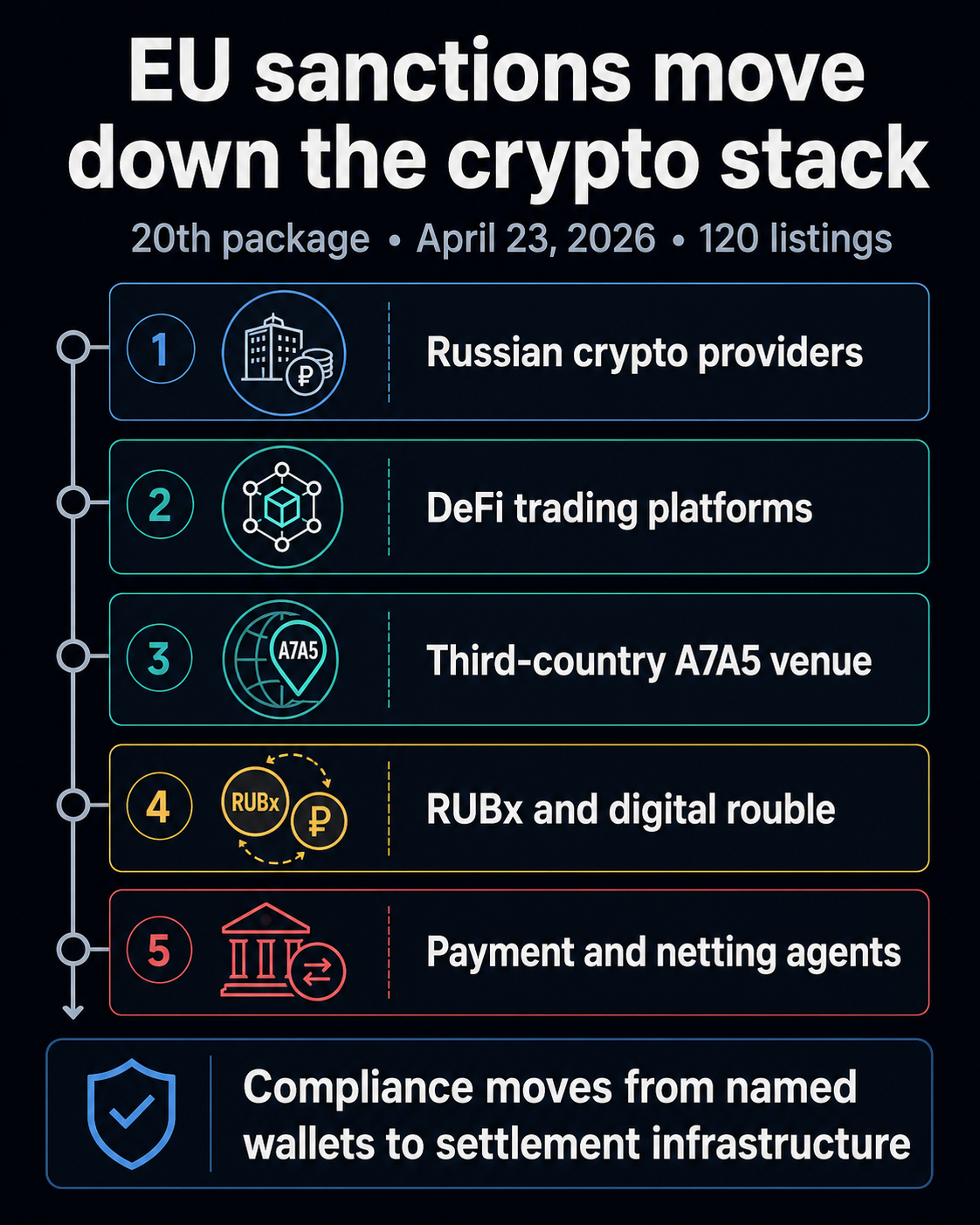
Adopted on April 23, the package adds 120 new listings and rolls out financial measures that touch just about every corner of Russia’s crypto scene. That includes service providers, decentralized trading platforms, ruble-backed tokens, payment agents, and even support for the digital rouble.
Earlier rounds of restrictions mostly went after specific exchanges, wallets, or operators. This time, the EU is aiming higher up the stack, targeting the service layer that keeps Russia-linked crypto settlement running. That means third-country platforms and tools that can keep money moving globally, even if a particular exchange gets shut down.

The EU frames these new rules as a way to close loopholes. According to Council materials, Russia is leaning more and more on crypto for international payments as traditional finance routes get squeezed by sanctions.
The package is the bloc's largest move to sanction Russia in years, with crypto restrictions among its most specific measures.
The real test now is whether Europe can actually measure crypto settlement risk at the infrastructure level. That means platforms have to dig deeper than exchange names and look at where a provider is based, which tokens are in play, which settlement agents are involved, and whether the route relies on a state-backed digital currency.
The Ban Moves Down The Stack
The Commission says this package brings a blanket ban on doing business with any Russian crypto asset service provider. It also covers decentralized platforms if they’re being used to get around sanctions. Now, where a provider is based and how it operates matter just as much as whether it’s been named on a sanctions list.
TRM Labs ties the measure to platform succession risk after Garantex was disrupted. Its analysis of the package points to the Garantex-to-Grinex migration and the role of A7A5 as the bridge between those systems.
Chainalysis reaches a similar conclusion from a compliance angle. Its 20th package analysis describes the measure as a move against categories of evasion infrastructure rather than single named entities.

It’s one thing to screen a wallet address or exchange name. It’s a whole different challenge to spot a service provider set up in Russia, a third-country platform with Russian liquidity, or a settlement route built around a sanctioned token.
The Financial Times had already reported that EU officials were weighing a broad ban on Russian crypto transactions.
Prior CryptoSlate coverage of that proposal shows the continuity: Brussels was already testing a broader enforcement perimeter before the package was adopted.

The new rules reach into five different parts of the crypto settlement process.
| Targeted layer | Role in the route | Compliance implication |
|---|---|---|
| Russian crypto asset service providers | Exchange and transfer access | Counterparty screening has to include establishment and operating nexus |
| Decentralized platforms enabling trading | Alternative access when centralized venues are blocked | Front-end, service, and platform exposure become relevant |
| TengriCoin / Meer.kg | Third-country venue where A7A5 is traded | Russia-linked stablecoin liquidity can create designation exposure outside Russia |
| RUBx and digital rouble support | State-linked token and CBDC settlement rails | Issuers, service providers, and infrastructure firms face instrument-level controls |
| Russian payment and netting agents | Settlement mechanics that can mask gross flows | Monitoring has to examine the route and the final address |
Stablecoins Become Enforcement Infrastructure
A7A5 gives the policy a concrete example. Chainalysis identifies TengriCoin, doing business as Meer.kg, as the Kyrgyz venue where significant amounts of the government-backed stablecoin are traded.
The Council language is broader, pointing to a Kyrgyz entity operating an exchange where significant A7A5 volumes move.
The venue turns A7A5 from background context into a named enforcement path. TRM says A7A5 served as the financial bridge between Garantex and Grinex after Garantex was disrupted, while Chainalysis describes the token as a Russia-linked stablecoin rail for sanctioned businesses seeking access to the global financial system.
A 2025 U.S. sanctions report linked the Garantex, Grinex, and A7A5 network to earlier enforcement pressure. The EU package now codifies that route-level concern in its own sanctions framework.

RUBx gives the package a second stablecoin layer. Russian state-owned conglomerate Rostec planned RUBx as a ruble-pegged token on Tron alongside a payment platform called RT-Pay.
The Commission now says the EU is prohibiting the use of and support for RUBx, as well as support for the digital rouble, a central bank digital currency under development by the Bank of Russia.
The policy signal is direct. The EU is treating a stablecoin, a CBDC project, and the service providers around them as parts of a sanctions-relevant payment architecture.
The role of the instrument carries more weight than the token ticker. If a ruble-backed asset can connect sanctioned businesses to liquidity, its issuer, venue, service provider, and supporting infrastructure all become part of the risk map.
Live market data shows these instruments are active across a huge global market. The focus here is on who can actually settle transactions.
Compliance Moves To The Whole Route
The netting ban shows how far the package reaches into settlement mechanics. The Commission says the package prohibits transactions with agents in Russia and other third countries that offer to facilitate international transactions from Russia to bypass EU sanctions. It also bars netting transactions with Russian agents.
Chainalysis describes this as significant for crypto compliance because netting can obscure the underlying counterparties of Russia-linked flows.
For crypto firms, risk can show up in the service provider behind the scenes, the country where an intermediary is based, the token used to settle, or the payment agent moving the money. Screening now means looking at the whole route, not just searching for familiar names.
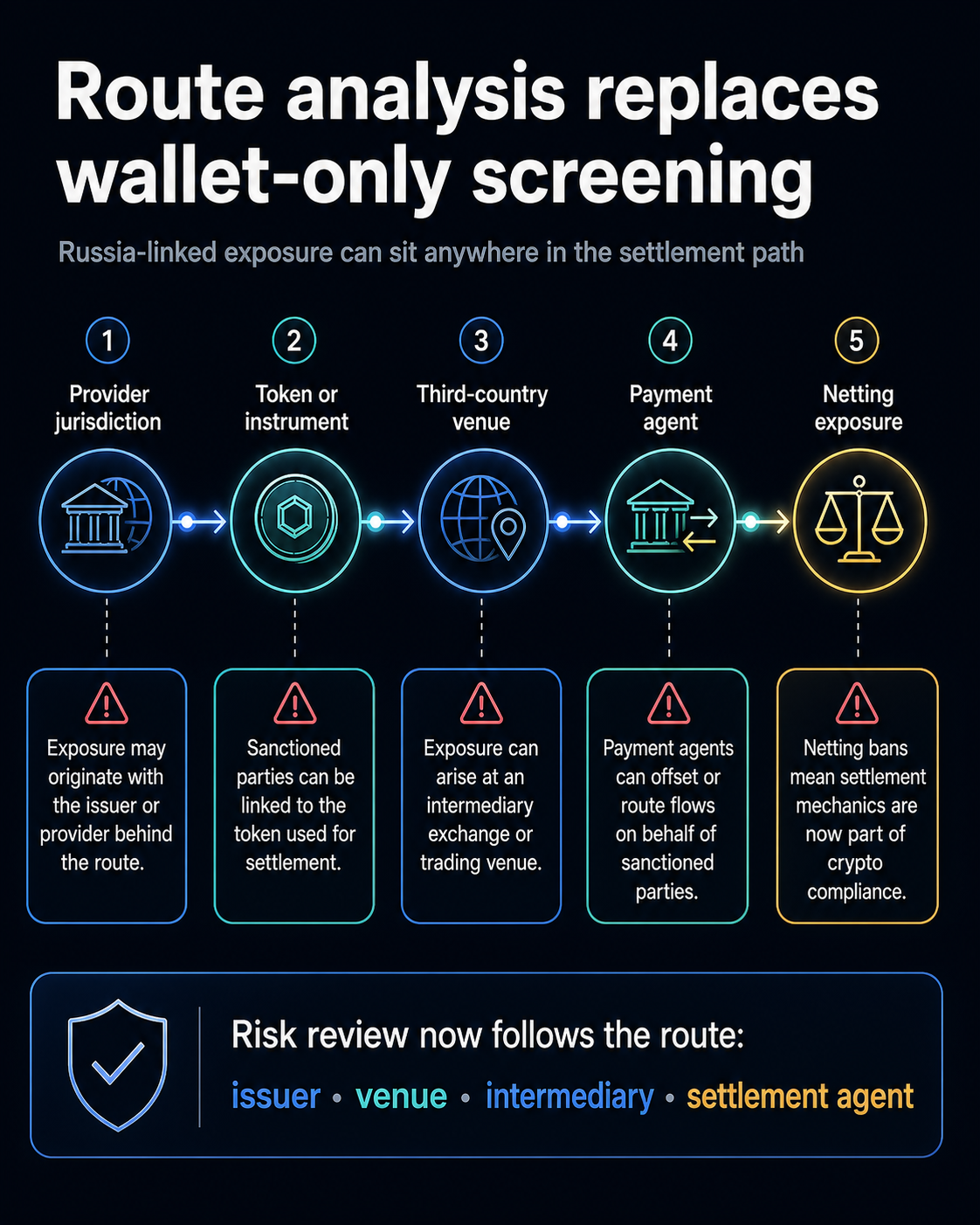
For stablecoin issuers, custodians, exchanges, payment processors, and infrastructure providers, this means stepping up checks on any Russia-linked activity. TRM points out that the package moves the focus from just screening names to figuring out if a counterparty is actually based in Russia, even if it’s a brand-new service that hasn’t been listed yet. individual designation.

Chainalysis flags third-country platforms and intermediaries as sanctions-evasion risks when Russian settlement links are detected.
One likely result is more friction. If issuers, exchanges, and service providers really enforce these rules, settling Russia-linked crypto could get pricier and less dependable. The real squeeze is on the route itself; redemption, platform access, liquidity, custody, and payment-agent relationships all come under pressure.
Another outcome is migration. Successor platforms, nested services, and third-country brokers can push activity into less transparent venues. The EU's answer is to target the architecture that lets those routes keep functioning, pairing crypto restrictions with measures against third-country financial institutions and anti-circumvention channels.
Stablecoins and the digital rouble are now firmly inside the EU’s sanctions playbook, not just sitting on the sidelines. The EU has called out crypto rails as real financial infrastructure and built restrictions around the providers, tokens, platforms, and settlement mechanics that make them work. The big question now is whether enforcement can keep up as these routes keep shifting.
The post EU sanctions Russian crypto usage for 20th time adding bans on digital rubles and anyone using Russian crypto services appeared first on CryptoSlate.
Cardano's governance system is facing two deadlines that belong in the same conversation.
JPG Store, a prominent Cardano NFT marketplace whose product page calls it the #1 Cardano NFT marketplace, began a ‘Restriction Mode' on April 23 and scheduled its ‘Complete Shutdown for May 23′.
The shutdown gives users immediate work to do. The shutdown FAQ tells users to remove listings, cancel offers, and settle or cancel loans before the final date. A separate social-login wallet notice tells users to transfer NFTs, tokens, and ADA to a self-custody Cardano wallet before access through those wallets ends.
At the same time, Cardano voters are weighing Input Output's 2026 treasury slate, where Pogun asks for ₳12.29 million to build a Bitcoin liquidity and credit engine. The process is demanding by design: treasury withdrawals require delegated representative approval from 67% of active voting stake, plus Constitutional Committee approval.
Put together, those deadlines turn Cardano's funding priorities into a live test against the stress points users can see.
The evidence supports an application-level pressure point, while broader chain-health claims would need separate support. JPG Store attributed the decision to operating sustainability, and the closure materials do not establish chain-wide failure.
That distinction is important for the ongoing treasury debate. Cardano can still pursue an ambitious Bitcoin DeFi strategy, but the case for funding it now has to sit beside a visible consumer product telling users to unwind positions and move assets.

A consumer deadline now sits beside the vote
Its ‘Restriction Mode' puts JPG Store into an immediate wind-down process. During that phase, core actions such as listings, offers, sales, and rentals are restricted, while users can still remove active orders and manage certain existing positions before ‘Complete Shutdown' on May 23.
That creates a migration problem for users and a visible comparison point for builders watching where Cardano treasury capital may go next.
Cardano's funding system is debating new infrastructure while one of its most recognizable consumer surfaces is asking people to move assets before it shuts down for good.
JPG Store winding down shows that a product with real visibility in Cardano's NFT market could not continue operating under its current model. Other parts of the ecosystem are still building, voting, and shipping, but the shutdown still adds pressure to the allocation question.
If treasury allocations are contested and voter approval is difficult to secure, the debate becomes a test of whether Bitcoin DeFi is the best near-term answer to the stress points users see.
A marketplace shutdown driven by sustainability pressure and a treasury request for new liquidity infrastructure can both be rational responses to the same ecosystem issues. Together, they set a clearer test: Cardano has to show that new funding can translate into applications, users, and liquidity, with the consumer layer as the proof point.
The closure also changes how the vote will be judged. A consumer deadline gives voters and builders a visible benchmark for any treasury ask.
Funding new infrastructure can still be rational, but the burden is higher when existing user surfaces are asking people to move assets and unwind positions.
The vote tests Cardano's allocation logic
Input Output's 2026 treasury package includes nine proposals. Pogun is the Bitcoin DeFi plank in that set, and its listed work includes a non-margin credit market, a yield application, institutional access, and a BitVM-powered trust-minimized bridge through 2026.
In plain English, the proposal aims to make Bitcoin useful within Cardano's DeFi stack. That is a coherent strategic target because it aims at liquidity alongside application growth.
The harder challenge is whether that target addresses the current weakness visible in Cardano's consumer and DeFi activity.
The live treasury withdrawal process listed Pogun as expiring May 24, with 1.04% DRep support toward the 67% threshold as of 09:30 UTC on April 24.
That can change quickly, but it captures the state of the process at a useful moment: the proposal is live, the threshold is high, and voter conviction still has to be built.
The broader request was already on the table. Input Output's teams were seeking almost $50 million for Bitcoin DeFi and Vision 2030, with the 2026 ask below the prior year's approved level.
JPG Store's closure adds pressure around how that funding case should be judged.
The Bitcoin-liquidity direction also predates Pogun. Cardano had already approved an Orion Fund first tranche tied to 50 million ADA, a $15 million first deployment, and an $80 million target.
Pogun, therefore, sits within a broader effort to connect Cardano with Bitcoin liquidity, a strategy that now has multiple pieces, from Orion to Pogun, while the consumer-product side has just set a new deadline.
The funding case has to show that those pieces connect, because a liquidity engine only strengthens the ecosystem if it eventually produces usable markets, credible demand, and applications that people return to.
The next test is delivery and usage
The market backdrop shows why Bitcoin DeFi is tempting. The aggregate crypto market sits at around $2.6 trillion, with BTC dominance near 60.1%.
CryptoSlate's Cardano price data show ADA trading near $0.25 with a market cap of around $9 billion, while BTC trades near $77,872 with a $1.56 trillion market cap.
Those figures show the scale mismatch Cardano is trying to solve. Bitcoin liquidity is enormous, and Cardano's own asset value remains large enough to make light application usage look like an execution challenge.
Cardano's activity metrics give the other side of the frame. DefiLlama shows about $134.57 million in DeFi TVL, $49.08 million in stablecoins, $556,520 in 24-hour DEX volume, and $3,575 in 24-hour NFT volume.
The shape is more important than the exact numbers. Cardano's market value is large, while measured DeFi and NFT activity remain comparatively light.
That makes the treasury question harder and more useful. A Bitcoin liquidity push could address one clear constraint by bringing a deeper asset pool into Cardano's DeFi system.
At the same time, a consumer NFT marketplace shutdown asks whether the ecosystem also needs stronger native demand, better product economics, or funding paths that sustain applications users already recognize.
Cardano's funding system was already in transition before this week. Project Catalyst had distributed more than $150 million, while the next rounds were paused as stewardship moved from Input Output to the Cardano Foundation.
That context places the current debate inside a broader governance reset and the strongest conclusion is conditional. JPG Store's closure leaves Cardano's Bitcoin DeFi strategy alive, but harder to judge by itself.
If Pogun and related liquidity work win support, ship on schedule, and create measurable activity, the treasury push can be understood as an attempt to connect Cardano to a larger pool of capital.
In that version, consumer consolidation and Bitcoin DeFi expansion can coexist because the chain is trying to build new demand channels while some unsustainable products wind down.
If voting remains thin, activity metrics stay weak, or more consumer surfaces contract, the same proposal will face a tougher interpretation.
It will resemble a bet that a new liquidity narrative can repair problems visible in the existing application layer.
The next thresholds are concrete. JPG Store's final shutdown date is May 23. Pogun's listed treasury vote window expires May 24.
After that, the useful signals move from governance approval to delivery, usage, and liquidity. The useful question is whether the treasury process can direct capital toward constraints that users and builders can actually feel.
The post Should Cardano invest more into Bitcoin while top Cardano marketplaces like JPG Store shut down? appeared first on CryptoSlate.
AAVE, the native token of the Aave DeFi platform, is now available on the Solana blockchain network.
The move will give Solana users access to one of the largest lending protocols in decentralized finance without leaving the network.
This came less than two days after the Solana Foundation revealed that it would deploy part of its treasury into Aave.
Through this action, the non-profit joined a broader industry effort to contain the fallout from the KelpDAO rsETH $292 million exploit and restore confidence in decentralized lending markets.
Solana Foundation aids Aave recovery
On April 25, Lily Liu, chair of the foundation, said the nonprofit is lending USDT to Aave to support recovery efforts after the exploit left major DeFi protocols exposed to unbacked collateral and liquidity stress.
The step marks an unusual cross-chain intervention by Solana, which has spent years building its own DeFi economy around native lending, trading, and liquid staking applications.
It also gives the foundation a direct role in a recovery effort centered on Aave, a protocol more closely associated with Ethereum and its layer-2 networks.
Liu framed the move as support for the broader open-finance market, saying blockchain economies do not operate in isolation and that Solana’s long-term health depends on a functioning DeFi sector beyond its own ecosystem.
For Solana, the intervention signals that competition among chains does not preclude coordination when a failure threatens the market structure on which they all depend.

A bridge failure becomes a DeFi problem
The April 18 $292 million exploit began with KelpDAO’s rsETH, a liquid restaking token, after attackers allegedly exploited a weakness tied to its LayerZero bridge configuration.
According to reports, the attackers were able to redeem 116,500 unbacked rsETH tokens on Ethereum before depositing the assets as collateral across Aave, Compound, and Euler, then borrowing roughly $292 million in ETH and other assets.
This action caused broader contagion, especially in Aave's lending markets, where platform users exited en masse, and resulted in WETH utilization reaching 100% within hours of the exploit.
Galaxy Research explained:
“At full utilization, Aave's design doesn't allow withdrawals, because there is no idle liquidity in the pool to redeem against. Whoever withdraws first is made whole, while whoever comes later must wait for new supply to arrive or borrowers to repay.”
Oak Research, a crypto intelligence firm, said the mass exit led to a 17% decline in total value locked in DeFi, with Aave experiencing more than $12 billion in outflows.
The firm argued the episode could have become a defining failure for DeFi because it combined a bridge misconfiguration, a systemically important lending venue, and lenders unable to withdraw funds from depleted pools.
The liquidity crunch also showed how lending protocols can operate as designed while still importing risk from outside infrastructure.
Aave pools depend on borrowers, collateral, and liquidations functioning normally. When collateral quality collapses suddenly, lenders can be left waiting for liquidity until borrowers repay, liquidations occur, or new deposits enter the market.
Can ‘DeFi United' restore investors' confidence?
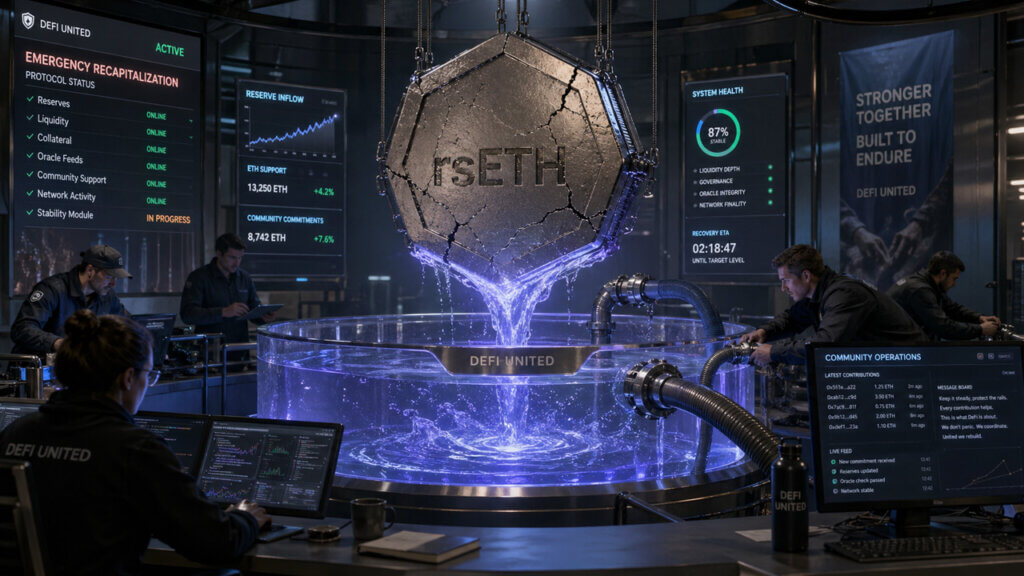
In response to the incident, Aave and KelpDAO helped organize DeFi United, a recovery vehicle aimed at replenishing rsETH reserves and making affected users whole.
According to DeFi United's official website, the effort has drawn commitments of nearly $240 million from several major DeFi participants, including Aave DAO, Arbitrum DAO, Mantle, Ether.fi, Lido, Kelp, Golem Foundation, and individual contributors.
Oak Research said this recovery effort is working because Aave was the protocol at risk.
In its view, the response may have been different if the losses had been isolated to a smaller restaking protocol or a bridge without broader systemic importance. Aave, as the largest DeFi lending venue, had stronger incentives to preserve its reputation and avoid a precedent in which lenders take losses from collateral accepted by the protocol.
That is what makes Solana’s support notable. The foundation is stepping into a sector-wide effort to prevent a bridge-linked collateral failure from damaging confidence in DeFi’s largest lending venue.
The move also gives Solana a strategic opening. Bringing AAVE to Solana could deepen cross-chain liquidity, broaden access for Solana users, and give Aave another distribution channel at a time when lending protocols are reassessing collateral risk, bridge dependencies, and emergency backstops.
Meanwhile, the recovery may still leave governance questions unresolved. Aave tokenholders must weigh the cost of using treasury assets against the reputational risk of allowing users to absorb losses.
While DeFi United can help close the immediate shortfall, the KelpDAO exploit has already shown that collateral standards, bridge design, and protocol risk controls are no longer separate issues.
The post Latest $290M exploit hit DeFi so hard it forced Aave onto Solana as part of rescue efforts appeared first on CryptoSlate.
Bitcoin traded below $78,000 on Monday as EU markets opened for the week.
BTC price hit $77,819, down 0.28% over 24 hours, with a market capitalization near $1.56 trillion and 24-hour volume of around $32.1 billion. Total crypto liquidations stood near $295 million over the previous 24 hours on CoinGlass.
Bitcoin had been pressing the $80,000 decision area, then quickly slipped back under $78,000 before any clear fresh macro, regulatory, exchange, ETF, or issuer headline had emerged.
The immediate test is whether the drop was a short-lived leverage flush or the start of a broader risk-off move.
The distinction is substantive. A leverage flush can reset crowded positioning while leaving the larger market structure intact. A broader risk-off move usually needs follow-through across risk assets, weaker liquidity, or a new catalyst that changes how traders price the next several sessions.
For now, the evidence points to market structure first. Liquidation pressure was evident, the price level was fragile, but the cause has yet to be resolved into a single clear explanation.

The $80,000 area was already loaded
The latest move landed in a zone that had already drawn attention. On Apr. 23, Bitcoin traded as high as $79,470 while moving toward the $80,000 threshold, before retracing to about $78,200.
The push was linked to forced liquidations and a more constructive macro and geopolitical setup.
Bitcoin was already testing a level where recent buyers, short sellers, and macro-sensitive traders had reasons to react. When price moves into that kind of area, the first rejection often says more about positioning than conviction.
A later CryptoSlate market-structure analysis gives the same zone a more tactical map. Bitcoin had failed to hold the upper-$78,000s after reaching the $80,000 level, while risk appetite and equities were doing more immediate work than crude oil.
The same analysis placed the constructive path around a hold of the $77,000 to $77,500 area followed by a reclaim of the upper-$78,000s.
That gives Monday's move a clean test. If buyers absorb the drop near the mid-$77,000s, the decline can remain a clearing event. If price fails there, the break starts to point to a broader reduction in risk.
The pattern also helps separate price action from explanation. Traders did not need a new headline to see why stops, hedges, or fast exits could cluster around a round-number level that had just rejected momentum. A market that has challenged $80,000 can reverse quickly when leverage is high, and the next buyer is waiting for a lower price.
That makes the first response around $77,000 to $77,500 more important than the search for a tidy headline. A fast reclaim would show demand absorbing forced flows. A stalled bounce would tell traders that the drop was spilling into spot conviction and broader risk appetite.
Recent CryptoSlate coverage explains why the $80,000 zone was crowded, why liquidations had helped shape the prior move, and why risk appetite could influence the next leg. It leaves the Apr. 27 drawdown as a live test, rather than a settled reaction to one event.
That framing separates the level from the narrative. The price zone can be real, and the catalyst can remain unresolved. Bitcoin had a clear technical pressure point, while the available evidence still leaves the trigger open.

Liquidations define what the evidence can support
The liquidation data adds pressure to that interpretation. Total crypto liquidations reached about $294.9 million over 24 hours, up sharply from the prior reading on the page.
CoinGlass also showed 89,011 traders liquidated and the largest single order on Binance's ETHUSDT pair at about $11.98 million.
The Bitcoin-specific page was more nuanced. BTC liquidations were about $95.55 million, split between about $38.8 million in longs and $56.75 million in shorts.
That split complicates the easy version of the move. A falling Bitcoin price often invites a simple long-liquidation explanation. The BTC-specific reading was short-heavy at the time checked, which suggests the liquidation backdrop was mixed and not a one-direction wipeout.
Still, liquidations were large enough to show forced position closure across the market, while the Bitcoin page showed activity clustered around the same hours as the European open. That supports a leverage and liquidity frame, with the immediate trigger still unresolved.
Market-cap data sets a second boundary. Global crypto market capitalization is near $2.59 trillion, and Bitcoin's dominance was around 60%. CryptoSlate's coins page shows Bitcoin's market capitalization is around $1.559 trillion.

Macro pressure sets the next test
The macro backdrop gives the move context. The Federal Reserve calendar shows a two-day FOMC meeting scheduled for Apr. 28 and 29, with a press conference on Apr. 29.
A separate Federal Reserve notice shows an Apr. 28 closed Board meeting to discuss monetary policy issues.
CryptoSlate's macro preview also framed the week as unusually compressed. Traders would get the Fed first, then GDP and PCE data shortly after, creating a tight test for rates, growth, inflation, and risk appetite.
That setup can explain why buyers may be less willing to step in aggressively. Bitcoin often trades as a liquidity-sensitive asset over short macro windows. When the market is heading into a packed policy and data sequence, traders have fewer reasons to add risk into a fast drop.
Still, the calendar is background pressure. During the Apr. 27 review window, no new Fed decision, fresh inflation print, regulatory action, exchange failure, ETF shock, or issuer announcement had emerged to explain the move.
The market had a plausible reason to be cautious, while the visible move looked more consistent with positioning and liquidity stress than a fully explained headline response.
The most defensible reading is that Bitcoin's drop below $78,000 looks like a leverage flush inside a risk-sensitive market, with no obvious fresh catalyst. That holds if the move stabilizes near the mid-$77,000s and buyers can push price back toward the upper-$78,000s.
A reclaim would suggest the market cleared excess exposure while preserving the larger range. It would also fit the pattern CryptoSlate mapped earlier: hold the $77,000 to $77,500 area, regain the upper-$78,000s, and put $80,000 back into play.
A deeper break would change the question. If Bitcoin loses the mid-$77,000s while equities weaken, yields firm, or the Fed week turns more hostile for risk assets, the same liquidation data would begin to resemble the first leg of a broader risk reduction.
That leaves the market with a precise test. The liquidation wave has shown where leverage was vulnerable. The next price reaction will show whether spot demand is strong enough to absorb the damage.
The post Bitcoin flash crashes below $78,000 at Europe market open with nearly $295 million in crypto liquidations appeared first on CryptoSlate.
The Bitcoin ETF trade sold investors a simple promise: crypto exposure inside a wrapper that looked and felt like mainstream finance. Advisors could buy it, compliance teams could understand it, and institutions could route capital into digital assets through a product that fits the rest of their strategy.
That promise worked, and the US spot Bitcoin ETF complex had reached $91.71 billion in assets under management by April 8, according to CryptoSlate data.
Given the size of the spot Bitcoin ETF market, we can clearly see that there's no lack of demand. The main problem the industry is faced with now is infrastructure.
On April 20, Grayscale amended its proposed Hyperliquid ETF filing and named Anchorage Digital Bank as custodian in place of Coinbase.
On its own, that looks like a modest filing change tied to a newer crypto product, but in context, it's a sign that issuers are starting to think harder about how much of the regulated crypto ETF market still runs through one back-office gatekeeper.
As CryptoSlate reported on April 12, funds whose launch documents name Coinbase as custodian or primary custodian account for about $77.10 billion of the market, or 84.1% of total US spot Bitcoin ETF AUM. A stricter method that excludes multi-custodian arrangements or unclear split allocations still leaves roughly $74.06 billion, or 80.8%, tied to Coinbase in some custody role. Those numbers make custody concentration part of the institutional appetite for Bitcoin, not a side detail buried in the documents.
A single filing doesn't establish a migration trend, and the market shouldn't turn one amendment into a sweeping break. Even so, custody choices inside ETFs carry real informational value because issuers, lawyers, and boards tend to repeat the safest available template. When a market that has spent years making the same custody decision starts to show variation, it's worth paying attention.
The ETF boom built a custody market around one default choice: Coinbase
Coinbase became dominant in crypto ETF custody for practical reasons that made sense from the start.
When spot Bitcoin ETFs won approval in January 2024, issuers needed a provider with a recognizable compliance profile, institutional operating history, and an infrastructure stack that already looked credible to boards, auditors, market makers, and regulators. Coinbase had that advantage. Once the largest issuers chose it, the rest of the market inherited a strong template effect.
That pattern kept extending into 2026. Morgan Stanley’s updated filing in March named Coinbase Custody and BNY as custodians for its proposed Bitcoin exchange-traded product, which later launched as the Morgan Stanley Bitcoin Trust.
Another blue-chip institution entered the market and plugged into the same custody backbone already supporting much of the ETF complex. That's how concentration deepens in financial infrastructure, with each new entrant reinforcing the same operational standard.
Coinbase’s own regulatory trajectory has only strengthened that position. On April 2, the company said it had received conditional approval from the Office of the Comptroller of the Currency to charter Coinbase National Trust Company. That was an important milestone, because a federal trust framework offers a cleaner supervisory map for the custody business that sits underneath products like ETFs.
Coinbase’s scale reflects institutional trust, launch readiness, and regulatory familiarity. Those strengths are also what made it the market’s central operational node. Crypto has spent years arguing about decentralization at the asset layer, while the institutional wrapper built around Bitcoin moved toward a highly concentrated custody structure. We can now clearly see that product variety expanded faster than infrastructure variety.
ETF investors spend most of their time looking at inflows, fees, and price action, though it's custody that shapes how the system functions day to day. If the wrapper is supposed to make digital assets legible to mainstream finance, then the resilience of that wrapper matters almost as much as the underlying asset. The live question now is whether the market has reached the point where resilience requires more redundancy.
Grayscale’s Anchorage switch points to a market thinking harder about redundancy
Grayscale’s amended Hyperliquid ETF proposal names Anchorage Digital Bank as custodian in place of Coinbase. Anchorage brings a different regulatory and institutional profile to crypto custody. It's the first federally chartered crypto-native bank in the United States, and it's already been moving deeper into the institutional stack. Grayscale had previously tapped Anchorage as a secondary custodian for part of its Bitcoin and Ethereum trusts, while BlackRock added Anchorage in April 2025 to support its spot crypto ETFs.
That makes the Grayscale amendment look like part of a slow broadening in the custody field. The important point is that issuers now have stronger reasons to add alternatives into the mix as the category grows larger and the cost of concentration becomes easier to quantify. A market carrying more than $90 billion in spot Bitcoin ETF assets starts to look different when more than four-fifths of that exposure still depends on one custody provider in some form.
The biggest risks are in operations, reputation, and market-wide spillover.
ETF assets are segregated, custody agreements impose fiduciary duties, and the legal structure around these funds differs sharply from the exchange failures and balance-sheet collapses that shaped crypto’s earlier crises.
That architecture is important, but so is the fact that a dominant provider can still become a choke point if it faces outages, settlement disruption, licensing complications, or regulatory pressure. The larger Coinbase’s role becomes, the larger the consequences become for any event that interrupts its ability to perform that role across multiple issuers at once.
Markets mature by building backups, widening their vendor maps, and reducing the number of points where one institution’s disruption can spill across an entire category. Crypto ETFs have already done the first part of institutionalization by attracting demand and embedding themselves in mainstream portfolios.
The next part is about whether the system underneath those products can carry that growth without leaning so heavily on a single provider, even when that provider remains strong and increasingly well connected to regulators.
Hyperliquid is a newer and more politically sensitive product than a plain spot Bitcoin ETF, and its core perpetuals venue remains ring-fenced in the US.
That alone may have given Grayscale an extra reason to lean on a federally chartered custodian. Even if that turns out to be the narrow explanation, the choice still reveals something important: when issuers encounter a product with more regulatory edge, they may see value in bringing a different type of custodian into the structure. And once that habit enters the market, broader diversification becomes easier to imagine.
That is why this launch belongs in the bigger conversation around Coinbase, Anchorage, and the institutional path of Bitcoin ETFs. The category no longer needs to prove that investors want regulated crypto exposure. It needs to show that the infrastructure underneath that exposure can evolve beyond the first template that worked.
Wall Street’s relationship with crypto keeps moving through familiar stages. First came access, then came legitimacy, and the next stage is resilience. Grayscale’s switch to Anchorage doesn't settle that transition, but
it does make the direction easier to see. The ETF boom made Bitcoin legible to traditional finance. What comes next will determine how durable that wrapper looks at scale.
The post Grayscale moves away from Coinbase for new ETF product – Is Wall Street building a post-Coinbase custody map? appeared first on CryptoSlate.
Cryptoticker
Ethereum drops below $2,300 as crypto momentum fades
Ethereum fell below the important $2,300 level after Bitcoin failed to hold its recent pump toward $79K. The move came during a broader crypto market pullback, where Bitcoin dropped below $77K and several major altcoins turned red within a short period.
The latest market data shows ETH trading around $2,277, down nearly 3% over 24 hours. This drop is important because Ethereum had recently been supported by bullish institutional headlines, including reports of major ETH accumulation by BitMine. However, the market reaction shows that short-term traders are still focused more on Bitcoin’s price action, liquidations and weak market structure than on long-term accumulation news.
In simple terms, Ethereum did not drop because of one isolated ETH-specific event. It dropped because the broader crypto market lost momentum.
Why did Ethereum drop below $2,300?
The main reason Ethereum dropped is that Bitcoin rejected a key resistance zone. BTC briefly pushed toward $79K, but the move failed quickly. Once Bitcoin lost strength and fell back below $77K, Ethereum followed with a sharper decline.
This is normal during fast market reversals. ETH often behaves like a higher-beta version of Bitcoin, meaning it can rise faster during bullish momentum but also fall harder when the market turns. When BTC rejected the breakout, traders quickly reduced exposure across major crypto assets, and ETH became one of the first large-cap altcoins to feel the pressure.
The loss of the $2,300 level then made the move worse. For many traders, $2,300 is both a psychological level and a short-term technical support zone. Once Ethereum fell below it, stop-losses and leveraged long liquidations likely accelerated the decline.
Liquidations hit Ethereum after Bitcoin’s failed breakout
The speed of the drop suggests that liquidations played a major role. Social media reports pointed to a sharp amount of value being wiped from the crypto market in a very short time, with both BTC and ETH falling almost simultaneously.
This matters because Ethereum is heavily traded with leverage. When the market moves against crowded long positions, traders are forced to close positions or get liquidated. That selling pressure can push ETH lower even if there is no major negative news about Ethereum itself.
This is why ETH can drop despite bullish long-term headlines. Institutional accumulation may support the broader narrative, but short-term leverage can still control intraday price action.
BitMine buying Ethereum was not enough to stop the selloff
One of the more bullish headlines around Ethereum was the report that Tom Lee’s BitMine bought a large amount of ETH. This should normally support confidence in Ethereum’s long-term outlook, especially as institutional interest in ETH continues to grow.
However, today’s move shows the difference between long-term accumulation and short-term trading pressure. Big buyers can strengthen the investment case for Ethereum, but they do not automatically prevent sudden corrections. If Bitcoin rejects resistance, the market deleverages, and altcoins weaken, ETH can still drop below key levels.
That is exactly what happened here. The BitMine headline helped the Ethereum narrative, but it was not strong enough to stop the market-wide selloff.
Ethereum weakens as altcoins flash warning signs
Ethereum’s decline also fits the broader altcoin weakness. XRP, Solana, Cardano, BNB and Chainlink were all under pressure, confirming that this was not only an Ethereum problem. The market was reducing risk across major altcoins.
This is important because Ethereum usually needs broader altcoin strength to build a sustainable rally. When ETH rises while altcoins confirm the move, the market often looks healthier. But when ETH drops alongside most large-cap coins, it suggests that traders are becoming more defensive.
For now, Ethereum is still being treated like a risk asset. It is not leading the market higher. Instead, it is reacting to Bitcoin’s failed breakout and the broader weakness across crypto.
Ethereum price analysis: key levels to watch
The most important level for Ethereum now is $2,300. If ETH can reclaim this level quickly, the latest drop may be viewed as a temporary shakeout caused by Bitcoin’s rejection and short-term liquidations.
A move back above $2,300 would be the first sign that buyers are trying to regain control. After that, ETH would need to push toward the $2,350 to $2,400 zone to rebuild stronger bullish momentum.
However, if Ethereum remains below $2,300, the risk of further downside increases. In that case, traders may start watching lower support areas near $2,250 and then $2,200. Losing those levels could make the ETH chart look weaker and extend the correction.
For now, ETH is in a sensitive position. The next move depends heavily on whether Bitcoin can stabilize above $76K to $77K and whether Ethereum can recover $2,300 quickly.
Is Ethereum still bullish?
Ethereum’s long-term outlook has not been destroyed by this drop. Institutional buying, ETF-related interest and the broader Ethereum ecosystem still support the long-term narrative. But the short-term chart is clearly under pressure.
The problem is not that Ethereum has no bullish catalysts. The problem is that the market is not responding strongly to them yet. When bullish headlines fail to push price higher, it usually means traders are waiting for technical confirmation before taking more risk.
For Ethereum, that confirmation starts with reclaiming $2,300. Without that, the market may continue to treat ETH as weak in the short term.
Ethereum price prediction: bounce or deeper correction?
If Ethereum reclaims $2,300 and Bitcoin stabilizes above $77K, ETH could attempt a recovery toward $2,350 and then $2,400. A stronger move above that zone would suggest that the selloff was only a temporary liquidation event.
But if ETH fails to recover $2,300, the bearish case becomes stronger. A continued rejection below this level could send Ethereum toward $2,250 or even $2,200, especially if Bitcoin loses the $76K support area.
The most likely short-term scenario is continued volatility. Ethereum is stuck between bullish institutional narratives and bearish short-term price action. Until ETH turns $2,300 back into support, traders should expect more sharp moves in both directions.
Final thoughts: why ETH dropped and what comes next
Ethereum dropped below $2,300 because Bitcoin’s failed $79K pump triggered a broader crypto market selloff. The move was accelerated by liquidations, weak altcoin momentum and traders reducing risk across major crypto assets.
This does not mean Ethereum’s long-term story is broken. But it does show that ETH needs stronger confirmation before the next major rally can begin. Bullish accumulation headlines are important, but price action still matters.
For now, the key level is clear: Ethereum needs to reclaim $2,300. If it does, the market could start looking for a recovery. If it fails, ETH may remain under pressure and test lower support zones.
Bitcoin fails to hold the $79K pump
Bitcoin gave traders a short burst of optimism after briefly pumping toward the $79K level. The move looked like a potential breakout attempt, especially after fresh institutional buying headlines entered the market. However, the momentum quickly faded, and Bitcoin dropped back below $77K, erasing the gains from the previous move.
According to the latest market data, Bitcoin is trading around $76,600, down roughly 1.7% over 24 hours. This confirms that BTC is still struggling to build a clean continuation above the $78K to $79K range. The failed move also shows that buyers are not yet strong enough to push Bitcoin into a confirmed breakout above $80K.
The key question now is simple: why did Bitcoin pump toward $79K, then suddenly lose strength?
Why did Bitcoin drop below $77K?
The first reason is a classic failed breakout. Bitcoin moved higher, attracted short-term traders, but failed to hold the breakout zone. Once the price started rejecting near $79K, leveraged positions became vulnerable. The move then turned into a fast downside reaction, with reports pointing to billions being wiped from the crypto market in a short period.
This type of move often happens when the market pumps into resistance without enough spot demand to support the rally. Traders chase the move, liquidity builds above and below the price, and once momentum slows, the market reverses sharply.
In this case, Bitcoin’s drop below $77K suggests that the $79K area was not a real breakout yet. It was more likely a liquidity move, where the price pushed higher, trapped late buyers, and then quickly reversed.
Strategy buys more Bitcoin, but BTC still drops
One of the most interesting parts of today’s crypto news is that Bitcoin dropped even after bullish institutional headlines. Michael Saylor’s Strategy reportedly bought 3,273 BTC worth around $255 million, adding more fuel to the long-term Bitcoin accumulation narrative.
Normally, this type of news would support bullish sentiment. But today’s price action shows that institutional buying does not always create an immediate pump. Large buyers may support the bigger trend, but short-term price action still depends on liquidity, leverage, resistance levels and market confidence.
In other words, Strategy buying more Bitcoin is bullish for the long-term narrative, but it was not enough to stop the short-term selloff below $77K.
BlackRock and institutions are buying, but retail momentum is weak
The broader institutional story remains strong. BlackRock has reportedly accumulated hundreds of millions of dollars worth of Bitcoin through spot ETF demand, while Strategy continues to add BTC to its balance sheet. This confirms that large players are still using weakness as an accumulation opportunity.
However, Bitcoin’s failure to break $80K shows that institutional demand alone is not enough. The market also needs stronger retail participation, better altcoin momentum, and a clear technical breakout. Without those elements, Bitcoin can continue to see sharp pumps and dumps inside the same range.
This is why today’s move is important. It shows a clear gap between the long-term accumulation story and the short-term trading reality.
Altcoins confirm the market weakness
Bitcoin was not the only asset under pressure. The latest crypto performance data shows that most major altcoins are also red. Ethereum dropped below $2,300, XRP fell by more than 2%, Solana moved lower, Cardano weakened, and Chainlink also declined.
This matters because a healthy crypto rally usually needs support from major altcoins. When Bitcoin pumps but altcoins remain weak, the move often looks defensive rather than broad-based. It means traders are not fully rotating into risk yet.
Ethereum’s weakness is especially important. ETH is trading around $2,277, down almost 3%, despite recent reports that Tom Lee’s BitMine bought a large amount of Ethereum. This shows that even bullish Ethereum accumulation headlines are not currently enough to reverse market pressure.
Peter Schiff adds bearish pressure to the Bitcoin narrative
Another headline adding attention to the market is Peter Schiff’s latest bearish comment, where he reportedly said Bitcoin could crash “close to zero.” Schiff has always been one of Bitcoin’s most vocal critics, so the statement itself is not surprising. But the timing matters.
His comment came while Bitcoin was failing to hold a breakout and dropping below $77K. This gives the market a stronger emotional contrast: institutions are buying BTC, but critics are using the failed pump as proof that Bitcoin remains fragile.
For traders, this does not mean Bitcoin is going to zero. But it does show that sentiment is still divided. The market is not in full euphoria mode. Fear, skepticism and leverage-driven volatility are still controlling short-term moves.
Why is Bitcoin weak while stocks hit all-time highs?
One of the most important parts of today’s market setup is that stocks are reportedly hitting all-time highs while Bitcoin is struggling below $80K. That is a major signal.
If US and Asian stock markets are strong, but Bitcoin cannot hold above $79K, it suggests that crypto is not currently leading the risk-on trade. Liquidity may be flowing first into equities, while crypto remains trapped by leverage, weak altcoin demand and resistance near $80K.
This does not necessarily mean the Bitcoin trend is broken. But it does mean that BTC needs stronger confirmation before traders can call the next major breakout. For now, the market is still reacting more like a fragile risk asset than a leading momentum asset.
Bitcoin price analysis: key levels to watch
The most important level now is the $76K to $77K support zone. If Bitcoin can hold this area and reclaim $78K, the market may attempt another move toward $79K and eventually $80K.
However, if BTC loses the $76K zone clearly, the failed $79K pump could turn into a deeper correction. In that case, traders may start watching lower liquidity areas and stronger support zones below the current range.
For the bullish case to return, Bitcoin needs more than another quick pump. It needs to reclaim the $78K to $79K range, hold it as support, and show enough strength to challenge $80K with real volume.
For Ethereum, the key level is $2,300. If ETH remains below this zone, altcoins may continue to struggle, even if Bitcoin stabilizes.
Is the Bitcoin rally over?
The Bitcoin rally is not necessarily over, but today’s move is a warning sign. Bitcoin is still attracting institutional buyers, and major companies continue to accumulate BTC. However, the short-term chart shows that the market is not ready for a clean breakout yet.
The drop below $77K after a pump to $79K shows that traders are still selling into strength. It also confirms that $80K remains a major psychological and technical barrier.
For now, the crypto market is stuck between two forces. On one side, institutional accumulation supports the long-term Bitcoin story. On the other side, weak altcoins, liquidations and failed breakout attempts are keeping short-term pressure alive.
Until Bitcoin turns $79K into support and breaks $80K with conviction, the market may continue to see sharp pumps followed by fast pullbacks.
Tangem is heating up the self-custody market this spring with the launch of its exclusive Prize Draw Campaign, running from May 5 to June 6, 2026. This campaign offers users a chance to win a share of over 100 prizes, including a grand prize of $5,000 in BTC.
How to Participate in the Tangem Draw
To participate in the Tangem Prize Draw, users simply need to purchase a Tangem wallet directly through our exclusive promo link here during the promotion period. Participation is entirely automatic; every wallet item purchased counts as one entry—for example, a 3-pack order equals three tickets—with no additional sign-up required.
Prize Pool Breakdown: What Can You Win?
The campaign features a robust selection of 104 individual prizes. Beyond the headline Bitcoin rewards, Tangem is giving away the latest tech and specialized hardware security gear.
| Prize | Quantity |
|---|---|
| $5,000 in $BTC | 1 winner |
| iPhone 17 (256GB) | 3 winners |
| Tangem Pro Kit | 5 winners |
| Tangem Ring | 10 winners |
| $50 in BTC | 25 winners |
| $10 in BTC | 60 winners |
Winners will be announced on July 5, 2026, following a 30-day "cooldown" period used to verify that only non-refunded purchases are eligible. The announcement will take place on the Tangem blog and via a live stream on the Tangem Discord.
Bonus Offer: Double Your Entries and Save 50%
Running concurrently with the prize draw is a significant discount on high-capacity storage. Users who purchase a Family Pack (two 3-card sets) starting with a Black or Stealth wallet can receive the second set at 50% off by using our official discount link.
Notably, both sets in the Family Pack count as separate entries for the prize draw, effectively doubling your chances to win while securing your assets at a lower cost. Eligible collections for the discounted second set include popular designs like Bitcoin, White Stealth, and the "Hold Your Freedom" series.
Why Hardware Security Matters in 2026
In an era where Bitcoin prices are pushing toward six-figure milestones, the security of your private keys is paramount. Modern hardware wallets have evolved to address sophisticated 2026 threats like AI-enabled phishing and "pig butchering" scams.
Tangem's unique approach utilizes EAL6+ certified secure element chips within a card-shaped form factor. Unlike traditional devices, Tangem is battery-free and requires no cables; users simply tap the card to their smartphone to sign transactions. This eliminates the vulnerability of a written seed phrase, as the keys are generated and stored exclusively on the card's chip.
Safety and Anti-Scam Precautions
Tangem has issued a strict warning regarding security during this campaign. Official winners will only be contacted via email from the @tangem.com domain.
- No Payment Required: Tangem will never ask for payment to claim a prize.
- Privacy First: Official staff will never ask for your private keys or seed phrases.
- Verify Sources: If you receive messages from other addresses claiming you have won, it is a scam.
While Bitcoin ($BTC) remains in a choppy consolidation range near $77,500, a handful of high-beta assets have posted double-digit gains, diverging significantly from the broader index.
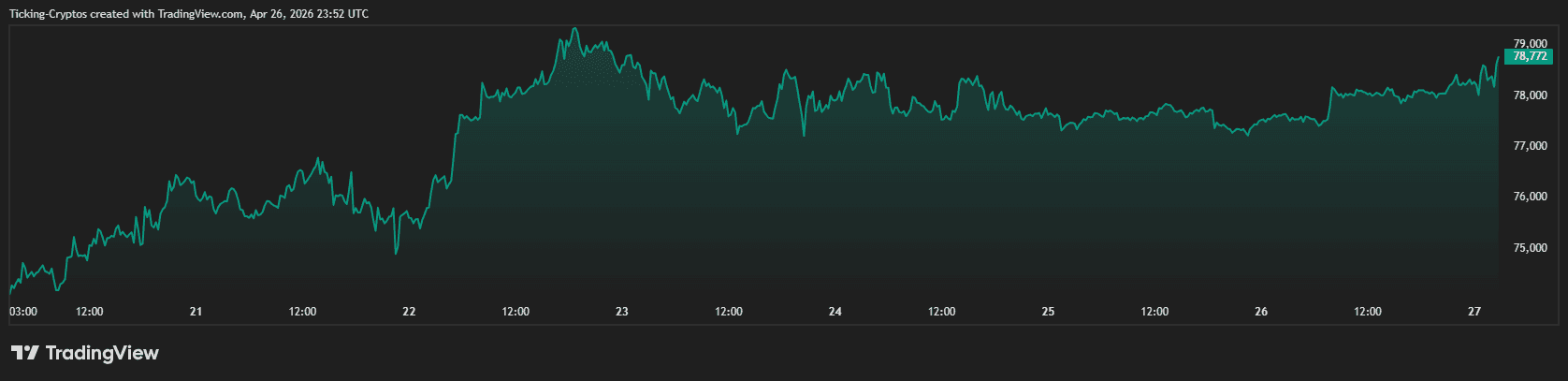
Historically, vertical moves of this magnitude—often exceeding 30% in seven days—invite a period of rebalancing. For traders, this week is less about chasing the "pump" and more about identifying where the floor sits. Here are 3 tokens that soared high and need to be on every trader's radar.
1. Humanity Protocol (H): The "Vesting Choice" Volatility
Humanity Protocol (H) has been the week's standout performer, surging over 45% following a massive spike in on-chain whale activity. Large-scale transactions for $H$ recently hit a five-month high, signaling that institutional players are positioning themselves within its "Proof of Humanity" ecosystem.
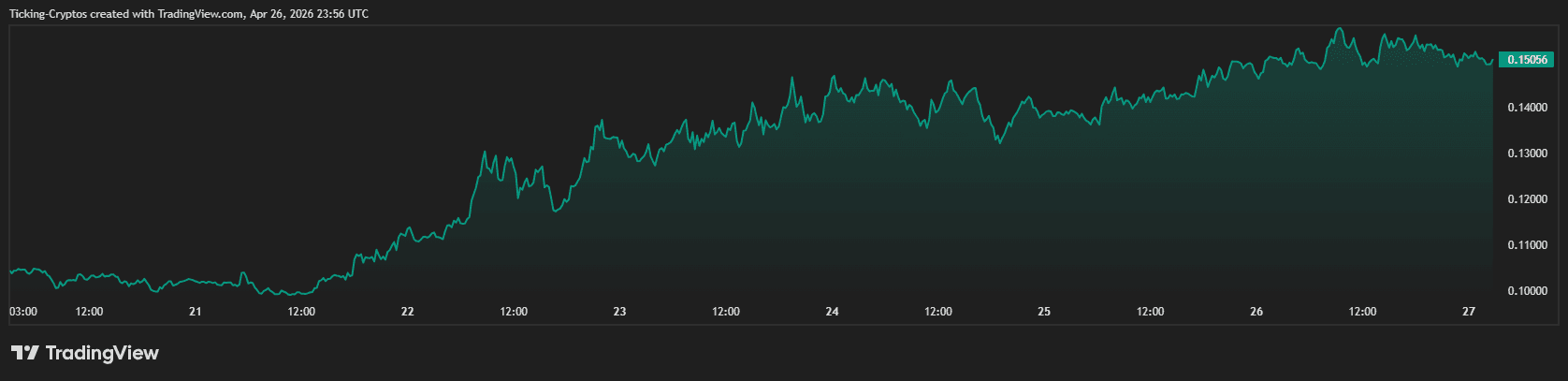
However, a fundamental headwind is peaking right now. The Humanity Foundation recently presented early backers with a difficult choice: extend their vesting schedules until late 2026 or accept a 70% haircut for immediate liquidity by April 26. This creates a complex supply dynamic for the remainder of this week.
- The Bull Case: If whales continue to defend the current breakout support at $0.12, a test of the $0.18 resistance level is likely.
- The Bear Case: A significant "cliff" token unlock is approaching on June 25 for those who chose the haircut. In the immediate term, the market is pricing in this "death spiral" risk. If $H$ fails to hold $0.14, expect a retracement toward the $0.11 EMA.
2. Stable (STABLE): Navigating Regulatory Momentum
Stable (STABLE) has climbed over 30% this week, reaching a market capitalization of approximately $742 million. This rally is fueled by the evolving regulatory landscape in the United States, specifically following the GENIUS Act guidelines and new institutional reserve portfolios from major banks.
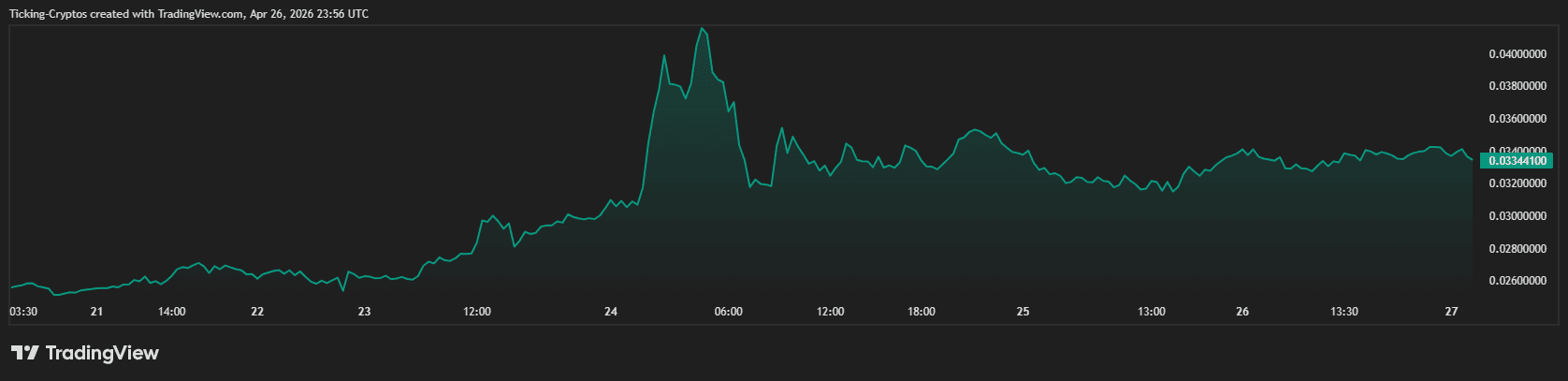
Unlike purely speculative tokens, STABLE is positioning itself as a compliance-first asset. However, after such a rapid ascent, the token is showing signs of exhaustion.
- Key Levels: STABLE is currently hovering near a psychological resistance point of $0.035. A failure to break through this week could see profit-taking dominate the mid-week sessions, leading to a healthy retracement toward $0.028.
- Watch for: New Treasury Department rules regarding stablecoin AML frameworks, which could either solidify this rally or trigger a "sell the news" event.
3. MemeCore (M): High Gains vs. Thin Liquidity
The third asset on our radar, MemeCore (M), has been the "moonshot" story of the month, gaining nearly 30% this week and pushing its valuation into the multi-billion dollar range. While the price of $M is sitting near its local highs of $4.38, technical analysts are sounding the alarm.
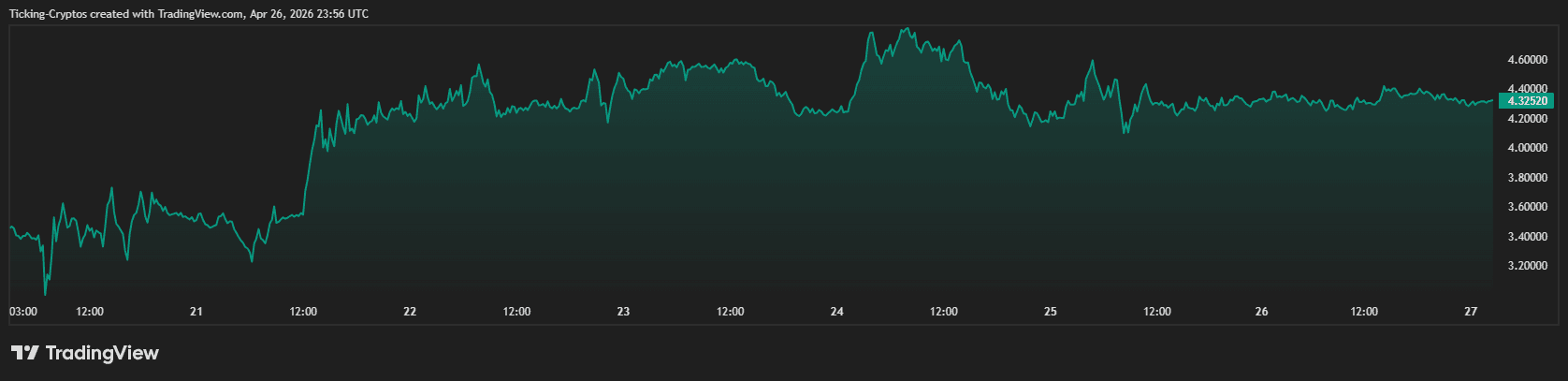
The project recently executed a hardfork that reduced gas fees by 99%, attracting a wave of retail interest. However, on-chain scrutiny highlights a potential risk: a discrepancy between the high market cap and relatively thin liquidity in decentralized exchange (DEX) pools.
- Risk Factor: The volume-to-market cap ratio remains low. In thin markets like MemeCore's, even small sell orders can have an outsized impact on the price.
- Technical Outlook: Watch for a "double top" pattern near $4.65. If $M fails to sustain volume above its 24-hour average of $25M, a sharp correction toward the $3.89 support level is probable.
Summary: 3 Cryptocurrencies to Watch This Week
| Asset | 7d Performance | Market Cap | Key Sentiment Trigger |
|---|---|---|---|
| Humanity Protocol ($H) | +45.48% | ~$415M | Token Unlock Decisions |
| Stable ($STABLE) | +30.12% | ~$742M | Institutional Reserve News |
| MemeCore ($M) | +29.19% | ~$5.68B | Liquidity & Social Hype |
Ethereum ($ETH) has spent much of 2026 consolidating, leading many investors to ask the golden question: will Ethereum break its previous all-time high (ATH) of $4,900? A series of technical "ceilings" and shifting macroeconomic factors are currently dictating its pace toward a new record.
Can Ethereum Break its $4,900 ATH?
While a break above $4,900 is technically possible in 2026, it remains an optimistic target rather than a guaranteed outcome for the first half of the year. Analysts from major institutions like Standard Chartered and JPMorgan have set year-end targets ranging from $5,440 to as high as $10,000, contingent on a successful breakout from the current $2,300–$2,800 accumulation zone. However, as of April 26, 2026, ETH is trading near $2,333, indicating that the bulls still have significant work to do.
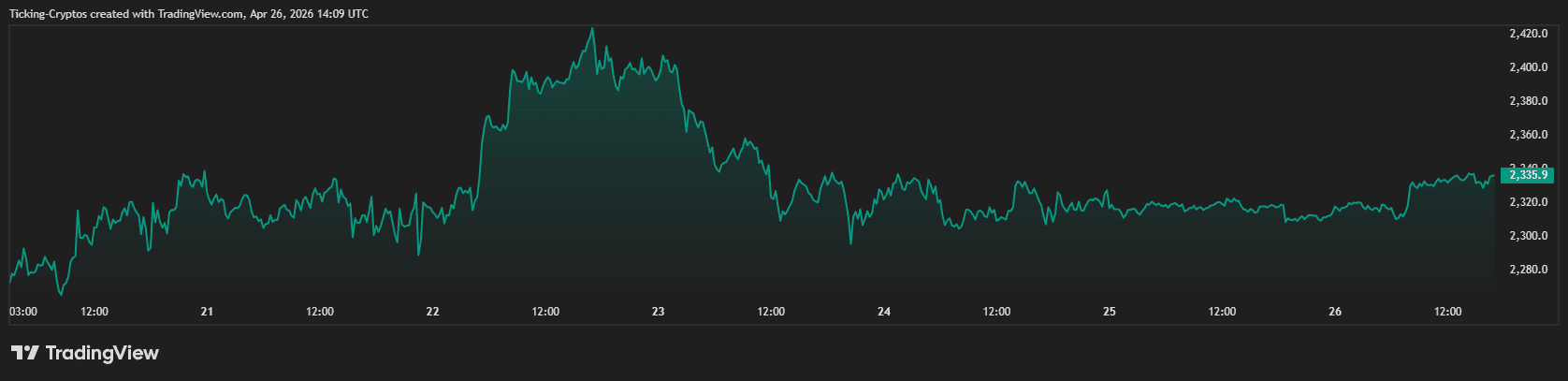
What Defines an "ATH Breakout"?
In technical analysis, an All-Time High (ATH) breakout occurs when an asset surpasses its highest ever recorded price—in Ethereum's case, approximately $4,878 (often rounded to $4,900). This event is significant because it enters a "price discovery" phase where no historical sell-side resistance exists. For ETH, the $4,900 mark isn't just a number; it is the final psychological barrier that separates the current range-bound market from a parabolic bull run.
Ethereum Price Prediction fr 2026
The journey to $4,900 is currently blocked by several key technical layers.
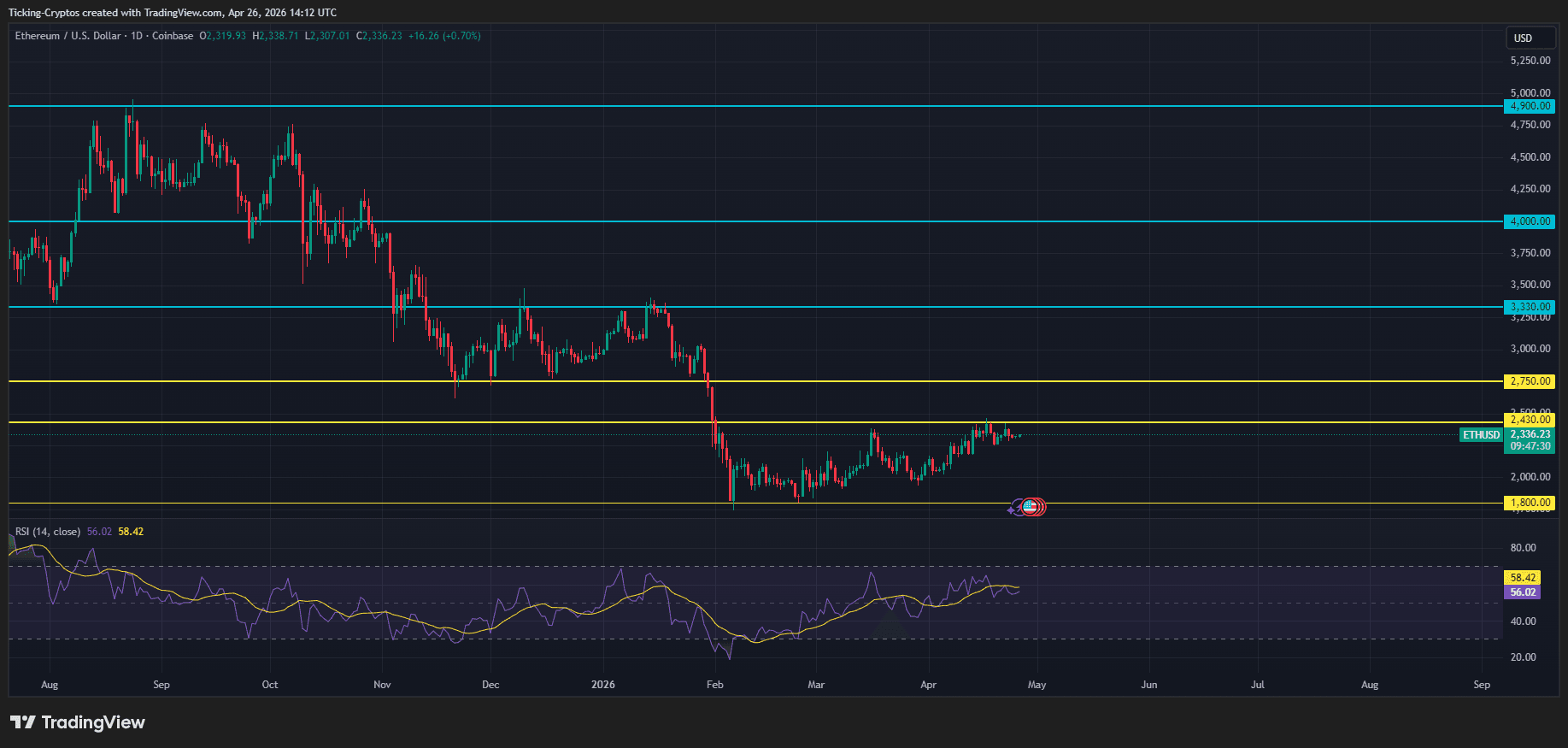
- The $2,750 Pivot: This is the immediate "line in the sand." Ethereum must reclaim this level to flip the medium-term trend from neutral to bullish.
- The $3,300 Resistance: A major supply zone. Historically, significant profit-taking occurs here, which could lead to temporary corrections back to $2,000.
- The Golden Cross: Traders are watching for the convergence of the 50-day and 200-day Moving Averages. A definitive "Golden Cross" in mid-2026 could be the catalyst for the final push toward the $4,900 ceiling.
Major Institutional Forecasts for 2026
| Institution | 2026 Target | Key Driver |
|---|---|---|
| Citi | $5,440 | Sustained Spot ETF Inflows |
| Standard Chartered | $7,500 | Institutional Pension Allocations |
| JPMorgan | $10,000 | L2 Fee Slashes & Scalability |
| DigitalCoinPrice | $5,301 | Post-Halving Momentum |
The Role of External Catalysts
While internal technicals are vital, Ethereum's trajectory is heavily influenced by Bitcoin ($BTC). Bitcoin is currently trading near $78,000, maintaining high dominance. For Ethereum to lead the market toward its ATH, we typically look for a "rotation" of capital where investors move profits from BTC into ETH. Furthermore, news regarding US-Iran geopolitical de-escalation and energy price stability—often reported by Reuters—plays a silent but massive role in risk-on sentiment for 2026.
Decrypt
Google's security team scanned billions of web pages and found real payloads designed to trick AI agents into sending money, deleting files, and leaking credentials.
Some 580 Google employees have signed the letter to CEO Sundar Pichai, citing ethical concerns over military use of AI.
Strive Inc. purchased 789 more Bitcoin while its subsidiary prepares to educate business leaders on corporate crypto adoption.
Trump said last week he didn’t like prediction markets, but then changed his tune, arguing the U.S. should not get left behind in the space.
Gemini has integrated AI models like Claude and ChatGPT to execute automated trading strategies via an open protocol.
U.Today - IT, AI and Fintech Daily News for You Today
Strategy doesn’t miss on its regular Monday purchases as the firm scoops another $255 million worth of Bitcoin this new week.
Prominent gold advocate and vocal cryptocurrency critic Peter Schiff claims that the executive's audacious prediction of a $1 million Bitcoin is mathematically doomed.
XRP has confirmed a Golden Cross, but the real story is the 30% technical gap to the long-term 200-day MA.
Shiba Inu ecosystem records impressive growth in its onchain movements as new users continue to massively onboard the network.
A collision of $108 oil, a projected 1.5% GDP gap, and the Fed’s neutral stance puts $2.5 billion in BTC and XRP ETF inflows in April at risk ahead of May.
Blockonomi
TLDR
- Voltage conducted a 30-day pilot that processed 88.2 BTC over the Bitcoin Lightning Network for an iGaming operator.
- The pilot handled 237,000 payments with a 99.94% success rate and an average settlement time of 1.86 seconds.
- The report found that 80% of deposits and withdrawals came from Cash App users using Lightning.
- Bitcoin Lightning reduced transaction fees to about 0.0029% per payment during the trial period.
- Lightning transactions removed chargeback risk because payments settle instantly and remain irreversible
Bitcoin’s Lightning Network is moving deeper into online gambling payouts, according to a new report from Voltage. The company released fresh pilot data that shows instant withdrawals and near-zero fees for operators. The findings position Lightning as a working payment rail for real-time betting markets.
Voltage based its report on a 30-day pilot with a single iGaming operator. During that period, the platform routed 88.2 BTC through Lightning and processed 237,000 payments. The system recorded a 99.94% success rate and averaged 1.86 seconds for settlement.
The company stated that 80% of deposits and withdrawals came from Cash App users. That figure shows that mainstream wallets already support large Lightning volumes. Voltage said this dynamic brings Bitcoin closer to daily payment use inside gambling platforms.
Bitcoin Lightning Cuts Fees and Settlement Times
Voltage compared on-chain Bitcoin transfers with Bitcoin Lightning transactions in the report. On-chain payments can take minutes or hours, and fees can rise during congestion. By contrast, Lightning routes payments through peer-to-peer channels and settles later on the base chain.
The pilot showed that operators paid fees of under one cent per transaction. Voltage calculated that the average fees reached about 0.0029% of the transaction value. The report said Lightning runs about 1,000 times cheaper than card processors on a percentage basis.
Traditional card networks usually charge between 2.9% and 5% per payout. They also allow chargebacks weeks after funds leave an account. Lightning transactions are final and irreversible, which removes chargeback exposure.
Voltage wrote, “Operators do not need to trust a separate governance structure or bridge.” The company added that Lightning inherits Bitcoin’s proof-of-work security when channels close. As a result, operators can move funds without relying on external validator groups.
The report stated that instant settlement reduces reserve balances held for processing risk. Operators can free capital that would otherwise sit in clearing accounts. That shift increases capital velocity inside live betting platforms.
Bitcoin Lightning Gains Traction in iGaming
Voltage-linked payout speed is directly tied to player retention metrics. Surveys cited in the report showed that 72% of players rank payout speed among their top three loyalty drivers. The data also showed that 71% left a platform due to slow withdrawals.
The company argued that instant Bitcoin Lightning payouts create a direct link between gameplay and wallet balance updates. A winning bet can reflect in seconds inside a supported wallet. That speed reinforces user trust in platform operations.
The report also compared Lightning with other blockchain networks. Ethereum mainnet can move ERC-20 tokens but uses 15-second blocks and a shared global state. Fees on Ethereum can rise to $10 or $30 during congestion periods.
Voltage said Tron and Solana offer lower fees and higher throughput. However, it pointed to smaller validator sets and past outages on those networks. The company presented Bitcoin’s network effect as a differentiating factor.
Public Lightning capacity now stands in the thousands of BTC, according to the report. Mobile Lightning wallets number in the millions worldwide. Voltage also references Taproot Assets, which allow stablecoins like USDT to move over Lightning rails.
Tether has announced support for Lightning-based transfers using this framework. That setup combines dollar-linked balances with Bitcoin infrastructure. The report closed by stating that operators can now process instant BTC or USDT payouts over the same network.
The post Bitcoin Lightning Drives Instant iGaming Payouts: Report appeared first on Blockonomi.
Memecoin presales are running hot again as buyers rotate back into early-stage plays heading into Q2. Based Eggman ($GGs) just crossed $315K raised in Stage 3, while Pepeto pushed past $9.5M and AlphaPepe extended its campaign to Stage 14.
The best crypto presale tier is where the cleanest setups are showing up right now, and these three projects are leading the pack.
Why Presale Activity Is Picking Up Amid Market Bounce
When sentiment shifts back toward risk, presales feel it first. Buyers who sit in stablecoins during weaker periods tend to deploy into early-stage tokens once momentum returns. That rotation is what’s driving activity across the top crypto presale conversation this week.
Memecoin campaigns benefit the most because they offer asymmetric upside without the sluggishness that comes with large-cap tokens. The challenge is separating projects with real structural setups from the ones running on hype alone.
What Based Eggman Brings to the Base Ecosystem
Based Eggman ($GGs) is positioned as the native currency for a Web3 gaming and Social-Fi platform on Base.
The token powers play-to-earn arcade tournaments, streamer tipping through Social-Fi tools, and staking that’s already live during the presale. Most best crypto presale projects ship utility after listing, but Based Eggman has the infrastructure running while Stage 3 is still active.
The smart contract has been audited by leading blockchain security firms, per the project, which addresses one of the most common questions buyers raise about Base-native presales. That audit framing positions safety as a core priority rather than an afterthought.
Based Eggman ($GGs) is in Stage 3 at a token price of $0.010838, with $314.8K raised and 40.31 million tokens sold. Roughly four days and six hours remain before the next price tier opens. The BASED-50 bonus code adds 50% extra tokens, which brings the effective entry price near $0.0072 per token.

The campaign is tracking around 26% of its current stage goal. That gives buyers a clear runway before the next price step. Stage transitions are mechanical, so once the cap fills or the timer runs, the next stage opens at a higher rate.
Pepeto and AlphaPepe Round Out the Watchlist
Pepeto has raised over $9,575,434 across its campaign, with global search interest climbing week over week. The project leans into Pepe-adjacent meme energy, which has worked in past cycles when broader memecoin sentiment lifts.
AlphaPepe is further along in its multi-stage structure, sitting at Stage 14 with more than $970,000 raised and 8,000+ holders. It’s past the invisible phase but still early enough that public markets haven’t priced it in. Both projects appeal to buyers who want meme exposure with active community traction.
Conclusion
The top crypto presale tier is where the next memecoin cycle is being priced in right now. Based Eggman ($GGs) leads on utility and Base ecosystem positioning, while Pepeto and AlphaPepe offer different angles on meme momentum.
For readers building a Q2 watchlist, the closing Stage 3 window on Based Eggman is the cleanest near-term setup. Four days remain at $0.010838 before the next price step opens.
More Information on Based Eggman Presale Here:
Website: https://basedeggman.com/
X (Twitter): https://x.com/Based_Eggman
Telegram: https://t.me/basedeggman
The post Memecoin Presales Heat Up: Based Eggman Stage 3 Explodes as Pepeto and AlphaPepe Regain Momentum appeared first on Blockonomi.
Quick Overview
- Aven introduces crypto-collateralized Visa card with credit limits reaching $1 million
- Product features competitive 7.99% annual rates with repayment periods extending to 10 years
- Platform bridges cryptocurrency holdings with mainstream payment networks via Visa infrastructure
- BitGo provides secure custody services for all cryptocurrency collateral backing the cards
- Card includes 2% cashback rewards program with zero annual membership costs
Aven has unveiled its Bitcoin Visa Card, delivering cryptocurrency-backed credit facilities up to $1 million. This innovative product integrates extended-term crypto-secured financing into the company’s collateral-based card framework. The offering seamlessly connects digital currency holdings with everyday transactions through Visa’s global payment network.
Extended-Term Cryptocurrency Lending Arrives
The Bitcoin Visa Card provides cardholders with fixed-rate financing secured by their bitcoin holdings. Aven has structured repayment schedules extending up to a full decade. The annual percentage rate sits at 7.99% for qualifying borrowers.
This approach represents a departure from typical cryptocurrency lending solutions in today’s marketplace. According to Aven, most bitcoin-collateralized financing carries interest charges exceeding 10%. The company notes that competitors frequently restrict borrowing periods to approximately one year.
Cardholders will deposit their bitcoin collateral with BitGo, the designated custodian for this program. The Bitcoin Visa Card then extends credit based on those deposited assets. This mechanism enables users to unlock liquidity while maintaining their cryptocurrency positions.
Asset-Backed Credit Platform Grows
Aven established its financial technology operation in 2019, concentrating on collateral-secured payment cards. The company leverages various assets including investment portfolios and real estate equity to underwrite consumer credit facilities. The Bitcoin Visa Card now brings this methodology into the digital asset space.
This product aligns with Aven’s core strategy of reducing borrowing expenses through asset-backed lending structures. The platform reports cutting interest costs by half compared to unsecured alternatives. The firm states customers have collectively saved $300 million in interest charges throughout its operating history.
Coastal Community Bank, operating under Washington state banking regulations, serves as the issuing institution for the Bitcoin Visa Card. The product comes without annual membership charges or origination fees. Additionally, cardholders receive unlimited 2% cash rewards on all transactions.
Cryptocurrency Lending Evolution Targets Wider Audience
The Bitcoin Visa Card launches into a sector where crypto-collateralized financing typically features abbreviated timelines. Aven’s objective centers on positioning bitcoin-backed credit as comparable to conventional secured lending products. The fixed-rate, fixed-term structure may attract borrowers prioritizing cost certainty.
This debut demonstrates how financial technology companies continue integrating cryptocurrency assets with consumer credit offerings. The Bitcoin Visa Card merges digital currency ownership with established payment infrastructure. Visa’s worldwide acceptance provides the product with extensive purchasing flexibility.
Aven’s product introduction establishes an additional application for bitcoin extending past speculation and accumulation strategies. The Bitcoin Visa Card allows borrowers to preserve their cryptocurrency exposure while leveraging holdings for credit access. The offering embeds bitcoin-collateralized lending within a conventional card experience.
The post Aven Introduces Bitcoin-Backed Visa Card With Seven-Figure Credit Limit appeared first on Blockonomi.
TLDR
- Shell has struck a deal to purchase ARC Resources of Canada in a transaction totaling $16.4 billion when including assumed debt.
- Each ARC shareholder will receive C$8.20 cash plus 0.40247 Shell ordinary shares for every ARC share owned.
- The transaction values ARC at a 27% premium over its Friday market close.
- Shell’s production portfolio will expand by approximately 370,000 barrels of oil equivalent daily through this acquisition.
- Analyst reactions varied: Raymond James boosted its ARC target to C$32.80, while TD Cowen shifted its rating from Buy to Sell.
Shell unveiled plans Monday to purchase ARC Resources, a Canadian energy company, in what ranks among 2026’s most significant energy sector transactions at $16.4 billion.
ARC Resources Ltd., ARX.TO
The transaction breaks down to approximately $13.6 billion in equity value, supplemented by $2.8 billion in assumed net debt and lease obligations to reach the full $16.4 billion figure. Under the agreement terms, each ARC shareholder receives C$8.20 cash combined with 0.40247 ordinary Shell shares per ARC share owned — representing a substantial 27% markup over the previous Friday’s market close.
Market reaction was swift, with ARC shares surging more than 20% following the announcement.
Shell CEO Wael Sawan characterized ARC as “a high-quality, low-cost and top quartile low carbon intensity producer” positioned to enhance the company’s resource foundation for the long haul.
The acquisition is projected to contribute approximately 370,000 barrels of oil equivalent daily to Shell’s overall production output. According to Shell’s projections, the transaction will deliver double-digit returns while enhancing free cash flow per share beginning in 2027.
ARC’s operations center on the Montney shale formation spanning British Columbia and Alberta — a prolific region particularly recognized for dry natural gas extraction. Industry observers at Raymond James suggested Shell’s strategic motivation likely stems from securing reliable feedstock for its LNG Canada project, making ARC’s natural gas reserves especially appealing.
Raymond James Increases Forecast; TD Cowen Shifts to Sell
Raymond James elevated its ARC price objective to C$32.80 from a previous C$29.00 while maintaining its Market Perform designation. The brokerage indicated the transaction pricing appears reasonable considering ARC’s persistent technical difficulties at its Attachie operations.
TD Cowen took a contrasting position, shifting ARC from Buy to Sell — though paradoxically raising its target to C$32.80 as well, effectively signaling the stock trades at fair value with minimal appreciation potential remaining.
ARC’s fourth quarter 2025 financial results presented a contrasting picture. The company fell short on earnings per share expectations, delivering $0.45 versus the anticipated $0.55. Conversely, revenue performance exceeded projections at C$1.58 billion compared to the C$1.48 billion consensus estimate.
Notwithstanding the operational challenges at Attachie, ARC boasts an impressive track record of 31 uninterrupted years of dividend distributions. Raymond James noted the company stands to gain from Shell’s technical expertise and extended planning horizons.
The transaction enjoys full Board endorsement, with Raymond James anticipating no significant regulatory or approval hurdles.
Shell disclosed it has pursued an active acquisition strategy, deploying approximately $2 billion on asset purchases throughout 2025 that contributed roughly 40,000 barrels daily of incremental production capacity targeting 2030. The ARC transaction represents a dramatically larger commitment by comparison.
Shell shares dipped 0.3% on the news. The stock has climbed approximately 20% year-to-date, although performance has lagged behind certain major industry competitors during this timeframe.
ARC President and CEO Terry Anderson expressed that the company’s resources and personnel “will play an important role in helping Shell to further strengthen Canada’s resource landscape whilst also providing the secure energy that the world needs.”
The post Shell’s $16.4B Acquisition of ARC Resources (ARX) Sends Stock Soaring 20% appeared first on Blockonomi.
TLDR
- Wondery, Amazon’s podcast division, has landed exclusive advertising and distribution rights for “The Oprah Podcast” through a multi-year partnership with Harpo Entertainment.
- Financial details of the agreement remain undisclosed, covering both audio and video distribution.
- Beginning this summer, the podcast will double its output to two weekly episodes, with Wondery taking over distribution in July.
- The partnership extends to include access to “The Oprah Winfrey Show” archive, “Oprah’s Book Club,” and “Oprah’s Favorite Things.”
- AMZN shares declined 0.59% following the announcement.
In a strategic content acquisition, Amazon has finalized a multi-year partnership with Oprah Winfrey’s Harpo Entertainment, granting its Wondery division exclusive rights to distribute and sell advertising for “The Oprah Podcast” across both audio and video channels.
The partnership was revealed on Monday, April 27, though neither party disclosed the financial arrangements behind the agreement.
Through her podcast, Winfrey explores diverse subjects ranging from personal relationships to financial wellness, conducting conversations with both prominent cultural icons and ordinary individuals. Notable interview subjects have included tennis champion Serena Williams, actor Hugh Jackman, celebrity chef Ina Garten, and organizational psychologist Adam Grant.
Amazon.com, Inc., AMZN
Commencing this summer, listeners can expect the program to increase its frequency to two fresh episodes weekly. Wondery will assume distribution responsibilities beginning in July, making the content available through Amazon platforms such as Prime Video and Amazon Music.
The podcast will maintain its presence on YouTube and additional podcast distribution platforms while simultaneously appearing on Amazon’s ecosystem.
A Broader Content Play
This partnership encompasses more than just podcast distribution. The agreement grants access to intellectual property connected to “The Oprah Winfrey Show” archive, “Oprah’s Book Club,” and “Oprah’s Favorite Things.”
This arrangement enables Amazon to integrate Winfrey’s branded content throughout its audio streaming, video platforms, e-commerce operations, and advertising infrastructure — representing a significantly more comprehensive arrangement than typical podcast licensing agreements.
Regarding the partnership, Winfrey expressed that the deal enables her to “continue the work I feel called to do – opening the door for conversations that matter.”
Wondery Builds Its Roster
Amazon continues expanding its Wondery content library as it positions itself competitively within the expanding podcast industry. Key competitors include Spotify ($SPOT) and Alphabet’s (GOOGL) YouTube.
The Oprah Podcast now complements Wondery’s current programming lineup, which features popular shows like “New Heights with Jason and Travis Kelce” and “Armchair Expert with Dax Shepard.”
The podcast sector has emerged as a critical expansion opportunity for media companies and technology platforms alike, as marketing dollars increasingly shift toward on-demand audio and video programming.
Amazon ($AMZN) shares traded down 0.59%, declining $1.55 to reach $262.44 when this report was compiled.
The post Amazon (AMZN) Stock: Wondery Secures Exclusive Oprah Winfrey Podcast Partnership appeared first on Blockonomi.
CryptoPotato
Toobit is one of the most popular and award-winning international cryptocurrency exchanges. Today, it has announced a 150,000 USDT reward pool for its peer-to-peer (P2P) trading community. The event will start from April 27th and run through May 18th this year. It invites active traders to take part in a series of deposit and trading challenges, which will enable them to earn various bonuses and additional benefits.
More About the 150,000 USDT Reward Pool
The event is structured in a way that intends to reward both newcomers and existing high-volume traders. This will happen through two main activities.
Activity 1: New participants who make their first P2P deposit and engage in futures trading during their first week can claim a cumulative 100 USDT in Trial Funds.
Activity 2: Based on net P2P deposit volume, traders can receive up to 150 USDT in rewards and VIP Trial Passes, granting APR boosts of up to 4% on Toobit Earn products.

How to Participate in the Event
To take part and ensure eligibility, traders will have to register on the official campaign page.
Moreover, additional information regarding milestones, reward schedules, and terms is fully available on the Toobit announcement page.
It’s important to understand that this particular initiative follows the rollout of P2P trading on Toobit earlier this year. The move introduced a marketplace for direct USDT exchange with no transaction fees, as well as support for more than 30 fiat currencies and integrated security measures, such as the T+1 withdrawal protocol and escrow protection.
This reflects a broader industry trend in 2026, where the shift toward P2P solutions is supported and encouraged. The global cryptocurrency user base has already reached more than 560 million as of the first quarter of this year, with P2P transaction volumes in emerging markets increasing by 28% year-over-year.
As the mainstream integration of tokenized assets continues accelerating through the maturing digital economy, the demand for secure and direct fiat-to-crypto gateways has reached an all-time high, with P2P trading now accounting for a rough 22% of global retail entry-point volume.
For more information about Toobit, visit: Website
The post Toobit Rewards P2P Traders with 150,000 USDT, VIP Perks, and APR Boosts appeared first on CryptoPotato.
Investment products tied to digital assets saw $1.2 billion in inflows after extending their run to four consecutive positive weeks. CoinShares revealed that the inflows likely reflect improving institutional interest, supported by Bitcoin reaching its highest price since early February.
However, some caution remains in the market as participants await the April 28-29 FOMC decision. Total assets under management increased to $155 billion, the highest level since February 1, though it remains far below the $263 billion peak recorded in October 2025.
Four-Week Inflow Streak
According to CoinShares’ Digital Asset Fund Flows Weekly Report, Bitcoin attracted $933 million in inflows, which pushed its year-to-date total to $4.0 billion. Short-Bitcoin products also brought in $16.5 million, close to the previous month’s average. This indicated steady but not increased hedging activity.
Ethereum, too, recorded $192 million over the past week – its third straight week above $190 million. Solana and XRP saw $31.8 million and $25 million, respectively, while Chainlink added $6.8 million during the same period. Litecoin and Sui also raked in smaller capital influxes of $0.5 million and $0.4 million, respectively.
Meanwhile, blockchain equity ETFs drew $617 million over the past three weeks and set record weekly levels amid growing interest in gaining exposure to the broader technology and digital asset sector among investors in recent weeks.
The United States led regional activity with $1.1 billion in inflows. Germany followed with $61.7 million, more than double the previous week. Switzerland saw a turnaround as it posted $35.2 million after recording $138 million in outflows a week earlier. Canada added $15 million, which was indicative of a broader participation across regions compared to recent weeks.
Australia and Brazil reported smaller additions of $0.8 million and $0.5 million, respectively. Besides, modest outflows were recorded in several markets, including Hong Kong, France, the Netherlands, Italy, and Sweden, reflecting mixed sentiment outside the leading regions during the same period.
Geopolitical Pressure
Even as inflows stayed consistent, QCP Capital noted that the crypto market’s trajectory is being influenced by geopolitical factors.
BTC and ETH initially moved higher, but gains were quickly reversed as new geopolitical concerns emerged. Despite this, Bitcoin remains up more than 15% this month, supported by steady ETF demand and continued accumulation.
The firm observed that a move above $82,000 is crucial for further upside, with a CME gap near that level. Positioning remains cautious, and negative funding rates mean that there are chances for a short squeeze. Upcoming earnings, inflation data, and the FOMC decision are expected to guide near-term direction.
The post Crypto Funds Pull in $1.2B as Bitcoin Rally Revives Institutional Demand appeared first on CryptoPotato.
XRP is trading around $1.42 as the broader crypto market finds its footing following weeks of macro-driven turbulence. With Bitcoin regaining some composure and risk appetite gradually returning to digital assets, Ripple’s token is showing early signs of building momentum. The question now is whether this is the beginning of a genuine breakout or simply another false dawn at the upper edge of a months-long descending channel.
Ripple Price Analysis: The USDT Pair
After spending the better part of Q1 2026 grinding sideways near the lows, XRP has quietly built a modest recovery setup. The asset is currently pressing against the upper boundary of the descending channel that has governed the price action since the October 2025 peak near $3.00, and for the first time in several months. The RSI has been hovering above 50, signaling that buyers are showing up with slightly more conviction than before.
The immediate overhead test is the channel’s upper boundary and the 100-day moving average, located around $1.50. Above that, the $1.80 zone is a wide supply band that served as support in late 2025 before flipping to resistance following the February breakdown. The 200-day MA is declining into that same area, adding structural weight to the resistance cluster.
A confirmed daily close above $1.80 would be the first meaningful technical break in this correction, opening the door toward the $2.40 supply zone where a heavier distribution band sits. On the downside, the trendline that price reclaimed in recent weeks and the February wick low at $1.20 remains the hard floor.
The BTC Pair
Against Bitcoin, XRP tells a different story. The pair is trading at 1,818 sats, sitting above the lower boundary of its own descending channel near 1,600 sats. While the USDT pair is challenging resistance from below, the BTC pair is declining, reflecting the fact that XRP has continued to underperform Bitcoin throughout this cycle’s corrective phase. The 100-day MA (~2,000 sats) and 200-day MA (~2,100 sats) both sit far above the current price and are still trending downward, with no sign of flattening.
The RSI on this pair hovers around 40, and there is no comparable bullish momentum building here to what is visible on the USDT chart. If the recent major low at 1,792 sats breaks on a closing basis, the next meaningful support lies at the 1,500 sats zone, with a deeper extension toward 1,200 sats possible.
On the other hand, a genuine recovery requires, at a minimum, a reclaim of the 2,000 sat level and the declining moving averages. Until XRP/BTC can clear that threshold, any dollar-denominated gains are more likely a product of Bitcoin strength lifting the broader market than XRP-specific outperformance.

The post Ripple Price Analysis: XRP Finally Shows Bullish Momentum Signs After Weeks of Consolidation appeared first on CryptoPotato.
Ethereum is trading above $2.3k as April draws to a close, ending the month in a frustratingly familiar position. It is pressing against the same $2.4k resistance zone it has now tested repeatedly since mid-March without a clean resolution. ETH sits at the threshold of what could either be its most significant breakout in months or yet another rejection at the gate.
Ethereum Price Analysis: The Daily Chart
What has genuinely changed on the daily chart over the past four weeks is not the resistance. The $2.4k zone has held firm throughout. Yet, each recent pullback has found support at a higher level, first the $2k area, then $2.1k, and now the higher trendline of the broken channel and the 100-day moving average around $2.2k are the support elements to keep an eye on. The sequence of higher lows, sustained over multiple weeks, represents quiet accumulation building beneath a stubborn ceiling.
The RSI also remains in the high-50s, which is not the kind of momentum collapse that has preceded prior failed breakouts, but still not showing enough strength for another push toward $2.4k. If the market fails to break above the mentioned level, the 100-day moving average would be the first downside target, and if it fails to hold, the price could fall all the way back below $2k and toward the critical $1.8k area that began this mild recovery.
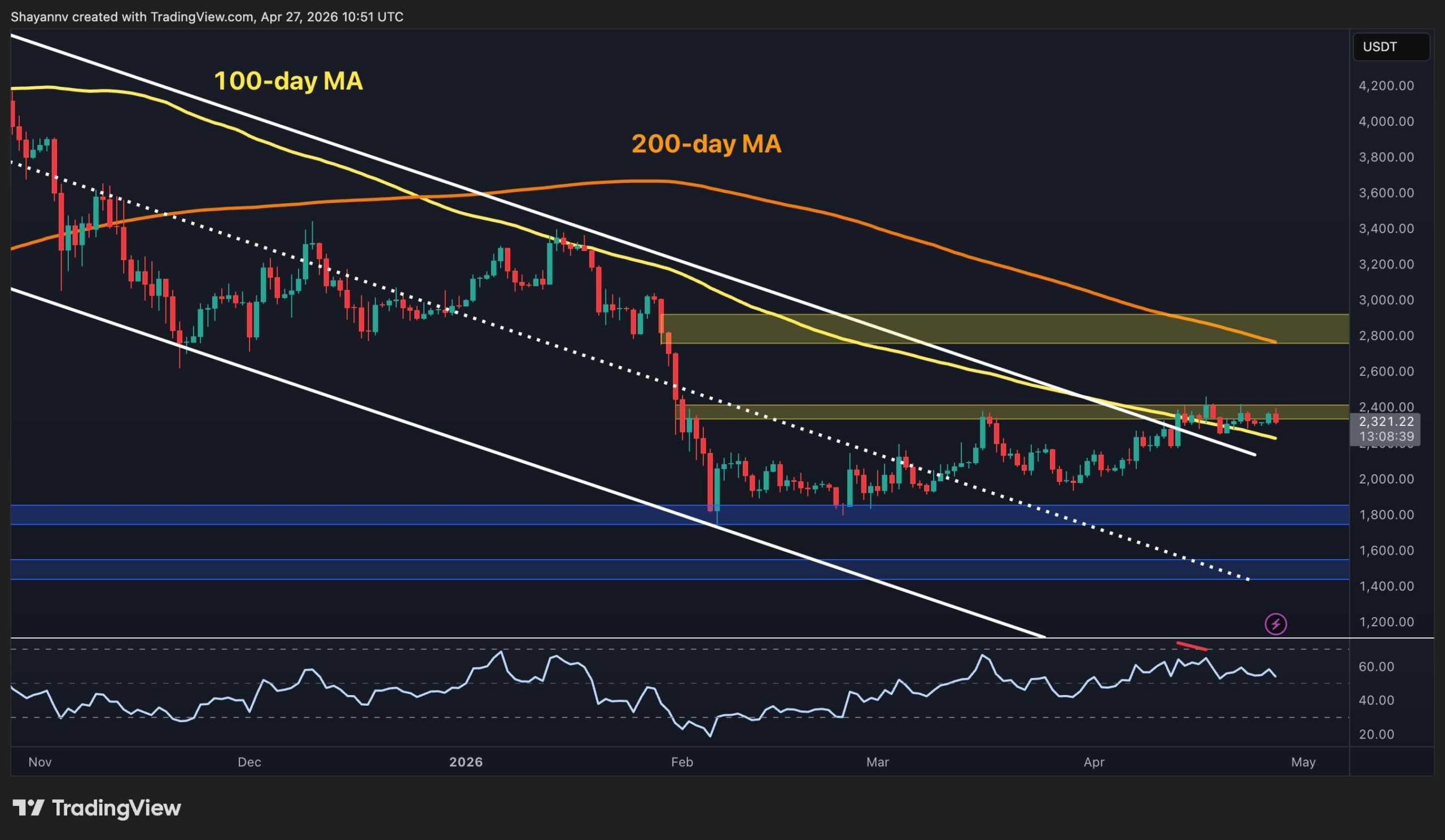
ETH/USDT 4-Hour Chart
On the 4-hour chart, a steep ascending trendline that emerged from the late-March lows is now providing dynamic support near $2.3k, keeping the short-term structure of higher lows intact. ETH is currently sitting directly on that trendline, with the RSI dropping to mid-40s following the most recent pullback from $2.4k.
At the moment, the most notable event is the trendline being tested near the $2.3k mark. Holding it keeps the bullish sequence alive and sets up another attempt at $2.4k, while a close below it opens $2.1k-$2k as the next area of interest. A breakdown of the trendline, followed by a close below the recent significant lows at $2.25k, would be the signal that a deeper pullback is coming once more.

On-Chain Analysis
Unlike Bitcoin, where funding rates have been persistently and deeply negative throughout the recent dataset, Ethereum’s funding picture is more mixed. The current reading of -0.0044 is negative, but the chart shows that ETH’s funding has been oscillating between modestly negative and modestly positive for much of April, rather than sustaining the unrelenting red bar dominance seen on Bitcoin’s equivalent chart.
This distinction matters. It suggests ETH’s derivatives market is not as aggressively short-positioned as Bitcoin’s, which means the potential short squeeze fuel that exists for BTC is less pronounced for ETH. On one hand, this reduces the risk of a violent downside flush if price breaks lower.
On the other hand, it means ETH will not benefit as dramatically from a forced short-covering cascade if the broader market rallies sharply. The more neutral funding environment reflects a market that is genuinely uncertain about ETH’s direction rather than one that is actively fighting a trend, and in that sense, the funding data is an honest mirror of the price action itself.

The post Ethereum Price Prediction: Most Significant Breakout Ahead or Another Painful Rejection? appeared first on CryptoPotato.
[PRESS RELEASE – Panama City, Panama, April 27th, 2026]
Founded by a King’s Counsel and a blockchain strategist, the company introduces a unified financial ecosystem for the over a billion adults left behind by legacy financial systems
Fuutura, a blockchain infrastructure company building a compliance-first financial ecosystem for the global market, today announced its official launch. Founded by Oliver Cook KC and Ellis McGrath, Fuutura launches with three integrated products designed to replace the fragmented financial infrastructure that prevents over a billion adults from fully participating in global financial markets.
Across the Global South, governments are writing digital asset frameworks for the first time. Fuutura has been built with this shift already in mind. The architecture is designed to be visible to regulators by default, with KYC and AML sitting within the protocol itself. Fuutura welcomes the inspection that responsible oversight requires.
Traditional financial systems were designed for specific markets, specific participants, and specific moments in financial history. According to the World Bank’s Global Findex 2025, 1.3 billion adults remain entirely excluded from the formal financial system – yet 900 million of them already own a mobile phone, and more than half have smartphones. The infrastructure to reach these populations exists and is growing. The financial architecture to serve them has never been built.
Fuutura’s answer is a compliance-first financial ecosystem built as a single connected platform. The ecosystem launches with three integrated products: Fuutura Identity, a reusable digital identity and KYC system that verifies once and works across the entire ecosystem; Fuutura Wallet, a non-custodial multi-chain wallet for storing, sending, receiving, and swapping digital assets; and Fuutura Trade, a digital asset exchange built to trade a significant depth of instruments across crypto, stablecoins, and tokenised real-world-assets.
Every product within the ecosystem is built around compliance from the protocol layer up, with KYC and AML integrated into the architecture rather than added as an afterthought.
“The financial systems that exist today were built to serve markets that already had the infrastructure to support them. Across the Global South, enormous populations have real demand for financial tools they simply cannot access. Fuutura is building the infrastructure that was always supposed to exist for them, built around compliance from the ground up and designed to support regulatory oversight as it develops.
Oliver Cook KC, Co-founder and Chief Legal Officer, Fuutura
“The same financial instruments available to people in developed markets should be available to anyone. We have built everything in-house, which means we are not dependent on third parties and we are not asking users to piece together a financial life from disconnected services. One ecosystem, genuinely accessible, with compliance built in from the start.”
Ellis McGrath, Co-founder and Chief Technology Officer, Fuutura
Fuutura is building for a market that existing financial infrastructure was never designed to serve. The company’s launch marks the beginning of a phased rollout, with further ecosystem development planned as the platform scales across the Global South and beyond.
About Fuutura
Fuutura is a blockchain infrastructure company building a compliance-first, accessible financial ecosystem for a global market. The platform brings together a reusable digital identity layer, a non-custodial multi-chain wallet, and a digital asset exchange spanning cryptocurrencies, stablecoins, and tokenised real-world assets. Identity verification and compliance attestation are built into the base architecture. Fuutura is designed to be open to regulatory oversight from the protocol layer up. We believe financial participation should be accessible to everyone, and we are building the infrastructure to make that possible.
Media Contact:
Fuutura
pr@fuutura.com
Forward-Looking Statements and Risk Disclosures
Digital asset risk. Digital assets are high-risk and their value may fall as well as rise. Trading digital assets involves significant risk and may not be suitable for all investors. Past performance is not a reliable indicator of future results.
Forward-looking statements. This press release contains forward-looking statements regarding Fuutura, its technology, products, business plans and future conduct, including statements relating to the phased rollout of the ecosystem, regulatory engagement and licensing outcomes, geographic expansion, and market ambitions. Forward-looking statements are identifiable by words such as “building,” “plans,” “intends,” “expects,” “designed to,” “anticipates” and similar expressions, as well as by statements regarding future outcomes, ambitions or strategic direction.
Forward-looking statements are not guarantees of future performance and are subject to risks, uncertainties and assumptions that could cause actual outcomes to differ materially from those expressed. These include, without limitation, changes in the regulatory environment across jurisdictions; the availability and timing of licensing or authorisation; developments in digital asset markets; technological and cybersecurity risks; operational risks; counterparty and third-party risks; the pace of product development; and other factors beyond Fuutura’s control.
No offer or advice. Nothing in this press release constitutes an offer to sell, a solicitation to purchase, investment advice, or a recommendation in respect of any digital asset, crypto-asset, token, security, or financial product or instrument. Fuutura’s products and services may not be available in all jurisdictions and may be subject to regulatory restrictions. Access to Fuutura’s platform is restricted to residents of jurisdictions where its services are permitted.
No duty to update. Fuutura undertakes no obligation to update or revise any forward-looking statement, whether as a result of new information, future events or otherwise, except as required by applicable law.
This release is not for distribution in the United States, the United Kingdom, the European Union, or in any other jurisdiction where such distribution would be unlawful.
The post Fuutura Launches as Blockchain Infrastructure Company Building a Compliance-First Financial Ecosystem appeared first on CryptoPotato.


