Cryptocurrency Posts
Crypto Briefing
The integration of S&P 500 perpetual trading on Hyperliquid signifies a pivotal shift towards merging traditional finance with decentralized markets.
The post S&P 500 perpetual trading goes live on Hyperliquid with S&P DJI license appeared first on Crypto Briefing.
Rising PPI signals persistent inflation, potentially impacting monetary policy and market stability, influencing Bitcoin's volatility.
The post US PPI rises 0.7% in February, Bitcoin falls toward $72,000 appeared first on Crypto Briefing.
Whale Bitcoin transfers to exchanges may signal increased market volatility, impacting investor sentiment amid key economic policy decisions.
The post Whales move over 44,000 Bitcoin to exchanges ahead of Fed meeting appeared first on Crypto Briefing.
Moody's integration of credit insights into blockchain enhances transparency and efficiency, potentially transforming digital financial markets.
The post Moody’s brings trusted credit insights to blockchain networks with Token Integration Engine appeared first on Crypto Briefing.
A stablecoin yield compromise could reshape financial competition, impacting banks and boosting digital asset adoption if regulatory clarity is achieved.
The post Tim Scott expects stablecoin yield compromise proposal by week’s end appeared first on Crypto Briefing.
Bitcoin Magazine
Bitcoin Magazine

Breez SDK Launches Passkey Login for Seedless Bitcoin Wallets
Breez, a lightning service provider and Bitcoin software lab, has introduced Passkey Login into its Breez SDK. The feature allows developers to build self-custodial wallets that use passkeys for authentication and key derivation, eliminating the traditional seed phrase requirement during normal use.
Seed phrase support remains available for users who prefer it, keeping backwards compatibility with industry standards, but removing the “speed bump” in Bitcoin wallets, which prompts users to back up their 12 words.
Breez explained the rationale behind this new feature in a press release shared with Bitcoin Magazine: “The seed phrase has been a barrier to self-custody since day one. It’s what scares normies away from keeping their own bitcoin, and it’s a legitimate reason why people accept the counterparty risk of exchanges and custodial apps.” Adding that “Passkey Login doesn’t eliminate the tradeoffs of self-custody, but it reframes them around something people already understand and use, namely the same biometric authentication that protects their banking app and their password manager. For most users, that’s a much more intuitive security model than a piece of paper in a drawer.”
Passkeys: Per-Site Key Pairs in Modern Hardware
Passkeys — a fairly new security standard that is gaining broad adoption online — are cryptographic credentials based on the FIDO2 WebAuthn standard, jointly promoted by Apple, Google, Microsoft, and the FIDO Alliance since 2022. Each passkey consists of a unique public-private key pair generated for a specific website or application.
The private key remains stored in the secure element or similar hardware on the user’s device, such as Apple’s Secure Enclave, Android’s Titan chip, Windows TPM, external security keys like YubiKey or the user’s password manager.
Normal online Passkeys resemble the original Bitcoin wallet.dat file introduced by Satoshi Nakamoto in his early releases of the Bitcoin client, where private keys are stored locally to the user’s device, while public keys are shared with third parties.
However, the FIDO2 standard implements this private-public key idea in a more standardised and modern way. Websites send a challenge to the user, referencing the user’s known public key for that account. The challenge message is signed by the user’s private key, authenticating their identity in a privacy-preserving way. Each service gets a different public key for the same user, so data compromised on one website does not leak data that can be used to access other websites, nor does it contain any user-identifying data.
FIDO2 is now widely adopted, it leverages device secure elements, integrates with password managers (e.g., iCloud Keychain, Google Password Manager), browsers, and the World Wide Web Consortium (W3C) WebAuthn API. Authentication occurs via challenge-response signing, with the private key bound to the domain to resist phishing.
Passkeys support biometric unlock (Face ID, fingerprint, PIN) and sync across devices within an ecosystem (e.g., via iCloud or Google)—over a billion activations reported by the FIDO Alliance as of mid-2025, with support on major platforms and many top websites.
FIDO2 was not Good Enough for Bitcoin Wallets
Standard passkeys excel at authentication (proving identity to a service) but were missing key functionality needed by the modern Bitcoin industry.
Bitcoin self-custody typically relies on a single source of entropy (seed phrase) to generate all addresses and keys in a deterministic way, via standards like BIP-39. Users expect those 12 words alone to be enough to recover all balances and accounts on a Bitcoin wallet. The Passkey standard needed to be extended to support this use case.
Breez’s Solution: Leveraging the PRF Extension
Breez addresses this by using the Pseudo-Random Function (PRF) extension in WebAuthn Level 3. PRF enables a passkey to produce a deterministic cryptographic output for any given input during authentication.
As described in Breez’s announcement materials, “That’s what the PRF extension of WebAuthn solves, and it’s the key ingredient in Passkey Login. PRF is a newer capability, part of the WebAuthn Level 3 spec, that lets your passkey produce a deterministic cryptographic output for any given input. Same passkey, same input, same output. Always. The passkey never leaves your device’s secure enclave.”
Device Loss and Recovery
If a device is lost, recovery depends on the platform used to store the passkey. Synced passkeys — via iCloud Keychain, Google Password Manager, etc — restore on a new device after regaining access to the associated account.
Breez provides an optional backwards-compatible path: users can export a normal 12-word, BIP-39 mnemonic for their wallet, so they can recover their account in other Bitcoin wallets, following industry standards. The press release adds that “Passkeys also aren’t fully interoperable across platforms yet. If you ever need to move to a platform or wallet that doesn’t support passkeys, you have a standard seed phrase to fall back on.”
The full technical specification for Passkey Login is public, and a reference app called Glow demonstrates the feature. Breez positions this as a step toward making Bitcoin self-custody more accessible by aligning with familiar biometric authentication used in banking and password managers, while preserving non-custodial control. Developers integrating the Breez SDK can now offer onboarding without the traditional “write down these words” step for supported environments.
The full technical specification for Passkey Login is public, and our reference app Glow is already running it, and it’s now available for all the Breez SDK devs to use.
This post Breez SDK Launches Passkey Login for Seedless Bitcoin Wallets first appeared on Bitcoin Magazine and is written by Juan Galt.
Bitcoin Magazine
SEC, CFTC Declare Most Crypto Assets Not Securities in Landmark Guidance
U.S. regulators took a decisive step toward reshaping crypto oversight yesterday, with the Securities and Exchange Commission and the Commodity Futures Trading Commission jointly issuing new guidance that states most digital assets are not securities.
The 68-page interpretation, released Tuesday, outlines how federal securities laws apply to cryptocurrencies and introduces a formal classification system for different types of tokens. The move marks a shift in tone and policy from prior years, when regulators often relied on enforcement actions and broad interpretations of securities law.
SEC Chair Paul Atkins framed the change as a return to clarity and statutory limits.
“After more than a decade of uncertainty, this interpretation will provide market participants with a clear understanding of how the Commission treats crypto assets,” he said. Speaking at the DC Blockchain Summit in Washington, Atkins added, “We’re not the ‘securities and everything commission’ anymore.”
At the center of the guidance is a “token taxonomy” that divides digital assets into several categories. According to the agencies, stablecoins, digital commodities, and “digital tools” are not securities.
Digital collectibles, including tokenized representations of art, media, or cultural items, also fall outside securities classification.
JUST IN:
— Bitcoin Magazine (@BitcoinMagazine) March 17, 2026SEC Chair Paul Atkins announces that "digital commodities, digital collectables, digital tools and payment stablecoins" are not securities. pic.twitter.com/UZr5pTarg1
Only one category, described as “digital securities,” remains subject to traditional securities laws. These are assets that mirror existing financial instruments, such as equities or debt, but are issued and traded using blockchain infrastructure.
The framework attempts to resolve a long-running debate over how to apply the SEC v. W.J. Howey Co. standard, known as the Howey Test, to crypto markets. That test determines whether a transaction qualifies as an investment contract based on expectations of profit derived from the efforts of others.
Under the new interpretation, a digital asset that is not inherently a security can become one if it is marketed as an investment in a common enterprise with promises of profit tied to managerial efforts. The guidance also clarifies that such a designation is not permanent. Once those promises are fulfilled or no longer relevant, the asset may cease to be treated as a security.
The agencies also addressed specific crypto activities that have drawn regulatory scrutiny. Protocol mining, staking, and certain airdrops do not constitute securities transactions under the new framework. The guidance states that airdrops, in particular, may not meet the “investment of money” requirement under the Howey Test.
JUST IN:
— Bitcoin Magazine (@BitcoinMagazine) March 17, 2026
that Bitcoin mining rewards are labeled under "protocol mining" as not securities. pic.twitter.com/7AefkMpoCk
The CFTC endorsed the interpretation and aligned its approach with the SEC, signaling closer coordination between the two regulators. CFTC Chair Mike Selig said the joint effort reflects a broader push toward regulatory “harmonization” and provides a clearer path for market participants.
The announcement stands in contrast to the approach taken under former SEC Chair Gary Gensler, whose tenure was defined by enforcement actions against major crypto firms and a view that many tokens qualified as securities. Industry participants often criticized that strategy as “regulation by enforcement,” arguing it created uncertainty and limited innovation.
The new guidance acknowledges those concerns, stating that prior efforts did not fully address the unique characteristics of digital asset markets. It positions the taxonomy as a foundation for a more tailored regulatory framework that can support both compliance and technological development.
More crypto proposals are coming
Despite its scope, the interpretation does not carry the force of formal rulemaking. Atkins said the SEC plans to introduce additional proposals in the coming weeks, including an “innovation exemption” aimed at giving crypto firms more flexibility while maintaining investor protections.
Lawmakers in Congress are also working on legislation to establish a comprehensive market structure for digital assets. Regulators indicated that statutory changes will be needed to make the new approach permanent.
For now, the guidance sends a clear signal that U.S. regulators are redefining their stance on crypto. By narrowing the definition of what constitutes a security and outlining specific categories, the SEC and CFTC have moved to provide the clarity that industry participants have sought for years.
The shift may reshape how crypto businesses operate in the United States, with regulators emphasizing defined boundaries over broad enforcement.
This post SEC, CFTC Declare Most Crypto Assets Not Securities in Landmark Guidance first appeared on Bitcoin Magazine and is written by Micah Zimmerman.
Bitcoin Magazine
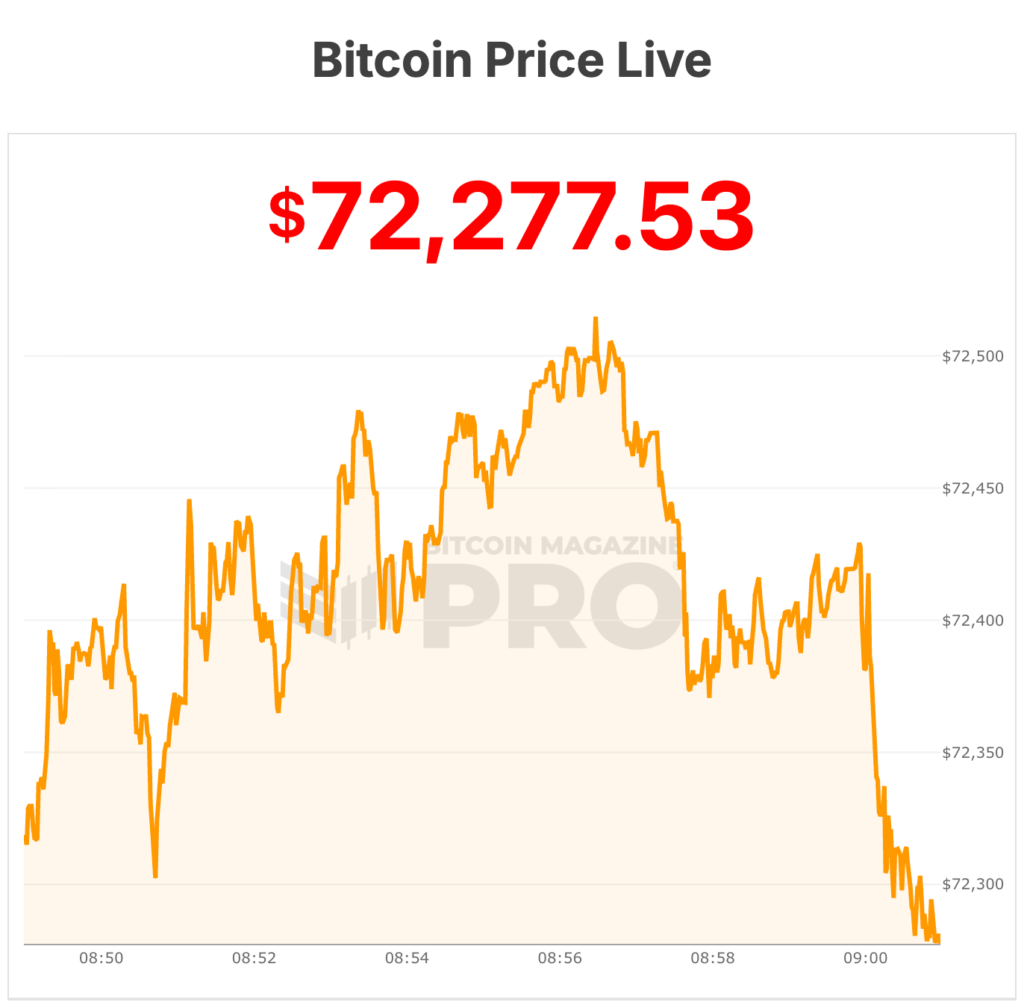
Bitcoin Price Falls to $72,000 as Fed Uncertainty Triggers Pullback
Bitcoin price dropped to the low $72,000 range early Wednesday, retreating from recent highs as traders reduced risk ahead of the Federal Reserve’s latest decision.
The pullback follows a strong multi-day rally that pushed the asset close to $75,000, its highest level since early February. That move has now stalled. Profit-taking has increased, and market participants appear reluctant to open new positions without clarity on macro conditions.
Trading activity reflects the shift in sentiment. Daily volume has declined sharply, signaling weaker conviction behind recent price action.
In derivatives markets, futures open interest has flattened while funding rates have turned mixed to slightly negative, pointing to a more defensive positioning.
Traders who were forced out of short positions during the rally have largely stayed on the sidelines, waiting for a clearer trend.
The Federal Reserve meeting later on Wednesday remains the central focus.
The Federal Reserve is expected to hold interest rates steady as it assesses how rising oil prices tied to the Iran conflict could impact inflation and economic growth. Markets now anticipate rate cuts later in the year, while Chair Jerome Powell is likely to signal a cautious, wait-and-see approach alongside new economic projections.
Markets are pricing in a near-certain pause in interest rates, but uncertainty around inflation and economic growth continues to weigh on risk assets.
Oil prices near $100 per barrel, driven by ongoing conflict in the Middle East, are adding upward pressure on inflation. At the same time, softer U.S. labor data complicates the outlook, reducing the likelihood of aggressive rate cuts in the near term.
Bitcoin price’s recent behavior around Fed meetings adds to the caution. Historical data shows the asset has often declined in the immediate aftermath of policy announcements, regardless of the outcome.
Bitcoin price resilence
Despite the short-term weakness, Bitcoin price has shown resilience on a broader timeframe. Since late February, the asset has gained while traditional markets like equities and gold have struggled.
Analysts attribute this divergence to continued inflows into spot Bitcoin exchange-traded funds and sustained accumulation from institutional players, which have helped reshape the asset’s ownership structure.
However, signs of potential selling pressure are emerging. On-chain data shows a rise in Bitcoin moving onto exchanges, often a precursor to distribution.
At the same time, analysts highlight the $75,000 to $85,000 range as a significant resistance zone, where previous rallies have stalled.
For now, Bitcoin price appears to be consolidating as markets wait for direction. The outcome of the Fed meeting, and more importantly, the tone of its guidance, is likely to determine whether the current pullback deepens or sets the stage for another attempt higher.
This post Bitcoin Price Falls to $72,000 as Fed Uncertainty Triggers Pullback first appeared on Bitcoin Magazine and is written by Micah Zimmerman.
Bitcoin Magazine
STRC: The Global Bitcoin Dollar Cost Average
If you haven’t already, please read my last research note about takeaways from Strategy World 2026. I cover a wide range of things there, and today I want to narrow in on what I believe is the most important Bitcoin development in the last year: STRC.
STRC and Volatility
Strategy designed STRC as a variable-rate financial instrument intended to maintain a fixed market price of $100. If STRC’s trading range falls below $100, Strategy is committed to increasing the dividend payout, incentivizing bids back to the $100 target. Conversely, if STRC trades above $100, Strategy uses its At-The-Market (ATM) offering to sell more shares or reduce the dividend, allowing the price to adjust back to $100.
This financial engineering substitutes price volatility with yield volatility. Given the market’s preference for price stability, Strategy created an instrument with stable pricing but variable yield. As market confidence in Strategy’s ability to manage the peg via the dividend improves, one would expect the frequency of dividend adjustments to decrease. This creates a positive feedback loop: price stability and high trading volume facilitate Strategy’s ability to sell substantial quantities of STRC.
The result of a stable $100 price and an active at-the-market offering is a mechanism for global Dollar Cost Averaging (DCA) into Bitcoin that operates—at the margins—independently of Bitcoin’s spot price. This is a very big deal.
Explaining Dollar Cost Averaging
Dollar Cost Averaging (DCA) is a straightforward concept: averaging the dollar-denominated cost basis of an asset acquisition. It is usually implemented by committing a fixed dollar amount to purchase an asset at regular intervals, regardless of the price. This method acquires more units when prices are low and fewer when prices are high. This generally imparts a marginal downward bias on the long-term cost basis, provided the asset exhibits reasonable volatility.
Strategy’s Bitcoin Financing So Far
Prior to STRC’s $100 price stabilization, Strategy often acquired Bitcoin at local price peaks. This occurred because all its existing financing vehicles positively correlated with the BTC spot price. For example, MSTR common stock trades as a high-beta proxy for BTC. Thus, when BTC significantly rises, selling MSTR raises substantial financing. However, this dynamic meant that capital for BTC acquisition became available precisely when BTC’s price was at local highs.
Other preferred instruments largely exhibited similar behavior. When BTC was strong, credit spreads narrowed. When BTC was weak, preferred shares typically sold off. Although these are fixed income instruments that theoretically should have been less correlated, a practical correlation persisted nonetheless.
STRC changes this dynamic.
As long as sufficient volume is maintained at or above the $100 price point, Strategy can continuously raise capital by issuing STRC. The market’s reliance and fervent desire for price stability creates a financing instrument uncorrelated with the price of BTC.
Specifically, fundraising via STRC is correlated with STRC volume rather than with BTC price action. This is a significant breakthrough, facilitating a “global DCA” into BTC.
STRC as the Global Bitcoin Dollar Cost Average
A stable-price asset offering an 11.5% yield naturally attracts global interest. So let’s follow the trail. Investors acquire STRC. Strategy then uses these funds to purchase BTC. Although the investors’ capital was not explicitly designated for BTC, it is ultimately channeled into BTC acquisition.
Demand for an instrument like STRC arises—at its margins—independently of the price of BTC. Therefore, the resulting financing activity and subsequent BTC purchases remain unaffected by BTC price fluctuations. This is the core characteristic of a dollar cost averaging program.
Crucially, the funds for this DCA originate from the collective savings of entities seeking STRC’s attributes. This demographic likely includes much of the global population. The only remaining challenge is distribution. Currently, Strategy can sell STRC to anyone with a standard U.S. brokerage account. The development of Layer 3 “Digital Money” products (discussed in the prior research note) built on the STRC foundation has the potential to broaden distribution substantially. Other things like investor education, marketing, market maturity, and an instrument-level credit rating can also help. These expansions would increase the magnitude of the global DCA funnel.
What is remarkable is that Bitcoin alone could never have achieved this type of broad demand. Bitcoin is evidently deemed by most entities to be too volatile or complicated or uncertain. What was needed was a corporation that could bear the volatility risk of BTC and provide a stable return profile in the form of a credit instrument. This instrument would be widely attractive and receive regular investment from a broad scope of investors, allowing the corporation to create a Bitcoin DCA by proxy. This is the essence of what STRC enables.
Some Caveats
I used the term “at margins” repeatedly for a reason. While STRC maintains price stability, this stability is contingent upon BTC continuing to generate favorable returns. If BTC’s return falls below the STRC yield rate, Strategy’s common equity investors are basically covering this difference via a combination of dilution and multiples compression. There is a limit to the losses that can be absorbed by common equity before the company’s ability to sustain the STRC instrument is jeopardized. STRC functions as a global Bitcoin DCA only as long as the underlying asset (BTC) performs well. This is an important caveat.
Furthermore, stability is maintained primarily in market conditions absent of complete “panic” surrounding BTC. Events like February 5 2026, or mid-November 2025, which saw significant and violent BTC drawdowns, resulted in temporary STRC sell-offs. Historical evidence therefore confirms that STRC exhibits some downside correlation to BTC during periods of extreme market duress. These types of market regimes do challenge the viability of a “global Bitcoin DCA” concept. At the very least, it is possible that this DCA will be temporarily disrupted if enough sellers push the price below $100.
Conclusion
The realization of a global DCA through STRC is in its early stages. Last week, Strategy issued over $1.1 billion through the STRC ATM program—an unprecedented magnitude for preferred stock in capital markets history.
It is interesting to consider how long BTC can remain below its all-time highs if an increasing number of entities participate in the global Bitcoin DCA by adopting STRC.
Disclaimer: This content was written on behalf of Bitcoin For Corporations. This article is intended solely for informational purposes and should not be interpreted as an invitation or solicitation to acquire, purchase or subscribe for securities.
This post STRC: The Global Bitcoin Dollar Cost Average first appeared on Bitcoin Magazine and is written by Allard Peng.
Bitcoin Magazine

From $5 to $75,000: Bitcoin’s Saint Patrick’s Day Prices Shows You the Wild Ride of Bitcoin
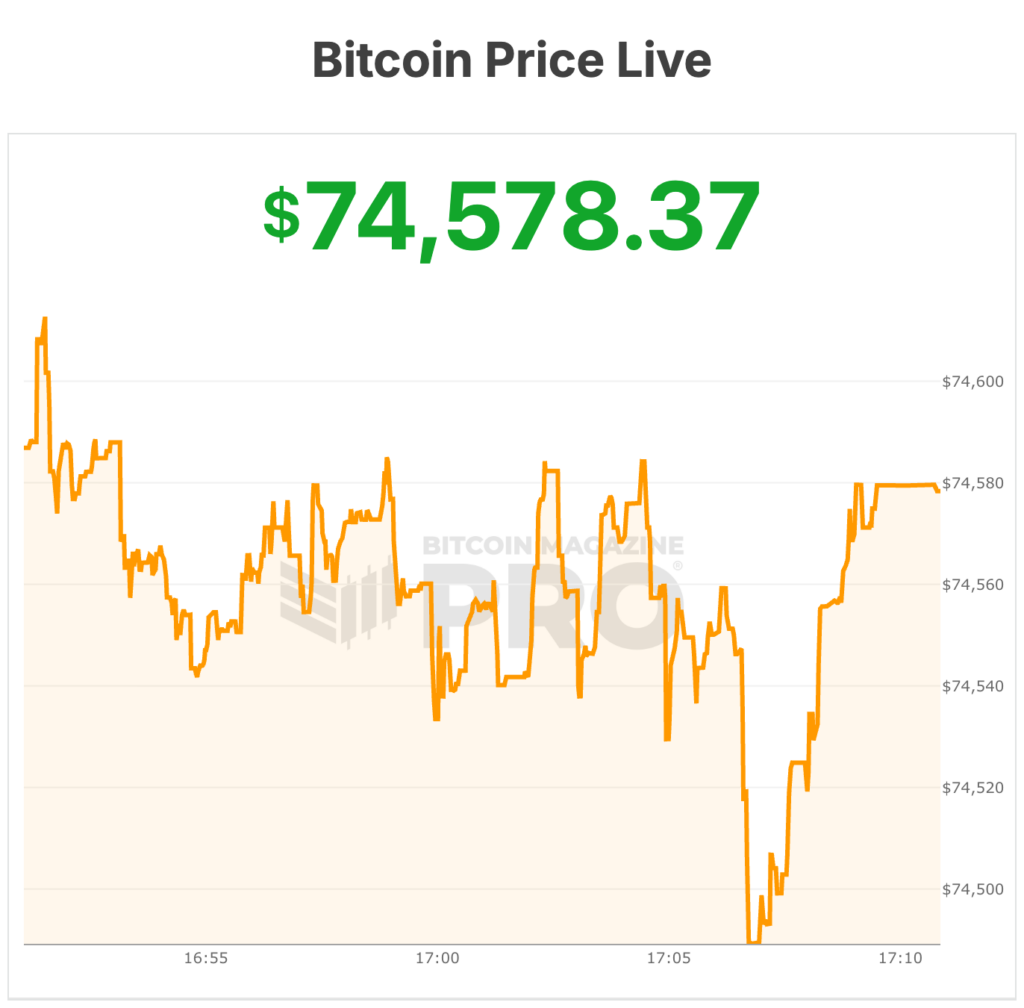
Bitcoin’s rise from an obscure digital asset to a global financial instrument is again in focus this St. Patrick’s Day. On March 17, 2012, Bitcoin traded near $5. Thirteen years later, it has reached roughly $75,000.
This is a massive expansion driven by increasing demand and a fixed supply model.
Bitcoin’s early years were defined by sharp price swings and thin liquidity. In 2013, the asset surged from under $50 to more than $600 before retracing below $300 by 2015.
These cycles repeated over time, with each rally followed by a correction.
In 2017, Bitcoin crossed $1,000 and later accelerated higher before entering another downturn. By 2021, it had climbed past $50,000 as institutional participation began to take shape. Pullbacks in 2022 and 2023 tested conviction, but the broader trend remained intact.
In late 2025, BTC surged above $125,000 before pulling back to $60,000 earlier this year.
Each cycle introduced new participants and strengthened market infrastructure, contributing to a more resilient asset over time.
Historical Bitcoin prices on Saint Patrick's Day
— Bitcoin Magazine (@BitcoinMagazine) March 17, 2026
2012 $5.34
2013: $47
2014: $630
2015: $290
2016: $417
2017: $1,180
2018: $8,321
2019: $4,047
2020: $5,002
2021: $56,825
2022: $41,140
2023: $26,876
2024: $68,845
2025: $83,223
2026: $74,590
HODLpic.twitter.com/8LMFUGZkpX

Institutional access is growing despite Bitcoin’s fixed supply
One of the most significant developments in the current cycle is the expansion of institutional access. Spot Bitcoin exchange-traded funds in the United States have created a direct pathway for large pools of capital to enter the market.
These products have recorded sustained inflows, including single-day totals exceeding $500 million, reflecting strong demand from asset managers, pension funds and retail brokerage accounts. The result is a steady accumulation of BTC within regulated investment vehicles.
As more capital flows through these channels, available supply on exchanges has tightened, reinforcing upward pressure on price.
Bitcoin’s monetary policy continues to differentiate it from traditional assets. The protocol enforces a hard cap of 21 million coins, limiting total supply regardless of demand conditions.
This scarcity is reinforced through halving events, which reduce the rate of new issuance. The most recent halving in April 2024 cut block rewards from 6.25 BTC to 3.125 BTC, lowering the number of new coins entering circulation each day.
Historically, these supply shocks have preceded major upward moves, as reduced issuance meets sustained or increasing demand.
Corporate and traditional finance interest
Beyond financial markets, Bitcoin has gained traction among corporations and policymakers. Public companies have continued adding Bitcoin to their balance sheets, treating it as a reserve asset rather than a speculative position.
Most popular of all these is Strategy, the bitcoin treasury company led by executive chairman Michael Saylor. The company purchased another 22,337 bitcoin for about $1.57 billion last week, continuing one of the largest corporate accumulation strategies in the crypto market.
The acquisition brings the firm’s total holdings to 761,068 bitcoin. Strategy said its cumulative BTC holdings were acquired for roughly $57.61 billion at an average price of about $75,696 per coin.
The stash represents more than 3.4% of the fixed 21 million supply of BTC, reinforcing MSTR’s status as the largest corporate holder of the asset.
Bitcoin’s changing market structure
Bitcoin’s market structure is shifting as ownership consolidates among long-term holders, institutions and corporate buyers. This has reduced the influence of short-term speculation and improved overall stability, even as volatility persists.
Bitcoin has remained resilient through recent turbulence, supported by steady institutional demand and continued accumulation. Analysts point to a clear return of large buyers, with ETF inflows and spot demand helping push prices back above $70,000 after weeks of range-bound trading.
Data shows institutional conviction holding firm. Despite a sharp drawdown since late 2025, ETF outflows have remained limited compared to earlier inflows, signaling that investors are maintaining positions rather than exiting.
This growing base of committed capital reflects a broader shift. Institutional investors entering the market today tend to have high conviction, often allocating with a long-term view rather than reacting to short-term price moves.
Research also highlights the expanding role of ETFs and corporate treasury strategies in reshaping BTC ownership. Institutional vehicles now account for a meaningful share of supply, while a large portion of coins remains inactive, reinforcing the dominance of long-term holders.
At the same time, on-chain data suggests the market may be in a late-stage bear phase, historically tied to accumulation. Analysts say current conditions point to continued consolidation, with long-term investors positioning for the next cycle.
This post From $5 to $75,000: Bitcoin’s Saint Patrick’s Day Prices Shows You the Wild Ride of Bitcoin first appeared on Bitcoin Magazine and is written by Micah Zimmerman.
HTTP error 403 on https://cryptoslate.com/feed/
Failed to fetch feed: https://cryptoslate.com/feed/
Failed to fetch feed.
Cryptoticker
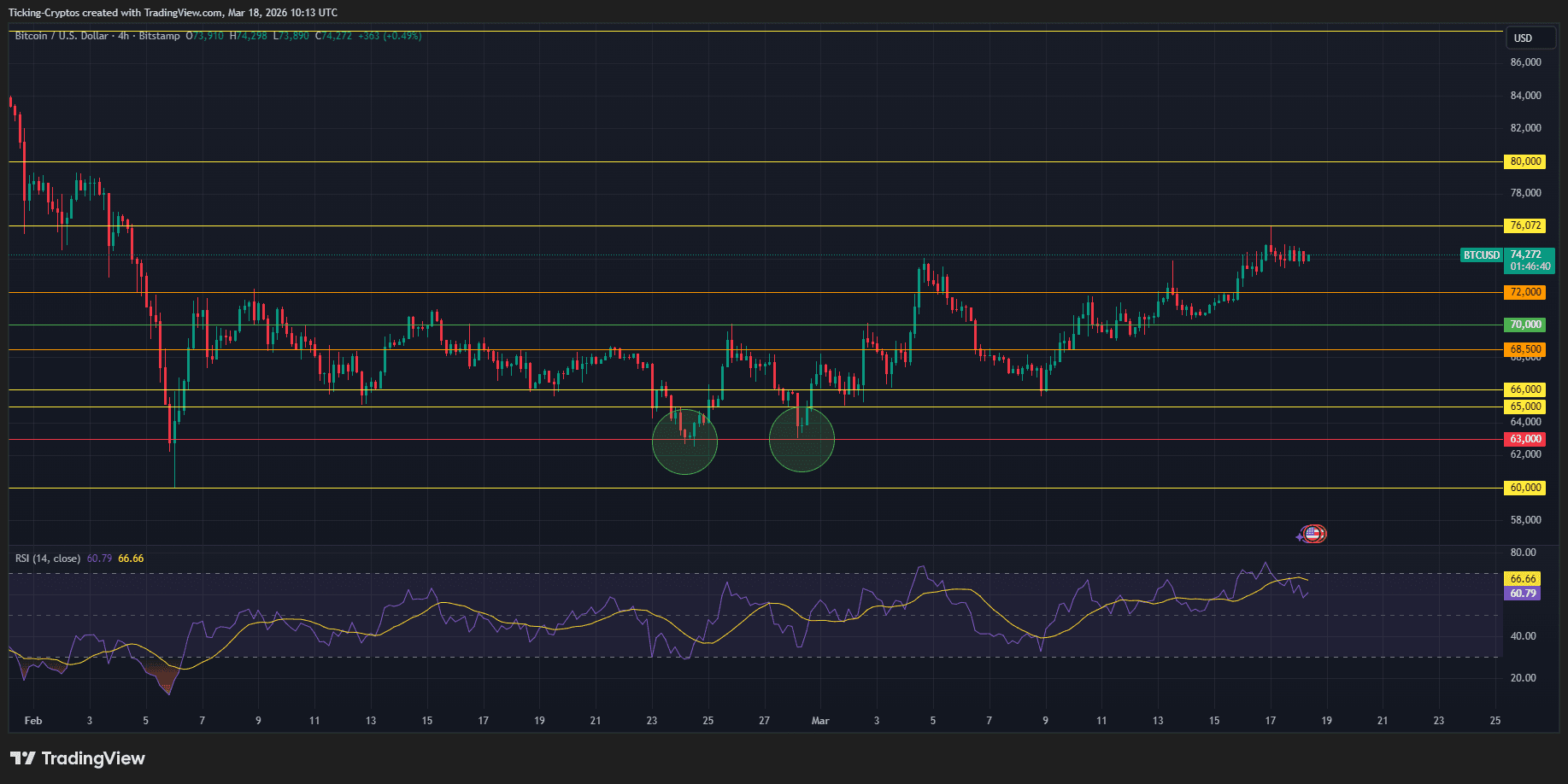
The Bitcoin price is currently navigating a high-stakes consolidation phase, trading at approximately $74,272 during the March 18, 2026, session. After a period of bearish dominance that saw the asset retreat from its 2025 record highs, the market is now testing the resilience of the $74,000 resistance zone.
Bitcoin Price Analysis: Why is BTC Price UP?
Analyzing the BTC/USD 4-hour chart, we observe several key technical patterns that define the current trend.
Double Bottom Recovery
The chart highlights two significant "troughs" (marked with green circles) near the $63,000 level. This Double Bottom formation served as a powerful reversal signal in late February and early March, allowing Bitcoin to climb back above the psychological $70,000 mark.
Key Resistance and Support Levels
The price action is currently sandwiched between tightly defined horizontal levels:
- Immediate Resistance: $74,500 – $76,000. A decisive break above this yellow-lined zone is required to target the next major hurdle at $80,000.
- Critical Support: $72,000. If the price fails to hold the $74,000 level, the green support line at $72,000 will be the first line of defense.
- Deep Support: $68,500 and $65,000. These remain the "must-hold" zones to prevent a return to the bear market lows seen earlier this year.
RSI and Momentum
The Relative Strength Index (RSI) is currently hovering around 60.79. While this indicates bullish momentum, the RSI has flattened significantly as the price approaches resistance. This suggests a "cooling off" period or a potential bearish divergence if the price makes a higher high while the RSI fails to follow suit.
Bitcoin News and Macro Catalysts
The broader crypto market is currently characterized by a "Fear" rating on the Sentiment Index (sitting at 26), despite Bitcoin's recent price recovery.
- The FOMC Factor: Traders are bracing for Federal Reserve Chair Jerome Powell’s comments. While interest rates are expected to remain steady, any hawkish rhetoric regarding inflation—driven by $100+ oil prices—could trigger a "sell the news" event for $BTC.
- Institutional Inflows: According to data from Bloomberg, spot Bitcoin ETFs saw a resurgence in March, with nearly $2.8 billion in net inflows, providing a structural floor for the recent rally.
- The Gold vs. Bitcoin Debate: As gold continues to trade near record levels above $5,000, Bitcoin's role as "Digital Gold" is being tested. Many analysts, including those at Fidelity Digital Assets, suggest that capital may rotate back into BTC if gold's parabolic move stalls.
Conclusion: What to Expect Next?
Bitcoin is showing "Experience" and "Expertise" in its ability to hold the $74,000 handle despite a heavy macro environment. However, the information density on the 4-hour chart suggests that the current range is exhausting.
If Bitcoin can flip $76,000 into support, a run toward $80,000 is the most likely scenario. Conversely, a rejection here, coupled with a hawkish Fed, could see a swift retest of the $68,500 support.
- Technical Note: Watch the 4-hour candle close. A close below $73,800 would signal a short-term breakdown, while a close above $75,100 validates the bullish breakout attempt.
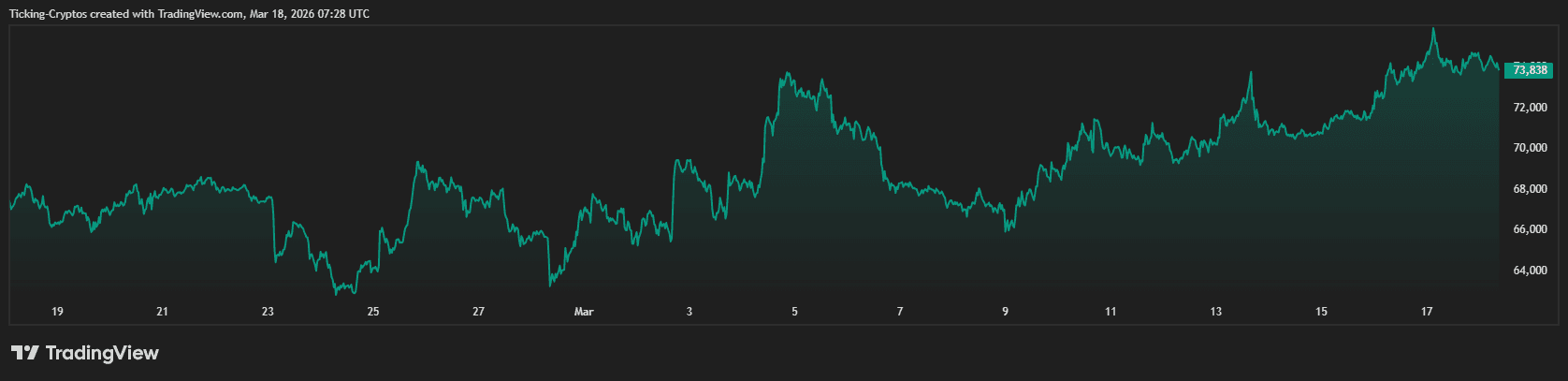
The crypto market in early 2026 has been nothing short of a rollercoaster. After the euphoric highs of late 2025, where Bitcoin flirted with the $130,000 mark, a "diffuse cocktail of macro anxieties" has sent prices into a steep correction. As of late mid-March 2026, $Bitcoin has retraced nearly 50% from its All-Time High (ATH), trading in above $73,000.
Is it a Good Time to Buy Crypto?
Historical cycles suggest that corrections of 50% to 70% are healthy "purges" that wipe out over-leveraged traders. With Bitcoin currently sitting at a 50% discount, the risk-to-reward ratio for March 2026 has shifted heavily in favor of the bulls.
As geopolitical tensions and tariff uncertainties stabilize, capital is expected to rotate back into "risk-on" assets. Investors who missed the 2025 rally now have a second chance to enter the market. If you are looking to build a portfolio, diversifying across these five projects offers a balance of stability, utility, and explosive recovery potential.
1. Ethereum (ETH) – The Infrastructure King
Despite the rise of "Ethereum killers," Ethereum remains the undisputed home of Decentralized Finance (DeFi) and Real-World Asset (RWA) tokenization. In 2026, the successful rollout of the "Prague" upgrade has further slashed Layer-2 costs, making the network more scalable than ever.
- Why Buy Now? ETH has followed Bitcoin’s slide, dropping from its 2025 high of $4,950 to under $2,000.
- The Catalyst: Major financial institutions like BlackRock and JPMorgan are increasingly using Ethereum for tokenized deposit pilots. At current prices, you are buying the "settlement layer of the internet" at a 60% discount.
2. Solana (SOL) – The Speed Demon
Solana has proven its resilience after the network reliability concerns of previous years. With the Firedancer upgrade now fully integrated in 2026, Solana can process over 1 million transactions per second.
- Status: While it reached $260 in the last bull run, SOL is currently trading significantly lower, creating a "gap" that savvy traders are eager to fill.
- Use Case: It has become the primary chain for consumer AI-crypto applications and high-frequency trading.
3. Chainlink (LINK) – The Oracle Essential
You cannot have a functional DeFi ecosystem without accurate data, and Chainlink owns 90% of that market. In 2026, its Cross-Chain Interoperability Protocol (CCIP) has become the standard for banks moving data between private and public blockchains.
- The Play: LINK often lags behind the initial BTC pump but rallies hard once the ecosystem matures. It is one of the most undervalued "blue-chip" utility tokens heading into March.
4. Sui (SUI) – The Emerging Contender
Sui has emerged as the breakout Layer-1 of the 2025-2026 cycle. Utilizing the Move programming language, it offers a level of security and parallel processing that older chains struggle to match.
- Growth Potential: Sui's Total Value Locked (TVL) has remained stable even during the February crash, suggesting a loyal and committed developer base. As the market recovers, SUI is positioned to be a top performer.
5. Fetch.ai (FET/ASI) – The AI Narrative
2026 is the year of "AI Agents." Fetch.ai, as part of the Artificial Superintelligence Alliance, is at the forefront of this movement. Their autonomous agents are now being used in logistics and decentralized energy grids.
- Why March 2026? The "AI plus Crypto" narrative is the strongest secular trend in the market. With FET down along with the broader market, it offers a high-beta play for those betting on the continued AI revolution.
Conclusion: Strategy for March 2026
Investing during a 50% Bitcoin drawdown requires a long-term mindset. While volatility may persist in the short term, the fundamental value of these projects remains unchanged. Consider using a regulated exchange to dollar-cost average into these positions throughout the month.
Vietnam is shifting from one of the world's most active unregulated crypto markets to a strictly controlled domestic ecosystem. According to reports from Reuters, the government in Hanoi is preparing to launch a pilot scheme for locally licensed digital asset exchanges while simultaneously drafting rules to ban citizens from using overseas platforms.
The Race for the First Vietnam Crypto License
Five major domestic entities have passed an initial qualification round to operate the country’s first legal exchanges. This move marks a significant transition for a nation that ranked fourth globally on the Chainalysis Global Crypto Adoption Index.
The qualified applicants include:
- Techcombank (TCB)
- VPBank (VPB)
- LPBank (LPB)
- VIX Securities
- Sun Group
Why Hanoi is Curbing Foreign Trading
The Vietnamese government’s primary concern is uncontrolled capital outflows. While the country has high crypto interest, most transactions currently occur on offshore servers, making it difficult for authorities to monitor wealth movement or collect taxes.
By forcing users onto local platforms, Hanoi aims to:
- Regulate Capital: Ensure trades are settled via local banking rails.
- Tax Revenue: Implement a structured tax framework for digital assets.
- Consumer Protection: Bring high-risk trading under the oversight of the Ministry of Finance.
Market Impact and Local Adoption
Currently, Vietnamese traders move over $200 billion annually in crypto. The new regulations will likely push this liquidity into the hands of major local financial institutions. However, digital assets are still not recognized as legal tender or a formal means of payment in the country.
Summary of New Vietnam Crypto Regulations
| Feature | New Policy |
|---|---|
| Foreign Exchanges | Planned ban for Vietnamese nationals |
| Local Exchanges | Pilot program for licensed domestic firms |
| Key Players | Major private banks (VPBank, Techcombank) |
| Objective | Combat capital flight and increase oversight |
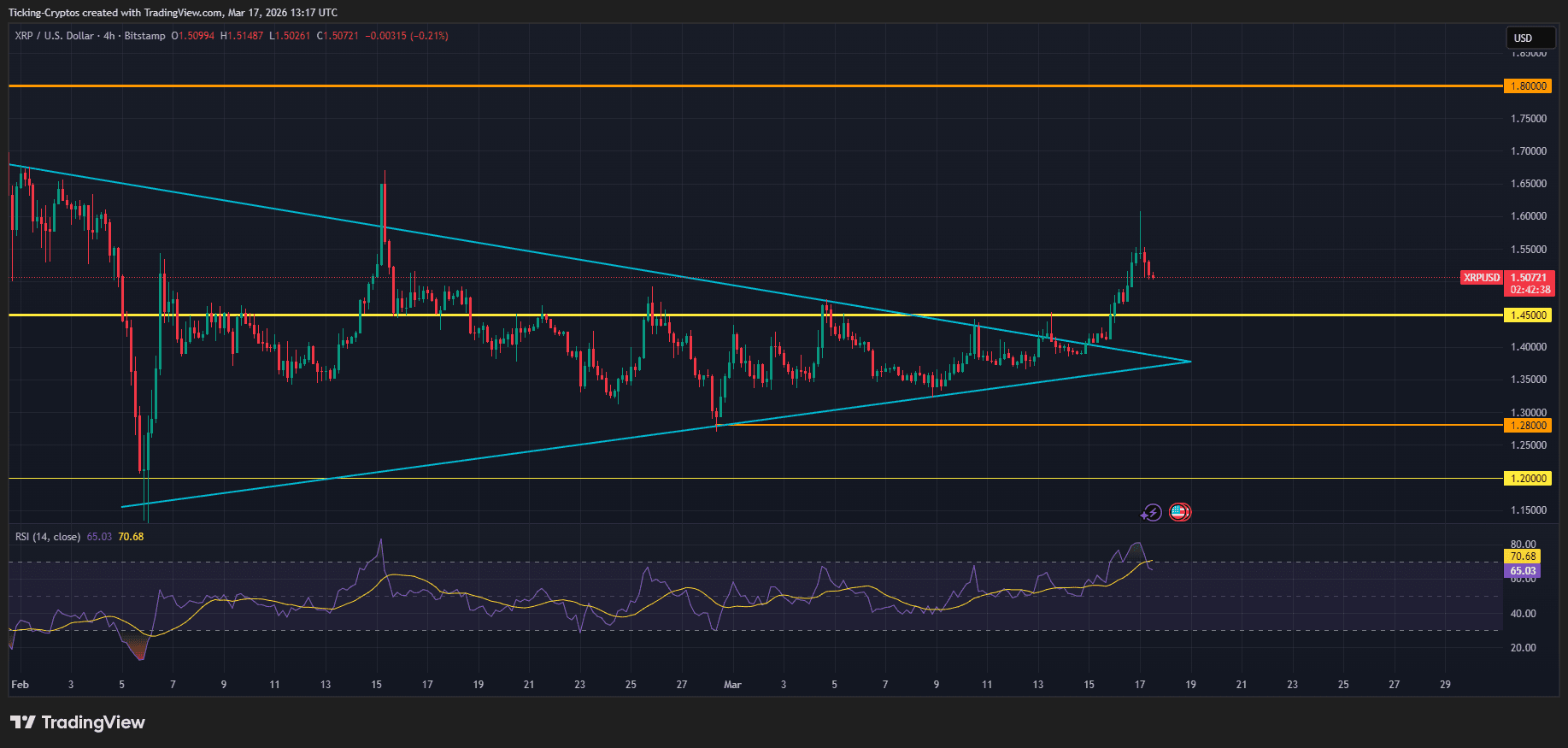
Ripple’s native token, $XRP, reclaimed the $1.50 price level. This move comes after weeks of tightening volatility, where the asset was compressed within a massive technical structure. As the broader crypto market shows signs of a renewed bullish cycle, XRP's recent price action suggests that the long-awaited move toward psychological resistance levels may be underway.
XRP Price Prediction: The Road to $2.00
The current technical setup confirms that XRP is targeting the $2.00 milestone. This projection is based on a "measured move" following the breach of a multi-week consolidation pattern. If XRP-USD can maintain its position above the $1.45 support zone, the next liquidity pocket sits between $1.85 and $2.10.
The Symmetrical Triangle
A symmetrical triangle is a chart pattern characterized by two converging trendlines connecting a series of sequential peaks and troughs. In XRP’s case, this pattern represented a period of "equilibrium" where buyers and sellers were in a deadlock. Typically, a breakout from this formation indicates that the prevailing trend—in this case, the bullish momentum from late 2025—is ready to resume with high volume.
The Breakout: How XRP Breached the Triangle
The most critical development in the recent XRP-USD price action is the upward breach from the triangle formation. Since February 2026, XRP has been making lower highs and higher lows, narrowing into an apex near the $1.38 mark.
On March 14, trading volume surged by over 300%, providing the necessary fuel for XRP to pierce the upper descending trendline. This "breach" was not merely a wick but was followed by a daily candle close above the resistance, effectively flipping it into a support floor. Technical analysts often view this specific type of exit from a triangle as a signal that the "accumulation phase" is over and the "markup phase" has begun.
Technical Indicators Supporting the $2 Target
Beyond the triangle breakout, several other indicators point toward a continued rally:
- Moving Averages: XRP is now trading comfortably above its 50-day and 200-day Exponential Moving Averages (EMAs).
- Relative Strength Index (RSI): The RSI is currently at 64, suggesting that while the asset is gaining strength, it is not yet "overbought" (which typically occurs above 70).
- Institutional Inflows: According to data from CoinShares, XRP-specific investment products have seen over $1.3 billion in cumulative inflows this year, providing the structural liquidity needed to sustain a move to $2.00.
Key Support and Resistance
| Level | Type | Significance |
|---|---|---|
| $1.38 - $1.42 | New Support | The previous triangle resistance now acts as a floor. |
| $1.56 | Current Pivot | XRP is consolidating here to build momentum for the next leg. |
| $1.80 | Minor Resistance | A historical supply zone from early 2026. |
| $2.00 | Major Target | The primary psychological and technical goal for the current rally. |
Ethereum (ETH) has bounced back strongly, rising more than 20% over the past eight days. While much of the market focused on Bitcoin’s volatility, Ethereum moved higher in the background. The rally is being driven by growing institutional interest and clearer regulatory support, two factors that are starting to change how major financial players approach the Ethereum network.
Why is Ethereum Price UP?
The recent Ethereum price pump is driven by a convergence of institutional liquidity and regulatory clarity. Specifically, the Federal Reserve's decision to allow tokenized securities as bank collateral and BlackRock’s launch of its iShares Staked Ethereum Trust (ETHB) have provided the necessary fundamental support for ETH to decouple from minor market corrections.
Tokenization and Staked ETFs
To understand why these developments are "game-changers," we must define the two pillars supporting this rally:
- Tokenized Securities: These are traditional assets (like stocks or bonds) represented as digital tokens on a blockchain.
- Staked ETFs: Unlike a standard spot ETF, a staked ETF (like ETHB) actually participates in the network's consensus, earning a "yield" or dividend for its shareholders by securing the network.
1. The Fed’s Green Light: Tokenized Assets as Collateral
On March 6, 2026, the Federal Reserve, alongside the OCC and FDIC, issued a landmark clarification. U.S. banks are now officially permitted to use tokenized securities as collateral for loans.
Why This Matters for Ethereum
Regulators confirmed that as long as the tokenized version confers the same legal rights as the traditional asset, it will receive the same capital treatment. Crucially, the Fed stated this applies regardless of whether the blockchain is permissioned or permissionless (public).
- Liquidity Influx: Trillions of dollars in "off-chain" value (Treasuries, equities) can now migrate to Ethereum.
- Ethereum as the "Settlement Layer": Since Ethereum remains the dominant hub for Real-World Assets (RWAs), this ruling cements $ETH role as the global plumbing for modern finance.
2. BlackRock’s ETHB: The First Dividend-Paying Crypto ETF
On March 12, 2026, BlackRock launched the iShares Staked Ethereum Trust (ticker: ETHB). While the market already had spot ETH ETFs, ETHB is the first from a major issuer to offer staking rewards directly to shareholders.
Key Features of ETHB:
- Yield Generation: The fund stakes between 70% and 95% of its holdings.
- Monthly Distributions: Investors receive monthly cash payouts, similar to a high-yield dividend stock.
- Institutional Infrastructure: BlackRock partnered with Figment and Coinbase Prime to manage the validator sets, bringing "Enterprise-Grade" security to the staking process.
"The ETHB launch transforms Ethereum from a speculative commodity into a productive, yield-bearing asset for the average 401k investor." — Market Insight
Comparison: Spot ETH vs. Staked ETH ETFs
| Feature | Spot ETH ETF (e.g., ETHA) | Staked ETH ETF (ETHB) |
|---|---|---|
| Primary Goal | Price Tracking | Price + Yield |
| Income Source | None | Staking Rewards (~2-3% Net) |
| Risk Profile | Market Volatility | Volatility + Slashing Risk |
| Target Audience | Traders | Long-term Income Seekers |
Fundamental Divergence
For months, analysts have noted a divergence: Ethereum's network fundamentals (Total Value Locked, Active Addresses, and Layer 2 scaling) were hitting record highs while the Ethereum price lagged. This 20% pump suggests the "valuation gap" is finally closing.
Decrypt
Canada's FINTRAC pulled the licenses of multiple money services businesses, in a "significantly increased pace of action."
Experts warn that Bitcoin ETF inflows remain "episodic" without policy shifts, ahead of today's FOMC meeting.
After a decade of lawsuits, the SEC and CFTC finally wrote the rules for digital assets.
New benchmark study results show leading AI models still lag humans in visual math reasoning.
A cross-party committee has warned that cryptocurrency donations leave UK politics open to foreign interference.
U.Today - IT, AI and Fintech Daily News for You Today
Binance names eight crypto assets to exit the exchange after a quarterly review.
Shiba Inu was really close to entering a prolonged downtrend, but thankfully exchange reserves saw a substantial drop.
Midweek on the crypto market: Whales go all-in on XRP with a 160% long bias, while Ethereum's open interest hits high-risk levels. Bitcoin decouples from gold as the SEC clarifies the status of major altcoins.
A report has revealed that the recent SEC update has driven the social sentiment of XRP, DOGE, and SHIB to a new high.
Capriole Investments founder Charles Edwards outlines the mathematical threshold for Bitcoin's next vertical move. Is $80,000 the ultimate line in the sand?
Blockonomi
Key Highlights
- Artelo Biosciences (ARTL) climbed more than 40% during pre-market hours on March 18, 2026
- Gains followed news of a fully-funded clinical trial partnership with Belfast Health and Social Care Trust
- ART27.13, the company’s peripherally selective synthetic cannabinoid, will be evaluated in glaucoma and ocular hypertension patients
- Glaucoma UK and HSC R&D Division are providing complete funding, with initial patient enrollment anticipated in Q2 2026
- This development comes shortly after a 1-for-3 reverse stock split implemented on March 10, 2026
Shares of Artelo Biosciences (ARTL) skyrocketed over 40% in Wednesday’s pre-market session following the company’s disclosure of a fully-funded clinical research collaboration to evaluate its synthetic cannabinoid compound ART27.13 in glaucoma treatment.
Artelo Biosciences, Inc., ARTL
The investigator-led clinical trial was arranged through a partnership with Belfast Health and Social Care Trust (BHSCT). Complete financial backing comes from Glaucoma UK alongside the HSC R&D Division.
This pilot trial will use a randomized, cross-over design to evaluate ART27.13’s ability to reduce intraocular pressure (IOP) among individuals diagnosed with glaucoma or ocular hypertension.
ART27.13 functions as a peripherally selective synthetic cannabinoid receptor agonist. This mechanism enables it to activate cannabinoid receptors located in peripheral tissues—such as ocular structures—while avoiding central nervous system engagement.
Current glaucoma management relies heavily on topical eye drop formulations, which frequently face challenges related to patient compliance and sustained therapeutic efficacy. According to Artelo, ART27.13’s unique design may circumvent the psychotropic adverse effects that have historically hindered cannabinoid-based ophthalmic therapies.
Regulatory approval for the study protocol has already been obtained from an ethics review board and the UK’s Medicines and Healthcare products Regulatory Agency (MHRA). Initial patient recruitment is projected to begin in Q2 2026.
Professor Augusto Azuara-Blanco will serve as principal investigator for the trial. He holds a position as clinical professor of ophthalmology at Queen’s University Belfast and brings extensive expertise in glaucoma research.
Glaucoma impacts over 80 million individuals globally and ranks among the primary causes of permanent vision loss. Elevated IOP represents the most significant modifiable risk factor for disease advancement.
Capital-Efficient Development Approach
CEO Greg Gorgas characterized the partnership as integral to the company’s resource-conscious development framework. Artelo’s strategy involves enabling external sponsors to finance this research while maintaining internal resources for ART27.13’s principal target indication—cancer-associated anorexia.
“This collaboration exemplifies our capital-efficient development strategy,” Gorgas said in the announcement. “Each study contributes to a growing body of evidence that could enhance the value of ART27.13.”
According to the agreement terms, Artelo’s responsibility is limited to supplying ART27.13 capsules as the Investigational Medicinal Product. All other financial obligations rest with the study’s external funding sources.
Company’s Financial Position
The dramatic pre-market rally occurs amid significant financial headwinds. Artelo disclosed a net loss of $12.9 million for fiscal year 2025 ending December 31, representing an increase from the $9.8 million loss recorded in the prior year.
The company’s cash position combined with investments totaled only $0.6 million at year-end. InvestingPro’s Financial Health Score assigns the company a “WEAK” rating.
A 1-for-3 reverse stock split was executed on March 10, 2026. This consolidation reduced outstanding common shares from approximately 2.1 million to 708,323 shares.
Before Wednesday’s surge, ARTL had experienced a 67% decline throughout the preceding six-month period. The stock was valued at $4.85 with a market capitalization near $3.47 million ahead of the pre-market jump.
The glaucoma trial marks Artelo’s inaugural venture into ophthalmology and represents the company’s first externally-funded clinical research partnership.
The post Artelo Biosciences (ARTL) Soars 40% After Securing Fully-Funded Glaucoma Trial Partnership appeared first on Blockonomi.
Quick Overview
- AIM ImmunoTech shares jumped 97.18% Wednesday following Japanese patent approval for its cancer therapy approach
- The approved patent protects the use of Ampligen combined with checkpoint inhibitor drugs for various cancer types, with emphasis on pancreatic cancer
- Patent protection extends through December 20, 2039
- The company previously secured comparable patents in the United States and Netherlands
- AIM intends to pursue orphan drug status in Japan for Ampligen as a pancreatic cancer therapy
AIM ImmunoTech (AIM) shares experienced a dramatic rally on Wednesday, climbing nearly 100% after receiving patent approval from Japan’s Patent Office for a cancer treatment methodology that combines its Ampligen drug with checkpoint inhibitor medications.
$AIM < $1 – AIM ImmunoTech
Announces Final Approval of Novel Cancer Therapy Patent in Japan, covering pancreatic cancer
— John Zidar aka/ Stock Wizard (@JohnZidar) March 18, 2026
Shares closed the session up 97.18%, building on a year-to-date increase of 24.11%. However, the stock remains down 94.21% from levels seen twelve months ago.
AIM ImmunoTech Inc., AIM
Trading activity surged dramatically during the session. Approximately 10.6 million shares exchanged hands Wednesday, representing a significant jump from the typical three-month average of roughly 2.7 million shares daily.
The intellectual property protection, initially awarded in September 2025, successfully completed a mandatory six-month challenge period before receiving final status. The patent encompasses multiple cancer indications, placing particular emphasis on pancreatic malignancies.
Projections indicate both the United States and Japan will experience increasing pancreatic cancer incidence rates through 2030. The company characterized this disease as “an extremely lethal and unmet global health problem.”
The Japanese intellectual property protection remains enforceable until December 20, 2039, providing AIM with an extended timeframe to advance and potentially bring its therapeutic approach to market in Japan.
Expanding Patent Rights Across Markets
The company previously secured patent protection in the United States covering Ampligen’s use alongside anti-PD-L1 antibody treatments, plus a Netherlands patent for Ampligen combined with checkpoint blockade medications — including branded therapies Keytruda, Opdivo, and Imfinzi.
Japan’s approval represents the third significant market addition to this intellectual property collection, with AIM indicating plans to further strengthen its IP position in the country.
AIM CEO Thomas Equels stated: “Securing this critical patent in a key global market is just the latest step in AIM’s robust development and commercialization strategy.”
The biotechnology firm is simultaneously working toward orphan drug designation in Japan specifically for Ampligen in treating pancreatic cancer, which would provide additional intellectual property advantages.
Financial Health Raises Red Flags
Despite positive patent developments, AIM’s financial condition presents substantial concerns. The company operates with a market capitalization near $3 million and reported revenue of only $0.11 million.
Operating margin registers at -13,006%, while net margin stands at -14,062%. The current ratio of 0.64 indicates potential liquidity challenges ahead.
The company’s Altman Z-Score registers -120.53, positioning AIM squarely within the financial distress category. Additionally, a Beneish M-Score of 1.8 suggests potential accounting irregularities worth monitoring.
Institutional investors hold merely 3.31% of outstanding shares. Company insiders own 13.41% of the equity.
With a beta of 2.16, AIM demonstrates significantly higher volatility compared to broader market indices. Wednesday’s dramatic price movement exemplified this characteristic.
Prior to the patent announcement, the RSI reading of 38.02 suggested the stock was approaching oversold conditions.
Ampligen lacks regulatory approval across most global markets, though it has received authorization for treating severe Chronic Fatigue Syndrome in Argentina.
With the Japanese patent opposition window now officially closed, the company can advance its commercialization strategy for the Asian market.
The post AIM ImmunoTech (AIM) Stock Soars Nearly 100% on Japanese Cancer Treatment Patent Approval appeared first on Blockonomi.
Key Highlights
- Supermicro unveiled a new lineup of server platforms featuring NVIDIA RTX PRO 4500 Blackwell Server Edition GPUs aimed at enterprise and edge computing facilities.
- The servers are available in compact 1U and 2U configurations, engineered for seamless integration into existing rack infrastructure without requiring power or cooling upgrades.
- Three distinct product tiers address different deployment scales: high-capacity AI systems (up to 8 GPUs), mid-tier enterprise platforms (up to 6 GPUs), and space-efficient edge solutions (up to 4 GPUs).
- Each platform carries NVIDIA certification and handles diverse computing tasks such as AI inference, virtual machine hosting, media processing, and cloud-based gaming.
- This release follows several recent product introductions from SMCI, including AMD EPYC blade server platforms and NVIDIA Vera Rubin infrastructure systems.
Super Micro Computer (SMCI) rolled out a fresh series of server platforms on Wednesday, integrating NVIDIA’s RTX PRO 4500 Blackwell Server Edition GPUs to serve enterprise data centers and edge computing locations where physical footprint and energy consumption matter.
The release comes at an interesting moment. While Supermicro continues accelerating its product cadence, the company’s shares have declined approximately 31% during the previous six-month period.
These newly introduced platforms address facilities that struggle with accommodating high-density computational equipment. The RTX PRO 4500 represents a single-slot, energy-conscious GPU capable of running at power levels as modest as 165 watts — efficient enough for remote edge sites that previously couldn’t support this caliber of hardware.
Super Micro Computer, Inc., SMCI
A significant advantage lies in infrastructure compatibility. The 1U and 2U chassis designs enable direct replacement of traditional CPU-exclusive servers while maintaining compatibility with current rack configurations, power distribution, and thermal management systems. This approach reduces adoption friction for organizations seeking performance upgrades without extensive infrastructure reconstruction.
The product range encompasses three categories. High-capacity AI platforms utilizing 4U and 5U enclosures accommodate up to 8 GPUs in each node. Mid-range enterprise and data center configurations in 1U and 2U formats house up to 6 GPUs. Space-optimized edge AI platforms featuring short-depth chassis support up to 4 air-cooled GPUs.
Every system carries NVIDIA certification, confirming validation for interoperability with NVIDIA RTX PRO Blackwell GPUs, NVIDIA network infrastructure, and NVIDIA software frameworks including AI Enterprise and Omniverse toolsets.
Intended Use Cases
The platforms target multiple computing scenarios: AI inference processing, virtual infrastructure, analytical workloads, media encoding and transcoding, and cloud gaming services. Supermicro additionally provides storage configurations leveraging GPU acceleration for data vectorization operations and vector database queries.
CEO Charles Liang emphasized that the adaptable, component-based design helps organizations “shorten Time-to-Online” — essentially accelerating deployment timelines for new computational resources.
Supermicro conducts design and manufacturing operations across facilities in the United States, Taiwan, and the Netherlands.
Recent Product Momentum
This announcement represents one element of an extensive product campaign. During recent weeks, Supermicro additionally introduced a MicroBlade infrastructure utilizing AMD EPYC 4005 processors, accommodating up to 320 nodes within a 48U rack configuration.
The organization presented an early-generation context memory storage server leveraging NVIDIA’s STX architecture. It simultaneously unveiled seven comprehensive AI Data Platform offerings created in partnership with technology providers including Cloudian, DDN, and IBM.
SMCI further announced platform support for the NVIDIA Vera Rubin ecosystem, constructed on its liquid-cooling technology framework, alongside a partnership with One Blockchain LLC focused on AI infrastructure development.
Financially, SMCI documented revenue expansion of 35% across the trailing twelve months. The organization maintains a market capitalization near $18.92 billion.
The newly announced Blackwell GPU-equipped systems are currently shipping.
The post Super Micro Computer (SMCI) Stock Unveils NVIDIA RTX PRO Blackwell-Powered Server Lineup appeared first on Blockonomi.
Key Highlights
- Lumentum (LITE) shares climbed over 10% Wednesday following its long-term financial presentation at OFC 2026
- Company sets sights on $2B in quarterly revenue ($8B yearly) achievable in 18-24 months
- Intermediate goal of $1.25B per quarter projected within 9-12 months
- Major multibillion-dollar, multi-year optical circuit switch contract announced with undisclosed hyperscale customer
- Stifel maintains Buy recommendation with $800 price objective
Lumentum (LITE) experienced a strong trading session Wednesday. Shares jumped over 10% during morning hours as the optical components maker unveiled aggressive financial projections at OFC 2026 — resonating positively with investors.
Lumentum Holdings Inc., LITE
The standout figure: $2B in quarterly revenue, translating to $8B on an annualized basis. Company leadership anticipates reaching this milestone in 18 to 24 months, accompanied by non-GAAP gross margins of 50.5% and non-GAAP operating margins of 40%.
Prior to that achievement, the firm aims for an intermediate benchmark of $1.25B quarterly — approximately $5B per year — within 9-12 months. This phase would feature a gross margin midpoint of 46.5% alongside a 35% operating margin.
Stifel’s Ruben Roy provided clarity on the expected timing. His analysis places the $1.25B milestone around fiscal Q2 or Q3 2027, while the $2B objective could materialize anywhere from fiscal Q1 2028 to Q3 2028.
Roy’s research group reaffirmed their Buy stance on Lumentum while holding their $800 price objective steady. Trading around $649, the stock has skyrocketed 886% over the trailing twelve months, pushing market capitalization near $46.38B.
Lumentum identified four primary catalysts underpinning its financial model: cloud transceivers, optical circuit switching technology, scale-out co-packaged optics solutions, and scale-up co-packaged optics platforms. While these categories aren’t novel for the business, the specific revenue targets add tangible visibility.
The company simultaneously unveiled a significant contract win. Lumentum secured a multi-year, multibillion-dollar optical circuit switch agreement with a single large customer whose identity remains confidential. While specifics were limited, the strategic timing during OFC appeared deliberate.
Nvidia Partnership and Manufacturing Expansion
Lumentum outlined its allocation strategy for Nvidia’s (NVDA) $2B equity investment. Approximately half the capital will fund strategic capital expenditures aimed at capacity expansion.
This includes the Greensboro, North Carolina manufacturing plant previously owned by Qorvo (QRVO). The Greensboro facility is slated for qualification during calendar 2027, with manufacturing operations commencing in early 2028.
At full capacity, the plant is projected to enable $5B in revenue potential, concentrating predominantly on ultra-high-power (UHP) laser components for co-packaged optics applications supporting Nvidia. Initial production plans call for 6-inch InP wafers, though flexibility exists to shift to 4-inch formats if circumstances warrant.
Industry Growth Outlook
Executive leadership quantified the market potential: an optical AI total addressable market exceeding $90B by 2030. This projection reflects approximately 40% compound annual growth from the calendar 2025 baseline of $18B.
Stifel indicated its financial forecasts are undergoing reassessment following the company presentation. The firm characterized the event favorably, noting management’s commentary “reaffirmed accelerating longer-term growth drivers.”
Shares traded at $649.56 Wednesday morning, representing an 11% gain for the session. Lumentum is also scheduled to enter the S&P 500 index during the forthcoming quarterly reconstitution.
The post Lumentum (LITE) Surges Over 10% on $8B Annual Revenue Goal and Major OCS Contract appeared first on Blockonomi.
Key Takeaways
- On March 3, the Pentagon designated Anthropic as a security threat after unsuccessful negotiations to remove AI safety guardrails preventing autonomous weapons and domestic surveillance applications.
- In a March 17 court filing, the Trump administration defended the blacklisting as lawful and argued Anthropic’s First Amendment challenge lacks merit.
- Defense officials claim Anthropic presents an “unacceptable risk” due to potential ability to disable or modify AI systems during critical military operations.
- The AI company has launched two legal challenges — one in California federal court and another in a D.C. appeals court — contesting the designation.
- Tech giant Microsoft, both an Anthropic customer and Pentagon contractor, submitted a supporting brief warning of potential damage to the AI industry.
A high-stakes legal battle is unfolding in federal court between the U.S. government and Anthropic, the artificial intelligence company behind Claude, over a Pentagon blacklisting that threatens the firm’s bottom line.
Defense Secretary Pete Hegseth officially labeled Anthropic as a national security supply chain threat on March 3, following the collapse of extended negotiations between Pentagon officials and the AI startup.
At the heart of the conflict lies Anthropic’s unwillingness to eliminate safety restrictions governing its AI technology. The company firmly declined to permit its systems to be deployed for autonomous weaponry or domestic surveillance purposes.
Pentagon officials deemed these limitations problematic. According to their court submission, maintaining Anthropic’s involvement in military infrastructure would create “unacceptable risk” within defense supply networks.
Government attorneys also expressed alarm about Anthropic’s potential capability to “disable its technology or preemptively alter the behavior of its model” while military missions are underway, should the company determine its ethical guidelines were being violated.
Administration Frames Issue as Conduct Rather Than Speech
The Justice Department, representing the Trump administration’s position, rejected Anthropic’s constitutional arguments. Officials characterized the matter as involving contractual obligations and national security imperatives rather than free expression.
According to the government’s legal brief, it was Anthropic’s decision to maintain its restrictions — described as “conduct, not protected speech” — that prompted President Trump to order all federal entities to terminate relationships with the company.
Anthropic initiated its primary legal action in California federal court on March 9. The complaint characterizes the government’s action as “unprecedented and unlawful,” alleging violations of constitutional protections including free speech and due process.
A companion lawsuit was submitted to a Washington, D.C. appeals court, challenging an additional Pentagon designation under separate statutory authority — one that could potentially expand the blacklist across the entire federal bureaucracy.
Tech Giant Microsoft Files Brief Supporting Anthropic
Microsoft, which integrates Anthropic’s Claude AI into its products while simultaneously serving as a Pentagon technology supplier, submitted an amicus brief backing Anthropic’s position. The computing giant cautioned that the designation risks undermining the artificial intelligence sector.
“This is not the time to put at risk the very AI ecosystem that the administration has helped to champion,” Microsoft wrote.
Anthropicindicated it was examining the government’s recent court submission. Company representatives emphasized the litigation was “a necessary step to protect our business, our customers, and our partners.”
Anthropichas also challenged assertions that its technology creates security vulnerabilities. Company officials maintain that AI systems have not reached the safety threshold necessary for autonomous weapons deployment and that they oppose mass surveillance on ethical grounds.
The White House did not respond to a request for comment.
Company leadership has projected the blacklisting could result in billions of dollars in financial damage by 2026. Such designations have historically been applied to entities from adversarial nations, including Chinese telecommunications company Huawei.
The post Federal Court Battle: Pentagon Defends Decision to Blacklist Anthropic Over AI Safety Rules appeared first on Blockonomi.
CryptoPotato
Bitcoin was mostly stable on Wednesday at $74,000 before it started to lose value gradually, dipping below $72,000 minutes ago.
And while supply pressure has eased significantly, demand remains muted as data revealed that “the rules of the game have quietly changed.”
Direction Still Unclear
In its latest report, CryptoQuant stated that Bitcoin’s supply-side activity has entered a subdued phase, while demand has yet to respond similarly. The MVRV Ratio, which compares market value to realized value, currently stands at 1.3, placing it just above the accumulation zone and indicating a minimal speculative premium.
This level means that Bitcoin is trading close to its aggregate cost basis, and reflects a reset phase rather than confirming either a market bottom or a recovery trend. On the supply side, miner behavior provides additional context. During the sharp price decline in early February, miner outflows climbed to almost 28,000 BTC, as selling pressure rose.
However, as prices stabilized and began to recover, outflows declined significantly, reaching almost 6,800 BTC by mid-March. Interestingly, this was the lowest level observed in the measured period.
Additionally, the Puell Multiple, currently around 0.69, further aligned with this trend, demonstrating that miners are operating within a post-halving normalization range without signs of financial stress or excessive profit-taking, and without urgency to increase supply in the market.
Beyond Old Patterns
Despite this muted supply activity, other structural factors remain relevant. For instance, SoSoValue recorded a steady 7-day non-stop inflow from spot Bitcoin exchange-traded funds. CryptoQuant also pointed to increasing adoption of Bitcoin as a reserve asset by institutional treasuries, and its gradual acceptance at the nation-state level, which may have contributed to elevating the cycle’s price floor compared to previous market cycles.
It is also important to note that the MVRV Ratio has not fallen below 1.0, a level which is historically associated with deeper corrections. This deviation implies that traditional cycle patterns, including revisits to lower valuation zones, may not occur in the same manner.
“For that reason, on-chain accumulation patterns, institutional flows, and miner behavior all warrant closer attention than usual, because the signals may look familiar while the rules of the game have quietly changed.”
The post Bitcoin Dips Below $72K as Data Warns ‘Rules Have Quietly Changed’ appeared first on CryptoPotato.
[PRESS RELEASE – Tel Aviv, Israel, March 18th, 2026]
Today, Playnance has officially launched GCOIN trading, marking a significant milestone in the expansion of its Web3 entertainment ecosystem. The token is now live on MEXC, with GCOIN/USDT trading opening on March 18, 2026, at 13:00 UTC following the project’s Token Generation Event earlier the same day.
The listing introduces GCOIN to the open market, unlocking broader access to the Playnance ecosystem and opening the door to a potentially enormous global user base. The launch follows strong early momentum, including high participation in MEXC’s Kickstarter campaign, where users competed for a share of a 50,000 USDT airdrop.
Ahead of the Token Generation Event, the GCOIN community demonstrated strong demand, with over 1 billion GCOIN locked in staking within hours of the staking program going live.
As the Exosystem’s native token, GCOIN powers transactions, rewards, and participation across a rapidly growing Web3 entertainment network. Beyond adoption metrics, GCOIN is designed to bridge Web2 and Web3 by offering seamless, Web2-like on-chain experiences that lower the barrier to entry for mainstream users. This approach is already enabling Playnance to onboard large volumes of new users, converting them into active participants within the ecosystem. The ecosystem already includes over 300,000 GCOIN holders, reflecting strong early adoption and continued expansion at scale.
The exchange debut represents a major step forward in accessibility, allowing global users to engage with the ecosystem through a liquid and scalable market environment. Deposits for GCOIN are already open on MEXC, with withdrawals scheduled to begin on March 19, providing users with full flexibility to trade and manage their holdings.
“Today marks a defining moment for Playnance,” said Pini Peter, CEO of Playnance. “We identified early the opportunity to bring real scale into Web3 entertainment, and we’re building one of the leading ecosystems to support it. With GCOIN now live, we’re opening the door to what comes next – a new wave of users, new models, and a much larger shift in how entertainment moves on-chain. This is just the beginning.”
Playnance has built its token model around ecosystem-driven rewards, linking value distribution directly to platform activity rather than relying on fixed emissions. The platform already supports more than 10,000 on-chain games and processes over 2 million on-chain transactions daily, reflecting strong user engagement and growing adoption across its network.
With GCOIN now live, Playnance is entering a new phase focused on accelerating growth, expanding its global reach, and driving deeper participation across its Web3 entertainment ecosystem.
About Playnance
Founded in 2020, Playnance is a Web3 infrastructure company developing live, non-custodial, on-chain products designed to onboard mainstream Web2 users into blockchain environments. The company develops consumer-facing platforms built on shared wallet systems and high-volume on-chain execution, currently processing approximately 2 million transactions per day. Playnance focuses on reducing friction between user experience and blockchain infrastructure by abstracting complexity while maintaining full on-chain transparency and non-custodial architecture.
The post Playnance Launches GCoin MEXC Listing with 200,000 Holders and 2M Daily Transactions appeared first on CryptoPotato.
[PRESS RELEASE – George Town, British Virgin Islands, March 18th, 2026]
Aster, a trading ecosystem backed by YZi Labs, today announced a major expansion of its collaboration with World Liberty Financial (WLFI).
The collaboration introduces USD1-denominated perpetual contracts and new trading incentives, including WLFI token rewards and reduced fees on USD1 pairs, while also allowing users to earn additional rewards on their holdings.
The integration is intended to support USD1 liquidity on the platform, laying the groundwork for Aster Chain, the project’s newly-launched Layer 1 blockchain.
Building a Diverse Foundation for Aster Chain
Adding USD1 as collateral and USD1-denominated perpetual markets reduce Aster’s reliance on any single stablecoin, giving users greater flexibility as the Aster Chain launches.
WLFI’s global community helps support Aster’s efforts to expand access to USD1 markets within DeFi.
“Aster Chain’s success depends on the depth of its underlying liquidity,” said Leonard, CEO at Aster. “By bringing USD1 into our core trading engine during this phase, we’re building the trading foundation for the Aster Chain launch. Our 0-bps maker fees are designed to encourage participation in USD1 markets on Aster as the mainnet launch.”
“Perpetual markets are where a significant portion of trading volume lives. Aster listing USD1 perps pairs and matching USDT collateral ratios means traders can use USD1 in a manner similar to any major stablecoin. That’s the bar we set: functional parity, rather than positioning USD1 a secondary option.” said Zak Folkman, Co-founder & COO of World Liberty Financial.
Establishing the USD1 Trading Hub
Aster supports USD1-denominated perpetual contracts, launching with BTC, ETH, and SOL pairs, with an additional 10+ pairs planned in the coming weeks.
To encourage market participation, Aster is offering zero-bps maker fees and a competitive 0.5-bps taker fee. USD1 is also supported as a core margin asset and collateral, with a collateral ratio on par with USDT – allowing traders to maximize capital efficiency.
Rewards for Early Adopters
This partnership introduces several incentives as part of Aster Chain’s mainnet launch:
- USD1 Perp Trading Rewards: Up to 2.5 million WLFI tokens distributed monthly through the USD1 perpetual trading incentive program based on trading activity, with rewards distributed weekly. WLFI reserves all rights regarding program interpretation and distribution.
- USD1 Holding Incentives: Users holding USD1 on Aster may be eligible to participate in platform incentive programs.
- Reduced Trading Fees: Zero maker fees and 0.5-bps taker fees on all USD1 pairs, a significant reduction compared to USDT pairs.*
Aster will also launch tracking tools including integrated Points Program entry points across web and mobile, allowing users to monitor their progress and participation in early Aster Chain market activity.
*Aster’s standard taker fee on USDT pairs is 4 bps. USD1 taker fee is 0.5 bps, representing an approximate 87.5% reduction. Maker fees on USD1 pairs are 0 bps. All fees are set by Aster and subject to change. See Aster’s fee schedule at Aster fee page for current rates.
About Aster
Aster is a privacy-first onchain trading platform backed by YZi Labs, featuring innovations like Hidden Orders to shield user trading activity. It offers perpetual contracts across crypto, stocks and commodities, as well as crypto spot trading, and is powered by Aster Chain, a Layer 1 blockchain built to power the future of decentralized finance.
Users can learn more about Aster on the official website or follow Aster on X.
About World Liberty Financial (WLFI)
World Liberty Financial (WLFI) operates at the intersection of traditional financial infrastructure with blockchain innovation, creating accessible, transparent, and scalable solutions for a new era of digital finance. This documentation is intended for developers, integrators, researchers, and community members seeking to understand the World Liberty Financial ecosystem.
The post Aster Expands WLFI Collaboration, Launches USD1-Denominated Perpetual Markets appeared first on CryptoPotato.
With just hours left until the US Federal Reserve publishes its decision whether it will change in any way the key interest rates, BTC’s price has dived by roughly two grand in minutes, dropping to a multi-day low of under $72,500.
This would be the second-to-last FOMC meeting before the Fed’s chair, Jerome Powell, leaves office as his four-year term expires on May 15.
FOMC Today: What to Expect
The general consensus among experts and prediction platforms is that there will be no changes to the interest rates today. According to most reports, Powell will likely keep them the same, as the war in the Middle East has only increased uncertainty, with gas prices jumping worldwide.
“Heading into the March [Federal Open Market Committee] meeting, the key question for the Fed is how to handle oil price shocks,” wrote Morgan Stanley economists in a recent note as cited by NBC News.
At the same time, economists at UBS reaffirmed the narrative that the Fed will not pivot on its most recent monetary policy. BeiChen Lin, a senior investment strategist at Russell Investments, also believes there won’t be any changes today, but noted that “any hints Chair Powell might drop about the path of future interest rates will be key.”
US President Trump continues to request that Powell cut the rates, which has brought him little to no success over the past several months. It appears he would have to wait for his nominee, Kevin Warsh, to replace Powell in mid-May.
As reported yesterday, the central banks for the UK and the European Union will also have such meetings in the near future, but the landscape in those jurisdictions is rather identical, as the market does not expect any changes.
Bitcoin Slips
Bitcoin became one of the top-performing assets since the war started on February 28, and jumped from a then-low of $63,000 to $76,000 marked yesterday morning. Although it was stopped there, it managed to hold above $74,000 until a few hours ago.
That’s when it started to lose value rapidly, dropping by around two grand in 90-120 minutes. The asset has a long history of reacting with intense volatility to Powell’s speeches, and more fluctuations are expected today, even if the Fed indeed leaves the rates as they are.
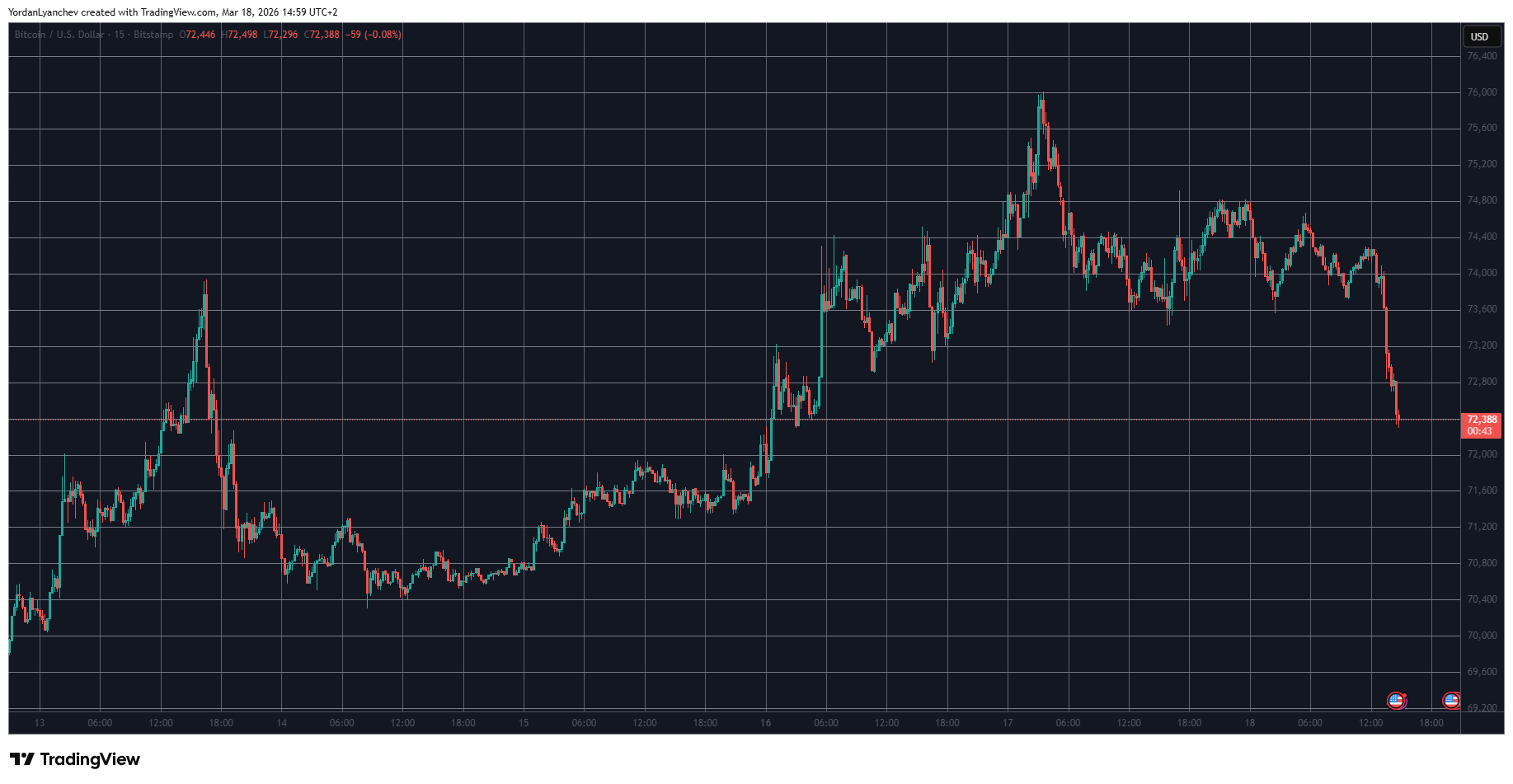
The post Bitcoin Price Falls Ahead of Crucial Fed Meeting: More Volatility Incoming? appeared first on CryptoPotato.
Binance revealed it will terminate all trading services for certain cryptocurrencies.
Somewhat expected, the tokens included in the effort nosedived by double digits immediately after the disclosure.
The Latest Announcement
Even though Binance supports a wide range of cryptocurrencies, their presence on the platform isn’t guaranteed forever and depends on factors such as trading volume, liquidity, network security, public communication, team commitment, and more.
Following its most recent review, the exchange decided to delist the altcoins Arena-Z (A2Z), Ampleforth Governance Token (FORTH), Hooked Protocol (HOOK), Loopring (LRC), IDEX (IDEX), Neutron (NTRN), Solar (SXP), and Radiant Capital (RDNT). The effort will take place on April 1 and will lead to the removal of spot trading pairs involving the aforementioned tokens. Meanwhile, Binance Spot Copy Trading will delist those assets on March 25.
“After this time, any outstanding assets will be force-sold at market price or moved to the Spot Account if the amount is unsellable. Users are strongly advised to update or cancel their Spot Copy Trading portfolios prior to Binance Spot Copy Trading delisting time to avoid potential losses,” the company warned.
Deposits of these tokens will not be credited to users’ accounts after April 2, while withdrawals won’t be supported after June 1. Delisted cryptocurrencies may be converted into stablecoins on behalf of customers after June 2, Binance clarified.
Such announcements usually trigger negative price reactions for the affected assets. After all, losing Binance support damages a coin’s reputation, reduces its liquidity, and limits its accessibility. Such was the case here as all of the involved altcoins headed south by double digits. IDEX was the biggest loser, with its valuation collapsing by 33% on a daily scale.
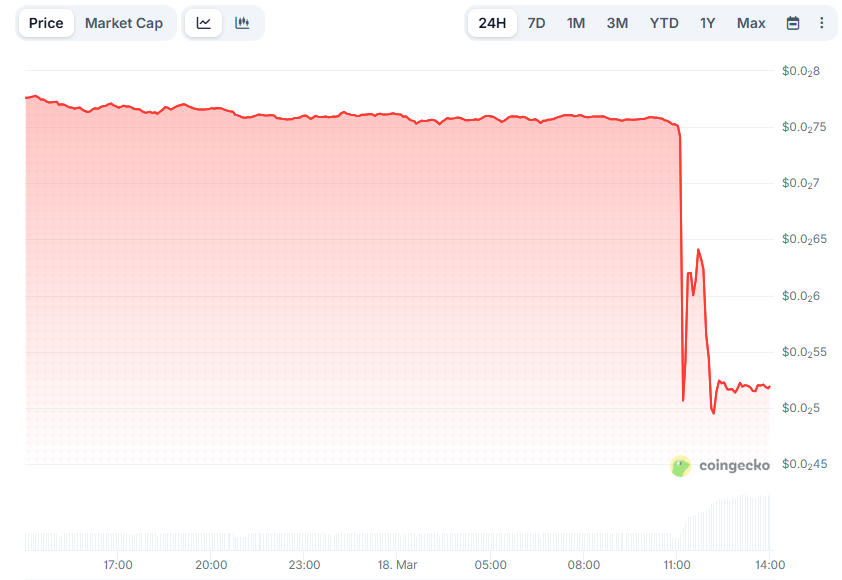
- IDEX Price, Source: CoinGecko
A similar thing was observed last week when Binance removed 21 cryptocurrencies, including WorldShards (SHARD), Alliance Games (COA), BNB Card (BNB Card), MilkyWay (MILK), Hyperbot (BOT), and others. Some of the assets saw their prices crash by an astonishing 70-80% shortly after the news broke.
The Opposite Effect
On the contrary, backing from Binance typically has quite a positive price effect on the involved cryptocurrencies. Earlier this week, the exchange introduced the trading pairs CFG/USDT, CFG/USDC, and CFG/TRY, causing CFG’s valuation to surge 60% within minutes.
At the start of 2026, the lesser-known digital assets Moonbirbs (BIRB) and ETHGas (GWEI) also posted substantial gains after Binance launched the BIRB/USDT and GWEI/USDT perpetual contracts with up to 50x leverage.
The post These Altcoins Crash Hard Following Binance Delisting: Details appeared first on CryptoPotato.