Cryptocurrency Posts
Crypto Briefing
Loopscale's pause highlights the ongoing vulnerability of DeFi platforms to sophisticated attacks, emphasizing the need for robust security measures.
The post Loopscale pauses operations after sustained attack on its Genesis Vaults appeared first on Crypto Briefing.
The chip impasse highlights the geopolitical tensions affecting global tech supply chains and underscores China's push for self-reliance in AI technology.
The post Nvidia’s H200 chips pile up in Hong Kong as Beijing withholds approval appeared first on Crypto Briefing.
American Bitcoin's profit surge highlights the volatility of relying on Bitcoin's price, with operational challenges impacting long-term stability.
The post American Bitcoin swings to $126M profit in Q3 2026 on Bitcoin gains appeared first on Crypto Briefing.
Kazakhstan's crypto investments highlight a strategic shift towards integrating digital assets into national financial reserves, signaling broader market acceptance.
The post Kazakhstan reportedly puts $100M into crypto funds, Brevan Howard Digital among them appeared first on Crypto Briefing.
The incident underscores the critical importance of robust security measures in fintech, potentially affecting user trust and platform reliability.
The post Binance removes SignalPlus API keys following security alert appeared first on Crypto Briefing.
Bitcoin Magazine
Bitcoin Magazine

American Bitcoin (ABTC) Posts $126 Million Profit as Holdings Gain $197 Million
American Bitcoin Corp. (Nasdaq: ABTC) reported about $126 million in third-quarter net income on Wednesday, a swing from a $57.2 million loss in the prior quarter that rested largely on a $197.3 million gain on the company’s bitcoin holdings rather than on mining revenue.
The Miami-based miner and treasury company, a majority-owned subsidiary of Hut 8 Corp. and co-founded with Trump family backing, mined about 891 bitcoin in the quarter at a cost of roughly $42,100 each and ended September with about 8,427 BTC.
Mining revenue was about $63.4 million, down from about $67.0 million in the second quarter. Gross profit was about $25.8 million, a 41% margin, compared with about $33.0 million and 49% a quarter earlier, as seasonal power costs rose across its sites.
Adjusted EBITDA came in at about $221 million, compared with an Adjusted EBITDA loss of about $45.0 million in the second quarter, according to the company’s release.
Eric Trump, co-founder and chief strategy officer of American Bitcoin, said the quarter delivered the net income and Adjusted EBITDA figures while growing the bitcoin reserve and bitcoin per share. Chief Executive Mike Ho said the company kept mining at a structural discount to spot and raised satoshis per share by about 5% without issuing shares through its at-the-market program or buying bitcoin on the open market.
A paper gain carried American Bitcoin’s quarter
The income statement makes the driver plain. American Bitcoin booked a $197.3 million gain on digital assets in the third quarter, after a $71.2 million loss on that line in the second. Operating income was about $191.8 million. Other expense included a $64.3 million loss on derivatives.
Strip the mark-to-market move out of the picture and the operating story looks quieter. Revenue per bitcoin mined was about $71,100, down slightly from about $71,900 in the second quarter, and the cost to mine rose to about $42,100 from about $36,500, the company said.
Production of about 891 bitcoin was below the second quarter’s roughly 932 coins, which the company had called its highest quarterly haul on record when it reported a $57.2 million second-quarter loss alongside a climb in holdings to about 8,002 BTC.
American Bitcoin said it sold a portion of production to cover operating costs while still adding to its strategic reserve. Holdings rose by about 425 bitcoin, or about 5%, to roughly 8,427 as of Sept. 30. That total includes about 3,090 bitcoin pledged for miner purchases under agreements with Bitmain.
Reserve up, satoshis per share up
Management’s preferred yardstick is satoshis per share, which rose about 5% to roughly 11,572 from about 10,989 at the end of June. The share count reflects a 1-for-15 reverse stock split effected earlier this year on July 2.
The owned fleet stood at about 89,242 bitcoin miners with roughly 28.1 EH/s of capacity at quarter-end. American Bitcoin remains majority-owned by Hut 8, which on the same day reported its own third-quarter results and confirmed bitcoin sales used to fund share buybacks while shifting mining into the American Bitcoin vehicle.
Eric Trump and Donald Trump Jr. helped launch the venture with Hut 8 in 2025; earlier Bitcoin Magazine coverage has put the Trump family’s stake near 20%, with Hut 8 holding the rest. The company has climbed the corporate treasury ranks as it stacked coins after its Nasdaq debut.
Whether another quarter of bitcoin price gains can keep paper profits ahead of higher power costs and thinner mining margins is the question the release leaves open.
At the time of writing, the bitcoin price is above $80,500 and shares of American Bitcoin were down over 5.5% today.
This post American Bitcoin (ABTC) Posts $126 Million Profit as Holdings Gain $197 Million first appeared on Bitcoin Magazine and is written by Micah Zimmerman.
Bitcoin Magazine

Judge Lets Stock Perpetual Futures Keep Trading but Says CFTC Likely Overstepped Its Authority
Stock perpetual futures can keep trading on Kalshi, Coinbase Derivatives and Bitnomial for now after a federal judge denied an emergency bid to halt them Tuesday, while finding that the Wall Street-backed challengers are likely to prove the CFTC overstepped its authority.
U.S. District Judge Valerie Caproni denied the temporary restraining order on Nov. 3 after a teleconference with the parties, hours after the CFTC said the products could begin trading on U.S.-regulated exchanges.
The plaintiff is the Capital Markets Alliance Association, a New York nonprofit whose members include Cboe Global Markets, Citadel Securities and the Healthy Markets Association, according to a declaration from its secretary, Adam Ford.
The group sued the CFTC and Chairman Michael S. Selig in the Southern District of New York, case No. 1:26-cv-09608, seeking to undo the approvals of filings by all three exchanges.
Caproni wrote that the group “is likely to succeed on the merits” of its claim that the agency lacks statutory authority to allow perpetual derivatives on individual stocks to be offered to retail investors on CFTC-regulated platforms.
“Because the perpetual contracts, by definition, do not provide for a ‘sale for future delivery of a single security,’ they cannot be a security future over which the CFTC has statutory and regulatory authority,” she wrote.
Instead, she said, the contracts “appear to satisfy the definition of a swap,” which falls to the Securities and Exchange Commission.
She also found that the balance of equities and the public interest favor the alliance, writing that the agency’s actions “seem to represent a major disruption to the equities market.”
The request failed on one prong. Caproni said the declarations from Cboe, Citadel Securities and Healthy Markets were “conjectural” about the harm members would suffer and did not show irreparable harm that was “actual and imminent.”
What the ruling does and does not do
The order leaves the approvals in place. It does not decide the case or the alliance’s separate motion for a preliminary injunction.
The CFTC’s opposition is due Friday, Nov. 6, and the alliance’s reply is due Tuesday, Nov. 10. The order says that schedule is subject to change by the assigned judge. The docket lists Judge Lorna G. Schofield as assigned to the case.
Kalshi was already listing four single-stock perps on Qualcomm, McDonald’s, Amgen and Costco by Wednesday morning, with maximum leverage of 4.9 times.
Bloomberg Law reported that the judge signaled she might ultimately side with the Wall Street firms opposed to the products.
A CFTC-SEC turf fight with crypto venues in the middle
The fight is over a label. Selig’s Nov. 3 statement said the contracts were deemed approved under Commission Regulation 40.3 as security futures products, a category the CFTC and SEC oversee jointly. The exchanges filed them Sept. 18, and the agency let its 45-day review period lapse without a written order.
The alliance argues that a contract with no expiration date and no delivery obligation is a security-based swap. Congress limited retail trading in those to national securities exchanges under full SEC oversight.
Its complaint says the CFTC “invited a parallel, synthetic market in U.S. stocks to grow outside the exclusive jurisdiction” of the SEC.
A CFTC spokesperson called the lawsuit “troubling” and told Reuters: “Our markets should be governed by law, not litigation campaigns intended to block innovation.”
For crypto-native venues, the stakes reach past stocks. Perpetuals are the core product of crypto derivatives trading, and Kalshi and Coinbase have used the CFTC’s framework to bring them onshore.
The agency approved the first U.S.-listed bitcoin perpetual on May 29, and Kalshi went live with the product soon after.
That approval already faces a challenge. CME Group sued the CFTC in June, arguing that a contract built on exchanged funding payments is a swap, not a future. That case is pending in Washington.
The New York order covers security futures, not commodities like bitcoin. But a federal judge has now said, at least preliminarily, that a contract with no expiration does not look like a future.
This post Judge Lets Stock Perpetual Futures Keep Trading but Says CFTC Likely Overstepped Its Authority first appeared on Bitcoin Magazine and is written by Micah Zimmerman.
Bitcoin Magazine

Huizenga Loses House Seat Despite $1 Million From Crypto PAC Fairshake
Rep. Bill Huizenga, the No. 2 Republican on the House Financial Services Committee, lost his reelection bid to Democrat Sean McCann, the Associated Press called Wednesday afternoon, despite about $1 million in support from the crypto super PAC Fairshake.
With more than 97% of votes counted earlier today, McCann led Huizenga 50.1% to 48.3% in Michigan’s 4th Congressional District, a gap of about 7,000 votes out of nearly 300,000 cast. The race had been rated “lean Republican” heading into Tuesday.
Huizenga, an eight-term congressman and the committee’s vice chair, is the highest-ranking Republican on the panel to lose. He is not the only crypto ally on it to go down.
Rep. Bryan Steil of Wisconsin, who chairs the Subcommittee on Digital Assets, Financial Technology and Artificial Intelligence, lost to Democrat Mitchell Berman 52% to 48%. The AP called that race at 11:48 p.m. Tuesday.
Rep. Ann Wagner of Missouri, who chairs the capital markets subcommittee, lost to Democrat Fred Wellman. Rep. Zach Nunn of Iowa lost to state Sen. Sarah Trone Garriott, and Rep. Mike Lawler of New York conceded to Democrat Cait Conley before the AP called his race.
Fairshake’s $1 million bets come up short
Fairshake committed at least $1 million in October to each of six House incumbents, among them Huizenga, Steil and committee Chairman French Hill of Arkansas. The super PAC reported spending $1,019,166 to support Huizenga in the general election, according to Federal Election Commission filings.
All 32 House incumbents the Fairshake network backed this fall voted for the CLARITY Act when it passed the House 294-134 in July 2025, CNBC reported. The network entered September with about $120.4 million in cash.
The crypto money was a small slice of the Huizenga race. Outside groups reported more than $25 million in spending in the district, FEC filings show, with House Majority PAC alone putting about $6 million against the Republican.
Two of Fairshake’s three Republican $1 million picks on the committee have now lost in midterms. Hill’s own race had not been called by the AP as of Wednesday afternoon. He led Democrat Chris Jones by about 4,400 votes, or 50.9% to 49.1%, with 99% of the expected vote counted.
What the losses mean for crypto in the House
Democrats won control of the House on Tuesday, which hands the committee gavel to their side regardless of Hill’s result. Rep. Maxine Waters of California, the panel’s top Democrat and its chair from 2019 to 2023, is in line to return to the post. Nineteen Financial Services Democrats backed her in October against a possible challenge from Rep. Sean Casten of Illinois, Politico reported.
Steil’s loss also leaves the digital assets subcommittee without its chair. Huizenga sat on that panel too. Journalist Eleanor Terrett noted that the subcommittee’s name, scope and membership are set each Congress, so Democrats could rename, re-scope or eliminate it.
Huizenga played a role in moving the stablecoin bill President Donald Trump signed in 2025, and he led the committee’s investigations into former SEC Chair Gary Gensler during the Biden administration.
The industry’s main legislative goal is still the CLARITY Act, which failed a Senate cloture vote 49-50 on Sept. 15. House Democrats are already weighing their own market structure bill with a bigger role for the SEC.
Crypto groups spent heavily to avoid this outcome, with about $176 million committed to more than 100 races this cycle. Losing Huizenga and Steil removes two of the Republicans who shaped crypto legislation on the committee, and both seats flip to Democrats.
Bitcoin itself rallied after the Democratic sweep, even as the industry’s allies in Congress lost ground.
This post Huizenga Loses House Seat Despite $1 Million From Crypto PAC Fairshake first appeared on Bitcoin Magazine and is written by Micah Zimmerman.
Bitcoin Magazine

French Bank Credit Mutuel Arkea Confirms Cyberattack as ZachXBT Puts Losses Above $133 Million
French bank Credit Mutuel Arkea said Wednesday that a cyberattack allowed hackers to carry out fraudulent transfers from the bank’s own account, a theft that on-chain investigator ZachXBT has put at more than $133 million and that the bank has not confirmed.
The Brittany-based lender said in a statement that the incident was under control, that operations were resuming and that customer assets were not affected. It suspended some transactions as a precaution.
“This incident has had no impact on (customer) assets and has only caused a delay in the execution of certain transfers,” the bank said on its website, in a translation published by Reuters.
In a follow-up question-and-answer note, Credit Mutuel Arkea said the attackers went through the platform of one of its service providers and reached the bank directly. They used the bank’s own account to send transactions to other banks, which then potentially allowed them to convert the money into cryptocurrency through specialized platforms, the bank said.
No customer accounts at its federations or subsidiaries were used, the bank said. It denied French press reports that the attackers got in through Fortuneo, its online banking arm, and said the Credit Mutuel Arkea hack was “a sophisticated attack from the outside,” not the result of human error.
The size of the Credit Mutuel Arkea hack
The bank has not given a final figure. Asked whether 118 million euros, or $133 million, had been stolen, it said it does not confirm the number and can only “validate the order of magnitude.”
Part of the funds involved has been frozen and other steps are underway to recover the rest, the bank said. It added that the amounts at stake are “absolutely not” large enough to threaten its financial health or soundness.
AFP reported that the bank put the attack at about 100 million euros in a provisional estimate. Earlier Wednesday, Reuters reported that the bank said its losses were lower than $133 million. “It is still too early to give a final figure,” a spokesperson told the wire service.
What ZachXBT reported
ZachXBT first flagged the incident on Monday without naming the victim. He wrote on his Telegram channel that an EU entity was suspected of losing more than $106 million from multiple centralized exchange accounts on Nov. 1, with the funds withdrawn as USDC and USDT. He said the funds were then swapped for ether and moved across several chains.
In an update, he said he had found another $27 million or more in exchange withdrawals, bringing the total to more than $133 million. A later post named Credit Mutuel Arkea as the alleged victim. He wrote that the attack “occurred for multiple days” and that he suspects the amount stolen is larger once over-the-counter activity is counted.
The bank has not confirmed his figure or his timeline. It has also not said when the attack began, who was behind it or whether any data was taken. Credit Mutuel Arkea is working with judicial and police authorities to determine the origin of the attack and how it was carried out. It said it informed its supervisors once the attack was detected.
The bank also warned customers that phishing attempts are possible after the Credit Mutuel Arkea hack.
Credit Mutuel Arkea, which groups the Credit Mutuel federations of Brittany and the Southwest, is part of the wider Credit Mutuel group. It has 5.8 million clients and 211.5 billion euros, or about $238 billion, in assets, Reuters reported. It posted net profit of 230 million euros in the first half of the year, AFP reported.
The Credit Mutuel Arkea hack lands less than a week after the record $6.34 billion Binance hack, which blockchain analysis firms have linked to North Korea. ZachXBT said in his first post that he was highly confident this incident was not the work of North Korea’s Lazarus Group. Brazil’s Mercado Bitcoin also froze deposits and withdrawals this week after a security incident.
How much of the money the bank can recover, and what the final loss from the Credit Mutuel Arkea hack will be, remains open.
This post French Bank Credit Mutuel Arkea Confirms Cyberattack as ZachXBT Puts Losses Above $133 Million first appeared on Bitcoin Magazine and is written by Micah Zimmerman.
Bitcoin Magazine

House Democrats Eye Their Own Crypto Market Structure Bill With a Bigger SEC Role After Sweep
House Democrats are discussing a plan to turn Rep. Maxine Waters’ Crypto Investor and Consumer Bill of Rights into their own crypto market structure bill next Congress, with ideas that include a bigger role for the SEC and a smaller one for the CFTC, Eleanor Terrett reported Wednesday.
The proposal would fold in the Democratic Clarity Act provisions Waters offered in the House, which were not adopted, plus the provisions Senate Democrats were able to agree on with Republicans before September’s failed cloture vote. Terrett cited three industry sources who have spoken with Democratic staffers.
Further ethics provisions restricting the crypto activities of President Donald Trump and other federal officials are also likely, she wrote. Republicans are calling it a “messaging bill.”
No text for the crypto market structure bill has been released, and the details so far come from industry sources rather than from lawmakers.
JUST IN:
— Bitcoin Magazine (@BitcoinMagazine) November 4, 2026House Democrats reportedly want to revive their Clarity Act provisions in a broader crypto market structure bill next Congress, Eleanor Terrett reports.
pic.twitter.com/8twokppjHz
The talks follow Tuesday’s Democratic sweep of Congress. Waters, the top Democrat on the House Financial Services Committee, is in line to take the gavel in January from Chairman French Hill, the Clarity Act’s sponsor.
Bloomberg Law reported Wednesday that the new majorities give Democrats leverage over the Clarity Act, the industry’s top legislative priority, starting with tougher ethics rules aimed at Trump’s ventures.
What the Waters amendment would do for crypto
Waters offered the bill of rights as amendment #31 to H.R. 3633 in July 2025. The House Rules Committee blocked it 4-8 along party lines, on a motion from Rep. Mary Gay Scanlon of Pennsylvania. Making an amendment “in order” lets the full House debate and vote on it, so the result kept the package off the floor.
The committee’s record lists what it would have required: 24/7 customer service, insurance or SIPC-like coverage, fiduciary and best-execution rules, anti-front-running rules, bankruptcy-remote custody with 24-hour withdrawals and monthly auditor-attested proof of reserves. It would also have sent more funding to the SEC and CFTC.
The committee rejected a second Democratic amendment by the same 4-8 margin. That one, from Rep. Joe Neguse of Colorado, would have barred members of Congress, presidents and vice presidents from issuing or endorsing digital assets. The ethics fight it previewed later followed the bill to the Senate.
SEC versus CFTC
The agency split is where a Democratic crypto market structure bill would break most sharply from the Republican one. The House-passed Clarity Act directs the CFTC to regulate most digital commodity trading, including exchanges, brokers and dealers, and exempts tokens on mature blockchains from SEC registration under certain conditions.
That design is the one the industry backed. A crypto market structure bill that moves supervision back toward the SEC would reverse it.
The Clarity Act passed the House 294-134 in July 2025 and failed a Senate cloture vote 49-50 on Sept. 15. Sen. Thom Tillis entered a motion to reconsider, which preserves the option of another vote, but the bill dies when this Congress ends on Jan. 3 unless the lame-duck session revives it.
Democrats now hold the leverage. “The industry and the Republicans screwed up. That was the best bill they were going to get,” Sen. Ruben Gallego of Arizona, a Senate Banking Committee member, said in comments reported by Bloomberg Law.
TD Cowen’s Jaret Seiberg wrote Wednesday that the sweep closes the door on Clarity for two years, and that Democratic investigations of the Trump family’s crypto ventures “may make it impossible to advance a version of Clarity that the crypto sector could back.”
A Democratic crypto market structure bill would still need Trump’s signature to become law. Whether one built around the SEC can draw enough Republican votes to get there, or remains the messaging bill Republicans say it is, is the question the next Congress opens with.
This post House Democrats Eye Their Own Crypto Market Structure Bill With a Bigger SEC Role After Sweep first appeared on Bitcoin Magazine and is written by Micah Zimmerman.
HTTP error 429 on https://cryptoslate.com/feed/
Failed to fetch feed: https://cryptoslate.com/feed/
Failed to fetch feed.
CryptoTicker.io
SwissBorg is a crypto app developed in Switzerland that operates in the EU through the French company BlockNodes SAS, authorised under MiCA by the regulator AMF since March 5, 2026. If you save €100 a month with the automatic savings plan Auto-Invest, you pay 0.99 percent according to the price list (as of October 8, 2026), or €11.88 a year. If you fund your account by card instead of bank transfer, it costs you at least €5 per deposit on the Standard tier. For this guide we analysed the price list, the regulatory register and user reviews. How other savings plans compare is shown in our Bitcoin savings plan comparison.
SwissBorg in brief: the key figures
- The AMF lists BlockNodes SAS, operator of the SwissBorg app, under number A2026-011 dated March 5, 2026.
- Buying and selling cost 0.99 percent on all tiers, with €5 to €120,000 possible per swap (as of October 8, 2026).
- Auto-Invest starts at €5 and runs at intervals from 30 minutes to one month (as of November 4, 2026).
- Card deposits cost 2.25 percent on the Standard tier, with a minimum of €5; SEPA transfers are free (as of October 8, 2026).
- Bitcoin withdrawals cost 0.1 percent, at least €1.61 and at most €100, plus the network fee (as of October 8, 2026).
- SwissBorg reports 922,600 verified users and customer assets of $1.19 billion (as of November 4, 2026).
What is SwissBorg? App, BORG token and savings plan
SwissBorg combines crypto purchases, automatic saving and yield products in a single app. The application is owned by the Swiss company SBorg SA; in the EU, since the switch to MiCA, it has been operated by BlockNodes SAS in France. The company moved existing customers there from Estonia in June 2026.
The offering ranges from simple swaps through limit orders and Auto-Invest to Crypto Bundles, ready-made baskets of several coins. On top come Earn, for returns on coins you hold, and a Mastercard card. According to the provider, a technology called Smart Engine finds the best route across several trading venues for each order.
One distinctive feature is the in-house BORG token. Locking it in the app moves you up the loyalty tiers from Standard through Bronze, Silver, Gold, Platinum and Diamond to Elite. Cashback, card fees and Earn deductions depend on your tier.

SwissBorg fees: the price list by loyalty tier
The price list of BlockNodes SAS (as of October 8, 2026) tiers many items by rank. The table shows the entry level and the top.
| Item | Standard tier | Top tiers |
|---|---|---|
| Buy, sell and Auto-Invest | 0.99 percent | 0.99 percent |
| Cashback on this fee, in BORG | up to 5 percent | up to 90 percent (Elite), up to 99 percent on swaps (Elite Top 10) |
| SEPA deposit | free | free |
| Deposit by card, Apple Pay, Google Pay | 2.25 percent, minimum €5 | 1.5 percent, minimum €3 |
| SEPA withdrawal | 0.1 percent, €1.50 to €100 | 0.1 percent, €1.50 to €100 |
| Bitcoin withdrawal | 0.1 percent, €1.61 to €100, plus network fee | 0.1 percent, €1.61 to €100, plus network fee |
| Crypto Bundles, buy and sell | 1.49 percent | 0.25 percent |
| Crypto Bundles, monthly on holdings | 0.12 percent | 0.10 percent |
SwissBorg pays the cashback in locked BORG and reserves the right to change it. The displayed price also contains an adjustment for market liquidity for which the price list gives no fixed rate: it varies with volatility, coin and order size, and BlockNodes may keep the portion that exceeds the margin it needs.
SwissBorg Auto-Invest worked through: €100 a month
The calculation assumes twelve instalments of €100 each in Bitcoin, €1,200 a year in total, on the Standard tier (price list, as of October 8, 2026). The money has to be in the app for this. SwissBorg recommends a standing order at your bank; the Auto-Invest fee already includes the normal swap.
| Route | Cost per month | Cost over 12 months |
|---|---|---|
| SEPA standing order plus Auto-Invest | €0.99 | €11.88 |
| Card deposit plus Auto-Invest | €5.99 | €71.88 |
The difference comes from the minimum fee. 2.25 percent of €100 would be €2.25, but a minimum of €5 applies. Only from €222 per deposit does the percentage rate kick in. For small instalments, bank transfer therefore remains by far the cheaper route.
Of the first item, up to €0.59 a year comes back as cashback in BORG, with no guarantee. On the other tiers the rate rises to up to 90 percent, but you have to lock BORG and carry its price risk. If you move the Bitcoin to your own wallet after a year, you pay the minimum fee of €1.61 once, plus the network fee, because 0.1 percent of €1,200 would come to only €1.20.
SwissBorg Earn: what is left of the yield after two deductions
With Earn, SwissBorg offers daily returns on coins you hold and shows estimated annual rates. Most strategies lock the coins for at least 24 hours, some for longer. Entering and exiting is free. According to the price list, two items are deducted from the yield in turn: a performance fee, usually 15 percent, and a service fee that depends on your tier (as of October 8, 2026). With a 15 percent performance fee, this is what remains of €100 in gross yield:
| Tier | Service fee | Left of €100 |
|---|---|---|
| Standard | 50 percent | €42.50 |
| Bronze | 37.5 percent | €53.13 |
| Silver | 25 percent | €63.75 |
| Gold | 12.5 percent | €74.38 |
| Platinum, Diamond, Elite | 0 percent | €85.00 |
The price list also expresses this gap as a yield factor: up to 2x compared with the Standard tier, in other words €85.00 against €42.50. If you mainly want to use Earn without BORG, it is best to compare the rate in the app with other providers in our staking comparison.

Is SwissBorg regulated? The MiCA licence of BlockNodes SAS
Yes. The AMF list shows BlockNodes SAS with number A2026-011 dated March 5, 2026, and six services: custody and administration, execution of orders, placing, advice, portfolio management and transfers. ESMA’s MiCA register lists it under the SwissBorg brand and names Germany among the states in which the authorisation applies (as of November 4, 2026).
At SwissBorg, coins are held in third-party custody: according to the company blog, BlockNodes runs an infrastructure with distributed keys (MPC), supervised by the AMF. If you want to hold the keys yourself, transfer the coins to your own wallet.
SwissBorg user reviews: a wide range of ratings
The sources differ markedly (as of November 4, 2026):
| Source | Rating | Reviews |
|---|---|---|
| App Store France | 4.6 out of 5 | 5,351 |
| App Store Germany | 4.5 out of 5 | 803 |
| Google Play | 4.4 out of 5 | 15,524 |
| Trustpilot | 3.0 out of 5 | 1,911 |
The 100 most recent reviews with text in the French App Store, from June 26, 2025 to October 22, 2026, average 3.6 stars: 57 with five stars, 23 with one. 32 comments praise the ease of use, with an average of 4.7 stars. 17 mention fees or prices (average 3.5 stars), 15 customer service (average 2.5 stars). The most frequent complaint in the poor reviews is blocked accounts, transfers or withdrawals: 14 comments, according to the users. Among the five-star reviews, 6 promote their own referral code.
Who SwissBorg suits: savings plans across several coins
SwissBorg suits investors who want to save into other coins alongside Bitcoin and keep everything in one app. In the calculation above, Auto-Invest costs less than Bitstack and Deblock as long as the money arrives by bank transfer. Locking BORG brings cashback and better Earn terms, but you carry the price risk of an additional token.
If you are looking for an everyday account with an IBAN, or want to save exclusively in Bitcoin, you will find a narrower offering among the alternatives.
SwissBorg alternatives: Bitstack, Deblock and regulated exchanges
The same calculation over twelve instalments of €100 gives different figures for the two French-licensed competitors. The table shows the stated fees according to Bitstack’s subscription page and Deblock’s pricing page (both as of November 4, 2026), each on the free plan, without mark-ups in the price.
| Provider and plan | Fee per €100 | Cost over 12 months | AMF number |
|---|---|---|---|
| SwissBorg, Auto-Invest | €0.99 | €11.88 | A2026-011 |
| Bitstack Standard with euro account (France) | €1.50 | €18.00 | A2025-003 |
| Deblock Standard | €1.99 | €23.88 | A2025-001 |
| Bitstack Standard without euro account (Germany) | €2.20 | €26.40 | A2025-003 |
If you prefer a traditional exchange with a savings plan, take a look at Kraken or Coinbase. More exchanges with an EU licence are listed in our comparison of regulated crypto exchanges, and fees and intervals of further savings plans in the crypto savings plan comparison.
For tax purposes in Germany, the purchase date and holding period of each individual instalment count, and Earn income can raise questions of its own. What a sale would incur is calculated by our tax calculator. This section is not tax advice.
SwissBorg verdict: 0.99 percent when the instalment arrives by SEPA
With Auto-Invest, SwissBorg offers a broad savings plan under a MiCA licence, from €5 and at an interval of your choice. At €100 a month, the fees come to €11.88 a year as long as deposits arrive by SEPA. By card, it is €71.88. With Earn, it pays to check your tier: on the Standard level, €42.50 is left of €100 in gross yield.
Crypto assets are highly volatile, and a total loss of the amount invested is possible. This guide is not investment advice and not a recommendation to buy.
(As of November 4, 2026. This article is not investment advice. Prices and fee structures change; check the terms with the provider before you buy.)
KYC stands for “Know Your Customer” and describes the identity check every licensed crypto exchange carries out before your first purchase. You provide your name, date of birth, place of birth, nationality and residential address, and the exchange matches these details against an official ID document. In Germany, no provider may open an account for you without this check, not even if you only want to swap 20 euros into Bitcoin.
The obligation comes from the German Anti-Money Laundering Act (Geldwäschegesetz, GwG). Since the European crypto regulation MiCA took effect, the act explicitly names crypto-asset service providers as obliged entities, putting them on a par with banks, payment institutions and investment firms. In practice, the ID check is neither the exchange’s business model nor harassment; it is a legal requirement. If you are looking for a properly licensed exchange, the comparison of regulated crypto exchanges lists providers with a licence, and every one of them requires KYC.
This guide explains which data you hand over, which verification methods exist, what is checked after your account is opened and what will still change by July 2027. If you are just starting out, the overview What is a cryptocurrency? is a good place to begin.
KYC explained: Know Your Customer under anti-money laundering law
KYC is the umbrella term for all the steps a financial company takes to establish who its customer is and whether the business relationship fits that person. In German law these steps are called “general due diligence obligations” and are set out in Section 10 of the act. They cover four core tasks:
- Identification: The exchange collects your personal details and verifies them against a document.
- Beneficial owner: The exchange establishes whether you are acting for yourself or for someone else. The beneficial owner is the person to whom the money ultimately belongs.
- Purpose of the business relationship: You state what you intend to use the account for, for example a savings plan or occasional purchases.
- PEP check: The exchange checks whether you are a politically exposed person. The term covers people holding a prominent public office, along with their family members and close associates.
On top of this comes ongoing monitoring. KYC therefore does not end with a photo of your ID. The check accompanies your account for as long as it exists. Section 10(9) draws a clear line: if the exchange cannot meet these obligations, it may not enter into the business relationship, or it must end it.
Five mandatory KYC details under Section 11 and which IDs are accepted
Exactly which data the exchange must collect is laid down in Section 11(4) of the Anti-Money Laundering Act. For a natural person there are five details:
- First name and last name
- Place of birth
- Date of birth
- Nationality
- Residential address
Under Section 12, the exchange verifies these details against a valid official photo ID, which in practice means your national identity card or passport. A driving licence is not enough, because it does not satisfy the domestic ID requirement. Under Section 8, the exchange also records which document it is, its number and the authority that issued it. It makes a copy of the ID you present or captures it digitally; the law expressly gives it both the right and the duty to do so.
Many exchanges ask for more than these five points: phone number, email address, occupation, the amount you plan to invest or the source of your money. Some of this serves the risk assessment, some of it communication with you. Strictly speaking, only the five details and the check against the document are mandatory.
Video ident, online ID and signature: the methods of KYC verification
The law allows several ways to verify your identity. Each exchange decides for itself which of them it offers. The three most common at a glance:
Video identification
With video ident, you hold your ID up to the camera of your smartphone or laptop, tilt it on request so that the security features become visible, and show your face so it can be compared with the photo. The minimum requirements for this method were set by the German financial regulator BaFin in its Circular 3/2017 (GW) on video identification. Many providers work with specialised service companies for this, whose names you will see during the process.
Online ID function (eID)
The electronic proof of identity under Section 18 of the German Identity Card Act reads the data directly from the chip in your identity card. You need an NFC-enabled smartphone and your six-digit PIN. The advantage: there is no video call, and because the data comes straight from the chip, typing errors are ruled out.
Qualified electronic signature
Less common is verification via a qualified electronic signature under the European eIDAS regulation. In this case, the first transaction must also come from a payment account in your name. That is why some providers ask for a first transfer from your own current account.
KYC and AML: where the identity check ends and the money laundering check begins
The terms KYC and AML are often confused. AML stands for “Anti-Money Laundering”, the fight against money laundering. AML is the goal, and KYC is one of the tools for reaching it. The identity check answers the question of who you are. The money laundering check answers the question of whether your transactions match what the exchange knows about you.
That is why the exchange keeps watching after your account is opened. Section 10 requires continuous monitoring of the business relationship, including its transactions. If you buy 50 euros’ worth every month for years and suddenly deposit 80,000 euros, that stands out. It does not mean anything is wrong; it simply means the exchange has to ask.
Source of funds and PEP status: when the exchange asks for more proof
If the exchange identifies a higher risk, the enhanced due diligence obligations under Section 15 apply. Typical triggers are large deposits, PEP status or transfers from countries with an elevated money laundering risk. The exchange then asks where the money comes from, known in the trade as “source of funds”. This is proof of where the specific money you are depositing originated.
Depending on the case, suitable evidence includes payslips, a sales contract for a property you sold, a certificate of inheritance or account statements from another provider where you sold crypto assets. Have such documents ready before you move larger sums. An exchange that freezes a deposit until the matter is cleared up is acting in line with the law, not arbitrarily.

Travel Rule since December 2024: KYC data travels with every crypto transfer
Since December 30, 2024, Regulation (EU) 2023/1113 on information accompanying transfers of funds and certain crypto-assets, known as the TFR or Travel Rule, has applied in the EU. The regulation carries a rule from traditional payments over to crypto assets: anyone sending coins from one exchange to another passes along details of the sender and the recipient. These include the name, the wallet address or account number and, depending on the case, the address or date of birth.
Unlike bank transfers, transfers between two crypto service providers have no minimum amount. The details therefore travel even with a transfer of 30 euros. That is why your exchange often asks, before a withdrawal to another platform, who the recipient is and with which provider they hold their account. If the details do not match, the receiving exchange can hold back the incoming funds until the data has been supplied.
Own wallet and the 1,000-euro threshold: proof for self-hosted addresses
A self-hosted address is a wallet whose private keys you keep yourself, for example on a hardware wallet or in a wallet app without an exchange account behind it. Transfers to such addresses follow their own rules. Under Article 14 of the regulation, when a transfer to a self-hosted address exceeds 1,000 euros, the exchange must take appropriate measures to establish whether the address belongs to you or is under your control.
How the exchange checks this is up to the exchange. Common methods are a confirmation in the app, a message signed with the private key, or proof taken directly from the wallet software. The practical point: do not leave your first large withdrawal to your hardware wallet until the last minute, because the check can take some time. Self-custody itself remains permitted; the rule only requires the proof.
Tax ID and DAC8: what exchanges have reported to the Federal Central Tax Office since 2026
Since this year, KYC has included one more detail that has nothing to do with money laundering. On January 1, 2026, Germany’s Crypto-Asset Tax Transparency Act (KStTG) came into force. It implements the European directive DAC8, the eighth version of the directive on administrative cooperation between tax authorities. Under it, crypto service providers report their customers’ transactions to the Federal Central Tax Office. The first reporting period is calendar year 2026, and according to an overview by the audit firm KPMG, the report is due by July 31, 2027.
So that the report can be matched to your tax account, exchanges ask for your tax identification number. If you opened your account before 2026, the exchange has to obtain this detail retrospectively. The basic rules for your tax return do not change: under current law, gains from private disposals of crypto assets within one year of purchase are taxable, and tax-free once this holding period has passed. What is new is that the tax office will be able to compare the exchange’s data with your own figures.

Data protection in KYC: five years of retention and the risk of data leaks
Many readers ask what happens to the ID copy and the video recording after the check. The answer is in Section 8(4) of the Anti-Money Laundering Act: the exchange must keep the records for five years. The period starts at the end of the calendar year in which the business relationship ends. If you close your account in June 2027, your data will therefore be stored until the end of 2032. It must be destroyed after ten years at the latest.
The exchange may use KYC data only for the purposes of the anti-money laundering law and its statutory reporting obligations. The General Data Protection Regulation applies as well, so you have a right of access. You cannot, however, demand deletion before the period expires, because the statutory retention obligation takes precedence.
A residual risk remains: ID data is valuable to fraudsters, and data leaks at financial service providers do happen. How such a case can unfold is shown in our report on the Revolut data breach, after which the bank is paying for new IDs for 680 affected customers. You can reduce the risk by opening accounts only with providers holding an EU licence, closing accounts you no longer need and never sending your ID by email or messenger when someone supposedly asks for it on behalf of an exchange.
Is there a MiCA exchange without an ID check?
Under MiCA, crypto-asset service providers in the EU need a licence, and with the licence come the obligations of anti-money laundering law. What the regulation requires of companies is explained in our overview of the MiCA licence and the obligations for crypto companies. A licensed exchange without KYC therefore does not exist. A provider that promises you an account with no ID at all while advertising an EU licence deserves suspicion.
There are still routes without ID, just not through a licensed exchange: decentralised exchanges, where you trade directly from your wallet, peer-to-peer trading or swaps in a wallet app. Which options remain under MiCA and where their limits lie is covered in the guide Crypto exchanges without KYC. The route for buying Bitcoin in particular is described in Buying Bitcoin without KYC. Bear in mind that without a regulated provider you also have no one to turn to if something goes wrong.
What happens if KYC fails?
If the exchange rejects your verification, it is usually down to formalities: an expired ID, a residential address that does not match the document, a blurred photo or a name spelled differently from the one on your current account. Go through these points before you make a second attempt. You will not always get a detailed explanation, because in the event of a suspicion of money laundering the act forbids the exchange from telling you.
AMLR from July 2027: the EU will then explicitly ban anonymous crypto accounts
The next stage has already been published in the Official Journal. The EU Anti-Money Laundering Regulation, AMLR for short, Regulation (EU) 2024/1624, will apply directly in all member states from July 10, 2027, replacing large parts of national anti-money laundering law. Article 79 will then prohibit credit institutions, financial institutions and crypto-asset service providers from keeping anonymous crypto-asset accounts or accounts that allow transactions to be obscured to a high degree, including through anonymity-enhancing cryptocurrencies. This refers to privacy coins, whose transactions cannot be traced on the blockchain.
For holders of a normal exchange account, little changes as a result, because their KYC is already complete today. The AMLR will be felt mainly in two respects: the rules will be the same across the EU, and the new European anti-money laundering authority AMLA in Frankfurt am Main will directly supervise selected large providers in future. A KYC completed at an exchange in France or the Netherlands will then follow the same requirements as one at a German provider.
KYC check: keep your ID, registered address and tax ID to hand
Before you register with an exchange, it is worth taking a quick look at your documents. It saves you an aborted video call and days in the queue.
- Choose a licensed exchange: Compare providers with an EU licence, fees and verification methods in the comparison of the best crypto exchanges. Check whether the exchange offers the online ID function if you would rather not do a video call.
- Prepare the withdrawal to your own wallet: If you want to hold your coins yourself later, set up the hardware wallet before the first large transfer. Devices and prices are listed in the hardware wallet comparison.
- Keep clean tax records: Because the exchange has reported your transactions to the Federal Central Tax Office since 2026, your own records should match. Suitable software can be found among the crypto tax tools and portfolio trackers.
(As of November 5, 2026. This article is not investment advice. Prices and fee structures change; check the terms with the provider before you buy.)
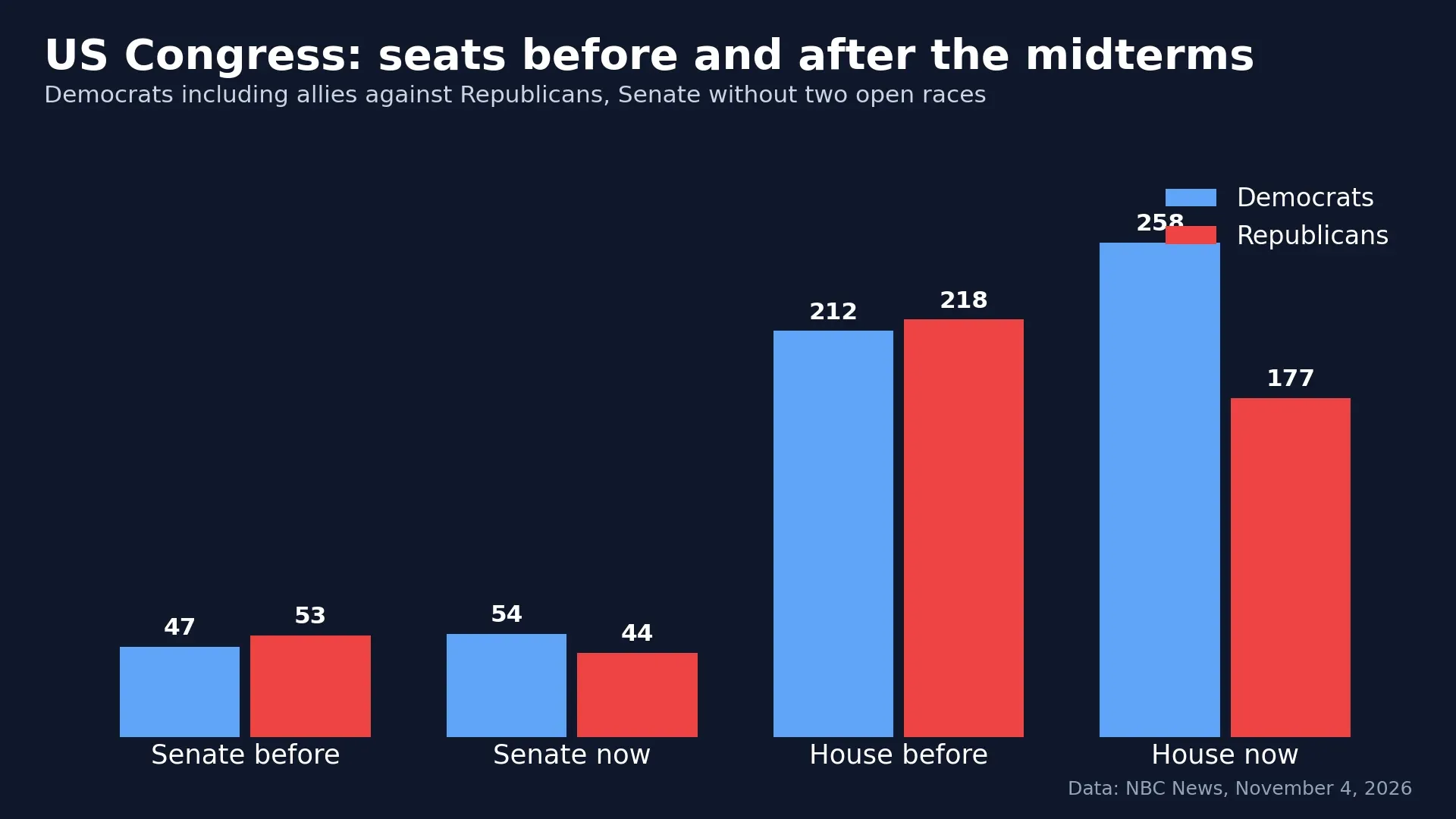
After the US midterms of November 3, 2026, the crypto industry faces a clear deadline: the CLARITY Act expires on January 3, 2027, if the Senate does not act by then. On that day the new Congress convenes, with Democrats leading both chambers. According to NBC News, the Senate stood at 54 to 44 on Wednesday with two races open. For the House the network estimates 258 to 177.
Midterms recap: key points
- Deadline: January 3, 2027, after that a new bill would have to start over.
- Hurdle: 60 votes in the Senate, on September 15 the count was 49 to 50.
- Committees: Elizabeth Warren is likely to lead the Banking Committee, Maxine Waters the Financial Services Committee.
- Agencies: from January a Democratic Senate can block nominees for the SEC and CFTC.
Midterms result: how the majorities in Congress shift
Before the election Republicans held the Senate 53 to 45, with two independents mostly voting with Democrats. In the House it stood 218 to 212. More on election night and the effect on prices is in our analysis of Trump, Bitcoin and the Trump coin and in our review of the Polymarket odds.
CLARITY Act after the midterms: why January 3 is so hard
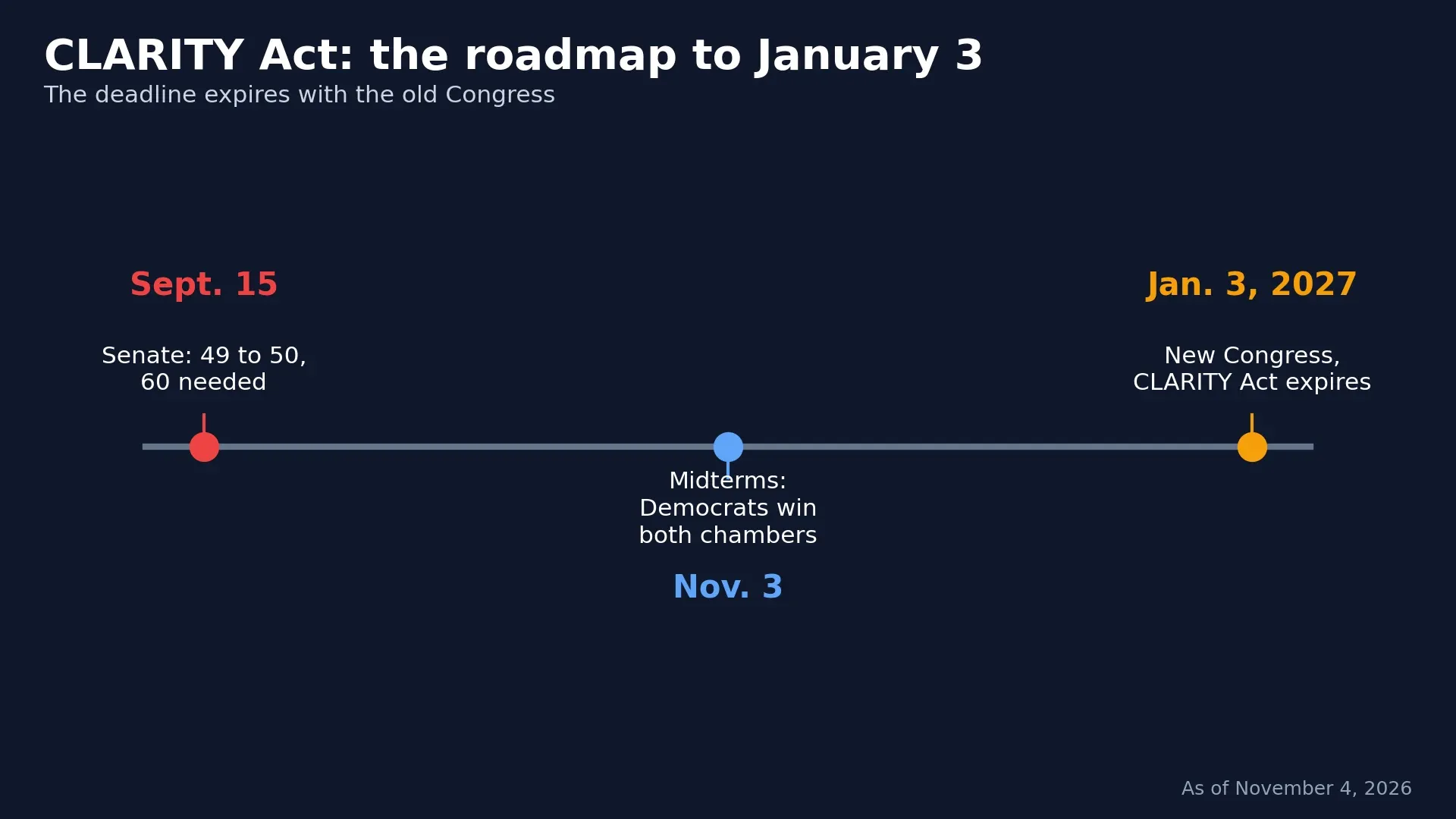
The CLARITY Act is meant to settle when a US token counts as a security and when as a commodity. In the vote on opening debate it failed on September 15 with 49 to 50 votes, 60 were needed. A bill not passed by the end of a term expires. Whatever is not through by then starts from zero in the new Congress, with new committee chairs.
That leaves the remaining session of the old Congress until January, the last chance for the current text. Senator Angela Alsobrooks, one of the negotiators, still considers a deal possible. The math stays the same, though: even with new majorities the bill needs 60 votes, and with 54 Democratic seats in the new Senate, six Republicans would have to join. Our overview CLARITY Act explained covers the content.
Midterms and crypto regulation: what changes in the committees from January
For the industry it matters almost more who sets the agenda. Elizabeth Warren is likely to lead the Senate Banking Committee, Maxine Waters the House Financial Services Committee. Both are among the best-known critics of the industry in Congress. Research firm TD Cowen also sees, according to Bitcoin Magazine, a risk at the agencies: from January a Democratic Senate could block Trump's nominees for the SEC and CFTC. Trump could respond with acting heads.
Midterms recap: what crypto investors should watch now
| Period | What can happen | Why it matters |
|---|---|---|
| Until January 3 | Final talks on the CLARITY Act | A deal would end years of uncertainty |
| From January 3 | New chairs set the agenda | A new bill starts over |
| 2027 | Staffing at the SEC and CFTC | The agencies shape practice even without a law |
The market has welcomed the election so far: Bitcoin stood at $80,032 on Wednesday evening after a low of $75,695. Oil and Wall Street did more for that than regulation, so the deadlines above are still ahead. For European investors little changes right away, since MiCA applies there. An overview of regulated crypto exchanges helps you choose a provider, and our comparison of crypto brokers shows the alternative without self-custody.
As of Wednesday evening, November 4, 2026. This article is not investment advice.
Etherscan is a free search engine for the Ethereum blockchain: you enter an address, a transaction ID or a token name and immediately see what happened there. You can use it to check whether a transfer has arrived, how high the fee was, which tokens an address holds and whether a smart contract is genuine. You need neither an account nor a wallet to do so.
The technical term for such a tool is block explorer: a website that reads in, sorts and makes searchable all the data on a blockchain. Etherscan is the best-known explorer for Ethereum and, by its own account, is run independently, meaning it is neither funded nor controlled by the Ethereum Foundation. One point matters for understanding it: Etherscan is not a wallet and not an exchange. It holds no coins, knows no private keys and cannot reverse a transaction.
This guide shows you step by step how to read Etherscan. The examples come from a real block of November 4, 2026. If you are mainly interested in gas fees and sending ERC-20 tokens, you will find the details in our guide to Ethereum gas and Etherscan.
What is Etherscan? The block explorer for the Ethereum blockchain
Every Ethereum transaction ends up in a public ledger that exists in identical form on thousands of computers worldwide. For humans, however, this ledger is hard to read, because it consists of raw data. Etherscan translates that data into tables, timestamps and amounts. The principle is that of a public bank statement, except that anyone can view any statement without knowing the person behind it.
The homepage shows four things at a glance: the current ether price, the latest blocks, the latest transactions and the state of network fees. Above them sits the search bar, with which you can find almost anything:
- Address: a string that starts with 0x and is 42 characters long
- Transaction ID (hash): a string with 0x and 64 further characters
- Block number: for example 26337953
- Token name or ticker: such as USDT or LINK
- ENS name: a readable address such as name.eth
A block is a data package in which the network bundles a batch of transactions roughly every twelve seconds and records them permanently. Block 26,337,953 of November 4, 2026, for example, contained 276 transactions and used around 27.8 million of a maximum of 60 million possible gas units.

Finding a transaction on Etherscan: hash, status and confirmations
The most common question put to Etherscan is: has my transfer arrived? For that you need the transaction hash, also called TxHash or transaction ID. Your wallet or exchange shows it after sending, usually behind a link such as "View in explorer". You paste this hash into the search bar.
The key fields are at the very top of the transaction page:
- Status: "Success" means executed, "Fail" means failed, "Pending" means the transaction is still waiting to be included in a block.
- Block: the block number and, next to it, the number of confirmations, i.e. how many blocks have been added since. The more confirmations, the more final.
- Timestamp: the time of inclusion in the block.
- From and To: sender and recipient.
- Value: the amount sent in ether.
- Transaction Fee: the network fee paid.
If it says "Success" but the money is missing from your exchange account, the problem is almost never on the blockchain. Common causes are the wrong network on the recipient's side, a missing allocation on the exchange's side or a token the wallet does not yet display. In that case, the hash serves as proof for customer support.
Reading gas fees on Etherscan: Gas Limit, Gas Used and Base Fee
Under "More Details", Etherscan shows how the fee is made up. Gas is the unit in which Ethereum measures the computational effort of a transaction. The price per gas unit is quoted in gwei, one billionth of an ether. Since the EIP-1559 upgrade it has consisted of two parts: the base fee, which the network sets automatically and which is burned, and the priority fee, a voluntary tip to the validator.
A real example from block 26,337,953: a simple ether transfer used exactly 21,000 gas units, the fixed minimum for a transfer between two wallets. At an effective price of around 0.045 gwei it cost 0.00000094 ether, which at the November 4 price of just over €2,000 is less than a cent. The base fee in this block was only 0.035 gwei.
The page shows two gas values side by side. "Gas Limit" is the ceiling the wallet set in advance. "Gas Used by Transaction" is the actual consumption. If consumption is at 100 percent of the limit and the status is "Fail", the transaction ran out of gas. According to Etherscan's help section, the actual amount stays with the sender in a failed transaction, but the fee is gone all the same.
ERC-20 tokens on Etherscan: a USDT transfer with 0 ETH in the Value field
Many people are alarmed when they look up a USDT or USDC transfer: "Value" shows 0 ETH and "To" shows an unfamiliar address. This is not an error. ERC-20 is the standard for tokens on Ethereum, and every such token is its own smart contract, a program on the blockchain. Your wallet sends the instruction "transfer 74.45 USDT to address X" to this contract, not directly to the recipient.
The real example 0x7b9984c5…f0e4 from the same block illustrates this well. "To" shows Tether's USDT contract and "Value" shows 0 ETH. You find the actual recipient and the amount of 74.45 USDT in the "ERC-20 Tokens Transferred" line. The transaction used 63,209 gas units, three times as much as a plain ether transfer, and still cost only 0.0000022 ether, less than half a cent.
Etherscan distinguishes three kinds of movement, each shown in its own tab on an address page:
- Transactions: normal transactions that a wallet sent itself or received directly.
- Internal Transactions: ether movements triggered by a smart contract, for example during a swap on a decentralised exchange.
- Token Transfers: transfers of ERC-20 tokens and of NFTs under ERC-721 or ERC-1155.
If a deposit is missing from the first tab, it is worth checking the other two. Withdrawals from exchanges in particular often run through contracts and then appear as internal transactions.
Checking a wallet address on Etherscan: balance, tokens and labels
If you enter an address, Etherscan shows its ether balance, the estimated equivalent value and a drop-down list of all tokens held there. Below that are all transactions in chronological order. The list can be downloaded via "Download CSV Export", which is useful for tax purposes (more on that below).
Well-known addresses carry a label, a so-called name tag. It lets you recognise, for example, wallets of large exchanges, known protocols or addresses linked to reported fraud cases. A missing label proves nothing, though: the vast majority of addresses are unlabelled, and Etherscan assigns labels after its own review.
Important for privacy: anyone who knows your address can see your entire balance and every movement on Etherscan. Do not publish your main address carelessly, for instance on social media, and use a separate address for donations or public payments.

Address poisoning and fake tokens: scams in your Etherscan history
Precisely because Etherscan shows everything publicly, fraudsters exploit it. The most widespread scam is called address poisoning. Attackers send tiny amounts or worthless tokens from an address that matches the start and end of your real destination address. Anyone who copies the next transfer address from their history then picks up the fake one.
Etherscan describes the scale of the problem in a post on address poisoning: a study cited there counted around 17 million such attempts against roughly 1.3 million users on Ethereum between July 2022 and June 2024, with confirmed losses of at least $79.3 million. The protective rule is simple: never copy an address from your transaction history, but from your address book or directly from the recipient, and compare it in full, not just the first and last characters.
Fake tokens work in a similar way. Anyone can create a contract named "USDT" and send it to other people's addresses. A token is only genuine if the contract address is correct. Check it on the token page in Etherscan or with the issuer itself, and never interact with a token that turns up unsolicited in your wallet.
Smart contracts on Etherscan: verified code, Read and Write Contract
On a smart contract's page there is a "Contract" tab. A green tick means the source code is verified: the operator has uploaded the readable program code, and Etherscan has confirmed that it matches the program on the blockchain exactly. A verified contract is not automatically safe, but an unverified contract is a warning sign, because nobody can read what it does.
Below that are two sections. "Read Contract" queries public data, such as an address's balance or a token's total supply. Such queries change nothing and cost no gas. "Write Contract", by contrast, sends real transactions and requires you to connect and sign with your wallet. Etherscan itself warns that every signed action can move money or grant permissions. Only use "Write" if you know exactly which function you are calling.
A practical use case is revoking token approvals. Anyone trading on a decentralised exchange often grants the relevant contract a permanent permission to move tokens out of the wallet. Etherscan's token approval page shows all open permissions and lets you withdraw them. That costs a small fee. We describe this in detail in our guide to gas and approvals.
Etherscan for other blockchains: BaseScan, Arbiscan and BscScan
Etherscan shows only the Ethereum mainnet. For layer-2 networks and other compatible blockchains, the same team runs separate explorers with an almost identical interface, including BaseScan for Base, Arbiscan for Arbitrum, BscScan for BNB Chain, PolygonScan and OP Mainnet Etherscan. A layer-2 network is a separate blockchain that bundles transactions and secures them collectively on Ethereum to bring fees down.
This is the most common cause of a "missing" transaction: you search on Etherscan, but the payment went through Arbitrum or Base. If Etherscan cannot find a hash, check in your wallet which network was selected and open the matching explorer. For Solana, Bitcoin or Tron you need entirely different explorers, because these blockchains are not compatible with Ethereum.
Etherscan and crypto tax: exporting transaction lists as records
For a tax return in Germany, you must be able to document purchases, sales and swaps of crypto assets with date, quantity and value, because gains within the one-year holding period are taxable under Section 23 of the German Income Tax Act once they reach the annual exemption limit of €1,000. Etherscan supplies the raw data for this: an address's CSV export contains the hash, time, sender, recipient, amount and fee of every transaction.
You should know two limits. First, the export lacks the euro values at the time of each movement, which the tax office wants to see. Second, Etherscan separates token movements and ether movements into separate lists. If you use several addresses and networks, a tax tool that reads in addresses directly and adds prices saves you a lot of manual work. Our comparison of crypto tax tools offers an overview. You should also note the hash of larger transactions: it is the unique record if the tax office asks.
Etherscan: hash, address and contract address document every payment
Etherscan answers most questions about an Ethereum payment within seconds, without any sign-up. Three steps make you safer in everyday use:
- Combine tools: Alongside Etherscan, analytics platforms help you keep track of large-address movements and market data. Our comparison of crypto analytics platforms shows a selection.
- Use a wallet with an address book: The best protection against address poisoning is a wallet that offers saved recipients and warnings. Which apps can do this is covered in our comparison of software wallets.
- Secure your records: Export your addresses' transaction lists once a year and have a tax tool add the euro values.
(As of November 4, 2026. This article is not investment advice. Prices and fee structures change; check the terms with the provider before you buy.)
In the view of the US Securities and Exchange Commission, Canton Coin is a digital commodity, but only in a narrowly defined case and without legal force. The Division of Corporation Finance published a so-called no-action letter on November 3, 2026. In it, the staff undertake not to act against the minting of Canton Coin (CC) by Super Validators, Validators and app providers, even though these coins are not registered as securities. For you as an investor in Germany, little changes legally, because the European MiCA regulation applies there rather than US securities law. A close look is still worthwhile, because the letter shifts how Canton is classified in capital markets, and with it the arguments funds, exchanges and custodians use when handling the token.
If you want to buy or hold Canton Coin, you should therefore keep three things apart: what the SEC staff actually committed to, what applies to trading in the EU, and which risks remain if the regulator changes its stance. Which crypto exchange you use to trade CC in Germany, by contrast, does not depend on Washington but on the provider's authorisation in Europe.
The November 3 no-action letter: the SEC's assurance on Canton Coin
A no-action letter is a written reply by SEC staff to a request from a company or its lawyers. In it, the staff state that they will not recommend enforcement action to the Commission if the company acts exactly as described in its request. In Canton's case, the request reached the agency on October 30, 2026, and the reply followed four days later. It was signed by Jonathan A. Ingram, Deputy Chief Counsel in the Office of Chief Counsel of the Division of Corporation Finance.
The core of the SEC letter consists of two statements. First, the division regards Canton Coin as a "digital commodity" within the meaning of the joint interpretation by the SEC and the CFTC. Second, it will take no action if CC is minted programmatically by Super Validators, Validators and application providers without registration under Section 5 of the Securities Act or Section 12(g) of the Exchange Act. Both statements rest expressly on the representations of the lawyers who filed the request.
According to industry reports, the request came from Digital Asset Holdings, the company that has led development of the Canton technology. The price of CC rose by around four percent after publication; Cointelegraph reported a price of just under $0.10. No forecast follows from this: the move only shows that the market has registered the news.
Digital commodity: where the classification comes from
The term "digital commodity" was not coined for Canton. It comes from a joint interpretation published by the SEC and the futures regulator CFTC on March 17, 2026. That interpretation divides crypto assets into five groups: digital commodities, digital collectibles, digital tools, stablecoins and digital securities. Only the last group falls clearly under the SEC's jurisdiction. Under this logic, a digital commodity is a token whose value derives from the operation of a network and from supply and demand, not from the work of a central team meant to generate profits for holders.
This is precisely the line the division examined in Canton's case. According to the lawyers' representations, Canton Coin is "intrinsically linked to" the programmatic operation of the Canton Network and derives its value from that and from supply and demand. Expectations of profit from the essential managerial efforts of others are said to play no role. Nor, they argue, is there a "central party" in the network in the sense of the March interpretation. Only these two points make CC a digital commodity in the agency's language.
For context, a comparison with the well-known Howey test helps. For decades it has asked whether someone invests money in a common enterprise and expects profits from the efforts of others. The March interpretation translates this test for crypto assets. The Canton letter is the first case in which the division has applied that translation to a single network token and recorded the result in writing.

No legal finding: where the SEC letter's reach ends
The most important limitation is in the letter itself. The reply, it says, expresses only the division's position on enforcement action and expressly does not express "any legal conclusion". A court is not bound by this assessment, and neither is the Commission as a body. Anyone reading headlines that Canton Coin is "no longer a security" is reading more into it than is there.
Then there is the dependence on the facts. The division writes that different facts or circumstances could lead it to different conclusions. If the way CC is created, distributed or governed changes, the letter loses its basis. That would include a stronger role for a single company, new distribution channels or promises to buyers that sound like profit pledges.
Equally important is what the letter does not cover. It concerns the minting of new coins by the network's operators. Other distributions, such as sales to investors, and investment products based on CC are not automatically included. The general rules of US securities law continue to apply to them. A fund that holds CC therefore still needs its own approval.
Super Validators and Validators: who may mint Canton Coin without registration
Canton Coin is not created through a sale organised by a company. The network mints new coins as payment for work that keeps the system running. A validator is a participant that checks and confirms transactions. Super Validators also take on governance tasks, for example voting on rules and parameters. App providers receive CC when their applications are used on Canton.
The letter names these three groups explicitly. For them, the assurance is most tangible: they can receive coins for their contribution without the SEC staff treating this as an unregistered securities offering. For banks and financial firms that act as validators themselves, this reduces a legal risk. One example is 21Shares, which says it operates a validator on Canton.
Earlier steps show how closely Canton is already tied to traditional finance. US securities depository DTCC uses the network for its tokenisation of securities, Ripple has added Canton Coin to its custody solution, and the first tokenized US stock runs on Canton. For these partners, a clear classification of the network token matters more than for retail investors, because they have to justify their role to their own supervisors.
Canton Coin under MiCA: in Europe, the Title II white paper is what counts
In the EU, the "digital commodity" category plays no role. Since the end of 2024 the Markets in Crypto-Assets Regulation, MiCA for short, has applied there. The regulation distinguishes between asset-referenced tokens, e-money tokens and all other crypto assets. Canton Coin belongs to the last group, governed by Title II of the regulation. Crypto assets that are also financial instruments under the MiFID II directive, on the other hand, do not fall under MiCA at all.
For a Title II token, MiCA above all requires a crypto-asset white paper. This is a mandatory document describing the project, rights, technology and risks, and it is notified to the competent supervisor. Canton Coin has such a white paper under Title II of the MiCA regulation. It is the basis on which authorised providers may offer CC for trading in the EU. The exchange itself also needs authorisation as a crypto-asset service provider, the so-called CASP licence, which comes with a set of obligations of its own.
The SEC letter changes nothing about this European position. It can, however, strengthen the arguments with which providers in Europe treat CC as an ordinary crypto asset rather than a financial instrument. That is no guarantee: classification in the EU follows its own rules, and the national supervisor, in Germany BaFin, assesses under European law.

Trading Canton Coin in Germany: crypto exchange or Xetra ETN
If you want to own CC directly, you buy the coin on a crypto exchange. Kraken, for example, offers Canton Coin for purchase on its German site and also allows savings plans and withdrawals to a wallet of your own that supports Canton. Not every exchange lists the token. Neobrokers with a narrow crypto range in particular often do not carry it. Before opening an account, check whether the provider has MiCA authorisation and whether it actually trades CC. Our comparison of regulated crypto exchanges shows which platforms hold a licence.
If you do not want to manage a wallet, you can go through a securities account. Bitwise Europe launched an exchange-traded product on Canton on Xetra on May 26, 2026. It trades under the ticker BWCC with ISIN DE000A4ARTH9, is fully backed by CC in cold storage according to the provider, and costs 0.85 percent a year. Legally it is a debt security, a so-called ETN: you hold a claim against the issuer that is collateralised by the deposited coins. Which broker for crypto ETNs suits your trading behaviour depends mainly on order fees and trading venues.
Both routes have their price. With an exchange, you are responsible for your login details and wallet yourself; with an ETN, you pay ongoing costs and bear issuer risk. On whether buying at the current price makes sense, we have published a separate assessment of Canton.
21Shares TCAN and Bitwise BWCC: two fund products with different access
In the US, the 21Shares Canton Network ETF with the ticker TCAN has existed since May 7, 2026. It is listed on Nasdaq and costs 0.50 percent a year. For investors in Germany it is generally out of reach. Banks and brokers in the EU are usually not allowed to sell US funds without a key information document under the European PRIIPs regulation to retail clients. In Germany, ETNs such as BWCC fill this gap.
For TCAN, the SEC letter is nonetheless a signal. A fund on a token the regulator regards as a digital commodity stands on firmer ground than one on a token with an open classification. That can ease inflows and pave the way for further providers. Whether and how strongly this affects the CC price cannot be predicted. Analysts who see such letters as a price driver are matched by others who point to the narrow scope and the lack of legal force.
Withdrawal of the no-action letter: the risk of new facts remains
A no-action letter is not a permanent approval. An agency's staff can change their assessment, and the Commission can set a different course. The letter itself names the main fault line: if the facts deviate from the representations of October 30, the division may reach different conclusions. Then there is the political side. Commentators point out that the March joint interpretation is administrative guidance, not a law. A future SEC leadership could revise it as long as Congress has not written the classification into statute.
What a withdrawal would mean in practice can be seen from earlier proceedings. US exchanges would have to examine whether to keep offering CC, validators would have to reassess the legal status of their rewards, and funds such as TCAN would come under pressure. For holders in Germany the direct effect would be smaller, because MiCA continues to apply. The indirect effect through price, trading volume and the willingness of large partners could still be noticeable.
There are also risks that have nothing to do with the SEC. The network has approved a change to its monetary policy, the Universal Burn, which takes effect only under the roadmap for 2027. Such interventions can change the supply side more than any classification by an agency.
Tax on Canton Coin: holding period and exemption limit under German income tax law
For tax purposes, the SEC letter changes nothing in Germany. The tax office treats Canton Coin, like other crypto assets, as an economic asset. If you sell CC at a profit within one year of buying it, that is a private disposal transaction under Section 23 of the German Income Tax Act (EStG). Gains remain tax-free as long as all private disposal gains in a year stay below the exemption limit of €1,000. After a holding period of more than one year, the sale is tax-free under current law.
If you receive coins yourself as a validator, you have to view these inflows differently. Rewards from operating a network are generally treated as other income under Section 22 No. 3 EStG, with an exemption limit of €256 a year, or as business income if conducted on a commercial scale. For an ETN such as BWCC, the treatment has not been uniformly settled. Ask your custodian bank how it reports gains and keep purchase records separately. A crypto tax tool saves you a great deal of manual work.
Canton Coin: the SEC letter applies only to the facts of October 30
The November 3 letter is an assurance from SEC staff with a clear limit. It helps the network and its partners in the US, but it binds no court and can fall away if the facts change. In Germany, MiCA and your provider's authorisation are what decide. Three concrete steps follow from this:
- Check the provider: Only buy CC on a platform with MiCA authorisation that actually lists the token. You can find the options in our comparison of regulated crypto exchanges.
- Choose your route: Decide whether you want to hold the coin yourself or through an ETN in a securities account. For the securities route, the comparison of crypto brokers helps.
- Document for tax: Record the purchase date and price of every position so that the one-year holding period can be proven. Tax tools and portfolio trackers help with this.
(As of November 4, 2026. This article is not investment advice. Prices and fee structures change; check the terms with the provider before you buy.)
Decrypt
Attorney General Tim Griffin said betting on "whether the Razorbacks win or lose" is gambling, and wants restitution, penalties and taxes.
Matt Corallo explains why patching four legacy bugs is about rebuilding muscle memory, just as much as it’s about Bitcoin maintenance.
OpenAI is rolling out animated GIF creation in ChatGPT, with frame-by-frame editing and speed controls.
Google is giving schools more control over Gemini, but districts that want Search without AI are out of luck, fueling accusations that the company is pressuring educators into adopting AI.
Coinbase told customers it wasn’t affected by the $6.4 billion Binance hack and detailed its security controls, including offline storage for over 99% of assets, split private keys and kill switches.
U.Today - IT, AI and Fintech Daily News for You Today
Bitcoin mining giant MARA Holdings has sparked fresh Bitcoin selling concerns after transferring $133 million worth of BTC to institutional crypto platforms.
South Korea plans to delay its 22% cryptocurrency gains tax until 2029, giving investors two more years of tax relief as regulators refine the framework.
Powerful iOS Spyware Exploit may put crypto wallets at risk, with crucial alert issued.
Polygon proposes a radical hard fork to wipe hacker wallets and save Binance and Polymarket funds, but breaking Web3’s main rule.
Bitcoin has climbed back above $80,000, but Shiba Inu has not joined the rally.
Blockonomi
TLDR
- COHR shares tumble nearly 6% despite stronger fiscal first-quarter results.
- Coherent’s quarterly revenue jumps 50% as demand for AI optical products expands.
- Adjusted earnings per share climb 80%, reflecting stronger operating performance.
- Gross margins improve as pricing changes and cost reductions lift company profits.
- Coherent targets over 60% pro forma revenue growth for fiscal year 2027 ahead.
Coherent Corp. (NYSE: COHR) shares fell 5.98% to $195.09 despite strong fiscal first-quarter revenue and earnings growth. However, the stock recovered 2.76% to $200.56 during premarket trading. The decline contrasted with a 50% revenue increase and 80% growth in adjusted earnings per share.
Coherent, Inc., COHR
Coherent Corp. Revenue Jumps 50% as AI Demand Supports Growth
Coherent reported $2.37 billion in revenue for its fiscal first quarter ended September 30, 2026. This represented a 49.9% increase from $1.58 billion during the same quarter last year. Revenue also climbed 15.9% from the previous quarter’s $2.05 billion.
The company recorded 56% year-over-year revenue growth on a pro forma basis. Its established businesses contributed to the expansion, while newer growth segments began increasing their contributions. Strong demand for optical connectivity supported the company’s performance across its photonics operations.
Coherent supplies optical technology and materials for communications, industrial applications, and advanced computing infrastructure. The expansion of artificial intelligence data centers continues to increase demand for faster data transmission. Consequently, the transition from copper connections to optical technology creates additional opportunities for its products.
Coherent Earnings Rise 80% as Profit Margins Expand
Coherent reported non-GAAP diluted earnings per share of $2.09, up from $1.16 a year earlier. The increase represented approximately 80% growth, alongside stronger operating performance. Meanwhile, GAAP diluted earnings reached $1.90, compared with $1.19 in the previous year.
The company’s GAAP gross margin improved to 39.1%, an increase of 254 basis points annually. Additionally, non-GAAP gross margin reached 40.6%, compared with 38.7% during the corresponding quarter. Pricing improvements and cost reductions helped strengthen profitability despite higher operating expenses.
GAAP operating income increased 45.9% to $378 million, while non-GAAP operating income reached $550 million. Furthermore, non-GAAP operating margin expanded to 23.2% from 19.5% a year earlier. These improvements reflected stronger operating leverage as revenue growth outpaced several underlying cost increases.
Coherent Maintains Strong Fiscal 2027 Growth Outlook
Coherent expects fiscal 2027 pro forma revenue growth to exceed 60%, supported by expanding optical connectivity demand. Chief Executive Jim Anderson identified AI infrastructure and manufacturing capacity as important growth drivers. The company also expects newer business segments to contribute more revenue as production expands.
Chief Financial Officer Sherri Luther outlined plans for further gross margin improvements. Coherent aims to surpass a 45% non-GAAP gross margin in a quarter before 2028 ends. Management linked this target to continued pricing improvements, cost controls, and operating efficiency.
Despite these results, the stock faced selling pressure during the regular trading session. However, subsequent premarket activity showed some recovery following the earlier decline. The mixed trading performance contrasted with Coherent’s revenue expansion, stronger profitability, and ambitious fiscal 2027 growth outlook.
The post Coherent Corp. (COHR) Stock: Drop 6% Despite 50% Revenue and 80% Earnings Growth in Q1 appeared first on Blockonomi.
TLDR
- Democrats won control of both the House and Senate, and the new Congress takes office in January.
- Rep. Robert Garcia told the Trump family to “lawyer up” as Democrats plan oversight probes.
- TD Cowen expects Democrats to investigate Trump-family-run World Liberty Financial.
- Pro-crypto PACs reportedly spent over $60 million in Ohio, but Sherrod Brown still won.
- TD Cowen says the Clarity Act is unlikely to advance in the next two years.
Democrats won control of both the House and Senate on Tuesday, ending two years of a friendly climate for crypto in Washington. Lawmakers are now signaling investigations into President Donald Trump’s crypto ventures and into tech leaders close to him.
The new Congress takes office in January. Democrats have already said oversight will be a top priority.
Crypto advocacy group Stand With Crypto said 19 pro-crypto senators and 226 pro-crypto House members were elected. It also counted 8 anti-crypto senators and 106 anti-crypto House members.
Oversight Plans Take Shape
Rep. Robert Garcia, the expected incoming chair of the House Oversight Committee, said he plans to take on “the Trump Crime Family” and corporate corruption. He added a two-word warning: “Lawyer up.”
“The president himself has a crypto scheme where he’s making billions of dollars,” Garcia said at a press conference on Wednesday. During the campaign, Democrats including Virginia Sen. Mark Warner pointed to Trump’s memecoin earnings.
TD Cowen’s Washington Research Group, led by managing director Jaret Seiberg, expects probes into Trump-family-run World Liberty Financial. “Democrats will investigate Trump’s crypto entanglements, including World Liberty Financial,” Seiberg wrote in a note on Wednesday.
Sen. Ed Markey said Big Tech executives should expect a wave of subpoenas. Punchbowl News reported that Elon Musk, Meta CEO Mark Zuckerberg and Nvidia CEO Jensen Huang could face scrutiny, with OpenAI CEO Sam Altman and Anthropic CEO Dario Amodei named as potential witnesses.
Andreja Cobeljic, head of derivatives trading at AMINA Bank, said the lame-duck period is being watched closely. Cointelegraph reported that Trump-linked tokens led crypto losses after the results.
The Ohio Loss and the Clarity Act
The crypto industry’s biggest bet was the Ohio Senate race. Pro-crypto PACs reportedly spent over $60 million against Democrat Sherrod Brown, who defeated Republican Sen. Jon Husted.
Brown is a former chair of the Senate Banking Committee, which oversees digital assets, and has been viewed as critical of crypto. Because he won a special election for Vice President JD Vance’s former seat, he could return as early as Dec. 15.
Crypto PAC Fairshake spent $154.5 million across the primaries and general election, including over $13.5 million backing Republican Sen. Pete Ricketts in Nebraska. Crypto PACs overall spent $170 million on the midterms, according to Fortune.
Fairshake spokesperson Geoff Vetter said the group “played a meaningful role in winning competitive races” and will be active again in 2028. One industry source questioned the Ohio spending, saying the money “could have been better spent on shoe-leather lobbying.”
That source pointed to the Clarity Act, broad crypto legislation that passed the House but stalled in the Senate in September. TD Cowen said the bill is unlikely to advance in the next two years given Brown’s win.
Kara Calvert, vice president of U.S. policy at Coinbase, said on X that there “will be headwinds for any bipartisan legislation next year.” She added that “crypto is 100% bipartisan.”
3/ Nobody has their head in the sand. There will be headwinds for any bipartisan legislation next year, but crypto is 100% bipartisan. Democrats and Republicans alike know that clear rules protect consumers and keep innovation in the U.S.
— Kara Calvert
(@karacalvert) November 4, 2026
Kevin Wysocki, head of policy at Anchorage Digital, said many new members are open to crypto. He expects Congress to focus on taxes and security, following a Binance hack of over $6 billion days before the election, the largest crypto hack on record.
House Judiciary Democrats published a staff report in November 2025 alleging Trump used the presidency to enrich his family through crypto ventures. The committee’s Democrats have now begun advertising counsel and investigations staff roles for the next Congress.
The post Democrats Win Congress, Crypto Faces Trump Probes and a $60 Million Ohio Loss appeared first on Blockonomi.
TLDR
- Crypto PAC Fairshake won 29 of 34 decided races, according to Reuters’ November 4 report.
- More than $60 million in crypto spending failed to stop Sherrod Brown from winning in Ohio.
- Democrats regained control of the House and Senate in the November 3 midterm elections.
- Ripple CEO Brad Garlinghouse said pro-crypto candidates won seats in both parties.
- Fairshake reportedly has about $56 million available for the 2028 election cycle.
The crypto industry’s largest political action committee won most of its decided races in the 2026 US midterm elections. Fairshake had won 29 of the 34 races decided as of November 4, according to Reuters.
The scorecard came with a costly loss. In Ohio, Democrat Sherrod Brown defeated Republican Senator Jon Husted despite more than $60 million in spending by crypto-backed political committees.
The results arrived as Democrats regained control of both the House of Representatives and the Senate in the November 3 elections. The party will now control the legislative agenda for the final two years of President Donald Trump’s term.
Where the Crypto Money Went
Industry-linked political groups spent about $176 million across more than 100 congressional races by late October, crypto.news reported. Fairshake and its affiliates accounted for most of that total.
Fairshake is backed by companies including Ripple, Coinbase and venture capital firm Andreessen Horowitz. Its House campaign first targeted 32 incumbents, including 19 Republicans and 13 Democrats who had supported the CLARITY Act.
Among the wins, Republican Senator Pete Ricketts defeated independent challenger Dan Osborn in Nebraska after heavy spending by crypto groups. Republican Andy Barr won a Senate seat in Kentucky after receiving industry support in his primary.
Several Democratic candidates backed by Fairshake also advanced to Congress. The group’s House targets included Financial Services Committee Chairman French Hill and Representatives Bryan Steil and Bill Huizenga.
Steil and Huizenga both lost their reelection bids. Those losses added to the setbacks for industry-backed campaigns.
The Ohio race was a repeat matchup for the industry. Brown, a longtime critic of crypto, lost his Senate seat in 2024 after another expensive campaign involving crypto-backed groups.
Ripple Leaders Say the Mission Is Unchanged
Ripple CEO Brad Garlinghouse said in a November 5 post on X that pro-crypto lawmakers had won seats in both parties. “New Congress, with the same mission: clear rules, built in America,” he wrote.
He added that the country’s estimated 67 million crypto users were not going anywhere. His post followed a longer statement from Ripple Chief Legal Officer Stuart Alderoty.
Alderoty acknowledged that some observers would call the election a setback for crypto. He said the industry’s results should be judged separately from how either political party performed.
He said Fairshake had achieved meaningful results in both the primaries and the general election. He also cited early data from advocacy group Stand With Crypto showing many crypto-friendly lawmakers won across party lines.
Alderoty said Ripple would keep working with both parties on federal rules for digital assets. The company plans to stay involved through super PACs, advocacy groups and education efforts with nonprofits such as the National Cryptocurrency Association.
The industry’s top legislative goal remains the CLARITY Act. The bill would set federal rules for crypto markets and clarify the roles of the Securities and Exchange Commission and the Commodity Futures Trading Commission.
The bill stalled in September when a Senate motion to begin debate failed by a vote of 49 to 50. Future talks will involve lawmakers who have raised concerns about consumer protection, financial oversight and the industry’s political influence.
Alderoty said more than 67 million Americans use digital assets for personal finances, business and payments. He also said banks and businesses are increasingly adopting crypto services.
Fairshake has said it plans to stay active in the 2028 election cycle. The group reportedly has about $56 million available for future campaigns.
The post Ripple Says Crypto Mission Unchanged After Democrats Win House and Senate appeared first on Blockonomi.
TLDR
- Trump Media moved about 4,259 BTC, worth $343.67 million, to Crypto.com.
- The coins came from wallets labeled as convertible note collateral.
- The amount nearly matches the 4,260.73 BTC the company pledged in June.
- Noteholders can demand up to $1 billion in cash repayment on November 30.
- The company has denied selling after past Crypto.com transfers.
Trump Media & Technology Group moved about 4,259 Bitcoin to Crypto.com on November 5, less than four weeks before holders of its convertible notes can ask for their money back. The coins were worth about $343.67 million at the time of the transfer.
The company has not said why it moved the Bitcoin. A transfer to an exchange does not prove that a sale took place.
Blockchain tracker Lookonchain first flagged the activity and asked whether Trump Media was selling. Data from Arkham showed two transfers of 2,140.03 BTC and 2,119.31 BTC at about 02:17 UTC.
Both transfers came from wallets labeled “2028 Convertible Notes Collateral.” They went to the same Crypto.com-linked address, which begins with the characters 34jvU.
A $1 Billion Question on November 30
In a November 2 filing with the Securities and Exchange Commission, Trump Media said noteholders can demand cash repayment on November 30, 2026. The notes were issued in May 2025 with a principal amount of $1 billion.
The notes carried a 4% original issue discount, which gave the company $960 million in gross proceeds. If every eligible holder asks for repayment, Trump Media could owe about $1 billion plus any accrued interest.
The filing warned that the company’s cash and available financing might not be enough to cover that amount. Management listed refinancing, more borrowing and equity financing as possible ways to raise the money.
If those steps do not work, the company said it might need to “sell our bitcoin or other digital asset holdings” to pay for the repurchases. The filing also said a failure to complete required note repurchases could trigger defaults under its debt agreements.
Transfer Nearly Matches Pledged Collateral
The size of Thursday’s transfer lines up closely with Bitcoin the company had already pledged against the same notes. Its second-quarter filing showed 4,260.73 BTC pledged as collateral, valued at about $250.46 million on June 30.
The latest transfer was about 1.38 BTC smaller than that reported balance. The match does not show that the pledged coins were withdrawn or changed owners.
Trump Media said those assets were subject to limits on withdrawals and distributions under its debt agreements. Those limits are set to end no later than May 29, 2028.
The company reported holding about 14,139 BTC, including pledged coins, as of July 31. Its June 30 statements listed 9,477.16 BTC as digital assets, separate from amounts pledged for financing.
Another 2,077.34 BTC was pledged for a Bitcoin options strategy, under which the counterparty could reuse the collateral. Trump Media reported a combined $360.65 million loss tied to digital assets and pledged assets in the first six months of 2026.
The company also posted a $238.1 million net loss for the second quarter. That loss partly reflected falling values across its investments.
Trump Media has faced similar questions before. In May, analysts spotted a 2,650 BTC transfer to Crypto.com worth about $205 million. The company later said the coins were moved as part of its trading strategy and were not sold.
Another 2,628 BTC, worth about $165 million at the time, moved in early August. A company spokesperson again denied a sale and described the transfer as custody management.
Crypto.com is one of Trump Media’s Bitcoin custody partners, along with Anchorage Digital. As of Thursday, the company had not publicly explained the purpose of the latest transactions.
The post Trump Media Moves $344M in Bitcoin as $1 Billion Debt Deadline Nears appeared first on Blockonomi.
TLDR
- Polygon is considering a hard fork to move 70.49 million stolen POL, worth about $6.5 million.
- The funds came from separate Polymarket and Binance hacks on October 29 and 30.
- The proposal calls the current blocklist a stopgap that is not a complete freeze.
- The attacker offered validators cash and tried a 219,450 POL fee to move the funds.
- The plan goes before the Polygon Protocol Governance Call on November 5.
Polygon network operators are being asked to approve a hard fork that would move about 70.49 million POL out of five blocked attacker addresses. The tokens, worth about $6.5 million, were taken in separate hacks of Polymarket and Binance in late October.
The proposal was posted by a member of the Polygon Labs Validator Support Team. It argues that the current freeze on the funds is fragile and that the attacker is still trying to break it.
The Polymarket incident on October 29 involved a compromised third-party vendor script. It took about 28 million POL from active, logged-in trading sessions.
Validators blocked four addresses tied to that incident, holding about 23.86 million POL. One of those addresses had sent 3,282,275.71 POL to another address in two transfers.
Binance was hacked late on October 29 after an engineer’s laptop was compromised. In block 96,406,484, a Binance hot wallet sent 46,626,589.6 POL and 6,185,900.1 USDT to a single attacker address.
Tether has since frozen the USDT. That leaves the POL as the remaining balance at risk, and it stays on the blocklist.
Why the Current Freeze Falls Short
After the hacks, Polygon’s validator-elected block producers added the attacker addresses to Bor’s transaction blocklist. The list has stopped the funds from moving, and no bypass has been found so far.
However, the proposal describes the blocklist as a stopgap. Each block producer reads its list only at startup, so every change requires a deployment and a restart. Entries also have no automatic expiry.
The filter only covers outer senders and EIP-7702 authorities. That means it is not a complete asset freeze, according to the document.
The attacker has kept testing the system. On October 30, a pending transaction offered a fee of about 219,450 POL, or 10.45 POL per gas.
The attacker also contacted validators and offered cash payments for help unblocking a transaction. Polymarket separately opened an on-chain recovery channel through the SEAL Safe Harbor Recovery Safe but has received no response.
What the Hard Fork Would Do
The hard fork would set each blocked address balance to zero at a fixed block. The same amount would be credited to recovery wallets designated and verified by Polymarket and Binance.
POL’s total supply would not change. Heimdall, the StakeManager and the bridge contracts would also stay the same, according to the proposal.
Polymarket and Binance must prove control of their recovery addresses before activation. This could be done with a signed message or a small test transfer confirmed by Polygon Labs.
The proposal rejects building a general freeze-and-recover tool, calling it a permanent power over user funds. It describes this fork as an extreme action that should not be repeated commonly.
All validators, RPC providers, exchanges and node operators would need to upgrade their Bor clients before the activation block. Nodes that do not upgrade would follow a different chain.
Polygon validator operations expects about 70% to 80% of stake to reach the required version quickly after release. Other Binance addresses, labeled Class B, would not be touched by the fork.
The proposal is scheduled for presentation at the Polygon Protocol Governance Call on November 5 at 14:30 UTC. If approved, client development and testing on the Amoy testnet are expected to take about two weeks.
The post Polygon Hard Fork Plan Targets Hacker Who Tried to Bribe Validators Over Frozen POL appeared first on Blockonomi.
HTTP error 429 on https://cryptopotato.com/feed/
Failed to fetch feed: https://cryptopotato.com/feed/
Failed to fetch feed.


