Cryptocurrency Posts
Crypto Briefing
Bittensor's quantum-resistant upgrade highlights the proactive measures needed to safeguard blockchain security against future technological threats.
The post Bittensor adds quantum-resistant wallet support with new digital signatures appeared first on Crypto Briefing.
The shift in U.S. political power may lead to reduced geopolitical tensions, impacting global oil markets and potentially stabilizing prices.
The post Oil prices plunge as US elections shift Iran conflict expectations appeared first on Crypto Briefing.
The perception of AI as a cost rather than a growth driver may lead to reduced investments and impact valuations of AI-focused firms.
The post AI spending seen as cost, not growth driver: Apollo analysis appeared first on Crypto Briefing.
TeraWulf's shift towards AI leases over Bitcoin mining highlights a strategic pivot, potentially reshaping its future revenue streams.
The post TeraWulf posts $76.2 million Q3 revenue as AI leases outgrow Bitcoin mining appeared first on Crypto Briefing.
BlackRock's ETF investment in Strive's SATS shares highlights the growing intersection of traditional finance with cryptocurrency assets.
The post BlackRock’s preferred stock ETF buys $39M in Strive’s SATS shares appeared first on Crypto Briefing.
Bitcoin Magazine
Bitcoin Magazine
Bitcoin Price Trades Near $76,000 as Nasdaq Tumbles into Correction
Bitcoin price traded near $76,000 on Thursday afternoon, down more than 5% on the day after sliding through the mid-$75,000s as a Nasdaq-led selloff in chip and AI stocks deepened into a formal correction and forced out more than $1 billion in leveraged bets, Bitcoin Magazine Pro data shows.
The afternoon session extended the morning crash that had already erased overnight gains above $80,000. Bitcoin briefly tested support near $75,400 before stabilizing just under $76,000 into the final hour of U.S. cash trading.
Bitcoin near $75,900 in afternoon trade, on track for its biggest single-day slide since June. The move undid Wednesday’s short-squeeze bounce in a single session. Traders who bought the midterm rebound with borrowed money were the first forced out when stocks cracked at the open, and the bitcoin price never regained the $77,000 area that held as morning support.
Nasdaq’s correction pulls crypto lower
Wall Street set the tone. The Nasdaq Composite fell about 5% on Thursday and dropped into correction territory, more than 10% below the record close it set last month, CNBC reported. The S&P 500 lost roughly 4%, and the Dow shed more than 1,600 points.
Semiconductors led the rout. The Philadelphia Semiconductor Index sank about 11%, and the iShares Semiconductor ETF posted its biggest one-day drop since March 2020. Nvidia and Broadcom each fell around 9%, Qualcomm lost about 9% and Tesla dropped about 11%.
Investors are pricing in a slower AI data-center buildout under a Democratic Congress. Traders fear construction pauses and tighter financing for neoclouds, a risk that has weighed on chip and infrastructure names since the midterm results. Analysts told CNBC that the $1.2 trillion of AI capital spending forecast for next year is now being reworked.
Bitcoin has moved with that AI-heavy complex for most of the year. Miners that sold bitcoin to fund data centers are now caught in both trades, so political risk on power and construction hits the same names that used to trade mainly on the bitcoin price.
Leverage flush grows past $1 billion
Forced selling kept the bitcoin price under pressure into the afternoon. Roughly $1.08 billion in leveraged crypto positions were liquidated over 24 hours, including about $954 million in long bets, as futures markets unwound positions built during Wednesday’s short squeeze.
Nearly $900 million of that wipeout came in a roughly four-hour stretch after the U.S. open, turning a stock-led break into a cascade of margin calls. Ether fell below $2,300 as the same leverage flushed out.
Crypto equities followed. Strategy (MSTR), Coinbase (COIN) and Circle (CRCL) each fell more than 10%, and bitcoin miners dropped as much as 20%. Keel Infrastructure (KEEL), which sold its entire bitcoin treasury for $192 million, slid about 20%. CleanSpark (CLSK), Cipher (CIFR) and TeraWulf (WULF) each lost more than 12%.
What comes next for bitcoin price
The next test is Friday’s October jobs report, then October CPI on Nov. 10 and the Fed’s Dec. 9 decision. Policy risk is building too, with House Democrats drafting their own market structure bill ahead of taking the committees in January.
Traders are watching whether the bitcoin price can hold the mid-$75,000 area that served as support on election night and several times since August. A clean break would leave bitcoin with room to run lower, near its weakest levels in months and put the September low back in view.
Options markets have been quiet into the jobs print, but the cash market is not. Volume stayed elevated through the afternoon as stocks and crypto sold together rather than against each other.
At the time of writing, the bitcoin price is near $75,900.
This post Bitcoin Price Trades Near $76,000 as Nasdaq Tumbles into Correction first appeared on Bitcoin Magazine and is written by Micah Zimmerman.
Bitcoin Magazine
Core Scientific (CORZ) to Exit Bitcoin Mining by Year-End as Colocation Hits $215 Million
Core Scientific will complete its exit from bitcoin mining by year-end and enter 2027 as a pure-play high-density colocation provider, management said on Thursday’s third-quarter earnings call, capping a pivot that has already cut the company’s mining fleet nearly in half.
Chief Financial Officer Jim Nygaard told investors the company expects to “complete the wind-down during the fourth quarter.” Chief Executive Officer Adam Sullivan put the same end date more bluntly: “We expect to complete our exit from Bitcoin mining by year end.” The comments landed alongside a results release filed with the SEC that shows how far the shift has already gone.
Colocation revenue climbed nearly 60% sequentially to $215.4 million in the quarter ended Sept. 30, the earnings exhibit shows. Digital asset self-mining revenue fell to $12.3 million, down about 79% from $57.4 million a year earlier. Hosted mining for third parties added just $5.2 million. Of $232.9 million in total revenue, colocation now accounts for roughly 92%.
Self-mining posted a $7.5 million gross loss in the quarter. Colocation gross profit was $128.4 million, a 60% margin. Adjusted EBITDA more than tripled sequentially to $133.6 million, with the margin expanding to 57% from 25%.
Mining shrinks as AI leases fill the floor
Nygaard said Core Scientific had nearly 50% fewer miners online at the end of September than at year-end 2025. The company has been repurposing power and floor space under long-term customer agreements for AI and high-performance computing workloads, a process its investor materials describe as continuing “as circumstances allow.”
That path is not unique among public miners. Peers have been selling bitcoin and leasing campuses to AI tenants, and research notes have flagged a widening funding gap between those that can finance data center builds and those that cannot.
Core Scientific is billing for 485 megawatts of colocation capacity as of Sept. 30 — up 90 MW in the quarter — representing more than $700 million in average annualized colocation GAAP revenue. The remaining roughly 100 MW under its CoreWeave buildout is in commissioning and expected to start recognizing revenue over the next few months, Sullivan said.
Beyond CoreWeave’s contracted 590 MW, Core Scientific has 530 MW under an AMD-backed agreement across five campuses, with initial delivery targeted for the first half of 2027 and full delivery by the end of 2028. Together, the two relationships cover about 1.1 GW. Once fully delivered and billing, management expects that portfolio alone to generate $1.8 billion in average annual run-rate revenue and $1.6 billion in net operating income.
What Core Scientific’s sheet shows
Bitcoin is almost gone from the books. Digital assets stood at $2.7 million on Sept. 30, down from $49.7 million three months earlier and $222 million at year-end 2025. Earlier this year, Core Scientific was still adding coins even as it sold into the pivot; that chapter is effectively closed.
The mining exit has already carried a cash cost. A $41.9 million loss on contract termination booked in the second quarter reflects the decision to end a Block/Proto mining chip supply agreement. Liquidity ended the third quarter at about $1.7 billion, including roughly $800 million in cash, after heavy capital spending on AMD sites and the Polaris acquisition.
Sullivan framed the wind-down as simplifying the business toward “more attractive long-term growth opportunities.” Nygaard added that starting 2027 with a “very clean P&L” — one without mining in the numbers — should give investors a clearer look at a true colocation run-rate.
The test now is whether Core Scientific turns the last machines off on schedule in the fourth quarter, and whether the AMD financing package lands in time to keep that clean P&L growing.
This post Core Scientific (CORZ) to Exit Bitcoin Mining by Year-End as Colocation Hits $215 Million first appeared on Bitcoin Magazine and is written by Micah Zimmerman.
Bitcoin Magazine

Greece Approves 10% Crypto Capital Gains Tax as First Framework Lands Below Draft Rate
Greece’s parliament approved on Thursday a bill that imposes a 10% capital gains tax on cryptocurrencies, the first comprehensive legal framework for taxing crypto assets in the country.
Cryptocurrency capital gains of up to €500 ($563) a year will be exempt from the new tax, the bill says. For bitcoin holders in Greece, that threshold is a small buffer, not a carve-out for larger positions.
“Further implementation directives will be published in the coming weeks, which will also define transparency and audit rules,” a senior finance ministry official told Reuters.
An earlier draft circulated in October had floated a 15% rate. The version lawmakers passed lands five points lower, while keeping the €500 annual exemption that was already in that proposal.
What the levy covers for bitcoin holders
The tax is set to apply from Jan. 1, 2027, Greek coverage of the finance ministry bill says. It is levied on the net gain — the difference between the acquisition price and the transfer price — not on the full sale proceeds. Trading fees and other costs tied to the deal can factor into that calculation.
A taxable transfer is not limited to selling for euros. Using cryptocurrency to buy goods or services, or contributing it to cover or increase company capital, can also crystallize a gain under the new rules. That matters for anyone in Greece who pays a merchant in bitcoin rather than converting first.
Simply holding bitcoin while its euro value rises does not, by itself, create a tax bill. Crypto-to-crypto swaps, such as bitcoin for another token, are treated as non-taxable events in the explanatory material that accompanied the bill, matching the approach France has used to avoid taxing every hop between coins.
Net annual gains at or below €500 are exempt. Greek analyses of the text say that once net gains clear that ceiling, the 10% rate applies to the full net gain for the year, not only the slice above €500. Losses above €500 in a tax year may be carried forward for up to five years and offset only against future crypto capital gains.
Purchases of crypto assets are also being pulled into Greece’s existing “source of funds” checks from 2027, so buyers may need to show that the euros used to acquire bitcoin or other tokens came from declared income or other lawful capital. The rule does not add a separate purchase tax; it widens the audit trail around how coins were funded.
An EU patchwork, not a single rate
European Union countries do not share a unified tax system for the sector. Rates on cryptocurrency gains typically run from about 8% to 30% across member states and are usually levied on capital gains, the finance ministry official said. Greece’s 10% sits toward the softer end of that band, below France’s often-cited 30% treatment and above Cyprus’s 8%.
The same patchwork is shifting elsewhere in the bloc. The Netherlands has moved toward a realized capital gains tax from 2028, while Germany and Portugal still exempt crypto held longer than a year. Since January, the EU’s DAC8 reporting rules have required crypto platforms to send user and transaction data to national tax authorities — a tool Greece already wrote into domestic law.
State revenue from the new levy could not be projected, the official said, because the vast majority of investors use platforms abroad, leaving the size of Greece’s cryptocurrency market hard to measure.
For bitcoin holders who trade on foreign exchanges, that gap is the practical test. The rate is now set in law; whether Athens can match 10% on paper with enforceable cost-basis data from offshore platforms is the question the coming directives will have to answer.
This post Greece Approves 10% Crypto Capital Gains Tax as First Framework Lands Below Draft Rate first appeared on Bitcoin Magazine and is written by Micah Zimmerman.
Bitcoin Magazine

Bull Bitcoin Becomes First Exchange to Add Payjoin Privacy Deposits, Withdrawals, and Payjoin-by-Default Trading
Bull Bitcoin announced deep Payjoin integration with its exchange, claiming to be the first Bitcoin exchange in the world to offer Payjoin as a deposit and withdrawal option. The update unlocks two new concepts: “Payjoin-by-default and Payjoin trading,” according to he press release shared with Bitcoin Magazine.
Founded by Francis Pouliot in Canada in 2013, Bull Bitcoin is the world’s longest-running Bitcoin-only exchange. Its non-custodial platform lets customers in Canada, Europe, and Latin America buy Bitcoin directly into their own wallet and sell Bitcoin to their bank account. Bull Bitcoin also develops BULL Wallet, a free and open-source self-custodial Bitcoin wallet. The company has been self-funded since its inception.
Payjoin is a Bitcoin onchain privacy protocol that breaks basic assumptions made by on-chain analysis firms about user behaviour. One such assumption is that one of the unspect transaction outputs (UTXOs) resulting from a bitcoin transaction will be change returning to the sender. Or that amounts are more often than not denominated in dollars. Payjoin protocols add an off-chain coordination layer such that the amounts sent and returned to the sender obfuscate user intent and thus protect their privacy on-chain. Payjoin does not require a hard fork or a soft fork into Bitcoin consensus. Instead, it must be adopted by user wallets and exchanges to scale, but it also does not depend on collective action to benefit individual users. Bull Bitcoin’s Payjoin integration is closely based on the Payjoin Foundation‘s work.
Every time a BULL Wallet user buys or sells Bitcoin on-chain via their built-in exchange, that transaction will be a Payjoin by default. This will allow Bitcoin buyers to passively aggregate their wallet’s UTXOs, which can reduce their Bitcoin mining fees in the future. “Many Bitcoin users do not even know that they must periodically “merge” their coins by spending them to a new address in their Bitcoin wallet, if they want to reduce the economic costs of future Bitcoin transactions,” explained the press release. Payjoin-by-default automates this process. Not only does this help reduce the size of Bitcoin’s UTXO set, making it easier for everyone to run a Bitcoin node, but it also reduces fee pressure for every Bitcoin user.
Payjoin trading is a novel concept that protects users from malicious actors trying to gain insights into their financial habits by conducting chain analysis. Because transaction amounts in Bitcoin are public, it’s possible to reverse-engineer information such as someone’s salary or trading strategies such as dollar-cost averaging. Bull Bitcoin is a non-custodial exchange, so every trade leaves an on-chain trail.
The widespread adoption of Payjoin in the Bitcoin network makes common input ownership and change output detection heuristics less reliable. Bull Bitcoin’s Payjoin implementation reduces round numbers in the amounts sent as well as address reuse, and reduces the possibility of third-party onlookers guessing the fiat value of Bitcoin transactions. Introducing Payjoin-by-default and Payjoin trading means that the more people use Bull Bitcoin, the more privacy the Bitcoin network gains as a whole; “This is part of our philosophy to align the incentives of our company with the interests of all Bitcoin users.”
In December 2024, BULL Wallet became the world’s first Bitcoin wallet to integrate the Payjoin V2 protocol. This was a highly experimental project coordinated with Dan Gould and the Payjoin Dev Kit team, who have since founded the Payjoin Foundation.
Researchers have used the insights from this experimentation to improve the Payjoin experience to make it more seamless and resistant to attacks. The software powering Payjoin, both for the wallet and for the exchange, is fully free and open-source.
To benefit from these features, all a user has to do is download BULL Wallet, create a Bull Bitcoin exchange account, and log into their account via the BULL mobile app; “The rest happens automatically, like magic!”
This post Bull Bitcoin Becomes First Exchange to Add Payjoin Privacy Deposits, Withdrawals, and Payjoin-by-Default Trading first appeared on Bitcoin Magazine and is written by Juan Galt.
Bitcoin Magazine
South Korea Pushes 22% Crypto Tax to 2029 in Fourth Delay, Offers Three-Year Loss Carryforward
South Korea’s government plans to push back its tax on cryptocurrency gains by another two years to 2029, Finance and Economy Minister Lee Hyeong-il said Thursday, in what would be the fourth delay since the levy was written into law.
The tax is scheduled to take effect in January. To postpone it, the National Assembly must amend the Income Tax Act before then, and Lee said the government would seek lawmakers’ approval during this year’s regular session.
“It weighs heavily on me to propose another delay after the tax has already been postponed three times,” Lee said at a press briefing in Seoul.
Korea legislated the tax in 2020 for a 2022 start. It was then pushed to 2023, 2025 and 2027 as officials conceded that tax systems and investor protections were not ready.
Waiting on U.S. data
The main reason for the new delay is data on overseas trading. When investors move tokens bought abroad onto a Korean exchange, the exchange may have no record of the purchase price needed to calculate a taxable gain.
That gap closes in 2029, when Korea and the United States begin exchanging information under the OECD-backed Crypto-Asset Reporting Framework, or CARF. Introducing the tax before then could put Korea’s domestic crypto market at a disadvantage, the government said.
“Once we begin receiving cryptocurrency transaction data from the United States in 2029, we will have enough information to tax investors who use US exchanges on the same basis as those who trade in the domestic market,” Lee said.
The government also cited the need to align the tax with the proposed Digital Asset Act, which would set rules for digital asset businesses and strengthen investor protection. Korea’s broader crypto rulebook has been moving on several fronts, including a Bank of Korea push to write stablecoins into foreign exchange law.
Exchanges, investors and lawmakers had pressed for more time, with exchanges saying unclear reporting requirements held up system development and testing.
What the 2029 tax would look like
The rate itself is not changing. Individuals would pay 22%, including local income tax, on annual net income above 2.5 million won, or about $1,869, from selling or lending virtual assets such as bitcoin.
What is new is a proposed three-year loss carryforward. Under current law, only losses from the same year can offset gains, so an investor could owe tax in a profitable year even after losing more the year before.
Under the proposal, losses realized in 2029 could offset gains through 2032. Losses realized before the tax takes effect would not be eligible, the government said, citing the volatility of crypto prices as the reason for the change.
The carryforward would follow similar practices in the U.S. and Britain, the finance ministry said. It also said it will work with the Financial Services Commission to speed up the digital asset law.
The government plans to use the extra two years to collect overseas trading records and analyze them alongside domestic tax data. A working group of industry representatives, experts and government officials will review tax rules for different types of transactions and ways to simplify filing through the first half of 2027.
If the review finds that more legislation is needed, the government plans to submit amendments during the National Assembly’s 2027 regular session. Detailed tax guidelines are due in the first half of 2028.
For Korea’s large base of retail crypto traders, the announcement extends a tax-free window that was supposed to close in 2022. Whether 2029 holds depends on the Assembly passing the amendment in the coming weeks and on the U.S. data exchange starting on schedule.
This post South Korea Pushes 22% Crypto Tax to 2029 in Fourth Delay, Offers Three-Year Loss Carryforward first appeared on Bitcoin Magazine and is written by Micah Zimmerman.
CryptoSlate
Its November 4 notice says the operator and affiliates will abstain from providing liquidity, leaving eligible outside participants to supply the planned pools.
Read the full story on CryptoSlate
Understand the crypto stories that matter and what to watch next. Get The Catalyst in your inbox
Patrick Steven Yaroch used credentials tied to 35 investigations for about 100 fraudulent transfers, according to DOJ.
Read the full story on CryptoSlate
Understand the crypto stories that matter and what to watch next. Get The Catalyst in your inbox
Six funds recorded withdrawals on November 5, leaving this week's ETF demand recovery short-lived.
Read the full story on CryptoSlate
Understand the crypto stories that matter and what to watch next. Get The Catalyst in your inbox
At the November 4 close, a capped sample of Bitstamp-issued USD offers held less funded inventory than the smaller RLUSD book.
Read the full story on CryptoSlate
Understand the crypto stories that matter and what to watch next. Get The Catalyst in your inbox
October’s services prices index eased to 73, but its 12-month average reached 69.2, the highest since April 2023.
Read the full story on CryptoSlate
Understand the crypto stories that matter and what to watch next. Get The Catalyst in your inbox
CryptoTicker.io
Deblock is a French account with a Visa card and a crypto wallet whose keys you hold, and legally it is an electronic money institution, not a bank. The supervisor ACPR lists it under code 17748, and the AMF authorised it as a crypto-asset service provider under MiCA on May 23, 2025. According to its pricing page (as of November 4, 2026), buying crypto costs 1.99 percent on the free plan and 0.49 percent on the Premium subscription. At €100 a month, that comes to €23.88 a year versus €125.88 including the subscription. For this guide we analysed the pricing page, the supervisory registers and user ratings. Our Bitcoin savings plan comparison covers pure savings plans.
Deblock at a glance: the key figures
- The AMF lists Deblock SAS under number A2025-001, authorised on May 23, 2025.
- The Standard plan is free; Premium costs €10 a month when paid annually, otherwise €14.99 (as of November 4, 2026).
- Buying, selling and swapping crypto costs 1.99 percent on Standard and 0.49 percent on Premium (as of November 4, 2026).
- According to the app description, Deblock pays 2 percent interest on euro balances, 4 percent with a subscription, a variable gross rate dated April 1, 2026.
- According to the app description, more than 200 crypto assets on 10 blockchains are available (as of November 4, 2026).
- In the French App Store, Deblock is rated 4.7 out of 5 stars from 30,855 ratings (as of November 4, 2026).
What is Deblock? Account, Visa card and self-custody wallet
Deblock combines an everyday account with an IBAN, salary deposits and SEPA instant transfers with a crypto wallet. The app is run by Deblock SAS, based in Lille. There is a dedicated website for Germany, and ESMA's MiCA register lists the country among the states where the authorisation applies.
The difference from most crypto apps lies in custody. According to the app description, Deblock can neither freeze nor move your coins, and the recovery phrase can be exported to another wallet at any time. That also makes you responsible for the phrase. On top come swaps between coins, including across blockchains, rounding up card payments into Bitcoin, and physical precious metals from €1.

Is Deblock a bank? An e-money institution with a MiCA licence
Not in the legal sense. According to its legal notice, Deblock is authorised by the French supervisor ACPR as an electronic money institution, code 17748. Such institutions must segregate or safeguard their customers' funds, as the joint information service of the supervisor and the Banque de France explains. Deblock itself speaks of segregated euro holdings.
For the crypto side, Deblock SAS appears on the AMF list under number A2025-001 of May 23, 2025, with three services: exchange for funds, exchange for other crypto assets and execution of orders. Custody is not on the list, in line with the self-custody model (as of November 4, 2026).
Deblock fees: Standard and Premium compared
The pricing page and the fee schedule (valid from October 13, 2026) give these figures (as of November 4, 2026). SEPA transfers, instant transfers and Apple Pay or Google Pay are free on both plans.
| Item | Standard | Premium |
|---|---|---|
| Price | free | €10 a month paid annually, otherwise €14.99 |
| Buying and selling crypto | 1.99 percent | 0.49 percent |
| Swapping crypto, including across blockchains | 1.99 percent | 0.49 percent |
| Buying and selling precious metals | 1.99 percent | 0.49 percent |
| Interest on euro balance | 2 percent | 4 percent |
| Virtual cards | 1 | 10 |
| Free cash withdrawals | 1 withdrawal or €100 a month | 3 withdrawals or €1,000 a month |
| Foreign currency payments | free up to €1,000 a month, then 0.5 to 1 percent | free subject to conditions |
| Cashback on card payments | 0 percent | up to 1 percent |
The pricing page also lists converting part of your salary into crypto as free. Deblock states the interest rates in the app description and on its homepage. The fee schedule lists Native as a third plan: free if you have held a Deblock NFT in your wallet for at least 30 days, and with no fee on buying, selling and swapping crypto.
Deblock costs worked out: €100 a month in crypto
The calculation assumes twelve purchases of €100 each, €1,200 a year in total, at the rates of November 4, 2026. It counts the stated fees and the subscription.
| Plan | Fee per purchase | Subscription per year | Cost over 12 months |
|---|---|---|---|
| Standard | €1.99 | €0 | €23.88 |
| Premium, paid annually | €0.49 | €120.00 | €125.88 |
| Premium, paid monthly | €0.49 | €179.88 | €185.76 |
On purchases alone, Premium pays off only late. The gap of 1.50 percentage points has to recoup €120 of subscription, which happens from €8,000 of annual purchases, or about €667 a month.
The picture changes if you hold a balance permanently. At today's rates, Standard and Premium differ by 2 percentage points of interest. To offset the €102 gap from the table, you need an average balance of about €5,100 over the year. The rates are variable, so the calculation only holds at today's levels and before tax.
Deblock interest: what is behind the 4 percent
The French homepage advertises 4 percent on the account, uncapped, paid daily and guaranteed until at least 2027. The footnote on the same page cites a variable gross rate dated April 1, 2026 for customers on the Premium and Natif plans. The app description cites 2 percent without a subscription and, for vaults, up to 5 percent in euros and 8 percent in dollars, also variable (as of November 4, 2026).
Worth knowing: the footnote also says that access to decentralised finance services does not fall under the MiCA regulation and runs through Techblock Ltd. The AMF authorisation mentioned above therefore does not cover this part. If the website and the contract documents differ, the legal notice says the contract documents prevail, so read them before using the service.
Deblock reviews from other users: high marks across all sources
The ratings sit close together (as of November 4, 2026):
| Source | Rating | Reviews |
|---|---|---|
| App Store France | 4.7 out of 5 | 30,855 |
| App Store Germany | 4.8 out of 5 | 926 |
| Google Play | 4.8 out of 5 | 35,873 |
| Trustpilot | 4.4 out of 5 | 9,712 |
The most recent comments are positive too. The 100 newest written reviews in the French App Store date from the eight days between October 26 and November 2, 2026 and average 4.8 stars: 92 with five stars, 4 with one. 33 comments praise the ease of use. Fees come up three times, customer service four times.
Who Deblock suits: an everyday account with your own crypto wallet
Deblock suits users who want their account, card and coins in one place and prefer to hold the keys themselves. The euro side is free, and so are transfers. If you swap often or hold a large balance, the Premium subscription offers the lower rate and more cards.
For a pure Bitcoin savings plan of €100 a month, the figures below show cheaper routes. If you would rather not keep your phrase yourself, a custodial provider is a better fit. Our overview of crypto credit cards compares cards linked to crypto.
Deblock alternatives: Bitstack, SwissBorg and regulated exchanges
The same calculation over twelve €100 purchases gives different results for the two French-licensed competitors. The table shows the stated fees according to Bitstack's subscription page (as of November 4, 2026) and SwissBorg's pricing policy (as of October 8, 2026), each on the free plan and excluding spreads.
| Provider and plan | Fee per €100 | Cost over 12 months | AMF number |
|---|---|---|---|
| SwissBorg, Auto-Invest | €0.99 | €11.88 | A2026-011 |
| Bitstack Standard with euro account (France) | €1.50 | €18.00 | A2025-003 |
| Deblock Standard | €1.99 | €23.88 | A2025-001 |
| Bitstack Standard without euro account (Germany) | €2.20 | €26.40 | A2025-003 |
If you prefer a traditional exchange, take a look at Kraken or Coinbase. Our comparison of regulated crypto exchanges shows further exchanges with an EU licence.
For tax in Germany, the purchase date and holding period of each purchase count, and even a swap between coins can be treated as a sale. Our crypto tax calculator works out what is due. This section is not tax advice.
Deblock verdict: Standard is enough up to about €667 a month in purchases
Deblock offers a free everyday account with a card and a wallet whose keys stay with you, supervised by the ACPR and the AMF. For buying crypto, the Standard plan at 1.99 percent is more expensive than pure savings apps; the Premium subscription lowers the rate to 0.49 percent and pays off on purchases alone only from about €667 a month. According to the footnote, the 4 percent rate is variable and gross, and MiCA does not govern the access to decentralised finance services that the same footnote mentions.
Crypto assets are highly volatile, and a total loss of your stake is possible. This guide is neither investment advice nor a recommendation to buy.
(As of November 4, 2026. This article is not investment advice. Prices and fee structures change; check the terms with the provider before you buy.)
Shiba Inu traded at around $0.00000461 on Friday morning, November 6, 2026, roughly €0.00000413. It is down 3.1 percent over 24 hours, in a range from $0.00000445 to $0.00000478. What the data shows: on the derivatives exchange OKX, the ratio of accounts holding long positions to those holding short positions in SHIB fell from 2.81 to 2.23 within three days, and the hourly reading dropped as low as 2.15 on Friday morning. Our assessment follows further down: the unwinding of the long overhang takes pressure off the market, but on its own it is not yet a reversal.
The Shiba Inu price prediction for the coming days therefore hinges on two things, neither of which comes from the SHIB camp: how many traders are still betting on rising prices, and a date in Washington. At 14:30 German time (8:30 a.m. in Washington), the US Labor Department publishes the October jobs report. Bitcoin stood at around $76,160 in the morning, 5.2 percent below the previous day; in this environment, the meme token has held up better than the two largest cryptocurrencies.
OKX long-short ratio: from 2.81 to 2.23 in three days
The account long-short ratio counts how many accounts on an exchange are net long and divides that number by the accounts that are net short. A reading of 2.23 means that for every account with a short position in SHIB, there are 2.23 accounts with a long position. Position size plays no role: an account with a $50 stake counts as much as one with $50,000.
The daily OKX readings point in a clear direction. On November 2 the ratio stood at 2.81, on November 3 at 2.38, on November 4 at 2.29 and on November 5 at 2.23. The hourly reading fell to 2.15 at 6 a.m. German time on Friday and was at 2.22 around 11 a.m. The last time the daily reading was this low was September 18, when it stood at 2.04.
With meme coins, a high long share among retail traders is more of a burden than a good sign. When many small accounts bet on rising prices with leverage, a layer of stop-loss levels and liquidation prices builds up below the current price. If the price falls into that layer, forced selling amplifies the move. As the ratio falls, that layer thins out.
Open interest at $6.7 million: who is switching sides
Open interest is the total value of all outstanding futures contracts on an underlying asset. For the SHIB perpetual against Tether on OKX, it stood at around $6.7 million on Friday morning. The daily reading was $6.46 million on November 5 and $6.96 million on October 29. Total open positions have therefore barely shrunk, while the long share has fallen markedly.
Taken together, this suggests that accounts have switched sides or new short accounts have entered, rather than traders simply closing their positions. Contract volume fits that picture: on November 1, SHIB contracts worth around $3.7 million traded on OKX, on November 4 and 5 more than $11 million each day. The funding rate, which buyers and sellers of the perpetual settle against each other every eight hours, was last at 0.01 percent, the exchange's default. It shows no excess in either direction.
For comparison, OKX reported a long-short ratio of 3.81 for XRP on Friday morning, as our analysis of the $1.19 zone shows. The long overhang there is considerably larger than in SHIB.
SHIB versus the majors: down 3.1 percent against 7.3 percent for Ethereum
In the 24 hours to Friday morning, Ethereum lost 7.3 percent according to CoinGecko, Dogecoin 6.0 percent and Bitcoin 5.2 percent. Shiba Inu got away with a 3.1 percent decline. Over 30 days the picture is different: SHIB is down 16.6 percent, Bitcoin 9.3 percent, Ethereum 14.3 percent and Dogecoin 20.0 percent. The meme token has come through the autumn weaker than Bitcoin, but gave up less in the latest sell-off.
The backstory offers an explanation. SHIB had already dropped to its lowest level since August 19 on Thursday, when the Nasdaq sell-off swept through the whole crypto market. Some of the leveraged long positions were probably unwound at that point. Whoever falls first has less to give up in the next decline.

Since Thursday evening: 5.5 percent above the daily low of $0.00000437
Our Shiba Inu price prediction from Thursday evening recorded the break below the zone around $0.0000045. On Kraken the daily low was $0.00000437, and late in the evening SHIB traded at $0.00000452. Since then, the picture has changed in three respects.
First, at $0.00000461 the price is back just above the $0.0000045 zone and about 5.5 percent above Thursday's low. Second, the low has held: SHIB did not fall below it again overnight into Friday, even though Bitcoin kept sliding. Third, the long-short ratio has dropped from 2.23 on the daily reading to 2.15 on the hourly one. The OKX funding rate is unchanged at 0.01 percent, where it already stood on Thursday.
The September comparison: when the long ratio last fell below 2.1
A similar pattern appeared seven weeks ago. On September 15, the account long-short ratio on OKX stood at 2.82, two days later at 1.91 and on September 18 at 2.04. According to CoinGecko, SHIB traded at around $0.00000515 on September 18. Over the following five days the price rose to around $0.0000061, so the September 23 high was a good 18 percent higher.
No rule can be derived from this. In September the rise came in a market where Bitcoin itself was gaining; today Bitcoin sits below its 100-day line, as our Bitcoin report from Friday morning shows. The comparison does show how the mechanism works, though: a market in which fewer accounts bet on rising prices with leverage offers less room for a cascade of forced selling. Whether that turns into a rise depends on demand in the spot market.
US jobs report at 14:30: why meme coins react to rate expectations
According to the Bureau of Labor Statistics release calendar, the October jobs report is published on Friday at 8:30 a.m. local time in Washington, which is 14:30 German time. In September, according to the agency's figures, only 29,000 non-farm jobs were added and the unemployment rate stood at 4.2 percent.
The path from the labour market to the SHIB price runs through interest rates. Weak numbers strengthen expectations that the Federal Reserve will keep cutting rates. Falling rates make risky assets more attractive, and few assets are riskier than a meme coin without cash flow. Strong numbers work the other way. Then there is the detour via Bitcoin: in stress phases SHIB tracks the Bitcoin price closely, as Thursday showed.
How strongly the market reacts depends less on the number itself than on how far it deviates from expectations. Short, sharp swings are therefore likely at 14:30, often stronger in SHIB than in Bitcoin because of thin trading.

Levels above the price: daily high, 20-day line and $0.00000515
The first level on the upside is the high of the past 24 hours at $0.00000478. Just above it, the average of daily closes over the past 20 days sits at around $0.00000485; we calculated it from CoinGecko daily data. A close above this line would be the first since Thursday's sell-off.
The more important hurdle is at around $0.00000515. That is where the 100-day average at $0.000005145 and the 200-day average at $0.000005151 meet, a good 11 percent above the current price. Only a move above this zone would end the downtrend that began in early October, when SHIB still traded at around $0.0000059. The 50-day average is even slightly higher at around $0.0000053, because it fully includes September and its higher prices.
Levels below the price: the August low and the year low of July 17
On the downside, Thursday's low at $0.00000437 is the first line. The August 19 close of around $0.00000441, the reference for "lowest since August", sat at almost the same height. If this double level breaks, the way to the year's low is open.
According to CoinGecko, SHIB recorded its lowest daily close of the past twelve months on July 17, at around $0.00000412. The current price is about 12 percent above it. On November 3 the gap was still 10.7 percent, so the buffer has not shrunk despite the sell-off. A year ago SHIB cost around $0.0000090, which equals a 49 percent loss.
Our view: the long unwind is not yet a reversal
Our assessment: the drop in the long-short ratio from 2.81 to 2.23 is the most constructive signal in the SHIB futures market since mid-September, but not a buy signal. In its favour, the price has not fallen further since Thursday's low even though Bitcoin kept slipping, and SHIB moved less than half as much as Ethereum over the past 24 hours. Against it, open interest has barely declined. New short positions have partly replaced the longs, and anyone who is short expects lower prices. Another point against: SHIB trades below all its key moving averages.
The picture is likely to clear only once the price leaves the range on one side: above $0.00000485 the new short accounts would have a problem, below $0.00000437 the remaining long accounts. The jobs report in the afternoon is likely to tip the balance, because it moves Bitcoin.
Leverage on SHIB: where a 10x long at $0.00000461 gets liquidated
Liquidation is the forced closure of a leveraged position once the posted collateral no longer covers the losses. At 10x leverage a drop of around 10 percent is enough, and slightly less because of the exchange's maintenance margin. A long opened at $0.00000461 on Friday morning would thus be wiped out at roughly $0.0000042, just above the year low of July 17. At 5x leverage the threshold would be roughly 20 percent lower, around $0.0000037.
If you trade, work out before entering whether the liquidation price lies above or below the levels the market could test in the coming days. A stop-loss above the liquidation price caps the loss before the exchange closes the position. Perpetual contracts are available on centralised exchanges and from decentralised providers; our comparison of perp exchanges shows which platforms offer stop-loss orders, isolated margin and low fees. Without leverage a position cannot be liquidated; in the spot market you lose at most your stake.
Crypto tax in Germany: how SHIB gains and losses are taxed
If you buy SHIB in the spot market and sell it again within a year, in Germany you realise a private capital gain under Section 23 of the Income Tax Act. If the total of such gains in a year stays below €1,000, it remains tax-free; exceed the exemption limit by even one euro and the full amount becomes taxable. After a holding period of more than one year, the sale is tax-free.
For many SHIB holders, the loss side matters more right now. Anyone who bought a year ago at around $0.0000090 is about 49 percent under water. A sale within the holding period makes that loss usable for tax purposes: it can be offset against gains from other private disposals in the same year or carried forward to later years. If you sell only after the one-year period, you lose that option. Gains and losses from leveraged futures are subject to different rules than spot purchases; their treatment is disputed in individual cases and belongs with a tax adviser.
Gathering the purchase dates of every single tranche across several exchanges is tedious. Our comparison of crypto tax tools shows how such tools calculate the holding period per purchase and report losses.
SHIB below $0.00000437: where the picture flips
- Set your levels. Note $0.00000437 as your line on the downside and $0.00000485 as your line on the upside. A daily close beyond either level says more than any swing at 14:30. Euro prices and limit orders are best placed on an exchange with a MiCA licence; our crypto exchange comparison offers a selection.
- Limit your leverage. If you trade SHIB with leverage, recheck your liquidation price before the jobs report and set a stop-loss above it. Platforms with isolated margin are listed in the perp exchange comparison.
- Document your losses. If your SHIB purchases of the past twelve months are in the red, the purchase date decides whether you can use the loss for tax. A tool from our tax tool comparison lists the deadlines for each tranche.
(As of November 6, 2026. This article is not investment advice. Prices and fee structures change; check the terms with the provider before you buy. Cryptocurrencies such as SHIB can lose their entire value.)
Solana trades at $89.62 on Friday morning, just over 7 percent lower than 24 hours earlier. A technical deadline also expires today. Anza, the development team behind the Agave validator client, requires every mainnet validator to run Agave 4.4.1 before epoch 1079 begins. The switch is expected at around 14:30 German time. If you hold SOL on an exchange, you do not need to do anything. If you have delegated SOL to a validator yourself, check after the switch whether that validator is still earning rewards.
The two events are not causally linked. The price drop follows a broad sell-off across the crypto market, while the upgrade is routine network maintenance. Together, though, they decide how calm Friday turns out for Solana holders.
Solana price on Friday: $89.62 and the lowest daily close since August
According to CoinGecko, SOL traded between $96.85 and $88.35 over the past 24 hours, a range of 8.8 percent. It is down 7.8 percent on the week and 24.4 percent over 30 days. In euro terms one SOL costs about €80. Market capitalisation stands at $52.9 billion, which makes Solana the seventh-largest cryptocurrency.
Thursday's daily close was $89.23. Solana last closed lower on August 21, at $87.65. That leaves the price roughly 69 percent below its all-time high of $293.31, set on January 19, 2025. cryptoticker.io compiled this analysis itself on November 6, 2026, based on CoinGecko daily closing prices for the past 365 days.
Agave 4.4.1: why Anza is making the upgrade mandatory before epoch 1079
Anza asked validators on November 5 to move to Agave 4.4.1 immediately. As Crypto Briefing reports, epoch 1079 is expected to start at around 13:30 UTC on November 6. According to the report, validators running older software then risk being forked off the network. Such validators would no longer take part in consensus and would stop earning rewards.
Agave is the most widely used software for running a Solana validator. A validator is a machine that checks transactions, confirms blocks and posts staked SOL as collateral in return. An epoch is the Solana blockchain's accounting period: at its boundary the network resets voting weights and distributes staking rewards.
The release page on GitHub has listed version 4.4.1 as a stable release recommended for general use since November 5. According to Crypto Briefing, the second major client, Firedancer, meets the new requirements from version 26.10.6. Anza had only cleared the previous version, 4.4.0, for general use on October 30, after a staged rollout in which the share of stake on the new version rose from 10 to 20 percent.
ProgramData and Loader-v3: a minimum size for program accounts
In the release notes, the key change appears as "apply ProgramData size floor during account loading". It sets a minimum size for ProgramData accounts when the network loads them to execute a transaction. ProgramData accounts hold the compiled code of programs deployed on Solana through the upgradeable Loader-v3. Almost every major application on Solana, from exchanges to lending protocols, uses this route.
Why the floor matters: Solana limits how much data a single transaction may load. If different validators count the size of a program account differently, two validators can assess the same transaction differently. In a network with shared consensus, that must not happen. According to Crypto Briefing, the patch is needed to keep validators compatible with an upcoming feature activation, a so-called feature gate. The report does not say which feature will be activated.

Fork instead of consensus: which validators drop out from 14:30
All mainnet validators that run neither Agave 4.4.1 nor the matching Firedancer version when epoch 1079 begins are affected. Such a machine technically keeps running, but follows its own, diverging view of the blockchain. For the rest of the network, its vote no longer counts.
For the network as a whole this is not an outage, as long as the large majority of stake upgrades in time. Solana needs a supermajority of staked weight to confirm blocks. If only a small group falls behind, transactions continue normally. Neither Anza nor the specialist press has put a figure on the share of validators that had upgraded by Friday morning.
Whether individual exchanges briefly pause SOL deposits and withdrawals around the switch is up to each provider. Exchanges usually announce such pauses on their status page or in the app.
Solana staking: delegated SOL stay safe, rewards depend on the validator
If you delegate SOL to a validator from your own wallet, you keep control of your coins. Delegated SOL remain in your own stake account, and the validator cannot move them. If your validator misses the upgrade, you do not lose coins, but you earn no or fewer rewards for as long as it is excluded.
Public overviews such as Solana explorers and validator lists show which software version a validator runs. If an older version is still listed after the switch, moving to another validator is an option. Bear in mind that unstaking only takes effect at the next epoch boundary, so a move costs time during which no rewards accrue.
If you stake through an exchange or a liquid staking provider, you do not need to worry about the version; the provider chooses the validators. The box at the top of this article compares which platforms offer which terms.
Crypto market sell-off: chip stocks and Bitcoin drag Solana lower
Solana's decline is part of a broad slide. According to CoinGecko, Bitcoin lost about 6 percent in 24 hours, Ether almost 8 percent and XRP nearly 10 percent. The move was triggered on Thursday by a sell-off in chip and technology stocks on Wall Street, as cryptoticker.io described on Friday morning in its Bitcoin price report ahead of the US jobs report. The jobs report is due today at 14:30 German time, almost exactly when epoch 1079 begins.
In phases like this, Solana usually falls harder than Bitcoin, because a larger share of its trading runs on leveraged futures markets and investors sell riskier coins first. Over the month, SOL is down 24.4 percent, far more than the market as a whole.
Solana price levels: 200-day line at $88.96, resistance at $98.89
On the downside, the first level sits just below the current price. The 200-day line, the average of daily closes over the past 200 days, runs at $88.96. Just below are the 24-hour low at $88.35 and the August low at $87.65. If Solana closes below this zone, there are few daily closes where buyers recently stepped in until the year's low of $62.18 from June 7.
On the upside, the 24-hour high at $96.85 is the first hurdle, followed by the 100-day line at $98.89 and the round $100 mark. The 50-day line is far higher at $108.39; Solana last hit its monthly high of $111.25 on October 12. cryptoticker.io also calculated these averages itself on November 6, 2026, from CoinGecko daily closing prices.

Leverage and liquidation: an 8.8 percent daily range is enough at 10x
With leverage you trade a multiple of your stake. A liquidation is the forced closure of your position by the exchange once the posted collateral no longer covers the losses. At 10x leverage a drop of just under 10 percent is enough, and depending on the exchange slightly less because of the maintenance margin. The 8.8 percent range of the past 24 hours came close to that threshold.
Around dates such as the start of an epoch with a mandatory upgrade and the US jobs report, prices often swing more than usual. If you trade with leverage, do not place your stop right at a widely watched level such as the 200-day line, where stops cluster, and work out the liquidation price before opening the position.
Crypto tax in Germany: the one-year holding period also applies to staked SOL
If you sell SOL at a loss because the price is falling, check the purchase date. Under Section 23 of the German Income Tax Act (EStG), gains from selling privately held cryptocurrencies are tax-free after a holding period of more than one year; below that, an annual exemption limit of €1,000 applies. Losses from sales within the holding period can be offset against gains from such private disposals.
According to the German Finance Ministry's letter of May 10, 2022, staking does not extend the holding period to ten years. The rewards themselves are taxed on receipt as other income under Section 22 No. 3 EStG, with an annual exemption limit of €256. That is the position today; whether lawmakers will change the rules for cryptocurrencies is politically open.
Buying Solana with a MiCA licence: purchase route and custody
If you want to buy after the decline, an exchange licensed under the EU's crypto regulation MiCA is the best choice in Germany. MiCA (Markets in Crypto-Assets) is the EU rulebook that requires crypto service providers to hold a licence, maintain capital and keep client assets segregated. The comparison of regulated crypto exchanges shows which providers already hold the licence.
For larger holdings, self-custody remains the safer choice. A hardware wallet keeps the private key offline, and you can delegate SOL to a validator from there too. The Agave upgrade changes nothing about your wallet: addresses, balances and existing delegations stay as they are.
Solana upgrade: from epoch 1079 only Agave 4.4.1 counts
For most investors, Friday is above all a price day, not a tech day. Three steps help you keep an eye on both:
- Check your staking: If you delegated SOL yourself, check your validator's software version after 14:30; terms from other providers are in the staking comparison.
- Secure your custody: Larger SOL holdings should not sit on an exchange permanently; suitable devices are listed in the hardware wallet comparison.
- Choose how to buy: If you want to add to your position, look at fees and licensing; the crypto exchange comparison gives an overview.
Below $88.35 the zone around the 200-day line would be broken; above $98.89 Solana would have reclaimed its 100-day line. Until then, the price depends on the wider market, not on the upgrade.
(As of November 6, 2026. This article is not investment advice. Prices and fee structures change; check the terms with the provider before you buy.)
Crypto Bubbles is a free website and app that displays the crypto market as a field of coloured bubbles. Each bubble represents a coin; by default its size shows how much the price has moved over the selected period, and its colour shows the direction: green for gains, red for losses. That lets you see in seconds which coins are standing out. What the map does not show is whether a coin is good, large or cheap. This is precisely where most misunderstandings arise.
According to its own description, Crypto Bubbles covers the top 1,200 cryptocurrencies, with price, market capitalisation and performance. The site is available in German and 16 other languages. For investors it is therefore a quick gauge of market sentiment, but not an analysis tool in the strict sense. Anyone wanting to compare coins also needs metrics, price history and an exchange with an EU licence. Which platforms go deeper is listed at the end of this article.
What is Crypto Bubbles? The bubble map for 1,200 cryptocurrencies
Crypto Bubbles is a so-called heatmap, a display that makes many values readable at once through colour and area. Classic heatmaps arrange tiles in a grid. Crypto Bubbles instead uses round bubbles that move around the screen, bump into each other and grow or shrink with each data update. It feels playful, and that is one of the reasons the tool has become so well known among crypto investors.
It is easy to use. You open the site in a browser or the app on your smartphone and immediately see the bubble field for the largest coins. Clicking a bubble opens a window with price, rank, market capitalisation, trading volume and a price history. For the price history, a TradingView chart can be displayed. From there, links lead to exchanges, blockchain explorers and data sites such as CoinGecko or CoinMarketCap. Below the bubble field there is also a classic table with rank, name, price, market capitalisation and daily change.
Crypto Bubbles and the crypto bubble: two different things
The name often leads searches astray. A crypto bubble is an economic term: prices rise through speculation, media hype and herd behaviour far beyond what usage or earnings can justify, until the bubble bursts. Examples include the surge of 2017 with the crash of 2018, or the 2021 rally with the 2022 slump. Crypto Bubbles, the tool, shares only the name. The bubbles on the map are a display device and say nothing about whether a coin is overvalued. A large green bubble is therefore no sign of a speculative bubble, and a red map is no proof that one has burst. The map shows the market mood of the moment, nothing more.
The iOS app is free in the German App Store but contains in-app purchases. It is rated 4.7 out of 5 stars there from 128 ratings (as of November 6). The App Store names MEXC Fintech, Inc. as the provider of the app, a company linked to the crypto exchange of the same name. More on this below, because it matters for how to interpret the buy buttons.
Bubble size and colour: how Crypto Bubbles displays price changes
The most important rule for reading the map is this: by default, the size of a bubble measures performance, meaning the percentage price change over the selected period. A coin that falls 15 percent in 24 hours gets a large red bubble. A coin that barely moves shrinks to a small dot, even if it is worth billions.
The colour shows the sign. Green means up, red means down, and the stronger the shade, the bigger the move. If you have red-green colour blindness or simply prefer other colours, you can switch to other pairs: yellow and blue, purple and blue, or orange and turquoise. There is also a neutral colouring and a choice between a modern dark design and the site's original colours.
By default, each bubble shows the coin's ticker and the percentage. This too can be changed: instead of the percentage, the bubble can show the price, rank or market capitalisation. That is handy if you just want to know where a particular coin stands without opening the table.
What a large bubble really means
A large bubble means only one thing: the price has moved a lot. Whether the coin is large, heavily traded or whether the move is sustainable cannot be read from it. Small coins with thin order books in particular often swing by double digits, because a handful of buys or sells is enough to shift the price. On the map they then appear more prominent than Bitcoin.

Time frames from one minute to one year: the map's ten periods
Which move the bubbles show depends on the selected period. Crypto Bubbles offers ten periods: one minute, five minutes, 15 minutes, one hour, four hours, one day, one week, one month, three months and one year. The table below the map shows the change from the previous day.
The period changes the picture fundamentally. Over one hour the market often looks calm, because most coins move less than one percent. Over a year, by contrast, the big outliers dominate, such as coins that have multiplied or lost almost all their value. If you do not choose the period deliberately, you can easily end up comparing apples with oranges: a green weekly map and a red daily map can both be true at the same time.
For most retail investors, the day and week are the most sensible settings. The minute periods mainly show noise, random swings with no meaning. They are aimed more at traders dealing in short-term moves, and even there a bubble does not replace a chart with volume and order book.
Market cap, volume and dominance: the other size metrics
Bubble size does not have to show the price change. In the settings you can link it to other metrics. The site defines them as follows:
- Market capitalisation: the total value of all coins in circulation, calculated as price times circulating supply.
- Trading volume (24 hours): the equivalent value in US dollars traded in the coin over the last 24 hours.
- Dominance: a coin's share of the market capitalisation of the entire crypto market, in percent.
- Rank: the position by market capitalisation, with rank 1 being the largest coin.
If you switch size to market capitalisation, the picture changes abruptly. Bitcoin then fills a large part of the area, followed by Ethereum and the big stablecoins, while small coins shrink to dots. This view is closer to the economic significance of the coins. The colour still shows the price direction, so you see both at once: how big a coin is and how it is currently performing.
Trading volume is the third useful view. It shows where money is actually flowing right now. A coin with a large price move but tiny volume is a warning sign: the swing then rests on a few trades and can vanish just as quickly. We worked through how market capitalisation and volume relate for the 25 largest coins in October.
Friday morning on the bubble map: 73 of 100 large coins in the red
Friday morning, November 6, showed what the map looks like on a weak day. After the sell-off on equity markets the day before, 73 of the 100 largest coins were down on a daily basis and only seven were up. Bitcoin stood at around $75,600, 5.9 percent lower than the previous day, Ethereum lost 8.1 percent to around $2,230 and XRP 8.4 percent to around $1.20. The steepest drop among the top 100 was LayerZero's 11.2 percent.
On the map, this produces an almost entirely red field with many medium-sized bubbles. The seven green bubbles stood out but were small: the biggest gain was 4.1 percent. Anyone looking only at the colour reads a broad sell-off from this, and that was accurate that morning. A look at the table, however, shows something else: 20 of the 100 largest assets did not move at all. These are mostly stablecoins such as Tether, USDC or Dai and tokenised money market funds whose price is pegged to the dollar.
Why stablecoins almost disappear from the map
A stablecoin is a token whose value is pegged to a currency such as the US dollar. Because its price barely fluctuates, it gets a tiny bubble in the performance view, even though Tether, with a market capitalisation of around $178 billion, is the third-largest asset in the entire crypto market. Yet stablecoins are central to the question of where investors' money is flowing: anyone switching from Bitcoin into dollar tokens during a sell-off moves capital without the map showing it. Stablecoins can be hidden in the settings so they do not fill the field with dots.
The limits of the heatmap: where the bubble display misleads
Crypto Bubbles is good at conveying a feel for the moment. On its own, however, the map is unsuitable for decisions, for several reasons.
First, context is missing. A red bubble shows that the price has fallen, but not why. A hack, a token unlock, a delisting announcement and a general market decline all look the same on the map. You will only find the reason in the news, in the project's announcements or in on-chain data.
Second, the percentage scale distorts. Ten percent for a coin with a $50 million market capitalisation is something entirely different from ten percent for Bitcoin. By default, both bubbles look the same size. Anyone concluding from this that a small coin is running "just as strongly" as Bitcoin overlooks the risk.
Third, the map rewards outliers. The largest bubbles often belong to coins that are currently rising or falling sharply. That invites you to chase the strongest mover. This behaviour has a name: FOMO, the fear of missing out. Buying decisions driven by FOMO often come too late, namely when the big move has already happened.
Fourth, the selection is limited. The map covers the largest 1,200 or so coins. New tokens traded only on decentralised exchanges appear only once they reach that threshold. Conversely, the map also shows coins that you cannot buy at all on an exchange licensed in Germany.

Buy buttons and app provider: separating information from advertising
In a coin's detail window, Crypto Bubbles offers buttons for trading. The links lead to exchanges such as Binance, Bybit, Bitget, KuCoin and MEXC. In addition, the App Store lists MEXC Fintech, Inc. as the provider of the iOS app. In itself, this is nothing unusual: many free crypto tools are financed through advertising, referrals or proximity to a trading venue. For you, though, it means reading the buy buttons as an offer and not as a neutral recommendation.
This matters above all because of regulation. Since the end of the transition periods, providers of crypto services in the EU need a licence under the Markets in Crypto-Assets Regulation, MiCA for short. A MiCA licence is the authorisation from a European supervisory authority to offer crypto services such as trading or custody across the entire single market. The bubble map does not show whether a trading venue holds one. The European Securities and Markets Authority, ESMA, maintains a public register of licensed providers for this purpose. You will find an overview of licensed exchanges in our comparison of regulated crypto exchanges.
Watchlist, categories and blocklist: the Crypto Bubbles filters
Crypto Bubbles only becomes truly useful once you narrow down the field. Three tools help. With a watchlist you create your own lists, for example of the coins you hold or follow. The map then shows only those bubbles, and you can see at a glance how your own holdings are moving. Using categories you filter by sector, such as stablecoins or thematic areas. With the blocklist you permanently hide individual coins, for example stablecoins or tokens that do not interest you.
Several views can be saved as separate configurations and used side by side. A sensible split for retail investors: one map with your own holdings on a daily view, a second with the top 100 by market capitalisation, a third with weekly performance. That way you avoid letting the most colourful bubble dictate your attention.
Crypto Bubbles alongside the Altcoin Season Index and market data: one tool among several
Crypto Bubbles answers one question well: what is moving right now, and in which direction? For the next questions you need other tools. Whether Bitcoin or the altcoins are currently ahead is shown by the Altcoin Season Index. How to read it, and why only 17 of 50 coins beat Bitcoin on October 23, we set out in our guide to altcoin season. A sortable overview with price, market capitalisation and change over several periods is provided by our top coins page.
When assessing an individual coin, what counts is data that no bubble map shows: the tokenomics, meaning how many coins exist and when locked holdings are released, the distribution among large holders, a protocol's revenue and development activity. Analytics platforms and blockchain explorers go considerably deeper here. Crypto Bubbles is the entry point that draws your attention to a coin, not the check of whether it fits your portfolio.
Who the bubble map is worthwhile for
Crypto Bubbles is most useful for investors who want a quick overview without being able to read charts. For a daily glance in the morning or after major news, the map is ideal: if the whole market is red, a move affects all coins. If only one bubble is red, that coin has a problem of its own. This distinction between market moves and individual moves is the real strength of the tool.
Crypto Bubbles is less suitable for long-term investors with a savings plan. Anyone investing a fixed amount in Bitcoin or Ethereum every month does not need to track daily moves, and a red map is more likely to tempt you into hasty sales. For investors in Germany, tax also comes into play: gains on crypto assets are tax-free after a holding period of one year. Anyone selling because of a red bubble before this period expires gives up that advantage.
Crypto Bubbles: the bubble shows the swing, not the reason
The map is a good sentiment gauge and a poor adviser. Three steps turn the colourful picture into useful information:
- Set the size deliberately: switch between performance and market capitalisation and hide stablecoins. If you want to analyse in more depth, you will find suitable tools in the comparison of analytics platforms.
- Check the exchange before buying: do not buy via the first button you see, but from a provider with a MiCA licence. A selection is listed in the comparison of regulated crypto exchanges.
- Alerts instead of constant monitoring: if you do not want to watch the map all the time, you can use price alerts or automated rules. The solutions available are shown in the comparison of crypto trading bots.
(As of November 6, 2026. This article is not investment advice. Prices and fee structures change; check the terms with the provider before you buy.)
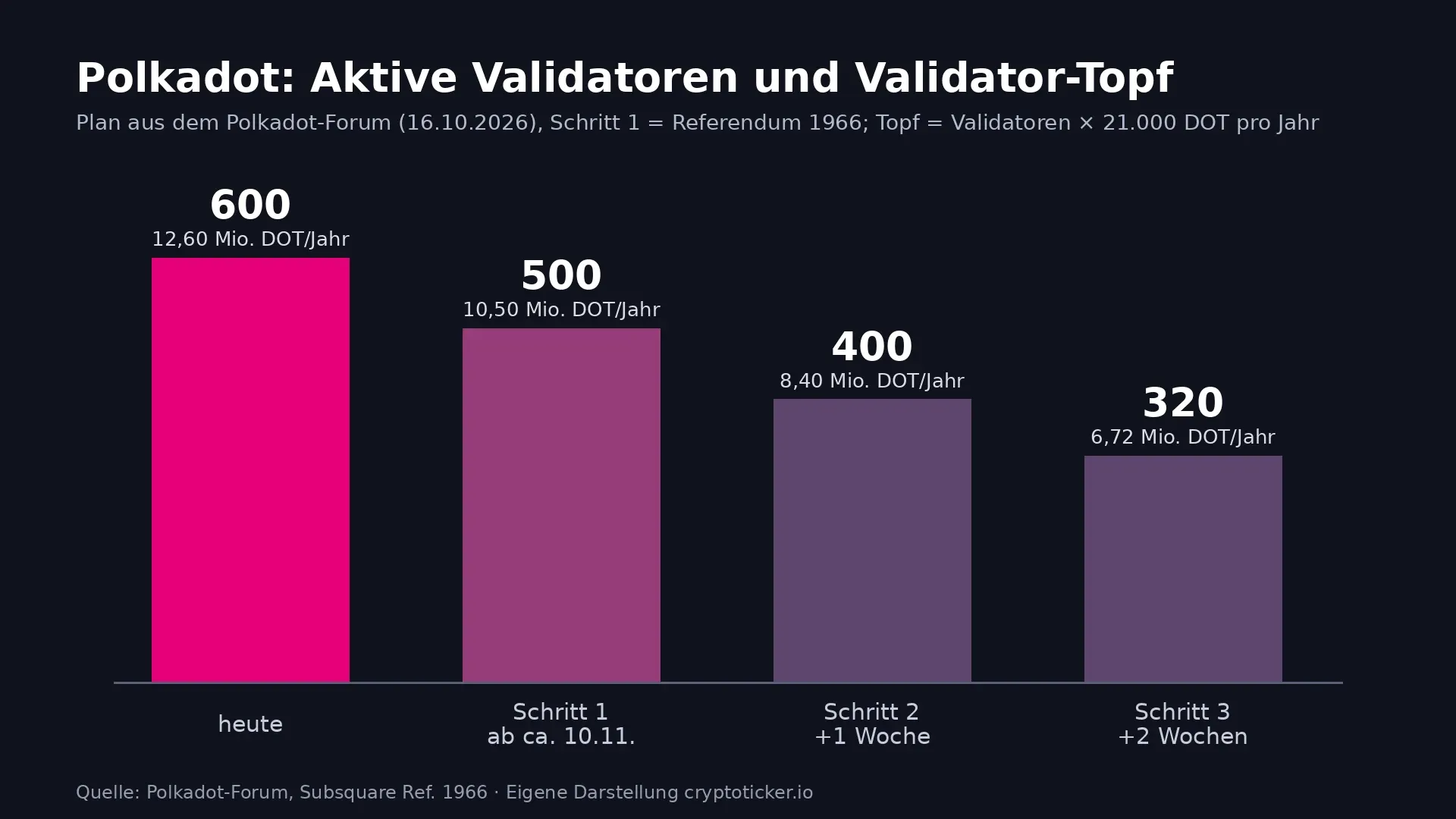
Polkadot is shrinking its circle of active validators. Referendum 1966 has been running since Tuesday and aims to cut the number of validators that produce blocks and earn rewards from 600 to 500. If approved, the change mathematically takes effect from Tuesday, November 10, at around 11 a.m. Central European Time. It is the first of three steps: by the end of November only 320 validators are to remain active. Anyone nominating DOT themselves may then be left without rewards if none of their chosen validators survives the cut. What is documented: content, timing and voting status come from the referendum itself, the roadmap from the proposal in the Polkadot forum of October 16, and the tax rules from the German Income Tax Act. Our assessment follows further down in a separate, clearly marked section.
The price offers the topic no tailwind. On Friday morning DOT trades at $0.92 or €0.82 according to CoinGecko, 3.1 percent lower than 24 hours earlier and almost 19 percent lower than a month ago. Bitcoin lost 6.1 percent over the same period and stands at $75,600.
Referendum 1966: what the first step of the validator set reduction changes
The referendum is titled "Step #1 of Validator Set Reduction" and runs in the "Whitelisted Caller" track. Polkadot uses this route for changes the Technical Fellowship has approved in advance. It is faster than the "Root" route but still requires a majority of DOT holders.
In substance the proposal does three things. It sets the number of active validators at 500. It reduces the budget from which validators are paid on top of their commission in the same proportion. And it adjusts two Relay Chain parameters that govern how many validators per core check blocks. A core, in Polkadot jargon, is a fixed slot for the computing work of a connected chain.
The timing is hard-coded: the change is set to take effect at block 33,814,400 of the Relay Chain. At six seconds per block, that was a good 58,000 blocks ahead on Friday morning, or around four days. The new number becomes effective in the first era after that. An era lasts 24 hours on Polkadot; at its start the network selects which validators are active.
The vote on Friday morning was clear-cut. Around 8.9 million votes stood in favour of the proposal and just over 26,000 against. Votes are weighted by lock-up period, so anyone committing their DOT for longer counts more. The amount actually participating, the "support" figure, is around 1.8 million DOT. The referendum is in its decision phase. Until it is confirmed, November 10 remains a planned date.
Validator set from 600 to 320: the roadmap to the end of November
The framework was presented by the user Jan-Jan in the Polkadot forum on October 16. The plan envisages three stages, each about a week apart: first 500, then 400 and finally 320 active validators. Each stage needs its own referendum with Fellowship approval and the consent of DOT holders. The step-by-step rollout is meant to allow the network's performance to be monitored and the process halted if problems arise.
According to the proposal, the existing election rule decides who stays. Polkadot elects its active validators through Nominated Proof of Stake, or NPoS: DOT holders nominate validators, and an election algorithm distributes the nominated DOT so that the elected validators are backed as evenly as possible. Validators with little backing drop out first. The smaller the set, the higher the threshold of nominated DOT a validator needs.
At 21,000 DOT per validator per year, the validator budget works out as follows: 12.6 million DOT a year today, 10.5 million after stage one and 6.72 million after stage three. The figure of 21,000 comes from the forum post itself; we calculated the totals from it.
Metanodes: why Polkadot wants fewer but stronger validators
The reason for the cut is called the metanode. By the end of 2026, validators are to take on more tasks than today: additionally running collators for Asset Hub and People Chain, answering requests from light clients and serving RPC requests from the Polkadot App. RPC stands for remote procedure call and refers to the interface through which a wallet queries a balance or submits a transfer. A collator gathers the transactions of a connected chain and passes them on to the validators for verification.
According to the proposal, 600 validators are more than Polkadot needs. The budget saved is later to compensate metanode operators for the more expensive hardware. As the minimum specification for a single machine, the developer alexggh names, in the same forum thread, 16 cores, 64 gigabytes of RAM, at least 2.4 terabytes of NVMe storage and a symmetrical 1 gigabit per second connection.
There are objections in the forum too. The user pmensik asks how the quality of RPC services is to be measured, how weak operators will be removed from the set, and whether the cut excludes good operators before metanodes launch. No answer setting out a measurement method has yet appeared in the thread.
Nomination and staking: which DOT could go unrewarded from November 10
For DOT holders, one question matters: where are your own DOT staked? There are three routes, and the cut affects them differently.
Direct nomination
Anyone nominating directly selects up to 16 validators. Rewards are paid only for eras in which at least one of them is in the active set and the DOT are assigned to it. If all selected validators drop out of the set of 500, or later 320, the DOT stay bonded but earn nothing. The staking dashboard then shows the status "inactive". A new selection takes effect from the next era.
Nomination pool
A nomination pool bundles the DOT of many holders, and the pool operator chooses the validators. Here the work lies with the operator. Checking is still worthwhile: a pool whose validators have weak backing will earn less after the cut, or at times nothing at all.
Staking via an exchange
Anyone staking DOT through an exchange or broker does not nominate themselves. The platform distributes holdings across its own or third-party validators. Whether it adapts its selection to the smaller set is its own decision; the yield paid out will show it with some delay. Which platforms offer DOT staking and on what terms is shown in our comparison of staking providers.
Exiting has no longer been a major risk since the summer. With Referendum 1910, Polkadot abolished slashing for nominators and shortened the unbonding period from 28 days to at most two eras. Anyone wanting to switch validators or exit entirely can therefore access their DOT within about two days.

Polkadot staking yield: the validator pot shrinks, the stakers' share does not
Since Referendum 1909, Polkadot has distributed newly issued DOT according to a fixed formula. According to the calculation by the user Northvane in the forum thread, 45.2 percent goes to stakers, 22.6 percent to validators as an incentive and 32.2 percent into a buffer. The cut only changes the middle item: after stage one it falls to 18.8 percent, after stage three to around 12 percent. The freed-up portion is to flow into the buffer for now and later go to collators and RPC services.
The stakers' share stays at 45.2 percent. For nominators with an active validator, the yield changes little on paper; spread across fewer validators, the reward per nominated DOT may even rise slightly. The proposal gives no yield figure, and we do not calculate one. The price of the stable yield is the risk of dropping out of the set entirely with a weak validator.
What the yield is worth in euros depends on the price. At €0.82 per DOT, a return of 100 DOT a year brings in around €82; a month ago it would still have been just over €100.
XCM incident in October: $1.38 million loss for the Treasury
The same weeks saw a glitch that has nothing to do with the validator cut but touches on confidence in the technology. Between October 24 and 26, an attacker exploited a flaw in Cross-Consensus Messaging, or XCM, the message format Polkadot chains use to exchange value. The attacker thereby lowered the recorded supply of the new stablecoin dotUSD on Asset Hub, without tokens disappearing from user accounts. The price in the DOT/dotUSD pool became distorted, and traders swapped at artificial rates.
According to the post-mortem by the developer firm Parity, published in the Polkadot forum on November 2 and reported by CryptoSlate on November 4, the Treasury, as the pool's sole liquidity provider, suffered a loss of around $1.381 million. According to Parity, no user funds were lost. The flaw had been fixed in the code in June, but the correction had not reached the running software. The fix came on October 26 with runtime 2.5.1, and on October 30 runtime 2.5.2 corrected the recorded dotUSD supply.
DOT price on Friday: $0.92 and the levels since Wednesday
On Wednesday DOT stood at $0.96. Our article five years after the 2021 record named $0.92 as the downside level and $1.04 at the 20-day average as the upside level at the time. The lower level has since been reached. Over the past 24 hours the low was $0.889 according to CoinGecko, just below it; on Friday morning DOT is trading slightly above it again.
The move follows the broader market. On Thursday, losses in chip stocks on the Nasdaq pulled Bitcoin below $77,000, and leveraged long positions were forcibly closed. At 3.1 percent in 24 hours, DOT fell only half as much as Bitcoin. DOT worth around $105 million changed hands over this period, and market capitalisation stands at just under $1.58 billion, rank 57.
Two levels matter for the coming days. Below, the range between $0.89 and $0.92, which held twice this week; should DOT close below it, the coin would trade lower than it has in years, and there would be no tested support. Above, $0.96, the high of the past 24 hours and Wednesday's level. Only above that would the 20-day average come back within reach. The validator cut itself changes neither the supply nor the issuance of DOT and is therefore not a direct price factor.
Polkadot staking and tax: the rules for rewards in Germany
In Germany, staking rewards are income under Section 22 No. 3 of the Income Tax Act. What counts is their euro value on the day they are received. If all income of this kind together stays below 256 euros a year, it is tax-free. This threshold is an exemption limit rather than an allowance: if the total exceeds it, the entire amount is taxed, not just the part above 256 euros.
On a later sale, the one-year holding period under Section 23 of the Income Tax Act applies to each tranche. Staked DOT do not extend this period; the Federal Ministry of Finance dispelled earlier concerns about an extension to ten years in its guidance on crypto assets. Whether the tax-free holding period survives at all is politically open. Our page on the crypto holding period reform summarises the state of the debate.
Switching validators now does not trigger a sale. Nominating anew or changing pools is not a taxable disposal, as long as the DOT are not exchanged for euros or another token.
Polkadot validator reduction: our assessment
Our assessment: the cut is technically understandable and manageable for investors, provided they keep an eye on their nominations. In its favour are the vote of around 8.9 million to 26,000 and the staged process with separate referendums. Also in its favour is that the stakers' yield remains untouched. Against it is the fact that Polkadot, with 320 instead of 600 validators, has a narrower base, and the measurement rules for metanodes are still open in the forum. The XCM incident also shows that fixes do not always reach the running software in time. We do not derive a buy recommendation from this; the price is currently following the broader market rather than the technology, and a total loss remains possible with any crypto asset.
Polkadot staking: four days remain for new nominations before November 10
- Review your nominations. Open the staking dashboard and see how many DOT back your validators. Those at the bottom drop out first at 500 or 320 slots. If you prefer to stake via a platform, you will find providers in the staking comparison.
- Check how you buy. Anyone looking to buy more DOT or reallocate should use an exchange licensed under the EU's MiCA regulation. Which providers are licensed is listed in our comparison of regulated crypto exchanges.
- Record your rewards. Note every inflow with date and euro value so that the 256-euro threshold and the holding period per tranche can be documented. A tax tool does this automatically; our comparison of crypto tax tools lists suitable programs.
(As of November 6, 2026. This article is not investment advice. Prices and fee structures change; check the terms with the provider before you buy.)
Decrypt
Patrick Yaroch drained wallets using credentials the FBI had collected, then asked ChatGPT for advice on starting a new life in Europe.
The Network Sustainability Mechanism will reissue removed ZEC from 2031 within the 21 million cap, as the community debates its dev fund.
Anthropic's Claude finance assistant analyzes spending from linked accounts in the U.S., and Anthony Pompliano has a big problem with it.
Ueno’s collapse trapped millions of Paraguayan depositors and triggered a president’s resignation, reviving Bitcoin’s argument for self-custody.
OpenAI wants to ease the backlash against AI campuses with promises on electricity, water and secrecy. Its new compact raises a tougher question: Who would make the company comply?
U.Today - IT, AI and Fintech Daily News for You Today
A bug in Reth's legacy trie code could cause incorrect state-root calculations.
Zcash open interest has fallen by almost 8% following the activation of the NU7 network upgrade.
BlackRock dumps Bitcoin worth $105 million as the broader market faces a deeper price correction, marking its fifth consecutive day of selling Bitcoin.
XRP Ledger cuts Node memory usage by up to 23% in major performance boost.
Zcash completely re-engineers long-term security with the NU7 upgrade, while its price is predicted to hit $2,000 by the end of the year.
Blockonomi
TLDR:
- Saylor says Bitcoin is rebounding from its 200-week moving average after a year-long bear market.
- Bitcoin’s market dominance has risen to around 67%, with about $6.3 billion in Q3 ETF inflows.
- Saylor says digital credit, bank lending, tokenization, and the 2028 halving could drive Bitcoin demand.
- Strategy holds 848,517 Bitcoin, about 4% of eventual supply, with record Q3 net income of $19.1 billion.
A Bitcoin bull market could last two to three years, according to Strategy founder Michael Saylor. He spoke during Strategy’s Q3 2026 earnings call on October 30, while Bitcoin rebounds from a year-long downturn.
Saylor Points to Rebound From 200-Week Moving Average
Saylor said Bitcoin has endured a bear market lasting roughly one year. According to him, the asset is now rebounding from its 200-week moving average. He expects a Bitcoin bull market of two to three years to follow.
Several indicators support that view, he explained. Bitcoin’s market dominance has risen to around 67%, which measures its share of the overall crypto market. Institutional demand is also returning.
Banks are embracing Bitcoin as well, Saylor noted. Additionally, he cited roughly $6.3 billion in Q3 Bitcoin ETF inflows as a positive signal. The pool of potential buyers is broadening as well.
These indicators are signs, not guarantees, of a Bitcoin bull market. Bitcoin remains volatile, and regulatory shifts or macroeconomic conditions could interrupt the trend. The webinar itself focused on Strategy’s Bitcoin treasury, digital-credit products, financial results, and outlook.
Factors Behind the Expected Bitcoin Bull Market
Saylor believes digital credit and bank lending could absorb all new Bitcoin supply. In his view, that demand would meet a scarce and increasingly predictable supply. Exchange-traded products, corporate treasuries, and financial institutions are also creating new channels for capital.
He also listed monetary expansion, institutional investment, and tokenization as additional demand drivers. Furthermore, the 2028 halving could add to that demand. He also argued that tokenization could enable global, 24/7 trading. As a result, product innovation could move faster.
Saylor presented Bitcoin as scarce “digital capital.” Its uses, he said, could expand beyond payments into equity, credit, collateral, and other financial products. Strategy CEO Phong Le described MSTR as “amplified Bitcoin,” with preferred securities providing digital credit.
Strategy’s stated goal is to double Bitcoin per share over seven years. It plans to use capital raised through its credit products to acquire Bitcoin.
Reserves for obligations would be maintained alongside those purchases. These were management’s projections and views on the Bitcoin bull market.
Strategy Reports Record Q3 Results and CFO Transition
Strategy said it held 848,517 Bitcoin, about 4% of the eventual supply. Bitcoin’s price rise drove a roughly $20.9 billion fair-value gain in Q3.
That gain contributed to record operating income of $20.9 billion. Net income reached $19.1 billion, with diluted earnings of $44.75 per share.
MSTR rose 76% during the quarter, compared with Bitcoin’s 43% gain. By October 23, the company reported about $74 billion in treasury assets.
Those assets include Bitcoin and roughly $5.1 billion in U.S.-dollar assets. Strategy said the reserves provide several years of coverage for interest and dividend payments.
Strategy raised $5.4 billion in Q3 and $21.2 billion year to date, while reporting low net leverage. Its digital-credit market has grown to about $16 billion. The Stretch preferred stock offers a roughly 12% dividend.
Shareholders approved daily dividend accrual and payments for several preferred products, which Strategy said is intended to improve liquidity. Management also described reserve-building, share repurchases, and a credit-coverage monitoring framework.
CFO Andrew Kang announced he would step down on November 5 for personal reasons. CEO Phong Le will take the principal financial officer role during the transition.
From January 2027, financial leadership is planned to split between the software and Bitcoin businesses. Management cautioned that Bitcoin-price volatility and other risks could materially affect results.
The post Michael Saylor Says Bitcoin Bull Market Could Last 2-3 Years appeared first on Blockonomi.
TLDR
- XRP Ledger activated the fixCleanup3_4_0 amendment on November 4 at 14:52 UTC, at ledger 108,112,129.
- The fix stops accounts with burn-only permission from creating new issued tokens, including stablecoins.
- XRP itself was not part of the affected permission system, and no exploitation has been publicly reported.
- A dip in validator support on October 21 restarted the 14-day approval clock and pushed activation into November.
- The update also fixes trading, signing and vault rules, but the lending protocol still needs its own vote.
The XRP Ledger activated a software amendment on November 4 that closes a flaw tied to issued tokens. The fix, called fixCleanup3_4_0, went live at 14:52 UTC at ledger 108,112,129, according to the XRPLWin amendment tracker.
The update reached the network almost two weeks later than first expected. A short drop in validator support in October forced the approval clock to start over.
The flaw sat inside the ledger’s permission delegation system. This system lets account holders allow other accounts to carry out specific transactions without giving up full control.
The problem involved a permission called PaymentBurn, which lets an approved account destroy tokens issued by another account. An issuer might give this permission to a payment service that handles stablecoin redemptions.
Under the old rules, an account holding only PaymentBurn rights could create issued tokens under certain conditions. This happened when payments using the permission crossed a zero-balance boundary.
The new amendment blocks those transactions from crossing that boundary. The official XRPL release notes say the change rejects “PaymentBurn payments that cross a zero balance.”
The flaw affected assets issued on the network, such as stablecoins, trust-line tokens and Multi-Purpose Tokens. XRP, the network’s native cryptocurrency, was not part of the affected permission system.
No confirmed exploitation of the flaw has been publicly reported. Available disclosures do not name any issuer that suffered unauthorized token creation.
How a Missed Vote Delayed the Fix
Developers added the correction to XRP Ledger server version 3.4.0 in September. However, a software release alone does not change the network’s transaction rules.
WOW… $XRP Ledger OFFICIALLY FIXES a Bug That Could Let Someone CREATE Tokens They Were Only Allowed to BURN
Imagine a stablecoin company allows another account to DESTROY tokens when customers cash out.
pic.twitter.com/DqbxiCjTOT
— ChardSartin (@ChardSartin_com) November 6, 2026


Amendments need support from more than 80% of trusted validators for 14 days in a row. With 35 validators on the tracked default list, at least 29 must back an amendment for the full period.
The first approval window opened on October 9, which put activation on track for around October 23. Support fell below the threshold on October 21, ending that attempt after 12 days and three hours.
A new majority formed later that same day, starting a fresh two-week countdown. The second attempt lasted 14 days and five minutes before the amendment went live.
Other Changes in the Update
The amendment also fixes several other transaction functions. One change stops automated market maker clawbacks from destroying a liquidity provider’s tokens when rounding would leave the issuer recovering no underlying assets.
Developers corrected permissioned trading rules so accounts cannot receive certain tokens through offers when issuer limits should block them. Other changes cover escrow reserves, Multi-Purpose Token authorization and transaction signatures.
Some signing steps had used overlapping authorization structures. The update adds distinct signing prefixes so a signature meant for one transaction role cannot be reused in another.
The release also includes accounting fixes for Single Asset Vaults and the proposed XRP Ledger lending protocol. These cover deposits, withdrawals, recoverable assets, overdue payments and how impaired loans affect vault records.
The maintenance amendment does not switch on the lending features themselves. Ripple has backed the lending amendments, which would let loan brokers arrange fixed-term loans using assets deposited into vaults.
A further amendment, LendingProtocolV1_1, proposes closed-ended vaults with subscription, investment and redemption periods. Each lending amendment must pass the same validator approval process before it can run on mainnet.
The post XRP Ledger Patches Burn Permission Bug That Could Create New Stablecoins appeared first on Blockonomi.
TLDR:
- The PBOC halted Solana Accelerate China 2026 events in Shanghai and other cities before they began.
- Officials say the Solana advertising campaign violated the February 2026 crypto risk notice.
- The advertisements appeared on the Citigroup Building’s exterior wall in Shanghai’s Lujiazui district.
- The PBOC will keep targeting domestic crypto traders and China-based affiliates of overseas platforms.
The People’s Bank of China (PBOC) has launched an investigation into the Solana advertising campaign in Shanghai’s Lujiazui financial district.
An official said authorities found that domestic entities placed the advertisements to promote cryptocurrencies through brand marketing.
Together with local financial regulators, police, and market supervision authorities, the PBOC halted the planned Solana Accelerate China 2026 events.
The events were set for Shanghai and other cities. Officials will examine the entities and individuals involved in the Solana advertising campaign.
PBOC Cites February 2026 Notice on Cryptocurrency Risks
The official said the Solana advertising campaign violated a notice issued by eight Chinese authorities in February 2026. The notice addresses the prevention and handling of risks related to cryptocurrencies. It also states that domestic cryptocurrency business activities constitute illegal financial activities.
Recent monitoring found that Solana promoted its brand through high-profile campaigns run by domestic organizations.
The official described Solana as a major issuance platform, saying its coins are “essentially virtual currencies.” The platform also provides technical services for issuing and trading major virtual currencies such as USDT.
The official said these businesses are “clearly illegal financial activities” under the notice. Promoting Solana therefore violates its provisions.
According to the official, virtual currencies “cannot effectively meet requirements for customer identity verification and anti-money laundering.” This makes them prone to triggering market speculation, the official said.
Financial Times reporters noted that the advertisements appeared on the exterior wall of the Citigroup Building. The placement drew attention across the cryptocurrency industry and sparked market discussion.
The Solana advertising campaign preceded the planned offline exchange events, which were halted before they began. The Financial Times also interviewed the relevant PBOC departments for the official’s explanation.
China Maintains Long-Standing Stance on Virtual Currencies
China has kept a prohibitive stance on virtual currency business for years. In 2013, the PBOC and five other departments issued a notice on preventing Bitcoin risks.
It stated that Bitcoin cannot and should not be used as currency in the market. Since then, regulators have issued further notices as part of the same policy direction.
A 2021 notice on virtual currency trading and speculation went further. It clarified that Bitcoin, Ethereum, and Tether do not hold legal status equivalent to fiat currencies. The February 2026 notice continued this approach.
The latest notice also sets accountability rules. Domestic entities and individuals face legal accountability if they assist foreign entities providing illegal virtual currency services. This applies when they knew, or should have known, about the violation.
Going forward, the PBOC will work with relevant departments and local governments after the Solana advertising campaign.
The focus will remain on domestic virtual currency traders and China-based affiliates of overseas issuance and trading platforms.
The official said the PBOC will “continue to crack down on domestic virtual currency-related business activities.” The goal, according to the official, is to “maintain economic and financial order.”
The post PBOC Opens Probe Into Solana Advertising Campaign in Shanghai appeared first on Blockonomi.
TLDR
- Fed and OCC staff called US banks on Monday about the $6.3 billion Binance hack.
- Supervisors asked about unusual transactions and service disruptions.
- One large US bank contacted Binance within hours and is preparing an internal report.
- A source said fast-improving AI models are the main worry for bank security teams.
- Binance shared an incident report with partner banks but has not determined the impact.
US banks are testing their own cyber defenses after federal supervisors called to ask about the $6.3 billion hack at Binance. The calls came from staff at the Federal Reserve and the Office of the Comptroller of the Currency, according to people familiar with the matter.
The outreach began on Monday morning. Supervisors asked lenders whether they had seen unusual transactions or any disruption to their services, Reuters reported on November 5.
Binance, the world’s largest crypto exchange, disclosed the theft last week. People familiar with the matter described it as the largest financial heist on record.
BREAKING:
The FED and the OCC have contacted US banks to assess potential security risks following Binance’s $6,300,000,000 hack.
Banks are checking for unusual activity and possible service disruptions. pic.twitter.com/RQcrmvlLQl
— Litest (@Litest) November 5, 2026
How Banks Are Responding
At least one bank that received a call said its operations had not been interrupted. It prepared talking points in case customers asked about the hack, but few questions have come in so far.
The cybersecurity team at one of the largest US banks contacted Binance within hours of the breach. That team is now writing an internal report on the attack.
The report will feed into a review of the bank’s own systems and could lead to security upgrades. It is not yet clear whether the bank would be exposed to the same methods the attackers used.
Other lenders are also studying the incident. They are running diagnostics to see whether their defenses could stop a similar attack.
One person familiar with the matter said fast-improving artificial intelligence models are the main worry. These tools make it harder for banks to stay ahead of attackers, the person said.
Banks are putting large amounts of resources into reviewing and fixing their cybersecurity code, the person added. Bank shares have shown little sign of strain so far.
What Binance and Regulators Have Said
The Fed and the OCC declined to comment. The contacts with banks have so far been informal inquiries, not formal examinations.
The checks come after US bank regulators eased rules on crypto activity. President Donald Trump has publicly supported digital assets.
The Fed, for example, withdrew a 2022 policy that required banks to get regulatory permission before starting crypto-related activities. Since then, more lenders have built out digital-asset services.
Stephan Mühlbauer, head of US government affairs at CertiK, said the inquiries could lead to closer checks on banks. He pointed to crypto custody services, counterparty risk and incident-response systems as likely areas of focus.
“The authorities’ job is to protect the financial system,” Mühlbauer said. “They need to understand where risks are concentrated and how quickly they can respond.”
Binance said it was not aware of the talks between banks and their supervisors. It also said it knew of no impact on US lenders.
“We are in close contact with regulators all over the world, keeping them up to date on this security breach,” a company spokesperson said.
Binance said it has shared an incident report with all of its partner banks. The exchange added that it has not yet determined how the breach affected those banking partners.
The post US Banks Test Cyber Defenses After Fed, OCC Calls Over $6.3 Billion Binance Hack appeared first on Blockonomi.
TLDR
- Binance removed all API keys linked to SignalPlus on Nov. 5, 2026, after the platform reported a potential security issue.
- CZ told SignalPlus users to revoke API keys on every exchange, and said Deribit had also reported the issue.
- Binance says its own systems are unaffected and user funds remain safe.
- The move came one week after Binance’s $6.34 billion hack on Oct. 29.
- No link has been established between the two incidents, and the SignalPlus issue has not been fully explained.
Binance founder Changpeng Zhao has told traders who use SignalPlus on any exchange to revoke their API keys. The warning came on Thursday, Nov. 5, 2026, after Binance removed every API key linked to the third-party trading platform.
SignalPlus had reported a potential security issue before the move. Binance said it acted as an immediate precaution.
“Following a potential security issue reported by third-party platform SignalPlus, we have proactively removed all API keys linked to SignalPlus as an immediate precautionary measure,” the exchange said on X. It added that “Binance’s own systems are unaffected. User funds remain safe.”
Warning Reaches Beyond Binance
Zhao, known as CZ, said the risk was not limited to one exchange. “If you use SignalPlus for any other exchange platform, it’s time to revoke all your API keys,” he wrote on social media.
He also said that Deribit, a crypto derivatives exchange focused on options and futures, had reported the issue. Zhao advised traders not to store API keys with any third-party platform.
Binance co-founder Yi He repeated that the exchange’s systems were unaffected. She told customers to check open orders, hold off on reconnecting affected keys and turn on IP whitelisting.
Binance's own systems are unaffected.
If you used SignalPlus, please log into your…
— Yi He (@heyibinance) November 5, 2026
SignalPlus is a Hong Kong-based financial technology company. It offers AI-enabled trading tools, options analytics and execution services.
Its software links to exchanges through application programming interfaces, or APIs. These keys let outside apps place trades without users moving funds off the exchange or logging in each time.
If an API key is compromised, attackers could use it to make unauthorized trades. This can happen even when withdrawals are switched off.
Binance told affected users to review positions and open orders directly in their accounts. It said they should wait for SignalPlus to confirm the issue is fixed before setting up new connections.
The exchange also urged users to enable IP whitelisting, which limits API access to approved internet addresses. It asked other connected platforms to review their own security controls.
Second Security Event in One Week
The move came one week after Binance suffered the largest crypto hack on record. On Oct. 29, attackers took about $6.34 billion after reportedly compromising 17 hot wallets across several blockchains.
That breach involved compromised developer systems, malicious software and unauthorized access to wallet-signing tools. Binance has said the attack began with a fake job interview.
The FBI linked the theft to North Korea’s TraderTraitor group, which is also tied to the 2025 Bybit hack. North Korea denied responsibility.
Tether, Circle and other partners reportedly froze or intercepted about $2.85 billion. Binance pledged to cover customer losses and began reopening withdrawals in phases on Nov. 1.
By early Nov. 5, blockchain tracking estimates put about $3.2 billion still under the attackers’ control. Most of it was held in bitcoin and ether.
Binance says no link has been established between the hack and the SignalPlus issue. The October breach hit its internal wallet systems, while the latest step concerns keys tied to an outside platform.
The exact nature of the SignalPlus problem has not been made public. It is also not yet known whether any customer credentials were accessed.
The post Binance Pulls SignalPlus API Keys, Says Funds Safe After Deribit Flags Security Issue appeared first on Blockonomi.
CryptoPotato
Today, we examine Ethereum, Ripple, Cardano, Binance Coin, and Hyperliquid in greater detail.
Ethereum (ETH)
In the past 48 hours, the crypto market has been extremely volatile as the mid-term elections in the US concluded. Ethereum quickly rallied by 10% only to erase those gains in full a day later, thus reconfirming $2,400 as resistance. This also made the weekly price flat.
Sellers have total control over the price, considering that the past five weekly candles are red with clear lower lows. In this context, it’s unlikely ETH can do much but seek support closer to $2,000.
Looking ahead, the correction for the leading altcoin is far from over. The first key level that may have a shot at reversing this is found at $2,000. If that support won’t hold, then bears will push towards $1,800 next.

Ripple (XRP)
XRP had a bad week and closed 6% lower as sellers continue to dominate and push the asset to new lows. At the time of this post, the cross-border token is found around $1.2, but may soon find itself moving closer to the key support at $1.1 and $1.
Due to the recent volatility, XRP’s downtrend appears to be accelerating with no sign of relief. This is why sellers may be determined to test $1 before they run out of steam.
Looking ahead, the token is likely to explore lower levels before finding support. If $1.1 won’t hold, then buyers have a good shot at defending the price around $1 since this level held well back in August.

Cardano (ADA)
ADA is in the same boat as Ethereum and is about to close its fifth weekly candle in red. It also fell by 5% this week. This correction has now erased more than half of the gains made during the previous rally in August and September.
Hopefully, buyers will start to show up around current levels, with good support expected at $0.18 and $0.16. If sellers somehow manage to break below both these levels, then Cardano will be forced to re-test the support at $0.15 that was last visited in June.
Looking ahead, buyers have to show up on the order book, as the alternative is a quick drop back to the starting point from July. Such a scenario would be a bearish signal that ADA cannot sustain current prices and may be forced lower still.

Binance Coin (BNB)
Binance Coin dropped to the key support at $690 and is currently being contested at this level. Considering the market context, sellers may have the upper hand. If successful, then BNB will likely fall to $580 next.
The asset also closed the week 4% lower after it faced pressure from sellers. As previously noted, Binance experienced the biggest crypto hack in history and has recently reopened withdrawals, which saw roughly $5 billion leave the exchange.
Looking ahead, expect a bumpy road for BNB as it seeks support and a new equilibrium. This will likely depend on how Binance manages the impact of the recent hack and its fallout.

Hype (HYPE)
HYPE has seen similar volatility where the recent rally towards its all-time high at $97 was completely erased a week later. That forced it to close the week 17% lower, which makes it the worst performer on our list.
This change of momentum is extremely bearish and raises questions about whether the price has topped, at least in the immediate future. Even more concerning, price action since the start of 2025 has formed a huge bearish wedge that is about to resolve.
Looking ahead, if Hyperliquid fails to sustain its current price and falls below the wedge in blue on the chart, then the top was likely in at $97, and it will take months before it can be challenged again, likely sometime in 2027.

The post Crypto Price Analysis Nov-6: ETH, XRP, ADA, BNB, and HYPE appeared first on CryptoPotato.
Fresh off their midterm heroics, House Democrats are reportedly discussing a broader crypto market structure bill that would expand Rep. Maxine Waters’ consumer bill of rights.
According to those in the know, the proposal could give the SEC more oversight and also add stricter rules for crypto exchanges.
Democrats to Revisit Provisions Left Out of the CLARITY Act
The proposal was first reported by journalist Eleanor Terrett, who noted that Dem lawmakers were having discussions about expanding a 2025 amendment to the CLARITY Act called the Crypto Investor and Consumer Bill of Rights, fronted by Waters, into a wider “market structure” bill for the industry.
According to her, the proposal is looking to combine provisions the congresswoman had offered but had not been adopted as well as those of other Democrats that Republicans had agreed to before the failed cloture vote in September.
Citing at least four sources she says are familiar with the matter, Terrett reported that on oversight, the SEC would get a larger role and the CFTC a smaller one, therefore reversing the CFTC-led approach to spot markets in the last bill. There is also a likelihood that ethics provisions that would restrict the crypto activities of President Donald Trump and other federal officials could be included. This had been a sticking point when CLARITY failed to move in the Senate.
Furthermore, the bill would put consumer protection back in the mix, starting with much stricter custody rules and monthly proof-of-reserve attestations, to confirm whether a crypto firm is holding what it owes its customers. Also to be included will be SIPC-like coverage of customer assets, a brokerage-style safety net, as well as 24/7 customer service and limits on firms trading against their own customers.
But the hardest fight, according to crypto law strategist Tonya M. Evans, could be around DeFi, with a Democratic operative reportedly suggesting that the industry may be made to meet intermediary-style requirements in order to operate.
Midterm Results Complicate the Path to a Crypto Framework
While some GOP legislators have apparently dismissed the measure as a “messaging bill,” Evans pointed out that such bills often end up as the starting draft to what eventually becomes law.
Analysts like Ash Crypto had warned that the CLARITY Act could be delayed for at least two years after the midterms produced a “blue tsunami” that saw Dems flip 7 Senate seats to reach 54 to the Republicans’ 44, as well as a projected 258 House seats (flipping 42) when it’s all done and dusted.
The post Report: Democrats Considering New Crypto Market Structure Bill appeared first on CryptoPotato.
Binance co-founder Changpeng Zhao (CZ) has urged iPhone users to update their operating systems amid warnings that the DarkSword exploit can steal crypto wallet information through compromised websites.
The threat has raised concerns about self-custody security, especially considering that the reported attack is said to be able to target sensitive device data even without victims connecting their wallets or approving transactions.
DarkSword Exploit Puts iPhone Crypto Wallets at Risk
In a November 6 post on X, CZ told users to install the latest iOS updates, especially those who have not updated their devices in a while. Furthermore, he reminded crypto holders that wallet apps cannot update a phone’s operating system.
“No wallet software can update your OS,” he wrote. “Self-custody means self-responsibility.”
His warning came in the wake of reports that DarkSword can exploit vulnerabilities on iOS through malicious websites opened in Safari. Discussing the threat, a crypto user pointed out that an attack wouldn’t even need a wallet connection, transaction signature, or approval, with just a simple visit to an infected website being enough to expose sensitive information such as wallet files and recovery phrases stored in the device.
Officer’s Notes, a threat researcher, had earlier reported that about $5.57 million worth of crypto had already been stolen through the vulnerability, with more than 18 websites allegedly involved in distributing the malicious code.
According to the account, DarkSword was being sold online for $30,000, and the seller has listed iOS 18.6.2 as the latest supported firmware. In addition, researchers have reportedly found placeholders for iOS 26 and 27, which could suggest that the infrastructure is being prepared for potential exploits in the future.
However, Officer’s Notes pointed out that Apple had already patched all vulnerabilities, numbering six, that had been used in the known exploit chain. That said, the wallet-targeting code is still relevant since the researcher says they discovered that parts of the older version could still be reused, with one iteration featuring a dedicated function for the imToken wallet.
iOS Vulnerabilities Exposed Crypto Holders in the Past
There have been other iPhone security incidents that resulted in the stealing of crypto, including a vulnerability in Apple’s 2D rendering engine, CoreGraphics, which allowed malicious code to run when a specifically crafted file was processed. The phone manufacturer addressed the issue with the release of iOS 26.7.1 and iPadOS 26.7.1 toward the end of September.
However, it did acknowledge that the flaw may have been exploited in highly sophisticated attacks against specific people, with security firm SlowMist at the time warning crypto users to update their devices and to avoid suspicious links and downloads.
There was also another case that involved the FomoPeek app, where SlowMist and OKX security reportedly found malicious code in the app that could exploit iOS weaknesses and access sensitive information beyond FomoPeek’s normal permissions.
The post CZ Urges iPhone Users to Update iOS Amid DarkSword Threat appeared first on CryptoPotato.
The popular crypto exchange Toobit announced the launch of scaled orders on Toobit Futures. The initiative lets traders place multiple limit orders across different price levels at once, simplifying trade execution and position management.
Using scaled orders, market participants can configure up to 10 limit orders across a chosen price range in a single setup. They can also customize how both prices and position sizes are distributed, allowing for greater flexibility in executing trading strategies and saving time on manual order entry.
The feature is particularly useful for traders who prefer staggered entries and exits, including those seeking to increase their exposure when prices decline or cash out when prices go up. Market participants can also adjust order quantities across different price levels to match their preferred approach to building or reducing positions.
After submission, traders can monitor and manage each order separately, making it easier to tune their actions without disrupting their broader trading strategy. The new feature expands Toobit’s recent futures upgrades, which include separate isolated margin mode for managing multiple positions, as well as one-click trading, keyboard shortcuts, and faster pair navigation. The platform has also introduced tools for adding to open positions and tracking trading history via a new timeline view.
Scaled orders are currently available on Toobit’s web platform, with mobile support planned for app version 2.3.9. For more details, visit the official announcement page, or refer to the step-by-step guide for instructions on how to get started.
The launch comes at a time when crypto derivatives continue to dominate trading activity on centralized exchanges. According to CoinDesk Research’s September 2026 Exchange Review, derivatives trading volume rose 15.7% to $3.94 trillion in September, representing 77.6% of combined spot and derivatives volume. Futures open interest also increased 4.5% to $107 billion, reflecting continued activity across derivatives markets.

About Toobit
Toobit is an award-winning cryptocurrency derivatives exchange that provides zero-fee spot trading, AI tools, and high leverage for both crypto and TradFi markets. It is particularly designed for those who thrive on exploring new frontiers and maintains a fair, secure, and transparent environment for traders to navigate the crypto markets.
The post Toobit Futures Upgrades Trading With Scaled Orders appeared first on CryptoPotato.
The quick gains charted on Wednesday afternoon across all markets disappeared 24 hours later, and the cryptocurrency industry was not spared.
Ripple’s cross-border token has taken one of the largest hits on a daily scale, dumping to its lowest price in well over two months.
Why Down So Much, XRP?
It was just 36 hours ago that XRP, alongside the rest of the market, was rocketing hard, jumping to $1.35. This came after popular analyst Ali Martinez predicted that a close above the $1.28 resistance could unlock the door for major price gains. However, the asset was rejected vigorously at that point, and the subsequent crash has been nothing short of a brutal ride.
XRP lost the $1.30 support and then did the same to the $1.20 level. It just plummeted below $1.185 for the first time since the August 22 crash. The most evident reason for this calamity is the overall market-wide collapse. After all, BTC was rejected at $81,000 and plunged to $75,000, and most altcoins followed suit.
However, XRP’s case is particularly painful, as the cross-border token is the poorest performer among the largest 30 altcoins, with its 9.5% decline on a 24-hour scale. Its market cap has tanked to $75 billion, further widening the gap with BNB ($90 billion) despite the recent major hack against Binance.
What could have driven XRP south so hard, or at least failed to prevent a more sustained rebound, is the ETF activity. Or the lack thereof. CryptoPotato reported that the funds were among the few in the green in October, but they started November with little to no demand. Monday was a minor red day, while Tuesday, Wednesday, and Thursday saw no action whatsoever, according to data from SoSoValue.
False Breakout?
As mentioned above, Martinez indeed predicted a massive move ahead when XRP was stable at $1.25. His subsequent post on X, though, leaned more bullish. He explained that over 13 million tokens were withdrawn from exchanges, which, in theory, reduced the supply immediately available to sell. Moreover, he outlined that whales’ holdings had grown by 60 million coins within a week, and both these metrics “point to growing interest from large holders.”
Lastly, he doubled down on the technical side, indicating that XRP appeared to have formed “the right shoulder of a potential inverse head-and-shoulders bottom.” As such, he concluded that $1.60 should be the next target, while a break above that key level could put XRP on the path to $2.10.
The subsequent rejection suggested that the surge to $1.35 was a false breakout, even though his data is still bullish. Nevertheless, it only goes to show that even the most prominent analysts cannot predict violent market crashes, and investors should always do their own research before allocating any funds, especially in times of extreme uncertainty.
The post Why Is the XRP Price Down to an 11-Week Low Today? appeared first on CryptoPotato.


