Cryptocurrency Posts
Crypto Briefing
The shift to onchain finance could disrupt traditional FMI revenue streams, fostering competition and innovation while reducing user costs.
The post Solana Research Institute estimates $11.2 billion of FMI revenue could survive onchain shift appeared first on Crypto Briefing.
Anthropic's massive compute commitments to tech giants highlight the escalating importance of cloud infrastructure in AI development and IPO strategies.
The post Anthropic adds over $10 billion in compute commitments to Microsoft and Google ahead of IPO appeared first on Crypto Briefing.
Morgan Stanley's shift signals potential opportunities in other semiconductor stocks, despite continued confidence in Nvidia's growth prospects.
The post Morgan Stanley reinstates Nvidia as top pick, keeps overweight rating and $300 target appeared first on Crypto Briefing.
Google's open-sourcing of XLA Serving Engine could significantly enhance ML model deployment efficiency and hardware versatility, impacting industry standards.
The post Google open sources XLA Serving Engine to run ML models without Python appeared first on Crypto Briefing.
Coincheck's strategic pivot aims to ensure sustainability amid market downturns, potentially reshaping its business model and industry dynamics.
The post Coincheck outlines three-phase plan to enhance trading platform appeared first on Crypto Briefing.
Bitcoin Magazine
Bitcoin Magazine

Bitcoin Heated Hot Tubs and 278 Washington Bitcoin Merchants : Now Accepting Bitcoin
Table of Contents
Washington Bitcoin merchant list has 278 businesses, from coffee shops and salons to a hot tub maker that heats its tubs with bitcoin mining. The list spans 94 named cities, and Seattle leads the way with 46 listings. First up is a homegrown US manufacturing business from Washington that makes a super unique product.
Snorkel: A Hot Tub Maker That Heats With Bitcoin
Snorkel has been making hot tubs in the Pacific Northwest since 1979, and its wood-stove business dates to the late 1970s. What makes them special is their full cedar tubs, and the wood stove which is fully submerged into the water of the cedar hot tub and has the “snorkel” coming out of the water. This is very convenient for anyone who has no electrical hook up.
It started with a bet in 2025. Michael Diederich, the owner, began accepting bitcoin for hot tubs after a wager with his brother. Payments were slow to trickle in at first, but bitcoiners kept asking him to build a hot tub powered by bitcoin miners. He started building one, pairing the tub with miners that heat the water. Snorkel works with Dane Soja of Hashrate House on the build.
The prototype with two S19J Pro miners drawing about 8 kW, which it says heated a tub from cold to 104°F (40°C) in under four hours. The project won an innovation award at the Heat Punk Summit in Denver, and a Snorkel tub is on display in Denver. Diederich sees a future where every electric hot tub is heated by miners, because the mining income helps pay back the cost of energy that would otherwise be wasted as heat.
The Rose Gift House and Coffee, Renton
The Rose sits at 226 Main Ave S in downtown Renton, in the Old Renton Pub building. Owner Katie Newman opened it in October 2020 as a gift shop that happened to serve coffee, and the coffee side grew into the larger part of the business. The shop stocks locally roasted coffee, handpicked artisan goods, and grab-and-go food. It won Best Customer Service in the 2025 Best of Renton readers’ poll.
Overcast Coffee, Seattle
Overcast Coffee is on Capitol Hill, and it started as a walk-up counter at 312 15th Ave E beside Kaiser Permanente. Owner Jonathan Pak opened the first shop there in June 2020. A second location, at 1517 12th Ave inside the Metier bike complex, came later, and the company buys its coffee and ingredients from small, local Seattle businesses.
Washington Bitcoin Merchant Directory
These 278 businesses come from the BTC Map survey of Washington. BTC Map is community-maintained, please write BTC Map and our series vagabond@b.tc if you’d like to see an update.
Coffee, Bakery & Sweets (42)
- Overcast Coffee (312 15th Ave E), Seattle, WA
- Overcast Coffee (1517 12th Ave), Seattle, WA 98122
- Toasted. Bagels & Coffee, Bellevue, WA 98004
- Ashuri Baklava & Cafe, Bellingham, WA 98225
- Daytrip Cafe, Bellingham, WA 98225
- Aloha Cafe, Blaine, WA 98230
- Koa Table Café, Blaine, WA 98230
- Dg Coffee, Bothell, WA 98011
- Los Encantos World Bakery, Bremerton, WA 98312
- Rustic Heritage Bakery, Centralia, WA 98531
- Two Brewnettes LLC, Centralia, WA 98531
- Mint City Coffee Roasting, Chehalis, WA 98532
- Stout Coffee House, Chehalis, WA 98532
- Chickalatte beautiful coffee, Everett, WA 98203
- Make It Healthy, Federal Way, WA 98003
- Fortunato Chocolate, Issaquah, WA 98027
- Fortunato Chocolate, Issaquah, WA 98027
- Fumie’s Gold, Kirkland, WA 98033
- Hub Boba, Mercer Island, WA 98040
- Little Prague Bakery, Mukilteo, WA 98275
- Bar Francis, Olympia, WA 98501
- Glowies, Olympia, WA 98501
- Buckin Coffee, Omak, WA 98841
- Mountain Goat Coffee Roaster and Bakery, Packwood, WA 98361
- Pink Pony Cafe, Port Angeles, WA 98362
- The Rose Gifts & Coffee, Renton, WA 98057
- Bright Spot, Seattle, WA 98144
- Cannolo, Seattle, WA 98109
- Hellenika Cultured Creamery, Seattle, WA 98101
- Panino, Seattle, WA 98109
- Samra Cafe & Baklava, Seattle, WA 98118
- Theo’s Gyros, Seattle, WA 98103
- TOASTED. Bagels & Coffee, Seattle, WA 98109
- TOASTED. Bagels & Coffee, Seattle, WA 98105
- Toasted. Bagels & Coffee, Seattle, WA 98104
- Tres Lecheria, Seattle, WA 98103
- Yoka Tea, Seattle, WA 98122
- Half Baked & lil Fruity, Spokane, WA 99207
- Half Baked and a Lil Fruity, Spokane, WA 99207
- Happy Belly Eatery & Juice Bar, Tacoma, WA 98402
- Naomi Joe Coffee Roasters, Tacoma, WA 98402
- Rooster Brew Espresso, Woodland, WA 98674
Restaurants & Fast Food (44)
- La Pasta @ West Seattle Farmers Market, WA
- Skylar’s, Bay Center, WA 98527
- La Tia Angelina, Bellevue, WA 98007
- La Tía Angelina, Bellevue, WA 98007
- Grouchy’s Diner, Bellingham, WA 98225
- Luchadora Burger, Bellingham, WA 98225
- Super Duper Teriyaki, Bellingham, WA 98225
- Taqueria El Rinconcito Express, Bingen, WA 98605
- Alaska Wild Fish & Chip Co., Blaine, WA 98230
- Virasat Indian Cuisine, Camas, WA 98607
- Good Fork, Chehalis, WA 98532
- Yabes Food Truck, Forks, WA 98331
- The Popcorn Shoppe, Grand Coulee, WA 99133
- Barbe-Queen Kitchen, Ilwaco, WA 98624
- Papa Zuzu’s Pizza, Kelso, WA 98626
- Skooder’s Hot Dog, Kent, WA 98032
- The Hive, Klickitat, WA 98628
- Leavenworth Coffee and Waffles, Leavenworth, WA 98826
- Zuri’s Gourmet Donutz, Lynnwood, WA 98036
- Maggie’s Kitchen, Moses Lake, WA 98837
- Best Pizza Ever, Pasco, WA 99301
- Alderdale Boneyard, Prosser, WA 99350
- Appethaizing Thai Food, Puyallup, WA 98371
- Fast and Curryous, Richland, WA 99354
- Teriyaki Thai Etc, Ridgefield, WA 98642
- Last Roadhouse, Ronald, WA 98940
- Ahadu Ethiopian Restaurant, Seattle, WA 98125
- El burrito feliz, Seattle, WA 98107
- Ka Pow Thai On Wheels, Seattle, WA 98106
- La Pasta Storefront, Seattle, WA 98109
- La Pasta Storefront, Seattle, WA 98115
- Ooink Ramen, Seattle, WA 98103
- Ooink Ramen, Seattle, WA 98122
- Poke Fresh, Seattle, WA 98115
- Wing Xscape by Hot Potato 1.2.3. Express, Seattle, WA 98105
- Burrito House, Spokane, WA 99202
- Island Style Food & BBQ, Spokane, WA 99207
- Craft & Gather, Spokane Valley, WA 99206
- Flying Boots & Wings, Tacoma, WA 98418
- Taco’n Madre, Toppenish, WA 98948
- Wild Nectar, Tumwater, WA 98512
- Steak Your Claim, Vancouver, WA 98682
- Fiddle’s Lunch Box, Yakima, WA 98902
- Jerk Juicy BBQ, Yelm, WA 98597
Bars, Breweries & Wine (11)
- The Hub Bar & Restaurant, Centralia, WA 98531
- Jones Creek Brewery, Chehalis, WA 98532
- McFiler’s, Chehalis, WA 98532
- Union Hill Cider Co., East Wenatchee, WA 98802
- Headworks Brewing, Enumclaw, WA 98022
- 3 Dog Cider and Brewstillary, Ethel, WA 98542
- Strange Ways Bar, Everett, WA 98201
- Plain Valley Brewing Club, Leavenworth;Plain, WA 98826
- Barley POP! Brewing, Snohomish, WA 98290
- Bonaparte Creek, Tonasket, WA 98855
- Paradisos del Sol Winery and Organic Vineyard, Zillah, WA 98953
Groceries & Food Shops (12)
- Bitcoin Lightning Newspaper Machine, WA
- La Pasta, WA
- La Pasta, WA
- Alucinor Farms, Chehalis, WA 98532
- Mt. Capra, Chehalis, WA 98532
- Mt. Capra Wholesale, Chehalis, WA 98532
- Tree To Me, Colbert, WA 99005
- Zambezi Market & Hair Supply, Federal Way, WA 98003
- Oak Meadows Farm, Ferndale, WA 98248
- Northsea Apothecary, Lopez Island, WA 98261
- Serendipity Farm, Quilcene, WA 98376
- Northwest Butchery, Woodinville, WA 98072
Beauty & Wellness (46)
- Rani Beauty Clinic, WA
- Wynn Nail Spa, WA
- Chavez Barbershop, Aberdeen, WA 98520
- Maria’s Beauty Salon, Aberdeen, WA 98520
- Michael Redhawk Salon, Bellevue, WA 98004
- Harbor Moon Salon, Bellingham, WA 98225
- Absolute Hair, Everett, WA 98203
- Beauty37 Studio, Federal Way, WA 98003
- The Shop Hair Studio, Gig Harbor, WA 98335
- Skintegrity Medspa, Kirkland, WA 98033
- Massage Restoration, Lacey, WA 98503
- Flippd Fades Cut Lounge, Lakewood, WA 98499
- Brand X Piercing & Fine Jewelry, Longview, WA 98632
- Beyond Beautiful Salon, Moses Lake, WA 98837
- NW Lash Boutique, Mountlake Terrace, WA 98043
- Lucid Skin Studio, North Bend, WA 98045
- Bright & Bold, Olympia, WA 98502
- Beauty By Suzi, Port Angeles, WA 98362
- Aqeel at Black Castle Barbershop, Puyallup, WA 98373
- Fuji Therapy, Renton, WA 98057
- 14th Avenue Hair, Seattle, WA 98122
- Botanabliss, Seattle, WA 98146
- CamStyledYou, Seattle, WA 98122
- Citron Aesthetics, Seattle, WA 98107
- Cleopatra Ink, Seattle, WA 98101
- CoCo & Company Hair Salon, Seattle, WA 98116
- Jerry Porter Massage Therapies, Seattle, WA 98119
- Lalascuts, Seattle, WA 98109
- Sal’s Pike Street Barbers, Seattle, WA 98122
- Snorkel Hot Tubs, Seattle, WA 98108
- Southpaw Barbershop, Seattle, WA 98116
- Treehouse Massage Therapy at Annie Firefly, Seattle, WA 98115
- Zara Jo Beauty Supply, Seattle, WA 98122
- Ace Of Fades, Selah, WA 98942
- Renay at Saluk Salon, Snohomish, WA 98290
- Flow: Massage and Fitness, Spokane, WA 99201
- Fragrance Station, Spokane, WA 99216
- Kate’s Barber Shop, Spokane Valley, WA 99212
- Flawless Tacoma, Tacoma, WA 98406
- The Crown Correction Lounge, Tacoma, WA 98444
- Cutter’s Barbershop, Tumwater, WA 98501
- Tonsor, Vancouver, WA 98660
- Exhala Wellness, Wenatchee, WA 98801
- Themaadstylist, Wenatchee, WA 98801
- Locs ‘N’ Braids, Yakima, WA 98902
- Valley Barbers, Yakima, WA 98901
Auto & Transport (22)
- Eco Car Cafe, Bellevue, WA 98004
- A&M automotive, Centralia, WA 98531
- Ricks Auto Tint, Ephrata, WA 98823
- Shop Mothership, Everett, WA 98203
- Lexy’s Oil Change, Goldendale, WA 98620
- Anytime Repair and Service, Kennewick, WA 99336
- Marty’s Place at Strawbridge Farm, Langley, WA 98260
- Mukilteo House Of Wax, Mukilteo, WA 98275
- Three Sixty PowerSports, Port Angeles, WA 98362
- OceanHills Auto Detailing, Redmond, WA 98052
- JK Towing, Republic, WA 99166
- S&J Automotive n Tires, Republic, WA 99166
- Abdi Complete Auto Service And Body, Seattle, WA 98108
- Rapid Towing, Seattle, WA 98125
- Tony’s Greenwood Auto Body, Seattle, WA 98103
- Union Square, Seattle, WA 98101
- University Used Tires, Seattle, WA 98105
- CB Automotive, Sedro Woolley, WA 98284
- AR Automotive, Stanwood, WA 98292
- Mad Max Creations, Washougal, WA 98671
- The Paddock, Woodinville, WA 98072
- Refined Rides Detail & Tint, Yakima, WA 98901
Retail, Shopping & Entertainment (31)
- Nova Vita, Bainbridge Island, WA 98110
- Kim’s Unique Boutique, Castle Rock, WA 98611
- Let’s Play Something, Centralia, WA 98531
- Vintage Vault 33, Centralia, WA 98531
- McFiler’s Chehalis Theater, Chehalis, WA 98532
- Eastsound Sporting Goods, Eastsound, WA 98245
- Dragonfire, Kennewick, WA 99336
- Gamebound Video Games, Kent, WA 98030
- SBC Kent Snooker & Billiard Club, Kent, WA 98032
- Adorkable Flowers & Gifts, Liberty Lake, WA 99019
- Pirates Keep, Long Beach, WA 98631
- Hello Nature, Moses Lake, WA 98837
- Dos Casas Thrift, Port Orchard, WA 98366
- Park Avenue Studio, Port Townsend, WA 98368
- GameBound Video Games, Renton, WA 98059
- The Little Plant Shop, Richland, WA 99352
- Shoe Express, Seattle, WA 98101
- Slow Love Vintage, Seattle, WA 98105
- Ugly Baby, Seattle, WA 98101
- Art Room 509, Spokane, WA 99212
- Fern Plant Shop, Spokane, WA 99201
- Petunia & Loomis, Spokane, WA 99201
- Teleport Vintage, Spokane, WA 99202
- Zap Lab Fun, Spokane, WA 99207
- Sincere Tacoma, Tacoma, WA 98406
- Aqua Gallery, Vancouver, WA 98660
- Briz Loan & Guitar, Vancouver, WA 98660
- Corridor Gallery, Vancouver, WA 98660
- Petal Me Home Flowers, Walla Walla, WA 99362
- Morning Moon Mercantile, Wenatchee, WA 98801
- Geetaku Market, Yakima, WA 98902
Health, Services & Professional (50)
- Caffery Photo, WA
- Darey Philbrick MD, Aberdeen, WA 98520
- High Performance Homes, Auburn, WA 98002
- New Town Cleaners, Battle Ground, WA 98604
- Stambaugh Designs – Web Design & SEO, Bellingham, WA 98225
- Hero Fence, Camas, WA 98607
- Zues Digital Designs, Eatonville, WA 98328
- Ezzia Healthcare, Everett, WA 98204
- Amigo Cell Phone Repair & PC Kennewick, Kennewick, WA 99336
- iPhone BLVD, Kennewick, WA 99336
- Let’s Go Dog Training, Kennewick, WA 99336
- Sylvia Income Tax And Plus, Kennewick, WA 99301
- Precision Hardscapes & Irrigation, Kent, WA 98032
- Silky – The Screen Print Shop, Kent, WA 98032
- Destak Cleaning Services, Kirkland, WA 98034
- Blessed Driving School, Lacey, WA 98503
- FixLab Electronics, Longview, WA 98632
- Bal Driving School of Lynnwood, Lynnwood, WA 98036
- Cellaxs, Lynnwood, WA 98037
- iRepair Xpert, Lynnwood, WA 98037
- Speedys Multi Services, Mattawa, WA 99349
- Institute of Beauty Professionals, Moses Lake, WA 98837
- J & M Custom Upholstery, Moses Lake, WA 98837
- Sylvia Income Tax And Plus, Pasco, WA 99301
- Purewag, Redmond, WA 98052
- Ez Fix Cell Phone Repair, Richland, WA 99354
- Purewag, Sammamish, WA 98075
- 4th Systems, Seattle, WA 98146
- Farr Design, Seattle, WA 98103
- Gadget Rehab, Seattle, WA 98105
- Nauti Stitches, Seattle, WA 98178
- Savvi Kenpo, Seattle, WA 98103
- Hood Canal Street Eats & Catering, Shelton, WA 98584
- Gig-techs, Shoreline, WA 98155
- Advanta Insurance Brokers, Spokane, WA 99203
- Kalea, Spokane, WA 99207
- North West Terraria, Spokane, WA 99202
- The Guilded Dragon, Spokane, WA 99207
- Cellaxs, Tacoma, WA 98409
- Dubreezy Entertainment, Tacoma, WA 98402
- iRepair Xpert, Tacoma, WA 98409
- Puget Sound Locksmith, Tacoma, WA 98409
- Alianza Hispana, Union Gap, WA 98903
- Adams Chimney Specialist, Vancouver, WA 98682
- Double Barrel Print, Vancouver, WA 98665
- High Performance Homes, Vancouver, WA 98661
- The PC Smith, Wenatchee, WA 98801
- Gorge Ink, White Salmon, WA 98672
- Axiom Technologies, Yakima, WA 98902
- Anderson Woodwork’s, Yelm, WA 98597
Other (20)
- Alucinor Farms, WA Chehalis
- Charron Vision Therapy, WA Bellingham
- Crazy Jumpers, WA Bellingham
- Fancy Flamingo Massage, WA Kennewick
- Health And Exercise Prescriptions, WA Bellingham
- Jennifer Branch Reiki Master, WA Anacortes
- Living Well Family Chiropractic, WA Chelan
- MOHI Sports Performance, WA Bellingham
- Northwest Pastoral Counseling, WA Tacoma
- On Deck, WA Vancouver
- Sacred Path Medicine, WA Lynnwood
- Sarah Enera Manual + Movement Therapy, WA Seattle
- South Sound Hypnosis, WA Olympia
- Strait Fitness, WA Port Angeles
- Terrain Gym, WA Bellingham
- Triangle Bowl, WA
- Bitcoin ATM, Chehalis, WA 98532
- Modulo, Chehalis, WA 98532
- Glacier Foods, East Wenatchee, WA 98802
- Doug Varenas Realtor, estate_agent, WA Vancouver
This post Bitcoin Heated Hot Tubs and 278 Washington Bitcoin Merchants : Now Accepting Bitcoin first appeared on Bitcoin Magazine and is written by Vagabond.
Bitcoin Magazine
LNbits Releases 1.7.0 Urgent Security Update After November 8 Attacks Drain Funds
LNbits, the open-source Lightning Network wallet and accounts platform, released version 1.7.0 on November 10 as an urgent security update and instructed all operators to upgrade before restarting their servers. The project’s official X account posted the announcement with a link to the GitHub release, calling it a “SECURITY UPDATE”.
The release follows a wave of attacks that began over the weekend. On November 8, LNbits posted on X that all users should stop their LNbits servers immediately after reporting active attacks, adding that security patches were being prepared and that it was “better to err on the side of caution.”
The project also disabled instances on its hosted service. Multiple reports documented unauthorized account creation and fund withdrawals.
Kevin Ravensberg, operator of the Telegram tipping service BitTipBot, publicly stated that attackers created new accounts on his instance and withdrew 2,285,545 satoshis (approximately 0.0229 BTC) between roughly 09:22 and 14:00 UTC on November 8.
According to the official upgrade guidance published alongside the release, versions prior to 1.7.0 are affected and “funds running on prior versions of LNbits are at risk of being stolen.” The project stated that 1.7.0 includes security fixes in response to the incident discovered on November 8 and that a full technical report on the exploit will follow.
Operators are advised to set up a fresh server if compromise is suspected, because updating alone cannot remove access an attacker may already have gained. Additional recovery steps include rotating all user wallet keys as Super Admin, replacing funding-source credentials (API keys or macaroons), rotating other secrets stored in settings, and reviewing or re-creating connections for extensions such as NWC Provider, LNDHub, Bolt Cards, TPOS, Bleskomat, and FOSSA.
The GitHub release notes describe extensive security hardening across authentication, extension management, and payment handling, plus dependency updates. New features shipping with the version include on-chain wallet support, BOLT12 offer payments, TOTP two-factor authentication, NIP-17 support, a job scheduler, automatic extension updates, and hold invoice support for the LNbits funding source. The project notes that LNbits functions as a hot wallet and that operators should keep only operational balances online, regularly review activity, and move excess funds to offline keys.
LNbits was founded as a free and open-source project in 2019 by Ben Arc and later incorporated a commercial entity to support development. It provides multi-user accounts and a large suite of extensions on top of any Lightning funding source (including LND and Core Lightning). Bitcoin Magazine profiled the project in September 2024, describing it as “the WordPress for your Bitcoin Lightning node” noting its widepsread use by individuals, businesses, and node operators seeking accessible Lightning tooling. The software is widely deployed both self-hosted and via managed instances.
As of the v1.7.0 announcement, the project has not published an aggregate total of funds lost across all affected instances. Operators who have not yet upgraded are directed to the official guidance before bringing servers back online.
This post LNbits Releases 1.7.0 Urgent Security Update After November 8 Attacks Drain Funds first appeared on Bitcoin Magazine and is written by Juan Galt.
Bitcoin Magazine
Texas Rep. Files Bill Letting Cities Invest $10 Million in Bitcoin
A Texas lawmaker filed a bill Monday that would let each city and county in the state invest up to $10 million of public money in bitcoin or another cryptocurrency, without setting any rules for how those coins would be held.
House Bill 815, filed by Rep. Ron Reynolds, a Missouri City Democrat, on the first day of prefiling for the 90th Texas Legislature, carries the caption “Relating to the authority of a municipality or county to invest money in cryptocurrencies.” The introduced text, posted on the Texas Legislature’s site, is two sections long.
The bill would amend the Public Funds Investment Act, Chapter 2256 of the Texas Government Code, by adding a new Section 2256.0165, titled “Authorized Investments: Cryptocurrency.” Under that section, “a municipality or county may invest not more than $10 million of its money or money under its control in Bitcoin or another cryptocurrency.” The authority would take effect Sept. 1, 2027, if the bill becomes law.
The $10 million figure is a cap on each city or county, not a single statewide pool. School districts and other local governments covered by the investment act are left out.
What the bill does and does not say
The measure borrows its definitions of “Bitcoin” and “cryptocurrency” from Section 403.701 of the Government Code, the definitions written into law last year by Senate Bill 21, which created the Texas Strategic Bitcoin Reserve. Bitcoin is defined as a decentralized cryptocurrency created by a peer-to-peer network that operates independently of any central authority or bank. Cryptocurrency is defined more broadly as a virtual currency that uses cryptography to secure transactions recorded on a distributed ledger, such as a blockchain.
That means a city or county would not be limited to bitcoin. The bill also does not import the reserve law’s requirement that coins bought for the state fund have an average market capitalization of at least $500 billion over the most recent 24-month period, or its provisions on cold storage and qualified custodians.
The Public Funds Investment Act already requires local governments to adopt a written investment policy that emphasizes safety of principal and liquidity, and to invest with the care a prudent person would use in managing their own affairs. A city or county would still have to add cryptocurrency to that policy before buying any. The new section itself is silent on custody, on audits specific to digital assets, and on how a loss would be handled.
A narrower version of last year’s proposal
Reynolds filed a broader measure, House Bill 4258, on March 10, 2025, with Rep. Mihaela Plesa. That bill would have let the comptroller invest as much as $250 million of the Economic Stabilization Fund, the state’s rainy day fund, in bitcoin or another cryptocurrency, and it included the same $10 million cap for cities and counties. It was referred to the House Delivery of Government Efficiency Committee on April 1, 2025, and did not become law.
House Bill 815 drops the rainy day fund language and keeps only the local-government piece. The state’s own reserve was created separately through Senate Bill 21, which Gov. Greg Abbott signed in June 2025.
The Texas Comptroller’s office later bought $5 million of BlackRock’s iShares Bitcoin Trust on Nov. 20, 2025, as a placeholder while it worked on direct custody, The Texas Tribune reported, with the office confirming the purchase. A second purchase brought the reserve’s IBIT exposure to about $10 million. In May, Acting Comptroller Kelly Hancock named an advisory committee and issued a request for proposals for a custodian, a step toward holding bitcoin directly.
What comes next
Prefiling for the 90th Texas Legislature opened Monday, and the regular session convenes Jan. 12, 2027. The bill has been filed but has not yet been referred to a committee, a step that typically waits until lawmakers convene. Even if it passes both chambers and is signed, cities and counties could not use the new authority until Sept. 1, 2027.
This post Texas Rep. Files Bill Letting Cities Invest $10 Million in Bitcoin first appeared on Bitcoin Magazine and is written by Micah Zimmerman.
Bitcoin Magazine

Poland’s Parliament Votes 240-202 to Let Officials Freeze Crypto Before Court Review
Poland’s lower house of parliament voted 240-202 on Friday to let the interior minister freeze crypto assets, bank accounts and other property of people placed on a national sanctions list, before any court reviews the order.
The Sejm, Poland’s lower house, passed the Act on Restrictive Measures at its 68th sitting, with one member abstaining and 17 not voting. The Senate received the bill Monday and has 30 days under Article 121 of the Constitution to adopt, amend or reject it, after which it would go to President Karol Nawrocki.
The law, a government bill that also implements European Union sanctions rules, treats crypto assets as financial means that can be frozen, using the definition in the EU’s Markets in Crypto-Assets regulation. A freeze, as the text defines it, is meant to stop any movement, transfer, use or other change that would let the holder benefit from the assets.
The freeze applies only to people and entities the interior minister adds to a public national list, either on the minister’s own initiative or at the request of agencies that include the financial watchdog, the central bank, the financial intelligence unit and the internal security service. Grounds include supporting a country already under EU sanctions, serious human rights abuses, or initiating or financing information manipulation that poses a serious threat to Poland’s national security.
A listing on that last ground requires a showing of a real and serious threat to Poland’s interests, borders, security or elections. The bill carves out ordinary journalism, political speech and publishing, unless that activity is a knowing campaign of the kind the law describes.
A freeze that starts before a judge weighs in
The interior minister’s decision takes effect the day after it is posted in the ministry’s Public Information Bulletin and is immediately enforceable. There is no request to the minister to reconsider. A listed person may file a complaint with an administrative court, but the law says the decision remains in force until a judgment becomes final, and it sets aside the usual rule that would let a court pause a challenged order.
The measures also bar making funds or property available to listed persons and can exclude them from public contracts. In some cases, the economy minister may appoint a temporary administrator to sell frozen assets or, under a separate order, take them over for the State Treasury.
What the freeze would mean for bitcoin
The Poland bill does not target ordinary bitcoin holders in Poland. It reaches crypto assets owned, held or under the control of people and firms on the sanctions list. Banks, exchanges and other parties face administrative fines if they fail to freeze those assets or make them available, and compliance is checked by the financial intelligence unit and the Polish Financial Supervision Authority for the firms they already oversee.
The text does not describe a way for officials to obtain the keys to coins held in self-custody. The practical enforcement path in Poland runs through exchanges, custodians and other obliged institutions that can actually stop a transfer.
What comes next for the bill
The bill still has to clear the Senate and Nawrocki’s desk. The president refused to sign a separate crypto-assets market bill the Sejm passed on May 15, and lawmakers in September failed to override that veto, voting 241-198. He had also vetoed earlier versions of that market bill, arguing the rules went too far.
That earlier fight was about licensing and supervision under the EU’s crypto-assets rulebook, not about a sanctions freeze. Whether the Senate trims the pre-court freeze, and whether Nawrocki will sign a sanctions law that reaches bitcoin, is the question the bill now leaves open.
This post Poland’s Parliament Votes 240-202 to Let Officials Freeze Crypto Before Court Review first appeared on Bitcoin Magazine and is written by Micah Zimmerman.
Bitcoin Magazine
Canaan (CAN) Swings to an $8 Million Profit on Bitcoin Gains as Rig Sales Collapse 96%
Canaan Inc. (NASDAQ: CAN) swung to $8.0 million of third-quarter net income on a $51.9 million fair-value gain in its bitcoin holdings and derivatives, the mining-rig maker said Tuesday, even as machine sales collapsed 96%.
The company filed the unaudited results Tuesday in a 6-K with the Securities and Exchange Commission. Total revenue fell to $14.5 million from $150.5 million a year earlier, including $4.8 million from product sales and $9.5 million from mining. Canaan sold 1.0 million terahashes per second of computing power and mined 133 bitcoin.
The profit did not come from the business. Canaan posted an $8.6 million gross loss and a $42.9 million operating loss. Chief financial officer Jin “James” Cheng said a recovery in bitcoin prices toward quarter-end generated the $51.9 million fair-value gain and called it “distinct from underlying operating performance.”
The $51.9 million is the sum of a $20.1 million gain on cryptocurrency and a $31.9 million gain on financial derivatives. Canaan also reported $22.4 million of non-GAAP adjusted EBITDA, a figure that still includes those gains. Strip them out and adjusted EBITDA would have been a loss of about $29.5 million.
Nangeng Zhang, Canaan’s chairman and chief executive officer, pointed to “continued weakness in bitcoin mining equipment demand and intense industry pricing competition.” Products revenue dropped from $13.6 million in the second quarter and from $118.6 million in the same period of 2025. The company blamed lower volumes and a lower average selling price.
The treasury carries the quarter
Canaan took $8.2 million of inventory-related write-downs, down from $25.3 million in the second quarter. Mining operations posted a gross margin of about 30% before depreciation, with an all-in power cost of about $0.043 per kilowatt-hour and roughly 10 exahashes per second of installed capacity outside joint ventures.
The company held 1,875.5 bitcoin as of Sept. 30. Of that, 517.5 coins were owned outright, 1,258 were pledged for secured term loans and 100 sat in a fixed-term product. It booked $43.7 million of cryptocurrency assets and $114.2 million of cryptocurrency receivables.
The stack is down about 40 bitcoin from the 1,915.5 Canaan reported at the end of the second quarter, even after the company mined 133 in the period, implying it moved roughly 173 bitcoin off the treasury. Zhang said Canaan is “selectively monetizing cryptocurrency holdings to fund share repurchases.”
On Nov. 6, the board approved a new $100 million share repurchase authorization over 12 months and launched an initial $20 million program under that cap.
A 2-gigawatt Texas bet, and a reverse split
Canaan is trying to recast itself around power and compute infrastructure. Its 1-gigawatt project in Duval County, Texas, received a conditional “Studied Load – Firm” classification under ERCOT’s Batch Zero process, a grid-connection step Zhang said remains “subject to further studies and approvals.” A second 1-gigawatt project in Zapata County is in early-stage development.
To support those plans, Canaan set aside $50 million of restricted cash as collateral for a letter of credit tied to infrastructure contracts and made about $3.3 million of project prepayments. In October it bought a parcel of U.S. land for about $1.1 million. Cash ended Sept. 30 at $72.8 million, $50 million of it restricted, leaving $22.8 million unrestricted.
Canaan also plans a 1-for-25 reverse ADS split, effective on or about Dec. 4, changing each ADS from 15 Class A ordinary shares to 375. The move is meant to help the company regain compliance with Nasdaq’s minimum bid price requirement.
For the fourth quarter, Canaan expects revenue of $18 million to $22 million.
The shift toward power and compute puts Canaan in the same lane as other public bitcoin miners. MARA sold 13,597 bitcoin to fund AI infrastructure, and Hyperscale Data sold its last coins for a Michigan data center.
Whether a paper gain on 1,875 bitcoin and a pair of early-stage Texas power projects can carry Canaan until customers start buying machines again is the question the quarter leaves open.
This post Canaan (CAN) Swings to an $8 Million Profit on Bitcoin Gains as Rig Sales Collapse 96% first appeared on Bitcoin Magazine and is written by Micah Zimmerman.
CryptoSlate
Coinbase advertises borrowing from 5.1%, but modeled savings depend on fees and a Bitcoin pledge exposed to liquidation.
Read the full story on CryptoSlate
Understand the crypto stories that matter and what to watch next. Get The Catalyst in your inbox
November 10 below-cost deposits fell 29.22% from the prior day but still accounted for about 96% of the cohort's exchange inflows.
Read the full story on CryptoSlate
Understand the crypto stories that matter and what to watch next. Get The Catalyst in your inbox
The OCC authorized a November 9 opening and approved gradual account transfers, while client-level migration timing remains undisclosed.
Read the full story on CryptoSlate
Understand the crypto stories that matter and what to watch next. Get The Catalyst in your inbox
The v8.3.3 release gives staking and non-staking beacon nodes high priority, while validator-client updates remain routine.
Read the full story on CryptoSlate
Understand the crypto stories that matter and what to watch next. Get The Catalyst in your inbox
Babylon reports ARFC passage for the plan, with proposed credit limits and a restricted mainnet rollout still ahead.
Read the full story on CryptoSlate
Understand the crypto stories that matter and what to watch next. Get The Catalyst in your inbox
CryptoTicker.io
Shiba Inu traded at around $0.00000445 on Wednesday morning, November 11, up 0.3 percent on 24 hours earlier. The calm is deceptive: since Tuesday’s US inflation data, futures markets have been all but certain of a US Federal Reserve rate hike on December 9. What is documented: the CME’s FedWatch tool shows a probability of around 85 to 89 percent for a 0.25 percentage point move in December, and over the past 90 days SHIB fell considerably harder than bitcoin itself on days when bitcoin was weak. Our assessment follows further down: until the rate decision, the SHIB price depends less on its own news than on how bitcoin digests the meeting.
This Shiba Inu price prediction therefore does not work with a price target plucked from thin air but with our own measurement: how much does SHIB lose when bitcoin drops by more than 2 percent, and how much does the coin gain on strong days? That yields the levels at which the next four weeks will be decided, and the questions you can ask yourself about leverage, custody and tax before the meeting. Where the price could head over a horizon of months is covered in our Shiba Inu price prediction.
Shiba Inu price prediction on Wednesday: 88.8 percent for a December rate hike
The trigger came from Washington. US consumer prices rose 0.4 percent in October from the previous month, according to the Labor Department, as CBS News reported on Tuesday. Economists surveyed by FactSet had expected 0.3 percent. The core rate excluding energy and food came in at 0.3 percent, also slightly above forecasts. The department did not report an annual rate for October, because the comparison figures from the same month a year earlier are missing owing to the government shutdown in autumn 2025.
The reaction in the rates market was clear. According to Investing.com, the CME’s FedWatch tool priced in a probability of 88.8 percent for a 0.25 percentage point increase overnight into Wednesday, up from around 72 percent a week earlier. For a large 0.5 percentage point move, the figure was 11.2 percent. Shortly after the release, CBS cited 85 and 15 percent. A pause in December is therefore practically no longer priced in. The Fed raised rates in September for the first time in three years and held in October. The next meeting runs on December 8 and 9.
For cryptocurrencies, a rising policy rate is a headwind, because safe assets such as short-dated government bonds yield more and capital for risky bets becomes more expensive. It usually hits hardest the coins that have no business model and no earnings of their own and live almost entirely on risk appetite. Shiba Inu belongs squarely in that group.
October inflation data: why the December 9 rate decision matters for SHIB
A meme coin such as SHIB rarely reacts directly to a rate decision. The path runs through bitcoin. When large investors cut their risk, they sell the most liquid positions first, and in the crypto market that means bitcoin. Altcoins follow, usually with bigger swings, because order books are thinner and fewer buyers are on hand. The mechanism works in both directions: if the rate hike turns out milder than feared, the same coins often benefit most.
How closely SHIB is currently tied to bitcoin is shown by the comparison since the start of October. Bitcoin lost around 11.5 percent from October 1 to Wednesday and traded at about $74,000 on Wednesday morning. Shiba Inu fell by around 22.6 percent over the same period, almost twice as much. Market capitalisation stands at around $2.6 billion according to CoinGecko, putting SHIB at number 37 among the largest cryptocurrencies.
It does not follow that SHIB must keep falling in December. It does follow, however, that a forecast for Shiba Inu over the coming four weeks is above all a forecast of how bitcoin reacts to the central bank. Anyone holding SHIB is also holding a bet on the rates question, whether they like it or not.

Our own measurement: on ten down days for bitcoin, SHIB lost 5.2 percent on average
To make the relationship tangible, we analysed CoinGecko daily closing prices for both coins over the 90 days from August 13 to November 11. We counted every day on which bitcoin lost more than 2 percent. That happened ten times. On those ten days bitcoin fell by 3.1 percent on average and Shiba Inu by 5.2 percent. On nine of the ten days, SHIB lost more than bitcoin.
| Day | Bitcoin | Shiba Inu |
|---|---|---|
| September 24 | −2.1% | −7.6% |
| October 8 | −2.6% | −6.2% |
| October 13 | −2.3% | −5.9% |
| October 30 | −4.2% | −6.6% |
| November 6 | −5.5% | −4.8% |
| Average of all ten days | −3.1% | −5.2% |
The only exception was November 6, the day of the US jobs report. Bitcoin fell by 5.5 percent then, SHIB by only 4.8 percent. The data do not reveal a reason with certainty, but part of the SHIB selling had already taken place in the days before.
The opposite direction is revealing. On the nine days on which bitcoin gained more than 2 percent, bitcoin rose by 5.1 percent on average and SHIB by 6.4 percent. The premium on the way up is therefore much smaller than on the way down: on down days SHIB lost around 1.7 times as much as bitcoin, on up days it gained only 1.3 times as much. This asymmetry is the real message of the measurement. In a nervous market, SHIB gives way faster than it recovers.
A beta of 1.36: how strongly Shiba Inu reacts to bitcoin moves
Statisticians sum up this relationship in a single measure, the beta. It indicates by how many percent an asset moves on average when the benchmark moves by one percent. A beta of 1 means moving in step, a beta above 1 an amplified swing.
Over the 90 days to Wednesday, SHIB has a beta of 1.36 against bitcoin. The correlation, meaning how reliably both prices move in the same direction, stands at 0.81 on a scale up to 1. SHIB’s daily volatility, at 3.7 percent, was almost twice that of bitcoin at 2.2 percent. Over the past 30 days, however, the beta fell to 1.03 with a correlation of 0.78. In the calmer downtrend of recent weeks, SHIB moved almost in lockstep with bitcoin and temporarily lost its leverage.
For the forecast, that is an important difference. The 30-day beta describes a market in which both coins slowly crumble. The 90-day beta contains the sharp swings of September and October. If there is a strong bitcoin day around December 9, the longer series suggests that SHIB is more likely to react with the higher factor again. That can only be proven after the meeting.
Since Monday: the zone around $0.00000427 has held
In the Shiba Inu price prediction from Monday evening, the zone around $0.00000427 was named as the first line of support, at the time against the backdrop of 86 trillion SHIB on exchanges. SHIB was trading at around $0.00000436 then. The zone has held since. According to CoinGecko, the lowest hourly level was around $0.00000432 on Monday morning; the price then turned higher and stands at $0.00000445 on Wednesday, a good 2 percent higher.
That is not yet a trend reversal. The 20-day line, cited on Monday as the next resistance, now sits at around $0.0000047, a good 6 percent above the price. The 50-day line stands at around $0.0000052. Over seven days SHIB is down 5.2 percent, over 30 days 18.6 percent. What is new since Monday is not the price but the rates picture: the probability of a December hike rose within a week from about 72 to almost 89 percent.
Futures market on OKX: funding back at 0.01 percent, long ratio rises to 2.33
A second look goes to the futures market, where traders bet on SHIB with leverage. In perpetual futures, known as perpetuals, a regular balancing payment aligns the futures price with the spot price. This funding rate is paid by buyers to sellers when it is positive, and the other way round when it is negative.
On the OKX exchange, funding for the SHIB-USDT perpetual stood at 0.01 percent per eight-hour cycle at 9 a.m. Central European Time on Wednesday, the usual base value. On Monday, when SHIB marked its low at $0.00000432, it was slightly negative for two cycles, meaning sellers briefly paid extra. That dip has disappeared again.
The ratio of accounts with long positions to those with short positions rose from 2.20 on Sunday to 2.33 on Tuesday, according to OKX data. For every account betting on falling prices, there are therefore a good two accounts betting on rising prices. On November 2 the figure was still 2.81. Open interest in SHIB contracts on OKX fell from around $6.96 million on October 29 to $6.05 million on Tuesday. Speculators have thinned out, but those who remain are still mostly betting on a recovery. If bitcoin falls after the rate decision, it is precisely these long positions that will be forcibly closed and could accelerate the decline.

SHIB levels up and down: $0.0000047 and the July yearly low
On the upside, the first level is $0.0000045, just above Wednesday’s intraday high of $0.00000449. Above that comes the 20-day line at around $0.0000047. Since mid-October this line has repeatedly been the ceiling at which recoveries ended. A daily close above it would make the November 4 high at around $0.0000048 the next target.
On the downside, Monday’s low at $0.00000432 counts first. If it breaks, the July 17 yearly low at around $0.00000411 comes into view. A worked example shows how close that is: if bitcoin loses 5 percent on a weak day, as happened on November 6, the 90-day beta of 1.36 implies a decline of around 6.8 percent for SHIB. From Wednesday’s price, that would be about $0.00000415, only a whisker above the yearly low. That is not a forecast but a calculation using the values of the past three months.
The same calculation works in reverse. A bitcoin day with a gain of 5 percent would lift SHIB by around 6.4 percent based on the up days in the measurement, to about $0.00000473, right at the 20-day line.
Leverage before the Fed meeting: what a worked example shows about liquidation
If you trade SHIB with leverage, you should translate the figures above to your own position. With 10x leverage, a deposit of 10 percent secures the full position. A price decline of 6.8 percent, as in the worked example, then eats up a good two thirds of the deposit. Depending on the exchange and the maintenance margin, such a position is forcibly closed after a decline of around 9 percent. The entire deposit is then gone.
Then there is funding. 0.01 percent per eight-hour cycle sounds like little, but it adds up to 0.03 percent a day on the full position value. With 10x leverage that is 0.3 percent of the deposit daily, or around 8 percent by December 9, without the price having moved at all. If you want to compare the fees and terms of trading venues for perpetuals, you will find them in our perp DEX comparison.
For holders without leverage, the situation is simpler. A drop to the yearly low would be painful, but it forces no one to sell. What matters more here is custody: holding SHIB on an exchange under European MiCA supervision offers more protection than an unlicensed trading venue. Which providers are suitable for European customers is shown in our crypto exchange comparison.
If you are sitting on SHIB losses after the decline since October, it is worth checking before year-end how your country treats them for tax purposes; the programs in our crypto tax software comparison help document purchase dates and cost prices.
Our assessment: Shiba Inu remains a leveraged bitcoin bet until the rate decision
In our view, more points to a continued weak phase than a strong one until December 9. The evidence: the rate hike is priced in at almost 89 percent, so a downside surprise is hardly possible any more, while an upside one through a 0.5 percentage point move still is. SHIB lost more on nine of ten weak bitcoin days and recovers less strongly on good days. In the futures market, a good two thirds of accounts are still betting on rising prices, which could trigger additional selling in a setback.
On the other side: the zone around $0.00000427 has held since Monday, the 30-day beta has fallen to 1.03, and open interest has shrunk, so there is less leverage in the market than at the end of October. If the rate hike is fully priced in by the meeting, a decision without further tightening could even trigger relief. This is not a recommendation to buy or sell. SHIB is a highly volatile meme coin, and a total loss remains possible.
Shiba Inu price prediction: below $0.00000432, the yearly low draws near
Until the rate decision in four weeks, three things can be done concretely:
- Check where your SHIB is held. You will find an exchange with a MiCA licence in the exchange comparison.
- For leveraged positions, calculate the distance to liquidation against a SHIB decline of 7 to 9 percent and compare funding costs in the perp DEX comparison.
- Reconcile realised gains and possible losses from 2026 before December 31, for example with a program from the tax software comparison.
The level for the next few days is Monday’s low at $0.00000432. As long as it holds, a recovery towards the 20-day line remains possible. If it breaks, the July yearly low lies only around 5 percent below.
(As of November 11, 2026. This article is not investment advice. Prices and fee structures change; check the terms with the provider before you buy.)
If you run your own LNbits server, you need to act now: every version before 1.7.0 contains a security flaw that attackers have used to drain bitcoin from Lightning wallets. The project released version 1.7.0 on November 10, 2026, and says an update alone is not enough if credentials have already leaked. Operators should therefore also reset all wallet keys and replace the credentials of their funding source.
For investors who hold bitcoin only on an exchange or in an ordinary app, nothing changes. Those affected are people and organisations that installed LNbits themselves, and anyone using a Lightning account on someone else’s LNbits server, for example through a Bolt Card or a shop’s checkout.
LNbits security flaw: what has been known since November 8
According to the project, the vulnerability was discovered on Sunday, November 8, 2026. According to Cointelegraph, LNbits first advised that day to disable the Paywall extension while the investigation was under way. Around an hour later came the far more urgent request to shut down all LNbits servers immediately, because a wave of attacks was in progress.
The official security notice for version 1.7.0 states that funds on all older versions are at risk of theft. LNbits has not yet disclosed exactly how the attack works technically. A separate report with details of the exploit is to follow. An exploit is an attack path that uses a specific weakness in software to do something the operator has not allowed.
It is therefore also unclear which of the many changes in 1.7.0 closes the path that was used. The specialist site SpendNode points out that the release notes do not make this link. For operators, this means it cannot be established with certainty whether their own instance was attacked through this particular flaw. Anyone who had an older version online is better off assuming the worst.
Lightning software LNbits: one server for many small accounts
LNbits is free software that sits on top of a Lightning funding source and uses it to manage any number of sub-accounts. The Lightning Network is a payment network on top of the bitcoin blockchain through which small amounts move in seconds for a fee of a few satoshis. A satoshi is one hundred millionth of a bitcoin.
The funding source can be a Lightning node of your own running LND or Core Lightning, a payment provider or another LNbits instance. LNbits itself holds no private keys for bitcoin on the blockchain. It does, however, hold the credentials for the funding source and the keys of the individual wallets. Anyone who gets hold of this data can trigger payments up to the available balance.
That is exactly why the software is popular: a club, a café or a merchant can run many accounts, checkouts and cards from a single node. LNbits founder Ben Arc said in May that around 200,000 people run the software themselves; Cointelegraph quotes the figure. It cannot be verified independently, but it shows the order of magnitude.
If you generally prefer to hold your coins without a server of your own, the software wallet comparison sets out the differences between app wallets. Bitcoin itself traded at around $73,800 on the morning of November 11, according to CoinGecko; the longer-term view is in our bitcoin price prediction.
Emergency shutdown: LNbits took its own hosted instances offline
Besides warning self-hosting operators, LNbits also acted on its own systems. According to Cointelegraph, the project took its own hosted installations offline. Anyone with an account there temporarily could not reach their balance, but was also protected against further outflows through the flaw.
For a hot wallet, a hard shutdown is the only measure that works immediately. A hot wallet is a wallet whose keys sit on an internet-connected computer and which can therefore trigger payments at any time. As long as the attack path is open, only a switched-off server prevents more satoshis from flowing out.
Security update 1.7.0: login, extensions and payments overhauled
The new version appeared on GitHub on November 10, 2026. LNbits describes it there as a critical security update with extensive hardening and important fixes to vulnerabilities. The changes cover three areas: login, extension management and payment processing. The release is headed by a call for all users to update immediately.
New features include a function that lets the super admin reset all wallet keys of an instance at once. According to SpendNode, two-factor login via a TOTP app and automatic updates for extensions have also been added. TOTP stands for time-based one-time passwords, the kind authenticator apps generate every 30 seconds.
LNbits requires that no server be started with an older version any more. Only with 1.7.0 may the instance run again.
Damage from the exploit: 2.3 million satoshis at one operator
LNbits has not given a total amount, nor the number of affected instances. So far one individual case has been documented publicly: according to Cointelegraph, an operator described how attackers drained around 2.3 million satoshis from his instance via newly created accounts before he could shut the server down. That is 0.023 bitcoin, around $1,700 at the November 11 price.
The route via newly created accounts is notable. Many observers see it as a sign that attackers obtained rights within the instance to which they were not entitled. LNbits has not confirmed this reading. According to Cointelegraph, Ben Arc spoke of challenging days in which the team finished version 1.7 after users and the project itself had suffered losses.
Measured against big exchange hacks, the known damage is small. For operators, though, something else counts: an LNbits server with access to a Lightning node can, in the worst case, lose the node’s entire outgoing balance, not just the money in a single account.
How to protect yourself from the LNbits exploit
What happened: On November 8, 2026, a security flaw was discovered in LNbits that attackers used to drain funds from self-hosted Lightning instances. All versions before 1.7.0 are affected; the fix was released on November 10. No total figure for the damage is known; one operator reported losing around 0.023 bitcoin, according to Cointelegraph (as of November 11).
Are you affected? Yes, if you ran an LNbits server on a version before 1.7.0 between the disclosure and your update, or use an account on such a server. No, if you hold bitcoin only on an exchange, in an ordinary wallet app or on a hardware wallet and none of the services you use runs on LNbits. Unusual new accounts and outgoing payments that nobody triggered show whether an instance was actually attacked.
- Update to 1.7.0: Restart your LNbits server only after installing version 1.7.0, and keep older versions switched off for good.
- New server if in doubt: If you see unknown accounts or unexplained payments, set up LNbits 1.7.0 on a freshly installed server and back up the old system’s log files first.
- Reset wallet keys: As super admin, open the Users section under settings, choose “Reset Wallet Keys” and then give all users the new keys for their connected apps.
- Re-secure the funding source: Revoke all API keys and macaroons that LNbits uses on the Lightning node or payment service, create new ones and enter them in the funding source settings.
- Withdraw funds: Leave only the money needed for day-to-day operation on the server and transfer everything else to an on-chain wallet whose keys are kept offline.
Our guide on how to store crypto safely explains the basics of secure custody, and the hardware wallet comparison lines up suitable devices.
NWC, LNDHub and Bolt Cards extensions: set up connections again
LNbits relies on extensions, and that is where part of the follow-up work lies. The security notice names six extensions whose existing connections operators should revoke or delete and recreate with new credentials: NWC Provider, LNDHub, Bolt Cards, TPOS, Bleskomat and FOSSA.
The names stand for very practical applications. NWC stands for Nostr Wallet Connect, a method that lets apps remotely prompt a wallet to pay. LNDHub connects mobile wallet apps to the server. Bolt Cards are NFC cards for paying via Lightning at the checkout, and TPOS is a point-of-sale extension for merchants. Bleskomat and FOSSA are bitcoin ATMs connected through LNbits.
Each of these connections carries its own keys. Anyone who resets only the wallet keys but leaves an old NWC connection or an issued Bolt Card running may be leaving a door open. The project also treats all other secret values in the LNbits settings as compromised and recommends replacing them.
If you run a BTCPay Server alongside LNbits, you will find the basic rules for Lightning access in our article on securing BTCPay Lightning access.
A hot wallet on the server: only operating funds belong online
Perhaps the most important lesson comes at the end of the LNbits notice and applies well beyond this case. LNbits is a hot wallet, it says. Only the money needed for day-to-day operation should therefore sit on the server. Operators should check balances and outgoing payments regularly and move surpluses to an on-chain wallet with keys stored offline.
For a merchant with a Lightning checkout, that means a fixed routine: takings build up on the node during the day, and in the evening or weekly the surplus moves to a cold wallet. A cold wallet is the counterpart of a hot wallet; its keys sit on a device without a permanent internet connection. How the common devices for this differ is shown in the hardware wallet comparison.
If you do not want to maintain a server at all, a well-maintained app wallet is often the better choice. A Lightning server of your own brings independence, but it requires someone to notice updates like this one on a Sunday evening.
Bolt Card and club till: accounts on other people’s LNbits servers
Many Lightning users do not run LNbits themselves but only have an account there. Typical examples are bitcoin meetups that issue Bolt Cards to their members, cafés with a Lightning checkout, or services that give away a wallet via a link. These users cannot install the update themselves; everything depends on the operator reacting.
It makes sense to ask the operator directly: is the server running 1.7.0, have the keys been reset, and were there any suspicious outflows? Until you get an answer, no larger amount belongs in such an account. If you receive a new access link or a new card after the reset, use only those. Old links and cards are worthless afterwards, and in the worst case an attacker knows them too.
If, on the other hand, you buy and hold bitcoin on an exchange licensed in the EU, you are not affected by this flaw. Which providers hold a licence under the European MiCA regulation is shown in the comparison of regulated crypto exchanges.
LNbits 1.7.0: only new keys make the update effective
- Install version 1.7.0, reset all wallet keys and replace your funding source credentials before the server accepts payments again. For reserves held outside the server, a device from the hardware wallet comparison is a good fit.
- Set up the connections for NWC, LNDHub, Bolt Cards, TPOS, Bleskomat and FOSSA again. For everyday use without a server of your own, the software wallet comparison helps you choose a well-maintained app.
- Keep an eye on the error analysis LNbits has announced, and until then keep only operating funds online. If you prefer to hold bitcoin with a licensed provider, you will find one in the comparison of MiCA-regulated exchanges.
(As of November 11, 2026. This article is not investment advice. Prices and fee structures change; check the terms with the provider before you buy.)
The Across Bridge did not fail because of its smart contracts but because of its web address. On the evening of Tuesday, November 10, attackers took over the across.to domain and redirected visitors to a convincing phishing page. Anyone who connected a wallet there and confirmed an approval or signature should check and revoke their token approvals now. Across has since regained the domain and promises full compensation to everyone affected.
Security firm GoPlus estimates the damage at around $350,000, spread across six blockchains. Across itself has so far given neither its own figure nor the number of people affected. For crypto investors, one point matters most: the target of the attack was users’ wallets, while the protocol itself stayed intact. Only those who signed on the fake page during the hijack window lost money. Anyone moving coins between networks through a regulated crypto exchange was not exposed to this attack path, because the exchange handles the network switch internally and requires no approval from your own wallet.
Across Bridge: what happened on November 10
Across is a bridge, a protocol that moves tokens between blockchains, for example from Ethereum to Arbitrum or Base. Users typically open the web interface at across.to, connect their wallet and confirm the transfer. It was precisely this web interface that the attackers took over.
According to Across, the attack began early on Tuesday evening. That same evening the team warned on X that no one should open the app, connect a wallet or sign transactions and approvals. By then several users were already reporting emptied wallets. According to Cointelegraph, one user reported a loss of 9,000 USDC and another 7,053 USDT0, drained in seven transactions on the Plasma blockchain. These individual figures come from the victims themselves and have not been independently confirmed.
On Wednesday morning, November 11, Across gave the all-clear: the domain was back under its control and all systems were running normally. The team thanked Namecheap founder Richard Kirkendall, who had responded on X, helped secure the account and opened an investigation.
Domain hijacking via the registrar Namecheap
Domain hijacking is the takeover of a web address by unauthorised parties. Whoever controls a domain decides, through its DNS records, which server it points to. DNS is the address book of the internet: it translates a name such as across.to into a server address. If an attacker changes this record, visitors land on the attacker’s server even though the browser’s address bar shows the correct domain.
Across blames a social engineering attack on the registrar Namecheap. A registrar is the company with which a domain is registered and managed. In social engineering, attackers trick people rather than technology: they pose as the account holder, for instance, and get support staff to change credentials or transfer an account. Exactly how this played out in the Across case is unclear. The team says the domain was protected by the usual security measures and has promised the details in its final report. According to the available reports, Namecheap has not yet commented publicly on what happened; so far the cause rests solely on Across’s account.
The speed of the response stands out. According to crypto.news, Across received a warning within 15 minutes. Security group SEAL 911 had across.to flagged as a phishing site with major wallet providers, Cloudflare classified the domain as dangerous and removed the DNS records. Across temporarily shut down its web interface and API until the domain had been recovered.

Around $350,000 in losses on six blockchains
GoPlus puts the losses at just under $350,000. According to this estimate, wallets on Ethereum, Arbitrum, Base, BNB Chain, Ink and Plasma were affected. Another figure of around $294,000 is circulating in some media, with no traceable origin. Until Across presents its own numbers in the final report, the scale should therefore be read as a range: a few hundred thousand dollars, spread across a still unknown number of wallets.
Compared with major bridge hacks such as the 2022 attack on the Ronin bridge, in which more than $600 million flowed out of the contracts themselves, the sum is small. For the individual victims that changes little, because a drainer usually empties a wallet completely, as far as the granted approvals reach. The individual cases reported involve stablecoins such as USDC and USDT0.
Approvals, permits and Permit2: the signatures the drainer used
A wallet drainer is a program on a phishing site that tricks users into giving it access to their tokens. According to GoPlus’s analysis, the fake Across page used three methods that are typical of such attacks:
- Direct token approval: an on-chain transaction that allows a third-party address to move tokens of a particular type out of the wallet. This approval costs fees and shows up in the block explorer.
- EIP-2612 permit: a signature given off-chain that grants the same permission. The signature costs nothing and initially appears nowhere. Only when the attacker submits it does it become an approval.
- Permit2 authorisation: Permit2 is a widely used contract through which many applications bundle approvals. Anyone who has approved it once can grant individual addresses access with a further signature.
In some cases, according to GoPlus, victims were also tricked into sending coins directly to the attackers’ addresses. What all these methods have in common is that wallet software only shows what is being signed, not whether the page is genuine. On a hijacked domain everything looks as usual. How such signatures work in principle and how to recognise them in the confirmation window is explained in our guide to wallet drainers and approvals.
Smart contracts untouched: why the bridge itself stayed safe
Across stresses that the protocol’s smart contracts were not affected. Funds in the bridge contracts and providers’ liquidity were left untouched. Users of the API and third-party applications that integrate Across in the background were also unaffected, according to the team. Anyone who bridged through a wallet app or an aggregator that merely uses Across as a route never saw the fake page.
The distinction matters for the question of whether balances in bridge transfers are at risk. A transfer started through the genuine site before the attack ran through the unchanged contracts. The danger lay only in a combination of three conditions: visiting across.to during the window, a connected wallet and a confirmed signature or transaction.
Revoking token approvals: how to check your wallet
If you visited across.to on November 10 or 11, check your wallet’s approvals immediately. It takes a few minutes:
- Show approvals: Enter your wallet address on Revoke.cash or in Etherscan’s Token Approval Checker. Revoke.cash shows approvals across many networks, including Permit2 approvals. Arbitrum and BNB Chain have their own explorers with the same function.
- Look for suspicious entries: Watch for approvals dated November 10 or 11, unknown recipient addresses and “unlimited” amounts. GoPlus has flagged several recipient addresses from the attack as suspicious.
- Revoke: Each revocation is a small transaction of its own that incurs fees on the network concerned. On Ethereum, a revocation recently cost only fractions of a cent, as our September article on revoking token approvals shows.
- Move after permit signatures: A permit signature that the attacker has not yet submitted does not appear in any approval list. If you gave a signature on the fake page and still hold funds in the wallet, moving to a new address is the safe option.
A revocation only protects what is still in the wallet. It does not bring back tokens already drained. It does, however, stop the drainer from accessing the wallet again later, for example when new stablecoins arrive at the address.
Compensation from Across: where things stand before the post-mortem
Across has pledged to compensate everyone affected in full. “All affected users will be made whole,” the team wrote on November 11, announcing a detailed post-mortem in the coming days. A post-mortem is the final report after a security incident, with a timeline, cause and consequences. On the evening of the attack, Across had already asked affected users to send transaction details.
Across has not yet published a fixed procedure with a form, deadline and payout route. It therefore makes sense to secure your own evidence now: your wallet address, the transaction hashes of the drained amounts, timestamps and screenshots from the block explorer. That lets you support a claim as soon as the procedure is in place. If you lost money, you can also file a report with the police in your country, in many places online.

Phishing warnings and fake refund pages after the attack
Across points out that some wallets and browsers may continue to flag the genuine site as a phishing page for a while. The reason is the blocklists onto which SEAL 911 and Cloudflare put the domain during the attack. According to the team, these warnings should disappear soon.
Hacks with a compensation pledge are often followed by a second wave: fake refund pages, direct messages from supposed support staff and forms asking for the seed phrase. The seed phrase is the list of words that can fully restore a wallet. No legitimate compensation procedure asks for it. Information on refunds comes exclusively through Across’s official channels; links in replies under the team’s posts or in private messages are not among them.
The registrar as a weak point: Name.com, Namecheap and DNS
The Across case is not isolated. Only at the start of November, attackers took over several domains via the registrar Name.com and planted a drainer on twelve DeFi sites, as we described in our article on the hijacked Name.com domains. The pattern is the same: the contracts on the blockchain are secure, the web interface in front of them is not.
For users, this means a bookmark alone offers no protection, since the address is correct. Habits protect better: grant approvals only for the amount needed rather than unlimited, keep larger sums on an address that is never connected to DeFi sites, and clean up approvals regularly. Hardware wallets help in that they show every signature on their own display; they do not prevent a malicious approval that you knowingly confirm.
Investors have also come across Across recently through its own token, ACX: Bitvavo delisted ACX on October 27, as our report on the ACX delisting at Bitvavo shows. That has nothing to do with the domain attack; the token itself was not the drainer’s target.
Across Bridge hack: until the post-mortem, checking approvals comes first
- Clean up approvals: Check every wallet you connected to across.to during the window and revoke suspicious approvals. If you often switch between networks, our software wallet comparison lists providers that display signatures clearly before you confirm.
- Keep evidence: Note your address, transaction hashes and timestamps so that you can support your compensation claim with Across once the procedure is published.
- Switch networks without your own approval: If you only occasionally move coins between blockchains, you can do it through an exchange that offers deposits and withdrawals on several networks. Which providers can do this and at what fees is shown in the comparison of the best crypto exchanges.
(As of November 11, 2026. This article is not investment advice. Prices and fee structures change; check the terms with the provider before you buy.)
The layer-1 blockchain Initia has been attacked for the second time in three weeks. This time the weak point was not the blockchain’s code but the project’s cloud infrastructure: using a compromised Google Cloud key, an attacker gained access to internal systems and approved forged withdrawals from five rollups. According to Initia, around $3.27 million was moved this way, about $2.16 million of which sits frozen on the halted blockchain. The network has been at a standstill since Tuesday, November 10.
Anyone holding INIT or tokens on one of the Initia rollups cannot move anything on-chain for now. What matters most for investors at this point is where their own coins are held, which announcements are genuine, and how to avoid the fake refund sites that reliably appear after incidents like this.
Initia hack: what happened on November 9 and 10
The sequence of events can be pieced together from the project’s statements and a Cointelegraph report of November 11. On Monday, November 9, the attacker gained access to Initia’s infrastructure. The project itself wrote on X (account @initia) on November 10 that an attacker had “gained unauthorized access to Initia’s infrastructure through a command injection attack” on November 9.
On Tuesday, validators stopped block production on the layer-1 blockchain. The halt made it possible to hold on to part of the loot, because no one can transfer assets on a stopped blockchain, the attacker included. On Wednesday, Initia confirmed the higher damage figure of $3.27 million. The first estimates on Tuesday had been considerably lower, because at first only the outflows that had already left the blockchain were visible.
Who is affected
The direct targets were the escrow accounts of five rollups. An escrow account is an on-chain custody account that holds the backing for tokens sent back and forth between two networks. If someone empties such an account, the tokens on the other side lose their backing. Initia stresses that no INIT tokens were taken; the assets affected are bridged assets such as USDC and TIA.
Command injection and a Google Cloud key: the attack path
Command injection is an attack in which a system executes commands that an attacker has smuggled into an input. In Initia’s case, according to Cointelegraph, the attack exploited a compromised key for Google Cloud Platform. According to Initia’s account, reported among others by CoinCentral, the key was actually meant for setting up private nodes.
With that access, the attacker reached environment variables. These are configuration values in which software often stores passwords and access keys. They opened Initia’s GitHub and cloud accounts as well as further credentials. The end point was access to Anvil, the platform on which the network’s rollups run.
A rollup is a separate blockchain that bundles transactions and borrows its security from a parent chain, in this case the Initia network. Whoever controls the rollup infrastructure can confirm operations that should never have taken place. That is exactly what happened: the attacker confirmed forged IBC withdrawals from five rollups.
IBC stands for Inter-Blockchain Communication, the transfer protocol of the Cosmos ecosystem that moves tokens between independent blockchains. An IBC withdrawal releases assets from an escrow account as soon as the other side confirms the transfer. If an attacker does the confirming, money flows out with no real counter-entry.

$3.27 million from five rollups: the damage in numbers
The attacker sold part of the released assets on Initia’s decentralized exchange and, according to Cointelegraph, withdrew 13,400 TIA, 8,000 USDC.inj and 597,000 Noble USDC. TIA is the token of the Celestia network; USDC.inj and Noble USDC are versions of the USDC stablecoin on the Injective and Noble blockchains.
Of the total of around $3.27 million, about $2.16 million is still frozen on the halted network, according to Initia. On paper, that means a little over $1 million has actually left the Initia ecosystem. Whether the frozen assets can be fully secured depends on how the network restart is handled.
So far the figures come solely from the project itself; no independent post-mortem by a security firm has been published yet. Initia says it is working with law enforcement and security partners but has not named them.
Second exploit in three weeks: how it differs from the MoveVM bug of October 23
The attack is already the second incident at Initia in quick succession. On October 23, an attacker exploited a bug in the script cache of the MoveVM, the virtual machine in which Initia’s smart contracts run. At the time, unbacked token balances were created and, according to Cointelegraph, around $2.7 million flowed out. We covered the first case in our report on the network halt after the infinite mint.
Technically, the two incidents have little in common. In October the bug was in the protocol, meaning code anyone can inspect publicly. In November the weakness lay in the operating environment: cloud accounts, access keys and internal tools. For holders the outcome is similar all the same, because in both cases the network had to be halted. Initia has not said whether the same attacker is behind both cases.
Why two incidents weigh more than one
A single exploit can happen to any young network. Two incidents within three weeks, in two different layers, raise questions about internal processes: how keys are managed, who has access to production systems, and how quickly the team spots unusual withdrawals. Answers will only come from a detailed review, which Initia has not yet published.
INIT price after the hack: up 102 percent in seven days
The market’s reaction is unusual. According to CoinGecko, INIT traded at around $0.26 on Wednesday morning, roughly €0.23. That is a good 20 percent more than 24 hours earlier and around 102 percent more than a week ago. Market capitalisation stood at about $57 million. Despite the jump, the price is still far from its record high of $1.42 from May 2025.
Neither the project nor the trade press gives a documented reason for the rise. Price moves in tokens with a small market capitalisation after hacks often come from short positions being covered or from short-term bets on a recovery. That is an assessment, not evidence. For investors it mainly means that a price jump like this is no signal that the incident is over.
According to CoinGecko, INIT trades on Binance, Kraken, Bitvavo, Bybit and Bitget, among others. As long as the blockchain is halted, INIT deposits and withdrawals on exchanges depend on how each platform handles the situation. Your exchange’s status page shows the current state. If you want to trade INIT, do so on a platform licensed under MiCA; our comparison of regulated crypto exchanges gives an overview.
Network halt and backing: what Initia promises for affected tokens
Initia has announced that it will restore the backing of the affected assets. This means tokens on the rollups should again be fully backed by counter-values in the escrow accounts. How that will happen, for instance from the project’s own funds or from recovered money, is not known. The statements so far give no date for the network restart.
Until then, anyone holding tokens on the Initia blockchain or one of its rollups cannot move them, not even to safety. That is inconvenient, but it also stops the attacker from moving the frozen $2.16 million onwards. Anyone holding INIT on a centralised exchange, by contrast, is only indirectly affected by the halt: trading on the exchange can continue, but deposits to and withdrawals from the network cannot.
How to protect yourself from fake refund sites after the Initia hack
What happened: On November 9, an attacker broke into Initia’s infrastructure using a compromised Google Cloud key and approved forged IBC withdrawals from five rollups. According to Initia, around $3.27 million was moved, and about $2.16 million is frozen on the network, which has been halted since November 10 (as of November 11).
Are you affected? You may be affected if you hold tokens on the Initia blockchain or its rollups, especially bridged assets such as USDC or TIA. If you only hold INIT on an exchange, you are not directly affected, but you cannot withdraw INIT to the network until the restart. Initia has not yet publicly specified which five rollups were hit, so follow the project’s announcements on its official channels.
- Official channels only: Read news about the restart only on Initia’s website, saved as a bookmark, and on its verified X account, never via links from chats or replies under posts.
- No refund forms: Do not fill in any “claim” or “refund” form that asks you to connect your wallet unless Initia itself has announced a procedure.
- Clean up approvals: Use a tool such as Revoke.cash to check which token approvals your wallet has granted to Initia applications and bridges, and revoke any you no longer need.
- Don’t force transfers: Do not try to pull tokens out of the halted network through unofficial bridges or services; anyone offering that is usually after your recovery phrase.
- Separate your holdings: Keep larger amounts on a hardware wallet and use a separate wallet with a small balance for experiments with young networks, so that an incident never reaches all of your assets.
Our guide on how to store crypto safely explains the basics of secure custody, and the hardware wallet comparison lines up suitable devices.
Cloud keys as a gateway: why infrastructure is becoming a risk for blockchains
The Initia case is part of a series of attacks in which the smart contract stays intact and its surroundings fail. Only this week, the Across bridge reported a hijacked domain that sent users to a rigged site. At Initia it was a cloud key. In both cases, auditing the code alone would not have helped.
For investors that is an uncomfortable finding. An audit seal says something about the audited code, but nothing about how a team manages its passwords, keys and servers. Young networks with their own rollups in particular run a lot of infrastructure themselves, and every component is a potential point of attack. The more parts a system has, the more keys there are that can be lost.
One sign of professionalism is therefore how openly a project reports after an incident. Initia described the attack path comparatively early. A full review with a timeline and countermeasures is still outstanding, though, and that is the yardstick by which the project will have to be measured.
Initia hack: no restart date, so the network stays frozen
As long as Initia gives no date for the restart, tokens on the network stay locked and any announcements about refunds should be read with caution. Three things make sense now:
- If you want to buy or sell INIT, use an exchange licensed in the EU; the comparison of regulated crypto exchanges shows which providers hold a MiCA licence.
- Larger holdings are better kept on your own hardware wallet than on young networks; you will find suitable devices in the hardware wallet comparison.
- For DeFi experiments, a separate wallet with a small balance is the right tool; the software wallet comparison shows which apps suit the purpose.
(As of November 11, 2026. This article is not investment advice. Prices and fee structures change; check the terms with the provider before you buy.)
Traders are betting more on Cardano in the futures market again, even though the price keeps slipping. According to data from analytics firm CoinGlass, analyzed by U.Today on Tuesday, open interest in ADA futures rose 5.42 percent within 24 hours to $395.09 million. At the same time, Cardano slipped below $0.175 on Wednesday morning, November 11, 2026. What is documented: new positions are being added while the price falls, and the funding rate in the perpetual market is just below zero. Our assessment follows further down: rising open interest during a falling price mainly increases the risk of violent swings in both directions, and no bottom can be read from it yet.
On Wednesday morning ADA cost $0.1748 according to CoinGecko and €0.1572 on the Kraken exchange. That is a loss of 2.2 percent over 24 hours, 8.0 percent over seven days and 30.8 percent over 30 days. The daily low was $0.1709. With a market value of around $6.6 billion, Cardano is the 18th-largest cryptocurrency and has lost considerably more since early October than Bitcoin, which gave up around 12 percent over the same period.
Open interest at $395 million: what the CoinGlass figure measures
Open interest is the sum of all open futures contracts on a coin, measured in dollars. Every contract has a buyer and a seller, so the figure does not say whether more money is betting on a rising or a falling price. It shows how much capital is tied up in the futures market and how much leverage is in the system.
If open interest rises while the price falls, traders are opening new positions rather than closing old ones. These are often short sellers betting on further losses. They could just as well be buyers speculating on a rebound after five losing weeks. CoinGlass data offers a clue: in futures on Tuesday, aggressive buying, meaning buy orders executed immediately at the market price, outweighed aggressive selling by 3.9 percent. In the spot market, by contrast, selling dominated, by a net $1.27 million.
The contradiction is typical of a phase in which futures traders position themselves against the trend while holders sell their coins. It usually resolves with a fast move: either the futures buyers give up and sell too, or short sellers have to buy back when the price rises.
Funding rate on OKX: longs and shorts almost evenly matched
A second metric shows which side is under more pressure. The funding rate is the fee that buyers and sellers of perpetual futures, known as perpetuals, pay each other every eight hours. If it is positive, buyers pay, because more money is betting on rising prices. If it is negative, short sellers pay.
For the ADA perpetual against Tether on the OKX exchange, the last settled rate on Wednesday morning was minus 0.0014 percent per eight hours, with the current period at minus 0.0006 percent. Both are very close to zero. Short sellers have a slight upper hand, but there is no sign of a one-sided bet in the market. On OKX itself, around 132 million ADA were held in open perpetual contracts at the same time, equivalent to about $23 million.

Order books at $0.177 to $0.179: where large sell orders sit
The order books of the major exchanges show where supply is piling up. According to CoinGlass, on Tuesday there were around $477,000 in sell orders at $0.179 on Bitget, around $415,000 in the same area on Crypto.com and about $445,400 at $0.177 in the Binance futures market. The $0.177 to $0.179 zone is therefore the first area where a rise would meet a lot of supply.
Below that, buy orders gathered between $0.170 and $0.175. That is exactly the zone the price moved into on Wednesday morning. Large orders in the order book are not a fixed boundary, however: traders can withdraw them at any time, and a wall that stands in the evening has sometimes vanished by the next morning.
Since November 9: price almost unchanged, DeFi deposits slightly recovered
On Monday we described Cardano DeFi deposits at their yearly low. ADA cost $0.1741 at the time; today it is $0.1748. The price has barely moved in two days, even though the US inflation data came out on Tuesday in between. According to DefiLlama, deposits in Cardano protocols stood at $48.9 million on Monday and $49.4 million on Wednesday. What is new is the futures market as a second view of the situation: the capital in the protocols stays almost flat, while the capital in futures grows.
ADA has not returned to the first hurdle of $0.193 named at the time. The yearly low of $0.1436, on the other hand, has come closer; measured from Wednesday morning, it is still 17.8 percent away.
From the August low to the yearly low: what happened at $0.174 last time
A look at our own daily values from CoinGecko shows that the zone around $0.174 is not unfamiliar territory for Cardano. On August 18, 2026, ADA stood at $0.1741. Four days later, on August 22, it was at $0.2291, a rise of around 32 percent. Back then the recovery came without the yearly low of June 29 at $0.1436 being tested again.
The comparison has a limit. In August ADA was coming out of a sideways phase; now the coin is coming off a decline from $0.2704 on October 6, the highest daily value of the past six months. Five consecutive losing weeks have pushed many autumn buyers into the red, and precisely these buyers like to sell at their entry price on any recovery. According to CoinCentral, the analyst More Crypto Online named the zone from $0.1617 to $0.1824 as a possible area for a bottom on November 9, but saw no signal for a low yet.
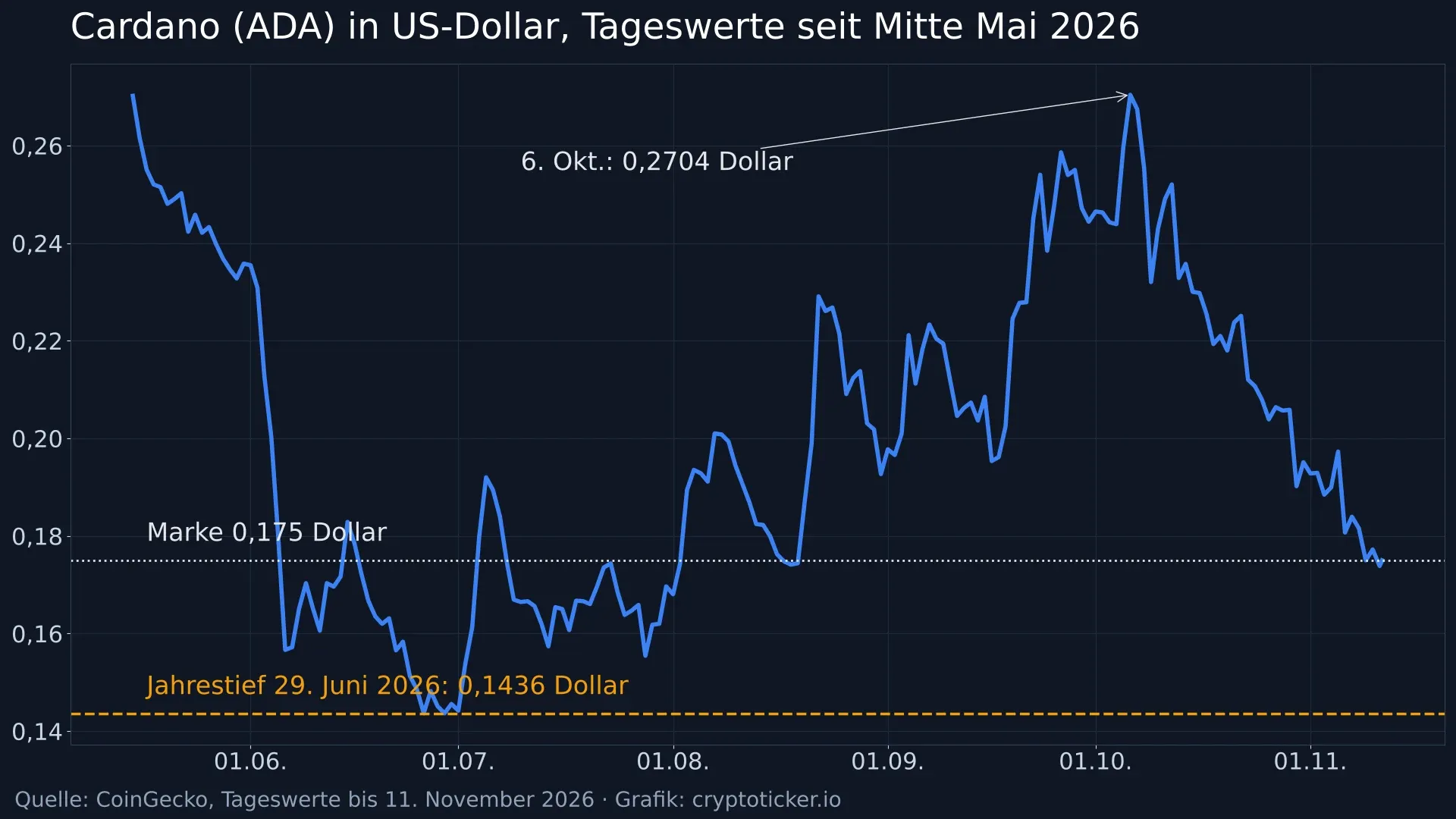
US inflation data as the trigger: why ADA falls harder than Bitcoin
The latest decline was triggered by US consumer prices for October, which came in higher than expected on Tuesday. We put the figures and the consequences for Bitcoin into context in our article on the US inflation data and stops before December 9. Higher inflation makes rate cuts by the US Federal Reserve less likely, and that hits risky assets first.
Cardano reacts more strongly than Bitcoin. Over 24 hours, ADA lost 2.2 percent on Wednesday morning and Bitcoin 1.0 percent. Over 30 days, ADA is down 30.8 percent and Bitcoin 12.1 percent. The reason lies in the market itself: smaller coins lack large buyers such as the Bitcoin ETFs that could cushion a decline. No spot ETF on Cardano trades in the US; according to CoinCentral, Grayscale withdrew its application in August.
Leverage and liquidation: at 5x, the threshold sits close to the yearly low
If you trade ADA futures, you should calculate the liquidation threshold before entering. Liquidation means the exchange forcibly closes a leveraged position as soon as the posted collateral no longer covers the loss. A worked example with Wednesday morning's price and an isolated long position: at 10x leverage, a decline of just under 10 percent is enough, putting the threshold at roughly $0.159. At 5x leverage, it is around $0.142, almost exactly at the yearly low. The exact values depend on the exchange's maintenance margin and fees.
This matters especially when open interest is rising. If many leveraged positions cluster in the same zone, a break of the $0.170 mark can trigger a wave of forced sales that makes the price fall faster than the actual trigger would. Conversely, short sellers buying back push the price higher still on a rise above $0.179.
For retail investors in Germany, leverage on crypto CFDs is capped at 2 to 1; the financial regulator has set this for regulated brokers. Anyone trading on foreign platforms with higher leverage bears the full risk of losing all their collateral. You can find an overview of providers for leveraged trading in our comparison of the best crypto brokers.
ADA holding period in Germany: using losses before one year is up
If you bought ADA in the past twelve months, you are almost certainly at a loss at the current price: a year ago Cardano still cost around $0.55. In Germany, a sale within the one-year holding period is a private sale transaction. The loss can then be offset against gains from other private sale transactions in the same year or carried forward to later years. After the period expires, a sale is tax-free, but a loss then no longer counts either. We track the status of plans to abolish the holding period on our page on the holding period reform.
The holding period does not apply to futures. Gains and losses from futures transactions are treated differently for tax purposes than a spot purchase, regardless of how long the position was open. Anyone mixing spot and futures therefore needs a clean record of all trades.
Cardano staking continues: delegated ADA remain freely available
One difference from many other networks helps holders in a phase like this. Staking on Cardano does not lock the coins. If you delegate ADA to a stake pool, you can sell or move them at any time, and rewards are credited every five days at the end of an epoch. According to a query of the blockchain service Koios, epoch 667 is currently running. The network's treasury holds around 1.42 billion ADA, whose use the community votes on; an open proposal for 22 million ADA for a copper reserve expires with epoch 668.
Staking does nothing to change the price risk. It does, however, bring ongoing income in ADA without tying you to a date. When buying through an exchange, it is worth checking whether it offers staking itself and what share of the reward it keeps. We compare exchanges with a MiCA license for customers in Germany on our page on the best crypto exchanges. If you want to buy ADA in this situation, you are better off placing a limit order in the $0.170 to $0.175 zone than buying at the market price.
Our view of the ADA futures market
From the editorial team's perspective, more points to continued swings than to a quick bottom. Three documented points support this: open interest of $395 million that grows as the price falls, the sell orders between $0.177 and $0.179, and the net spot outflow of $1.27 million in a single day. The neutral funding rate argues against a further slide. If short sellers dominated the market, it would be clearly negative.
In our view, the $0.170 to $0.175 zone is decisive. If it holds, a move like the one in August is possible, when ADA rose around 32 percent within four days from the same area. If it breaks, the next documented level is only the yearly low of $0.1436. This is an assessment of the situation and not a recommendation to buy or sell. With cryptocurrencies, a total loss is possible.
ADA futures: below $0.170 things get tight for longs
- Calculate the liquidation threshold: For every leveraged ADA position, check where the exchange will forcibly close you out, and compare the conditions in our comparison of the best perp DEXs.
- Document losses: Record the purchase date and entry price of every ADA position before the holding period expires. Suitable tools are listed in our comparison of crypto tax tools.
- Use staking: If you hold ADA anyway, you can delegate them without a lock-up. Providers and their fees are in the comparison of staking platforms.
(As of November 11, 2026. This article is not investment advice. Prices and fee structures change; check the terms with the provider before you buy.)
Decrypt
Nvidia's independent directors have hired Wachtell Lipton to investigate its CEO's ties to an alleged Chinese spy, as pressure mounts.
The New York Stock Exchange will use Avalanche infrastructure, but experts say that won't necessarily boost AVAX's price.
Robert Barr planned to have accomplices force a crypto investor to install remote-access software so he could drain the wallet from prison.
The Bitcoin miner says its Boden facility could generate $45 million annually, but a June letter of intent remains nonbinding as executives negotiate financing and customer protections for the project.
Truth Social’s parent booked $409.7 million in quarterly income largely from crypto investments, even as its stock remained more than 94% below its March 2024 peak.
U.Today - IT, AI and Fintech Daily News for You Today
Around 86.04 trillion SHIB, worth about $382.87 million, are currently held on exchanges.
Scammers flood XRP community with millions of fake reward and airdrop offers.
Deutsche Bank has launched digital asset custody for institutional clients.
Suiball, a hardware wallet built for Sui, has closed before shipping its first unit after the Sui Foundation judged the project too risky.
Telegram founder Pavel Durov has touted Gram's strong performance amid the broader crypto sell-off, predicting that the Telegram-linked cryptocurrency will eventually break into the top three by market capitalization.
Blockonomi
TLDR
- Index Industries came out of stealth with a $50 million seed round led by Lightspeed Venture Partners.
- Former Polychain Capital President Josh Rosenthal is CEO, and Longmark CEO Brian Hardecker is chairman.
- The company’s USHP Index will track U.S. home prices daily using data from major housing indices.
- A token called USHP is planned for Ethereum in 2026, with Solana expansion set for 2027.
- USHP will be offered only to eligible non-U.S. persons outside the United States.
A new company wants to turn U.S. home prices into something investors can hold on a blockchain. Index Industries came out of stealth on Nov. 10 with a $50 million seed round.
Lightspeed Venture Partners led the round. Polychain Capital, Galaxy Ventures, Wintermute Ventures and other institutional investors also took part.
The company plans to track home prices every day and make that data investable. The first product built on its platform will be a token called USHP.
A Crypto Investor and a Real Estate Executive
Josh Rosenthal is the co-founder and chief executive. He was previously President and General Partner of Polychain Capital, one of the investors in the round.
Brian Hardecker is co-founder and chairman. He is a former Principal at Blackstone and the founder and CEO of Longmark, a residential real estate platform formed in 2021 with $2 billion in assets under management.
“Indexing is one of the most important and least celebrated innovations in modern finance,” Rosenthal said. He added that indexing lowers the cost and expertise needed to invest in an entire market.
Hardecker said housing makes up roughly a quarter of the value of the U.S. economy. He said it draws less attention because there have not been easy ways to take a position in it.
Justin Overdorff, a partner at Lightspeed, said the company’s partnership with Longmark made leading the investment “an easy decision.” He described real estate as one of tokenization’s biggest opportunities.
How the Housing Index Will Work
The company’s first offering is the U.S. Home Price Index, or USHP Index. It combines data from major housing indices into one national measure that is calculated daily.
The index is meant to support housing research, reporting and portfolio monitoring. It is also designed for housing-related financial products, and the company said it is expected to launch imminently.
U.S. housing is a $55 trillion market, according to the company. Index Industries said broad investment exposure to home prices has been hard to get through traditional financial products.
The platform pairs the index with tokenization technology and real estate and capital markets services. It is built to power housing-linked investment products from third parties.
Index Industries will not issue USHP itself. The token is expected to be issued by USHP Limited, a British Virgin Islands company and a subsidiary of the USHP Foundation, a Cayman Islands foundation company.
The company said it will not offer, sell, market or redeem USHP. It also will not accept subscriptions for the product.
The securities have not been registered under the U.S. Securities Act of 1933. Any offering of USHP will be made only to eligible non-U.S. persons outside the United States.
Under the current plan, the token tied to U.S. home prices will not be offered to U.S. investors. USHP Limited plans to release USHP on Ethereum in 2026 and expand to Solana in 2027.
The post U.S. Home Price Token Backed by $50 Million Will Not Be Sold to Americans appeared first on Blockonomi.
TLDR
- Kimber Digital Securities, a Plume affiliate, is now an SEC-registered broker-dealer and FINRA member.
- The firm plans to let U.S. investors hold real stocks, ETFs and bonds as tokens in their own wallets.
- Tokens are meant to carry the same legal claim investors hold through DTC today, not a wrapped version.
- Stablecoin apps could offer users SEC-regulated yield products once GENIUS Act rules take effect.
- Some services, including DTC tokenized entitlements, are still under development.
Kimber Digital Securities, the broker-dealer linked to blockchain developer Plume, is now registered with the U.S. Securities and Exchange Commission. The firm has also been approved for membership in the Financial Industry Regulatory Authority, or FINRA.
The company announced the approvals on Nov. 10. It plans to give U.S. investors a regulated way to hold real stocks, ETFs and bonds as tokens in their own crypto wallets.
Kimber Digital Securities is a subsidiary of Kimber Labs Inc., which does business as Plume. Plume builds the Plume blockchain, an Ethereum layer 2 network made for real-world assets, and the Nest vault protocol.
The Same Claim, Recorded Onchain
The firm says its tokens are meant to represent the same legal interest investors already hold through a normal brokerage account. In the U.S., most investors do not hold legal title to their shares. Instead, they hold a “security entitlement” against their broker.
That broker holds a matching entitlement at the Depository Trust Company, known as DTC. DTC holds the securities through its nominee, Cede & Co., which is listed as the owner on the issuer’s records.
Kimber Digital Securities says each token records a position inside this existing chain of custody. The company says it is not a wrapper around an asset held somewhere else.
Because of this, the firm says token holders are meant to keep rights such as dividends, voting and a direct claim on the underlying asset. Investors could also use ACATS, the standard account transfer system, to move whole portfolios between onchain and offchain formats.
DTC holds more than $100 trillion in assets, according to the release. Plume has been part of the DTCC’s Digital Assets Solutions Industry Working Group since August.
Stablecoin Users and Yield
The company is also aiming at people who already use stablecoins. Rules for payment stablecoins under the GENIUS Act are set to take effect in the coming months.
Kimber Digital Securities says it will let stablecoin apps offer customers SEC-regulated products that pay yield. These include tokenized shares of funds run by large U.S. asset managers.
“Stablecoins are bringing a new generation onchain. What keeps them there is yield and access to real investment opportunities with full regulatory protections,” said Chris Yin, CEO and co-founder of Plume.
The firm says more than 700 million people hold a crypto wallet today. It also says over 700 wallet apps connect through WalletConnect alone.
General Counsel Salman Banaei called the registration “a threshold, not a finish line.” He said it lets the company move “real, unwrapped securities onto open, programmable infrastructure” while keeping investor protections.
The broker-dealer approval adds to other licenses held by Plume’s affiliates. Kimber Transfer Agency registered with the SEC as a transfer agent in September 2025.
In May, the Kimber Digital Assets Bermuda unit was approved by the Bermuda Monetary Authority as a regulated vault curator. It is authorized to issue tokenized investments.
The company said some services, including access to DTC tokenized entitlements and stablecoin products, are still under development. FINRA membership and SEC registration do not mean regulators endorse the firm or its products.
As of Sept. 30, 2026, the Plume Vaults protocol held $250 million in total value locked. About $1 billion in volume has moved through the platform, though those figures relate to the Plume protocol and not the broker-dealer.
The post Crypto Wallets Could Soon Hold Real US Stocks After Plume Broker Gets SEC Nod appeared first on Blockonomi.
TLDR
- Moody’s Ratings and Chainlink finished a pilot that sent credit ratings to several blockchains at the same time.
- The test used Chainlink’s Cross-Chain Interoperability Protocol (CCIP) and Moody’s Token Integration Engine (TIE).
- The pilot ran on a testnet with sample data, and no real ratings were published onchain.
- Moody’s has rated or assessed more than 70 digital issuances since January 2017.
- A future live version would keep Moody’s existing publication and governance processes.
Moody’s Ratings has finished a test that sent credit ratings to several blockchain networks at the same time. The pilot used Chainlink’s Cross-Chain Interoperability Protocol, known as CCIP, to move the data.
The two companies announced the results on November 10, 2026, in New York. The test ran in a controlled setting and did not involve any real ratings.
The pilot was built around a Moody’s tool called the Token Integration Engine, or TIE. The tool is designed to share credit ratings and related data for tokenized assets and other blockchain-based products.
Using CCIP, TIE sent ratings to both permissioned and permissionless blockchains at once. Permissioned networks limit who can take part, while permissionless networks are open to anyone.
A Test Run With No Live Ratings
The work was done on a testnet, which is a practice version of a blockchain used for trials. No actual rating actions were published onchain during the pilot.
No live rating processes were involved either. The companies used representative test data to check whether the systems could work together and deliver information correctly.
The setup is designed to handle future updates, including rating actions, with governance and lifecycle controls. Any future production version would keep Moody’s Ratings’ existing publication processes in place.
Fabian Astic, Global Head of Digital Economy at Moody’s Ratings, said tokenized finance is unlikely to sit on a single blockchain, platform or market system. He said investors will expect access to credit ratings no matter what technology supports an asset.
Astic added that the pilot explored how ratings could be offered across several networks. He said this was done while keeping the governance and publication processes that support confidence in the firm’s opinions.
Moody’s Track Record With Digital Bonds
Moody’s Ratings has more than 125 years of experience in credit ratings and research. The firm has also been reviewing digital assets for nearly a decade.
Between January 2017 and October 2026, Moody’s Ratings rated or assessed more than 70 digital issuances. These included digital bonds and tokenized funds.
The companies said that as more financial assets are issued on blockchains, market participants will need trusted credit information inside those systems. The pilot was set up to test one way of delivering that information.
Johann Eid, Chief Business Officer at Chainlink Labs, said credit ratings help institutions decide where to put capital and how to price risk. He said that as more assets move onchain, credit information has to move with them across chains and through every rating change.
Eid said the pilot sets up a key part of the foundation institutional capital needs to adopt tokenization at scale. Chainlink describes itself as the standard for onchain finance.
Chainlink provides data, cross-chain messaging and blockchain connectivity for financial firms and decentralized apps. Its users include Swift, Euroclear, Mastercard, Fidelity International, UBS, S&P Dow Jones Indices, FTSE Russell, WisdomTree and ANZ.
Crypto protocols such as Aave, Polymarket, Lido and Lighter also use its technology. The company says its standard has enabled tens of trillions of dollars in transaction value.
Chainlink uses a fee model where offchain and onchain revenue from enterprise adoption is converted into LINK tokens. Those tokens are stored in a strategic Chainlink Reserve.
The post Chainlink Crypto Network Helps Moody’s Test Blockchain Credit Ratings for Tokenized Assets appeared first on Blockonomi.
TLDR
- Google’s Gemini Apps Privacy Hub says reviewed chats can be kept for up to three years after a user deletes them.
- A GitHub project says an October 16 edit reversed Google’s 2023 pledge that personal Gmail, Docs and Drive content is not seen by human reviewers.
- Gemini Connected Apps changed from opt-in to on by default across Gmail, Chat and Meet.
- A class action, Thele v. Google, claims the default-on setting violates California’s wiretapping law.
- The GitHub author is pseudonymous, and no independent lab has reproduced the reported behavior at scale.
Google users who delete their Gemini chats may not be erasing every copy. The company’s Gemini Apps Privacy Hub, updated on October 13, 2026, says reviewed conversations can be kept for up to three years after deletion.
The rule applies to personal accounts with Keep Activity turned on. A subset of those chats is read by human reviewers, including outside service providers.
The disclosure is drawing attention because of a separate change to how Gemini links to Gmail, Drive and other Google apps. Critics say the two changes together put personal email and files within reach of reviewers.
What Changed in Google’s Policy
In 2023, Google said personal content from Gmail, Docs and Drive “is not seen by human reviewers.” A GitHub documentation project says an October 16 edit to a Google help article reversed that pledge.
According to the project, connected Drive and email content now flows into human review pipelines. Google also switched Gemini Connected Apps from opt-in to on by default across Gmail, Chat and Meet.
That means users who never turned the feature on may already be covered. Google now warns users against connecting apps that hold “confidential information that you wouldn’t want a reviewer to see.”
The change has also reached the courts. A class action, Thele v. Google, argues the default-on activation violates the California Invasion of Privacy Act, a state wiretapping law.
How the Retrieval Works
The GitHub project is titled “Documentation of Gemini File Leaking Behavior.” Its author says Gemini pulls data “autonomously in background conversation without explicit @Drive or @Gmail tags.”
The author also describes the behavior as probabilistic. The same question can return different data from one session to the next, which makes it hard to track what was exposed.
The project lists four possible outcomes. A query may return nothing, a short metadata summary, or a “2–4 sentence exact quotation” containing “sensitive PII, account details.”
In the fourth outcome, the “complete, unredacted text” of a document enters the chat. That content could then become part of a conversation selected for review.
The suggested test is simple. A user with an internet bill in a connected Gmail account casually mentions they may be paying too much for internet service.
The author also questions Google’s privacy filters. The project says Google’s regex and named entity recognition scrubbers “cannot sufficiently deidentify narrative data.”
The issue reaches into the workplace as well. About 67% of people using corporate devices run personal Google accounts on them, and a Workspace license does not close that gap after the fact.
The three-year retention window is longer than most corporate data retention policies. It is also longer than the periods used by competing AI providers, according to the report.
The GitHub author is pseudonymous. No independent lab has yet published a reproduction of the four-outcome behavior at scale.
The post Deleted Gemini Chats Can Stay With Google Reviewers for Up to Three Years appeared first on Blockonomi.
TLDR
- October CPI rose 0.4% and core CPI rose 0.3%, both above forecasts.
- Core inflation matched the 0.3% level Fed Governor Christopher Waller flagged for a possible larger rate hike.
- Bitcoin fell to an intraday low of about $72,836 before recovering near $73,300.
- About $178 million in long crypto positions were liquidated within an hour of the report.
- Analysts say a sustained break below $73,000 could open a path toward $69,000 or $70,000.
Bitcoin dropped below $73,000 on November 10 after US inflation data came in hotter than expected. The report hit a level that one Federal Reserve official had named as a possible trigger for a larger rate hike in December.
The October Consumer Price Index rose 0.4% from the previous month, above the 0.3% forecast. Core CPI, which leaves out food and energy, rose 0.3% against expectations of 0.2%.
Inflation Meets the Fed’s Warning Line
Before the report, Fed Governor Christopher Waller said he would back a 25-basis-point rate increase in December even if inflation cooled. He also said a stronger move may be needed if core prices rose 0.3% or more from September.
Waller added that a 50-basis-point increase should be considered in that case. October’s core reading landed right on that 0.3% line.
Reuters reported that market odds for a 50-basis-point hike climbed to nearly 15% by midmorning. A quarter-point increase at the December 8 to 9 meeting was already seen as almost certain.
FED RATE HIKE IS ALMOST CONFIRMED NOW
US inflation data was released, and it again came in higher than expectations.
US CPI rose 0.4% MoM, while the Core CPI rose 0.3% MoM.
Last week, the job data already came better than expected, which means the Fed's biggest concern is… pic.twitter.com/vgTAVctnAR
— Crypto Rover (@cryptorover) November 10, 2026
Core CPI has now risen 0.3% for three months in a row, following similar gains in August and September. Shelter costs rose 0.3% in October and made up more than 30% of the monthly increase.
Food prices rose 0.5%, while energy costs climbed 0.7% after a 5.2% jump in September. Headline CPI had risen 0.6% in September.
The Bureau of Labor Statistics did not publish a yearly inflation figure. The 2025 government shutdown stopped the collection of October 2025 price data, leaving no base for an annual comparison.
Bitcoin’s Price Floor Under Pressure
Bitcoin traded near $74,264 before the release and fell to about $73,494 within five minutes. It later reached an intraday low of about $72,836 before recovering to around $73,294 by 11:01 a.m. ET.
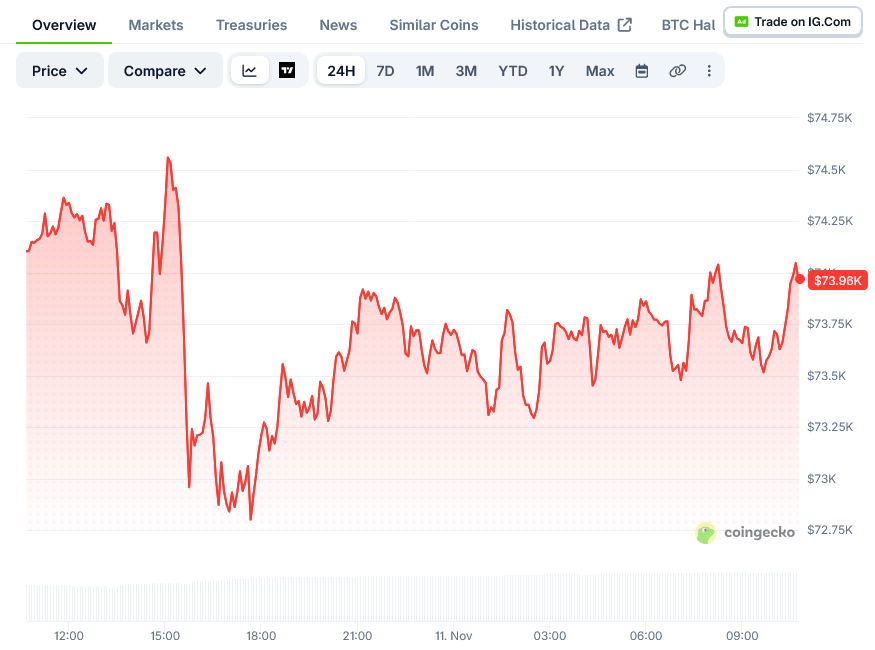
The $73,000 level has history behind it. Matt Mena, senior crypto research strategist at 21Shares, said it sits near Bitcoin’s pre-election 2024 all-time high and its April 2025 lows.
Mena said a sustained break below that level could send Bitcoin toward $69,000, near its 2021 cycle high. Bitget analyst Lewis Huang pointed to the 200-day moving average near $73,200 as a key support to watch.
About $178 million in long crypto positions were liquidated within an hour of the CPI release, according to TokenPost. CoinDesk reported about $1.1 billion in futures liquidations in the 24 hours to November 9, before the data came out.
US spot Bitcoin ETFs saw about $201 million in net outflows on November 9, their third straight day of withdrawals. BlackRock’s iShares Bitcoin Trust recorded $213.2 million in redemptions, partly offset by inflows into other funds.
Other tokens also fell. Ethereum touched about $2,006 and traded near $2,027, while XRP fell to about $1.0336 before trading near $1.05.
Solana traded around $82.49 after touching an intraday low near $81.59. It was down about 5.2% over 24 hours.
Mena said a break of Bitcoin’s 50-week moving average could pressure Ethereum’s $2,000 support, with $1,800 the next level. If Bitcoin holds $73,000 and stocks keep rebounding, 21Shares sees a possible retest of $78,000 and a path to $85,000 by year-end.
November has been Bitcoin’s strongest month historically, with an average return of 34.4% since 2010. Paul Howard, senior director at Wincent, said that without a shift in policy, regulation or institutional flows, a gradual downward drift is more likely than a rally toward $100,000.
The post Bitcoin Slips Below $73,000 as Core Inflation Hits Fed’s Rate Hike Warning Line appeared first on Blockonomi.
CryptoPotato
The pain continues across the cryptocurrency market, with major assets like Bitcoin (BTC), Ethereum (ETH), and Ripple (XRP) suffering even deeper losses.
Against this backdrop, it is worth examining how big investors have responded to the persistent downfall and what their behavior could reveal about the near future.
BTC and ETH Whales Cash Out
Popular analyst Ali Martinez said large Bitcoin investors have sold over 34,000 coins in the past week as the price plummeted from nearly $80,000 to a local bottom under $73,000. The stash is worth roughly $2.6 billion, and this cohort of market participants now holds a little more than 5.24 million units, representing 26% of BTC’s circulating supply.
Massive sell-offs of that type can negatively impact the price for two main reasons. First, they increase the number of coins available on the open market, which could lead to a pullback if demand fails to keep pace. Second, these moves can fuel uncertainty across the space, causing smaller investors to offload their holdings as well, potentially accelerating the decline.
As of this writing, BTC is hovering around $74,000 (per CoinGecko), down 12% on a monthly basis. Those seeking more insight into additional factors that warn of a possible further downtrend ahead can read our dedicated article here.
Martinez revealed that Ethereum whales have also been reducing their exposure, though at a slower pace. Over the last seven days, these investors have parted with approximately 17,800 units, worth roughly $40 million.
The leading altcoin came dangerously close to losing the psychological $2,000 level but managed to stay above it, and it currently trades around $2,060. Many analysts believe holding the $2K barrier is crucial, warning that a breakdown below could open the door to a serious downfall. X user Ted said:
“This is a major support zone for Ethereum, and losing this would be brutal.”
XRP Whales Act Differently
Unlike the behavior observed among large BTC and ETH investors, XRP whales acquired roughly 65.32 million units over the past four days, representing close to $72 million in value. As a result, this group of market participants has once again increased its total holdings to more than 4 billion tokens.
The whales’ accumulation offers a ray of hope for those hoping for a meaningful short-term rebound, yet other factors suggest the downtrend is nowhere near its end. Among those are the overall weakness of the crypto market and the waning institutional interest in Ripple’s cross-border token.
Spot XRP ETFs posted serious outflows over the past two trading sessions, and last week also ended in negative territory.
The post Are Whales Rotating Into XRP? BTC and ETH Holdings Slide appeared first on CryptoPotato.
The higher-than-expected CPI numbers for October resulted in another major leg down for bitcoin yesterday, with the asset plunging below $73,000, thus charting a near-three-month low.
The altcoins shed tons of value once again, and ZEC leads the pack. The privacy token has tanked the most over the past 24 hours, dropping below $1,000 for the first time since early September.
BTC Keeps Struggling
It was just a week ago when the markets rebounded from the midterm election shock, in which the Democrats won decisively on numerous fronts. Bitcoin had dropped from $78,000 to $75,600 before it skyrocketed to $81,000 as the uncertainty seemingly vanished.
However, that rally was short-lived, and the bears were back in control less than 24 hours later. The so-called Thursday crash drove Wall Street and crypto south hard, with BTC plummeting from almost $81,000 to $75,200. It dipped further on Friday to $74,800 before it recovered some ground during the weekend and remained close to $76,000.
Monday began with another nosedive, taking BTC to $73,600. All eyes turned to the US CPI on Tuesday, with bitcoin remaining close to $74,000 ahead of the announcement. Once the MoM data came out higher than expected, bitcoin crashed further to under $73,000 for the first time since mid-August.
Although it has rebounded by a grand since then, it still struggles below $74K. Its market cap is well below $1.5 trillion on CMC, but its dominance over the alts has increased slightly to 60.5%.

ZEC Leads the Pack
Zcash is the poorest performer over the past 24 hours. The privacy coin has tanked by 13% and sits below $1,000 as of now. Its main rival, on the other hand, is up by 5.6%. As a result, XMR sits above $575. BTW is the other big gainer today, surging by 10% to $1.08. AVAX has added another 4% of value and trades close to $8.7.
In contrast, most other larger-cap alts are in the red. ETH has defended the $2,000 support, but it’s still 1.6% down on the day to $2.055. BNB is down to $680, while XRP has tanked to $1.06. SOL, DOGE, HYPE, UNI, QNT, and RAIN have posted losses as well.
The total crypto market cap has declined by another $40 billion in a day, and it’s down to $2.450 trillion on CMC.

The post Zcash (ZEC) Dumps Below $1K, Bitcoin (BTC) Struggles at $74K After CPI Reading: Market Watch appeared first on CryptoPotato.
When BTC heads south as violently as it did over the past week or so, analysts are trying to determine what caused the calamity and what’s next.
On the surface, there are always some evident reasons, such as the building macro pressure, uncertainty after the midterm elections for crypto, and the Bitcoin ETF outflows, which neared $1.3 billion last week alone, and have continued as the new week began.
But we will focus on more unexpected factors in this article that could be behind this major leg down. Those that remain behind the scenes.
Liquidity and Longs
The first factor came from stablecoins, which have helped finance virtually every major crypto rally this cycle. CryptoQuant, though, highlighted that USDT supply has contracted sharply, with its market cap falling by around $6.6 billion in the past couple of months. Its recent research pointed out that this decline is more than twice the one seen in December 2022 after the collapse of FTX.
Since stablecoins effectively represent deployable dollar liquidity inside crypto, the shrinking supply means that one important source of marginal demand disappears.
Joao Wednes referred to his Long & Short Liquidation Exposure Within ±10% metric, which showed approximately $580 million of longs exposed to liquidation versus less than $150 million of shorts if BTC moves 10% in either direction. He argued that such an imbalance creates significantly more downside liquidation fuel than upside short-squeeze fuel.
The results can be quite devastating, as falling prices liquidate leveraged longs, force traders to close positions and create additional selling, while the next layer of leveraged positions comes under pressure.
IPO Pulls Capital Away?
Perhaps the most unexpected theory involves the gigantic Anthropic public listing right around the corner. Popular analyst Crypto Rover noted that BTC fell almost 30% around the run-up to SpaceX’s IPO earlier this year and has now declined by 16%-17% ahead of Anthropic’s expected Nasdaq debut on November 19.
The company behind Claude is seeking to raise as much as $64.4 billion through the offering, making it one of the largest IPOs ever. A separate private placement could take the capital raised alongside the listing above $90 billion.
The theory is that exceptionally large IPOs compete with other risk assets for investor liquidity and attention, temporarily drawing capital away from markets such as crypto.
Adding the growing inflation fears, Fed uncertainty, and liquidity already under pressure, Crypto Rover concluded that the timing “couldn’t be worse.”
“The big question now is whether Bitcoin is repeating the same pattern,” he noted.
The post 3 Surprising Factors Behind Bitcoin’s Brutal $8K Weekly Drop appeared first on CryptoPotato.
Telegram CEO Pavel Durov has said that The Open Network’s native GRAM token is undervalued and predicted that it will eventually rank among CoinMarketCap’s three largest cryptocurrencies.
This was after GRAM gained about 8% on November 11, while pretty much every other asset above it, including Bitcoin and the top 10 altcoins by market cap, traded lower.
Durov Says GRAM Is the Only Coin Rising in a Red Market
“Crypto’s a sea of red. Only GRAM is up +8%,” Durov wrote in a post on X. This was accompanied by a market snapshot showing coins like LTC, AVAX, SUI, and HBAR, all losing between 1.70% and 3.57% while GRAM was trading at approximately $1.12, with an 8.65% gain and a market cap of $3.21 billion.
At the time of writing, figures from CoinGecko had the former Toncoin changing hands near $1.14, with a market capitalization of approximately $3.26 billion and a 50% jump in trading volume in the last 24 hours to reach $113 million.
Durov attributed the performance to the token’s connection to an established social platform:
“No surprise there. It’s the only coin built into a real social ecosystem.”
The Telegram founder was even more bullish about GRAM’s longer-term position, declaring that it was “still ridiculously undervalued” and that it “belongs in CMC’s top 3.”
That performance came as BTC and ETH struggled, with the former hovering below $74,000 after shaving off about 1% from its price in the last day and the latter just above $2,000, having dipped by about 2.4% over the same period.
It was just as bad with other heavyweights such as Ripple’s XRP and Solana (SOL), which had both shaved off 3.5% from their prices in 24 hours, while Zcash (ZEC) was the worst hit among the top ten, plunging by almost 12% in that time.
GRAM Still Facing a Much Larger Recovery
Despite GRAM’s daily advance, its broader performance figures paint a less optimistic picture than Durov’s post portrayed. The coin is still down nearly 8% across two weeks and almost 21% lower than where it was 30 days ago.
Across the last 12 months, the world’s #29-ranked crypto by market cap (CG) has lost over 46% of its value, keeping it about 86% below its all-time high price of $8.25 attained in July 2024.
Market conditions have also not been all smooth, as October’s US Consumer Price Index came in above expectations, with headline inflation going up by 0.4% and core inflation increasing by 0.3%, which helped push BTC below $74,000 as expectations of another Federal Reserve rate increase intensified.
The post Pavel Durov Calls GRAM ‘Ridiculously Undervalued’ After 8% Surge appeared first on CryptoPotato.
Goldman Sachs and Citigroup are among the banks that have committed about $270 million to a joint stablecoin company, Bloomberg reported on Tuesday.
Banco Santander and Deutsche Bank have also joined, according to people familiar with the matter. That money is meant to cover five years of operations at the new company, which will issue a dollar-denominated stablecoin and is expected to be incorporated in the US, the sources said.
Participants call the initiative Project Faro. The project is still searching for a chief executive, and its final name remains under discussion. Goldman and Citi referred questions to a project spokesperson, who declined to comment.
Ten Founders Became 21
Project Faro dates back to October 10, 2025, when ten banks said they were jointly exploring a 1:1 reserve-backed form of digital money on public blockchains, focused on G7 currencies. Barclays and BNP Paribas were in that group, alongside the four banks Bloomberg named.
On September 1, the group expanded to 21 institutions and committed to set up a company in the second half of 2026, subject to closing conditions. The new members included Wells Fargo, Fidelity Investments, Lloyds Banking Group and Standard Bank. Barclays and BNP Paribas were not on the September list.
The consortium plans a dollar token first, with a market launch targeted for the first half of 2027. After that, the group’s priority is a euro version. The group said the product will serve wholesale, institutional, and retail markets, including cross-border payments and digital asset settlement. It intends to comply with the US GENIUS Act and the EU’s Markets in Crypto-Assets (MiCA) rules, where they apply.
Banks Back Competing Projects
Bank of America, Citi, and Wells Fargo also back a separate blockchain payment effort. Those three banks were building a tokenized deposit network called The Bridge through the Clearing House, the Wall Street Journal reported in June. The report put that network’s launch in the first half of 2027.
European banks run a separate euro project through Qivalis, an Amsterdam company backed by 37 banks across 15 countries. On October 14, Qivalis said the Dutch central bank had authorized it as an electronic money institution.
New entrants have struggled to dent the lead of Tether and Circle, Bloomberg noted. Tether’s USDT has about $176 billion in circulation, according to DefiLlama. Circle’s USDC is second at about $70 billion. All dollar-pegged stablecoins tracked by DefiLlama total about $293 billion.
The post Goldman, Citi Among Banks Committing $270M to Fund Joint Stablecoin Issuer for Five Years appeared first on CryptoPotato.


