Cryptocurrency Posts
Crypto Briefing
ASML's stock drop despite strong performance underscores market volatility and investor skepticism in the semiconductor sector amid macro concerns.
The post ASML shares fall 12% in October despite record quarter appeared first on Crypto Briefing.
TSMC's potential entry into 3D memory chips could disrupt the DRAM market, altering competitive dynamics and impacting Nvidia's growth trajectory.
The post TSMC explores advanced 3D memory chip production at Nvidia’s request appeared first on Crypto Briefing.
Potential regulatory actions in Texas could reshape data center growth strategies, impacting market dynamics and grid reliability considerations.
The post Texas considers moratorium on new data centers amid grid frequency concerns appeared first on Crypto Briefing.
Nvidia's leadership faces scrutiny, potentially impacting its strategic position in AI and raising national security concerns.
The post Nvidia CEO Jensen Huang admits to infidelity in memo to employees appeared first on Crypto Briefing.
The investigation's outcome could impact Nvidia's leadership stability and influence US-China tech relations, affecting investor confidence.
The post Nvidia board backs Jensen Huang as independent review of foreign intelligence claims begins appeared first on Crypto Briefing.
Bitcoin Magazine
Bitcoin Magazine

U.S. Treasury Cuts Off MEXC From U.S. Financial System Over Alleged $16 Billion in Illicit Flows
The U.S. Treasury’s Financial Crimes Enforcement Network issued a final order Friday that will cut offshore exchange MEXC Global off from the American banking system over alleged links to sanctions evasion by Iran, North Korea and Russia, the department said.
FinCEN’s order, published as a PDF pending Federal Register placement, finds MEXC a “primary money laundering concern in connection with Russian illicit finance” under section 9714(a) of the Combating Russian Money Laundering Act. Thirty days after that Register notice, covered U.S. financial institutions will be barred from any funds transfer — including convertible virtual currency — to or from MEXC.
Reuters reported the same cut-off Friday afternoon. Treasury framed the move as part of Operation Economic Outcast. It is not an OFAC sanctions designation: the order says it does not rewrite Bank Secrecy Act duties or OFAC rules, and it is a FinCEN funds-transmittal ban rather than a Section 311 proposed rulemaking.
Treasury alleges MEXC facilitated at least $16 billion in illicit flows from May 2021 through May 2026, including nearly $1.5 billion tied to Russian sanctions evasion and about $22 million linked to Iran’s Central Bank and the Islamic Revolutionary Guard Corps’ Qods Force. The platform was still processing trades with sanctioned Garantex and successor Grinex as recently as June 2026, more than four years after OFAC designated Garantex, the release says.
What the order does — and when
The order, signed by FinCEN Deputy Director Jimmy L. Kirby, covers MEXC Global and named affiliates operating outside the United States, including Seychelles-incorporated MEXC Global Ltd / MX Global Ltd, Estonia’s MEXC Estonia OÜ, Switzerland’s GIDA Technology AG and the U.K.’s MXC Global Ltd, plus successors. Covered institutions face civil or criminal penalties for willful violations.
Until the Federal Register publishes the notice, the 30-day clock has not started. As of Friday evening eastern time the Register’s public index still showed no MEXC document, matching the order’s own cover note that publication is pending.
Background on MEXC
Founded in 2018 and formerly branded MXC, MEXC ranks among the world’s 20 largest centralized crypto venues by volume. Treasury puts daily turnover above $1 billion and reserves near $5 billion as of mid-2026, with access claimed across more than 170 countries. The exchange already lists the United States as a prohibited jurisdiction in its user terms, so Friday’s action mainly hits any remaining dollar rails, banking partners and counterparties that still touch U.S. institutions.
Regulators elsewhere have been circling for years. The U.K. Financial Conduct Authority put MEXC Global Ltd on its warning list in March 2024 as unauthorized. Hong Kong’s Securities and Futures Commission warned the same month that the platform was marketing to local investors without a licence. Seychelles’ Financial Services Authority said in May 2026 it took action against MX Global Ltd for unlicensed virtual-asset operations — footnoted in FinCEN’s order.
Those compliance gaps matter because the illicit-flow thesis is specific, not guilt by association. Beyond Russia, FinCEN cites about $1 billion in direct traffic with more than 40 Iranian crypto exchangers, nearly $26 million with the OFAC-sanctioned A7 sanctions-evasion network, and almost $200 million tied to the A7A5 stablecoin. DPRK facilitators and cybercrime flows are also alleged. MEXC has not issued a public response to the Friday order; its main X account kept posting marketing content through the afternoon.
Why it matters for bitcoin markets
Practically, once the order bites, U.S. banks, money transmitters and other covered firms cannot move dollars or crypto to MEXC wallets or accounts. Offshore users may keep trading peer-to-peer, but dollar on-ramps and any bank that still clears for MEXC become legal risk. The template tracks earlier 9714 cut-offs of venues such as Bitzlato, and it lands beside a busy sanctions week that has already seen North Korea crypto designations, an Iranian exchange action, and Russia’s push to put bitcoin trading on the Moscow Exchange.
Whether MEXC contests the finding, seeks an exemption, or quietly reroutes liquidity is the open question. For now the paper trail is clear: a final FinCEN order under 9714(a), a 30-day fuse after Federal Register publication, and Treasury’s claim of at least $16 billion in illicit volume sitting behind the cut-off.
This post U.S. Treasury Cuts Off MEXC From U.S. Financial System Over Alleged $16 Billion in Illicit Flows first appeared on Bitcoin Magazine and is written by Micah Zimmerman.
Bitcoin Magazine
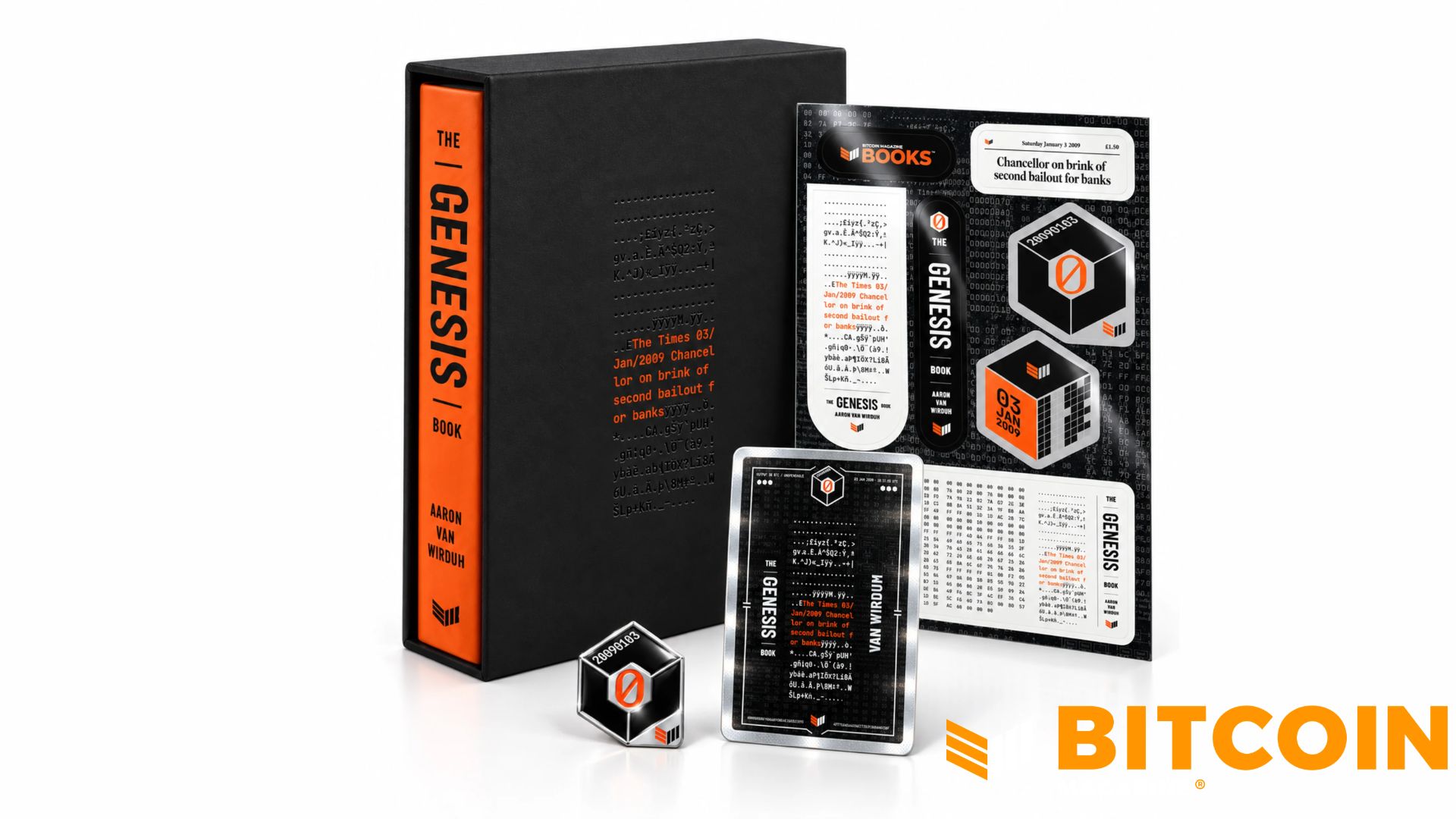
Bitcoin Magazine Books Opens 333-Copy Genesis Book Collector Edition for 3rd Anniversary
Bitcoin Magazine Books opened a third-anniversary campaign Friday for Aaron van Wirdum’s The Genesis Book, offering a redesigned Collectors Edition limited to 333 hand-signed, individually numbered hardcovers in an exclusive Genesis Block slipcase.
Each Collectors Edition hardcover is hand-signed and hand-numbered by van Wirdum, the former Bitcoin Magazine editor-in-chief whose book traces the people, projects and ideas that preceded Satoshi Nakamoto’s peer-to-peer cash design. The standard package is priced at $221 and pairs the book with a limited trading card carrying a Certificate of Authenticity, a collector pin, a sticker sheet, the slipcase and a digital package.
Two one-of-one packages sit outside the ordinary number queue. The #1 package is listed at $5,000 and the #21 package at $2,500; each includes the matching numbered copy, a matching one-of-one collector card and the same accessories as the standard collector package.
Standard collector numbers are assigned in purchase order starting at #2 and skipping #21, the campaign FAQ says. Once preorders close, the signed Genesis print run will not be reproduced.
The Genesis Book Collector's Edition is live!
— Bitcoin Magazine (@BitcoinMagazine) November 6, 2026
333 copies.
Individually numbered.
Exclusive Genesis Block slipcase.
Hand-signed by Aaron van Wirdum.
Once they're gone, they're gone.pic.twitter.com/BgiJoCVt8m
What ships with the anniversary editions
Beside the signed run, Bitcoin Magazine Books is selling a Premium Edition hardcover for $160 with foil stamping, a ribbon marker, stained page edges and custom endsheets. That edition is not limited, signed, numbered or slipcased, and it does not include the collector accessories or digital files.
A standalone Digital Package at $9.99 delivers the ebook in EPUB and the audiobook in MP4 immediately after purchase, independent of whether the physical campaign clears its funding bar.
Physical collector and premium orders are scheduled to ship in calendar year 2027.
Van Wirdum, who discovered bitcoin in 2013 and later led Bitcoin Magazine‘s editorial desk, frames The Genesis Book as a history of computer scientists, privacy activists and heterodox economists who chased government-independent digital money long before the 2008 white paper — from early cypherpunk culture through experiments such as David Chaum’s ecash, Wei Dai’s b-money, Adam Back’s Hashcash and Hal Finney’s reusable proof of work.
Store images for the slipcase and accessories are artistic renderings; the campaign page notes that color, materials and finishes may vary in production. The campaign is operated by BTC Inc., which publishes Bitcoin Magazine.
This post Bitcoin Magazine Books Opens 333-Copy Genesis Book Collector Edition for 3rd Anniversary first appeared on Bitcoin Magazine and is written by Micah Zimmerman.
Bitcoin Magazine

Thailand SEC Files Criminal Complaint Against Bitget Ahead of Dec. 5 Access Block
Thailand’s Securities and Exchange Commission filed a criminal complaint Thursday against BG Limited, the operator of cryptocurrency exchange Bitget, alleging it ran an unlicensed digital-asset exchange for Thai users from 2022 to 2025, and notified the government to block the platform from Dec. 5.
The complaint, lodged with the Economic Crime Suppression Division, also names Mr. Kritsana Kritsananuwat as an alleged supporter who promoted Bitget through Facebook and YouTube channels, the SEC said in statement No. 241/2026.
From 2022 through 2025, the regulator found, Bitget offered a trading system in the ordinary course of business, charged fees, ran a Thai-language website that could show values in baht, and solicited Thai users on social channels including “Bitget Thailand” on X, “BGB Thai Holder” on Telegram and “bitgetthailand” on TikTok.
That conduct amounts to operating a digital-asset exchange under Section 3 of the Emergency Decree on Digital Asset Businesses B.E. 2561 (2018) without a license, a violation of Section 26 punishable under Section 66, the SEC said. The case now moves to an inquiry official, then prosecutors and the courts.
Separately, the SEC submitted Bitget’s website, other domains and its app to the Ministry of Digital Economy and Society under a 2025 royal decree that authorizes access blocks on unlicensed trading platforms. From Dec. 5, the public “will be unable to access the platform,” the statement said, and investors still holding assets there were told to consider acting before the cutoff.
A licensed path that now sits next to a criminal case
The enforcement push lands weeks after Bitget announced a planned acquisition of GMO-Z.com Cryptonomics (Thailand), a Bangkok digital-asset exchange and brokerage that already holds Thai licenses, through its interest in BTGT Management (Thailand) Ltd.
Under that deal, GMO Internet and its Thai holding company would transfer their entire stake in GMO-Z — about 49% and 50.94%, respectively — to BTGT or a designee at completion, a Sept. 24 GMO Internet filing showed. Bitget said completion remains subject to regulatory approval and, after a change-of-control nod, it intends to introduce its trading platform to Thai users under local rules.
“Thailand is an important part of Southeast Asia’s digital asset landscape, and this acquisition gives us a great opportunity to establish local operations,” Bitget CEO Gracy Chen said in the Oct. 20 release.
The timetable has already slipped. GMO Internet Group pushed the effective date of the share transfer from Oct. 31 to Nov. 30, citing careful work on Thai regulatory applications and closing procedures. That revised date sits five days before the planned Bitget access block.
CoinDesk reported that Bitget’s own terms of use, updated in October, already list Thailand among jurisdictions where its services are prohibited, and that the SEC has not said whether the criminal complaint will weigh on the GMO-Z change of control.
What the block does and does not settle
Thailand has used the same access-blocking tool before. In mid-2025 the SEC referred Bybit, OKX and three other unlicensed platforms for a June 28 cutoff, telling users to move assets first. The Bitget action follows that template — and adds a criminal complaint against the exchange operator and a named promoter.
Licensed venues still sit at the center of Bangkok’s policy mix. Thailand has approved a multi-year capital-gains tax break only for trades on SEC-regulated platforms, and has been expanding regulated crypto products in derivatives and capital markets. Unlicensed platforms get the opposite treatment: investor alerts, access blocks and, now for Bitget, a police referral.
What is not yet clear is whether a criminal case against BG Limited for the 2022–2025 period bars, slows or leaves untouched BTGT’s bid to take over a licensed local operator. The SEC statement does not mention GMO-Z. Bitget has not publicly answered the complaint in a statement posted with the acquisition release.
For Thai users still on Bitget, the practical clock is Dec. 5. For Bitget, the test is whether Nov. 30 closes a regulated door into Thailand — or whether the complaint filed Thursday makes that licensed path the next question the ECD and the SEC have to answer.
This post Thailand SEC Files Criminal Complaint Against Bitget Ahead of Dec. 5 Access Block first appeared on Bitcoin Magazine and is written by Micah Zimmerman.
Bitcoin Magazine

Former FBI Agent Pleads Guilty to Stealing $2.47 Million in Crypto From Investigations
A former FBI agent pleaded guilty Thursday to stealing about $2.47 million in cryptocurrency with wallet credentials the bureau had collected in its own cases, the U.S. Attorney’s Office for the Eastern District of Virginia announced.
Patrick Steven Yaroch, 37, of Ashburn, Virginia, entered pleas to wire fraud and money laundering in federal court in Alexandria. U.S. District Judge Patricia Tolliver Giles accepted the plea. He faces up to 20 years in prison and is scheduled for sentencing on March 4, 2027.
Court papers put the illicit haul at $2,474,380.66. Prosecutors say Yaroch made roughly 100 fraudulent transfers using credentials tied to 35 separate FBI investigations, drawing on wallets controlled by investigation subjects, adversarial nation-state actors and at least one wallet the FBI itself had created for an operation.
The Justice Department Office of the Inspector General had flagged the case in August after Yaroch’s arrest on a criminal complaint. That earlier account described a smaller set of transfers — about 10 moves totaling roughly $1 million — and noted that Yaroch self-reported the activity to two department employees on July 29, 2026. The plea figures are larger.
From 2017 through early 2025, Yaroch worked in the FBI Boston Division on a squad focused on an adversarial nation-state. From February 2025 through July 31, 2026, he served in the FBI’s Counterintelligence and Espionage Division at headquarters, with access to systems that stored cryptocurrency credentials gathered in investigations.
How the FBI credentials turned into cash
Beginning no later than December 2024, Yaroch used that access to move coins out of those wallets and into ones he controlled. After the transfers, he swapped the stolen cryptocurrency into other digital assets and ran further transactions meant to obscure its source, nature and ownership.
Between Nov. 25, 2025, and Jan. 13, 2026, he moved about $93,082 into one of his accounts, then shuffled funds among other accounts to cover debts, including credit cards, car payments and loans, the office said.
FOX 5 DC, citing the same U.S. Attorney’s Office release, noted the Portugal planning that appears in the plea papers. Yaroch asked ChatGPT how to maximize investment returns and where to live in the European Union. After the chatbot suggested buying a vineyard in Portugal, he gave Portuguese lawyers a power of attorney on June 15, 2026, to register him with the Portuguese Tax and Customs Authority, obtain a tax identification number and collect the password to his finance portal. He arranged travel to Portugal for September 2026.
What the plea says the FBI lost
The agreed statement of facts goes beyond the dollar figure. Yaroch’s conduct compromised multiple FBI investigations into criminal groups and nation-state adversaries, the office said, and it compromised FBI sources and methods used in foreign intelligence collection and criminal cases. It also “deprived FBI employees of their ability to carry out their functions to protect public safety and national security.”
First Assistant U.S. Attorney Theophani K. Stamos and Daniel S. Wierzbicki, special agent in charge of the FBI Washington Field Office’s Counterintelligence Division, announced the plea. Assistant U.S. Attorneys Kathleen Robeson and Russell Carlberg are prosecuting, with help from the National Security Cyber Section of the Justice Department’s National Security Division and the DOJ inspector general’s Mid-Atlantic region. The case is 1:26-CR-208 in the Eastern District of Virginia.
The admission lands in a week when federal crypto-crime stories keep stacking up — from a failed bitcoin kidnapping plot that produced its own guilty plea last month to FBI tallies putting U.S. crypto fraud losses above $11 billion in 2025, a figure the White House has used to frame a wider crackdown.
What sentencing will do with the gap between Yaroch’s July self-report and the $2.47 million plea figure is still open. So is how many of the 35 FBI cases can be repaired after an insider treated the bureau’s own wallet credentials as a personal ATM. March 4, 2027, is when Judge Giles gets to answer the first question.
This post Former FBI Agent Pleads Guilty to Stealing $2.47 Million in Crypto From Investigations first appeared on Bitcoin Magazine and is written by Micah Zimmerman.
Bitcoin Magazine

Strive (ASST) Posts $474.8 Million Common Net Income as Bitcoin Yield Hits 63.2%
Strive reported $474.8 million of net income attributable to common stockholders for the third quarter ended Sept. 30, a print that arrived Friday alongside a company claim that Class A total return had outperformed bitcoin by 103.7% year to date through the same date.
GAAP net income was $509.0 million, or $5.24 a share on a fully diluted basis. Almost all of that came from a $533.7 million unrealized gain on digital assets marked to fair value. Operating revenue for the quarter was just $2.7 million, so the earnings line is a treasury mark, not a fee business.
In a post on X that led with the outperformance figure, Strive also highlighted a year-to-date bitcoin yield of 63.2% and a bitcoin dollar gain of $9.00 per assumed diluted share outstanding, both measured through Sept. 30. Chairman and CEO Matthew Cole tied those metrics to the stock’s relative showing against the asset.
“Strive has continued to successfully execute on its treasury management strategy, delivering a strong bitcoin yield year to date in 2026, which I believe is the primary driver of our common equity’s outperformance relative to Bitcoin so far this year,” Cole said in the earnings release.
Bitcoin yield, buys and the preferred stack
Bitcoin yield, as Strive defines it, is the percentage change in bitcoin per share over a period — not a cash yield. On that measure the company posted 18.5% in the third quarter alone and 19.3% from Oct. 1 through Oct. 30, after the SATS preferred debut.
Strive acquired 8,136 bitcoin in the third quarter at an average cost of about $78,885 and 20,373 bitcoin over the nine months ended Sept. 30. Another 15,124 coins followed between Oct. 1 and Oct. 30. Holdings stood at 28,000 bitcoin on Sept. 30 and 43,124 by Oct. 30, keeping Strive among the largest public corporate stacks after recent multi-thousand-coin buys and smaller weekly adds that still trailed Strategy.
Digital assets at fair value were $2.34 billion on the Sept. 30 balance sheet. Cash had risen to $490.4 million by Oct. 30, and Strive still held Strategy’s variable-rate STRC preferred with a fair value of about $50.1 million.
The capital stack that funded the buys is mostly perpetual preferreds. On Oct. 20 Strive closed a registered offering of 7 million shares of its 15% Series A perpetual preferred (SATS) for about $609 million in net proceeds. Preferred dividends of $34.2 million in the quarter are what turned the $509.0 million GAAP profit into the $474.8 million common figure.
Strip the story to nine-month GAAP and the picture flips. For the nine months ended Sept. 30, Strive posted a net loss attributable to common stockholders of $88.4 million. The third-quarter profit is real under fair-value accounting, but it is concentrated in one mark-to-market line.
What ASST stock has done over the past year
ASST itself has not moved in a straight line with the company’s bitcoin-yield scoreboard. Shares closed at $20.59 on Thursday, down about 10% on the day, and traded near $20.70 early Friday. That leaves the stock roughly 29% below its level a year earlier, when Yahoo Finance data put the close near $29, and about 33% under its Oct. 21 local high of $30.75.
The 52-week range on Yahoo Finance runs from $7.02 to $34.40. Year to date, the price path from the Jan. 2 close near $17.30 into the mid-$20s is a gain of roughly 20%, with a February low near the 52-week floor and a September push back toward $30. Through Sept. 30 — the cutoff on Strive’s outperformance claim — ASST had risen about 70% from that January close while bitcoin was down roughly 7% over the same window on Yahoo Finance data, a wide gap even before the company’s own total-return methodology.
The longer chart still carries the scar of 2025, when Asset Entities became the public shell for Strive’s bitcoin-treasury reverse merger and the share price spiked into triple digits on weekly closes before collapsing. Investors who held through that conversion saw a different ride than the tidy year-to-date relative-return figure Strive put at the top of Friday’s note.
Cole said the recent SATS issuance leaves Strive “never been in a better position to generate long-term returns in excess of Bitcoin for our common equity shareholders.” The test for ASST from here is whether another quarter of bitcoin yield and preferred-funded buys can reopen the gap to bitcoin after a year in which the stock still sits well below where it traded twelve months ago, even as the treasury has climbed past 30,000 then 40,000 bitcoin.
This post Strive (ASST) Posts $474.8 Million Common Net Income as Bitcoin Yield Hits 63.2% first appeared on Bitcoin Magazine and is written by Micah Zimmerman.
CryptoSlate
The indicative fee estimate accompanies a changing XRP–RLUSD portfolio, with different outcomes from all-XRP and untouched 50/50 holdings.
Read the full story on CryptoSlate
Understand the crypto stories that matter and what to watch next. Get The Catalyst in your inbox
US derivatives exchanges face a comply-or-explain demand as separate court holdings keep Kalshi's nationwide access unresolved.
Read the full story on CryptoSlate
Understand the crypto stories that matter and what to watch next. Get The Catalyst in your inbox
Keplr’s documented backups can reduce login dependence, but they cannot establish that a potentially exposed key is safe.
Read the full story on CryptoSlate
Understand the crypto stories that matter and what to watch next. Get The Catalyst in your inbox
National inventories fell to 99.259 million barrels, while lower weekly diesel and heating-oil prices kept the financing risk conditional.
Read the full story on CryptoSlate
Understand the crypto stories that matter and what to watch next. Get The Catalyst in your inbox
Fidelity finished positive in the November 2-6 week, but the other funds collectively remained negative without IBIT.
Read the full story on CryptoSlate
Understand the crypto stories that matter and what to watch next. Get The Catalyst in your inbox
CryptoTicker.io
Shiba Inu trades at around $0.00000445 on Sunday evening, November 8, 2026, roughly €0.00000399. In the afternoon SHIB slipped to $0.00000442 on Kraken, its lowest level since August 19. At the same time, exchange data from CryptoQuant point the other way: within 24 hours a net 20 billion or so SHIB left the major trading venues.
What the data show: the ten largest addresses sent only just over two billion SHIB to exchanges over that period, and withdrew considerably more. Our assessment follows further down. The outflow takes some selling pressure out of the market in the short term, but in dollar terms it is smaller than the figure of 20 billion suggests. For investors in Germany it is a good moment to put their own custody in order.
Shiba Inu price on Sunday evening: $0.00000445 and a new low since August
Sunday passed without a big swing, but the direction was clear. On Kraken, SHIB opened against the US dollar at $0.00000448, with a daily high of $0.00000449 and a daily low of $0.00000442. That put the token just below Thursday's low of $0.00000444. According to CoinGecko, SHIB is down 0.5 percent over 24 hours, 5.0 percent over seven days and 17.6 percent over 30 days.
Bitcoin held up far better over the same period. The largest cryptocurrency trades at around $75,700 on Sunday evening, down 7.9 percent over 30 days. SHIB has therefore lost more than twice as much. Measured against the October high of $0.00000604 on October 5, the token is now a good 26 percent lower; compared with November 8, 2025, when SHIB cost just under $0.00000996 on Kraken, the gap is around 55 percent.
Turnover stayed thin, as is typical at weekends. By the evening, a little over 40 billion tokens had changed hands in the SHIB/USD pair on Kraken. On Thursday, when the wider market slid after liquidations of more than $1 billion, the figure was almost 87 billion, and on October 30 it reached 199 billion.
A net 20 billion SHIB withdrawn: Sunday's CryptoQuant figures
The exchange flow figures come from the analytics firm CryptoQuant and were analysed on Sunday at midday by U.Today. An exchange flow measures how many tokens arrive at addresses of known trading venues and how many leave them. The difference is the netflow. When it is negative, more coins are leaving exchanges than arriving.
For the 24 hours to Sunday midday, the analysis puts the netflow across the major exchanges at minus 20.07 billion SHIB. Over the same period the ten largest SHIB addresses sent 2.28 billion tokens to exchanges and withdrew about 3.48 billion. CryptoQuant puts the reserves of all tracked exchanges at 86.16 trillion SHIB, equivalent to roughly $384 million.
A point that matters for interpretation: in crypto jargon a whale is an address with a very large holding. When such addresses send many tokens to exchanges, that often signals planned sales. When they withdraw tokens, the coins usually end up in self-custody, in cold-storage addresses or with custodians. Both are indications rather than proof, because transfers between addresses belonging to the same exchange also show up in this kind of data.

Exchange outflow instead of inflow: what has turned since November 4
Four days ago the picture was reversed. On Wednesday, November 4, we reported on net inflows of around 153 billion SHIB to exchanges. The price stood at $0.00000473 at the time, and the zone around $0.0000045 had just passed its second test. Since then SHIB has lost almost 6 percent, and the zone has given way.
On Saturday came the slide below $0.0000045, with the token at around $0.00000449 at midday. The level we named there as the next marker, Thursday's low of $0.00000444, failed to hold on Sunday afternoon. What is new is the direction of the exchange flow: after Wednesday's inflow, the large addresses are withdrawing tokens again while the price keeps falling.
This pattern is not unusual in falling markets. Anyone buying at lower prices who does not want to leave the coins on the exchange withdraws them. Anyone who wants to sell deposits. A look at the individual figures shows that both are happening at once: billions of SHIB went to exchanges on Sunday as well, only more came back out.
Exchange reserves of 86 trillion SHIB: why 20 billion still counts
A figure of 20 billion sounds large, yet at a price of $0.00000446 it comes to just under $89,000. Measured against exchange reserves of 86.16 trillion SHIB, the outflow equals about 0.02 percent. CryptoQuant shows exactly this decline in reserves. Wednesday's 153 billion was likewise worth only a little over $700,000.
A comparison with trading volume adds further context. The 40 billion SHIB traded on Kraken on Sunday alone are worth around $178,000, and Kraken is only one of many venues. A single day of outflows therefore barely moves the price of a token with a market value of a good $2.6 billion.
The figure only becomes meaningful as part of a series. If the outflows continue for several days, the supply that can sit on the order books in the short term shrinks. If they flip back into inflows after a day, it was a transfer without consequences. SHIB holders should therefore not react to a single day's reading but watch whether the netflow stays negative into the middle of the week.
SHIB futures market: futures netflow falls to minus $207,000
Alongside the spot market, the futures market offers a second angle. According to a second analysis by U.Today based on data from Coinglass, $10.39 million flowed into SHIB futures contracts over three days while $10.60 million flowed out. That left the netflow at minus $207,230.
A futures contract, which in crypto trading usually comes as a perpetual future with no expiry date, lets traders bet on rising or falling prices, often with leverage. When money flows out on a net basis, traders are closing more positions than they open. That points to less speculation on credit, though not automatically to weaker buying interest in the token itself.
Taken together with the spot picture, the market looks calm but weak. Traders are retreating from the futures market, exchange balances are edging lower and the price is slipping on low volume. A high-volume sell-off looks different, and so does a trend reversal.

Levels below the price: $0.00000442 and the June low for the year
The first level is Sunday's low at $0.00000442. U.Today sees local support there, between $0.00000440 and $0.00000442. If it breaks, the next target according to the same analysis is $0.00000410. That level roughly matches the low of July 17, when SHIB fell as far as $0.00000406 on Kraken.
According to Kraken's daily data, the 2026 low stands at $0.00000405, reached on June 25. That is a good 9 percent below the current level. A close below it would mark a new low for the year, and there would then be no nearby support left from this year.
Resistance above the price: the 20-day line at $0.00000480
The first level above the price is $0.00000480. This is where the average of the past 20 daily closes on Kraken runs, and where SHIB lost an important support according to U.Today. To get there, the price would have to rise by almost 8 percent. Only a close above it would break the series of lower highs since early October.
The 50-day line sits at $0.00000526, a good 18 percent above the current level. Above that lies the zone between $0.00000540 and $0.00000550, which SHIB tested in October and which U.Today names as a recovery target. According to the second analysis, the 50-week moving average runs at $0.00000586.
Withdrawing SHIB from an exchange: network and receiving address
What the whales do on a large scale is worth doing on a small scale for many retail investors: coins you plan to hold for longer do not necessarily belong on an exchange. An exchange holds your tokens in trust, and in the event of insolvency or a freeze your access depends on it. In your own wallet you control the keys yourself and carry full responsibility for them.
Shiba Inu is a token on the Ethereum blockchain that follows the ERC-20 standard. Some exchanges also offer SHIB withdrawals on other networks. Choose the network your receiving wallet supports, which for SHIB is usually Ethereum. If the tokens land on a network your wallet does not recognise, recovering them is laborious or impossible.
The first time, send a small test amount and check that it arrives. Compare the receiving address character by character, at least at the beginning and the end, because malware swaps addresses copied to the clipboard. For later transfers from your own wallet you will also need some ether to pay the network fee. An overview of tested devices is available in our hardware wallet comparison, and for smaller amounts in our software wallet comparison.
One feature of EU rules: since December 30, 2024, the Transfer of Funds Regulation has also applied to crypto-assets. For withdrawals of more than €1,000 to a self-hosted wallet, the exchange must verify that the address belongs to you. Expect a query or a short confirmation, for example by signature or screenshot. Whether your exchange is licensed in the EU as a crypto-asset service provider under MiCA is shown in our overview of regulated crypto exchanges.
Self-custody and tax: the holding period keeps running after the transfer
For tax purposes, moving coins from the exchange to your own wallet is not a sale. No gain or loss arises, and the one-year holding period under Section 23 of the German Income Tax Act continues to run from the original purchase date. If you sell SHIB after more than a year, any gain is tax-free in Germany. Within that period, gains remain tax-free up to an exemption limit of €1,000 a year, with all private disposal transactions counted together.
To prove this later, you need the exchange's purchase records. Download your transaction history before withdrawing the coins, and note the date, amount and destination of the withdrawal. Without these records it is hard to show the tax office when the tokens in the wallet were bought. If you made many partial purchases, a tax tool helps assign the tranches.
Leverage on SHIB at the weekend: liquidations in thin trading
Anyone trading SHIB with leverage carries a particular risk when volumes are thin. A liquidation is the forced closure of a position when the collateral posted no longer covers the losses. At $0.00000445 and five-times leverage, a fall of just under 20 percent is enough to wipe out a long position including the stake; at ten-times leverage it takes about 10 percent, roughly the distance to the low for the year.
Retail investors in Germany mostly trade crypto derivatives through CFD brokers. For them, BaFin has set a maximum leverage of 2:1 on crypto-assets. Higher leverage is mainly offered by exchanges outside that framework. Anyone using it should avoid placing stop levels directly below obvious supports such as $0.00000442, because many orders cluster there and weekend price spikes can easily trigger them.
Our view: the outflow offers support but settles nothing yet
In the editorial team's view, Sunday's exchange outflow is a friendly signal in a weak market, and no more than that. In its favour: the ten largest addresses sent only just over two billion SHIB to exchanges within 24 hours, and leveraged positions are being unwound in the futures market. Both reduce the risk of a forced sell-off.
Against it stands the scale: a net outflow of just under $89,000 compares with a market capitalisation of a good $2.6 billion, and the price marked a new low since August on the same day. As long as SHIB closes below the 20-day line at $0.00000480, the downtrend that began in early October remains intact. Earlier in the day we described the looming sixth losing week. Cryptocurrencies such as SHIB can be highly volatile, and a total loss is possible.
Shiba Inu price: above $0.00000480 the losing streak ends
Three readings will be in focus over the coming days. The first is the netflow on exchanges: if it stays negative into the middle of the week, that supports the idea of large holders who do not want to sell. The second is the level at $0.00000442, whose break would clear the way to the low for the year at $0.00000405. The third is the 20-day line at $0.00000480, above which the picture brightens.
- Settle how you buy: if you want to add to your position, choose an exchange with an EU licence and low fees; our crypto exchange comparison gives an overview.
- Sort out custody: SHIB you plan to hold for longer can be moved to your own wallet, after a test amount and with ether for later fees; suitable devices are listed in the hardware wallet comparison.
- Keep your records: export your transaction history before every withdrawal so that the purchase date and holding period remain provable; the crypto tax software comparison helps with matching tranches.
(As of November 8, 2026. This article is not investment advice. Prices and fee structures change; check the terms with the provider before you buy.)
FOMO stands for “fear of missing out”, the fear of missing a price rally. FUD stands for “fear, uncertainty and doubt”, the anxiety that pushes investors to sell. Together the two terms describe the emotions that move the crypto market more than almost any news item: greed drives buyers into rising prices, fear drives sellers out of falling ones. If you understand the mechanics, you will recognise them in your own behaviour and make better decisions.
How strongly these emotions are at work right now can be measured. The best-known gauge, the Crypto Fear & Greed Index from alternative.me, stood at 28 out of 100 on November 8, 2026, and at 25 the day before. That is the fear zone. As recently as September 22, the same index showed 78, which is extreme greed. Between the two readings, Bitcoin lost about 12 percent. This guide explains what lies behind FOMO and FUD, how the index is calculated, what role social media plays according to Germany's financial regulator, and which rules protect you from costly gut decisions.
What does FOMO mean in crypto?
FOMO is short for “fear of missing out”. It describes the feeling of missing an opportunity that everyone else seems to be seizing. In the crypto market, FOMO typically shows up when a coin gains double digits within a few days, friends talk about their profits and headlines report new records. The urge to buy then comes not from analysis but from comparing yourself with others.
The problem is timing. FOMO purchases almost inevitably happen late in an upswing, because only a visible rally creates the pressure. Buying at that point often means paying prices close to a local high and riding the next correction with your full stake. Typical signs of FOMO in your own behaviour are:
- You buy a coin whose project you had never heard of three days ago.
- You spontaneously raise the amount you planned because the price is “doing so well right now”.
- You buy with a market order at any price instead of setting a limit.
- You turn to leveraged products to catch up on missed gains faster.
- You check the price every few minutes after buying.
A related term is FOMO trading: short-term purchases that rely purely on momentum. If you deliberately trade short term, you need fixed entry and exit rules, as is common in swing trading crypto.
FUD: fear, uncertainty and doubt as the counterpart to FOMO
FUD is the mirror image. The abbreviation stands for “fear, uncertainty and doubt” and refers to anxiety and scepticism generated by negative news, rumours or deliberate scaremongering. The expression originally comes from computer industry marketing in the 1970s, where it described the tactic of unsettling customers with vague warnings about competitors. In the crypto world it has become a catch-all term for anything that pushes prices down by spreading uncertainty.
The distinction between legitimate criticism and FUD matters. A confirmed hack at an exchange, a court ruling or a ban are facts that investors should react to. FUD begins where unverified claims, numbers taken out of context or anonymous rumours trigger a panic that goes beyond the actual facts. In forums the term is also misused: some project supporters label every critical question “FUD” to brush it off. That is a warning sign too.
To separate FUD from real danger, ask three questions: who is the source, and can it be verified? Does the news affect the project itself or only the sentiment around it? And has anything actually changed in the fundamentals, such as usage, fees or development?

Herd behaviour and loss aversion: the psychology behind FOMO and FUD
Both phenomena rest on well-researched patterns from behavioural economics. Herd behaviour describes the tendency to follow the majority because the crowd seems to know more than the individual. When everyone is buying, waiting feels like a mistake. When everyone is selling, holding feels reckless.
Loss aversion completes the picture. It refers to the observation that losses weigh considerably more heavily on us psychologically than gains of the same size. A loss of €1,000 hurts more than a gain of €1,000 pleases. In a downtrend this leads to panic selling, because investors want to avoid the pain of further losses, often right at the bottom.
Then there is confirmation bias, the tendency to notice only information that fits your own opinion, and the anchoring effect: if you have seen Bitcoin at a high, every lower price feels “cheap”, regardless of whether the value can be justified. The crypto market amplifies all of these effects because it trades around the clock, is highly volatile and is shaped by retail investors who get their information through the same channels.
Fear and Greed Index: six data sources measure market sentiment
The Crypto Fear & Greed Index translates sentiment in the crypto market into a number between 0 and 100. A reading of 0 means extreme fear, a reading of 100 extreme greed. According to alternative.me, six data sources feed into it with fixed weightings:
| Data source | Weighting | What is measured |
|---|---|---|
| Volatility | 25% | Price swings and maximum drawdowns compared with the 30- and 90-day averages |
| Momentum and volume | 25% | Trading volume and price momentum compared with the 30- and 90-day averages |
| Social media | 15% | Number and interaction rate of Bitcoin posts on X |
| Surveys | 15% | Weekly polls, currently suspended |
| Dominance | 10% | Bitcoin's share of total market capitalisation |
| Search trends | 10% | Change in Google search queries related to Bitcoin |
The logic behind it: high volatility and falling prices point to fear, while rising volumes in an up-market and falling Bitcoin dominance point to greed, because investors then move into riskier altcoins. The index is a sentiment indicator, a measure of market participants' psychology, and not a price prediction tool. You will also find the current reading alongside other market data on the cryptoticker.io chart overview. If you want to analyse sentiment data, on-chain metrics and charts in one place, the comparison of crypto analytics platforms lists suitable tools.
One limitation of the index is worth knowing: it mainly measures Bitcoin. Sentiment around smaller coins can differ considerably, and readings can shift sharply within a single day. On November 5, 2026 the index still stood at a neutral 50, on November 6 at 28. Over the same period Bitcoin fell from about $80,400 to about $76,000, based on CoinGecko daily prices.
Bitcoin between index readings of 5 and 78: a year of market sentiment in numbers
How closely sentiment and price are linked becomes clear from the extreme readings of the past twelve months. The prices come from CoinGecko daily data and are rounded.
| Date | Fear & Greed Index | Bitcoin price |
|---|---|---|
| February 23, 2026 | 5 (extreme fear, lowest reading) | about $65,200 |
| March 23, 2026 | 8 (extreme fear) | about $67,900 |
| September 22, 2026 | 78 (extreme greed, highest reading) | about $86,600 |
| November 8, 2026 | 28 (fear) | about $75,800 |
The arithmetic is sobering for FOMO buyers. Anyone who bought on the day of peak greed in September is about 12.5 percent down at the start of November. Anyone who bought on the day of peak fear in February is about 16 percent up. This does not amount to a trading rule, because nobody knows the bottom in advance, and extreme fear can be followed by more fear. But the numbers show why experienced investors tend to read extreme readings as a warning about their own gut feeling rather than an invitation to follow the crowd.
The distribution is revealing as well. In the 90 days to November 8, the index showed greed or extreme greed on 60 days, fear or extreme fear on 18 days and a neutral reading on 12 days. Long stretches of good sentiment are therefore more the rule, and the reversal often comes quickly.
Finfluencers and social media as FOMO amplifiers, according to a BaFin survey
Germany's Federal Financial Supervisory Authority, BaFin, has examined how strongly social media shapes purchasing decisions. In its article “Social media drives crypto investments” of October 1, 2026, BaFin analyses an online survey of 4,340 people aged 18 to 59, conducted from March 26 to April 6, 2026. It evaluated the answers of 1,000 people who hold or have held crypto assets.
The results read like a description of FOMO in figures:
- Around half of crypto investors pay attention to recommendations from finfluencers, people who talk about investing on social media.
- 30 percent have followed finfluencers' tips when investing.
- 35 percent of this group bought because the finfluencer claimed now was the right time.
- 29 percent bought because, according to the finfluencer, many others were doing so. BaFin explicitly calls this “fear of missing out”.
- 19 percent of respondents have already bought memecoins.
The regulator thus makes visible something that often gets lost in everyday life: the reasoning “everyone is buying right now” says nothing about the crypto asset itself. How to recognise paid or self-interested recommendations is explained in our guide to finfluencer crypto tips.

Typical FUD triggers: hacks, bans and rumours in the crypto market
FUD follows recurring patterns. If you know them, you can classify new reports more quickly:
- Ban reports: stories about an alleged crypto ban in a large country regularly trigger waves of selling. On closer reading they often concern only individual business models or are long known.
- Hacks and technical outages: an attack on an exchange or a bridge is a real risk. It becomes FUD when rumours follow about the solvency of other, uninvolved providers.
- Statements by prominent people: a single post by an entrepreneur, politician or bank chief can move prices in the short term without anything changing in substance.
- Wallet movements by large holders: when coins from a well-known address move to an exchange, this quickly becomes a “sell-off”, although the reason may just as well be an internal transfer.
- Numbers taken out of context: high liquidation totals or outflows sound dramatic but say little about the situation without a point of comparison.
The counter-strategy is called “do your own research”, or DYOR: read primary sources such as the exchange's announcement, the ruling, the text of the law or the on-chain data, instead of relying only on summaries on social networks. Scammers exploit a particular form of fear: after losses, supposed recovery services get in touch. How this scheme works is explained in our article on the crypto recovery scam.
Savings plans, limit orders and fixed rules against emotional trading
Structure helps more against FOMO and FUD than willpower. The most effective tools are decisions you make before the market puts you under pressure.
A savings plan takes timing out of the decision
With dollar-cost averaging, you regularly invest a fixed amount, for example every month. When prices are high you automatically buy fewer coins, when they are low you buy more. The entry point loses importance, and the question “now or later?” no longer arises with every headline. A savings plan does not guarantee profits, but it prevents a single FOMO purchase at the worst possible moment from determining the result. We have worked through the difference between a savings plan and a lump-sum investment in a separate calculation.
Limit orders and stop-losses fix prices in advance
A limit order is a buy order that is executed only up to a set maximum price. It thus protects against the typical FOMO mistake of buying at any price during a fast move. A stop-loss order sells automatically as soon as the price falls below a set level. It limits losses, but in very volatile phases it can also lead to sales just before a recovery. Both tools only work if you set the levels calmly and do not move them on impulse.
A position size you can live with
The simplest rule against panic is a position whose swings do not keep you awake at night. If you only invest money you would not need even after a 50 percent decline, you do not have to sell on FUD. Leveraged products, by contrast, amplify every emotion, because liquidations loom even with small moves. Long-term investors therefore often rely on holding for years, known in the scene as HODL.
A checklist before every purchase
A short written check before every order has proven its worth: why am I buying, and would I give the same reason without the current price move? At what price do I sell at a profit, and at what price at a loss? What share of my wealth will be in crypto afterwards? If you cannot answer these questions, you are probably acting out of FOMO.
The panic-selling tax trap in Germany: the one-year holding period under Section 23 EStG
In Germany, FUD has a tax dimension that is often overlooked. Crypto assets held privately count as “other assets” within the meaning of Section 23 of the German Income Tax Act (EStG). If you sell them within one year of buying, any gain is taxed as a private sale transaction at your personal income tax rate. Once the one-year holding period has passed, the gain is tax-free.
For emotional decisions this means two things. If you sell in a panic with a gain shortly before the period expires after a FOMO purchase, you may give away the tax exemption. Gains from such transactions remain tax-free only as long as their total stays below the exemption threshold of €1,000 per calendar year; once it is exceeded, the entire amount is taxable. Conversely, losses from a panic sale within the holding period can only be offset against gains from private sale transactions, not against salary or stock gains. A sale driven by fear can therefore be doubly expensive.
FOMO and FUD: a plan made before you buy beats any mood
At the start of November the index sits in the fear zone, and it is precisely in such phases that spontaneous decisions are most expensive. Three steps help you stay on course:
- Choose how you buy: pick an exchange with an EU licence, low fees and limit orders. The crypto exchange comparison offers an overview.
- Instalments instead of gut feeling: set a fixed amount and a schedule, and automate it. Providers with recurring purchases are listed in the comparison of Bitcoin savings plans.
- Automate your rules: if you trade actively, you can have entries and exits executed according to rules set in advance. Which tools are suitable and where their limits lie is shown in the comparison of crypto trading bots.
(As of November 8, 2026. This article is not investment advice. Prices and fee structures change; check the terms with the provider before you buy.)
What is confirmed: between Saturday evening and Sunday evening at 18:40 German time, a net 2,982 new ether entered circulation, according to ultrasound.money. Fee burning over the same period destroyed only 10.05 ETH, worth roughly $22,400. Our assessment follows further down: the growing supply is no reason to panic, but it shifts the burden onto buyers, and buyers are exactly what the market lacks right now.
The price itself has barely moved. On Sunday evening ether trades at $2,234 according to CoinGecko, or about €2,006. The 24-hour range ran from $2,223 to $2,243. Where the price could head over the coming months is covered in our Ethereum price prediction. This piece is about a number that never appears on the price chart yet counts every single day: how much ether is created and how little of it disappears again.
New ETH versus burned ETH on Sunday
Since the switch to proof of stake in September 2022, new ether is created only as a reward for validators who have locked up their coins and propose or attest blocks. At the same time, the network has destroyed the so-called base fee of every transaction since August 2021. Both flows run continuously, and only their balance decides whether supply grows or shrinks.
Sunday's figures show how lopsided that balance currently is:
| Period to November 8, 18:40 | Net new ETH | Burned ETH | Burn as share of issuance |
|---|---|---|---|
| 24 hours | 2,982 | 10 | 0.3 percent |
| 7 days | 20,666 | 288 | 1.4 percent |
| 30 days | 86,751 | 2,697 | 3.0 percent |
Of the roughly 2,990 ether the protocol paid out to validators on Sunday, the burn recovered only one three-hundredth. Over 30 days, supply grew by 86,751 ETH. Annualised, that is an increase of just over one million ether, or 0.86 percent of the total stock of 122.2 million ETH.

Why the Ethereum fee burn has almost stopped working
The mechanism is simple. Every transaction pays a base fee per unit of gas used, and that base fee is destroyed. When demand for block space rises, the base fee rises automatically and more ether is burned. When demand falls, the fee drops towards zero. On Sunday evening the gas price on mainnet stood at around 0.04 gwei. A simple transfer therefore costs less than one cent.
For users that is pleasant. For the supply calculation it means Ethereum is not short of block space at the moment. A large share of trading and payments runs on layer-2 networks, which bundle their data and store it cheaply on mainnet. Plenty of activity remains there, but little burned fee.
A rough calculation shows how far the road back to a shrinking supply is. At unchanged usage, the base fee would have to rise roughly 300-fold, to around 12 gwei, for the burn to offset daily issuance of about 2,990 ETH. Levels like that were last seen in hectic market phases, not in a quiet week like this one.
ETH supply up 1.68 million since the Merge
A look back puts the daily figure into context. On September 15, 2022, the day of the switch, 120.52 million ether were in circulation. On Sunday evening the figure is 122.20 million. Supply has therefore grown by 1.68 million ETH, or 1.4 percent, in just over four years. Over the same period the network burned about 2.02 million ETH, and 4.64 million ETH since burning began in August 2021.
The “ultrasound money” narrative that convinced many buyers in 2022 and 2023 therefore only holds in phases of heavy use. Without the burn, supply today would be more than two million ether larger. With it, supply still grows, just more slowly than before the Merge, when miners received a multiple of today's amount every day. If you want to know more about the period before, you will find the story in our piece on Ethereum mining after the Merge.
About $6.7 million of buying pressure needed every day
For the price, supply is only one side. Sunday's 2,982 new ETH are worth about $6.7 million at the current price. Over 30 days, the net new coins add up to about $194 million. Not every validator sells its reward; many leave it staked. But whatever is sold has to be bought by someone for the price to hold.
That is precisely the weakness of recent weeks. US exchange-traded ether funds most recently reported a sixth consecutive week of outflows; our article on the Ethereum price at €2,000 describes the situation. When the largest new buyers of 2024 and 2025 are net sellers, a growing supply weighs more heavily than in a phase of inflows.
Since our last prediction on Saturday, the price has hardly changed: it showed about $2,233 then and $2,234 today. That piece focused on the pause of the Glamsterdam upgrade ahead of the Hoodi testnet, which you can read under Eight gas traps halt Glamsterdam. What is new since then is the supply side: at 10 ETH burned in a day, it is as weak as it rarely gets.

The ETH price levels between $2,192 and $2,570
Three zones matter for the coming days, all derived from the price data of the past 30 days:
- $2,192 is the 30-day low. A daily close below it would break out of the range in which ether has oscillated since late October.
- $2,000 is the round number below, about 10 percent under the current price. It currently equates to about €1,800.
- $2,400 to $2,486 on the upside: ether last traded above $2,400 on November 5, and $2,486 was the price exactly 30 days ago. The top of the range sits at $2,570.
Against bitcoin, too, ether remains weak. One ETH costs 0.0295 BTC. The high for the year on January 20 was 0.0361 BTC, the low on June 7 was 0.0248 BTC. Ether is therefore closer to the low than to the high.
Our assessment: as long as the base fee sits at fractions of a gwei, supply grows by just under one percent a year, and that increase needs buyers. The figures above support this: a 0.3 percent burn on Sunday, six weeks of fund outflows, and an ETH/BTC ratio in the lower third of the annual range. Against it stands the fact that 0.86 percent annual inflation is small on its own, and that part of the new coins never reaches the market because it stays staked. In the newsroom's view, supply is therefore no trigger for a crash, but a headwind that makes a recovery above $2,400 harder without fresh inflows. This is not a buy recommendation; with cryptocurrencies a total loss is possible.
Staking yield minus dilution
The growing supply does not affect all holders equally. If you only hold ether, you own a share of total supply about 0.86 percent smaller at the end of the year. If you stake, you receive the new coins yourself. By our own calculation, issuance of about 2,990 ETH a day comes to roughly 1.09 million ETH a year. Spread across the just over 36 percent of all ether that is staked, that gives about 2.5 percent a year, before user tips are added.
What matters is what remains after deductions. Exchanges and staking services keep part of the rewards as commission. At a 25 percent commission, 2.5 percent shrinks to just under 1.9 percent; after subtracting dilution of 0.86 percent, the real increase in your share is about one percent. At a 10 percent commission it is about 1.4 percent. The differences between providers, the lock-up periods for exiting and the commissions are set out in our comparison of staking platforms. How long the entry and exit queues have been recently is in our analysis of the staking queue.
When choosing a provider, it pays to look at its licence. The EU's MiCA regulation has applied since the end of 2024, and providers with European authorisation are listed in a public register. Our comparison of regulated crypto exchanges offers an overview.
Staking rewards in Germany: tax and the one-year holding period
For investors in Germany, staking has a tax dimension that many underestimate. Staking rewards count as other income under Section 22 No. 3 of the German Income Tax Act. The relevant value is the euro value on the day they are received. They remain tax-free only as long as all income of this kind stays below the exemption threshold of €256 a year; once that is exceeded, the entire amount is taxable.
If you later sell ether, the one-year holding period applies. According to the Federal Ministry of Finance's letter of March 6, 2025, staking does not extend this period to ten years. Gains from sales within one year remain tax-free up to an exemption threshold of €1,000 a year. Whether and when these rules change is tracked on our page on the status of the holding period reform. If you need to document many small staking inflows properly, suitable software saves time; prices and features are in the comparison of crypto tax tools.
Ethereum supply: it only shrinks again from about 12 gwei
Sunday's calculation comes down to three numbers. Around 2,990 new ether are created every day, about 10 are currently burned, and supply therefore grows by 0.86 percent a year. The calculation would only tip if the base fee on mainnet rose permanently to around 12 gwei, meaning considerably more demand for block space than today.
Until then, staking is the way for long-term holders to offset dilution, with provider costs and tax obligations as deductions. For the price, $2,192 on the downside and $2,400 on the upside remain the lines at which the coming days will show whether new buyers absorb the growing supply.
(As of November 8, 2026. This article is not investment advice. Prices and fee structures change; check the terms with the provider before you buy.)
Anyone who bought Dogecoin in November 2025 is now sitting on a loss of around 58 percent, and the tax clock on that loss is running out. Early on Sunday evening, Dogecoin (DOGE) cost $0.0712 or €0.0639, according to CoinGecko. On November 9, 2025, the daily price was still €0.1523, and on November 11, 2025, it was €0.1569. Because gains and losses on crypto assets in Germany only count for tax purposes within one year of purchase, the losses on these buys drop out of the window one after another from Monday.
What is established: the price is as low as it was last in August, the fifth week in a row is closing below the previous one, and the law only offsets losses from sales within the holding period. Our assessment follows further down: nobody can plan the timing of a recovery, but the deadline for the loss can be planned.
Dogecoin price on Sunday evening: $0.0712 after a quiet trading range
Sunday brought little movement. In the 24 hours to early evening, DOGE oscillated between $0.0706 and $0.0720, a decline of 0.6 percent. Trading volume came to around $244 million according to CoinGecko, well below the $721 million recorded on Thursday, when the price fell from $0.0770 to $0.0711 in a single day. Market capitalisation now stands at $11.2 billion.
Over seven days, Dogecoin lost 5.9 percent, and over 30 days 15.7 percent. Bitcoin fell 8.4 percent over the same month and traded at around $75,900 on Sunday. DOGE is therefore falling almost twice as fast as the largest cryptocurrency, a pattern typical of memecoins in weak phases: memecoins have no earnings, no fee revenue and no fund demand that could support the price. The Fear and Greed Index from Alternative.me stood at 28 points on Sunday, in fear territory, after 25 points and extreme fear on Saturday.
Since Saturday's death cross: what happened at $0.0760 and $0.0690
On Saturday morning we analysed the Dogecoin death cross, the moment the 50-day moving average crossed below the 200-day line on October 29. At the time the price stood at $0.0721, and we named two levels: $0.0760 as the first hurdle to the upside and $0.0690, the low for the year set in August, to the downside.
Little has happened since, and that in itself is the news. The price slipped by just over one percent to $0.0712. The $0.0760 level never came within reach; the daily high was $0.0720. The $0.0690 level held, but the distance to it has shrunk to three percent. What is new is the weekly close in the night to Monday: if DOGE stays below $0.0755, it will be the fifth lower weekly close in a row.

Five lower weekly closes in a row: the DOGE price since October 4
A weekly close is the price at the end of Sunday at midnight UTC. Many traders find it more meaningful than daily values, because it smooths out the swings of individual days. Our analysis of CoinGecko's daily data shows an unbroken staircase down:
- October 4: $0.0958
- October 11: $0.0867
- October 18: $0.0794
- October 25: $0.0768
- November 1: $0.0755
- November 8, as of Sunday evening: $0.0712
If today's level holds until midnight, it would be the lowest weekly close since August 16, at $0.0695. From the high in early October, DOGE has thus lost a good quarter of its value. The gaps between the steps are getting smaller, however: from mid-October to early November the weekly close fell by only a few tenths of a cent, and only Thursday's slump picked up the pace again.
Dogecoin holding period: why November purchases are now running out of time
In Germany, crypto assets held as private wealth count as other assets within the meaning of Section 23 of the Income Tax Act. A sale only counts as a private disposal if no more than one year lies between purchase and sale. After that, a gain is tax-free, and conversely a loss is irrelevant for tax purposes. The loss stays in the portfolio, and the tax office no longer sees it.
For Dogecoin, that now affects an entire group of buyers. In November 2025, DOGE cost between €0.12 and €0.16, and by the end of the year the price had fallen to €0.105. Every one of these positions is in the red today, even a purchase on December 31, 2025, at minus 39 percent. Anyone who bought on November 9, 2025, reaches the anniversary on Monday; anyone who bought on November 11 reaches it on Wednesday. Until then, the loss can still be used for tax purposes by selling. You are safely within the deadline if the sale is executed no later than the day before the anniversary.
The purchase date is shown in your exchange's transaction history. Export it as a CSV before you sell and file it with your purchase records. Without this evidence, the tax office cannot verify the loss.
Loss offsetting under Section 23 EStG: how a DOGE loss of €930 works out
A worked example using CoinGecko's daily prices: anyone who bought 10,000 DOGE at €0.1569 on November 11, 2025, paid €1,569. On Sunday the coins were worth €639. Selling before the anniversary creates a loss from a private disposal of €930, before fees.
Under the law, this loss can only be offset against gains from other private disposals in the same calendar year. These include gains on bitcoin, ether or other coins sold in 2026 within one year of purchase, but also the sale of gold or a rented flat within the respective holding period. It cannot be offset against salary or share gains.
If there are no such gains in 2026, the loss is not lost. Under Section 23 (3) sentence 8, it reduces gains from private disposals in the previous year, 2025, or in subsequent years. For the tax office to record it, it belongs in Annex SO of the 2026 tax return, even if nothing else goes in it.

The €1,000 exemption limit: a small loss can wipe out the whole tax bill
Since 2024, gains from private disposals have remained tax-free if the total gain for a year is below €1,000. This is an exemption limit and not an allowance: anyone who makes €1,000 or more pays tax on the full amount at their personal rate, not just on the part above the threshold.
This is exactly where the Dogecoin loss becomes valuable. Suppose you bought ether in spring 2026 and sold it in the summer with a gain of €1,200. Without a loss you are above the limit and pay tax on €1,200, which at a tax rate of 30 percent comes to €360. With the DOGE loss of €930, the total gain falls to €270. That is below €1,000, and the tax disappears entirely. Crypto tax tools and portfolio trackers that import exchange exports and show gains and losses per position help you keep track of calculations like these.
FIFO order: older DOGE holdings count as sold first
If you bought DOGE in several tranches, you need to know which coins count as disposed of when you sell. In its guidance on crypto assets, the tax administration allows the first in, first out order for this. FIFO means the oldest coins in a wallet or exchange account are treated as sold first.
That has an awkward consequence. Anyone who holds DOGE from 2021 in the same account alongside the November 2025 purchase will, under FIFO, sell the old, tax-free coins first. The November loss only arises once the sale goes beyond the older holdings. A tax tool or your account's purchase history shows how your holdings are layered before you place an order.
Holding period reform 2027: the December 31 cut-off is only in a draft
The one-year rule remains unchanged. A draft bill from the Federal Ministry of Finance dated September 30, 2026, would subject crypto assets bought from January 1, 2027, to the 25 percent flat-rate withholding tax. For purchases up to December 31, 2026, the one-year rule would remain. Nothing has been decided: the cabinet meeting on November 4 did not take up the draft either, and the Bundesrat only has two regular sessions left this year, on November 20 and December 18. All dates are listed in our overview of the status of the crypto holding period reform.
For the losses from November 2025, the reform changes nothing. They stem from purchases made before the cut-off date and run out of time under current law, regardless of what the final legislation looks like.
August 2026 as a comparison: $0.0695 was followed by 34 percent in a week
The last comparable low was three months ago. On August 7, DOGE fell to $0.0690, the lowest daily value of the past twelve months. The weekly close on August 16 was $0.0695. One week later, on August 23, the week closed at $0.0934, a gain of 34 percent.
The comparison shows two things. First, a Dogecoin recovery can come out of nowhere, without the preceding weeks having hinted at anything. Second, it did not last: by mid-September the weekly close had fallen back to $0.0824, and the rise to $0.0969 at the end of September remained the autumn high. Anyone who realises a loss for tax purposes in November may therefore miss such a move if they do not buy back in. Whether and when you buy DOGE back is a separate decision that has nothing to do with the tax deadline.
Dogecoin from the newsroom's perspective: the tax deadline can be planned, the turnaround cannot
Our assessment: the Dogecoin price currently shows no sign of a trend reversal. The case for that view rests on five lower weekly closes since October 4, the death cross of October 29 and a 30-day decline of 15.7 percent against 8.4 percent for bitcoin. Against it: the $0.0690 level held in August, and from there the price rose by a third within a week. We see no trigger for such a move today, but it cannot be ruled out.
For holders in Germany, this results in a clear order of priorities. The price question remains open; the tax question has a date. Anyone holding November 2025 purchases at a loss who has gains from private disposals in 2026 should know before the respective anniversary whether a sale makes sense. A sale remains a decision that carries risk; crypto assets can fall all the way to a total loss.
Dogecoin losses still count until the anniversary of the purchase
- Check purchase dates: export your account's transaction history and mark all DOGE purchases between November 9 and December 31, 2025, with date and cost basis. A tax tool does this for several exchanges at once.
- Offset against 2026 gains: add up this year's gains from sales within the holding period. If the total is just above €1,000, a DOGE loss can push it below the exemption limit.
- Execute the sale before the anniversary: if you decide to sell, schedule it for no later than the day before the anniversary and keep an eye on your exchange's fees. What trading venues cost is shown in our comparison of crypto exchanges.
(As of November 8, 2026. This article is not investment advice and not tax advice. Prices and fee structures change; check the terms with the provider before you buy. For your personal tax situation, consult a tax adviser.)
Based on everything documented so far, the Binance account closure hits customers in France, Spain, Italy and Poland: the exchange is closing their accounts on December 31, 2026, and from November 29 it will deduct a monthly fee of 0.025 percent of holdings, with a minimum of 10 USDC. There is no evidence so far that accounts in Germany are among those affected. According to the customer emails, anyone who withdraws their full balance before November 29 pays nothing at all.
A Binance spokesperson confirmed the closure date to CoinDesk: the affected accounts would be closed with effect from December 31, 2026, in what the company called a carefully managed process. The fee rules, by contrast, come from emails to customers that several trade publications have reviewed. As of Sunday, November 8, Binance had made no public announcement containing these figures. The distinction matters, because it determines how far you can rely on the details.
For crypto investors in Germany the story is still more than foreign news. Binance holds no licence under the MiCA regulation anywhere in the EU and has only been winding down its business with customers in the bloc since July. Anyone in Germany who still keeps coins on Binance faces the same basic question as customers in Paris or Madrid: where should the balance go, and by when? An overview of regulated crypto exchanges with a MiCA licence helps you pick a new provider.
Binance account closure: the countries named in the customer emails
French media were the first to report on the letters from Binance France on November 6. According to Bitcoin.com News, the exchange told its customers that deposits were no longer possible and that every account held with the French entity would be closed on December 31, 2026. Accounts whose owners have not withdrawn their crypto assets by then would be treated as inactive. CoinDesk also names customers in Spain and Poland as recipients of identical emails, and users in Italy report the same letters on social media.
The four countries have one thing in common: before the MiCA deadline, Binance held its own national registrations there. In France, Binance France was registered with the financial regulator, the Autorité des marchés financiers (AMF), as a digital asset service provider. National registrations of this kind lost their effect when the transition period ended. The account closures therefore affect precisely the entities through which Binance served customers in these countries.
As early as July 1, Binance had shut down spot trading, margin and futures for EU customers in these markets and allowed only withdrawals. In France alone, around two million customers were affected, according to an estimate cited by Bitcoin.com News. What that meant for your balance at the time is summarised in our June article on Binance's withdrawal from the EU. What is new now is the fixed end date, together with the fee.
Monthly fee from November 29: 0.025 percent or at least 10 USDC
The fee is an administrative charge on whatever is still held in the account. According to the customer emails, from the cut-off date of November 29 Binance will charge 0.025 percent of the total crypto holdings once a month, but at least 10 USDC. Whichever amount is higher applies. USDC is a stablecoin pegged to the US dollar, a token whose value is meant to track the dollar one to one; 10 USDC is therefore roughly $10.
Two deductions before the end of the year
The first deduction is due within three days of November 29, the second after December 24. Fees are taken from existing USDC holdings first and then from other cryptocurrencies in the account. If the account holds less than the fee, Binance takes the entire remainder. Someone still holding coins worth $15, for example, would by this logic lose 10 USDC in the first deduction and whatever is left in the second.
The percentage only applies above $40,000
For almost every account, the minimum fee determines the bill. A rate of 0.025 percent only produces exactly $10 on holdings of $40,000, because 10 divided by 0.00025 equals 40,000. Below that threshold you pay a flat 10 USDC per month; above it, the percentage applies. Holdings of $100,000 accordingly cost 25 USDC per deduction. Over two deductions, the fee on small accounts adds up to 20 USDC.
| Holdings in the account | Fee per deduction | Two deductions by year-end |
|---|---|---|
| $15 | 10 USDC, then the remainder | the entire balance |
| $1,000 | 10 USDC | 20 USDC |
| $40,000 | 10 USDC | 20 USDC |
| $100,000 | 25 USDC | 50 USDC |
In percentage terms, the rule hits small leftover balances hardest. Experience shows these are exactly the accounts most often left untouched, because moving them hardly seems worth the effort. The fee turns that around: a forgotten remainder of a few dollars is gone after two deductions.

Are Binance accounts in Germany affected by the account closure?
What is known so far: none of the sources reviewed mentions Germany. The reports from CoinDesk, Bitcoin.com News and FinanceFeeds refer to France, Spain, Italy and Poland, or more generally to some European countries. Whether Binance will also close the accounts of German customers therefore remains open, neither confirmed nor ruled out.
The background explains why Germany may be in a different position. Binance never held its own licence in the country and withdrew its application with BaFin in 2023. According to the available reports, there is no German national entity comparable to Binance France that is now being wound up. German customers were served through other Binance entities. Since the end of the MiCA transition period, the same wind-down applies to them as to the rest of the EU: no new purchases, no deposits, while withdrawals remain possible.
You can check whether the closure on December 31 affects you in three places. Start with your inbox: affected customers have received an email stating the closure date and the fee rules. Next, look at the notifications inside the Binance app, where the exchange usually mirrors such notices. Finally, the terms of use you accepted when opening the account name the entity your contract is with. If one of the four national entities is listed there, the deadline applies to you.
If you have received no such notice, there is no November 29 deadline for you. That changes little in practice: even without a fee, your balance sits with a provider that has no EU licence and where you can no longer buy anything. Many investors are therefore using the occasion to complete the move anyway.
MiCA transition period: why Binance is only winding down in the EU
MiCA stands for the Markets in Crypto-Assets Regulation, the EU rulebook for crypto-asset markets. It requires every crypto service provider serving customers in the EU to hold a licence as a crypto-asset service provider, or CASP for short. A licence from one member state is valid across the whole union through so-called passporting. The transitional arrangements for older national registrations ended on June 30, 2026 at the latest, and in Germany as early as the turn of 2025/2026. More on the obligations for providers can be found on our overview page on the MiCA licence.
Binance had bet on Greece as its entry point and withdrew its application there in June. Since then the exchange has not named another member state, and it does not appear in the register of the European Securities and Markets Authority (ESMA). That removes the basis for regular operations, and Binance may only accompany EU customers through an orderly exit. The account closures at year-end are the final step of this wind-down in the four countries with their own national entity.
Which restrictions have applied since July and how to look up a provider's licence yourself is explained in our guide to switching from Binance to a MiCA-regulated exchange. For the fee question, one point matters above all: according to the reports, withdrawals in crypto and fiat continue to work; only deposits are blocked.
Leftover balances after December 31: inactive accounts and conversion
Binance intends to treat anything still held in an affected account after the cut-off date as the balance of an inactive account. The email to French customers explicitly mentions the possibility that assets may be converted, transferred or otherwise handled under the terms of use. How exactly is left open. Neither a conversion rate, a destination account nor a date is given.
For you, such a conversion means two things. You lose control over when and at what price your coins are sold. And a forced swap can count as a sale for tax purposes, with all the consequences for the holding period (more on this below). You avoid both by deciding yourself while the account is still fully accessible.
A third point concerns access itself. The block on new deposits is already in place. The emails do not say whether login will still work after December 31. Anyone who needs account statements, trading history and tax data should therefore export them now and save them locally.
Binance withdrawals after the hack: networks and phases
The deadline falls at a time when withdrawals at Binance are not running quite normally. After the hack of October 29, the exchange is reopening withdrawals in phases. Not every coin is immediately available on every network, and some could initially only be withdrawn via BNB Smart Chain (BEP20). We described the status of the third phase, covering HYPE, Aptos and Litecoin, in our article on withdrawal phase 3.
That suggests a simple order. Withdraw whatever can be withdrawn today first, ideally USDC and large coins such as bitcoin and ether. Coins whose network is still blocked you track in the exchange's status updates and withdraw as soon as the network opens. With every withdrawal, make sure the destination address supports the same network. A token sent on the wrong network can be lost.
Also plan for a buffer. Withdrawal fees per network come on top of the monthly fee, and when demand is high, withdrawals can sit in review for longer. If you only start on November 28, you risk part of your balance still being in the account on the cut-off date.

MiCA exchange or hardware wallet: two destinations for your Binance balance
There are two routes for the move. The first leads to a crypto exchange with a MiCA licence. There you can keep trading, use savings plans and withdraw euros, and the exchange is supervised by an EU authority. We compared four such providers in our comparison of Binance alternatives.
The second route is self-custody. A hardware wallet is a small device that stores the private keys to your coins offline, so no exchange has access any longer. The device suits holdings you intend to keep for longer. In return, you bear full responsibility for the recovery phrase; lose it and you lose the coins. Which devices are worth considering is shown in the hardware wallet comparison.
The two routes can be combined: whatever you want to trade goes to the regulated exchange, the rest to your own wallet. Whichever destination you choose, send a test amount first. Once it arrives, move the rest.
Crypto tax when switching exchanges: transfers, fees and forced conversion
In Germany, moving your coins is usually unproblematic for tax purposes. Transferring coins between your own accounts and wallets is not a sale and does not trigger any tax. Gains from private disposals under Section 23 of the German Income Tax Act only arise if you sell or swap crypto assets within one year of buying them. The holding period continues to run during a transfer.
Things can look different if Binance itself sells coins. If the exchange takes the monthly fee from cryptocurrencies other than USDC, the tax authorities regard this as an exchange for a service, in other words a disposal. The same applies to a forced conversion after December 31. If less than a year lies between purchase and disposal, a gain becomes taxable once the total of all private disposal gains in the year reaches the exemption limit of 1,000 euros.
For your tax return you need the complete trading history from Binance. Export it before you empty the account and import it into a tax tool so that the purchase dates of the coins you moved are preserved. Without this data, the holding period will be hard to prove later.
Account closure phishing: how to spot genuine Binance emails
Deadlines with fees are a popular pretext for fake emails. Fraudsters copy the exchange's layout, set a tight deadline and link to a cloned login page. Anyone who enters their credentials or a two-factor code there opens their account to strangers.
So do not click links in any email about the account closure. Instead, open the app or type the exchange's address yourself and check the notifications there. Binance offers an anti-phishing code that appears in every genuine email once you have set it in your account settings. If the code is missing, or a message asks for your recovery phrase, it is fake. No exchange will ever ask for this phrase.
Binance leftover balance: withdrawing before November 29 costs nothing
The situation is clearer than the many open questions suggest. For customers in France, Spain, Italy and Poland the deadline is running; for Germany there is no evidence. Either way the goal is the same, and three steps are enough:
- Choose a new home. Open an account with an exchange holding a MiCA licence and complete identity verification before the move. You will find a selection in the comparison of regulated crypto exchanges.
- Keep long-term holdings in self-custody. Whatever you do not want to trade goes to your own wallet, starting with a test amount. Suitable devices are listed in the hardware wallet comparison.
- Save your history, plan for tax. Export your Binance trading history and import it into a tax tool so that purchase dates and holding periods are preserved. Suitable programs are listed in the comparison of crypto tax tools.
(As of November 8, 2026. This article is not investment advice. Prices and fee structures change; check the terms with the provider before you buy.)
Decrypt
Cory Fields wants future quantum attackers to post Bitcoin as collateral before touching vulnerable wallets, giving prepared owners a chance to recover their coins and collect a potentially costly penalty.
Apple and Meta’s objections mean all seven of the biggest U.S. tech companies have now asked to keep their shares off the planned OKX-ICE venue.
A Friday rebound offered relief after a historic selloff. The question now is whether politics and mounting debt could turn an AI correction into something much worse.
Experts say a disc-free PlayStation will price out low-income players, while in much of Africa, digital-only gaming means breaking Sony’s rules.
FinCEN’s order, part of Operation Economic Outcast, bars U.S. institutions from any transfers to or from MEXC, which Treasury says facilitated $16 billion in illicit finance tied to Iran, North Korea and Russia.
U.Today - IT, AI and Fintech Daily News for You Today
Flare CEO Hugo Philion has pushed back against renewed XRP FUD, urging holders to stop relying on Ripple to drive the cryptocurrency's value and instead focus on turning XRP into usable capital.
Ethereum co-founder Vitalik Buterin rejects the commercialization of ETH, declaring the asset a pure Store of Value.
Dogecoin cofounder makes Shiba Inu-related observation that gets attention.
Promising “big plans for 2027,” Ripple engineers have begun overhauling the XRPL core to handle smart contracts and commercial bank payments.
XRP Ledger eyes bigger scaling opportunity with key feature beneficial in this regard.
Blockonomi
TLDR:
- The Keplr wallet hack affected Google and Apple sign-in accounts, while Keplr says recovery-phrase and hardware-wallet accounts remain outside the incident scope.
- Web3Auth paused its embedded-wallet service, Keplr froze social login, and users with affected accounts were told not to deposit additional assets.
- Bitquery initially tracked about $6.01 million across eight destinations, but the figure needs review after Web3Auth labeled those addresses as recovery wallets.
- The companies have not released a final loss total, technical root-cause report, return process, or accounting of assets moved in whitehat recoveries.
Keplr wallet hack reports have put Google and Apple login users on alert. Keplr paused both social-login options after unauthorized transactions affected some accounts. The wallet says recovery-phrase and hardware-wallet accounts are not affected. Web3Auth, which provides embedded login technology, paused its service during a security response. Initial blockchain tracking placed more than $6 million at several on-chain addresses.
Yet Web3Auth later said flagged destinations belong to its recovery operation. That clarification changes how the on-chain flows should be read. It does not erase unauthorized activity or establish a final loss total. Users must distinguish protective transfers from attacker-controlled withdrawals.
Keplr Wallet Hack Triggers Google and Apple Login Pause
Keplr’s social-login feature lets users open an account through Google or Apple instead of recording a recovery phrase. The flow relied on Web3Auth infrastructure to generate and access wallet keys. Web3Auth first placed its embedded-wallet service on pause November 6. It also moved the Login Service into maintenance while investigators reviewed a security incident.
Keplr disclosed the next day that some social-login accounts had transactions their owners did not authorize. The company disabled Google and Apple login while it examined the incident with Web3Auth. The Keplr wallet hack affects the social-login route, not every Keplr account. Its guidance is direct: do not send new assets to an affected account. Users should move any remaining liquid tokens to a separate recovery-phrase or hardware wallet.
A private-key breach can expose Cosmos balances at once. Cosmos chains use one key across related addresses, even though their prefixes differ. That design can turn a single compromised key into an ecosystem-wide problem. It also explains why early tracking found activity on Cosmos Hub, Osmosis, Celestia, Akash, Noble, Injective, dYdX, and Babylon.
Bitquery traced at least $6.01 million to eight destinations. It recorded 44,041 drained wallets on seven linked chains and estimated total victims near 44,700. The research did not include unpriced tokens in its dollar total. For the Keplr wallet hack, it logged a largest individual loss near $325,000.
The original figure is not a confirmed, final theft total. It reflects the value held by named addresses at the investigation cutoff. Verified Web3Auth recovery wallets help analysts clearly separate stolen balances from assets transferred during the whitehat response. That assessment may change as the companies reconcile individual transactions with users.
Keplr Wallet Hack Raises Recovery Wallet Questions
Web3Auth later reported that it began whitehat recoveries before an attacker could reach some vulnerable wallets. The company used the same access path to secure affected assets. As a result, a balance moving from a social-login wallet does not automatically prove theft.
On November 8, Web3Auth published verified destinations for its recovery effort. Keplr relayed the same list and said the named addresses were not malicious or exploit addresses. The list included destinations across eight Cosmos chains, three additional Cosmos networks, and an EVM address covering eight chains.
Those Web3Auth recovery wallets overlap with addresses Bitquery had previously associated with the drain. That overlap complicates the headline loss estimate. Web3Auth has not disclosed the value it secured, and neither company has provided a final loss reconciliation. There is no return process or technical postmortem yet.
Some accounts may look empty because assets were moved during mitigation, Keplr said. Staked and locked assets require more time to secure. Users should not trust direct messages, give up recovery phrases, or send funds to a claimed rescue address.
The Keplr wallet hack remains a confirmed security incident with an unsettled financial tally. The key distinction is narrow but important: Web3Auth calls some transfer destinations protective wallets, while unauthorized activity affected social-login accounts.
The post Keplr Wallet Hack Hits Google and Apple Users as Recovery Begins appeared first on Blockonomi.
TLDR:
- Ripple and Privy are bringing embedded XRP Ledger wallets to payment apps, supporting XRP and RLUSD transfers.
- Privy integration supports automated transactions and x402 payments for app developers building on XRP Ledger.
- Ali Martinez reported that XRP whales accumulated 16.46 million tokens over five days, despite falling prices.
- XRP trades near $1.16, while some analysts watch $0.99 support and a possible $1.60 breakout resistance level.
Ripple has partnered with Stripe-owned Privy to bring embedded wallets to the XRP Ledger (XRPL), expanding support for digital payments. The development comes as XRP whale accumulation increases despite continued selling pressure across the cryptocurrency market.
The integration, announced on October 13, lets developers create wallets that support XRP, RLUSD, and other digital assets. Meanwhile, XRP traded near $1.16 on November 8, raising questions about whether the token can recover toward $2.
Recent on-chain activity shows growing interest among large holders, though XRP has struggled to sustain upward momentum. Market analyst Ali Martinez reported that whales accumulated more than 16.46 million XRP over five days.
Ripple and Privy Expand XRP Ledger Payment Infrastructure
Ripple’s partnership with Privy introduces programmable wallet services designed for developers building financial applications on the XRP Ledger. The infrastructure allows businesses to create wallets, manage digital assets, and sign transactions without developing separate wallet systems.
According to Privy’s official announcement, the integration supports XRP, RLUSD, and other XRPL-based assets. Users can access these services without manually managing private keys, while retaining the option to export their credentials.
The partnership also supports automated payments through the x402 standard, allowing AI agents to transact using server-side wallets. These tools can support payments for digital services, including data access and computing resources.
Markus Infanger, RippleX’s senior vice president, said Privy’s infrastructure would help developers build payment applications using XRPL. The network has recorded more than eight million funded accounts and over $1 trillion in cumulative value transferred.
The integration follows other network developments, including a recent XRP Ledger security update addressing token permissions. Privy plans to expand its services with transaction policy controls and network fee sponsorship. However, the companies have not disclosed expected transaction volumes or projected XRP demand from the partnership.
Can XRP Price Reclaim $2 as Whales Accumulate?
XRP traded around $1.16 on November 8 after retreating from approximately $1.34 during the preceding week. Despite the decline, large wallet holders continued accumulating tokens, according to Santiment data shared by Martinez.
In a November 7 post, Martinez reported that whales purchased more than 16.46 million XRP over five days. However, buying activity has not reversed the broader downward trend. Previous XRP price analysis identified $1.60 as an important resistance level.
Martinez has also identified a potential inverse head-and-shoulders formation, although the pattern remains unconfirmed. A sustained recovery above $1.60 would bring higher resistance levels into focus, including the psychological $2 mark. From $1.16, XRP would need to gain approximately 72.4% to reach that target.
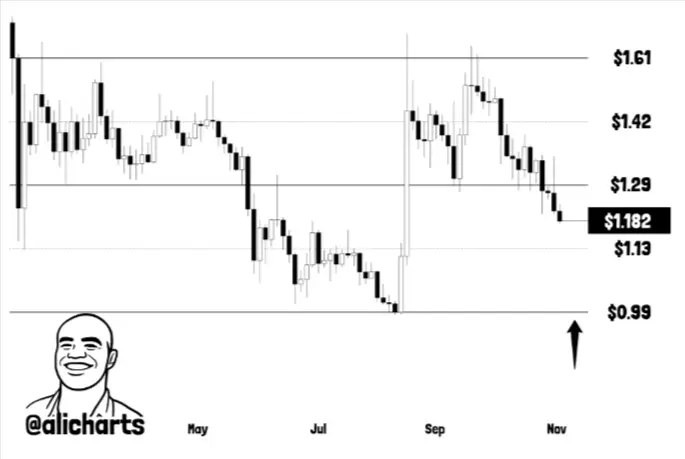
XRP/USD 3-day chart (Source: X)
Meanwhile, recent XRP market analysis identified support between $1.04 and $1.16. The same report recorded approximately $529,500 in net XRP ETF outflows between November 2 and 6. Weak ETF demand adds another challenge for buyers attempting to reverse the decline.
However, whale accumulation suggests some large holders have continued increasing their positions at lower prices. Institutional investment products remain part of the wider XRP market picture, with GraniteShares delaying its leveraged XRP ETFs until November 30.
Martinez has separately identified $0.99 as the next potential support area following XRP’s breakdown below its trading channel midpoint. A further decline toward that boundary would place additional pressure on buyers attempting to defend the $1 level.
The post Ripple Partners With Stripe-Owned Privy: Can XRP Price Reclaim $2? appeared first on Blockonomi.
TLDR:
- Trump linked the November 5 stock market sell-off to Democrats’ victories in the USA midterm election results.
- U.S. stocks suffered steep losses on November 5, with the Nasdaq falling 5.52% amid a broader AI stock sell-off.
- Trump described the election result as a giant step back in history after the U.S. stock market’s sharp decline.
- Technology shares led Wall Street’s losses as investors questioned AI spending and the data center expansion plans.
U.S. President Donald Trump blamed the midterm election results for a $3 trillion U.S. stock market loss on November 5. His latest comments followed a sharp sell-off in U.S. stocks and cryptocurrencies, which erased the previous session’s gains.
In a November 8 post shared by The Kobeissi Letter, Trump described the election outcome as a “giant step back in history.” The president linked the market decline to Democratic victories, although concerns over artificial intelligence investments contributed to the selling.
The S&P 500 lost approximately $3 trillion in market value during Thursday’s session, while major technology companies recorded heavy losses. The Nasdaq Composite entered correction territory, and investors reassessed the outlook for AI infrastructure spending.
Trump Blames Democrats for $3 Trillion Stock Market Loss
Trump’s latest remarks followed his November 5 Truth Social statement, where he criticized the market’s reaction to the elections. He argued that Democratic victories had reversed progress made during his administration and affected Americans’ retirement savings.
“The Stock Market suffered one of the Worst Days in History based on the results of the Election,” Trump wrote. He also blamed Democrats for the decline, while maintaining that the market could recover.
However, the sell-off followed a rally on November 4, when investors initially welcomed the election results. The S&P 500 gained 1.58%, while the Dow Jones Industrial Average advanced approximately 3% during that session.
The reversal came as investors assessed how the new congressional balance could affect corporate spending and technology regulations. Democrats secured control of Congress, while several gubernatorial victories raised questions about future data center approvals.
Some newly elected governors have proposed restrictions on large AI projects, particularly those requiring substantial electricity supplies. The proposals have raised concerns over planned data center expansion across several states.
However, proposed restrictions have not automatically become law, and governors face different approval requirements across states. Markets have also reacted to company valuations, technology spending, and expectations for future earnings.
Nasdaq Drops 5.52% as AI Stocks Lead Wall Street Decline
The Nasdaq Composite dropped 5.52% on November 5, closing at 24,315 after its steepest daily decline in 19 months. Meanwhile, the S&P 500 fell 4.36% to 7,353.73, while the Dow declined 3.44% to 51,523.06.
Technology companies recorded some of the largest losses, with Nvidia shares falling approximately 9.3% during Thursday’s trading. Advanced Micro Devices and Micron Technology each dropped around 17%, while the Philadelphia Semiconductor Index declined approximately 12%.
The decline reflected renewed concerns about AI infrastructure spending and the financial returns expected from major technology investments. Investors also examined the funding required to construct data centers and secure electricity supplies.
The technology stock sell-off reached companies involved in chips, cloud computing, and data center development. However, several semiconductor stocks recovered during Friday’s trading as buyers returned after the previous session’s declines.
The broader market downturn extended into other sectors, with all 11 S&P 500 sectors closing lower on Thursday. The losses followed growing concern about future regulation and the pace of corporate investment.
Meanwhile, the incoming Democratic majority is preparing greater congressional oversight of Trump’s business interests and technology companies. The election results have prompted plans for investigations into Trump-linked crypto businesses, although the new Congress will not convene until January.
The post Donald Trump Blames Midterm Results for $3 Trillion Wall Street Loss appeared first on Blockonomi.
TLDR:
- A potential Strategy Bitcoin buy remains unconfirmed because Saylor’s chart post disclosed neither a purchase size nor a new holdings total.
- Strategy last acquired 811 BTC for $65.5 million, lifting its reported Bitcoin holdings to 849,327 coins as of November 1.
- Bitcoin near $75,900 traded below Strategy’s latest $80,846 purchase price, yet remained just above its $75,451 aggregate basis.
- The November 2 acquisition used MSTR stock-sale proceeds, while cash funded a separate $208.2 million repurchase of STRC shares.
Michael Saylor revived attention around a possible Strategy Bitcoin buy after sharing the company’s familiar accumulation chart on X Sunday. He captioned the post, “Connecting the dots,” but gave no purchase amount. He provided no updated holdings. Bitcoin traded near $75,900 as it struggled to regain $76,000.
That level sat slightly above Strategy’s overall average cost of $75,451 per coin. The message followed the company’s latest disclosed BTC purchase and a separate STRC repurchase. Investors will watch the next official filing.
Saylor has repeatedly posted the chart before weekly disclosures. Still, the latest message does not confirm that Strategy bought Bitcoin during the past week. It renewed attention on its acquisition pattern. A purchase report would normally identify the coin amount, average price, funding source, and reporting period.
Strategy Bitcoin Buy Signal Follows Familiar Saylor Pattern
The Strategy Bitcoin buy idea gained attention because Saylor’s tracker often precedes company updates. Strategy typically releases its treasury activity through a Form 8-K. Those reports give investors a formal record of purchases and financing decisions. They also separate confirmed transactions from signals shared on social media.
The company’s last confirmed acquisition covered October 26 through November 1. Strategy bought 811 BTC for $65.5 million. It paid an average of $80,846 per Bitcoin, including fees and expenses. The purchase lifted its reported holdings to 849,327 BTC. Strategy reported an aggregate purchase price of $64.08 billion for the entire position.
For now, a fresh acquisition remains an expectation, not a confirmed event. Sunday’s post did not state whether any coins changed hands. It also did not say whether the company raised new capital. That distinction matters while the Bitcoin price remains below the latest purchase price. Market participants need an official disclosure before treating the chart as evidence of a completed acquisition.
Michael Saylor has built a public narrative around steady Bitcoin accumulation. The tracker shows prior additions across market cycles. Yet the format alone offers limited detail about timing and size. A new filing would clarify whether Strategy extended its treasury during the latest reporting week.
Funding Behind the Last Strategy Bitcoin Buy and STRC Deal
The November 2 filing showed how Strategy financed its latest confirmed purchase. The company sold 1,178,552 MSTR common shares through its at-the-market program. Those sales generated $164 million in net proceeds after commissions. Strategy allocated $65.5 million to Bitcoin and added $98.5 million to its USD Cash balance.
The financing structure matters because it separates the BTC acquisition from the STRC transaction. Strategy did not sell preferred shares during that reporting period. Instead, it used existing USD Cash to repurchase 2,092,035 STRC shares. The repurchases totaled $208.2 million. STRC closed Friday at $99.84, just below its $100 stated amount.
The last Strategy Bitcoin buy arrived at a higher level than the current Bitcoin price. BTC traded near $75,900 on Sunday, while the company paid $80,846 per coin in its most recent purchase. However, the spot price remained roughly $449 above Strategy’s blended acquisition cost. That comparison remains important for investors assessing its treasury exposure.
Strategy held about $4.79 billion in its designated dollar reserve on November 1. It also reported $132.7 million in separate cash holdings. Those balances, along with future common-stock sales, could shape its purchasing capacity. Any new Strategy Bitcoin buy would also show whether management changed its financing mix after the STRC repurchase.
The company’s future disclosure may reveal another BTC addition, no purchase, or a different capital move. Michael Saylor’s post did not resolve those possibilities. It only placed the next reporting window under scrutiny as Bitcoin traded near Strategy’s average cost.
The post Strategy Bitcoin Buy Watch Builds as Saylor Hints at Purchase appeared first on Blockonomi.
TLDR:
- Vitalik Buterin says ETH’s store-of-value case rests on decentralization, security, and long-term stability.
- Buterin backs retaining EIP-1559 even if ETH fee burns remain under 10% of the break-even level indefinitely.
- He says 2021–2023 fee burns were driven largely by crypto speculation, making them a weak ETH valuation floor.
- Buterin warns a fee-focused model could demand 700,000 ETH yearly for R&D and interventionist governance.
Ethereum co-founder Vitalik Buterin has argued that ETH should be valued primarily as a store of value rather than through the amount of transaction fees the network destroys. In a November 8 series of posts on X, Buterin outlined three reasons for shifting the focus.
He questioned whether fee burns reliably support ETH’s valuation, warned that maximizing fee revenue could undermine decentralization, and said Ethereum’s security offers a stronger foundation for long-term holders.
However, Buterin stressed that Ethereum should retain EIP-1559, which burns the base fee paid on transactions. He added that holders should not be concerned even if burns remain below 10% of the break-even level indefinitely.
Buterin Questions Whether Ethereum Fee Burns Support ETH Value
Buterin challenged the assumption that annual fee burns establish a dependable valuation floor. Under a simplified discounted-cash-flow approach, burned fees can represent economic value accruing to holders, but that calculation depends on sustainable demand.
He argued that exceptionally high burns during 2021–2023 largely came from activity within crypto, including speculative trading and digital collectibles. If ETH lost 90% of its value, he reasoned, much of the spending power behind those fees could decline alongside it.
Consequently, the apparent valuation floor would weaken during market downturns, precisely when investors would want protection. Although tokenized real-world assets could generate demand from outside crypto, Buterin said mature businesses were unlikely to recreate speculative peaks that once produced roughly $180 million in burns in a single day.
Higher Ethereum Fees Could Threaten Decentralization
Buterin also examined what optimizing Ethereum for fee-based valuation would require. Supporting a hypothetical market capitalization of roughly $270 billion through such a model, he argued, could push Ethereum toward the operating structure of a large corporation.
He estimated that a revenue-driven strategy might require approximately 700,000 ETH annually in protocol-funded research and development. Maintaining that system could also require more interventionist governance over spending and development priorities, creating tensions with Ethereum’s decentralization and resistance to capture.
Higher gas fees would make Ethereum more expensive to use. Buterin warned that this could exclude people who most need private, secure, and censorship-resistant transactions. Ethereum’s EIP-1559 specification confirms that the network burns transaction base fees, while validators receive priority fees. The mechanism reduces circulating supply but does not guarantee that ETH becomes deflationary.
ETH Store-of-Value Case Centers on Security and CROPS
Instead, Buterin connected ETH’s store-of-value potential to Ethereum’s CROPS principles: censorship and capture resistance, open-source development, privacy, and security. The Ethereum Foundation formally established censorship resistance, open source, privacy, and security as central priorities in its March 2026 mandate.
For holders, Buterin said the priority is preserving assets reliably over time. That requires conservative security decisions, greater stability in the core protocol, reduced political intervention, and secure private transfers with limited dependence on intermediaries.
He added that holding ETH becomes more useful when assets remain directly on Ethereum’s base layer and can be exchanged without trusted middlemen or used as collateral.
Buterin also connected the argument to potential disruption from artificial intelligence. As technologies and institutions change, he suggested, dependable decentralized infrastructure could become increasingly valuable to people seeking long-term asset protection.
The post Vitalik Buterin Backs ETH as a Store of Value Over Fee Burning in the AI Era appeared first on Blockonomi.
CryptoPotato
During the first full week after the major Binance hack, which coincided with the US midterm elections, the spot Bitcoin ETFs recorded their largest net outflows since late June.
Meanwhile, their Ethereum counterparts continue to see red-only, as their negative weekly streak has been extended to six in a row.
BTC ETFs Bleed $1.28B
As CryptoPotato reported last weekend, the last trading day of October turned the entire month around. With over $640 million being withdrawn from the Bitcoin ETFs at the time, a major outflow that followed the aforementioned Binance hack, the funds closed the month with $515 million in the red. This was the first such instance since June, when the financial products bled out $4.51 billion.
As the actual impact of the hack unraveled, investors pulled out another $400 million on November 2 (Monday), and $115.56 million on Tuesday (midterm election day). The bulls returned on Wednesday, pouring $74.57 million into the funds, which helped drive the underlying asset’s major surge at the time to $81,000.
However, that rally was short-lived, and so were the net inflows. Investors changed their tune on Thursday and Friday, withdrawing another $430 million and $412 million, respectively. Expectedly, BTC’s price tumbled hard in line with these outflows, dumping to a seven-week low of under $75,000 on Friday.
Ultimately, the week ended with net outflows of $1.28 billion, the highest since the last full week of June, when the number was close to $1.8 billion.

6 In a Row
The leading altcoin plunged by double digits in October, and the ETF outflows were among the major reasons. As reported last weekend, October’s withdrawals hit an all-time high, with $1.61 billion leaving the funds. There were only three green days throughout the entire month, each with less than $25 million.
This negative streak for the Ethereum ETFs has extended. Aside from November 4, which saw net inflows of $53 million, the other four trading days were deep in the red — each saw more net outflows than the Wednesday inflows. $139.80 million left the funds on Monday, followed by $85.35 million on Tuesday, $100 million on Thursday, and another $93.19 million on Friday.
The week ended with just over $365 million in net outflows, which makes it the sixth consecutive week in the red. The cumulative total net inflows have declined from $13.94 billion at the end of September to $11.92 billion as of November 6. Meanwhile, ETH’s price has tanked hard to under $2,250, posting a 10% monthly drop.

The post Bitcoin ETF Outflows Hit 4-Month High as Ethereum Funds Stay in the Red appeared first on CryptoPotato.
XRP’s rebound has given way to another sharp selloff, with the price falling toward $1.16 after losing a key support zone. Sellers retain control across both timeframes, while the next major demand area is approaching below.
Ripple Price Analysis: The Daily Chart
The daily chart shows a clear continuation of XRP’s bearish structure. The recent recovery into the $1.30–$1.34 supply zone was aggressively rejected, triggering a breakdown beneath the $1.24–$1.28 support area. Several consecutive bearish candles have since carried the price toward $1.16, with little sustained buying response.
The next significant demand zone sits around $1.09–$1.14, corresponding to the base of August’s strong advance. This area could attract buyers and produce a relief bounce, but a reversal would require stronger follow-through than the recent candles have shown. A sustained breakdown below $1.09 would expose the broader $0.99–$1.03 support zone around the August lows.
On the upside, the broken $1.24–$1.28 region is now an important potential resistance area. Recovering it would ease immediate downside pressure, although the $1.30–$1.34 supply zone remains the more significant barrier to a broader structural improvement. Until these levels are reclaimed, rebounds remain vulnerable to renewed selling.
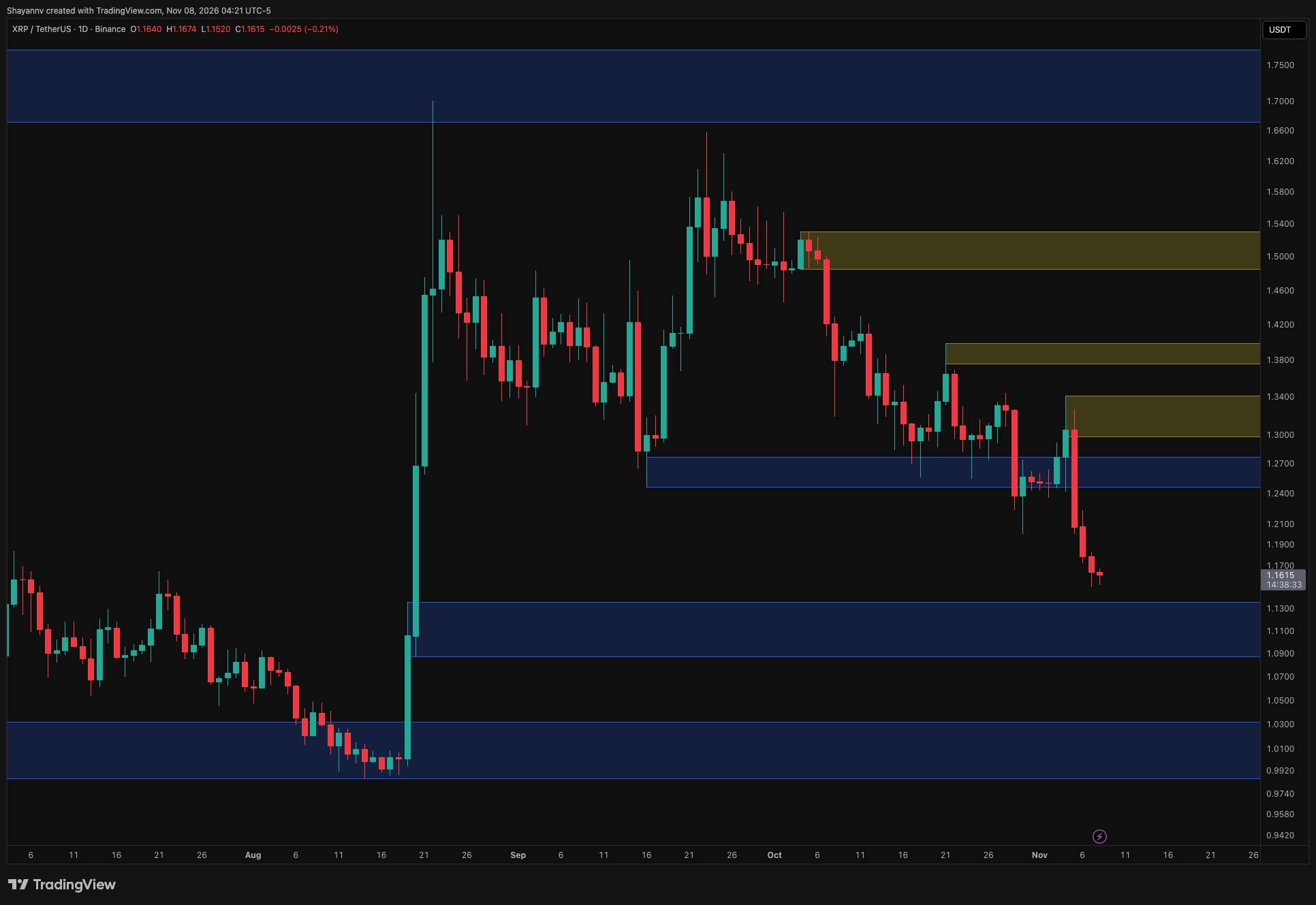
XRP/USDT 4-Hour Chart
The four-hour chart highlights a failed breakout above the descending channel’s upper boundary. Ripple briefly advanced into the $1.30–$1.34 supply zone before reversing sharply, falling back inside the channel and breaking through the consolidation base near $1.25.
The subsequent sequence of lower highs and lower lows confirms strong bearish momentum. Price is now consolidating narrowly around $1.16, but this pause has yet to produce a meaningful bullish structure shift. The nearby $1.15 low is the immediate downside reference, followed by the $1.09–$1.14 demand zone. The descending channel’s lower boundary currently passes through approximately $1.12, adding technical confluence within that area.
For a recovery to gain traction, Ripple first needs to overcome the recent lower highs around $1.18–$1.20. Sustained acceptance above this region could support a rebound toward $1.24–$1.28, where former support overlaps with the descending channel’s upper boundary. Until then, the limited response near the lows keeps another move toward the lower demand zone in focus.

The post Ripple Price Analysis: Could XRP Crash to $1.00 Next Week as Sellers Remain in Control? appeared first on CryptoPotato.
Bitcoin’s recovery toward $81K has been sharply rejected, sending the price back to the lower edge of its daily demand zone. With Bitcoin consolidating near $75.9K, buyers face another important test while futures activity shows signs of heating up.
Bitcoin Price Analysis: The Daily Chart
The daily chart shows Bitcoin remaining below the ascending channel’s midpoint after an unsuccessful attempt to reclaim it. The latest rebound toward $81K ended with a strong bearish candle, reinforcing the sequence of lower highs that has developed since the September and October peaks.
The asset is now hovering near the bottom of the $75K–$78K demand zone. Although this area has attracted buyers on several occasions, the latest reaction has been limited, with small candles forming following the aggressive selloff. This indicates temporary stabilization, but there is little evidence of a convincing reversal so far.
A sustained daily close below $75K would weaken this demand zone and could extend the correction toward the ascending channel’s lower boundary, currently around $72K–$73K. Alternatively, buyers need to recover $78K to improve the immediate outlook. A subsequent reclaim of the $80K–$81K region and the broken channel midpoint would provide stronger evidence that the correction is losing momentum.
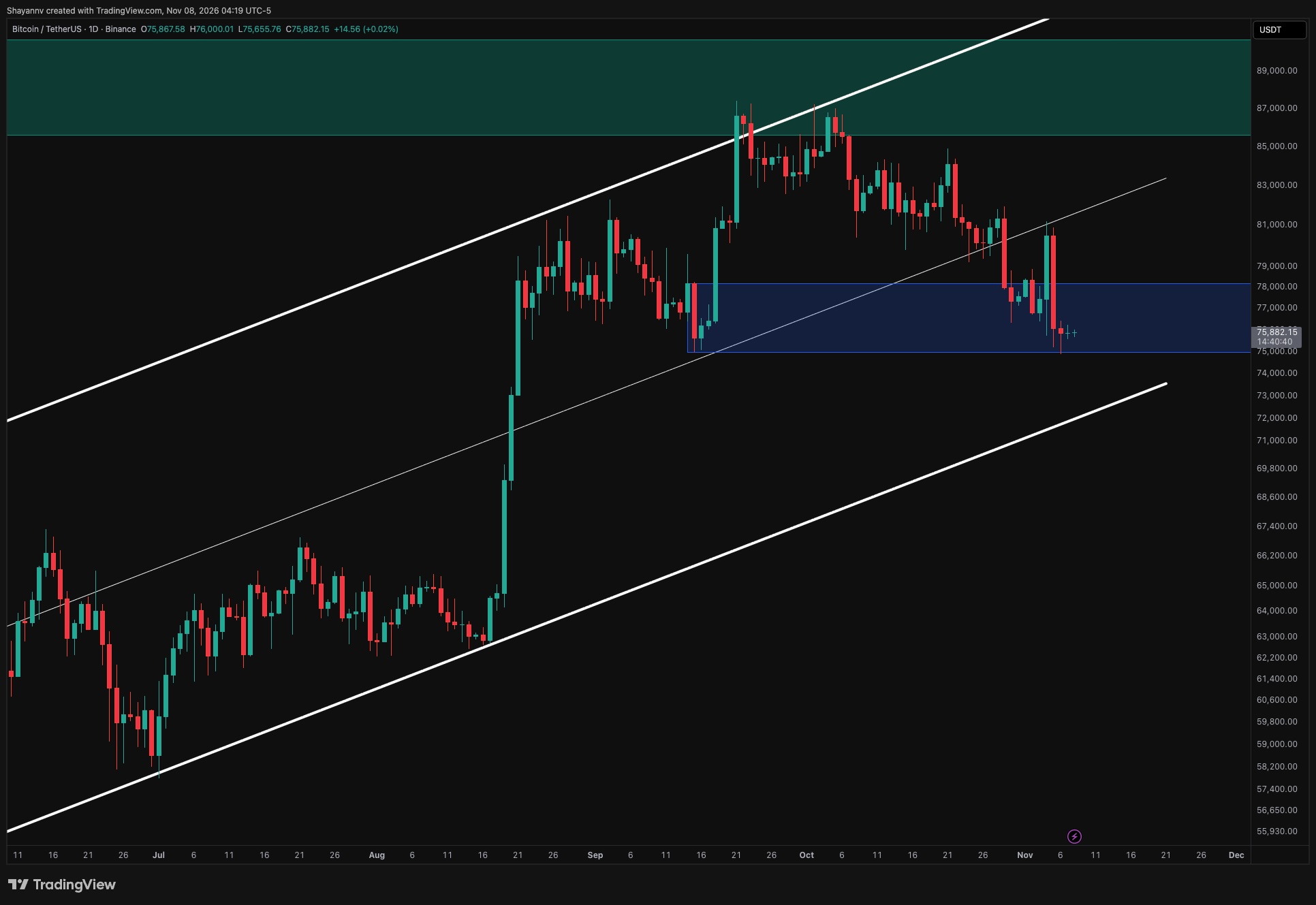
BTC/USDT 4-Hour Chart
On the four-hour timeframe, Bitcoin is trading within a descending channel. The recent rally reached the channel’s upper boundary inside the $79.8K–$82K supply zone before reversing sharply. This rejection confirms that sellers continue to defend both horizontal supply and descending trendline resistance.
The subsequent decline carried BTC into the $74.9K–$76.3K demand zone, where it is now consolidating near the channel’s lower boundary. This confluence could support a temporary rebound, but the narrow consolidation and lack of strong bullish follow-through leave the short-term structure fragile.
A sustained recovery above $76.3K would be the first sign of relief, potentially allowing a move toward the recent consolidation area around $77K–$78.5K. However, a broader reversal would require Bitcoin to overcome the descending channel’s upper boundary and reclaim the $79.8K–$82K supply zone.
Conversely, acceptance below $74.9K would signal that buyers have failed to defend the September demand area. A simultaneous breakdown beneath the descending channel could accelerate the decline toward the lower daily support region.

Sentiment Analysis
The Futures Volume Bubble Map classifies futures volume conditions into cooling, neutral, heating, and overheating regimes. The latest observations show heating conditions around $75.8K–$76K, following another heating reading near the failed recovery around $80.5K.
The appearance of heating signals during the latest decline suggests increased futures participation as Bitcoin approaches support. However, volume alone does not establish whether this activity represents fresh short positions, defensive hedging, or buyers attempting to absorb the selloff. The latest bubbles also remain in the heating category rather than overheating.
Combined with the bearish price structure, this activity makes the current demand zone particularly important. Rising participation alongside a confirmed support breakdown could accompany further downside volatility. If buyers instead reclaim $76.3K and build sustained upward momentum, the same increase in activity could mark a contested support defense. For now, the bubble map highlights an active decision area without confirming capitulation or a bottom.

The post BTC Price Analysis: Key Support Levels to Watch as Bitcoin Enters a Crucial Week appeared first on CryptoPotato.
Alongside the rest of the market, shares of JPMorgan Chase tanked at the end of the previous week, but there’s more to the story. JPM’s decline also came after reports emerged that Senate Democrats are preparing a fresh investigation into the banking behemoth’s relationship with convicted sex offender Jeffrey Epstein.
Although there’s no real connection with Bitcoin, we decided to still cover this and highlight the awkwardness, as JPM’s CEO, Jamie Dimon, has spent years bashing the crypto industry.
JPMorgan Faces New Epstein Scrutiny
CNBC reported after the Blue-nami in the US midterms that Democratic staff on the Senate Finance Committee plan to examine how senior JPM executives handled Epstein as they take control of Congress early next year. Mary Erdoes, CEO of the bank’s Asset & Wealth Management Division, is expected to be among the high-profile names in the investigations.
“The US government had damning information about Epstein’s crimes that it failed to share with us or other banks. We regret any association we had with him, but we did not help him commit his crimes,” commented a spokesperson from the bank.
The market reaction was immediate as JPM shares tanked by over 4% to under $340 on Thursday. The sell-off essentially erased the stock’s post-midterm rally.
Although the bank continues to deny any wrongdoing, it previously agreed to pay $365 million in settlements related to Epstein.
The Irony
We admit there’s no official confirmation that JPM has done anything wrong, and we don’t expect it to come to light if it did, because it’s one of the world’s largest banks. And we know how banks are treated in almost any situation (recall the 2008 banking crisis and the subsequent lack of any real consequences). Nevertheless, the irony is still worth pointing out.
JPM’s long-serving CEO, Jamie Dimon, has been bashing BTC for years. He has called it a “fraud,” “worthless,” a “pet rock,” and a “decentralized Ponzi scheme.” All bad and, in some cases, illegal names. He also advised investors to stay away from crypto and told lawmakers that if he were running the US government, he would “close it down.”
The hypocrisy is glaring when we look at what the bank has done lately. It now lets institutional clients use BTC and ETH as collateral; it supports crypto-related services; it participated in BlackRock’s spot Bitcoin ETF infrastructure; and it recently projected that bitcoin could outperform US large-cap stocks and gold over the next 10-15 years.
But there’s another contrast. Bitcoin has no CEO, board of directors, wealth-management division, or customer relationship with Jeffrey Epstein – or anyone else, for that matter. The protocol itself cannot make a questionable client decision, hide internal correspondence, or become subject to congressional scrutiny over corporate conduct.
People or companies using BTC can still appear in investigations and criminal records, but reputational and governance risks belong to institutions and individuals, not the decentralized Bitcoin network itself.
The post JPMorgan Stock Slides on Epstein Probe Fears: Bitcoin Has No CEO to Drag Into the Scandal appeared first on CryptoPotato.
The Nasdaq-listed company built around an actively managed XRP treasury has released a detailed report on the XRP Ledger’s push into tokenized finance.
The data suggests that while RLUSD has become an increasingly important dollar-denominated settlement asset, its growth is not necessarily coming at the expense of XRP.
RLUSD Growth Runs Through XRP
CryptoPotato reported yesterday on the heated debate online between some XRP Army members, who claim that Ripple’s leadership has not taken any steps to support the cross-border token’s price valuation. Evernorth’s report also takes a side but tries to explore the question from a different angle.
It said that approximately $400 billion in real-world assets and nearly $300 billion in dollar stablecoins have now been tokenized globally, but only around $39 billion can currently be traded, settled, or pledged directly on the chains where they reside. The thesis is that the next phase of tokenization will be less about simply recording assets on-chain and more about making those assets usable.
XRPL has made substantial progress on that front, as tokenized value on the network has grown from $1.76 billion in February to over $5 billion as of October 20. This puts the Ledger at sixth place among all networks and fourth among public blockchains, said Evernorth. Meanwhile, the number of accounts issuing new Multi-Purpose Tokens rose from four in January to 24 in October, and 98 MPTs were issued in a record month.
Here’s where things get more interesting for the XRP Army. In 2024, only 10.5% of XRP trading on XRPL’s native DEX involved stablecoins or fiat-backed tokens. That figure jumped to 50% in 2025 and has reached 86% so far in 2026. Moreover, Evernorth said 92% of the $1.65 billion worth of RLUSD swapped on XRPL’s native exchange this year traded against XRP.
“The dollar isn’t taking liquidity away from XRP. It trades against XRP,” the report argued.
Wall Street Experiment Grows
Evernorth began trading on Nasdaq under the XRPN ticker on October 12 after completing its merger with Armada Acquisition Corp. II. It entered the public market with approximately 473 million XRP and roughly $300 million in gross cash proceeds.
The company later selected Ripple, Coinbase, Kraken, and BitGo to help deploy that treasury through institutional strategies rather than simply holding the tokens passively. More recently, it arranged an equity facility with Cantor Fitzgerald that could raise approximately $80 million, with additional XRP purchases listed among the possible uses of the capital.
The post XRP on Wall Street: Evernorth Reveals a Huge RLUSD-XRP Link appeared first on CryptoPotato.


